Article

Temporal Dynamics and Recovery Patterns of Reef Benthic Communities in the Maldives Following a Mass Global Bleaching Event


by
Eva Germani
1,2,*,
Valentina Asnaghi
1,3 and
Monica Montefalcone
1,2,3
1
DiSTAV, Department of Earth, Environment and Life Sciences, University of Genoa, Corso Europa 26, 16132 Genoa, Italy
2
CoNISMa (Consorzio Nazionale Interuniversitario per le Scienze del Mare), Piazzale Flaminio 9, 00197 Rome, Italy
3
NBFC (National Biodiversity Future Center), Piazza Marina 61, 90133 Palermo, Italy
*
Author to whom correspondence should be addressed.
J. Mar. Sci. Eng. 2025, 13(12), 2265; https://doi.org/10.3390/jmse13122265
Submission received: 31 October 2025 / Revised: 24 November 2025 / Accepted: 26 November 2025 / Published: 28 November 2025

Abstract

Coral reefs are crucial ecosystems for marine biodiversity but are increasingly threatened by anthropogenic pressures and climate anomalies. The 2016 global bleaching event resulted in widespread coral mortality, altering reef structure and benthic communities. Here, we examine the evolution of Maldivian reefs from 2015 to 2023 using long-term monitoring data to assess post-disturbance dynamics. Analyses of 26 benthic descriptors revealed severe impacts from thermal stress, with heterogeneous recovery patterns. Reef-building capacity, which reflects the reef’s accretion potential and is mainly sustained by primary (e.g., Acropora branching corals) and secondary constructors (e.g., Tridacna spp.), rebounded substantially, while binders (e.g., coralline algae) and bafflers (e.g., erect sponges) remained depleted. Among growth forms, fast-growing branching and digitate corals, despite substantial declines, drove rapid recovery. Massive corals were less affected and continued growing, while encrusting corals declined steadily over the period. Post-bleaching community composition shifted markedly toward increased abiotic cover and reduced coral dominance, with partial reversion by 2023. Despite the 2016 collapse in constructional capacity, most reefs exhibited notable recovery within seven years. These findings underscore the moderate yet promising resilience of Maldivian reefs, exceeding previous bleaching events, and emphasize the importance of long-term monitoring to understand ecosystem responses under accelerating climate stress.

1. Introduction

Coral reefs are recognized as the most biologically diverse and ecologically complex marine ecosystems on the planet [1]. These highly structured benthic environments are characterized by exceptional biodiversity, intricate trophic interactions, and high primary and secondary productivity [2]. Their ecological significance extends beyond biodiversity maintenance, as they provide a broad array of ecosystem services, including fisheries resources, coastal protection, and socio-economic benefits, such as tourism and cultural value [3].
Coral reefs are increasingly threatened by a range of multiple stressors, including overexploitation, habitat degradation, pollution, and the accelerating impacts of global climate change. Growing evidence indicates that anthropogenic warming is intensifying both the frequency and severity of extreme climatic events, such as unusually intense storms, hurricanes, floods, and heatwaves [4]. Marine heatwaves—defined as prolonged periods of extreme sea temperatures—are becoming more frequent and intense [5,6]. Corals are increasingly exposed to acute thermal stress events, particularly those associated with the warm phase of the El Niño–Southern Oscillation (ENSO), which elevates sea temperatures, especially in the Central and Eastern Tropical Pacific Ocean [7,8]. These climatic anomalies, when coupled with strong ENSO phases, can trigger extensive coral bleaching and mass mortality [6,7,9]. Although severe or prolonged bleaching episodes often result in widespread coral mortality [9], recovery is possible following moderate bleaching through a mechanism known as the “Phoenix effect”, whereby surviving tissue gradually recolonizes adjacent skeletal surfaces, which is a process primarily observed in massive Porites coral [10].
Since the late 1990s, coral reefs worldwide have experienced four major global bleaching and mass mortality events in 1998, 2010, 2014–2016, and the last one in 2023–2024 [11,12].
While recovery can be assessed through destructive coring of massive corals [13], it is best evaluated using historical data series of coral community conditions, which can only be obtained through long-term ecological monitoring, which is essential for identifying temporal patterns in reef health and shifts in community composition [14]. Such datasets are essential for understanding ecosystem dynamics and forecasting how reefs might respond to ongoing and future climate change [14,15]. Despite their ecological significance, long-term datasets remain rare in marine research. In this context, the dataset collected in the Maldives since 1997—through consistent and uninterrupted annual scientific surveys—stands out as one of the most robust and long-lasting coral reef monitoring initiatives worldwide [16,17]. Its continuity and methodological consistency over nearly three decades make it a valuable resource for tracking ecological changes and reef conditions over time. This long-term record provides critical insight into the consequences of repeated thermal stress events occurring in the region, including mass bleaching and coral mortality [9,18], and offers a rare opportunity to explore patterns of resilience and recovery across Maldivian reef ecosystems.
Many marine organisms, both plants and animals, contribute to bioconstruction by accumulating their calcareous skeletons into durable, elevated structures. When acting as autogenic ecosystem engineers, they give rise to long-lasting formations known as bioconstructions [19]. The collaborative nature of these bioconstructors plays a key role in shaping and sustaining ecosystem architecture, thereby enhancing habitat complexity and biodiversity [20]. A comprehensive analysis of the processes driven by bioconstructors that enhance biodiversity in marine benthic ecosystems is essential [21]. A bioconstructional guild can be defined as a group of organisms that interact synergistically to create, maintain, or modify these structures. In marine environments, such guilds often include corals, molluscs, algae, and microorganisms that contribute through calcium carbonate deposition and material secretions. Within bioconstructional guilds, scleractinian corals play a central role, and their morphological diversity further enhances their ecological function. This diversity results from their remarkable phenotypic plasticity, which allows a single genotype to express a variety of morphological forms in response to environmental factors, such as light availability, wave energy, and substrate type [22]. For instance, corals in high-energy reef crest zones tend to adopt robust, compact morphologies, while those in deeper or sheltered slopes develop more delicate, arborescent or tabular forms [23]. Competition for space, particularly with other sessile organisms, also influences coral morphology through mechanisms like overgrowth and shading [24,25]. These biotic and abiotic factors jointly determine species dominance and structural composition within the reef. Coral colonies can assume various forms—massive, encrusting, tabular, digitate, or branching—each with different ecological implications. Notably, coral morphology is closely linked to stress tolerance. Massive and encrusting species, characterized by higher tissue thickness, generally show greater resistance to thermal stress and nutrient enrichment. In contrast, branching corals, though faster-growing with thin tissues, tend to be more vulnerable to environmental disturbances [26,27,28,29,30].
This study aims to assess the impacts of the third global bleaching event of 2016 on Maldivian coral reef communities, with a particular focus on their post-disturbance recovery and constructional potential. To this end, we investigate whether the bleaching event triggered significant and persistent changes in benthic cover, with particular attention given to coral growth forms and bioconstructional guilds. To quantify shifts in the reefs’ capacity to build and maintain their structural framework, we analyzed variations in the BioConstruction Potential index [9]. Additionally, we examined whether benthic community structure followed a trajectory of recovery, stability, or continued degradation in the years following the thermal anomaly.

2. Materials and Methods

The Maldives Archipelago extends over 900 km in a north–south direction, from 7°06′ N to 00°45′ S latitude, and spans approximately 130 km longitudinally, between 72°33′ E to 73°47′ E [31]. Comprising nearly 1192 coral islands, with Malé as its capital, this Indian Ocean nation hosts one of the most extensive reef systems globally [32]. The Maldives have been affected by all four major global bleaching events, 1998, 2010, 2016, and most recently in 2024 [9,17,33].
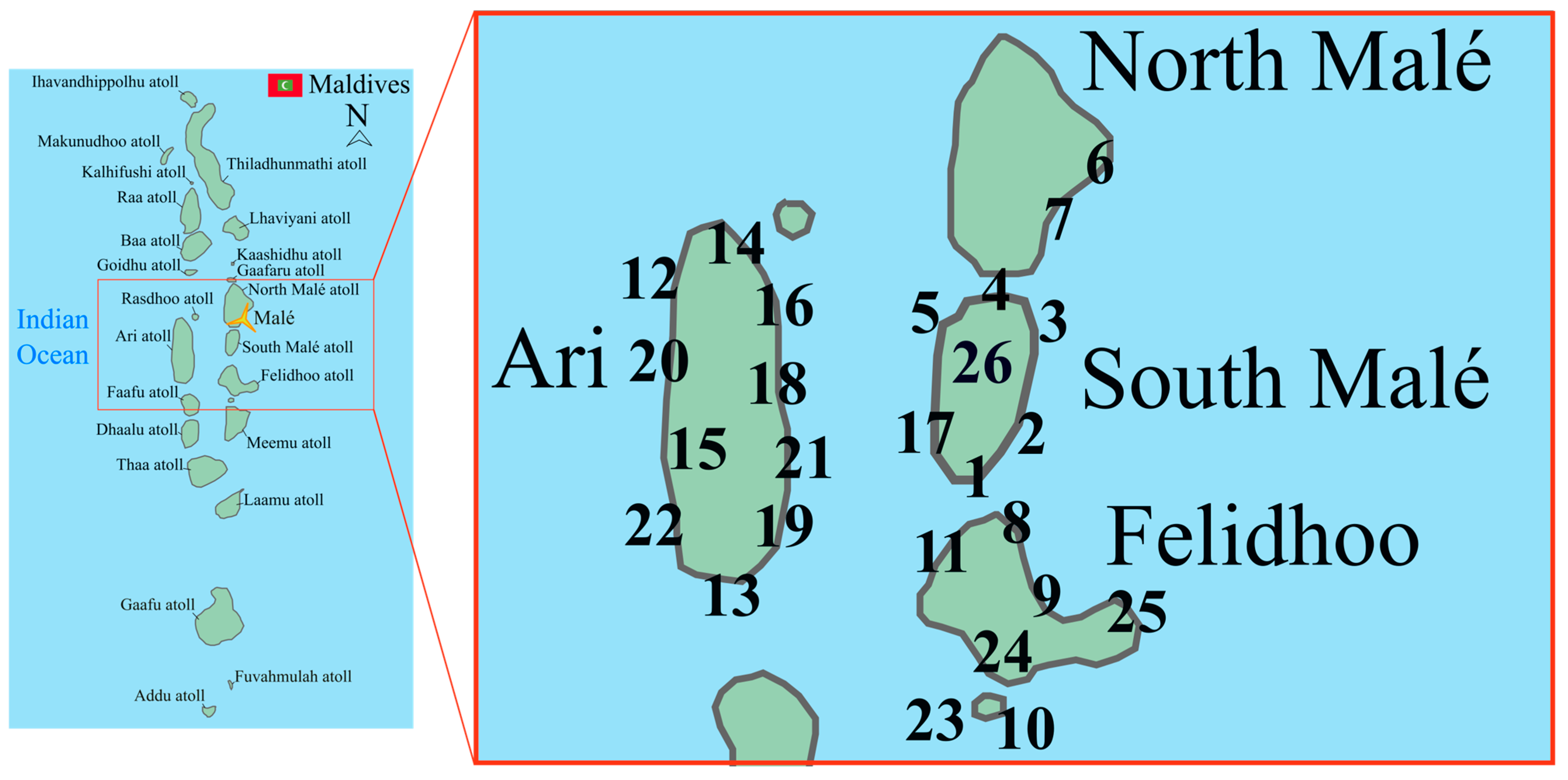
Between 1997 and 2023, annual scientific cruises were conducted during April–May across different sites in the Maldivian atolls. These surveys consistently included reefs exposed to different oceanographic conditions and levels of human pressures, with several sites revisited during periods of major climate-driven disturbances. To assess temporal changes in benthic community structure following the 2016 global bleaching event, data from three key time points were analyzed: pre-bleaching (2015), immediate post-bleaching (2016), and long-term recovery (2023). Surveys were conducted in 2015 and 2016 at six oceanic reefs and five lagoon reefs, and in 2023 at ten reefs of each type. Benthic cover data were collected through SCUBA diving on the reef flat at depths of 5 ± 1 m, using the visual census method described by [34]. Divers swam 1–2 m above the substrate, recording observations over an area of approximately 16 m2 on waterproof PVC tablets [9]. At each site and for each year, three replicate surveys were conducted to account for natural variability and improve statistical robustness. Field measurements consisted of obtaining two-dimensional visual estimates of the percent cover of each benthic category [34]. To ensure consistency across years, data collection followed a standardized protocol [17], with the same trained observers performing all surveys in 2015, 2016, and 2023. The exact location of each site was recorded using GPS, allowing precise spatial tracking and enabling long-term monitoring [9], although repeated visits to the same reef were sometimes limited by weather and sea conditions. The sampling sites, along with their atoll, code, coordinates and year of survey, are reported in Table 1. Their geographic distribution within the Maldives is illustrated in Figure 1.
To characterize the composition and structure of reef benthic communities, we calculated the mean percentage cover (±standard error) for 26 benthic descriptors (Table 2). These descriptors were then grouped in three main benthic categories: hard corals (HC), other living organisms (Oth), and abiotic components (Abt). Additionally, we grouped the descriptors into five bioconstructional guilds, following the classification proposed by [19] (see Table 2):
(1)
Primary reef builders (P): these organisms directly form the reef’s structural framework by secreting calcium carbonate. Corals such as Acropora species (with branching, digitate, and tabular morphologies), Tubastraea, Heliopora (blue coral), and Millepora (fire coral, class Hydrozoa), are major contributors, building the complex three-dimensional architecture essential for reef ecosystems [9,35].
(2)
Secondary reef builders (S): although not forming the primary structure, these organisms enhance reef stability and complexity. They include foliose corals and members of the Fungiidae family (solitary corals with distinctive, disc-like shapes), as well as bivalves like Tridacna, whose calcareous shells contribute to habitat formation and material accumulation [9,35].
(3)
Binders (Bi): these organisms stabilize and consolidate the reef by cementing sediments and debris. Key binders include encrusting corals and coralline algae, which secrete calcareous substances that act as natural cement. While binders do not create the foundational framework, they are indispensable in maintaining the structural integrity and resilience of the reef ecosystem [9,35].
(4)
Bafflers (Ba): by reducing the strength of water currents and promoting sediment deposition, bafflers create suitable conditions for the settlement and growth of other reef-building organisms. Representative taxa include Corallimorpharia, genus Palythoa, soft corals (both zooxanthellate and azooxanthellate), fleshy algae, sponges, Tunicata, fan and feather corals, and whip and wire corals. Their role in modulating hydrodynamics enhances reef resilience and biodiversity [9,35].
(5)
Abiotic elements (A): non-living components such as dead coral, coral rock, coral rubble, and sand. They contribute to structural support, sediment retention, and provide a substrate for colonization by bioconstructors [9,35].
In addition, the BioConstruction Potential (BCP) index [18] was calculated to provide a synthetic measure of the reef’s structural capacity. The index is based on the following equation:
B C P = i = 1 n s i C i %   ×   100 1
where n is the number of bioconstructional guilds, si is a coefficient representing the structural relevance of the i-th guild, and Ci% is its percentage cover.
Following the weighting scheme established in [9], the scores assigned to the BCP were: +3 for primary builders, +2 for secondary builders, +1 for binders, 0 for bafflers, and −1 for abiotic elements. These weights reflect the relative contribution of each guild to reef framework accretion: primary builders drive superstratal growth, secondary builders contribute carbonate infill, binders cement the structure, bafflers play no constructive role, and abiotic elements indicate erosional or non-accreting states [18]. The BCP theoretically ranges from 3 (in the hypothetical case with 100% cover of primary builders) to −1 (if only abiotic components are present), thus reflecting the overall structural status of reefs. Negative BCP values indicate the absence of bioconstruction, values between 0 and 1 suggest a potential for constratal growth only, while values greater than 1 are indicative of superstratal reef development [9].
We assessed temporal changes in the three main benthic categories (HC, Oth, Abt), as well as in the five bioconstructional guilds (P, S, Bi, Ba, A) across the three key time points: pre-bleaching (2015), post-bleaching (2016), and recovery phase (2023). To evaluate differences over time, statistical analyses were performed. Since the assumptions of normality and homogeneity of variances were not met, we applied a trimmed ANOVA to assess changes in the percentage cover of HC and individual coral growth form (i.e., branching, digitate, massive, and encrusting). Because of insufficient observations across the three periods, no statistical test could be performed for tabular Acropora. The trimming level for the ANOVA was set at 0.2, meaning that 20% of the most extreme values were excluded prior to analysis.
Post hoc comparisons were conducted using the mcppb20 function, which provides robust pairwise tests based on trimmed means and bootstrap confidence intervals. To explore multivariate patterns in benthic community composition across the three time points, we performed a two-dimensional Non-metric Multidimensional Scaling (NMDS) based on Bray–Curtis dissimilarity. The resulting stress value was examined to ensure the ordination was meaningful and interpretable. In addition, a Principal Component Analysis (PCA) was conducted to identify the benthic categories contributing most to temporal variation in community structure across the 2015, 2016, and 2023 surveys.
All statistical and multivariate analyses were conducted using R (version 4.3.2; R Core Team, 2023) using RStudio (version 2023.09.1+494: RStudio Team, 2023).

3. Results

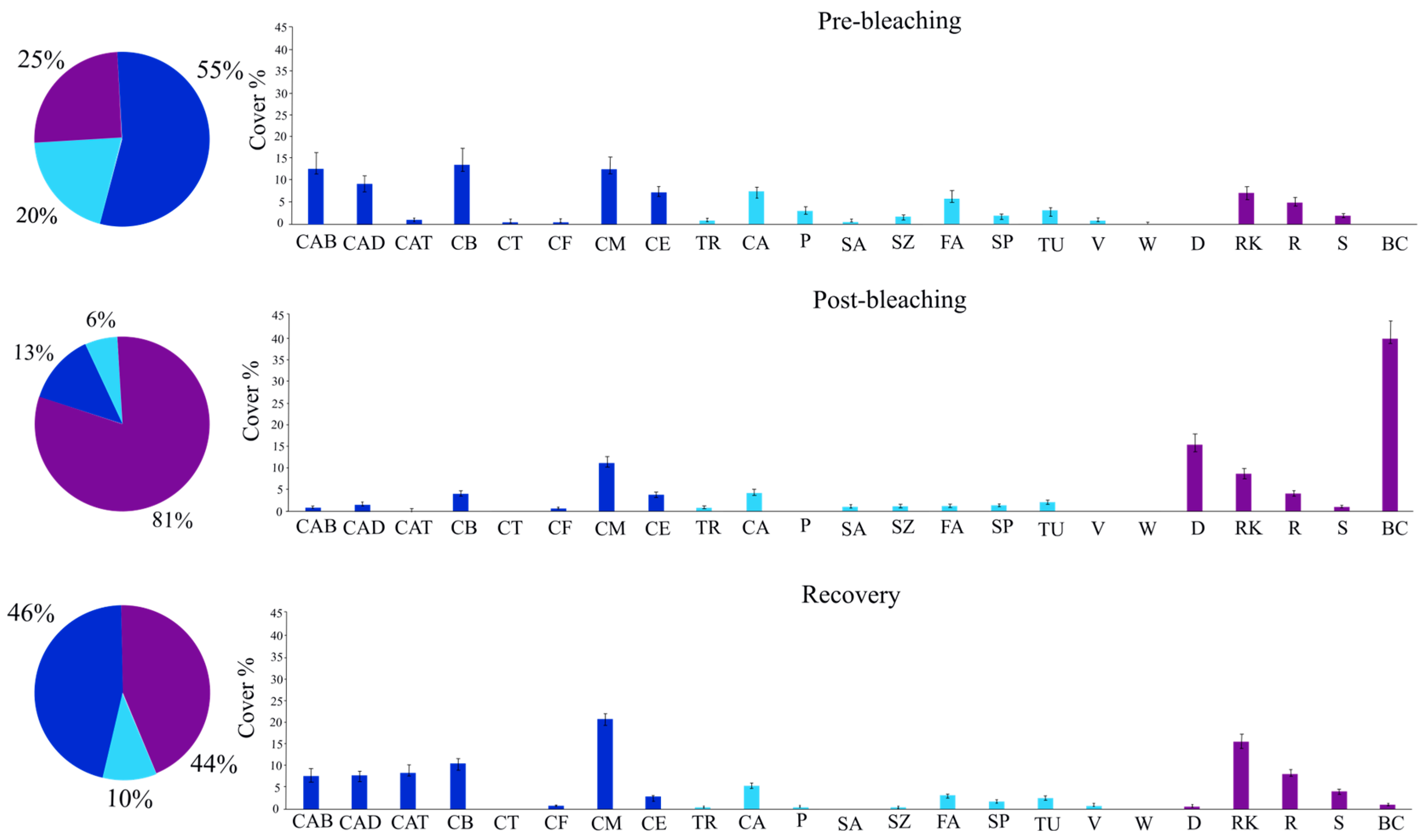
Prior to the 2016 bleaching event, the benthic community was dominated by hard corals, particularly massive, branching, digitate, and encrusting forms (Figure 2). Other living organisms, including coralline algae, fleshy algae, and tunicates, were also present, alongside abiotic components. Immediately following the bleaching event, the benthic assemblage underwent a severe compositional shift, with all hard coral categories experiencing a sharp decline. Massive corals were relatively less affected compared to other growth forms. Concurrently, abiotic components increased markedly, reflecting widespread coral mortality and substrate degradation. By 2023, during the recovery phase, evidence of regeneration was observed in several hard coral categories, particularly massive, branching, digitate, and tabular forms. Abiotic components declined, and cover of other living organisms remained relatively low, though slight increases were observed in coralline algae, fan and feathers corals, sponges, and tunicates.
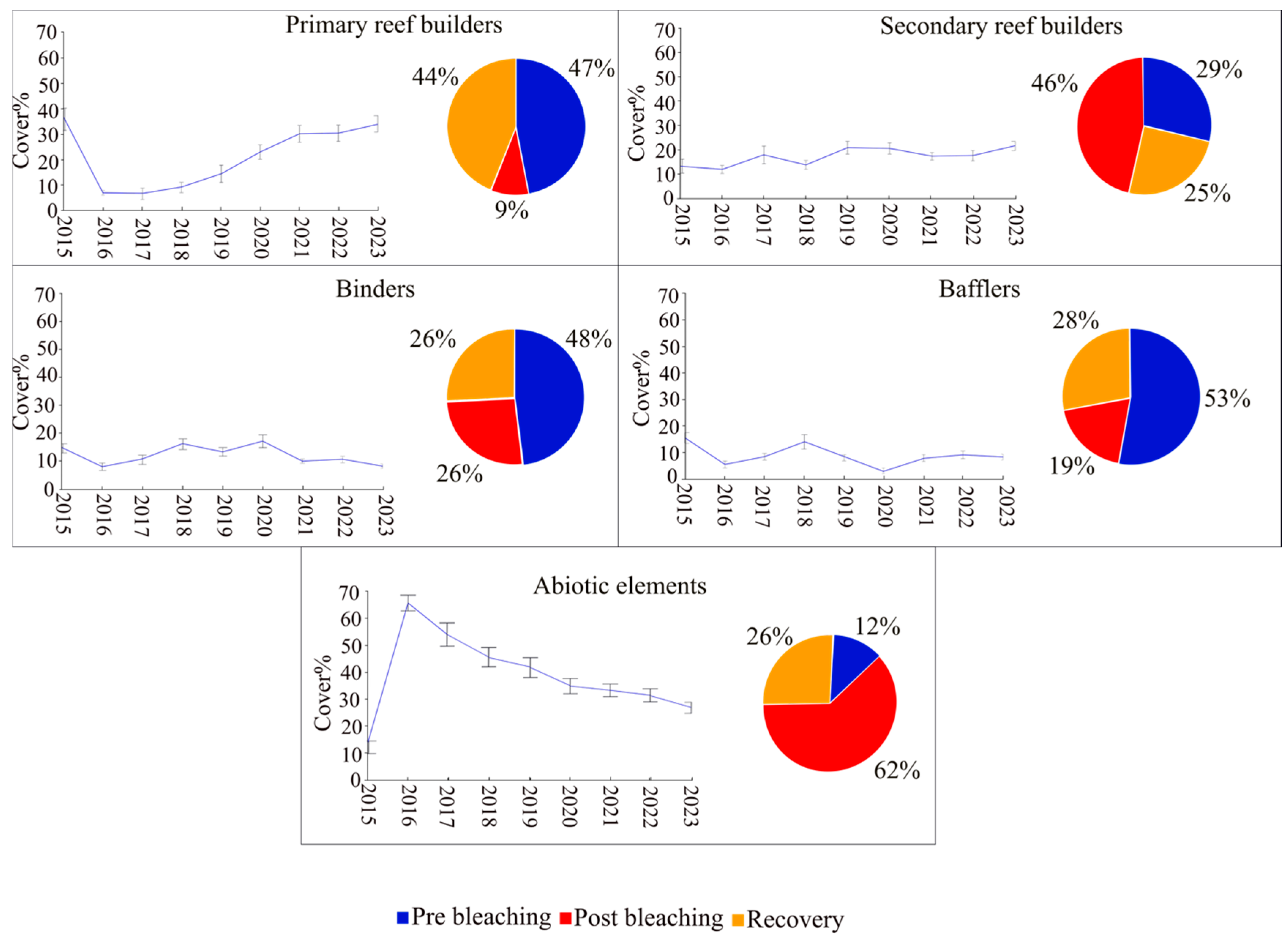
The relative cover of the five bioconstructional guilds varied significantly across the three time points (Figure 3). Primary reef builders experienced a sharp decline immediately after the bleaching event but showed substantial recovery by 2023. Secondary reef builders underwent a milder reduction initially, followed by a significant increase during the recovery phase, also surpassing pre-disturbance levels. Binders decreased after the bleaching and showed little change by 2023. Bafflers declined markedly but partially recovered over time. In contrast, abiotic components increased sharply immediately following the bleaching event, then declined as the substrate was recolonized by living organisms.
The BioConstruction Potential index (BCP) showed substantial variation across the three time points. In 2015, prior to the bleaching event, the BCP reached a value of 1.41, indicating a strong potential for superstratal reef growth. Following the 2016 bleaching, the index declined sharply to −0.16, with the negative value reflecting a collapse in the reef’s bioconstructional capacity and a shift toward net structural degradation. By 2023, the BCP had risen again to 1.25, suggesting a significant recovery and a return to conditions favorable for active reef accretion.
ANOVA results (Table 3) revealed significant differences in hard coral cover across the three time points (F = 21.05, p < 0.001), with a moderate effect size (0.19; 95% CI: 0.13–0.24). Post hoc tests indicated significant differences between 2015 and 2016, and between 2016 and 2023, while no significant difference was found between 2015 and 2023, suggesting a recovery to pre-disturbance conditions. Branching corals showed significant temporal variation (F = 16.83, p < 0.001; effect size = 0.35), with a marked decline following bleaching and a full recovery by 2023. A similar trend was observed for digitate corals (F = 15.43, p < 0.001), which exhibited a large effect size (0.54) and complete recovery in the final year. Massive corals also changed significantly over time (F = 7.34, p = 0.0013; effect size = 0.41), although no significant change occurred between 2015 and 2016; a significant increase was observed by 2023. Encrusting corals showed significant variation as well (F = 7.97, p < 0.001; effect size = 0.46), with post hoc tests revealing a gradual decline in cover from 2015 to 2023.
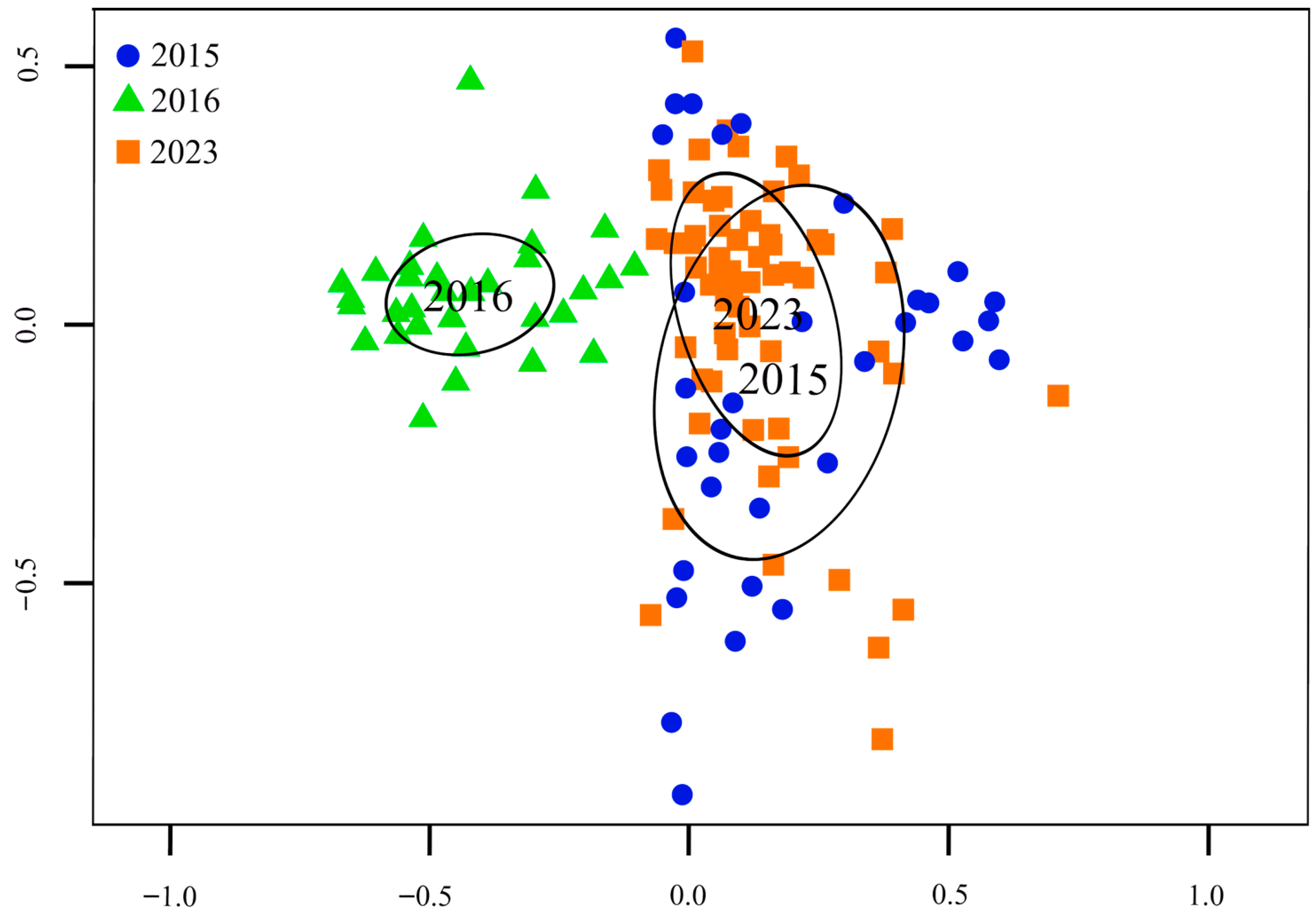
The NMDS ordination revealed clear temporal shifts in benthic community structure (Figure 4). The Shepard’s plot showed a strong correlation between ordination distances and observed dissimilarities, with a non-metric fit of R2 = 0.95 and a stress value of 0.22, indicating that the two-dimensional representation adequately captured the variation in community composition. The spatial arrangement of samples in the NMDS plot highlights distinct clustering patterns across the three time points. Assemblages from 2016 formed a separate cluster, clearly distinct from those of 2015 and 2023, reflecting the substantial impact of the bleaching event on community structure. In contrast, the partial overlap between 2015 and 2023 samples suggests a degree of recovery, with benthic communities in 2023 showing a trend toward pre-disturbance composition. NMDS thus provides a visual summary of multivariate community patterns, which, when interpreted alongside percent cover data, offers a comprehensive understanding of reef structural changes and ongoing recovery processes.
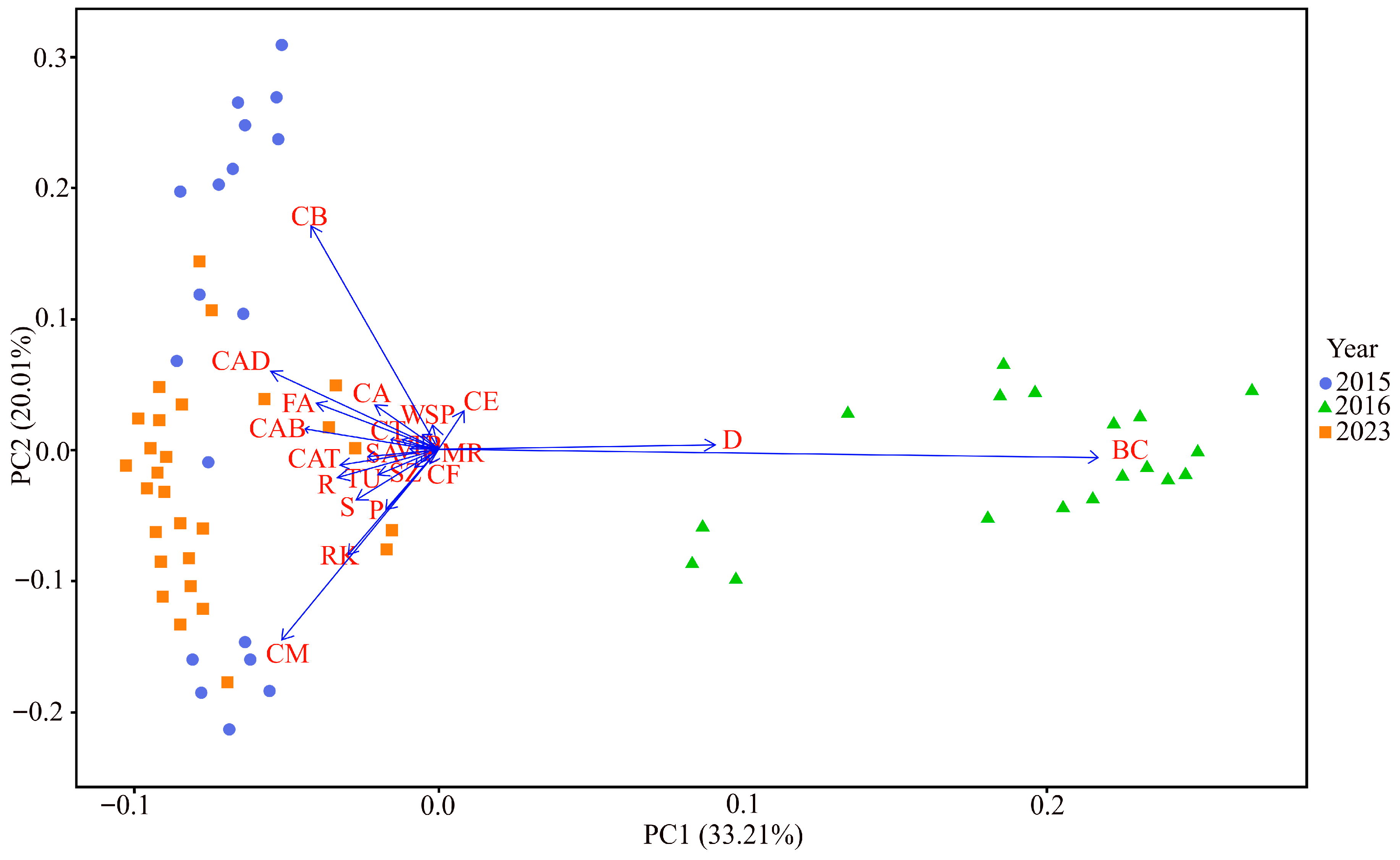
A Principal Component Analysis (PCA) was performed to identify the benthic categories contributing most to temporal variation in community structure (Figure 5). The ordination shows a clear separation between 2015 and 2016 along PC1, primarily driven by the strong influence of dead (D) and bleached corals (BC), which clearly align with the 2016 samples and indicate the dominant contribution of bleaching-induced mortality to post-disturbance variability. Conversely, the 2023 samples cluster closer to those from 2015, showing substantial spatial overlap along both axes, suggesting a partial return toward pre-disturbance community configurations. Hard coral categories, such as tabular and branching Acropora and massive corals, are associated with the 2015–2023 cluster. Overall, the PCA highlights a pronounced shift in benthic structure following the 2016 bleaching event, with community composition in 2023 trending back toward configurations characteristic of the pre-disturbance assemblages.

4. Discussion

The marked changes in benthic community composition observed across the pre-bleaching, post-bleaching, and recovery phases reflect the severe impact of the 2016 bleaching event on the Maldivian reef. Analysis of 26 benthic descriptors revealed a significant post-event increase in bleached and dead corals, consistent with patterns documented in other reef systems where climate-induced stress leads to the accumulation of non-living substrates [36,37,38,39,40,41,42,43].
These findings align with previous observations in the Maldives following the 1998 and 2010 regional bleaching events, which resulted in strategic shifts in coral community composition, latitudinal variation in Acroporidae dominance, and the increasing prevalence of stress-tolerant massive corals [44,45,46]. The sharp decline in coral cover due to mass mortality marked a shift from biologically rich to structurally degraded reef environments. This loss of complexity likely compromises biodiversity and hampers coral recruitment [37,38]. Although by 2023 there were signs of partial recovery in hard coral cover, abiotic components remained prevalent, indicating that the ecosystem had not fully recovered and that degraded substrates persisted [39]. These conditions may continue to limit coral recolonization and extend the recovery timeline typical of severely impacted reefs [37]. During the recovery phase, all coral morphotypes showed an increase in cover, suggesting some degree of resilience. However, the reduction in other living organisms following the bleaching event, coupled with their slow rebound by 2023, suggests a delayed restoration of functional diversity and associated ecosystem services [40]. Overall, the enduring presence of abiotic elements and the incomplete regeneration of benthic communities highlight the long-term challenges coral reef ecosystems face in the aftermath of large-scale disturbances [41,42].
Similar to previous observations [47], recovery after seven years was uneven, with resilience evident in some coral taxa but hindered by persistent stressors and the slower growth rates of other morphotypes [48]. These findings underscore the divergent recovery trajectories within benthic assemblages, where certain coral morphologies can recolonize more rapidly, while others, along with non-coral taxa, lag behind. The continued dominance of abiotic components suggests that reef recovery depends not only on coral regrowth but also on the complex interactions between biological communities and the altered physical environment [40].
The five bioconstructional guilds exhibited distinct recovery trajectories across the three time points. Primary builders, which dominated the reef structure before the bleaching event, experienced a sharp decline in 2016 due to their high sensitivity to thermal stress [40]. By 2023, their cover had increased, though without returning to pre-disturbance levels [49]. Secondary builders showed a more moderate decline, reflecting greater thermal tolerance [50], and by 2023 had surpassed their initial cover, suggesting strong adaptive capacity in certain taxa [51]. Binders remained relatively stable throughout the post-bleaching and recovery phases, likely continuing to contribute to reef framework stability [52]. Bafflers, on the other hand, declined significantly after the bleaching but showed partial recovery by 2023. Their re-establishment, facilitated by the availability of space following coral loss, is consistent with their ecological role in early recolonization and habitat restructuring [53,54]. Abiotic elements increased markedly after the bleaching event, reflecting severe structural degradation [39]. Although their presence decreased by 2023, they remained elevated compared to pre-bleaching levels, suggesting ongoing biological recolonization but incomplete recovery. Overall, primary and secondary builders showed the most substantial recovery, while the persistence of abiotic substrates and slower rebound of other guilds underscore the non-linear and interdependent nature of reef restoration, shaped by both biological interactions and persistent stressors [42]. Notably, the 2016 bleaching event not only caused a sharp decline of key primary builders but also induced shifts in size–frequency distributions across all coral taxa, reflecting altered population structure and demographic dynamics [55].
The trend in the Bioconstruction Potential (BCP) index further supports these observations. Following the bleaching, Maldivian reefs lost their superstratal growth capacity, a key indicator of active three-dimensional accretion [9]. In 2016, the absence of coral-driven bioconstruction led to net degradation. By 2023, the BCP had risen again to values indicative of resumed superstratal growth, suggesting that reef framework rebuilding was underway at a considerable pace. This rapid recovery implies that the benthic assemblages responsible for accretion, particularly branching corals, recovered more quickly than typically observed in other Indo-Pacific reefs, possibly reflecting the resilience of local primary builder taxa [19].
Among coral growth forms, branching and digitate corals, which suffered significant losses in 2016, showed rapid and complete recovery by 2023, likely due to their fast growth and colonization capacity [56,57]. Massive corals, more resistant to thermal stress due to their tissue thickness [28,30], remained stable between 2015 and 2016 and increased in cover during the recovery phase. Encrusting corals displayed a gradual decline, suggesting initial resilience followed by reduced competitiveness as other coral forms recovered [58,59]. These dynamics highlight the importance of growth form diversity in assessing reef resilience under climate stress.
Multivariate analyses revealed clear temporal shifts in reef composition, confirming the strong impact of the 2016 bleaching and subsequent recovery trends. The distinct clustering of 2016 samples reflects the immediate post-disturbance state, while the overlap between 2015 and 2023 samples indicates partial return to pre-bleaching conditions, although with some persistent differences. Species contribution patterns highlighted the structural role of hard corals, particularly Acropora spp., in shaping pre-bleaching communities. After the disturbance, assemblages shifted toward dominance by abiotic elements and dead coral. By 2023, hard coral cover had largely recovered, indicating that these taxa were central to reef rebuilding, although subsequent bleaching events may have altered this trajectory [12].
The PCA results reinforced these patterns by identifying hard coral categories as the primary contributors to the structure of pre-bleaching communities. Conversely, bleached and dead corals strongly defined the post-bleaching ordination space, reflecting the shift toward degraded substrates that characterized 2016. The proximity of the 2023 samples to the pre-disturbance cluster further supports a substantial–though not complete–re-establishment of hard-coral-dominated assemblages, consistent with a trajectory toward the community configurations observed before the bleaching event.
A key consideration in interpreting these results is the environmental variability exhibited by Maldivian coral reefs, which is also reflected in their recovery trajectories following successive disturbances [18]. Although not all sites were revisited in every sampling year due to variable sea and weather conditions, this design allows the surveys to capture the full spectrum of natural spatial variability.
In summary, the restructuring of coral reef communities following bleaching events is marked by gradual, uneven recovery, shaped by both biotic and abiotic factors. These findings emphasize the importance of long-term monitoring to fully understand resilience and recovery dynamics under recurrent thermal stress.

5. Conclusions

This study highlights both the vulnerability and resilience of Maldivian coral reefs in the face of climate-induced disturbances. The 2016 bleaching event caused a dramatic collapse in reef-building capacity, yet by 2023, signs of structural and functional recovery were evident, particularly among primary and secondary builders and fast-growing coral morphotypes. However, the accelerating frequency and intensity of marine heatwaves, amplified by local human pressures, pose a significant threat to the long-term persistence of these ecosystems.
Through the integration of benthic composition, bioconstructional guilds, and coral growth forms, we documented complex and non-linear recovery trajectories. The regeneration of reef-building taxa and the rebound in bioconstruction potential suggest that, under favorable conditions, these ecosystems retain the capacity to rebuild. However, the persistence of abiotic substrates and uneven responses among functional groups indicate that recovery remains partial and potentially unstable.
These findings emphasize the importance of long-term monitoring to understand ecological changes and resilience. Adaptive conservation strategies, including actions aimed at preserving reef structural complexity—such as enforcing no-take zones and limiting direct physical impacts like anchoring and trampling—will be essential to enhance natural recovery processes and mitigate the combined effects of climate change and local anthropogenic pressures.

Author Contributions

Conceptualization, E.G. and M.M.; methodology, E.G. and M.M.; formal analysis, E.G. and V.A.; investigation, M.M.; data curation, E.G., V.A. and M.M.; writing—original draft preparation, E.G.; writing—review and editing, E.G., V.A. and M.M.; supervision, M.M.; project administration, M.M. All authors have read and agreed to the published version of the manuscript.

Funding

This project was partially funded under the National Recovery and Resilience Plan (NRRP), Mission 4 Component 2 Investment 1.4—Call for tender No. 3138 of 16 December 2021, rectified by Decree n.3175 of 18 December 2021 of Italian Ministry of University and Research funded by the European Union—NextGenerationEU; Award Number: Project code CN_00000033, Concession Decree No. 1034 of 17 June 2022 adopted by the Italian Ministry of University and Research, CUP D33C22000960007, Project title “National Biodiversity Future Center—NBFC”.

Data Availability Statement

The authors will make the raw data supporting this article’s conclusions available upon request.

Acknowledgments

We express our gratitude to the Scientific Cruise Expedition, organized by the ISSD (International School for Scientific Diving) in partnership with the University of Genoa (Italy), the tour operator Albatross Top Boat (Verbania, Milan, and Malé), and the local NGO Save the Beach Maldives. The authors would like to express their sincere gratitude to Carlo Nike Bianchi and Carla Morri for their invaluable contributions during the conception of this manuscript, and especially for their pivotal role in initiating the scientific expeditions in the Maldives. Their vision and dedication were fundamental in laying the groundwork for the long-term research activities that underpin this study.

Conflicts of Interest

The authors declare no conflicts of interest.

References

  1. Burke, L.; Reytar, K. Reefs at Risk Revisited: Technical Notes on Modeling Threats to the World’s Coral Reefs; World Resources Institute: Washington, DC, USA, 2011. [Google Scholar]
  2. Hoegh-Guldberg, O. Climate change, coral bleaching and the future of the world’s coral reefs. Mar. Freshw. Res. 1999, 50, 839–866. [Google Scholar] [CrossRef]
  3. Moberg, F.; Folke, C. Ecological goods and services of coral reef ecosystems. Ecol. Econ. 1999, 29, 215–233. [Google Scholar] [CrossRef]
  4. França, F.M.; Benkwitt, C.E.; Peralta, G.; Robinson, J.P.W.; Graham, N.A.J.; Tylianakis, J.M.; Berenguer, E.; Lees, A.C.; Ferreira, J.; Louzada, J.; et al. Climatic and local stressor interactions threaten tropical forests and coral reefs. Philos. Trans. R. Soc. B Biol. Sci. 2020, 375, 20190116. [Google Scholar] [CrossRef]
  5. Hobday, A.J.; Alexander, L.V.; Perkins, S.E.; Smale, D.A.; Straub, S.C.; Oliver, E.C.J.; Benthuysen, J.A.; Burrows, M.T.; Donat, M.G.; Feng, M.; et al. A hierarchical approach to defining marine heatwaves. Prog. Oceanogr. 2016, 141, 227–238. [Google Scholar] [CrossRef]
  6. Oliver, E.C.J.; Donat, M.G.; Burrows, M.T.; Moore, P.J.; Smale, D.A.; Alexander, L.V.; Benthuysen, J.A.; Feng, M.; Gupta, A.S.; Hobday, A.J.; et al. Longer and more frequent marine heatwaves over the past century. Nat. Commun. 2018, 9, 1324. [Google Scholar] [CrossRef] [PubMed]
  7. Trenberth, K.E. The Definition of El Niño. Bull. Am. Meteorol. Soc. 1997, 78, 2771–2778. [Google Scholar] [CrossRef]
  8. Claar, D.C.; Szostek, L.; McDevitt-Irwin, J.M.; Schanze, J.J.; Baum, J.K. Global patterns and impacts of El Niño events on coral reefs: A meta-analysis. PLoS ONE 2018, 13, e0190957. [Google Scholar] [CrossRef]
  9. Montefalcone, M.; Morri, C.; Bianchi, C.N. Long-term change in bioconstruction potential of Maldivian coral reefs following extreme climate anomalies. Glob. Change Biol. 2018, 24, 5629–5641. [Google Scholar] [CrossRef]
  10. Roff, G.; Bejarano, S.; Bozec, Y.M.; Nugues, M.; Steneck, R.S.; Mumby, P.J. Porites and the Phoenix effect: Unprecedented recovery after a mass coral bleaching event at Rangiroa Atoll, French Polynesia. Mar. Biol. 2014, 161, 1385–1393. [Google Scholar] [CrossRef]
  11. Virgen-Urcelay, A.; Donner, S.D. Increase in the extent of mass coral bleaching over the past half-century, based on an updated global database. PLoS ONE 2023, 18, e0281719. [Google Scholar] [CrossRef]
  12. Reimer, J.D.; Peixoto, R.S.; Davies, S.W.; Traylor-Knowles, N.; Short, M.L.; Cabral-Tena, R.A.; Burt, J.A.; Pessoa, I.; Banaszak, A.T.; Winters, R.S.; et al. The Fourth Global Coral Bleaching Event: Where do we go from here? Coral Reefs 2024, 43, 1121–1125. [Google Scholar] [CrossRef]
  13. Barkley, H.C.; Cohen, A.L. Skeletal records of community-level bleaching in Porites corals from Palau. Coral Reefs 2016, 35, 1407–1417. [Google Scholar] [CrossRef]
  14. Dey, M.; Alcoverro, T.; Gómez, C.; Kelkar, N.; Pagès, J.F.; Pinto, W.; Yadav, S.; Karkarey, R.; Gangal, M.; Ibrahim, M.K.; et al. Local Environmental Filtering and Frequency of Marine Heatwaves Influence Decadal Trends in Coral Composition. Divers. Distrib. 2025, 31, e70043. [Google Scholar] [CrossRef]
  15. Sheppard, C.; Harris, A.; Sheppard, A. Archipelago-wide coral recovery patterns since 1998 in the Chagos Archipelago, central Indian Ocean. Mar. Ecol. Prog. Ser. 2008, 362, 109–117. [Google Scholar] [CrossRef]
  16. Montefalcone, M.; Morri, C.; Bianchi, C.N. Influence of Local Pressures on Maldivian Coral Reef Resilience Following Repeated Bleaching Events, and Recovery Perspectives. Front. Mar. Sci. 2020, 7, 587. [Google Scholar] [CrossRef]
  17. Morri, C.; Montefalcone, M.; Lasagna, R.; Gatti, G.; Rovere, A.; Parravicini, V.; Baldelli, G.; Colantoni, P.; Bianchi, C.N. Through bleaching and tsunami: Coral reef recovery in the Maldives. Mar. Pollut. Bull. 2015, 98, 188–200. [Google Scholar] [CrossRef] [PubMed]
  18. Donati, M.; Bianchi, C.N.; Morri, C.; Montefalcone, M. Idiosyncratic recovery patterns in coral reefs of the Maldives following climate disturbance. Mar. Ecol. 2025, 46, e70009. [Google Scholar] [CrossRef]
  19. Bianchi, C.N.; Morri, C.; Lasagna, R.; Montefalcone, M.; Gatti, G.; Parravicini, V.; Rovere, A. Resilience of the Marine Animal Forest: Lessons from Maldivian Coral Reefs After the Mass Mortality of 1998. In Marine Animal Forests; Rossi, S., Bramanti, L., Gori, A., Orejas, C., Eds.; Springer International Publishing: Cham, Switzerland, 2017; pp. 1241–1269. Available online: http://link.springer.com/10.1007/978-3-319-21012-4_35 (accessed on 26 January 2025).
  20. Fagerstrom, J.A. Reef-building guilds and a checklist for determining guild membership. Coral Reefs 1991, 10, 47–52. [Google Scholar] [CrossRef]
  21. Cocito, S. Bioconstruction and biodiversity: Their mutual influence. Sci. Mar. 2004, 68 (Suppl. S1), 137–144. [Google Scholar] [CrossRef]
  22. Todd, P.A. Morphological plasticity in scleractinian corals. Biol. Rev. 2008, 83, 315–337. [Google Scholar] [CrossRef]
  23. Martin-Garin, B.; Montaggioni, L.F. Into the Intimacy of Corals, Builders of the Sea. In Corals and Reefs: From the Beginning to an Uncertain Future; Martin-Garin, B., Montaggioni, L.F., Eds.; Springer International Publishing: Cham, Switzerland, 2023; pp. 7–29. [Google Scholar] [CrossRef]
  24. Connell, J.H. On the Prevalence and Relative Importance of Interspecific Competition: Evidence from Field Experiments. Am. Nat. 1983, 122, 661–696. [Google Scholar] [CrossRef]
  25. Cresswell, A.K.; Thomson, D.P.; Haywood, M.D.E.; Renton, M. Frequent hydrodynamic disturbances decrease the morphological diversity and structural complexity of 3D simulated coral communities. Coral Reefs 2020, 39, 1147–1161. [Google Scholar] [CrossRef]
  26. Done, T.J. Ecological criteria for evaluating coral reefs and their implications for managers and researchers. Coral Reefs 1995, 14, 183–192. [Google Scholar] [CrossRef]
  27. Wooldridge, S.A. Differential thermal bleaching susceptibilities amongst coral taxa: Re-posing the role of the host. Coral Reefs 2014, 33, 15–27. [Google Scholar] [CrossRef]
  28. Qin, Z.; Yu, K.; Wang, Y.; Xu, L.; Huang, X.; Chen, B.; Li, Y.; Wang, W.; Pan, Z. Spatial and Intergeneric Variation in Physiological Indicators of Corals in the South China Sea: Insights Into Their Current State and Their Adaptability to Environmental Stress. J. Geophys. Res. Ocean. 2019, 124, 3317–3332. [Google Scholar] [CrossRef]
  29. Zawada, K.J.A.; Madin, J.S.; Baird, A.H.; Bridge, T.C.L.; Dornelas, M. Morphological traits can track coral reef responses to the Anthropocene. Funct. Ecol. 2019, 33, 962–975. [Google Scholar] [CrossRef]
  30. Fox, M.D.; Nelson, C.E.; Oliver, T.A.; Quinlan, Z.A.; Remple, K.; Glanz, J.; Smith, J.E.; Putnam, H.M. Differential resistance and acclimation of two coral species to chronic nutrient enrichment reflect life-history traits. Funct. Ecol. 2021, 35, 1081–1093. [Google Scholar] [CrossRef]
  31. Naseer, A. Pre-and post-tsunami coastal planning and land-use policies and issues in the Maldives. In Proceedings of the Workshop on Coastal Area Planning and Management in Asian Tsunami-Affected Countries, Bangkok, Thailand, 27–29 September 2006. [Google Scholar]
  32. Karthikheyan, T.C. Environmental Challenges for Maldives. South Asian Surv. 2010, 17, 343–351. [Google Scholar] [CrossRef]
  33. Regional Coral Bleaching Report—CORDIOEA. 2024. Available online: https://cordioea.net/2024-wio-bleaching-report/ (accessed on 28 October 2025).
  34. Wilson, S.K.; Graham, N.A.J.; Polunin, N.V.C. Appraisal of visual assessments of habitat complexity and benthic composition on coral reefs. Mar. Biol. 2007, 151, 1069–1076. [Google Scholar] [CrossRef]
  35. Pandolfi, J.M.; Bradbury, R.H.; Sala, E.; Hughes, T.P.; Bjorndal, K.A.; Cooke, R.G.; McArdle, D.; McClenachan, L.; Newman, M.J.H.; Paredes, G.; et al. Global Trajectories of the Long-Term Decline of Coral Reef Ecosystems. Science 2003, 301, 955–958. [Google Scholar] [CrossRef]
  36. Hughes, T.P.; Kerry, J.T.; Baird, A.H.; Connolly, S.R.; Dietzel, A.; Eakin, C.M.; Heron, S.F.; Hoey, A.S.; Hoogenboom, M.O.; Liu, G.; et al. Global warming transforms coral reef assemblages. Nature 2018, 556, 492–496. [Google Scholar] [CrossRef] [PubMed]
  37. Baker, A.C.; Glynn, P.W.; Riegl, B. Climate change and coral reef bleaching: An ecological assessment of long-term impacts, recovery trends and future outlook. Estuar. Coast. Shelf Sci. 2008, 80, 435–471. [Google Scholar] [CrossRef]
  38. Hay, M.E.; Rasher, D.B. Coral reefs in crisis: Reversing the biotic death spiral. F1000 Biol. Rep. 2010, 2, 71. [Google Scholar] [CrossRef] [PubMed]
  39. Roth, F.; Saalmann, F.; Thomson, T.; Coker, D.; Villalobos, R.; Jones, B.; Wild, C.; Carvalho, S. Coral reef degradation affects the potential for reef recovery after disturbance. Mar. Environ. Res. 2018, 142, 48–58. [Google Scholar] [CrossRef]
  40. Obura, D.; Gudka, M.; Samoilys, M.; Osuka, K.; Mbugua, J.; Keith, D.A.; Porter, S.; Roche, R.; van Hooidonk, R.; Ahamada, S.; et al. Vulnerability to collapse of coral reef ecosystems in the Western Indian Ocean. Nat. Sustain. 2021, 5, 104–113. [Google Scholar] [CrossRef]
  41. Ortiz, J.C.; Wolff, N.H.; Anthony, K.R.N.; Devlin, M.; Lewis, S.; Mumby, P.J. Impaired recovery of the Great Barrier Reef under cumulative stress. Sci. Adv. 2018, 4, eaar6127. [Google Scholar] [CrossRef]
  42. Gouezo, M.; Golbuu, Y.; Fabricius, K.; Olsudong, D.; Mereb, G.; Nestor, V.; Wolanski, E.; Harrison, P.; Doropoulos, C. Drivers of recovery and reassembly of coral reef communities. Proc. R. Soc. B Biol. Sci. 2019, 286, 20182908. [Google Scholar] [CrossRef]
  43. Coker, D.J.; Pratchett, M.S.; Munday, P.L. Coral bleaching and habitat degradation increase susceptibility to predation for coral-dwelling fishes. Behav. Ecol. 2009, 20, 1204–1210. [Google Scholar] [CrossRef]
  44. Tkachenko, K.S. The northernmost coral frontier of the Maldives: The coral reefs of Ihavandippolu Atoll under long-term environmental change. Mar. Environ. Res. 2012, 82, 40–48. [Google Scholar] [CrossRef]
  45. Tkachenko, K.S. Impact of repetitive Thermal anomalies on survival and development of mass reef-building corals in the Maldives. Mar. Ecol. 2015, 36, 292–304. [Google Scholar] [CrossRef]
  46. Pancrazi, I.; Ahmed, H.; Chimienti, G.; Montefalcone, M. The new face of the northernmost coral reefs of the Maldives revisited after 13 years. Coral Reefs 2025, 44, 1–8. [Google Scholar] [CrossRef]
  47. Robinson, J.P.W.; Wilson, S.K.; Graham, N.A.J. Abiotic and biotic controls on coral recovery 16 years after mass bleaching. Coral Reefs 2019, 38, 1255–1265. [Google Scholar] [CrossRef]
  48. Johns, K.A.; Osborne, K.O.; Logan, M. Contrasting rates of coral recovery and reassembly in coral communities on the Great Barrier Reef. Coral Reefs 2014, 33, 553–563. [Google Scholar] [CrossRef]
  49. Pisapia, C.; Burn, D.; Yoosuf, R.; Najeeb, A.; Anderson, K.D.; Pratchett, M.S. Coral recovery in the central Maldives archipelago since the last major mass-bleaching, in 1998. Sci. Rep. 2016, 6, 34720. [Google Scholar] [CrossRef] [PubMed]
  50. Hawley, J.; University of New South Wales. Soft Corals More Resilient than Reef-Building Corals During a Marine Heatwave. 2022. Available online: https://phys.org/news/2022-06-soft-corals-resilient-reef-building-marine.html (accessed on 7 February 2025).
  51. Marshall, P.A.; Baird, A.H. Bleaching of corals on the Great Barrier Reef: Differential susceptibilities among taxa. Coral Reefs 2000, 19, 155–163. [Google Scholar] [CrossRef]
  52. Cornwall, C.E.; Carlot, J.; Branson, O.; Courtney, T.A.; Harvey, B.P.; Perry, C.T.; Andersson, A.J.; Diaz-Pulido, G.; Johnson, M.D.; Kennedy, E.; et al. Crustose coralline algae can contribute more than corals to coral reef carbonate production. Commun. Earth Environ. 2023, 4, 105. [Google Scholar] [CrossRef]
  53. Diaz-Pulido, G.; McCook, L. The fate of bleached corals: Patterns and dynamics of algal recruitment. Mar. Ecol. Prog. Ser. 2002, 232, 115–128. [Google Scholar] [CrossRef]
  54. Goatley, C.H.R. The Ecological Role of Sediments on Coral Reefs. Ph.D. Thesis, James Cook University, Townsville, Australia, 2013. Available online: http://rgdoi.net/10.13140/RG.2.1.2083.5441 (accessed on 7 February 2025).
  55. Pisapia, C.; Burn, D.; Pratchett, M.S. Changes in the population and community structure of corals during recent disturbances (February 2016–October 2017) on Maldivian coral reefs. Sci. Rep. 2019, 9, 8402. [Google Scholar] [CrossRef]
  56. Loya, Y.; Sakai, K.; Yamazato, K.; Nakano, Y.; Sambali, H.; van Woesik, R. Coral bleaching: The winners and the losers. Ecol. Lett. 2001, 4, 122–131. [Google Scholar] [CrossRef]
  57. Siqueira, A.C.; Kiessling, W.; Bellwood, D.R. Fast-growing species shape the evolution of reef corals. Nat. Commun. 2022, 13, 2426. [Google Scholar] [CrossRef]
  58. Norzagaray-López, C.O.; Calderon-Aguilera, L.E.; Hernández-Ayón, J.M.; Reyes-Bonilla, H.; Carricart-Ganivet, J.P.; Cabral-Tena, R.A.; Balart, E.F. Low calcification rates and calcium carbonate production in Porites panamensis at its northernmost geographic distribution. Mar. Ecol. 2015, 36, 1244–1255. [Google Scholar] [CrossRef]
  59. Álvarez-Noriega, M.; Baird, A.H.; Dornelas, M.; Madin, J.S.; Connolly, S.R. Negligible effect of competition on coral colony growth. Ecology 2018, 99, 1347–1356. [Google Scholar] [CrossRef] [PubMed]
Figure 1. Map of the Maldives indicating the atolls and sites included in this study. The inset provides a detailed view of the area where the sampling sites were located. Each sampled reef is identified by a numerical code, which corresponds to the codes reported in Table 1.
Jmse 13 02265 g001
Figure 2. Pie charts representing the proportional percent cover of the three main benthic categories (hard corals in dark blue, other living organisms in light blue, and abiotic components in violet) and bar plots depicting the mean (+SE) percentage cover of the benthic categories across the three time points (pre-bleaching, immediately post-bleaching, and recovery). For clarity, benthic categories with mean cover values <2% were excluded from the figure. See Table 2 for codes of the benthic categories.
Jmse 13 02265 g002
Figure 3. Temporal trends in the mean (±SE) cover percentage of the five bioconstructional guilds from 2015 to 2023. Each guild is represented by a line plot showing its yearly variation over the whole period investigated, accompanied by a pie chart summarizing its relative composition across the three time points: 2015 (blue), 2016 (red), and 2023 (orange).
Jmse 13 02265 g003
Figure 4. Non-metric Multidimensional Scaling (NMDS) plot showing the temporal variation in coral community composition across the three time points (2015, 2016, and 2023). The plot illustrates the dissimilarities between benthic communities over time, with clustering patterns indicating shifts in community structure.
Jmse 13 02265 g004
Figure 5. Principal Component Analysis (PCA) plot showing the variation in coral community composition across 2015, 2016, and 2023. The plot visualizes the distribution of coral communities along the principal components, highlighting the patterns of variability and clustering across the different years.
Jmse 13 02265 g005
Table 1. Overview of the surveyed sites, including atoll, site name and code, geographic coordinates, and year of sampling.
AtollSite NameSite CodeLatitudeLongitudeYear
South MaléMaadhoo Beyru13°52.959′ N73°28.085′ E2015
2016 2017
South MaléVillivaru Kuda Giri23°54.234′ N73°26.663′ E2015
2016 2017
South MaléMyharu Faru33°59.573′ N73°31.479′ E2015
South MaléCocoa Beyru43°54.731′ N73°29.116′ E2015
2016 2017
South MaléKuda Finolhu53°59.931′ N73°23.613′ E2015
North MaléHulhumale Beyru64°14.238′ N73°33.322′ E2015
2016 2017
North MaléKuda Khali74°14.032′ N73°31.945′ E2015
2016 2017
FelidhooMiyaru Kandu83°35.868′ N73°30.241′ E2015
2023
FelidhooDevana Kandu93°34.959′ N73°30.325′ E2015
FelidhooVattaru Beyru East103°13.188′ N73°25.639′ E2015
2023
FelidhooFushi Falhu Etere113°39.853′ N73°24.373′ E2015
AriViligilee Falhu123°59.947′ N72°47.140′ E2016
AriDhigurah Beyru133°31.923′ N72°55.801′ E2016
2023
AriEllahidoo144°01.663′ N72°57.561′ E2016
AriToshiganduhau153°43.400′ N72°48.124′ E2016
2023
AriFishi Faru Beyru163°56.817′ N72°57.472′ E2016
2023
South MaléVaagali Faru173°54.660′ N73°22.631′ E2016
AriFaanu Mudugau Beyru183°55.527′ N72°57.478′ E2023
AriDhangethi House Reef193°36.172′ N72°56.102′ E2023
AriEmboodhoo House Reef203°48.819′ N72°45.135′ E2023
AriMaafaru falhu213°42.332′ N72°58.178′ E2023
AriRehi reef223°43.754′ N72°45.550′ E2023
FelidhooVattaru Etere233°13.477′ N73°25.203′ E2023
FelidhooRakeedhoo Beyru243°18.702′ N73°27.931′ E2023
FelidhooFotteyo Beyru253°30.313′ N73°44.569′ E2023
South MaléSexy Finolhu263°57.318′ N73°27.500′ E2023
Table 2. List of the 26 benthic descriptors—together with their codes—used to characterize coral reef communities. Descriptors are grouped into three main benthic categories (HC = hard corals; Oth = other organisms; Abt = abiotic components) and five bioconstructional guilds (P = primary constructors; S = secondary constructors; Bi = binders; Ba = bafflers; A = abiotic elements).
CategoryCodeBioconstructional GuildDescriptor
HCCABPCoral Acropora branching
HCCADPCoral Acropora digitate
HCCATPCoral Acropora tabular
HCCBPCoral branching
HCHPHeliopora
HCMPMillepora
HCCMPCoral massive
HCCTPCoral Tubastrea
HCCFSCoral foliose/Fungidae
HCCEBiCoral encrusting
OthTRSOther clams
OthCABiCoralline algae
OthCMRBaOthers Corallimorpharians
OthPBaOthers Palythoa
OthSABaSoft corals azooxanthellates
OthSZBaSoft corals zooxanthellates
OthFABaFlashy algae
OthSPBaSponges
OthTUBaOther tunicates
OthVBaOthers fan and feather corals
OthWBaOthers whip and wire corals
AbtDADead coral
AbtRKACoral rock
AbtRACoral rubble
AbtSASand
AbtBCABleached corals
Table 3. Results of the trimmed ANOVAs and post hoc comparisons on hard corals and coral growth forms across the three time points (2015, 2016, and 2023).
StatisticHard CoralsBranchingDigitateMassive Encrusting
F-statistic21.059316.830115.43397.34427.9677
Degrees of freedom (Between)22222
Degrees of freedom (Within)613.99112.8260.3365.8955.02
p-value *0000.001320.00091
Effect size0.190.350.540.410.46
Bootstrap CI
(Effect size)
[0.13; 0.24][0.22; 0.45][0.32; 0.73][0.21; 0.69][0.23; 0.65]
Post hoc *2015 > 2016
2023 > 2016
2015 > 2016
2023 > 2016
2015 > 2016
2023 > 2016
2015 < 2023
2016 < 2023
2015 > 2016
2015 > 2023
2016 > 2023
Significant values are in bold; * p < 0.05.
Disclaimer/Publisher’s Note: The statements, opinions and data contained in all publications are solely those of the individual author(s) and contributor(s) and not of MDPI and/or the editor(s). MDPI and/or the editor(s) disclaim responsibility for any injury to people or property resulting from any ideas, methods, instructions or products referred to in the content.