


Abstract
Vessel trajectory prediction (VTP) plays a critical role in maritime safety and intelligent navigation. Existing methods struggle to simultaneously capture long-term dependencies and nonlinear dynamic patterns in vessel movements. To address this challenge, we propose MKAIS, a novel trajectory prediction model that integrates the selective state space modeling capability of Mamba with the strong nonlinear representation power of Kolmogorov–Arnold Networks (KAN). Specifically, we design a feature-separated embedding strategy for AIS inputs (longitude, latitude, speed over ground, course over ground), followed by an MKAN module that jointly models global temporal dependencies and nonlinear dynamics. Experiments on the public ct_dma dataset demonstrate that MKAIS outperforms state-of-the-art baselines (LSTM, Transformer, TrAISformer, Mamba), achieving up to 16.65% improvement in the Haversine distance over 3 h prediction horizons. These results highlight the effectiveness and robustness of MKAIS for both short-term and long-term vessel trajectory prediction.
1. Introduction
Driven by the continuous expansion of the global economy, international trade and maritime transportation have grown at an unprecedented pace. This surge has resulted in denser shipping routes, more frequent vessel encounters at close range, and increasingly complex navigational conditions, which substantially raise the difficulty of ship operations and exacerbate the safety risks. To cope with these challenges, vessel trajectory prediction (VTP) has emerged as a pivotal technology in maritime safety management. By utilizing modern data analysis techniques in conjunction with machine learning and artificial intelligence methods [1,2,3,4], VTP can efficiently interpret dynamic AIS data and deliver reliable forecasts of vessel movements. These predictive insights play a crucial role in reducing collision probabilities and minimizing maritime accidents. As a fundamental component of intelligent navigation systems, vessel trajectory prediction (VTP) reinforces early-warning and risk-prevention capabilities and provides the technical foundation for the safe and sustainable development of global maritime transportation. Consequently, it has become a focal point of research and application in both academic and industrial communities.
Current vessel trajectory prediction (VTP) techniques can generally be divided into two categories: machine learning-based approaches and deep learning-based approaches. Methods in the first category typically depend on handcrafted features, including vessel position (latitude and longitude), speed, heading, and ship type. For instance, Guo et al. [5] constructed a state transition matrix derived from a K-order multivariate Markov chain, incorporating multiple navigation parameters to capture variations in vessel motion states. Perera et al. [6] proposed a maneuvering motion model that employed an Extended Kalman Filter (EKF) as an adaptive filtering mechanism within a curved trajectory framework. Similarly, Zhang [3] designed a prediction algorithm that integrated a Hidden Markov Model with wavelet analysis (HMM-WA). Although such machine learning-based approaches improve the accuracy of VTP, they still face challenges in effectively capturing the continuous and dynamic characteristics of vessel movement.
With technological advances, neural network models have gradually become a research hotspot. Their data-driven nature enables them to effectively capture complex spatiotemporal dependencies. Zhu et al. [7] proposed a short-term trajectory prediction method combining AIS data with a recurrent neural network (RNN), achieving improvements over traditional backpropagation (BP) neural networks. Zhang et al. [8] addressed the temporal irregularity of AIS data by proposing a trajectory prediction method that integrates a time-aware long short-term memory (T-LSTM) network with a generative adversarial network (GAN), which reduces errors and delays when modeling non-uniform AIS data. Nguyen et al. [4] tackled the heterogeneity and multimodality of AIS data in VTP tasks by introducing TrAISformer, an improved Transformer model designed to capture long-term temporal dependencies in AIS data. Despite the progress achieved by these deep learning methods in VTP and their improved predictive accuracy, they fail to fully account for the high complexity of vessel trajectories in narrow and intricate navigation environments. As a result, their ability to comprehensively extract features remains constrained, thereby limiting the overall prediction performance.
Recently, state space models (SSMs), originating from Kalman [9], have been widely applied in natural language processing and computer vision due to their ability to efficiently handle long sequence data while maintaining linear computational complexity. To address the aforementioned challenges, some researchers have introduced the Mamba architecture [10,11] to model complex dependencies in sequential data. In the field of trajectory prediction—whether for vessels [12,13,14], vehicles [15,16,17], or unmanned aerial vehicles (UAVs) [18,19,20]—Mamba has demonstrated superior performance in capturing complex dynamic patterns and global features.
For example, Suo et al. [12] proposed a vessel trajectory prediction model based on Mamba to address challenges such as strong dynamics and nonlinear complexity in maritime trajectories. Lin et al. [16] introduced the Trajectory-Mamba model for vehicle trajectory prediction, effectively extracting continuous motion behavior features while maintaining low computational cost. However, such Mamba-based models for long sequence modeling are sensitive to non-stationarity, noise, and outliers in the data. Vessel trajectories, characterized by strong temporal continuity and dynamic evolution, are well-suited for Mamba due to its advantage in long-term dependency modeling.
Nevertheless, vessel motion is influenced not only by past movement patterns but also by various uncertain factors, including wind, waves, ocean currents, changes in navigation plans, and sensor inaccuracies. Trajectory modeling must incorporate broader contextual information. Conventional Mamba architectures are predominantly unidirectional, which restricts their capacity to fully capture bidirectional dependencies in the data. This limitation weakens their effectiveness in vessel trajectory prediction tasks [21].
The comparative analysis of existing mainstream models (Table 1) reveals a clear research gap. While attention-based networks (e.g., Transformer) demonstrate strong predictive capabilities, their high resource consumption limits applications in long-sequence and real-time scenarios. Emerging state space models (e.g., Mamba) hold significant advantages in this regard, achieving competent long-sequence handling with low resource consumption, making them an ideal foundation for our research. However, Table 1 indicates that the standard Mamba model’s AIS modeling capability is only “medium.” We have identified two core limitations: first, its inherent causal unidirectional structure struggles to directly model future contextual information that is crucial for trajectory prediction; second, the representational capacity of its internal linear state space may be insufficient to capture the complex nonlinear dynamics present in AIS data.
Table 1.
Comparison of different model categories in terms of long-sequence handling, resource consumption, and AIS modeling capability.
To address these existing challenges, this paper proposes an innovative MKAIS model, a deep ship trajectory prediction framework that integrates Mamba with KAN (Kolmogorov–Arnold networks) [22]. The model is designed to simultaneously capture long-term dependency features and nonlinear variation patterns of trajectories, thereby improving both prediction accuracy and generalization capability. Specifically, based on the extraction of current trajectory features using Mamba’s SSM, KAN is incorporated with learnable nonlinear activation functions to enhance the model’s representational power. The main contributions are summarized as follows:
- Designed a novel fusion framework that combines the efficient long-sequence modeling capability of the structured state space model Mamba with the strong representational power of KAN, enabling joint modeling of the spatial states of ship trajectories.
- Adopted a feature-separate embedding strategy for AIS data, where longitude, latitude, speed, and course are independently modeled and embedded at the input stage. At the output stage, the four predicted variables are also computed with separate loss functions, achieving fine-grained supervision and optimization at the feature level.
- Conducted comparative experiments on real-world datasets against several mainstream models, including LSTM, BiGRU, Attention_LSTM, Transformer, and Mamba, demonstrating the proposed model’s superior prediction accuracy across multiple metrics such as the MAE, RMSE, and Haversine distance.
2. Methodology
2.1. Problem Formulation
Vessel trajectory prediction (VTP) constitutes a fundamental task in maritime traffic management, with the goal of forecasting future vessel positions based on historical navigation data. In this work, we employ the publicly available AIS dataset ct_dma released by the Danish Maritime Authority (https://www.dma.dk/safety-at-sea/navigational-information/ais-data) [4]. This dataset provides essential navigation attributes, including latitude (Lat), longitude (Lon), speed over ground (Sog), and course over ground (Cog), which serve as inputs for model training and evaluation of the trajectory prediction performance. The dataset spans the period from 1 January to 31 March 2019 and contains about 712 million AIS entries from diverse vessel categories such as cargo and passenger ships. Nevertheless, raw AIS data typically suffer from noise, missing values, and abnormal records that may negatively influence predictive accuracy. To address these issues, we conducted systematic preprocessing in line with the procedures described by Jiang et al. [12,23].
Specifically, we removed the following records: voyage data with speed over ground (Sog) less than 0 knots or greater than 30 knots; records of vessels at anchor or moored; points located less than 1 nautical mile from the coastline; and trajectory segments with fewer than 20 AIS points or a total voyage duration shorter than 4 h. Subsequently, voyages with consecutive AIS messages separated by no more than 20 h were merged into a complete trajectory. To better control trajectory length, long voyages were further divided into segments not exceeding 20 h. Finally, all trajectory data were uniformly downsampled to a 10 min interval to ensure training efficiency and consistency.
After preprocessing, the dataset comprised 11,188 AIS sequences, each capturing a vessel’s longitude, latitude, speed over ground, and course over ground over time, which were used to forecast future trajectories. The input to the model is defined as , where each element encapsulates the vessel’s location and motion characteristics at time step t. Consequently, the trajectory prediction problem for the vessel can be formally expressed as
The notation represents the predicted vessel trajectories over the interval from to . Here, f denotes the forecasting model that performs this mapping, while corresponds to the sequence of historical AIS observations spanning time steps 0 through T, which are provided as input to the model.
2.2. The Proposed MKAIS Model
The proposed MKAIS model in this study is designed to address the challenge of comprehensively modeling vessel trajectory features. To begin with, in order to reduce the resource consumption, we incorporate the Mamba architecture, which is based on a selective state space model (SSM) and employs an SSD mechanism to enable efficient data-parallel scanning, thereby improving computational efficiency. Furthermore, to more effectively extract fine-grained features from long sequences, we introduce the Kolmogorov–Arnold Network (KAN), which models complex nonlinear relationships through explicitly learnable function nodes, helping to capture high-order spatiotemporal variations in trajectory sequences. Compared with traditional neural networks, KAN is better suited for modeling complex patterns under small-sample conditions, enhancing the model’s ability to understand fine-grained temporal features.
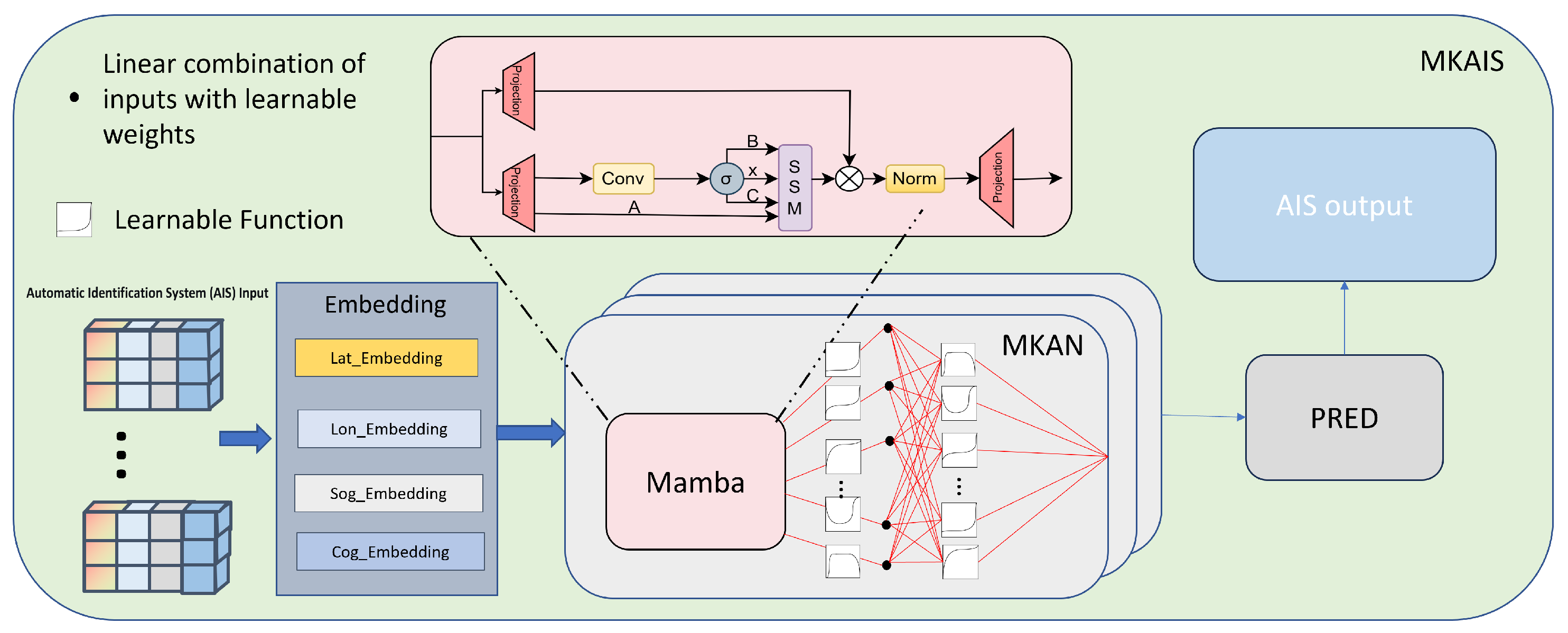
Finally, the MKAN module is designed to fuse contextual information with fine-grained features, enabling a comprehensive representation of the spatiotemporal dynamics of vessel trajectories and improving prediction accuracy. As illustrated in Figure 1, the MKAIS framework comprises three main components: an embedding layer, the MKAN module, and a prediction layer.
Figure 1.
Schematic Overview of the MKAIS network architecture.
- Embedding Layer: This component transforms the four-dimensional AIS features into a higher-dimensional latent space. The resulting representation is combined with positional encoding, and the fused embedding serves as the input to the subsequent MKAN module.
- MKAN Module: This module is composed of two key parts: Mamba and KAN. The state space model (SSM) in Mamba is leveraged to capture intricate dependencies in vessel trajectory sequences and extract global contextual information. Meanwhile, KAN enhances the model’s nonlinear representation power. By substituting traditional activation functions with trainable kernel functions, KAN is capable of adaptively learning complex input–output mappings, thereby offering higher flexibility and accuracy in modeling the nonlinear and dynamic behaviors of vessel trajectories. In addition, due to its lightweight design, KAN can be seamlessly combined with other modules, further boosting the overall prediction performance.
- Prediction Layer: This layer applies linear projection combined with nonlinear activation to transform the dynamic variations and spatial characteristics captured by the MKAN module into the output domain, thereby facilitating accurate vessel trajectory prediction.
2.2.1. Embedding Layer
Because longitude, latitude, speed, and course differ greatly in both physical significance and numerical range, directly mapping them into a high-dimensional space can result in uneven feature weighting, which may weaken the model’s capacity to accurately capture the relationships between features.
To address this, the proposed MKAIS model adopts a strategy of embedding each feature separately, preserving the physical meaning and independence of each feature, which helps the model more accurately capture their intrinsic relationships. Additionally, this approach reduces the complexity of the training process and partially mitigates overfitting.
The four-dimensional vessel trajectory input is represented as , where each time step . For , each feature dimension is independently embedded into a high-dimensional representation, as detailed below:
Subsequently, these embedding vectors are concatenated to form , which yields the trajectory embedding sequence , , where denotes the sequence length, and represents the dimensionality of the concatenated embeddings. This formulation preserves the individual characteristics of each feature while providing a comprehensive high-dimensional representation suitable for subsequent modeling.
2.2.2. The MKAN Module
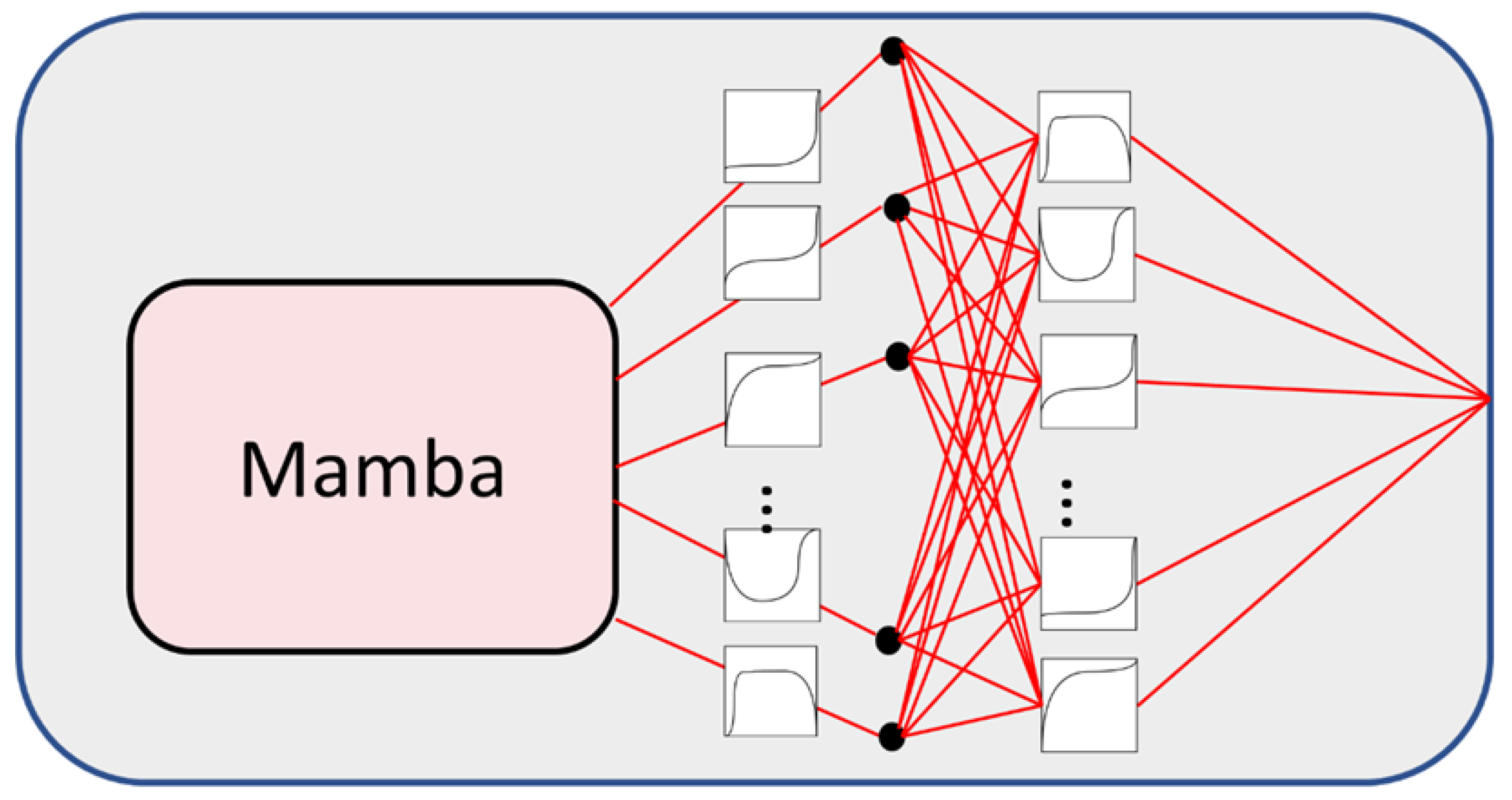
To comprehensively capture the characteristics of vessel trajectories, we designed the MKAN module, which consists of two primary components: the Mamba component and the KAN component. The detailed architecture is illustrated in Figure 2.
Figure 2.
Schematic diagram of the MKAN module architecture.This figure illustrates the core data flow and adaptive component structure of the MKAN module. Please note that the activation functions are data-fitted, meaning their specific forms are adaptively learned during training rather than being fixed. Therefore, they are not assigned specific names in the diagram. For the detailed theory and implementation of this core component, please refer to Section 2.2.2.
The Mamba module utilizes the Selective State Space Model (SSM) to capture intricate dependencies in vessel trajectories and model global contextual information. Its main advantage is the ability to handle high-dimensional data while efficiently extracting both temporal and spatial features, all while preserving strong generalization. Additionally, parallel computation and parameter-sharing mechanisms are incorporated to enhance efficiency. The Mamba model significantly reduces the computational cost and memory consumption, thereby enabling efficient training and prediction even on large-scale datasets. Moreover, through its innovative state space formulation, Mamba can precisely capture the dynamic variations and nonlinear characteristics of vessel trajectories, ultimately enhancing the prediction accuracy.
The KAN module introduces learnable nonlinear kernel functions, which significantly enhance the model’s representational capacity when handling complex data. Unlike traditional linear models, KAN is capable of flexibly modeling intricate nonlinear relationships within the data, thereby improving the accuracy of vessel trajectory prediction. In addition, by adaptively adjusting function weights, KAN can automatically capture the interdependencies among different features, enabling effective performance improvement across diverse vessel trajectory scenarios.
The overall architecture adopts a serial design: the input is first passed sequentially through multiple layers of MKAN components, where the internal structure of each layer follows a configuration. This design enables the model to effectively capture global contextual information, while enhancing the nonlinear representational capacity, thereby allowing a more comprehensive modeling of the complex dynamic features inherent in vessel trajectories. The detailed computational process is as follows:
where denotes the output of the l-th module, while Z represents the final encoded feature sequence. denotes the number of encoder layers.
Mamba Component
In the Mamba component, the key element is the Selective State Space Model (SSM), which enables efficient trajectory modeling with lower memory requirements. The SSM encodes vessel motion patterns as multidimensional state vectors and preserves temporal dependencies via a real-time data-driven state update process. This design not only captures sequential dynamics effectively but also considerably reduces the model’s parameter count, improving both computational efficiency and modeling performance.
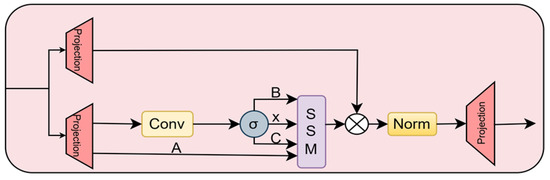
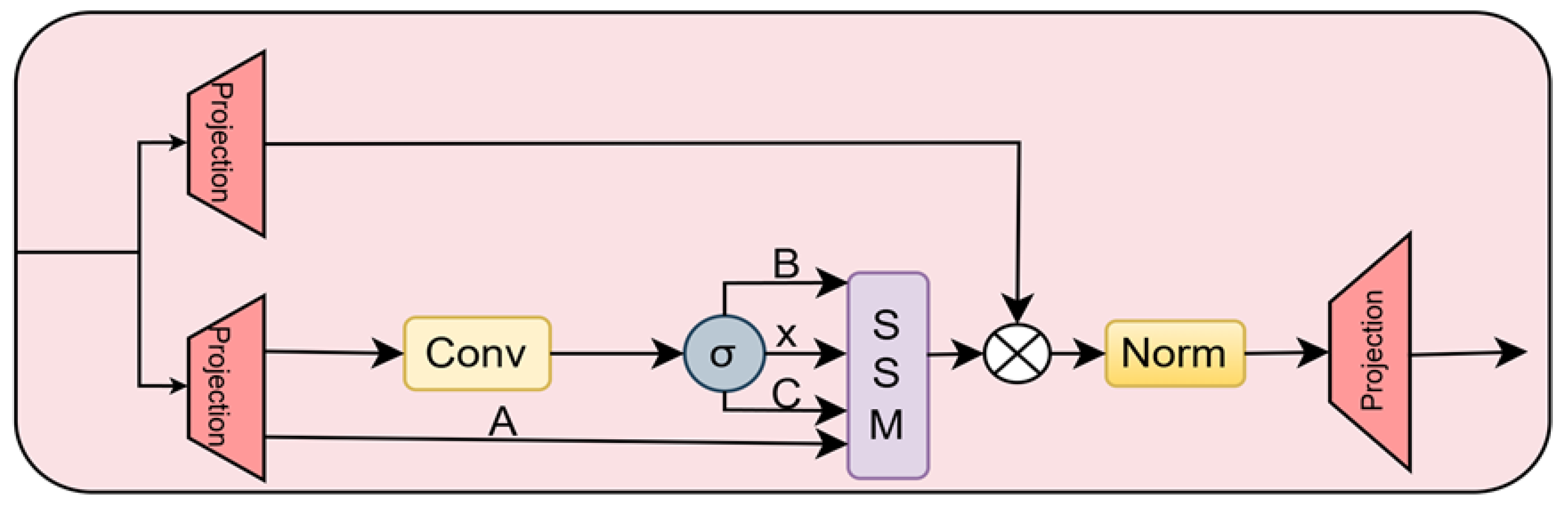
As illustrated in Figure 3, within the vessel trajectory prediction (VTP) task, the output generated by the -th encoder layer is expressed as , where , representing the encoded sequence of the input . Concretely, this representation is denoted as . Building upon this formulation, the spatial state equation for the vessel can then be defined as
Figure 3.
Mamba module.
For , denotes the vessel’s latent state at time t. The state transition matrix A governs the evolution of , while the input matrix B quantifies the influence of external inputs. The output matrix C maps the state to observed outputs, and D accounts for the direct contribution of inputs. represents the encoded output at the current layer and time step t.
The output from the current encoder layer is given by , where . From this, we can further obtain
The corresponding output equation can be obtained by multiplying with [11]:
By representing as a vector, the evolution of the SSM can be expressed in matrix form, as follows:
In this formulation, , , and , where N corresponds to the dimensionality of the hidden states in the state space model (SSM), which governs the dynamic transition of the system. The matrix is strictly lower triangular, with entries defined as for . Otherwise, for , the element is given by . This matrix M serves as the encoded representation generated by the current MKAN layer after the Mamba operation.
KAN Component
The Mamba network effectively captures global contextual information in vessel trajectories through the Selective State Space Model (SSM), enabling the modeling of complex temporal dependencies in high-dimensional data. However, the linear modeling approach of Mamba faces limitations when dealing with nonlinear features in the data. To address this issue, we introduce the KAN network, which serves as a powerful complement to Mamba.
The KAN network better captures the nonlinear dynamic variations in vessel trajectories through adaptive nonlinear mapping functions, addressing the limitations of Mamba when handling complex nonlinear patterns. Specifically, the introduction of KAN enables the model to further explore complex feature relationships based on the contextual features extracted by Mamba, thereby improving the prediction accuracy and robustness of vessel trajectory forecasting. In this way, the combination of Mamba and KAN not only enhances the model’s expressive power but also imparts greater flexibility to the entire system when handling complex dynamic data.
Specifically, the architecture of Kolmogorov–Arnold Networks (KAN) is based on an innovative design concept, where the traditional can be expressed as
where represents the number of layers in the MLP network, and to denote the weights from the 0th to the last layer, with indicating the activation function applied after each layer.
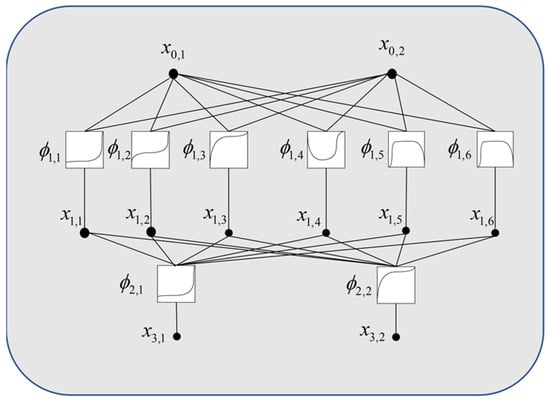
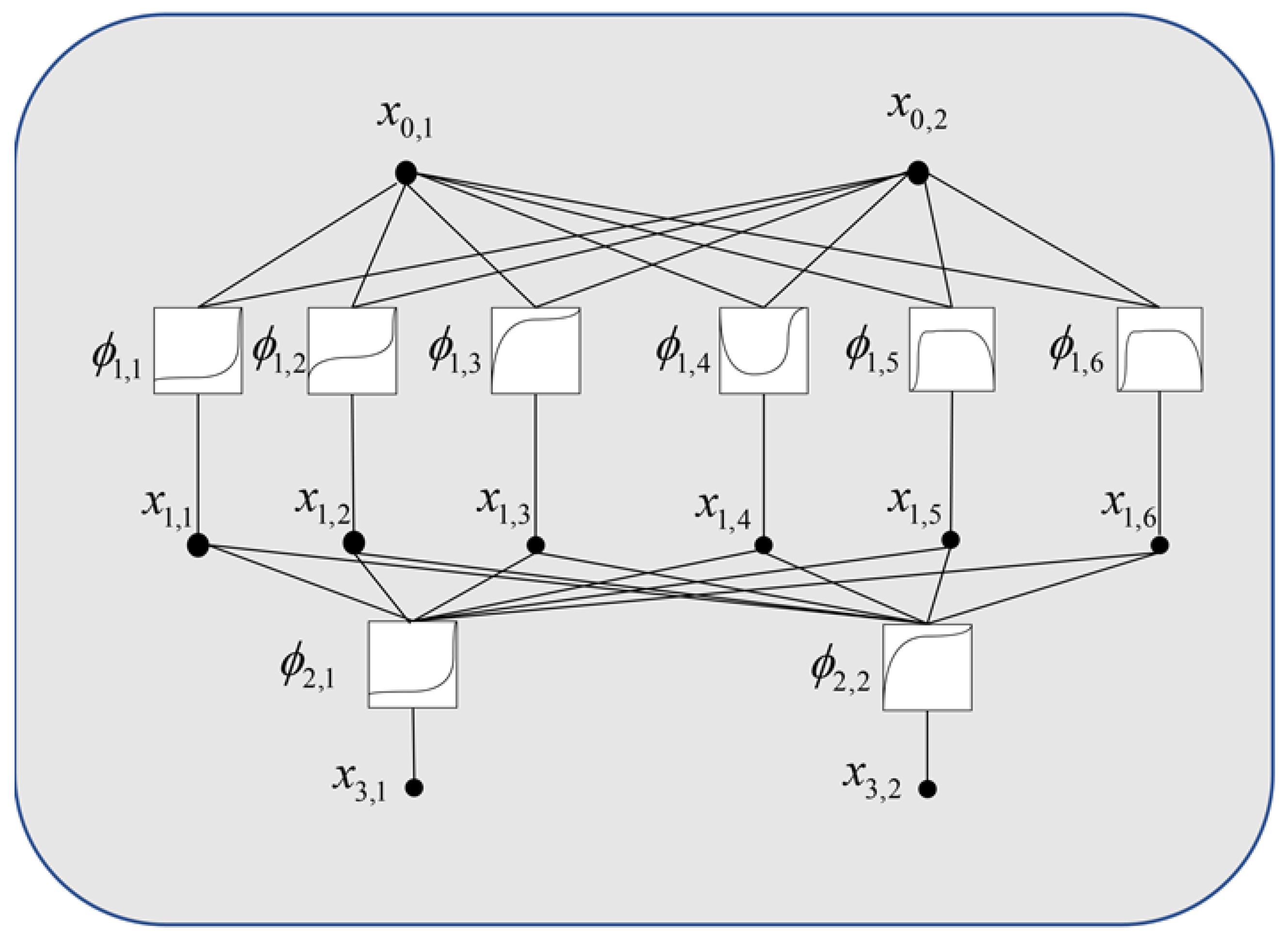
In traditional neural networks, the edge weights are replaced by variable functions. As shown in Figure 4, in KAN, each node does not perform any nonlinear transformation when aggregating the outputs of these functions, which forms a sharp contrast with the approach in MLP:
Figure 4.
KAN component.
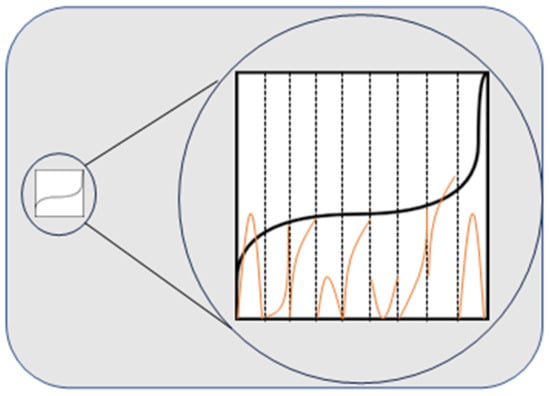
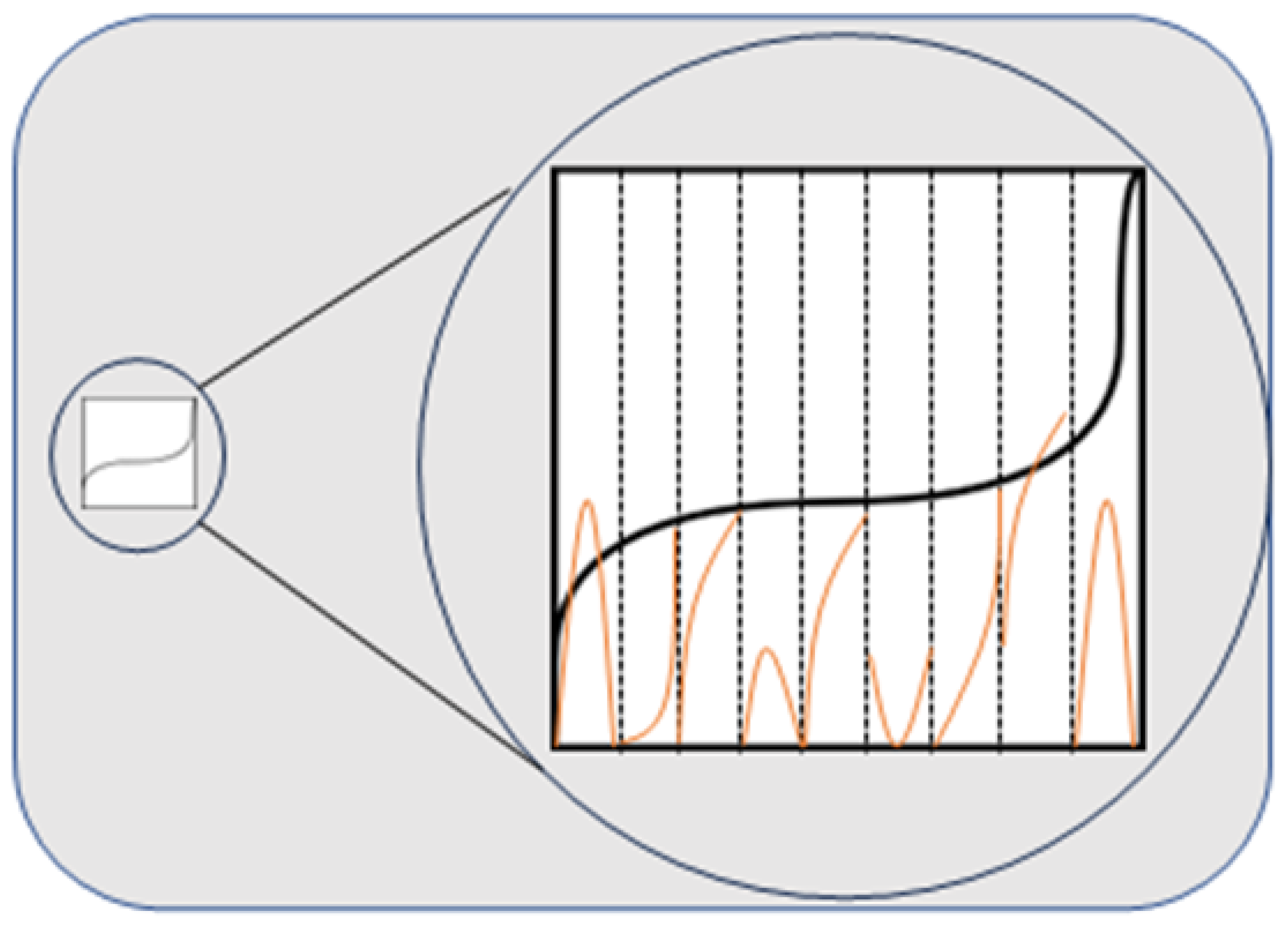
In this context, represent each layer of the KAN network. In KAN, the scalar weights in traditional neural networks are replaced by one-dimensional learnable functions. KAN employs spline functions as the connecting function form, as shown in Figure 5, and is defined as follows [22]:
where represents the i-th B-spline basis function, and is the learnable coefficient. This structure allows each edge input value z to undergo adaptive nonlinear mapping, thereby enhancing the model’s expressive power and generalization capability. k denotes the number of spline basis functions.
Figure 5.
Spline function.
As shown in Figure 5, the entire input interval is divided into multiple sub-intervals, with each sub-interval corresponding to a spline basis function. These basis functions perform nonlinear mapping of the inputs within their respective intervals, and the final structure used for learning in the KAN network is obtained by a weighted summation of these functions.
Ultimately, the series of spline functions in the KAN network, along with the linear weighted summation, perform the nonlinear transformation. The output result from this process serves as the final representation of the encoder, which is then used for subsequent prediction tasks:
Prediction Layer
The prediction stage projects the high-level representation Z generated by the MKAN module into distinct probabilistic subspaces, with model training guided by the cross-entropy loss to enhance trajectory estimation accuracy. In this process, the input sequence —comprising longitude, latitude, speed over ground, and course—is first transformed by the MKAN module into a latent feature matrix Z that encodes the underlying spatiotemporal relationships of the subsequent trajectory . The embedded feature matrix is subsequently fed into a fully connected layer, which separates it into four independent branches. Each branch is designed to capture and predict one specific navigational attribute, namely longitude, latitude, velocity, and heading. Their outputs are denoted as , , , and , representing the probability distributions of the respective features. For example, in the case of latitude, the interval (55.5° to 58.0°) is discretized into 250 probability classes. Similarly, longitude, speed over ground, and course are discretized according to their respective ranges, thereby enhancing the prediction accuracy. Finally, the model applies the softmax function to each output feature (, , , ) to normalize them and obtain the corresponding probability distributions. The various trajectory features of the vessel are summarized as follows:
Among them, and correspond to the discretized features of in the four subspaces of latitude, longitude, speed over ground, and course over ground, respectively. , , , and denote the number of discrete intervals in each subspace. The intervals are determined by dividing the value range of each variable by the predefined interval width, as specified below:
Latitude: range from 55.5° to 58.0°, with a span of 2.5°. Discretized with a step size of 0.01°, resulting in a total of intervals.
Longitude: range from 10.3° to 13.0°, with a span of 2.7°. Similarly, discretized with a step size of 0.01°, resulting in a total of intervals.
Speed over ground (SOG): with a maximum value set to 30 knots, discretized with a step size of 1 knot, yielding a total of intervals.
Course over ground (COG): ranging from 0° to 360°, discretized with a step size of 5°, resulting in a total of intervals.
Accordingly, the values are 250, 270, 30, and 72, respectively, which define the number of categories for the four feature subspaces.
In addition, the cross-entropy loss [24] is employed to measure the discrepancy between the predicted probability distribution and the true labels. The model parameters are then optimized through backpropagation. For the task of ship trajectory prediction, the loss function can be expressed as
In the above formulation, , , , and denote the ground-truth values of for Lat, Lon, Sog, and Cog, respectively. Meanwhile, , , , and represent the corresponding probability distributions. , , , and denote the loss terms for each dimension. The final overall loss function is obtained by either weighting or directly summing these four loss components.
Training
To achieve strong alignment between the predicted trajectories and the ground-truth data, the MKAIS model is trained using backpropagation. During this process, the model parameters are iteratively updated to minimize the discrepancy between the predicted outputs and the actual values, thereby enhancing the overall performance. For end-to-end optimization, the AdamW optimizer [25] is employed. AdamW extends the standard Adam algorithm [26] by incorporating weight decay directly on the model parameters through an regularization term, rather than including it in the gradients. This approach helps mitigate overfitting and improves the model’s generalization on complex trajectory data. By applying this optimization strategy, MKAIS can more effectively learn historical motion patterns and deliver precise predictions for future vessel trajectories.
3. Experiment
In this section, we perform a comparative assessment of the proposed MKAIS model against leading existing methods using a real-world dataset. We begin by describing the experimental setup in detail, followed by comprehensive experiments to demonstrate the performance benefits of MKAIS.
3.1. Experimental Setup
3.1.1. Dataset
This study conducted experiments using the ct_dma dataset [4], with detailed information provided in Table 2. The dataset comprises AIS records of cargo and passenger vessels collected between 1 January and 31 March 2019. The study focused on a rectangular region of interest (ROI), with latitudes ranging from 55.5° to 58.0°. For model evaluation, the dataset was divided based on time: 1 January to 10 March was assigned to the training set, 11 March to 20 March to the validation set, and 21 March to 31 March to the testing set. After filtering out short trajectories, a total of 11,888 AIS samples remained for subsequent analysis. This time-based segmentation preserves temporal continuity and stability, providing a solid foundation for assessing the model’s trajectory prediction accuracy over multiple forecast intervals.
Table 2.
Summary of the ct_dma dataset.
3.1.2. Evaluation Metrics
Building on key prior research in vessel trajectory prediction (VTP) [4,8,27,28], we assessed the effectiveness of the proposed MKAIS model using three widely recognized evaluation metrics. Specifically, we employed the mean absolute error (MAE) to measure the average magnitude of prediction deviations, the root mean square error (RMSE) to account for larger discrepancies, and the Haversine distance to quantify the geospatial difference between predicted and actual vessel positions. These metrics together provide a comprehensive assessment of both numerical accuracy and spatial prediction performance [29,30].
where denotes the ground truth, represents the predicted value, and N is the number of samples [31].
Here, d represents the prediction error at time step t, computed as the Haversine distance between the actual and predicted positions. In this calculation, is the latitude difference, with and indicating the latitudes of the two points. is the difference in longitude, and r denotes the Earth’s radius, approximately 6371 km.
3.1.3. Baseline Models
We evaluate the performance of the proposed MKAIS model against a set of established deep learning methods as well as recently developed vessel trajectory prediction (VTP) approaches. The chosen baseline models for comparison are as follows:
- (1)
- LSTM [32]: the long short-term memory network (LSTM) is an improved architecture of recurrent neural networks (RNNs). It introduces memory cells to mitigate the long-term dependency challenges faced by traditional RNNs in vessel trajectory prediction (VTP).
- (2)
- BiGRU [33]: the bidirectional gated recurrent unit (Bi-GRU) model processes sequential data in both forward and backward directions with its gated recurrent structure; this bidirectional architecture enables a more comprehensive capture of contextual dependencies in vessel trajectories, allowing it to effectively learn from both past and future states for enhanced prediction accuracy.
- (3)
- Attention_LSTM [34]: based on the LSTM, this model incorporates the Transformer attention mechanism to enhance the capability of modeling complex nonlinear trajectories in AIS data, thereby overcoming the limitations of traditional approaches.
- (4)
- Transformer [27]: this model applies the Transformer architecture to AIS data, effectively addressing the limitations of traditional models (e.g., LSTM) in handling nonlinear trajectory information.
- (5)
- TrAISformer [4]: captures long-term dependencies in AIS data within a high-dimensional feature space and addresses data heterogeneity and multimodal patterns by employing a modified loss function.
- (6)
- Mamba [12]: incorporates the Mamba architecture into vessel trajectory prediction to enhance forecasting accuracy and speed up inference, effectively overcoming performance limitations found in models like the Transformer.
3.1.4. Parameter Settings
The experimental setup employed an Intel Core i5-13400F processor alongside an Nvidia RTX 4060Ti GPU with 8 GB of memory. The system operated on Ubuntu, and all deep learning experiments were implemented using PyTorch version 2.3.1+cu118.
3.1.5. Hyperparameter Settings
As shown in Table 3, the batch size was configured to 16, with a historical sequence length P of 30 time steps (equivalent to 5 h). The model was trained for 20 epochs using a learning rate of . The prediction horizons Q were set to 6, 12, and 18 time steps, corresponding to 1 h, 2 h, and 3 h forecasts, respectively. The architecture included 5 encoding layers.
Table 3.
Hyperparameter settings used in the experiments.
To evaluate the forecasting capability of the proposed model, experiments were performed for both short-term (3 h) and long-term (10 h) vessel trajectory predictions. In addition, comprehensive analyses were conducted to examine the model’s performance under varying numbers of encoder layers and its effectiveness in practical real-world scenarios.
4. Results
4.1. Experimental Results and Analysis
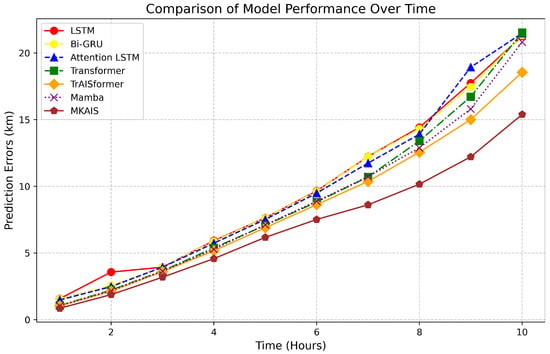
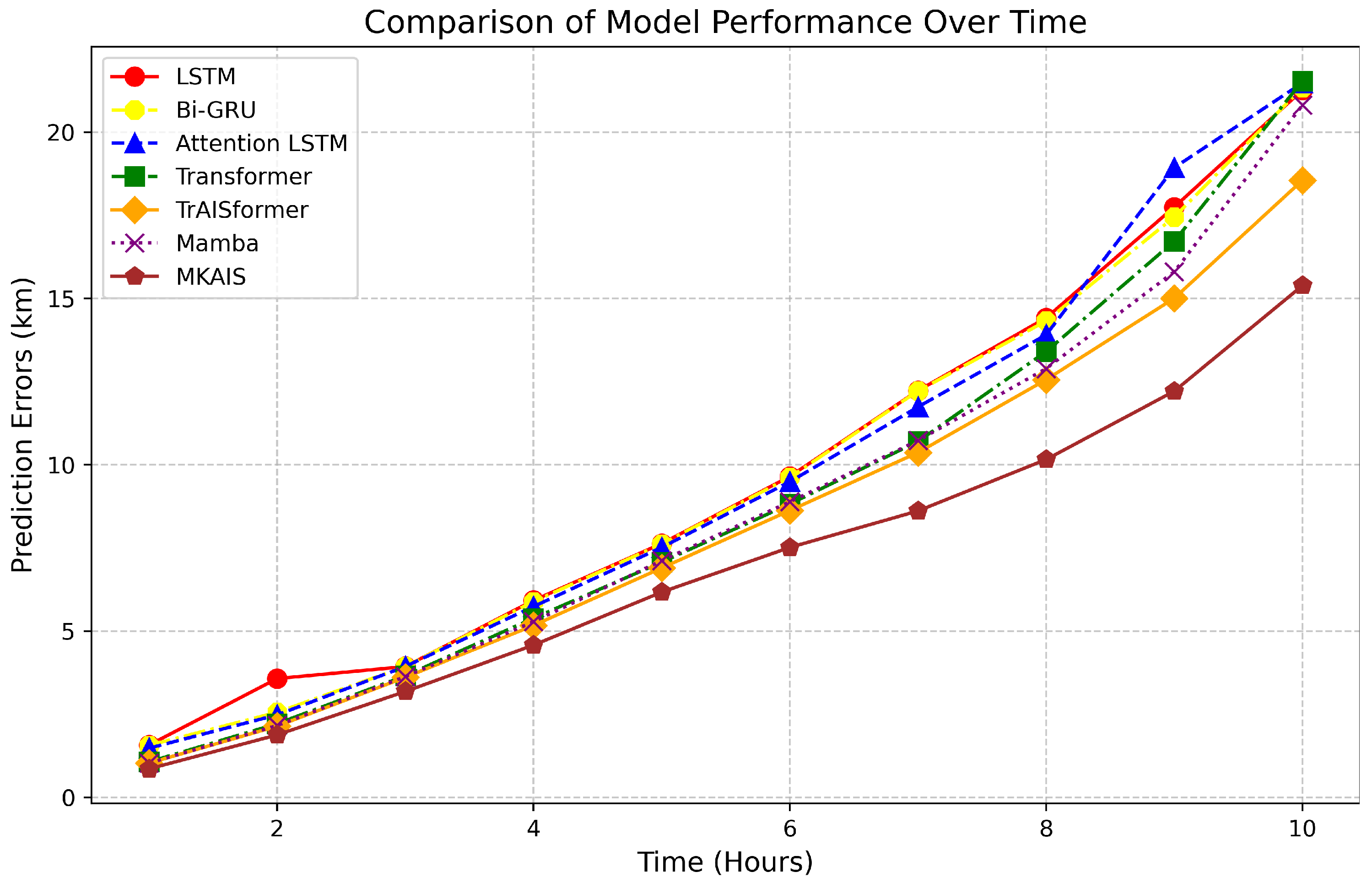
To thoroughly assess the performance of the proposed MKAIS model, the experimental setup was divided into short-term and long-term trajectory prediction tasks. The short-term evaluation examined the model’s ability to forecast vessel movements within a 1–3 h horizon, whereas the long-term assessment extended the predictions to cover up to 10 h. The corresponding results are compiled in Table 4 and visually presented in Figure 6.
Table 4.
Comparison of trajectory prediction accuracy of different vessel models within 1 to 3 h intervals.
Figure 6.
Comparison of model errors within 10 h predictions.
Analysis of Short-Term Trajectory Prediction Results
Table 4 presents the performance of the proposed MKAIS model compared with baseline models on the VTP dataset, covering prediction intervals of 1, 2, and 3 h in terms of the MAE (mean absolute error), RMSE (root mean square error), and Haversine distance.
- LSTM: The LSTM model exhibits relatively poor prediction performance across different time intervals, particularly in terms of the Haversine distance. Specifically, the prediction errors are 1.5508, 2.5709, and 3.9328, which are significantly higher than those of MKAIS. This deficiency arises from the LSTM’s limited capability in handling long-term dependencies and dynamic features, leading to suboptimal performance in complex ship trajectory prediction tasks.
- Bi-GRU: The Bi-GRU model demonstrates performance comparable to the LSTM baseline but fails to achieve significant improvements. Specifically, its MAE values of 0.6254, 1.7936, and 3.6111 for 1, 2, and 3 h predictions show only marginal enhancement over LSTM’s 0.6246, 1.8279, and 3.6211. In terms of the RMSE, Bi-GRU records 0.6577, 2.9798, and 6.5840 across the three time intervals, even slightly underperforming LSTM in the 1 h prediction (0.6425 vs. 0.6577). The Haversine distance metrics of 1.5639, 2.5583, and 3.9333 further confirm this trend, showing minimal deviation from the LSTM baseline. These results indicate that while the bidirectional architecture provides additional contextual information, it offers limited advantages in handling the complex temporal dependencies present in vessel trajectory prediction, particularly in long-term forecasting scenarios.
- Attention_LSTM: The Attention_LSTM model demonstrates improvements over LSTM across different time intervals; however, certain limitations remain. Specifically, its RMSE values are 0.5969, 2.6611, and 6.5150, which, although slightly better than those of LSTM, still lag behind TrAISformer and MKAIS. These results indicate that, despite the enhancements brought by the attention mechanism, the performance of Attention_LSTM in long-term prediction remains suboptimal, with substantial deviations from the actual trajectories, suggesting that further optimization is required.
- Transformer: The Transformer model outperforms Attention_LSTM across different time intervals, though there remains room for further improvement. Specifically, the MAE values of the Transformer are 0.5930, 1.6315, and 3.3615 for 1, 2, and 3 h predictions, respectively, showing better accuracy compared to LSTM (0.6246, 1.8279, 3.6211) and Attention_LSTM (0.6085, 1.7721, 3.5974). However, its performance is still inferior to that of MKAIS (0.5652, 1.4979, 2.9397) and TrAISformer (0.5884, 1.6252, 3.2611). In terms of the Haversine distance, the Transformer yields values of 1.0661, 2.2150, and 3.6479, indicating moderate performance with noticeable deviations in long-term predictions. Overall, the Transformer demonstrates a certain advantage in accuracy, but it has not yet reached the optimal level.
- TrAISformer: The TrAISformer model demonstrates superior performance across different time intervals compared to all other models, particularly excelling in long-term prediction accuracy. Specifically, the MAE values of TrAISformer are 0.5884, 1.6252, and 3.2611 for 1, 2, and 3 h predictions, respectively, showing a significant reduction compared with LSTM (0.6246, 1.8279, 3.6211) and Attention_LSTM (0.6085, 1.7721, 3.5974), thereby indicating a clear improvement in accuracy. Nevertheless, there remains room for improvement relative to MKAIS. In terms of the Haversine distance, TrAISformer achieves 1.0289, 2.1393, and 3.6089, which, while favorable, are still less accurate than MKAIS (0.8566, 1.8770, 3.1819) in long-term predictions. This suggests that although TrAISformer exhibits outstanding accuracy, its predictive capability remains suboptimal under certain conditions.
- Mamba: The Mamba model exhibits stable performance across all evaluation metrics, yet still leaves room for further optimization. Its MAE values for 1, 2, and 3 h predictions are 0.5876, 1.6320, and 3.2570, respectively, showing improvements over LSTM (0.6246, 1.8279, 3.6211) and Attention_LSTM (0.6085, 1.7721, 3.5974), while remaining higher than those of TrAISformer (0.5884, 1.6252, 3.2611) and MKAIS (0.5652, 1.4979, 2.9397). In terms of the RMSE, Mamba achieves values of 0.5218, 2.4572, and 6.2074, outperforming LSTM and Attention_LSTM but still falling short of TrAISformer (0.5104, 2.4572, 6.2554). Regarding the Haversine distance, Mamba records values of 1.0278, 2.1589, and 3.6325, which are slightly higher than those of TrAISformer (1.0289, 2.1393, 3.6089). Although the Mamba model demonstrates relatively balanced performance, its accuracy in certain cases—particularly in long-term prediction—remains somewhat inferior to that of more advanced models.
From the above analysis, the proposed MKAIS model effectively addresses the shortcomings observed in short-term predictions. Compared to Mamba and TrAISformer, MKAIS achieves notably lower MAE values for 1 h forecasts (0.5652, 1.4979, 2.9397), corresponding to improvements of 3.81%, 7.83%, and 9.74%, respectively. In addition, MKAIS mitigates long-term error accumulation. For 3 h predictions, it attains an RMSE of 5.6773 and a Haversine distance of 3.1819 km, substantially outperforming the baseline models and demonstrating strong capability in capturing long-term dependencies. For 1 h predictions, the Haversine distance reaches only 0.8566, significantly surpassing Mamba and TrAISformer, indicating superior accuracy in geographic position modeling. Overall, the MKAIS model exhibits robust performance in forecasting vessel trajectories across both short-term and long-term horizons, effectively overcoming the limitations of previous approaches in prediction accuracy, spatiotemporal feature capture, and control of error accumulation.
Furthermore, to reduce the risk of overfitting in short-term forecasts (e.g., the first three hours) and to examine the model’s generalization capabilities over longer durations, the prediction window was extended to 10 h. Extending the forecast duration allows for a more thorough assessment of the model’s robustness and performance across longer time scales. The experimental outcomes are displayed in Figure 6, from which the following observations can be made:
- LSTM: For the LSTM model, the Haversine distance within 10 h increased significantly, from 1.5508 km to 21.2634 km. As the prediction horizon extends, the error continues to grow, with a particularly sharp increase observed in predictions beyond 3 h. This indicates that while LSTM performs relatively well in short-term predictions (1 h and 2 h), its accuracy declines in long-term forecasts (especially beyond 3 h), leading to substantial deviations from the true trajectories. Compared with other models, the error growth of LSTM is more pronounced, particularly when contrasted with TrAISformer and MKAIS, where the LSTM shows considerably lower accuracy in long-term predictions. Overall, the LSTM demonstrates weak capability in handling long-term dependencies, requiring further improvements to reduce Haversine distance errors in extended forecasting.
- Bi-GRU: The Bi-GRU model exhibits performance highly similar to the LSTM baseline throughout the 10 h prediction horizon, with the Haversine distance increasing from 1.5639 km to 21.3369 km. In short-term predictions (1–3 h), its errors (1.5639 km, 2.5583 km, 3.9333 km) show negligible improvement over LSTM (1.5508 km, 2.5709 km, 3.9328 km), indicating limited advantages from the bidirectional architecture. As the prediction horizon extends beyond 3 h, the error growth pattern closely mirrors that of LSTM, with both models demonstrating parallel accumulation of deviations. Particularly in medium to long-term predictions (5–10 h), the performance gap between Bi-GRU and LSTM remains minimal, suggesting that the bidirectional processing mechanism provides insufficient enhancement in capturing complex temporal dependencies for vessel trajectory prediction. While the Bi-GRU slightly outperforms LSTM at certain time points (e.g., 7 h prediction: 12.2141 km vs. 12.2271 km), the overall improvement is marginal and fails to demonstrate substantial advantages over the conventional unidirectional architecture.
- Attention_LSTM: The Attention_LSTM model exhibits relatively stable Haversine distance performance within the 10 h horizon; however, the error still shows an upward trend as the prediction time increases. The distance rises from 1.4785 km to 21.4780 km, which marks an improvement over the LSTM (1.5508 km to 21.2634 km). Nonetheless, in long-term predictions (beyond 3 h), the error still increases significantly, with the 10 h prediction error remaining comparatively high relative to the other models. The advantage of Attention_LSTM over LSTM mainly stems from the incorporation of the attention mechanism, which enhances the model’s ability to capture long-term dependencies. However, despite this improvement, the model still lacks sufficient accuracy in long-term predictions, especially after the 3 h horizon, where the error rises rapidly. Compared with TrAISformer and MKAIS, Attention_LSTM still has room for improvement, particularly in long-term dependency modeling.
- Transformer: The Transformer model demonstrates relatively superior performance in terms of the Haversine distance within the 10 h horizon, increasing from 1.0661 km to 21.5362 km. Although the error grows with longer prediction times, its growth rate is smaller compared to LSTM and Attention_LSTM. At the 1 h and 2 h intervals, the Transformer achieves significantly lower prediction errors than LSTM and Attention_LSTM, indicating higher accuracy in short-term predictions. However, as the prediction time extends to 10 h, its error gradually approaches that of the other models. Particularly in long-term predictions (beyond 3 h), the error still shows a notable increase. Despite this, the Transformer performs well in modeling long-term dependencies and effectively captures sequential relationships. Nevertheless, further optimization is required in longer time-horizon prediction tasks, particularly to address the issue of error accumulation.
- TrAISformer: The TrAISformer model demonstrates overall strong performance in 10 h predictions, though some limitations remain. Its Haversine distance increases from 1.0289 km to 18.5502 km, showing a relatively smaller error growth. However, as the prediction horizon extends, errors still accumulate, with a more noticeable increase in long-term predictions (e.g., at 10 h). Compared with MKAIS (0.8566 km to 15.3848 km), TrAISformer still has room for improvement in long-term prediction accuracy, and its short-term precision is slightly inferior. While TrAISformer effectively captures long-term dependencies and mitigates error accumulation, its short-term accuracy lags behind some other models, suggesting potential shortcomings in capturing local features over shorter intervals. Overall, TrAISformer shows clear advantages in long-horizon forecasting but still requires further optimization in short-term precision and in controlling error accumulation for very long predictions.
- Mamba: The Mamba model exhibits relatively stable performance in terms of the Haversine distance over a 10 h prediction horizon, increasing from 1.0278 km to 20.8097 km. Its errors are smaller than those of LSTM and Attention_LSTM, particularly in short-term predictions (1 h and 2 h), where it achieves higher accuracy. However, as the prediction horizon extends, errors gradually accumulate, with a more pronounced increase beyond 3 h. Compared with TrAISformer and MKAIS, Mamba shows lower accuracy in long-term predictions, especially at the 10 h mark where its Haversine distance is larger. While Mamba demonstrates strong short-term performance, its ability to capture long-term dependencies is relatively weaker, leading to faster error accumulation. Relative to more advanced models such as TrAISformer, Mamba still requires further improvements in long-horizon forecasting, particularly in mitigating error growth.
Based on the results, the proposed MKAIS model exhibits the most stable error growth trend. In short-term predictions (1 h), the error is around 0.8566 km, while for 10 h forecasts, it remains the lowest at 15.3848 km—approximately 17.06% lower than the best-performing TrAISformer. Additionally, the error increases smoothly across all prediction horizons, highlighting MKAIS’s robustness and its strong capability for long-term trajectory forecasting.
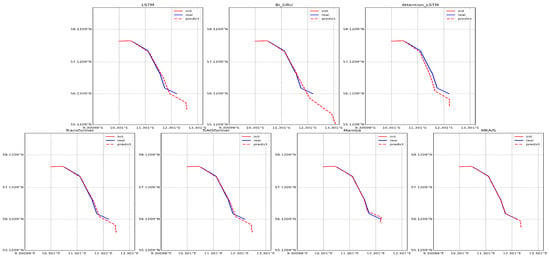
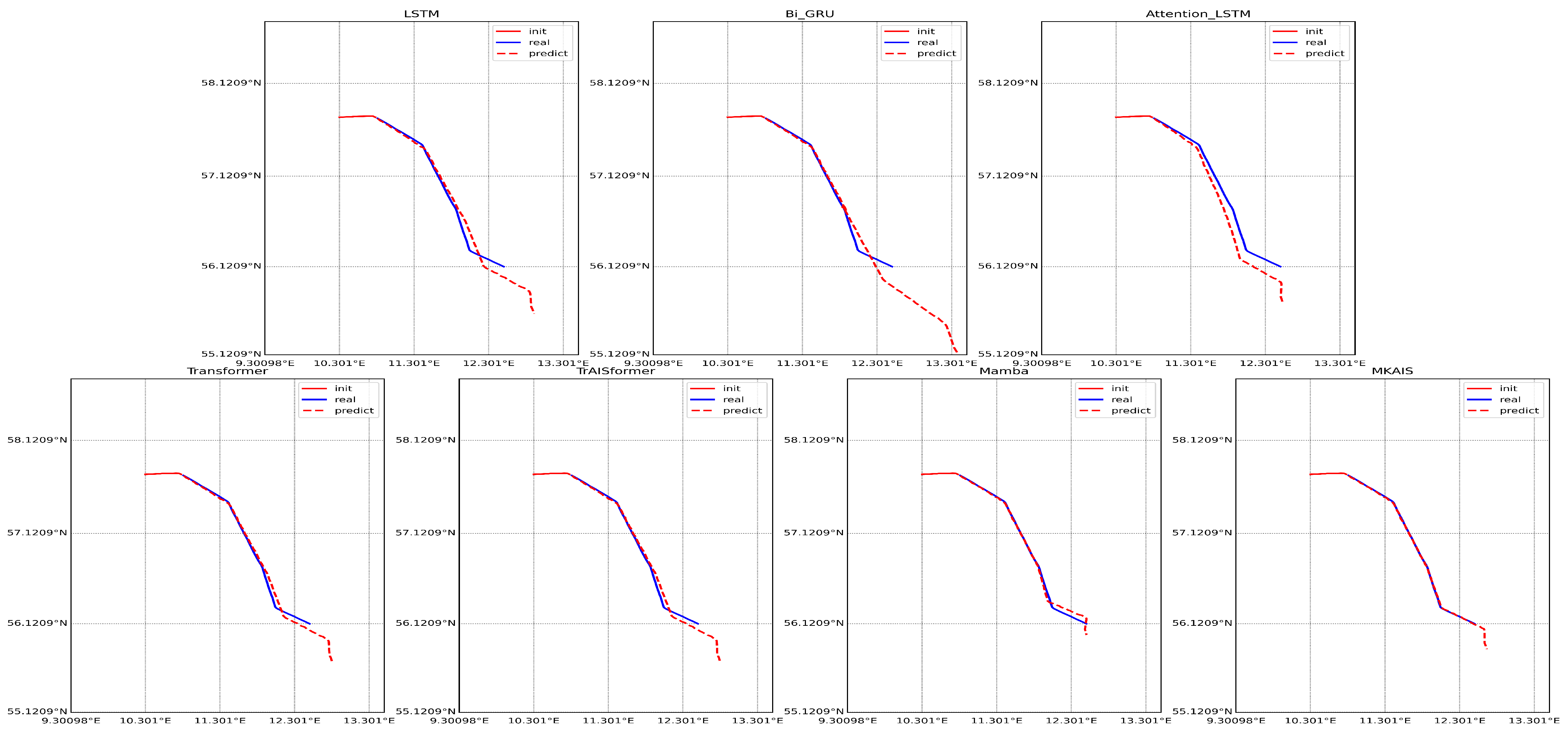
Figure 7 presents a comparative analysis of the MKAIS model against alternative approaches in practical scenarios. The experiment aims to forecast a vessel’s trajectory over the next 10 h (60 time steps) using the preceding 2 h trajectory (12 time steps). The trajectory involves multiple course changes with varying turning angles. Over the extended prediction horizon, the vessel exhibits significant variations in direction, speed, and environmental interactions, reflecting highly dynamic behavioral characteristics.
Figure 7.
Performance of different models on practical tasks.
The experimental results demonstrate that Transformer, TrAISformer, Mamba, and MKAIS consistently outperform LSTM, Attention_LSTM, and BiGRU across all cases, highlighting the limitations of LSTM in capturing longterm dependencies. Among these models, MKAIS achieves the best predictive performance, primarily attributable to its integration of the efficient Mamba architecture with the KAN neural network. This combination enables the model to simultaneously capture both long-term patterns and detailed features of vessel trajectories, thereby significantly enhancing the forecasting accuracy.
As shown in Figure 7, when the vessel begins to turn, all models are able to maintain satisfactory prediction accuracy. However, when the vessel undergoes multiple turns, the prediction results of LSTM and Attention_LSTM exhibit significant deviations. Moreover, in scenarios involving large-angle turns, the Transformer, TrAISformer, and Mamba models all demonstrate varying degrees of deviation, while only MKAIS maintains high prediction accuracy under such conditions.
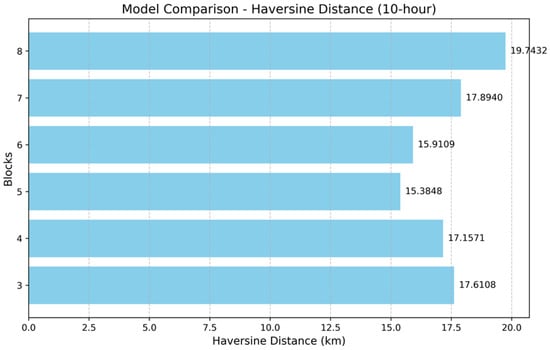
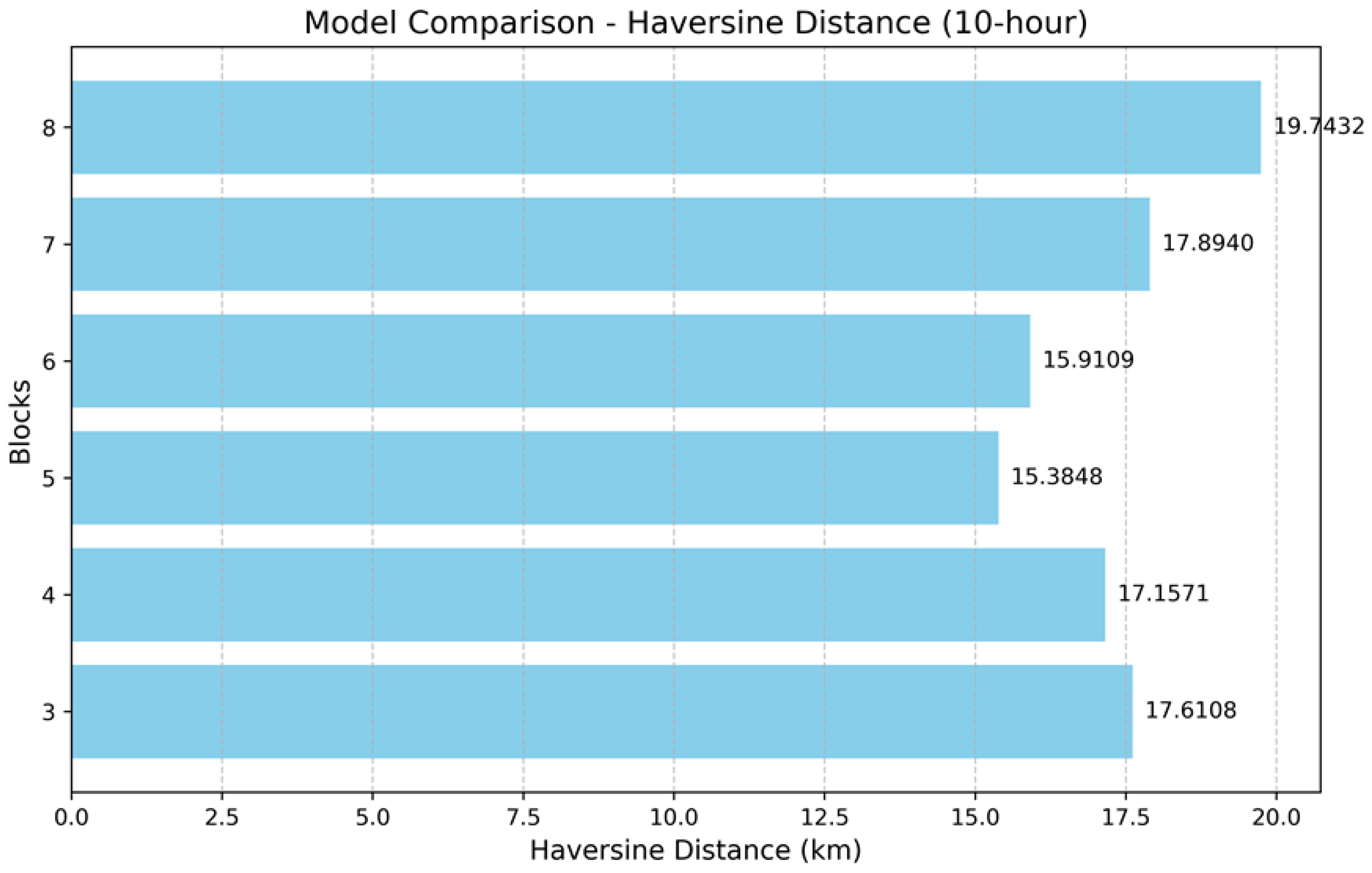
Figure 8 illustrates the Haversine distance performance of MKAIS in the 10 h prediction scenario across different numbers of encoder layers. As shown, MKAIS achieves its best performance with five encoder layers, yielding the lowest Haversine distance of 15.3848 km, indicating that, under this configuration, the model can maintain relatively low prediction error in long-term forecasting tasks. As the number of encoder layers increases or decreases, the prediction accuracy of MKAIS gradually declines, with errors rising particularly when the number exceeds five layers. This suggests that using five encoder layers enables the model to effectively balance complexity and predictive accuracy, thereby avoiding issues of overfitting or underfitting.
Figure 8.
Comparison of MKAIS performance with different numbers of layers.
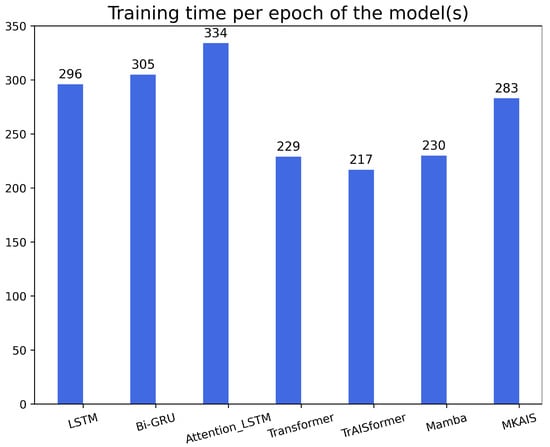
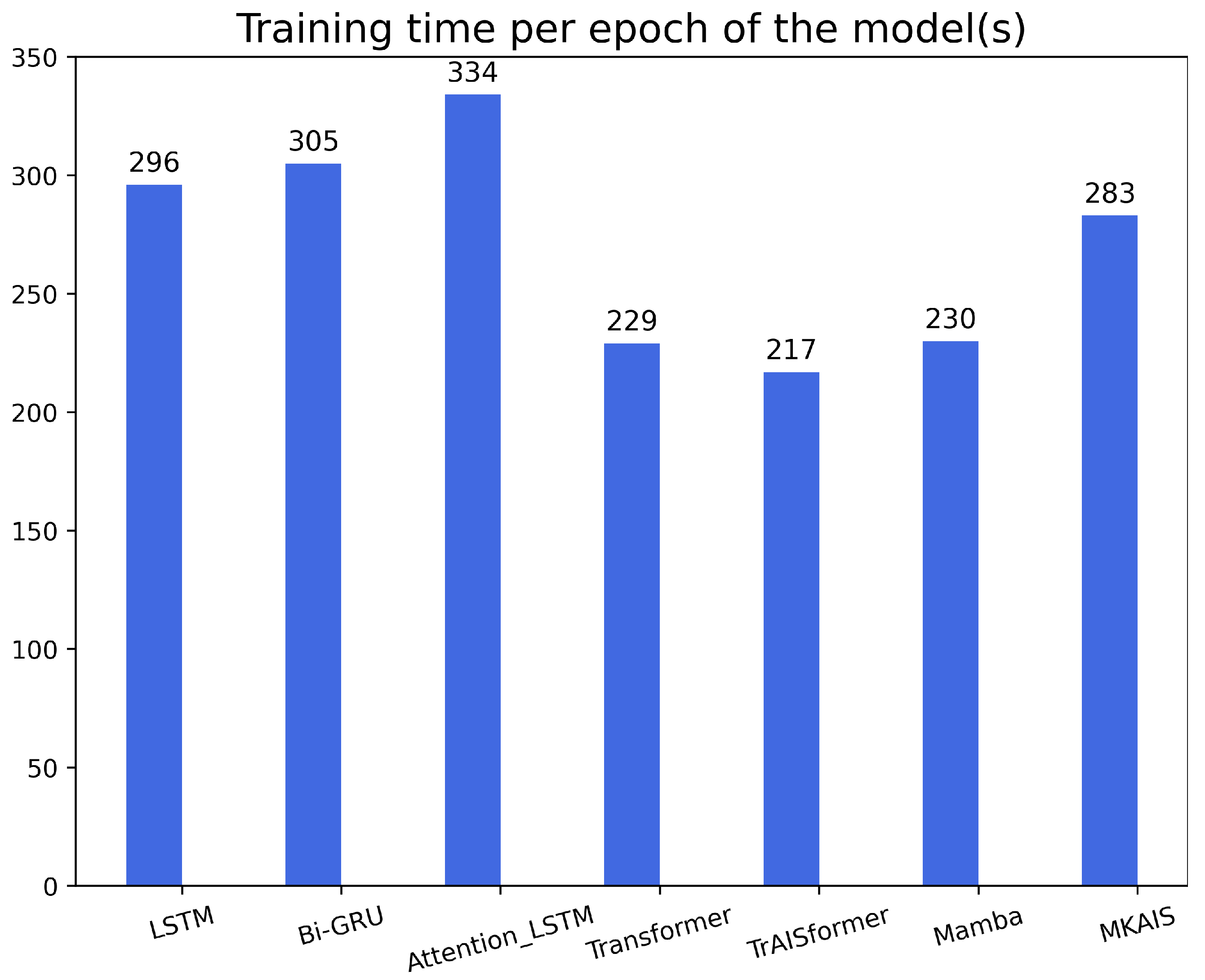
To evaluate the computational efficiency of different models, this paper compares the resource consumption of LSTM, Attention LSTM, Transformer, TrAISformer, Mamba, and the proposed MKAIS model, as shown in Figure 9. The analysis reveals that the computational cost of models increases significantly with the complexity of their architectures. While the traditional LSTM and its attention-based variants have a smaller parameter scale, their ability to handle long sequences remains limited. The standard Transformer model, due to the quadratic computational complexity of its self-attention mechanism, incurs substantial computational and memory overhead, which restricts its application in resource-constrained scenarios. Against this background, the proposed MKAIS model demonstrates remarkable efficiency advantages. As illustrated in Figure 3, MKAIS achieves significantly lower computational resource consumption compared to the standard Transformer model while maintaining competitive performance. This can be primarily attributed to the selective state space architecture and the innovative simplification of the attention mechanism adopted in MKAIS, which effectively avoids the dense computations of the Transformer and enables more efficient information processing. Compared to the emerging Mamba model, which is also known for its efficiency, MKAIS incorporates structural optimizations through KAN, achieving superior task-specific performance with comparable or even lower computational overhead.
Figure 9.
Comparison of training time per epoch for different models.
4.2. Ablation Study
To examine the contribution of each component in MKAIS to the overall performance, we conducted two sets of ablation experiments:
- A variant of the model incorporating five Mamba layers (denoted as Mamba-5) was employed to assess its performance within the encoder.
- A model consisting of five KAN layers (KAN-5) was designed to investigate its performance without the involvement of Mamba.
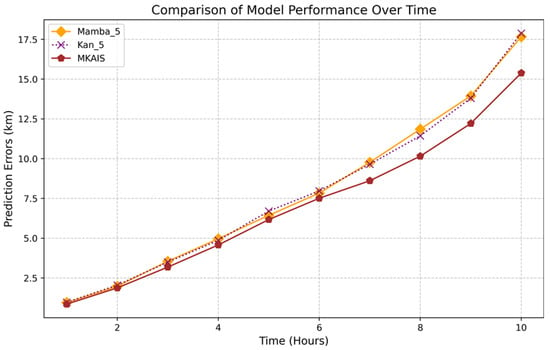
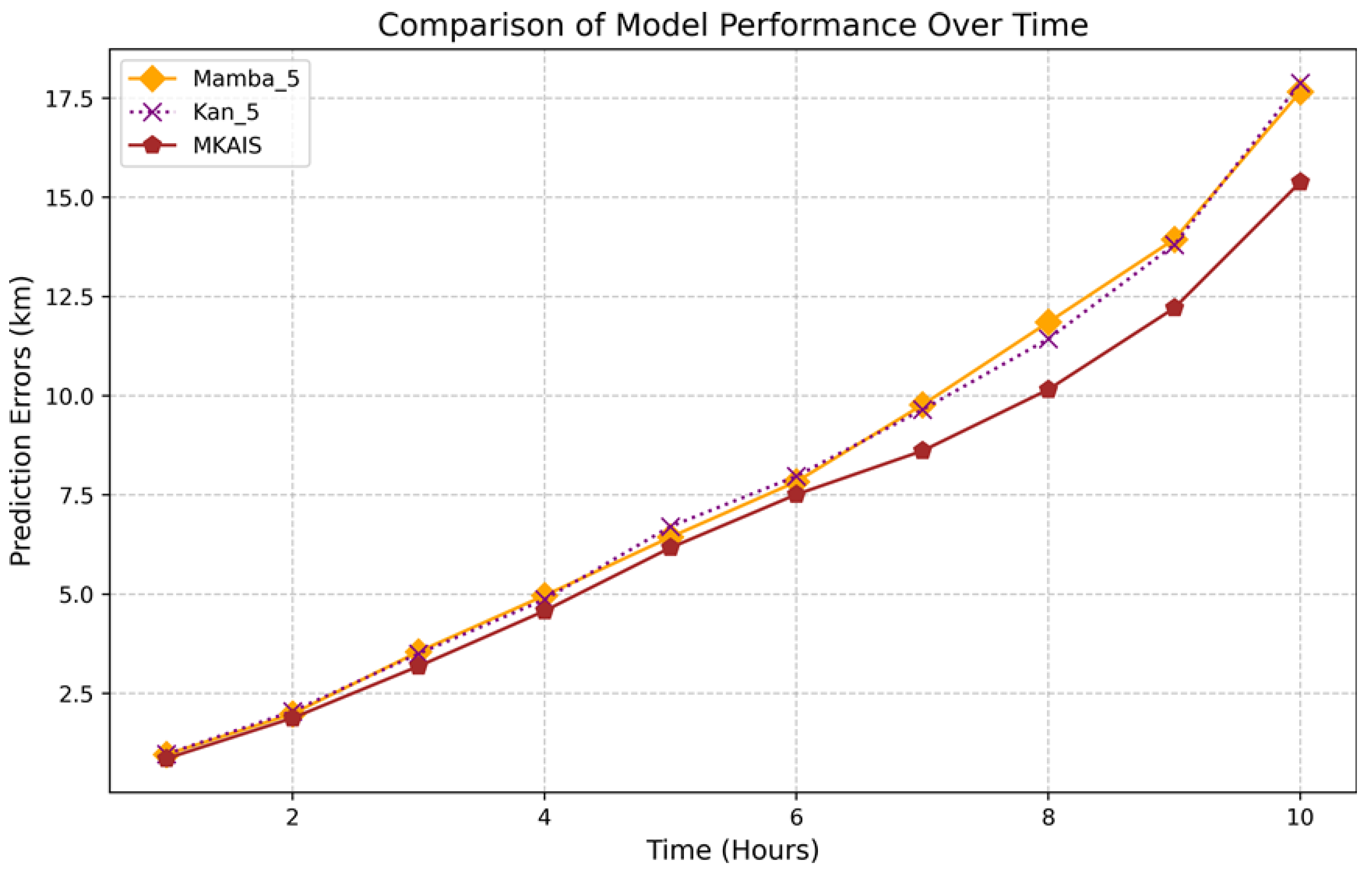
These ablation experiments provide a systematic assessment of the contributions and performance differences of various components in the ship trajectory prediction task. The results are presented in Figure 10. From the comparative analysis of these results, the following conclusions can be drawn:
Figure 10.
Ablation experiment results.
- The errors of Mamba-5 and KAN-5 exhibit similar trends over the time steps, both gradually increasing as time progresses. However, compared to MKAIS, their overall errors are higher, with noticeable deviations in the later stages (e.g., at 9 and 10 h). During the initial hours (e.g., 1 to 6 h), Mamba-5 and KAN-5 perform similarly, but their errors grow significantly over time, indicating that these two models cannot effectively control error accumulation in long-term predictions.
- MKAIS consistently outperforms Mamba-5 and KAN-5 at all time steps, particularly in long-term predictions (10 h), demonstrating its advantage in capturing long-term dependencies and mitigating error accumulation.
- By integrating the Mamba module with the causal self-attention mechanism, MKAIS is able to maintain sensitivity to short-term details while providing stable long-term predictions for complex vessel trajectories, effectively preventing rapid error accumulation.
5. Conclusions
In this paper, we proposed MKAIS, a novel deep learning framework for vessel trajectory prediction that integrates the Mamba state space model with Kolmogorov–Arnold Networks (KAN). The proposed model leverages Mamba’s efficiency in capturing long-range dependencies and KAN’s superior nonlinear representation capacity to effectively model both global contextual patterns and local trajectory variations. A feature-separate embedding strategy was further introduced to enable the precise modeling and supervision of individual navigational attributes.
The major outcomes of this study can be summarized as follows:
- MKAIS achieved state-of-the-art performance across multiple prediction horizons, outperforming LSTM, Attention-LSTM, Transformer, TrAISformer, and Mamba in terms of the MAE, RMSE, and Haversine distance.
- The feature-separate embedding strategy proved effective in enhancing the model’s interpretability and learning efficiency for distinct motion attributes.
- The combination of Mamba and KAN offers a promising architecture for sequence modeling tasks that require both long-term dependency capture and high-fidelity representation of complex nonlinear dynamics.
Future work will be directed towards enhancing the practical applicability of MKAIS in line with these considerations. Our planned research trajectory includes the following:
- Integration into Decision-Support Frameworks: We will explore the integration of MKAIS as a core prediction module within larger maritime intelligent systems. Specifically, its high-accuracy predictions will be used to drive collision risk assessment algorithms and COLREGs-compliant path planning tools, providing actionable recommendations for officers on the bridge or in Vessel Traffic Service (VTS) centers.
- Modeling Multi-Agent Interactions and Environment: A key next step is to extend MKAIS to a multi-agent setting that explicitly reasons about the mutual influences between vessels. Concurrently, we will incorporate real-time environmental data (e.g., wind, waves) to move from pure trajectory prediction to intention-aware and context-aware motion forecasting.
- Validation in Simulated and Real-World Environments: We plan to validate the enhanced model through collaborations, utilizing high-fidelity maritime simulators for controlled testing and seeking access to industry datasets that encompass richer operational contexts.
Author Contributions
Conceptualization, C.X. and J.L.; methodology, J.L.; software, J.L. and Y.Z.; validation, C.X. and X.W.; formal analysis, C.X.; investigation, M.L.; resources, X.W.; data curation, J.L.; writing—original draft preparation, J.L.; writing—review and editing, C.X.; visualization, Y.Z.; supervision, X.W.; project administration, Q.W.; funding acquisition, Q.W. All authors have read and agreed to the published version of the manuscript.
Funding
This research received no external funding.
Data Availability Statement
Data are contained within the article.
Conflicts of Interest
The authors declare no conflicts of interest.
References
- Liu, J.; Shi, G.; Zhu, K. Vessel trajectory prediction model based on AIS sensor data and adaptive chaos differential evolution support vector regression (ACDE-SVR). Appl. Sci. 2019, 9, 2983. [Google Scholar] [CrossRef] [Scilit]
- Zhang, M.; Huang, L.; Wen, Y.; Zhang, J.; Huang, Y.; Zhu, M. Short-term trajectory prediction of maritime vessel using k-nearest neighbor points. J. Mar. Sci. Eng. 2022, 10, 1939. [Google Scholar] [CrossRef] [Scilit]
- Zhang, X.; Liu, G.; Hu, C.; Ma, X. Wavelet analysis based hidden Markov model for large ship trajectory prediction. In Proceedings of the 2019 Chinese Control Conference (CCC), Guangzhou, China, 27–30 July 2019; IEEE: New York, NY, USA, 2019; pp. 2913–2918. [Google Scholar]
- Nguyen, D.; Fablet, R. A transformer network with sparse augmented data representation and cross entropy loss for ais-based vessel trajectory prediction. IEEE Access 2024, 12, 21596–21609. [Google Scholar] [CrossRef] [Scilit]
- Guo, S.; Liu, C.; Guo, Z.; Feng, Y.; Hong, F.; Huang, H. Trajectory prediction for ocean vessels base on K-order multivariate Markov chain. In Proceedings of the International Conference on Wireless Algorithms, Systems, and Applications, Tianjin, China, 20–22 June 2018; Springer: Berlin/Heidelberg, Germany, 2018; pp. 140–150. [Google Scholar]
- Perera, L.P.; Soares, C.G. Ocean vessel trajectory estimation and prediction based on extended Kalman filter. In Proceedings of the Second International Conference on Adaptive and Self-Adaptive Systems and Applications, Lisbon, Portugal, 21–26 November 2010; Citeseer: Princeton, NJ, USA, 2010; pp. 14–20. [Google Scholar]
- Zhu, F. Ship short-term trajectory prediction based on RNN. Proc. J. Phys. Conf. Ser. 2021, 2025, 012023. [Google Scholar] [CrossRef] [Scilit]
- Zhang, J.; Wang, H.; Cui, F.; Liu, Y.; Liu, Z.; Dong, J. Research into ship trajectory prediction based on an improved LSTM network. J. Mar. Sci. Eng. 2023, 11, 1268. [Google Scholar] [CrossRef] [Scilit]
- Kalman, R.E. A new approach to linear filtering and prediction problems. J. Fluids Eng. 1960, 82, 35–45. [Google Scholar] [CrossRef] [Scilit]
- Gu, A.; Dao, T. Mamba: Linear-time sequence modeling with selective state spaces. arXiv 2023, arXiv:2312.00752. [Google Scholar] [CrossRef] [Scilit]
- Dao, T.; Gu, A. Transformers are ssms: Generalized models and efficient algorithms through structured state space duality. arXiv 2024, arXiv:2405.21060. [Google Scholar] [CrossRef] [Scilit]
- Suo, Y.; Ding, Z.; Zhang, T. The mamba model: A novel approach for predicting ship trajectories. J. Mar. Sci. Eng. 2024, 12, 1321. [Google Scholar] [CrossRef] [Scilit]
- Xiong, C.; Li, J.; Wu, X.; Liu, D.; Wang, Q.; Gao, R.; Ruan, J. Enhancing vessel trajectory prediction with bi-state space and squeeze excitation attention. Ocean Eng. 2025, 336, 121688. [Google Scholar] [CrossRef] [Scilit]
- Ye, H.; Wang, W.; Zhang, X. GC-MT: A Novel Vessel Trajectory Sequence Prediction Method for Marine Regions. Information 2025, 16, 311. [Google Scholar] [CrossRef] [Scilit]
- Huang, Y.; Cheng, Y.; Wang, K. Trajectory mamba: Efficient attention-mamba forecasting model based on selective ssm. In Proceedings of the Computer Vision and Pattern Recognition Conference, Nashville, TN, USA, 10–17 June 2025; pp. 12058–12067. [Google Scholar]
- Lin, Y.; Liu, Y.; Zhou, Z.; Wen, H.; Zheng, E.; Guo, S.; Lin, Y.; Wan, H. Ptrajm: Efficient and semantic-rich trajectory learning with pretrained trajectory-mamba. arXiv 2024, arXiv:2408.04916. [Google Scholar]
- Ren, Y.; Liu, L.; Lan, Z.; Cui, Z.; Yu, H. MLB-Traj: Map-Free Trajectory Prediction with Local Behavior Query for Autonomous Driving. IEEE Internet Things J. 2025, 12, 28556–28571. [Google Scholar] [CrossRef] [Scilit]
- Xiao, Z.; Hu, H.; Xu, G.; He, J. Tame: Temporal audio-based mamba for enhanced drone trajectory estimation and classification. In Proceedings of the ICASSP 2025—2025 IEEE International Conference on Acoustics, Speech and Signal Processing (ICASSP), Hyderabad, India, 6–11 April 2025; IEEE: New York, NY, USA, 2025; pp. 1–5. [Google Scholar]
- Zhang, W.; Zhu, X.; Zhang, J.; Guo, Y.; Tao, J.; Zhu, M. MCFM: Multi Channel-Frequency Mamba-Based Model for Flight Trajectory Prediction. In Proceedings of the International Conference on Pattern Recognition, Kolkata, India, 1–5 December 2024; Springer: Berlin/Heidelberg, Germany, 2024; pp. 417–430. [Google Scholar]
- Liu, B.; Chen, C.; Li, J.; Yu, G.; Song, H.; Liu, X.; Cui, J.; Zhang, H. TrackingMiM: Efficient Mamba-in-Mamba Serialization for Real-time UAV Object Tracking. arXiv 2025, arXiv:2507.01535. [Google Scholar]
- Wu, H.; Yang, Y.; Xu, H.; Wang, W.; Zhou, J.; Zhu, L. Rainmamba: Enhanced locality learning with state space models for video deraining. In Proceedings of the 32nd ACM International Conference on Multimedia, Melbourne, Australia, 28 October–1 November 2024; pp. 7881–7890. [Google Scholar]
- Liu, Z.; Wang, Y.; Vaidya, S.; Ruehle, F.; Halverson, J.; Soljačić, M.; Hou, T.Y.; Tegmark, M. Kan: Kolmogorov-arnold networks. arXiv 2024, arXiv:2404.19756. [Google Scholar]
- Jiang, D.; Shi, G.; Li, N.; Ma, L.; Li, W.; Shi, J. TRFM-ls: Transformer-based deep learning method for vessel trajectory prediction. J. Mar. Sci. Eng. 2023, 11, 880. [Google Scholar] [CrossRef] [Scilit]
- Shannon, C.E. A mathematical theory of communication. Bell Syst. Tech. J. 1948, 27, 379–423. [Google Scholar] [CrossRef] [Scilit]
- Loshchilov, I.; Hutter, F. Decoupled weight decay regularization. arXiv 2017, arXiv:1711.05101. [Google Scholar]
- Kingma, D.P. Adam: A method for stochastic optimization. arXiv 2014, arXiv:1412.6980. [Google Scholar]
- Takahashi, K.; Zama, K.; Hiroi, N.F. Ship trajectory prediction using AIS data with TransFormer-based AI. In Proceedings of the 2024 IEEE Conference on Artificial Intelligence (CAI), Singapore, 25–27 June 2024; IEEE: New York, NY, USA, 2024; pp. 1302–1305. [Google Scholar]
- Park, J.; Jeong, J.; Park, Y. Ship trajectory prediction based on bi-LSTM using spectral-clustered AIS data. J. Mar. Sci. Eng. 2021, 9, 1037. [Google Scholar] [CrossRef] [Scilit]
- Rao, S.J. Regression modeling strategies: With applications to linear models, logistic regression, and survival analysis. J. Am. Stat. Assoc. 2003, 98, 257–258. [Google Scholar] [CrossRef] [Scilit]
- Judge, G.G.; Griffiths, W.E.; Hill, R.C.; Lütkepohl, H.; Lee, T.C. The Theory and Practice of Econometrics; John wiley & sons: Hoboken, NJ, USA, 1991. [Google Scholar]
- Inman, J. Navigation and Nautical Astronomy: For the Use of British Seamen; F. and J. Rivington: London, UK, 1849. [Google Scholar]
- Tang, H.; Yin, Y.; Shen, H. A model for vessel trajectory prediction based on long short-term memory neural network. J. Mar. Eng. Technol. 2022, 21, 136–145. [Google Scholar] [CrossRef] [Scilit]
- Wang, C.; Ren, H.; Li, H. Vessel trajectory prediction based on AIS data and bidirectional GRU. In Proceedings of the 2020 International Conference on Computer Vision, Image and Deep Learning (CVIDL), Chongqing, China, 10–12 July 2020; IEEE: New York, NY, USA, 2020; pp. 260–264. [Google Scholar]
- Liu, T.; Ma, J. Ship navigation behavior prediction based on AIS data. IEEE Access 2022, 10, 47997–48008. [Google Scholar] [CrossRef] [Scilit]

Disclaimer/Publisher’s Note: The statements, opinions and data contained in all publications are solely those of the individual author(s) and contributor(s) and not of MDPI and/or the editor(s). MDPI and/or the editor(s) disclaim responsibility for any injury to people or property resulting from any ideas, methods, instructions or products referred to in the content. |
© 2025 by the authors. Licensee MDPI, Basel, Switzerland. This article is an open access article distributed under the terms and conditions of the Creative Commons Attribution (CC BY) license (https://creativecommons.org/licenses/by/4.0/).