Multi-Objective Optimization for PTO Damping of Floating Offshore Wind–Wave Hybrid Systems Under Extreme Conditions


Abstract
1. Introduction
2. Numerical Model
2.1. Design of the Hybrid System
2.2. Dynamics Model of the Hybrid System
3. Survival Modes
- (1)
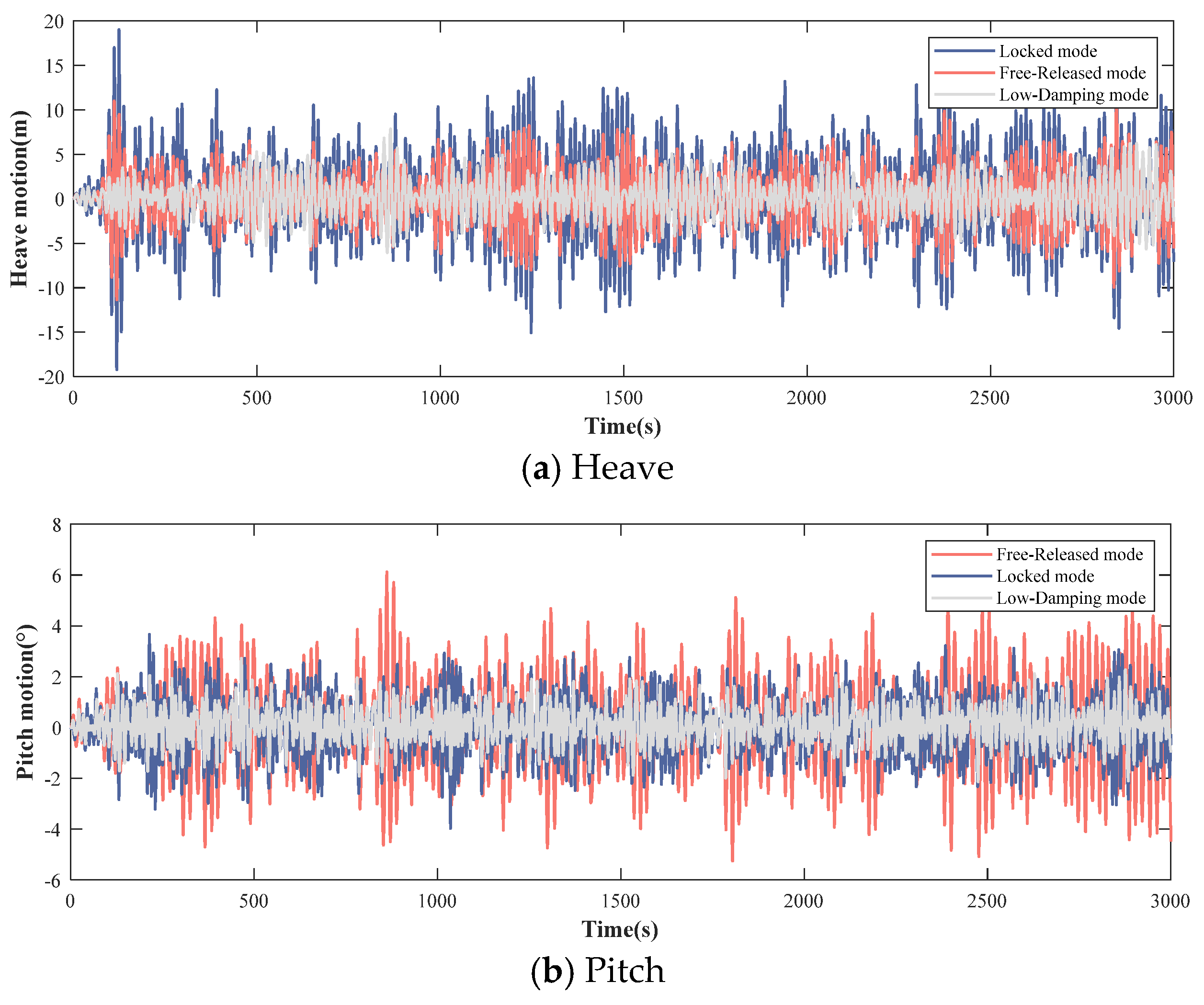
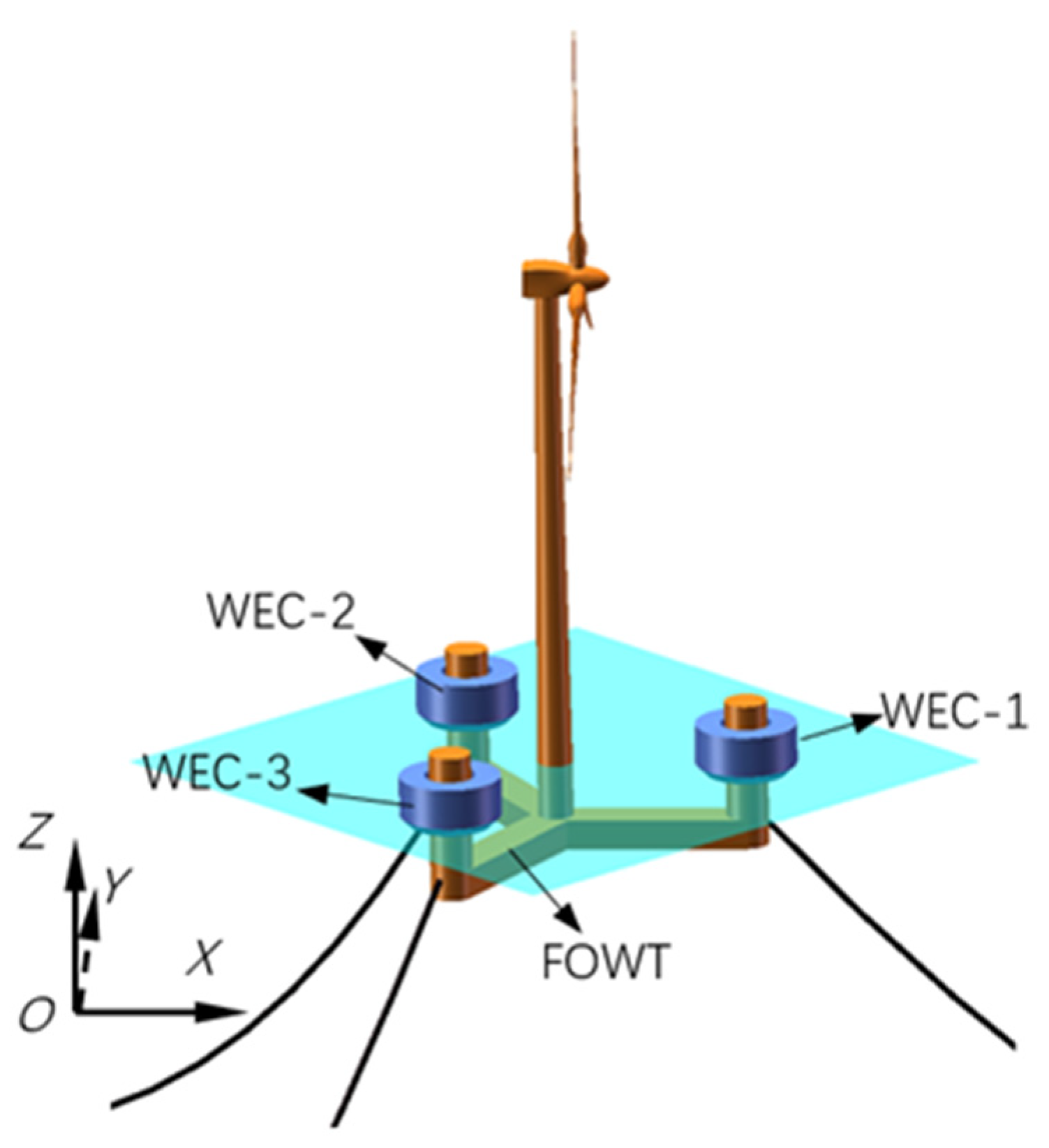
- Locked mode: The WECs do not generate power and are mechanically locked to remain relatively stationary with respect to the FOWT foundation. In numerical simulations, the floating offshore wind–wave hybrid system is modeled as a single rigid body. Two locking modes could be employed for the WECs: one locked directly at the still water equilibrium position; alternatively, the device may be ballasted and fully submerged. However, the latter approach may result in wave impacts on the wind turbine blades [15].
- (2)
- Free-released mode: The WECs are deactivated from power generation and permitted to move freely along the axial direction of the FOWT foundation’s column. In this condition, the PTO damping coefficient is set to zero.
- (3)
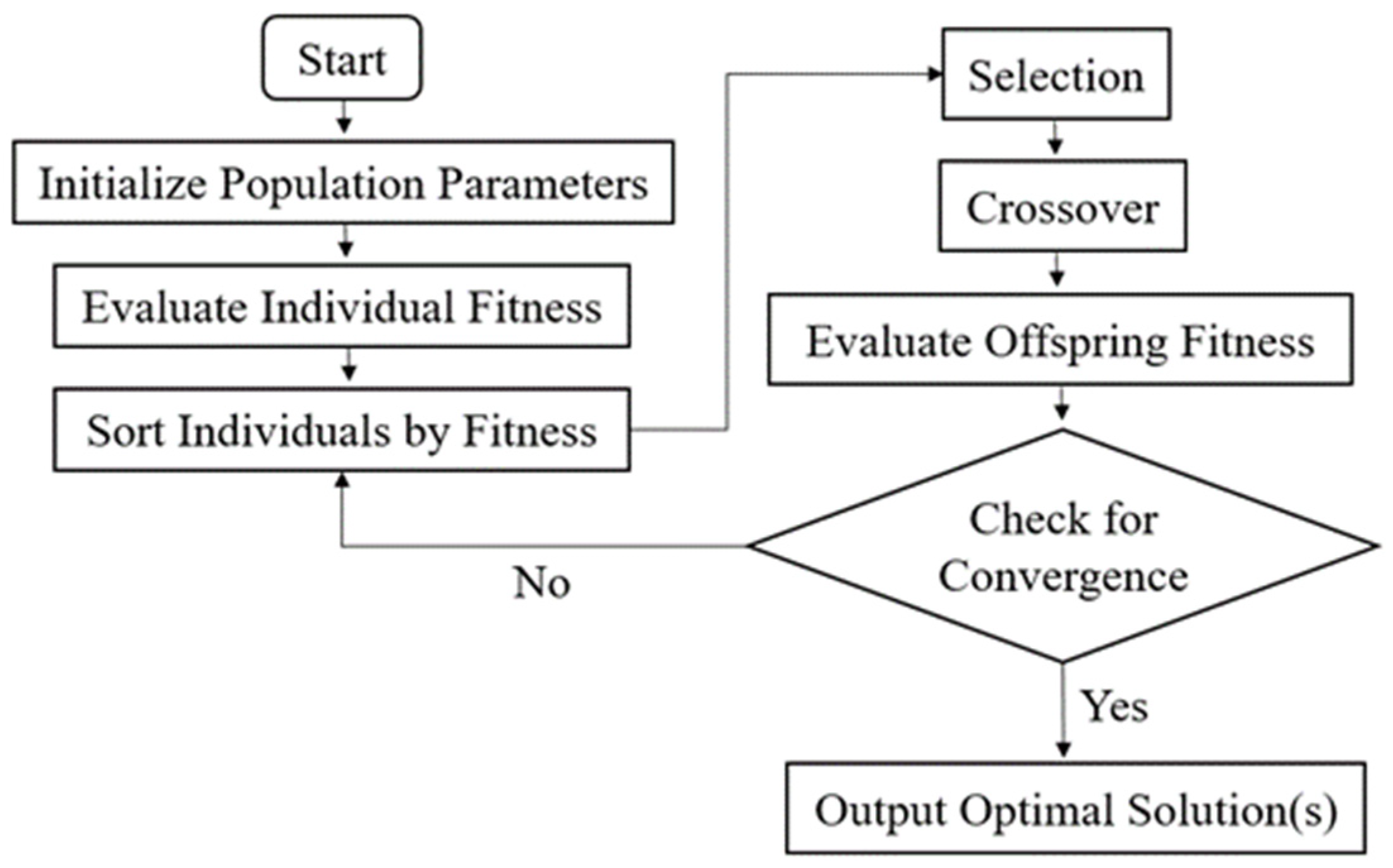
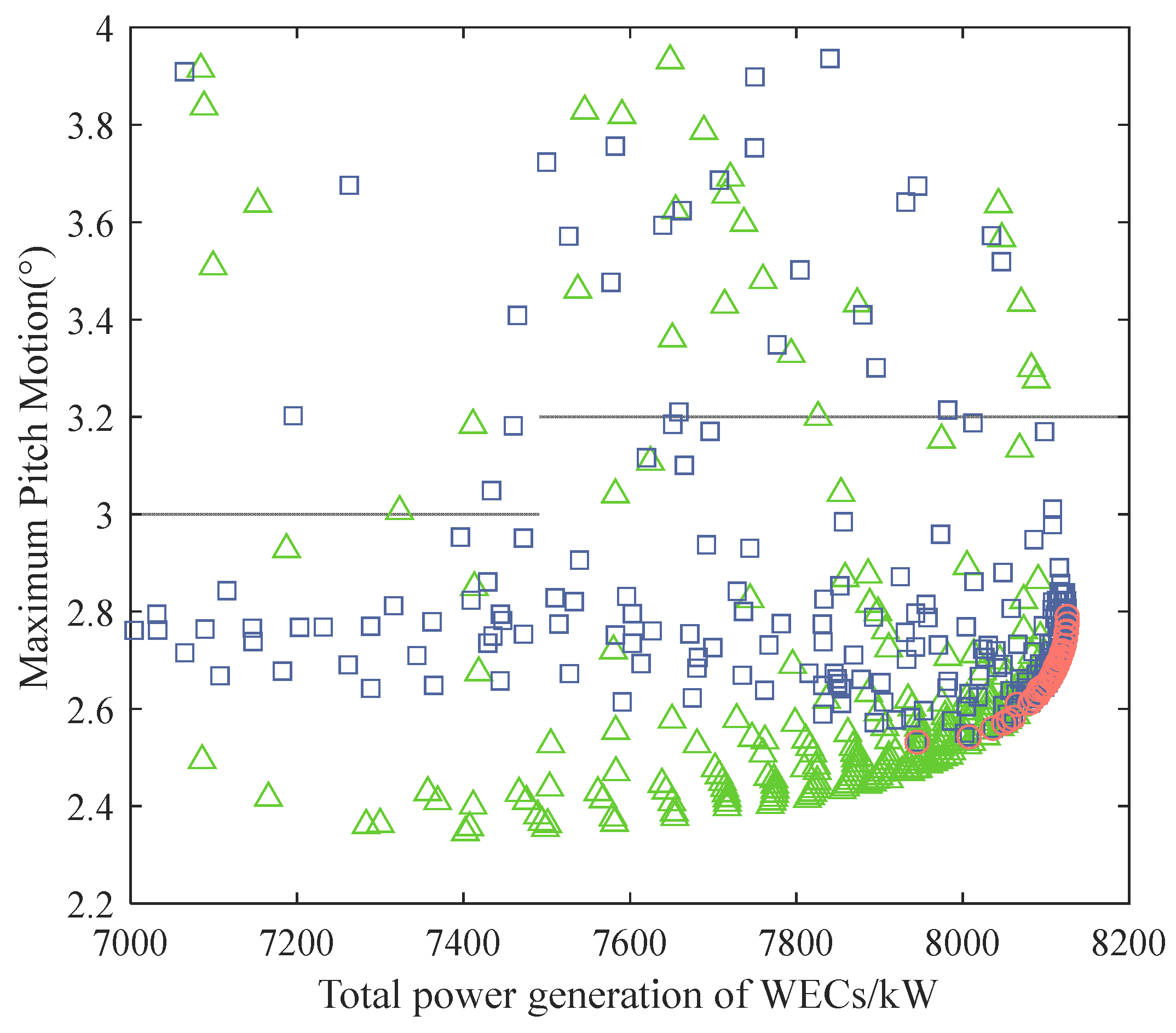
- Low damping mode: The WECs remain in the power generation state. No standardized approach has been defined for the selection of PTO damping coefficients. Consequently, the values of the PTO damping for each WECs within the hybrid system are optimized through the application of the NSGA-II algorithm in this paper.
4. Multi-Objective Optimization of PTO Damping Coefficient
4.1. NSGA-II
4.2. Objective Function and Constraints
4.3. Pareto Solutions
4.4. Performance Assessment
5. Conclusions
- (1)
- A method for determining the optimal PTO damping of WECs is proposed, based on a time-domain dynamic model coupled with a multi-objective genetic algorithm. This method provides a feasible approach for specifying the PTO damping of wind–wave hybrid systems under low-damping modes in extreme environments.
- (2)
- The dynamic response characteristics of the wind–wave hybrid system are systematically compared under three survival modes. It is found that the low-damping mode can effectively reduce the pitch motion of the FOWT foundation within the hybrid system. Although slight increases are observed in heave motion and mooring line tensions compared to the free-released mode without PTO damping, the effective suppression of relative heave motion of the WECs significantly reduces the risk of collision between the buoy and the FOWT foundation pontoon, while maintaining a high level of power generation.
Author Contributions
Funding
Data Availability Statement
Conflicts of Interest
Abbreviations
| WECs | Wave Energy Converters |
| PA | Point-Absorbing |
| DOF | Degrees of Freedom |
| LCOE | Levelized Cost of Energy |
| OWC | Oscillating Water Column |
| FOWT | Floating Offshore Wind Turbine |
| PTO | Power Take-off |
| NSGA-II | Non-dominated Sorting Genetic Algorithm II |
| M | Mass | kg |
| A | Added Mass | kg |
| D | Viscous Damping Coefficient | Ns/m |
| K | Retardation Function | N/m |
| F | Forces | N |
| P | Power | W |
| CPTO | PTO Damping | Ns/m |
| η | Displacement | m |
References
- Guo, J.; Han, B.; Ma, Z.; Zhang, B.; Guo, M.; He, B. Research on the strain response of offshore wind turbine monopile foundation through integrated fluid-structure-seabed model test. Ocean Eng. 2024, 314, 119729. [Google Scholar] [CrossRef]
- Gao, J.; Cheng, Y.; Zhang, D.; Chen, Y. Physics-constrained wind power forecasting aligned with probability distributions for noise-resilient deep learning. Appl. Energy 2025, 383, 125295. [Google Scholar] [CrossRef]
- Butterfield, S.; Musial, W.; Jonkman, J.; Wayman, L. Engineering Challenges for Floating Offshore Wind Turbines; Technical Report; National Renewable Energy Lab. (NREL): Copenhagen, Denmark, 2007. [Google Scholar]
- Da-Silva, L.S.P.; Sergiienko, N.Y.; Cazzolato, B.; Ding, B. Dynamics of hybrid offshore renewable energy platforms: Heaving point absorbers connected to a semi-submersible floating offshore wind turbine. Renew. Energy 2022, 199, 1424–1439. [Google Scholar] [CrossRef]
- Pérez-Collazo, C.; Greaves, D.; Iglesias, G. A review of combined wave and offshore wind energy. Renew. Sustain. Energy Rev. 2015, 42, 141–153. [Google Scholar] [CrossRef]
- Weinstein, A.; Roddier, D.; Banister, K. Wind Wave Float (WWF): Final Scientific Report; Principle Power Inc.: Seattle, WA, USA, 2012. [Google Scholar]
- Muliawan, M.J.; Karimirad, M.; Moan, T.; Zhen, G. STC (Spar-Torus Combination): A combined spar-type floating wind turbine and large point absorber floating wave energy converter-promising and challenging. In Proceedings of the ASME 2012 31st International Conference on Ocean, Offshore and Arctic Engineering, Rio de Janeiro, Brazil, 1–6 July 2012. [Google Scholar]
- Ren, N.; Wu, H.; Liu, K.; Zhuo, D.; Ou, J. Hydrodynamic analysis of a modular floating structure with tension-leg platforms and wave energy converters. J. Mar. Sci. Eng. 2021, 9, 424. [Google Scholar] [CrossRef]
- Sun, K.; Yi, Y.; Zheng, X.; Cui, L.; Zhao, C.; Liu, M.; Rao, X. Experimental investigation of semi-submersible platform combined with point-absorber array. Energ. Convers. Manag. 2021, 245, 114623. [Google Scholar] [CrossRef]
- Ghafari, H.R.; Ghassemi, H.; Neisi, A. Power matrix and dynamic response of the hybrid Wavestar-DeepCwind platform under different diameters and regular wave conditions. Ocean Eng. 2022, 247, 110734. [Google Scholar] [CrossRef]
- Luan, C.; Michailides, C.; Gao, Z.; Moan, T. Modeling and analysis of a 5 MW semi-submersible wind turbine combined with three flap-type wave energy converters. In Proceedings of the ASME 2014 33rd International Conference on Ocean, Offshore and Arctic Engineering, San Francisco, CA, USA, 8–13 June 2014. [Google Scholar]
- Sarmiento, J.; Iturrioz, A.; Ayllón, V.; Guanche, R.; Losada, I.J. Experimental modelling of a multi-use floating platform for wave and wind energy harvesting. Ocean Eng. 2019, 173, 761–773. [Google Scholar] [CrossRef]
- Huang, S.; Wang, J.; Yang, M.; Dong, G.; Wang, Y.; Liu, Y. Parameter analysis and dual-objective optimization of the hydraulic power take-off system of a floating wind-wave hybrid system. Ocean Eng. 2024, 307, 118058. [Google Scholar] [CrossRef]
- Si, Y.; Chen, Z.; Zeng, W.; Sun, J.; Zhang, D.; Ma, X.; Qian, P. The influence of power-take-off control on the dynamic response and power output of combined semi-submersible floating wind turbine and point-absorber wave energy converters. Ocean Eng. 2021, 227, 108835. [Google Scholar] [CrossRef]
- Ren, N.; Gao, Z.; Moan, T.; Wan, L. Long-term performance estimation of the spar-torus-combination (STC) system with different survival modes. Ocean Eng. 2015, 108, 716–728. [Google Scholar] [CrossRef]
- Wang, Q. Design of a Steel Pontoon-Type Semi-Submersible Floater Supporting the DTU 10MW Reference Turbine. Master’s Thesis, Norwegian University of Science and Technology, Trondheim, Norway, 2014. [Google Scholar]
- Bak, C.; Zahle, F.; Bitsche, R.; Kim, T.; Yde, A.; Henrikesen, L.C.; Hansen, M.H.; Gaunaa, M.; Natarajan, A. The DTU 10-MW reference wind turbine. In Proceedings of the Danish Wind Power Research 2013, Fredericia, Denmark, 27–28 May 2013. [Google Scholar]
- Muliawan, M.J.; Gao, Z.; Moan, T.; Babarit, A. Analysis of a two-body floating wave energy converter with particular focus on the effects of power take-off and mooring systems on energy capture. J. Offshore Mech. Arct. Eng. 2013, 135, 031902. [Google Scholar] [CrossRef]
- Cummins, W.E. The Impulse Response Function and Ship Motions. Schiffstechnik 1962, 9, 101–109. [Google Scholar]
- Ogden, D.; Ruehl, K.; Yu, Y.H. Review of WEC-Sim development and applications. Int. Mar. Energy J. 2022, 5, 293–303. [Google Scholar] [CrossRef]
- Deb, K.; Pratap, A.; Agarwal, S.; Meyarivan, T. A fast and elitist multiobjective genetic algorithm: NSGA-II. IEEE Trans. Evol. Comput. 2002, 6, 182–197. [Google Scholar] [CrossRef]


| Parameter | Value ** | Parameter | Value ** | ||
|---|---|---|---|---|---|
| FOWT | Offset column diameter | 10.0 | WECs | Buoy outer diameter (upper) | 24.0 |
| Main column diameter | 8.3 | Buoy inner diameter (upper) | 12.0 | ||
| Pontoon length | 45.0 | Buoy outer diameter (lower) | 19.2 | ||
| Pontoon height | 7.0 | Buoy inner diameter (lower) | 16.8 | ||
| Total draft below SWL | 20.0 | Draft below SWL | 2.4 | ||
| FOWT mass | 1.34 × 10⁷ | Buoy mass | 4.8 × 10⁵ | ||
| Cob location below SWL | 13.8 | Buoy height | 9.6 | ||
| Cog location below SWL | 5.7 | COG location below SWL | 0.0 |
| Mooring Line Configuration | ||
|---|---|---|
| Number of mooring lines | 3 | [-] |
| Angel between adjacent lines | 120 | deg |
| Water depth | 200 | m |
| Depth from fairlead to seabed | 185 | m |
| Radius to anchors from platform center | 879.6 | m |
| Radius to fairlead from platform center | 50 | m |
| Unstretched mooring line length | 880 | m |
| WEC-1 Damping (kNs/m) | WEC-2 Damping (kNs/m) | WEC-3 Damping (kNs/m) | Average Power (kW) | FOWT Pitch Motion (°) | |
|---|---|---|---|---|---|
| 1 | 3600 | 3900 | 3900 | 8125.6 | 2.790 |
| 2 | 3700 | 3800 | 3800 | 8124.0 | 2.758 |
| 3 | 3900 | 3800 | 3800 | 8121.9 | 2.731 |
| 4 | 4100 | 3800 | 3800 | 8117.4 | 2.707 |
| 5 | 4100 | 3600 | 3600 | 8108.6 | 2.674 |
| 6 | 4300 | 3600 | 3600 | 8102.1 | 2.654 |
| 7 | 4400 | 3500 | 3500 | 8090.6 | 2.629 |
| 8 | 4600 | 3500 | 3500 | 8081.4 | 2.612 |
| 9 | 4800 | 3400 | 3400 | 8061.0 | 2.582 |
| 10 | 5200 | 3400 | 3400 | 8036.2 | 2.560 |
| Relative Heave (m) | Relative Pitch (°) | ||
|---|---|---|---|
| Locked mode | Maximum | 17.20 | 3.22 |
| Minimum | −14.57 | −3.04 | |
| Standard deviation | 27.56 | 1.33 | |
| Free-released mode | Maximum | 6.24 | 4.77 |
| Minimum | −5.66 | −4.48 | |
| Standard deviation | 2.58 | 2.29 | |
| Low-Damping mode | Maximum | 10.63 | 2.63 |
| Minimum | −9.94 | −2.14 | |
| Standard deviation | 11.96 | 0.56 |
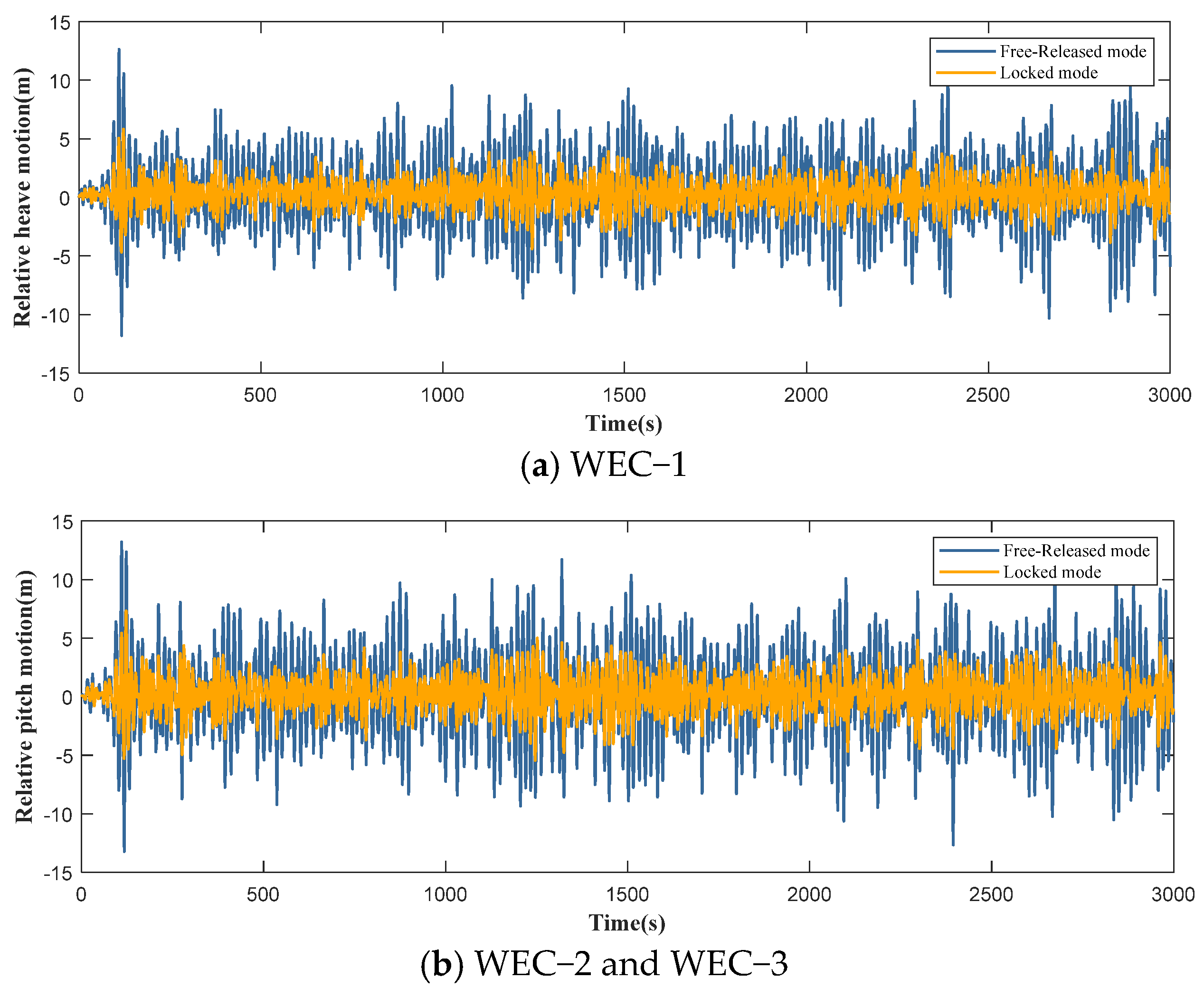
| Relative Motion WEC-1 (m) | Relative Motion WEC-2 and 3 (m) | ||
|---|---|---|---|
| Free-released mode | Maximum | 9.58 | 11.14 |
| Minimum | −10.34 | −10.53 | |
| Standard deviation | 3.79 | 4.35 | |
| Low-damping mode | Maximum | 6.24 | 4.77 |
| Minimum | −5.66 | −4.48 | |
| Standard deviation | 2.58 | 2.29 |
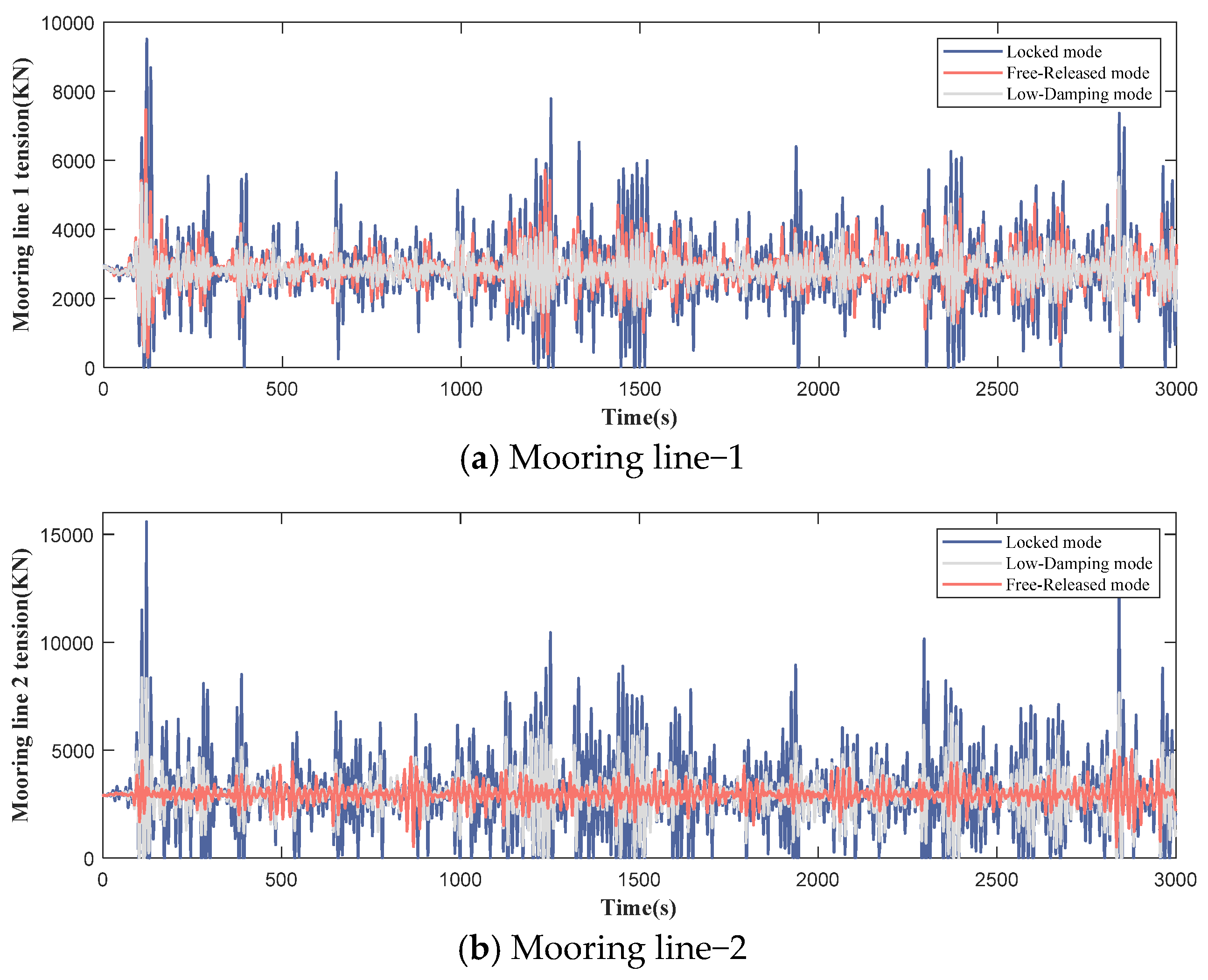
| Mooring Line-1 Tension (kN) | Mooring Line-2 Tension (kN) | ||
|---|---|---|---|
| Locked mode | Maximum | 7367 | 12,662 |
| Standard deviation | 1081 | 1810 | |
| Free-released mode | Maximum | 5229 | 5034 |
| Standard deviation | 566 | 571 | |
| Low-damping mode | Maximum | 5516 | 7660 |
| Standard deviation | 503 | 1018 |
Disclaimer/Publisher’s Note: The statements, opinions and data contained in all publications are solely those of the individual author(s) and contributor(s) and not of MDPI and/or the editor(s). MDPI and/or the editor(s) disclaim responsibility for any injury to people or property resulting from any ideas, methods, instructions or products referred to in the content. |
© 2025 by the authors. Licensee MDPI, Basel, Switzerland. This article is an open access article distributed under the terms and conditions of the Creative Commons Attribution (CC BY) license (https://creativecommons.org/licenses/by/4.0/).
Share and Cite
Yang, S.; Zhang, S.; Zhang, F.; Wang, X.; Qiao, D. Multi-Objective Optimization for PTO Damping of Floating Offshore Wind–Wave Hybrid Systems Under Extreme Conditions. J. Mar. Sci. Eng. 2025, 13, 2084. https://doi.org/10.3390/jmse13112084
Yang S, Zhang S, Zhang F, Wang X, Qiao D. Multi-Objective Optimization for PTO Damping of Floating Offshore Wind–Wave Hybrid Systems Under Extreme Conditions. Journal of Marine Science and Engineering. 2025; 13(11):2084. https://doi.org/10.3390/jmse13112084
Chicago/Turabian StyleYang, Suchun, Shuo Zhang, Fan Zhang, Xianzhi Wang, and Dongsheng Qiao. 2025. "Multi-Objective Optimization for PTO Damping of Floating Offshore Wind–Wave Hybrid Systems Under Extreme Conditions" Journal of Marine Science and Engineering 13, no. 11: 2084. https://doi.org/10.3390/jmse13112084
APA StyleYang, S., Zhang, S., Zhang, F., Wang, X., & Qiao, D. (2025). Multi-Objective Optimization for PTO Damping of Floating Offshore Wind–Wave Hybrid Systems Under Extreme Conditions. Journal of Marine Science and Engineering, 13(11), 2084. https://doi.org/10.3390/jmse13112084