Recent Developments in Cross-Shore Coastal Profile Modeling

Abstract
1. Introduction
2. Model Description and Improvement
2.1. General
2.2. Model Description
2.3. Model Improvements
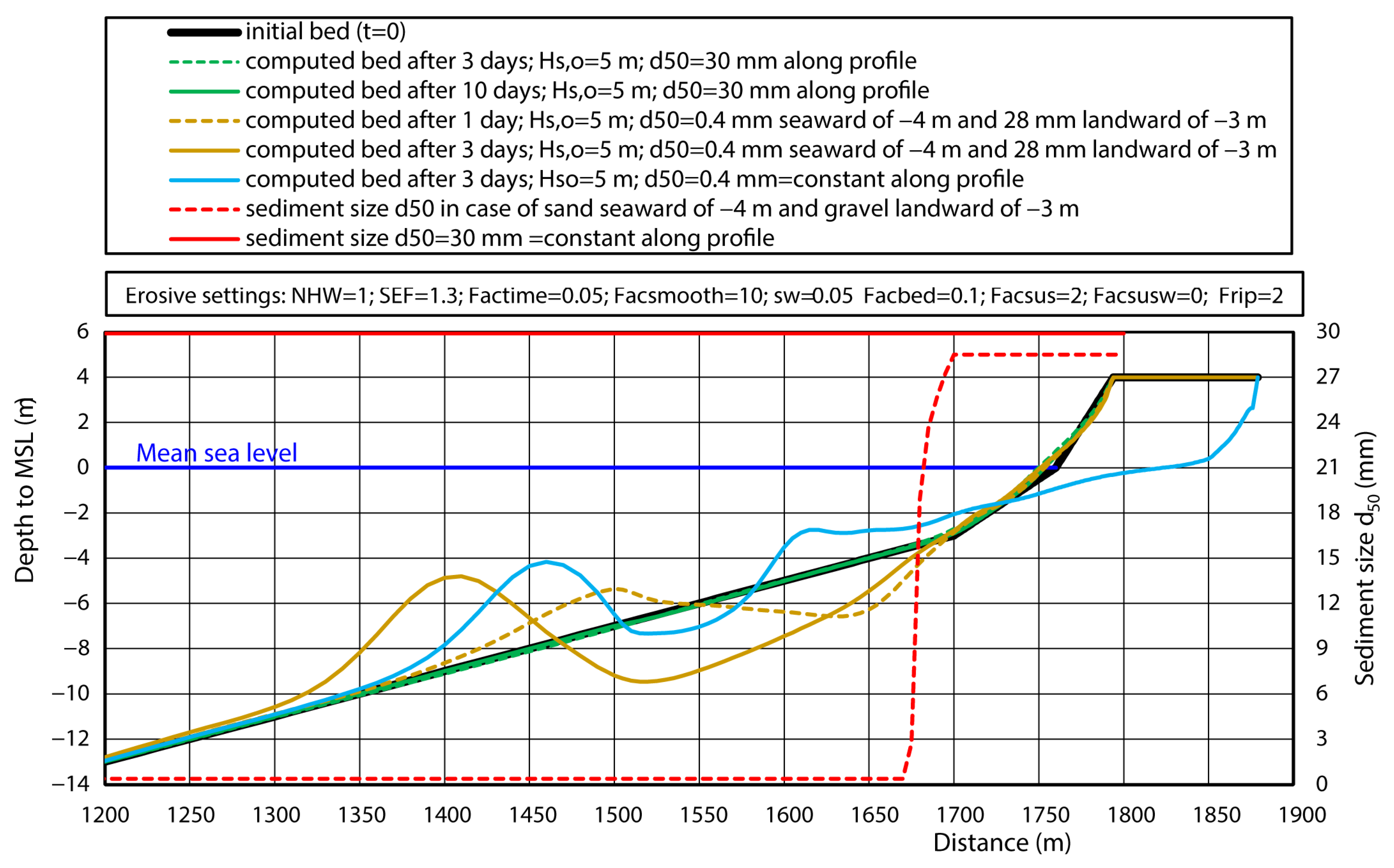
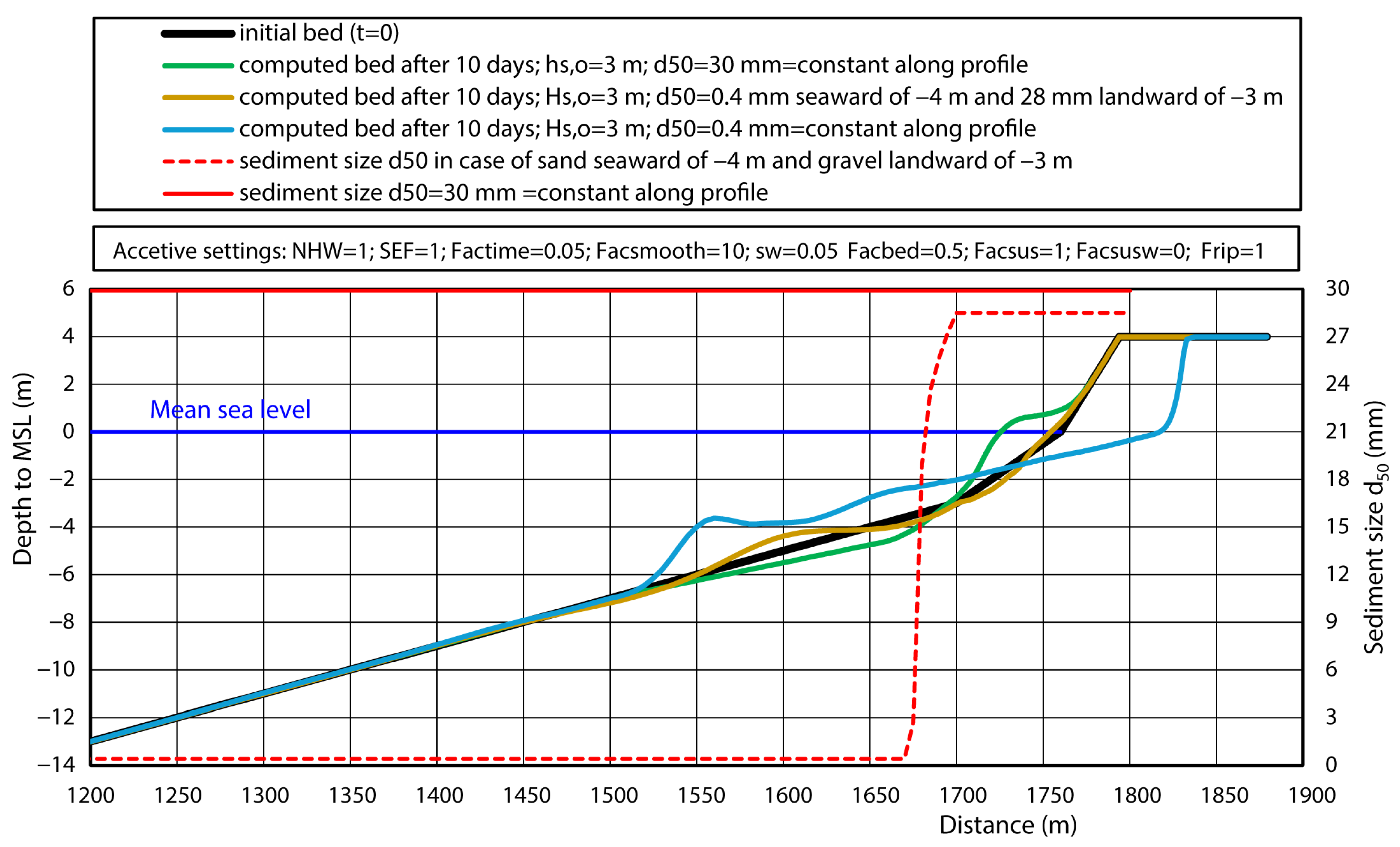
2.3.1. Bed Material Composition and Hard Layers
2.3.2. Wave Runup Equations
2.3.3. Wave Runup Equations
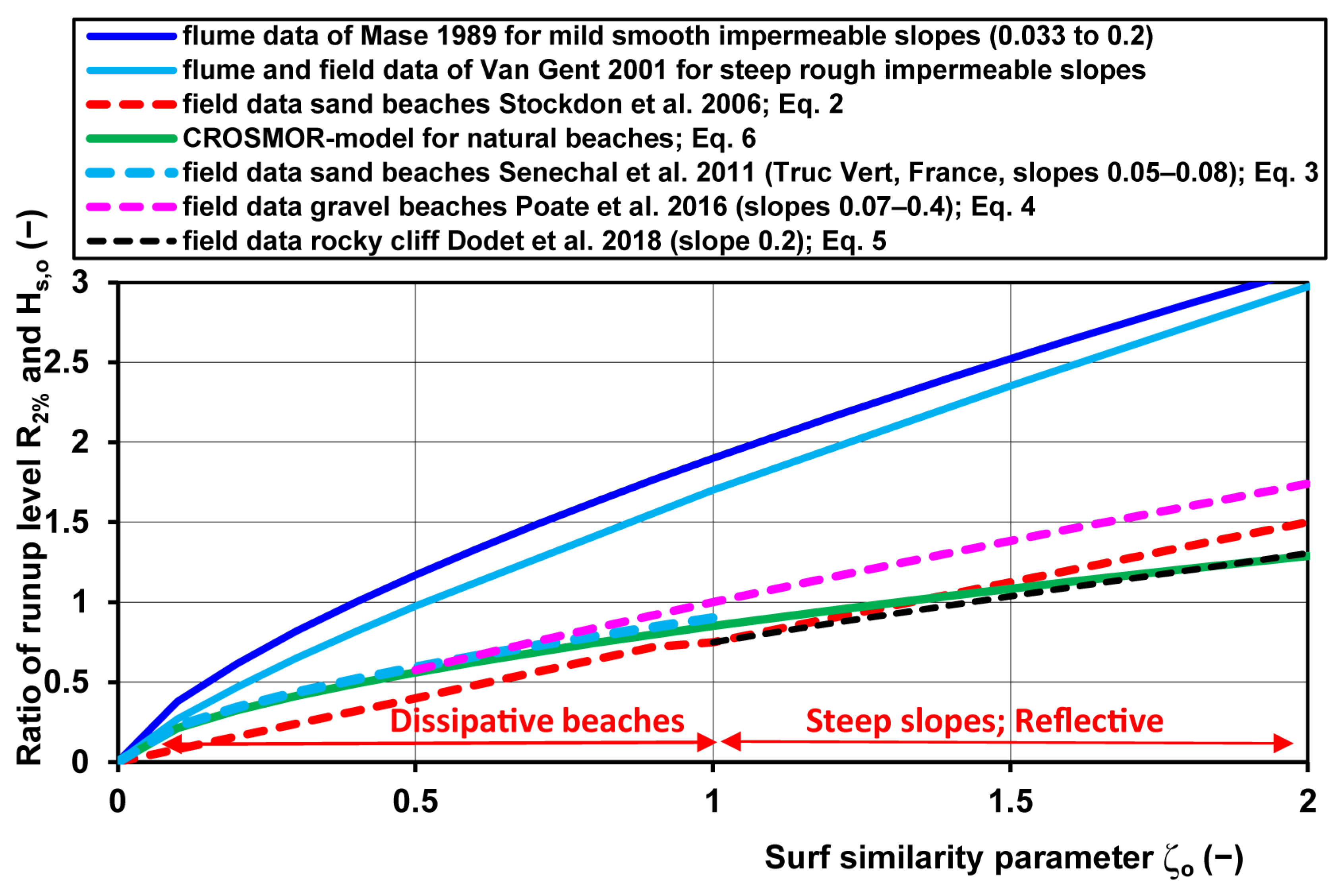
- R2% = αHs,o; wave runup only depends on the offshore wave height Hs,o;
- R2% = α(Hs,o Ls,o)0.5 = α[Hs,oTp2g/(2π)]0.5; effect of the wave period is included;
- R2% = αζoHs,o; effect of the wave period and beach slope are included (ζo = tanβ/(Hs,o/Ls,o)0.5, with tanβ = beach slope around water line).
2.3.4. Wave Runup Equation of CROSMOR-Model
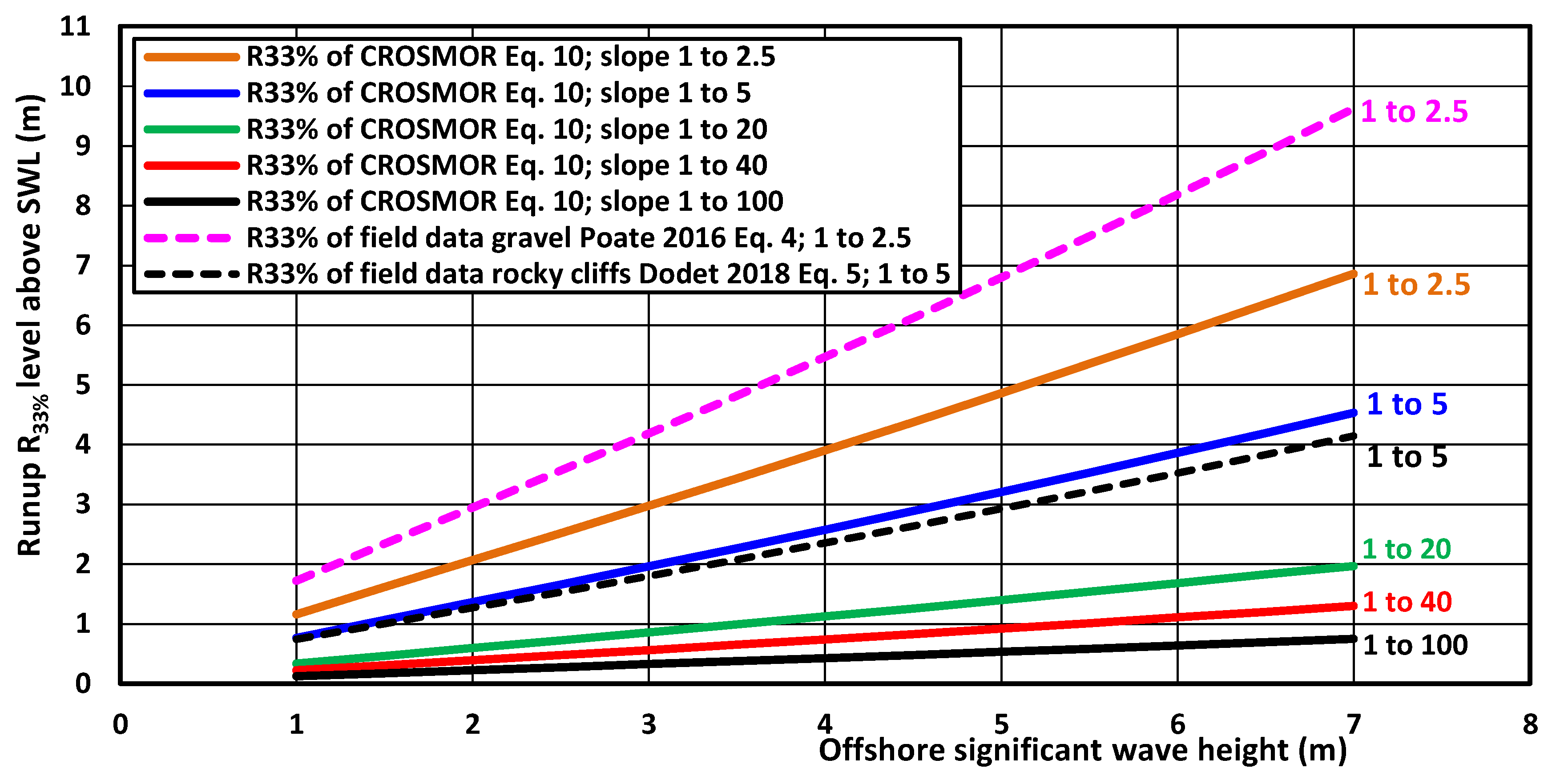
- The wave runup values for steep gravel beaches are higher (30%) than at sand beaches; the wave runup values for rocky cliffs are much lower than at gravel beaches, but are reasonably in agreement with the CROSMOR equations for wave runup;
- The wave runup of Equation (6) of the CROSMOR-model is relatively small (about 1 m for Hs,o = 7 m) for mild slopes between 1 and 100 and 1 and 40;
- The wave runup of Equation (6) increases to 2 m for a slope of 1 to 20, to 4 m for a slope of 1 to 5 and to 7 m for a slope of 1 to 2.5 in the case of Hs,o = 7 m;
- The wave runup values for cliff and gravel slopes are relatively high and reasonably represented by the CROSMOR Equation (6) for slopes up to 1 to 5; Equation (6) underpredicts for steep gravel slopes (1 to 2.5).
3. Model Accuracy and Numerical Behavior
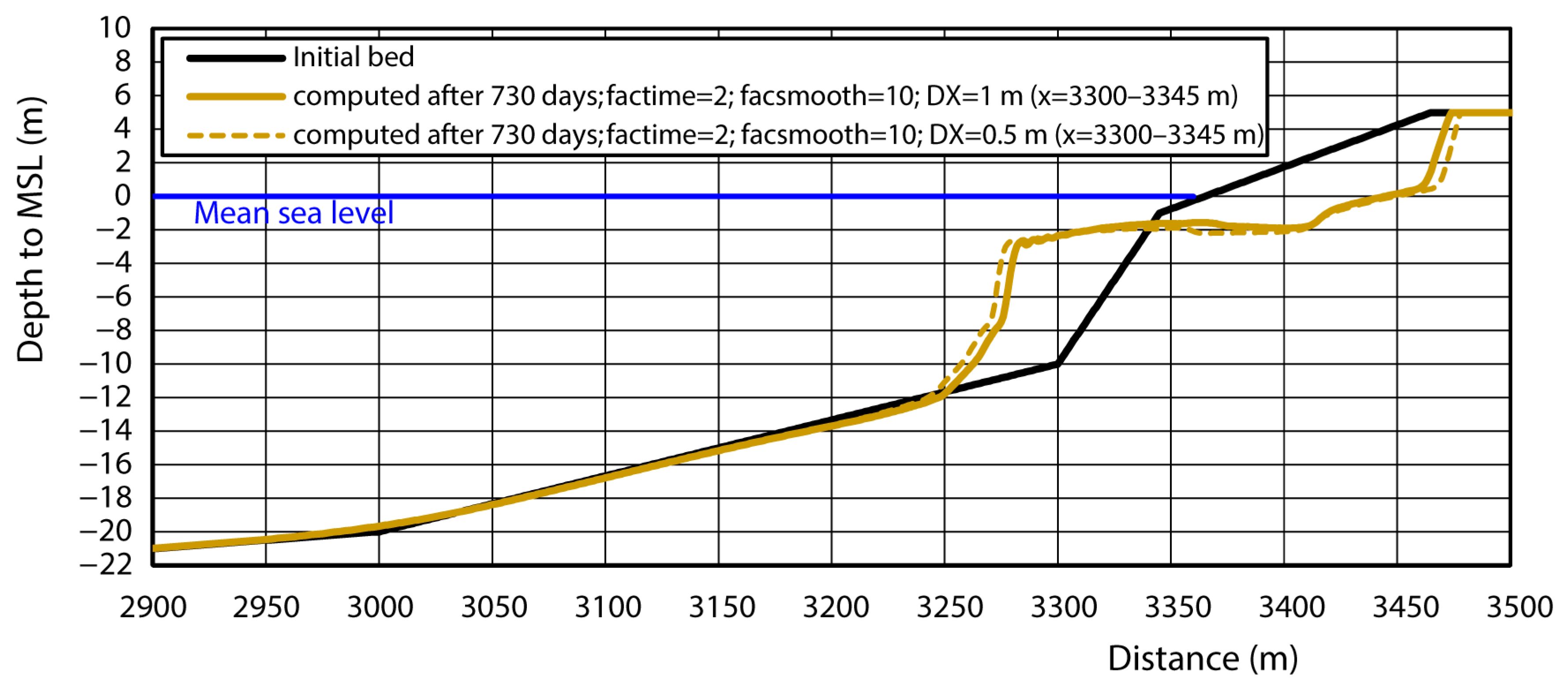
- Grid size: The accuracy can be improved by reducing the grid size from 1 m to 0.5 m at the steep section x = 3300 to 3345 m; see Figure 3;
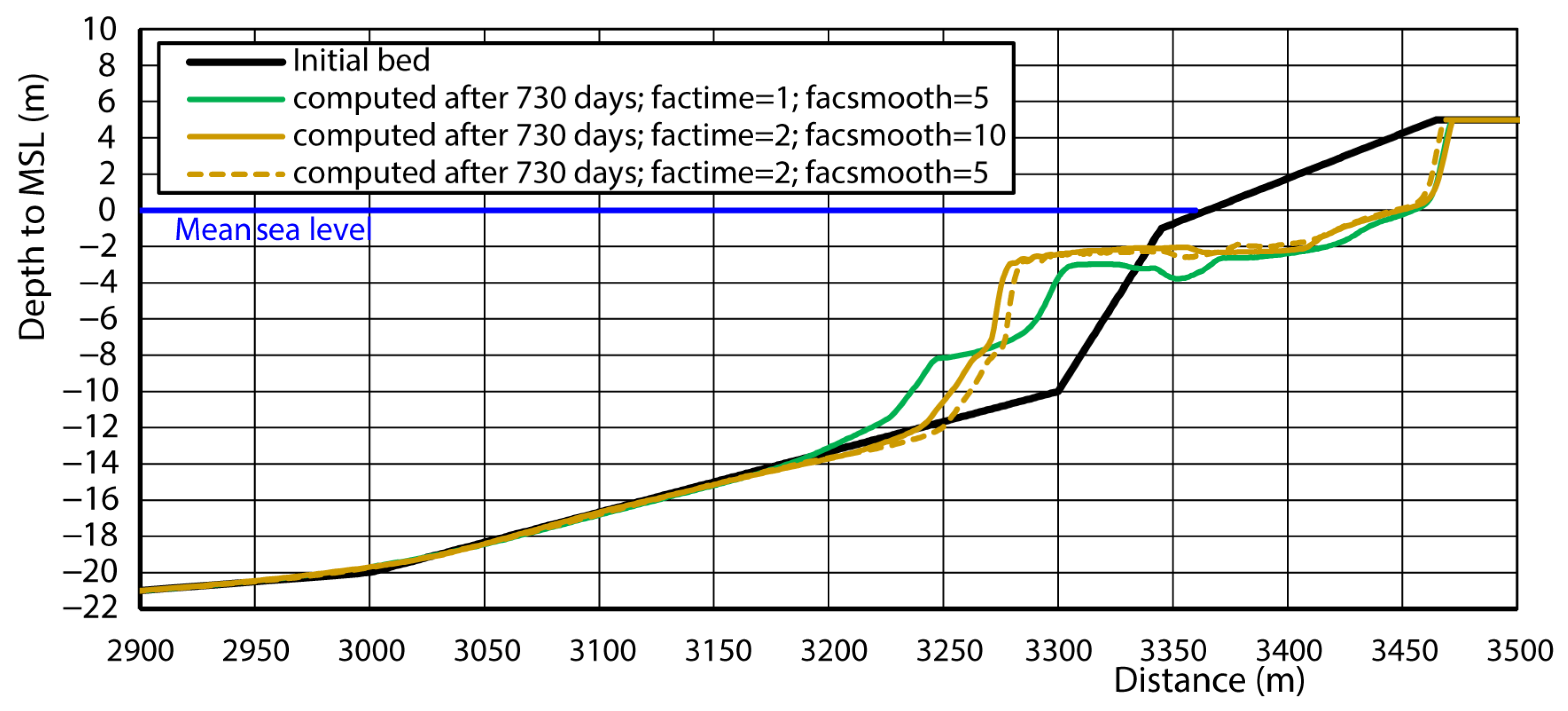
- Time step and bed-smoothing parameters (factime and facsmooth): The effect of bed-smoothing can be seen at point x = 3000 where the sediment transport is very small and the deposition is mainly caused by the bed-smoothing procedure; the most accurate run is for factime = 2 and facsmooth = 5; see Figure 4; the run with factime = 1 and facsmooth = 5 has a lower smoothing coefficient but the smoothing procedure is applied more often due to the smaller time step (factime = 1), which leads to more smoothing of the bed;
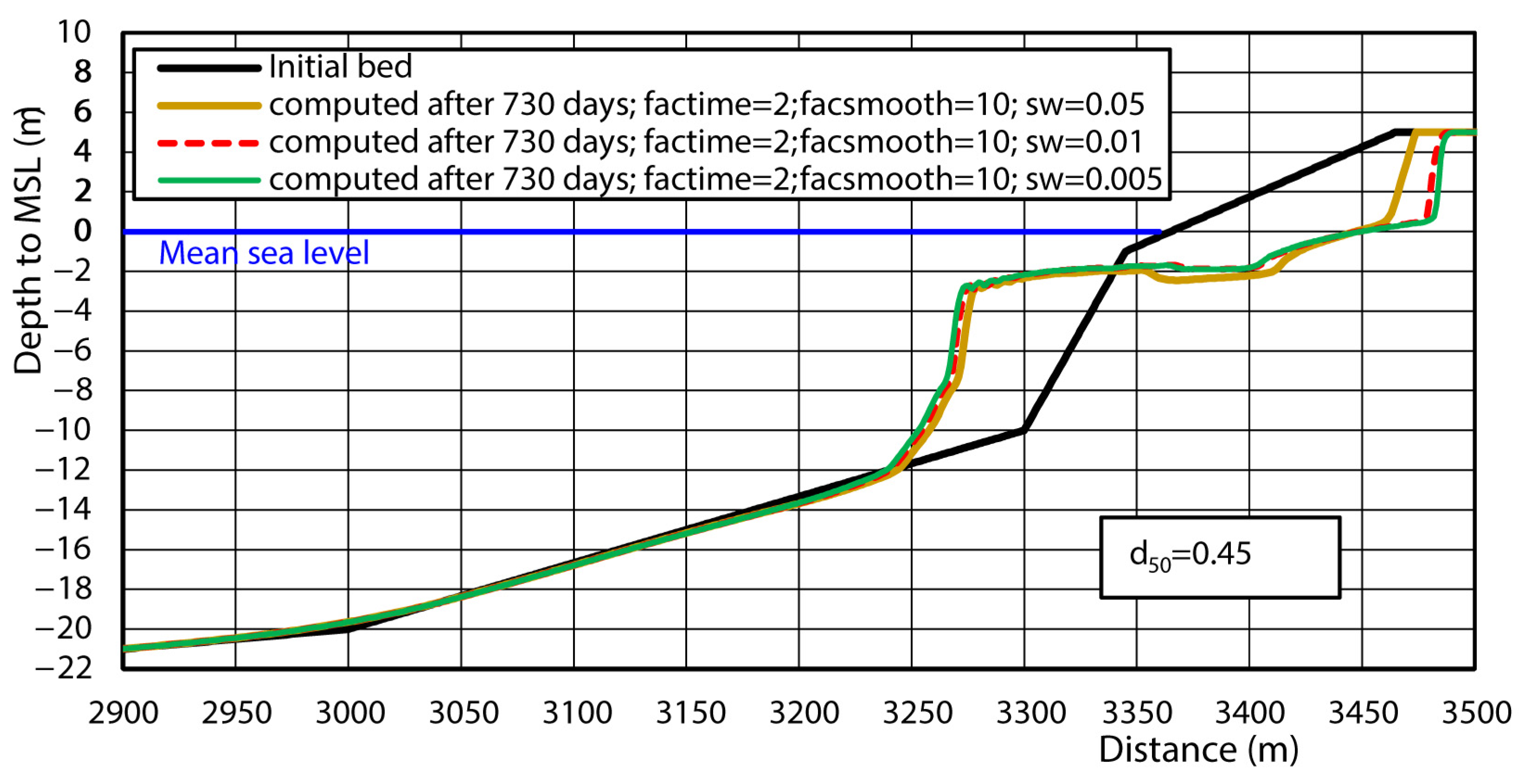
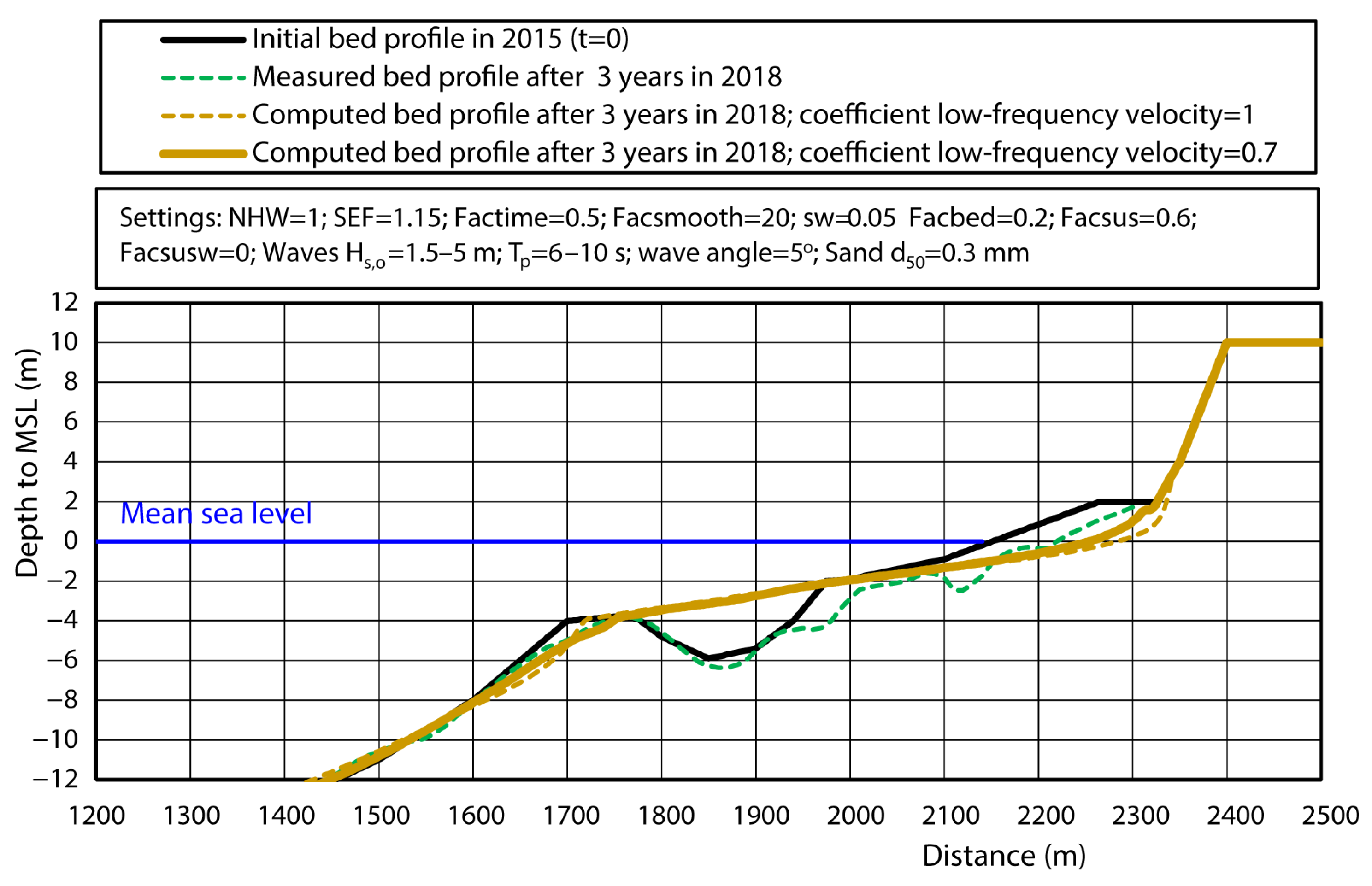
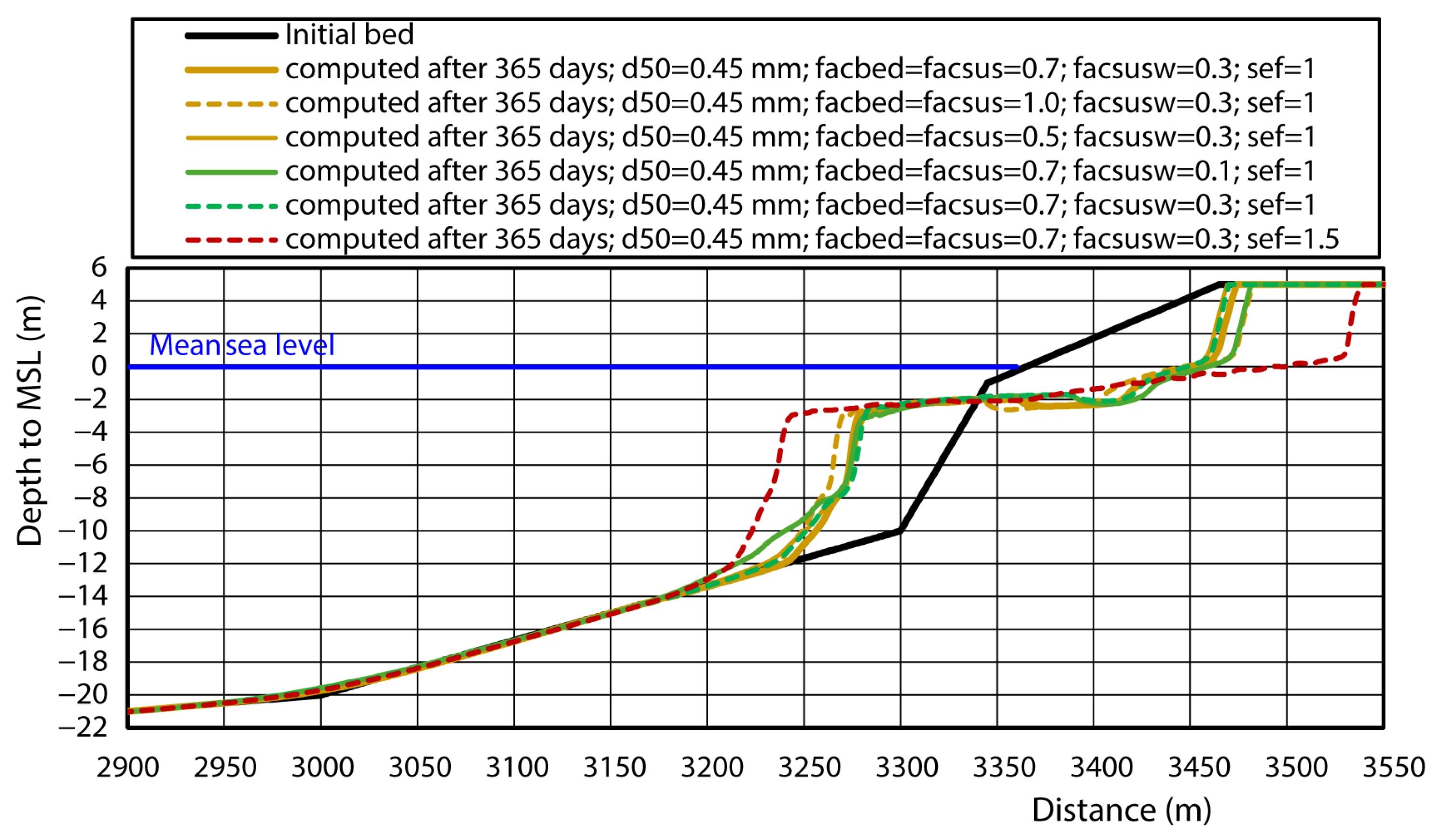
- Effect of bed-smoothing in the swash zone (sw): sw = 0.005 and 0.01 instead of sw = 0.05 gives somewhat more erosion because less smoothing is applied; sw = 0.01 is sufficiently accurate; see Figure 5; slight instability (minor saw-tooth pattern) along the bed can be seen between x = 3275 and 3300 m; the bed comes unstable for SW < 0.005 (run breaks off).
4. Model Validation for Sand and Gravel/Shingle Beaches
4.1. Model Validation Sand Beaches
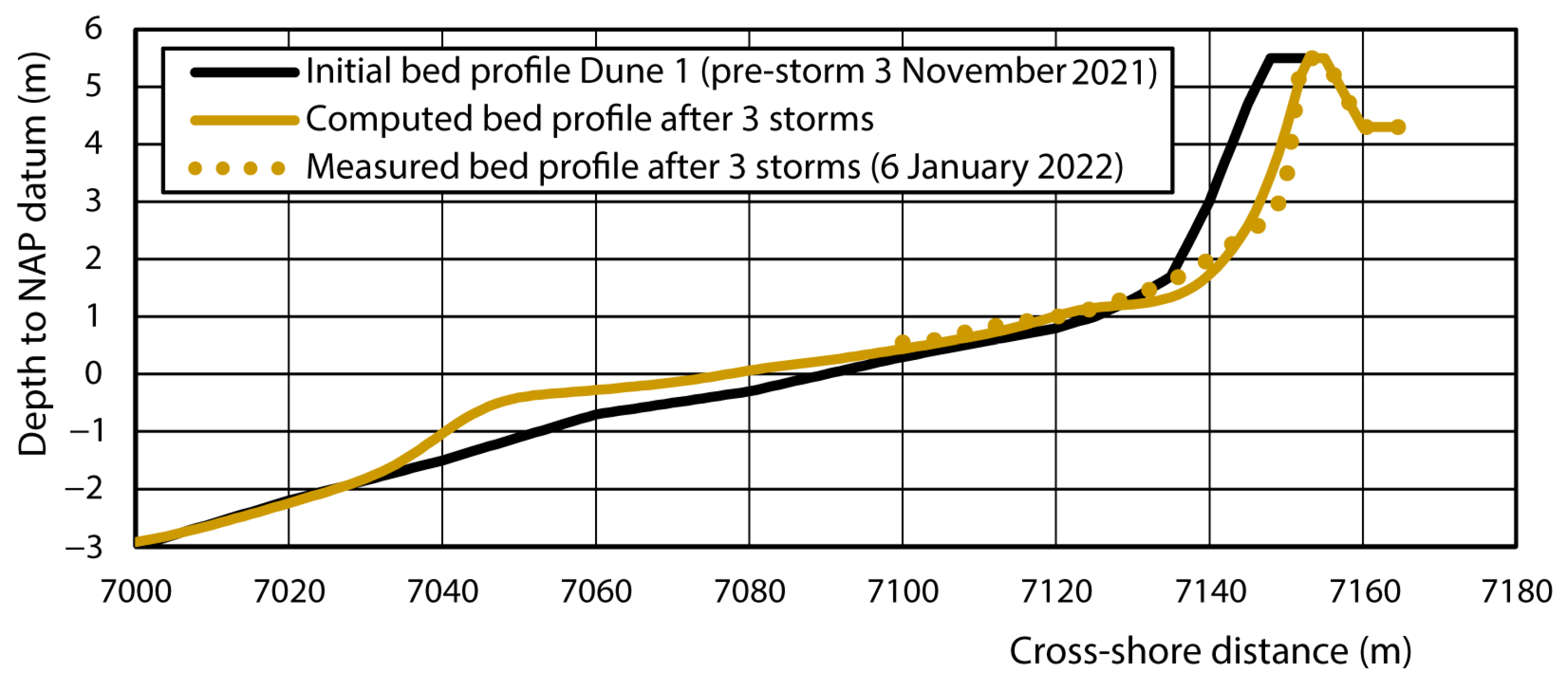
4.1.1. Beach–Dune Erosion of Test Dunes at Site Sand Motor, The Netherlands
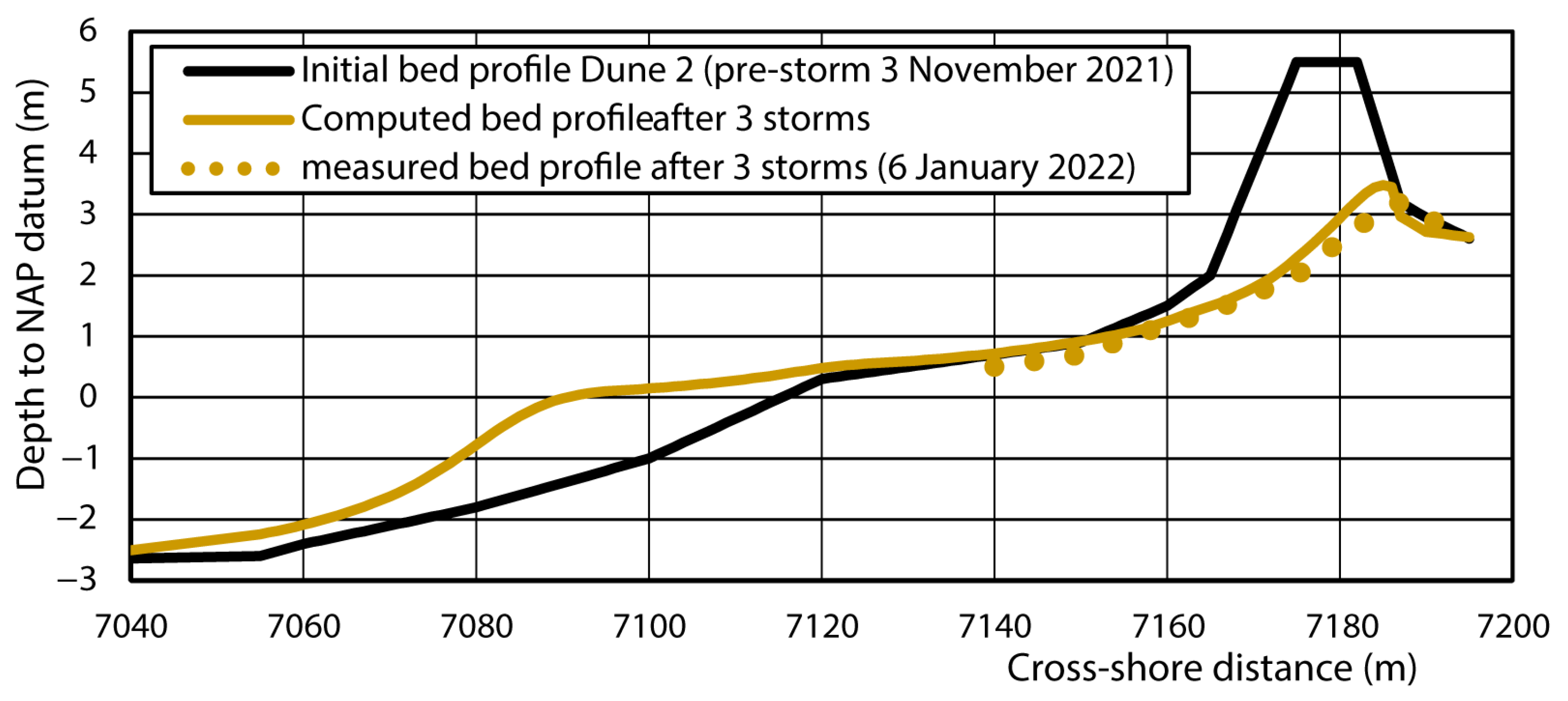
4.1.2. Beach–Dune Erosion at Site De Haan, Belgium
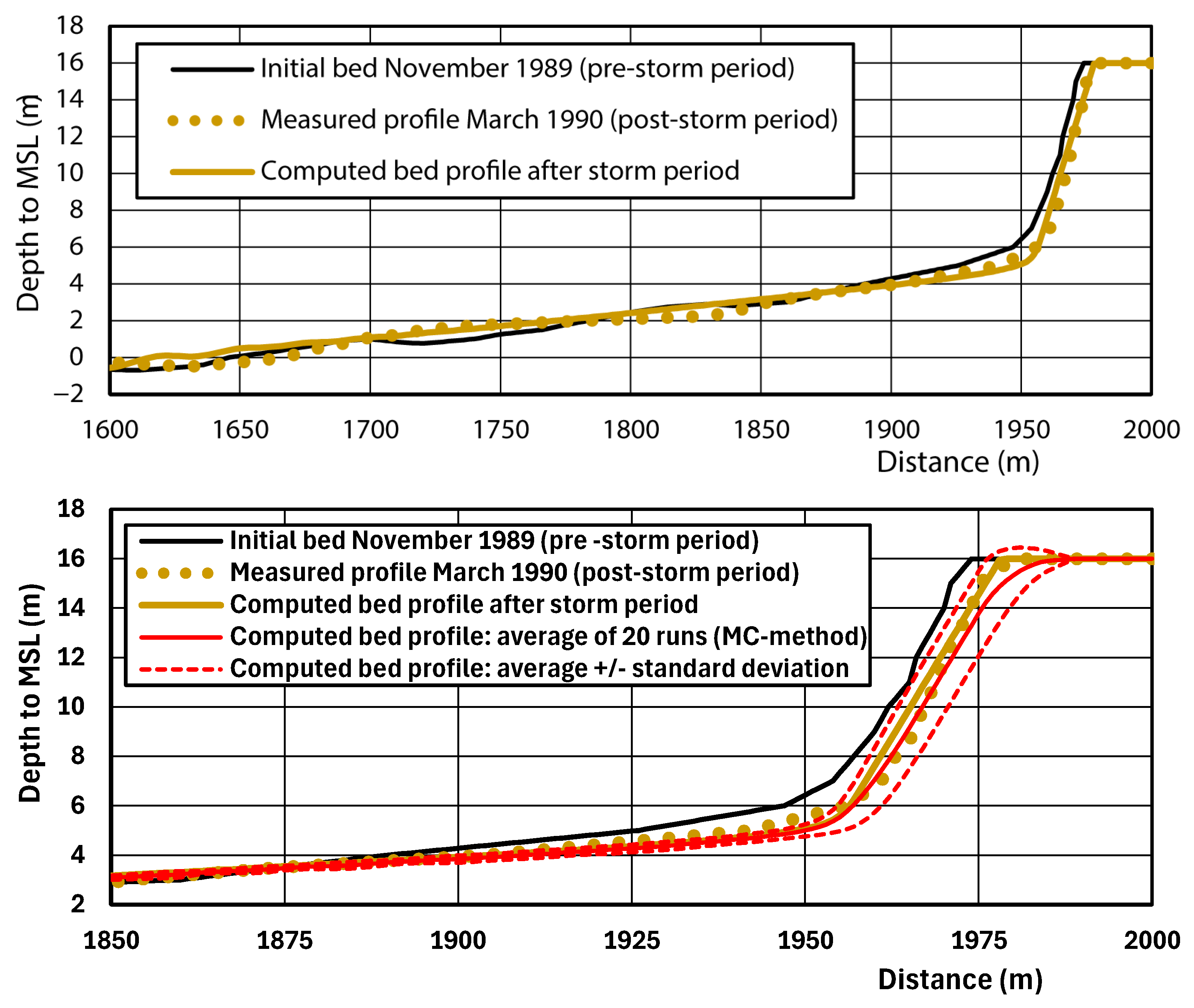
4.1.3. Beach–Dune Erosion at the Site HBZ Petten, Netherlands
4.2. Model Validation Gravel/Shingle Beaches
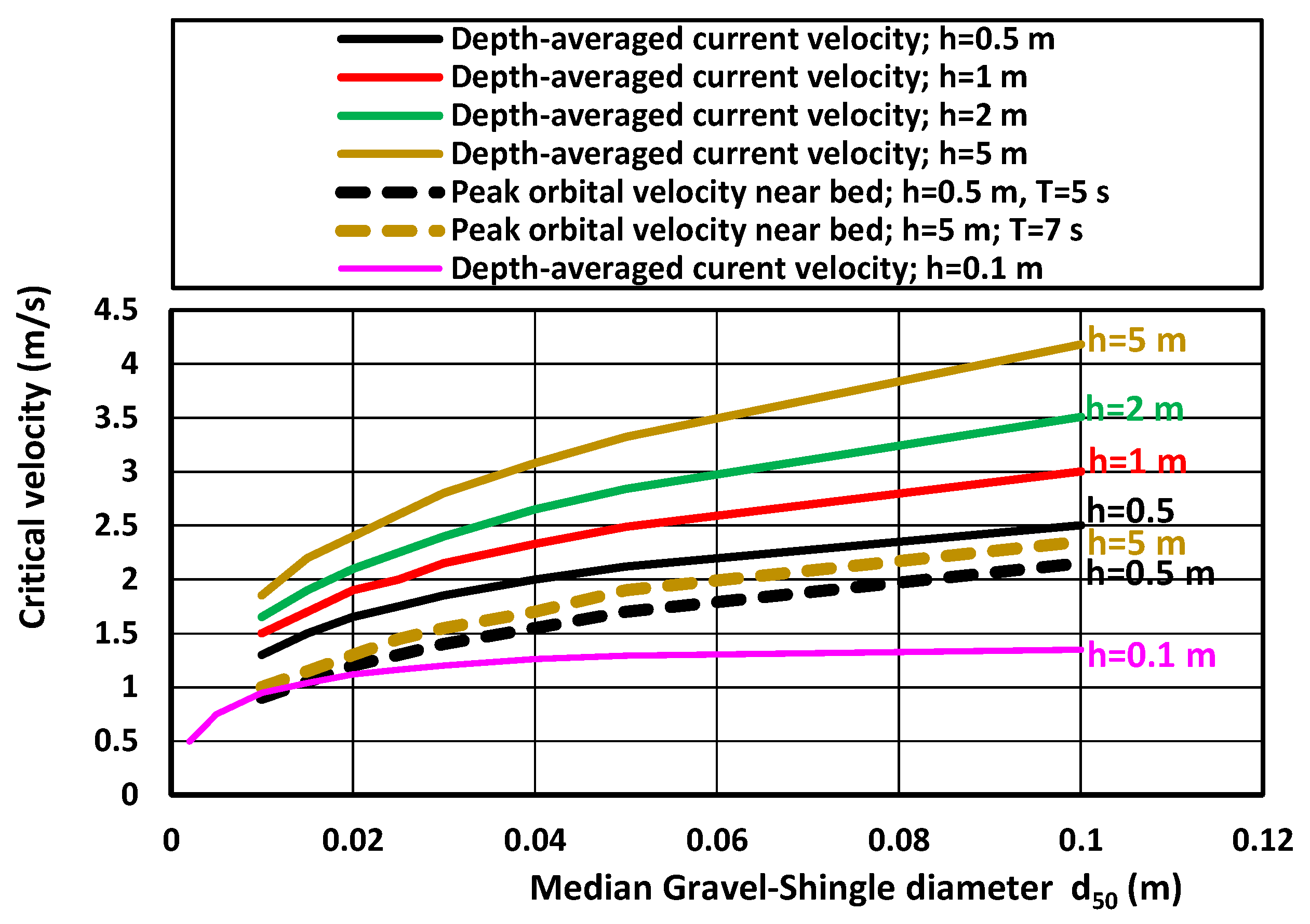
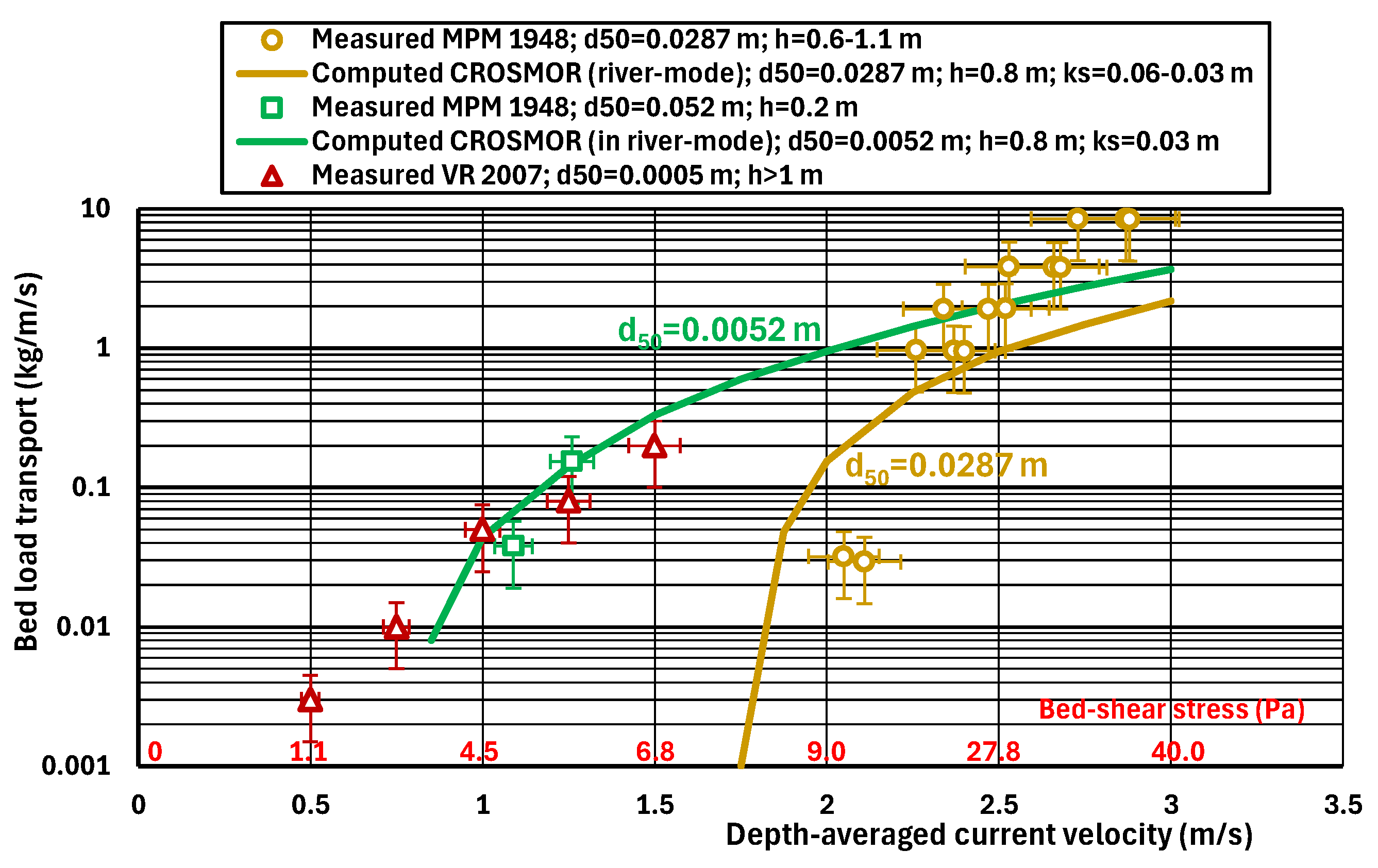
- Gravel transport rates in a unidirectional flow (river flow) computed by the CROSMOR-model (in river mode) are compared to the measured values of the gravel flume experiments of Meyer-Peter and Mueller, 1948 [52];
- CROSMOR simulation runs are made for gravel profiles in large-scale wave flumes;
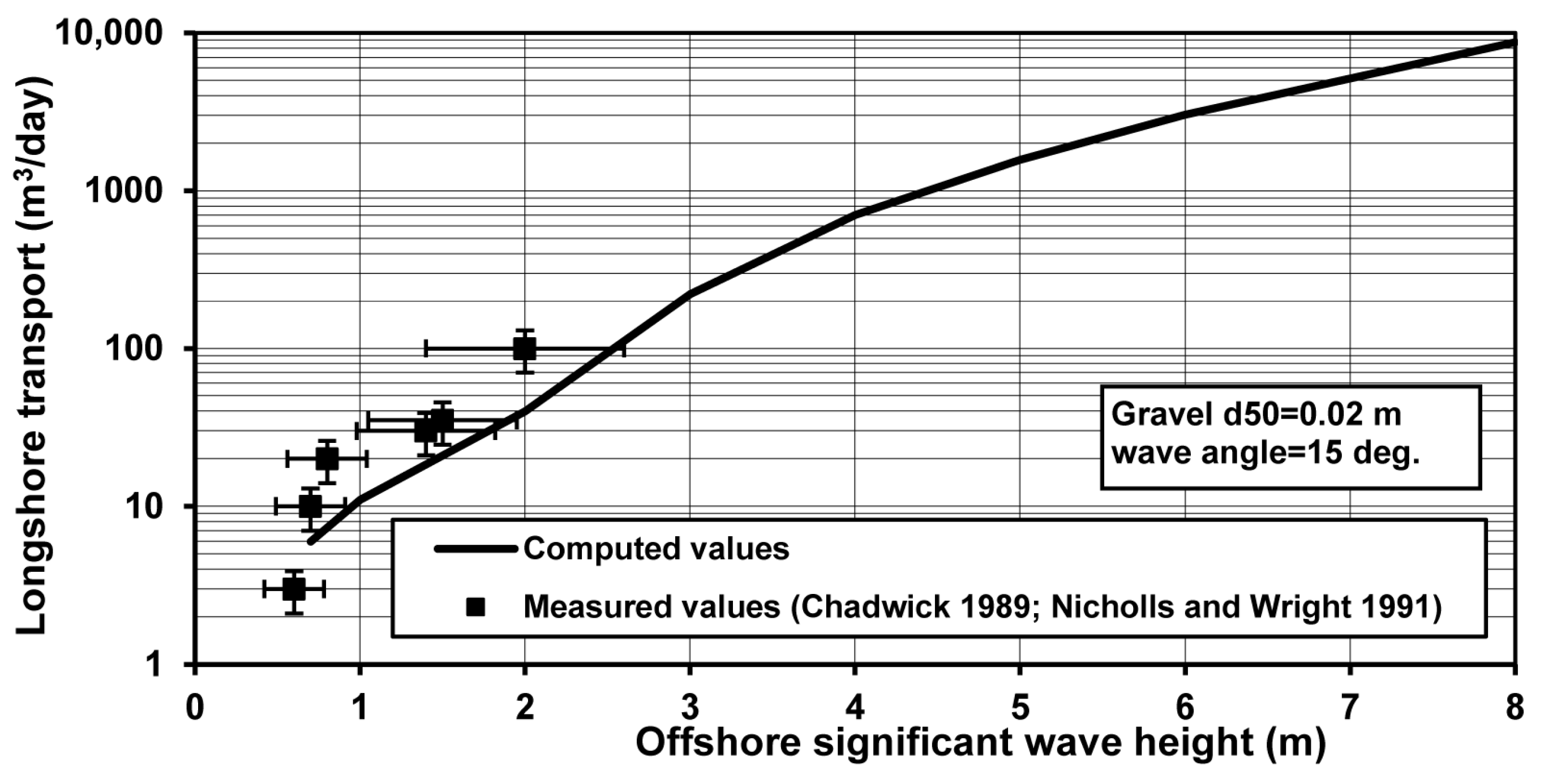
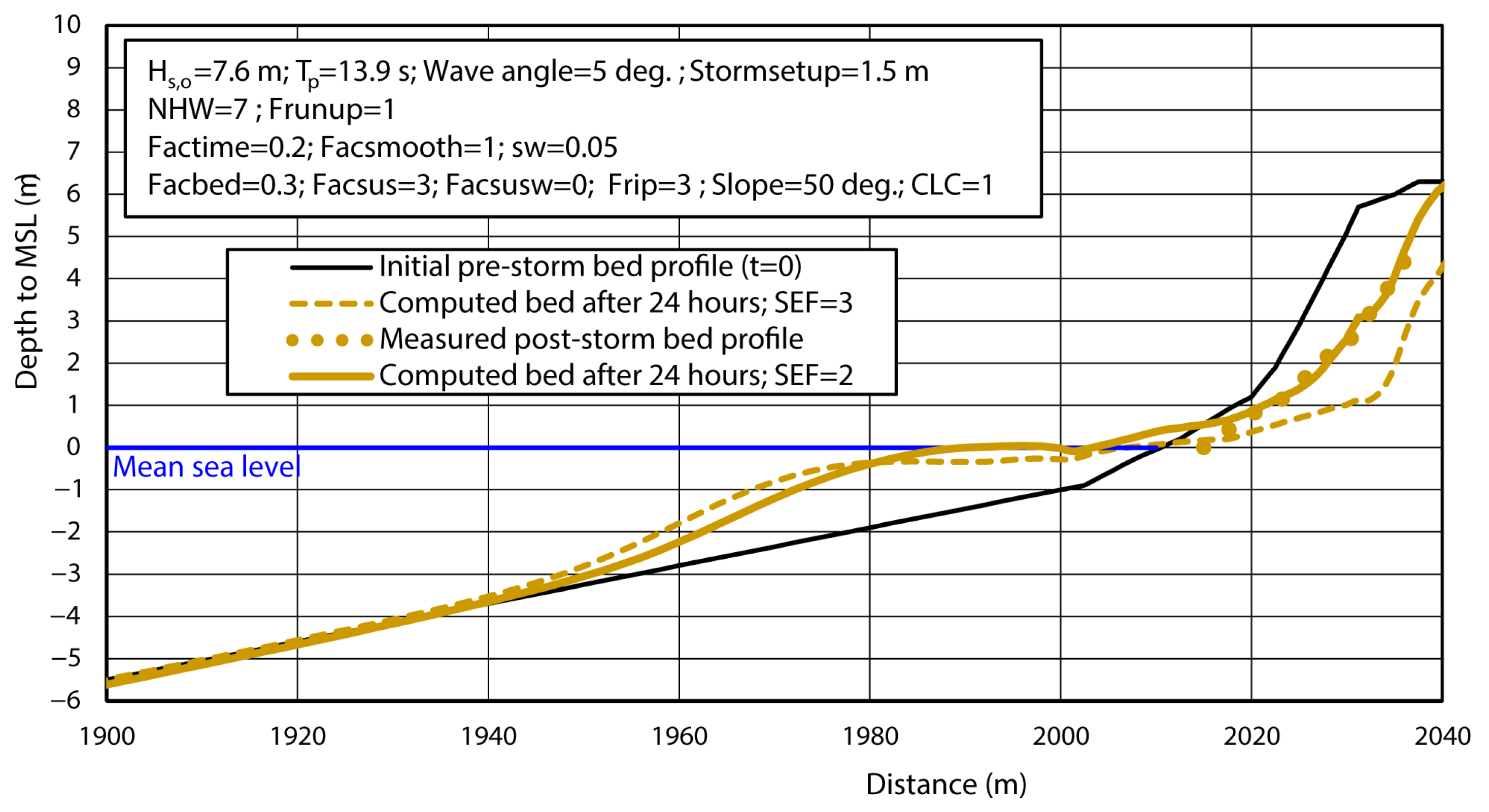
- CROSMOR simulation runs are made for coastal gravel beach profiles at the field sites of Chesil beach (UK) and at Slapton Sands beach (UK).
4.2.1. Measured Bed Load Transport Rates of Gravel in Unidirectional Current
4.2.2. Measured Longshore Gravel Transport Data at Shoreham and Hurst Castle Spit, UK
4.2.3. CROSMOR Simulation Runs for Coastal Gravel Profiles in Large-Scale Wave Flumes
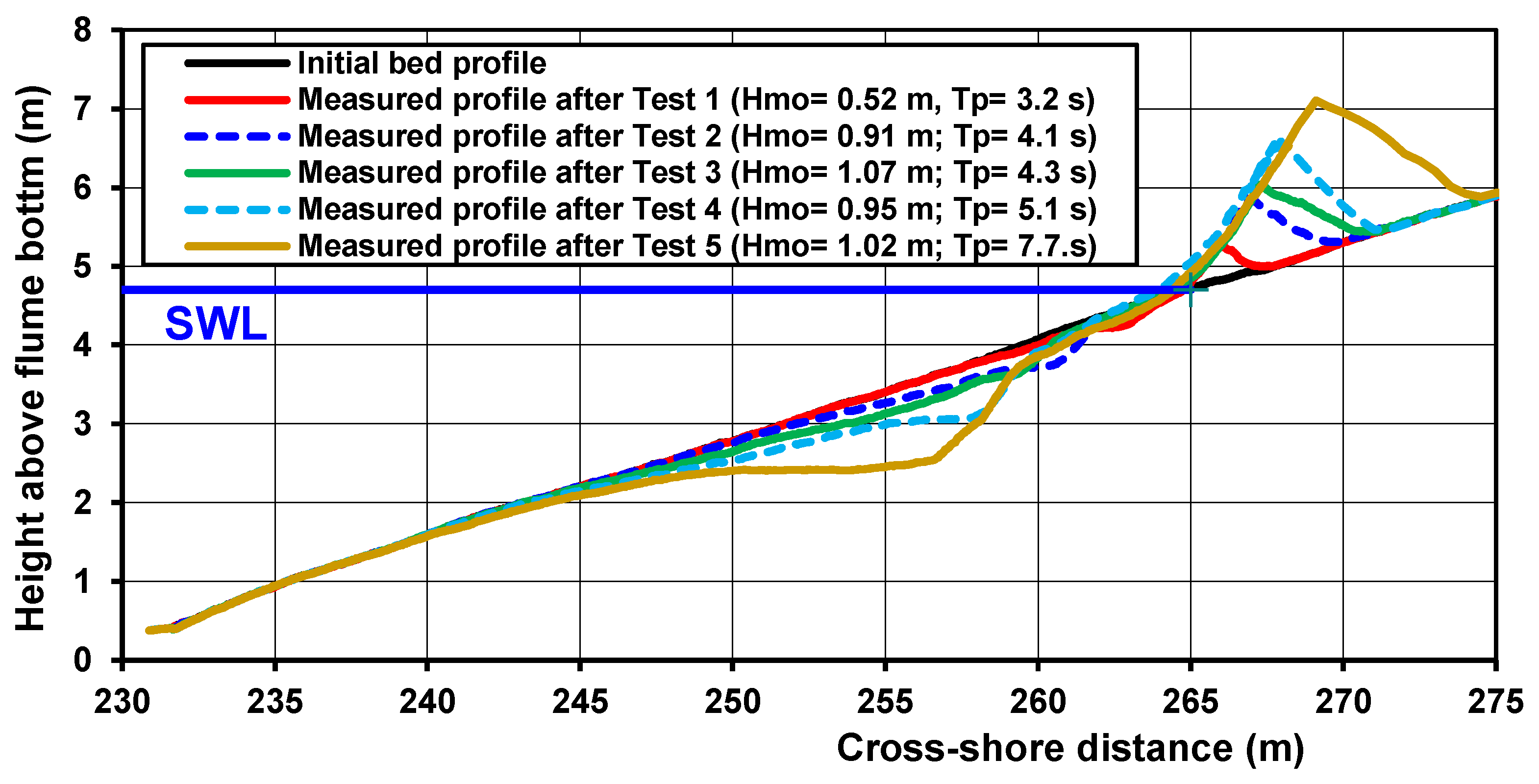
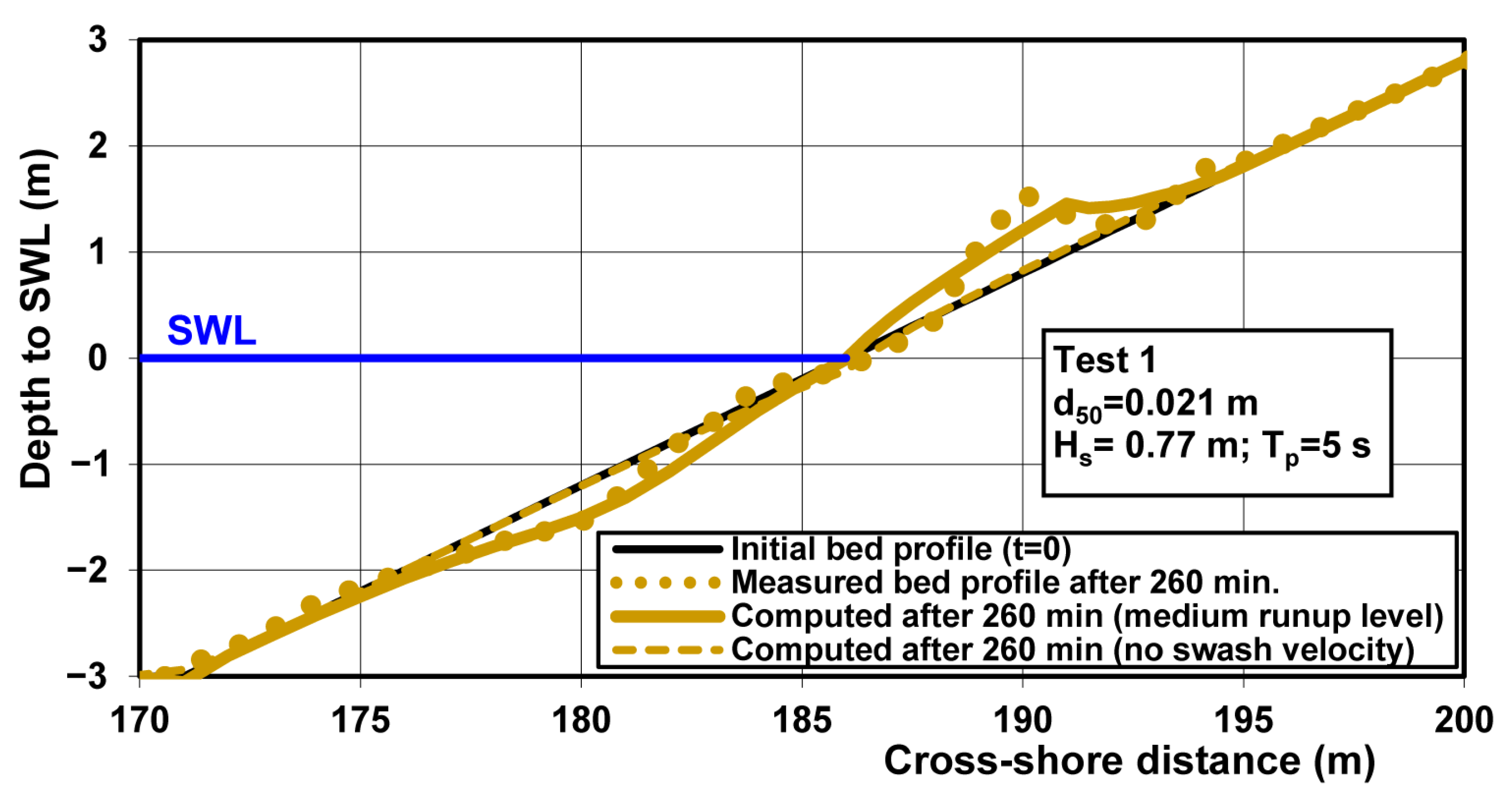
- The formation of swash bar above SWL (up to 2.5 m) due to onshore transport; see Figure 13; the swash bar extends substantially above SWL, indicating the effect of wave runup; the bar size increases with increasing wave height and increasing wave period;
- The generation of a scour pit below SWL; scour depth extends substantially below SWL;
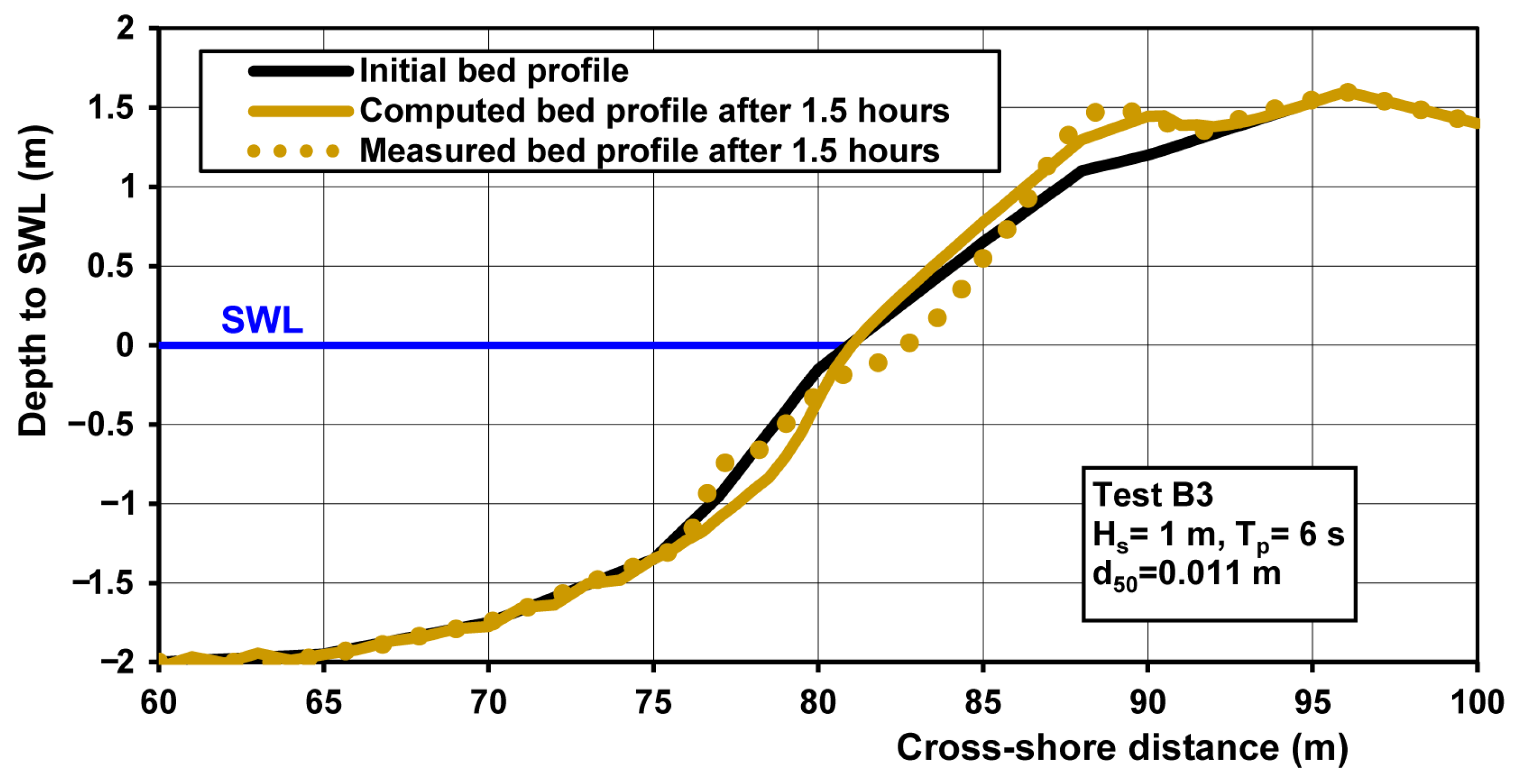
- The formation of a small breaker bar (below SWL) for relative fine gravel (d50 = 4.8 mm);
- The generation of ripples with length scales of 1 to 3 m and height scales of 0.1 to 0.4 m at the lower part of the fine gravel slope (d50 = 4.8 mm).
4.2.4. CROSMOR Simulation Runs for Chesil Gravel–Shingle Beach (UK)
4.2.5. CROSMOR Simulation Runs for Slapton Sands Gravel Beach (UK)
5. Model Sensitivity Tests; Effect of Key Physical Parameters
5.1. General
- Representative wave height (number of wave classes);
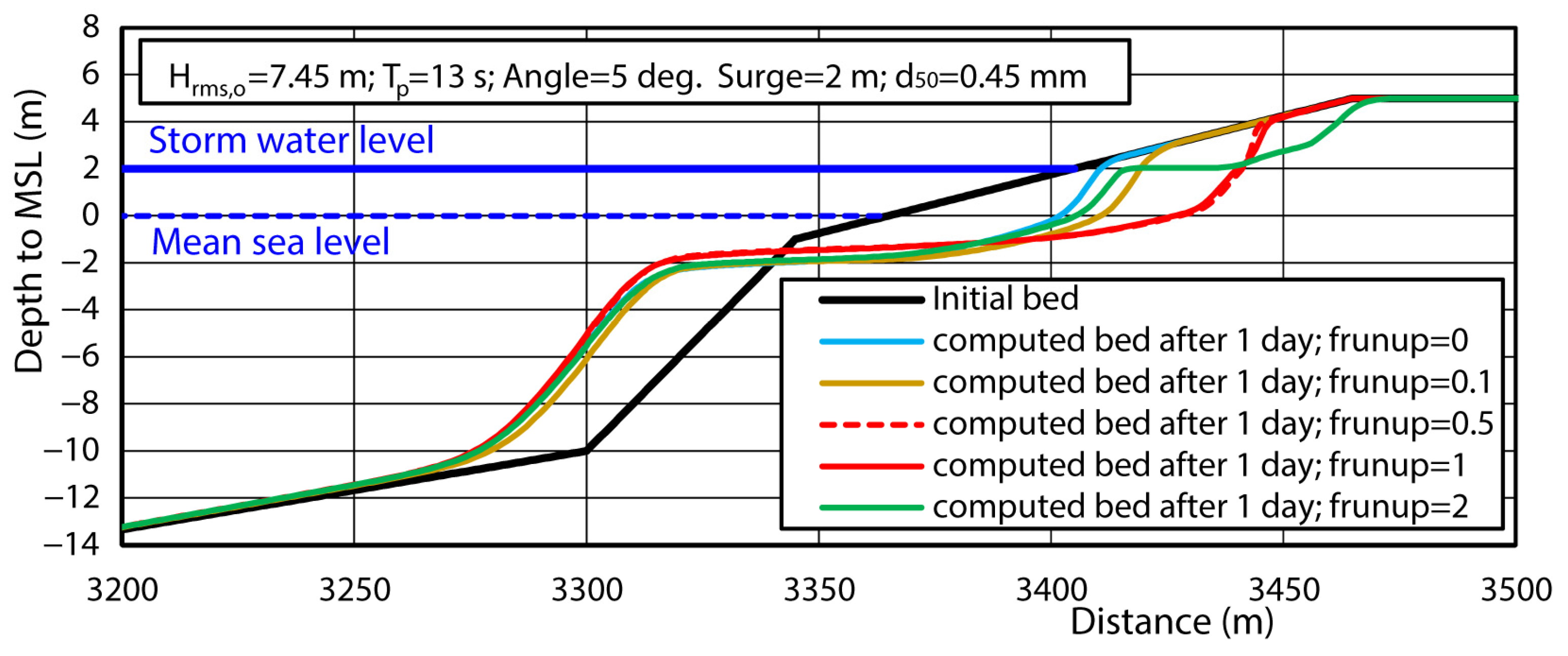
- Wave height and wave incidence angle;
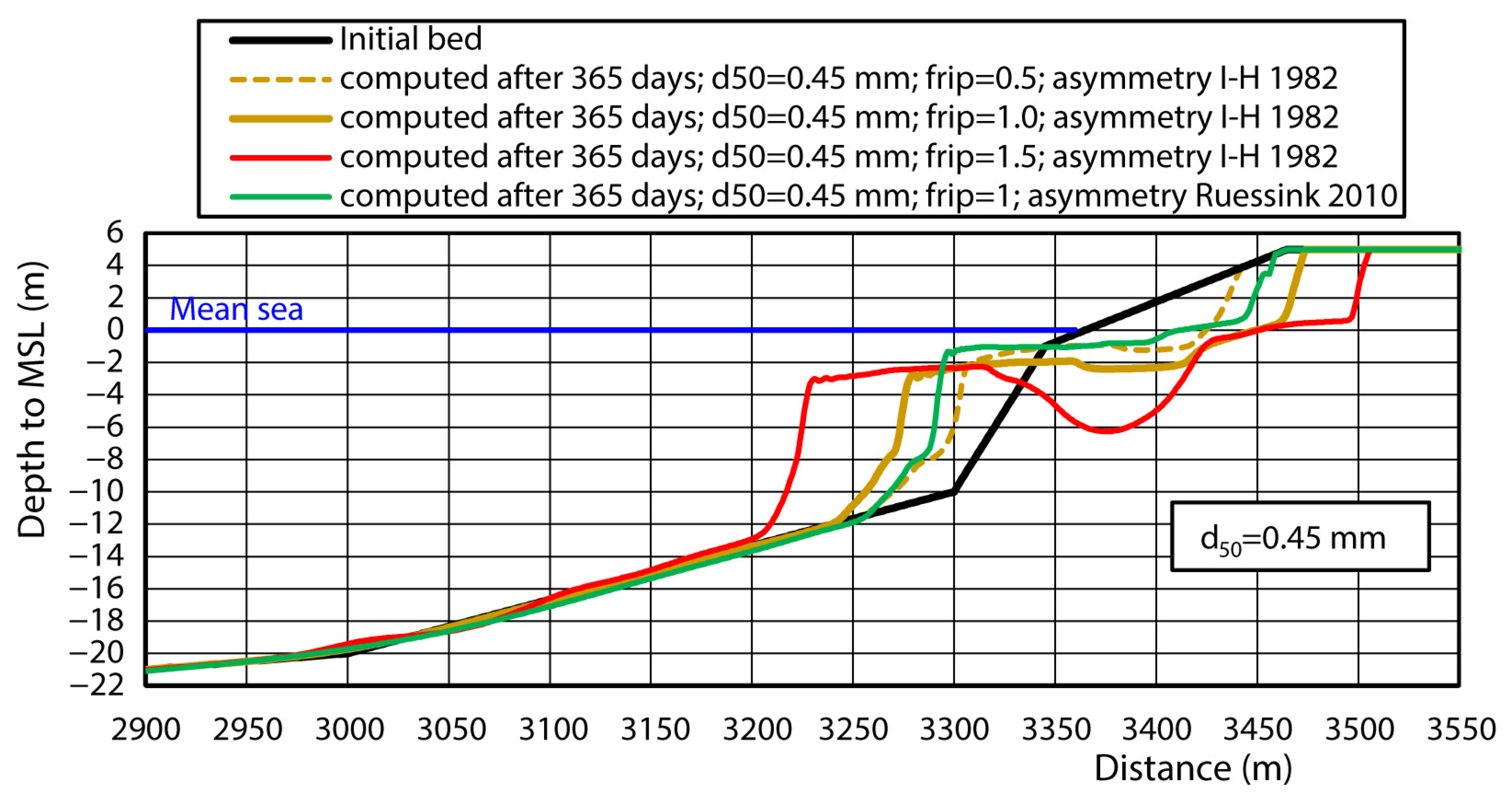
- Undertow, wave asymmetry (orbital velocities) and wave runup;
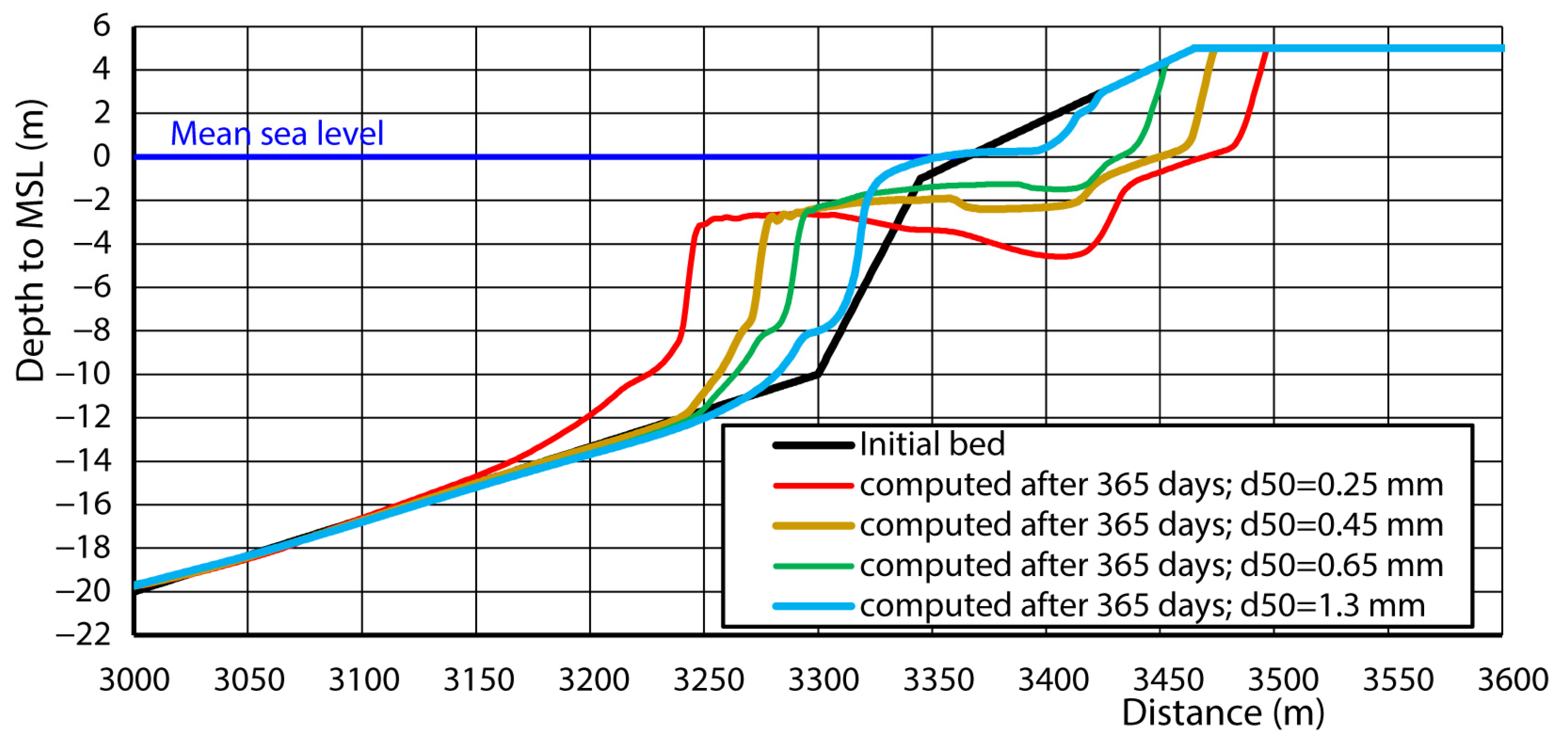
- Sand grain size and sand transport rates.
5.2. Effect of Representative Wave Height
5.3. Effect of Wave Height and Wave Incidence Angle
5.4. Effect of Undertow Current, Wave Asymmetry and Wave Runup
5.5. Effect of Sediment Size and Sediment Transport
6. Effect of Erosion Reducing Measures
6.1. General
6.2. Effect of Coarse Gravel-Type Top Layer
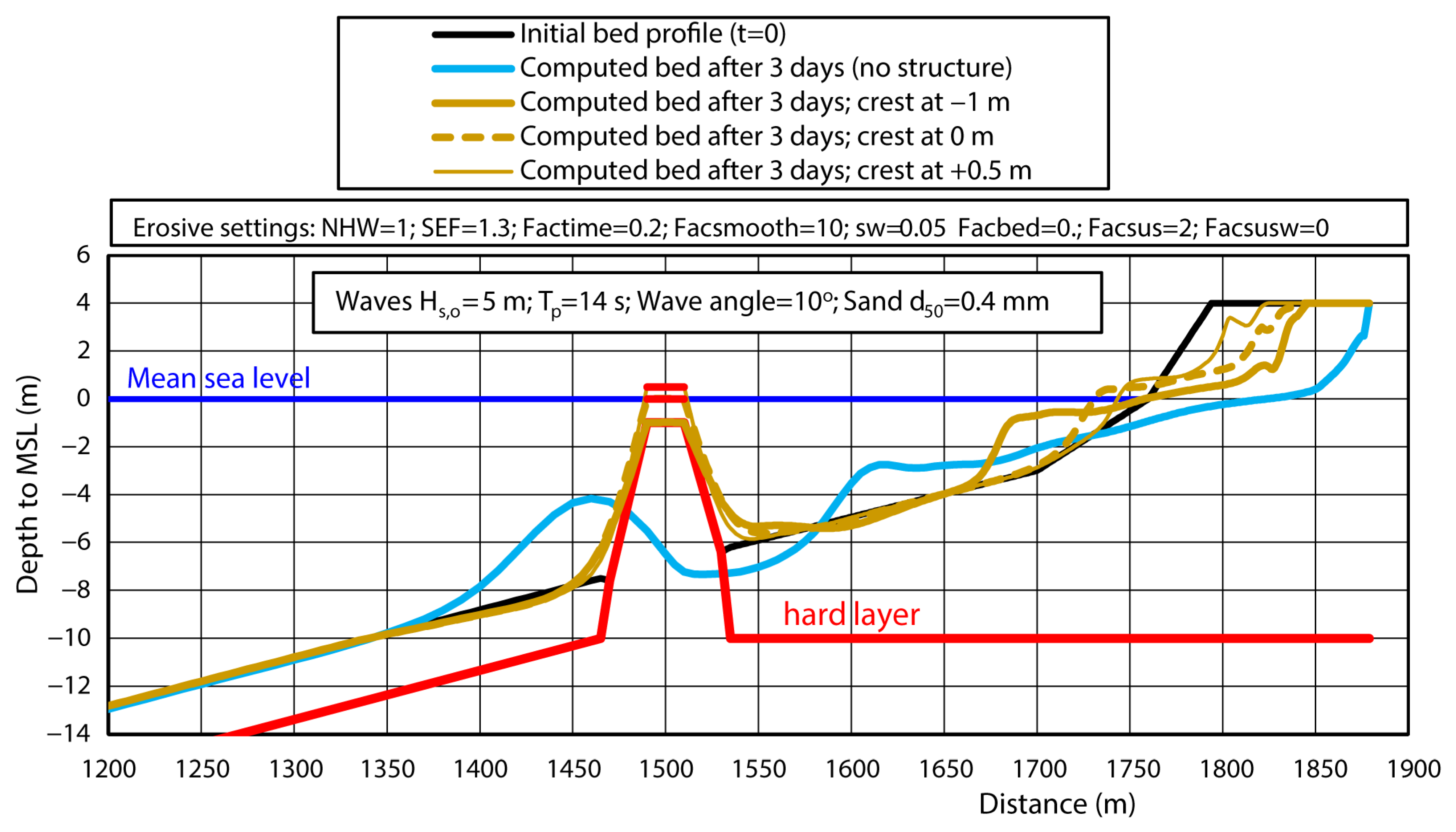
6.3. Effect of Breakwater in the Surf Zone
7. Summary, Discussion and Conclusions
Author Contributions
Funding
Data Availability Statement
Conflicts of Interest
References
- Roelvink, J.A.; Broker, I. Cross-shore profile models. Coast. Eng. 1993, 21, 163–191. [Google Scholar] [CrossRef]
- Stive, M.J.F. A model for cross-shore sediment transport. In Proceedings of the 8th ICCE, Taipeh, Taiwan, 1 September 1986; pp. 1550–1554. [Google Scholar]
- Roelvink, J.A.; Meijer, T.; Houwman, K.; Bakker, W.; Spanhoff, R. Field validation and application of a coastal profile model. In Coastal Dynamics; ASCE: Gdansk, Poland, 1995; pp. 818–828. [Google Scholar]
- Steetzel, H. Cross-Shore Transport During Storm Surges. Ph.D. Thesis, Delft University of Technology, Delft, The Netherlands, 1993. [Google Scholar]
- Nairn, R.B.; Southgate, H.N. Deterministic profile modelling of nearshore processes; Part 2, Sediment transport and beach profile development. Coast. Eng. 1993, 19, 57–96. [Google Scholar] [CrossRef]
- Van Rijn, L.C.; Wijnberg, K. One-Dimensional modelling of individual waves and wave-induced currents in the surf zone. Coast. Eng. 1996, 28, 121–145. [Google Scholar] [CrossRef]
- Van Rijn, L.C. The effect of sediment composition on cross-shore bed profiles. In Proceedings of the 26th ICCE, Copenhagen, Denmark, 22–26 June 1998. [Google Scholar]
- Van Rijn, L.C. Prediction of dune erosion due to storms. Coast. Eng. 2009, 56, 441–457. [Google Scholar] [CrossRef]
- Van Rijn, L.C. Crosmor-Applications. 2025. Available online: www.leovanrijn-sediment.com (accessed on 1 September 2025).
- Van Rijn, L.C.; Walstra, D.J.R.; Grasmeijer, B.; Sutherland, J.; Pan, S.; Sierra, J.P. The predictability of cross-shore bed evolution of sandy beaches at the time scale of storms and seasons using process-based profile models. Coast. Eng. 2003, 47, 295–327. [Google Scholar] [CrossRef]
- Kobayashi, N.; Farhadzadeh, A. Cross-Shore Numerical Model CSHORE for Waves, Currents, Sediment Transport and Beach Profile Evolution; Report CACR-08-01; Center for Applied Coastal Research, Ocean Engineering Laboratory; University of Delaware: Newark, DE, USA, 2008. [Google Scholar]
- Roelvink, D.; Reniers, A.; Van Dongeren, A.; Van Thiel de Vries, J.; McCall, R.; Lescinski, J. Modelling storm impacts on beaches, dunes and barrier islands. Coast. Eng. 2009, 56, 1133–1152. [Google Scholar] [CrossRef]
- McCall, R.T.; Masselink, G.; Poate, T.G.; Roelvink, J.A.; Almeida, L.P. Modelling the morphodynamics of gravel beaches during storms with XBeach-G. Coast. Eng. 2015, 103, 52–66. [Google Scholar] [CrossRef]
- Ruessink, B.G.; Kuriyama, Y.; Reniers, A.J.H.M.; Roelvink, J.A.; Walstra, D.J.R. Modeling cross-shore sandbar behavior on the timescale of weeks. J. Geophys. Res. 2007, 112, 1–15. [Google Scholar] [CrossRef]
- Grasmeijer, B.T.; Van Rijn, L.C.; Walstra, D.J. Modeling cross-shore bar behavior on storm and seasonal time scales. In Proceedings of the 28th ICCE, Cardiff, UK, 16–19 September 2002. [Google Scholar]
- Walstra, D.J.; Ruesink, G. Process-based modelling of cyclic bar behaviour on yearly scales. In Proceedings of the Coastal Dynamics 2009: Impacts of Human Activities on Dynamic Coastal Processes, Tokyo, Japan, 7–11 September 2009; p. 54. [Google Scholar] [CrossRef]
- Rafati, Y.; Hsu, T.J.; Elgar, S.; Raubenheimer, B.; Quataert, E.; Van Dongeren, A. Modeling the hydrodynamics and morphodynamics of sand bar migration events. Coast. Eng. 2021, 166, 103885. [Google Scholar] [CrossRef]
- Zhang, J.; Tsai, B.; Rafati, Y.; Hsu, T.J.; Puleo, J.A. Cross-shore hydrodynamics and morphodynamics modeling of an erosive event in the inner surf zone. Coast. Eng. 2025, 196, 104662. [Google Scholar] [CrossRef]
- Vellinga, P. Beach and Dune Erosion During Storm Surges. Ph.D. Thesis, Delft University of Technology, Delft, The Netherlands, 1986. [Google Scholar]
- Deltares. Technical Report Dune Erosion; Report H4357; Delft Hydraulics: Delft, The Netherlands, 2007. (In Dutch) [Google Scholar]
- Dean, R.G. Equilibrium beach profiles: Characteristics and applications. J. Coast. Res. 1991, 7, 53–84. [Google Scholar]
- Larson, M.; Kraus, N.C. SBEACH: Numerical Model for Simulating Storm-Induced Beach Change; Report 1: Empirical Foundation and Model Development; Technical Report CERC-89-9; U.S. Army Engineer Water-Ways Experiment Station: Vicksburg, MS, USA, 1989. [Google Scholar]
- Larson, M.; Kraus, N.C. Mathematical modelling of the fate of beach fill. In Artificial Beach Nourishments: Coastal Engineering; Special Issue; Niemayer, H.D., van Overeem, J., van de Graaff, J., Eds.; Elsevier: Amsterdam, The Netherlands, 1991; Volume 16, pp. 83–114. [Google Scholar]
- Larson, M.; Palalane, J.; Fredriksson, C.; Hanson, H. Simulating cross-shore material exchange at decadal scale. Theory and model component validation. Coast. Eng. 2016, 116, 57–66. [Google Scholar] [CrossRef]
- Marinho, B.; Coelho, C.; Larson, M.; Hanson, H. Cross-shore modelling of multiple nearshore bars at a decadal scale. Coast. Eng. 2020, 159, 103722. [Google Scholar] [CrossRef]
- Romao, F.; Coelho, C.; Lima, M.; Ásmundsson, H.; Myer, E.M. Cross-Shore Modeling Features: Calibration and Impacts of Wave Climate Uncertainties. J. Mar. Sci. Eng. 2024, 12, 760. [Google Scholar] [CrossRef]
- Diez, J.; Uriarte, A.; Canovas, V.; Medina, R. A parametric model for dry beach equilibrium profiles. Coast. Eng. 2017, 127, 134–144. [Google Scholar] [CrossRef]
- Kettler, T.; de Schipper, M.; Luijendijk, A. Simulating decadal cross-shore dynamics at nourished coasts with Crocodile. Coast. Eng. 2024, 190, 104491. [Google Scholar] [CrossRef]
- Kim, J.; Kim, T.; Chang, S.; Kim, J.; Kim, I. Prediction of beach profile changes using spatiotemporal graph neural networks for beach morphological evolution modeling. Ocean Eng. 2025, 340, 122282. [Google Scholar] [CrossRef]
- Ken Muroi, S.; Bertone, E.; Cartwright, N.; Alvarez, F. Machine Learning methods for predicting shoreline change from submerged breakwater simulations. Eng. Appl. Artif. Intell. 2025, 125, 110726. [Google Scholar] [CrossRef]
- Munian, S.; Karakus, O.; Russell, W.; Nelson, G. Topoformer: Integrating Transformers and ConvLSTMs for Coastal Topography Prediction. arXiv 2025, arXiv:2501.06494v1. [Google Scholar]
- Van Rijn, L.C.; Mol, A.; Kroeders, M. Design of artificial beaches at sheltered and exposed sites. J. Environ. Earth Sci. 2025, 7, 588–610. [Google Scholar] [CrossRef]
- Van Rijn, L.C. Unified view of sediment transport by currents and waves, I: Initiation of motion, bed roughness, and bed-load transport. J. Hydraul. Eng. 2007, 133, 649–667. [Google Scholar] [CrossRef]
- Van Rijn, L.C. Unified view of sediment transport by currents and waves, II: Suspended transport. J. Hydraul. Eng. 2007, 133, 668–689. [Google Scholar] [CrossRef]
- Van Rijn, L.C. Unified view of sediment transport by currents and waves, III: Graded Beds. J. Hydraul. Eng. 2007, 133, 761–775. [Google Scholar] [CrossRef]
- Guza, R.T.; Thorton, E.B. Swash oscillations on a natural beach. J. Geophys. Res. 1982, 87, 483–490. [Google Scholar] [CrossRef]
- Douglass, S.L. Estimating extreme values of runup on beaches. Journal of Waterway, Port, Coastal, and Ocean Engineering. Am. Soc. Civ. Eng. 1992, 118, 220–224. [Google Scholar]
- Nielsen, P.; Hanslow, D.J. Wave runup distributions on natural beaches. J. Coast. Res. 1991, 7, 1139–1152. [Google Scholar]
- Stockdon, H.F.; Holman, R.A.; Howd, P.A.; Sallenger, A.H. Empirical parameterization of setup, swash and runup. Coast. Eng. 2006, 53, 73–588. [Google Scholar] [CrossRef]
- Senechal, N.; Coco, G.; Bryan, K.R.; Holman, R.A. Wave runup during extreme storm conditions. J. Geophys. Res. 2011, 116, C07032. [Google Scholar] [CrossRef]
- Mase, H. Random wave runup height on gentle slope. J. Waterw. Port Coast. Ocean Eng. Am. Soc. Civ. Eng. 1989, 115, 649–661. [Google Scholar] [CrossRef]
- Van Gent, M.R.A. Wave runup on dikes with shallow foreshores. J. Waterw. Port Coast. Ocean Eng. 2001, 127, 254–262. [Google Scholar] [CrossRef]
- Hughes, S.A. Estimation of wave runup on smooth, impermeable slopes using the wave momentum flux parameter. Coast. Eng. 2004, 51, 1085–1104. [Google Scholar] [CrossRef]
- Poate, T.G.; McCall, R.T.; Masselink, G. A new parameterisation for runup on gravel beaches. Coast. Eng. 2016, 117, 176–190. [Google Scholar] [CrossRef]
- Dodet, G.; Leckler, F.; Sous, D.; Ardhuin, F.; Filipet, J.F.; Suarez, S. Wave runup over steep rocky cliffs. JGR Ocean. 2018, 123, 7185–7205. [Google Scholar] [CrossRef]
- Isobe, M.; Horikawa, K. Study on water particle velocities of shoaling and breaking waves. Coast. Eng. Jpn. 1982, 25, 109–123. [Google Scholar] [CrossRef]
- Malherbe, B.; Helewaut, M. Design and execution of beach nourishments in Belgium. In Proceedings of the Coastal Zone 93, New Orleans, LA, USA, 19–23 July 1993. [Google Scholar]
- Fordeyn, J.; Malherbe, B. Coastal Defence of Lowlands with Sand: Morpho-Dynamic Concepts of Beach-Dune System Rehabilitation. In Proceedings of the 8th International Conference on Coastal and Port Engineering in Developing Countries, COPEDEC, Madras, India, 20–24 February 2012. [Google Scholar]
- Malherbe, B.; Fordeyn, J. Smart beach and dune nourishments to achieve sustainable coastal protection. In Proceedings of the WODCON XX 2013—World Dredging Congress, Brussels, Belgium, 3–7 June 2013. [Google Scholar]
- Van Wiechen, P.; Rutten, J.; Mieras, R.; Anarde, K.; Wrobel, M.; Tissier, M.; De Vries, S. The real dune/reflex experiment at the sand engine 75–77). In Book of Abstracts Building Coastal Resilience; Special Publication; Strypsteen, G., Roest, B., Bonte, D., Rauwoens, P., Eds.; Flemish Institute for the Sea: Oostende, Belgium, 2022; p. 89. [Google Scholar] [CrossRef]
- Rijkswaterstaat. JARKUS Database. 2025. Available online: www.data/overheid.nl (accessed on 23 August 2025).
- Meyer-Peter, E.; Mueller, R. Formulas for bed load transport. In Proceedings of the IAHR 2nd Meeting, Stockholm, Sweden, 7 June 1948; pp. 41–64. [Google Scholar]
- Chadwick, A.J. Field measurements and numerical model verification of coastal shingle transport, Chapter 27. In Advances in Water Modelling and Measurements; Palmer, M.H., Ed.; BHRA, Fluid Engineering Centre: Bedford, UK, 1989; pp. 381–402. [Google Scholar]
- Nicholls, R.J.; Wright, P. Longshore transport of pebbles: Experimental estimates of K-factor. In Coastal Sediments; ASCE: Seattle, WA, USA, 1991; pp. 920–933. [Google Scholar]
- Deltares/Delft Hydraulics. Scale Effects in Stability of Gravel and Stone Slopes Under Wave Attack in Deltaflume; Report M1983 Part IV; Deltares/Delft Hydraulics: Delft, The Netherlands, 1989. (In Dutch) [Google Scholar]
- López de San Román-Blanco, B.; Coates, T.; Holmes, P.; Chadwick, A.; Bradbury, A.; Baldock, T.; Pedrozo Acuña, A.; Lawrence, J.; Grune, J. Large scale experiments on gravel and mixed beaches. Coast. Eng. 2006, 53, 349–362. [Google Scholar] [CrossRef]
- Buscombe, D.; Williams, J.J.; Masselink, G. Barrier Dynamics Experiments (BARDEX), Experimental Procedure, Technical Information and Data Report; School of Geography, University of Plymouth: Plymouth, UK, 2008. [Google Scholar]
- Ruessink, B.G.; Ramaekers, G.; Van Rijn, L.C. On the parameterization of the free-stream non-linear wave orbital motion in nearshore morphodynamic models. Coast. Eng. 2012, 65, 56–63. [Google Scholar] [CrossRef]
- Van Rijn, L.C. Design and effectiveness of coastal protection structures; case studies and modeling approaches. J. Environ. Earth Sci. 2025, 7, 72–95. [Google Scholar] [CrossRef]
- Pais-Barbosa, J.; Ferreira, A.M.; Lima, M.; Magalhães Filho, L.; Roebeling, P.; Coelho, C. Cost-benefit analysis of artificial nourishments: Discussion of climate change adaptation pathways at Ovar (Aveiro, Portugal). Ocean Coast. Manag. 2023, 244, 106826. [Google Scholar] [CrossRef]
- Lima, M.; Coelho, C. Assessing costs and benefits of coastal structures to mitigate erosion. In Coastal Structures; Goseberg, N., Schlurmann, T., Eds.; Bundesanstalt fur Wasserbau: Karlsruhe, Germany, 2019. [Google Scholar] [CrossRef]
- Van Rijn, L.C. Modelling of Longshore Gravel Transport at Gravel Beach Nourishment Magdalen Island, Saint Lawrence Bay, Canada; Technical Report; LVRS-Consultancy: Blokzijl, The Netherlands, 2025; Available online: www.leovanrijn-sediment.com (accessed on 1 September 2025).
- Musumeci, R.E.; Cavallaro, L.; Foti, E. Performance of perched beach nourishments. In Proceedings of the 33rd International Conference on Coastal Engineering ICCE, Santander, Spain, 1–3 August 2012. [Google Scholar]
- Groenewoud, M.D.; Van de Graaff, J.; Claessen, E.W.M.; Van der Biezen, S.C. Effect of submerged breakwater on profile development. In Proceedings of the 25th ICCE, Orlando, FL, USA, 2 September 1996; pp. 2428–2441. [Google Scholar]


| Input Parameters | Parameter Abbreviation | Values |
|---|---|---|
| Tide water level Tidal current (longshore, cross-shore) | WS VNUL1; VNUL2 | −0.15, +0.15 m; 0.1; m/s |
| Bed profile to MSL (m) | HMSL | −50 m at deep water to +5 m at dune crest |
| Number of grids along profile | NSTAP | 0 to 100 |
| Storm level above MSL (m) | HSTORM | 0 to 2 m |
| Maximum dune slope SL | SL | 50° (sliding if slope is larger) |
| Boundary depth near beach (m) | HGRENS | 0.3 m (last grid point) |
| Grid size (m) | 20 m offshore; 1 m nearshore | |
| Profile of hard layer to MSL (m) | HRMSL | None |
| Number of wave classes per wave height | NHW | 1 |
| RMS-wave height, period and wave incidence angle at deep water | HRMS, T, THETA | Hrms = 0.35 to 7.45 m (Hs,o = 0.5 to 10.5 m); Tp = 7 to 13 s, angle = 5° |
| Wave asymmetry method | SWIT1 | Isobe-Horikawa 1982 [46] |
| Wave breaking (−); roller coefficient (−) | GAMMA CRL | 0 (automatic); 0.5 |
| Runup coefficient (−) | FRUNUP | 0.5 (default = 1) |
| Coefficients wave averaging for undertow and longshore current | COEF6 COEF5 | 3 for field; 1 laboratory cases 3 for field; 1 laboratory cases |
| Longuet–Higgins streaming (−); | CLH | 0.5 (default = 1) |
| Grain diameter sand d50 (m) Cu-coefficient (−) | D50 CU | 0.45 mm; 2 |
| Coefficients sand transport formulas facbed; facsus; facsusw (−) | FACBED FACSUS FACSUSW | 0.7; 0.7; 0.3 (default 1) |
| Coefficient extra sand entrainment in dune zone | SEF | 1 (default = 1; range 1–2) |
| Coefficient bed concentration landward of hard layer (−) | FSAND | 1 (default) |
| Coefficient undertow (−) | FRIP | 1 (default) |
| Bed roughness (m) | KS | 0 (automatic) |
| Bed smooth factors (−) | FACSMOOTH SW | 30 (default = 10); 0.05 (default = 0.05) |
| Time step factor (−) | FACTIME | 1 (default = 2) |
| Temperature (°C); Salinity (promille) | TE; SA | 10 °C and 30 promille |
| Files | case3.inp; case3-k.inp |
| Parameter | Hrms,o = 1 m; Tp = 7 s | Hrms,o = 7.45 m; Tp = 13 s | |
|---|---|---|---|
| Undertow velocity | frip = 0.5 | 0.04 m/s at x = 3358 m | 0.375 m/s at x = 3358 m |
| frip = 1 | 0.08 m/s at x = 3358 m | 0.75 m/s at x = 3358 m | |
| frip = 1.5 | 0.12 m/s at x = 3358 m | 1.125 m/s at x = 3358 m | |
| Asymmetry of peak orbital velocity | Uon/Uoff | 1.33/0.56 m/s at x = 3344 m | 2.64/1.17 m/s at x = 3326 m |
| I-H 1982 [46] | 0.69/0.42 m/s at x = 3358 m | 0.6/0.4 m/s at x = 3358 m | |
| Uon/Uoff | 1.62/1.14 m/s at x = 3344 m | 2.54/1.6 m/s at x = 3183m | |
| Ruessink 2012 [58] | 0.8/0.62 m/s at x = 3358 m | 0.65/0.53 m/s at x = 3358 m | |
| X-location (m) (bed level) | Fr 1 0.2–0.6 (mm) | Fr 2 0.6–1.8 (mm) | Fr 3 1.8–3.6 (mm) | Fr 4 3.6–7.2 (mm) | Fr 5 7.2–14.4 (mm) | Fr 6 14.4–28.8 (mm) | Fr 7 28.8–57.6 (mm) |
|---|---|---|---|---|---|---|---|
| 0 (−37 m) | 0.9 | 0.02 | 0.02 | 0.02 | 0.02 | 0.01 | 0.01 |
| 1650 (−4 m) | 0.9 | 0.02 | 0.02 | 0.02 | 0.02 | 0.01 | 0.01 |
| 1700 (−3 m) | 0.02 | 0.02 | 0.02 | 0.02 | 0.02 | 0.1 | 0.8 |
| 1760 (0 m) | 0.02 | 0.02 | 0.02 | 0.02 | 0.02 | 0.1 | 0.8 |
| 1794 (4 m) | 0.02 | 0.02 | 0.02 | 0.02 | 0.02 | 0.1 | 0.8 |
| 1879 (4 m) | 0.02 | 0.02 | 0.02 | 0.02 | 0.02 | 0.1 | 0.8 |
| Parameters | Sand Dune Erosion Sand Motor (NL) | Sand Dune Erosion De Haan (BE) | Sand Beach Erosion Petten (NL) | Gravel Slapton Sands (UK) | Gravel Chesil Beach (UK) |
|---|---|---|---|---|---|
| Waves Hs,o (m | 1.4–4.3 | 1.7–4.8 | 1.4–5.1 | 4.7 | 7.7 |
| Wave period Tp (s) | 6–10 | 4.8–7.3 | 5–10 | 9.5 | 13.9 |
| Wave angle θo (°) | 10 | 5 | 5 | 5 | 5 |
| Grain diameter d50 (mm) | 0.3 | 0.23 | 0.3 | 6 | 40 |
| Uniformity Cu (−) | 2 | 2 | 2 | 2 | 2 |
| Coefficient BLT facbed (−) | 0.5 | 0.5 | 0.2 | 0.5 | 0.3 |
| Coefficient SLT facsus (−) | 1.1 | 1.0 | 0.6 | 2 | 3 |
| Coefficient SLT facsusw (−) | 0 | 0 | 0 | 0 | 0 |
| Coefficient extra sand entrainment dune zone SEF (−) | 2 | 1.5 | 1.15 | 2 | 2 |
| Increased undertow frip (−) | 1 | 1 | 1 | f | 3 |
| Bed roughness (m) | 0 | 0 | 0 | 0.02 | 0.08 |
| Brier Skill Score (−) | 0.9 | 0.82 | 0.55 | 0.85 | 0.8 |
Disclaimer/Publisher’s Note: The statements, opinions and data contained in all publications are solely those of the individual author(s) and contributor(s) and not of MDPI and/or the editor(s). MDPI and/or the editor(s) disclaim responsibility for any injury to people or property resulting from any ideas, methods, instructions or products referred to in the content. |
© 2025 by the authors. Licensee MDPI, Basel, Switzerland. This article is an open access article distributed under the terms and conditions of the Creative Commons Attribution (CC BY) license (https://creativecommons.org/licenses/by/4.0/).
Share and Cite
van Rijn, L.C.; Dumont, K.; Malherbe, B. Recent Developments in Cross-Shore Coastal Profile Modeling. J. Mar. Sci. Eng. 2025, 13, 2011. https://doi.org/10.3390/jmse13102011
van Rijn LC, Dumont K, Malherbe B. Recent Developments in Cross-Shore Coastal Profile Modeling. Journal of Marine Science and Engineering. 2025; 13(10):2011. https://doi.org/10.3390/jmse13102011
Chicago/Turabian Stylevan Rijn, L. C., K. Dumont, and B. Malherbe. 2025. "Recent Developments in Cross-Shore Coastal Profile Modeling" Journal of Marine Science and Engineering 13, no. 10: 2011. https://doi.org/10.3390/jmse13102011
APA Stylevan Rijn, L. C., Dumont, K., & Malherbe, B. (2025). Recent Developments in Cross-Shore Coastal Profile Modeling. Journal of Marine Science and Engineering, 13(10), 2011. https://doi.org/10.3390/jmse13102011