Article

Earthquake-Triggered Tsunami Hazard Assessment in the Santorini–Amorgos Tectonic Zone: Insights from Deterministic Scenario Modeling


by
Dimitrios-Vasileios Batzakis
1,*,
Dimitris Sakellariou
2,
Efthimios Karymbalis
1,
Loukas-Moysis Misthos
3,
Gerasimos Voulgaris
4,
Konstantinos Tsanakas
1,
Emmanuel Vassilakis
5 and
Kalliopi Sapountzaki
1
1
Department of Geography, Harokopio University, 17671 Athens, Greece
2
Institute of Oceanography, Hellenic Center for Marine Research, 19013 Anavyssos, Greece
3
Department of Surveying and Geoinformatics Engineering, University of West Attica, 12243 Athens, Greece
4
Institute of Human Sciences, University of Tsukuba, Tsukuba 305-8577, Japan
5
Department of Geology and Geoenvironment, National and Kapodistrian University of Athens, 15784 Athens, Greece
*
Author to whom correspondence should be addressed.
J. Mar. Sci. Eng. 2025, 13(10), 2005; https://doi.org/10.3390/jmse13102005
Submission received: 26 September 2025 / Revised: 15 October 2025 / Accepted: 17 October 2025 / Published: 19 October 2025
(This article belongs to the Special Issue Storm Tide and Wave Simulations and Assessment, 3rd Edition)

Abstract

In the early months of 2025, a significant seismic activity was recorded in the area between Santorini and Amorgos, raising concerns about the potential occurrence of a major earthquake and a possible tsunami. The objective of this study is to assess the earthquake-triggered tsunami hazard in the Santorini-Amorgos Tectonic Zone (SATZ) by simulating tsunami processes using the MOST (Method of Splitting Tsunami) numerical model, implemented through the ComMIT (Community Model Interface for Tsunamis). High-resolution bathymetry and topography were employed to model tsunami generation, propagation, and onshore inundation. A total of 60 simulations were conducted using a deterministic approach based on worst-case scenarios. The analysis considered six major active faults with two kinematic types, pure normal and oblique-slip, and assessed tsunami impact on five selected coastal study areas. The simulations results showed potential maximum run-up values of 4.1 m in Gialos (Ios), 2.7 m in Kamari (Santorini), 2.4 m in Perissa (Santorini), 1.5 m in Katapola (Amorgos), and 2.3 m in Chora (Astypalaea), in some cases affecting residential zones. Inundation flows also impacted the main ports of Gialos, Katapola, and Chora, highlighting the exposure of critical infrastructure. Although earthquake-triggered tsunamis represent a potential hazard in the SATZ, the results indicated that it is unlikely to cause a widespread disaster in the study areas.

1. Introduction

The Aegean region is a highly geodynamically active area shaped by the complex interactions of several tectonic plates. Its tectonic evolution is primarily influenced by the relative motions between the Eurasian and African plates, with the Anatolian and Aegean microplates playing a key role in controlling the regional crustal deformation [1]. The northern boundary of the Aegean is marked by the North Anatolian Fault (NAF), one of the most prominent strike–slip fault systems in the Eastern Mediterranean. This right-lateral fault accommodates the westward motion of the Anatolian microplate relative to Eurasia at an average rate of approximately 2.4 cm/year according to geodetic and tectonic data [2,3]. The southern boundary is formed by the Hellenic subduction zone, where the African plate subducts beneath the Aegean microplate at a rate of approximately 0.9 cm/year [4]. In conjunction with the westward extrusion of the Anatolian microplate, this tectonic interaction induces the southward migration of the Aegean microplate at an estimated average rate of ~3.5 cm/year [5,6]. This kinematic regime results in pronounced crustal deformation, the evolution of diverse tectono-volcanic structures, and the development of multiple faulting mechanisms throughout the broader region [7].
The south Aegean exhibits an extensional deformation regime driven by the rollback of the subducting African slab beneath the South Aegean back-arc region [8]. This slab rollback induces a progressive stretching of the overriding Aegean microplate, generating conditions that favor crustal extension and the development of numerus active normal faults that control the morphology of the south Aegean basins and influence the spatial distribution of seismicity [9]. The ongoing extension in the region is associated with highly active seismic zones and the development of volcanic activity. A key area of interest is the Santorini-Amorgos Tectonic Zone (SATZ), a geodynamically complex area shaped by the interplay of subduction and extensional tectonic processes [10,11]. This zone is characterized by active faulting, frequent seismic events, and the presence of volcanic centers [12,13,14].
Between late January and March 2025, a significant seismic crisis occurred offshore northeast of the Santorini volcanic island, affecting the region between Santorini and Amorgos. During this period, more than 20,000 earthquakes were recorded, including eight events with magnitude of Mw ≥ 5 [15,16]. The intense seismic activity, coupled with the threat of a magnitude ~6 or greater earthquake and potential volcanic unrest, led to the voluntary evacuation of over 11,000 people, according to press reports [17]. Furthermore, the potential for a tsunami triggered by a major earthquake further intensified the concerns, particularly given the region’s past experience with tsunami events and its exposure to coastal hazards.
An essential aspect of tsunami preparedness is the accurate estimation of key parameters that determine the impact of tsunamis on coastal areas. Parameters such as wave height, flow depth, run-up extent, and arrival time are critical for quantifying the potential effects of a tsunami strike [18]. Numerical simulations have become a fundamental tool in this context, as they allow the calculation of these parameters while capturing the complex processes of tsunami generation, propagation, and inundation. Such models enable detailed assessments of potential future events under a range of scenarios. Recent advances in computational techniques, together with the availability of high-resolution bathymetric and topographic data and an improved understanding of tsunami generation mechanisms, have significantly increased the accuracy and reliability of tsunami modeling [19,20].
Tsunami simulation techniques have been widely applied to evaluate tsunami hazard in Greece, a region marked by complex tectonics and high seismicity. Both deterministic and probabilistic approaches have been employed, incorporating historical events, potential scenarios, and diverse triggering mechanisms. Numerical studies have targeted several key areas, including the Hellenic Subduction Zone (HSZ) (e.g., [21,22]), the North Aegean Sea (e.g., [23,24]), the South Aegean Sea (e.g., [25]), the Ionian Sea (e.g., [26]), and the Corinth Gulf (e.g., [27]). In addition, numerical simulations have been used to support the development of early warning systems (e.g., [28]). Results from these studies demonstrate that tsunami impacts in Greece vary considerably, depending on factors such as the distance from the tsunamigenic source, the characteristics of the triggering mechanism, and the influence of coastal topography and bathymetry. Consequently, tsunami impacts can also vary across different regions of Greece, showing differentiated effects in terms of wave height, inundation depth, and run-up, even for a single tsunamigenic event.
This study applies a Deterministic Tsunami Hazard Assessment (DTHA) approach to assess earthquake-triggered tsunami hazard in the SATZ. The DTHA approach was selected due to the limited availability of reliable historical and research data on seismicity in the area, which constrains the application of probabilistic methods. Moreover, this approach enables the assessment of the maximum possible impact of tsunamis generated by credible earthquake scenarios [29,30]. In this context, earthquake parameters such as magnitude, location, and fault geometry are used to estimate the maximum credible characteristics of potential earthquakes and the resulting tsunami waves. Worst-case earthquake scenarios were developed for the major active faults in the SATZ based on their geometry and kinematics, with each fault considered sequentially as normal-slip and oblique-slip to represent the area’s tsunamigenic potential. Numerical simulations are employed to model tsunami generation, propagation and coastal inundation, providing insights into the potential impact of the waves on specific coastal areas of the surrounding islands. For each scenario, seafloor displacement is calculated and used as the initial condition for numerical simulations, enabling detailed modeling of tsunami propagation, arrival times, run-up heights, and coastal inundation patterns. The scenarios aim to determine the potential spatial extent and severity of tsunami impacts in selected coastal settlements on nearby islands. This study provides the most comprehensive fault-specific assessment of earthquake-triggered tsunami hazard in the SATZ to date, offering valuable insights for early warning, preparedness, and risk reduction.

2. Study Area

The SATZ, is situated in the South Aegean Sea, bounded by the islands of Santorini, Ios, Amorgos, Astypalaea, and Anafi. Tectonically, the SATZ forms part of the broader HSZ framework, where back-arc extension drives extensive crustal deformation primarily accommodated by normal faulting. It represents a highly active seismic and tectonic region that marks the transition from the relatively quiescent western South Aegean to the more active eastern part [4,31].
High-resolution bathymetric and seismic reflection studies reveal that the SATZ is a structurally complex feature composed of tectonic grabens and horsts formed along major and minor faults oriented predominantly NE–SW [13,32]. Regional crustal deformation is primarily controlled by these faults, which exhibit variable dip angles, significant fault throws, and predominantly normal faulting [12,13,14]. Moreover, several studies suggest that the faults in the SATZ may exhibit a right-lateral strike-slip component, implying that the region is affected by a dextral trans-tensional stress regime [32,33].
In recent times, the SATZ has experienced significant seismic activity, including the Mw ~6 earthquakes of 1911 and 1919 [34]. The most notable event was the 1956 Mw 7.8 earthquake, possibly along the Amorgos Fault (AmF), which generated a tsunami that produced substantial run-up along the coasts of the surrounding islands, although the precise source mechanism of this event remains a subject of ongoing debate [35]. The exact location of these seismic events, however, remain uncertain. The proximity of the SATZ to the Santorini volcanic complex increases the geohazards potential, as magmatic activity can influence fault dynamics and potentially interact with earthquake-triggered processes [15,16,31].
The SATZ is structured by several major faults (Figure 1) including the Ios Fault Zone (IFZ) and Amorgos Fault (AmF), which extend across the northern part; the Amorgos-Santorini Fault Zone (ASFZ) and Anydros Fault Zone (ANFZ) located in the central part; the Astypalaea Fault Zone (AsFZ) in the eastern part; and the Anafi-Astypalaea Fault Zone (An-AsFZ) across the southern margin of the SATZ. AmF, ASFZ, AsFZ exhibit southeastward dipping, IFZ exhibits southwestward dipping, while ANFZ and An-AsFZ show opposite polarity with northwestward dipping motion [32]. Apart from the ANFZ and AsFZ, these faults are sufficiently long to generate earthquakes of Mw ≥ 7, underscoring their significant potential for both seismic and tsunami hazard in the area [36].
The importance of hazard assessment in the SATZ is increased by the proximity of densely populated and touristic coastal areas to tectonically active faults and the Santorini volcanic complex. The combination of active tectonics, a history of destructive earthquakes and tsunamis, and the high exposure of the surrounding coastal zones designates the SATZ as one of the most hazardous tectonic regions in the Aegean and a critical area for tsunami hazard assessment.

3. Methodology

Seismic events along the major faults of the SATZ were considered to analyze tsunami propagation patterns and evaluate the potential impact of earthquake-triggered tsunamis across the region. To provide a focused assessment of tsunami hazard, five key coastal settlements—Kamari and Perissa in Santorini, Katapola in Amorgos, Gialos in Ios, and Chora in Astypalaea—were selected as representative study areas. These locations were chosen due to their high level of touristic development, dense population during peak seasons, concentration of critical infrastructure, and economic significance, all of which contribute to their heightened exposure to tsunami events.
The MOST (Method of Splitting Tsunami) numerical model, implemented via the ComMIT (Community Model Interface for Tsunamis) Graphical User Interphase developed by National Oceanic and Atmospheric Administration (NOAA), is employed to simulate the complete tsunami process, including generation, propagation, and onshore inundation [37,38]. For tsunami generation, MOST uses the analytical dislocation model of Okada [39] to compute seafloor deformation, which defines the initial conditions for the simulations. ComMIT utilizes a system of three nested computational topo-bathymetric grids for tsunami simulation. Two coarser grids with different resolutions are employed, with a very coarse grid covering a wide area to calculate tsunami dynamics across the open sea and a finer, moderately coarse grid over a smaller area to simulate wave propagation more accurately close to the coast. A third, high-resolution grid focuses on the coastal zone, to be used for the precise modeling of onshore inundation and inland penetration. For the coarser grid, topo-bathymetric data from the General Bathymetric Chart of the Oceans (GEBCO-2024) [40] with an approximate resolution of 375 m were employed. For the intermediate grid, a 90 m resolution dataset was generated by merging topographic information (90 m resolution) provided by the Copernicus GLO-90 Digital Elevation Model [41] with the bathymetric data (~50 m resolution) derived from recent swath bathymetry surveys in the SATZ [32], which were resampled to match the topographic resolution. For the finer grid, a high-resolution 5 m elevation dataset was employed, created by integrating topographic data from the Hellenic Cadastre with the bathymetric data obtained from the swath bathymetry surveys. This detailed dataset allowed for the precise simulation of coastal inundation and tsunami run-up at a local scale. Data processing was carried out using GIS software (ArcGIS Pro 3.2, ESRI®, Redlands, CA, USA) to produce a seamless elevation model for the coastal study areas. Bathymetry of the coarser grid was adjusted using the finer grid to enhance accuracy in the coastal zones targeted for tsunami impact assessment, employing GIS-based Map Algebra tools.
The seismic source parameters employed for initializing tsunami generation were derived from previous studies conducted in the SATZ, where detailed bathymetric mapping and seismic reflection surveys have been analyzed to constrain the geometry and kinematics of the major faults [12,13,32]. The fault length and strike employed in the simulations were determined from the mapped fault traces. The fault width (W) was calculated using Equation (1).
W = H/sinδ,
where H represents the thickness of the seismogenic layer, assigned a value of 12.5 km according to Andinisari et al. [34], and δ is the average fault dip angle, estimated from the values reported in the aforementioned studies.
The magnitude of the potential earthquake was estimated using the regression equation corelating moment magnitude (Mw) to the fault rupture area (S), defined as the product of the rupture length and width. The average slip (u) was calculated using the regression equation correlating Mw with u, as proposed for dip-slip continental faults by Papazachos et al. [42]. It was further assumed that the faults would rupture along their entire length, with the IFZ, ANFZ, ASFZ, AsFZ, and An-AsFZ considered as single continuous structures. These estimations were obtained by applying Equations (2) and (3), respectively.
Log (S) = 0.78Mw – 2.56
Log (u) = 0.72Mw – 2.28
For all faults considered in the study, a hypocentral depth of 10 km was assigned to the potential earthquakes, consistent with the depth distribution of recent seismic events recorded in the SATZ [43]. This assumption reflects the seismogenic layer characteristics of the region and ensures that the modeled earthquake sources are representative of the typical seismic activity in the area. The epicenter of the earthquake was defined as the midpoint of the fault length, and the distance (d) from the fault trace was calculated according to Equation (4).
d = D/tanδ,
where D is the earthquake depth.
For each fault, two fault kinematic scenarios were adopted for the tsunami simulations. A rake of −90° was first assumed, corresponding to pure normal faulting, while a rake of −135° was also applied, consistent with the National Observatory of Athens (NOA) fault catalog for the AmF [44], representing a normal right-lateral oblique slip on the faults. In total, 60 tsunami simulation models were performed, corresponding to scenarios generated from each major fault toward all selected coastal study areas.
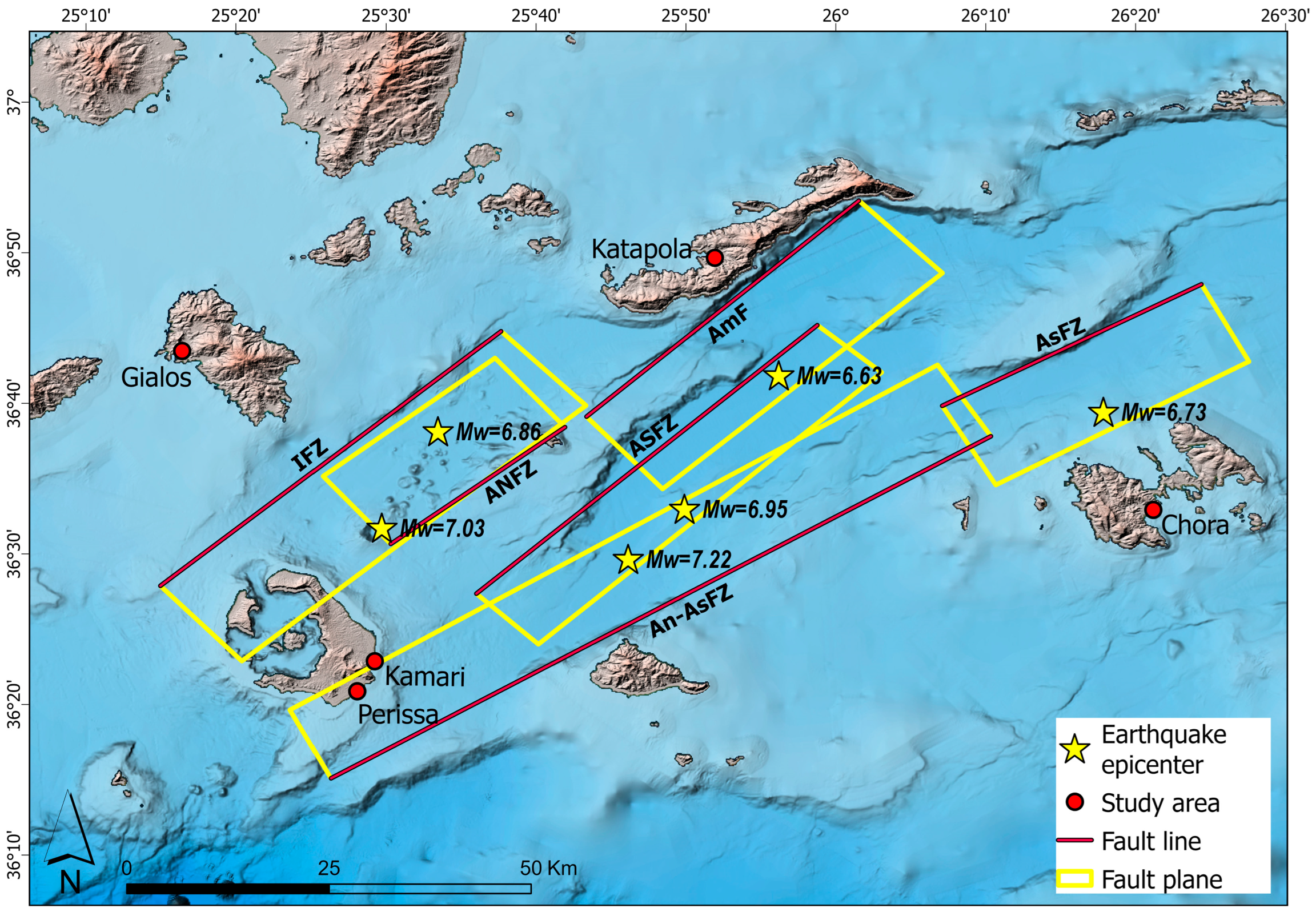
The modeled results were overlaid on a satellite imagery basemap in the GIS environment to visualize tsunami inundation patterns and quantify coastal run-up. All source parameters employed in the simulations are summarized in Table 1, and the corresponding fault planes are depicted in Figure 2.

4. Results and Discussion

4.1. Tsunami Propagation and Wave Amplitude

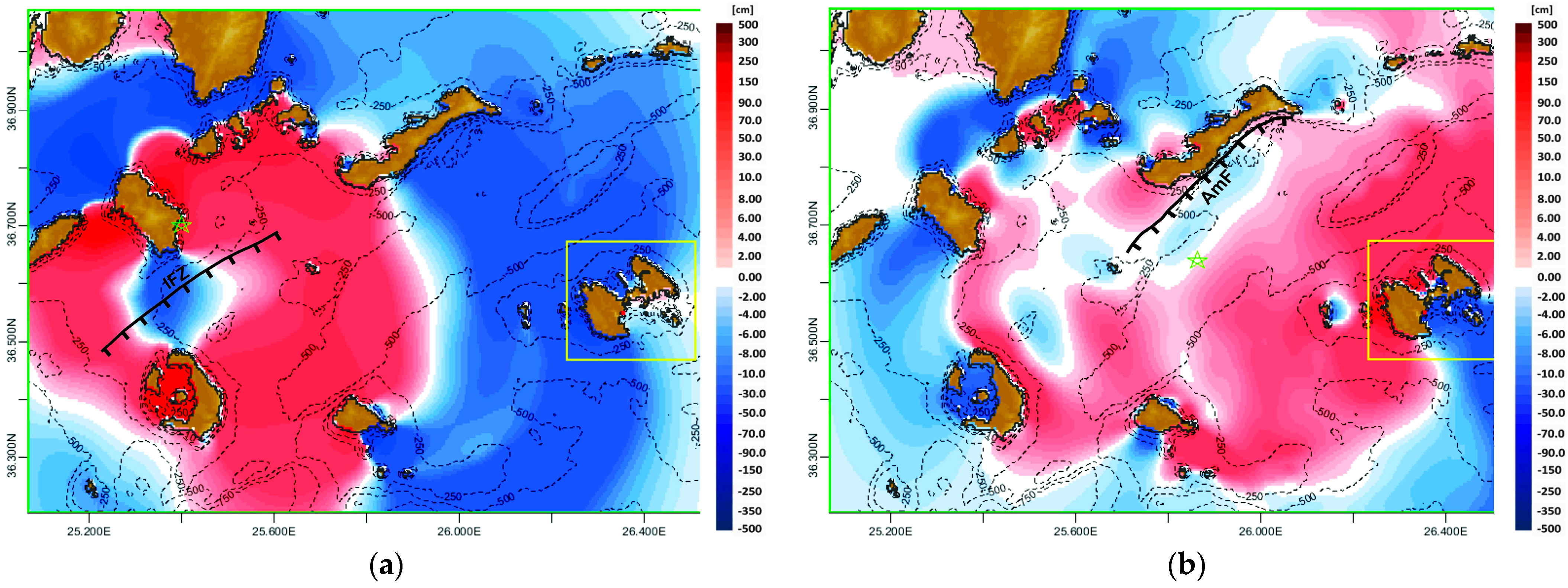
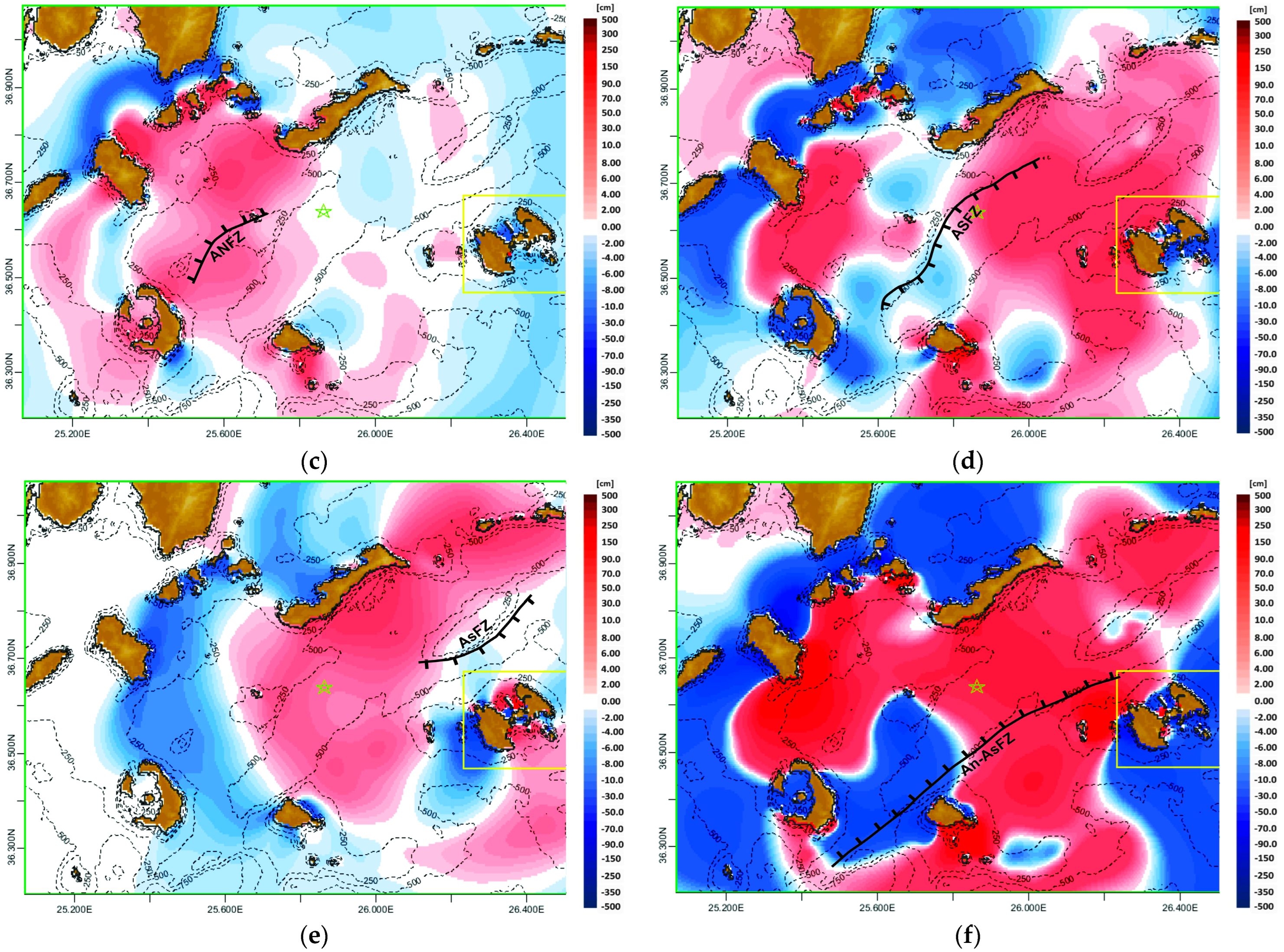
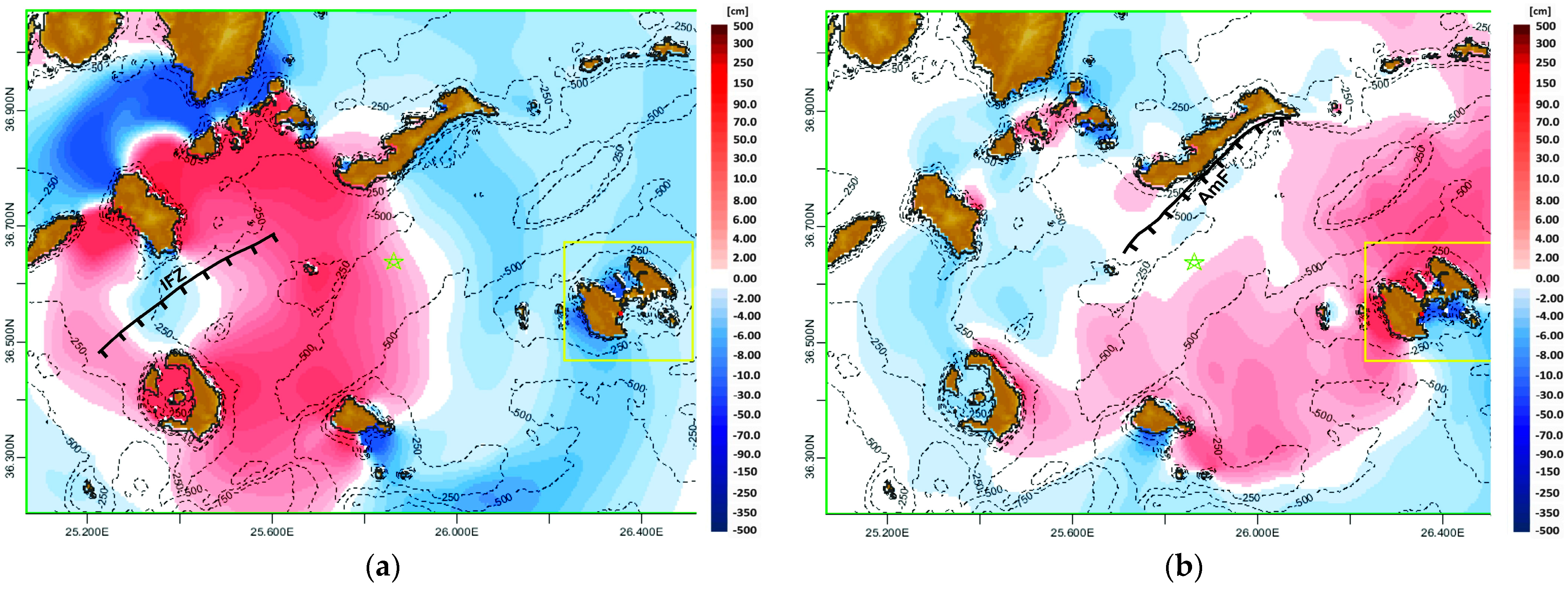
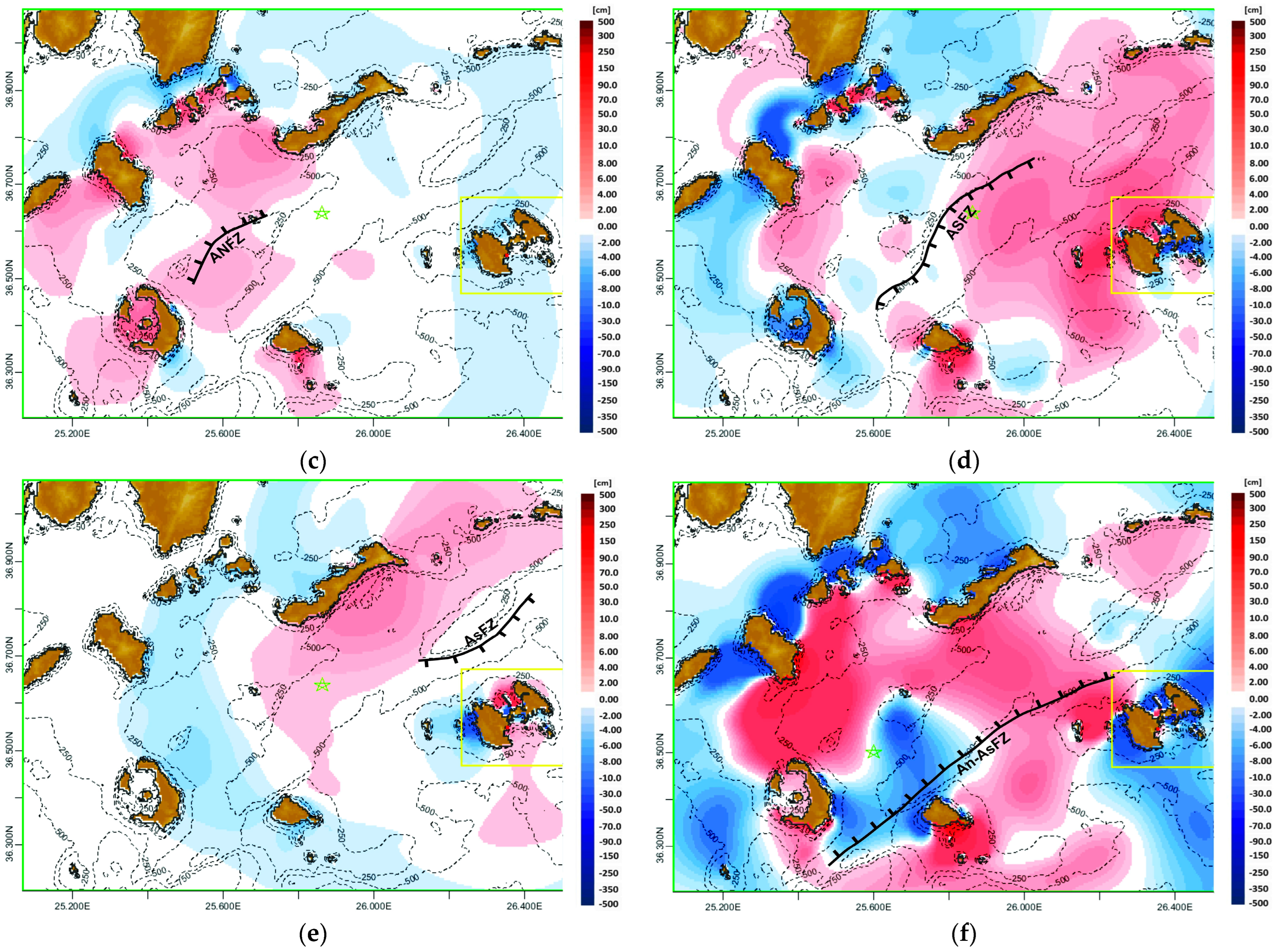
The numerical simulation outcomes illustrated the generation and propagation of tsunami waves produced by twelve earthquake scenarios, in which each one of the six faults was modeled using two kinematic conditions—rake of −90° representing normal faulting and rake of −135° representing normal right-lateral oblique slip. The calculated initial wave amplitude fields reflected the seafloor surface displacement associated with the uplift and submerge produced by each seismic event. The primary wave direction and the highest observed wave crests were aligned with the fault strike, predominantly propagating toward the northwest and southeast. The simulations also captured interactions between the wavefronts and seafloor features, which influenced tsunami behavior through variations in bathymetry. Such seafloor variations within the SATZ, along with the shape of the islands and coastal morphology, enhanced wave refraction and amplification, especially in nearshore zone. Additionally, the relative wavelength of incoming waves and the presence of ridges or shallow shelves modified the wave field, focusing or trapping energy and generating localized high wave amplitudes on the islands’ protected sides [45,46]. In particular, the Anydros horst, hosting Anydros Islet in the central-western SATZ, significantly enhanced wave diffraction and modulated wave propagation patterns (Figure 3 and Figure 4).
In addition to wave propagation patterns, the simulations also provided insights into wave amplitudes. Amplitudes represent the vertical sea surface displacement from equilibrium and reflect the energy released during the fault rupture. The simulations indicated that high wave amplitudes were generated by the IFZ. Under the pure normal faulting scenario, maximum amplitudes reached 2.0–2.5 m along the southern, western, and southeastern coasts of Ios, while values of approximately 1 m were observed along the northern coast of Santorini and the western coast of Amorgos. In contrast, the oblique-slip scenario produced smaller amplitudes, ranging between 0.7 and 0.8 m, primarily along the southern coast of Ios and the western coast of Amorgos. For the AmF, the pure normal faulting scenario produced wave amplitudes of approximately 1.5 m along the southwestern coast of Amorgos and up to 2.0 m along the northern coast of Astypalaea. Under the oblique-slip scenario, the amplitudes were notably reduced, ranging between 0.7 and 0.8 m in the same areas. For the ANFZ, the pure normal faulting scenario showed wave amplitudes between 0.6 and 0.8 m along the southeastern coast of Ios and the northern coast of Santorini. In contrast, the oblique-slip scenario produced lower amplitudes, ranging from 0.3 to 0.4 m, particularly affecting the southeastern coast of Ios and the northwestern coast of Santorini. In the case of the ASFZ, maximum wave amplitudes reached up to 1.8–2.0 m along the eastern coast of Anafi, the western and northern coasts of Astypalaea, and the western coast of Ios under the pure normal rupture. In contrast, the oblique-slip rupture generated significantly lower amplitudes of 0.5–0.7 m in the same areas. For the AsFZ, the highest wave amplitudes were observed along the northern coast of Astypalaea, reaching up to 2.6 m under the pure normal rupture. The oblique-slip rupture generated lower amplitudes of 1.1–1.4 m in the same area. The elevated amplitudes, despite the smaller earthquake magnitude compared to other scenarios, can be explained due to the proximity of the island to the fault and its nearshore morphology. The An-AsFZ generated the highest maximum wave amplitudes while, high amplitudes observed in a broader area compared to other faults. Under the pure normal scenario, amplitudes reached approximately 3 m along the northern coast of Anafi, 2 m in southeast Santorini, 1.8 m in eastern Ios, 1.0 m in southwest Ios, 1.5 m in Astypalaea, 1.2 m in western Astypalaea, and up to 1 m in southeast Amorgos. The oblique-slip scenario produced lower amplitudes, with 1.5 m in northern Anafi, 1.2 m in southwest Santorini, and 0.8 m in southwest Ios. Comparing the two kinematic scenarios, the pure normal faulting produced higher maximum observed wave amplitudes across the SATZ, whereas the oblique-slip scenarios produced lower and more spatially confined amplitudes. All of the above amplitude values were observed along shallow nearshore areas with headlands and protruding shorelines, where local bathymetry contributes to wave amplification through shoaling, refraction and reflection.
In the selected study areas, for the normal-faulting scenarios, the highest amplitudes were recorded along the coastline of Gialos, reaching 1.7 m from the IFZ, 1.1 m from the ASFZ, and up to 2.5 m from the An-AsFZ. In Kamari, wave amplitudes reached 0.9 m from the IFZ and 1.5 m from the An-AsFZ, while in Perissa, the An-AsFZ scenario generated amplitudes of 2.1 m. In all other study areas, maximum amplitudes remained below 0.6 m. Concerning the oblique-slip scenarios, the highest amplitudes were observed in Gialos, reaching 1.1 m from the IFZ and 1.4 m from the An-AsFZ, while in Kamari and Perissa, the An-AsFZ scenario produced amplitudes of 1.0 m and 1.5 m, respectively. At all other study sites, amplitudes remained below 0.3 m. The latter values are consistently lower than those of the normal-faulting scenarios, reflecting the reduced energy released in the vertical component of seafloor displacement during oblique-slip events, where part of the fault motion is expressed as horizontal shear, thereby limiting its efficiency in generating large tsunami waves.
In certain scenarios, the wave with the highest amplitude did not coincide with the first arrival, which may be attributed to trapped waves along submarine ridges and/or the excitation of harbor resonance nearshore [47,48]. For example, in Katapola, both the pure normal and oblique-slip IFZ scenarios produced the largest wave as the second wave rather than the initial one. In addition, in most of the scenarios, the wave sequence began with negative amplitudes, indicating an initial sea-level recession before the arrival of the first crest.

4.2. Tsunami Waves Arrival Time

The first-wave arrival times at the shoreline, derived from the wave amplitude time series, were analyzed across the five study areas, revealing variations depending on the proximity to the seismic source and, in certain cases, to the rupture kinematics. According to the results, the An-AsFZ produced the shortest tsunami arrival times, with waves reaching Kamari and Perissa within 8–9 min under both rupture types. In contrast, the AsFZ was associated with the longest arrival times, exceeding 45 min in Gialos and 36 min in Katapola.
The IFZ, AmF, ANFZ, and ASFZ produced intermediate arrival times, ranging generally between 11 and 41 min depending on the distance of each study area from the seismic source or/and the applied kinematic model. For instance, the AmF scenario produced very rapid arrival times in Katapola (11–12 min), whereas in Gialos the corresponding times exceeded 32 min. A similar spatial/temporal variability was observed for the ASFZ, where waves reached Kamari in less than 14 min and Perissa in 16 min, but required more than 32 min to arrive at Gialos and Katapola.
Comparing the two rupture kinematics across all scenarios, no consistent pattern was emerged in first-wave arrival times In certain cases, such as the ANFZ, the oblique-slip rupture generated shorter arrival times in Gialos, Kamari, and Perissa compared to the pure normal rupture. Conversely, in other cases, the normal-faulting rupture produced faster arrivals, such as the ANFZ in Katapola and the AmF in Gialos. This variability reflects differences in seafloor deformation, which modify the geometry of wave generation and propagation, thereby altering the initial wavefront distribution and travel paths.
The results underscore a significant spatial variability in wave arrival times across the SATZ, even for tsunamis generated by the same seismic source. While distant sources, such as the AsFZ, provide comparatively longer arrival times—offering a broader window for evacuation and emergency response—nearby sources, particularly the An-AsFZ, can generate waves reaching the coast within only 8–9 min in the western coast of Santorini. Such short arrival times significantly limit the available window for evacuation and emergency response.
Table 2 summarizes the computed first-wave arrival times for all study areas, presenting results for both pure normal faulting and oblique-slip scenarios.

4.3. Tsunami Inundation Extent and Run-Up

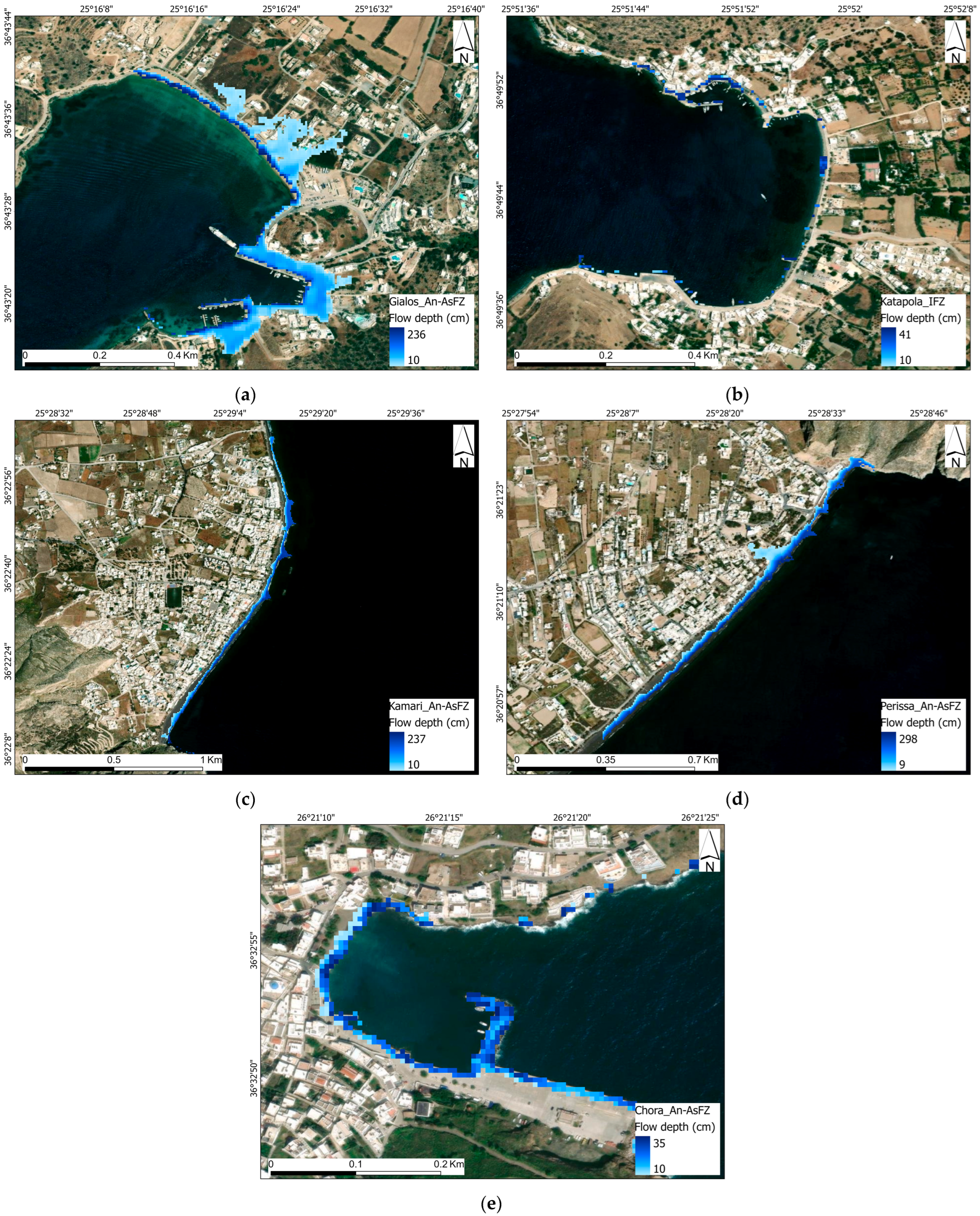
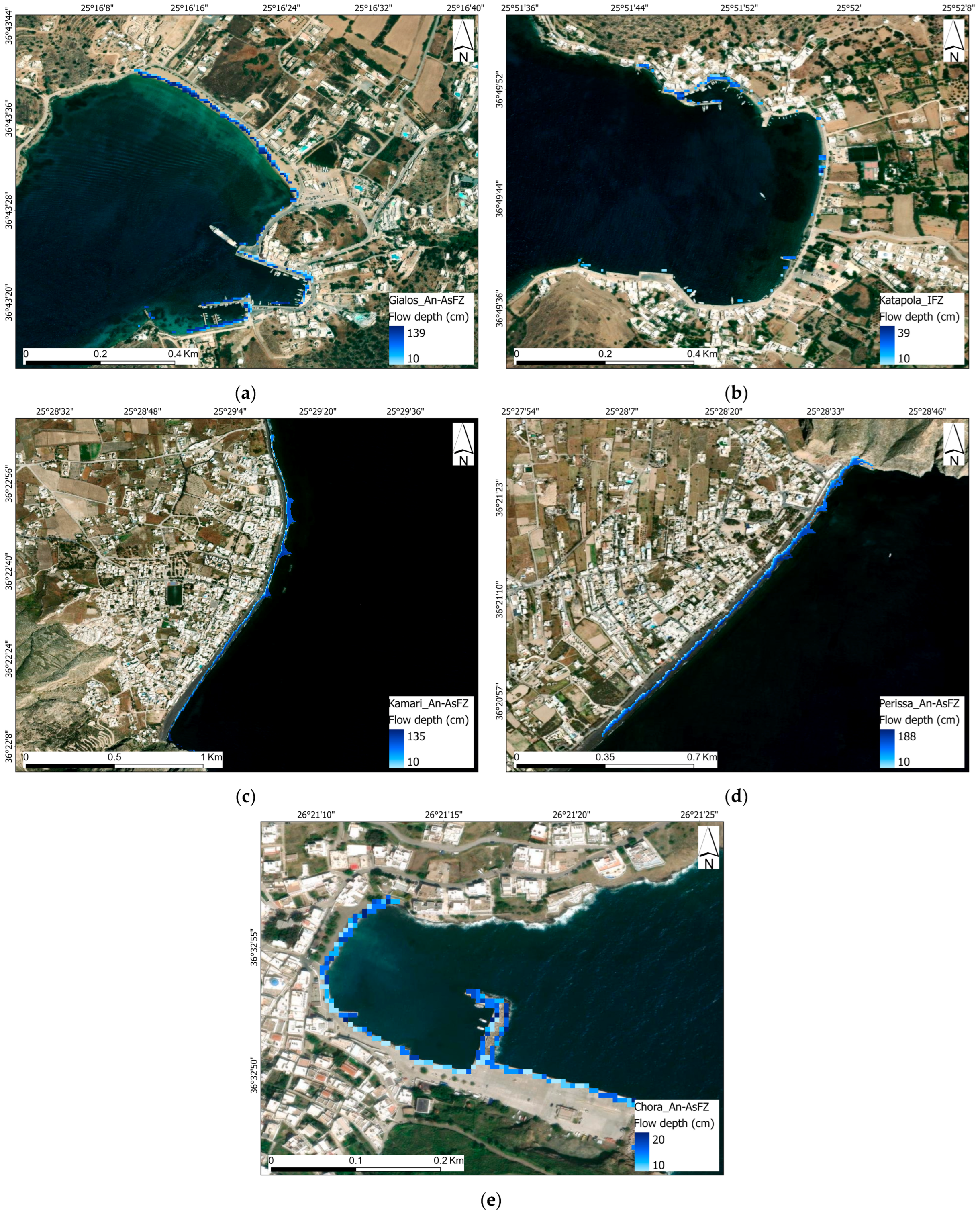
The results revealed significant variability in coastal impact depending on the distance from the fault source, rupture kinematics, and site-specific conditions. The largest inundation in the selected study areas is typically observed in bays and harbors, which can be attributed to the excitation of harbor resonance by the tsunami waves [49,50]. Among the scenarios, the An-AsFZ produced the highest run-up values, reaching up to 4.1 m in Gialos, 2.7 m in Kamari, 2.4 m in Perissa, and 2.3 m in Chora under the pure normal rupture. Even under oblique slip, this fault generated notably high run-ups up to 3.4 m in Gialos and 2.1 m and 2.0 m in Perissa and Chora, respectively, highlighting the highest tsunamigenic potential among all the faults.
The IFZ and ASFZ also generated significant run-up heights, with maxima of 3.5 m (IFZ) and 3.4 m (ASFZ) in Gialos under normal faulting. However, their oblique-slip scenarios produced notably smaller run-ups, generally below 2.6 m. Similarly, the AmF produced run-up values up to 2.1 m in Gialos and 1.4 m in Katapola for the normal rupture, and up to 1.5 m in Gialos for the oblique-slip scenario. By contrast, the ANFZ and AsFZ exhibited the lowest run-up values across the study areas, with maxima not exceeding 1.4 m and 0.6 m, respectively, under normal faulting, and less than 1.0 m under oblique-slip scenarios.
The results demonstrate that normal faulting scenarios consistently produced higher run-up values than oblique-slip ruptures, reflecting the greater vertical energy release. Spatial differences among the study areas further emphasize the role of local coastal morphology in modulating tsunami impact.
The simulated run-up values for each seismic source under both pure normal and oblique-slip faulting scenarios are summarized in Table 3 for the five study areas.
Under the pure normal faulting scenarios, the largest inundation extents were associated with the An-AsFZ in Gialos, Kamari, Perissa, and Chora, whereas in Katapola, the IFZ produced the most extensive flooding (Figure 5). In Gialos, tsunami waves inundated the port area and extended inland beyond the beach zone, with the central and eastern sections being most affected. In Katapola, inundation was primarily concentrated along the northern coast, impacting the island’s port, while the remaining areas experienced minimal or no flooding. In Kamari and Perissa, inundation generally extended slightly beyond the coastline, except in northern Perissa, where flows penetrated up to approximately 100 m into residential areas, highlighting the influence of local topography on inundation extent. In Chora, the western coast along the beach experienced the most extended flooding, with waves stopping just before the buildings. Minor inundation was also observed along the southern coast along the port, and very limited flooding occurred along the steep northern rocky shoreline. For all other pure normal faulting scenarios, inundation remained restricted to the immediate coastal zone, rarely penetrating inland, or was entirely negligible, as in Chora for the ANFZ scenario.
For the oblique-slip scenarios, the same faults produced the highest computed run-up in each study area (Figure 6). However, the overall inundation extent was consistently smaller compared to the pure normal faulting scenarios. The results indicate that flows reached the port areas in Gialos, Katapola, and Chora, indicating that critical infrastructure could still be affected even under reduced wave energy. In general, the inundation remained confined to the immediate coastal zones and rarely extended far inland, highlighting the influence of fault kinematics in limiting the inundation extent of oblique-slip tsunami waves.

4.4. Tsunami Hazard Assessment and Further Considerations

Earthquake-triggered tsunamis within the SATZ were simulated using the ComMIT framework implementing the MOST numerical model, a validated tool for reproducing tsunami generation, propagation, and inundation [51]. The simulations showed that while the faults in the SATZ are capable of generating locally significant tsunami waves, they are not large enough to produce widespread catastrophic inundation across the study area. These findings provide an essential basis for preparedness and risk communication planning. Even under worst-case scenarios, a significant part of coastal settlements remained non-exposed, indicting the potential for effective protection of the entire population, including both permanent and seasonal residents, through targeted preparedness measures and effective communication planning. A critical research query for the future is how the epistemic knowledge derived from this study can best be integrated into island-specific risk communication and tsunami preparedness planning.
The characteristics of the computed inundation, including run-up heights and limited inland penetration, are comparable to those observed during the 2020 Samos Island tsunami, the most recent tsunami in Greece. That event, with an earthquake magnitude of Mw 7, produced similar localized coastal impacts [52,53]. Likewise, in Gialos, Katapola, Perissa, and Chora, inundation extends further into the coastal zone, affecting residential areas. Height restrictions in building regulations and the presence of basements observed in many structures could increase their vulnerability to tsunamis. As a large proportion of the buildings along the coastal front are associated with tourism and other economic activities, this increased vulnerability may also undermine the settlements’ local comparative advantage, particularly within the tourism sector [54]. These settlements, except Perissa, also host the main ports, indicating that even moderate tsunamis could exacerbate a seismic crisis by disrupting critical infrastructure essential for emergency response. To mitigate such impacts, the construction of breakwaters and the strategic relocation of critical equipment can reduce damage and enhance operational resilience.
In most scenarios, inundation remained restricted not far beyond the shoreline, with the modeled tsunamis occurring as large waves without significant inland penetration. Notably, the findings of this study are consistent with documented tsunami run-up heights following the 1956 earthquake, as reported by eyewitnesses, which reached 1.5 m in Katapola, 3 m in Perissa, and 2.6–4.0 m in Chora [35]. The simulations conducted here produced comparable values of 1.5 m in Katapola, 2.4 m in Perissa, and 2.3 m in Chora, demonstrating strong agreement between the modeled results and field observations. Although potential tsunami inundation in this island region is confined to a relatively narrow coastal zone, the high concentration of infrastructure, population, and economic activities along the shoreline results in elevated exposure and vulnerability, indicating that even low-hazard tsunami events could lead to considerable disaster. These observations underscore the need for integrated disaster risk reduction strategies, including coastal land-use planning, port protection measures, and preparedness policies aimed at strengthening the resilience of island communities.
The present study is limited to earthquake-triggered tsunamis and does not consider tsunamis generated by submarine mass transports. However, the SATZ is prone to such events, as sedimentological data reveal submarine deposits resulting from multiple mass-transport events triggered by the 1956 earthquake. Similar deposits, associated with mass transport and dated before and after the 1956 event, reflect the area’s high seismicity [55]. Furthermore, Okal et al. [35] performed simulation scenarios that included an earthquake on the AmF combined with multiple submarine landslides. Their results suggested that the 1956 tsunami in the SATZ was likely generated by a combination of co-seismic seafloor rupture and submarine landslides triggered by the main shock and its aftershocks. These observations indicate that, in addition to earthquake-triggered tsunamis, submarine mass-transport events could produce locally significant tsunami waves, posing an additional hazard that falls outside the scope of the present work. The MOST numerical model, in its standard form, is developed for earthquake-triggered tsunamis and is not directly applicable to landslide events, which involve highly localized water displacement and require specialized models similar to those applied in the North Aegean [23]. While the current study provides valuable insights into the earthquake-induced tsunami hazard, future studies should consider the potential contribution of mass-transport events to fully assess tsunami hazard within the SATZ.

5. Conclusions

The study assessed the earthquake-triggered tsunami hazard in five coastal settlements within the SATZ. Numerical simulations were performed under a deterministic, worst-case scenario approach. Six well-documented major faults were selected as seismic sources to evaluate their potential for tsunami generation. The ComMIT platform was employed to simulate tsunami generation, propagation, and onshore inundation. The faults geometry was derived from detailed bathymetric studies in the SATZ. Earthquake parameters were defined using recent seismotectonic data and empirical relationships linking rupture area, magnitude, and slip. Each fault was assumed to rupture along its full length, representing maximum-magnitude scenarios. Two kinematic scenarios were considered, one assuming pure normal faulting and the other normal right-lateral oblique slip.
The simulations showed considerable variability in first-wave arrival times across the study areas, ranging from a few minutes to over 45 min, depending on the proximity to the seismic sources and fault kinematics. The results also revealed that the largest run-up values generally occurred under the pure normal faulting scenario, highlighting the influence of fault kinematics on tsunami impact. The computed inundation extents and run-up values indicated predominantly localized impacts, with the highest run-up of 4.1 m recorded in Gialos and maximum run-ups of 1.5 m in Katapola, 2.7 m in Kamari, 2.4 m in Perissa, and 2.3 m in Chora potentially affecting residential zones. In Gialos, Katapola, and Chora, inundation flows impacted the main ports, indicating that tsunamis could exacerbate a seismic crisis by disrupting the critical infrastructure essential for emergency response. In most other scenarios, inundation remained restricted to the immediate coastal zone, rarely extending inland, reflecting the controlling influence of fault kinematics, local bathymetry, coastal morphology, and proximity to the generating source. Although earthquake-triggered tsunamis pose a potential hazard, the results suggested that these events are unlikely to lead to a widespread disaster in the study areas.
The findings indicate the importance of integrated disaster risk reduction strategies, including coastal land-use planning, port protection, and preparedness measures to enhance the resilience of island communities. The methodology presented here can also be extended to faults outside the SATZ to assess their potential impact on the study areas. Moreover, it is readily applicable to other tsunami-prone regions, offering a practical framework for site-specific hazard assessment.

Author Contributions

Conceptualization, D.-V.B., D.S. and E.K.; methodology, D.-V.B., D.S., E.K., L.-M.M., G.V., K.T., E.V. and K.S.; software, D.-V.B., L.-M.M., G.V. and K.T.; validation, D.-V.B., D.S., E.K., L.-M.M., G.V., K.T., E.V. and K.S.; formal analysis, D.-V.B., D.S., E.K., L.-M.M., G.V., K.T., E.V. and K.S.; resources, D.-V.B., D.S. and E.K.; data curation, D.-V.B., L.-M.M., G.V. and K.T.; writing—original draft preparation, D.-V.B., L.-M.M., G.V. and K.T.; writing—review and editing, D.-V.B., D.S., E.K., L.-M.M., G.V., K.T., E.V. and K.S.; visualization, D.-V.B., L.-M.M., G.V. and K.T.; supervision, D.-V.B., D.S., E.K., E.V. and K.S.; All authors have read and agreed to the published version of the manuscript.

Funding

This research received no external funding.

Data Availability Statement

The data presented in this study are available on request from the corresponding author.

Acknowledgments

We thank the three anonymous reviewers for their valuable comments and suggestions that significantly improved this manuscript.

Conflicts of Interest

The authors declare no conflicts of interest.

References

  1. Taymaz, T.; Yilmaz, Y.; Dilek, Y. The geodynamics of the Aegean and Anatolia: Introduction. In The Geodynamics of the Aegean and Anatolia; Taymaz, T., Yilmaz, Y., Dilek, Y., Eds.; Geological Society Special Publication: London, UK, 2007; Volume 291, pp. 1–16. [Google Scholar] [CrossRef]
  2. Ferentinos, G.; Georgiou, N.; Christodoulou, D.; Geraga, M.; Papatheodorou, G. Propagation and termination of a strike slip fault in an extensional domain: The westward growth of the North Anatolian Fault into the Aegean Sea. Tectonophysics 2018, 745, 183–195. [Google Scholar] [CrossRef]
  3. Caroir, F.; Chanier, F.; Gaullier, V.; Sakellariou, D.; Bailleul, J.; Maillard, A.; Paquet, F.; Watremez, L.; Averbuch, O.; Graveleau, F.; et al. Late Quaternary deformation in the western extension of the North Anatolian Fault (North Evia, Greece): Insights from very high-resolution seismic data (WATER surveys). Tectonophysics 2024, 870, 230138. [Google Scholar] [CrossRef]
  4. Reilinger, R.; McClusky, S.; Paradisis, D.; Ergintav, S.; Vernant, P. Geodetic constraints on the tectonic evolution of the Aegean region and strain accumulation along the Hellenic subduction zone. Tectonophysics 2010, 488, 22–30. [Google Scholar] [CrossRef]
  5. McClusky, S.; Balassanian, S.; Barka, A.; Demir, C.; Ergintav, S.; Georgiev, I.; Gurkan, O.; Hamburger, M.; Hurst, K.; Kahle, H.; et al. Global positioning system constraints on plate kinematic and dynamics in the eastern Mediterranean and Caucasus. J. Geophys. Res. 2000, 105, 5695–5719. [Google Scholar] [CrossRef]
  6. Reilinger, R.; McClusky, S.; Vernant, P.; Lawrence, S.; Ergintav, S.; Cakmak, R.; Ozener, H.; Kadirov, F.; Guliev, I.; Stepanyan, R.; et al. GPS constraints on continental deformation in the Africa-Arabia-Eurasia continental collision zone and implications for the dynamics of plate interactions. J. Geophys. Res. 2006, 111, B05411. [Google Scholar] [CrossRef]
  7. Papazachos, C.B.; Kiratzi, A.A. A detailed study of the active crustal deformation in the Aegean and surrounding area. Tectonophysics 1996, 253, 129–153. [Google Scholar] [CrossRef]
  8. Sachpazi, M.; Laigle, M.; Charalampakis, M.; Diaz, J.; Kissling, E.; Gesret, A.; Becel, A.; Flueh, E.; Miles, P.; Hirn, A. Segmented Hellenic slab rollback driving Aegean deformation and seismicity. Geophys. Res. Lett. 2016, 43, 651–658. [Google Scholar] [CrossRef]
  9. Papazachos, B.C.; Papaioannou, C.A.; Papazachos, C.B.; Savvaidis, A.S. Rupture zones in the Aegean region. Tectonophysics 1999, 308, 205–221. [Google Scholar] [CrossRef]
  10. Hübscher, C.; Ruhnau, M.; Nomikou, P. Volcano-tectonic evolution of the polygenetic Kolumbo submarine volcano/Santorini (Aegean Sea). J. Volcanol. Geotherm. Res. 2015, 291, 101–111. [Google Scholar] [CrossRef]
  11. Heath, B.A.; Hooft, E.E.E.; Toomey, D.R.; Papazachos, C.B.; Nomikou, P.; Paulatto, M.; Morgan, J.V.; Warner, M.R. Tectonism and Its Relation to Magmatism Around Santorini Volcano From Upper Crustal P Wave Velocity. J. Geophys. Res. 2019, 124, 10610–10629. [Google Scholar] [CrossRef]
  12. Nomikou, P.; Hübscher, C.; Ruhnau, M.; Bejelou, K. Tectono-stratigraphic evolution through successive extensional events of the Anydros Basin, hosting Kolumbo volcanic field at the Aegean Sea, Greece. Tectonophysics 2016, 671, 202–217. [Google Scholar] [CrossRef]
  13. Nomikou, P.; Hübscher, C.; Papanikolaou, D.; Farangitakis, G.P.; Ruhnau, M.; Lampridou, D. Expanding extension, subsidence and lateral segmentation within the Santorini-Amorgos basins during Quaternary: Implications for the 1956 Amorgos events, central—South Aegean Sea, Greece. Tectonophysics 2018, 722, 138–153. [Google Scholar] [CrossRef]
  14. Preine, J.; Schwarz, B.; Bauer, A.; Hübscher, C. When There Is No Offset: A Demonstration of Seismic Diffraction Imaging and Depth-Velocity Model Building in the Southern Aegean Sea. J. Geophys. Res. 2020, 125, e2020JB019961. [Google Scholar] [CrossRef]
  15. Briole, P.; Ganas, A.; Serpetsidaki, A.; Beauducel, F.; Sakkas, V.; Tsironi, V.; Elias, P. Volcano-tectonic interaction at Santorini. The crisis of February 2025. Constraints from geodesy. Geophys. J. Int. 2025, 242, ggaf262. [Google Scholar] [CrossRef]
  16. Fountoulakis, I.; Evangelidis, C.P. The 2024–2025 seismic sequence in the Santorini-Amorgos region: Insights into volcano-tectonic activity through high-resolution seismic monitoring. Seismica 2025, 4, 1–9. [Google Scholar] [CrossRef]
  17. Triantafyllou, I.; Papadopoulos, G.A.; Siettos, C.; Spiliotis, K. Real-Time Foreshock–Aftershock–Swarm Discrimination During the 2025 Seismic Crisis near Santorini Volcano, Greece: Earthquake Statistics and Complex Networks. Geosciences 2025, 15, 300. [Google Scholar] [CrossRef]
  18. González, A.; Fernández, M.; Llorente, M.; Macías, J.; Sánchez-Linares, C.; García-Mayordomo, J.; Paredes, C. Pseudo-Probabilistic Design for High-Resolution Tsunami Simulations in the Southwestern Spanish Coast. GeoHazards 2022, 3, 294–322. [Google Scholar] [CrossRef]
  19. Greenslade, D.J.; Titov, V.V. A comparison study of two numerical tsunami forecasting systems. Pure Appl. Geophys. 2008, 165, 1991–2001. [Google Scholar] [CrossRef]
  20. Marras, S.; Mandli, K.T. Modeling and simulation of tsunami impact: A short review of recent advances and future challenges. Geosciences 2020, 11, 5. [Google Scholar] [CrossRef]
  21. Flouri, E.T.; Kalligeris, N.; Alexandrakis, G.; Kampanis, N.A.; Synolakis, C.E. Application of a finite difference computational model to the simulation of earthquake generated tsunamis. Appl. Numer. Math. 2013, 67, 111–125. [Google Scholar] [CrossRef]
  22. Triantafyllou, I.; Agalos, A.; Samaras, A.G.; Karambas, T.V.; Papadopoulos, G.A. Strong earthquakes and tsunami potential in the Hellenic subduction zone. J. Geodyn. 2024, 159, 102021. [Google Scholar] [CrossRef]
  23. Janin, A.; Rodriguez, M.; Sakellariou, D.; Lykousis, V.; Gorini, C. Tsunamigenic potential of a Holocene submarine landslide along the North Anatolian Fault (northern Aegean Sea, off Thasos island): Insights from numerical modelling. Nat. Hazards Earth Syst. Sci. 2019, 19, 121–136. [Google Scholar] [CrossRef]
  24. Triantafyllou, Ι.; Zaniboni, F.; Armigliato, A.; Tinti, S.; Papadopoulos, G.A. The large earthquake (~M7) and its associated tsunami of 8 November 1905 in Mt. Athos, northern Greece. Pure Appl. Geophys. 2020, 177, 1267–1293. [Google Scholar] [CrossRef]
  25. Novikova, T.; Papadopoulos, G.A.; McCoy, F.W. Modelling of tsunami generated by the giant late Bronze Age eruption of Thera, South Aegean Sea, Greece. Geophys. J. Int. 2011, 186, 665–680. [Google Scholar] [CrossRef]
  26. Tselentis, G.A.; Stavrakakis, G.; Sokos, E.; Gkika, F.; Serpetsidaki, A. Tsunami hazard assessment in the Ionian Sea due to potential tsunamogenic sources–results from numerical simulations. Nat. Hazards Earth Syst. Sci. 2010, 10, 1021–1030. [Google Scholar] [CrossRef]
  27. Tselentis, G.A.; Gkika, F.; Sokos, E. Tsunami hazards associated with the Perachora fault at eastern Corinth Gulf, Greece. Bull. Seism. Soc. Am. 2006, 96, 1649–1661. [Google Scholar] [CrossRef]
  28. Wang, Y.; Heidarzadeh, M.; Satake, K.; Mulia, I.E.; Yamada, M. A tsunami warning system based on offshore bottom pressure gauges and data assimilation for Crete Island in the Eastern Mediterranean Basin. J. Geophys. Res. Solid Earth 2020, 125, e2020JB020293. [Google Scholar] [CrossRef]
  29. Petricca, P.; Babeyko, A.Y. Tsunamigenic potential of crustal faults and subduction zones in the Mediterranean. Sci. Rep. 2019, 9, 4326. [Google Scholar] [CrossRef]
  30. El-Hussain, I.; Omira, R.; Al-Habsi, Z.; Baptista, M.A.; Deif, A.; Mohamed, A.M.E. Probabilistic and deterministic estimates of near-field tsunami hazards in northeast Oman. Geosci. Lett. 2018, 5, 30. [Google Scholar] [CrossRef]
  31. Bohnhoff, M.; Rische, M.; Meier, T.; Becker, D.; Stavrakakis, G.; Harjes, H.P. Microseismic activity in the Hellenic Volcanic Arc, Greece, with emphasis on the seismotectonic setting of the Santorini-Amorgos zone. Tectonophysics 2006, 423, 17–33. [Google Scholar] [CrossRef]
  32. Tsampouraki-Kraounaki, K.; Sakellariou, D.; Rousakis, G.; Morfis, I.; Panagiotopoulos, I.; Livanos, I.; Manta, K.; Paraschos, F.; Papatheodorou, G. The Santorini-Amorgos shear zone: Evidence for dextral transtension in the south Aegean back-arc region, Greece. Geosciences 2021, 11, 216. [Google Scholar] [CrossRef]
  33. Sakellariou, D.; Sigurdsson, H.; Alexandri, M.; Carey, S.; Rousakis, G.; Nomikou, P.; Georgiou, P.; Ballas, D. Active tectonics in the Hellenic Volcanic Arc: The Kolumbo Submarine Volcanic Zone. Bull. Geol. Soc. Greece Spec. Publ. 2010, 43, 1056–1063. [Google Scholar] [CrossRef]
  34. Andinisari, R.; Konstantinou, K.I.; Ranjan, P. Seismicity along the Santorini-Amorgos zone and its relationship with active tectonics and fluid distribution. Phys. Earth Planet. Inter. 2021, 312, 106660. [Google Scholar] [CrossRef]
  35. Okal, E.A.; Synolakis, C.E.; Uslu, B.; Kalligeris, N.; Voukouvalas, E. The 1956 earthquake and tsunami in Amorgos, Greece. Geophys. J. Int. 2009, 178, 1533–1554. [Google Scholar] [CrossRef]
  36. Leclerc, F.; Palagonia, S.; Feuillet, N.; Nomikou, P.; Lampridou, D.; Barrière, P.; Dano, A.; Ochoa, E.; Gracias, N.; Escartin, J. Large seafloor rupture caused by the 1956 Amorgos tsunamigenic earthquake, Greece. Commun. Earth Environ. 2024, 5, 663. [Google Scholar] [CrossRef]
  37. Titov, V.V.; Synolakis, C.E. Numerical modeling of tidal wave runup. J. Waterw. Port Coast. Ocean Eng. 1998, 124, 157–171. [Google Scholar] [CrossRef]
  38. Titov, V.V.; Moore, C.W.; Greenslade, D.J.M.; Pattiaratchi, C.; Badal, R.; Synolakis, C.E.; Kânoǧlu, U. A New Tool for Inundation Modeling: Community Modeling Interface for Tsunamis (ComMIT). Pure Appl. Geophys. 2021, 168, 2121–2131. [Google Scholar] [CrossRef]
  39. Okada, Y. Surface deformation due to shear and tensile faults in a half-space. Bull. Seism. Soc. Am. 1985, 75, 1135–1154. [Google Scholar] [CrossRef]
  40. General Bathymetric Chart of the Oceans (GEBCO), Gridded Bathymetry Data—2024. Available online: https://download.gebco.net/ (accessed on 10 July 2025).
  41. Copernicus GLO-90 Digital Elevation Model. Available online: https://portal.opentopography.org/raster?opentopoID=OTSDEM.032021.4326.1 (accessed on 10 July 2025).
  42. Papazachos, B.C.; Scordilis, E.M.; Panagiotopoulos, D.G.; Papazachos, C.B.; Karakaisis, G.F. Global relations between seismic fault parameters and moment magnitude of earthquakes. Bull. Geol. Soc. Greece Spec. Publ. 2004, 36, 1482–1489. [Google Scholar] [CrossRef]
  43. Institute of Geodynamics-National Observatory of Athens. Observations and Preliminary Results on the Seismic Sequence Between Santorini and Amorgos. 2025. Available online: https://www.emsc.eu/Special_reports/?id=351 (accessed on 10 July 2025).
  44. Ganas, A.; Oikonomou, I.A.; Tsimi, C. Noafaults: A digital database for active faults in Greece. Bull. Geol. Soc. Greece Spec. Publ. 2013, 47, 518–530. [Google Scholar] [CrossRef]
  45. Yeh, H.; Liu, P.; Briggs, M.; Synolakis, C. Propagation and amplification of tsunamis at coastal boundaries. Nature 1994, 372, 353–355. [Google Scholar] [CrossRef]
  46. Wang, G.; Fu, D.; Zheng, J.; Liang, Q.; Zhang, Y. Analytic study on long wave transformation over a seamount with a pit. Ocean Eng. 2018, 154, 167–176. [Google Scholar] [CrossRef]
  47. Wang, G.; Liang, Q.; Shi, F.; Zheng, J. Analytical and numerical investigation of trapped ocean waves along a submerged ridge. J. Fluid Mech. 2021, 915, A54. [Google Scholar] [CrossRef]
  48. Wang, G.; Stanis, Z.E.O.G.; Fu, D.; Zheng, J.; Gao, J. An analytical investigation of oscillations within a circular harbor over a Conical Island. Ocean Eng. 2020, 195, 106711. [Google Scholar] [CrossRef]
  49. Horrillo, J.; Knight, W.; Kowalik, Z. Kuril Islands tsunami of November 2006: 2. Impact at Crescent City by local enhancement. J. Geophys. Res. Oceans 2008, 113, C01021. [Google Scholar] [CrossRef]
  50. Dong, G.; Wang, G.; Ma, X.; Ma, Y. Harbor resonance induced by subaerial landslide-generated impact waves. Ocean Eng. 2010, 37, 927–934. [Google Scholar] [CrossRef]
  51. Titov, V.V.; Gonzalez, F.I. Implementation and testing of the method of splitting tsunami (MOST) model. In NOAA Technical Memorandum ERL-PMEL-112; PB98-122773; Pacific Marine Environmental Laboratory: Seattle, WA, USA, 1997; 11p. [Google Scholar]
  52. Triantafyllou, I.; Gogou, M.; Mavroulis, S.; Lekkas, E.; Papadopoulos, G.A.; Thravalos, M. The Tsunami Caused by the 30 October 2020 Samos (Aegean Sea) Mw7. 0 Earthquake: Hydrodynamic Features, Source Properties and Impact Assessment from Post-Event Field Survey and Video Records. J. Mar. Sci. Eng. 2021, 9, 68. [Google Scholar] [CrossRef]
  53. Katsetsiadou, K.N.; Triantafyllou, I.; Papadopoulos, G.A.; Lekkas, E.; Lozios, S.; Vassilakis, E. Crowdsourcing data interpretation for the response to the first public tsunami alert in the Mediterranean sea, after the October 30th, 2020 earthquake (Mw7. 0), Samos, Greece. Int. J. Disaster Risk Reduct. 2023, 95, 103867. [Google Scholar] [CrossRef]
  54. Batzakis, D.-V.; Misthos, L.-M.; Voulgaris, G.; Tsanakas, K.; Andreou, M.; Tsodoulos, I.; Karymbalis, E. Assessment of Building Vulnerability to Tsunami Hazard in Kamari (Santorini Island, Greece). J. Mar. Sci. Eng. 2020, 8, 886. [Google Scholar] [CrossRef]
  55. Manta, K.; Rousakis, G.; Geraga, M.; Papatheodorou, G.; Sakellariou, D.; Patiris, D.; Androulakaki, E.G.; Karageorgis, A.P. Sedimentological characteristics of Mass Transport Deposits (MTDs) triggered by the Amorgos 1956 earthquake: Sediment provenance and geochemical elements. Geo-Mar. Lett. 2025, 45, 27. [Google Scholar] [CrossRef]
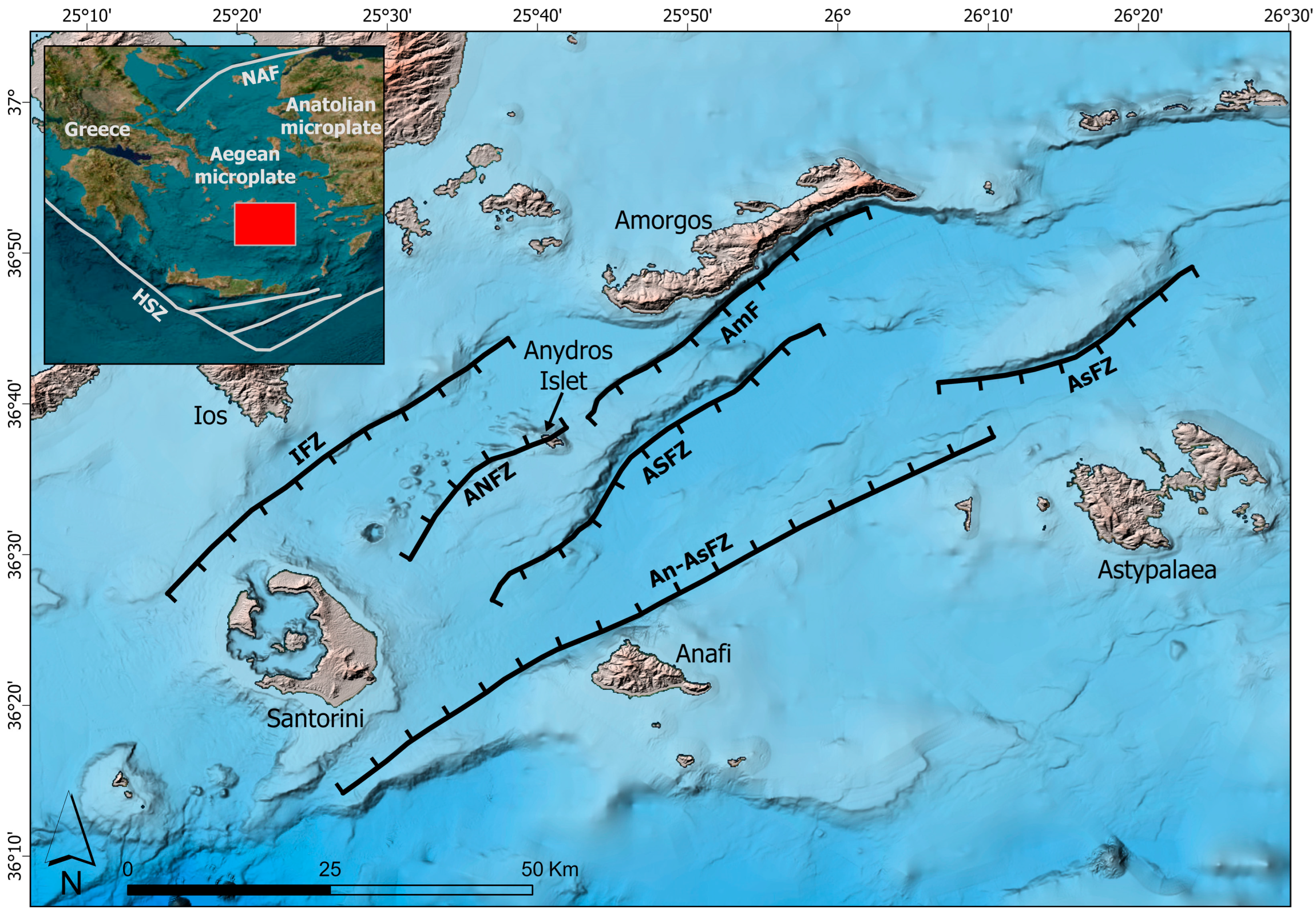
Figure 1. Map of the major active faults in the SATZ (modified after Nomikou et al.; Tsampouraki-Kraounaki et al. [13,32]). The inset map shows the main tectonic features of the broader Aegean, including the Hellenic Subduction Zone (HSZ) and the North Anatolian Fault (NAF); the red rectangle marks the location of the SATZ within the South Aegean. IFZ: Ios Fault Zone; AmF: Amorgos Fault; ANFZ: Anydros Fault Zone; ASFZ: Amorgos-Santorini Fault Zone; AsFZ: Astypalaea Fault Zone; An-AsFZ: Anafi-Astypalaea Fault Zone.
Jmse 13 02005 g001
Figure 2. Map of the selected tsunamigenic earthquake sources and coastal study areas. Yellow rectangles represent the surface projection of the fault planes, red lines indicate the fault traces, yellow stars mark the epicenters of the potential earthquakes considered in the simulation modeling, while red circles mark the coastal settlements selected for inundation assessment.
Jmse 13 02005 g002
Figure 3. Wave propagation and amplitude distribution for the normal-faulting seismic source scenarios in the SATZ: (a) IFZ; (b) AmF; (c) ANFZ; (d) ASFZ; (e) AsFZ; (f) An-AsFZ. Snapshots correspond to 20 min after the seismic events. Wave crests are shown in red and troughs in blue, with the color scale ranging from −500 cm to 500 cm.
Jmse 13 02005 g003aJmse 13 02005 g003b
Figure 4. Wave propagation and amplitude distribution for the oblique-slip seismic source scenarios in the SATZ: (a) IFZ; (b) AmF; (c) ANFZ; (d) ASFZ; (e) AsFZ; (f) An-AsFZ. Snapshots correspond to 20 min after the seismic events. Wave crests are shown in red and troughs in blue, with the color scale ranging from −500 cm to 500 cm.
Jmse 13 02005 g004aJmse 13 02005 g004b
Figure 5. Maximum computed inundation extent in each study area under pure normal faulting scenarios: (a) Gialos, An-AsFZ; (b) Katapola, IFZ; (c) Kamari, An-AsFZ; (d) Perissa, An-AsFZ; (e) Chora, An-AsFZ. The corresponding calculated flow depth values are indicated in the map legends.
Jmse 13 02005 g005
Figure 6. Maximum computed inundation extent in each study area under oblique-slip faulting scenarios: (a) Gialos, An-AsFZ; (b) Katapola, IFZ; (c) Kamari, An-AsFZ; (d) Perissa, An-AsFZ; (e) Chora, An-AsFZ. The corresponding calculated flow depth values are indicated in the map legends.
Jmse 13 02005 g006
Table 1. Seismic source parameters used in the tsunami simulations for the SATZ, including fault earthquake epicenter, length, width, rupture area, magnitude (Mw), average slip, hypocentral depth, strike, dip, and rake. Two kinematic scenarios (rake = −90° and −135°) were considered for each fault to represent pure normal and normal right-lateral oblique faulting.
Seismic SourceEarthquake Epicenter (°)Length (km)Width (km)Rupture Area (km2)MwDepth (km)Average Slip (m)Strike (°)Dip (°)Rake
(°)
LatitudeLongitude
IFZ36.528946725.49529624717.7831.97.03101.744745−90/−135
AmF36.697663125.93668943816.3619.46.86101.324650−90/−135
ANFZ36.635766825.55777392317.7407.16.63100.9022845−90/−135
ASFZ36.549899325.83183464815.2729.66.95101.534455−90/−135
AsFZ36.657233726.29766633016.3489.06.73101.065850−90/−135
An-AsFZ36.496826325.76781507815.21185.67.22102.3923755−90/−135
Table 2. Tsunami arrival times for each seismic source at the study areas, measured in minutes following the seismic events. N: normal faulting; O: oblique slip.
Seismic SourceCalculated Arrival Times (in m After the Seismic Event)
GialosKatapolaKamariPerissaChora
IFZN2634182039
O2322181838
AmFN3212222233
O3811212127
ANFZN3026151741
O2542111341
ASFZN3439132226
O3238142229
AsFZN4636262821
O4538293021
An-AsFzN30339829
O31348825
Table 3. Tsunami run-up values (in meters) for each seismic source across the study areas. N: normal faulting; O: oblique slip.
Seismic SourceCalculated Run-Up Values (in m)
GialosKatapolaKamariPerissaChora
IFZN3.51.51.21.60.8
O2.61.10.40.7N/A
AmFN2.11.40.81.40.6
O1.50.80.40.50.3
ANFZN1.40.60.80.5N/A
O0.90.10.40.3N/A
ASFZN3.41.20.91.30.8
O2.60.80.40.60.3
AsFZN0.60.40.40.30.5
O0.20.1N/AN/A0.2
An-AsFzN4.11.42.72.42.3
O3.40.91.72.12.0
Disclaimer/Publisher’s Note: The statements, opinions and data contained in all publications are solely those of the individual author(s) and contributor(s) and not of MDPI and/or the editor(s). MDPI and/or the editor(s) disclaim responsibility for any injury to people or property resulting from any ideas, methods, instructions or products referred to in the content.