Abstract
The second-generation intact stability criteria, including five stability failure modes, were approved by the International Maritime Organization (IMO) in 2020, and it is an urgent task to develop the numerical method for the significant roll motion under dead conditions. Both intact and damaged stability focus on the large roll motion in beam seas. A unified numerical method is studied to predict the large roll motion in regular and irregular beam seas under intact and damaged conditions. Firstly, a sway–heave–pitch–roll–yaw coupled equation named 5-DOF and a sway-roll-yaw coupled motion with the roll-righting arm in still water named 3-DOF are used to predict the large roll motion in regular beam seas under the intact and damaged conditions. Secondly, the method is extended for the large roll motion in irregular beam seas, where the diffraction force in the roll direction and the sway and yaw motion under intact and damaged conditions are calculated by the subharmonic superposition method. Thirdly, the roll-righting arm in the calm water, roll-damping coefficients, and the roll natural roll period, under the intact and damaged conditions, are obtained by software and a free roll decay experiment, respectively. Finally, the numerical results of a patrol boat under intact and damaged conditions are compared to the experimental results. The results show that the sway-roll-yaw coupled motion with the roll-righting arm in still water named 3-DOF can predict the large roll motion in regular and irregular beam seas under intact and damaged conditions.
1. Introduction
The direct stability assessment under dead ship conditions is requested in the Interim guidelines on the second-generation intact stability criteria approved by the International Maritime Organization (IMO) on 10 December 2020 [1]. The worst condition of the dead ship is the harmonic roll motion in regular and irregular beams without forward speeds [2]. The Japan delegation, such as Prof. Umeda et al., conducted a Monte Carlo simulation on an uncoupled roll model with irregular beam winds and waves (1-DOF) in the time domain for direct stability assessment of the dead ship condition [3,4]. However, the Italy delegation, such as Francescutto and Bulian, considered the 1-DOF approach too simplistic for direct stability assessment [5]. Kubo et al. [6] (2012) pointed out that their developed sway-heave-roll-pitch (4-DOF) numerical model is better than the 1-DOF numerical model for assessing the stability under the dead ship condition. Ogawa et al. [7] presented that the drift speed affects the capsizing probability under dead ship conditions. Three model test methods, such as drifting freely, wire system with balanced weight and wire system with spring, and 1-DOF numerical model, were used to study the stability under dead ship conditions with the ONR tumblehome hull [8]. The numerical model, at least 4-DOF with sway, heave, roll, and pitch, is requested for the direct stability assessment under dead ship conditions [1].
Comparing the intact stability under dead ship conditions, the damaged stability is another hot topic, which also focuses on the significant roll motion in regular and irregular beam seas. Comparing the intact condition, the following items should be considered: (1) the changed initial balanced conditions, such as heaving, pitching, and heeling; (2) the changed GM and roll period; (3) the force due to the water ingress and egress. The large roll motion in beam seas under damaged conditions is complicated, and many researchers, such as Prof. Dracos Vassalos’ team at the University of Strathclyde, have made great efforts to study the numerical methods on the significant roll motion in beam seas under damaged conditions. However, it is still difficult to predict the significant roll motion in beam seas in damaged conditions in quantity. The present study intends to provide a unified numerical model for predicting the large roll motion in regular and irregular beam seas under intact and damaged conditions validated by one model test.
The novelty of the method in this paper is as follows: (1) A sway–heave–roll–pitch–yaw coupled 5-DOF numerical model where the FK (Froude–Krylov) force and hydrostatic force in the roll direction are calculated with the instantaneous wet hull, is established for predicting large roll motions in regular and irregular beam seas under intact conditions; (2) The above 5-DOF numerical model is reduced to a sway–roll–yaw-coupled 3-DOF numerical model with GZ in still water and the FK force under the initial balanced wet hull in calm water, usually upright hull for predicting large roll motions in regular and irregular beam seas under intact conditions; (3) The above 3-DOF numerical model gives out surprisingly reasonable results for the large roll motions in regular and irregular beam seas with damaged GZ in still water, where the FK force in the roll direction and the frequency-domain motions, such as sway, heave, pitch and yaw, are calculated under the balanced damaged wet hull in calm water, and the roll period and the roll-damping coefficients obtained by the roll decay test under damaged conditions.
2. Mathematical Model
2.1. Coordinate Systems
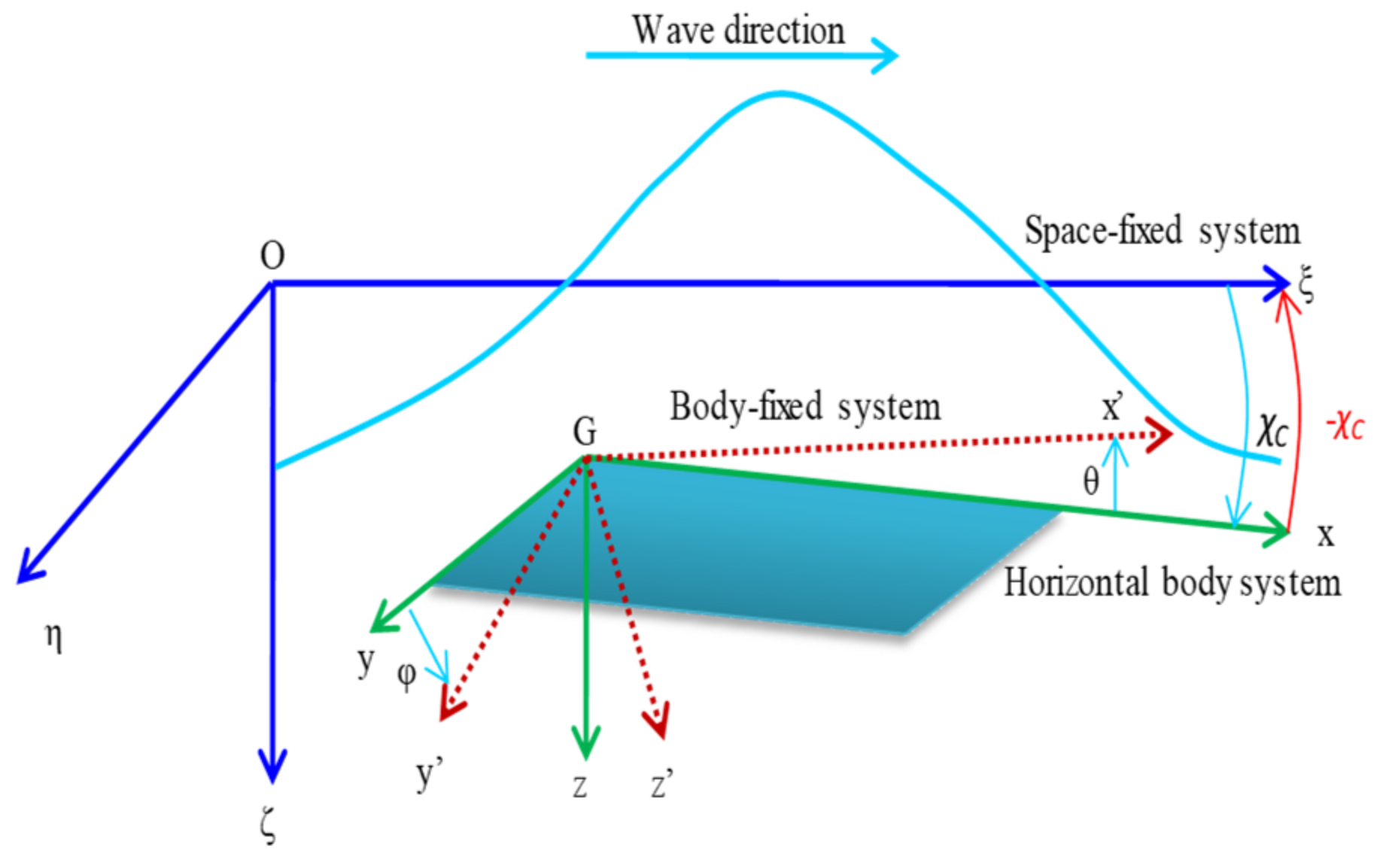
The systems involve a space-fixed coordinate system with the origin at a wave trough, a body-fixed system with the origin at the center of gravity of the ship, and a horizontal body coordinate system [9] , which has the same origin as the body-fixed system but does not rotate around or move in sway and heave directions. See Figure 1.
Figure 1.
Coordinate systems.
The ship heading angle is , and the heading angle of the incident wave is . The instantaneous heading angle takes the yaw motion into account.
2.2. Mathematical Model in Regular Waves
Six degrees of freedom (DOFs) of ship motion in waves is widely accepted. Even though the average ship speed is zero or constant, surge speed happens due to wave action. In this case, it is called 6-DOF. If the ship runs at zero or a constant speed without the surge motion, the degrees of freedom become five. The time-domain heave and pitch motions obtained by a nonlinear strip method applied to an upright hull are used to determine the simultaneous relative position of the ship to waves in the time domain for predicting parametric roll, where the nonlinear Froude–Krylov and hydrostatic moments in the roll directions are calculated by integrating wave pressure up to the wave surface [10,11,12]. This method has also been developed to predict pure loss of stability in regular astern waves [13,14,15,16]. The sway and yaw motions cannot be ignored in beam seas, and the 5-DOF mathematical model expressed by the sway, heave, roll, pitch, and yaw motions is rewritten as follows:
The frequency-domain sway, heave, roll, pitch, and yaw motions are calculated by a strip method using an enhanced integrating method of direct line integral to solve the velocity potential [17,18] as shown in Equations (1)–(5), respectively.
The time-domain sway, heave, pitch, and yaw motions are obtained according to the amplitude, the initial phase, the relative position of the ship to waves, and the wave amplitudes shown in Equations (6)–(9), respectively.
The time-domain roll motions are shown in Equations (10)–(13). is the righting arm in the calm water when the heeling angle is . is the linear Froude–Krylov moment with the upright hull. are the nonlinear Froude–Krylov and hydrostatic moments, which are calculated by integrating the incident wave pressure around the instantaneous wetted hull surface with the heave and pitch motions considered. are the nonlinear Froude–Krylov and hydrostatic moments calculated by Equation (14).
The diffraction forces are calculated for the mean submerged hull at the encounter frequency. The linear and cubic roll-damping coefficients are used in the mathematical model obtained from the model test. The sway and yaw motions are not only coupled to the roll motion but also considered for the ship’s relative position to waves, as shown in Equation (13).
The following formula, proposed by Hamamoto [19], is used to calculate the nonlinear Froude–Krylov roll-restoring variation with the instantaneous wet section and the center of buoyancy:
where is the submerged area of a local section of the ship. is the transverse position of the buoyancy center of a local section. is the vertical position of the buoyancy center of a local section.
is the ship’s mass; is the moment of inertia in roll; is the moment of inertia in pitch; is the moment of inertia in yaw; is the wave celerity; is the wave number; is the ship’s hull width at the x section; is the ship’s speed; is the sway velocity; is the relative position of the ship to the waves; is the time. The dot denotes the differentiation with time.
Furthermore, is the sway; is the heave; is the roll; is the pitch angle; is the yaw; is the constant heading angle; is the varied heading angle with the yaw motion; are the wave exciting forces on ith direction, including the Froude–Krylov component, the hydrostatic component, and the diffraction component. are the amplitude and initial phase of swaying when the wave amplitude is 1 m; are the amplitude and initial phase of yawing when the wave amplitude is 1 m; is the wave amplitude. are the coupling seakeeping coefficients, and 2, 3, 4, 5, and 6 denote the direction in the sway, heave, roll, pitch, and yaw motions, respectively.
2.3. Mathematical Model in Irregular Waves
The irregular wave profile is calculated by an energy method proposed by Shuku et al., 1979 [20], which has been used for studying parametric rolling in irregular waves by the first author guided by Prof. Umeda [11]. The ITTC wave spectrum is used, and the formula of the irregular wave profile used in this paper is as follows:
is the significant wave height, and is the mean wave period. Here, . is the time; is the number of harmonic waves; is the amplitude of the ith harmonic wave amplitude; is the wavenumber of the ith harmonic wave; is the frequency of the ith harmonic wave; is the random phase of the ith harmonic wave; is the longitudinal position of the ship‘s gravity in the direction of wave propagation.
The time series of sway, heave, pitch, and yaw motions in irregular beam seas are shown in Equations (21)–(24), respectively. The time series of the wave exciting force on roll direction, including the Froude–Krylov component and diffraction component in irregular beam seas, are shown in Equations (25) and (26). The time series of the roll motion in irregular beam seas is also shown in Equations (10)–(12).
: the amplitude and initial phase of sway, heave, pitch, and yaw when the ith harmonic wave amplitude is 1 m; : the amplitude and initial phase of the wave exciting force in the roll direction, including the Froude–Krylov component and diffraction component when the ith harmonic wave amplitude is 1 m.
2.4. Excited Wave Force
The wave-induced forces as the sum of the Froude–Krylov force (FK) and the diffraction force (DF) are listed in the reference [17,18] and are rewritten as follows:
The lift force of the after and forward sections is also considered based on the strip theory.
Equations (25) and (26) can also be written as follows:
2.5. Roll Restoring Force Variation
The significant roll motion in beam seas is also one of the problems related to the roll-restoring force. The restoring force variations and based on the Froude–Krylov assumption can be defined as follows: are the nonlinear Froude–Krylov and hydrostatic moments, which are calculated by integrating the incident wave pressure around the instantaneous wetted hull surface with the heave and pitch motions considered. is the only Froude–Krylov moment with the instantaneous wet hull. The and in waves depend on the ship motions, and the amplitude and phase of the heave and pitch are obtained by an enhanced strip method with the upright hull, and then time-domain heave and pitch motions are obtained using instantaneous relative position between the ship and wave. The roll angle is restricted to a constant value when we calculate GZ. The amplitude and initial phase of can also be calculated with the heave and pitch obtained by a static balance method with a constant heeling angle, and is the only Froude–Krylov moment with the wet hull considering heave, roll, and pitch with a static balance method.
The contribution of diffraction and radiation forces to the roll moment is also defined as GZ. The symbols of GZ, like those used in this paper, are defined as follows:
2.6. Roll-Damping
Roll-damping is an essential term for predicting large-amplitude roll motion. The roll-damping moment is calculated by linear and cubic nonlinear roll-damping coefficients, as shown in Equations (10)–(12). The roll decay model experiment can obtain the roll-damping coefficients A and C, and then the nondimensional linear and cubic nonlinear roll-damping coefficients are obtained by Equations (37) and (38).
3. Subject Ship
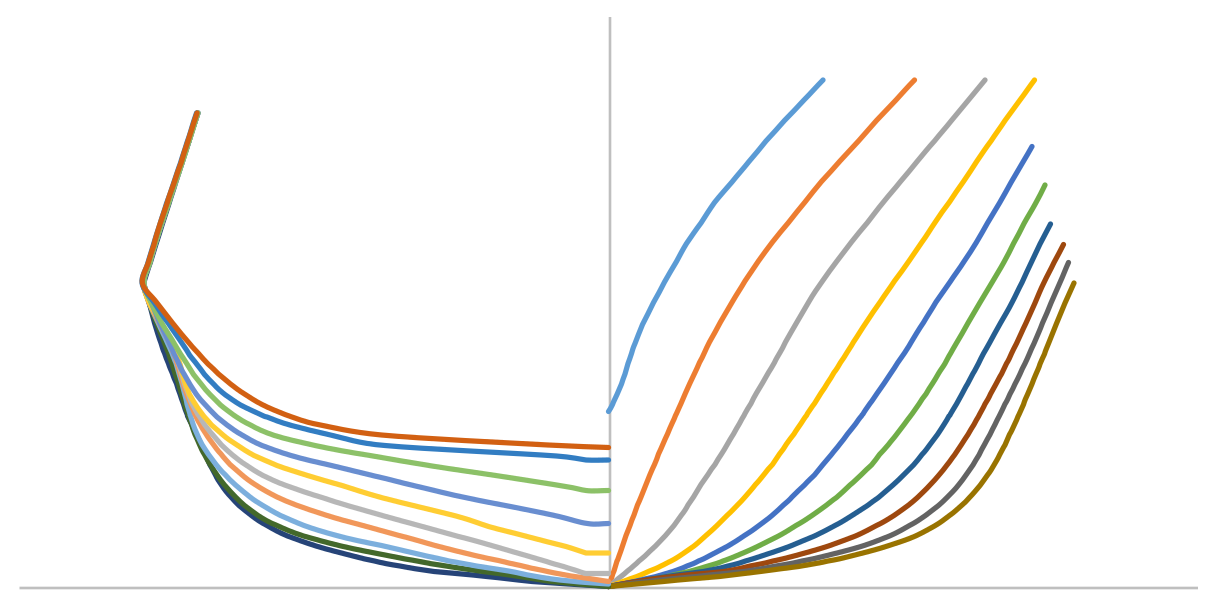
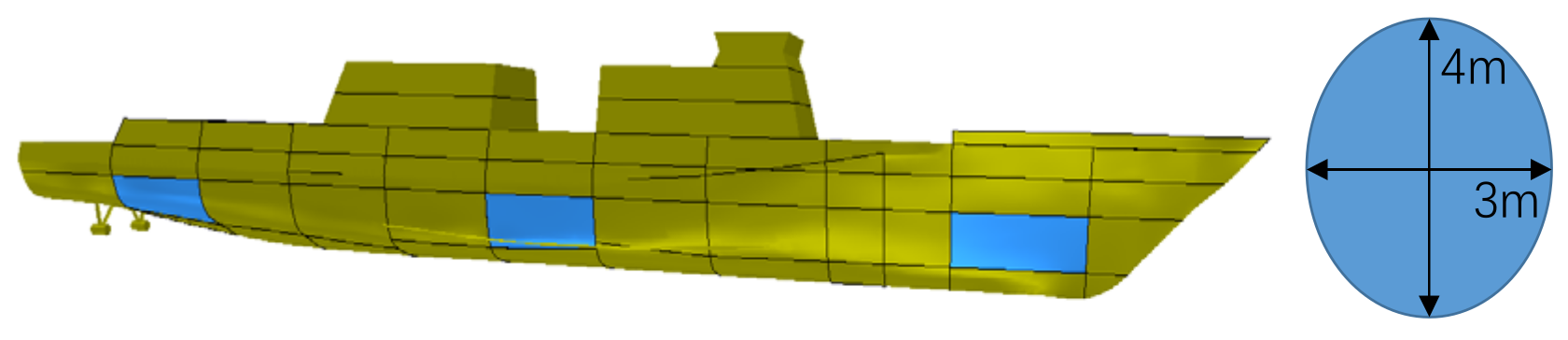
The principal particulars and the lines of the patrol boat are shown in Table 1 and Figure 2, respectively. The damaged positions are shown in Figure 3. The principal particulars with an aft compartment damaged, with a middle compartment damaged, or with a fore compartment damaged are shown in Table 2, respectively. The positions of the aft, middle, and fore compartments are shown in Table 3. The roll-damping under intact and damaged conditions obtained from the model test is shown in Table 4.
Table 1.
Principal particulars of the patrol boat.
Figure 2.
The patrol boat lines.
Figure 3.
The damaged position and size.
Table 2.
Principal particulars of an aft, a middle, or a fore compartment (Comp.) that has been damaged (D.).
Table 3.
The position of the aft, the middle, and the fore compartment (Comp.).
Table 4.
The roll-damping of the patrol boat under intact and damaged conditions.
4. Simulations and Discussions
4.1. The Roll-Restoring Variation
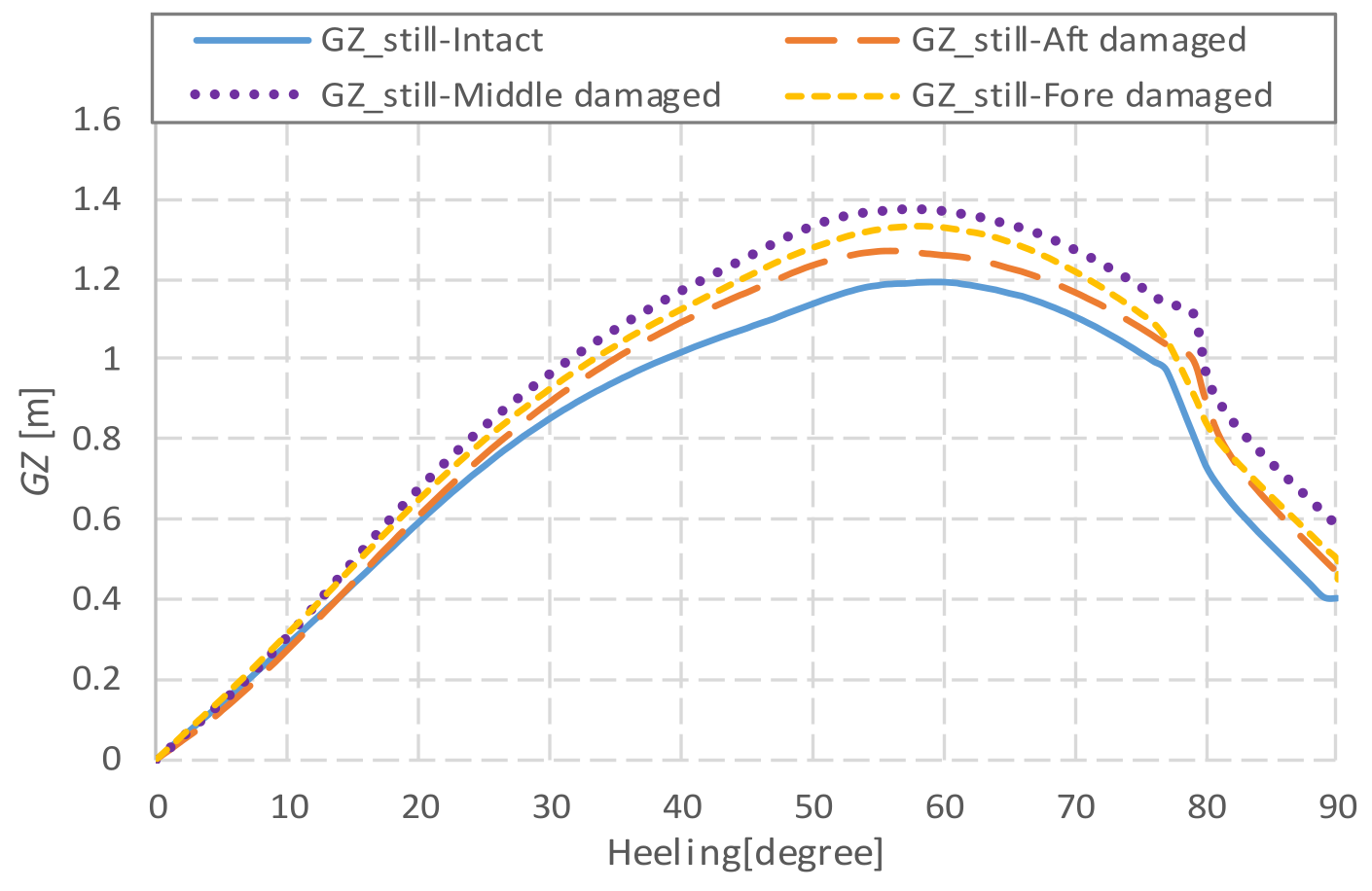
The righting arms in calm water under the intact condition, under an aft cabin-damaged condition, under a middle cabin-damaged condition, and under a fore compartment-damaged condition are shown in Figure 4. The longitudinal bulkhead is not set, and this means the damaged compartment is symmetrical between the port and starboard sides. Therefore, there is no initial heeling angle when the compartment is damaged in calm water. At the same time, the damaged compartment is asymmetric for the midship of the ship. Therefore, there is an initial pitching angle, as shown in Table 2, which is calculated by one static balance method. A static balance method and a buoyancy loss method are used to calculate the GZ in calm water under damaged conditions. The righting arms in calm water under the damaged condition are better than those under the intact condition, as shown in Figure 4. The reasons are as follows: (1) there is no initial heeling angle due to symmetrical ingress water; (2) the gravity of the ingress water is lower than the ship’s gravity. If the ingress water is looked at as one part of the ship, the GM becomes larger, such as the middle- and aft-damaged conditions.
Figure 4.
Comparison of GZ in calm water under intact and damaged conditions.
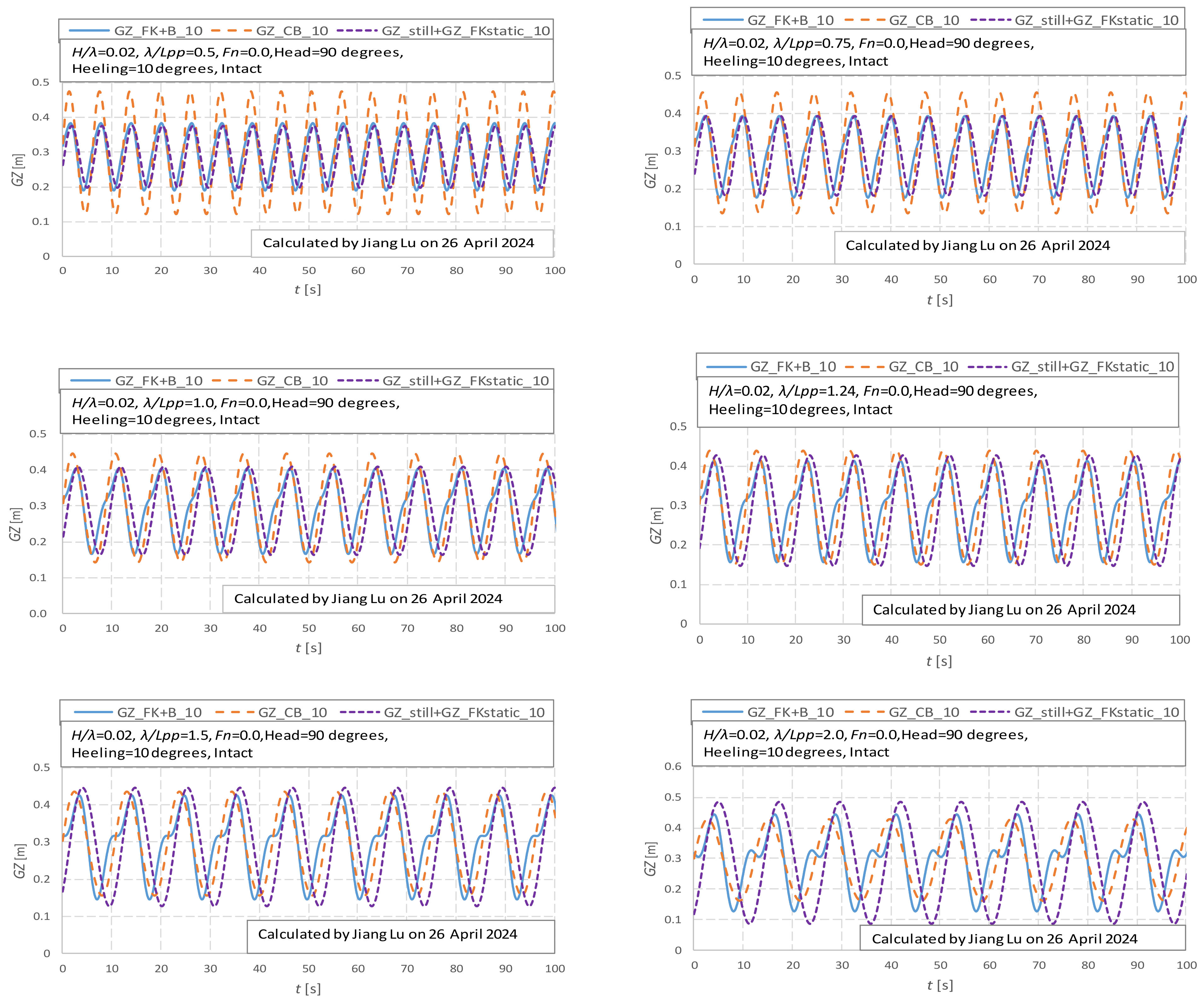
The GZ variation in the waves is a critical factor for predicting the large roll motion in the waves. There are several methods that have been used to predict the parametric roll in head seas and the pure loss of stability in astern waves by the first author, and it is necessary to investigate the effectiveness of these methods for predicting the large roll motion in beam seas. The effect of wavelength on the different methods for calculating GZ in waves with heeling angel = 10 degrees, Fn = 0.0, H/Lpp = 0.02, and χ = 90 degrees are shown in Figure 5. The restoring variations in waves with the static balance method named plus the righting arm in calm water named have a reasonable agreement with that calculated by integrating the incident wave pressure around the instantaneous wetted hull surface with the heave and pitch motions taken into account named . The restoring variations in waves by the instantaneous wet section and the center of buoyancy named also have a reasonable agreement with at the long wavelength while overestimating the GZ variation at the short wavelength in beam seas. The method for calculating GZ in oblique waves was proposed by Hamamoto (1986) [19] with the heave and pitch obtained by a static balance method with a constant heeling angle. The method was developed by using the strip method of heave and pitch motion (Umeda et al., 2005) [10] instead of that with the static balance method (Hamamoto, 1986). The method is further utilized using time-varied amplitude and phase of heave and pitch for the direct stability assessment of pure loss of stability in following waves by Lu et al. (2019) [13]. This method is under the assumption that the wavelength is long compared with the ship width. This method could effectively calculate GZ in short waves in the head and astern seas because the ship width’s projection in the wave direction is small. However, the wavelength could not be long in beam seas because the ship width’s projection in wave direction equals the ship width. If the wavelength is smaller than half of the ship length, this method could not be effective for calculating GZ in beam seas. This method overestimates the GZ variation at the short wavelength in beam seas, as shown in Figure 5 with this patrol boat. The irregular beam seas contain short wave components, and this method could not be suitable for predicting significant roll motion in irregular beam seas. The following numerical results of the large roll motions also confirm this guess. This method has been used for many years, and we will further investigate its limitations and the detailed reason for the limitations in the future.
Figure 5.
The effect of wavelength on the different methods for calculating GZ in waves with φ = 10 degrees, Fn = 0.0, H/Lpp = 0.02, and χ = 90 degrees.
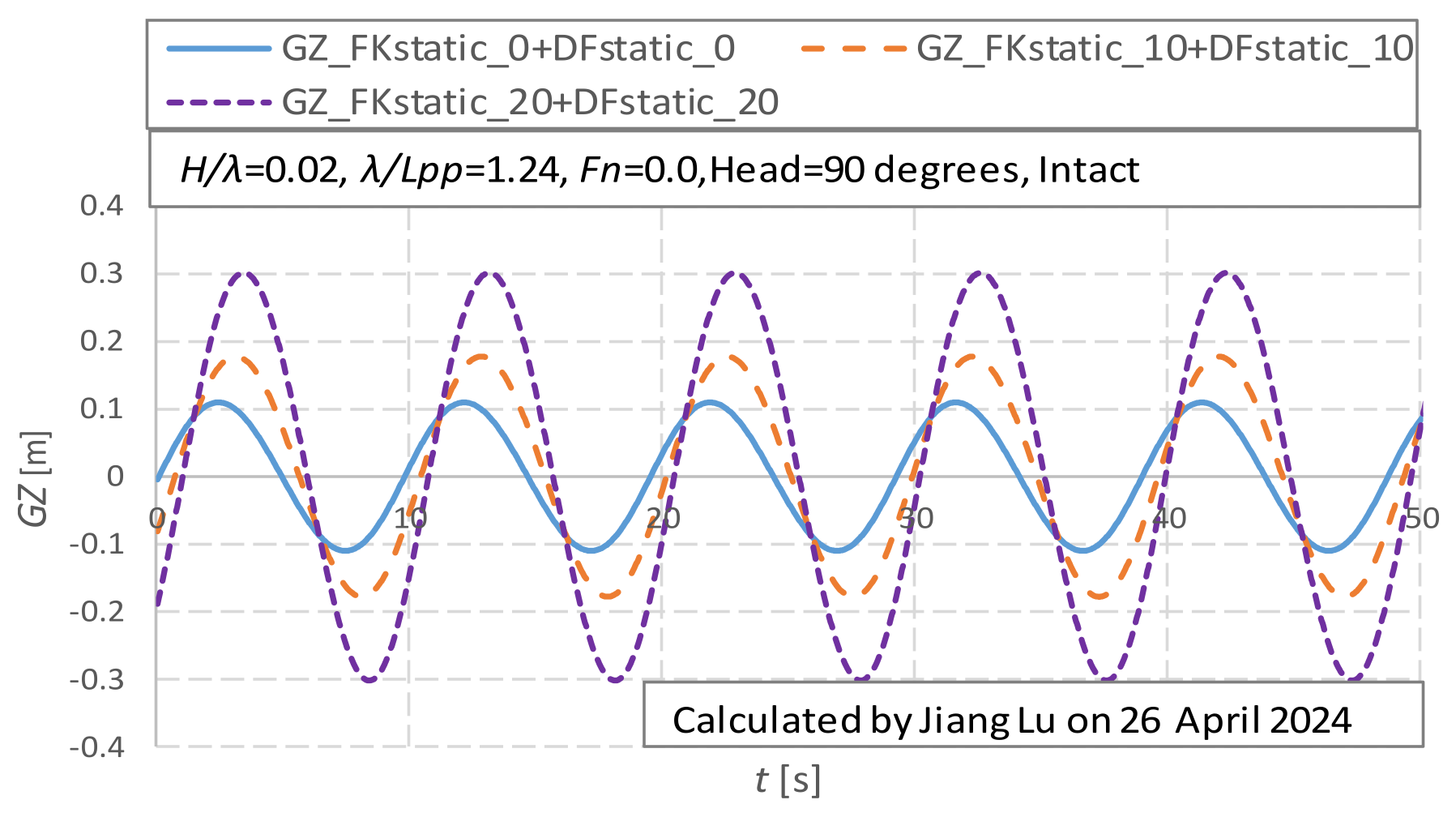
The effect of the heeling angle on the restoring variations in waves, including FK and DF components, with the static balance method with Fn = 0.0, λ/Lpp = 1.243644, H/Lpp = 0.02, and χ = 90 degrees is shown in Figure 6. The amplitude of the restoring variations is changed significantly as the heeling angle increases because the wetted hull is asymmetric with the heeling angle, and the amplitude of the FK force plus the diffraction force in the roll direction becomes significant as the heeling angle increases. However, all their mean values are near zero because the frequency-domain method calculates the amplitude of the FK force and the diffraction force. Although using the GZ with instantaneous heeling angle is more accurate in theory, the time cost and complexity become high, especially the diffraction force. For keeping the same dealing method of the FK force and the diffraction force in the roll direction, this paper will use to predict significant roll motion in irregular beam seas.
Figure 6.
Comparison of the restoring variation, including FK and DF components, between three heeling angles with Fn = 0.0, λ/Lpp = 1.243644, H/Lpp = 0.02, and χ = 90 degrees.
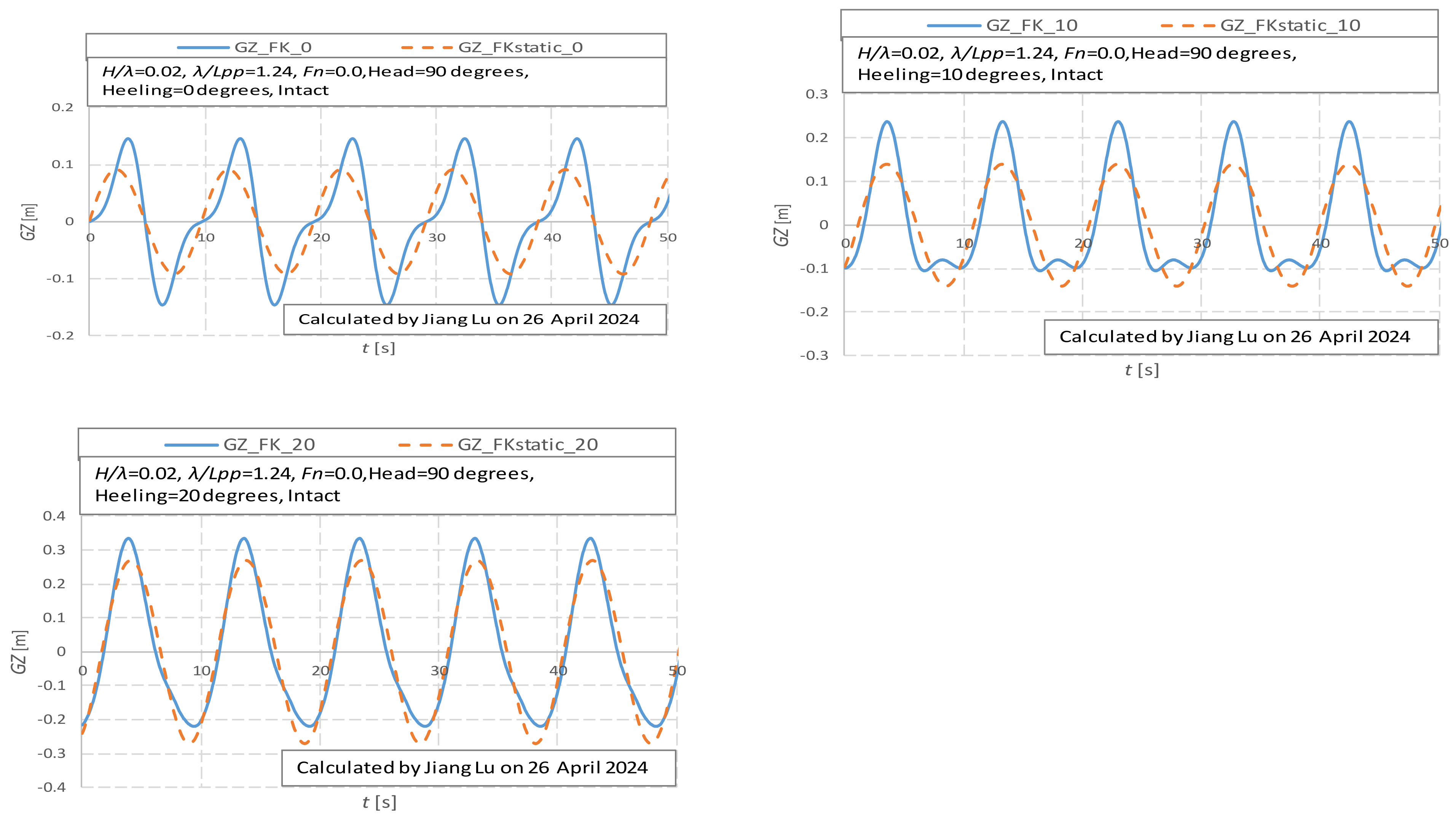
The comparison of the restoring variation in only the FK component between and with three heeling angles is shown in Figure 7. The mean values of and are near zero, with the upright hull because the wet hull changes symmetrically along with the wave profile due to the symmetrical heave and pitch motions along with the wave profile. The mean values of are also near zero with the heeling angle increasing due to the symmetrical heave and pitch motions along with the wave profile. However, the mean values of with the heeling angle of 10 degrees and 20 degrees are positive because the heave and pitch motions along with the wave profile are asymmetric under this condition due to the asymmetric ship wet hull. Although using with the instantaneous heeling angle is more accurate in theory, the time cost becomes high. For keeping the same dealing method of the FK force and the diffraction force in the roll direction, this paper will use to predict large roll motion in irregular beam seas.
Figure 7.
Comparison of the restoring variation in only the FK component between three heeling angles and two methods with Fn = 0.0, λ/Lpp = 1.243644, H/Lpp = 0.02, and χ = 90 degrees.
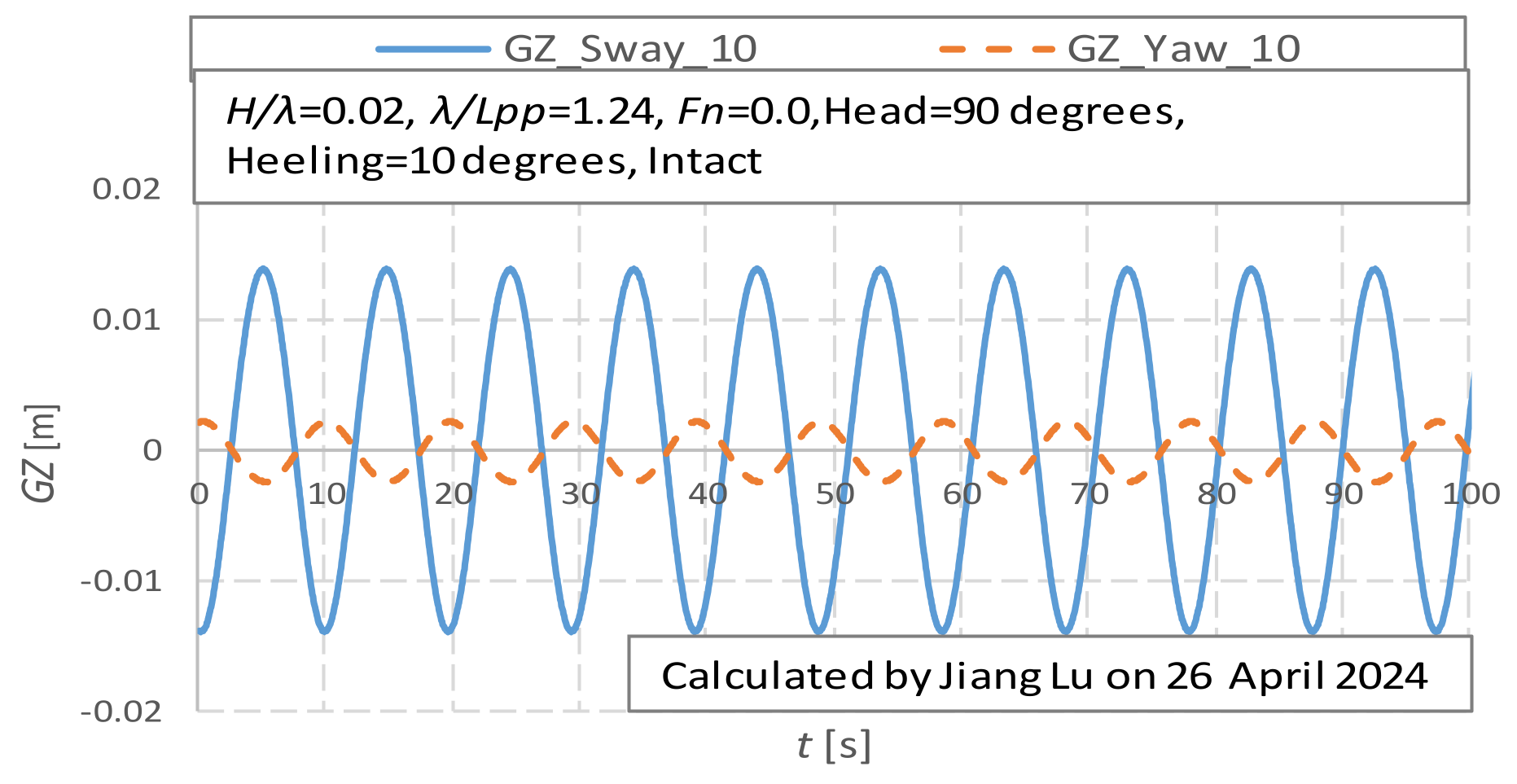
The effect of sway and yaw motions on the contribution to restoring variation is generally small, as shown in Figure 8, due to slight sway and yaw motions. However, in case the yaw motion becomes large, the coupling force to roll becomes large; therefore, the effect of sway and yaw motions should be considered in beam seas.
Figure 8.
The effect of sway and yaw motions on the contribution to restoring variation with φ = 10 degrees, Fn = 0.0, λ/Lpp = 1.243644, H/Lpp = 0.02, and χ = 90 degrees.
4.2. The Roll Motions in Regular Beam Waves
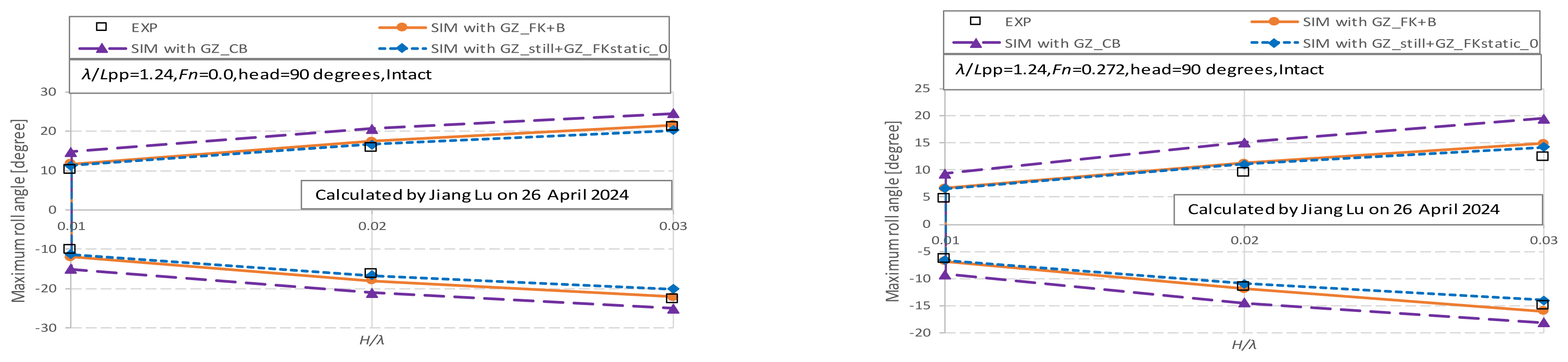
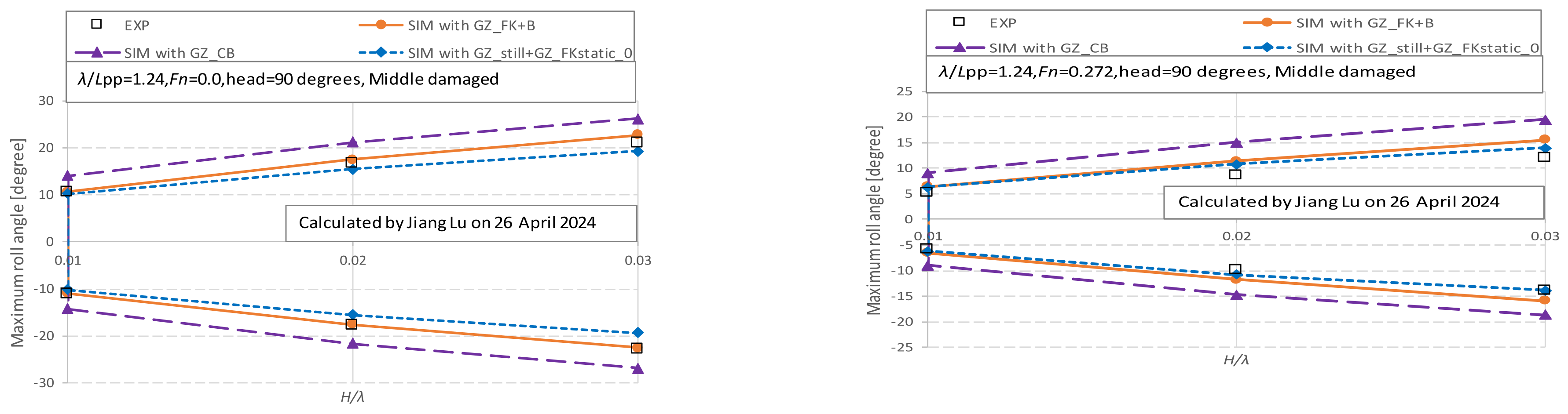
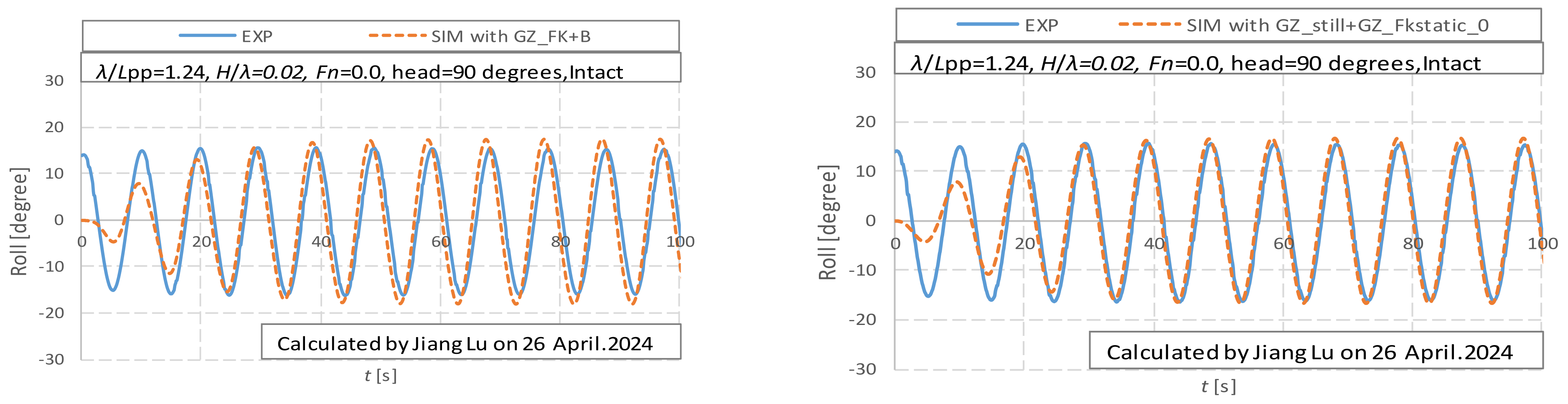
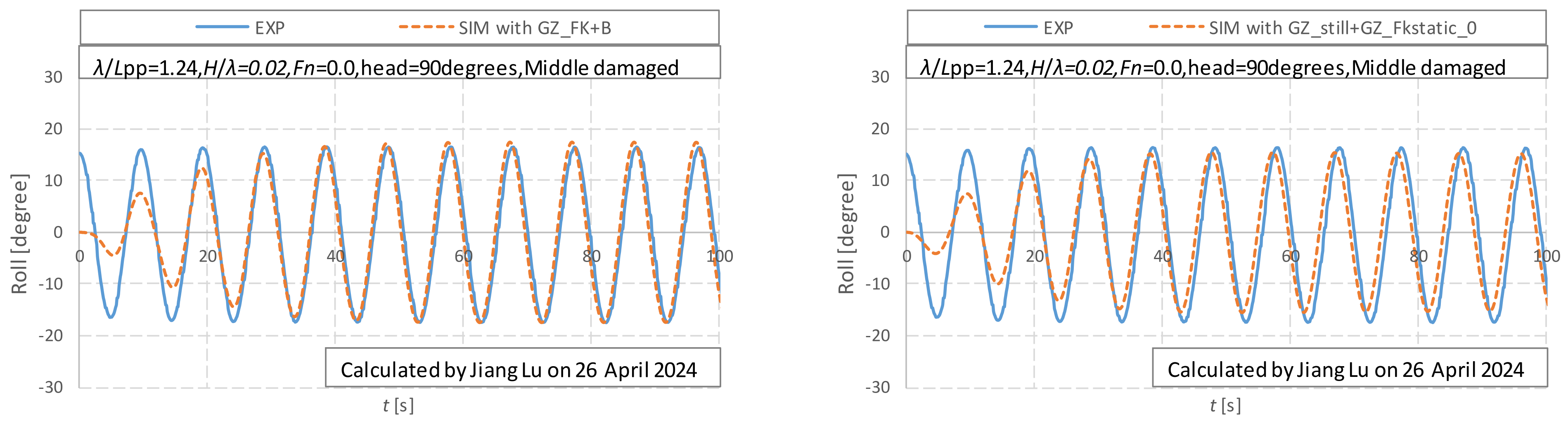
The comparisons of the roll amplitudes between the experiment and three numerical methods under intact and middle-damaged conditions with Fn = 0.0, 0.272, λ/Lpp = 1.243644, H/Lpp = 0.02, and χ = 90 degrees are shown in Figure 9, Figure 10, Figure 11 and Figure 12. The simulations with and have a good agreement with experimental results, while that with overestimates the roll motion in regular beam seas. The reasons are that the amplitudes of and are near the same as shown in Figure 5 under this condition, while the method for could overestimate the amplitude of GZ. This paper prefers to use to predict large roll motion in regular beam seas due to its lower complexity than that of .
Figure 9.
Comparison of the roll amplitudes between the experiment and three numerical methods under the intact condition with Fn = 0.0, 0.272, λ/Lpp = 1.243644, H/Lpp = 0.02, and χ = 90 degrees.
Figure 10.
Comparison of time-domain roll between the experiment and two numerical methods under the intact condition with Fn = 0.0, λ/Lpp = 1.243644, H/Lpp = 0.02, and χ = 90 degrees.
Figure 11.
Comparison of the roll amplitudes between the experiment and three numerical methods under the middle-damaged condition with Fn = 0.0, 0.272, λ/Lpp = 1.243644, H/Lpp = 0.02, and χ = 90 degrees.
Figure 12.
Comparison of time-domain roll between the experiment and two numerical methods under the middle-damaged condition with Fn = 0.0, λ/Lpp = 1.243644, H/Lpp = 0.02, and χ = 90 degrees.
4.3. The Roll Motions in Irregular Beam Waves
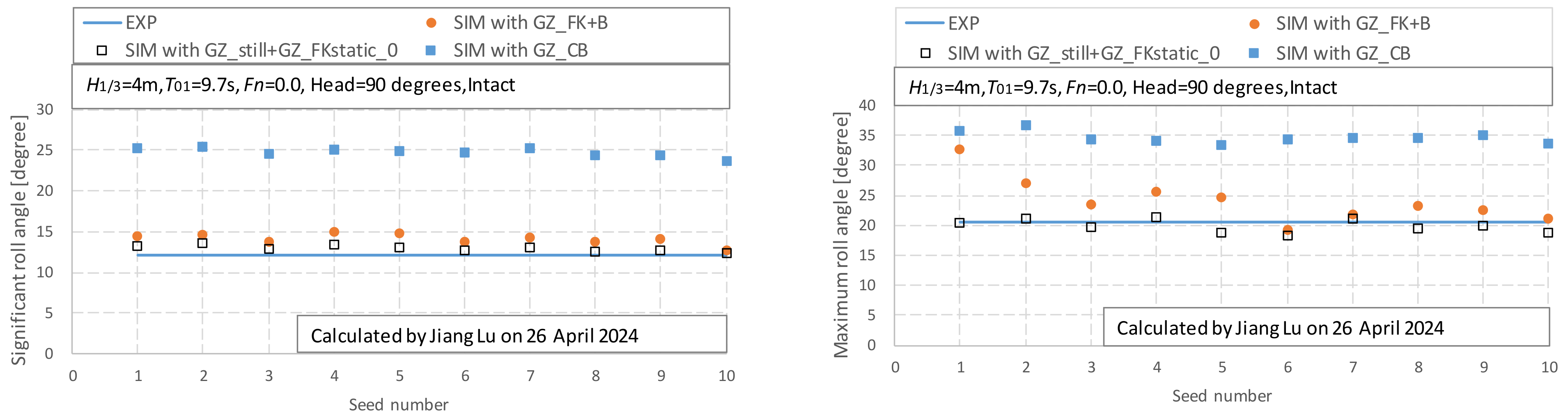
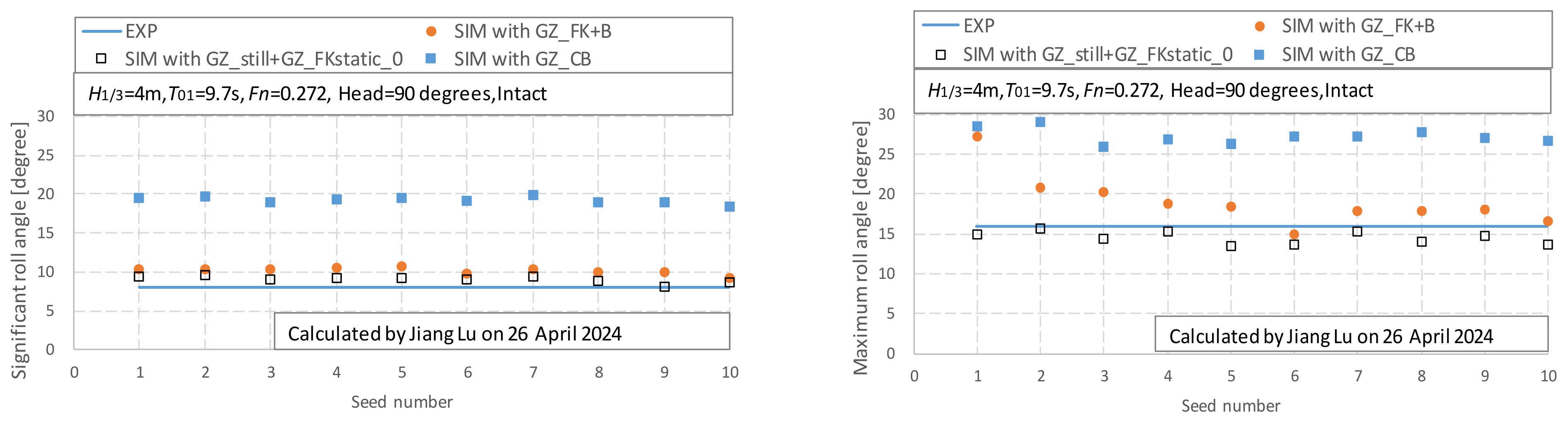
The comparisons of the significant and maximum roll angles between the experiment and three numerical methods under the intact condition with Fn = 0.0, 0.272, T01 = 9.7 m, H1/3 = 4 m, and χ = 90 degrees are shown in Figure 13. The simulations with have a good agreement with the experimental results. The simulations with have a good agreement with the experimental results except in the case of seed number 1, while that with also overestimates the roll motion in irregular beam seas. The reasons are that the method for could overestimate the amplitude of GZ with the subharmonic waves, as shown in Figure 5, especially in the short waves.

Figure 13.
Comparison of the significant and maximum roll angles between the experiment and three numerical methods under intact conditions with Fn = 0.0, 0.272, T01 = 9.7 m, H1/3 = 4 m, and χ = 90 degrees.
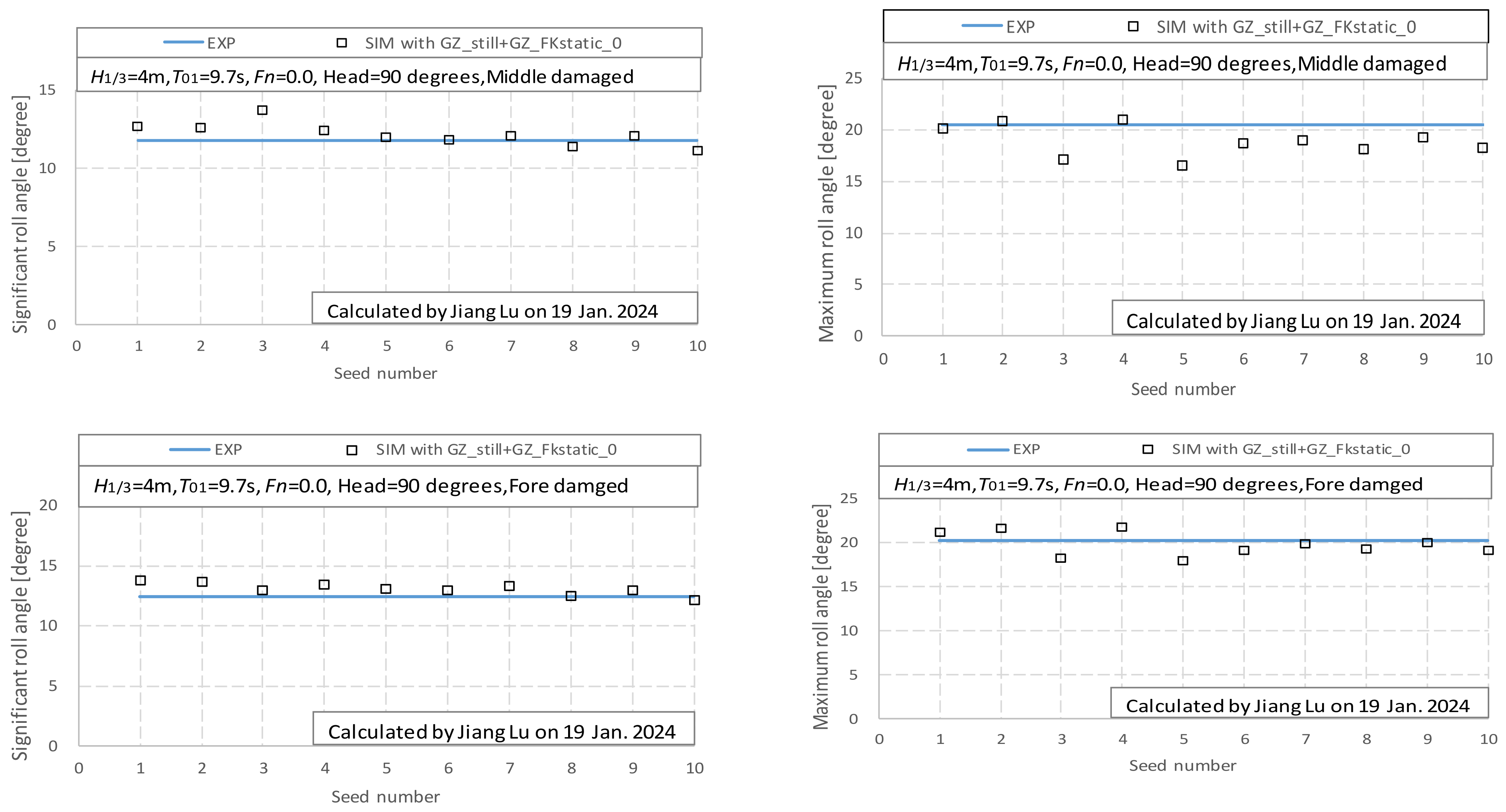
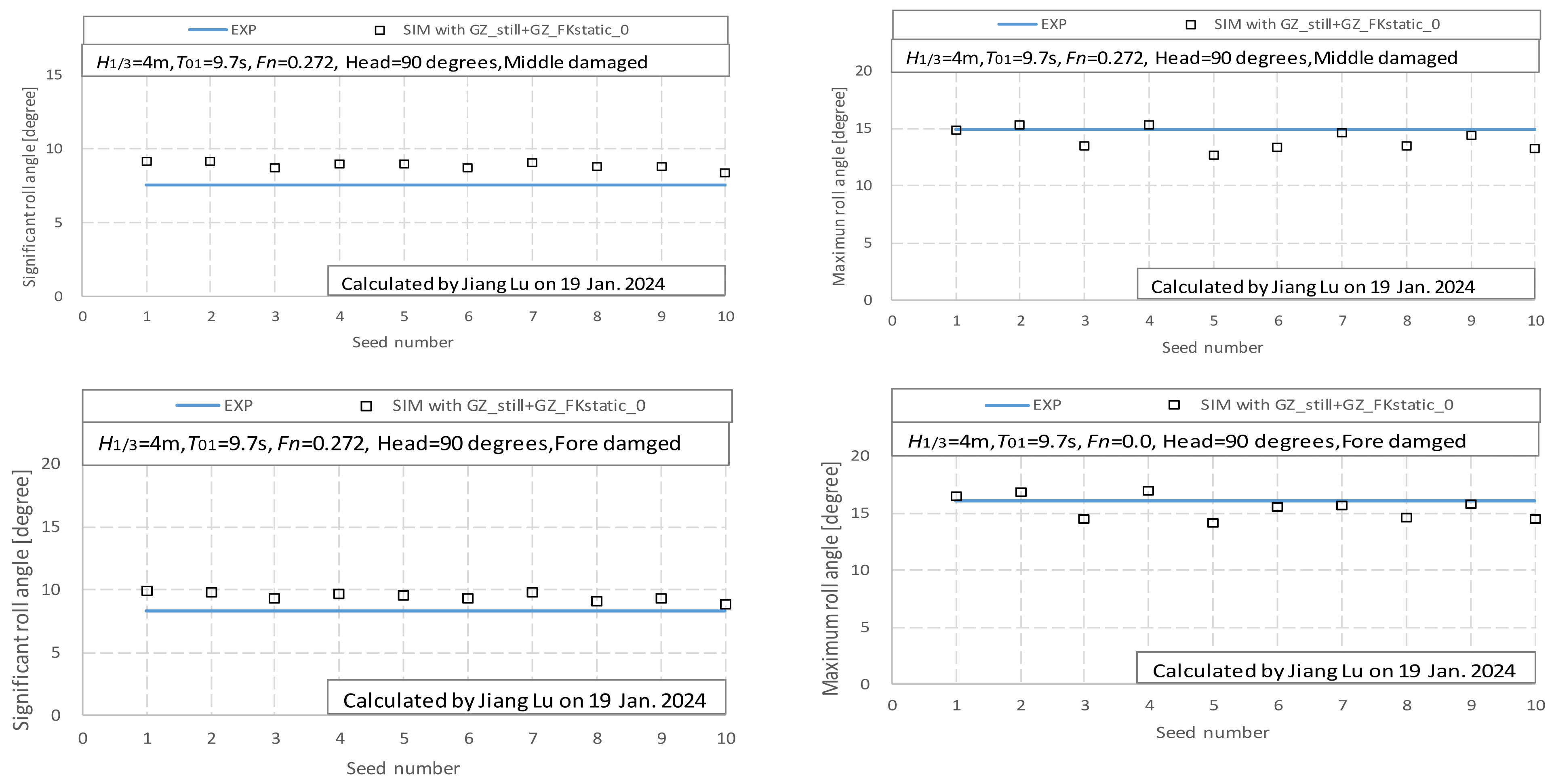
The 5-DOF numerical model with under instantaneous wet hull is better than the 3-DOF numerical model with in theory to predict large roll motion in regular and irregular beam seas. However, it could cost time to calculate under an instantaneous wet hull in irregular beam seas. The 3-DOF numerical model with can give reasonable results of roll motion in regular and irregular beam seas under intact conditions and in regular beam seas under damaged conditions. The effect of water ingress and egress is necessary for predicting the roll motion in beam seas under damaged conditions. However, it is not easy to consider the effect of water ingress and egress in the time domain. One unpublished code is used to calculate the principal particulars and GZ in still water under damaged conditions, which are regarded as the program’s initial parameters for predicting large roll motion for intact ships. One free roll decay test in calm water is conducted to obtain roll-damping coefficients and the roll natural period with the initial roll angle larger than 20 degrees under the damaged condition. This means the roll natural period is a mean roll period with the effect of water ingress and egress considered in calm water during the free roll decay test. The obtained roll-damping coefficients also consider the effect of water ingress and egress during the free roll decay test. This is the reason why the 3-DOF numerical model with can also give reasonable results of roll motion in regular beam seas under the damaged condition. This method is further investigated to predict large motions in irregular beam seas as follows (Figure 14 and Figure 15):

Figure 14.
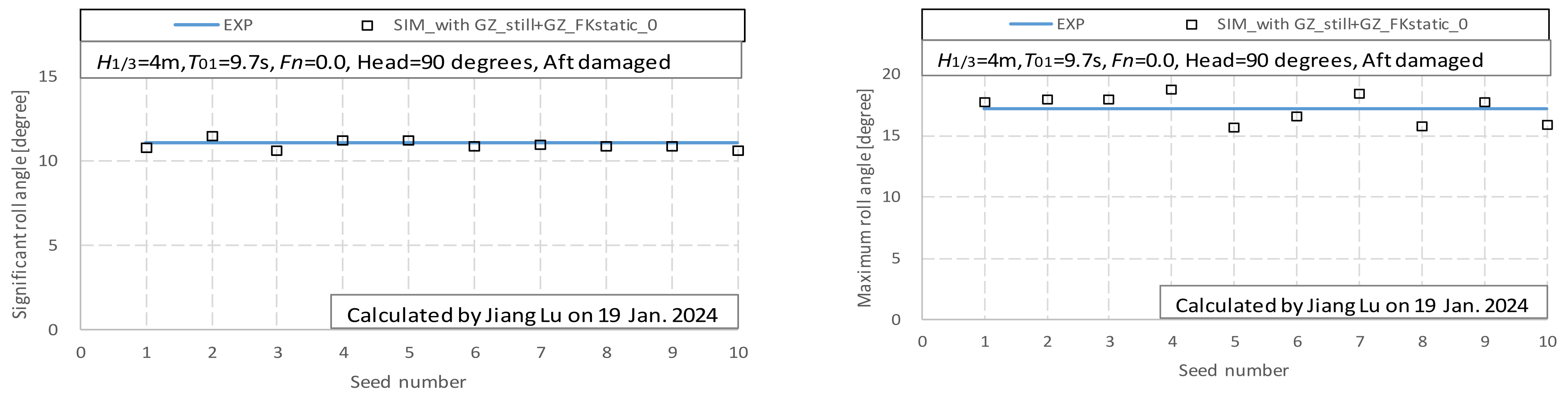
Comparison of the significant and maximum roll angles between the experiment and one numerical method under three damaged conditions with Fn = 0.0, T01 = 9.7 s, H1/3 = 4 m, and χ = 90 degrees.
Figure 15.
Comparison of the significant and maximum roll angles between the experiment and one numerical method under three damaged conditions with Fn = 0.272, T01 = 9.7 s, H1/3 = 4 m, and χ = 90 degrees.
The comparisons of the significant and maximum roll angles between the experiment and the numerical method using under three damaged conditions with Fn = 0.0, 0.272, T01 = 9.7 m, H1/3 = 4 m, and χ = 90 degrees are shown in Figure 14 and Figure 15. Both the calculated significant roll angles and maximum roll angles in irregular beam seas with have a good agreement with experimental results. The critical reasons are as follows: (1) the mean roll period with the effect of water ingress and egress considered in calm water during the free roll decay test; (2) the roll-damping coefficients also consider the effect of water ingress and egress during the free roll decay test; (3) the hydrodynamic forces and the sway and yaw motions are calculated using the new initial parameters under the damaged conditions.
5. Conclusions
Based on the numerical study of the large roll motion in beam seas under intact and damaged conditions, the following remarks can be made:
- A sway–heave–pitch–roll–yaw coupled equation named 5-DOF can predict the large roll motion in regular and irregular beam seas under intact conditions.
- The sway-roll-yaw coupled motion with the roll-righting arm in still water named 3-DOF can be used to predict the large roll motion in regular and irregular beam seas under damaged conditions with the initial hydrostatic parameters under the damaged condition, especially the mean roll period and the roll-damping coefficients, which consider the effect of water ingress and egress in calm water during the free roll decay test.
- The numerical mathematical model for predicting the significant roll motion in beam seas under intact and damaged conditions could be unified with the sway-roll-yaw coupled motion with the roll-righting arm in still water.
Surprisingly, the unified method gives reasonable results on roll motion in beam seas under intact and damaged conditions. It is necessary to validate the method using other ships and other damage conditions in the future.
Author Contributions
Conceptualization, J.L., Y.Z. and M.G.; Methodology, M.G.; Software, J.L.; Validation, J.L., C.S. and T.Y.; Investigation, Y.Z.; Data curation, Y.Z., C.S. and T.Y.; Writing—original draft, J.L. All authors have read and agreed to the published version of the manuscript.
Funding
Some contents used in this research were once guided by Naoya Umeda during the first author’s course at Osaka University, supported by the China Scholarship Council [No. 2008606031]. This research is supported by the Ministry of Industry and Information Technology of China (No. [2017]614) and NSFC (No. 52001285). These supports are gratefully acknowledged.
Institutional Review Board Statement
Not applicable.
Informed Consent Statement
Not applicable.
Data Availability Statement
The original contributions presented in the study are included in the article, further inquiries can be directed to the corresponding author.
Conflicts of Interest
The authors declare no conflict of interest.
References
- IMO. Interim Guidelines on the Second-Generation Intact Stability Criteria; Msc.1/Circ.1627; IMO: London, UK, 2020. [Google Scholar]
- Umeda, N.; Koga, S.; Ueda, J.; Maeda, E.; Tsukamo, I.; Paroka, D. Methodology for Calculating Capsizing Probability for a Ship under Dead Ship Condition. In Proceedings of the 9th International Ship Stability Workshop, Hamburg, Germany, 30–31 August 2007; p. 1.2.1. [Google Scholar]
- Japan. Draft Direct Assessment on Stability under Dead Ship Condition and Its Numerical Validation; SLF 53/INF.10, Annex7; IMO: London, UK, 2010. [Google Scholar]
- Japan. Review of Draft Leve2 and Level 3 Criteria on Stability under Dead Ship Condition; SLF 54/INF.12, Annex19; IMO: London, UK, 2011. [Google Scholar]
- Italy. Comments on Japan’s Submission for Draft Leve2 and Level 3 Criteria on Stability Under Dead Ship Condition; SLF 54/INF.12 Annex20; IMO: London, UK, 2011. [Google Scholar]
- Kubo, T.; Umeda, N.; Izawa, S.; Matsuda, A. Total Stability Failure Probability of a Ship in Irregular Beam Wind and Waves: Model Experiment and Numerical Simulation. In Proceedings of the 11th International Conference on the Stability of Ships and Ocean Vehicles, Athens, Greece, 23–28 September 2012; pp. 39–46. [Google Scholar]
- Ogawa, Y.; de Kat, J.O.; Ishida, S. Analytical Study of the Effect of Drift Motion on the Capsizing Probability under Dead Ship Condition. In Proceedings of the 9th International Conference on the Stability of Ships and Ocean Vehicles, Rio de Janeiro, Brazil, 25–29 September 2006; Volume 1, pp. 29–36. [Google Scholar]
- Gu, M.; Lu, J.; Wang, T.H. Stability of a Tumblehome Hull under Dead Ship Condition. J. Hydrodyn. 2015, 27, 452–457. [Google Scholar] [CrossRef]
- Hamamoto, M.; Kim, Y.S. A New Coordinate System and the Equations Describing Maneuvering Motion of a Ship in Waves. J. Soc. Nav. Archit. Jpn. 1993, 173, 209–220. [Google Scholar] [CrossRef]
- Umeda, N.; Hashimoto, H.; Sakamoto, G.; Urano, S. Research on Roll Restoring Variation in Waves. Proc. Kansai Soc. Nav. Archit. 2005, 24, 17–19. [Google Scholar]
- Lu, J.; Umeda, N.; Ma, K. Predicting Parametric Roll in Irregular Head Seas with Added Resistance Taken into Account. J. Mar. Sci. Technol. 2011, 16, 462–471. [Google Scholar] [CrossRef]
- Lu, J.; Gu, M.; Umeda, N. Experimental and Numerical Study on Several Crucial Elements for Predicting Parametric Roll in Regular Head Seas. J. Mar. Sci. Technol. 2017, 22, 25–37. [Google Scholar] [CrossRef]
- Lu, J.; Gu, M.; Boulougouris, E. Model Experiments and Direct Stability Assessments on Pure Loss of Stability of the ONR Tumblehome in Following Seas. Ocean Eng. 2019, 194, 106640. [Google Scholar] [CrossRef]
- Lu, J.; Gu, M.; Boulougouris, E. Model Experiments and Direct Stability Assessments on Pure Loss of Stability in Stern Quartering Waves. Ocean Eng. 2020, 216, 108035. [Google Scholar] [CrossRef]
- Lu, J.; Gu, M.; Boulougouris, E. Further Study on One of the Numerical Methods for Pure Loss of Stability in Stern Quartering Waves. J. Mar. Sci. Eng. 2023, 11, 394. [Google Scholar] [CrossRef]
- Lu, J.; Gu, M.; Boulougouris, E. A Unified Numerical Method for Broaching and Loss of Stability in Astern Waves. J. Mar. Sci. Eng. 2023, 11, 1555. [Google Scholar] [CrossRef]
- Kashiwagi, M. Prediction of Surge and Its Effect on Added Resistance by Means of the Enhanced Unified Theory. Trans West-Jpn. Soc. Nav. Arch. 1995, 89, 77–89. [Google Scholar]
- Kashiwagi, M.; Ikeda, T.; Sasagawa, T. Effect of Forward Speed of a ship on Added Resistance in waves. Int. J. Offshore Polar Eng. 2010, 20, 1–8. [Google Scholar]
- Hamamoto, M. Transverse Stability of Ships in a Quartering Sea. In Proceedings of the 3rd International Conference on Stability of Ships and Ocean Vehicles, Gdansk, Poland, 22–26 September 1986; pp. 7–13. [Google Scholar]
- Shuku, M.; Shimada, H.; Fujii, H.; Ikegami, K.; Toyoda, S.; Ando, H. The Motions of Moored Floating Storage Barge in Shallow Water. J. Soc. Nav. Archit. Jpn. 1979, 146, 245–254. (In Japanese) [Google Scholar] [CrossRef] [PubMed]
Disclaimer/Publisher’s Note: The statements, opinions and data contained in all publications are solely those of the individual author(s) and contributor(s) and not of MDPI and/or the editor(s). MDPI and/or the editor(s) disclaim responsibility for any injury to people or property resulting from any ideas, methods, instructions or products referred to in the content. |
© 2024 by the authors. Licensee MDPI, Basel, Switzerland. This article is an open access article distributed under the terms and conditions of the Creative Commons Attribution (CC BY) license (https://creativecommons.org/licenses/by/4.0/).