Definition of a Methodology for Gradual and Sustainable Safety Improvements on Farms and Its Preliminary Applications


 ,
,
Abstract
1. Introduction
- Mechanical risks (about 60% of serious and fatal injuries);
- Biomechanical risks due to repetitive movements and postural issues (in recent years there has been a significant increase in claims related to occupational injuries especially in those sectors with low levels of mechanization such as horticulture and floriculture);
- Interference risks; serious and fatal workplace injuries due to poorly qualified or inexperienced farm workers who may also be employed on several farms.
- -
- Those farms where machinery is used;
- -
- Farms where manual processes are still common (pruning and harvesting represent a particularly high biomechanical risk);
- -
- -
- As far as employment is concerned, the farming sector does not follow standard patterns and each individual farm may well demand specific solutions if safety levels are to be improved;
- -
- Improvement pathways and tools need to be devised that work in association with governance models for SMEs (small and medium-sized enterprises) and family-run agricultural enterprises;
- -
- We need to define operational procedures for two main areas: work organization and production, which require dedicated safety solutions for machinery and equipment;
- -
- It is also essential to pay attention to the evolution of both production facilities and reception facilities, and so identify a set of innovative organizational and technical solutions to safety issues.
2. Materials and Methods
- Definition of the productive and organizational components of the farm;
- Creation of a specific pyramidal matrix for each farm;
- Validation of the model through field tests;
- Building of specific pathways to improve safety levels.
- -
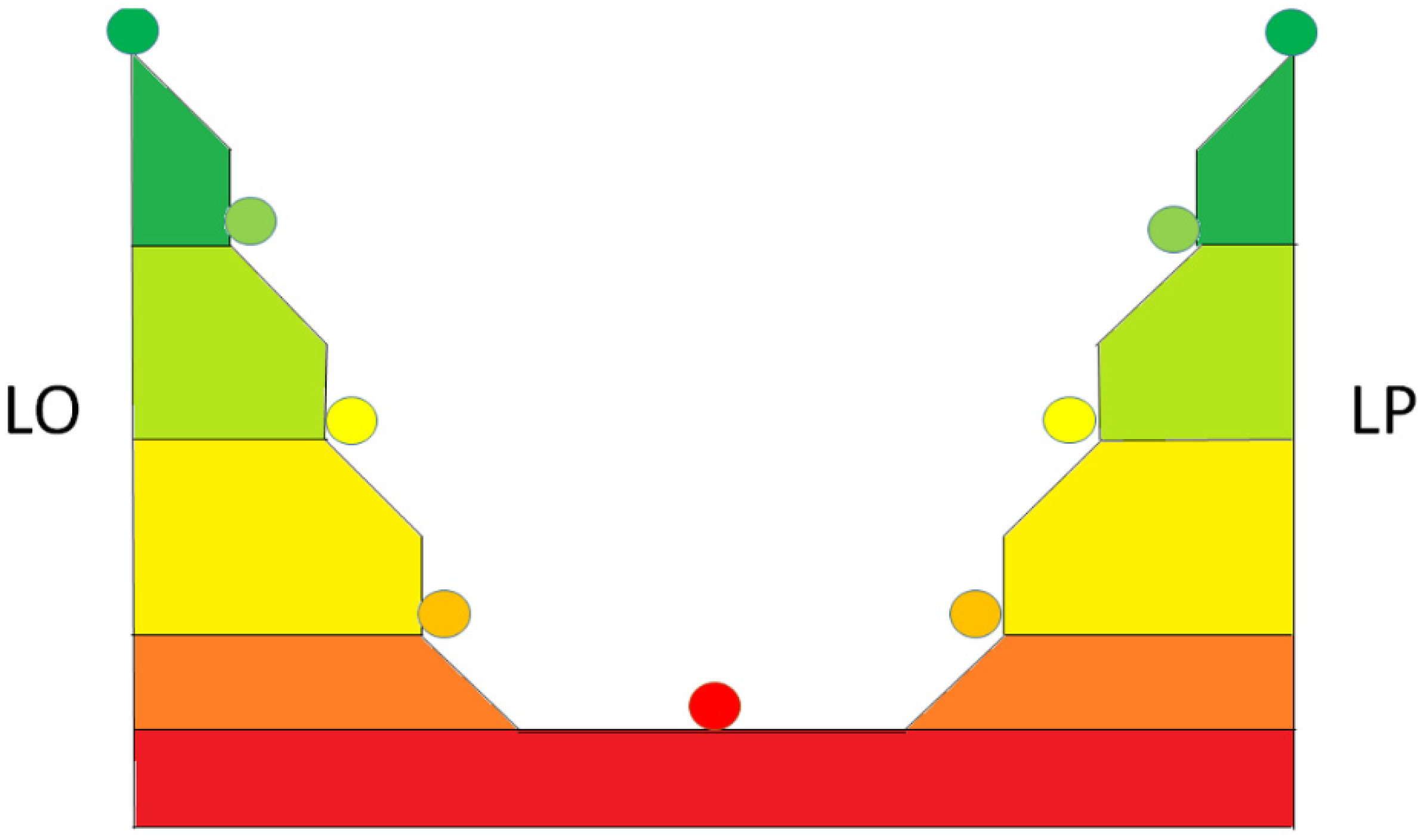
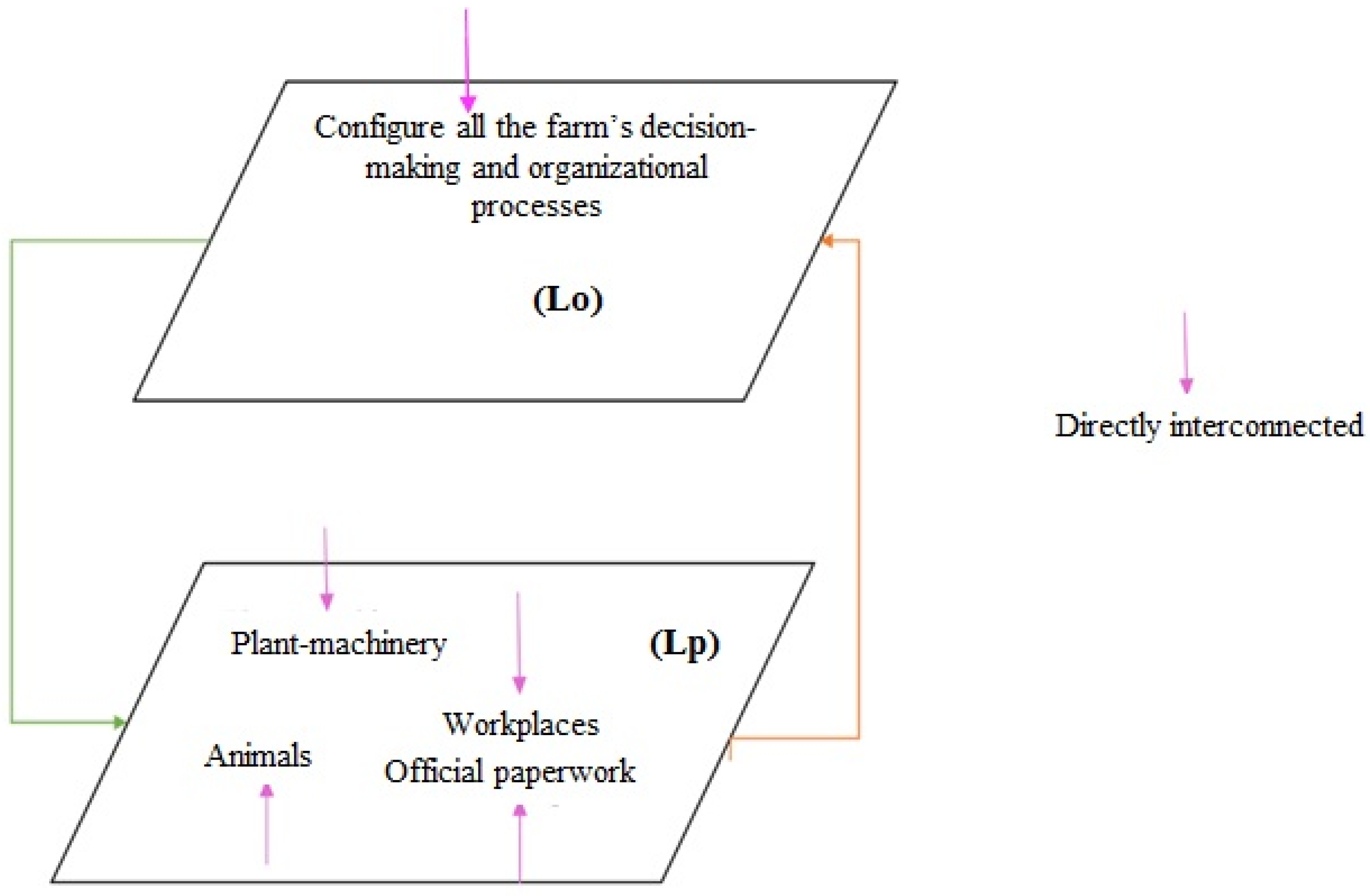
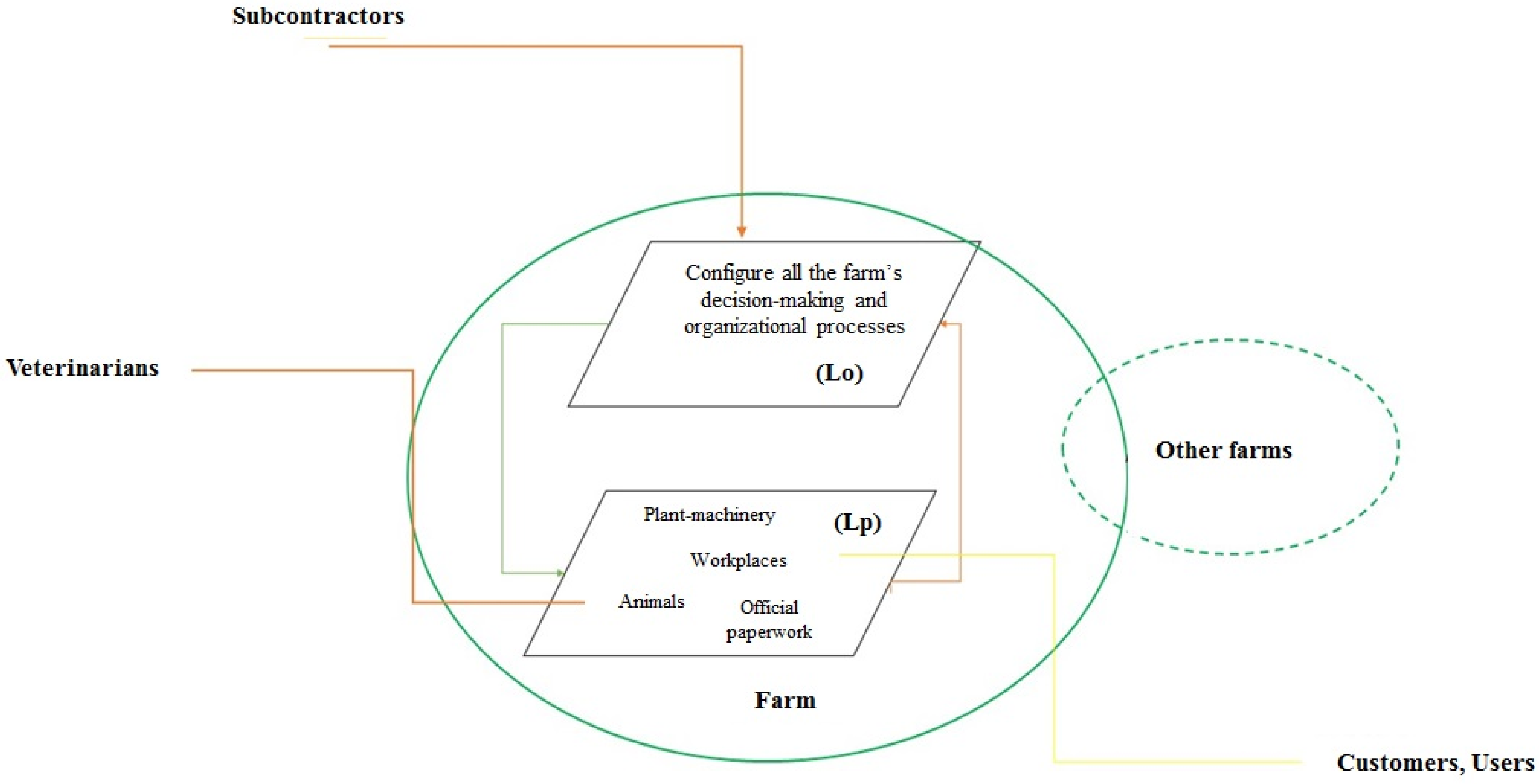
- Lo = organizational level. Defines and analyzes safety management from the point of view of farm organization.
- -
- Lp = the operational and productive level and defines different occupational areas.
- -
- The constant presence of people not involved in farming activities (veterinarians, technicians, National Health System employees, etc.).
- -
- The presence of visitors, children and school groups (this occurs normally on educational and social farms).
- -
- Productive and organizational activities carried out on one farm by other directly interconnected farms.
- -
- Personnel working on more than one farm.
- (1)
- Organizational management aspects: how the farm manages production and safety in the workplace.
- (2)
- Documentation: set of technical documents required by the government’s health and safety standards.
- (3)
- Operational aspects: how the farm organizes its production according to the specific context in which it operates.
- (4)
- Interface: this defines the receptivity level of the farm in terms of work processes (subcontractors, mobility of the workforce between farms in the network, educational and social farms).
3. Preliminary Results
- -
- Gradual changes to Italian law which affect the employment of people on non-standard contracts (agistment, sharecropping, workforce employed on a network of farms);
- -
- Situations in which family farms, in compliance with specific Italian laws, employ family members as subordinate workers;
- -
- The propensity of farms, especially the newly established ones, to offer certain types of contracts which allow them to hire people who are qualified to drive farm tractors (the driver must be a skilled worker who cannot be paid by voucher) (Table 2).
- The farms we studied mainly specialize in one specific type of production in order to attain greater sustainability.
- The surface-area of land farmed ranged from a few hectares up to over a hundred.
- This area was not proportional to the farm’s income or the number of people employed. In fact, in order to determine the real productive level of a farm, we need to consider certain key factors: the degree of mechanization, planting distances, production philosophy (organic production is more labour-intensive).
- The farms we selected were representative, in terms of their characteristics and size, of the average Italian farm (Table 2).
4. Discussion
- Building a matrix that describes the farm’s current safety performance;
- Positioning the collected data in the matrix and the pyramid;
- Defining aims according to the type of farm in question;
- Identifying the technical and operational changes that need to be made in order to attain adequate safety levels;
- Final positioning and assessment of whether aims have been achieved.
- -
- The farm owners/managers used the positioning of coloured matrices correctly in order to carry out the self-assessment of any critical points on their farm;
- -
- The solutions proposed were not costly because they often involved simple changes to the organization or management of the farm;
- -
- From an administrative point of view a series of easily applicable operational solutions and procedures were identified;
- -
- The model promoted innovative solutions involving third parties, showing that a farm can be an “open workplace” which interacts with other networked farms;
- -
- Structural changes are very often unnecessary for farms; in fact, in some cases, the reorganization of productive activities demanded operational solutions rather than structural;
- -
- Changes to machinery and equipment can often be made by means of existing farm resources;
- -
- The protocol and the improvement pathways designed for each individual farm provided objective feedback on the farm’s safety status.
- -
- Each farm has specific requirements where improvements in safety are concerned, and these are influenced by the nature of its governance, structure and production;
- -
- During the risk analysis phase the farms implemented new knowledge and technical skills which were then transmitted to satellite farms or other family farms;
- -
- This new process of safety improvements is easily adaptable to the typical Italian small and medium-sized enterprises and family farms; in fact, all the farms we analyzed were able to comply with Italian safety standards through the application of innovative processes, including those farms which initially had an extremely low safety rating.
- Obtain specific farm data;
- Apply the screened parameters to the coloured pyramid matrices;
- Analyze the coloured pyramid matrices;
- Classify farms according to their organizational structure;
- Set objectives according to their organizational structure;
- Plan operational and structural decisions in order to improve the safety of the chosen farms;
- Evaluate the efficiency of new safety plans.
5. Conclusions
Acknowledgments
Author Contributions
Conflicts of Interest
References
- Boubaker, K.; Colantoni, A.; Allegrini, E.; Longo, L.; Di Giacinto, S.; Monarca, D.; Cecchini, M. A model for musculoskeletal disorder-related fatigue in upper limb manipulation during industrial vegetables sorting. Int. J. Ind. Ergon. 2014, 44, 601–605. [Google Scholar] [CrossRef]
- Marucci, A.; Monarca, D.; Cecchini, M.; Colantoni, A.; Di Giacinto, S.; Cappuccini, A. The heat stress for workers employed in a dairy farm. J. Agric. Eng. 2014, 44, 170–174. [Google Scholar] [CrossRef]
- Marucci, A.; Monarca, D.; Cecchini, M.; Colantoni, A.; Biondi, P.; Cappuccini, A. The heat stress for workers employed in laying hens houses. J. Food Agric. Environ. 2013, 11, 20–24. [Google Scholar]
- Cecchini, M.; Colantoni, A.; Massantini, R.; Monarca, D. The risk of musculoskeletal disorders for workers due to repetitive movements during tomato harvesting. J. Agric. Saf. Health 2010, 16, 87–98. [Google Scholar] [CrossRef] [PubMed]
- Marucci, A.; Pagniello, B.; Monarca, D.; Cecchini, M.; Colantoni, A.; Biondi, P. Heat stress suffered by workers employed in vegetable grafting in greenhouses. J. Food Agric. Environ. 2012, 10, 1117–1121. [Google Scholar]
- Niskanen, T.; Naumanen, P.; Hirvonen, M.L. An evaluation of EU legislation concerning risk assessment and preventive measures in occupational safety and health. Appl. Ergon. 2012, 43, 829–842. [Google Scholar] [CrossRef] [PubMed]
- Cividino, S.R.S.; Vello, M.; Maroncelli, E.; Gubiani, R.; Pergher, G. Analyzing the manual handling risk in wine growing and wine production sectors. In Proceedings of the Work Safety and Risk Prevention in Agro-Food and Forest Systems, Ragusa, Italy, 16–18 September 2010; Elle Due s.r.l.: Ragusa, Italy, 2010; Volume 1. ISBN/ISSN 97888-903151-6-9. [Google Scholar]
- Cecchini, M.; Colantoni, A.; Massantini, R.; Monarca, D. Estimation of the risks of thermal stress due to the microclimate for manual fruit and vegetable harvesters in central Italy. J. Agric. Saf. Health 2010, 16, 141–159. [Google Scholar] [CrossRef] [PubMed]
- Vincenzo, C.; Gubiani, R.; Pergher, G.; Cividino, S.R.S.; Fanzutto, A.; Vello, M.; Grimaz, S. Demetra: A Survey on Work Safety in 103 Agricultural Farms in Friuli Venezia Giulia. Procedia-Soc. Behav. Sci. 2016, 223, 297–304. [Google Scholar] [CrossRef]
- Colantoni, A.; Longo, L.; Biondi, P.; Baciotti, B.; Monarca, D.; Salvati, L.; Boubaker, K.; Cividino, S.R.S. Thermal stress of fruit and vegetables pickers: Temporal analysis of the main indexes by “predict heat strain” model. Contemp. Eng. Sci. 2014, 7, 1881–1891. [Google Scholar] [CrossRef]
- Colantoni, A.; Marucci, A.; Monarca, D.; Pagniello, B.; Cecchini, M.; Bedini, R. The risk of musculoskeletal disorders due to repetitive movements of upper limbs for workers employed in vegetable grafting. J. Food Agric. Environ. 2012, 10, 14–18. [Google Scholar]
- Moreschi, C.; Da Broi, U.; Cividino, S.; Gubiani, R.; Pergher, G. Neck injury patterns resulting from the use of petrol and electric chainsaws in suicides. Report on two cases. J. Forensic Legal Med. 2014, 25, 14–20. [Google Scholar] [CrossRef] [PubMed]
- ProŠrekl, J. Safe behavior and level of knowledge regarding safe work practices on farms. Res. J. Chem. Sci. 2011, 1, 15–19. [Google Scholar]
- Moreschi, C.; Da Broi, U.; Fanzutto, A.; Cividino, S.; Gubiani, R.; Pergher, G. Medicolegal Investigations Into Deaths Due to Crush Asphyxia After Tractor Side Rollovers. Am. J. Forensic Med. Pathol. 2017, 38, 312–317. [Google Scholar] [CrossRef] [PubMed]
- Monarca, D.; Colantoni, A.; Cecchini, M.; Longo, L.; Vecchione, L.; Carlini, M.; Manzo, A. Energy characterization and gasification of biomass derived by hazelnut cultivation: Analysis of produced syngas by gas chromatography. Math. Probl. Eng. 2012, 2012, 102914. [Google Scholar] [CrossRef]
- Monarca, D.; Cecchini, M.; Guerrieri, M.; Colantoni, A. Conventional and alternative use of biomasses derived by hazelnut cultivation and processing. Acta Hortic. 2009, 845, 627–634. [Google Scholar] [CrossRef]


| LO | LP | ||
|---|---|---|---|
| Color Code | Meaning | Color Code | Meaning |
| Farm organized in an optimal way, which goes beyond the minimum safety levels, with regular internal audits and a safety management system | Production is carried out in a safe and correct manner, above the standards defined by the legislation | ||
| Farm complies with statutory obligations, with proper management of all organizational aspects | Production and operating conditions comply with the regulations | ||
| Farm with deficiencies at an organizational or management level which fails to meet its statutory obligations | Farm has deficiencies that can lead to risk scenarios in work activities | ||
| Farm that has serious deficiencies and criticalities in the organization and management of the farm | Farm has deficiencies and criticalities that can lead to significant risk scenarios in work activities | ||
| Farm without any organization or safety management system covering operational, productive and statutory areas. | Farm which lacks any internal system of risk assessment or safety management at operational, productive and statutory level. | ||
| Farm Number | Farm 1 | Farm 2 | Farm 3 | Farm 4 | Farm 5 | Farm 6 | Farm 7 | Farm 8 | Farm 9 | Farm 10 | Farm 11 |
|---|---|---|---|---|---|---|---|---|---|---|---|
| Sector | Vine-growing and cereals | Livestock-cereals | Vine-growing and winemaking | Livestock | Vine-growing and winemaking | Fruit and vegetables | Livestock and cereals | Vine-growing and winemaking | Vine-growing | Horticulture | Livestock |
| Surface area (hectares) | 100 | 50 | 15 | 60 | 50 | 5 | 1500 managed, 30 under ownership | 5 | 50 | 2 | 20 |
| Employees | yes | no | yes | yes | yes | yes | yes | no (family members only) | no (family members only) | yes | Yes |
| Outsource or make use of subcontractors | yes | yes | yes | yes | yes | yes | yes | yes | yes | yes | Yes |
| Payment by voucher | yes | no | yes | no | yes | yes | yes | no | yes | yes | No |
| Direct sales | yes | no | no | yes | yes | yes | no | yes | no | yes | Yes |
| Farm restaurant or shop; social or educational farm | yes | no | yes | yes | yes | yes | no | yes | yes | yes | No |
| Family farmhouse | no | yes | no | yes | yes | no | yes | yes | no | yes | Yes |
| Accidents | yes | yes | yes | yes | yes | yes | yes | yes | yes | yes | Yes |
| Governance | Structured family-run enterprises | Family-run enterprises | Co-operative | Family-run enterprises | Structured family-run enterprises | Social farm | Subcontractors | Family-run enterprises | Family-run enterprises | Multiple owners and employers, family-run enterprises | Multiple owners and employers, family-run enterprises |
| Risk | Activities/Settings | Sector |
|---|---|---|
| Environmental risks | ||
| Explosion | Presence of explosive atmospheres (Biogas plants, autoclaves, storage of granular and dusty material, presence of flours) | livestock, vine-growing and winemaking, cereal sector |
| Drowning | Streams, irrigation channels, ponds, lakes | all sectors |
| Fire | Presence of flammable substances, high fire load (e.g., barns), possibility of combustion, high-temperature fermentation | all sectors |
| Fall from height | Use of simple ladders, silo maintenance activities, fall while using agricultural machinery | all sectors |
| Fall from ground level | All open field operations, working in the presence of water and residues on the floor | all sectors |
| Contact with medium-sized and large animals | Care and management of the farm | livestock sector |
| Mechanical risk | Use of agricultural machinery, open field operations | all sectors |
| Working at height | Maintenance of and access to silos, wine tanks, use of aerial platforms, construction of rural buildings | all sectors in occasional way |
| Health risks | ||
| Exposure to low temperatures | Working outdoors during winter, or working in cold storage units | winegrowing, wine, cereals, livestock sector |
| Exposure to high temperatures | Manual operations outdoors | horticultural, winegrowing, wine, cereal sector |
| Risks associated with microclimate in general | Protected crops, dairies, wineries, processing in hot, humid environments where there are considerable amounts of organic material | horticultural, wine, floricultural sector |
| Biological | Animal care and management, management of livestock excrement, direct contact with organic material (picking/harvesting, manual operations outdoors), irrigation | all sectors |
| Chemical | Treatment, fertilization, sanitization of production environments, prolonged use of chainsaw, brush cutters and grass trimmers (exhaust gas) | all sectors |
| Asbestos | Presence of asbestos roofs and manufacturing facilities built using asbestos | all sectors |
| Powders of organic and inorganic origin | Use of agricultural machinery for soil processing, food distribution, livestock—excrement management, plant logging and sawing | all sectors |
| Noise | Use of agricultural machinery and equipment, open field operations, transformation operations | all sectors |
| Electrocution | Use of agricultural machinery and electrical equipment | all sectors |
| Vibrations | Use of agricultural machinery and equipment, management of green and marginal areas | all sectors |
| Organizational and cross-cutting risks | ||
| Postural issues (stooping, squatting, etc.) | Management of arboreal and herbaceous crops, in particular harvesting and pruning | horticultural, nursery, winegrowing, wine, livestock sector |
| Repetitive movements | Management of arboreal and herbaceous crops, in particular manual pruning; Processing of products, nursery operations (planting, transplanting, weeding) | horticultural, nursery, winegrowing, wine sector |
| Night-time operations | Ploughing, harvesting and soil management operations, animal management | cereals, livestock sector |
| Working in solitude | Driving farm tractors or other vehicles, in isolated places which emergency services will have trouble reaching quickly in the event of an accident | all sectors |
| Interference risks | Presence of several farms in one area, with shared equipment and personnel | all sectors |
© 2018 by the authors. Licensee MDPI, Basel, Switzerland. This article is an open access article distributed under the terms and conditions of the Creative Commons Attribution (CC BY) license (http://creativecommons.org/licenses/by/4.0/).
Share and Cite
Cividino, S.R.S.; Pergher, G.; Gubiani, R.; Moreschi, C.; Da Broi, U.; Vello, M.; Rinaldi, F. Definition of a Methodology for Gradual and Sustainable Safety Improvements on Farms and Its Preliminary Applications. Agriculture 2018, 8, 7. https://doi.org/10.3390/agriculture8010007
Cividino SRS, Pergher G, Gubiani R, Moreschi C, Da Broi U, Vello M, Rinaldi F. Definition of a Methodology for Gradual and Sustainable Safety Improvements on Farms and Its Preliminary Applications. Agriculture. 2018; 8(1):7. https://doi.org/10.3390/agriculture8010007
Chicago/Turabian StyleCividino, Sirio Rossano Secondo, Gianfranco Pergher, Rino Gubiani, Carlo Moreschi, Ugo Da Broi, Michela Vello, and Fabiano Rinaldi. 2018. "Definition of a Methodology for Gradual and Sustainable Safety Improvements on Farms and Its Preliminary Applications" Agriculture 8, no. 1: 7. https://doi.org/10.3390/agriculture8010007
APA StyleCividino, S. R. S., Pergher, G., Gubiani, R., Moreschi, C., Da Broi, U., Vello, M., & Rinaldi, F. (2018). Definition of a Methodology for Gradual and Sustainable Safety Improvements on Farms and Its Preliminary Applications. Agriculture, 8(1), 7. https://doi.org/10.3390/agriculture8010007