Article

Genetic Parameter Estimation for Group-Based Selection Alternatives in Dairy Cattle Hybrids in Northwest Ethiopia


1
Department of Animal Biotechnology Campus of Ase Tewodros, Institute of Biotechnology, University of Gondar, Gondar P.O. Box 196, Ethiopia
2
Department of Pathobiology Campus of Ase Tewodros, College of Veterinary Medicine and Animal Sciences, University of Gondar, Gondar P.O. Box 196, Ethiopia
3
Department of Coordination of National Research on Biotechnology (Animal, Plant, Health, Environmental, and Industrial), Bio and Emerging Technology Institute, Addis Ababa Science and Technology, Addis Abeba P.O. Box 5954, Ethiopia
4
Department of Animal Science, Debretabor University, Debretabor P.O. Box 272, Ethiopia
5
Department of Animal Science Campus of Ase Tewodros, University of Gondar, Gondar P.O. Box 196, Ethiopia
6
Department of Medical Biotechnology Campus of Ase Tewodros, Institute of Biotechnology, University of Gondar, Gondar P.O. Box 196, Ethiopia
*
Author to whom correspondence should be addressed.
Agriculture 2026, 16(9), 977; https://doi.org/10.3390/agriculture16090977
Submission received: 2 December 2025 / Revised: 8 February 2026 / Accepted: 9 February 2026 / Published: 29 April 2026
(This article belongs to the Section Farm Animal Production)

Abstract

This study was conducted in Northwest Ethiopia in 2025 to estimate genetic parameters for dairy cattle hybrids under a group-based mass selection scheme. The objective was to investigate lactation milk yield (MY), lactation length (LL), and key fitness traits across varying breed compositions, aligned with suitable agro-ecological zones and milkshed systems. The findings may then serve as a framework to develop economically efficient and sustainable dairy genotypes tailored to the region. Data were collected from 355 dairy households using semi-structured questionnaires and monthly monitoring of MY. A mass selection scheme was applied to evaluate the productive and reproductive performance of Holstein-Friesian (HF) and Jersey hybrids across varying levels of exotic breed compositions. To identify superior genotypes, a total merit index (TMI) was developed, utilizing economic weights of +0.20 for production traits and −0.12 for reproductive traits. General liner model (GLM) analyses were performed to evaluate the performance of different breeds and exotic breed composition. Realized genetic parameters including genetic correlations (rg) as an indicator of pleiotropy, genetic gain (GG) per trait, and aggregate genetic response (AGG) were estimated for each group using specialized procedures in R software. Breed type (stratified by exotic breed composition), agro-ecology zone, and milkshed system were defined as the main and sub-fixed effects. The genetic contribution to the performance of hybrids indicated that the Holstein-Friesian (HF) hybrid baseline scheme achieved significantly higher efficiency, with an aggregate genetic gain) (AGG) of 155.50, compared with 136.03 for the Jersey hybrid schemes. Specifically, the >75% HF hybrid group exhibited the highest predicted AGG (183.00), a result primarily underpinned by significant gains in MY (182.53 L) and extended LL (0.28 months). This indicated that higher exotic breed composition in HF crosses maximizes the genetic gain when selection is weighted toward productivity. Conversely, the 62.5% Jersey hybrid exhibited the lowest AGG (110.38) and GG for MY (109.86 L), indicating that intermediate Jersey breed compositions may be suboptimal under the studied conditions. Analysis of interaction effects revealed environment-specific superiorities: in the Bahir Dar midland milkshed, the >75% HF hybrids achieved the highest genetic gains in MY (182.53 L) and a superior AGG (181.34). In contrast, within the Gondar midland milkshed, >75% Jersey hybrids reached the highest overall AGG (177.11), with a corresponding GG for MY of 178.75 L per lactation. The observed variance in MY (δ2 = 362.44) indicated significant potential for genetic improvement through group-based selection. Pleiotropy was identified between MY and LL (rg = 0.14), whereas an antagonistic trade-off was observed between maturity and conception efficiency (rg = −0.34). The consistent upward trend in the performance of hybrids as breed composition increased from 50% to >75% across both main and sub-effects suggests that these genotypes are suited to the environment. In conclusion, single- and multiple-trait predictions based solely on breed and breed comparisons were suboptimal; instead, selection strategies incorporating genotype-by-environment (G × E) interactions offered the most effective alternative for regional dairy selection alternatives.

1. Introduction

Dairy cattle production plays a critical role in food security and income generation for smallholder farmers in Africa, particularly in Ethiopia [1]. The indigenous breeds are uniquely adapted to the country’s diverse agro-ecological zones and serve multiple roles, including milk and meat production, draught power, and various cultural functions [1]. In general, these cattle populations play a central role in rural livelihoods by enhancing nutrition and providing direct income to households [2]. Owing to these advantages, nearly all rural and many peri-urban families in Africa in general and in Ethiopia in particular maintain small herds of cattle. Therefore, Ethiopia ranks first in Africa and tenth globally, with an estimated 71 million head of cattle, which are heavily dominated by indigenous breeds (98.24%) [3]. However, indigenous cattle generally exhibit lower productive and reproductive performance compared with many exotic breeds. To address these productivity gaps, genetic improvement initiatives dating back to the early 20th century have focused on crossbreeding indigenous Zebu with high-yielding temperate breeds, specifically Holstein-Friesian (HF) and Jersey [4,5]. During the 1950s and 1960s, institutions such as the Dairy Development Agency (DDA), the Chilalo Agricultural Development Unit (CADU), and the Wolaita Agricultural Development Unit (WADU) played pivotal roles in advancing crossbreeding initiatives. These organizations facilitated genetic improvement through the strategic implementation of both natural mating systems and artificial insemination (AI) services [4].
Despite these long-term initiatives, productivity remained inefficient and hybrid dairy cattle comprise only 1.54% to 0.22% of the exotic breeds of the national herd [6,7,8] due to poor management practices, limited artificial insemination (AI) coverage, inadequate performance recording, chronic feed scarcity, and environmental heat stress [7,8]. Consequently, the Ethiopian livestock master plan recommended maintaining an exotic Holstein-Friesian (HF) breed composition of approximately 62.5% to optimize the balance between productivity and environmental adaptability in smallholder systems [9]. However, it has been argued that these general recommendations ignore the need for environment-specific hybrid recommendations in Ethiopia [10]. Therefore, the performance of these dairy cattle hybrids is highly variable and is associated with breed composition and agro-ecologies. Similarly, in the Amhara region, approximately 17.2 million cattle had complex genotype-by-environment environment (G × E) interactions [5], which resulted in differential responses under varying environmental conditions [11]. While genetic improvement programs in Northwest Ethiopia have enhanced local livestock performance, current crossbreeding strategies remain largely fixed at 62.5% exotic breed composition, frequently overlooking critical genotype-by-environment (G × E) interactions for unoptimized inclusion of exotic genetics in the composition of hybrids [5]. This shows a significant shortcoming of investigations to address group-based selection schemes of hybrids, considering the interaction effects of exotic breeds with varying compositions across agro-ecologies and to estimate real genetic parameters such as heritability (h2), genetic correlations (rg), and genetic gains (GG). Therefore, this study was focused on genetic parameter estimation for group-based selection alternatives in the dairy cattle hybrids of Northwest Ethiopia with the following specific objectives:
  • To estimate the key genetic parameters (heritability, GG, and genetic correlations) of important production and fitness traits in hybrid dairy cattle;
  • To evaluate and compare the performance of multiple group-based selection alternatives defined by different exotic breed compositions and breed combinations across distinct agro-ecological zones and milksheds;
  • To utilize the estimated genetic parameters, weighted by economic values, to calculate the aggregated genetic gain (AGG) for each selection alternative, allowing for a clearly optimized comparison against a defined benchmark.

2. Materials and Methods

2.1. Description of the Study Area

The study was conducted in the Amhara regional state of Northwest Ethiopia within the two major agro-ecological zones and milkshed areas. The region hosts a substantial cattle population estimated at over 17.2 million head, characterized by poor productive and reproductive performance [12]. Both the Gondar and Bahir Dar milksheds were selected due to better cattle crossbreeding trends in those regions. Specifically, the areas were the central Gondar zone and the Bahir Dar milkshed. The Central Gondar zone is about 728 km northwest of the capital city of Addis Ababa, hosts approximately 1.15 million cattle and 1300 dairy households, and lies at 1780–2700 masl. It has rainfall ranging from 700 to 1530 mm and temperatures from 10 to 32 °C, providing favorable conditions for crossbred dairy cattle under moderate-input management systems [12,13]. Bahir Dar milkshed includes the vicinity of Bahirdar vicinity and the territory of Lake Tana of the South Gondar zone. The South Gondar zone is approximately 660 km northwest of Addis Ababa, maintains about 1.18 million cattle, and extends across altitudes of 1500 to 3200 masl, with 900 to 1599 mm of annual rainfall and averaging 17 °C. This area has both highland and mid-altitudes that support diversified dairy production systems [12]. Bahir Dar City is about 565 km northwest of Addis Ababa and has roughly 120,000 cattle and 1900 dairy households. It is situated at 1700 to 1840 masl, receives 850 to 1250 mm of rainfall, and experiences temperatures of 10 to 32 °C. Both milksheds are supported by milk processing hubs due to the strong urban demand for dairy products [14].

2.2. Data Type and Collection Methods

Primary data for this study were collected using semi-structured questionnaires administered to dairy cow owners. A month-long period to monitor data collection for milk production per animal per day was implemented. Quantitative traits included daily milk yield (MY) at the early, mid, and late lactation stages, as well as reproductive traits such as lactation length (LL), calving interval (CI), generation interval (GI), weaning age (WA), number of services per conception (NSPC), and average age at first sexual maturity (AAFSM, which refers to the age measured in months or years at which a heifer first exhibited a standing heat and is physiologically capable of conceiving) were recorded on a per-day, per-cow, per-breed, and per-breed composition basis. The estimated realized genetic parameters were heritability (h2), selection differential (S), genetic correlation, genetic gains (GG), and aggregate genetic responses (AGG). In addition, qualitative factors associated with each cow, namely breed composition, breed type, agro-ecologies, and milksheds, were recorded and treated as fixed effects in the analysis.

2.3. Sampling Technique and Sample Size Determination

Multi-stage and purposive sampling of dairy production potential, followed by stratifications of the districts (Gondar and Bahir Dar milksheds) based on agro-ecological zones (midland and lowland), were used. The total population of 3200 smallholder dairy farmers [15] was the basis for determining the sample size of 355 dairy owners using Yamane’s formula at a 95% confidence interval [16].
The formula to determine the sample size was given as
n = N/1 + N (e)2 = 3200/1 + 3200 (0.05)2 = 355
where n is the sample size, N is the total population size, and e is the sampling error.
These owners were then selected via systematic simple random sampling techniques, considering that they had at least one hybrid dairy cow and over eight years of dairy experience. Following that, the respondents were proportionally selected across seven districts (102 owners from two Gondar districts and 253 owners from five Bahir Dar districts). Finally, a total of 528 dairy cows (311 HF hybrids, 166 Jersey hybrids, and 51 native breeds) owned by respondents during data collection were selected. Average daily MY was calculated from monthly monitored daily records stratified by lactation stages [early (≤3 months), mid (3–6 months), and late (>6 months)]. Dairy cows included 15, 20, and 16 local cows; 90, 38, and 38 Jersey hybrids; and 124, 96, and 91 HF hybrids from the early, mid, and late lactation stages, respectively.

2.4. Data Analysis

Data collected on phenotypic traits (MY, LL, GI, WA, CI, NSPC and AAFS) were first subjected to descriptive statistics to characterize the population means, variance components, and data distribution. The main analysis utilizing the collected phenotypic data was used to estimate the key genetic parameters of hybrids, based on alternative group-based selection schemes. The predefined fixed effects, including the four-way interaction of breed, breed composition, agro-ecology zone, and milkshed, on all traits were evaluated using analysis of variance (ANOVA) with R software [17]. Subsequently, GLM was employed to estimate realized genetic parameters such as the heritability (h2), genetic gain, and genetic correlations (rg) among the traits also using R software (version 4.5.0). The realized effectiveness of each selection scheme was quantified by calculating the selection differential (S) and the realized genetic gain (GG) for each hybrid group. A 100-year review of the selection indices indicated that dairy breeding has evolved from a total focus on production in the 1960s to a modern, balanced approach [18]. Currently, production traits account for approximately 40–50% of index weights, while functional and fitness traits comprise the remaining 50–60%. Specifically, a global average of 44% for production and 56% for functional traits has been established in modern breeding programs [19]. As shown in Table 1, a 60% relative weight was assigned to fitness traits because challenging tropical environments directly impact reproductive performance more than milk production. Prioritizing these traits ensured that the biological prerequisites for lactation such as sexual maturity and successful conception were met, thereby securing the animals’ long-term productive potential. An index approach mitigates antagonistic correlations between high output and fertility. Economic weights were strategically balanced to allocate 40% of the selection pressure to two production traits (MY and LL, w = +0.20 each) and 60% to reproductive/fitness traits, with each of the five weighted by approximately −0.12 (ANSPC, AAFSM, GI, CI, and WA, since reduced values are preferred). Therefore, the economic efficiency of each alternative breeding program, aggregate genetic gain (AGG), was weighted by 0.20 for each when a larger expected trait value is desired and −0.12 when a lower value is preferred [19].
To resolve unit disparities between kilograms, months, liters, and years, all traits were standardized, and we created a dimensionless scale (Zi), where selection is driven by relative importance rather than numerical magnitude. The index (I = ∑wi. Zi), where WI is the economic weight for each trait, was operationally aligned with modern functional trait prioritizations for tropical dairy hybrids [20]. This involved summing the product of the estimated genetic gains (GG) for each trait and their corresponding economic weights, thereby providing a composite efficiency score for ranking the most suitable hybrids for smallholder farmers. A general linear model (GLM) ANOVA framework was used to estimate the aggregate genetic gain (AGG) indices.

2.5. General Linear Model (GLM)

A general linear model (GLM) including the fixed effects of agro-ecology, breed, breed composition, and milkshed (evaluating the differences within breed and breed composition) were considered.
Therefore, the general form of a general linear model (GLM) was
Yijklm = µ + AEi + MSj + BLk + (AE * MS)ij + (AE * BL)ik + (MS * BL)jk
+ (AE * MS * BL)ijk + eijklm,
where
Yijklm is the observed performance of the mth individual animal, expressed as standardized GG values, where negative values are presented for fitness traits and positive values are for productive traits. The AGG values are also standardized with 0 and 1 (0 ≤ H ≤ 1) scales;
µ is the overall population mean;
AEi is the fixed effect of the ith agro-ecology zone (midland Vs. highland);
MS is the fixed effect of the jth milkshed (Bahir Dar vs. Gondar);
BLk is the fixed effect of the kth exotic breed composition (50%, 62.5%, 75%, 76%);
(AE * MS)ij is the fixed interaction effect between agro-ecology and management site;
(AE * BL)ik is the fixed interaction effect between agro-ecology and breed composition (G × E interaction);
(MS * BL)jk is the fixed interaction effect between milkshed and breed composition;
(AE * MS * BL)ijk is the fixed three-way interaction effect representing the specific selection scheme and;
eijklm is the residual error associated with the mth observation.
Combined genetic gains (GG) for each trait were derived from previously estimated trait-specific selection responses obtained from the generalized linear model (GLM). For each selection scheme, genetic gain for an individual trait was calculated as the deviation of the mean performance of selected cows and their offspring from the overall population mean. These trait-level gains were then weighted using predefined economic weights to reflect their relative importance and summed to obtain the combined genetic gain for each selection scheme. The resulting weighted genetic gains were subsequently used as response variables in the multiple regression models.
Yi = β0 + β1X1 + β2X2 + β3X3 + β4X45X5 + β6X6 + β7X7 + ei,
where
Yi is the dependent variable, genetic gain (GG) for the ith selection scheme;
β0 is the intercept (constant);
β1–β7 is the partial regression coefficients for each trait representing the change in AGG per unit of change in the trait, holding others constant;
X1–X7 are the independent variables (standardized traits);
ei is the random residual error term.

3. Results and Discussion

3.1. Genetic and Environment Interactions with Dairy Production

The performances of hybrids were evaluated on the basis of the effects of both fixed and random factors. The results showed that interaction effects on the performances of hybrids along with breed compositions (HF and Jersey) were different from the main effect across agro-ecological zones and milksheds. As a result, even animals with similar breeds and breed compositions showed different performance outcomes across agro-ecologies and milkshed zones. To support this, optimizing dairy breeding is required to understand how genetic potential interacts with environmental conditions [21]. In addition, dairy owners utilized animals with varying breed compositions, yet those that performed well in one location might underperform in another [22]. Similarly, studies on HF and other genotypes also demonstrated that agro-ecology and management factors affected performance, which highlighted the importance of taking local conditions into account when designing breeding programs [23]. This variability arose due to genotype-by-environment interactions (G × E), where certain hereditary traits manifested optimally only under specific environmental and management conditions. Therefore, understanding the genotype-by-environmental interaction is crucial for developing appropriate breeding and management strategies that best suit a specific environmental management setting [21]. Similarly, quantifying the total economic return (TER) for a genetic gain analysis in these diverse settings was essential; and a clear understanding of G × E interactions allowed breeders to optimize selection strategies for improved adaptation and productivity in specific regions [24].

3.2. Genetic Effects and Predicted Efficiency Scores of Dairy Cow Hybrids

As presented in Table 2, the random additive associated with breeds and breed compositions across environmental factors was evaluated. The random genetic effect was evaluated as the contribution of genetics to the superiority of individuals in the population (GG = h2 * S), where S is phenotypic variance, for breed and breed composition. Both positive and negative genetic gains (GG) were predicted using realistic genetic parameter estimation methods and the lactation performance of hybrids, where positive values increase the favoring of productive traits like MY and LL, and negative values decrease the benefit of fertility and fitness traits such as ANSPC, AAFSM, CI, WA, and GI, which penalize any cow that was productive (0.2) but infertile (−0.12) [19]. This balance supported maximizing revenue while minimizing the associated costs. The aggregate genetic gain (AGG) score combined genetic merit with economic weight as a benchmark to identify better hybrids for the specific geographic region. The expected aggregate genetic gain (AGG) is the sum of the GG of all traits, multiplied by the respective economic weight and converted into a single score for an index-based response to selection. The highest expected realized GG of milk production per lactation was estimated to be for >75% HF (182.53 L) and 50% Jersey (151.05 L) hybrids under mass selection schemes. AGG increased from 140.7 to 183 in HF hybrids and from 110.38 to 151.16 in Jersey hybrids, compared with the benchmark breeding value of 145.78 under mass selection. Breed-specific performance indicated that >75% HF and 50% Jersey hybrids were the most economically superior groups, achieving the highest AGG (Table 2). Conversely, 50% HF and 62.5% Jersey hybrids showed the lowest realized AGG estimate, with values of 140.7 and 110.38, respectively, suggesting that those hybrids are lower in genetic merit and were below the benchmark performance of the breed. Trait-specific GG values indicated that reductions in ANSPC, AAFSM, WA, GI, and CI are desirable and expected in the next generation, while increases in MY–LL and LL reflect positive genetic progress. Therefore, an overall baseline crossbreeding scheme was predicted due to crossbreeding as a genetic improvement activity at the AGG benchmark of 145.78 with average MY gains of 145.53 L and a 0.32-month increase in lactation length. Fitness traits like GG-NCPC were expected to be reduced (negative value advantage) by −0.04 and −0.04 for the baseline scheme for HF and Jersey hybrids, respectively. These results aligned with [25], who noted that localized dairy breeds allowed higher-grade exotic hybrids to perform better due to better resource access. Modern dairy breeding has shifted toward functional traits to prevent the correlated response often seen with high-yielding performances [20]. Similarly, advanced estimation conducted using machine learning and artificial intelligence has transformed genomic prediction for livestock breeding by efficiently handling high-dimensional data and capturing complex genetic relationships, achieving an average correlation of up to 0.643 between actual and predicted values [26].

3.3. Sub-Effects and Predicted Efficiency Scores of Hybrids

The realized genetic parameter estimation indicated that reduced (negative sign) fitness, and fertility and increased productive traits (positive sign) were due to crossbreeding effects estimated from the genetic effect evaluated on the basis of breeds associated with breed compositions, agro-ecologies, and milksheds. The consistency of the expected improvement among hybrids was assessed. The economic efficiency of GG expressed as AGG was captured across alternative genetic bases of selection schemes. Specifically, HF hybrids, particularly in the mid-altitude and highland in the Bihardar milkshed, exhibited superior productivity, with top-performing crosses (HF > 75), and consistently yielded up to 182.53 and 171.02 L of milk per lactation, with AGG values exceeding 181.34 and 169.22 L (in that order) compared with mass selection.
Likewise, >75% Jersey hybrids in the midland Gondar region demonstrated the second highest achieving hybrids with an AGG value of 177.11 (Table 3). Negative GG values for reproductive traits indicated progressive improvements in fertility and calving efficiency across all hybrid types. Univariate (single-trait) evaluation provided only a partial view, since hybrids that performed well for one trait often performed poorly for others. Despite this, the multivariate baseline selection analysis integrated multiple traits into a single AGG score, representing overall genetic merit. Under a mass selection framework, the alternative hybrids’ average benchmark (AGG) was 148.23 for both hybrids, reflecting the overall genetic and economic advantage of crossbreeding overall. This benchmark thus served as a reference for evaluating the efficiency of hybrids (50 to >75%) under mass selection schemes. The pure local breeds were excluded from this benchmark due to their limited contribution to overall improvement and were instead used as the comparative base for crossbreeding effects. Estimated AGG values for the top six schemes (>75 Jersey and 50% HF in midland Gondar, >75% HF and 75% Jersey in midland Bihardar, and >75% HF and 50% Jersey in highland Bihardar) had estimated values of 177.11, 147.81, 181.34, 149.54, 169.22 and 160.66, respectively. In contrast, the bottom six schemes recorded lower AGG values (108.39), and MY gains below 109.86 L were recorded from 62.5% Jersey hybrids in the midland Bihardar milkshed due to weaker adaptability and reduced economic efficiency under the current selection intensity (Table 3), and G × E interaction effects. Regional programs historically targeted an exotic inheritance level of 62.5%, which agreed with these findings. This suggests that the phenotypic expression is heavily modulated by local agro-ecological constraints. However, the higher performance of some groups in specific environments confirmed that genetic potential was not uniform but site-dependent. This is consistent with the FAO [5], which reported that fixed breed compositions often fail to account for the differential responses of hybrids under varying environmental stressors. Midland zones have adequate management, so the biological maximum of the 62.5% breed composition recommended can be safely exceeded [9]. Similarly, Jersey hybrids were often preferred in tropical systems due to their smaller body size, lower maintenance requirements, and superior heat tolerance [19].
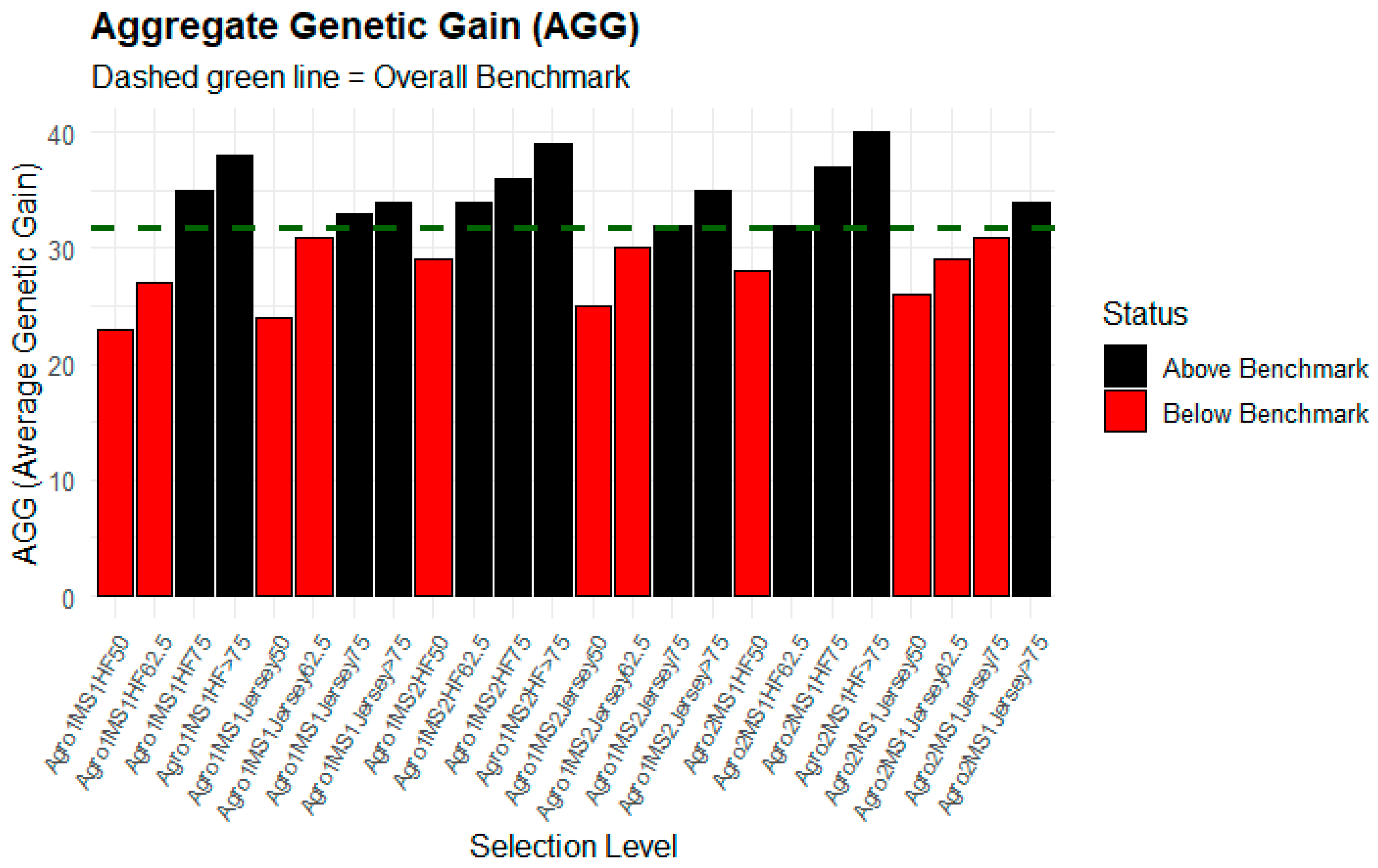
The bar chart in Figure 1 clearly illustrates the optimum breed compositions, according to which, hybrids are below and above the green line which indicates the benchmark for alternative selection schemes. Thus, AGG values were used to evaluate the genetic potentials of hybrids across different selection schemes. The template was designed to provide an alternative for smallholder farmers to select hybrids from the specific production areas. High-grade HF cows performed well in the Bihardar milkshed in the midland and in the highland, indicating that this system effectively supports the demanding production needs of high-grade HF animals across the terrains. The consistent success of Jersey crosses in the Bihardar highland highlighted the importance of the genotype-by-environment interaction, as adaptability and hardiness affected the preferred option in this challenging agro-ecology. In contrast, the strong performance of HF in both midland and highland Bihardar, though it was not in the top-ranking Gondar schemes, suggested that Gondar’s local feed resources, disease patterns, and management conditions better support high-grade Jersey crosses for maximizing AGG. Moderate Jersey crosses just above the benchmark, except for 62.5% in midland Bihardar schemes, also played an important strategic role. Although not the highest achievers, these combinations provided resilient, stable gains through hybrid vigor, making them suitable for these environments. Optimum groups of high-grade Holstein-Friesian (>75% HF) crosses from Bihardar milkshed showed exceptional performance in both the midland and highland zones, confirming their strong adaptabilities under local management conditions. Similarly, Jersey hybrids also showed notable success in this milkshed, except that 62.5% Jersey crosses performed above the benchmark in the midland zone, while >50% were the optimized groups in both agro-ecologies. In the Gondar midland milkshed, the 50% HF group showed strong performance, but the >75% Jersey hybrid clearly outperformed all others, highlighting the superior genetic and environmental compatibility of Jersey genetics in this setting.

3.4. Existing Genetic Architecture and Variance Partitioning of Hybrid Dairy Performance

In the realized genetic parameter estimation, the genotypic variance (selection response) was derived from the phenotypic variance as the product of the selection differential and trait heritability (SR÷SD), reflecting the realized genetic gain for each trait as a selection response (Table 4) However, the ratio of genetic variance to phenotypic variance provided an estimate of heritability (genetic contribution) and was identified from the superior performance of hybrid (S) to calculate the expected genetic gain of standard deviation (GG-αg). Performance evaluations of dairy cow hybrids were conducted with the total average economic return (TER) of keeping dairy cow hybrids being 46,728 units per lactation. Area-specific optimized hybrids per breed, particularly 76% HF hybrids in the midland Gondar milkshed, achieved the highest TER (ETB 70,095) over the population mean of HF hybrids in the milkshed (ETB 50,532). Due to this, the phenotypic variance (δ2p) was an outlier (ETB 19,560), suggesting uniformity records in performance over all hybrids in the area, likely driven by the genetic contribution of exotic breeds within that milkshed. The estimated heritability (h2) for the selected hybrids ranged from 0.17 to 0.50, with an overall study mean of 0.25. This average value aligns with the established literature values for dairy traits in the tropics, where production and reproductive traits are generally considered moderately heritable. Notably, the 50% Jersey group in midland Bihardar demonstrated the highest heritability (h2 = 0.499), suggesting that the genetic effect within this group was more positive than in the >75% HF groups due to the small S from the uniform and low performance diversities among the groups due to crossbreeding effect within the hybrids for this group-based selection scheme. This high h2 reflected a stronger additive genetic influence on phenotypic differences, making this population a prime candidate for future breeding programs. Conversely, the lower h2 in the midland Gondar milkshed (h2 = 0.17 for Jersey) indicated that phenotypic superiority in that area is largely non-transmissible and sensitive to external factors. The performances of dairy cow hybrids were predominantly influenced by environmental factors, including measurement error, accounting for about 75% of the total variation on average and reaching up to 83% in certain Jersey hybrids, with a low genetic contribution (h2 = 0.17).
The observed superiority of selected hybrids and their offspring was strongly influenced by environmental variance (δ2e = 50–83%), reflecting non-genetic factors such as feed quality, heat stress, disease pressure, and management conditions, which modulated the expression of genetic potential. The results of the present study indicate that environmental effects (50–83%) contributed more to hybrid performance than genetic effects (17–49%), underscoring the need to prioritize improvements in nutrition, health, and management alongside breed composition. The disagreement in genetic contribution across locations reinforces the importance of genotype-environment (G × E) interactions i within the Ethiopian dairy sector. Hybrids (particularly at 50–>75% breed composition) showed higher genetic stability and lower environmental sensitivity in specific agro-ecologies and could be used to develop sustainable dairy development in Northwest Ethiopia. These results suggested that selection strategies should not only target high phenotypic output but also prioritize genotypes that maintain higher heritability and resilience under localized environmental constraints. Broader Ethiopian crossbred analyses (HF * local Horro cattle breed * Jersey hybrids) reported that the h2 of daily milk yield (DMY) ranged from 0.19 to 0.28, matching the current findings, while pure Jersey herds showed a lower h2 (0.12–0.14 for DMY/LMY) [26], and a, higher record (h2 = 0.50) was reported at Bahir Dar via reduced σ2e [27].

3.5. Genetic Correlations

As presented in Table 5, genetic correlation (rg) measures the genetic relationship between two traits, whereas phenotypic correlation (rp) is the overall observed relationship between two traits influenced by both genetics and environmental factors. Genetic variance represents the portion of total variation due to the additive effects of genes. The genetic gain variance (GG-σg2) due to genetic effects (σg2) and the standard deviation of genetic gain (GG-σ) of realized genetic gains quantified the dispersion of genetic progress for each trait across different hybrids selected due to genetics. Moderate to low σ values for fitness traits were recorded, which indicated the high consistency of selection response across schemes, implying that environmental interaction effects were limited and the genetic architecture is relatively stable. In contrast, the larger σ values for GG-MY denoted a greater variability in response to strong genotype interactions. Biologically, higher variance (σ2) implies a broader scope for selection, as it indicates the presence of allelic diversity contributing to genetic progress.
The genetic correlation among realized genetic gains provided insight into pleiotropic gene action. These correlations are critical in predicting correlated responses to selection and in constructing multi-trait selection indices. Traits found under the same, antagonistic, and different genes were evaluated. Positive genetic correlations (favorable pleiotropy) suggested that the same alleles enhanced multiple traits in a similar direction. Thus, the observed positive association between MY and LL (rg = 0.14) indicated that genes contributing to prolonged lactation also favor increased milk yield. The correlation matrix indicated that AGG is strongly correlated (r9 = 0.96) with GG from MY, signifying improved MY. Similarly, weaning age (WA) and LL (rg = 0.24) shared a mild positive relationship, implying that selection for delayed weaning age indirectly enhanced lactation persistency. Although these correlations are modest, they indicated opportunities for synergistic genetic improvement, where selection for one economically important trait (MY) can produce small but favorable correlated gains in another (lactation length). Negative genetic correlations and trade-offs were conversely correlated and reflected antagonistic pleiotropy, where alleles may be beneficial for one trait and negatively affect another. The moderate negative correlation between age at first service sexual maturity (AAFSM) and average number of services per conception (ANSPC) (rg = −0.34) exemplifies this trade-off. Selecting for an earlier AAFSM indicative of precocity unintentionally increased ANSPC, implying reduced conception efficiency and potential reproductive stress. Likewise, the negative correlation between calving interval (CI) and generation interval (GI) (rg = −0.27) suggested that shortening the calving interval could compromise the generation turnover rate, potentially due to physiological recovery constraints between reproductive cycles. Such negative correlations necessitate balanced selection strategies, where economic weights and reproductive fitness are jointly considered to avoid compromising one trait for gains in another. This aligns with the principle of restricted or weighted selection indices, which aim to optimize overall genetic merit across multiple correlated traits. However, trait independence correlations near zero (MY-LL and GI, rg = −0.04) indicated genetic independence. These traits are controlled by largely distinct genetic mechanisms, allowing them to be improved separately without a risk of undesirable correlated responses. This independence offers flexibility in designing breeding objectives, as selection intensity can be tailored independently for each trait, depending on economic importance. The current findings supported the idea that negative genetic correlations indicate that one trait compromises another [28]. Accordingly, the moderate negative correlation between age at first service (AAFSM) and services per conception (ANSPC) (r9 = −0.34) suggests that selection for precocity may reduce conception efficiency, as reported in dairy cattle studies [29].

3.6. Implications for Breeding Program Design

The observed genetic variance (σ2 = 362.44) for MY indicated substantial genetic variability, suggesting significant alternatives for genetic improvement through group-based selection schemes. Other traits showed smaller variances but still provided consistent opportunities for progress through multi-trait selection indices with appropriate economic and genetic weights. The findings emphasized a biological trade-off between reproductive maturity and production efficiency: a slightly later age at first sexual service allowed heifers to reach adequate physiological maturity before breeding and MY in the first lactation. Strategic breeding timing, like age at first sexual service, informed by genetic correlation, enhanced lifetime productivity and herd sustainability. The h2 = δ2g/δ2p and the genetic contribution correlations were derived from the genetic variances of the GLM, not just simple phenotypic correlations. In quantitative genetics, a low genetic correlation (rg < 0.20) indicates that traits are governed by largely distinct gene sets. When production, fertility, and fitness traits exhibited these low-magnitude relationships, it suggests a lack of pleiotropy. Under the standardized thresholds of low (<0.20), moderate (0.21–0.50), and strong (>0.50), these results confirm that these traits are mostly genetically independent, necessitating a multi-trait selection index (AGG) for simultaneous improvement with group-based selection schemes.
Table 5. Genetic correlation of traits obtained from GLM model.
TraitVariance of GG (δ2g)Standard Deviation of GG (σgg)GG MY (kg)GG WAGG AAFSM (n)GG LL/MonthGG CIGG ANSPCGG GIAGG
GG MY (kg)362.4419.041−0.070.100.140.13−0.18−0.042.80
GG WA (months)0.060.24−0.0710.080.240.180.050.14−0.09
GG AAFSM (years)0.040.190.100.081−0.01−0.03−0.340.090.31
GG LL (months)0.040.060.140.24−0.011−0.030.050.17−0.01
GG CI (years)0.0010.020.130.18−0.03−0.0310.08−0.270.03
GG ANSPC/No0.00020.01−0.180.05−0.340.050.081−0.08−0.24
GG GI (years)0.00010.01−0.040.140.090.17−0.27−0.081−0.22
AGG51.802.800.96−0.090.31−0.010.03−0.24−0.221
GG, genetic gain; WA, weaning age; AAFSM, age at first sexual maturity; LL, lactation length; GI, generation interval; CI, calving interval; ANSPC, average number of services per conception; δ2g, variance of GG; σgg, standard deviation of GG.

3.7. Multiple Regressions

The prediction capacity of the independent variables was evaluated using full-way multiple regression models, which were developed to identify the best-performing hybrids based on only the genetic contribution of realized phenotypic variation, and aggregate (multigrain) genetic gain (AGG) (Table 6). The performance traits were incorporated with the models to predict the dependent variable due to the genetic improvement impacts on dairy cattle hybrids. The aim was to determine how these parameters jointly influence the total genetic progress under the existing production environment. The realized genetic parameter on the GGG efficient score as a dependent variable was predicted with the incorporation of independent GG production and fitness traits into the model. The regression analysis revealed that hybrids differing in breed composition showed significant associations among S, GG, h2, and the aggregate genetic response, indicating that these variables can effectively predict overall breeding performance. The regression model quantified how different genetic gains (GG) contributed to the economic superiority (GG) of dairy cattle hybrids. The intercept value of 16.44 represented the baseline GG when all genetic predictors are held constant. This is essentially the expected efficiency level of an average animal before any genetic improvement is applied. In the first model (Model 1), adding GG_ANSPC (genetic gain in number of services per conception) resulted in a negative coefficient of −24.61, explaining 5.6% (R2 = 0.056) of the total variation in AGG.
This indicates that higher ANSPC reduces economic efficiency, as fewer inseminations per conception are more desirable for profitability. In Model 2, inclusion of GG_AAFSM (genetic gain in age at first sexual maturity) improved the model’s explanatory power to 14.2% (R2 = 0.142). The negative coefficient (−24.50) confirms that delayed sexual maturity negatively affects efficiency scores, reinforcing that optimum-maturing heifers contributed to better herd efficiency. In Model 3, the addition of GG_WA (genetic gain in weaning age) raised the R2 value to 0.409. The large negative coefficient (−134.50) demonstrated that one unit of increase in weaning period substantially reduced the ES (the commutative breeding value of hybrids) by 134.5 for maintenance costs and delaying productivity. Model 4 added GG_GI (generation interval), marginally increasing the explanatory power to 0.412. The negative coefficient (−21.84) implied that shorter generation intervals enhance ES by accelerating the rate of genetic turnover and progress. Model 5 incorporated GG_CI (calving interval), producing a significant increase in model fit (R2 = 0.64) with a strong positive coefficient of +109.00. This suggested that improved calving regularity and reduced reproductive downtime substantially boost economic efficiency. Model 6 introduced GG_MY (genetic gain in MY), resulting in a near-perfect fit (R2 = 0.995). The positive coefficient (+20.67) confirms that MY is the most influential determinant of ES, as higher yield directly increases profitability. Finally, Model 7 added GG_LL (genetic gain in lactation length), slightly improving R2 to 0.998, with a positive coefficient of +12.90. This indicates that longer productive lactation periods further enhance total economic output when combined with higher yield and efficient reproduction. Collectively, the sequential improvement in R2 values from 0.056 to 0.998 illustrates how each added trait contributes cumulatively to explaining variation in the efficiency score of hybrids (ES). Among all predictors, MY (GG_MY) and LL (GG_LL) emerged as the strongest positive contributors, while reproductive traits (GG_WA, GG_AAFSM, GG_ANSPC, GG_GI) showed negative impacts on efficiency.

4. Conclusions and Recommendations

4.1. Conclusions

This study systematically assessed the genetic influences on the performance and economic efficiency of Holstein-Friesian (HF) and Jersey dairy hybrids across different agro-ecological zones and milkshed systems in Northwest Ethiopia. Using a random model ANOVA framework to estimate aggregate genetic response (AGG) indices, the analysis revealed that the genotype-by-environment interaction (G × E) played a crucial role in determining the most suitable hybrid breed composition for each production environment as a phenotypic performance. The findings indicated that a single breeding strategy based on different production environment cannot be profitably applied across all Ethiopian smallholder systems. This is because the country’s diverse regions differ widely in climate, feed resources, and management practices. Therefore, each area requires its own tailored breeding plan aligned with the local conditions and available resources.
Performances due to genetic effects, specifically hybrids with more than 75% Holstein-Friesian genetics, achieved the highest productivity and expected aggregate genetic response (AGG = 36.5) in the midland Bahir Dar milkshed. The 75% Jersey hybrids consistently exhibited superior efficiency scores across the main and sub-effects in both the midland Gondar and highland Bahir Dar milkshed areas. In addition, 50% Jersey hybrids showed strong performance in AGG in the midland Bahir Dar milkshed. However, the optimum group-based candidates selected for HF hybrids were 50% in Gondar and 75% in the midland, and >75% in the highland areas of the Bihardar milkshed. Further genetic correlation analyses revealed that positive relationships between MY and LL are influenced by the same genetics, indicating potential for simultaneous improvement of key productivity traits. However, negative correlations among reproductive and productive traits highlighted the importance of balanced selection strategies to prevent declines in fertility as yield increases.
Overall, the improvement trends observed in this study underscore multi-trait selection indices for boosting economic returns, preserving genetic diversity and environmental adaptabilities. In conclusion, the findings demonstrated that environment-specific and group-based selection strategies perform better than uniform mass selection systems. Incorporating G × E modeling into hybrid breeding programs can therefore promote sustainable, climate-resilient, and economically sound dairy genetic improvement in Ethiopia.

4.2. Recommendations

Focus on promoting 75% Jersey hybrids because they offer excellent adaptability, fertility, and profitability, particularly in moderate-input and cooler environments.
Include genotype-by-environment interaction models in selection for breeding schemes at both the national and regional levels, rather than evaluating factors separately.
Adopt environment-specific, group-based optimum selection strategies.
Prioritize management and environmental improvements alongside genetic selection.
Use multi-trait selection indices rather than single-trait selection and focused on the stable genetic correlations.
To enhance accurate heritability and genetic gain estimation, national and regional programs should invest in systematic performance recording, reduction in measurement errors, and longitudinal data collection.
Future studies should be integrated with genomic tools and advanced statistical models to further refine genetic parameter estimation and improve the precision of selection decisions under smallholder conditions.

Author Contributions

Conceptualization, data collection, formal analysis, investigation, methodology, project administration, supervision, validation, writing—original draft, visualization, writing—review and editing: A.G. methodology, software, supervision, validation, writing—review and editing: M.B. (Mastewal Birhan), conceptualization, data accusation, writing—review and editing: H.D. conceptualization, methodology, software, writing—review and editing: S.A. project administration and supervision: M.B. (Malede Birhan), conceptualization, methodology, supervision, validation, writing—review and editing: N.B. All authors have read and agreed to the published version of the manuscript.

Funding

This research received no external funding.

Institutional Review Board Statement

Not applicable.

Informed Consent Statement

Not applicable.

Data Availability Statement

The raw data supporting the analyses in this study are available from the corresponding author, Addis Getu, upon reasonable request.

Conflicts of Interest

The authors declare no conflicts of interest.

References

  1. Bora, S.K.; Tessema, T.S.; Girmay, G. Genetic Diversity and Population Structure of Selected Ethiopian Indigenous Cattle Breeds Using Microsatellite Markers. Int. J. Genom. 2023, 2023, 1106755. [Google Scholar] [CrossRef]
  2. Mwai, O.; Hanotte, O.; Kwon, Y.J.; Cho, S. African Indigenous Cattle: Unique Genetic Resources in a Rapidly Changing World. Front. Genet. 2015, 6, 92. [Google Scholar] [CrossRef]
  3. Legese, G.; Gelmesa, U.; Jembere, T.; Degefa, T.; Bediye, S.; Teka, T.; Temesgen, D.; Tesfu, Y.; Berhe, A.; Gemeda, L.; et al. Ethiopia National Dairy Development Strategy 2022–2031; Ministry of Agriculture: Addis Ababa, Ethiopia, 2023.
  4. Chemcha, C.; Alemayehu, K. Trends of cattle genetic improvement programs in Ethiopia: Challenges and opportunities. Livest. Res. Rural Dev. 2012, 24, 109. [Google Scholar]
  5. FAO. The State of the World’s Biodiversity for Food and Agriculture; Food and Agriculture Organization of the United Nations: Rome, Italy, 2022.
  6. Mohamed, M.; Legesse, Y.; Abdimahad, K. Handling, Processing and Composition of Cow Milk Under Two Traditional Farming Systems in Kebribeyah District of Fafan Zone, Somali Regional State, Ethiopia. Am. J. Aquac. Anim. Sci. 2023, 2, 1–6. [Google Scholar] [CrossRef]
  7. Dekebo, D.; Kebede, I.A. Review On Dairy Cattle Production in Ethiopia: Review Article. Mathews J. Vet. Sci. 2023, 7, 28. [Google Scholar] [CrossRef]
  8. Development Gateway. National Livestock Data Standard, 2024; Ministry of Agriculture: Addis Ababa, Ethiopia, 2024.
  9. Ethiopia Livestock Master Plan (ELMP). Ethiopian Livestock Master Plan 2015: Animal Breeding and Genetics; ILRI: Addis Ababa, Ethiopia, 2015. [Google Scholar]
  10. Direba, H.; Yosef, T.; Tesfaye, G.; Million, T. Estimation of genetic parameters for crossbred dairy cattle in the Central Ethiopia. Ethiop. J. Agric. Sci. 2022, 32, 105–123. [Google Scholar]
  11. Hammami, H.; Rekik, B.; Gengler, N. Genotype by environment interaction in dairy cattle. Biotechnol. Agron. Soc. Environ. 2009, 13, 155–164. [Google Scholar]
  12. Central Statistical Agency (CSA). Agricultural Sample Survey 2019/20: Volume II Report on Livestock and Livestock Characteristics; CSA: Addis Ababa, Ethiopia, 2020. [Google Scholar]
  13. BoARD. Annual Report of Bureau of Agriculture and Rural Development (BoARD); Amhara National Regional State: Bahir Dar, Ethiopia, 2006. [Google Scholar]
  14. Tilahun, A.; Teklu, B.; Kasaye, A. Analysis of Dairy Value Chain and Determinants of Market Participation: The Case of Smallholder Farmers in Ethiopia. Sustainability 2018, 10, 2197. [Google Scholar]
  15. ARAIC; Amhara Regional Artificial Insemination Center. Annual Report on Artificial Insemination Service Coverage and Genetic Improvement in Northwest Ethiopia. ARAIC Rep. 2025, 1, 1–15. [Google Scholar]
  16. Yamane, T. Statistics: An Introductory Analysis, 2nd ed.; Harper and Row: New York, NY, USA, 1967. [Google Scholar]
  17. Bates, D.; Mächler, M.; Bolker, B.; Walker, S. Fitting Linear Mixed-Effects Models Using lme4. J. Stat. Softw. 2015, 67, 48. [Google Scholar] [CrossRef]
  18. Miglior, F.; Fleming, A.; Malchiodi, F.; Baes, C.F.; Abdalla, E.A.; Schenkel, F.S.; Cole, J.B. A 100-year review: History of selection indices and selection objectives. J. Dairy Sci. 2017, 100, 10271–10288. [Google Scholar]
  19. Koivula, M.; Strandén, I.; Viglino, A.; Mäntysaari, E.A. Genetic parameters for reproductive traits and their correlation with milk yield in dairy cattle. J. Dairy Sci. 2018, 101, 9110–9121. [Google Scholar]
  20. Bereda, A.; Agune, B.; Yilma, Z. Performance and farmers preferred traits of Jersey × local cows in the tropics: The case of Anolelana Tera district, North Shewa zone, Ethiopia. Cogent Soc. Sci. 2024, 10, 2368948. [Google Scholar] [CrossRef]
  21. Digesa, S. Effect of the Genotype by Environment Interaction on the Productive and Reproductive Performance of Livestock in Ethiopia: A Review. Glob. Res. Environ. Sustain. 2024, 2, 77–90. [Google Scholar]
  22. Worku, D.; Alemayehu, K.; H/Melekote, M. Comparative reproductive performance evaluation of Holstein Friesian cattle breeds in two different agro-ecological conditions, Oromia region, Ethiopia. Anim. Genet. Resour. 2016, 58, 31–34. [Google Scholar] [CrossRef]
  23. Rahman, M.A.; Juyena, N.S.; Shamsuddin, M.; Bhuiyan, M.M.U. Genomic tools and genetic improvement of crossbred Friesian cattle. Res. Agric. Livest. Fish. 2021, 8, 89–107. [Google Scholar] [CrossRef]
  24. Bizuayehu, A.; Alemayehu, K.; Mekuriaw, G. Genetic and environmental factors affecting the performance of crossbred dairy cattle in Ethiopia. J. Agric. Rural Dev. Trop. Subtrop. 2022, 123, 245–256. [Google Scholar]
  25. Panigrahi, M.; Rajawat, D.; Nayak, S.S.; Bose, A.; Bharia, N.; Singh, S.; Sharma, A.; Dutt, T. Advancements in Animal Breeding: From Mendelian Genetics to Machine Learning. Int. J. Mol. Sci. 2025, 26, 11352. [Google Scholar] [CrossRef] [PubMed]
  26. Endale, A.; Dessie, T.; Peider, A. Genetic Parameters Estimation for Milk Production Traits of Pure Jersey Breed at Adea-Berga Dairy Farm, Ethiopia. Online J. Anim. Feed Res. 2025, 15, 1–8. [Google Scholar]
  27. Getahun, K.; Tadesse, M.; Hunde, D.; Lemma, Z. Genetic Parameters of Milk Production Traits in Crossbred Cows in Ethiopia. J. Livest. Sci. 2021, 12, 103–110. [Google Scholar] [CrossRef]
  28. Falconer, D.S.; Mackay, T.F.C. Introduction to Quantitative Genetics, 4th ed.; Longman Group Ltd.: Essex, UK, 1996. [Google Scholar]
  29. Berry, D.P.; Wall, E.; Pryce, J.E. Genetics and genomics of reproductive performance in dairy and beef cattle. Animal 2014, 8, 70–84. [Google Scholar] [CrossRef] [PubMed]
Figure 1. Aggregate genetic gain (AGG) across breed compositions of hybrids associated with milksheds and agro-ecologies. From left to right: Agro1MS1HF50 = midland Bihardar milkshed 50% HF; Agro1MS1HF62.5 = midland Bihardar milkshed 62.5% HF; Agro1MS1HF75 = midland Bihardar milkshed 75% HF; Agro1MS1HF76 = midland Bihardar milkshed > 750% HF; Agro1MS1HF76 = midland Bihardar milkshed > 75% HF; Agro1MS1Jersey50 = midland Bihardar milkshed 50% Jersey; Agro1MS1Jersey62.5 = midland Bihardar milkshed 62.5% Jersey; Agro1MS1Jersey75 = midland Bihardar milkshed 75% Jersey; Agro1MS1Jersey76 = midland Bihardar milkshed > 75% Jersey; Agro1MS2HF50 = midland Gondar milkshed 50% HF; Agro1MS2HF62.5 = midland Gondar milkshed 62.5% HF; Agro1MS2HF75 = midland Gondar milkshed 75% HF; Agro1MS2HF76 = midland Gondar milkshed > 75% HF; Agro1MS2Jersey50 = midland Gondar milkshed 50% Jersey; Agro1MS2Jersey62.5 = midland Gondar milkshed 62.5% Jersey; Agro1MS2Jersey75 = midland Gondar milkshed 75% Jersey; Agro1MS2Jersey76 = midland Gondar milkshed > 75% Jersey; Agro2MS1HF50 = highland Bihardar milkshed 50% HF; Agro2MS1HF62.5 = highland Bihardar milkshed 62.5% HF; Agro2MS1HF75 = highland Bihardar milkshed 75% HF; Agro2MS1HF76 = highland Bihardar milkshed > 75% HF; Agro2MS1Jersey50 = highland Bihardar milkshed 50% Jersey; Agro2MS1Jersey62.5 = highland Bihardar milkshed 62.5% Jersey; Agro2MS1Jersey75 = highland Bihardar milkshed 75% Jersey; Agro2MS1Jersey76 = highland Bihardar milkshed > 75%.
Agriculture 16 00977 g001
Table 1. Economic weights (EW) assigned to production and fitness traits (40% and 60% weighting, respectively).
Performance Goal TraitsIndex WeightProgress Direction
FitnessvalueImportance
ANSPC (n)−0.12Decrease
AAFSM (year)−0.12Decrease
WA (month)−0.12Decrease
GI (year)−0.12Decrease
CI (year)−0.12Decrease
Production
MY (liter)+0.20Increase
LL (month)+0.20Increase
ANSPC = number of services per conception; AAFSM = average age at first sexual maturity; WA = weaning age; GI = generation interval; CI = calving interval; MY = milk yield; LL = lactation length.
Table 2. Analysis of the main effects of breeds and hybrids of crossbreeding schemes and estimation of GG and AGG (genetic variance) on productive and reproductive traits (H = 0 means lower genetic merit than the other).
Types of SelectionHybrid
Genetic Basis of Selection Scheme
Standard Scale of AGG Effect
(0 ≤ H ≤ 1)
Additive Gene Effect or GG of Traits
ANSPCAAFSMWAGICIMY-LLLLAGG
Mass SelectionHF Hybrid SchemeWithin HF Breed Baseline Scheme0.36−0.040.02−0.06−0.004−0.06155.360.28155.50
50% HF 0−0.080.20−0.30−0.11−0.29141.050.23140.7
62.5% HF 0.330.08−0.050.060.160.05153.230.33153.86
75% HF0.09−0.09−0.111−0.009−0.110.00144.630.27144.58
>75% HF 1−0.030.050.060.030.08182.530.28183
Jersey Hybrid SchemeWithin Jersey Baseline Scheme0.63−0.04−0.070.020.030.05135.690.35136.03
50% Jersey1−0.09−0.11−0.009−0.110.05151.050.38151.16
62.5% Jersey00.08−0.020.060.160.00109.860.24110.38
75% Jersey0.80−0.03−0.110.030.110.08142.340.46142.88
>75% Jersey0.72−0.09−0.05−0.01−0.050.05139.510.34139.7
Overall Benchmark Selection Scheme0.50−0.03−0.03−0.020.010.0001145.530.32145.78
ANSPC = number of services per conception; AAFSM = average age at first sexual maturity; WA = weaning age; GI = generation interval; CI = calving interval; MY-LL= milk yield per lactation; LL = lactation length; AGG = aggregate genetic gain.
Table 3. Interaction effects of a realized genetic parameter estimation of hybrids.
Source of InformationSelection Intensity Hybrid Selection SchemeGG ANSPC (n)GG AAFSM (Years)GG
WA (Months)
GG
GI (Years)
GG
CI (Years)
GG
MY-LL(Liters)
GG
LL (Months)
AGG (Value)
MilkshedBreedAgro-EcologyBreed Composition
Mass Selection SchemeHF Hybrid SchemeBihardarHFmidland50−0.01−0.55−1.28−0.02−0.12110.770.29109.08
,,.,,,,62.5−0.03−0.53−0.63−0.01−0.06153.230.33152.30
,,,,,,75−0.02−0.76−1.02−0.01−0.04144.630.27143.05
,,,,,,>75−0.04−0.36−1.02−0.01−0.04182.530.28181.34
Baseline Selection−0.02−0.55−1.03−0.01−0.07147.790.29146.40
Jersey Hybrid SchemeBihardarJerseymidland50−0.01−0.52−1.28−0.02−0.06151.050.38149.54
,,.,,,,62.5−0.02−0.67−0.95−0.02−0.05109.860.24108.39
,,,,,,75−0.02−0.88−1.02−0.01−0.09142.340.46140.78
,,,,,,>75−0.01−0.94−1.07−0.02−0.05139.510.34137.76
Baseline Selection−0.02−0.75−1.08−0.02−0.06135.690.35134.11
HF Hybrid SchemeGondar HFmidland50−0.02−0.60−1.32−0.02−0.05149.580.24147.81
,,,,,,62.5−0.05−0.74−097−0.02−0.06143.390.29141.84
,,,,,,75−0.05−0.59−1.16−0.01−0.08137.810.31136.23
,,,,,,>75−0.02−0.48−1.04−0.02−0.04124.840.24123.48
Baseline Selection−0.03−0.60−1.12−0.02−0.05138.900.27137.35
Jersey Hybrid SchemeGondar Jerseymidland50−0.02−0.64−1.44−0.01−0.09146.150.24144.19
,,,,,,62.5−0.03−0.57−1.38−0.02−0.04150.420.37148.75
,,,,,,75−0.02−1.06−1.28−0.02−0.08170.390.27168.19
,,,,,,>75−0.02−0.65−1.22−0.01−0.05178.750.31177.11
Baseline Selection−0.02−0.73−1.33−0.01−0.07161.930.30160.06
HF Hybrid Scheme BihardarHFHigh50−0.02−0.50−0.76−0.02−0.06169.800.33168.77
,,.,,,,62.5−0.02−0.60−1.05−0.02−0.06137.910.27136.43
,,,,,,75−0.02−0.44−0.75−0.02−0.06170.090.37169.17
,,,,,,>75−0.04−0.44−1.52−0.02−0.06171.020.28169.22
Baseline Selection−0.03−0.50−1.02−0.02−0.06162.210.31160.89
Jersey Hybrid SchemeBihardarJerseyHigh50−0.03−0.72−1.18−0.01−0.10162.430.27160.66
,,.,,,,62.5−0.01−0.70−1.14−0.02−0.04137.960.33136.38
,,,,,,75−0.01−0.92−1.24−0.03−0.04160.900.25158.91
,,,,,,>75−0.02−0.65−1.11−0.01−0.06155.710.44154.30
Baseline Selection−0.02−0.75−1.17−0.02−0.06154.250.32152.55
Expected Overall Crossbreeding Benchmark−0.03−0.65−1.13−0.02−0.07149.820.31148.23
HF, Holstein-Frisian; GG, genetic gain; WA, weaning age; AAFSM, age at first sexual maturity; LL, lactation length; GI, generation interval; CI, calving interval; ANSPC, number of services per conception; MY-LL, milk yield per lactation.
Table 4. Genetic and environmental contributions to phenotypic performance of selected hybrid dairy cows.
Agro-Ecology and MilkshedSuperior CowSelected HybridsTER Per Lactationδ2pσpGenetic ContributionEnvironmental and Measurement Error Effect
XsXoµp
h2SRδ2e%
Midland BihardarSelected Hybrid Cow>75% HF32,29029,52928,149414164.350.33138027610.67
50% Jersey26,57224,57122,582399063.170.499198920010.50
Midland GondarSelected Hybrid Cow>75% HF70,09555,32850,53219,560139.860.25479614,6700.75
50% Jersey58,45635,56130,78527,671166.350.173478722,8840.83
Highland BihardarSelected Hybrid Cow>75% HF41,47533,56130,78510,690103.390.26277679140.74
>75% Jersey51,48146,37643,152833291.280.39322451080.61
Overall meanSelected Hybrid CowSelected Hybrids46,72837,48834,33112,397111.350.25315792410.75
TER = total economic return; δ2p = phenotype variance; σp = standard deviation of the phenotype; µp = mean of the population; δ2e = environmental variance; Xs = mean of selected hybrid cow; Xo = mean of offspring performance; SR = selection response; h2 = heritability.
Table 6. Full-way multiple regression with intercept, predictor coefficients, and R2 values.
ModelInterceptAdded Predictor (GG)Coefficient (β)Cumulative R2% Contribution to Change
016.44Baseline (no traits)0.00
116.44GG_ANSPC−24.610.06+6.0%
216.44GG_AAFSM24.500.14+8.0%
316.44GG_WA−134.500.41+27.0%
416.44GG_GI−21.840.410.0%
516.44GG_CI+109.000.64+23.0%
616.44GG_MY+20.670.995+35.5%
716.44GG_LL+12.900.998+0.3%
Disclaimer/Publisher’s Note: The statements, opinions and data contained in all publications are solely those of the individual author(s) and contributor(s) and not of MDPI and/or the editor(s). MDPI and/or the editor(s) disclaim responsibility for any injury to people or property resulting from any ideas, methods, instructions or products referred to in the content.