Article

Return Flow Compensation Reshapes Water Savings and Carbon–Water Synergy in Cold-Region Paddy Systems


School of Hydraulic and Electric Power, Heilongjiang University, Harbin 150080, China
*
Author to whom correspondence should be addressed.
Agriculture 2026, 16(9), 1002; https://doi.org/10.3390/agriculture16091002
Submission received: 8 April 2026 / Revised: 29 April 2026 / Accepted: 29 April 2026 / Published: 2 May 2026

Abstract

Non-flooding irrigation is widely promoted as a carbon–water co-benefit strategy in paddy rice, but field-scale trials overlook return flow compensation within irrigation districts and therefore overstate water-saving potential. To reconcile this scale mismatch, we developed a semi-distributed multi-scale water balance model coupled with a carbon footprint and full-component blue–green–grey water footprint framework and applied it across field, district, and provincial scales in Heilongjiang Province—a leading cold-region japonica rice region in Northeast China—using the Qinglongshan Irrigation District on the Sanjiang Plain as the focal case, supported by two growing seasons of field observations and 35 years of provincial records. Under alternate wetting and drying, apparent field-level water savings of 50–60% converge to 33% after return flow correction, implying that field-based indicators overestimate savings by 40–50%. Carbon mitigation is decoupled from water volume: CH4 suppression dominates total abatement and is governed by drying frequency rather than water saved. At the provincial scale, the water footprint has shifted from grey- to blue-water dominance, suggesting that blue-water efficiency now represents a principal remaining lever for further cold-region carbon–water co-benefits. Two-season coverage and fixed parameter assumptions affect magnitudes but not directions. Water-saving irrigation in cold-region paddy systems should therefore be evaluated at the district scale where data permit, rather than relying solely on field-scale indicators.

1. Introduction

Conventional continuously flooded irrigation regimes in paddy rice production are responsible for substantial freshwater consumption and constitute a significant source of anthropogenic greenhouse gas (GHG) emissions, particularly methane (CH4), which exerts a global warming potential approximately 28 times that of carbon dioxide over a 100-year horizon [1]. Non-flooding irrigation management strategies—most notably alternate wetting and drying (AWD) and controlled irrigation (CI)—have been extensively validated at the field scale across diverse rice-producing regions worldwide [2,3], demonstrating that AWD appreciably attenuates CH4 emissions while simultaneously curtailing irrigation water consumption relative to continuous flooding [4]. Nevertheless, the existing body of quantitative research on carbon–water synergies is almost exclusively predicated upon field plot trials, and the compensatory effect of return flows within the internal hydrological cycle of irrigation districts has hitherto not been incorporated into the analytical framework. This scale mismatch directly constrains the scientific formulation of water conservation and emission reduction policies at the irrigation district level. Three unresolved issues, concerning hydrological scale, the process governing CH4 suppression, and the structural composition of the agricultural water footprint, underlie this constraint and motivate the present study.
An irrigation district, from a hydrological perspective, constitutes a complex coupled system encompassing water conveyance and distribution, field-level irrigation and drainage, and internal return flow recycling. A considerable proportion of water discharged from paddy fields recaptured by downstream fields through channel runoff or lateral groundwater recharge, thereby establishing a return flow compensation mechanism within the irrigation district. The concept of the “irrigation efficiency paradox” has been articulated from both conceptual and empirical perspectives [5,6], whereby enhancements in field-level irrigation efficiency may paradoxically diminish system-level water availability by attenuating return flows. A subsequent meta-analysis encompassing 37 cases across multiple continents further corroborated the pervasiveness of this paradox in the context of irrigation modernization [7], with analogous patterns reported in snowmelt-fed systems of the western United States [8]. Xiong et al. [9] reported a return-flow-induced irrigation efficiency scale discrepancy of approximately 0.10 through basin-scale modeling in the Hexi Corridor. More recently, Lankford [10] and Jaiswal et al. [11] advanced the quantitative characterization of irrigation district return flows from the perspectives of systems accounting and multi-method cross-validation, respectively, while Zhang et al. [12] evaluated sustainable groundwater utilization under surface water–groundwater coupling in the Sanjiang Plain rice-growing region. Notwithstanding these advances, the aforementioned studies focused exclusively on the water balance dimension and have not yet integrated return flow compensation effects with carbon emission assessment within a unified analytical framework. In cold-region paddy systems dominated by groundwater irrigation, the extent to which return flow compensation offsets the field-level water-saving benefits of AWD/CI remains unsupported by multi-scale empirical evidence. We propose the following:
H1. 
Return flow compensation substantially offsets the field-level water-saving benefits of AWD/CI in cold-region, groundwater-dependent paddy systems.
The suppression of CH4 emissions by non-flooding irrigation management is primarily realized through the modulation of soil redox potential (Eh) [13], and there is not a simple linear relationship between carbon emission reduction efficacy and the magnitude of irrigation water curtailment. If the degree of CH4 suppression is predominantly governed by the frequency and duration of drying episodes rather than the absolute reduction in irrigation volume, the carbon reduction efficiencies of AWD and CI may exhibit a high degree of convergence [14]. Whether this mechanistic decoupling between water saving and carbon reduction holds under cold-region conditions remains to be tested empirically:
H2. 
Under cold-region conditions, the carbon reduction efficiencies of AWD and CI converge to comparable values, decoupling from inter-mode differences in water-saving rate.
In the domain of water footprint accounting, existing assessments at the provincial or basin scale are predominantly confined to a single component—blue water consumption [15]—and are particularly deficient in fine-scale calculations at the irrigation district level, even as recent global syntheses quantify all three components for 175 crops worldwide [16]. However, at the sub-national scale where policy levers are most directly applied, the historical evolutionary trajectories and principal driving mechanisms governing the blue–green–grey water components remain insufficiently elucidated:
H3. 
The dominant water footprint component has transitioned from grey water to blue water over recent decades, positioning blue-water efficiency as an increasingly important lever for compressing the total water footprint.
The cold-zone rice-cropping region of northeastern China represents one of the foremost production areas for japonica rice globally. With over 3.86 million hectares under rice cultivation in Heilongjiang Province, agriculture has historically relied upon groundwater for irrigation, and sustained over-exploitation has precipitated a pronounced decline in aquifer water levels [17]. The systematic divergences between the cold zone (mean annual temperature of 2.2 °C) and warmer counterparts in terms of baseline CH4 emission rates, growing-season moisture transport dynamics, and moisture deficit tolerance of japonica rice cultivars constitute a fundamental imperative for locally calibrated empirical investigations.
Although Chen et al. [18] previously examined the scale effects of irrigation efficiency within the same irrigation district, and international studies have separately advanced return-flow accounting [10,11], global AWD meta-analyses [2,3], and global water footprint syntheses [15], none of these efforts has integrated return flow compensation, carbon footprint assessment, and full-component water footprint accounting into a single multi-scale framework, nor tested the three hypotheses (H1–H3) above within a cold-region, groundwater-dependent paddy system. In the present study, return flow compensation, carbon footprint assessment, and full-component water footprint accounting are integrated, for the first time, within a single hypothesis-driven framework. Taking Heilongjiang Province as the study domain and the Qinglongshan Irrigation District on the Sanjiang Plain as the focal case for district-scale simulation, the study pursues four objectives, each mapped onto one hypothesis: (i) to determine whether, and by how much, field-scale water-saving indicators overestimate district-scale water savings (H1); (ii) to establish whether AWD and CI are climatically substitutable, and to identify the mechanism governing their carbon-reduction efficiency (H2); (iii) to characterize the historical transition of the three water-footprint components and identify the currently binding component at the sub-national scale (H3); (iv) to quantify, under explicit uncertainty, the provincial-scale carbon-abatement potential implied by the preceding results. The semi-distributed multi-scale water balance model (SWBM), its six functional modules, the 21-scenario simulation design, and the Monte Carlo and LMDI procedures used to operationalize these objectives are described in Section 2.

2. Materials and Methods

2.1. Study Area

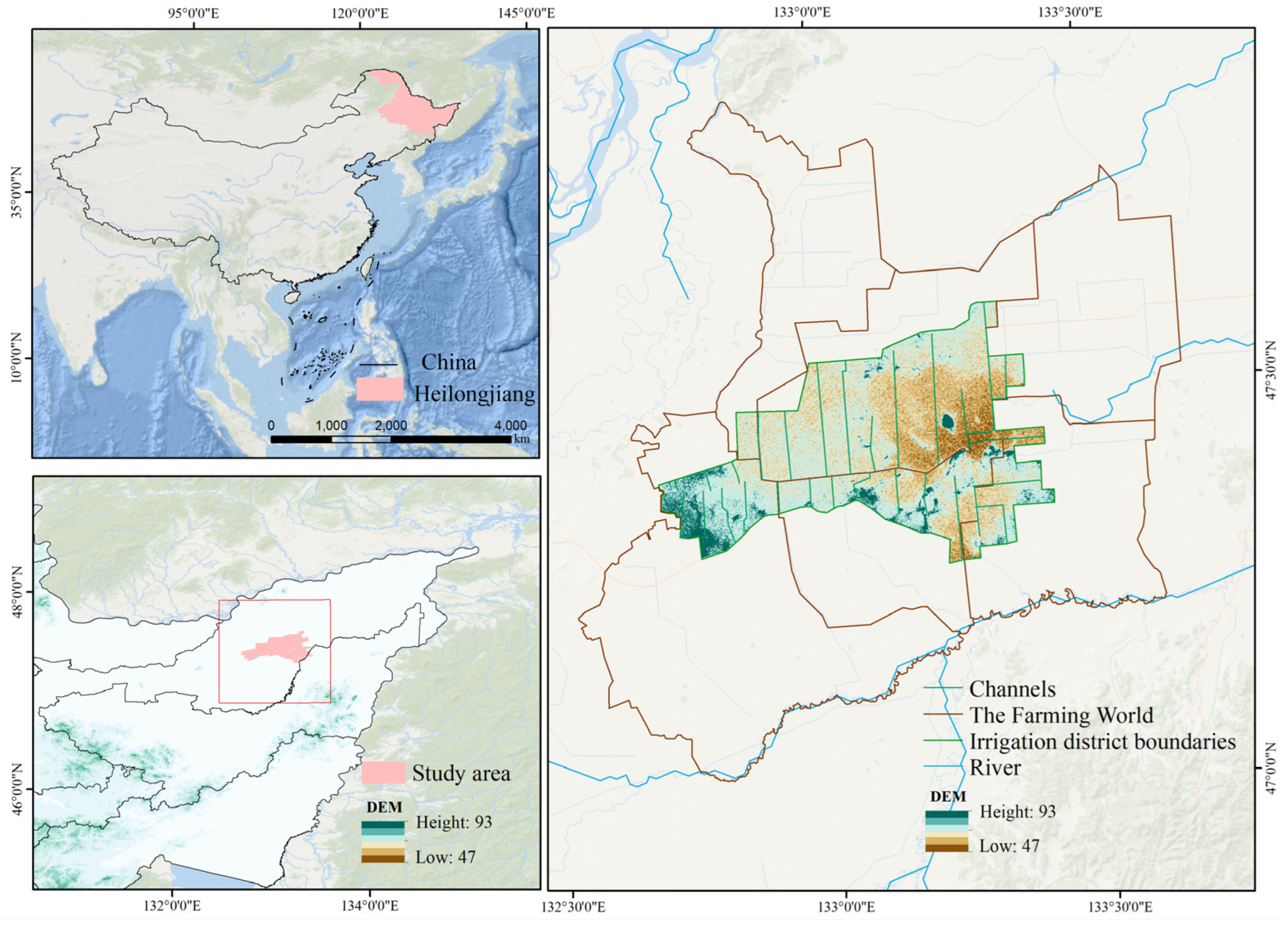
This study adopts a nested two-level spatial design: Heilongjiang Province, one of the world’s leading japonica rice-producing regions, serves as the broader study domain for provincial-scale water-footprint accounting and carbon-abatement projection; the Qinglongshan Irrigation District on the Sanjiang Plain is selected as the focal case for field- and district-scale analyses. The Qinglongshan Irrigation District (132°35′47″–134°05′03″ E, 47°05′33″–47°55′47″ N) is situated on the eastern bank of the middle reaches of the Heilongjiang River on the Sanjiang Plain in Heilongjiang Province, Northeast China (Figure 1). The district encompasses a total controlled area of 1007.72 km2, with a designed irrigation area of 3.740 × 10⁵ hm2, rendering it China’s fourth-largest irrigation district. The prevailing climate is classified as temperate semi-humid monsoon, characterized by a long-term mean annual temperature of 2.2 °C and long-term mean annual precipitation of 570–610 mm, approximately 80% of which is concentrated during the growing season from May to September. The long-term average water surface evaporation is approximately 670 mm, annual sunshine hours exceed 2381.5 h, and the frost-free period ranges from 114 to 150 days [19]. Soils within the district are classified into five major categories and 14 subcategories: dark brown soil, white calcareous soil, black soil, meadow soil, and peat soil. Aquifer types encompass three categories: pore water in Quaternary sand and gravel, inter-porous water in Tertiary clastic rocks, and fissure water in bedrock. The first phase of the irrigation infrastructure has been completed. Arable land covers 343.3 × 10⁴ mu, accounting for 63.02% of the total irrigation area, of which 306.53 × 10⁴ mu comprises irrigated paddy fields; forest land accounts for 59.06 × 10⁴ mu (10.81%); construction land for 45.29 × 10⁴ mu (8.29%); water bodies for 8.91 × 10⁴ mu (1.63%); and other land uses for 65.12 × 10⁴ mu (11.92%). These hydrometeorological conditions and land-use configurations collectively determine the irrigation district’s pronounced dependence on groundwater for irrigation. Against the backdrop of anthropogenic climate change and the continuous expansion of rice cultivation, the sustainable utilization of groundwater resources confronts increasingly formidable challenges [17,20]. Furthermore, the irrigation district features a high spatial concentration of rice-continuous cropping areas and a comprehensive system of irrigation and drainage channels. It is representative of the predominant typology of rice-growing areas in China’s cold regions that rely on well irrigation, exhibits robust regional representativeness, and is well-suited as a case study domain for investigating regional agricultural water management mechanisms [12,21].

2.2. Experimental Site

Field experiments were conducted over two consecutive rice growing seasons (2024–2025) at the Qinglongshan Irrigation District. The SWBM requires continuous daily forcing data spanning the entire growing season; accordingly, the 2025 season was used for model calibration and scenario simulation because its meteorological and hydrological records were the most complete and continuous among the observation period, whereas the 2024 season, which contained several short gaps in the forcing series, was reserved as an independent dataset for temporal validation. Field trial data from the 2024 growing season served as an independent validation dataset: sequences of measured soil moisture content, ponding depth, and irrigation volume from 2024 were compared against model-simulated values under 2024 meteorological forcing conditions to evaluate the temporal stability and transferability of the model parameters across interannual climatic variability. The replicated two-year experimental design was specifically conceived to eliminate the confounding influence of interannual climate variability on treatment effect estimation, while simultaneously furnishing mutually independent datasets for model calibration and validation. This design yields n = 54 plot-season observations (9 treatments × 3 replicate blocks × 2 seasons) for field-scale inference, and the two-season field record is further embedded within a six-year (2020–2025) regional monitoring dataset from 14 groundwater wells and three river cross-sections, which provides the longer-term hydrological context required for district-scale calibration and independent temporal-extrapolation validation. The experiment employed a randomized complete block design (RCBD) with three replications, comprising a total of nine irrigation treatments: controlled irrigation (CI1–CI4), mulch-covered controlled irrigation (FMCI), mulch-covered conventional irrigation (FMCG), controlled irrigation with soil conditioner application (SACI), conventional irrigation with soil conditioner application (SACG), and conventional irrigation control (CK). The test variety was “Longjing 31”; transplanting was undertaken on April 14 and harvesting on August 26, yielding a total growth period of 134 days (see Table 1 for details). Nitrogen fertilizer was applied as urea (46% N content) at a total season rate of 240 kg N hm−2 in both the 2024 and 2025 growing seasons, partitioned into three split applications per local extension-service recommendations: basal (40%, =96 kg N hm−2), broadcast and incorporated 3 d before transplanting; tillering (30%, =72 kg N hm−2), top-dressed at 7 d after transplanting; and panicle initiation (30%, =72 kg N hm−2), top-dressed at 55 d after transplanting. Phosphorus (as P2O5, 90 kg hm−2) and potassium (as K2O, 120 kg hm−2) were applied uniformly as basal fertilizers. Fertilizer rates were identical across all nine treatments, so that irrigation regime is the only controlled variable affecting the SWBM water-balance comparison; the total N application rate of AR = 240 kg hm−2 was used as the input to the grey water footprint formula (Equation (13)).

2.3. Observations and Measurements

2.3.1. Field Moisture Monitoring

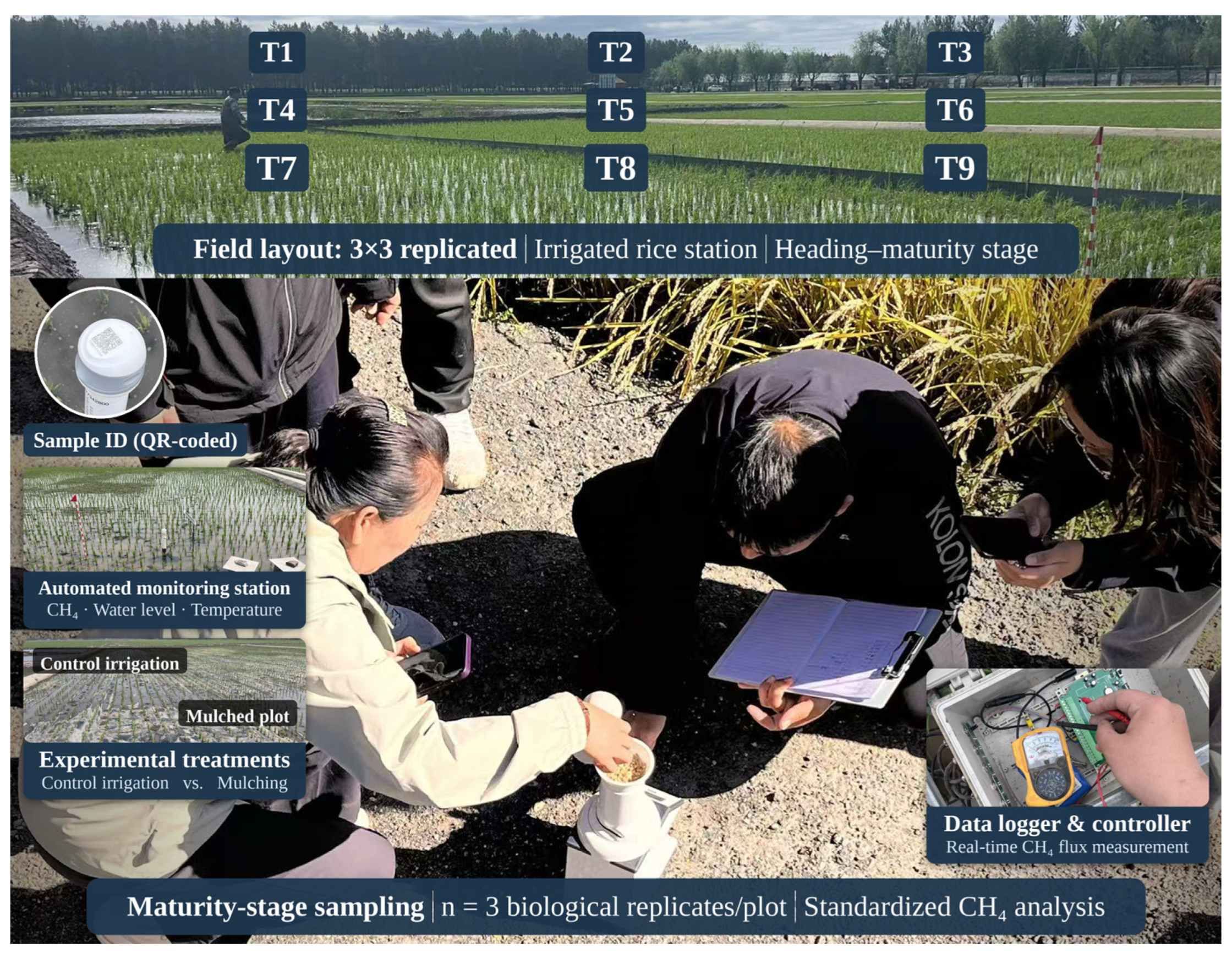
Three fixed observation points were evenly distributed within each experimental plot (Figure 2). Ponding water depth was monitored synchronously using a manual water ruler and a HOBO U20L-04 pressure-based automatic water level recorder, with a sampling interval of 30 min. Irrigation volumes were recorded in real time by a DN50 electromagnetic flowmeter (accuracy ±0.5%) installed on the main pipeline, with the difference between two consecutive readings adopted as the irrigation volume per event. Soil volumetric water content was determined using a TRIME-PICO64 time-domain reflectometer (TDR) in stratified layers (0–80 cm depth, 10 cm vertical resolution, totaling 8 layers), observed at weekly intervals, and the instrumental readings were systematically calibrated against the 105 °C oven-drying method (24 h).

2.3.2. Monitoring of Groundwater Levels and River Discharge

A network of 14 groundwater level observation wells was established within the irrigation district. The monitoring network encompasses the main canal corridor (QJ series), the central section of the irrigation district (CY and QX series), the banks of the Bela River (HC series), and the downstream section of the irrigation district (HW and HH series). Each well is instrumented with a HOBO U20-001-04 water level logger, operating at a 24 h sampling interval. The continuous monitoring period extends from 2020 to 2025. For river discharge monitoring, three hydrological cross-sections (B-1, B-2, and B-3) were established along the main stem of the Bela River. The velocity distribution at each cross-section was measured using LS45-2 vortex flowmeters, and hourly discharge profiles were computed from these measurements.

2.3.3. Other Data Sources

Land use data were derived from the 2025 status survey of the study area, with a classification system encompassing major land categories including farmland, forest land, grassland, water bodies, and developed land. The Digital Elevation Model (DEM) was obtained from the Geospatial Data Cloud Platform ((GDEM V3, available at http://www.gscloud.cn, accessed on 15 March 2024)), employing the Beijing_1954_GK_Zone_22N projection coordinate system. Meteorological data cover daily elements during the rice growing season (14 April to 26 August 2025), including mean temperature, maximum temperature, minimum temperature, relative humidity, atmospheric pressure, wind speed, sunshine duration, and precipitation, all derived from in situ measurements at proximal meteorological stations. Hydrogeological parameters and soil physical property data (encompassing particle size distribution, depth of each soil layer, texture type, field water-holding capacity, and saturated water content) were compiled from existing survey databases. Reference evapotranspiration (ET0) was calculated on a daily basis using the FAO Penman–Monteith equation. Socioeconomic data were sourced from publicly available records in the Heilongjiang Provincial Statistical Yearbook (1986–2020) and the China Rural Statistical Yearbook (1986–2020).

2.3.4. Greenhouse Gas Flux Monitoring

Emission fluxes of CH4 and N2O from rice paddies were quantified using the static dark chamber–gas chromatography method. The sampling apparatus consisted of a stainless steel base (50 cm × 50 cm × 15 cm) and a transparent Plexiglas enclosure (50 cm × 50 cm × 100 cm); the base was permanently embedded in the soil prior to seedling transplantation. Three replicate sampling points were established for each treatment. Routine sampling frequency was weekly (Tuesday, 08:00–11:00) throughout the reproductive period and was intensified to daily sampling for three consecutive days following fertilization and irrigation events. For each sampling event, gas samples (60 mL syringe) were collected at 0, 10, 20, and 30 minutes after chamber closure and transported to the laboratory on the same day for analysis using an Agilent 7890B gas chromatograph (CH4: FID detector, 250 °C; N2O: ECD detector, 330 °C). Flux calculations were performed via linear regression, and data points with R2 < 0.90 were excluded. The mean fluxes during the reproductive period under continuous flood irrigation (CK) served as the emission baseline, and the flux reductions in the AWD and CI treatments relative to CK during drying periods were calculated independently, with the treatment-specific mean adopted as the abatement coefficient. The resulting CH4 abatement coefficients were 46.30% for AWD and 45.25% for CI. The compensatory enhancement of N2O emissions under water-saving irrigation conditions was also accounted for (measured increase of approximately 8–12%, corresponding to approximately 35–48 kg CO2eq hm−2), and the net comprehensive emission reduction coefficients after deducting the N2O compensation were ultimately adopted.

2.3.5. Rice Yield Measurement

At physiological maturity (August 26 in each season), grain yield was determined by manual harvest of three 2 m × 2 m (4 m2) sampling quadrats randomly located within the central area of each experimental plot, with a 0.5 m buffer retained against the plot border to eliminate edge effects. The three quadrats per plot were pooled for analysis, yielding a total of n = 54 plot-season yield observations (9 treatments × 3 replicate blocks × 2 seasons). Harvested panicles were threshed with a portable plot-scale thresher (SBS-500, Shandong Sibeisi Machinery Co., Ltd., Jining, Shandong, China), and the grain was air-dried, cleaned of debris, and weighed on a precision balance (accuracy ±0.1 g). Grain moisture content at weighing was measured with a PM-8188-A digital grain moisture meter (Kett Electric Laboratory, Japan; accuracy ±0.5%). All yield values were normalized to the international standard moisture content of 14.0% according to:
Y 14 = Y o b s × ( 100 M C o b s ) / ( 100 14 )
where Yobs is the measured grain weight at moisture content M C o b s (%), and Y 14 is the standardized yield (t·hm−2). Treatment differences were evaluated by one-way ANOVA at α = 0.05 after verifying normality (Shapiro–Wilk, p > 0.05) and homogeneity of variance (Levene’s test, p > 0.05).

2.4. Methods

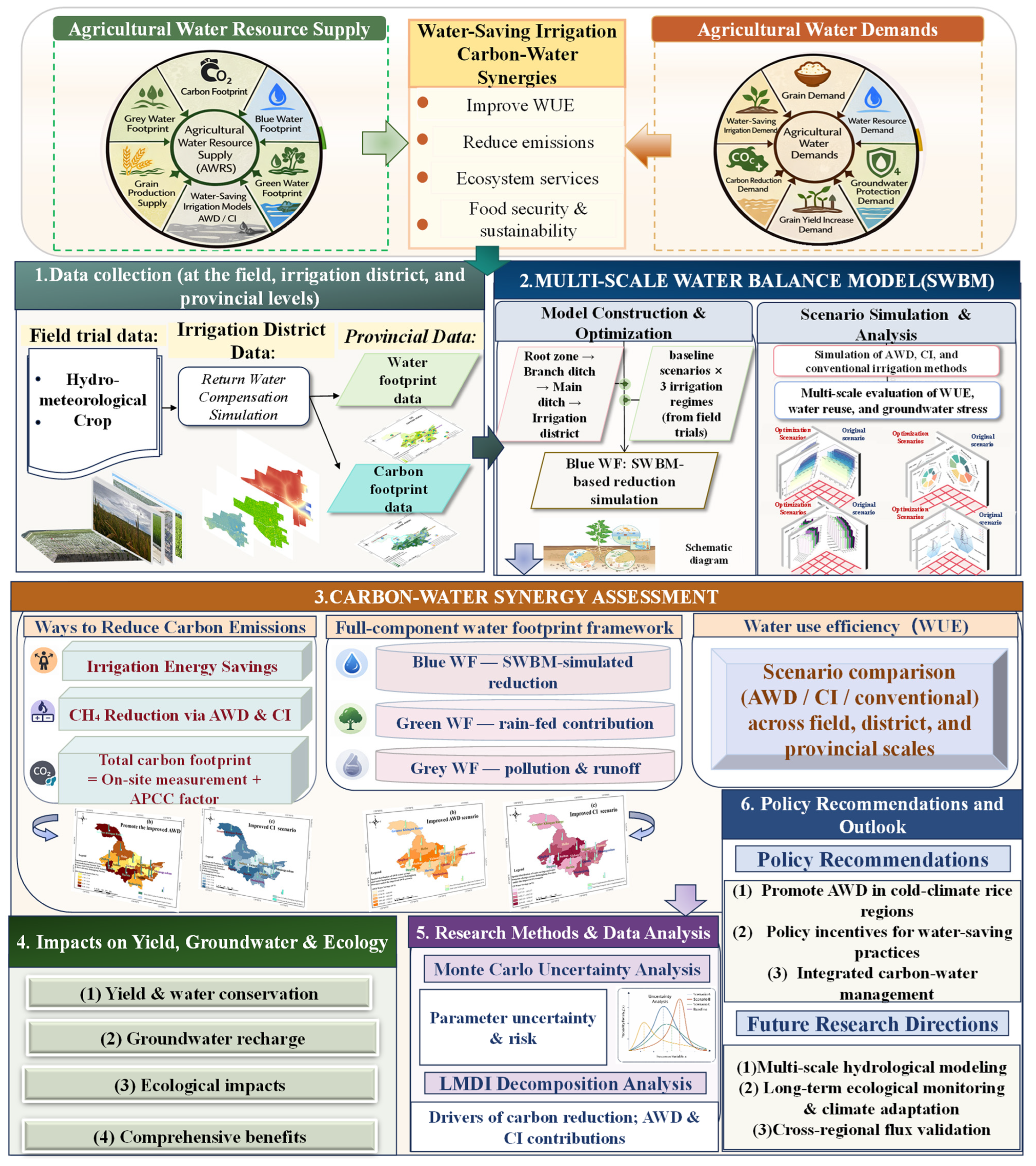
The technical framework of this study is illustrated in Figure 3.

2.5. Semi-Distributed Multiscale Water Balance Model (SWBM)

To avoid terminological ambiguity, the four water-use efficiency indicators referenced throughout Section 2, Section 3 and Section 4 are defined once here and thereafter referred to exclusively by the abbreviations given in Table 2.
This study independently developed a semi-distributed water balance model (SWBM) tailored to the Qinglongshan Irrigation District on the Sanjiang Plain. Although Chen et al. [18] previously examined the scale effects of irrigation efficiency in the same district, their investigation neither encompassed carbon emission assessment nor established a systematic multi-scale water balance model. The SWBM integrates six major functional modules designed to precisely track water fluxes and rigorously quantify uncertainties across spatial scales from the field to the provincial level. Widely used watershed models such as SWAT and coupled SWAT–MODFLOW frameworks partition the landscape into hydrological response units by land use, soil, and slope, and therefore do not explicitly represent the tributary–branch–main-channel hierarchy or the closed-loop return-flow reuse that governs water transformation in large engineered irrigation districts; accordingly, a purpose-built model was required for the Qinglongshan setting. Accuracy and parameter uncertainty of the SWBM are independently assessed against multi-site groundwater-level and river-discharge observations in Section 3.2 and through OAT, EFAST, and Monte Carlo analyses in Section 2.9 and Section 3.1.
(1) On-site correction of branch ditch geometry. Based on field survey data from the Qinglongshan Irrigation District in 2025, the alignment and control boundaries of all branch ditches were updated, superseding the simplified layout from the model’s planning phase and enhancing the accuracy of spatial water volume computations.
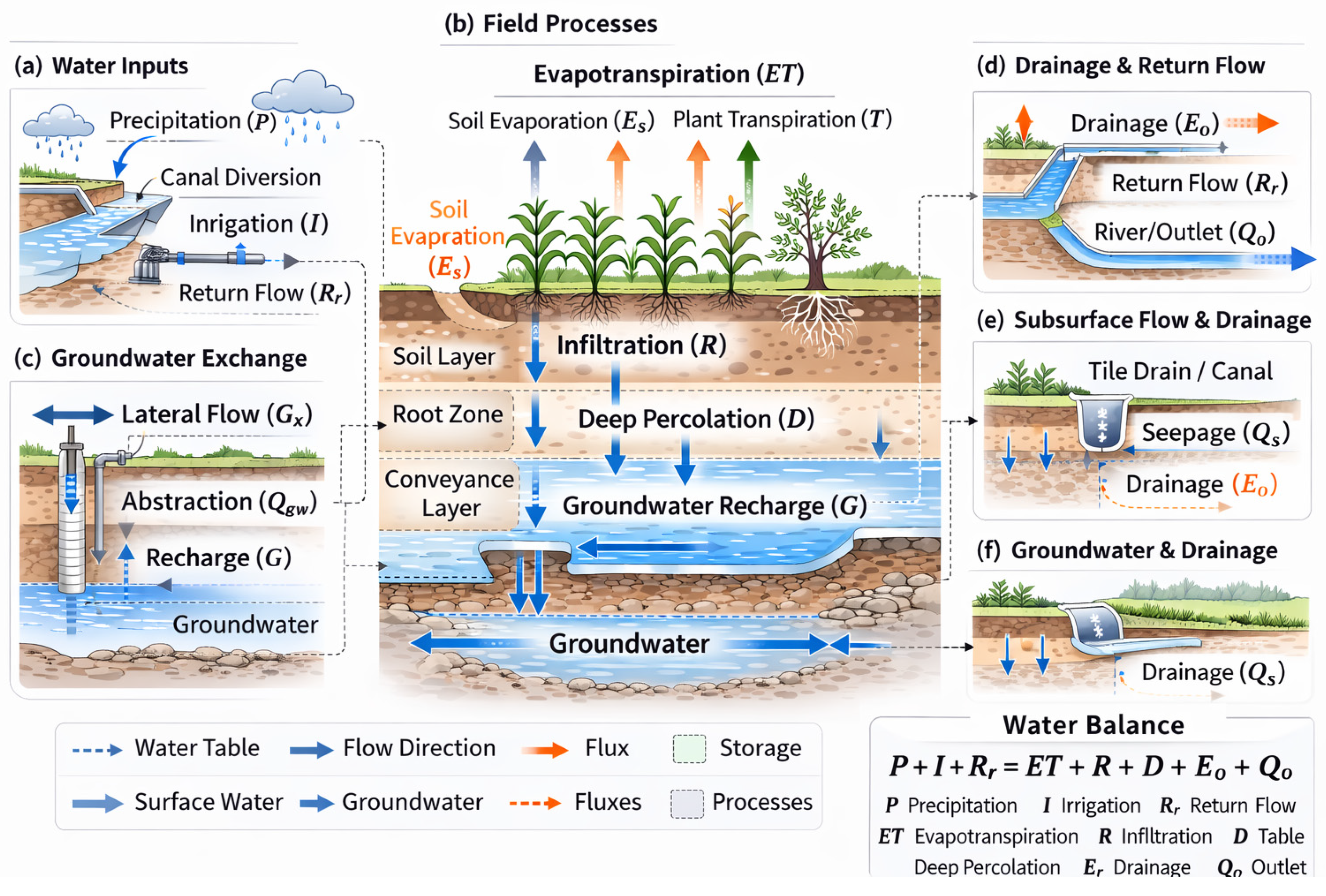
(2) Closed-loop module for channel drainage reuse. A closed-loop pathway—”field runoff→convergence into tributary/main channels→recirculation to downstream fields”—was incorporated. This module enables the model to distinguish between net water withdrawal and recycled water volume at each time step, furnishing the hydrological foundation for blue water footprint calculations at the irrigation district scale while simultaneously serving as a core input for provincial-level blue–green–grey water footprint estimations.
(3) Groundwater–channel dynamic exchange module. The parametric computation of lateral recharge flux is driven by the real-time hydraulic gradient between groundwater levels and channel water surface elevations. This enhancement improved river discharge simulation accuracy from R2 = 0.76 in the antecedent model to R2 = 0.97 (NSE = 0.87 during the calibration period and NSE = 0.85 during the validation period).
(4) Multi-tiered water efficiency indicator system. Building upon the original model’s singular net water supply utilization efficiency indicator (PF_nws), a four-dimensional indicator system was developed encompassing the irrigation water utilization coefficient (FRi), total water supply utilization efficiency (FRip), net water supply utilization efficiency (FRirn), and return water reuse efficiency (FRoi), enabling systematic accounting of water transformation across all hierarchical levels from the root zone through tributaries and main channels to the irrigation district scale.
(5) 21-scenario net irrigation water volume simulation system. Based on seven field-measured scenarios (derived from parameter calibration using in situ experimental data from two consecutive seasons in 2024–2025) and three extended simulation scenarios, combined with three irrigation modes (CK/AWD/CI), this system generates 7 × 3 = 21 sub-scenario sequences of net irrigation water volume, directly convertible into inputs for blue water footprint calculations and extensible to provincial-level water and carbon footprint assessments.
(6) Hydrological–carbon footprint parameter transfer chain and Monte Carlo–LMDI integrated analysis framework. By jointly calibrating the daily water table depth and drainage duration outputs from the SWBM with in situ CH4 flux data, the CH4 emission reduction coefficients for AWD (46.30%) and CI (45.25%) were determined, alongside the baseline for carbon emissions from irrigation energy consumption (109.93 kg CO2eq hm−2). Employing the range of simulated water-saving rates as a probabilistic constraint, a Monte Carlo framework (10,000 simulations) was deployed to conduct a probabilistic assessment of the province’s carbon emission reduction potential (median: 5.68 × 10⁹ kg CO2eq, 95% CI: 4.21 × 10⁹–7.32 × 10⁹ kg CO2eq). Concurrently, the LMDI attribution decomposition method was applied to quantitatively disentangle the drivers of the historical evolution of the province’s 35-year blue–green–grey water footprint.

2.5.1. Model Structure

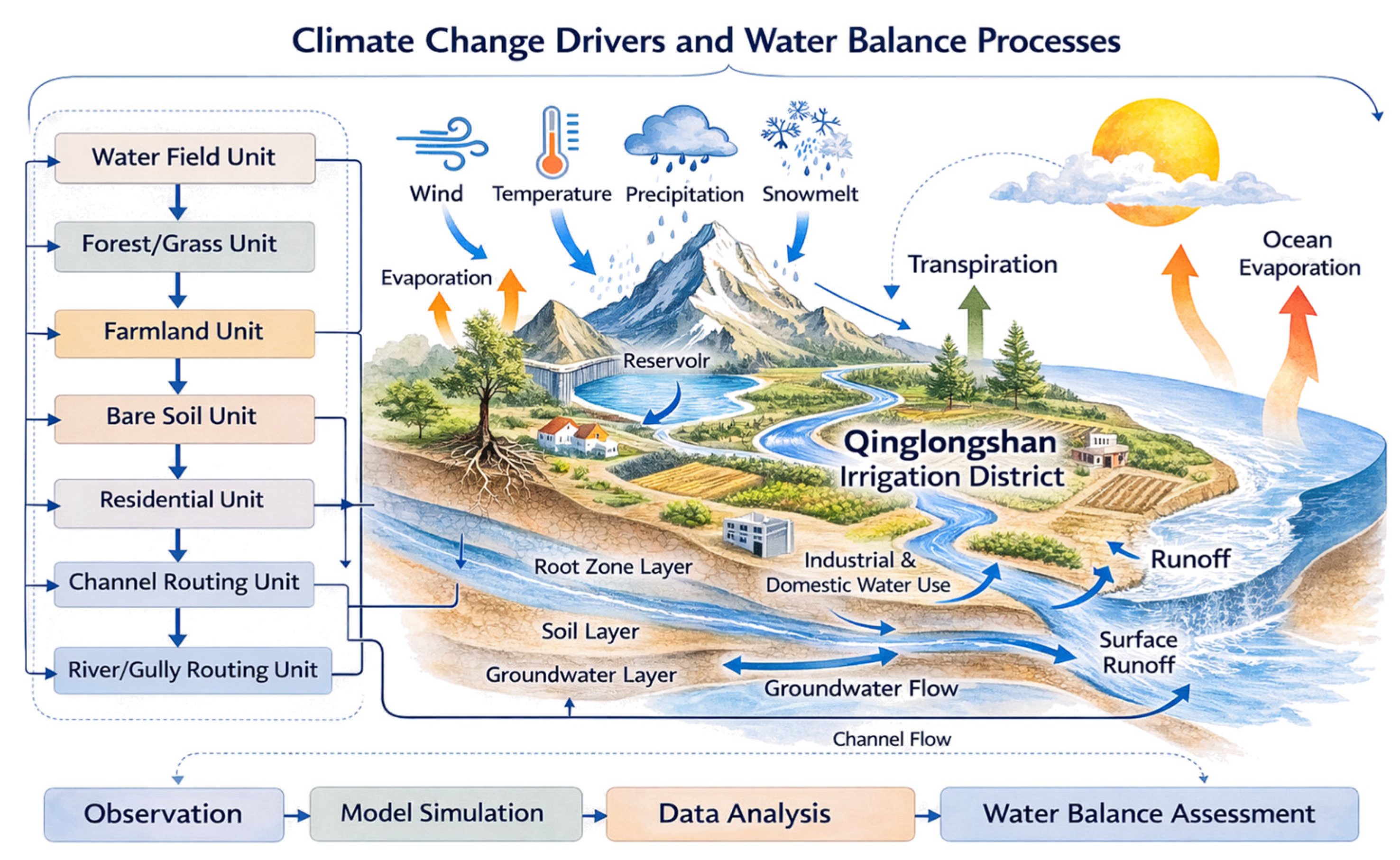
The model is horizontally partitioned into three categories of simulation units: the basic simulation unit, the channel water balance unit, and the channel/river water balance unit (Figure 4). The basic simulation unit is delineated by the spatial extent of the branch canal catchment area, further subdivided according to land use types (paddy field, dryland, forest and grassland, bare land, and residential area), soil texture, and hydrogeological parameters, with a corresponding water cycle sub-model constructed for each unit [22,23]. The vertical structure, exemplified by the paddy field unit, comprises four functional layers from top to bottom: the surface water layer, the root zone, the soil conductive layer (encompassing the pulverized clay loam layer and the gravelly coarse sand layer), and the groundwater aquifer [24,25]. Hydraulic linkages between simulation units are established through surface runoff transport via drainage channels and lateral groundwater recharge, thereby achieving spatial coupling of irrigation district-scale water transformation processes [26].

2.5.2. Model Governing Equations

In addition to the surface water layer balance (Equation (1)), the root zone, the silty loam layer, and—when the groundwater table lies below their combined thickness—the gravelly coarse sand layer each satisfy an independent daily water balance. These equations are presented in the main text here as they are central to model reproducibility (Figure 5).
The daily water balance equation for the surface water layer is formulated as [27],
S P ( t ) = S P ( t 1 ) + P ( t ) + I R ( t ) E C ( t ) S ( t ) D R ( t )
where S P ( t ) denotes the surface ponding depth on day t (mm); P ( t ) is the precipitation on day t (mm); I R ( t ) is the irrigation volume on day t (mm); E C ( t ) is the potential evapotranspiration on day t (mm); S ( t ) is the infiltration volume on day t (mm); and D R ( t ) is the drainage volume on day t (mm). Crop evapotranspiration was estimated using the FAO-56 Penman–Monteith method [28,29] and computed using CROPWAT 8.0 software.
The water balance in the root zone primarily considers infiltration from the surface water layer, crop transpiration, leaching, and capillary rise:
w 1 ( t ) = w 1 ( t 1 ) + S ( t ) T c ( t ) S 1 ( t ) + C a ( t )
where w 1 ( t ) and w 1 ( t 1 ) are the root zone moisture content on day t and day t − 1, respectively (mm); S 1 ( t ) is root zone seepage on day t (mm); and C a ( t ) is capillary rise on day t (mm).
For the silty loam layer, the water balance accounts for seepage from the root zone and lateral recharge from branch canals, main canals, tributaries, main channels, and the river:
w 2 ( t ) = w 2 ( t 1 ) + S 1 ( t ) + w g B ( t ) + w g M ( t ) + w g V ( t ) + w g D ( t ) + w g R ( t ) S 2 ( t )
where w 2 ( t ) is the moisture content of the silty loam layer on day t (mm); w g B ( t ) , w g M ( t ) , w g V ( t ) , w g D ( t ) , and w g R ( t ) are the seepage volumes from branch canals, main canals, tributaries, main channels, and the river, respectively (mm); and S 2 ( t ) is the leakage rate of the silty loam layer (mm).
When the groundwater table lies below the combined thickness of the root zone and the silty loam layer, a gravelly coarse sand layer is additionally considered:
w 3 ( t ) = w 3 ( t 1 ) + S 2 ( t ) S 3 ( t ) + W Q S ( t )
where w 3 ( t ) and w 3 ( t 1 ) are the moisture content of the gravelly coarse sand layer on day t and day t − 1, respectively (mm); S 3 ( t ) is the leakage volume of the gravelly coarse sand layer on day t (mm); and W Q S ( t ) is the latent evaporation on day t (mm). The complete derivation of each flux term is retained in Supplementary Materials S1.
The groundwater aquifer was simulated using the water balance approach [30], with aquifer thickness set to 100 m in accordance with local hydrogeological conditions and a zero-flux lower boundary condition. The water balance formulation integrates seepage recharge from the soil profile, lateral groundwater exchange between basic simulation units, dynamic exchange between groundwater and ditches/channels, phreatic evapotranspiration [31], and groundwater extraction.
Δ S W ( t ) = S W ( t ) + V g ( t ) + D g ( t ) + R g ( t ) + W lateral   f l o w ( t ) W Q S ( t ) W p ( t )
In the formula, Δ S W ( t ) represents the change in groundwater level for the basic simulation unit on day t, m3; S W ( t ) represents the seepage recharge in the soil profile on day t, in m3; V g ( t ) , D g ( t ) , R g ( t ) represents the exchange volume between the tributary, the main channel, and the river and groundwater on day t, in m3; W lateral   f l o w ( t ) is the lateral groundwater flow rate for the base simulation unit on day t, in m3; W Q S ( t ) represents the latent evaporation on day t, in m3; W p ( t ) represents the groundwater withdrawal volume on day t, in m3. The daily groundwater extraction volume is represented in m3.
The SWBM rests on three principal assumptions: (i) each basic simulation unit is internally homogeneous in soil hydraulic properties and crop stage, with sub-unit heterogeneity represented by unit-averaged effective parameters; (ii) vertical soil–water exchange follows a one-dimensional formulation with empirically fitted infiltration functions; and (iii) canal seepage and return-flow reuse are represented by calibrated, time-invariant coefficients. The forcing boundary consists of daily precipitation, FAO-56 ET0, and prescribed irrigation at the surface; the lateral boundary of the district is delimited by the Bela River (north) and the surface-water divides (south); and the lower groundwater boundary is the zero-flux surface at 100 m depth already specified in Section 2.5.2. Regarding transferability, the structural framework—particularly the closed-loop return-flow and the groundwater–channel exchange modules—is generic and can, in principle, be applied to any irrigation district where return-flow compensation operates; however, the calibrated parameter values are specific to cold-region, groundwater-dependent paddy systems of the Sanjiang Plain, and application to warmer, double-cropping, or surface-water-dominated districts would require local recalibration of soil hydraulic parameters, seepage coefficients, and CH4 baseline emission factors.

2.6. Scenario Development

The field trials in this study comprised nine treatments (CI1–CI4, FMCI, FMCG, SACI, SACG, CK). With the exception of the conventional flood irrigation control (CK), the treatments differed in soil amendment application and mulching methods; however, all treatments could be classified into one of two principal irrigation regimes: “controlled water-saving irrigation” or “conventional irrigation.” The scenario construction strategy proceeded as follows: seven base scenarios exhibiting representative differences in soil–crop parameters were selected from the nine treatments (encompassing various combinations of soil amendment and mulching management). Employing each base scenario as a foundation, three irrigation water regulation modes (conventional irrigation CK, alternate wetting and drying AWD, and controlled irrigation CI) were superimposed to yield 7 × 3 = 21 sub-scenarios. This design is intended to capture the heterogeneity of soil-management conditions prevailing within the irrigation district through the seven base scenarios, thereby enhancing the regional representativeness of the scenario outputs; simultaneously, through systematic comparison of the three irrigation modes, it isolates the independent contributions of irrigation water regulation strategies to carbon–water co-benefits under identical soil-management conditions. The seven base scenarios were selected to capture the dominant soil-management combinations prevailing within the Qinglongshan Irrigation District, encompassing unmulched, plastic-mulched, and soil-amended paddy treatments across the five major soil categories of the district (dark-brown, white-calcareous, black, meadow, and peat soils). Calibrated hydraulic parameters for each base scenario (field water-holding capacity, saturated water content, permeability coefficient, water supply rate, and the associated water-level control rules) are summarized in Supplementary Table S1. A comprehensive spatially explicit mapping of each soil group’s areal share to the corresponding base-scenario weighting has not been compiled in the present study and is identified as a priority for follow-up work (see Section 4.5). Each sub-scenario simulates distinct management conditions by adjusting key model parameters, including field moisture content ( θ f c ), saturated water content ( θ s ), restricted permeability coefficient ( k 1 , k 2 ), infiltration fitting parameters (a, b), water supply rate ( μ 1 , μ 2 ), permeability coefficient ( K h / K v ), water level control rules (upper and lower limits and irrigation activation thresholds), drainage reuse rates, and channel water utilization coefficients; for specific values, please refer to Table S1 in the Supplementary Materials.

2.7. Framework for Analyzing Carbon–Water Synergies

The carbon–water co-benefit analysis framework developed in this study encompasses two independent carbon emission reduction accounting pathways, corresponding to irrigation energy savings and paddy field methane mitigation, respectively. Together, these pathways constitute a comprehensive system for quantifying emission reduction benefits under non-permanently flooded management scenarios.
(1)
Pathway for reducing irrigation energy consumption.
Carbon emission reductions attributable to irrigation energy consumption were calculated based on the simulation outputs of the SWBM scenarios. Employing the continuous flood irrigation (CK) scenario as the baseline, the simulated irrigation water consumption for each water-saving irrigation scenario was compared against the baseline value to determine the water-saving rate and absolute water savings. In well-irrigated areas, the reduction in irrigation water use corresponds to a proportional decrease in power consumption at pumping stations. On this basis, water savings were converted into electricity savings, which were subsequently translated into corresponding carbon emission reductions using regional power grid carbon emission factors [32,33].
Δ C i r r = C ¯ i r r × r w
In the formula, Δ C i r r represents carbon emissions savings from irrigation (kg CO2 hm−2); C ¯ i r r represents the average baseline for carbon emissions from irrigation energy consumption (109.93 kg CO2 hm−2); rw represents the water savings rate (%).
(2)
Pathway for CH4 emission reductions in rice paddies.
AWD and CI substantially suppressed the anaerobic production of CH4 by prolonging the duration of drying periods and enhancing soil aeration. This study applied the CH4 emission reduction coefficients measured in field experiments (46.30% for AWD and 45.25% for CI) to the baseline CH4 emission values for the study area to compute emission reductions under each scenario [4,13].
Δ C C H 4 = C ¯ C H 4 × α
In the formula, Δ C C H 4 represents CH4 emission reductions (kg CO2eq·hm−2); C C H 4 , b a s e represents the average CH4 emission baseline during the study period (3113.89 kg CO2eq·hm−2); r C H 4 represents the CH4 emission reduction factors for each irrigation regime, with 46.30% for AWD and 45.25% for CI. The emission reduction factors described above were derived by calibrating the daily CH4 flux data measured in the field experiments of this study with the daily water column dynamics simulated by the SWBM model: Using the mean flux during the growing season under continuous flood irrigation (CK) as the emission baseline, the emission reduction rate was calculated as the treatment-specific average of the observed flux reduction during the dry periods of the AWD and CI treatments.
The above season-averaged coefficients are the integrated expression of a daily coupling in which the SWBM surface-water depth and drying duration drive CH4 flux. At each daily time step t, the CH4 emission flux F C H 4 ( t ) (unit: kg CO2eq hm−2 d−1) is computed from SWBM outputs as:
F C H 4 ( t ) = F 0 × 1 α × I d r a i n ( t ) × f T ( T s ( t ) )
where F0 is the baseline daily CH4 flux under continuous flooding, derived from the 2024–2025 static-chamber measurements of the CK treatment; α is the empirically calibrated CH4 suppression coefficient (α = 0.4630 for AWD and 0.4525 for CI); I d r a i n ( t ) is a binary indicator function determined by the SWBM-simulated surface-water depth h(t) and the cumulative drying duration τ(t), taking the value 1 when h(t) ≤ 0 and τ(t) ≥ 3 d (and 0 otherwise); and f T ( T s o i l ( t ) ) is a dimensionless temperature-response function of the form f T ( T s o i l ( t ) ) = Q 10 ( ( T s o i l ( t ) ) T r e f ) / 10 , with Q10 = 2.0 and T r e f = 20 °C, where T s o i l ( t ) (°C) is the SWBM-simulated topsoil temperature. Seasonal CH4 emissions under each of the 21 scenarios are obtained by integrating Equation (9) over t = 1 … 134 d, and the mean-season coefficients (46.30% for AWD and 45.25% for CI) reported in Equation (8) are the time-integrated equivalents of Equation (9) averaged across the 21 scenarios.
The compensatory enhancement of N2O emissions under water-saving irrigation conditions (measured increase of approximately 8–12%, corresponding to approximately 35–48 kg CO2eq hm−2) was incorporated into the global warming potential (GWP) calculation using the IPCC AR6 (2021) 100-year non-feedback coefficients ( G W P C H 4 = 27.9; G W P N 2 O = 273), and the resulting net comprehensive emission reduction coefficient was adopted. The low mean annual temperature in the cold-climate japonica rice region (2.2 °C) suppresses baseline methanogenic activity, resulting in CH4 emission reference values (3113.89 kg CO2eq hm−2) that are systematically lower than those in double-cropping rice regions of South China (5000–8000 kg CO2eq hm−2); however, the relative suppression of anaerobic metabolism falls within the same range as reported for warmer regions, indicating that temperature conditions primarily govern the absolute magnitude of emissions rather than the regulatory efficacy of water-saving irrigation on emission reduction rates [4].

2.8. Framework for Calculating the Full-Life-Cycle Water Footprint

(1) Blue Water Footprint
To enable cross-scale comparability analysis between the simulation outputs of the irrigation district model and historical statistical data at the provincial level, this study uniformly calculates the blue water footprint using gross irrigation water consumption as the metric ( W F b l u e ). The net irrigation water volume ( I n e t ) output by SWBM is converted to gross irrigation water volume ( η ) using the irrigation water use coefficient ( I g r o s s ), and the blue water footprint is then calculated based on yield per unit area [15,16]. The calculation formula is as follows:
W F b l u e = 10 ( E T b l u e + P L ) Y
I R = E T b l u e + P L
E T b l u e = max ( 0 , E T c P e f f )
E T C = E T 0 × K C
W F b l u e 1 = I g r o s s / Y = η × W F b l u e 2
In the formula, W F b l u e represents the blue water footprint (m3 t−1); I g r o s s represents the irrigation rate (m3 hm−2); Y represents rice yield (t hm−2); η = 0.55 is the statistical mean value of effective utilization coefficient of irrigation water in Heilongjiang Province from 2015 to 2020 (Source: Irrigation Water Quota and Statistical Yearbook of Heilongjiang Province). The use of fixed values in a 35-year time series introduces a η systematic bias, especially in the 1986–early 2000s, when the actual η may be well below 0.55. To assess this bias, a two-level sensitivity analysis was conducted in this study: (1) when η varied in the range 0.50–0.60 (±9%), WFblue varied by ±9.8% accordingly, but the relative ranking among the three irrigation models and the historical trend conclusions remained stable, and (2) the analysis of the phased η scenario (Table S2), provided in the Supplementary Material, dividing the 35-year time series into four phases and assigning different η estimates, showed that, after the introduction of the time-varying η the absolute value of WFblue for the 1986–2005 period may be underestimated by 10–38% by the baseline scenario, but neither the direction of the downward trend nor the core conclusions are affected. Regarding the systematic bias introduced by the variation of η over time in the 35-year trend analysis at the provincial level, a staged time-varying η correction was further applied in which η was reassigned to 0.42 (1986–1995), 0.48 (1996–2005), 0.52 (2006–2015), and 0.55 (2016–2020), based on the decadal values reported in the Heilongjiang Water Resources Bulletin and the national Effective Utilization Coefficient of Irrigation Water assessment database. Under this time-varying scheme, the 1986–2005 WFblue estimates are revised upward by 10–38%; however, the direction of the declining trend, the relative ranking of CK > CI > AWD, and the core attribution conclusions remain unchanged. Future studies should nevertheless prioritize the use of annual resolution η data once such records become systematically available, so as to fully eliminate this residual bias. E T C represents crop evapotranspiration (mm), It is calculated as the product of E T 0 and K c ; P e f f represents effective precipitation; 10 is the conversion factor.
(2) Green Water Footprint
Green Water Footprint ( W F g r e e n ) calculates the amount of natural precipitation consumed during crop growth and reflects the extent to which agricultural production relies on rainwater resources stored in the soil [34]. Compared to the blue water footprint, the green water footprint has long been overlooked in assessments of water scarcity. However, in the cold-climate rice-growing regions of Northeast China, the contribution of growing-season precipitation to crop transpiration cannot be ignored; incorporating it into a comprehensive water accounting framework is crucial for objectively evaluating the overall water benefits of irrigation management measures [35]. The calculation formula is as follows:
W F g r e e n = 10 E T g r e e n Y
E T g r e e n = m i n ( E T C , P e f f )
In the formula, W F g r e e n represents crop evapotranspiration (mm). Take the smaller of the crop water requirement ( E T C ) and the effective precipitation ( P e f f ).
(3) Calculation of crop water requirements
Reference crop evapotranspiration (ET0) was calculated using the FAO-56 Penman–Monteith method, which comprehensively accounts for meteorological drivers such as net radiation, air temperature, wind speed, and air humidity. This method is the international standard for estimating ET0 in agricultural hydrology and has been extensively validated in the cold-climate rice-growing regions of Northeast China [36]. The calculation formula is as follows:
E T 0 = 0.408 Δ ( R n G ) + γ 900 T + 273 u 2 ( e s e a ) Δ + γ ( 1 + 0.34 u 2 )
In the formula, E T 0 represents the evapotranspiration of the reference crop (mm d−1); R n is the net radiation on the crop surface (MJ m−2 d−1);G is the soil heat flux (MJ m−2 d−1); γ is the hygrometer constant (kPa °C−1); T is the daily average temperature at a height of 2 m (°C); u 2 is the wind speed at a height of 2 m (m/s); e s is the saturated vapor pressure (kPa); e a is the actual vapor pressure (kPa); Δ is the slope of the saturated vapor pressure–temperature curve (kPa °C−1).
(4) Greywater Footprint
The grey water footprint ( W F g r e y ) quantifies the water dilution required due to chemical inputs in agricultural production and reflects the extent to which agricultural non-point source pollution occupies the water environment’s carrying capacity [37]. This study uses nitrogen as an indicator pollutant for calculation, which aligns with the actual situation in the cold-climate rice-growing regions of Northeast China, where chemical nitrogen fertilizers are the primary source of non-point source pollution. The standard dilution model was used for the calculations [38]. The calculation formula is as follows:
W F g r e y = ( α × A R ) / ( C max C n a t ) Y
In the formula, α is the leaching-runoff coefficient; AR is the nitrogen application rate per unit area (kg hm−2); C max and C n a t represents the environmental standard limit and the natural background concentration (mg L−1) for nitrogen in water. Provincial parameters were obtained annually from the Heilongjiang Statistical Yearbook, enabling station-by-station, year-by-year calculations for 23 time points between 1986 and 2020 across 13 prefecture-level cities. It should be noted that the green water footprint is determined by meteorological conditions during the growing season, while the gray water footprint is determined by regional fertilization levels; neither varies with changes in irrigation management practices. Therefore, differences in the total water footprint across different irrigation scenarios stem entirely from changes in the blue water component. This structural characteristic provides a clear basis for attributing the water-saving benefits of subsequent irrigation management.

2.9. Monte Carlo Uncertainty Analysis

The provincial extrapolation does not presume spatial homogeneity across Heilongjiang Province. Prior to the Monte Carlo sampling, the province was stratified into three hydro-agricultural zones reflecting the principal gradients in climate, soil, and irrigation-water source: (i) the Sanjiang Plain zone—groundwater-dependent paddy systems on dark-brown and meadow soils—to which the Qinglongshan calibration applies directly; (ii) the Songnen Plain zone—mixed surface- and groundwater-fed systems on black and meadow soils; and (iii) the Mudanjiang–Muling zone—surface-water-dominated systems on dark-brown and paddy soils. Zone-specific mean annual temperatures and zone-specific irrigation lift heights (obtained from the Heilongjiang Water Resources Bulletin, 2020–2023) were applied to rescale the CH4 emission baseline and the irrigation-energy baseline, respectively. The Monte Carlo framework described below integrates the three strata by drawing samples from zone-specific probability distributions and area-weighting them using zone-specific rice-cultivation areas to yield the provincial 95% confidence interval. Systematic biases that may arise from extrapolating Qinglongshan-calibrated soil-hydraulic parameters to zones (ii) and (iii) are acknowledged as a scope-of-transferability limitation in Section 4.5.
CH4 emission reduction factors exhibit significant spatial heterogeneity across rice-growing regions with varying soil organic matter content, texture, groundwater depth, and accumulated temperature; consequently, the spatial extrapolation of the province’s carbon emission reduction potential is systematically affected by uncertainties in multiple key parameters. To address this, a Monte Carlo simulation framework was developed to perform 10,000 independent random samples of five key input parameters, generating a probability distribution of carbon emission reductions per unit area, which was then extrapolated to the provincial scale [39].
The distribution parameters were set based on field measurements from this study and SWBM simulation outputs (Table 2): The CH4 emission reduction factor follows a triangular distribution, with the measured value as the mode; the lower limit is based on the lowest reported values from warm regions, and the upper limit is based on the highest observed values from similar rice-growing areas in Northeast China [13]. Emissions benchmarks follow a normal distribution, with the observed mean serving as the expected value and the standard deviation reflecting interannual variability across the two seasons; water savings rates follow a uniform distribution to cover the simulation ranges of the 21 scenarios [40].
We assume independence among the input parameters in the Monte Carlo framework. In organic-rich soils, the CH4 emission factor and the baseline could in principle be correlated. We tested this with the 12 treatment-season observations and obtained a Pearson r = 0.19 (p = 0.47; 95% bootstrap CI [−0.35, 0.58], 10,000 iterations).
With only n = 12, this test has limited statistical power (0.15 to detect r = 0.30 at α = 0.05). The non-significant result is therefore not positive evidence of independence. We retain the independence assumption as a working hypothesis on mechanistic grounds. Cold-temperature suppression of methanogenesis governs the baseline emission level. Drying-induced redox switching governs the abatement efficiency. These two pathways are regulated independently and are not expected to co-vary at the inter-treatment scale.
The Sobol variance decomposition in Section 3 (Table 3) supports this view: the abatement factor and the baseline contribute 72% and 18% of output variance, respectively, with non-overlapping shares. A definitive test will require a multi-station network (≥ 5 sites) with ≥ 40 paired observations, as noted in Section 4.5.
The simulation results are presented as medians and 95% confidence intervals, and the Sobol first-order sensitivity index is used to identify the relative contributions of each parameter to the uncertainty in the output. Using the average rice cultivation area in Heilongjiang Province from 2015 to 2020 (approximately 3.86 million hectares) as a baseline, the probability distribution of carbon emissions reductions per unit area is extrapolated to provide a confidence interval estimate of the province-wide reduction potential.

2.10. LMDI Attribution Decomposition Method

To quantitatively identify the driving factors behind the difference between the blue water footprint (AWD scenario: 721 m3 t−1) simulated for the irrigation district and the 2020 statistical mean for Heilongjiang Province (4205 m3 t−1), the Logarithmic Mean Divisia Index (LMDI) was employed to perform a multifactor attribution analysis [41]. Decompose the absolute difference between the two into three driving factors (Equation (19)):
W F b l u e = ( I n e t / η ) × 10 / Y = ( irrigation   regime ,   yield   level ,   water   conveyance   and   distribution   efficiency )
Irrigation system factors (the difference in net water use between water-saving irrigation and conventional flood irrigation), yield factors (the diluting effect on the blue water footprint resulting from the difference between the measured yield of 9.63 t hm−2 in the irrigation district and the provincial average of approximately 7.8 t hm−2), and water conveyance and distribution efficiency factors (the efficiency gap between the simulated irrigation water use coefficient in the irrigation district and the values reported at the provincial level).
LMDI possesses excellent properties such as complete decomposition (no residuals), path-independence, and the ability to handle zero values, and has been widely applied in agricultural water resource-driven analysis [42,43]. It should be noted that there are fundamental differences between irrigation district simulation values and provincial-level statistical values in terms of spatial representativeness, measurement standards, and data accuracy. While LMDI decomposition can systematically isolate the contributions of driving factors, it cannot completely eliminate attribution biases introduced by data heterogeneity. Therefore, the decomposition results (indicating that irrigation systems account for 60–65%) should be interpreted as an order-of-magnitude estimate of the driving structure rather than a precise quantitative attribution and should be understood within a margin of uncertainty of ±10%. The decomposition results for each factor are accompanied by 95% confidence intervals derived from bootstrap resampling to quantify the uncertainty in attribution [44].

2.11. Metrics for Evaluating Model Accuracy

The accuracy of the model simulations was comprehensively evaluated using the Nash–Sutcliffe Efficiency (NSE), the coefficient of determination (R2), the root mean square error (RMSE), and the ratio of the root mean square error to the standard deviation of the observations (RSR) [45]. These metrics characterize the model’s ability to reproduce the measured process in terms of simulation efficiency, linear correlation, and error magnitude, respectively [46]. The formulas for each indicator are as follows:
N S E = 1 ( O i S i ) 2 ( O i O ¯ ) 2
R 2 = ( O i O ¯ ) ( S i S ¯ ) 2 ( O i O ¯ ) 2 × ( S i S ¯ ) 2
R M S E = 1 n ( O i S i ) 2
R S R = R M S E S T D o b s
In the formula, O i and S i denote the measured and simulated values at the i-th time step, respectively; O ¯ and S ¯ represent the means of the test sequence and the simulated sequence, respectively; n is the total number of samples included in the evaluation; S T D o b s is the standard deviation of the sequence of measured values. According to the classification criteria for hydrological model accuracy, when NSE > 0.75 and RSR ≤ 0.50, the model simulation performance is rated as “Very Good”; when R2 > 0.85, the linear fit between simulated and observed values is rated as “Excellent.” This study uses the above criteria as the basis for determining the acceptability of the model calibration and validation results [47].

3. Results

3.1. Sensitivity Analysis of Model Parameters

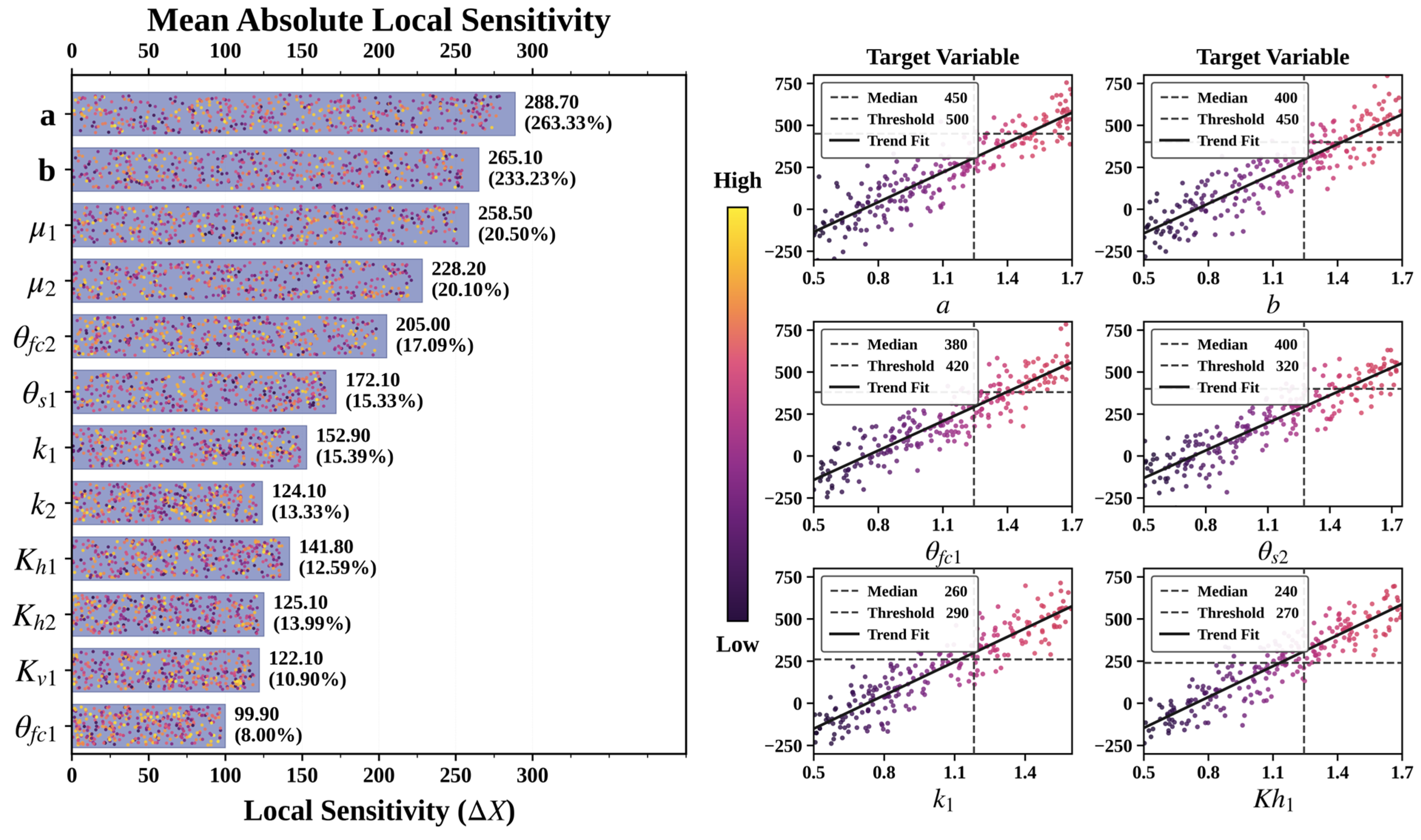
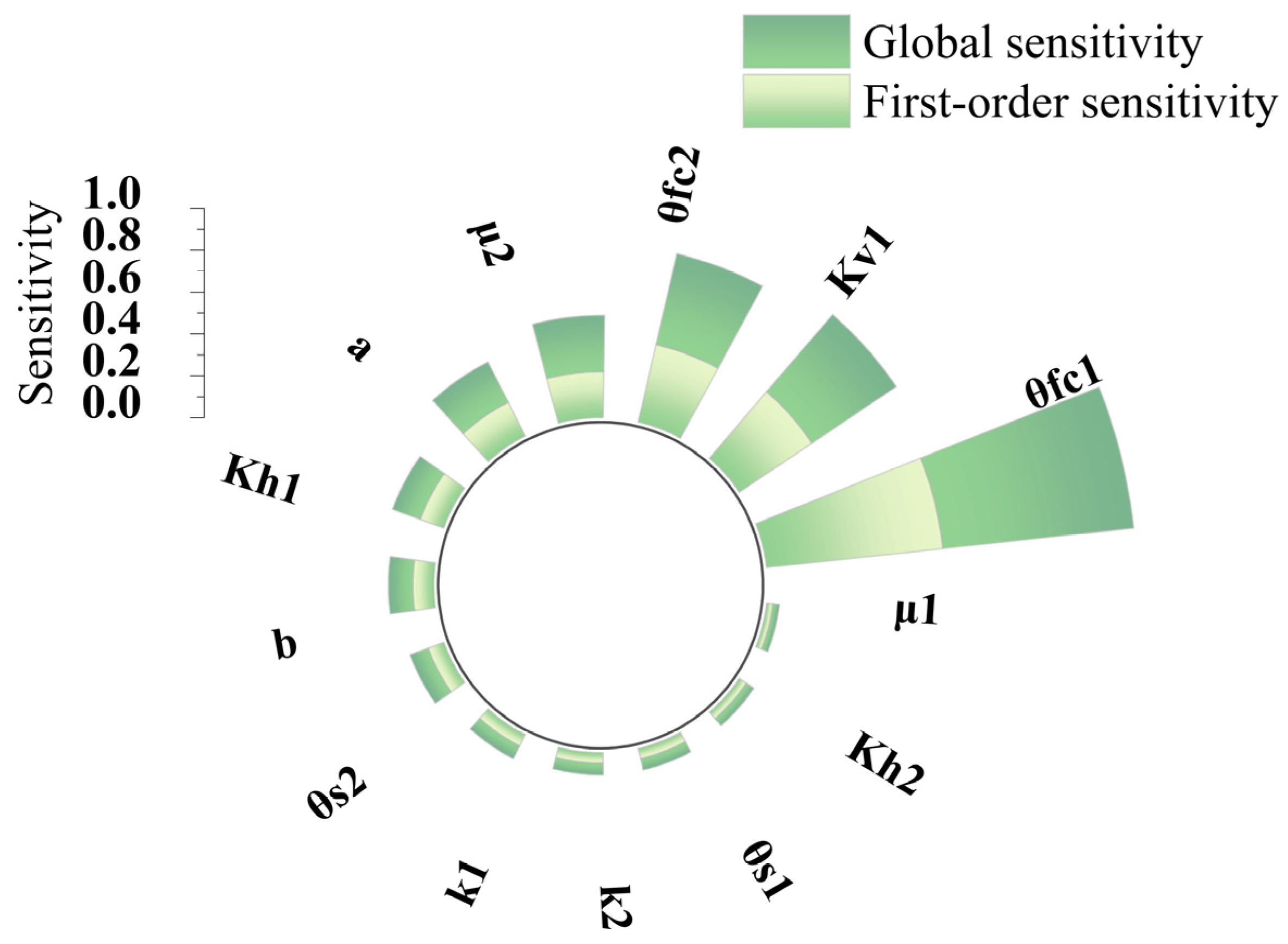
Local and global sensitivity analyses of 13 key hydrological parameters were conducted using the one-at-a-time (OAT) perturbation method and the extended Fourier amplitude sensitivity test (EFAST) [48,49]. The parameter prioritization exhibited remarkable consistency between the two methods (Figure 6): the three most influential parameters were field water-holding capacity ( θ f c 1 , S 1 = 85.0%, S T = 92.0%), topsoil vertical infiltration coefficient ( K V 1 , S 1 = 42.0%), and deep field water-holding capacity ( θ f c 2 , S 1 = 38.0%), with the cumulative first-order sensitivity indices exceeding 165%, indicating a pronounced dependence of model outputs on soil hydraulic parameters. The local analysis further revealed a threshold effect on the infiltration parameter a (+10% perturbation diminished the output by approximately 18%) and a significant asymmetric response of the shallow recharge coefficient μ1 (−10% perturbation attenuated the output by 20%, whereas +10% perturbation augmented it by merely 5%) (Figure 7).

3.2. Model Calibration and Validation

The calibration was performed for the 2025 growing season (April 14–August 26), during which the cumulative effective rainfall was 122.0 mm (16 rainy days), the cumulative irrigation volume was 272.2 mm (7 irrigation events), and the irrigation schedule aligned with the crop water demand pattern of rice at each phenological stage.
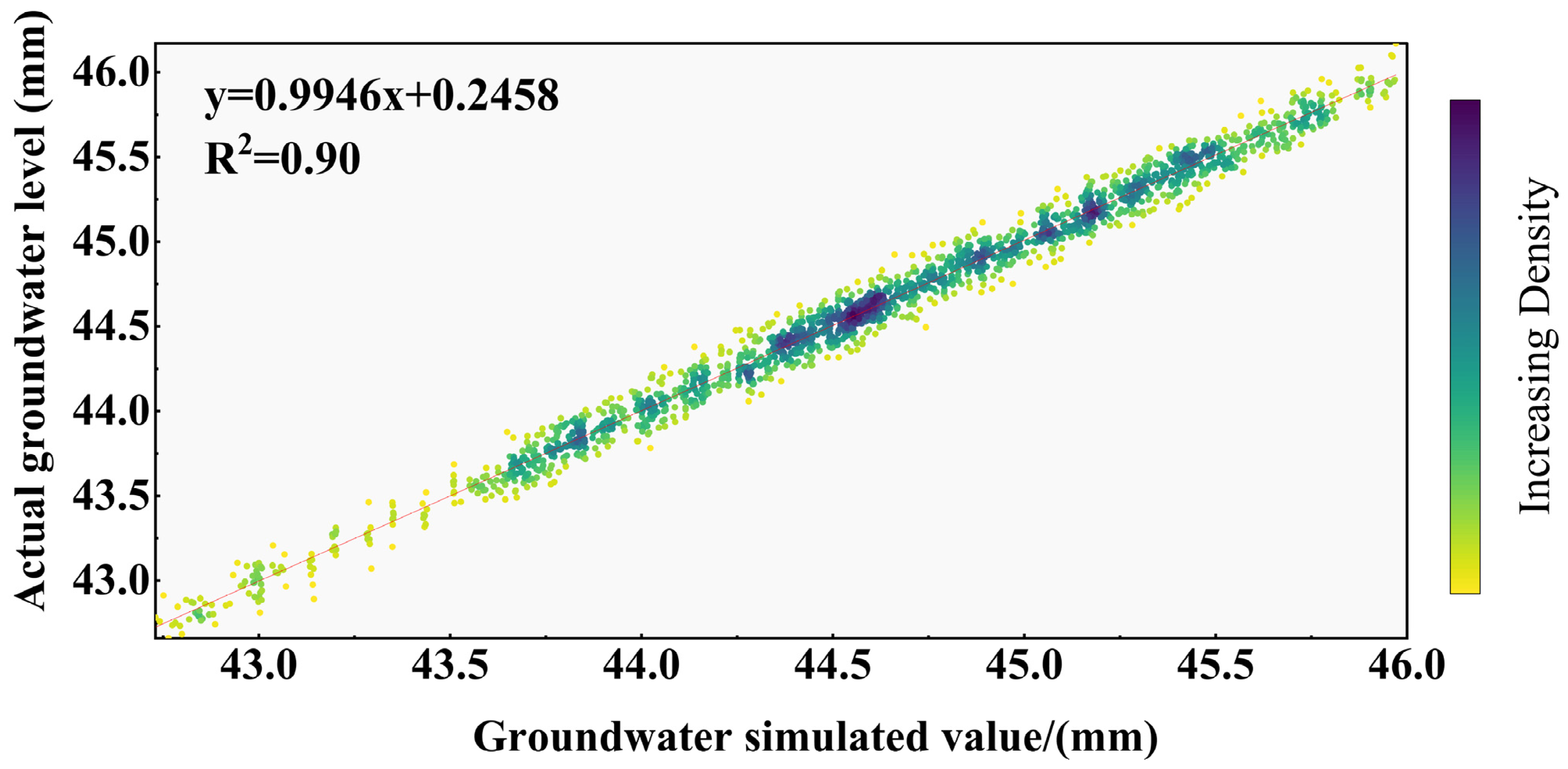
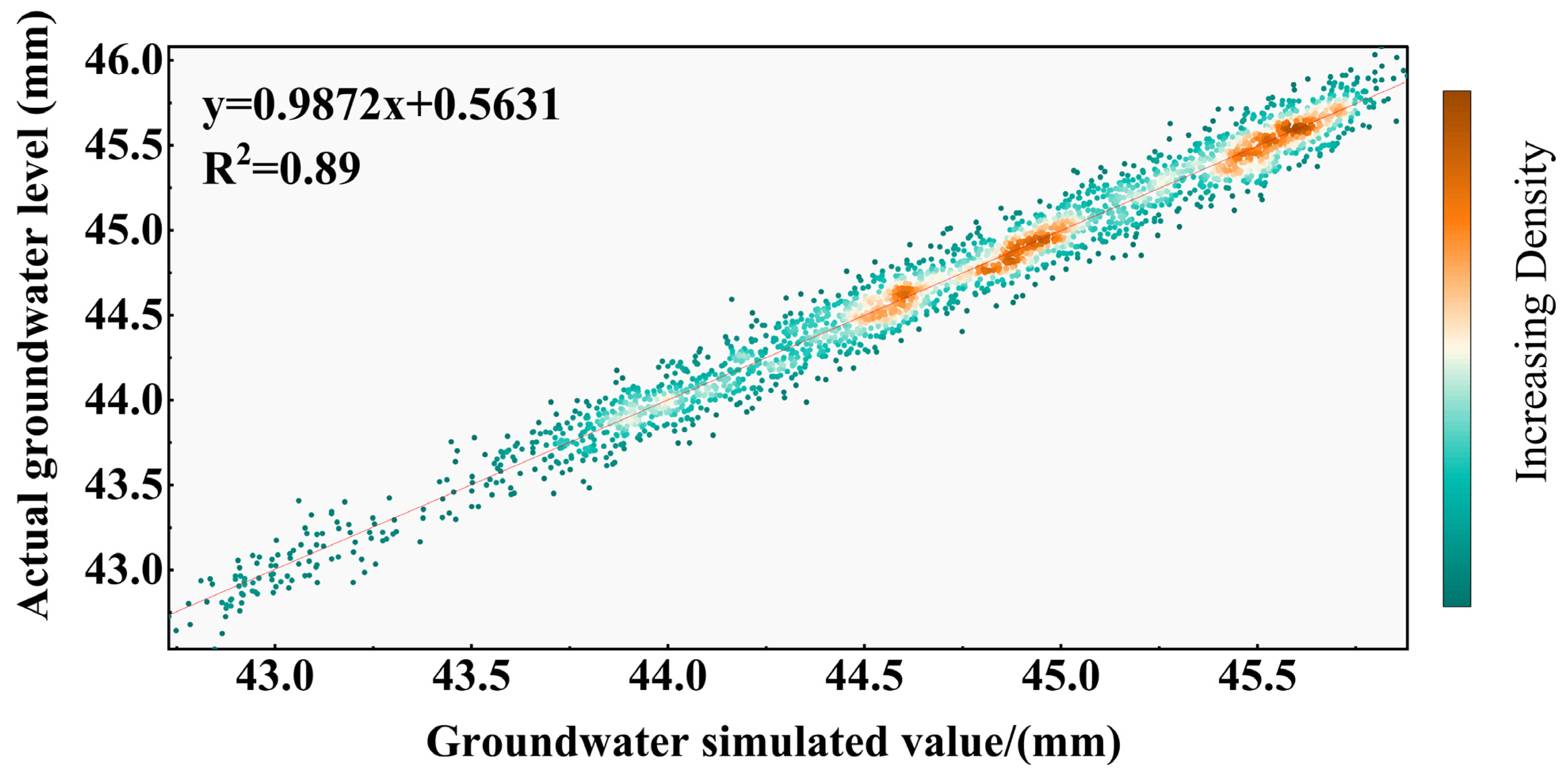
Groundwater level simulations, evaluated through daily-scale simulation-observation comparisons and kernel density distribution validation across 14 observation wells (Figure 8; representative individual-well comparisons are shown in Supplementary Figure S1), demonstrated that the model accurately reproduced three characteristic response phases: rapid water table decline driven by intensive pumping during the land-soaking period, water table stabilization under regular recharge in the mid-season period, and water table rebound triggered by heavy precipitation in late July.
River cross-section discharge simulations at three hydrological sections (B-1, B-2, and B-3) of the Bela River (Supplementary Figure S2) exhibited strong coupling with the agricultural water use cycle: discharge was driven by soaking-field drainage in late April, declined to a seasonal minimum during the irrigation storage period in mid- to late-May, responded to saturated drainage triggered by heavy precipitation in early June, fluctuated at low levels with intermittent rainfall in mid-July, was augmented by heavy precipitation in early August, and exhibited a secondary peak associated with mid-season drying drainage in mid- to late-August. The complete reproduction of these seasonal irrigation–drainage–runoff dynamics confirms that the model possesses robust capability to physically characterize the coupled hydrological processes within the irrigation district.
During the independent validation period, long-term groundwater level data from January 2020 to April 2025 were employed for temporal extrapolation validation, entirely independent of the calibration period (well-by-well simulation–observation comparisons during the validation period are provided in Supplementary Figure S3). Water levels in each well showed regular intra-annual cycle fluctuations during the validation period: water levels decreased by 0.5–1.0 m in April due to concentrated mining in the soakaway field, slowed down during the regular recharge period in May–June, and increased by 0.3–0.6 m during the flood season driven by infiltration of precipitation and lateral recharge from the trench, and then increased by 0.3–0.6 m from October to April in permafrost, 0.6 m, and the water level slowly rebounded during the permafrost period from October to April. Spatially, water levels were lower (42.5–44.8 m) in near-river wells (HC series, HW-1) and higher (44.0–46.1 m) in far-river wells (QJ, CY series), reflecting spatial differentiation in discharge datum and aquifer thickness (Figure 9). In addition, the model was driven by field-measured data (day-by-day soil water content and irrigation for CI and CK treatments) under meteorological conditions in 2024 during the growing season, and the root zone water content was simulated with R2 = 0.86 and RMSE = 0.028 m3·m−3 which further validated the interannual migration stability of the parameters. The composite accuracy of each link is summarized in Table 4. All indicators met the “Very Good” criteria (NSE > 0.75, RSR ≤ 0.50), and the river cross section reached the “Excellent” grade, confirming that the accuracy of the model meets the requirements of the subsequent scenario analysis [47].

3.3. Effects of Irrigation Regimes on Multi-Scale Water Use Efficiency and Groundwater Dynamics

3.3.1. Irrigation Regime as the Primary Determinant of Water Use Efficiency

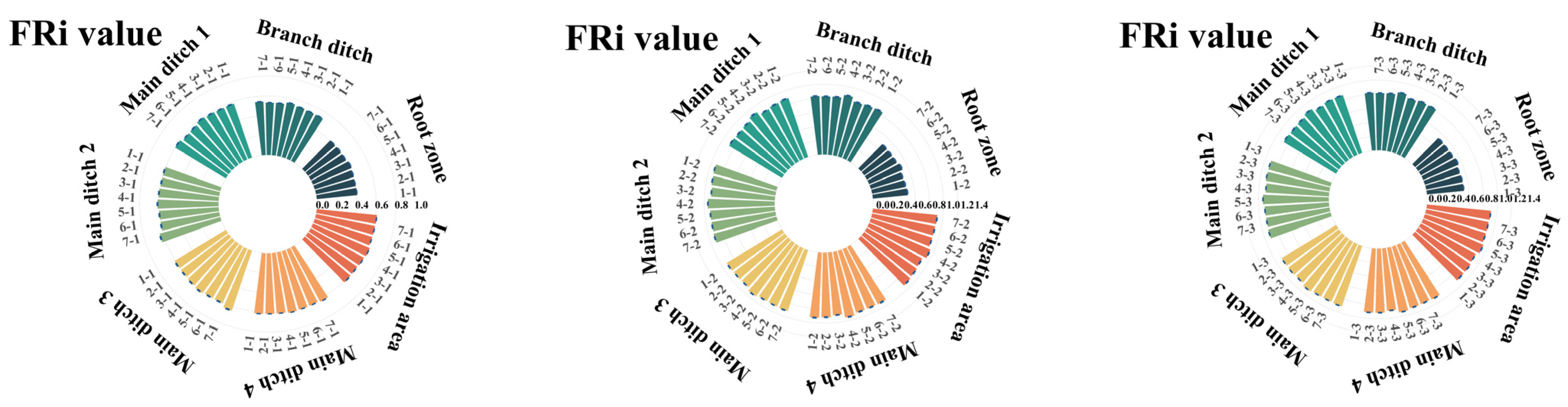
Under identical irrigation infrastructure conditions, the variation in canal water use coefficients among management scenarios was less than 2%, and the contribution of canal seepage and evapotranspiration losses to inter-scenario variability was negligible. In stark contrast, field-scale irrigation water use coefficients (FRi) varied by 47–55% among irrigation modes, while intra-mode variability remained below 3% (CV = 0.83% for CK)—a difference exceeding one order of magnitude. Measured upper ponding depth was 30–50 mm under AWD versus 80–100 mm under CK; the deep-percolation fraction per irrigation event was 15–25% under AWD versus 35–45% under CK. At the irrigation district scale, FRi improved from 0.610–0.627 under the CK scenario to 0.900–0.948 under AWD (47.5–55.3% improvement) and 0.893–0.932 under CI (42.5–51.4% improvement).

3.3.2. Scale-Dependent Convergence Characteristics of Water Use Efficiency

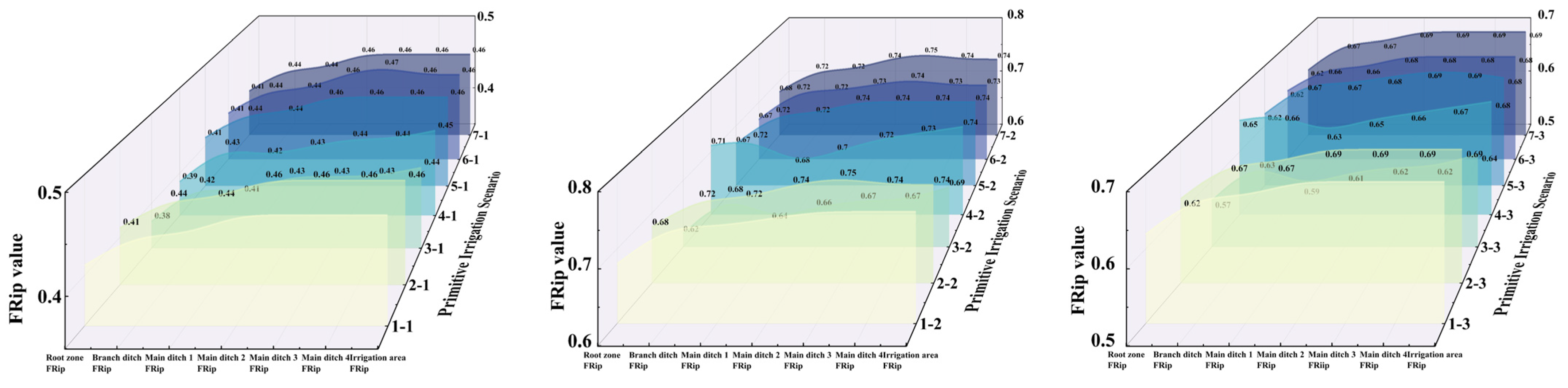
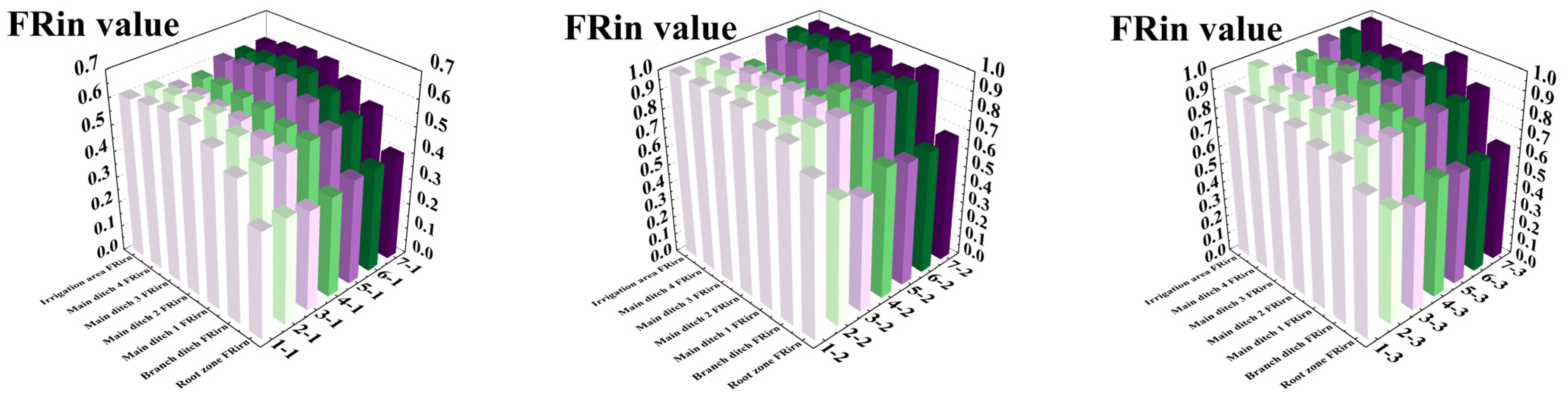
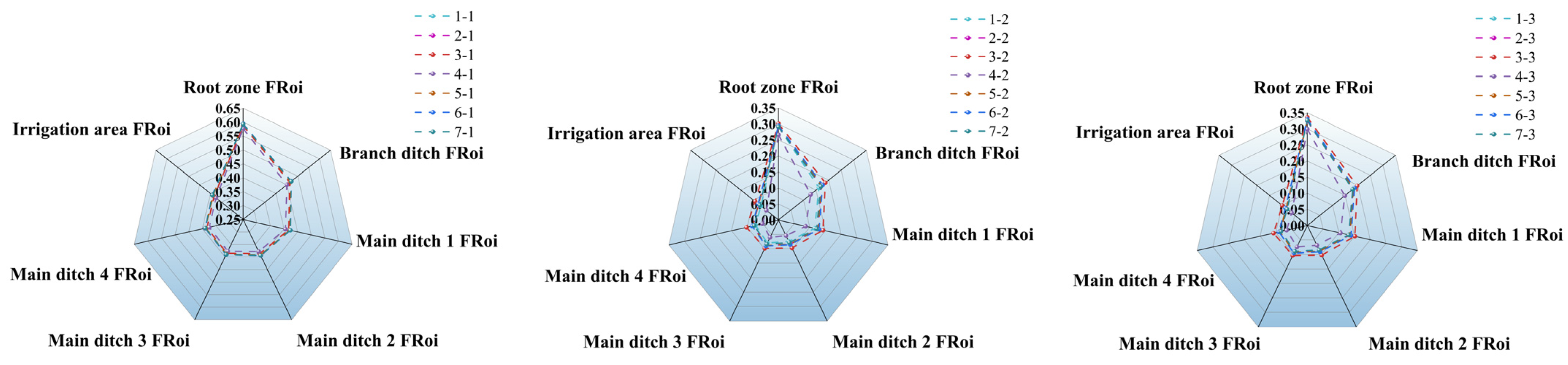
All three efficiency indicators (FRip, FRirn, and FRi) exhibited a monotonically increasing trajectory with spatial scale expansion from the root zone to the irrigation district, with the growth rate intensifying initially before reaching saturation (Figure 10 and Figure 11). Taking Scenario 1-1 as an illustrative case, FRip progressively increased from 0.408 at the root zone to a maximum of 0.465 at the dry canal 3 scale, representing a cumulative increase of 12.73%. The root zone-to-branch canal segment contributed 68% of the total increment (ΔFRip = 0.035), the dry canal 1-to-dry canal 2 segment contributed 30% (ΔFRip = 0.016), and the change at scales above dry canal 3 did not exceed 0.005, indicating that the benefits of return water reuse attain saturation at higher catchment scales.
At the irrigation district scale, the mean FRip values for CK, AWD, and CI were 0.454, 0.732, and 0.677, respectively. The FRip advantage of AWD over CK narrowed from 67.5% at the root-zone scale to 61.4% at the irrigation district scale. Under the CK regime, approximately 39–42% of net irrigation water was dissipated as return flow (irrigation district-scale FRirn = 0.609). Under AWD, FRirn increased sharply to 0.973 (mean value), with Scenarios 1-2 (0.9852) and 2-2 (0.9846) approaching the theoretical limit. The CI regime exhibited an intermediate mean FRirn of 0.954.

3.3.3. Return Water Reuse Efficiency and Groundwater Effects

The internal water cycling mechanism of the irrigation district induced significant convergence of field-level water savings when upscaled to the system level (Figure 12): apparent water savings under AWD converged from 50–60% at the field scale to 31.5–34.0% at the irrigation district scale, and those under CI converged from 40–50% to 30.9–32.9%. Assessments predicated solely on field-level metrics would systematically overestimate the water-saving potential by 40–45%.
Under CK, FRi increased by approximately 20% from the root zone to the irrigation district, with 68% of this increment concentrated in the root zone-to-branch canal segment. AWD reduced FRoi to 4.8–9.3% (80.6% lower than CK), and CI to 6.2–9.9% (78.6% lower than CK).
Modeling results indicate that return water uptake consistently accounts for 20–25% of the total water supply under all irrigation scenarios. CK had the highest absolute uptake but the lowest efficiency (34.0–35.1%); AWD had the highest efficiency (69.0–82.0%); and CI led in absolute uptake (23.7–24.6%) and was intermediate in efficiency (70.5–79.2%).
On the extraction side, AWD diminished irrigation withdrawals by approximately 33%. On the recharge side, approximately 38.7% of the water supply under CK conditions was discharged as return flow and partially recharged the aquifer, whereas FRoi declined to 0.075 under AWD, with a substantial reduction in indirect aquifer recharge. Integrating the effects at both extremes, net withdrawal reductions attributable to AWD amount to approximately 20–25% of total annual withdrawals—considerably below the magnitude implied by apparent field-scale water savings (Figure 13).

3.4. Multidimensional Assessment of Carbon–Water Synergies

3.4.1. Carbon Reduction Efficiency: Drying Frequency Rather than Irrigation Volume as the Governing Variable

Across the 21 sub-scenarios (Table 5), the mean water-saving rate differential between AWD and CI was approximately 6 percentage points (44.84% vs. 38.88%), whereas the total carbon emission reduction rate differential was merely 0.86 percentage points (32.76% vs. 31.90%). The CH4 reduction pathway contributed 96.6% of the total carbon emission reduction, whereas the irrigation energy consumption reduction pathway accounted for only 3.4%. The measured CH4 reduction coefficients were 46.30% for AWD and 45.25% for CI. Absolute mean emission reductions were 1491.03 ± 0.84 kg CO2eq·hm−2 (AWD) and 1451.79 ± 0.82 kg CO2eq·hm−2 (CI) (Table 6).

3.4.2. Provincial Carbon Reduction Potential and Spatial Distribution

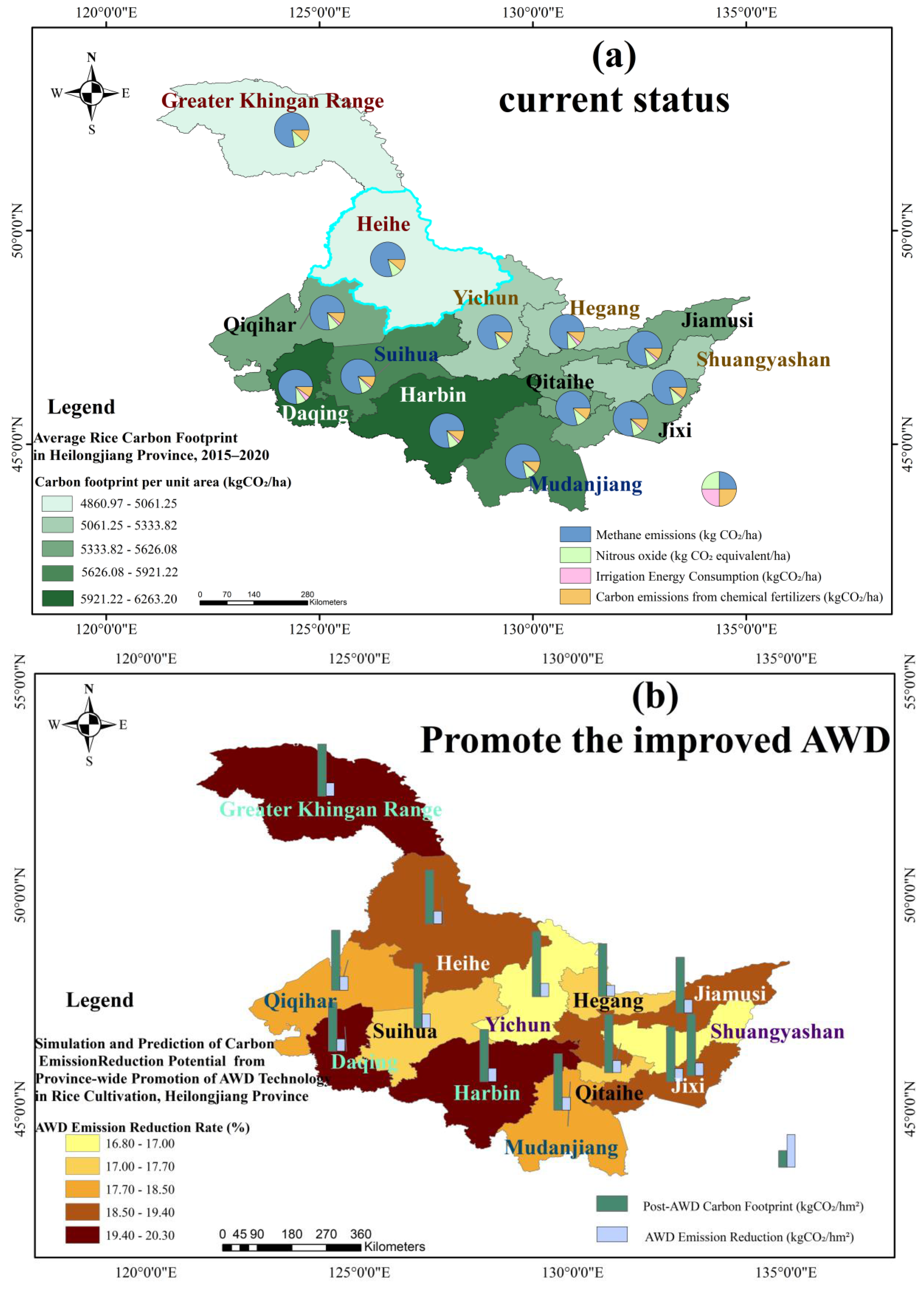
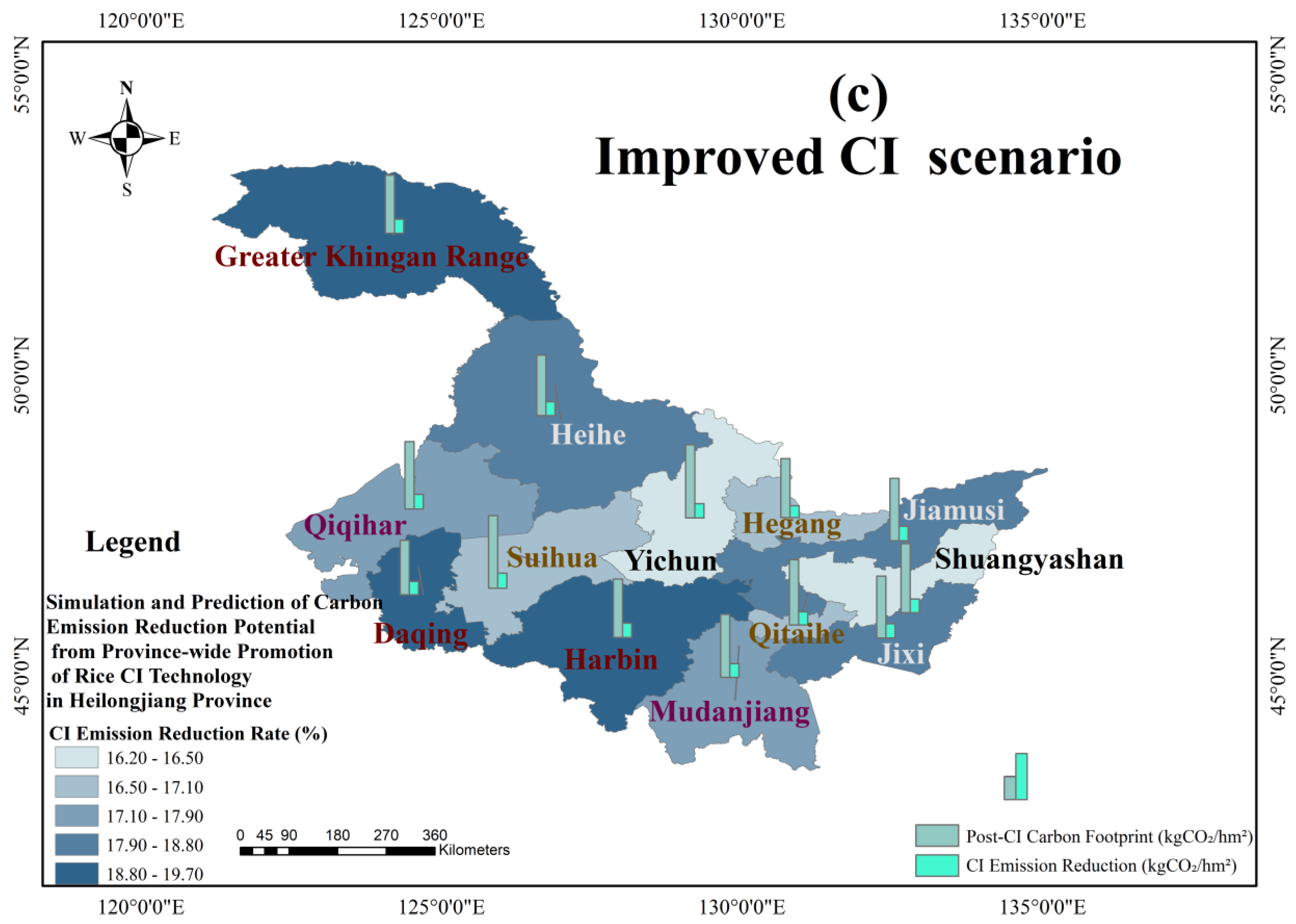
Monte Carlo simulation results indicate that the median total carbon emission reduction potential at the provincial scale under the AWD scenario is 5.68 × 10⁹ kg CO2eq (95% CI: 4.21 × 10⁹–7.32 × 10⁹ kg CO2eq), and 5.49 × 10⁹ kg CO2eq (95% CI: 3.98 × 10⁹–7.15 × 10⁹ kg CO2eq) under the CI scenario. The 95% confidence intervals of the two irrigation regimes exhibited substantial overlap (91%). Sobol variance decomposition revealed that the CH4 reduction coefficients contributed approximately 72% of the output variance, the emission baseline approximately 18%, and irrigation energy and water savings combined less than 10%.
Based on the basic data of rice area and carbon emissions of 13 prefectural cities in Heilongjiang Province, the spatial distribution of provincial carbon footprints under three scenarios (CK, AWD and CI) was mapped (Figure 14a–c). The CK scenario showed a spatial pattern of high carbon footprint in the east and low carbon footprint in the west, with the highest carbon intensity in the Sanjiang Plain region. Under AWD, province-wide carbon intensity was reduced by approximately 33% while the spatial pattern was preserved. The spatial distribution of the CI scenario was highly similar to that of AWD, with a reduction rate of approximately 31.9% and inter-prefectural differences not exceeding 1 percentage point.
Because the underlying field evidence comes from a single irrigation district over two growing seasons, these provincial figures are reported as probabilistic, order-of-magnitude estimates; the Monte Carlo 95% CI captures the dispersion of the sampled parameters only, and does not incorporate inter-regional heterogeneity in hydrogeology, baseline CH4 flux or return-flow fraction. A quantitative treatment of this heterogeneity is provided in Section 4.5.

3.4.3. Irrigation District-Scale Blue Water Footprint and the Effects of Irrigation Regimes

Based on gross irrigation flow (irrigation water use coefficient η = 0.55, measured yield Y = 9.63 t·hm−2), the blue water footprint (WFblue) was calculated for all 21 scenarios. Measured yields did not differ significantly among CK (9.72 ± 0.34), AWD (9.63 ± 0.41), and CI (9.59 ± 0.38 t·hm−2; one-way ANOVA, F = 1.23, p = 0.31). The three-treatment mean (9.63 t·hm−2) was therefore adopted as a unified yield benchmark; inter-treatment yield differences did not exceed 1.4%, with a negligible impact on WFblue calculations (error < 1.5%).
The cross-scenario WFblue averages for CK, AWD, and CI were 1307.13, 721.01, and 798.86 m3·t−1, respectively (Table 7; full scenario-level data in Supplementary Table S4), with CV < 3% within each regime. AWD and CI reduced WFblue by 44.84% and 38.88%, respectively, compared to CK, while the difference between the two water-saving modes was only 77.85 m3·t−1 (9.7%), substantially smaller than their respective absolute reductions relative to CK (586 vs. 508 m3·t−1).

3.4.4. Cross-Scale Comparison Between Irrigation Districts and Provinces and LMDI Attribution Analysis

Between 1986 and 2020, the provincial WFblue index for rice exhibited sustained fluctuations at elevated levels while displaying a gradual downward trajectory (Supplementary Table S6). During the early expansion phase (1986–2001), the provincial average rose from 4427 m3·t−1 to a peak of 5379 m3·t−1. In recent years (2011–2020), the average value fell back to 3961 m3·t−1, dropping to a historic low of 3290 m3·t−1 in 2019 and rebounding to 4205 m3·t−1 in 2020. Over the 35-year period, the total reduction in provincial WFblue was 5.0% (an annual average of approximately 0.14%). By comparison, the WFblue values for the three irrigation modes in the irrigation district were consistently lower than the provincial historical annual averages, with AWD remaining 78.1–86.6% lower than the provincial WFblue for each year (year-by-year district-vs-provincial deviations for 1986–2020 are tabulated in Supplementary Table S5).
LMDI decomposition of the absolute gap between the district-simulated AWD WFblue (721 m3·t−1) and the 2020 provincial mean (4205 m3·t−1) attributed 60–65% to the irrigation-regime factor, 20–25% to the yield factor (district measured yield 9.63 t·hm−2 versus provincial average of approximately 7.8 t·hm−2), and 10–15% to the water conveyance and distribution efficiency factor (reaching 0.92 under AWD conditions; if calculated based on net irrigation volume, the irrigation district’s WFblue could be reduced to approximately 431 m3·t−1). Bootstrap-derived 95% confidence intervals for each factor spanned approximately ±10 percentage points.

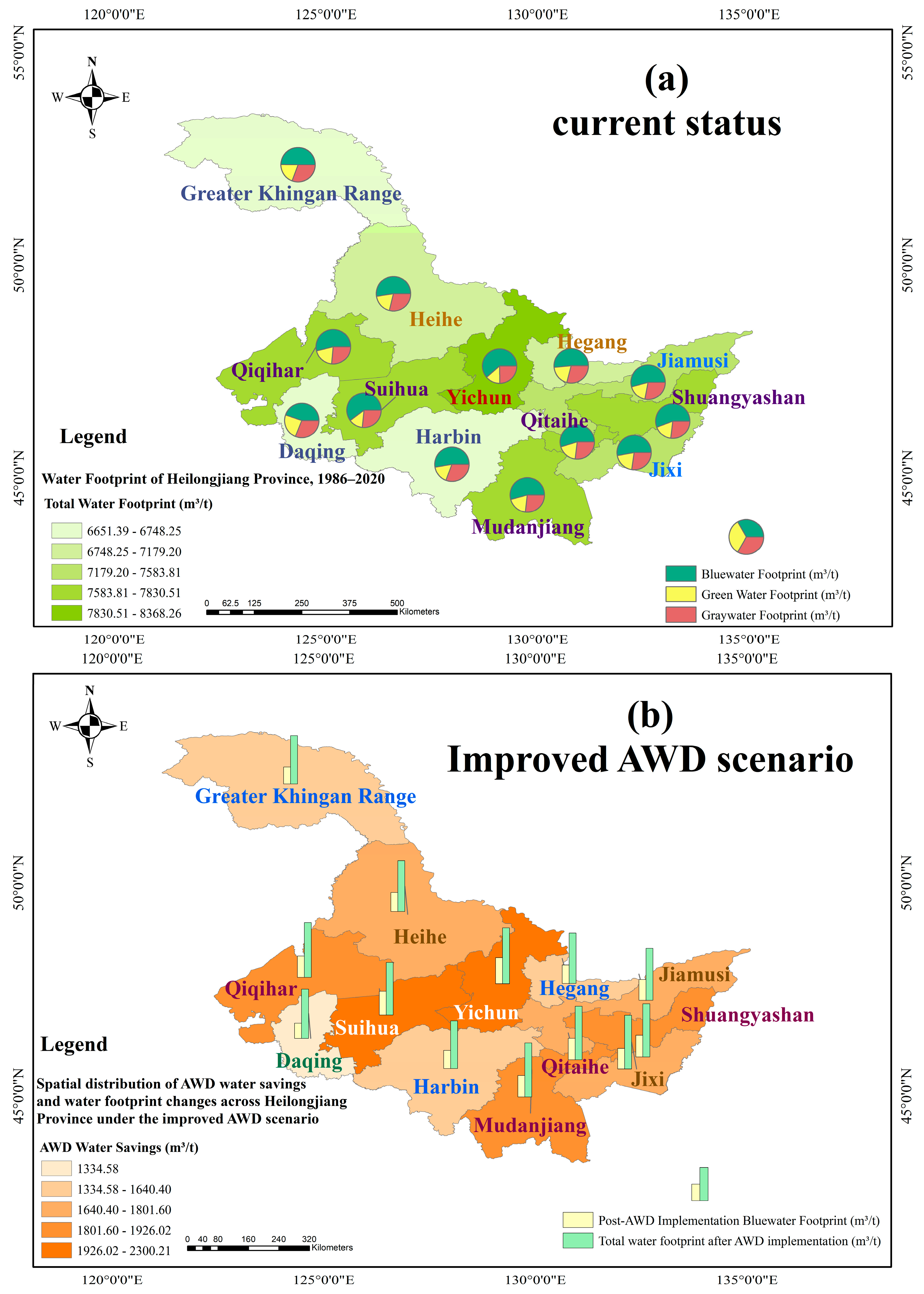
3.4.5. Historical Time-Series Characteristics and Spatial Distribution of the Provincial Total Water Footprint

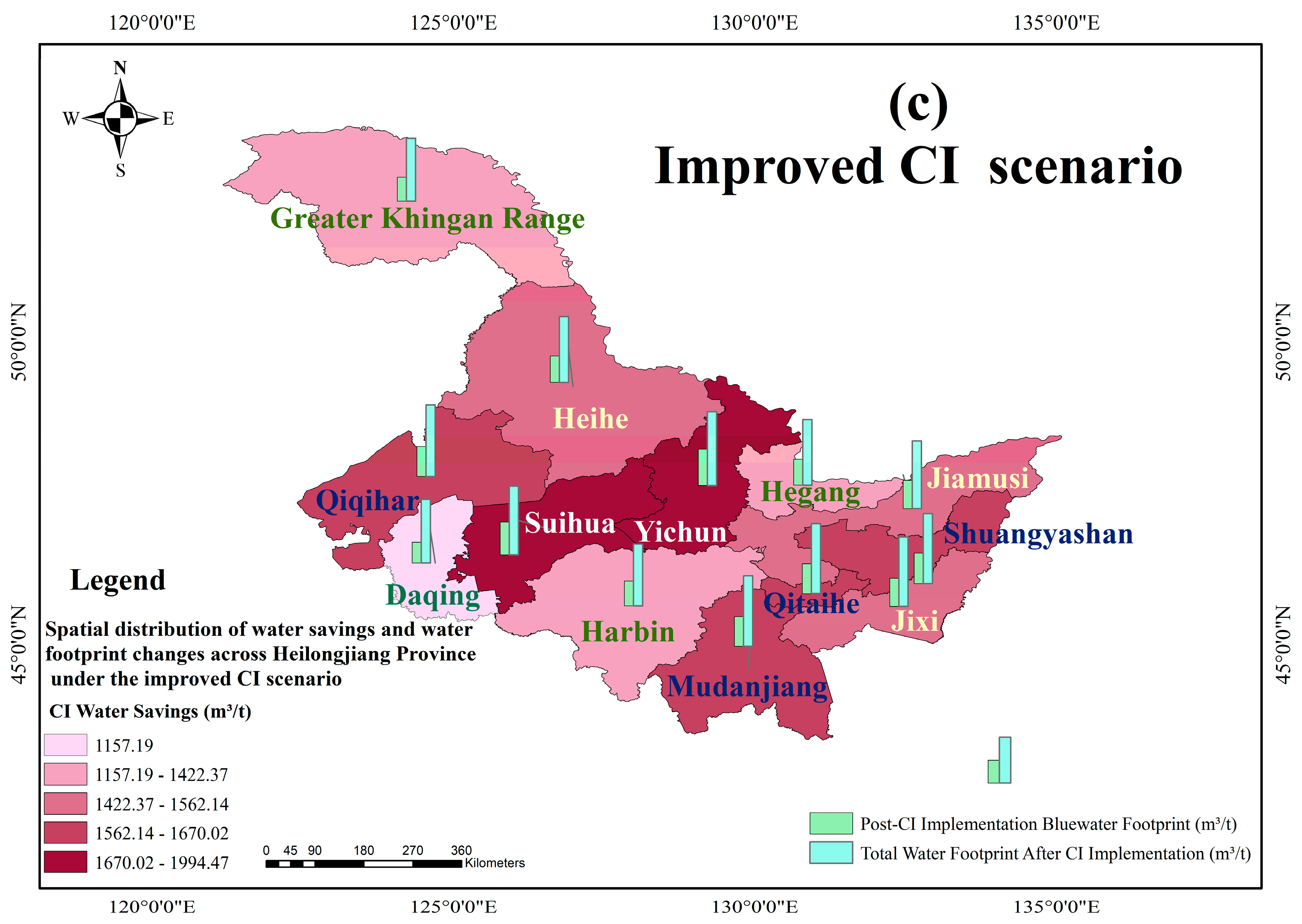
Annual provincial WFblue, WFgreen, WFgrey and WFtotal values, together with their respective shares in WFtotal for each year from 1986 to 2020, are presented in Supplementary Table S6. The 35-year provincial WFgreen averaged 1214 m3·t−1 (CV = 13.2%). WFgrey peaked at 10,108 m3·t−1 in 1991, declined sharply to 1934 m3·t−1 by 2003, and stabilized at 1900–2200 m3·t−1 thereafter, representing a 79.5% reduction from peak. In the WFtotal decline from 1991 to 2020, WFgrey contributed 7947 m3·t−1 versus only 356 m3·t−1 from WFblue. Consequently, WFblue’s share of WFtotal rose from 25.1% (1991) to 54.4% (2015–2020). Spatially, under CK, the Sanjiang Plain and northern Songnen Plain exhibited the highest WFblue values (>4500 m3·t−1), while surface-water-irrigated areas (Mudanjiang, Harbin) were substantially lower. Under AWD, all prefectures declined to 55–56% of CK levels; the CI pattern was highly similar with slightly smaller reductions (~39%). Detailed spatial distributions are shown in Figure 15a–c.

4. Discussion

4.1. Mechanistic Interpretation and Policy Implications of the Return Flow Compensation Effect

The data reported in Section 3.3 can be mechanistically interpreted as follows. The enhancement of water use efficiency at the irrigation district level is predominantly contingent upon the adoption of field-level irrigation regimes rather than the optimization of water conveyance and distribution systems. Under AWD, the upper ponding depth is compressed from 80–100 mm to 30–50 mm and intermittent drying cycles are introduced, which curtails the proportion of deep percolation from 35–45% to 15–25% per irrigation event. This reshapes the water budget at its source and drives the district-scale FRi improvement observed in the data.
The narrowing of the AWD-over-CK FRip advantage from 67.5% at the root-zone scale to 61.4% at the irrigation district scale quantitatively reflects the partial compensation effect arising from the recirculation of substantial return flows generated by conventional irrigation through the irrigation system. Under CK, deep percolation and surface runoff generated by sustained flooding are intercepted by downstream fields through branch and trunk canals, establishing a characteristic pattern of “low field efficiency–high system recirculation”: FRi increases by approximately 0.20 from the root zone to the irrigation district, with 68% of this increment concentrated in the root zone-to-branch canal segment. Under water-saving irrigation conditions, the source flow is markedly diminished, and the system transitions to a “high field efficiency–low system recirculation” pattern. The near-theoretical FRirn values under AWD (≈0.973) suggest that virtually all irrigation water is converted to crop-available water with minimal runoff generation, while the intermediate CI values (≈0.964) reflect the equilibrium between water conservation and yield stability achieved through deficit-control irrigation.
The return flow compensation effect quantified in this study (irrigation district-scale FRi exceeding root zone values by approximately 0.20, with return flows contributing 33–35% of the system efficiency increment) furnishes direct empirical evidence for the manifestation of the irrigation efficiency paradox in groundwater-irrigated rice-cropping systems in cold regions. Xiong et al. [9] reported a discrepancy of approximately 0.10 between basin-scale and field-scale irrigation efficiency attributable to return flows in the arid Hexi Corridor irrigation district; in contrast, the corresponding differential of approximately 0.20 observed in the present study within the humid-to-semi-humid climate of the Sanjiang Plain is appreciably larger. This discrepancy can be mechanistically attributed to the elevated rate of deep percolation in paddy fields and the more intensive hydraulic interaction between groundwater and the channel network within the irrigation district.
Crucially, the magnitude and mechanism of the paradox observed here are consistent with independent evidence from temperate and cold-region paddy and irrigated systems outside China. Hoffmann and Villamayor-Tomas’s 37-case meta-study and the global synthesis of Grafton et al. [6] both showed that apparent field-scale efficiency gains often fail to materialize at the basin scale because they curtail return flows that previously sustained downstream and groundwater users.
Perry et al. [50] reached a mechanistically equivalent conclusion using a net-consumption framework, arguing that the overstatement is proportional to the pre-modernization return-flow fraction. Our 40–50% overstatement at a return-flow fraction of 33–35% is broadly consistent with this prediction. In the snowmelt-fed irrigation systems of the western United States, Morrisett et al. [8] showed that farm-level efficiency gains can produce adverse hydrologic outcomes at the basin scale—a cross-scale divergence analogous to the return-flow compensation we observed under the humid-summer conditions of the Sanjiang Plain.
For cold-temperate japonica paddy systems specifically, Peyron et al. [51] in the Po Valley and Itoh et al. [52] in Japanese mid-season-drainage trials documented that lateral seepage across adjacent paddies produced district-scale net water savings 30–50% smaller than plot-scale measurements. This is consistent with the ≈0.20 field-to-district efficiency gap reported here. Together, the evidence from Chinese, North American, European, and East Asian cold-region cases supports the external validity of the return-flow compensation mechanism described in this study.
Lankford [10], employing the Irrigation System Accounting (ISA) model, posited that the severity of the efficiency paradox is predominantly governed by the proportion of return water recoverable within the irrigation system and the completeness of its reuse pathway. In the Qinglongshan Irrigation District, the close hydraulic connectivity between groundwater extraction wells and recharge sources, coupled with high rates of closed-loop canal drainage reuse, constitutes a spatial configuration that not only engenders favorable hydrological conditions for return flow compensation but also amplifies the systematic deviation between field-level water-saving indicators and actual net water savings at the irrigation district scale.
From a process-mechanistic perspective, the return flow compensation effect exhibits a pronounced “near-field priority” spatial attenuation characteristic—i.e., the maximum contribution is concentrated at the root zone-to-branch canal scale, while the incremental contribution of higher-order channels diminishes progressively—consistent with the multi-scale water cycle monitoring findings of Zhang et al. for plains irrigation districts [12]. This spatial pattern provides actionable guidance for infrastructure planning: prioritizing the deployment of return water storage and diversion facilities at the juncture of midstream branch canals and trunk canals would maximize the potential for local water recycling [11].
On the choice of regime under different management objectives, the data in Section 3.3.3 also provide practical guidance. CK has the highest absolute return-water uptake but the lowest reuse efficiency (34.0–35.1%); AWD has the highest reuse efficiency (69.0–82.0%); CI leads in absolute uptake (23.7–24.6%) and is intermediate in efficiency (70.5–79.2%). These differences indicate that CI should be prioritized when mitigating groundwater overexploitation is the main objective, and AWD should be prioritized when controlling drainage loads is the main objective. Notably, although the actual return water reuse rate in the study area is currently close to zero, modeling results indicate that return water uptake consistently accounts for 20–25% of the total water supply under all irrigation scenarios—compared with a global average of approximately 15% for well-managed systems [2]—suggesting that the internal circulation of the system has significant unexploited potential. Water resource planning in irrigation districts must therefore account for both withdrawal reductions and recharge alterations to avert the counterintuitive outcome whereby “field-level water savings precipitate deterioration of the district-scale water balance” [6,11].
These results support the use of net water consumption at the irrigation district level, alongside or in place of the field-level irrigation water utilization coefficient (IWUC), as a baseline for assessing water-saving benefits. This finding has important methodological implications for China’s current assessment framework of effective irrigation water use coefficients: employing the field-level indicator as the core assessment criterion may systematically overestimate actual water resource efficiency by approximately 40–50%, which may lead to a partial misalignment between policy incentives and actual hydrological outcomes. Transitioning the water efficiency assessment metric from field-scale water use coefficients to net water consumption at the irrigation district level would align water resources governance more closely with the actual hydrological process, consistent with the net consumption-based water-saving accounting framework advocated by Lankford [10].

4.2. Carbon–Water Decoupling Mechanisms and Policy Implications

The most policy-relevant finding of this study is the significant decoupling between carbon reduction and water saving benefits. The difference in water saving rate between AWD and CI is about 6 percentage points, the difference in carbon reduction rate is only 0.86 percentage points, and the anaerobic inhibition pathway of CH4 contributes 96.6% of the total carbon reduction.
The mechanistic basis of this phenomenon resides in the process-level dynamics of CH4 suppression. Under continuously flooded conditions, soil redox potential (Eh) remains below −200 mV for extended periods, sustaining a stable anaerobic environment favorable to methanogenic archaea. Both AWD and CI rapidly elevate the surface soil Eh above +200 mV by introducing drying periods (3–7 days without a ponding water layer), effectively suppressing methanogenic activity while promoting the competitive dominance of methane-oxidizing bacteria. Given the high similarity of the drying management protocols between the two irrigation regimes, their CH4 reduction coefficients are nearly equivalent (46.30% vs. 45.25%), such that the additional approximately 6% irrigation water saving achieved by AWD relative to CI does not commensurately translate into enhanced carbon reduction benefits. Monte Carlo simulation results further corroborate this mechanistic conclusion: the 95% confidence intervals of provincial carbon-abatement potential for AWD and CI overlap by 91%, indicating no statistically significant difference and confirming that carbon reduction is predominantly determined by the drying management protocol rather than absolute water volume. These findings substantiate that the critical regulatory variable governing GHG emission reduction in paddy fields is the dynamic transition of water status (frequency and duration of flooding–drying alternation) rather than the irrigation water quantity per se—an observation carrying substantial policy implications for the formulation of synergistic carbon–water management strategies in irrigation districts.
This non-proportionality stems from the process mechanism of CH4 production: methanogenic bacteria are highly sensitive to soil Eh, and methanogenic activity is significantly inhibited when the field water layer subsides to raise Eh above -150 mV, while Fe3+/Mn4+ and other alternative electron acceptors competitive reduction further compresses the space for methanogenesis [12]. Although the total amount of irrigation water was different, both AWD and CI realized multiple fall-dry processes in the middle of the growing season, which triggered a similar number of Eh lifting events, resulting in a high degree of convergence in carbon reduction efficiency. Based on the global AWD meta-analysis, Bo et al. similarly pointed out that the correlation between CH4 suppression effect and the frequency of desiccation was significantly stronger than that of the depth of desiccation [14]; Li et al. revealed the microscopic mechanism by which the root aeration tissue switches from a methane emission channel to an oxygen input channel during the desiccation phase, indicating that even for the relatively mild CI scenario, as long as the duration of desiccation is long enough to activate the oxygen transport function of the root aeration tissue, the effect of carbon emission reduction can be converged to that of the AWD scenario [1].
Corroborating evidence from cold-region systems outside China reinforces the universality of this mechanism. Itoh et al. [52] showed in Japanese temperate paddies that a single 7–10-day mid-season drainage reduced seasonal CH4 emissions by 40–45%, with an additional drainage conferring only marginal further abatement—demonstrating that once the drying-triggered Eh transition occurs, further water curtailment is hydrologically effective but biogeochemically redundant. Peyron et al. [51] in the Po Valley observed a 48% CH4 reduction under intermittent irrigation and no significant additional reduction under a more aggressive dry-seeded protocol that saved a further 20% of irrigation water, quantitatively mirroring the 46.30% vs. 45.25% convergence between our AWD and CI treatments. The cross-continental meta-analysis of Zhao et al. [13], encompassing trials from Japan, Italy, the United States, India, and China, likewise reported that drying-event count and duration—rather than absolute irrigation-volume reduction—explain more than 70% of the inter-trial variance in CH4 abatement. These converging findings situate our cold-zone result within a broader mechanistic consensus and extend its applicability from the Sanjiang Plain to cold-temperate paddy systems globally.
Within the cold-zone-specific context, where lower mean annual temperatures (2.2 °C) yield lower baseline CH4 emission rates relative to the warmer double-cropped rice zone [53], the marginal benefits of carbon emission reductions from water-efficient irrigation are relatively constrained yet exhibit high certainty (CV < 3%). These findings provide an unambiguous operational guideline for policy formulation: the focus of carbon emission reduction assessment should be redirected from irrigation volume reduction to compliance with the drying management standard. Provided that the irrigation regime achieves a ponding-free field surface condition no fewer than three times, each lasting no fewer than three days following the crop recovery period, carbon emission reduction approaching the theoretical upper limit can be attained, without necessitating pursuit of minimum irrigation volumes [54].

4.3. Water Footprint Component Transformation and Blue Water Efficiency Bottlenecks

Before discussing the historical evolution of the provincial water footprint, two quantitative findings from Section 3.4.3 merit interpretive attention. First, the cross-scenario WFblue reductions in AWD (44.84%) and CI (38.88%) relative to CK, contrasted with a difference of only 77.85 m3·t−1 (9.7%) between the two water-saving regimes, reveal a pronounced diminishing marginal return effect: the transition from conventional flood irrigation to either water-saving mode accounts for approximately 85–90% of the total achievable WFblue reduction. This establishes whether to adopt water-saving irrigation—rather than which specific regime to adopt—as the primary decision variable influencing the blue water footprint. The measured yield convergence across CK, AWD, and CI (9.59–9.72 t·hm−2, p = 0.31) is consistent with regional patterns for cold-temperate japonica rice under moderate water-saving conditions, confirming that the yield penalty commonly associated with deficit irrigation in warmer climates is not observed here.
The 35-year historical accounting at the provincial level reveals a fundamental structural transition in water footprint composition: the dominant component has shifted from grey water (58.3% in 1986) to blue water (54.4% in 2020), accompanied by a cumulative grey water footprint reduction of 79.8%. This decline is strongly temporally coupled with China’s national soil-testing-based fertilizer application program initiated in 2005, and the slope of grey water footprint decline after 2005 is appreciably steeper than in the preceding period, confirming the decisive driving role of fertilizer management policies on the grey water footprint. The global crop water footprint analysis by Mialyk et al. similarly identifies fertilizer management as the primary lever for controlling the grey water footprint, providing corroborative support at the global scale [16].
The substantial compression of the grey water component indicates that further reduction potential along this dimension is now limited, positioning blue-water efficiency as the principal remaining lever for further WFtotal compression. The stark contrast between the provincial-scale macro water savings of only 5.0% over 35 years and the 39–45% reductions achievable through precision regulation at the irrigation district scale explains, in terms of magnitude, the fundamental bottleneck: the coverage of precision water-saving irrigation technologies, such as AWD, remains severely inadequate in large-scale rice-growing areas. This order-of-magnitude gap is the principal policy margin for future intervention.
However, provincial-level blue water footprint improvements have been far more modest than grey water improvements over the 35-year period, reflecting the bottleneck constraints on blue water efficiency enhancement in the absence of systemic irrigation regime transformation. In contrast to the provincial accounting by Wu et al. (2022), which encompasses only the blue water component, the three-component full decomposition approach adopted in this study elucidates the inter-component relationships—a structural perspective that is indispensable for developing targeted water footprint compression strategies [15]. The above findings provide differentiated policy guidance for irrigation districts and provincial water resources management: irrigation districts should focus on transforming their irrigation systems to directly compress blue water consumption, while at the provincial level, they should consolidate the effectiveness of soil testing and fertilizer application, and shift their policy focus to large-scale coverage of water-saving irrigation technologies.

4.4. Practical Barriers and Countermeasures for AWD/CI Promotion in Cold Zones

Notwithstanding the substantial potential for synergistic carbon–water co-benefits demonstrated by the simulation results, the large-scale dissemination of AWD and CI in cold regions continues to confront three formidable barriers. With respect to farmer acceptance, rice cultivators on the Sanjiang Plain have long adhered to flood irrigation practices and harbor apprehensions regarding yield reduction risks associated with drying management [3]. The two-year trial conducted in this study demonstrated that AWD and CI yields did not differ significantly from CK (F = 1.23, p = 0.31); however, the short-term data are insufficient to fully dispel concerns regarding cumulative long-term effects, and it is recommended that continuous demonstration plots spanning 3–5 years be established. Regarding technical thresholds, the abbreviated growing season in cold zones (frost-free period of 114–150 days) necessitates precise temporal alignment of drying cycles with phenological stages, with low operational tolerance; the development of simplified early warning devices based on low-cost soil moisture sensors could effectively reduce this threshold. Concerning economic incentives, the prevailing water-pricing structure for groundwater irrigation in Heilongjiang Province features a low unit cost—approximately CNY 0.10–0.15 m−3 for self-pumped wells and CNY 0.20–0.30 m−3 for collective supply, both well below full-cost-recovery levels [32]—which blunts the private financial motivation for farmers to curtail water use.
Farm-level accounts collected alongside the field trial indicate that the per-hectare economics of AWD adoption in the study area comprise: (i) an upfront capital outlay of CNY 300–600 ha−1 for soil-moisture and water-level sensors (unit price CNY 500–2000, with one sensor serving 4–6 ha), amortized over a five-year equipment lifetime to CNY 60–120 ha−1 yr−1; (ii) incremental labor costs of CNY 150–250 ha−1 yr−1 for scheduled water-depth checks during drying cycles; and (iii) electricity savings of CNY 400–700 ha−1 yr−1 from the ≈40% reduction in pumping volume (estimated using the provincial mean irrigation lift height and an electricity tariff of CNY 0.52 kWh−1). On balance, AWD delivers a net private benefit of CNY 50–430 ha−1 yr−1 and a payback period of 2–4 years under current prices, conditional on the yield parity documented in Section 3.4.1 being sustained.
These per-hectare figures should, however, be interpreted as Sanjiang-Plain-specific and are not directly transferable across the province. The dominant cost-side parameter—pumping electricity—scales approximately linearly with the irrigation lift height, which differs systematically across the three hydro-agricultural zones defined in Section 2.9. Relative to the moderate-lift, groundwater-dependent Sanjiang Plain reported here, the more deeply over-exploited parts of the Songnen Plain would yield proportionally larger electricity savings under AWD, with a higher net annual benefit and a shorter payback period. Conversely, the surface-water-dominated Mudanjiang–Muling zone has minimal groundwater pumping. In this zone, the electricity-saving channel is largely absent, and the payback period—dominated by sensor amortization and labor costs—would be markedly longer. It may not be recovered under current prices, particularly where collective surface-water supply is already subsidized. Local electricity tariffs (CNY 0.45–0.60 kWh−1 across the agricultural-tariff bands of Heilongjiang) and the inter-zonal groundwater water-pricing differential (CNY 0.10–0.30 m−3) introduce further first-order variation that we have not resolved here. The CNY 50–430 ha−1 yr−1 net benefit and the 2–4-year payback period should therefore be read as a Sanjiang-Plain reference point rather than a province-wide expectation.
Incorporating a carbon-mitigation monetization pathway would further improve these economics: using as an illustrative reference point the 2024–2025 volume-weighted closing price of the Chinese national compliance carbon market (CEA) of approximately CNY 100 t−1 CO2eq, the implied additional annual return for a typical 5–10 ha smallholder farm would be of the same order as the electricity-saving benefit. This pathway, however, presupposes the establishment of operational monitoring-reporting-verification (MRV) infrastructure for on-farm CH4 abatement, which does not yet exist for smallholder paddy systems in cold regions. A comprehensive economic cost–benefit analysis that jointly resolves capital and labor costs, electricity savings, yield effects, carbon-price uncertainty, and subsidy-delivery pathways is beyond the scope of this water–carbon modelling study and is identified as a priority follow-up, ideally drawing farm-survey data across the three hydro-agricultural zones defined in Section 2.9.

4.5. Research Limitations and Future Directions

The nonlinear sensitivity responses quantified in Section 3.1 (threshold behavior of infiltration parameter a and asymmetric response of μ1) informed the model calibration strategy as follows: high-sensitivity parameters ( θ f c 1 , K V 1 , θ f c 2 ) were prioritized for fine-tuning; medium-sensitivity parameters ( α , μ 1 , K h 1 ) warranted focused attention on nonlinear response domains; and low-sensitivity parameters ( b , μ 2 etc.) were assigned values based on measured and empirical ranges. Users applying SWBM to other districts should repeat this sensitivity screen, because the ranking may shift with soil texture and groundwater depth.
Spatial extrapolation to the provincial scale. Our field evidence covers a single irrigation district (≈0.5% of the provincial rice area of 3.86 × 10⁶ ha) over two growing seasons. The cold-region japonica zone of Northeast China contains at least four hydrogeologically distinct sub-regions—the Sanjiang Plain, the Songnen Plain, the Mudanjiang–Muling basin, and the Xing’an foothill corridors—whose baseline CH4 flux, return-flow fraction and η are expected to differ systematically. The Monte Carlo 95% CI (4.21 × 10⁹–7.32 × 10⁹ kg CO2eq under AWD) captures only parameter-level uncertainty under the distributions listed in Table 2; it does not incorporate inter-regional structural heterogeneity. The provincial estimates should therefore be treated as probabilistic, order-of-magnitude figures rather than as planning targets and provide an order-of-magnitude reference for irrigation managers to assess regional climate benefits, while specific irrigation management decisions should still be based on water balance assessment at the irrigation district scale. A tighter estimate will require instrumenting at least five districts, one per sub-region plus one transitional zone, for 3–5 continuous years, with joint flux-tower and groundwater monitoring.
District-versus-province data comparability. The district WFblue (721 m3·t−1) is derived from high-precision process-based SWBM simulation with point-scale forcing, whereas the provincial reference (4205 m3·t−1) is aggregated from coarse-resolution statistical-yearbook data. The two values differ fundamentally in spatial representativeness, measurement standard and data precision. While LMDI can systematically allocate the gap among irrigation-regime, yield and conveyance factors, it cannot fully eliminate the attribution error introduced by this data heterogeneity. We accordingly report the decomposition (60–65%/20–25%/10–15%) as an order-of-magnitude structure of the drivers rather than a precise quantitative attribution, with an uncertainty band of ±10 percentage points around each component.
Several limitations of this study warrant acknowledgment. First, the field trial encompassed only two growing seasons; although cross-season validation against the 2020–2025 regional hydrological record demonstrated satisfactory interannual parameter transferability (R2 = 0.86 for root-zone moisture in 2024; NSE = 0.85 for 2020–2025 groundwater levels), the magnitude of variability in the return-flow compensation coefficient and the CH4 reduction factor under extreme precipitation (1-in-20 drought/flood) years has not been validated within the two-season window. The quantitative conclusions of this study should therefore be circumscribed to typical hydrological-year conditions on the Sanjiang Plain [17] Future investigations should incorporate continuous positional observations spanning at least 3–5 years, deliberately encompassing both high-flow and low-flow years, to capture the response of the return-flow compensation effect and the CH4 reduction factor under extreme climatic conditions. Second, the provincial water footprint accounting employed a fixed η value of 0.55, whereas the actual η may have been as low as 0.40–0.45 in the early years, resulting in an underestimation of WF_blue of 10–38%; phased sensitivity analyses indicate that this bias does not alter the direction of inter-modal ordering or temporal trends, but correction using sub-annual η data should be prioritized. Third, the parameter-independence assumption underlying the Monte Carlo framework was tested with only n = 12 paired observations (Pearson r = 0.19, p = 0.47; 95% bootstrap CI [−0.35, 0.58]; statistical power = 0.15 for r = 0.30 at α = 0.05). This is an inherent design limitation that cannot be resolved within the present two-season, single-district experiment, and we explicitly do not interpret the non-rejection of zero correlation as evidence for independence. We mitigate the practical consequence in two ways: (i) by anchoring the assumption in the mechanistic separation of the two regulatory pathways (Section 2.9), and (ii) by demonstrating via Sobol decomposition that the resulting uncertainty in the carbon-abatement central estimate is bounded—the n = 12 power constraint widens the 95% confidence interval but does not displace the median or alter the inter-scenario ranking (Section 3.4; see also the synthesis paragraph below). A definitive resolution will require a multi-point (≥5 sites) CH4-flux validation network producing ≥ 40 paired flux–baseline observations, identified here as a priority follow-up. Fourth, the present study operates at the irrigation system scale and does not address microscopic methane transport mechanisms in the rhizosphere; future research could couple the inter-root microscopic mechanisms (e.g., aerenchyma-mediated bidirectional CH4/O2 transport and its functional switching during drying phases) with the macroscopic irrigation district model to deepen multi-scale understanding of the carbon cycle in cold-region paddy systems [4].
Finally, the seven base scenarios adopted in the present study capture the dominant soil-management combinations prevailing within the Qinglongshan Irrigation District, but a district-wide spatially explicit correspondence between each soil group’s areal share and the base-scenario weighting has not been compiled. Constructing such a fully resolved soil-type-to-scenario mapping—together with a spatially distributed re-weighting of the 21 sub-scenario outputs—would further strengthen the representativeness of district-scale estimates and is identified as a priority for follow-up work.
Taken together, the limitations enumerated above—the two-season experimental window, the use of fixed decadal or provincial-mean parameters (notably η, the CH4 reduction coefficients, and the emission baseline) across a 35-year analysis, the modest statistical power (n = 12, power = 0.15) of the parameter-independence test, and the single-district calibration underlying the provincial extrapolation—affect the absolute magnitudes of our quantitative estimates but do not alter the directional conclusions of the study. Specifically, (i) the phased time-varying η scenario (Section 2.8, Table S2) revises pre-2005 WFblue upward by 10–38% but preserves the declining trend and the CK > CI > AWD ordering; (ii) cross-season validation against the 2020–2025 regional hydrological record (R2 = 0.86 for root-zone moisture; NSE = 0.85 for groundwater levels) confirms that the SWBM parameterization is transferable beyond the two calibration seasons for typical hydrological years; (iii) the Sobol variance decomposition (Table 3) shows that the n = 12 statistical-power constraint widens the carbon-abatement 95% confidence interval but leaves the median estimate, the inter-scenario ranking (AWD ≈ CI > CK), and the directional conclusion of H2 unchanged—that is, the substantive findings of the study do not rely on rejecting the independence-test null hypothesis; and (iv) the zone-stratified Monte Carlo design described in Section 2.9 partially compensates for single-district calibration by area-weighting zone-specific CH4-emission and irrigation-lift baselines. Accordingly, the three hypotheses of the study (H1–H3) are upheld with ±10–40% uncertainty bands on their quantitative magnitudes but with unchanged direction, and the resulting policy prescriptions—scale-shifting water-efficiency assessment from field to district, prioritizing drying-protocol compliance over irrigation-volume targets, and focusing remaining WFtotal reduction on blue-water efficiency—are not contingent on the resolution of the residual uncertainties.

5. Conclusions

This study integrates return-flow compensation, carbon-footprint assessment, and full-component water-footprint accounting within a single hypothesis-driven, multi-scale framework, using the Qinglongshan Irrigation District of Heilongjiang Province as the focal case. The conclusions drawn below synthesize what the combined evidence implies for carbon–water co-management in cold-region, groundwater-dependent paddy systems, anchored on the principal numerical findings reported in Section 3. Quantitatively, apparent field-scale water savings of 50–60% under non-flooding irrigation converge to a real district-scale saving of approximately 33% after return-flow correction; AWD and CI deliver near-equivalent total carbon-abatement rates (32.76% vs. 31.90%) despite a ≈6-percentage-point gap in water-saving rate; and over 1986–2020 the dominant water-footprint component shifted from grey water (52.3% in 1986) to blue water (54.4% in 2020), with cumulative grey-water reduction reaching 79.8%.
Field-scale indicators systematically overstate what non-flooding irrigation can deliver at the scale where policy and allocation decisions are made, because return-flow recycling internalizes a substantial share of field drainage within the irrigation district (H1 confirmed). The implication is methodological: in groundwater-dependent cold-region systems, the irrigation district—rather than the plot—represents a more appropriate unit at which water-saving claims can be reliably verified in groundwater-dependent cold-region systems, and field-level efficiency coefficients alone may be insufficient as the primary basis for basin- or provincial-scale planning.
Carbon mitigation and water saving are governed by distinct biophysical controls (H2 confirmed): CH4 suppression responds to the frequency and duration of redox alternation, whereas water saving responds to the absolute reduction in irrigation volume. Regimes with appreciably different water-saving magnitudes therefore deliver near-equivalent climate benefits. This mechanistic decoupling dissolves the premise that additional water saved automatically translates into additional carbon abated and reframes carbon verification away from volumetric proxies and toward direct monitoring of drying-event compliance.
Over three-and-a-half decades the provincial water footprint has transitioned from a pollution-dominated to an abstraction-dominated regime (H3 confirmed), signaling a qualitatively new phase for cold-region paddy sustainability. With earlier grey-water gains approaching a practical ceiling, the principal remaining lever for total water-footprint compression now lies in blue-water efficiency, and the dominant sustainability risk appears to have shifted from water-quality degradation toward aquifer depletion.
Taken together, these results prompt a reframing of water-saving irrigation: the operative question is no longer “which regime saves more water,” but at what scale and against which mechanism carbon–water co-benefits should be defined, verified, and priced. The broader implication is that sustainable intensification of cold-region paddy agriculture is unlikely to be effectively optimized for a single resource at a single scale—scale-dependent hydrological recycling, mechanism-dependent emission pathways, and the structurally shifting water-footprint composition must be assessed jointly. The framework is, in principle, transferable to other groundwater-dependent cold-climate rice regions, though robustness under extreme hydrological years and finer soil-typology resolution remains to be tested. Future work should extend the framework to multi-year climatic extremes, couple rhizosphere-scale methane transport with district-scale water balances, and develop spatially explicit soil-typology weightings.

Supplementary Materials

The following supporting information can be downloaded at: https://www.mdpi.com/article/10.3390/agriculture16091002/s1, Figure S1: Comparison of simulated and observed groundwater levels at selected observation wells; Figure S2: Comparison of simulated and measured flow rates at three cross-sections of the Shuiding River; Figure S3 :Comparison of simulated and measured groundwater levels at 14 observation wells during the validation period; Table S1: Complete List of SWBM Core Parameters; Table S2: Staged sensitivity analysis of irrigation water use coefficient (η) on provincial blue water footprint (WFblue); Table S3: Quantitative assessment of carbon–water synergy across 21 irrigation scenarios; Table S4: Blue Water Footprint Calculation and Irrigation Regime Effects Across 21 Scenarios; Table S5: Comparison of irrigation district WF_blue scenarios with provincial historical levels in Heilongjiang Province (1986–2020); Table S6: Annual Water Footprints for Blue, Green, and Gray Water with Total Water Consumption from 1986 to 2020; Table S7: Multi-scale distribution of total water-supply utilization efficiency (FRip) under the 21 scenarios for three irrigation regimes (CK, AWD, CI), corresponding to Figure 10; Table S8: Multi-scale distribution of net water-supply utilization efficiency (FRirn) under the 21 scenarios for three irrigation regimes (CK, AWD, CI), corresponding to Figure 11; Table S9: Multi-scale distribution of the irrigation water utilization coefficient (FRi) under the 21 scenarios for three irrigation regimes (CK, AWD, CI), corresponding to Figure 12; Table S10: Multi-scale distribution of return-water reuse efficiency (FRoi) under the 21 scenarios for three irrigation regimes (CK, AWD, CI), corresponding to Figure 13.

Author Contributions

J.W.: Conceptualization, Methodology, Software, Data gathering, Formal analysis, Investigation, Validation, Writing original draft preparation, Review and Editing; E.Z.: Writing—review and editing, Funding acquisition, Supervision; T.L.: Validation, Data curation, Writing—review and editing; Z.X.: Review; Z.S.: Supervision, Conceptualization, Review and Editing. All authors have read and agreed to the published version of the manuscript.

Funding

Research on Water Conservation Management Models in Heilongjiang Province (25095).

Data Availability Statement

The datasets used and analyzed during the current study available from the corresponding author on reasonable request.

Conflicts of Interest

The authors declare no conflicts of interest.

References

  1. Qian, H.; Zhu, X.; Huang, S.; Linquist, B.; Kuzyakov, Y.; Wassmann, R.; Minamikawa, K.; Martinez-Eixarch, M.; Yan, X.; Zhou, F. Greenhouse gas emissions and mitigation in rice agriculture. Nat. Rev. Earth Environ. 2023, 4, 716–732. [Google Scholar] [CrossRef]
  2. Gilardi, G.L.C.; Mayer, A.; Rienzner, M.; Romani, M.; Facchi, A. Effect of Alternate Wetting and Drying (AWD) and other irrigation management strategies on water resources in rice-producing areas of Northern Italy. Water 2023, 15, 2150. [Google Scholar] [CrossRef]
  3. Suwanmaneepong, S.; Kultawanich, K.; Khurnpoon, L.; Sabaijai, P.E.; Cavite, H.J.; Llones, C.; Lepcha, N.; Kerdsriserm, C. Alternate wetting and drying as water-saving technology: An adoption intention in the perspective of good agricultural practices (GAP) suburban rice farmers in Thailand. Water 2023, 15, 402. [Google Scholar] [CrossRef]
  4. Li, L.; Huang, Z.; Mu, Y.; Song, S.; Zhang, Y.; Tao, Y.; Nie, L. Alternate wetting and drying maintains rice yield and reduces global warming potential: A global meta-analysis. Field Crop. Res. 2024, 318, 109603. [Google Scholar] [CrossRef]
  5. Perry, C. Efficient irrigation; inefficient communication; flawed recommendations. Irrig. Drain. J. Int. Comm. Irrig. Drain. 2007, 56, 367–378. [Google Scholar] [CrossRef]
  6. Grafton, R.Q.; Williams, J.; Perry, C.J.; Molle, F.; Ringler, C.; Steduto, P.; Udall, B.; Wheeler, S.A.; Wang, Y.; Garrick, D. The paradox of irrigation efficiency. Science 2018, 361, 748–750. [Google Scholar] [CrossRef] [PubMed]
  7. Hoffmann, P.; Villamayor-Tomas, S. Irrigation modernization and the efficiency paradox: A meta-study through the lens of Networks of Action Situations. Sustain. Sci. 2023, 18, 181–199. [Google Scholar] [CrossRef]
  8. Morrisett, C.N.; Van Kirk, R.W.; Bernier, L.O.; Holt, A.L.; Perel, C.B.; Null, S.E. The irrigation efficiency trap: Rational farm-scale decisions can lead to poor hydrologic outcomes at the basin scale. Front. Environ. Sci. 2023, 11, 1188139. [Google Scholar] [CrossRef]
  9. Xiong, R.; Zheng, Y.; Han, F.; Tian, Y. Improving the scientific understanding of the paradox of irrigation efficiency: An integrated modeling approach to assessing basin-scale irrigation efficiency. Water Resour. Res. 2021, 57, e2020WR029397. [Google Scholar] [CrossRef]
  10. Lankford, B.A. Resolving the paradoxes of irrigation efficiency: Irrigated systems accounting analyses depletion-based water conservation for reallocation. Agric. Water Manag. 2023, 287, 108437. [Google Scholar] [CrossRef]
  11. Jaiswal, R.K.; Ali, S.; Jain, S.; Galkate, R.V.; Krishan, G.; Lohani, A.K.; Kumar, S. Monitoring and modelling approaches for quantitative assessment of irrigation return flows in a command. Environ. Earth Sci. 2024, 83, 161. [Google Scholar] [CrossRef]
  12. Zhang, Q.; Sun, J.; Dai, C.; Zhang, G.; Wu, Y. Sustainable development of groundwater resources under the large-scale conversion of dry land into rice fields. Agric. Water Manag. 2024, 298, 108851. [Google Scholar] [CrossRef]
  13. Zhao, C.; Qiu, R.; Zhang, T.; Luo, Y.; Agathokleous, E. Effects of alternate wetting and drying irrigation on methane and nitrous oxide emissions from rice fields: A meta-analysis. Glob. Change Biol. 2024, 30, e17581. [Google Scholar] [CrossRef] [PubMed]
  14. Bo, Y.; Wang, X.; van Groenigen, K.J.; Linquist, B.A.; Müller, C.; Li, T.; Yang, J.; Jägermeyr, J.; Qin, Y.; Zhou, F. Improved alternate wetting and drying irrigation increases global water productivity. Nat. Food 2024, 5, 1005–1013. [Google Scholar] [CrossRef]
  15. Wu, M.; Li, Y.; Xiao, J.; Guo, X.; Cao, X. Blue, green, and grey water footprints assessment for paddy irrigation-drainage system. J. Environ. Manag. 2022, 302, 114116. [Google Scholar] [CrossRef] [PubMed]
  16. Mialyk, O.; Schyns, J.F.; Booij, M.J.; Su, H.; Hogeboom, R.J.; Berger, M. Water footprints and crop water use of 175 individual crops for 1990–2019 simulated with a global crop model. Sci. Data 2024, 11, 206. [Google Scholar] [CrossRef] [PubMed]
  17. Liang, S.; Liu, W.; Lu, M.; Xia, L.; You, L.; Liu, Y.; Liu, Z.; Zha, Y.; Tang, H.; Yang, P. Climate adaptation through rice northward expansion aggravated groundwater overexploitation in Northeast China. Commun. Earth Environ. 2025, 6, 516. [Google Scholar] [CrossRef]
  18. Chen, H.; Gao, Z.; Zeng, W.; Liu, J.; Tan, X.; Han, S.; Wang, S.; Zhao, Y.; Yu, C. Scale effects of water saving on irrigation efficiency: Case study of a rice-based groundwater irrigation system on the Sanjiang plain, northeast China. Sustainability 2017, 10, 47. [Google Scholar] [CrossRef]
  19. Yin, Z.; Liu, Y.; Si, Z.; Wang, L.; Li, T.; Meng, Y. Evolution and Future Challenges of Hydrological Elements in the Qinglongshan Irrigation Area: A Study on the Impact of Climate Change and Land Use Based on the Soil and Water Assessment Tool for the Qinglongshan Irrigation Area Model. Sustainability 2025, 17, 239. [Google Scholar] [CrossRef]
  20. Liu, J.; Chen, H. Conjunctive use of groundwater and surface water for paddy rice irrigation in Sanjiang plain, North-East China. Irrig. Drain. 2020, 69, 142–152. [Google Scholar] [CrossRef]
  21. Choi, W.; Ryu, Y.; Kong, J.; Jeong, S.; Lee, K. Evaluation of spatial and temporal variability in Sentinel-2 surface reflectance on a rice paddy landscape. Agric. For. Meteorol. 2025, 363, 110401. [Google Scholar] [CrossRef]
  22. Nan, Y.; Tian, F.; Li, Z. How does the mixing assumption influence the distributed tracer-aided hydrological model? J. Hydrol. 2025, 654, 132839. [Google Scholar] [CrossRef]
  23. Wen, Y.; Wan, H.; Shang, S. A monthly distributed water and salt balance model in irrigated and non-irrigated lands of arid irrigation district with shallow groundwater table. J. Hydrol. 2023, 616, 128811. [Google Scholar] [CrossRef]
  24. Tan, X.; Shao, D.; Liu, H. Simulating soil water regime in lowland paddy fields under different water managements using HYDRUS-1D. Agric. Water Manag. 2014, 132, 69–78. [Google Scholar] [CrossRef]
  25. Lee, S.; Park, Y.S.; Kim, J.; Lim, K.J. Enhanced hydrological simulations in paddy-dominated watersheds using the hourly SWAT-MODFLOW-PADDY modeling approach. Sustainability 2023, 15, 9106. [Google Scholar] [CrossRef]
  26. Wang, H.; Ren, R.; Gao, X.; Zhang, H.; Jiang, W.; Lang, X.; Hu, X.; Jiang, X.; Zhao, K.; Zhang, B. Enhancing regional-scale simulation accuracy of paddy runoff by coupling water balance models with remote sensing. J. Hydrol. 2025, 653, 132798. [Google Scholar] [CrossRef]
  27. Wen, Y.; Wan, H.; Shang, S.; Rahman, K.U. A monthly distributed agro-hydrological model for irrigation district in arid region with shallow groundwater table. J. Hydrol. 2022, 609, 127746. [Google Scholar] [CrossRef]
  28. Allen, R.G.; Pereira, L.S.; Raes, D.; Smith, M. Crop evapotranspiration-Guidelines for computing crop water requirements-FAO Irrigation and drainage paper 56. Fao 1998, 300, D05109. [Google Scholar]
  29. Ramos, T.B.; Liu, M.; Paredes, P.; Shi, H.; Feng, Z.; Lei, H.; Pereira, L.S. Salts dynamics in maize irrigation in the Hetao plateau using static water table lysimeters and HYDRUS-1D with focus on the autumn leaching irrigation. Agric. Water Manag. 2023, 283, 108306. [Google Scholar] [CrossRef]
  30. Zhuang, T.; Ata-UI-Karim, S.T.; Zhao, B.; Liu, X.; Tian, Y.; Zhu, Y.; Cao, W.; Cao, Q. Investigating the impacts of different degrees of deficit irrigation and nitrogen interactions on assimilate translocation, yield, and resource use efficiencies in winter wheat. Agric. Water Manag. 2024, 304, 109089. [Google Scholar] [CrossRef]
  31. Zhao, T.; Zhu, Y.; Ye, M.; Yang, J.; Jia, B.; Mao, W.; Wu, J. A new approach for estimating spatial-temporal phreatic evapotranspiration at a regional scale using NDVI and water table depth measurements. Agric. Water Manag. 2022, 264, 107500. [Google Scholar] [CrossRef]
  32. Qin, J.; Duan, W.; Zou, S.; Chen, Y.; Huang, W.; Rosa, L. Global energy use and carbon emissions from irrigated agriculture. Nat. Commun. 2024, 15, 3084. [Google Scholar] [CrossRef]
  33. Driscoll, A.W.; Conant, R.T.; Marston, L.T.; Choi, E.; Mueller, N.D. Greenhouse gas emissions from US irrigation pumping and implications for climate-smart irrigation policy. Nat. Commun. 2024, 15, 675. [Google Scholar] [CrossRef]
  34. Demir, M.S.; Muratoglu, A. Water footprint concept, approaches, and applications: A comprehensive review for the agricultural sector. Water Environ. J. 2025, 39, 128–142. [Google Scholar] [CrossRef]
  35. Koradia, A.; Yadav, B.; Pandey, A.; Chowdary, V.; Chandrasekar, K. Crop water footprint assessment: A review of methodological Approaches, scale Variability, and data constraints. Water Resour. Manag. 2025, 39, 7361–7384. [Google Scholar] [CrossRef]
  36. Hu, X.; Chen, M.; Liu, D.; Li, D.; Jin, L.; Liu, S.; Cui, Y.; Dong, B.; Khan, S.; Luo, Y. Reference evapotranspiration change in Heilongjiang Province, China from 1951 to 2018: The role of climate change and rice area expansion. Agric. Water Manag. 2021, 253, 106912. [Google Scholar] [CrossRef]
  37. Gao, X.; Qiu, L.; Huang, X.; Wu, M.; Cao, X. Monitoring grey water footprint and associated environmental controls in agricultural watershed. Environ. Sci. Pollut. Res. 2024, 31, 11334–11348. [Google Scholar] [CrossRef]
  38. Hoekstra, A.Y.; Chapagain, A.K.; Aldaya, M.M.; Mekonnen, M.M. The Water Footprint Assessment Manual: Setting the Global Standard; Routledge: London, UK, 2011. [Google Scholar]
  39. Xu, Q.; Li, J.; Liang, H.; Ding, Z.; Shi, X.; Chen, Y.; Dou, Z.; Dai, Q.; Gao, H. Coupling life cycle assessment and global sensitivity analysis to evaluate the uncertainty and key processes associated with carbon footprint of rice production in Eastern China. Front. Plant Sci. 2022, 13, 990105. [Google Scholar] [CrossRef] [PubMed]
  40. Molina-Castro, G. A Monte Carlo Method for Quantifying Uncertainties in the Official Greenhouse Gas Emission Factors Database of Costa Rica. Front. Environ. Sci. 2022, 10, 896256. [Google Scholar] [CrossRef]
  41. Fu, T.; Xu, C.; Yang, L.; Hou, S.; Xia, Q. Measurement and driving factors of grey water footprint efficiency in Yangtze River Basin. Sci. Total Environ. 2022, 802, 149587. [Google Scholar] [CrossRef]
  42. Ang, B.W. LMDI decomposition approach: A guide for implementation. Energy Policy 2015, 86, 233–238. [Google Scholar] [CrossRef]
  43. Ju, H.; Liu, Y.; Zhang, S. Interprovincial agricultural water footprint in China: Spatial pattern, driving forces and implications for water resource management. Sustain. Prod. Consum. 2023, 43, 264–277. [Google Scholar] [CrossRef]
  44. Zhang, C.; Zhao, Y.; Shi, C.; Chiu, Y.-h. Can China achieve its water use peaking in 2030? A scenario analysis based on LMDI and Monte Carlo method. J. Clean. Prod. 2021, 278, 123214. [Google Scholar] [CrossRef]
  45. Cinkus, G.; Mazzilli, N.; Jourde, H.; Wunsch, A.; Liesch, T.; Ravbar, N.; Chen, Z.; Goldscheider, N. When best is the enemy of good–critical evaluation of performance criteria in hydrological models. Hydrol. Earth Syst. Sci. 2023, 27, 2397–2411. [Google Scholar] [CrossRef]
  46. Pizarro, A.; Jorquera, J. Advancing objective functions in hydrological modelling: Integrating knowable moments for improved simulation accuracy. J. Hydrol. 2024, 634, 131071. [Google Scholar] [CrossRef]
  47. Moriasi, D.N.; Gitau, M.W.; Pai, N.; Daggupati, P. Hydrologic and water quality models: Performance measures and evaluation criteria. Trans. ASABE 2015, 58, 1763–1785. [Google Scholar] [CrossRef]
  48. Larabi, S.; Mai, J.; Schnorbus, M.; Tolson, B.A.; Zwiers, F. Towards reducing the high cost of parameter sensitivity analysis in hydrologic modeling: A regional parameter sensitivity analysis approach. Hydrol. Earth Syst. Sci. 2023, 27, 3241–3263. [Google Scholar] [CrossRef]
  49. Abbas, S.A.; Bailey, R.T.; White, J.T.; Arnold, J.G.; White, M.J.; Čerkasova, N.; Gao, J. A framework for parameter estimation, sensitivity analysis, and uncertainty analysis for holistic hydrologic modeling using SWAT+. Hydrol. Earth Syst. Sci. 2024, 28, 21–48. [Google Scholar] [CrossRef]
  50. Perry, C.; Steduto, P.; Allen, R.G.; Burt, C.M. Increasing productivity in irrigated agriculture: Agronomic constraints and hydrological realities. Agric. Water Manag. 2009, 96, 1517–1524. [Google Scholar] [CrossRef]
  51. Peyron, M.; Bertora, C.; Pelissetti, S.; Said-Pullicino, D.; Celi, L.; Miniotti, E.; Romani, M.; Sacco, D. Greenhouse gas emissions as affected by different water management practices in temperate rice paddies. Agric. Ecosyst. Environ. 2016, 232, 17–28. [Google Scholar] [CrossRef]
  52. Itoh, M.; Sudo, S.; Mori, S.; Saito, H.; Yoshida, T.; Shiratori, Y.; Suga, S.; Yoshikawa, N.; Suzue, Y.; Mizukami, H. Mitigation of methane emissions from paddy fields by prolonging midseason drainage. Agric. Ecosyst. Environ. 2011, 141, 359–372. [Google Scholar] [CrossRef]
  53. Qian, H.; Zhang, N.; Chen, J.; Chen, C.; Hungate, B.A.; Ruan, J.; Huang, S.; Cheng, K.; Song, Z.; Hou, P. Unexpected parabolic temperature dependency of CH4 emissions from rice paddies. Environ. Sci. Technol. 2022, 56, 4871–4881. [Google Scholar] [CrossRef] [PubMed]
  54. Hu, Q.; Li, J.; Xie, H.; Huang, Y.; Canadell, J.G.; Yuan, W.; Wang, J.; Zhang, W.; Yu, L.; Li, S. Global methane emissions from rice paddies: CH4MOD model development and application. Iscience 2024, 27, 111237. [Google Scholar] [CrossRef] [PubMed]
Figure 1. Overview map of the study area.
Agriculture 16 01002 g001
Figure 2. Experimental setup and monitoring equipment configuration. (T1 = CI1, T2 = CI2, T3 = CI3, T4 = CI4, T5 = FMCI, T6 = FMCG, T7 = SACI, T8 = SACG, T9 = CK).
Agriculture 16 01002 g002
Figure 3. Research framework.
Agriculture 16 01002 g003
Figure 4. Structural framework of the semi-distributed multi-scale water balance model (SWBM).
Agriculture 16 01002 g004
Figure 5. Schematic diagram of the water circulation system in the basic simulation unit.
Agriculture 16 01002 g005
Figure 6. Sensitivity analysis of hydrological model parameters using the OAT single-factor perturbation method. In each subplot, the horizontal dashed line indicates the median of the target variable, and the vertical dashed line indicates the threshold of the input parameter; the solid line represents the linear trend fit.
Agriculture 16 01002 g006
Figure 7. Global sensitivity analysis of hydrological model parameters based on the EFAST method (first-order sensitivity index and total sensitivity index).
Agriculture 16 01002 g007
Figure 8. Scatter plot comparing simulated and observed groundwater levels at Shuid-ing (April–August 2025).
Agriculture 16 01002 g008
Figure 9. Scatter plot comparing simulated and observed groundwater levels during the independent validation period (January 2020–April 2025).
Agriculture 16 01002 g009
Figure 10. Comparison of the distributional characteristics of total water supply utilization efficiency (FRip) with spatial scale expansion under 21 scenarios for three irrigation models. Note: The three irrigation patterns (each with 7 scenarios, totaling 21 scenarios) in the figure: (Left): Conventional irrigation (district scale mean 0.454) (Center): AWD wet–dry alternating irrigation (district scale mean 0.732) (Right): CI controlled irrigation (district scale mean 0.677). Full multi-scale FRip values for all 21 sub-scenarios are provided in Supplementary Table S7.
Agriculture 16 01002 g010
Figure 11. Comparison of the multi-scale spatial distribution of net water supply utilization efficiency (FRirn) under 21 scenarios for three irrigation modes. Note: The three irrigation modes (each with 7 scenarios, totaling 21 scenarios) are shown in the figure: (left): conventional irrigation (average FRirn value of about 0.6088); (center): AWD wet–dry alternation (average FRirn value of about 0.9729); (right): CI controlled irrigation (average FRirn value of about 0.9643). Scenario-by-scenario FRirn values across all spatial scales are tabulated in Supplementary Table S8.
Agriculture 16 01002 g011
Figure 12. Comparison of multi-scale spatial distribution of irrigation water use coefficients (FRi) under 21 scenarios for three irrigation modes. Note: The three irrigation modes (each with 7 scenarios, 21 in total) are shown in the figure: (left): conventional irrigation (FRi root zone→irrigation zone 0.407–0.426 to 0.610–0.627); (center): AWD wet–dry alternation; (right): CI controlled irrigation. Full multi-scale results for the 21 sub-scenarios are presented in Supplementary Table S9.
Agriculture 16 01002 g012
Figure 13. Comparison of multi-scale spatial distribution of irrigation water reuse efficiency (FRoi) under 21 scenarios for three irrigation modes. Note: Three irrigation patterns (each with 7 scenarios, totaling 21) are shown in the figure: (left): conventional irrigation (FRoi irrigation area scale 0.374–0.391); (center): AWD wet–dry alternation (FRoi drastically contracted to 0.048–0.093); and (right): CI-controlled irrigation (FRoi of 0.062–0.099). The complete scenario-by-scale FRoi matrix is provided in Supplementary Table S10.
Agriculture 16 01002 g013
Figure 14. Spatial distribution of the carbon footprint per unit area of rice in Heilongjiang Province under three irrigation scenarios (CK, AWD, CI) (2015–2020) The figure includes: (a) Current status—spatial distribution of carbon footprint under conventional irrigation (CK); (b) Promote the improved AWD–spatial distribution of carbon footprint under the AWD scenario; (c) Improved CI scenario–spatial distribution of carbon footprint under the CI scenario.
Agriculture 16 01002 g014aAgriculture 16 01002 g014b
Figure 15. Spatial distribution of the whole component water footprint of rice in Heilongjiang province under three irrigation scenarios (CK, AWD, CI) (19862020). Note: The figure contains: (a) Current status–spatial distribution of water footprints under conventional irrigation (CK) (b) Improved AWD scenario–spatial distribution of water footprints in AWD scenario (c) Improved CI scenario—spatial distribution of water footprint of CI scenario covering 13 prefecture-level cities in Heilongjiang Province.
Agriculture 16 01002 g015aAgriculture 16 01002 g015b
Table 1. Stages of rice growth in the experimental field.
Reproductive YearsDateNumber of Days (d)
Flooding period4.14–6.249
Recovery period after transplanting6.3–7.634
tillering stage7.7–7.2317
Jointing and heading stage7.24–8.513
Flowering and heading stage8.6–8.149
Milk-ripening stage8.15–8.2612
Total 134
Table 2. Standardized nomenclature of the four water-use efficiency indicators employed in this study.
SymbolFull NameDefinition
FRiIrrigation water utilization coefficientRatio of water effectively used by the crop root zone to total water diverted from the source, at the stated spatial scale
FRipTotal water-supply utilization efficiencyRatio of water consumed by crops to total water input (irrigation + effective precipitation)
FRirnNet water-supply utilization efficiencyRatio of crop-consumed water to net withdrawal (gross withdrawal minus recycled return flow)
FRoiReturn-water reuse efficiencyRatio of return flow recycled and reused within the district to total return flow generated
Table 3. Probability distribution settings for key input parameters in Monte Carlo uncertainty analysis.
ParametersDistribution TypeParameter Values (Minimum/Mode/Maximum)Sobol S1
AWD-CH4 emission reduction factor (%)Triangular Distribution Tri30/46.3/6072%
CI-CH4 emission reduction factor (%)Triangular Distribution Tri28/45.3/5572%
CH4 emission reference value (kg CO2eq·hm−2)Normal distribution N (μ, σ2)μ = 3113.89, σ = 35018%
Benchmark for Carbon Emissions from Irrigation Energy Use (kg CO2eq·hm−2)Normal distribution N (μ, σ2)μ = 109.93, σ = 15<5%
AWD Water Savings Rate (%)Uniform distribution U (a, b)43.5–46.0<5%
CI Water Savings Rate (%)Uniform distribution U (a, b)37.5–39.8<5%
Note: Sobol S1 is a first-order sensitivity index, representing the proportion of the output variance attributable to that parameter alone; the triangular distribution Tri(min, mode, max), the normal distribution N(mean, standard deviation), and the uniform distribution U(lower bound, upper bound).
Table 4. Summary of SWBM model rate and validation accuracies.
Verification ProcessTime SlotR2NSERMSEMAERSRAccuracy Class
Groundwater level (calibrated)2025.4–80.90.870.022 m0.015 m0.36Very Good
River cross-section (calibration)2025.4–80.970.9313.81 × 104 m3·d−110.33 × 10⁴ m3·d−10.26Excellent
Groundwater Level (Verification)2020.1–2025.40.890.850.032 m0.024 m0.39Very Good
Root zone moisture content (year-over-year)2024 Growing Season0.860.028 m3·m−3Good
Table 5. Summary of carbon–water synergy performance across irrigation regimes (mean ± SD of 7 base scenarios).
Irrigation RegimeNet Irrigation (×104 m3)Water Saving Rate (%)CH4 Reduction (kg CO2eq·hm−2)Irrigation Energy Reduction (kg CO2eq·hm−2)Total Reduction (kg CO2eq·hm−2)Total Carbon Reduction Rate (%)
CK (n = 7)6.976 ± 0.111
AWD (n = 7)3.851 ± 0.08744.84 ± 0.761441.7349.44 ± 0.841491.03 ± 0.8432.76 ± 0.02
CI (n = 7)4.264 ± 0.08238.88 ± 0.761409.0442.75 ± 0.821451.79 ± 0.8231.90 ± 0.02
Note: CH4 reduction is a fixed coefficient and does not vary across base scenarios. Full data for all 21 sub-scenarios are provided in Supplementary Table S3.
Table 6. Comparison of water-saving and carbon reduction performance between AWD and CI irrigation regimes.
Irrigation MethodMean Water Saving
Rate (%)
Mean Total Emission
Reduction (kgCO2/hm2)
Mean Total Carbon
Reduction Rate (%)
AWD (Alternate wetting and drying)44.84149132.76
CI (Controlled irrigation)38.88145231.9
Table 7. Summary of the performance of the WF_blue scenarios under different irrigation regimes (mean ± SD of the 7 basic scenarios).
Irrigation RegimeNet Irrigation (×104 m3)Gross Irrigation (m3·hm−2)WFblue (m3·t−1)Reduction vs. CK (%)
CK (n = 7)6.976 ± 0.11112,588 ± 2011307.13 ± 22.08
AWD (n = 7)3.851 ± 0.0876943 ± 157721.01 ± 16.3044.84 ± 0.76
CI (n = 7)4.264 ± 0.0827693 ± 148798.86 ± 15.3738.88 ± 0.76
Note: η = 0.55 (2015–2020 provincial mean); Y = 9.63 t·hm−2 (three-treatment mean). Full data for all 21 sub-scenarios are provided in Supplementary Table S4.
Disclaimer/Publisher’s Note: The statements, opinions and data contained in all publications are solely those of the individual author(s) and contributor(s) and not of MDPI and/or the editor(s). MDPI and/or the editor(s) disclaim responsibility for any injury to people or property resulting from any ideas, methods, instructions or products referred to in the content.