Article

Spatially Explicit Assessment of Crop Production, Nitrogen Use Efficiency, and Environmental Footprint in Iran
1
Hebei Key Laboratory of Environmental Change and Ecological Construction, School of Geographical Sciences, Hebei Normal University, Shijiazhuang 050024, China
2
Key Laboratory of Land Surface Pattern and Simulation, Institute of Geographic Sciences and Natural Resources Research, Chinese Academy of Sciences, Beijing 100101, China
3
Hebei Technology Innovation Center for Remote Sensing Identification of Environmental Change, Shijiazhuang 050024, China
4
College of Resources and Environment, University of Chinese Academy of Sciences, Beijing 100049, China
*
Authors to whom correspondence should be addressed.
Agriculture 2026, 16(8), 851; https://doi.org/10.3390/agriculture16080851
Submission received: 28 February 2026 / Revised: 4 April 2026 / Accepted: 9 April 2026 / Published: 11 April 2026
(This article belongs to the Section Ecosystem, Environment and Climate Change in Agriculture)

Abstract

Crop production, nitrogen use efficiency (NUE), and environmental footprint are not only of great significance for ensuring food security, but also serve as key determinants for achieving the integrated governance of agricultural development and environmental protection. However, Iran is currently facing challenges such as production in an arid climate and on degraded land, low NUE, and associated ecological and environmental pollution. Current agricultural nitrogen (N) management research is mostly limited to single crops or dimensions, leaving a gap in integrated multi-crop, multi-dimensional spatiotemporal analyses and grid-scale high-resolution spatial assessments of regional heterogeneity. Therefore, from the perspectives of food, resources, and the environment, this study systematically assessed the sown area, yield, N application rate, NUE, N surplus, and greenhouse gas emissions (GHG emissions) of six major crops (wheat, rice, barley, maize, sugarcane, and cotton) in Iran for the years 2000, 2010, and 2020. The aim was to assess the current status and spatiotemporal evolution of cropland N management in Iran. The results of this study indicate that the total N application rate in Iranian cropland exhibited an overall upward trend from 2000 to 2020, increasing from 1.095 × 10⁶ t to 1.1937 × 10⁶ t over this period. The NUE improved in some regions but remained generally low, increasing from 31.7% to 41.8%. Provinces in northern and southern Iran were characterized by high N application rates, low NUE (20–40%), substantial N surplus accumulation, and high GHG emissions. The multi-dimensional comprehensive assessment framework proposed in this study provides a scientific basis for N management in regions aiming for coordinated governance of food security and the ecological environment.

1. Introduction

Food security remains a strategic global challenge [1]. Nitrogen (N) plays an essential role in supporting crop growth and ensuring food supply [2]. Therefore, precision N management has become a cornerstone of agricultural sustainability and ecological environmental protection. Wheat, rice, barley, maize, sugarcane, and cotton are core crops in global agricultural production, holding significant economic and commercial value. Among these, wheat, rice, and maize—the three staple crops—serve as the cornerstone of global food supply, providing approximately 50% of the world’s dietary energy [3]. Barley is a key input for the livestock industry, while sugarcane and cotton, as major cash crops, underpin the sugar and textile sectors, respectively, generating substantial employment worldwide and contributing to the agricultural economic development of many countries. These six crops also form the backbone of Iran’s agricultural sector, playing a crucial role in ensuring its food security and promoting foreign trade. As a key agricultural country in the Middle East [4], Iran has witnessed a steady increase in N inputs to cropland in recent years, driven by rising food demand associated with population growth [5]. However, excessive N application has not only led to resource inefficiency and low nitrogen use efficiency (NUE), but has also resulted in the accumulation of N surplus, triggering a series of ecological and environmental risks, including soil salinization [6] and groundwater contamination [7]. Notably, as the largest emitter of greenhouse gases in the Middle East, Iran ranks seventh globally in total greenhouse gas emissions (GHG emissions) [8]. Nitrous oxide (N2O) emissions resulting from excessive N fertilizer use in agricultural soils represent a significant contributing source, further intensifying regional environmental pressures and the challenges posed by climate change. Hence, a systematic assessment of NUE and its environmental impacts in Iranian cropland is urgently needed. Such research can provide a scientific foundation for optimizing regional N management strategies and balancing food security with ecological and environmental protection.
In terms of research scale, existing studies on N management in croplands have largely been confined to experimental plots or small watersheds, which limits their capacity to capture fine-scale spatial heterogeneity within regions. In particular, high-resolution spatial assessments at the grid scale remain lacking. For example, Oberson et al. [9] leveraged an experiment in Switzerland to elucidate the long-term dynamics of N budgets and NUE. Song et al. [10] simulated N transport and export loads at the scale of small watersheds in the Jianghuai region of China. Methodologically, existing research has largely relied on field experiments [11] or crop model simulations [12] (e.g., Decision Support System for Agrotechnology Transfer (DSSAT), Agricultural Production Systems sIMulator (APSIM)). While plot-level experiments provide valuable insights, they are inherently limited in their capacity to represent national-scale characteristics and regional heterogeneity. Conversely, crop model simulations often face challenges related to parameter localization and calibration, which constrains the generalizability and adaptability of their findings. With respect to crop types, several studies have contributed important insights: Yokamo et al. [13] conducted a meta-analysis on wheat NUE; Ren et al. [14] investigated maize N uptake and NUE through long-term field experiments with varying N application rates; and Chakraborty et al. [15] systematically compared NUE and N losses among wheat, rice, and maize. However, these investigations have predominantly focused on single crops or major staple grains, leaving a research gap in systematic comparisons that include both cash crops and food crops. Finally, regarding research dimensions, studies such as those by Lu et al. [16], who analyzed N application rates, yields, and NUE in maize-producing regions from 1970 to 2020, and Sharifi et al. [17], who measured crop N emphasized, yield, and NUE through field trials, have primarily focused on yield and NUE as core indicators. Consequently, there remains a lack of a comprehensive, multi-dimensional assessment framework that integrates considerations of food security, resource utilization, and environmental impacts across multiple crop types.
This study conducts a grid-scale comprehensive assessment of N management in Iranian croplands from a food–resource–environment multi-dimensional perspective, focusing on the years 2000, 2010, and 2020. These three benchmark years were selected due to the availability of complete and consistent gridded datasets. In addition, the ten-year interval ensures robust temporal representation, enabling the identification of long-term trends over the past two decades. Six major crops—wheat, rice, barley, maize, sugarcane, and cotton—are selected to systematically examine key indicators, including sown area, yield, N rate, NUE, N surplus, and GHG emissions. The objective is to characterize the current status, spatial patterns, and temporal dynamics of N use and its associated environmental consequences for these crops. The specific research objectives are as follows: (1) Food security dimension: to quantify the spatiotemporal changes in the sown area and yield of major crops in Iran across the three time points; (2) Resource utilization dimension: to assess N application rates and NUE, and to reveal their spatial heterogeneity and temporal evolution; (3) Environmental impact dimension: to estimate N surplus and greenhouse gas emissions, and to explore their spatiotemporal trends.

2. Materials and Methods

2.1. Study Area

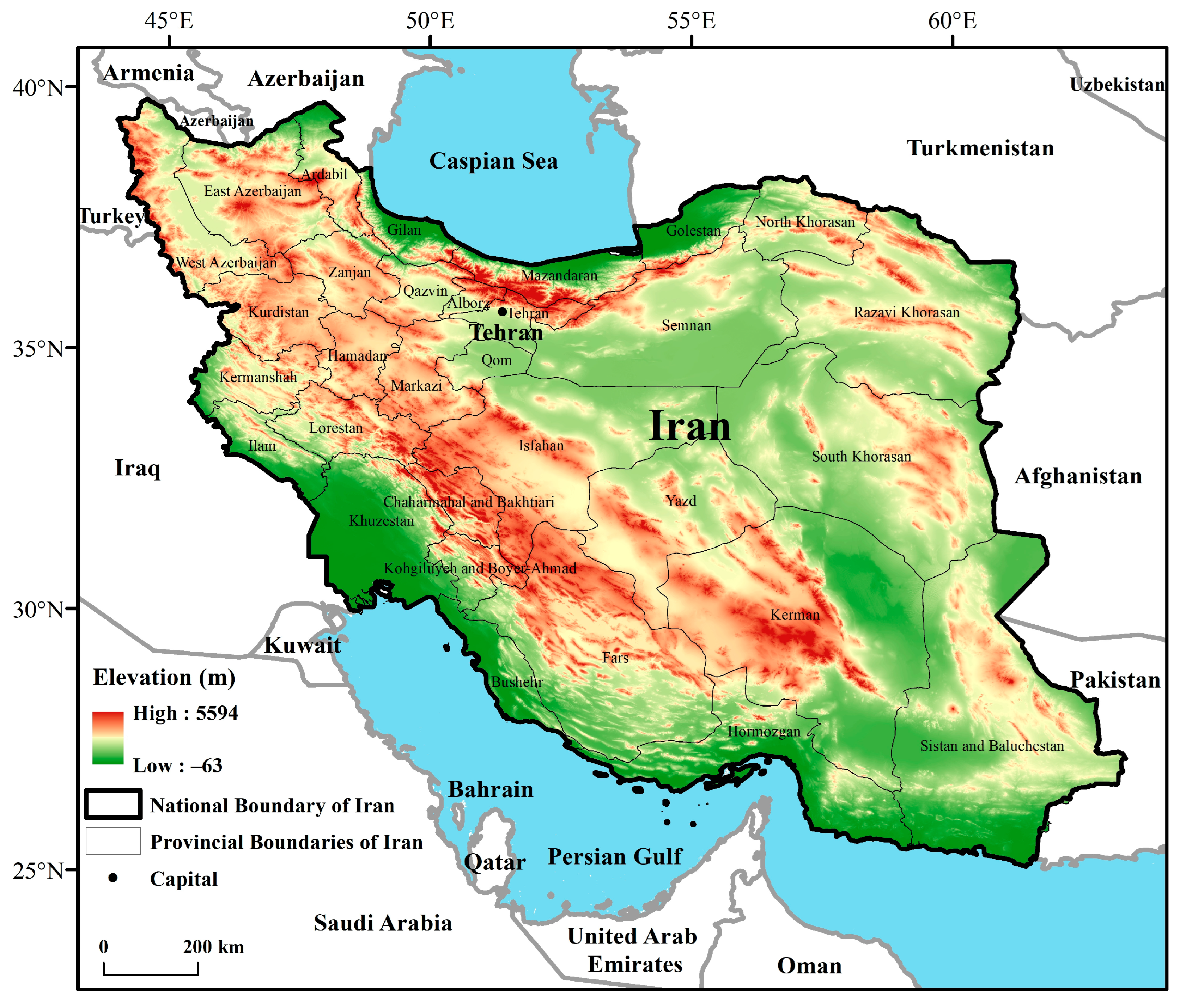
As a major Middle Eastern country, Iran is located in Southwest Asia between roughly 25–40° N and 44–63° E. Its land area, approximately 1.65 million km2, makes it the second largest in the region (Figure 1). To its north lies the Caspian Sea, while the Persian Gulf and Gulf of Oman border it to the south. Its eastern and western neighbors are Afghanistan, Pakistan, Iraq, and Turkey, and across the Strait of Hormuz to the south lies the Arabian Peninsula. Climatically, most of Iran is arid or semi-arid, but with notable regional differences. The northern coastal area along the Caspian Sea enjoys a humid subtropical climate with high rainfall and mild temperatures. In contrast, the central highlands have a continental climate marked by large temperature ranges and scarce precipitation. The southern coasts near the Persian Gulf and Gulf of Oman are warm and dry, with extremely hot summers. Annual temperatures across the country average between 10 °C and 27 °C, and yearly rainfall typically falls below 250 mm. Despite these water constraints, Iran supports the cultivation of major cereal crops—including wheat, rice, maize, and barley—through irrigated agriculture and the utilization of diverse agroclimatic conditions across the country [18].

2.2. Data Sources

In this study, grain crops include wheat, rice, maize, and barley, while cash crops include sugarcane and cotton. Data on the sown area, total production, and yield of major crops in Iran were obtained from the SPAM dataset (https://mapspam.info/) for the period 2000–2020 and the statistical yearbooks of the Iranian Ministry of Agriculture Jihad (https://www.amar.org.ir/). N application rates and organic manure data for major crops in Iran were derived from the global crop-specific N fertilizer dataset (1961–2020) [19]. Atmospheric N deposition data for Iran were obtained from the global N deposition dataset (2008–2020) [20]. N fixation rates for crops were referenced from Smil et al. [21] and the N contents of wheat, rice, barley, maize, sugarcane, and cotton were sourced from Mosanaei et al. [22], Mohammadian et al. [23], Shokat et al. [24], Majnooni-Heris et al. [25], Bahrani et al. [26], and Seilsepour et al. [27], respectively. All coefficients are derived from the local Iranian literature and fall within the global range of coefficient values. Among the datasets used in this study, only the statistical yearbook of the Iranian Ministry of Agriculture Jihad provides aggregated statistical data, while all other datasets are at the raster scale. Three time periods—2000, 2010, and 2020—were uniformly selected, and all raster data were resampled to a uniform spatial resolution of 10 km. To verify data reliability, we first conducted a cross-comparison at the national level between the Ministry of Agriculture Jihad statistics and the Food and Agriculture Organization (FAO) data, focusing on indicators such as sown area, total production, yield, and N application rate. The results showed good consistency between the two sources. Based on this, to better align with the local data characteristics of Iran, the provincial-level statistical data from the Ministry of Agriculture Jihad were proportionally allocated to the raster scale of the SPAM dataset. This ensured that the aggregated raster data for each province matched the total provincial statistics from the Ministry, while the allocation proportions at the raster level remained consistent with the SPAM dataset. For N application data, the Ministry’s statistical yearbook only provides total national N application without crop-specific breakdowns, making it unsuitable for the raster allocation method described above. However, cross-validation with FAO data and the relevant literature confirms that this dataset accurately reflects the overall N application situation in Iran.

2.3. Methods

2.3.1. NUE

Nitrogen use efficiency (NUE) is defined as the ratio of N output from crop harvest to total agricultural N input, which encompasses chemical fertilizers, organic manure, biological N fixation, and atmospheric N deposition. The calculation formula is presented below [28]:
NUE c   =   N c , yield N c , fer   +   N c , man   +   N c , fix   +   N c , dep   ×   100 %
N c , yield =   Yield c   ×   NC c
where NUEc represents the nitrogen use efficiency of crop c (%), Nc,yield denotes the N output of crop c at harvest (kg/ha), Nc,fer represents the chemical N fertilizer input for crop c (kg/ha), Nc,man represents the organic manure N input for crop c (kg/ha), Nc,dep represents the atmospheric N deposition for crop c (kg/ha), and Nc,fix represents the N fixation for crop c (kg/ha). Yieldc represents the yield of crop c (kg/ha), and NCc indicates the N content of crop c at harvest (%).

2.3.2. N Surplus

For the environmental dimension, we set two indicators: N surplus and GHG emissions; the N surplus was calculated as follows [28]:
NU c , sur   =   N c , fer   +   N c , man   +   N c , fix   +   N c , dep     N c , yield
where NUc,sur is the excess N application of crop c (kg/ha); Nc,fer and Nc,man are the N inputs from chemical fertilizer and organic manure, respectively (kg/ha); Nc,fix and Nc,dep represent N fixation and atmospheric deposition, respectively (kg/ha); and Nc,yield is the N output at harvest (kg/ha).

2.3.3. GHG Emissions

GHG emissions from crops primarily include N2O and CH4. N2O emissions originate from N fertilizer application, encompassing both direct and indirect emissions. CH4 emissions, on the other hand, mainly arise from rice cultivation. The calculation formulas is as follows [29]:
CF c , GHG   =   E c , N 2 O   ×   44 28   ×   273   +   E c , CH 4   ×   27
where CFc,GHG represents GHG emissions (kg CO2 eq/ha); E c , N 2 O denotes the N2O emissions of crop c (kg/ha); 44 28 is the factor for converting N2 to N2O. E c , CH 4 represents the CH4 emissions from rice cultivation (kg CH4/ha); and 273 and 27 are the global warming potentials of N2O and CH4, respectively.
(1)
N2O emissions from fertilizer
Direct N2O emissions were estimated using crop-specific emission factors reported in the literature. Specifically, the factors for wheat, rice, and sugarcane were taken from Moradimajd et al. [30]; for barley, from Qin et al. [31]; for maize, from Borzouei et al. [32]; and for cotton, from Gheysari et al. [33].
E c , N 2 O _ d i r = 0.0042   ×   N c , fer ,   w h e a t 0.0108   ×   N c , fer ,   r i c e 0.00585   ×   N c , fer ,   b a r l e y 0.01   ×   N c , fer ,   m a i z e 0.0038   ×   N c , fer ,   s u g a r c a n e 0.0095   ×   N c , fer ,   c o t t o n
where Ec,N2O_dir represents the direct N2O emissions from crop c (kg/ha), and Nc,fer represents the N fertilizer input for crop c (kg/ha).
The calculation of indirect N2O emissions adopted the emission factors from the Intergovernmental Panel on Climate Change (IPCC) National Greenhouse Gas Inventories Guidelines [34].
For N leaching from different crops, we adopted the findings of Wang et al. [35]. The N leaching calculation method is as follows:
N c , L e a = 0.085   ×   N c , f e r ,     wheat 0.105   ×   N c , f e r ,     rice 0.07   ×   N c , f e r ,     barley 0.095   ×   N c , f e r ,     maize 0.125   ×   N c , f e r ,     sugarcane 0.055   ×   N c , f e r ,     cotton
where Nc,Lea represents the amount of N leaching from crop c (kg/ha), and Nc,fer represents the N fertilizer input for crop c (kg/ha).
For ammonia volatilization from different crops, we adopted the findings of Xu et al. [36]. The ammonia volatilization calculation method is as follows:
E c , N H 3 _ v o l = 0.09   ×   N c , f e r ,     wheat 0.15   ×   N c , f e r ,     rice 0.08   ×   N c , f e r ,     barley 0.105   ×   N c , f e r ,     maize 0.13   ×   N c , f e r ,     sugarcane 0.07   ×   N c , f e r ,     cotton
where E c , N H 3 _ v o l represents the amount of ammonia volatilization from crop c (kg/ha), and Nc,fer represents the N fertilizer input for crop c (kg/ha).
For nitrous oxide (NOx) emissions from different crops, we adopted the range of emission factors proposed by Wang et al. [37] and Moradimajd et al. [30]. The calculation method for NOx emissions is as follows:
E c , N O x _ v o l = 0.005   ×   N c , f e r ,     wheat 0.0015   ×   N c , f e r ,     rice 0.004   ×   N c , f e r ,     barley 0.0055   ×   N c , f e r ,     maize 0.0065   ×   N c , f e r ,     sugarcane 0.003   ×   N c , f e r ,     cotton
where E c , N O x _ v o l represents the NOx emissions from crop c (kg/ha), and Nc,fer represents the N fertilizer input for crop c (kg/ha).
(2)
CH4 emissions from rice fields
The methane calculation formula is derived from the IPCC 2019 report [34], as well as the studies by Salar Ashayeri et al. [38] and Yousefian et al. [39] The formula for calculating methane emissions from rice cultivation is as follows:
C H 4 , r   =   a , b , c ( E F a , b , c   ×   T a , b , c   ×   A a , b , c   ×   10 6 )
where CH4,r represents the methane emission intensity (Gg CH4/yr); EFa,b,c represents the methane emission factor (kg CH4/ha/day); Ta,b,c represents the rice cultivation period (day); Aa,b,c represents the rice cultivation area (ha); and a, b, c represent different ecosystems, water regimes, and organic amendment types and amounts, as methane emissions from rice cultivation may vary under different conditions.
E F a = E F b × G F c × H F d × K F e
where EFa and EFb are the adjusted and baseline daily emission factors, respectively; GFc and HFd are scaling factors for water management during cultivation and the pre-cultivation season; and KFe is a scaling factor dependent on the type and amount of organic amendment applied.
K F e = 1 + a R O A a × C F O A a 0.59
where KFe is the organic amendment scaling factor (dependent on type and amount); a denotes the amendment type; ROAa is the application rate (kg/ha), with straw reported in dry weight and others in fresh weight; and CFOAa is the conversion factor for amendment a.

3. Results

3.1. Spatiotemporal Patterns of Crop Production in Iran

3.1.1. Sown Area of Major Crops in Iran

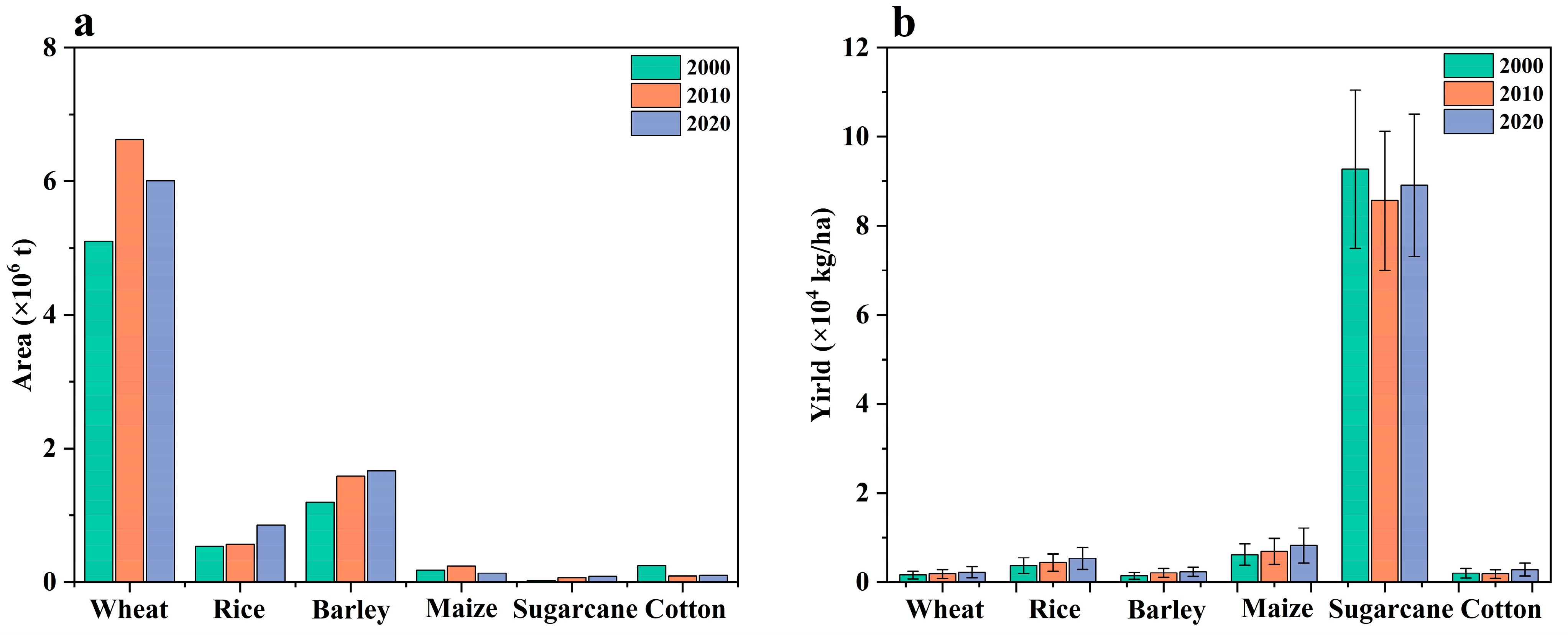
The composition of sowing areas for major crops in Iran displays considerable variation. Wheat dominates the sown area composition, accounting for 71.32% of the total sown area, followed by barley at 17.88%. In contrast, the shares of rice, maize, cotton, and sugarcane are substantially smaller, comprising 7.86%, 2.23%, 1.75%, and 0.72%, respectively. This predominance of wheat and barley underscores the heavy reliance of Iran’s agricultural sector on drought-tolerant staple crops, a structural feature well-adapted to the country’s arid and semi-arid environmental conditions. From a temporal perspective, the total sown area of major crops in Iran exhibited an overall expansion trend during 2000–2020. Among these, the sown areas of rice, barley, and sugarcane showed sustained increases over the period. In contrast, wheat and maize followed a trajectory of initial increase followed by decline, while cotton displayed a pattern of early decrease and subsequent recovery (Figure 2a). In terms of average annual growth rates, sugarcane, rice, barley, and wheat recorded positive growth, at 6.32%, 2.38%, 1.67%, and 0.82%, respectively. Conversely, cotton and maize experienced negative average annual growth rates, at –4.26% and –1.56%, respectively.
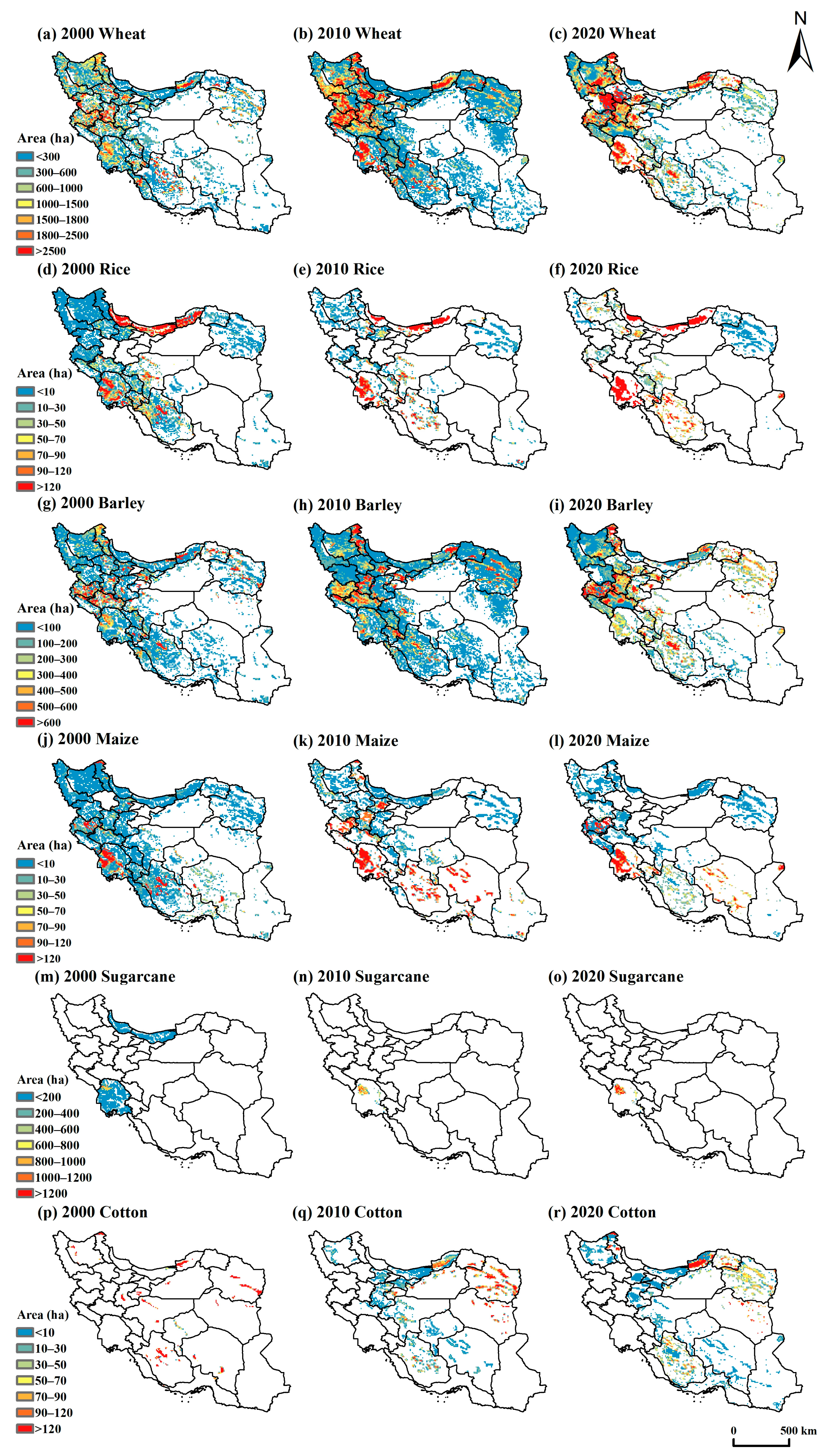
In terms of spatial distribution, the sown areas of major crops in Iran display significant spatial heterogeneity (Figure 3). In 2020, areas with high maize sown density were predominantly located in the southern and western regions, with Khuzestan and Kermanshah provinces emerging as key production hubs. Khuzestan Province recorded the largest maize sowing area, accounting for 38.69% of the national total, thereby establishing itself as the core region for maize cultivation in Iran. Rice cultivation is highly concentrated along the Caspian Sea coast in the north and in selected southern areas, with the highest concentration found in Mazandaran Province, followed by Gilan and Khuzestan provinces. These three provinces together account for 41.58%, 25.74%, and 10.95% of the national rice sowing area, respectively—a distribution pattern closely aligned with the abundant water availability and humid climatic conditions characteristic of these regions. Large cotton sown areas are concentrated in the northeastern part of the country, with Golestan and Khorasan provinces serving as the primary production zones. Among these, Khuzestan Province holds the largest cotton sowing area, followed by Kermanshah Province, representing 38.68% and 20.28% of the national total, respectively. Barley sowing areas with high density are concentrated in western and northern Iran, with Fars Province ranking first, followed closely by Kermanshah Province. These two provinces account for 10.76% and 10.50% of the national barley sowing area, respectively, reflecting the suitability of local climatic conditions for barley’s drought-tolerant characteristics. Large wheat sown areas are widely distributed across the northwestern regions, as well as parts of northern and southern Iran, including provinces such as Kurdistan, Zanjan, Golestan, and Khuzestan. Among these, Kurdistan Province holds the highest share of wheat sowing area (9.99%), followed by Khuzestan Province (8.97%). Sugarcane cultivation is overwhelmingly concentrated in Khuzestan Province, with only a limited presence in Mazandaran Province in the north. This spatial pattern is primarily attributed to Khuzestan’s favorable climatic conditions and well-established sugarcane industry infrastructure, which together position it as the national center for sugarcane production. In contrast, other provinces face constraints related to insufficient thermal or water resources, making large-scale sugarcane cultivation difficult to sustain.
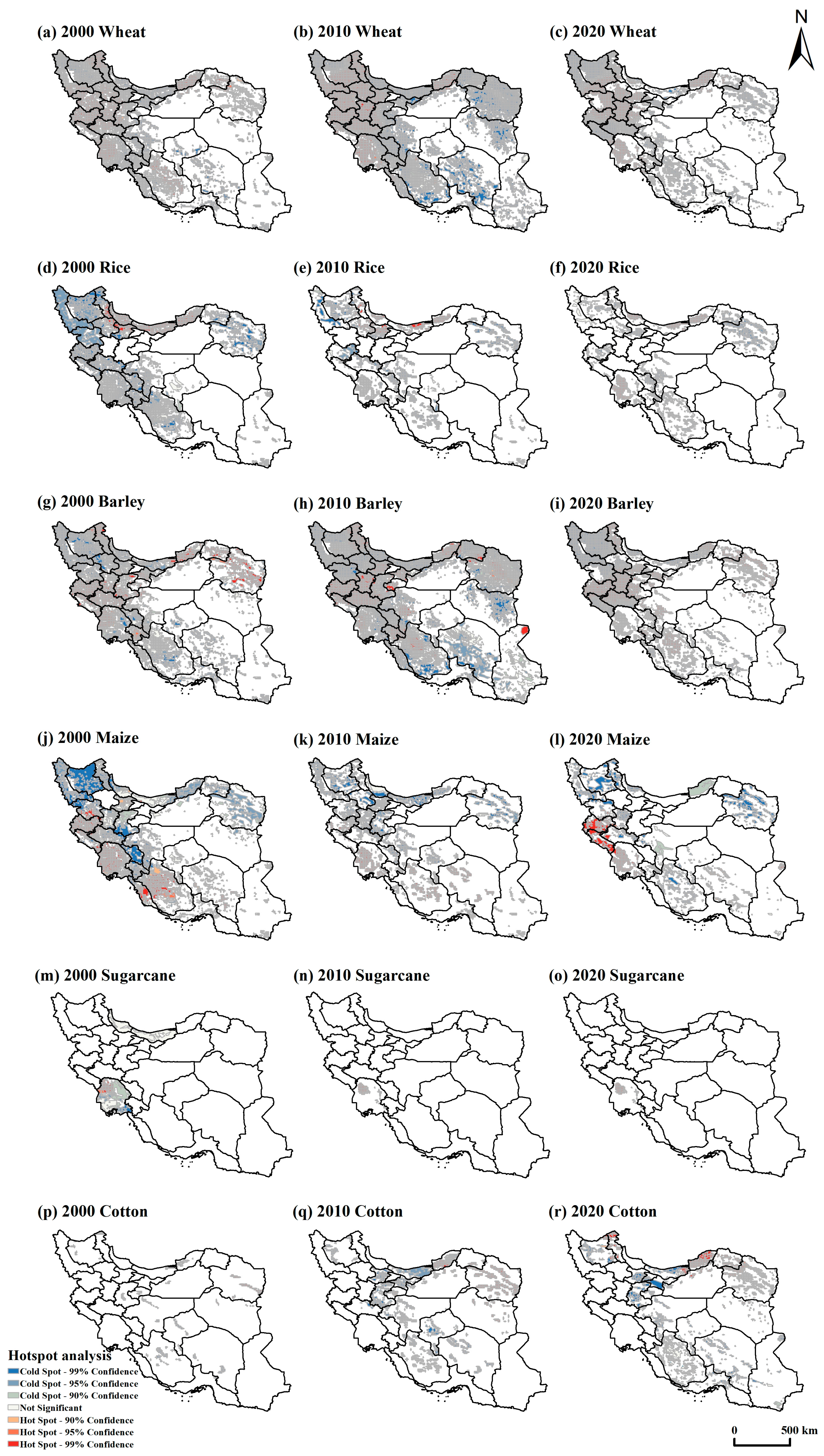
Spatially, the hotspots of sown areas for major crops in Iran were mainly concentrated in the northern and southern regions, while the cold spots were primarily located in the western regions, showing good consistency with the overall spatial pattern of sown area distribution in Iran. Specifically, the cold spots of wheat and barley were relatively concentrated, mainly occurring in southern Iran. The cold spots of rice and maize were primarily concentrated in western Iran. In terms of hotspots, rice and cotton hotspots were mainly distributed along the Caspian Sea coast in northern Iran. Maize hotspots were predominantly located in western Iran, while sugarcane hotspots were primarily concentrated in Khuzestan Province (Figure 4).

3.1.2. Crop Yield of Major in Iran

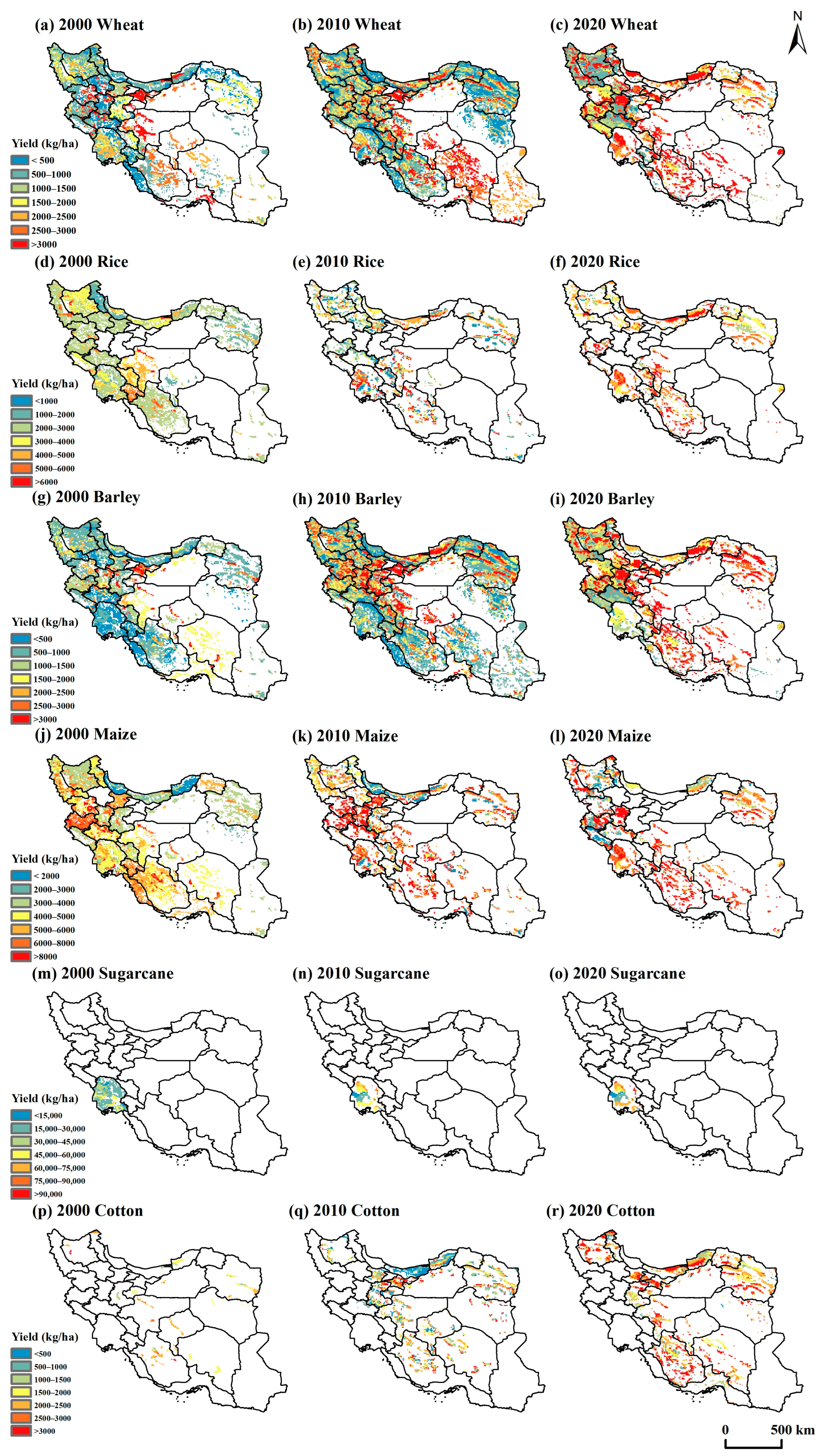
In 2000, 2010, and 2020, the national average yields of major crops in Iran showed substantial variation. Sugarcane had the highest average yield, reaching 89,145 kg/ha, followed by maize at 7093 kg/ha. The average yields of rice, cotton, barley, and wheat were 4481 kg/ha, 2223 kg/ha, 1939 kg/ha, and 1891 kg/ha, respectively. Temporally, the average yields of most major crops in Iran exhibited an overall increasing trend during the 2000–2020 period, with sugarcane being the sole exception (Figure 2b). Nevertheless, the growth rates varied considerably among crops. With the exception of sugarcane, all six crops recorded positive average annual growth rates. Barley and rice posted relatively higher annual growth rates at 2.53% and 1.85%, respectively, while wheat, cotton, and maize registered comparatively modest rates of 1.76%, 1.65%, and 1.44%, respectively. In contrast, sugarcane experienced a slight decreasing trend, reflected in a negative average annual growth rate of –0.2%.
From a spatial distribution standpoint, crop yields in Iran demonstrate pronounced spatial heterogeneity (Figure 5). In 2020, high-yield areas for wheat were broadly distributed in a semi-circular pattern along the Iranian Plateau. Notably, Hormozgan, Tehran, and Yazd provinces recorded average yields of 4912 kg/ha, 3903 kg/ha, and 3844 kg/ha, respectively, substantially surpassing the national average. High-yield areas for rice were mainly situated along the Caspian Sea coast in the north and in parts of southern Iran. Kermanshah Province reported the highest average yield at 6307 kg/ha, followed by Golestan, Kohgiluyeh and Boyer-Ahmad, and Ilam provinces, where average yields also far exceeded the national level—reaching 5900 kg/ha, 5736 kg/ha, and 5600 kg/ha, respectively. Barley high-yield areas were predominantly concentrated in northwestern Iran, including Alborz, Tehran, and Markazi provinces, with average yields of 4569 kg/ha, 4569 kg/ha, and 4213 kg/ha—all above the national average. Maize high-yield areas were concentrated in western and southern Iran, where Hamadan, Fars, and Kerman provinces achieved average yields of 9784 kg/ha, 9443 kg/ha, and 9257 kg/ha, respectively. Cotton yields were relatively evenly distributed across the country, with approximately 90% of cotton-growing areas recording average yields between 2009 kg/ha and 2802 kg/ha. Alborz Province recorded the highest average cotton yield at 2802 kg/ha. Sugarcane cultivation is concentrated in Khuzestan Province, where abundant water resources and favorable thermal conditions explain its significantly higher yields compared to other regions of Iran.
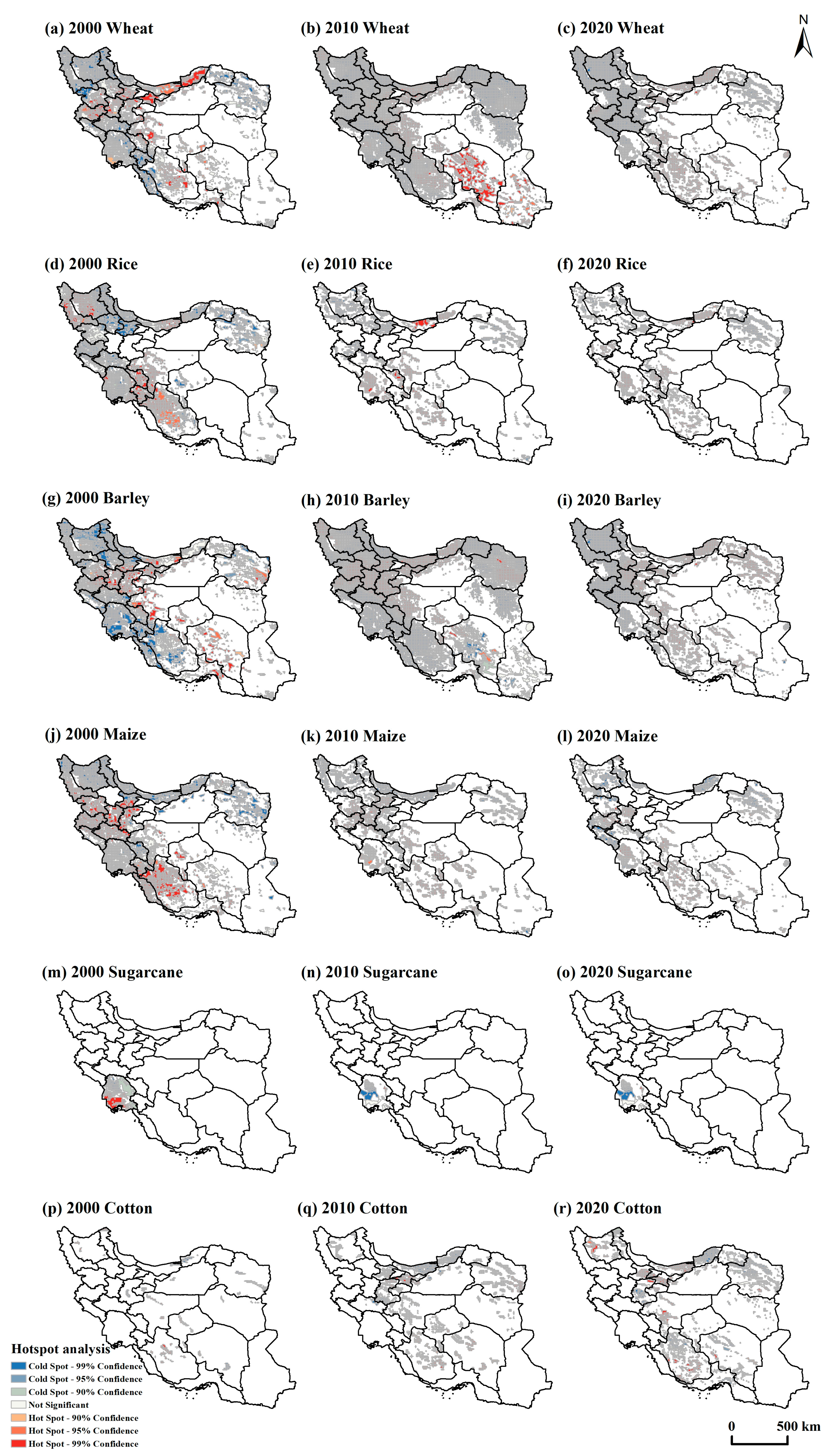
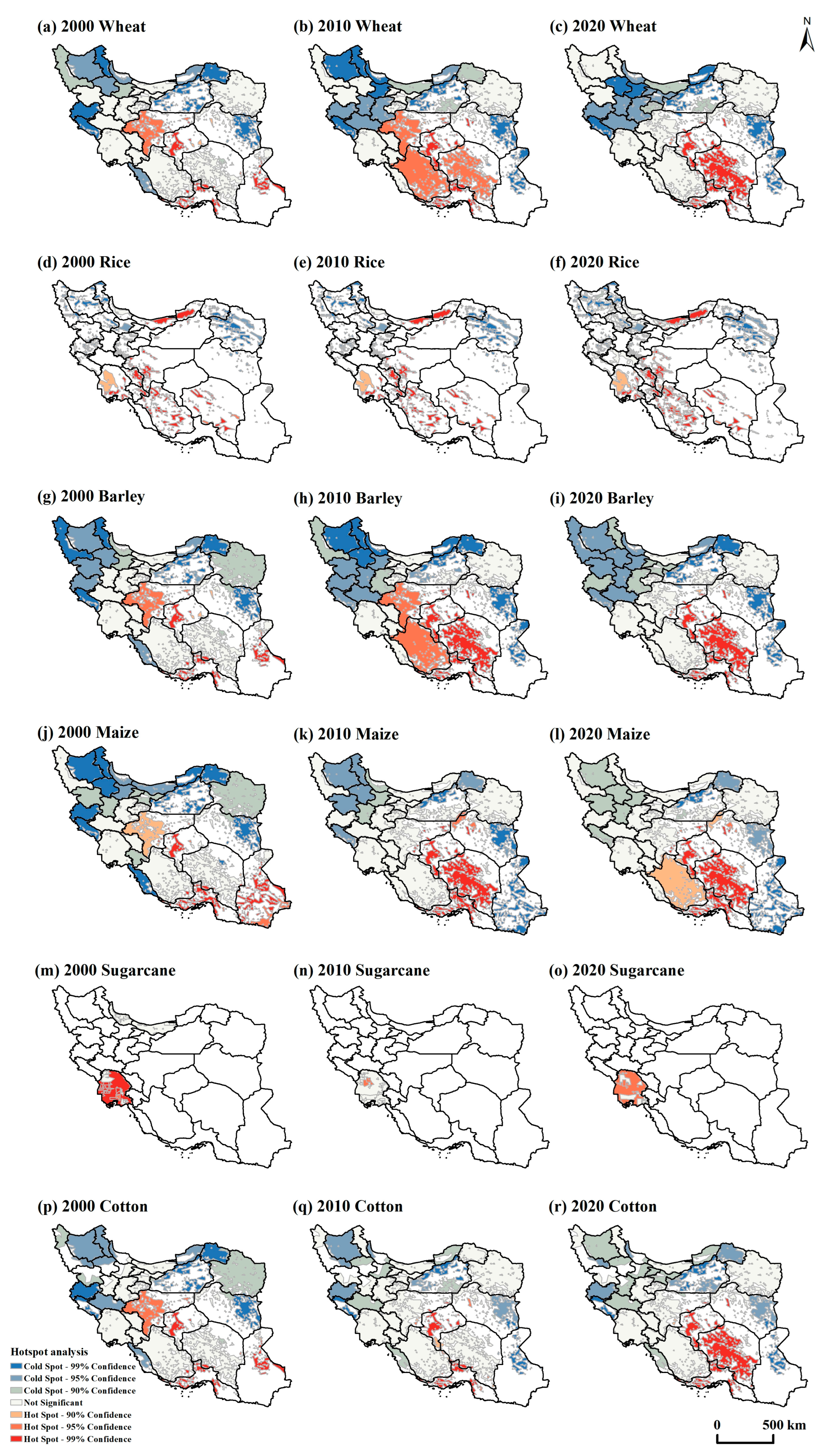
The hotspots of crop yields in Iran were relatively concentrated, primarily located in the northern and southern regions, while the cold spots were most concentrated in the western region. This distribution of hotspots and cold spots effectively reflected the yield patterns across Iran. Specifically, the hotspots for wheat and rice were mainly concentrated along the northern Caspian Sea coast and in several southern provinces, whereas the hotspots for barley and maize were primarily located in the west-central and southern parts of the country. The cold spots were most evident for wheat, barley, and rice, which were predominantly situated in western Iran (Figure 6).

3.2. Spatiotemporal Patterns of N Application in Iran

3.2.1. N Application Rates for Major Crops in Iran

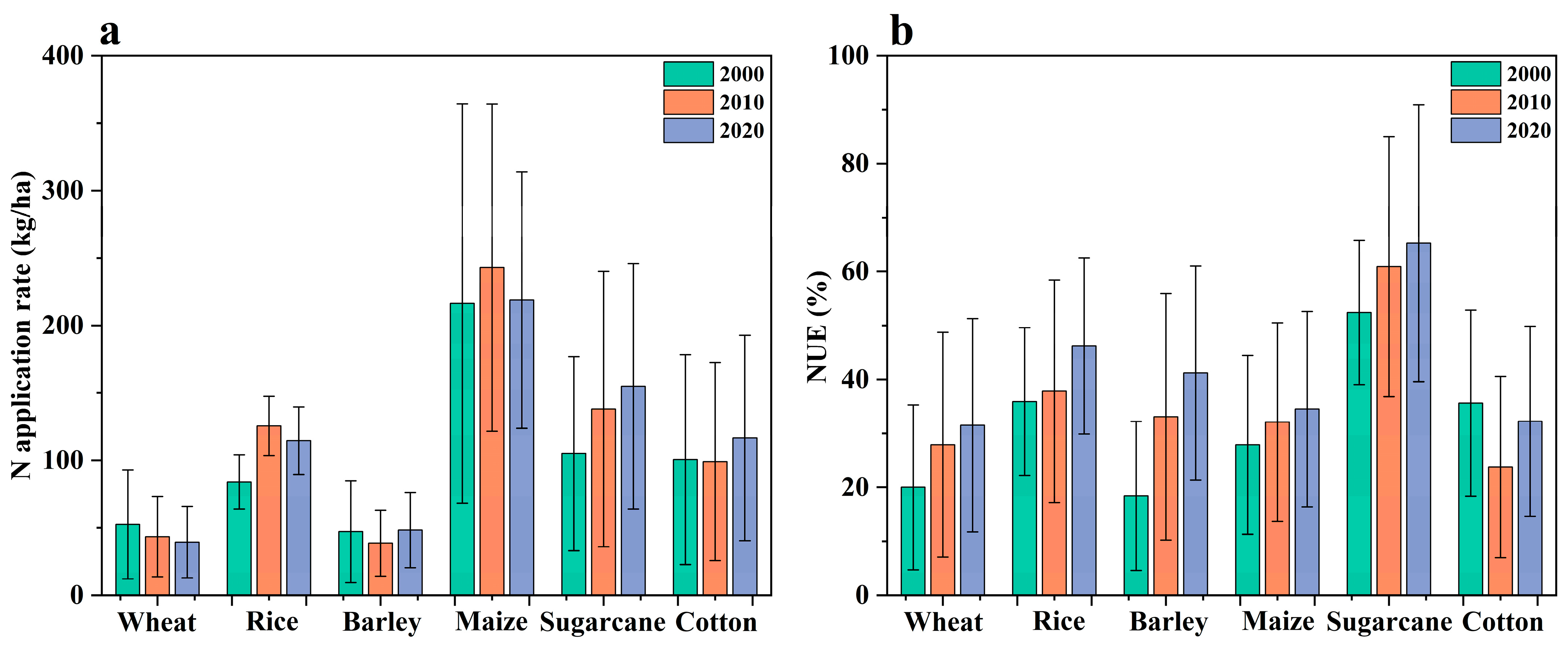
N application rates vary among major crops in Iran. Between 2000 and 2020, maize had the highest average N application rate at 225 kg/ha, followed by sugarcane (132 kg/ha), rice (108 kg/ha), and cotton (105 kg/ha). In contrast, barley and wheat received comparatively lower rates, at 45 kg/ha and 44 kg/ha, respectively. From a temporal perspective, N application rates for these crops remained relatively stable overall during 2000–2020, with only minor fluctuations (Figure 7a). However, distinct trends emerged for individual crops: rice and maize followed a pattern of initial increase followed by decline; barley and cotton showed an initial decrease followed by a subsequent rise; sugarcane exhibited a continuous increasing trend; and wheat experienced a sustained decline. The average annual growth rates also differed across crops. Rice, sugarcane, cotton, barley, and maize recorded positive growth, with average annual rates of 1.56%, 1.23%, 0.74%, 0.12%, and 0.06%, respectively. In contrast, wheat registered a negative average annual growth rate of –1.42%.
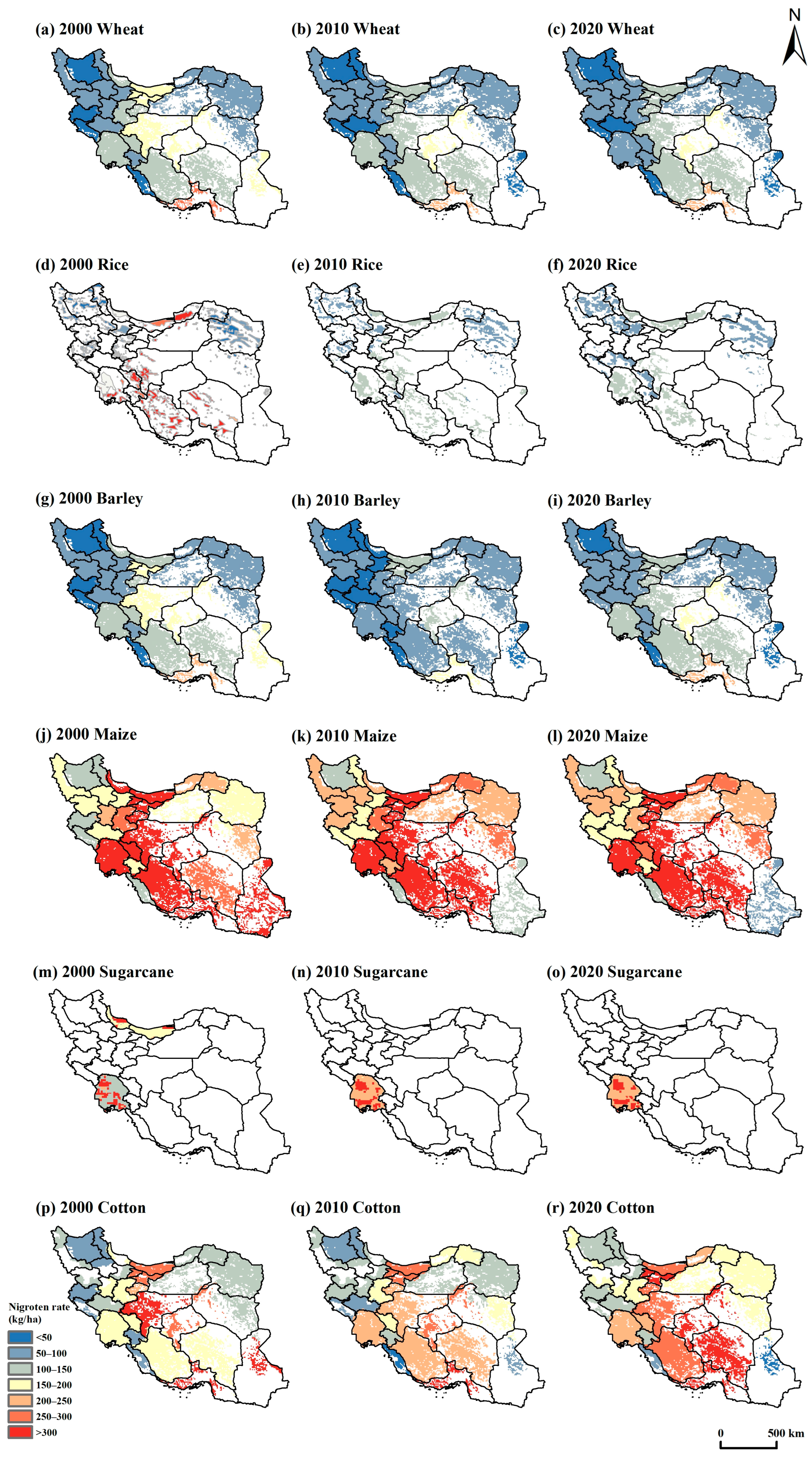
In terms of spatial distribution, N application rates for crops in Iran display marked spatial heterogeneity (Figure 8). In 2020, areas with high N application rates for rice were primarily concentrated in the Caspian Sea coastal provinces and southern provinces, including Mazandaran, Khuzestan, and Fars, each recording a rate of 128 kg/ha. In contrast, rates in western regions such as East Azerbaijan, Lorestan, and Ardabil provinces were relatively lower, at 68 kg/ha. Wheat and barley exhibited similar spatial patterns of N application, with high-rate areas concentrated in the southern regions, particularly Hormozgan Province, which recorded the highest rates for both crops (212 kg/ha for wheat and 229 kg/ha for barley). In western areas where wheat and barley cultivation is limited, application rates were generally low. For example, in East Azerbaijan, Lorestan, and Zanjan provinces, N rates for wheat were 42 kg/ha, 48 kg/ha, and 60 kg/ha, respectively, while those for barley were 46 kg/ha, 51 kg/ha, and 65 kg/ha, respectively. Maize N application rates were generally high across the country, especially in northern and selected southern provinces. In Mazandaran, Tehran, and Kerman provinces, rates reached 425 kg/ha, 410 kg/ha, and 400 kg/ha, respectively. In contrast, Sistan and Baluchestan Province recorded the lowest rate at just 88 kg/ha. Cotton N application rates were highest in Tehran and Alborz provinces (308 kg/ha), while southern provinces such as Bushehr and Sistan and Baluchestan had relatively lower rates of 85 kg/ha and 64 kg/ha, respectively. Sugarcane N application was highly concentrated in Khuzestan Province—Iran’s primary sugarcane-producing region—with rates generally around 132 kg/ha.
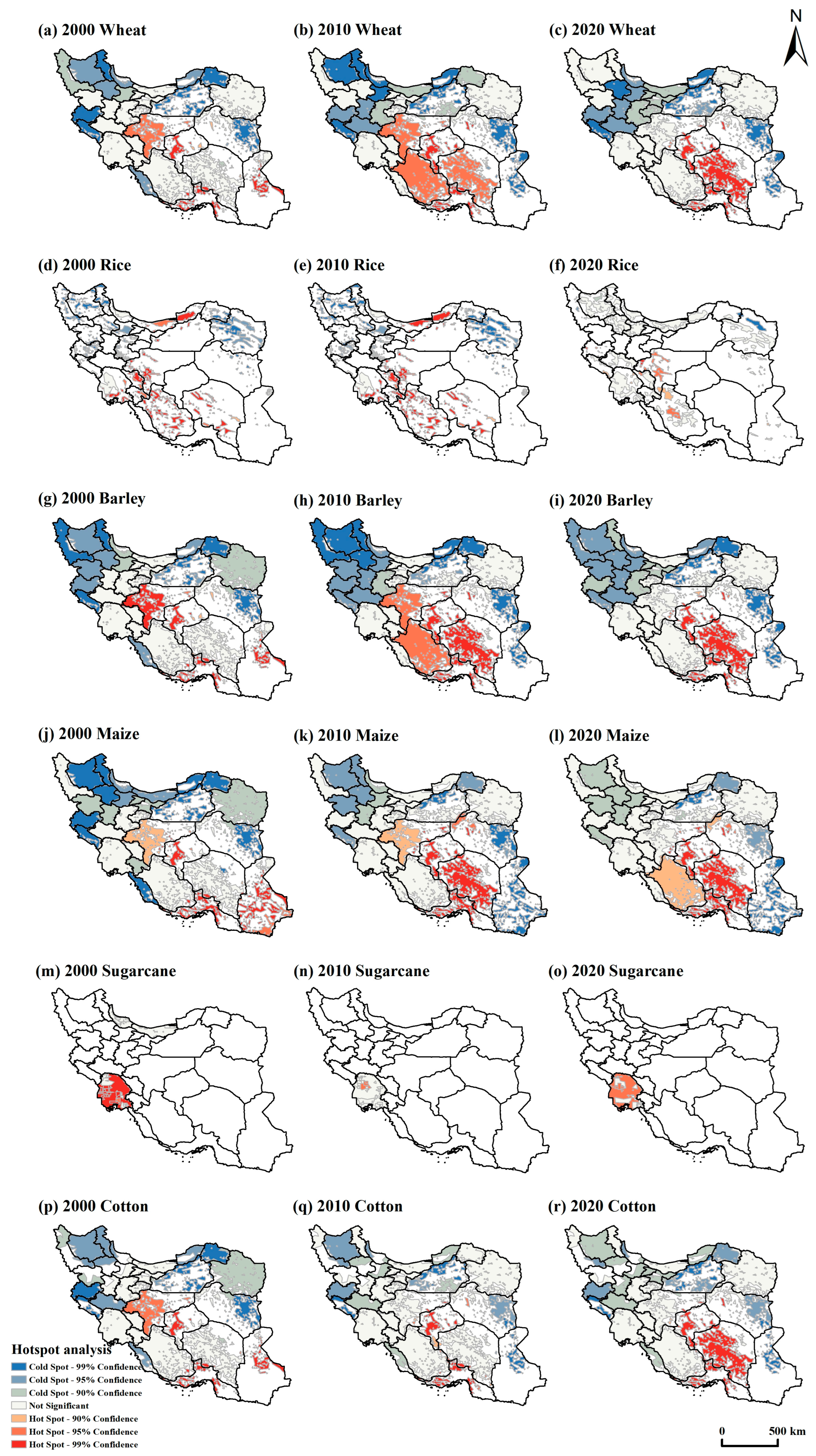
Hotspots for N application rate were largely concentrated along the northern Caspian Sea coast and in the southern regions, whereas cold spots were mainly located in western and northwestern Iran. In more detail, the spatial patterns for wheat, barley, and maize were relatively similar, with hotspots in the south and cold spots in the west. Rice hotspots were mainly found along the northern Caspian Sea coast and in southern provinces, while its cold spots were primarily in the northwest and southwest. Cotton hotspots were predominantly in the south, and its cold spots were mostly in the west. Sugarcane hotspots were largely confined to the sugarcane-producing areas of Khuzestan Province. Temporally, the extent of hotspots for the major crops initially expanded before stabilizing, while cold spot areas showed a general trend of contraction. This suggested that areas with low N application were shrinking, and the national N application rate was generally increasing (Figure 9).

3.2.2. NUE of Major Crops in Iran

NUE differs among major crops in Iran. Overall, cash crops demonstrate a higher average NUE (45.02%) than food crops (32.21%). Sugarcane ranks first with the highest average NUE at 59.52%, followed by rice (39.96%), maize (31.5%), barley (30.9%), cotton (30.53%), and wheat (26.46%). From a temporal perspective, during the period 2000–2020, the NUE of wheat, rice, barley, maize, and sugarcane exhibited an upward trend (Figure 7b), while cotton NUE followed a pattern of initial decline and subsequent recovery. In terms of average annual growth rates, barley, wheat, rice, sugarcane, and maize all posted positive increases, at 4.11%, 2.3%, 1.27%, 1.1%, and 1.07%, respectively. Cotton was the only crop to record a negative average annual growth rate, at –0.5%.
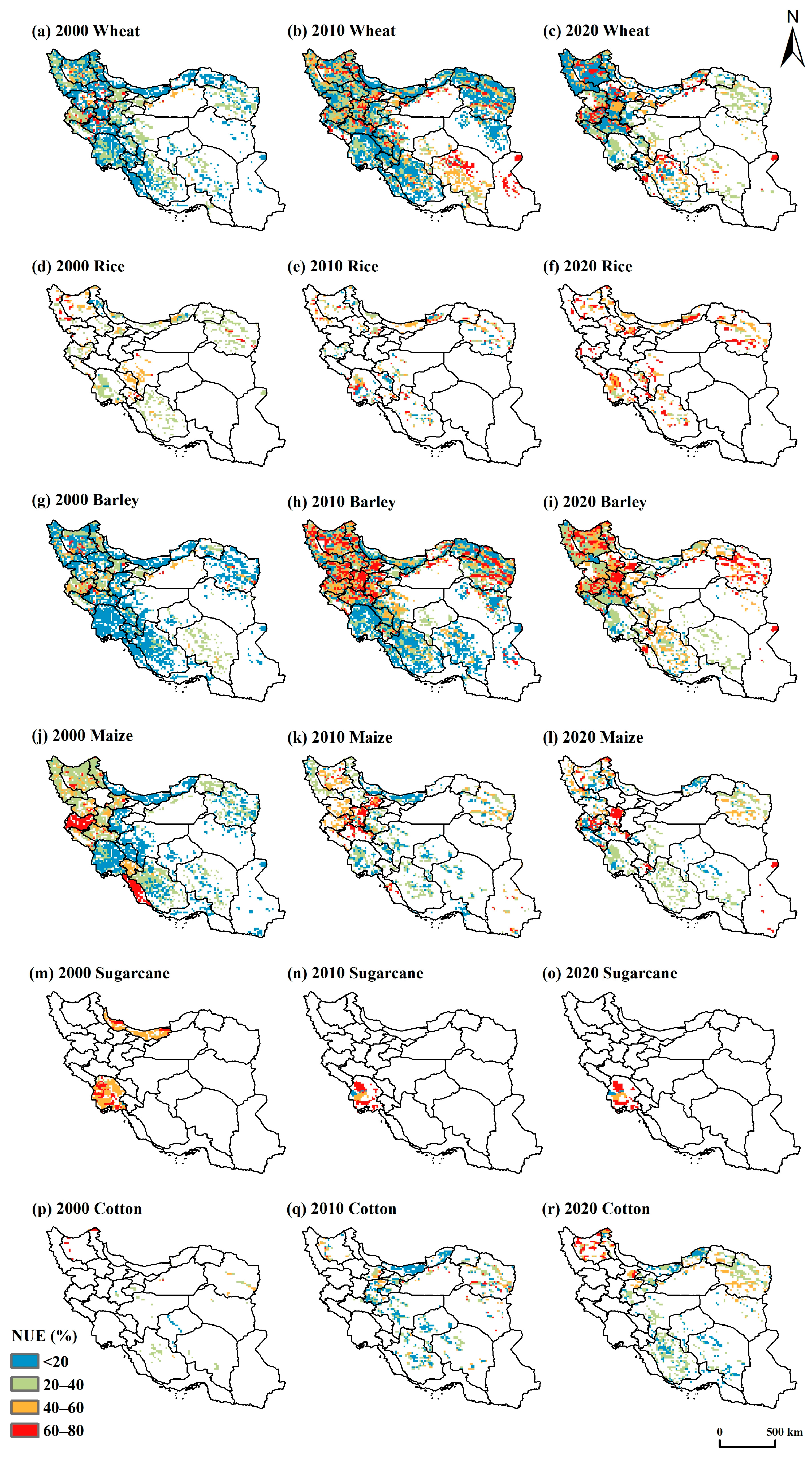
In terms of spatial distribution, the NUE of crops in Iran displays marked spatial heterogeneity (Figure 10). In 2020, high-NUE areas for wheat were mainly concentrated in the western regions and parts of the south, including Alborz, Bushehr, Qom, and Kermanshah provinces, with average NUE values of 49.93%, 44.46%, 42.31%, and 42.22%, respectively. High-NUE areas for rice were primarily located in northern and southern Iran, notably in Kermanshah, Qazvin, and Golestan provinces, where average NUE reached 71.14%, 66.79%, and 55.70%, respectively. High-NUE areas for barley were mainly found in western and northern Iran, including Qazvin, Razavi Khorasan, Hamadan, and East Azerbaijan provinces, with average NUE values of 59.21%, 57.60%, 55.81%, and 53.23%, respectively. High-NUE areas for maize were concentrated in the southern regions, particularly in Hamadan and Kohgiluyeh and Boyer-Ahmad provinces, where average NUE reached 64.69% and 50.82%, respectively. High-NUE areas for cotton were mainly distributed in East Azerbaijan and Qazvin provinces, with average NUE values of 64.05% and 55.51%, respectively. Sugarcane NUE is also highly concentrated in Khuzestan Province, where relatively sound water and fertilizer management practices and appropriate application levels contribute to its higher NUE compared to other crops.
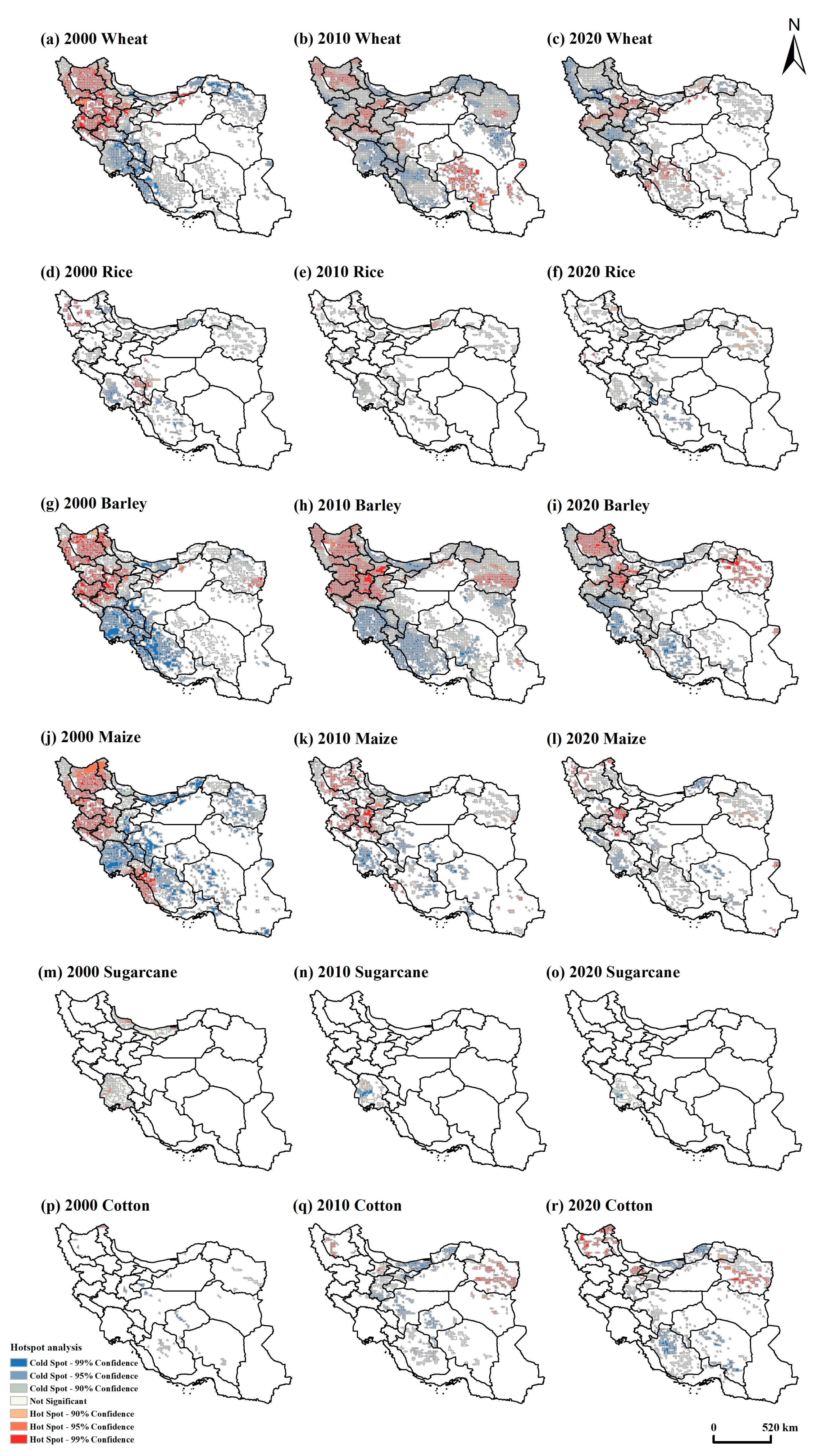
NUE hotspots for major crops in Iran were largely concentrated in the northwestern region, while cold spots were mainly located in the northern and southern regions, showing a high degree of spatial clustering. The hotspot and cold spot patterns for wheat, barley, and maize were relatively similar, with hotspots consistently distributed in the northwest and cold spots primarily in the south. Rice hotspots were mainly concentrated in the north. Cotton hotspots were predominantly found in the northwest and northeast, whereas its cold spots were primarily located in the south and along the Caspian Sea coast in the north (Figure 11).
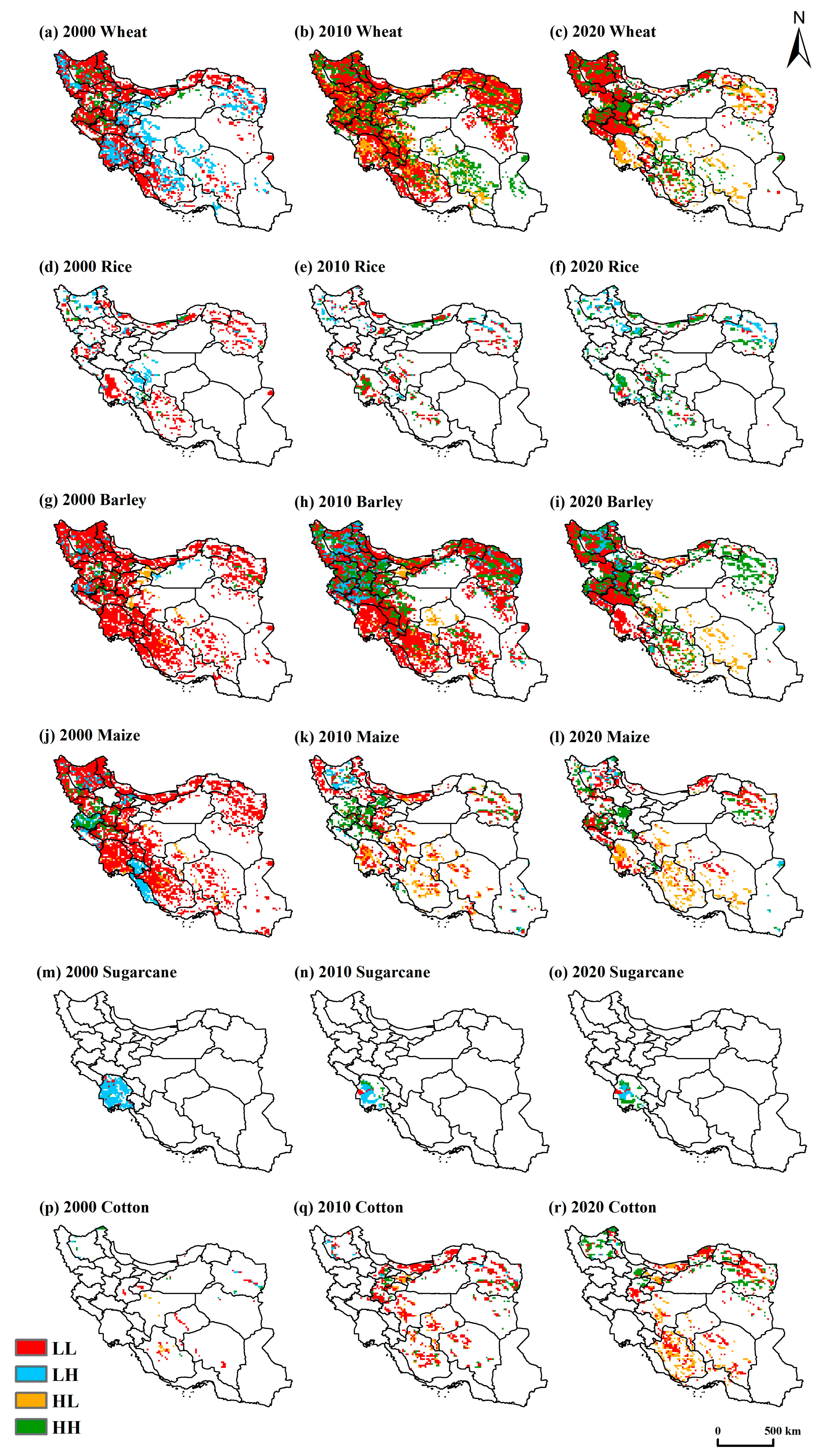
From a spatial perspective, high-yield and high-efficiency (HH) regions were mainly distributed in the western, northern, and parts of southern Iran. High-yield but low-efficiency (HL) regions were primarily located in southern and northeastern Iran. Low-yield but high-efficiency (LH) regions were mainly found in central and parts of northern Iran, while low-yield and low-efficiency (LL) regions were most concentrated in western Iran. Temporally, between 2000 and 2020, the HH areas for wheat, rice, barley, maize, and cotton exhibited an expanding trend, whereas LH areas contracted and transitioned into HL areas. This suggested that, while yields had increased in recent decades, improving efficiency remained a key priority. For sugarcane, a clear transition from LH to HH was observed, with HH areas concentrated primarily in Khuzestan Province. Overall, the performance of major crops in Iran improved between 2000 and 2020, characterized by an expansion of HH areas and a reduction in LL areas (Figure 12).

3.3. Spatiotemporal Patterns of Environmental Footprint in Iran

3.3.1. N Surplus of Major Crops in Iran

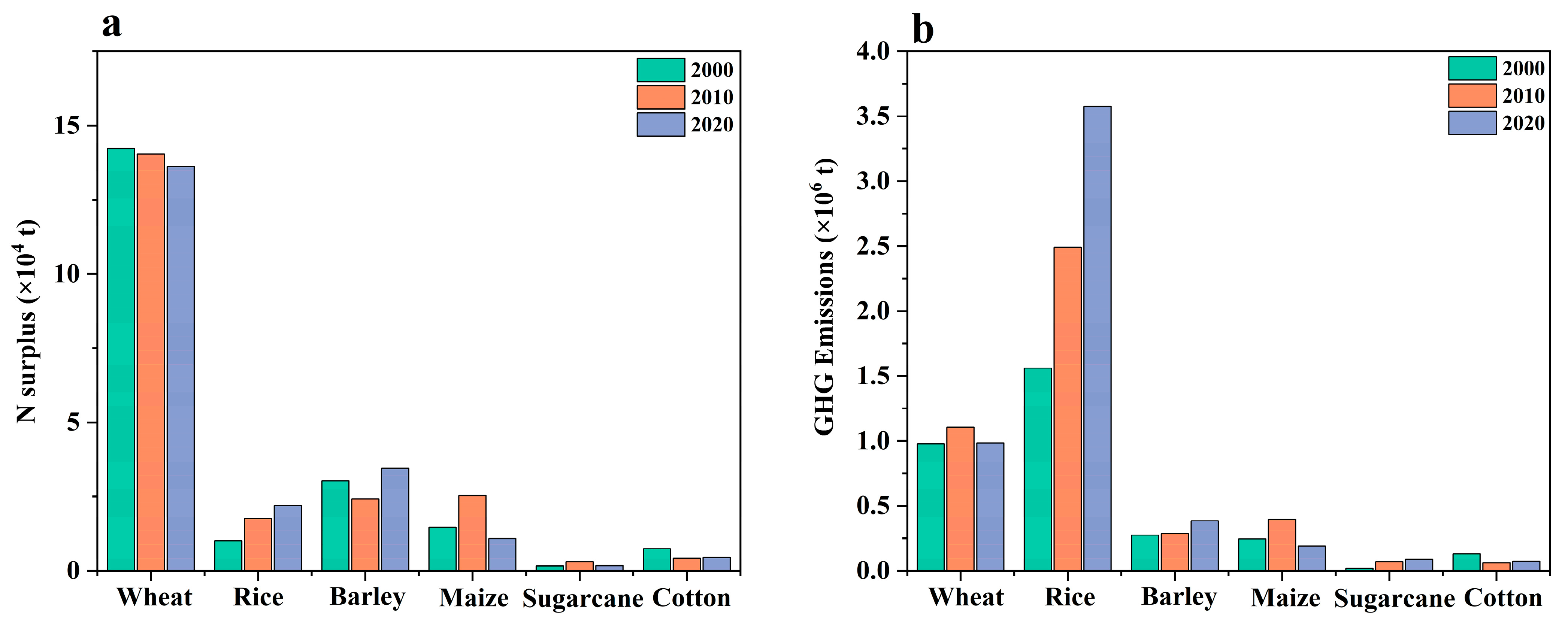
Between 2000 and 2020, N surplus among major crops in Iran showed marked differences. Overall, the average total N surplus of food crops (50,679 t) far exceeded that of cash crops (3750 t). Wheat had the highest average total N surplus at 139,579 t, followed by barley (29,632 t), maize (16,922 t), and rice (16,583 t). Among cash crops, cotton recorded a higher average total N surplus (5390 t) than sugarcane (2111 t). Temporally, the evolution of total N surplus varied by crop during 2000–2020 (Figure 13a). Wheat and cotton followed a declining trajectory, while rice exhibited a steady upward trend. Maize and sugarcane showed a pattern of initial increase followed by decline, whereas barley first decreased and then increased. In terms of average annual growth rates, rice, barley, and sugarcane posted positive increases of 3.97%, 0.66%, and 0.34%, respectively. In contrast, wheat, maize, and cotton recorded negative average annual growth rates of –0.22%, –1.49%, and –2.46%, respectively.
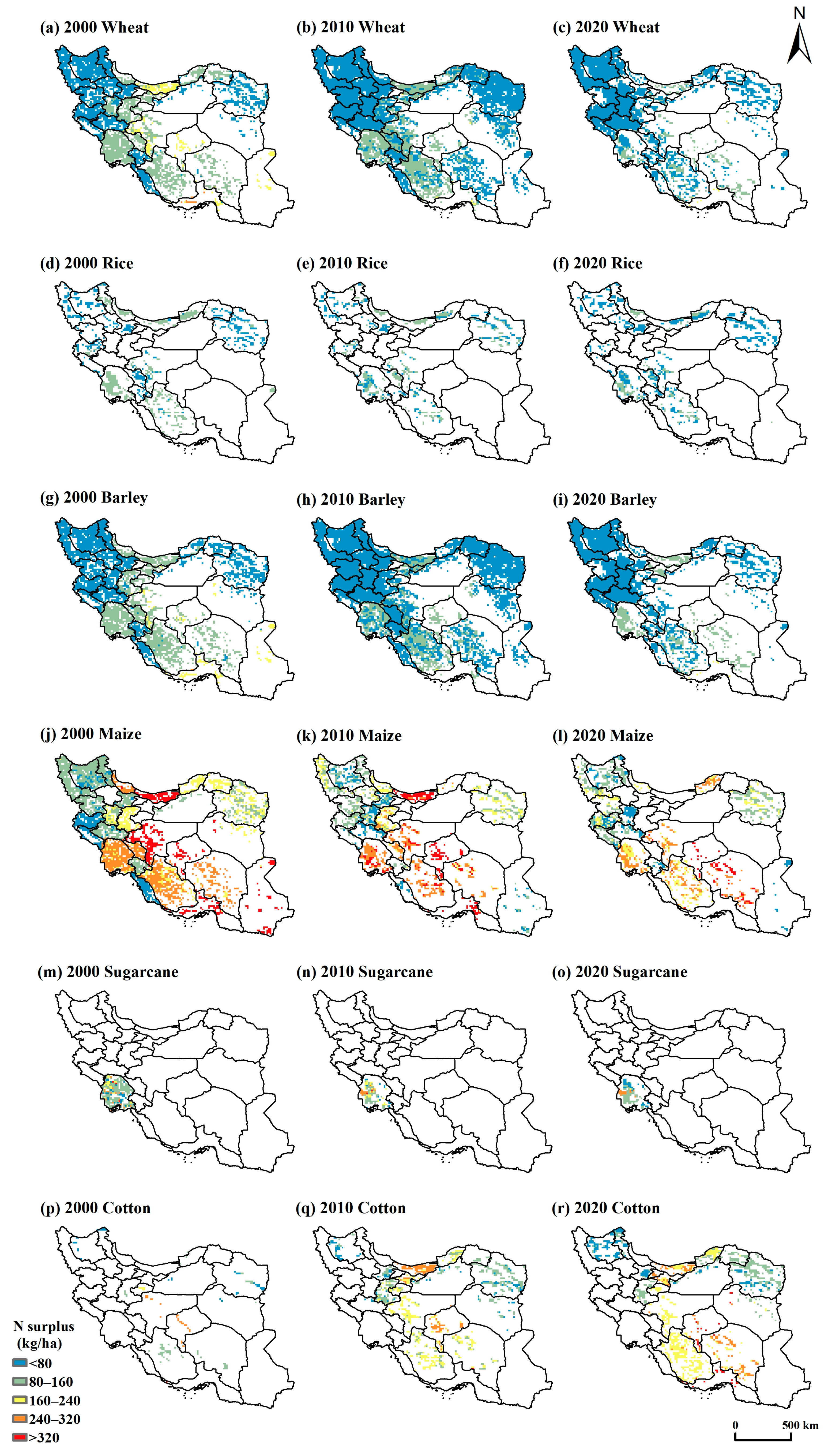
In terms of spatial distribution, the pattern of N surplus for crops in Iran closely parallels that of N application rates (Figure 14). In 2020, high N surplus areas for wheat were primarily found in western and parts of southern Iran, including Hormozgan, Alborz, and Mazandaran provinces, with N surplus values of 143.69 kg/ha, 111.79 kg/ha, and 110.81 kg/ha, respectively. High N surplus areas for rice were mainly distributed along the Caspian Sea coast in the north and in southern regions, such as Gilan, Mazandaran, and Fars, provinces, with values of 84.73 kg/ha, 81.26 kg/ha, and 79.86 kg/ha, respectively. High N surplus areas for barley were concentrated in northern and southern Iran, particularly in Hormozgan, Mazandaran, and Khuzestan provinces, where N surplus reached 169.64 kg/ha, 106.04 kg/ha, and 94.83 kg/ha, respectively. High N surplus areas for maize were located mainly in the south and parts of the north, with Yazd, Kerman, and Fars provinces recording values of 414.64 kg/ha, 328.19 kg/ha, and 245.63 kg/ha, respectively. Cotton N surplus peaked in Hormozgan Province at 446.15 kg/ha. Sugarcane N surplus was concentrated in Khuzestan Province, where large-scale cultivation resulted in a total N surplus of approximately 2111 t.
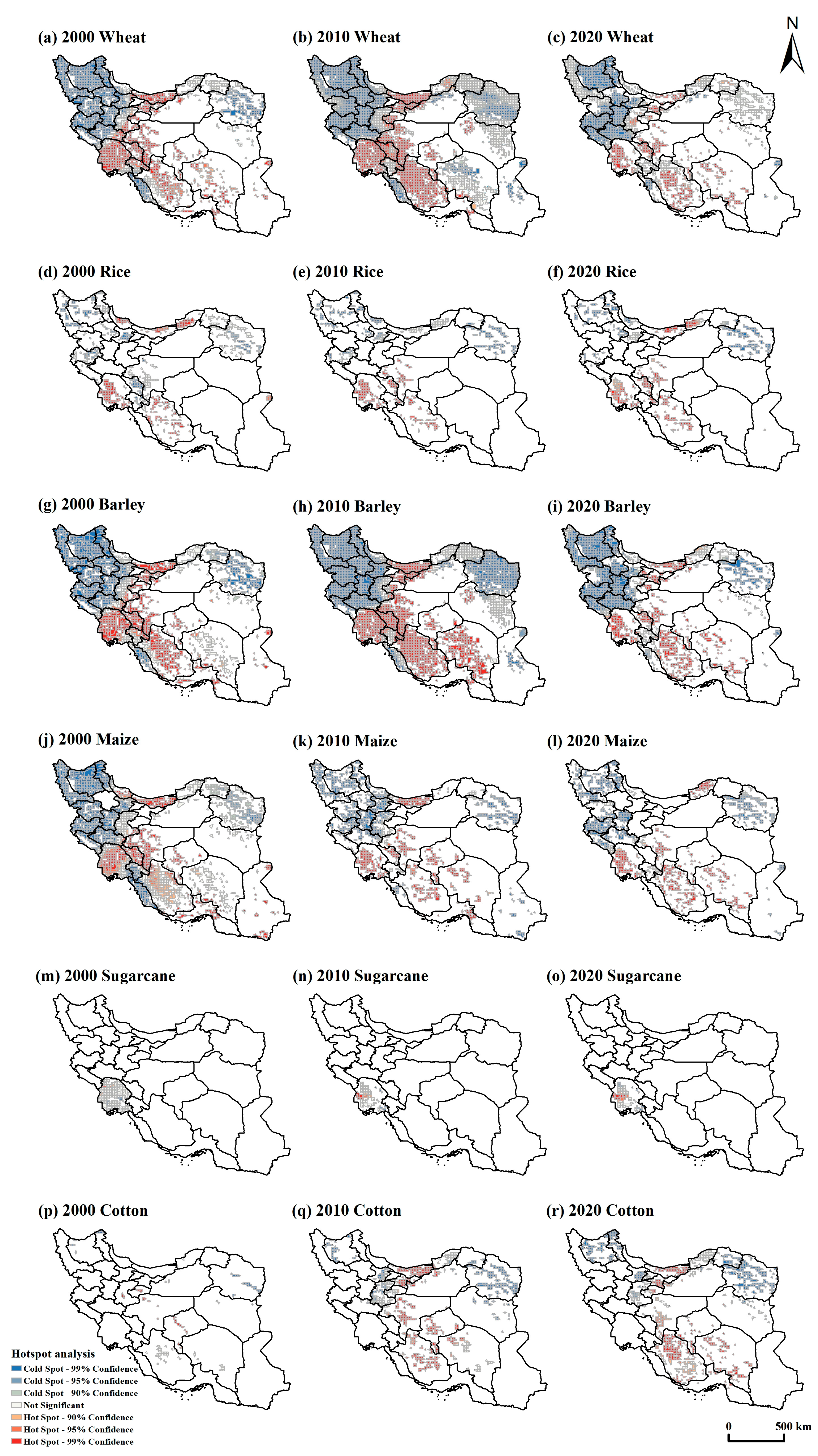
The distributions of N surplus hotspots and cold spots for wheat and barley were similar, with hotspots concentrated in the south and cold spots in the northwest. Rice and maize showed a comparable pattern, with hotspots in the south and cold spots in the north. For sugarcane, hotspots were mainly found in its primary growing area, Khuzestan Province. In the case of cotton, hotspots were largely distributed in the south, whereas cold spots were predominantly located in the north (Figure 15).

3.3.2. GHG Emissions of Major Crops in Iran

Between 2000 and 2020, total greenhouse gas (GHG) emissions from major crops in Iran exhibited a sustained upward trend (Figure 13b), increasing from 3.2 × 10⁹ kg CO2 eq to 5.2 × 10⁹ kg CO2 eq. Food crops were the dominant contributors, accounting for roughly 96% of total emissions, while cash crops contributed only 4%. Among individual crops, rice recorded the highest GHG emissions, reaching 2.5 × 10⁹ kg CO2 eq, largely attributable to its emission profile, which includes both N2O and CH4. The total GHG emissions for wheat, barley, maize, cotton, and sugarcane were 1 × 10⁹ kg CO2 eq, 0.3 × 10⁹ kg CO2 eq, 0.2 × 10⁹ kg CO2 eq, 0.09 × 10⁹ kg CO2 eq, and 0.06 × 10⁹ kg CO2 eq, respectively. In terms of average annual growth rates, rice, sugarcane, barley, and wheat posted positive increases. Rice recorded the highest average annual growth rate at 51.35%, followed by sugarcane (20.97%), barley (18.49%), and wheat (0.36%). In contrast, maize and cotton experienced negative average annual growth rates of –11.81% and –23.69%, respectively.
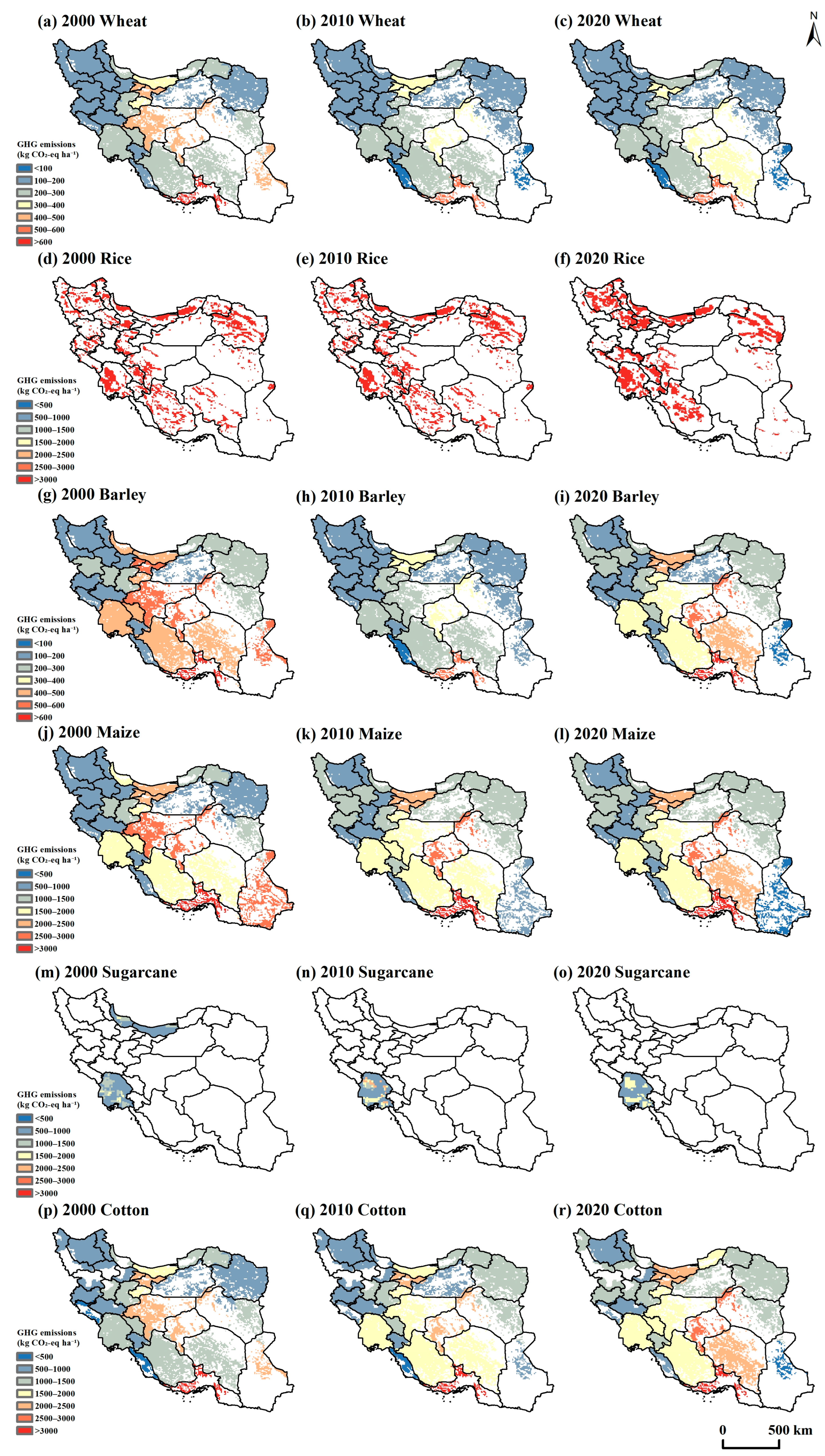
In terms of spatial distribution, the pattern of greenhouse gas (GHG) emissions closely mirrors that of N application rates and N surplus (Figure 16). In 2020, high GHG emission areas for wheat were predominantly located in western and parts of southern Iran, including Hormozgan, Alborz, and Mazandaran provinces, with per-unit-area emissions of 527.64 kg CO2 eq/ha, 310.08 kg CO2 eq/ha, and 298.68 kg CO2 eq/ha, respectively. Rice GHG emissions were relatively uniform across the country, with an average emission of approximately 4000 kg CO2 eq/ha. High GHG emission areas for barley were mainly found in northern and southern Iran, particularly in Hormozgan, Mazandaran, and Khuzestan provinces, where per-unit-area emissions reached 708.92 kg CO2 eq/ha, 401.40 kg CO2 eq/ha, and 322.59 kg CO2 eq/ha, respectively. High GHG emission areas for maize were concentrated in the south and parts of the north, with Hormozgan and Yazd provinces recording per-unit-area emissions of 3669.13 kg CO2 eq/ha and 2770.03 kg CO2 eq/ha, respectively. Cotton per-unit-area GHG emissions peaked in Hormozgan Province at 2405.09 kg CO2 eq/ha. Sugarcane GHG emissions were also concentrated in Khuzestan Province, where emissions remained relatively low overall and exhibited spatial stability.
Greenhouse gas emission hotspots were mainly concentrated along the northern Caspian Sea coast (rice), in southern Iran (wheat, barley, maize, and cotton), and in Khuzestan Province (sugarcane). These regions were characterized by high N fertilizer application, and rice cultivation also produced large amounts of CH4 emissions, resulting in higher greenhouse gas emissions. Cold spots were primarily located in western and northern Iran. Temporally, the agricultural greenhouse gas emission hotspots in Iran exhibited an expanding trend from 2000 to 2020 (Figure 17).

4. Discussion

This study innovatively integrates 10 km grid data, Iranian agricultural statistics, field experiment parameters, and model simulation outputs to systematically characterize the fine-scale spatial distribution and dynamic evolution of crop yield, harvested area, N application rate, NUE, N surplus, and GHG emissions across Iran—details that are often obscured in analyses at provincial or coarser scales [40,41]. The findings provide robust support for accurately interpreting regional variations in N management and environmental impacts, and establish a scientific foundation for developing crop-specific and location-specific N management strategies aimed at improving NUE while mitigating environmental risks.
In terms of food production, a spatiotemporal analysis of six major crops in Iran for the years 2000, 2010, and 2020 reveals that both sowing area and yield exhibit pronounced spatial heterogeneity. Spatially, rice cultivation is heavily concentrated in northern Iran, with Mazandaran and Gilan provinces together accounting for 67% of the national rice sowing area—a result closely aligned with the 70–80% range reported by Motamed et al. [42]. This distribution pattern of rice is primarily attributable to the region’s favorable hydrothermal and soil conditions, as well as its long history of rice cultivation. Specifically, the northern Caspian coastal region, influenced by topography and atmospheric circulation, receives abundant precipitation and possesses suitable thermal conditions, along with widely distributed fertile alluvial soils, which collectively provide optimal hydrothermal and edaphic conditions for rice growth. As a staple crop in this region for centuries, rice has given rise to a well-established cultivation system and production traditions, making the northern Caspian coastal area the primary rice-growing hub of Iran. The cultivation areas of barley, wheat, and maize are mainly concentrated in western Iran, particularly in Khuzestan, Fars, and Kermanshah provinces—a pattern consistent with the spatiotemporal analysis of wheat and barley in Iran from 2003 to 2018 by FarajiSabokbar et al. [43]. Western and northwestern Iran have become the primary wheat and barley cultivation areas, largely thanks to favorable natural conditions for rainfed agriculture. These regions receive relatively abundant precipitation during the cold season, making them the most suitable areas in the country for dryland farming. Wheat and barley have their growing seasons concentrated in the cool period of the year and require relatively little water, so their growth rhythm aligns closely with local climatic conditions. From a resource perspective, agricultural production here relies mainly on natural precipitation rather than large-scale irrigation, which fits local water availability and land carrying capacity—giving these areas a natural advantage over other regions for developing dryland farming. These areas are also traditional grain-producing regions in Iran, with a stable agricultural structure and farmers’ extensive cultivation experience. Together, these factors have shaped a stable spatial pattern for wheat and barley distribution. Moreover, research by Sadeghi et al. [44] suggests that wheat yield in Iran exhibits a spatially clustered pattern, with increased precipitation and moderate temperature rises in the arid and warm regions of central and southeastern Iran exerting a positive effect on wheat yield—findings that corroborate the spatial patterns observed in this study. From a temporal perspective, crop yields exhibited fluctuating trends over the study period. The average annual change rate for sugarcane was negative, at –0.2%, which is consistent with the findings of Hooshmand et al. [45], whose long-term monitoring data revealed a slight downward trend in sugarcane yields in the region in recent years. As a typical high-water-consumption crop, sugarcane is primarily cultivated in Khuzestan Province in Iran, where its yield variations are closely linked to regional climate and water resource availability. Specifically, the relationships between annual mean temperature and annual precipitation with sugarcane yield follow an inverted U-shaped nonlinear pattern [46]. During the study period, rising temperatures and declining precipitation in the region exacerbated local water scarcity, ultimately leading to a reduction in sugarcane cultivation area and a significant impact on yields.
In the dimension of resource utilization, N input in Iranian cropland is characterized by high total application, low use efficiency, and considerable spatial heterogeneity. The current state of N management in Iran reflects both global trends in agricultural N use and the distinctiveness shaped by the country’s natural conditions and agricultural management capacity. Variation in N application rates among crops is influenced by multiple factors, including crop-specific N demand, economic returns, production goals, and input levels [47]. Based on the findings of this study, the main factors influencing N input in Iran’s farmland can be summarized as follows. First, at the crop type level, N application rates vary significantly among different crops. Maize, owing to its high yield potential and substantial biomass accumulation, receives N applications of up to 240 kg/ha, which is considerably higher than those for wheat, barley, and rice. Second, climatic and water conditions also play an important role in determining N application intensity. In Mediterranean climate zones, wheat and barley are predominantly grown under rainfed or deficit irrigation conditions, resulting in relatively low N application rates ranging from 50 to 150 kg/ha. At the spatial scale, regional differences in N application are primarily attributed to variations in fertilizer subsidy policies, soil fertility levels, and farmland management practices. Regarding NUE, Iran follows the global pattern where cash crops generally achieve higher NUE than food crops [48]. Although similarities exist with both developed and developing nations, notable differences persist. According to FAO data, global NUE declined from 54% to 42% between 1960 and 2021, before recovering to 54%, with developing regions accounting for about 70% of this increase [49]. Nevertheless, Iran’s overall NUE remains low, with food crop NUE (32.21%) substantially below that of developed countries (58–62%) and the global average (40–53%) [50]. Among individual crops, sugarcane records the highest average NUE (59.52%), while rice (39.96%), maize (31.5%), barley (30.9%), cotton (30.53%), and wheat (26.46%) exhibit relatively lower values. In contrast to developed nations, where precision fertilization technologies and robust agricultural infrastructure are widely implemented, Iran’s arid climate and inconsistent regional agricultural management largely account for its low NUE and substantial spatial variability. Overapplication of N fertilizer remains pervasive in Iranian agroecosystems, and the common practice of applying all N as a single basal dose in most regions further suppresses NUE. Moreover, the majority of Iran’s croplands lie in arid zones, and staple crops including wheat, maize, barley, and cotton frequently endure prolonged water deficits that limit plant N uptake, thereby further depressing NUE. Consequently, optimizing fertilization regimes and improving water management in an integrated manner are critical pathways to enhancing NUE in Iranian cropland [11].
In terms of environmental effects, this study reveals that the spatial distribution of N surplus closely mirrors that of N application rates, with food crops exhibiting higher N surplus than cash crops. High N surplus areas are primarily located in northern Iran and parts of the southern regions, where values in some locations exceed 150 kg/ha. This not only leads to inefficient use of N resources but also contributes to ecological and environmental issues such as groundwater contamination. Notably, N surplus in high-value crop areas, particularly for maize and cotton, has already far surpassed the scientific reference threshold of 80 kg/ha recommended by the EU N Expert Panel [51], highlighting an urgent need for targeted N management and the formulation of region-specific N input limits in parts of Iran. With respect to agricultural greenhouse gas (GHG) emissions, total emissions in Iran exhibited a continuous upward trend during the 2000–2020 period. The emissions per-unit-area of various crops are consistent with the systematic assessments conducted by Zangeneh et al. [52]. In particular, the average emission from rice in Iran reaches approximately 4000 kg CO2 eq/ha, which aligns closely with the findings of Zangeneh et al.’s meta-analysis (3197 kg CO2 eq/ha). Rice generates substantially greater greenhouse gas (GHG) emissions than most other crops; continuous flooding maintains long-term anaerobic soil conditions that promote the simultaneous production of N2O and CH4. Under anaerobic conditions, limited oxygen diffusion allows methanogenic archaea to flourish and generate CH4 via anaerobic metabolism—making it the primary contributor to total GHG emissions from paddy soils. Upland crops such as wheat, maize, barley, and cotton, by contrast, are generally cultivated in aerobic soils. Here, organic carbon mineralization is driven mainly by aerobic microbes and releases predominantly CO2, with only negligible CH4 formation. Nitrification and denitrification—and consequently N2O emissions—remain low, occurring mostly within localized anaerobic microsites. These contrasting soil environments give rise to divergent GHG profiles: anaerobic systems favor substantial CH4 emissions, aerobic systems promote CO2 release, and systems with fluctuating aerobic–anaerobic conditions tend to stimulate N2O production. This is why rice consistently exhibits higher GHG emission intensity than upland crops. Spatially, the pattern of GHG emissions from crops in Iran parallels that of N application rates and N surplus, suggesting that N input is a critical driver of regional agricultural GHG emissions [53]. Consequently, optimizing N fertilizer management, enhancing NUE, and reducing N surplus and GHG emissions are essential for achieving both food security and environmental sustainability in Iran.
Although this study takes multiple factors into account, there are still several limitations and uncertainties. First, due to limited data availability, the environmental impact assessment in this study relies primarily on empirical parameters, which fail to fully account for the effects of different crop varieties, regional differences, or climate-specific agricultural production systems on the results, nor do they comprehensively address the uncertainties arising from multi-source data integration. Nevertheless, we have made every effort to integrate localized experimental data and parameters to enhance the reliability and regional applicability of the findings. Future research could focus on developing region-specific coefficients based on more detailed field observations and model calibration, and establish unified parameter standards to improve estimation accuracy. In addition, the impact of parameter variability on the results could be systematically assessed through sensitivity analysis or uncertainty analysis. More importantly, long-term monitoring or isotope tracing techniques could be employed to more realistically evaluate the environmental impacts of nitrogen fertilization, thereby further strengthening the robustness of the research conclusions. Second, this study compares and calibrates crop yield and planting area data based on the statistical yearbooks of the Iranian Ministry of Agriculture and gridded datasets, ensuring that the gridded data accurately reflect the actual characteristics of agricultural production in Iran. Nevertheless, regarding N application rates, the statistical yearbooks do not provide detailed data by crop type. This study could only conduct comparative validation at an aggregate level, which may result in certain discrepancies. However, the overall trends remain consistent. Future research could further conduct localized field surveys to improve the reliability of the results.

5. Conclusions

Based on the three dimensions of food, resources, and environment, this study constructs a comprehensive assessment framework for N fertilizer application and its environmental effects in Iran for the years 2000, 2010, and 2020. In terms of food production, the sown area and yield of major food crops in Iran generally showed an upward trend from 2000 to 2020. From the perspective of resource utilization, the total N application rate in Iranian croplands remained relatively stable overall between 2000 and 2020, with slight fluctuations. However, the NUE of crops in Iran was generally low (45%), particularly for barley and wheat, both of which exhibited low N application rates and NUE. Nevertheless, from 2000 to 2020, the overall NUE in Iran showed an increasing trend. In terms of resource utilization, GHG emissions in Iran exhibited a growing trend, with methane emissions from rice paddies being the most significant and the primary contributor to GHG emissions from croplands. Overall, food crops demonstrated lower NUE, higher N surplus, and greater GHG emissions compared to cash crops. From a spatial distribution perspective, N application rates, N surplus, and GHG emissions in Iran exhibited consistent spatial patterns, with high-value areas mainly concentrated in both the northern and southern regions, while the western regions generally showed low values. The spatial distribution of NUE, on the other hand, displayed opposite characteristics. The multi-dimensional comprehensive assessment framework proposed in this study provides an important scientific basis for regional N management, food security assurance, and the coordinated governance of the ecological environment.

Author Contributions

Conceptualization, W.S. and X.S.; methodology, J.L.; investigation, X.S.; data curation, X.L. and J.L.; writing—original draft preparation, X.L.; writing—review and editing, J.L., W.S. and X.S.; visualization, X.L. and J.L.; supervision, W.S. and X.S.; project administration, W.S.; funding acquisition, W.S. All authors have read and agreed to the published version of the manuscript.

Funding

This work is supported by National Key Research and Development Program of China (2025YFE0215100), the National Natural Science Foundation of China (42571122, 72221002 and 42330707), Major Project of Humanities and Social Sciences Research in Hebei Provincial Universities (ZD202412), Scientific Research Foundation for the Returned Overseas Chinese Scholars of Hebei Province (C20230347).

Institutional Review Board Statement

Not applicable.

Data Availability Statement

The data presented in this study are available in the article. Further inquiries can be directed to the corresponding authors.

Acknowledgments

The authors would like to thank Iman Islam (Department of Rangeland Management, Faculty of Natural Resources, Tarbiat Modares University, Noor, Mazandaran, Iran) for providing guidance on data sources and for the insightful discussions regarding this study.

Conflicts of Interest

The authors declare no conflicts of interest.

Abbreviations

The following abbreviations are used in this manuscript:
NUENitrogen Use Efficiency
GHGGreenhouse Gas
DSSATDecision Support System for Agrotechnology Transfer
APSIMAgricultural Production Systems sIMulator

References

  1. Zhang, Q.; Yu, H.; Li, J.; Clothier, B.; Singh, V.P.; Shen, Z. Divergent effectiveness of irrigation in enhancing food security in droughts under future climates with various emission scenarios. npj Clim. Atmos. Sci. 2023, 6, 40. [Google Scholar] [CrossRef]
  2. Anas, M.; Liao, F.; Verma, K.K.; Sarwar, M.A.; Mahmood, A.; Chen, Z.-L.; Li, Q.; Zeng, X.-P.; Liu, Y.; Li, Y.-R. Fate of nitrogen in agriculture and environment: Agronomic, eco-physiological and molecular approaches to improve nitrogen use efficiency. Biol. Res. 2020, 53, 47. [Google Scholar] [CrossRef]
  3. Poutanen, K.S.; Kårlund, A.O.; Gómez-Gallego, C.; Johansson, D.P.; Scheers, N.M.; Marklinder, I.M.; Eriksen, A.K.; Silventoinen, P.C.; Nordlund, E.; Sozer, N.; et al. Grains—A major source of sustainable protein for health. Nutr. Rev. 2022, 80, 1648–1663. [Google Scholar] [CrossRef]
  4. Aghabeygi, M.; Dönmez, C. Estimating Yield Response Functions to Nitrogen for Annual Crops in Iran. Agronomy 2024, 14, 436. [Google Scholar] [CrossRef]
  5. Zhai, J.; Zhang, G.; Zhang, Y.; Xu, W.; Xie, R.; Ming, B.; Hou, P.; Wang, K.; Xue, J.; Li, S. Effect of the Rate of Nitrogen Application on Dry Matter Accumulation and Yield Formation of Densely Planted Maize. Sustainability 2022, 14, 14940. [Google Scholar] [CrossRef]
  6. Tarolli, P.; Luo, J.; Park, E.; Barcaccia, G.; Masin, R. Soil salinization in agriculture: Mitigation and adaptation strategies combining nature-based solutions and bioengineering. iScience 2024, 27, 108830. [Google Scholar] [CrossRef] [PubMed]
  7. Sapkota, T.B.; Bijay, S.; Takele, R. Chapter Five—Improving nitrogen use efficiency and reducing nitrogen surplus through best fertilizer nitrogen management in cereal production: The case of India and China. Adv. Agron. 2023, 178, 233–294. [Google Scholar] [CrossRef]
  8. Mansouri Daneshvar, M.R.; Ebrahimi, M.; Nejadsoleymani, H. An overview of climate change in Iran: Facts and statistics. Environ. Syst. Res. 2019, 8, 7. [Google Scholar] [CrossRef]
  9. Oberson, A.; Jarosch, K.; Frossard, E.; Hammelehle, A.; Fliessbach, A.; Mäder, P.; Mayer, J. Higher than Expected: Nitrogen Flows, Budgets and Use Efficiencies Over 35 Years of Organic and Conventional Cropping. Agric. Ecosyst. Environ. 2024, 362, 108802. [Google Scholar] [CrossRef]
  10. Song, Y.; Jiang, L.; Liang, M. Simulation of Nitrogen Migration and Output Loads Under Field Scale in Small Watershed, China. Land 2026, 15, 442. [Google Scholar] [CrossRef]
  11. Amirhajloo, S.; Gheysari, M.; Shayannejad, M.; Shirvani, M. Effects of applied nitrogen fertilizers and irrigation strategies on environmental protection and yield indices of winter wheat and barley in a Mediterranean climate region of Iran. Water Supply 2023, 23, 4386–4402. [Google Scholar] [CrossRef]
  12. Vogeler, I.; Kluß, C.; Taube, F. Variable-rate nitrogen fertilisation to improve silage maize yield and crude protein using APSIM modelling. Soil Res. 2025, 63, SR24180. [Google Scholar] [CrossRef]
  13. Yokamo, S.; Irfan, M.; Huan, W.; Wang, B.; Wang, Y.; Ishfaq, M.; Lu, D.; Chen, X.; Cai, Q.; Wang, H. Global evaluation of key factors influencing nitrogen fertilization efficiency in wheat: A recent meta-analysis (2000–2022). Front. Plant Sci. 2023, 14, 1272098. [Google Scholar] [CrossRef]
  14. Ren, H.; Liu, Z.; Wang, X.; Zhou, W.; Zhou, B.; Zhao, M.; Li, C. Long-term excessive nitrogen application decreases spring maize nitrogen use efficiency via suppressing root physiological characteristics. J. Integr. Agric. 2025, 24, 4195–4210. [Google Scholar] [CrossRef]
  15. Chakraborty, D.; Ladha, J.K.; Das, B.; Rana, D.S.; Gathala, M.K.; Jat, M.L.; Krupnik, T.J. Global insights into nitrogen losses and efficiency in rice, wheat, and maize cultivation. Field Crops Res. 2025, 334, 110138. [Google Scholar] [CrossRef]
  16. Lu, C.; Zhang, J.; Cao, P.; Hatfield, J. Are We Getting Better in Using Nitrogen?: Variations in Nitrogen Use Efficiency of Two Cereal Crops Across the United States. Earth’s Future 2019, 7, 939–952. [Google Scholar] [CrossRef]
  17. Sharifi, S.; Shi, S.; Dong, X.; Obaid, H.; He, X.; Gu, X. Variations in Nitrogen Accumulation and Use Efficiency in Maize Differentiate with Nitrogen and Phosphorus Rates and Contrasting Fertilizer Placement Methodologies. Plants 2023, 12, 3870. [Google Scholar] [CrossRef]
  18. Karandish, F.; Nouri, H.; Schyns, J. Agricultural Adaptation to Reconcile Food Security and Water Sustainability Under Climate Change: The Case of Cereals in Iran. Earth’s Future 2022, 10, e2021EF002095. [Google Scholar] [CrossRef]
  19. Adalibieke, W.; Cui, X.; Cai, H.; You, L.; Zhou, F. Global crop-specific nitrogen fertilization dataset in 1961–2020. Sci. Data 2023, 10, 617. [Google Scholar] [CrossRef] [PubMed]
  20. Zhu, J.; Jia, Y.; Yu, G.; Wang, Q.; He, N.; Chen, Z.; He, H.; Zhu, X.; Li, P.; Zhang, F.; et al. Changing patterns of global nitrogen deposition driven by socio-economic development. Nat. Commun. 2025, 16, 46. [Google Scholar] [CrossRef] [PubMed]
  21. Smil, V. Nitrogen in crop production: An account of global flows. Glob. Biogeochem. Cycles 1999, 13, 647–662. [Google Scholar] [CrossRef]
  22. Mosanaei, H.; AjamNorozi, H.; Dadashi, M.; Faraji, A.; Pessarakli, M. Improvement effect of nitrogen fertilizer and plant density on wheat (Triticum aestivum L.) seed deterioration and yield. Emir. J. Food Agric. 2017, 29, 899. [Google Scholar] [CrossRef]
  23. Mohammadian, M.; Astaraie, A.; Lakzian, A.; Emami, H.; Kavoosi, M. Effect of nitrogen fertilizer source on grain yield and nitrogen use efficiency in rice (Oryza sativa L.) cv. Shiroudi. Iran. Soc. Crops Plant Breed. Sci. 2019, 21, 82–95. [Google Scholar] [CrossRef]
  24. Shokat, S.; Mojaddam, M. Evaluation Impact of Amount and Distribution of Nitrogen Fertilizer on Barley Crop Production and Qualitative Characteristics. J. Crop Nutr. Sci. 2022, 8, 26–36. [Google Scholar]
  25. Majnooni-Heris, A.; Zand-Parsa, S.; Sepaskhah, A.R.; Kamgar-Haghighi, A.A.; Yasrebi, J. Modification and validation of maize simulation model (MSM) at different applied water and nitrogen levels under furrow irrigation. Arch. Agron. Soil Sci. 2011, 57, 401–420. [Google Scholar] [CrossRef]
  26. Bahrani, M.J.; Shomeili, M.; Zand-Parsa, S.; Kamgar-Haghighi, A. Sugarcane responses to irrigation and nitrogen in subtropical Iran. Iran. J. Agric. Res. 2009, 27, 17–26. [Google Scholar] [CrossRef]
  27. Seilsepour, M.; Rashidi, M. Effect of Different Application Rates of Nitrogen on Yield and Quality of Cotton (Gossypium hirsutum). Am. Euras. J. Agric. Environ. Sci. 2011, 10, 366–370. [Google Scholar]
  28. Zhang, X.; Davidson, E.A.; Mauzerall, D.L.; Searchinger, T.D.; Dumas, P.; Shen, Y. Managing nitrogen for sustainable development. Nature 2015, 528, 51–59. [Google Scholar] [CrossRef]
  29. Zuo, L.; Zhang, Z.; Carlson, K.M.; MacDonald, G.K.; Brauman, K.A.; Liu, Y.; Zhang, W.; Zhang, H.; Wu, W.; Zhao, X.; et al. Progress towards sustainable intensification in China challenged by land-use change. Nat. Sustain. 2018, 1, 304–313. [Google Scholar] [CrossRef]
  30. Moradimajd, N.; Fallahghalhari, G.A.; Chatrenour, M. Sensitivity Assessment of Nitrous oxide Greenhouse Gas Emissions in Agricultural Lands of Khuzestan Province with Linear and Non-linear Models. J. Environ. Res. 2023, 14, 43–58. [Google Scholar]
  31. Qin, J.; Fan, X.; Wang, X.; Jiang, M.; Lv, M. The Effects of Irrigation and Nitrogen Application on the Water and Nitrogen Utilization Characteristics of Drip-Irrigated Winter Wheat in the North China Plain. Agronomy 2024, 14, 2629. [Google Scholar] [CrossRef]
  32. Borzouei, A.; Saadati, S.; Müller, C.; Sanz-Cobena, A.; Kim, D.-G.; Dawar, K.; Zaman, M. Reducing nitrous oxide emissions from irrigated maize by using urea fertilizer in combination with nitrapyrin under different tillage methods. Environ. Sci. Pollut. Res. 2022, 29, 14846–14855. [Google Scholar] [CrossRef]
  33. Gheicari, G.; Asgharipour, M.R.; Mousavi Nik, M.; Ghanbari, A. Effects of different cotton tillage methods on N2O and NH3 emissions in a cotton-wheat rotation. Agric. Environ. Soc. 2021, 1, 1–9. [Google Scholar]
  34. Buendia, E.; Tanabe, K.; Kranjc, A.; Jamsranjav, B.; Fukuda, M.; Ngarize, S.; Osako, A.; Pyrozhenko, Y.; Shermanau, P.; Federici, S. 2019 Refinement to the 2006 IPCC Guidelines for National Greenhouse Gas Inventories; IPCC: Geneva, Switzerland, 2019. [Google Scholar]
  35. Wang, C.; Shen, Y.; Fang, X.; Xiao, S.; Liu, G.; Wang, L.; Gu, B.; Zhou, F.; Chen, D.; Tian, H.; et al. Reducing soil nitrogen losses from fertilizer use in global maize and wheat production. Nat. Geosci. 2024, 17, 1008–1015. [Google Scholar] [CrossRef]
  36. Xu, P.; Li, G.; Zheng, Y.; Fung, J.C.H.; Chen, A.; Zeng, Z.; Shen, H.; Hu, M.; Mao, J.; Zheng, Y.; et al. Fertilizer management for global ammonia emission reduction. Nature 2024, 626, 792–798. [Google Scholar] [CrossRef] [PubMed]
  37. Wang, Y.; Yao, Z.; Zheng, X.; Subramaniam, L.; Butterbach-Bahl, K. A synthesis of nitric oxide emissions across global fertilized croplands from crop-specific emission factors. Glob. Change Biol. 2022, 28, 4395–4408. [Google Scholar] [CrossRef]
  38. Salar Ashayeri, M.; Khaledian, M.R.; Kavoosi-Kalashami, M.; Rezaei, M. Evaluation of energy balance and greenhouse gas emissions in rice cultivation in Guilan province, northern Iran. Paddy Water Environ. 2020, 18, 261–272. [Google Scholar] [CrossRef]
  39. Yousefian, M.; Shahnazari, A.; Ahmadi, M.Z.; Sarjaz, M.R.; Arabzadeh, B. The effect of irrigation management on rice grain yield, irrigation water productivity and methane emissions in northern Iran. Irrig. Drain. 2024, 73, 230–243. [Google Scholar] [CrossRef]
  40. Lu, C.; Tian, H. Global nitrogen and phosphorus fertilizer use for agriculture production in the past half century: Shifted hot spots and nutrient imbalance. Earth Syst. Sci. Data 2017, 9, 181–192. [Google Scholar] [CrossRef]
  41. Lessmann, M.; Kros, H.; Walvoort, D.; Voogd, J.C.; Renaud, L.; Cals, T. Uncertainties in nitrogen application from manure and synthetic fertilizers and ammonia emissions from agriculture in the Netherlands across different spatial scales. Nutr. Cycl. Agroecosystems 2025, 131, 141–164. [Google Scholar] [CrossRef]
  42. Motamed, M.K.; Javadi Baghi, S.; Ghorbani Piralidehi, F.; Esfanjari Kenari, R. Identification and prioritization of strategies for achieving sustainable agriculture in rice production (Case study: Guilan Province, northwest Iran). Casp. J. Environ. Sci. 2025, 23, 757–769. [Google Scholar]
  43. FarajiSabokbar, H.; Rezvani, M.R.; Jamshidi, F.; Tahmasi, B. Analysis of spatio-temporal pattern of Cereals cultivation in Iran. J. Phys. Dev. Plan. 2021, 6, 125–142. [Google Scholar]
  44. Sadeghi, H.; Mohamadi, H.; Shamsipour, A.; Zarei, K.; Karimi, M. Spatial Relations Between Climatic Variables and Wheat Yield in Iran. Geogr. Dev. 2022, 20, 184–214. [Google Scholar] [CrossRef]
  45. Hooshmand, M.; Ebrahimian, H.; Sohrabi, T.; Nozari, H.; Naseri, A. Modeling of Drained Lands of Sugarcane Crop in Hakim Farabi Khuzestan Agro-Industry Using the Perspective of Water-Environment-Food Nexus. Iran. J. Soil Water Res. 2025, 55, 2035–2055, (In Persian with English Extended Abstract). [Google Scholar] [CrossRef]
  46. Rajabalinejad, A.; Nozari, N.; Rahimi Badr, B. The Effects of Climate Change on Iran’s Sugarcane Production (Case study: Khuzestan Sugarcane). Int. J. Agric. Manag. Dev. 2023, 13, 317–329. [Google Scholar] [CrossRef]
  47. Farquharson, R. Production Response and Input Demand in Decision Making: Nitrogen Fertilizer and Wheat Growers. Australas. Agribus. Rev. 2006, 14. [Google Scholar] [CrossRef]
  48. Liu, J.; Wang, H.; Penuelas, J.; Mou, J.; Delgado-Baquerizo, M.; Sardans, J.; Coello, F.; Quan, Z.; Qiu, T.; Li, Y.; et al. Global-scale prevalence of low nutrient use efficiency across major crops. Nat. Commun. 2025, 16, 11036. [Google Scholar] [CrossRef]
  49. Wanner, N.; Tubiello, F.; Obli-Laryea, G.; Dobermann, A.; Gruere, A.; Heffer, P.; Zhang, X.; Vishwakarma, S.; Jackson, K.; Ludemann, C.; et al. Cropland Nutrient Balance: Global, Regional and Country Trends 1961-2022; FAOSTAT ANALYTICAL BRIEF 95; FAO: Rome, Italy, 2024. [Google Scholar]
  50. Zhang, X.; Zou, T.; Lassaletta, L.; Mueller, N.D.; Tubiello, F.N.; Lisk, M.D.; Lu, C.; Conant, R.T.; Dorich, C.D.; Gerber, J.; et al. Quantification of global and national nitrogen budgets for crop production. Nat. Food 2021, 2, 529–540. [Google Scholar] [CrossRef]
  51. Oenema, O.; Brentrup, F.; Lammel, J.; Bascou, P.; Billen, G.; Dobermann, A.; Erisman, J.W.; Garnett, T.; Hammel, M.; Haniotis, T.; et al. Nitrogen Use Efficiency (NUE)—An Indicator for the Utilization of Nitrogen in Agriculture and Food Systems; EU Nitrogen Expert Panel: Wageningen, The Netherlands, 2015. [Google Scholar]
  52. Zangeneh, M.; Banaeian, N.; Clark, S. Meta-Analysis on Energy-Use Patterns of Cropping Systems in Iran. Sustainability 2021, 13, 3868. [Google Scholar] [CrossRef]
  53. Batool, M.; Sarrazin, F.J.; Zhang, X.; Musolff, A.; Nguyen, T.V.; Attinger, S.; Kumar, R. Scenario analysis of nitrogen surplus typologies in Europe shows that a 20% fertilizer reduction may fall short of 2030 EU Green Deal goals. Nat. Food 2025, 6, 787–798. [Google Scholar] [CrossRef]
Figure 1. Overview of the study area.
Agriculture 16 00851 g001
Figure 2. Total sowing area (a) and yield (b) of major crops in Iran in 2000, 2010, and 2020.
Agriculture 16 00851 g002
Figure 3. Spatial distribution of the sown area of major crops in Iran in 2000, 2010 and 2020. (ac) Wheat, (df) rice, (gi) barley, (jl) maize, (mo) sugarcane, (pr) cotton. For each crop, the three panels correspond to 2000, 2010, and 2020, respectively.
Agriculture 16 00851 g003
Figure 4. Distribution of cold spots and hot spots of sown area for major crops in Iran in 2000, 2010, and 2020. (ac) Wheat, (df) rice, (gi) barley, (jl) maize, (mo) sugarcane, (pr) cotton. For each crop, the three subplots correspond to data from 2000, 2010, and 2020, respectively.
Agriculture 16 00851 g004
Figure 5. Spatial distribution of yields of major crops in Iran in 2000, 2010 and 2020. (ac) Wheat, (df) rice, (gi) barley, (jl) maize, (mo) sugarcane, (pr) cotton. For each crop, the three panels correspond to 2000, 2010, and 2020, respectively.
Agriculture 16 00851 g005
Figure 6. Distribution of cold spots and hot spots of yields for major crops in Iran in 2000, 2010, and 2020. (ac) Wheat, (df) rice, (gi) barley, (jl) maize, (mo) sugarcane, (pr) cotton. For each crop, the three subplots correspond to data from 2000, 2010, and 2020, respectively.
Agriculture 16 00851 g006
Figure 7. N application rates (a) and NUE (b) of major crops in Iran in 2000, 2010, and 2020.
Agriculture 16 00851 g007
Figure 8. Spatial distribution of N application rates of major crops in Iran in 2000, 2010, and 2020. (ac) Wheat, (df) rice, (gi) barley, (jl) maize, (mo) sugarcane, (pr) cotton. For each crop, the three panels correspond to 2000, 2010, and 2020, respectively.
Agriculture 16 00851 g008
Figure 9. Distribution of cold spots and hot spots of N application rates for major crops in Iran in 2000, 2010, and 2020. (ac) Wheat, (df) rice, (gi) barley, (jl) maize, (mo) sugarcane, (pr) cotton. For each crop, the three subplots correspond to data from 2000, 2010, and 2020, respectively.
Agriculture 16 00851 g009
Figure 10. Spatial distribution of NUE of major crops in Iran in 2000, 2010, and 2020. (ac) Wheat, (df) rice, (gi) barley, (jl) maize, (mo) sugarcane, (pr) cotton. For each crop, the three panels correspond to 2000, 2010, and 2020, respectively.
Agriculture 16 00851 g010
Figure 11. Distribution of cold spots and hot spots of NUE for major crops in Iran in 2000, 2010, and 2020. (ac) Wheat, (df) rice, (gi) barley, (jl) maize, (mo) sugarcane, (pr) cotton. For each crop, the three subplots correspond to data from 2000, 2010, and 2020, respectively.
Agriculture 16 00851 g011
Figure 12. Spatial distribution of yield-NUE quadrants for major crops in Iran (2000, 2010, and 2020). (ac) Wheat, (df) rice, (gi) barley, (jl) maize, (mo) sugarcane, (pr) cotton. Colors represent four performance classes: LL (low yield, low efficiency), LH (low yield, high efficiency), HL (high yield, low efficiency), and HH (high yield, high efficiency).
Agriculture 16 00851 g012
Figure 13. Total N surplus (a) and total GHG emissions (b) of major crops in Iran in 2000, 2010, and 2020.
Agriculture 16 00851 g013
Figure 14. Spatial distribution of N surplus of major crops in Iran in 2000, 2010, and 2020. (ac) Wheat, (df) rice, (gi) barley, (jl) maize, (mo) sugarcane, (pr) cotton. For each crop, the three panels correspond to 2000, 2010, and 2020, respectively.
Agriculture 16 00851 g014
Figure 15. Distribution of cold spots and hot spots of N surplus for major crops in Iran in 2000, 2010, and 2020. (ac) Wheat, (df) rice, (gi) barley, (jl) maize, (mo) sugarcane, (pr) cotton. For each crop, the three subplots correspond to data from 2000, 2010, and 2020, respectively.
Agriculture 16 00851 g015
Figure 16. Spatial distribution of GHG emissions from major crops in Iran in 2000, 2010, and 2020. (ac) Wheat, (df) rice, (gi) barley, (jl) maize, (mo) sugarcane, (pr) cotton. For each crop, the three panels correspond to 2000, 2010, and 2020, respectively.
Agriculture 16 00851 g016
Figure 17. Distribution of cold spots and hot spots of GHG emissions for major crops in Iran in 2000, 2010, and 2020. (ac) Wheat, (df) rice, (gi) barley, (jl) maize, (mo) sugarcane, (pr) cotton. For each crop, the three subplots correspond to data from 2000, 2010, and 2020, respectively.
Agriculture 16 00851 g017
Disclaimer/Publisher’s Note: The statements, opinions and data contained in all publications are solely those of the individual author(s) and contributor(s) and not of MDPI and/or the editor(s). MDPI and/or the editor(s) disclaim responsibility for any injury to people or property resulting from any ideas, methods, instructions or products referred to in the content.