Article

Predictive Modelling and Analysis of Filtration Performance for Drip Irrigation Filters Using Sediment-Laden Water Based on the Differential Evolution Optimized Random Forest (DE/RFR)

1
College of Water Resources Science and Engineering, Taiyuan University of Technology, Taiyuan 030024, China
2
China Institute of Water Resources and Hydropower Research, Beijing 100048, China
3
State Key Laboratory of Water Cycle and Water Security, China Institute of Water Resources and Hydropower Research, Beijing 100038, China
4
College of Water Resources and Architectural Engineering, Tarim University, Alar 843300, China
5
Zhongshan Institute of Advanced Cryogenic Technology, Zhongshan 528455, China
*
Authors to whom correspondence should be addressed.
Agriculture 2026, 16(8), 844; https://doi.org/10.3390/agriculture16080844
Submission received: 22 February 2026 / Revised: 31 March 2026 / Accepted: 8 April 2026 / Published: 10 April 2026
(This article belongs to the Section Agricultural Technology)

Abstract

Filtration systems are essential for drip irrigation using sediment-laden water sources such as the Yellow River. This study focused on a sand filter (filtration accuracy: 150 μm), a disc filter (filtration accuracy: 125 μm), and their combined multi-stage filtration system (flow rate: 30–50 m3/h). In situ tests were conducted under Yellow River water conditions in the Hetao Irrigation District, Inner Mongolia, China, to evaluate the response of filtration performance to sediment characteristics, flow rate, and operating time. On this basis, Differential Evolution-optimized Random Forest Regression (DE/RFR) was further established to predict filtration performance. The results showed that: (1) Under sediment concentrations of 0.62–3.6 g/L and median particle sizes of 4.70–16.03 μm, the head loss of the sand filter (ΔHsi) remained stable over the operating time. Conversely, the head loss of the disc filter (ΔHdi) increased with the operating time; the magnitude of this increase grew with higher flow rates, sediment concentrations, and median particle sizes, reaching 0.07 MPa after 16–235 min of operation. The head loss of the multi-stage filtration system (ΔHi) was primarily generated by the disc filter. (2) The filtration efficiency of the filters and the filtration system was 2.5–6.4%. The outlet sediment concentration and particle size distribution were linearly correlated with the inlet values, and the outlet sediment particle size distribution remained below the clogging risk threshold for emitters. (3) Prediction models for ΔHsi, ΔHdi, and ΔHi were developed based on MLR, RFR, and DE/RFR. Among these, DE/RFR exhibited the highest accuracy in predicting these variables, with R2 values ranging from 0.71 to 0.93 and RMSE values from 0.0017 to 0.0104 MPa. (4) Results from Pearson correlation and feature importance analysis indicated that ΔHsi, ΔHdi, and ΔHi were primarily influenced by flow rate, sediment concentration and operating time, and flow rate and operating time, respectively. (5) Building upon the DE/RFR model, a Filtration Cycle Prediction Model (FCPM) was developed to determine the operational duration required for the head loss across both the filters and the filtration system to reach 0.07 MPa. The two models developed in this study provide technical support for the configuration and operation of drip irrigation filtration systems using sediment-laden water.

1. Introduction

The mismatch between water and land resources exists in China’s Yellow River Basin, and drought and water scarcity have become rigid constraints on the sustainable agricultural development of irrigation districts along the Yellow River [1]. Using Yellow River water for drip irrigation is the fundamental solution to solve the water shortage in the Yellow River Basin [2]. From 2026 to 2030, the Hetao Irrigation District in Inner Mongolia plans to add a Yellow River water drip irrigation area of 147,000 hm2 [3], but the high sediment concentration (reaching 3.7–26.5 kg/m3) [4] and fine particle size (<63 μm) of the water easily lead to emitter clogging problems [5]. Currently, most drip irrigation systems using Yellow River water in the Hetao Irrigation District are equipped with multi-stage filtration systems, employing sand filters for primary filtration and disc filters for secondary filtration [6]. However, investigations reveal that operational multi-stage filtration systems generally suffer from problems such as excessive head loss, high susceptibility to clogging, frequent backflushing, poor filtration accuracy, and clogging of drip irrigation systems. Furthermore, fertilizer loss caused by the initiation of backflushing during fertigation is a prevalent issue. Due to the complex spatiotemporal variations in the sediment characteristics of Yellow River water (e.g., sediment concentration and particle size distribution), determining filter specifications, system configurations, and operational modes based solely on conventional engineering design experience often fails to meet actual field requirements. The timing of backflushing initiation (defined as the duration required for the pressure drop across the filter to reach 0.07 MPa) is dependent on the sediment characteristics of Yellow River water, yet this timing remains indeterminate across different operational periods of the irrigation season. Furthermore, the declines in outlet pressure and flow rate induced by backflushing compromise the irrigation and fertigation uniformity of the drip irrigation system. Therefore, developing a head loss prediction model for Yellow River water drip irrigation filtration systems to predict backflushing initiation times under various sediment characteristics and operating conditions is essential for establishing the fertigation regime and improving the uniformity of water and fertilizer application.
Under clean water conditions, researchers have primarily investigated the influence of internal components on the hydraulic performance of sand filters through experimental tests. Compared to the water distributor and filter media layer, the filter nozzle is the primary component responsible for head loss [7]. In light of this, Arbat et al. [8] modified the Ergun equation proposed by McCabe et al. [9] by introducing a filter nozzle porosity parameter, significantly improving the calculation accuracy of head loss in sand filters at flow velocities exceeding 70 m/h. Building on this work, Bové et al. [10] simplified the Ergun equation using stepwise regression analysis, achieving high calculation accuracy for head loss. Compared to sand media filters, disc filters exhibit a more complex structural configuration; existing research has primarily focused on the calculation of head loss under clean water conditions and the structural optimization of the discs. Researchers have developed empirical equations relating head loss to flow velocity, disc structural parameters, inlet/outlet diameters, and kinematic viscosity of water, based on hydraulic performance experiments and dimensional analysis [11,12]. Based on Computational Fluid Dynamics (CFD) numerical simulations, modifying the disc channel from a linear to a discrete design reduced head loss by 20.8% [13]. Based on CFD, Zeng et al. [14] determined the optimal combination of fractal channel parameters by introducing a buffer slot and using neural network algorithms, thereby reducing the average clean pressure drop of the filter from 0.024 MPa to 0.015 MPa.
Under sediment-laden water conditions, the variation patterns of filter performance are mainly obtained through laboratory experiments. For sand filters, when the sediment concentration is 0.2–1.2 g/L, within certain ranges, increasing the filter bed thickness, reducing the media particle size, and lowering the filtration velocity are effective ways to improve filtration efficiency [15,16]. For disc filters, whether under conditions of wastewater with a low suspended solid concentration (10–60 mg/L) [17] or Yellow River water with a high sediment concentration (0.8–2.8 g/L) [18], their filtration efficiency is consistently higher than that of screen filters with the same filtration accuracy. When the sediment concentration is 0.2–1.2 g/L, the head loss of disc filters exhibits a trend of initial stability followed by a sharp increase over operating time, and is significantly affected by sediment concentration, where for every 0.1 g/L increase in concentration, the filtration cycle is shortened by 40–60% [19,20]. Structural optimization of filter discs can reduce head loss and enhance filtration efficiency, as demonstrated by [21], whose introduction of a fractal flow channel design increased efficiency by 19.6–44.7% under equivalent head loss at a sediment concentration of 0.3 g/L. Based on extensive experimental data, Li et al. [22] developed multiple linear regression models relating head loss after 5 min of operation to sediment concentration, sediment median particle size (D50), and flow rate, with R2 values of 0.73–0.81. In recent years, to determine appropriate filter selection schemes under sediment-laden water conditions, Yuan et al. [23] developed a multi-objective evaluation model considering sediment-laden water, disc filters, and drip emitters based on the fuzzy comprehensive evaluation method following laboratory experiments. They subsequently identified appropriate filtration accuracies for disc filters under a sediment concentration of 0.2 g/L and a D50 range of 0–150 μm. The majority of these studies focus on filtration performance experiments and head loss simulation of single-stage filters under artificially prepared sediment-laden water conditions. Consequently, there is a critical need to investigate the performance response patterns and numerical simulation of filters and filtration systems under the complex spatiotemporal variations in Yellow River sediment-laden water, as well as to determine suitable specifications, configuration strategies, and operational modes.
Furthermore, in the field of reclaimed water irrigation, researchers have combined dimensional analysis with regression analysis to develop regression models relating the head loss of screen, sand, and disc filters to inlet suspended solid concentration, flow velocity, water viscosity, filtered volume, and structural dimensions. These models achieved high prediction accuracy (R2 > 0.84), enabling effective head loss prediction for these three filter types under reclaimed water conditions and providing a theoretical basis for pump station selection, filtration system performance monitoring, and backflushing schedule formulation in reclaimed water drip irrigation systems [24,25]. To further elucidate the nonlinear characteristics of the filtration process in sand filters under unconventional water conditions, García-Nieto et al. [26,27,28,29] successively applied Gradient Boosting Regression Tree (GBRT) models to quantify the filtered volume, employed Support Vector Machine (SVM) and Gaussian Process Regression (GPR) models to predict the outlet dissolved oxygen and outlet turbidity, and utilized the Differential Evolution (DE) algorithm to determine the key hyperparameters of Random Forest Regression (RFR) models, achieving an RMSE for outlet turbidity as low as 0.39 FNU, indicating high simulation accuracy. Compared with reclaimed water filtration systems, drip irrigation using sediment-laden water from the Yellow River involves limited annual irrigation events, resulting in a limited number of in situ test samples. Models such as GBRT, SVM, and GPR exhibit relatively weak stability under small-sample conditions. In contrast, the RFR model, which integrates multiple decision trees and employs random sampling and feature selection strategies, possesses robust anti-overfitting capabilities and superior generalization performance. It is more suitable for complex nonlinear modelling of small-scale datasets [30]. Furthermore, water quality characteristics and filter clogging processes under high-sediment conditions (e.g., Yellow River water) are inconsistent with those of reclaimed water. Therefore, the feasibility and adaptability of utilizing the DE/RFR model to characterize the filtration performance of multi-stage filtration systems warrant further investigation. However, the adaptability of the DE/RFR model to Yellow River sediment-laden water and its prediction accuracy for the filtration performance of multi-stage filtration systems warrant further investigation.
To this end, this study conducted in situ field experiments on the filtration performance of drip irrigation filtration systems using Yellow River sediment-laden water in the Hetao Irrigation District, Inner Mongolia. The specific objectives of this study were to: (1) elucidate the effects of inlet pressure, flow rate, sediment concentration, sediment median particle size, and operating time on the head loss and outlet sediment characteristics of the filters and the filtration system and identify the key influencing parameters and their order of importance; (2) develop predictive models for head loss and outlet sediment characteristics using Linear Regression (LR), Random Forest Regression (RFR), and a hybrid Differential Evolution-optimized Random Forest Regression (DE/RFR) algorithm and determine the most suitable model through accuracy comparison to provide technical support for the configuration and operation of sediment-laden water drip irrigation systems.

2. Materials and Methods

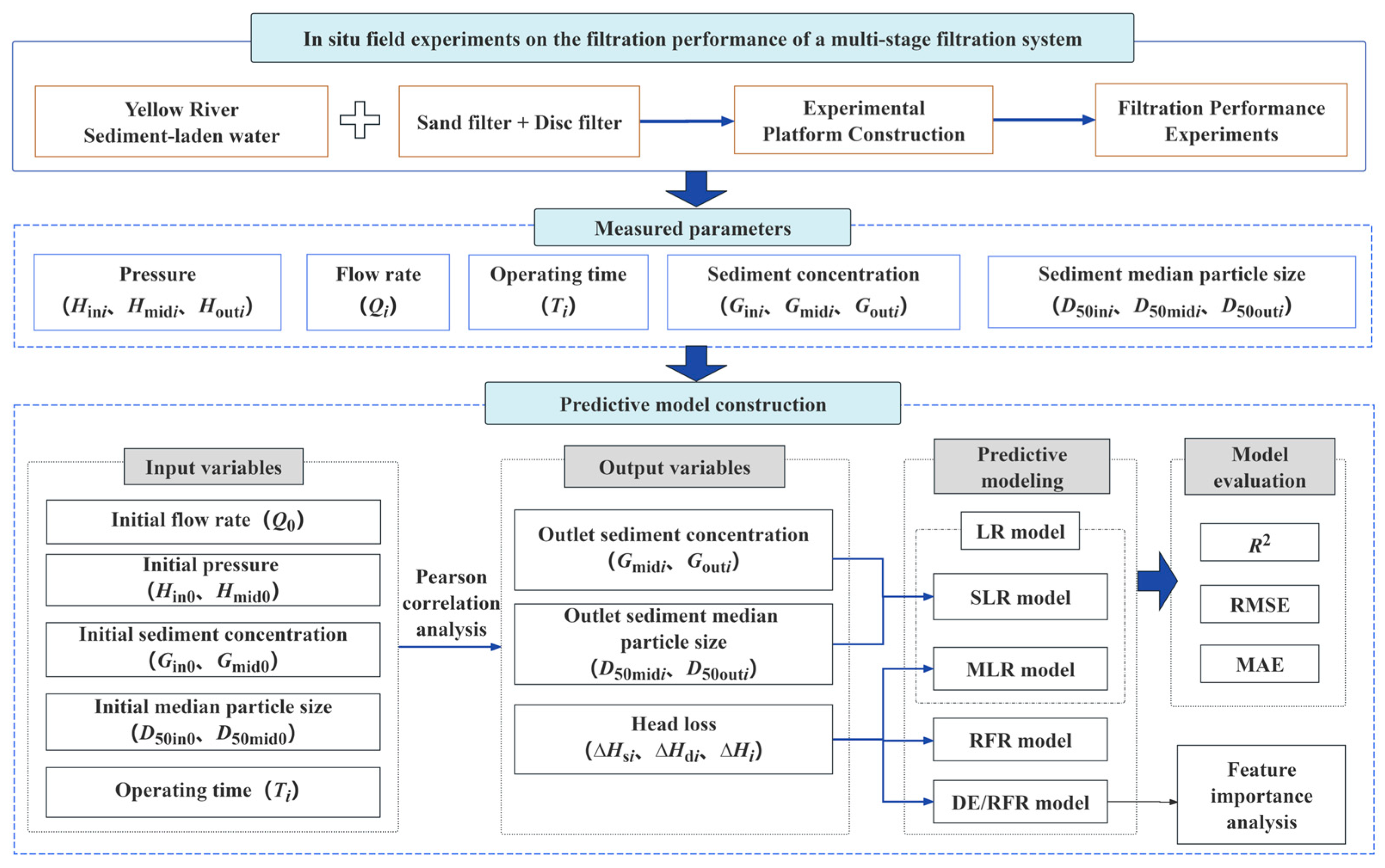
This study combines in situ field experiments with data-driven modelling. Based on a multi-stage filtration system composed of sand and disc filters, filtration experiments using sediment-laden water from the Yellow River were conducted, and predictive models were developed for hydraulic performance and effluent sediment characteristics. The technical workflow is shown in Figure 1.

2.1. Experimental Setup

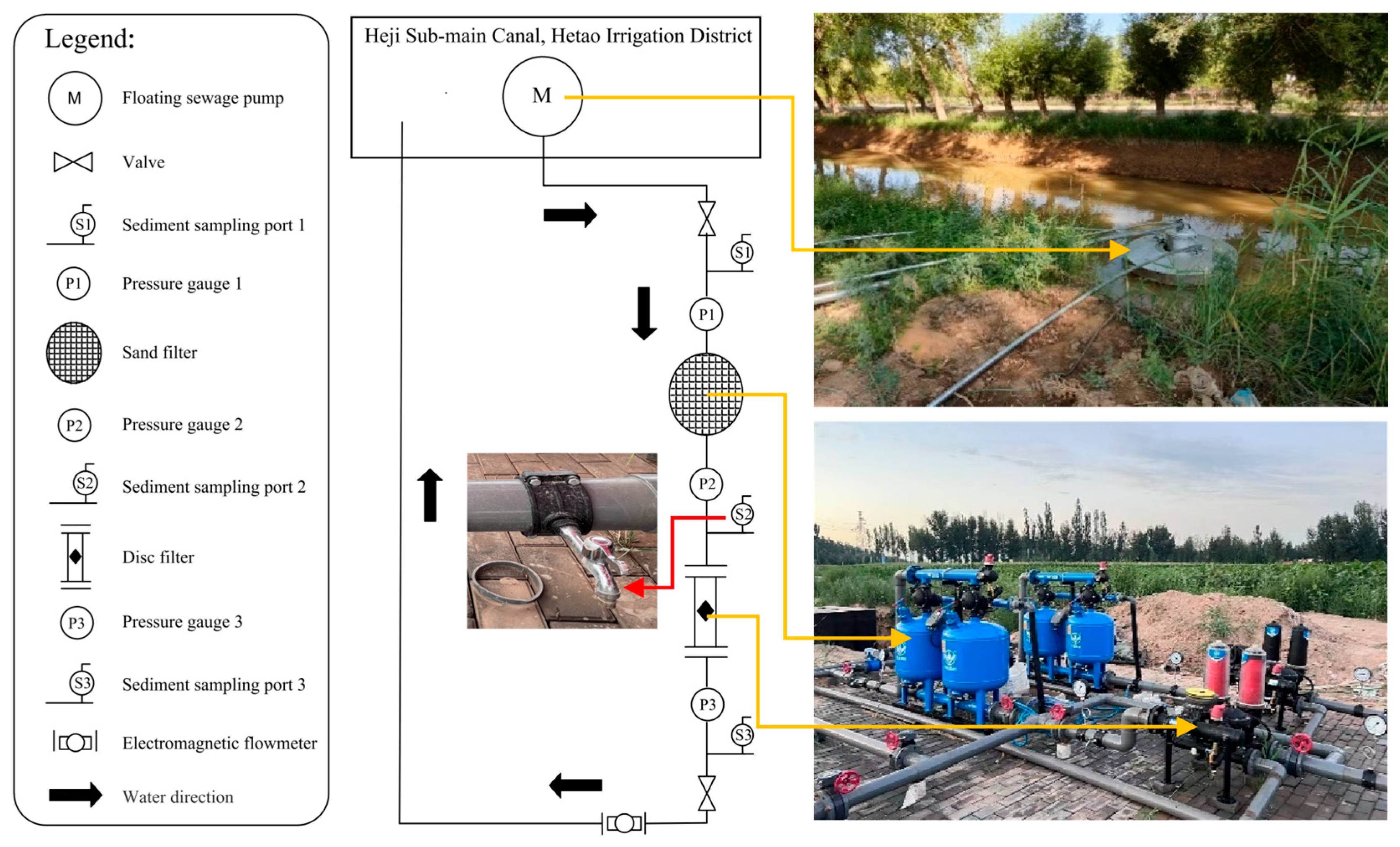
The multi-stage filtration system performance test platform was constructed in 2025. It is located south of the second check gate of the Heji sub-main canal in the Yongji Irrigation Area of the Hetao Irrigation District, Inner Mongolia, China (40°73′ N, 107°28′ E). The platform primarily consists of a floating sewage pump (Shandong Shuimai Agricultural Development Co., Ltd., Dezhou, Shandong, China; flow rate: 60 m3/h; head: 50 m; power: 18.5 kW), a sand media filter (Shanghai Huawei Agritech Group Co., Ltd., Shanghai, China), a disc filter (Shanghai Huawei Agritech Group Co., Ltd., Shanghai, China), pressure gauges (Hongqi Instrument Co., Ltd., Yueqing, Zhejiang, China; range: 0–0.6 MPa; accuracy: ±0.4%), an electromagnetic flowmeter (Henan Zhong’an Electronic Detection Technology Co., Ltd., Zhengzhou, Henan, China; range: 9–90 m3/h; accuracy: ±2%), valves, and sediment sampling ports (Figure 2). Both the sand media filter and the disc filter are equipped with backflushing capabilities. Their filtration specifications correspond to those commonly used in drip irrigation systems supplied with Yellow River water in the Hetao Irrigation District, namely, 100 mesh (nominal filtration accuracy: 150 μm) and 120 mesh (effective filtration accuracy: 125 μm), respectively. Three pressure gauges were used to monitor the inlet pressure (Hini), outlet pressure (Houti), and inter-stage pressure (Hmidi, i.e., at the sand media filter outlet or disc filter inlet) of the multi-stage filtration system. Additionally, three sediment sampling ports were positioned at the inlet, outlet, and inter-stage of the filtration system.

2.2. Experimental Design and Methods

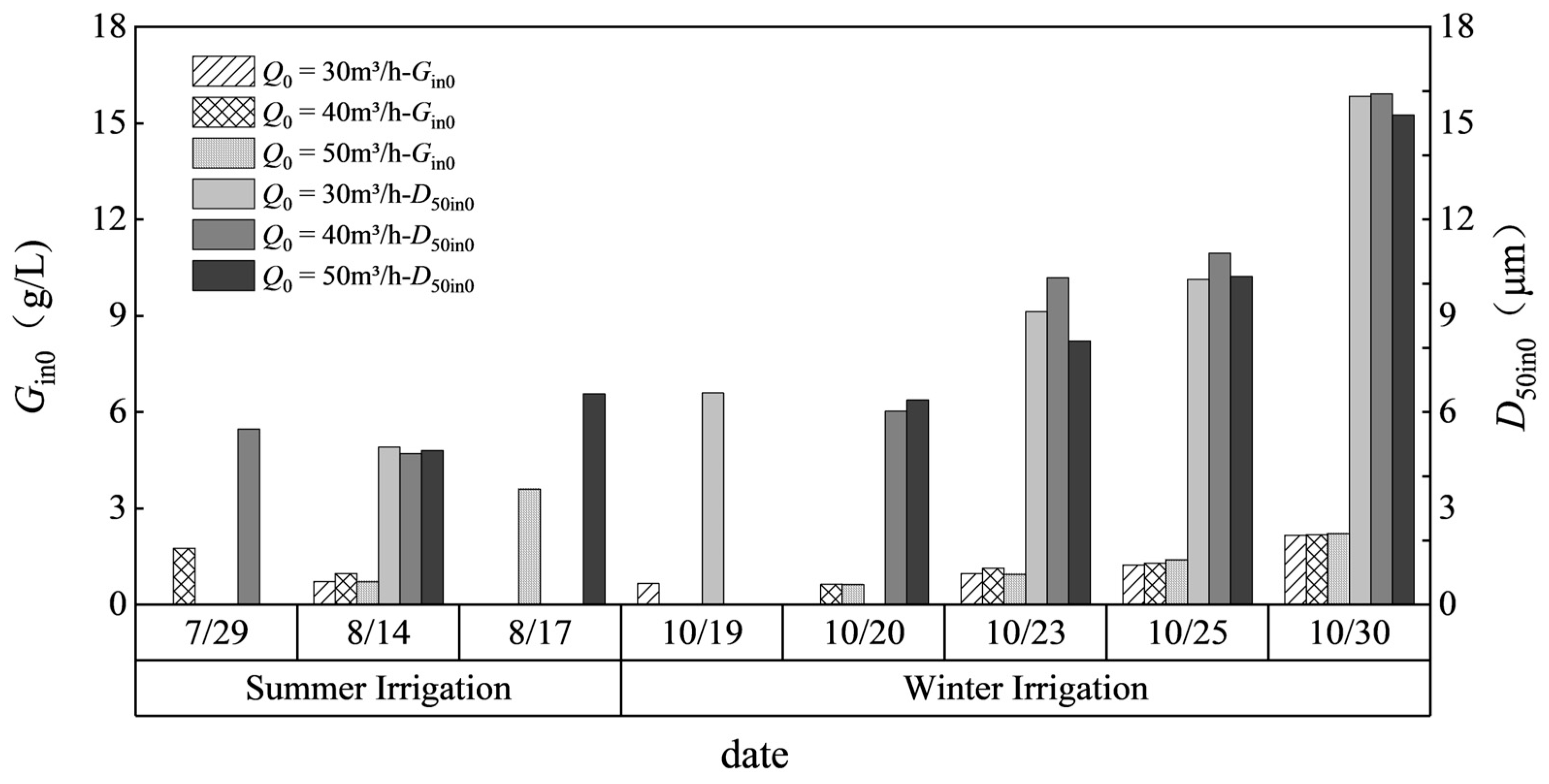
To investigate the hydraulic performance response of the multi-stage filtration system under all sediment characteristics of the Heji sub-trunk canal, this study conducted experimental tests during both the summer (29 July–17 August) and winter (19 October–30 October) irrigation periods of 2025. During the summer irrigation period, the initial sediment concentration at the inlet (Gin0) ranged from 0.72 to 3.6 g/L, with a corresponding median particle size (D50in0) of 4.70–6.56 μm; in the winter irrigation period, Gin0 ranged from 0.62 to 2.31 g/L and D50in0 was 5.87–16.03 μm. Notably, Gin0 peaked at 3.6 g/L in late August. D50in0 exhibited an increasing trend over time, and the average D50in0 in the winter irrigation period was 48.3% higher than that in the summer irrigation period (Figure 3).
During the experimental process, the initial flow rate (Q0) of the multi-stage filtration system at the beginning of operation was set at three levels: 30, 40, and 50 m3/h. Under each of the three Q0 levels, 5–6 filtration experiments were conducted under different sediment-laden water conditions, resulting in a total of 17 filtration performance experiments (Table 1). Specifically, when Q0 was 30 or 40 m3/h, the initial pressure at the outlet (Hout0) was set to 0.15 MPa at the beginning of the operation. However, when Q0 was 50 m3/h, Hout0 was maintained between 0.09 and 0.11 MPa due to the head limitations of the floating sewage pump.
The experimental procedure is as follows:
  • After initiating the water pump and ensuring its stable operation, the valves shown in Figure 2 were adjusted according to the experimental design (Table 1) to set the outlet pressure and flow rate of the multi-stage filtration system to Hout0 and Q0, respectively.
  • Once the readings of the pressure gauges and electromagnetic flowmeter stabilized, the initial pressures at the inlet (Hin0), outlet (Hout0), and inter-stage (Hmid0) were recorded at the onset of the system operation. These values were then used to determine the initial head losses of the sand filter (∆Hs0), disc filter (∆Hd0), and the multi-stage filtration system (∆H0), respectively.
  • For every incremental increase of approximately 0.01 MPa in the head loss of the multi-stage filtration system (∆Hi), the pressures at the inlet (Hini), inter-stage (Hmidi), and outlet (Houti) were recorded. Based on these readings, the head loss of the sand filter (∆Hsi), the disc filter (∆Hdi), and the multi-stage filtration system (∆Hi) were determined. Simultaneously, the flow rate (Qi) and the cumulative operating time (Ti) were documented.
  • Concurrently, 250 mL sediment-laden water samples were collected from the inlet, outlet, and inter-stage ports using 300 mL sampling bottles at the three designated locations.
  • When ∆Hsi or ∆Hdi reached 0.07 MPa, the corresponding Ti was recorded as Tmax, defined as the filtration cycle. The water pump was then deactivated to initiate the backflushing of the sand or disc filter until ∆Hsi or ∆Hdi recovered to ∆Hs0 or ∆Hd0, respectively [31].

2.3. Measured Parameters

2.3.1. Hydraulic Performance of Filters

The hydraulic performance parameters of the multi-stage filtration system primarily include the pressure indices (Hini, Hmidi, and Houti), head losses (∆Hsi, ∆Hdi, and ∆Hi), and flow rate (Qi). Specifically, the head losses during operation were calculated as: ∆Hsi = HiniHmidi, ∆Hdi = HmidiHouti, and ∆Hi = HiniHouti. Correspondingly, the initial head losses were defined as: ∆Hs0 = Hin0Hmid0, ∆Hd0 = Hmid0Hout0, and ∆H0 = Hin0Hout0.

2.3.2. Sediment Characteristic Indices

The sediment characteristic indices of the multi-stage filtration system included the sediment concentrations (Gini, Gmidi, and Gouti) and their corresponding median sediment particle sizes (D50ini, D50midi, and D50outi) obtained from three sampling ports. The testing methods for sediment concentration and particle size distribution were as follows:
  • Sediment concentration:
The sediment-laden water sample was shaken evenly, and the volume was fixed to 200 mL using a volumetric flask; the sample was suction-filtered using a diaphragm vacuum pump (Jianhu Mingte Glass Instrument Factory, Yancheng, Jiangsu, China; negative pressure 0.086 MPa, filter membrane pore size 4 μm); after suction filtration, the filtered sediment was placed in an aluminum box and dried at 105 °C to a constant weight, recorded as m (g); thus, the sediment concentration was calculated as 5 m (g/L) [32].
2.
Sediment particle size distribution:
A dried sediment sample of 0.5–0.6 g was weighed and subjected to ultrasonic dispersion using an automatic sample dispersion system (Bettersize Instruments Ltd., Dandong, China); subsequently, the particle size distribution of the sediment sample was measured using a laser particle size analyzer (measuring range: 0.02–2000 μm, error: ≤1%; Bettersize Instruments Ltd., Dandong, China) [33]. The D50 (corresponding to 50% of the cumulative volume distribution) was adopted as the representative index to characterize the sediment particle size distribution.

2.3.3. Filtration Efficiency

The filtration efficiencies of the sand filter (Esi), disc filter (Edi), and multi-stage filtration system (Ei) were calculated using Equations (1)–(3):
Esi = (GiniGmidi)/Gini × 100%
Edi = (GmidiGouti)/Gmidi × 100%
Ei = (GiniGouti)/Gini × 100%

2.4. Mathematical Modelling Techniques

Under sediment-laden water conditions, previous studies have employed linear regression (LR) models to establish quantitative mathematical models characterizing the relationship between the head loss of the disc filter and the inlet flow rate, inlet sediment concentration, and inlet median particle size [22]. In recent years, to enhance the prediction accuracy of mathematical models, Garcia-Nieto et al. [29] proposed a hybrid model combining the differential evolution (DE) algorithm with random forest regression (RFR), denoted as DE/RFR. By utilizing the DE algorithm to optimize the hyperparameters of the RFR model, the prediction accuracy for the outlet turbidity of sand filters was significantly improved. Therefore, this study aims to develop LR, RFR, and DE/RFR models for sand filters, disc filters, and multi-stage filtration systems to calculate the head loss, outlet sediment concentration, and outlet median sediment particle size for each of these three filtration configurations across various scenarios.

2.4.1. Variables in the Model

Based on 17 independent hydraulic performance tests, data were collected at 3–5 time points during each test, yielding a cumulative total of 75 datasets (Table 2). This study selected indicators affecting the hydraulic performance of the filter as model input variables [34,35], including the flow rate (Q0), inlet pressure (Hin0 or Hmid0), sediment concentration (Gin0 or Gmid0), and median sediment particle size (D50in0 or D50mid0) under initial operating conditions, along with the operating time (Ti). ∆Hsi, ∆Hdi, and ∆Hi, along with outlet sediment characteristics (Gmidi or Gouti, D50midi or D50outi), were selected as output indicators. Among these, ∆Hsi, ∆Hdi, and ∆Hi characterize the filter head loss [36], while Gouti and D50outi are associated with the risk of physical clogging in drip irrigation systems [2].

2.4.2. Linear Regression (LR)

Pearson correlation analysis was performed to examine the relationships among all inlet and outlet variables in the sand, disc, and multi-stage filtration systems. Based on this analysis, LR models were employed to establish quantitative mathematical relationships between the head loss indices (∆Hsi, ∆Hdi, and ∆Hi) and the operating time (Ti) as well as the initial parameters of the filters and the filtration system, including Q0, Hin0 (or Hmid0), Gin0 (or Gmid0), and D50in0 (or D50mid0). Additionally, linear regression analysis was performed to determine the relationships between inlet and outlet sediment characteristics. The linear regression (LR) models employed in this study comprised multiple linear regression (MLR) and simple linear regression (SLR).

2.4.3. Random Forest Regression (RFR)

RFR is a non-linear statistical model grounded in the Bagging ensemble learning framework, with the regression decision tree serving as its fundamental unit. Its core mechanism employs Bootstrap sampling and random feature selection strategies to construct an ensemble of multiple decision trees, collectively forming a “forest”. Each tree was trained independently, and the final prediction was derived by averaging the outputs of multiple decision trees, which significantly mitigates the risk of overfitting while enhancing generalization capability and accuracy [37]. RFR possesses the capability to assess variable importance, enabling the quantitative identification of key features and providing a reliable basis for input variable selection [38]. The key hyperparameters of the RFR model primarily include the number of trees (n_estimators), maximum tree depth (max_depth), minimum samples required to be at a leaf node (min_samples_leaf), minimum samples required to split an internal node (min_samples_split), and maximum features considered for the best split (max_features). Their definitions and roles in the model are described in detail in Reference [39].

2.4.4. Differential Evolution (DE) Optimizer

Given that the prediction accuracy of RFR is related to the values of hyperparameters, this study adopted DE to optimize the RFR hyperparameters. DE is a meta-heuristic method that solves optimization problems by iteratively improving the quality of candidate solutions. It mainly includes four steps: initialization, mutation, crossover, and selection [40]. After initialization, the search was started, and the “mutation–crossover–selection” steps were executed until the preset termination conditions were met (reaching the maximum number of iterations, convergence accuracy of the target solution, or no significant improvement in population fitness). It has been successfully applied to the prediction of head loss, outlet dissolved oxygen, and outlet turbidity in sand filters [27,28,29].
  • Initialization
According to Equation (4), an initial population was randomly generated within the search space, where NP and I denote the population size and the maximum number of iterations, respectively. Each individual in the population corresponds to an n -dimensional vector of RFR hyperparameters. In this study, the individual vector is denoted as X p i = [n_estimators, max_depth, min_samples_leaf, min_samples_split, max_features], where X p i represents the p-th individual in the i-th generation (p = 1, …, NP; i = 0, 1, …, I). The variable range for the initial population is [ X j L , X j U ], where j denotes the index of the variable within the individual.
X p , j 0 = X j L + r a n d p , j   ( 0 ,   1 ) ( X j U X j L )   for   p = 1 ,   2 ,     ,   N P   and   j = 1 ,     ,   n
where X p , j 0 is the j-th variable of the p-th individual in the initial population (the first generation); randp,j (0, 1) denotes a uniformly distributed random number within the range (0, 1).
2.
Mutation
The initial vectors X p i were updated according to the mutation strategy in Equation (5) to generate the new vectors V p g .
V p i = X r 1 i + F ( X r 2 i X r 3 i )   for   p = 1 ,   2 ,     ,   N P
where X r 1 i , X r 2 i , and X r 3 i are three distinct individuals randomly selected from the population; F is the scaling factor, which lies in the interval [0, 2].
3.
Recombination
The trial vectors U p i are generated through the crossover operation between the initial vectors X p i and the new vectors V p i .
U p i = V p , j i ,   if   r a n d p , j   ( 0 ,   1 )     C R ,   or   j = I r a n d X p , j i ,   otherwise   for   p = 1 ,   2 ,     ,   N P   and   j = 1   ,     ,   n
where Irand denotes a random dimension index; CR is the crossover rate, which lies in the interval [0, 1].
4.
Selection
In order to choose the vectors of the following generation, the trial vectors were compared to the initial vectors to retain the individuals with the best value given by the fitness function.
X p i + 1 = U p i ,   if   f ( U p i ) < f ( X p i ) X p i ,   otherwise
where f denotes the fitness function.

2.4.5. Differential Evolution-Optimized Random Forest Regression (DE/RFR)

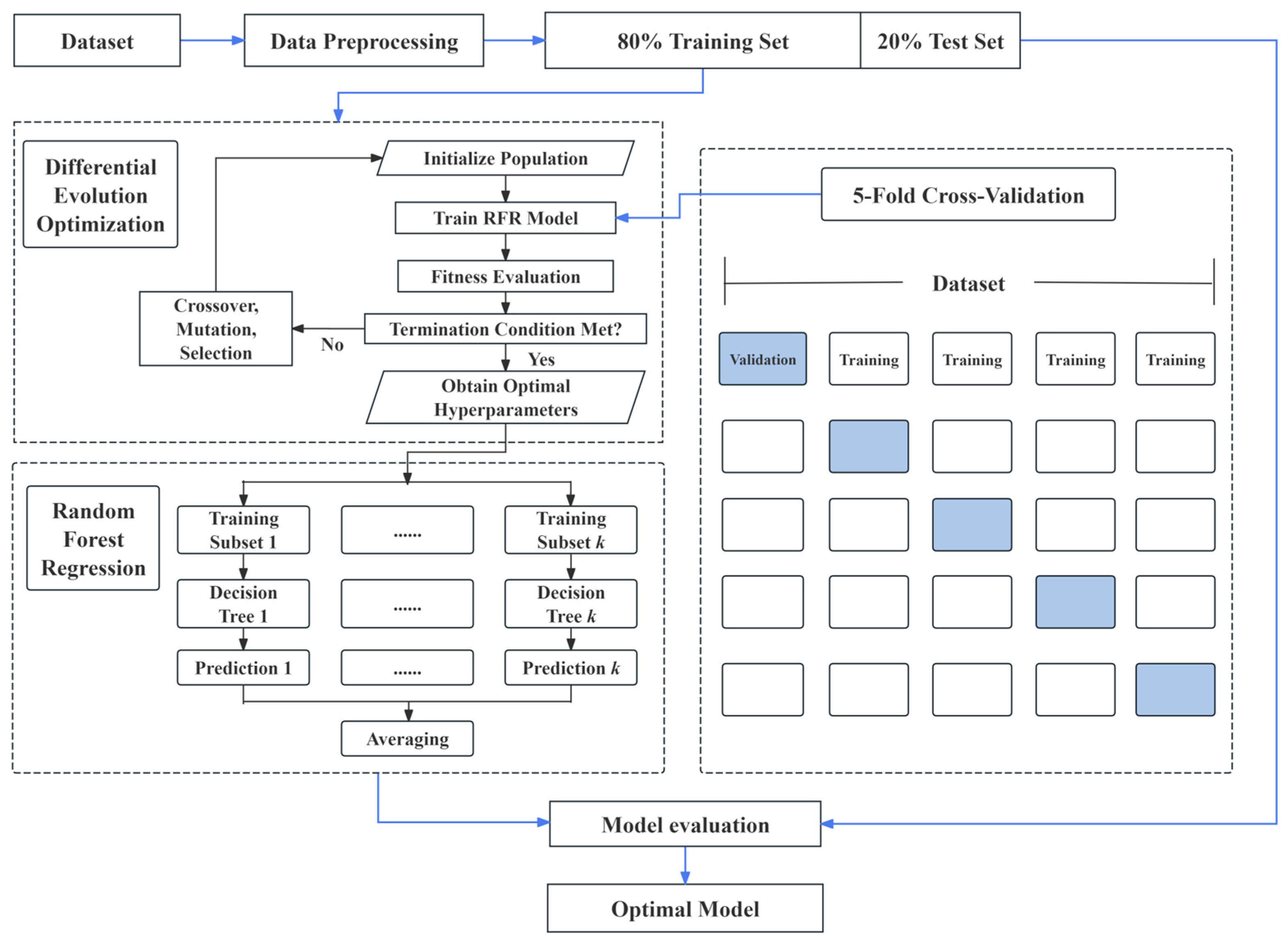
During the construction phase of the DE/RFR model, the dataset consisting of 75 samples was partitioned into an 80% training set (60 samples) and a 20% test set (15 samples) using a random sampling method. The training set was employed for model construction and parameter learning, while the test set was utilized to evaluate the generalization ability of the model on unseen data. To enhance the generalization capability and prevent overfitting, a 5-fold cross-validation mechanism was implemented within the training set [41]. Specifically, the training set was randomly divided into five equal subsets; four subsets were rotated for training, while the remaining one served as the validation subset, with the process repeated five times. Based on the characteristics of the RFR hyperparameters and their suitability for the limited dataset of 75 samples used in this study, the initial search ranges (Table 3) were predefined with reference to empirical settings reported in previous studies [29,42]. These ranges provided reasonable search boundaries for the DE algorithm. The DE algorithm was employed to perform global optimization of RFR hyperparameters by iteratively generating candidate combinations. The average error of the 5-fold cross-validation served as the fitness function for the DE algorithm, guiding the population to evolve toward error minimization until the algorithm converged and established the optimal hyperparameters [43]. Finally, the RFR model was constructed based on these optimal hyperparameters, and its predictive performance was verified on the test set using various accuracy metrics. The overall modelling workflow of the DE/RFR model is illustrated in Figure 4.

2.4.6. Model Evaluation

The prediction accuracy of the LR, RFR, and DE/RFR models was evaluated using the coefficient of determination (R2, Equation (8)), root mean square error (RMSE, Equation (9)), and mean absolute error (MAE, Equation (10)). Specifically, the closer the R2 is to 1.0, and the closer the RMSE and MAE are to 0, the higher the prediction accuracy of the model is indicated.
R 2 = 1 S S err S S tot = 1 i = 1 n t i y i 2 i = 1 n t i t ¯ 2
RMSE = 1 n i = 1 n t i y i 2
MAE = 1 n i = 1 n t i y i
where SSerr is the residual sum of squares; SStot is the total sum of squares; ti and yi represent the measured and predicted values of the samples, respectively; t - is the mean of the measured values; and n is the sample size.

2.4.7. Feature Importance Analysis

To quantify the contribution of each input feature to the DE/RFR model’s predictions, feature importance analysis was conducted based on the permutation importance method [44]. Specifically, while maintaining the fixed structure of the model trained with optimal hyperparameters, the values of a single feature in the training set were randomly permuted to recalculate the R2. The resulting decrease in R2 (∆R2) was employed as the indicator of variable importance, where a larger ∆R2 signifies a more significant impact of that specific variable on the model’s predictive performance. In this study, the number of permutations (n_perm) was set to 50, and the mean value of these iterations was adopted as the final importance score for each feature. On this basis, each importance score was normalized, such that the relative proportion of each variable’s score represents its relative importance.

2.4.8. Data Analysis

In this study, Python (v3.9) was used to perform Pearson correlation analysis and LR model construction, the Scikit-learn library in Python was adopted to construct the RFR model, and the DE algorithm from the SciPy library was utilized to optimize hyperparameters; finally, all charts and figures were completed using Excel (v2021).

3. Results

3.1. Variation in Head Loss with Operating Time

3.1.1. Sand Filter

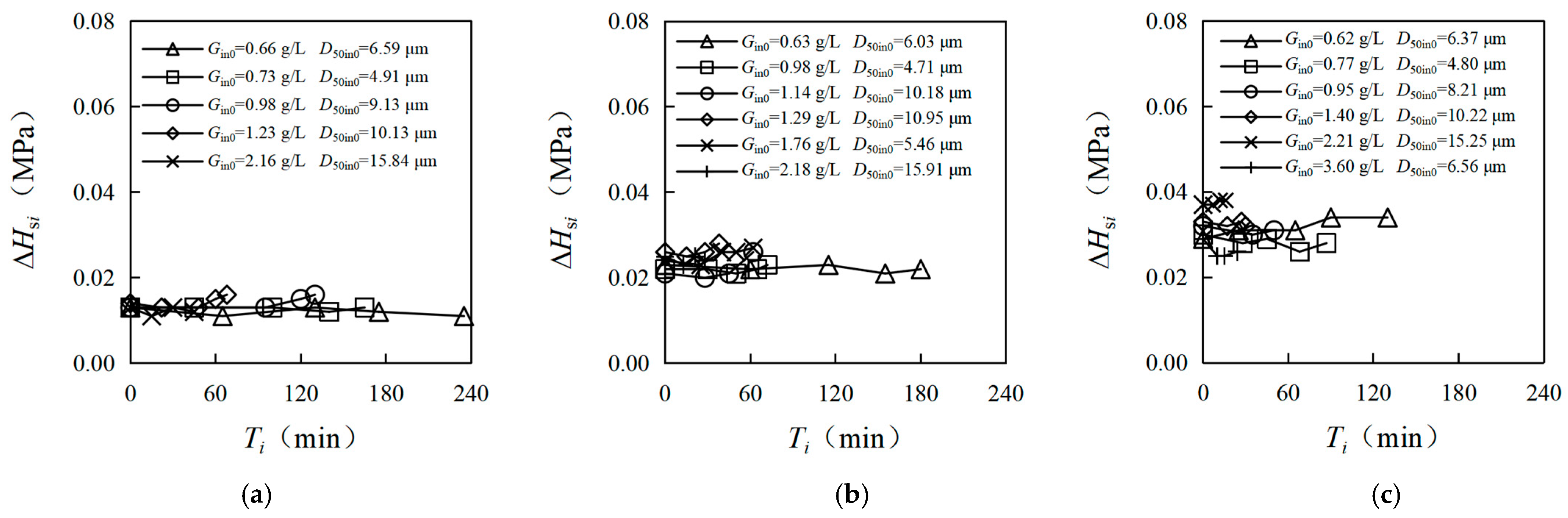
The variation in ∆Hsi for the sand filter with increasing Ti is relatively gentle, and both ∆Hsi and its fluctuations increase with the rise in Q0 (Figure 5). When Q0 was 30 m3/h, Gin0 ranged from 0.66 to 2.16 g/L, and D50in0 ranged from 4.91 to 15.84 μm, the average ∆Hsi was 0.014 MPa. When Q0 was 40 m3/h, Gin0 was 0.63–2.18 g/L, and D50in0 was 4.71–15.91 μm, the average ∆Hsi was 0.024 MPa. When Q0 was 50 m3/h, Gin0 was 0.62–3.60 g/L, and D50in0 was 4.80–15.25 μm, the average ∆Hsi was 0.031 MPa.

3.1.2. Disc Filter and Multi-Stage Filtration System

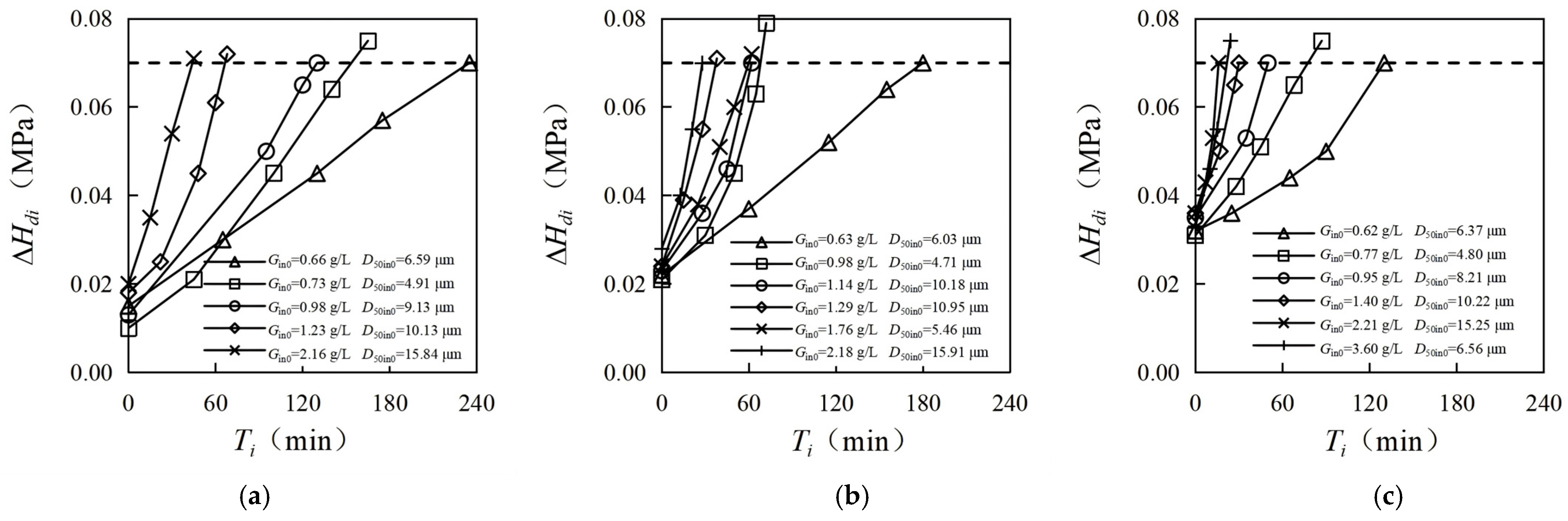
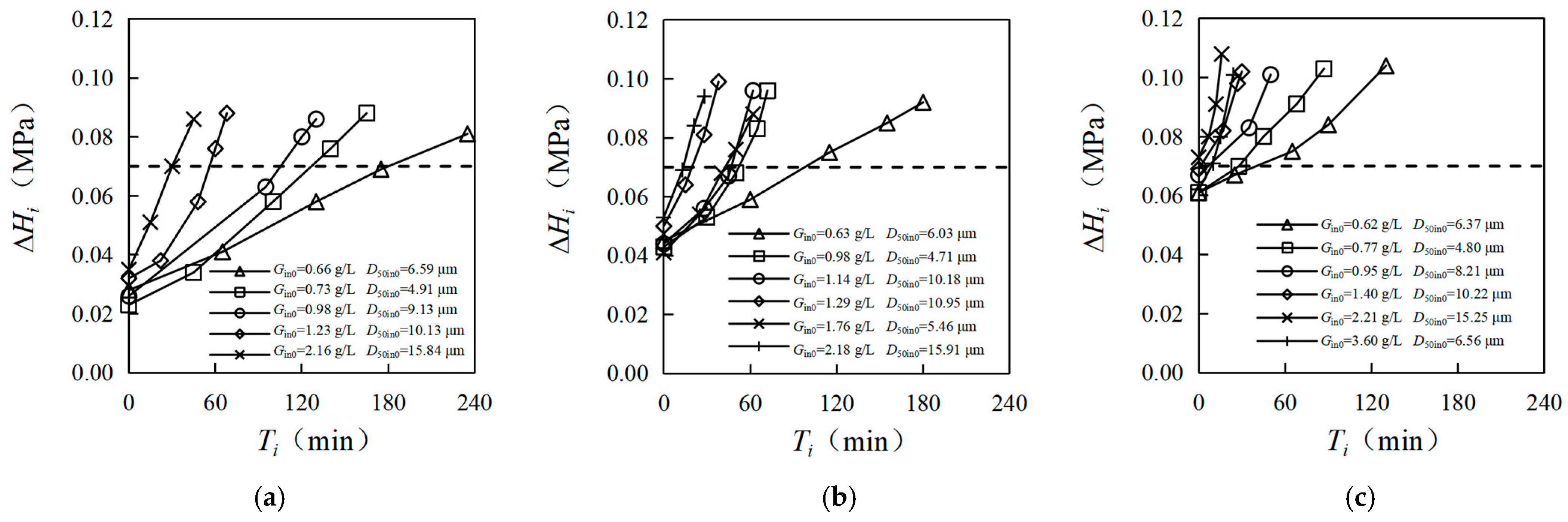
The ∆Hdi of the disc filter (Figure 6) and ∆Hi of the multi-stage filtration system (Figure 7) both exhibit a linearly increasing trend with the rise in Ti, and the magnitude of the increase grows with the rise in Q0, Gin0, and D50in0.
When Q0 was 30 m3/h, Gin0 was 0.66–2.16 g/L, and D50in0 was 4.91–15.84 μm, ∆Hdi ranged from 0.01 to 0.075 MPa, and ∆Hi ranged from 0.023 to 0.088 MPa; when Q0 was 40 m3/h, Gin0 was 0.63–2.18 g/L, and D50in0 was 4.71–15.91 μm, ∆Hdi was 0.021–0.079 MPa, and ∆Hi was 0.041–0.099 MPa; and when Q0 was 50 m3/h, Gin0 was 0.62–3.60 g/L, and D50in0 was 4.80–15.25 μm, ∆Hdi was 0.031–0.075 MPa, and ∆Hi was 0.061–0.108 MPa.
As Gin0 and D50in0 increased, the operating time (Ti) required for ∆Hdi and ∆Hi to reach 0.07 MPa gradually shortened across the three Q0 levels. Specifically, when Gin0 sequentially increased from <1.0 g/L to 1.0–2.0 g/L and >2.0 g/L, the average Ti for ∆Hdi decreased from 129 min to 51 min and 28 min, respectively, while the average Ti for ∆Hi decreased from 80 min to 33 min and 13 min. Similarly, when D50in0 sequentially increased from 4.0–7.0 μm to 8.0–11.0 μm and >15.0 μm, the average Ti for ∆Hdi decreased from 126 min to 62 min and 29 min, respectively, while the average Ti for ∆Hi decreased from 72 min to 39 min and 15 min.

3.2. Variation Patterns of Filtration Efficiency and Sediment Characteristics

At Q0 of 30–50 m3/h, the average filtration efficiencies (Esi, Edi, and Ei) of the sand filter, disc filter, and multi-stage filtration system were 2.5%, 4.2%, and 6.4%, respectively. The filters and the filtration system exhibited a limited interception effect on sediment.
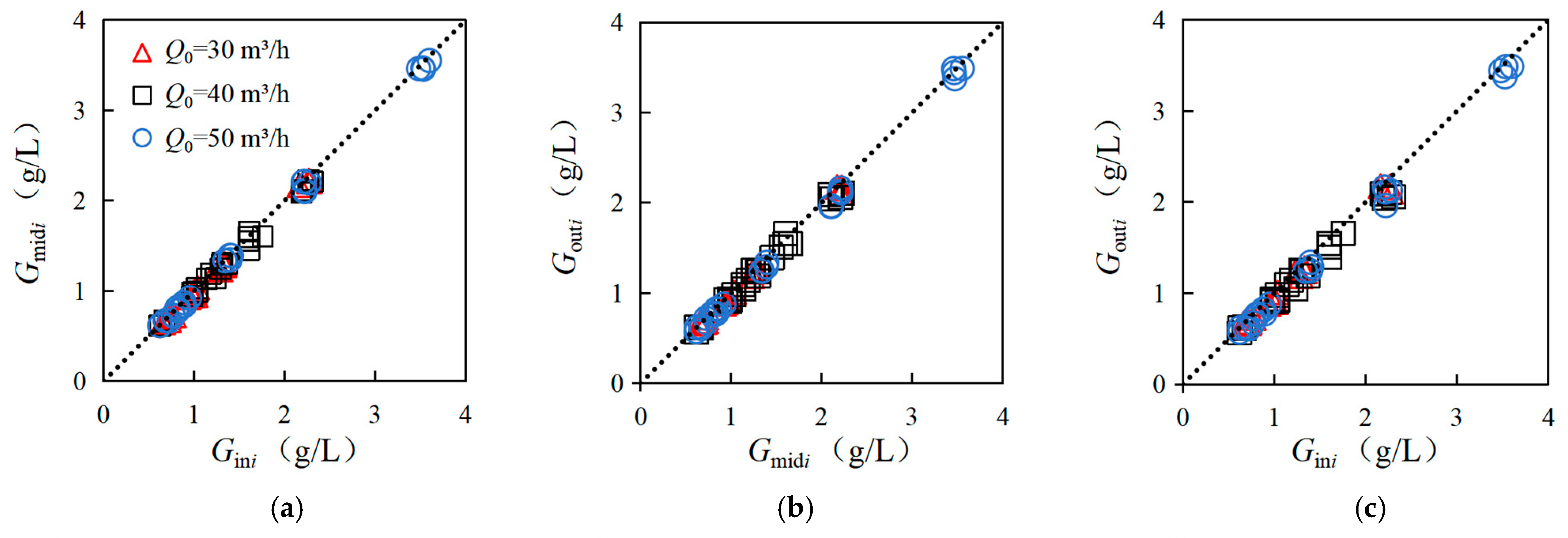
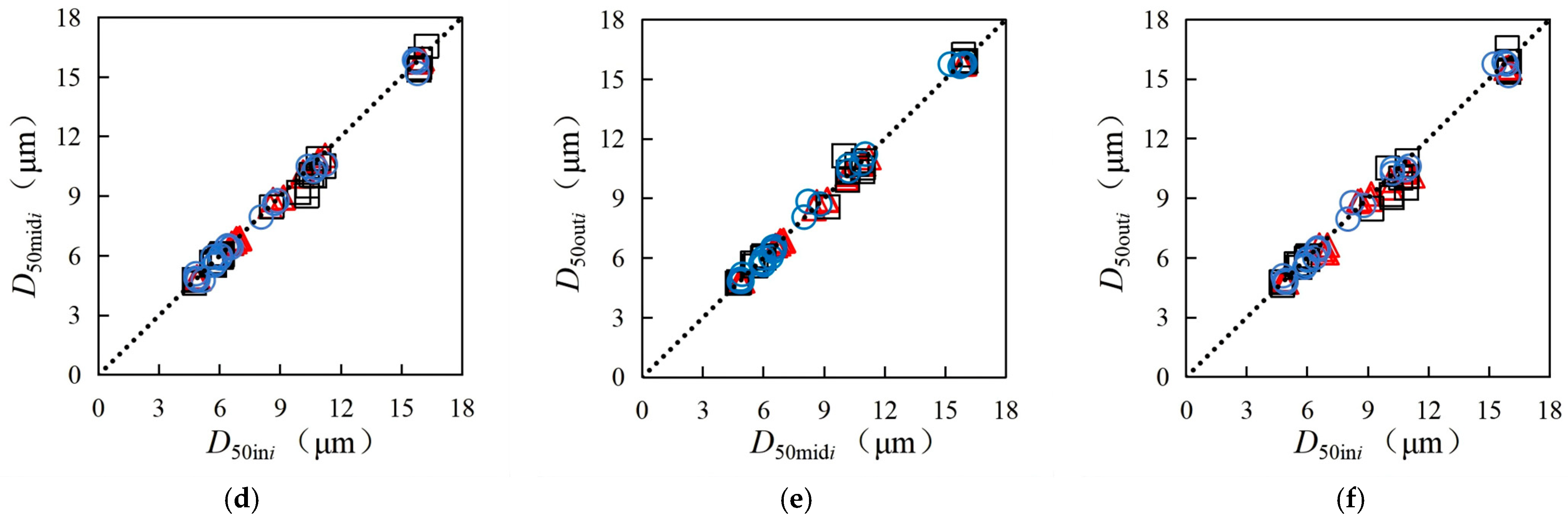
Taking Q0 = 30 m3/h as an example, when Gini ranges from 0.66 to 2.28 g/L and D50ini ranges from 4.84 to 16.03 μm, Gmidi and Gouti range from 0.65 to 2.22 g/L and 0.62 to 2.17 g/L, respectively, while D50midi and D50outi range from 4.84 to 15.92 μm and 4.78 to 15.58 μm, respectively. Both outlet sediment concentration and median particle size of the filters and the filtration system were linearly correlated with their inlet counterparts, with slopes approaching 1 (Figure 8). The sediment characteristics at each node of the filtration system did not show significant changes.

3.3. Significance Analysis of Factors Influencing the Filtration Performance

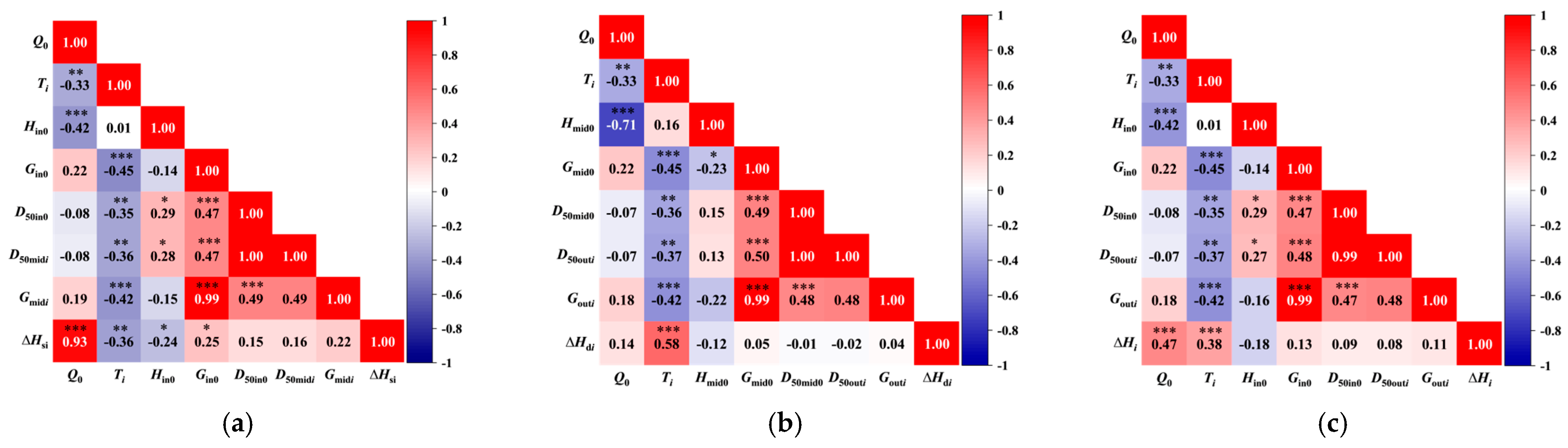
Based on the Pearson correlation analysis results (Figure 9), the head loss variations in the filters and filtration system are influenced by multiple factors. ∆Hsi exhibited significant positive correlations with Q0 (r = 0.93) and Gin0 (r = 0.25), and significant negative correlations with Ti (r = −0.36) and Hin0 (r = −0.25) (p < 0.05), while no significant correlation with D50in0 was observed. ∆Hdi was significantly and positively correlated only with Ti (r = 0.58, p < 0.01). Meanwhile, ∆Hi showed significant positive correlations with Q0 (r = 0.47) and Ti (r = 0.38) (p < 0.01), whereas its correlations with the remaining variables were not significant.
In terms of sediment characteristics, the outlet sediment characteristics (Gmidi or Gouti, D50midi or D50outi) of the sand filter, disc filter, and multi-stage filtration system were all significantly and positively correlated with their respective inlet sediment characteristics (Gin0 or Gmid0, D50in0 or D50mid0) (r = 0.993–0.995, p < 0.01) and were significantly and negatively correlated with Ti (r = −0.42 to −0.36, p < 0.05). Additionally, both D50midi and D50outi exhibited significant positive correlations with Hin0 (r = 0.27–0.28).
The filtration efficiency of the sand filter, disc filter, and the multi-stage filtration system is relatively low; however, the variation patterns of head loss differ. ∆Hsi is significantly positively correlated with Q0, indicating that its head loss is primarily governed by hydraulic conditions, with a relatively minor influence from sediment retention. In contrast, both ∆Hdi and ∆Hi show significant positive correlations with Ti, reflecting the cumulative effects induced by continuous sediment deposition within the disc flow channels. For the multi-stage filtration system, the evolution of ∆Hi is dominated by the disc filter and is jointly influenced by both Q0 and Ti.

3.4. Development of the LR Model

3.4.1. Head Loss of the Filters and the Filtration System

The head loss of filters results from the coupled effects of flow resistance and sediment retention. The flow rate and pressure conditions determine the instantaneous energy dissipation as the fluid passes through the porous medium, whereas sediment characteristics and operating time drive the dynamic evolution of head loss by altering the pore structure and permeability.
Building upon the aforementioned head loss formation mechanism, to accurately calculate the head loss of the filters and filtration system and quantify the combined effects of multiple factors, MLR was employed to construct regression equations for ∆Hsi, ∆Hdi, and ∆Hi incorporating all independent variables. The R2 values were 0.916, 0.568, and 0.674, respectively (Equations (11)–(13)), and all models passed the overall significance test (p < 0.05).
Hsi = 0.048Hin0 − 0.001Gin0 + 0.001D50in0 + 0.0002Ti + 0.001Q0 − 0.03  R2 = 0.916
Hdi = 0.105Hmid0 + 0.007Gmid0 + 0.001D50mid0 + 0.019Ti + 0.001Q0 − 0.045  R2 = 0.568
Hi = 0.076Hin0 + 0.005Gin0 + 0.002D50in0 + 0.02Ti + 0.002Q0 − 0.062  R2 = 0.674

3.4.2. Outlet Sediment Characteristics of the Filters and the Filtration System

Based on Figure 8 and the Pearson correlation analysis results, the inlet sediment characteristics are the primary factor governing the variations in outlet sediment characteristics (r > 0.99). The SLR equations between the outlet and inlet sediment characteristics for the sand filter (Equations (14) and (15)), disc filter (Equations (16) and (17)), and multi-stage filtration system (Equations (18) and (19)) exhibited high goodness-of-fit, with R2 values ranging from 0.9862 to 0.9903.
Gmidi = 0.9492 Gin0 + 0.0611  R2 = 0.9875
D50midi = 1.0147 D50in0 − 0.0745  R2 = 0.9902
Gouti = 0.9493 Gmid0 + 0.0455  R2 = 0.9875
D50outi = 0.9744 D50mid0 + 0.0213  R2 = 0.9903
Gouti = 0.9384 Gin0 + 0.0283  R2 = 0.9862
D50outi = 0.9933 D50in0 − 0.0663  R2 = 0.9878

3.5. Development of the DE/RFR Model

3.5.1. Hyperparameter Optimization of the RFR Model Based on the DE Algorithm

To improve the prediction accuracy of the hydraulic performance at the outlet of the filters and the filtration system, this study developed both RFR and DE/RFR models. The hyperparameters of the RFR model were determined within predefined ranges based on the literature experience and were kept fixed. For the DE algorithm, considering the relatively small sample size of this study, a four-level full factorial experiment was conducted for parameter tuning. Specifically, the NP was set to 5, 10, 15, and 20; the F was set to 0.4, 0.5, 0.7, and 0.9; and the CR was set to 0.5, 0.6, 0.7, and 0.9, resulting in a total of 64 parameter combinations. Based on five-fold cross-validation on the training set, the minimum RMSE for the head loss prediction model on the validation set was obtained when NP = 10, F = 0.5, and CR = 0.7. Therefore, this parameter set was selected as the optimal configuration for the DE algorithm. During the iterative process, the fitness value tended to stabilize after 10 iterations and remained constant after 20 iterations, indicating that the model had converged. Therefore, the number of iterations was set to 20. The mean error of 5-fold cross-validation was utilized as the fitness function, with a tolerance threshold of 0.01 for the fitness value between adjacent iterations. The results indicated that the optimized n_estimators for ∆Hdi were 465, significantly higher than those for ∆Hsi (120) and ∆Hi (149). Similarly, the max_depth for ∆Hdi was 19, higher than that for ∆Hsi (11) and ∆Hi (14). Regarding the low-dimensional case with five input variables, the max_features obtained via DE optimization were all close to 1, exhibiting a gradual decrease from ∆Hsi (0.97) to ∆Hi (0.83) (Table 4).

3.5.2. Feature Importance Analysis Based on the DE/RFR Model

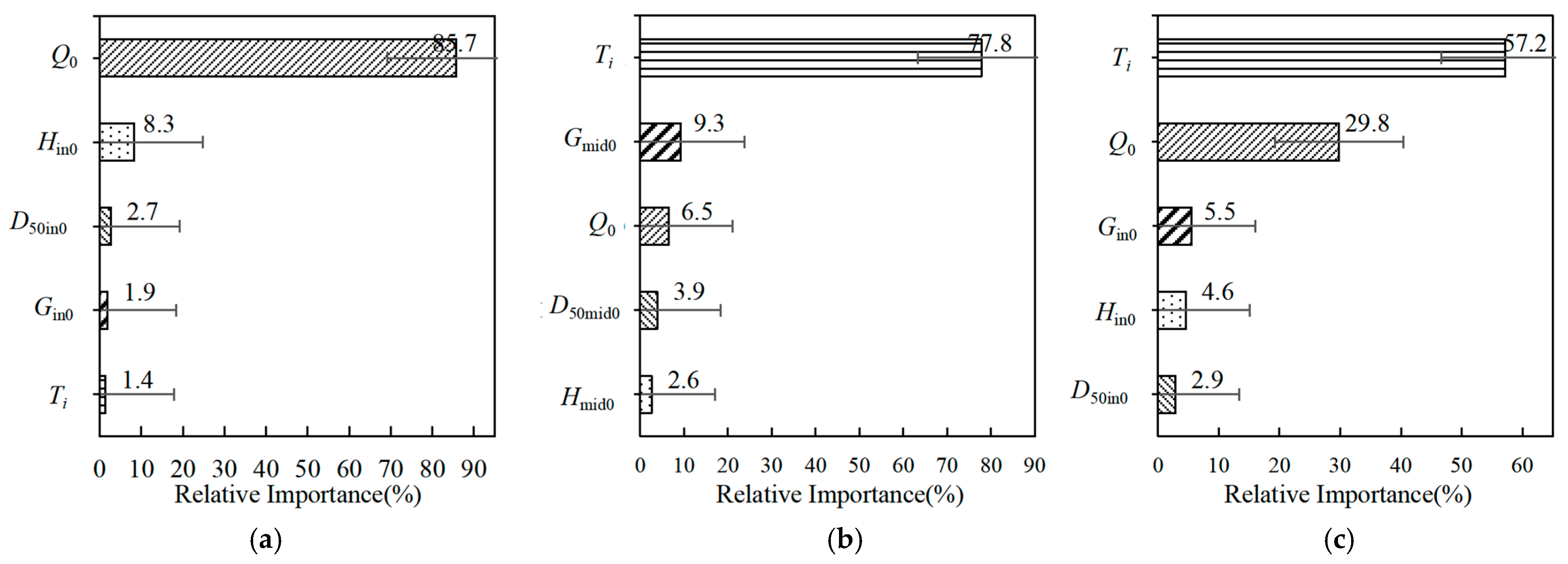
Given that Pearson correlation analysis and MLR are primarily based on linear assumptions, they lack the capacity to capture complex nonlinear relationships and interaction effects among variables. Consequently, the permutation importance method within the DE/RFR model was employed to more accurately quantify the relative contributions of independent variables to ∆Hsi, ∆Hdi, and ∆Hi (Figure 10). The importance of variables affecting Q0 > Hin0 > D50in0 > Gin0 > Tᵢ; Tᵢ > Gmid0 > Q0 > D50mid0 > Hmid0; and Tᵢ > Q0 > Gin0 >Hin0 > D50in0, respectively. Specifically, in the feature importance analysis for ∆Hsi, Q0 emerged as the most dominant factor with a relative importance of 85.7%. For ∆Hdi, the cumulative contribution of Tᵢ, Gmid0, and Q0 reached approximately 93.6%. Regarding the prediction of ∆Hi, Tᵢ and Q0 were identified as the two key variables, with Tᵢ providing the largest contribution (57.2%) and Q0 accounting for a relative importance of 29.8%.

3.6. Prediction Accuracy Comparison and Model Selection

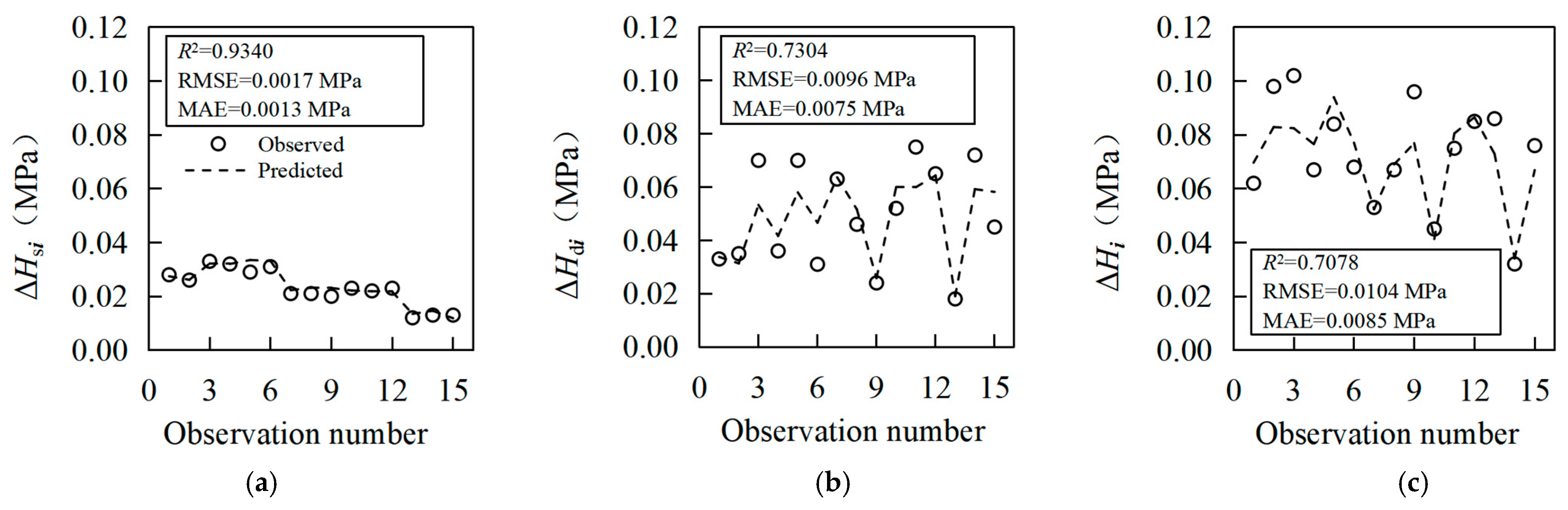
The DE/RFR model demonstrated the highest prediction accuracy for ∆Hsi, ∆Hdi, and ∆Hi, yielding R2 values of 0.9340, 0.7304, and 0.7078; RMSE values of 0.0017, 0.0096, and 0.0104 MPa; and MAE values of 0.0013, 0.0075, and 0.0085 MPa, respectively (Table 5). Compared with the MLR and RFR models, the average R2 of the DE/RFR model increased by 11.86% and 4.53%, respectively. Furthermore, the average RMSE and MAE of the DE/RFR model decreased by 19.31% and 19.74% relative to the MLR model, and by 6.52% and 8.76% relative to the RFR model.
Based on the DE/RFR model, the predicted values of ΔHsi were in close agreement with the measured data. Regarding ΔHdi and ΔHi, the DE/RFR model effectively captured the fluctuation trends of the experimental data; however, at peak values ranging from 0.07 to 0.075 MPa for ΔHdi and 0.084 to 0.102 MPa for ΔHi, the prediction errors were 17.6–20.1% and −19.9% to 11.9%, respectively (Figure 11).

4. Discussion

4.1. Variation Patterns of Head Loss Under Sediment-Laden Water Conditions

When Gin0, D50in0, Q0, and filter media size ranged from 0.6–2.5 g/L, 25–63 μm, 1.24–25 m3/h, to 0.85–3.0 mm, respectively, the ΔHsi of sand filters increased with Ti, reaching 0.07 MPa within 20–60 min of operation [45,46]. In the present study, due to the small D50in0, the ratio of sediment size to filter media size was merely 1/851–1/125. This value is significantly lower than the range of 1/48–1/13 reported in the aforementioned studies, resulting in ineffective interception of Yellow River sediment by the filter media. Consequently, even with Gin0 and Q0 reaching as high as 3.6 g/L and 50 m3/h, respectively, ΔHsi remained relatively stable as Ti increased, maintaining values of 0.025–0.029 MPa after 24 min of operation. When Q0 was 30–50 m3/h, ΔHsi exhibited fluctuations (Figure 5). This phenomenon was attributed to the dynamic attachment, deposition, and detachment of sediment particles at the micro-scale within the filter bed. The analysis indicates that the fluctuation amplitude of ΔHsi is influenced by the flow rate. Under low flow conditions, the hydrodynamic shear is relatively weak, resulting in a relatively stable particle deposition process and smaller fluctuations in ΔHsi. Under high flow conditions, particles migrate deeper into the filter layer and scouring of previously deposited particles occurs, thereby intensifying the fluctuations in ΔHsi. Similarly, the Pearson correlation analysis for the sand filter in this study indicated that ΔHsi was significantly positively correlated with both Q0 and Gin0 (p < 0.05). This finding is consistent with the conclusions of Ren et al. [47] and Zhang et al. [48]: as Gin0 increased from 0.3 g/L to 0.8 g/L and Q0 from 12 m3/h to 24 m3/h, ΔHsi rose from 0.045 MPa to 0.067 MPa after 20 min of operation.
In contrast to the sand filter, experimental data from this study indicated that ΔHdi increased with the increase in Tᵢ, and the Tmax shortened as both Gin0 and D50in0 increased. For example, when Gin0 increased from <1.0 g/L to >2.0 g/L, Tmax decreased from 129 min to 28 min; similarly, when D50in0 increased from 4.0–7.0 μm to >15.0 μm, Tmax decreased from 126 min to 29 min (Figure 6). Under sediment-laden water conditions, the accumulation of particles within the disc filter channels is the primary cause of increased head loss. Higher sediment concentration increases the particle flux per unit time, while larger particles are more prone to local deposition at the inlet and within the filter channels, thereby accelerating the clogging process. Similarly, Yang et al. [20] observed that, under conditions where Q0 was 30 m3/h and D50 was 40–80 μm, when Gin0 increased from 0.2 g/L to 0.4 g/L, ΔHdi increased with Tᵢ, and Tmax decreased from 15–18 min to 4–5 min. Similarly, Li et al. [22] confirmed via regression analysis that ∆Hdi was positively correlated with Gin0 and D50in0 for both linear and annular flow channels. Notably, the Pearson correlation analysis in this study indicated that ΔHdi was significantly influenced only by Tᵢ (p < 0.05). This phenomenon was attributed to the linear cumulative effect of Tᵢ during the monitoring process, which accounted for a contribution rate as high as 77.8%. Consequently, the strong temporal characteristics masked the significant impact of the initial conditions (Gin0 and D50in0) on the increase in ΔHdi. Furthermore, the integration of Pearson correlation analysis and feature importance analysis yielded consistent conclusions, indicating that ΔHsi, ΔHdi, and ΔHᵢ were primarily influenced by Q0, by Tᵢ and Gmid0, and by Tᵢ and Q0, respectively. Given the performance disparities among the aforementioned filters, the ΔHᵢ in a multi-stage filtration system combining sand and disc filters is predominantly attributed to the disc filter. Consequently, the overall operational performance of the system is determined by the disc filter [31,49].

4.2. Analysis of Outlet Sediment Characteristics and Filtration Performance Under Sediment-Laden Water Conditions

Analysis of 225 sediment-laden water samples revealed that for the sand filter, disc filter, and multi-stage filtration system, both the sediment concentration and median particle diameter at the outlet exhibited linear correlations with those at the inlet (Figure 8). The average Esi, Edi, and Ei for these three filtration configurations were merely 2.5%, 4.2%, and 6.4%, respectively. This is attributed to the fact that, from July to October 2025, the incoming sediment particle sizes in the Heji diversion canal were consistently smaller than the filtration accuracy of the disc filter. This indicated that the filters and the filtration system with this specific filtration accuracy provided ineffective interception of the Yellow River sediment in the 2025 experimental area. Similarly, Yang et al. [21] found that a linear disc filter with a filtration accuracy of 125 μm exhibited a filtration efficiency of merely 3.4–7.9% for sediment-laden water with a D50 of approximately 40–50 μm. Yuan et al. [50] revealed that clogging in disc filters is primarily concentrated in the upper filter element and channel inlets, where, in suboptimally designed filters, over 1/3 of the element and 81% of the flow channels fail to intercept sediment, resulting in a physical clogging rate of merely 25% even when ΔHdi reaches 0.06 MPa. It is precisely for this reason that the disc filter in the present study exhibited low filtration efficiency, yet a substantial increase in ΔHdi with respect to Tᵢ.
Relevant studies indicate that, when the sediment D50 ranges from 49 to 66 μm, a filter with a filtration accuracy of 75–100 μm is required; whereas, for a D50 of 82–100 μm, a filtration accuracy of 125 μm is more suitable [19,23]. However, increasing the filtration accuracy often leads to problems such as rapid clogging and frequent backflushing. Hou et al. [2] reported that the D50 of sediment deposited in the flow channels of emitters (rated flow: 1.6–2.8 L/h) operated for one year in the Hetao Irrigation District was 22.2–30.5 μm, implying that most sediment with a D50 smaller than 22.2 μm could pass through the emitters. In the present study, although the Ei of the multi-stage filtration system was relatively low, the D50 of the outlet sediment was merely 4.63–15.56 μm, which allowed these particles to pass through the emitters, posing a low risk of clogging.

4.3. Prediction Model for Filtration Performance of Multistage Filtration Systems Using Yellow River Water

Based on experimental data, MLR, RFR, and DE/RFR models were developed to predict ∆Hsi, ∆Hdi, and ∆Hi under Yellow River water conditions. The prediction accuracy followed the order: DE/RFR > RFR > MLR. Specifically, the RMSE of the DE/RFR model was reduced by an average of 19.3% compared to the MLR model and by 6.5% compared to the RFR model. Constrained by the assumption of linear relationships between dependent and independent variables, the MLR model often struggles to effectively capture and characterize the intrinsic features of data under highly complex non-linear conditions [51]. In contrast, the Random Forest Regression (RFR) model, based on ensemble learning, can accurately capture complex high-dimensional non-linear relationships between inputs and outputs by constructing and aggregating multiple decision trees [52,53]. However, the accuracy of RFR is closely related to its hyperparameter settings (e.g., number of trees and depth) [54]. While Grid Search (GS) is a conventional method for determining hyperparameters, integrating meta-heuristic algorithms—such as Differential Evolution (DE) and Genetic Algorithms (GAs)—with mathematical models has recently become a vital approach to further enhancing model performance [55]. Moradi et al. [56] analyzed operational data from a water treatment plant and demonstrated that prediction models using influent water quality, chemical parameters, and flow rate as inputs could accurately predict the unit filter run volume of sand filters. Among them, the Grid Search-optimized Random Forest (GS-RFR) model exhibited the best performance, with its RMSE reduced by 55.5–57.9% compared to the MLR model. In this study, the DE algorithm was employed to achieve adaptive global optimization of RFR hyperparameters, thereby improving the prediction accuracy of the RFR model. Similarly, Garcia-Nieto et al. [29] developed linear regression models (Ridge, Lasso, and Elastic-net) and a DE/RFR model. In predicting the effluent turbidity of sand filters, the RMSE of the DE/RFR model was 46.3–46.5% lower than that of the linear regression models.

4.4. Application of the DE/RFR Model to Drip Irrigation Systems in the Yellow River Basin

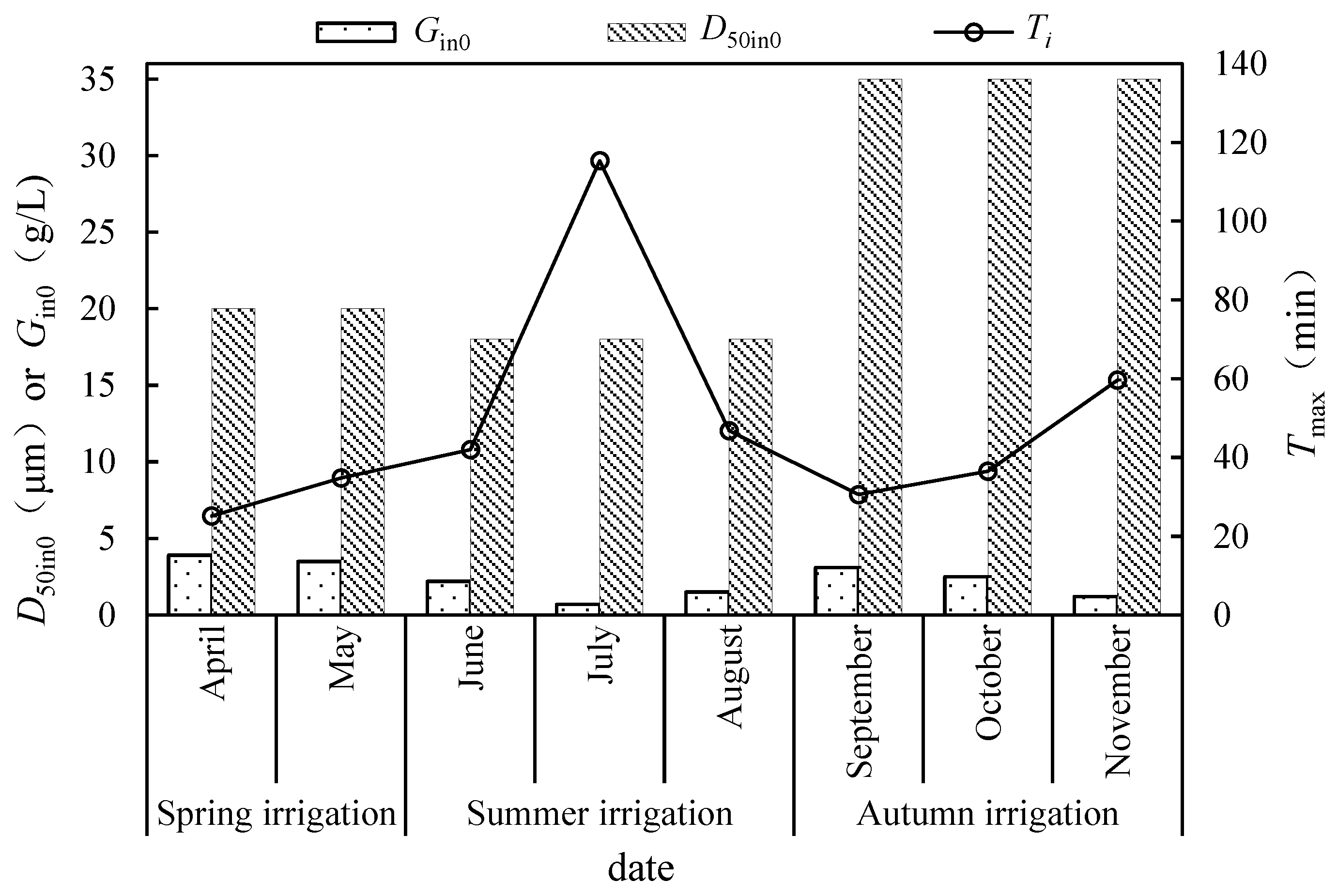
Based on the ΔHdi calculation model (DE/RFR), this study further developed a Filtration Cycle (Tmax) Prediction Model (FCPM), transforming the forward prediction of ΔHdi into an inverse solution for Tmax. Regarding model construction, building upon the established DE/RFR model, this study coupled the Differential Evolution (DE) algorithm with the Limited-memory Broyden–Fletcher–Goldfarb–Shanno algorithm with Box constraints (L-BFGS-B). Specifically, the DE algorithm was first utilized to perform global optimization under the given input parameters (Q0, H in0, D50in0, Gin0) to locate the optimal solution region, followed by local gradient refinement using the L-BFGS-B algorithm. By minimizing the sum of squared residuals between the predicted and target values of ΔHdi, the precise calculation of Tmax under given operating conditions was achieved. In 2021, the sediment concentration in the Main Canal of the Hetao Irrigation District ranged from 0.70 to 3.90 g/L between April and November, with a D50 of 18–35 μm [57]. Using these water–sediment characteristics as initial input parameters for the FCPM, under the conditions of Hin0 = 0.19 MPa and Q0 = 40 m3/h, the predicted Tmax ranged from 25 to 115 min (Figure 12), exhibiting a seasonal trend of initially increasing and then decreasing. During the spring irrigation period (April–May), due to the high sediment concentration (3.5–3.9 g/L), and the autumn irrigation period (September–November), due to the large D50 (approx. 35 μm), the Tmax ranged from 25 to 59 min; in the summer irrigation period (June–August), due to the lower sediment concentration (0.7–2.2 g/L) and smaller D50 (approx. 18 μm), the Tmax increased to 42–118 min. Backflushing of filtration systems typically causes reductions in outlet pressure and flow rate, thereby compromising the uniformity of irrigation and fertilization in drip irrigation systems. Based on the DE/RFR and FCPMs developed in this study, the variations in head loss with Ti and the Tmax of the filters and the filtration system can be predicted under diverse sediment characteristics and operating conditions. Therefore, these predictions provide critical technical support for optimizing the configuration (e.g., filter specifications and combination schemes) and operational strategies (e.g., pump pressure regulation, fertilization timing, and backwashing frequency) of multi-stage filtration systems for sediment-laden water drip irrigation.

5. Conclusions

This study investigated the effects of Q0, H0, D50in0, Gin0, and Ti on the head loss (ΔHsi, ΔHdi, and ΔHi) and outlet sediment characteristics (Gmidi, D50midi, or Gouti, D50outi) of the filters and the filtration system through field tests in the Hetao Irrigation District, Inner Mongolia, China, using Yellow River sediment-laden water. The primary conclusions are as follows:
  • Under sediment concentrations of 0.62–3.6 g/L, median particle sizes of 4.70–16.03 μm, and flow rates of 30–50 m3/h, the ΔHsi remained stable over the Ti. In contrast, the ΔHdi reached the backflushing threshold of 0.07 MPa after 16–235 min of operation, increasing with operating time. The magnitude of this increase grew with higher flow rates, sediment concentrations, and median particle sizes. Furthermore, by integrating Pearson correlation analysis and DE/RFR feature importance analysis, the factors influencing the head loss of the filters and the filtration system were identified. Specifically, ΔHsi, ΔHdi, and ΔHi were primarily influenced by flow rate, sediment concentration and operating time, and flow rate and operating time, respectively.
  • The inlet and outlet sediment characteristics of the filters and the filtration system were significantly and linearly correlated. The average filtration efficiencies of the sand filter, disc filter, and multi-stage filtration system were 2.5%, 4.2%, and 6.4%, respectively. The outlet median particle size (4.63–15.56 μm) remained within the safety threshold (22.2–30.5 μm).
  • The Random Forest Regression model optimized by the Differential Evolution algorithm (DE/RFR) developed in this study exhibited high accuracy in predicting ΔHsi, ΔHdi, and ΔHi. The model achieved R2 values ranging from 0.71 to 0.93 and RMSE values from 0.0017 to 0.0104 MPa. The FCPM, developed on the basis of the DE/RFR model, can calculate Tmax for the filters and the filtration system under different operating conditions. This model can provide technical support for the configuration of filter specifications and combination modes in sediment-laden drip irrigation systems, as well as for the formulation of operational strategies such as pump pressure regulation, fertilization timing, and backwashing frequency.
  • This study is constrained by variations in the inflow conditions of the Yellow River and the frequency of water distribution, resulting in a relatively limited sample size of in situ experiments. Future work is suggested to conduct multi-year repeated experiments combined with quantitative sediment addition tests, in order to expand the dataset for the DE/RFR model, thereby further improving its prediction accuracy and generalization performance for head loss.

Author Contributions

Conceptualization, Y.M. and X.N.; methodology, X.N. and Y.M.; software, X.N.; validation, Y.M., J.X. and Y.Z.; formal analysis, X.N., H.G., Z.L., Y.H. and X.G.; investigation, X.N.; resources, J.X.; data curation, X.N.; writing—original draft, X.N.; writing—review and editing, Y.M. and J.X.; visualization, Y.Z. and Q.Z.; supervision, J.X. and Y.M.; project administration, Y.M.; funding acquisition, Y.M. and J.X. All authors have read and agreed to the published version of the manuscript.

Funding

This research was funded by the Joint Fund for Yellow River Water Science Research of the National Natural Science Foundation of China (U2443211) and the Research and Development Support Program of China Institute of Water Resources and Hydropower Research (ID0145B042021).

Institutional Review Board Statement

Not applicable.

Data Availability Statement

The data presented in this study are available upon request from the corresponding author.

Conflicts of Interest

The authors declare no conflicts of interest.

Abbreviations

The following abbreviations are used in this manuscript:
CFDComputational fluid dynamics
CRCrossover rate
D50Median particle size (μm)
D50in0Initial median particle size at the inlet (μm)
D50iniMedian particle size of the sediment at the inlet (μm)
D50mid0Initial median particle size at the inter-stage (μm)
D50midiMedian particle size of the sediment at the inter-stage (μm)
D50outiMedian particle size of the sediment at the outlet (μm)
DEDifferential evolution
EdiFiltration efficiency of the disc filter (%)
EiFiltration efficiency of the multi-stage filtration system (%)
EsiFiltration efficiency of the sand filter (%)
FScaling factor
FCPMFiltration cycle prediction model
Gin0Initial sediment concentration at the inlet (g/L)
GiniSediment concentration at the inlet (g/L)
Gmid0Initial sediment concentration at the inter-stage (g/L)
GmidiSediment concentration at the inter-stage (g/L)
GoutiSediment concentration at the outlet (g/L)
Hin0Initial pressure at the inlet (MPa)
HiniPressure at the inlet (MPa)
Hmid0Initial pressure at the inter-stage (MPa)
HmidiPressure at the inter-stage (MPa)
Hout0Initial pressure at the outlet (MPa)
HoutiPressure at the outlet (MPa)
IMaximum number of iterations
L-BFGS-BLimited-memory BFGS with box constraints
LRLinear regression
MAEMean absolute error (MPa)
MLRMultivariable linear regression
n_permNumber of permutations
NPPopulation size
Q0Initial flow rate (m3/h)
QiFlow rate (m3/h)
R2Coefficient of determination
RFRRandom forest regression
RMSERoot mean square error (MPa)
SLRSimple linear regression
SSerrResidual sum of squares
SStotTotal sum of squares
TiOperating time (h)
TmaxOperating time when ∆Hsi or ∆Hdi reaches 0.07 MPa (h)
H0Initial head loss of the multi-stage filtration system (MPa)
Hd0Initial head loss of the disc filter (MPa)
HdiHead loss of the disc filter (MPa)
HiHead loss of the multi-stage filtration system (MPa)
Hs0Initial head loss of the sand filter (MPa)
HsiHead loss of the sand filter (MPa)

References

  1. Ma, Y. Accelerating the modernization of irrigation areas and the application of water-saving technologies to promote ecological protection and high-quality development in the Yellow River Basin—An interview with Kang Shaozhong, Academician of the Chinese Academy of Engineering. China Water Resour. 2021, 17, 4–7. [Google Scholar] [CrossRef]
  2. Hou, P.; Xiao, Y.; Wu, N.; Wang, H.J.; Ma, Y.J.; Li, Y.K. Cascade relationship between the emitter structure-sedimentation-clogging behavior in drip irrigation systems with Yellow River water. J. Hydraul. Eng. 2020, 51, 1372–1382. [Google Scholar] [CrossRef]
  3. Gao, H.; Mo, Y.; Li, Z.Y.; Li, W.J.; Zhang, Y.Q.; Li, H. Regulation mechanism of automatic flushing valve on emitter clogging characteristics during drip irrigation with Yellow River water. J. Hydraul. Eng. 2025, 56, 1517–1528. [Google Scholar] [CrossRef]
  4. An, C.H.; Lu, J.; Wu, M.X.; Liang, Y.; Luo, Q. The threshold value of equilibrium sediment transport in the Lower Yellow River. J. Hydraul. Eng. 2020, 51, 402–409. [Google Scholar] [CrossRef]
  5. Wang, N.; Qiao, L.L.; Li, G.X.; Zhong, Y.; Song, D.H.; Ding, D.; Gao, F.; Ji, F.Y. Numerical Study on Seasonal Transportation of the Suspended Sediments in the Modern Yellow River Mouth Effected by the Artificial Water and Sediment Regulation. J. Ocean Univ. China 2019, 18, 11–24. [Google Scholar] [CrossRef]
  6. Liu, L.; Hou, P.; Liu, Z.Y.; Wu, N.Y.; Li, W.S.; Wu, R.N.; Wang, H.J.; Ma, Y.J.; Li, Y.K. Selection of suitable drip-emitters for Yellow River water drip irrigation. Trans. Chin. Soc. Agric. Eng. 2021, 37, 99–107. [Google Scholar] [CrossRef]
  7. Mesquita, M.; Testezlaf, R.; Ramirez, J.C.S. The effect of media bed characteristics and internal auxiliary elements on sand filter head loss. Agric. Water Manag. 2012, 115, 178–185. [Google Scholar] [CrossRef]
  8. Arbat, G.; Pujol, T.; Puig-Bargués, J.; Duran-Ros, M.; Montoro, L.; Barragán, J.; de Cartagena, F.R. An experimental and analytical study to analyze hydraulic behavior of nozzle-type underdrains in porous media filters. Agric. Water Manag. 2013, 126, 64–74. [Google Scholar] [CrossRef]
  9. McCabe, W.L.; Smith, J.C.; Harriott, P. Unit Operations of Chemical Engineering, 7th ed.; McGraw-Hill: New York, NY, USA, 2005. [Google Scholar]
  10. Bové, J.; Arbat, G.; Duran-Ros, M.; Pujol, T.; Velayos, J.; de Cartagena, F.R.; Puig-Bargués, J. Pressure drop across sand and recycled glass media used in micro irrigation filters. Biosyst. Eng. 2015, 137, 55–63. [Google Scholar] [CrossRef]
  11. Yurdem, H.; Demir, V.; Degirmencioglu, A. Development of a mathematical model to predict head losses from disc filters in drip irrigation systems using dimensional analysis. Biosyst. Eng. 2008, 100, 14–23. [Google Scholar] [CrossRef]
  12. Wu, W.Y.; Chen, W.; Liu, H.L.; Yin, S.; Bao, Z.; Niu, Y. A dimensional analysis model for the calculation of head loss due to disc filters in drip irrigation systems. Irrig. Drain. 2014, 63, 349–358. [Google Scholar] [CrossRef]
  13. Xu, X.; Wang, Q.; Zhang, J.; Zong, R.; Liu, N.; Wang, Z. Experimental study of filtration performance of disc filter with discrete channel structure. J. Irrig. Drain. Eng. 2023, 149, 04023013. [Google Scholar] [CrossRef]
  14. Zeng, J.; Yang, P.; Liu, W.; Xiang, X. Influence of Fractal Disc Filter Flow Channel Parameters on Filtration Performance. Appl. Sci. 2024, 14, 7505. [Google Scholar] [CrossRef]
  15. Zhang, W.; Cai, J.; Lyu, M.; Zhai, G.L. Experimental Study on Influencing Factors of Filtration Effect of Sand Filter. J. Irrig. Drain. 2020, 39, 77–83. [Google Scholar] [CrossRef]
  16. Song, L.; Cai, J.M.; Zhai, G.L.; Feng, J.J.; Zhang, W.Z. Sediment deposition and migration feature in the filter layer of micro-irrigation sand filter. Trans. Chin. Soc. Agric. Eng. 2023, 39, 76–83. [Google Scholar] [CrossRef]
  17. Gómez, M.; Plaza, F.; Garralón, G.; Pérez, J.; Gómez, M.A. Comparative analysis of macrofiltration processes used as pre-treatment for municipal wastewater reuse. Desalination 2010, 255, 72–77. [Google Scholar] [CrossRef]
  18. Qin, T.Y.; Wang, W.E.; Hu, X.T. Hydraulic Performance of Screen and Disc Filters for Drip Irrigation. J. Irrig. Drain. 2017, 36, 57–62. [Google Scholar] [CrossRef]
  19. Zheng, C.; Zhu, D.; Zhang, R.; Zhao, Z.; Li, L.M. Design of adjustable equivalent aperture disc filters and its hydraulic performance. Trans. Chin. Soc. Agric. Eng. 2024, 40, 64–73. [Google Scholar] [CrossRef]
  20. Yang, P.L.; Lu, P.; Ren, S.M.; Wang, X.; Liu, W.J. Comprehensive evaluation method for hydraulic performance and filtering quality of laminated filter. Trans. Chin. Soc. Agric. Eng. 2019, 35, 134–141. [Google Scholar] [CrossRef]
  21. Yang, P.L.; Lu, P.; Ren, S.M.; Ma, Z.X.; Wang, X. Experiment on Performance of Disc Filter Based on Fractal Theory. Trans. Chin. Soc. Agric. Mach. 2019, 50, 218–226. [Google Scholar] [CrossRef]
  22. Li, L.M.; Zhu, D.; Zhang, R.; Zheng, C.; Zhao, Z.; Hong, M.; Liu, C. Enhanced experimental study on the head loss and filtration performance of annular flow disc filter. Trans. Chin. Soc. Agric. Eng. 2024, 40, 140–148. [Google Scholar] [CrossRef]
  23. Yuan, J.W.; Zhu, D.L.; Sun, S.B.; Nazarov, K.; Liu, C.X. Optimization of structural parameter for disc filter in drip irrigation system. Trans. Chin. Soc. Agric. Eng. 2024, 40, 133–141. [Google Scholar] [CrossRef]
  24. Puig-Bargués, J.; Barragán, J.; Ramírez de Cartagena, F. Development of Equations for Calculating the Head Loss in Effluent Filtration in Microirrigation Systems Using Dimensional Analysis. Biosyst. Eng. 2005, 92, 383–390. [Google Scholar] [CrossRef]
  25. Hu, Y.Q.; Wu, W.Y.; Liu, H.L.; Huang, Y.; Bi, X.; Liao, R.; Yin, S. Dimensional Analysis Model of Head Loss for Sand Media Filters in a Drip Irrigation System Using Reclaimed Water. Water 2022, 14, 961. [Google Scholar] [CrossRef]
  26. García Nieto, P.J.; García-Gonzalo, E.; Arbat, G.; Duran-Ros, M.; Ramírez de Cartagena, F.; Puig-Bargués, J. A new predictive model for the filtered volume and outlet parameters in micro-irrigation sand filters fed with effluents using the hybrid PSO–SVM-based approach. Comput. Electron. Agric. 2016, 125, 74–80. [Google Scholar] [CrossRef]
  27. García Nieto, P.J.; García-Gonzalo, E.; Arbat, G.; Duran-Ros, M.; Puig-Bargués, J. Pressure drop modelling in sand filters in micro-irrigation using gradient boosted regression trees. Biosyst. Eng. 2018, 171, 104–114. [Google Scholar] [CrossRef]
  28. García Nieto, P.J.; García-Gonzalo, E.; Puig-Bargués, J.; Solé-Torres, C.; Duran-Ros, M.; Arbat, G. A new predictive model for the outlet turbidity in micro-irrigation sand filters fed with effluents using Gaussian process regression. Comput. Electron. Agric. 2020, 170, 105292. [Google Scholar] [CrossRef]
  29. García-Nieto, P.J.; García-Gonzalo, E.; Arbat, G.; Duran-Ros, M.; Pujol, T.; Puig-Bargués, J. Forecast of the outlet turbidity and filtered volume in different microirrigation filters and filtration media by using machine learning techniques. J. Comput. Appl. Math. 2024, 439, 115606. [Google Scholar] [CrossRef]
  30. Desai, S.; Ouarda, T.B.M.J. Regional hydrological frequency analysis at ungauged sites with random forest regression. J. Hydrol. 2021, 594, 125861. [Google Scholar] [CrossRef]
  31. Yang, P.L.; Zhou, Y.; Ren, S.M.; Ma, Z.X. Structural optimization and performance test of sand screen combination filter. Trans. Chin. Soc. Agric. Mach. 2018, 49, 307–316. [Google Scholar] [CrossRef]
  32. GB 50159-2015; Code for Measurement of Suspended Load in Open Channels. Ministry of Housing and Urban-Rural Development of the People’s Republic of China, China Planning Press: Beijing, China, 2015.
  33. SL 42-2010; Technical Code for Analysis of River Sediment Particle Size. Ministry of Water Resources of the People’s Republic of China, China Water & Power Press: Beijing, China, 2010.
  34. Puig-Bargues, J.; Duran-Ros, M.; Arbat, G.; Barragán, J.; de Cartagena, F.R. Prediction by neural networks of filtered volume and outlet parameters in micro-irrigation sand filters using effluents. Biosyst. Eng. 2012, 111, 126–132. [Google Scholar] [CrossRef]
  35. Liu, Z.J.; Lei, C.Y.; Li, J.; Long, Y.J.; Lu, C. A standardized treatment model for head loss of farmland filters based on interaction factors. Agriculture 2024, 14, 788. [Google Scholar] [CrossRef]
  36. Lu, C.; Liu, Z.J.; Jiang, B.; Long, Y.J.; Lei, C.Y. Optimization of Filtration Performance Based on Multi-Objective Micro-Pressure Mesh Filters. J. Drain. Irrig. Mach. Eng. 2025, 43, 1176–1188. [Google Scholar] [CrossRef]
  37. Zounemat-Kermani, M.; Batelaan, O.; Fadaee, M.; Hinkelmann, R. Ensemble machine learning paradigms in hydrology: A review. J. Hydrol. 2021, 598, 126266. [Google Scholar] [CrossRef]
  38. Rodriguez-Galiano, V.F.; Chica-Olmo, M.; Abarca-Hernandez, F.; Atkinson, P.M.; Jeganathan, C. Random Forest classification of Mediterranean land cover using multi-seasonal imagery and multi-seasonal texture. Remote Sens. Environ. 2012, 121, 93–107. [Google Scholar] [CrossRef]
  39. Probst, P.; Wright, M.N.; Boulesteix, A.-L. Hyperparameters and tuning strategies for random forest. Wiley Interdiscip. Rev. Data Min. Knowl. Discov. 2019, 9, e1301. [Google Scholar] [CrossRef]
  40. Rocca, P.; Oliveri, G.; Massa, A. Differential evolution as applied to electromagnetics. IEEE Antennas Propag. Mag. 2011, 53, 38–49. [Google Scholar] [CrossRef]
  41. Arlot, S.; Celisse, A. A survey of cross-validation procedures for model selection. Stat. Surv. 2010, 4, 40–79. [Google Scholar] [CrossRef]
  42. Chen, Y.; Liu, R.G.; Li, Y.; Zhou, X. Research and application of cross-validation for fault diagnosis of measurement channels. Prog. Nucl. Energy 2022, 150, 104324. [Google Scholar] [CrossRef]
  43. Schmidt, M.; Safarani, S.; Gastinger, J.; Jacobs, T.; Nicolas, S.; Schülke, A. On the performance of differential evolution for hyperparameter tuning. In Proceedings of the 2019 International Joint Conference on Neural Networks (IJCNN) 2019, Budapest, Hungary, 14–19 July 2019; pp. 1–8. [Google Scholar] [CrossRef]
  44. Janitza, S.; Strobl, C.; Boulesteix, A.L. An AUC-based permutation variable importance measure for random forests. BMC Bioinform. 2013, 14, 119. [Google Scholar] [CrossRef]
  45. Zhang, J.W.; Feng, J.; Xu, F.P.; Mo, F.Y. Sand filter performance on drip irrigation with the Yellow River. J. Drain. Irrig. Mach. Eng. 2016, 34, 357–361. [Google Scholar]
  46. Zhang, W.Z.; Zhai, G.L.; Lü, M.C.; Cai, J.M.; Deng, Z.; Zong, J. Efficacy of Sand Filter, Screen Filter and Disc Filter for Removing Silts from the Yellow River Water for Micro-Irrigation. J. Irrig. Drain. 2017, 36, 88–93. [Google Scholar] [CrossRef]
  47. Ren, Y.N.; Li, S.Q.; Liu, Z.Y.; Hou, P.; Li, Y.K. Effect of sand filter on filtration performance of Yellow River water and reclaimed water under different operating conditions. J. Drain. Irrig. Mach. Eng. 2023, 41, 261–267. [Google Scholar]
  48. Zhang, W.; Cai, J.; Zhai, G.; Song, L.; Lv, M. Experimental study on the filtration characteristics and sediment distribution influencing factors of sand media filters. Water 2023, 15, 4303. [Google Scholar] [CrossRef]
  49. Wang, S.; Wang, H.; Qiu, X.; Wang, J.; Wang, S.; Wang, H. Study on the performance of filters under biogas slurry drip irrigation systems. Agriculture 2024, 15, 30. [Google Scholar] [CrossRef]
  50. Yuan, J.W.; Zhu, D.L.; Gao, S.S.; Sun, S.B.; Zhao, H.; Zhang, R. Head loss variation and impurity interception characteristics in a disc filter. Trans. Chin. Soc. Agric. Eng. 2022, 38, 114–122. [Google Scholar] [CrossRef]
  51. Ryu, L.; Han, K. Machine learning vs. statistical model for prediction modelling: Application in medical imaging research. J. Korean Soc. Radiol. 2022, 83, 1219–1228. [Google Scholar] [CrossRef] [PubMed]
  52. Xu, T.; Valocchi, A.J.; Choi, J.; Amir, E. Use of machine learning methods to reduce predictive error of groundwater models. Groundwater 2014, 52, 448–460. [Google Scholar] [CrossRef] [PubMed]
  53. He, S.; Wu, J.; Wang, D.; He, X. Predictive modeling of groundwater nitrate pollution and evaluating its main impact factors using random forest. Chemosphere 2022, 290, 133388. [Google Scholar] [CrossRef]
  54. Zhang, W.; Wu, C.; Zhong, H.; Li, Y.; Wang, L. Prediction of undrained shear strength using extreme gradient boosting and random forest based on Bayesian optimization. Geosci. Front. 2021, 12, 469–477. [Google Scholar] [CrossRef]
  55. Jiang, P.Y.; Liu, J.; Zhou, Q.; Cheng, Y. Advances in metaheuristic methods for large-scale black-box optimization problems. Chin. J. Ship Res. 2021, 16, 1–18. [Google Scholar] [CrossRef]
  56. Moradi, S.; Omar, A.; Zhou, Z.; Agostino, A.; Gandomkar, Z.; Bustamante, H. Forecasting and optimizing dual media filter performance via machine learning. Water Res. 2023, 235, 119874. [Google Scholar] [CrossRef] [PubMed]
  57. Li, C.; Ding, F.; Lou, Y.; Liang, Y.Q.; Shao, Y.J. Study of main channel sediment transport characteristics and fluvial equilibrium in Madihao pumping irrigated area. Water Sav. Irrig. 2025, 9, 60–66+73. [Google Scholar] [CrossRef]
Figure 1. Overall technical roadmap.
Agriculture 16 00844 g001
Figure 2. Layout of the hydraulic performance test platform for the multi-stage filtration system.
Agriculture 16 00844 g002
Figure 3. Variations in inlet sediment concentration (Gin0) and median particle size (D50in0) of the multi-stage filtration system with time.
Agriculture 16 00844 g003
Figure 4. Flowchart of the DE/RFR modelling process. Note: Blue boxes represent the validation set, and white boxes represent the training set. The ellipses (…) represent the parallel iteration process from subset 1 to k.
Agriculture 16 00844 g004
Figure 5. Variation in the head loss of the sand filter (∆Hsi) over the operating time (Ti) under different sediment-laden water conditions at Q0 values of: (a) 30 m3/h; (b) 40 m3/h; and (c) 50 m3/h.
Agriculture 16 00844 g005
Figure 6. Variation in the head loss of the disc filter (∆Hdi) over the operating time (Ti) under different sediment-laden water conditions at Q0 values of: (a) 30 m3/h; (b) 40 m3/h; and (c) 50 m3/h. Note: The horizontal dashed line represents the clogging pressure drop threshold of the filter (0.07 MPa).
Agriculture 16 00844 g006
Figure 7. Variation in the head loss of the multi-stage filtration system (∆Hi) over the operating time (Ti) under different sediment-laden water conditions at Q0 values of: (a) 30 m3/h; (b) 40 m3/h; and (c) 50 m3/h. Note: The horizontal dashed line represents the clogging pressure drop threshold of the filter (0.07 MPa).
Agriculture 16 00844 g007
Figure 8. Variations of (a) inter-stage sediment concentration (Gmidi) and (d) inter-stage median particle size (D50midi) with inlet values (Gini and D50ini); (b) outlet sediment concentration (Gouti) and (e) outlet median particle size (D50outi) with Gmidi and D50midi; and (c) Gouti and (f) D50outi with Gini and D50ini for the multi-stage filtration system at Q0 values of 30, 40, and 50 m3/h. Note: The dashed line represents the 1:1 reference line (y = x).
Agriculture 16 00844 g008aAgriculture 16 00844 g008b
Figure 9. Correlation analysis between variables for: (a) sand filter; (b) disc filter; and (c) multi-stage filtration system. Note: Values in the figure represent the correlation coefficient r. Significant correlations are indicated by * (p < 0.05), ** (p < 0.01), and *** (p < 0.001). Positive and negative values of r indicate positive and negative correlations, respectively, with the colour intensity reflecting the strength of the correlation. Q0: initial flow rate; Ti: operating time; Hin0 or Hmid0: initial pressure at the inlet or the inter-stage; Gin0 or Gmid0: initial sediment concentration at the inlet or the inter-stage; D50in0 or D50mid0: initial median particle size at the inlet or the inter-stage; Gouti: sediment concentration at the outlet; D50outi: median particle size of the sediment at the outlet; ∆Hsi, ∆Hdi, ∆Hi: head loss of the sand filter, disc filter, and multi-stage filtration system, respectively. The same applies to the following figures.
Agriculture 16 00844 g009
Figure 10. Ranking of the relative importance of input variables based on the DE/RFR model for: (a) head loss of sand filters (∆Hsi); (b) head loss of disc filters (∆Hdi); and (c) head loss of the multi-stage filtration system (∆Hi).
Agriculture 16 00844 g010
Figure 11. Comparison between predicted and measured values of head loss based on the DE/RFR model for: (a) sand filters (∆Hsi); (b) disc filters (∆Hdi); and (c) the multi-stage filtration system (∆Hi).
Agriculture 16 00844 g011
Figure 12. Prediction analysis of the filtration cycle (Tmax) for the multi-stage filtration system based on the FCPM.
Agriculture 16 00844 g012
Table 1. Initial hydraulic operating conditions and inlet sediment characteristics of the multi-stage filtration system.
Trial NumberTest DateInitial Hydraulic Operating ConditionsInitial Inlet Sediment Characteristics
Flow Rate (Q0)
(m3/h)
Inlet Pressure
(Hin0)
(MPa)
Outlet Pressure
(Hout0)
(MPa)
Sediment Concentration
(Gin0)
(g/L)
Median
Particle Size
(D50in0)
(μm)
114 Aug.300.170.150.734.91
219 Oct.0.180.666.59
323 Oct.0.180.989.13
425 Oct.0.181.2310.13
530 Oct.0.192.1615.84
629 July400.190.151.765.46
714 Aug.0.190.984.71
820 Oct.0.200.636.03
923 Oct.0.191.1410.18
1025 Oct.0.201.2910.95
1130 Oct.0.202.1815.91
1214 Aug.500.150.090.724.80
1317 Aug.0.150.093.606.56
1420 Oct.0.170.110.626.37
1523 Oct.0.170.110.958.21
1625 Oct.0.170.101.4010.22
1730 Oct.0.170.102.2115.25
Table 2. Means and standard deviations of the input and output variables for the respective filter units and the multi-stage filtration system.
Input VariablesName of
the Variable
MeanStandard Deviation
Sand
Filter
Disc
Filter
Filtration
System
Sand
Filter
Disc
Filter
Filtration
System
Initial flow rate (m3/h)Q039.07.8
Operating time (h)Ti//
Initial inlet pressure (MPa)Hin0 or Hmid00.180.160.180.010.020.02
Initial inlet sediment concentration (g/L)Gin0 or Gmid01.331.291.330.760.750.76
Initial inlet median
particle size (μm)
D50in0 or D50mid08.618.698.613.713.783.71
Output variablesName of
the variable
MeanStandard deviation
Sand
Filter
Disc
Filter
Filtration
System
Sand
Filter
Disc
Filter
Filtration
System
Head loss (MPa)Hsi or ∆Hdi or ∆Hi0.020.050.070.010.020.02
Outlet sediment
concentration (g/L)
Gmidi or Gouti1.291.271.270.750.720.72
Outlet median
particle size (μm)
D50midi or D50outi8.698.498.493.783.703.70
Table 3. Initial ranges of hyperparameter values for the DE/RFR model.
RFR ParametersLower LimitUpper Limit
n_estimators100500
max_depth530
min_samples_split210
min_samples_leaf15
max_features0.21
Table 4. Hyperparameters of the RFR model and optimal hyperparameters of the DE/RFR model.
Optimal ParametersΔHsiΔHdiΔHi
RFRDE/RFRRFRDE/RFRRFRDE/RFR
n_estimators300120200465200149
max_depth151112191514
min_samples_split222252
min_samples_leaf112121
max_features0.80.970.90.930.70.83
Table 5. Comparison of the prediction accuracy of MLR and DE/RFR models for ∆Hsi, ∆Hdi, and ∆Hi.
Output VariablesTechniqueR2RMSE (Mpa)MAE (Mpa)
HsiMLR0.91600.00230.0018
RFR0.92760.00180.0014
DE/RFR0.93400.00170.0013
HdiMLR0.56800.01200.0096
RFR0.67160.01060.0089
DE/RFR0.73040.00960.0075
HiMLR0.67400.01180.0094
RFR0.67960.01090.0088
DE/RFR0.70780.01040.0085
Disclaimer/Publisher’s Note: The statements, opinions and data contained in all publications are solely those of the individual author(s) and contributor(s) and not of MDPI and/or the editor(s). MDPI and/or the editor(s) disclaim responsibility for any injury to people or property resulting from any ideas, methods, instructions or products referred to in the content.