Article

Supplementation with Commercial Corn Grain or a Mexican Hybrid Variety (Tlaoli Puma) in Sheep at the End of Gestation and Its Effect on Productive and Behavioral Parameters

by
Angélica Terrazas
1,*,
Lorena Nava
1,
Katya Camacho
1,
Margarita Tadeo-Robledo
1,
Alejandro Espinosa-Calderon
1,2,
Karina Yazmine Mora-García
1,
Paolo Cano-Suárez
1,
Alan Olazabal
1,
Jesús Jonathan Ramírez-Espinosa
1 and
Laura Castillo-Hernández
1
1
Departamentos de Ciencias Pecuarias y Ciencias Agrícolas, Centro de Enseñanza Agropecuaria, Facultad de Estudios Superiores Cuautitlán, Universidad Nacional Autónoma de México, Cuautitlán Izcalli 54714, Estado de México, Mexico
2
Instituto Nacional de Investigaciones Forestales Agrícolas y Pecuarias, Campo Experimental Valle de México, Texcoco 56250, Estado de México, Mexico
*
Author to whom correspondence should be addressed.
Agriculture 2026, 16(8), 841; https://doi.org/10.3390/agriculture16080841
Submission received: 9 March 2026 / Revised: 31 March 2026 / Accepted: 8 April 2026 / Published: 10 April 2026
(This article belongs to the Section Farm Animal Production)

Abstract

Using alternative energy sources for animal feed, such as hybrid corn varieties rather than genetically modified ones, is important. Therefore, the objective of this work was to assess the effects of supplementation at the end of gestation with Mexican Puma hybrid corn grain on productive and behavioral parameters in sheep. Twenty Columbia multiparous ewes were used; along with their diet, they were provided 600 g/animal/day of cracked corn during the last 20 days of pregnancy and the first week of lactation. The animals were divided into two groups: one fed commercial cracked corn (n = 11) and the other Mexican Tlaoli Puma hybrid cracked corn (n = 9). The productive parameters evaluated in the mother were: body weight, body condition score (BCS), feed intake, weight change, glucose, and ketone body levels, as well as the estimated quality of milk using Brix refractometer values on days 15 and 30 of lactation. In lambs, their rectal and external temperature was measured 2 h after birth, while their weight was measured 2 h after birth and every week until week 6 postpartum. Behavioral parameters were measured in the first two hours postpartum, including the maternal latency of cleaning the offspring, duration of the first cleaning episode, the lamb’s latencies of standing and nursing, and vocalizations in mother and lamb. Weight, BCS and weight change were not affected by the group but were affected by time; these parameters increased at the end of gestation and decreased significantly after delivery (p < 0.05). Ketone body levels were not affected by group or time (p > 0.05) and remained at low values. Glucose levels were not affected by the group but were affected by time; they increased significantly after birth (p < 0.05). Feed intake was similar in both groups (p > 0.05) and decreased as parturition approached (p < 0.05). The estimated milk quality was not affected by the group, nor by the time (p > 0.05). Mothers in both groups began cleaning their offspring within the first three minutes after giving birth and emitted a similar frequency of vocalizations (p > 0.05). However, mothers in the commercial maize group had a longer cleaning episode than those in the hybrid maize group (p < 0.05). The lambs in both groups stood up within the first half hour of birth, suckled before one hour after birth and emitted a similar number of vocalizations (p > 0.05). Temperatures and lamb weight were similar in both groups (p > 0.05); however, lamb weight increased as they aged (p < 0.05). It is concluded that supplementing sheep at the end of gestation with Puma hybrid Mexican corn grain can yield similar productive and behavioral benefits as supplementing with commercial grain.

1. Introduction

Corn is one of the most productive cultivated species and has the highest potential for carbohydrate production per unit of surface area per day [1]. Corn contains approximately 72% starch, 10% protein and 4% fat, providing an energy density of 365 Kcal/100 g, and is grown throughout the world [2].
The animal feed industry mainly consumes yellow corn in the manufacture of concentrates for animals [3]. According to information reported by the USDA, in the 2025–2026 cycle, the USDA reported a total export of 6 billion metric tons of yellow corn, which is mainly used for animal consumption [4]. According to the National Customs Agency of Mexico (ANAM), the United States positioned itself as the main supplier of transgenic yellow corn. From January to August 2024, corn imports totaled 16.8 million tons, a 0.2% increase, marking a higher record compared to the previous year [5].
As the figures show, most of the corn used for animal feed comes from imports, unfortunately, much of which is genetically modified. For this reason, it is important to generate sovereignty and security to produce corn for animal consumption, which will help the national economy in the future and reduce dependence on this product from abroad. In conjunction with the National Institute of Forestry, Agricultural and Livestock Research (INIFAP) and the Cuautitlán Faculty of Higher Studies (FESC) of the National Autonomous University of Mexico (UNAM), corn hybrids have been generated that are adapted to the High Valleys of Mexico and have a high grain and forage yield. Additionally, these hybrids are resistant to root and stem lodging and to fungal diseases of the plant and ear caused by the genera Puccinia and Ustilago [6,7]. In recent studies carried out on sheep and goats, the capacities of some of these Puma hybrids have been tested and have been shown to be very good when used for feeding in the form of silage during gestation [8]. However, the yellow or white corn produced for grain in the Puma hybrid varieties have not been evaluated for their potential as animal feed, although other imported commercial varieties are used and can sometimes be expensive.
Global sheep production is concentrated in extensive and semi-extensive systems; hence, during certain stages, such as gestation and lactation, animals can suffer from malnutrition, which can affect fetal development, milk and colostrum production, as well as mother–offspring relationship, consequently increasing mortality rates in young animals [9,10,11,12,13]. Therefore, ensuring adequate nutrition during these stages is crucial. One of the strategies that has been used in sheep is short supplementation at the end of gestation, for which several sources of nutrients have been tested, highlighting those with a high concentration of energy [14,15]. One of the most recommended feeds has been proven to be corn [14,16]. Corn supplementation in sheep and goats at the end of gestation has been shown to improve lactogenesis and therefore increase colostrum production [16,17]. It has also been determined that including this type of supplement improves offspring vitality by ensuring prompt and sufficient colostrum intake [18,19]. Furthermore, this nutritional strategy promotes an appropriate hormonal and metabolic state that allows for good lactogenesis [20]. Nutritional effects in sheep have been shown to not only affect productivity but also alter maternal behavior. Poorly fed ewes at the end of gestation, whether grazing or in intensive systems, show impaired attention to their young, and the lambs, in turn, show a delay in standing and nursing [11,13,21,22]. Therefore, appropriate feeding strategies at the end of gestation could counteract the nutritional decline in ewes, as has been demonstrated in goats [17,18].
The nutritional status of the mother at the end of gestation also affects the animal’s thermogenesis [23,24]. Firstly, it affects the size and body weight of the offspring, which in turn determines the brown adipose tissue that will influence the lambs’ external temperature [25,26,27]. Therefore, the role of supplements in mothers that could improve the thermogenesis of their offspring has been studied. However, studies show that the effects of energy supplementation on lamb thermogenesis depend largely on the type of supplement.
Sheep are ruminants with trophic abilities that allow them to ingest plants with high fiber content; therefore, the addition of corn to the diet, either as forage (silage and stubble) or grain, can enhance their production as described above. Research conducted in some countries with developing economies, where the nutritional conditions of sheep flocks are sometimes not optimal, has focused on generating nutritional strategies with short and precise periods of food supplementation, exploring mainly females in states of pregnancy and lactation [22,28,29]. Research on these nutritional strategies has also considered production costs, so the predominant proposals are those that allow for the use of economical and regionally available nutritional substrates. The Mexican hybrid corn varieties selected by UNAM and INIFAP are a good alternative for producing low-cost animal feed and can be adapted to regional conditions. Therefore, it is necessary to evaluate their use in sheep production in the form of grain, such as yellow and white corn.
Our hypothesis is that supplementing with white corn grain from the Tlaoli Puma hybrid during the last 20 days of gestation and the first week of lactation will have positive results on productive, metabolic and behavioral parameters in sheep and their lambs. The objective is to determine whether supplementation with white corn grain from the Tlaoli Puma hybrid during the last 20 days of gestation and the first days of lactation affects productive and metabolic parameters in ewes and the dam–lamb relationship postpartum.

2. Materials and Methods

Ethical note: This research was approved by the Institutional Committee for the Use and Care of Research Animals of Facultad de Estudios Superiores Cuautitlán, Universidad Nacional Autónoma de México, with protocol number CICUAE-FESC C 24_37 (9 December 2024).

2.1. Study Sites

This study was carried out in the sheep unit of the Agricultural Teaching Center of the Facultad de Estudios Superiores Cuautitlán, Universidad Nacional Autónoma de México (UNAM), located in the central mountain range of the country (19°31′35′′ N, 99°11′42′′ W) at an altitude of 2256 m. The climate is moderate, with summer rains, small temperature fluctuations, an average annual precipitation of 600 mm, an average minimum temperature of 8.7 °C, an average maximum of 34 °C and an annual average of 15.7 °C [30]. The crop for grain production was established on a land located in the municipality of Texcoco, State of Mexico.

2.2. Hybrid Corn Grain Production

The Tlaoli Puma hybrid maize was planted on land located in the municipality of Texcoco, State of Mexico, at an altitude of 2240 m above sea level. Planting took place in June 2024 at a plant density of 65,000 plants per hectare (ha−1) for grain productivity evaluation, and the crop was harvested 170 days after planting. The land was prepared conventionally, consisting of plowing, two passes with a harrow, and furrowing. At the time of furrowing, the land was fertilized with an 80-40-00 (N, P, K) fertilizer, using urea and ammonium phosphate. The harvest took place in early December to obtain grain in January 2025. Once harvested, the corn was shelled and cracked to facilitate animal intake.

2.3. Animals and General Maintenance Conditions

For this experiment, 20 Columbia multiparous ewes were used. The ewes were kept under semi-intensive conditions from August to November, during which the animals went out to graze for 5 h a day in the morning (08:00 to 13:00 h) in plots with introduced forage and the rest of the day were kept in pens where they were provided with corn silage, alfalfa hay, oat hay, commercial concentrated feed and free access to water. From November until the end of the experiment, the animals were kept in confinement conditions in two pens, each of which was approximately 100 m2 with a cement floor, a linear feeder of 10 m, an area for overfeeding and equipped with automatic waterers.
To collect data within a single season, the reproduction of these animals was controlled during the breeding season (September). Reproduction was synchronized using the following protocol: each female had an intravaginal polyurethane sponge impregnated with 60 mg of medroxyprogesterone acetate (SINCRO-GEST®, Ourofino Salud Animal, México) inserted for 14 days. After removal, 400 IU of equine chorionic gonadotropin (GonActive® eCG, Virbac, México) was administered intramuscularly. Artificial insemination (AI) was performed laparoscopically 56 h after removal and administration of the gonadotropin. To ensure the highest possible number of pregnant females, two sexually mature rams were placed in each pen (one in each pen).

2.4. Experimental Groups

Approximately 72 days after mating, pregnancy was diagnosed. This handling was done with the help of a portable device, model 9618, B-mode ultrasonic diagnostic equipment (Welld 9618®, Shenzhen WELLD Medical Electronics Co., Ltd., China) with a convex probe operating at a frequency of 3–5 MHz. The animals were kept in their pens and provided with a diet containing corn silage, oat hay, alfalfa hay, and commercial concentrate. This ration met their nutritional needs (NRC, 2007) [31]. Twenty-six days prior to lambing, the pregnant ewes were divided into two pens. One week after this division, the supplement with cracked corn was started in their diet and two experimental groups were formed as follows:
(A)
Commercial yellow corn group (n = 11 Columbia ewes): The ewes were fed the diet shown in Table 1, but the cracked corn came from an imported commercial company and was genetically modified.
(B)
Tlaoli Puma hybrid white corn group (n = 9 Columbia ewes). The ewes were fed the diet shown in Table 1, but the cracked corn was produced and harvested in the year prior to supply and was of a hybrid variety called Tlaoli Puma, produced in Mexico.
The diet and its nutritional contribution are presented in Table 1 and Table 2. The supplement with cracked corn was supplied from approximately 128 days of gestation until seven days after delivery. The composition of the groups by weight and BCS is presented in Table 3.

2.5. Experimental Process

2.5.1. Determination of the Metabolic Profile of Ewes

From day 72 of gestation onwards, a drop of blood was taken from the external jugular vein of all females. This blood was placed in a portable device (FreeStyle Precision Monitor with Test ® Optium Neo, Abbott Diabetes Care Inc., Alameda, CA, USA), and glucose and ketone body levels were determined immediately using the reagent strips designed for this device. These measurements were carried out on days 72, 107, and 128 of gestation and at parturition and were done with the animals fasting around 09:00 a.m., except for the one carried out on the day of delivery.

2.5.2. Determination of the Productive Parameters of Ewes

These parameters were measured on days 72, 107, 128 of gestation, at delivery, and 15 days postpartum. The weight and body condition of the ewes were also measured. The weight of the ewes was measured using a PLABA-12 digital platform scale (Rhino Maquinaria S.A. de C.V., Mexico), with a capacity of 3 t and 500 g precision. The weight difference between each stage was also calculated by subtracting the immediately preceding weight from the last weight. Therefore, data for four weight changes were obtained (weight change 1: the difference between the weight on day 107 and the weight on day 72 of gestation; weight change 2: the difference between the weight on day 128 and the weight on day 107 of gestation; weight change 3: the difference between the weight at parturition and the weight on day 128 of gestation; weight change 4: the difference between the weight on day 15 of lactation and the weight at parturition). Body condition score was measured using a scale of 1 to 5, where 1 is emaciated and 5 is obese. [32].

2.5.3. Determination of Estimated Daily Feed Intake of Ewes

The estimated daily feed intake of ewes was determined from week 21 of gestation (the week supplementation began) until the first week of lactation. Each day, the ration components were weighed and fed sequentially, starting with corn silage, followed by alfalfa hay, minerals, and, finally, cracked corn. The following day, before offering the feed, any uneaten feed found in the troughs of each pen was collected, weighed, and recorded in the feed log. The estimated daily intake per ewe was calculated by subtracting the uneaten feed from the total feed offered and dividing by the number of animals.

2.5.4. Determination of Estimated Milk Quality of Ewes

The estimated milk quality of ewes was determined at 15 and 30 days postpartum through Brix refractometer values, the procedure validated by [33], and using the Brix degree (Brix) technique with the aid of a digital refractometer (KWPHGLQA®, Chongqing Vision Star Optical Co., Ltd., China). This instrument can indicate the total amount of dissolved solids, primarily lactose, proteins, minerals, and fats, by measuring the concentration of these components through light refraction. A 2 mL sample was taken by mixing the milk from two both halves of the mammary gland and adding the sample dropwise to the device to measure the Brix degree percentage.

2.5.5. Behavioral Recording During and Immediately After Parturition

With the aim of assessing whether the nutritional strategy carried out in this work also affected the deployment of behaviors of the mother and the lambs in the sensitive period [34], some behaviors that have been described as a reference for this type of assessment were evaluated [13,21]. Direct observations were made to identify imminent signs of parturition and to carry out the recordings described below. Day and night watches were maintained for this purpose. Once a female showed signs of parturition, a 2 × 2 m area was delimited with a portable pen within the herd’s pen in the location she had chosen. From this point, 120 min of continuous recordings were made, starting from the birth of the first offspring, using a pre-formatted sheet. The behaviors recorded during this observation period were:
  • MOTHER: Lamb cleaning latency, duration of the first cleaning episode and total vocalizations.
  • LAMBS: Standing latency, latency of nursing and vocalizations.
At the end of the measurement, the mother was given water and food and remained in the corral with her offspring until 4 h postpartum. During this period, it was also verified that the offspring had been suckled.

2.5.6. Recording of Weight and Body Temperatures in Lambs

  • Body weight: Lambs were weighed approximately 2 h after birth and weekly until week 6 postpartum. The lambs were weighed using a Trip2 portable digital scale (Wei Hang, Guangzhou Weiheng Electronic Technology Co., Ltd., China) with a capacity of 40 kg and an accuracy of 10 g.
  • Body temperatures: At 2 h after birth, the lambs’ rectal temperature was recorded; to take the internal temperature, the lamb was kept in place and only the mercury bulb of a digital thermometer was inserted (Hergom Medical®, Mexico). Neck and scapular temperatures were also taken. To take these two external temperatures, an infrared gun thermometer with a range of −20 to 50 °C and ±2.5 °C (Steren® HER-424, Electrónica Steren S.A. de C. V., Mexico) was placed 5 cm from the animal.

2.6. Statistical Analysis

Productive parameters, metabolic profile, and milk quality were analyzed using the ANOVA statistical test, with the fixed effects of feed treatment, litter size, and stage of production. Behavioral variables were analyzed using non-parametric tests such as the Mann–Whitney U test. The data were analyzed using the statistical program SYSTAT® 13.0 (Chicago, IL, USA).

3. Results

It was found that in the group supplied with commercial corn grain, there were 11 births. These animals had a total of 19 lambs (eight males and 11 females, born of four single births and 15 multiple births). In the group fed Tlaoli Puma hybrid corn, there were nine births. These animals had a total of 15 lambs (seven males and eight females born of five single births and 10 multiple births).

3.1. Metabolic Profile of the Ewes

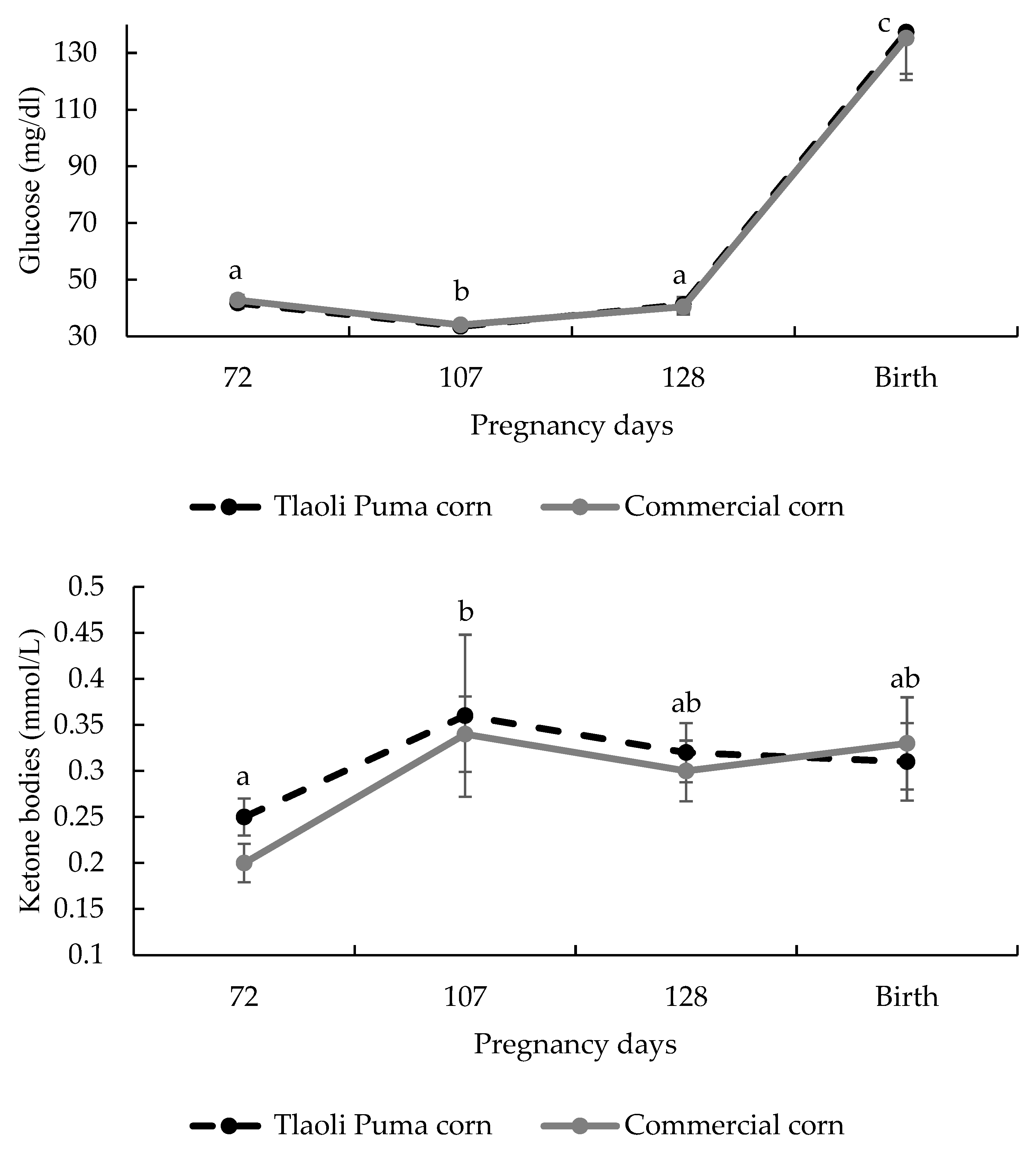
Glucose levels were not affected by group (p = 0.85), litter size (p > 0.88) or interaction between group × litter size (p = 0.65). A time effect was found (p < 0.0001), as can be seen in the top of Figure 1: glucose increased significantly from day 128 of gestation to delivery. The interaction was not significant between time and litter size (p = 0.75), between time and group (p = 0.87), or between the time and group and litter size (p = 0.77).
Ketone body levels were not affected by group (Figure 1 bottom, p = 0.92), litter size (p = 0.38) or interaction between group × litter size (p = 0.59). There was no significant effect of time (p = 0.31), the interaction between time and litter size (p = 0.11), between time and group (p = 0.87), or between time and group and litter size (p = 0.43).

3.2. Productive Parameters of Ewes

3.2.1. Body Condition Score (BCS)

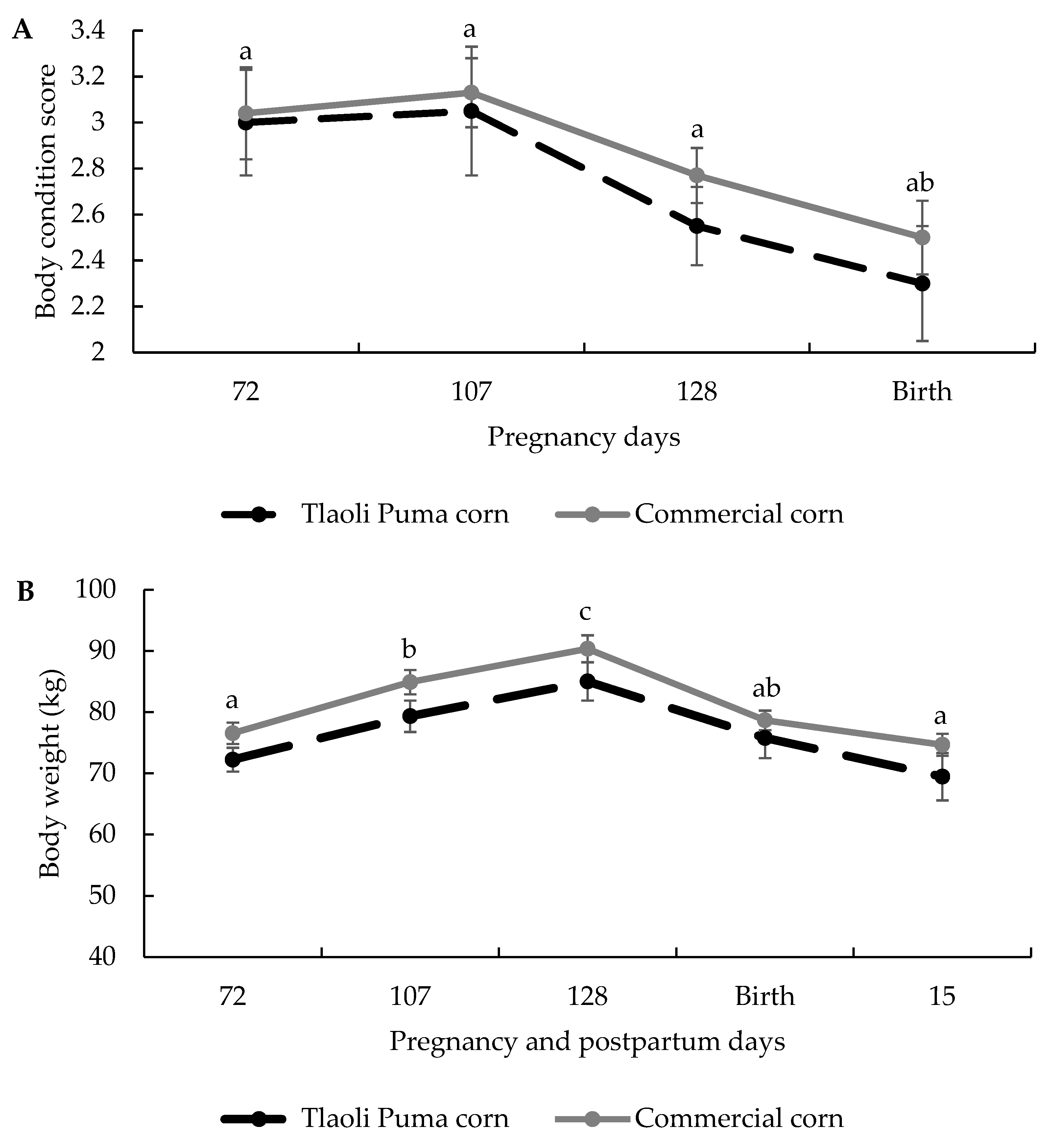
Body condition score was not affected by group (p = 0.85), litter size (p = 0.23) or interaction between group × litter size (p = 0.21). A time effect was found (p = 0.001), as can be seen in Figure 2A: BCS began to decline from day 128 of gestation and continued until delivery. The interaction was not significant between time and litter size (p = 0.71), between time and group (p = 0.59), or between the time and group and litter size (p = 0.75).

3.2.2. Body Weight of Ewes

Body weight was not affected by group (p = 0.40), litter size (p = 0.63) or interaction between group × litter size (p = 0.64). A time effect was found (p < 0.0001), as can be seen in Figure 2B: body weight began to decline from day 128 of gestation to parturition and continued to decline over 15 days of lactation. The interaction between time and litter size was significant (p = 0.008). However, this was not the case for the interaction between time and group (p = 0.76) or between the time and group and litter size (p = 0.91).

3.2.3. Weight Change

Weight change was not affected by group (p = 0.44), litter size (p = 0.11) or interaction between group × litter size (p = 0.96). A time effect was found (p < 0.0001), as ewes in both groups gained weight from day 72 to 128 of gestation and then lost weight immediately after parturition (Table 4). The interaction between time and litter size was also found to be significant (Table 4, p = 0.045); the weight gain at the end of gestation, as well as the weight loss immediately after parturition, was more evident in ewes with multiple births than in those with single births. Finally, the interactions between time and group (p = 0.70), as well as time and group and litter size, were not significant (p = 0.74).

3.3. Estimated Daily Feed Intake of Ewes

Group did not affect feed intake (p = 0.83); however, a time effect was observed (p < 0.0001), as shown in Table 5. For both groups, the estimated individual consumption per animal decreased as birth approached and even after birth.

3.4. Estimated Milk Quality of Ewes

The Brix refractometer values (Table 6) were not affected by group (p = 0.74), litter size (p = 0.32) or interaction between group × litter size (p = 0.89). They were not affected by time (p = 0.71), the interaction between time and litter size (p = 0.92), between time and group (p = 0.58), or between the time and group and litter size (p = 0.76).

3.5. Behavioral Recording During and Immediately After Parturition

The mean and standard error values for the behaviors recorded in the ewes and their lambs are shown in Table 7. The duration of the first cleaning episode during the two hours of observation was lower in the group supplemented with the Tlaoli Puma hybrid than in the commercial group (p = 0.02). There were no differences in the other behaviors recorded in the mother or lambs due to the experimental group (p > 0.05). Nor were any differences observed in any of the behaviors of the mother due to litter size (p > 0.05).
The behaviors of the lambs (Table 7) were not affected by the experimental group (p > 0.05), nor by the litter size (p > 0.05), nor by the sex of the lamb (p > 0.05).

3.6. Weight and Body Temperatures in Lambs

3.6.1. Body Weight of Lambs

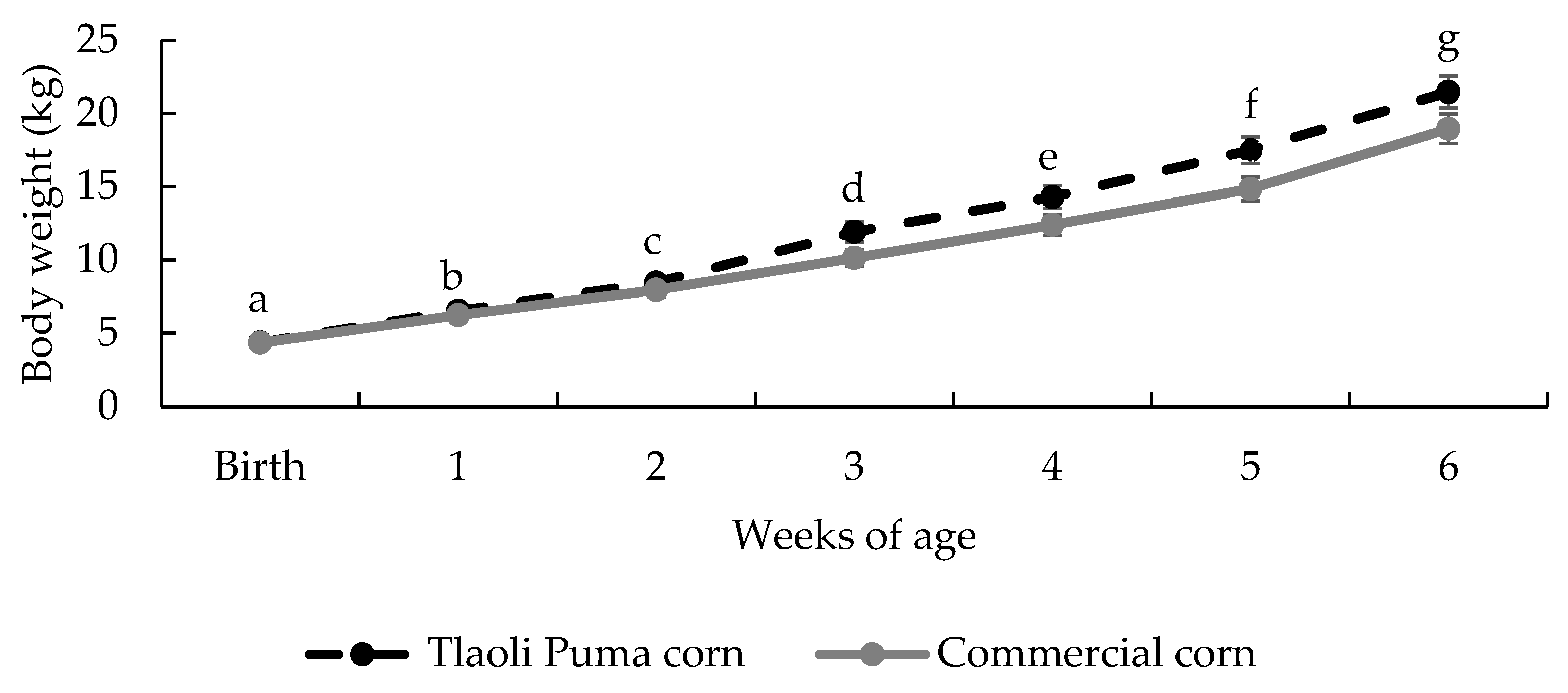
The body weight of the lambs (Figure 3) was not affected by group (p = 0.57), litter size (p = 0.11), sex of the offspring (p = 0.52) or interaction between group × litter size (p = 0.64), between group × sex of lamb (p = 0.39), between sex × litter size (0.37) or between group × litter size × sex of lamb (p = 042).
However, time did affect the weight of the lambs (p < 0.0001). As the lamb grew, its weight increased (Figure 3). Likewise, the interaction between time and litter size was significant (p = 0.040), while the interactions between time × group, between time × sex, and time × sex × litter size were not significant (p > 0.05).

3.6.2. Body Temperatures

The scapula temperature tended to be higher in lambs born to the group supplemented with hybrid corn than with commercial corn (p = 0.053, Table 8). The neck temperature tended to be higher in female than in male lambs (28.8 ± 0.6 vs. 26.7 ± 1.03, °C, p = 0.09). There were no more differences in the different temperatures between groups (p > 0.05), nor between litter size (p > 0.05) or between female vs. male lambs (p > 0.05).

4. Discussion

Our hypothesis—that supplementing with white corn grain from the Tlaoli Puma hybrid during the last 20 days of gestation and the first week of lactation will have positive results on productive, metabolic and behavioral parameters in sheep and their lambs—was fully confirmed.
Previous studies in sheep had already separately demonstrated that providing strategic, localized supplementation in the final weeks of gestation, using a high-concentration energy source such as corn, significantly improves the productive and metabolic parameters of the ewe [14,35,36,37]. It also promotes the mother–offspring bond after birth and lamb survival [16,35,37,38]. However, it is important to note that most of these studies were conducted with corn varieties commercially grown for animal production, which are very likely genetically modified. This last point highlights the importance of our findings, since the present study used corn kernels from a hybrid variety derived from native corn varieties, which have been improved to resist diseases, pests, and adverse environmental conditions. This suggests that it could be a sustainable strategy for animal feed without potentially negative consequences for animal health. Although extensive studies on animal feed have shown that genetically modified (GM) corn has comparable performance to conventional corn in livestock, the effects on human health from consuming animal products fed with GM corn are not fully understood. In fact, it is assumed that the performance and health of animals fed GM corn are comparable to those of animals fed non-GM corn. However, this has not been extrapolated beyond the animal sector [39]. Genetically modified corn has been selected to be a herbicide-tolerant, pest-resistant, and lodging-resistant crop; however, there are several controversies surrounding its use, such as the problem that arises from using highly toxic pesticides with negative consequences for human health, such as glyphosate [40].
Our work demonstrates that it is possible to continue obtaining benefits from forage and animal feed by using improved crops selected for their adaptation to changing natural environments, which is far more beneficial than using genetically modified plants. This study can contribute to sustainable strategies for future maize production, for both human and animal consumption. Specifically, we found that the weight of ewes at the end of gestation increased considerably in the final days, which is due to the accelerated growth of the fetus and the onset of milk production [10,41]. Between 70% and 80% of fetal growth occurs in the last 6 weeks of gestation [42,43]. The availability of energy in the ewe’s diet at the end of gestation is crucial, and if it is not met, problems such as the development of pregnancy toxemia can occur, which can compromise the life of the mother and the offspring [44,45]. Therefore, the ewes must have access to rations that provide adequate amounts of nutrients, especially energy [10,36,46]. It is also important to highlight that in the last five weeks of pregnancy, the uterus occupies considerable space, affecting rumen distension [47,48]. Therefore, it is necessary that the nutrients the ewes need come from readily available sources (such as energy concentrates like corn grain) and not from fibrous sources that require complex digestive processing and occupy considerable space in the rumen [14]. In this study, it was found that, on average, ewes gained 7 kg between days 72 and 107 of gestation. Once the cracked corn supplement was administered, the ewes maintained their weight gain, and an average weight loss of −10 kg was observed for both groups immediately after lambing. These results are consistent with other studies of pregnant ewes that report similar weight gain during gestation and weight loss after lambing [49,50]. This also indicates that the considerable weight difference between the start of supplementation and lambing was due to an adequate nutritional and metabolic status. This resulted in a significantly appropriate birth weight for the lambs of this breed. On the other hand, as the data on weight change and body weight show, the animals gained or lost weight as gestation progressed or parturition occurred. We also observed an interaction between time and litter size on body weight and weight change; evidently, females gained or lost more weight with multiple litters than with single litters. In the present study, there was a similar distribution of animals by litter type in both groups, which would rule out that the weight loss or gain was due to a confounding factor. Therefore, this finding regarding this interaction between time and litter size coincides with some previous studies [51].
We found that body condition score (BCS) was not different between the ewes in the two groups; in fact, this variable was consistently within the appropriate ranges, reflecting adequate nutritional status in the pregnant ewes. The most significant loss of BCS was observed once the females had given birth, which coincides with weight loss. On average, values for these stages are estimated to be between 2.5 and 3.0 on a scale of 1 to 5, as used in this experiment [43]. Although the results of this study show that the ewes had lower body condition score (BCS) values at the end of gestation compared to those obtained in another study where the ewes were fed a diet with 50% Puma hybrid corn silage [8]; it is also important to highlight that in that study, feeding with silage from Puma hybrid corn began in the second half of gestation and continued until one week postpartum, which favored a better nutritional status for the mothers [8]. Despite this discrepancy, we could affirm that the BCS obtained in our study was within acceptable limits, so the short-term energy supplementation allowed for the maintenance of an adequate nutritional status and could be economically profitable.
These two productive indicators show us that the nutritional status of the ewes was good, and that supplementation with cracked corn grain, both the Puma hybrid and the commercial variety, allowed the females to maintain adequate parameters to complete gestation and did not show effects such as the development of pregnancy toxemia, which is what has been reported in other studies in sheep.
For their part, in this study, blood glucose levels in ewes at the end of gestation were lower than those reported in other studies, even those with similar conditions as our study [8], as well as compared to those reported in grazing ewes [43], although some studies indicate that glucose levels before delivery remain low [52]. The discrepancy between our results and those of other researchers could be due to the type of diet provided and the time of day the sample was taken; in our case, samples were always taken after the animals had fasted, while other studies do not specify this procedure. Furthermore, the glucose levels obtained in this study began to increase on day 128 of gestation (when the cracked corn supplement was initiated) and reached their peak at parturition. Several studies report this pattern, some of which indicate that it coincides with increased fetal growth [43], as well as the rise in insulin levels, even in malnourished ewes during gestation [22]. It is important to note that in our study we had higher glucose levels on the day of parturition (the sample was taken two hours after birth, when the behavioral monitoring was completed), compared to the previously mentioned studies [8,43], although our results coincide with other studies that report levels ranging from 95 to almost 200 mg/dL immediately after delivery [53]. The average glucose level for both groups was 128.8 mg/dL, which indicates a high energy availability that facilitated glucose mobilization for delivery, probably due to supplementation with cracked corn. When the sheep’s nutritional levels are low in the later stages of gestation, insulin values decrease, reflecting poor glucose mobilization [22].
For their part, the blood ketone body values for both groups also reflected that the nutritional levels of the sheep were adequate, since these values in neither group at any stage reached values above 0.45 mmol/L; when the values are above 0.8 mmol/L, the animal is considered to have entered subclinical ketosis [54]. According to the literature, ketone bodies in sheep increase towards the end of gestation and reach a peak concentration at parturition [52]. In our study, we had average ketone bodies of 0.32 on day 128 of gestation and 0.33 mmol/L on the day of delivery. The literature indicates that high levels of these metabolites reflect the mobilization of body reserves and are therefore indicators of low energy status [55,56,57]. In our study, although there was a slight increase in ketone bodies from day 128 to parturition, it was neither significant nor important (it remained within a normal range). This contrasted with the high glucose levels recorded at parturition (indicating that the ewe had available energy). This finding is consistent with the literature, which has determined that ketone bodies are indicators for predicting the mobilization of fat reserves and understanding energy status in the prepartum period in sheep [55,56,57].
Regarding the results obtained using the Brix refractometer, it was found that they were not different between the two groups, with average percentages of 13.55 to 13.65% at 15 days of lactation and 13.46 to 12.95% at 30 days of lactation. These Brix refractometer values decrease as the date of delivery approaches, since they are directly related to the concentrations of immunoglobulins in the colostrum. In the first few days postpartum, the values considered optimal are above 22% [58]. During lactation, sheep milk Brix percentages decline substantially. Immediately after birth, ewes produce colostrum with mean Brix values of 32.8%, which decrease to 22.6% at 12 h, 17.2% at 24 h, and stabilize around 14–15% by 2–3 days postpartum [59]. It has been determined that the nutritional quality of the pregnant ewe’s diet, especially when supplemented with corn grain at the end of gestation, increases the amount of colostrum [14,60]. This same feeding strategy has been proven useful in goats, obtaining similar results even with underfed animals [17]. The energy source in the diet, in particular, favors lactogenesis and colostrum production [15,20]. In our study, although the cracked corn supplement was maintained until day 7 of lactation, we cannot be certain that this feed improved milk quality and quantity, even though the Brix values obtained were within optimal levels according to the literature [59]. What we can affirm is that the nutritional quality of the diet at the end of gestation and the availability of energy substrates promote lactogenesis and, consequently, the initiation of successful lactation [15,61].
Regarding the weight and thermogenesis of the lambs on the day of birth, it was found that they were similar for both groups. In fact, the average weights and temperatures were like those reported in a previous study where ewes were fed a ration containing 50% Puma hybrid Mexican corn silage from the second half of gestation [8]. Likewise, we observed adequate weight gains in the lambs of both groups throughout lactation, which coincides with the aforementioned study [8]. We also found a significant interaction between time and litter size on lamb weight during lactation, which is consistent with the findings regarding dam weight and weight change during gestation. Although no differences in lamb weight were found between single and multiple litters, a significant effect was observed when the time factor was applied. The weights of the lambs reflect an adequate metabolic state of the mother, a consequence of an adequate diet at the end of gestation that impacts the growth of the fetus, with lamb weights in primiparous and multiparous females on pasture above 4 kilos [43], as obtained in the present study. Therefore, we can affirm that corn grain supplementation at the end of gestation, although it does not increase the mothers’ productive parameters, does maintain them at levels that allow for adequate fetal development, resulting in lambs with birth weights above 4 kg in both groups.
Finally, with respect to the behaviors recorded in ewes and their lambs in the first two hours postpartum, no significant differences were found between the two groups in most of the recorded behaviors. However, while it was observed that the duration of the first cleaning episode was longer in ewes supplemented with commercial corn, we would not have a plausible explanation for this response, since factors that could interfere with the display of maternal behavior, such as maternal experience, were controlled for, as all females in this study were multiparous with similar maternal experience. One factor that could have affected or interfered was perhaps litter size, since the results for this same behavior also show that the duration of the first episode was longer in mothers with multiple births than in those with single births (however, the statistical analysis did not yield a significant result). Further studies are needed, as one disadvantage of the present work was the limited number of animals per group. In general, we find that similar maternal motivation and vitality of the lambs could be seen, since the mothers of both groups immediately began cleaning the lamb, emitting a high frequency of maternal bleats to stimulate the lamb to get up and reach the udder. For their part, the lambs had short latencies to stand and reach the udder, which enabled most of them to ingest colostrum within the first hour of birth. In fact, it was found that the lambs of the Tlaoli Puma hybrid corn grain got up, on average, at 28 min and had their first suckling at 48 min, while the lambs in the commercial corn grain group got up on average at 36 min and had their first suckling at 57 min. These results are comparable to those obtained in goats and their kids: in a study where the mothers were provided with a supplement during the last 20 days of gestation with 500 g/animal/day of commercial cracked corn, it was found that although these mothers were undernourished, they experienced positive effects from the energy supplement, since the production of colostrum was increased and the mother’s behavior and vitality were improved [17,18].

5. Conclusions

It is concluded that supplementing ewes at the end of gestation with the Mexican hybrid cracked corn Puma provides similar benefits to those obtained with commercial corn varieties. In this study, Puma Tlaoli corn allowed ewes to maintain a body condition score above 2.5 before lambing, as well as a weight gain of more than 10 kg at lambing. This was reflected in adequate glucose levels with a significant increase at lambing and ketone levels no higher than 0.35 mmol/L. These productive effects resulted in lambs weighing over 4 kg at birth, with daily weight gains of more than 300 g per day and reaching a weight of up to 21 kg at 6 weeks of age. Furthermore, supplementation promoted the vitality of the lambs and the proper development of maternal behavior during the sensitive period, allowing the lambs to nurse within the first hour of birth. Finally, it is presumed that supplementation had positive effects on lactogenesis, as it promoted the lambs’ vitality and their adequate growth during lactation. Additionally, the Brix levels of the milk were within acceptable percentages at 15 and 30 days of lactation. Therefore, the use of the Mexican hybrid corn Tlaoli Puma as a supplement, in addition to improving the parameters evaluated in the animals, is an economical strategy adaptable to the conditions of the region and with harmless benefits for animal health.

Author Contributions

Conceptualization, A.T., M.T.-R. and A.E.-C.; methodology, A.T., M.T.-R., A.E.-C., K.Y.M.-G., P.C.-S., A.O., J.J.R.-E. and L.C.-H.; validation, A.T.; formal analysis, A.T.; investigation, A.T., L.N., K.C., M.T.-R., A.E.-C., K.Y.M.-G., P.C.-S., A.O., J.J.R.-E. and L.C.-H.; resources, A.T., M.T.-R., A.E.-C., K.Y.M.-G., P.C.-S. and A.O.; data curation, A.T., L.N. and K.C.; writing—original draft preparation, A.T., M.T.-R. and A.E.-C.; writing—review and editing, A.T., L.N., K.C., M.T.-R., A.E.-C., K.Y.M.-G., P.C.-S., A.O., J.J.R.-E. and L.C.-H.; visualization, A.T., L.N. and K.C.; supervision, A.T., P.C.-S., A.O. and L.C.-H.; project administration, A.T., M.T.-R., A.E.-C., K.Y.M.-G., P.C.-S. and A.O.; funding acquisition, A.T. All authors have read and agreed to the published version of the manuscript.

Funding

This research was funded by Universidad Nacional Autonoma de Mexico (FESC-UNAM-CI2458).

Institutional Review Board Statement

This research was approved by the Institutional Committee for the Use and Care of Research Animals of Facultad de Estudios Superiores Cuautitlán, Universidad Nacional Autónoma de México, with protocol number CICUAE-FESC C 24_37 (9 December 2024).

Data Availability Statement

The data used in the study will be made available to other researchers on request from the corresponding author.

Acknowledgments

Special thanks to Karla Díaz Menchaca for her support and guidance in analyzing the milk samples and to Sandra Gonzalez Luna for the loan of the measuring equipment of digital refractometer. We also thank the social service students and volunteers for their assistance with feeding and caring for the animals, as well as collecting the data. We thank Karen Tajonar for her support in supervising the births.

Conflicts of Interest

The authors declare no conflicts of interest.

Abbreviation

The following abbreviation is used in this manuscript:
BCSBody Condition Score

References

  1. Granados, C.C.; Vega, J.A. Sustitutos de maíz utilizados en la alimentación animal en Costa Rica. Nutr. Anim. Trop. 2016, 10, 91–113. [Google Scholar] [CrossRef]
  2. Nuss, E.T.; Tanumihardjo, S.A. Maize: A Paramount Staple Crop in the Context of Global Nutrition. Compr. Rev. Food Sci. Food Saf. 2010, 9, 417–436. [Google Scholar] [CrossRef]
  3. Ranum, P.; Pena-Rosas, J.P.; Garcia-Casal, M.N. Global maize production, utilization, and consumption. Ann. N. Y. Acad. Sci. 2014, 1312, 105–112. [Google Scholar] [CrossRef]
  4. U.S. Department of Agriculture (USDA). Feed Grain Data Base; Economic Research Service, Department of Agriculture: Washington, DC, USA, 2026.
  5. México Rompe Récord en Importación de Maíz, la Mayoría Proveniente de Estados Unidos. Available online: https://www.ganaderia.com/noticias/mexico-rompe-record-en-importacion-de-maiz-la-mayoria-proveniente-de-estados-unidos (accessed on 6 March 2026).
  6. Tadeo-Robledo, M.; Espinosa-Calderón, A.; García-Zavala, J.; Lobato-Ortriz, R.; Gómez-Montiel, N.; Sierra-Macías, M.; Valdivia-Bernal, R.; Zamudio-González, B.; Martínez-Yañez, B.; López-López, C.; et al. Tsiri puma, híbrido de maíz para valles altos con esquema de androesterilidad para producción de semillas. Rev. Fitotec. Mex. 2016, 39, 331–333. [Google Scholar] [CrossRef]
  7. Tadeo-Robledo, M.; Espinosa-Calderón, A.; Zaragoza-Esparza, J.; López-López, C.; Canales-Islas, E.; Zamudio-González, B.; Turrent-Fernández, A.; Virgen-Vargas, J.; Sierra-Macías, M.; Gómez-Montiel, N.; et al. Tlaoli puma, híbrido de maíz para grano y forraje con androesterilidad y restauración de la fertilidad masculina. Rev. Fitotec. Mex. 2021, 44, 265. [Google Scholar] [CrossRef]
  8. Castillo-Hernández, L.; Zaragoza-Esparza, J.; Tadeo-Robledo, M.; Espinosa-Calderón, A.; Ramírez-Espinosa, J.; Macedo-González, J.; Castillo Hernández, A.; Cano-Suárez, P.; Terrazas-García, A. Potencial alimenticio de ensilados híbridos de maíz Puma incluidos en la dieta de ovejas gestantes. Revisa MVZ Cordoba 2024, 29, e3262. [Google Scholar] [CrossRef]
  9. Mellor, D.J. Nutritional and placental determinants of foetal growth rate in sheep and consequences for the newborn lamb. Br. Vet. J. 1983, 139, 307–324. [Google Scholar] [CrossRef]
  10. Robinson, J.J.; McEvoy, T.G.; Sinclair, K.D. Nutritional effects on foetal growth. Anim. Sci. 1999, 68, 315–331. [Google Scholar] [CrossRef]
  11. Terrazas, A.; Robledo, V.; Serafín, N.; Soto, R.; Hernández, H.; Poindron, P. Differential effects of undernutrition during pregnancy on the behaviour of does and their kids at parturition and on the establishment of mutual recognition. Animal 2009, 3, 294–306. [Google Scholar] [CrossRef]
  12. Dwyer, C.M.; Conington, J.; Corbiere, F.; Holmoy, I.H.; Muri, K.; Nowak, R.; Rooke, J.; Vipond, J.; Gautier, J.M. Invited review: Improving neonatal survival in small ruminants: Science into practice. Animal 2016, 10, 449–459. [Google Scholar] [CrossRef]
  13. Freitas-de-Melo, A.; Terrazas, A.; Ungerfeld, R.; Hötzel, M.; Orihuela, A.; Pérez-Clariget, R. Influence of low pasture allowance during pregnancy on the attachment between ewes and their lambs at birth and during lactation. Appl. Anim. Behav. Sci. 2018, 199, 9–16. [Google Scholar] [CrossRef]
  14. Banchero, G.E.; Quintans, G.; Vazquez, A.; Gigena, F.; La Manna, A.; Lindsay, D.R.; Milton, J.T. Effect of supplementation of ewes with barley or maize during the last week of pregnancy on colostrum production. Animal 2007, 1, 625–630. [Google Scholar] [CrossRef]
  15. Banchero, G.E.; Quintans, G.; Martin, G.B.; Lindsay, D.R.; Milton, J.T. Nutrition and colostrum production in sheep. 1. Metabolic and hormonal responses to a high-energy supplement in the final stages of pregnancy. Reprod. Fertil. Dev. 2004, 16, 633–643. [Google Scholar] [CrossRef]
  16. Banchero, G.E.; Quintans, G.; Lindsay, D.R.; Milton, J.T. A pre-partum lift in ewe nutrition from a high-energy lick or maize or by grazing Lotus uliginosus pasture, increases colostrum production and lamb survival. Animal 2009, 3, 1183–1188. [Google Scholar] [CrossRef]
  17. Ramírez-Vera, S.; Terrazas, A.; Delgadillo, J.A.; Serafín, N.; Flores, J.A.; Elizundia, J.M.; Hernández, H. Feeding corn during the last 12 days of gestation improved colostrum production and neonatal activity in goats grazing subtropical semi-arid rangeland. J. Anim. Sci. 2012, 90, 2362–2370. [Google Scholar] [CrossRef]
  18. Ramírez-Vera, S.; Terrazas, A.; Delgadillo, J.A.; Flores, J.A.; Serafín, N.; Vielma, J.; Duarte, G.; Fernández, G.; Fitz-Rodríguez, G.; Hernández, H. Inclusion of maize in the grazing diet of goats during the last 12 days of gestation reinforces the expression of maternal behaviour and selectivity during the sensitive period. Livest. Sci. 2012, 148, 52–59. [Google Scholar] [CrossRef]
  19. Torres-Fajardo, R.A.; Cardozo-Herrán, M.A.; Cámara-Sarmiento, R.; Sandoval-Castro, C.A.; de Jesús Torres-Acosta, J.F.; González-Pech, P.G. Can the energetic supplementation of ewes influence the behavioral performance of their newborn lambs? Cienc. y Agric. 2020, 17, 32–38. [Google Scholar] [CrossRef]
  20. Banchero, G.E.; Perez Clariget, R.; Bencini, R.; Lindsay, D.R.; Milton, J.T.; Martin, G.B. Endocrine and metabolic factors involved in the effect of nutrition on the production of colostrum in female sheep. Reprod. Nutr. Dev. 2006, 46, 447–460. [Google Scholar] [CrossRef]
  21. Dwyer, C.M.; Lawrence, A.B.; Bishop, S.C.; Lewis, M. Ewe-lamb bonding behaviours at birth are affected by maternal undernutrition in pregnancy. Br. J. Nutr. 2003, 89, 123–136. [Google Scholar] [CrossRef]
  22. Olazábal Fenochio, A.; Vera Ávila, H.R.; Serafín López, N.; Medrano Hernández, J.A.; Sánchez Saucedo, H.; Terrazas García, A.M. Mother-young mutual recognition in Columbia sheep with nutritional restriction during pregancy. Rev. Mex. Cienc. Pecu. 2013, 4, 127–147. [Google Scholar]
  23. Okla, M.; Kim, J.; Koehler, K.; Chung, S. Dietary Factors Promoting Brown and Beige Fat Development and Thermogenesis. Adv. Nutr. 2017, 8, 473–483. [Google Scholar] [CrossRef]
  24. Li, Y.; Huo, J.; Yu, S.; Xiang, Y.; Feng, Y.; Jiang, Z.; Gao, S.; Huang, Z.; Luo, Y.; Xin, Y.; et al. Maternal Taurine Supplementation Enhances Thermogenesis of Newborn Lambs by Promoting Brown Adipogenesis. FASEB J. 2025, 39, e71185. [Google Scholar] [CrossRef]
  25. Vicente-Pérez, R.; Avendaño-Reyes, L.; Correa-Calderón, A.; Mellado, M.; Meza-Herrera, C.A.; Montañez-Valdez, O.D.; Macías-Cruz, U. Relationships of body surface thermography with core temperature, birth weight and climatic variables in neonatal lambs born during early spring in an arid region. J. Therm. Biol. 2019, 82, 142–149. [Google Scholar] [CrossRef]
  26. McKnight, S.M.; Simmons, R.M.; Wu, G.; Satterfield, M.C. Maternal arginine supplementation enhances thermogenesis in the newborn lamb. J. Anim. Sci. 2020, 98, skaa118. [Google Scholar] [CrossRef]
  27. Keithly, J.I.; Kott, R.W.; Berardinelli, J.G.; Moreaux, S.; Hatfield, P.G. Thermogenesis, blood metabolites and hormones, and growth of lambs born to ewes supplemented with algae-derived docosahexaenoic acid. J. Anim. Sci. 2011, 89, 4305–4313. [Google Scholar] [CrossRef]
  28. Terrazas, A.; Hernandez, H.; Ramirez-Vera, S.; Fierros, A.; Rojas, S.; Serafin, N. Undernutrition during pregnancy in goats and sheep, their repercussion on mother-young relationship and behavioural development of the young. Trop. Subtrop. Agroecosystems 2012, 15, S161–S174. [Google Scholar] [CrossRef]
  29. Idamokoro, E.M.; Muchenje, V.; Masika, P.J. Peri-and post-parturient consequences of maternal undernutrition of free ranging does: A review. Livest. Res. Rural. Dev. 2017, 29, 202. [Google Scholar]
  30. Instituto Nacional de Estadística y Geografía. Climatología. 2020. Available online: https://www.inegi.org.mx/temas/climatologia/ (accessed on 3 April 2026).
  31. National Research Council (US); Committee on Nutrient Requirements of Small Ruminants. Nutrient Requirements of Small Ruminants: Sheep, Goats, Cervids, and New World Camelids; National Academies Press: Washington, DC, USA, 2007. [Google Scholar]
  32. Russel, A.J.F.; Doney, J.M.; Gunn, R.G. Subjective assessment of body fat in live sheep. J. Agric. Sci. 1969, 72, 451–454. [Google Scholar] [CrossRef]
  33. Agenbag, B.; Swinbourne, A.M.; Petrovski, K.; van Wettere, W. Validation of a handheld refractometer to assess Merino ewe colostrum and transition milk quality. J. Dairy. Sci. 2023, 106, 1394–1402. [Google Scholar] [CrossRef]
  34. Lévy, F. The Onset of Maternal Behavior in Sheep and Goats: Endocrine, Sensory, Neural, and Experiential Mechanisms. Adv. Neurobiol. 2022, 27, 79–117. [Google Scholar] [CrossRef]
  35. Pedernera, M.; Pérez-Sánchez, L.A.; Romero-Aguilar, L.D.; Aguirre, V.; Flores-Pérez, I.; Vázquez, R.; Orihuela, A. Effects of high concentrate supplementation of Saint Croix sheep during peripartum on neonatal lamb behaviour. J. Appl. Anim. Res. 2018, 46, 720–724. [Google Scholar] [CrossRef]
  36. Silva, N.C.D.; Cabral Filho, S.L.S.; Santos, R.S.D.; Silva, C.J.D.; Cardoso, R.B.; Silva, B.D.M.; Ribeiro, M.D. Supplementation strategies for ewes during gestation and lactation. An. Acad. Bras. Ciênc. 2024, 96, e20230686. [Google Scholar] [CrossRef]
  37. Villar, M.L.; Giraudo, C.G.; Cueto, M.I. Short-term energy supplementation before lambing improves maternal behaviour, udder volume, colostrum viscosity and lamb birthweight in ewes under extensive grazing. Small Rumin. Res. 2023, 219, 106893. [Google Scholar] [CrossRef]
  38. Putu, I.G.; Poindron, P.; Lindsay, D.R. A high level of nutrition during late pregnancy improves subsequent maternal behaviour of Merino ewes. Proc. Aust. Soc. Anim. Prod. 1988, 17, 294–297. [Google Scholar]
  39. Van Eenennaam, A.L.; Young, A.E. Prevalence and impacts of genetically engineered feedstuffs on livestock populations. J. Anim. Sci. 2014, 92, 4255–4278. [Google Scholar] [CrossRef]
  40. Chavas, J.P.; Shi, G.; Lauer, J. The effects of GM technology on maize yield. Crop Sci. 2014, 54, 1331–1335. [Google Scholar] [CrossRef]
  41. Selmi, H.; Bahri, A.; Rouissi, H. Nutrition for lactation of dairy sheep. Lactation in Farm Animals-Biology, Physiological Basis, Nutritional Requirements, and Modelization. In Veterinary Medicine and Science; M’Hamdi, N., Ed.; IntechOpen: London, UK, 2020; pp. 1–12. [Google Scholar]
  42. Carr, D.J.; Aitken, R.P.; Milne, J.S.; David, A.L.; Wallace, J.M. Ultrasonographic assessment of growth and estimation of birthweight in late gestation fetal sheep. Ultrasound Med. Biol. 2011, 37, 1588–1595. [Google Scholar] [CrossRef]
  43. Damian, J.P.; Terrazas, A.; Cabrera, E.; Simonetti, S.; Aragunde, R.; Fila, D. Growth of foetal bones and metabolic profile during gestation in primiparous ewes and multiparous ewes. Reprod. Domest. Anim. 2020, 55, 1180–1189. [Google Scholar] [CrossRef]
  44. Van Saun, R.J. Pregnancy toxemia and metabolic changes of transition in small ruminants. In Proceedings of the 45th Annual Conference of the American Association of Bovine Practitioners Conference, Montreal, QC, Canada, 20–22 September 2012; pp. 142–147. [Google Scholar]
  45. Olfati, A.; Moghaddam, G.; Bakhtiari, M. Diagnosis, treatment and prevention of pregnancy toxemia in ewes. J. Adv. Biol. Biomed. Res. 2013, 1, 1452–1456. [Google Scholar]
  46. Jenkinson, C.; Earl, A.; Kenyon, P.; Blair, H.T. Effects of maternal nutrition during pregnancy on fetal growth and maternal constraint in sheep. Anim. Prod. Sci. 2012, 52, 524–532. [Google Scholar] [CrossRef]
  47. Forbes, J. The physical relationships of the abdominal organs in the pregnant ewe. J. Agric. Sci. 1968, 70, 171–177. [Google Scholar] [CrossRef]
  48. Anthony, R.V.; Scheaffer, A.N.; Wright, C.D.; Regnault, T.R. Ruminant models of prenatal growth restriction. Reprod. Suppl. 2003, 61, 183–194. [Google Scholar] [CrossRef]
  49. Ferguson, M.B.; Thompson, A.N.; Gordon, D.J.; Hyder, M.W.; Kearney, G.A.; Oldham, C.M.; Paganoni, B.L. The wool production and reproduction of Merino ewes can be predicted from changes in liveweight during pregnancy and lactation. Anim. Prod. Sci. 2011, 51, 763–775. [Google Scholar] [CrossRef]
  50. Robinson, J.; McDonald, I.; McHattie, I.; Pennie, K. Studies on reproduction in prolific ewes. 4. Sequential changes in the maternal body during pregnancy. J. Agric. Sci. 1978, 9, 291–304. [Google Scholar] [CrossRef]
  51. Pesantez-Pacheco, J.L.; Heras-Molina, A.; Torres-Rovira, L.; Sanz-Fernandez, M.V.; Garcia-Contreras, C.; Vazquez-Gomez, M.; Feyjoo, P.; Caceres, E.; Frias-Mateo, M.; Hernandez, F.; et al. Influence of Maternal Factors (Weight, Body Condition, Parity, and Pregnancy Rank) on Plasma Metabolites of Dairy Ewes and Their Lambs. Animals 2019, 9, 122. [Google Scholar] [CrossRef]
  52. Mohammadi, V.; Anassori, E.; Jafari, S. Measure of energy related biochemical metabolites changes during peri-partum period in Makouei breed sheep. Vet. Res. Forum 2016, 7, 35–39. [Google Scholar]
  53. Silva, L.P.; Lourenço, M.L.; Paula, R.A.; Verdugo, M.R.; Pereira, K.H.; Chiacchio, S.B. Assessment of serum lactate levels, blood glucose values and blood gas values in sheep, newborn lambs and placenta. Pesqui. Veterinária Bras. 2018, 38, 1878–1884. [Google Scholar] [CrossRef]
  54. Marutsova, V.; Marutsov, P. Subclinical and clinical ketosis in sheep–relationships between body condition scores and blood β-hydroxybutyrate and non-esterified fatty acids concentrations. Tradit. Mod. Vet. Med. 2018, 3, 30–36. [Google Scholar]
  55. Schlumbohm, C.; Harmeyer, J. Hyperketonemia impairs glucose metabolism in pregnant and nonpregnant ewes. J. Dairy. Sci. 2004, 87, 350–358. [Google Scholar] [CrossRef]
  56. Taghipour, B.; Seifi, H.A.; Mohri, M.; Farzaneh, N.; Naserian, A. Variations of Energy Related Biochemical Metabolites During Periparturition Period in Fat-Tailed Baloochi Breed Sheep. Iran. J. Vet. Sci. Technol. 2010, 2, 85–92. [Google Scholar]
  57. Harmeyer, J.; Schlumbohm, C. Pregnancy impairs ketone body disposal in late gestating ewes: Implications for onset of pregnancy toxaemia. Res. Vet. Sci. 2006, 81, 254–264. [Google Scholar] [CrossRef]
  58. Kessler, E.C.; Bruckmaier, R.M.; Gross, J.J. Short communication: Comparative estimation of colostrum quality by Brix refractometry in bovine, caprine, and ovine colostrum. J. Dairy. Sci. 2021, 104, 2438–2444. [Google Scholar] [CrossRef]
  59. Akköse, M. Comparative evaluation of colostrum quality in Karya ewes and yearling lambs using the brix refractometer. Repvas 2025, 2, 66–73. [Google Scholar] [CrossRef]
  60. Mioč, B.; Antunović, Z.; Širić, I.; Novoselec, J.; Kasap, A.; Klir Šalavardić, Ž.; Držaić, V. The influence of different stress factors on the production and quality of sheep milk. Mljekarstvo Dairy. Experts J. 2024, 74, 169–184. [Google Scholar] [CrossRef]
  61. Landau, S.; Nitsan, Z.; Zoref, Z.; Madar, Z. The influence of extruding corn grain on glucose metabolism in pregnant ewes. Reprod. Nutr. Dev. 1999, 39, 181–187. [Google Scholar] [CrossRef] [PubMed]
Figure 1. Mean and standard errors of blood glucose (top) and ketone body (bottom) concentrations are shown for ewes supplemented with commercial yellow cracked corn or Tlaoli Puma hybrid white cracked corn. Different letters indicate statistically significant changes over time (p < 0.05).
Agriculture 16 00841 g001
Figure 2. Means and standard errors for (A) body condition score and (B) body weight of ewes supplemented with either commercial yellow cracked corn or Tlaoli Puma hybrid white cracked corn. Different letters indicate significant differences over time (p < 0.05).
Agriculture 16 00841 g002
Figure 3. Mean and standard error of lamb weight from birth to 6 weeks of age. Data were compared for lambs born to ewes supplemented with commercial cracked corn or with Tlaoli Puma hybrid corn. Different letters indicate significant differences over time (p < 0.05).
Agriculture 16 00841 g003
Table 1. Composition and nutritional contribution of the diet.
IngredientInclusion (% DM)Protein (%)Metabolizable Energy (Mcal/kg)
Hybrid cornCommercial cornHybrid cornCommercial corn
Cracked corn181.851.620.7280.721
Corn silage705.65.61.4981.498
Alfalfa hay101.981.980.1890.189
Minerals2
Total nutrient intake1009.439.22.4152.408
Table 2. Nutritional composition of the ingredients used in the rations supplied to the animals according to the laboratory report of the proximate chemical analysis.
Nutrient (%DM)Cracked Corn CommercialCracked Corn Puma HybridAlfalfa HayCorn Silage
Crude protein9.010.319.88.0
Soluble protein 1.72.26.83.7
Detergent acid fiber4.75.532.335.8
Neutral detergent fiber11.312.639.955.7
Crude fiber4.95.0----
Lignin1.431.637.464.46
Ethanol-soluble sugars3.13.38.20.4
Water-soluble sugars 4.54.812.00.6
Starch72.467.9--14.3
Total fatty acids4.055.381.141.84
Unsaturated fatty acids3.394.680.721.25
Ashes1.72.011.48.61
Calcium0.030.031.450.22
Phosphorus0.330.390.360.25
Magnesium0.140.180.310.16
Potassium0.490.523.351.53
Sulfur0.120.130.390.13
Table 3. Composition of the groups according to the weight and body condition of the ewes when the corn grain supplement was started.
Tlaoli Puma Hybrid Corn Group
(n = 9)
Commercial Corn Group (n = 11)
Body weight (kg)85.0 ± 3.1290.36 ± 2.21
Body condition score2.55 ± 0.172.77 ± 0.12
Table 4. Mean and standard error of the weight change (kg) of ewes from day 72 of gestation to day 15 of lactation. Comparisons were made between experimental groups and by litter size.
StagesTlaoli Puma Corn
(n = 9)
Commercial Corn
(n = 11)
Single
(n = 6)
Multiple
(n = 14)
Stage 1 (weight on day 107-72 of gestation)7.11 ± 0.858.36 ± 0.716.83 ± 0.748.2 ± 0.71
Stage 2 (weight on day 128-107 of gestation)5.66 ± 0.725.45 ± 0.734.83 ± 1.075.85 ± 0.56
Stage 3 (weight on day of parturition; day 128 of gestation)−9.22 ± 1.97−11.15 ± 2.1−3.83 ± 0.79−13.19 ± 1.43
Stage 4 (weight on day 15 of lactation; day of parturition)−6.33 ± 1.73−3.9 ± 1.53−6.4 ± 3.17−4.70 ± 1.10
Table 5. Mean and standard error of daily feed intake per ewe (kg) from week 21 of gestation to the first week of lactation. Comparisons were made between experimental groups and by litter size.
WeeksTlaoli Puma Corn
(n = 9)
Commercial Corn
(n = 11)
Week 18 of gestation (start of supplementation)3.96 ± 0.083.99 ± 0.03
Week 19 of gestation3.73 ± 0.083.74 ± 0.06
Week 20 of gestation3.45 ± 0.133.49 ± 0.12
Week 21 of gestation3.28 ± 0.093.39 ± 0.06
Week 1 of lactation3.27 ± 0.063.25 ± 0.037
Table 6. Mean and standard error Brix refractometer values of ewe’s milk at 15 and 30 days of lactation. Comparisons were made between experimental groups and by litter size.
TimeTlaoli Puma Corn
(n = 9)
Commercial Corn
(n = 11)
15 d13.55 ± 0.2113.65 ± 0.53
30 d13.46 ± 0.4512.95 ± 0.32
Single
(n = 6)
Multiple
(n = 11)
15 d12.95 ± 0.1513.7 ± 0.23
30 d12.75 ± 0.4513.4 ± 0.37
There were no differences between groups and litter size or over time (p > 0.05).
Table 7. Mean and standard error of the different behaviors recorded in the mother and the lamb during the two hours after birth. Comparisons were made between experimental groups and by litter size.
Behaviors Tlaoli Puma Corn
(n = 12)
Commercial Corn
(n = 14)
Single
(n = 6)
Multiple
(n = 23)
Lamb cleaning latency (s)212.08 ± 75.3129.5 ± 30.3228.0 ± 185.9151.6 ± 31.1
Duration of the first cleaning episode (s)120.0 ± 33.1 a373.3 ± 97.6 b195.0 ± 66.5305.2 ± 80.6
Maternal vocalizations309.93 ±39.6389.8 ± 49.7306.5 ± 105.01359.0 ± 34.9
Standing latency (s)1680.0 ± 217.82336.4 ± 418.52055.0 ± 588.02051.5 ± 288.4
Latency of nursing (s)2880.0 ± 487.93518.5 ± 560.92820.0 ± 1347.83363.1 ± 396.8
Lamb’s vocalizations279.4 ± 64.7250.3 ± 43.2136.2 ± 38.2280.1 ± 40
a,b indicate differences within the same row when comparing between groups (p < 0.05).
Table 8. Mean and standard errors of rectal, neck, and scapular temperatures recorded in lambs at approximately two hours of age. Data are presented by group.
VariableTlaoli Puma Corn
(n = 14)
Commercial Corn
(n = 19)
Rectal temperature (°C)39.2 ± 0.1539.3 ± 0.13
Scapular temperature (°C)30.4 ± 0.727.6 ± 1.16
Neck temperature (°C)28.0 ± 0.928.0 ± 0.64
Disclaimer/Publisher’s Note: The statements, opinions and data contained in all publications are solely those of the individual author(s) and contributor(s) and not of MDPI and/or the editor(s). MDPI and/or the editor(s) disclaim responsibility for any injury to people or property resulting from any ideas, methods, instructions or products referred to in the content.