Article

Autoregressive Distributed Lag (ARDL) Analysis of Selected Climatic, Trade and Macroeconomic Determinants of South African White Maize Price Movements

by
Phuti Garald Semenya
,
Chiedza L. Muchopa
* and
Arone Vutomi Baloi
Department of Agricultural Economics, University of Limpopo, Polokwane 0727, South Africa
*
Author to whom correspondence should be addressed.
Agriculture 2026, 16(7), 804; https://doi.org/10.3390/agriculture16070804
Submission received: 26 February 2026 / Revised: 31 March 2026 / Accepted: 2 April 2026 / Published: 4 April 2026
(This article belongs to the Special Issue Price and Trade Dynamics in Agricultural Commodity Markets)

Abstract

This study examines selected factors influencing white maize price movements in South Africa over the period 1994–2024. Given the importance of white maize for food security, understanding the drivers of producer price dynamics is essential for effective policy formulation and managing price stability. Annual time-series data are analysed using an Autoregressive Distributed Lag (ARDL) modelling framework, complemented by bounds testing, an error-correction model, Toda–Yamamoto causality and structural break tests. The bounds test confirms the existence of a stable long-run cointegrating relationship between maize prices and the selected explanatory variables. In the short run, imports and fuel prices exert significant upward pressure on maize producer prices, while lagged fuel prices and rainfall reduce prices. In the long run, imports and fuel prices remain statistically significant determinants, whereas maize production, exports, the exchange rate, and rainfall are insignificant. Complemented with the structural break tests that identify regime shifts in the early 2000s, 2012, and 2021, causality results indicate that imports, rainfall and fuel prices lead to Granger causality in maize producer prices. Collectively the findings reinforce the conclusion that white maize prices in South Africa are governed by long-run structural relationships, while short-run price movements reflect temporary adjustments rather than permanent shifts in market fundamentals. An integrated, long-horizon analysis that jointly incorporates climatic, trade, and macroeconomic determinants within an ARDL framework is provided by the study. Therefore, the findings have important implications for climate-risk management, transport cost containment, trade and price-stabilisation policies.

1. Introduction

Maize (Zea mays L.) continues to receive considerable research attention largely due to its importance as a staple crop that globally contributes to agricultural trade, food security and livelihoods. In sub-Saharan Africa, maize accounts for a large share of the daily caloric intake and remains the dominant cereal crop for human consumption [1,2]. Particularly for low-income households in countries such as South Africa, white maize constitutes the dominant staple grain while nationally contributing to food security [3,4]. According to BFAP [5], per capita maize consumption for South Africa is estimated at approximately 80 kg per year, underscoring the commodity’s importance. Theoretically, the expectation is that fluctuations in maize producer prices would have direct implications for food affordability, producer incomes, and inflationary pressures. The effect of staple commodity price fluctuations on consumption and producer incomes can be explained by the theory of price transmission, wherein shocks at the farm-gate level are transmitted to consumer prices, while consumer demand conditions also feed back into producer [6,7]. In the context of this study, trade variables such as maize imports and exports capture external price transmission channels through which global market shocks influence domestic prices. Macroeconomic variables, particularly fuel prices and the exchange rate, reflect cost-push mechanisms that affect production, transportation, and input costs, thereby influencing price formation. Climatic factors, represented by rainfall, operate through supply-side channels by affecting production conditions and yield variability. Recent evidence from South Africa Monteiro & Jammer [8] shows that maize price movements are closely linked with other agricultural commodities, with significant long-run spillovers observed between grain and livestock markets, indicating strong market integration and price transmission across the agricultural sector. These theoretical insights are particularly relevant in the context of South Africa’s continually evolving maize market structure. Since the liberalisation of agricultural markets in the mid-1990s, maize prices in South Africa have been largely determined by market forces rather than direct state intervention [5,9]. In addition, the South African maize market is integrated into regional and global trade networks, making domestic prices sensitive to both local supply conditions and external shocks [10]. The growing empirical literature [8,11,12,13] has examined agricultural commodity price dynamics, highlighting the roles of climate variability, trade integration, and macroeconomic factors. However, much of this literature focuses on specific channels, particularly trade integration and price transmission, often without jointly incorporating climatic and macroeconomic cost factors within a unified analytical framework. This is particularly evident in studies focusing on trade integration and price transmission (e.g., [14,15,16]), which often abstract from climatic variability and domestic cost conditions.
While available studies [17,18,19] have added to further understanding of the dynamics in the maize sector, the literature remains incomplete, as the studies do not jointly incorporate trade, macroeconomic, and climatic determinants within a single framework. On the other hand, empirical findings remain ambiguous, varying in magnitude and the persistence of the effects across countries and time periods. Radebe [20] finds that depreciation of the South African rand increases maize prices by raising the cost of imported inputs such as fertiliser and fuel, while also affecting export parity pricing. However, other studies Abidoye & Labuschagne [10] suggest that exchange rate pass-through to maize prices may be incomplete or context-dependent, particularly during periods of domestic surplus. BFAP [21] notes the contributory upward pressure on maize prices from sustained fuel price inflation, particularly in the short run. While these studies provide valuable insights, several South African studies examine maize price dynamics by focusing on individual determinants rather than an integrated framework incorporating trade, climate and macroeconomic determinants. In addition, only a few studies that include FAO [22], Mwakiwa et al. [23] and Rath & Mishra [24], explicitly account for structural breaks associated with major climatic events, policy shifts, and global market disruptions.
Methodologically, studies on agricultural commodity price dynamics [8,25] employ a range of econometric approaches. For example, Monteiro & Jammer [8] apply VAR and VECM frameworks to examine long-run relationships and price spillovers in South African grain markets, while Jembere et al. [25] use GARCH models to assess climate-induced volatility in maize prices. Techniques such as ARDL bounds testing are widely applied for cointegration analysis in time-series studies [26]. The prior literature discussed in Jordaan et al. [27] shows that studies employing volatility-focused methods, such as GARCH-based, prioritise short-run price variability while offering less insight into long-run price adjustment mechanisms. Similarly, Abidoye & Labuschagne [10] emphasise price transmission and market integration over relatively short sample periods, with limited attention to long-run equilibrium relationships.
Despite evidence [22,23,24] that shows that agricultural price formation processes can be altered by changes in climatic events, policy shifts, and global market disruptions, a dearth in the literature remains, thus limiting the ability of existing research to fully capture the evolving nature of maize price dynamics in South Africa. Against this background, the present study provides an integrated short-run dynamics and long-run equilibrium analysis to provide policy-relevant evidence on price dynamics and trade in agricultural commodity markets. This is consistent with classical price formation theory, which conceptualises agricultural prices as being determined by the interaction of supply conditions, demand forces, and production costs operating within interconnected markets. Second, the present study tests for structural breaks in maize price behaviour that could be associated with periods of known climatic stress and macroeconomic instability, which will contribute towards providing a more comprehensive and policy-relevant understanding of maize price behaviour in South Africa and enables the contextualisation of the results.
The present paper is structured as follows: following the introduction is the Data and Methodology Section (Section 2), which is followed by the Results (Section 3) and Conclusions (Section 4).

2. Data and Methodology

2.1. Data

Publicly available annual time-series data for South Africa covering the period 1994–2024 was utilised and this time horizon was guided by data constraints for the variables included in the study. The use of annual data is justified on both practical and methodological grounds. First, several key variables, particularly rainfall, maize production, and trade volumes, are consistently and reliably available at an annual frequency over long-time horizons, while higher-frequency data are either incomplete or subject to measurement inconsistencies [28]. According to Ollech & Deutsche Bundesbank [29], annual data are more suitable for capturing long-run structural relationships and equilibrium dynamics, which are central to the objectives of this study. The selected variables of the study are presented in Table 1.

2.2. Autoregressive Distributed Lag (ARDL) Framework

Prior to estimation, the time-series properties of the variables were examined to determine their order of integration. Stationarity was tested using the Augmented Dickey–Fuller (ADF) unit root test.
The ADF test is specified as ([30]):
Δ Y t = α + β t + γ Y t 1 + i = 1 p δ Y t 1 + ϵ t
Y t is the time-series variable (e.g., maize prices), α is a constant term, β t is deterministic trend, γ is coefficient that determines whether the series has a unit root, p is an optimal lag length, and ϵ t is the error term.
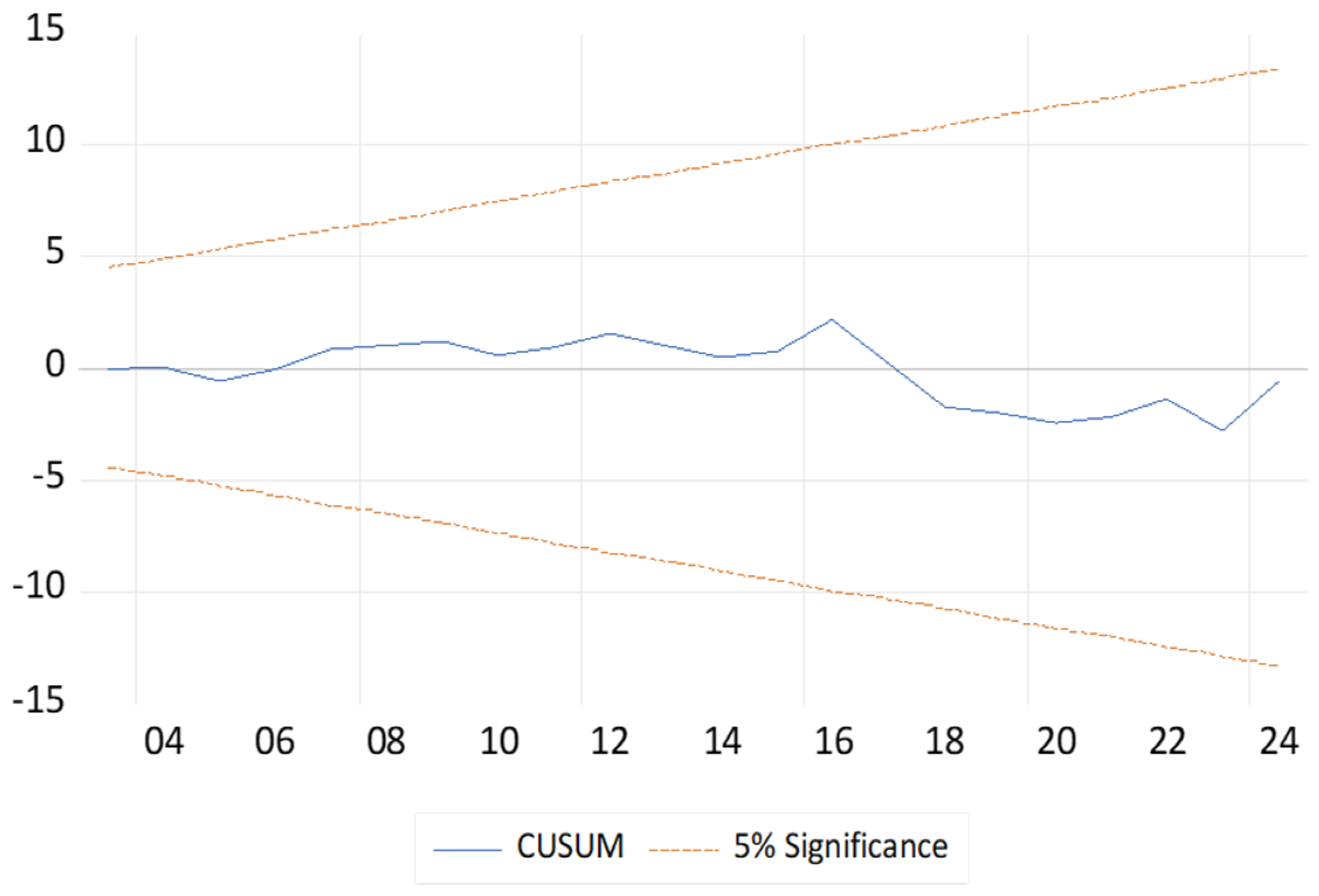
Given the mixed order of integration observed among the variables, the Autoregressive Distributed Lag (ARDL) bounds testing approach to cointegration was appropriate. The ARDL framework is particularly suitable for small sample sizes because it provides consistent long-run estimates even when regressors are a mixture of I(0) and I(1) processes [26]. The suitability of the ARDL framework in the present study was further supported by the diagnostic results (normality, heteroscedasticity and serial correlation tests) as well as the stability test results (CUSUM). However, it is important to note that the relatively small sample size and the presence of structural breaks may affect the robustness of the estimated relationships, and results are therefore interpreted with caution.
The ARDL bounds test is expressed as [26]:
Δ Y t =   γ 0 +   i = 1 p γ i Δ Y t i + j = 0 q δ j Δ x t j +   θ 0 Y t 1 +   θ 1 x 1 , t 1 + +   θ n x n , t 1 + ε t    
This formulation captures both the short-run and long-run dynamics of white maize prices ( Y t ) and their determinants ( x 1 , t , x 2 , t , , x n , t ). The first-differenced terms Δ Y t and Δ x t j represent short-term changes, allowing the model to measure immediate adjustments in response to shocks such as rainfall variation or fuel price changes. The coefficients γ i and δ j indicate the impact of past changes in maize prices and explanatory variables on current price movements. The lagged level terms ( Y t 1 , x 1 , t 1 , , x n , t 1 ) capture the long-run equilibrium relationship, while the parameters θ 0 , θ 1 , , θ n show how deviations from this equilibrium are corrected over time. The error term ε t represents unobserved factors affecting maize prices. The bounds test is used to determine whether the lagged level variables collectively contribute to the explanation of Y t . The test evaluates the following joint hypotheses:
H 0 : θ 0 = θ 1 = = θ n = 0 H 1 :   At   least   one   θ i 0
The null hypothesis posits that no stable long-term association exists among the variables [26].
Furthermore, the Autoregressive Distributed Lag (ARDL) framework was used to examine both short-run and long-run determinants of white maize prices. This approach is widely recognised for its reliability in estimating long-run relationships, even with small sample sizes, and can be expressed in an error-correction form to separate short-term dynamics from long-term equilibrium adjustments [31,32].
The general long-run ARDL representation is expressed as follows [33]:
Y t =   β 0 + β 1 x t +   β 2 x 2 t + + β n x n t + u t
In the context of this study, the long-run relationship between white maize prices and their determinants is expressed by Equation (3), where Y t represents the producer price of white maize at time t , and x 1 , t , x 2 , t , , x n , t denote the explanatory variables, including maize production, imports, exports, fuel prices, exchange rate, and rainfall. The coefficients β 1 , β 2 , , β n measure the long-term impact of each determinant on maize prices, indicating how a permanent change in one factor affects the equilibrium price level. The constant term β 0 captures the baseline or average price when all explanatory variables are zero, while u t represents the stochastic error term, capturing shocks or other influences not included in the model.
The short-run and long-run dynamics of the ARDL model are made explicit when the model is rewritten in its error-correction representation.
The general error-correction form is expressed as [26]:
Δ Y t =   α 0 + i = 1 p α 1 i Δ x 1 , t i + i = 1 p α 2 i Δ x 2 , t i + + i = 1 p α 6 i Δ x 6 , t i + ϕ 1 x 1 , t 1 + ϕ 2 x 2 , t 1 + + ϕ 6 x 6 , t 1 + ε t
Here, Δ Y t denotes the change in white maize producer prices at time t , while x 1 , t , x 2 , t , and x 3 , t represent the key explanatory variables such as maize imports, fuel prices, and rainfall, respectively. The differenced terms Δ x i , t i capture the short-run effects of changes in the explanatory variables over the previous p periods on maize price fluctuations, with α 1 i , α 2 i , and α 3 i measuring the magnitude and direction of these short-term impacts. The lagged level variables x i , t 1 , together with their coefficients ϕ i , represent the long-run equilibrium relationships, reflecting how deviations from the long-run equilibrium influence maize prices over time. The constant term α 0 captures the baseline price level, and ε t is a stochastic error term accounting for unobserved shocks.

2.3. Causality Analysis

To examine the directional relationships among white maize prices and their determinants, the Toda–Yamamoto causality approach was employed. The approach (Toda and Yamamoto [34]), provides a robust framework for testing causal linkages in time-series data irrespective of the stationarity properties of the variables.
The procedure involves estimating an augmented Vector Autoregression (VAR) model of order k d m a x , expressed as [34]:
Y t = α + i = 1 k + d m a x β i Y t i + ε t
where Y t represents a vector of endogenous variables, α is a vector of intercept terms, β i are coefficient matrices, and ε t is a white-noise error term. The optimal lag length k was selected using standard VAR lag order selection criteria, based on the Akaike Information Criterion (AIC), Schwarz Criterion (SC), and Hannan–Quinn Criterion (HQ), Sequential modified LR test statistic (LR), and the final prediction error (FPE), consistent with standard econometric practice in time-series modelling [35]. The lag order that minimised these SC, HQ, FPE and LR was chosen. The results indicated an optimal lag length of k = 1 . The maximum order of integration ( d m a x ) was determined based on the unit root test results obtained from the Augmented Dickey–Fuller (ADF) test. The ADF test findings (Table 2) revealed that none of the variables were integrated of order two, implying that all variables are integrated at most of order one. Therefore, d m a x = 1 was implemented in the augmented causality test.

2.4. Bai–Perron Multiple Structural Break Test

To account for possible regime shifts in maize price dynamics, the Bai–Perron multiple structural break test was applied. The identified breaks would be accounted for in the estimations if they are permanent structural changes, rather than shock-driven changes.
The model is specified as [36]:
Y t   =   X t β t   +   u t ,   t = T j 1   +   1 , T j , j = 1 , m + 1
In the Bai–Perron multiple structural break model, Y t represents the dependent variable, while X t denotes the vector of regressors. The term β t refers to the coefficient vector that applies within regime j , and ut captures the error term. The breakpoints, denoted by T j , are the unknown points in the time-series where structural changes occur. Finally, m represents the number of structural breaks identified in the model.

3. Results

3.1. Unit Root Test Results

Stationarity was tested using the Augmented Dickey–Fuller (ADF) unit root test. The ADF tests were estimated with an intercept (constant) only, without a trend. The lag length was selected automatically using the Schwarz Information Criterion (SIC), with a maximum of seven lags. The results of the ADF unit root test reported in Table 2 indicate that all variables are stationary either in levels or after first differencing and none are integrated of order two. This confirms that the data satisfy the necessary conditions for the application of the ARDL bounds testing approach [26]. It is important to note that standard unit root tests can sometimes be affected by breaks in the series.

3.2. ARDL Bounds Test Results

The ARDL bounds test results are presented in Table 3 and the statistically significant bounds test (computed F-statistic exceeds the upper bound critical value at conventional significance levels) confirms the existence of a long-run cointegrating relationship between white maize prices and the studied climatic, macroeconomic, and trade-related determinants, implying that these variables move together over time despite short-run fluctuations. The critical values reported in Table 3 are the standard asymptotic critical values provided by Pesaran et al. [26], which are commonly used in ARDL applications.
Within the ARDL framework, such cointegration indicates that although maize prices may temporarily diverge from equilibrium due to shocks such as rainfall variability, fuel price changes, or trade disturbances, these deviations are not permanent and are corrected through an adjustment mechanism that restores long-run equilibrium [26]. This interpretation follows similar interpretations reported by Narayan & Narayan [37], indicating that agricultural prices and macroeconomic variables exhibit long-run co-movement despite short-term volatility. Evidence from Southern African maize markets further supports the present study’s interpretation of findings, with Davids et al. [12] showing that domestic maize prices remain anchored to their long-run fundamentals even when short-run disturbances occur. However, the presence of structural breaks (Section 3.7) suggests that the speed and pattern of adjustment may vary across different periods, reflecting the influence of regime shifts and external shocks. The policy implication of this result is that planners can better forecast and develop strategies to ensure stability of the commodity maize, which has an important food security role in South Africa.

3.3. ARDL Long-Run Model

The findings in Table 4 indicate that in the long run, maize imports and fuel prices have a positive significant effect on producer prices, while rainfall showed a weak positive significant effect. The present study’s findings are consistent with expectations; however, the results on maize production, exchange rate and exports are not significant.
A one-ton increase in maize imports is associated with a 0.55 currency unit increase per ton in domestic producer prices and the positive relationship provides an indication that imports operate as a transmission channel for international price movements rather than exerting downward pressure on domestic prices. This finding is comparable with Kilwake [38] finding that increases in maize import quantities are positively associated with domestic maize prices in the Kenyan context. Specifically, Kilwake [38] finds that a one per cent increase in maize import volumes is associated with approximately a 0.27–0.35 per cent increase in domestic maize prices in the short run, indicating measurable upward price transmission from import flows into local markets. In line with this evidence, the positive long-run coefficient on maize imports likely reflects the structural exposure of South Africa’s maize market to global price dynamics, especially during periods of domestic supply shortfalls. In a broader agricultural setting, Lubis & Panjaitan [39] show that, for Indonesian food commodities such as rice, wheat, milk, and sugar, increasing import volumes are associated with higher domestic prices in their econometric analysis of import volume and price dynamics. In that study, the VECM estimates show that a one-ton increase in rice imports raises domestic rice prices by 1.27 currency units, while wheat imports increase domestic prices by 23.85 units per additional ton. Similarly, milk imports increase domestic prices by 190.82 units per ton, and sugar imports raise prices by 2.06 units per ton. The diverse findings related to the highlighted agricultural commodities indicate why commodity-specific studies are relevant as results are not universally applicable across the agricultural sector.
Energy costs play a significant role, as can be observed from the findings indicating that a one-unit currency increase in fuel prices raises maize producer prices by approximately 1.88 units in the long run. This coefficient exhibits both the largest magnitude and strongest statistical significance among the significant regressors in the model, highlighting the central role of energy costs in maize price formation. Similar quantitative pass-through effects have been documented in the literature, such as Kpoda & Liu [40] showing that a 10% increase in domestic fuel prices raises overall inflation by 0.4–0.7 percentage points, with significant spillovers to food inflation components. In the Kenyan context, Ngare and Derek [41] find that a 1% increase in fuel prices increases food prices by approximately 0.27% in the long run.
Rainfall is positive and statistically significant at the 10% level (3.700209; p = 0.0864), indicating that a one-unit increase in rainfall is associated with an increase in maize producer prices of approximately 3.70 currency units in the long run. Although the effect is weaker than other determinants, it remains statistically detectable, suggesting that climatic variability contributes to maize price dynamics. The relatively lower level of statistical significance likely indicates that broader market mechanisms, such as trade exposure and energy costs, mediate the influence of rainfall on prices. However, this result can also be explained in the context of the heightened climatic stress during the 2011–2012 agricultural season in Southern Africa (see Section 3.7 on structural break tests). Empirical evidence from the other literature such as Odongo et al. [42] contradicts the present study’s findings. In Nigeria, Odongo et al. [42] reports that rainfall has a statistically significant long-run negative effect on food price inflation, with a coefficient of −0.509875 (p = 0.0002), indicating that a one-unit increase in average rainfall reduces domestic food inflation by approximately 0.51 percentage points.

3.4. ARDL Short-Run and Error-Correction Model

The estimated differenced short-run coefficients for variables and the error-correction term from the ARDL model are reported in Table 5.
The present study’s findings are in line with Minot [43] as well as Dardeer & Shaheen [44], supporting the view that imports can act as a channel of upward price transmission in the short run, especially under supply stress conditions. Changes in maize import volumes exert a positive short-run effect on domestic maize prices (coefficient = 0.312036; p = 0.0048). Rather than exerting downward pressure through supply expansion, this positive relationship suggests that import volumes may be responding to domestic supply shortfalls or rising international prices, thereby transmitting external market pressures into the domestic market. Fuel prices display both contemporaneous and lagged short-run effects on maize prices. The contemporaneous coefficient is positive and statistically significant (1.120233; p = 0.0020), indicating that a one-unit increase in the fuel price index increases maize prices by approximately 1.12 units within the same period. This reflects the immediate cost-push effect of higher energy prices on transportation, storage, and distribution costs within agricultural supply chains. The lagged fuel price coefficient is negative and statistically significant (−1.175162; p = 0.0011), suggesting partial short-term adjustment dynamics. This indicates that part of the fuel price shock from the previous period has already been incorporated into maize prices, moderating subsequent adjustments. This pattern aligns with evidence from Nazlioglu [45] estimating that a 1% increase in global oil prices raises international food commodity prices by roughly 0.15–0.35% in the short run (p < 0.05), and Baumeister and Kilian [46], who show that energy price shocks contribute significantly to food price volatility. In the South African context, Antwi et al. [47] report that a 1% increase in regional diesel prices is associated with a 0.42% rise in domestic grain prices, reflecting the central role of logistics in price formation.
Lagged rainfall exhibits a negative and statistically significant coefficient (−2.274490; p = 0.0073). This implies that a one-unit increase in rainfall in the previous period leads to a 2.27-unit decrease in maize prices in the current period. This effect reflects improved production expectations including higher rainfall during the growing season, signalling better yield prospects, reducing anticipated supply shortages and easing upward price pressures. These findings are consistent with Nguyen et al. [48], who showed that favourable rainfall conditions are associated with statistically significant reductions in staple food price volatility, with estimates indicating that a positive rainfall anomaly of one standard deviation is associated with a 5–8% reduction in cereal price inflation in rain-fed markets.
Crucially, the error-correction term is negative and highly significant (ECT = −1.129; p = 0.000), with a magnitude of the coefficient exceeding unity. This implies that maize prices adjust by more than 100 per cent of the previous period’s disequilibrium within one year, thus indicating overshooting behaviour, where short-run adjustments temporarily exceed the equilibrium correction required (the CUSUM test for model stability was performed, see Section 3.5). Importantly, because the coefficient remains negative, the adjustment process is thus oscillatory rather than explosive. This finding is plausible given the climatic shocks emanating from events such as drought, as well as identified structural breaks in periods of exchange rate depreciation and the COVID-19 pandemic (see Section 3.7 identifying the structural breaks), causing volatility, yet the maize system shows resilience and adequate mechanisms to correct itself following fluctuations.

3.5. Model Diagnostic Tests

To analyse the robustness and statistical soundness of the ARDL estimates, a series of diagnostic tests were undertaken. Residual normality was assessed using the Jarque–Bera test, while the ARCH test was employed to determine whether the error variance remained stable over time, thereby detecting potential heteroskedasticity. In addition, the Breusch–Godfrey LM test was applied to analyse the existence of serial correlation, since autocorrelated residuals can bias parameter estimates and undermine statistical inference.

3.5.1. Normality Test

The Jarque–Bera normality test results are presented in Table 6.
The normality test results indicate that the residuals are approximately normally distributed. The residual mean (2.62 × 10⁻¹³) is effectively zero, confirming that the error term is correctly centred. The skewness coefficient (0.629) reflects mild positive asymmetry, while the kurtosis value (3.311) is close to the normal benchmark of 3, indicating an approximately mesokurtic distribution. The Jarque–Bera statistic (2.0317) is statistically insignificant (p = 0.3621), implying that the null hypothesis of normality cannot be rejected. This confirms that the residuals satisfy the normality assumption required for valid statistical inference [26].

3.5.2. Heteroskedasticity Test

The heteroskedasticity test results (Table 7) provide no strong evidence of non-constant variance. In the first specification, both the F-statistic (0.082937; p = 0.9207) and the ObsR-squared statistic (0.185328; p = 0.9115) are statistically insignificant. This indicates that the null hypothesis of no heteroscedasticity (homoscedastic residuals) cannot be rejected. Therefore, there is no evidence of conditional heteroscedasticity, suggesting that the variance of the residuals remains stable over time. These estimates were found using the Breusch–Pagan test.

3.5.3. Serial Correlation Test

Breusch–Godfrey LM serial correlation test results presented in Table 8 show that the F-statistic (2.451838; p = 0.1222) is statistically insignificant, indicating that the null hypothesis of no serial correlation up to the second lag cannot be rejected. Although the Chi-square statistic suggests possible autocorrelation, econometric practice recommends prioritising the F-version of the test in small samples. Therefore, serial correlation is not regarded as a significant problem in the model [26], although the conflicting evidence indicates that minor autocorrelation cannot be entirely ruled out.

3.5.4. CUSUM Stability Test

The CUSUM Stability test results in Figure 1 shows that the CUSUM plot remains within the 5% critical bounds throughout the sample period, indicating parameter stability and the absence of structural instability. Although minor fluctuations are observed during certain sub-periods, the cumulative sum does not cross the critical lines, confirming that the estimated coefficients are stable over time [26].

3.6. Toda–Yamamoto Causality Test

The Toda–Yamamoto causality results in Table 9 reveal several meaningful predictive linkages between maize prices and their determinants.
The analysis shows a causal relationship in the direction of maize prices causing production (p = 0.0111). This causality reflects an interactive system where production shocks predict future price movements, implying that historical prices influence farmers’ production decisions. While this feedback loop is not in line with the study of Monteiro & Jammer [8], which reported that production disturbances driven by climate variability and cost pressures affect price volatility, the findings align with Ramoroka & Muchopa [49], who highlighted that producers adjust land allocation, input levels and cropping strategies in response to past and expected prices.
Exports show no causal effect on maize prices, confirming the position of South Africa that, because maize production is usually in surplus, exporting rather stabilises the domestic maize prices and does not necessarily lead to Granger causality in maize prices given that the maize prices would be close to export parity. This is in contrast with Tadesse [50] showing that international demand shocks and export linkages transmit to domestic food markets, often amplifying price pressures when global demand conditions are favourable. Additionally, because export contracts are often predetermined, domestic price signals do not necessarily feed back into export volumes, consistent with the absence of reverse causality. The findings further reveal that imports exhibit a strong unidirectional causal relationship with maize prices, significant at the 1% level (p = 0.0009), while the reverse relationship is not significant. This finding aligns with the ARDL results and underscores the importance of external supply dependence in shaping South Africa’s domestic maize pricing. This finding is consistent with the study of Baquedano & Liefert [51] showing that countries with higher levels of trade openness exhibit stronger transmission of global grain price shocks to domestic markets. Similarly, Minot [43] finds that increased market integration amplifies international price pass-through, particularly in liberalised trading environments. Glauben et al. [52] noted that recent global commodity shocks have further demonstrated how disruptions in international grain trade and energy markets transmit into domestic food prices. In the South African maize market, pricing behaviour has been shown to align with parity pricing mechanisms under conditions of trade exposure [10]. This supports the Granger result, indicating that import volumes help predict future maize price movements, while domestic prices do not significantly affect import decisions, which are largely driven by seasonal supply shortages rather than short-term domestic price levels.
Fuel prices display a weak causal influence on maize prices, significant at the 10% level (p = 0.0785), with no reverse causality. This gives somewhat of an insight into the role of energy costs in predicting price fluctuations within the agricultural sector. These findings align with Ledwaba et al. [53] identifying fuel prices as a major driver of input cost inflation, particularly in relation to transport, storage and mechanised operations. The international literature also supports this cost-push mechanism, with Nazlioglu [45] demonstrating persistent spillovers from energy prices into food commodity prices. The lack of reverse causality is expected, as global oil markets and domestic taxation determine fuel price behaviour, rather than domestic agricultural price dynamics.
Rainfall displays a unidirectional causal influence on maize producer prices, significant at the 5% level (p = 0.0336), with no reverse causality. The result confirms the role of rainfall as an exogenous climatic factor affecting agricultural production and, consequently, market supply conditions. These findings are consistent with those of Nguyen et al. [48], showing that rainfall variability significantly influences staple food price dynamics through its impact on agricultural output and supply stability. Similarly, Odongo et al. [42] identify rainfall as a key determinant of food price movements, particularly in rain-fed agricultural systems where production is highly sensitive to climatic conditions.
Taken together, the results indicate that rainfall, imports and fuel prices hold predictive power over maize prices in the domestic market, with statistical significance ranging between the 1% and 10% levels. Conversely, maize production, the exchange rate and exports show no significant causal influence at conventional confidence thresholds. These findings jointly propose that maize price movements in South Africa are driven more by imports, climatic factors and energy costs than by short-run macroeconomic conditions, production responses, or export conditions, aligning with recent empirical evidence on agricultural price formation in the region.

3.7. Structural Break Results

The results of the Bai–Perron multiple structural break test are reported in Table 10.
As shown in the table, the sum of squared residuals (SSR) declines sharply from approximately 39 million in the no-break model to 7.26 million when three breaks are included, indicating a substantial improvement in model fit once structural changes are accounted for. Both the Schwarz Criterion (SC) and the LWZ criterion support the presence of multiple breaks, with the SC specifically favouring a three-break specification. This pattern aligns with Smith & Patel [54], who document pronounced structural instability in South African summer grain markets during periods of macroeconomic and climatic shocks. Similarly, Pretorius & Geyser [55] report evidence of regime changes in South African maize price dynamics associated with climatic events and external market pressures.
The Bai–Perron procedure identified three statistically significant break dates: 2001, 2012, and 2021. The 2001 break coincides with a period of sharp exchange rate depreciation, during which the South African rand weakened substantially against the US dollar. As shown by Poonyth et al. [9], exchange rate volatility raises imported input costs, particularly fuel and fertilisers, thereby exerting upward pressure on maize prices. This period also reflects the lingering effects of agricultural market deregulation following the disbanding of the Maize Board, which exposed domestic maize prices to market forces and increased price volatility [56]. The 2012 break corresponds to heightened climatic stress and global commodity market instability. During the 2011–2012 agricultural season in Southern Africa, the rainfall season was marked by poor and erratic distribution of precipitation, including a delayed onset and prolonged dry spells in many areas, which contributed to reduced crop development and lower maize yields [57]. Concurrently, international commodity markets experienced renewed volatility during the post-2008 recovery phase, contributing to rising input costs and food price inflation [17]. This break therefore reflects the joint influence of domestic climatic shocks and global economic turbulence. The structural break observed from 2021 reflects the compounded effects of the COVID-19 pandemic’s disruptions to agricultural inputs and markets, global supply chain shocks, escalating fuel and transport costs, and renewed drought conditions that strained maize production systems. Mthembu et al. [58] found that COVID-19 movement restrictions hindered smallholder farmers’ access to critical inputs and reduced maize yields in South African rural areas. Interrupted grain market dynamics during the pandemic further disrupted price signals and production incentives [59]. Simultaneously, climate variability including heat and drought events has been linked to significant maize yield variability in South Africa [60].
While these structural breaks indicate pronounced short-run regime shifts, the ARDL framework adopted in this study assumes that the long-run relationship between white maize prices and their fundamental determinants remains stable over time [26]. This assumption is theoretically defensible, as the identified breaks are interpreted as shock-driven deviations around a stable equilibrium, rather than permanent structural changes in price formation mechanisms, following the approach of [37]. Accordingly, as noted by Pesaran et al. [26], the break analysis is used to inform interpretation of the short-run dynamics and the speed of adjustment, rather than to redefine the long-run coefficients. The continued significance of the error-correction mechanism is consistent with the ARDL framework developed by Pesaran et al. [26], which allows for stable long-run equilibrium relationships despite short-run disturbances. Moreover, Narayan & Popp [61] show that explicitly accounting for structural breaks improves inference regarding stationarity and persistence. While ignoring structural breaks may affect inference regarding persistence [61], the statistically significant and correctly signed error-correction term suggests that the underlying long-run relationship remains stable despite short-run regime shifts [26].

3.8. Validation Checks on the Standard ARDL Versus the Augmented (With Break Dummies) ARDL

An augmented ARDL model, incorporating structural breaks as a dummy variable, was run for the purposes of validating the use of the standard ARDL model in the present study. Firstly, the ARDL bounds tests showed the existence of long-run relationships among white maize prices and selected climatic, trade and macroeconomic determinants, which is a similar observation to the standard form. However, in the long-run analysis, the three break dummies that were incorporated into the model were found to be insignificant, meaning that they have no statistical effect on white maize prices; therefore, they could be excluded in the standard model. This finding is consistent with the argument that cointegrated systems may remain stable despite structural changes, as long-run relationships are anchored by underlying economic fundamentals. This was further supported by the CUSUM test, which showed stability of the model both in the standard and augmented form of the ARDL model. Given these observations, it is important to note that the model might not have the strength to estimate the break dummies accurately due to the small sample size of the study. In the short run, the augmented ARDL estimates indicated that break dummies for the years 2012 and 2021 have a statistically significant effect on white maize prices. These findings support the earlier argument that the breaks represent “shock-driven deviations around a stable equilibrium” and are used mainly to interpret short-run dynamics rather than to redefine the long-run relationship. Similar evidence is provided by Narayan & Popp [61], who demonstrate that structural breaks often reflect transitory adjustments in time-series rather than persistent shifts in long-run relationships.

4. Conclusions

This study examined the determinants of white maize producer price movements in South Africa using annual data from 1994 to 2024 within an ARDL modelling framework. The empirical results confirm the existence of a long-run relationship between maize prices and key climatic, trade, and macroeconomic variables. In both the short and long run, maize imports and fuel prices emerge as the most influential drivers of price movements, exerting positive and statistically significant effects. Rainfall influences maize prices primarily in the short run, while maize production and the exchange rate are found to be statistically insignificant once trade and cost variables are accounted for. Structural break analysis further reveals that maize price dynamics have undergone significant regime shifts associated with macroeconomic instability, climatic shocks, and global market disruptions. The study provides an integrated, long-horizon perspective on white maize price dynamics in South Africa within a single ARDL–ECM framework. By distinguishing between short-run adjustments and long-run equilibrium relationships, the study advances understanding of the mechanisms through which external shocks and domestic cost pressures shape staple food prices in South Africa. The policy implications derived from the results are clear. Given the dominant role of imports in both the short and long run, strategic trade management and the maintenance of adequate grain reserves are critical for cushioning domestic markets against international price volatility during deficit periods. The strong influence of fuel prices highlights the importance of stabilising transport and energy costs along the maize value chain to mitigate food price inflation. While climatic variability affects prices mainly in the short run, although weakly, it indicates the need for strengthening climate-risk mitigation measures, such as investment in drought-resilient technologies and early-warning systems, which remain essential for improving market stability and food security. Despite these contributions, the study is subject to several limitations. The use of annual data limits the ability to capture intra-year price volatility and seasonal dynamics, while the focus on aggregate national data may mask regional/provincial heterogeneity in maize markets. In addition, the analysis does not explicitly incorporate storage behaviour, policy interventions, or global maize price indices, which may further influence domestic price formation. Future research could address these limitations by incorporating the structural breaks, employing higher-frequency data, incorporating regional market analysis, and extending the framework to include stock levels, policy variables, and international price transmission mechanisms. Such extensions would further enhance understanding of maize price dynamics and support more-targeted policy interventions. Overall, the findings emphasise the need for a coordinated policy approach that simultaneously addresses trade exposure, energy cost pressures, and climate variability to ensure sustainable maize price stability and food security in South Africa.

Author Contributions

Conceptualization, P.G.S. and C.L.M.; methodology, P.G.S. and C.L.M.; validation, P.G.S.; formal analysis, P.G.S.; investigation, P.G.S.; writing—original draft, P.G.S. and C.L.M.; writing—review and editing, P.G.S., C.L.M. and A.V.B.; supervision, C.L.M. and A.V.B. All authors have read and agreed to the published version of the manuscript.

Funding

This research received no external funding.

Institutional Review Board Statement

Not applicable.

Informed Consent Statement

Not applicable.

Data Availability Statement

The data utilised in the study are publicly available on the stated websites in Table 1.

Conflicts of Interest

The authors declare no conflicts of interest.

Abbreviations

The following abbreviations are used in this manuscript:
ARDLAutoregressive Distributed Lag
ECMError Correction Model
FAOFood and Agriculture Organization
ADFAugmented Dickey–Fuller
OECDOrganisation for Economic Co-operation and Development
Stats SAStatistics South Africa
NAMCNational Agricultural Marketing Counsel

References

  1. Shiferaw, B.; Prasanna, B.M.; Hellin, J.; Bänziger, M. Crops that feed the world: Past successes and future challenges to the role played by maize in global food security. Food Secur. 2011, 3, 307–327. [Google Scholar] [CrossRef]
  2. OECD/FAO. OECD–FAO Agricultural Outlook 2024–2033; OECD Publishing: Paris, France; FAO: Rome, Italy, 2024. [Google Scholar] [CrossRef]
  3. NAMC. South African Grain Market Outlook; National Agricultural Marketing Council: Pretoria, South Africa, 2022. [Google Scholar]
  4. Statistics South Africa. Producer Price Index; Statistics South Africa: Pretoria, South Africa, 2023. Available online: https://www.statssa.gov.za/publications/P01421/P01421December2023.pdf? (accessed on 26 February 2026).
  5. BFAP. The South African Agricultural Baseline; Bureau for Food and Agricultural Policy: Pretoria, South Africa, 2022. [Google Scholar]
  6. Gardner, B.L. The farm-retail price spread in a competitive food industry. Am. J. Agric. Econ. 1975, 57, 399–409. [Google Scholar] [CrossRef]
  7. Meyer, J.; von Cramon-Taubadel, S. Asymmetric price transmission: A survey. J. Agric. Econ. 2004, 55, 581–611. [Google Scholar] [CrossRef]
  8. Monteiro, M.A.; Jammer, B.D. Price dynamics in South African agriculture: A study of cross-commodity spillovers between grain and livestock markets. Sustainability 2024, 16, 3136. [Google Scholar] [CrossRef]
  9. Poonyth, D.; Van Zyl, J.; Meyer, F.H. Forecasting the market outlook for the South African maize and sorghum sector using econometric modelling. Agrekon 2000, 39, 607–619. [Google Scholar] [CrossRef]
  10. Abidoye, B.O.; Labuschagne, M.H. The transmission of world maize price to South African maize market: A threshold cointegration approach. Agric. Econ. 2014, 45, 501–512. [Google Scholar] [CrossRef]
  11. Jayne, T.S.; Zulu, B.; Nijhoff, J.J. Stabilizing food markets in Eastern and Southern Africa. Food Policy 2006, 31, 328–341. [Google Scholar] [CrossRef]
  12. Davids, T.; Meyer, F.; Westhoff, P. Impact of trade controls on price transmission between southern African maize markets. Agrekon 2017, 56, 223–232. [Google Scholar] [CrossRef]
  13. Sabola, G.A. Climate change impacts on agricultural trade and food security in emerging economies: Case of Southern Africa. Discov. Agric. 2024, 2, 12. [Google Scholar] [CrossRef]
  14. FAO. The State of Agricultural Commodity Markets 2022; Food and Agriculture Organization of the United Nations: Rome, Italy, 2022. [Google Scholar]
  15. OECD/FAO. OECD–FAO Agricultural Outlook 2023–2032; OECD Publishing: Paris, France, 2023. [Google Scholar] [CrossRef]
  16. World Bank. Commodity Markets Outlook: The Impact of the War in Ukraine on Commodity Markets; World Bank: Washington, DC, USA, 2022. [Google Scholar]
  17. Gilbert, C.L. How to understand high food prices. J. Agric. Econ. 2010, 61, 398–425. [Google Scholar] [CrossRef]
  18. Lobell, D.B.; Schlenker, W.; Costa-Roberts, J. Climate trends and global crop production since 1980. Science 2011, 333, 616–620. [Google Scholar] [CrossRef]
  19. FAO. The State of Agricultural Commodity Markets 2023: Market Transparency and Food Security; Food and Agriculture Organization of the United Nations: Rome, Italy, 2023. [Google Scholar]
  20. Radebe, N. The Rising Cost of Agricultural Inputs and Implications on Food Prices in South Africa; National Agricultural Marketing Council: Pretoria, South Africa, 2025; Available online: https://www.namc.co.za/wp-content/uploads/2025/11/The-rising-cost-of-agricultural-inputs-and-implications-on-food-prices-in-South-Africa.pdf (accessed on 26 February 2026).
  21. BFAP. Food Inflation Brief—April 2023; Bureau for Food and Agricultural Policy: Pretoria, South Africa, 2023; Available online: https://www.bfap.co.za/wp-content/uploads/2023/05/Food-Inflation-brief_April_2023.pdf (accessed on 26 February 2026).
  22. FAO. Crop Prospects and Food Situation—Triannual Global Report No. 3, November 2023; Food and Agriculture Organization of the United Nations: Rome, Italy, 2023; Available online: https://openknowledge.fao.org/3/cc8566en/cc8566en.pdf (accessed on 26 February 2026).
  23. Mwakiwa, E.; Wineman, A.; Agyei Holmes, A.; Fall, M.G.; Kirimi, L.; Mpenda, Z.; Mutandwa, E.; Ogunbayo, I.; Tschirley, D. Price shocks and associated policy responses stemming from the Russia-Ukraine war and other global crises: Evidence from six African countries. Glob. Food Secur. 2025, 45, 100861. [Google Scholar] [CrossRef]
  24. Rath, B.; Mishra, D. Tracing the effects of structural break and climatic factors on the production of major commercial crops in India. Discov. Agric. 2025, 3, 250. [Google Scholar] [CrossRef]
  25. Jembere, T.; Mushunje, A.; Chaminuka, P. Effects of climate change on maize prize volatility in South Africa: Evidence from a GARCH model. In Proceedings of the 7th African Conference of Agricultural Economics & 60th Annual AEASA Conference, Durban, South Africa, 18–21 September 2023; Available online: https://hdl.handle.net/10568/137235 (accessed on 29 January 2026).
  26. Pesaran, M.H.; Shin, Y.; Smith, R.J. Bounds testing approaches to the analysis of level relationships. J. Appl. Econ. 2001, 16, 289–326. [Google Scholar] [CrossRef]
  27. Jordaan, H.; Grové, B.; Jooste, A.; Alemu, A.G. Measuring the price volatility of certain field crops in South Africa using the ARCH/GARCH approach. Agrekon 2007, 46, 306–322. [Google Scholar] [CrossRef]
  28. Sunde, T. Impact of trade openness and exchange rate volatility on South Africa’s industrial growth: Assessment using ARDL and SVAR models. Sustainability 2025, 17, 4933. [Google Scholar] [CrossRef]
  29. Ollech, D.; Deutsche Bundesbank. Economic analysis using higher-frequency time series: Challenges for seasonal adjustment. Empir. Econ. 2023, 64, 1375–1398. [Google Scholar]
  30. Dickey, D.A.; Fuller, W.A. Likelihood ratio statistics for autoregressive time series with a unit root. Econometrica 1981, 49, 1057–1072. [Google Scholar] [CrossRef]
  31. Shrestha, M.B.; Guna, N. Selecting appropriate methodological framework for time series data analysis. J. Financ. Data Sci. 2018, 4, 71–89. [Google Scholar] [CrossRef]
  32. Nkoro, E.; Uko, A.K. Autoregressive distributed lag (ARDL) cointegration technique: Application and interpretation. J. Stat. Econom. Methods 2016, 5, 63–91. [Google Scholar]
  33. Engle, R.F.; Granger, C.W.J. Co-integration and error correction: Representation, estimation, and testing. Econometrica 1986, 55, 251–276. [Google Scholar] [CrossRef]
  34. Toda, H.Y.; Yamamoto, T. Statistical inference in vector autoregressions with possibly integrated processes. J. Econ. 1995, 66, 225–250. [Google Scholar] [CrossRef]
  35. Gujarati, D.N.; Porter, D.C. Basic Econometrics, 6th ed.; McGraw-Hill: New York, NY, USA, 2018. [Google Scholar]
  36. Bai, J.; Perron, P. Computation and analysis of multiple structural change models. J. Appl. Econ. 2003, 18, 1–22. [Google Scholar] [CrossRef]
  37. Narayan, P.K.; Narayan, S. Modelling oil price volatility. Energy Policy 2007, 35, 6549–6553. [Google Scholar] [CrossRef]
  38. Kilwake, P. Analysis of the Determinants of Domestic Maize Prices in Kenya. Ph.D. Thesis, Strathmore University, Nairobi, Kenya, 2021. Available online: http://hdl.handle.net/11071/12671 (accessed on 20 February 2026).
  39. Lubis, A.D.; Panjaitan, D.V. Volatility of volume imports of major food commodities in Indonesia. Econ. J. Emerg. Mark. 2012, 4, 127–142. [Google Scholar] [CrossRef]
  40. Kpodar, K.; Liu, B. The distributional implications of the impact of fuel price increases on inflation. Energy Econ. 2022, 108, 105909. [Google Scholar] [CrossRef]
  41. Ngare, E.; Dereck, N. Effect of fuel prices on food prices in Kenya. Int. J. Econ. Commer. Manag. 2021, 9, 127–131. [Google Scholar] [CrossRef]
  42. Odongo, M.M.; Misati, R.N.; Kamau, A.W.; Kisingu, K.N. Climate change and food price inflation in Nigeria. Sustainability 2022, 14, 14764. [Google Scholar] [CrossRef]
  43. Minot, N. Food price volatility in sub-Saharan Africa: Has it really increased? Food Policy 2014, 45, 45–56. [Google Scholar] [CrossRef]
  44. Dardeer, M.; Shaheen, R. Structural determinants of food price inflation and food security implications: Evidence from GCC panel data. Humanit. Soc. Sci. Commun. 2025, 12, 1877. [Google Scholar] [CrossRef]
  45. Nazlioglu, S.; Erdem, C.; Soytas, U. Volatility spillover between oil and agricultural commodity markets. Energy Econ. 2013, 36, 658–665. [Google Scholar] [CrossRef]
  46. Baumeister, C.; Kilian, L. Do oil price increases cause higher food prices? Econ. Policy 2014, 29, 691–747. [Google Scholar] [CrossRef]
  47. Antwi, A.; Kammies, E.T.; Chaka, L.; Arasomwan, M.A. Forecasting South African grain prices and assessing the non-linear impact of inflation and rainfall using a dynamic Bayesian generalised additive model. Front. Appl. Math. Stat. 2025, 11, 1582609. [Google Scholar] [CrossRef]
  48. Nguyen, H.; Randall, M.; Lewis, A. Factors affecting crop prices in the context of climate change—A review. Agriculture 2024, 14, 135. [Google Scholar] [CrossRef]
  49. Ramoroka, P.; Muchopa, C.L. Inter-commodity price transmission between maize and wheat in South Africa. Int. J. Econ. Financ. Issues 2022, 12, 57–63. [Google Scholar] [CrossRef]
  50. Tadesse, G.; Algieri, B.; Kalkuhl, M.; von Braun, J. Drivers and triggers of international food price spikes and volatility. Food Policy 2014, 47, 117–128. [Google Scholar] [CrossRef]
  51. Baquedano, F.G.; Liefert, W.M. Market integration and price transmission in consumer markets of developing countries. Food Policy 2014, 44, 103–114. [Google Scholar] [CrossRef]
  52. Glauben, T.; Svanidze, M.; Götz, L.; Prehn, S.; Jamali Jaghdani, T.; Đurić, I.; Kuhn, L. The war in Ukraine, agricultural trade and risks to global food security. Intereconomics 2014, 57, 157–163. [Google Scholar] [CrossRef]
  53. Ledwaba, K.L.; Muchopa, C.L.; Belete, A. Price interaction between crude oil, selected grains, and oilseeds in South Africa. Sustainability 2025, 17, 618. [Google Scholar] [CrossRef]
  54. Smith, J.; Patel, L. Testing for weak form efficiency and structural breaks in South Africa’s summer grain spot markets. Sustainability 2025, 18, 811. [Google Scholar] [CrossRef]
  55. Pretorius, A.; Geyser, M. The impact of El Niño–Southern Oscillation events on price volatility: The case of South African maize. Agriculture 2025, 15, 2361. [Google Scholar] [CrossRef]
  56. Geyser, J.M.; Pretorius, A.; Fourie, A. Trends in and determinants of South African maize exports in the post-deregulation era. J. Econ. Financ. Sci. 2024, 17, a862. [Google Scholar] [CrossRef]
  57. SADC FANR. 2011–2012 Regional Agricultural Season Assessment Report; Southern African Development Community: Gaborone, Botswana, 2012.
  58. Mthembu, B.E.; Mkhize, X.; Arthur, G.D. Effects of COVID-19 pandemic on agricultural food production among smallholder farmers in Northern Drakensberg areas of Bergville, South Africa. Agronomy 2022, 12, 531. [Google Scholar] [CrossRef]
  59. Gutierrez, L.; Pierre, G.; Sabbagh, M. Agricultural grain markets in the COVID-19 crisis: Insights from a GVAR model. Sustainability 2022, 14, 9855. [Google Scholar] [CrossRef]
  60. Makuya, V.; Tesfuhuney, W.; Moeletsi, M.E.; Bello, Z. Assessing the impact of agricultural drought on yield over maize growing areas, Free State Province, South Africa, using the SPI and SPEI. Sustainability 2024, 16, 4703. [Google Scholar] [CrossRef]
  61. Narayan, P.K.; Popp, S. A new unit root test with two structural breaks in level and slope at unknown time. J. Appl. Stat. 2010, 37, 1425–1438. [Google Scholar] [CrossRef]
Figure 1. CUSUM stability test results.
Agriculture 16 00804 g001
Table 1. Table of variables.
VariablesDescriptionMeasurement UnitsData Source
White maize producer priceAnnual average nominal white maize producer price measured in ZAR per ton.ZAR/tonQuantec
White maize productionThe annual quantity of white maize produced.TonsQuantec
Exchange rateAnnual average ZAR per US dollar.ZARQuantec
Exports The annual quantity of white maize exported.Tons Quantec
Imports The annual quantity of white maize imported.Tons SAGIS
Fuel pricesThe annual average nominal domestic fuel price.c/LQuantec, DMRE
Rainfall Annual total rainfall.mmTrading economics
Table 2. ADF unit root test results.
Variables LevelsFirst DifferenceOrder of Integration
Test StatisticsCritical Value at 5%ProbTest StatisticsCritical Value at 5%Prob
White maize producer price−0.84−2.9639710.79−7.45−2.9677670.00 ***I(1)
White maize production−3.32−2.9639720.02 **−8.2−2.9718530.00 ***I(0)
Exchange rate −0.08−2.9639720.94−4.8−2.9677670.00 ***I(1)
Exports −4.01−2.9639720.00 ***−5.49−2.9718530.00 ***I(0)
Imports −4.57−2.9677670.00 ***−6.23−2.9718530.00 ***I(0)
Fuel prices1.68−2.9718530.9993−5.62−2.9718530.00 ***I(1)
Rainfall −4.28−2.9639720.00 ***−6.94−2.9677670.00 ***I(0)
Note: *** 1% significance, ** 5% significance
Table 3. Autoregressive Distributed Lag bounds cointegration test.
StatisticValue Significance LevelI(0)I(1)
F-statistic 5.98784410%2.263.35
Number of regressors (k)65%2.393.38
1%3.004.15
Table 4. ARDL long-run results.
VariableCoefficient Std. Errort-statisticProb.
White maize production −0.0764090.075177−1.0163850.3246
Exchange rate31.7589840.890980.7766740.4487
Exports 0.1156340.1732840.6673090.5141
Imports 0.5476530.2097032.6115700.0189 **
Fuel prices 1.8845990.3926394.7998280.0002 ***
Rainfall3.7002092.0251671.8271130.0864 *
C−1462.0641159.937−1.2604690.2256
Note: *** 1% significance, ** 5% significance, and * 10% significance.
Table 5. ARDL short-run and error-correction results.
VariableCoefficient Std. Errort-StatisticProb.
D(Imports) 0.3120360.0955033.2672820.0048 ***
D(Fuel prices)1.1202330.3038073.6873160.0020 ***
D(Fuel prices(−1))−1.1751620.295560−3.9760490.0011 ***
D(Rainfall)0.4678530.7181270.6414900.5240
D(Rainfall(−1))−2.2744900.740754−3.0705080.0073 ***
CointEq(−1) −1.1292600.136085−8.2982050.0000 ***
StatisticValue
R-squared0.869443
Adjusted R-squared0.841061
Durbin–Watson stat2.485063
Note: *** 1% significance
Table 6. Normality test results.
StatisticValue
Mean 2.62 × 10⁻¹³
Median −39.64652
Maximum667.3993
Minimum −456.6359
Std. dev. 255.1046
Skewness0.62937
Kurtosis 3.311440
Jarque–Bera2.031719
Probability 0.362091
Table 7. Heteroskedasticity test results.
StatisticValue
F-statistic 0.082937
Prob. F(2, 24)0.9207
Obs*R-squared0.185328
Prob. Chi-square(2)0.9115
Table 8. Serial correlation test results.
StatisticValue
F-statistic 2.451838
Prob. F(2,24)0.1222
Obs*R-squared7.522695
Prob. Chi-square(2)0.0233
Table 9. Toda–Yamamoto causality test results.
Null HypothesisChi-sqProbability Decision
Maize production does not cause maize producer prices0.7970.3721Accept
Maize producer prices do not cause maize production6.4540.0111 ***Reject
Exchange rate does not cause maize producer prices 0.8180.3657Accept
Maize producer prices do not cause exchange rate0.7440.3883Accept
Exports do not cause maize producer prices0.2160.6417Accept
Maize producer prices do not cause exports1.0050.3160Accept
Imports do not cause maize producer prices11.0910.0009 ***Reject
Maize producer prices do not cause imports2.5610.1095Accept
Fuel prices do not cause maize producer prices3.0950.0785 *Reject
Maize producer prices do not cause fuel prices0.0810.7764Accept
Rainfall does not cause maize producer prices4.5130.0336 **Reject
Maize producer prices do not cause rainfall0.2320.6299Accept
Notes: Granger causality if p < 0.05. *** Statistically significant at 1% level. ** Statistically significant at 5% level. * Statistically significant at 10% level.
Table 10. Bai–Perron structural break test results.
Number of BreaksNumber of CoefficientsSum of Squared ResidualsSchwarz CriterionLWZ CriterionLog-Likelihood
0139,127,42214.1591214.20981−261.7365
1214,353,63713.3778513.53333−246.1928
259,109,84013.1447513.41013 *−239.1457
377,264,30413.13991 *13.52114−235.6368
496,655,86113.2739913.77802−234.2809
5116,299,18813.4404614.07560−233.4272
* Shows minimum information criterion values. Estimated break dates: 1: 2012; 2: 2011, 2021; 3: 2001, 2012, 2021; 4: 2001, 2007, 2012, 2021; 5: 2001, 2007, 2011, 2015, 2021.
Disclaimer/Publisher’s Note: The statements, opinions and data contained in all publications are solely those of the individual author(s) and contributor(s) and not of MDPI and/or the editor(s). MDPI and/or the editor(s) disclaim responsibility for any injury to people or property resulting from any ideas, methods, instructions or products referred to in the content.