Article

The Spatiotemporal Dynamics and Nonlinear Driving Mechanisms of Ecosystem Service Supply–Demand Relationships in the Yellow River Basin of Henan Province, China

1
School of Surveying and Land Information Engineering, Henan Polytechnic University, Jiaozuo 454000, China
2
Observation and Research Station of Land Ecology and Land Use in the Grain-Producing Area of Central China, Ministry of Natural Resources, Jiaozuo 454000, China
3
Key Laboratory of Vegetation and Environmental Change, Institute of Botany, Chinese Academy of Sciences, Beijing 100093, China
*
Authors to whom correspondence should be addressed.
Agriculture 2026, 16(7), 732; https://doi.org/10.3390/agriculture16070732
Submission received: 6 February 2026 / Revised: 13 March 2026 / Accepted: 25 March 2026 / Published: 26 March 2026
(This article belongs to the Section Ecosystem, Environment and Climate Change in Agriculture)

Abstract

With the intensification of human activities and climate variability, balancing ecosystem service (ES) supply and demand is critical for regional sustainable development. Existing studies predominantly focus on linear driving effects and lack integrated quantitative frameworks that link the spatiotemporal dynamics of ES supply–demand relationships (ESSDRs) with their nonlinear driving mechanisms, and few have systematically quantified the critical thresholds of driving factors and their interactive effects. To address these research gaps, this study quantified the supply, demand, and supply–demand ratios of four key ESs (food production [FP], carbon sequestration [CS], water yield [WY], and soil retention [SR]) in the Yellow River Basin of Henan Province (2000–2020) using the InVEST model and multi-source data. An analytical framework integrating the Extreme Gradient Boosting (XGBoost) model and Shapley Additive Explanations (SHAP) was established to identify dominant drivers, reveal nonlinear response patterns, and quantify critical thresholds. The results showed that FP and CS supply increased continuously, while WY and SR supply slightly declined; CS and WY demand grew faster than supply, leading to expanding deficits, whereas FP and SR maintained relative balance. Spatially, FP/CS surpluses concentrated in eastern plains and southwestern forests, WY deficits occurred in the northwest, and SR balance prevailed in most regions. Dominant drivers differed by ES type—arable land proportion (FP), population density (CS), precipitation (WY), and slope (SR)—all exhibiting distinct threshold effects (e.g., arable land proportion >0.6, slope >3°). These findings provide novel insights into ESSDR spatial heterogeneity and threshold-based regulation, offering a scientific basis for differentiated ecological management and sustainable spatial planning in the Yellow River Basin and similar ecologically vulnerable regions.

1. Introduction

Ecosystem services (ESs) refer to the multiple benefits that natural ecosystems provide to human societies, encompassing provisioning, regulating, supporting, and cultural services [1,2]. As a vital link between ecological systems and human well-being, ESs play a fundamental role in maintaining environmental stability, promoting economic development, and improving quality of life [3]. However, driven by rapid population growth, intensified urbanization, and increasing climate pressures, the mismatch between ES supply and demand has become increasingly prominent globally [4,5,6]. This challenge is particularly acute in river basin regions, where agricultural production, ecological protection, and urban expansion are closely intertwined, leading to significant imbalances in ES supply–demand (ESSD) that constrain the sustainable and coordinated development of socio-ecological systems [7,8]. Therefore, systematic assessment of ESSDRs is essential for formulating targeted management strategies and supporting the sustainable development of river basin ecosystems.
In ESSDR research, the spatial matching of ESSD and its dynamic driving mechanisms are core research focuses [9,10,11]. Spatial matching refers to the degree of alignment between ES provision and the distribution of societal demand, including surplus areas (supply > demand), deficit areas (demand > supply), and the overall spatial pattern of balance [12]. This pattern is primarily shaped by climate variability and human activities [9]. Driving mechanisms involve the factors and processes regulating supply–demand balance, including ecological factors (e.g., climate, topography, vegetation cover) and socio-economic factors (e.g., population density, land use intensity, urbanization) [9]. Uncovering these mechanisms is crucial for understanding how ecological and social factors influence supply–demand balance and its spatial distribution, providing a scientific basis for developing differentiated management strategies, optimizing resource allocation, and preventing ES imbalances [13].
Traditional methods for identifying driving factors, such as geographic detectors and geographically weighted regression, often struggle to fully capture nonlinear relationships and complex interactions, limiting insights into underlying mechanisms [9,14,15]. Although machine learning techniques have gained attention for their ability to handle high-dimensional, nonlinear, and interactive data, traditional machine learning methods (e.g., random forest, support vector machine) face limitations in interpretability, making it difficult to intuitively reveal the specific roles and threshold effects of driving factors on supply–demand balance [16,17,18,19,20]. To address this critical research gap, this study integrates the XGBoost model with SHAP analysis—an innovative approach that not only has higher fitting accuracy than Random Forest + SHAP but also quantitatively measures the marginal contributions of driving factors and identifies critical thresholds; compared with geographic detectors, this framework can capture continuous nonlinear relationships rather than just categorical factor interactions [21,22].
The Yellow River Basin of Henan Province, located in the middle and lower reaches of the Yellow River, serves as a transitional zone connecting the Loess Plateau and the North China Plain. Characterized by ecological diversity, this region plays a crucial role in agriculture, ecological protection, and population aggregation [23]. In recent years, rapid urbanization, land use transformations, and ongoing climate change have exacerbated contradictions between ES supply and demand, particularly in reconciling arable land protection, ecological restoration, and urban expansion [24]. As a key component of China’s national strategy for “ecological protection and high-quality development of the Yellow River Basin,” the Henan segment is critical for maintaining ESs, improving ecological conditions, and promoting regional progress. However, systematic evaluations of ES supply and demand in this region remain insufficient, hindering the development of science-based management strategies.
To address the aforementioned research gaps and the pressing issue of ES supply–demand imbalance in the Yellow River Basin of Henan Province, this study constructs a systematic research framework of “dynamic evolution–driving mechanism–regulation strategy,” integrating multiple analytical methods and multi-source data (remote sensing, model simulations, socio-economic statistics). Within this framework, natural and socio-economic drivers influence ecosystem service supply and demand through environmental conditions and human activities, thereby shaping the spatial–temporal dynamics of the ES supply–demand balance. When key driving factors exceed certain levels, threshold effects may emerge, leading to pronounced shifts in the supply–demand relationship and providing a scientific basis for targeted regulation strategies. The specific objectives are as follows: (1) quantify the supply and demand of four key ESs (FP, CS, WY, SR) from 2000 to 2020 using the InVEST model and statistical datasets, and calculate the supply–demand ratio to reveal their spatiotemporal dynamics; (2) apply Local Indicators of Spatial Association (LISAs) to examine the spatial correlation and clustering of supply–demand matching and their temporal changes; (3) integrate the XGBoost model with SHAP analysis to identify the driving effects and nonlinear response patterns of multiple socio-ecological factors, quantify the thresholds of key drivers, and analyze the complex mechanisms influencing the evolution of supply–demand patterns. The results are expected to enhance our understanding of the evolution of regional ESSDRs, provide a scientific basis for supporting ecological protection and high-quality development, and facilitate the precise regulation and sustainable use of ESs in the study area and similar ecologically vulnerable regions.

2. Materials and Methods

2.1. Research Area

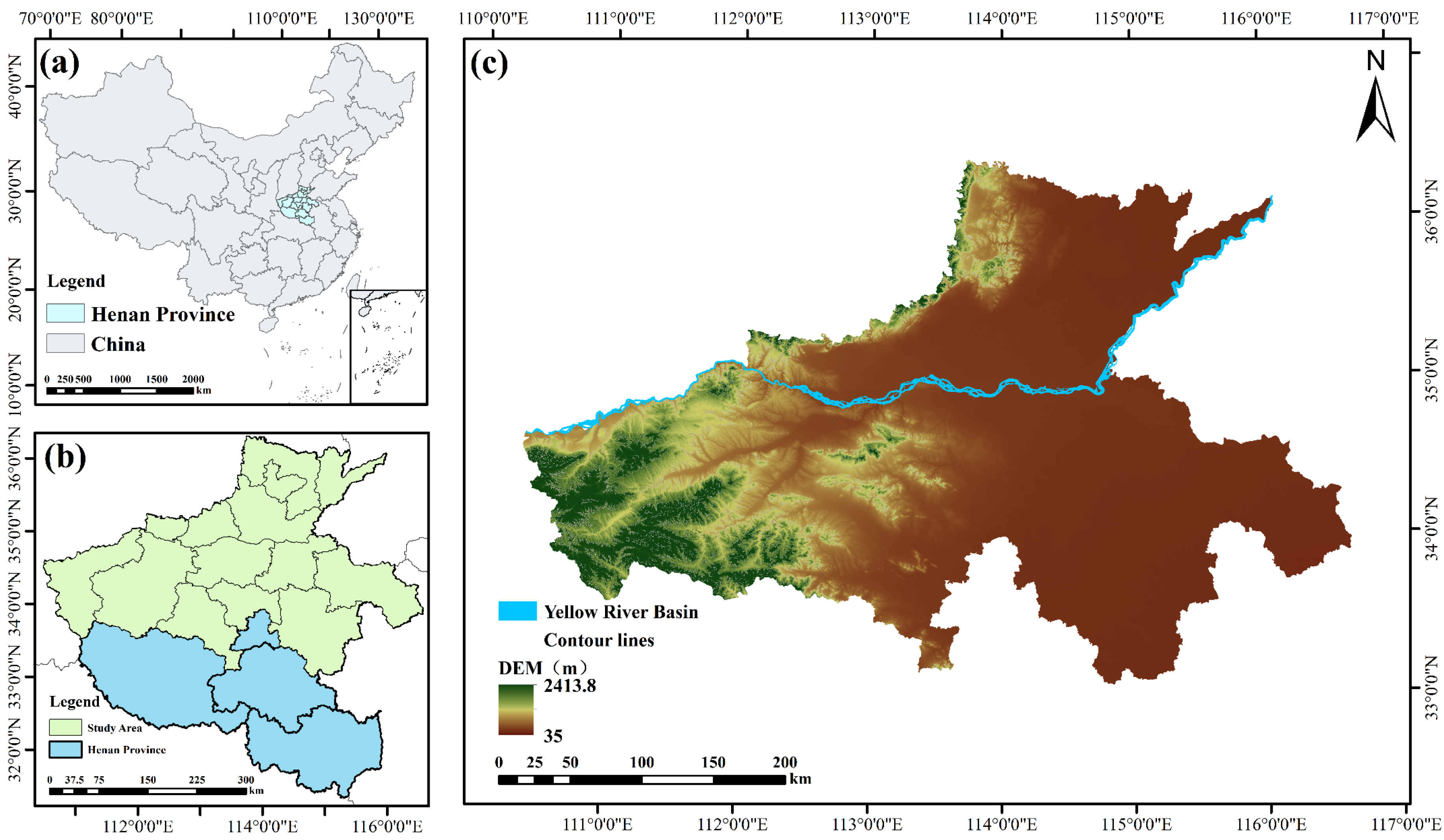
The study area, defined by the Territorial Spatial Planning of the Yellow River Basin in Henan Province (2021–2035), spans the second and third steps of China’s topographic gradient, covering the middle and lower reaches of the Yellow River. It includes 14 prefecture-level cities and 120 county-level administrative units, with a total area of approximately 102,500 km2 (Figure 1). The terrain generally slopes from west to east, featuring diverse ecosystem types and significant variations in natural geography and ecological functions. Located in a monsoon-influenced zone between warm temperate and subtropical climates, the region experiences distinct seasonal variations in temperature and precipitation.
The ecological systems in this region exhibit pronounced spatial heterogeneity. The western and northwestern areas are dominated by forest, grassland, and mountainous farmland ecosystems, serving as critical sources of multiple essential ESs. In contrast, the eastern and central regions are dominated by agricultural and urban ecosystems, functioning as key zones for food production and population aggregation. Driven by rapid economic development and intensified urbanization, mismatches between ES supply and demand have become increasingly evident, with the contradiction between declining supply capacity and growing demand further exacerbated. Ensuring the sustainable supply and effective regulation of ESs is therefore pivotal to maintaining ecological stability and enhancing human well-being [25,26,27].

2.2. Data Sources

This study utilized diverse data sources to assess ESSD, including remote sensing, land use, meteorology, soil properties, the digital elevation model (DEM), and socio-economic datasets. All data were standardized to the WGS_1984_UTM_Zone_50N projected coordinate system to ensure consistency in spatial referencing. Detailed information on data sources, spatial resolution, and usage is presented in Table 1.

2.3. Research Theoretical Framework

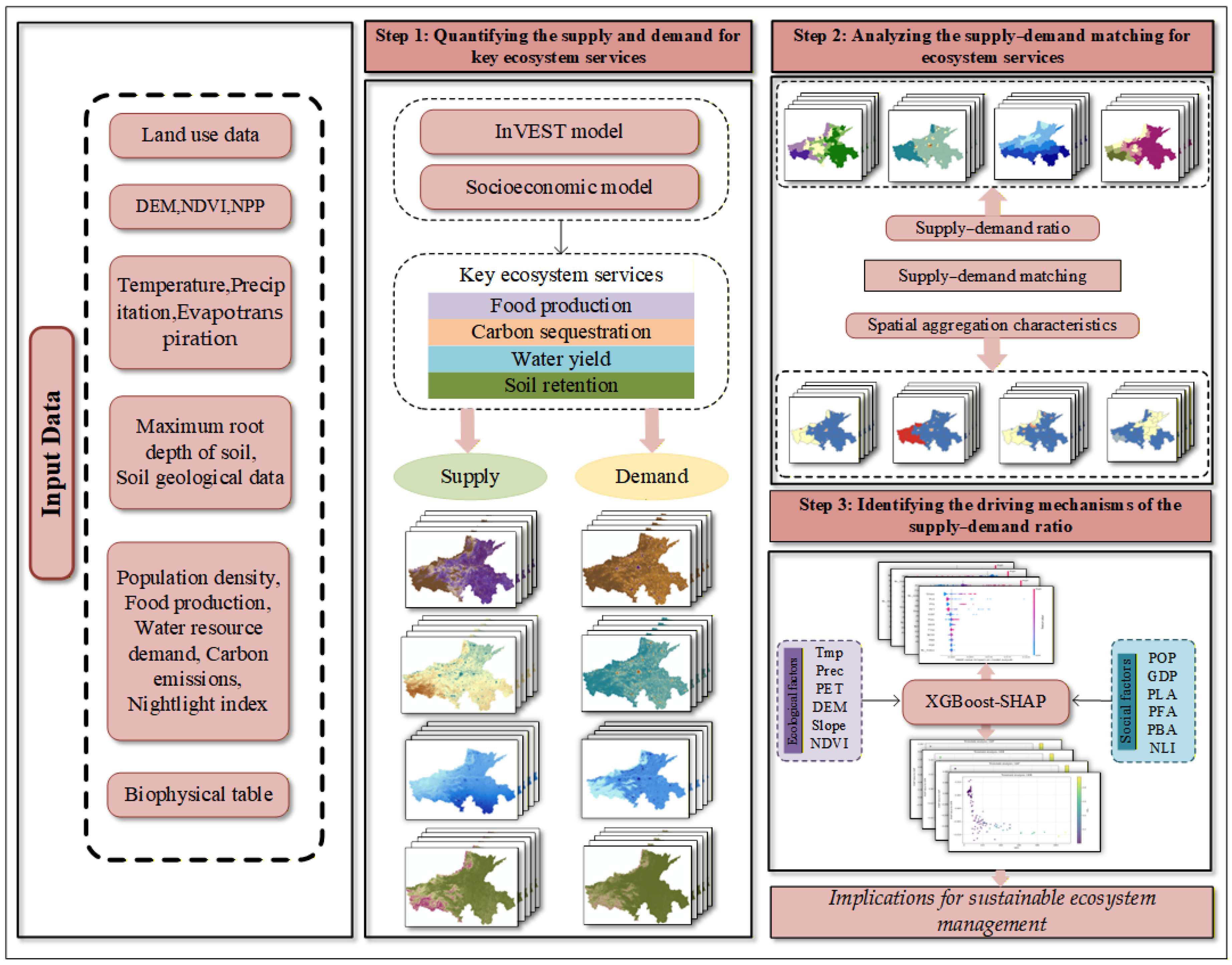
To provide a systematic overview of the analytical procedures, a research framework was established to guide the investigation of ESSDRs (Figure 2). The framework integrates three major components. (1) The supply and demand of four key ESs were quantified for the period 2000–2020, and their spatial–temporal patterns were analyzed. (2) The spatial matching and aggregation characteristics of ESSD were identified through local spatial autocorrelation analysis (LISA). (3) The XGBoost model combined with the SHAP interpretation approach was employed to explore the nonlinear effects and threshold responses of multiple socio-ecological drivers. This framework provides a coherent methodological basis for uncovering the dynamic mechanisms and spatial heterogeneity of ESSDRs.

2.4. Assessment of Supply and Demand for ESs

2.4.1. Food Production (FP)

FP is a key provisioning service with a well-established linear correlation between grain yield and NDVI [28]. FP supply was estimated by allocating total food yield (from statistical yearbooks) across arable land grids, weighted by NDVI values [29,30]. FP demand was derived by integrating per capita food requirements with regional population distribution [28]:
S F P x = N D V I x N D V I s u m × S s u m
D F P x = D F P p e r × P O P x
where S F P x and D F P x are the supply and demand values in grid x , respectively, N D V I x is the NDVI value in grid x , N D V I s u m is the total NDVI value of all arable land grids, S s u m is the total food production of the study area, D F P p e r is the per capita food requirement, and P O P x corresponds to the population density of grid x .

2.4.2. Carbon Sequestration (CS)

CS supply was assessed using the conversion coefficient between net primary productivity (NPP) and CO2—a key approach for quantifying ecosystem carbon sink capacity [31]. Based on the photosynthesis–respiration mechanism, 1.63 g of CO2 is fixed for each gram of dry matter formed [32]. CS demand was estimated by combining population distribution with per capita carbon emissions [33]:
S C S x = N P P x × γ
D C S x = D C S _ p e r × P O P x
where S C S x is the CS supply in grid x , N P P x indicates the primary net productivity (gC/m2) of grid x , and γ is the conversion factor between organic matter and CO2, with a value of 1.63. D C S x is the CS demand in grid x , D C S _ p e r is the average carbon emissions per person, and P O P x is the population grid x .

2.4.3. Water Yield (WY)

WY supply was evaluated using the Annual Yield module of the InVEST 3.14.0 model. The model is based on the Budyko water balance framework, which estimates annual water yield as the difference between precipitation and actual evapotranspiration [34]. Soil water storage capacity was represented by plant available water content (AWC), which was derived from soil texture data to reflect variations in soil water retention and evapotranspiration processes among land units. In addition, topographic conditions, particularly slope, may influence watershed hydrological responses. Steeper slopes tend to promote surface runoff generation and reduce infiltration opportunities, thereby affecting the spatial distribution of water yield. WY demand was represented by water consumption, including domestic, agricultural, and industrial use, with data extracted from statistical reports and hydrological bulletins [35]:
S W Y x = P x A E T x
D W Y x = P O P x × P C D W + A G R × A W C M + C L R × I W C M
where S W Y x is the annual water yield in grid   x ; A E T x is the yearly actual evapotranspiration of grid   x ; P x indicates the yearly precipitation of grid   x ; D W Y x is the WY demand in grid x ; P O P x is the population density of grid x ; P C D W is the per capita domestic water consumption; A G R and C L R are the grid data for arable land and construction land, respectively; A W C M is the water consumption of arable land; I W C M is the water consumption of construction land.

2.4.4. Soil Retention (SR)

SR supply was defined as the amount of soil retained by ecosystems, whereas SR demand was represented by the potential soil erosion volume [28]. In this study, soil retention and soil erosion were estimated using the Sediment Delivery Ratio (SDR) module of the InVEST 3.14.0 model, which simulates sediment generation and transport processes based on spatial datasets such as land use/land cover, rainfall erosivity, soil erodibility, and topographic factors.
S S D = R K L S U S L E
R K L S = R K L S
U S L E = R K L S C P
D S D = U S L E
where S S D and D S D are the supply and demand of SR, respectively; R K L S is the potential soil erosion rate; U S L E is actual soil loss; R is rainfall erosivity; K   is soil edibility; L is slope length; S is slope gradient; C is vegetative cover; and P is a soil conservation measure. The key parameters (C and P factors) in the USLE model were optimized based on the actual situation of the study area and its published literature to ensure the simulation accuracy.

2.4.5. Supply–Demand Ratio

The ES supply–demand ratio reflects the balance between ecological provisioning capacity and anthropogenic needs, serving as a key indicator of ecosystem sustainability [36]:
E S D R i = E S i s E S i d ( E S s m a x + E S d m a x ) / 2
where E S D R i is the service supply–demand ratio of ES type   i ; E S i s and E S i d are the supply and demand of ES type   i ; E S s m a x and E S d m a x are the maximum values of supply and demand for ES type i , respectively.

2.5. Supply–Demand Matching Characteristics of ESs

The bivariate Local Indicators of Spatial Association (LISAs) were used to capture spatial associations between individual grid units and their neighbors, as well as the overall spatial aggregation of ESSD. This method categorizes grid units into four types: high supply–high demand (HH), low supply–low demand (LL), high supply–low demand (HL), and low supply–high demand (LH). This classification enables precise identification of synergistic areas and mismatch hotspots, providing a solid spatial basis for regional ecological management and resource optimization.

2.6. Driving Mechanism Analysis Based on XGBoost Model and SHAP Values

Traditional models are often limited by spatial heterogeneity and data complexity in ESSDR analysis. The XGBoost model offers high fitting accuracy and computational efficiency, making it suitable for capturing nonlinear relationships and variable interactions in complex, high-dimensional datasets [37]. It also incorporates regularization to prevent overfitting and parallel computation to enhance performance. In this study, a separate XGBoost model was fitted for each of the four ESSDRs.
Integrating the XGBoost model with the SHAP interpretability framework allows for the identification of principal factors influencing ESSDR evolution, including their direction of influence, nonlinear response characteristics, and threshold effects—addressing the limitations of traditional linear models in revealing complex drivers. The objective function of the XGBoost model is expressed as follows:
O b j ( t ) i = 1 n L y i , y ^ i ( t 1 ) + g i f t x i + 1 2 h i f t 2 x i + i = 1 t Ω ( f i )
where O b j ( t ) is the objective function after t iterations;   L y i , y ^ i ( t 1 ) is the loss function between the actual value y i , and the predicted value y ^ i ( t 1 ) after t 1 iterations; g i and h i are the first and second derivatives of the loss function, respectively; f t x i is the prediction function of the t - t h decision tree; Ω ( f i ) is the regularization term of the   i - t h decision tree.

3. Results

3.1. Spatiotemporal Evolution of Supply and Demand for ESs

3.1.1. Assessment of ES Supply

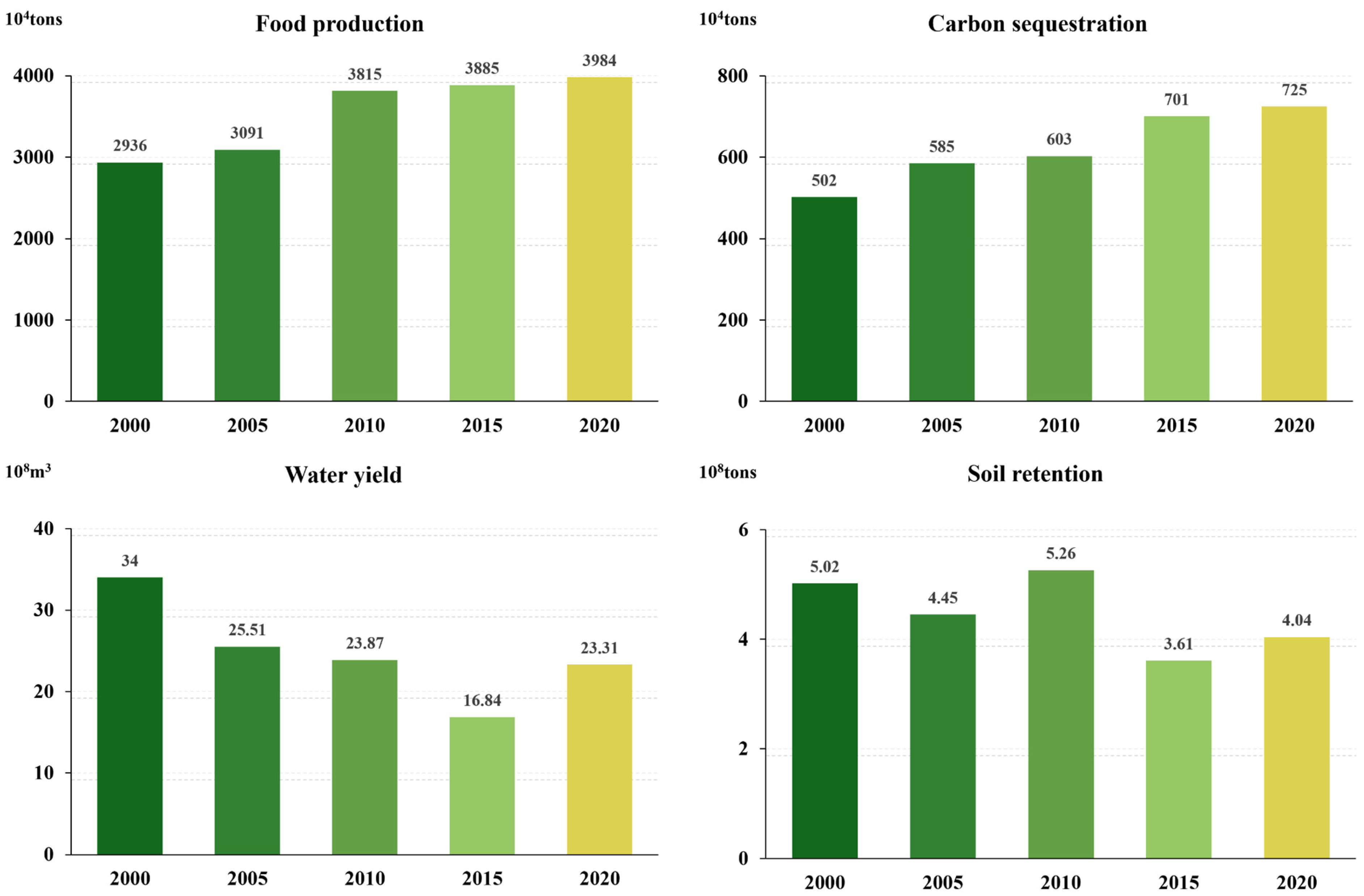
The total supply of ESs in the study area across five time periods is presented in Figure 3. From 2000 to 2020, the total supply of FP increased significantly, rising from 29.36 million tons to 39.84 million tons, showing an overall sustained upward trend. Notably, the period 2005–2010 recorded the highest growth rate of FP supply among all intervals. For CS, the total supply gradually increased from 5.02 million tons to 7.25 million tons, exhibiting a stable upward trajectory with relatively prominent growth during 2000–2005 and 2010–2015. In contrast, WY and SR displayed fluctuating trends over the study period. The total supply of WY decreased from 3.4 billion cubic meters to 2.331 billion cubic meters, while that of SR declined from 502 million tons to 404 million tons, with both services showing an overall downward trend.
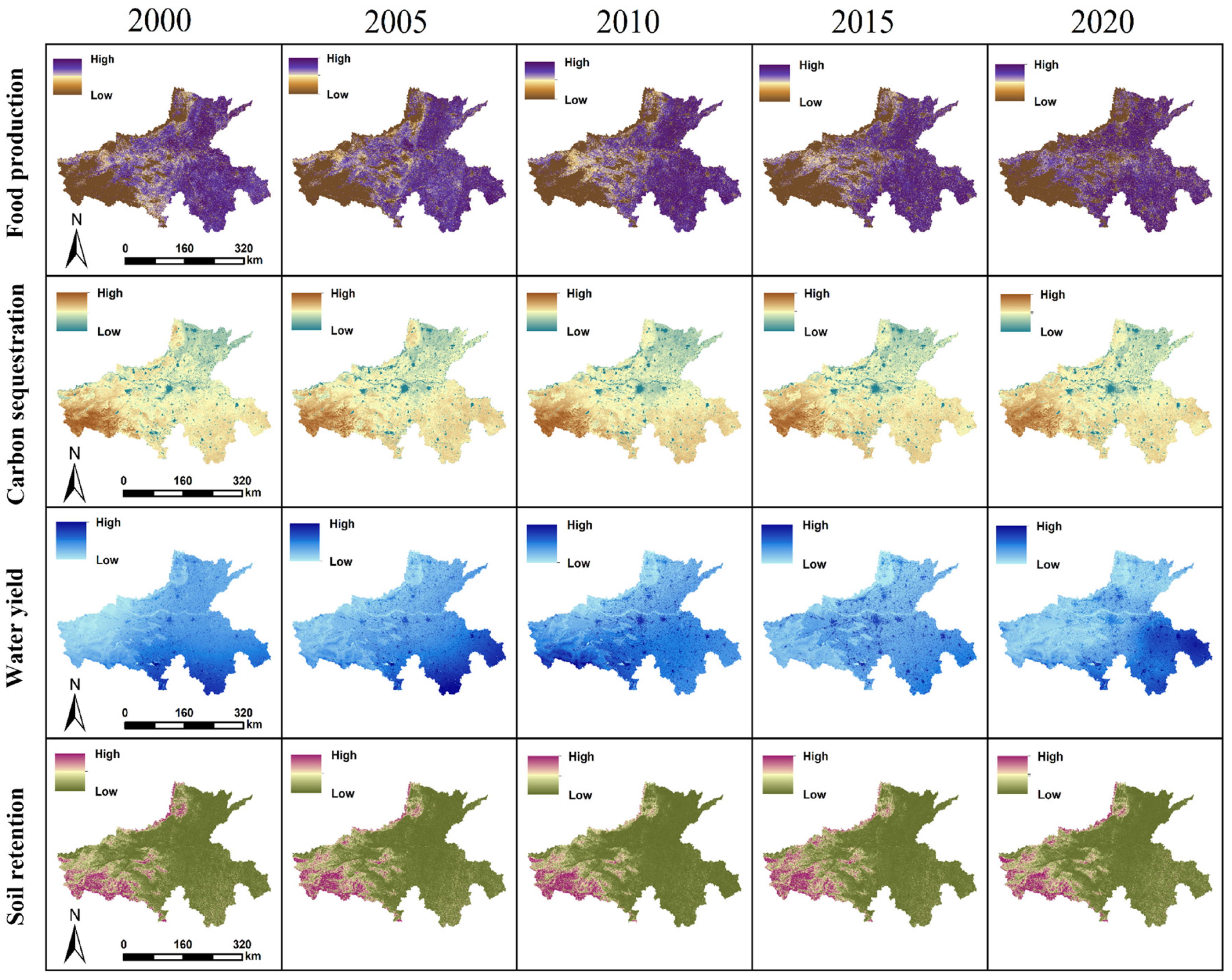
From 2000 to 2020, ES supply in the study area exhibited pronounced spatiotemporal variations (Figure 4). High-value FP zones were primarily distributed in the eastern and central plains, where flat terrain, concentrated croplands, and favorable agricultural conditions prevail. High-value CS zones were consistently located in the forested mountainous areas of the west and southwest. High-value WY zones experienced a reduction in extent and shifts in spatial centers over time, while high-value SR zones were persistently concentrated in forested mountainous and hilly regions along the western, southwestern, and northern margins. Overall, different ESs demonstrated distinct spatial differentiation patterns across the study area.

3.1.2. Assessment of ES Demand

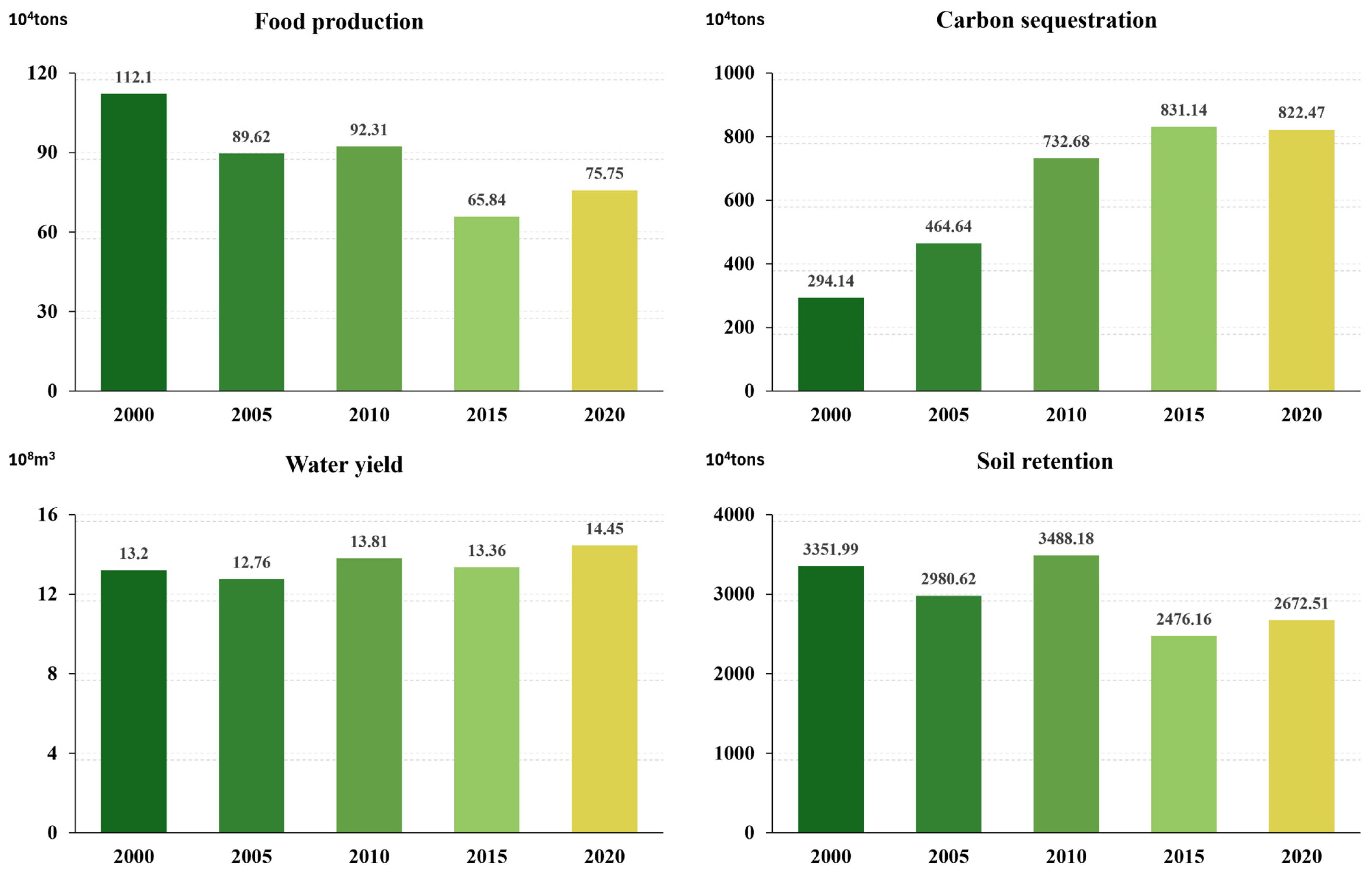
The total demand for ESs in the study area from 2000 to 2020 is illustrated in Figure 5. Over this two-decade period, the total demand for FP showed a consistent downward trend, decreasing from 1.121 million tons to 757,500 tons. For CS, total demand increased overall—rising from 294.14 million tons in 2000 to 822.47 million tons in 2020—despite experiencing periodic fluctuations. WY exhibited steady growth with moderate variability, and the overall fluctuation range remained limited; its total demand increased from 1.32 to 1.445 billion cubic meters, corresponding to a cumulative growth rate of 9.5%. In contrast, the total demand for SR displayed a fluctuating downward trend, declining from 33.52 million tons to 26.73 million tons.
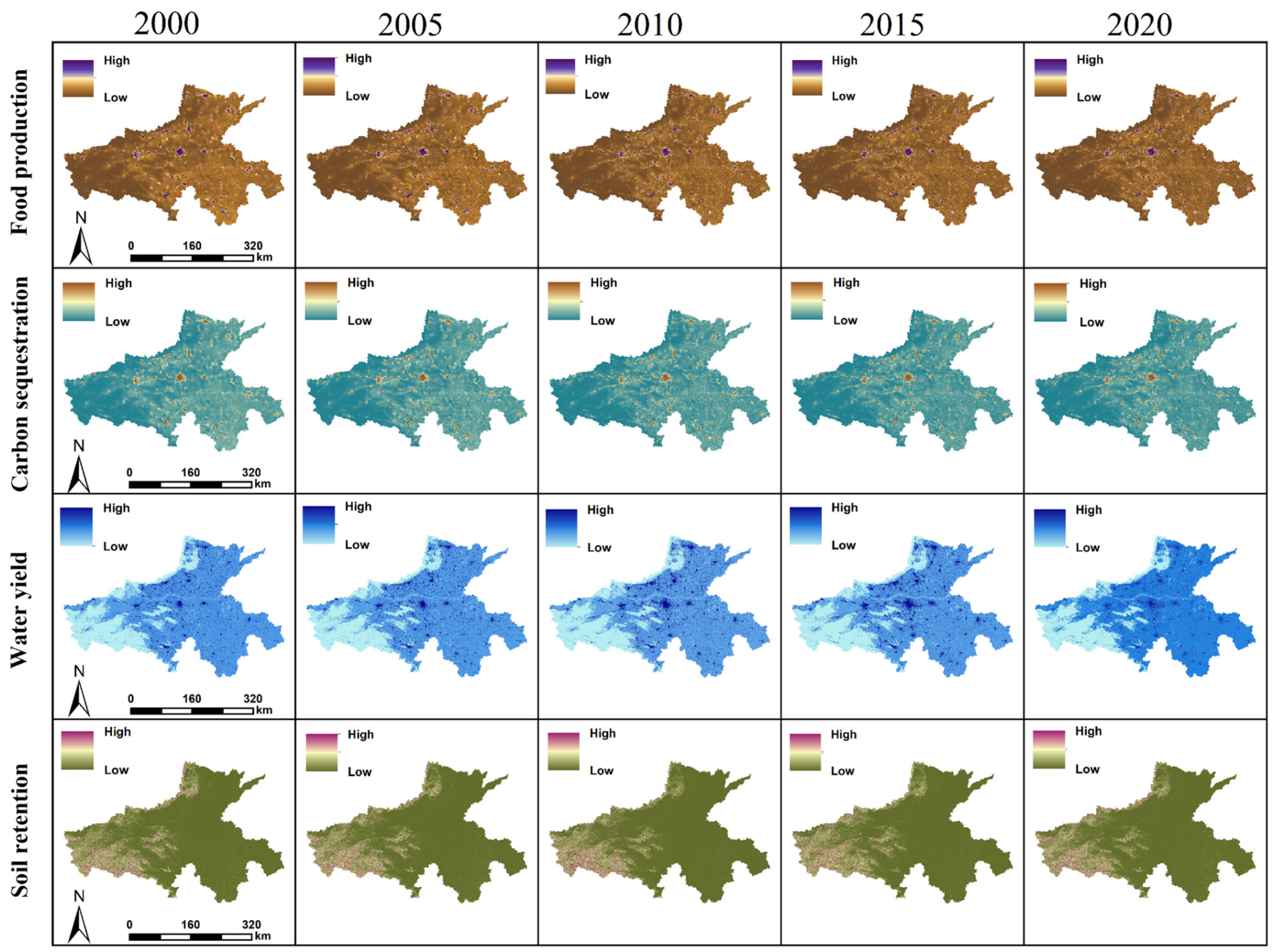
The spatial heterogeneity of ES demand in the study area is particularly pronounced (Figure 6). The demand for FP, CS, and WY was estimated based on population density, and their spatial distribution thus largely corresponded with population patterns, generally showing a gradual decline in demand from urban centers to peripheral areas. From 2000 to 2020, high FP demand persisted in urban core areas, whereas low FP demand was observed in suburban regions, which was generally consistent with the spatial distribution of the urban population. High carbon emission levels (a key indicator of CS demand) were mainly concentrated in the metropolitan areas adjacent to city centers, with the scope of high CS demand zones expanding significantly over the study period. High WY demand was centered on urban agglomerations, with a marked increase in water consumption recorded in both central urban areas and their expanding surrounding zones. In contrast, the demand for SR was evaluated based on actual soil erosion rates. High SR demand zones were predominantly distributed in the mountainous areas of the central, northwestern, and southwestern parts of the study area—regions characterized by relatively high elevations—while low SR demand was found in low-elevation areas. The spatial pattern of soil erosion rates remained relatively stable across the five observation periods from 2000 to 2020.

3.1.3. Supply–Demand Ratio of ESs

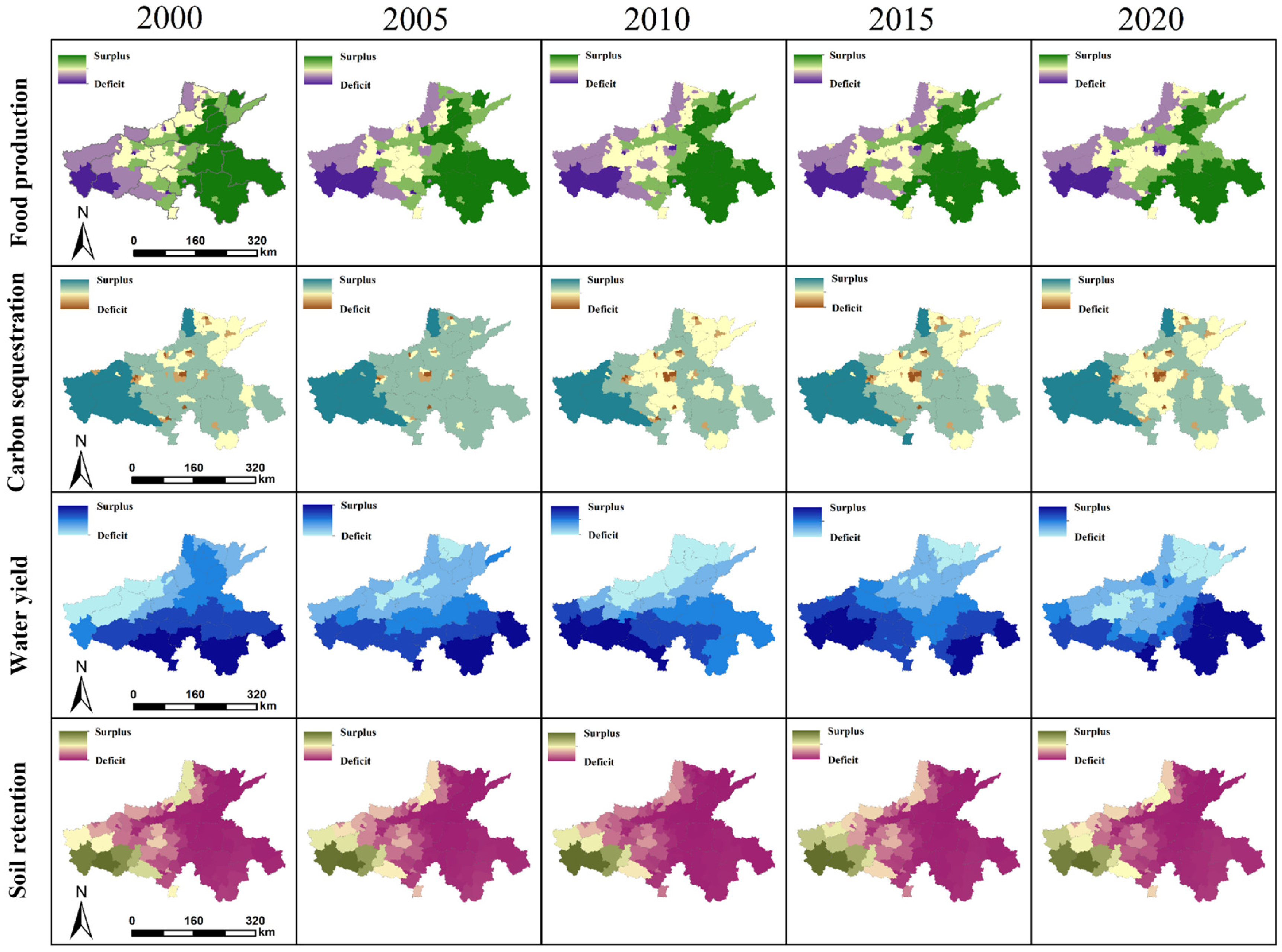
The spatiotemporal distribution of ES supply–demand ratios (SDRs) is illustrated in Figure 7. Overall, surplus areas largely corresponded to high-value supply zones. FP and SR SDRs remained positive throughout the study period, indicating that their provision consistently met local demand. FP surplus areas were mainly concentrated in the central and eastern regions, while other areas were generally balanced. SR was predominantly in a balanced state, with relatively higher SDRs in the western and northern mountainous regions. No significant CS surplus was observed, with balanced zones primarily located in the western and northern mountains and deficit zones in the more densely populated central and eastern areas. WY exhibited a gradual transition from surplus in the southeast to deficit in the northwest, with deficit zones concentrated in the northwest. Over the 20-year period, FP surplus areas declined while balanced areas increased; CS and WY deficit zones expanded; and SR surplus areas increased.

3.2. Matching Characteristics of Supply and Demand of ESs

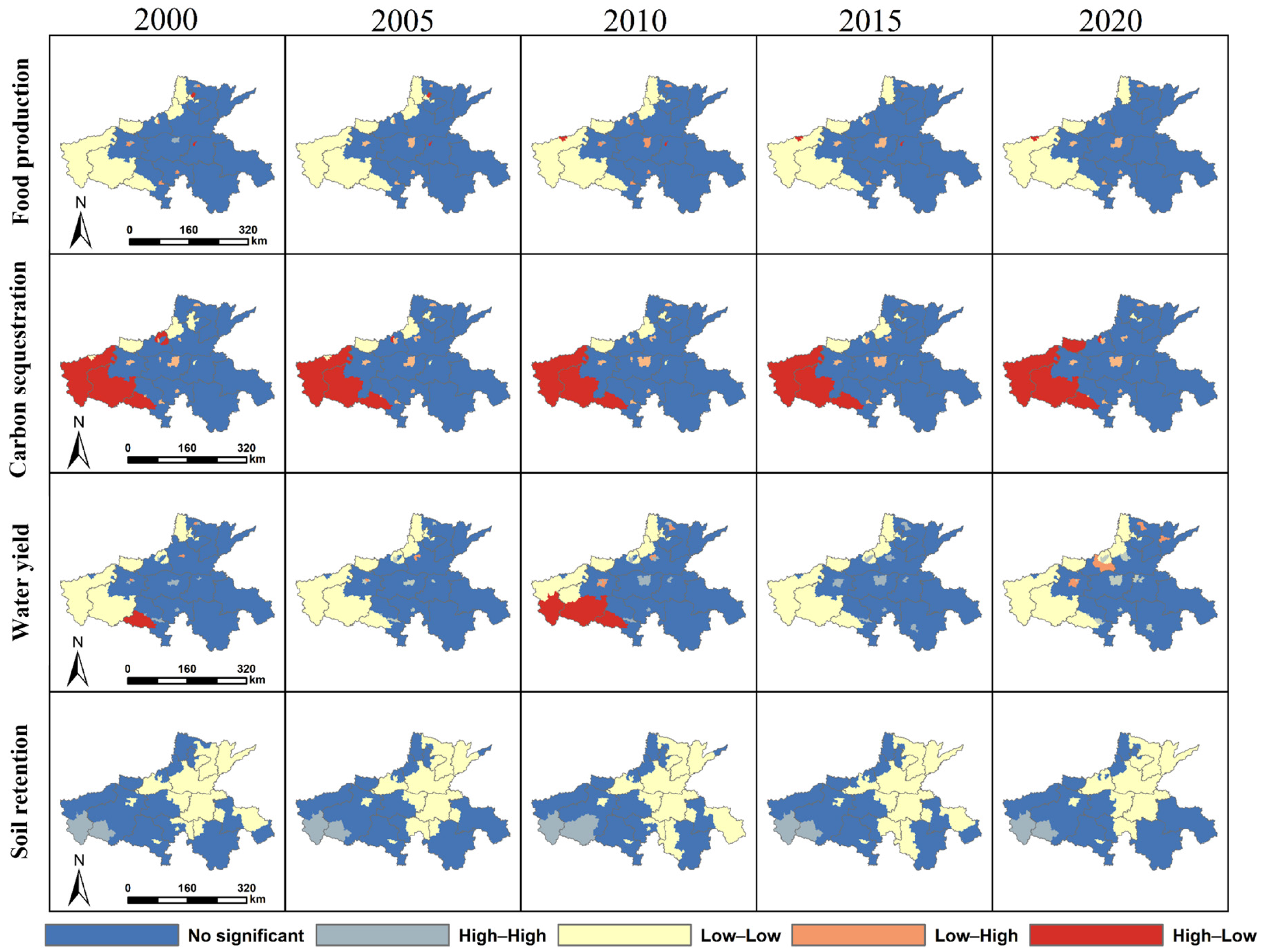
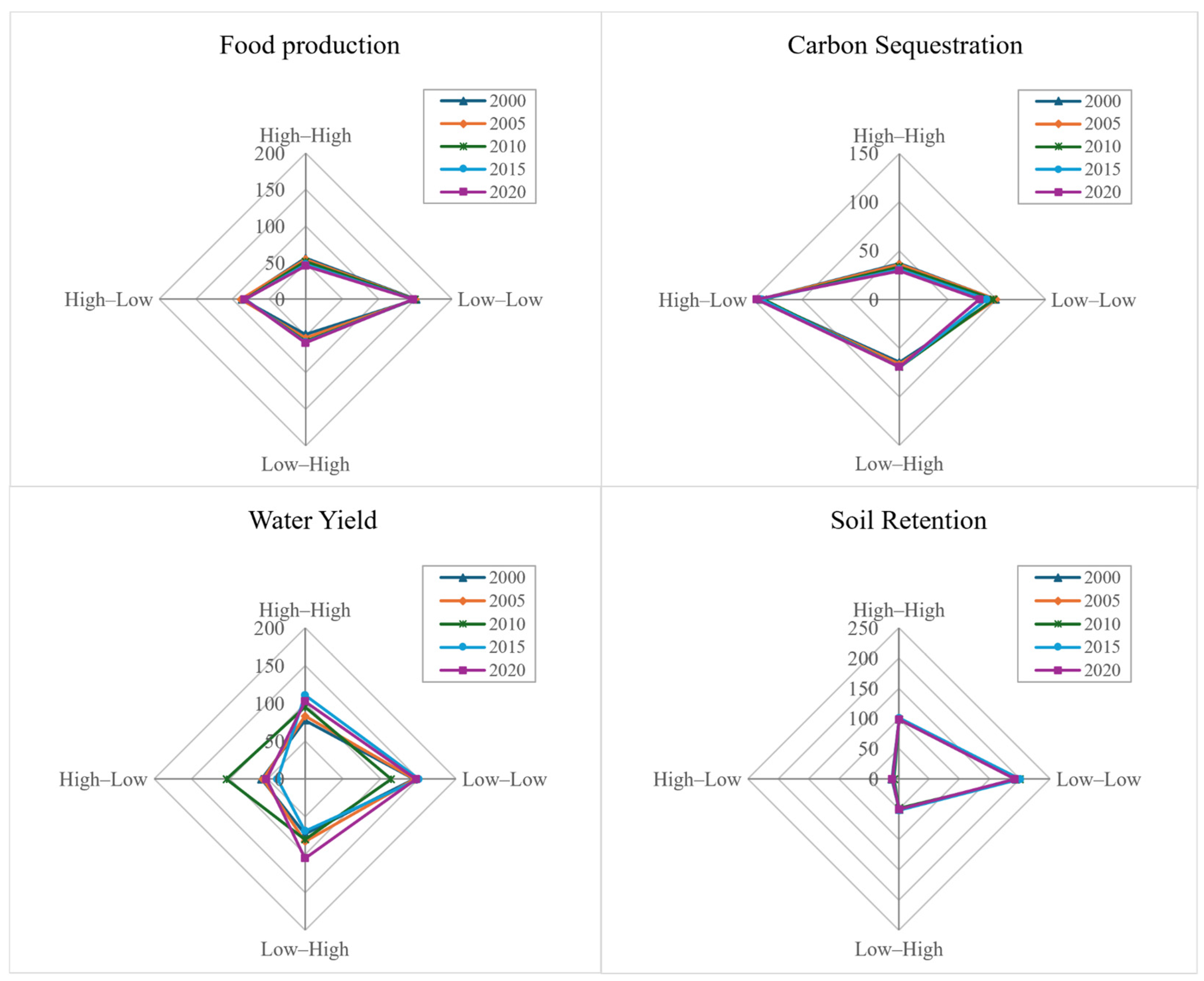
The bivariate LISA model identified four spatial matching types for ES SDRs from 2000 to 2020: HH, HL, LH, and LL (Figure 8 and Figure 9). FP was dominated by LL areas, primarily distributed in the western and northern regions, with a slight decline in areal proportion. CS was mainly characterized by HL areas, concentrated in the ecologically favorable western mountainous zones, with a fluctuating but increasing area share. WY was also dominated by LL areas, showing a distribution pattern similar to FP (concentrated in the western and northern mountains), with its area first decreasing and then increasing. SR supply–demand relationships were dominated by LL areas, widely distributed across the central and northern regions, with their areal proportion initially increasing and subsequently declining.
Overall, the spatial matching types of ESSD exhibited clear regional differentiation: LL areas were typically associated with regions with limited natural conditions or low human activity intensity, whereas HL and HH areas clustered in zones with stronger ecological supply capacity or concentrated construction land. Despite some shifts in type distribution over the two decades, the overall spatial pattern remained relatively stable.

3.3. Driving Factors of Supply and Demand for ESs

3.3.1. Selection of Social–Ecological Driving Factors

Based on ecological processes, data availability, spatial-scale suitability, and previous research, a set of driving factors were selected (Table 2). Climate variables (mean annual temperature [Tmp], mean annual precipitation [Prec], potential evapotranspiration [PET]) represent regional hydrothermal conditions. Topographic factors (elevation [DEM], slope [Slope]) capture terrain effects on water and material redistribution. Land use variables (proportion of cropland [PLA], forestland [PFA], built-up land [PBA]) reflect human interventions in ecosystems. Socio-economic factors (population density [POP], gross domestic product [GDP], nighttime light index [NL_Index]) characterize population distribution, economic activity, and human pressure. Ecological factors (normalized difference vegetation index [NDVI]) quantify vegetation cover and ecosystem condition. All datasets were obtained from authoritative sources with compatible spatial resolution, providing a reliable foundation for quantitative analyses.

3.3.2. Identification of the Main Drivers of ESs

To ensure the reliability of the SHAP-based interpretation, the predictive performance of the XGBoost models was evaluated using the coefficient of determination (R2) and root mean square error (RMSE). As shown in Table 2, all models achieved high predictive accuracy, with mean R2 values ranging from 0.942 to 0.965 across ecosystem services. These results indicate that the models effectively captured the relationships between the explanatory variables and ESSDRs, providing a reliable basis for the subsequent analysis of driving factors.
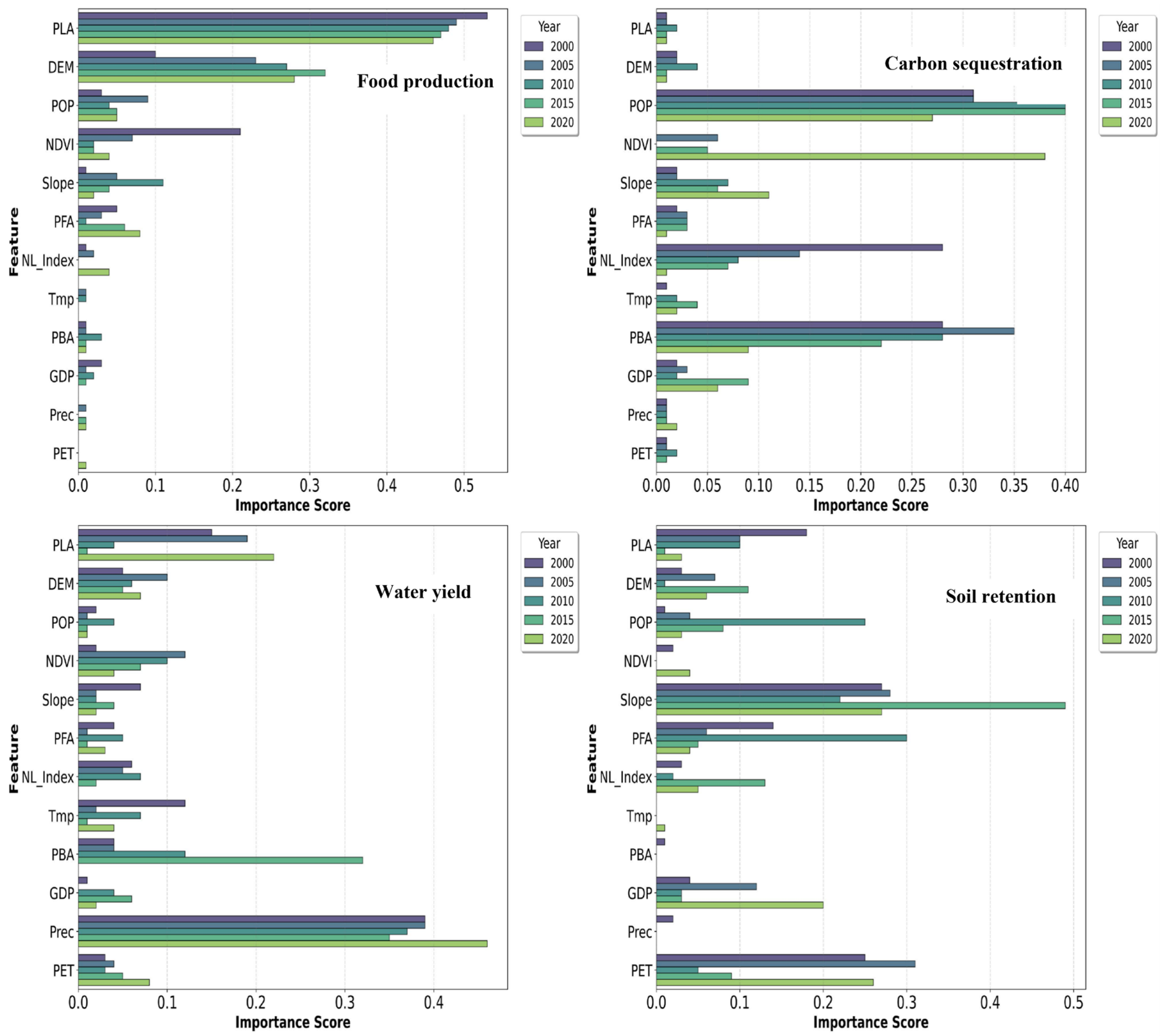
Feature importance results from the XGBoost model indicate that ESSDRs are controlled by distinct groups of driving factors with pronounced temporal variability (Figure 10). For FP supply–demand relationships, PLA was consistently the most important feature from 2000 to 2020, followed by DEM, NDVI, and Slope, while climatic factors (Prec, Tmp) contributed minimally. For CS, POP, PBA, and NL_Index were highly important in most years, with POP peaking in 2010 and 2020; NDVI importance increased markedly in 2020, indicating enhanced carbon sequestration capacity from increased vegetation cover. For WY, Prec consistently exhibited the highest importance, while PBA importance increased notably in 2015, and PET and Tmp contributed during specific periods. For SR, Slope consistently had the highest importance (peaking in 2015), while PFA, NL_Index, and PET showed pronounced effects in different periods. Specifically, PET ranked among the top secondary drivers in the early years (2000 and 2005) and alternately exerted notable influence with PFA during 2005–2020, whereas PLA was the second-most important factor only in 2000. Overall, dominant drivers exhibited substantial heterogeneity among ES types and across time, corresponding closely to the regulatory roles of individual factors in ecological processes.
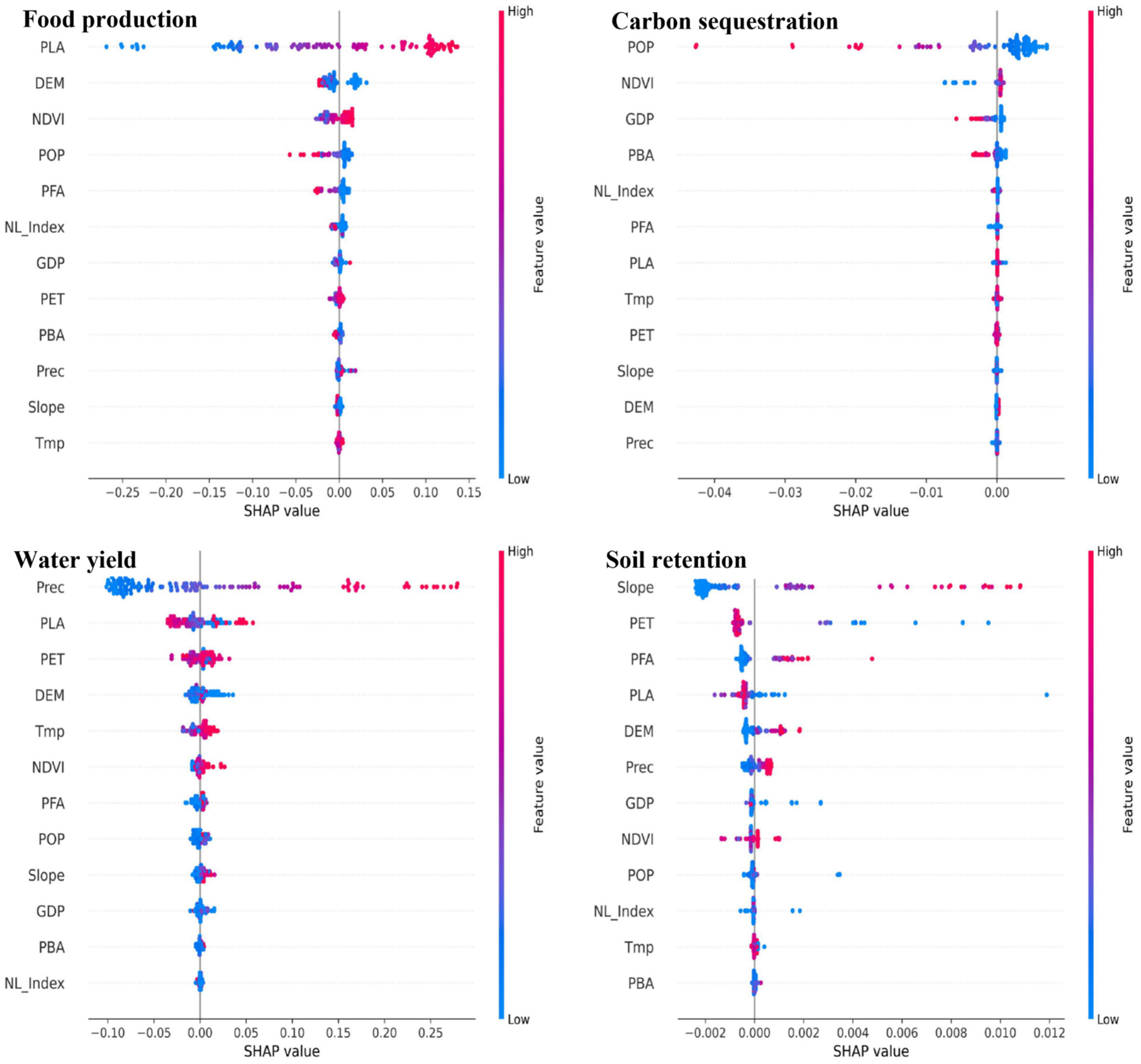
SHAP bee-swarm plots (Figure 11) visually quantify the direction and magnitude of each driving factor’s contribution to model predictions. For FP, PLA SHAP values were predominantly positive, with higher PLA values corresponding to greater positive effects—indicating that increased cultivated land area facilitates food supply–demand balance; DEM and NDVI contributions were relatively limited. For CS, POP was characterized by negative SHAP values, with higher POP exerting stronger inhibitory effects (intensified human activities suppress carbon sink balance); NDVI exhibited predominantly positive contributions, with higher values improving carbon sink supply–demand matching. For WY, Prec was mainly associated with positive SHAP values, with higher Prec exerting the strongest positive influence; PLA contributed negatively, constraining regional water yield capacity. For SR, Slope SHAP values were predominantly negative (steeper slopes had stronger adverse effects), while PFA exhibited mainly positive contributions (higher forest cover significantly enhanced soil retention capacity). Additionally, PET showed predominantly negative SHAP values, indicating that higher PET levels exerted a negative influence on soil retention by increasing water demand and reducing surface moisture availability.

3.3.3. Effectiveness Thresholds of Key Factors and Potential Interaction Effects

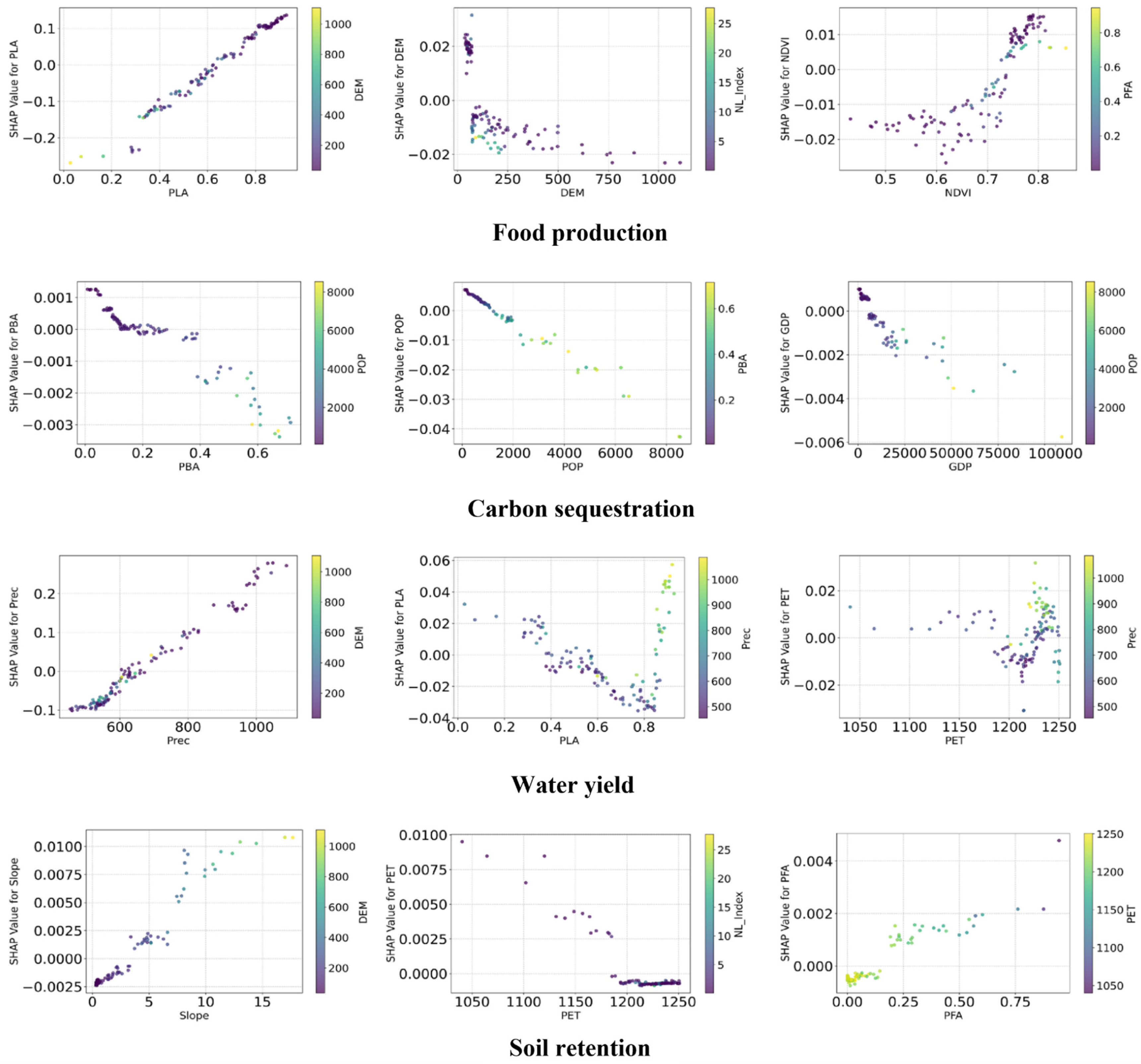
SHAP dependency plots (Figure 12) quantify the marginal contributions of key driving factors to ESSDRs across their value ranges, revealing pronounced nonlinear responses and potential interaction effects among driving factors. Focusing on the top three most influential factors for each ES:
FP: SHAP values shifted from negative to positive with increasing PLA, indicating a strong positive influence of cultivated land proportion on the FP supply–demand balance. Notably, a clear threshold response was observed when PLA exceeded approximately 0.6–0.7, beyond which SHAP values increased markedly, suggesting that a sufficiently large proportion of cultivated land is required to sustain the balance between food production supply and demand. As shown in the SHAP dependence plot (Figure 10), higher PLA values are mainly concentrated in lower-elevation areas. Within these regions, larger PLA corresponds to stronger positive SHAP values, confirming that the contribution of PLA is more pronounced in low-elevation zones. The relationship between PLA and FP balance becomes nearly linear at higher PLA levels, indicating that the positive effect is primarily driven by the magnitude of cultivated land rather than being strongly modulated by DEM. CS: As POP increased, SHAP values declined continuously, with a clear threshold occurring at approximately 1000–2000 people/km2, beyond which SHAP values shifted rapidly toward negative values. This pattern indicates that increasing population density imposes growing pressure on the balance between carbon sequestration supply and human demand. Moreover, the interaction with PBA further intensified this effect, as higher levels of built-up land were associated with stronger negative SHAP values. This finding suggests that the combined influence of population aggregation and urban expansion significantly weakens regional carbon sequestration capacity relative to demand.
WY: SHAP values increased steadily with increasing precipitation, with a more pronounced upward trend beyond approximately 700 mm, suggesting a potential hydrological threshold above which ecosystem water supply improves substantially relative to demand. In contrast, PLA exerted a predominantly negative influence on the WY balance, particularly at higher values. This negative effect was more evident under lower precipitation conditions, whereas increasing precipitation partially offset the negative contribution of PLA, indicating an interaction between land use intensity and climatic water availability. Potential evapotranspiration (PET) showed no clear contribution pattern and exhibited relatively low importance overall, likely due to complex interactions with precipitation.
SR: SHAP values increased markedly with slope, with the most pronounced variation occurring within the 5–10° range, suggesting a potential topographic threshold where soil erosion control functions become increasingly important. PFA acted as a stable positive driver, with SHAP values increasing steadily as forest proportion increased. This pattern indicates that greater forest coverage enhances soil conservation capacity, thereby improving the balance between soil retention supply and demand.

4. Discussion

As China’s strategy for ecological protection and sustainable development in the Yellow River Basin advances, accurate assessment of ESSDR spatiotemporal dynamics has become increasingly important for optimizing ecological management and promoting human–nature harmony. Understanding the spatial characteristics and long-term evolution of ESSDRs provides critical support for enhancing regional ecological sustainability and ensuring balanced development between human and natural systems.
Despite considerable progress in ES assessments, studies systematically analyzing the spatiotemporal evolution of ESSDRs remain limited—particularly regarding the nonlinear responses and threshold effects of multiple socio-ecological drivers. This gap constrains a deeper understanding of the mechanisms shaping ES balance. To address this, the present study examined four key ESs in the Yellow River Basin of Henan Province from 2000 to 2020, employing the XGBoost model combined with SHAP interpretation to identify dominant driving factors and reveal their nonlinear and threshold effects on ES supply–demand balance.

4.1. Analysis of ES Supply and Demand

ES supply and demand in the study area exhibited evident spatiotemporal differentiation. From 2000 to 2020, total FP supply increased while demand declined; however, surplus areas contracted significantly and balanced regions expanded—revealing a contradiction between overall balance and local mismatch. FP supply growth was concentrated in core agricultural zones, while most non-core regions experienced limited or negative growth, leading to reduced surplus areas. Socio-economic development, dietary transitions, and changing consumption patterns have reduced direct grain demand as residents shift from subsistence- to nutrition-oriented diets.
Urban and peri-urban zones with dense populations and rapid industrialization showed concentrated ES demand but limited supply capacity, resulting in persistent ecological deficits—consistent with findings by Wang et al. [26]. In contrast, the southwestern and northern mountainous regions (characterized by complex terrain, rich vegetation, and low human disturbance) maintained high ecological supply potential and stable surplus conditions. These areas serve as crucial ecological buffer zones and service “highlands,” providing important ecological compensation sources for deficit regions—aligning with conclusions by Gao et al. [38].

4.2. Driving Mechanisms of ES Supply–Demand Relationships

Based on feature importance analysis and SHAP values from the XGBoost model, the driving mechanisms and spatiotemporal heterogeneity of ESSDRs for four ESs were systematically revealed—with core findings closely aligning with the intrinsic patterns of ecological processes.
Dominant drivers for each ESSDR exhibited distinct characteristics, reflecting the combined influence of ecosystem formation mechanisms and varying intensities of human demand. For FP, PLA was consistently identified as the core driver of supply–demand equilibrium—consistent with findings by Wu et al. [20]. SHAP value analysis further indicated that PLA contributed positively, with its effect strengthening beyond a threshold of 0.6–0.7. This aligns with the core function of agricultural ecosystems, where higher land productivity in low-altitude areas further enhances the positive effect of PLA.
For WY, Prec was identified as the primary controlling factor. SHAP values increased steadily with Prec, rising more sharply when precipitation exceeded 700 mm—reflecting precipitation’s role as the direct water source for water production services. Meanwhile, PLA exerted a stable negative effect on WY, as cultivated land expansion often increases irrigation water use and surface hardening, intensifying demand while reducing supply capacity.
The driving mechanisms for CS and SR further highlighted interactions between natural and human factors. CS supply–demand balance was jointly regulated by POP, PBA, and NDVI. The negative contribution of POP intensified when density exceeded 1000–2000 people/km2, while PBA exerted a strong inhibitory effect at high values—demonstrating that urbanization widens the carbon sink gap through land use expansion and increased energy consumption [39]. Conversely, NDVI consistently contributed positively, indicating that vegetation cover enhancement is a key driver of carbon sink supply. The increased importance of NDVI in 2020 further suggests that regional vegetation restoration projects have begun to enhance carbon sequestration effects.
For SR, a “topography constraint–vegetation regulation” pattern was observed. Slope (5–10°) exerted the most fluctuating negative effect on the supply–demand ratio, while the positive contribution of PFA increased steadily with coverage. This pattern aligns with the physical processes underlying soil conservation, where these factors jointly regulate the supply–demand equilibrium of soil conservation services.
The threshold responses identified in this study are generally consistent with previous findings on nonlinear relationships between ecosystem services and socio-ecological drivers. Previous studies have shown that vegetation coverage and precipitation often exhibit critical thresholds influencing ecosystem productivity and hydrological regulation. Similarly, population density and urban expansion have been widely recognized as key pressures affecting ecosystem service sustainability through land use change and increased resource consumption. Compared with studies focusing mainly on ES supply patterns, this study further demonstrates that threshold responses also exist in ecosystem service supply–demand relationships, highlighting the coupled dynamics between ecological capacity and human demand. These findings provide new empirical evidence for understanding nonlinear socio-ecological processes and offer useful references for identifying ecological management thresholds in rapidly developing regions.
Moreover, different ecosystem services exhibited distinct dominant thresholds, suggesting that the mechanisms governing supply–demand balance vary substantially among ES types. This highlights the necessity of adopting service-specific management strategies rather than uniform ecological regulation policies.

4.3. Implications for Sustainable Ecosystem Management

By elucidating the dominant drivers of ESSDRs and their nonlinear threshold response mechanisms, this study provides important practical insights for sustainable, region-specific ecosystem management. The results indicate that a uniform regulatory approach is unsuitable; instead, differentiated, threshold-based management strategies should be implemented, tailored to specific ES types and dominant limiting factors in each region.
Conceptually, areas with severe ESSDR imbalances, intense human disturbance, or exceedance of critical thresholds may be designated as priority ecological restoration areas—where strict land use controls and ecosystem restoration projects should be prioritized. Areas with relatively stable or surplus ESSDRs may be classified as ecological conservation and maintenance areas, requiring stringent protection measures and long-term monitoring. Transitional areas with improving supply–demand conditions or high sensitivity should be designated as optimization regulation areas, where management strategies can be dynamically adjusted in response to environmental change and development pressure.
From a practical perspective, targeted management strategies can be developed based on identified thresholds:
FP: For areas with PLA ≥ 0.6, strictly protect existing high-quality farmland; enhance agricultural productivity in low-altitude areas through technological improvements and optimized management (e.g., high-standard farmland construction); and prevent indiscriminate expansion of cultivated land to preserve ecosystem integrity.
CS: Effectively control construction land expansion in high-density urban areas and implement large-scale vegetation restoration projects in suburban areas and along ecological corridors to enhance regional carbon sink capacity.
WY: In water-scarce regions with annual precipitation <700 mm, widely adopt water-saving irrigation technologies; rationally delineate restricted cultivation areas to alleviate irrigation pressure; and strengthen protection of key forested and wetland water conservation areas.
SR: Prioritize management interventions in areas with slopes of 5–10° (highest erosion risk) and implement integrated measures (e.g., terrace construction, afforestation, grassland restoration) to increase vegetation cover and enhance land stability.
Collectively, these management strategies underscore the importance of integrating ecological thresholds, spatial heterogeneity, and socio-ecological interactions into regional planning, facilitating the evolution of ES supply–demand structures toward greater balance, stability, and resilience.

4.4. Limitations and Directions

Despite systematically analyzing the supply–demand relationships and driving mechanisms of four key ESs in the study area, several limitations and uncertainties persist. First, the selected ES types do not encompass all services (e.g., biodiversity, climate regulation, cultural services), which may reduce the comprehensiveness of the findings. Second, the methods used to quantify ES supply and demand carry inherent uncertainties. For example, service demand estimates are based on socio-economic statistics, whose spatial resolution and accuracy may influence result precision. In addition, ES quantification relies on several empirical parameters and input datasets (e.g., R, K, C, and P factors in soil retention estimation), and uncertainties in these parameters may affect the absolute values of ES estimates to some extent. However, since consistent datasets and parameter settings were applied across all study periods, these uncertainties are unlikely to substantially alter the overall spatial patterns and temporal trends identified in this study. Third, this study did not fully account for the spatial flow of ES supply and demand or cross-regional matching, which could affect the assessment of actual beneficiary areas and management priorities.
Future research could address these limitations by (1) expanding the range of ESs to enhance comprehensiveness; (2) optimizing quantification methods to improve estimation accuracy; (3) integrating ES flow models or multi-model coupling analyses to address cross-regional matching; and (4) incorporating scenario analyses of climate change, land use change, and policy interventions to enhance the applicability and utility of the findings for ecological management and decision-making.

5. Conclusions

This study systematically investigated the supply–demand patterns and driving mechanisms of four key ESs (FP, CS, WY, SR) in the Yellow River Basin of Henan Province from 2000 to 2020. FP and CS supply increased steadily, while WY and SR supply exhibited fluctuating declines. Spatially, high-value FP zones were primarily distributed in the central and eastern plains, high-value CS zones in the western and southwestern forested mountains, and high-value WY and SR zones in hilly and mountainous areas. ES demand was closely linked to population density and human activity intensity, resulting in evident supply–demand mismatches in many areas. Spatial matching analysis indicated that low supply–low demand and high supply–low demand patterns dominated the region.
Driving mechanism analysis further demonstrated that ES supply–demand ratios are controlled by distinct dominant factors: FP by the proportion of arable land, CS by population density and built-up land proportion (negative effects), WY by precipitation, and SR by slope. Key factors exhibited pronounced nonlinear threshold effects—e.g., arable land proportion (0.6–0.7), population density (1000–2000 persons/km2), precipitation (≈700 mm), and slope (5–10°). These findings provide an important scientific basis for spatially targeted regulation and precision ecological management in the Yellow River Basin of Henan Province, with implications for similar ecologically vulnerable regions worldwide.

Author Contributions

L.F.: writing—original draft; formal analysis. X.W.: writing—review and editing. Y.H.: software; data curation. Z.M.: methodology. S.W.: writing—review and editing. All authors have read and agreed to the published version of the manuscript.

Funding

This research was funded by the National Natural Science Foundation of China [grant No. 32371667].

Data Availability Statement

The original data presented in this study are included in the article. Further inquiries can be directed to the corresponding author.

Conflicts of Interest

The authors declare that they have no known competing financial interests or personal relationships that could have appeared to influence the work reported in this paper.

References

  1. Costanza, R.; d’Arge, R.; De Groot, R.; Farber, S.; Grasso, M.; Hannon, B.; Limburg, K.; Naeem, S.; O’Neill, R.V.; Paruelo, J.; et al. The value of the world’s ecosystem services and natural capital. Nature 1997, 387, 253–260. [Google Scholar] [CrossRef]
  2. Daily, G.C. Nature’s Services: Societal Dependence on Natural Ecosystems; Island Press: Washington, DC, USA, 1997. [Google Scholar]
  3. Abson, D.J.; Von Wehrden, H.; Baumgärtner, S.; Fischer, J.; Hanspach, J.; Härdtle, W.; Heinrichs, H.; Klein, A.M.; Lang, D.J.; Martens, P.; et al. Ecosystem services as a boundary object for sustainability. Ecol. Econ. 2014, 103, 29–37. [Google Scholar] [CrossRef]
  4. Liu, H.Y.; Xiao, W.F.; Zhu, J.H.; Zeng, L.; Li, Q. Urbanization Intensifies the Mismatch between the Supply and Demand of Regional Ecosystem Services: A Large-Scale Case of the Yangtze River Economic Belt in China. Remote Sens. 2022, 14, 5147. [Google Scholar] [CrossRef]
  5. Romulo, C.L.; Posner, S.; Cousins, S.; Fair, J.H.; Bennett, D.E.; Huber-Stearns, H.; Richards, R.C.; McDonald, R.I. Global state and potential scope of investments in watershed services for large cities. Nat. Commun. 2018, 9, 5309. [Google Scholar] [CrossRef]
  6. Runting, R.K.; Bryan, B.A.; Dee, L.E.; Maseyk, F.J.F.; Mandle, L.; Hamel, P.; Wilson, K.A.; Yetka, K.; Possingham, H.P.; Rhodes, J.R. Incorporating climate change into ecosystem service assessments and decisions: A review. Glob. Change Biol. 2017, 23, 28–41. [Google Scholar] [CrossRef]
  7. Guan, D.J.; Fan, X.F.; Zhou, L.L.; Zhu, K. Quantitative assessment of the supply, demand and flows of ecosystem services in the Yangtze River Basin, China. Front. Earth Sci. 2024, 18, 422–445. [Google Scholar] [CrossRef]
  8. Jiang, S.; Cheng, X.Y.; Yu, S.Y.; Zhang, H.; Xu, Z.; Peng, J. Elevation dependency of ecosystem services supply efficiency in great lake watershed. J. Environ. Manag. 2022, 318, 115476. [Google Scholar] [CrossRef]
  9. Fan, J.Y.; Liu, S.L.; Wang, W.T.; Li, Y.; Wang, Z.; Liu, M.; Zhao, Y.; Lin, J.; Tian, Z.; Wu, G. Identifying driving mechanisms and relationships between supply and demand of ecosystem services based on structural equation model in the upstream segment of the Yangtze River. J. Environ. Manag. 2025, 393, 127093. [Google Scholar] [CrossRef]
  10. Shen, J.S.; Li, S.C.; Wang, H.; Wu, S.; Liang, Z.; Zhang, Y.; Wei, F.; Li, S.; Ma, L.; Wang, Y.; et al. Understanding the spatial relationships and drivers of ecosystem service supply–demand mismatches towards spatially-targeted management of social-ecological system. J. Clean. Prod. 2023, 406, 136882. [Google Scholar] [CrossRef]
  11. Wang, Z.; Sun, X.Y.; Shan, R.F.; Wang, B. Mapping and assessing supply–demand matching of recreational ecosystem services in Shandong province, China. Ecol. Indic. 2024, 160, 111859. [Google Scholar] [CrossRef]
  12. Sun, F.; Zhang, J.H.; Xu, Y.H.; Hu, W.; Cao, Y. Analysis of the relationship between supply–demand matching of selected ecosystem services and urban spatial governance: A case study of Suzhou, China. Environ. Sci. Pollut. Res. 2023, 30, 79789–79806. [Google Scholar] [CrossRef]
  13. Tian, F.; Li, X.P.; Wu, X.; Gong, L. Identifying supply–demand mismatches of ecosystem services and social-ecological drivers at different scales to support land use planning. Ecol. Indic. 2025, 174, 113462. [Google Scholar] [CrossRef]
  14. Fang, Y.C.; Cao, L.H.; Tang, Q.R.; Zhang, L.; Guo, X. Assessment and driving mechanisms for the supply–demand of ecosystem services in the central plains urban agglomeration, China: A water-soil-food-carbon nexus perspective. Ecol. Indic. 2025, 171, 113218. [Google Scholar] [CrossRef]
  15. Xiao, S.J.; Xia, H.N.; Zhai, J.; Jin, D.; Gao, H. Trade-Off and Synergy Relationships and Driving Factor Analysis of Ecosystem Services in the Hexi Region. Remote Sens. 2024, 16, 3147. [Google Scholar] [CrossRef]
  16. Lai, J.L.; Qi, S. Supply–demand coordination and driving forces of soil conservation services in the middle and lower Jinsha River Basin, China. Ecol. Indic. 2025, 178, 114029. [Google Scholar] [CrossRef]
  17. Lorilla, R.S.; Poirazidis, K.; Detsis, V.; Kalogirou, S.; Chalkias, C. Socio-ecological determinants of multiple ecosystem services on the Mediterranean landscapes of the Ionian Islands (Greece). Ecol. Model. 2020, 422, 108994. [Google Scholar] [CrossRef]
  18. Xie, A.Y.; Zhang, F.T.; Ding, Y.K.; Chen, J.; Yang, P.; Peng, G. Exploring the Dynamic Local and Tele-Coupling Coordination Mechanism of the Ecosystem Services Supply–demand and Its Driving Forces: Taking China’s Yangtze River Economic Belt as an Example. Land Degrad. Dev. 2025, 36, 3178–3193. [Google Scholar] [CrossRef]
  19. Su, R.; Duan, C.C.; Chen, B. The shift in the spatiotemporal relationship between supply and demand of ecosystem services and its drivers in China. J. Environ. Manag. 2024, 365, 121698. [Google Scholar] [CrossRef]
  20. Wu, J.; Guo, X.; Zhu, Q.; Guo, J.; Han, Y.; Zhong, L.; Liu, S. Threshold effects and supply–demand ratios should be considered in the mechanisms driving ecosystem services. Ecol. Indic. 2022, 142, 109281. [Google Scholar] [CrossRef]
  21. Tang, L.A.; Kasimu, A.; Chen, J.Z. Ecological deficit mitigation in the Tianshan North Slope: Network-driven spatial strategies for ecosystem service flows. Ecol. Indic. 2025, 178, 113921. [Google Scholar] [CrossRef]
  22. Karanam, V.; Magoon, M.; Arunkumar, N.; Pattock, A.; Dardas, T.; Boyle, P.; Buber, Y.; Leone, D. Explainable machine learning to predict heart failure outcomes using exercise and clinical data. Circulation 2024, 150, A4134947. [Google Scholar] [CrossRef]
  23. Liu, J.M.; Wang, G.; Fu, X.D.; Yu, S.Z.; Ren, M.L.; Shi, H.S.; Deng, X.S.; Chen, K. Evaluation of ecological protection and high-quality development level in Henan Section of the Yellow River Basin. Yellow River 2023, 45, 7–13. [Google Scholar] [CrossRef]
  24. Zhang, C.H.; Wang, G.Q. Thoughts on ecological protection and high-quality development in the Yellow River Basin. Yellow River 2024, 46, 1–7. [Google Scholar]
  25. Fan, L.T.; Wang, X.C.; Chen, Z.C.; Chen, R.; Liu, X.; He, Y.; Wang, S. Analysis of Spatial and Temporal Evolution of Ecosystem Services and Driving Factors in the Yellow River Basin of Henan Province, China. Forests 2024, 15, 1547. [Google Scholar] [CrossRef]
  26. Wang, C.K.; Chang, Y.J.; Guo, B.X.; Liu, P. Forecasting and Evaluation of Ecosystem Services Supply–demand Under SSP-RCP Scenarios in the Henan Segment of the Yellow River Basin, China. Remote Sens. 2025, 17, 1067. [Google Scholar] [CrossRef]
  27. Wang, M.N.; Shu, H.J.; Fan, S.X.; Chu, L.Q.; Liu, R.Z.; Zhang, J.J. Coupling relationship between the supply–demand pattern of ecosystem service and human activity intensity in Henan Province. J. China Agric. Univ. 2025, 30, 194–210. [Google Scholar]
  28. Liu, L.C.; Liu, C.F.; Wang, C.; Li, P.J. Supply and demand matching of ecosystem services in loess hilly region: A case study of Lanzhou. Acta Geogr. Sin. 2019, 74, 1921–1937. [Google Scholar]
  29. Ding, T.H.; Chen, J.F.; Fang, L.P.; Ji, J.; Fang, Z. Urban ecosystem services supply–demand assessment from the perspective of the water-energy-food nexus. Sustain. Cities Soc. 2023, 90, 104401. [Google Scholar] [CrossRef]
  30. Xiang, H.X.; Zhang, J.; Mao, D.H.; Wang, Z.; Qiu, Z.; Yan, H. Identifying spatial similarities and mismatches between supply and demand of ecosystem services for sustainable Northeast China. Ecol. Indic. 2022, 134, 108501. [Google Scholar] [CrossRef]
  31. Qiu, C.L.; Wang, C.X.; Zhang, R.; Feng, Y.; Zhang, Y.L.; Li, X.; Wang, K.P. Characteristics of ecological space carbon sequestration service function and its relationship with landscape pattern in Beijing-Tianjin-Hebei urban agglomeration. Acta Ecol. Sin. 2022, 42, 9590–9603. [Google Scholar] [CrossRef]
  32. Fan, S.X.; Yan, M.; Yu, L.F.; Chen, B.; Zhang, L. Integrating Ecosystem Service Supply–demand and Ecological Risk Assessment for Urban Planning: A case Study in Beijing, China. Ecol. Indic. 2024, 161, 111950. [Google Scholar] [CrossRef]
  33. Guan, Y.R.; Shan, Y.L.; Huang, Q.; Chen, H.; Wang, D.; Hubacek, K. Assessment to China’s Recent Emission Pattern Shifts. Earths Future 2021, 9, e2021EF002241. [Google Scholar] [CrossRef]
  34. Jia, G.L.; Li, C.L.; Chen, X.; Hu, Y.; Chen, W.; Kang, J. Impacts of Land Use and Climate Change on Water-Related Ecosystem Service Trade-offs in the Yangtze River Economic Belt. Ecosyst. Health Sustain. 2024, 10, e0208. [Google Scholar] [CrossRef]
  35. Yan, S.W.; Chen, H.; Quan, Q.; Liu, J. Driving Mechanisms and Flow Potential of Ecosystem Services Based on a Supply–demand Perspective in a Developing Region. Ecosyst. Health Sustain. 2025, 11, 0349. [Google Scholar] [CrossRef]
  36. Qin, K.Y.; Liu, J.Y.; Yan, L.W.; Huang, H. Integrating ecosystem services flows into water security simulations in water scarce areas: Present and future. Sci. Total Environ. 2019, 670, 1037–1048. [Google Scholar] [CrossRef]
  37. Zhang, Z.Y.; Tong, Z.M.; Zhang, L.T.; Liu, Y.L. What are the dominant factors and optimal driving threshold for the synergy and tradeoff between ecosystem services, from a nonlinear coupling perspective? J. Clean. Prod. 2023, 422, 138609. [Google Scholar] [CrossRef]
  38. Gao, M.W.; Hu, Y.C.; Liu, X.W.; Liang, M. Revealing multi-scale characteristics of ecosystem services supply and demand imbalance to enhance refined ecosystem management in China. Ecol. Indic. 2025, 170, 112971. [Google Scholar] [CrossRef]
  39. Meng, X.X.; Ling, Z.X.; Chen, Y.B.; Zheng, X.H.; Shi, X.H.; Kuang, J.Y.; Chen, W.T.; Yang, Y.F.; Wu, Z.F.; Zheng, Z.H. Exploring the differential responses of ecosystem services to urbanization: A perspective from the metropolitan area as a whole and internal service bundles. Ecol. Indic. 2025, 176, 113685. [Google Scholar] [CrossRef]
Figure 1. Location of study area. (a) Location of Henan Province in China; (b) Study area (Yellow River Basin within Henan Province) and administrative divisions of Henan Province; (c) Digital Elevation Model (DEM) and geographical features of the study area, including the Yellow River and contour lines.
Agriculture 16 00732 g001
Figure 2. Theoretical framework of study.
Agriculture 16 00732 g002
Figure 3. Temporal variation in total ES supply.
Agriculture 16 00732 g003
Figure 4. Spatial pattern of ES supply from 2000 to 2020.
Agriculture 16 00732 g004
Figure 5. Temporal variation in total ES demand.
Agriculture 16 00732 g005
Figure 6. Spatial pattern of ES demand from 2000 to 2020.
Agriculture 16 00732 g006
Figure 7. Spatiotemporal patterns of ES SDRs at the county level.
Agriculture 16 00732 g007
Figure 8. Spatial aggregation characteristics of supply and demand for ESs (High–High: high supply and high demand; Low–Low: low supply and low demand; Low–High: low supply and high demand; High–Low: high supply and low demand).
Agriculture 16 00732 g008
Figure 9. The area proportion of ES spatial matching types (High–High: high supply and high demand; Low–Low: low supply and low demand; Low–High: low supply and high demand; High–Low: high supply and low demand).
Agriculture 16 00732 g009
Figure 10. Temporal variation in importance of driving factors for ESSDRs.
Agriculture 16 00732 g010
Figure 11. SHAP bee-swarm plot of driving factors for ES supply–demand ratio.
Agriculture 16 00732 g011
Figure 12. Feature dependency plots of drivers for ES supply–demand ratio.
Agriculture 16 00732 g012
Table 1. Data sources and uses.
Data TypesData NameData SourceSpatial
Resolution
Land use dataLand use dataBig Earth Data Science Engineering, Chinese Academy of Sciences (https://data.casearth.cn)30 m
Topographic dataElevation data
(DEM)
Geospatial Data Cloud (http://www.gscloud.cn/)30 m
Remote sensing dataLandsat NDVI datasetGoogle Earth Engine(GEE) platform30 m
MOD17A3HGF V6.1 Annual NPP DataLP DAAC—MOD17A3HGF500 m
Meteorological dataAnnual average temperature
Annual precipitation
Annual average potential evapotranspiration
National Earth System Science Data Center (https://www.geodata.cn/)
Resources and Environmental Science Data Platform (https://www.resdc.cn)
National Tibetan Plateau Data Center (https://data.tpdc.ac.cn/home)
1 km
1 km
1 km
Soil dataMaximum root depth of soil
Soil geological data
Harmonized World Soil Database (HWSD) (https://data.tpdc.ac.cn/)1 km
1 km
Socio-economic dataPopulation density
Food production
Water resource demand
Carbon emissions
Nightlight index
WorldPop (https://www.worldpop.org/)
Henan Statistical Yearbook, Henan Water Resources Bulletin
National Earth System Science Data Center (https://www.geodata.cn)
1 km
city scale
city scale
city scale
500 m
Other dataBiophysical tableLiterature and InVEST User Guide
Table 2. Mean R2 and RMSE of the four ecosystem service simulations.
Mean R2Mean RMSE
Food production0.9650.0136
Carbon sequestration0.9420.0136
Water yield0.9610.0368
Soil retention0.9440.0562
Disclaimer/Publisher’s Note: The statements, opinions and data contained in all publications are solely those of the individual author(s) and contributor(s) and not of MDPI and/or the editor(s). MDPI and/or the editor(s) disclaim responsibility for any injury to people or property resulting from any ideas, methods, instructions or products referred to in the content.