Article

Differential Pathways of Distinct Organic Amendments in Ameliorating the Root Zone Environment of Saline-Alkali Farmland: A Case Study of Straw, Biochar, and Peat

1
Institute of Applied Ecology, Chinese Academy of Sciences, Shenyang 110016, China
2
University of Chinese Academy of Sciences, Beijing 100049, China
3
Key Laboratory of Stable Isotope Techniques and Applications, Shenyang 110016, China
*
Author to whom correspondence should be addressed.
Agriculture 2026, 16(7), 730; https://doi.org/10.3390/agriculture16070730
Submission received: 4 March 2026 / Revised: 24 March 2026 / Accepted: 25 March 2026 / Published: 26 March 2026

Abstract

Returning organic amendments to saline–alkali soils constitutes a key strategy for soil amelioration, as it enhances crop productivity by modulating the rhizosphere microenvironment. In this study, straw, biochar, and peat were selected as representative organic amendments, and a two-year field experiment—employing a rotational cropping system of Sesbania and Triticale—was conducted to investigate their differential regulatory effects on rhizosphere properties and root development. Results demonstrated that all three amendments induced coordinated shifts in the rhizosphere “extract–microbiota–enzymes–nutrients” nexus, concomitant with significant stimulation of root growth. The hypothesized pathways through which different organic amendments improve the rhizosphere environment vary mechanistically: straw application appears to enhance alkaline phosphatase activity and enrich phosphorus-solubilizing microorganisms; it is hypothesized that this promotes root growth by facilitating the mineralization of organic phosphorus. In contrast, peat amendment induces the most pronounced increases in esterase content and sucrase activity, and its growth-promoting effect is likely attributable to accelerated carbon and phosphorus cycling. Biochar, meanwhile, is associated with elevated catalase activity, improved potassium retention, and enhanced organic carbon sequestration; its beneficial function is postulated to stem from mitigation of oxidative stress. Collectively, this study provides initial evidence that distinct organic amendments modulate rhizosphere processes via divergent biochemical and microbial mechanisms—offering a theoretical foundation for their rational selection and application in saline–alkali soil remediation.

1. Introduction

Salinization represents one of the most critical abiotic stressors limiting the efficient utilization of global arable land and impeding the sustainable development of agriculture [1]. It triggers a cascade of adverse effects—including soil structural degradation, nutrient imbalances, and physiological stress in crops—that collectively suppress plant growth and hinder the sustainable reclamation and utilization of saline–alkali soils. Conventional approaches to saline–alkali land remediation primarily emphasize broad-scale modulation of bulk soil properties [2]. Yet, plant responses to and adaptation against abiotic stress are initiated and orchestrated within the rhizosphere—a highly dynamic microdomain where roots, soil particles, and diverse microbiota interact intensively [3]. As the primary interface integrating plant physiology, microbial activity, and soil biogeochemistry [4,5], the rhizosphere governs key ecological processes that directly influence plant survival, health, and productivity [6]. Consequently, elucidating how saline–alkali land improvement strategies enhance plant resilience through the targeted regulation of rhizosphere ecological processes—and thereby activate beneficial plant–microbe interactions—has emerged as a pivotal frontier in current agricultural and soil science research [7,8].
In the rhizosphere microdomain, the dynamic secretion of root exudates, the composition and structure of microbial communities, and the nutrient transformation and cycling processes—mediated predominantly by soil enzymes—collectively constitute a complex, interdependent micro-ecosystem [9]. Root exudates serve as a critical medium for bidirectional information and material exchange between plants and the soil environment [10,11]; they not only supply essential carbon sources and energy to rhizosphere microorganisms [12] but also modulate the physicochemical properties—including pH, redox potential, and ion availability—of the rhizosphere [13]. Microbial communities, in turn, drive soil enzyme–catalyzed biochemical reactions [14] and synthesize bioactive compounds such as phytohormones [15], thereby enhancing plant stress tolerance both directly and indirectly [16]. Soil enzymes function as key biological catalysts for biogeochemical reactions [17], governing the turnover and cycling of major elements—including carbon, nitrogen, and phosphorus—and critically influencing the bioavailability of soil nutrients [18]. These three components are tightly coupled through reciprocal interactions, forming a dynamic, self-regulating feedback network [19] that reflects the functional responsiveness of the rhizosphere habitat to external environmental perturbations [20,21,22].
Returning organic materials to the soil is currently one of the primary strategies for ameliorating saline-alkali soils [23,24]. Previous studies have demonstrated that various organic amendments—including crop straw, peat, and biochar—can enhance the plant growth environment by modulating rhizosphere processes; however, their underlying mechanisms differ substantially [25]. Specifically, straw is rich in structural carbohydrates such as cellulose and hemicellulose [26]. During microbial decomposition, it releases low-molecular-weight organic acids, which directly enhance the bioavailability of soil nutrients in the rhizosphere microenvironment via acidification and chelation. Concurrently, the soluble carbon released serves as a readily utilizable carbon source, selectively enriching salt-tolerant functional microbial groups—such as phosphate-solubilizing bacteria and nitrogen-fixing bacteria. These microbes further promote nutrient activation through biological nitrogen fixation, phosphate solubilization, and potassium solubilization. In synergy with root exudates, they improve rhizosphere nutrient cycling efficiency, thereby facilitating root elongation and lateral root initiation [27]. Peat is a naturally occurring organic material characterized by weak acidity and high concentrations of humus and diverse bioactive organic compounds [28]. The humic component of peat exhibits strong buffering capacity, thereby contributing to pH stabilization within the rhizosphere microdomain. Moreover, peat serves as a source of carbon and essential nutrients, promoting the enrichment of beneficial rhizosphere microorganisms, enhancing soil enzyme activity, and optimizing the structure of the soil microbial community. In addition, bioactive substances released from peat can directly stimulate root development, improve nutrient uptake efficiency, and augment plant tolerance to abiotic and biotic stresses [29]. Biochar—characterized by its high specific surface area, well-developed porous structure, and abundance of surface functional groups [30]—provides a favorable habitat for soil microorganisms. Its surface functional groups can adsorb signaling molecules and selectively enrich beneficial microbial taxa (e.g., certain members of the phylum Actinobacteria), thereby promoting microbial community stability. Concurrently, biochar reduces nitrogen leaching and phosphorus fixation through adsorption and slow-release mechanisms [31], and synergizes with root exudates to facilitate nutrient uptake, enhance root physiological activity, and improve plant stress resilience [32].
Although numerous studies have independently investigated the effects of individual organic amendments—such as straw incorporation and biochar application—on rhizosphere processes [33,34], systematic comparative research remains scarce regarding how distinct types of organic materials differentially regulate the “rhizosphere soil extract–microbial community–soil enzyme activity–nutrient availability” cascade via divergent rhizosphere modulation pathways. In particular, under saline-alkali stress, critical knowledge gaps persist concerning (i) whether straw, biochar, and peat—a distinctive organic material—exert fundamentally distinct mechanisms in shaping the rhizosphere micro-ecosystem, and (ii) how such mechanistic differences ultimately influence root growth. Moreover, as the primary chemical signal library mediating plant–microbe communication in the rhizosphere, compositional shifts in the rhizosphere soil extract induced by organic amendments—and their downstream cascading effects on microbial recruitment and nutrient mobilization—represent a key unresolved frontier in current research.
Based on this background, this study selected saline–alkali soil as the experimental substrate and established four treatments: (i) control (fertilizer application only), (ii) fertilizer + straw return, (iii) fertilizer + biochar application, and (iv) fertilizer + peat application. We systematically compared the effects of these three organic amendments on rhizosphere processes in triticale. By integrating analyses of (a) compositional changes in rhizosphere soil extracts, (b) structural shifts in rhizosphere microbial communities, (c) dynamics of soil enzyme activities, and (d) concentrations of plant-available nutrients, this study aimed to: (1) elucidate the distinct regulatory roles of different organic amendments in shaping the chemical composition of rhizosphere soil extracts; (2) characterize the response patterns of rhizosphere microbial communities to each organic amendment and identify their correlations with rhizosphere soil extract composition; and (3) clarify how the “rhizosphere soil extract–microbe–enzyme–nutrient” cascade pathway mediates root growth promotion under organic amendment application. The findings are expected to provide a mechanistic and theoretical foundation for the rational selection and targeted application of organic amendments in saline–alkali land reclamation.

2. Materials and Methods

2.1. Experimental Location

The field experiment site for this study was located in Huanghekou Town, Kenli District, Dongying City, Shandong Province (36.660355° N, 118.909237° E). The region experiences a warm temperate semi-humid continental monsoon climate, characterized by a mean annual temperature of 12.1 °C and a frost-free period of 201 days. Mean annual precipitation ranges from 500 to 600 mm, with pronounced seasonal variability: approximately 50% of the total annual rainfall occurs during July and August. The soil under investigation was coastal saline soil, classified as sandy clay loam. Its particle-size distribution comprised 20.60% clay, 15.67% silt, and 63.73% sand. The soil exhibited a total salt content of 4.92 g kg−1, pH of 8.69, organic carbon concentration of 4.01 g kg−1, available phosphorus concentration of 2.38 mg kg−1, available potassium concentration of 0.138 g kg−1, cation exchange capacity (CEC) of 7.27 cmolc kg−1, electrical conductivity (EC) of 4.5 dS m−1, exchangeable sodium percentage (ESP) of 30.9%, and sodium adsorption ratio (SAR) of 14.9 mmolc L−1.

2.2. Experimental Design

The experiment employed a Sesbania–Triticale rotation system, established in June 2022. Sesbania was sown annually in late June and harvested in late October; triticale was then sown immediately thereafter. This rotation cycle was maintained for two consecutive years, concluding in June 2024. Prior to sowing each crop, the same suite of chemical fertilizers—urea, superphosphate, and potassium sulfate—was applied. Additionally, both crops received a top-dressing of urea at the seedling stage. The specific application rates are presented in Table 1.
Prior to treatment application, a grid-based soil sampling survey (10 m × 10 m) was conducted across the experimental field to characterize its spatial variability in soil salinity. At each grid intersection, a composite soil sample was collected from the 0–20 cm layer and analyzed for total soil salt content. Results revealed low spatial heterogeneity in initial soil salinity across the field, as evidenced by a low coefficient of variation. The experiment employed a randomized complete block design with four treatments: (i) chemical fertilizer only (CK, control); (ii) chemical fertilizer + triticale straw (S); (iii) chemical fertilizer + biochar (B); and (iv) chemical fertilizer + peat (P). Each treatment was replicated three times, yielding 12 experimental plots in total. Each plot measured 9 m2 (3 m × 3 m), with inter-plot spacing maintained at 2 m. All organic amendments were incorporated uniformly into the 0–20 cm soil layer using a rotary tiller prior to sesbania sowing in June 2022 and 2023 to ensure thorough mixing with the soil. Application rates were standardized on an equivalent carbon basis, anchored to the local recommended full return rate of triticale straw (5000 kg ha−1 yr−1). Accordingly, the annual application rates were 4325 kg ha−1 yr−1 for peat and 5459 kg ha−1 yr−1 for biochar. The basic physical and chemical properties of the three organic materials are summarized in Table 2. Triticale straw was sourced directly as post-harvest crop residue; biochar was a commercially available product derived from corn straw pyrolyzed at 500 °C; and peat was imported Danish sphagnum peat (low pH, <20% ash content).

2.3. Collection and Determination of Rhizosphere Soil and Plant Roots

In May 2024—during the flowering stage of Triticale—rhizosphere soil samples were collected via the excavation method. It should be noted that the sampling design emphasized horizontal comparisons among treatments at this single time point; it was not intended to capture seasonal dynamics of rhizosphere processes. From each experimental plot, five representative plants were randomly selected. Soil monoliths measuring 25 cm × 25 cm × 25 cm—including intact root systems—were carefully excavated. Loosely adhering soil was removed by gentle shaking, and the tightly bound rhizosphere soil was then collected from root surfaces using sterile brushes. All collected soil samples were homogenized, and visible roots and stones were manually removed. Subsequently, each composite sample was divided into three subsamples: (i) one portion was air-dried for analysis of soil nutrient concentrations and enzyme activities; (ii) a second portion was immediately stored at 4 °C for extraction and chemical characterization of rhizosphere soil metabolites; and (iii) the third portion was flash-frozen in liquid nitrogen and stored at −80 °C for downstream microbial community analysis. Concurrently, harvested roots were oven-dried at 70 °C for 48 h until constant weight was achieved, after which root dry biomass was recorded.
Soil organic carbon (SOC) was quantified using the potassium dichromate oxidation method with external heating [35]. Nitrate-nitrogen (NO3–N) and ammonium-nitrogen (NH4+–N) concentrations were determined using a discrete chemical analyzer (Smartchem180 Intermittent Chemical Analyzer, AMS-Alliance, Frépillon, France) [36]. Available phosphorus was measured via the molybdenum–antimony–ascorbic acid colorimetric method [37], and available potassium was quantified by flame photometry [38]. Alkaline phosphatase (ALP) activity was assayed using the sodium phenyl phosphate colorimetric method [39]; urease (UE) activity was determined using the indophenol blue method; sucrase (SC) activity was assessed via the 3,5-dinitrosalicylic acid (DNS) colorimetric method [40]; and catalase (CAT) activity was measured spectrophotometrically [41].

2.4. Determination of Rhizosphere Soil Extract

The extraction of rhizosphere soil metabolites was performed following the protocol described by Bian et al. [42]. Briefly, 20 g of fresh rhizosphere soil samples were weighed and homogenized with 85% (v/v) ethanol at a soil-to-solvent ratio of 1:3 (w/v). The suspension was subjected to magnetic stirring at 2600 rpm for 24 h at 20 °C. Subsequently, the mixture was centrifuged at 3500× g for 15 min at 20 °C, and the supernatant was carefully collected. The solvent was removed from the supernatant under reduced pressure using a rotary evaporator, yielding the crude extract. Liquid–liquid partitioning was then carried out on the crude extract as follows: first, the extract was partitioned once with ethyl acetate to obtain the neutral fraction; second, the residual aqueous phase was acidified to pH ≈ 2 with 1 mol L−1 HCl and extracted with ethyl acetate to yield the acidic fraction; third, the aqueous phase was subsequently basified to pH ≈ 12 with 1 mol L−1 NaOH and re-extracted with ethyl acetate to yield the basic fraction. All three fractions (neutral, acidic, and basic) were combined to constitute the comprehensive rhizosphere soil extract. The extract was concentrated to approximately 1 mL by vacuum rotary evaporation at 35 °C. The concentrated solution was dehydrated with anhydrous sodium sulfate and then completely dried under a nitrogen stream. To the residue, 100 μL of pyridine and 100 μL of BSTFA (containing 1% TMCS) were added, and the mixture was derivatized at 70 °C for 60 min. After cooling, 1 μL of the derivatized sample was analyzed qualitatively by gas chromatography-mass spectrometry.
It should be noted that this method extracts a broad spectrum of organic compounds from rhizosphere soil, including root exudates, microbial metabolic byproducts, and soluble organic matter derived from decomposing soil amendments. Consequently, throughout this article, the terms “rhizosphere soil extract” are used consistently to denote this complex, functionally relevant mixture—rather than purified root exudates alone. Although this approach does not isolate root exudates in isolation, it effectively captures the integrated chemical milieu to which rhizosphere microorganisms are naturally exposed under realistic growth conditions, thereby offering valuable insights into rhizosphere biogeochemical processes.

2.5. Determination of Soil Microbial Communities at the Rhizosphere

The high-throughput sequencing analysis of soil microbial communities was conducted as follows: First, total genomic DNA was extracted from soil samples using the MolPure Soil DNA Kit (Yeasen Biotech, Shanghai, China). DNA concentration and purity were assessed using a NanoDrop ND-2000c UV-Vis spectrophotometer (Thermo Fisher Scientific, Waltham, MA, USA). Next, target gene fragments were amplified by polymerase chain reaction (PCR): the bacterial 16S rRNA gene V3–V4 hypervariable region was amplified using primers 338F (5′-ACTCCTACGGGAGGCAGCAG-3′) and 806R (5′-GGACTACHVGGGTWTCTAAT-3′); the fungal internal transcribed spacer 1 (ITS1) region was amplified using primers ITS5-1737F (5′-GGAAGTAAAAGTCGTAACAAGG-3′) and ITS2-2043R (5′-GCTGCGTTCTTCATCGATGC-3′). All PCRs were performed using Phusion® High-Fidelity PCR Master Mix (New England Biolabs, Ipswich, MA, USA). The thermal cycling profile comprised an initial denaturation at 95 °C for 3 min, followed by 25 cycles of denaturation at 95 °C for 30 s, annealing at 55 °C for 30 s, and extension at 72 °C for 30 s. Amplification success and specificity were verified by electrophoresis on a 2% (w/v) agarose gel at 100 V for 30 min. Purification of the resulting amplicons was carried out using AMPure XP magnetic beads (Beckman Coulter, Brea, CA, USA) at a bead-to-sample ratio of 0.8:1 to remove primer dimers and non-specific amplification products. Subsequently, adapter ligation was performed via a second round of PCR using Illumina-compatible indexing primers (Illumina, San Diego, CA, USA), following the same thermal cycling conditions but reduced to 8 cycles. Finally, a second round of AMPure XP bead purification was performed. The purity and concentration of the sequencing libraries were assessed using an Agilent 2100 Bioanalyzer (Agilent Technologies, Inc., Santa Clara, CA, USA) and a Qubit 3 Fluorometer (Thermo Fisher Scientific Inc., Waltham, MA, USA). Equimolar amounts of amplicons from each library were pooled and sequenced on an Illumina MiSeq platform using the MiSeq v3 Reagent Kit (Illumina, Inc., San Diego, CA, USA), generating 2 × 300 bp paired-end reads. Microbiome bioinformatics analyses were conducted using QIIME 2. Raw sequences were quality-filtered and trimmed to remove low-quality reads (Phred quality score threshold ≥ Q20), error-corrected, merged, and dereplicated; chimeric sequences were subsequently removed using the DADA2 plugin (2025.2). This workflow yielded an amplicon sequence variant (ASV) table. Bacterial taxonomic assignments were performed against the SILVA database (https://www.arb-silva.de/, accessed on 23 March 2026), while fungal sequences were annotated using the UNITE database (https://unite.ut.ee/, accessed on 23 March 2026). To mitigate biases arising from unequal sequencing depth across samples, the ASV table was rarefied to a uniform depth of 20,000 sequences per sample prior to calculation of α- and β-diversity indices. Finally, to minimize technical noise, ASVs with a relative abundance < 0.01% across all samples were excluded from downstream statistical analyses.

2.6. Data Analysis

The data acquired in this study were processed using Microsoft Excel 2021 and are presented as mean ± standard error of the mean based on three biological replicates. Differences among treatment groups were assessed by one-way analysis of variance (ANOVA) implemented in R (version 4.5.1), with statistical significance defined as p < 0.05. Graphs depicting rhizosphere soil extract properties and plant root biomass were generated using OriginPro 2025. Advanced statistical analyses of microbial community composition—including principal coordinates analysis (PCoA), identification of differentially abundant bacterial taxa, co-occurrence network construction, Mantel tests, and structural equation modeling (SEM)—were all performed in R. A complete list of R packages employed is provided in the Supplementary Materials.

3. Results

3.1. Effects of Organic Materials on Rhizosphere Soil Extracts

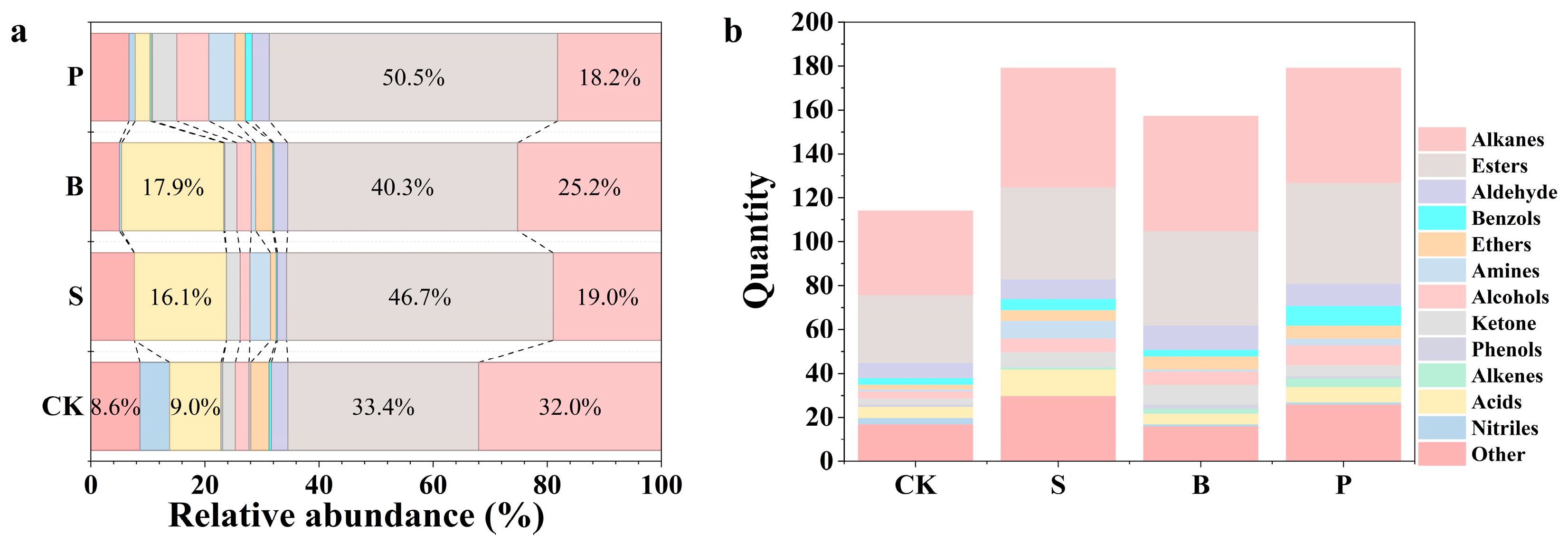
All organic material amendments significantly altered both the chemical composition and total quantity of rhizosphere soil extracts from triticale. With respect to chemical composition (Figure 1a), the relative abundance of alkanes decreased significantly across all three treatments relative to the control. The greatest reductions were observed in the P and S treatments, at 43.1% and 40.6%, respectively, whereas the B treatment exhibited a more moderate decline of 21.3%. Concurrently, esters emerged as the dominant compound class in all amended treatments: the P treatment showed the highest relative abundance of esters (50.5%), followed by the S (46.7%) and B (40.3%) treatments. Regarding total secretion (Figure 1b), all organic material amendments significantly enhanced the overall yield of rhizosphere soil extracts. The S and P treatments exerted the strongest effects, increasing total secretion by 57.0% relative to the control; the B treatment increased secretion by 37.7%.

3.2. Effects of Organic Materials on Microorganisms in Rhizosphere Soil

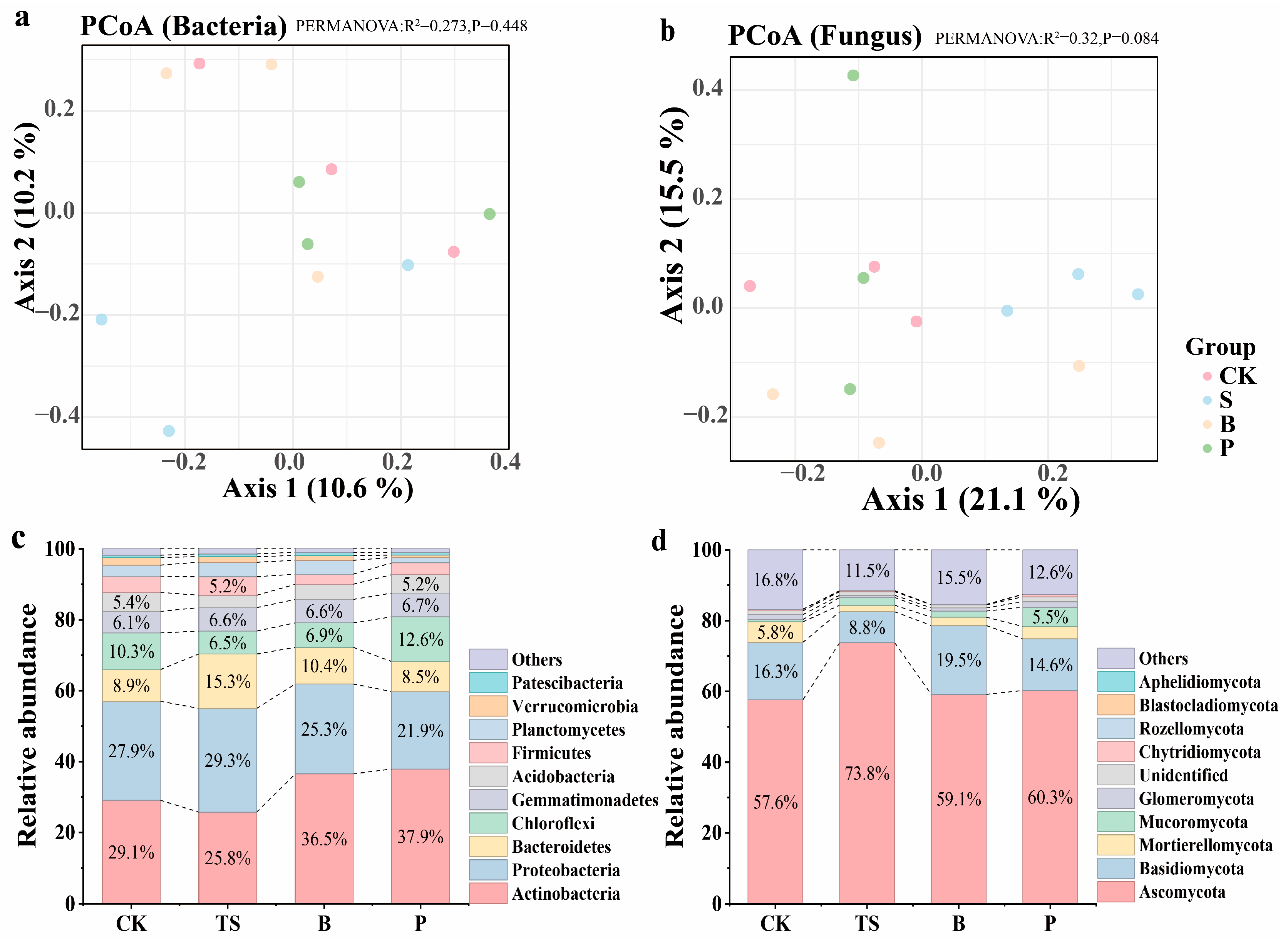
The effects of different organic material amendments on the α-diversity of rhizosphere bacteria and fungi are presented in Table 3. No significant differences were observed in the Chao1, Shannon, and Simpson indices across all treatments (CK, S, B, P) (p > 0.05), suggesting that, under the experimental conditions employed in this study, the application of organic materials did not significantly alter the richness or diversity of the rhizosphere microbial community. PCoA based on ASVs revealed the overall compositional patterns of bacterial and fungal communities across treatments (Figure 2a,b). PERMANOVA results indicated that treatment type exerted no statistically significant effect on either the bacterial community (p = 0.448, R2 = 0.273) or the fungal community (p = 0.084, R2 = 0.32). Although ordination plots showed a discernible separation between the S treatment and CK in the bacterial community—and a degree of visual differentiation among treatments in the fungal community—these trends lacked statistical support. At the phylum level, the relative abundances of dominant bacterial and fungal taxa are illustrated in Figure 2c (bacteria) and Figure 2d (fungi). In the bacterial community, Actinobacteria, Proteobacteria, Bacteroidetes, Chloroflexi, and Acidobacteria collectively constituted the five most abundant phyla; their relative abundance profiles remained largely consistent across all treatments. In the fungal community, Ascomycota was consistently the dominant phylum across all treatment groups, followed by Basidiomycota. Relative to CK, the relative abundance of Ascomycota increased by 28.1%, 2.70%, and 4.63% in the S, B, and P treatments, respectively; however, none of these increases reached statistical significance (p > 0.05). For Basidiomycota, relative abundance decreased under the S and P treatments but increased under the B treatment; yet, all observed changes remained non-significant (p > 0.05).
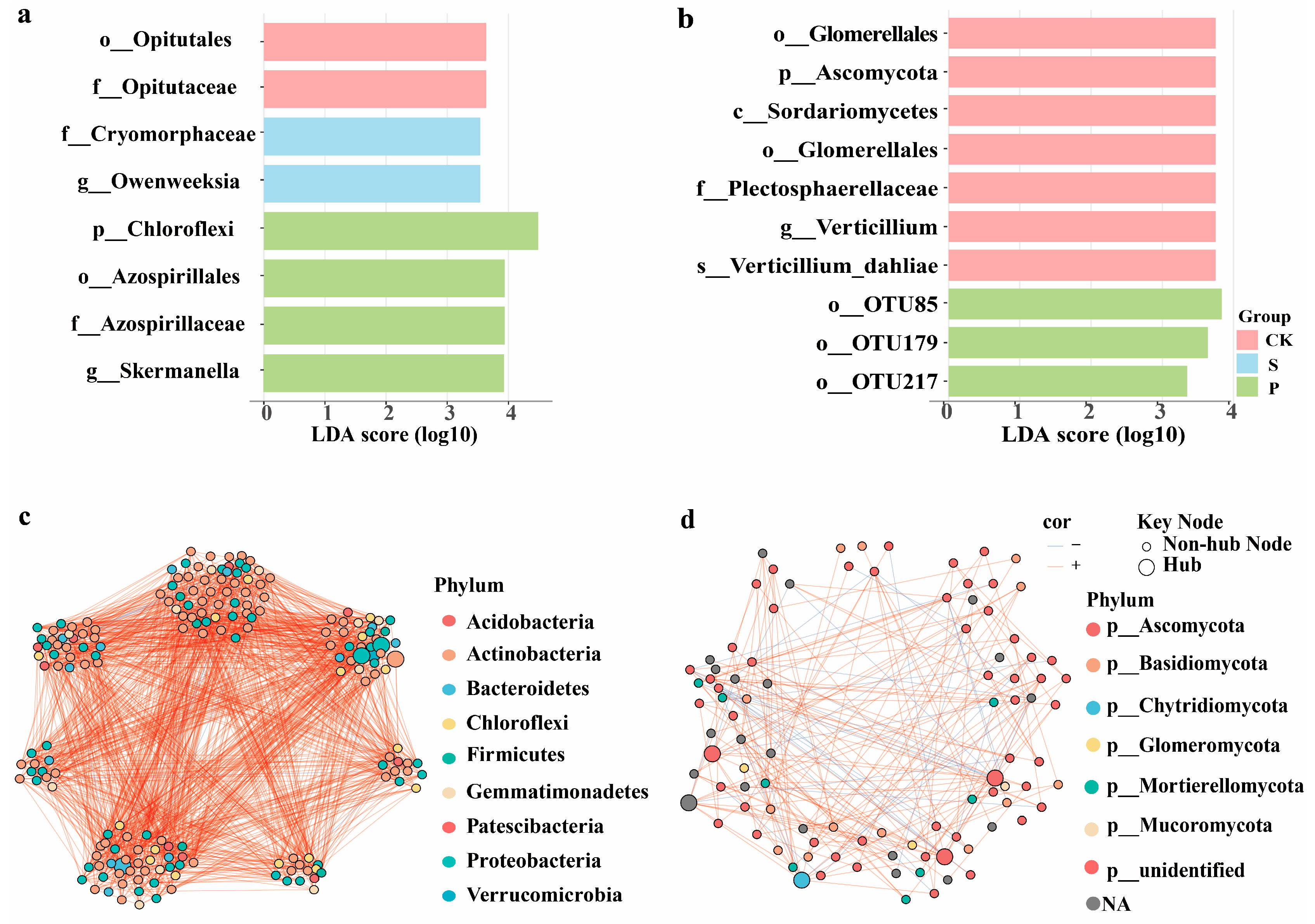
The microbial marker species identified in each treatment via LEfSe analysis are presented in Figure 3. In the bacterial community (Figure 3a), two, two, and four marker species were detected in the CK, S, and P treatments, respectively; no bacterial marker species were identified in the B treatment. In the fungal community (Figure 3b), seven and three marker species were identified in the CK and P treatments, respectively; no fungal marker species were detected in the S or B treatments. The co-occurrence network topological structures of the bacterial and fungal communities are illustrated in Figure 3c and Figure 3d, respectively. A summary of key network topological parameters is provided in Table 4. The bacterial co-occurrence network comprises 195 nodes and 1324 edges, with a modularity index of 0.599, an average clustering coefficient of 0.571, an average path length of 3.26, and a network density of 0.070. This network encompasses nine major bacterial phyla; within it, multiple nodes affiliated with Actinobacteria and Proteobacteria exhibit high connectivity and are identified as hub nodes. In contrast, the fungal co-occurrence network differs markedly in scale and topology: it consists of 97 nodes and 213 edges, with a modularity index of 0.546, an average clustering coefficient of 0.390, an average path length of 3.26, and a network density of 0.046. This network encompasses six major fungal phyla, and nodes related to the Glomeromycota phylum also appear in the network.

3.3. Effects of Organic Material Applications on Rhizosphere Soil Enzymes and Available Nutrients

The effects of different organic amendments on soil enzyme activities and nutrient concentrations in the rhizosphere are presented in Table 5. With respect to soil enzyme activities, compared with CK, S treatment significantly enhanced ALP activity by 22.6% (p < 0.05), whereas B and P treatments showed no significant difference from CK. UE activity did not differ significantly among any of the treatments. SC activity was significantly higher than that in CK across all organic amendment treatments, following the order S < B < P. CAT activity was significantly greater than CK only under the B treatment; both the S and P treatments differed significantly from CK.
Regarding soil nutrients, all organic amendment treatments significantly increased SOC content, with the B treatment inducing the largest increase (35.6%, p < 0.05). NO3-N content was significantly elevated by the S and P treatments, whereas the B treatment showed no significant difference from CK. NH4+-N content was significantly increased by the S and B treatments, but not by the P treatment, which did not differ significantly from CK. AP content was significantly higher than CK in the B and P treatments—with the P treatment exhibiting the greatest increase—whereas the S treatment showed no significant difference from CK. AK content was significantly higher than CK in all treatments, following the trend B > P > S.

3.4. Effects of Organic Material Applications on Plant Root Biomass

Compared with CK, S, B, and P applications all significantly increased root biomass by 33.6%, 44.1%, and 60.4%, respectively. The P treatment exhibited the strongest promotive effect, which was statistically indistinguishable from that of the B treatment. Both B and S treatments resulted in significantly higher root biomass than CK (p < 0.05), yet no significant difference was observed between B and S treatments (Figure S1).

3.5. Correlation Analysis

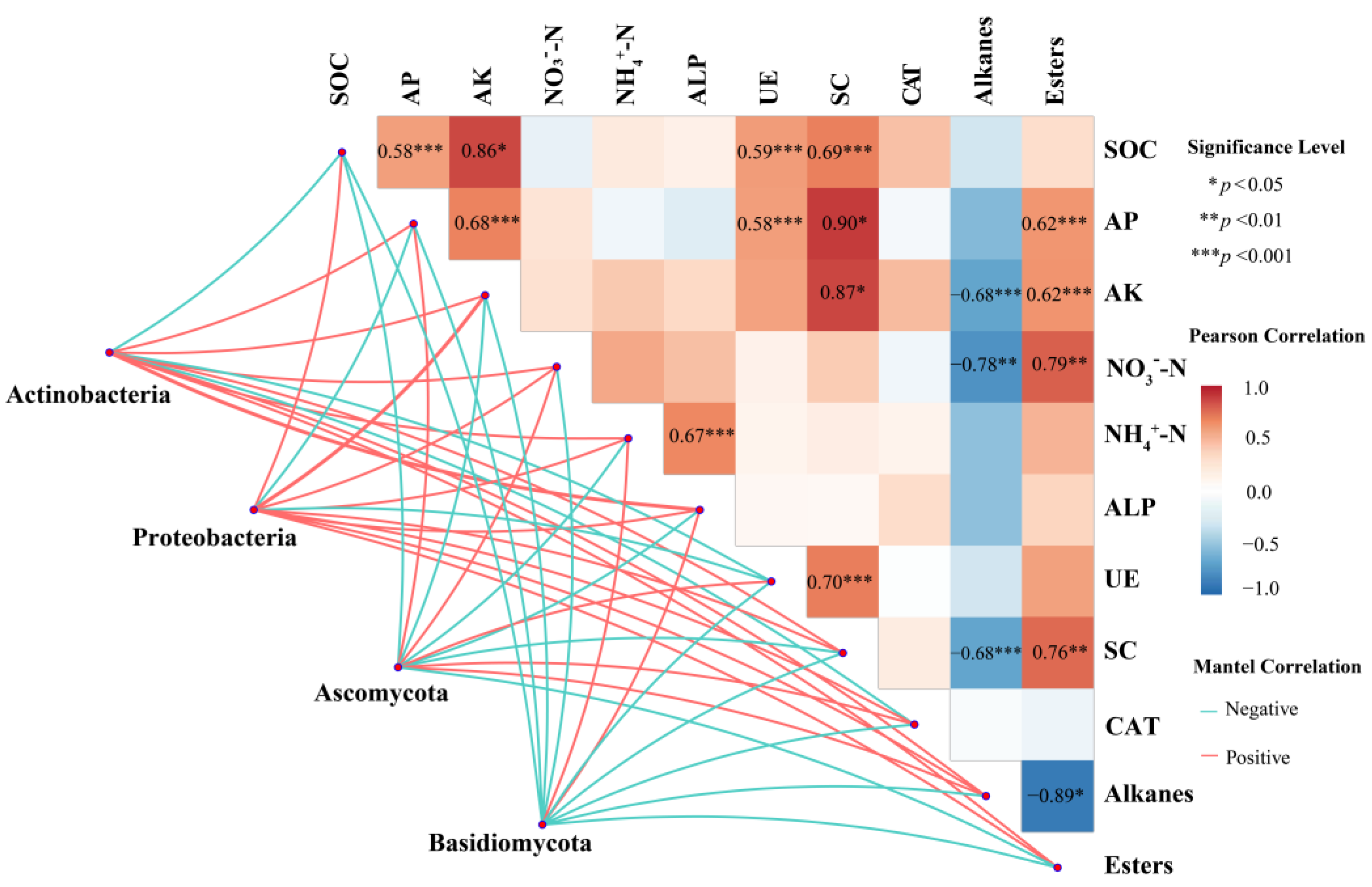
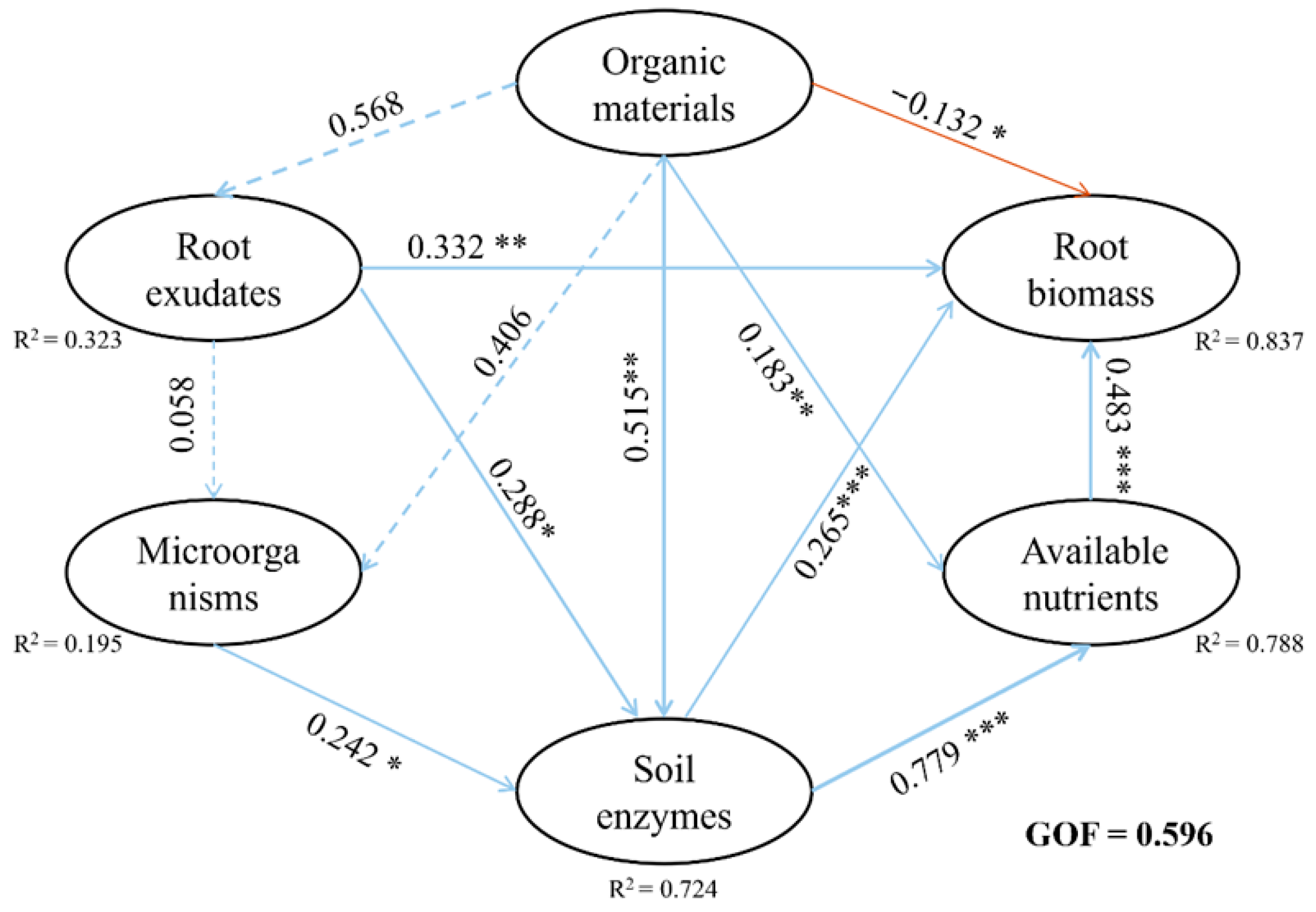
Mantel tests assessing correlations among rhizosphere soil nutrients, soil enzymes, major rhizosphere soil extracts, and dominant bacterial and fungal taxa are presented in Figure 4. Among the identified compounds, esters in rhizosphere soil extracts exhibited significant positive correlations with AP, AK, NO3-N, and SC. In contrast, alkanes showed significant negative correlations with AK, NO3-N, and SC. Soil cellulase activity SC was significantly and positively correlated with SOC, AP, AK, and UE. At the phylum level, Actinobacteria and Proteobacteria displayed significant positive correlations with alkanes, esters, ALP, and SC; conversely, Ascomycota and Basidiomycota were significantly negatively correlated with esters and SC. The exploratory analysis results derived from the structural equation model (Figure 5) indicate that the hypothesized path framework exhibits an excellent fit to the observed data, thereby elucidating the patterns of covariation among the key variables. Specifically: Organic matter exerts a significant positive effect on rhizosphere soil extract, microbial abundance, soil enzyme activity, and nutrient content; Rhizosphere soil extract positively influences both soil enzyme activity and plant growth; Microbial abundance and soil enzyme activity co-vary in a coordinated manner; Soil enzyme activity is significantly associated—both positively and coordinately—with nutrient availability and plant growth status.

4. Discussion

4.1. The Composition and Quantity of Rhizosphere Soil Extracts

In this study, no significant differences in soil moisture content were observed among the treatments (9.57–10.9%, p > 0.05; Supplementary Figure S2), indicating that the observed changes in rhizosphere soil extract composition and quantity, microbial community structure, enzyme activity, and root growth responses were primarily associated withthe intrinsic chemical properties of the applied organic materials—and their direct modulation of rhizosphere processes—rather than by indirect effects mediated through soil water conditions. Following the application of straw, biochar, and peat, the chemical composition of rhizosphere soil extracts underwent significant shifts, characterized predominantly by a decrease in the relative abundance of alkanes and a concomitant increase in the relative abundance of esters. Esters are readily metabolized by microorganisms [43], and their increased accumulation coincided with an overall rise in the total quantity of rhizosphere soil extracts. Collectively, these two trends point to a potential acceleration of carbon turnover and enhanced microbial activity within the rhizosphere microenvironment [44]. Nevertheless, the underlying mechanistic pathways likely differ across organic material types. The most pronounced increase in the proportion of esters was observed under the peat treatment, may be attributable to its high humic acid content and diverse array of bioactive compounds [45]. In contrast, the straw treatment decreased the abundance of alkanes while concurrently increasing the total quantity of rhizosphere soil extracts. This pattern may be related to the fact that straw, as a readily decomposable organic substrate, competes with plants for bioavailable nutrients during the early stages of decomposition [46,47], thereby altering carbon dynamics and modulating microbial activity in the rhizosphere. The influence of biochar on the composition of rhizosphere soil extracts is primarily indirect. By adsorbing nutrients and releasing them gradually, biochar progressively improves the rhizosphere microenvironment and provides a favorable habitat for beneficial microorganisms [48].
The application of organic amendments is strongly associated with a substantial increase in the total quantity of rhizosphere soil extracts. The increases in total rhizosphere soil extracts quantity elicited by straw and peat amendments are significantly greater than those observed with biochar. This disparity may reflect differences in the lability of organic carbon of labile organic compounds in straw and peat. In contrast, biochar—characterized by its highly recalcitrant aromatic structure [49]—exerts a milder yet more persistent stimulatory effect on soil microbes, resulting in a comparatively weaker stress signal and, accordingly, a more moderate enhancement in total rhizosphere soil extracts production. The aforementioned shifts in the chemical composition of rhizosphere soil extracts—particularly the increased relative abundance of esters and decreased abundance of alkanes—may in turn influence the rhizosphere microbial community. As readily assimilable carbon sources for microorganisms, esters may serve as preferential energy substrates for specific microbial taxa, thereby shaping both the taxonomic composition and functional potential of the community. Moreover, the distinct phytochemical profiles of soil extracts induced by different organic amendments may be associated with the recruitment of divergent microbial assemblages.

4.2. The Connection Between the Changes in Rhizosphere Soil Extracts and the Responses of Microbial Communities

Differences in the composition of rhizosphere soil extracts may impose selective pressure on microbial communities, thereby promoting the enrichment or suppression of specific taxonomic groups. Alpha-diversity analysis revealed that straw, biochar, and peat amendments did not significantly alter bacterial community richness (Chao1 index) or evenness (Shannon index) (Table 3), indicating that these three organic inputs had no substantial effect on the species richness or equitability of the rhizosphere bacterial community. The relatively higher standard errors observed in S and P treatments likely reflect the inherent biological heterogeneity characteristic of complex soil ecosystems. Such amendments may modify soil physical and chemical properties—e.g., porosity, water-holding capacity, and nutrient availability—thereby generating more heterogeneous microhabitats and contributing to greater variability in microbial colonization and spatial distribution across replicate samples. Beta-diversity analysis further demonstrated that none of the treatments significantly influenced bacterial community structure (PERMANOVA, p = 0.448); sample points from all treatments overlapped extensively in the ordination space (Figure 2a), corroborating the α-diversity findings. This structural stability may stem from robust interspecific interactions and functional redundancy within the bacterial community under saline-alkali conditions [50], conferring a strong buffering capacity against external perturbations. Although biochar and peat may create novel ecological niches [51], their influence is insufficient to override the community assembly pattern governed by strong environmental filters—particularly pH and salinity. In contrast, the fungal community exhibits greater sensitivity to organic matter addition. While the α-diversity indices did not differ significantly among treatments (Table 3), β-diversity analysis revealed an almost significant treatment effect on fungal community structure (p = 0.084). As shown in the ordination plot (Figure 2b), sample points from the CK, S, and B treatments display a visually distinct separation, suggesting that organic matter input may be driving compositional shifts in the fungal community. This finding aligns with the established notion that exogenous organic matter alters resource availability by supplying diverse, labile carbon sources, thereby selectively favoring certain fungal taxa [52]. The heightened sensitivity of fungi relative to bacteria likely stems from their narrower carbon substrate preferences and greater functional specialization [53].
At the phylum level of bacterial classification, the relative abundances of dominant phyla—particularly Actinobacteria and Proteobacteria—remained largely consistent across treatments, underscoring the overall structural stability of the bacterial community. The influence of organic amendments on bacterial composition appears to be subtle, primarily manifesting as fine-scale shifts in species-level assemblages within phyla [54]. For fungi, Ascomycota—which comprises taxa adept at rapidly utilizing labile carbon sources (e.g., cellulose and hemicellulose)—exhibited an increasing trend in relative abundance under the S treatment. This enrichment suggests an enhanced capacity for lignocellulose decomposition in the soil, potentially accelerating the mineralization of organic amendments and promoting short-term nutrient release [55]. In contrast, the B and P treatments—characterized by more recalcitrant carbon sources—showed comparatively smaller shifts in Ascomycota abundance, likely reflecting indirect benefits mediated by improved soil microenvironmental conditions. Notably, distinct association patterns emerged between specific organic amendments and the relative abundances of fungal phyla: Basidiomycota decreased in both the S and P treatments but increased in the B treatment. This may be attributed to the readily degradable components in straw, which stimulate rapid microbial proliferation during the early stage of decomposition [56], thereby transiently suppressing basidiomycetes—fungi specialized in decomposing recalcitrant organic carbon. In contrast, the highly aromatic and chemically stable structure of biochar may provide a more favorable niche for the enrichment of basidiomycetes capable of metabolizing such refractory carbon sources [57]. Moreover, organic amendments exert a significantly stronger structuring effect on fungal communities than on bacterial communities, and their impacts on bacterial versus fungal assemblages differ markedly [58], underscoring fundamental differences in the ecological strategies employed by these microbial groups in response to exogenous organic inputs.
In terms of bacterial marker taxa, no prominent bacterial marker groups were detected in B treatment. A plausible explanation for this observation is that biochar tends to enhance both the alpha diversity and evenness of the soil microbial community by providing a spatially homogeneous, porous habitat [59], rather than selectively enriching specific taxonomic groups. Notably, the Cryomorphaceae and Owenweeksia families—significantly enriched in S treatment—are hypothesized to play a role in cellulose degradation during the early stage of straw decomposition [60]. This enrichment aligns with the observed increase in the total quantity of rhizosphere soil extract under straw amendment (Section 4.1), suggesting that the proliferation of these bacterial groups may be driven by shifts in root and/or microbial secretions induced by straw addition. Similarly, the marked increase in the relative abundance of bacterial marker taxa and ester-related functional markers in P treatment likely reflects a recruitment effect mediated by peat-induced alterations in the composition of soil secretions [61]. With regard to fungal communities, no fungal marker taxa were identified in either the S or B treatments—indicating that organic matter amendment alleviates pre-existing environmental stressors, thereby diminishing the dominance of stress-adapted fungal indicator taxa. However, the P treatment retained three microbial markers, suggesting that peat amendment may alleviate plant stress while simultaneously maintaining a certain level of specific selective pressure. Bacterial co-occurrence network analysis revealed that hub nodes were distributed across the phyla Actinobacteria and Proteobacteria, reflecting their complementary contributions to rhizosphere ecological functions. Within Actinobacteria, multiple highly connected nodes were identified—consistent with their well-documented capacity to decompose complex organic matter and mobilize phosphorus, notably through enhancement of alkaline phosphatase activity [62]. In contrast, highly connected nodes within Proteobacteria likely reflect their physiological agility in responding to resource fluctuations; for instance, they may facilitate nitrogen transformations via upregulated protease and urease activities [63]. In contrast, fungal hub nodes were predominantly concentrated within the phyla Ascomycota and Basidiomycota (Figure 3d), underscoring their central roles in organic matter decomposition. Notably, Glomeromycota—representing arbuscular mycorrhizal fungi—emerged as key network nodes. Glomeromycota extend the plant’s effective absorption zone for water and nutrients via an extensive extraradical mycelial network; moreover, their metabolic activity enhances rhizosphere alkaline phosphatase activity, thereby promoting the mineralization and bioavailability of soil organic phosphorus [64,65,66].
A potential correlation exists between compositional shifts in rhizosphere soil extracts and concomitant adjustments in microbial community structure: (i) the marked increase in ester compounds under peat amendment coincides with enrichment of bacterial taxonomic markers; (ii) the overall increase in extractable metabolite abundance following straw amendment is associated with proliferation of functionally specialized degrader bacterial taxa; and (iii) the comparatively modest compositional changes observed under biochar amendment align with the absence of detectable bacterial marker enrichment. Collectively, these correlative patterns lend support to a “root extract–microbial community” cascade effect; however, the precise causal mechanisms underlying this relationship remain to be experimentally validated.

4.3. Microbial-Mediated Enzyme Activity Drives Nutrient Cycling and Root Growth

The application of organic amendments is closely linked to alterations in the biological and chemical properties of the rhizosphere microenvironment, which may subsequently influence plant root development. This relationship is primarily manifested through corresponding shifts in rhizosphere enzyme activities and the dynamics of bioavailable nutrient cycling under organic amendment treatments [67]. With respect to rhizosphere soil enzymes, alkaline phosphatase activity was significantly enhanced in S treatment, a change strongly associated with the Actinobacteria phylum—identified as a keystone taxon within the bacterial co-occurrence network. It is hypothesized that, under straw incorporation, plants may actively recruit microbial functional groups with high phosphorus-solubilizing capacity via rhizosphere soil extracts [68], thereby augmenting the mineralization potential of soil organic phosphorus to satisfy the elevated phosphorus demand accompanying rapid root system expansion [69]. Sucrase activity increased significantly across all treatments, following the order: P > B > S. The pronounced stimulation under peat application may stem from the enrichment of labile organic compounds in peat, which promote microbial sucrase secretion; in contrast, under the straw treatment, the microbial community may preferentially activate cellulose-degrading pathways [70], potentially reducing reliance on sucrase-mediated saccharide hydrolysis [71]. Catalase activity was significantly elevated under B treatment, suggesting that biochar may enhance oxidative stress resilience in the rhizosphere by improving soil aeration and stimulating aerobic microbial metabolism [72]. Notably, no significant differences in urease activity were observed among the three treatments, indicating that the initial stimulatory effects of peat, biochar, and straw on nitrogen mineralization are broadly comparable.
In terms of soil nutrients, the supply intensity and chemical speciation of bioavailable nutrients in the rhizosphere are strongly influenced by the type of organic amendment applied. Treatment B exerted the most pronounced effect on enhancing SOC content—a result likely attributable to its stable aromatic structure and concomitant capacity for long-term carbon sequestration [73]. Regarding nitrogen dynamics, nitrate nitrogen accumulation was markedly greater under the S and P treatments, consistent with the establishment of a microbially driven, bacteria-dominated nitrification environment [74]. Straw application may promote ammonium nitrogen retention in the rhizosphere via rapid mineralization of labile organic matter, whereas biochar likely achieves similar retention through direct adsorption of NH4+ ions and subsequent suppression of nitrification activity [75]. With respect to phosphorus mobilization in rhizosphere soil, both B and P significantly increased available phosphorus concentrations; however, their underlying mechanisms appear distinct. Peat’s effect is likely mediated primarily by humic acid—abundant in peat—which chemically solubilizes otherwise fixed phosphorus forms. In contrast, biochar may enhance phosphorus availability indirectly by improving the rhizosphere microenvironment and thereby stimulating the activity of phosphorus-solubilizing microorganisms, particularly actinomycetes [76,77]. Furthermore, treatment B also induced a significant increase in available potassium, potentially owing to its inherently large specific surface area and high CEC, which collectively facilitate efficient adsorption and retention of K+ ions [78,79].
The application of straw, biochar, and peat all significantly increased triticale root biomass, suggesting that optimization of the rhizosphere microenvironment is a key driver of root growth. Among these amendments, P treatment exhibited the strongest growth-promoting effect—likely attributable to its dual role in shaping both the rhizosphere nutrient and signaling environment. On one hand, this treatment enhanced esterase secretion, intensified carbon cycling activity, and improved bioavailable phosphorus supply [80]; on the other hand, humic substances naturally present in peat may directly stimulate root development and mitigate abiotic stress [81], thereby enabling plants to reallocate photosynthetic assimilates from stress-defense metabolism toward structural and morphological growth. The B treatment also promoted root growth, potentially through systemic improvement of the rhizosphere environment—including enhanced organic carbon sequestration, greater spatial uniformity of the microhabitat, sustained potassium availability, and moderate enhancement of microbial symbiotic networks [82,83]. In contrast, although the S treatment induced a rapid short-term increase in soil nitrogen and phosphorus concentrations, its overall growth-promoting effect on roots was comparatively modest. This limited efficacy may stem from transient nutrient competition between decomposing microorganisms and plant roots during the early stages of straw decomposition.

4.4. Limitations of This Study and Future Prospects

It is necessary to highlight several limitations inherent in the experimental design of this study. First, although organic material inputs were standardized on an equal-carbon basis, differences in conventional fertilization practices for Sesbania and triticale resulted in slight variations in the application rates of chemical nitrogen and phosphorus fertilizers across treatments. Consequently, the observed treatment effects—such as differences in soil enzyme activity, microbial community composition, and crop growth—may reflect the combined influence of organic material type and nutrient input level. Specifically, the relatively high nitrogen input in the straw treatment (73.9 kg N ha−1) likely contributed to its superior biomass production; although the biochar treatment received lower nitrogen, its substantial potassium and phosphorus supply may partly account for the pronounced increase in available potassium; in contrast, the peat treatment received the lowest total nutrient input, suggesting that its effects were driven more by physical properties—such as enhanced water-holding capacity—than by nutrient provision. Second, this study analyzed only rhizosphere soil samples and did not include non-rhizosphere (bulk) soil controls. As a result, it remains unclear whether the observed changes stem from the “specific regulation” exerted by organic amendments on rhizosphere-specific processes, or instead represent a “rhizosphere mirror”—i.e., a reflection of broader, whole-soil microbial community responses—to these amendments. In addition, owing to the limited sample size, the SEM results should be interpreted as exploratory rather than confirmatory: the path coefficients reflect consistent associative patterns among variables but do not establish rigorous causal relationships. Similarly, although the Mantel test identifies statistically significant correlations among variables, it cannot infer direct mechanistic linkages. Future research should advance mechanistic understanding along the following three directions: First, implement a nutrient-balanced experimental design—by adjusting synthetic fertilizer inputs on an equal-carbon basis to ensure equivalent total nitrogen, phosphorus, and potassium availability—and concurrently establish soil-only control treatments to isolate and more rigorously assess the “material effect” of organic matter and its root-specific influence. Second, functionally characterize the key microbial taxa identified in this study—using metagenomic approaches or targeted isolation and cultivation—to elucidate their specific roles and underlying mechanisms in rhizosphere processes. Third, conduct controlled experiments to causally test and validate the path relationships inferred by the SEM.

5. Conclusions

The application of straw, biochar, and peat is strongly associated with enhanced root growth in triticale. Based on coordinated changes observed in rhizosphere soil extracts, microbial community composition, soil enzyme activities, and nutrient availability, we propose a conceptual mechanistic model: organic amendments may modulate the rhizosphere microbial community by altering the composition and concentration of rhizosphere soil extracts; this, in turn, stimulates soil enzyme activities and enhances nutrient bioavailability—ultimately establishing a putative positive feedback loop that favors root development. From a practical standpoint, these findings hold significant implications for the remediation and sustainable management of saline–alkali soils. The selection of organic amendments should be guided by site-specific improvement objectives: (i) peat may be optimal when rapid root growth promotion is the primary goal; (ii) straw may be preferable for enhancing phosphorus cycling and activating specific functional microbial groups; and (iii) biochar may play a positive role in improving the physical and chemical properties of soil and the quality of the microbial habitat. It should be noted that soil and microbial samples in this study were collected only once—at the flowering stage—thereby limiting our ability to resolve the temporal dynamics of the proposed mechanism. Consequently, the above hypotheses require further validation through longitudinal sampling across multiple developmental stages, increased biological replication, and systematic quantification of root architectural traits.

Supplementary Materials

The following supporting information can be downloaded at: https://www.mdpi.com/article/10.3390/agriculture16070730/s1, Figure S1: Dry weight of plant roots. CK refers to single application of chemical fertilizer, S refers to application of chemical fertilizer + triticale straw, B refers to application of chemical fertilizer + biochar, and P refers to application of chemical fertilizer + peat; Figure S2: Soil water content under different organic material treatments. CK refers to single application of chemical fertilizer, S refers to application of chemical fertilizer + triticale straw, B refers to application of chemical fertilizer + biochar, and P refers to application of chemical fertilizer + peat.

Author Contributions

Conceptualization, J.L. and X.C.; Methodology, J.L. and X.C.; Software, J.L.; Validation, J.L. and X.M.; Formal analysis, J.L.; Investigation, J.L. and X.M.; Data curation, J.L.; Writing—original draft, J.L.; Writing—review & editing, X.C.; Visualization, J.L. and X.M.; Funding acquisition, X.C. All authors have read and agreed to the published version of the manuscript.

Funding

This work was supported by “Joint Funds of the National Natural Science Foundation of China (U2106214)”.

Data Availability Statement

The data that support the findings of this study are available from the corresponding author upon reasonable request.

Conflicts of Interest

The authors declare no conflicts of interest.

References

  1. Guan, R.H.; Li, Y.; Jia, Y.L.; Jiang, F.C.; Li, L.W. Acidified Biochar One-off Application for Saline-Alkali Soil Improvement: A Three-Year Field Trial Evaluating the Persistence of Effects. Ind. Crop Prod. 2024, 222, 119972. [Google Scholar] [CrossRef]
  2. Jin, F.; Piao, J.L.; Miao, S.H.; Che, W.K.; Li, X.; Li, X.B.; Shiraiwa, T.; Tanaka, T.; Taniyoshi, K.; Hua, S.; et al. Long-Term Effects of Biochar One-off Application on Soil Physicochemical Properties, Salt Concentration, Nutrient Availability, Enzyme Activity, and Rice Yield of Highly Saline-Alkali Paddy Soils: Based on a 6-Year Field Experiment. Biochar 2024, 6, 40. [Google Scholar] [CrossRef]
  3. Philippot, L.; Raaijmakers, J.M.; Lemanceau, P.; van der Putten, W.H. Going Back to the Roots: The Microbial Ecology of the Rhizosphere. Nat. Rev. Microbiol. 2013, 11, 789–799. [Google Scholar] [CrossRef] [PubMed]
  4. Berendsen, R.L.; Pieterse, C.M.J.; Bakker, P.A.H.M. The Rhizosphere Microbiome and Plant Health. Trends Plant Sci. 2012, 17, 478–486. [Google Scholar] [CrossRef]
  5. Mueller, C.W.; Baumert, V.; Carminati, A.; Germon, A.; Holz, M.; Koegel-Knabner, I.; Peth, S.; Schlueter, S.; Uteau, D.; Vetterlein, D.; et al. From Rhizosphere to Detritusphere—Soil Structure Formation Driven by Plant Roots and the Interactions with Soil Biota. Soil Biol. Biochem. 2024, 193, 109396. [Google Scholar] [CrossRef]
  6. Dessaux, Y.; Grandclement, C.; Faure, D. Engineering the Rhizosphere. Trends Plant Sci. 2016, 21, 266–278. [Google Scholar] [CrossRef]
  7. Hartman, K.; Tringe, S.G. Interactions between Plants and Soil Shaping the Root Microbiome under Abiotic Stress. Biochem. J. 2019, 476, 2705–2724. [Google Scholar] [CrossRef] [PubMed]
  8. Trivedi, P.; Leach, J.E.; Tringe, S.G.; Sa, T.; Singh, B.K. Plant-Microbiome Interactions: From Community Assembly to Plant Health. Nat. Rev. Microbiol. 2020, 18, 607–621. [Google Scholar] [CrossRef]
  9. Raaijmakers, J.M.; Paulitz, T.C.; Steinberg, C.; Alabouvette, C.; Moenne-Loccoz, Y. The Rhizosphere: A Playground and Battlefield for Soilborne Pathogens and Beneficial Microorganisms. Plant Soil 2009, 321, 341–361. [Google Scholar] [CrossRef]
  10. Zhao, M.L.; Zhao, J.; Yuan, J.; Hale, L.; Wen, T.; Huang, Q.W.; Vivanco, J.M.; Zhou, J.Z.; Kowalchuk, G.A.; Shen, Q.R. Root Exudates Drive Soil-Microbe-Nutrient Feedbacks in Response to Plant Growth. Plant Cell Environ. 2021, 44, 613–628. [Google Scholar] [CrossRef]
  11. Wu, D.Y.; He, X.M.; Jiang, L.M.; Li, W.J.; Wang, H.F.; Lv, G.H. Root Exudates Facilitate the Regulation of Soil Microbial Community Function in the Genus Haloxylon. Front. Plant Sci. 2024, 15, 1461893. [Google Scholar] [CrossRef]
  12. Zhalnina, K.; Louie, K.B.; Hao, Z.; Mansoori, N.; da Rocha, U.N.; Shi, S.; Cho, H.; Karaoz, U.; Loque, D.; Bowen, B.P.; et al. Dynamic Root Exudate Chemistry and Microbial Substrate Preferences Drive Patterns in Rhizosphere Microbial Community Assembly. Nat. Microbiol. 2018, 3, 470–480. [Google Scholar] [CrossRef]
  13. Jacoby, R.; Peukert, M.; Succurro, A.; Koprivova, A.; Kopriva, S. The Role of Soil Microorganisms in Plant Mineral Nutrition-Current Knowledge and Future Directions. Front. Plant Sci. 2017, 8, 1617. [Google Scholar] [CrossRef]
  14. Breitkreuz, C.; Herzig, L.; Buscot, F.; Reitz, T.; Tarkka, M. Interactions between Soil Properties, Agricultural Management and Cultivar Type Drive Structural and Functional Adaptations of the Wheat Rhizosphere Microbiome to Drought. Environ. Microbiol. 2021, 23, 5866–5882. [Google Scholar] [CrossRef] [PubMed]
  15. Timofeeva, A.M.; Galyamova, M.R.; Sedykh, S.E. How Do Plant Growth-Promoting Bacteria Use Plant Hormones to Regulate Stress Reactions? Plants 2024, 13, 2371. [Google Scholar] [CrossRef]
  16. Lugtenberg, B.; Kamilova, F. Plant Growth Promoting Rhizobacteria. Annu. Rev. Microbiol. 2009, 63, 541–556. [Google Scholar] [CrossRef] [PubMed]
  17. Burns, R.G.; DeForest, J.L.; Marxsen, J.; Sinsabaugh, R.L.; Stromberger, M.E.; Wallenstein, M.D.; Weintraub, M.N.; Zoppini, A. Soil Enzymes in a Changing Environment: Current Knowledge and Future Directions. Soil Biol. Biochem. 2013, 58, 216–234. [Google Scholar] [CrossRef]
  18. Daunoras, J.; Kacergius, A.; Gudiukaite, R. Role of Soil Microbiota Enzymes in Soil Health and Activity Changes Depending on Climate Change and the Type of Soil Ecosystem. Biology 2024, 13, 85. [Google Scholar] [CrossRef] [PubMed]
  19. Hu, L.F.; Robert, C.A.M.; Cadot, S.; Zhang, X.; Ye, M.; Li, B.B.; Manzo, D.; Chervet, N.; Steinger, T.; van der Heijden, M.G.A.; et al. Root Exudate Metabolites Drive Plant-Soil Feedbacks on Growth and Defense by Shaping the Rhizosphere Microbiota. Nat. Commun. 2018, 9, 2738. [Google Scholar] [CrossRef]
  20. Gu, Y.Y.; Zhang, H.Y.; Liang, X.Y.; Fu, R.; Li, M.; Chen, C.J. Effect of Different Biochar Particle Sizes Together with Bio-Organic Fertilizer on Rhizosphere Soil Microecological Environment on Saline-Alkali Land. Front. Environ. Sci. 2022, 10, 949190. [Google Scholar] [CrossRef]
  21. Pan, X.; Shi, M.; Chen, X.C.; Kuang, S.P.; Ullah, H.; Lu, H.X.; Riaz, L. An Investigation into Biochar, Acid-Modified Biochar, and Wood Vinegar on the Remediation of Saline-Alkali Soil and the Growth of Strawberries. Front. Environ. Sci. 2022, 10, 1057384. [Google Scholar] [CrossRef]
  22. Pokharel, P.; Ma, Z.L.; Chang, S.X. Biochar Increases Soil Microbial Biomass with Changes in Extra- and Intracellular Enzyme Activities: A Global Meta-Analysis. Biochar 2020, 2, 65–79. [Google Scholar] [CrossRef]
  23. Song, Y.; Gao, M.G.; Li, Z. Impacts of Straw Return Methods on Crop Yield, Soil Organic Matter, and Salinity in Saline-Alkali Land in North China. Field Crop Res. 2025, 322, 109752. [Google Scholar] [CrossRef]
  24. Yao, R.F.; Tao, S.Q.; Chen, Y.Y.; Liu, Z.Y.; Feng, S. Study on the Effects of Phosphoric Acid-Modified Biochar on the Adsorption Behavior and Bioavailability of Oxytetracycline in Saline-Alkali Soils. Environ. Geochem. Health 2025, 47, 539. [Google Scholar] [CrossRef]
  25. Uddin, S.; Rohan, M.; Weng, Z.H.; Tahmasbian, I.; Fang, Y.Y.; Hayden, H.L.; Armstrong, R.; Tavakkoli, E. Enhancing Root Proliferation in an Alkaline Dispersive Subsoil: A Comparative Study of Organic and Inorganic Amendments with Different Amelioration Mechanisms. J. Soil Sci. Plant Nutr. 2025, 25, 7381–7396. [Google Scholar] [CrossRef]
  26. Huang, C.Y.; Huang, H.J.; Huang, S.J.; Li, W.B.; Zhang, K.R.; Chen, Y.; Yang, L.; Luo, L.; Deng, L.J. Effects of Straw Returning on Soil Aggregates and Its Organic Carbon and Nitrogen Retention under Different Mechanized Tillage Modes in Typical Hilly Regions of Southwest China. Agronomy 2024, 14, 928. [Google Scholar] [CrossRef]
  27. Yan, S.S.; Song, J.M.; Fan, J.S.; Yan, C.; Dong, S.K.; Ma, C.M.; Gong, Z.P. Changes in Soil Organic Carbon Fractions and Microbial Community under Rice Straw Return in Northeast China. Glob. Ecol. Conserv. 2020, 22, e00962. [Google Scholar] [CrossRef]
  28. Qi, J.; Weigt, S.; Wang, M.; Rezanezhad, F.; Quinton, W.; Zak, D.; Ahmad, S.; Wang, L.; Zhao, Y.; Lennartz, B.; et al. Hydro-Physical and Carbon Properties of Peat across Peatland Types and Climate Zones. Geoderma 2025, 461, 117480. [Google Scholar] [CrossRef]
  29. Lipatov, D.N.; Shcheglov, A.; Manakhov, D.; Brekhov, P.T. Spatial Variation of Organic Carbon Stocks in Peat Soils and Gleyzems in the Northeast of Sakhalin Island. Eurasian Soil Sci. 2021, 54, 226–237. [Google Scholar] [CrossRef]
  30. Kuryntseva, P.; Karamova, K.; Galitskaya, P.; Selivanovskaya, S.; Evtugyn, G. Biochar Functions in Soil Depending on Feedstock and Pyrolyzation Properties with Particular Emphasis on Biological Properties. Agriculture 2023, 13, 2003. [Google Scholar] [CrossRef]
  31. Zhao, W.; Zhou, Q.; Tian, Z.Z.; Cui, Y.T.; Liang, Y.; Wang, H.Y. Apply Biochar to Ameliorate Soda Saline-Alkali Land, Improve Soil Function and Increase Corn Nutrient Availability in the Songnen Plain. Sci. Total Environ. 2020, 722, 137428. [Google Scholar] [CrossRef] [PubMed]
  32. Chen, S.T.; Liu, G.Z.; Hong, Y.; Ma, Y.Y.; Guo, S.K.; Yan, P.; Mi, W.H. Biochar Amendment Was Less Effective for Rice Yield Improvement but More Effective for Soil Quality Relative to Inorganic Fertilization in a Low Fertility Paddy Soil. J. Soil Sci. Plant Nutr. 2024, 24, 4918–4928. [Google Scholar] [CrossRef]
  33. Li, M.; Song, Z.; Li, Z.; Qiao, R.; Zhang, P.; Ding, C.; Xie, J.; Chen, Y.; Guo, H. Populus Root Exudates Are Associated with Rhizosphere Microbial Communities and Symbiotic Patterns. Front. Microbiol. 2022, 13, 1042944. [Google Scholar] [CrossRef]
  34. Deshoux, M.; Sadet-Bourgeteau, S.; Gentil, S.; Prevost-Boure, N.C. Effects of Biochar on Soil Microbial Communities: A Meta-Analysis. Sci. Total Environ. 2023, 902, 166079. [Google Scholar] [CrossRef]
  35. Walkley, A.; Black, I.A. An Examination of the Degtjareff Method for Determining Soil Organic Matter, and a Proposed Modification of the Chromic Acid Titration Method. Soil Sci. 1934, 37, 29–38. [Google Scholar] [CrossRef]
  36. Lopez Pasquali, C.E.; Fernandez Hernando, P.; Durand Alegria, J.S. Spectrophotometric Simultaneous Determination of Nitrite, Nitrate and Ammonium in Soils by Flow Injection Analysis. Anal. Chim. Acta 2007, 600, 177–182. [Google Scholar] [CrossRef] [PubMed]
  37. Murphy, J.; Riley, J.P. A Modified Single Solution Method for the Determination of Phosphate in Natural Waters. Anal. Chim. Acta 1962, 27, 31–36. [Google Scholar] [CrossRef]
  38. Walker, J.M.; Barber, S.A. Absorption of Potassium and Rubidium from the Soil by Corn Roots. Plant Soil 1962, 17, 243–259. [Google Scholar] [CrossRef]
  39. Tarafdar, J.; Jungk, A. Phosphatase-Activity in the Rhizosphere and Its Relation to the Depletion of Soil Organic Phosphorus. Biol. Fertil. Soils 1987, 3, 199–204. [Google Scholar] [CrossRef]
  40. Vlek, P.L.G.; Stumpe, J.M.; Byrnes, B.H. Urease Activity and Inhibition in Flooded Soil Systems. Fertil. Res. 1980, 1, 191–202. [Google Scholar] [CrossRef]
  41. Johnson, J.L.; Temple, K.L. Some Variables Affecting the Measurement of Catalase Activity in Soil. Soil Sci. Soc. Am. J. 1964, 28, 207–209. [Google Scholar] [CrossRef]
  42. Bian, F.Y.; Zhong, Z.K.; Li, C.Z.; Zhang, X.P.; Gu, L.J.; Huang, Z.C.; Gai, X.; Huang, Z.Y. Intercropping Improves Heavy Metal Phytoremediation Efficiency through Changing Properties of Rhizosphere Soil in Bamboo Plantation. J. Hazard. Mater. 2021, 416, 125898. [Google Scholar] [CrossRef] [PubMed]
  43. Chen, L.; Liu, Y.P. The Function of Root Exudates in the Root Colonization by Beneficial Soil Rhizobacteria. Biology 2024, 13, 95. [Google Scholar] [CrossRef] [PubMed]
  44. Fang, K.; Kou, Y.P.; Tang, N.; Liu, J.; Zhang, X.Y.; He, H.L.; Xia, R.X.; Zhao, W.Q.; Li, D.D.; Liu, Q. Differential Responses of Soil Bacteria, Fungi and Protists to Root Exudates and Temperature. Microbiol. Res. 2024, 286, 127829. [Google Scholar] [CrossRef]
  45. Obeng, A.S.; Dunne, J.; Giltrap, M.; Tian, F.R. Soil Organic Matter Carbon Chemistry Signatures, Hydrophobicity and Humification Index Following Land Use Change in Temperate Peat Soils. Heliyon 2023, 9, e19347. [Google Scholar] [CrossRef]
  46. Yang, H.J.; Xia, J.B.; Xie, W.J.; Wei, S.C.; Cui, Q.; Shao, P.S.; Sun, J.K.; Dong, K.K.; Qi, X.C. Effects of Straw Returning and Nitrogen Addition on Soil Quality of a Coastal Saline Soil: A Field Study of Four Consecutive Wheat-Maize Cycles. Land Degrad. Dev. 2023, 34, 2061–2072. [Google Scholar] [CrossRef]
  47. Feng, Z.W.; Liang, Q.H.; Yao, Q.; Bai, Y.; Zhu, H.H. The Role of the Rhizobiome Recruited by Root Exudates in Plant Disease Resistance: Current Status and Future Directions. Environ. Microbiome 2024, 19, 91. [Google Scholar] [CrossRef] [PubMed]
  48. Cui, X.; Yuan, J.; Yang, X.; Wei, C.Q.; Bi, Y.H.; Sun, Q.; Meng, J.; Han, X.R. Biochar Application Alters Soil Metabolites and Nitrogen Cycle-Related Microorganisms in a Soybean Continuous Cropping System. Sci. Total Environ. 2024, 917, 170522. [Google Scholar] [CrossRef]
  49. Chi, W.C.; Nan, Q.; Liu, Y.X.; Dong, D.; Qin, Y.; Li, S.J.; Wu, W.X. Stress Resistance Enhancing with Biochar Application and Promotion on Crop Growth. Biochar 2024, 6, 43. [Google Scholar] [CrossRef]
  50. Zhou, D.; Fu, Y.; Liu, L.; Lin, W.; Lu, Z.; Ye, Y.; Zhang, M. Comparative Analysis of Bacterial Communities and Environmental Interactions in Seawater and Saline-Alkali Aquaculture Ponds for Scylla Paramamosain in Northern China. Front. Microbiol. 2025, 16, 1589304. [Google Scholar] [CrossRef]
  51. Liang, S.; Wang, S.N.; Zhou, L.L.; Sun, S.; Zhang, J.; Zhuang, L.L. Combination of Biochar and Functional Bacteria Drives the Ecological Improvement of Saline-Alkali Soil. Plants 2023, 12, 284. [Google Scholar] [CrossRef]
  52. Zhu, B.; Li, J.Q.; Li, J.Z.; Chen, X.; Chi, G.Y. Fungal Community Is More Sensitive to the Short-Term Application of Biochar in Saline Farmland Soil than Bacterial. Appl. Soil Ecol. 2025, 212, 106219. [Google Scholar] [CrossRef]
  53. Wang, M.; Qi, X.; Shi, Y.; Zhao, J.; Ahmad, S.; Akhtar, K.; Chen, B.; Lian, T.; He, B.; Wen, R. Sugarcane Straw Returning Is an Approaching Technique for the Improvement of Rhizosphere Soil Functionality, Microbial Community, and Yield of Different Sugarcane Cultivars. Front. Microbiol. 2023, 14, 1133973. [Google Scholar] [CrossRef] [PubMed]
  54. Wang, G.Z.; Qin, W.; Yin, Z.; Zhou, Z.Y.; Jiao, J.; Xu, X.H.; Zhang, Y.; Han, X. Threshold Effects of Straw Returning Amounts on Bacterial Colonization in Black Soil. Microorganisms 2025, 13, 1797. [Google Scholar] [CrossRef]
  55. Qi, X.Y.; Chen, T.; Ding, C.; Chen, X.M.; He, B.; Hu, W.G. Diversity of Fungal Communities in the Rhizosphere Soil of Tamarix Chinensis in Saline-Alkaline Wetland. Environ. Dev. Sustain. 2025, 27, 8693–8709. [Google Scholar] [CrossRef]
  56. Wang, J.L.; Jing, H.Y.; Xu, T.Y.; Li, C.R.; Zhao, C.K.; Feng, W.Z. Application Effect of Straw Returning and Biochar in the Improvement of Saline-Alkali Land in Northeast China. Biol. Bull. 2023, 50, 825–836. [Google Scholar] [CrossRef]
  57. Li, M.; Chen, C.J.; Zhang, H.Y.; Wang, Z.S.; Song, N.N.; Li, J.L.; Liang, X.Y.; Yi, K.H.; Gu, Y.Y.; Guo, X.H. Effects of Biochar Amendment and Organic Fertilizer on Microbial Communities in the Rhizosphere Soil of Wheat in Yellow River Delta Saline-Alkaline Soil. Front. Microbiol. 2023, 14, 1250453. [Google Scholar] [CrossRef]
  58. Chen, L.; Zhou, S.; Zhang, Q.; Zou, M.; Yin, Q.; Qiu, Y.; Qin, W. Effect of Organic Material Addition on Active Soil Organic Carbon and Microbial Diversity: A Meta-Analysis. Soil Till. Res. 2024, 241, 106128. [Google Scholar] [CrossRef]
  59. Huang, Z.C.; Bian, F.Y.; Wang, Z.G.; Zhu, J.; Zhang, X.P.; Wang, J.; Gai, X.; Zhong, Z.K. Microorganisms Facilitated the Saline-Alkali Soil Remediation by Biochar: Soil Properties, Microbial Communities, and Plant Responses. Land Degrad. Dev. 2024, 35, 3567–3578. [Google Scholar] [CrossRef]
  60. Li, J.; Li, J.; Yang, R.; Yang, P.; Fu, H.; Yang, Y.; Liu, C. Construction of Microbial Consortium to Enhance Cellulose Degradation in Corn Straw during Composting. Agronomy 2024, 14, 2107. [Google Scholar] [CrossRef]
  61. Liu, L.; Liu, D.M.; Ding, X.D.; Chen, M.M.; Zhang, S.R. Straw Incorporation and Nitrogen Fertilization Enhance Soil Carbon Sequestration by Altering Soil Aggregate and Microbial Community Composition in Saline-Alkali Soil. Plant Soil 2024, 498, 341–356. [Google Scholar] [CrossRef]
  62. Ai, Z.; Deng, Y.; Li, X.H.; Zhang, J.Y.; Liu, H.F.; Xu, H.W.; Liu, G.B.; Sha, X. Effect of Plant-Soil Feedback on Soil Microbial Co-Occurrence Network Depends on the Stage of Secondary Succession. Rhizosphere 2023, 27, 100733. [Google Scholar] [CrossRef]
  63. Zhang, Y.; Miao, S.H.; Song, Y.; Wang, X.D.; Jin, F. Biochar Application Reduces Saline-Alkali Stress by Improving Soil Functions and Regulating the Diversity and Abundance of Soil Bacterial Community in Highly Saline-Alkali Paddy Field. Sustainability 2024, 16, 1001. [Google Scholar] [CrossRef]
  64. Xin, Y.; Fan, Y.; Babalola, O.O.; Zhang, X.M.; Yang, W. Legacy Effects of Biochar and Compost Addition on Arbuscular Mycorrhizal Fungal Community and Co-Occurrence Network in Black Soil. Microorganisms 2022, 10, 2137. [Google Scholar] [CrossRef] [PubMed]
  65. Ma, X.C.; Xu, X.; Geng, Q.H.; Luo, Y.Q.; Ju, C.H.; Li, Q.; Zhou, Y. Global Arbuscular Mycorrhizal Fungal Diversity and Abundance Decreases with Soil Available Phosphorus. Glob. Ecol. Biogeogr. 2023, 32, 1423–1434. [Google Scholar] [CrossRef]
  66. Li, Z.S.; Lin, K.Q.; Wang, Y.; Zhai, Y.X.; Wang, B.Y.; Ping, M.L.; Meng, Y.Z.; Luo, W.M.; Chen, J.; Li, X.Y. Synergistic Superiority of AMF and Biochar in Enhancing Rhizosphere Microbiomes to Support Plant Growth under Cd Stress. Biochar 2025, 7, 105. [Google Scholar] [CrossRef]
  67. Wozniak, M.M.; Siebielec, S.; Siebielec, G.; Bojarszczuk, J.; Galazka, A.; Urbaniak, M. Microbially Modified Effect of Exogenous Organic Matter on Soil Chemical and Biological Indices and Plant Responses. J. Soil Sediment. 2024, 24, 70–85. [Google Scholar] [CrossRef]
  68. Liu, Y.L.; Gu, Y.; Wu, C.S.; Zhao, H.X.; Hu, W.H.; Xu, C.; Chen, X.F. Short-Term Straw Returning Improves Quality and Bacteria Community of Black Soil in Northeast China. Pol. J. Environ. Stud. 2022, 31, 1869–1884. [Google Scholar] [CrossRef]
  69. Wang, K.K.; Ren, T.; Yan, J.Y.; Zhu, D.D.; Liao, S.P.; Zhang, Y.Y.; Lu, Z.F.; Cong, R.H.; Li, X.K.; Lu, J.W. Straw Returning Mediates Soil Microbial Biomass Carbon and Phosphorus Turnover to Enhance Soil Phosphorus Availability in a Rice-Oilseed Rape Rotation with Different Soil Phosphorus Levels. Agric. Ecosyst. Environ. 2022, 335, 107991. [Google Scholar] [CrossRef]
  70. Guan, Y.P.; Wu, M.K.; Che, S.H.; Yuan, S.; Yang, X.; Li, S.Y.; Tian, P.; Wu, L.; Yang, M.Y.; Wu, Z.H. Effects of Continuous Straw Returning on Soil Functional Microorganisms and Microbial Communities. J. Microbiol. 2023, 61, 49–62. [Google Scholar] [CrossRef]
  71. Zheng, W.S.; Dong, H.L.; Wang, Z.B.; Tao, Y.H. Effect of Straw Returning and Nitrogen Application Rate on Soil Enzymatic Activities. Agric. Res. 2023, 12, 163–171. [Google Scholar] [CrossRef]
  72. Wojewodzki, P.; Lemanowicz, J.; Debska, B.; Haddad, S.A. Soil Enzyme Activity Response under the Amendment of Different Types of Biochar. Agronomy 2022, 12, 569. [Google Scholar] [CrossRef]
  73. Jia, X.; Ma, H.; Yan, W.; Shangguan, Z.; Zhong, Y. Effects of Co-Application of Biochar and Nitrogen Fertilizer on Soil Profile Carbon and Nitrogen Stocks and Their Fractions in Wheat Field. J. Environ. Manag. 2024, 368, 122140. [Google Scholar] [CrossRef]
  74. Espenberg, M.; Truu, M.; Mander, U.; Kasak, K.; Nolvak, H.; Ligi, T.; Oopkaup, K.; Maddison, M.; Truu, J. Differences in Microbial Community Structure and Nitrogen Cycling in Natural and Drained Tropical Peatland Soils. Sci. Rep. 2018, 8, 4742. [Google Scholar] [CrossRef]
  75. Lu, J.K.; Li, Y.; Wang, B.; Hou, B.Y.; Du, G.T.; Si, H.Y. Analysis of the Adsorption and Fixation Process of Ammonium Nitrogen in Arable Soil by Biochar Based on Molecular Dynamics Simulation. Sci. Total Environ. 2024, 930, 172815. [Google Scholar] [CrossRef]
  76. Qi, C.H.; Zhang, C.Y.; Yang, Z.H.; Liu, N.N.; Gao, Y.; Wang, R.T.; Huang, D.Y.; Tian, F.; Li, W.; Wei, C.; et al. Acid-Modified Biochar-Based Bacterial Fertilizer and Increase Soil Available Phosphorus. J. Soil. Sediment. 2025, 25, 59–66. [Google Scholar] [CrossRef]
  77. Zhang, L.X.; Chang, L.; Liu, H.J.; de Jesus Puy Alquiza, M.; Li, Y.F. Biochar Application to Soils Can Regulate Soil Phosphorus Availability: A Review. Biochar 2025, 7, 13. [Google Scholar] [CrossRef]
  78. Biederman, L.A.; Harpole, W.S. Biochar and Its Effects on Plant Productivity and Nutrient Cycling: A Meta-Analysis. GCB Bioenergy 2013, 5, 202–214. [Google Scholar] [CrossRef]
  79. Xiu, L.Q.; Sun, Y.Y.; Han, X.R. Effects of Biochar Amendment on Potassium Supply Capacity and Potassium Accumulation in Soybean across Diverse Soils. Plants 2025, 14, 1959. [Google Scholar] [CrossRef]
  80. Liu, Z.; Zhang, J.; Qin, J.X.; Ouyang, X.D.; Wang, J.L.; Gu, W.B.; Li, J.; Wang, L.; Li, Z.; Wu, J.; et al. Peat and Liquid Organic Fertilizer Promoted Kiwifruit Performance by Modifying Rhizosphere Soil Physicochemical and Microbial Properties. Land Degrad. Dev. 2025, 36, 3227–3240. [Google Scholar] [CrossRef]
  81. Jarukas, L.; Ivanauskas, L.; Kasparaviciene, G.; Baranauskaite, J.; Marksa, M.; Bernatoniene, J. Determination of Organic Compounds, Fulvic Acid, Humic Acid, and Humin in Peat and Sapropel Alkaline Extracts. Molecules 2021, 26, 2995. [Google Scholar] [CrossRef] [PubMed]
  82. Zhang, M.Y.; Riaz, M.; Liu, B.; Xia, H.; El-desouki, Z.; Jiang, C.C. Two-Year Study of Biochar: Achieving Excellent Capability of Potassium Supply via Alter Clay Mineral Composition and Potassium-Dissolving Bacteria Activity. Sci. Total Environ. 2020, 717, 137286. [Google Scholar] [CrossRef] [PubMed]
  83. Bilias, F.; Kalderis, D.; Richardson, C.; Barbayiannis, N.; Gasparatos, D. Biochar Application as a Soil Potassium Management Strategy: A Review. Sci. Total Environ. 2023, 858, 159782. [Google Scholar] [CrossRef] [PubMed]
Figure 1. Composition (a) and total amount (b) of rhizosphere soil extracts under different organic material treatments. The extracts represent a mixture of root exudates, microbial metabolic products, and soluble organic matter in the amendment. The total amount of rhizosphere extracts extracted from every 20 g of rhizosphere soil. CK refers to the application of chemical fertilizer alone, S refers to the application of chemical fertilizer + triticale straw, B refers to the application of chemical fertilizer + biochar, and P refers to the application of chemical fertilizer + peat.
Agriculture 16 00730 g001
Figure 2. Principal coordinate analysis and relative abundance of rhizosphere soil bacteria and fungi under different organic matter treatments. (a) Principal coordinate analysis of bacteria, (b) Principal coordinate analysis of fungi, (c) Distribution of relative abundance at the phylum level of bacteria, (d) Distribution of relative abundance at the phylum level of fungi). PERMANOVA analysis indicated that the treatments had no significant effect on the community structure of bacteria (p = 0.448, R2 = 0.273) and fungi (p = 0.084, R2 = 0.32). CK refers to the application of chemical fertilizer alone, S refers to the application of chemical fertilizer + triticale straw, B refers to the application of chemical fertilizer + biochar, and P refers to the application of chemical fertilizer + peat.
Agriculture 16 00730 g002
Figure 3. Significant bacterial and fungal communities and co-occurrence network diagrams in the rhizosphere soil of plants treated with different organic materials (a) bacterial LDA score, (b) fungal LDA score, (c) bacterial co-occurrence network diagram, (d) fungal co-occurrence network diagram). The LDA score plots based on LEfSe analysis show species with significant abundance differences among treatments (threshold: log10 LDA > 2.0, p < 0.05). The network diagrams were constructed based on the comprehensive dataset of all treatment samples. Nodes represent individual ASVs and are colored by phylum. Node size is proportional to the relative abundance of the ASV. Edges represent strong (|r| > 0.7) and statistically significant (Spearman correlation, p < 0.01) correlations between nodes. Edge color indicates positive correlation (red) or negative correlation (blue). This network was constructed using the ‘igraph’ package, and only correlations with FDR-corrected p values < 0.01 were retained. CK refers to single application of chemical fertilizer, S refers to application of chemical fertilizer + triticale straw, B refers to application of chemical fertilizer + biochar, and P refers to application of chemical fertilizer + peat.
Agriculture 16 00730 g003
Figure 4. Correlation between soil nutrients, enzyme activities, major rhizosphere soil extracts and significant microbial communities in the rhizosphere of plants and Mantel test.
Agriculture 16 00730 g004
Figure 5. Structural equation modeling demonstrated the potential pathways through which organic amendments might influence root growth. It is important to note that due to the limited sample size (n = 12), these results should be regarded as exploratory inferences rather than conclusive evidence of causal relationships. The R2 values are the explanation rates of the variables in the model. The numbers next to the paths are normalized path coefficients. Blue arrows indicate positive influence, and orange arrows indicate negative influence. Asterisks *, ** and *** respectively represent significant influence at the levels of p < 0.05, p < 0.01 and p < 0.001. Dashed arrows indicate that the path direction is not significant.
Agriculture 16 00730 g005
Table 1. Fertilizer application rate (kg/ha).
CropFertilizerBase FertilizerTop Dressing
SesbaniaUrea (N 46%)9090 (Jointing stage)
Superphosphate (P2O5 12%)1200
Potassium sulfate (K2O 50%)750
TriticaleUrea (N 46%)157.567.5 (Jointing stage)
Superphosphate (P2O5 12%)1500
Potassium sulfate (K2O 50%)750
Table 2. The basic physicochemical properties of three kinds of organic materials.
ParameterStraw (S)Biochar (B)Peat (P)
C (g/kg)378.5346.7437.6
N (g/kg)14.7710.289.24
P (g/kg)2.533.460.877
K (g/kg)19.825.72.85
Actual N input (kg/ha)73.8556.1239.96
Actual P input (kg/ha)12.6518.893.79
Actual K input (kg/ha)99.0140.312.32
C/N25.633.747.4
pH5.468.725.61
Note: CK refers to the application of chemical fertilizer alone, S refers to the application of chemical fertilizer + triticale straw, B refers to the application of chemical fertilizer + biochar, and P refers to the application of chemical fertilizer + peat.
Table 3. Effects of different organic materials application on alpha diversity of soil bacteria and fungi.
IndexCKSBP
Bacteria
Richness236 ± 7.62 a265 ± 61.8 a225 ± 5.61 a177 ± 20.3 a
Chao1242 ± 6.57 a270 ± 65.4 a231 ± 6.27 a179 ± 21.7 a
Shannon5.13 ± 0.058 a5.18 ± 0.248 a5.08 ± 0.026 a4.83 ± 0.146 a
Simpson0.993 ± 0.001 a0.993 ± 0.002 a0.992 ± 0.001 a0.990 ± 0.002 a
Fungi
Richness129 ± 9.71 a79 ± 10.2 a86 ± 3.61 a169 ± 58.4 a
Chao1131 ± 10.6 a79 ± 10.2 a86 ± 3.57 a173 ± 60.1 a
Shannon3.62 ± 0.027 a3.15 ± 0.244 a3.22 ± 0.123 a3.68 ± 0.348 a
Simpson0.952 ± 0.003 a0.916 ± 0.020 a0.921 ± 0.011 a0.945 ± 0.017 a
Note: The same letter indicates no significant difference among treatments (p > 0.05). CK refers to the application of chemical fertilizer alone, S refers to the application of chemical fertilizer + triticale straw, B refers to the application of chemical fertilizer + biochar, and P refers to the application of chemical fertilizer + peat.
Table 4. Topological parameters of bacterial and fungal networks.
ParameterBacteriaFungi
Vcount19597
Ecount1324213
Positive edges1300174
Negative edges2439
Positive negative ratio54.24.46
Network density0.07000.0457
Mean node degree13.613.6
Transitivity value0.5710.390
Mean path length3.263.26
Modularity value0.5990.546
Module sizes713
Max module sizes6025
Min module sizes121
Mean module sizes27.97.46
Table 5. Enzymes and available nutrients in rhizosphere soil.
TreatmentCKSBP
ALP (U/g)715 ± 32.5 b877 ± 30.3 a788 ± 26 ab734 ± 25.6 b
UE (U/g)430 ± 28.8 a474 ± 10 a547 ± 57.5 a562 ± 41.8 a
SC (U/g)22.9 ± 0.896 d34.1 ± 0.896 c41.6 ± 0.453 b48.3 ± 0.539 a
CAT (U/g)76.4 ± 2.45 b80.1 ± 2.98 ab85 ± 1.63 a76.6 ± 1.29 b
SOC (g/kg)4.18 ± 0.041 c4.66 ± 0.24 b5.67 ± 0.054 a4.96 ± 0.084 b
AP (mg/kg)2.79 ± 0.088 c3.04 ± 0.167 c3.8 ± 0.181 b4.76 ± 0.132 a
AK (g/kg)0.169 ± 0.002 c0.213 ± 0.003 b0.233 ± 0.007 a0.223 ± 0.001 ab
NO3-N (mg/kg)29.1 ± 1.54 b40.9 ± 2.06 a29.7 ± 1.84 b39.3 ± 0.916 a
NH4+-N (mg/kg)9.62 ± 0.266 c13.6 ± 0.695 a11.0 ± 0.244 b10.7 ± 0.139 bc
Note: The same letter indicates no significant difference among treatments (p > 0.05). CK refers to single application of chemical fertilizer, S refers to application of chemical fertilizer + triticale straw, B refers to application of chemical fertilizer + biochar, and P refers to application of chemical fertilizer + peat.
Disclaimer/Publisher’s Note: The statements, opinions and data contained in all publications are solely those of the individual author(s) and contributor(s) and not of MDPI and/or the editor(s). MDPI and/or the editor(s) disclaim responsibility for any injury to people or property resulting from any ideas, methods, instructions or products referred to in the content.