Article

Optimization of Mechanized Quinoa (Chenopodium quinoa Willd.) Harvesting in Mediterranean Conditions: Technical and Environmental Aspects


by
Alberto Assirelli
1,
Rossella Manganiello
1,*,
Enrico Santangelo
1,
Francesco Ciavarella
2,
Carmen Manganiello
2,
Giuditta De Santis
2 and
Michele Rinaldi
2
1
Centro di Ricerca Ingegneria e Trasformazioni Agroalimentari, Consiglio per la Ricerca in Agricoltura e L’analisi dell’Economia Agraria (CREA), Via della Pascolare 16, Monterotondo, 00015 Rome, Italy
2
Centro di Ricerca Cerealicoltura e Colture Industriali, Consiglio per la Ricerca in Agricoltura e L’analisi dell’Economia Agraria (CREA), S.S. 673 m 25200, 71122 Foggia, Italy
*
Author to whom correspondence should be addressed.
Agriculture 2026, 16(7), 715; https://doi.org/10.3390/agriculture16070715
Submission received: 13 February 2026 / Revised: 17 March 2026 / Accepted: 22 March 2026 / Published: 24 March 2026
(This article belongs to the Section Agricultural Technology)

Abstract

Quinoa attracts growing interest thanks to its nutritional value, biomass potential, and tolerance to cold, salinity, and drought, making it suitable for Mediterranean environments. Harvesting can be carried out with conventional wheat combine harvesters, although specific adjustments are required to ensure efficient seed–biomass separation and minimize losses. This study examined technical and environmental aspects of mechanized quinoa harvesting in southern Italy to identify the most effective threshing drum (TD) speed that limits losses while ensuring adequate seed separation. Field trials conducted in Puglia in 2022 and 2024, using modified combine harvesters and TD speeds between 600 and 900 rpm, showed wide variability in seed losses across settings. The 700-rpm setting yielded minimal losses in 2022 (Threshing Index, TI 6%), but proved inadequate in 2024 (TI 93%), as uneven ripening and lower yields compromised threshing efficiency. Conversely, 900 rpm produced the highest losses in 2022 (TI 67%) and the lowest cleaning efficiency with the highest residue percentage in 2024, confirming excessive mechanical aggressiveness. In 2024, 650 rpm showed relatively low losses (53%), but these were affected by reduced yield and incomplete detachment (TI 50%). In both years, 750 rpm provided the most stable performance, offering a balanced compromise between efficient seed detachment (TI 23% in 2022; 55% in 2024) and moderate seed losses (25% and 63%, respectively). Adaptive harvesting strategies, focused on appropriate machinery calibration and optimized agronomic practices, could promote the sustainable integration of quinoa into Mediterranean crop diversification systems.

1. Introduction

Quinoa (Chenopodium quinoa Willd.) is a pseudocereal plant native to the Bolivian, Chilean and Peruvian Andes, which has long served as a primary food source for ancient Andean societies [1]. It is highly valued for the nutritional value of its seeds, rich in proteins (14–18%), with a complete amino acid profile, gluten-free and rich in fiber, minerals, vitamins, polyunsaturated fatty acids and bioactive compounds such as saponins and polyphenols [2,3,4]. These nutraceutical properties are associated with antidiabetic, antioxidant, anti-obesity and anti-cardiopathic effects [5,6]. Furthermore, its nutritional qualities are considered strategic in the global fight against malnutrition and poverty [7,8]. In recognition of its potential for global food security, the FAO proclaimed 2013 the “International Year of Quinoa.” [1].
Global quinoa production has increased over the past decade, exceeding 175,000 tons in 2020 [9]. Quinoa is currently cultivated successfully in Europe due to growing demand and its ability to contribute to global food security, as well as its high ecological plasticity, salinity resistance, drought tolerance, and adaptability to different soil types [10,11,12]. These agronomic traits make it a strategic crop in the context of climate change and sustainable agriculture [13]. In Italy, quinoa cultivation has expanded significantly over the past 15 years, supported by research initiatives and the growing demand for sustainable, gluten-free foods. Following initial trials launched in Central and Southern Italy (particularly in Tuscany, Umbria, Lazio, Campania, and Puglia), led by universities, public research institutions and private individuals, quinoa cultivation testing has recently extended to northern regions. Although cultivated areas remain limited compared to traditional cereals, they are steadily increasing, and the crop has been included in the cropping systems of several conventional and organic farms [14]. This expansion is part of a broader framework of crop diversification, agri-food innovation, and the valorization of local supply chains with high added value [12].
The success of the crop is also linked to its good resistance to drought, salinity, and low chemical input requirements [15]. Several studies have demonstrated that quinoa adapts well to different soil types and climatic regions and can be cultivated even in marginal environments characterized by water scarcity and poor water quality, thanks to its morphophysiological characteristics and pronounced frugality [16,17,18]. Although quinoa prefers warm and well-drained soils, it can achieve satisfactory yields even in clayey and poorly drained environments [19,20]. Its moderate input needs make it suitable for Mediterranean rotations, particularly as a break crop between cereals and potatoes [17]. In this context, climate change requires new technical solutions and the identification of varieties adapted to the European photoperiod that can ensure adequate production under challenging conditions [21,22]. Quinoa is strongly photoperiod-sensitive, with a critical threshold of approximately 12 h for floral induction [10,23]. Under Mediterranean conditions, where daylength often exceeds 14–15 h, plants tend to prolong vegetative growth, delay grain filling, and exhibit 4–6% variability in seed moisture at harvest [13,24]. This uneven ripening increases heterogeneity in seed hardness and detachment force, complicating the identification of the optimal harvest window and affecting threshing efficiency [25].
Harvesting represents one of the most critical stages in quinoa production. Conventional cereal combine harvesters are not designed for the morphological and mechanical characteristics of quinoa, and inadequate settings can cause mechanical damage (i.e., seed breakage, pericarp fractures, stem lodging), significantly reducing yield and harvesting efficiency [26]. Quinoa seeds are extremely small (1.8–2.2 mm) and have a low thousand-seed weight, which reduces inertia and increases susceptibility to acceleration forces during threshing [27,28]. The loose panicle architecture and low seed density further decrease mechanical strength, making quinoa highly sensitive to the centrifugal forces generated by the threshing drum [29]. Even small increases in drum speed can therefore cause premature seed detachment, pericarp rupture, and breakage losses. Moreover, tall, branched plants tend to bend or lean, reducing cutting uniformity [30], while uneven ripening increases variability in seed moisture content and detachment force [31,32]. The moisture level at harvest should be around 14–15%, but in dry seasons, it may fall below 12%, especially in Mediterranean regions, resulting in significant seed loss and economic damage to farmers. Agronomic practices such as optimized planting methods and varietal selection are essential to mitigate these effects and enhance quinoa’s performance under moisture stress [33]. Studies on plant development and homogeneity, similar to those conducted on fruit tree canopies, may also contribute to optimizing mechanical harvesting [34]. In addition, the high presence of impurities (straw pieces, immature seeds, dust) in the harvested product requires more complex cleaning than other cereals [35]. The use of vibrating screens with optimized sieving size can improve cleaning efficiency [36].
To overcome these critical issues, research is ongoing on varieties with more uniform maturation, improved panicle structure and semi-specialized harvesting equipment [37,38,39]. Although previous studies have explored mechanical harvesting of quinoa, most investigations have been limited to single-year trials, prototype harvesters, or non-Mediterranean environments. As highlighted by Bazile et al. [13], mechanized harvesting remains poorly standardized and strongly affected by crop heterogeneity and environmental variability. However, very few studies have evaluated how threshing drum speed interacts with these factors under real farm conditions using commercial combine harvesters. This gap is particularly relevant in Mediterranean systems, where uneven ripening and low seed moisture strongly influence threshing efficiency. Despite recent innovations in engineering and agronomic strategies, mechanized quinoa harvesting remains constrained by crop heterogeneity, limited equipment standardization, and the need for post-harvest saponin removal. Addressing these challenges requires an interdisciplinary approach that integrates mechanical engineering, plant science, and socio-economic considerations.
The Research Center for Cereal and Industrial crops of the Council for Agricultural Research and Economics (CREA-CI) is working on a genetic breeding program for a new Italian quinoa variety and on improving agronomic management [4,12,40], while the Research Center for Engineering and Agro-Food Processing (CREA-IT) is developing innovative technologies for food and biomass crops [41], for the sowing and harvesting stages of not only herbaceous crop [42,43], as well as for optimizing combine harvester settings for emerging supply chains [44]. This study, conducted jointly by these two research centers, examines the effect of different combine rotor speeds on quinoa harvesting efficiency in southern Italy, with the aim of identifying optimal mechanical settings that minimize yield losses over two harvesting seasons, using different combine harvesters. Therefore, this study addressed the need for multi-year, field-scale evidence on the effect of rotor speed on seed losses and cleaning performance.

2. Materials and Methods

2.1. Agronomic Management and Environmental Conditions

The study was conducted during the spring-summer of 2022 and 2024, at the experimental farm of CREA-CI in Foggia (Apulia Region, Italy), where quinoa has been cultivated within the QuinoaPUGLIA regional project. The soil had a clay-loam texture, with the following characteristics: 21.8% clay, 43.4% silt, 35.8% sand, pH 8.1 (in H2O), 1.2 g kg−1 total N (Kjeldahl method), 15.4 mg kg−1 available P (Olsen method), 800 mg kg−1 exchangeable K (NH4Ac), and 21.6 g kg−1 organic matter (Walkey-Black method) [14]. To obtain a realistic assessment of quinoa harvesting at farm scale, different combine harvester configurations were tested, with threshing drum speeds ranging from 600 to 900 rpm, as follows:
  • In 2022, the machine was tested on five plots (90 m × 5 m), one for each rotor speed: 620, 700, 750, 800, and 900 rpm;
  • In 2024, mechanized harvesting was evaluated on six plots (50 m × 5 m), at rotor speeds of 600, 650, 700, 750, 800, and 900 rpm, with appropriate fan-speed adjustments.
The experiments required only a single harvesting phase using direct cutting, thanks to the Italian climate conditions that allowed for an accelerated drying phase during late summer. The weather-climate conditions were monitored by the meteorological station of the CREA Research Centre for Cereal and Industrial Crops (CREA-CI) at the experimental farm in Foggia (Latitude: 41°27′31″ N; Longitude: 15°29′59″ E; Altitude: 85 m a.s.l.).
A summary of the agronomic practices adopted during the two years of experimentation is reported in Table 1.
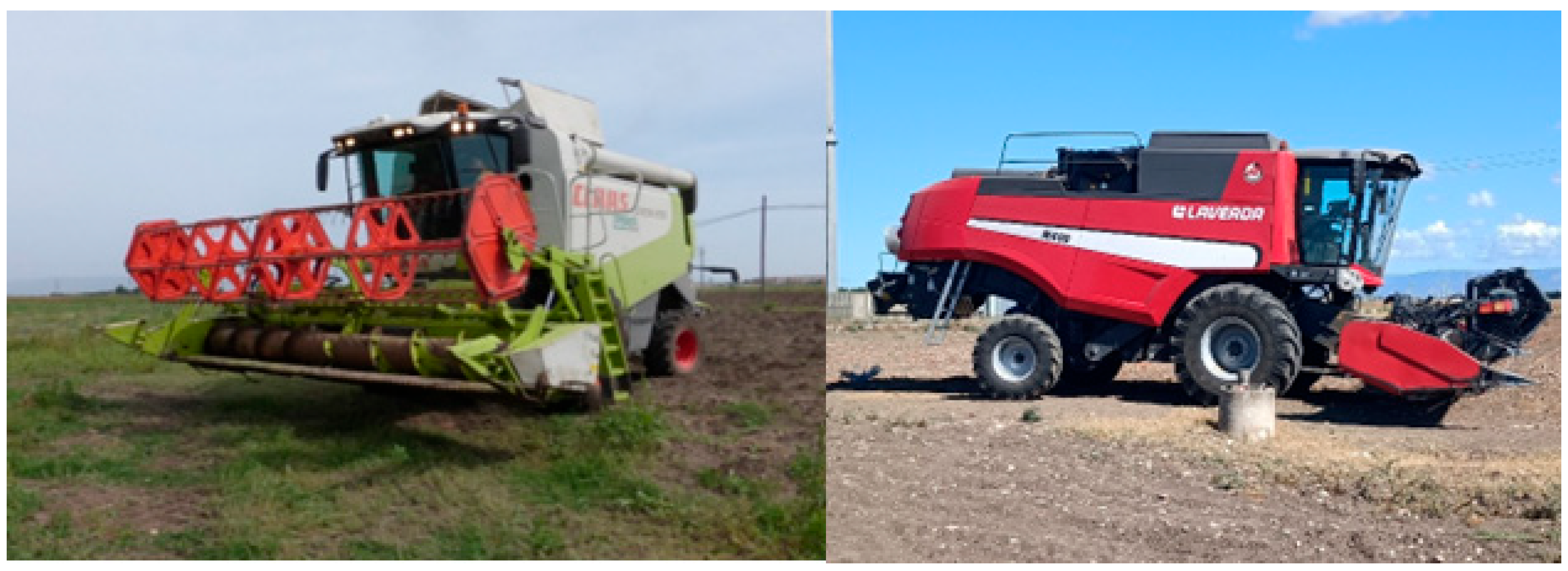
Harvest took place on 8 September 2022 and 11 September 2024. Before harvesting, three (2022) and six (2024) sampling areas of 1 m2 (2022) and 2 m2 (2024) were collected for each plot to assess plant density and seed yield. In both years, plants were harvested using a wheat combine, as shown in Table 2 and Figure 1. The threshing drum (TD) was considered the main component determining threshing efficiency; therefore, during the trial design, an attempt was made to keep the overall combine harvester setup fixed to isolate only the effect of drum-rotation speed.

2.2. Combine Setting and Harvesting Losses

Harvesting was carried out using two commercial combine harvesters equipped with axial-flow threshing systems. For each machine, the main operational parameters were adjusted according to the manufacturer’s technical specifications and field conditions. Although the two privately owned combines (Claas and Laverda) belonged to different manufacturers, their threshing and cleaning systems were functionally comparable, each featuring a 600 mm drum with ten bars and a conventional cleaning unit based on superimposed adjustable sieves and regulated airflow. In the first year (2022), five different combine TD speed settings were compared: 620, 700, 750, 800, and 900 rpm. In the second year (2024), adaptation was improved by selecting the following TD speeds: 600, 650, 700, 750, 800, and 900 rpm. The choice of speeds was based on the combine’s technical specifications. Starting from the intermediate speed recommended for seeds such as legumes, the speeds were shifted above and below this value. The selected TD speed range (600–900 rpm) is consistent with the validated method for hemp, rapeseed and other herbaceous oil crops, where effective threshing typically occurs between 500 and 850 rpm and higher speeds significantly increase seed breakage due to excessive peripheral speed [45,46,47]. Each TD speed resulted in a different level of aggressiveness of threshing system on the plant’s panicle. The peripheral drum velocity (ν) was calculated as (v = π·D·n/60), where D is the drum diameter (0.60 m) and n is the rotational speed (rpm). This resulted in velocities ranging from 19.5 m s−1 at 620 rpm to 28.3 m s−1 at 900 rpm. These values were consistent with thresholds reported for small-seeded crops, where peripheral velocities above approximately 25 m s−1 markedly increase impact energy and seed breakage [48]. Concave clearance also contributed to the mechanical action of the threshing system. This parameter regulates the counter-pressure applied to the panicle and the intensity of the rubbing forces generated between the drum and the plant material. Wider concave openings reduce the friction required for effective seed detachment and may result in incomplete threshing, whereas narrower settings increase compression and rubbing, potentially causing pericarp rupture and seed breakage. In each experimental plot harvested by the combine, seed yield and seed losses were collected. Prior to harvesting, the combine harvester was calibrated outside the test field to ensure consistent operational parameters. A boundary strip was removed around the perimeter of each test plot to delineate the harvesting zone.
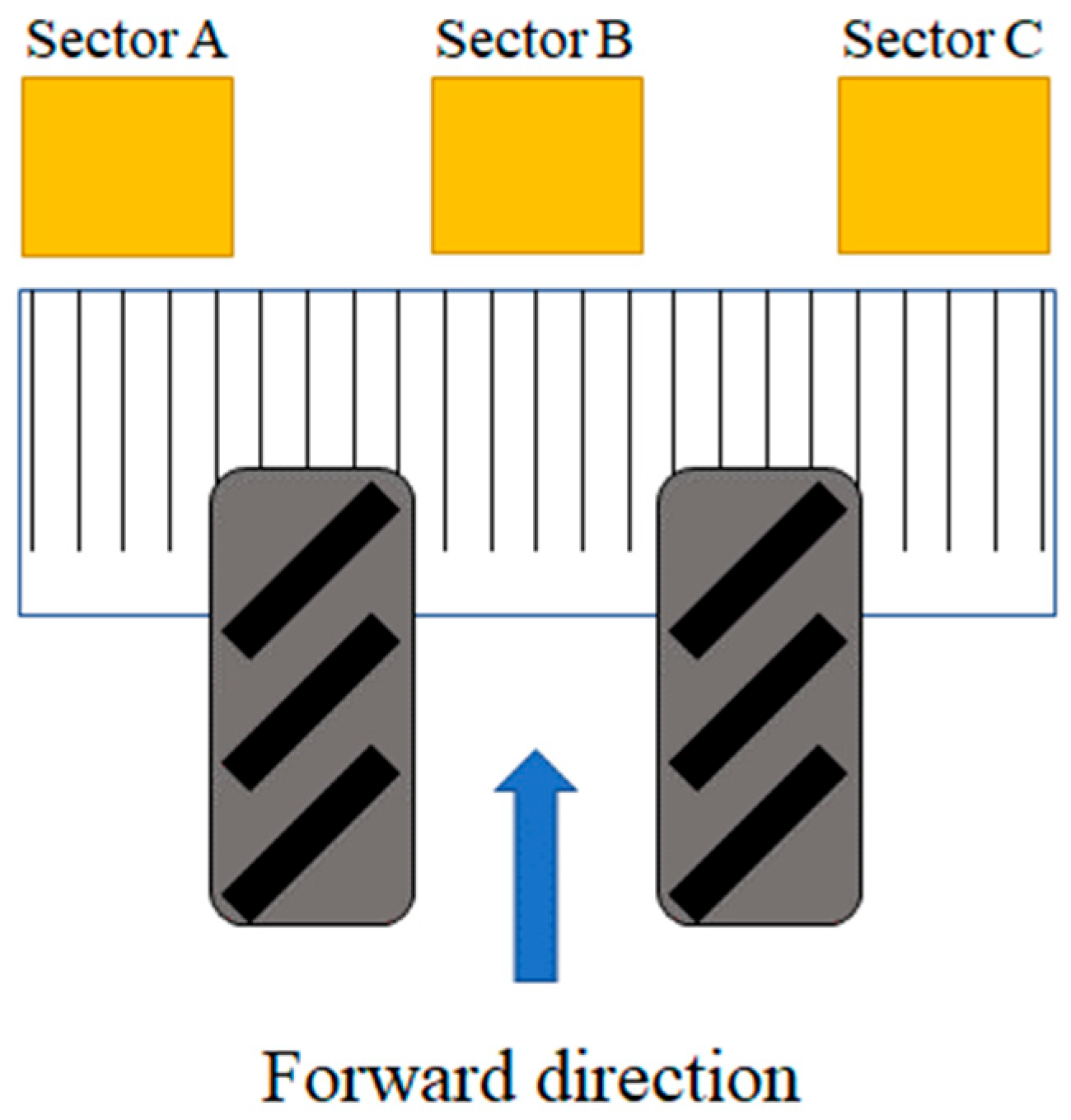
For every configuration, losses due to the header and threshing were assessed. To quantify seed losses, the harvesting area was prepared using collection trays, following the methodology described by Assirelli et al. [49], with minor adaptations for quinoa. Within the combine harvester, three schematic zones, designated as sections A, B, and C in Figure 2, were identified to localize and differentiate loss sources. To correctly represent the monitored areas, the operational points of the combine were identified according to where each component collects material and where it discharges residues. Based on this functional mapping, the three sampling sections were defined as the only positions capable of intercepting the residual material generated by specific harvesting phases. During harvesting, three plastic trays (dimensions: 0.60 m × 0.40 m; area: 0.24 m2) were placed on the soil surface in each plot during the harvester’s pass. The trays were oriented perpendicularly to the machine’s travel direction to intercept losses from different functional components. Sections A and C corresponded to the left and right extremities of the header, respectively, while section B represented the central area of the machine’s forward direction. In 2022 and 2024, this sampling layout was replicated three times per field: two trays were positioned 30 m from the headland, and one tray was placed at the center of the plot. This configuration enabled the assessment of losses originating from the header components, specifically the cutter bar and reel (sections A and C), and from the threshing and cleaning systems (section B). Losses attributed to the threshing system, influenced by machine settings and environmental conditions, were estimated by calculating the differential between section B and either section A or C. To quantify the overall efficiency of the threshing process, a Threshing Index (TI) was calculated as the proportion of seeds not successfully separated by the threshing and cleaning systems. The TI was computed as: TI = threshing losses/(threshing losses + clean seeds collected) × 100, following the approach commonly adopted in studies evaluating combine harvester performance for small-seeded crops [47,50]. This index provided a synthetic measure of the mechanical efficiency of the threshing unit, with higher values indicating reduced separation efficiency. The increase in the number and size of sampling areas adopted in 2024 did not modify the data processing procedure. In both years, the reference variable was always the total amount of seed lost per unit area, obtained by cumulatively integrating header and threshing losses. The A–B–C spatial layout and the computational approach used to derive losses were identical in 2022 and 2024. The expanded sampling scheme implemented in 2024 simply improved the spatial resolution of measurements and the representation of field variability, without affecting the comparability of results between years. The A–B–C layout was applied identically to both combine harvesters, as it refers to spatial sampling positions relative to the machine trajectory rather than to machine-specific components. The tray-based loss assessment method adopted reflects the procedures commonly used in field evaluations of combine harvesters for small-seeded crops and provides reliable separation of header and threshing losses under real operating conditions.

2.3. Agronomic Context

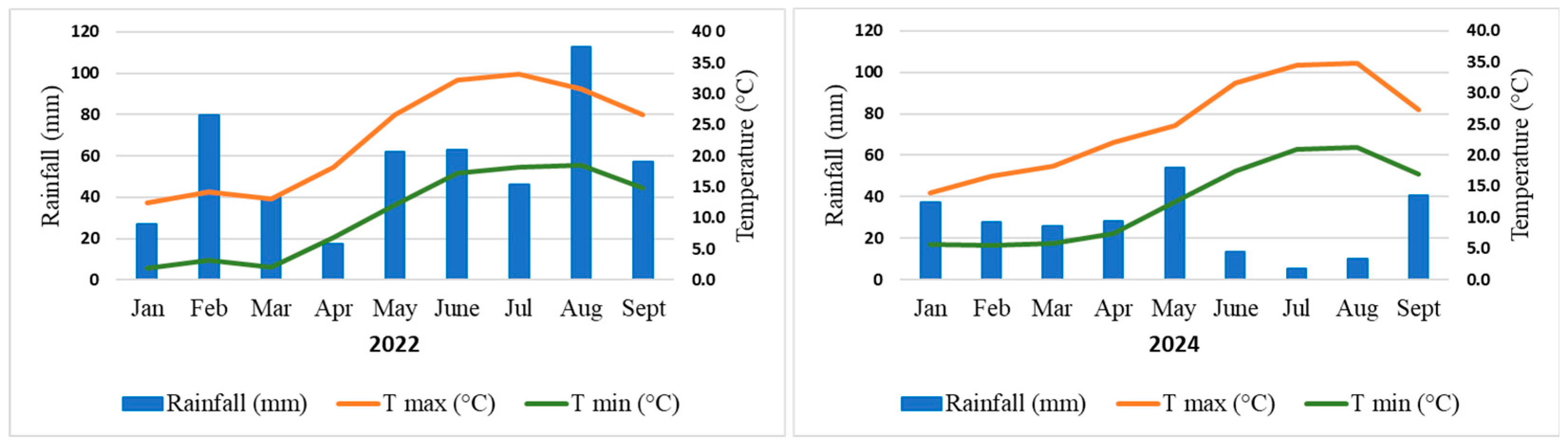
The meteorological conditions were typical of the Mediterranean region, with minimum and maximum temperatures gradually increasing from January to July in both 2022 and 2024 (Figure 3). Winter precipitation was higher in 2022 than in 2024, while summer rainfall was extremely scarce in 2024. Immediately before harvest, in the first week of September 2022, the average temperature and relative humidity were 23 °C and 68%, respectively; in the first 10 days of September 2024, they were 25 °C and 60%.
At harvest time, the average plant height (n = 10, including the main stem) was 115.8 cm ± 12.5 cm in 2022 and 93.4 cm ± 6.7 cm in 2024, values consistent with those reported for quinoa grown under similar conditions [12,40]. These agronomic and environmental conditions were used to interpret differences in threshing efficiency and seed losses across years.

2.4. Statistical Analysis

Statistical analyses of sampling area data and seed loss measurements across the combine harvester sectors were conducted using PAST software (version 4.02) [51]. All response variables were tested for normality (Shapiro–Wilk test) and homogeneity of variances (Levene test) at α = 0.05; for variables not explicitly mentioned in the text, these tests did not indicate any violations of assumptions (p ≥ 0.05). For plant density, the Shapiro–Wilk (p = 0.072) and Levene (p = 0.042) tests indicated normality and heteroscedasticity; for seed yield (t ha−1), however, both normality and homogeneity of variances were satisfied (p > 0.05). The Levene test indicated heteroscedasticity for threshing losses in 2022 (p = 0.034), while the homogeneity of variances was not rejected for header losses in 2022 (p = 0.187), header losses in 2024 (p = 0.086), and threshing losses in 2024 (p = 0.052). When both normality and homoscedasticity were satisfied, a two-way analysis of variance (ANOVA) was applied to plant density and seed yield, followed by Tukey’s HSD post hoc test for pairwise comparisons, considering the effects of the year (2022–2024), the variation in TD speed (from 600 to 900 rpm) and their interaction. Variables related to seed harvesting (i.e., harvested seeds residual and clean, seed losses at threshing and header sector) were analyzed by one-way ANOVA within each year, to verify the differences between the different TD speeds, and the pairs of groups were compared by Tukey’s HSD test (p < 0.05) when the assumptions were met. When normality or homoscedasticity were not met, the Kruskal–Wallis test and Dunn’s paired post hoc test (with Bonferroni correction for multiple comparisons) were used. Since experimental replication was limited (n = 3 per treatment), statistical power was reduced and non-significant results were interpreted with caution, as exploratory rather than as evidence of no effect. The 650-rpm level, present only in 2024 as an optimization step, was excluded from the primary two-way ANOVA to preserve the balanced factorial design; observations at 650 rpm were analyzed using one-way tests within year and the nonparametric alternatives described above.

3. Results

3.1. Crop Performance

Agronomic and environmental conditions relevant to harvesting performance are reported in Section 2.4. Plant density and seed yield measured in the two years for each TD speed are presented in Table 3.
Seed yield in 2022 ranged from (1.01 ± 0.30) to (1.45 ± 0.21) t ha−1, whereas 2024 yields were lower (0.48 ± 0.16 to 0.99 ± 0.10 t ha−1) despite the higher plant density. The reduced yield in 2024 coincided with the dry conditions recorded during June–August, which are known to limit seed filling in quinoa under Mediterranean environments. However, in 2022, plant density at harvest was lower due to a beetle infestation during the seedling germination and untimely weed control. Consequently, average seed production in 2022 slightly exceeded 1 t ha−1, whereas in 2024 it averaged 0.7 t ha−1 (Table 3).
The two-way ANOVA did not show any significant differences between the test areas within the same year, demonstrating the homogeneity of cultivation in the plots considered. Significant differences were found between years for both plant density (p < 0.001) and seed production (p < 0.01), as reported in Table 4.

3.2. Combine Setting and Harvesting Losses

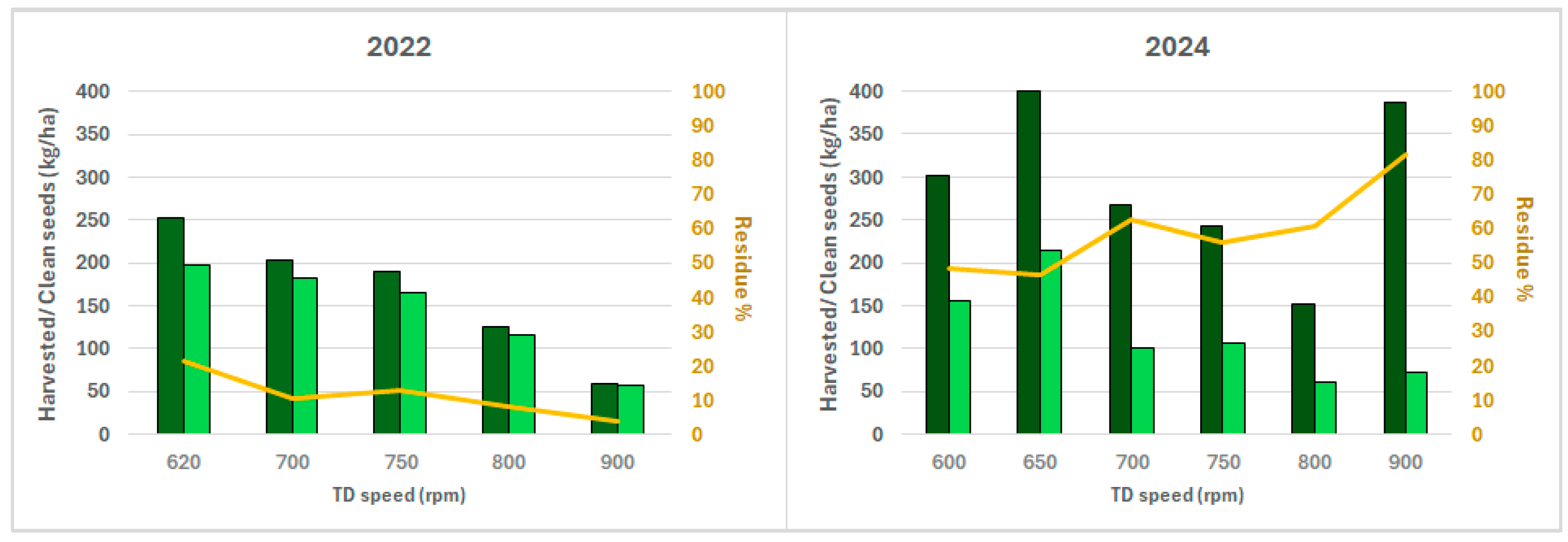
The amount of harvested quinoa (dirty and clean seeds) varied across TD speeds and years (Figure 4). In 2022, clean seed yield decreased progressively with increasing TD speed, from (198 ± 26) kg ha−1 at 620 rpm to (58 ± 12) kg ha−1 at 900 rpm (−71%), with residue percentages ranging from 4% to 22%. In 2024, the yield of clean seeds was highest at the lowest TD speeds (156 ± 22 kg ha−1 at 600 rpm and 214 ± 28 kg ha−1 at 650 rpm), while at 900 rpm clean seeds accounted for only 20% of the harvested crop (−80% compared to 600 rpm), with a higher percentage of residues compared to 2022. At 650 rpm, residues accounted for 46% of the harvested material, although this setting was associated with a reduced seed yield (Table 3).
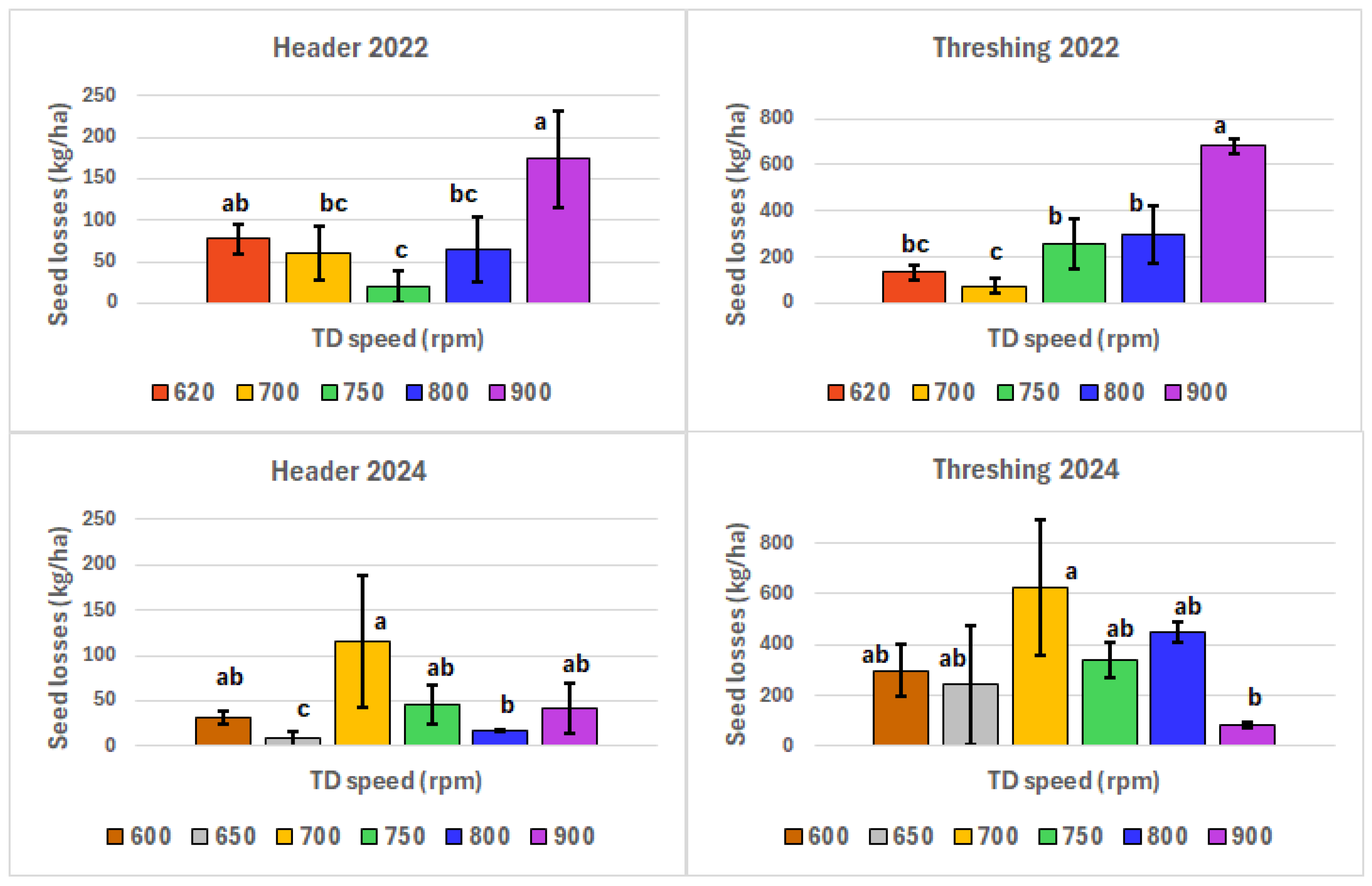
Seed losses related to the header and threshing sections of the combine differed significantly among TD speeds in both years (Figure 5). In both years, seed losses were systematically higher in the threshing sector than in the header, at all TD speeds. This pattern is consistent with the larger volume of plant material processed in the threshing section of the combine harvester.
In 2022, header losses increased from 20 ± 18 kg ha−1 at 750 rpm to 174 ± 58 kg ha−1 at 900 rpm, while threshing losses varied from 74 ± 30 kg ha−1 at 700 rpm to 681 ± 35 kg ha−1 at 900 rpm. In 2024, header losses ranged from 12 ± 8 kg ha−1 at 650 rpm to 116 ± 72 kg ha−1 at 700 rpm, while threshing losses ranged from 81 ± 9 kg ha−1 at 900 rpm to 626 ± 266 kg ha−1 at 700 rpm. One-way ANOVA followed by Tukey’s post hoc test (p < 0.05) confirmed significant differences among TD speeds for both sectors in each year. In 2022, the lowest losses were recorded at 750 rpm in the header sector and at 700 rpm in the threshing sector. In 2024, lower TD speeds also resulted in significantly reduced losses, although with greater variability across replicates.
To better interpret these patterns and compare the overall performance of the different TD speeds, the threshing index was used to summarize the combined effect of seed detachment efficiency and threshing losses. In 2022, TI values ranged from 6% at 700 rpm to 67% at 900 rpm, indicating a significant increase in losses at higher speeds. In 2024, the TI ranged from 50% at 650 rpm to 93% at 700 rpm, reflecting the greater heterogeneity of the crop observed that year. In both years, the 750-rpm setting showed the most stable performance, with intermediate TI values (23% in 2022; 55% in 2024) and moderate seed losses (25% and 63%, respectively).

4. Discussion

Quinoa is one of the so-called alternative crops which, thanks to their resilience, are considered particularly interesting for combating climate change [11,41]. Italian soil and climate conditions have proven to be favorable for quinoa cultivation, but its large-scale distribution may encounter critical issues related to the interaction between the crop and the environment, as well as to the agronomic practices adopted. In this context, mechanization is a determining factor for the agronomic and economic success of quinoa [52]. On the one hand, the absence of specific equipment can limit the adoption of unconventional crops; on the other, the current trend towards sustainable resources management requires the use of low-energy machinery and a rationalization of cultivation operations.
This study focused on optimizing the mechanical harvesting of quinoa by adjusting the operating parameters of the combine harvester. The results confirmed that the TD speed played a crucial role in the mechanized harvesting of quinoa, particularly in minimizing seed loss and mechanical damage. The effect of the threshing drum speed on harvesting performance reflected the balance between energy input and mechanical damage. Increasing the TD speed increases the drum’s tangential speed and, consequently, the kinetic energy transferred to the panicle. This improves seed detachment but also increases the probability of pericarp rupture, seed breakage and dispersion, especially in small-seeded crops such as quinoa [53,54]. The significant increase in losses observed above 800 rpm in both years is consistent with this compromise between energy and damage. Residue percentages also varied with TD speed and year, reflecting the interaction between the fan airflow and the sieve opening. At higher TD speeds (>800 rpm), the increased proportion of broken pericarp fragments and light impurities likely increased the load on the cleaning system, reducing separation efficiency. Conversely, at moderate speeds (650–750 rpm), the airflow-sieve combination proved more effective at removing chaff while retaining seeds, consistent with the cleaning dynamics described for small-seeded crops [55,56]. Considering the overall losses in the two years, the results suggested that a moderate speed of 750 rpm was optimal for reducing seed losses with minimal error, especially in threshing sector (cumulative average: 295 ± 88 kg ha−1). Excessively high TD speeds increased losses in almost all cases due to seed dispersion, while moderate speeds tended to optimize harvesting. Year-to-year differences were consistent with the environmental data shown in Figure 3. In 2024, lower summer precipitation and higher temperatures likely reduced seed moisture at harvest, increasing seed fragility and variability in detachment force—two factors known to influence quinoa threshing efficiency [13,54]. These documented environmental conditions provide an objective explanation for the higher TI values and greater variability observed in 2024.
Several recent studies supported this conclusion. For example, Zhao et al. [57] designed a specialized combine harvester for quinoa with modified threshing and cutting drums to handle the small size and fragile structure of quinoa seeds, including adaptations for large-scale harvesting. Gu et al. [58] developed an automatic vibration balancing system for combine harvester TDs, which included dynamic speed adaptation to reduce mechanical stress and improve operational stability. Although these studies were not conducted specifically on quinoa but focused on grains in general, the principles of vibration control and adaptive speed regulation are directly applicable to quinoa, where excessive vibration can cause seed breakage. Similarly, Su et al. [59] designed a variable-diameter TD capable of adjusting both diameter and rotation speed according to crop conditions. Their results showed that lower speeds significantly reduce grain breakage in rice, a crop with similar fragility to quinoa, confirming that reducing TD speed during threshing can improve yield without compromising productivity. Ghoname et al. [60] reported improvements in grain separation and reduced clogging by modifying the drum speed and fork geometry in the rice combine harvester. Although their study was not specific to quinoa, the mechanical issues addressed, such as seed loss and drum overload, are similar to those encountered in quinoa harvesting. Guan et al. [61] introduced a continuous speed control system for the TD and cleaning fan, allowing real-time adjustments based on crop moisture and density. This approach is consistent with the findings of this study, suggesting that flexible speed control mechanisms can significantly improve harvesting under variable conditions. Moreover, Bhandari and Jotautienė [62] emphasized the importance of vibration analysis in tangential threshing drums, noting that suboptimal speed settings can increase wear and reduce performance. Their work reinforced the need to precisely calibrate drum speed, especially when working with sensitive crops such as quinoa. These studies highlight a growing consensus on the importance of adaptive threshing systems, particularly those with variable speed control, for optimizing the mechanized harvesting of quinoa. The most common modifications to combine harvesters include reducing rotor speed, using fine-mesh concaves, and using sieves calibrated for the small size of quinoa seeds. Among the major challenges in mechanized quinoa harvesting, Chang et al. [26] proposed an innovative method that significantly reduces grain loss (1.8%) compared to traditional machines (3–5%), by improving the header parameters under real conditions and applying neural network algorithms to optimize the parameters of the quinoa splitter, demonstrating its broad applicability in agricultural mechanization. The main adaptations involve adjusting the threshing drum, which must operate at low speeds to avoid breaking the seeds, and the use of concaves and fine-mesh sieves to facilitate the separation of very small, lightweight, and easily loss-prone seeds, which must be less than 10% [63,64].
Under Italian conditions, the use of combine harvesters is subject to specific combine settings. One problem is the difference in the ripeness degree between the stalk and the panicle. In southern Italy, dry seasons favor the drying of the stalk, and therefore, the combine settings can be focused solely on the panicle. This study focused on the speed of the thresher, considered one of the main factors influencing the efficiency of combine harvesting. In the two years considered, the differences in seed production were not significant, so the effect on the harvested seed was determined by the application of different TD speeds. Bakharev et al. [65] verified that corn cob threshing depended largely on the diameter and speed of the thresher. Similarly, for quinoa harvesting, Shi et al. [36] demonstrated that the rotation speed and sieve design are critical for effective seed separation and minimizing losses. In climates less favorable to the simultaneous drying of stalks and ears, such as in northern Italy or in wetter seasons, the combine harvester setting is crucial for single-step harvesting. Excessive volume and high stem flexibility could increase the risk of clogging, prevent efficient threshing, and increase seed losses. Overall, the results of this study indicated that quinoa harvesting requires a delicate balance between mechanical stress and seed protection, with the TD speed being the primary determining factor in this balance. Under the tested conditions (southern Italy), 750 rpm proved to be the most suitable speed for both combine harvesters, ensuring a higher yield of clean seeds and lower losses, with the smallest margin of error. More precise indications require customized experiments. Future studies should explore the integration of sensor-based feedback systems to automate real-time speed adjustment, further improving efficiency and reducing operator dependence. In some cases, it may be useful to consider other crops with a similar structure to quinoa, analyzing innovative mechanical solutions such as cardoon [66] or hemp [45].

5. Conclusions

This study demonstrated that threshing drum speed was the main factor influencing the efficiency of mechanized quinoa harvesting under Mediterranean conditions, in terms of seed integrity, harvesting efficiency, and overall yield. Intermediate TD speeds, particularly around 750 rpm, provided the most favorable balance between seed detachment and mechanical protection, resulting in lower losses and a higher proportion of clean seeds. Higher speeds increased kinetic energy transfer to the panicle and consequently raised the incidence of seed breakage and dispersion, while lower speeds reduced detachment efficiency. Residue patterns and cleaning performance also reflected the interaction between TD speed, airflow, and sieve opening. Year-to-year differences were consistent with the documented environmental conditions, confirming that crop moisture and maturity strongly affected machine–crop interactions. Overall, the findings indicated that effective mechanized harvesting required adjusting TD speed according to crop structure and seasonal conditions. Future research should refine multi-parameter optimization, including the combined effects of drum speed, fan speed, and concave clearance, to support the development of crop-specific harvesting protocols adapted to the morphological and physiological characteristics of quinoa. Improving the efficiency of mechanized quinoa harvesting from a technical and cost-effective perspective is essential to promoting its wider adoption in Mediterranean agricultural systems, where growing global demand offers new opportunities for small farmers.

Author Contributions

Conceptualization, A.A., E.S., M.R., R.M. and G.D.S.; methodology, E.S., F.C. and C.M.; formal analysis, E.S. and A.A.; investigation, M.R., A.A. and G.D.S.; data curation, F.C., C.M., R.M. and E.S.; writing—original draft preparation, R.M. and E.S.; writing—review and editing, R.M., E.S., M.R. and A.A.; supervision, M.R., A.A., G.D.S. and E.S.; project administration, G.D.S.; funding acquisition, G.D.S. All authors have read and agreed to the published version of the manuscript.

Funding

This research received financial funding from the Puglia Region (Italy) PSR Mis. 16.2—“Consolidamento della filiera in Puglia—QUINOAPUGLIA” project, CUP: B79J20000100009.

Institutional Review Board Statement

Not applicable.

Data Availability Statement

The original contributions presented in this study are included in the article. Further inquiries can be directed to the corresponding author.

Acknowledgments

Authors would acknowledge Antonio Troccoli for providing meteorological data of the CREA-CI experimental farm in Foggia.

Conflicts of Interest

The authors declare no conflicts of interest.

References

  1. FAO. The Food and Agriculture Organization of the United Nations. Available online: https://www.fao.org/quinoa/en/ (accessed on 13 January 2026).
  2. Vega-Gálvez, A.; Miranda, M.; Vergara, J.; Uribe, E.; Puente, L.; Martínez, E.A. Nutrition facts and functional potential of quinoa (Chenopodium quinoa Willd.), an ancient Andean grain: A review. J. Sci. Food Agric. 2010, 90, 2541–2547. [Google Scholar] [CrossRef]
  3. Goyat, J.; Handa, C. Quinoa (Chenopodium quinoa Willd.)—The forgotten golden grain. Int. J. Food Nutrit. Sci. 2018, 7, 1. [Google Scholar]
  4. De Santis, G.; Maddaluno, C.; D’Ambrosio, T.; Rascio, A.; Rinaldi, M.; Troisi, J. Characterisation of quinoa (Chenopodium quinoa Willd.) accessions for the saponin content in Mediterranean environment. Ital. J. Agron. 2016, 11, 277–281. [Google Scholar] [CrossRef]
  5. Alamri, E.; Amany, B.; Bayomy, H. Quinoa seeds (Chenopodium quinoa): Nutritional value and potential biological effects on hyperglycemic rats. J. King Saud Univ.-Sci. 2023, 35, 102427. [Google Scholar] [CrossRef]
  6. Chaudhary, N.; Walia, S.; Kumar, R. Functional composition, physiological effect and agronomy of future food quinoa (Chenopodium quinoa Willd.): A review. J. Food Compos. Anal. 2023, 118, 105192. [Google Scholar] [CrossRef]
  7. Shahbandeh, M. Global Quinoa Market Value 2020–2026. Statista. 2021. Available online: https://www.statista.com/statistics/1128506/global-quinoa-market-value-by-country (accessed on 13 January 2026).
  8. Alandia, G.; Rodriguez, J.P.; Jacobsen, S.-E.; Bazile, D.; Condori, B. Global expansion of quinoa and challenges for the Andean region. Glob. Food Sec. 2020, 26, 100429. [Google Scholar] [CrossRef]
  9. FAOSTAT. Available online: https://www.fao.org/faostat/en/#data/QCL/visualize (accessed on 13 January 2026).
  10. Jacobsen, S.-E.; Mujica, A.; Jensen, C.R. The resistance of quinoa (Chenopodium quinoa Willd.) to adverse abiotic factors. Food Rev. Int. 2003, 19, 99–109. [Google Scholar] [CrossRef]
  11. Jacobsen, S.-E.; Jensen, C.R.; Liu, F. Improving crop production in the arid Mediterranean climate. Field Crops Res. 2012, 128, 34–47. [Google Scholar] [CrossRef]
  12. De Santis, G.; Ronga, D.; Caradonia, F.; Ambrosio, T.D.; Troisi, J.; Rascio, A.; Fragasso, M.; Pecchioni, N.; Rinaldi, M. Evaluation of two groups of quinoa (Chenopodium quinoa Willd.) accessions with different seed colours for adaptation to the Mediterranean environment. Crop Pasture Sci. 2018, 69, 1264–1275. [Google Scholar] [CrossRef]
  13. Bazile, D.; Jacobsen, S.-E.; Verniau, A. The global expansion of quinoa: Trends and limits. Front. Plant Sci. 2016, 7, 622. [Google Scholar] [CrossRef] [PubMed]
  14. Assirelli, A.; Palmieri, N.; Santangelo, E.; Manganiello, C.; De Santis, G.; Stagno, F.; Roccuzzo, G.; Rinaldi, M. Quinoa Cultivation in Italy: Some Insights. In Safety, Health and Welfare in Agriculture and Agro-Food Systems; Ragusa SHWA 2023, LNCE 521; Berruto, R., Biocca, M., Cavallo, E., Cecchini, M., Failla, S., Romano, E., Eds.; Springer: Cham, Switzerland, 2024; pp. 128–137. [Google Scholar] [CrossRef]
  15. Pulvento, C.; Sellami, M.H.; De Mastro, G.; Calandrelli, D.; Lavini, A. Quinoa vikinga response to salt and drought stress under field conditions in Italy. Environ. Sci. Proc. 2022, 16, 5. [Google Scholar] [CrossRef]
  16. Oustani, M.; Mehda, S.; Halilat, M.T.; Chenchouni, H. Yield, growth development and grain characteristics of seven Quinoa (Chenopodium quinoa Willd.) genotypes grown in open-field production systems under hot-arid climatic conditions. Sci. Rep. 2023, 13, 1991. [Google Scholar] [CrossRef] [PubMed]
  17. Sellami, M.H.; Pulvento, C.; Lavini, A. Agronomic Practices and Performances of Quinoa under Field Conditions: A Systematic Review. Plants 2021, 10, 72. [Google Scholar] [CrossRef]
  18. Nanduri, K.R.; Hirich, A.; Salehi, M.; Saadat, S.; Jacobsen, S.-E. Quinoa: A New Crop for Harsh Environments. In Sabkha Ecosystems. Tasks for Vegetation Science; Gul, B., Böer, B., Khan, M., Clüsener-Godt, M., Hameed, A., Eds.; Volume VI: Asia/Pacific; Springer International Publishing: Cham, Switzerland, 2019; pp. 301–333. [Google Scholar] [CrossRef]
  19. Razzaghi, F.; Bahadori-Ghasroldashti, M.R.; Henriksen, S.; Sepaskhah, A.R.; Jacobsen, S.E. Physiological characteristics and irrigation water productivity of quinoa (Chenopodium quinoa Willd.) in response to deficit irrigation imposed at different growing stages—A field study from Southern Iran. J. Agron. Crop Sci. 2020, 206, 390–404. [Google Scholar] [CrossRef]
  20. Choukr-Allah, R.; Rao, N.K.; Hirich, A.; Shahid, M.; Alshankiti, A.; Toderich, K.; Gill, S.; Butt, K.U.R. Quinoa for marginal environments: Toward future food and nutritional security in MENA and Central Asia regions. Front. Plant Sci. 2016, 7, 346. [Google Scholar] [CrossRef]
  21. Emrani, N.; Maldonado-Taipe, N.; Hasler, M.; Patiranage, D.S.; Jung, C. Early flowering and maturity promote the successful adaptation and high yield of Quinoa (Chenopodium quinoa Willd.) in temperate regions. Plants 2024, 13, 2919. [Google Scholar] [CrossRef] [PubMed]
  22. Fujita, Y.; Yasui, Y.; Nagatoshi, Y.; Katsura, K.; Tokura, Y. Fighting Climate Change with Quinoa: A Highly Nutritious Crop that Can Withstand Harsh Environments. In Plant Genetic Resources (PGR) for Sustainable Crop Production: SATREPS Projects Tackling Global Warming and Environmental Extremes in Developing Countries; Nagamine, T., Masuda, M., Irie, K., Eds.; Springer: Singapore, 2025; pp. 75–84. [Google Scholar] [CrossRef]
  23. Christiansen, J.L.; Jacobsen, S.-E.; Jørgensen, S.T. Photoperiodic effect on flowering and seed development in quinoa (Chenopodium quinoa Willd.). Acta Agric. Scand. Sect. B-Soil Plant Sci. 2010, 60, 539–544. [Google Scholar] [CrossRef]
  24. Bhargava, A.; Ohri, D. Origin of Genetic Variability and Improvement of Quinoa (Chenopodium quinoa Willd.). In Gene Pool Diversity and Crop Improvement. Sustainable Development and Biodiversity; Rajpal, V., Rao, S., Raina, S., Eds.; Springer: Cham, Switzerland, 2016; Volume 10. [Google Scholar] [CrossRef]
  25. Bhargava, A.; Shukla, S.; Ohri, D. Chenopodium quinoa—An Indian perspective. Ind. Crops Prod. 2006, 23, 73–87. [Google Scholar] [CrossRef]
  26. Chang, L.; Shi, R.; Dai, F.; Zhao, W.; Wang, H.; Zhao, Y. Header parameters optimization for quinoa mechanical harvesting using neural network and approximation modeling. Comput. Electron. Agric. 2025, 237, 110472. [Google Scholar] [CrossRef]
  27. Vilche, C.; Gely, M.; Santalla, E. Physical properties of quinoa seeds. Biosyst. Eng. 2003, 86, 59–65. [Google Scholar] [CrossRef]
  28. Gonzalez, J.A.; Konishi, Y.; Bruno, M.; Valoy, M.; Prado, F.E. Interrelationships among seed yield, total protein and amino acid composition of ten quinoa (Chenopodium quinoa) cultivars from two different agroecological regions. J. Sci. Food Agric. 2012, 92, 1222–1229. [Google Scholar] [CrossRef]
  29. Kutzbach, H.D. Approaches for mathematical modelling of grain separation. In International Conference on Crop Harvesting and Processing; American Society of Agricultural and Biological Engineers: Saint Joseph, MI, USA, 2003; p. 64. [Google Scholar]
  30. Olguín, P.; Contreras, S.; Rojas, C.; Fuentes, F. Genotype-by-Environment Interaction Stability Analysis of New Quinoa (Chenopodium quinoa Willd.) Varieties in the Mediterranean Zone of Chile. Plants 2025, 14, 3007. [Google Scholar] [CrossRef]
  31. Jan, K.N.; Panesar, P.S.; Singh, S. Effect of moisture content on the physical and mechanical properties of quinoa seeds. Int. Agrophysics 2019, 33, 41–48. [Google Scholar] [CrossRef]
  32. Habib, Z.; Ijaz, S.; Haq, I.U. Comparative metabolomic profiling and nutritional chemistry of Chenopodium quinoa of diverse panicle architecture and agroecological zones. Physiol. Mol. Biol. Plants 2023, 29, 1959–1979. [Google Scholar] [CrossRef]
  33. Taaime, N.; Rafik, S.; El Mejahed, K.; Oukarroum, A.; Choukr-Allah, R.; Bouabid, R.; El Gharous, M. Worldwide development of agronomic management practices for quinoa cultivation: A systematic review. Front. Agron. 2023, 5, 1215441. [Google Scholar] [CrossRef]
  34. Assirelli, A.; Romano, E.; Bisaglia, C.; Lodolini, E.M.; Neri, D.; Brambilla, M. Canopy index evaluation for precision management in an intensive olive orchard. Sustainability 2021, 13, 8266. [Google Scholar] [CrossRef]
  35. Kumar, M.; Singh, A.; Upadhyay, A.; Thakur, R.S. Evaluation of Physical, Anti-nutritional and Optimisation of Milling Characteristics of Quinoa Grains for Sustainable Food Security. Int. J. Environ. Clim. Change 2023, 13, 2490–2498. [Google Scholar] [CrossRef]
  36. Shi, R.; Ren, X.; Dai, F.; Zhao, W.; Wang, T. Design of the Vibrating Sieving Mechanism for a Quinoa Combine Harvester and Coupled Analysis of DEM-MBD. Agriculture 2025, 15, 1317. [Google Scholar] [CrossRef]
  37. Habib, Z.; Ijaz, S.; Haq, I.U.; Hashem, A.; Avila-Quezada, G.D.; Abd_Allah, E.F.; Khan, N.A. Empirical phenotyping and genome-wide association study reveal the association of panicle architecture with yield in Chenopodium quinoa. Front. Microbiol. 2024, 15, 1349239. [Google Scholar] [CrossRef] [PubMed]
  38. Lozano-Isla, F.; Kienbaum, L.; Haussmann, B.I.; Schmid, K. A High-Throughput Phenotyping Pipeline for Quinoa (Chenopodium quinoa) Panicles Using Image Analysis With Convolutional Neural Networks. Plant Breed. 2025. [Google Scholar] [CrossRef]
  39. Stanschewski, C.S.; Rey, E.; Fiene, G.; Craine, E.B.; Wellman, G.; Melino, V.J.; Patiranage, S.R.D.; Johansen, K.; Schmöckel, S.M.; Bertero, D.; et al. Quinoa Phenotyping Consortium. Quinoa phenotyping methodologies: An international consensus. Plants 2021, 10, 1759. [Google Scholar] [CrossRef]
  40. De Santis, G.; D’Ambrosio, T.; Rinaldi, M.; Rascio, A. Heritabilities of morphological and quality traits and interrelationships with yield in quinoa (Chenopodium quinoa Willd.) genotypes in the Mediterranean environment. J. Cereal Sci. 2016, 70, 177–185. [Google Scholar] [CrossRef]
  41. Assirelli, A.; Santangelo, E.; Spinelli, R.; Acampora, A.; Croce, S.; Civitarese, V.; Pari, L. Mechanization of rhizome extraction in giant reed (Arundo donax L.) nurseries. Appl. Eng. Agric. 2013, 29, 489–494. [Google Scholar] [CrossRef]
  42. Assirelli, A.; Croce, S.; Acampora, A.; Civitarese, V.; Suardi, A.; Santangelo, E.; Pari, L. An innovative system for conditioning biomass sorghum [Sorghum bicolor (L.) Moench.]. Trans. ASABE 2013, 56, 829–837. [Google Scholar] [CrossRef]
  43. Pari, L.; Assirelli, A.; Acampora, A.; Del Giudice, A.; Santangelo, E. A new prototype for increasing the particle size of chopped Arundo donax (L.). Biomass Bioenergy 2015, 74, 288–295. [Google Scholar] [CrossRef]
  44. Faugno, S.; Sannino, M.; Crimaldi, M.; Caracciolo, G.; Assirelli, A. Hemp seed mechanical harvesting efficiency analysis. In Proceedings of the 26th European Biomass Conference and Exhibition, Copenhagen, Denmark, 14–17 May 2018; pp. 374–377. [Google Scholar]
  45. Assirelli, A.; Rondelli, V.; Martelli, R.; Musio, S.; Franceschetti, B.; Amaducci, S. Technical evaluation of mechanical harvesting of hemp fibre. In European Biomass Conference and Exhibition Proceedings 2022; ETA-Florence Renewable Energies: Florence, Italy, 2022; pp. 151–155. [Google Scholar]
  46. Pari, L.; Latterini, F.; Stefanoni, W. Herbaceous oil crops, a review on mechanical harvesting state of the art. Agriculture 2020, 10, 309. [Google Scholar] [CrossRef]
  47. Pari, L.; Assirelli, A.; Suardi, A.; Civitarese, V.; Del Giudice, A.; Costa, C.; Santangelo, E. The harvest of oilseed rape (Brassica napus L.): The effective yield losses at on-farm scale in the Italian area. Biomass Bioenergy 2012, 46, 453–458. [Google Scholar] [CrossRef]
  48. Bansal, N.K.; Lohan, S.K. Design and development of an axial flow thresher for seed crops. J. Agric. Eng. 2009, 46, 1–8. [Google Scholar] [CrossRef]
  49. Assirelli, A.; Santangelo, E.; Stagno, F.; Roccuzzo, G.; Musio, S.; Amaducci, S. Hemp Sowing Seed Production: Assessment of New Approaches in North-Italy. Sustainability 2022, 14, 17020. [Google Scholar] [CrossRef]
  50. Stefanoni, W.; Latterini, F.; Ruiz, J.P.; Bergonzoli, S.; Palmieri, N.; Pari, L. Assessing the camelina (Camelina sativa (L.) Crantz) seed harvesting using a combine harvester: A case-study on the assessment of work performance and seed loss. Sustainability 2020, 13, 195. [Google Scholar] [CrossRef]
  51. Hammer, Ø.; Harper, D.A.T.; Ryan, P.D. PAST: Paleontological Statistics Software Package for Education and Data Analysis. Palaeont. Electron. 2001, 4, 9. [Google Scholar]
  52. Kakabouki, I.; Tataridas, A.; Mavroeidis, A.; Kousta, A.; Roussis, I.; Katsenios, N.; Efthimiadou, A.; Papastylianou, P. Introduction of alternative crops in the Mediterranean to satisfy EU Green Deal goals. A review. Agron. Sustain. Dev. 2021, 41, 71. [Google Scholar] [CrossRef]
  53. Bhargava, A.; Shukla, S.; Ohri, D. Genetic variability and interrelationship among various morphological and quality traits in quinoa (Chenopodium quinoa Willd.). Field Crops Res. 2007, 101, 104–116. [Google Scholar] [CrossRef]
  54. Jacobsen, S.E. The Worldwide Potential for Quinoa (Chenopodium quinoa Willd.). Food Rev. Int. 2003, 19, 167–177. [Google Scholar] [CrossRef]
  55. Hanna, H.M.; Jarboe, D.H.; Quick, G.R. Grain residuals and time requirements for combine cleaning. Appl. Eng. Agric. 2009, 25, 851–861. [Google Scholar] [CrossRef][Green Version]
  56. Khoshtaghaza, M.H.; Mehdizadeh, R. Aerodynamic properties of wheat kernel and straw materials. Agric. Eng. Int. CIGR J. 2006. [Google Scholar]
  57. Zhao, W.; Yang, F.; Dai, F.; Zhang, F.; Shi, R.; Qu, J.; Wang, T. Large-Scale Quinoa Combine Harvester. Patent n. CN214708799U, 16 November 2021. Available online: https://patents.google.com/patent/CN214708799U/en (accessed on 13 January 2026).
  58. Gu, X.; Wang, B.; Tang, Z.; Zhang, H.; Zhang, H. Automatic Vibration Balancing System for Combine Harvester Threshing Drums Using Signal Conditioning and Optimization Algorithms. Agriculture 2025, 15, 1564. [Google Scholar] [CrossRef]
  59. Su, Z.; Ding, Z.; Tian, L.; Lin, X.; Wang, Z. Design and performance test of variable diameter threshing drum of combine harvester. Food Sci. Nutr. 2021, 9, 4322–4334. [Google Scholar] [CrossRef]
  60. Ghoname, M.S.; Soltan, M.A.; Bahnas, O.T.; Fouda, T.Z. Modification of a combine harvester rice threshing device. Agric. Eng. Int. CIGR J. 2023, 25, 101–109. [Google Scholar]
  61. Guan, Z.; Zhang, Z.; Jiang, T.; Li, Y.; Wu, C.; Mu, S. Development and test of speed control system for combine harvester threshing and cleaning device. INMATEH—Agric. Eng. 2020, 61, 305–314. [Google Scholar] [CrossRef]
  62. Bhandari, S.; Jotautienė, E. Vibration analysis of a roller bearing condition used in a tangential threshing drum of a combine harvester for the smooth and continuous performance of agricultural crop harvesting. Agriculture 2022, 12, 1969. [Google Scholar] [CrossRef]
  63. Hayes, R.A. Human Centered Design of an Open-Drum, Treadle Thresher for Quinoa Farmers in the Andes of Northern Peru. Open Access Master’s Report; Master’s Thesis, Michigan Technological University, Houghton, MI, USA, 2017. [Google Scholar] [CrossRef]
  64. Zhao, J.; Li, C.; Tang, J.; Li, B.; Yang, Z. An Integrated Device Suitable for Quinoa Harvesting and Threshing. Patent n. CN211721125U, 23 October 2020. Available online: https://patents.google.com/patent/CN211721125U/en (accessed on 13 January 2026).
  65. Bakharev, D.; Pastukhov, A.; Volvak, S.; Kovalev, S. Study of seed corn threshing process. Eng. Rural Dev. 2020, 19, 1036–1041. [Google Scholar] [CrossRef]
  66. Pari, L.; Alfano, V.; Acampora, A.; Del Giudice, A.; Scarfone, A.; Sanzone, E. Harvesting and Separation of Different Plant Fractions in Cynara cardunculus L. In Perennial Biomass Crops for a Resource-Constrained World; Barth, S., Murphy-Bokern, D., Kalinina, O., Taylor, G., Jones, M., Eds.; Springer: Cham, Switzerland, 2016; pp. 261–271. [Google Scholar] [CrossRef]
Figure 1. Combine harvester used during the study: the CLAAS Lexion 550 (CLAAS KGaA mbH, Harsewinkel, Germany) employed in 2022 (on the left), and the Laverda M400 (Laverda S.p.A., AGCO Corporation, Breganze, Italy) used in 2024 (on the right).
Agriculture 16 00715 g001
Figure 2. Arrangement of the trays (in orange) to assess the seed losses from different sectors of the combine harvester.
Agriculture 16 00715 g002
Figure 3. Rainfall, temperature (maximum and minimum) from January to September 2022 and 2024 in the experimental field. Source: the meteorological station of the CREA-CI, Foggia (Italy).
Agriculture 16 00715 g003
Figure 4. Harvested quinoa dirty and clean seeds (expressed in kg ha−1) for each threshing drum speed setting in the 2 years illustrated by the columns: dark green columns represent the total collected seeds, and light green columns represent the cleaned seeds. The yellow line represents the percentage of residual seeds relative to the secondary axis on the right.
Agriculture 16 00715 g004
Figure 5. Seed losses expressed in kg ha−1 (mean ± St. Dev., n = 3) per threshing drum (TD) speed and combine sector (i.e., threshing and header). Within each size class, different letters indicate a significant difference according to ANOVA and Tukey HSD test (p < 0.05).
Agriculture 16 00715 g005
Table 1. Quinoa agronomic management during the two years of harvesting.
20222024
VarietyRegalona-BaerRegalona-Baer
Seedbed preparationPlowing at 45 cmPlowing at 50 cm
Rotary harrow (two passages)Rotary harrow (two passages)
Sowing date10 April15 April
FertilizationAmmonium diphosphate 200 kg ha−1 (autumn 2021)Ammonium diphosphate 200 kg ha−1 (autumn 2023)
ammonium nitrate 200 kg ha−1 (May)ammonium nitrate 200 kg ha−1 (May)
Irrigation *100 mm (5 applications)120 mm (6 applications)
Weed controlMechanicalMechanical
Harvesting8 September11 September
* The 5 and 6 irrigation events, for 2022 and 2024, respectively, have been applied at sowing (10 mm), emergence (15 mm at BBCH 12), stem elongation (20 mm at BBCH 30, only in 2024), flowering at 10% (25 mm at BBCH 62), flowering at 50% (25 mm at BBCH 67), milky grain seed stage (25 mm at BBCH 81), for a seasonal irrigation volume of 100 mm in 2022 and 120 mm in 2024.
Table 2. Settings and combined data of the modified combine harvesters used during the two years of quinoa harvesting.
Description20222024
BrandCLAASLAVERDA
ModelLexion 550M400
Engine power (kW)249239
Straw walker (n)65
Header width (m)5.45.4
Threshing drum diameter (mm)600600
Threshing drum length (mm)17001340
Threshing drum speed (rpm)620–700–750–800–900600–650–700–750–800–900
Combine speed (km h−1)4.54.4
Fan speed (rpm)660600
Concave clearance (mm)910
Upper sieve clearance (mm)1213
Lower sieve clearance (mm)67
Table 3. Plant density and seed production in each test area per year, sampled before harvesting, for each TD speed assayed. Values are expressed as mean ± standard deviation (n = 3).
YearTD Speed (rpm)Plant Density (Plants m−2)Seed Production (t ha−1)
20226208.60 ± 2.961.01 ± 0.30
7009.53 ± 1.621.32 ± 0.19
7509.60 ± 2.231.10 ± 0.22
80013.73 ± 3.101.45 ± 0.21
9008.60 ± 4.851.02 ± 0.44
202460014.92 ± 2.710.99 ± 0.10
65029.58 ± 3.730.48 ± 0.16
70020.25 ± 2.250.68 ± 0.16
75021.08 ± 3.410.61 ± 0.04
80019.33 ± 2.960.97 ± 0.14
90021.17 ± 2.580.72 ± 0.30
Table 4. Results of the two-way ANOVA for plant density and seed production in each test area per year and each TD speed assayed (df = degree of freedom).
Plant DensitySeed Production
dfFpFp
Year193.25<0.00110.990.003
TD speed42.670.0622.550.071
Interaction42.430.0813.800.019
Disclaimer/Publisher’s Note: The statements, opinions and data contained in all publications are solely those of the individual author(s) and contributor(s) and not of MDPI and/or the editor(s). MDPI and/or the editor(s) disclaim responsibility for any injury to people or property resulting from any ideas, methods, instructions or products referred to in the content.