Article

The Impact of Age at First Mating on Lifetime Milk Yield in Alpine Goats: Balancing Early Gains and Lifetime Efficiency


1
Department of Animal Science and Technology, Faculty of Agriculture, University of Zagreb, Svetošimunska Cesta 25, 10000 Zagreb, Croatia
2
Ministry of Agriculture, Ulica Grada Vukovara 78, 10000 Zagreb, Croatia
3
Croatian Agency for Agriculture and Food, Svetošimunska Cesta 25, 10000 Zagreb, Croatia
4
Croatian Association of Sheep and Goat Breeders, Jarnovićeva 17c, 10000 Zagreb, Croatia
*
Author to whom correspondence should be addressed.
Agriculture 2026, 16(6), 687; https://doi.org/10.3390/agriculture16060687
Submission received: 25 February 2026 / Revised: 12 March 2026 / Accepted: 17 March 2026 / Published: 18 March 2026
(This article belongs to the Section Farm Animal Production)

Abstract

The longitudinal study investigated the impact of age at first mating (AFM) on milk yield (MY) across the productive lifespan of Alpine goats born between 2005 and 2018. Data from 740 animals across three herds and 3200 lactations were analyzed. The AFM of the studied population ranged from 7 to 23 months. The impact of AFM on MY was estimated using a linear mixed model, accounting for the fixed effects of parity, litter size, season, herd, and suckling and milking durations, with the individual goat included as a random effect to control for repeated measures. The impact of AFM on lifetime production was estimated by regressing total milk yield (TMY) and number of lactations (TNL) on AFM, while accounting for herd effect. The study revealed a notable shift in productivity patterns across the animal’s life. Every additional month of AFM significantly increased milk yield in the first lactation (13.28 kg; p < 0.001), but this influence vanished in subsequent parities (p > 0.05). These higher initial yields were insufficient to compensate for the losses caused by a shortened productive lifespan. Specifically, each month of mating delay resulted in a loss of ~0.08 TNL and 34 kg TMY, totaling ~1 lactation and ~400 kg of milk for a 12-month delay. Results suggest that earlier mating may improve lifetime productivity under intensive production systems.

1. Introduction

In modern dairy goat farming, optimizing the transition from the rearing phase to the productive phase is a critical factor influencing both biological efficiency and economic profitability. The age at first mating (AFM) represents one of the most significant management decisions for breeders. This parameter not only dictates the onset of the first lactation but also sets the trajectory for the animal’s entire productive lifespan. The systematic study of AFM has been extensive in the dairy cattle industry. Studies in cattle have consistently demonstrated that optimal AFM range maximizes milk production and herd longevity, with earlier calving generally enhancing lactation performance, while delayed mating reduces productivity and lifespan [1,2]. Moreover, reducing the age at first calving can lower rearing costs and increase the number of offspring produced over a lifetime [3,4]. However, research in cattle also warns that precocious mating before achieving adequate body weight can lead to dystocia and stunted growth [5,6].
In contrast to the abundant information available for dairy cattle, where a mating age from 13 to 15 months is well-established as the optimal one, systematic studies in small ruminants remain scarce. Research in dairy sheep systems, particularly with breeds such as Lacaune, Awassi, and Assaf, indicates that while earlier mating may result in lower first-lactation yields, it is nonetheless encouraged to maximize cumulative lifetime output [7,8,9]. This strategy was further supported by recent findings in Mediterranean dairy-oriented Istrian sheep [10]. The authors confirmed that although delayed mating increases initial milk production, it does not benefit long-term productivity.
While these insights provide a foundational understanding for dairy sheep, research in the dairy goat sector has traditionally addressed production factors with a broader focus. Extensive literature has characterized the interplay of nutrition, management, and environmental factors on milk yield in goats [11,12]. Beyond these individual factors, Pulina et al. [13] emphasized that optimizing these factors is an economic necessity for the global sector, while Arnal et al. [14] demonstrated that even within similar systems, there is significant biological diversity in how lactation curves are shaped over time. Early landmark studies, such as those by Montaldo et al. [15] and Zoa-Mboé et al. [16], established that general animal age, breed, and season are primary drivers of milk yield and lactation curve shape. However, in these studies, “age” was typically treated as a chronological covariate or a fixed effect of maturity (to control for physiological development), rather than being investigated as the primary factor of interest. A more targeted approach was taken by Mulc et al. [17], who specifically investigated the influence of age at first kidding on the Alpine breed, although that analysis was restricted to performance during the first lactation. This study builds upon the foundational work of Mulc et al. [17] by extending the analysis from a single-parity observation to a comprehensive lifetime perspective. This distinction is crucial because treating age as a general factor, or focusing only on separate parities, fails to capture how the specific timing of the first reproductive event resonates through the animal’s entire life. To date, there is a lack of high-resolution longitudinal models that account for the interaction between AFM and subsequent parity dynamics over the animal’s entire lifespan. Without such modeling, it remains unclear whether the effects of initial breeding decisions are truly independent of parity or if a more detailed longitudinal framework could reveal hidden trade-offs in milk production as the animal matures. Therefore, this study aims to fill this gap by providing an integrated longitudinal analysis of how AFM dictates the productive trajectory of Alpine goats. By moving beyond general age effects to a specific lifetime framework, this research aims to clarify the trade-offs between early-life productivity and long-term cumulative performance.

2. Materials and Methods

2.1. Animals

The analyzed population originates from a foundation flock of 400 Alpine does imported to Croatia from France between 1984 and 1986. This original importation established the groundwork for organized selection and breeding programs for the breed in continental Croatia. Consequently, the animals in this study originate from a consistent genetic pool managed under a long-standing, centralized national breeding program. This history of systematic selection ensures a high degree of phenotypic and genetic uniformity within the source population, minimizing potential confounding effects from genetic diversity on the observed productivity traits. The analysis was conducted on a total of 740 does with known age at first mating (AFM) and age at culling in three commercial dairy-orientated herds. The animals were reared in intensive dairy production systems practicing highly standardized management and technological procedures. Generally, the does were maintained indoors year-round with limited access to outdoor paddocks and milked twice a day. The animals were managed under a uniform feeding regime. During the lactation period, the diet was primarily based on high-quality green forage provided twice daily, sourced from the farms’ own arable land (including various grasses, clovers, clover-grass mixtures, and field peas). High-quality hay was available ad libitum. Additionally, a commercial concentrate mixture with 16% crude protein was administered twice daily in the milking parlor, with quantities adjusted according to the lactation stage and milk yield of a particular group of goats. Breeding seasonality followed the natural polyestrous cycle of the Alpine breed in this region, with the main mating season occurring between September and November. Reproduction management involved controlled natural mating, where the age at first mating (AFM) was determined by the farm’s management policy, while maintaining a consistent body weight threshold across the herds (70% of mature body weight). Culling criteria were strictly professional and standardized across all three locations. Animals were removed from the herd based on objective health and reproductive indicators, such as chronic mastitis, severe lameness, or infertility, ensuring that culling was independent of the AFM. By focusing only on animals born from 2005 to 2018, we ensured that the majority of the goats in the study had the opportunity to complete their full productive lifespan, allowing for a reliable assessment of lifetime productivity without the bias of right-censored data. Furthermore, this period was characterized by highly stable management practices across the participating farms. We can confirm that during these years, all three farms strictly adhered to the uniform feeding regimes, breeding protocols, and culling criteria previously described, thereby ensuring that the environmental and management conditions remained consistent for the duration of the study.

2.2. Data

The dataset for this study was provided by the Croatian Agency for Agriculture and Food (CAAF), which is responsible for the operational implementation of the breeding program for this breed. Daily milk yield was estimated from test-day records collected monthly in accordance with the regular alternate scheme (morning/evening system) based on ICAR rules [18]. While this method follows strict ICAR protocols for dairy goats, it is an estimation technique that may introduce minor errors compared to daily electronic milk meters. Nevertheless, monthly recording remains the industry and research standard for large-scale longitudinal studies where daily individual monitoring is not logistically feasible across multiple commercial herds. The amount of milk from one milking was doubled to estimate daily production and these values were then translated into total milk yield per lactation using the Fleischmann’s method:
M Y   =   I 0 D 1 +   i = 1 n 1 I i D i + D i + 1 2 +   I n D n ,
where MY: Total lactation milk yield; D: Daily yield on the recording day; I0: Interval from the start of milking to the first recording; Iᵢ: Interval between consecutive recordings; Iₙ: Interval from the last recording to drying off.
The total milk yield and the total number of lactations were calculated for each goat to assess long-term productivity. The lifetime milk yield (TMY) was estimated as the sum of milk produced across all successful lactations:
T M Y   =   i = 1 n L i ,
and the total number of lactations (TNL) per goat was defined as:
T N L   = max i ,
where T M Y : cumulative lifetime total milk yield (kg); n: total number of lactations completed by an individual goat before culling; L i : milk yield (kg) produced in the ith individual lactation (calculated via Fleischmann’s method); TNL: total number of completed lactations (representing the goat’s reproductive and productive longevity).

2.3. Data Preparation

The dataset comprised records from goats with an age at first mating (AFM) ranging from 7 to 23 months. This interval represents the natural variation in management practices across the participating farms during the study period (2005–2018). To ensure the integrity of the analysis, a multi-step process of data checking, pruning, and transformation of original records was applied. Records with missing information regarding their AFM, culling date, or any missing information on the animal’s status at the time of phenotyping were excluded from the dataset. Out of the original dataset (n = 3445), a total of (245) records (7%) were excluded for this reason. This exclusion did not introduce selection bias, as it was not based on any performance-related criteria or animal preferences. In essence, these individuals did not differ biologically from the retained population but were simply missing the necessary records required for the longitudinal model. Consequently, the final analysis was conducted on a total of 740 does with 3200 complete lactation records, accompanied by information on parity, litter size, kidding season, herd allocation, and the durations of both suckling and milking periods.
The season was defined as the month of kidding. Preliminary analysis revealed a high prevalence of kidding in January, February, and March; therefore, records from December were assigned to the January category, while kiddings occurring after March were grouped into the March category. Similarly, due to the smaller number of observations in late-life parities, all lactations occurring after the 5th kidding were combined into a single 5+ bin. These merging procedures followed a logical biological basis to ensure robust statistical power while maintaining the representativeness of the data.

2.4. Statistical Analysis

Both descriptive and inferential statistical analyses were performed using the R software environment (version 4.3.1) [19]. Data manipulation and preparation were conducted using the “dplyr” package (version 1.1.4) [20], while descriptive statistics were calculated using “pastecs” (version 1.4.2) [21] and “RcmdrMisc” (version 2.9.1) [22]. The majority of data visualizations used in the statistical analysis, including those employed during preliminary analysis to examine data distributions and model properties (though not all are presented here), were generated using the “ggplot2” package (version 3.5.1) [23]. For the inferential part of the study, a linear mixed model (LMM) with repeated measures was employed using the “lme4” package (version 1.1.29) [24]. To visualize and interpret the complex interactions within the model, the “effects” package (version 4.2.2) [25] was used. To quantify lactation milk yield (MY) within parities, a linear mixed model was employed. This approach accounts for fixed and random effects while adjusting for repeated measurements across individual goats using the following model:
M Y i j k l n o q = μ + β A F M A F M A F M ¯ + β 1 P P P ¯ + β 2 P P P ¯ 2 + β 1 P * A F M A F M A F M ¯ P P ¯ + β 2 P * A F M A F M A F M ¯ P P ¯ 2 + β S S S ¯ + β M M M ¯ + L S j + K S k + B l + i d q + e i j k l n o q ,
where M Y i j k l n o q : milk yield; β A F M : the linear regression coefficient for AFM; β 1 P and β 2 P : the linear and quadratic regression coefficients for parity (P), respectively; β 1 P * A F M and β 2 P * A F M : interaction coefficients representing the influence of AFM within P; β S and β M : regression coefficients for suckling duration (S) and milking duration (M); L S j : the effect of the jth litter size (j = 1, 2, and 3+ kids); K S k : the effect of the kth kidding season (k = January, February, March); B l : the effect of the lth breeder (l = 1, 2, 3); i d q : the random intercept for the qth individual goat, accounting for the permanent environmental and genetic effects shared across parities for the same animal; e i j k l n o q : the random residual error.
The structural integrity and predictive power of the final mixed-effects model were validated using the “performance” package (version 0.16.0) [26], specifically through Variance Inflation Factors (VIF) to assess multicollinearity and Marginal and Conditional R2 and Intraclass Correlation Coefficients (ICC) to evaluate goodness-of-fit. The significance of fixed effects was tested using Type III ANOVA, with the denominator degrees of freedom estimated via the Satterthwaite approximation to ensure accurate p-value calculations for the unbalanced longitudinal data. Furthermore, to control the family-wise error rate for the analysis of AFM effects within individual parities, a Bonferroni correction was applied by multiplying the nominal p-values by the number of comparisons (k = 5).
The total lifetime production, specifically the total number of lactations (TNL) and the cumulative total lifetime milk yield (TMY), were examined by regressing both variables on the AFM. To control environmental and management-related variance, the breeder effect was incorporated into the analysis using the following linear models:
T M Y i j = μ + B i + β 1 A F M A F M ¯ + e i j ,
T N L i j = μ + B i + β 1 A F M A F M ¯ + e i j ,
where T M Y i j : total lifetime milk yield of the jth individual within the ith breeder (B); T N L i j : total lifetime number of lactations achieved by the jth individual within the ith breeder (B); μ = overall population mean (intercept); B i : the effect of the lth breeder (l = 1, 2, 3); β 1 : linear regression coefficient representing the change in TMY or TNL per unit change in AFM; e i j : random residual error representing unexplained variance.

3. Results

3.1. Preliminary Analysis and Environmental Drivers

Preliminary analysis revealed clear and significant trends in milk yield and lactation dynamics across different environmental and physiological factors (Table 1). Parity showed a typical biological trajectory; milk yield (MY) significantly increased from the first (518.54 kg) to the third lactation (840.46 kg), after which it stabilized and slightly decreased in later parities. This trend in yield was closely mirrored by lactation length components; the duration of the milking period increased from the first (237.79 days) to the third lactation (257.14 days), providing a longer window for commercial production as the animals reached maturity. Litter size also exerted a notable influence on MY, with animals carrying multiples exhibiting significantly higher yields (955.62 kg for twins and 999.36 kg for triplets or more) compared to those with single kids (785.02 kg). Furthermore, the kidding season was a critical factor; animals kidding in January achieved a substantially longer milking duration (261.04 days) and higher milk yield (816.35 kg) compared to those kidding in February and March (211.75 days; 550.62 kg). This 50-day difference in lactation length directly correlates with the lower MY observed in March-kidding animals. Finally, the analysis revealed substantial disparities between breeders; specifically, breeder B2 (941.21 kg) nearly doubled the milk yield of B1 (519.79 kg), despite the absence of a corresponding discrepancy in the length of milking periods.

3.2. Inferential Statistical Modeling: Unraveling the AFM × Parity Interaction

The final mixed-effects model demonstrated high structural stability and predictive power (R2cond = 0.746), with multicollinearity diagnostics (Table 2) confirming that all predictors were non-redundant (VIF < 2.3). These diagnostic metrics, including an ICC of 0.343, validated the inclusion of the specified fixed and random effects as independent and reliable contributors to the variance in milk yield. While the lack of direct data on genetic merit should be considered, the inclusion of breeder as a fixed effect partially captures the variation stemming from shared genetic lines and management styles within those units. Furthermore, we acknowledge certain latent variables inherent to this retrospective design. For instance, body weight at first mating, a known confounder for first-lactation performance and longevity, was not recorded; however, its impact is often correlated with management quality, which was accounted for in our linear mixed model. Additionally, as is common in retrospective studies, the potential for selection bias (the “healthy worker effect” in livestock) exists, as animals remaining in the herd longer are inherently more resilient. While we addressed this by using regression analysis specifically designed for lifetime traits, we recognize that unobserved health status and culling bias remained factors that may lead to an overestimation of certain lifetime parameters. Consequently, our findings were discussed in terms of strong associations rather than definitive causal links.
The summary of the linear model analysis (Table 3) underscores the multi-factorial nature of milk yield (MY) expression. The model identified parity, litter size, season, and breeder as highly significant factors (p < 0.001), justifying their inclusion as fixed effects to minimize residual variance and filter out environmental noise (Table 3). To further refine these estimations and isolate the specific impact of the age at first mating (AFM), two management-related covariates were essential. Suckling duration was incorporated to account for variations in the onset of commercial milking, while milking duration standardized productivity relative to the average lactation length. Both covariates were found to be highly statistically significant (p < 0.001), confirming their critical role in explaining the observed variance in milk yield. This dual adjustment for S and M was essential to distinguish between the timing of milking onset and the overall lactation length, thereby effectively minimizing systematic bias.
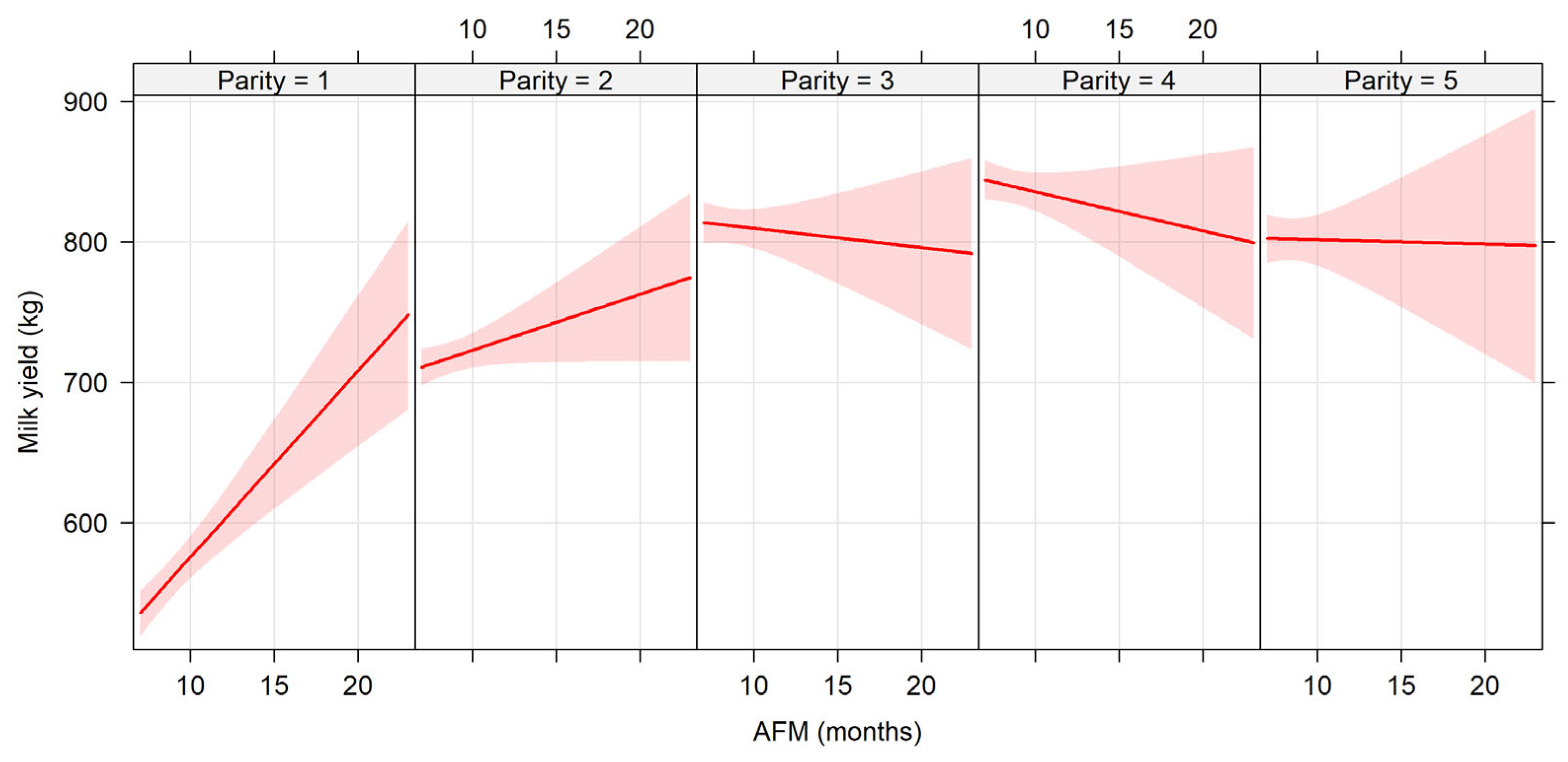
Within this comprehensive framework, the main effect of AFM as a standalone continuous covariate did not reach the threshold for statistical significance (F = 2.56; p = 0.109). However, its biological relevance became evident through a highly significant interaction between AFM and Parity (AFM × Parity; F = 15.90; p < 0.001). This interaction is the most critical finding of the model, as it indicates that the influence of mating age is not a constant linear effect but is strictly dependent on the specific lactation number. Consequently, this interaction necessitated a detailed breakdown of AFM effects by parity (Table 4). The estimated linear regression coefficients (slopes) revealed that for primiparous does (Parity 1), AFM had a strong and significant positive impact ( β 1   = 13.28; p < 0.001), indicating a gain of 13.28 kg of milk for every month of delay in first mating. Conversely, this effect was transient; in the second ( β 1   = 3.99), third ( β 1   = −1.37), fourth ( β 1   = −2.80), and fifth ( β 1 = −0.31) lactations, the slopes were not statistically significant (p > 0.05). This convergence, where the initial advantage of older primiparous animals disappears as they mature, is visually confirmed by the flattening of regression lines in Figure 1.

3.3. Lifetime Productivity Metrics

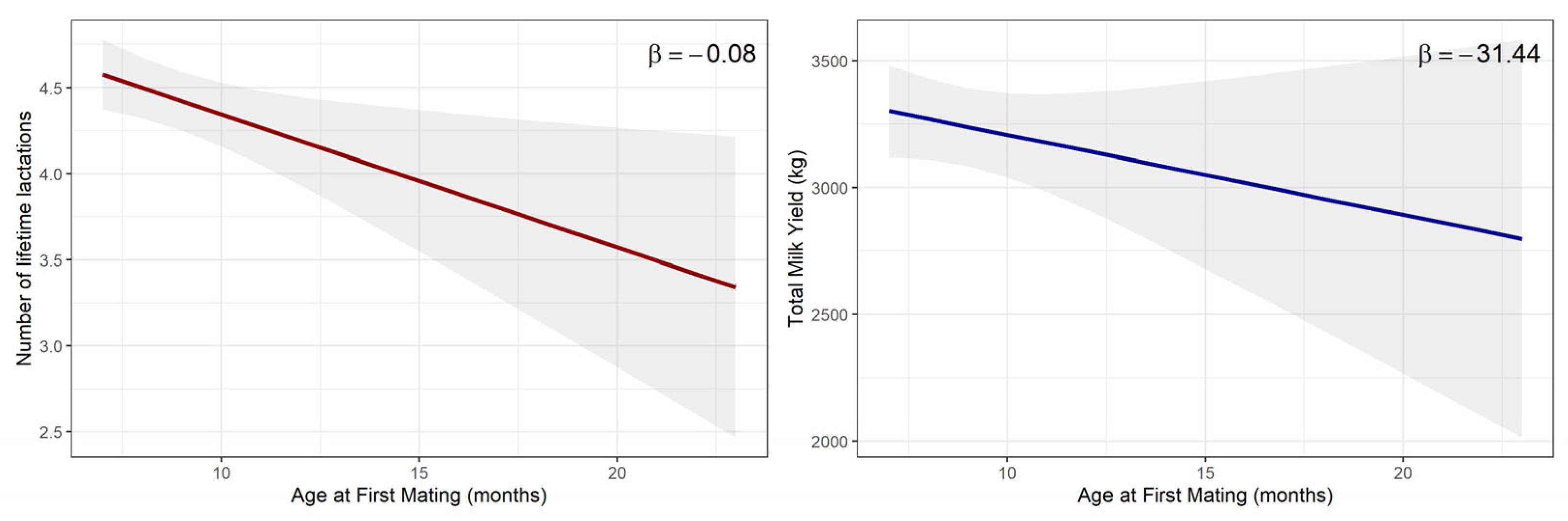
The regression analysis of lifetime metrics provided a nuanced view of the impact of AFM on overall productivity (Figure 2). When accounting for breeder effects using a conservative Type III ANOVA, the relationship between AFM and lifetime number of lactations (TNL) remained statistically significant (F = 6.30; p < 0.05), confirming that delayed mating reduces the total productive life of the goat. However, the effect of AFM on total lifetime milk yield (TMY) did not reach significance under the same rigorous testing (F = 1.29; p > 0.05). This indicates that while delayed mating directly limits longevity, the cumulative milk yield is more heavily influenced by farm-specific management factors (Breeder effect; p < 0.001), which appear to partially compensate for or mask the initial biological advantages of earlier mating over a multi-year period. The regression coefficients provide a practical quantification of these biological trends. For every one-month increase in AFM, the total number of lactations (TNL) decreased by approximately 0.08 units ( β 1 = −0.08; SE = 0.03; 95% CI: [−0.14, −0.02]). Despite the model’s lower explained variance for this lifetime trait (R2 = 0.074), the effect remains a consistent limiting factor. Similarly, for the cumulative lifetime milk yield (TMY), every additional month of AFM was associated with a downward trend of 31.4 kg ( β 1 = −31.44; SE = 27.59; 95% CI: [−85.62, 22.73]; R2 = 0.217). While this effect on TMY was secondary to the dominant influence of the breeder, the results collectively suggest that the reduction in the total number of kiddings and lactations acts as the primary driver for the observed decline in lifetime efficiency as AFM increases.

4. Discussion

The findings of this study provide a comprehensive overview of the factors driving milk productivity and the long-term consequences of reproductive management in dairy goats. The observed trends in yield and maturation reflect the physiological development of the mammary gland and overall milk production. The significant influence of litter size aligns with the lactation demand theory, where greater placental lactogen levels before birth and increased suckling intensity after birth stimulate higher milk synthesis [27]. Regarding seasonality, the 50-day difference in milking duration between January and March kidding suggests that earlier kidding allows goats to better exploit the natural production cycle before the onset of summer heat stress, confirming that lactation length is a primary driver of cumulative yield. A significant strength of this study, often neglected in similar research across many ruminant species, is the simultaneous accounting for suckling (S) and milking (M) durations. By incorporating these as highly significant covariates (p < 0.001), we effectively isolated the biological effect of AFM from management-driven variations. This methodological rigor was essential to identify the highly significant AFM × Parity interaction (p < 0.001), which clarifies why the benefits of delaying mating are strictly limited to the first lactation. The significant positive slope ( β 1 = 13.28) in primiparous goats suggests that older animals possess a temporary physiological advantage, likely due to greater body reserves and mammary gland development, allowing them to reach higher peak yields during their first commercial season. The physiological basis is likely the partitioning of energy; younger animals must direct nutrients toward their own growth, whereas older animals can channel more energy into milk synthesis. This aligns with patterns observed in other dairy small ruminants, such as Awassi [7], Assaf [8] and Lacaune [9] ewes, where older primiparous animals produced more milk initially. Due to the limited availability of research specifically focusing on the long-term impact of AFM in goats, comparisons were drawn from studies on dairy sheep. While acknowledging the distinct physiological and management differences between these species, these parallels are intended to provide a relative biological framework regarding the attainment of sexual maturity and its influence on subsequent production cycles. As for the results pertaining to latter parities, non-impactful AFM in subsequent parities (p > 0.05) indicates a rapid physiological equilibration. Younger primiparous animals, though producing less initially, eventually reach the same productive potential as their older counterparts once they attain full physical maturity. Despite the transient benefit in the first parity, the regression analysis of lifetime metrics (TMY and TNL) clearly demonstrates that these initial gains are insufficient to offset the negative impact of delayed mating on overall productivity. Our results indicate that delayed AFM leads to a net cumulative loss of approximately 400 kg of milk over the goat’s entire productive lifespan. It is important to contextualize this figure against the population’s average single-lactation yield of 740 kg. The 400 kg loss represents the net balance over the lifetime, accounting for the internal trade-off where higher initial yields observed in older primiparous does (as shown in Section 3.2) are eventually outweighed by the reduction in the total number of lactations. This cumulative perspective is crucial, as looking only at the first lactation might lead to the misleading conclusion that older primiparous does are more productive. The significant reduction in longevity (TNL) acts as the primary driver for the decline in lifetime efficiency. Our findings on the decline of TNL, and consequently TMY, were indirectly supported by recent evidence from the high-yielding Florida dairy goat breed. Specifically, Ziadi et al. [28], utilized a Cox proportional hazards model to demonstrate that the risk of premature culling is directly linked to the onset of reproduction. They reported that goats kidding at an early age (12–15 months) exhibited the lowest risk, whereas those older (>19 months at first kidding) faced the highest risk of being prematurely culled. In this context, the long-term implications of AFM are reflected not only in lactation performance but also in herd longevity. Although studies directly linking AFM to milk yield in goats are scarce, the finding that management factors significantly influence culling risk is vital; any factor increasing the risk of early culling inherently limits the goat’s opportunity to reach peak milk production in later parities, thereby reducing lifetime efficiency. This corroborates our finding that the “lost” milk production, quantified in our study as a net cumulative loss of 400 kg for a 12-month delay, is a direct consequence of a shorter productive life. The discrepancy between this 400 kg loss and the average lactation yield (740 kg) is explained by the model’s accounting for the trade-off between the early-life yield bonus of older does and their significantly reduced productive life in the herd. In conclusion, the trade-off between superior first-parity performance and overall longevity suggests that within the observed range (7–23 months), earlier mating (targeting the lower end of this interval, around 7 months) is associated with enhanced lifetime productivity. By prioritizing long-term yield over short-term first-parity peaks, this strategy may improve herd biological efficiency. This study represents one of the first systematic attempts to quantify these effects in a major cosmopolitan breed, offering a data-driven tool for breeding management. While these associations should be generalized with caution to other systems, as they were not subject to a formal economic cost–benefit analysis, they serve as a practical benchmark for Alpine producers to optimize the entry of young does into the milking herd, ultimately maximizing lifetime yield rather than chasing short-term first-parity peaks. While this study provides robust insights into the impact of AFM on lifetime performance, certain limitations must be acknowledged. First, the timing of first mating is subject to management confounding; breeders may decide to mate animals based on individual vigor or farm-specific strategies not captured in the data. Second, the long-term nature of the dataset (2005–2018) means that environmental shifts over time could introduce additional variance. Regarding genetic consistency, we acknowledge that incorporating estimated breeding values (EBVs) within an animal model could provide a more direct correction for genetic merit. However, we chose a more parsimonious mixed-model approach due to the relatively small size of this specific population and our primary goal of providing a management-focused analysis accessible to a broader audience. While incorporating genetic merit is not common practice in such studies, we addressed genetic variability by including breeder as a fixed effect and individual as a random effect. Furthermore, as the population originates from a unified selection system, we are confident that the model robustly partitions the variance, reflecting management impacts (AFM) rather than divergent genetic backgrounds. The model performance indices for lifetime traits showed lower R2 values compared to first-lactation models, which is consistent with the higher cumulative environmental noise inherent in lifetime production data. Finally, we note the reliance on inter-species comparisons for interpreting some physiological effects; while goats and sheep share similar pathways, differences in nutrient partitioning require cautious extrapolation. Despite these factors, the large sample size ensures a reliable estimation of the observed biological trends.

5. Conclusions

This study shows that although delaying the age at first mating (AFM) may increase early production in dairy goats, these benefits are ultimately offset by a significant reduction in lifetime efficiency. Earlier mating appears beneficial, provided adequate physical development is achieved. For the Alpine goat, a globally important cosmopolitan breed, these findings highlight a key economic trade-off: the increased production seen in older primiparous does cannot compensate for the loss of effective productive time. Therefore, in intensive dairy systems similar to this population, mating young does from seven months of age onwards, provided they have achieved adequate physical development, appears to be associated with optimized lifetime output. While these results should be further investigated through controlled experimental trials to isolate and estimate the effect of AFM with greater precision, they provide a scientific basis for breeders to optimize reproductive management and enhance the long-term profitability of their farms.

Author Contributions

Conceptualization, A.K., B.M. and D.M.; methodology, A.K.; software, A.K. and M.Š.; validation, V.D. and Z.P.; formal analysis, A.K. and MŠ; investigation, D.J., M.Š. and Z.B.; resources, D.M., D.J. and Z.B.; data curation, A.K. and M.Š.; writing—original draft preparation, A.K.; writing—review and editing, V.D., M.Š., Z.P. and Z.B.; visualization, A.K. and V.D.; supervision, A.K. and B.M.; project administration, V.D.; funding acquisition, A.K. All authors have read and agreed to the published version of the manuscript.

Funding

This research was funded by the European Union–Next Generation EU (project GEN-UP GOAT, AGR23-581).

Institutional Review Board Statement

Not applicable.

Data Availability Statement

The data used in this research are the property of the Ministry of Agriculture of the Republic of Croatia, and may be available upon request from the corresponding author. They are not publicly available to protect privacy.

Acknowledgments

The authors appreciate the support of the Croatian Agency for Agriculture and Food, Croatian association of sheep and goat breeders, and the Ministry of Agriculture, which provided access to the data required for this research.

Conflicts of Interest

The authors declare no conflicts of interest. The funders had no role in the design of the study; in the collection, analyses, or interpretation of data; in the writing of the manuscript; or in the decision to publish the results.

References

  1. Eastham, N.T.; Coates, A.; Cripps, P.; Richardson, H.; Smith, R.; Oikonomou, G. Associations between Age at First Calving and Subsequent Lactation Performance in UK Holstein and Holstein-Friesian Dairy Cows. PLoS ONE 2018, 13, e0197764. [Google Scholar] [CrossRef] [PubMed]
  2. Nilforooshan, M.A.; Edriss, M.A. Effect of Age at First Calving on Some Productive and Longevity Traits in Iranian Holsteins of the Isfahan Province. J. Dairy Sci. 2004, 87, 2130–2135. [Google Scholar] [CrossRef] [PubMed]
  3. Ettema, J.F.; Santos, J.E.P. Impact of Age at Calving on Lactation, Reproduction, Health, and Income in First-Parity Holsteins on Commercial Farms. J. Dairy Sci. 2004, 87, 2730–2742. [Google Scholar] [CrossRef] [PubMed]
  4. Hare, E.; Norman, H.D.; Wright, J.R. Trends in Calving Ages and Calving Intervals for Dairy Cattle Breeds in the United States. J. Dairy Sci. 2006, 89, 365–370. [Google Scholar] [CrossRef] [PubMed]
  5. Van Dam, B.P.; Bartlett, P.C.; Kirk, J.H.; Mather, E.C. The Effect of Age at Calving on Reproduction, Milk Production and Disease Incidence in the First Lactation of Dairy Heifers. Theriogenology 1988, 30, 583–591. [Google Scholar] [CrossRef] [PubMed]
  6. Simerl, N.A.; Wilcox, C.J.; Thatcher, W.W.; Martin, F.G. Prepartum and Peripartum Reproductive Performance of Dairy Heifers Freshening at Young Ages. J. Dairy Sci. 1991, 74, 1724–1729. [Google Scholar] [CrossRef] [PubMed]
  7. Gootwine, E.; Pollott, G.E. Factors Affecting Milk Production in Improved Awassi Dairy Ewes. Anim. Sci. 2000, 71, 607–615. [Google Scholar] [CrossRef]
  8. Pollott, G.E.; Gootwine, E. Reproductive Performance and Milk Production of Assaf Sheep in an Intensive Management System. J. Dairy Sci. 2004, 87, 3690–3703. [Google Scholar] [CrossRef] [PubMed]
  9. Hernandez, F.; Elvira, L.; Gonzalez-Martin, J.-V.; Gonzalez-Bulnes, A.; Astiz, S. Influence of Age at First Lambing on Reproductive and Productive Performance of Lacaune Dairy Sheep under an Intensive Management System. J. Dairy Res. 2011, 78, 160–167. [Google Scholar] [CrossRef] [PubMed]
  10. Kasap, A.; Ramljak, J.; Mioč, B.; Držaić, V.; Širić, I.; Jurković, D.; Špehar, M. The Impact of Age at First Lambing on Milk Yield and Lactation Length in a Population of Istrian Sheep under Semi-Intensive Management. Animals 2021, 11, 1604. [Google Scholar] [CrossRef] [PubMed]
  11. Goetsch, A.L.; Zeng, S.S.; Gipson, T.A. Factors Affecting Goat Milk Production and Quality. Small Rumin. Res. 2011, 101, 55–63. [Google Scholar] [CrossRef]
  12. Miller, B.A.; Lu, C.D. Current Status of Global Dairy Goat Production: An Overview. Asian-Australas J. Anim. Sci. 2019, 32, 1219–1232. [Google Scholar] [CrossRef] [PubMed]
  13. Pulina, G.; Milán, M.J.; Lavín, M.P.; Theodoridis, A.; Morin, E.; Capote, J.; Thomas, D.L.; Francesconi, A.H.D.; Caja, G. Invited Review: Current Production Trends, Farm Structures, and Economics of the Dairy Sheep and Goat Sectors. J. Dairy Sci. 2018, 101, 6715–6729. [Google Scholar] [CrossRef] [PubMed]
  14. Arnal, M.; Robert-Granié, C.; Larroque, H. Diversity of Dairy Goat Lactation Curves in France. J. Dairy Sci. 2018, 101, 11040–11051. [Google Scholar] [CrossRef] [PubMed]
  15. Montaldo, H.; Almanza, A.; Juárez, A. Genetic Group, Age and Season Effects on Lactation Curve Shape in Goats. Small Rumin. Res. 1997, 24, 195–202. [Google Scholar] [CrossRef]
  16. Zoa-Mboé, A.; Michaux, C.; Detilleux, J.C.; Kebers, C.; Farnir, F.P.; Leroy, P.L. Effects of Parity, Breed, Herd-year, Age, and Month of Kidding on the Milk Yield and Composition of Dairy Goats in Belgium. J. Anim. Breed. Genet. 1997, 114, 201–213. [Google Scholar] [CrossRef] [PubMed]
  17. Mulc, D.; Špehar, M.; Pocrnić, I.; Mioč, B.; Jurković, D.; Barać, Z. Effect of Goats’ Age at First Kidding on Production of Milk in the First Lactation at Alpina Breed. In Book of Abstracts of the 49th Croatian & 9th International Symposium on Agriculture, Dubrovnik, Croatia, 16 February 2014; Faculty of Agriculture, University of Josip Juraj Strossmayer in Osijek: Dubrovnik, Croatia, 2014; p. 179. [Google Scholar]
  18. ICAR. International Committee for Animal Recording Section 16. In Guidelines for Performance Recording in Dairy Sheep and Dairy Goats; ICAR: Rome, Italy, 2018. [Google Scholar]
  19. R Core Team. R: A Language and Environment for Statistical Computing; R Foundation for Statistical Computing: Vienna, Austria, 2023; Available online: https://www.R-project.org/ (accessed on 24 February 2026).
  20. Wickham, H.; François, R.; Henry, L.; Müller, K.; Vaughan, D. Dplyr: A Grammar of Data Manipulation 2023, (Version 1.1.4) [R package]. Available online: https://CRAN.R-project.org/package=dplyr (accessed on 24 February 2026).
  21. Grosjean, P.; Ibanez, F. Pastecs: Package for Analysis of Space-Time Ecological Series 2002, (Version 1.4.2) [R package]. Available online: https://CRAN.R-project.org/package=pastecs (accessed on 24 February 2026).
  22. Fox, J.; Munoz-Marquez, M. RcmdrMisc: R Commander Miscellaneous Functions 2014, (Version 2.9.1) [R package]. Available online: https://CRAN.R-project.org/package=RcmdrMisc (accessed on 24 February 2026).
  23. Wickham, H. Ggplot2: Elegant Graphics for Data Analysis, 2nd ed.; Use R! Springer International Publishing: Cham, Switzerland, 2016; ISBN 978-3-319-24277-4. Available online: https://ggplot2.tidyverse.org (accessed on 24 February 2026).
  24. Bates, D.; Mächler, M.; Bolker, B.; Walker, S. Fitting Linear Mixed-Effects Models Using Lme4. J. Stat. Soft. 2015, 67, 1–48. [Google Scholar] [CrossRef]
  25. Fox, J.; Weisberg, S. An R Companion to Applied Regression, 3rd ed.; SAGE: Thousand Oaks, CA, USA, 2019; ISBN 978-1-5443-3647-3. [Google Scholar]
  26. Lüdecke, D.; Ben-Shachar, M.; Patil, I.; Waggoner, P.; Makowski, D. Performance: An R Package for Assessment, Comparison and Testing of Statistical Models. JOSS 2021, 6, 3139. [Google Scholar] [CrossRef]
  27. Hayden, T.J.; Thomas, C.R.; Forsyth, I.A. Effect of Number of Young Born (Litter Size) on Milk Yield of Goats: Role for Placental Lactogen. J. Dairy Sci. 1979, 62, 53–57. [Google Scholar] [CrossRef] [PubMed]
  28. Ziadi, C.; Sánchez, J.P.; Sánchez, M.; Morales, R.; Molina, A. Survival Analysis of Productive Life in Florida Dairy Goats Using a Cox Proportional Hazards Model. J. Anim. Breed. Genet. 2023, 140, 431–439. [Google Scholar] [CrossRef] [PubMed]
Figure 1. Predicted milk yield (MY) in relation to age at first mating (AFM) across parities. The lines illustrate model-estimated values, corrected for the influence of all environmental factors included in the model. Red band is a 95% confidence interval for the regression line.
Agriculture 16 00687 g001
Figure 2. Predicted total number of lactations (TNL) and total milk yield (TMY) based on age at first mating (AFM) corrected for herd effect. Gray band is a 95% confidence interval for the regression line.
Agriculture 16 00687 g002
Table 1. Descriptive statistics of lactation length and milk yield classified by parity, litter size, season and breeder.
MY (kg)Milking (Days)
nMeanSDMeanSD
Parity
1730518.54204.56237.7935.87
2637734.94264.25253.9930.23
3553840.46285.76257.1431.16
4449824.65288.11251.0032.35
5+831822.83295.47247.7834.34
Litter size
singletons2537785.02290.17246.2034.02
twins605955.62286.31259.2130.43
triplets58999.36275.18254.0735.13
Season
January 1570816.35289.85261.0427.31
February1057726.90287.53250.7225.90
March573550.62232.63211.7536.10
Breeder
B1944519.79181.90238.6533.01
B21113941.21278.46259.5534.12
B31143723.76250.04246.7330.99
Overall3200739.22295.82248.8033.78
Table 2. Multicollinearity diagnostics and goodness-of-fit indices for the final mixed-effects model.
Diagnostic MetricTermValue[95% CI]Interpretation
Multicollinearity (VIF)AFM1.17[1.13, 1.23]Non redundant
Litter size1.06[1.03, 1.12]Non redundant
Suckling 1.64[1.57, 1.73]Non redundant
Milking 1.9[1.80, 2.00]Non redundant
Season2.29[2.17, 2.43]Non redundant
Breeder 1.15[1.11, 1.21]Non redundant
Model Fit (R2)Marginal0.614Fixed effects explain 61.4% of variance
Conditional0.746Total model explains 74.6% of variance
Random EffectsICC 0.34334.3% variance due to individual goats
AFM: age of first mating; ICC: Intraclass correlation; VIF: variance inflation factor.
Table 3. Summary of the linear model analysis showing the influence of various factors and interactions on milk yield (MY).
EffectDFF-Valuep-ValueSignificance
AFM12.560.1096NS
Parity2130.05<0.001***
Litter size24.180.0153*
Suckling157.67<0.001***
Milking1788.37<0.001***
Season28.30<0.001***
Breeder2332.17<0.001***
AFM × Parity215.90<0.001***
AFM: age of first mating; NS: insignificant; DF: degrees of freedom, * p < 0.05; *** p < 0.001; F-statistics and associated p-values for fixed effects were calculated using Type III Sum of Squares. Denominator degrees of freedom were estimated using the Satterthwaite approximation.
Table 4. Estimated linear regression coefficients (slopes) for the effect of age at first mating (AFM) on milk yield across different parities.
Parity β 1 SE95% CIp-Value *
113.282.35[8.67, 17.89]0.000
23.992.10[−0.12, 8.11]0.285
3−1.372.38[−6.04, 3.30]2.831
4−2.802.38[−7.46, 1.86]1.192
5−0.313.37[−6.91, 6.30]4.636
*: Bonferrroni adjusted for to account for multiple comparisons; CI: confidence interval.
Disclaimer/Publisher’s Note: The statements, opinions and data contained in all publications are solely those of the individual author(s) and contributor(s) and not of MDPI and/or the editor(s). MDPI and/or the editor(s) disclaim responsibility for any injury to people or property resulting from any ideas, methods, instructions or products referred to in the content.