


Abstract
Erosion in intensively farmed landscapes threatens above- and below-ground biodiversity. While impacts on soil physical and chemical properties (which affect soil inhabiting biota) are well documented, effects on ground-associated fauna (distribution, diversity, abundance) remain less understood. A likely very strong factor is the direct transport of epigeon together with the eroded soil. We assessed how water-erosion processes shape communities of epigeic invertebrates along agricultural slopes in the Chernozem region of South Moravia (Czech Republic). Ground-dwelling invertebrates were sampled over five years (May–September) in conventionally managed maize fields using pitfall traps across 18 sloping fields. Three slope positions were compared per field (control, erosional, depositional; 54 positions in total). Community patterns were evaluated using Canonical Correspondence Analysis with covariates (month, year, slope position, site), and species responses to key drivers were analysed using Generalised Additive Models. Across the full dataset, Shannon diversity and species richness did not differ significantly among slope positions; however, total invertebrate abundance was significantly lower in erosional parts. Interannual variation was pronounced and linked to precipitation: wet conditions increased diversity and richness at depositional positions, whereas dry conditions reduced diversity downslope. Ordination and GAM results identified erosion intensity and relative precipitation/temperature anomalies as important predictors, with most dominant species showing higher abundances under low to moderate erosion. These findings indicate that epigeic invertebrate communities along slopes can serve as indicators of erosion force.
1. Introduction
Human-induced erosion facilitated by inappropriate land use represents the most widespread form of soil degradation worldwide, with water erosion alone affecting an estimated 1094 million hectares of land [1]. In the European Union (EU), Panagos et al. [2] reported an estimated average soil loss rate of 2.46 t/ha/yr, yet these averages mask more critical localized issues; indeed, more than 6% of EU agricultural land experiences severe erosion exceeding 11 t/ha/yr [3]. This critical trend is mirrored in the Czech “Soil Report” [4] which regularly publishes report analyses and evaluates the agricultural land fund of the Czech Republic, including soil quality and new trends in terms of its bonitation. From the perspective of water erosion, it assesses the level of threat to the agricultural land fund, where the main conclusion is that more than 50% of agricultural land is threatened by water erosion, which leads to the degradation of hydrological functions and the loss of organic matter in the soil. To remedy this, the report recommends the use of modern tools, such as the Erosion Prevention Calculator, and compliance with the standards of good agricultural condition. Such high erosion is particularly evident in regions like South Moravia, where soil loss now substantially exceeds natural soil formation [5].
The vulnerability of soil to these erosive processes results from a complex interplay between abiotic factors and anthropogenic management. While natural elements such as intense rainfall and slope gradient determine the raw energy of erosive forces [6,7,8], the actual susceptibility of a site is further modulated by soil texture, organic matter content, and land-use practices [3,9,10]. Among various land uses, agroecosystems on arable land are significantly more susceptible to water erosion than grasslands or forests. This heightened vulnerability stems from conventional farming practices that disturb the soil matrix, leading to organic matter oxidation and reduced aggregate stability [11]. Consequently, intensive soil tillage has emerged as one of the principal drivers of modern soil erosion [12,13].
Beyond tillage itself, the use of heavy machinery induces soil compaction, which further exacerbates erosion by reducing water infiltration and increasing surface runoff [14,15]. These mechanical disturbances redistribute soil unevenly across the landscape; the greatest losses typically occur on crests and steep shoulders, while deposition dominates concave slope segments [16]. Furthermore, the depth and frequency of downslope tillage not only increase immediate soil susceptibility but also leave depositional areas more vulnerable to subsequent erosion by wind and water [16,17].
This continuous movement of water and sediment initiates a cycle of in-field deposition and intermediate storage, which can account for approximately 50% of total erosion [18]. As sediments are redistributed to footslopes and buffer strips, the chemical and physical properties of the soil—including substantial amounts of translocated carbon—are profoundly altered [5,19,20,21,22,23,24]. However, the impact of water erosion extends beyond the physical transport of inorganic sediment; it poses a significant threat by simultaneously redistributing soil biota to lower slope positions [12,25]. This redistribution, influenced by climate and topography, creates distinct environmental gradients: eroded, nutrient-poor upslope environments versus enriched depositional environments downslope [12,26,27,28].
Soils exposed to such erosive stress often exhibit reduced biodiversity and a loss of ecosystem functioning compared with undisturbed systems [29,30,31]. These consequences are not limited to reduced soil depth; they include diminished water-holding capacity and depleted nutrient pools, which together affects the habitats of diverse soil communities [32,33]. Given that approximately one quarter of all animal species live exclusively in soil and leaf litter [34]—ranging from microbiota and mesofauna to macrofauna [35,36]—the disruption of the pedosphere has far-reaching ecological implications. Some species of soil macrofauna are vital for soil formation due to their ability to move substantial amounts of soil, yet their populations are directly affected by these habitat alterations [37,38,39].
Importantly, the effects of water erosion are not uniform across these biotic groups. While torrential rainfall primarily impacts surface-dwelling microbiota and mesofauna, larger organisms like earthworms may be more affected by the clogging of their burrows with fine particles in depositional areas [40]. The magnitude of this impact depends on the erosion intensity—from rainsplash to gully erosion—which determines the depth of soil removal and its redistribution and the subsequent transport of biota [41,42]. In high-magnitude events, the destruction of critical zones like the detritosphere can lead to the loss of keystone species, triggering cascading effects across the entire ecosystem [43,44,45].
Ultimately, the influence of erosion on soil biota involves a dual mechanism: the direct passive transport of organisms as vectors [46,47,48,49,50,51] and the indirect modification of their physical habitat [52]. As erosion reshapes the landscape, it reduces habitat availability and compromises soil structure through the depletion of organic matter and the blocking of soil pores by sediments [24,53,54]. Despite these known mechanisms, our understanding of the comprehensive effects of erosion on soil biota remains unsatisfactory [40,55]. To address this gap, the present study uses ground-dwelling invertebrates—representing soil macrofauna—as model groups to investigate the effects of water erosion. We expected that water erosion and the resulting redistribution of soil particles and nutrients would significantly shape the spatial structure of ground-dwelling invertebrate communities along the slope gradient. We specifically anticipated that erosional and depositional positions would harbour distinct assemblages, with lower abundance and diversity in the most degraded slope segments. Furthermore, we presumed that the biological response to erosion processes would be strongly modulated by inter-annual climatic variability, particularly by deviations in precipitation and temperature from long-term averages. Finally, we sought to test whether high-resolution erosion models and topographic parameters could effectively explain the observed variation in species distribution across these transformed agricultural landscapes.
2. Materials and Methods
2.1. Study Sites
The study was conducted in the Chernozem region of the South Moravia, Czech Republic. According to the World Reference Base for Soil Resources [56], the predominant soil types include Haplic or Calcic Chernozems in the control and depositional areas, and Calcaric Regosols in the erosional parts of the slopes (Table 1). The average grain size composition of the soil is used for USDA soil categorization. Soils in the control position are just below the boundary between Loam and Clay Loam, whereas soils in the erosional position have a slightly higher Silt content, which places them in the Silt Loam category. In the depositional position at the bottom of the slope, the average grain size composition corresponds to typical Loam. Geologically, the study area is characterized by a Pleistocene loess layer, with depths ranging from several meters to tens of meters [57]. Meteorological data for the region (1981–2018) indicate an average annual temperature of 9.8 °C, annual precipitation of 528 mm, and an annual evapotranspiration rate of 661 mm. During the five years of this study, the meteorological summers (during which we took samples) were on average and slightly above average in terms of temperature (maximum of 1.42 °C) and relatively richer in precipitation (during the summer, 71 to 145 mm more precipitation fell in individual years compared to the long-term average).
Table 1.
Characteristics of soil conditions (mean ± S.E. calculated from 18 sites) at studied slopes.
Sampling was carried out at sloping sites within maize plots managed under conventional farming practices on Chernozem soils. Most agricultural operations in this area utilize minimal tillage techniques with cultivation depths of up to 15 cm. Additional spring activities include fertilization with mineral fertilizers, skidding, and hauling. Sowing typically takes place in the second half of April, with an average of one herbicide and one insecticide application during the growing season. Maize is harvested in early September for silage or in October for grain.
2.2. Sampling Design and Slope Positions
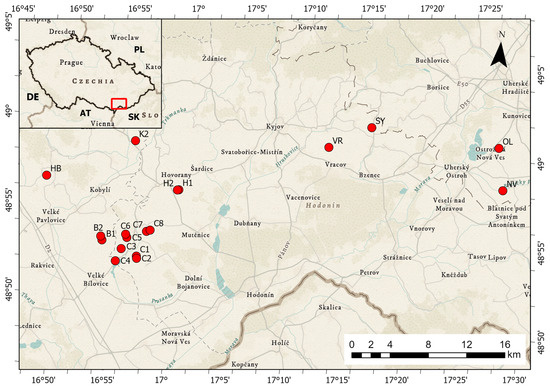
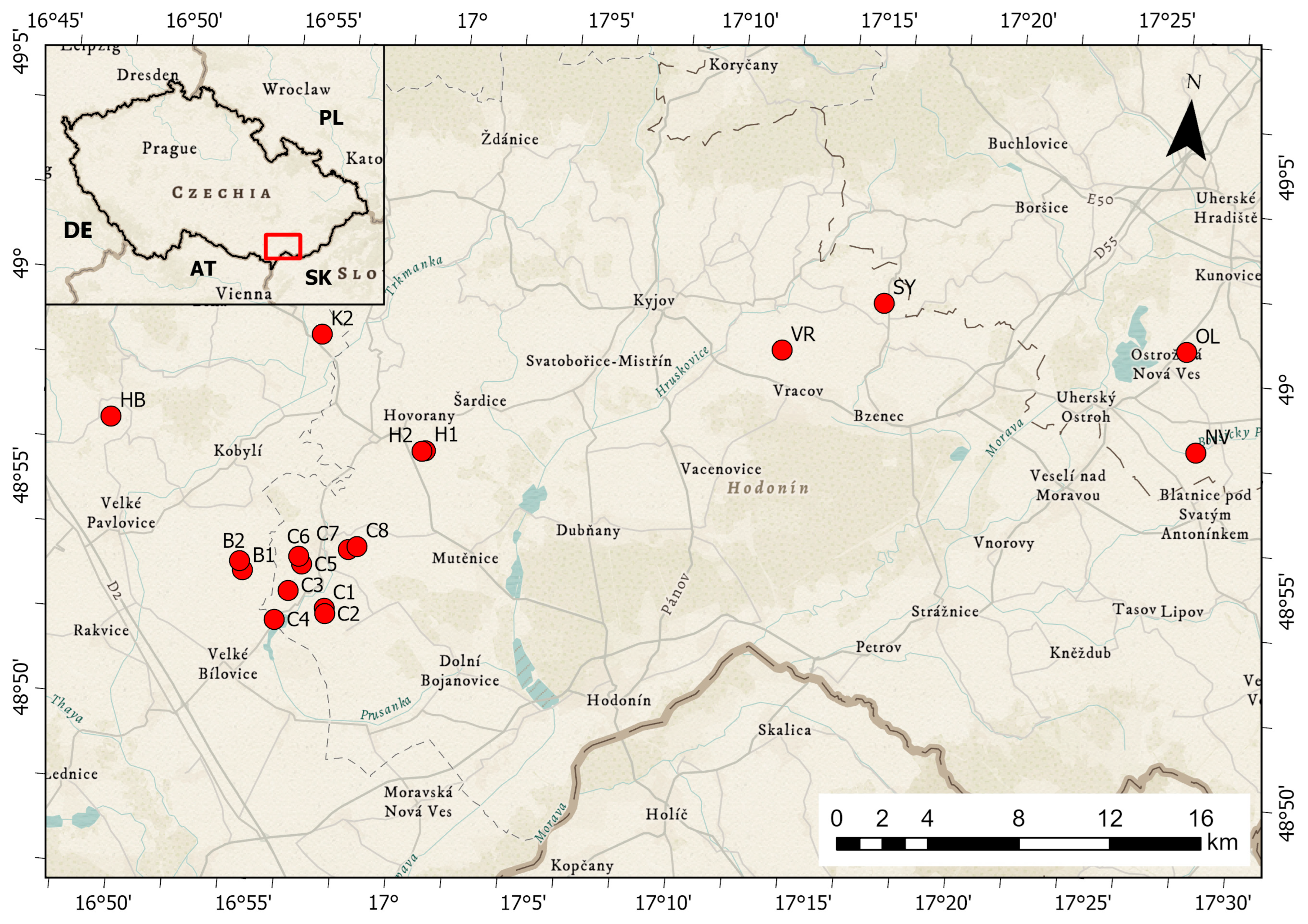
Soil invertebrates were sampled every year for 5 collections with a 14-day exposure. Traps were installed according to the current weather and possibilities at the end of May or in June, and the 10-week trapping ended in August or September. Two sites (as a pilot study) were monitored during the first year, increasing to four sites in each of the subsequent four years. In total, the research covered 18 sloping fields (Figure 1), with three distinct positions investigated per field, amounting to 54 study positions. Each slope was at least 500 m long with varying gradients. The three compared positions within each field were not interrupted by landscape features such as streams, paths, or grass strips.
Figure 1.
Distribution of experimental slopes in South Moravia, Czech Republic. The inset map shows the location of the study area (red rectangle) within the Czech Republic and its position relative to neighbouring countries: Germany (DE), Poland (PL), Slovakia (SK), and Austria (AT). Each red circle on the main map represents a slope field where its control, erosive, and depositional positions were compared. For codes of localities, see Section 2.2.
The control position was located in the upper part of the field where the slope was relatively gentle (average 4°; Table 1). The erosional position was situated in the part of the slope with the highest inclination (average 9°). The depositional position was located in the lower part of the field with a gentler inclination (average 3.2°); this did not represent a typical footslope but rather a still-sloping segment, as individual fields covered only a portion of the entire slope.
All sites were situated in the South Moravia (Figure 1) within the cadastral areas of Krumvíř (K2), Horní Bojanovice (HB), Ostrožská Nová Ves (NV), Ostrožská Lhota (OL), Syrovín (SY), Vracov (VR), Velké Bílovice (B1, B2), Čejkovice (C1–C8), and Hovorany (H1, H2). Sites were selected using Evaluated Soil-Ecological Unit (ESEU) maps and erosion risk modelling based on the Universal Soil Loss Equation (USLE/RUSLE) [58,59]. The EASheet_us model, which calculates erosion and accumulation rates based on altitude, slope, and the nature of the contributing area, reported values of −20.6 for control positions, −66.9 (the highest erosion rate) for erosional positions, and +27.4 for depositional positions. To pinpoint specific sampling locations, the Unit Stream Power-based Erosion Deposition (USPED) model was employed to predict the spatial distribution of erosion and deposition rates [60].
2.3. Invertebrate Sampling and Identification
The traps consisted of embedded plastic cups (7 cm in diameter) with metal covers, filled with a 4% killing-preserving formaldehyde solution. At each of the 54 positions (18 control, 18 erosional, and 18 depositional), five pitfall traps were installed in a transect along the contour line, spaced 10 m apart. Traps were exposed for 10 weeks, totalling five collections during each growing season at each slope, which together provided 1350 samples. The most abundant taxa, ground beetles (Carabidae), spiders (Araneae), harvestmen (Opiliones), centipedes and millipedes (Myriapoda; Chilopoda and Diplopoda, respectively), and terrestrial isopods (Isopoda: Oniscidea), were sorted and identified to the species level.
2.4. Environmental Variables for Studied Fields
In all described localities, selected physical, chemical and biological soil characteristics were determined in the previous research, which are described in more detail and from a methodological point of view in the publication Bílá et al. [61]. Soil chemical and physical properties were determined using standard pedological protocols: The total organic carbon content (Cox.) was determined by oxidation of the soil with a chromium-sulphur mixture and the colour intensity was subsequently measured spectrophotometrically. Total nitrogen (Ntot.) was determined after mineralization with sulfuric acid and after distillation by titration. The soil reaction was determined as pH/H2O. The content of available calcium was determined using Mehlich 3 extraction solution, followed by determination by atomic absorption spectrophotometry and photometry. Soil texture was analysed by the pipette method after organic matter removal. For these characteristics, differences were demonstrated between the erosional, depositional and control parts of the slopes, with those related to the quantity and quality of organic matter responding most sensitively to erosion processes. The physical characteristics of the soils responded the least sensitively. The analysed characteristics showed better parameters in the depositional and control parts of the slope compared to the erosion areas. The exception was pH and CaCO3 content, where the values were higher in the erosional parts of the slopes, which indicates the erosion of the upper part of the soil and greater exposure of the soil-forming substrate, which is calcareous loess [5]. For our study of the influence of erosion processes on biota, we chose the basic soil characteristics listed in Table 1. Climatic factors, such as temperatures and precipitation and relative temperatures and precipitation, were determined from records of the nearest meteorological stations.
Topographic characteristics and erosion indices were derived from the “dmr4g” digital elevation model (5 × 5 m resolution). Slope was extracted directly from the DEM, while potential soil loss was calculated using the Universal Soil Loss Equation (USLE) to obtain g_usl02 [t/ha/year]. The USPED (Unit Stream Power-based Erosion Deposition) model, which incorporates USLE principles, was applied to delineate erosional and depositional zones, generating dimensionless erosion-accumulation values (EASheet_us) for sheet erosion conditions. These variables were assigned to each pitfall trap location based on spatial intersection with the respective grid cells.
2.5. Data Processing and Statistics
Community-level analyses were conducted in R 4.2.3 using the vegan, dplyr, and ggplot2 packages. To account for variation in trap exposure duration, species abundance data were standardized by rarefaction to 14 days, as some traps were exposed for longer periods. Three alpha diversity metrics were calculated for each trap: Shannon diversity index, number of species, and total abundance (count of individuals per trap per inspection).
Differences in community parameters among slope positions (control, erosional, and depositional parts) were evaluated using Kruskal–Wallis test. When significant effects were detected, Dunn post hoc test was applied for pairwise comparisons among all position pairs.
The effects of relative annual rainfall on soil macrofauna community parameters (Shannon diversity index, species richness, and abundance) were analysed separately for erosional and depositional trap positions using Linear Mixed Models (LMM) implemented in the lme4 and lmerTest packages in R. Relative rainfall (percentage expression of total precipitation from May to September in a given year compared to the long-term average for this period) was included as a fixed effect. To account for the hierarchical and repeated-measures structure of the data, year and trap ID nested within locality were included as random effects (random intercepts). Abundance data were log(x + 1)-transformed prior to analysis to meet the assumption of normally distributed residuals; predicted values were back-transformed to the original scale for visualization. Marginal predictions with 95% confidence intervals were extracted using the ggeffects package and plotted against raw data using ggplot2. In several models, variance components of random effects converged to zero (singular fit), indicating that between-year and between-trap variability was negligible relative to residual variance; these models were retained as the fixed-effect structure remained valid. Statistical significance was assessed using Satterthwaite’s approximation for degrees of freedom.
Quantitative data on active invertebrates from individual plots on erosional slopes were analysed using CANOCO 5.0 for Windows for multivariate analysis [62]. Based on the gradient length of the species data (380 SD), the distribution of animals along the slopes was examined by Canonical Correspondence Analysis (CCA), with month, year, slope position, and site identity included as covariates. Species data consisted of counts of individuals per species, with the influence of rare species down-weighted. All available environmental variables were first evaluated using simple term effects, and the most informative variables were subsequently selected by forward selection to build the final model. Model significance was assessed using a Monte Carlo permutation test with 499 permutations. For the numerical responses of dominant species to selected environmental variables, Generalised Additive Models (GAMs) were fitted, using 2 degrees of freedom for the smoothing of the response curves and assuming a Poisson error distribution. The best model was selected using AIC.
Spearman’s rank correlation coefficients (rs) were calculated to evaluate the relationships between the studied variables, as the data did not meet the assumption of normality. The statistical significance (p-value) of each correlation was assessed using a two-tailed t-test. The matrix serves to identify potential multicollinearity between predictors of different spatial and temporal scales.
3. Results
3.1. Invertebrate Community Composition and Abundance
A total of 69,716 ground beetles, 7198 spiders, 2358 harvestmen, 1284 myriapods, and 183 terrestrial isopods, all belonging to 77 species in total, were captured using 270 pitfall traps over a 10-week sampling period.
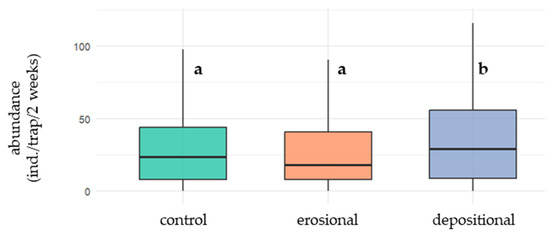
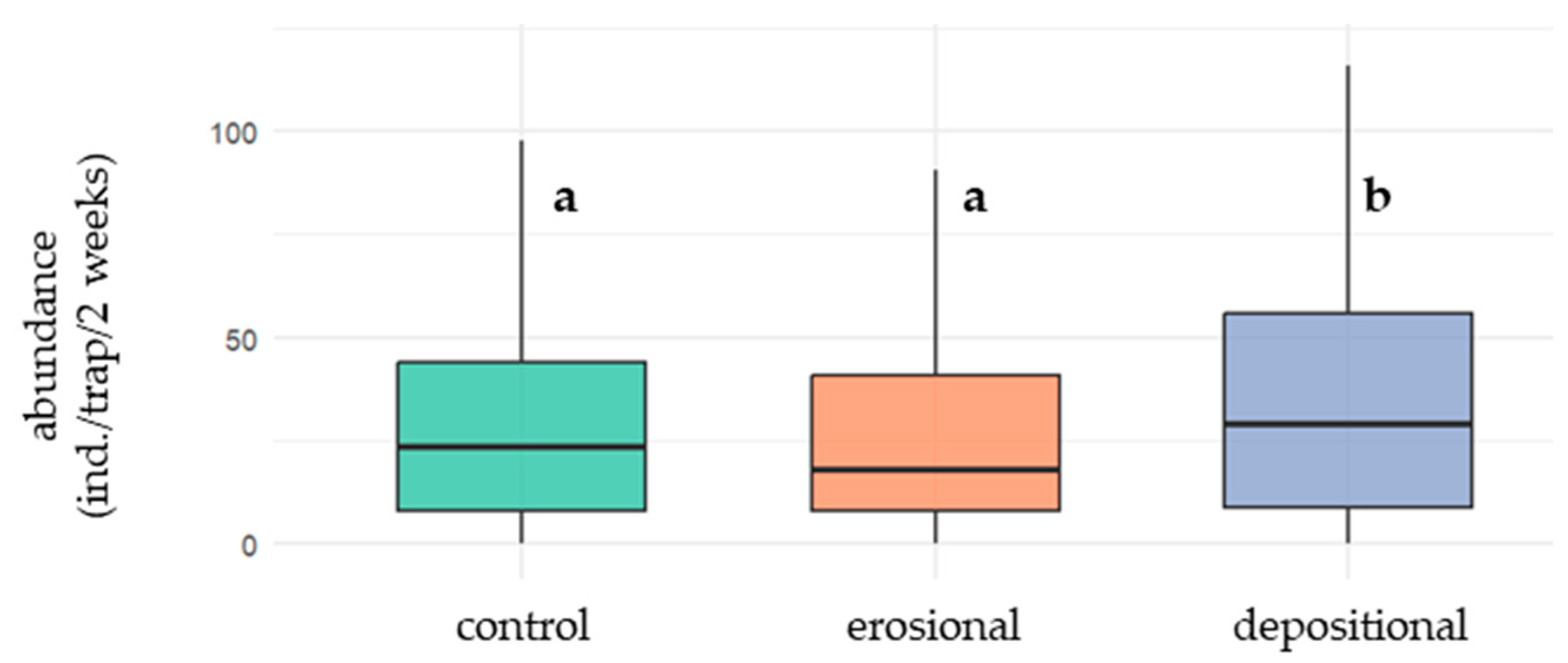
The distribution patterns of invertebrates varied across individual slopes. Analysis of the entire dataset revealed no significant differences in the Shannon diversity index be-tween the control, erosional, and depositional positions (Kruskal–Wallis: χ2 = 1.93, p = 0.381). Similarly, species richness did not differ significantly among these positions (Kruskal–Wallis: χ2 = 5.23, p = 0.073). However, total invertebrate abundance varied significantly by slope position, with markedly higher numbers of individuals recorded on depositional positions (Kruskal–Wallis: χ2 = 11.13, p = 0.004; Figure 2). A similar pattern was observed for the abundance of the six most dominant ground beetle species (Kruskal–Wallis: χ2 = 7.19, p = 0.028), which were more abundant at depositional positions than at erosional ones.
Figure 2.
Abundances of ground dwelling invertebrates on experimental slopes. Different letters indicate significant differences between mean abundances at individual positions (p ˂ 0.001), calculated from dataset of all 18 slopes.
3.2. Influence of Precipitation and Annual Variability on Community Parameters
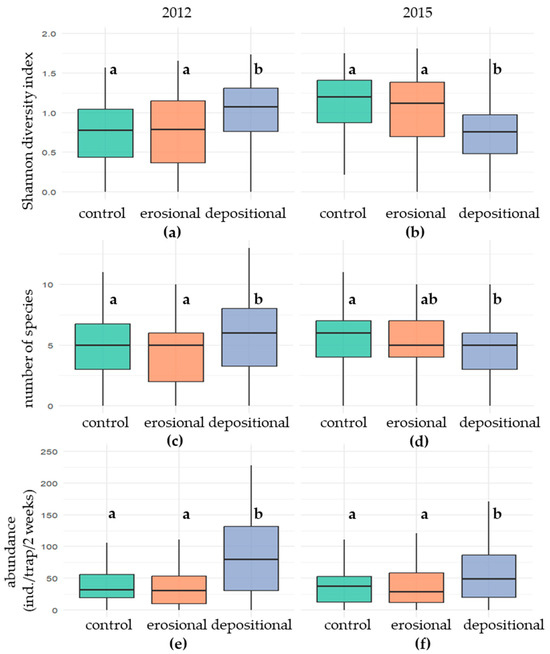
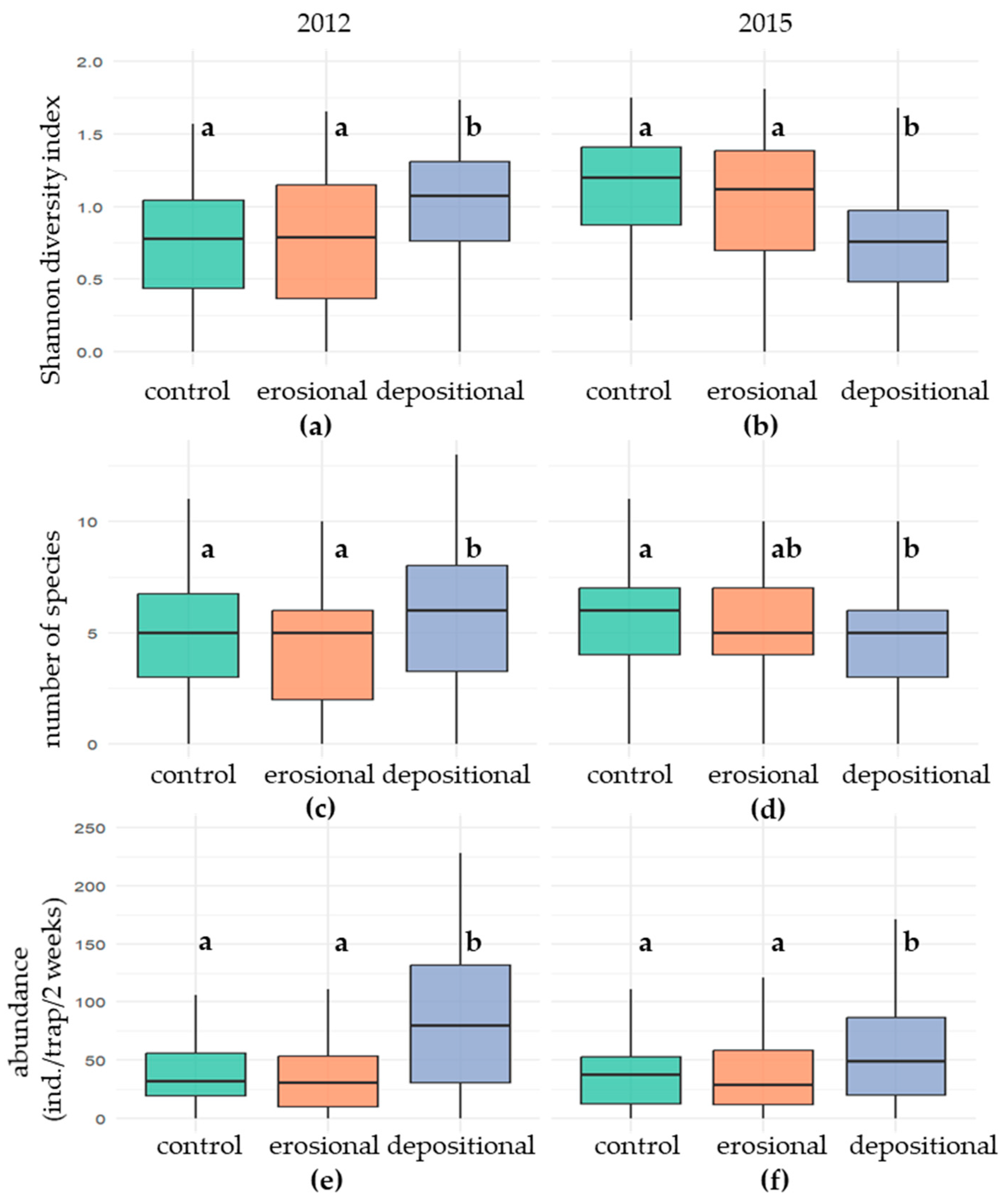
While overall Shannon diversity did not differ significantly among sites, it varied strongly between years in response to precipitation during the sampling period (Figure 3). In the wet summer of 2012, invertebrate diversity increased significantly at depositional positions (Kruskal–Wallis: χ2 = 11.204, p = 0.004), whereas in the dry summer of 2015, diversity at the bottom of the slope was significantly lower (Kruskal–Wallis: χ2 = 39.99, p < 0.001).
Figure 3.
Shannon diversity indices (a,b), number of species (c,d) and abundances (e,f) of ground dwelling invertebrate communities on experimental slopes during rainy year 2012 (a,c,e) and dry year 2015 (b,d,f). Different letters indicate significant differences between mean values at individual positions (p ˂ 0.001).
Species richness showed a similar pattern (Figure 3). In wet years, more species occurred at depositional positions (Kruskal–Wallis: χ2 = 9.17, p = 0.010), while in dry years, species richness shifted upward along the slope and became higher at erosional positions (Kruskal–Wallis: χ2 = 5.83, p = 0.054). Precipitation also influenced invertebrate abundance. Although significantly more individuals were captured in the depositional part during the dry year of 2015 (Kruskal–Wallis: χ2 = 6.47, p = 0.039), this contrast was even stronger in the wet year of 2012, when differences in abundance between slope positions were much larger (Kruskal–Wallis: χ2 = 17.57, p < 0.001).
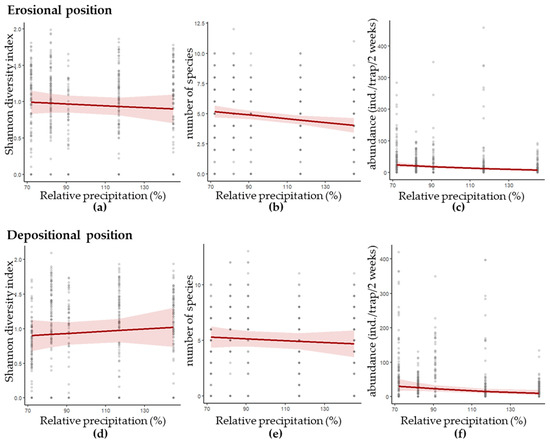
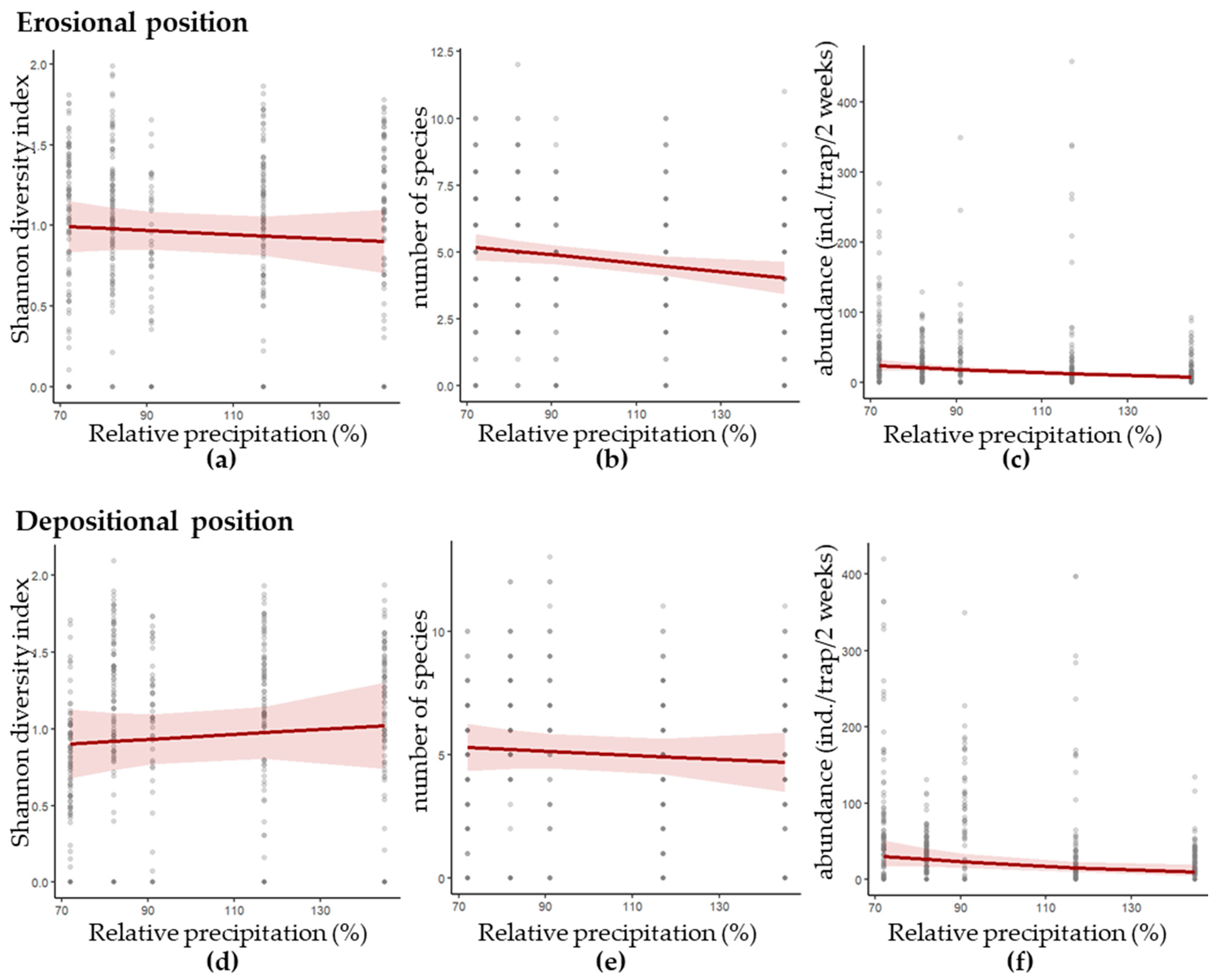
Relative rainfall had a significant negative effect on species richness in erosional positions (β = −0.016, t = −2.59, p = 0.020; Figure 4), while no significant effect was detected in depositional positions (β = −0.008, t = −0.69, p = 0.549). Shannon diversity index was not significantly affected by relative rainfall in either erosional (β = −0.001, t = −0.63, p = 0.623) or depositional positions (β = +0.002, t = 0.58, p = 0.605).
Figure 4.
Relationship between relative annual precipitation (%) and soil macrofauna community parameters in erosional (top row: (a–c)) and depositional (bottom row: (d–f)) positions. The parameters shown are Shannon diversity index (a,d), species richness (b,e), and abundance (c,f). Solid dark red lines represent marginal predictions derived from Linear Mixed Models (LMM), with shaded areas indicating 95% confidence intervals. Grey points represent raw observed data. Note that for abundance (c,f), predictions were back-transformed. Significant negative trends were observed for richness in erosional positions and for abundance in both erosional and positions.
Abundance showed a significant negative relationship with relative rainfall in both positional types. In erosional positions, abundance decreased significantly with increasing rainfall (β = −0.014 on log scale, t = −3.94, p = 0.001), as did abundance in depositional positions (β = −0.014, t = −2.28, p = 0.036). Predicted values back-transformed to the original scale indicate that higher relative rainfall was associated with lower arthropod abundance regardless of geomorphic position.
3.3. Dominant Species and Their Taxonomic Distribution
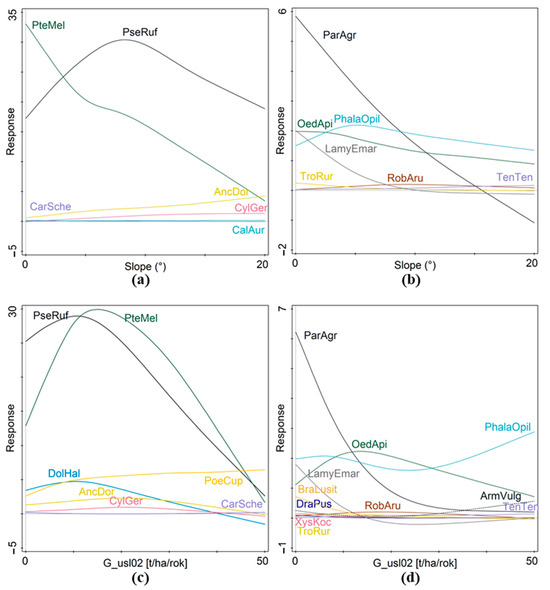
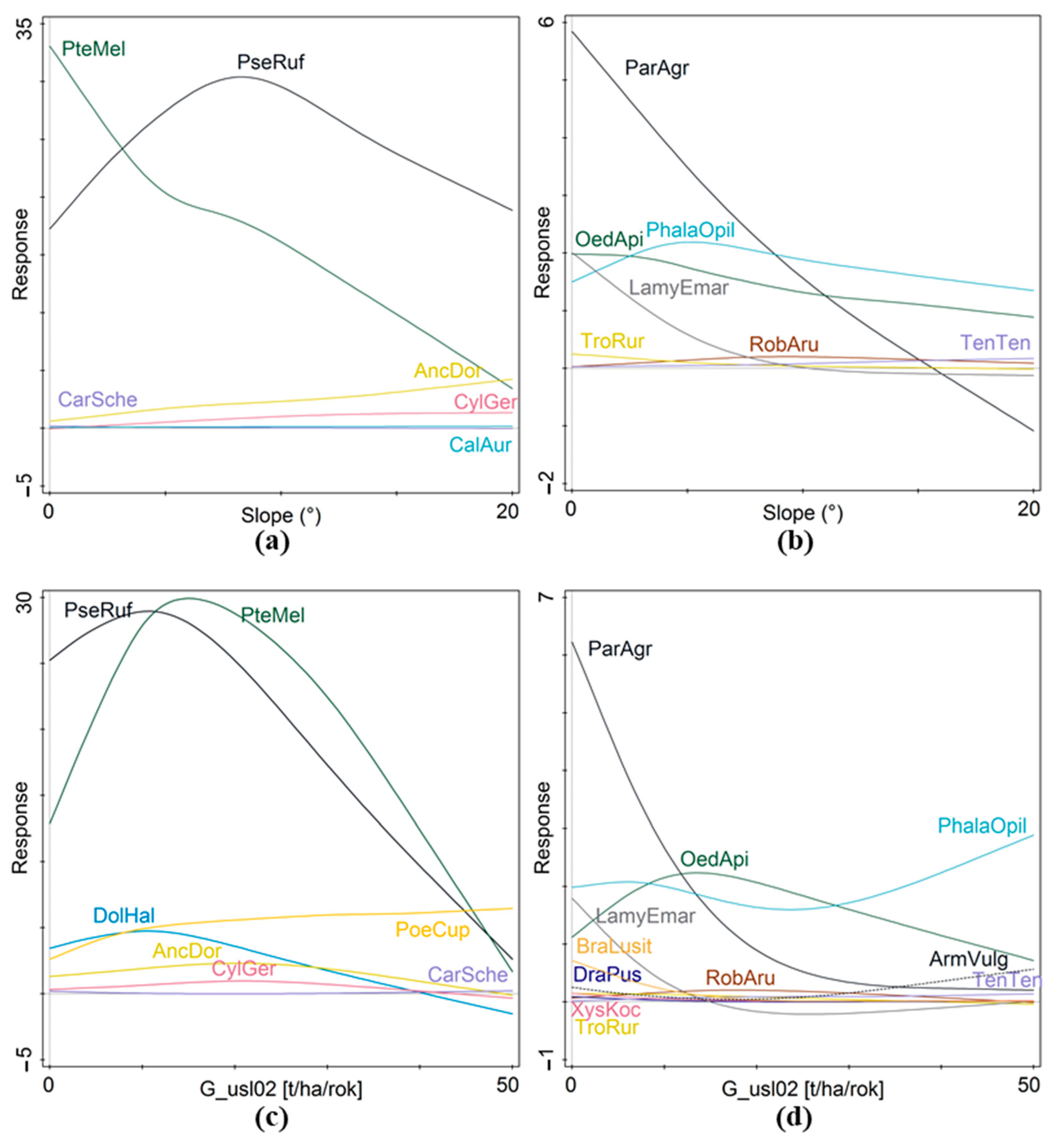
We identified 14 species of ground beetles, dominated by Pseudoophonus rufipes (De Geer, 1774) (37% of specimens) and Pterostichus melanarius (Illiger, 1798) (31%). Other notable species included Poecilus cupreus (Linnaeus, 1758) (6%), Dolichus halensis (Fabricius, 1792) (6%), Anchomenus dorsalis (Pontoppidan, 1763) (2%), and Brachinus crepitans (Linnaeus, 1758) (1%). Among the 55 spider species, the six most numerous were Pardosa agrestis (Westring, 1861) (47%), Oedothorax apicatus (Blackwall, 1850) (23%), Robertus arundineti (O. Pickard-Cambridge, 1871) (2%), Trochosa ruricola (De Geer, 1778) (2%), and Xysticus kochi Thorell, 1872 (1%). The harvestman Phalangium opilio Linnaeus, 1758 accounted for 77% of all captured opilionids. Among the seven myriapod species, Lamyctes emarginatus (Newport, 1844) (98% of centipedes) and Brachyiulus lusitanus (Verhoeff, 1898) (70% of millipedes) were the most abundant. The woodlouse Armadillidium vulgare (Latreille, 1804) (48% of terrestrial isopods) was the most dominant of the four isopod species. The relationships between these dominant species and selected environmental factors were tested using Generalized Additive Models (GAMs; Figure 5).
Figure 5.
Generalised Additive Models for numerical response of abundances of ground beetles (a,c) and other ground dwelling species of model taxa (b,d) predicted by inclination of slope (a,b) and by intensity of erosion (c,d). Only species with significant prediction are imaged (p ˂ 0.01). Legend of species abbreviations: AncDor: Anchomenus dorsalis; ArmVulg: Armadillidium vulgare; BraLusit: Brachyiulus lusitanus; CalAur: Calosoma auropunctatum; CarSche: Carabus scheidleri; CylGer: Cylindera germanica; DolHal: Dolichus halensis; DraPus: Drassyllus pusillus; LamyEmar: Lamyctes emarginatus; OedApi: Oedothorax apicatus; ParAgr: Pardosa agrestis; PhalaOpil: Phalangium opilio; PoeCup: Poecilus cupreus; PseRuf: Pseudoophonus rufipes; PteMel: Pterostichus melanarius; RobAru: Robertus arundineti; TenTen: Tenuiphantes tenuis; TroRur: Trochosa ruricola; XysKoc: Xysticus kochi.
3.4. Environmental Drivers of Species Distribution
The Canonical Correspondence Analysis (CCA) revealed that all tested environmental variables were significant predictors of invertebrate distribution and abundance. The total inertia (total variation) of the species data was 2.650. In the marginal effects test (evaluating each variable independently), the individual predictors explained between 0.34% and 2.51% of the total inertia (Table 2). The most influential factor was altitude (derived from the digital elevation model, dmr4g), which explained 2.51% of the variation and strongly corresponds with the position on the slope.
Table 2.
Marginal Effects of tested environmental variables for predictions of distribution of ground dwelling invertebrates on tested fields. Parameters are arranged according to explanatory power (marginal effects). Explains % = percentage of total inertia explained by each variable. Pseudo-F = ratio of explained to unexplained variance. All variables are statistically significant at p = 0.002 (999 permutations).
Notably, invertebrate catches were better predicted by relative climatic data (expressed as the deviation of current monthly averages from long-term averages for the May–September period) than by absolute current values. Both erosion models—g_usl02 (estimating soil loss in t/ha/year) and EASheet_us (calculating erosion/accumulation rates)—significantly explained approximately 1% of the species data variation each. Collectively, the full model including all significant environmental variables accounted for 12.10% of the total variation (adjusted explained variation = 11.18%; global permutation test: pseudo-F = 13.2, p = 0.002).
3.5. Relationships Between Environmental Factors and Species-Specific Responses
Correlations between environmental factors are summarized in Table 3. The strongest relationships were observed between climatic variables, specifically relative temperature and relative precipitation, reflecting a gradient from hot, dry conditions to cold, rainy summers. Regarding soil chemistry, a strong positive correlation was found between calcium levels and soil pH, indicating that higher calcium concentrations were associated with more alkaline conditions. Furthermore, calcium content was positively correlated with slope steepness. Weaker but significant correlations were also identified between relative precipitation and both humus content and soil alkalinity.
Table 3.
Correlation matrix of analysed factors. Some factors were determined for the entire slope under study, or for a wider area (e.g., temperature and relative temperature), while others were analysed for each position on the slope (chemical and physical soil parameters) or for the vicinity of each trap (erosion models). Significant correlations stronger than 0.4 are highlighted in red (if positive) and in blue (if negative). The matrix serves to identify potential multicollinearity between predictors of different spatial and temporal scales. Legend for columns and rows: A—volumetric water content; B—precipitations (month); C—relative precipitation (V–IX); D—temperature (month); E—relative temperature (V–IX); F—slope (°); G—altitude (dmr4g, m a.s.l.); H—erosion (EASheet_us); I—erosion (g_usl02, t/ha/year); J—conductivity; K—Calcium; L—C:N; M—pH/H2O; N—Nitrogen; O—Ntotal (%); P—sand particles; Q—silt; R—clay; S—humus (%); T—humus quality.
Physical soil properties were primarily driven by erosion processes. A strong positive correlation existed between slope steepness and the erosion factor (g_usl02), which in turn influenced grain size distribution, as evidenced by the correlation between sand and silt content. Additionally, nitrogen levels were positively correlated with the proportion of silt particles.
GAMs were developed for the variables “slope” (inclination) and “dmr4g” (altitude). Six ground beetle species, six spider species, and several other taxa responded significantly to slope inclination. Only the spider Tenuiphantes tenuis (Blackwall, 1852) and three ground beetle species were more common on steeper slope segments (Figure 5), while most other species preferred areas with lower inclination. Similarly, the higher abundance of most species in areas with low or moderate erosion suggests that severely eroded zones tend to be species-poor (Figure 5).
4. Discussion
4.1. Erosion as a Driver of Habitat Modification and Faunal Redistribution
Water erosion degrades not only soil itself but also communities of soil organisms, both through habitat alteration and through the direct displacement of individuals from affected parts of slopes [46]. Ground beetles and spiders form a substantial part of the epigeic fauna and play an important role in providing key ecosystem services [46,63,64,65]. Erosion-driven shifts in their communities may therefore compromise the delivery of these services.
The influence of erosion on soil biota encompasses both the direct transport and redistribution of organisms and the modification of habitat and environmental conditions [46]. Water acts as a vector for the passive dispersal of soil biota [47,48,49,50,51]. Key processes contributing to passive redistribution include soil loss caused by erosion, tillage, harvesting, and other agricultural activities [52]. Erosion becomes particularly important when it alters the physical and chemical properties of soil, degrading upslope environments while enriching downslope areas [24]. In this way, erosion reshapes the landscape for soil organisms. According to Joschko et al. [53], these indirect consequences of erosion manifest as reduced habitat availability, compromised soil structure, and decreased concentrations of organic matter and nutrients. Soil pores may become clogged by transported fine particles, thereby altering habitats for soil biota. Furthermore, the finest particles, which are transported most easily, can carry soil organisms of similar size and mass [54]. Rain splash and slaking may also represent important erosive mechanisms affecting micro- and mesofauna [40].
The observed negative trends in some diversity indices relative to annual precipitation (Figure 4) may seem counterintuitive, but they likely reflect the complex response of soil macrofauna to extreme weather events. While moderate moisture generally promotes biological activity, high annual precipitation in our study area was often associated with intense, episodic rainfall events. Such conditions can lead to mechanical stress on soil organisms, temporary waterlogging of pore spaces, or excessive surface runoff that may physically displace individuals from their microhabitats [21,66]. This suggests that beyond a certain threshold, the positive effect of moisture is overridden by the physical disturbance caused by high-intensity precipitation, leading to the observed decline in community metrics.
4.2. Community Composition and Its Correspondence with Central European Agroecosystems
The composition of the captured communities indicated that both studied groups were typical of maize fields in Central Europe and correspond well with previous findings [67,68,69]. A similar carabid assemblage was reported from rapeseed fields by Lemic et al. [70], where P. cupreus was among the dominant species. Alford et al. [71] also listed this species as one of the most abundant in winter crops, and our results confirm its dominant status in spring-sown crops.
Spider communities captured in pitfall traps during our study period were more diverse in terms of species richness than carabid communities. The dominant family was Lycosidae, i.e., ground-dwelling spiders that do not build webs but actively hunt prey [72]. The dominant species were typical of arable fields, as shown by Svobodová et al. [73] and Volkmar and Freier [74], who reported the same main species in maize crops.
4.3. Differential Responses of Invertebrate Communities to Slope Position and Erosion Intensity
The invertebrate communities were clearly affected by erosion processes, with control and erosional parts of slopes differing from depositional parts. Slope segments dominated by erosion differed markedly from those dominated by deposition. This is in contrast to Šarapatka et al. [5], who studied soil chemical properties and concluded that control parts of slopes were more similar to depositional parts, with higher contents of organic carbon and nutrients. Our results suggest that material washed down from upper slope segments accumulates in depositional areas and includes not only organic matter, nutrients, and fine mineral fractions, but also invertebrate fauna. Baxter et al. [40] reached a similar conclusion for nematodes, which are much smaller than the taxa studied here.
The GAM analyses further support this pattern, showing that the abundance of most carabid species decreases with increasing erosion intensity. The most intensively eroded parts of slopes typically have poorer plant cover and reduced diversity and abundance of soil fauna [75,76], and our results are consistent with this general trend. The main exceptions are P. melanarius and P. cupreus, which showed less pronounced responses to erosion gradient.
In addition to direct transport, the development of communities in different parts of slopes is influenced by the erosion processes themselves, which alter the physical, chemical, and biological properties of soil and its production potential [21,28,66]. One likely mechanism is nutrient depletion caused by erosion: sudden nutrient loss from a given area can alter community size and structure [77]. Denser vegetation at depositional positions provides better protection of the soil surface against rainfall [11,78], thereby helping to prevent further erosion, and simultaneously supports higher abundances of soil predators [79,80]. However, our results (Figure 3d) indicate that the benefit of depositional positions as biodiversity hotspots is strongly mediated by annual precipitation. While these areas supported higher diversity in the wet year of 2012, this advantage was lost during the extreme drought of 2015. This suggests that in dry years, the accumulated sediment may undergo rapid desiccation or lack the moisture-driven influx of individuals, limiting the buffering capacity of depositional zones against climatic extremes.
4.4. Species-Specific Responses: Ground Beetles
The most abundant carabid species at all study sites was P. rufipes, which prefers open, unshaded habitats [81] and is frequently used in biocontrol studies focusing on seed predation of both crop and weed species [82,83]. Depositional slope segments in our study had the highest weed cover, and P. rufipes occurred at all 18 sites. It was also relatively abundant at control positions, where soil conditions and vegetation cover were similar to those in depositional parts [5].
The responses of individual carabid species to slope position were not uniform. For example, the small carabid A. dorsalis was more abundant in contours with more intensive erosion, whereas B. crepitans was more numerous in depositional parts of slopes. Only P. melanarius was more abundant in depositional segments. Unlike nematodes, carabids can recolonise those parts of the slope from which they have been displaced, owing to their ability to fly—for instance, P. rufipes was more abundant in erosional parts, which may reflect active recolonisation rather than passive accumulation.
As the study plots were conventionally farmed, a certain number of pesticides was applied. The active ingredients of some pesticides can substantially reduce the abundance of epigeic fauna [84,85]. Depositional parts of slopes, with their higher nutrient and organic matter content and denser vegetation, may better buffer or intercept insecticides, thereby reducing their impact on soil surface fauna.
4.5. Species-Specific Responses: Spiders
Pardosa agrestis and O. apicatus were the eudominant spider species in our study. Their dominance in arable crops has also been reported elsewhere [74,86,87,88], while other species were far less abundant. A comparison of their spatial distributions reveals contrasting habitat preferences in these two common species, paralleling patterns observed in carabids.
Most O. apicatus individuals were found in depositional parts, whereas P. agrestis was most abundant at control positions. Oedothorax apicatus is typically associated with meadows and fields, and Řezáč and Řezáčová [89] documented passive migration of this species by ballooning, which in our case may relate to grassy edges and patches in the surrounding landscape. The bioindicator potential of O. apicatus in relation to movements between arable fields and grasslands was also highlighted by Madeira et al. [90]. As a small spider that creates its web in soil cavities, O. apicatus was apparently transported by erosion to depositional positions. Niedobová et al. [91] demonstrated both lethal effects and reduced predatory activity in P. agrestis following pesticide exposure, which may further contribute to its preference for less disturbed control positions.
By contrast, the higher abundance of P. agrestis at control positions may support the findings of Öberg [86], who showed that this species performs better in more homogeneous environments due to lower competition for food resources.
4.6. Broader Implications and Limitations
Soil erosion leads to nutrient loss and alters the microhabitats of microbial communities, thereby reshaping microbial composition, functional processes, nutrient cycling, and overall soil fertility. These changes may also influence the dynamics of surface fauna [92]. Although water erosion modifies soil structure by washing fine particles into depositional slope segments—where they clog soil pores and block migration pathways for soil fauna [93,94]—given the body size of the taxa studied here, this mechanism is unlikely to have played a major role in our results.
Our findings contribute to a growing body of evidence highlighting the complex interactions between soil physical processes and invertebrate communities in agricultural landscapes. By demonstrating how water erosion and slope position reshape the distribution of both soil macrodecomposers and ground-dwelling predators, this study underscores the necessity of integrating biological indicators into soil conservation models. Recent global assessments confirm that soil invertebrates are fundamental regulators of hydrological cycles and nutrient dynamics [95], yet their functional efficiency is strictly dependent on the stability of the topsoil horizon. In the vulnerable Chernozem regions of Central Europe, the erosion-driven loss of soil structure and organic matter likely triggers a detrimental feedback loop, where reduced biological aggregation [96] further accelerates soil detachment and habitat degradation.
Future research should focus on the long-term resilience of these communities under shifting management intensities and climate-driven erosion patterns. As systematic reviews indicate, the response of carabid and spider assemblages to agronomic interventions is highly context-specific [97], suggesting that site-specific factors like microtopography and erosion history must be accounted for in biodiversity monitoring. Furthermore, understanding how different management strategies—ranging from conventional tillage to regenerative practices—influence the functional traits of these predatory taxa [98] will be crucial for maintaining natural pest control and ecosystem integrity. Ultimately, protecting the biological component of the soil is not merely a matter of biodiversity conservation, but a prerequisite for the long-term sustainability of high-productivity agricultural systems.
5. Conclusions
In the South Moravia region, where Chernozem soils predominate, erosion processes in agricultural landscapes represent a serious problem for both production and non-production functions. While the effects of erosion on physical and chemical soil properties and crop yield are relatively well documented, its influence on soil biological processes is less well understood. Our study highlights an additional dimension of this problem by demonstrating that water erosion is associated with marked changes in the abundance and spatial distribution of ground beetles, spiders, and myriapods in arable fields.
We found pronounced differences among slope positions: erosional parts of slopes generally supported lower abundances and, under wet conditions, lower diversity of epigeic invertebrates, whereas depositional parts were often more species-rich and abundant, particularly in wet years. These patterns indicate that species spending most of their lives on or near the soil surface, and directly exposed to water erosion, can serve as sensitive indicators of erosion-driven degradation in agroecosystems through changes in community composition and abundance.
The selected model groups perform multiple important functions in agroecosystems. Beyond their value as bioindicators, ground beetles and spiders are key predators of crop pests. Through their predatory activity, they help prevent pest outbreaks and form an important link in trophic networks. By moving within and across the soil surface, they can also contribute indirectly to soil structure and to the coupling between above- and below-ground processes. Their role may therefore differ substantially among control, erosional, and depositional parts of slopes.
These findings should be considered when planning anti-erosion measures, including agrotechnical, organisational, and technical interventions. Management that reduces severe erosion and supports vegetation cover, especially in erosional segments, is likely to benefit not only soil physical and chemical properties but also the biodiversity and functional integrity of soil ground-dwelling invertebrate communities. Future research should focus more on smaller soil biota groups, particularly mesofauna, and compare their responses to erosion with those of surface-dwelling fauna documented in this study.
Author Contributions
Conceptualization, B.Š.; methodology, B.Š., M.B., P.N. and I.H.T.; software, M.B.; formal analysis, M.B., V.C., L.P., O.M., K.T. and I.H.T.; investigation, V.C. and P.N.; resources, B.Š.; data curation, V.C., L.P., O.M., K.T. and I.H.T.; writing—original draft preparation, B.Š., V.C., L.P. and I.H.T.; writing—review and editing, I.H.T., L.P. and B.Š.; funding acquisition, B.Š. All authors have read and agreed to the published version of the manuscript.
Funding
The article was prepared thanks to the projects of the Technology Agency of the Czech Republic, namely SS06010290 (Strip cropping management as an adaptation measure to optimize landscape water management) and SS07010439 (Development and verification of local measures for the long-term support of soil organisms and desirable groups of invertebrates on intensively farmed land). Thanks also go to the Internal Grant Agency of Palacký University (project IGA_PrF_2026_019).
Data Availability Statement
The raw data supporting the conclusions of this article will be made available by the authors on request.
Acknowledgments
Our sincere thanks go to four anonymous reviewers for their valuable and constructive comments, which greatly improved the quality of this work.
Conflicts of Interest
The authors declare no conflicts of interest.
References
- Lal, R. Soil erosion and the global carbon budget. Environ. Int. 2003, 29, 437–450. [Google Scholar] [CrossRef] [Scilit]
- Panagos, P.; Borelli, P.; Poesen, J.; Ballabio, C.; Lugato, E.; Meusburger, K.; Montanarella, L.; Alewell, C. The new assessment of soil loss by water erosion in Europe. Environ. Sci. Policy 2015, 54, 438–447. [Google Scholar] [CrossRef] [Scilit]
- Panagos, P.; Ballabio, C.; Poesen, J.; Lugato, E.; Scarpa, S.; Montanarella, L.; Borrelli, P.A. Soil erosion indicator for supporting agricultural, environmental and climate policies in the European Union. Remote Sens. 2020, 12, 1365. [Google Scholar] [CrossRef] [Scilit]
- Collective. Situační a Výhledová Zpráva Půda (Report on Current and Anticipated State of Soil); The Ministry of Agriculture of the Czech Republic: Prague, Czech Republic, 2021. [Google Scholar]
- Šarapatka, B.; Čáp, L.; Bílá, P. The varying effect of water erosion on chemical and biochemical soil properties in different parts of Chernozem slopes. Geoderma 2018, 314, 20–26. [Google Scholar] [CrossRef] [Scilit]
- Govers, G.; Vandaele, K.; Desmet, P.; Poesen, J.; Bunte, K. The role of tillage in soil redistribution on hillslopes. Eur. J. Soil Sci. 1994, 45, 469–478. [Google Scholar] [CrossRef] [Scilit]
- DEFRA. Scoping Study of Lowland Soil Loss Through Wind Erosion, Tillage Erosion and Soil Co-Extracted with Root Vegetables—Final Report SP 08007; Department for Environment, Food and Rural Affairs: London, UK, 2006. [Google Scholar]
- Borrelli, P.; Robinson, D.A.; Panagos, P.; Lugato, E.; Yang, J.E.; Alewell, C.; Ballabio, C. Land use and climate change impacts on global soil erosion by water (2015-2070). Proc. Natl. Acad. Sci. USA 2020, 117, 21994–22001. [Google Scholar] [CrossRef] [Scilit] [PubMed]
- Mamedov, A.I.; Shainberg, I.; Levy, G.J. Rainfall energy effects on runoff and interrill erosion in effluent irrigated soils. Soil Sci. 2000, 165, 535–544. [Google Scholar] [CrossRef] [Scilit]
- Verheijen, F.G.A.; Jones, R.J.A.; Rickson, R.J.; Smith, C.J. Tolerable versus actual erosion rates in Europe. Earth-Sci. Rev. 2009, 94, 23–38. [Google Scholar] [CrossRef] [Scilit]
- Dungait, J.A.J.; Ghee, C.; Rowan, J.S.; McKenzie, B.M.; Hawes, C.; Dixon, E.R.; Paterson, E.; Hopkins, D.W. Microbial responses to the erosional redistribution of soil organic carbon in arable fields. Soil Biol. Biochem. 2013, 60, 195–201. [Google Scholar] [CrossRef] [Scilit]
- Powlson, D.S.; Gregory, P.J.; Whalley, W.R.; Quinton, J.N.; Hopkins, D.W.; Whitmore, A.P.; Hirsch, P.R.; Goulding, K.W.T. Soil management in relation to sustainable agriculture and ecosystem services. Food Policy 2011, 36, 72–87. [Google Scholar] [CrossRef] [Scilit]
- Lal, R. Restoring soil quality to mitigate soil degradation. Sustainability 2015, 7, 5875–5895. [Google Scholar] [CrossRef] [Scilit]
- Addiscott, T.M.; Thomas, D. Tillage, mineralization and leaching: Phosphate. Soil Tillage Res. 2000, 53, 255–273. [Google Scholar] [CrossRef] [Scilit]
- Bailey, A.; Deasy, C.; Quinton, J.; Silgram, M.; Jackson, B.; Stevens, C. Determining the cost of in-field mitigation options to reduce sediment and phosphorus loss. Land Use Policy 2013, 30, 234–242. [Google Scholar] [CrossRef] [Scilit]
- Van Oost, K.; Govers, G.; De Alba, S.; Quine, T.A. Tillage erosion: A review of controlling factors and implications for soil quality. Prog. Phys. Geogr. 2006, 30, 443–466. [Google Scholar] [CrossRef] [Scilit]
- Dlugoß, V.; Fiener, P.; Van Oost, K.; Schneider, K. Model based analysis of lateral and vertical soil carbon fluxes induced by soil redistribution processes in a small agricultural catchment. Earth Surf. Process. Landf. 2012, 37, 193–208. [Google Scholar] [CrossRef] [Scilit]
- Ferguson, R.I. Channel forms and channel changes. In British Rivers; Lewin, J., Ed.; George Allen and Unwin: London, UK, 1981; pp. 90–120. [Google Scholar] [CrossRef] [Scilit]
- Rhoton, F.E.; Shipitalo, M.J.; Lindbo, D.L. Runoff and soil loss from midwestern and southwestern US silt loam soils as affected by tillage practice and soil organic matter content. Soil Tillage Res. 2002, 66, 1–11. [Google Scholar] [CrossRef] [Scilit]
- Papiernik, S.K.; Lindstrom, M.J.; Schumacher, T.E.; Schumacher, J.A.; Malo, D.D.; Lobb, D.A. Characterization of soil profiles in a landscape affected by long term tillage. Soil Tillage Res. 2007, 93, 335–345. [Google Scholar] [CrossRef] [Scilit]
- Nie, X.J.; Zhao, T.Q.; Qiao, X.N. Impacts of soil erosion on organic carbon and nutrient dynamic in an alpine grassland soil. Soil Sci. Plant Nutr. 2013, 59, 660–668. [Google Scholar] [CrossRef] [Scilit]
- Quinton, J.N.; Govers, G.; Van Oost, K.; Bardgett, R.D. The impact of agricultural soil erosion on biogeochemical cycling. Nat. Geosci. 2010, 3, 430–437. [Google Scholar] [CrossRef] [Scilit]
- Chappell, A.; Baldock, J.; Sanderman, J. The global significance of omitting soil erosion from soil organic carbon cycling schemes. Nat. Clim. Change 2016, 6, 187–191. [Google Scholar] [CrossRef] [Scilit]
- Doetterl, S.; Berhe, A.A.; Nadeu, E.; Wang, Z.; Sommer, M.; Fiener, P. Erosion, deposition and soil carbon: A review of process-level controls, experimental tools and models to address C cycling in dynamic landscapes. Earth-Sci. Rev. 2016, 154, 102–122. [Google Scholar] [CrossRef] [Scilit]
- Qiu, L.; Zhang, Q.; Zhu, H.; Reich, P.B.; Banerjee, S.; van der Heijden, M.G.A.; Sadowsky, M.J.; Ishii, S.; Jia, X.; Shao, M.; et al. Erosion reduces soil microbial diversity, network complexity and multifunctionality. ISME J. 2021, 15, 2474–2489. [Google Scholar] [CrossRef] [Scilit]
- Collins, A.J.; Owens, P.N. Introduction to soil erosion and sediment redistribution in river catchments: Measurement, modelling and management in the 21st Century. In Soil Erosion and Sediment Redistribution in River Catchments: Measurement, Modelling and Management; Collins, A.J., Owens, P.N., Eds.; CABI: Wallingford, UK, 2006; pp. 3–12. [Google Scholar] [CrossRef] [Scilit]
- Helming, K.J.; Luis Rubio, J.; Boardman, J. Soil erosion across Europe: Research approaches and perspectives. Catena 2006, 68, 71–72. [Google Scholar] [CrossRef] [Scilit]
- Alewell, C.; Ringeval, B.; Ballabio, C.; Robinson, D.A.; Panagos, P.; Borrelli, P. Global phosphorus shortage will be aggravated by soil erosion. Nat. Commun. 2020, 11, 4546. [Google Scholar] [CrossRef] [Scilit]
- Raffaelli, D.; van der Putten, W.H.; Persson, L.; Wardle, D.A.; Petchey, O.L.; Koricheva, J.; van der Heijden, M.; Mikola, J.; Kennedy, T. Multi-trophic dynamics and ecosystem processes. In Biodiversity and Ecosystem Functioning: Synthesis and Perspectives; Loreau, M., Naeem, S., Inchausti, P., Eds.; Oxford University Press: Oxford, UK, 2002; pp. 147–154. [Google Scholar] [CrossRef] [Scilit]
- Brussaard, L.; de Ruiter, P.C.; Brown, G.G. Soil biodiversity for agricultural sustainability. Agric. Ecosyst. Environ. 2007, 121, 233–244. [Google Scholar] [CrossRef] [Scilit]
- Guerra, C.A.; Rosa, I.M.D.; Valentini, E.; Wolf, F.; Filipponi, F.; Karger, D.N.; Nguyen Xuan, A.; Mathieu, J.; Lavelle, P.; Eisenhauer, N. Global vulnerability of soil ecosystems to erosion. Landsc. Ecol. 2020, 35, 823–842. [Google Scholar] [CrossRef] [Scilit]
- Pimentel, D.; Kounang, N. Ecology of soil erosion in ecosystems. Ecosystems 1998, 1, 416–426. [Google Scholar] [CrossRef] [Scilit]
- Amundson, R.; Berhe, A.A.; Hopmans, J.W.; Olson, C.; Sztein, A.E.; Sparks, D.L. Soil and human security in the 21st century. Science 2015, 348, 1261071. [Google Scholar] [CrossRef] [Scilit]
- Decaëns, T.; Jimenez, J.J.; Gioia, C.; Measey, G.J.; Lavelle, P. The values of soil animals for conservation biology. Eur. J. Soil Biol. 2006, 42, 23–38. [Google Scholar] [CrossRef] [Scilit]
- Giller, K.E.; Beare, M.H.; Lavelle, P.; Izac, A.M.N.; Swift, M.J. Agricultural intensification, soil biodiversity and agroecosystem function. Appl. Soil Ecol. 1997, 6, 3–16. [Google Scholar] [CrossRef] [Scilit]
- Bardgett, R.D.; van der Putten, W.H. Belowground biodiversity and ecosystem functioning. Nature 2014, 515, 505–511. [Google Scholar] [CrossRef] [Scilit]
- Roots, B.I. The water relations of earthworms 2: Resistance to desiccation and immersion, and behaviour when submerged and when allowed a choice of environment. J. Exp. Biol. 1956, 33, 29–44. [Google Scholar] [CrossRef] [Scilit]
- Lavelle, P.; Decaëns, T.; Aubert, M.; Barot, S.; Blouin, M.; Bureau, F.; Margerie, P.; Mora, P.; Rossi, J.P. Soil invertebrates and ecosystem services. Eur. J. Soil Biol. 2006, 42, 3–15. [Google Scholar] [CrossRef] [Scilit]
- Blouin, M.; Hodson, M.E.; Delgado, E.A.; Baker, G.; Brussaard, L.; Butt, K.R.; Mathieu, J. A review of earthworm impact on soil function and ecosystem services. Eur. J. Soil Sci. 2013, 64, 161–182. [Google Scholar] [CrossRef] [Scilit]
- Baxter, C.; Rowan, J.S.; McKenzie, B.M.; Neilson, R. Understanding soil erosion impacts in temperate agroecosystems: Bridging the gap between geomorphology and soil ecology using nematodes as a model organism. Biogeosciences 2013, 10, 7133–7145. [Google Scholar] [CrossRef] [Scilit]
- Morgan, R.P.C. Soil Erosion and Conservation, 3rd ed.; Blackwell Publishing: Oxford, UK, 2005. [Google Scholar]
- Poesen, J. Soil erosion in the Anthropocene: Research needs. Earth Surf. Proc. Landf. 2018, 43, 64–84. [Google Scholar] [CrossRef] [Scilit]
- Heywood, V.H. Global Biodiversity Assessment; Cambridge University Press: Cambridge, UK, 1995. [Google Scholar]
- Daily, G.C. (Ed.) Nature’s Services: Societal Dependence on Natural Ecosystems; Island Press: Washington, DC, USA, 1997. [Google Scholar]
- Eisenhauer, N.; Bonn, A.; Guerra, C.A. Recognizing the quiet extinction of invertebrates. Nat. Commun. 2019, 10, 50. [Google Scholar] [CrossRef] [Scilit]
- Kromp, B. Carabid beetles in sustainable agriculture: A review on pest control efficacy, cultivation impacts and enhancement. Agric. Ecosyst. Environ. 1999, 74, 187–228. [Google Scholar] [CrossRef] [Scilit]
- Freckman, D.W.; Baldwin, J.G. Nematoda. In Soil Biology Guide; Dindal, D.L., Ed.; John Wiley & Sons: New York, NY, USA, 1990; pp. 155–200. [Google Scholar]
- Dighton, J.; Jones, H.E.; Robinson, C.H.; Beckett, J. The role of abiotic factors, cultivation practices and soil fauna in the dispersal of genetically modified microorganisms in soils. Appl. Soil Ecol. 1997, 5, 109–131. [Google Scholar] [CrossRef] [Scilit]
- Terhivuo, J. The Finnish Lumbricidae (Oligochaeta) fauna and its formation. Ann. Zool. Fenn. 1988, 25, 229–247. [Google Scholar]
- Terhivuo, J.; Saura, A. Dispersal and clonal diversity of North-European parthenogenetic earthworms. Biol. Invasions 2006, 8, 1205–1218. [Google Scholar] [CrossRef] [Scilit]
- Eijsackers, H. Earthworms as colonizers of natural and cultivated soil environments. Appl. Soil Ecol. 2011, 50, 1–13. [Google Scholar] [CrossRef] [Scilit]
- Debeljak, M.; Cortet, J.; Demšar, D.; Krogh, P.H.; Džeroski, S. Hierarchical classification of environmental factors and agricultural practises affecting soil fauna under cropping systems using Bt maize. Pedobiologia 2007, 51, 229–238. [Google Scholar] [CrossRef] [Scilit]
- Joschko, M.; Rogasik, H.; Dannowski, M.; Hierold, W.; Heisler, C. A catena in northeast Brandenburg (Bőlkendorf): Soil biota, root growth and soil structure. Arch. Agron. Soil Sci. 1998, 43, 385–396. [Google Scholar] [CrossRef] [Scilit]
- Cadet, P.; Albergel, J. Passive transport of phytoparasitic nematodes by runoff water in the Sudano-Sahelian climatic area. J. Hydrol. 1999, 214, 91–102. [Google Scholar] [CrossRef] [Scilit]
- Ritz, K.; Trudgill, D.L. Utility of nematode community analysis as an integrated measure of the functional state of soils: Perspectives and challenges. Plant Soil 1999, 212, 1–11. [Google Scholar] [CrossRef] [Scilit]
- IUSS Working Group WRB. World Reference Base for Soil Resources. International Soil Classification System for Naming Soils and Creating Legends for Soil Maps, 4th ed.; International Union of Soil Sciences (IUSS): Vienna, Austria, 2022. [Google Scholar]
- Chlupáč, I.; Brzobohatý, R.; Kovanda, J.; Straník, Z. Geologická Minulost České Republiky (Geological History of the Czech Republic); Academia: Prague, Czech Republic, 2002. [Google Scholar]
- Wischmeier, W.H.; Smith, D.D. Predicting Rainfall Erosion Losses—A Guide to Conservation Planning; Agriculture Handbook No. 537; U.S. Department of Agriculture: Washington, DC, USA, 1978; 57p. [Google Scholar]
- Renard, K.G.; Foster, G.R.; Weesies, G.A.; McCool, D.K.; Yoder, D.C. (Coordinators). Predicting Soil Erosion by Water: A Guide to Conservation Planning with the Revised Universal Soil Loss Equation (RUSLE); Agriculture Handbook No. 703; U.S. Department of Agriculture: Washington, DC, USA, 1997; 404p. [Google Scholar]
- Mitas, L.; Mitasova, H. Distributed soil erosion simulation for effective erosion prevention. Water Resour. Res. 1998, 34, 505–516. [Google Scholar] [CrossRef] [Scilit]
- Bila, P.; Sarapatka, B.; Hornak, O.; Novotna, J.; Brtnicky, M. Which quality indicators reflect the most sensitive changes in the soil properties of the surface horizons affected by the erosion processes? Soil Water Res. 2020, 15, 116–124. [Google Scholar] [CrossRef] [Scilit]
- Ter Braak, C.J.F.; Šmilauer, P. CANOCO Reference Manual and CanoDraw for Windows User’s Guide: Software for Canonical Community Ordination (Version 4.5); Microcomputer Power: Ithaca, NY, USA, 2002. [Google Scholar]
- Holland, J.M. Carabid beetles: Their ecology, survival and use in agroecosystems. In The Agroecology of Carabid Beetles; Holland, J.M., Ed.; Intercept: Andover, UK, 2002; pp. 1–40. [Google Scholar]
- Nyffeler, M.; Sunderland, K.D. Composition, abundance and pest control potential of spider communities in agroecosystems: A comparison of European and US studies. Agric. Ecosyst. Environ. 2003, 95, 579–612. [Google Scholar] [CrossRef] [Scilit]
- Michalko, R.; Pekár, S.; Entling, M.H. An updated perspective on spiders as generalist predators in biological control. Oecologia 2019, 189, 21–36. [Google Scholar] [CrossRef] [Scilit] [PubMed]
- Polyakov, V.O.; Lal, R. Soil erosion and carbon dynamics under simulated rainfall. Soil Sci. 2004, 169, 590–599. [Google Scholar] [CrossRef] [Scilit]
- Law, J.J.; Gallagher, R.S. Seed distribution and invertebrate seed predation in no-till and minimum-till maize systems. Agron. J. 2018, 110, 2488–2495. [Google Scholar] [CrossRef] [Scilit]
- Svobodova, Z.; Habustova, O.; Holec, J.; Holec, M.; Bohac, J.; Jursik, M.; Soukup, J.; Sehnal, F. Split application of glyphosate in herbicide-tolerant maize provides efficient weed control and favors beneficial epigeic arthropods. Agric. Ecosyst. Environ. 2018, 251, 171–179. [Google Scholar] [CrossRef] [Scilit]
- Palinkas, Z.; Zalai, M.; Szenasi, A.; Kadar, F.; Dorner, Z.; Balog, A. Rove beetles (Coleoptera Staphylinidae)—Their abundance and competition with other predatory groups in Bt maize expressing Cry34Ab1, Cry35Ab1, Cry1F and CP4 EPSPS proteins. Crop Prot. 2016, 80, 87–93. [Google Scholar] [CrossRef] [Scilit]
- Lemic, D.; Cacija, M.; Gasparic, H.V.; Drmic, Z.; Bazok, R.; Zivkovic, I.P. The ground beetle (Coleoptera: Carabidae) community in a intensively managed agricultural landscape. Appl. Ecol. Environ. Res. 2017, 15, 661–674. [Google Scholar] [CrossRef] [Scilit]
- Alford, D.V. (Ed.) Biocontrol of Oilseed Rape Pests; Blackwell: Oxford, UK, 2008. [Google Scholar]
- Kheirodin, A.; Costamagna, A.C.; Carcamo, H.A. Laboratory and field tests of predation on the cereal leaf beetle, Oulema melanopus (Coleoptera: Chrysomelidae). Biocontrol Sci. Technol. 2019, 29, 451–465. [Google Scholar] [CrossRef] [Scilit]
- Svobodova, Z.; Habustova, O.; Sehnal, F.; Holec, M.; Hussein, H.M. Epigeic spiders are not affected by the genetically modified maize MON 88017. J. Appl. Entomol. 2013, 137, 56–67. [Google Scholar] [CrossRef] [Scilit]
- Volkmar, C.; Freier, B. Spider communities in Bt. maize and not genetically modified maize fields. Z. Pflanzenkrankh. Pflanzenschutz 2003, 110, 572–582. [Google Scholar]
- Atlavinyte, O. Distribution of earthworms (Lumbricidae) and larval insects in the eroded soil under cultivated crops. Pedobiologia 1964, 4, 245–250. [Google Scholar] [CrossRef] [Scilit]
- Tsiafouli, M.A.; Thébault, E.; Sgardelis, S.P.; de Ruiter, P.C.; van der Putten, W.H.; Birkhofer, K.; Hemerik, L.; de Vries, F.T.; Bardgett, R.D.; Brady, M.V.; et al. Intensive agriculture reduces soil biodiversity across Europe. Glob. Change Biol. 2015, 21, 973–985. [Google Scholar] [CrossRef] [Scilit]
- Sierocinski, P.; Milferstedt, K.; Bayer, F.; Großkopf, T.; Alston, M.; Bastkowski, S.; Swarbreck, D.; Hobbs, P.J.; Soyer, O.S.; Hamelin, J.; et al. A single community dominates structure and function of a mixture of multiple methanogenic communities. Curr. Biol. 2017, 27, 3390–3395. [Google Scholar] [CrossRef] [Scilit]
- Borrelli, P.; Robinson, D.A.; Fleischer, L.R.; Lugato, E.; Ballabio, C.; Alewell, C.; Panagos, P. An assessment of the global impact of 21st century land use change on soil erosion. Nat. Commun. 2017, 8, 2013. [Google Scholar] [CrossRef] [Scilit]
- Sommaggio, D.; Peretti, E.; Burgio, G. The effect of cover plants management on soil invertebrate fauna in vineyard in Northern Italy. Biocontrol 2018, 63, 795–806. [Google Scholar] [CrossRef] [Scilit]
- Pimentel, D.; Stachow, U.; Takacs, D.A.; Brubaker, H.W.; Dumas, A.R.; Meaney, J.J.; O’Neil, J.; Onsi, D.E.; Corzilius, D.B. Conserving biological diversity in agricultural/forestry systems. Bioscience 1992, 42, 354–362. [Google Scholar] [CrossRef] [Scilit]
- Labruyere, S.; Petit, S.; Ricci, B. Annual variation of oilseed rape habitat quality and role of grassy field margins for seed eating carabids in arable mosaics. Agric. For. Entomol. 2018, 20, 234–245. [Google Scholar] [CrossRef] [Scilit]
- Mader, V.; Diehl, E.; Wolters, V.; Birkhofer, K. Agri-environmental schemes affect the trophic niche size and diet of common carabid species in agricultural landscapes. Ecol. Entomol. 2018, 43, 823–835. [Google Scholar] [CrossRef] [Scilit]
- Sint, D.; Guenay, Y.; Mayer, R.; Traugott, M.; Wallinger, C. The effect of plant identity and mixed feeding on the detection of seed DNA in regurgitates of carabid beetles. Ecol. Evol. 2018, 8, 10834–10846. [Google Scholar] [CrossRef] [Scilit]
- Jonason, D.; Smith, H.G.; Bengtsson, J.; Birkhofer, K. Landscape simplification promotes weed seed predation by carabid beetles (Coleoptera: Carabidae). Landsc. Ecol. 2013, 28, 487–494. [Google Scholar] [CrossRef] [Scilit]
- Aydin, G.; Karaca, I. The effects of pesticide application on biological diversity of ground beetle (Coleoptera: Carabidae). Fresenius Environ. Bull. 2018, 27, 9112–9118. [Google Scholar]
- Öberg, S. Diversity of spiders after spring sowing—Influence of farming system and habitat type. J. Appl. Entomol. 2007, 131, 524–531. [Google Scholar] [CrossRef] [Scilit]
- Kalushkov, P.; Blagoev, G.; Deltshev, C. Biodiversity of epigeic spiders in genetically modified (Bt) and conventional (non-Bt) potato fields in Bulgaria. Acta Zool. Bulg. 2008, 60, 61–69. [Google Scholar]
- Kunz, K.; Uhl, G. Short-term nutritional limitation affects mating behaviour and reproductive output in dwarf spiders. Ethology 2015, 121, 874–888. [Google Scholar] [CrossRef] [Scilit]
- Řezáč, M.; Řezáčová, V. Mass spring recolonization of agroecosystems by the spider Oedothorax apicatus (Linyphiidae: Erigoninae). Biologia 2019, 74, 169–172. [Google Scholar] [CrossRef] [Scilit]
- Madeira, F.; Tscharntke, T.; Elek, Z.; Kormann, U.G.; Pons, X.; Rosch, V.; Samu, F.; Scherber, C.; Batary, P. Spillover of arthropods from cropland to protected calcareous grassland—The neighbouring habitat matters. Agric. Ecosyst. Environ. 2016, 235, 127–133. [Google Scholar] [CrossRef] [Scilit]
- Niedobova, J.; Kristofova, L.; Michalko, R.; Hula, V.; Kynicky, J.; Brtnicky, M. Effects of glufosinate-ammonium herbicide and pod sealant on spider Pardosa agrestis. J. Appl. Entomol. 2019, 143, 196–203. [Google Scholar] [CrossRef] [Scilit]
- Arunrat, N.; Mhuantong, W.; Sereenonchai, S. Land-use legacies shape soil microbial communities and nutrient cycling functions in rotational shifting cultivation fields of Northern Thailand. Microb. Ecol. 2025, 88, 102. [Google Scholar] [CrossRef] [Scilit]
- Cerdá, A.; Jurgensen, M.F. The influence of ants on soil and water losses from an orange orchard in eastern Spain. J. Appl. Entomol. 2008, 132, 306–314. [Google Scholar] [CrossRef] [Scilit]
- Rabot, E.; Wiesmeier, M.; Schlüter, S.; Vogel, H.J. Soil structure as an indicator of soil functions: A review. Geoderma 2018, 314, 122–137. [Google Scholar] [CrossRef] [Scilit]
- Wu, D.; Du, E.; Eisenhauer, N.; Mathieu, J.; Chu, C. Global engineering effects of soil invertebrates on ecosystem functions. Nature 2025, 640, 120–129. [Google Scholar] [CrossRef] [Scilit]
- Guhra, T.; Stolze, K.; Totsche, K.U. The functional role of earthworm mucus during aggregation. J. Plant Nutr. Soil Sci. 2024, 187, 63–76. [Google Scholar] [CrossRef] [Scilit]
- Triquet, C.; Fabian, Y.; Jeanneret, P. Investigating the effects of the main agronomic interventions on carabids and spiders in European arable fields: A systematic review protocol. Environ. Evid. 2025, 14, 6. [Google Scholar] [CrossRef] [Scilit] [PubMed]
- Makwela, M.M.; Slotow, R.; Munyai, T.C. Ecological response of carabid beetles (Coleoptera: Carabidae) to contrasting agroecosystem management. Community Ecol. 2025, 26, 705–716. [Google Scholar] [CrossRef] [Scilit]

Disclaimer/Publisher’s Note: The statements, opinions and data contained in all publications are solely those of the individual author(s) and contributor(s) and not of MDPI and/or the editor(s). MDPI and/or the editor(s) disclaim responsibility for any injury to people or property resulting from any ideas, methods, instructions or products referred to in the content. |
© 2026 by the authors. Licensee MDPI, Basel, Switzerland. This article is an open access article distributed under the terms and conditions of the Creative Commons Attribution (CC BY) license.