Article

Who Reaches the Consumer? A Network Analysis of Market Reach Factors of Slovakia’s Short Food Supply Chains


Faculty of European Studies and Regional Development, Institute of Sustainable Regional and Local Development, Slovak University of Agriculture in Nitra, Tr. A Hlinku 2, 949 76 Nitra, Slovakia
*
Author to whom correspondence should be addressed.
Agriculture 2026, 16(6), 649; https://doi.org/10.3390/agriculture16060649
Submission received: 12 January 2026 / Revised: 27 February 2026 / Accepted: 11 March 2026 / Published: 12 March 2026

Abstract

The aim of this study is to identify the factors that shape the ability of producers in short food supply chains in Slovakia to utilize different types of distribution channels and to penetrate higher-demand markets. The analysis was based on a database compiled from a public SFSC platform, comprising 986 agri-food producers, 1434 points of sale, and 1908 producer–point of sale ties. The data were analyzed as a two-mode network using ERGM models. The results show that most producers remain tied to local direct sales, while access to more demanding channels and distant markets is concentrated among a small group of actors. The study shows that the functioning of SFSCs in Slovakia is strongly shaped by producer size, value added, and the form of production organization. Organic certification emerges as a key tool of product differentiation that enhances ability to access distant and urban markets, although its importance in a post-socialist context is highly dependent on market characteristics. Family farms are selectively able to supply distant markets, while cooperatives, despite their expected association with commodity-oriented production, are able to overcome capacity and logistical barriers within SFSCs, indicating the emergence of new collaborative structures and business models.

1. Introduction

Short food supply chains (SFSCs) are perceived as a key element in building sustainable and resilient food systems that respond to global challenges such as climate change as well as disruptions and negative externalities of global food chains by strengthening resilience and by reducing environmental impacts associated with long-distance food transport and resource-intensive production [1,2,3]. Based on minimizing physical distance and the number of intermediaries between producers and consumers, these networks of actors and product flows emphasize quality, health, freshness, and local identity. The importance of SFSCs lies in their capacity to support local economic development, strengthen the position of small farmers, and enhance food security [1,4]. However, for SFSCs to be sustainable in the long term, they must be economically viable. In this regard, success increasingly depends on the ability to reach a sufficiently large and stable consumer base. Access to larger, higher-demand markets, often concentrated in urban and densely populated areas, offers opportunities to increase sales volume and stabilize the income of the producers. Market reach is therefore a key dimension of SFSC performance [5,6,7].
When attempting to expand their market reach, producers operating within SFSCs face substantial barriers. These include spatial distance, logistical constraints, limited infrastructure, and buyer requirements regarding volume, consistency, and quality [8,9,10]. These and other challenges are particularly pronounced in post-socialist countries, where producers face limited scalability and access to markets [11]. A major barrier consists of high transportation and logistics costs resulting from the spatial dispersion of producers in rural areas and demand concentrated in urban centers. The development of SFSCs is further constrained by low purchasing power and weak demand for high-quality local products, compounded by limited consumer awareness of opportunities to buy directly from producers. Producers are also characterized by low levels of coordination and cooperation, as well as limited marketing and digital skills [11]. From the consumer perspective, local producers often remain at the margins of interest due to the dominant position of foreign retail chains. Consumers also remain price-sensitive [12,13].
Despite the growing body of research on SFSCs, existing studies predominantly focus on specific channels or producer characteristics in isolation. Much less attention has been paid to the conditions under which SFSC producers are able to access and penetrate major consumer markets. Recent works [1,3] emphasize that SFSC research should focus on examining the mechanisms shaping SFSC market access under different geographical contexts and structural conditions to identify context-specific barriers and opportunities for producer participation. Post-socialist countries are particularly underexplored in this respect, as they combine strong institutional legacies, polarized farm structures, and weakly developed coordination mechanisms, which may fundamentally shape market access within SFSCs. Slovakia provides an empirical setting in which barriers to penetrating high-demand markets are particularly visible. The situation in Slovakia is characterized by a pronounced dual structure, combining small and micro-producers with large agricultural enterprises and post-socialist cooperatives. Large holdings dominate production and rely mainly on scale-based strategies and low-value-added commodities [14,15], while SFSCs are primarily associated with small and family producers oriented toward direct sales [16,17]. Small producers face an acute lack of logistical infrastructure, high distribution costs, and strict regulatory and hygiene standards [13,17,18]. Collaborative arrangements within SFSCs remain weakly developed, with a lack of coordinated distribution systems and food hubs [19,20]. These structural conditions make Slovakia a particularly suitable case for examining how SFSC producers overcome barriers and gain access to higher-demand markets, yet the relational structure of these market connections remains insufficiently explored.
This study addresses this gap by adopting a network-based perspective on SFSCs at a national scale. The primary aim of this study is to reveal factors shaping the access of SFSC producers to different types of distribution channels and to high-demand markets within SFSC networks in Slovakia. Specifically, the study seeks to describe the network structure of Slovak SFSCs, to identify which producer characteristics are associated with the use of direct and intermediated channels, and to assess under what conditions producers are able to overcome spatial barriers and reach larger urban markets. Research questions were formulated as follows:
  • RQ1: What is the structural configuration of short food supply chain networks in Slovakia?
  • RQ2: Which producers are better able to utilize direct channels and which are better able to utilize intermediated channels?
  • RQ3: Under what conditions are producers able to access higher-demand markets, typically located in areas with higher population density?
The article contributes to SFSC research by integrating spatial barriers, organizational characteristics, and channel differentiation within a single relational framework, allowing us to observe patterns of high-demand market access. Furthermore, by employing a network-based modeling framework, it responds to the need for analytical approaches capable of capturing complex producer–market relations [1,3,21].

1.1. SFSC Distribution Channels

The literature review was guided primarily by recent review studies on short food supply chains and market access. Bibliographic searches were conducted mainly using Google Scholar, with a primary focus on publications from 2015 onwards. In the case of studies addressing post-socialist and Central and Eastern European contexts, the time frame was extended to include earlier key contributions. The search was based on combinations of the following keywords: short food supply chains, direct and intermediated channels, market access, urban markets, organic certification, value-based differentiation, family farms, food hubs, cooperatives, post-socialist.
Definitions of short food supply chains typically rely on the geographical distance between production and consumers or on the limited number of intermediaries, as actors may be close regardless of physical distance [4]. Geographical or relational proximity means direct and immediate contact between producer and consumer. The presence of a direct relationship implies shared values and objectives of actors, is expected to foster trust, and enables producers to provide information about the origin and production process of their products [9,22]. Proximity is also associated with product quality [22,23]. However, relationships between producers and consumers, even though geographically or relationally close, depend on the local context. Therefore, definitions emphasize that SFSCs are not only about an exchange of a product, but also about close social relations, a focus on value creation, the active role of producers in the food system, flows of knowledge about the product, cooperation, and alignment of the goals of the actors involved [22,24,25,26]. Focusing on value creation and meaning in producer–consumer relationships, an early SFSC typology by Marsden et al. [24] and Renting et al. [4] classifies SFSCs based on organizational structure and quality definition and conventions. The first dimension differentiates “face-to-face,” which represents direct sales from the producer/processor to the consumer; “proximate,” based on spatial as well as cultural proximity, where products are sold within the region of production and consumers are informed about their local origin; and “extended,” where products reach markets beyond the original region, while labels or reputation highlight their distinctiveness. The second dimension differentiates between cases where “regional or artisanal” and “ecological or natural” characteristics are paramount. Therefore, the taxonomy of SFSC channels reflects varying degrees of producer control and intermediation [4]. Direct-to-consumer (DTC) channels (farm shops, farmers’ markets, CSA, online direct sales) maximize producer control and price premiums but impose high transaction and time costs. In contrast, intermediated direct-to-retail (DTR) channels (specialized shops, restaurants, institutional buyers) reduce marketing burdens and enable higher volumes but require compliance with stricter standards and coordination with intermediaries [1,2,4,27]. Newer reviews stress that SFSCs should be understood less as a single model and more as a spectrum of market arrangements combining proximity, governance, and value attribution [1,3,21,22,27,28]. Studies confirm that producers allocate output across DTC and DTR channels [21,29], implying different capacities for reaching beyond local consumer bases and the ability to access larger and more distant markets.

1.2. SFSCs and Access to Markets

The social, environmental, and landscape functions of SFSCs depend on their economic viability [6,30]. Regardless of their broader goals, producers engaged in SFSCs are motivated primarily by expectations of higher income and financial stability, whether through capturing a larger share of added value or through price premiums [3,29,31]. Large urban markets provide an environment where this goal can be effectively achieved, as they offer a high concentration of customers with greater purchasing power and a demand for diverse, high-quality products often reflecting environmental awareness or ethical concerns [5,6,7]. Proximity to an urban center constitutes a significant competitive advantage for producers, for example, by utilizing direct contact with customers, strong customer relationships, and optimized logistics [6,32,33,34]. Farms located near urban areas, when applying an appropriate strategy, have a substantially higher chance of success [5,6,28,35], and SFSC initiatives in these locations are more active [6,7]. To gain access to large urban markets, producers must overcome substantial barriers. In addition to general transaction costs, they face the challenge of bridging long distances, buyer requirements regarding volume and quality, and the lack of physical infrastructure for logistics and storage [7,8,9,10,11,25,33]. Producers require physical infrastructure for transportation, refrigerated storage, aggregation, and processing, and these resources often cannot be afforded by small and medium-sized producers [11,34,36]. On the demand side, buyers frequently require minimum quantities, consistent supply, uniform quality, and specific packaging specifications [8,18,37]. The challenge is to connect dispersed, small-scale production with concentrated urban demand [5,11,38,39].
Entering major markets in the context of short food supply chains depends on a combination of characteristics, choices and capabilities of producers and market conditions. Producers tend to allocate products across both direct and intermediated channels, minimizing risk and balancing high price premiums of direct channels with larger sales volumes of intermediated channels [8,40,41]. Smaller producers tend to rely on direct channels due to limited production volumes and capital constraints, whereas larger producers are structurally better positioned to supply intermediated channels, utilizing higher efficiency in terms of sales volume [2,23,27,40]. However, recent findings suggest that size alone is insufficient to explain market access. Organizational capacity and accumulated market experience play a mediating role [2,31,39]. Participation in SFSC requires new competencies, as producers take on tasks related to logistics, sales, and marketing [42,43]. Beginning producers face higher entry barriers, particularly in intermediated channels requiring formal contracts and consistent supply [35,44].
Producer strategies in post-socialist countries are shaped by disrupted institutional continuity following transition and rapid market liberalization [16,45,46]. Large agricultural enterprises and vertically integrated processors retain advantages in logistics, contracting, and compliance with standards [11,14,39]. Small farms tend to rely on direct sales, not as a strategic choice but as an adaptive response to exclusion from intermediated channels. Regulatory regimes often impose high compliance costs, which disproportionately burden micro-producers and encourage semi-formal or informal marketing practices [16,19,39,44,45,47]. This supports the argument that channel choice reflects adaptive strategies rather than fixed structural positions [6]. While structural disadvantages of small producers in this context are documented [11,16,17,39,47], few studies link them to observable patterns of market access across different SFSC channels. In the case of producer capacity, the following hypotheses were formulated:
H1a. 
Larger producers exhibit higher utilization of intermediated channels.
H1b. 
Larger producers are better able to penetrate major markets.
H2a. 
Longer-established producers exhibit overall higher utilization of SFSC channels.
H2b. 
Longer-established producers are better able to penetrate major markets.
Value-based differentiation remains central to market access strategies [21]. One of the key value-based product differentiation strategies employed is organic certification [23,26,48,49], reflecting growing demand for higher-quality, safer, healthier, and more ethical products [47,50]. Although certification represents only one of several quality signals [11], the credibility of organic production is associated with higher consumer willingness to pay and the ability to capture price premiums [23,51,52]. The literature documents a significant effect of certification on market penetration, driven by increased consumer trust and higher perceived product value, and shows that it facilitates access to specialized markets [23,44,52] and, in some contexts, to international markets [53]. At the same time, organic certification entails compliance with production standards that may not be feasible or economically justified for all producers [48,52]. Organic producers are frequently documented as relying on direct sales channels [41,44,54]. However, this form of product differentiation also provides advantages in extended channels, particularly in markets where consumers demand value-aligned products [5,40,41]. A family farm designation can also serve as a foundation for value-based marketing [52,55]. In this case producers add a narrative to their products, utilizing family background, farm history or a way of life, which creates a more intimate form of marketing. In a process of food “resocialization”, consumers make value-based judgements grounded in personal experience and trust in a particular farmer [3,52,55,56]. Processing and product diversification further increase market reach by enabling producers to stabilize income across seasons and respond to heterogeneous urban demand [1,35,44]. Producers engaged in processing and the production of higher-value-added products more frequently use SFSC channels that may involve a single intermediary, allowing them to reach a broader market [18,27,57]. Nevertheless, diversification also raises coordination complexity and may reinforce dependence on intermediated channels [5,21,44].
In post-socialist markets, the effectiveness of value-based strategies is mediated by price sensitivity, uneven consumer trust, and the high cost of certification relative to farm scale [12,13,58]. Organic production remains less embedded in mass retail and public procurement systems [51,52,54,59], limiting its scaling potential compared to Western Europe. There is limited empirical evidence on how value-based strategies translate into differential access to distant or intermediated markets in post-socialist SFSCs. The hypotheses related to value-based and product-related strategies are formulated as follows:
H3a. 
Producers with diversified production exhibit overall higher utilization of SFSC channels.
H3b. 
Producers with diversified production are better able to penetrate major markets.
H4a. 
Producers engaged in organic production exhibit overall higher utilization of SFSC channels.
H4b. 
Producers engaged in organic production are better able to penetrate major markets.
H5a. 
Producers operating as processors exhibit higher utilization of intermediated channels.
H5b. 
Producers operating as processors are better able to penetrate major markets.
H6a. 
Family farms exhibit higher utilization of direct channels.
H6b. 
Family farms are better able to penetrate major markets.
Collaborative arrangements have received attention as mechanisms for overcoming individual capacity constraints. Food hubs, producer cooperatives, and hybrid intermediary organizations facilitate aggregation, standardization, and market negotiation, enabling small producers to access retail and institutional buyers [2,27,38]. However, they are unevenly distributed across regions and highly sensitive to institutional context [20]. The density and performance of collaborative arrangements remain uneven across Central and Eastern Europe due to weak institutional support, limited managerial capacity, and path-dependent mistrust [20,39,45,46]. In post-socialist settings, agricultural cooperatives persist as legacy organizations, and their role within SFSCs remains ambiguous. Where they persist or re-emerge, cooperatives may function less as classic farmer-owned enterprises and more as hybrid coordination platforms, enabling aggregation and risk sharing [2,27].
In the context of Slovakia, agricultural cooperatives occupy a specific position as a legacy of the socialist period. They retain a relatively dominant position and typically manage large areas of land, focusing on commodity production and supplying processors or wholesalers [14,15,45]. Within SFSCs, however, their position is not clear, as existing literature primarily focuses on small and micro-enterprises as the SFSC actors in Slovakia [16,17,19]. Cooperatives involved in SFSCs in Slovakia may point to actors that have adapted [45]. Alternatively, they may represent newly formed cooperative or coordination structures able to actively manage product aggregation, distribution, and marketing; share infrastructure; and enhance bargaining power, resulting in improved access to retail and institutional markets [2,27]. The following hypotheses were formulated in relation to agricultural cooperatives:
H7a. 
Agricultural cooperatives exhibit higher utilization of intermediated channels.
H7b. 
Agricultural cooperatives are better able to penetrate major markets.

2. Materials and Methods

2.1. Data

In this study, we aim to explore the structure of SFSC business-to-consumer (B2C) networks in Slovakia, with a focus on identifying the factors that enable agri-food producers to access larger urban markets. The analysis is based on data obtained from lokalnytrh.sk (“Local market”), the largest online platform in Slovakia dedicated to showcasing local agri-food producers. As of March 2025, the platform included information on 995 producers who voluntarily registered their businesses. The platform provides detailed, map-based data on producers, including enterprise characteristics (e.g., firm size, years of operation, location, and product types), as well as the types and locations of points of sale (POSs) they use. As part of the registration process, each producer is required to provide information about their points of sale. Every producer listed on the platform reported at least one point of sale. Utilization of specific types of points of sale implies engagement of the producers in short food supply chains, as it is intended for those who directly connect with consumers or use only minimal intermediaries.
Publicly available data were obtained via web scraping using the R package rvest [60]. The analysis is based on data accumulated in the platform database between 2017 and 2025, with extraction in March 2025. Out of the 995 producers in the database, 9 were excluded: 5 records contained incomplete or inconsistent information that did not allow reliable identification of the producer, 3 entities operated exclusively in mainstream distribution channels, and 1 entity was outside the scope of agri-food production. The final dataset contained information on 986 producers, 1434 points of sale, and 1908 producer–POS ties. The dataset is subject to limitations related to incomplete coverage of SFSC channel types, non-exhaustive coverage of producers and missing information. The database covers only selected types of SFSC channels and does not include several important outlets, such as farmers’ markets, HoReCa, or informal sales. It captures only specific types of B2C sales channels. As the data on firm size and years of operation was incomplete, missing data were added using publicly available records from the Statistical Office of the Slovak Republic [61] and the Register of Financial Statements of the Ministry of Finance [62]. For 29 producers (2.94%), the year of establishment was unknown and imputed using the median of the available data. In some cases, producers listed additional sales locations as free-text entries; these were manually verified and geocoded, contributing to 25.1% of the final POS dataset. The included types of points of sale were categorized as follows:
  • On-site sale: Direct sales at the site where the product is made, without a formal retail structure.
  • Own store: A retail store owned and operated by the producer, located independently from the production site.
  • Specialized store: A retail store focused on local, organic, or artisanal foods, typically not owned by the producer but aligned with ethical or quality values.
  • Local retail chain: A small-scale, regionally limited chain of stores with Slovak ownership and an explicit orientation toward working with local producers.
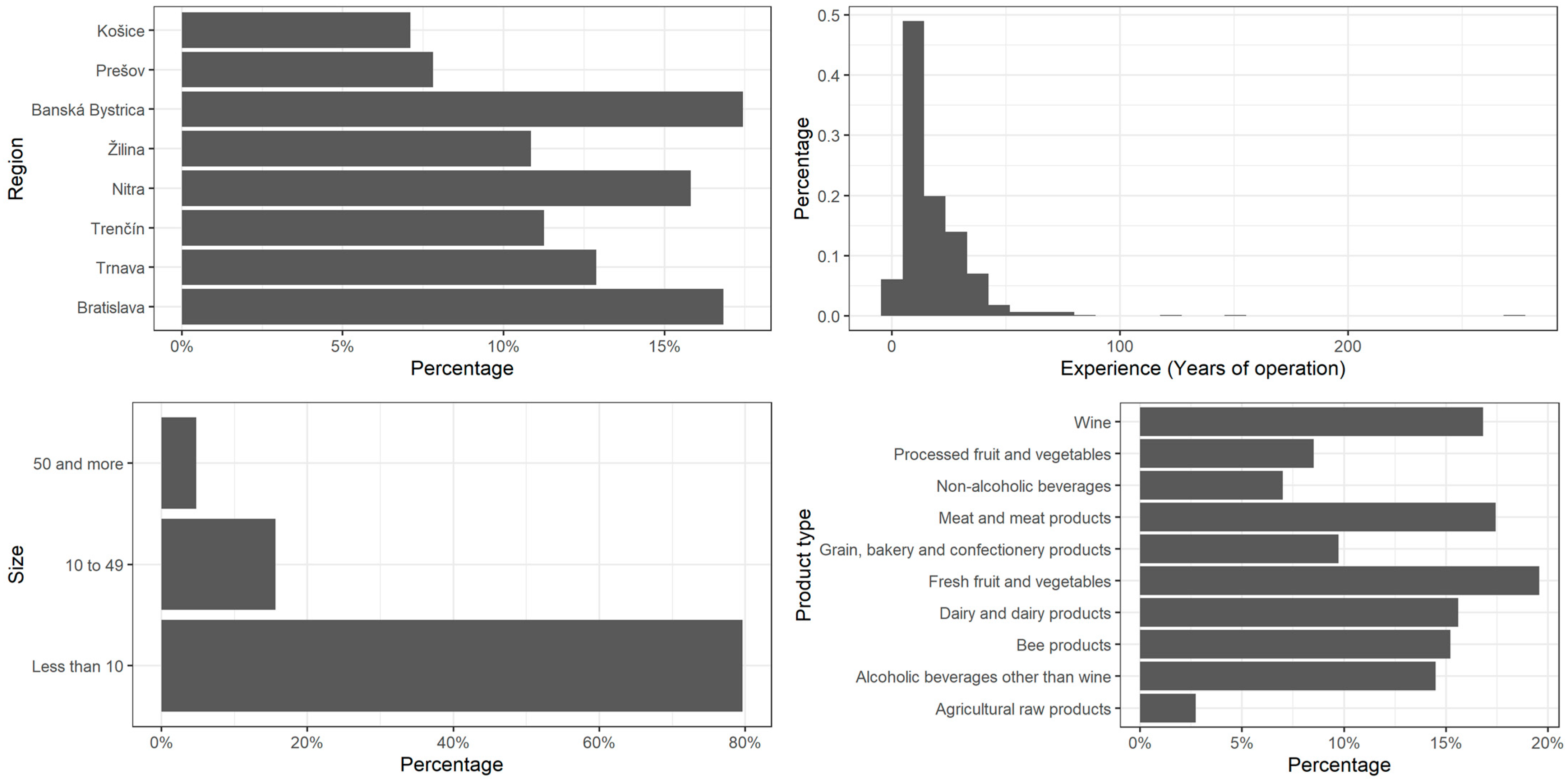
In Slovakia, a comprehensive database of producers involved in SFSCs is not available. For the purpose of assessing the representativeness of the data sample, we therefore used the Register of Institutional Subjects of the Slovak Republic and compared the research sample with the overall shares of entities in the agricultural sector (Table 1). The sample shows notable differences compared to the overall population of agricultural enterprises in Slovakia. Small producers with fewer than 10 employees are slightly underrepresented in the sample, while medium-sized and large enterprises are overrepresented. Regionally, the sample is skewed towards western Slovakia, with eastern regions such as Prešov and Košice being underrepresented. Although the database is rather west-centric, these patterns may partially reflect the actual structural characteristics of SFSCs in Slovakia, with higher participation closer to more urbanized or accessible areas. The platform is open to registration for all producers; therefore, we do not assume a systematic reason for the non-participation of actors from the eastern part of the country.

2.2. Exponential Random Graph Model Utilization

Exponential Random Graph Models (ERGMs) were employed to identify the factors that shape use of specific types of points of sale and, more specifically, to uncover the determinants that allow producers to overcome constraints posed by geographical proximity and limited access to major urban centers, while accounting for the underlying network structure. ERGM represents a class of statistical models designed to analyze the structure of networks [63]. ERGM was chosen as the main analytical tool because the study conceptualizes market access as a relational outcome arising from interdependent producer–point of sale ties. Conventional regression-based approaches treat producer–outlet relationships as independent observations and therefore cannot account for structural dependencies such as highly connected outlets or producer-level clustering. Moreover, the use of conventional logistic regression for relational data is not recommended, as such models fail to account for interdependencies between observations, thereby violating the assumption of independence [64]. In contrast, ERGM explicitly incorporates such dependencies into the estimation process by modeling the global network structure as the outcome of local tie formation processes. This makes ERGM particularly suitable for assessing how organizational characteristics and product differentiation strategies affect channel use while controlling for the fact that some points of sale attract systematically more producers than others. Compared to descriptive network analysis, ERGM provides a statistical framework for identifying mechanisms of market access rather than merely describing observed patterns.
The extent of direct and intermediated SFSC channel utilization and market access was operationalized through network structure as a situation in which a given producer uses a specific point of sale (a presence of a tie in a network). The utilized network approach allowed us to treat each reported producer–point of sale relationship as a separate tie, accounting for variation in the number of connections per producer. The final dataset was analyzed as a network, with producers and points of sale represented as nodes and their tie (a producer using a given place of sale) as edges. Since ties only occur between the two different node types, the network is two-mode with undirected ties. In addition to the comprehensive network, four subnetworks were created for each individual type of point of sale. Network objects were constructed and analyzed in R using the statnet package [65]. To explore the structural properties of the networks, standard network-level indicators were computed, including network density, mean and median degree [66]. The analysis was conducted using R software version 4.5.2. Visualizations were created using QGIS version 3.42.3.
ERGMs allow us to model both the factors associated with tie formation and the broader structural properties of the observed network. They estimate the probability of ties between agri-food producers and points of sale based on their attributes and structural patterns in the network, with the general form shown in Equation (1). At the network level, they explain the overall structure and formation logic of the network, meaning which social, spatial, or economic factors systematically shape which producer connected to which place of sale. Similar to a logistic regression, each coefficient represents the log-odds change in the probability of a tie forming when the corresponding variable increases by one unit, holding all else constant.
P X = x = e x p ( θ 1 g 1 ( x ) + θ 2 g 2 ( x ) + + θ p g p ( x ) ) k ( θ )
In the formula, X is a random variable representing all possible network permutations, x is the observed network (a realization of X), g(x) is a vector of model statistics for the network, θ is the corresponding covariate coefficients, p is the number of terms in the model, and k(θ) is the sum of the numerator over all networks with the same node set as x, serving as a normalizing constant [67].
Table 2 lists the utilized variables, their description and hypothesized expected effects of the variables. Descriptive statistics and sources of the variables are detailed in Appendix A. Because the explanatory variables were operationalized using specific ERGM terms, the corresponding model terms are reported in the table. Table A2 in Appendix A provides a summary of the ERGM term description, providing rationale.
To investigate which factors enable producers to access major urban markets, the final model included second-order interaction terms. Specifically, second-order interactions of the variables representing population density in the POS location and distance from producer to POS with hypothesized producer level covariates were utilized (producer level covariates × distance and producer level covariates × POS population density). A higher likelihood of a tie existing between a producer with the hypothesized characteristic and a distant point of sale, or a point of sale located in an area with high population density, indicates the ability to penetrate markets by supplying products over longer distances and/or by accessing a large consumer base. The models also included a set of control variables, comprising baseline distance between the producer and the point of sale, baseline population density at the POS location, and individual product types produced by the producer (to account for the assumption that processed and specific product types can be transported over longer distances at lower costs). Additional controls included population density at the producer location (to distinguish between rural and urban producers) and average wages at the POS location (to capture purchasing power effects). The subnetwork models also included the total number of POSs used across all POS types as a variable, capturing a general tendency to be active across multiple sales outlets. Although it does not capture all possible distribution channels, it provides a relative indicator of market reach within the observed set of SFSC channels. The comprehensive network models further included POS type as an attribute, thereby controlling for tendencies to use specific types of points of sale.
Given the complex processes driving the tie formation in the producer–POS networks, ERGM allowed us to incorporate different types of covariates: node-level covariates (effects of producer and/or place of sale attributes, e.g., producer firm size, population density of the municipality where the place of sale is located), edge-level covariates (a variable at the level of a producer–POS pair, e.g., distance), and network structural covariates (the propensity for tie formation may vary between network structures where a small number of producers engage with a wide array of POSs and those where producers utilize only a limited number) [63]. As utilizing structural covariates may lead to model degeneracy (producing an empty network or full network), we utilized geometrically weighted variables [67]. Across all networks, a moderate decay parameter value of 0.25 was used.

3. Results

First, we provide a descriptive overview of the producers included in the analysis. The characterization in terms of spatial distribution, firm size, product portfolio, and years of operation is presented in Appendix A (Figure A1). Spatially, the sample covers the entire territory of the country. However, as noted in the Methodology section, producers are concentrated mainly in western and central Slovakia. Lower shares of producers are observed in the eastern regions (Prešov and Košice). The higher representation of producers from western and central Slovakia may be related to the concentration of larger cities, higher purchasing power of the population, and better infrastructure accessibility. In contrast, eastern Slovakia is characterized by a higher proportion of peripheral and sparsely populated areas, which may imply lower demand and make SFSCs less feasible. In terms of size, approximately 79% of all producers employ fewer than 10 workers. Medium-sized producers with 10–49 employees form a much smaller group, while large producers with 50 or more employees are only marginally represented. The distribution of producers by years of operation is highly right-skewed. Most producers have relatively short to medium-duration operational histories, with a median value of 13 years. The relatively short duration of operation of most producers is attributed to the historical context of socialism with its collective forms of farming, followed by a period of institutional uncertainty and unstable market conditions. With respect to product specialization, the most strongly represented categories are fresh fruit and vegetables (19.57%), meat and meat products (17.44%), wine (16.83%), dairy products (15.61%), and bee products (15.21%). Overall, producers display considerable diversity, although products with higher levels of processing and added value prevail.

3.1. Structure of SFSC Networks and Spatial Linkages Between Producers and Points of Sale

The structure of four sub-networks, each containing an individual type of place of sale, is analyzed through a network approach. Direct channels are represented by the “on-site sale” and “own store” networks. Intermediated channels are represented the utilization of “specialized store” and “local retail chain” channels. Subsequently, a comprehensive network is analyzed, including all types of channels. Summary statistics at the network level are presented in Table 3. The summary statistics show that individual sales channels significantly differ in structure and spatial reach. All networks have significantly low density, which is expected in two-mode producer–POS networks containing many potential ties. Each producer naturally uses only a fraction of the existing places of sale. Density also cannot be compared between networks, as each subnetwork contains only the given type of POS. On-site sales represent the most commonly used sales channel, with approximately 74.75% of producers using at least one “on-site” POS based on the isolate rate. This is also indicated by the relatively high producer mean degree (average number of utilized places of sale by a producer) in the case of on-site sales. In contrast, own stores, specialized stores, and especially local retail chains show very high producer isolate rates, indicating that only a small subset of producers engages in these more demanding or intermediated channels, while the majority do not use them at all. Sales through specialized stores were used by only about 6.8% of producers, while in the case of local retail chains, it was only 4.46%.
A skewed structure of the networks points to a very different levels of individual sales channel utilization. The differences between the mean and the median producer degrees and the high standard deviations in specialized stores and local retail chains point to a high centralization, where a limited number of producers are able to use a large number of places of sale, indicating their ability to penetrate markets. Centralization and hub-like structure is evident from the perspective of places of sale, where specific ones are used by many producers. This is naturally pronounced for local retail chains, where the POS mean degree is very high, indicating that individual chain outlets connect to many producers, while most producers do not access these channels.
In the case of the comprehensive network, we observe that producers use on average approximately 3.87 points of sale. However, the lower half of producers relies on only two or fewer channels. Slovak SFSC producers therefore depend on a combination of sales channels, primarily on on-site sales, while a narrow group of the most successful producers is able to utilize multiple intermediated places of sale. These options, however, remain inaccessible to roughly 95% of them, showing differentiated capacities among producers.
Differences are also visible in the case of distances between POSs and the producers who utilize them. While in the case of own stores this type of POS is located approximately 15 min by car from the producer, for specialized stores the distance increases to about 54 min, and for local retail chains to roughly 93 min. The long distances associated with intermediated channels reflect, on the one hand, the limited spatial coverage of such points of sale in Slovakia; that is, if an SFSC producer uses an intermediated channel, it will likely be located in a store about 60 to 90 min driving time away. This also implies substantial spatial barriers when placing products through these channels. According to the values of the comprehensive network, the average distance in Slovak SFSCs between the producer and utilized POS is approximately 40 min, which captures the coexistence of both highly local ties and long-distance ties. Overall, the summary distance statistics show that SFSCs in Slovakia have a primarily local character of utilizing direct channels, and access to more intermediated and larger urban markets is significantly unevenly distributed and concentrated among a very small group of producers capable of operating across longer distances and within more centralized network structures.
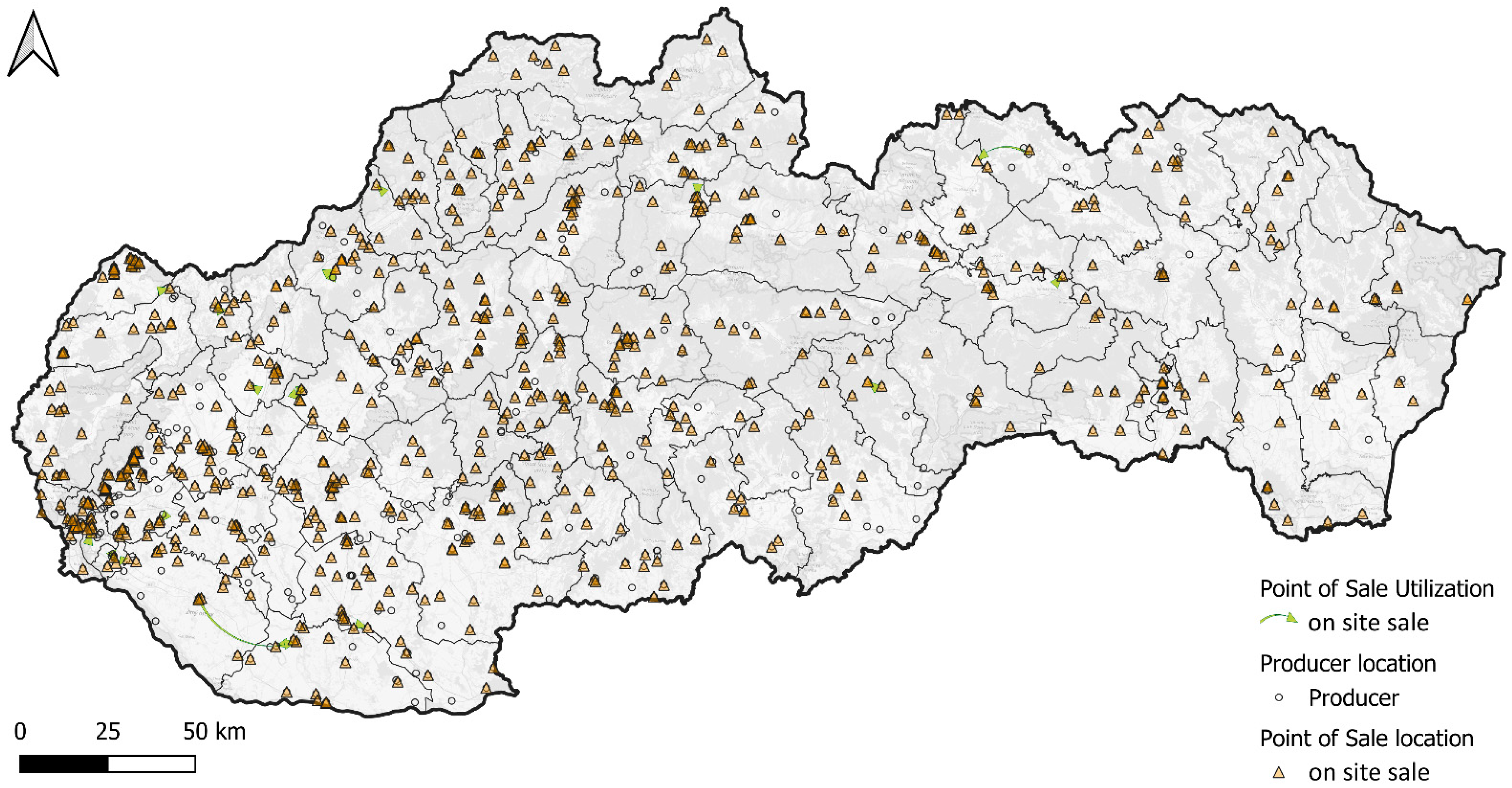
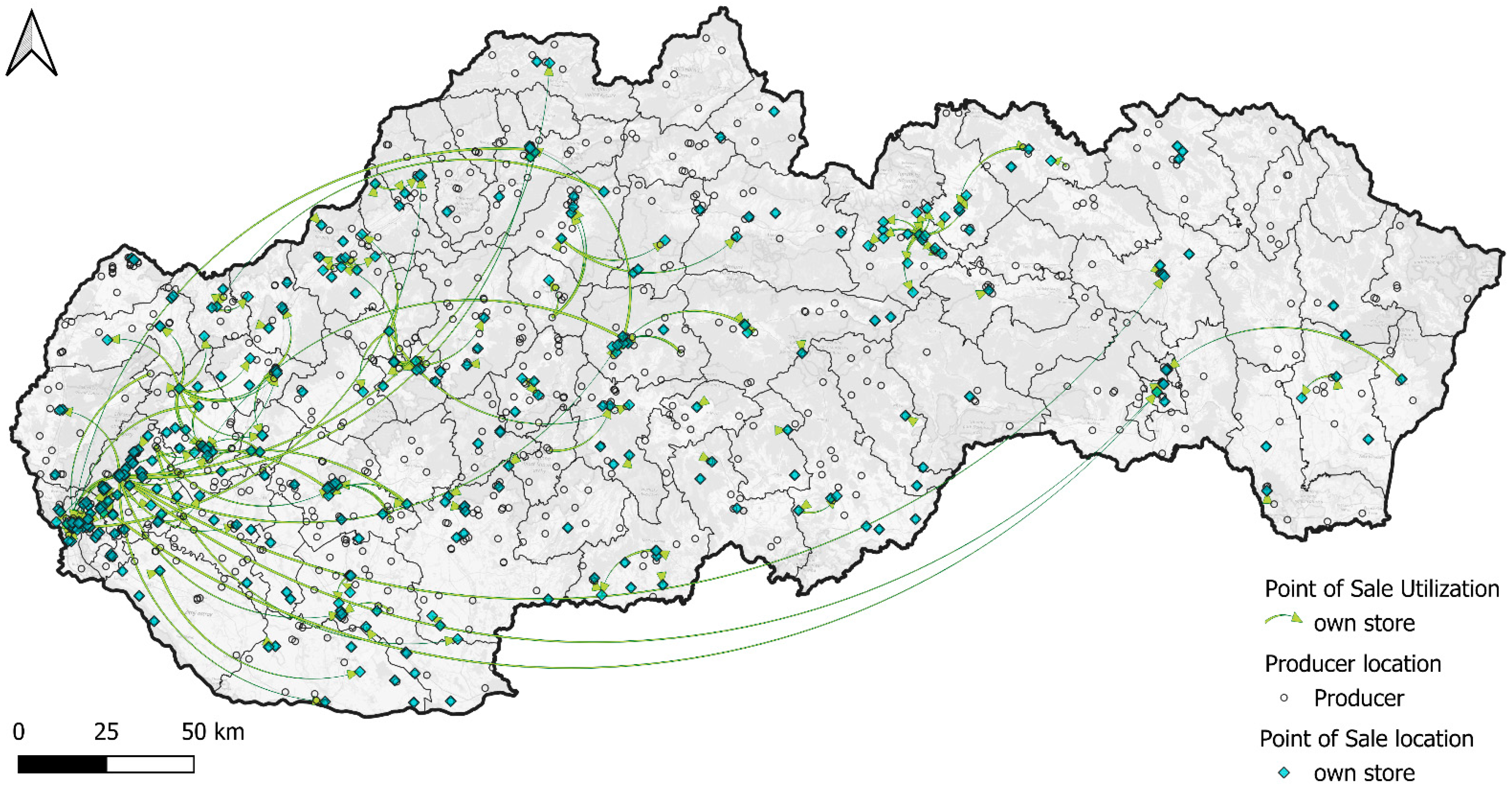
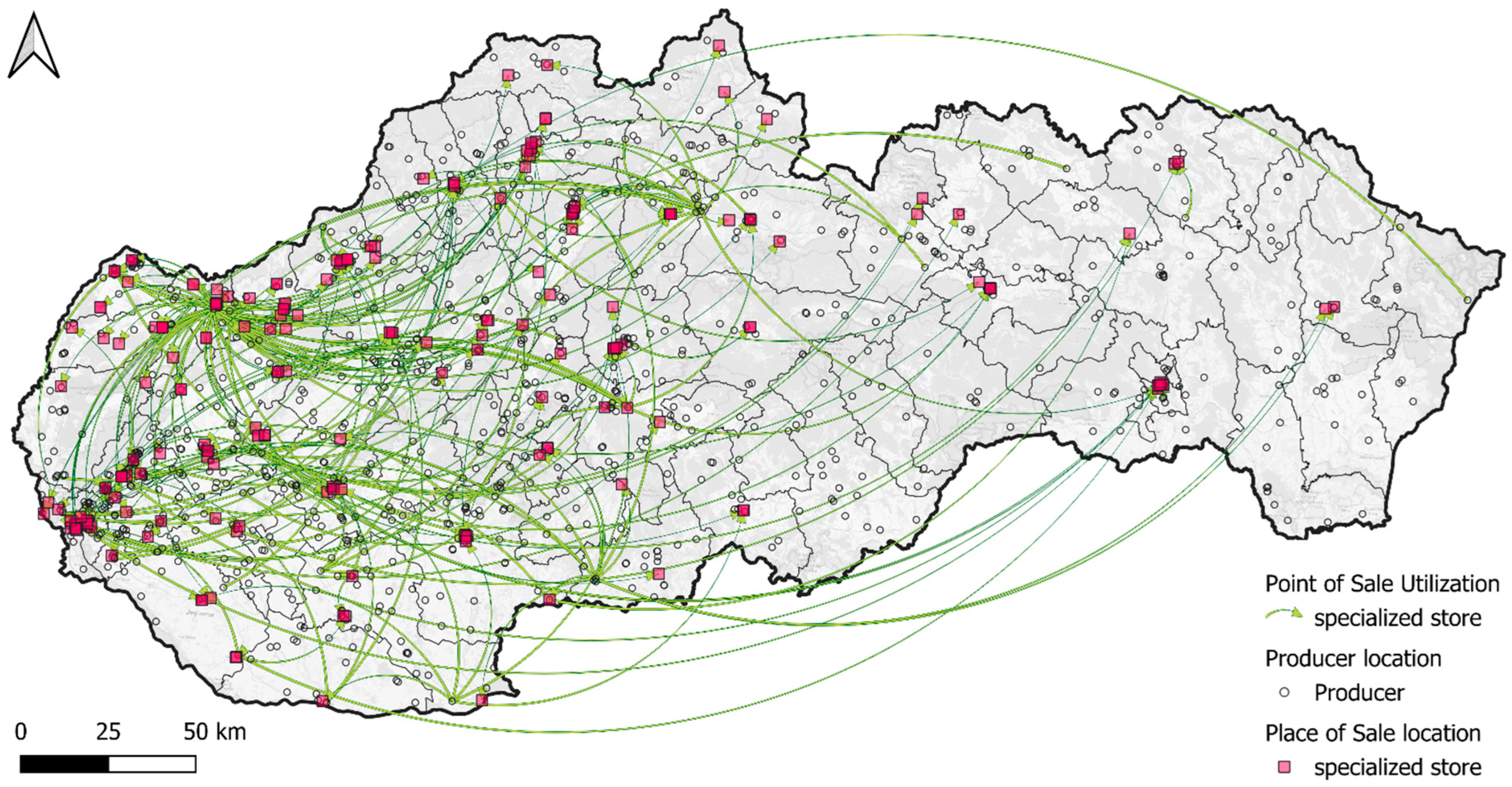
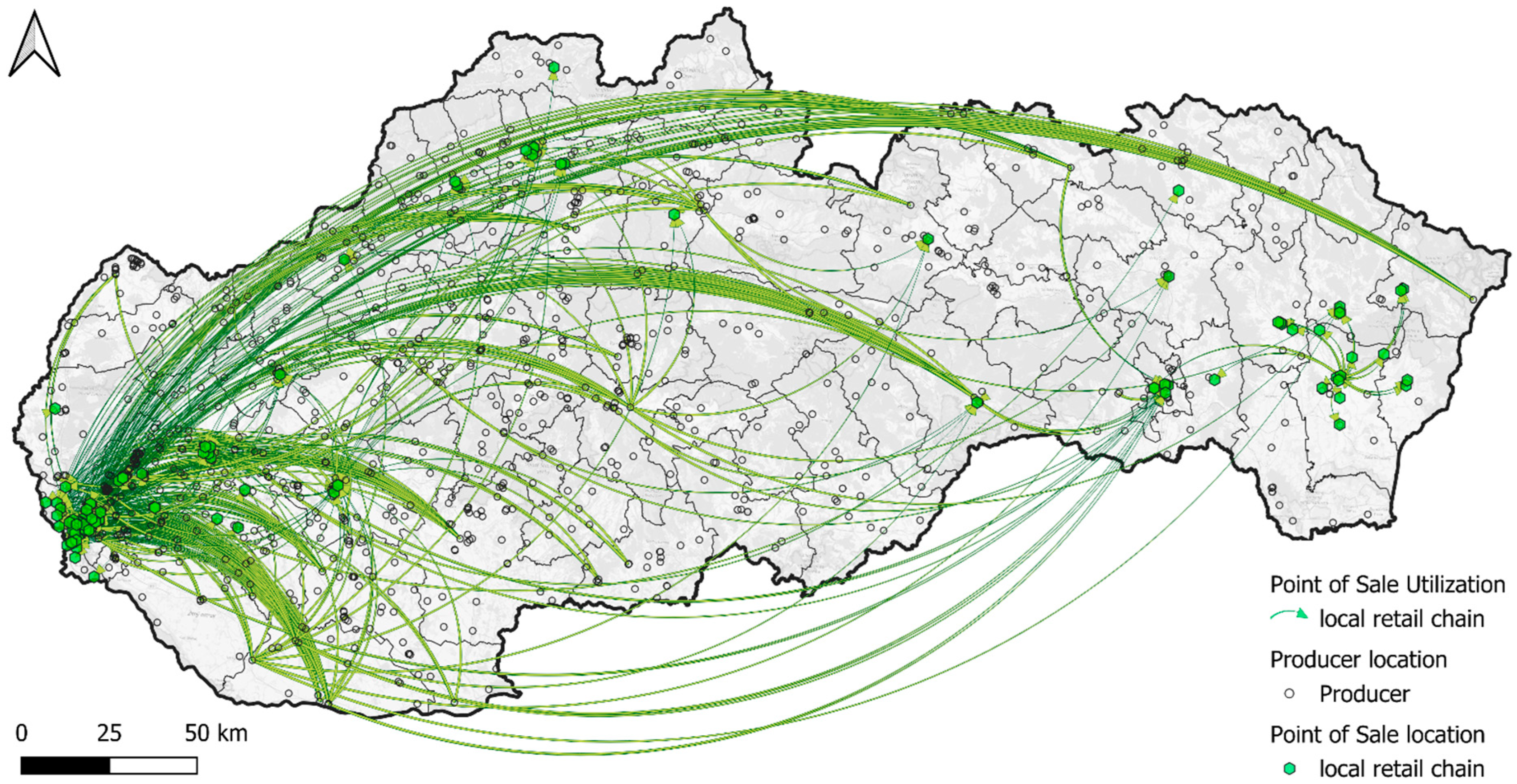
Visualizations in Figure 1, Figure 2, Figure 3 and Figure 4 provide a closer look at the spatial distribution of producers, specific types of POS, and their utilization. Given the west-centric character and the associated lower density of both producers and points of sale in eastern Slovakia, we remain cautious in interpreting the spatial localization of actors and east–west linkages.
Spatially, the on-site sale network (Figure 1) consists of many small, disconnected dyads. Each producer typically maintains one or very few on-site sale ties. Logically, the vast majority of ties connecting producers to on-site sale POSs are co-located or immediately adjacent to their production sites. However, in rare cases, there is a certain distance between the place of sale and the location of the producer. In these cases, the producer has multiple production sites or facilities, or a spatially fragmented place of production. Inspection of these cases indicates that producers utilized multiple distinct production or farm locations as separate on-site sale points, suggesting that their production activities are spatially distributed across more than one site. The distribution of on-site sale POSs broadly follows the settlement structure and agricultural regions. Higher concentrations of producers and on-site sale points appear in western and southern parts of the country and in agriculturally productive areas. Less densely populated areas show fewer nodes. The fragmented nature of on-site sale POSs may affect direct producer–consumer interaction locally; however, in terms of broader market access, this channel does not connect producers to distant consumers or urban markets.
Unlike on-site sale, the own store network shows that in many cases points of sale are spatially decoupled from production locations. In several instances, there are substantial distances between producers and their points of sale. Producers are therefore often able to operate or supply own stores outside their immediate locality, suggesting that they possess the necessary logistical and organizational capacities. Even within this direct channel, an orientation toward urban areas is evident, particularly toward the Bratislava region. Multiple ties terminate there, indicating the localization of stores in more densely populated areas with higher purchasing power. The own store network thus shows that, when using this channel, producers are able to preserve direct producer control over distribution while simultaneously exploiting a more spatially expansive SFSC channel and having access to larger markets.
Moving to intermediate channels, the specialized store network channel (Figure 3), compared to direct channels, shows much more extensive and integrated distribution patterns. Based on the location of specialized stores, we infer that they relatively densely cover the national territory and are used by producers from diverse regions. We observe long-distance ties, with producers in many cases supplying stores outside their home regions. The connections are to a large extent not one-sided and tend to be oriented toward larger and medium-sized cities across the country. These areas host a higher concentration of specialized stores and act as hubs attracting producers from across the country. Compared to own stores, however, this centralization is less producer-driven and more retail-driven. Within this channel, geographic distance therefore appears to be less important than the ability to achieve product differentiation.
Compared to the specialized store network, the local retail chain visualization (Figure 4) shows a higher level of centralization. Points of sale of local retail chains are concentrated primarily in the capital city and other major cities of western Slovakia, and they are connected to producers from across the entire country. In contrast to the specialized store network, this case exhibits a higher concentration of ties converging toward hubs representing core urban markets. This spatial concentration corresponds to the high standard deviation for this type of point of sale and confirms their role as regional distribution gateways to urban markets with high demand. Only a small fraction of producers are involved, but those that are tend to establish multiple long-distance ties. By comparison, the specialized store network is characterized mainly by single or very limited ties. Local retail chains, however, exhibit the highest mean and median distances among all networks, which clearly confirms their capacity to connect producers with the main centers of consumption.
The use of summary statistics of individual networks revealed general tendencies for producers to primarily use direct channels. Networks of intermediated channels are highly skewed, creating centralized structures where a small group of businesses capable of using large numbers of places of sale occupies a central position. By using visualizations, we can observe that in the case of intermediated channels, urban areas, especially the capital city, serve as hub-like structures, with connections spanning large distances across the entire country. Visualizations thus show that in the context of Slovak SFSCs, there are producers who can penetrate core markets and overcome long distances. However, social network analysis using network-level metrics, as well as visualizations of connections, does not allow us to systematically uncover the factors that determine the tendencies and abilities to use a particular type of sales channel and to be able to utilize sales points at great distances and located in core markets. In the next section, we will therefore use ERGM models to confirm or dismiss related research hypotheses.

3.2. Tendencies of Direct and Intermediate Channel Utilization and Market Reach Factors

In the following section, we use ERGM models to uncover the factors that enable producers to utilize direct or intermediated places of sale. Additional models are employed to identify the factors that allow producers to access distant places of sale and places of sale located in areas with high population density. In this way, we identify which producers are able to meet demanding logistical requirements and penetrate major markets. In total, six ERGM models were estimated. The first four models examine tendencies to use places of sale within four individual subnetworks. Model 5 estimates the factors influencing the use of places of sale within the comprehensive network, that is, general tendencies to use places of sale overall. Finally, in Model 6, the factors are enriched with interactions of producer characteristics with distance and population density at the location of the place of sale in order to identify successful producer determinants. The results of the models are presented in Table 4. The interaction terms of Model 6 are reported separately in Table 5.
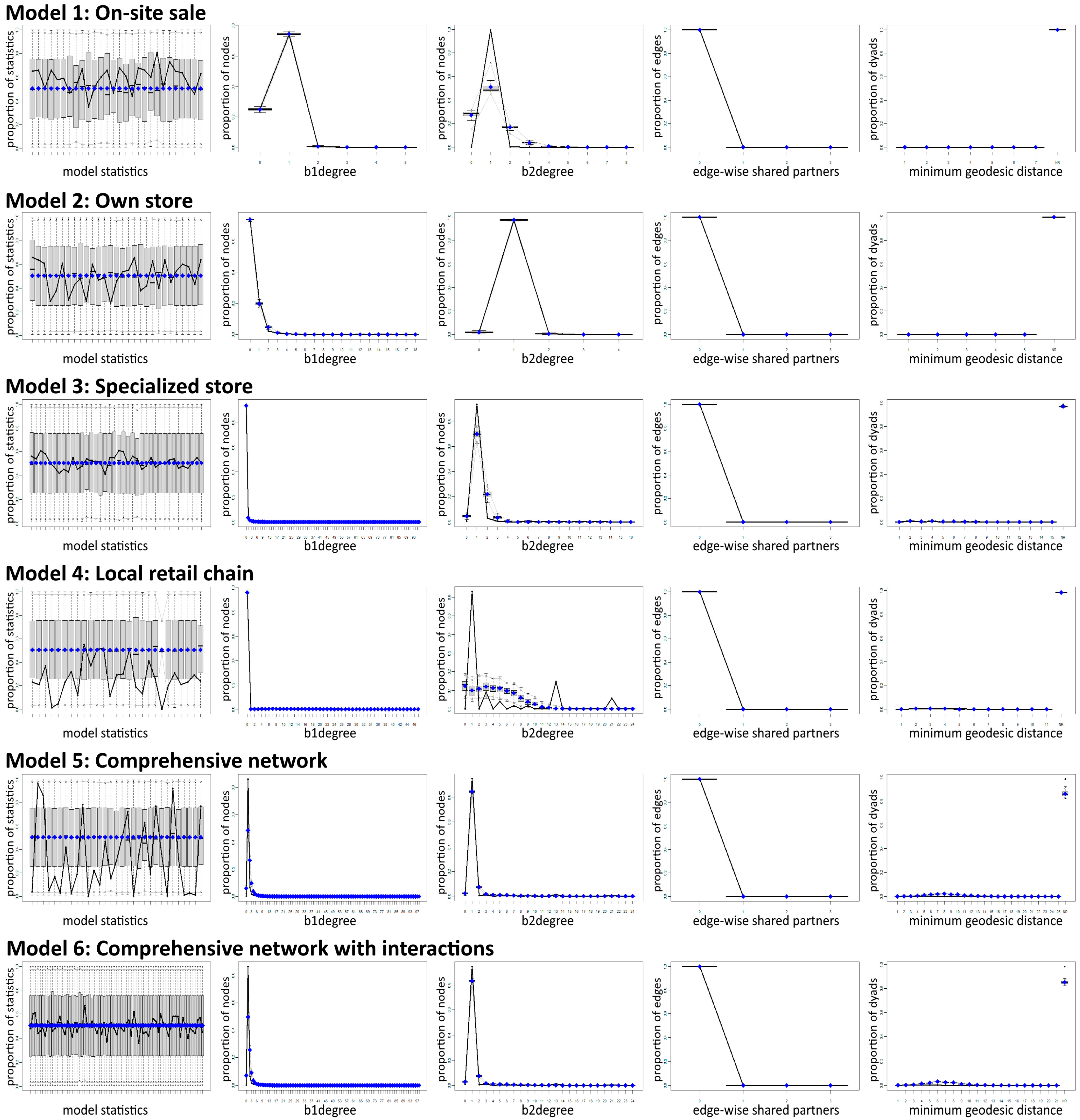
Model diagnostics focused on the MCMC process and on evaluating the goodness of fit of the models. High joint p-values in the MCMC diagnostics indicate stable MCMC chains and show no signs of convergence problems. Individual p-values are in most cases likewise high, which should not indicate a problem with the models (Appendix A). In the goodness-of-fit assessment, the statistics of the observed networks were compared with 1000 simulations based on the estimated parameters. Overall, the values of the observed networks fall within the distributions generated by the simulated networks. However, for some models, replicating the structure of certain statistics proved challenging. This is particularly evident in the b2degree distribution (the distribution of the number of ties of points of sale) in Models 1 and 4, given the highly specific tie structures of these networks. This is partly attributable to the decision to estimate all channel-specific models using an identical model specification in order to preserve cross-channel comparability. In this case GOF plots show that the ability of the models to reproduce the extreme ends of the POS degree distribution is limited, particularly in the case of Model 4’s upper tail. However, this deviation is localized to the b2degree statistic and does not affect the reproduction of producer degree distributions or the main covariate effects. Therefore, the models are still valid, as they are primarily interpreted as models of producer-side channel utilization. Because in some subnetworks no observations existed for certain characteristics associated with tie formation (for example, no producers offering raw agricultural products and using specialized store points of sale), these variables, as well as variables causing convergence problems, were excluded from the models. This reflects strong negative associations, indicating that specific producer or product categories are systematically absent from particular distribution channels.
First, we focus on the direct channel subnetworks, represented by Models 1 and 2. For several variables, we can observe differences in the signs of the estimated coefficients of statistically significant variables between the on-site sale and own-store models. This points to the distinct roles of these two sales channels from the perspective of the producer. Results from the on-site sale network (Model 1) show a negative impact of product diversity and the size of the business (categories with 10–49 employees) on the utilization of this sales channel. It appears that on-site sales are more typical for smaller producers operating with a narrower product range. Thus, this channel is primarily used by small producers who offer a limited variety of products. Additionally, producers using this sales channel are located in sparsely populated areas. Producers identified as “family farms” use this type of sales channel to a significantly lesser extent. This form of value-oriented marketing likely requires effort in brand building, suggesting that sellers in this regard do not solely rely on their production location, but also strive to leverage the established brand more effectively by targeting a broader range of value-oriented customers in specialized markets. The use of this channel for selling certain product categories points to varying distribution capacities and needs across different types of producers. The negative coefficient for total producer degree indicates that producers who make more intensive use of other sales channels are less likely to establish a tie in this network. This supports the position of on-site sales as the primary, often sole, sales channel for less developed producers. In terms of structural variables, there is a significantly positive effect of the geometrically weighted producer degree (gw1degree), meaning the network is characterized by an even distribution of producers in terms of the number of places of sale they utilize. The effect of increasing distance is, as expected, strongly negative, and similarly, there is a positive effect from matching the producer’s location with that of the point of sale in the same district (district). These effects can be observed across all of the analyzed networks.
In the own store network (Model 2), the effects are in several cases opposite compared to the previous network. The positive effect of product diversity and firm size (especially large producers) indicates that this type of POS can be used primarily by more established producers with higher organizational and logistical capacities. However, the tendency to use this type of channel decreases with years of operation, suggesting that more experienced producers tend to rely on other types of channels. Producers declaring organic production use this type of POS to a significantly lesser extent. This type of actor bears high costs associated with compliance with production standards, which likely means that they lack the capacity and skills to further diversify their activities into retail operations. The own store channel is therefore selective and not accessible to all types of producers. In contrast, family farms use own store places of sale to a significantly greater extent. Own stores thus represent a key outlet where these actors concentrate their sales efforts and value-oriented marketing activities. Structural terms in this network indicate that, from the perspective of the producers, strong centralization structures are not present, as the term is not significant. The POS degree distribution is very decentralized, as this type of POS is used by multiple producers only in rare and specific cases (such as two enterprises with the same owner, and similar situations).
Models 3 and 4 represent intermediated channel networks. Tie formation in the case of specialized stores is affected by only a limited number of producer characteristics. The use of this type of POS is not significantly affected by the length of firm operation, product diversity, or firm size. This points to specific market conditions in which neither scale of production nor producer experience plays a decisive role. From the perspective of value-based product differentiation, it is somewhat surprising that producers engaged in organic production do not use this type of POS more intensively. In the Slovak context, specialized stores are not exclusively oriented toward certified organic products but rather toward quality products in general, which may weaken the importance of organic certification. Organic producers may therefore primarily orient themselves toward other channels where such certification is better valorized. Value-based differentiation in the form of family farm labeling, however, is associated with a higher likelihood of tie formation in this network. An emphasis on authenticity, local embeddedness, and trust thus appears to be more closely aligned with the philosophy of Slovak specialized stores. The significant coefficient of population density at the POS location indicates a clear orientation toward urban markets. The structure of this network suggests that a subset of producers acts as hubs by using multiple specialized stores. In contrast, the POS side exhibits a fragmented structure, meaning that specialized stores serving as buyers for large groups of producers are not typical. This may indicate that specialized stores are not primarily focused on Slovak SFSC products but also sell quality products from conventional producers or foreign suppliers, which represents an additional challenge for SFSC producers.
The results of Model 4 confirm the high level of centralization observed in the network visualization, from the perspective of producers and points of sale. The use of this channel is therefore highly selective. Within this channel, the organizational form of the producer plays an important role, as cooperatives have a significantly higher likelihood of supplying local retail chains. They are thus able to meet requirements related to volume, continuity, and coordination. Processors also show a higher likelihood of participation, reflecting the orientation of these sales channels toward processed products with higher added value. In this network, firm size and length of operation are not statistically significant, suggesting that organizational capacities are the key factor. Average wages at the POS location have a strong positive effect, while population density at the POS location is not statistically significant. In this case, after controlling for purchasing power, it becomes evident that the economic attractiveness of the market is more important than its purely demographic characteristics.
Models 5 and 6 identify the factors shaping the use of places of sale across different types of distribution channels and thus reveal general tendencies of tie formation within the analyzed SFSC networks. In the case of Model 5, many factors are statistically significant. As the number of years a producer has been operating increases, the chance of using places of sale also rises. More experienced producers are therefore able to use a larger number of POSs. Long-term market presence likely provides advantages in the form of stable business relationships, reputation, and better knowledge of the operating environment. Larger firm size leads to a greater ability to use and supply places of sale in general. Higher production capacity and lower unit transaction costs thus determine success even within SFSCs. Producers with organic certification have, on average, a substantially higher chance of using and supplying POSs than conventional producers. Organic production therefore represents an effective product differentiation strategy even in a country where consumers are price-sensitive, increasing the attractiveness of producers for various types of POSs. Actors engaged in processing and capable of supplying products with higher added value show a higher propensity to successfully use and supply POSs. Vertical integration thus represents an important competitive advantage within SFSCs as well. Actors declaring themselves family farms exhibit a lower overall tendency to form ties compared to others. Even though this contrasts with the positive effects observed in Models 2 (own store) and 3 (specialized store), these results are not contradictory, as the subnetwork models capture participation in particular high-value channels that constitute only a subset of the overall network. Although family farms represent a form of value-based differentiation, these actors are apparently less able to expand extensively, which may also point to barriers in the Slovak business environment. Instead, they are selective and focus on a narrow set of channels where they can best valorize the added value of their production. Although they supply fewer points of sale overall, their selective concentration allows them to use their limited capacities more efficiently, reduce transaction and coordination costs, and supply through high-value channels.
Cooperatives, which in the context of conventional markets, are typically associated with low-value-added production and display a high capacity to use multiple places of sale within SFSCs. This points to their adaptive capacity, drawing both on long-established relationships with distributors and on stronger bargaining power.
In Model 6, the main effects cannot be interpreted in isolation, as interactions with spatial variables (distance and population density at the POS location) (Table 5) alter the meaning of individual producer characteristics. After introducing the interaction terms, the coefficient for experience becomes statistically insignificant, and the interactions themselves are also insignificant. Producer experience therefore does not affect the ability to access more distant or denser markets. The length of the operation alone does not increase spatial reach or improve its linkage to urban POSs. With respect to firm size, the main terms remain significant. For small and medium-sized enterprises, there is no evidence of a more intensive use of POSs at greater distances or in denser locations. Larger firms, however, show a substantially higher ability to overcome longer distances and thus likely draw on their logistical, organizational, and volume capacities. At the same time, they are not primarily oriented toward the densest urban markets, but rather toward efficient distribution channels regardless of the demographic size of the market. In the case of organic production, the main term is not significant, indicating that organic production does not confer advantages across all channels. However, organic producers exhibit a higher ability to supply both distant POSs and POSs located in densely populated urban areas. Organic certification thus yields benefits mainly in distant and urban markets, where demand is sufficiently large and willingness to pay is higher. Clear differences can be observed between primary producers and producers in the role of processors. Primary producers are strongly tied to short distances and less urbanized markets; their ability to use POSs declines sharply with increasing distance, indicating high sensitivity to logistical capacities. Processors capable of delivering higher-value-added products, by contrast, are able to supply more distant and more urbanized markets. The positions of family farms and cooperatives are also specific. Family farms supply fewer POSs on average, yet they are able to supply POSs over long distances. Thus, while family farms are less engaged overall, those that do enter the network are capable of overcoming larger distances. This may reflect a selective group of family farms with a strong focus on quality and reputation and with established buyer relationships. Similarly, cooperatives do not hold a dominant position in overall POS utilization, but they are capable of serving distant POSs as well as POSs located in core urban markets. Regarding structural variables, after controlling for other factors, the positive coefficients indicate a decentralized network structure. Overall, the structure of these SFSC networks is fragmented, such that neither individual actors nor POSs can be considered universal central hubs.

4. Discussion

This study confirmed several hypotheses related to the functioning of short food supply chains (SFSCs) in post-socialist countries as well as in a broader context. At the same time, it highlights the specific position of organic producers, family farms, and agricultural cooperatives within Slovak SFSC channels. The study provides a comprehensive analysis of SFSC channels reflecting the specific conditions of a post-socialist country.
First, we focus on producer capacity. Hypothesis H1a, associated with the more intensive use of intermediated channels by larger firms, was not formally confirmed; however, Model 5 shows that larger enterprises exhibit a significantly higher tendency to use points of sale within SFSC networks in general. This finding corresponds with existing literature indicating that greater production capacity, lower unit transaction costs, and stronger organizational capacity increase ability to engage in multiple distribution channels [2,3,27]. Large enterprises are able to overcome longer distances, suggesting a higher capacity to supply distant markets. At the same time, however, they are significantly less capable of supplying points of sale in densely populated locations. Hypothesis H1b therefore cannot be confirmed. We assume that although larger firms are connected to more points of sale, they face increasing competition in highly urbanized areas from smaller producers offering highly differentiated niche products (based on authenticity claims or alternative quality labels not captured by the model). This highlights the importance of city-adjustment strategies for market penetration in large urban areas [6,32]. As a result, the largest urban markets may exhibit partial saturation, as suggested by the concentration of both demand and supply flows in Bratislava. Larger firms may thus reorient toward medium-sized towns, where competitive pressure is lower and scale-based advantages remain effective. Consequently, the relative advantage of larger firms within SFSCs diminishes with increasing market density. This result extends existing knowledge by showing that while firm size increases spatial reach, urban markets are not the sole target of expansion [5,6,32].
Model 5 confirms hypothesis H2a, as the length of time a producer has been operating has a positive effect on the ability to use points of sale. More experienced producers are thus able to utilize a greater number of POSs, which can be interpreted as the result of long-term business relationships, reputation, and better market knowledge. This finding supports previous research emphasizing the importance of social capital and experience in participation in SFSCs [31,39,42,47]. Hypothesis H2b was not confirmed. Experience alone therefore does not increase the ability to penetrate more distant or larger markets. This suggests that while experience is important for successful engagement in SFSCs, it is insufficient to overcome the logistical and organizational barriers that are critical for supplying core markets [8,10,11]. In the post-socialist context, this finding points to structural conditions frequently emphasized in the literature [11,14,16,46], which argue that small producers remain constrained by a long-term limited access to capital, low production capacity, and weak growth opportunities.
The results underscore the importance of value-based and product-related strategies and in many cases can be generalized beyond the post-socialist context. First, neither hypothesis H3a nor hypothesis H3b was confirmed. This result contrasts with literature that presents diversification as a strategy for risk reduction and expansion of distribution opportunities [1,35,44]. Diversification may instead increase logistical complexity and limit producers’ spatial reach, which is consistent with arguments about the constrained capacities of small and medium-sized producers in SFSCs [5,11,36,44]. This finding may reflect another layer of structural constraints commonly identified in post-socialist contexts [17,18,19,44,47], stemming from the exhaustion of logistical and managerial capacities, additional handling and storage costs, and the dispersion of limited resources across multiple production and marketing activities [11].
Hypotheses H4a and H4b are confirmed, as organic producers are generally able to use and supply SFSC points of sale more intensively and are also capable of supplying major markets. Organic production appears to be particularly valorized in distant and urban markets, where demand is concentrated and willingness to pay for value-oriented products is higher [5,40]. Even in a post-socialist context, organic production can function as an effective product differentiation strategy that increases producer attractiveness across different types of POSs, in line with literature emphasizing higher consumer trust and willingness to pay [23,51,52]. The result may indicate changes in previously price-sensitive purchasing behavior in post-socialist societies [12,13]. However, the success of these producers may also be supported by higher per-hectare payments and specific support for conversion to and maintenance of organic production under the EU Common Agricultural Policy. Additionally, organic producers in Slovakia constitute a relatively well-organized group of actors linked through a national association that actively facilitates knowledge exchange, networking, and political representation, thereby reducing barriers to entry into distant and urban markets. This suggests that their success may be driven by cooperative and coordinative mechanisms [2,27,46] that remain underdeveloped in Slovakia.
Hypotheses H5a and H5b were also confirmed. Producers engaged in processing show a higher ability to use points of sale, reflecting their orientation toward products with higher added value and better compatibility with intermediated channels [18,27,57]. Their ability to supply more distant and larger markets indicates a capacity to meet the requirements of large buyers [8,9,10,11,25].
In the context of hypothesis H6a, reference is made to the results of Model 2 as, while on-site sales are essentially accessible to all producers and can be relied upon as a “default” channel, operating an own store places higher demands on the producer. Both this hypothesis and hypothesis H6b were confirmed. Enterprises identified as family farms are able to supply distant markets. The ability of family farms to reach distant markets despite their generally lower number of ties suggests that narrative may substitute for scale. An emphasis on tradition, locality, and “home-style” production enables these producers to build trust-based relationships that compensate for limited production volumes. This likely reflects a selective group of family farms emphasizing quality, reputation, and stable buyer relationships, which corresponds with the literature on value-based marketing [3,23,26,56]. Rather than expanding extensively across multiple outlets, family farms appear to follow a selective strategy focused on high-value niches where personal reputation and product narrative can be effectively valorized. This pattern is consistent with theories of food resocialization [3,55,56], in which producer identity and perceived authenticity become market assets that facilitate access to premium and geographically distant consumers.
Finally, hypotheses H7a and H7b were also confirmed. It appears that agricultural cooperatives have been able to adapt to SFSCs and their capacity to leverage existing organizational and coordination structures. They are able to supply both distant and urbanized markets, pointing to their potential to overcome capacity constraints through coordination, resource sharing, and bargaining power. While often associated with commodity production and scale-oriented strategies [14,15,45], the findings show that cooperatives engaged in SFSCs may function as effective coordination mechanisms. The results likely reflect a selective subgroup of cooperatives that successfully adapted to post-socialist market conditions by specializing in higher-value-added and processed goods compatible with SFSC channels, particularly in the livestock and dairy sectors. They often retain production infrastructure, storage facilities, and established commercial contacts originating from the pre-transition period. However, the results do not capture cooperatives that are not engaged in SFSC channels, many of which have failed to establish viable market positions due to low trust, weak managerial capacities, and unfavorable institutional and market conditions, as documented in the literature [15,45,46]. Although this cannot be empirically confirmed with the available data, the observed success of this category may be attributable to recently formed organizations based on inter-member coordination and capacity sharing, independent of post-socialist legacy structures. Such entities may constitute early forms of more complex arrangements that enable resource pooling and the emergence of new business models [2,27,46]. Post-socialist SFSCs are often characterized by limited cooperative structures and institutional support [11]; however, collaborative arrangements have significant potential to help producers overcome barriers [2,27].

5. Conclusions

The aim of this article was to identify the factors that shape the ability of producers in short food supply chains in Slovakia to utilize different types of distribution channels and to penetrate higher-demand markets, particularly urbanized areas. The results show that most producers remain tied to local direct sales, while access to more demanding channels and distant markets is concentrated among a small group of actors. Organic certification emerges as a key tool of product differentiation that enhances ability to access distant and urban markets, although its importance in a post-socialist context is highly dependent on market characteristics. Family farms and cooperatives represent specific actors within SFSCs: family farms are selectively able to supply distant markets, while cooperatives, despite their expected association with commodity-oriented production, are able to overcome capacity and logistical barriers within SFSCs.
This research contributes to the understanding of why SFSCs in post-socialist countries remain dominated by direct sales despite growing urban demand. The findings indicate that limited access to intermediated channels reflects deficiencies in coordination structures and supportive institutional environments rather than purely producer-level constraints. At the same time, the results highlight the role of value-based strategies as a pathway for overcoming these barriers, pointing both to evolving consumer behavior and to the importance of cooperative and institutional arrangements that remain unevenly developed in post-socialist contexts. The study further shows that adaptive organizational strategies enable small producers to overcome disadvantages related to scale, suggesting that market access is not determined solely by size but also by strategic positioning. The use of network-level analysis represents a key methodological contribution by uncovering the interplay between producer characteristics and specific types of points of sale within SFSC structures.
Public support for SFSCs should prioritize the creation of collective infrastructures for aggregation, storage, and distribution. Measures fostering cooperative marketing arrangements and food hubs could help small producers overcome scale and distance barriers. In the Slovak context, easing rigid regulatory requirements may help shift informal producers into formal market channels and create conditions for their sustainable growth. Policy support should also promote value-added processing and organic certification as pathways to urban markets. Such interventions would address both structural constraints and adaptive strategies identified in the analysis. However, these measures should be embedded in broader rural development strategies aimed at improving organizational capacity and cooperation, as SFSC ecosystems involve not only producers but also consumers, the public sector, and businesses beyond the agri-food sector.
This study has several limitations. A primary limitation of the research concerns the data source. The dataset contained only selected types of physical direct and intermediated channels, while other channels, such as farmers’ markets, online sales, HoReCa, and other institutional channels, were not covered. If these channels were included, the factors determining success in accessing major markets might differ. This is also reflected in the control variables, as they cannot fully capture the effects of involvement in other, unobserved channels on market access. The dataset provided only a “snapshot” of producer–point-of-sale relationships accumulated over multiple years and provided only a sample of producers, as businesses under 10 employees and producers from the eastern part of the country are underrepresented. Micro-producers are likely underrepresented because their sales are legally restricted (e.g., farm-gate regimes) and due to limited visibility tied to the prevalence of informal or semi-formal market participation. Lower digital skills among older farmers may further contribute to their limited presence in the dataset. Finally, in some cases, the available data did not allow for a more qualitative assessment of internal governance and operational processes of the producers, mainly within family farms and cooperatives, which limits the interpretation of the observed effects.
Future research should extend this analysis in several directions. Quantitate network analysis should be extended to incorporate additional channels, such as farmers’ markets, digital platforms, HoReCa, and public procurement systems. Networks encompassing the wider SFSC ecosystem also need to be explored. One possible direction is to focus on the legislative framework governing public procurement in the context of supporting short food supply chains. Further research should therefore focus primarily on a deeper examination of new governance mechanisms and business models in short food supply chains, particularly in the context of post-socialist countries.

Author Contributions

Conceptualization, L.V. and J.J.; methodology, L.V.; software, L.V.; validation, L.V., J.J. and M.H.; formal analysis, L.V.; investigation, L.V.; resources, L.V. and J.J.; data curation, L.V.; writing—original draft preparation, L.V., J.J. and M.H.; writing—review and editing, J.J. and M.H.; visualization, L.V.; supervision, J.J.; project administration, L.V. and J.J.; funding acquisition, L.V. All authors have read and agreed to the published version of the manuscript.

Funding

This research was funded by the Grant Agency of the Slovak University of Agriculture (GA SPU), project No. 21-GA-SPU-2024, and by Slovakia’s recovery and resilience plan, project No. 09I03-03-V05-00018—Early Stage Grants at SUA in Nitra.

Institutional Review Board Statement

Not applicable.

Informed Consent Statement

Not applicable.

Data Availability Statement

The original data presented in this study are openly available at https://www.lokalnytrh.sk (accessed on 2 March 2025).

Conflicts of Interest

The authors declare no conflicts of interest. The funders had no role in the design of the study; in the collection, analyses, or interpretation of data; in the writing of the manuscript; or in the decision to publish the results.

Abbreviations

The following abbreviations are used in this manuscript:
SFSCShort food supply chain
ERGMExponential random graph model
POSPoint of sale
MCMC MLEMarkov Chain Monte Carlo Maximum Likelihood Estimation

Appendix A

Table A1. Descriptive statistics of the variables.
Numeric and Binary Variables
NameMeanStd devMinMaxSource
experience17.59115.7900273Lokalnytrh database
product_divers1.6881.158111Lokalnytrh database
organic0.1680.37401Lokalnytrh database
family0.2820.45001Lokalnytrh database
coop0.0620.24101Lokalnytrh database
fresh_fruit_vege0.1960.39701Lokalnytrh database
coffee_tea0.0830.27601Lokalnytrh database
meat_products0.1740.38001Lokalnytrh database
dairy_products0.1560.36301Lokalnytrh database
grain_bakery0.0970.29701Lokalnytrh database
nonalc_bev0.0700.25501Lokalnytrh database
raw_agri_products0.0270.16301Lokalnytrh database
proc_fruit_vege0.0850.27901Lokalnytrh database
bee_products0.1520.35901Lokalnytrh database
wine0.1680.37401Lokalnytrh database
alcohol_other0.1450.35201Lokalnytrh database
pop_density: producer364.527751.2594.9804916.720Statistical Office of the Slovak Republic [68]
pop_density: POS597.6581096.5904.9806643.830Statistical Office of the Slovak Republic [68]
wage (POS)1255.439197.74998951797Statistical Office of the Slovak Republic [68]
distance (comprehensive network)112.55567.7800358.200Travel Time Matrix between municipalities of the Slovak Republic [69]
total_degree1.9394.973095Lokalnytrh database
Categorical variables
NameCategoryPercentageSource
sizeFewer than 1079.61%Lokalnytrh database
10 to 4915.62%
50 or more4.77%
producer_typeBoth64.50%Lokalnytrh database
Primary8.82%
Processor26.67%
pos_typeOwn store24.90%Lokalnytrh database
On-site sale51.81%
Specialized14.78%
Local retail8.51%
District (producer) *Pezinok7.30%Lokalnytrh database
Nitra4.16%
Levice3.96%
Sobrance0.30%
Svidník0.20%
Košice III0.10%
District (POS) *Pezinok6.07%Lokalnytrh database
Trnava4.11%
Nitra3.56%
Kysucké Nové Mesto0.14%
Svidník0.14%
Košice III0.07%
* Note: Due to the large number of districts, only the three districts with the highest share and the three districts with the lowest share of producers are shown.
Table A2. Utilized ERGM terms and their rationale.
ERGM TermDescriptionIllustration
edgesBaseline propensity to tie formation, controlling network density.Agriculture 16 00649 i001
gw1degreeGeometrically weighted degree distribution. Utilized to control for star-like configurations, where a producer utilizes multiple places of sale. Agriculture 16 00649 i002
gw2degreeGeometrically weighted degree distribution. Utilized to control for star-like configurations, where a place of sale is utilized by multiple producers.Agriculture 16 00649 i003
b1covThe effect of a producer node-level continuous attribute.Agriculture 16 00649 i004
b2covThe effect of a place-of-sale node-level continuous attribute.Agriculture 16 00649 i005
b1factorThe effect of a producer node-level categorical attribute.Agriculture 16 00649 i006
b2factorThe effect of a place of sale node-level categorical attribute.Agriculture 16 00649 i007
edgecovThe effect of an edge-level attribute (a covariate at the producer–place-of-sale pair level)Agriculture 16 00649 i008
nodematchThe tendency for tie formation between producers and places of sale with the same categorical attribute.Agriculture 16 00649 i009
Note: Illustration shows modelled tie formation pattern. Circles represent producers and squares represent places of sale.
Figure A1. Producer characteristics.
Agriculture 16 00649 g0a1
Table A3. ERGM model MCMC diagnostics p-values (last round of simulation).
VariableModel 1Model 2Model 3Model 4Model 5Model 6
edges0.2050.6140.1430.9430.9610.792
gw1degree0.1970.3570.3740.7880.0450.009
gw2degree -0.6620.6860.8430.0970.128
experience0.4580.8660.4690.5980.4860.252
product_divers0.7250.6540.4680.8950.0390.776
pop_density: producer0.2510.5500.0130.6520.8380.964
total_degree0.1140.4990.6540.406--
size: 10 to 490.3390.9550.3510.7380.9330.014
size: 50 or more0.3640.5170.8610.5380.5050.489
organic0.3150.4990.5960.2850.0920.767
producer_type: primary0.3820.849--0.0740.136
producer_type: processor0.8710.7510.7990.3230.9800.414
family0.9790.1850.6440.3880.7560.739
coop0.3520.7040.7470.5590.8440.654
fresh_fruit_vege0.6890.9980.5590.4020.9150.878
alcohol_other0.6100.1840.3720.8350.0060.422
coffee_tea0.8680.7880.0090.2240.2090.417
meat_products0.2430.0340.3650.2000.9690.749
dairy_products0.2970.8830.0990.5040.9550.889
grain_bakery0.3330.4030.4530.7730.0570.500
nonalc_bev0.6690.1320.6300.7400.9450.642
raw_agri_products0.5120.157-0.5960.4470.746
proc_fruit_vege0.5180.3910.7710.8950.2320.260
bee_products0.5220.9570.838-0.5110.003
wine0.0640.2610.9070.6740.9240.458
wage0.3560.5840.1550.9250.9980.979
pop_density: POS0.1560.5720.6120.7680.9000.385
distance0.5170.8620.4100.7480.0970.105
district (nodematch)0.2020.4470.0370.7020.1990.072
pos_type: on-site sale----0.0280.083
pos_type: specialized----0.1910.853
pos_type: local retail----1.0000.809
experience × distance-----0.027
product_divers × distance-----0.245
size 10 to 49 × distance-----0.082
size: 50 and more × distance-----0.171
organic × distance-----0.558
producer_type: primary × distance-----0.767
producer_type: processor × distance-----0.029
family × distance-----0.550
coop × distance-----0.236
fresh_fruit_vege × distance-----0.446
alcohol_other × distance-----0.051
coffee_tea × distance-----0.372
meat_products × distance-----0.179
dairy_products × distance-----0.480
grain_bakery × distance-----0.749
nonalc_bev × distance-----0.421
raw_agri_products × distance-----0.855
proc_fruit_vege × distance-----0.351
bee_products × distance-----0.131
wine × distance-----0.916
experience × pop_density: POS-----0.135
product_divers × pop_density: POS-----0.982
size: 10 to 49 × pop_density: POS-----0.919
size: 50 or more × pop_density: POS-----0.989
organic × pop_density: POS-----0.628
producer_type: primary × pop_density: POS-----0.293
producer_type: processor × pop_density: POS-----0.037
family × pop_density: POS-----0.817
coop × pop_density: POS-----0.394
fresh_fruit_vege × pop_density: POS-----0.975
alcohol_other × pop_density: POS-----0.789
coffee_tea × pop_density: POS-----0.728
meat_products × pop_density: POS-----0.811
dairy_products × pop_density: POS-----0.770
grain_bakery × pop_density: POS-----0.374
nonalc_bev × pop_density: POS-----0.570
raw_agri_products × pop_density: POS-----0.378
proc_fruit_vege × pop_density: POS-----0.305
bee_products × pop_density: POS-----0.004
wine × pop_density: POS-----0.220
Figure A2. ERGM model goodness-of-fit statistics.
Agriculture 16 00649 g0a2

References

  1. Jia, F.; Shahzadi, G.; Bourlakis, M.; John, A. Promoting resilient and sustainable food systems: A systematic literature review on short food supply chains. J. Clean. Prod. 2024, 435, 140364. [Google Scholar] [CrossRef]
  2. Stoeva, S.; Van Gompel, R.; Van Den Bossche, L.; Rogge, E.; Slavova, P.; Grivins, M.; Mileiko, I. Understanding collaboration in short food supply chains: A focus on collaborative relationships, interaction mechanisms and relational benefits. Agric. Food Econ. 2024, 12, 49. [Google Scholar] [CrossRef]
  3. Bayir, B.; Charles, A.; Sekhari, A.; Ouzrout, Y. Issues and Challenges in Short Food Supply Chains: A Systematic Literature Review. Sustainability 2022, 14, 3029. [Google Scholar] [CrossRef]
  4. Renting, H.; Marsden, T.K.; Banks, J. Understanding Alternative Food Networks: Exploring the Role Short Food Supply Chains in Rural Development. Environ. Plan. 2003, 35, 393–411. [Google Scholar] [CrossRef]
  5. Keech, D.; Milford, A.B.; Gillund, F.; Reed, M. Strategies and Business Models used by Short-Chain Food Enterprises Marketing in Oslo (Norway) and Bristol (UK). Eur. Countrys. 2023, 15, 149–166. [Google Scholar] [CrossRef]
  6. Sroka, W.; Pölling, B.; Mergenthaler, M. City adjustments as the main factor of success of urban and peri-urban farms–empirical evidence from the Ruhr metropolis. NJAS Wagening. J. Life Sci. 2019, 89, 1–13. [Google Scholar] [CrossRef]
  7. Yacamán Ochoa, C.; Matarán Ruiz, A.; Mata Olmo, R.; Macías Figueroa, Á.; Torres Rodríguez, A. Peri-Urban Organic Agriculture and Short Food Supply Chains as Drivers for Strengthening City/Region Food Systems—Two Case Studies in Andalucía, Spain. Land 2020, 9, 177. [Google Scholar] [CrossRef]
  8. Gerhart, J.; Howard, P. Assessing the profitability of scaling up for retail access: Lessons from local salad mix in Southeast Michigan. J. Agric. Food Syst. Community Dev. 2023, 12, 85–102. [Google Scholar] [CrossRef]
  9. González-Azcárate, M.; Cruz-Maceín, J.L.; Bardají, I. Certifications in short food supply chains in the region of Madrid. Part of the alternative? Ecol. Econ. 2022, 195, 107387. [Google Scholar] [CrossRef]
  10. Hyland, J.; Crehan, P.; Colantuono, F.; Macken-Walsh, Á. The Significance of Short Food Supply Chains: Trends and Bottlenecks from the SKIN Thematic Network. Stud. Agric. Econ. 2019, 121, 59–66. [Google Scholar] [CrossRef]
  11. Oleksiuk, A.; Rull Quesada, K. Co-creation of business and marketing models for SMEs in short food supply chains in Lithuania, Latvia and Poland. Cent. Eur. J. Manag. 2023, 31, 374–389. [Google Scholar] [CrossRef]
  12. Najdený, R.; Križan, F.; Gurňák, D.; Bilková, K. Buy domestic? Emerging food nationalism in Slovakia. Tijdschr. Econ. Soc. Geogr. 2022, 113, 382–396. [Google Scholar] [CrossRef]
  13. Križan, F.; Bilková, K.; Novotná, M.; Kunc, J.; Hencelová, P. Consumer perception of food value: A comparative study of global supermarkets and local farmers’ markets in Slovakia. Morav. Geogr. Rep. 2023, 31, 184–193. [Google Scholar] [CrossRef]
  14. Tóth, M.; Rábek, T.; Boháčiková, A.; Holúbek, I. Profitability and risk of crop and livestock production in Slovak farms. Rural Areas Dev. 2017, 14, 37–48. [Google Scholar]
  15. Ilková, Z.; Lazíková, Z.; Bandlerová, A.; Lazíková, J. Development of the Legal Regulation of the Cooperative in Slovakia. EU Agrar. Law 2019, 8, 6–16. [Google Scholar] [CrossRef]
  16. Floriš, N.; Schwarcz, P.; Schwarczová, L.; Munk, M. Short Food Supply Chains and Small Farms—Evidence from Slovakia. Sustainability 2022, 14, 2728. [Google Scholar] [CrossRef]
  17. Horská, E.; Petriľák, M.; Šedík, P.; Nagyová, Ľ. Factors Influencing the Sale of Local Products through Short Supply Chains: A Case of Family Dairy Farms in Slovakia. Sustainability 2020, 12, 8499. [Google Scholar] [CrossRef]
  18. Varecha, L.; Laginová, L.; Jarábková, J. Short Food Supply Chains in Slovakia: Motivations and Barriers for Foodservice Establishments. Sustainability 2025, 17, 1107. [Google Scholar] [CrossRef]
  19. Laginová, L.; Jarábková, J.; Varecha, L. Involvement of Foodservice Establishments in Short Food Supply Chains: Organisational Models in Slovakia. Folia Geogr. 2024, 66, 58–82. [Google Scholar]
  20. Smutná, Z.; Hruška, V. Food Hub or Not Yet? Exploring the Food Hub Milieu in Czechia. Eur. Countrys. 2024, 16, 204–223. [Google Scholar] [CrossRef]
  21. Fobbe, L.; Hilletofth, P. Developing a Local Food Business Model and Innovation Framework: A Systematic Literature Review. Front. Sustain. Food Syst. 2025, 9, 1703973. [Google Scholar] [CrossRef]
  22. León-Bravo, V.; Borrello, B.; Ciccullo, F.; Caniato, F. Unpacking Proximity for Sustainability in Short Food Supply Chains. Bus. Strategy Environ. 2025, 34, 1792–1809. [Google Scholar] [CrossRef]
  23. Aubert, M.; Enjolras, G. Do short food supply chains go hand in hand with environment-friendly practices? An analysis of French farms. Int. J. Agric. Resour. Gov. Ecol. 2016, 12, 189. [Google Scholar] [CrossRef]
  24. Marsden, T.; Banks, J.; Bristow, G. Food Supply Chain Approaches: Exploring their Role in Rural Development. Sociol. Rural. 2000, 40, 424–438. [Google Scholar] [CrossRef]
  25. Jarzębowski, S.; Bourlakis, M.; Bezat-Jarzębowska, A. Short Food Supply Chains (SFSC) as Local and Sustainable Systems. Sustainability 2020, 12, 4715. [Google Scholar] [CrossRef]
  26. Pasqualotto, C.; De Menezes, D.C. Drivers and Barriers for the Adoption to the Circular Economy by Organic Food Producers in Short Chains. Rev. Gest. Secr. 2023, 14, 20441–20479. [Google Scholar] [CrossRef]
  27. Renkema-Singh, M.; Hilletofth, P. Investigating capabilities of intermediaries in short food supply chains: A resource-based view. Agric. Food Econ. 2025, 13, 79. [Google Scholar] [CrossRef]
  28. Gonzalez-Azcarate, M.; Macein, J.L.C.; Bardaji, I. Why buying directly from producers is a valuable choice? Expanding the scope of short food supply chains in Spain. Sustain. Prod. Consum. 2021, 26, 911–920. [Google Scholar] [CrossRef]
  29. Malak-Rawlikowska, A.; Majewski, E.; Wąs, A.; Borgen, S.O.; Csillag, P.; Donati, M.; Freeman, R.; Hoàng, V.; Lecoeur, J.-L.; Mancini, M.C.; et al. Measuring the Economic, Environmental, and Social Sustainability of Short Food Supply Chains. Sustainability 2019, 11, 4004. [Google Scholar] [CrossRef]
  30. Sciortino, C.; Giamporcaro, G.; Sgroi, F.; Modica, F. Exploring the Role of Short Food Supply Chains in Agricultural Sustainability and Resilience: A Literature Review. Agric. Food Econ. 2025, 13, 75. [Google Scholar] [CrossRef]
  31. Chiffoleau, Y.; Dourian, T. Sustainable Food Supply Chains: Is Shortening the Answer? A Literature Review for a Research and Innovation Agenda. Sustainability 2020, 12, 9831. [Google Scholar] [CrossRef]
  32. Pölling, B.; Mergenthaler, M.; Lorleberg, W. Professional urban agriculture and its characteristic business models in Metropolis Ruhr, Germany. Land Use Policy 2016, 58, 366–379. [Google Scholar] [CrossRef]
  33. Wang, M.; Kumar, V.; Ruan, X.; Saad, M.; Garza-Reyes, J.A.; Kumar, A. Sustainability Concerns on Consumers’ Attitude towards Short Food Supply Chains: An Empirical Investigation. Oper. Manag. Res. 2022, 15, 76–92. [Google Scholar] [CrossRef]
  34. Paciarotti, C.; Torregiani, F. The Logistics of the Short Food Supply Chain: A Literature Review. Sustain. Prod. Consum. 2021, 26, 428–442. [Google Scholar] [CrossRef]
  35. Corsi, A.; Barbera, F.; Dansero, E.; Peano, C. (Eds.) Alternative Food Networks: An Interdisciplinary Assessment; Palgrave Macmillan Cham: London, UK, 2018; pp. 163–243. [Google Scholar]
  36. Nsamzinshuti, A.; Janjevic, M.; Rigo, N.; Ndiaye, A.B. Short Supply Chains as a Viable Alternative for the Distribution of Food in Urban Areas? Investigation of the Performance of Several Distribution Schemes. In Sustainable Freight Transport: Theory, Models, and Case Studies; Zeimpekis, V., Aktas, E., Bourlakis, M., Minis, I., Eds.; Springer: Cham, UK, 2018; pp. 99–120. [Google Scholar]
  37. Herzig, J.; Zander, K. Determinants of Consumer Behavior in Short Food Supply Chains: A Systematic Literature Review. Agric. Food Econ. 2025, 13, 21. [Google Scholar] [CrossRef]
  38. Berti, G.; Mulligan, C. Competitiveness of small farms and innovative food supply chains: The role of food hubs in creating sustainable regional and local food systems. Sustainability 2016, 8, 616. [Google Scholar] [CrossRef]
  39. Raftowicz, M.; Korabiewski, B. Regional Determinants of the Development of Short Food Supply Chains in Poland. Sustainability 2025, 17, 9772. [Google Scholar] [CrossRef]
  40. Cortes, J.D.; Jackson, J.E.; Cortes, A.F. Farmers’ markets or the supermarket? Channel selection in small farming businesses. N. Engl. J. Entrep. 2024, 27, 40–62. [Google Scholar] [CrossRef]
  41. Teuber, R.; Jensen, J.D. Producers’ and processors’ perceptions of locality and its interaction with the concept of organic farming—Empirical evidence from Denmark. Br. Food J. 2021, 123, 4049–4068. [Google Scholar] [CrossRef]
  42. Charatsari, C.; Kitsios, F.; Lioutas, E.D. Short food supply chains: The link between participation and farmers’ competencies. Renew. Agric. Food Syst. 2020, 35, 643–652. [Google Scholar] [CrossRef]
  43. Dupé, P.; Dedieu, B.; Gasselin, P.; Ollivier, G. The work of farmers in short food supply chains: Systematic literature review and research agenda. PLoS ONE 2025, 20, e0314175. [Google Scholar] [CrossRef]
  44. Benedek, Z.; Fertő, I.; Molnár, A. Off to market: But which one? Understanding the participation of small-scale farmers in short food supply chains—A Hungarian case study. Agric. Hum. Values 2018, 35, 383–398. [Google Scholar] [CrossRef]
  45. Hagedorn, K. Post-socialist farmers’ cooperatives in Central and Eastern Europe. Ann. Public Coop. Econ. 2014, 85, 555–577. [Google Scholar] [CrossRef]
  46. Tisenkopfsa, T.; Kováchb, I.; Lošťákc, M.; Šūmanea, S. Rebuilding and Failing Collectivity: Specific Challenges for Collective Farmers Marketing Initiatives in Post-Socialist Countries. Int. J. Sociol. Agric. Food 2011, 18, 70–88. [Google Scholar] [CrossRef]
  47. Ujj, A.; Pércsi, K.N.; Bazsik, I.; Harkányi, A.; Jancsovszka, P. Covid Crisis Experiences of Hungarian Small Family Farms Engaged in Multifunctional Agriculture. Eur. Countrys. 2023, 15, 465–493. [Google Scholar] [CrossRef]
  48. Baldin, A.M. Organic certification: Challenges and benefits for producers. Rev. Sist. 2022, 6, 2. [Google Scholar] [CrossRef]
  49. Hyland, J.; Henchion, M.M.; Olomo, O.; Attard, J.; Gaffey, J. Sustainable and Healthy Food Consumption in Europe: An Analysis of Consumer Purchase Patterns, Motivations and Barriers towards Foods from SFSCs. Br. Food J. 2024, 126, 1429–1455. [Google Scholar] [CrossRef]
  50. Kovacs, I.; Keresztes, E.R. Perceived Consumer Effectiveness and Willingness to Pay for Credence Product Attributes of Sustainable Foods. Sustainability 2022, 14, 4338. [Google Scholar] [CrossRef]
  51. Smoluk-Sikorska, J.; Śmiglak-Krajewska, M.; Rojík, S.; Fulnečková, P.R. Prices of Organic Food—The Gap between Willingness to Pay and Price Premiums in the Organic Food Market in Poland. Agriculture 2023, 14, 17. [Google Scholar] [CrossRef]
  52. Delibas, H.I. Trust and the Clean Food Imaginaries: An Analysis of a Short Food Supply Chain from Romania. Future Food J. Food Agric. Soc. 2021, 9, 1–13. [Google Scholar] [CrossRef]
  53. Kyomugisha, H.; Nuppenau, E.-A.; Mugisha, J. Market channel options for smallholders in dual markets: A case of organic pineapple farmers in Uganda. J. Dev. Agric. Econ. 2019, 11, 186–196. [Google Scholar] [CrossRef]
  54. Kociszewski, K.; Krupowicz, J.; Graczyk, A.; Sobocińska, M.; Mazurek-Łopacińska, K. The supply-side of the organic food market in the light of relations between farmers and distributors. Econ. Environ. 2024, 88, 698. [Google Scholar] [CrossRef]
  55. Aguiar, L.D.C.; DelGrossi, M.E.; Thomé, K.M. Short food supply chain: Characteristics of a family farm. Ciência Rural 2018, 48, e20170775. [Google Scholar] [CrossRef]
  56. Rucabado-Palomar, T.; Cuéllar-Padilla, M. Short food supply chains for local food: A difficult path. Renew. Agric. Food Syst. 2020, 35, 182–191. [Google Scholar] [CrossRef]
  57. Troján, S.; Kacz, K.; Miklósné Varga, A. Producers in short food supply chains and the role of local farmers’ markets in sales. Rev. Agric. Rural Dev. 2023, 12, 75–82. [Google Scholar] [CrossRef]
  58. Urban, J.; Husák, J. Prefer Local over Organic? Dilemma of Czech Organic Consumers within Social Discourse on Organic 3.0. J. Cent. Eur. Agric. 2022, 23, 192–206. [Google Scholar] [CrossRef]
  59. Jiří, P.; Ondřej, K.; Jiří, H.; Michal, L. Beyond the Story of the LEADER Projects: Are Organic Farmers Actors of Multifunctionality and Rural Development? Land Use Policy 2022, 116, 106046. [Google Scholar] [CrossRef]
  60. Wickham, H. Rvest: Easily Harvest (Scrape) Web Pages, R Package Version 1.0.5; RStudio: Boston, MA, USA, 2025. Available online: https://rvest.tidyverse.org/ (accessed on 2 March 2025).
  61. Statistical Office of the Slovak Republic. Register of Institutional Subjects of the Slovak Republic 2024; Statistical Office of the Slovak Republic: Bratislava, Slovakia, 2024. [Google Scholar]
  62. Register Účtovných Závierok. Available online: https://www.registeruz.sk/ (accessed on 20 March 2025).
  63. Lusher, D.; Koskinen, J.; Robins, G. Exponential Random Graph Models for Social Networks: Theory, Methods, and Applications; Cambridge University Press: Cambridge, UK, 2013; pp. 47–114. [Google Scholar]
  64. Robins, G.; Lewis, J.M.; Wang, P. Statistical Network Analysis for Analyzing Policy Networks. Policy Stud. J. 2012, 40, 375–401. [Google Scholar] [CrossRef]
  65. Handcock, M.S.; Hunter, D.R.; Butts, C.T.; Goodreau, S.M.; Morris, M. Statnet: Software tools for the representation, visualization, analysis, and simulation of network data. J. Stat. Softw. 2008, 24, 1548–7660. [Google Scholar] [CrossRef]
  66. Borgatti, S.P.; Everett, M.G.; Johnson, J.C. Analyzing Social Networks; Sage: Thousand Oaks, CA, USA, 2018; pp. 34–296. [Google Scholar]
  67. Hunter, D.R.; Goodreau, S.M.; Handcock, M.S. Goodness of Fit of Social Network Models. J. Am. Stat. Assoc. 2008, 103, 248–258. [Google Scholar] [CrossRef]
  68. DATAcube. Available online: https://datacube.statistics.sk/ (accessed on 24 April 2025).
  69. Travel Time Matrix Between Municipalities of the Slovak Republic. Available online: https://frdsa.fri.uniza.sk/~janosik/ (accessed on 26 April 2025).
Figure 1. On-site sale producer–POS ties. Note: Arrows connect producers and utilized POSs in the given network.
Agriculture 16 00649 g001
Figure 2. Own store producer–POS ties. Note: Arrows connect producers and utilized POSs in the given network.
Agriculture 16 00649 g002
Figure 3. Specialized store producer–POS ties. Note: Arrows connect producers and utilized POSs in the given network.
Agriculture 16 00649 g003
Figure 4. Local retail chain producer–POS ties. Note: Arrows connect producers and utilized POSs in the given network.
Agriculture 16 00649 g004
Table 1. Representativeness of the sample.
Sample (n = 986)Population (n = 14,590)
Size (employees)Fewer than 1079.61%94.76%
10 to 4915.62%4.53%
50 or more4.77%0.71%
RegionBratislava16.84%10.34%
Trnava12.88%11.41%
Trenčín11.26%8.22%
Nitra15.82%15.46%
Žilina10.85%12.30%
Banská Bystrica17.44%16.96%
Prešov7.81%13.52%
Košice7.10%11.80%
Table 2. Operationalization of variables.
Variable NameDescriptionLevel (Type)ERGM TermChannel Utilization
Expected Effect
Major Market Reach
Expected Effect
edgesBaseline propensity for tie formation.NetworkedgesStructural controlStructural control
gw1degreeTendency of producers to use multiple points of sale.Networkgw1degreeStructural controlStructural control
gw2degreeTendency of a point of sale to attract multiple producers.Networkgw2degreeStructural controlStructural control
experienceProducer experience based on number of years of functioning.Producer (numeric)b1cov+(overall)+
product_diversThe product diversity of a producer, defined as the number of different agri-food product categories offered.Producer (numeric)b1cov+(overall)+
sizeProducer firm size based on a number of employees: less than 10, 10 to 49, 50 and more.Producer (categorical)b1factor+(intermediated)+
organicDeclared utilization of organic farming practices. 1 = organic production, 0 = conventional production.Producer (binary)b1factor+(overall)+
prod_typeType of producer: primary, processor, both.Producer (categorical)b1factor+ (intermediated)+
familyProducer is tagged as a family firm. 1 = yes, 0 = no.Producer (binary)b1factor+(direct)+
coopProducer is tagged as a cooperative. 1 = yes, 0 = no.Producer (binary)b1factor+(intermediated)+
pop_dens: producerPopulation density at the municipal level at the location of the producer.Producer (numeric)b1covControlControl
total_degreeNumber of ties of a producer across all POS types.Producer (numeric)b1covControlControl
fresh_fruit_vegeFresh fruit and vegetables are offered by the producer. 1 = yes, 0 = no.Producer (binary)b1factorControlControl
alcohol_otherAlcoholic beverages other than wine are offered by the producer. 1 = yes, 0 = no.Producer (binary)b1factorControlControl
coffee_teaCoffee and tea are offered by the producer. 1 = yes, 0 = no.Producer (binary)b1factorControlControl
meat_productsMeat and meat products are offered by the producer. 1 = yes, 0 = no.Producer (binary)b1factorControlControl
dairy_productsMilk and dairy products are offered by the producer. 1 = yes, 0 = no.Producer (binary)b1factorControlControl
grain_bakeryGrain, bakery and confectionery products are offered by the producer. 1 = yes, 0 = no.Producer (binary)b1factorControlControl
nonalc_bevNon-alcoholic beverages are offered by the producer. 1 = yes, 0 = no.Producer (binary)b1factorControlControl
raw_agri_productsAgricultural raw products are offered by the producer. 1 = yes, 0 = no.Producer (binary)b1factorControlControl
proc_fruit_vegeProcessed fruit and vegetables are offered by the producer. 1 = yes, 0 = no.Producer (binary)b1factorControlControl
bee_productsBee products are offered by the producer. 1 = yes, 0 = no.Producer (binary)b1factorControlControl
wineWine is offered by the producer. 1 = yes, 0 = no.Producer (binary)b1factorControlControl
wageAverage nominal monthly wage at district level at the POS location.POS (numeric)b2factorControlControl
pop_dens: POSPopulation density at the municipal level at the POS location.POS (numeric)b2covControlControl
distanceTravel time in minutes from the municipality of a producer to the municipality of a place of sale.Edge (numeric)edgecovControlControl
districtBoth the producer and the POS are located in the same district.Edge (binary)nodematchControlControl
pos_typeType of place of sale: On-site sale, own store, specialized store, local retail chain.POS (categorical)b2factorControlControl
ERGMs use Markov Chain Monte Carlo Maximum Likelihood Estimation (MCMC MLE) sampling to estimate parameters, which iteratively compares simulated network distributions to the observed network [63]. Estimation was conducted using the ergm function with default control settings to ensure reliable results. Model convergence was evaluated through MCMC diagnostics, while goodness-of-fit checks were used to assess how well the model reproduced key structural features of the observed network, such as the number of edges and degree distributions.
Table 3. Descriptive network statistics of SFSC distribution channel networks.
NetworkOn-Site SaleOwn StoreSpecialized StoreLocal Retail ChainComprehensive Network
Density0.00100.00100.00130.00460.0013
Producer mean degree1.50510.71400.53961.11163.8702
Producer median degree20002
Producer std deviation0.88671.91646.30476.70169.9305
Producer isolate rate0.25250.73530.93200.95540.0010
POS mean degree1.99731.97202.50948.98362.6611
POS median degree22222
POS std deviation0.12710.31682.768311.82314.0888
Mean distance (minutes)3.907415.132664.483193.096639.9874
Median distance (minutes)3.40004.600054.150076.50006.8500
Distance std dev. (minutes)2.543533.891354.647575.812761.5472
Note: The table provides metrics for both producer and POS level in individual networks. Degree refers to the number of ties. Distance is measured as travel time (minutes) between producers and POSs.
Table 4. Results of the ERGM models (main effects).
Main TermsModel 1
On−Site Sale
Model 2
Own Store
Model 3
Specialized Store
Model 4
Local Retail Chain
Model 5
Comprehensive Network
Model 6
Comprehensive Network with Interactions
edges−6.6315 (1.1908) ***−11.4777 (3.1044) ***−4.3249 (1.0916) ***−5.3285 (0.4410) ***−17.1752 (0.5405) ***−16.1743 (0.5404) ***
gw1degree7.8788 (0.6039) ***−0.2475 (0.2142)−3.5298 (0.2639) ***−8.9031 (0.4420) ***3.0631 (0.1911) ***3.0929 (0.1801) ***
gw2degree 11.4138 (1.0599) ***3.6815 (0.4331) ***−1.2244 (0.3792) **8.2042 (0.3024) ***8.0586 (0.3071) ***
experience0.0112 (0.0079)−0.0138 (0.0056) *−0.0086 (0.0060)0.0008 (0.0008)0.0079 (0.0014) ***0.0041 (0.0022)
product_divers−0.4774 (0.1895) *0.3897 (0.1160) ***−0.0067 (0.1209)0.0282 (0.0401)−0.0137 (0.0646)0.0166 (0.0900)
pop_dens: producer−0.0004 (0.0002) *−0.0002 (0.0001)−0.0004 (0.0002)−0.0001 (0.0001)−0.0009 (0.0001) ***−0.0009 (0.0001) ***
total_degree−0.0484 (0.0169) **0.0358 (0.0063) ***0.0576 (0.0046) ***0.0358 (0.0032) ***
size: less than 10BaselineBaselineBaselineBaselineBaselineBaseline
size 10 to 49−0.6615 (0.2674) *0.5178 (0.1686) **0.2579 (0.1547)−0.0439 (0.0680)0.5119 (0.0992) ***0.4280 (0.1264) ***
size: 50 or more−0.1929 (0.4515)1.7655 (0.2174) ***0.0482 (0.2302)−0.0829 (0.0939)2.3241 (0.1008) ***1.7884 (0.1341) ***
organic0.0873 (0.2525)−0.3532 (0.1800) *−0.0773 (0.1679)−0.1744 (0.0923)0.9423 (0.0897) ***0.1923 (0.1110)
prod_type: bothBaselineBaselineBaselineBaselineBaselineBaseline
prod_type: primary−0.0378 (0.4413)0.0712 (0.2886) −0.6053 (0.2143) **4.4872 (0.4221) ***
prod_type: processor−0.1798 (0.3279)−0.1928 (0.2017)−0.3345 (0.1949)0.1931 (0.0888) *0.6295 (0.1054) ***0.1685 (0.1426)
family−0.6574 (0.2102) **0.3326 (0.1346) *0.3414 (0.1433) *0.1102 (0.0583)−0.2047 (0.0893) *−0.4265 (0.1134) ***
coop0.3402 (0.4399)−0.0913 (0.2838)0.0361 (0.2428)0.2845 (0.0865) **0.3562 (0.1286) **−0.5729 (0.1825) **
fresh_fruit_vege0.1645 (0.3690)−0.6737 (0.2390) **−0.0683 (0.2534)0.0418 (0.1022)−0.4015 (0.1358) **−0.2779 (0.1903)
alcohol_other0.8248 (0.3265) *−0.3779 (0.2014)0.3461 (0.1849)0.0064 (0.0812)0.3434 (0.1075) **0.0407 (0.1506)
coffee_tea−0.8674 (0.3722) *0.3994 (0.2307)0.3165 (0.2647)−0.0251 (0.0983)0.4982 (0.1388) ***0.0363 (0.1971)
meat_products0.7385 (0.3678) *−0.8372 (0.2442) ***0.1378 (0.2264)−0.7977 (0.2081) ***0.0969 (0.1147)0.6515 (0.1584) ***
dairy_products0.7356 (0.3879)−0.4307 (0.2533)−0.0270 (0.2926)0.1604 (0.0984)−0.2025 (0.1430)−0.0035 (0.1853)
grain_bakery0.6312 (0.4010)−0.0964 (0.2286)0.6691 (0.2214) **0.0539 (0.0810)0.2913 (0.1166) *0.0688 (0.1639)
nonalc_bev0.5963 (0.4045)−0.2386 (0.2586)0.2265 (0.2250)0.0412 (0.0945)−0.3362 (0.1388) *−0.3984 (0.1909) *
raw_agri_products−0.3532 (0.5979)−0.3930 (0.3949) −0.4204 (0.3290)−1.6525 (0.2891) ***0.5529 (0.4952)
proc_fruit_vege0.9123 (0.4480) *−0.3433 (0.2817)0.1692 (0.2458)0.1687 (0.0859) *1.5723 (0.1473) ***0.7166 (0.1952) ***
bee_products0.1559 (0.3606)−0.0555 (0.2239)−0.2450 (0.3420) −0.5578 (0.1616) ***2.2333 (0.2479) ***
wine−1.7801 (0.3200) ***0.2259 (0.2124)0.3836 (0.2207)−0.0920 (0.1035)−0.0253 (0.1330)−0.1106 (0.1718)
wage−0.0011 (0.0006)−0.0008 (0.0024)−0.0013 (0.0008)0.0016 (0.0003) ***0.0032 (0.0003) ***0.0035 (0.0003) ***
pop_dens: POS−0.0001 (0.0002)0.0002 (0.0005)0.0003 (0.0001) **0.0000 (0.0000)0.0002 (0.0000) ***−0.0000 (0.0001)
distance−0.6231 (0.0272) ***−0.0705 (0.0058) ***−0.0129 (0.0018) ***−0.0016 (0.0005) ***−0.0133 (0.0008) ***−0.0341 (0.0024) ***
district4.0164 (0.7242) ***2.4790 (0.1931) ***2.0104 (0.2305) ***0.5783 (0.2906) *3.7975 (0.0741) ***3.1297 (0.0815) ***
pos_type: own store BaselineBaseline
pos_type: on-site sale 0.4565 (0.2531)0.3618 (0.2465)
pos_type: specialized 2.4907 (0.2893) ***2.4962 (0.2846) ***
pos_type: local retail 5.5794 (0.2855) ***5.5484 (0.2875) ***
Log likelihood−1357.8802−1267.7713−1045.4202−1672.5936−9065.6042−8189.8358
AIC2771.76032593.54262144.84033399.187118193.208416521.6716
MCMC joint p-value0.34820.59850.17010.43540.82360.2917
Note: Significance levels: *** p < 0.001; ** p < 0.01; * p < 0.05. Reported values are log-odds coefficients, with standard errors in parentheses. Model 6 interaction terms are reported separately in Table 5.
Table 5. Results of Model 6 interaction effects of producer characteristics with distance and POS population density.
Interaction TermsModel 6 Comprehensive Network with Interactions
×Distance×Pop_Density: POS
experience0.0000 (0.0000)0.0000 (0.0000)
size 10 to 490.0009 (0.0019)0.0000 (0.0001)
size: 50 or more0.0116 (0.0017) ***−0.0001 (0.0000) *
organic0.0144 (0.0014) ***0.0002 (0.0000) ***
product_divers−0.0045 (0.0015) **0.0001 (0.0000)
producer_type: primary−0.7171 (0.0812) ***−0.0009 (0.0004) *
producer_type: processor0.0075 (0.0019) ***0.0002 (0.0001) *
family0.0050 (0.0013) ***−0.0001 (0.0000)
coop0.0130 (0.0022) ***0.0002 (0.0001) **
fresh_fruit_vege−0.0031 (0.0026)0.0000 (0.0001)
alcohol_other0.0087 (0.0020) ***0.0000 (0.0001)
coffee_tea0.0105 (0.0028) ***−0.0001 (0.0001)
meat_products0.0012 (0.0021)−0.0005 (0.0001) ***
dairy_products0.0013 (0.0029)0.0001 (0.0001)
grain_bakery0.0080 (0.0021) ***−0.0000 (0.0001)
nonalc_bev0.0091 (0.0025) ***−0.0002 (0.0001) *
raw_agri_products−0.2566 (0.0668) ***0.0004 (0.0003)
proc_fruit_vege0.0242 (0.0025) ***−0.0000 (0.0001)
bee_products−0.2666 (0.0254) ***−0.0002 (0.0002)
wine0.0082 (0.0025) ***−0.0002 (0.0001) **
Note: Significance levels: *** p < 0.001; ** p < 0.01; * p < 0.05. Reported values are log-odds coefficients, with standard errors in parentheses.
Disclaimer/Publisher’s Note: The statements, opinions and data contained in all publications are solely those of the individual author(s) and contributor(s) and not of MDPI and/or the editor(s). MDPI and/or the editor(s) disclaim responsibility for any injury to people or property resulting from any ideas, methods, instructions or products referred to in the content.