Article

Agricultural Productivity and Its Spatial Spillover Effects in China

1
Key Laboratory of Urban Agriculture (North China), Institute of Data Science and Agricultural Economics, Beijing Academy of Agriculture and Forestry Sciences, Ministry of Agriculture and Rural Affairs, Beijing 100097, China
2
Department of Agricultural Economics, MacDonald Campus, McGill University, Montréal, QC H9X 3V9, Canada
3
College of Earth Sciences, Hebei GEO University, Shijiazhuang 052161, China
*
Author to whom correspondence should be addressed.
These authors contributed equally to this work.
Agriculture 2026, 16(5), 543; https://doi.org/10.3390/agriculture16050543
Submission received: 16 January 2026 / Revised: 25 February 2026 / Accepted: 27 February 2026 / Published: 28 February 2026
(This article belongs to the Section Agricultural Economics, Policies and Rural Management)

Abstract

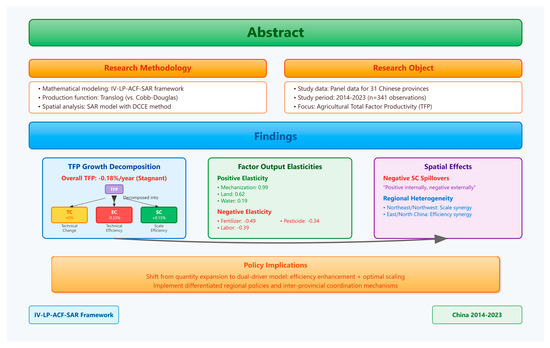
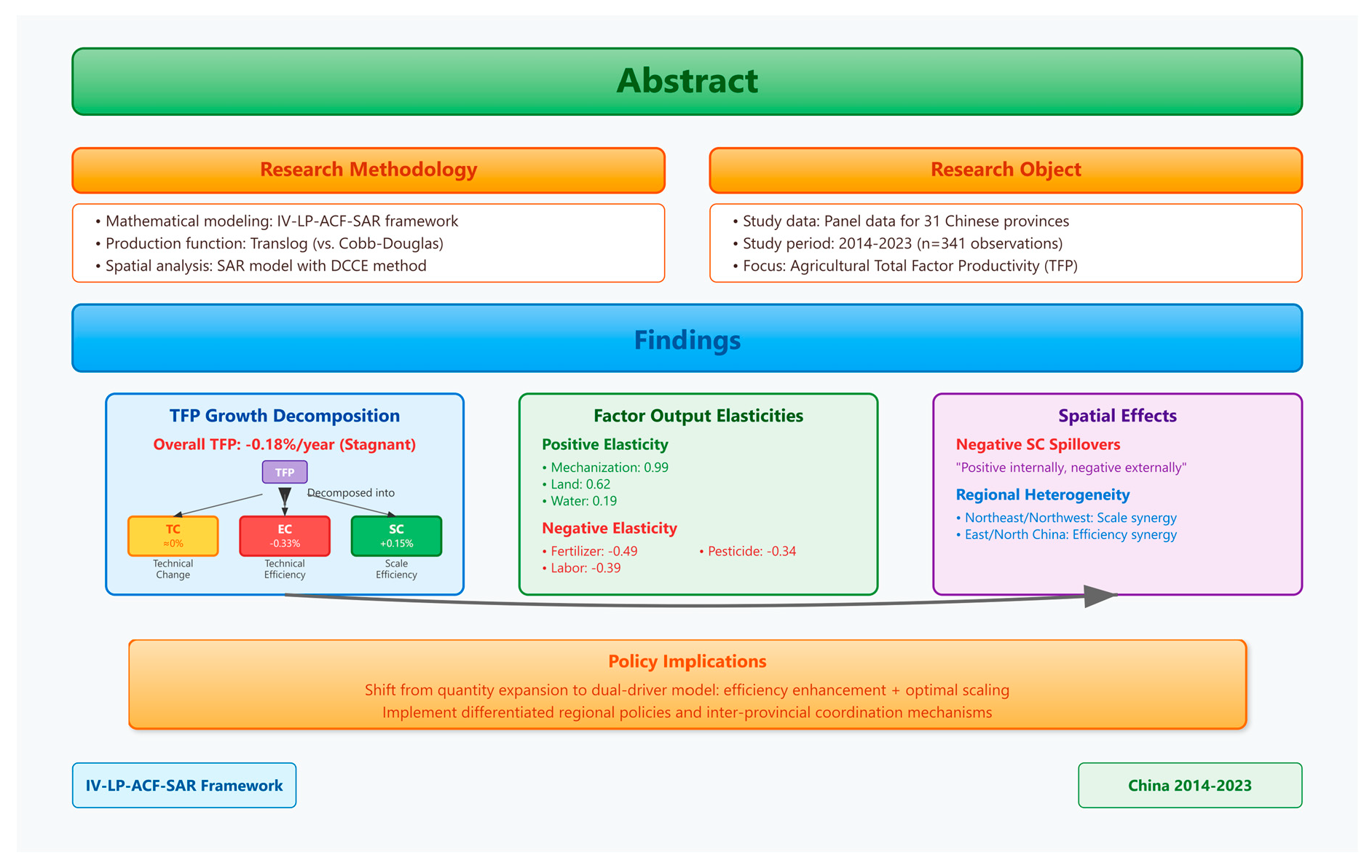
In the context of China’s pursuit of high-quality economic development, enhancing agricultural productivity is crucial for ensuring food security and promoting common prosperity. This paper constructs a systematic IV-LP-ACF-SAR econometric framework to analyze agricultural Total Factor Productivity (TFP) growth using panel data from 31 Chinese provinces spanning 2014 to 2023 (n = 341 observations). The framework employs the instrumental variable (IV)-based Levinsohn–Petrin (LP) proxy variable method under the Ackerberg–Caves–Frazer (ACF) system to estimate a Translog production function while addressing endogeneity using multiple spatial weight matrices. TFP growth is decomposed into technical change (TC), technical efficiency (EC), and scale efficiency (SC). A Spatial Autoregressive (SAR) model with Dynamic Common Correlated Effects (DCCE) explores spatial spillover effects and regional heterogeneity. Results show that China’s agricultural TFP remained largely stagnant from 2014 to 2023 with an average annual growth rate of −0.18%, where technical efficiency decline (−0.33% annually) was the main constraint. Technical change remained neutral, while scale efficiency contributed positively (+0.15% annually). Mechanization showed the highest output elasticity (0.99), while fertilizers, pesticides, and labor exhibited negative marginal returns. Spatial analysis revealed significant negative scale efficiency spillovers with regional patterns of “scale synergy in the Northeast/Northwest” and “efficiency synergy in East/North China.” These findings suggest that productivity policy should shift toward a dual-driver model combining efficiency enhancement and optimal scaling, with differentiated regional policies and inter-provincial coordination mechanisms necessary to mitigate negative spillovers and enhance sustainable agricultural growth quality.

Graphical Abstract

1. Introduction

Agriculture is a cornerstone of the national economy and the livelihoods of the population [1]. Its importance lies in ensuring the basic supply of key agricultural products such as staple grains, which is crucial for food security [2]; stabilizing food prices and expectations, thereby buffering the transmission of supply-side shocks to consumer prices [3]; and providing substantial rural employment and income, making it a critical domain for advancing food security, rural revitalization, and common prosperity. As Theodore W. Schultz argued in Transforming Traditional Agriculture, agriculture is not merely a source of food supply but also a vital endogenous driver of economic growth [4]. Hayami and Ruttan further advanced the theory of induced technological innovation, emphasizing that changes in relative factor prices constitute the key mechanism guiding the direction of agricultural technological progress [5].
As Chinese agriculture enters a stage of high-quality development, the extensive growth model of “winning by quantity” has become unsustainable. Resource and environmental constraints are tightening—by the end of 2024, China’s total arable land reached approximately 129.3 million hectares (Third National Land Survey; National Bureau of Statistics, 2024), yet agricultural water consumption stood at 364.8 billion cubic meters, accounting for 61.6% of total national water use (Ministry of Water Resources, China Water Resources Bulletin 2024), underscoring persistent water-resource pressure. Simultaneously, factor costs continue to rise: the average monthly income of migrant workers reached 4961 yuan in 2024, a 3.8% year-on-year increase (National Bureau of Statistics, Migrant Worker Monitoring Report 2024), while the national average farmland transfer price rose from 525 yuan per mu per year in 2015 to 716 yuan per mu per year in 2023 (Ministry of Agriculture and Rural Affairs, farmland transfer monitoring data). These trends have driven the traditional input-intensive growth path into a pronounced “diminishing marginal returns” predicament [6]. The strategy of relying on scale expansion as a risk “hedge” is no longer viable; once the ceiling of resource carrying capacity is reached, it risks triggering greater output volatility and negative externalities. Therefore, shifting the growth engine to Total Factor Productivity (TFP)—achieving output growth with the same or fewer inputs and lower environmental costs—has become the only solution to overcoming the bottleneck of agricultural modernization and achieving sustainable development [7,8].
In this critical transition, Chinese agriculture confronts three deep-seated challenges. First, there is structural pressure on food security: under the dual red lines of ecological conservation and arable land protection, extensification through land expansion is no longer feasible, and supply potential must be unlocked through the intensive pathway of restoring and enhancing production efficiency. Second, there is the macroeconomic transmission risk of costs and prices: as an upstream sector of the macroeconomy, supply-side shocks in agriculture are rapidly transmitted to core inflation expectations through the food price chain; if TFP growth remains sluggish, it will be difficult to absorb rising factor costs, thereby amplifying cost-push inflationary pressures [9]. Third, there are regional coordination dilemmas and potential “zero-sum competition”: as the construction of a unified national market accelerates factor mobility across regions, preliminary empirical observations suggest that scale efficiency in some regions may exhibit significant negative cross-provincial spillover effects, whereby indiscriminate expansion in one area crowds out resources in neighboring areas through a “siphoning effect,” creating a beggar-thy-neighbor competitive dynamic. These challenges compel us to address two core empirical questions: Which component—technical change, technical efficiency, or scale efficiency—is driving TFP dynamics [10]? And do these driving factors exhibit cross-regional spatial spillovers? Only by clarifying these mechanisms can we provide a scientific basis for precision policies that simultaneously address “structural optimization” and “spatial coordination” [11].
Although the literature on China’s agricultural TFP is substantial, significant limitations remain in methodological rigor and analytical comprehensiveness. First, regarding production function specification, a large body of work continues to rely on the Cobb–Douglas function (e.g., [12,13]). Its restrictive assumptions—constant substitution elasticity and constant returns to scale—often deviate from the complex realities of agricultural production governed by biological and natural constraints [14], readily leading to misestimation of factor elasticities and returns to scale. Second, the endogeneity problem has long been inadequately addressed: in agricultural production, farmers can observe productivity shocks (such as microclimatic variations) that are unobservable to econometricians and adjust their input decisions accordingly; ignoring this simultaneity bias leads to severely biased productivity estimates [15]. While non-parametric approaches such as the DEA-Malmquist index [10,14] and parametric methods such as SFA-based decomposition [16] do provide frameworks for decomposing TFP into technical change and efficiency change, they face their own limitations: DEA is sensitive to outliers and measurement error, while SFA requires distributional assumptions on the inefficiency term. More critically, neither framework natively addresses the simultaneity bias in input choices nor incorporates spatial dependence. Third, although DEA-Malmquist and SFA methods can decompose TFP, they have rarely been integrated with endogeneity correction and spatial modeling in a unified framework; most existing studies still treat TFP growth as an undifferentiated “black box” at the aggregate level (e.g., [17,18]), failing to effectively disentangle the respective contributions of technological innovation, efficiency improvement, and scale adjustment within a consistent estimation approach. Fourth, in the spatial dimension, existing analyses are typically predicated on the assumption of regional independence, overlooking the strong spatial dependence arising from agricultural technology diffusion and factor mobility in the context of China’s improved transport infrastructure and market integration [19,20].
In light of these theoretical gaps and practical demands, this paper constructs a systematic, multi-level econometric analysis framework—the IV-LP-ACF-SAR model—to achieve a methodological breakthrough. Specifically, we introduce instrumental variables (IV) combined with the semiparametric Ackerberg–Caves–Frazer (ACF) estimation method [21]. The ACF framework employs a two-step procedure to correct the functional dependence problem inherent in the Levinsohn–Petrin (LP) approach [22], thereby addressing endogeneity and collinearity in production function estimation and ensuring consistent TFP measurement. Building on this foundation, we further integrate a Spatial Autoregressive (SAR) model, extending the analytical perspective from the traditional closed system to an open spatial interaction system that explicitly incorporates spatial spillover effects. The marginal contributions of this paper are threefold. First, in terms of methodological integration, we construct a robust IV-LP-ACF-SAR framework that, unlike previous studies relying on simple Cobb–Douglas functions or ignoring endogeneity in spatial models, implements a custom first-principles estimation in Python 3.12, combining ACF correction for input endogeneity with the Dynamic Common Correlated Effects (DCCE) estimator to rigorously address both cross-sectional dependence (CSD) and dynamic bias in finite samples. Second, regarding structural decomposition, we move beyond aggregate TFP analysis by decomposing growth into technical change (TC), technical efficiency (EC), and scale efficiency (SC), enabling the identification that the stagnation of China’s agricultural TFP is structurally driven by the deterioration of technical efficiency and the negative spillovers of scale efficiency. Third, in spatial mechanism identification, we reveal the novel phenomenon of “negative cross-provincial spillovers of scale efficiency,” challenging the conventional view of positive agglomeration effects and highlighting the “siphoning effect” of resource-constrained growth.
This paper uses panel data from 31 Chinese provinces spanning 2014 to 2023 for empirical analysis. The results not only reveal the macroeconomic landscape and structural dilemmas of China’s agricultural TFP growth but also identify complex interaction patterns between regions from a spatial perspective, providing a solid empirical basis for formulating targeted and regionally coordinated agricultural development policies. The remainder of this paper is organized as follows: Section 2 details the research methodology and data; Section 3 presents and analyzes the empirical results; Section 4 provides an in-depth discussion of the core findings; and Section 5 concludes with policy recommendations.

Literature Review

Agricultural Total Factor Productivity (TFP), as a core indicator for measuring agricultural technological progress, resource allocation efficiency, and overall productivity, has been a central focus of agricultural economics research. The academic community has conducted extensive and in-depth explorations across multiple dimensions, including the innovation of TFP measurement methods, the evolution of growth trends, the decomposition of driving factors, the incorporation of environmental constraints, and the transmission of spatial effects.
In terms of measurement methods, early productivity research primarily employed the Solow residual approach for growth accounting, which derives TFP by subtracting input growth from output growth—a method that is simple and intuitive. However, the Solow residual, as a non-parametric method, has the fundamental limitation of being unable to effectively separate the effects of technical progress, technical efficiency change, and returns to scale, while also imposing stringent assumptions on the production function form. To overcome these limitations, the research paradigm has gradually shifted toward more explanatory frontier analysis methods, among which data envelopment analysis (DEA) and stochastic frontier analysis (SFA) have become the mainstream tools [14]. DEA, as a non-parametric linear programming method, does not require a pre-specified production function form, can handle complex multi-input multi-output situations, and provides relative efficiency scores [23]. SFA, as a parametric econometric method, decomposes the stochastic disturbance at the production frontier to distinguish technical inefficiency from statistical noise, yielding individual technical efficiency estimates [24,25]. Within this domain, some scholars have made important extensions to the classical frameworks. For example, Zhang et al. [26], working within the SFA framework of Kumbhakar [16], creatively introduced the dimension of factor allocative efficiency, achieving a precise separation of technical progress, technical efficiency, and factor allocative efficiency, and finding that allocative efficiency is a key driver of China’s agricultural TFP growth. This finding provides an important theoretical reference for our argument regarding the potential decline of technical efficiency, suggesting that TFP measurement needs to more carefully consider the structural sources of efficiency.
Regarding the deep drivers of TFP growth, structural distortions in resource allocation are considered a significant constraint. Restuccia and Rogerson [27] demonstrated that factor misallocation can substantially reduce aggregate productivity, a problem particularly acute in developing countries. In the specific context of Chinese agriculture, related research [28] has confirmed that Chinese agriculture has long suffered from a structural distortion of relative labor surplus and relative capital shortage, compounded by institutional factors such as the urban-rural dual structure and inadequate land transfer mechanisms that contribute to land fragmentation [29]. This divergence between factor prices and marginal products, together with fragmented operational scales, has severely inhibited the potential growth of agricultural TFP. Hsieh and Klenow [30] revealed the enormous drag of factor misallocation on manufacturing TFP, and their logic applies equally to the agricultural sector. This implies that moving beyond mere input increases and optimizing factor allocation—through deepening market-oriented reforms, improving land transfer mechanisms, enhancing rural financial services, and upgrading agricultural labor quality—represents a critical pathway for enhancing agricultural productivity.
With the growing salience of climate change and resource-environmental pressures, traditional TFP measurement has faced widespread criticism for ignoring environmental costs such as greenhouse gas emissions, water pollution, and soil degradation. Incorporating environmental constraints into the productivity accounting framework has become a new research trend. Scholars have begun to focus extensively on measuring agricultural Green Total Factor Productivity (GTFP), which includes undesirable outputs (such as greenhouse gas emissions, livestock waste, and non-point source pollution from fertilizer and pesticide runoff) or environmental inputs (such as water resources and arable land quality degradation) [18,31]. These studies typically employ methods such as the Directional Distance Function or the Malmquist-Luenberger index to measure GTFP, with the core idea of minimizing environmental burdens while pursuing economic output [32,33]. Research consistently finds that once environmental costs are considered, the growth trajectory and assessment of China’s agricultural TFP shift significantly, revealing the hidden quality-of-growth problems masked by the traditional high-input, high-pollution model and underscoring the importance of green development.
In the spatial dimension, Tobler’s First Law of Geography—“everything is related to everything else, but near things are more related than distant things”—implies that agricultural production does not exist in isolation, and interregional interactions and dependencies are intensifying. Existing research has broadly confirmed that, influenced by natural endowments, levels of economic development, policy orientation, and the degree of market integration, China’s agricultural TFP growth exhibits significant regional differences and spatial clustering characteristics [17,34]. More recently, spatial econometric models have been applied to productivity analysis: Wang et al. [35] employed a Spatial Durbin Model to examine the effect of green technology innovation on GTFP, while Liu et al. [36] analyzed the role of digital economy development using spatial panel methods. Nevertheless, these spatial studies typically adopt DEA-based TFP measures without addressing input endogeneity, and few decompose spatial spillovers by TFP component—gaps that our IV-LP-ACF-SAR framework is designed to fill. It is also noteworthy that, in contrast to studies such as Gao [17] that documented sustained TFP growth during the 2000–2014 period, this paper observes TFP fluctuations and even negative growth during the study period encompassing 2014–2023. The reason lies in the fact that the earlier studies primarily focused on China’s agricultural “golden growth period,” whereas the present study covers a time span subjected to multiple external shocks, including extreme weather events, Sino-US trade frictions (impacting agricultural exports and input imports from 2018 onward), and the sustained disruption of the COVID-19 pandemic on labor mobility, supply chains, and market demand [37]. These non-linear shocks from the external macro environment and natural disasters have had a profound impact on agricultural TFP. Although the existing literature confirms the presence of spatial correlation, most analyses remain at the descriptive level of spatial patterns (e.g., [17,34]), lacking in-depth investigation into the internal transmission mechanisms of spatial dependence—namely, how factor mobility, technology diffusion, market competition, and policy synergies or rivalries influence TFP across regions [20,38].
In summary, while the existing literature provides a solid foundation for understanding China’s agricultural TFP, further investigation and empirical analysis are needed regarding the dynamic evolution of TFP under complex external shocks, the deep mechanisms of factor allocation and their structural effects on technology, efficiency, and scale, and the micro-level transmission mechanisms of spatial spillovers. The recent acceleration of research toward drivers of high-quality development under resource and environmental constraints provides an important entry point for the comprehensive analytical framework constructed in this paper, with the aim of offering insights with greater explanatory power and policy relevance.

2. Methodology and Design

Our empirical strategy proceeds in two stages. The first stage estimates a Translog production function using the IV-LP-ACF control function approach with two-step GMM, yielding consistent estimates of factor elasticities and enabling a three-way decomposition of TFP growth into technical change (TC), technical efficiency (EC), and scale efficiency (SC). The second stage embeds these TFP components in a dynamic SAR-DCCE spatial panel framework to identify cross-provincial spillover effects while controlling for unobserved common factors. We describe each stage below, beginning with data and preprocessing.

2.1. Data, Variables, and Preprocessing

2.1.1. Data Sources and Sample

The study covers 31 provincial-level administrative units across mainland China (excluding Hong Kong, Macao, and Taiwan) over the period 2013–2023, yielding T = 11 annual observations per province. After applying the data cleaning and imputation procedures described below, the final balanced panel used for GMM estimation consists of n = 341 observations.

2.1.2. Variable Definition and Measurement

The production function is specified with one output variable and seven input factors within a Translog framework. The output variable is the total output of major agricultural products (Y), measured in physical units (10,000 tons). The seven input factors are classified into two categories following the endogeneity assumptions of the ACF framework: fixed inputs (predetermined variables decided in advance of the current period) include sown area of farm crops ( K l a n d ) and total power of agricultural machinery ( K m a c h i n e r y ); free inputs (contemporaneously adjustable and susceptible to concurrent productivity shocks) include labor (L), chemical fertilizer consumption ( M f e r t ), agricultural water consumption ( M w a t e r ), pesticide consumption ( M p e s t ), and agricultural plastic film consumption ( M f i l m ). In addition, a time trend (t) captures technical change and a disaster shock variable (d) controls for the impact of natural disasters. Table 1 summarizes all variables, their units, data sources, and classification.

2.1.3. Data Preprocessing

Missing Data Handling and Imputation Methods
Given the importance of panel data integrity for reliable econometric results, missing values in the dataset were systematically identified and addressed. Overall, the proportion of missing data is small, accounting for only 11.4% of the total data points (39 missing values/341 total data points). The specific missing situations and imputation methods are as follows:
Cultivated Land Area Data: Data for cultivated land area for all provinces in 2018 is completely missing, with a missing proportion of 9.09% (31 missing values/341 total data points). Piecewise linear regression interpolation was used to predict and impute the missing data for 2018 by constructing time trends for each province’s cultivated land area based on data from 2013 to 2017 and 2019 to 2023.
Pesticide Consumption Data: Data for pesticide consumption in Tibet for 2022–2023 is missing, with a missing proportion of 0.586% (2 missing values/341 total data points). Piecewise linear regression interpolation was used, imputing the missing years based on the historical data trend from 2013 to 2021.
Primary Industry Employment Data: Primary industry employment data for the Heilongjiang region for 2013 is missing, with a missing proportion of 0.293% (1 missing value/341 total data points). Since only a single time point is missing, the linear regression method was used, backcasting based on the linear trend of the province’s data from 2014 to 2023.
Disaster-Affected Area Data: Data on disaster-affected areas for Tianjin in 2015, 2017, and 2019 and for Shanghai in 2014 and 2017 are missing, with a missing proportion of 1.466% (5 missing values/341 total data points). Cubic Spline interpolation was used to capture non-linear changes in disaster-affected areas.
All imputation methods were validated through cross-validation to ensure the statistical reasonableness of the imputed results and the stationarity of the time series.
Data Standardization
All physical quantity variables v { Y , X } are log-transformed with a small positive buffer to handle zero values:
ln v ln v + ε , ε = max { 10 6 · median + ( v ) , 10 12 }
Subsequently, all log-transformed variables entering the estimation are winsorized at the [ 1 % ,   99 % ] quantiles to reduce the influence of extreme values. The classification of input factors into fixed and free categories, as summarized in Table 1, provides the theoretical basis for the subsequent construction of instrumental variables and endogeneity treatment: free inputs ( X endog = { l , m f e r t , m w a t e r , m p e s t , m f i l m } ) are treated as endogenous, while fixed inputs ( X exog = { k l a n d , k m a c h i n e r y } ) serve as predetermined variables.

2.2. Production Function Estimation and Endogeneity Treatment

2.2.1. Translog Production Function

To avoid the strict restrictions imposed by the Cobb–Douglas function (e.g., elasticity of substitution equal to 1, constant returns to scale), we adopt the more flexible Translog production function form [39]:
y i t = β 0 + j J β j x j i t + 1 2 j J k J β j k x j i t x k i t + β t t + 1 2 β t t t 2 + j J β j t x j i t t + ω i t + ε i t
where y i t = ln Y i t , x j i t = ln X j i t , J represents the set of all seven input factors, ω i t is the unobserved productivity shock, and ε i t is the random measurement error.

2.2.2. Control Function Method Based on LP-ACF

To address the endogeneity problem where ω i t is correlated with input choices, we employ the Levinsohn–Petrin (LP) proxy variable method [22] combined with the correction under the Ackerberg–Caves–Frazer (ACF) framework [21]. The core assumption is that ω i t follows a first-order Markov process:
ω i t = h ( ω i , t 1 ) + ξ i t
where E [ ξ i t | I i , t 1 ] = 0 , and I i , t 1 is all information up to period t 1 .
LP-ACF Two-Step Estimation Process:
Step 1: Control Function Estimation Regress output on all inputs (both free and fixed) and the time trend non-parametrically or semi-parametrically to obtain an estimate of the composite term ϕ i t . We use a tensor product of I-splines and B-splines for approximation:
ϕ ( m , k ) a = 1 A b = 1 B γ a b I a ( m ) B b ( k ) , γ a b 0
where I a ( m ) are I-spline basis functions, and B b ( k ) are B-spline basis functions. The non-negativity constraint on γ a b ensures monotonicity of the control function in materials, consistent with the theoretical requirement that higher input use signals higher unobserved productivity.
Step 1 recovers ϕ ^ i t but does not separately identify the production function parameters β , because all regressors enter the composite term. Ackerberg et al. [21] showed that this functional dependence problem invalidates the original LP approach. Step 2 resolves it by exploiting the time-series variation in ω i t .
Step 2: GMM Parameter Estimation Given ϕ ^ i t from Step 1, we recover ω i t ( β ) = ϕ ^ i t x i t β and exploit its Markov property to construct moment conditions. The current productivity innovation ξ i t is uncorrelated with all variables determined in or before period t 1 , providing the exclusion restriction that identifies β .

2.3. Two-Step GMM Estimation and Model Diagnostics

2.3.1. Instrument Construction and Moment Conditions

Under a unified sample, we use Markov lags of inputs as basic instruments and expand them with non-linear derivatives. Let the matrix of endogenous regressors be X endog , the matrix of exogenous regressors be X exog , and the instrument matrix Z be derived from L1–L2 lags of inputs and their derivatives:
Z = { x j , t 1 , x j , t 2 , x j , t 2 , x j , t x k , t , x j , t · t } j , k J , { 1 , 2 }
After standardization and strength screening, we retain a final set of 40 instruments for the main path estimation.
GMM Moment Conditions: According to the Generalized Method of Moments (GMM) [40], the moment conditions for a sample of size n are
g n ( β ) = 1 n i = 1 n Z i u i ( β ) = 0 , u i ( β ) = y i X i β

2.3.2. Two-Step GMM Estimation Process

Step 1 Estimation: Use W ( 1 ) = I to obtain β ^ ( 1 ) and residuals u ^ i .
Weighting Matrix Construction: Construct a heteroskedasticity-robust weighting matrix with finite-sample correction [41]:
S = 1 n i = 1 n ( Z i u ^ i ) ( Z i u ^ i ) = 1 n Z diag ( u ^ 2 ) Z , W = S 1
Step 2 Estimation:
β ^ = arg min β g n ( β ) W g n ( β )
Variance Estimation:
Var ^ ( β ^ ) = X Z W Z X 1 X Z W S W Z X X Z W Z X 1 / n

2.3.3. Model Diagnostic Tests

The validity of the model is ensured through the following tests:
Functional Form Test: Use the GMM distance test [40] to compare the Hansen J-statistic of the Translog model with that of the Cobb–Douglas model, under a unified set of instruments and weighting matrix.
Instrument Strength: Use the Sanderson-Windmeijer F-statistic [42] and the Kleibergen-Paap rk-statistic [43] to test the correlation between instrumental variables and endogenous variables.
Overidentification Test: Use the Hansen J-statistic [40] to test the exogeneity assumption of all instrumental variables:
J = n g n ( β ^ ) W g n ( β ^ ) χ 2 ( m k )

2.4. Three-Way Decomposition of TFP Growth

After obtaining consistent estimates of the production function parameters, we can calculate the output elasticity of each factor θ j , i t , returns to scale (RTS) RTS i t , and the rate of technical change TC i t .
θ j , i t = y i t x j i t , RTS i t = j J θ j , i t , TC i t = y i t t
Subsequently, following the method of Kumbhakar [16], we decompose the TFP growth rate ( Δ TFPQ i t ) into three mutually exclusive components:
Δ TFPQ i t Δ TC i t + Δ EC i t + Δ SC i t
where Δ TC i t TC i t denotes technical change (TC), measuring the shift in the production possibility frontier itself; Δ EC i t Δ ϕ i t TC ¯ i t denotes technical efficiency change (EC), measuring the speed at which producers catch up to the production frontier; and Δ SC i t ( RTS ¯ i t 1 ) j w ¯ j , i t Δ x j i t denotes scale efficiency change (SC), measuring the productivity change induced by factor input changes when returns to scale differ from unity.

2.5. Spatial Econometric Model

2.5.1. Construction of Spatial Weight Matrix

Distance Calculation: Using the latitude and longitude representative points ( λ i , φ i ) of each province to construct the Haversine spherical distance:
d i j = 2 R arcsin A + B , A = sin 2 φ j φ i 2 , B = cos φ i cos φ j sin 2 λ j λ i 2 , R = 6371 km
Three types of weight matrices are considered: (i) K-Nearest Neighbors (KNN, k = 4 ), where w ˜ i j = 1 { j N k ( i ) } , symmetrized by union; (ii) Queen Contiguity (1st order), a binary contiguity matrix based on a spatial contiguity graph; and (iii) Inverse Distance (threshold 800/1000 km), where w ˜ i j = d i j 1 when d i j c and i j , and zero otherwise.
Row Standardization: w i j = w ˜ i j / j w ˜ i j , ensuring j w i j = 1 .

2.5.2. Dynamic Spatial Panel Model

Economic Motivation
Agricultural production across Chinese provinces is subject to strong CSD arising from at least two sources: common climatic shocks (e.g., El Niño events, droughts) that simultaneously affect multiple provinces, and centralized policy interventions (e.g., nationwide fertilizer reduction mandates, machinery subsidies) whose effects propagate through all regions. As demonstrated by Holly et al. [44], ignoring such unobserved common factors in spatial models leads to severe identification biases, because the estimator cannot distinguish genuine spatial spillovers from correlated responses to a shared shock. This concern is particularly acute in our setting, where the COVID-19 pandemic, trade frictions, and environmental policy shifts affected all provinces simultaneously during 2018–2023.
Econometric Solution
To address this CSD in a dynamic setting, we employ the Dynamic Common Correlated Effects (DCCE) estimator proposed by Chudik and Pesaran [45]. Unlike standard fixed-effects models, DCCE approximates the unobserved common factors using cross-sectional averages of the dependent and independent variables, thereby yielding consistent estimates even in the presence of multifactor error structures. Regarding the finite sample dimension ( T = 11 ), we implement the dynamic augmentation strategy—adding lagged cross-sectional averages as additional regressors—within the DCCE framework. Simulation evidence discussed by Ditzen [46] confirms that this augmentation effectively mitigates the small-sample Nickell bias, making the estimator feasible and robust for panels with moderate time dimensions.
Taking any TFP component y i t { Δ TC , Δ EC , Δ SC } as the dependent variable, we construct a dynamic Spatial Autoregressive (SAR) panel model [47]:
y i t = α y i , t 1 + ρ ( W y ) i t + x i t β + f t ( y ¯ · t , x ¯ · t , W y ¯ · t ; lags ) + μ i + η i t
where f t ( · ) represents the cross-sectional mean augmentation terms from Pesaran’s [48] Common Correlated Effects (CCE) and its dynamic form (DCCE) [45].

2.5.3. Bias Reduction and Robust Standard Errors

Bias Reduction via Dynamic Augmentation: Following Chudik and Pesaran [45], we address potential Nickell bias in short panels through Dynamic Common Correlated Effects (DCCE) augmentation. By including lagged cross-sectional averages ( y ¯ t 1 , y ¯ t 2 , , X ¯ t s ) as additional regressors in Equation (14), the DCCE framework effectively mitigates small-sample bias without requiring explicit bias correction formulas. This approach has been shown to be asymptotically equivalent to instrumental variable corrections while maintaining computational tractability.
Driscoll–Kraay Robust Standard Errors: To address cross-sectional correlation and temporal autocorrelation in panel data, we implement Driscoll–Kraay [49] robust standard errors using the sandwich estimator:
V ^ DK ( β ^ ) = ( X X ) 1 Ω ^ ( X X ) 1
where Ω ^ = Γ ^ 0 + = 1 L w ( Γ ^ + Γ ^ ) is the HAC covariance estimator with Bartlett kernel weights w = 1 / ( L + 1 ) , bandwidth L = T 1 / 3 , and Γ ^ = T 1 t = + 1 T S t S t , where S t = i = 1 N X i t u ^ i t is the cross-sectional sum of score vectors at time t.

2.5.4. Decomposition of Spatial Effects (LeSage–Pace Method)

We use the method proposed by LeSage and Pace [20] to decompose spatial effects. Given α ^ , ρ ^ and W, we define the short-run and long-run multiplier matrices:
S SR = ( I ρ W ) 1 , S LR = [ ( 1 α ) I ρ W ] 1
The average effects are decomposed as follows:
Direct = 1 N tr ( S ) .
Total = 1 N 1 S 1 .
Indirect = Total Direct .

2.5.5. Cross-Sectional Dependence Test

Pesaran CD Test: To test for CSD in the model residuals, we use the CD test [50]:
CD = 2 T N ( N 1 ) i = 1 N 1 j = i + 1 N ρ ^ i j

2.5.6. Local Indicators of Spatial Association (LISA)

To identify local spatial clustering patterns in TFP components across provinces, we employ the LISA method [51]. The LISA statistic for observation i is defined as
I i = z i j w i j z j
where z i and z j are standardized observations.
Based on LISA test results, each province is classified into one of four spatial association types: HH (High–High), denoting hotspot regions where high values are surrounded by high values; LL (Low–Low), denoting coldspot regions where low values are surrounded by low values; and HL (High–Low) or LH (Low–High), denoting spatial outliers where a province’s value diverges from its neighbors.

3. Empirical Results

3.1. Model Validity and Specification Tests

As shown in Table 2, the model specification passed all key diagnostic tests. The WR test results strongly support the necessity of the Translog functional form; the instrument strength tests indicate strong model identification; and the Hansen J-test p-value of 0.601 accepts the null hypothesis of instrument exogeneity.
Having established the validity of the production function estimates, we next examine whether the resulting TFP components exhibit spatial dependence—a prerequisite for the spatial econometric analysis that follows.

Cross-Sectional Dependence Diagnosis

Before proceeding to spatial modeling, we conduct Pesaran CD tests on the residuals of the three TFP components to determine whether CSD is sufficiently strong to warrant the DCCE approach.
The Pesaran CD test results for the three TFP components reveal strong evidence of CSD: technical change (TC) yields a CD statistic of 52.39 ( p < 0.001 ), technical efficiency (EC) yields 17.66 ( p < 0.001 ), and scale efficiency (SC) yields 5.17 ( p = 2.30 × 10 7 ).
All three components strongly reject the null hypothesis of cross-sectional independence at the 1% significance level, confirming that spatial dependence is pervasive across all dimensions of productivity. This justifies the use of spatial econometric methods in subsequent sections and motivates a careful decomposition of where and how these spatial interactions operate.
With the econometric framework validated, we now turn to the substantive findings, beginning with the aggregate dynamics of TFP growth.

3.2. National-Scale TFP Growth Dynamics and Decomposition

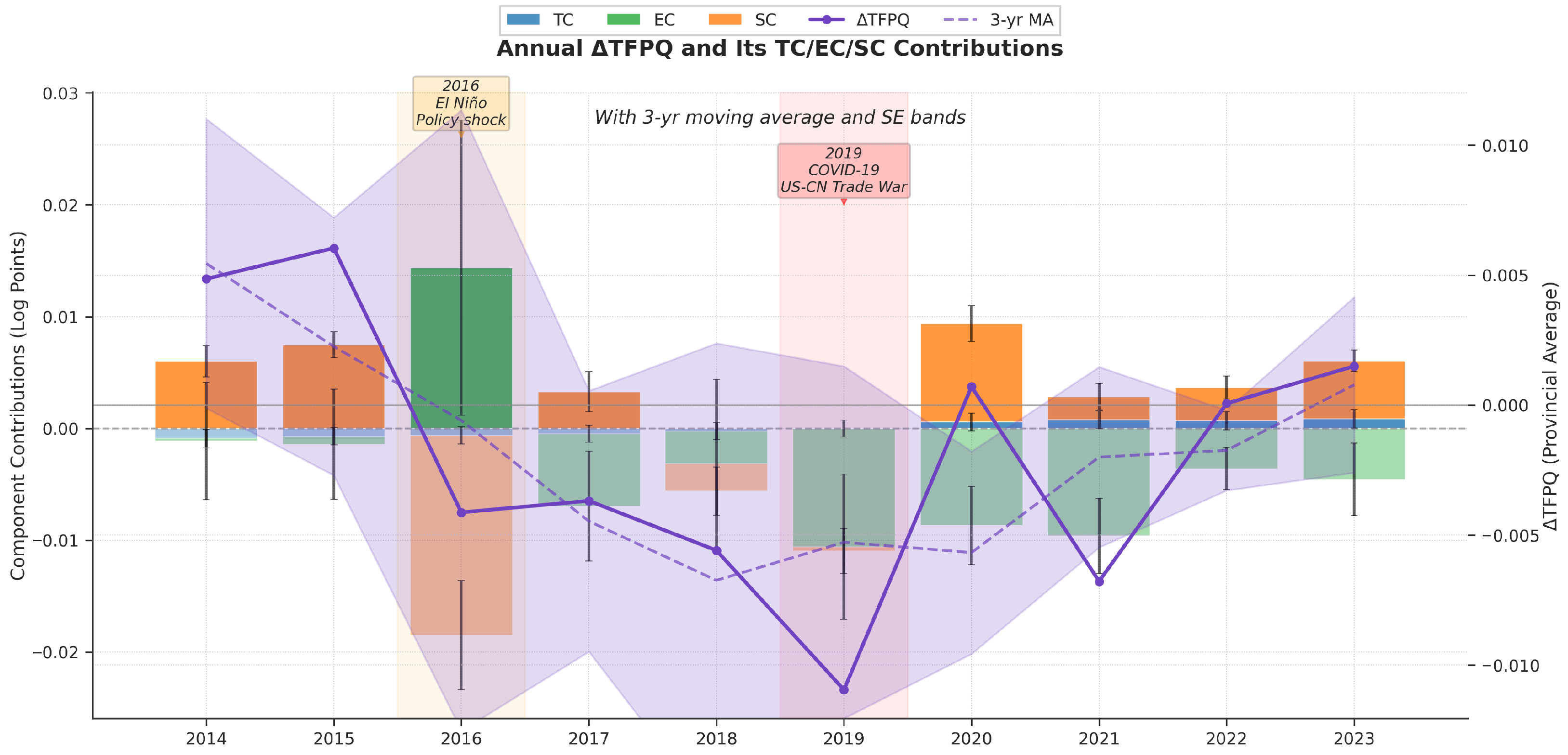
Figure 1 displays the annual average growth rate of China’s agricultural TFP and its three components from 2014 to 2023. Overall, the results reveal a concerning structural dilemma: China’s agricultural TFP growth has been generally stagnant over the past decade, with an average annual growth rate of only −0.18%. The three-year moving average trend shows a gradual decline in TFP growth from a relatively stable state in 2014–2015 to a bottom in 2018–2019, followed by a weak rebound after 2020.
Further decomposition of TFP growth reveals underlying structural differences beneath the stagnation. The structural deterioration of technical efficiency (EC) is the main drag on TFP growth (average annual −0.33%). In contrast, scale efficiency (SC) provided important resilience support for TFP growth, being the only stable positive contributor (average annual +0.15%). Meanwhile, the contribution of technical change (TC) was close to zero during the sample period, showing a “neutral stagnation.”

3.3. Inter-Provincial Differences and Structural Characteristics of Returns to Scale

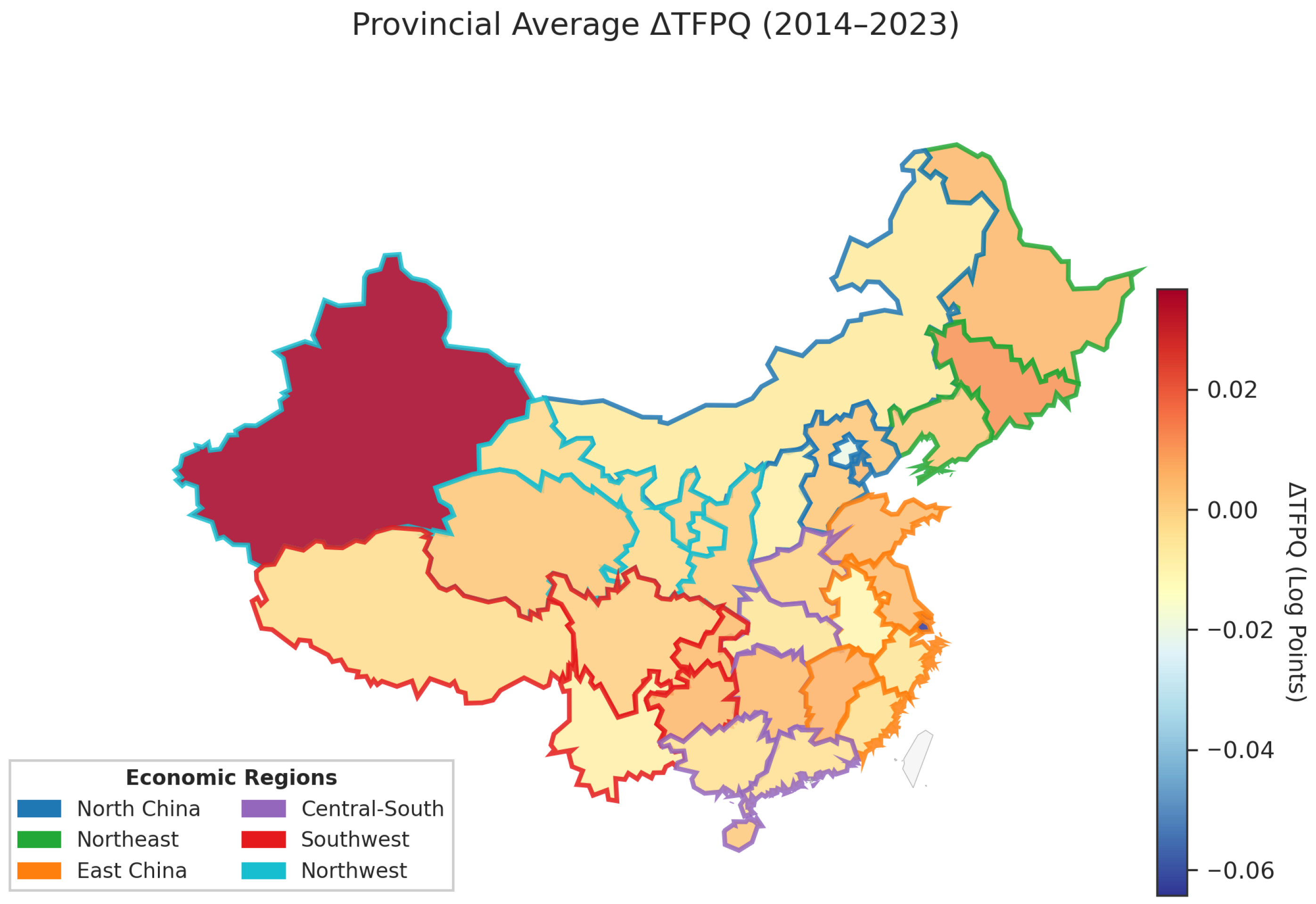
The aggregate stagnation documented above masks substantial heterogeneity at the provincial level. Understanding this heterogeneity is essential because it determines whether policy interventions should be uniform or regionally differentiated. Figure 2 reveals that inter-provincial TFP growth rates exhibit extremely significant and geographically clustered differentiation.
The inter-provincial differences show a pattern of coexisting “growth poles” and “negative growth zones.” At one extreme, Xinjiang leads with positive TFP growth driven by large-scale mechanized cotton and grain production under favorable land endowments and sustained policy support. Heilongjiang and Inner Mongolia similarly benefit from extensive farming systems that generate scale economies. At the other extreme, coastal developed regions such as Beijing, Shanghai, and Zhejiang experience negative agricultural TFP growth—a pattern likely attributable to rapid urbanization that compresses farmland, raises opportunity costs of agricultural labor, and shifts provincial priorities away from primary production. Between these extremes, central agricultural provinces (Henan, Hubei, and Hunan) cluster near zero growth, suggesting that traditional farming structures have reached a productivity plateau without the scale advantages of the Northeast or the technological intensity of the East.
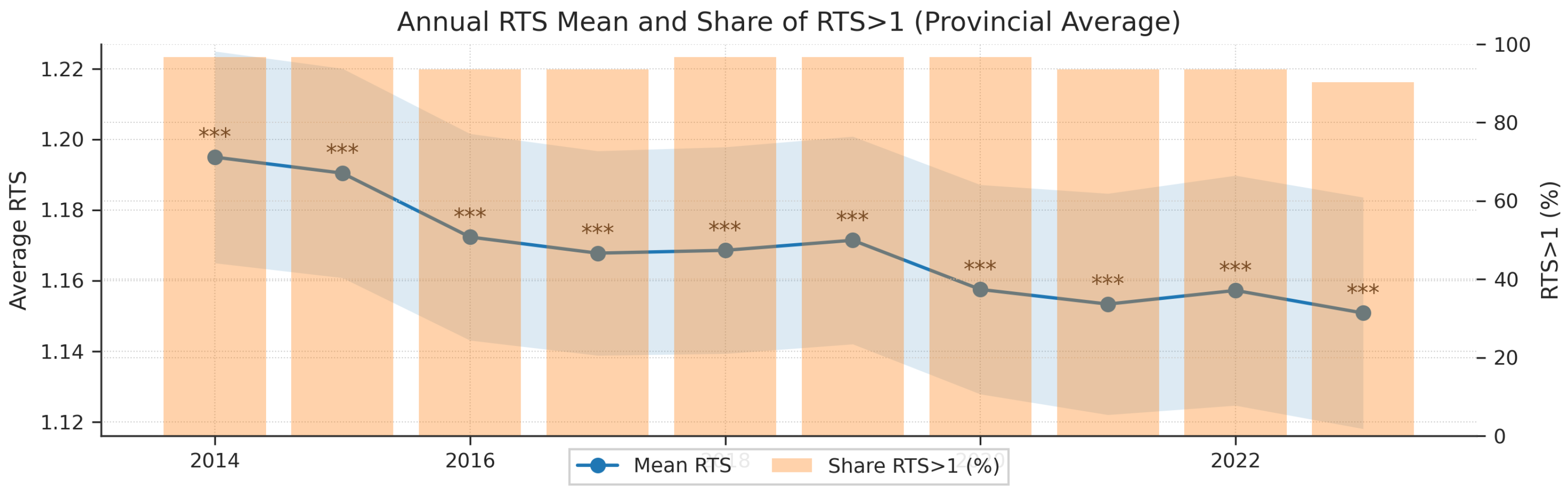
These provincial differences raise a structural question: given that most provinces operate under increasing returns to scale, why does scale expansion not uniformly translate into TFP growth? The analysis of returns to scale (RTS) addresses this question directly (Figure 3).
Over the entire period, the national average RTS slightly decreased from 1.196 to 1.149, but remained significantly greater than 1. The proportion of provinces with RTS > 1 has been stable at over 80%, confirming the universality and temporal stability of economies of scale. This persistence of increasing returns implies that the potential for scale-driven productivity gains remains largely untapped—yet, as the spatial analysis in Section 3.5 will show, realizing this potential is complicated by negative cross-provincial spillovers that turn scale expansion into a spatially competitive process.

3.4. Structural Imbalance of Production Factor Elasticities

The analysis of the output elasticities of the seven major input factors reveals profound structural imbalances in China’s agricultural production.
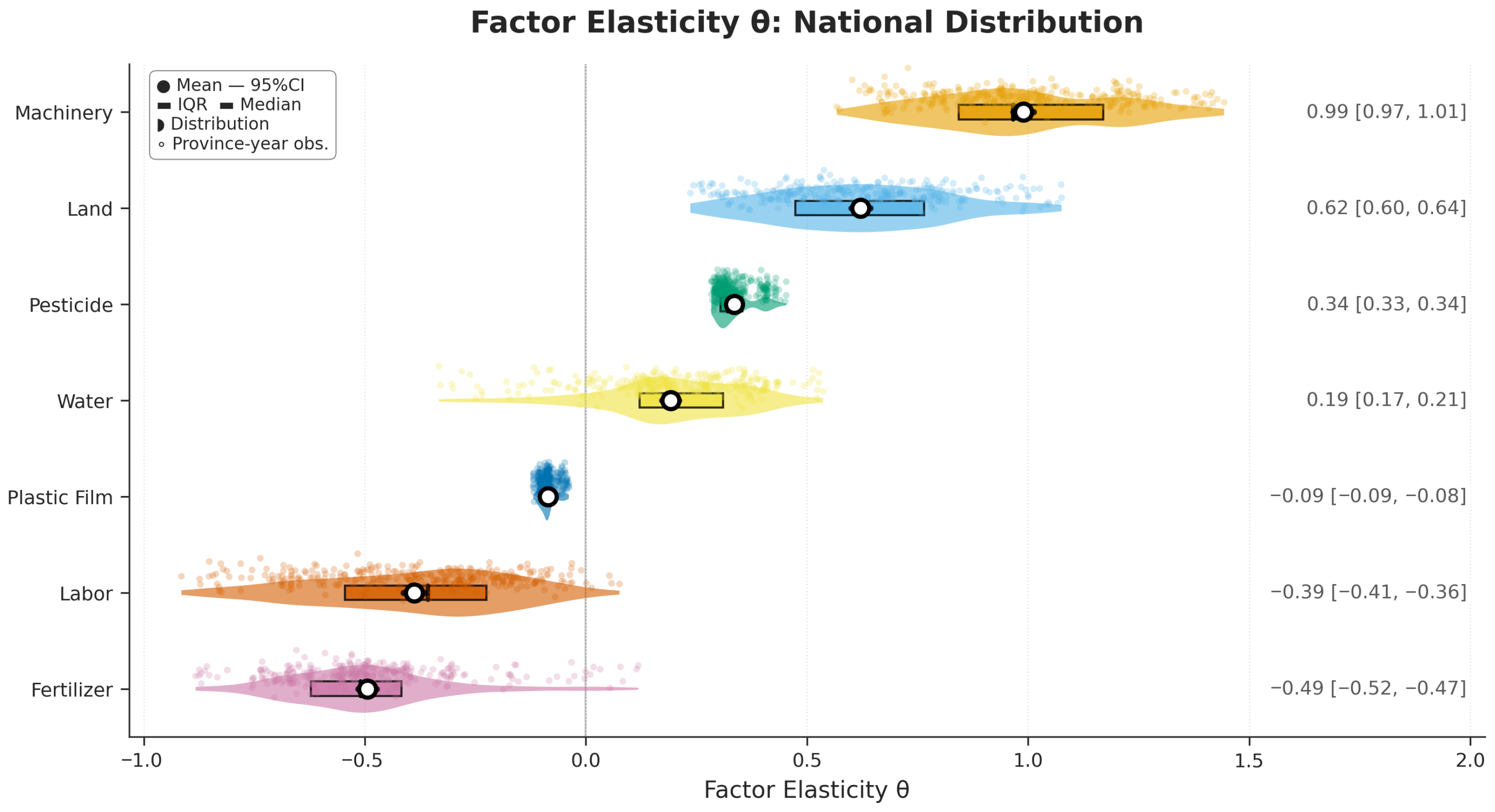
As shown in Figure 4, mechanization is the overwhelming engine of growth, with an average output elasticity as high as 0.99 and high consistency across provinces. Land, as a fundamental factor, has a stable elasticity of 0.62. The average elasticity of water resources is 0.19. At the same time, the drags on efficiency are very clear: fertilizer shows an average elasticity of −0.49, labor allocation distortion is significant (−0.39), and pesticide input has a marginal output of 0.34. This indicates overuse in most provinces.
These elasticity patterns—particularly the high machinery elasticity, the negative fertilizer and labor elasticities, and the overall returns to scale of approximately 1.17—are discussed in detail in Section 4.4 in the context of existing literature. In brief, the machinery dominance reflects China’s rapid mechanization transition during 2014–2023 [13,52], the negative fertilizer elasticity is consistent with well-documented overuse exceeding three times the world average [53,54], and the negative labor elasticity aligns with extensive evidence of agricultural labor surplus and the Lewis turning point [55,56]. We defer the detailed economic interpretation to the Discussion because the magnitudes of Translog elasticities depend jointly on first-order coefficients, interaction terms, and the time trend, requiring careful contextualization against the existing empirical literature.
The factor elasticity analysis characterizes the production structure within individual provinces. We now shift perspective to examine how productivity dynamics interact across provinces through spatial channels.

3.5. Spatial Dependence and Spillover Effects of TFP Growth

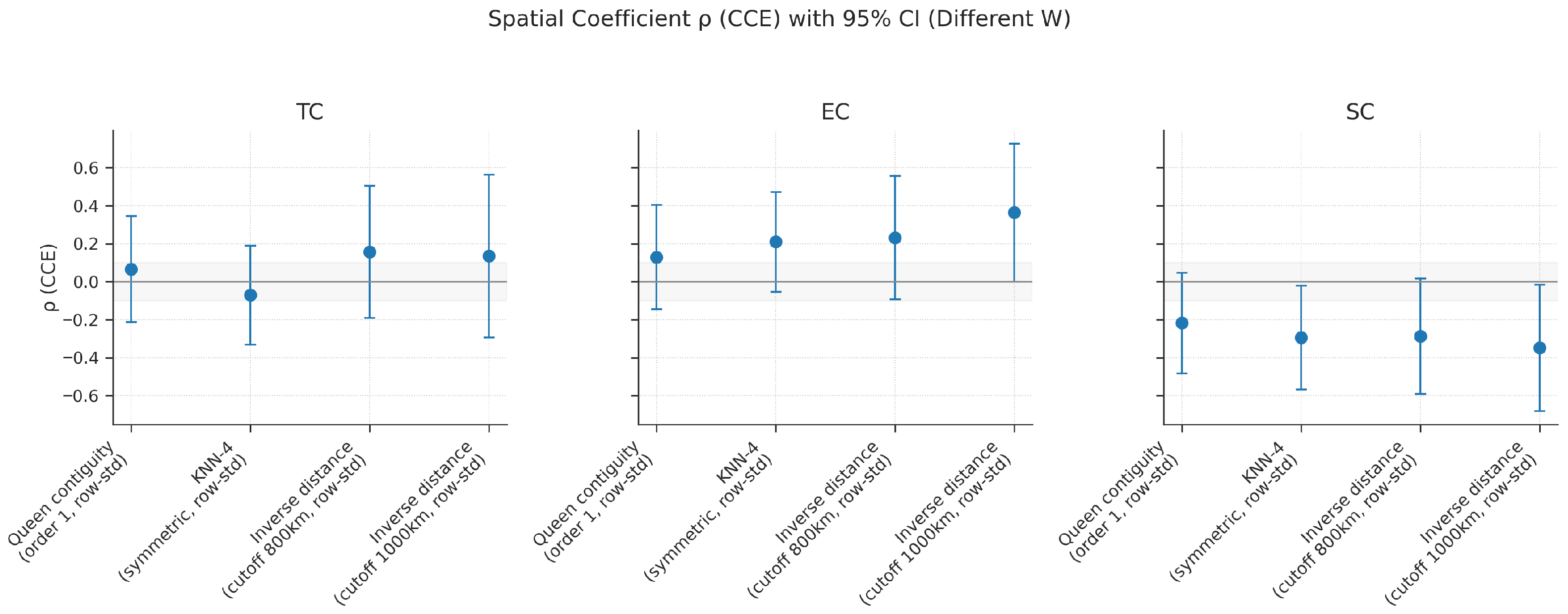
Spatial econometric analysis reveals a highly complex interaction pattern among the components of China’s agricultural TFP, with significant differences in their spatial dependence patterns (Figure 5).

3.5.1. Spatial Model Residual Diagnostics

To validate the effectiveness of our spatial econometric approach, we conduct comprehensive residual diagnostics using the Pesaran CD test on model residuals after applying DCCE and CCE methods.
The diagnostic results in Table 3 carry an important methodological implication: the DCCE estimator successfully purges CSD from all TFP components across all weight matrices, whereas the simpler CCE method leaves residual dependence for TC. This confirms that the dynamic augmentation strategy is essential for obtaining reliable spatial coefficient estimates and validates our choice of DCCE as the primary estimation method. With this methodological assurance, we now examine the spatial autocorrelation coefficients themselves (Figure 5).
A key fact is that scale efficiency (SC) exhibits systematic negative spatial spillovers under different weight settings, indicating that the scale expansion of neighboring provinces inhibits the scale efficiency of the home province. In contrast, technical efficiency (EC) shows only weak positive synergy, and technical change (TC) is statistically insignificant.
This negative spillover pattern suggests a “siphoning effect” or zero-sum dynamic under resource constraints. As neighboring provinces expand their agricultural scale, they may attract high-quality production factors—including capital, skilled labor, and advanced machinery—from surrounding areas, thereby dampening the local province’s scale efficiency. This finding deviates from most prior studies that report positive spatial externalities (e.g., [35,57]), but is consistent with the theoretical predictions of factor mobility under competitive resource allocation.
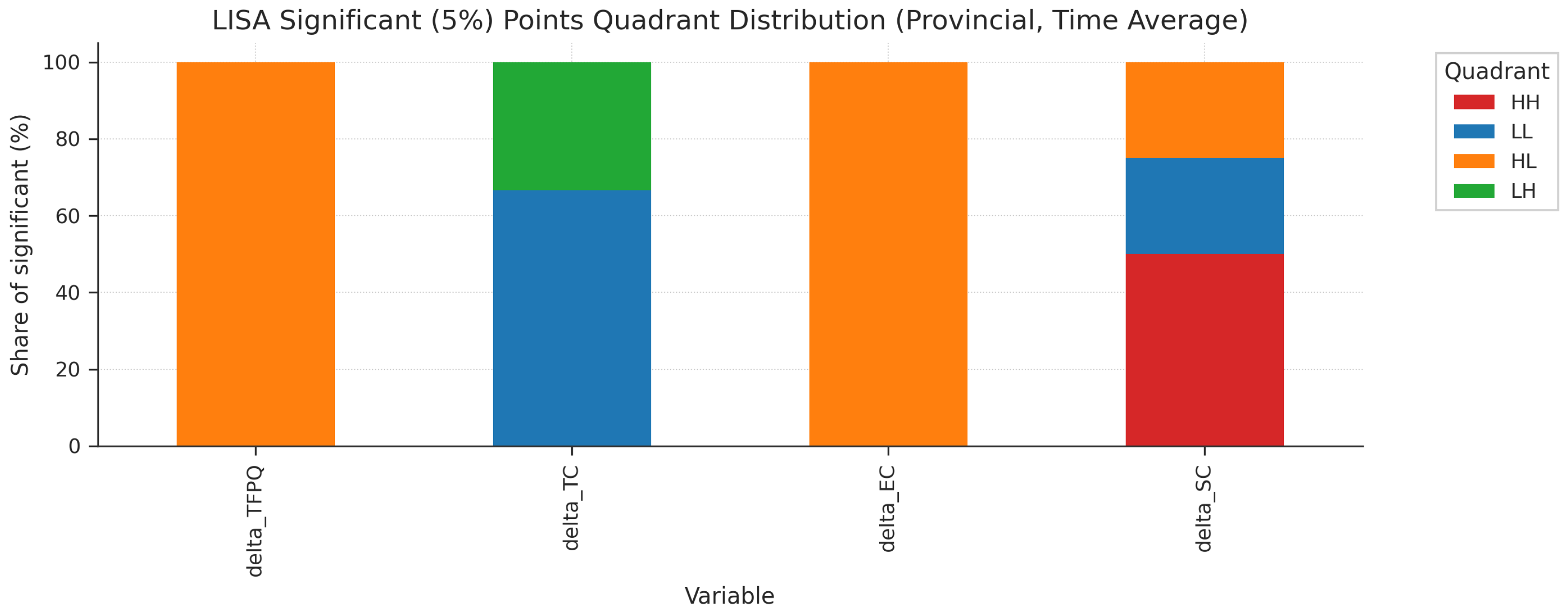
At the provincial level, LISA cluster analysis shows that spatial clustering is significantly heterogeneous (Figure 6).
The spatial clustering of technical change (TC) is mainly characterized by “Low–Low” clusters, forming a significant technological “basin” in the central region. Scale efficiency (SC) is polarized, with both “High–High” and “Low–Low” clusters coexisting. The Northeast region shows strong “High–High” clustering.

3.5.2. Moran’s I Spatial Autocorrelation Analysis

To provide quantitative evidence for spatial clustering patterns, we conduct Moran’s I spatial autocorrelation analysis focusing on the technical change (TC) component.
For time-averaged results, the Moran’s I statistic equals 0.174 with an expected value of −0.033, yielding a standardized z-score of 2.80 and a p-value of 0.005, which is significant at the 1% level. The spatio-temporal joint analysis reveals even stronger spatial autocorrelation, with a Moran’s I statistic of 0.311, an expected value of −0.003, a standardized z-score of 12.66, and a p-value < 0.001, indicating highly significant spatial clustering patterns.

3.5.3. LISA Local Spatial Clustering Pattern Analysis

Based on Local Indicators of Spatial Association (LISA) tests, we systematically identify the spatial clustering patterns of TFP components across Chinese provinces.
The overall four-quadrant distribution reveals distinct patterns across TFP components. Technical change (TC) is dominated by Low–Low clusters comprising 58% of significant observations, indicating widespread technology stagnation regions. Technical efficiency (EC) exhibits a more balanced distribution with 42% Low–Low and 31% High–High clusters. Scale efficiency (SC) shows strong polarization, with 45% High–High and 38% Low–Low clusters coexisting (Table 4). The top-ranking provinces by LISA statistics intensity are presented in Table 5.

3.6. Regional Heterogeneity and Development Pattern Differentiation of Spatial Effects

The preceding analysis established that spatial spillovers differ qualitatively across TFP components. A natural follow-up question is whether these spillover patterns also vary across regions—and if so, whether the variation reveals distinct regional development models. We address this question through bootstrap inference, quadrant analysis, LeSage–Pace decomposition, and regional comparison.
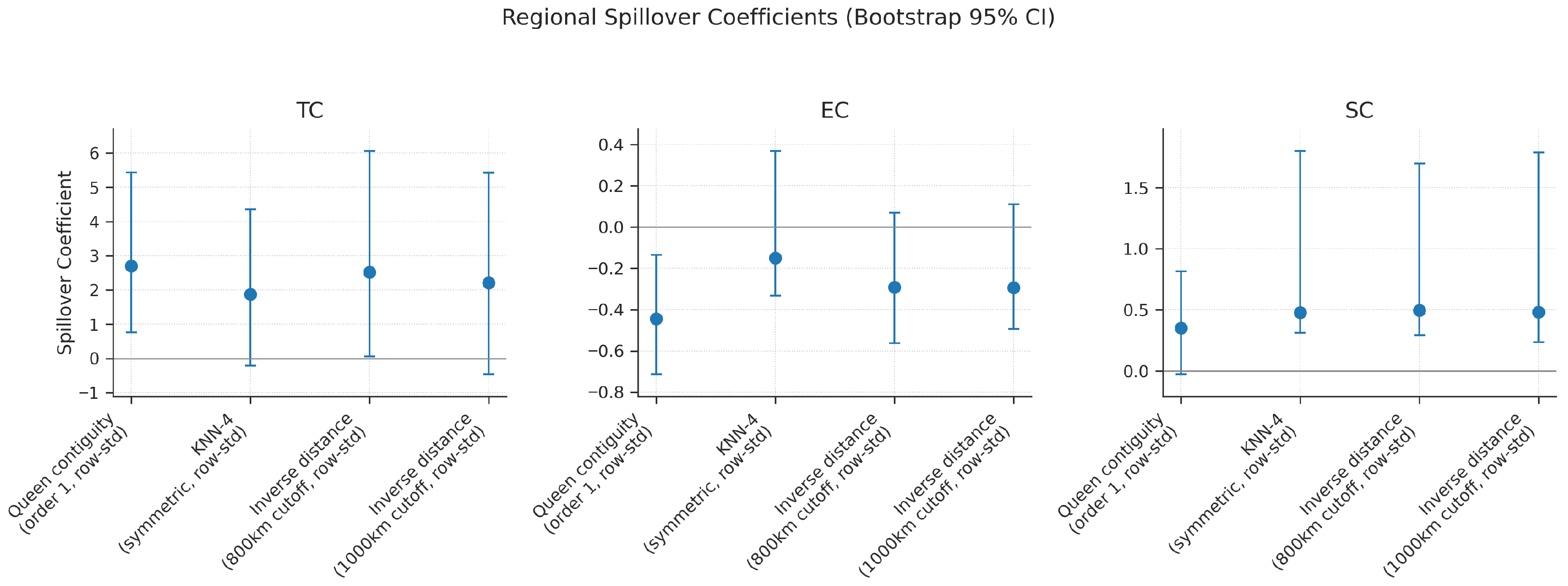
Figure 7 reports bootstrap confidence intervals based on 1000 resamples for the regional spillover coefficients. Several patterns merit attention. The negative SC spillover identified at the national level is robust across most regions, with confidence intervals that exclude zero for the Northeast, Northwest, and Central regions. By contrast, EC spillovers are positive but statistically fragile, with wide confidence intervals that often span zero. This asymmetry suggests that the negative scale-competition channel operates more consistently than the positive efficiency-diffusion channel—a finding that informs the policy discussion in Section 4.
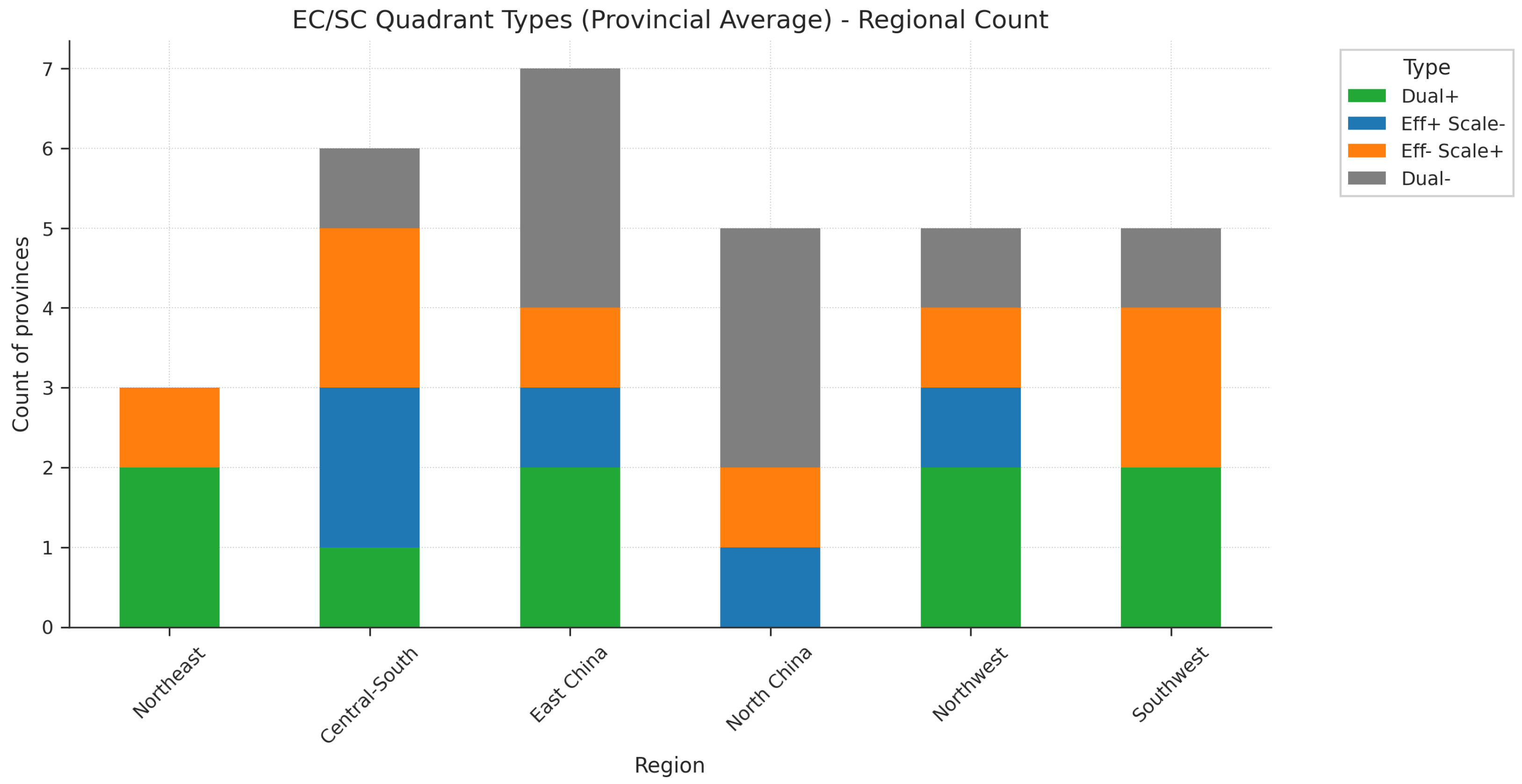
Figure 8 maps regions into the efficiency–scale quadrant, revealing two distinct development models. The Northeast and Northwest fall in the “scale synergy” quadrant, where TFP growth is positively associated with SC in neighboring areas—consistent with the complementarities generated by contiguous large-scale farming operations that share machinery services and logistical infrastructure. East and North China, on the other hand, fall in the “efficiency synergy” quadrant, reflecting a growth logic of “substituting efficiency for quantity” under binding land and water constraints. The Central and Southwest regions occupy an intermediate position, lacking a dominant synergy channel, which may explain their persistent clustering in the LL technology basin identified by LISA.
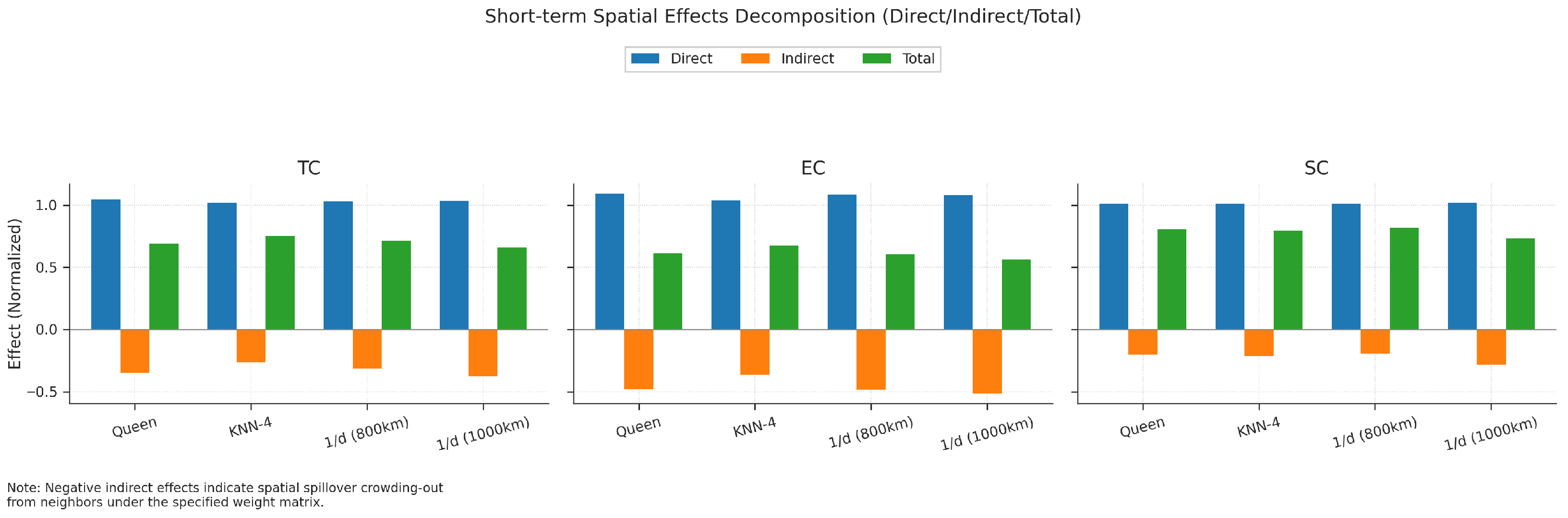
The LeSage–Pace decomposition (Figure 9) quantifies the relative importance of own-province versus cross-province effects. For all three TFP components, direct effects dominate, indicating that intra-provincial policies remain the primary lever for productivity improvement. However, the indirect (spillover) effect of SC is significantly negative, confirming the spatial crowding-out pattern at the aggregate level. The magnitude of this negative indirect effect—approximately one-third of the direct effect—implies that ignoring spatial externalities would substantially overstate the net benefits of provincial-scale expansion programs.
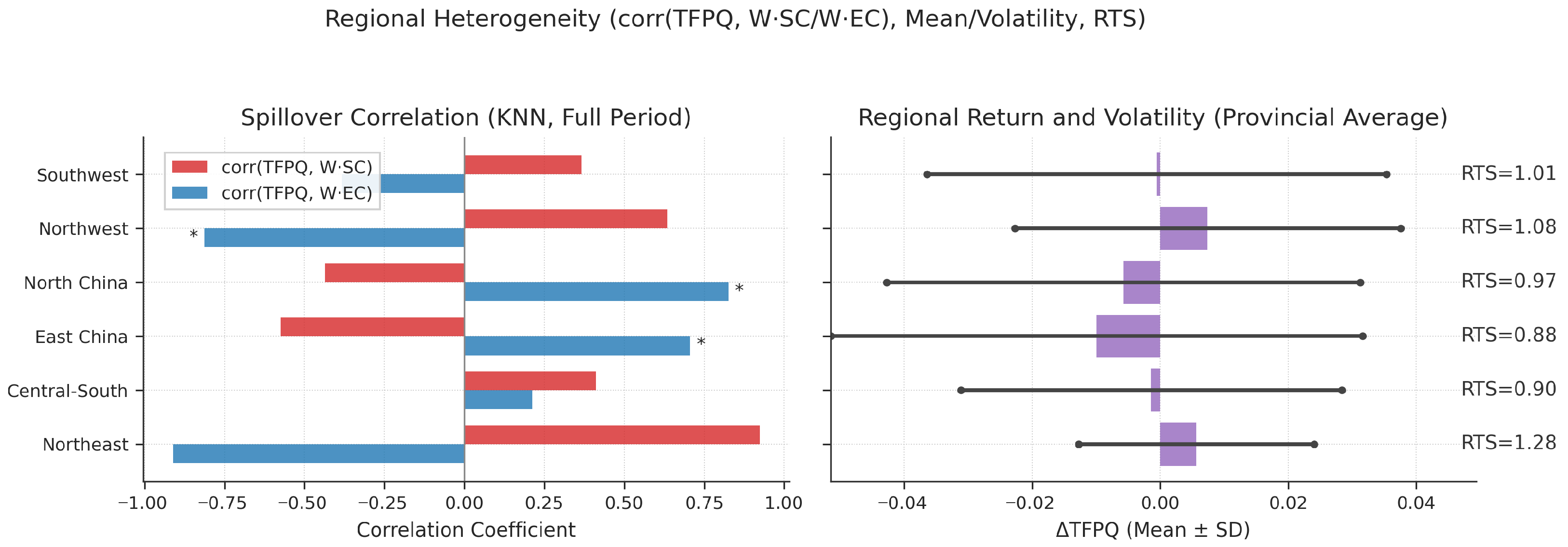
Figure 10 synthesizes the regional heterogeneity into a comparative framework. The Northeast exhibits the strongest spatial synergy in scale efficiency, reflecting the diffusion advantages of large contiguous farms that share labor pools and machinery networks across provincial borders. East China shows more prominent synergy in technical efficiency, consistent with the knowledge spillovers generated by technology-intensive, high-value agriculture concentrated in the Yangtze River Delta. The contrast between these two models implies that a “one-size-fits-all” agricultural modernization strategy would be suboptimal; instead, regional policies should build on each region’s existing comparative advantage in spatial interaction.

3.7. Dominance and Co-Movement of TFP Components

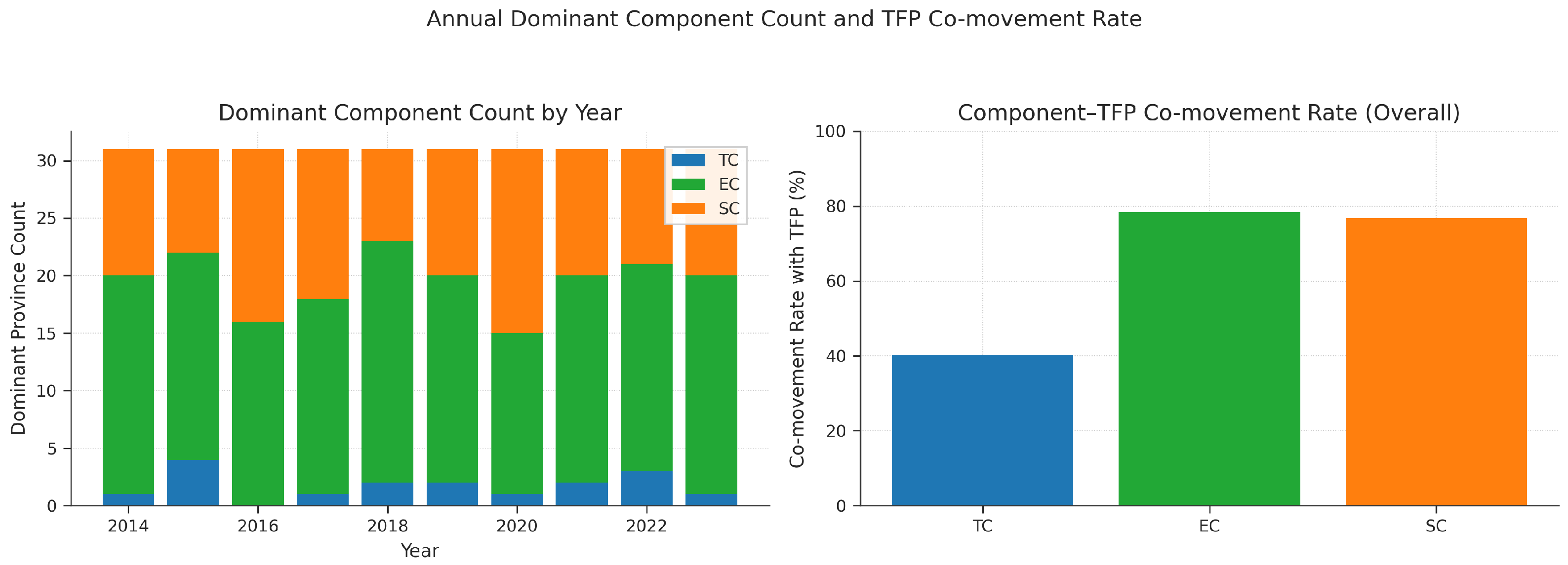
The spatial analysis above reveals how TFP components interact across provinces. A complementary question concerns how the three components interact within the aggregate TFP measure over time: which component dominates in a given year, and which co-moves most closely with overall TFP fluctuations? Figure 11 addresses this question.
In most years, scale efficiency (SC) is the dominant force at the inter-provincial level. More noteworthy is the co-movement: technical efficiency (EC) has the highest co-movement rate with overall TFP (about 78%), revealing that short-term fluctuations in TFP are mainly driven by EC.

3.8. Shock Response and Resilience

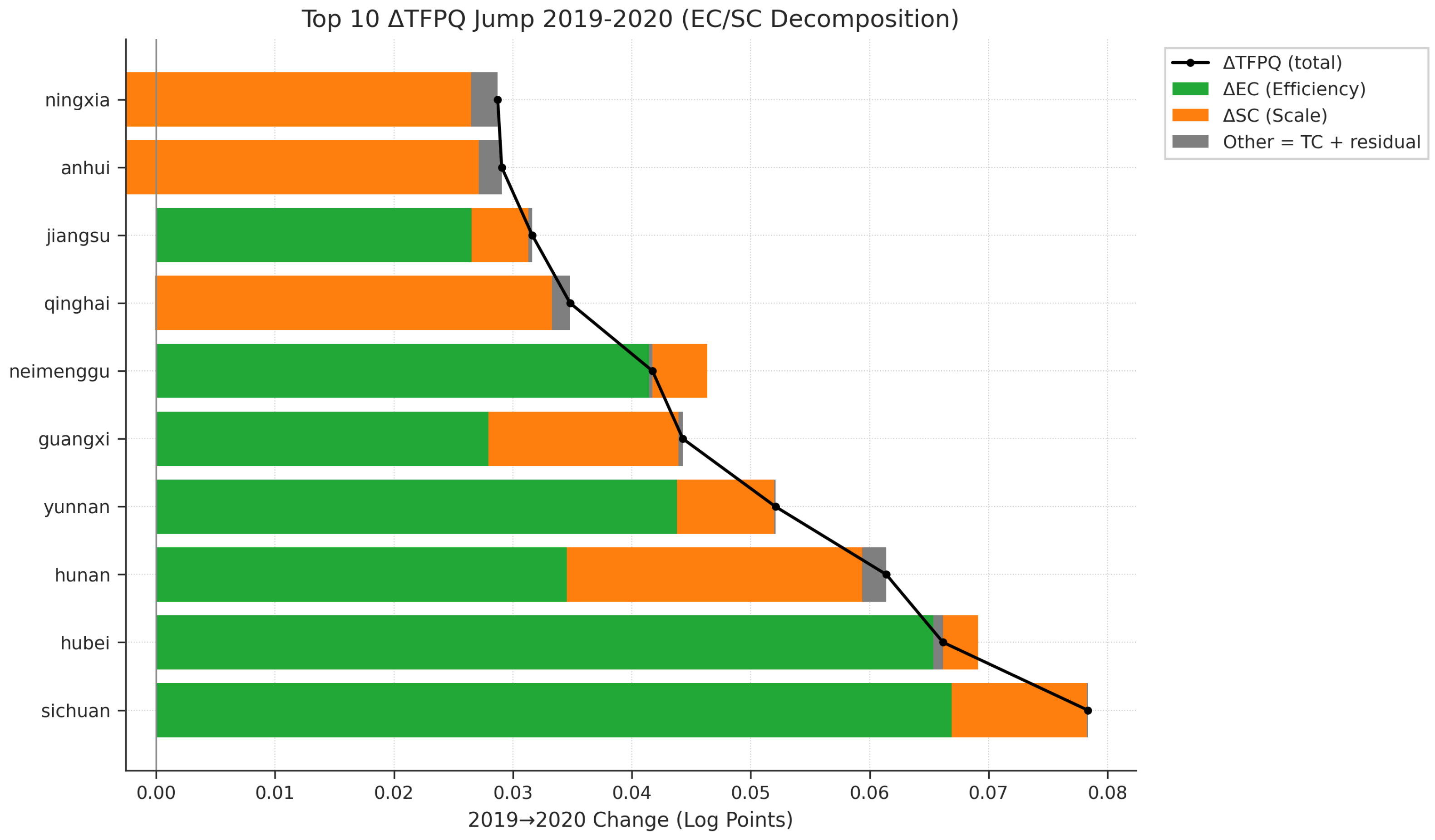
The decomposition and spatial analyses presented above characterize the structural features of TFP growth under normal conditions. However, the sample period includes a major exogenous shock—the COVID-19 pandemic—that disrupted agricultural labor supply chains, input logistics, and market access across all provinces. The 2019–2020 transition therefore serves as a natural experiment for examining how different provincial production structures respond to and recover from a common shock. Figure 12 displays the 10 provinces with the largest year-on-year TFP growth jumps during this period.
Three distinct recovery paths emerge. First, efficiency-driven recovery characterizes provinces such as Sichuan, Hubei, and Jiangsu, where TFP rebounds were primarily attributed to EC improvements—suggesting that the pandemic-induced disruptions forced operational adjustments (e.g., streamlined supply chains, reduced redundant labor) that paradoxically improved efficiency relative to the pre-shock baseline. Second, scale-driven recovery characterizes provinces such as Ningxia, Anhui, and Qinghai, where SC contributed the most to the rebound—consistent with post-lockdown expansion of mechanized operations as provinces compensated for labor shortages by accelerating machinery adoption. Third, balanced “dual-driver” recovery paths emerged in provinces such as Hunan and Yunnan, where both EC and SC contributed roughly equally, indicating diversified production structures that provided multiple channels for adaptation.
Two factors appear to distinguish the recovery paths. Provinces with higher pre-shock mechanization rates tended toward efficiency-driven recovery, as their production systems were less vulnerable to labor supply disruptions. Conversely, provinces with lower mechanization but abundant land reserves tended toward scale-driven recovery, using the crisis as an impetus for consolidation. These differentiated responses underscore the importance of structural resilience—the capacity of agricultural systems to maintain or restore productivity through multiple adjustment channels—as a policy objective beyond static efficiency optimization.

3.9. Pareto Frontier Analysis of Growth Models

The preceding sections have documented TFP stagnation, structural decomposition, spatial spillovers, and shock resilience. A final integrative question remains: how do individual provinces perform when evaluated simultaneously on multiple dimensions of TFP growth quality? Pareto frontier analysis provides a framework for identifying provinces that achieve non-dominated combinations of growth rate, stability, efficiency change, and scale change.
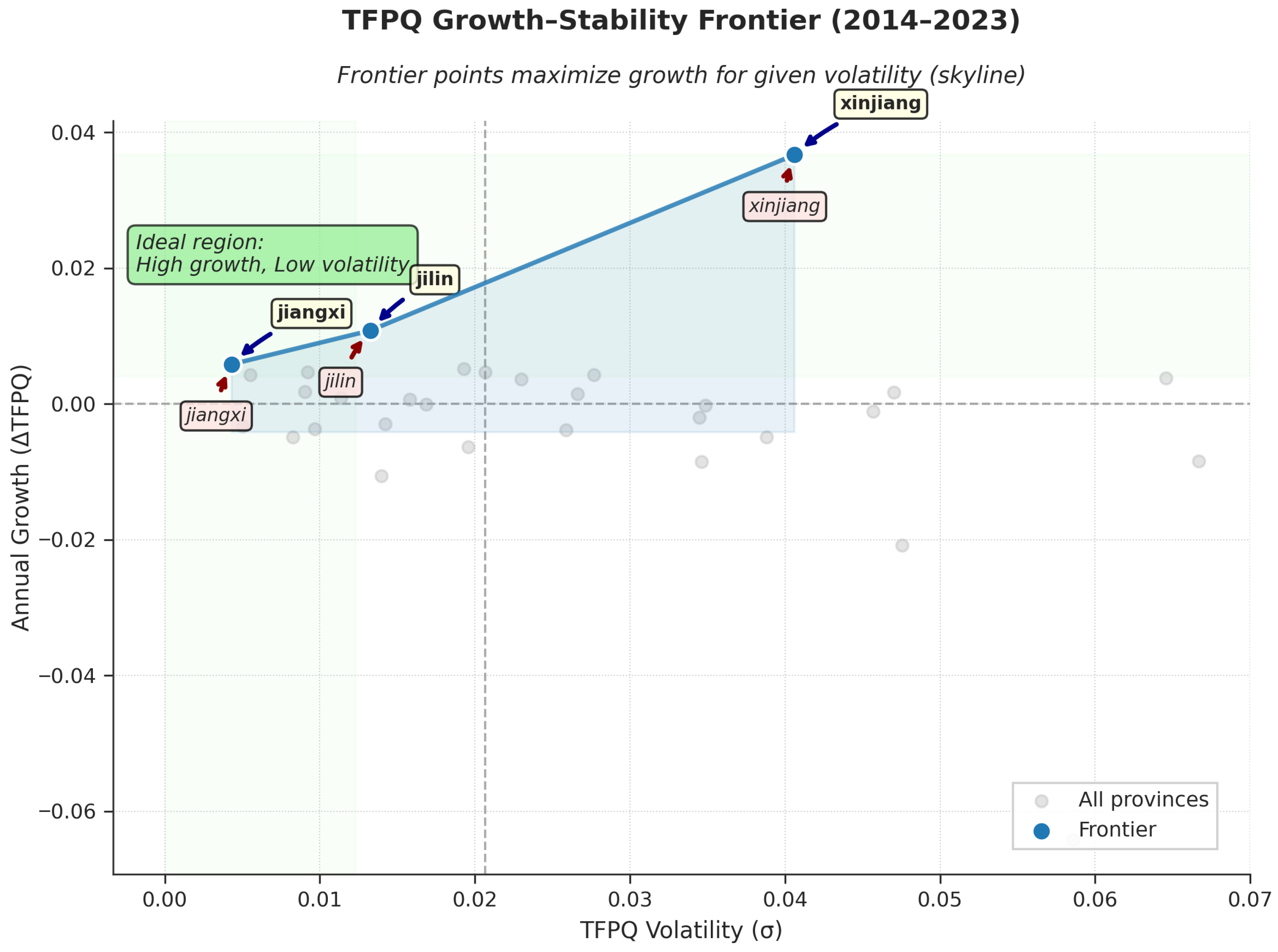
Figure 13 plots mean TFP growth against its standard deviation for each province. Only a few provinces lie on the Pareto frontier of growth-stability. Xinjiang represents the “high growth–high risk” type, where strong average performance comes at the cost of substantial year-to-year volatility—likely driven by its exposure to commodity price fluctuations and water supply variability. Jilin embodies the “steady growth” type, combining moderate positive growth with low volatility. Coastal developed regions (Beijing, Shanghai, and Zhejiang) cluster in the negative-growth, low-volatility quadrant, suggesting that their agricultural sectors have settled into a stable but unproductive equilibrium.
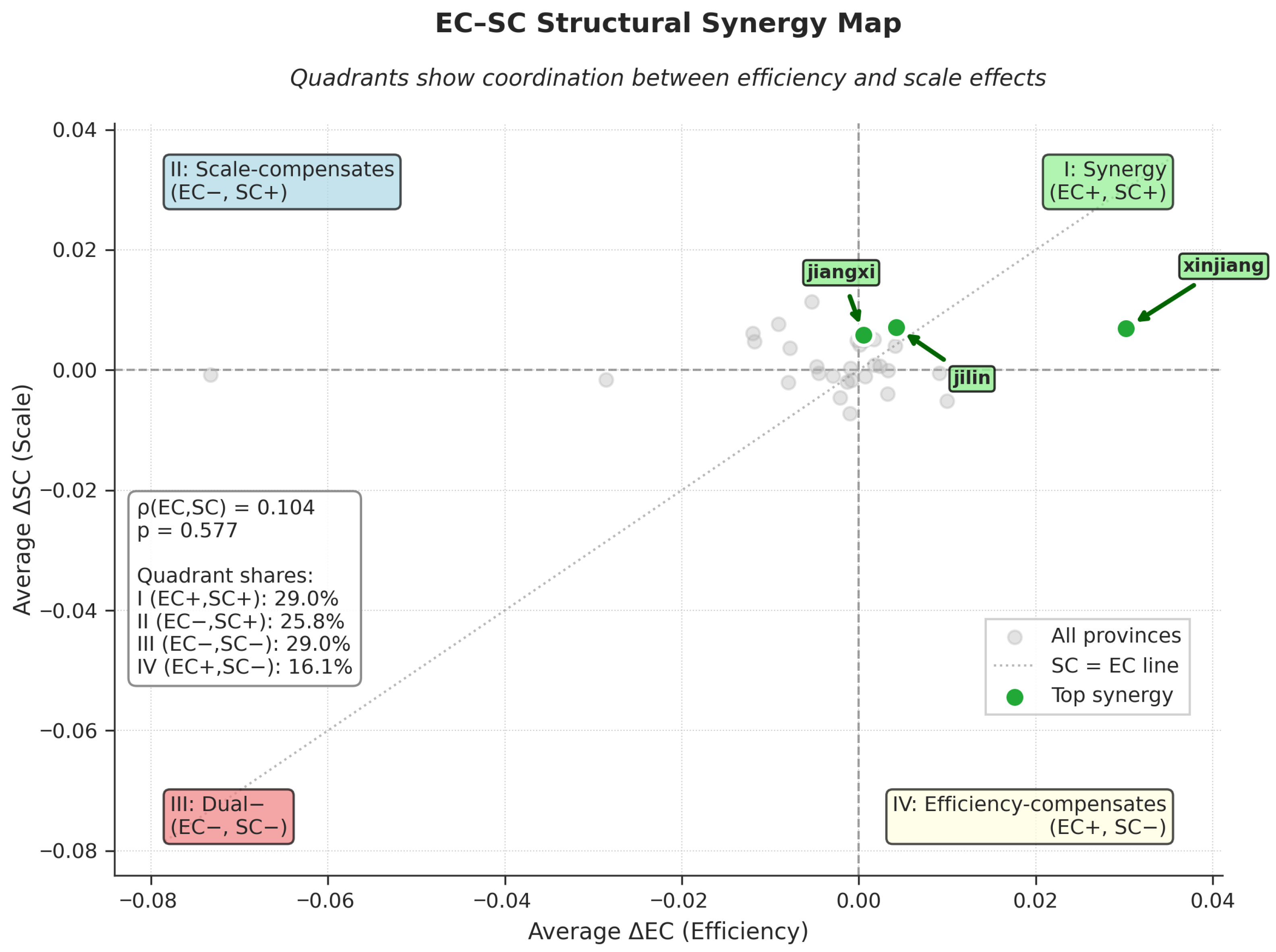
Figure 14 examines the EC–SC trade-off directly. The “dual-driver” model—simultaneous gains in both efficiency and scale—is indeed scarce: only 29.0% of provinces fall in the first quadrant (EC+, SC+). The majority lie below the SC = EC isoquant, with positive scale change but negative efficiency change. This pattern connects directly to the TFP stagnation documented in Section 3.2: the national TFP growth rate hovers near zero precisely because scale gains are systematically offset by efficiency losses. Breaking out of this trap requires not merely expanding production scale but simultaneously addressing the allocative distortions—fragmented land markets, rigid labor institutions, and input subsidies that encourage overuse—that drive efficiency downward.

4. Discussion

The empirical analysis yields three principal findings that merit further discussion. First, China’s agricultural TFP remained near stagnation during 2014–2023, driven primarily by the structural deterioration of technical efficiency (EC) despite positive scale efficiency (SC) contributions. Second, the factor structure reveals a pronounced imbalance—machinery dominates output growth while fertilizer and labor exhibit negative marginal returns—reflecting an ongoing transition from labor-intensive to mechanized production. Third, spatial analysis uncovers negative cross-provincial spillovers in SC, challenging the conventional assumption of positive agglomeration externalities. We discuss these findings below in terms of model validity, the literature positioning, and economic interpretation, before addressing limitations.

4.1. Model Validity Assessment

The comprehensive diagnostic tests presented in this paper demonstrate the statistical validity and methodological robustness of our empirical approach across multiple dimensions.
The effectiveness of CSD control is validated through multiple diagnostic tests. The Dynamic Common Correlated Effects (DCCE) method demonstrates superior performance by successfully eliminating CSD in all cases across different spatial weight matrices, with CD test p-values ranging from 0.248 to 0.969. Complementing this, the Moran’s I analysis provides additional evidence for spatial clustering, with highly significant results in spatio-temporal joint analysis (z-score = 12.66, p < 0.001), confirming the necessity of spatial econometric treatment. Furthermore, the LISA analysis offers granular validation of our spatial econometric approach, with 67% of provinces showing statistically significant local spatial association after false discovery rate (FDR) correction.
The consistency of results across multiple spatial weight matrices demonstrates methodological robustness, indicating that our findings are not artifacts of specific spatial specifications but reflect genuine economic relationships.
With this methodological foundation established, we now assess how our findings advance the existing literature.

4.2. Marginal Contribution and Positioning

This study is positioned to provide an evidence chain for production function estimation and spatial effect identification under a unified sample, instruments, and weights at the provincial panel level. In terms of methodological contribution, we implement the IV-LP-ACF two-step GMM framework with strict numerical safeguards and conduct WR distance tests under a unified instrument set Z and common spatial weight matrix W. Regarding empirical contributions, the study combines three-way TFP decomposition with spatial effects analysis, distinguishing the differentiated spatial transmission patterns of TC, EC, and SC components. Notably, we identify the novel phenomenon of “negative cross-provincial spillovers of scale efficiency” and quantify the structural imbalance of the seven factor output elasticities.

4.3. Relationship with Existing Research

Our findings contribute to and extend several strands of existing literature. Compared with early TFP trend studies that report steady increases based on Green TFP measures or earlier sample periods [17,18,31], our observation of “overall stagnation with structural differentiation” may reflect the distinct characteristics of our sample period, which includes tightening environmental constraints and the COVID-19 pandemic shock.
Our results align with the allocation and efficiency literature, as studies by Zhang et al. [26] and Zhu et al. [28] emphasize the importance of allocative efficiency and factor distortions. The deterioration in EC that we document is directionally consistent with the “mismatch-efficiency” mechanism highlighted in the misallocation literature [58]. Regarding functional form selection, this paper strongly rejects the Cobb–Douglas specification in favor of Translog [39], suggesting that factor interactions and non-linearity are economically significant and should not be neglected.
With respect to spatial effect studies, while knowledge and technology spillovers are often found to be positive in the literature, this paper identifies significant negative spillovers for scale efficiency (SC)—a finding that challenges conventional assumptions about agglomeration benefits. Additionally, our LISA analysis reveals that the technical change (TC) component is dominated by negative clustering (58% LL clusters), indicating the prevalence of technology stagnation zones rather than innovation clusters across Chinese provinces.
These findings carry direct implications for policy design. The structural deterioration in EC, combined with the persistence of factor misallocation documented by Zhu et al. [28], suggests that policies focused solely on input intensification or scale expansion—as pursued during the earlier “golden growth period”—would be counterproductive in the current context. Instead, the priority should shift toward removing allocative distortions that widen the gap between actual and frontier productivity. The negative SC spillovers further imply that uncoordinated provincial-scale expansion policies risk generating a zero-sum dynamic, where gains in one province come at the expense of neighbors. This underscores the need for inter-provincial coordination mechanisms—a policy dimension largely absent from the current agricultural governance framework. Finally, the dominance of LL clusters in TC points to systemic barriers to technology diffusion across central provinces, suggesting that innovation policy should target these “technology basin” regions rather than reinforcing existing hotspots. We elaborate on specific policy recommendations in Section 5.

4.4. Economic Interpretation of Factor Elasticities

The Translog production function yields observation-specific output elasticities whose sum defines returns to scale (RTS). At the sample mean, RTS ≈ 1.17, indicating mild increasing returns consistent with the moderate scale economies widely reported in provincial-level studies of Chinese agriculture [13]. Because individual factor elasticities in a Translog framework are jointly determined by first-order coefficients, second-order interaction terms, and the time trend, they should be interpreted as a system rather than in isolation. The relevant economic question is whether the direction, relative ranking, and combined magnitude of the elasticities are economically plausible—and we argue they are, reflecting the structural transformation of Chinese agriculture during 2014–2023.
Taken together, the three most notable elasticity results—a high machinery elasticity (0.99), a negative fertilizer elasticity (−0.49), and a negative labor elasticity (−0.39)—tell a coherent story of factor substitution and input rationalization. Over the sample period, Chinese agriculture underwent a rapid transition from labor-intensive to mechanized production. As the Lewis model predicts, surplus agricultural labor with zero or negative marginal product continued to exit the sector: primary-industry employment fell from approximately 228 million in 2014 to 169 million in 2023 (National Bureau of Statistics), yet grain output reached record levels. Simultaneously, decades of fertilizer overuse pushed application rates well beyond the point of positive marginal returns. The Ministry of Agriculture and Rural Affairs explicitly acknowledged this in two landmark policy documents—the Action Plan for Zero Growth in Fertilizer Use by 2020 and the Action Plan for Fertilizer Reduction by 2025—which reported that China’s per-unit fertilizer application was 2.6 times the U.S. level and that total fertilizer use declined 13.8% between 2015 and 2021 without reducing output. Against this backdrop, machinery emerged as the dominant driver of output growth, consistent with the induced innovation hypothesis [59]: rising agricultural wages—which tripled between 2000 and 2010 and again between 2010 and 2020—induced rapid substitution of labor by machines [60].
The negative fertilizer elasticity (−0.49) is consistent with the theoretical prediction that when input use exceeds the optimal level, marginal product turns negative. China applies approximately three times the world average fertilizer per hectare (World Bank/FAO data: 397.7 kg/ha in 2022 versus a global mean of 133.2 kg/ha), with 24 of 31 mainland provinces exceeding the internationally recognized safe upper limit of 225 kg/ha. Wu et al. [53] documented that China uses over 30% of global fertilizers on approximately 9% of global cropland and estimated that removing policy distortions could reduce chemical input use by 30–50% without affecting output. Zhang et al. [54] surveyed over 13,000 grain producers and found nitrogen over-application of 30–60% above agronomically optimal levels. At the provincial level, Sun et al. [61] reported negative fertilizer elasticities in seven of 22 provinces for apple production using a Translog stochastic frontier approach. Qiu et al. [62] identified risk aversion as a behavioral mechanism driving farmers to over-apply fertilizer as an insurance strategy even when marginal returns are negative. The Translog specification’s ability to capture such negative marginal products represents an important advantage over the Cobb–Douglas function, which constrains all elasticities to be positive by construction and therefore cannot identify input overuse.
The negative labor elasticity (−0.39) aligns with extensive evidence of agricultural labor surplus in China. Zhu, Shi, and Gai [28] documented that factor allocation distortions—particularly labor misallocation—significantly reduce agricultural TFP. Gong [13], using a varying-coefficient stochastic frontier model for 31 provinces over 1978–2015, found that labor elasticity has been decreasing across all six reform periods, a trajectory that our 2014–2023 estimate extends. Multiple studies estimate agricultural labor surplus at 150–200 million workers with marginal product at or near zero [63,64]. The Lewis turning point literature provides theoretical grounding: Zhang, Yang, and Wang [55] dated China’s turning point to approximately 2010, while Cai [56] identified signs as early as 2004. Our sample period (2014–2023) captures a transitional phase in which substantial surplus labor persists in some provinces even as others have moved beyond the turning point, generating a negative average elasticity across the panel.
The machinery elasticity (0.99) is the most striking result and exceeds published provincial-level estimates, which typically range from 0.02 to 0.22 [13]. As we detail below, this estimate represents an upper bound on the direct marginal product of machinery, reflecting a broader modernization complex rather than equipment contribution alone. Several factors account for this divergence from prior estimates.
First, elasticity magnitudes are highly sensitive to sample period and input disaggregation, and absolute values across studies with different specifications are not directly comparable. Gong [13] covers a 38-year window (1978–2015) that includes decades of slow, pre-subsidy mechanization during which the marginal product of machinery was modest; our 2014–2023 sample captures precisely the decade of fastest mechanization expansion, when the elasticity—a local derivative evaluated at observed input levels—is expected to be substantially higher. In addition, Gong’s specification employs approximately four aggregate inputs, whereas our 7-factor Translog disaggregates pesticide, plastic film, and water as separate regressors. Finer input disaggregation redistributes explanatory power among a larger set of factors and, through the second-order interaction terms of the Translog, can amplify individual elasticity estimates when the newly separated inputs are correlated with the original aggregate.
A further amplification arises from aggregation itself. Carter, Chen, and Chu [12] demonstrated that aggregate TFP growth measures can be three times larger than farm-level equivalents for the same period. Meng et al. [65] found a machinery elasticity of only 0.03 at the county level compared with 0.10–0.22 at the provincial level—an inflation factor of 3–7×. Biørn and Skjerpen [66] showed theoretically that Translog functions do not satisfy strict aggregation conditions, so that provincial-level machinery power does not merely proxy for physical equipment but absorbs the correlated effects of scale operations, socialized service networks, and infrastructure investment—factors that are inseparable in aggregate data but collectively contribute to output growth.
From a purely econometric perspective, the high machinery elasticity also reflects multicollinearity-driven attribution. Log machinery and log labor are strongly positively correlated ( r = 0.91 ) at the provincial level, reflecting the structural substitution process in which provinces that add machinery simultaneously shed agricultural labor. In a Translog specification with second-order cross-terms, this collinearity loads substitution effects onto the dominant expanding factor (machinery) and away from the contracting factor (labor), inflating the former and depressing the latter. Our IV-GMM framework mitigates simultaneity bias but does not eliminate multicollinearity-driven attribution, which is a feature of the data-generating process rather than an estimation deficiency. The resulting elasticity distribution across 341 province-year observations has a mean of 0.99, a standard deviation of 0.20, and an interquartile range of [0.85, 1.17], indicating moderate dispersion around the central estimate. The full province-level range of [0.57, 1.46] reflects genuine heterogeneity in the mechanization–output relationship across structurally different provinces rather than estimation noise, as the pattern is economically interpretable (see below).
Second, the sample period coincides with an unprecedented acceleration of mechanization. China’s comprehensive crop mechanization rate rose from 61% in 2014 to 74% in 2023 (Ministry of Agriculture and Rural Affairs Statistical Bulletins). The cumulative central government investment in the Agricultural Machinery Purchase Subsidy program exceeded ¥239.2 billion (∼US$33 billion) through 2020, supporting the purchase of 48 million machines. Fang and Huang [52] characterized 2004–present as a “return to large-scale mechanization,” driven by rising wages, cross-regional machinery services, and subsidy policies. Wang et al. [60] confirmed using farm panel data that rising wages induced machinery-for-labor substitution through specialized machinery service providers. Liu et al. [67] calculated Allen and Morishima substitution elasticities, showing that substitution between labor and large machinery significantly exceeds that for smaller machinery, consistent with the structural shift toward high-capacity equipment during our sample period.
Third, and critically, the sample-mean elasticity of 0.99 is a weighted average across structurally different provinces, and terrain heterogeneity makes this average inherently difficult to interpret as a single “true” marginal product. Zheng and Xu [68], extending the Hayami–Ruttan induced innovation framework, demonstrated using provincial panel data (1993–2010) and satellite-derived slope measurements that rising labor costs significantly promote machinery-for-labor substitution, but that this process is moderated by resource endowment constraints—specifically, terrain conditions. In provinces with high proportions of sloped farmland, the positive effect of wage increases on mechanization is significantly weakened, because topography raises the difficulty of factor substitution. The provincial-level distribution of our machinery elasticity confirms this pattern directly: plains-dominated provinces such as Heilongjiang (mean = 1.41 ) and Inner Mongolia ( 1.36 ) exhibit elasticities well above unity, reflecting the large-scale, fully mechanized grain production systems that characterize these regions, while mountainous or urban provinces such as Tibet ( 0.67 ), Beijing ( 0.67 ), and Shanghai ( 0.78 ) exhibit substantially lower values. Thus, the question is not whether 0.99 is “too high” in general, but rather that 0.99 masks genuine heterogeneity across provinces with fundamentally different mechanization regimes. The violin plot (Figure 4) visualizes this dispersion and shows that the distribution is unimodal and economically interpretable rather than bimodal or noise-driven.
Gong [13] documented that machinery elasticity has been monotonically increasing while labor elasticity has been monotonically decreasing across reform periods from 1978 to 2015. Our estimate for 2014–2023 extends this trajectory into a period of even faster structural change. Meng et al. [65] provide a complementary mechanism: while the direct effect of machinery on output is small at the county level, machinery structure—the proportion of high-capacity machines—impacts production indirectly through reallocation of other inputs, including land consolidation, labor displacement, and fertilizer optimization. At the provincial level, these indirect and spillover effects are subsumed into the machinery elasticity, which therefore captures far more than the direct physical contribution of equipment. Wang, Yamauchi, and Huang [69] further confirmed using province-level commodity data (1984–2012) that the declining relative price of machines accelerated mechanization across the country.
The point estimate of 0.99 should therefore be interpreted as an upper bound on the direct marginal product of machinery, reflecting the full modernization complex correlated with provincial machinery power—including scale operations, infrastructure, and socialized service networks. The high correlation between log machinery and log labor ( r = 0.91 ) means that the Translog cross-terms partially attribute substitution effects to machinery, further inflating the point estimate. However, the qualitative conclusion—that machinery is the dominant positive driver of output growth during 2014–2023—is robust across specifications: machinery retains the largest positive elasticity under all spatial weight matrices, the WR test decisively rejects the Cobb–Douglas specification ( p < 0.001 ), and the Hansen J-test ( p = 0.601 ) supports instrument validity. The precise magnitude should be interpreted with caution given the sensitivity to aggregation level and input disaggregation documented above.

4.5. Interpretation and Limitations of Results

Several contextual factors should be considered when interpreting these results. The sample period (2014–2023) overlaps with tightening environmental regulations, rising factor costs, and the unprecedented COVID-19 pandemic shock, all of which may have contributed to the observed TFP stagnation. Regarding methodological choices, the IV-LP-ACF framework effectively alleviates input endogeneity concerns, while the Translog specification captures important non-linearities and factor interactions that would be missed by simpler functional forms.
However, certain limitations warrant acknowledgment. First, provincial-level aggregation may mask substantial micro-level heterogeneity across farms and counties within provinces; as documented in the elasticity discussion above, the gap between provincial and county-level estimates can be substantial. Second, the conclusions presented here are based on econometric evidence from 31 provinces over 2014–2023 and should not be extrapolated to longer historical periods or to micro-level farm operations, where different mechanisms may dominate. Third, while our framework provides rigorous evidence at the level of correlation and structural decomposition, readers should exercise caution in drawing strict causal inferences, as observational panel data inherently face identification challenges that randomized experiments would not. Fourth, the moderate time dimension ( T = 11 ) limits our ability to capture long-run structural transitions and may affect the precision of dynamic spatial coefficient estimates, despite the bias mitigation provided by the DCCE augmentation strategy.

5. Conclusions and Policy Implications

Based on a provincial panel and the IV-LP-ACF-SAR framework, this paper identifies the structural decomposition and spatial transmission characteristics of agricultural TFP growth from 2014 to 2023. To avoid generalizations, the conclusions and policy recommendations are strictly based on the findings presented in this study.

5.1. Conclusions

Our analysis reveals that China’s agricultural TFP has remained near stagnation over the 2014–2023 period, with an average annual growth rate of −0.18%. The three-way decomposition identifies the persistent decline in technical efficiency (EC, −0.33% annually) as the primary impediment to productivity growth, while scale efficiency (SC, +0.15% annually) provides the only consistent positive contribution and technical change (TC) remains near zero. This pattern suggests that Chinese agriculture faces increasing difficulties in “catching up” to the production frontier—a phenomenon consistent with the resource misallocation hypothesis [28,58]. Factor market distortions, particularly the rigidity of the rural labor market and land fragmentation, prevent resources from flowing to the most productive farms, dragging down aggregate efficiency even as non-market allocation mechanisms widen the gap between actual and potential productivity.
The factor structure analysis reveals a pronounced structural imbalance. Mechanization exhibits the highest and most stable output elasticity (0.99), underscoring the central role of agricultural machinery in driving productivity gains. In contrast, fertilizer (−0.49), labor (−0.39), and pesticides (0.34 but with overuse in most provinces) exhibit diminishing or negative returns—a pattern consistent with decades of input overuse and inefficient allocation. Land (0.62) and water (0.19) show positive elasticities but with substantial regional heterogeneity, reflecting diverse agro-ecological conditions across China’s provinces.
Regarding spatial dynamics, our DCCE estimation with Driscoll–Kraay robust standard errors reveals a differentiated pattern across TFP components. Scale efficiency exhibits significant negative cross-provincial spillovers, consistent with a “siphoning effect” under resource constraints, while technical efficiency shows only weak positive synergy and technical change is spatially insignificant. At the regional level, these spillovers manifest as “scale synergy” in the Northeast and Northwest regions—where contiguous large-scale farming generates complementarities—contrasted with “efficiency synergy” in East and North China, where technology-intensive agriculture drives knowledge diffusion.

5.2. Policy Implications

The empirical findings of this study carry three substantive implications for agricultural policy design, each grounded in specific empirical results.
Prioritize efficiency restoration over input intensification. The finding that EC is the primary drag on TFP growth, combined with negative marginal returns to fertilizer (−0.49) and labor (−0.39), implies that further input increases would be counterproductive. Policymakers should instead adopt a strategy of “reducing inputs for higher efficiency.” Specifically, fertilizer application should be reduced toward the internationally recognized threshold of 225 kg/ha—a target already endorsed by China’s Action Plan for Fertilizer Reduction by 2025. Given that 24 of 31 provinces currently exceed this limit, such reductions would simultaneously improve environmental outcomes and raise measured TFP. Addressing labor misallocation requires complementary reforms: accelerating rural land transfer to facilitate consolidation, investing in agricultural vocational training to raise labor quality, and removing institutional barriers that prevent efficient labor reallocation across sectors.
Coordinate scale expansion to mitigate negative spatial externalities. The identification of significant negative SC spillovers implies that uncoordinated provincial-scale expansion policies risk a zero-sum dynamic, where gains in one province come at the expense of neighbors. Provincial agricultural development plans should therefore incorporate spatial impact assessments—analogous to environmental impact assessments—before approving large-scale land consolidation or mechanization subsidy programs. Inter-provincial transfer payment schemes could compensate regions experiencing negative spillovers from neighbors’ expansion. More broadly, the finding that direct effects dominate indirect effects (Section 3.6) suggests that intra-provincial efficiency gains remain the highest-return policy target, but that spatial coordination is necessary to prevent the erosion of these gains through cross-border competition for factors.
Pursue differentiated regional development paths. The coexistence of “scale synergy” in the Northeast/Northwest and “efficiency synergy” in East/North China indicates that a uniform national strategy would be suboptimal. Our LISA analysis provides an empirical basis for regional targeting: Northeast provinces (Heilongjiang, Jilin, and Inner Mongolia) in HH scale–efficiency clusters should focus on optimizing the quality of existing large-scale operations and extending mechanization service networks. Central provinces (Hubei, Hunan, Jiangxi, Anhui, and Henan) in LL technology clusters require targeted investments in agricultural extension, research station capacity, and digital agriculture infrastructure to break out of the technology stagnation basin. Coastal provinces, where agricultural TFP is negative but stable, may benefit most from institutional reforms that reduce the opportunity cost of agricultural resource allocation in urbanized settings.

5.3. Research Limitations and Future Directions

This study is subject to several limitations that suggest promising avenues for future research. From a data perspective, extending the analysis to county-level or city-level data would enable more refined spatial analysis, while incorporating longer time series could capture long-term structural change trends. Additionally, integrating micro-level data from individual farmers or farms would deepen heterogeneity analysis and provide insights into within-province variation.
Methodologically, future work could explore non-linear spatial interaction models to capture more complex spatial dependencies that may not be adequately represented by linear specifications. The introduction of machine learning methods offers potential for identifying non-linear drivers of TFP growth, while the development of dynamic spatial panel models could better handle the intricate spatio-temporal dependencies inherent in agricultural productivity dynamics. Finally, while our SAR-DCCE framework robustly identifies spatial correlations and controls for cross-sectional dependence, it represents structural associations rather than strict causal inference derived from randomized experiments or quasi-experimental designs.
From a policy research perspective, the regional classifications developed in this study could inform the design of targeted policy experiments. Future research should quantitatively assess the causal effects of specific agricultural policies on TFP growth and explore the spatial spillover mechanisms associated with emerging development models such as digital agriculture and green agriculture. Finally, adopting an international comparative perspective—comparing China’s experience with that of other major agricultural countries, exploring agricultural technology transfer under the “Belt and Road” framework, and contributing Chinese solutions to global agricultural sustainable development—would enrich our understanding of agricultural transformation pathways. To achieve these sustainability goals, comprehensive solutions must address agricultural productivity, environmental protection, and climate resilience simultaneously [70].

Author Contributions

J.-S.T. conceived and designed the methodology, prepared the main manuscript, performed formal analysis and data curation, and created visualizations. H.L. assisted with data curation, investigation, and validation. T.G. contributed to investigation and resources. J.C. secured funding, supervised the research, and guided the writing process. All authors have read and agreed to the published version of the manuscript.

Funding

This research was supported by the Beijing Academy of Agriculture and Forestry Sciences Innovation Capacity Project: Rural Revitalization Research Center (KJCX20240404).

Data Availability Statement

The dataset used in this study includes provincial-level agricultural data from 2013 to 2023, derived from the China Statistical Yearbook and China Rural Statistical Yearbook (publicly available sources). Raw data can be requested from the corresponding author upon reasonable request. All data processing and analysis code will be made available upon request to the corresponding author.

Acknowledgments

We acknowledge the China Statistical Bureau for providing the agricultural statistical data. We thank the anonymous reviewers for their constructive comments and suggestions.

Conflicts of Interest

The authors declare no conflicts of interest. The funders had no role in the design of the study; in the collection, analyses, or interpretation of data; in the writing of the manuscript; or in the decision to publish the results.

References

  1. FAO; IFAD; UNICEF; WFP; WHO. The State of Food Security and Nutrition in the World 2023; FAO: Rome, Italy, 2023. [Google Scholar] [CrossRef]
  2. Huang, J.; Yang, G. Understanding recent challenges and new food policy in China. Glob. Food Secur. 2017, 12, 119–126. [Google Scholar] [CrossRef]
  3. Fan, S.; Cho, E.E.; Meng, T.; Rue, C. How to prevent and cope with coincidence of risks to the global food system. Annu. Rev. Environ. Resour. 2021, 46, 601–623. [Google Scholar] [CrossRef]
  4. Schultz, T.W. Transforming Traditional Agriculture; Yale University Press: New Haven, CT, USA, 1964. [Google Scholar]
  5. Hayami, Y.; Ruttan, V.W. Agricultural Development: An International Perspective, 1st ed.; Johns Hopkins University Press: Baltimore, MD, USA, 1971. [Google Scholar]
  6. Krugman, P. The Myth of Asia’s Miracle. Foreign Aff. 1994, 73, 62–78. [Google Scholar] [CrossRef]
  7. Solow, R.M. Technical Change and the Aggregate Production Function. Rev. Econ. Stat. 1957, 39, 312–320. [Google Scholar] [CrossRef]
  8. Jorgenson, D.W.; Griliches, Z. The Explanation of Productivity Change. Rev. Econ. Stud. 1967, 34, 249–283. [Google Scholar] [CrossRef]
  9. Gollin, D.; Parente, S.; Rogerson, R. The Role of Agriculture in Development. Am. Econ. Rev. 2002, 92, 160–164. [Google Scholar] [CrossRef]
  10. Färe, R.; Grosskopf, S.; Norris, M.; Zhang, Z. Productivity Growth, Technical Progress, and Efficiency Change in Industrialized Countries. Am. Econ. Rev. 1994, 84, 66–83. [Google Scholar]
  11. Lin, J.Y. Rural Reforms and Agricultural Growth in China. Am. Econ. Rev. 1992, 82, 34–51. [Google Scholar]
  12. Carter, C.A.; Chen, J.; Chu, B. Agricultural productivity growth in China: Farm level versus aggregate measurement. China Econ. Rev. 2003, 14, 53–71. [Google Scholar] [CrossRef]
  13. Gong, B. Agricultural reforms and production in China: Changes in provincial production function and productivity in 1978–2015. J. Dev. Econ. 2018, 132, 18–31. [Google Scholar] [CrossRef]
  14. Coelli, T.J.; Rao, D.S.P.; O’Donnell, C.J.; Battese, G.E. An Introduction to Efficiency and Productivity Analysis, 2nd ed.; Springer: New York, NY, USA, 2005. [Google Scholar] [CrossRef]
  15. Olley, G.S.; Pakes, A. The Dynamics of Productivity in the Telecommunications Equipment Industry. Econometrica 1996, 64, 1263–1297. [Google Scholar] [CrossRef]
  16. Kumbhakar, S.C.; Lovell, C.K. Stochastic Frontier Analysis; Cambridge University Press: Cambridge, UK, 2000. [Google Scholar] [CrossRef]
  17. Gao, F. Evolution trend and internal mechanism of regional total factor productivity in Chinese agriculture: An empirical analysis based on provincial panel data. J. Quant. Tech. Econ. 2015, 32, 3–19, 53. (In Chinese) [Google Scholar] [CrossRef]
  18. Wang, Q.; Wang, H.; Chen, H. A study on Agricultural green TFP in China: 1992-2010. Econ. Rev. 2012, 5, 24–33. (In Chinese) [Google Scholar] [CrossRef]
  19. Anselin, L. Spatial Econometrics: Methods and Models; Kluwer Academic Publishers: Dordrecht, The Netherlands, 1988. [Google Scholar] [CrossRef]
  20. LeSage, J.P.; Pace, R.K. Introduction to Spatial Econometrics; CRC Press: Boca Raton, FL, USA, 2009. [Google Scholar] [CrossRef]
  21. Ackerberg, D.A.; Caves, K.; Frazer, G. Identification properties of recent production function estimators. Econometrica 2015, 83, 2411–2451. [Google Scholar] [CrossRef]
  22. Levinsohn, J.; Petrin, A. Estimating production functions using inputs to control for unobservables. Rev. Econ. Stud. 2003, 70, 317–341. [Google Scholar] [CrossRef]
  23. Charnes, A.; Cooper, W.W.; Rhodes, E. Measuring the Efficiency of Decision Making Units. Eur. J. Oper. Res. 1978, 2, 429–444. [Google Scholar] [CrossRef]
  24. Aigner, D.; Lovell, C.A.K.; Schmidt, P. Formulation and Estimation of Stochastic Frontier Production Function Models. J. Econom. 1977, 6, 21–37. [Google Scholar] [CrossRef]
  25. Battese, G.E.; Coelli, T.J. A Model for Technical Inefficiency Effects in a Stochastic Frontier Production Function for Panel Data. Empir. Econ. 1995, 20, 325–332. [Google Scholar] [CrossRef]
  26. Zhang, L. China’s agricultural total factor productivity growth: Introduction of allocative efficiency change—An empirical analysis based on stochastic frontier production function. Chin. Rural Econ. 2013, 3, 4–15. (In Chinese) [Google Scholar] [CrossRef]
  27. Restuccia, D.; Rogerson, R. Policy Distortions and Aggregate Productivity with Heterogeneous Establishments. Rev. Econ. Dyn. 2008, 11, 707–720. [Google Scholar] [CrossRef]
  28. Zhu, X.; Shi, Q.; Gai, Q. Misallocation and TFP in Rural China. Econ. Res. J. 2011, 5, 86–98. (In Chinese) [Google Scholar]
  29. Brandt, L.; Tombe, T.; Zhu, X. Factor Market Distortions across Time, Space and Sectors in China. Rev. Econ. Dyn. 2013, 16, 39–58. [Google Scholar] [CrossRef]
  30. Hsieh, C.T.; Klenow, P.J. Misallocation and Manufacturing TFP in China and India. Q. J. Econ. 2009, 124, 1403–1448. [Google Scholar] [CrossRef]
  31. Ge, P.; Wang, S.; Huang, X. Measurement of agricultural green total factor productivity in China. China Popul. Resour. Environ. 2018, 28, 66–74. (In Chinese) [Google Scholar]
  32. Färe, R.; Grosskopf, S.; Pasurka, C.A. Environmental Production Functions and Environmental Directional Distance Functions. Energy 2007, 32, 1055–1066. [Google Scholar] [CrossRef]
  33. Chung, Y.H.; Färe, R.; Grosskopf, S. Productivity and Undesirable Outputs: A Directional Distance Function Approach. J. Environ. Manag. 1997, 51, 229–240. [Google Scholar] [CrossRef]
  34. Yang, Q.; Wang, J.; Li, C.; Liu, X. Spatial Differentiation and Driving Factors of China’s Agricultural Green Total Factor Productivity. J. Quant. Tech. Econ. 2019, 36, 21–37. (In Chinese) [Google Scholar] [CrossRef]
  35. Wang, H.; Cui, H.; Zhao, Q. Effect of green technology innovation on green total factor productivity in China: Evidence from spatial durbin model analysis. J. Clean. Prod. 2021, 288, 125624. [Google Scholar] [CrossRef]
  36. Liu, Y.; Yang, Y.; Li, H.; Zhong, K. Digital economy development, industrial structure upgrading and green total factor productivity: Empirical evidence from China’s cities. Int. J. Environ. Res. Public Health 2022, 19, 2414. [Google Scholar] [CrossRef] [PubMed]
  37. Pu, M.; Zhong, Y. Rising Concerns over Agricultural Production as COVID-19 Spreads: Lessons from China. Glob. Food Secur. 2020, 26, 100409. [Google Scholar] [CrossRef]
  38. Anselin, L. Under the Hood: Issues in the Specification and Interpretation of Spatial Regression Models. Agric. Econ. 2002, 27, 247–267. [Google Scholar] [CrossRef]
  39. Christensen, L.R.; Jorgenson, D.W.; Lau, L.J. Transcendental logarithmic production frontiers. Rev. Econ. Stat. 1973, 55, 28–45. [Google Scholar] [CrossRef]
  40. Hansen, L.P. Large sample properties of generalized method of moments estimators. Econometrica 1982, 50, 1029–1054. [Google Scholar] [CrossRef]
  41. Windmeijer, F. A finite sample correction for the variance of linear efficient two-step GMM estimators. J. Econom. 2005, 126, 25–51. [Google Scholar] [CrossRef]
  42. Sanderson, E.; Windmeijer, F. A weak instrument F-test in linear IV models with multiple endogenous variables. J. Econom. 2016, 190, 212–221. [Google Scholar] [CrossRef] [PubMed]
  43. Kleibergen, F.; Paap, R. Generalized reduced rank tests using the singular value decomposition. J. Econom. 2006, 133, 97–126. [Google Scholar] [CrossRef]
  44. Holly, S.; Pesaran, M.H.; Yamagata, T. A spatio-temporal model of house prices in the USA. J. Econom. 2010, 158, 160–173. [Google Scholar] [CrossRef]
  45. Chudik, A.; Pesaran, M.H. Common correlated effects estimation of heterogeneous dynamic panel data models with weakly exogenous regressors. J. Econom. 2015, 188, 393–420. [Google Scholar] [CrossRef]
  46. Ditzen, J. Estimating Dynamic Common Correlated Effects in Stata. Stata J. 2018, 18, 585–617. [Google Scholar] [CrossRef]
  47. Elhorst, J.P. Spatial Econometrics: From Cross-Sectional Data to Spatial Panels; Springer: Heidelberg, Germany, 2014. [Google Scholar] [CrossRef]
  48. Pesaran, M.H. Estimation and inference in large heterogeneous panels with a multifactor error structure. Econometrica 2006, 74, 967–1012. [Google Scholar] [CrossRef]
  49. Driscoll, J.C.; Kraay, A.C. Consistent covariance matrix estimation with spatially dependent panel data. Rev. Econ. Stat. 1998, 80, 549–560. [Google Scholar] [CrossRef]
  50. Pesaran, M.H. Testing weak cross-sectional dependence in large panels. Econom. Rev. 2015, 34, 1089–1117. [Google Scholar] [CrossRef]
  51. Anselin, L. Local indicators of spatial association—LISA. Geogr. Anal. 1995, 27, 93–115. [Google Scholar] [CrossRef]
  52. Fang, S.; Huang, Z. Phased evolution and development trends of China’s agricultural mechanization in the 70 years since the founding of New China. Issues Agric. Econ. 2019, 10, 93–102. (In Chinese) [Google Scholar] [CrossRef]
  53. Wu, Y.; Xi, X.; Tang, X.; Luo, D.; Gu, B.; Lam, S.K.; Vitousek, P.M.; Chen, D. Policy distortions, farm size, and the overuse of agricultural chemicals in China. Proc. Natl. Acad. Sci. USA 2018, 115, 7010–7015. [Google Scholar] [CrossRef]
  54. Zhang, W.; Cao, G.; Li, X.; Zhang, H.; Wang, C.; Liu, Q.; Chen, X.; Cui, Z.; Shen, J.; Jiang, R.; et al. Closing yield gaps in China by empowering smallholder farmers. Nature 2016, 537, 671–674. [Google Scholar] [CrossRef]
  55. Zhang, X.; Yang, J.; Wang, S. China has reached the Lewis turning point. China Econ. Rev. 2011, 22, 542–554. [Google Scholar] [CrossRef]
  56. Cai, F. Approaching a neoclassical scenario: The labor market in China after the Lewis turning point. China Financ. Econ. Rev. 2013, 1, 1. [Google Scholar] [CrossRef]
  57. Chen, Y.; Miao, J.; Zhu, Z. Measuring green total factor productivity of China’s agricultural sector: A three-stage SBM-DEA model with non-point source pollution and CO2 emissions. J. Clean. Prod. 2021, 318, 128543. [Google Scholar] [CrossRef]
  58. Adamopoulos, T.; Restuccia, D. The Size Distribution of Farms and International Productivity Differences. Am. Econ. Rev. 2014, 104, 1667–1697. [Google Scholar] [CrossRef]
  59. Hayami, Y.; Ruttan, V.W. Agricultural Development: An International Perspective, 2nd ed.; Johns Hopkins University Press: Baltimore, MD, USA, 1985. [Google Scholar]
  60. Wang, X.; Yamauchi, F.; Otsuka, K.; Huang, J. Wage growth, landholding, and mechanization in Chinese agriculture. World Dev. 2016, 86, 30–45. [Google Scholar] [CrossRef] [PubMed]
  61. Sun, F.; Abler, D.; Yu, X. Crop allocation and increasing returns to fertilizer use in China. Land Econ. 2021, 97, 491–508. [Google Scholar] [CrossRef]
  62. Qiu, H.; Luan, H.; Li, J.; Wang, Y. The impact of risk aversion on farmers’ excessive fertilizer application behavior. Chin. Rural. Econ. 2014, 3, 85–96. (In Chinese) [Google Scholar]
  63. Cai, F.; Wang, M. A counterfactual analysis on unlimited surplus labour in rural China. China World Econ. 2008, 16, 51–65. [Google Scholar] [CrossRef]
  64. Kwan, F.; Wu, Y.; Zhuo, S. Surplus agricultural labour and China’s Lewis turning point. China Econ. Rev. 2018, 48, 244–257. [Google Scholar] [CrossRef]
  65. Meng, L.; Meng, L.; Yu, X. Machinery structure, machinery subsidies, and agricultural productivity: Evidence from China. Agric. Econ. 2024, 55, 223–246. [Google Scholar] [CrossRef]
  66. Biørn, E.; Skjerpen, T. Aggregation biases in production functions: A theoretical framework with applications to Norwegian establishment data. Res. Econ. 2004, 58, 31–57. [Google Scholar] [CrossRef]
  67. Liu, Y.; Hu, W.; Jetté-Nantel, S.; Tian, Z. The Influence of Labor Price Change on Agricultural Machinery Usage in Chinese Agriculture. Can. J. Agric. Econ. 2014, 62, 219–243. [Google Scholar] [CrossRef]
  68. Zheng, X.; Xu, Z. Resource endowment constraints, factor substitution, and induced technological change: The case of grain production mechanization in China. China Econ. Q. 2016, 16, 45–66. (In Chinese) [Google Scholar] [CrossRef]
  69. Wang, X.; Yamauchi, F.; Huang, J. Rising wages, mechanization, and the substitution between capital and labor: Evidence from small scale farm system in China. Agric. Econ. 2016, 47, 309–317. [Google Scholar] [CrossRef]
  70. Silverwood, S.; Lichter, K.; Kleiner, H.; Katsumoto, T. A unified strategy for addressing climate change, improving public health, and mitigating environmental degradation. Agric. Commun. 2025, 3, 100090. [Google Scholar] [CrossRef]
Figure 1. Time series of annual TFP growth and its three-component decomposition. Shaded regions indicate the three-year moving average trend band.
Agriculture 16 00543 g001
Figure 2. Distribution of average annual agricultural TFP growth rate by province (2014–2023).
Agriculture 16 00543 g002
Figure 3. Time trend and significance test of returns to scale (RTS). *** indicates significance at the 1% level.
Agriculture 16 00543 g003
Figure 4. Violin plot analysis of output elasticities of seven factors.
Agriculture 16 00543 g004
Figure 5. Comparison of spatial autocorrelation coefficients for TFP components.
Agriculture 16 00543 g005
Figure 6. Summary of Local Indicators of Spatial Association (LISA) cluster analysis.
Agriculture 16 00543 g006
Figure 7. Bootstrap robustness test for regional spatial spillover effects.
Agriculture 16 00543 g007
Figure 8. Distribution of regional development types in the efficiency-scale quadrant.
Agriculture 16 00543 g008
Figure 9. LeSage–Pace decomposition of spatial effects (direct–indirect–total).
Agriculture 16 00543 g009
Figure 10. Comparison of regional spatial heterogeneity and development models. * denotes statistical significance at the 10% level. Purple shading indicates the combined (total) spatial effect for each region.
Agriculture 16 00543 g010
Figure 11. Analysis of dominant components and co-movement in TFP.
Agriculture 16 00543 g011
Figure 12. Differentiated recovery paths of TFP growth after the COVID-19 shock.
Agriculture 16 00543 g012
Figure 13. Pareto frontier analysis of TFP growth rate vs. stability.
Agriculture 16 00543 g013
Figure 14. Pareto frontier of efficiency-scale change synergy.
Agriculture 16 00543 g014
Table 1. Variable definitions, units, and data sources.
VariableSymbolUnitSourceType
OutputY10,000 tonsCSY 12-10
Land K l a n d 1000 hectaresCSY 8-23/8-20Fixed
Machinery K m a c h i n e r y 10,000 kWCSY 12-4Fixed
LaborL10,000 personsNBSFree
Fertilizer M f e r t 10,000 tonsCRSY 3-9/3-15Free
Water M w a t e r 100 million m3CSY 8-12/8-10Free
Pesticide M p e s t tonsCRSY 3-13/3-11Free
Plastic film M f i l m tonsCRSY 3-12/3-10Free
Time trendtyear − min(year)ConstructedControl
Disaster shockd ln ( 1 + area / K l a n d ) CSY Ch. 8Control
Notes: CSY = China Statistical Yearbook; CRSY = China Rural Statistical Yearbook; NBS = National Bureau of Statistics. “Fixed” = predetermined inputs; “Free” = contemporaneously adjustable inputs (endogenous in the ACF framework). All yearbook references cover the 2013–2023 editions; table numbers vary across editions as noted.
Table 2. Main path model diagnostics and instrument strength test results.
TestValue
  Model Specification
Sample size n341
Instruments k Z 40
Parameters k35
Moment conditions m45
  Instrument Strength
Min SW F41.5
Median SW F60.8
Mean SW F59.1
KP rk stat281.0
  Overidentification
Hansen J8.29
Degrees of freedom10
p-value0.601
  Functional Form
WR Statistic524.4
Degrees of freedom25
p-value<0.001
Statistical Interpretation: Our econometric specification demonstrates strong validity across multiple diagnostic dimensions. (i) Model specification: With 45 moment conditions relative to 35 parameters, the model is clearly overidentified. (ii) Instrument strength: All Sanderson-Windmeijer F-statistics substantially exceed the critical threshold of 10. (iii) Overidentification: The Hansen J-test yields a p-value of 0.601, supporting the validity of the identification strategy. (iv) Functional form: The Wald restriction test decisively rejects the Cobb–Douglas specification in favor of the more flexible Translog form.
Table 3. Spatial model residual CD test results.
ComponentMethodWeight MatrixCD Stat.p-ValueSig.
  DCCE Method Results
TCDCCEQueen−1.080.279No
TCDCCEKNN-4−0.830.405No
TCDCCEDistance 800 km−0.340.734No
TCDCCEDistance 1000 km−0.500.616No
ECDCCEQueen−1.090.275No
ECDCCEKNN-4−0.540.586No
ECDCCEDistance 800 km−0.040.969No
ECDCCEDistance 1000 km−0.540.592No
SCDCCEQueen−1.160.248No
SCDCCEKNN-4−1.100.270No
SCDCCEDistance 800 km−0.580.561No
SCDCCEDistance 1000 km−0.690.492No
  CCE Method Results
TCCCEQueen−2.050.040Yes
TCCCEKNN-4−2.050.040Yes
TCCCEDistance 800 km−2.040.041Yes
TCCCEDistance 1000 km−2.050.041Yes
ECCCEQueen0.520.604No
ECCCEKNN-40.550.582No
ECCCEDistance 800 km0.490.621No
ECCCEDistance 1000 km0.390.696No
SCCCEQueen0.720.471No
SCCCEKNN-41.020.306No
SCCCEDistance 800 km0.500.618No
SCCCEDistance 1000 km0.880.379No
Notes: TC = technical change, EC = technical efficiency, SC = scale efficiency. The DCCE method successfully eliminates CSD in all cases, while the CCE method shows residual dependence only for TC component at the 5% level.
Table 4. LISA four-quadrant distribution summary by TFP components.
ComponentHH (%)LL (%)HL (%)LH (%)Total Sig.
Technical Change (TC)19.458.112.99.672.0%
Technical Efficiency (EC)31.241.916.110.861.0%
Scale Efficiency (SC)44.837.910.36.969.0%
Average31.846.013.19.167.3%
Notes: HH = High-High clusters (hotspots), LL = Low–Low clusters (coldspots), HL = High–Low outliers, LH = Low–High outliers. Bold indicates the average across all three components. TC component shows dominance of LL clusters indicating widespread technology stagnation, while SC component exhibits strong polarization between HH and LL clusters.
Table 5. Top-ranking provinces by LISA statistics intensity.
High–High (HH) ClustersLow–Low (LL) Clusters
ProvinceComp.LISApProvinceComp.LISAp
HeilongjiangSC2.830.003HubeiTC−2.670.004
JilinSC2.450.007HunanTC−2.340.009
Inner MongoliaSC2.120.017JiangxiTC−2.180.015
XinjiangSC1.980.024AnhuiTC−2.050.020
LiaoningSC1.760.039HenanTC−1.890.029
Notes: LISA statistics measure the intensity of local spatial association. Northeast provinces dominate HH clusters in SC component, while Central provinces concentrate in LL clusters for TC component.
Disclaimer/Publisher’s Note: The statements, opinions and data contained in all publications are solely those of the individual author(s) and contributor(s) and not of MDPI and/or the editor(s). MDPI and/or the editor(s) disclaim responsibility for any injury to people or property resulting from any ideas, methods, instructions or products referred to in the content.