Modeling Current and Future Global Distribution of the Quarantine Pathogen Phytophthora ramorum Using MaxEnt

Abstract
1. Introduction
2. Materials and Methods
2.1. Occurrence Data Acquisition and Preprocessing
2.2. Acquisition and Preprocessing of Environmental Data
2.3. Optimization and Construction of the MaxEnt Model
2.4. Evaluation of MaxEnt Model Accuracy
2.5. Habitat Suitability Classification and Centroid Shift Analysis
3. Result
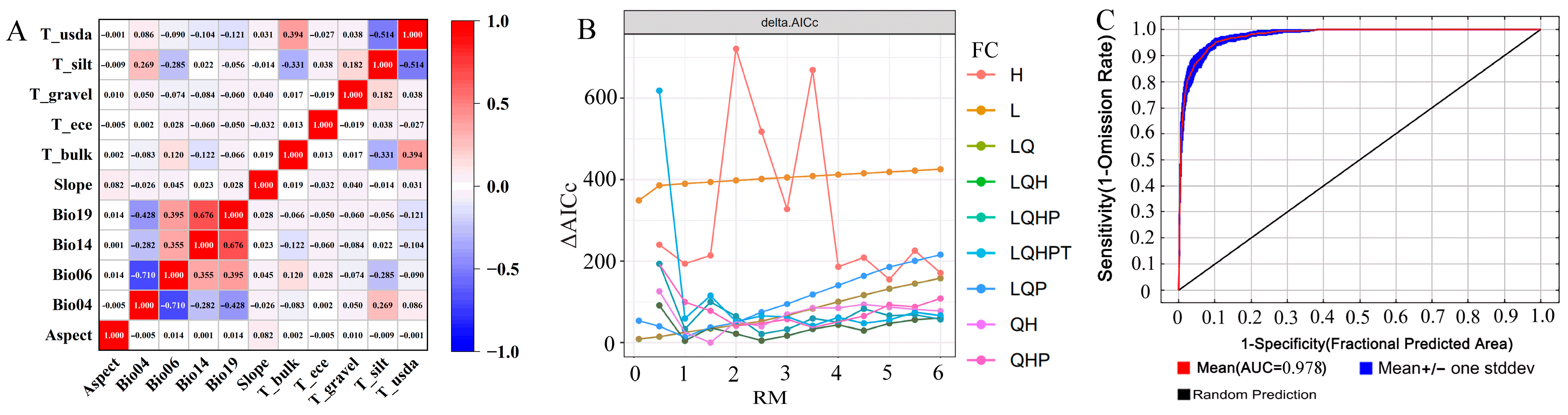
3.1. Model Parameter Optimization and Performance Evaluation
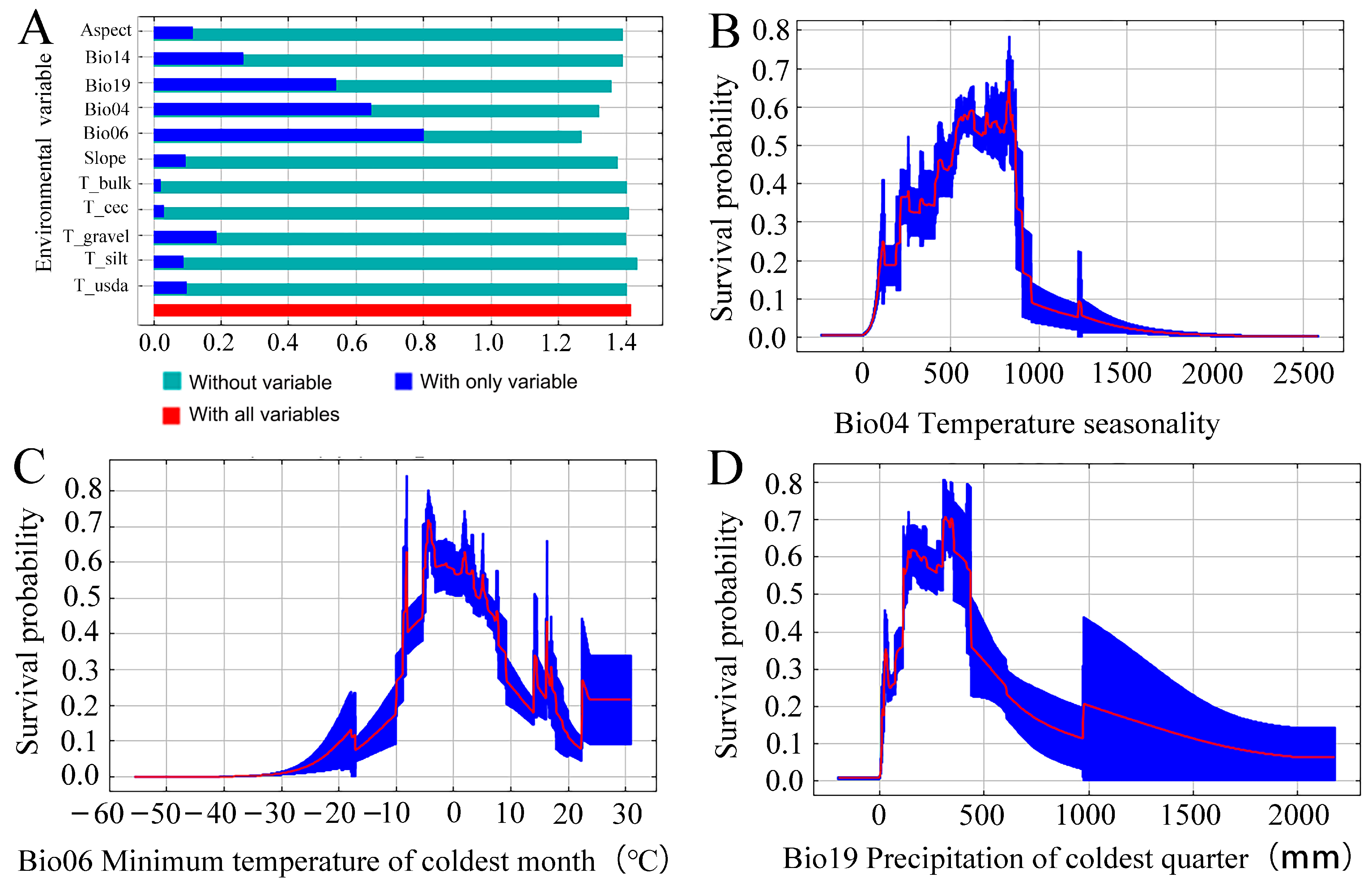
3.2. Environmental Drivers Shaping the Distribution of P. ramorum
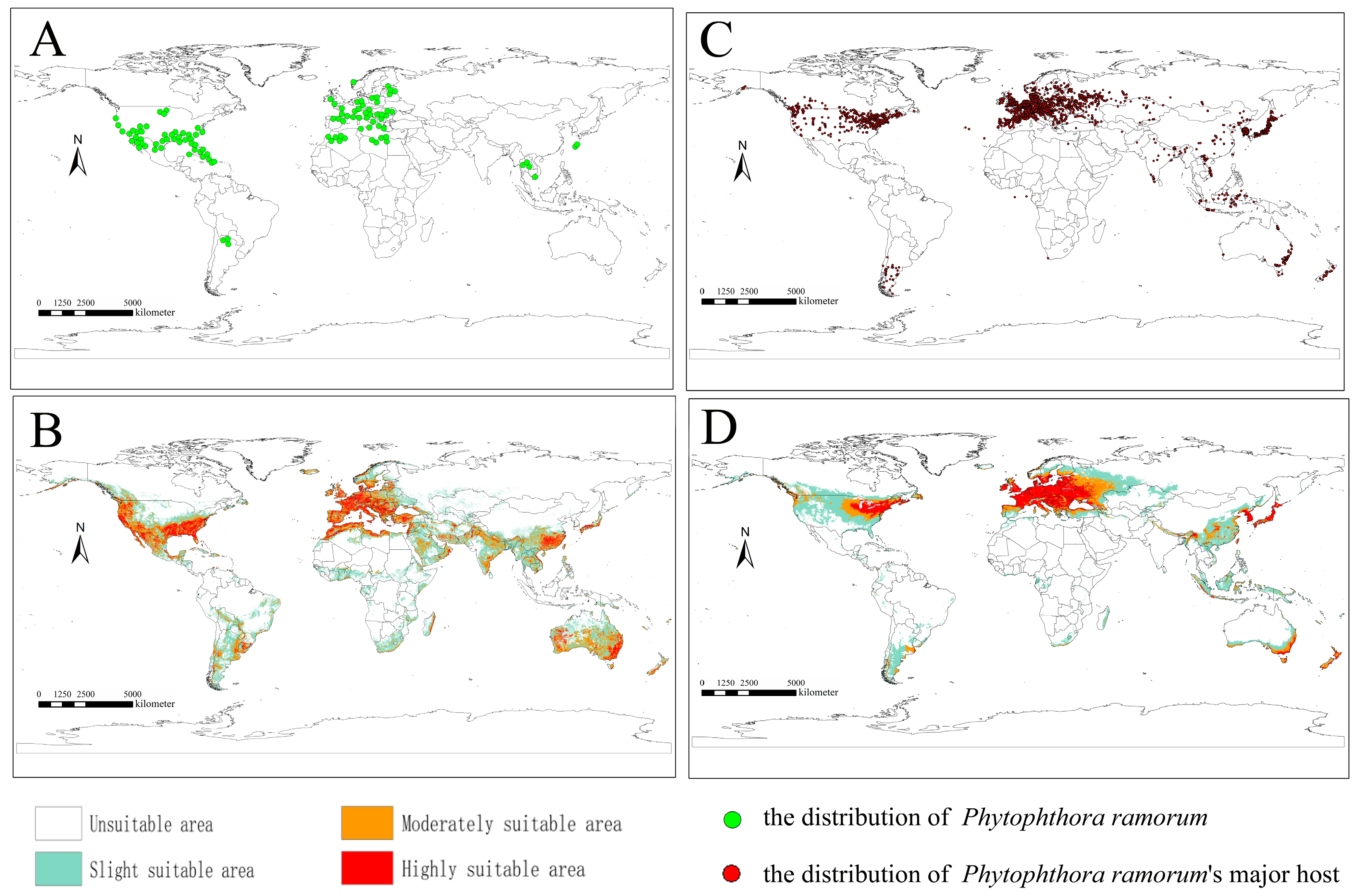
3.3. Simulation of Ecologically Suitable Areas Under Current Climatic Conditions
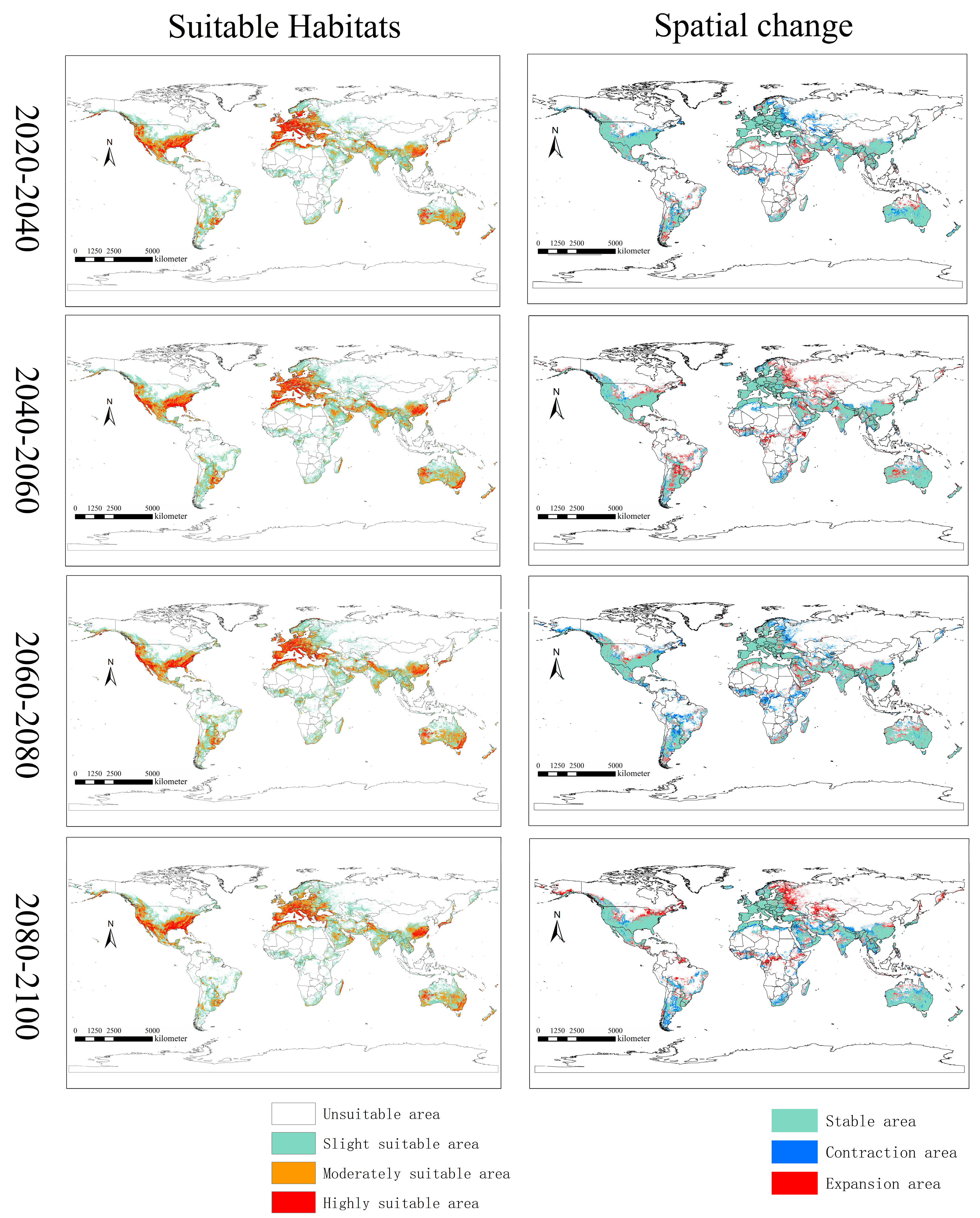
3.4. Distribution Dynamics of P. ramorum Under Future Climate Scenarios
3.5. Shifts in the Potential Habitat of P. ramorum Under Future Climate Scenarios
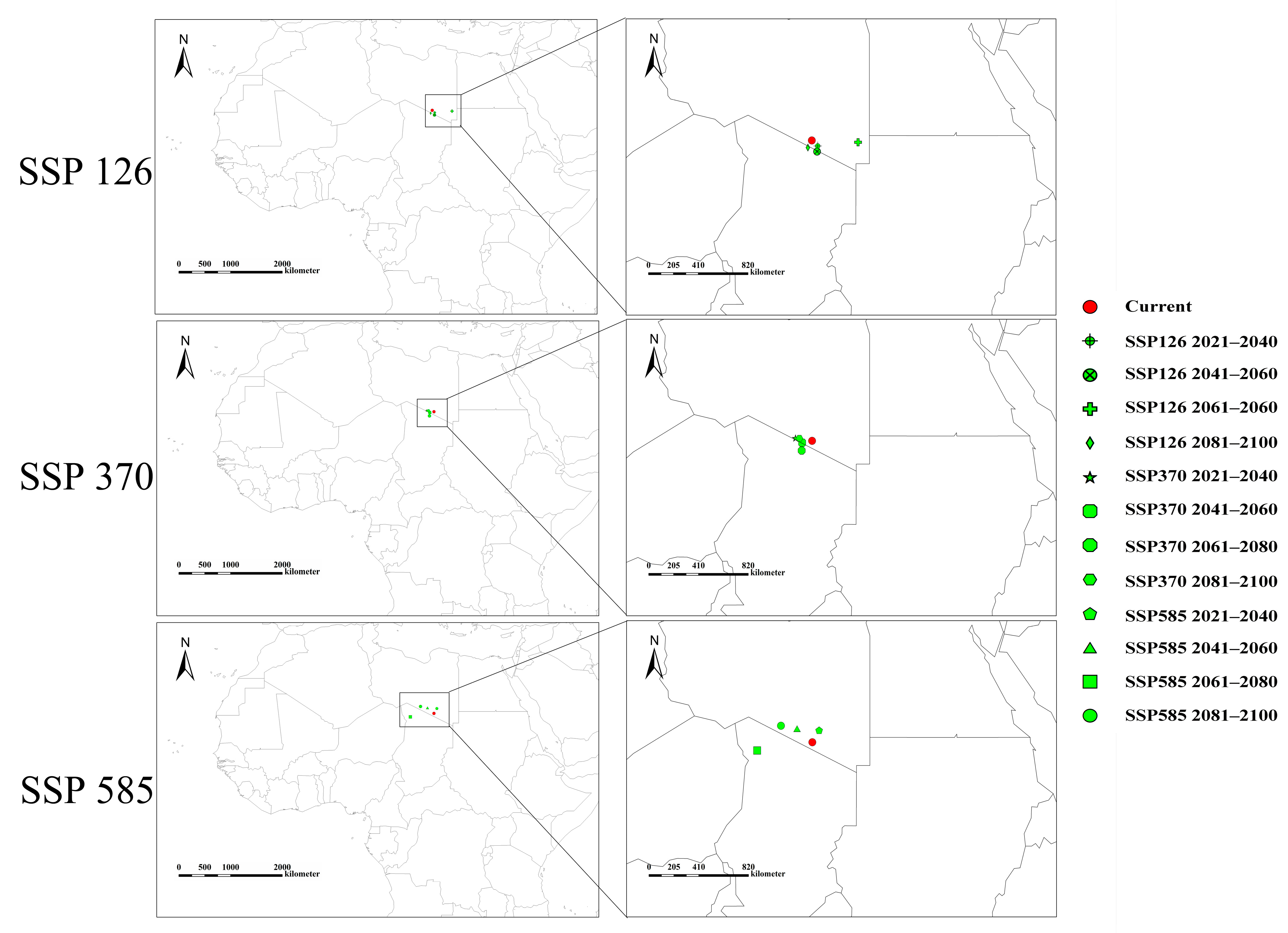
3.6. Centroid Shift in the Suitable Habitats of P. ramorum
4. Discussion
4.1. Model Robustness and Climatic Determinism in Pathogen Distribution
4.2. “Habitat Churning” Versus Poleward Migration Under Climate Change
4.3. Centroid Migration Toward the Sahel: An Emerging Phytosanitary Frontier
4.4. Hierarchical Stability and Adaptive Management Strategies
4.5. Limitations and Forward-Looking Perspectives
5. Conclusions
Supplementary Materials
Author Contributions
Funding
Data Availability Statement
Conflicts of Interest
References
- Chen, S.; Chen, J.; Jiang, C.; Yao, R.T.; Xue, J.; Bai, Y.; Wang, H.; Jiang, C.; Wang, S.; Zhong, Y. Trends in research on forest ecosystem services in the most recent 20 years: A bibliometric analysis. Forests 2022, 13, 1087. [Google Scholar] [CrossRef]
- Brouwer, R.; Bongers, F.; Peña-Claros, M.; Zuidema, P.A.; Brancalion, P.; Lohbeck, M.; Guzmán, A.H.; Heinze, A.; Guillemot, J.; Kramer, K. Forest restoration, biodiversity, and ecosystem services. In Restoring Forests and Trees for Sustainable Development; Oxford University Press: New York, NY, USA, 2024; pp. 160–198. [Google Scholar]
- EFSA Panel on Plant Health (PLH). Scientific Opinion on the Pest Risk Analysis on Phytophthora ramorum prepared by the FP6 project RAPRA. EFSA J. 2011, 9, 2186. [Google Scholar]
- Garbelotto, M.; Hayden, K.J. Sudden oak death: Interactions of the exotic oomycete Phytophthora ramorum with naïve North American hosts. Eukaryot. Cell 2012, 11, 1313–1323. [Google Scholar] [CrossRef] [PubMed]
- Pastalka, T.; Abeysekara, N.; Schweigkofler, W. First report of Phytophthora ramorum on Cotoneaster sp. in the USA. Plant Dis. 2023, 108, 231. [Google Scholar] [CrossRef]
- Grünwald, N.J.; Goss, E.M.; Press, C.M. Phytophthora ramorum: A pathogen with a remarkably wide host range causing sudden oak death on oaks and ramorum blight on woody ornamentals. Mol. Plant Pathol. 2008, 9, 729–740. [Google Scholar] [CrossRef]
- Kartakis, S.; Jung, T.; Kriticos, D.J.; Wesseler, J. Modeling disease expression of Phytophthora ramorum to estimate potential economic impacts in European forests. For. Ecol. Manag. 2026, 601, 123367. [Google Scholar] [CrossRef]
- Venette, R.C.; Cohen, S.D. Potential climatic suitability for establishment of Phytophthora ramorum within the contiguous United States. For. Ecol. Manag. 2006, 231, 18–26. [Google Scholar] [CrossRef]
- Grünwald, N.J.; Garbelotto, M.; Goss, E.M.; Heungens, K.; Prospero, S. Emergence of the sudden oak death pathogen Phytophthora ramorum. Trends Microbiol. 2012, 20, 131–138. [Google Scholar] [CrossRef]
- Webber, J.F. Status of Phytophthora ramorum and P. kernoviae in Europe. In Proceedings of the Sudden Oak Death Third Science Symposium; General Technical Report PSW-GTR-214; Frankel, S.J., Kliejunas, J.T., Palmieri, K.M., Eds.; U.S. Department of Agriculture, Forest Service, Pacific Southwest Research Station: Albany, CA, USA, 2008; pp. 19–26. [Google Scholar]
- Ireland, K.B.; Hardy, G.E.S.J.; Kriticos, D.J. Combining inferential and deductive approaches to estimate the potential geographical range of the invasive plant pathogen, Phytophthora ramorum. PLoS ONE 2013, 8, e63508. [Google Scholar] [CrossRef]
- Liao, T.L.; Li, B.S. Risk Analysis of Phytophthora ramorum Imported into China. J. Southwest For. Coll. 2004, 24, 34–37. [Google Scholar] [CrossRef]
- Davidson, J.M.; Patterson, H.A.; Wickland, A.C.; Fichtner, E.J.; Rizzo, D.M. Forest type influences transmission of Phytophthora ramorum in California oak woodlands. Phytopathology 2011, 101, 492–501. [Google Scholar] [CrossRef]
- Green, S.; Cooke, D.E.; Dunn, M.; Barwell, L.; Purse, B.; Chapman, D.S.; Valatin, G.; Schlenzig, A.; Barbrook, J.; Pettitt, T. PHYTO-THREATS: Addressing threats to UK forests and woodlands from Phytophthora; identifying risks of spread in trade and methods for mitigation. Forests 2021, 12, 1617. [Google Scholar] [CrossRef]
- Bussell, E.; Cunniffe, N. Applying optimal control theory to a spatial simulation model of sudden oak death: Ongoing surveillance protects tanoak while conserving biodiversity. J. R. Soc. Interface 2020, 17, 20190671. [Google Scholar] [CrossRef]
- Søndreli, K.L.; Tabima, J.F.; LeBoldus, J.M. Rapid new diagnostic LAMP (loop-mediated isothermal amplification) assays to distinguish among the four lineages of Phytophthora ramorum. Plant Dis. 2023, 107, 3553–3559. [Google Scholar] [CrossRef] [PubMed]
- Ahmad, H.; Rajput, N.A.; Atiq, M.; Kachelo, G.A.; Usman, M.; Tariq, H.; Wahab, M. Detection of Phytophthora nicotianae induced citrus gummosis by the loop-mediated isothermal amplification. Pak. J. Bot. 2024, 56, 1–11. [Google Scholar] [CrossRef] [PubMed]
- Li, Q.; Shao, H. The Role of Pathogens in Plant Invasion: Accumulation of Local Pathogens Hypothesis. Microb. Ecol. 2024, 87, 178. [Google Scholar] [CrossRef] [PubMed]
- Hunter, S.; Waipara, N.; Burns, B.; Scott, P.; Williams, N. Survival and dispersal of Phytophthora multivora zoospores in soil substrates. Australas. Plant Pathol. 2025, 54, 289–297. [Google Scholar] [CrossRef]
- Blaker, N.S. Influence of Container Medium pH on Sporangium Formation, Zoospore Release, and Infection of Rhododendron by Phytophthora cinnamomi. Plant Dis. 1983, 67, 259–263. [Google Scholar] [CrossRef]
- Thomsen, I.M.; Alsanius, B. Updated pest risk assessment of Phytophthora ramorum in Norway. In Report from the Norwegian Scientific Committee for Food and Environment (VKM); Norwegian Scientific Committee for Food and Environment: Oslo, Norway, 2023. [Google Scholar]
- Xu, J.; Zhang, H.; Qiao, Y.; Yuan, H.; Xu, W.; Xia, X. Effects of Microtopography on Neighborhood Diversity and Competition in Subtropical Forests. Plants 2025, 14, 870. [Google Scholar] [CrossRef]
- Martens, M. Ring Test for Recombinase Polymerase Amplification (RPA) of Phytophthora ramorum. Master’s Thesis, Cornell University, Ithaca, NY, USA, 2023. [Google Scholar]
- Van Poucke, K.; Franceschini, S.; Webber, J.F.; Vercauteren, A.; Turner, J.A.; McCracken, A.R.; Heungens, K.; Brasier, C.M. Discovery of a fourth evolutionary lineage of Phytophthora ramorum: EU2. Fungal Biol. 2012, 116, 1178–1191. [Google Scholar] [CrossRef]
- Niu, Z.; Han, D.; Niu, Z.; Roussos, P.A.; Cheng, T.; Xie, J.; Jin, N.; Zhang, D. Assessment of potential habitat suitability for kiwifruit (Actinidia spp) in Shaanxi Province under climate change scenarios. Front. Plant Sci. 2025, 16, 1617802. [Google Scholar] [CrossRef] [PubMed]
- Campos, J.C.; Garcia, N.; Alírio, J.; Arenas-Castro, S.S.; Teodoro, A.; Sillero, N. Ecological Niche models using MaxEnt in Google Earth engine: Evaluation, guidelines and recommendations. Ecol. Inform. 2023, 76, 102147. [Google Scholar] [CrossRef]
- Lissovsky, A.A.; Dudov, S.V. Species-Distribution Modeling: Advantages and Limitations of Its Application. 2. MaxEnt. Biol. Bull. Rev. 2021, 11, 265–275. [Google Scholar] [CrossRef]
- Steven, J.P.; Miroslav, D.; Schapire, R. Maxent Software for Modeling Species Niches and Distributions (Version 3.4.1). Available online: http://biodiversityinformatics.amnh.org/open_source/maxent/ (accessed on 12 January 2017).
- Fan, Y.; Zhang, X.; Yang, J.; Yang, J.; Zhang, H.; Yang, B.; Li, X. Prediction of global potential distribution and assessment of habitat suitability for Xanthium spinosum driven by climate change. Front. Plant Sci. 2025, 16, 1690546. [Google Scholar] [CrossRef]
- Mu, S.; Zhen, J.; Xi, C.; Wang, L. Suitability Assessment of Pastoral Human Settlements in Xilingol League Based on an Optimized MaxEnt Model. Land 2025, 14, 2052. [Google Scholar] [CrossRef]
- Lane, S.L.; Erland, L.A. Differential temperature adaptation mechanisms in the High Arctic-adapted Cerastium regelii Ostenf. and the widespread Stellaria longipes Goldie. bioRxiv 2025. [Google Scholar] [CrossRef]
- Xiang, Y.; Li, S.; Yang, Q.; Liu, J.; Liu, Y.; Zhao, L.; Lin, H.; Luo, Y.; Ren, J.; Luo, X. Modeling the Habitat Suitability and Range Shift of Daphniphyllum macropodum in China Under Climate Change Using an Optimized MaxEnt Model. Biology 2025, 14, 1360. [Google Scholar] [CrossRef]
- Fan, L.; Mi, C.; Li, J.; Zhang, Y.; Zhang, H.; Zhang, G.; Wang, H. Projecting global shifts in the invasive potential of Bidens pilosa L. under climate change using species distribution models. Front. Plant Sci. 2025, 16, 1580278. [Google Scholar] [CrossRef]
- Lin, Z.; Halliday, F.W.; Zhang, P.; Wang, X.; Chen, F.; Shi, A.; Shi, J.; Xiao, Y.; Liu, X. Above-and belowground plant pathogens along elevational gradients: Patterns and potential mechanisms. Oikos 2025, 2025, e10455. [Google Scholar] [CrossRef]
- Serrano, M.S.; Romero, M.Á.; Homet, P.; Gómez-Aparicio, L. Climate change impact on the population dynamics of exotic pathogens: The case of the worldwide pathogen Phytophthora cinnamomi. Agric. For. Meteorol. 2022, 322, 109002. [Google Scholar] [CrossRef]
- Shamoun, S.F.; Elliott, M. Phytophthora ramorum Werres, de Cock & Man in’t Veld, Sudden Oak Death/Encre des chênes rouges (Peronosporaceae). In Biological Control Programmes in Canada 2013–2023; CABI: Oxfordshire, UK, 2024; pp. 593–602. [Google Scholar]
- Brown, J.L. SDMtoolbox: A python-based GIS toolkit for landscape genetic, biogeographic and species distribution model analyses. Methods Ecol. Evol. 2014, 5, 694–700. [Google Scholar] [CrossRef]
- Waititu, J.M.; Mundia, C.N.; Sichangi, A.W. Assessing distribution changes of selected native and alien invasive plant species under changing climatic conditions in Nyeri County, Kenya. PLoS ONE 2020, 17, e0275360. [Google Scholar] [CrossRef]
- Aparecido, L.E.D.O.; Lorenone, J.A.; Lorenone, P.A.; Torsoni, G.B.; Lima, R.F.D.; Chiquitto, A.G.; Saqui, D.; Oliveira Júnior, G.G.d.; Rolim, G.D.S. Climate Change and Phoma spp. Leaf Spot of Arabica Coffee: A CMIP6 Modeling Approach. Rev. Bras. Meteorol. 2023, 38, e38230041. [Google Scholar] [CrossRef]
- Xiong, T.; Wang, S.; Kang, F.; Liu, J.; Qin, Y. The Projected Effects of Climate Change on the Potential Distribution of Planococcus minor Based on Ensemble Species Distribution Models. Agronomy 2025, 15, 1165. [Google Scholar] [CrossRef]
- Wang, C.; Wang, J.; Naudiyal, N.; Wu, N.; Cui, X.; Wei, Y.; Chen, Q. Multiple effects of topographic factors on Spatio-temporal variations of vegetation patterns in the three parallel rivers region, Southeast Qinghai-Tibet Plateau. Remote Sens. 2021, 14, 151. [Google Scholar] [CrossRef]
- Nachtergaele, F.; Van Velthuizen, H.; Verelst, L.; Batjes, N.; Dijkshoorn, K.; van Engelen, V.; Fischer, G.; Jones, A.; Montanarella, L.; Petri, M. Harmonized world soil database. In Proceedings of the 19th World Congress of Soil Science, Soil Solutions for a Changing World, Brisbane, Australia, 1–6 August 2010; pp. 34–37. [Google Scholar]
- Zhou, J.; Tang, Q.; Zong, D.; Hu, X.; Wang, B.; Wang, T. Drivers of species distribution and niche dynamics for ornamental plants originating at different latitudes. Diversity 2023, 15, 877. [Google Scholar] [CrossRef]
- Xue, N.; Li, K.; Chen, K.; Li, P.; Ji, X.; Ma, Z.; Ji, W. Predicting climate change impacts on distribution and conservation of critically endangered Picea neoveitchii using MaxEnt. Front. For. Glob. Change 2024, 7, 1472857. [Google Scholar] [CrossRef]
- Fang, H.Q.; Zhang, P.F.; Xu, S.W.; Xu, T.; He, B.; Wang, E.; Dong, C.W.; Yang, Q.S. The ecological suitability area of Cirsium lineare (Thunb.) Sch.-Bip. under future climate change in China based on MaxEnt modeling. Ecol. Evol. 2024, 14, e10848. [Google Scholar] [CrossRef]
- Zhang, M.; Sun, X.; Miao, Y.; Li, M.; Huang, L. Cordyceps cicadae and Cordyceps gunnii have closer species correlation with Cordyceps sinensis: From the perspective of metabonomic and MaxEnt models. Sci. Rep. 2022, 12, 20469. [Google Scholar] [CrossRef]
- Vignoles, A. Guide francophone pour la modélisation de niches écologiques. Biodivers. Inform. 2022, 17, 67–95. [Google Scholar] [CrossRef]
- Xue, Y.; Lin, C.; Wang, Y.; Zhang, Y.; Ji, L. Ecological niche complexity of invasive and native cryptic species of the Bemisia tabaci species complex in China. J. Pest Sci. 2022, 95, 1245–1259. [Google Scholar] [CrossRef]
- Palagi, E.; Norscia, I. Bonobos protect and console friends and kin. PLoS ONE 2013, 8, e79290. [Google Scholar] [CrossRef] [PubMed]
- Kantidakis, G.; Putter, H.; Litière, S.; Fiocco, M. Statistical models versus machine learning for competing risks: Development and validation of prognostic models. BMC Med. Res. Methodol. 2023, 23, 51. [Google Scholar] [CrossRef] [PubMed]
- Al Ruheili, A.M.; Boluwade, A.; Al Subhi, A.M. Assessing the impact of climate change on the distribution of lime (16SRII-b) and alfalfa (16srii-d) phytoplasma disease using maxent. Plants 2021, 10, 460. [Google Scholar] [CrossRef]
- Multimodality Writing Group for Chronic Coronary Disease; Winchester, D.E.; Maron, D.J.; Blankstein, R.; Chang, I.C.; Kirtane, A.J.; Kwong, R.Y.; Pellikka, P.A.; Prutkin, J.M.; Russell, R. ACC/AHA/ASE/ASNC/ASPC/HFSA/HRS/SCAI/SCCT/SCMR/STS 2023 multimodality appropriate use criteria for the detection and risk assessment of chronic coronary disease. J. Am. Coll. Cardiol. 2023, 81, 2445–2467. [Google Scholar] [CrossRef]
- Metheny, N.; Kitson, J.; Graves, A.; Shariq, A.; Wright, K.; Taylor, L.; Cryer, J.; Raimondi, J.; Schipper, S.; Binny, J.M.S. Applied Artificial Intelligence-Capstone Chronicles 2024; University of San Diego: San Diego, CA, USA, 2024. [Google Scholar]
- Sun, Z.; Zhao, T.; Hu, S.; Chen, G.; Zhu, W.; Peng, X.; Su, S. Integrating climate change and fine-scale habitat suitability to assess amphibian range shift in Mount Emei, China. Front. Zool. 2025, 22, 16. [Google Scholar] [CrossRef]
- Dun, H.F.; MacKay, J.J.; Green, S. Expansion of natural infection of Japanese larch by Phytophthora ramorum shows trends associated with seasonality and climate. Plant Pathol. 2024, 73, 419–430. [Google Scholar] [CrossRef]
- Khalaf, S.M.; Alqahtani, M.S.; Selim, Y.A.; Elsayed, K.O.; Bendary, H.A. Spatiotemporal dynamics of Bacillus anthracis under climate change: A machine learning approach. Front. Microbiol. 2025, 16, 1659876. [Google Scholar] [CrossRef]
- Ogris, N.; Drenkhan, R.; Vahalík, P.; Cech, T.; Mullett, M.; Tubby, K. The potential global distribution of an emerging forest pathogen, Lecanosticta acicola, under a changing climate. Front. For. Glob. Change 2023, 6, 1221339. [Google Scholar] [CrossRef]
- Negi, P.S.; Paul, S.; Lata, S. MaxEnt distribution modelling of Betula utilis D.Don under changing climatic conditions in North Western Himalaya, India. Discov. Geosci. 2025, 3, 214. [Google Scholar] [CrossRef]
- Caballol, M.; Redondo, M.Á.; Catalán, N.; Corcobado, T.; Jung, T.; Marçais, B.; Milenković, I.; Nemesio-Gorriz, M.; Stenlid, J.; Oliva, J. Climate acts as an environmental filter to plant pathogens. ISME J. 2024, 18, wrae010. [Google Scholar] [CrossRef] [PubMed]
- Ragab, S.H.; Alqurashi, S.I.; Aljameeli, M.M.; Tyshenko, M.G.; Abdelwahab, A.H.; Selim, T.A. Predicting the Global Distribution of Gryllus bimaculatus Under Climate Change: Implications for Biodiversity and Animal Feed Production. Sustainability 2024, 16, 10278. [Google Scholar] [CrossRef]
- Cai, C.; Zhang, X.; Zha, J.; Li, J.; Li, J. Predicting climate change impacts on the rare and endangered Horsfieldia tetratepala in China. Forests 2022, 13, 1051. [Google Scholar] [CrossRef]
- Nordström, I.; Sherwood, P.; Bohman, B.; Woodward, S.; Peterson, D.L.; Niño-Sánchez, J.; Sánchez-Gómez, T.; Díez, J.J.; Cleary, M. Utilizing volatile organic compounds for early detection of Fusarium circinatum. Sci. Rep. 2022, 12, 21661. [Google Scholar] [CrossRef]
- Zhang, X.; Chen, C.; Wang, F.; Dai, T. Predicting the Global Distribution of Fusarium circinatum Using MaxEnt Modeling. Agronomy 2025, 15, 1913. [Google Scholar] [CrossRef]
- Shen, S.; Zhang, X.; Jian, S. The Distributional Range Changes of European Heterobasidion Under Future Climate Change. Forests 2024, 15, 1863. [Google Scholar] [CrossRef]
- Sturrock, R.N.; Frankel, S.J.; Brown, A.V.; Hennon, P.E.; Kliejunas, J.T.; Lewis, K.J.; Worrall, J.J.; Woods, A.J. Climate change and forest diseases. Plant Pathol. 2011, 60, 133–149. [Google Scholar] [CrossRef]
- Runghen, R.; Llopis-Belenguer, C.; Stouffer, D.B. Using network analysis to study and manage human-mediated dispersal of exotic species. Biol. Invasions 2023, 25, 3369–3389. [Google Scholar] [CrossRef]
- Liu, B.; Li, L.; Zhang, Z.; Ran, H.; Xing, M. Modeling the Potential Distribution and Future Dynamics of Important Vector Culex tritaeniorhynchus Under Climate Change Scenarios in China. Insects 2025, 16, 382. [Google Scholar] [CrossRef]
- Sinha, P.; Chen, X. Potential infection risks of the wheat stripe rust and stem rust pathogens on barberry in Asia and southeastern Europe. Plants 2021, 10, 957. [Google Scholar] [CrossRef]
- Jiranek, J.; Miller, I.F.; An, R.; Bruns, E.; Metcalf, C.J.E. Mechanistic models to meet the challenge of climate change in plant–pathogen systems. Philos. Trans. R. Soc. B 2023, 378, 20220017. [Google Scholar] [CrossRef]
- Tang, X.; Deng, Y.; He, Z.; Zhou, M.; Yuan, Y.; Zeng, K. Modelling the potential distribution and niche shift of Solenopsis invicta Buren under climate change and invasion process. Front. For. Glob. Change 2025, 8, 1659630. [Google Scholar] [CrossRef]
- Lin, M.; Ye, X.; Zhao, Z.; Chen, S.; Liu, B. Comparative Analysis of Habitat Expansion Mechanisms for Four Invasive Amaranthaceae Plants Under Current and Future Climates Using MaxEnt. Plants 2025, 14, 2363. [Google Scholar] [CrossRef]
- Padilla, D.G. Modeling the Role of Land-Use Change on the Spread of Infectious Disease; Arizona State University: Tempe, AZ, USA, 2020. [Google Scholar]
- Hoffmann, P.; Rechid, D.; Reinhart, V.; Asmus, C.; Davin, E.; Katragkou, E.; De Noblet-Ducoudré, N.; Bechtel, B.; Böhner, J. Long-term high-resolution land-use/land-cover change dataset for regional climate modeling. In AGU Fall Meeting Abstracts; American Geophysical Union: Washington, DC, USA, 2020; p. GC007-0008. [Google Scholar]
- Tagyan, A.I.; AlAshaal, S.; Alkhalifah, D.H.M.; Abdelghany, W.R.; Hozzein, W.N. Estimating the climate change-driven global distribution of Fusarium proliferatum and mycotoxin risk assessment under future warming scenarios. Front. For. Glob. Change 2025, 8, 1673494. [Google Scholar] [CrossRef]
- Skendžić, S.; Zovko, M.; Živković, I.P.; Lešić, V.; Lemić, D. The impact of climate change on agricultural insect pests. Insects 2021, 12, 440. [Google Scholar] [CrossRef]
- Qiao, H.; Peterson, A.T.; Myers, C.E.; Yang, Q.; Saupe, E.E. Ecological niche conservatism spurs diversification in response to climate change. Nat. Ecol. Evol. 2024, 8, 13. [Google Scholar] [CrossRef] [PubMed]



| Number | Variable | Percent Contribution (%) | Permutation Importance (%) |
|---|---|---|---|
| 1 | Bio04 | 29.4 | 23.1 |
| 2 | Bio19 | 20.4 | 23.9 |
| 3 | Bio06 | 18.2 | 26.9 |
| 4 | T_gravel | 7 | 4.4 |
| 5 | Slpoe | 6 | 1.7 |
| 6 | Aspect | 5.7 | 3.9 |
| 7 | Bio14 | 4 | 5.3 |
| 8 | T_bulk | 3.2 | 3.7 |
| 9 | T_usda | 2.4 | 2.1 |
| 10 | T_silt | 2.4 | 3.8 |
| 11 | T_ece | 1.3 | 1.4 |
| SSP Scenario | Time Period | Total Area | Highly Suitable | Moderately Suitable | Poorly Suitable |
|---|---|---|---|---|---|
| (104 km2/Change %) | (104 km2/Change %) | (104 km2/Change %) | (104 km2/Change %) | ||
| Historical | 1970–2000 | 4247.64/- | 631.97/- | 1302.34/- | 2313.33/- |
| SSP126 | 2021–2040 | 4512.30/+6.23% | 640.29/+1.31% | 1412.40/+8.45% | 2459.61/+6.32% |
| 2041–2060 | 4341.14/+2.20% | 598.00/−5.38% | 1327.04/+1.90% | 2416.11/+4.44% | |
| 2061–2080 | 4418.18/+4.01% | 553.55/−12.41% | 1373.00/+5.42% | 2491.64/+7.71% | |
| 2081–2100 | 4306.47/+1.38% | 543.92/−13.94% | 1314.03/+0.90% | 2448.52/+5.84% | |
| SSP370 | 2021–2040 | 4149.67/−2.31% | 627.26/−0.75% | 1258.70/−3.35% | 2263.72/−2.14% |
| 2041–2060 | 3992.88/−6.00% | 542.36/−14.18% | 1142.76/−12.26% | 2307.76/−0.24% | |
| 2061–2080 | 4111.40/−3.21% | 536.50/−15.11% | 1185.32/−8.98% | 2389.58/+3.30% | |
| 2081–2100 | 4303.00/+1.30% | 579.07/−8.37% | 1317.37/+1.15% | 2406.57/+4.03% | |
| SSP585 | 2021–2040 | 4295.29/+1.12% | 640.73/+1.39% | 1296.55/−0.44% | 2358.01/+1.93% |
| 2041–2060 | 4590.16/+8.06% | 592.88/−6.19% | 1365.59/+4.86% | 2631.69/+13.77% | |
| 2061–2080 | 4539.00/+6.86% | 594.97/−5.86% | 1364.83/+4.80% | 2579.20/+11.49% | |
| 2081–2100 | 4433.42/+4.37% | 552.44/−12.59% | 1286.54/−1.21% | 2594.44/+12.16% |
Disclaimer/Publisher’s Note: The statements, opinions and data contained in all publications are solely those of the individual author(s) and contributor(s) and not of MDPI and/or the editor(s). MDPI and/or the editor(s) disclaim responsibility for any injury to people or property resulting from any ideas, methods, instructions or products referred to in the content. |
© 2026 by the authors. Licensee MDPI, Basel, Switzerland. This article is an open access article distributed under the terms and conditions of the Creative Commons Attribution (CC BY) license.
Share and Cite
Zheng, B.; Lin, S.; Zhang, X.; Dai, T. Modeling Current and Future Global Distribution of the Quarantine Pathogen Phytophthora ramorum Using MaxEnt. Agriculture 2026, 16, 505. https://doi.org/10.3390/agriculture16050505
Zheng B, Lin S, Zhang X, Dai T. Modeling Current and Future Global Distribution of the Quarantine Pathogen Phytophthora ramorum Using MaxEnt. Agriculture. 2026; 16(5):505. https://doi.org/10.3390/agriculture16050505
Chicago/Turabian StyleZheng, Bingyan, Sixi Lin, Xiaorui Zhang, and Tingting Dai. 2026. "Modeling Current and Future Global Distribution of the Quarantine Pathogen Phytophthora ramorum Using MaxEnt" Agriculture 16, no. 5: 505. https://doi.org/10.3390/agriculture16050505
APA StyleZheng, B., Lin, S., Zhang, X., & Dai, T. (2026). Modeling Current and Future Global Distribution of the Quarantine Pathogen Phytophthora ramorum Using MaxEnt. Agriculture, 16(5), 505. https://doi.org/10.3390/agriculture16050505