Article

Enhancing Soil Quality and Bacteria Diversity by Increasing Soil Organic Matter and Microbial Activity Under Biochar Application


1
The Center for Agricultural Resources Research, Institute of Genetics and Developmental Biology, The Chinese Academy of Sciences, Shijiazhuang 050021, China
2
University of Chinese Academy of Sciences, Beijing 100049, China
*
Author to whom correspondence should be addressed.
Agriculture 2026, 16(5), 498; https://doi.org/10.3390/agriculture16050498
Submission received: 7 December 2025 / Revised: 11 February 2026 / Accepted: 21 February 2026 / Published: 25 February 2026
(This article belongs to the Special Issue Dynamics of Organic Matter in Agricultural Soil Management Systems)

Abstract

Maintaining healthy soil is fundamental to sustainable agriculture, and soil organic carbon (SOC) is a key indicator of soil health. Although the application of straw and biochar is known to enhance SOC, their specific effects on the soil health index (SHI) and the underlying microbial drivers across different soil layers—particularly in the 20–40 cm subsoil layer—remain insufficiently quantified. This study therefore aimed to evaluate the effects of straw and biochar application on the SHI and associated microbial indicators. The experiment included five treatments: conventional planting with straw removed (CK), homogeneous incorporation of mechanically crushed straws into the 0–20 cm topsoil layer (SR), biochar burial at 40 cm (SD), combined application of returning mechanically crushed straws in the topsoil and biochar burial at 40 cm (SB), and biochar incorporation into the topsoil combined with burial of entire maize plants at 40 cm (BS). Results showed that SR, SD, SB and BS all enhanced SHI values compared to CK in the topsoil, with BS exhibiting the largest increase (23.07%). In the subsoil, SB exhibited the highest SHI, representing increases of 64.52% and 18.60% compared with CK and BS, respectively. This was attributable to the greater enhancement of key subsoil parameters under SB than under BS, including microbial biomass carbon (17.52%), microbial biomass nitrogen (24.20%), leucine aminopeptidase (91.20%), and SOC (181.38%). Furthermore, surface straw application reduces fungal diversity, whereas biochar application in the subsoil significantly enhanced bacterial diversity. Biochar improved SHI both directly through SOC increase and indirectly via the increase in microbial activity and enzyme content mediated by SOC.

1. Introduction

Soil health serves as the cornerstone for sustaining agricultural ecosystem functions and ensuring global food security [1]. The United Nations Sustainable Development Goals identify soil quality enhancement as the central pathway to preventing soil degradation [2]. Notably, continuous decrease in soil organic carbon (SOC) has resulted in soil degradation across 13% of global cultivated land under conventional farming practices [3]. Recent advancements demonstrate that integrated straw return and biochar amendment, functioning as carbon accumulation strategies, enhance SOC content [4,5]. Consequently, regulating SOM dynamics via organic amendments has emerged as a critical approach to mitigate soil degradation and enhance soil health.
Healthy soils are characterized by sufficient SOC levels and a rich diversity of microbial life. Elevated organic carbon content fosters the formation of stable soil aggregates [6] and enhances microbial community diversity [7]. The interactions of healthy soil carbon are essential for maintaining the chemical, physical, and biological properties of soil, which subsequently affect nutrient supply, aggregate stability, and moisture retention [8]. Furthermore, improved nutrient cycling, water-holding capacity, and root growth could enable soils to withstand disturbances and maintain productive functions under stress conditions [9,10]. In contrast, inadequate carbon inputs result in decreasing microbial functions and structural integrity, impairing key soil processes, exacerbating degradation, and reducing water and nutrient retention, thereby causing lower productivity and ecosystem resilience and heightening the risk of desertification [11]. Such conditions also decrease the ability of soil to adapt to future climate change. Climate change notably influences SOC, accelerating its decomposition, interrupting vegetation-driven carbon inputs, and modifying microbial behavior—all of which compromise soil fertility, structure, and productive output [12,13]. With diminishing SOC, soils lose their capacity to regulate hydrological cycles, raising susceptibility to droughts, erosion, and flood events [14]. Additionally, climatic shifts disturb nitrogen cycling, soil moisture regimes, and pH levels, causing nutritional imbalances that suppress microbial activity and limit crop yields [15,16]. Adopting sustainable land management strategies enables soils to play an important role in climate change mitigation through carbon sequestration and lowering atmospheric greenhouse gas levels [17]. Therefore, straw and biochar application represents a forward-looking approach to ensuring agricultural sustainability and responsible land use amid a changing climate. In the context of global climate change and increasing pressure on food systems, enhancing SOC stocks has been widely recognized as a key pathway for climate change mitigation and long-term agricultural sustainability. Soil carbon sequestration not only reduces atmospheric CO2 concentrations but also improves soil structure, water retention, and nutrient cycling, thereby strengthening agroecosystem resilience [18,19]. In recent years, regenerative agriculture has further emphasized rebuilding soil carbon pools and stimulating soil biological processes as foundational strategies for restoring ecosystem services and improving farm resilience [20]. However, quantitative evidence on how specific residue and biochar management strategies influence subsoil carbon dynamics and microbial functioning remains limited.
The fundamental process of organic matter cycling is as follows: plants convert carbon dioxide into organic matter through photosynthesis; consumers achieve material transfer through ingestion; and ultimately, microorganisms decompose the organic matter into inorganic substances, which return to the environment. Soil microbial composition and diversity are primarily shaped by soil physicochemical properties, including soil texture, SOC content, pH, and nutrient availability, which collectively regulate microbial growth and activity [21,22]. As the most important component of soil nutrients, SOC affects microbial communities by influencing the physical, chemical, and biological properties of the soil [23,24]. Crop straws as carbon-rich agricultural wastes contain a great deal of essential nutrients and micronutrients [25], which are required for microorganism growth. Straw return enhances soil fertility and structural properties by improving nutrient availability, stimulating microbial activity, promoting macroaggregate formation, increasing porosity, and reducing bulk density [26,27,28,29]. Similarly, biochar is rich in both organic and inorganic carbon, as well as macronutrients and micronutrients, and possesses the ability to enhance the physicochemical properties of soil [30,31,32]. Straw and biochar, in return, regulate soil microbial communities through direct nutrient provisioning (as carbon and nutrient sources) and indirect impacts via physicochemical property alterations. Microorganisms, including bacteria and fungi, are widely recognized as key agents in nutrient cycling, playing a vital role in accelerating the turnover of SOC and increasing the rate of nutrient mineralization [33]. These functions directly and indirectly affect soil quality and crop productivity [34]. Consequently, regulating soil microbial communities through straw and biochar incorporation is critical for enhancing agricultural soil health.
Straw and biochar returned to the field regulates the soil microenvironment through carbon input, yet there are significant differences in the shaping of microbial communities among various input ways. While most studies have focused on surface application of straw and biochar, their impacts on soil health when incorporated into the subsoil remain largely unexplored. And few studies have explored the pathway how microbial taxa and soil factors impact soil health under different straw and biochar return methods. This study aimed to (1) quantify soil health at 0–20 and 20–40 cm in wheat–maize rotation fields under different approaches of returning straw and biochar, (2) reveal the correlations between soil microbial communities and soil properties, and (3) determine the mechanisms by which microbial community composition and soil factors impact soil health. Then, our hypotheses were: (1) the application of biochar and straw could enhance soil quality by introducing SOM and altering soil factors and microbe, but the mechanisms differ between topsoil and subsoil; and (2) biochar, as a material with loose texture and abundant pore structure, demonstrates superior capacity to improve subsoil quality compared to straw especially in the subsoil.

2. Materials and Methods

2.1. Study Site

This experiment was set at the Nanpi Eco-agricultural Experimental Station of the Chinese Academy of Sciences in the Bohai Rim region of the North China Plain in 2021–2023 (38°00′ N, 116°40′ E). The climate conditions are the warm-temperate semi-humid monsoon climate. The average annual precipitation is 520.5 mm, the average temperature is 12.3 °C, the total annual sunshine hour is 2938.6 h, and the annual total radiation is 133.6 kJ cm−2. The shallow groundwater ranged from 3 to 5 m. This soil is silt loam texture. The soil properties within the 0–40 cm depth range are presented in Table 1.

2.2. Experimental Design and Farmland Management

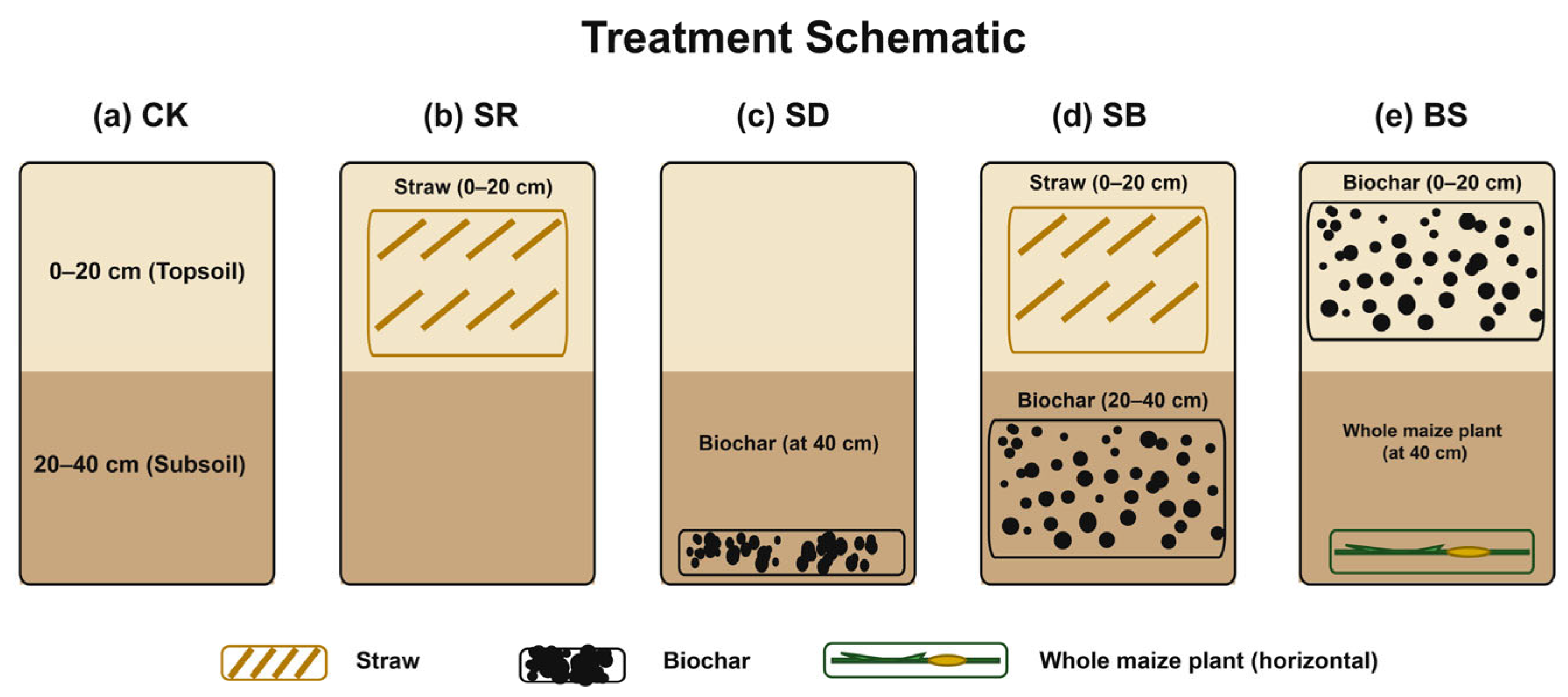
The study was initiated in November 2021. Prior to wheat planting, biochar and maize straws were applied into the soil using different retention patterns. The specific experimental design consisted of five treatments (Figure 1): conventional planting with straw removed (CK), homogeneous incorporation of mechanically crushed straws into the 0–20 cm topsoil layer (SR), biochar burial at 40 cm (SD), combined application of returning mechanically crushed straws in the topsoil and biochar burial at 40 cm (SB), and biochar incorporation into the topsoil combined with burial of entire maize plants at 40 cm (BS). The biochar was synthesized through anaerobic pyrolysis of maize straws at 500 °C for 2 h, with a pH of 8.71, total nitrogen (5.38 g kg−1), total carbon (377.51 g kg−1), and cation exchange capacity (4.2 cmol kg−1). The optimal application rate of biochar was 25 t ha−1. The straw returned to each plot was exclusively sourced from the maize straws harvested within that same plot. After being crushed into small pieces using a crusher, the maize straws of SR and SB treatments were mixed into 0–20 cm using a rotary tiller. The entire maize plant was manually buried at 40 cm in BS treatment. The wheat cultivar Xiaoyan60 and maize cultivar Zhengdan958 were sowed in October and June of each year, respectively. Pre-planting irrigation for maize and wheat was determined based on real-time soil moisture measurements. A randomized complete block design with three replications was implemented, creating 15 experimental plots (4.4 m × 2.2 m, 9.68 m2) in total. All treatments had the same irrigation and fertilization pattern. 600 kg ha−1 of chemical fertilizers (N:P2O5:K2O = 18%:22%:5%) were applied to the winter wheat as basal fertilizers. The remaining nitrogen fertilizer (210 kg N ha−1) was applied as urea at the jointing stage. Irrigation was applied before sowing wheat and maize based on soil water content to ensure seedling emergence, and 80 mm of water was applied during the jointing stage in conjunction with topdressing. Other agricultural practices, such as tillage and pesticide application, were kept consistent across all plots.

2.3. Yield Measurement

Wheat and maize yields were determined from a 9.68 m2 area in each plot, and all grain within the harvest area was harvested manually. Samples were first oven-dried at 65 °C to a constant weight to determine dry grain weight. Grain moisture was measured and yields were standardized to 12.5% moisture content.

2.4. Soil Sampling

Soil samples in 0–20 cm and 20–40 cm were collected in each plot after removing surface litter in November of 2023. Soil water content (SWC) was measured immediately after collection by the gravimetric method. Approximately 20–30 g fresh soil was measured after drying at 105 °C until reaching constant mass. The samples for DNA sequencing were immediately placed on dry ice and stored at −80 °C until DNA extraction. A part of the collected soil samples was stored at 4 °C prepared for microbial biomass carbon (MBC), microbial biomass nitrogen (MBN), ammonium nitrogen (NH4+–N), nitrate nitrogen (NO3–N), and dissolved organic carbon (DOC) analysis; the remaining soil was sieved through a 1 mm screen for soil pH and electrical conductivity (EC) analysis, as well as a 0.25 mm screen for SOC analysis after being air-dried.

2.5. Soil Indicators and Measurement Methods

2.5.1. Chemical Indicators

Soil NH4+–N and NO3–N were extracted using 1 mol L−1 potassium chloride (KCl) solution at a soil-to-solution ratio of 1:10 (w/v). The mixture was mechanically shaken for 60 min and subsequently filtered through medium-flow filter paper (12 cm diameter); then, the filtrate was measured using a flow injection analyzer (AutoAnalyzer-3, SEAL Analytical, Mequon, WI, USA) [35]. Soil DOC was determined by extracting soil with distilled water (1:5, w/v), following the procedure outlined by Shaaban et al. (2023) [36]. Soil pH and EC were measured in suspension of soil and CO2-free distilled water at a 1:5 (w/v) ratio [37]. SOC was determined using the K2Cr2O7–H2SO4 oxidation method [38].

2.5.2. Biological Indicators

MBC and MBN were measured using the chloroform fumigation–extraction assay [39]. Alkaline phosphatase (ALP), β-glucosidase (BGL), and leucine aminopeptidase (LAP) activities were measured following established protocols with minor procedural adaptations for microplate-based detection [40,41,42]. Briefly, fresh soil samples (0.1 g) were incubated with their respective substrates under controlled temperature conditions, and the reactions were terminated using Na2CO3 solution. After centrifugation, enzyme activities were quantified using a microplate reader (Thermo Fisher MK3, Thermo Fisher Scientific, Waltham, MA, USA) at wavelengths of 400 nm for ALP and 405 nm for BGL and LAP.

2.6. Soil Health Assessment

The Comprehensive Assessment of Soil Health (CASH) [43] combined with Principal Component Analysis (PCA) [44] was used to evaluate the soil health index (SHI). The scoring function was derived by calculating the mean and standard deviation for each indicator, subsequently modeled as the cumulative normal distribution [45]:
p = f x , μ , σ = 1 σ 2 π + e ( x μ ) 2 2 σ 2 d x
where p is the probability (between 0 and 1), x is measured value ( + , − ), μ is the mean of each indicator and σ is the indicator standard deviation. Two scoring functions (maximization objective: SWC, SOC, DOC, NH4+–N, NO3–N, MBC, MBN, BGL, LAP, and ALP; minimization objective: pH and EC) were implemented to translate the measured values to unitless CASH scores. Weights for individual CASH indicators were determined using PCA across all soil layers (Figure S1), and were calculated by summing the eigenvector loadings of the first four principal components. Component selection was guided by the inflection point in the scree plot and Kaiser’s cut-off (eigenvalues > 1) (Figure S2). The first four principal components collectively explained 81.64% of the total variance in the dataset, with individual contributions of 33.63%, 25.68%, 13.13%, and 9.20%, effectively capturing the majority of variation present in the soil indicators.
The SHI was computed as a weighted average of all individual scores, calculated as follows:
S H I = i = 1 n W i × S i
where SHI is the soil health index, Wi is the indicator scores of CASH for each soil indicator, and Si is the PCA weights for each indicator (Figure S1).

2.7. DNA Extraction, PCR Amplification and Sequencing

Total genomic DNA was isolated from soil samples using the OMEGA Soil DNA Kit (M5635-02; Omega Bio-Tek, Norcross, GA, USA) in accordance with the manufacturer’s protocol and stored at −20 °C until further processing. DNA concentration and purity were assessed using a NanoDrop NC2000 spectrophotometer (Thermo Fisher Scientific, Waltham, MA, USA), while DNA integrity was verified by agarose gel electrophoresis.
Bacterial community analysis was conducted by amplifying the V4 region of the 16S rRNA gene using primers 515F (5′-GTGYCAGCMGCCGCGGTAA-3′) and 806R (5′-GGACTACNVGGGTWTCTAAT-3′), each containing a unique 7 bp barcode for sample identification. Fungal communities were characterized by amplifying the ITS1 region of the rRNA gene using primers ITS1-1F-F (5′-CTTGGTCATTTAGAGGAAGTAA-3′) and ITS1-1F-R (5′-GCTGCGTTCTTCATCGATGC-3′). PCR reactions were carried out in a total volume of 25 μL, comprising 2 μL of template DNA, 5 μL of 5× reaction buffer, 5 μL of 5× GC buffer, 2 μL of dNTPs (2.5 mM), 1 μL (10 μM) of each primer, 0.25 μL of Q5 High-Fidelity DNA Polymerase (2 U μL−1), and 8.75 μL of sterile ddH2O. Amplifications were performed on an ABI 2720 Thermal Cycler (Applied Biosystems, Foster City, CA, USA) with the following program: initial denaturation at 98 °C for 5 min; 25 cycles of denaturation at 98 °C for 30 s, annealing at 55 °C for 30 s, and extension at 72 °C for 30 s; followed by a final extension at 72 °C for 5 min.
PCR products were purified using VAHTSTM DNA Clean Beads (Vazyme, Nanjing, China) and quantified with the Quant-iT PicoGreen dsDNA Assay Kit (Invitrogen, Carlsbad, CA, USA). Equimolar amounts of purified amplicons were pooled and subjected to paired-end sequencing (2 × 250 bp) on an Illumina NovaSeq 6000 platform (Illumina, San Diego, CA, USA) using the NovaSeq 6000 SP Reagent Kit (500 cycles).
The 16S rRNA gene sequences were analyzed with EasyAmplicon v1.20 [46] with slight modification according to the official tutorials, which includes VSEARCH v2.22.1 [47] and USEARCH v11.0.667 [48]. The quality of the paired-end Illumina reads was processed in the following steps by VSEARCH: merging pair-end reads and rename; integrating renamed reads; cutting primers and quality filter; filtering of low-quality reads; and finding non-redundancy reads. The amplicon sequence variants (ASVs) were clustered based on the unoise3 method in USEARCH. All ASVs were aligned to the ‘RDP trainset 19’ database to remove sequences from chimera with the UCHIME algorithm in VSEARCH [48]. Taxonomic assignment was carried out using ASVs with ‘RDP 18’ database [49] (16S) and ‘Unite v9.0’ database (ITS) [50].

2.8. Statistical Analysis

All statistical analyses were performed using R software (version 4.4.3). Differences among treatments were evaluated using one-way analysis of variance (ANOVA). When significant effects were detected, means were compared using the least significant difference (LSD) test at p < 0.05. The weighting scheme was constructed through PCA using the stats package (version 4.4.2). Differences in bacterial and fungal communities were evaluated using partial least squares discriminant analysis (PLS-DA) implemented in the mixOmics package (version 6.30.0). A random forest model was used to predict soil factors driving SHI using rfPermute package (version 2.5.5). The linear regression analysis was conducted using ggpmisc package (version 0.6.1). Partial least squares structural equation modeling (PLS-SEM) was implemented using the plspm package (version 0.5.1). Model fit was evaluated via good of fit (GoF), with standardized path coefficients revealing direct and indirect effects. Visualization was achieved via the ggplot2 package (version 3.5.2).

3. Results

3.1. Wheat and Maize Yield

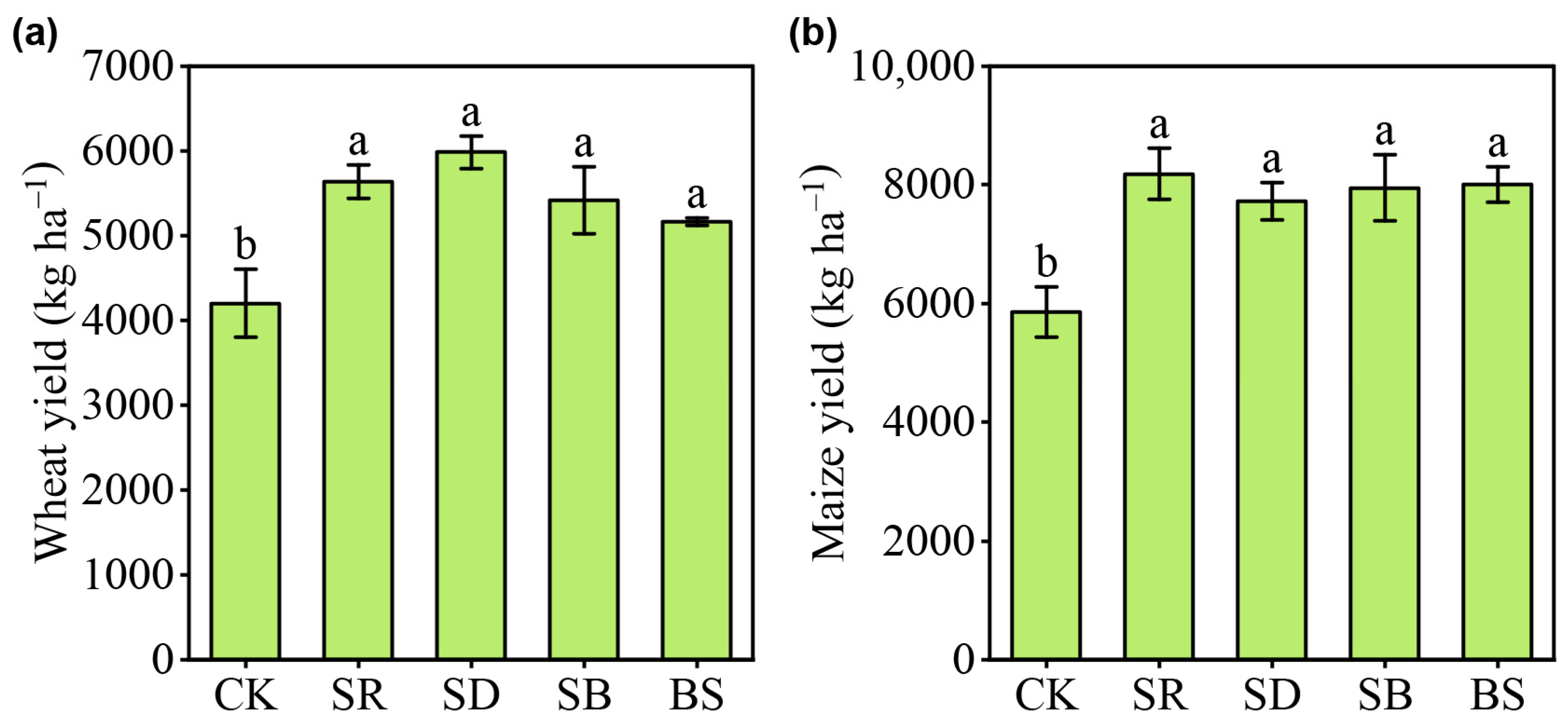
Wheat yield differed significantly among treatments (Figure 2). All straw and biochar–amended treatments (SR, SD, SB, and BS) produced significantly higher wheat yields than the control (CK). However, no significant differences were observed among the four amended treatments. Wheat yield ranged from 5166.33 to 5984.24 kg ha−1 in the amended treatments, compared with 4202.10 kg ha−1 in CK.
A similar pattern was observed for maize yield. Straw and biochar application significantly increased maize yield relative to CK, whereas no significant differences were observed among SR, SD, SB, and BS (Figure 2). Maize yield in the amended treatments ranged from 7720.53 to 8184.09 kg ha−1, which was significantly higher than that in CK (5851.26 kg ha−1).

3.2. Soil Chemical Properties and Enzyme Activity

Soil indicators in different layers showed different significance among various treatments. (Table 2). In the topsoil (0–20 cm), there was no significant difference in soil EC. BS treatment significantly increased SOC by 33.64 to 84.52% and DOC level by 15.60 to 39.79% compared to other treatments (p < 0.05), respectively. The NO3–N content in the SD, SB, and BS was higher than that in the CK and SR. NH4+–N and MBC were highest under SD, while BS had the lowest soil NH4+–N content, and CK showed the least MBC. MBN was highest under SB, with a significant increase of 34.94 to 132.04% compared to other treatments (p < 0.05).
In the subsoil (20–40 cm), SD, SB and BS significantly increased the soil pH, MBC, and MBN content in contrast to CK and SR (p < 0.05). BS significantly enhanced the content of EC, NH4+–N and NO3–N compared with other treatments (p < 0.05), resulting in increases of 23.56–41.99%, 85.93–136.37%, and 123.39–212.00%, respectively. The SOC, BGL and ALP level were significantly highest under SB (p < 0.05), increased by 121.69–218.08%, 51.16–157.40% and 37.33–75.35%, respectively. Under SB, MBC and MBN increased by 17.51% and 24.20%, compared with BS.

3.3. Soil Heath Index

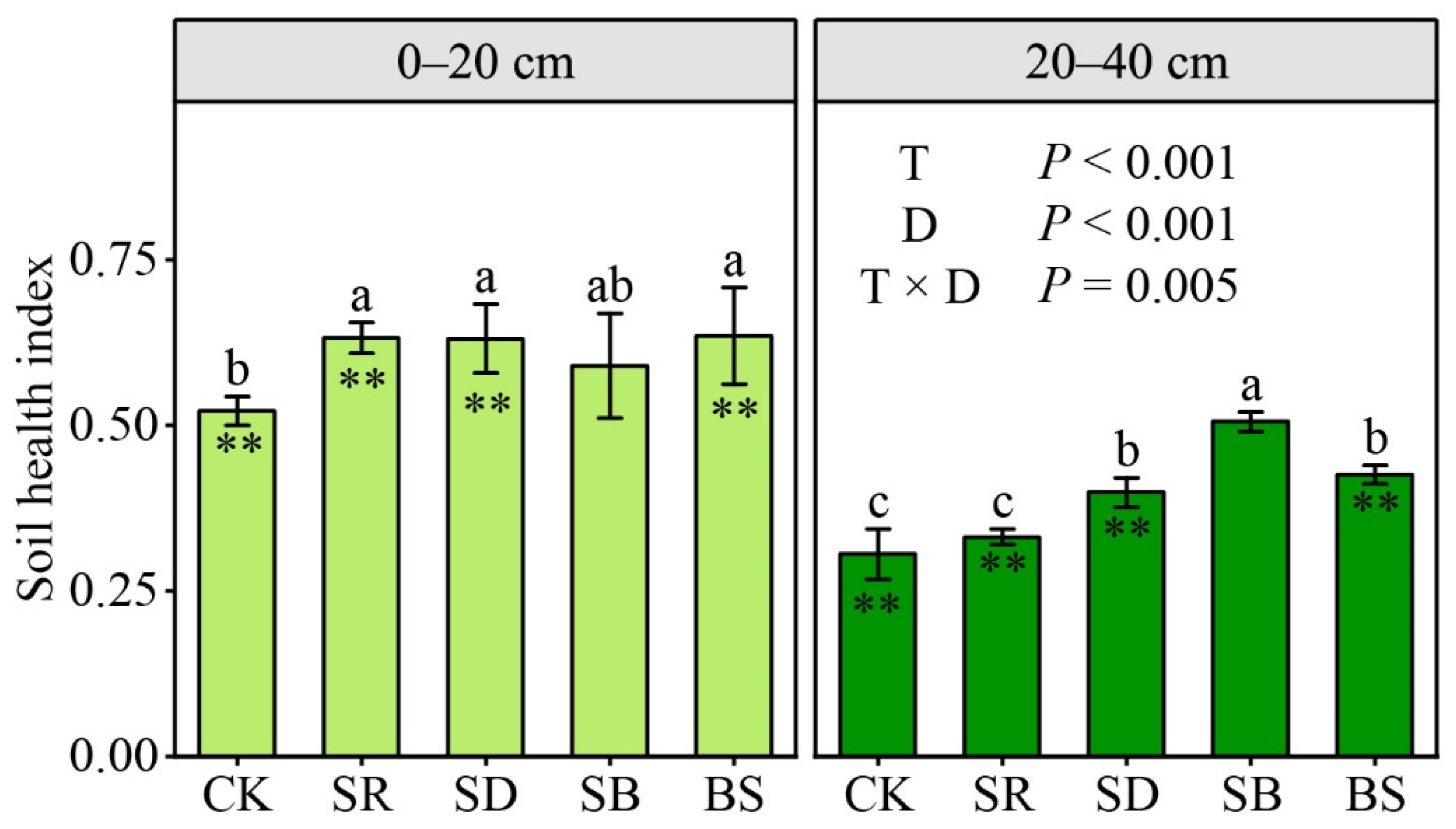
A total of 12 soil parameters were included in the dataset to evaluate SHI. Statistical analyses revealed that the application of straws and biochar significantly influenced SHI values (Figure 3). In the topsoil, the mean of SHI in CK, SR, SD, SB and BS were 0.52, 0.63, 0.63, 0.59 and 0.64, respectively. The SHI of SR, SD, and BS were significantly higher than that in CK (p < 0.05); however, no difference was observed between SB and other treatments. In the subsoil, the mean of SHI in CK, SR, SD, SB and BS were 0.31, 0.33, 0.40, 0.51 and 0.43, respectively. SB exhibited the best SHI and significantly enhanced the soil health index compared with CK, SR, SD, and BS. There was no significant difference between CK and SR, or between SD and BS. Furthermore, comparative analysis between soil depths indicated that SHI values in the topsoil were significantly higher than those in the subsoil layer (p < 0.001).
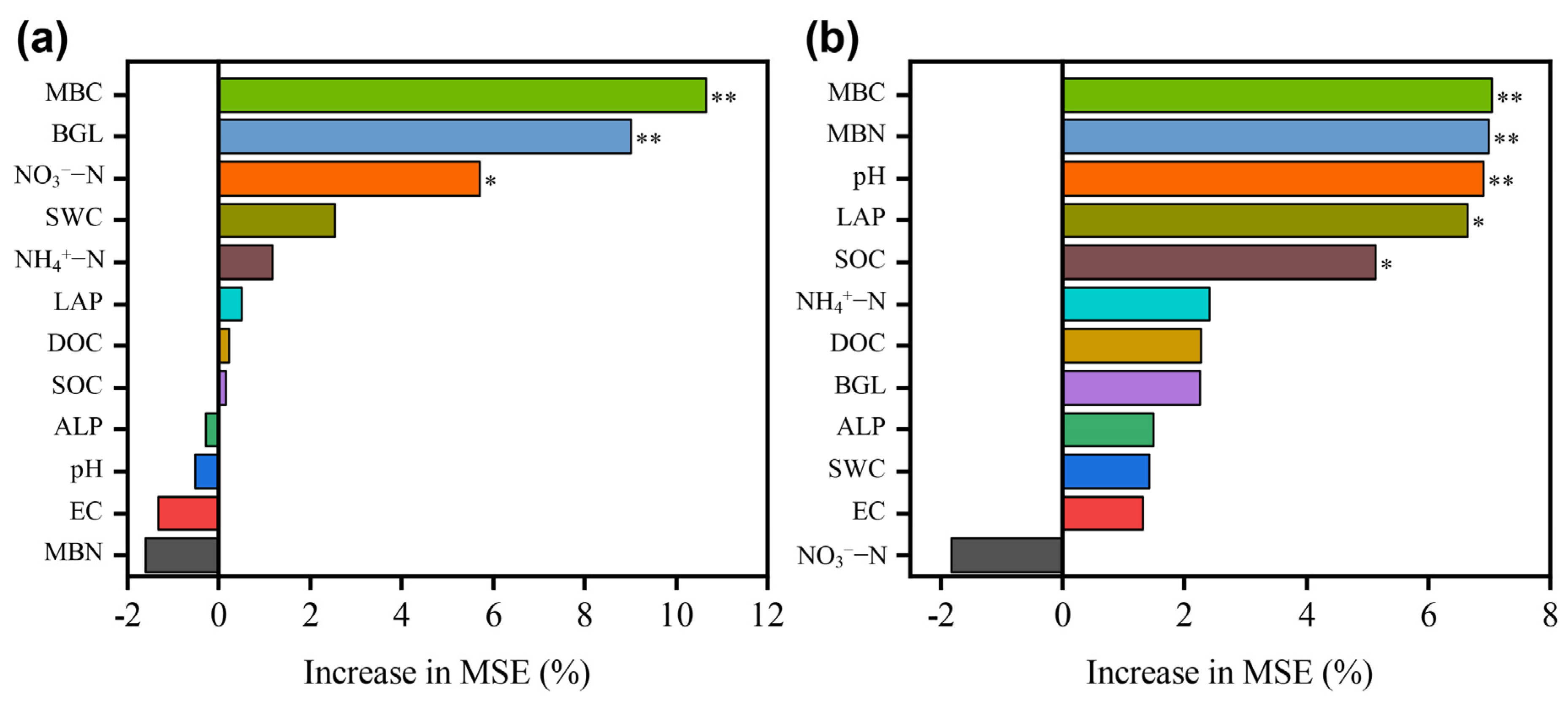
Random forest regression was conducted to identify the most influential soil properties as predictors of SHI. The analysis revealed distinct key predictors between soil layers (Figure 4). In the topsoil, MBC, BGL, and NO3–N emerged as key factors of SHI. In contrast, within the subsoil layer, MBN, LAP, MBC, and soil pH exhibited the dominant influence on the index.

3.4. Soil Microbial Community Composition

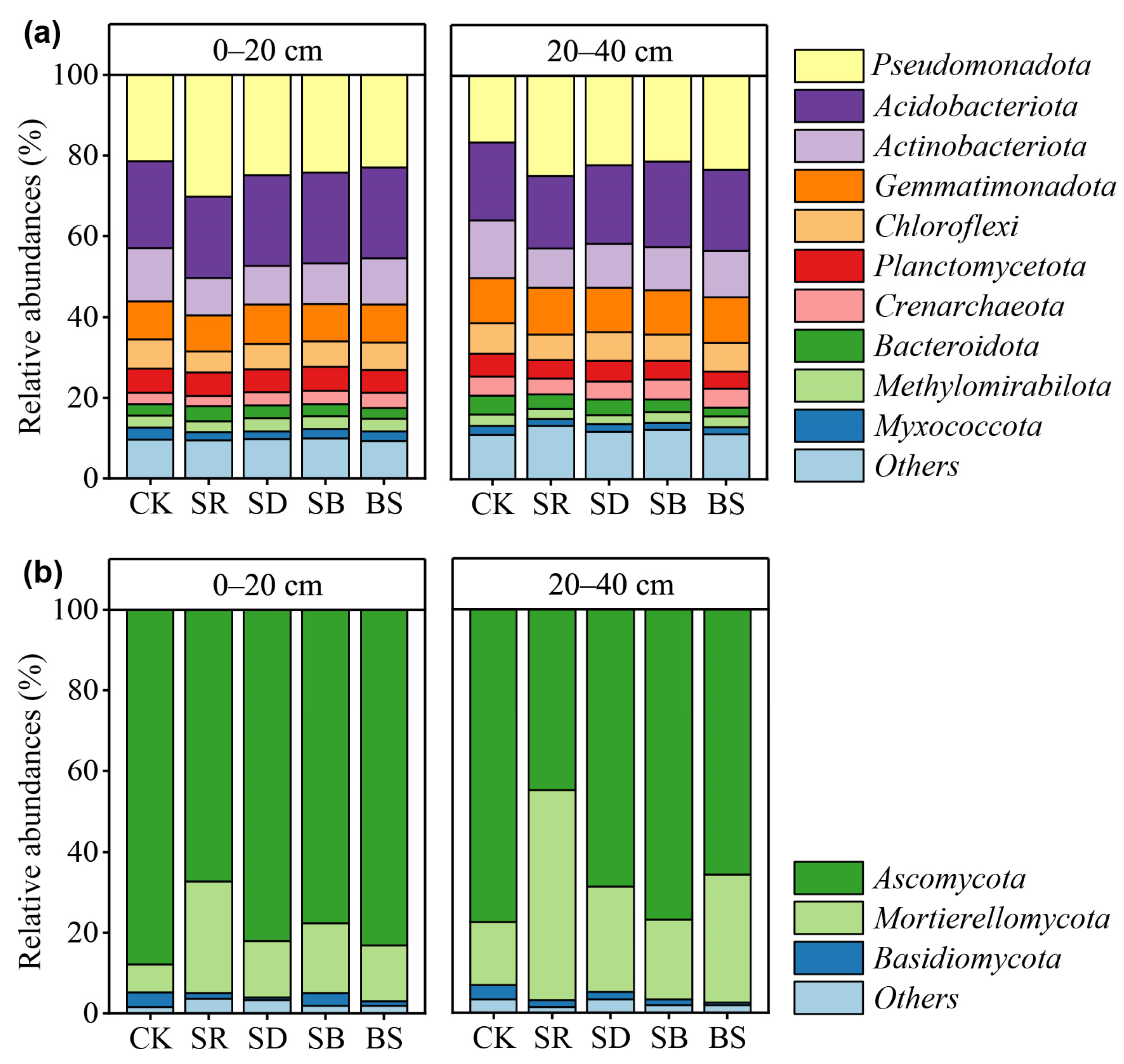
Analysis of the soil microbial community composition at the phylum level revealed distinct structures for bacteria and fungi. For the bacterial community, the dominant phyla included Pseudomonadota (formerly Proteobacteria), Acidobacteriota (formerly Acidobacteria), Actinomycetota (formerly Actinobacteria), Gemmatimonadota, Chloroflexi, Planctomycetota, Crenarchaeota, Bacteroidota, Methylomirabilota, and Myxococcota, accounting for 90.4% and 86.3% of the bacterial sequences in the topsoil and subsoil, respectively (Figure 5). In contrast, the fungal community was mainly composed of Ascomycota, Mortierellomycota, and Basidiomycota, representing over 96.7% of the fungal sequences at the both soil depths.
Under SR, the relative abundance of Pseudomonadota was highest (30.24% and 24.90% of the total bacteria in topsoil and subsoil, respectively) compared to that under other treatments. Additionally, SR demonstrated the highest level of relative abundance among Mortierellomycota, whereas it showed the lowest relative abundance for Ascomycota.
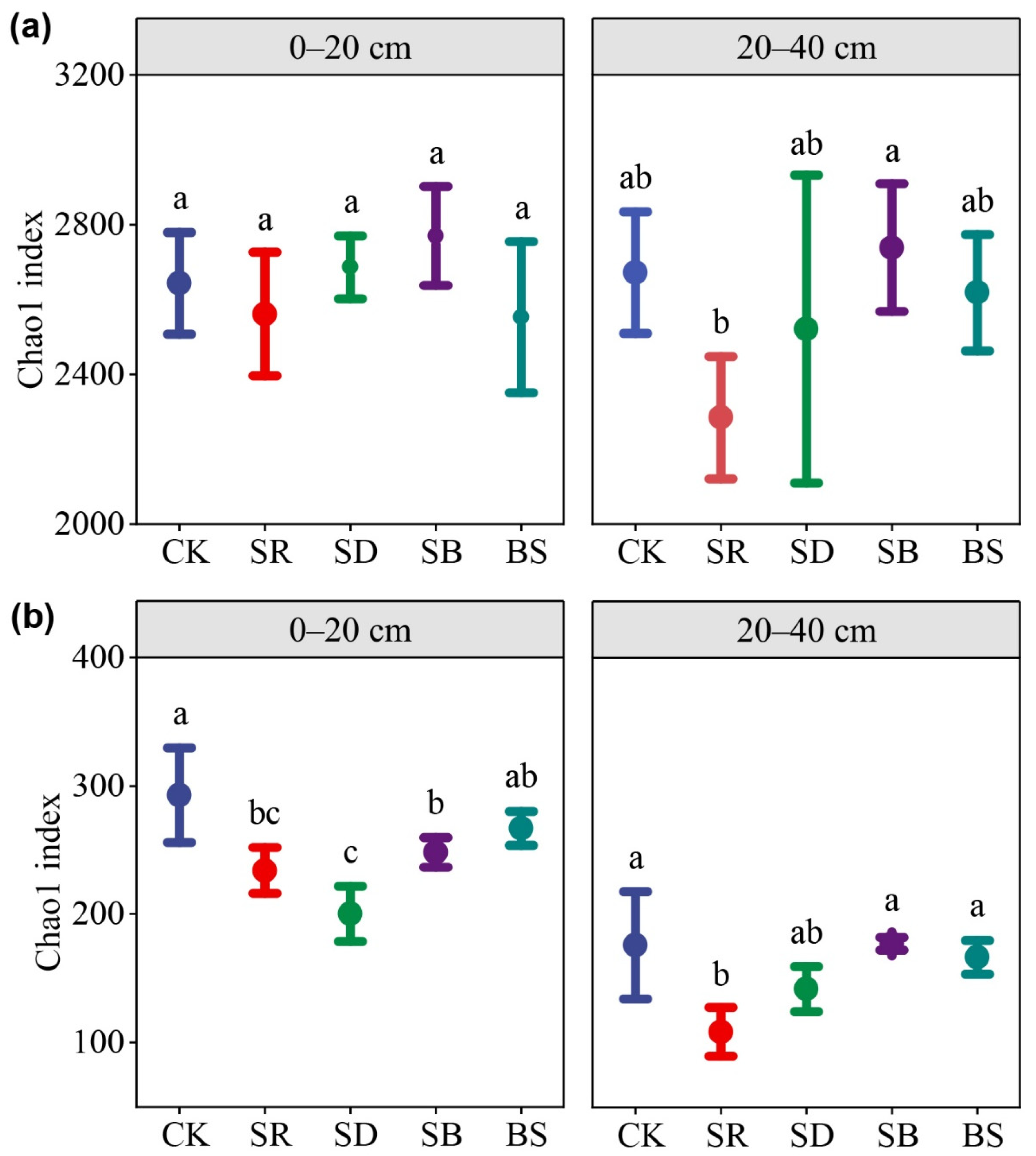
In the topsoil, the differences in soil bacterial diversity were not significant (Figure 6). SR, SD, and SB significantly reduced soil bacterial diversity compared to CK (p < 0.05). The statistical analysis revealed no significance between BS and those of CK, SR, and SB. In the subsoil, SD and SB treatments enhanced soil bacterial diversity compared to CK, SR, and BS, but there was no statistically significant difference between SD, SB, and SR.
Based on PLS-DA analysis, notable alterations were observed in microbial community makeup among the treatments. PCo1 and PCo2 explained 26.9% and 15.6% of the bacterial community variance in the topsoil, respectively, and those were 37.6% and 14.5% in the subsoil, respectively (Figure S3). Under SR and SD, the bacterial communities in the subsoil cm and the fungal communities in the topsoil exhibited the high degree of similarity. Similarly, SD and BS also had highly similar fungal communities in the subsoil.

3.5. Interactions Between Soil Factors and Microbial Characteristics

While Mantel tests revealed minimal environmental constraints on microbial communities (Figure S4), niche differentiation was observed: bacterial community composition responded strongly to soil moisture, whereas fungal community composition was primarily governed by soil moisture and MBC.
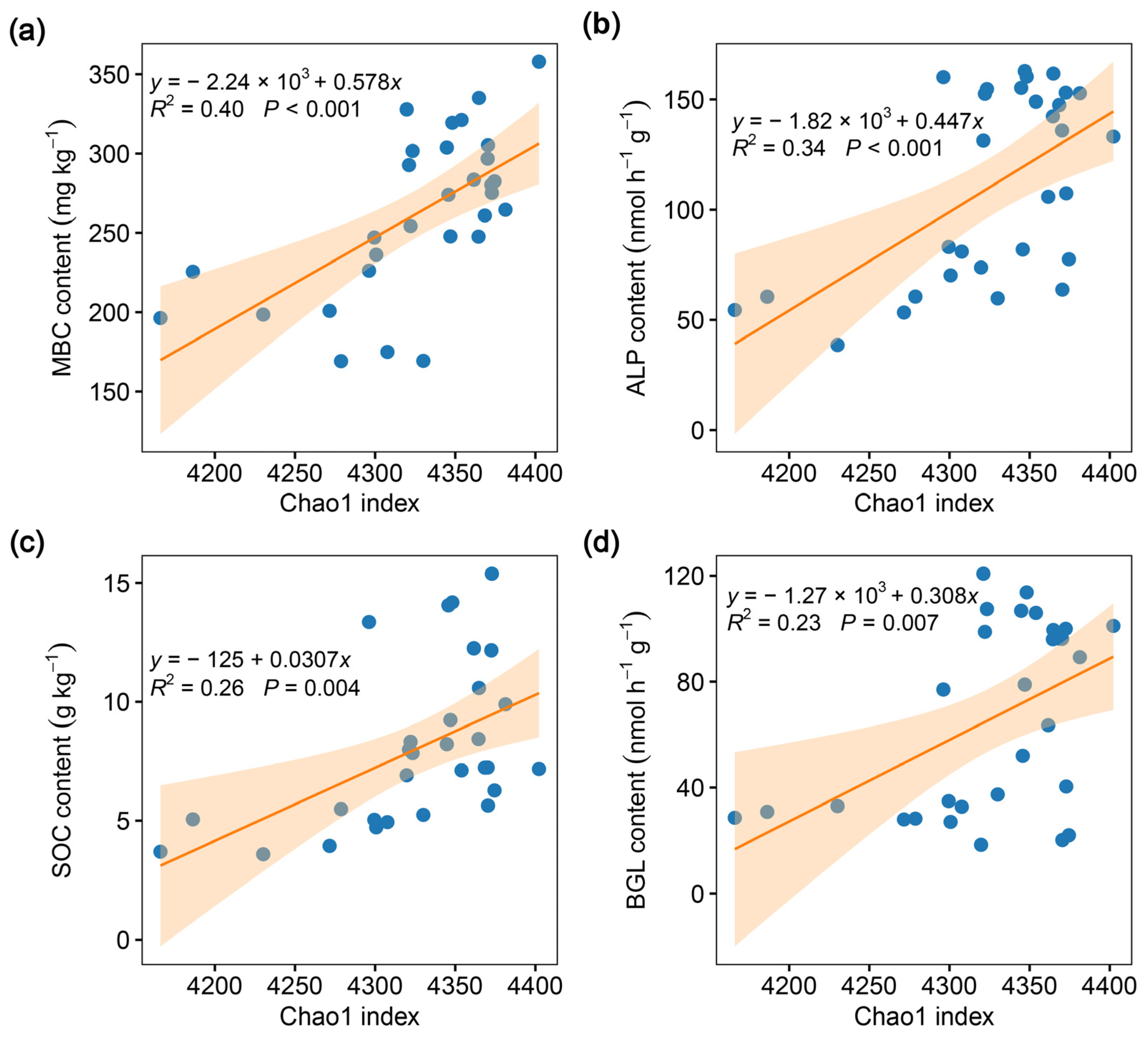
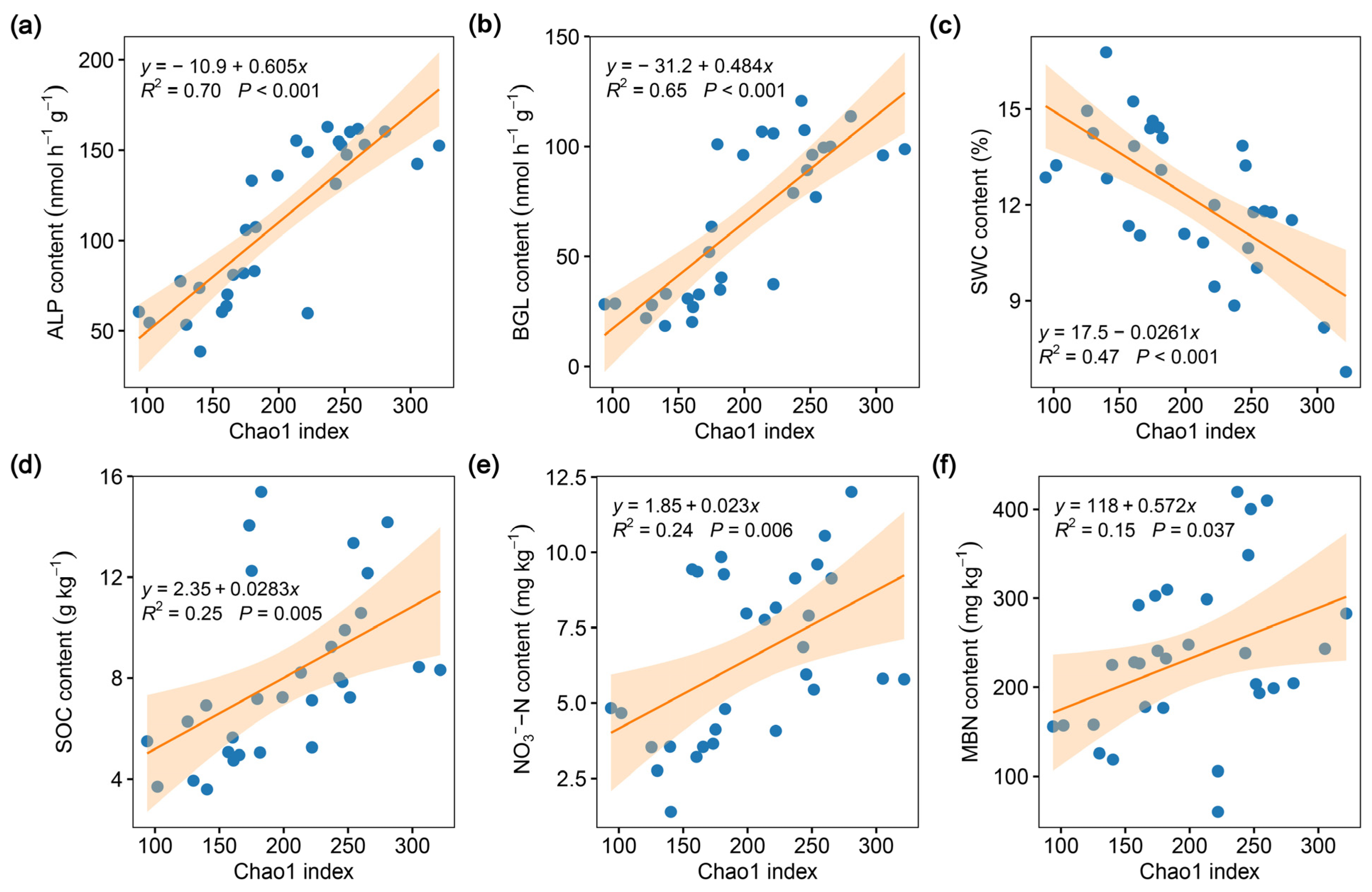
Linear regression analysis was performed to elucidate the relationships between soil physicochemical properties, enzymatic activities, and microbial diversity indices in both topsoil and subsoil layers (Table S1). The results showed that soil bacterial diversity was significantly and positively correlated with SOC, MBC, ALP, and BGL (Table S1, Figure 7). For fungal diversity, the analysis revealed a more complex pattern. Fungal diversity was positively correlated with ALP, BGL, SOC, and soil NO3–N, but negatively associated with SWC (Table S1, Figure 8).

3.6. Comprehensive Effects of Soil Factors and Microbial Diversity on SHI

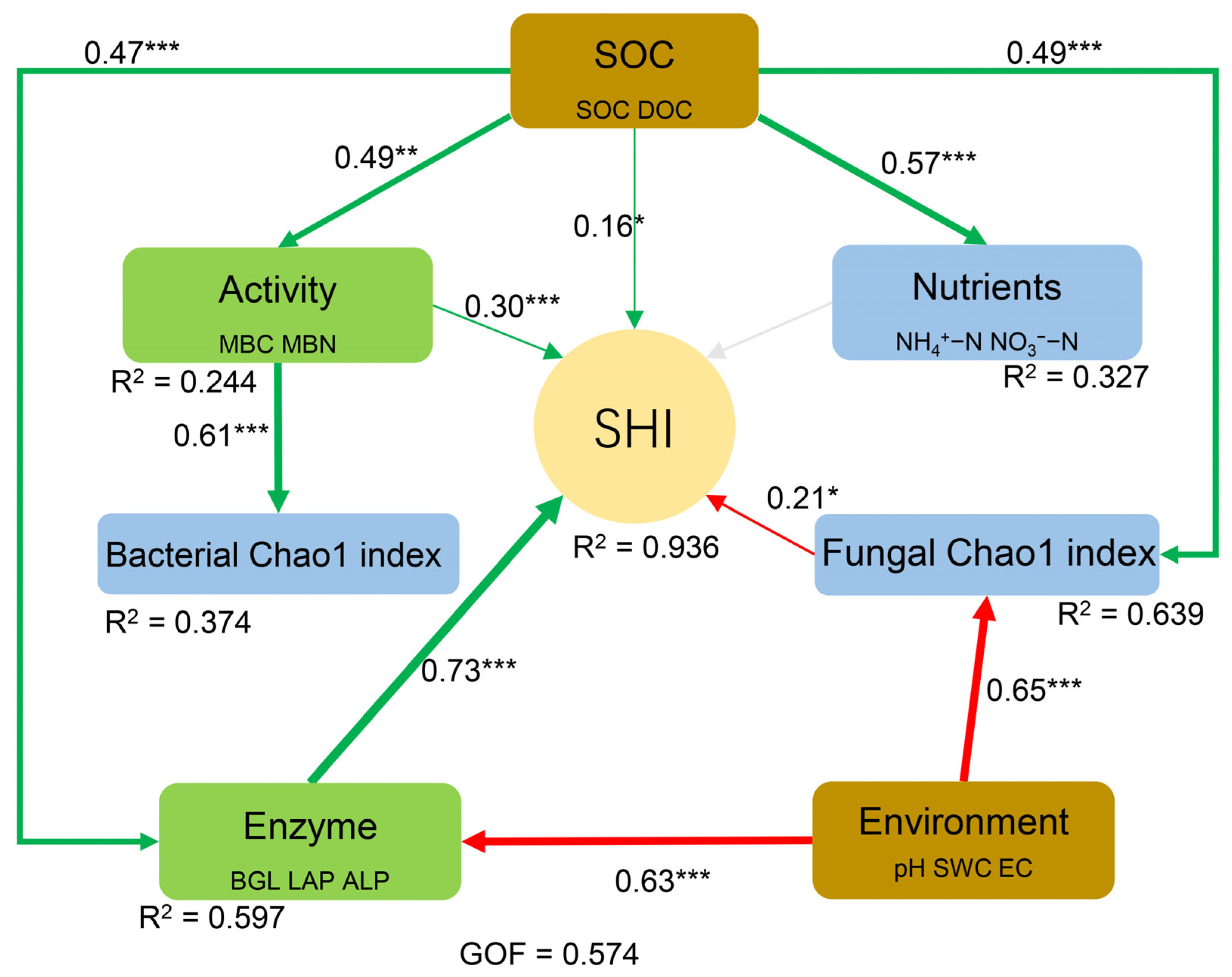
Structural equation model was employed to elucidate the direct and indirect pathways through which environmental factors and microbial properties influence the SHI (Figure 9). The model revealed that SOC, microbial activity (MBN, MBC), and enzyme activities (BGL, LAP and ALP) exhibited significant direct positive effects on the SHI. In contrast, the fungal alpha-diversity exhibited an inverse relationship with SHI. Importantly, SOC exhibited both a direct positive effect on the SHI, and indirect effects mediated by microbial activity, enzyme activities, and fungal diversity. Additionally, soil pH, EC, and SWC indirectly impacted SHI, primarily via enzyme activities and fungal diversity.

4. Discussion

4.1. Biochar Improves the Soil Quality by Increasing the Soil Organic Matter

Adding external organic substances can alter soil pH, SOM content, microbial biomass, as well as the accessibility of soil carbon and nitrogen, thereby influencing overall soil quality [51]. Consistent with our hypothesis, both straw return and biochar application have improved SHI, yet the pathways of enhancement differed between topsoil and subsoil. In the topsoil, the addition of straw and biochar to the topsoil significantly improved the soil quality by increasing varying soil properties (SWC, MBN and BGL in SR, MBN, NH4+–N and NO3–N in SB, SOC, DOC, NH4+–N and NO3–N in BS). MBC, BGL, and NO3–N were identified as key indicators for predicting soil quality in the topsoil, and different treatments exert varying impacts on these indicators. In the subsoil, the improvement effect of biochar application was superior to that of straw return. Biochar enhanced the levels of pH, SOC, DOC, MBC, MBN, and ALP, whereas straw return led to significant increases in soil pH, EC, DOC, MBC, MBN, NH4+–N and NO3–N. Among these parameters, MBC, MBN, pH, and SOC emerged as the primary contributors to improving SHI.
Numerous studies have confirmed that both straw return and biochar application can enhance SOC content, improve soil nutrient levels and increase MBC content [4,5,29,32], which aligns with the findings of our research. SOC plays a crucial role in ecosystem services and soil health, determining the soil’s nutrient retention capacity [52]. Consistent with our findings, extensive studies results indicate that biochar application significantly enhances SOC (a stable, long-lived carbon reservoir) and DOC, which is readily bioavailable [5,53,54]. Biochar provides both a persistent carbon pool and a source of carbon and energy for soil microorganisms, and the coexistence of stable and labile carbon fractions improves substrate availability and soil habitat conditions, thereby supporting microbial growth and enzyme production and ultimately enhancing MBC, MBN, and extracellular enzyme activities in the subsoil [55]. It should be noted that increases in DOC were not consistently observed across all treatments and soil depths, particularly in SR. This indicates that microbial stimulation was not solely dependent on increases in bulk DOC concentration. Instead, microbial biomass and enzyme activities may have been supported by integrated changes in soil carbon pools, including the presence of stabilized SOC, biochar-mediated sorption–desorption processes that regulate carbon availability, and improved soil habitat conditions such as moisture retention and physical protection. Therefore, DOC represents only one component of the carbon supply, and enhanced microbial functioning can occur even in the absence of pronounced DOC increases. This integrated carbon supply provides a plausible explanation for the observed increases in MBC, MBN, BGL, and ALP following biochar incorporation. Although straw return also elevated SOC, its effect was considerably weaker than that of biochar. Compared to biochar, a marked increase in mineral nitrogen content was detected under straw return treatment in the subsoil, likely due to the gradual release of macronutrients such as nitrogen, phosphorus, and potassium during straw decomposition [56]. The nutrient release associated with straw return subsequently stimulated the accumulation of MBC and MBN in the subsoil. In summary, the application of biochar significantly improved soil health compared to straw return in the subsoil, and this improvement was primarily driven by the increase in SOC, MBN, and MBC in the subsoil. Consequently, we posit that the stability of biochar guarantees its long-term efficacy in enhancing the SOC pool, while the accumulation of SOC further stimulates microbial activity and nutrient cycling dynamics, thus establishing a virtuous cycle of ‘organic carbon input—microbial response—ecosystem function enhancement’.

4.2. Biochar Regulates Bacterial Diversity by Increasing SOC and MBC

The combined application of biochar and straw significantly induced changes microbial community composition and diversity by altering soil physicochemical properties. Specifically, straw return significantly reduced fungal diversity (p < 0.05) in the topsoil. In the subsoil, biochar application enhanced bacterial diversity, consistent with findings from previous studies on the return of exogenous organic materials [51,57]. The underlying mechanism for these differential effects can be attributed to niche partitioning between bacterial and fungal communities, a process driven by intense substrate competition following amendment application [58]. In contrast, fungal communities demonstrate superior enzymatic capabilities, particularly through their lignocellulolytic systems, which are specialized for the decomposition of more recalcitrant organic matter [21]. The reduction in fungal diversity following straw return in the topsoil may be explained by shifts in resource availability and competitive interactions between bacteria and fungi. Straw incorporation introduces readily decomposable carbon fractions that preferentially stimulate fast-growing copiotrophic bacteria, which can rapidly exploit labile substrates and outcompete certain fungal taxa under high nutrient availability conditions. Previous studies have shown that increases in labile carbon inputs tend to promote bacterial dominance and reduce fungal-to-bacterial ratios, particularly in agricultural soils [59,60]. In addition, slight increases in soil pH and mineral nitrogen availability under straw return may further favor bacterial proliferation over fungi, as bacterial communities generally respond more rapidly to nutrient enrichment and shifts toward neutral pH conditions [61]. In contrast, the enhancement of bacterial diversity under biochar application can be attributed not only to increased SOC availability but also to biochar’s intrinsic physical and chemical properties. Biochar is characterized by high porosity, large specific surface area, and strong sorption capacity, which together increase microsite heterogeneity and provide protective habitats for microbial colonization [62]. These structural features can enhance microbial niche differentiation and reduce competitive exclusion, thereby supporting greater bacterial richness, particularly in subsoil environments where habitat limitation is more pronounced.
The structural equation model developed in this study systematically elucidated the correlation between soil properties, microbial diversity (bacteria/fungi), and SHI. Notably, fungal diversity increased with SOC enhancement but was negatively regulated by environmental factors. Fungal abundance and diversity were strongly and positively correlated with SOC [63]. Regression analysis indicated that SWC was the dominant factor suppressing fungal diversity. Fungi exhibited superior hydrophobicity and exoenzyme efficiency compared to bacteria, allowing them to degrade hydrophobic compounds through oxidative and hydrolytic pathways [55]. Thus, fungal diversity in moist soils is lower than that in dry soils [64]. The model revealed that SOC indirectly regulated microbial diversity through MBN and MBC changes. Combined linear regression analysis showed that SOC and MBC were the main variables associated with increases in bacterial diversity. Previous studies have reported that biochar application can alter bacterial community composition through increases in SOC [65]. And soil carbon content indirectly regulates microbial diversity through alterations in microbial biomass [66]. Therefore, the observed increase in bacterial diversity in this study can be attributed to the synergistic effects of SOC and MBC, whereby biochar addition promoted the accumulation of SOC and MBC, ultimately enhancing bacterial diversity.

5. Conclusions

Straw return and biochar application both enhance soil health index, yet biochar application significantly increases subsoil soil health index rather than straw return. This is primarily attributed to biochar’s substantial elevation of subsoil organic matter, which directly improves soil health index and indirectly enhances it through soil microbial activity and enzyme. From a wider viewpoint, these findings imply that management practices centered around biochar could play a role in carbon sequestration and climate change mitigation. This is because they encourage the buildup of more enduring soil organic carbon, while also boosting the biological functions of the soil. Significantly, the enhancements in soil health were realized without any reduction in crop yields, suggesting that applying biochar could be a viable approach for farmers aiming to shift towards regenerative agricultural systems. These systems prioritize the long-term quality of the soil, ecosystem services, and sustainable productivity.

6. Limitations

This study has several limitations that should be acknowledged. First, soil organic matter was measured as a bulk pool without fractionation into labile or stabilized forms, limiting the ability to distinguish the relative contributions of fresh organic inputs and persistent carbon pools. Second, the experiment was conducted at a single site characterized by lightly alkaline soil under a warm-temperate semi-humid monsoon climate and over a relatively short duration, which may constrain the broader applicability of the findings. Third, soil sampling was limited to the 0–40 cm layer, and deeper soil layers relevant to long-term carbon sequestration were not examined. Finally, although microbial diversity shifts were associated with changes in soil properties, direct functional measurements linking community composition to specific ecosystem processes were not performed. Future studies integrating soil organic matter fractionation, deeper soil profiles, long-term field trials, and functional microbial assessments would strengthen mechanistic understanding and improve the generalizability of these findings.

Supplementary Materials

The following supporting information can be downloaded at: https://www.mdpi.com/article/10.3390/agriculture16050498/s1, Figure S1: Weighting factors based on Principal Component Analysis (PCA) of eigenvectors for the different soil indicators to calculate the soil health index; Figure S2: Scree plot of eigenvalues against the number of principal components (a, b) for soil indicators from five treatments; Figure S3: PLS-DA of soil bacterial and fungal communities in five treatments at soil depth of 0–20 cm and 20–40 cm; Figure S4: Mantel test results analyzing the relationships between soil microbial communities (bacteria and fungi) and both soil physicochemical factors and SHI (Soil Health Index) at different soil depths; Table S1: Correlation between soil microbe Chao1 index with soil factors.

Author Contributions

Conceptualization, X.D. and W.D.; methodology, H.S., H.W., X.D. and W.D.; software, W.B.; validation, H.S., X.D. and W.D.; formal analysis, H.W., X.D. and W.D.; investigation, W.B. and H.W.; resources, X.D. and W.D.; data curation, W.B.; writing—original draft, W.B.; writing—review and editing, W.B., X.D. and W.D.; visualization, W.B.; supervision, X.D. and W.D.; project administration, X.D. and W.D.; funding acquisition, W.D. All authors have read and agreed to the published version of the manuscript.

Funding

National Key Research and Development Program of China (2021YFD1900904).

Institutional Review Board Statement

Not applicable.

Data Availability Statement

Dataset available on request from the authors.

Acknowledgments

We thank the invaluable contributions made by all staff of the Nanpi Ecological Agriculture Experimental Station, Chinese Academy of Sciences. We also thank Jintao Wang, Teng Li, Liu Tian, Wenwen Zhang, Lihua Xia, Xuejia Zhang, Boyuan Lou, Tong Lyu, and Menghao Zhao for their help in soil sampling.

Conflicts of Interest

The authors declare no conflicts of interest.

References

  1. Lehmann, J.; Bossio, D.A.; Kögel-Knabner, I.; Rillig, M.C. The Concept and Future Prospects of Soil Health. Nat. Rev. Earth Environ. 2020, 1, 544–553. [Google Scholar] [CrossRef]
  2. United Nations. Transforming Our World: The 2030 Agenda for Sustainable Development; UN: New York, NY, USA, 2015. [Google Scholar]
  3. FAO. UNEP Global Assessment of Soil Pollution; Report; FAO: Rome, Italy, 2021.
  4. Li, L.; Yang, J.; Yu, Y.; Shakoor, A.; Virk, A.L.; Li, F.-M.; Yang, H.; Kan, Z.-R. Crop Straw Converted to Biochar Increases Soil Organic Carbon but Reduces Available Carbon. Eur. J. Agron. 2025, 164, 127499. [Google Scholar] [CrossRef]
  5. Li, S.; Zhao, L.; Wang, C.; Huang, H.; Zhuang, M. Synergistic Improvement of Carbon Sequestration and Crop Yield by Organic Material Addition in Saline Soil: A Global Meta-Analysis. Sci. Total Environ. 2023, 891, 164530. [Google Scholar] [CrossRef]
  6. Fukumasu, J.; Jarvis, N.; Koestel, J.; Kätterer, T.; Larsbo, M. Relations between Soil Organic Carbon Content and the Pore Size Distribution for an Arable Topsoil with Large Variations in Soil Properties. Eur. J. Soil Sci. 2022, 73, e13212. [Google Scholar] [CrossRef]
  7. Zhou, J.; Sun, T.; Shi, L.; Kurganova, I.; Lopes De Gerenyu, V.; Kalinina, O.; Giani, L.; Kuzyakov, Y. Organic Carbon Accumulation and Microbial Activities in Arable Soils after Abandonment: A Chronosequence Study. Geoderma 2023, 435, 116496. [Google Scholar] [CrossRef]
  8. Ramesh, T.; Bolan, N.S.; Kirkham, M.B.; Wijesekara, H.; Kanchikerimath, M.; Rao, C.S.; Sandeep, S.; Rinklebe, J.; Ok, Y.S.; Choudhury, B.U.; et al. Chapter One—Soil Organic Carbon Dynamics: Impact of Land Use Changes and Management Practices: A Review. In Advances in Agronomy; Sparks, D.L., Ed.; Academic Press: Cambridge, MA, USA, 2019; Volume 156, pp. 1–107. [Google Scholar]
  9. Arthur, E.; Schjønning, P.; Moldrup, P.; Jonge, L.W. de Soil Resistance and Resilience to Mechanical Stresses for Three Differently Managed Sandy Loam Soils. Geoderma 2012, 173–174, 50–60. [Google Scholar] [CrossRef]
  10. Lehman, R.M.; Cambardella, C.A.; Stott, D.E.; Acosta-Martinez, V.; Manter, D.K.; Buyer, J.S.; Maul, J.E.; Smith, J.L.; Collins, H.P.; Halvorson, J.J.; et al. Understanding and Enhancing Soil Biological Health: The Solution for Reversing Soil Degradation. Sustainability 2015, 7, 988–1027. [Google Scholar] [CrossRef]
  11. López-Teloxa, L.C.; Monterroso-Rivas, A.I. Soil Organic Carbon May Decline Under Climate Change: A Case Study in Mexican Forests. Land 2024, 13, 1711. [Google Scholar] [CrossRef]
  12. Robinson, S.I.; O’Gorman, E.J.; Frey, B.; Hagner, M.; Mikola, J. Soil Organic Matter, Rather than Temperature, Determines the Structure and Functioning of Subarctic Decomposer Communities. Glob. Change Biol. 2022, 28, 3929–3943. [Google Scholar] [CrossRef]
  13. Xu, X.; Pei, J.; Xu, Y.; Wang, J. Soil Organic Carbon Depletion in Global Mollisols Regions and Restoration by Management Practices: A Review. J. Soils Sediments 2020, 20, 1173–1181. [Google Scholar] [CrossRef]
  14. Baveye, P.C.; Schnee, L.S.; Boivin, P.; Laba, M.; Radulovich, R. Soil Organic Matter Research and Climate Change: Merely Re-Storing Carbon Versus Restoring Soil Functions. Front. Environ. Sci. 2020, 8, 579904. [Google Scholar] [CrossRef]
  15. Saleem, A.; Anwar, S.; Nawaz, T.; Fahad, S.; Saud, S.; Ur Rahman, T.; Khan, M.N.R.; Nawaz, T. Securing a Sustainable Future: The Climate Change Threat to Agriculture, Food Security, and Sustainable Development Goals. J. Umm Al-Qura Univ. Appll. Sci. 2025, 11, 595–611. [Google Scholar] [CrossRef]
  16. Viancelli, A.; Michelon, W. Climate Change and Nitrogen Dynamics: Challenges and Strategies for a Sustainable Future. Nitrogen 2024, 5, 688–701. [Google Scholar] [CrossRef]
  17. FAO. Soils Help to Combat and Adapt to Climate Change by Playing a Key Role in the Carbon Cycle; Report; FAO: Rome, Italy, 2015.
  18. Lal, R. Soil Carbon Sequestration to Mitigate Climate Change. Geoderma 2004, 123, 1–22. [Google Scholar] [CrossRef]
  19. Paustian, K.; Lehmann, J.; Ogle, S.; Reay, D.; Robertson, G.P.; Smith, P. Climate-Smart Soils. Nature 2016, 532, 49–57. [Google Scholar] [CrossRef] [PubMed]
  20. Schreefel, L.; Schulte, R.P.O.; de Boer, I.J.M.; Schrijver, A.P.; van Zanten, H.H.E. Regenerative Agriculture—The Soil Is the Base. Glob. Food Secur. 2020, 26, 100404. [Google Scholar] [CrossRef]
  21. Linton, N.F.; Ferrari Machado, P.V.; Deen, B.; Wagner-Riddle, C.; Dunfield, K.E. Long-Term Diverse Rotation Alters Nitrogen Cycling Bacterial Groups and Nitrous Oxide Emissions after Nitrogen Fertilization. Soil Biol. Biochem. 2020, 149, 107917. [Google Scholar] [CrossRef]
  22. Lyu, H.; Yu, A.; Chai, Q.; Wang, F.; Wang, Y.; Wang, P.; Shang, Y.; Yang, X. Enhancing Soil Quality and Crop Yield by Increasing Dominant Bacterial Abundance and Reducing Bacterial Diversity under No-Tillage with Total Green Manure Incorporation. Agric. Ecosyst. Environ. 2025, 378, 109303. [Google Scholar] [CrossRef]
  23. Che, T.; Xu, Y.; Li, Y.; Wei, Z.; Zang, X.; Zhang, X.; Xiao, Z.; Hu, F.; Jiao, J.; Zhang, X.; et al. Mixed Planting Reduces the Shaping Ability of Legume Cover Crop on Soil Microbial Community Structure. Appl. Soil Ecol. 2022, 178, 104581. [Google Scholar] [CrossRef]
  24. Zhang, Y.; Xu, X.; Li, Z.; Xu, C.; Luo, W. Improvements in Soil Quality with Vegetation Succession in Subtropical China Karst. Sci. Total Environ. 2021, 775, 145876. [Google Scholar] [CrossRef] [PubMed]
  25. Jin, Z.; Shah, T.; Zhang, L.; Liu, H.; Peng, S.; Nie, L. Effect of Straw Returning on Soil Organic Carbon in Rice–Wheat Rotation System: A Review. Food Energy Secur. 2020, 9, e200. [Google Scholar] [CrossRef]
  26. Głąb, T.; Kulig, B. Effect of Mulch and Tillage System on Soil Porosity under Wheat (Triticum aestivum). Soil Tillage Res. 2008, 99, 169–178. [Google Scholar] [CrossRef]
  27. Guan, X.-K.; Wei, L.; Turner, N.C.; Ma, S.-C.; Yang, M.-D.; Wang, T.-C. Improved Straw Management Practices Promote in Situ Straw Decomposition and Nutrient Release, and Increase Crop Production. J. Clean. Prod. 2020, 250, 119514. [Google Scholar] [CrossRef]
  28. Liu, C.; Lu, M.; Cui, J.; Li, B.; Fang, C. Effects of Straw Carbon Input on Carbon Dynamics in Agricultural Soils: A Meta-analysis. Glob. Change Biol. 2014, 20, 1366–1381. [Google Scholar] [CrossRef]
  29. Xin, J.; Yan, L.; Cai, H. Response of Soil Organic Carbon to Straw Return in Farmland Soil in China: A Meta-Analysis. J. Environ. Manag. 2024, 359, 121051. [Google Scholar] [CrossRef]
  30. Gezahegn, A.; Selassie, Y.G.; Agegnehu, G.; Addisu, S.; Asargew Mihretie, F.; Kohira, Y.; Sato, S. Pyrolysis Temperature Changes the Physicochemical Characteristics of Water Hyacinth-Based Biochar as a Potential Soil Amendment. Biomass Conv. Biorefinery 2025, 15, 3737–3752. [Google Scholar] [CrossRef]
  31. Oladele, S.O. Changes in Physicochemical Properties and Quality Index of an Alfisol after Three Years of Rice Husk Biochar Amendment in Rainfed Rice—Maize Cropping Sequence. Geoderma 2019, 353, 359–371. [Google Scholar] [CrossRef]
  32. Sun, Z.; Hu, Y.; Shi, L.; Li, G.; Pang, Z.; Liu, S.; Chen, Y.; Jia, B. Effects of Biochar on Soil Chemical Properties: A Global Meta-Analysis of Agricultural Soil. Plant Soil Environ. 2022, 68, 272–289. [Google Scholar] [CrossRef]
  33. Yang, Y.; Xie, H.; Mao, Z.; Bao, X.; He, H.; Zhang, X.; Liang, C. Fungi Determine Increased Soil Organic Carbon More than Bacteria through Their Necromass Inputs in Conservation Tillage Croplands. Soil Biol. Biochem. 2022, 167, 108587. [Google Scholar] [CrossRef]
  34. Wan, P.; Zhou, Z.; Yuan, Z.; Wei, H.; Huang, F.; Li, Z.; Li, F.-M.; Zhang, F. Fungal Community Composition Changes and Reduced Bacterial Diversity Drive Improvements in the Soil Quality Index during Arable Land Restoration. Environ. Res. 2024, 244, 117931. [Google Scholar] [CrossRef]
  35. Wu, L.; Tang, S.; He, D.; Wu, X.; Shaaban, M.; Wang, M.; Zhao, J.; Khan, I.; Zheng, X.; Hu, R.; et al. Conversion from Rice to Vegetable Production Increases N 2 O Emission via Increased Soil Organic Matter Mineralization. Sci. Total Environ. 2017, 583, 190–201. [Google Scholar] [CrossRef]
  36. Shaaban, M.; Wu, Y.; Núñez-Delgado, A.; Kuzyakov, Y.; Peng, Q.-A.; Lin, S.; Hu, R. Enzyme Activities and Organic Matter Mineralization in Response to Application of Gypsum, Manure and Rice Straw in Saline and Sodic Soils. Environ. Res. 2023, 224, 115393. [Google Scholar] [CrossRef]
  37. Dong, X.; Wang, J.; Zhang, X.; Dang, H.; Singh, B.P.; Liu, X.; Sun, H. Long-Term Saline Water Irrigation Decreased Soil Organic Carbon and Inorganic Carbon Contents. Agric. Water Manag. 2022, 270, 107760. [Google Scholar] [CrossRef]
  38. Walkley, A.; Black, I.A. An Examination of the Degtijareff Method for Determining Soil Organic Matter and a Proposed Modification of the Chromic Acid Titration Method. Soil Sci. 1934, 37, 29–38. [Google Scholar] [CrossRef]
  39. Vance, E.D.; Brookes, P.C.; Jenkinson, D.S. An Extraction Method for Measuring Soil Microbial Biomass C. Soil Biol. Biochem. 1987, 19, 703–707. [Google Scholar] [CrossRef]
  40. Tabatabai, M.A.; Bremner, J.M. Use of P-Nitrophenyl Phosphate for Assay of Soil Phosphatase Activity. Soil Biol. Biochem. 1969, 1, 301–307. [Google Scholar] [CrossRef]
  41. Hayano, K. A Method for the Determination of β-Glucosidase Activity in Soil. Soil Sci. Plant Nutr. 1973, 19, 103–108. [Google Scholar] [CrossRef]
  42. Appel, W. Leucine Aminopeptidase. In Methods of Enzymatic Analysis, 2nd ed.; Bergmeyer, H.U., Ed.; Academic Press: Cambridge, MA, USA, 1974; pp. 954–958. ISBN 978-0-12-091302-2. [Google Scholar]
  43. Moebius-Clune, B.N.; Moebius-Clune, D.J.; Gugino, B.K.; Idowu, O.J.; Schindelbeck, R.R.; Ristow, A.J.; van Es, H.M.; Thies, J.E.; Shayler, H.A.; McBride, M.B.; et al. Comprehensive Assessment of Soil Health—The Cornell Framework; Edition 3.2; Cornell University: Ithaca, NY, USA, 2016. [Google Scholar]
  44. Shukla, M.K.; Lal, R.; Ebinger, M. Determining Soil Quality Indicators by Factor Analysis. Soil Tillage Res. 2006, 87, 194–204. [Google Scholar] [CrossRef]
  45. Fine, A.K.; Van Es, H.M.; Schindelbeck, R.R. Statistics, Scoring Functions, and Regional Analysis of a Comprehensive Soil Health Database. Soil Sci. Soc. Am. J. 2017, 81, 589–601. [Google Scholar] [CrossRef]
  46. Liu, Y.; Chen, L.; Ma, T.; Li, X.; Zheng, M.; Zhou, X.; Chen, L.; Qian, X.; Xi, J.; Lu, H.; et al. EasyAmplicon: An Easy-to-use, Open-source, Reproducible, and Community-based Pipeline for Amplicon Data Analysis in Microbiome Research. iMeta 2023, 2, e83. [Google Scholar] [CrossRef]
  47. Rognes, T.; Flouri, T.; Nichols, B.; Quince, C.; Mahé, F. VSEARCH: A Versatile Open Source Tool for Metagenomics. PeerJ 2016, 4, e2584. [Google Scholar] [CrossRef]
  48. Edgar, R.C. Search and Clustering Orders of Magnitude Faster than BLAST. Bioinformatics 2010, 26, 2460–2461. [Google Scholar] [CrossRef]
  49. Wang, Q.; Garrity, G.M.; Tiedje, J.M.; Cole, J.R. Naïve Bayesian Classifier for Rapid Assignment of rRNA Sequences into the New Bacterial Taxonomy. Appl. Environ. Microbiol. 2007, 73, 5261–5267. [Google Scholar] [CrossRef] [PubMed]
  50. Schoch, C.L.; Seifert, K.A.; Huhndorf, S.; Robert, V.; Spouge, J.L.; Levesque, C.A.; Chen, W.; Fungal Barcoding Consortium; Fungal Barcoding Consortium Author List; Bolchacova, E.; et al. Nuclear Ribosomal Internal Transcribed Spacer (ITS) Region as a Universal DNA Barcode Marker for Fungi. Proc. Natl. Acad. Sci. USA 2012, 109, 6241–6246. [Google Scholar] [CrossRef]
  51. Kong, A.Y.Y.; Scow, K.M.; Córdova-Kreylos, A.L.; Holmes, W.E.; Six, J. Microbial Community Composition and Carbon Cycling within Soil Microenvironments of Conventional, Low-Input, and Organic Cropping Systems. Soil Biol. Biochem. 2011, 43, 20–30. [Google Scholar] [CrossRef]
  52. Dutta, S.; Pal, R.; Chakraborty, A.; Chakrabarti, K. Influence of Integrated Plant Nutrient Supply System on Soil Quality Restoration in a Red and Laterite Soil: Einfluss Integrierter Pflanzennährstoff Versorgung Auf Die Wiederherstellun Der Bodenqualität von Rotem Und Laterit Boden. Arch. Agron. Soil Sci. 2003, 49, 631–637. [Google Scholar] [CrossRef]
  53. Meng, W.; Zhu, F.; Wang, X.; Guan, S.; Dou, S.; Ndzelu, B.S. Contrasting Effects of Straw and Straw-Derived Biochar Application on Soil Organic Matter and Corn Yield in a Chinese Mollisol. J. Soils Sediments 2023, 23, 3843–3856. [Google Scholar] [CrossRef]
  54. Xia, H.; Shen, J.; Riaz, M.; Jiang, C.; Zu, C.; Jiang, C.; Liu, B. Effects of Biochar and Straw Amendment on Soil Fertility and Microbial Communities in Paddy Soils. Plants 2024, 13, 1478. [Google Scholar] [CrossRef]
  55. Jin, X.; An, T.; Gall, A.R.; Li, S.; Filley, T.; Wang, J. Enhanced Conversion of Newly-Added Maize Straw to Soil Microbial Biomass C under Plastic Film Mulching and Organic Manure Management. Geoderma 2018, 313, 154–162. [Google Scholar] [CrossRef]
  56. Yan, C.; Yan, S.-S.; Jia, T.-Y.; Dong, S.-K.; Ma, C.-M.; Gong, Z.-P. Decomposition Characteristics of Rice Straw Returned to the Soil in Northeast China. Nutr. Cycl. Agroecosyst. 2019, 114, 211–224. [Google Scholar] [CrossRef]
  57. Yang, L.; Bai, J.; Zeng, N.; Zhou, X.; Liao, Y.; Lu, Y.; Rees, R.M.; Nie, J.; Cao, W. Diazotroph Abundance and Community Structure Are Reshaped by Straw Return and Mineral Fertilizer in Rice-Rice-Green Manure Rotation. Appl. Soil Ecol. 2019, 136, 11–20. [Google Scholar] [CrossRef]
  58. Wang, C.; Kuzyakov, Y. Mechanisms and Implications of Bacterial–Fungal Competition for Soil Resources. ISME J. 2024, 18, wrae073. [Google Scholar] [CrossRef]
  59. Fierer, N.; Bradford, M.A.; Jackson, R.B. Toward an Ecological Classification of Soil Bacteria. Ecology 2007, 88, 1354–1364. [Google Scholar] [CrossRef]
  60. Six, J.; Frey, S.D.; Thiet, R.K.; Batten, K.M. Bacterial and Fungal Contributions to Carbon Sequestration in Agroecosystems. Soil Sci. Soc. Am. J. 2006, 70, 555–569. [Google Scholar] [CrossRef]
  61. Rousk, J.; Brookes, P.C.; Bååth, E. Contrasting Soil pH Effects on Fungal and Bacterial Growth Suggest Functional Redundancy in Carbon Mineralization. Appl. Environ. Microbiol. 2009, 75, 1589–1596. [Google Scholar] [CrossRef] [PubMed]
  62. Lehmann, J.; Rillig, M.C.; Thies, J.; Masiello, C.A.; Hockaday, W.C.; Crowley, D. Biochar Effects on Soil Biota—A Review. Soil Biol. Biochem. 2011, 43, 1812–1836. [Google Scholar] [CrossRef]
  63. Zhao, H.; Zhang, X.; Liu, H.; Bai, X.; Nie, J.; Han, G.; Han, B. Reduced Moisture Caused by Short-Term Grazing Prohibition Results in a Significant Decrease of Fungi Abundance. J. Arid Environ. 2024, 221, 105138. [Google Scholar] [CrossRef]
  64. Castro, H.F.; Classen, A.T.; Austin, E.E.; Norby, R.J.; Schadt, C.W. Soil Microbial Community Responses to Multiple Experimental Climate Change Drivers. Appl. Environ. Microbiol. 2010, 76, 999–1007. [Google Scholar] [CrossRef] [PubMed]
  65. Zhang, L.; Jing, Y.; Xiang, Y.; Zhang, R.; Lu, H. Responses of Soil Microbial Community Structure Changes and Activities to Biochar Addition: A Meta-Analysis. Sci. Total Environ. 2018, 643, 926–935. [Google Scholar] [CrossRef]
  66. Bastida, F.; Eldridge, D.J.; García, C.; Kenny Png, G.; Bardgett, R.D.; Delgado-Baquerizo, M. Soil Microbial Diversity–Biomass Relationships Are Driven by Soil Carbon Content across Global Biomes. ISME J. 2021, 15, 2081–2091. [Google Scholar] [CrossRef]
Figure 1. Schematic illustration of the experimental design showing the five treatments applied, including the type of amendments (straw, biochar, or whole maize plants) and their application depth (0–20 cm topsoil or buried at 40 cm depth).
Agriculture 16 00498 g001
Figure 2. Effects of different straw and biochar treatments on (a) wheat yield and (b) maize yield. Values are means ± standard errors (SE). Different lowercase letters indicate significant differences among treatments at p < 0.05. Conventional planting without biochar or straw addition (CK), homogeneous incorporation of mechanically crushed straws into the 0–20 cm topsoil layer (SR), biochar burial at 40 cm (SD), combined application of returning mechanically crushed straws in the topsoil and biochar burial at 40 cm (SB), and biochar incorporation into the topsoil combined with burial of entire maize plants at 40 cm (BS).
Agriculture 16 00498 g002
Figure 3. Soil health index in five treatments at soil depths of 0–20 and 20–40 cm. The different lowercase letters indicate statistically significant (p < 0.05) differences between different treatments at the same soil depth. ** indicates significant differences (p < 0.05) in the same treatment between 0–20 and 20–40 cm. Conventional planting without biochar or straw addition (CK), homogeneous incorporation of mechanically crushed straws into the 0–20 cm (SR), biochar burial at 40 cm (SD), combined application of returning mechanically crushed straws in the topsoil and biochar burial at 40 cm (SB), and biochar incorporation into the topsoil combined with burial of entire maize plants at 40 cm (BS). T, treatment; D, depth.
Agriculture 16 00498 g003
Figure 4. Random forest regression modeling of (a) 0–20 cm and (b) 20–40 cm indicates the mean predictor importance (as MSE, mean square error) of soil properties driving the soil health. * p < 0.05; ** p < 0.01. EC, exchange capacity; SOC, soil organic carbon; DOC, dissolved organic carbon; NH4+–N, ammonium nitrogen; NO3–N, nitrate nitrogen; MBC, microbial biomass carbon; MBN, microbial biomass nitrogen; BGL, β-glucosidase; LAP, leucine aminopeptidase; ALP, alkaline phosphatase.
Agriculture 16 00498 g004
Figure 5. Relative abundance of (a) soil bacteria and (b) soil fungi at phylum level in five treatments at soil depth of 0–20 and 20–40 cm. Conventional planting without biochar or straw addition (CK), homogeneous incorporation of mechanically crushed straws into the 0–20 cm topsoil layer (SR), biochar burial at 40 cm (SD), combined application of returning mechanically crushed straws in the topsoil and biochar burial at 40 cm (SB), and biochar incorporation into the topsoil combined with burial of entire maize plants at 40 cm (BS).
Agriculture 16 00498 g005
Figure 6. The Chao1 index of (a) soil bacteria and (b) soil fungi in five treatments at soil depths of 0–20 and 20–40 cm. Different lowercase letters below pillars indicate significant differences between rotations at p < 0.05. Conventional planting without biochar or straw addition (CK), homogeneous incorporation of mechanically crushed straws into the 0–20 cm topsoil layer (SR), biochar burial at 40 cm (SD), combined application of returning mechanically crushed straws in the topsoil and biochar burial at 40 cm (SB), and biochar incorporation into the topsoil combined with burial of entire maize plants at 40 cm (BS).
Agriculture 16 00498 g006
Figure 7. Correlation between soil bacterial Chao1 index and soil factors. (a) MBC, microbial biomass carbon, (b) ALP, alkaline phosphatase, (c) SOC, soil organic carbon, and (d) BGL, β-glucosidase.
Agriculture 16 00498 g007
Figure 8. Correlation between soil fungal Chao1 index and soil factors. (a) ALP, alkaline phosphatase, (b) BGL, β-glucosidase, (c) SWC, soil water content, (d) SOC, soil organic carbon, (e) NO3–N, nitrate nitrogen, and (f) MBN, microbial biomass nitrogen.
Agriculture 16 00498 g008
Figure 9. Pathways showing how the different soil properties impact the soil health index (SHI). Red and green arrows represent significant negative and positive relationships, respectively (* p < 0.05, ** p < 0.01, *** p < 0.001). EC, exchange capacity; SOC, soil organic carbon; DOC, dissolved organic carbon; NH4+–N, ammonium nitrogen; NO3–N, nitrate nitrogen; MBC, microbial biomass carbon; MBN, microbial biomass nitrogen; BGL, β-glucosidase; LAP, leucine aminopeptidase; ALP, alkaline phosphatase.
Agriculture 16 00498 g009
Table 1. Soil physicochemical properties, microbial biomass, and nutrient availability in the topsoil (0–20 cm) and subsoil (20–40 cm).
Soil LayerpHBulk Density
(g cm−3)
Microbial Biomass Carbon
mg kg−1
Microbial Biomass Nitrogen
mg kg−1
SOC
g kg−1
Available Phosphorus
mg kg−1
Available
Potassium
mg kg−1
Topsoil
(0–20 cm)
8.741.49217.0161.377.6611.46103.17
Subsoil
(20–40 cm)
8.751.5898.3434.973.923.7490.47
Note: SOC, soil organic matter.
Table 2. Soil chemical properties and enzyme activity at soil depths of 0–20 and 20–40 cm.
Soil Depth
cm
TreatmentpHEC
dS m−1
SWC
%
SOC
g kg−1
DOC
mg kg−1
NH4+–N
mg kg−1
NO3–N
mg kg−1
MBC
mg kg−1
MBN
mg kg−1
BGL
nmol h−1 g−1
LAP
nmol h−1 g−1
ALP
nmol h−1 g−1
0–20CK8.14 ± 0.07 bc1.73 ± 0.02 a8.91 ± 2.58 b7.99 ± 0.66 c52.50 ± 4.73 bc1.25 ± 0.26 ab5.68 ± 0.2 c254.26 ± 6.68 b243.11 ± 39.66 bc96.98 ± 1.57 ab31.20 ± 1.02 a147.49 ± 5.08 ab
SR8.11 ± 0.03 c1.71 ± 0.08 a12.64 ± 1.6 a8.01 ± 0.19 c49.54 ± 5.28 c1.50 ± 0.28 ab6.85 ± 0.91 bc299.36 ± 5.87 ab295.16 ± 55.22 b111.66 ± 7.89 a24.07 ± 2.57 ab147.13 ± 13.63 ab
SD8.35 ± 0.01 a1.66 ± 0.01 a12.51 ± 1.72 a7.17 ± 0.06 c57.36 ± 2.52 bc1.70 ± 0.38 a8.66 ± 1.03 ab325.29 ± 30.78 a176.64 ± 71.01 c101.05 ± 4.93 ab28.41 ± 6.57 ab139.39 ± 8.47 b
SB8.24 ± 0.1 ab1.71 ± 0.14 a10.44 ± 1.49 ab9.90 ± 0.67 b59.91 ± 7.8 b1.11 ± 0.04 b9.20 ± 1.33 a282.45 ± 46.26 ab409.88 ± 9.69 a89.24 ± 10.31 b14.21 ± 6.69 c159.16 ± 5.52 a
BS8.21 ± 0.08 bc1.72 ± 0.11 a11.11 ± 0.94 ab13.23 ± 1.01 a69.25 ± 1.12 a1.09 ± 0.26 b10.25 ± 1.54 a275.27 ± 46.82 ab198.76 ± 5.64 c96.91 ± 18.54 ab20.89 ± 6.57 bc157.87 ± 4.16 a
20–40CK8.13 ± 0.10 b1.88 ± 0.28 b11.11 ± 1.69 c4.59 ± 0.88 bc46.59 ± 8.65 b1.27 ± 0.16 b3.00 ± 1.42 b180.90 ± 15.50 c118.74 ± 58.84 c34.38 ± 2.61 b33.52 ± 1.83 a59.76 ± 21.22 b
SR8.19 ± 0.09 b1.81 ± 0.09 b13.45 ± 0.72 b4.37 ± 0.97 c44.83 ± 1.36 b1.23 ± 0.06 bc4.08 ± 1.15 b188.75 ± 17.16 c145.97 ± 17.79 bc28.28 ± 0.32 bc30.29 ± 1.44 ab56.13 ± 3.87 b
SD8.40 ± 0.04 a1.94 ± 0.05 b15.65 ± 0.98 a6.27 ± 0.64 b54.77 ± 1.00 ab1.35 ± 0.02 b3.43 ± 0.19 b305.18 ± 22.67 a224.97 ± 67.18 ab20.19 ± 1.80 c6.35 ± 1.24 d71.66 ± 7.15 b
SB8.37 ± 0.03 a2.08 ± 0.18 b14.37 ± 0.27 ab13.90 ± 1.57 a61.01 ± 7.09 ab1.06 ± 0.14 c4.19 ± 0.58 b277.63 ± 5.17 a284.34 ± 37.89 a51.97 ± 11.57 a25.43 ± 2.42 b98.42 ± 14.30 a
BS8.38 ± 0.01 a2.57 ± 0.08 a12.76 ± 1.28 bc4.94 ± 0.19 bc65.03 ± 16.82 a2.51 ± 0.08 a9.36 ± 0.08 a236.25 ± 10.76 b228.94 ± 2.92 a30.93 ± 3.93 b13.30 ± 5.60 c71.25 ± 11.33 b
Treatment (T)<0.001<0.0010.002<0.0010.001<0.001<0.001<0.001<0.0010.237<0.0010.002
Soil depth (D)0.002<0.001<0.001<0.0010.2340.053<0.001<0.0010.001<0.0010.220<0.001
T × D0.1690.0010.401<0.0010.930<0.0010.0060.0130.0010.001<0.0010.089
Note: The values are mean ± SD for 0–20 and 20–40 cm. EC, exchange capacity; SOC, soil organic carbon; DOC, dissolved organic carbon; NH4+–N, ammonium nitrogen; NO3–N, nitrate nitrogen; MBC, microbial biomass carbon; MBN, microbial biomass nitrogen; BGL, β-glucosidase; LAP, leucine aminopeptidase; ALP, alkaline phosphatase. Conventional planting without biochar or straw addition (CK), homogeneous incorporation of mechanically crushed straws into the 0–20 cm (SR), biochar burial at 40 cm (SD), combined application of returning mechanically crushed straws in the topsoil and biochar burial at 40 cm (SB), and biochar incorporation into the topsoil combined with burial of entire maize plants at 40 cm (BS). Values in bold indicate statistically significant (p < 0.05) differences. The different lowercase letters indicate statistically significant (p < 0.05) differences between different treatments.
Disclaimer/Publisher’s Note: The statements, opinions and data contained in all publications are solely those of the individual author(s) and contributor(s) and not of MDPI and/or the editor(s). MDPI and/or the editor(s) disclaim responsibility for any injury to people or property resulting from any ideas, methods, instructions or products referred to in the content.