Article

Inversion of SPAD Value in Yellowed Leaves of ‘Kuerle Xiangli’ (Pyrus sinkiangensis Yu) Using Multispectral Images from Drones

1
College of Agriculture, Shihezi University, Shihezi 832003, China
2
Key Laboratory of Special Fruits & Vegetables Cultivation Physiology and Germplasm Resources Utilization, Xinjiang Production and Construction Group, Shihezi University, Shihezi 832003, China
*
Authors to whom correspondence should be addressed.
Agriculture 2026, 16(4), 416; https://doi.org/10.3390/agriculture16040416
Submission received: 14 January 2026 / Revised: 3 February 2026 / Accepted: 10 February 2026 / Published: 12 February 2026
(This article belongs to the Section Artificial Intelligence and Digital Agriculture)

Abstract

SPAD values serve as a key physiological indicator for assessing the health status of ‘Kuerle Xiangli’ leaves and for monitoring the occurrence of chlorosis. Rapid, non-destructive acquisition of their spatial distribution provides crucial support for precision orchard management and the scientific correction of leaf yellowing. This study selected six ‘Kuerle Xiangli’ experimental orchards in Tiemenguan City, Bayingolin Mongol Autonomous Prefecture, Xinjiang, as the research area. Using multi-spectral imagery from a DJI Mavic 3 drone and ground-measured SPAD values, four inversion models, RF, XGBoost, SVR, and PLSR, were constructed. Model inputs included vegetation indices (VIs), texture features, and a combination of both. By comparing the accuracy of the different models, the optimal SPAD inversion model for yellowing leaves of ‘Kuerle Xiangli’ was selected and validated in the field. Finally, a spatial distribution map of SPAD values was generated based on the optimal model. The results indicate the following: (1) Feature selection and the fusion of multi-source features significantly enhanced inversion performance. Compared to models using a single feature type, the Random Forest (RF) model that integrated 6 vegetation indices (CIRE, NDRE, LCI, REOSAVI, GNDVI, and NDWI) with 26 texture features performed best. It achieved an R2 = 0.9179, RMSE = 1.9970 and MAE = 1.2284 on the training set, and an R2 = 0.8161, RMSE = 3.4702, and MAE = 2.6799 on the validation set. The model also maintained good performance during field validation in an independent orchard (R2 = 0.7329, RMSE = 1.5823, MAE = 1.3377). (2) The spatial distribution map of SPAD values generated by the optimal model clearly delineates the SPAD ranges and yellowing status across the six orchards. The overall SPAD range across all orchards was 15.7 to 45.7. The order of yellowing severity was LLJ (80.5%) > YHC (68.1%) > LGQ (52.9%) > NKS (46.8%) > LCX (36.4%) > LGL (34.1%).

1. Introduction

‘Kuerle Xiangli’ (Pyrus sinkiangensis Yu) is a species belonging to the genus Pyrus in the Rosaceae family. It is native to southern Xinjiang, China, with its core cultivation area centered in the Bayingolin Mongol Autonomous Prefecture. This area radiates outward from Korla City to surrounding regions. By the end of 2024, the total cultivation area of ‘Kuerle Xiangli’ in Xinjiang, China, had reached 64,500 hectares. Within this total, the Bayingolin Mongol Autonomous Prefecture accounted for 37,300 hectares, while the Aksu region comprised 27,100 hectares [1]. Its fruit is noted for exceptional quality, distinctive flavor, rich aroma, and excellent storage properties [2]. Serving as a vital pillar of Xinjiang’s forestry and fruit industry, it plays a key role in enhancing agricultural efficiency, increasing farmers’ income, driving regional economic development, and maintaining ecological balance [3]. However, the production areas of ‘Kuerle Xiangli’ have been consistently affected by widespread yellowing over many years, which has become a constraining factor for the industry’s healthy development [4]. Affected pear trees exhibit a range of symptoms. Lighter cases involve reduced tree vigor, yield, and fruit quality. Severe cases lead to deformity or death, often with associated rot diseases. Thereby, the normal growth and development of pear trees and the sustainability of the industry are seriously threatened [5].
The yellowing of fruit tree leaves fundamentally results from chlorosis, which is caused by impaired chlorophyll synthesis or accelerated degradation. The factors inducing yellowing can be categorized into two types, pathological and physiological. Pathological yellowing is triggered by biotic infestations (e.g., pests or pathogens) that lead to localized or overall reductions in chlorophyll content, often accompanied by symptoms such as mold growth or small black spots [6]. In contrast, physiological yellowing occurs when plants are subjected to abiotic stressors including adverse climate and soil conditions that indirectly inhibit chlorophyll synthesis or accelerate its breakdown.
Based on previous research, the yellowing observed in ‘Kuerle Xiangli’ is generally categorized as physiological in nature. This variety is primarily cultivated in the oasis regions of the Tarim Basin in Xinjiang, where calcareous soils immobilize iron. This reduces the efficiency of iron uptake and utilization by the roots. Iron deficiency subsequently inhibits chlorophyll synthesis and accelerates its degradation in ‘Kuerle Xiangli’ [7]. In the early stage of chlorosis, young leaves at the tips of new shoots begin to yellow. As the condition progresses, the leaf mesophyll gradually turns yellow. Severely affected leaves exhibit vein chlorosis, resulting in an overall yellowish white appearance, with dry patches forming along the margins [8]. Yellowing symptoms in Kuerle Xiangli are evident throughout the entire growing season, with the most pronounced manifestation occurring during the fruit enlargement stage [4]. Therefore, chlorophyll content can serve as an effective indicator for monitoring this yellowing. Currently, methods for determining chlorophyll content mainly fall into two categories. The first is destructive chemical analysis in the laboratory, which accurately quantifies the concentrations of chlorophyll a, chlorophyll b, and total chlorophyll. The second involves using a portable chlorophyll meter to obtain relative chlorophyll content (SPAD values). While the latter method offers high accuracy for single plant measurements and can reflect crop health status [9], both approaches share drawbacks such as low efficiency, limited spatial coverage, and delayed data acquisition [10]. Consequently, they are inadequate for meeting the demand for rapid, accurate, and real-time monitoring of large-scale leaf yellowing in orchard environments.
In recent years, unmanned aerial vehicle (UAV) remote sensing technology has shown considerable promise in agricultural monitoring, particularly for the inversion of crop physiological parameters, where it offers distinct advantages [11]. This technology is characterized by high efficiency, low cost, nondestructiveness, high spatiotemporal resolution, and wide coverage, enabling the rapid acquisition of information over large agricultural areas. These capabilities provide crucial support for the dynamic monitoring and precision management of orchards [12]. As a key component of UAV remote sensing, multi-spectral imaging technology utilizes onboard sensors to capture the reflectance spectra of crop canopies across multiple spectral bands, allowing for accurate estimation of crop nutrient content [13]. In the specific context of estimating crop chlorophyll content using UAV multi-spectral data, several studies have demonstrated progress. For example, Ning Yan et al. [14] combined vegetation indices with texture features and compared multiple algorithms to build a high accuracy SPAD value inversion model for pear trees. Zhao Peng et al. [15] integrated parameters such as leaf water content, SPAD values, and leaf area index with machine learning methods, including Random Forest and Gradient Boosting, to support precision management in semiarid millet production systems. Xiaofei Yang et al. [16] developed a potato canopy SPAD estimation model based on UAV multi-spectral imagery and machine learning, followed by further algorithm optimization. Similarly, Khan S M et al. [17] estimated canopy chlorophyll concentration in lemongrass across different growth stages and nutrient treatments, reporting that Support Vector Machine models achieved the highest accuracy.
In conclusion, combining UAV multi-spectral remote sensing with machine learning offers considerable promise for estimating crop SPAD values. Nevertheless, research on estimating SPAD values in yellowing leaves of ‘Kuerle Xiangli’ remains limited, particularly regarding feature optimization and validation of model generalization. Therefore, this study aims to develop a SPAD value inversion model for yellowed leaves of ‘Kuerle Xiangli’ using four machine learning algorithms: RF, XGBoost, SVR, and PLSR. The model inputs include vegetation indices, texture information, and combinations of both, which are correlated with SPAD values measured from ‘Kuerle Xiangli’. By analyzing and comparing the accuracy of different models, the optimal model for estimating SPAD values in yellowing leaves of ‘Kuerle Xiangli’ will be selected and further validated through field application experiments. Based on UAV multi-spectral imaging, this approach enables efficient and nondestructive monitoring of SPAD values in yellowing ‘Kuerle Xiangli’ leaves, offering scientific support for the targeted management of leaf yellowing.

2. Materials and Methods

2.1. Research Area Overview

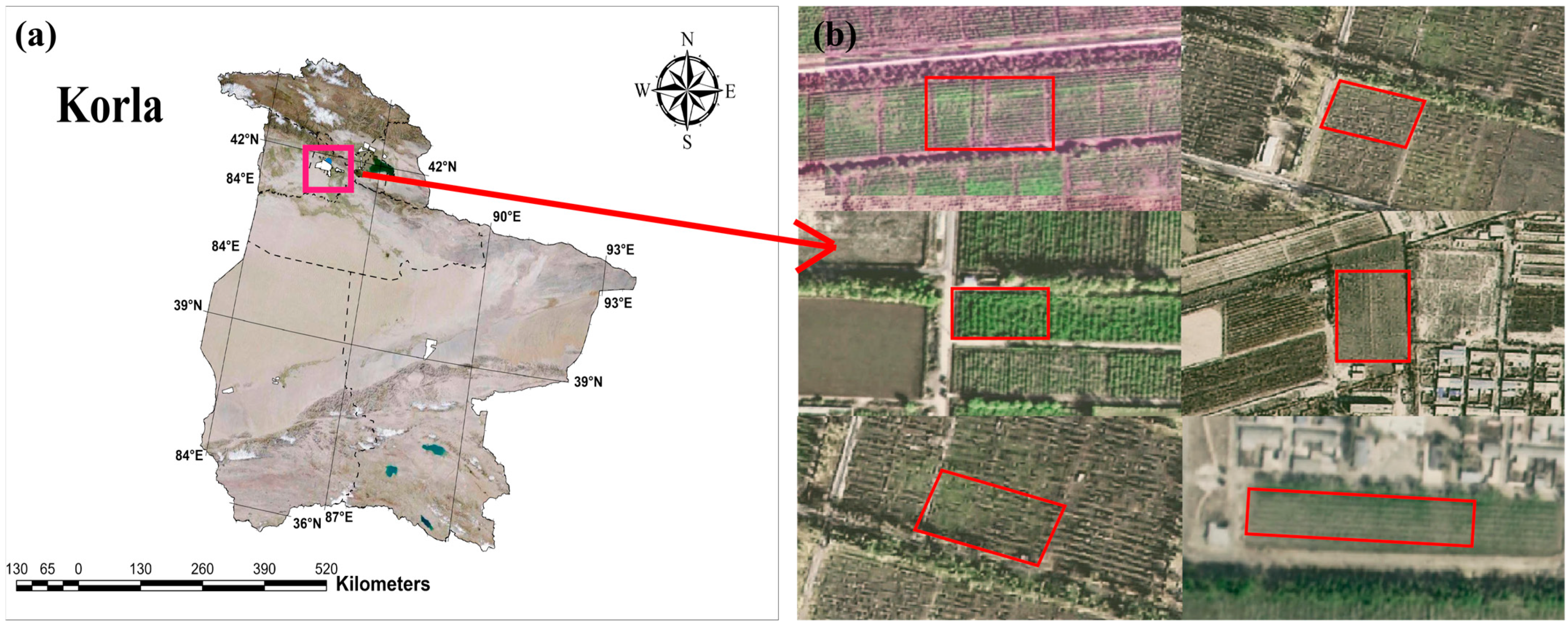
The experimental area is situated in Tiemenguan City, Korla, Xinjiang, China (Figure 1). This region lies at the southern foothills of the Tianshan Mountains and in the eastern part of the Tarim Basin. The climate is characterized as a northern temperate continental extreme arid type. Annual average sunshine duration ranges from 2603 to 2832.8 h, with a sunshine percentage between 59% and 64%. To distinguish between different experimental orchards, each orchard is identified by an acronym derived from the initials of the orchard manager’s name in pinyin. Specifically, these acronyms are LCX, LGL, LLJ, NKS, and YHC. The aforementioned acronyms serve as the designations for each orchard. Specific trial plots include: NKS at the Agricultural Science Institute of the 28th Regiment; LCX and LLJ, both located at the 10th Company of the 29th Regiment; LGL at the 1st Company of the 30th Regiment; and LGQ and YHC at the 2nd Company of the 30th Regiment. All orchards adhered to local standard cultivation and management practices to ensure consistency and reproducibility. The test material comprised ‘Kuerle Xiangli’ trees grafted onto Pyrus betulifolia Bunge rootstock, with tree ages ranging from 11 to 20 years. Tree architecture included both spindle and open tiered shapes with heights of approximately 3–5 m. Overall, the six experimental orchards exhibited good growth vigor and showed no obvious signs of pests or diseases (Table 1).

2.2. Data Collection and Processing

2.2.1. Assessment of Chlorosis Severity and Spatial Distribution in Sample Trees

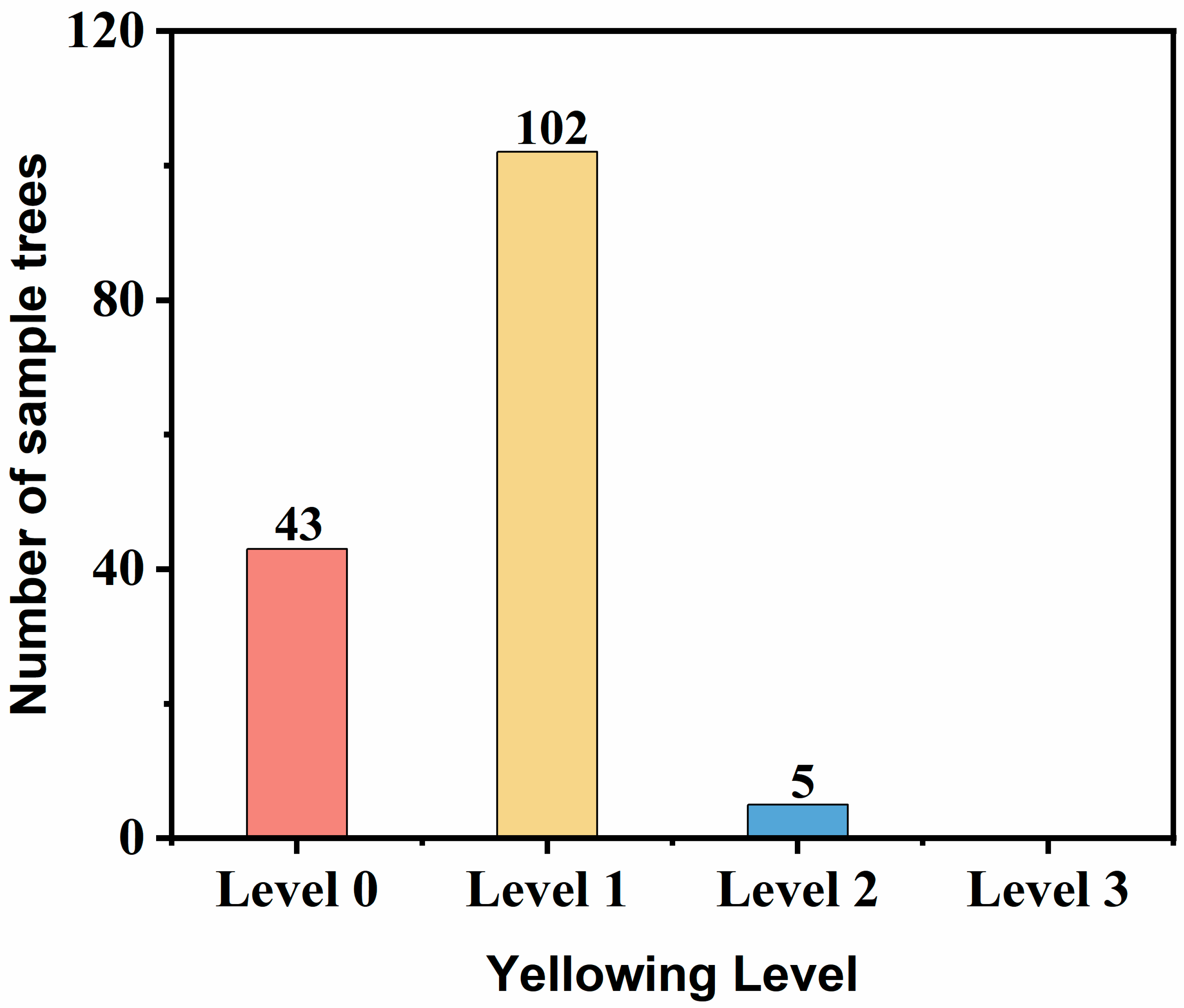
This study surveyed 150 sample trees across six experimental orchards. Referencing previous research [18], the sample trees were classified into different levels of chlorosis based on the classification criteria for chlorotic trees (Table 2), as shown in Figure 2. Among them, 102 sample trees exhibited mild chlorosis (Level 1), accounting for 68.0%; 43 trees were healthy (Level 0), accounting for 28.7%; only 5 trees exhibited moderate yellowing (Level 2), representing 3.3%. Given the overall robust tree condition in the experimental orchards, no severely yellowed trees (Level 3) were observed. The chlorosis observed in ‘Kuerle Xiangli’ is iron deficiency-induced. Consequently, chlorotic symptoms were primarily distributed in the upper and middle canopy layers. As severity increased, chlorosis progressed downward through the canopy, starting from young leaves on new shoots, exhibiting localized chlorosis [8]. Actual photos of sample trees with varying degrees of chlorosis severity are shown in Supplementary Figure S1.

2.2.2. Leaf Sampling and Processing

To develop and validate a SPAD value inversion model for yellowing leaves of ‘Kuerle Xiangli’, four of the six experimental orchards were randomly assigned to the model dataset, while the remaining two served as an external test set. The six experimental gardens comprise a total of 150 samples, with the model dataset containing 100 samples and the external test set comprising 50 samples. Within each orchard, 25 ‘Kuerle Xiangli’ trees were selected. From each tree, 20 leaves were collected from the upper middle canopy layer at four cardinal directions (east, south, west, north) to ensure representative sampling. The SPAD values of freshly harvested leaves were measured with a portable chlorophyll meter (Konica Minolta, Inc., Tokyo, Japan). Three readings were taken at the upper, middle, and lower portions of each leaf, avoiding the main and secondary veins, and the average of these readings was used to represent the tree’s SPAD value. All measurements were performed under sunny, natural light conditions between 12:00 and 14:00 local time. Leaf collection was synchronized with UAV multi-spectral image acquisition to maintain temporal and spatial consistency.

2.2.3. UAV Image Acquisition and Preprocessing

This study employed a DJI Mavic 3 multi-spectral drone (DJI Mavic 3, 3M; DJI Innovation, Shenzhen, China) for image acquisition. Precise control was achieved using an integrated RTK centimeter-level positioning system and time synchronization technology. The platform is equipped with a 20 mega pixel visible light camera and four 5 mega pixel multi-spectral cameras. An onboard irradiance sensor records solar irradiance to enable real-time light compensation, thereby improving data consistency. To ensure uniform lighting conditions, image collection was conducted between 12:00 and 14:00 under clear, windless weather during the fruit expansion stage of pear trees (from 17 to 27 July 2025). For each of the six ‘Kuerle Xiangli’ experimental orchards, one multi-spectral remote sensing survey was performed sequentially. Prior to takeoff, a diffuse reflectance panel was manually photographed for calibration. During flight, the gimbal was maintained in a nadir orientation, with a heading overlap of 80% and a side overlap of 70%. The flight altitude was set at 12 m above ground level, with a speed of 4 m per second. Images were captured at 2 s intervals with a resolution of 2592 × 1944 pixels. The drone imagery features a pixel size of 0.55 cm/pixel and is stored in both JPEG and TIFF formats. Detailed parameters are listed in Table 3.
The preprocessing workflow for multi-spectral drone imagery includes key steps such as image stitching, geometric correction, radiometric calibration, soil background removal, and reflectance extraction. Before image stitching, the captured images of the diffuse reflectance plate and the collected multi-spectral drone imagery were imported into DJI Terra 4.4.6 software (DJI Innovation, Shenzhen, China) for radiometric calibration. Subsequently, the calibrated multi-spectral imagery was processed in DJI Terra 4.4.6 to generate visible light images and single-band orthophotos for all six study areas. The final mosaicked orthophotos were exported and saved in TIFF format. The maximum interclass variance method was applied to eliminate the effects of soil background and shadows in the single band UAV images. Finally, to ensure accurate spatial alignment between ground-based SPAD measurements and UAV imagery, reference targets were placed at each sampling point. Geographic coordinates of these points were extracted using DJI Terra software. In QGIS 3.40.4, a fixed circular region of interest was delineated at each sample point to cover the upper middle portion of the canopy. Subsequently, the average values within these regions were extracted as reflectance values and used to construct vegetation indices.

2.2.4. Multi-Spectral Vegetation Index Calculation and Screening

Vegetation indices are parameters derived from remote sensing technology, used to evaluate vegetation growth status and health by analyzing spectral reflectance characteristics. Their calculation is based on differences and ratios in how vegetation reflects and absorbs light across visible, near-infrared, and infrared bands. These indices can effectively reflect key parameters such as chlorophyll content and biomass, thereby providing data support for agricultural monitoring and ecological assessment [19]. In this study, 17 vegetation indices were selected: NDVI, DVI, RVI, TVI, SAVI, OSAVI, GNDVI, NDRE, NRI, REOSAVI, GOSAVI, LCI, NDCI, NDWI, RGRI, CIRE, and MSR. Based on the reflectance values extracted from the four single band images within the regions of interest in the multi-spectral data, vegetation indices were calculated using the raster calculator tool in ENVI 5.6 software (NV5 Geospatial Software, Inc., Orlando, FL, USA), following the formulas provided in Table 4. To improve the generalization capability and computational efficiency of the SPAD value inversion model for yellowing leaves of ‘Kuerle Xiangli’, this study applied the Recursive Feature Elimination (RFE) algorithm for key feature selection [20]. RFE uses a random forest estimator to rank features by importance and calculate their cumulative contribution. Once the cumulative contribution of a feature subset exceeds 90%, that subset is identified as the optimal feature set [21]. This approach simplifies the model structure, reduces computational complexity, and retains essential information, thereby providing reliable feature support for subsequent inversion model construction.

2.2.5. Calculation of Texture Features and Construction and Screening of Texture Indices

Texture features describe recurring local patterns and their arrangement rules within an image. Local texture information is quantified by the grayscale distribution of pixel neighborhoods, while global texture features arise from their repetitive nature [38]. Among methods for texture feature quantification, the Gray-Level Co-occurrence Matrix (GLCM) is widely applied. In this study, image texture features (TFs) were extracted using the second-order probabilistic statistical filter (Co-occurrence Measures) in ENVI 5.6 software. Extraction across four spectral bands yielded eight TF categories: Mean (MEA), Variance (VAR), Homogeneity (HOM), Contrast (CON), Dispersion (DIS), Entropy (ENT), Second-order Moment (SEM), and Correlation (COR). For the texture analysis, a 3 × 3 window size and a 45° direction were chosen, considering both the spatial resolution of the imagery and the actual arrangement characteristics of the fruit trees. The spatial offsets in the X and Y directions were set to the default value of 1, resulting in a total of 32 texture feature variables. To explore the potential of texture indices for predicting SPAD values in yellowing leaves of ‘Kuerle Xiangli’ from UAV multi-spectral images, four texture indices (TIs) were examined, as shown in Table 5: the Normalized Difference Texture Index (NDTI), Difference Texture Index (DTI), Ratio Texture Index (RTI), and Combined Difference Texture Index (CDTI). These indices were constructed by randomly combining texture features according to established empirical formulas [39]. The feature combination demonstrating the highest correlation with SPAD values was selected as the optimal texture index. To enhance the generalization capability and computational efficiency of the SPAD value inversion model for yellowing leaves of ‘Kuerle Xiangli’, the Recursive Feature Elimination (RFE) algorithm [20] was employed to screen key features from the total set of 36 variables, which comprised the 4 texture indices and the 32 texture features. RFE uses a random forest estimator to rank features by importance and calculate their cumulative contribution. Once the cumulative contribution of a feature subset exceeds 90%, that subset is identified as the optimal feature set. This strategy simplifies the model structure, reduces computational complexity, and preserves the key informative components within the texture data, thereby providing reliable texture feature support for the subsequent construction of the inversion model.

2.3. Model Construction and Evaluation

This study compiled 100 valid samples of yellowing leaves from ‘Kuerle Xiangli’ to develop a reliable SPAD value inversion model and systematically compare the performance of different algorithms. The samples were randomly divided into a training set and a validation set using a 7:3 ratio. During the modeling phase, several machine learning regression algorithms were applied to construct inversion models. By comparing the prediction accuracy of each model on both the training and validation sets, the optimal algorithm for estimating SPAD values in yellowing ‘Kuerle Xiangli’ leaves was identified. In this study, the machine learning models were selected following careful consideration of their established effectiveness in remote sensing applications, especially in estimating vegetation biophysical parameters. These algorithms are widely acknowledged in the literature for their high predictive accuracy, strong robustness to noise, and capacity to handle complex nonlinear relationships [40,41]. The machine learning regression models tested in this work included Random Forest (RF), XGBoost, Support Vector Regression (SVR), and Partial Least Squares Regression (PLSR). Model parameters were optimized via grid search in combination with 5-fold cross validation with specific parameters detailed in Table S1.

2.3.1. Support Vector Regression Algorithm

Support Vector Regression (SVR) is a regression method based on statistical learning theory [42,43]. Its core idea is to construct an optimal hyperplane that minimizes prediction error. By controlling model complexity, SVR reduces over-fitting and improves generalization ability. To address the nonlinear relationships commonly found in real data, this study adopts the radial basis function as the kernel. This approach maps the input data into a high-dimensional feature space, allowing nonlinear patterns to be effectively captured.

2.3.2. Random Forest Regression Algorithm

Random Forest Regression (RF) is an ensemble learning method based on regression decision trees [44]. Its core mechanism involves constructing diverse models through dual randomness: first, generating multiple training subsets from the original data-set; second, randomly selecting a subset of features as candidate variables during node splitting. For regression tasks, RF’s final prediction is achieved by averaging the results of all decision trees. Thus, the predicted value y ^ for input sample x can be expressed as:
y ^ = 1 T i = 1 T h i ( x ) ,
Here, T denotes the number of regression decision trees, and hi(x) represents the prediction result of the i th tree. This ensemble strategy reduces the prediction variance of individual trees and excels at capturing nonlinear relationships. Therefore, the RF algorithm was selected for this study due to its outstanding regression prediction performance, efficient handling of complex data, and unique capability for feature importance assessment, combining both accuracy and robustness.

2.3.3. Extreme Gradient Boosting Tree Algorithm

Extreme Gradient Boosting Tree Algorithm (XGBoost) is an improved algorithm based on gradient boosted decision trees [45]. Its core principle involves sequentially constructing regression decision trees (weak learners) while minimizing an objective function with a regularization term, ultimately forming a strong learner. For regression tasks, let the training data-set be D = { ( x i , y i ) } i = 1 n (where xi ∈ Rp is a p-dimensional feature vector and yi ∈ R is the regression target value), the model undergoes K iterations to generate K decision trees f k ( x ) ( k = 1,2 , , K ) . The final prediction for input sample x is the weighted sum of all tree outputs, defined as:
y ^ ( x ) = k = 1 K f k ( x ) ,
In each iteration, the objective of constructing the t-th tree is to minimize the following loss function:
L ( t ) = i = 1 n l ( y i , y ^ i ( t 1 ) + f t ( x i ) ) + γ T t + 1 2 λ j = 1 T t w tj 2 ,
where l(⋅) denotes the loss function, y ^ i ( t 1 ) represents the prediction value of the previous t − 1 trees for sample xi, and γ T t + 1 2 λ j = 1 T t w tj 2 serves as the regularization term (where Tt denotes the number of leaf nodes in the t-th tree, wtj represents the weight of the j-th leaf node in the t-th tree, and γ and λ are regularization parameters). This study selected the XGBoost algorithm based on its advantages of high accuracy, strong adaptability, and high efficiency in regression tasks, providing reliable model support for the inversion of SPAD values in yellowed leaves of ‘Kuerle Xiangli’.

2.3.4. Partial Least Squares Regression

Partial Least Squares Regression (PLSR) is a modeling technique that integrates principal component analysis with linear regression [46]. It is designed to establish quantitative relationships between input variables (X) and response variables (Y). In regression tasks, PLSR simultaneously decomposes and filters both X and Y to extract a small set of mutually independent principal components (PCs). A linear regression model between X and Y is then constructed based on these components, effectively addressing challenges associated with high-dimensional modeling. This method efficiently eliminates redundant collinearity among independent variables that are unrelated to the dependent variable. The PLSR algorithm was selected for this study due to its ability to retain essential information from the original data while effectively addressing multicollinearity among vegetation indices and challenges related to high dimensionality. This approach helps avoid model overfitting, which can occur when high-dimensional features are used with small sample sizes. By leveraging PLSR’s robustness to multicollinearity and its efficient use of samples, the method can uncover linear relationships between spectral features and SPAD values, thereby enhancing overall model stability.

2.3.5. Evaluation of Model Accuracy

In this study, a total of 100 sample sets were acquired. Seventy percent of the samples were allocated to the training set for model construction, while the remaining thirty percent formed the validation set to assess model accuracy. The coefficient of determination (R2) reflects the model’s ability to explain variation in the data, whereas RMSE and MAE provide absolute measures of prediction error by quantifying deviations between observed and predicted values. These metrics are essential for assessing a model’s practical utility in field applications [47]. Therefore, to comprehensively evaluate the generalization capability of the models, this study employed R2, RMSE, and MAE. Generally, a higher R2 indicates stronger explanatory power of the model, while lower RMSE and MAE values correspond to smaller prediction errors and thus better model performance. The formulas for calculating these evaluation metrics are provided below:
R 2 = 1 i = 1 n ( y i y ^ i ) 2 i = 1 n ( y i y ¯ i ) 2 ,
RMSE = 1 n i = 1 n ( y i y ^ i ) 2
MAE = 1 n i = 1 n | y i y ^ i |
In the equation, yi represents the target parameter, such as the measured SPAD values of leaves; y ^ i denotes the model estimated value; y ¯ i is the average of the measured values; and n indicates the number of samples.

2.4. Field Application Validation

To objectively evaluate the field applicability and generalization ability of the constructed optimal model, the LCX and YHC experimental plots were selected from the six test sites as an external test set. Once the optimal model was determined, the test set was applied to it for field validation. The accuracy metrics R2, RMSE, and MAE were used to assess model performance, thereby determining the practical effectiveness of the optimal model.

3. Results

3.1. Screening of Vegetation Indices

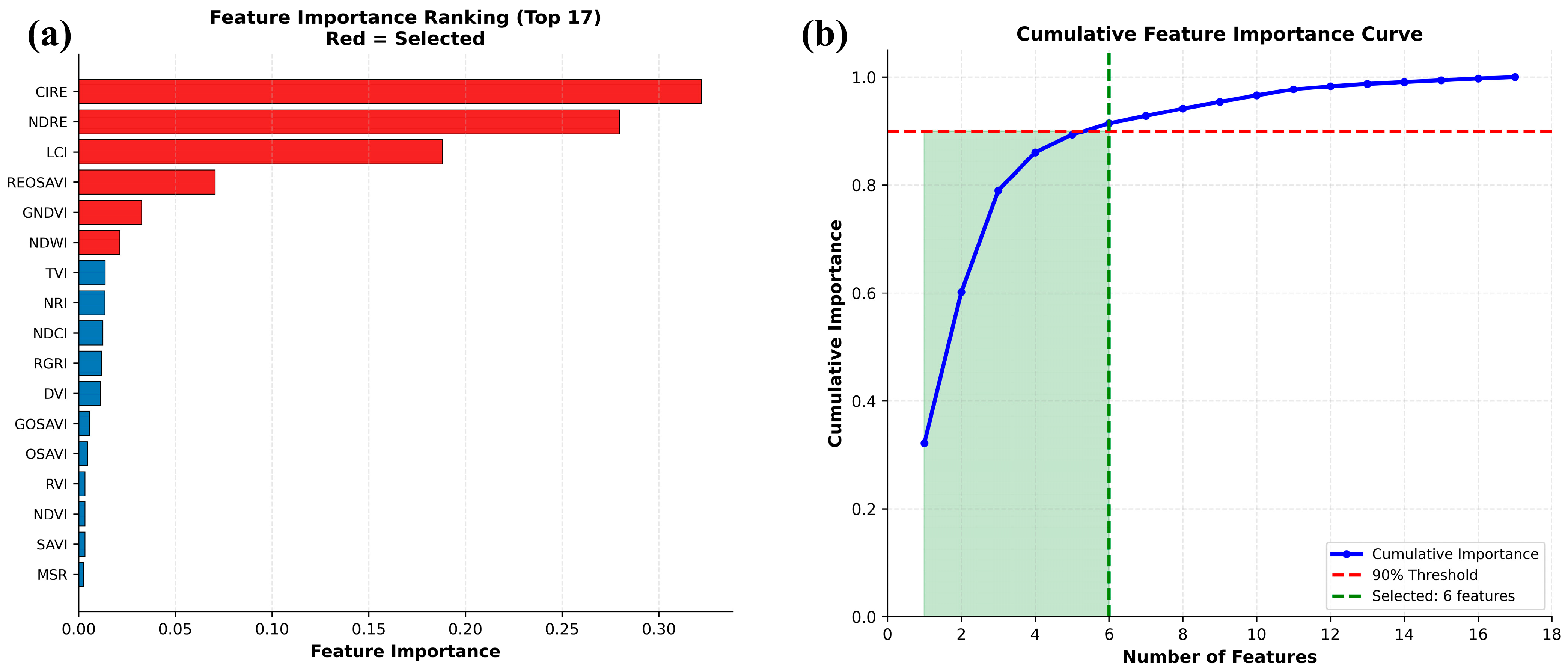
To mitigate multicollinearity among vegetation indices, this study used the RFE algorithm to screen 17 candidate indices. The out-of-bag error of a random forest model served as the evaluation criterion. As shown in Figure 3a, the importance scores and rankings of all indices are presented. The six indices highlighted in red CIRE, NDRE, LCI, REOSAVI, GNDVI, and NDWI obtained importance scores of approximately 0.32, 0.28, 0.19, 0.07, 0.03, and 0.02, respectively, which were notably higher than those of the remaining 11 indices. Figure 3b displays the cumulative feature contribution curve. The cumulative contribution reached about 79% when the first three features were included, and it attained the 90% threshold after incorporating all six selected features. The subsequent increase in cumulative contribution became relatively slow, indicating high redundancy among the remaining indices. Based on the feature importance ranking and the cumulative contribution curve, redundant variables were progressively removed. Consequently, six key vegetation indices, CIRE, NDRE, LCI, REOSAVI, GNDVI, and NDWI, were retained for constructing the SPAD value inversion model for yellowing leaves of ‘Kuerle Xiangli’.

3.2. Construction of Texture Index

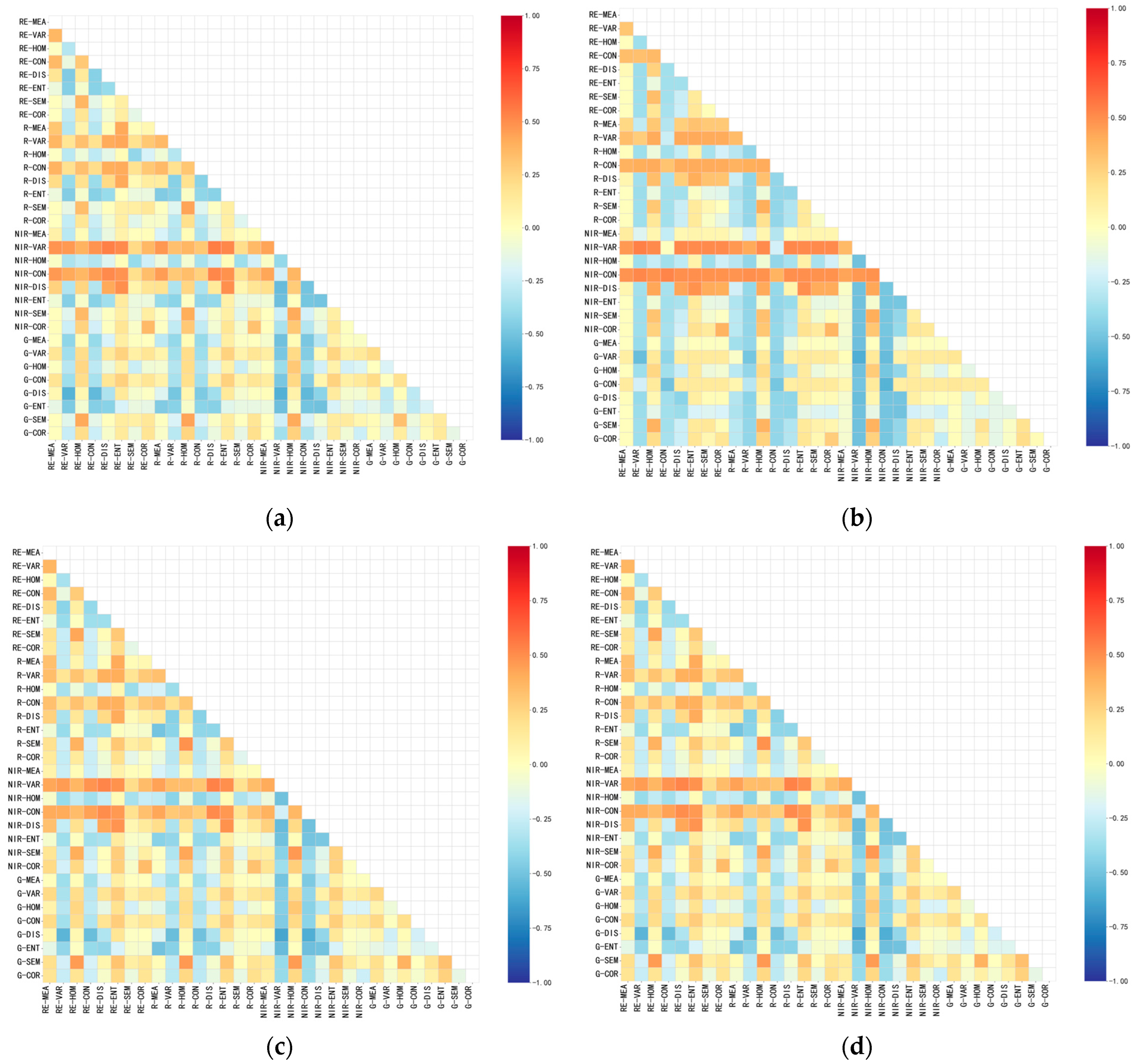
As shown in Figure 4, this study constructed four texture indices: NDTI, DTI, RTI, and CDTI. Correlation analyses were conducted between these texture indices derived from various combinations of texture features and the SPAD values in yellowed leaves of ‘Kuerle Xiangli’. In the NDTI correlation heatmap (Figure 4a), the combination of NIR_VAR and G_DIS showed the highest correlation with SPAD values, with a correlation coefficient of −0.58, while the combination of R_MEA and NIR_VAR showed the lowest correlation, with a coefficient of 0.48. In the DTI correlation heatmap (Figure 4b), the combination of NIR_VAR and G_VAR exhibited the strongest correlation with SPAD values at −0.60, whereas the combination of RE_CON and G_CON showed the weakest correlation at −0.50. In the RTI correlation heatmap (Figure 4c), the combination of NIR_VAR and G_DIS showed the highest correlation with SPAD values, with a correlation coefficient of −0.63; the combination of NIR_CON and G_MEA showed the lowest correlation, with a coefficient of −0.47. In the CDTI correlation heatmap (Figure 4d), the optimal combination was NIR_VAR and G_DIS, with a correlation coefficient of −0.63. Therefore, the optimal feature combinations for NDTI, CDTI, and RTI were NIR_VAR and G_DIS, while the optimal feature combination for DTI was NIR_VAR and G_VAR.

3.3. Filtering of Texture Information

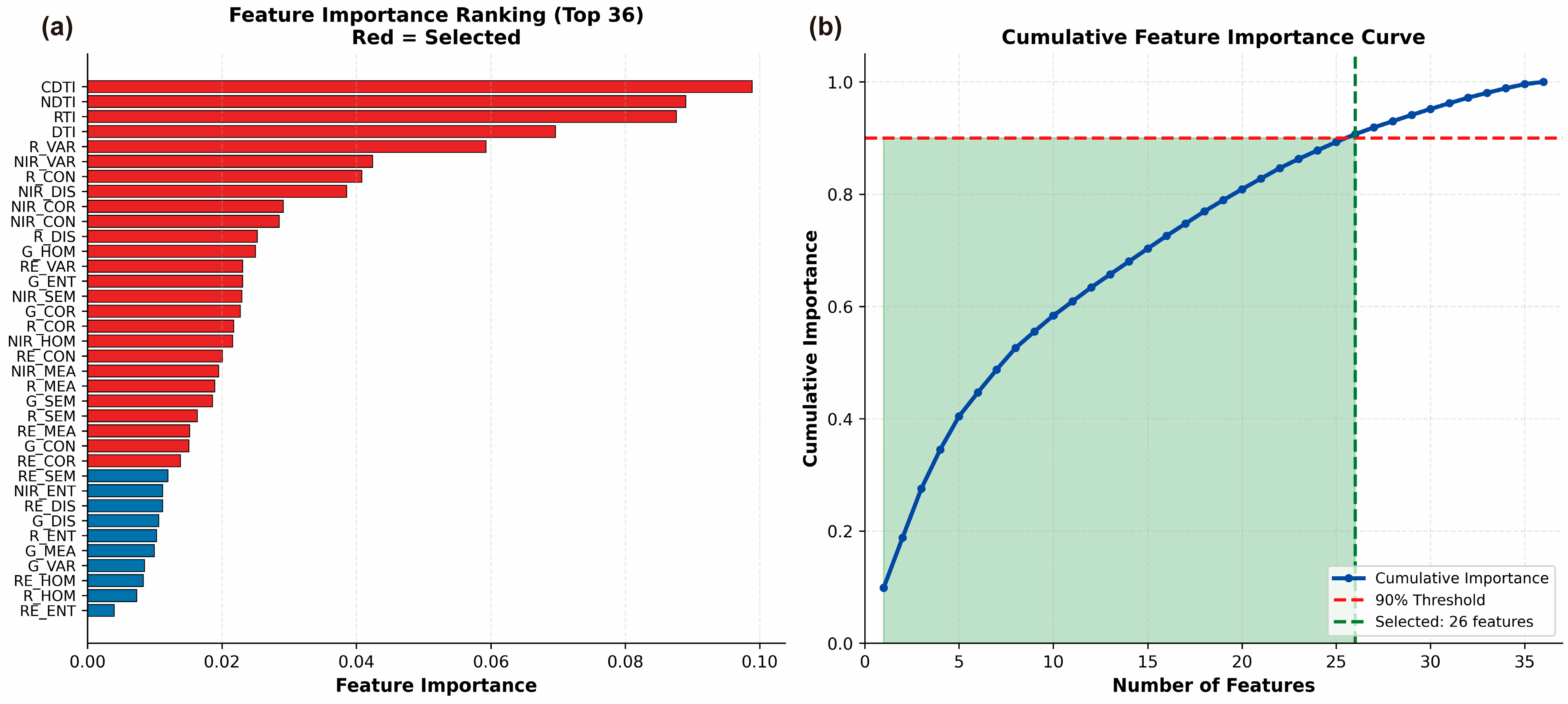
To reduce redundancy and multicollinearity among texture features and indices, a recursive feature elimination algorithm was applied to screen 36 texture variables. These comprised four texture indices (CDTI, NDTI, RTI, DTI) and 32 texture measures extracted from the red edge, red, near-infrared, and green bands. For each band, eight features were derived: mean, variance, homogeneity, contrast, dissimilarity, entropy, second moment, and correlation. The out-of-bag error of a random forest regression model served as the evaluation criterion. Figure 5a presents the importance score ranking of the 36 features. The 26 key features highlighted with red bars display importance scores ranging from 0.01 to 0.10. Among them, the four texture indices, CDTI, NDTI, RTI, and DTI, obtained scores of 0.10, 0.09, 0.09, and 0.07, respectively. The cumulative contribution curve in Figure 5b shows that the top 10 features account for approximately 58% of the total contribution. As more features are added, the curve rises gradually, reaching the preset 90% threshold when all 26 selected features are included. By combining the importance ranking with the cumulative contribution curve, redundant features with low scores and limited contribution were progressively eliminated. Ultimately, 26 key texture features were retained for constructing the subsequent SPAD value inversion model for yellowing leaves of ‘Kuerle Xiangli’.

3.4. Model Development for Optimal SPAD Values in Yellowed Leaves of ‘Korla Xiangli’

3.4.1. Optimal Model Construction Based on Vegetation Indices

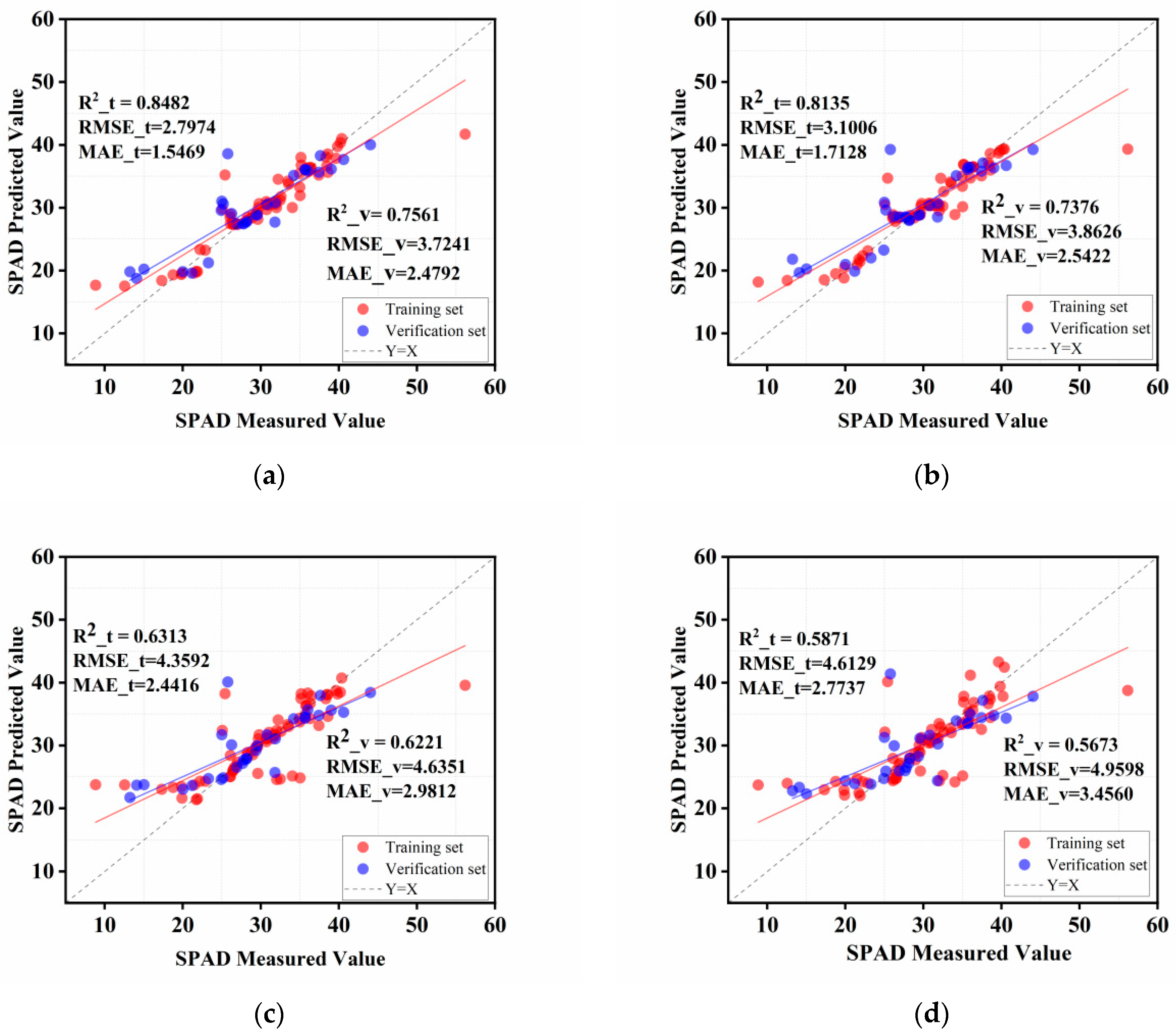
Based on the six vegetation indices selected through RFE screening, this study developed four SPAD value inversion models: RF, XGBoost, SVR, and PLSR (Figure 6). The fitting ability and generalization performance of each model were systematically assessed using R2, RMSE, and MAE. A comprehensive comparison revealed notable performance differences among the models. The RF model (Figure 6a) performed best on both the training and validation sets, achieving a training R2 of 0.8482, RMSE of 2.7974, and MAE of 1.5469, and a validation R2 of 0.7561, RMSE of 3.7241, and MAE of 2.4792. The XGBoost model (Figure 6b) ranked second, with a training R2 of 0.8135, RMSE of 3.1006, and MAE of 1.7128, and a validation R2 of 0.7376, RMSE of 3.8626, and MAE of 2.5422, showing good generalization ability. The SVR model (Figure 6c) delivered lower accuracy, with R2 values of 0.6313 on the training set and 0.6221 on the validation set. The PLSR model (Figure 6d) exhibited the weakest fit, with both training and validation R2 values below 0.6. In summary, the RF model surpassed the others in both fitting accuracy and generalization, rendering it more suitable for estimating SPAD values in yellowing leaves of ‘Kuerle Xiangli’.

3.4.2. Optimal Model Construction Based on Texture Information

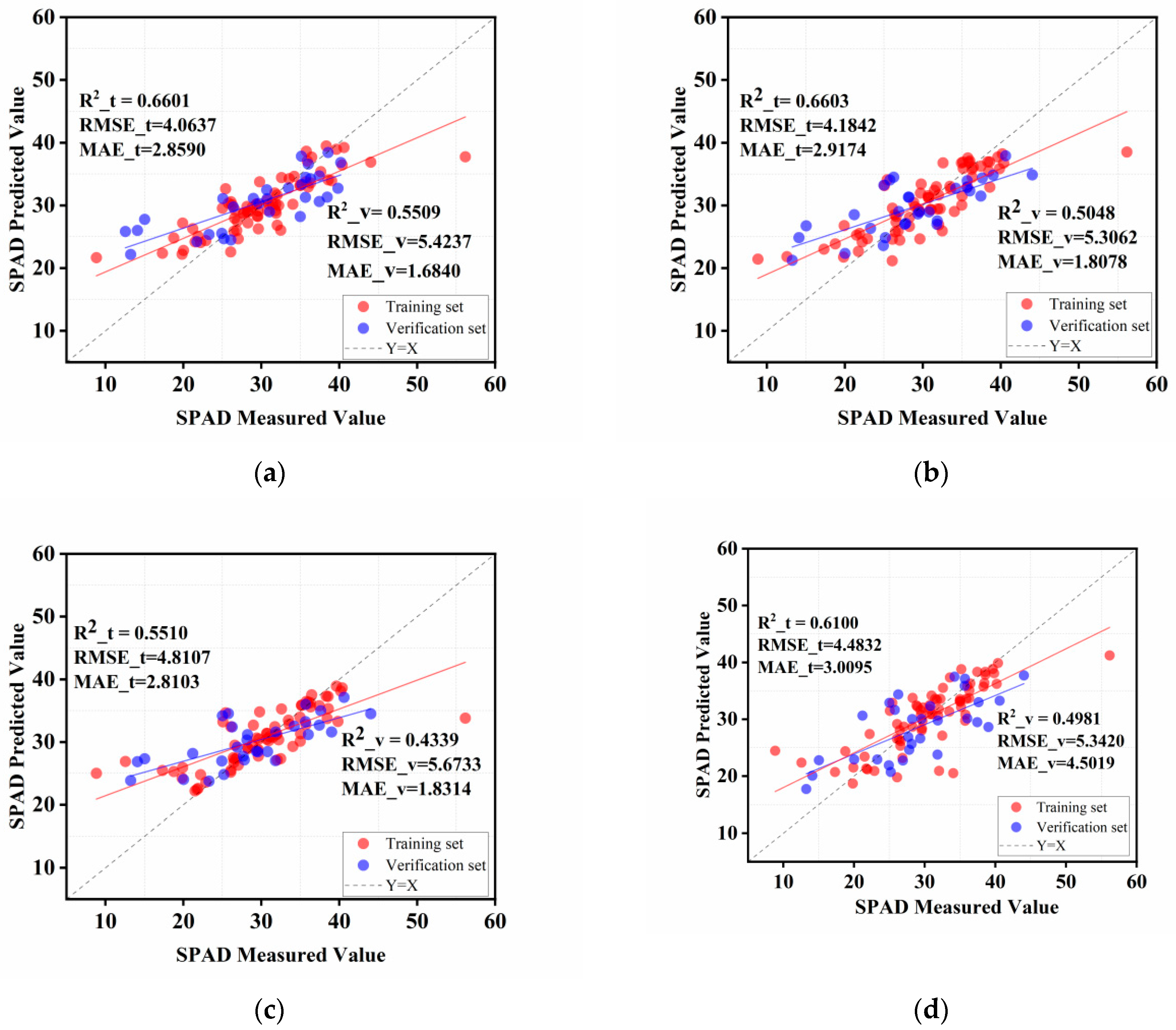
This study constructed four SPAD value inversion models, RF, XGBoost, SVR, and PLSR, using the 26 texture features selected via RFE (Figure 7). The models were evaluated in terms of fitting and generalization performance using R2, RMSE, and MAE. The results indicated clear performance differences among the models. The RF model (Figure 7a) performed best, with a training set R2 of 0.6601, RMSE of 4.0637, and MAE of 2.8590, and a validation set R2 of 0.5509, RMSE of 5.4237, and MAE of 1.6840. The XGBoost model (Figure 7b) ranked second, achieving a training set R2 of 0.6603 and a validation set R2 of 0.5048. The SVR model (Figure 7c) and PLSR model (Figure 7d) demonstrated relatively weaker performance, with R2 values of 0.5510 and 0.4339 for the training and validation sets of SVR, respectively. The R2 values for the training and validation sets of PLSR were 0.6100 and 0.4981, respectively. In summary, the RF model exhibited the best overall performance and is considered more suitable for SPAD value inversion.

3.4.3. Optimal Model Construction Based on Vegetation Indices Combined with Texture Information

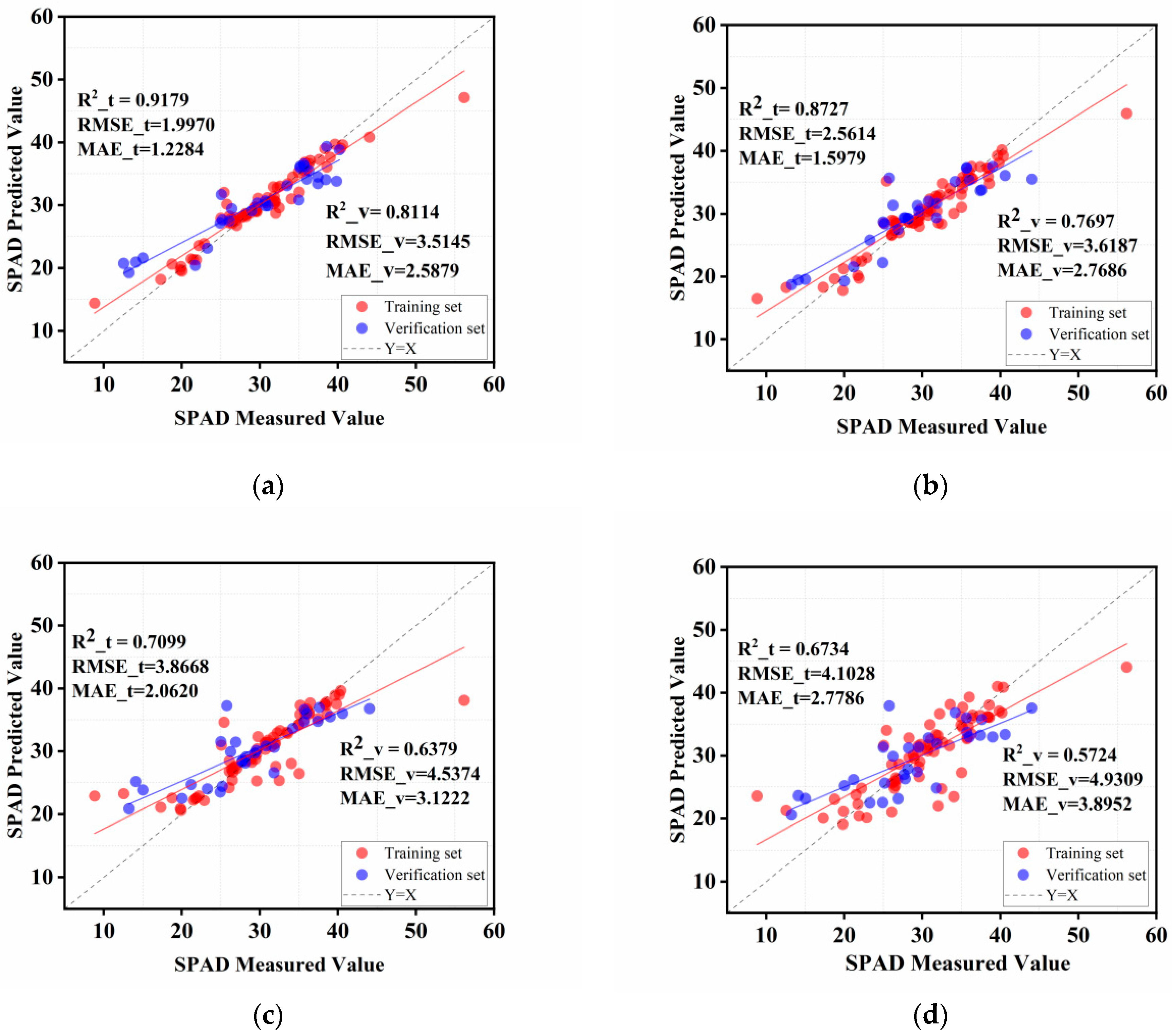
By combining vegetation indices and texture information, this study developed four SPAD value inversion models: RF, XGBoost, SVR, and PLSR (Figure 8). Model performance was evaluated using R2, RMSE, and MAE. The RF model (Figure 8a) performed best, with a training set R2 of 0.9179, RMSE of 1.9970, and MAE of 1.2284, and a validation set R2 of 0.8114, RMSE of 3.5145, and MAE of 2.5879. The XGBoost model (Figure 8b) ranked second, achieving a training set R2 of 0.8727, RMSE of 2.5614, and MAE of 1.5979, and a validation set R2 of 0.7697, RMSE of 3.6887, and MAE of 2.7686. The SVR model (Figure 8c) showed lower accuracy, with a training set R2 of 0.7099, RMSE of 3.8668, and MAE of 2.0620, and a validation set R2 of only 0.6379, reflecting limited generalization ability. The PLSR model (Figure 8d) exhibited the weakest fit, with training and validation set R2 values of 0.6734 and 0.5724, respectively, indicating overall poor predictive performance. In summary, the RF model that integrated both vegetation indices and texture information delivered the best performance, establishing it as the optimal model for SPAD value inversion in yellowing leaves of ‘Kuerle Xiangli’.

3.5. Model Accuracy Evaluation

This study evaluated the SPAD value inversion task for yellowing leaves of ‘Kuerle Xiangli’ by comparing the performance of four machine learning algorithms, RF, XG, SVR, and PLSR, under three input scenarios. Accuracy metrics for each model are summarized in Table 6. When vegetation indices alone were used as input, the RF model performed best, achieving a training set R2 of 0.8482 and a validation set R2 of 0.7561, along with the most favorable RMSE and MAE values. The XG model ranked second, whereas SVR and PLSR showed relatively weaker fitting and generalization. When only texture information was used, all models exhibited lower accuracy compared to the vegetation index only scenario. In this case, RF and XG attained training set R2 values of 0.6601 and 0.6603, respectively; however, RF achieved a higher validation R2 of 0.5509, compared to 0.5048 for XG, making RF the top performer. Both SVR and PLSR performed below RF. When vegetation indices and texture information were combined, the inversion accuracy of all four models improved substantially. The RF model showed the most marked gain, with training set R2 increasing to 0.9179 and validation set R2 reaching 0.8114. The XG model also exceeded its single input performance, recording training and validation R2 values of 0.8727 and 0.7697, respectively. This improvement can be attributed to complementary information: vegetation indices are sensitive to factors such as canopy shading and leaf spatial arrangement, while texture information captures canopy structure but correlates less directly with SPAD values. Combining both provides a more comprehensive feature set, thereby increasing model reliability. Overall, the RF model that integrates vegetation indices and texture information delivered the best performance, establishing it as the optimal model for estimating SPAD values in yellowing leaves of ‘Kuerle Xiangli’ in this study.

3.6. Testing Based on Optimal Models

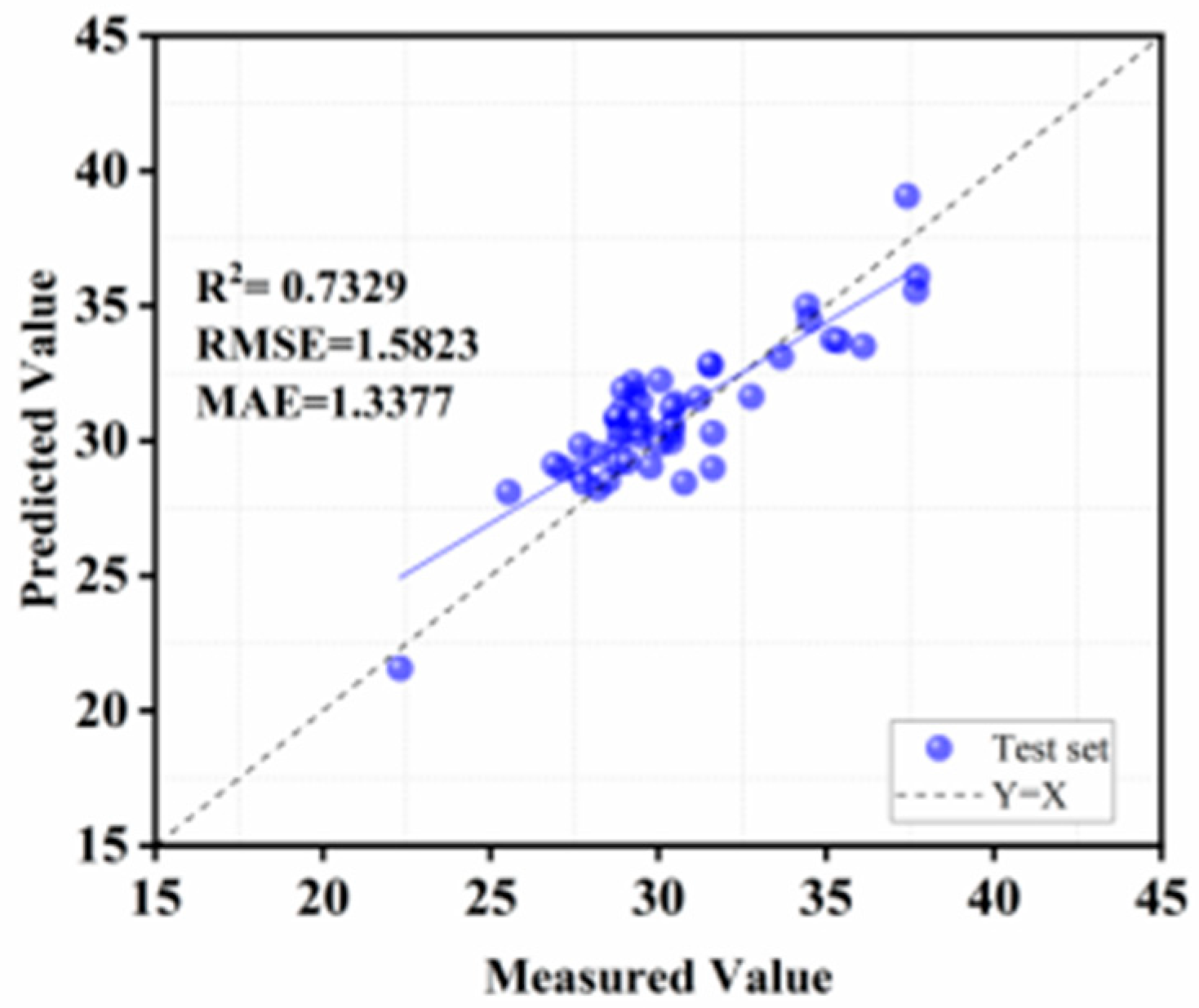
To validate the generalization capability of the optimal model under field conditions, two independent experimental orchards not involved in the model training were selected as a test set. The model was applied to estimate the SPAD values of yellowing leaves in ‘Kuerle Xiangli’. The results (Figure 9) show that the model achieved an R2 = 7329 on the test set, explaining approximately 73.29% of the variation in SPAD values. The MAE was 1.3377, indicating an average absolute prediction error of about 1.34 and demonstrating good consistency between predicted and measured values. The RMSE was slightly higher at 1.5823, suggesting that a small number of samples were more difficult to predict. Both error metrics remained low and were close in magnitude, with prediction deviations staying within an acceptable range. These results indicate that the model maintains good predictive accuracy under field conditions.

3.7. Spatial Distribution Map of SPAD Values

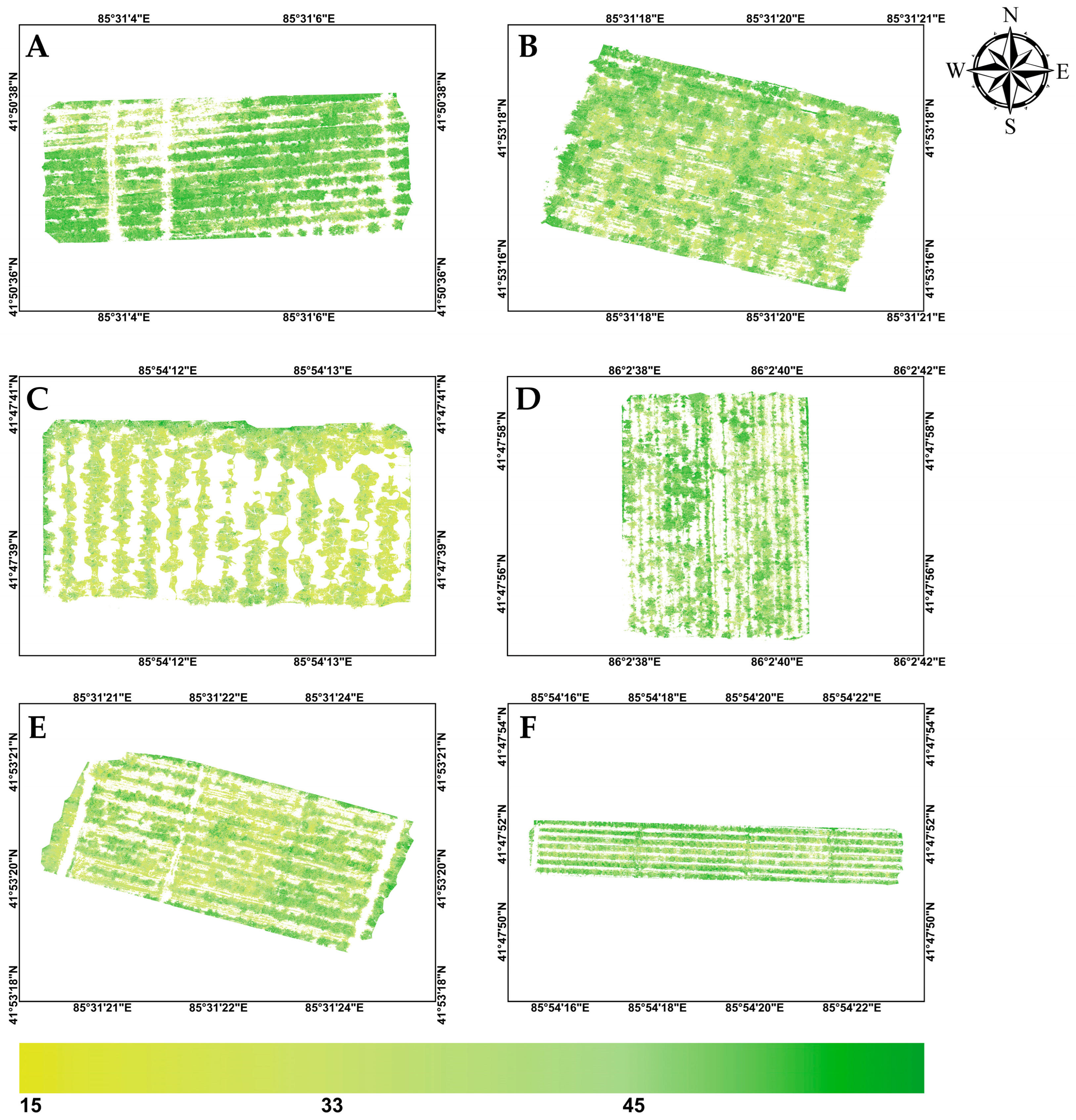
Based on the inversion results of the optimal model combining vegetation indices and texture information, Figure 10 presents the spatial distribution of chlorophyll content in ‘Kuerle Xiangli’ across the experimental orchards. The predicted SPAD values for all six orchards ranged from 15.7 to 45.7. Specifically, the predicted ranges were: 16.5–45.3 for LGL (Figure 10A), 16.4–45.7 for LGQ (Figure 10B), 15.7–45.1 for LLJ (Figure 10C), 16.6–45.1 for NKS (Figure 10D), 16.5–45.3 for LCX (Figure 10E), and 16.5–45.2 for YHC (Figure 10F). LGL, NKS, and LCX contained larger proportions of dark green areas, indicating generally higher chlorophyll levels. In contrast, LLJ and YHC were dominated by yellow green and light green tones, reflecting a prevalence of moderate to low values. LGQ showed a more complete range of SPAD values with a relatively balanced spatial distribution. All experimental plots contained localized low value areas approaching 15.
Based on earlier experimental findings, the SPAD values of healthy leaves sampled from the six experimental orchards in this study exceeded 33, whereas those of yellowed leaves fell below 33. By extracting pixels based on this attribute, areas corresponding to yellowed leaves with SPAD values below 33 were identified in each orchard, and the respective degree of yellowing was calculated (Table 7). The average SPAD value in the LGL orchard was 34.22 ± 4.85, with 34.1% of values below 33, indicating an overall high SPAD level. In LGQ, the mean SPAD value was 31.96 ± 5.95, with 52.9% of values below 33. LLJ showed an average SPAD value of 27.49 ± 5.87, and 80.5% of its values were below 33. For NKS, the average SPAD value was 32.89 ± 5.22, with 46.8% below 33. LCX had an average SPAD value of 33.92 ± 5.28, and 36.4% of values fell below 33. In YHC, the average SPAD value was 30.13 ± 5.78, with 68.1% of values below 33. Ranking the six experimental orchards from highest to lowest severity of yellowing gives: LLJ, YHC, LGQ, NKS, LCX, LGL. In summary, the SPAD value spatial distribution maps generated in this study, combined with the specific percentage data, clearly reveal the differences in SPAD values and spatial structure characteristics among the experimental orchards. This provides scientific support for monitoring yellowing and implementing precision agricultural practices in ‘Kuerle Xiangli’ cultivation.

4. Discussion

RFE was applied to screen different combinations of vegetation indices in this study. Six core indices, CIRE, NDRE, LCI, REOSAVI, GNDVI, and NDWI, were selected, accounting for over 90% of the cumulative contribution. Among these, indices associated with the red edge band dominated, indicating high sensitivity of the red edge region to SPAD values variation in ‘Kuerle Xiangli’. This observation is consistent with the findings of Deng et al. [48], who used a UAV equipped with narrow band Mini MCA6 and broad band Redwood multi-spectral cameras to acquire maize imagery and SPAD values. Their comparative analysis showed that reNDVI, constructed from red edge bands, significantly outperformed traditional NDVI in SPAD value prediction. In this study, however, we observed that several widely applied vegetation indices previously reported to be strongly correlated with SPAD values were not retained in the optimal subset identified by Recursive Feature Elimination (RFE). This outcome likely reflects their relatively lower contribution to model performance during the selection process. RFE operates by iteratively eliminating features that contribute minimally to predictive accuracy, ultimately identifying a feature subset that maximizes the model’s generalization capability [20]. Consequently, in datasets with high dimensionality, RFE tends to prioritize variables that carry unique information and exhibit strong individual contributions, while progressively discarding vegetation indices with lower relevance. It is evident that vegetation indices selected based primarily on empirical rules and correlation metrics are susceptible to the “curse of dimensionality”. The RFE-based screening process effectively reduces dimensionality by removing low importance and noisy features. It should be noted, however, that RFE evaluates features solely based on their contribution to model performance and does not explicitly account for inter feature correlations. As a result, the selected features may still exhibit a degree of collinearity. Nevertheless, in the present study, RF models constructed using features selected by RFE consistently demonstrated robust performance. This observation aligns with the findings of Yin Q et al. [49], who compared models trained using different feature selection algorithms across various stages of the reproductive cycle. Their results indicated that the Random Forest model based on Recursive Feature Elimination consistently demonstrated superior predictive performance.
Among the four machine learning models systematically constructed and compared in this study, the RF model consistently achieved the best performance across all three input scenarios for SPAD value inversion. In particular, the RF model that integrated both vegetation indices and texture information yielded the most accurate results. This advantage can be attributed to complementary information; vegetation indices primarily reflect photochemical canopy properties such as chlorophyll and water content, whereas texture information captures structural characteristics like leaf clustering and shadow distribution. Since leaf yellowing not only alters leaf color but may also modify canopy structure, combining both feature types enhances model accuracy compared to using either alone. This observation is in line with findings by Song Z et al. [50], who extracted both spectral and textural features from hyperspectral images of apple leaves infected with mosaic disease. Their comparison between single-feature and multi-feature models demonstrated that integrating texture with spectral information significantly improved the detection accuracy of chlorophyll content, thereby boosting prediction performance. The superiority of the RF model stems from its ensemble learning mechanism, which uses bootstrap resampling to build multiple decision trees and effectively captures complex nonlinear relationships between spectral features and SPAD values. Other models showed certain limitations: XGBoost, although the second best performer, can be more sensitive to parameter tuning and outliers in small sample settings. Meanwhile, PLSR, as a linear method, struggles to fully represent intricate nonlinear spectral response relationships, resulting in the lowest accuracy. These results are consistent with the conclusions of Zhao et al. [51] in cotton chlorophyll inversion, further confirming the robustness and applicability of Random Forest for remote sensing estimation of vegetation parameters.
The results of this study show that the four texture indices exhibit moderate negative correlations with SPAD values, with correlation coefficients ranging from –0.58 to –0.62. This indicates that higher texture index values generally correspond to lower leaf SPAD values. Such a relationship reflects how chlorophyll loss alters canopy structure, which in turn drives changes in spectral texture patterns [52]. Texture index screening was performed to identify the optimal feature combination for each index. The results reveal that NIR_VAR combined with G_DIS forms the best feature pair for NDTI, CDTI, and RTI, whereas for DTI the optimal combination is NIR_VAR with G_VAR. These findings highlight the importance of near-infrared band variance as a key textural factor. This metric quantifies the spatial dispersion of pixel gray level values, and its variation is closely associated with canopy leaf aggregation patterns and vegetation health status [42,53]. Meanwhile, Dissimilarity and Variance in the green band provide valuable Supplementary Information. Together, these selected features deliver efficient and informative texture inputs for building the SPAD value inversion model in this study.
To objectively evaluate the field applicability of the optimized model, two independent experimental orchards were used for external validation. The validation results showed that the RF model achieved a prediction accuracy of R2 = 0.7329. Although this represents a decrease compared to the model’s earlier performance metrics, the accuracy remains relatively high, confirming the model’s strong generalization capability. The observed decline in validation accuracy is primarily attributed to spatial heterogeneity across different orchards [54]. This heterogeneity arises from several factors: differences in fundamental soil properties, such as nutrient availability, pH, salinity, and organic matter content [55]; variations in field management practices; and microenvironmental influences, including unpredictable local microclimates that can readily influence model prediction accuracy [56]. The combined effect of these factors introduces site specific biases, leading to variation in the performance of a single unified model across orchards. In practical precision orchard management, a primary need is often to distinguish between zones of relatively high and low SPAD values and to map the spatial extent of chlorosis. The prediction accuracy offered by the present model adequately meets this operational requirement. The SPAD values spatial distribution map generated by the optimized model overcomes the limitations of conventional approaches, enabling visual assessment of spatial variability. Using this map, growers can accurately identify yellowing areas and implement targeted irrigation, fertilization, and yellowing control measures, thereby providing a scientific foundation for refined orchard management.
This study has made progress in SPAD value inversion for ‘Kuerle Xiangli’, but limitations remain. First, while data were collected from six experimental orchards, all sites are located within the same geographical region and are managed under similar agricultural practices. Furthermore, this study was conducted exclusively on the “Kuerle Xiangli” variety, which may limit the model’s applicability to different ecological conditions or other pear varieties. Nevertheless, the research approach and methodology presented herein can still provide valuable reference for deriving physiological parameters of leaves in other crops. Second, vegetation indices derived from UAV data are influenced not only by leaf chlorophyll content but also by canopy structural traits such as leaf density, which varies with phenological stage. Since the data in this study were acquired during a single growth stage, model performance across different phenological periods may be limited. Third, the UAV-mounted multi-spectral sensor used in this study contained only four spectral bands, which may not fully capture subtle spectral variations associated with dynamic chlorophyll changes. Future work will aim to expand the dataset by incorporating samples from multiple regions, growth stages, and crop species. The integration of hyperspectral data or the fusion of multi-source remote sensing inputs (e.g., RGB and thermal imagery) could provide richer spectral and structural information. Such refinements are expected to further optimize the inversion model and enhance its robustness and broader applicability.
Furthermore, this study confirms the advantage of the RF model that integrates vegetation indices and texture information for SPAD value inversion, demonstrating that multifeature fusion effectively improves model accuracy and generalization. However, traditional machine learning methods remain limited in automatically extracting features and modeling complex nonlinear relationships. Recent research indicates that deep learning approaches offer greater potential for feature learning and temporal modeling in agricultural remote sensing parameter inversion [57]. Future studies could therefore explore the incorporation of deep learning algorithms, leveraging their capacity for automatic feature extraction and hierarchical representation. Such an approach would enable more thorough integration of information from spectral, textural, and multisource remote sensing data, thereby enhancing model adaptability and generalization in complex agricultural scenarios.

5. Conclusions

This study constructed and validated an SPAD value inversion model for monitoring leaf chlorosis in ‘Kuerle Xiangli’. The research findings are as follows:
(1)
Feature selection and the fusion of multi-source features significantly enhanced inversion performance. Compared to models using a single feature type, the Random Forest (RF) model that integrated 6 vegetation indices (CIRE, NDRE, LCI, REOSAVI, GNDVI, and NDWI) with 26 texture features performed best. It achieved an R2 = 0.9179, RMSE = 1.9970 and MAE = 1.2284 on the training set, and an R2 = 0.8161, RMSE = 3.4702, and MAE = 2.6799 on the validation set. The model also maintained good performance during field validation in an independent orchard (R2 = 0.7329, RMSE = 1.5823, MAE = 1.3377).
(2)
The spatial distribution map of SPAD values generated by the optimal model clearly delineates the SPAD ranges and yellowing status across the six orchards. The overall SPAD range across all orchards was 15.7 to 45.7. The order of yellowing severity was LLJ (80.5%) > YHC (68.1%) > LGQ (52.9%) > NKS (46.8%) > LCX (36.4%) > LGL (34.1%).

Supplementary Materials

The following supporting information can be downloaded at: https://www.mdpi.com/article/10.3390/agriculture16040416/s1, Figure S1: Schematic Diagram of Sample Trees with Different Yellowing Severity Levels; Table S1: Model Parameters for Different Models.

Author Contributions

Conceptualization, Y.D.; methodology, Y.D.; software, Y.D. and L.L.; validation, Y.D.; formal analysis, Y.D.; investigation, Y.D.; resources, S.Q. and X.L.; data curation, Y.D. and L.L.; writing—original draft preparation, Y.D. and L.L.; writing—review and editing, Y.D., L.L. and S.Q.; visualization, Y.D. and L.L.; supervision, S.Q. and X.L.; project administration, S.Q. and X.L.; funding acquisition, X.L. All authors have read and agreed to the published version of the manuscript.

Funding

This research was funded by the Key Area Research and Development Program of Xinjiang Production and Construction Corps (grant number: 2021AB016).

Data Availability Statement

The data are available from the authors upon reasonable request as the data need further use.

Conflicts of Interest

The authors declare no conflicts of interest.

References

  1. Li, Y.; Zhang, J.; Zhou, H. Problems and Countermeasures of Storage and Preservation of Xinjiang ‘Korla Pear’. North Fruits 2025, 6, 53–55. [Google Scholar] [CrossRef]
  2. Liu, X.; Guo, Y.; Li, H.; Pei, Y.; Lv, X.; Chen, W.; Sun, M.; Shen, X.; Chai, Z. Research progress of characteristic flavor of Korla fragrant pear. J. Food Saf. Qual. 2024, 15, 149–156. [Google Scholar] [CrossRef]
  3. Guo, H.; Zhou, Y.; Cheng, S.; Zhai, S.; Yang, H. Development Status and Prospect of Korla Fragrant Pear Industry in Xinjiang. North. Hortic. 2025, 130–136. [Google Scholar] [CrossRef]
  4. Li, X.; He, T.; Wu, Y.; Qin, W. Investigation on Annual Occurrence Law of Yellows Disease of Kuerle Fragrant Pear. Xinjiang Agric. Sci. 2010, 47, 559–563. [Google Scholar]
  5. Liu, Z.; Zhao, Y.; Yin, W.; Qin, W.; He, T. Characterization of Iron Content in Leaf of Kuerle Fragrant Pear (Pyrus bretschneideri Rehd) and Iron Spatial Distribution. Tianjin Agric. Sci. 2014, 20, 13–17. [Google Scholar] [CrossRef]
  6. Liu, X.; Zheng, X.; Khaskheli, M.I.; Sun, X.; Chang, X.; Gong, G. Identification of Colletotrichum Species Associated with Blueberry Anthracnose in Sichuan, China. Pathogens 2020, 9, 718. [Google Scholar] [CrossRef]
  7. He, T.M.; Liu, Z.J.; Qin, W.M.; Tian, Y.; Zhang, S. Effects of Soil Factors on Iron-deficit Chlorosis of Kuerle Fragrant Pear (Pyrus bretschneideri Rehd). Acta Agric. Boreali-Occident. Sin. 2013, 22, 97–103. [Google Scholar]
  8. Lu, M.Y.; Yan, X.K.; Wang, Q.; Wu, C.; Hu, M.; Zhang, M.J. Research Progress on Iron Deficiency Chlorosis in Pear. Agric. Technol. 2021, 41, 35–38. [Google Scholar] [CrossRef]
  9. Křížová, K.; Kadeřábek, J.; Novák, V.; Linda, R.; Kurešová, G.; Šařec, P. Using a single-board computer as a low-cost instrument for SPAD value estimation through colour images and chlorophyll-related spectral indices. Ecol. Inform. 2022, 67, 101496. [Google Scholar] [CrossRef]
  10. Qi, H.; Wu, Z.; Zhang, L.; Li, J.; Zhou, J.; Jun, Z.; Zhu, B. Monitoring of peanut leaves chlorophyll content based on drone-based multispectral image feature extraction. Comput. Electron. Agric. 2021, 187, 106292. [Google Scholar] [CrossRef]
  11. Rahman, M.F.F.; Fan, S.; Zhang, Y.; Chen, L. A Comparative Study on Application of Unmanned Aerial Vehicle Systems in Agriculture. Agriculture 2021, 11, 22. [Google Scholar] [CrossRef]
  12. Khaliq, A.; Comba, L.; Biglia, A.; Ricauda Aimonino, D.; Chiaberge, M.; Gay, P. Comparison of Satellite and UAV-Based Multispectral Imagery for Vineyard Variability Assessment. Remote Sens. 2019, 11, 436. [Google Scholar] [CrossRef]
  13. Sishodia, R.P.; Ray, R.L.; Singh, S.K. Applications of Remote Sensing in Precision Agriculture: A Review. Remote Sens. 2020, 12, 3136. [Google Scholar] [CrossRef]
  14. Yan, N.; Qin, Y.; Wang, H.; Wang, Q.; Hu, F.; Wu, Y.; Zhang, X.; Li, X. The Inversion of SPAD Value in Pear Tree Leaves by Integrating Unmanned Aerial Vehicle Spectral Information and Textural Features. Sensors 2025, 25, 618. [Google Scholar] [CrossRef]
  15. Zhao, P.; Yan, Y.; Jia, S.; Zhao, J.; Zhang, W. Construction and Evaluation of a Cross-Regional and Cross-Year Monitoring Model for Millet Canopy Phenotype Based on UAV Multispectral Remote Sensing. Agronomy 2025, 15, 789. [Google Scholar] [CrossRef]
  16. Yang, X.; Zhou, H.; Li, Q.; Fu, X.; Li, H. Estimating Canopy Chlorophyll Content of Potato Using Machine Learning and Remote Sensing. Agriculture 2025, 15, 375. [Google Scholar] [CrossRef]
  17. Khan, M.S.; Yadav, P.; Semwal, M.; Prasad, N.; Verma, R.K.; Kumar, D. Predicting canopy chlorophyll concentration in citronella crop using machine learning algorithms and spectral vegetation indices derived from UAV multispectral imagery. Ind. Crops Prod. 2024, 219, 119147. [Google Scholar] [CrossRef]
  18. Houji, Z.; Yueao, T. STUDIES OF IRON CHLOROSIS IN APPLE PLANTS Il. The influence of iron stress on the morphological, physiological and biochemical changes in Apple. Sci. Agric. Sin. 1988, 21, 46–50. [Google Scholar]
  19. Sivabalan, K.R.; Ramaraj, E. Surface segmentation and environment change analysis using band ratio phenology index method—Supervised aspect. IET Image Process. 2020, 14, 1813–1821. [Google Scholar] [CrossRef]
  20. Lee, Y.-J.; Jeong, H.; Lee, S.; Ga, E.; Baek, J.; Kim, S.L.; Kang, S.-H.; Park, Y.-I.; Kim, K.-H.; Lyu, J.I. Development of Fruit-Specific Spectral Indices and Endmember-Based Analysis for Apple Cultivar Classification Using Hyperspectral Imaging. Horticulturae 2025, 11, 1177. [Google Scholar] [CrossRef]
  21. Chai, X. Baseflow Data Prediction Based on Machine Learning: A Case Study in Contiguous United States Watersheds. Master’s Thesis, Northwest A&F University, Xianyang, China, 2025. [Google Scholar]
  22. Lee, S.; Mun, H.; Moon, B. Monitoring Fertilizer Effects in Hardy Kiwi Using UAV-Based Multispectral Chlorophyll Estimation. Agriculture 2025, 15, 1794. [Google Scholar] [CrossRef]
  23. Fang, W.; Zhu, H.; Li, S.; Ding, H.; Bi, R. Rapid Identification of Main Vegetation Types in the Lingkong Mountain Nature Reserve Based on Multi-Temporal Modified Vegetation Indices. Sensors 2023, 23, 659. [Google Scholar] [CrossRef]
  24. Han, L.; Yang, G.; Dai, H.; Xu, B.; Yang, H.; Feng, H.; Li, Z.; Yang, X. Modeling maize above-ground biomass based on machine learning approaches using UAV remote-sensing data. Plant Methods 2019, 15, 10. [Google Scholar] [CrossRef] [PubMed]
  25. Jin, X.; Li, Z.; Feng, H.; Ren, Z.; Li, S. Deep neural network algorithm for estimating maize biomass based on simulated Sentinel 2A vegetation indices and leaf area index. Crop J. 2020, 8, 87–97. [Google Scholar] [CrossRef]
  26. Yeom, J.; Jung, J.; Chang, A.; Ashapure, A.; Maeda, M.; Maeda, A.; Landivar, J. Comparison of Vegetation Indices Derived from UAV Data for Differentiation of Tillage Effects in Agriculture. Remote Sens. 2019, 11, 1548. [Google Scholar] [CrossRef]
  27. Verrelst, J.; Schaepman, M.E.; Koetz, B.; Kneubühler, M. Angular sensitivity analysis of vegetation indices derived from CHRIS/PROBA data. Remote Sens. Environ. 2008, 112, 2341–2353. [Google Scholar] [CrossRef]
  28. Wang, F.-M.; Huang, J.-F.; Tang, Y.-L.; Wang, X.-Z. New Vegetation Index and Its Application in Estimating Leaf Area Index of Rice. Rice Sci. 2007, 14, 195–203. [Google Scholar] [CrossRef]
  29. Chang, A.; Yeom, J.; Jung, J.; Landivar, J. Comparison of Canopy Shape and Vegetation Indices of Citrus Trees Derived from UAV Multispectral Images for Characterization of Citrus Greening Disease. Remote Sens. 2020, 12, 4122. [Google Scholar] [CrossRef]
  30. Li, W.; Wang, J.; Zhang, Y.; Yin, Q.; Wang, W.; Zhou, G.; Huo, Z. Combining Texture, Color, and Vegetation Index from Unmanned Aerial Vehicle Multispectral Images to Estimate Winter Wheat Leaf Area Index during the Vegetative Growth Stage. Remote Sens. 2023, 15, 5715. [Google Scholar] [CrossRef]
  31. Cao, Q.; Miao, Y.; Shen, J.; Yu, W.; Yuan, F.; Cheng, S.; Huang, S.; Wang, H.; Yang, W.; Liu, F. Improving in-season estimation of rice yield potential and responsiveness to topdressing nitrogen application with Crop Circle active crop canopy sensor. Precis. Agric. 2015, 17, 136–154. [Google Scholar] [CrossRef]
  32. Cao, Q.; Miao, Y.; Feng, G.; Gao, X.; Li, F.; Liu, B.; Yue, S.; Cheng, S.; Ustin, S.L.; Khosla, R. Active canopy sensing of winter wheat nitrogen status: An evaluation of two sensor systems. Comput. Electron. Agric. 2015, 112, 54–67. [Google Scholar] [CrossRef]
  33. Wan, L.; Li, Y.; Cen, H.; Zhu, J.; Yin, W.; Wu, W.; Zhu, H.; Sun, D.; Zhou, W.; He, Y. Combining UAV-Based Vegetation Indices and Image Classification to Estimate Flower Number in Oilseed Rape. Remote Sens. 2018, 10, 1484. [Google Scholar] [CrossRef]
  34. Mishra, S.; Mishra, D.R. Normalized difference chlorophyll index: A novel model for remote estimation of chlorophyll-a concentration in turbid productive waters. Remote Sens. Environ. 2012, 117, 394–406. [Google Scholar] [CrossRef]
  35. Ngo, P.L.; Pham, V.H.; Bui, N.L.; Phan, H.A.T.; Vo, H.B.; Velavan, T.P.; Tran, D.K. Detection of small water bodies for vector control using deep learning on multispectral imagery from unmanned aerial vehicles. Discov. Artif. Intell. 2025, 5, 170. [Google Scholar] [CrossRef]
  36. Gitelson, A.A.; Viña, A.; Ciganda, V.; Rundquist, D.C.; Arkebauer, T.J. Remote estimation of canopy chlorophyll content in crops. Geophys. Res. Lett. 2005, 32, L08403. [Google Scholar] [CrossRef]
  37. Zhang, W.; Zhu, S.; Zhong, Y.; Li, H.; Sun, A.; Zhang, Y.; Zeng, J. UAV Remote Sensing for Integrated Monitoring and Model Optimization of Citrus Leaf Water Content and Chlorophyll. Agriculture 2025, 15, 2197. [Google Scholar] [CrossRef]
  38. Sotoodeh, M.; Moosavi, M.R.; Boostani, R. A structural based feature extraction for detecting the relation of hidden substructures in coral reef images. Multimed. Tools Appl. 2019, 78, 34513–34539. [Google Scholar] [CrossRef]
  39. Yang, W.; Li, Z.; Chen, G.; Cui, S.; Wu, Y.; Liu, X.; Meng, W.; Liu, Y.; He, J.; Liu, D.; et al. Soybean (Glycine max L.) Leaf Moisture Estimation Based on Multisource Unmanned Aerial Vehicle Image Feature Fusion. Plants 2024, 13, 1498. [Google Scholar] [CrossRef] [PubMed]
  40. Xu, M.; Dai, J.; Zhang, G.; Hou, W.; Mu, Z.; Chen, P.; Cao, Y.; Zhao, Q. Inversion of Glycyrrhiza Chlorophyll Content Based on Hyperspectral Imagery. Agronomy 2024, 14, 1163. [Google Scholar] [CrossRef]
  41. Wang, J.; Zhang, Y.; Han, F.; Shi, Z.; Zhao, F.; Zhang, F.; Pan, W.; Zhang, Z.; Cui, Q. Estimation of Canopy Chlorophyll Content of Apple Trees Based on UAV Multispectral Remote Sensing Images. Agriculture 2025, 15, 1308. [Google Scholar] [CrossRef]
  42. Ai, W.; Yang, G.; Li, Z.; Du, J.; Ye, L.; Feng, X.; Jin, X.; He, Y. Two-year remote sensing and ground verification: Estimating chlorophyll content in winter wheat using UAV multi-spectral imagery. Artif. Intell. Agric. 2026, 16, 480–494. [Google Scholar] [CrossRef]
  43. Shafiee, S.; Lied, L.M.; Burud, I.; Dieseth, J.A.; Alsheikh, M.; Lillemo, M. Sequential forward selection and support vector regression in comparison to LASSO regression for spring wheat yield prediction based on UAV imagery. Comput. Electron. Agric. 2021, 183, 106036. [Google Scholar] [CrossRef]
  44. Zhang, C.; Lu, X.; Zhang, H.; Cui, H.; Ma, H.; Ji, J.; Ding, T. Multispectral UAV imaging and machine learning for estimating wheat nitrogen nutrition index. Front. Plant Sci. 2025, 16, 1709459. [Google Scholar] [CrossRef] [PubMed]
  45. Li, Y.; Zeng, H.; Zhang, M.; Wu, B.; Zhao, Y.; Yao, X.; Cheng, T.; Qin, X.; Wu, F. A county-level soybean yield prediction framework coupled with XGBoost and multidimensional feature engineering. Int. J. Appl. Earth Obs. Geoinf. 2023, 118, 103269. [Google Scholar] [CrossRef]
  46. Du, L.; Shi, S.; Yang, J.; Sun, J.; Gong, W. Using Different Regression Methods to Estimate Leaf Nitrogen Content in Rice by Fusing Hyperspectral LiDAR Data and Laser-Induced Chlorophyll Fluorescence Data. Remote Sens. 2016, 8, 526. [Google Scholar] [CrossRef]
  47. Prakash, P.; Koley, S.; Kumar, S.N.; Harit, R.C.; Gupta, J.K.; Kumar, R. Remote Sensing-Based Leaf Area Index Estimation of Spring Wheat Through Machine-Learning Approaches. J. Indian Soc. Remote Sens. 2025, 1–14. [Google Scholar] [CrossRef]
  48. Deng, L.; Mao, Z.; Li, X.; Hu, Z.; Duan, F.; Yan, Y. UAV-based multispectral remote sensing for precision agriculture: A comparison between different cameras. ISPRS J. Photogramm. Remote Sens. 2018, 146, 124–136. [Google Scholar] [CrossRef]
  49. Yin, Q.; Zhang, Y.; Li, W.; Wang, J.; Wang, W.; Ahmad, I.; Zhou, G.; Huo, Z. Estimation of Winter Wheat SPAD Values Based on UAV Multispectral Remote Sensing. Remote Sens. 2023, 15, 3595. [Google Scholar] [CrossRef]
  50. Song, Z.; Liu, Y.; Yu, J.; Guo, Y.; Jiang, D.; Zhang, Y.; Guo, Z.; Chang, Q. Estimation of Chlorophyll Content in Apple Leaves Infected with Mosaic Disease by Combining Spectral and Textural Information Using Hyperspectral Images. Remote Sens. 2024, 16, 2190. [Google Scholar] [CrossRef]
  51. Zhao, X.; Zhang, Z.; Shi, C.; Zhao, F.; Gao, Y.; He, W.; Wang, X. Estimation of chlorophyll content in cotton canopy leaves based on drone multispectral sensors: Multiple spectral information fusion. Ind. Crops Prod. 2025, 235, 121710. [Google Scholar] [CrossRef]
  52. Wang, R.; Tuerxun, N.; Zheng, J. Improved estimation of SPAD values in walnut leaves by combining spectral, texture, and structural information from UAV-based multispectral image. Sci. Hortic. 2024, 328, 112940. [Google Scholar] [CrossRef]
  53. Du, R.; Lu, J.; Xiang, Y.; Zhang, F.; Chen, J.; Tang, Z.; Shi, H.; Wang, X.; Li, W. Estimation of winter canola growth parameter from UAV multi-angular spectral-texture information using stacking-based ensemble learning model. Comput. Electron. Agric. 2024, 222, 109074. [Google Scholar] [CrossRef]
  54. Somers, B.; Gysels, V.; Verstraeten, W.W.; Delalieux, S.; Coppin, P. Modelling moisture-induced soil reflectance changes in cultivated sandy soils: A case study in citrus orchards. Eur. J. Soil Sci. 2010, 61, 1091–1105. [Google Scholar] [CrossRef]
  55. Fan, Y.; Zhang, Y.; Kalkhajeh, Y.K.; Hu, W.; Tian, K.; Yu, D.; Huang, B. Effective indicators and drivers of soil organic matter in intensive orchard production systems. Soil Tillage Res. 2024, 238, 105999. [Google Scholar] [CrossRef]
  56. Sun, Y.; Huang, K.; Zhang, B.; Zhang, Y.; Qi, Y.; Yuan, Q.; Lei, X.; Lv, X. Improving estimation accuracy of canopy nitrogen content using the fusion of ground-space spectral imagery with machine learning in pear orchards. Comput. Electron. Agric. 2025, 239, 111075. [Google Scholar] [CrossRef]
  57. Qin, S.; Ren, H.; Chen, S.; Ding, Y.; Li, H.; Lv, X.; Zhang, Z.; Zhang, L. Deep learning time-series prediction method for cotton nitrogen content based on small sample hyperspectral data. Ind. Crops Prod. 2025, 233, 121467. [Google Scholar] [CrossRef]
Figure 1. Research Area Overview Map: (a) Location of Korla; (b) Aerial view of the surroundings near the test site, with the study area outlined in red.
Agriculture 16 00416 g001
Figure 2. Distribution of Sample Trees Across Different Yellowing Severity Levels.
Agriculture 16 00416 g002
Figure 3. Vegetation Index Screening: (a) Importance Ranking; (b) Cumulative Importance Curve.
Agriculture 16 00416 g003
Figure 4. Correlation Analysis of SPAD values and Texture Index in Yellowed Leaves of ‘Kuerle Xiangli’: (a) NDTI; (b) DTI; (c) RTI; (d) CDTI.
Agriculture 16 00416 g004
Figure 5. Feature Selection: (a) Importance Ranking; (b) Cumulative Importance Curve.
Agriculture 16 00416 g005
Figure 6. Optimal Model Construction Based on Vegetation Indices: (a) RF; (b) XGBoost; (c) SVR; (d) PLSR.
Agriculture 16 00416 g006
Figure 7. Optimal Model Construction Based on Texture Information: (a) RF; (b) XGBoost; (c) SVR; (d) PLSR.
Agriculture 16 00416 g007
Figure 8. Optimal Model Construction Based on Vegetation Indices Combined with Texture Information: (a) RF; (b) XGBoost; (c) SVR; (d) PLSR.
Agriculture 16 00416 g008
Figure 9. Field Testing Based on Optimal Models.
Agriculture 16 00416 g009
Figure 10. Model-Based Prediction of the Spatial Distribution of SPAD Values: (A) LGL; (B) LGQ; (C) LLJ; (D) NKS; (E) YHC; (F) LCX.
Agriculture 16 00416 g010
Table 1. Overview of the Experimental Garden.
Name of the Experimental GardenLongitudeLatitudeTree ShapeAge of TreesTree Vigor
NKS41.799° N86.043° EFusiform11 yearsOverall growth is vigorous, with no significant pests or diseases.
LCX41.797° N85.904° EStratification of Evacuation11 yearsOverall growth is vigorous, with no significant pests or diseases.
LLJ41.794° N85.903° EStratification of Evacuation20 yearsOverall growth is moderate, with no significant pests or diseases.
LGL41.844° N85.517° EStratification of Evacuation8 yearsOverall growth is vigorous, with no significant pests or diseases.
LGQ41.888° N85.521° EStratification of Evacuation8 yearsOverall growth is moderate, with no significant pests or diseases.
YHC41.889° N85.522° EStratification of Evacuation15 yearsOverall growth is moderate, with no significant pests or diseases.
Table 2. Classification Standards for Yellowing Levels of ‘Kuerle Xiangli’.
Yellowing LevelSymptoms
Level 0No chlorosis.
Level 1Mild, with some leaves showing chlorosis or certain large branches exhibiting chlorosis.
Level 2Moderate, with 50% of leaves showing chlorosis.
Level 3Severe, with most leaves turning yellow and symptoms present throughout the entire tree. Leaf drop occurs, or large patches of dead tissue appear on leaves.
Table 3. DJI Mavic 3 multi-spectral parameter.
ParameterValue
UAV weight895 g
Max flight time43 min
Imaging sensormulti-spectral camera: image sensor 1/2.8 inch CMOS, effective pixel 5 million, viewing angle: 73.91° (61.2° × 48.10°).
Equivalent focal length: 25 mm.
Imaging max dpi2592 × 1944
spectral bandsGreen (G): 560 nm ± 6 nm; Red (R): 650 nm ± 16 nm; Red edge (RE): 730 nm ± 16 nm; Near-infrared (NIR): 860 nm ± 26 nm;
Table 4. Multi-spectral vegetation index of UAV and its calculation formula.
Vegetation IndexComputing FormulaReferences
NDVI(NIR − R)/(NIR + R)[22]
DVINIR − R[23]
RVINIR/R[24]
TVI0.5 × (120 × (NIR − G) − 200 × (R − G))[25]
SAVI1.5 × (NIR − R)/(NIR + R + 0.5)[26]
OSAVI(NIR − R)/(NIR + R + 0.16)[27]
GNDVI(NIR − G)/(NIR + G)[28]
NDRE(NIR − RE)/(NIR + RE)[29]
NRI(G − R)/(G + R)[30]
REOSAVI1.16 × (NIR − RE)/(NIR + RE + 0.16)[31]
GOSAVI1.16 × (NIR − G)/(NIR + G + 0.16)[32]
LCI(NIR − RE)/(NIR + R)[33]
NDCI(RE − R)/(RE + R)[34]
NDWI(G − NIR)/(G + NIR)[35]
RGRIG/R[33]
CIRENIR/RE − 1[36]
MSR(NIR/R − 1)/(sqrt (NIR/R + 1))[37]
Table 5. Multi-spectral Texture Indexes for Drones and Their Calculation Formulas.
Texture IndexFormula for Calculation
NDTI(Ri − Rj)/(Ri + Rj)
DTIRi − Rj
RTIRi/Rj
CDTI(Ri − Rj)/Rj
Table 6. Comparison of the prediction accuracy of different models.
InputModelTraining SetValidation Set
R2RMSEMAER2RMSEMAE
Vegetation IndexRF0.84822.79741.54690.75613.72412.4792
XG0.81353.10061.71280.73763.86262.5422
SVR0.63134.35922.44160.62214.63512.9812
PLSR0.58714.61292.77370.56734.95983.4560
Texture informationRF0.66014.06372.85900.55095.42371.6840
XG0.66034.18422.91740.50485.30621.8078
SVR0.55104.81072.81030.43395.67331.8314
PLSR0.61004.48323.00950.49815.34204.5019
Vegetation Index and Texture InformationRF0.91791.99701.22840.81143.51452.5879
XG0.87272.56141.59790.76973.61872.7686
SVR0.70993.86682.06200.63794.53743.1222
PLSR0.67344.10282.77860.57244.93093.8952
Table 7. Average SPAD Values and Degree of Chlorosis in Different Experimental Orchards.
Name of the Experimental GardenAverage SPAD ValueDegree of Yellowing in the Experimental Garden
LGL34.22 ± 4.8534.1%
LGQ31.96 ±5.9552.9%
LLJ27.49 ± 5.8780.5%
NKS32.89 ± 5.2246.8%
YHC30.13 ± 5.7868.1%
LCX33.92 ± 5.2836.4%
Disclaimer/Publisher’s Note: The statements, opinions and data contained in all publications are solely those of the individual author(s) and contributor(s) and not of MDPI and/or the editor(s). MDPI and/or the editor(s) disclaim responsibility for any injury to people or property resulting from any ideas, methods, instructions or products referred to in the content.