Article

A Deductive Ex-Ante Framework for Assessing Risks and Benefits of the EU–Mercosur Agreement for Agri-Food Producers and Processors
by
Agnieszka Bezat
* and
Włodzimierz Rembisz
Institute of Agricultural and Food Economics—National Research Institute, ul. Świętokrzyska 20, 00-002 Warszawa, Poland
*
Author to whom correspondence should be addressed.
Agriculture 2026, 16(3), 382; https://doi.org/10.3390/agriculture16030382
Submission received: 28 December 2025 / Revised: 20 January 2026 / Accepted: 4 February 2026 / Published: 5 February 2026
(This article belongs to the Section Agricultural Economics, Policies and Rural Management)

Abstract

In the absence of ex-post empirical evidence on the implementation effects of the EU-Mercosur agreement, assessments of expected risks and benefits for the agri-food sector must rely on ex-ante reasoning rather than statistical identification. This paper develops a deductive ex-ante framework to assess how partial market integration under EU–Mercosur may affect the prices and profitability of two groups: agri-food processors and agricultural producers. Methodologically, we formalize a two-market setting (final food products and agricultural raw materials) and derive comparative-statics implications for microeconomic profitability indicators that guide agents’ choices. The main propositions are as follows. First, the integration of the sourcing base for processors is likely to increase the relative profitability of processing by improving the ratio of output to raw-material inputs and, crucially, by widening the price wedge between final food prices and agricultural input prices. Second, the same mechanism implies that agricultural producers in the EU face greater downside risk, as increased competition on the raw-material market tends to depress farm-gate prices; the resulting revenue effect is unlikely to be fully offset by higher sales volumes in the short run. Third, these asymmetric effects rationalize the divergence of perceived risks and benefits across processors and farmers, even when both operate within the same integrated market environment. In addition, we highlight a complementary risk channel: market integration can affect not only price levels but also price volatility in raw-material markets, which may further increase downside risk for farms. The proposed framework provides a disciplined basis for scenario and simulation analyses relevant to agricultural and trade policy, and yields testable predictions for future ex-post evaluation.

1. Introduction

The EU–Mercosur agreement is multi-pillar in nature (a political partnership and cooperation pillar, and a trade pillar), and its institutional pathway remains conditional due to signature and ratification requirements on both sides. In June 2019, a political agreement in principle on the terms of the trade component was announced; in subsequent years, the process has continued amid substantial political tensions and disputes over environmental provisions [1,2,3]. The agreement remains at the stage of political–legal procedures: the European Commission has adopted proposals for Council decisions on the signing and conclusion of the agreement, as well as on an interim trade agreement (iTA). Following legal scrubbing, the text will become binding only after the parties complete their internal procedures (including consent of the European Parliament and a Council decision; in the case of the EMPA, also ratification by EU Member States) [3]. This justifies ex-ante analysis and shifts the burden of proof from empirical identification to the rigor of economic reasoning.
In trade terms, the EU–Mercosur agreement is part of a broader framework arrangement and provides for far-reaching tariff liberalization alongside regulatory disciplines. Liberalization is gradual (with a horizon of up to 10–15 years), while “sensitive goods” in agriculture are covered by tariff-rate quotas (TRQs) rather than full tariff elimination [1]. In parallel, the agreement covers, inter alia, SPS/TBT chapters, elements concerning services and public procurement, and protection of European geographical indications (GIs), around 350 names [4]. The TRQ design implies that potential competitive pressure in agricultural sectors depends not only on “market opening” per se, but also on quantitative parameters and liberalization schedules, thereby strengthening the rationale for an ex-ante, conditional-claims approach. At the same time, the agreement’s political status remains burdened by ratification risk and disputes over the enforceability of environmental commitments [4]. The debate is also framed by a geopolitical and credibility argument concerning the EU’s position in Latin America and a geo-economic dimension under intensifying great-power competition; however, in this paper, these issues serve as context rather than objects of formal modeling [5,6,7,8,9].
Public and expert debate around EU–Mercosur is polarized: alongside expected gains from market expansion, concerns are raised about competitive pressure in “sensitive” sectors, particularly agriculture [2,9,10]. A key epistemic constraint, however, is that credible ex-post data enabling identification of implementation effects are still unavailable; hence, assessments must be conditional and grounded in the modeling of mechanisms [11,12,13]. Within the EU itself, the dispute is further amplified by heterogeneity in sectoral and national interests (especially in agriculture), which translates into political instability of the signature and ratification process and divergent assessments of risks and benefits in public discourse [2].
Existing ex-ante studies of EU–Mercosur frequently rely on scenario simulations (including CGE-type approaches) and on competitiveness indicators. These approaches are informative but their quantitative outcomes depend on calibration choices and assumed transmission channels. The novelty of this article is to provide a deductive, mechanism-based two-market framework grounded in microeconomic profitability primitives. Rather than producing a point forecast, we derive conditional implications that make explicit how market expansion relaxes local revenue constraints and how price transmission between the final-good market and the raw-material market shapes processors’ versus farmers’ profitability.
In this article, we analyze anticipated concerns and benefits primarily from the perspective of two groups of agri-food actors: agri-food processors and agricultural producers. These actors operate simultaneously in two connected markets: the market for final food products and the market for agricultural products as inputs into the production of those final goods. Partial integration may change prices and scale in both markets, affecting profitability and decisions. The paper’s contribution is to formalize this mechanism in a two-market framework (final food products–agricultural inputs) and to derive conditional, testable predictions regarding changes in profitability for processors and agricultural producers under market expansion. For processors, the central channel is a potential increase in the availability and diversification of the input base (reduced dependence on the domestic EU supply base), which improves sourcing conditions and may strengthen cost–price relationships [2,14,15]. For EU agricultural producers, by contrast, the same change implies increased competitive pressure in the input market, potentially translating into adverse procurement-price dynamics and greater short-run exposure to downside profitability risk.
Within this framework, we formulate two research hypotheses: (H1) on the side of EU agricultural producers, there is a relatively higher risk of a decline in profitability stemming from the expansion of the agricultural input market and increased competitive pressure on farm-gate prices; (H2) on the side of agri-food processors, the benefits (an increase in profitability) will be relatively larger, driven by the simultaneous expansion of the market for final goods and the sourcing base for inputs. These differences are consistent with the literature on marketing margins, price transmission, and derived demand, including findings on potential asymmetries in price transmission within agri-food supply chains [16,17,18,19].

2. Methodological Framework and Maintained Assumptions

2.1. Assumptions of Analysis

We adopt the assumption that the EU–Mercosur agreement primarily establishes a framework for economic cooperation, including trade, by removing formal impediments, restrictions, and regulations related to foreign trade. Its actual “filling in” will take place at the microeconomic level, through the choices of agri-food processors and agricultural producers who maximize their objective functions. The operative variable in this maximization is the profitability of processing and farming, which we subsequently capture by a profitability indicator that constitutes the object of analysis. Whether concerns materialize, or expected gains are actually realized and capitalized, will depend on these micro-level choices rather than on political declarations per se. More precisely, market mechanisms will be resolved at the level of processors and farmers, but also though not explicitly modeled in this article at the level of trading firms and, crucially, at the level of household choices (consumers).
We further assume that agents will operate on markets conceived as larger integrated wholes, which increases the chances that more efficient entities (processors and agricultural producers) will improve their competitiveness and efficiency relative to less efficient entities. This assumption defines the scientific reasoning framework regarding the hopes and concerns associated with an (in practice conditional) expansion of the free-trade sphere between two economic–political and geographic blocs. In the article, we treat this assumption as given, without developing it further.
Central to our framework are assumptions regarding the coexistence of two markets: the market for final food products and the market for agricultural products as raw-material inputs used to produce the former. When each bloc is considered separately (the EU and Mercosur), there is a relatively “organic” linkage between the production of final food products and a local input base. The agreement may weaken or transform this linkage: the availability of agricultural products as inputs for processors, especially in EU countries, will increase, intensifying competition for the sale of agricultural inputs in processors’ sourcing markets (competition between EU producers and producers from Mercosur countries). In a hypothetical analysis grounded in the formal–theoretical framework derived below, we represent this mechanism as the effect of market expansion on the profitability indicator for both processing and agricultural production.
We also assume that there are currently no grounds for ex-post empirical identification of the effects of implementing this agreement, and that existing studies are hypothetical in character, often based on potential advantages (or their absence) in specific product markets stemming from factor endowments, efficiency, production requirements and regimes, and related determinants captured by various competitiveness indicators. A theoretical foundation for such reasoning is comparative advantage theory [20,21,22], which in this paper we treat as a general reference point rather than as a direct identification instrument.
A further assumption is that implementation will occur at the microeconomic level (among processors, farmers, and consumers) consistent with their respective objective functions. The agreement merely delineates the institutional conditions for more unconstrained (though in many respects still conditional) trade between agents in the two blocs. Agents will exploit these conditions to maximize their objectives, while the key “carrier” of change will be the rules and regularities of the market as a larger whole (rather than the EU market or Mercosur markets considered in isolation). Within a framework of constraints, requirements, and regulations on production standards, the resulting environment may favor larger-scale production, allowing more efficient agents (including processors and farmers) to benefit from economies of scale [23]. At the same time, it gives rise to concerns among agents whose factor relationships are less well-suited to competition in an integrated EU–Mercosur market. In practice, one may assume that this pertains primarily to agricultural producers (not only in Poland but also in many EU countries) operating in animal-product markets (e.g., beef, poultry) and crop markets (e.g., cereals, including wheat and maize). In this respect, there exists a sufficiently large body of comparative analyses that allows one to proceed hypothetically, rather than in the sense of ex-post identification.
An important additional assumption is that the analysis throughout the article is conducted at a level of generality appropriate for microeconomics and academic agricultural economics. We abstract from unnecessary detail in order to extract the essence of the issue—namely, the concerns and benefits associated with the agreement, and our method of reasoning and inference is deductive and logical. The argument refers to the food product market and the agricultural product market as abstract objects, both for an individual product and for an aggregate; analogously, the agri-food processor and the agricultural producer are treated as microeconomic categories. On this basis, we define variables and formal–analytical objects that can serve as a foundation for empirical (e.g., econometric) approaches in future work.
Finally, we distinguish explicitly between short-run and long-run mechanisms: in the short run, processing capacity and farm technology are partially rigid while, in the long run, investment, reallocation, and contractual arrangements can alter pass-through, margins, and efficiency.

2.2. Thesis and Methodological Stance—Deductive Ex-Ante Reasoning

Given the absence of ex-post data, credible identification of the implementation effects of the EU–Mercosur agreement, and a quantitative assessment of its consequences in terms of concerns and benefits, is currently not feasible. Moreover, inferences based solely on “competitiveness” indicators are inherently limited, because they measure potential rather than causal effects [11,12,13].
From a microfoundations perspective, competitiveness is not an attribute of a country as a whole but of a producer (e.g., a processing firm): it is at the firm level that average and marginal costs, profitability, and their determinants, i.e., factor proportions, efficiency, innovativeness, quality, and markups are realized, and only subsequently are these outcomes aggregated to the level of industries and the economy [24,25,26]. Attempts to transfer the category of “competitiveness” to the level of an entire market (food or agricultural products) or to a sectoral level (the agri-food sector, agriculture, the food industry) without an explicit mechanism linking it to microeconomic primitives lead to a fallacy of composition and obscure allocation mechanisms [27,28]. We focus on microeconomic profitability mechanisms for processors and farmers; welfare and consumer-policy considerations are outside the scope of this framework. In this context, it is also worth recalling that demand may be shaped by non-price product attribute, i.e., by the bundle of characteristics consumers associate with a good, including (among others) its perceived origin-related characteristic, rather than by price alone [29]. The empirical literature on home bias and origin-based demand differentiation shows that such channels can operate independently of quality and price, complicating welfare assessments of trade policies [30,31,32,33]. We focus on firm-level mechanisms and profitability-based microfoundations; broader welfare implications are outside the scope of this paper [30,34]. Related issues of pricing and pass-through are also beyond our scope [35,36].
Because ex-post empirical foundations are lacking, the analysis must therefore rely on a deductive rather than an inductive approach. An inductive approach rests on ex-post empirical analysis of facts (data), yet such an empirical past does not exist in this case. One can, of course, compute hypothetical competitiveness measures (e.g., RCA), opportunity-cost indicators based on a resource-endowment approach, and other indices using outcome data for both groups of agents in EU and Mercosur markets [37,38], and then build ex-ante indicators within scenario models. In a deductive approach (more appropriate under ex-ante analysis), we instead refer to benchmark theoretical models and derive the logical implications of market mechanisms that may anticipate concerns (threats, losses) and benefits (opportunities). This allows one to incorporate more conditioning factors than hypothetical index calculations alone, to anticipate market-specific configurations for both sides of the agreement, and to focus on the choice mechanisms of agents for whom the agreement constitutes a framework of action.
At the center of the argument lies the concept of demand price sensitivity, understood as the inverse of the absolute value of the price elasticity of demand. Within this framework, even well-calibrated ex-ante simulations do not “prove” policy effects; they illustrate the consequences of assumed parameters and transmission mechanisms [39,40]. Accordingly, this article treats predictions as conditional and focuses on explicit relationships between elasticities, the marketing margin, and profitability indicators.
Finally, we advance the proposition that the existing scholarly debate on the EU–Mercosur agreement (articles, reports, monographs) can make a cognitive–methodological contribution to agricultural economics. This debate, especially regarding opportunities and threats for producers and processors in specific markets and for agriculture as a sector, motivates the search for new theoretical–formal perspectives and analytical tools in economics and agricultural policy. In the present article, we treat this debate as a premise for proposing a microeconomic approach: one centered on production profitability as the mechanism by which both processors and agricultural producers realize their objective functions, and on capturing the functioning of agricultural markets under an expanded “market whole” [41,42,43].
Consequently, we assume that the EU–Mercosur agreement may create different conditions for the evolution of profitability indicators for agri-food processors than for agricultural producers, depending on the market and on price-transmission mechanisms and derived demand. One may advance the claim that the agreement creates more favorable market conditions for maximizing production profitability for processors than for agricultural producers in many markets within EU countries. Empirical verification of this claim requires ex-post data, which is currently unavailable; therefore, we propose a deductive approach grounded in a theoretical–formal model.
In the remainder of the article, the analysis is conducted for a situation in which EU markets and the markets of Mercosur countries become a larger whole, larger than EU and Mercosur markets considered separately. We focus on the value of revenues obtained from a given market, understood as the product of supplied quantity and the product’s price level. We assume that, in a given market considered as part of a larger whole, revenue constraints known from the King effect may be relaxed [19,44,45]. We use the King mechanism as a stylized representation of a short-run revenue constraint under relatively stable demand/expenditure over a given horizon, implying a strong quantity–price trade-off in a bounded submarket. In contemporary, highly integrated food markets, this constraint can be attenuated by cross-border arbitrage, inventory/storage possibilities, contractual arrangements, and risk-management instruments (which may smooth the price response), and it may differ across commodities depending on perishability and the scope for intertemporal substitution.
These constraints arise from the substitutability between changes in supply quantity and price levels in a market of limited capacity, where capacity is measured by the attainable revenue value. The revenues that can be obtained from the market by all processors and agricultural producers operating in it are tied to the value of consumer expenditures in that market (e.g., the market for cheese, butter, poultry, processed meat products). The value of consumer expenditures, determined by purchase quantities and the prices paid by consumers, is treated here as exogenous and remains outside the analysis. Processor and farmer revenues are the “mirror image” of these expenditures and equal the product of sales quantity (supply) and realized prices (abstracting from detailed tax adjustments and transaction costs, which lie outside the scope of the present analysis).

2.3. From Deductive Implications to Empirical Evaluation—Research Design

The results presented in this paper should be interpreted as conditional forecasts: their content depends on the maintained assumptions and on the values of key parameters (e.g., elasticities, pass-through). For this reason, a natural next step is to design an “empirical pathway” that would make it possible, following any eventual implementation of the agreement or with access to reliable ex-ante data, to move from deductive implications to a quantitative assessment.
First, scenario design should be grounded in tariff and TRQ parameters mapped at the HS-line level and over time, distinguishing between in-quota and out-of-quota rates as well as the transition paths toward target rates [1]. An example of a scenario–simulation application addressing market dynamics and the sustainability of production profitability (illustrated for wheat) is Bezat-Jarzębowska et al. [46]. Second, structural ex-ante models are useful, ranging from Armington-type frameworks to models with firm heterogeneity, in which substitution elasticities and pass-through assumptions determine the range of outcomes [24,36,47,48]. Third, an “empirical bridge” technique is advisable, i.e., calibrating parameters using analogous liberalization episodes and meta-analyses of elasticities and pass-through, so as to formulate credible effect intervals rather than point predictions [34,35].
Operationally, the model suggests directly measurable ex-post indicators: marketing margin dynamics m t = p F , t p A , t and margin shares m t / p F , t ; pass-through from final-good prices to input prices (e.g., regressions/VARs of p A on p F ); changes in price volatility, especially σ ( p A ) , as an additional risk channel for farms; and heterogeneity analysis by commodity (e.g., beef vs. cereals vs. dairy) and by farm type (size, productivity, contracting).
Because the agreement has not been implemented, the framework does not deliver point forecasts and is not a calibrated CGE model. It provides conditional comparative-statics implications under maintained assumptions. It abstracts from exchange rates, freight costs, endogenous policy responses, and general-equilibrium feedbacks. Standards and border enforcement are treated as binding constraints, and changes in enforcement intensity could alter outcomes. These limitations are revisited in Section 5.4.

3. Theoretical Model

The theoretical model presented in Section 3 is our own derivation, organized on the basis of the cited sources and standard microeconomic foundations, most notably Mas-Colell et al. [42] and Varian [43], in order to structure the reasoning coherently. We deliberately restrict the formalization to variable inputs and omit cost components that are not variable inputs (e.g., fixed/overhead costs), treating them as quasi-fixed. The mathematical expressions therefore follow from the revenue–input (factor) relationship implied by the production–function framework and the associated profit-maximization logic, rather than from an accounting representation that aggregates all non-input cost categories. This modeling choice is standard and acceptable and does not affect the comparative-statics reasoning under ceteris paribus.

3.1. Market Revenue Identities and Agents

Based on the foregoing considerations, at a general market level, without yet distinguishing between the market for final food goods and the market for agricultural products as inputs (which we do later), we can adopt the following definitional equations:
R = Y i · p y
where R is the value of market revenue; Y i = j y j i is the quantity sold on the market (total supply from all producers); and p y is the market price of the product.
Correspondingly, for processors (i.e., the market for final food products) we have
R F = Y F · p F
where R F is processors’ revenue from the final food market; Y F = j y F j is the quantity sold of the final food product (market supply); and p F is the price level of the food product. For agricultural producers (i.e., the market for agricultural inputs) we have
R A = y A · p A
where R A is farmers’ revenue from the market for the product as an input; Y A = j y A j is the quantity sold of the agricultural product as an input (market supply); and p A is the price level of the agricultural product. At the agent level, processor j sells y F j and farm j   sells y A j .
These identities define market scale in value terms. Behavioral content enters through the equilibrium relationship between prices and quantities (e.g., inverse demand), which determines how a change in market size propagates into profitability.

3.2. Linking the Two Markets—Marketing Margin and Derived Demand

Naturally, revenues in the two markets are interdependent through derived demand and the marketing margin [49]. The simplest representation of the price spread is
g p = p F p A
This marketing margin (price spread) can be extended, following Hudson [49] and using our notation, as
g p = c + a · p F
where c 0 is a constant component of the margin, and 0 a < 1 denotes the share of the marketing margin in the final food price. It follows directly that the relationship between the agricultural input price and the final-good price is
p A = p F g P = 1 a p F c
This specification links primary demand for final food products to derived demand for agricultural inputs: given technology and margin rules, changes in the final-good market translate into conditions in the input market through the fact that p A is tied to a “component” of the final price, ( 1 a ) p F . Hence, the margin can be characterized via the relationship between the price elasticities of demand for final food products and agricultural inputs:
E Y = E F [ 1 c ( 1 a ) p F ]
where E Y is the price elasticity of demand for agricultural products (inputs) and E F is the price elasticity of demand for final food products. This expression provides a more rigorous analytical foundation for the notion of the marketing margin, which is a key maintained assumption in our analysis. Note that when c = 0 , the two elasticities coincide. Throughout the article, we assume that the marketing margin remains unchanged; the same assumption is maintained for the price elasticities of demand for food products and agricultural inputs.
We introduce the marketing margin because it affects how demand shocks are transmitted from the final food market to demand for agricultural inputs, i.e., the relationship between primary demand and derived demand [16,17,18,43]. Derived demand, like the marketing margin itself, depends fundamentally on processors’ production efficiency. This is reflected in potentially different price elasticities of demand for final products and for the agricultural inputs used to produce them. The other side of this mechanism is the sensitivity of prices in both markets to changes in supplied quantities, i.e., for the food market s F = ( p F / Y F ) and analogously for the agricultural input market. These issues are complex both theoretically and empirically; we leave them for future work.
The margin equation provides a direct price-transmission mapping from p F to p A . Under integration, if competition or sourcing changes affect margin components or pass-through, the relative-price ratio p F / p A can change even when final demand conditions are stable.

3.3. Market Integration as Expansion of Market Capacity

To avoid ambiguity, we distinguish three objects used in the paper: elasticity of demand E ; price sensitivity as the inverse of elasticity in percentage terms; and revenue decomposition identities. In particular, while the differential identity d R = p d Y + Y d p always holds, in equilibrium p = p ( Y ) , so d p and d Y are generally not independent. Hence, for any market R ( Y ) = Y p ( Y ) , we have d R / d Y = p ( Y ) + Y d p / d Y . This correction is applied below when discussing revenue responses under market integration. For derivational details (revenue derivative along inverse demand, marketing-margin mapping, and profitability decompositions), see Appendix A.
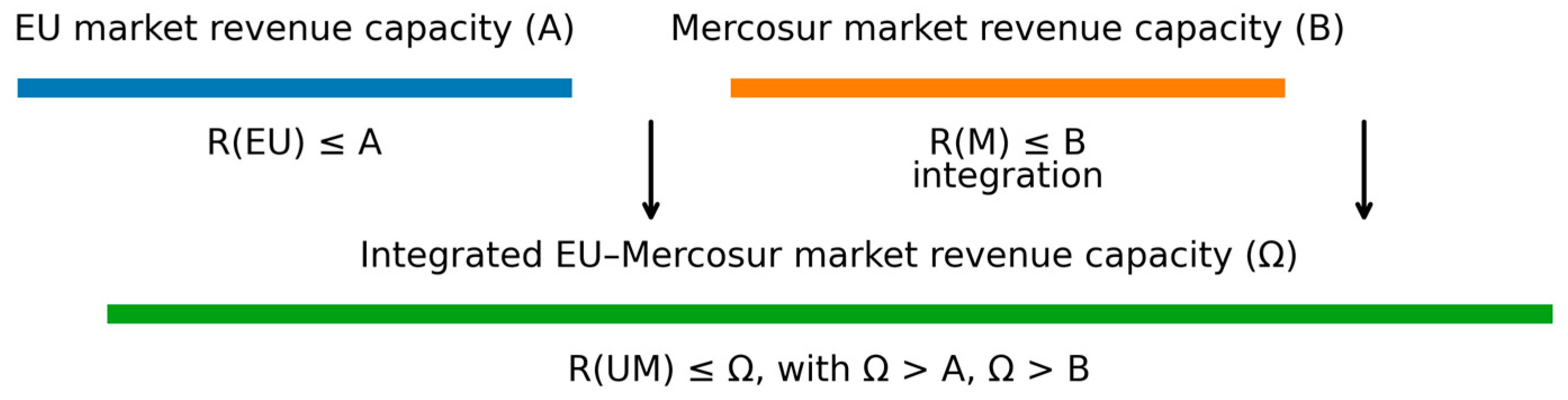
With market revenues defined as above (interpretable as a measure of market capacity) the revenue capacities of the EU and Mercosur markets considered separately are exogenously given (bounded) and satisfy
R E U A , R ( M ) B
When the two markets are integrated into a larger whole, i.e., a free-trade area under the agreement, the constraints become less binding. For final food products, this can be written as
R F ( E U ) + R F ( M ) = R F ( U M ) Ω
with Ω > A , Ω > B , and Ω > ( A + B ) . For agricultural products (inputs), analogously,
R A E U + R A M = R A U M Π ,   Π > A ,   Π > B
From the perspective of a processor or an agricultural producer, revenue constraints faced in a single market (EU or Mercosur) are relaxed by the opportunity to sell into the additional market. Illustratively (Figure 1), if one represents attainable revenue from a given market by a line segment, integration adds a second segment corresponding to attainable revenues in the additional market.

3.4. Revenue Sensitivity to Quantity vs. Price

Based on this stylized visualization, we can treat the EU+Mercosur market as a larger whole (a longer segment), implying a relaxation of the revenue constraint associated with the EU or Mercosur market considered separately. In separate markets, revenues are bounded over a given horizon (e.g., a year or longer) because they are tied to consumer expenditures, while demand is relatively stable [19,50,51]. This can be expressed in terms of (total) differentials for the revenue function. For a single market (e.g., the EU), we have:
R U E = Y i p y , d R U E = 0
whereas for the integrated market under the EU–Mercosur agreement:
R U M = Y i p y , d R U M 0
This highlights two sources of revenue growth: (a) an increase in supply, Δ Y F i > 0 , or (b) an increase in the product price level, Δ p F > 0 .
In general terms, for the EU market (and analogously for Mercosur), without specifying whether it is the final food market or the agricultural input market, if the revenue value is ex-ante bounded, then, for a given period t , the total differential satisfies
d R U E = R Y i Δ Y i + R p y Δ p y = 0
For the integrated market, the revenue constraint is relaxed and aggregate revenues may increase over the same period t , so
d R U M = R Y i Δ Y i + R p y Δ p y 0
We discuss revenue changes using the total derivative along inverse demand; where we decompose d R , it is purely an accounting decomposition of the same equilibrium movement. The identity d R = p d Y + Y d p is general; however, along inverse demand p = p ( Y ) , the equilibrium derivative is d R / d Y = p ( Y ) + Y d p / d Y . Therefore, quantity and price contributions should be interpreted as components of the total derivative rather than independent changes.
What is novel in this framework is the explicit use of revenue sensitivities with respect to quantity and price. In the literature, it is more common to focus on the sensitivity of prices to changes in determinants such as supply or demand. While the price elasticity of demand measures the percentage change in quantity demanded (or supplied) induced by a one-percent change in price, price sensitivity (in the opposite direction) measures the percentage change in the price level induced by a one-percent change in quantity (e.g., supply or demand). A common interpretation is that the higher the sensitivity, the smaller the margin for error faced by producers [48,52,53]. This notion of sensitivity can also be used to infer the intensity of competition on the supply side of the market [47,54], which is relevant to our argument. A complementary formal microeconomic treatment consistent with this deductive approach is provided in Rembisz and Sielska [55].
In addition, market integration may affect volatility: even when mean price effects are moderate, changes in variance, e.g., σ ( p A ) , can increase downside risk for farms. This channel is incorporated conceptually in Section 4.2 and Section 5.
These post-integration revenue conditions in the EU–Mercosur framework are likely to affect the choices of agri-food processors and agricultural producers regarding the maximization of their objective functions. If, as we assume, the primary operator of such maximization is an increase in the profitability indicator, then the effect of market expansion (the market as a larger whole) on this indicator will be fundamentally different for the two groups of agents, as demonstrated in the analysis that follows. Accordingly, the way processors and farmers anticipate benefits and threats will also differ.

4. Results–Deductive Implications

4.1. Implications for Processors (Agri-Food Processing)

It appears that, in the near term, revenue constraints in the market for final food products are tighter than in the market for agricultural products, regardless of whether the markets are considered separately or jointly. Ultimately, this is governed by consumer expenditures. Consumers, guided by the price, utility trade-off under given incomes, reflected in the income and price elasticities of demand, determine both the volume and the composition of demand [29,34], and thus determine processors’ revenues. In addition, for processors, an important short-run constraint (especially in the first years after market integration) is processing capacity, determined by the stock of investment in production techniques and technologies. This can be represented by the function
Y F t = f ( K t L t , Y A t , ε t ) m a x
where K t L t denotes processing techniques with embodied technology; Y A t denotes the volume of agricultural products purchased/processed as raw-material inputs; and ε t captures “soft” factors (e.g., management) that shape processing efficiency, understood as the ratio of food output Y F t to agricultural inputs Y A t , i.e., Y F t Y A t , which is effectively an outcome embedded in the function.
From this expression one can infer that market expansion, resulting from implementation of the agreement, may increase for an EU processor (by access to Mercosur markets, and vice versa) both opportunities to sell final food products Y F t and opportunities to procure agricultural inputs Y A t . This can improve efficiency Y F t / Y A t , while also affecting prices in both markets. In particular, ceteris paribus, stronger competition on the supply side of agricultural inputs may lead to a decline, or at least stabilization, of input prices purchased for processing. Consequently, ex-ante, processors supplying final food markets may view the agreement more as a source of potential benefits than as a dominant source of risk.
This economic mechanism is well recognized in microeconomics and in the theory of the producer’s choice [43,55]. These results are conditional comparative statics; commodity-level verification requires post-implementation data [46,56]. The inference regarding processors’ concerns and benefits becomes even more complex once one introduces into the above function the prices received for final food products p F and the prices paid for purchased agricultural inputs p A , while treating the remuneration of capital and labor as fixed under ceteris paribus to avoid further complication. In that case, the above function can be written as
R F = Y F i · p F = f ( K t L t , ( Y A t · p A ) , ε t ) m a x
where R F = Y F i · p F is processors’ revenue from the final food market (typically the EU market); K t L t denotes processing techniques; Y A t · p A denotes expenditures on agricultural inputs purchased for processing; and ε t captures soft determinants of efficiency and a stochastic component.
In terms of concerns and benefits, this formulation highlights a second key factor in addition to processing efficiency: namely, the price ratio between received output prices p F   and paid input prices p A ; thus,
p F p A .
This ratio is closely related to the marketing margin discussed above, which over the longer run is shaped by the processing-efficiency indicator embedded in Y F t = f ( K t / L t , Y A t , ε t ) , where efficiency is measured by Y F t / Y A t . It is plausible to conclude that market expansion, treating the EU and Mercosur markets as a larger whole, creates conditions under which processors can realize revenues without a decline in final-good prices, because local revenue constraints are relaxed [57], consistent with a weakening of the King effect [19,58]. This can also be interpreted as an increase in market scale, production scale, and revenues. Analytically, this is developed below. Regarding the prices paid for agricultural inputs, one may infer that expansion of the procurement market could depress input prices in domestic markets. Therefore, the ratio p F p A tends to improve p F p A , which benefits processors, while simultaneously raising concerns among farmers as suppliers. Overall, agri-food processors appear relatively less exposed to the risks associated with the EU–Mercosur agreement and may perceive it as a source of potential gains.
This line of reasoning can be reinforced by reference to a simplified profitability formula for processing [56]. We abstract from capital inputs (depreciation, non-raw-material intermediate inputs such as energy) and from other costs not treated as inputs (taxes and other charges). The profitability coefficient is limited to the ratio of the value of revenues from processed final food products (output quantity times output prices) to the value of expenditures on raw-material inputs (purchased agricultural inputs times their prices). Anticipating the subsequent argument, note that the “inputs” in the denominator of the profitability ratio differ for processors versus farmers, which substantially shapes how each group anticipates concerns and benefits from the agreement. The shared foundation is the microeconomic (and inherently agent-specific) character of the profitability ratio, which is central to the logic of this article. In this simplified form, the profitability function for a processor is
e F i = f ( Y F i · p F i Y A i · p A i ) m a x
This expression can be analyzed in two complementary ways.
First, it can be decomposed into two key components. The first is the efficiency of transforming agricultural products into food products:
Y F t Y A t .
The second is the price ratio between output prices and input prices:
p F i p A i .
Hence, the decomposed profitability indicator can be expressed as
e F i = f { Y F i Y A i · p F i p A i } m a x .
The decomposition makes the mechanism transparent: market integration can raise e F by enabling efficiency gains Y F / Y A and/or improving relative prices p F / p A through input market competition and margin dynamics.
It follows that, as market scale expands for both final products and agricultural inputs, both components of processors’ profitability may improve. Processing efficiency (the first ratio) may rise because opportunities to sell final products Y F i expand while procurement opportunities for agricultural inputs Y A i improve, through stronger competition among suppliers (farmers) for sales to processors. While this can apply to processors in both the EU and Mercosur, it plausibly benefits EU processors more. Market integration may also amplify the role of the second ratio, i.e., the increase in output-price-to-input-price ratios. One may conjecture that this increase is driven mainly by a depression of agricultural input prices alongside relative stability (or modest increases) in food prices. Such reasoning is consistent with the expectation that food prices may rise faster than agricultural prices, i.e., Δ p F i > Δ p A i (a conjecture that could, to some extent, be evaluated using price-trend functions or autoregressive models). Under this conjecture, the implication is an obvious gain for processors and a concern for farmers, reinforcing the claim that processors and farmers face systematically different perspectives on the agreement’s risks and benefits.
Second, given the ratio form ( Y F i · p F i Y A i · p A i ) , one can analyze how the agreement affects the numerator and denominator through market conditions. One may posit that: (a) the numerator can rise because a larger market (a larger “whole”) allows higher output and revenues with weaker adverse price effects; and that (b) the denominator can fall because a larger integrated EU–Mercosur market constitutes a bigger and more competitive procurement market for agricultural inputs, with potentially depressive effects on input prices. Thus, for the integrated market (EU–Mercosur) with relaxed revenue constraints at time t ,
d R U M = R Y F · Y F + R p F · p F 0 ,
one may obtain
+ ( R Y F · Y F ) + ( R p F · p F ) ,
whereas for the EU market alone (as a bounded submarket),
d R U E = R Y F · Y F + R p F · p F = 0 ,
one would typically observe
+ ( R Y F · Y F ) ( R p F · p F ) .
An increase in the supply of final products is unlikely to be accompanied by higher prices; rather, it typically implies relative price declines [19,43,49]. Here, R Y F denotes the sensitivity of revenue from final food sales to changes in supplied quantity, while R p F denotes sensitivity to changes in price. The terms R Y F · Y F and R p F · p F   capture the contributions of quantity and price changes to revenue changes. Importantly, throughout Section 4.1 and Section 4.2 the “quantity” and “price” terms are used only as an accounting decomposition of the same equilibrium movement along the inverse demand curve; they should not be interpreted as two independent causal channels.
In the context of our analytical objective, what matters more is the potential substitution effect between these two components under the revenue constraint of each market considered separately, whether the EU or Mercosur:
( R Y F · Y F ) + / ( R p F · p F ) ,
that is, whether an increase in revenues driven by higher supply can be accompanied by a decline in revenues due to a fall in the price level, and vice versa. Moreover, depending on the absolute magnitudes of revenue sensitivity to quantity changes, R Y F , and to price changes, R p F , the two terms on opposite sides of the above expression will not necessarily offset each other.
It seems that the substitution effect will always arise in a market with bounded revenue capacity, i.e., in the EU market and the Mercosur market considered separately. This may be treated not so much as a hypothesis, but rather as a maintained assumption (a thesis). While this is ultimately an empirical question, within the present theoretical analysis we can assume that such a substitution effect may occur, an assumption that would speak in favor of integrating the two markets. By contrast, when the two markets are combined into a larger whole, and the revenue constraint is thereby relaxed as a consequence of the EU–Mercosur agreement, one may speak of a complementarity effect or a synergy effect, i.e.,
{ + R Y F · Y F R p F · p F + } .
Needless to add, this configuration is favorable for agri-food processors. It is likely to apply in particular to EU processors, who plausibly possess technical and productivity advantages and produce food under EU standards, with a processing regime that complies with health and environmental requirements. Such advantages of EU processors are emphasized in a number of publications [59]. It is reasonable to assume that these advantages can be capitalized by EU processors (including Polish processors) in the integrated EU–Mercosur market.
A more complex issue is the analysis of processors’ hypothetical benefits and concerns once one accounts for the variables in the denominator of the profitability ratio, i.e., the value of purchases of agricultural products as an input: Y A i · p A i . This term effectively determines the value of demand for agricultural products and thus constitutes the revenue base of agricultural producers. Hence, conclusions drawn here also speak to the revenue conditions, i.e., the numerator of the profitability ratio, for farmers. This also highlights the essence of the maintained thesis that processors and agricultural producers have fundamentally different perspectives on the concerns and benefits associated with the EU–Mercosur agreement.
In analyzing the impact of market integration on raw-material costs, i.e., processors’ purchases of agricultural products, basic market regularities are informative. Market integration unambiguously implies a larger supply of agricultural products available as raw-material inputs for agri-food processors. This can intensify price competition, with beneficial effects for processors. To support this conclusion, one may invoke the basic relationship between supply and the price level of an agricultural product, representing the agricultural price p A as a function of supply Y A , given demand d F A = Y A i (in particular, d F A = 1 on the processor side) [57]:
p A = f ( d F A Y A ) for Y A > 0 ,   d F 0
or, analytically,
p A = d F A Y A , Δ p A = d F A Y A
With a high degree of plausibility, demand for agricultural inputs by processors will not increase as quickly as the supply of these products as inputs may increase as a consequence of the EU–Mercosur agreement. Therefore, one may anticipate a decline in agricultural prices:
Y A > d F A     Δ p A < 0
Other plausible scenarios, such as Δ d F A < 0 combined with Δ Y A > 0 , lead to the same implication, Δ p A < 0 . Such scenario assumptions are plausible and admissible, given the potential improvement in efficiency among European processors, Y F i Y A i , captured in the decomposition of the processing profitability indicator:
e F i = f { Y F i Y A i · p F i p A i } m a x .
The straightforward implication is that an increase in market scale resulting from the EU–Mercosur agreement may prove beneficial for EU agri-food processors.
Under maintained assumptions, the model supports H2: processors’ profitability tends to improve when sourcing expansion depresses or stabilizes p A relative to p F and market expansion relaxes tight revenue constraints in final-good markets so that scale increases do not require proportional declines in p F .

4.2. Implications for Farmers (Agricultural Producers)

Agricultural producers, consistent with the paper’s initial thesis, face a different perspective with respect to the concerns and benefits associated with the agreement. Based on the reasoning in the previous subsection, one may conclude that farmers’ concerns about the EU-Mercosur agreement can be well founded. As noted above, the agreement expands processors’ procurement market. From the standpoint of EU (including Polish) farmers, however, the expansion of the agricultural products market under the agreement primarily implies stronger competition for selling these products to processors, particularly within the EU. These concerns may indeed be justified, but only if one abstracts from issues of quality standards, production regimes, and sanitary, environmental, and related requirements governing production processes. These issues are raised in most publications on the topic [60,61].
Remaining within the same theoretical–hypothetical line of reasoning, based on the formal–analytical framework, we assess the plausibility of these concerns. The analysis is grounded in the construction of farmers’ production profitability and in the decomposition of this indicator. However, we consider only the numerator variables of the farmer profitability ratio, which correspond to the denominator of the processor profitability ratio. Substantively, these are the same variables: for processors they represent the cost of purchasing raw materials (expenditure on inputs), while for farmers they represent market revenues. The denominator of the farmer profitability ratio is not analyzed; its variables are treated as given under ceteris paribus. The microeconomic profitability coefficient for agricultural producers, in a general form, is
e A i = f ( Y A i · p A i N A i · p N A i ) m a x ,
where e A i denotes the profitability indicator at a level of generality typical for microeconomics (abstracting from non-input costs); N A i denotes production-factor inputs (e.g., fertilizers, fuel, energy), depreciation of fixed assets, land rent, and labor inputs; p N A i denotes their prices; and N A i p N A i is the value of input costs, which remains outside the scope of the present analysis.
Taking the denominator N A i p N A i as fixed (ceteris paribus) and leaving it outside the analysis, we focus on the numerator Y A i p A i , i.e., farmers’ market revenue. The relevant market is the EU agricultural market understood as a component of a larger whole resulting from the EU–Mercosur agreement. That is, we consider the EU agricultural market opened to imports from Mercosur under the conditions specified in the agreement. These import conditions are also treated as given (ceteris paribus). We assume that the EU market continues to be governed by existing quality standards and established agricultural production regimes regarding sanitary, environmental, and climate requirements. This implies enforcement of these norms at the market border. There is a large body of publications on this issue [3].
Given the above, including compliance with norms regarding inputs and agricultural production processes and effective enforcement of quality standards, greater openness of the EU agricultural market (as part of a larger whole) is likely to intensify competition faced by agricultural producers on the EU market. This can be represented as a reduced ability to realize a given level of market revenue:
d R A U E = R Y A · Y i A + R p A · p A 0 ,
where R A U E denotes farmers’ revenues on the EU market; d R A U E is the change in EU market revenues as a component of the larger whole; R Y A is the sensitivity of market revenue to changes in the quantity supplied; Y i A and Δ Y i A denote the level and change in the aggregate supply offered by all EU and Mercosur farmers; R p A is the sensitivity of market revenue to changes in the price level; and p A and Δ p A denote the level and change of agricultural prices on the EU market as part of the larger whole.
Beyond mean price effects, market integration can increase price volatility in raw-material markets (especially for globally exposed commodities). Higher σ ( p A ) increases downside risk for farms with rigid costs, limited hedging capacity, or liquidity constraints, even if the average price decline is moderate.
The intensity of the risk is heterogeneous across commodities (e.g., beef vs. cereals vs. dairy, depending on TRQs and substitution patterns) and across farms (scale, productivity, cost rigidity, contracting/vertical coordination). Therefore, H1 should be interpreted as a conditional statement applying more strongly to high-exposure markets and to farms with lower ability to absorb price and volatility shocks.
In light of the above, any increase in supply and the associated positive revenue effect for farmers may be offset by a negative revenue effect due to a decline in prices. In particular, one may obtain
+ ( R Y A · Y A ) < ( R p A · p A ) ,
or, alternatively, an approximate balance between the quantity effect and the price effect:
+ ( R Y A · Y A )   ( R p A · p A ) .
As in Section 4.1, the “quantity” and “price” components refer to the same equilibrium adjustment after a shock; the decomposition serves only to clarify which part of the revenue change is associated with movement in Y   versus movement in p along inverse demand.
In each of these scenario cases, it is highly plausible that agricultural prices on the EU market decline. Consequently, the concerns of some agricultural producers in the EU regarding the effects of the EU–Mercosur agreement appear justified. One may expect a decline in agricultural prices that will not be compensated by higher sales volumes; thus, the net revenue effect (according to the logic of the above expressions) will be negative. The relationship between procurement prices, efficiency, and profitability in an empirical–analytical framework is documented, inter alia, by Bezat-Jarzębowska and Rembisz [56].
The relationships derived in the theoretical part are deductive and illustrate how the integration of EU and Mercosur markets into a “larger whole” may alter the conditions governing revenue formation and, through profitability indicators, the decision incentives of processors and farmers. Since the agreement has not been implemented, the results should be interpreted as conditional implications dependent on the maintained assumptions [11,12].
The model supports H1 under conditions where p A declines due to stronger contestability of the EU input market and the volume response Y A is insufficient to offset the price effect in the short run; the risk is amplified if volatility of p A rises after integration.
Overall, the deductive implications predict asymmetric profitability dynamics along the value chain: processors benefit via p F / p A and potential efficiency gains, while farmers face higher downside risk through price pressure and potentially increased volatility in raw-material markets.

5. Discussion

Adopting in this paper the perspective of two interconnected markets, the market for final food products and the market for agricultural raw materials, together with the concepts of the marketing margin (price spread) and derived demand, helps to organize the relevant mechanisms and to show that exposure to risk depends on price transmission, price volatility, and asymmetric responses to supply/demand shocks across the two segments of the chain [16,17,18,43,49]. Accordingly, we interpret the model’s implications in terms of differences in price-transmission mechanisms and profitability incentives on the side of processors versus agricultural producers, emphasizing the conditional character of conclusions in the absence of ex-post data [11,13].
Section 3 and Section 4 provide conditional, positive implications: “if maintained assumptions hold, then profitability components move as described.” Normative conclusions (e.g., desirability of the agreement) require welfare analysis and distributional weights and are beyond the scope of the present deductive framework.

5.1. Heterogeneity of Concerns and Benefits Along the Value Chain

The model’s deductive results point to an asymmetry in the consequences of potential EU–Mercosur market integration for two groups of agents: agri-food processors and agricultural producers. This asymmetry follows from the fact that both groups operate simultaneously in two linked markets: the market for final goods (food) and the market for agricultural products as raw-material inputs. Mechanically, the two are connected through derived demand and the marketing margin/price spread, which serves as a channel through which price and quantity shocks are transmitted across markets [16,17,18,19,43].
In the literature and commentary surrounding EU–Mercosur, risk is often framed in a one-sided manner, most commonly as a threat to agricultural producers through competitive pressure and a potential decline in raw-material prices. The two-market/marketing margin perspective allows a more precise differentiation of risk exposure along the chain: for farmers, the key variables are prices and volumes in the raw-material market; for processors, the relevant objects are the relationship between final-good prices and raw-material prices, margin formation, and the transmission of price volatility between segments [18,19,49]. As a result, risk is multidimensional and may materialize as pressure on input prices, margin compression, changes in relative prices, or increased price volatility after integration.
Commodity-level illustrations help show how the same two-market mechanism can yield different conditional implications depending on TRQ design, storability, and supply-chain organization. For example, beef and poultry are typically discussed as sensitive goods under TRQs: when quotas are binding or transition schedules are slow, the price-pressure channel on is attenuated, and adjustment may be concentrated in specific cuts/segments rather than p A the entire market; cereals (e.g., wheat/maize) are storable and more exposed to global arbitrage, so integration may transmit more into volatility σ p A and intertemporal price dynamics than into a one-off level shift; dairy (or other highly processed chains) is more dependent on contracting/vertical coordination, so the pass-through from p F to p A   and the marketing margin rule can change with renegotiation of contracts, affecting whether farms experience mainly level effects (mean p A ) or risk effects (variance of p A ). These examples underscore that the paper’s claims are conditional: “if TRQs bind/if storability enables smoothing/if contracting alters pass-through, then the implied profitability components move accordingly.

5.2. Relation to the Literature and the Advantage of a Two-Market Perspective

The framework employed in this paper builds on classical approaches in agricultural economics in which the raw-material market is structurally linked to the market for final products, and price transmission (including asymmetries) constitutes a primary channel through which impulses propagate [16,17,18,19]. Relative to many assessments of EU–Mercosur, often relying on sectoral narratives or aggregate indicators, the two-market perspective disciplines the argument: it shows that even if production standards and non-tariff barriers were assumed to remain binding, changes in market scale and revenue constraints alone can generate different profitability outcomes for processing versus primary agricultural production.
Thus, the contribution of this approach is not another “balance-sheet” assessment, but an explicit identification of the channels through which changes in market scale and revenue conditions can differentiate profitability in processing and agriculture even under unchanged technologies and standards.
At the same time, the approach is consistent with a microeconomic view of competitiveness: carriers of advantage/efficiency are individual agents (farms, firms), not countries, and aggregation is a secondary outcome. In this sense, inference about concerns and benefits should be formulated as changes in profitability conditions at the agent level, rather than categorical claims about economies “winning” or “losing” [24,25,27].

5.3. Analogy to Poland’s Accession to the EU and Limits to Extrapolation

As a complementary reference point, an analogy with the period following Poland’s accession to the EU is useful, when the Polish agri-food sector operated within a larger integrated market. From a national perspective, one can note that Poland’s agri-food sector performed well in international competition, which was associated inter alia with a positive trade balance, a sizeable export surplus, and a sustained share in EU and global exports [62,63]. Such facts can serve as a premise for tempering some concerns, particularly with respect to potential opportunities on the processing side.
In a two-market framework, it is also important that success in processing can generate a derived-demand effect for agriculture (higher demand for raw materials), thereby increasing farm revenues [16,17,64]. However, the analogy has important limitations: EU accession implied deep institutional integration within the single market, whereas EU–Mercosur (a free-trade area) would represent a shallower and more conditional form of integration. Therefore, extrapolating accession experiences to an EU–Mercosur scenario must be done cautiously, and the derived-demand channel may coexist with price pressure in raw-material markets.
An additional limitation is that demand responses may depend not only on quality-to-price ratios but also on preferences regarding origin. It is worth noting that evaluations of liberalization effects may be complicated by empirically documented “home bias” and origin-based demand differentiation, which can operate independently of quality-to-price considerations [31,32,33]. From a welfare perspective, these channels may imply a reallocation of demand and costs toward consumers if they are not grounded in cost–quality advantage [30,34]. In this paper, this mechanism is not modeled explicitly; we point to it as a potential interpretive background for the public debate and for ex-ante scenarios.

5.4. Methodological Implications

The framework is stylized and does not deliver point forecasts. It abstracts from general-equilibrium feedbacks, exchange-rate and freight-cost dynamics, endogenous policy responses, and strategic pricing. Standards and border enforcement are treated as binding constraints; changes in enforcement intensity could alter outcomes. These limitations are a feature of the ex-ante deductive design and define the scope for future calibrated work.
The results of this paper constitute conditional implications of a model, reflecting the absence of ex-post data on post-implementation market conditions. In such a setting, categorical claims about policy effectiveness or “national competitiveness” should be avoided; it is more valuable to present the logical implications of models, state assumptions explicitly, and indicate conditions under which the claims become falsifiable in the future [11,12,13]. Even sophisticated ex-ante simulation exercises do not constitute proof of policy effects; they map the consequences of assumed parameters and of a counterfactual construction that, in this case, remains unobservable [39,40]. Therefore, where possible, one should present model implications and sensitivity analysis with respect to key parameters (e.g., elasticities, pass-through) rather than point forecasts [35,36].
Looking forward, a natural continuation is an empirical research agenda: scenarios based on tariffs, TRQs, and the paths toward target rates [1,47]; structural ex-ante models (including firm heterogeneity frameworks) in which substitution elasticities determine the range of outcomes [24,36,48]; and parameter calibration using analogous liberalization episodes and meta-analyses [34,35]. Regardless of strategy, it is crucial to separate the effects of tariffs/TRQs from SPS/TBT standards and other non-tariff barriers, and to control for exchange rates, freight costs, and the political-implementation risk [4,25].
Consequently, ex-ante simulations should be treated as sensitivity analysis with respect to parameters and counterfactual assumptions, and conclusions should be interpreted at the micro level (firms/farms), because directly translating them into “national competitiveness” without an aggregation mechanism risks a fallacy of composition [24,27,39,40].
A complementary empirical question concerns the sustainability of the post-integration relationships highlighted by the model, i.e., whether the implied margin dynamics, pass-through patterns, and relative-price relationships (e.g., p F / p A ) persist beyond the initial adjustment period. Market integration can trigger structural changes in the value chain, such as deeper contracting, greater vertical coordination, shifts in concentration, or reallocation across processing technologies, that may alter effective pass-through and the marketing margin rule over time. Hence, the short-run comparative statics derived here should be interpreted as operating under partially rigid capacity and contractual arrangements, whereas long-run outcomes may reflect endogenous reorganization of the chain and investment responses. This reinforces the paper’s interpretation of results as conditional and motivates an explicit empirical focus on the time profile of margins, volatility transmission, and procurement conditions during and after the transition to an integrated market.

5.5. Policy Relevance: Monitoring and Adjustment Instruments

To facilitate future testing, the model implies measurable indicators: margin dynamics m t = p F , t p A , t and m t / p F , t ; pass-through estimates (e.g., VAR/regressions of p A on p F ); changes in volatility σ ( p A ) and volatility transmission; and heterogeneity analysis across commodities and farm types. On the adjustment side, the model rationalizes targeted transition support in high-exposure sectors and for farms with rigid cost structures and limited hedging capacity: income stabilization tools, risk-management instruments (insurance/hedging facilitation), support for contracting/vertical coordination that stabilizes p A , and temporary adjustment assistance linked to clearly defined monitoring thresholds.

6. Conclusions

The paper contributes a deductive two-market framework linking market expansion, price transmission, and profitability along the agri-food chain. In this sense, the paper’s contribution is primarily methodological: it structures the mechanisms and enables the formulation of conditional implications regarding concerns and benefits, rather than relying on sectoral narratives or aggregate competitiveness indicators.
Because the EU–Mercosur agreement has not been implemented, and thus ex-post observations enabling identification of a policy effect are unavailable, the results should be interpreted as conditional forecasts dependent on maintained assumptions [11,12,13]. In such a context, analytical integrity requires explicit reference to assumptions, sensitivity analysis, and avoidance of categorical claims about policy effectiveness or national competitiveness [25,35,36].
Substantively, the model points to a structural asymmetry in incentives and risk exposure between agri-food processors and agricultural producers. Expansion of the final-good market alongside an expanded sourcing base for raw materials tends to improve processing profitability conditions, whereas for farmers, competitive pressure in the raw-material market may heighten the risk of price declines and deteriorating revenues. This mechanism is consistent with the literature on marketing margins, price transmission, and derived demand in agri-food supply chains.
Explicit answers to hypotheses (added): H2 is supported when integration improves processors’ output-to-input price ratio p F / p A and/or efficiency Y F / Y A , and when expanded market scale prevents proportionate declines in p F . H1 is supported when increased contestability of the EU raw-material market depresses p A and the volume response does not offset the price effect in the short run; the risk is amplified if price volatility of p A rises after integration.
A natural continuation of this work is an empirical research program, once adequate observations or credible ex-ante data become available, covering, the organization of tariff shocks and TRQ parameters over time, the application of structural ex-ante models (including firm heterogeneity frameworks), and the calibration of key parameters (including elasticities) using analogous liberalization episodes and meta-analyses [24,34,35,47,48]. Across all strategies, it remains essential to separate the effects of tariffs/TRQs from non-tariff barriers (SPS/TBT), to control for exchange rates and freight costs, and to account for political-implementation risk [4,25].
The paper provides conditional implications derived from a stylized two-market framework and therefore does not deliver point forecasts. Key limitations concern the abstraction from general-equilibrium feedbacks, exchange-rate and freight-cost dynamics, endogenous policy responses, and potential changes in enforcement intensity (Section 5.3 and Section 5.4). These limitations motivate an empirical agenda focused on tariff/TRQ-based scenario design, structural ex-ante models with explicit substitution and pass-through, and calibration from analogous episodes and meta-analyses, with particular attention to the time profile of margins, pass-through, and volatility transmission once suitable data become available.

Author Contributions

Conceptualization, A.B. and W.R.; methodology, A.B. and W.R.; software, A.B. and W.R.; validation, A.B. and W.R.; formal analysis, A.B. and W.R.; writing—original draft preparation, A.B. and W.R.; writing—review and editing, A.B. and W.R.; visualization, A.B.; supervision, W.R. All authors have read and agreed to the published version of the manuscript.

Funding

This research received no external funding.

Data Availability Statement

No new data were created or analyzed in this study.

Conflicts of Interest

The authors declare no conflicts of interest.

Appendix A. Key Derivational Steps

Appendix A.1. Revenue Derivative Along Inverse Demand

Consider a market with inverse demand
p = p ( Y ) .
Market revenue is
R ( Y ) = Y p ( Y ) .
Differentiating with respect to Y yields
d R d Y = p ( Y ) + Y d p d Y .
Equivalently, in total differential form,
d R = p d Y + Y d p ,
but along inverse demand p = p ( Y ) we have d p = d p d Y d Y , hence
d R = ( p ( Y ) + Y d p d Y ) d Y .
Therefore, the terms p d Y and Y d p are an accounting decomposition of the same equilibrium movement along p ( Y ) , not two independent channels.

Appendix A.2. Marketing Margin Mapping and Implied Input–Output Price Link

Define the marketing margin (price spread) as
g p p F p A ,
where p F is the final-good (food) price and p A is the agricultural input (raw-material) price.
Assume a linear margin rule
g p = c + a p F ,   c 0 ,   0 a < 1 .
Then
p A = p F g p = p F ( c + a p F ) = ( 1 a ) p F c .
This provides a direct pass-through mapping from p F to p A under maintained margin parameters a c .

Appendix A.3. Profitability Decomposition for Processors

Define a stylized profitability indicator for processor i as
e F i Y F i p F i Y A i p A i ,
where Y F i is processor i ’s output of final food goods and Y A i is the quantity of agricultural raw materials used/purchased; p F i and p A i are the corresponding output and input prices.
Then
e F i = Y F i Y A i p F i p A i .
Thus, changes in processing profitability can be discussed through two components: physical/technical efficiency: Y F i Y A i output–input price ratio: p F i p A i both potentially affected by market expansion, sourcing conditions, and pass-through/margin dynamics.

Appendix A.4. Farmer-Side Profitability and Revenue Focus Under Ceteris Paribus Costs

Analogously, define a stylized profitability indicator for farm i as
e A i Y A i p A i N A i p N A i ,
where Y A i is farm i ’s marketed quantity of the agricultural product (input/raw material), p A i is the farm-gate price, N A i is an aggregate index of variable inputs (e.g., fertilizer, fuel/energy, feed, hired services), p N A i is the corresponding input-price index, so that N A i p N A i is the value of variable input costs (in the stylized sense used in the paper).
Under a short-run ceteris paribus assumption that the cost term N A i p N A i is approximately fixed (or changes slowly relative to revenue), the risk assessment focuses on the numerator: farm   revenue   R i A Y A i p A i . Hence, short-run impacts of integration on farms operate mainly through the joint equilibrium movement in Y A i p A i , and may be additionally affected by changes in price volatility, e.g., σ ( p A ) or   σ ( p A , t ) .

References

  1. European Commission. Factsheet: EU-Mercosur Partnership Agreement—Trade & Sustainable Development. Brussels: European Commission. 2024. Available online: https://policy.trade.ec.europa.eu/eu-trade-relationships-country-and-region/countries-and-regions/mercosur/eu-mercosur-agreement/factsheet-eu-mercosur-partnership-agreement-trade-and-sustainable-development_en (accessed on 5 December 2025).
  2. Grieger, G. EU-Mercosur Partnership Agreement: Trade Pillar. (International Agreements in Progress). European Parliament, European Parliamentary Research Service. EPRS Briefing PE 769.537. 2025. Available online: https://www.europarl.europa.eu/thinktank/en/document/EPRS_BRI%282025%29769537 (accessed on 5 December 2025).
  3. European Commission. EU-Mercosur Agreement: Text of the Agreement; Proposals for Council Decisions; Interim Trade Agreement (iTA) and Partnership Agreement (EMPA). 2025. Available online: https://policy.trade.ec.europa.eu/eu-trade-relationships-country-and-region/countries-and-regions/mercosur/eu-mercosur-agreement/text-agreement_en (accessed on 5 December 2025).
  4. European Parliament. EU-Mercosur Partnership Agreement (Legislative Train: Background and State of Play). Brussels: European Parliament. 2024. Available online: https://www.europarl.europa.eu/legislative-train/theme-a-global-europe-leveraging-our-power-and-partnerships/file-eu-mercosur-association-agreement (accessed on 5 December 2025).
  5. Malamud, A.; Schenoni, L. Geopolitical Aspects of the EU–Mercosur Agreement. European Parliament, External Policies Analysis and Support Unit Directorate-General for External Policies of the Union, Study, PE 754.478. 2025. Available online: https://www.europarl.europa.eu/RegData/etudes/STUD/2025/754478/EXPO_STU%282025%29754478_EN.pdf (accessed on 5 December 2025).
  6. Castro Ribeiro, G. Geoeconomic Awakening: The European Union’s Trade and Investment Policy Shift toward Open Strategic Autonomy; EU Diplomacy Papers 2023, 3/2023; College of Europe: Bruges, Belgium, 2023. [Google Scholar]
  7. Weiß, W. The EU’s strategic autonomy in times of politicisation of international trade: The future of Commission accountability. Glob. Policy 2023, 14, 54–64. [Google Scholar] [CrossRef]
  8. European Central Bank (ECB). Inputs in Distress: The Real Effects of Geoeconomic Fragmentation; Working Paper Series 2024, No 2992; European Central Bank: Frankfurt am Main, Germany, 2024. [Google Scholar] [CrossRef]
  9. European Commission. Sustainability Impact Assessment in Support of the Negotiations of the Association Agreement Between the European Union and Mercosur (Report for the European Commission). 2021. Available online: https://policy.trade.ec.europa.eu/news/commission-publishes-final-sia-and-position-paper-eu-mercosur-trade-agreement-2021-03-29_en (accessed on 5 December 2025).
  10. Krzyzanowski, J.T. The EU-Mercosur Agreement in Agriculture: Opportunities and Threats for European Producers. Eur. Res. Stud. J. 2025, 28, 272–294. [Google Scholar] [CrossRef]
  11. Heckman, J.J.; Hotz, V.J. Choosing among alternative nonexperimental methods for estimating the impact of social programs: The case of manpower training. J. Am. Stat. Assoc. 1989, 84, 862–880. [Google Scholar] [CrossRef]
  12. Imbens, G.W.; Wooldridge, J.M. Recent developments in the econometrics of program evaluation. J. Econ. Lit. 2009, 47, 5–86. [Google Scholar] [CrossRef]
  13. Angrist, J.D.; Pischke, J.-S. The credibility revolution in empirical economics: How better research design is taking the con out of econometrics. J. Econ. Perspect. 2010, 24, 3–30. [Google Scholar] [CrossRef]
  14. Antràs, P. Global Production: Firms, Contracts, and Trade Structure; Princeton University Press: Princeton, NJ, USA, 2016. [Google Scholar]
  15. Grossman, G.M.; Rossi-Hansberg, E. Trading Tasks: A Simple Theory of Offshoring. Am. Econ. Rev. 2008, 98, 1978–1997. [Google Scholar] [CrossRef]
  16. Gardner, B.L. The farm-retail price spread in a competitive food industry. Am. J. Agric. Econ. 1975, 57, 399–409. [Google Scholar] [CrossRef]
  17. Wohlgenant, M.K. Marketing margins: Empirical analysis. In Handbook of Agricultural Economics; Gardner, B.L., Rausser, G.C., Eds.; Elsevier: Amsterdam, The Netherlands, 2001; Volume 1B, pp. 933–970. [Google Scholar] [CrossRef]
  18. Meyer, J.; von Cramon-Taubadel, S. Asymmetric price transmission: A survey. J. Agric. Econ. 2004, 55, 581–611. [Google Scholar] [CrossRef]
  19. Tomek, W.G.; Kaiser, H.M. Agricultural Product Prices, 5th ed.; Cornell University Press: Ithaca, NY, USA, 2014. [Google Scholar]
  20. Ricardo, D. On the Principles of Political Economy and Taxation; John Murray: London, UK, 1817; Available online: https://competitionandappropriation.econ.ucla.edu/wp-content/uploads/sites/95/1970/01/Principles-of-Political-Economy-and-Taxation-1817.pdf (accessed on 5 December 2025).
  21. Heckscher, E.F.; Ohlin, B. Interregional and International Trade; Harvard University Press: Cambridge, MA, USA, 1933. [Google Scholar] [CrossRef]
  22. Helpman, E.; Krugman, P.R. Market Structure and Foreign Trade: Increasing Returns, Imperfect Competition, and the International Economy; MIT Press: Cambridge, MA, USA, 1985. [Google Scholar]
  23. Martimort, D. (Ed.) Agricultural Markets: Mechanisms, Failures and Regulations; Emerald Group Publishing: Bingley, UK, 2008. [Google Scholar]
  24. Melitz, M.J. The impact of trade on intra-industry reallocations and aggregate industry productivity. Econometrica 2003, 71, 1695–1725. [Google Scholar] [CrossRef]
  25. Syverson, C. What determines productivity? J. Econ. Lit. 2011, 49, 326–365. [Google Scholar] [CrossRef]
  26. Latruffe, L. Competitiveness, Productivity and Efficiency in the Agricultural and Agri-Food Sectors; OECD Food, Agriculture and Fisheries Papers 2010, No. 30; OECD Publishing: Paris, France, 2010. [Google Scholar] [CrossRef]
  27. Bernard, A.B.; Jensen, J.B.; Redding, S.J.; Schott, P.K. Firms in international trade. J. Econ. Perspect. 2007, 21, 105–130. [Google Scholar] [CrossRef]
  28. Atkeson, A.; Burstein, A. Pricing-to-market, trade costs, and international relative prices. Am. Econ. Rev. 2008, 98, 1998–2031. [Google Scholar] [CrossRef]
  29. Lancaster, K.J. A new approach to consumer theory. J. Political Econ. 1966, 74, 132–157. [Google Scholar] [CrossRef]
  30. Hausman, J.A. Exact consumer’s surplus and deadweight loss. Am. Econ. Rev. 1981, 71, 662–676. [Google Scholar]
  31. McCallum, J. National borders matter: Canada–U.S. regional trade patterns. Am. Econ. Rev. 1995, 85, 615–623. [Google Scholar]
  32. Bronnenberg, B.J.; Dubé, J.-P.; Gentzkow, M. The evolution of brand preferences: Evidence from consumer migration. Am. Econ. Rev. 2012, 102, 2472–2508. [Google Scholar] [CrossRef]
  33. Shimp, T.A.; Sharma, S. Consumer ethnocentrism: Construction and validation of the CETSCALE. J. Mark. Res. 1987, 24, 280–289. [Google Scholar] [CrossRef]
  34. Feenstra, R.C.; Weinstein, D.E. Globalization, markups, and U.S. welfare. J. Political Econ. 2017, 125, 1040–1074. [Google Scholar] [CrossRef]
  35. Campa, J.M.; Goldberg, L.S. Exchange rate pass-through into import prices. Rev. Econ. Stat. 2005, 87, 679–690. [Google Scholar] [CrossRef]
  36. Gopinath, G.; Itskhoki, O. Frequency of price adjustment and pass-through. Q. J. Econ. 2010, 125, 675–727. [Google Scholar] [CrossRef]
  37. Balassa, B. Trade liberalisation and “revealed” comparative advantage. Manch. Sch. 1965, 33, 99–123. [Google Scholar] [CrossRef]
  38. Vollrath, T.L. A theoretical evaluation of alternative trade intensity measures of revealed comparative advantage. Weltwirtschaftliches Arch. 1991, 127, 265–280. [Google Scholar] [CrossRef]
  39. Abadie, A.; Gardeazabal, J. The economic costs of conflict: A case study of the Basque Country. Am. Econ. Rev. 2003, 93, 113–132. [Google Scholar] [CrossRef]
  40. Abadie, A.; Diamond, A.; Hainmueller, J. Synthetic control methods for comparative case studies: Estimating the effect of California’s tobacco control program. J. Am. Stat. Assoc. 2010, 105, 493–505. [Google Scholar] [CrossRef]
  41. Laffont, J.-J.; Martimort, D. The Theory of Incentives: The Principal–Agent Model; Princeton University Press: Princeton, NJ, USA, 2002. [Google Scholar]
  42. Mas-Colell, A.; Whinston, M.D.; Green, J.R. Microeconomic Theory; Oxford University Press: Oxford, UK, 1995. [Google Scholar]
  43. Varian, H.R. Intermediate Microeconomics: A Modern Approach, 9th ed.; W. W. Norton: New York, NY, USA, 2014. [Google Scholar]
  44. Endres, A.M. The King-Davenant ‘Law’ in Classical Economics. Hist. Political Econ. 1987, 19, 621–638. [Google Scholar] [CrossRef]
  45. Czyżewski, B.; Majchrzak, A. Market versus agriculture in Poland—Macroeconomic relations of incomes, prices and productivity in terms of the sustainable development paradigm. Technol. Econ. Dev. Econ. 2018, 24, 318–334. [Google Scholar] [CrossRef]
  46. Bezat-Jarzębowska, A.; Rembisz, W. Maintaining Agricultural Production Profitability—A Simulation Approach to Wheat Market Dynamics. Agriculture 2024, 14, 1910. [Google Scholar] [CrossRef]
  47. Armington, P.S. A theory of demand for products distinguished by place of production. IMF Staff Pap. 1969, 16, 159–178. [Google Scholar] [CrossRef]
  48. Nevo, A. Measuring market power in the ready-to-eat cereal industry. Econometrica 2001, 69, 307–342. [Google Scholar] [CrossRef]
  49. Hudson, D. Agricultural Markets and Prices; Blackwell Publishing: Oxford, UK, 2007. [Google Scholar]
  50. Deaton, A.; Muellbauer, J. Economics and Consumer Behavior; Cambridge University Press: Cambridge, UK, 1980. [Google Scholar]
  51. Banks, J.; Blundell, R.; Lewbel, A. Quadratic Engel curves and consumer demand. Rev. Econ. Stat. 1997, 79, 527–539. [Google Scholar] [CrossRef]
  52. Deaton, A. Quality, quantity, and spatial variation of price. Am. Econ. Rev. 1988, 78, 418–430. [Google Scholar]
  53. Berry, S.; Levinsohn, J.; Pakes, A. Automobile prices in market equilibrium. Econometrica 1995, 63, 841–890. [Google Scholar] [CrossRef]
  54. Feenstra, R.C. New Product Varieties and the Measurement of International Prices. Am. Econ. Rev. 1994, 84, 157–177. Available online: https://ideas.repec.org/a/aea/aecrev/v84y1994i1p157-77.html (accessed on 5 December 2025).
  55. Rembisz, W.; Sielska, A. Mikroekonomia Współcześnie. Ujęcie Analityczno-Formalne; Vizja Press & IT w Warszawie: Warszawa, Poland, 2024. [Google Scholar]
  56. Bezat-Jarzębowska, A.; Rembisz, W. Changes in Purchase Prices and Efficiency vs. Production Profitability in Agriculture: Analytical and Empirical Approach. Zagadnienia Ekon. Rolnej Probl. Agric. Econ. 2022, 372, 5–20. [Google Scholar] [CrossRef]
  57. Jakimowicz, A. Źródła Niestabilności Struktur Rynkowych (The Sources of Instability Market Structures); Wydawnictwo Naukowe PWN: Warszawa, Poland, 2010. [Google Scholar]
  58. Krawczak, M.; Rembisz, W. Występowanie efektu Kinga na wybranych rynkach rolnych w Polsce. Zagadnienia Ekon. Rolnej Probl. Agric. Econ. 2018, 354, 19–33. [Google Scholar] [CrossRef]
  59. Tidjani, F.; Selten, M.; van Galen, M. The EU Food and Drink Industry: A Competitiveness Analysis; Report 2025-035; Wageningen Social & Economic Research: Wageningen, The Netherlands, 2025. [Google Scholar]
  60. European Commission. Factsheet: EU-Mercosur Partnership Agreement—Respecting Europe’s Health and Safety Standards. 2025. Available online: https://policy.trade.ec.europa.eu/eu-trade-relationships-country-and-region/countries-and-regions/mercosur/eu-mercosur-agreement/factsheet-eu-mercosur-partnership-agreement-respecting-europes-health-and-safety-standards_en (accessed on 5 December 2025).
  61. Zolotnytska, Y.; Krzyżanowski, J.; Wigier, M.; Krupin, V.; Wojciechowska, A. Food Security Strategy for Mercosur Countries in Response to Climate and Socio-Economic Challenges. Sustainability 2025, 17, 7280. [Google Scholar] [CrossRef]
  62. Pawlak, K. Zmiany w polskim handlu zagranicznym produktami rolno-spożywczymi po akcesji do Unii Europejskiej. Probl. Rol. Swiat. Probl. World Agric. 2014, 14, 170–184. [Google Scholar] [CrossRef]
  63. Rembisz, W.; Bezat-Jarzębowska, A.; Ambroziak, Ł. Mechanizmy i Procesy Rynkowe—20 lat Członkostwa Polski w Unii Europejskiej; Instytut Ekonomiki Rolnictwa i Gospodarki Żywnościowej—Państwowy Instytut Badawczy: Warszawa, Poland, 2024. [Google Scholar]
  64. Zhang, W.; Alston, J.M. The Demand for Inputs and Technical Change in the U.S. Dairy Manufacturing Industry. Agric. Resour. Econ. Rev. 2018, 47, 533–567. [Google Scholar] [CrossRef]
Figure 1. Stylized representation of market integration as an expansion of market revenue capacity (from separate bounds A and B to a larger integrated bound Ω).
Agriculture 16 00382 g001
Disclaimer/Publisher’s Note: The statements, opinions and data contained in all publications are solely those of the individual author(s) and contributor(s) and not of MDPI and/or the editor(s). MDPI and/or the editor(s) disclaim responsibility for any injury to people or property resulting from any ideas, methods, instructions or products referred to in the content.