Skip Content
You are currently on the new version of our website. Access the old version .
AgricultureAgriculture
  • Article
  • Open Access

4 February 2026

Genome-Wide Identification of the MADS-Box Family Reveals Transcriptional Regulation Underlying Heat Stress Response in Pearl Millet

,
,
,
,
,
,
,
,
1
College of Grassland Science and Technology, Sichuan Agricultural University, Chengdu 611130, China
2
China School of Scientific Research, Tianfu Campus, Chengdu Vocational and Technical College of Industry, Chengdu 610213, China
*
Author to whom correspondence should be addressed.
This article belongs to the Special Issue Molecular Mechanisms and Breeding Techniques of Forage Crops

Abstract

Pearl millet, an African-origin crop with exceptional heat tolerance, maintains normal flowering and seed production even under extremely high temperatures. The MADS-box transcription factor family plays a central role not only in floral organs, but also in abiotic stress responses. However, its specific function in pearl millet’s heat stress response remains unclear. In this study, a total of 63 MADS-box genes were identified. These genes were classified into five subfamilies and distributed across seven chromosomes, with chromosome 6 containing the highest number (12 genes). Additionally, expression analysis revealed that 53 MADS-box genes exhibited increased expression levels following heat stress under high-temperature conditions. Differential expression analysis identified five key MADS-box genes responding to heat stress. Further analysis of their expression trends using qRT-PCR revealed that the expression levels of these genes first increased and then decreased after heat stress treatment, with differences in the timing of peak expression among different genes. PMA1G07218.1 was selected for further functional characterization, which exhibited a significant response to heat stress treatment and reached a peak at 6 h. Subcellular localization analysis confirmed that the encoded protein is exclusively nuclear-localized. Through the yeast one-hybrid method (Y1H), we found that PMA1G07218.1 interacts by binding to the AG cis-acting element of F-box gene PMA1G04890.1. These findings provide valuable insight into the role of MADS-box genes in the high-temperature stress response of pearl millet, highlighting PMA1G07218.1 as a promising candidate for enhancing thermotolerance in this species.

1. Introduction

Global warming poses a serious threat to agricultural productivity, particularly in arid and semi-arid tropical regions where high temperatures directly constrain crop growth and yield stability [1]. Pearl millet (Pennisetum glaucum (L.) R. Br., syn. Cenchrus americanus (L.) Morrone), a typical heat-tolerant C4 crop (2n = 2x = 14) originating from the Saharan region of Africa [2], can complete its growth cycle and maintain normal flowering and seed production under extreme high temperatures [3]. In contrast, other staple cereals like maize and rice often suffer severe yield reductions under the same conditions [4]. The exceptional high-temperature tolerance of pearl millet is attributed not only to morphological adaptations, such as thickened leaf wax layers and enhanced stomatal regulation, but also to physiological responses, including the rapid accumulation of osmoprotectants (e.g., proline and soluble sugars), significantly elevated antioxidant enzyme activities, and improved cell membrane stability, which collectively alleviate high-temperature-induced oxidative damage [5]. Recent studies have further unveiled molecular mechanisms underlying its thermotolerance: they reveal that the expansion and structural variation of the RWP-RK transcription factor family synergistically enhance pearl millet’s heat tolerance by regulating the expression of genes associated with the endoplasmic reticulum system [6]. Concurrently, heat stress significantly activates key pathways related to signal transduction, nitrogen, and protein transport in vascular tissue cells, further bolstering its capacity to withstand high-temperature stress [7]. In summary, these findings verify that pearl millet is vital for agricultural sustainability; furthermore, its heat-tolerant traits hold considerable value in securing worldwide food supplies and responding to climate challenges [4].
The MADS-box family comprises evolutionarily conserved transcription factors that are found broadly across plant lineages and other eukaryotic organisms [8]. The MADS-box genes are characterized by their unique MADS, K-box structural domain, which typically consists of approximately 58 amino acid residues and is highly conserved [9]. Research indicates that the MADS-box gene family not only participates in the development of floral organs in plants but also plays a crucial role in plants’ responses to environmental stress, particularly in heat tolerance. For example, in rice (Oryza sativa), OsMADS87 is a type I MADS-box gene that is specifically expressed at the seed syncytium stage [10]. It was found that the expression of OsMADS87 was repressed under high-temperature stress (35 °C and 39 °C), leading to a premature transition from the syncytium to the cellularization stage of the seed, thereby affecting seed size and heat tolerance. In addition, in Arabidopsis, the SOC1 (Suppressor of Overexpression of CO1) and SOC1-like genes are MADS-box transcription factors, and it has been shown that these genes are up-regulated for expression under high-temperature stress and promote chloroplast biosynthesis in petals [11]. It was also demonstrated in tomatos that specific MADS-box genes (e.g., SlMBP21 and SlAGL6) exhibited increased expression under heat stress, indicating their potential important role in heat tolerance [12]. However, the role of MADS-box genes in heat stress responses remains largely unexplored in pearl millet.
In gramineous crops, the functions of MADS-box genes have been gradually elucidated. For instance, in foxtail millet (Setaria italica L.), a genome-wide analysis identified 72 MADS-box genes [13], among which the expression of 10 MIKC-type members was induced by drought and salt stress, as well as the hormones abscisic acid (ABA) and gibberellin (GA), suggesting the regulatory role of this family in abiotic stress responses. These findings provide an important reference for comparative and functional studies of MADS-box genes in gramineous crops. This study aims to systematically identify the MADS-box transcription factor family in pearl millet and elucidate its regulatory functions in response to heat stress. Our preliminary analysis revealed that MADS-box genes in pearl millet exhibit specific expression patterns under high-temperature conditions, with some members showing potential associations with known thermotolerance regulatory networks. This finding not only uncovers novel functions of the MADS-box family in pearl millet’s heat tolerance but, more importantly, provides new insights into the molecular mechanisms underlying pearl millet’s adaptation to high-temperature environments. The genes identified in this study provide critical resources for future exploration of the heat tolerance mechanism in pearl millet. The findings may also serve as a reference for genetic research on other cereal crops in response to climate change.

2. Materials and Methods

The experimental work and data collection for this study were conducted between 2024 and 2025.

2.1. Identification of MADS-Box Protein Genes

The genomic and protein sequences of Pennisetum glaucum (PI537069) and Pennisetum purpureum Schum (CIAT6263) were collected from Milletdb [14]. Those in rice and Arabidopsis were separately collected from NCBI [15] and TAIR [16]. To identify MADS-box gene family members across species, the simple HMM search tool in TBtools (version 2.376) [17] was used to screen the protein sequences of Pennisetum glaucum for homologs of known MADS-box proteins. After preliminary identification was conducted, these proteins were then put into the swissprot database for validation [18].

2.2. Chromosomal Location Analysis

The chromosomal localization of MADS-box genes was visualized using TBtools [17]. The Multiple Collinearity Scan (MCScanX) toolkit (version 1.0.0) [19] was employed to compare pearl millet genome sequences, analyzing repetitive sequences with motif count 10 [19]. TBtools was used to analyze and visualize conserved motifs, chromosomal localization, collinearity relationships, and the gene structures of PgMADS-box genes [17].

2.3. Gene Structure and Promoter Region Cis-Regulatory Element Analysis

Conserved motif structures were analyzed using the MEME online program [20], with motif functions evaluated via NCBI-CDD. Genome sequences spanning 2 kb upstream of MADS-box gene start codons were extracted from Milletdb [14]. The PlantCARE database was employed to identify cis-regulatory elements within these putative promoter regions [21].

2.4. Analysis of Conserved Domain and Subcellular Localization Prediction

Conserved domains were further confirmed using the NCBI Conservation Domain Database (NCBI-CDD) tool [22], excluding genes lacking conserved domains. Subcellular localization predictions for MADS-box gene family members were performed using the online subcellular localization tool Cell-PLoc 2.0 [23].

2.5. Multiple Sequence Alignment and Phylogenetic Analysis

The protein sequences of all MADS-box genes were aligned using the Muscle tool in MEGA 12 software for phylogenetic tree construction [24]. Neighbor-joining analysis and the maximum likelihood method were performed with the pairwise deletion option and Poisson correction. Bootstrap analysis was conducted with 1000 replicates using the MEGA program. Rice MADS-box protein sequences were sourced from NCBI [14], and Pennisetum purpureum sequences were sourced from Milletdb [13]. The multiple-sequence comparison of pearl millet, rice, and Pennisetum purpureum revealed the evolutionary relationships among PgMADS-box protein, OsMADS-box protein, and PpMADS-box protein, and the subfamily classification of PgMADS-box protein was further simplified according to the existing classification of OsMADS-box protein [25].

2.6. Plant Material and Heat Stress Treatment

Pennisetum glaucum (PI537069) were cultivated in a growth chamber under standard conditions (25 °C/23 °C, day/night). When plants reached the V4 stage, half of the seedlings were transferred to a high-temperature environment (42 °C/40 °C, day/night) for heat stress treatment, while the other half remained under standard conditions as the control. Leaf samples were collected from each group at 0, 3, 6, 12, 24, and 48 h post-treatment initiation. Samples were immediately flash-frozen in liquid nitrogen and stored at −80 °C. These leaf samples were used for subsequent RNA extraction and the validation of gene expression patterns under heat stress.

2.7. RNA Extraction and Gene Expression Analysis

Total RNA was extracted from pearl millet leaves using the Trizol method. Prior to reverse transcription, genomic DNA (gDNA) was removed as follows: 4× gDNA wiper Mix 4 μL, template RNA (1 pg–1 μg), and RNase-free ddH2O to 16 μL. Gently pipette to mix, then incubate at 42 °C for 2 min. Subsequently, reverse transcribe RNA to cDNA using the Invitrogen Superscript III First Chain Synthesis System (Thermo Fisher Scientific, Waltham, MA, USA). The qPCR reaction mixture contained 2.0 μL of cDNA, 1.0 μL forward primer, 1.0 μL reverse primer, 12.5 μL SYBR Premix Ex Taq II (Takara Bio Inc., Kusatsu, Japan), and 12.5 μL ddH2O. Amplification was performed on a Bio-Rad CFX-connect real-time PCR instrument (Bio-Rad Laboratories, Inc., Hercules, CA, USA) with the following program: 95 °C pre-denaturation for 5 s; 95 °C denaturation for 5 s; and 60 °C annealing and extension for 30 s, repeated for 40 cycles. The experiment included three biological replicates and three technical replicates. The β-actin gene served as the internal control, and relative gene expression was calculated using the 2−ΔΔCT method. qRT-PCR primers were designed using Primer Premier 5.0 software, and the sequences of these primers are provided in Table S2. Gene expression levels are shown as mean ± SD, derived from three independent biological replicates (n = 3). For statistical evaluation, differences across time points and versus the control were assessed using two-way ANOVA (or mixed models) followed by Tukey’s post hoc test, with statistical significance defined at p < 0.05.

2.8. Gene Cloning, Vector Construction and Subcellular Localization

Full-length sequences were amplified from pearl millet cDNA using the primers listed in Table S2, employing 2’Phanta Flash Master Mix (Dye Plus) (Vazyme Biotech Co., Ltd., Nanjing, China) under standard PCR conditions (98 °C 30 s; 35 cycles of 98 °C 10 s, 60 °C 10 s, 72 °C 15 s; final extension 72 °C 1 min). PCR products were gel-purified (FastPure Kit, Vazyme Biotech Co., Ltd.) and cloned into the modified pML-CAMBIA3300 vector digested with BamHI/EcoRI using a Fast Cloning Kit (Assem Mix Plus, Vazyme Biotech Co., Ltd.) at 50 °C for 30 min. Recombinant plasmids were transformed into DH5αsensory peptide, screened by colony PCR using vector-specific primers (Table S1), and verified by sequencing. Validated plasmids were electroporated into Agrobacterium tumefaciens GV3101. For subcellular localization, GV3101 cultures (OD600 = 0.8–1.0) were resuspended in infiltration buffer to OD600 = 0.8. Equal volumes of nuclear marker (H2B-RFP), membrane marker (PIP2A-mCherry), and recombinant vector suspensions were mixed and incubated in darkness for 3 h. The mixture was infiltrated into the abaxial surfaces of 3–4-week-old N. benthamiana leaves. After 12 h dark incubation and 48 h growth, fluorescence was visualized using a Leica confocal microscope (Leica Microsystems, Wetzlar, Germany).

2.9. GO and KEGG Annotation Analysis and Protein Interaction Network Analysis

Functional annotation was performed based on the KEGG (https://www.genome.jp/kegg/, accessed on 23 October 2025) and GO (http://geneontology.org/, accessed on 23 October 2025) databases. The GO enrichment analysis was conducted using Goatools, while the KEGG pathway enrichment analysis was performed via R-language scripting. Significance was determined at p < 0.05 after correction. Visualization was conducted via the MicroBioinformatics online platform (https://www.bioinformatics.com.cn/?keywords=pathway, accessed on 23 October 2025) and TBtools.
For Protein–Protein Interaction (PPI) network construction, first, since the STRING database [26] did not contain species information for pearl millet, we performed a search in the STRING database using maize (Zea mays) homologs as bridges, based on the protein sequences of pearl millet MADS-box genes. These maize orthologs were then queried against the STRING database to retrieve a high-confidence (confidence score > 0.7) PPI network, which integrates interactions from experimental evidence, co-expression, and text mining. Finally, this maize-based interaction network was mapped back to the corresponding PgMADS-box genes. The resulting network was visualized and further analyzed using Cytoscape software (version 3.9.1) [27]

2.10. Yeast One-Hybrid

The interaction between the transcription factor PMA1G07218.1 and its putative target promoters was investigated using a yeast one-hybrid (Y1H) system according to the method of Li [28]. The 2-kb promoter sequences of candidate target genes (PMA6G04890.1) were amplified and inserted into the pHIS2 vector to create bait constructs. The coding sequence of PMA1G07218.1 was cloned into the pGADT7 vector to generate the prey construct. All constructs were verified by sequencing. The bait plasmid was first transformed into yeast Y187 to determine the minimal concentration of 3-AT required to suppress background growth on a SD/-His/-Trp medium. For the interaction assay, yeast Y187 was co-transformed with the pGADT7-PMA1G07218.1 prey plasmid and pHIS2-PMA6G04890.1. The transformed yeast Y187 was spotted onto SD/-Leu/-Trp/-His selection plates containing the optimized 3-AT concentration. Empty pGADT7 vector co-transformed with the bait constructs served as negative controls. Protein–promoter interaction was confirmed by yeast growth on the selective medium after incubation at 29 °C for 48–96 h.

3. Results

3.1. MADS-Box Gene Family Member Identification and Characterization

In pearl millet, 63 MADS-box genes were identified based on sequence similarity. As summarized in Table S1, the encoded proteins ranged from 70 to 499 amino acids in length, with an average of 254.27, and molecular weights ranging from 8030.43 Da to 5650.78 Da, with an average of 28,343.933 Da. The theoretical isoelectric point (pI) ranged from 4.47 (PMA1G06849.1) to 11.87 (PMA3G05616.1), with an average of 7.77. It is noteworthy that 23 proteins (36.5%) proteins had a pI of less than 7, while 40 proteins (63.5%) had a pI of more than 7, suggesting that most of the MADS-box proteins were characterized by basicity. Regarding the analysis of Grand Average hydropathicity, 98.4% of MADS-box proteins had negative fat coefficients, and only one had a positive fat coefficient (PMA4G03074.1), suggesting that most of the MADS-box proteins are hydrophilic. Furthermore, instability coefficients exceeding 40 were observed for 57 proteins, accounting for 90.4% of the MADS-box gene family. This suggests that the majority of these proteins are unstable.
To reveal the chromosomal distribution of the MADS-box gene family, the locations of the MADS-box genes were mapped to the chromosomes of pearl millet (Figure S1). A total of 62 MADS-box genes were more evenly distributed on the seven chromosomes of pearl millet, except for the PMA0G00035.1 gene. A total of at most 12 genes were found on chromosome 7, and only two genes were found on chromosome 2. Interestingly, the chromosomal locations of the MADS-box gene family showed some clustering, with the majority of genes located at the ends of the chromosomes and a few in the mid-segment, as was seen on chromosome 6, but the distribution of genes on chromosome 4 was slightly different, with more genes in the mid-segment than on the other chromosomes.
Therefore, the systematic identification and characterization of pearl millet MADS-box genes supply essential genetic resources. Considering the common instability and hydrophilicity of these proteins, the findings also deliver key insights for uncovering the family’s specific functional mechanisms under high-temperature stress.

3.2. Gene Structures, Conserved Motif and Structural Domains Analysis of MADS-Box Families in Pearl Millet

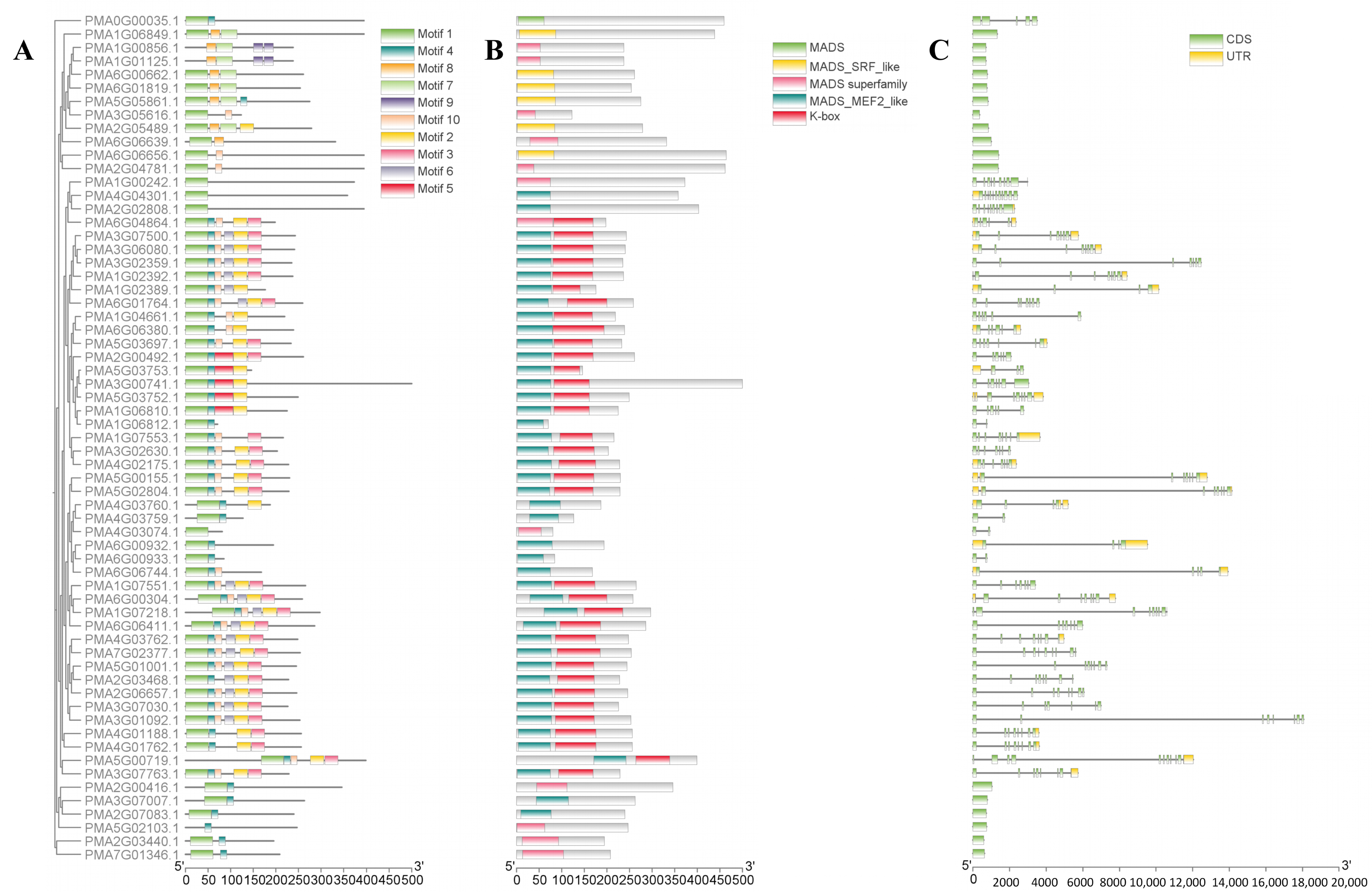
To further investigate the characteristic regions and functions of the PgMADS-box protein, we analyzed its conserved motifs and identified 10 motifs, designated as motifs 1–10 (Figure 1). None of the MADS-box proteins contained all 10 motifs, with the number per protein ranging from 1 to 6. The predicted structural domains of MADS-box proteins showed that, in addition to the MADS structural domains, some MADS proteins also contain MADS superfamily structural domains as well as K-box structural domains (Figure 1). To analyze the structural composition of MADS-box genes, their exon–intron arrangements were obtained by comparing each gene’s coding sequence and DNA sequences. The results revealed considerable variation in gene structure: the intron count in MADS-box genes varied from one to eleven, and exons ranged from zero to three. Overall, differences in motif composition, domain architecture, and gene structure across PgMADS-box subfamilies highlight their structural divergence, which likely corresponds to phylogenetic relationships.
Figure 1. Combined plot of phylogenetic relationship, conserved motifs, domain architecture, and gene structure of MADS-box family members in Pennisetum glaucum. PgMADS-box genes are arranged vertically according to the phylogenetic tree presented on the far left. For each gene, three sets of features are displayed sequentially from left to right: (A) the distribution of 10 conserved motifs (Motif 1–10) identified by MEME; (B) the architecture of the conserved MADS-box domain; and (C) the exon–intron gene structure. Scale bars are indicated at the bottom of each corresponding panel.

3.3. Analysis of Cis-Acting Elements in the Promoter Sequences of MADS-Box Genes

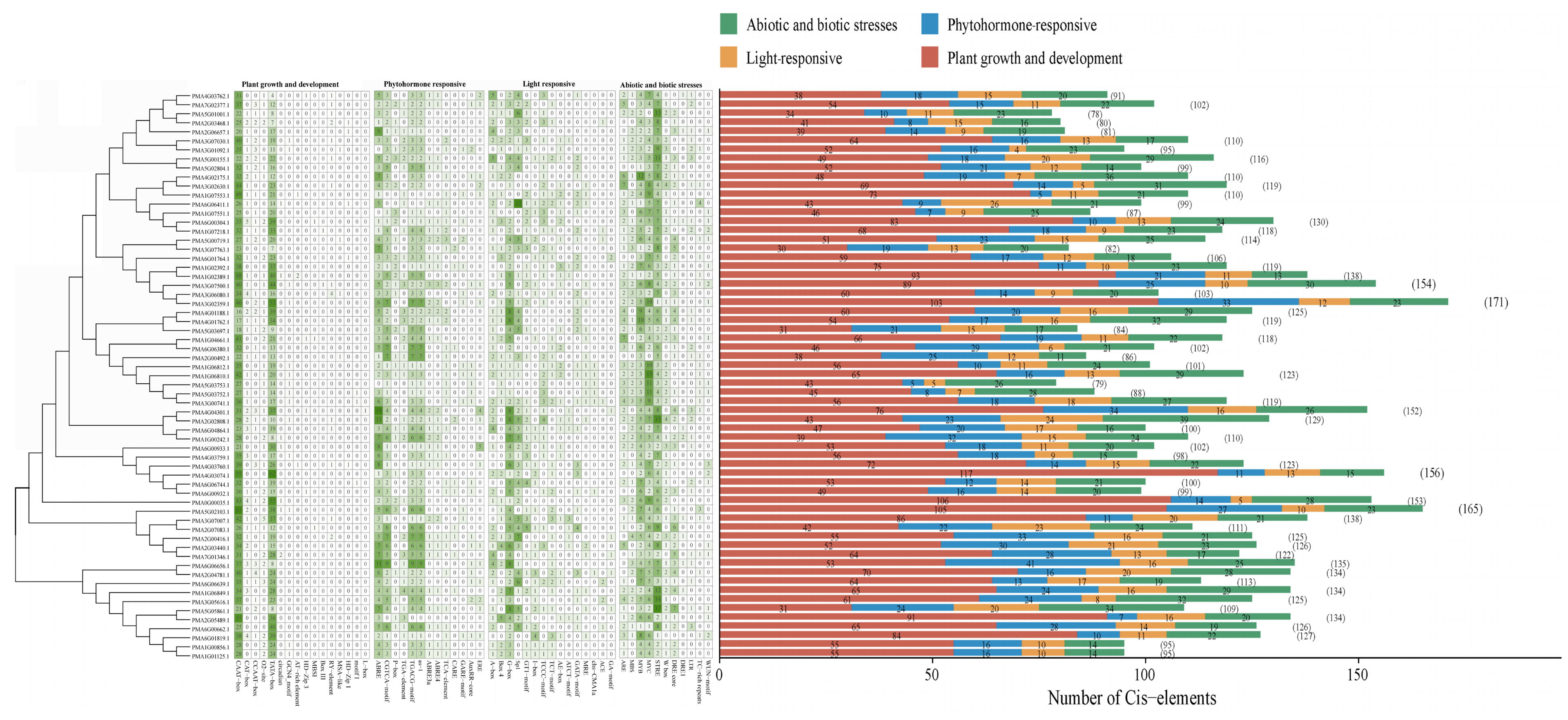
To explore the functional roles of MADS-box gene family members in stress response and growth regulation, their upstream promoter regions were examined for cis-regulatory elements (Figure 2). The results revealed that MADS-box genes encompass a diverse array of cis-regulatory elements, which can be categorized into four distinct classes: plant growth and development-related elements, phytohormone-responsive elements, light-responsive elements, and abiotic and biotic stress-responsive elements. Notable variations in both type and quantity of these regulatory elements was observed among different family members, suggesting functional divergence and tissue-specific roles across various subfamilies. Among the 63 PgMADS-box genes analyzed, elements associated with plant growth and development were most abundant, followed by those responsive to abiotic and biotic stresses. This distribution pattern indicates that MADS-box genes likely play crucial roles in both developmental processes and environmental adaptation. Detailed examination revealed that core promoter elements CAAT-box and TATA-box elements predominated in the first category, which may influence normal plant growth and development by regulating the expression of fundamental genes. For phytohormone responsiveness, ABRE, CGTCA-motif, TGACG-motif, and as-1 elements were most frequently identified, indicating that MADS-box genes may participate in the regulation of multiple hormone-signaling pathways. The light-responsive category was characterized by abundant G-box and Sp1 elements, which indicate that the expression of MADS-box may be associated with photosynthesis, photomorphogenesis, and photoperiodic responses. The widespread presence of MYB, MYC, and STRE elements in the biological and abiotic stress response categories suggests that these genes may respond to environmental stresses by participating in multiple stress-response pathways. Further analysis of individual subfamilies revealed distinct, subfamily-specific enrichment patterns in their promoter regulatory elements. For instance, the MIKCC subfamily is significantly enriched in elements associated with abiotic and biotic stress responses, while the Mβ subfamily is predominantly enriched in elements related to phytohormone responses. These findings suggest that different subfamilies may employ divergent transcriptional regulatory strategies, which provides valuable insights into the potential regulatory mechanisms governing MADS-box gene expression and suggests their involvement in multiple biological processes, from normal development to stress adaptation.
Figure 2. Identification of cis-acting elements within MADS-box genes promoters.

3.4. Comparative Analysis of PgMADS-Box, OsMADS-Box and PpMADS-Box Gene Families

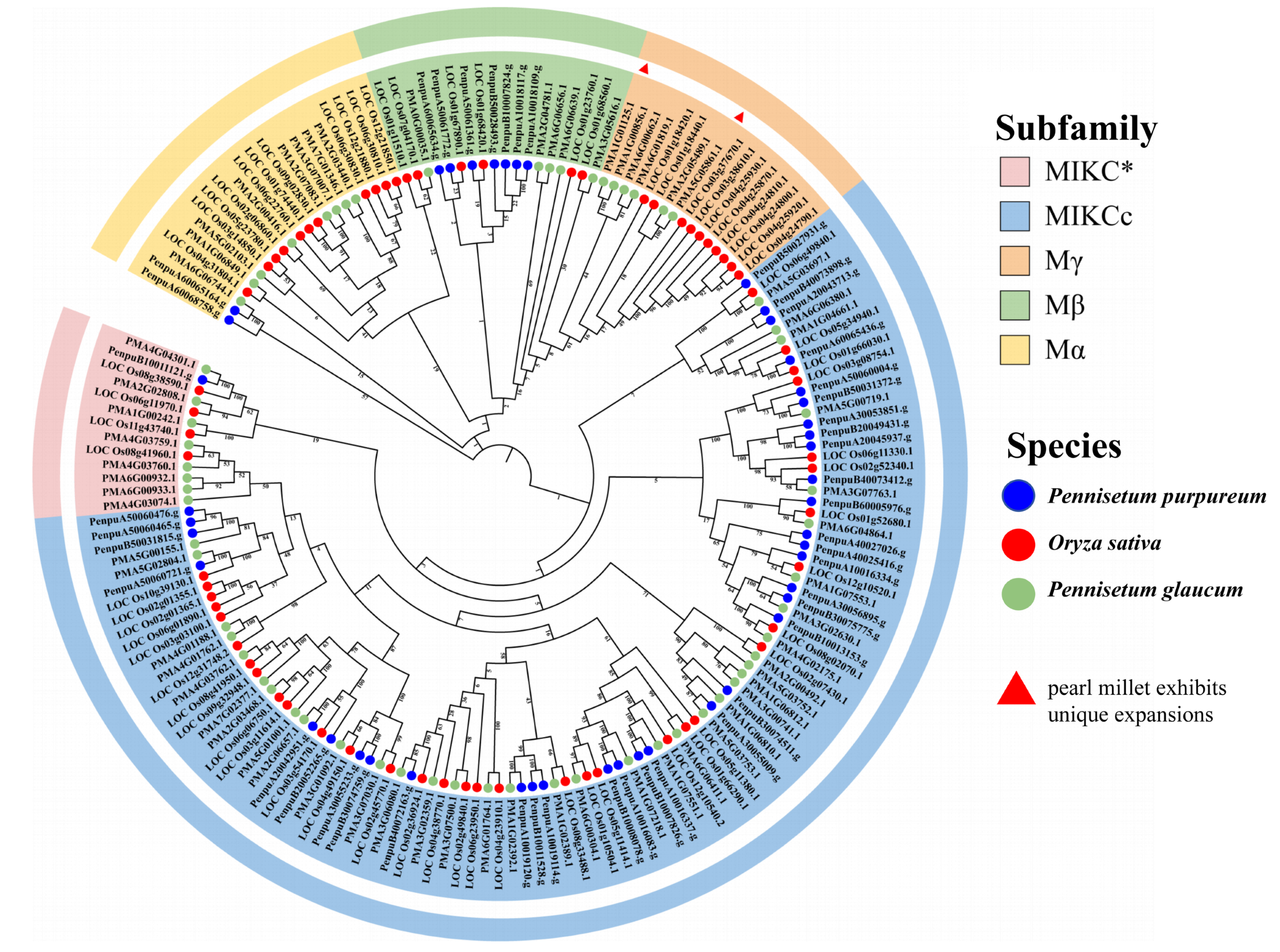
To resolve the evolutionary lineage and screen for heat stress-related candidates, we built a phylogenetic tree comprising MADS-box proteins from pearl millet, the model species rice (Oryza sativa), and its close relative elephant grass (Pennisetum purpureum). Phylogenetic tree analysis showed that the members of this family are evolutionarily conserved and are divided into only five subfamilies (Figure 3), with branch support values labeled on the tree. Notably, among these subfamilies, the MIKCc subfamily possessed the most PgMADS-box genes and the Mγ subfamily the fewest. Of the 63 pearl millet MADS-box genes, 36 grouped with MIKCc, 8 with MIKC*, 5 with Mβ, 8 with Mα, and 6 with Mγ-type. Indeed, pearl millet is widely distributed across all major branches and shares multiple pairs of orthologous genes with rice (e.g., PMA1G06849.1/LOC_Os04g31804.1), indicating conserved functions. Additionally, pearl millet exhibits unique expansions, such as the (PMA1G01125.1, PMA1G00856.1) branch (indicated by the triangle in Figure 3). In pearl millet, genes responsive to heat stress at early and late stages were found to be widely distributed across all five subfamilies. This broad distribution suggests a potential role for these subfamilies in the heat stress response, although it is still unknown which specific genes among them are truly responsible for conferring heat stress tolerance.
Figure 3. Evolutionary tree of the MADS-box gene family members in Pennisetum glaucum (Pg), Oryza sativa (Os), and Pennisetum purpureum (Pp). The five subfamilies are indicated by colored ranges, three species are indicated by the colored circles, and pearl millet-unique expansions are indicated by the triangle.

3.5. Synteny Analysis of MADS-Box Genes

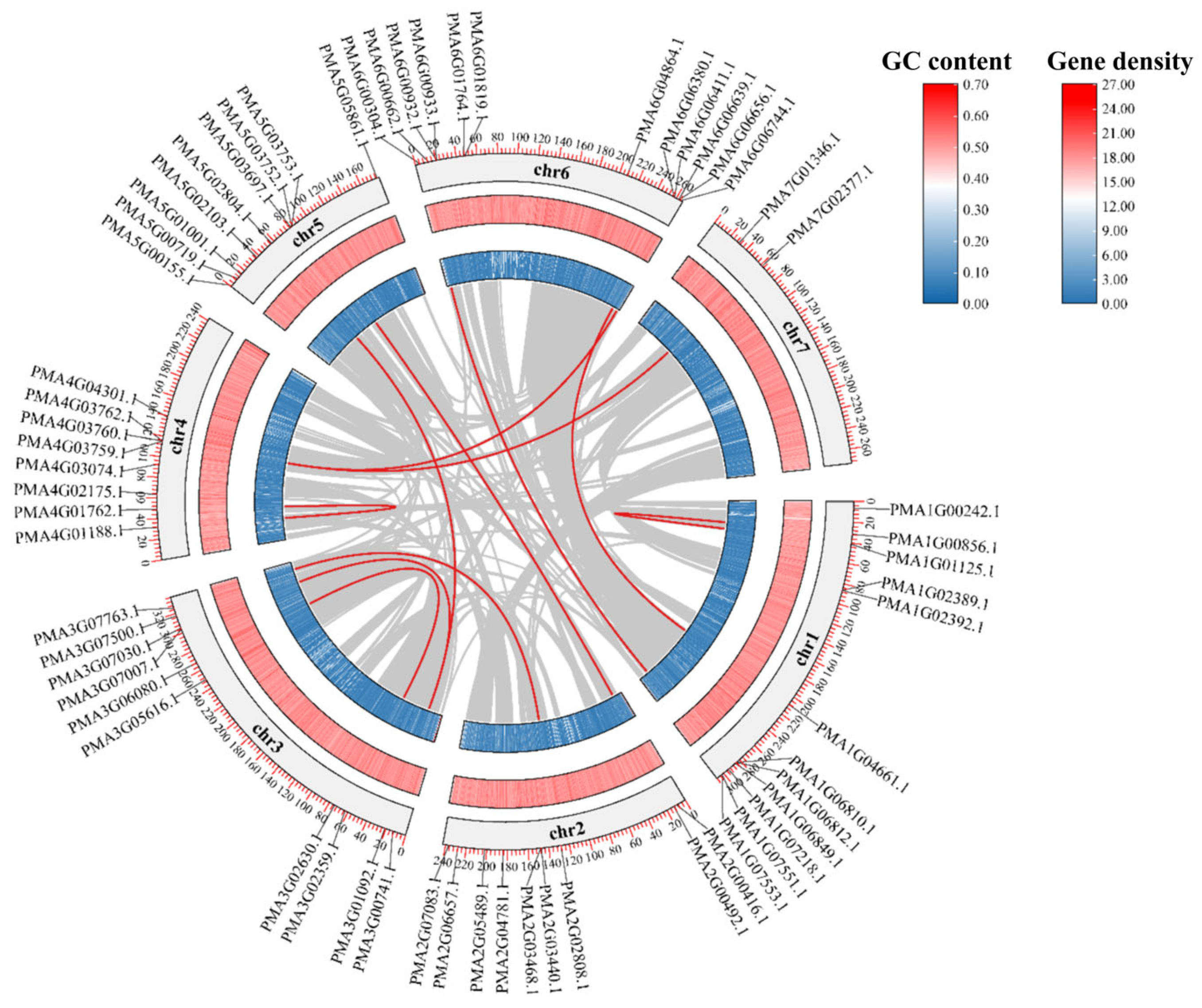
To trace the expansion mechanisms of the MADS-box gene family within the pearl millet genome, an intra-genomic synteny analysis was performed. Across the seven chromosomes of pearl millet, a total of 63 MADS-box members were located. Within this set, 20 were further characterized as homologous members, as illustrated in Figure 4. Intraspecific colinearity analysis revealed that the segmental duplications of MADS-box genes in pearl millet are unevenly distributed across chromosomes, with chromosome 3 harboring the highest number of duplicated genes (six in total). Among these homologous MADS-box members, four pairs were located on the same chromosome. Crucially, we identified tandem duplication events predominantly concentrated at the telomeric regions of chromosomes (e.g., chromosomes 1, 2, 3, and 6).
Figure 4. Intraspecific synteny analysis of the PgMADS-box gene family. (From inner to outer circles: GC content (blue); gene density (red); seven chromosomes).
To elucidate the evolutionary history and orthologous relationships of the MADS-box gene family across graminaceous species, a comparative synteny analysis was conducted among Pennisetum glaucum, Oryza sativa, and Pennisetum purpureum, which further elucidates the evolutionary conservation and diversity among these members (Figure S2). From a genomic perspective, this work delineates the evolutionary limits and diversification patterns of the MADS-box family. It thereby supplies critical insights that will facilitate future functional research into orthologs across related species.

3.6. Analysis of the Expression Pattern of MADS-Box Gene in Leaves Under Heat Stress

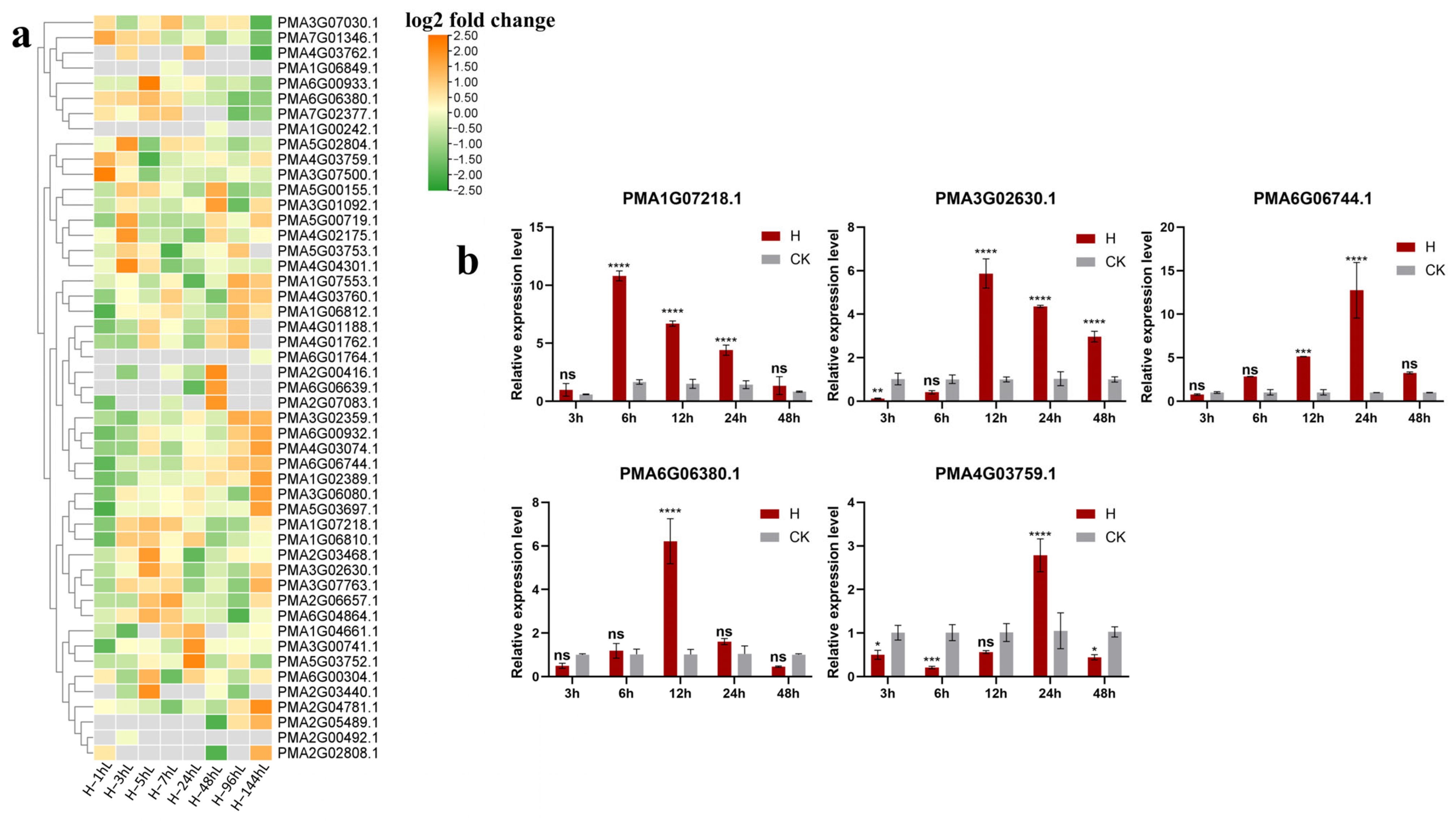
Pearl millet is exposed to a variety of abiotic stresses in its natural growing environment, including drought, high-temperature, and salt stress. To investigate the molecular response mechanisms of the pearl millet MADS-box gene family to high-temperature stress, we analyzed the expression levels of MADS-box genes in pearl millet under high-temperature conditions using transcriptomic data. The results of heat stress treatments showed (Figure 5a) that MADS-box genes were differentially expressed in leaves, as not all MADS-box genes were expressed under heat stress growth conditions, and nine MADS-box genes were not expressed. Overall, among the 53 expressed MADS-box genes, transcript levels in leaves were generally low during the initial phase of heat stress. Compared with the untreated controls, 19 genes were significantly upregulated within 1–7 h of heat treatment, whereas 25 genes showed significant upregulation during the later period (24–144 h). This indicates that the upregulation trend of the MADS-box gene family intensified during the later stages of heat treatment.
Figure 5. Expression analysis of MADS-box gene family in response to heat stress. (a)—Expression heatmap of MADS-box gene family members under heat stress (log2 fold change calculated from TPM values), (b)—Expression analysis of MADS-box gene family members under heat stress. (CK: Control condition; H: Heat stress treatment, error bars: standard deviation (SD), asterisk (*): t-test p-value < 0.05, asterisk (**): t-test p value < 0.01, asterisk (***): t-test p value < 0.001, asterisk (****): t-test p-value < 0.0001, ns: nearly same).

3.7. The Expression of MADS-Box Genes Involved in Stress Tolerance Response

To further validate the differential expression of MADS-box gene family members in response to stress in pearl millet (Figure 5a), quantitative fluorescence expression analysis (quantitative PCR) was performed on genes that showed significant expression under heat stress conditions. Through differential expression analysis, five key MADS-box genes responding to heat stress (PMA1G07218.1, PMA3G02630.1, PMA6G06744.1, PMA6G06380.1, PMA4G03759.1) were identified and validated by qRT-PCR (Figure 5b). The results showed that, after heat stress, all of them showed a trend of increasing and then decreasing expression, suggesting that the MADS-box gene family may have similar functions. Results indicated that all genes exhibited an expression pattern of an initial increase followed by a decline after heat stress treatment, suggesting the MADS-box gene family may share similar functional characteristics. However, the timing of maximum expression varied among these genes, with their maximums reached at 6 h (PMA1G07218.1), 12 h (PMA3G02630.1 and PMA6G06380.1), and 24 h (PMA6G06744.1 and PMA4G03759.1) of heat stress. The expression patterns of these five genes differ significantly from those of other genes, suggesting they may have some differences and play different roles in different heat tolerance stages of pearl millet.

3.8. Prediction and Verification of Subcellular Localization of MADS-Box Proteins

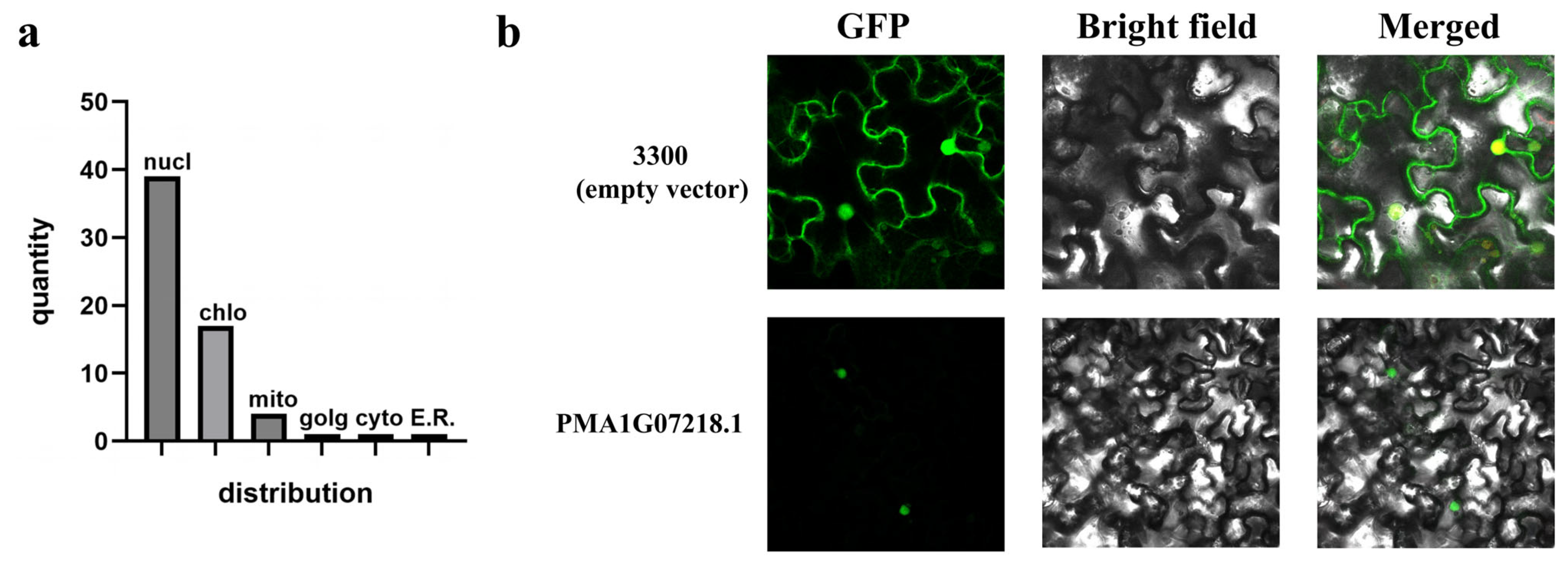
To identify potential binding sites for MADS-box transcription factors, we performed subcellular localization predictions and experimentally validated a representative gene. Subcellular localization predictions showed that the majority (39) of the MADS-box proteins were localized in the nucleus, while 17 were localized in the chloroplasts, with the remaining four in the mitochondria, and a very small number in the Golgi apparatus (PMA4G03760.1), endoplasmic reticulum (PMA2G00416.1), and cytoplasm (PMA1G02392.1) (Figure 6a). To verify the subcellular localization of these MADS-box proteins, one gene was selected for functional localization (PMA1G07218.1), and the result showed that the empty vector 3300 GFP green fluorescent signals were distributed in the plasma membrane and nucleus. The expression of PMA1G07218.1 was limited to the nucleus (Figure 6b), which was consistent with the results of PMA1G07218.1 that were predicted.
Figure 6. Subcellular localization analysis of MADS-box proteins. (a)—Statistics on subcellular localization prediction results, (b)—Verification of subcellular localization of MADS-box proteins.

3.9. PMA6G04890.1 Enhances the Expression of Heat Response Genes and Directly Regulates the F-Box Gene PMA1G07218.1

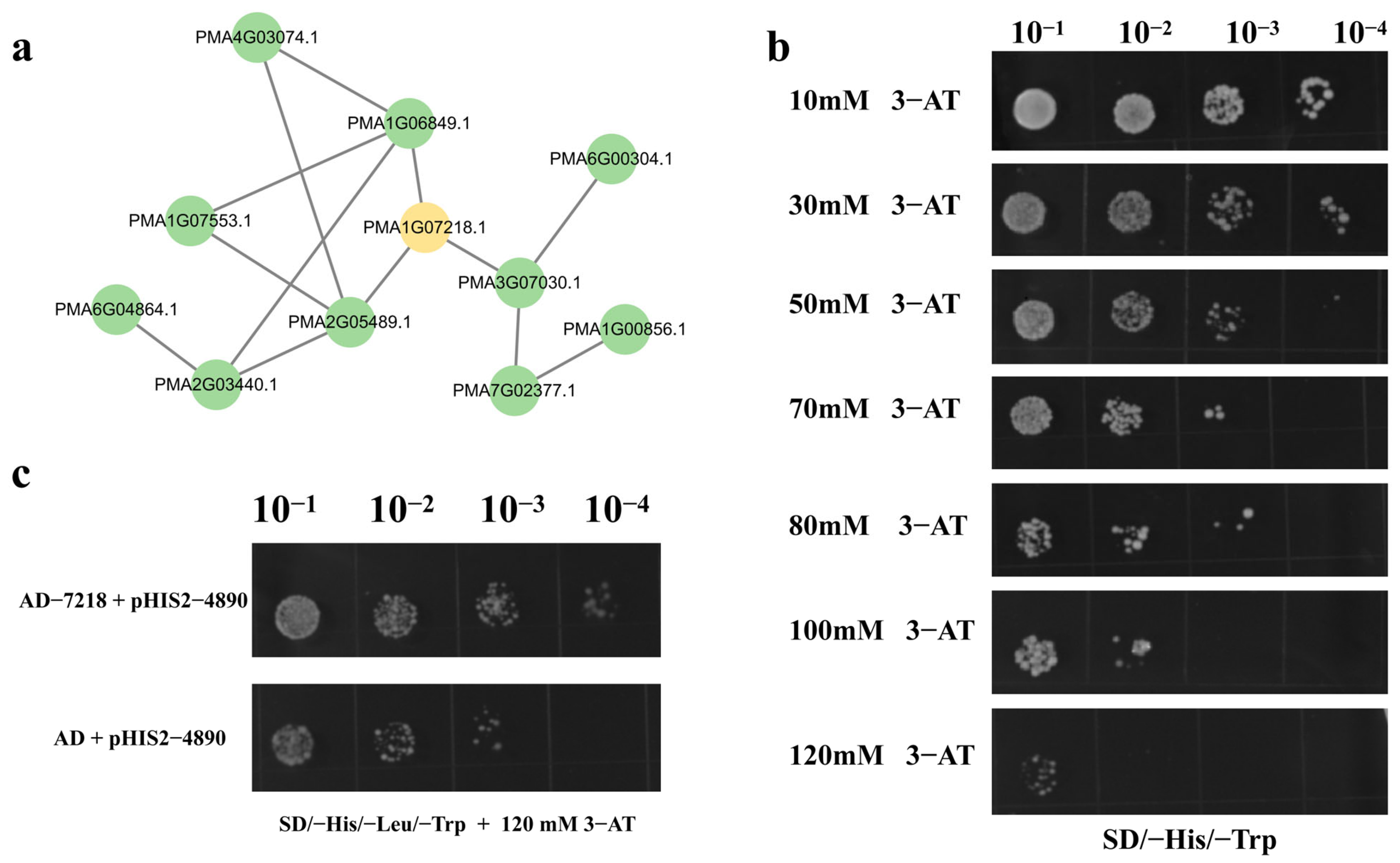
To investigate the transcriptional regulatory mechanisms of pearl millet in response to high-temperature stress, we first constructed a protein–protein interaction network based on protein sequence similarity (Figure 7a). Through topological and functional module analyses of the MADS-box transcription factor family, we identified PMA1G07218.1 as a central hub within the network. Notably, among the direct interaction partners of PMA1G07218.1, we identified one protein associated with heat stress response. To confirm whether PMA1G07218.1 directly regulates these heat-tolerance-related genes, we performed the yeast one-hybrid technique. The yeast one-hybrid technique can be used to study the relationship between cis-acting elements and transcription factors. The interaction of PMA1G07218.1 protein with F-box gene PMA6G04890.1 promoter can be confirmed by yeast one-hybrid experiments. The F-box gene PMA6G04890.1 promoter contains a fragment of AG cis-acting element in the PMA6G04890.1 promoter. A fragment of the PMA6G04890.1 promoter containing an AG cis-acting element was transformed into strain Y187. The self-activating activity of the promoter was then verified on a SD/-His/-Trp/(SD-TH) medium containing 3-AT (0, 10, 30, 50, 70, 80, 100, and 120 mmol/L) to repress the transcriptional activation of the promoter (Figure 7b). At eight different concentrations of 3-AT, the growth of the yeast strains on SD-TH medium with 120 mmol/L 3-AT had deteriorated, suggesting that their transcriptional self-activation activity had been repressed. The positive yeast clones (containing the PMA1G07218.1 transcription factor and the PMA6G04890.1 promoter) grew well on SD/-His/-Leu/-Trp medium supplemented with 120 mmol/L 3-AT, whereas the negative controls (empty PGADT7 with PMA6G04890.1 promoter) did not (Figure 7c). This result indicates that the transcription factor PMA1G07218.1 can bind to the promoter of PMA6G04890.1.
Figure 7. Protein–protein interaction network prediction and experimental validation for MADS-box proteins. (a)—Protein–protein interaction network of MADS-box proteins, (b)—Screening of vector self-activation inhibitory concentration, (c)—Yeast one-hybrid proof that PMA1G07218.1 and interact with each other.

3.10. GO/KEGG Analysis

The GO annotation of pgMADS-box genes yielded 20 GO terms (Figure S3). Within biological processes, numerous genes were enriched in hormone-signaling pathways and glycolysis, providing evidence for the critical role of pgMADS-box genes in plant growth and development. Cellular component predictions indicated that pgMADS-box genes are predominantly localized to the nucleus. Molecular function predictions revealed that pgMADS-box genes primarily participate in protein dimerization and phosphoglycerate kinase and protein binding. These results suggest that pgMADS-box genes regulate pearl millet growth and development through protein-binding interactions.
KEGG analysis (Figure S4) revealed that pgMADS-box genes are concentrated in several key pathways, including genetic information processing, the cell cycle (ko04011), and cell division (ko04111), as well as calcium signaling (ko04022), endocytosis (ko04371), and hormone signaling (ko04928): processes involving transmembrane transport and intracellular signal transduction. This indicates that pgMADS-box gene sequences play a crucial role in key pathways of plant growth and development.

4. Discussion

This study provides a comprehensive overview of the MADS-box transcription factor family in pearl millet, underscoring its central role in heat stress response. The 63 identified PgMADS-box genes were classified into five subfamilies, suggesting evolutionarily conserved functional diversification [29]. Notably, most members were significantly upregulated under high-temperature stress, with distinct temporal expression patterns indicating stage-specific roles in fine-tuning thermotolerance [30]. Moreover, the enrichment of tandem duplicated genes at chromosome ends may correlate with higher homologous recombination rates in these regions, potentially facilitating gene family expansion and the emergence of novel functions. This study identified multiple PgMADS-box genes induced by high temperatures whose promoter regions are enriched with cis-acting elements responsive to heat stress. This suggests they may be embedded within a heat stress transcriptional regulatory network centered on heat shock factors (HSFs) [31]. Furthermore, we mainly focused on PMA1G07218.1, while its expression was limited to the nucleus, which aligns with their function as DNA-binding transcriptional regulators [32]. In this study, only preliminary predictions have been made for the validation of the genes’ biological functions. We fully acknowledge that conclusive functional verification—such as genetic transformation for gene overexpression, knockout, in-depth phenotypic analysis, and the direct validation of target genes—is essential for establishing a complete “gene-function” causal relationship and will be the core focus of further investigation in this research.
In this study, the candidate gene PMA1G07218.1 interacted with PMA1G04890.1, a member of the F-box protein subfamily FBX22, through a Y1H experiment. F-box proteins typically function as substrate-recognition subunits within the SCF (SKP1–Cullin–F-box) E3 ubiquitin ligase complex, participating in the ubiquitination and subsequent degradation of specific target proteins [33]. These proteins are increasingly recognized as crucial regulators in stress signaling pathways [34]. In plants, numerous F-box proteins are involved in responses to abiotic stresses such as heat, drought, and salinity, often through hormone signaling pathways or direct regulation of stress-responsive transcription factors [35], playing essential roles in the modulation of abiotic stress responses [36].
The observed interaction between PMA1G07218.1 (MADS-box) and PMA1G04890.1 (F-box) suggests that the target gene PMA1G07218.1 may play a significant role in plant heat-stress responses by participating in the regulation of the ubiquitin-mediated degradation pathway. This regulatory mechanism closely parallels findings in other crop species. For instance, in wheat, the F-box protein TaFBA1 has been identified as a key positive regulator of thermotolerance. Through its synergistic interaction with TaASRP1, TaFBA1 modulates downstream antioxidant enzyme levels and gene expression, thereby enhancing heat tolerance in transgenic tobacco—manifested as reduced oxidative damage and the upregulation of genes involved in reactive oxygen species scavenging, proline biosynthesis, and stress-response pathways [37]. Although the function of PMA1G04890.1, a member of the FBX22 subfamily of F-box proteins, remains incompletely characterized in plants, the collective evidence supports the hypothesis that PMA1G07218.1 may form a complex with this F-box protein. This interaction likely facilitates the post-translational regulation of key components within the heat-stress signaling pathway, contributing to a finely tuned regulatory network that ultimately enhances thermotolerance in plants. It is also important to note that the regulatory role of F-box proteins—whether positive or negative—is highly specific and depends on the substrate proteins they recognize. For example, GmFBL144 in soybean negatively regulates drought tolerance by interacting with small heat shock proteins [38]. Therefore, the functional outcome of the interaction between PMA1G07218.1 and PMA1G04890.1—whether it confers enhanced or reduced heat stress tolerance—requires further validation through functional assays, such as gene knockout or overexpression studies. Elucidating the regulatory network governed by this interaction will provide new insights into the molecular mechanisms of heat stress response in pearl millet.
In the future, gene editing technology can be considered to verify the role of specific genes in stress response, as well as to deeply explore the network regulation between gene family members and other genes [39]. This will help to reveal the mechanism of the MADS-box gene family in plant adaptations to environmental stress and provide more precise gene regulation strategies. With the current changing environment and climate, it is especially important to study high-yielding crops that can adapt to most environments [40]. By digging deeper into the role of MADS-box gene family in plant growth and development and stress responses, we can provide more genetic resources and feasible solutions for crop improvement and food production.

5. Conclusions

This study identified 63 MADS-box family members distributed across seven chromosomes, all possessing highly conserved domains. Phylogenetic analysis grouped them into five subfamilies. Subcellular localization predictions indicated that most MADS-box genes reside in the nucleus. Analysis of promoter cis-acting elements revealed that these family members contain numerous regulatory elements responsive to abiotic stress and growth-related processes. Expression responses varied among members at different time points under heat stress, with some exhibiting high sensitivity to stress. Expression analysis revealed that most MADS-box genes exhibited increased expression following heat stress. qRT-PCR showed that these genes first increased and then decreased in expression after heat stress treatment, with different genes reaching their maximum expression at different times, with maximums reached at 6 h (PMA1G07218.1), 12 h (PMA3G02630.1 and PMA6G06380.1), and 24 h (PMA6G06744.1 and PMA4G03759.1) of heat stress. The expression patterns of these five genes differ significantly from those of other genes, suggesting they may have some differences and play different roles in different heat tolerance stages of pearl millet. We mainly focused on PMA1G07218.1, and after yeast one-hybrid testing, it is known that PMA1G07218.1 transcription factor can interact by binding to the AG cis-acting element of PMA6G04890.1, suggesting its role in regulating the expression of this putative heat-tolerant gene.
The results of the subcellular localization of these MADS-box proteins showed that the empty vector 3300 GFP green fluorescent signals were distributed in the plasma membrane and nucleus, while the expression of PMA1G07218.1 was limited to the nucleus. GO/KEGG annotation results also demonstrated that members of the PgMADS-box gene family play a crucial role in plant growth, development, and maturation. This work lays a foundation for investigating the biological functions of MADS-box genes and their roles in growth, development, and stress tolerance. It thereby offers a valuable reference for related molecular breeding efforts.

Supplementary Materials

The following supporting information can be downloaded at: https://www.mdpi.com/article/10.3390/agriculture16030373/s1, Table S1: Analysis of physical and chemical properties of pgMADS-box protein; Figure S1: Distribution of MADS-box family members on chromosomes map; Figure S2: Synteny analysis of the MADS-box gene family in Pennisetum glaucum (Pg) and Oryza sativa (Os) Pennisetum purpureum (Pp); Table S2: Candidate gene qRT PCR primers and gene cloning and linkage primers; Figure S3: GO analysis of PgMADS-box gene family members; Figure S4: KEGG analysis of PgMADS-box gene family members.

Author Contributions

Z.Z., Y.J. and L.H. designed this project. Z.Z., Y.J., D.Y., C.M., J.Z., W.L., Y.Z., Y.L., Q.L. and R.Y. participated in experimental processing, data collection, and curation. L.H. supervised the project. Z.Z. wrote the original draft of article. Y.J. and H.Y. revised the manuscript. L.H. contributed to reviewing and edited the manuscript. All authors have read and agreed to the published version of the manuscript.

Funding

This work was supported by the National Key R&D Program of China (2024YFF1001300), the Key Project of Sichuan Provincial Natural Science Foundation (2025ZNSFSC0019), the National Modern Agricultural Industry Technology System Sichuan Forage Innovation Team (SCCXTD-2024-16), the Sichuan Province Breeding Research Project (2021YFYZ0013), and the National Undergraduate Training Program on Innovation and Entrepreneurship (No. 202510626003). We thank the College of Grassland Science and Technology, Sichuan Agricultural University, for providing the experimental platform.

Data Availability Statement

The original contributions presented in this study are included in the article and Supplementary Materials. Further inquiries can be directed to the corresponding author.

Acknowledgments

The authors declare that no generative AI tools were used in the writing, composition, or data visualization of this manuscript. All text, ideas, and figures are the original work of the authors. Only basic tools for checking grammar, spelling, and references were employed, which, according to the journal’s policy, do not require declaration.

Conflicts of Interest

The authors declare no conflicts of interest.

References

  1. Zhao, C.; Liu, B.; Piao, S.; Wang, X.; Lobell, D.B.; Huang, Y.; Huang, M.; Yao, Y.; Bassu, S.; Ciais, P.; et al. Temperature increase reduces global yields of major crops in four independent estimates. Proc. Natl. Acad. Sci. USA 2017, 114, 9326–9331. [Google Scholar] [CrossRef]
  2. Satyavathi, C.T.; Ambawat, S.; Khandelwal, V.; Srivastava, R.K. Pearl Millet: A Climate-Resilient Nutricereal for Mitigating Hidden Hunger and Provide Nutritional Security. Front. Plant Sci. 2021, 12, 659938. [Google Scholar] [CrossRef] [PubMed]
  3. Vadez, V.; Hash, T.; Bidinger, F.R.; Kholova, J., II. 1.5 Phenotyping pearl millet for adaptation to drought. Front. Physiol. 2012, 3, 386. [Google Scholar] [CrossRef] [PubMed]
  4. Varshney, R.K.; Shi, C.; Thudi, M.; Mariac, C.; Wallace, J.; Qi, P.; Zhang, H.; Zhao, Y.; Wang, X.; Rathore, A.; et al. Pearl millet genome sequence provides a resource to improve agronomic traits in arid environments. Nat. Biotechnol. 2017, 35, 969–976. [Google Scholar] [CrossRef] [PubMed]
  5. Singh, S.; Viswanath, A.; Chakraborty, A.; Narayanan, N.; Malipatil, R.; Jacob, J.; Mittal, S.; Satyavathi, T.C.; Thirunavukkarasu, N. Identification of key genes and molecular pathways regulating heat stress tolerance in pearl millet to sustain productivity in challenging ecologies. Front. Plant Sci. 2024, 15, 1443681. [Google Scholar] [CrossRef]
  6. Yan, H.; Sun, M.; Zhang, Z.; Jin, Y.; Zhang, A.; Lin, C.; Wu, B.; He, M.; Xu, B.; Wang, J.; et al. Pangenomic analysis identifies structural variation associated with heat tolerance in pearl millet. Nat. Genet. 2023, 55, 507–518. [Google Scholar] [CrossRef]
  7. Jin, Y.; Yan, H.; Zhu, X.; Yang, Y.; Jia, J.; Sun, M.; Najeeb, A.; Luo, J.; Wang, X.; He, M.; et al. Single-cell transcriptomes reveal spatiotemporal heat stress response in pearl millet leaves. New Phytol. 2025, 247, 637–650. [Google Scholar] [CrossRef]
  8. Parenicová, L.; de Folter, S.; Kieffer, M.; Horner, D.S.; Favalli, C.; Busscher, J.; Cook, H.E.; Ingram, R.M.; Kater, M.M.; Davies, B.; et al. Molecular and phylogenetic analyses of the complete MADS-box transcription factor family in Arabidopsis: New openings to the MADS world. Plant Cell 2003, 15, 1538–1551. [Google Scholar] [CrossRef]
  9. Shore, P.; Sharrocks, A.D. The MADS-box family of transcription factors. Eur. J. Biochem. 1995, 229, 1–13. [Google Scholar] [CrossRef]
  10. Chen, C.; Begcy, K.; Liu, K.; Folsom, J.J.; Wang, Z.; Zhang, C.; Walia, H. Heat stress yields a unique MADS box transcription factor in determining seed size and thermal sensitivity. Plant Physiol. 2016, 171, 606–622. [Google Scholar] [CrossRef]
  11. Wang, Z.; Shen, Y.; Yang, X.; Pan, Q.; Ma, G.; Bao, M.; Zheng, B.; Duanmu, D.; Lin, R.; Larkin, R.M.; et al. Overexpression of particular MADS-box transcription factors in heat-stressed plants induces chloroplast biogenesis in petals. Plant Cell Environ. 2019, 42, 1545–1560. [Google Scholar] [CrossRef] [PubMed]
  12. Yin, W.; Hu, Z.; Hu, J.; Zhu, Z.; Yu, X.; Cui, B.; Chen, G. Tomato (Solanum lycopersicum) MADS-box transcription factor SlMBP8 regulates drought, salt tolerance and stress-related genes. Plant Growth Regul. 2017, 83, 55–68. [Google Scholar] [CrossRef]
  13. Zhao, W.; Zhang, L.-L.; Xu, Z.-S.; Fu, L.; Pang, H.-X.; Ma, Y.-Z.; Min, D.-H. Genome-Wide Analysis of MADS-Box Genes in Foxtail Millet (Setaria italica L.) and Functional Assessment of the Role of SiMADS51 in the Drought Stress Response. Front. Plant Sci. 2021, 12, 659474. [Google Scholar] [CrossRef] [PubMed]
  14. Sun, M.; Yan, H.; Zhang, A.; Jin, Y.; Lin, C.; Luo, L.; Wu, B.; Fan, Y.; Tian, S.; Cao, X.; et al. Milletdb: A multi-omics database to accelerate the research of functional genomics and molecular breeding of millets. Plant Biotechnol. J. 2023, 21, 2348–2357. [Google Scholar] [CrossRef]
  15. Sayers, E.W.; Beck, J.; Bolton, E.E.; Brister, J.R.; Chan, J.; Comeau, D.C.; Connor, R.; DiCuccio, M.; Farrell, C.M.; Feldgarden, M.; et al. Database resources of the National Center for Biotechnology Information. Nucleic Acids Res. 2024, 52, D33–D43. [Google Scholar] [CrossRef]
  16. Lamesch, P.; Berardini, T.Z.; Li, D.; Swarbreck, D.; Wilks, C.; Sasidharan, R.; Muller, R.; Dreher, K.; Alexander, D.L.; Garcia-Hernandez, M.; et al. The Arabidopsis Information Resource (TAIR): Improved gene annotation and new tools. Nucleic Acids Res. 2011, 40, D1202–D1210. [Google Scholar] [CrossRef]
  17. Chen, C.; Chen, H.; Zhang, Y.; Thomas, H.R.; Frank, M.H.; He, Y.; Xia, R. TBtools: An Integrative Toolkit Developed for Interactive Analyses of Big Biological Data. Mol. Plant 2020, 13, 1194–1202. [Google Scholar] [CrossRef]
  18. The UniProt Consortium. The Universal Protein Resource (UniProt). Nucleic Acids Res. 2007, 35, D193–D197. [Google Scholar] [CrossRef]
  19. Wang, Y.; Tang, H.; Debarry, J.D.; Tan, X.; Li, J.; Wang, X.; Lee, T.H.; Jin, H.; Marler, B.; Guo, H.; et al. MCScanX: A toolkit for detection and evolutionary analysis of gene synteny and collinearity. Nucleic Acids Res. 2012, 40, e49. [Google Scholar] [CrossRef]
  20. Bailey, T.L.; Johnson, J.; Grant, C.E.; Noble, W.S. The MEME Suite. Nucleic Acids Res. 2015, 43, W39–W49. [Google Scholar] [CrossRef]
  21. Lescot, M.; Déhais, P.; Thijs, G.; Marchal, K.; Moreau, Y.; Van de Peer, Y.; Rouzé, P.; Rombauts, S. PlantCARE, a database of plant cis-acting regulatory elements and a portal to tools for in silico analysis of promoter sequences. Nucleic Acids Res. 2002, 30, 325–327. [Google Scholar] [CrossRef] [PubMed]
  22. Marchler-Bauer, A.; Bo, Y.; Han, L.; He, J.; Lanczycki, C.J.; Lu, S.; Chitsaz, F.; Derbyshire, M.K.; Geer, R.C.; Gonzales, N.R.; et al. CDD/SPARCLE: Functional classification of proteins via subfamily domain architectures. Nucleic Acids Res. 2017, 45, D200–D203. [Google Scholar] [CrossRef] [PubMed]
  23. Chou, K.C.; Shen, H.B. Cell-PLoc: A package of Web servers for predicting subcellular localization of proteins in various organisms. Nat. Protoc. 2008, 3, 153–162. [Google Scholar] [CrossRef]
  24. Tamura, K.; Stecher, G.; Kumar, S. MEGA11: Molecular Evolutionary Genetics Analysis Version 11. Mol. Biol. Evol. 2021, 38, 3022–3027. [Google Scholar] [CrossRef] [PubMed]
  25. Arora, R.; Agarwal, P.; Ray, S.; Singh, A.K.; Singh, V.P.; Tyagi, A.K.; Kapoor, S. MADS-box gene family in rice: Genome-wide identification, organization and expression profiling during reproductive development and stress. BMC Genom. 2007, 8, 242. [Google Scholar] [CrossRef]
  26. Szklarczyk, D.; Kirsch, R.; Koutrouli, M.; Nastou, K.; Mehryary, F.; Hachilif, R.; Gable, A.L.; Fang, T.; Doncheva, N.T.; Pyysalo, S.; et al. The STRING database in 2023: Protein–protein association networks and functional enrichment analyses for any sequenced genome of interest. Nucleic Acids Res. 2023, 51, D638–D646. [Google Scholar] [CrossRef]
  27. Shannon, P.; Markiel, A.; Ozier, O.; Baliga, N.S.; Wang, J.T.; Ramage, D.; Amin, N.; Schwikowski, B.; Ideker, T. Cytoscape: A software environment for integrated models of biomolecular interaction networks. Genome Res. 2003, 13, 2498–2504. [Google Scholar] [CrossRef]
  28. Li, M.; Xue, M.; Ma, H.; Feng, P.; Chen, T.; Sun, X.; Li, Q.; Ding, X.; Zhang, S.; Xiao, J. Wild soybean (Glycine soja) transcription factor GsWRKY40 plays positive roles in plant salt tolerance. Crop J. 2024, 12, 766–775. [Google Scholar] [CrossRef]
  29. Becker, A.; Theissen, G. The major clades of MADS-box genes and their role in the development and evolution of flowering plants. Mol. Phylogenet Evol. 2003, 29, 464–489. [Google Scholar] [CrossRef]
  30. Guo, M.; Liu, J.H.; Ma, X.; Luo, D.X.; Gong, Z.H.; Lu, M.H. The Plant Heat Stress Transcription Factors (HSFs): Structure, Regulation, and Function in Response to Abiotic Stresses. Front. Plant Sci. 2016, 7, 114. [Google Scholar] [CrossRef]
  31. Wang, Y.-X.; Xu, J.-H. The heat shock transcription factors regulate response mechanisms to abiotic stresses in plants. Crop Design 2025, 4, 100109. [Google Scholar] [CrossRef]
  32. Latchman, D.S. Transcription factors: An overview. Int. J. Biochem. Cell Biol. 1997, 29, 1305–1312. [Google Scholar] [CrossRef] [PubMed]
  33. Saxena, H.; Negi, H.; Sharma, B. Role of F-box E3-ubiquitin ligases in plant development and stress responses. Plant Cell Rep. 2023, 42, 1133–1146. [Google Scholar] [CrossRef] [PubMed]
  34. Zhang, X.; Gonzalez-Carranza, Z.H.; Zhang, S.; Miao, Y.; Liu, C.-J.; Roberts, J.A. F-Box Proteins in Plants. In Annual Plant Reviews Online; John Wiley & Sons: Hoboken, NJ, USA, 2019; pp. 307–328. [Google Scholar] [CrossRef]
  35. Abd-Hamid, N.-A.; Ahmad-Fauzi, M.-I.; Zainal, Z.; Ismail, I. Diverse and dynamic roles of F-box proteins in plant biology. Planta 2020, 251, 68. [Google Scholar] [CrossRef] [PubMed]
  36. Wang, Y.; Chen, F.; Chen, Y.; Ren, K.; Zhao, D.; Li, K.; Li, H.; Wan, X.; Peng, M.; Xiang, Z.; et al. Identification and analysis of drought-responsive F-box genes in upland rice and involvement of OsFBX148 in ABA response and ROS accumulation. BMC Plant Biol. 2024, 24, 1120. [Google Scholar] [CrossRef]
  37. Li, Q.; Wang, W.; Wang, W.; Zhang, G.; Liu, Y.; Wang, Y.; Wang, W. Wheat F-Box Protein Gene TaFBA1 Is Involved in Plant Tolerance to Heat Stress. Front. Plant Sci. 2018, 9, 521. [Google Scholar] [CrossRef]
  38. Xu, K.; Zhao, Y.; Zhao, Y.; Feng, C.; Zhang, Y.; Wang, F.; Li, X.; Gao, H.; Liu, W.; Jing, Y.; et al. Soybean F-Box-Like Protein GmFBL144 Interacts With Small Heat Shock Protein and Negatively Regulates Plant Drought Stress Tolerance. Front. Plant Sci. 2022, 13, 823529. [Google Scholar] [CrossRef]
  39. Sukegawa, S.; Saika, H.; Toki, S. Plant genome editing: Ever more precise and wide reaching. Plant J. 2021, 106, 1208–1218. [Google Scholar] [CrossRef]
  40. Lobell, D.B.; Gourdji, S.M. The influence of climate change on global crop productivity. Plant Physiol. 2012, 160, 1686–1697. [Google Scholar] [CrossRef]
Disclaimer/Publisher’s Note: The statements, opinions and data contained in all publications are solely those of the individual author(s) and contributor(s) and not of MDPI and/or the editor(s). MDPI and/or the editor(s) disclaim responsibility for any injury to people or property resulting from any ideas, methods, instructions or products referred to in the content.

Article Metrics

Citations

Article Access Statistics

Multiple requests from the same IP address are counted as one view.