


Abstract
This research was conducted on small farms in Republika Srpska, an entity of Bosnia and Herzegovina. Data were collected through direct interviews on five farms, each with 8–15 dairy cows, which at some point diversified their production from selling raw milk to processing and selling fresh cheese. Due to low productivity and limited economies of scale, calculated indicators such as net present value, internal rate of return, and payback period are insufficient to consider traditional milk production economically justified. However, further analysis using Monte Carlo simulations and the real options method demonstrated that diversifying production into cheese processing is economically feasible, as confirmed by the strategic net present value calculated using Black–Scholes and binomial approaches. The results indicate that small, extensive family farms should focus on higher levels of product finalization. Although their production volumes are limited and they are not cost-competitive in raw milk markets, they gain a competitive advantage by adding value through their own labor and selling products via short supply chains. Diversification enables these farms to improve profitability, achieve financial stability, and strengthen market positioning, demonstrating that value addition is essential for the sustainability of small-scale dairy enterprises.
1. Introduction
Milk production is one of the most intensive agricultural productions. This production requires daily labor and significant agricultural land for grazing and fodder preparation, for which there are not many alternative uses [1]. From an economic point of view, milk production is interesting as it is a daily production that presupposes faster marketing, which accelerates capital movement in agriculture, which in turn enhances liquidity [2]. Milk processing and diversification of production have been identified as an option in many cases, especially in emerging countries. In some countries, this is due to the absence of the dairy industry and the purchase of raw milk [3,4], and in others due to resisting the competition of large farms and filling out a market niche for traditional and other products of special origin [5].
Republika Srpska (RS) is predominantly the northern and eastern part of Bosnia and Herzegovina. Problems in the milk sector in the Republic of Srpska (RS) are low milk yield per cow compared to the World and European average, low marketability, and the fact that more than 50% of the raw milk comes from small farms that have up to five cows [6]. The value gained from cattle breeding products accounts for more than 40% of the total agricultural production in Republika Srpska [7]. In the context of cheese production with small capacities, where most or all operations are carried out manually, the system of small rural dairies enables relatively quick delivery of milk to the production site, which is a necessary condition for high-quality cheese production [8]. The option to switch into on-farm milk processing and sell processed milk products directly to consumers or sell at the green markets instead of selling milk to dairies is identified as one of four options for small milk farms in the Food and Agriculture Organization (FAO) milk and meat sectoral strategy for Bosnia and Herzegovina [9]. Also, according to research conducted in the same country, based on a case study and a similar methodology applied in this paper, it was determined that it is financially justified to diversify production on dairy farms by finalizing production through milk processing into cheese [10].
The application of the discounted cash flow approach in agriculture is not always the appropriate way to decide if an investment project is feasible or not. In this aspect, the net present value (NPV) method does not allow for management flexibility and ignores the strategic value of the projects, such as the farmer’s opportunity to expand into a new market [11]. The Real Options Approach (ROA) arises from the doubt about the NPV method, and can make up for it in evaluating agricultural venture capital projects [12]. Additionally, due to constant fluctuations in input and output prices and trends in the productivity of dairy production, it is necessary to apply simulations from the best to the worst scenario for an investment project. The option to expand a project offers the possibility (not the obligation) of increasing the productive scale of the project by making additional investments [13]. According to previous research, dairy farms should establish their processing facility to process raw milk into dairy products and then market their dairy products at more favorable prices [14]. The strengths that make smallholder milk farms sustainable lie in the diversification of the system, the reliance on family labor, and the optimization of available resources to reduce dependency on external inputs [15]. Family labor is a key factor for the flexibility and resilience of family farming, but its share in total labor depends on the size of the farming operation, the crop/livestock choice, and whether the farm is organic or conventional [16]. A key element of sustainable agriculture is the long-run profitability of the set of specific sustainable production practices comprising the farming system, i.e., to continue farming over a long period and ultimately transfer ownership of the farm to the next generation, the specific farming practices employed over the period must be profitable, at least in most years [17]. The profitability of the dairy business declined, on average, with greater use of supplementary feeds, irrespective of the geographic region assessed. Also, in general, increased costs per liter, per cow, and hectare with increasingly intensive use of purchased supplements were not matched by increased revenue; therefore, profit declined linearly with the inclusion of purchased feeds above 10% of the cow’s diet [18]. The profitability of dairy industry businesses depends on minimizing the cost of items that constitute the total cost of producing milk and dairy products [19]. Research on productivity, economic efficiency, and the viability of business activities in dairy farming has also been conducted by numerous other researchers, whose studies have been utilized to provide a broader context for this scientific work [14,15,20,21].
Attitudes toward risk strongly affect when and how much farmers adopt new technologies and strategies: risk-averse farmers start earlier but on a smaller scale, while those with higher risk exposure delay adoption but adopt on a larger scale [22]. There is no approach that ensures optimal decisions under all circumstances, so capital budgeting is about making optimal investment decisions [23]. Every potential business idea contains a dose of risk and uncertainty. Cost–Benefit Analysis (CBA) provides a transparent record of the data, assumptions, and analysis [24]. CBA should consider as many financial, economic, social, and other factors as possible to assess the financial and economic viability of projects [25]. The price and production fluctuations are big factors, but also institutional, financial, environmental and market risks need to be considered [26], and currently, these impactful investment decisions are evaluated by the net present value (NPV) approach, but the appropriate approach to evaluate investment decisions more realistically is the real option approach. Rozman et al. (2016) had an economic point of view on milk production in Bosnia and Herzegovina [2]. In their Decision EXpert (DEXi) model, one of the most important indicators of business success was net present value (NPV). Another study concluded that the decision process for the assessment of an investment in dairy quota and/or cattle purchase and/or building expansion can be addressed with three common methods for valuing an investment opportunity–payback period, net present value, and internal rate of return [27].
In agriculture, MCS have been applied by authors in relation to robotic milking systems in the United States of America [28]; other researchers used the mentioned method to examine the impact of risk, i.e., the relationship between price and yield with business profitability [29]; also, some authors used the MCS to calculate the income risk factors in organic production [30]. The standard NPV underestimates the value of the investment by not including the value of waiting for new information to reduce the uncertainty of the cash flow generated by the investment [11]. The theory of real options valuation was developed to be a helpful tool in situations when the strategic project value includes not just the current economic features but also opportunities related to the basic model [31]. Real options analysis (ROA) provides a framework for valuing reactive and proactive managerial flexibility in investment decisions [32]. Compared to the traditional approaches, the ROA takes into consideration two important aspects: riskiness of cash flow and flexibility, i.e., capability of management to change the past decision [33]. Real options analysis is one robust decision-making tool that extends the principles of Cost–Benefit Analysis of a “now or never” decision by allowing for learning [34]. The application of the ROA is justified if an investment is characterized by the uncertainty of returns, irreversibility of the investment costs and flexibility regarding investment timing [35]. Traditional methodologies do not consider the uncertainties related to milk production [36]. A simple discrete-time option pricing formula is presented and applied with fundamental economic principles of option valuation [37]. The Black–Scholes model is aimed at calculating a theoretical call price using the five key determinants of an option’s price: stock price, strike price, volatility, time to expiration, and short-term (risk-free) interest rate. Within agricultural research, significant studies include those by authors regarding the option of diversifying plum production and processing into plum brandy [38]; focused on land and water solar power projects [39]; investigated environmentally friendly production systems in organic farming [40]; applied the ROA method to hog production [41]; studied irrigation dam investments [42]; conducted research applying the ROA method to spelt grain processing [43]; examined when it is optimal to enter or exit the dairy farming business [44]; focused on forms of livestock enterprises [45]; and developed a model for land-use decision-making [46].
SFSC is recognized as an effective approach to sell part of the farm output through their own outlets, build a positive reputation, lower costs, and simultaneously enhance farmers’ self-esteem [47]. Dairy value chain resilience is significant for food security and socioeconomic sustenance [48]. Short Food Supply Chains (SFSCs) are local and sustainable food systems that follow the three pillars of sustainability: environmental, social, and economic, while also facing various growth barriers and challenges [49]. Similar conclusions were drawn for 12 European countries, showing that closer distribution systems through Short Food Supply Chains (SFSCs) can be considered a sustainable alternative [50]. The dairy value chain contributes to inclusive, sustainable development by providing ecosystem services, high-quality, and added-value products, inclusive governance, reduced environmental impact, and local development [51]. What is crucial for producers with a smaller scale of production is that they do not base their full profit on selling larger quantities of products. Instead, they add value to their products by selling through short food supply chains, thereby capturing the intermediary’s margin for themselves, building trust with consumers, and consequently increasing the price of their products. SFSCs for the dairy chain can represent a viable alternative for sustainability of small and medium milk producers [52]. The significance of dairy value chain analysis at the small scale is high and profitable, as the dairy sector is the means of livelihood of a large number of small farmers and traders, and it provides the lion’s share of protein to the population of Bangladesh [53]. In Bosnia and Herzegovina, the dairy product value chain has largely emerged through spontaneous market developments, with little or no coordinated efforts to organize chain actors, improve business performance, enhance value creation, or respond to market trends [54]. The aforementioned reasons both encourage and limit the use of short supply chains in the marketing of dairy products.
The economic efficiency of farm diversification from milk production to cheese processing in the analyzed territory is the subject of this research. The study had several main objectives: first, to evaluate the efficiency of production and milk sales; second, to assess business risks in this sector; third, to evaluate the justification for business diversification, i.e., the transition from milk sales to cheese processing; and finally, to identify the best business model among the analyzed farms. Within the research, three hypotheses were formulated, which will be presented and discussed in the Discussion chapter.
2. Materials and Methods
In this study, a small farm is defined based on the ES6 (Economic Size 6) classification of farms established by [55] for uniform holdings in the European Union (EU). According to this classification, a small farm has a standard output (SO) between 8000 and 25,000 euros, representing the monetary value of gross production at farm prices; therefore, the farms for the sample were selected under the assumption that they fall approximately within this SO range. The primary data collection was conducted in the second half of 2023 on a total of five farms, each with its own specific characteristics. The survey questionnaire was developed based on similar studies [56,57,58] with certain adaptations. It included questions related to production areas, yields, livestock numbers, housing systems, herd replacement, milk yield, the conversion coefficient of milk liters into kilograms of cheese, fuel, lubricant, mineral fertilizer, pesticide, water, and electricity consumption, as well as feed purchases, sanitary and hygiene costs, veterinary services, and all other purchased materials. The questionnaire also covered labor input and cost, selling and purchase prices, subsidies, refunds, and questions related to all fixed assets on the farm, depreciation rates, and similar aspects. The target sample was intended to encompass small family farms with 8–15 dairy cows. Household members serve as the primary workforce for various tasks, from preparing livestock feed and caring for and feeding animals to processing milk into cheese as the final stage of production. The production model is mostly extensive to semi-intensive, and the housing method is primarily free-range, especially during the summer months. The milk yield of these animals is low, and the breed composition is not particularly noble or high-quality. Data collection was conducted using oral examination methods and a reminder for the interviewing of farm owners. The surveys were carried out face-to-face and lasted from 2 to 4 h, depending on the respondent’s readiness and time availability. All primary data collection was performed on the farms; thus, all farms were visited, and certain conditions of the farms were visually assessed. Two out of the five analyzed farms represent fully extensive production types, located at altitudes of 750 and 1046 m above sea level. In these cases, dairy cows spend most of the year grazing and return to the barns in the evening. An exception is during winter and snowy conditions, when the cows stay in the stables.
Five farms in the northwest part of Republika Srpska were personally visited between and face-to-face in-depth interviews were conducted to collect the necessary data. Consent was obtained from the owners of all farms for the use of the collected data for scientific research purposes.
In the methodological approach of financial analysis (Cost–Benefit Analysis), the NPV is the difference between discounted annual cash inflows and outflows, reduced by the initial value of the investment. The internal rate of return is the discount rate that makes the NPV equal to zero, and for this reason, it is also known as the break-even discount rate [59]. After using the trial and error procedure and finding the first positive NPV and the first negative NPV, the Internal Rate of Return (IRR) was calculated using the linear interpolation method [60]. The Payback Period (PP) of the investment is the time point when all money inflows are equal to all money outflows. This indicator is also calculated by using the interpolation method [60].
The method algorithm of estimating the project risk (volatility) by using the Monte Carlo simulation is shown in its five successive interactive steps [61], of which certain steps were adapted to the specific research:
Step 1: Creating a parametric model, y = f (x1, x2, …, xq)
CBA represents a model, that is, a function based on which the simulation is generated, and NPV1 to i is taken as the output of each iteration.
Step 2: Generation of the random input set of data, xi1, xi2, …, xiq
The Monte Carlo method generates artificial values of a probabilistic variable by using a random uniformly distributed number generator in the [0, 1] interval and also by using the cumulative distribution function. In the first stage, random numbers were used, and then, with the development of computer technology, this barrier was removed.
Each random variable was introduced according to the Microsoft Office Excel formula (author determination):
to generate random values of prices for each iteration, where P is the input or output price obtained based on an interview with the farmer, and x represents the highest rate of inflation in the previous 15 years in the country. The process began with determining a function that has independent variables (such as labor costs, food costs, and other expenses involved in the production, as well as the price of cheese as output) and net present value as a dependent variable. To determine variability or project volatility, it was necessary first to determine the range of price movements that was generated in the simulation. Considering the maximum inflation rate of up to 20% in the previous period of crisis, the range of price movements was determined to be up to 20% lower than the current market price and up to 20% higher than the current market price (obtained based on data collection from farmers).
= P − P×x + P×2x×rand()
Step 3: Effective calculations and memorizing results as yi
Simulation generation of NPVs (dependent on the function written in step 2) of all iterations in the program set. This process is repeated, or the function is applied for each new price that affects the final NPV to some extent within the CBA for cheese production. In this manner, a model is obtained where NPV, as the dependent variable, depends on several independent variables, i.e., different input costs in production and the final product price, cheese.
Step 4: Repeating steps 2 and 3
for I = 1 to n (n = 10,000);
Step 5: Analyze the results using histograms, confidence intervals, other statistical indicators resulting from the simulation, etc.
Based on the author’s research and published works [32,33,62,63,64,65,66], the following methodology will be applied to calculate the volatility in this research:
where Vol—volatility, ln—logarithm to the base of the mathematical constant e ≈ 2.72, CV—coefficient of variation: CV = σ/µ (σ—standard deviation of 10.000 iterations, µ—average (expected value) of 10.000 iterations), t—temporal determinant (one year).
Robert C. Merton and Myron S. Scholes, in collaboration with the late Fischer Black, developed a pioneering formula for the valuation of stock options. The Black–Scholes model, based on stochastic calculus, is shown below [67]:
where OV—option value (€), S—the present value of cash flows from optional investment (€), d1—lognormal distribution of d1, d2—lognormal distribution of d2, X—investment expenditure (€), r—annual risk-free continuously compounded rate (%), σ—annualized variance (risk) of the investment’s project, t—period until investment (years), and e-rt—the exponential term (2.71828).
OV = SN(d1) − X/e-rt N(d2)
d1 = [ln(S/X) + (r + ½ σ2) × t]/σ√t
d2 = d1 − σ √t
Option value = SN(d1) − present value of X times N(d2)
N(d1) and N(d2) represent the probability distributions. Values of N(d1) and N(d2) are obtained from normal probability distribution tables. They give us the probability that S or X will be below d1 and d2. In the BS model, they measure the risk associated with the volatility of the value of S.
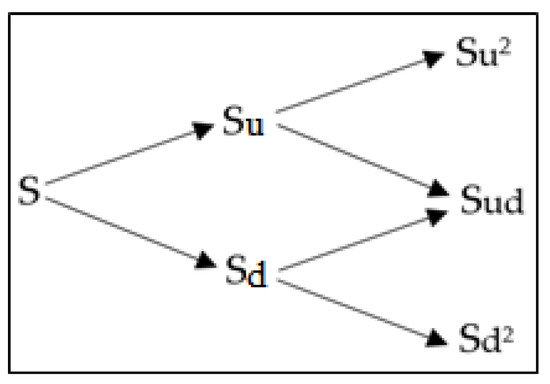
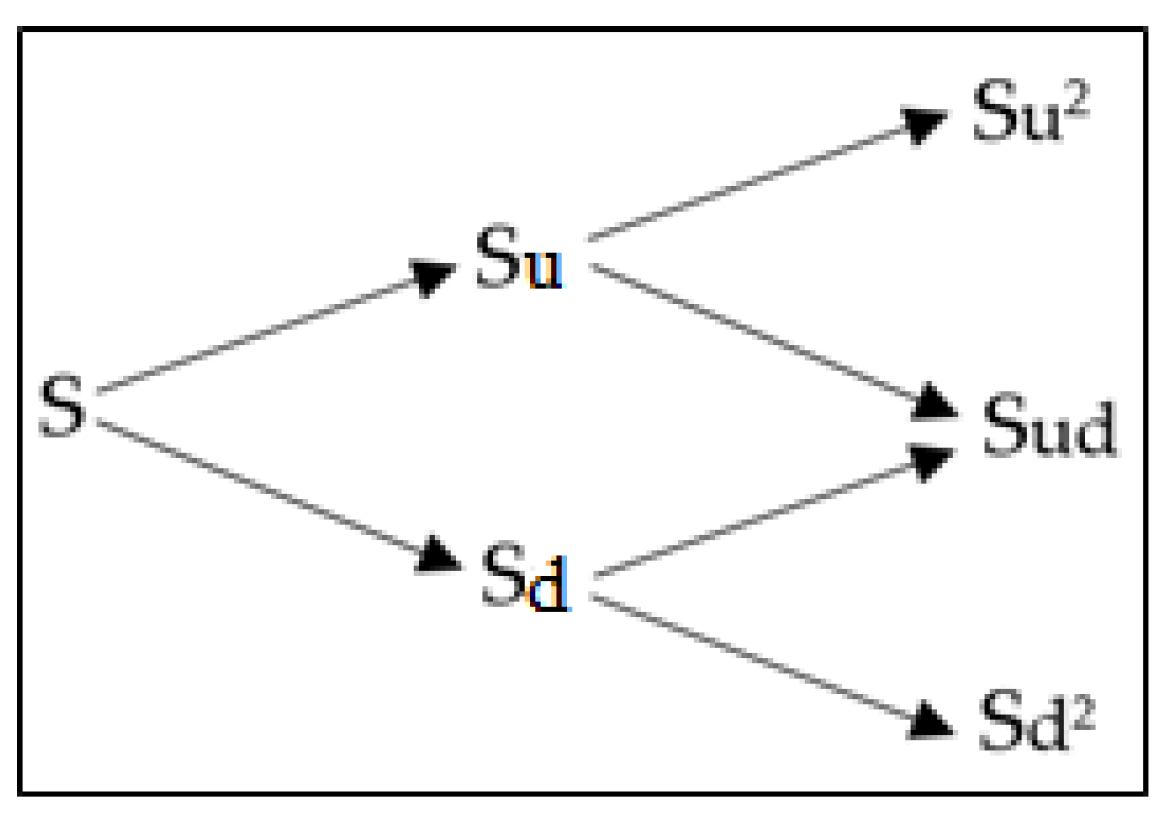
The binomial model lattice describes price movements over time, where the asset value can move to one of two possible prices with associated probabilities [68]. The general formulation of a stock price process that follows the binomial model is shown in Figure 1.
Figure 1.
The binomial tree for the value of the underlying asset process. Source: [68].
Here (Figure 1), S—the current stock price, Su—the price moves up with probability p in any period, Sd—the price moves down with probability 1 − p in any period, u—the up factor (eδ×√dt+(r−δ2/2)×dt), d—the down factor (e−δ×√dt+(r−δ2/2) ×dt), and dt—1/number of periods from a year, until maturity.
A binomial model, using a binomial tree, describes price movements over time, where the asset value can move to one of two possible prices (up or down) with associated probabilities. This method consists of a two-step process [38]:
- The binomial tree for the value of the underlying asset.
- The binomial tree for the CALL option to delay the project.
The total project strategic NPV consists of two components: the traditional static (passive) NPV of directly measurable expected cash flows, and the flexibility value capturing the value of real options under active management [33].
The strategic Black–Scholes and binomial real options value of the investment project are calculated as [67]:
where NPVS—the strategic value of the real option (€), NPVT—the traditional value of project investment (€), and OV—option value (€).
NPVS = NPVT + OV
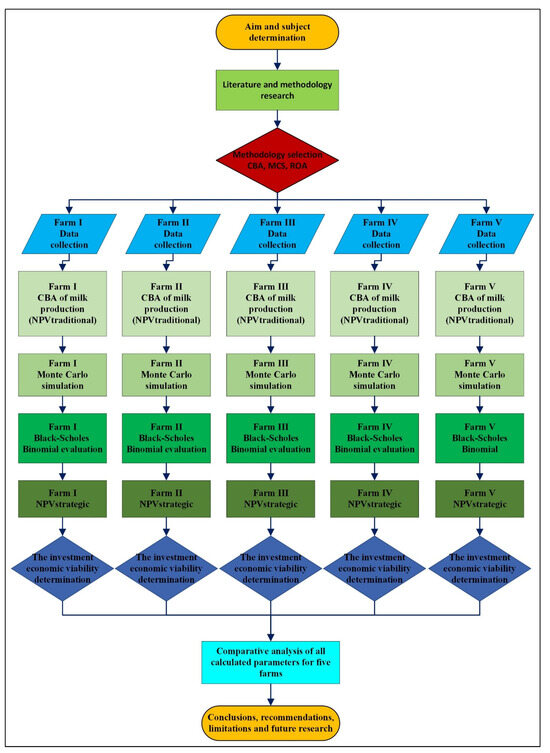
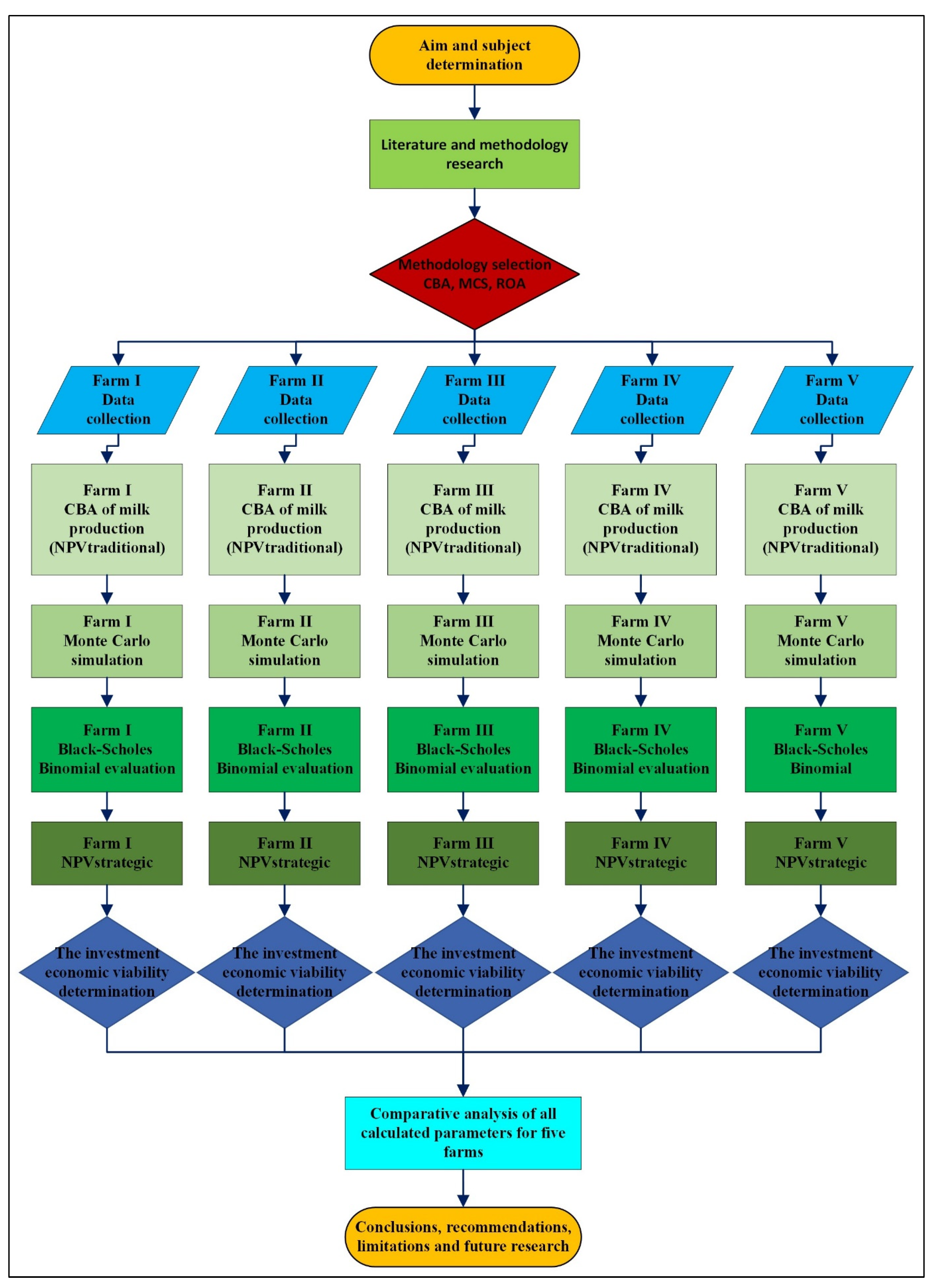
Following the object and aim of the research, to determine the economic efficiency of business diversification of small milk farms in the direction of continuing milk processing on the same farms (see Figure 2), the following specific hypotheses were set:
Figure 2.
The model proposed by the study. Source: Author.
Hypothesis (H1).
Diversification of the small milk farm business in the Republika Srpska to milk processing into cheese is economically efficient under assumed production parameters.
This hypothesis is tested based on the calculated real options value of the additional project (Black–Scholes and Binomial model). If the Strategic Net Present Value (NPVS) is greater than the Traditional Net Present Value (NPVT), that is, the real option value is greater than zero, this hypothesis will be accepted.
Hypothesis (H2).
Raw milk production on analyzed small milk farms in Republika Srpska is financially inefficient.
Based on the calculated NPVT, the level of financial efficiency of milk production on small milk farms is determined. This hypothesis will be confirmed if the Net Present Value (NPV) values are negative.
Hypothesis (H3).
The NPV of cheese production and the investment risk are affected by variations in prices.
By applying Monte Carlo simulations, variations in the NPV of cheese production are determined. Low values of the calculated volatility index, of the generated NPV, indicate a lower risk and higher values indicate a higher risk.
The potential limitations of this research primarily stem from the fact that the applied methodology was used for the first time in the context of dairy farming and on-farm cheese processing in the Republika Srpska. The exact number of small-scale cheese processors is unknown, as this type of production is not subject to mandatory registration, statistical monitoring, or data collection systems such as FADN, nor is it eligible for subsidy schemes in the Republika Srpska. Consequently, it was not possible to define the total population or apply proportional sampling. Therefore, the analysis was based on a limited number of representative farms for which reliable and detailed data were surveyed, allowing the methodology to be tested and the local production realities to be adequately reflected.
3. Results
In addition to similarities in terms of standard output (SO), herd size, labor engagement, and sales methods, a certain degree of variability or diversity among the analyzed farms can also be observed. Table 1 presents a comparison of the results, the structural and production characteristics of five selected family farms engaged in dairy and cheese production. The total project duration is assumed to be 14 years, corresponding to two turnover cycles of the dairy cow herd. As stated in the previous chapter, all data pertain to the year 2023, with the projected cash flow remaining constant for each year of the analysis.
Table 1.
Comparison of the results for the analyzed farms.
The average number of household members across the farms is five, with a coefficient of variation (CV) of 40%, indicating substantial differences in household size. The average age of household members ranges from 24.5 to 55 years, with a mean of 41.5 years and a CV of 26.7%, reflecting demographic variability among farms. The number of dairy cows per farm varies between 8 and 15, with an average of 10.8 cows and a CV of 25.7%, showing moderate heterogeneity in herd size. In addition to heterogeneity in size, there is also variability in the extensiveness and intensiveness of production, which is primarily reflected in grazing and feeding practices, and consequently in overall productivity. Milk yield per cow per year ranges from 3050 to 4175 L, with an average of 3488 L and a CV of 13.5%, suggesting a relatively uniform productivity level per animal. Total annual milk production per farm ranges from 29,280 to 45,750 L, with an average of 36,875 L and a CV of 18.3%, highlighting variability in overall production output. Cheese yield (liters of milk per kilogram of cheese) is relatively stable, ranging from 6 to 8 L/kg, with an average of 7 and a CV of 11.3%. Total cheese production per farm ranges between 4209 and 6862 kg annually, with an average of 5337 kg and a CV of 23.5%. The average cheese price across the farms is €7.46 per kilogram, with a wide range from €5.5 to €10.3 and a high CV of 27.0%, indicating significant differences in market positioning or quality differentiation strategies.
Table 2 will provide a detailed overview of the analyzed summary items of investments and costs incurred within the economic activities of the sampled farms.
Table 2.
Annual cost summary in milk production (before diversification).
In terms of investment costs, the highest amount was recorded by Farm 2, primarily due to its extensive agricultural machinery. The smallest farm in terms of the number of dairy cows, Farm 4, understandably had the lowest investment cost. As expected, an average investment of approximately €142,000 is required to establish a small dairy farm business of this kind. Investment variations amount to around 21%, indicating a noteworthy level of variability. Farm 2 also recorded the highest operating costs, which include: the cost of small inventory, electricity, water, diesel, veterinary services, anti-hail preventive measures, press rope (baler), maintenance of agricultural machinery (such as filters and tires), maintenance of milking machines and freezers, tractor registration, and land lease. Conversely, Farm 4 had the lowest operating costs. The average operating cost across all farms amounted to €4119, with a coefficient of variation of 21.3%, indicating a moderate level of variability. Farm 3 incurred the highest feeding costs and is also the farm with the most intensive production. This intensity subsequently had a positive effect on the cows’ milk yield and the overall productivity of the farm. Despite having the largest number of milking cows, Farm number one had the lowest feeding costs, as these cows were continuously grazing except during the calving period and when the mountain pastures were covered with snow. Regarding cattle feeding costs, the highest variability was observed among the analyzed expenses, reaching a significant 50%. The highest labor costs were recorded on Farm One. On average, labor expenses amount to approximately €11,000 for the analyzed farms in Republika Srpska, with a low coefficient of variation. The highest cost related to the use of fixed assets was recorded on Farm 1, which is expected, given the largest number of animals in production. Conversely, Farm 4 had the lowest depreciation costs. The coefficient of variation was 23.9%.
The following Table 3 presents the results of the conducted Cost–Benefit Analysis, calculated for milk production on the analyzed farms. These results represent a part of the traditional approaches used in investment analysis. The findings reveal differences in economic performance across farms, despite relatively similar production activities.
Table 3.
Cost–Benefit Analysis results in milk production (before diversification).
Total cash expenditures varied moderately, with a coefficient of variation (CV) of 11.8%, indicating some differences in spending levels. The average total expenditure was approximately €396,099 over the project period, with Farm 2 showing the highest investment and Farm 4 the lowest. However, the variation in total net receipts was more pronounced (CV = 14.8%), reflecting differing levels of operational efficiency and market performance among the farms. The payback period (PP) ranged from 12.2 to over 14 years, suggesting a relatively slow return on investment for all farms. Notably, Farm 5 did not achieve payback within the project horizon, indicating a potentially unviable investment under current conditions. Internal rate of return (IRR) values further emphasize this concern. While Farm 1 reached an IRR of 7.9%, Farms 2 to 4 reported values below typical thresholds of investment attractiveness, and Farm 5 had a negative IRR (−2.8%), implying that the investment generated less value than its cost. The average IRR across all farms was only 3.72%, accompanied by a very high coefficient of variation (106%), underscoring the inconsistency and risk associated with returns in small-scale milk production. Net present value (NPV) calculations yielded mixed results. Only Farm 1 had a positive NPV (€10,011), suggesting potential profitability. The remaining farms showed negative NPVs, with Farm 5 experiencing the greatest loss (−€59,563). The high variation in NPV (CV = 144%) confirms significant disparities in financial viability across the sample.
Traditional discounted cash flow analysis assumes that after deciding on starting an investment project, the management should follow the initially chosen strategy, even in adverse circumstances [69]. Traditional approaches to capital budgeting, such as discounted cash-flows, cannot entirely capture the project value for different reasons: it is assumed that the investment decision is irreversible, interactions between today’s decisions and future decisions are not considered, and investment in assets seems to be passive (management does not interfere during the life of the project) [70]. As base-case assumptions are more likely to occur than the extremes of the ranges found in the literature, best and worst-case scenarios contain little information value. Monte Carlo analysis overcomes this problem by considering probability distributions for the uncertain quantitative assumption [71].
The Option Value (OV) incorporates the investment value of fixed assets engaged in milk processing, including molds, cooling chambers, cheese tables, weight scales, transport vehicles, production spaces and air-conditioning units. Furthermore, the option value accounts for additional material and service costs incurred during the processing stage, such as the maintenance of the cheese factory and transport vehicle, vehicle registration, fuel, packaging, water, other ingredients, small inventory, and energy (electricity and firewood), alongside the costs of labor engaged in processing. The option value is driven by the revenue from cheese sales as the final product, as well as other parameters such as the annual risk, exponential function, investment period, and annualized risk, all of which are detailed in the fifth step of the Materials and Methods section.
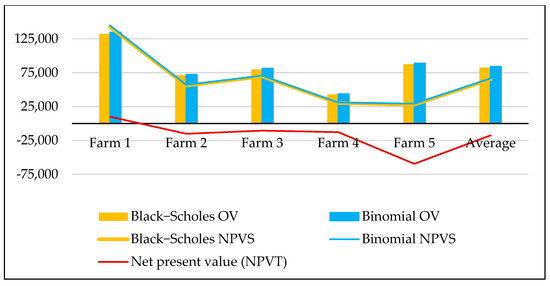
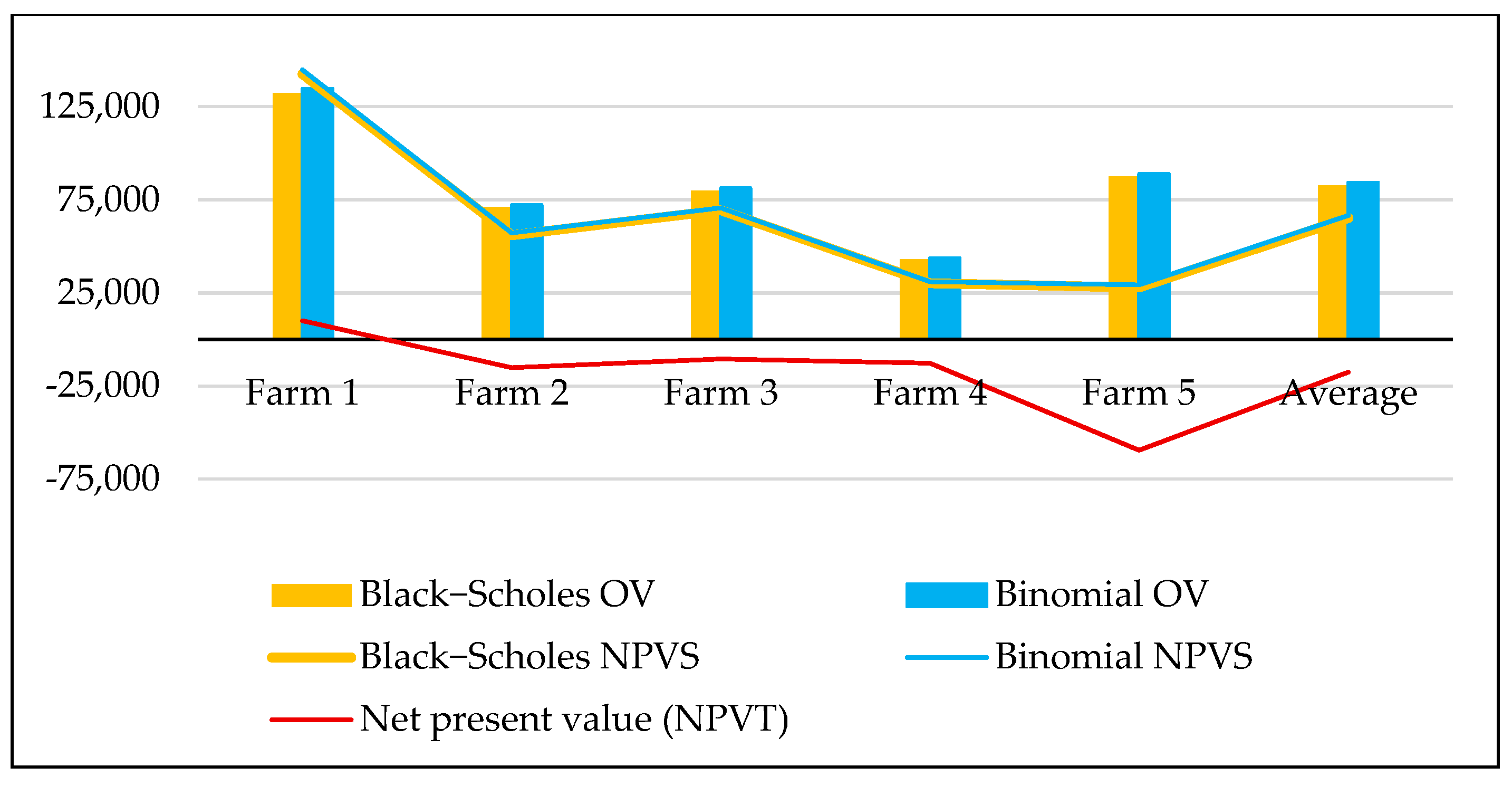
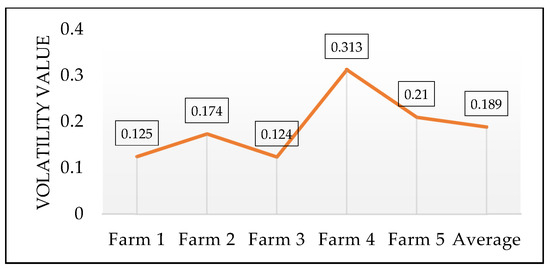
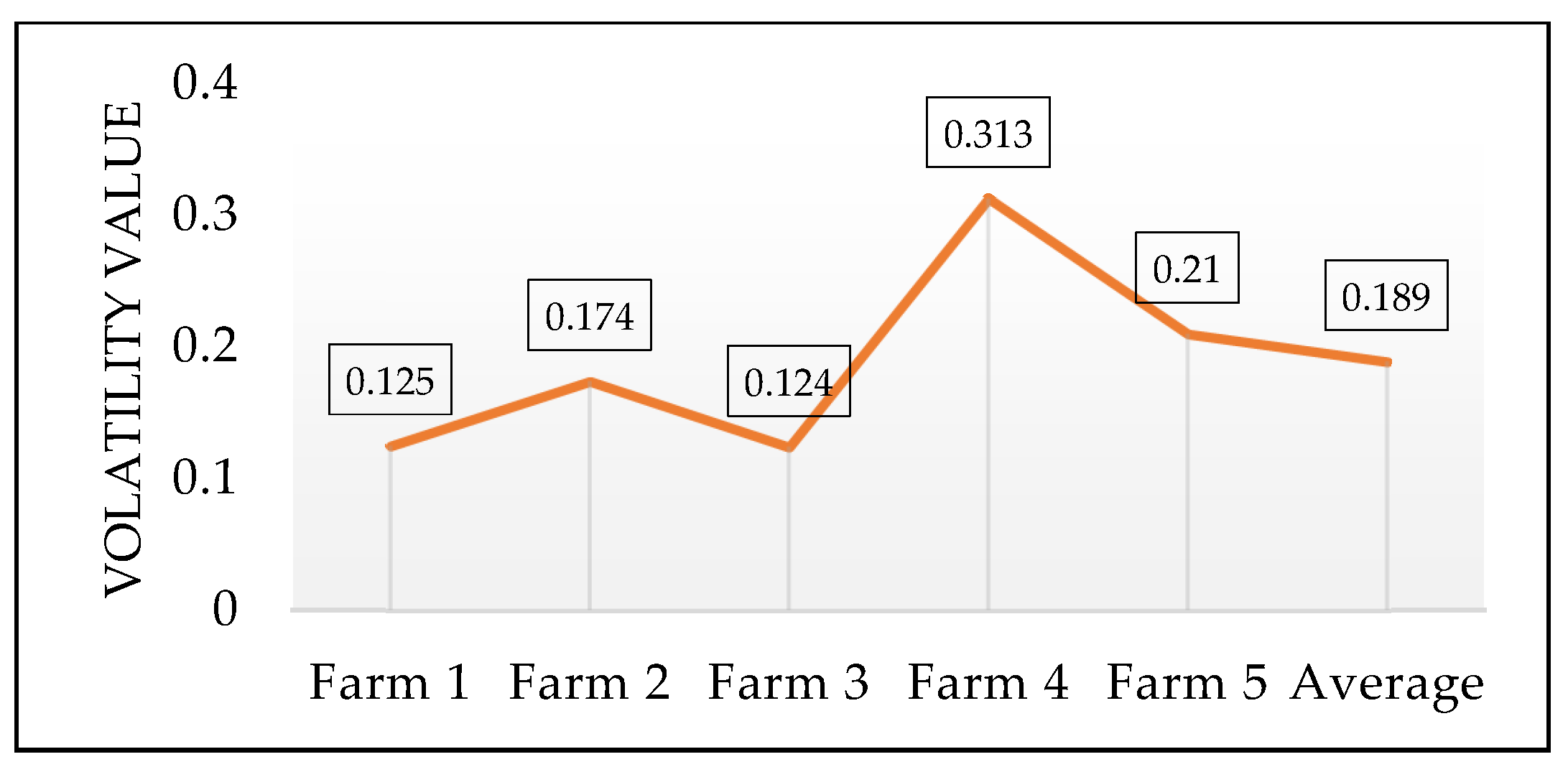
For the above-mentioned reasons, a more in-depth analysis was conducted using the Monte Carlo simulation method and the Real Options Approach, the results of which are presented in the following Figure 3 and Figure 4.
Figure 3.
Traditional and strategic values of farm projects.
Figure 4.
Volatility for the analyzed farm projects.
Since none of the farms achieved profitable milk production, the project was generally unfeasible, with the exception of Farm 1, which showed a marginally positive NPV insufficient to motivate producers to start such projects. Therefore, the diversification of milk production into cheese production was assessed by evaluating the economic effects through simulations and calculating the option value using two different methods. According to the Black Scholes and binomial valuation methodologies, Farm 1 has the highest option value (BS €132,507, Bin. €134,799). As expected, Farm 4, with the smallest business scale, has the lowest option values for the additional project. As explained and presented in previous chapters of the dissertation, NPVS represents the value obtained by adding NPVT obtained through Cost–Benefit Analysis of milk production on farms and calculated option values in cheese production. According to the results of NPVT and calculated option values, Farm 1 has the highest NPVS value (NPVS BS €142,518, NPVS Bin. €144,810). The lowest value of the diversified project, i.e., the milk processing into cheese project, is Farm 5. Farms 1, 2, and 5 add spices such as paprika, chili, and pepper, olives, and garlic, and their cheeses certainly contribute to a higher selling price at which they realize their products, so this also influences the differences in their project values.
In terms of determined volatility, Farms 1 and 3 demonstrate the highest level of assurance regarding the occurrence of measured indicators. Farm 4 has the greatest chance of changing the value of final indicators due to market influences, which can be both positive and negative, given the highest volatility of 0.313.
These results are in agreement with the previous research, which found that farms that have diversified their production respond better to consumer demands and thus adequately maximize their profit [72]. Additionally, the research by other authors [73] on the example in Italy and the Netherlands concluded that diversification and multifunctionality represent two important adaptation strategies recently adopted by EU farmers to react to the crisis of the so-called agricultural productivity model. Dries et al. (2012) suggest that combined measures should be introduced in agricultural production incentive systems to support diversification strategies [74]. Also, [75,76] authors found that diversification strategies represent ways to increase household income using on-farm resources and reduce farm household risk exposure; however, diversification activity requires skills, competence, challenge, and the endowment of productive factors that represent a barrier to adoption for many farms. In addition to the economic benefits of diversification, it is important to emphasize the significant advantages in adapting to climate change and addressing agroecological and socioeconomic challenges [77]. Affirmative conclusions regarding the importance of diversification in agricultural production were also highlighted by authors for Norwegian farms [78], for the England and Wales farm business [79], for Eastern Germany [80], and for Dutch farms [81].
4. Discussion
In this chapter, the results obtained based on the applied methodology and the hypotheses formulated according to the objectives and subject of the research will be linked with previous similar studies. Similarities will be identified, and certain implications will be drawn. This will primarily be carried out through the discussion of hypotheses, which will thus be initially accepted or rejected, and only then linked to previous scientific research.
Hypothesis (H1)
Considering that the calculated option value of the additional projects of observed farms, the milk processing into cheese, is at least around €43,000 and at best around €133,000 according to both applied option valuation methods (BS and Bin.), the hypothesis, “Diversification of the small milk farm business in the conditions of Republika Srpska to milk processing into cheese is economically efficient under the assumed production parameters” is confirmed. Therefore, diversifying milk production into a new project, the processing of raw milk into cheese, is economically feasible and fully justified in all analyzed cases, regardless of production intensity and other specificities of production, processing, and sale of the final product. The results obtained are on the statement that diversification in one of its many forms can be seen as a useful strategy to cope with the income problems of farm households [82]. Similar conclusions also came from [83] that diversification via processing and direct marketing is one strategy that farmers can utilize to survive and maintain competitive positions in the global dairy market. Diversification is seen as an important future strategy for farmers to reduce reliance on agricultural production as a source of income [79]. Similarly, the research by [84] on profitability and economic-financial efficiency showed that adding milk value to the production of fresh cheese is a viable and advantageous strategy, and more profitable than the commercialization of fresh milk, representing an alternative for the increase in income of the milk producer. [85] confirmed through their research that cheese production is economically viable and profitable. According to [86], farms that run additional ventures outside traditional agriculture and are diversified are more viable compared to specialized agricultural units. However, according to the research by [79], a particular concern is that small farms, especially those in LFA’s (less-favored areas), are likely to find it relatively more difficult to pursue most types of diversification activity, so it seems that those in greatest need of non-agricultural income find it hardest to diversify production. For this research, the assertion made by previous authors is confirmed for farms 1 and 2. Also, according to the research on the state of the dairy sector in the EU-28, [87] proposed, among other measures, diversification of production and the application the strategic management as key strategies in addressing unfavorable market situations.
Hypothesis (H2)
Given that all calculated net present values of milk production are negative or, in the case of Farm 1, marginally positive (€10,011), the hypothesis “Raw milk production on the analyzed small milk farms in Republika Srpska is financially inefficient” is also confirmed. The production and sale of raw milk on small family farms with 8–15 milking cows in Republika Srpska are financially unfeasible and unjustified. This conclusion points to the need for either diversification of production, increasing production volume, or completely abandoning this type of production. To earn higher profits, the businesses need to increase the scale of their production and keep it at an optimum level [19] and the same thesis and statement are applicable to this research as well. Additionally, larger and fully commercial farms achieved better economic results in milk production, while smaller, family-run rural farms showed poorer economic indicators [88]. According to this research, it has been proven that the size of the farm indeed has a significant impact on profitability and economic outcomes, and Farm 1 has the best-measured indicators. Baležentis et al. (2019) came to similar conclusions that profitability and economic viability of operations are directly related to the size of the farm [89]. Considering that farm businesses face increasing challenges, farmers respond to incentives and pressures by becoming more entrepreneurial, diversifying, becoming more efficient at production, and adopting new technology [90]. Supporting the previous findings is the research by Kryszak et al. (2021), which aimed to determine whether farm size matters in terms of profitability determinants [91]. They concluded that smaller entities have too much equity relative to their real production capabilities and that larger entities are more productive since they use better technology. There is a direct relationship between herd size and profitability, meaning that smaller farms are less profitable [92]. Similarly, price-related reasons and low income influence producers’ exit from the dairy sector [93]. The size of farms and the level and value of milk production are directly correlated with profitability, and the increase in the physical size of the farm, no matter the farm location, positively influenced milk production [94].
Hypothesis (H3).
The third hypothesis was determined based on the application of Monte Carlo simulation methods using 10,000 iterations of NPV cheese production. Each simulation represents a multifactorial function, where the dependent variable is the traditional value of the cheese production project, while the independent variables are the prices and costs of inputs in this production. According to the calculated minimum volatility of 0.124, maximum of 0.313, and average volatility for all five farms of 0.189, it can be stated that there is a risk that, under the influence of changes in the prices and costs of key inputs (fuel, seed material, mineral fertilizers, pesticides, labor costs, veterinary services, land lease, vehicle registration, electricity, maintenance of machinery, etc.), the expected project value may not occur. This deviation can have both positive effects for the producer when prices decrease, but also negative effects that are much more likely to occur, given various crises and inflation across the agricultural and other economic sectors. Therefore, the third hypothesis, “The NPV of cheese production and the investment risk are affected by variations in prices,” is also confirmed, based on the applied methodology and results, given that the average volatility of the analyzed farms, or the risk, is around 19%. This result is in line with [21], who argue that diversified farms are associated with greater managerial challenges, production risks, and market risks compared to raw milk farms. The research that found an important regularity regarding risk in production is [95], indicating that families who have been engaged in agriculture for more than one generation have accumulated experience with the cyclical ups and downs of farming and are therefore more likely to be motivated to find ways of reducing uncertainty. Similar conclusions can be drawn for the analyzed small farms in Republika Srpska. Also, these results correspond with [29] other research, which found that prices were the main contributor to revenue risk; even if the importance of yield risk increased over time, the increase in price volatility significantly elevated revenue risk. According to [72], diversification reduces uncertainty effectively when concerning a relatively large part of the farmer’s income and when the new activities provide a stable flow of return, so it can be said that the conclusion of the mentioned research is fully compatible with the obtained results and indicators from this research.
The synthesis of the tested hypotheses confirms that the traditional raw milk model is financially unsustainable, making diversification into cheese processing a strategic imperative for survival. The results prove that value-added processing transforms unfeasible operations into economically justified projects by effectively leveraging managerial flexibility. However, high sensitivity to input price volatility necessitates robust risk management to protect these gains. Ultimately, this strategic shift allows small farms to overcome the limitations of production scale and maintain competitiveness in a volatile market.
5. Conclusions
In the production of milk in RS, small dairy farms are still quite present. Therefore, research into their sustainability and prospects in open market conditions is welcome. The study focuses strictly on the economic sustainability of primary agricultural activities, excluding non-farm income from the analysis. The absence of a statistical system necessitated direct data collection, highlighting a critical need for policy-driven databases to support farm diversification. This research analyzed the economic perspective of five dairy farms in the case of diversifying their business into processing milk into cheese on the farm. The number of cows on the analyzed farms ranges from 8 to 15, representing mostly small family farms, where all able-bodied household members work, and agriculture constitutes the dominant source of income. The productivity of dairy cows is very low, primarily due to poor nutrition, as cows spend most of their time on pastures and the breeding stock used in production has poor genetic potential. Milk yield ranges from 3050 to 4175 L per lactation per cow. These farms mostly possess older, often second-hand machinery with a very long amortization and usage period. Cheese processing is generally conservative, employing traditional methods, which, on the other hand, earn the trust of customers who are willing to pay a good price for the local product. For cheese production, depending on the region and farm, 6–8 L of milk are required to produce 1 kg of cheese. On average, the analyzed farms produce around 5337 kg of cheese, which is sold exclusively through direct sales where the producer has direct contact with the customer. Short supply chains applied include on-farm sales, home delivery, sales at marketplaces, and sales at tourist sites. This contributes to achieving favorable cheese prices, ranging from €5.5 in lowland farms, €8 in extensive farms located further from major urban centers, up to a maximum of €10.3 for a farm near the capital of Republika Srpska. The variation in cheese prices among the analyzed farms is 27.1%, which represents significant variability given that it concerns a single type of product. When considering traditional milk production and sales analysis, all indicators for all farms are negative, suggesting that it is not economically viable for them to produce and sell milk to processing industries or large dairies. For this reason, diversification was analyzed—that is, exploiting the option for farms to diversify their production and finalize the product on the farm, given the availability of sufficient labor within the household. By applying the real options method and calculations, it is concluded that the additional project is highly beneficial and that the decision to invest in a small cheese dairy facility, and selling cheese instead of milk, is a sustainable option for them and economically acceptable. In this way, financial stability and security of small dairy farmers are achieved. Beyond mere profitability, the application of the Real Options Approach in this study provides a rigorous quantitative framework for managing market volatility, offering a high level of strategic precision. Implementing this transition requires a systematic pathway, including investments in on-farm mini-processing units, specialized training in food safety standards (HACCP), and the development of recognizable local brands. Such a strategic shift is vital not only for the economic survival of small producers but also for retaining youth in rural areas, thereby preventing the demographic decline of the countryside. However, as dedicated institutional support for this form of diversification is currently lacking, targeted government subsidies are essential to bridge the initial investment gap and ensure the long-term sustainability of the rural sector in Republika Srpska. The transition of small farms from raw milk production and fresh milk sales to on-farm processing should be supported by government programmes through investment subsidies. Agricultural extension services should actively demonstrate the benefits of diversification using computational models similar to those presented in this study. Furthermore, the scientific community should devote greater attention to related research using robust, science-based methodologies, thereby supporting the efforts of government agencies, extension services, local development organizations, and farmer associations to accelerate the modernization and strategic development of small dairy farms.
Author Contributions
Conceptualization, N.J., Ž.V., Č.R. and K.P.; methodology, N.J. and K.P.; software, N.J.; validation, Č.R. and K.P.; formal analysis, N.J. and Ž.V.; investigation, N.J.; resources, N.J. and Ž.V.; data curation, N.J.; writing—original draft preparation, N.J., Ž.V., Č.R. and K.P.; writing—review and editing, Ž.V., Č.R. and K.P.; visualization, N.J.; supervision, K.P. All authors have read and agreed to the published version of the manuscript.
Funding
This research received no external funding.
Institutional Review Board Statement
This study was a non-interventional, observational socio-economic study based on anonymous surveys and interviews with adult participants. Participation was entirely voluntary, and all respondents provided informed consent to take part in the research. Respondents’ names were neither collected nor mentioned, and no data were presented in a way that could enable personal identification. No interventions were applied, and no sensitive personal data were collected.
Data Availability Statement
The original contributions presented in this study are included in the article. Further inquiries can be directed to the corresponding author.
Acknowledgments
The authors acknowledge no additional support beyond that described in the author contributions and funding sections.
Conflicts of Interest
The authors declare no conflicts of interest.
Abbreviations
The following abbreviations are used in this manuscript:
| RS | Republika srpska |
| FAO | Food and Agriculture Organization |
| NPV | Net Present Value |
| NPVS | Net Present Value strategic |
| NPVt | Net Present Value traditional |
| IRR | Internal Rate of Return |
| PP | Payback Period |
| CBA | Cost–Benefit Analysis |
| ROA | Real Options Approach |
| DEXi | Decision EXpert |
| MCS | Monte Carlo Simulation |
| EU | European Union |
| BS | Black–Scholes |
| Bin. | Binomial |
| SO | Standard Output |
| ES6 | Economic Size 6 |
| CV | Coefficient of Variation |
| OV | Option Value |
References
- Vaško, Ž.; Drinić, L. Break-Even Point of Milk Production Depending on the Level of Milk Premium. In Proceedings of the International Symposium of Animal Science, Novi Sad, Serbia, 9–11 September 2015. [Google Scholar]
- Rozman, Č.; Grgić, Z.; Maksimović, A.; Ćejvanović, F.; Puška, A.; Šakić-Bobić, B. Multiple-Criteria Approach of Evaluation of Milk Farm Models in Bosnia and Herzegovina. Mljekarstvo 2016, 66, 206–214. [Google Scholar] [CrossRef] [Scilit]
- Amistu, K.; Sanago, S.; Dawit, C. Cow Milk Production, Processing and Marketing Situation in Tello District. Afr. J. Agric. Res. 2016, 24, 41–47. [Google Scholar]
- Kaur, H.; Kaur, I.; Singh, V.P.; Wakchaure, N. Economic analysis of different milk products manufacture at farms in Punjab State. Indian J. Dairy Sci. 2022, 75. Available online: https://epubs.icar.org.in/index.php/ijds/article/view/96859 (accessed on 1 December 2025).
- Becker, K.M.; Parsons, R.L.; Kolodinsky, J.; Matiru, G.N. A Cost and Returns Evaluation of Alternative Dairy Products to Determine Capital Investment and Operational Feasibility of a Small-Scale Dairy Processing Facility. J. Dairy Sci. 2007, 90, 2506–2516. [Google Scholar] [CrossRef] [Scilit] [PubMed]
- Vaško, Ž.; Ostojić, A.; Rokvić, G.; Drinić, L.; Mrdalj, V.; Figurek, A.; Brković, D. Poljoprivreda i Ruralni Razvoj u Republici Srpskoj Do 2020. Godine; Univerzitet u Banjoj Luci, Poljoprivredni Fakultet: Banja Luka, Bosnia and Herzegovina, 2016; pp. 1–361. [Google Scholar]
- Pandurevic, T.; Mojevic, M.; Rankic, I.; Ristanovic, B. Analysis of Some Cattle Farms Focused on Milk Production. Act. Agric. Serb. 2015, 20, 127–135. [Google Scholar] [CrossRef] [Scilit]
- Sarić, Z.; Puhan, Z.; Dizdarevic, T. Cheese Manufacture at Tradition and Industry Crossways. J. Contemp. Agric. 2007, 56, 103–113. [Google Scholar]
- FAO. The Meat and Dairy Sector in Bosnia and Herzegovina. In Proceedings of the IPARD Sector Analysis in Bosnia and Herze-Govina; FAO Regional Office for Europe and Central Asia: Budapest, Hungary, 2012. [Google Scholar]
- Jalić, N.; Rozman, Č.; Vaško, Ž.; Pažek, K. Determining the Extent of Economical Sustainability of a Case Study Milk Farm in Bosnia and Herzegovina Based on the Real Options Model. Sustainability 2022, 14, 11993. [Google Scholar] [CrossRef] [Scilit]
- Pažek, K.; Kolenko, M.; Turk, J.; Prišenk, J.; Borec, A.; Pavlovič, M.; Rozman, Č. Assessment of Potato Processing Investments by Real Options Approach: Case Study. Afr. J. Agric. 2013, 8, 5468–5474. [Google Scholar]
- Wang, Z.; Tang, X. Research of Investment Evaluation of Agricultural Venture Capital Project on Real Options Approach. Agric. Agric. Sci. Procedia 2010, 1, 449–455. [Google Scholar] [CrossRef] [Scilit]
- Cruz Rambaud, S.; Sánchez Pérez, A.M. The Option to Expand a Project: Its Assessment with the Binomial Options Pricing Model. Oper. Res. Perspect. 2017, 4, 12–20. [Google Scholar] [CrossRef] [Scilit]
- Bozoglu, M.; Sağlam, O.; Kılıç Topuz, B. Economic Sustainability of Family Dairy Farming within the Scope of Technical Efficiency: A Case Study of Bafra District, Turkey. Custos E Agronegocio 2017, 13, 295–316. [Google Scholar]
- Fadul-Pacheco, L.; Wattiaux, M.; Espinoza-Ortega, A.; Sanchez-Vera, E.; Arriaga-Jordán, C. Evaluation of Sustainability of Smallholder Dairy Production Systems in the Highlands of Mexico During the Rainy Season. Agroecol. Sustain. Food Syst. 2013, 37, 882–901. [Google Scholar] [CrossRef] [Scilit]
- Davidova, S.; Thomson, K.J. Family Farming in Europe: Challenges and Prospects. Available online: https://kar.kent.ac.uk/64952/1/FAO%20Family%20Farming%20%20Europe_Central%20Asia%20Jan_2014.docx (accessed on 1 December 2025).
- Debertin, D.L.; Pagoulatos, A. Production Practices and Systems in Sustainable Agriculture; The University of Kentucky, Department of Agricultural Economics: Lexington, KY, USA, 2015; Staff Paper 488; pp. 1–31. [Google Scholar]
- Ramsbottom, G.; Horan, B.; Berry, D.; Roche, J. Factors Associated with the Financial Performance of Spring-Calving, Pasture-Based Dairy Farms. J. Dairy Sci. 2015, 98, 3526–3540. [Google Scholar] [CrossRef] [Scilit] [PubMed]
- Akin, A.C.; Cevger, Y. Analysis of Factors Affecting Production Costs and Profitability of Milk and Dairy Products in Turkey. Food Sci. Technol. 2019, 39, 781–787. [Google Scholar] [CrossRef] [Scilit]
- Hochuli, A.; Hochuli, J.; Schmid, D. Competitiveness of Diversification Strategies in Agricultural Dairy Farms: Empirical Findings for Rural Regions in Switzerland. J. Rural Stud. 2021, 82, 98–106. [Google Scholar] [CrossRef] [Scilit]
- García-Cornejo, B.; Pérez-Méndez, J.A.; Roibás, D.; Wall, A. Efficiency and Sustainability in Farm Diversification Initiatives in Northern Spain. Sustainability 2020, 12, 3983. [Google Scholar] [CrossRef] [Scilit]
- Spiegel, A.; Britz, W.; Finger, R. Risk, Risk Aversion, and Agricultural Technology Adoption—A Novel Valuation Method Based on Real Options and Inverse Stochastic Dominance. Q Open 2021, 1, qoab016. [Google Scholar] [CrossRef] [Scilit]
- Baecker, P.N. (Ed.) Real Options and Intellectual Property: Capital Budgeting Under Imperfect Patent Protection; Springer: Berlin/Heidelberg, Germany, 2007. [Google Scholar]
- Robinson, L.; Hammitt, J. Behavioral Economics and the Conduct of Benefit-Cost Analysis: Towards Principles and Standards. J. Benefit-Cost Anal. 2011, 2, 1–51. [Google Scholar] [CrossRef] [Scilit]
- Čupić, M. Cost-Benefit Analiza; Business Start-up centre Kragujevac: Kragujevac, Serbia, 2010. [Google Scholar]
- Muller, W. Simulated Real Option Approach to Investment Decisions of Dutch Dairy Farmers. Ph.D. Thesis, Wageningen University, Wageningen, The Netherlands, 2018. [Google Scholar]
- Mann, J.M. What is Driving the Price of Dairy Quota?—A Net Present Value Adaptive Expectations Model. Master’s Thesis, University of Manitoba, Winnipeg, MB, Canada, 2008. [Google Scholar]
- Hyde, J.; Engel, P. Investing in a Robotic Milking System: A Monte Carlo Simulation Analysis. J. Dairy Sci. 2002, 85, 2207–2214. [Google Scholar] [CrossRef] [Scilit]
- El Benni, N.; Finger, R. Gross Revenue Risk in Swiss Dairy Farming. J. Dairy Sci. 2012, 96, 936–948. [Google Scholar] [CrossRef] [Scilit]
- Lauwers, L.; Decock, L.; De Wit, J.; Wauters, E. A Monte Carlo Model for Simulating Insufficiently Remunerating Risk Premium: Case of Market Failure in Organic Farming. Hydrometallurgy 2010, 1, 76–89. [Google Scholar] [CrossRef] [Scilit]
- Hadelan, L.; Par, V.; Njavro, M.; Lovrinov, M. Real Option Approach to Economic Analysis of European Sea Bass (Dicetrar-Chus Labrax) Farming in Croatia. ACS Agric. Conspec. Scintificus 2012, 77, 161–165. [Google Scholar]
- Cobb, B.R.; Charnes, J.M. Real options volatility estimation with correlated inputs. Eng. Econ. 2004, 49, 119–137. [Google Scholar] [CrossRef] [Scilit]
- Čulík, M. Real Options Valuation with Changing Volatility. Perspect. Sci. 2015, 7, 10–18. [Google Scholar] [CrossRef] [Scilit]
- Dittrich, R.; Butler, A.; Ball, T.; Wreford, A.; Moran, D. Making Real Options Analysis More Accessible for Climate Change Adaptation. An Application to Afforestation as a Flood Management Measure in the Scottish Borders. J. Environ. Manag. 2019, 245, 338–347. [Google Scholar] [CrossRef] [Scilit]
- Tubetov, D.; Musshoff, O.; Kellner, U. Investments in Kazakhstani Dairy Farming: A Comparison of Classical Investment Theory and the Real Options Approach. Q. J. Int. Agric. 2012, 51, 257–284. [Google Scholar] [CrossRef]
- Xavier, D.T.; Peres, A.A.C.; Almeida, G.L.; Carvalho, C.A.B. Application of the “Real Options Theory” Method to the Production Systems Used in Dairy Cattle Farming. Arq. Bras. Med. Vet. Zootec. 2020, 72, 2288–2296. [Google Scholar] [CrossRef] [Scilit]
- Cox, J.C.; Ross, S.A.; Rubinstein, M. Option Pricing: A Simplified Approach. J. Financ. Econ. 1979, 7, 229–263. [Google Scholar] [CrossRef] [Scilit]
- Hadelan, L.; Njavro, M.; Par, V. Plum Plantation Value Based on Real Option Contribution. Poljoprivreda 2009, 15, 51–56. [Google Scholar]
- Na, S.; Kim, K.; Jang, W.; Lee, C. Real Options Analysis for Land and Water Solar Deployment in Idle Areas of Agricultural Dam: A Case Study of South Korea. Sustainability 2022, 14, 2297. [Google Scholar] [CrossRef] [Scilit]
- Tzouramani, I.; Mattas, K. Employing Real Options Methodology to Evaluate the Organic Agriculture Scheme in Greece. In Proceedings of the 87th EAAE-Seminar, Assessing Rural Development of the CAP, Vienna, Austria, 21–23 April 2004; pp. 1–10. [Google Scholar]
- Odening, M.; Mußhoff, O.; Balmann, A. Investment Decisions in Hog Finishing: An Application of the Real Options Approach. Agric. Econ. 2005, 32, 47–60. [Google Scholar] [CrossRef] [Scilit]
- Michailidis, A.; Mattas, K. Using Real Options Theory to Irrigation Dam Investment Analysis: An Application of Binomial Option Pricing Model. Water Resour Manag. 2007, 21, 1717–1733. [Google Scholar] [CrossRef] [Scilit]
- Pazek, K.; Rozman, C.; Par, V.; Hadelan, L. Investment Projects Assessments and Evaluation in Agriculture Using Option Models. 2010. Available online: https://ageconsearch.umn.edu/record/183824/files/3-Karmen%20Pazek.pdf (accessed on 1 December 2025).
- Tauer, L. When to Get In and Out of Dairy Farming: A Real Option Analysis. Agric. Resour. Econ. Rev. 2005, 35, 339–347. [Google Scholar] [CrossRef] [Scilit]
- Abdul-Salam, Y.; Ovando, P.; Roberts, D. Understanding the Economic Barriers to the Adoption of Agroforestry: A Real Options Analysis. J. Environ. Manag. 2022, 302, 113955. [Google Scholar] [CrossRef] [Scilit] [PubMed]
- Golub, A.; Herrera, D.; Leslie, G.; Pietracci, B.; Lubowski, R. A Real Options Framework for Reducing Emissions from Deforestation: Reconciling Short-Term Incentives with Long-Term Benefits from Conservation and Agricultural Intensification. Ecosyst. Serv. 2021, 49, 101275. [Google Scholar] [CrossRef] [Scilit]
- Mancini, M.C.; Menozzi, D.; Donati, M.; Biasini, B.; Veneziani, M.; Arfini, F. Producers’ and Consumers’ Perception of the Sustainability of Short Food Supply Chains: The Case of Parmigiano Reggiano PDO. Sustainability 2019, 11, 721. [Google Scholar] [CrossRef] [Scilit]
- Sarkar, A.; Gupta, H.; Dutta, A. Dairy Value Chain Operation and Dairy Producers: Its Impact and Limitations in an Emerging Economy. CABI Reviews Perspect. Agric. Vet. Sci. Nutr. Nat. Resour. 2022, 17. [Google Scholar] [CrossRef] [Scilit]
- Jarzębowski, S.; Bourlakis, M.; Bezat-Jarzębowska, A. Short Food Supply Chains (SFSC) as Local and Sustainable Systems. Sustainability 2020, 12, 4715. [Google Scholar] [CrossRef] [Scilit]
- Vittersø, G.; Torjusen, H.; Laitala, K.; Tocco, B.; Biasini, B.; Csillag, P.; De Labarre, M.D.; Lecoeur, J.-L.; Maj, A.; Majewski, E.; et al. Short Food Supply Chains and Their Contributions to Sustainability: Participants’ Views and Perceptions from 12 European Cases. Sustainability 2019, 11, 4800. [Google Scholar] [CrossRef] [Scilit]
- Ceppatelli, A.; Pozo, C.; Bonnet, C.; Siampanopoulos, A.; Vogg, M.; Strankman, P.; Sturaro, E.; Tourrand, J.-F.; Wedderburn, L. The Benefits of the Dairy Value Chain to Inclusive Sustainable Development in European Highlands: A Systems Thinking Approach. Sustain. Earth Rev. 2024, 7, 27. [Google Scholar] [CrossRef] [Scilit]
- Beux, S.; Viagi, A.; Panizzolo, R.; Cassandro, M.; Waszczynskyj, N. Food Supply Chain—Sustainability in Small Milk Industry; Springer International Publishing: Cham, Switzerland, 2016; p. 605. [Google Scholar]
- Rahman, H.; Happy, F.; Efan, A.; Hera, M.H.R. The small-scale dairy value chain analysis: Challenges and opportunities for dairy development in Mymensingh district of Bangladesh. SAARC J. Agric. 2019, 17, 213–226. [Google Scholar] [CrossRef] [Scilit]
- Krilić, A.; Nikolić, A.; Falan, V.; Đorđević, Đ. Efficiency of Dairy Value Chain in Bosnia and Herzegovina. In Proceedings of the 10th Central European Congress on Food; Brka, M., Sarić, Z., Oručević Žuljević, S., Omanović-Mikličanin, E., Taljić, I., Biber, L., Mujčinović, A., Eds.; Springer International Publishing: Cham, Switzerland, 2022; pp. 223–235. [Google Scholar]
- European Commission. Community Committee for the Farm Accountancy Data Network. In Brussels Typology Handbook; European Commission: Brussels, Belgium, 2009. [Google Scholar]
- Lovarelli, D.; Bava, L.; Zucali, M.; D’Imporzano, G.; Adani, F.; Tamburini, A.; Sandrucci, A. Improvements to Dairy Farms for Environmental Sustainability in Grana Padano and Parmigiano Reggiano Production Systems. Ital. J. Anim. Sci. 2019, 18, 1035–1048. [Google Scholar] [CrossRef] [Scilit]
- MacDonald, J.M.; McBride, W.D.; O’Donoghue, E.; Nehring, R.F.F.; Sandretto, C.; Mosheim, R. Profits, Costs, and the Changing Structure of Dairy Farming. USDA-ERS Econ. Res. Rep. 2007. [Google Scholar] [CrossRef] [Scilit]
- Cecchini, L.; Torquati, B.; Paffarini, C.; Barbanera, M.; Foschini, D.; Chiorri, M. The Milk Supply Chain in Italy’s Umbria Region: Environmental and Economic Sustainability. Sustainability 2016, 8, 728. [Google Scholar] [CrossRef] [Scilit]
- Pažek, K.; Rozman, Č. The Simulation Model for Cost-Benefit Analysis on Organic Farms. Agron. Glas. 2007, 3, 209–222. [Google Scholar]
- Vaško, Ž. Costs and Calculations in Agricultural Production, Theory and Examples; University of Banja Luka, Faculty of Agriculture: Banja Luka, Bosnia and Herzegovina, 2019; pp. 1–319. [Google Scholar]
- Platon, V.; Constantinescu, A. Monte Carlo Method in Risk Analysis for Investment Projects. Procedia Econ. Financ. 2014, 15, 393–400. [Google Scholar] [CrossRef] [Scilit]
- Herath, H.S.B.; Park, C.S. Multi-stage capital investment opportunities as compound real Options. Eng. Econ. 2002, 47, 1–27. [Google Scholar] [CrossRef] [Scilit]
- Brach, M.A. Real Options in Practice; Wiley Finance Series; Wiley: Hoboken, NJ, USA, 2003. [Google Scholar]
- Godinho, P. Monte Carlo Estimation of Project Volatility for Real Options Analysis. J. Appl. Financ. 2006, 16. [Google Scholar]
- Brealey, R.A.; Myers, S.C.; Allen, F. Principles of Corporate Finance: S&P Market Insight, 10th ed.; The McGraw-Hill/Irwin Series in Finance, Insurance, and Real Estate; McGraw-Hill Irwin: New York, NY, USA, 2011. [Google Scholar]
- Marques, N.L.; Bastian-Pinto, C.D.L.; Brandão, L.E.T. A Tutorial for Modeling Real Options Lattices from Project Cash Flows. Rev. Adm. Contemp. 2021, 25, e200093. [Google Scholar] [CrossRef] [Scilit]
- Pažek, K.; Rozman, Č. The Real Options Approach for Assessment of Business Opportunities in Spelt Processing. Available online: https://www.cabidigitallibrary.org/doi/full/10.5555/20123287050 (accessed on 1 December 2025).
- Damodaran, A. The Promise and Peril of Real Options. 75. Available online: https://papers.ssrn.com/sol3/papers.cfm?abstract_id=1295849 (accessed on 1 December 2025).
- Baranov, A.; Muzyko, E. Using Real Options for the Evaluation of Venture Projects. Gadjah Mada Int. J. Bus. 2016, 18, 153. [Google Scholar] [CrossRef] [Scilit]
- Vintila, N. Real Options in Capital Budgeting. Pricing the Option to Delay and the Option to Abandon a Project. Theor. Appl. Econ. 2007, 7, 47–58. [Google Scholar]
- Kuppens, T.; Rafiaani, P.; Vanreppelen, K.; Yperman, J.; Carleer, R.; Schreurs, S.; Thewys, T.; Van Passel, S. Combining Monte Carlo Simulations and Experimental Design for Incorporating Risk and Uncertainty in Investment Decisions for Cleantech: A Fast Pyrolysis Case Study. Clean Technol. Env. Policy 2018, 20, 1195–1206. [Google Scholar] [CrossRef] [Scilit]
- Meraner, M.; Heijman, W.; Kuhlman, T.; Finger, R. Determinants of Farm Diversification in the Netherlands. Land Use Policy 2015, 42, 767–780. [Google Scholar] [CrossRef] [Scilit]
- Aguglia, L.; Henke, R.; Poppe, K.; Roest, A.; Salvioni, C. Diversification and Multifunctionality in Italy and The Netherlands: A Comparative Analysis. 2009. Available online: https://www.researchgate.net/profile/Cristina-Salvioni-2/publication/228764306_Diversification_and_multifunctionality_in_Italy_and_the_Netherlands_a_comparative_analysis/links/004635184bdf5b06c4000000/Diversification-and-multifunctionality-in-Italy-and-the-Netherlands-a-comparative-analysis.pdf (accessed on 1 December 2025).
- Dries, L.; Pascucci, S.; Gardebroek, C. Diversification in Italian Farm Systems: Are Farmers Using Interlinked Strategies? New Meddit 2012, 4, 7–15. [Google Scholar]
- Bartolini, F.; Andreoli, M.; Brunori, G. Explaining Determinants of the On-Farm Diversification: Empirical Evidence from Tuscany Region. Bio-Based Appl. Econ. 2014, 3, 137–157. [Google Scholar] [CrossRef] [Scilit]
- Bowman, M.S.; Zilberman, D. Economic Factors Affecting Diversified Farming Systems. ES 2013, 18, art33. [Google Scholar] [CrossRef] [Scilit]
- Van Zonneveld, M.; Turmel, M.-S.; Hellin, J. Decision-Making to Diversify Farm Systems for Climate Change Adaptation. Front. Sustain. Food Syst. 2020, 4, 32. [Google Scholar] [CrossRef] [Scilit]
- Vik, J.; McElwee, G. Diversification and the Entrepreneurial Motivations of Farmers in Norway. J. Small Bus. Manag. 2011, 49, 390–410. [Google Scholar] [CrossRef] [Scilit]
- McNally, S. Farm Diversification in England and Wales—What Can We Learn from the Farm Business Survey? J. Rural Stud. 2001, 17, 247–257. [Google Scholar] [CrossRef] [Scilit]
- Lange, A.; Piorr, A.; Siebert, R.; Zasada, I. Spatial Differentiation of Farm Diversification: How Rural Attractiveness and Vicinity to Cities Determine Farm Households’ Response to the CAP. Land Use Policy 2013, 31, 136–144. [Google Scholar] [CrossRef] [Scilit]
- Jongeneel, R.A.; Polman, N.B.P.; Slangen, L.H.G. Why Are Dutch Farmers Going Multifunctional? Land Use Policy 2008, 25, 81–94. [Google Scholar] [CrossRef] [Scilit]
- Meert, H.; Van Huylenbroeck, G.; Vernimmen, T.; Bourgeois, M.; Van Hecke, E. Farm Household Survival Strategies and Diversification on Marginal Farms. J. Rural Stud. 2005, 21, 81–97. [Google Scholar] [CrossRef] [Scilit]
- Alvarez, A.; García-Cornejo, B.; Pérez-Méndez, J.A.; Roibás, D. Diversification in Spanish Dairy Farms: Key Drivers of Performance. Int. Food Agribus. Manag. Rev. 2016, 19, 163–188. [Google Scholar]
- Ferraz Rocha, Á.G.; Ferreira Pelegrini, D.; Lopes, M.A. Agregação de Valor Ao Leite Por Meio Da Produção de Queijo: Análise Da Rentabilidade Em Uma Propriedade Familiar No Município de Uberlândia/MG. Med. Vet. 2018, 12, 283. [Google Scholar] [CrossRef] [Scilit]
- Agboola, T.; Alao, O.; Odewumi, T. The Profitability of Cheese Production in Ola-Oluwa Local Government Area, Osun State. Niger. J. Rural. Ext. Dev. 2020, 14, 41–47. [Google Scholar]
- Barnes, A.P.; Hansson, H.; Manevska-Tasevska, G.; Shrestha, S.S.; Thomson, S.G. The Influence of Diversification on Long-Term Viability of the Agricultural Sector. Land Use Policy 2015, 49, 404–412. [Google Scholar] [CrossRef] [Scilit]
- Popescu, A.; Stoian, E.; Șerban, V. THE EU-28 MILK SECTOR TRENDS IN THE PERIOD 2009–2018. Sci. Pap. Ser. Manag. Econ. Eng. Agric. Rural. Dev. 2019, 19, 1–16. Available online: https://managementjournal.usamv.ro/pdf/vol.19_4/Art36.pdf (accessed on 1 December 2025).
- Qadir, F.; Tariq, M.; Jan, S.; Zada, K. Profitability Analysis of Milk Production In District Peshawar. J. Res. Soc. Pak. 2016, 53, 1–23. [Google Scholar]
- Baležentis, T.; Galnaitytė, A.; Kriščiukaitienė, I.; Namiotko, V.; Novickytė, L.; Streimikiene, D.; Melnikiene, R. Decomposing Dynamics in the Farm Profitability: An Application of Index Decomposition Analysis to Lithuanian FADN Sample. Sustainability 2019, 11, 2861. [Google Scholar] [CrossRef] [Scilit]
- Morris, W.; Henley, A.; Dowell, D. Farm Diversification, Entrepreneurship and Technology Adoption: Analysis of Upland Farmers in Wales. J. Rural Stud. 2017, 53, 132–143. [Google Scholar] [CrossRef] [Scilit]
- Kryszak, Ł.; Guth, M.; Czyżewski, B. Determinants of Farm Profitability in the EU Regions. Does Farm Size Matter? Agric. Econ. Czech 2021, 67, 90–100. [Google Scholar] [CrossRef] [Scilit]
- Perumal, A. Economic Analysis of Dairy Farming in Dry Farming Areas of Tamil Nadu. Indian J. Dairy Sci. 2018, 69. [Google Scholar]
- Bragg, L.A.; Dalton, T.J. Factors Affecting the Decision to Exit Dairy Farming: A Two-Stage Regression Analysis. J. Dairy Sci. 2004, 87, 3092–3098. [Google Scholar] [CrossRef] [Scilit]
- Chetroiu, R.; Cișmileanu, A.E.; Cofas, E.; Petre, I.L.; Rodino, S.; Dragomir, V.; Marin, A.; Turek-Rahoveanu, P.A. Assessment of the Relations for Determining the Profitability of Dairy Farms, A Premise of Their Economic Sustainability. Sustainability 2022, 14, 7466. [Google Scholar] [CrossRef] [Scilit]
- Barbieri, C.; Mahoney, E. Why Is Diversification an Attractive Farm Adjustment Strategy? Insights from Texas Farmers and Ranchers. J. Rural Stud. 2009, 25, 58–66. [Google Scholar] [CrossRef] [Scilit]

Disclaimer/Publisher’s Note: The statements, opinions and data contained in all publications are solely those of the individual author(s) and contributor(s) and not of MDPI and/or the editor(s). MDPI and/or the editor(s) disclaim responsibility for any injury to people or property resulting from any ideas, methods, instructions or products referred to in the content. |
© 2026 by the authors. Licensee MDPI, Basel, Switzerland. This article is an open access article distributed under the terms and conditions of the Creative Commons Attribution (CC BY) license.