Article

Priestia megaterium Inoculation Enhances the Stability of the Soil Bacterial Network and Promotes Cucumber Growth in a Newly Established Greenhouse


1
State Key Laboratory of North China Crop Improvement and Regulation, Key Laboratory for Farmland Eco-Environment of Hebei Province, Hebei Collaborative Innovation Center for Green and Efficient Vegetable Industry, College of Resources and Environmental Science, Hebei Agricultural University, Baoding 071000, China
2
Institute of Plant Protection, Hebei Academy of Agricultural and Forestry Sciences, Integrated Pest Management Center of Hebei Province, Key Laboratory of IPM on Crops in Northern Region of North China, Ministry of Agriculture and Rural Affairs of China, 437# Dongguan Street, Baoding 071000, China
3
Centre for Soil and Environmental Research, Lincoln University, Lincoln, Christchurch 7647, New Zealand
4
Agricultural and Rural Bureau of Yongqing, Yongqing 065600, China
*
Author to whom correspondence should be addressed.
These authors contributed equally to this work.
Agriculture 2026, 16(3), 361; https://doi.org/10.3390/agriculture16030361
Submission received: 21 October 2025 / Revised: 8 January 2026 / Accepted: 14 January 2026 / Published: 3 February 2026
(This article belongs to the Section Agricultural Soils)

Abstract

The rapid expansion of greenhouse agriculture demands sustainable strategies to maintain soil health and productivity from the outset. Priestia megaterium, a plant growth-promoting rhizobacterium (PGPR), has shown promise in improving plant growth and soil nutrient availability, but its efficacy in newly established greenhouse systems, where the soil microbiome is still developing, remains underexplored. This study evaluated the impact of P. megaterium inoculation on cucumber growth, soil nutrient bioavailability, and soil microbial communities in a greenhouse with only two years of operation. A two-year experiment was conducted with conventional fertilization as the control and P. megaterium inoculation (7.0 × 10⁸ cfu mL−1) at different rates (37.5, 75, 150, and 300 L ha−1) and timings. Soil and plant nutrient content were measured, and microbial communities were analyzed through 16S rRNA sequencing and co-occurrence network analysis. Results showed that applying P. megaterium at 75 L ha−1 during seedling transplantation significantly increased soil available phosphorus (AP) by 11.64–26.48% and available potassium (AK) by 11.27–47.31% compared to the control, while enhancing cucumber yield by 6.71–9.28%. The inoculant also increased soil bacterial diversity, enriched beneficial genera such as Lysobacter, Pseudomonas, and Flavobacterium, and reduced the abundance of Xanthomonas. Furthermore, P. megaterium application promoted a more complex and stable bacterial network, with higher connectivity and modularity. These findings suggest that P. megaterium is a viable strategy for enhancing soil health and productivity in newly established greenhouse systems, offering an environmentally sustainable alternative to traditional fertilization methods.

1. Introduction

The rapid expansion of greenhouse vegetable production systems has been driven by the growing global demand for fresh produce. However, the intensive cultivation practices commonly used in these systems, particularly with long-term monocropping and heavy reliance on synthetic fertilizers, have raised concerns regarding soil health and sustainability [1,2]. Over time, these practices lead to soil acidification, salinization, nutrient accumulation, and the destabilization of microbial communities, which adversely affect crop productivity and soil quality [3,4,5]. Cucumber (Cucumis sativus L.) is an important vegetable, and typically cultivated under continuous monoculture greenhouse conditions to achieve a higher yield and a year-round supply [6]. Previous studies showed that the long-term continuous monocropping had a serious negative effect on soil quality and soil microbial community, resulting in poor cucumber growth and yield [7]. Although some common measures, such as organic amendments (e.g., manure/compost), crop rotation or soil replacement, biochar application, and soil disinfection, could improve soil quality and soil microbial community in the monocropping system of vegetables [8,9,10], it is difficult to recover the damaged greenhouse production system rapidly. In calcareous greenhouse soils, phosphorus (P) is frequently immobilized by Ca-P precipitation, and potassium (K) availability can become limiting or imbalanced under intensive fertilization; therefore, improving P and K bioavailability is a practical target for sustainable nutrient management in these systems.
Modern agricultural practices, such as the application of organic fertilizers and/or PGPR, are alternatives to moving towards more environmentally friendly and sustainable agriculture [11,12]. PGPR are microorganisms in soils that can colonize the rhizosphere of plants and can fix nitrogen (N), solubilize P and K, secrete auxins and antibiotics, enhance plant nutrient uptake, and, as a consequence, stimulate plant growth and increase crop yield [13,14,15]. It has been reported that the genus Bacillus shows different kinds of PGPR traits, like inoculations with Bacillus subtilis can effectively promote muskmelon growth due to the colonization in the rhizosphere soil and interior of the plant roots, and the production of indole-3-acetic acid (IAA) [16]. It was also reported that B. amyloliquefaciens suppressed the spread of Fusarium wilt under both greenhouse and open-field conditions [17]. Priestia megaterium (formerly Bacillus megaterium) is well known for being able to solubilize P and K in soil [18,19], to promote the growth of tomatoes and common beans [20,21], and to inhibit the activity of rice spikelet rot disease [22]. A greenhouse experiment suggested that the addition of P. megaterium improved tomato plant growth by controlling Fusarium wilt in tomatoes [23]. Our recent work carried out as a greenhouse experiment with cucumber continuously monocropping for 15 years demonstrated that application of P. megaterium augmented the cucumber yield and the bioavailability P and K in the soil, which provided a more sustainable production system for continuously mmonocroppingvegetables in greenhouse via improving the properties of soil microbial community and the bioavailability of soil P and K by P. megaterium inoculants [24]. Although Bacillus megaterium has been widely shown to enhance plant growth and health across diverse crops, and its biochemical mechanisms for phosphorus and potassium solubilization are well documented, its functional performance and ecological impacts on cucumber growth and soil P and K bioavailability in newly established greenhouse systems with short planting histories remain insufficiently explored, where complex soil microbial interaction networks are still forming. Applying the PGPR in the modern agricultural production system plays a key role, which not only achieves the purpose of increasing crop yield, but also ensures the sustainable development of agriculture ecosystem [8].
Exogenous addition of PGPR in agricultural production systems may also affect the indigenous soil microbial communities [25]. Microbiota have critical roles in various biogeochemical cycles and play a vital role in the functioning of agro-soil ecosystems [26]. The microbial community of the rhizosphere is the primary factor determining crop plant health and is also thought to be important in maintaining a robust and stable microenvironment [27]. A previous study suggested that B. amyloliquefaciens promoted cucumber plant growth and alleviated damage to it from Fusarium wilt by changing the soil microbial community composition and diversity of its rhizosphere [28]. We had confirmed that applying P. megaterium increased the richness and functional groups abundance of soil bacterial and fungal communities under a greenhouse experiment with cucumber continuously monocropping for 15 years [24]. In addition, the soil properties, plant species, and monocropping years are also capable of influencing the microbial community composition [29]. Moreover, co-occurrence network analysis could reveal complex associations within microbial communities, especially the interactions among microorganisms in response to environmental stress, which cannot easily be understood by routine microbial community analyses [30,31]. In this context, there remains a critical knowledge gap regarding how microbial inoculants influence early-stage microbiome assembly and interaction patterns in newly established greenhouse systems with short cultivation histories. In contrast to previous studies, including our own work in long-term monocropping greenhouses, the effects of microbial inoculation on soil bacterial community structure and network stability during the initial years of greenhouse establishment remain poorly understood.
This study builds on our earlier work [24] that demonstrated the role of P. megaterium in enhancing cucumber yields and nutrient availability in long-term monoculture systems. Here, we investigate how P. megaterium influences cucumber growth and soil nutrient cycling in a newly established greenhouse, with a particular focus on its effect on soil microbial diversity and network stability. Therefore, the principal aims of this study were (1) to determine the effects of P. megaterium inoculation on cucumber growth, P and K availability in the root affected soil and their accumulation in cucumber plant; and (2) to explore the effect of the inoculation of P. megaterium on the diversity, composition, and structure of the root affected soil bacterial community, with a special emphasis on its impact on the co-occurrence network patterns of the bacterial community. We hypothesized that the inoculation of P. megaterium would promote cucumber growth in this nascent system, not only by colonizing the soil and increasing P and K bioavailability but also by secreting phytohormones and steering the development of a more stable and beneficial soil bacterial network from the early stages of cultivation.

2. Materials and Methods

2.1. Greenhouse Experiment

The experiment was conducted over two consecutive years in a plastic-shed greenhouse with cucumber (cultivar No. 301) monocropping, using field-like conditions within the greenhouse in Yongqing County, Hebei Province, China (39°13′19″ N, 116°27′50″ E). The soil type here is classified as a typical cinnamon soil, with the following characteristics prior to the experiment: pH 7.95, organic matter 18.31 g kg−1, total nitrogen 1.48 g kg−1, total phosphorus 1.53 g kg−1, total potassium 19.14 g kg−1, NO3-N 20.36 g kg−1, available phosphorus 209.43 g kg−1, and available potassium 380.21 g kg−1.
The study comprised two sequential greenhouse experiments conducted over two consecutive years, with the first-year screening inoculant application rates and the second year optimizing application timing at the selected rate. The objective of the first experiment was to explore the effect of different concentrations of P. megaterium inoculant on cucumber growth from April to August 2017. These treatments were as follows: conventional fertilization without any application of the P. megaterium inoculant as control (CK), and conventional fertilization with the application of the P. megaterium inoculant at 37.5, 75, 150, and 300 L ha−1, respectively. When the cucumber seedlings were transplanted, a timing was selected to maximize early root-zone establishment and microbial colonization under farmer-relevant conditions, while the soil was left non-sterilized to preserve the indigenous microbial community and reflect practical greenhouse management (labeled as 37.5BM, 75BM, 150BM, and 300BM) (Table S1). All treatments were applied by root irrigation. Each plant received 100 mL of inoculant solution diluted 50-fold with irrigation water, a volume chosen to ensure uniform delivery of the target field rate to the root zone without causing runoff. Based on the planting density (3.56 plants m−2), a field rate of 75 L ha−1 corresponds to approximately 2.1 mL product plant−1, equivalent to 1.5 × 10⁹ cfu plant−1. Control plants received the same volume of irrigation water. According to the results, the suitable concentration of P. megaterium inoculant was 75 L ha−1; hence, the second experiment was conducted from April through July 2018, explore the effects of application of P. megaterium inoculant at 75 L ha−1 at different growth stages on cucumber growth. The treatments included the following: (i) conventional fertilization without P. megaterium inoculation as the control (CK); (ii) conventional fertilization with P. megaterium applied at seedling transplantation (BM1); (iii) conventional fertilization with P. megaterium applied before the full fruiting stage (BM2); and (iv) conventional fertilization with P. megaterium applied both at seedling transplantation and before the full fruiting stage (BM1 + BM2), with half of the total inoculant dose applied at each time point (Table S1). In both field experiments, all treatments were completely randomized block designed with three replicates. Each plot consisted of 72 cucumber seedlings with a 14.4 m long and 1.4 m wide, corresponding to an area of 20.2 m2. Plant density was 3.56 plants m−2, equivalent to 0.28 m2 per plant (≈0.53 m × 0.53 m). The conventional fertilization comprised basal fertilizer and chemical fertilizer. The basal fertilizer applied in the form of air-dried chicken manure (containing 0.022% N, 0.017% P2O5, and 0.030% K2O) at the rate of 42.5 t ha−1 per growing season, which was the same for all treatments. Moreover, each treatment received identical levels of N, P, and K from chemical fertilizers applied in the first experiment (309 kg N ha−1, 149 kg P2O5 ha−1, and 234 kg K2O ha−1), and likewise in the second experiment (350 kg N ha−1, 197 kg P2O5 ha−1, and 254 kg K2O ha−1). The Priestia megaterium inoculant adopted for this study was a commercially available liquid microbial inoculant (Run-Wo Biotechnology Co., Ltd., Langfang, China). The principal substrate of P. megaterium inoculant is a mixture of yeast extract, bran, corn meal, brown sugar, KH2PO4, MnSO4, FeSO4, and ZnSO4. It contained the effective P. megaterium strain at a concentration of 7.0 × 10⁸ cfu mL−1. This strain was originally classified as Bacillus megaterium but has since been reclassified as Priestia megaterium. The whole genome sequencing of this strain has been completed, confirming its genomic characteristics [32].

2.2. Soil Samples Collection and Soil Nutrients Determination

In the first experiment, root-affected soil samples (root-affected soil was defined here as the soil zone influenced by cucumber roots, including rhizosphere and closely adjacent bulk soil) were taken with a soil core at about 5 cm from the cucumber root at 0–5 cm depth layer in each replicate plot of every treatment on days 1, 2, 4, 8, and 16 after the cucumber plant transplantation (1 d, 2 d, 4 d, 8 d, and 16 d), to determine the colonization extent of P. megaterium in soil. The first experiment verified that the strain of P. megaterium colonized the soil for a period of time; we further examined whether the application of P. megaterium might have long-term impacts on the root-affected soil bacterial community. Therefore, in the second experiment, root-affected soil samples were taken with a soil core from the soil plow layer at 0–20 cm depth layer of each plot in all treatments, on days 20, 40, 60, and 80 after the cucumber plants transplanting (20 d, 40 d, 60 d, and 80 d), and also after harvesting the cucumber crop (118 days since cucumber transplantation: 118 d). In both experiments, each composite soil sample consisted of five soil cores was randomly collected with a 2.5 cm diameter auger. The soil samples were pooled in a sterile plastic bag and then placed in an insulated container with ice blocks and taken to the laboratory. All soil samples were sieved (2 mm mesh) and divided into two subsamples after being thoroughly homogenized. One was stored at −80 °C for DNA extraction, and the rest of the soil was air-dried at room temperature for chemical analysis of soil pH, total phosphorus (TP), total potassium (TK), available phosphorus (AP), and available potassium (AK) contents. The soil pH was detected at a 1:2.5 ratio (soil/water, m/v) using a combination electrode. The contents of AP and AK were determined using the methods of NaHCO3 extraction-molybdenum-antimony colorimetry and NH4OAC extraction-flame photometry, respectively [33]. TP content was determined with a spectrophotometer, according to the molybdenum blue method. TK was measured by atomic absorption spectroscopy [34].

2.3. Plant Samples Collection and Plant P and K Accumulation Determination

To explore the effect of inoculating P. megaterium on the growth of cucumber and the amounts of P and K accumulation in the cucumber plant, three plant samples were randomly collected from each plot after cucumbers were harvested and oven-dried to constant weight at 60 °C; cucumber plant samples were wet digested with H2SO4–H2O2. The contents of P and K in the cucumber plant were determined according to Ma et al. [35]. The respective accumulation of P and K in the plant was calculated as described by Zhao et al. [24].

2.4. HPLC Analysis of Phytohormone Produced by Strain P. megaterium

P. megaterium strain was stored on Luria–Bertani (LB) agar slant culture medium at 4 °C in the laboratory of Hebei Agricultural University. It was recovered on an LB agar plate at 37 °C for 24 h, then streaked on a second LB plate, and single colonies from this growth were used. The medium (yeast extract 7 g; peptone 10 g; starch 20 g; K2HPO4 2 g; (NH4)2SO4 2 g; MgSO4 2 g; distilled water 1 L; and pH 7.0~7.2) was used to determine the production of phytohormone such as Indole-3-acetic acid (IAA), Gibberellin (GA3), and Zeatin (ZR) by P. megaterium at different cultivation times. The P. megaterium was incubated in the triangular flask with 200 mL of medium on a rotary shaker (200 r min−1) at 30 °C for four days. During the incubation, samples were collected every 12 h from 12 to 96 h, with three independent replicates harvested at each time point by the destructive sampling method. The fermentation broth was centrifuged at 10,000 rpm at 4 °C for 10 min. The supernatant was collected and adjusted to pH 2.0 with 2 M HCl and extracted three times with an equal volume of ethyl acetate. The ethyl acetate extracts were combined and evaporated to dryness under vacuum at 37 °C, and the resulting residue was re-dissolved in 1 mL of methanol. The extracted samples were filtered through a 0.22 μm membrane and stored at −20 °C until further use [36]. HPLC (High Performance Liquid Chromatography) analysis of IAA, GA3, and ZR was performed on an Agilent 1260 system (Agilent Technologies Inc., Santa Clara, CA, USA) equipped with a C18 column (4.6 mm × 250 mm, 5 μm). The mobile phase consisted of methanol and 0.2% acetic acid (60:40, v/v), set to a flow rate of 0.8 mL min−1 at 30 °C for 20 min. The three phytohormones were determined using a UV detector at 254 nm and quantified by integrating the peak areas of their standard samples [36].

2.5. Real-Time PCR Quantification of the Number of P. megaterium Copies and Illumina MiSeq Sequencing

Total community DNA was extracted from 0.25 g frozen soil samples using the E.Z.N.A.® soil DNA Kit according to manufacturer instructions (Omega Bio-tek, Norcross, GA, USA). After extraction, DNA integrity was examined on a 1% agarose gel, and DNA concentration and purity were determined using a NanoDrop 2000 spectrophotometer (Thermo Scientific, Wilmington, DE, USA), and all DNA samples were stored at −80 °C for further analysis.
The determination of the number of P. megaterium copies was according to the methods described in Zhao et al. [24]. The specific primers used were as follows: BML257 (5′-TGATGATAATCGGGAACT-3′) and BMR700 (5′-TGAATGATGCTCGTAATG-3′). All runs had standard efficiency curves of R2 > 0.99; the average efficiency was 93.35%. Full details of the 16S rRNA gene amplification process and its sequence analysis can be found in Zhao et al. [7]. Briefly, primers 515F (5′-GTGCCAGCMGCCGCGG-3′) and 907R (5′-CCGTCAATTCMTTTRAGTTT-3′) were used to amplification of the V4–V5 regions of bacterial 16S rRNA genes [37]. Sequence analysis was carried out in the software Mothur (v1.48.0). Sequence reads belonging to the samples were extracted from the data obtained from the Illumina Miseq platform (Illumina, San Diego, CA, USA) according to the standard protocols (Majorbio Bio-Pharm Technology Co., Ltd. (Shanghai, China)). The sequences that were higher than 200 base long with an average quality score higher than 20 were included in the subsequent analysis. Operational taxonomic units (OTUs) were clustered by UPARSE at a dissimilarity of 0.03, and the chimeric sequences were identified and removed using UCHIME. High-throughput sequencing data have been deposited into the NCBI Sequence Read Archive (SRA) database (accession number: SRP306943).

2.6. Statistical Analysis

All data were analyzed in the SPSS v19.1 software program. Statistical significance between treatments was compared using one-way ANOVA based on Tukey’s post hoc test or Student’s t test at p < 0.05. The ACE and Shannon indices values were used to compare the alpha diversity of soil bacteria among treatments. Spearman’s rank correlation analysis was used to assess the relationships between the relative abundance of abundant bacterial taxa, α-diversity indices, and soil properties in all tested treatments’ soils. Principal coordinates analysis (PCoA) and permutational multivariate analysis of variance (PERMANOVA) were performed based on OTUs at weighted UniFrac distances and used to distinguish differences in bacterial community structure between treatments. The soil bacterial community based on the predominant phyla and the selected soil environmental factors was examined using redundancy analysis (RDA).
The co-occurrence network analyses based on Spearman’s rank were performed to examine the relationship and interactions between different microbial taxa, using abundance data of microbial communities at the genus level. The genera with relative abundance greater than 0.1% were selected. The co-occurrence patterns were explored based on strong (Spearman’s r > |0.9|) and significant correlations (p < 0.01). Gephi 0.9.2 was used to visualize the network images, using the undirected network and the Fruchterman–Reingold layout. Network parameters were also extracted, including nodes, edges, average degree, average clustering coefficient, and modularity [38].

3. Results

3.1. Effects of P. megaterium on Cucumber Growth and Yields

In the first experiment, the 75BM and 300BM treatments increased the dry weight of cucumber shoots and roots by 4.75% and 5.18% as well as 5.03% and 16.09%, in comparison to CK, respectively (Table 1). However, no differences were observed in the dry weight of different organs of cucumber among the 75BM, 150BM, and 300BM treatments. Furthermore, the highest cucumber yield (fresh weight) was obtained in the 75BM, 150BM, and 300BM treatments, in which it was, respectively, increased significantly by 6.71%, 6.18%, and 6.78% relative to the CK (p < 0.05) (Table 1). There was no significant difference between the 37.5BM treatment and CK.
In the second experiment, BM1 treatment significantly increased the dry weight of cucumber fruits, shoots, and roots by 40.32%, 4.86%, and 5.03%, respectively, relative to CK (Table 1). Compared with CK, the dry weight of cucumber fruits was also 21.96% and 23.86% higher in the BM2 and BM1 + BM2 treatments, respectively. Moreover, the BM1 treatment significantly increased the cucumber yield by 9.28% when compared with CK (p < 0.05) (Table 1). However, cucumber yield was similar between the BM2, BM1 + BM2 treatments, and CK (Table 1).

3.2. Relationships Between Bioavailability of P and K and Cucumber Yields

In the first experiment, at 2 to 8 days post plant application, the 75BM and 300BM treatments had significantly increased soil AP content by 11.64–20.76% and 15.16–26.48%, in comparison with CK (p < 0.05) (Table S2). Similarly, at 8 and 16 days post plant application, the 75BM, 150BM, and 300BM treatments significantly increased the soil AK content by 16.28–47.31%, 11.27–20.60%, and 19.19–19.66%, respectively, compared with CK (p < 0.05). Moreover, the 75BM treatment also increased the contents of soil AP and AK significantly after cucumber harvest, by 21.89% and 23.23%, respectively (p < 0.05). There was no significant difference in soil pH, TP, and TK between the application rates and CK. In the second experiment, the BM1, BM2, and BM1 + BM2 treatments did not significantly affect soil pH, AP, AK, TP, and TK during the entire growing season (Table S3).
Compared with CK, the 75BM, 150BM, and 300BM treatments significantly increased P accumulation in cucumber roots by 55.00%, 45.00%, and 25.00%, respectively (Table S4) (p < 0.05). At the whole-plant level, P accumulation was also significantly higher under 75BM, 150BM, and 300BM, with increases of 22.37%, 31.96%, and 23.30%, respectively, relative to CK (Table S4) (p < 0.05). Similarly, 150BM and 300BM treatments also increased the amount of K accumulated in cucumber shoots, roots, and whole plants relative to those of CK (p < 0.05). In the second-year experiment, the BM1 treatment resulted in significantly higher P accumulation in cucumber fruits, shoots, and roots, with increases of 48.60%, 14.87%, and 22.45%, respectively, compared with CK (p < 0.05) (Table S4). The BM1, BM2, and BM1 + BM2 treatments enhanced the P accumulation in whole plants of cucumber significantly, by 26.09%, 13.86%, and 19.15% over that of CK, respectively (p < 0.05). Furthermore, the BM1 treatment significantly increased the amount of K accumulated in cucumber fruits and roots by 41.79% and 17.08% compared with CK (p < 0.05). The K accumulation in cucumber plants was significantly higher in BM1, BM2, and BM1 + BM2 treatments than in CK, by a magnitude of 21.25%, 13.06%, and 11.97%, respectively (p < 0.05).
Spearman correlation analysis showed that the yield of cucumber was positively correlated with K accumulation in cucumber fruits, roots, and whole plants under all application rates or across the different inoculation stage treatments (Figure 1). Similarly, cucumber yield was also positively correlated with the P accumulation in cucumber fruits as well as in whole plants. This indicated that P. megaterium application increased cucumber yields through improved bioavailability of P and K.

3.3. Analysis of Phytohormones Produced by P. megaterium

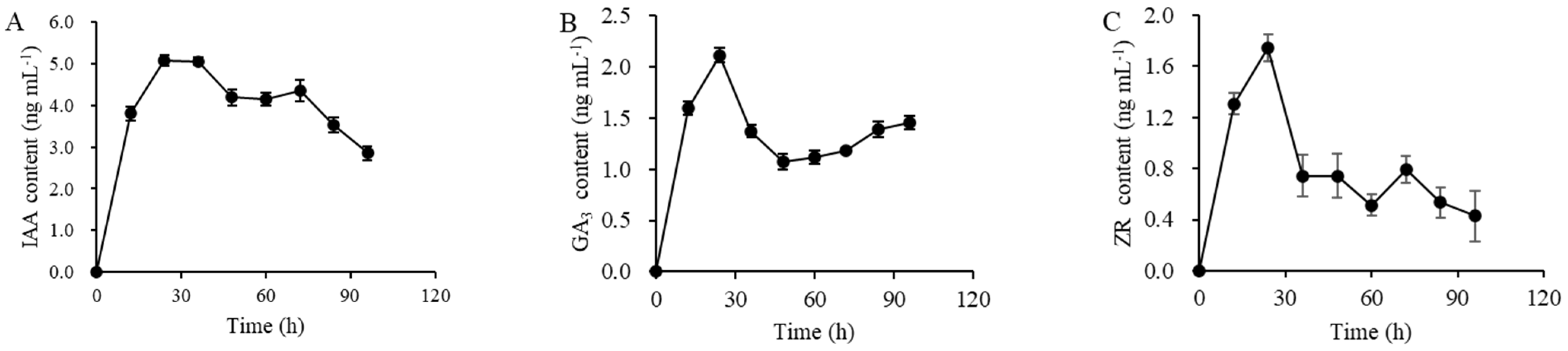
HPLC analysis revealed that P. megaterium could secrete IAA, ZR, and GA3 (Figure 2). The production of these phytohormones increased rapidly in the early stage of cultivation and peaked at 24 h after incubation, and then decreased. During 96 h of incubation, the produced concentrations of IAA ranged from 2.85 to 5.07 ng mL−1 (Figure 2A), those of GA3 from 1.07 to 2.11 ng mL−1 (Figure 2B), and those of ZR from 0.43 to 1.74 ng mL−1 (Figure 2C). This indicated that the P. megaterium strain could produce these phytohormones in vitro, a trait that may contribute to cucumber plant growth promotion by modulating root development and nutrient uptake.

3.4. q-PCR Quantitative Analysis of P. megaterium

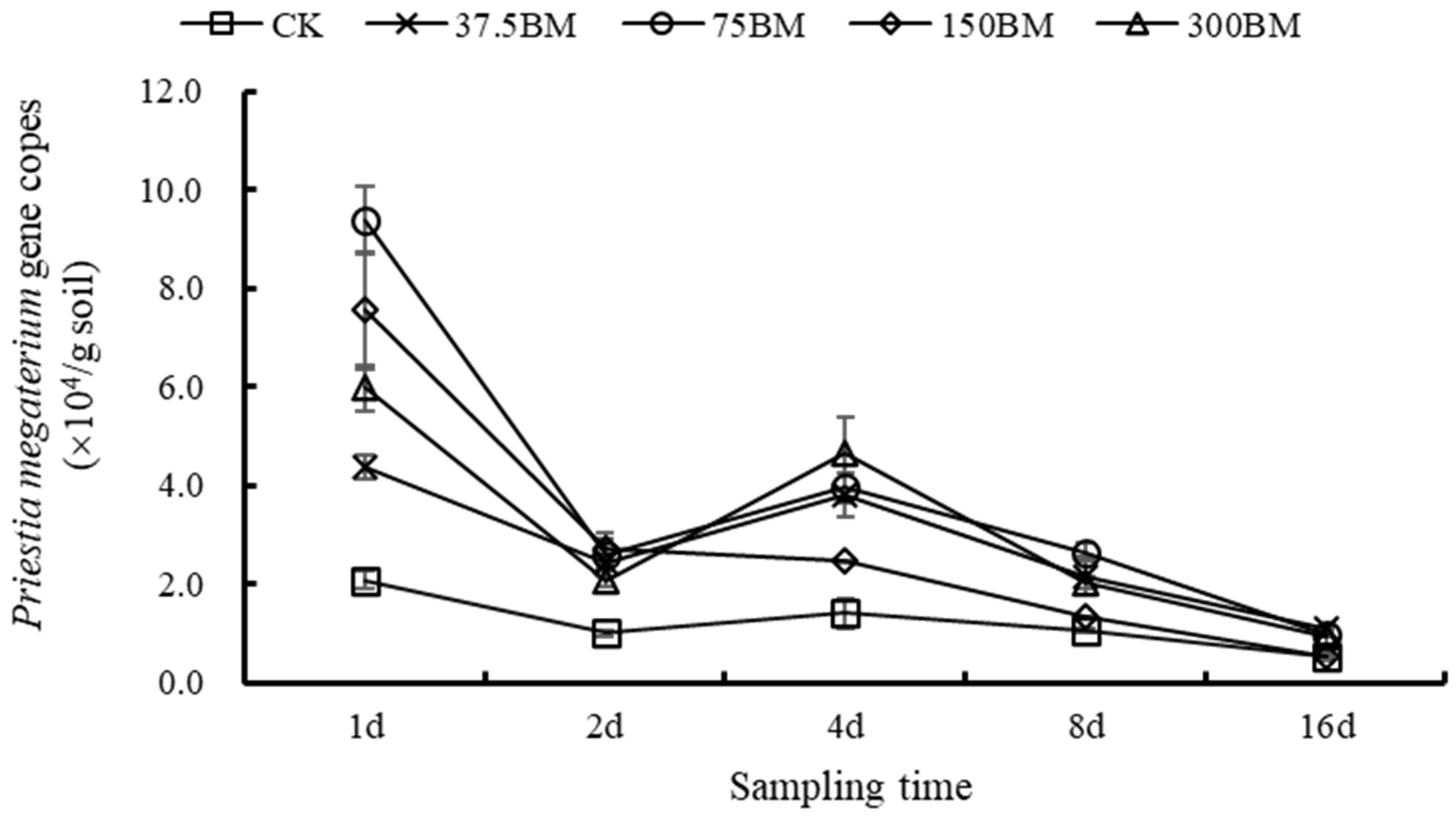
To some extent, application of the P. megaterium inoculant increased the number of copies of this strain in soil significantly within 16 days post-application when compared with the CK (p < 0.05) (Figure 3). At 1 day after inoculation, the number of P. megaterium copies reached a peak value of 9.4 × 10⁴ copies g−1 soil in the 75BM treatment, followed by 7.5 × 10⁴, 6.0 × 10⁴, and 4.4 × 10⁴ copies g−1 soil in 150BM, 300BM, and 37.5BM treatments, respectively. This indicated that the strain could quickly colonize the soil once applied. At 2, 4, and 8 days after inoculation, the number of P. megaterium copies remained between 1.0 × 10⁴ and 4.6 × 10⁴ copies g−1 soil, indicating that the strain maintained a relatively stable population during this early post-application period. Furthermore, at 16 days post-application, the P. megaterium population had decreased to about 103 copies g−1 soil. This suggested that the P. megaterium could establish itself in the soil for a period of time, irrespective of the application rate treatments.

3.5. Effects of P. megaterium on Soil Bacterial Community Diversity

Based on the result that the application of 75 L ha−1 after seedlings were transplanted (BM1) was the optimum way to mobilize soil P, K, and improve P and K cucumber content, the impacts of P. megaterium application on the properties of soil bacterial community under these greenhouse conditions were explored next. Across all soil samples, a total of 1,386,205 high-quality sequences were obtained, with the number of each sample ranging from 36,658 to 54,471; the average reading length was 396.
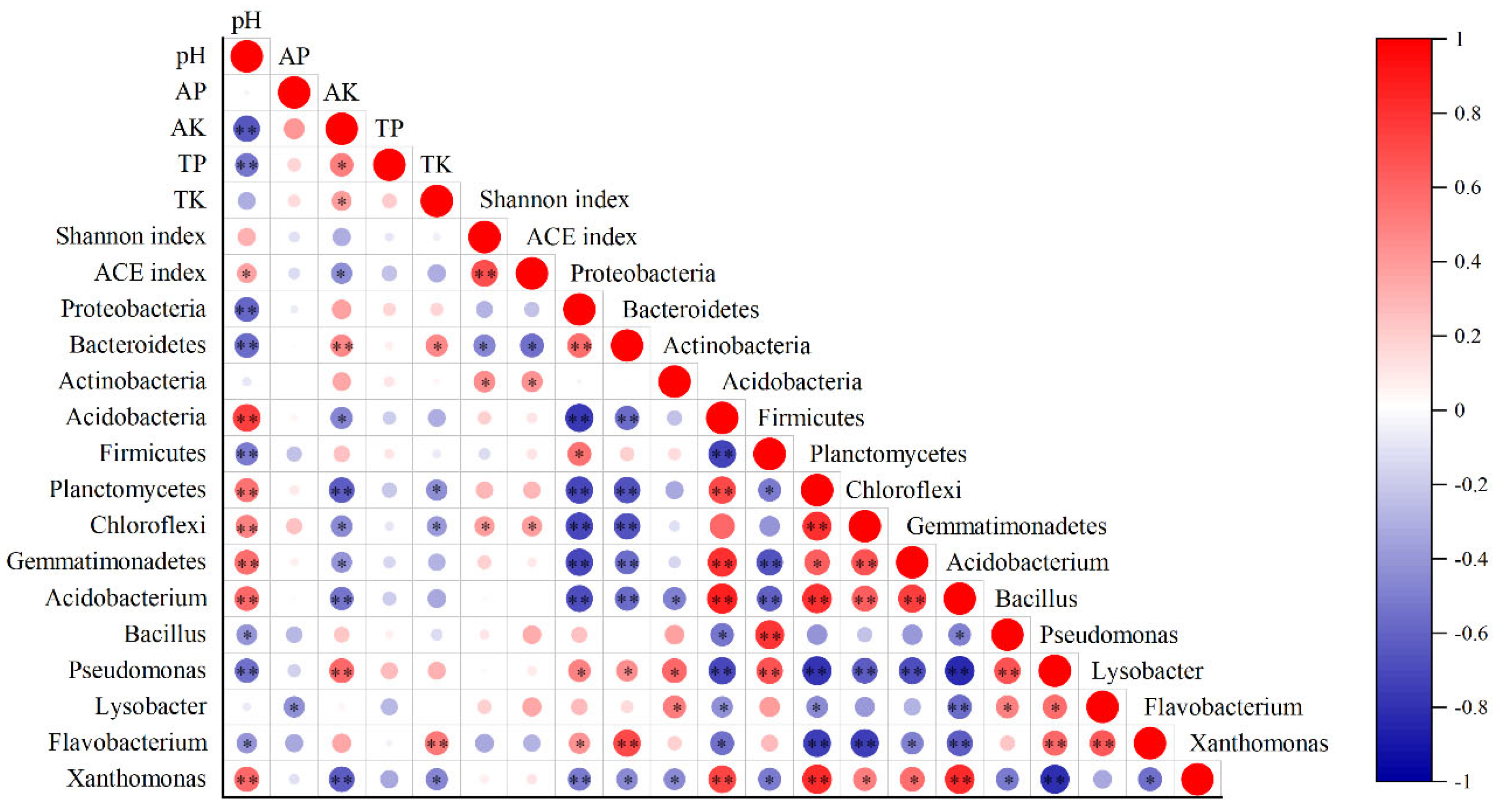
The BM1 treatment increased the ACE index significantly within 60 days after the application when compared with CK (p < 0.05) (Figure S1A). However, there was no significant difference in the Shannon index between the BM1 treatment and CK (Figure S1B). The relationships between α-diversity and soil properties indicated that the ACE index was positively correlated with soil pH but negatively correlated with soil AK and TK (Figure 4). This suggested that the K accumulation in soil, along with the cultivation years, might reduce the diversity of the soil bacterial community.

3.6. Effects of P. megaterium on Soil Bacterial Community Structure

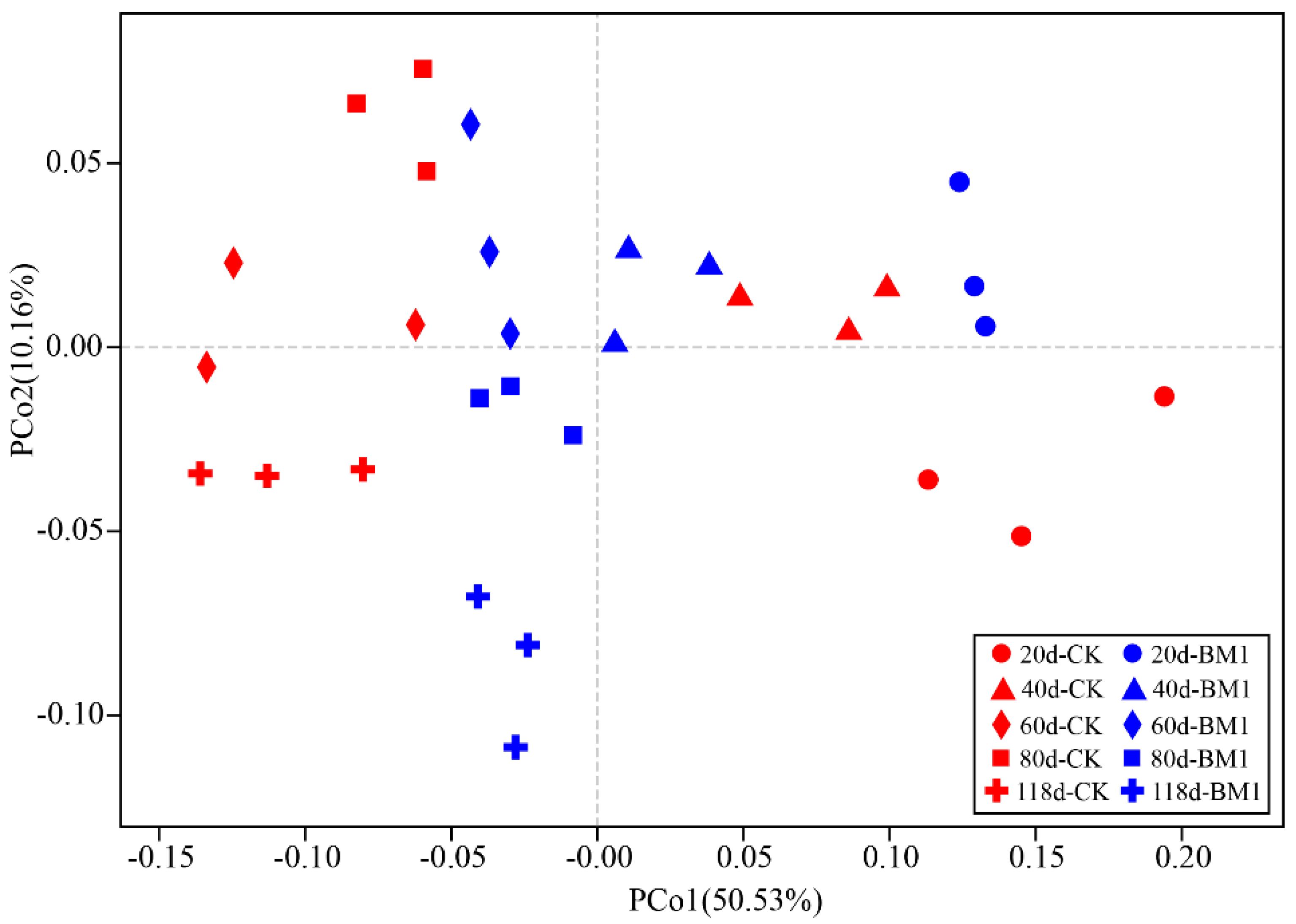
PCoA clearly revealed that the structure of the the soil bacterial community varied among the treatments, with the first two axes explaining 50.53% and 10.16% of the total variation in the bacterial community (PERMANOVA: R2 = 0.716, p = 0.001; Figure 5). The PCo1 generally distributed the bacterial community along the differing plant growth stages. Further, the bacterial community from the BM1 treatment was distinctly separated from that of CK at both 20 d and 80 d along PCo2. These results suggested that the soil bacterial community structure was affected by the application of P. megaterium as well as the particular growth stage of the cucumber.

3.7. Effects of P. megaterium on Soil Bacterial Community Composition

The predominant phyla (>1%) across all samples were Proteobacteria (31.3–41.2%), Bacteroidetes (9.3–17.9%), Actinobacteria (8.0–14.3%), and Acidobacteria (8.7–14.8%), which altogether accounted for more than 67% of the bacterial sequences, followed by Firmicutes (3.6–10.3%), Planctomycetes (4.3–8.3%), Chloroflexi (3.6–8.2%), and Gemmatimonadetes (1.7–3.5%) (Figure S2). Applying P. megaterium significantly affected the relative abundances of the phyla Actinobacteria and Firmicutes (Figure S2, Table S5). The BM1 treatment increased the relative abundance of Firmicutes significantly within 80 days after the application compared to CK. The abundance of Actinobacteria was significantly higher in the BM1 treatment than in CK during the entire growing season, except at 40 d, and Bacteroidetes increased significantly in the BM1 treatment at 20 d.
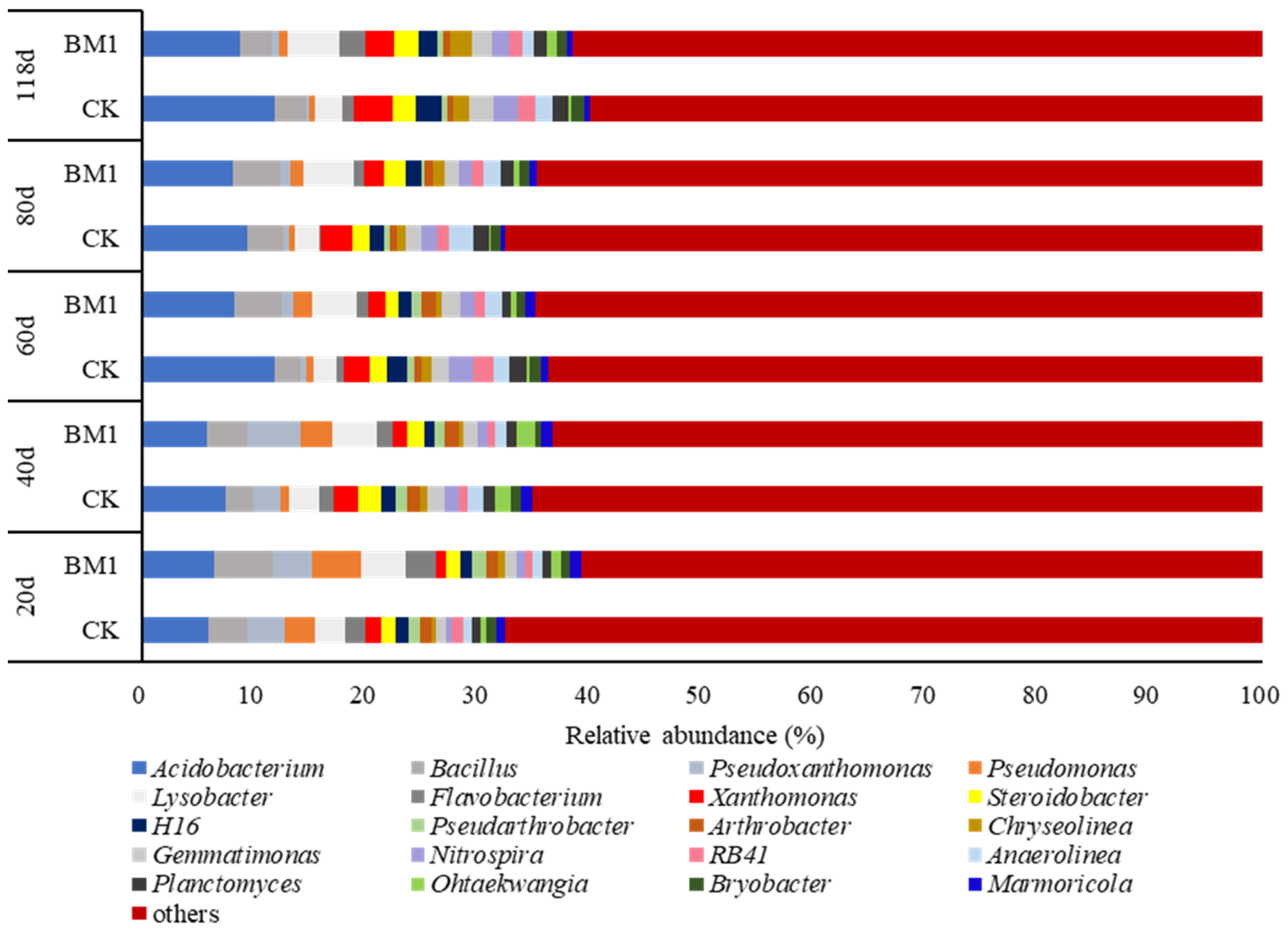
P. megaterium application also significantly changed the relative abundances of dominant genera (Figure 6; Table S6). The relative abundance of the genus Bacillus (phylum Firmicutes) was significantly higher in the BM1 treatment than in CK within 80 days after the application (p < 0.05). For Acidobacterium (phylum Acidobacteria), its relative abundance decreased significantly in the BM1 treatment at 60 d and 80 d compared with CK. Concerning the phylum Proteobacteria, relative abundances of the genera Lysobacter and Pseudomonas increased significantly by 53.9–115.3% and 56.5–254.5%, respectively, in BM1 treatment during the entire growing season, compared with CK. Moreover, compared with CK, the BM1 treatment increased the relative abundance of the genus Flavobacterium (phylum Bacteroidetes) by 47.7–225.0% during the entire growing season except for 40 d. On the contrary, the relative abundance of Xanthomonas decreased by 32.4–40.5% in the BM1 treatment within 80 days after the application when compared with CK (p < 0.05).

3.8. Relationship Between the Soil Bacterial Community Structure and Soil Properties

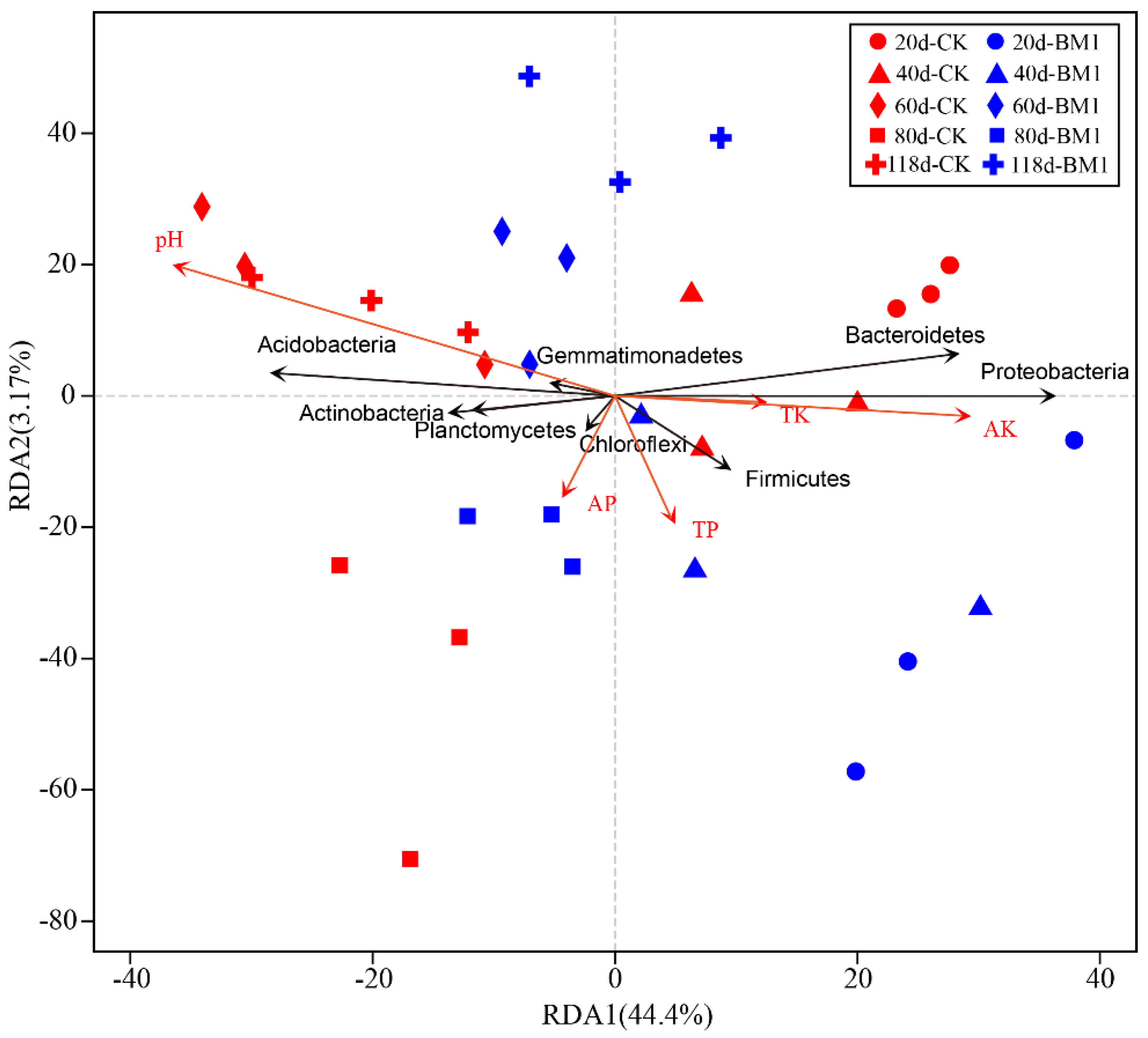
The relation of soil bacterial community to soil properties was investigated and quantified by RDA (Figure 7). The first two axes explained nearly half (47.55%) of the total variance in the data, with the first axis explaining 44.38% and the second explaining 3.17%. Among the soil properties, soil pH (R2 = 0.54 and p = 0.001) and AK (R2 = 0.33 and p = 0.005) were the most important factors affecting the structure of the soil bacterial community, both of which were along the RDA1 axis. Spearman correlations were used to investigate the relationships between soil properties and the relative abundance of dominant bacterial phyla or genera. Most of the abundant taxa were significantly correlated with some of the soil properties, except for the phylum Actinobacteria, which lacked any significant correlation with any soil property (Figure 4). For instance, the relative abundance of the phylum Bacteroidetes was positively correlated with soil AK and TK, but Planctomycetes and Chloroflexi were negatively correlated with them. Relative abundances of phyla Acidobacteria and Gemmatimonadetes were negatively correlated with soil AK. At the genus level, the relative abundance of the genus Pseudomonas was positively correlated with soil AK, while Xanthomonas and Acidobacterium were negatively correlated (Figure 4). In addition, the relatively abundance of Lysobacter was negatively correlated with soil AP. However, the relationships between the dominant phylum or genus and soil TP were all negligible. This indicated that the contents of available P and K accumulated in soil along with the cultivation years likely influenced soil bacterial community composition.

3.9. Effects of P. megaterium on Co-Occurrence Networks of Soil Bacterial Community

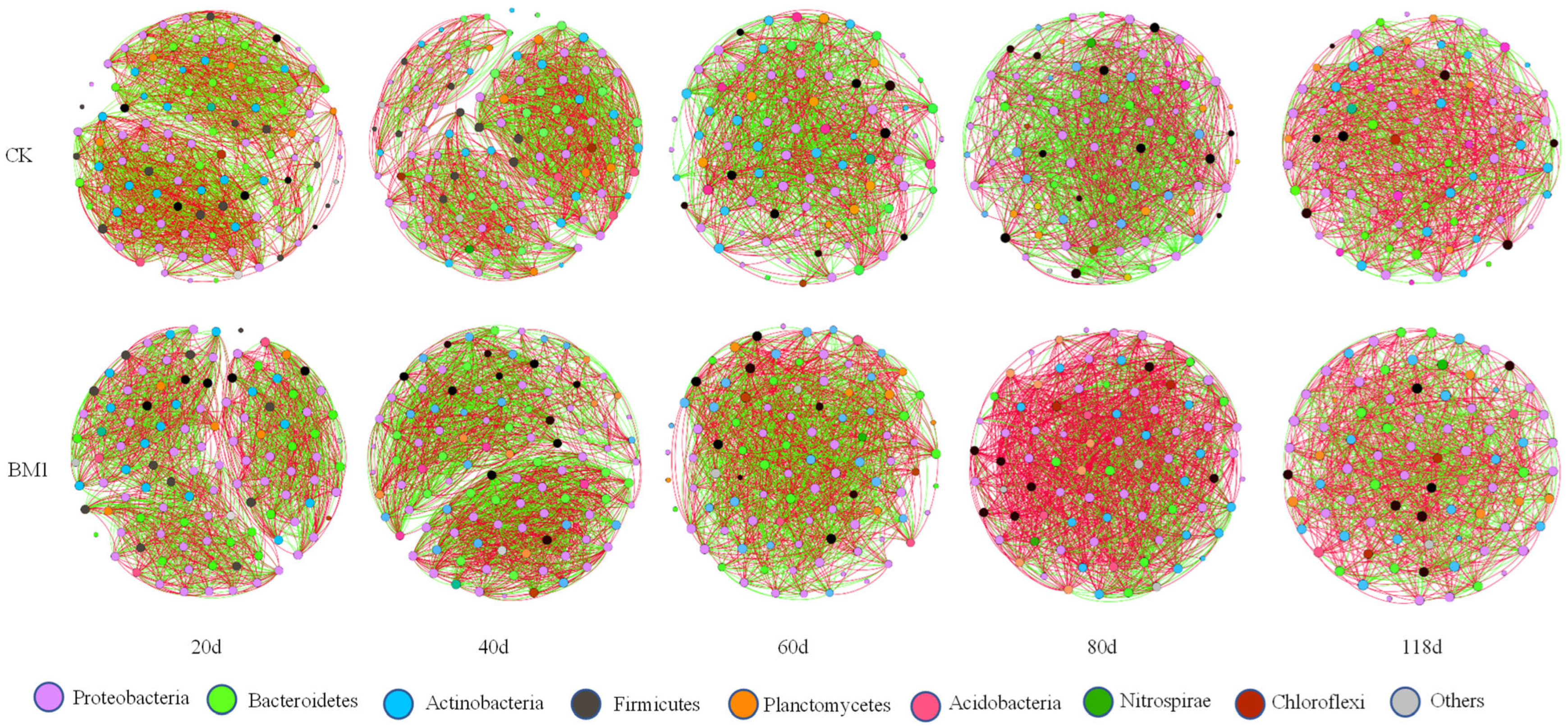
Co-occurrence patterns of the soil bacterial community at the genus level are shown in Figure 8. During the whole growing season, the number of nodes and total links followed a decreasing trend regardless of whether applying P. megaterium or not (Table S7). Specifically, the number of total links was increased after application of P. megaterium during the entire growing season. Furthermore, the positive links were higher in the BM1 (from 51.93% to 72.83%) treatment than in CK (from 48.01% to 52.18%), indicating that the application of P. megaterium increased the positive co-occurrence patterns of the network. It also indicated that the competition between microorganisms is weakening after the application of P. megaterium. In addition, the average clustering coefficient of the BM1 treatment network was increased at 20 d and 80 d after P. megaterium application. The average degree of the bacterial network in the soil of the BM1 treatment was also higher than in CK (Table S7). This indicates that the application of P. megaterium had enhanced the relationships between bacterial groups and had improved possible symbiotic relationships in the soil bacterial community. Moreover, the modularity of BM1 treatment was from 0.489 to 0.663, which was higher than in CK from 0.409 to 0.594. In short, these results revealed that the microbial co-occurrence networks are becoming more strongly developed and more resilient towards environmental stresses after the application of P. megaterium.

4. Discussion

A clear growth-promoting effect of P. megaterium was confirmed in this study, which was conducted in a greenhouse with only two years of planting history. This contrasts with our previous findings in a 15-year-old greenhouse system [24], highlighting the system-specific functionality of PGPR. It is well known that plant growth-promoting bacteria (PGPB) can promote the growth of plants in multiple ways, such as facilitating resource acquisition, regulating plant hormone levels, solubilizing soil nutrients, and inhibiting various pathogens that hamper plant growth and development [39,40], or via a combination of these mechanisms [41]. Phytohormone production is an important trait of PGPB because it can promote the highly organized development of plant root systems that increase their efficiency at nutrient uptake [12]. In our study, HPLC analysis revealed that P. megaterium could secrete IAA, zeatin, and gibberellin, which are known to act as inducers of plant metabolic processes that increase the growth and yield of plants directly [42]. Moreover, the quantification of P. megaterium copies indicated it could colonize the root-affected soil (Figure 3). Here, early colonization was quantified using root-affected soil (0–5 cm), which is most sensitive to initial establishment at the root–soil interface shortly after inoculation. This is a paramount prerequisite of plant–PGPB interactions before PGPB are even able to exert their biocontrol function to diseases and other activities to promote the of growth plant [43]. A previous study also confirmed that high counts of a Bacillus subtilis strain present in root plane and rhizosphere soil would protect plants from soil-borne pathogens, because effective colonization of biocontrol agents is essential for achieving effective control of plant pathogens [44]. Further, 75BM and BM1 treatments increased the yield of cucumber significantly (Table 1). Collectively, these results indicate that applying P. megaterium at 75 L ha−1 at seedling transplantation is an effective practice in a two-year greenhouse system, supporting the idea that inoculation timing targeting early root establishment can maximize functional outcomes under farmer-relevant conditions.
The application of P. megaterium increased the contents of soil AP and AK, as well as both P and K accumulation in cucumber plants (Tables S2–S4). In contrast to the root-affected soil (0–5 cm) sampling used for short-term colonization, seasonal nutrient dynamics were assessed in the 0–20 cm plow layer, a standard depth for evaluating management-driven changes in soil nutrient availability and associated microbial responses [45]. PGPB inoculation can effectively make the inaccessible form of soil nutrients available and also promote their effective absorption and utilization by the roots of various plants [46,47]. Our results indicate that P. megaterium inoculation can enhance the bioavailability and plant uptake of P and K, thereby improving nutrient use in the plant–soil system under intensive greenhouse management. In addition, the Spearman correlations confirmed that cucumber yield increased significantly with more P and K accumulated in its different tissues, indicating that PGPB can also promote plant growth by the solubilization of insoluble nutrients of P and K [25,48]. This finding was consistent with our prior work that showed how a P and K solubilizing inoculant could enhance the yields of chili pepper by increasing the amount of P and K available in soil under greenhouse conditions [41]. Turan et al. [49] observed that inoculation with P. megaterium led to 2–4 times greater P concentrations in different plant organs, and this stimulated the yield of wheat. Therefore, it is suggested that the solubilization of P and K by P. megaterium might constitute another set of mechanisms underlying their ability to promote cucumber growth [8].
Soil microorganisms are considered to play key roles in determining plants’ growth and health [50]. Reduced soil microbial diversity was reported as being responsible for the emergence and development of soil-borne diseases [51]. A greater richness of the bacterial community was also associated with greater functional uniqueness of the soil microbial community, indicating higher diversity in the relative abundance of microbes that are functionally different [52]. In our study, the bacterial diversity within days 60 post-application was significantly higher in the BM1 treatment compared with CK (Figure S1). This indicated that applying the P. megaterium inoculant could enhance the functioning of the soil bacterial community by increasing its bacterial diversity. This finding was consistent with our prior research that was conducted in a greenhouse with cucumber monocropping for more than 15 years [24]. However, this promotion effect lasted for 40 days in the previous study, while 60 days in this study, probably due to the different resident microorganisms between the newly built cucumber greenhouse and the 15-year-old cucumber greenhouse [7]. This longer response window may reflect the higher ecological “plasticity” of bacterial communities during the early years of greenhouse establishment, when community assembly and niche saturation are not yet stabilized. From a management perspective, the finding implies that early-stage systems may provide a broader opportunity for inoculants to steer community development compared with long-established monoculture soils.
Furthermore, the better cucumber growth obtained after application of the P. megaterium may be due to the stimulated growth of the indigenous beneficial bacteria. For example, applying the inoculant increased the relative abundances of Actinobacteria and Firmicutes (Table S5), two taxa consistently associated with plant disease suppression and other plant-growth-promoting properties [50,53]. Therefore, applying the P. megaterium inoculant may enhance the resistance to disease in cucumber and enhance other plant growth-promoting traits by enriching the abundance of these phyla. Moreover, compared with CK, the BM1 treatment significantly enriched the relative abundance of Pseudomonas, Lysobacter, and Flavobacterium genera, whereas it decreased that of Xanthomonas (Figure 6, Table S6). Previous studies have confirmed that the beneficial genera Flavobacterium and Pseudomonas produce auxins and reduce the emission of ethylene [54,55], and Lysobacter could inhibit the growth of various phytopathogenic taxa [56]. Xanthomonas has been reported to cause bacterial spot disease in different crops [57,58]. Notably, the concurrent enrichment of these beneficial genera and suppression of Xanthomonas aligns with previous observations that inoculants can reshape resident microbiomes via indirect facilitation/antagonism rather than direct dominance, especially under protected cultivation, where microbial networks are sensitive to management inputs. It is thus plausible that the pronounced effects of the P. megaterium inoculant application we found were further reinforced by the enrichment of those beneficial microbial taxa in the resident microbiome, leading to effective cucumber growth promotion. In addition, the availability of nutrients such as fertilizers may lead to a shift in microbial communities during the crop-growing period [59,60]. In this study, the changing of the composition of the bacterial community may be responsible for the increasing of the contents of soil AP and AK with the application of P. megaterium inoculant. This can also be explained by the relationships between dominant phylum or genus with soil available P and K (Figure 4). It was reported that the microbial community after inoculation is related to direct antagonism or synergism between inoculants and the indigenous microorganisms, through which inoculants affect the community composition via inhibiting or cultivating other soil microorganisms, respectively [61]. This may help explain the increased relative abundance of beneficial bacterial genera and decreased relative abundance of bacterial pathogen followed applying the P. megaterium inoculant.
The PCoA analysis showed that the structure of the root-affected-soil bacterial community in BM1 treatment differed distinctly from that of CK at 20 d and 80 d (Figure 5). The stage-dependent separation in PCoA is consistent with the well-established concept that rhizosphere communities reassemble across plant developmental stages as root exudation patterns and nutrient demand shift, thereby altering microbial recruitment and interaction structures under greenhouse conditions [62]. Evidence shows that root exudation dynamics vary strongly across plant developmental stages and can drive temporal reassembly of rhizosphere communities, providing a mechanistic basis for stage-dependent community separation in ordination analyses [63,64]. The RDA results indicated that soil pH and AK were the prominent factors affecting the structure of the soil bacterial community (Figure 7). Moreover, the relative abundances of the most abundant bacterial phyla and genera were significantly correlated with those two soil properties (Figure 4). Altogether, these results suggested that soil P or K accumulation would affect both the composition and structure of the soil bacterial community, and that regulation of the soil bacterial community is probably driven by improved bioavailability of soil P and K arising from P. megaterium application.
To better understand soil microbial communities and their responses to environmental changes, a co-occurrence network of the microbiota was created. Previous study showed that agricultural intensification management weakened the stability of the bacterial and fungal community networks, and the stability of the bacterial network was significantly correlated with the composition of the microbial community [65]. In this study, the P. megaterium treatment increased the positive co-occurrence patterns of the network (Table S7), probably due to the application of P. megaterium, which provided a more suitable habitat for microorganisms as well as reduced competition and promoted cooperation between species [66]. The P. megaterium treatment also contributed to a more complex microbial network through increasing the average clustering coefficient, average degree, and modularity (Table S7). The number of nodes and linkages, as well as modularity, are the key properties for network stability [67]. Moreover, the complex networks are more resistant than simple networks to environmental perturbations [68]. In this context, the increased connectivity/modularity observed after inoculation suggests that the inoculant may help counteract the network simplification often associated with intensive management by fostering more positive cooperative associations among resident taxa. Importantly, our data extend these observations to a newly established greenhouse, indicating that microbiome network steering can occur early in the system’s development rather than only as a remediation strategy in degraded long-term monoculture soils. These suggested that the application of P. megaterium could promote the healthy development of the microbial community through increasing the stability of soil bacterial networks. The enhanced stability and complexity of the bacterial network observed in this newly established system suggest that P. megaterium can play a foundational role in steering the microbiome towards a more resilient state, highlighting a potential role for P. megaterium in guiding early microbiome assembly toward a more resilient configuration.

5. Conclusions

This study demonstrates that applying P. megaterium inoculant at the rate of 75 L ha−1 (equivalent to 5.25 × 10¹³ cfu ha−1) at seedling transplantation is a practical approach for enhancing productivity and soil ecosystem development in newly established greenhouses. Here, P. megaterium promoted cucumber growth through a multi-faceted approach: (1) direct phytohormone production; (2) enhanced bioavailability of soil P and K; (3) enrichment of beneficial bacterial genera Lysobacter, Pseudomonas, and Flavobacterium, while suppressing the pathogen Xanthomonas; and most notably, (4) the promotion of a more complex and stable soil bacterial co-occurrence ne=twork. Our findings underscore that the agronomic benefits of PGPR are context-dependent and highlight the unique potential of P. megaterium to shape a healthier and more productive soil microbiome during the critical early years of greenhouse operation.

Supplementary Materials

The following supporting information can be downloaded at: https://www.mdpi.com/article/10.3390/agriculture16030361/s1. Table S1: Summary of treatments and sampling scheme. Table S2: Soil chemical properties at different sampling times under the different fertilization treatments in 2017 growing season (means ± SE, n = 3). Table S3: Soil chemical properties at different sampling times under the different fertilization treatments in 2018 growing season (means ± SE, n = 3). Table S4: The amount of P and K accumulation (kg ha−1) in different tissues (fruits, shoots, roots) of cucumber plants (Means ±SE, n = 3). Table S5: Relative abundances (>1%) of the bacterial phyla of the soil samples in the BM1 treatment and CK (means ± SE, n = 3). Table S6: Relative abundances of the dominant bacterial genera (relative abundance > 1% in at least one sample) of the soil samples in the BM1 treatment and CK (means ± SE, n = 3). Table S7: The key parameters of bacterial community co-occurrence network of the soil samples in the BM1 treatment and CK. Figure S1: The α-diversity indices of the soil bacterial community in the BM1 treatment and the CK (means ± SE, n = 3). Figure S2: Relative abundances of the dominant bacterial phyla (>1%) in soil between the BM1 treatment and the CK (means ± SE, n = 3).

Author Contributions

Conceptualization, Y.Z. and M.Z.; methodology, W.Y. and X.W.; software, Y.Y. and L.M.; validation, H.J.D., W.L. and B.L.; investigation, Y.Z.; resources, W.L. and B.L.; data curation, M.Z.; writing—original draft preparation, Y.Z.; writing—review and editing, Y.Z. and H.J.D.; supervision, W.L. and B.L. All authors have read and agreed to the published version of the manuscript.

Funding

This research was funded by the S&T Program of Hebei, grant number 24466301D; Scientific Research Foundation for Introduced Talents of Hebei Agricultural University, grant number YJ2021045.

Institutional Review Board Statement

Not applicable.

Data Availability Statement

The data presented in this study are available upon request from the corresponding author.

Conflicts of Interest

The authors declare no conflicts of interest.

References

  1. Li, Y.; Gan, Y.; Lupwayi, N.; Hamel, C. Influence of introduced arbuscular mycorrhizal fungi and phosphorus sources on plant traits, soil properties, and rhizosphere microbial communities in organic legume-flax rotation. Plant Soil 2019, 443, 87–106. [Google Scholar] [CrossRef]
  2. Namis, E.; Mohamed, B.; Guo-Chun, D.; Dinah, N.; Nino, W.; Ellen, K.; Günter, N.; Uwe, L.; Leo, V.; Kornelia, S. Enhanced tomato plant growth in soil under reduced P supply through microbial inoculants and microbiome shifts. FEMS Microbiol. Ecol. 2019, 95, fiz124. [Google Scholar] [CrossRef]
  3. Kianpoor Kalkhajeh, Y.; Huang, B.; Hu, W.; Ma, C.; Gao, H.; Thompson, M.L.; Bruun Hansen, H.C. Environmental soil quality and vegetable safety under current greenhouse vegetable production management in China. Agric. Ecosyst. Environ. 2021, 307, 107230. [Google Scholar] [CrossRef]
  4. Olasupo, I.O.; Wang, J.; Wei, X.; Sun, M.; Li, Y.; Yu, X.; Yan, Y.; He, C. Chili residue and Bacillus laterosporus synergy impacts soil bacterial microbiome and agronomic performance of leaf mustard (Brassica juncea L.) in a solar greenhouse. Plant Soil 2022, 479, 185–205. [Google Scholar] [CrossRef]
  5. Xun, W.; Liu, Y.; Li, W.; Ren, Y.; Xiong, W.; Xu, Z.; Zhang, N.; Miao, Y.; Shen, Q.; Zhang, R. Specialized metabolic functions of keystone taxa sustain soil microbiome stability. Microbiome 2021, 9, 35. [Google Scholar] [CrossRef]
  6. Chang, C.; Fu, X.; Zhou, X.; Guo, M.; Wu, F. Effects of seven different companion plants on cucumber productivity, soil chemical characteristics and Pseudomonas community. J. Integr. Agric. 2017, 16, 2206–2214. [Google Scholar] [CrossRef]
  7. Zhao, Y.; Mao, X.; Zhang, M.; Yang, W.; Di, H.J.; Ma, L.; Liu, W.; Li, B. Response of soil microbial communities to continuously mono-cropped cucumber under greenhouse conditions in a calcareous soil of north China. J. Soils Sediments 2020, 20, 2446–2459. [Google Scholar] [CrossRef]
  8. Li, H.; Qiu, Y.; Yao, T.; Ma, Y.; Zhang, H.; Yang, X. Effects of PGPR microbial inoculants on the growth and soil properties of Avena sativa, Medicago sativa, and Cucumis sativus seedlings. Soil Tillage Res. 2020, 199, 104577. [Google Scholar] [CrossRef]
  9. Li, L.; Ma, J.; Mark Ibekwe, A.; Wang, Q.; Yang, C.-H. Influence of Bacillus subtilis B068150 on cucumber rhizosphere microbial composition as a plant protective agent. Plant Soil 2018, 429, 519–531. [Google Scholar] [CrossRef]
  10. Zhao, J.; Ni, T.; Li, J.; Lu, Q.; Fang, Z.; Huang, Q.; Zhang, R.; Li, R.; Shen, B.; Shen, Q. Effects of organic–inorganic compound fertilizer with reduced chemical fertilizer application on crop yields, soil biological activity and bacterial community structure in a rice–wheat cropping system. Appl. Soil Ecol. 2016, 99, 1–12. [Google Scholar] [CrossRef]
  11. Pongsilp, N.; Nimnoi, P. Inoculation of Ensifer fredii strain LP2/20 immobilized in agar results in growth promotion and alteration of bacterial community structure of Chinese kale planted soil. Sci. Rep. 2020, 10, 15857. [Google Scholar] [CrossRef]
  12. Wang, L.; Yang, F.; E, Y.; Yuan, J.; Raza, W.; Huang, Q.; Shen, Q. Long-term application of bioorganic fertilizers improved soil biochemical properties and microbial communities of an apple orchard soil. Front. Microbiol. 2016, 7, 1893. [Google Scholar] [CrossRef] [PubMed]
  13. Conversa, G.; Lazzizera, C.; Bonasia, A.; Elia, A. Yield and phosphorus uptake of a processing tomato crop grown at different phosphorus levels in a calcareous soil as affected by mycorrhizal inoculation under field conditions. Biol. Fertil. Soils 2012, 49, 691–703. [Google Scholar] [CrossRef]
  14. Di Salvo, L.P.; Cellucci, G.C.; Carlino, M.E.; García de Salamone, I.E. Plant growth-promoting rhizobacteria inoculation and nitrogen fertilization increase maize (Zea mays L.) grain yield and modified rhizosphere microbial communities. Appl. Soil Ecol. 2018, 126, 113–120. [Google Scholar] [CrossRef]
  15. Puri, A.; Padda, K.P.; Chanway, C.P. Evidence of nitrogen fixation and growth promotion in canola (Brassica napus L.) by an endophytic diazotroph Paenibacillus polymyxa P2b-2R. Biol. Fertil. Soils 2015, 52, 119–125. [Google Scholar] [CrossRef]
  16. Zhao, Q.; Shen, Q.; Ran, W.; Xiao, T.; Xu, D.; Xu, Y. Inoculation of soil by Bacillus subtilis Y-IVI improves plant growth and colonization of the rhizosphere and interior tissues of muskmelon (Cucumis melo L.). Biol. Fertil. Soils 2011, 47, 507–514. [Google Scholar] [CrossRef]
  17. Wang, B.; Shen, Z.; Zhang, F.; Raza, W.; Yuan, J.; Huang, R.; Ruan, Y.; Li, R.; Shen, Q. Bacillus amyloliquefaciens strain W19 can promote growth and yield and suppress Fusarium Wilt in banana under greenhouse and field conditions. Pedosphere 2016, 26, 733–744. [Google Scholar] [CrossRef]
  18. Huang, F.; Zhang, Y.; Zhang, L.; Wang, S.; Feng, Y.; Rong, N. Complete genome sequence of Bacillus megaterium JX285 isolated from Camellia oleifera rhizosphere. Comput. Biol. Chem. 2019, 79, 1–5. [Google Scholar] [CrossRef]
  19. Wang, Z.; Chen, H.; Zhu, Z.; Xing, S.; Wang, S.; Chen, B. Low-temperature straw biochar: Sustainable approach for sustaining higher survival of B. megaterium and managing phosphorus deficiency in the soil. Sci. Total Environ. 2022, 830, 154790. [Google Scholar] [CrossRef]
  20. Antil, S.; Kumar, R.; Pathak, D.V.; Kumar, A.; Panwar, A.; Kumari, A. Plant growth-promoting rhizobacteria—Bacillus cereus KMT-5 and B. megaterium KMT-8 effectively suppressed Meloidogyne javanica infection. Appl. Soil Ecol. 2022, 174, 104419. [Google Scholar] [CrossRef]
  21. Korir, H.; Mungai, N.W.; Thuita, M.; Hamba, Y.; Masso, C. Co-inoculation Effect of Rhizobia and Plant Growth Promoting Rhizobacteria on Common Bean Growth in a Low Phosphorus Soil. Front. Plant Sci. 2017, 8, 141. [Google Scholar] [CrossRef]
  22. Cheng, T.; Yao, X.; Wu, C.; Zhang, W.; He, W.; Dai, C. Endophytic Bacillus megaterium triggers salicylic acid-dependent resistance and improves the rhizosphere bacterial community to mitigate rice spikelet rot disease. Appl. Soil Ecol. 2020, 156, 103710. [Google Scholar] [CrossRef]
  23. Rocha, F.Y.O.; de Oliveira, C.M.; da Silva, P.R.A.; de Melo, L.H.V.; do Carmo, M.G.F.; Baldani, J.I. Taxonomical and functional characterization of Bacillus strains isolated from tomato plants and their biocontrol activity against races 1, 2 and 3 of Fusarium oxysporum f. sp. Lycopersici. Appl. Soil Ecol. 2017, 120, 8–19. [Google Scholar] [CrossRef]
  24. Zhao, Y.; Mao, X.; Zhang, M.; Yang, W.; Di, H.J.; Ma, L.; Liu, W.; Li, B. The application of Bacillus Megaterium alters soil microbial community composition, bioavailability of soil phosphorus and potassium, and cucumber growth in the plastic shed system of North China. Agric. Ecosyst. Environ. 2021, 307, 107236. [Google Scholar] [CrossRef]
  25. Chaudhary, D.R.; Rathore, A.P.; Sharma, S. Effect of halotolerant plant growth promoting rhizobacteria inoculation on soil microbial community structure and nutrients. Appl. Soil Ecol. 2020, 150, 103461. [Google Scholar] [CrossRef]
  26. Sun, J.; Pan, L.; Li, Z.; Zeng, Q.; Wang, L.; Zhu, L. Comparison of greenhouse and open field cultivations across China: Soil characteristics, contamination and microbial diversity. Environ. Pollut. 2018, 243, 1509–1516. [Google Scholar] [CrossRef]
  27. Shi, L.; Du, N.; Shu, S.; Sun, J.; Li, S.; Guo, S. Paenibacillus polymyxa NSY50 suppresses Fusarium wilt in cucumbers by regulating the rhizospheric microbial community. Sci. Rep. 2017, 7, 41234. [Google Scholar] [CrossRef]
  28. Han, L.; Wang, Z.; Li, N.; Wang, Y.; Feng, J.; Zhang, X. Bacillus amyloliquefaciens B1408 suppresses Fusarium wilt in cucumber by regulating the rhizosphere microbial community. Appl. Soil Ecol. 2019, 136, 55–66. [Google Scholar] [CrossRef]
  29. Zhang, J.; Wang, P.; Tian, H.; Xiao, Q.; Jiang, H. Pyrosequencing-based assessment of soil microbial community structure and analysis of soil properties with vegetable planted at different years under greenhouse conditions. Soil Tillage Res. 2019, 187, 1–10. [Google Scholar] [CrossRef]
  30. Banerjee, S.; Walder, F.; Buchi, L.; Meyer, M.; Held, A.Y.; Gattinger, A.; Keller, T.; Charles, R.; van der Heijden, M.G.A. Agricultural intensification reduces microbial network complexity and the abundance of keystone taxa in roots. ISME J. 2019, 13, 1722–1736. [Google Scholar] [CrossRef]
  31. de Vries, F.T.; Griffiths, R.I.; Bailey, M.; Craig, H.; Girlanda, M.; Gweon, H.S.; Hallin, S.; Kaisermann, A.; Keith, A.M.; Kretzschmar, M.; et al. Soil bacterial networks are less stable under drought than fungal networks. Nat. Commun. 2018, 9, 3033. [Google Scholar] [CrossRef] [PubMed]
  32. Yang, W.; Zhao, Y.; Yang, Y.; Zhang, M.; Mao, X.; Guo, Y.; Li, X.; Tao, B.; Qi, Y.; Ma, L.; et al. A Genomic Analysis of Bacillus megaterium HT517 Reveals the Genetic Basis of Its Abilities to Promote Growth and Control Disease in Greenhouse Tomato. Int. J. Genom. 2022, 2022, 2093029. [Google Scholar] [CrossRef] [PubMed]
  33. Wang, F.; Wang, X.; Song, N. Biochar and vermicompost improve the soil properties and the yield and quality of cucumber (Cucumis sativus L.) grown in plastic shed soil continuously cropped for different years. Agric. Ecosyst. Environ. 2021, 315, 107425. [Google Scholar] [CrossRef]
  34. Wang, C.; Liu, J.; Shen, J.; Chen, D.; Li, Y.; Jiang, B.; Wu, J. Effects of biochar amendment on net greenhouse gas emissions and soil fertility in a double rice cropping system: A 4-year field experiment. Agric. Ecosyst. Environ. 2018, 262, 83–96. [Google Scholar] [CrossRef]
  35. Ma, J.; Chen, T.; Lin, J.; Fu, W.; Feng, B.; Li, G.; Li, H.; Li, J.; Wu, Z.; Tao, L.; et al. Functions of Nitrogen, Phosphorus and Potassium in Energy Status and Their Influences on Rice Growth and Development. Rice Sci. 2022, 29, 166–178. [Google Scholar] [CrossRef]
  36. Shao, J.; Xu, Z.; Zhang, N.; Shen, Q.; Zhang, R. Contribution of indole-3-acetic acid in the plant growth promotion by the rhizospheric strain Bacillus amyloliquefaciens SQR9. Biol. Fertil. Soils 2014, 51, 321–330. [Google Scholar] [CrossRef]
  37. Yusoff, M.Z.; Hu, A.; Feng, C.; Maeda, T.; Shirai, Y.; Hassan, M.A.; Yu, C.P. Influence of pretreated activated sludge for electricity generation in microbial fuel cell application. Bioresour. Technol. 2013, 145, 90–96. [Google Scholar] [CrossRef]
  38. Mao, X.; Yang, Y.; Guan, P.; Geng, L.; Ma, L.; Di, H.; Liu, W.; Li, B. Remediation of organic amendments on soil salinization: Focusing on the relationship between soil salts and microbial communities. Ecotoxicol. Environ. Saf. 2022, 239, 113616. [Google Scholar] [CrossRef]
  39. Gu, Y.; Dong, K.; Geisen, S.; Yang, W.; Friman, V.P. The effect of microbial inoculant origin on the rhizosphere bacterial community composition and plant growth-promotion. Plant Soil 2020, 454, 105–117. [Google Scholar] [CrossRef]
  40. Yang, J.; Wei, S.; Su, D.; Zhang, Z.; Chen, S.; Luo, Z.; Shen, X.; Lai, Y.; Jamil, A.; Tong, J. Comparison of the rhizosphere soil microbial community structure and diversity between powdery mildew-infected and noninfected strawberry plants in a greenhouse by high-throughput sequencing technology. Curr. Microbiol. 2020, 77, 1724–1736. [Google Scholar] [CrossRef]
  41. Zhao, Y.; Zhang, M.; Yang, W.; Di, H.J.; Ma, L.; Liu, W.; Li, B. Effects of microbial inoculants on phosphorus and potassium availability, bacterial community composition, and chili pepper growth in a calcareous soil: A greenhouse study. J. Soils Sediments 2019, 19, 3597–3607. [Google Scholar] [CrossRef]
  42. Jiang, Y.; Wu, Y.; Hu, N.; Li, H.; Jiao, J. Interactions of bacterial-feeding nematodes and indole-3-acetic acid (IAA)-producing bacteria promotes growth of Arabidopsis thaliana by regulating soil auxin status. Appl. Soil Ecol. 2020, 147, 103447. [Google Scholar] [CrossRef]
  43. Yuan, J.; Zhang, N.; Huang, Q.; Raza, W.; Li, R.; Vivanco, J.M.; Shen, Q. Organic acids from root exudates of banana help root colonization of PGPR strain Bacillus amyloliquefaciens NJN-6. Sci. Rep. 2015, 5, 13438. [Google Scholar] [CrossRef] [PubMed]
  44. Cao, Y.; Zhang, Z.; Ling, N.; Yuan, Y.; Zheng, X.; Shen, B.; Shen, Q. Bacillus subtilis SQR 9 can control Fusarium wilt in cucumber by colonizing plant roots. Biol. Fertil. Soils 2011, 47, 495–506. [Google Scholar] [CrossRef]
  45. Shang, W.; Razavi, B.S.; Yao, S.; Hao, C.; Kuzyakov, Y.; Blagodatskaya, E.; Tian, J. Contrasting mechanisms of nutrient mobilization in rhizosphere hotspots driven by straw and biochar amendment. Soil Biol. Biochem. 2023, 187, 109212. [Google Scholar] [CrossRef]
  46. Damodharan, K.; Palaniyandi, S.A.; Le, B.; Suh, J.W.; Yang, S.H. Streptomyces sp. strain SK68, isolated from peanut rhizosphere, promotes growth and alleviates salt stress in tomato (Solanum lycopersicum cv. Micro-Tom). J. Microbiol. 2018, 56, 753–759. [Google Scholar] [CrossRef]
  47. Zhang, N.; Wang, D.; Liu, Y.; Li, S.; Shen, Q.; Zhang, R. Effects of different plant root exudates and their organic acid components on chemotaxis, biofilm formation and colonization by beneficial rhizosphere-associated bacterial strains. Plant Soil 2013, 374, 689–700. [Google Scholar] [CrossRef]
  48. Rana, A.; Saharan, B.; Nain, L.; Prasanna, R.; Shivay, Y.S. Enhancing micronutrient uptake and yield of wheat through bacterial PGPR consortia. Soil Sci. Plant Nutr. 2012, 58, 573–582. [Google Scholar] [CrossRef]
  49. Turan, M.; Gulluce, M.; von Wirén, N.; Sahin, F. Yield promotion and phosphorus solubilization by plant growth-promoting rhizobacteria in extensive wheat production in Turkey. J. Plant Nutr. Soil Sci. 2012, 175, 818–826. [Google Scholar] [CrossRef]
  50. Shen, Z.; Ruan, Y.; Chao, X.; Zhang, J.; Li, R.; Shen, Q. Rhizosphere microbial community manipulated by 2 years of consecutive biofertilizer application associated with banana Fusarium wilt disease suppression. Biol. Fertil. Soils 2015, 51, 553–562. [Google Scholar] [CrossRef]
  51. Raaijmakers, J.M.; Paulitz, T.C.; Steinberg, C.; Alabouvette, C.; Moënne-Loccoz, Y. The rhizosphere: A playground and battlefield for soilborne pathogens and beneficial microorganisms. Plant Soil 2008, 321, 341–361. [Google Scholar] [CrossRef]
  52. Wagg, C.; Schlaeppi, K.; Banerjee, S.; Kuramae, E.E.; van der Heijden, M.G.A. Fungal-bacterial diversity and microbiome complexity predict ecosystem functioning. Nat. Commun. 2019, 10, 4841. [Google Scholar] [CrossRef]
  53. Fu, L.; Ruan, Y.; Tao, C.; Li, R.; Shen, Q. Continous application of bioorganic fertilizer induced resilient culturable bacteria community associated with banana Fusarium wilt suppression. Sci. Rep. 2016, 6, 27731. [Google Scholar] [CrossRef]
  54. Chatterjee, P.; Samaddar, S.; Anandham, R.; Kang, Y.; Kim, K.; Selvakumar, G.; Sa, T. Beneficial soil bacterium Pseudomonas frederiksbergensis OS261 augments salt tolerance and promotes red pepper plant growth. Front. Plant Sci. 2017, 8, 705. [Google Scholar] [CrossRef]
  55. Tsukanova, K.A.; Chebotar, V.K.; Meyer, J.J.M.; Bibikova, T.N. Effect of plant growth-promoting Rhizobacteria on plant hormone homeostasis. S. Afr. J. Bot. 2017, 113, 91–102. [Google Scholar] [CrossRef]
  56. Postma, J.; Stevens, L.H.; Wiegers, G.L.; Davelaar, E.; Nijhuis, E.H. Biological control of Pythium aphanidermatum in cucumber with a combined application of Lysobacter enzymogenes strain 3.1T8 and chitosan. Biol. Control 2009, 48, 301–309. [Google Scholar] [CrossRef]
  57. Constantin, E.C.; Cleenwerck, I.; Maes, M.; Baeyen, S.; Van Malderghem, C.; De Vos, P.; Cottyn, B. Genetic characterization of strains named as Xanthomonas axonopodis pv. dieffenbachiae leads to a taxonomic revision of the X. axonopodis species complex. Plant Pathol. 2016, 65, 792–806. [Google Scholar] [CrossRef]
  58. Principe, A.; Fernandez, M.; Torasso, M.; Godino, A.; Fischer, S. Effectiveness of tailocins produced by Pseudomonas fluorescens SF4c in controlling the bacterial-spot disease in tomatoes caused by Xanthomonas vesicatoria. Microbiol. Res. 2018, 212, 94–102. [Google Scholar] [CrossRef]
  59. Krober, M.; Wibberg, D.; Grosch, R.; Eikmeyer, F.; Verwaaijen, B.; Chowdhury, S.P.; Hartmann, A.; Puhler, A.; Schluter, A. Effect of the strain Bacillus amyloliquefaciens FZB42 on the microbial community in the rhizosphere of lettuce under field conditions analyzed by whole metagenome sequencing. Front. Microbiol. 2014, 5, 252. [Google Scholar] [CrossRef]
  60. Wu, B.; Wang, X.; Yang, L.; Yang, H.; Zeng, H.; Qiu, Y.; Wang, C.; Yu, J.; Li, J.; Xu, D.; et al. Effects of Bacillus amyloliquefaciens ZM9 on bacterial wilt and rhizosphere microbial communities of tobacco. Appl. Soil Ecol. 2016, 103, 1–12. [Google Scholar] [CrossRef]
  61. Mawarda, P.C.; Le Roux, X.; Dirk van Elsas, J.; Salles, J.F. Deliberate introduction of invisible invaders: A critical appraisal of the impact of microbial inoculants on soil microbial communities. Soil Biol. Biochem. 2020, 148, 107874. [Google Scholar] [CrossRef]
  62. Shi, S.; Richardson, A.E.; O’Callaghan, M.; DeAngelis, K.M.; Jones, E.E.; Stewart, A.; Firestone, M.K.; Condron, L.M. Effects of selected root exudate components on soil bacterial communities. FEMS Microbiol. Ecol. 2011, 77, 600–610. [Google Scholar] [CrossRef] [PubMed]
  63. McLaughlin, S.; Zhalnina, K.; Kosina, S.; Northen, T.R.; Sasse, J. The core metabolome and root exudation dynamics of three phylogenetically distinct plant species. Nat. Commun. 2023, 14, 1649. [Google Scholar] [CrossRef]
  64. Ulbrich, T.C.; Rivas-Ubach, A.; Tiemann, L.K.; Friesen, M.L.; Evans, S.E. Plant root exudates and rhizosphere bacterial communities shift with neighbor context. Soil Biol. Biochem. 2022, 172, 108753. [Google Scholar] [CrossRef]
  65. Xue, R.; Wang, C.; Zhao, L.; Sun, B.; Wang, B. Agricultural intensification weakens the soil health index and stability of microbial networks. Agric. Ecosyst. Environ. 2022, 339, 108118. [Google Scholar] [CrossRef]
  66. Liu, X.; Shi, Y.; Kong, L.; Tong, L.; Cao, H.; Zhou, H.; Lv, Y. Long-term application of Bio-compost increased soil microbial community diversity and altered its composition and network. Microorganisms 2022, 10, 462. [Google Scholar] [CrossRef]
  67. Yuan, M.M.; Guo, X.; Wu, L.; Zhang, Y.; Xiao, N.; Ning, D.; Shi, Z.; Zhou, X.; Wu, L.; Yang, Y.; et al. Climate warming enhances microbial network complexity and stability. Nat. Clim. Change 2021, 11, 343–348. [Google Scholar] [CrossRef]
  68. Mei, C.; Wang, H.; Cai, K.; Xiao, R.; Xu, M.; Li, Z.; Zhang, Z.; Cui, J.; Huang, F. Characterization of soil microbial community activity and structure for reducing available Cd by rice straw biochar and Bacillus cereus RC-1. Sci. Total Environ. 2022, 839, 156202. [Google Scholar] [CrossRef]
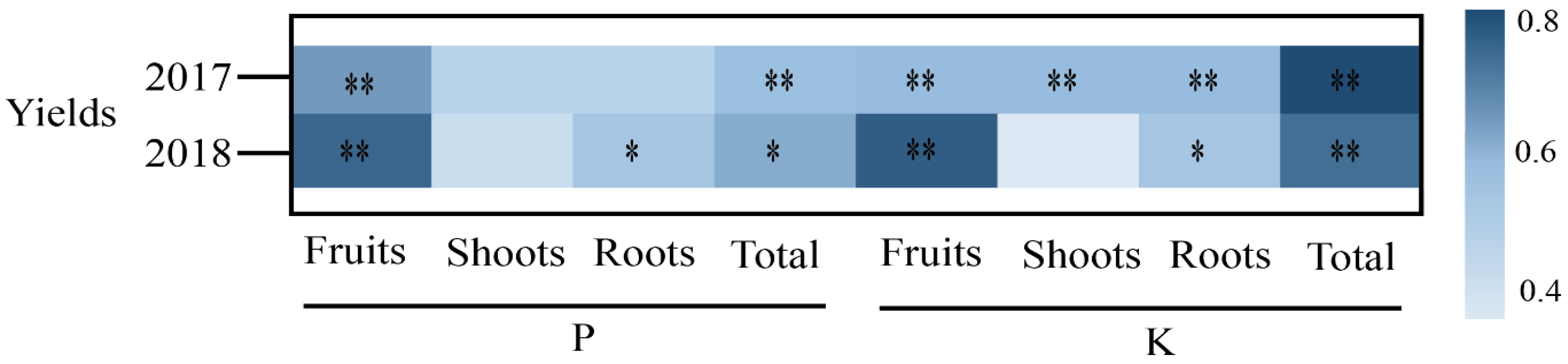
Figure 1. Spearman’s correlation coefficients between cucumber yield and the accumulation of P and K in different tissues of cucumber plants. * p < 0.05, ** p < 0.01.
Agriculture 16 00361 g001
Figure 2. The phytohormone content in the fermentation broth of P. megaterium. (A) IAA, (B) GA3; (C) ZR.
Agriculture 16 00361 g002
Figure 3. Real-time PCR quantification of the number of P. megaterium copies under different treatments (means ± SE, n = 3).
Agriculture 16 00361 g003
Figure 4. Spearman’s correlation analysis between soil properties and the predominant bacterial taxa and α-diversity indices. The size of the circle represents the size of the correlation coefficient. * p < 0.05, ** p < 0.01.
Agriculture 16 00361 g004
Figure 5. PCoA plots based on OTUs and weighted UniFrac distances were generated for the bacterial community structures of BM1 treatment versus the CK.
Agriculture 16 00361 g005
Figure 6. Relative abundances of the dominant bacterial genera in the soils between the BM1 treatment and the CK (means ± SEs, n = 3).
Agriculture 16 00361 g006
Figure 7. Redundancy analysis (RDA) of the soil bacterial community and selected environmental variables for soil samples from the BM1 treatment and the CK.
Agriculture 16 00361 g007
Figure 8. Co-occurring network of soil bacterial community (genus level, BM1 vs. CK). Nodes indicate the genera involved in the networks, and links indicate the relationships among the nodes. Red and green lines represent significant positive and negative relationships (Spearman’s r > 0.9 and p < 0.01). The different colored dots represent the different phyla to which the genera belong.
Agriculture 16 00361 g008
Table 1. Yields (fresh weight) (t ha−1) and dry weights (kg ha−1) of the fruits, shoots, and roots of cucumber plants under different fertilization treatments (means ± SE, n = 3).
Growing SeasonTreatmentsYieldsFruitsShootsRoots
2017CK132.7 ± 2.0 b5759.0 ± 85.6 c5853.0 ± 34.7 b316.7 ± 5.7 b
37.5BM132.8 ± 0.8 b5865.9 ± 55.8 bc5836.6 ± 35.4 b338.2 ± 1.7 ab
75BM141.6 ± 0.8 a6258.4 ± 37.3 a6131.1 ± 78.3 a368.0 ± 16.4 a
150BM140.9 ± 1.8 a6078.0 ± 35.8 ab6057.7 ± 30.2 ab348.2 ± 6.5 ab
300BM141.7 ± 2.5 a6190.8 ± 23.9 a6155.6 ± 80.7 a357.8 ± 6.3 a
2018CK125.5 ± 0.4 b4379.8 ± 15.0 c5119.3 ± 38.4 b517.1 ± 3.3 b
BM1136.6 ± 4.4 a6145.8 ± 196.5 a5367.9 ± 36.7 a542.7 ± 7.5 a
BM2130.0 ± 1.0 ab5341.4 ± 42.4 b5231.3 ± 21.4 ab519.8 ± 4.4 ab
BM1 + BM2128.6 ± 1.4 ab5425.0 ± 57.1 b5188.9 ± 93.1 ab522.1 ± 6.1 ab
Values within the same column in each growing season, followed by different letters, are significantly different at p < 0.05 according to Tukey’s post hoc test.
Disclaimer/Publisher’s Note: The statements, opinions and data contained in all publications are solely those of the individual author(s) and contributor(s) and not of MDPI and/or the editor(s). MDPI and/or the editor(s) disclaim responsibility for any injury to people or property resulting from any ideas, methods, instructions or products referred to in the content.