Numerical Investigation of the Coupled Effects of External Wind Directions and Speeds on Surface Airflow and Convective Heat Transfer in Open Dairy Barns

Abstract
1. Introduction
2. Materials and Methods
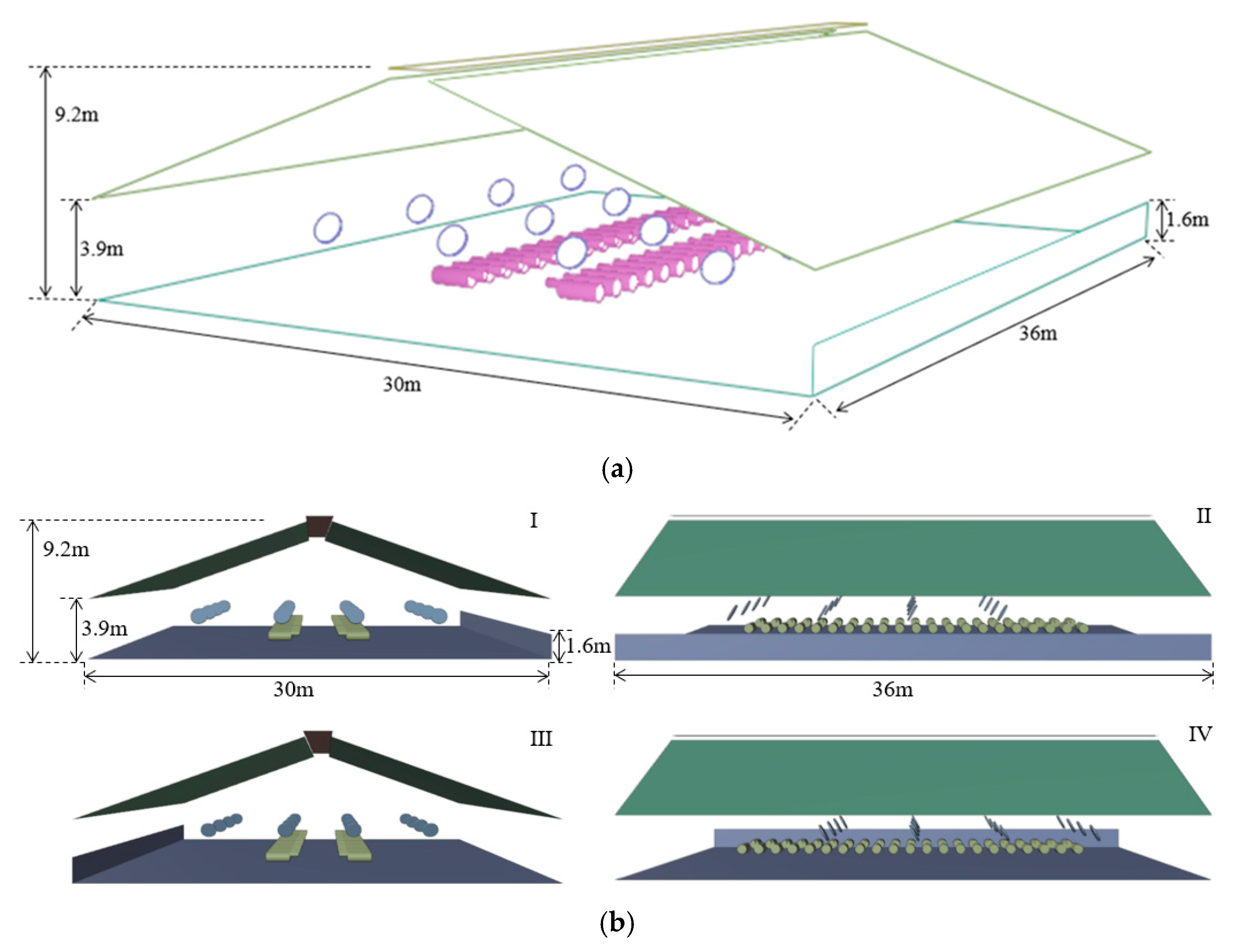
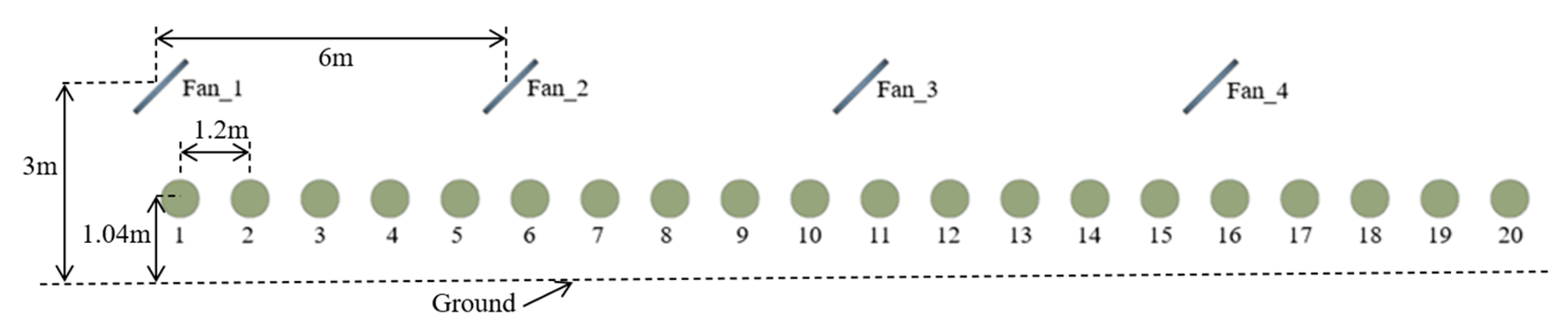
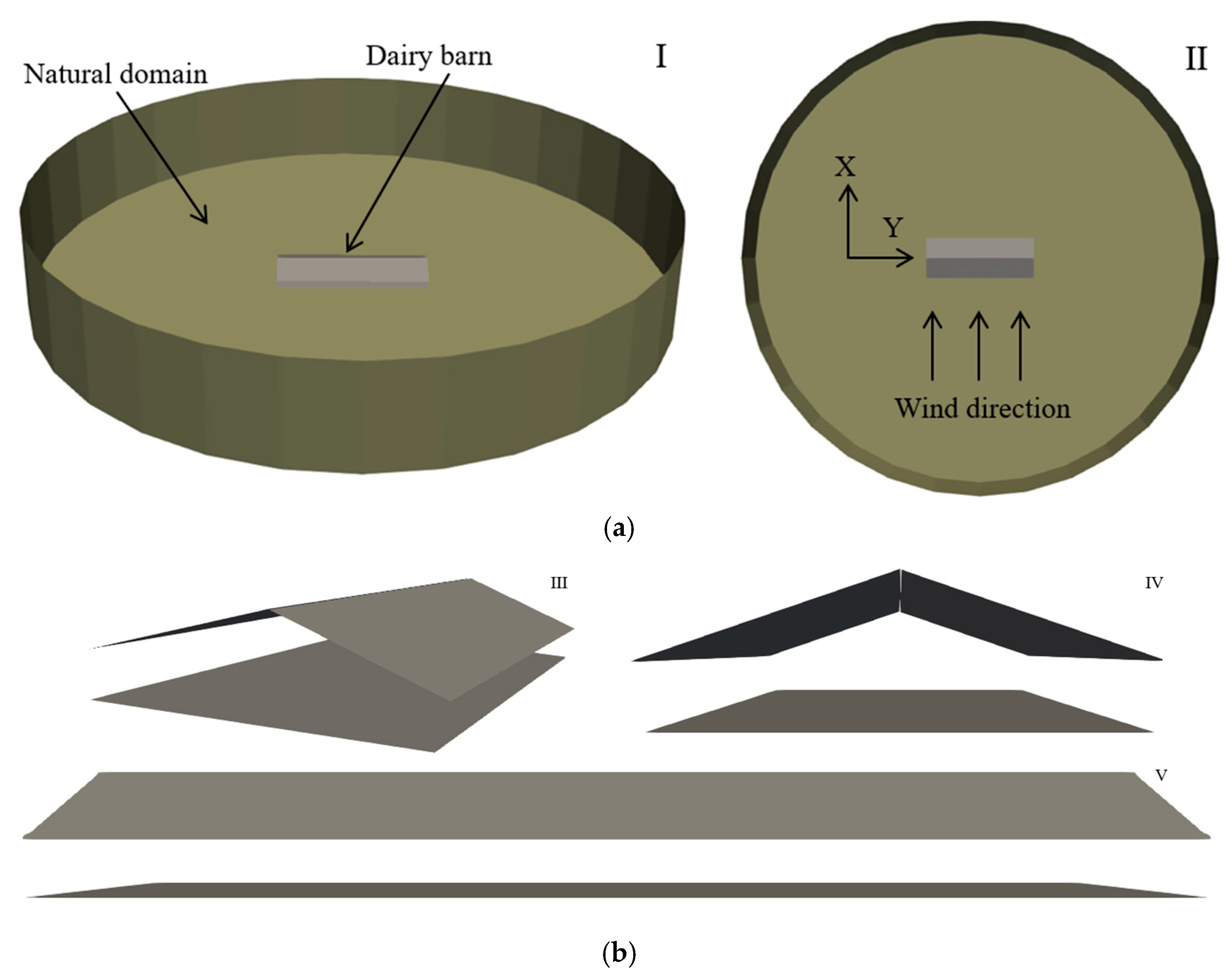
2.1. Geometric Model and Computational Domain
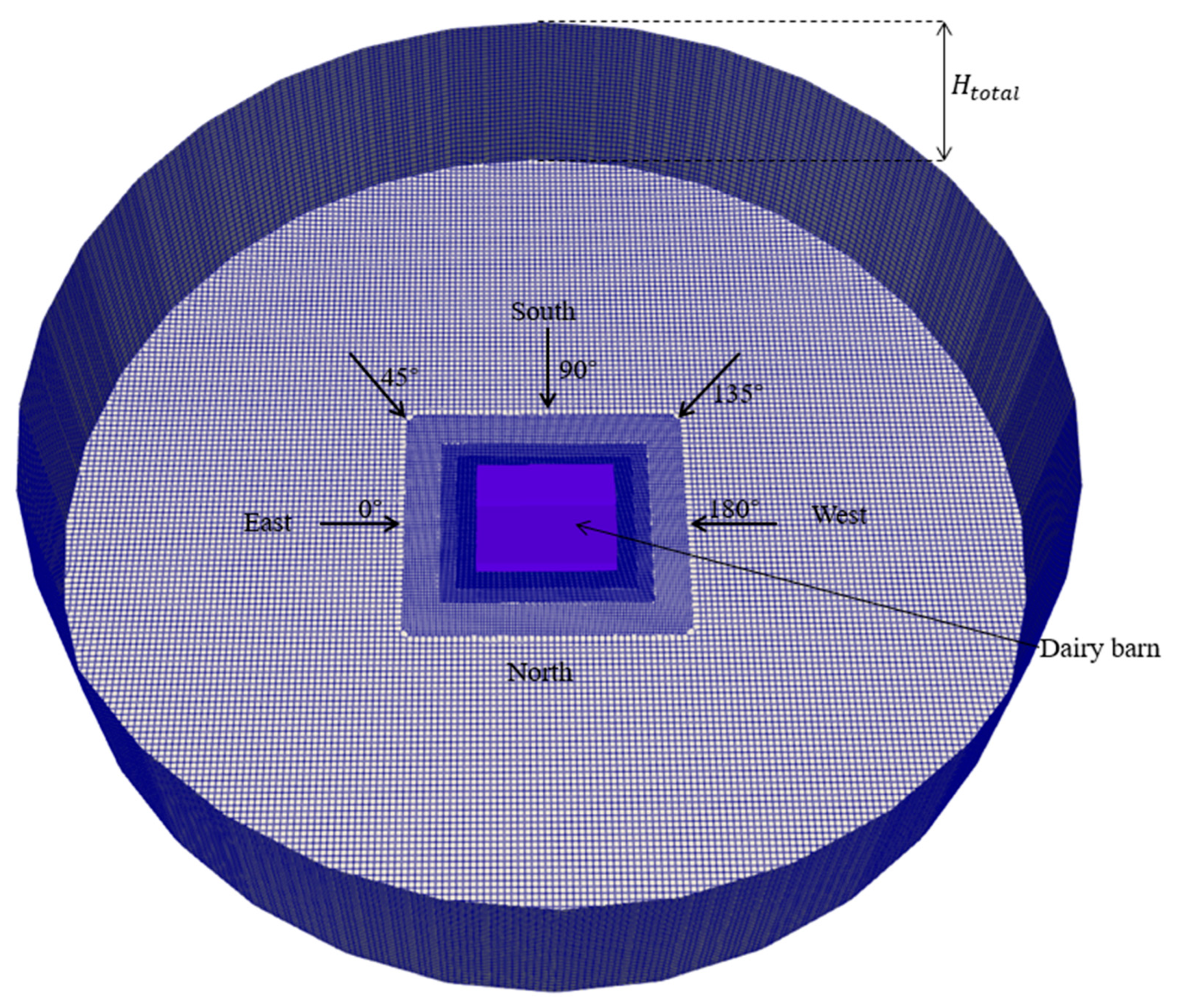
2.2. Meshing Strategy and Independence Test
2.3. Numerical Simulation
2.4. Simulation Cases and Boundary Conditions
2.5. Convective Heat Transsfer
2.6. Statistic Method Used in This Study
2.7. Verification of CFD Model
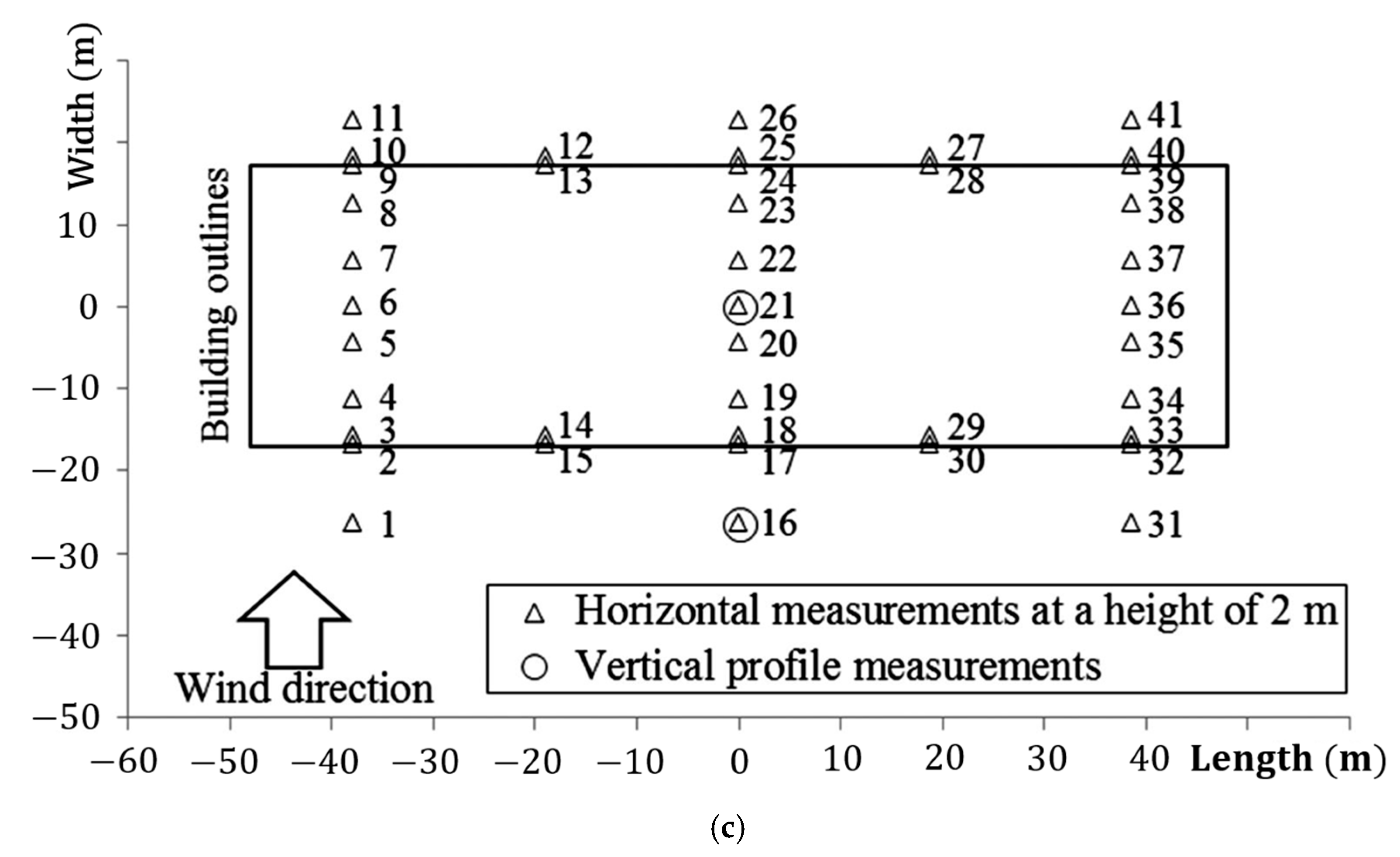
2.7.1. Verification of Wind Speeds and Directions in Natural Domain
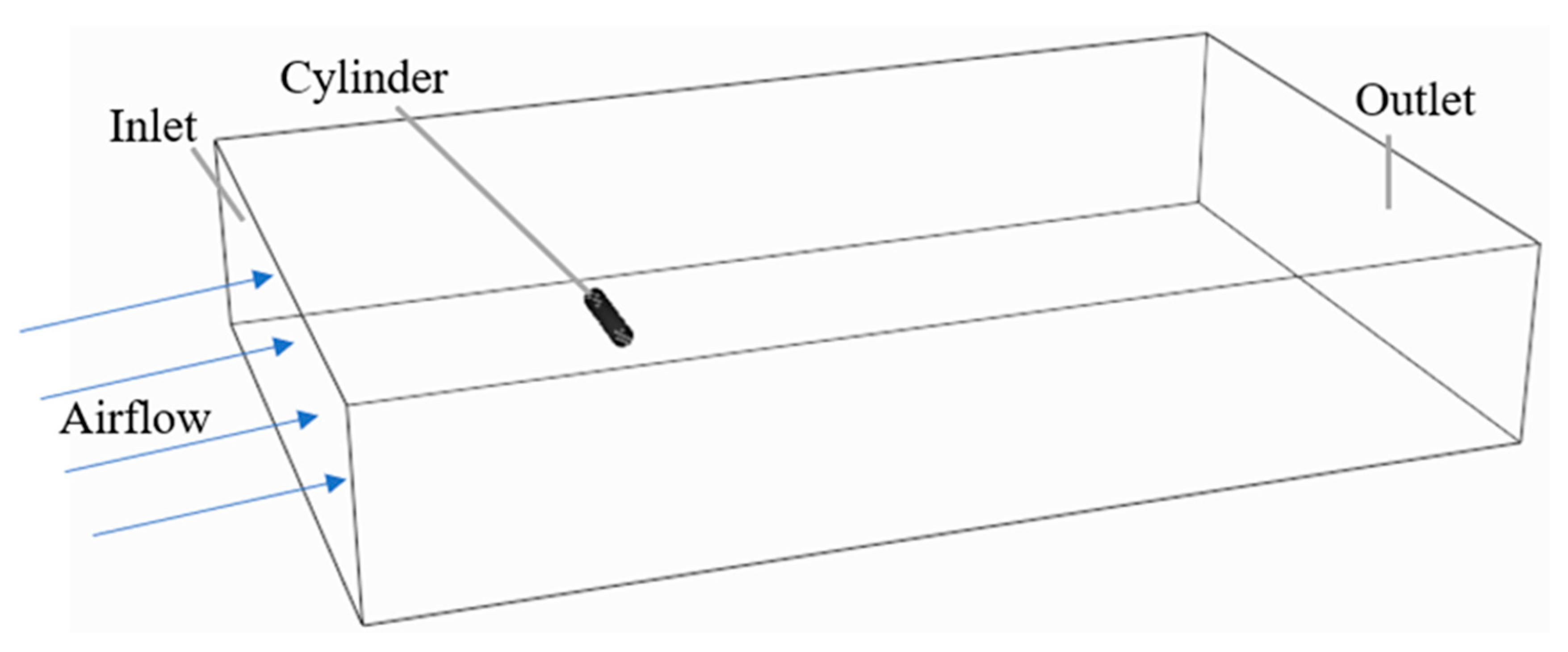
2.7.2. Verification of Convective Heat Transfer
3. Results and Discussion
3.1. Airflow Speed and Convective Heat Transfer CFD Verification
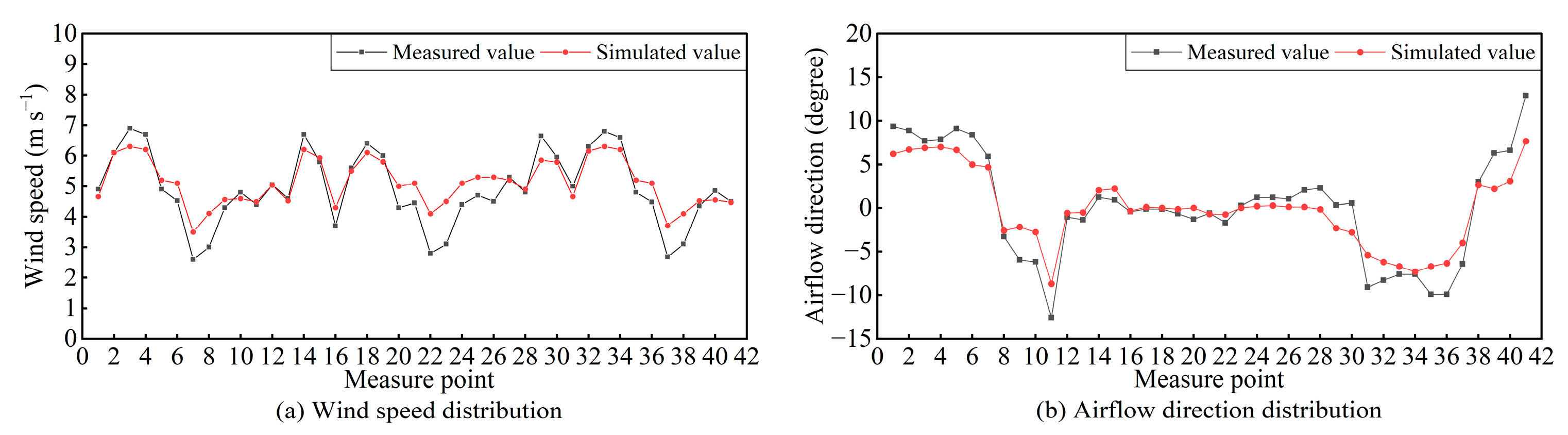
3.1.1. Natural Domain Wind Speed CFD Validation
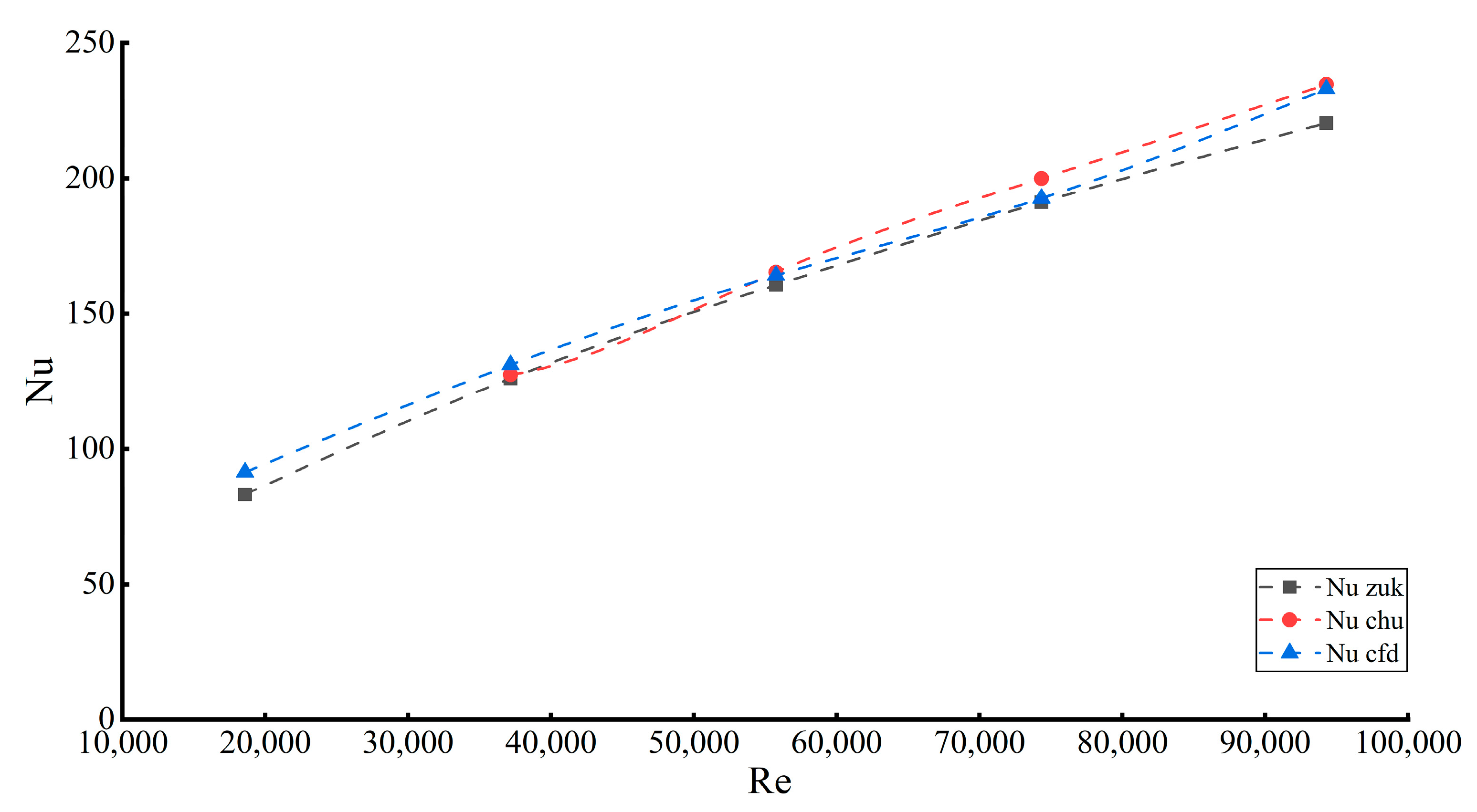
3.1.2. Convective Heat Transfer CFD Verification
3.2. Effects of External Wind Direction and Speed on Cow Surface Airflow
3.3. Effects of External Wind Direction and Speed on Convective Heat Transfer
3.4. Asymmetric Heat Dissipation Between Dorsal and Abdominal Regions Under Different Wind Conditions
3.5. Research Limitations and Perspectives
3.5.1. Applicability and Limitations of the Modeling Scope
3.5.2. Applicability of the Findings to Real World Farming Conditions
3.5.3. Future Research Directions
4. Conclusions
- (1)
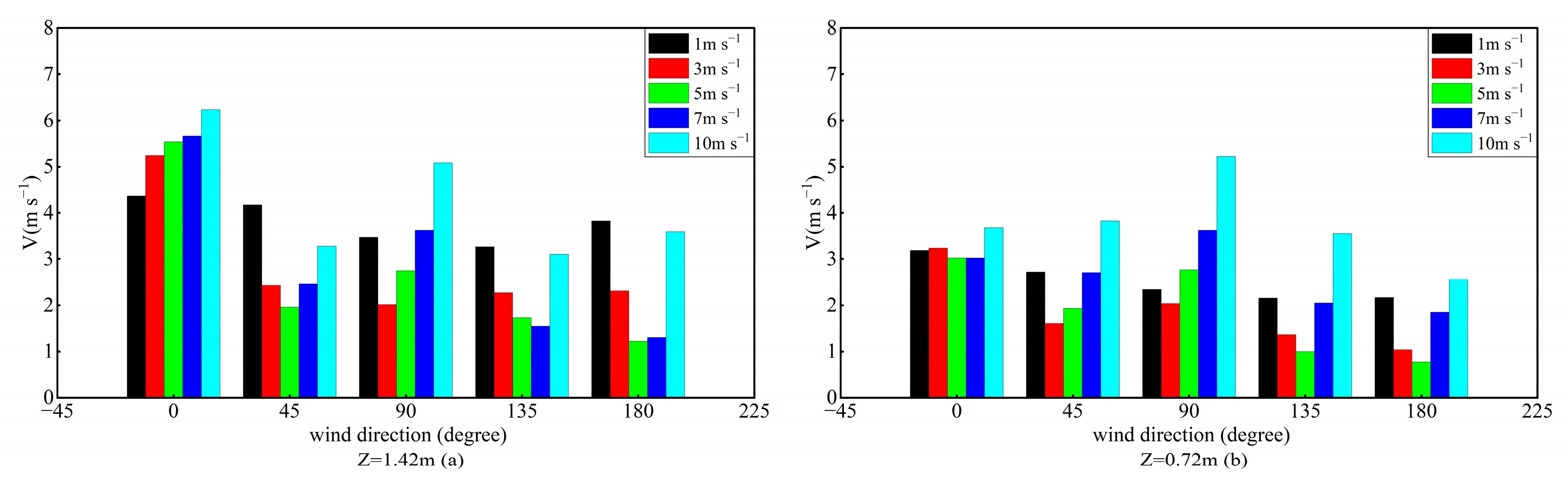
- Under 0° wind direction, the dorsal airflow velocities reached up to 6.2 at 10 wind speed, indicating strong dorsal ventilation, as characterized by elevated airflow velocities over the cow’s dorsal region. In contrast, oblique and opposing winds (45–180°) reduced dorsal airflow velocities to 1.22–4.17 m s−1, reflecting weakened ventilation performance.
- (2)
- The abdominal region exhibited maximum airflow velocities (approximately 5.22 ) under 90° wind direction, but fell below 1 at 135–180° wind direction, reflecting stagnation and limited air renewal beneath the body due to shielding by the body and reduced penetration of the incoming flow.
- (3)
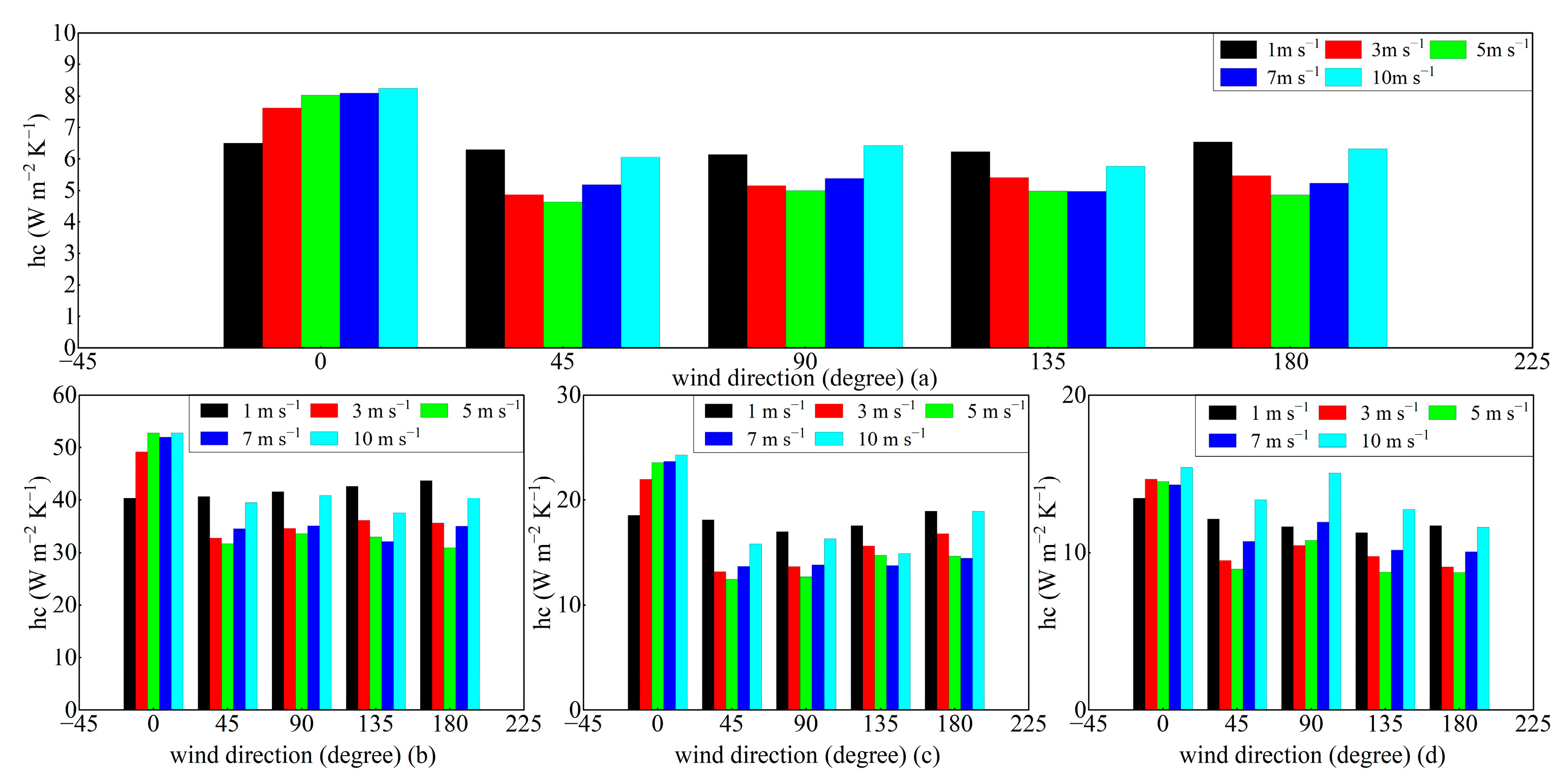
- Under a wind direction of 0°, CHTCs increased linearly with wind speed (6.50–8.24 W m−2 K−1), indicating strong forced convection, while oblique or opposing winds (45–180°) reduced CHTCs by up to 35%, mainly because the incoming flow was less aligned with the fan jet, leading to weakened airflow impingement and reduced air renewal near the body surface.
- (4)
- The dorsal region exhibited 16.3–24.3 W m−2 K−1, whereas the abdominal region remained lowest (approximately 15.4 W m−2 K−1), reflecting weak ventilation and recirculating flow beneath the body, particularly under 135–180° winds.
- (5)
- Both airflow velocity and convective heat transfer analyses showed strong wind direction dependence, with 135–180° producing the sharpest Δ% reductions and highest CV values, indicating unstable, ventilation-limited zones, especially over the torso, the airflow velocities and CHTCs were minimal, indicating the most compromised convective cooling and a decrease in local heat dissipation.
- (6)
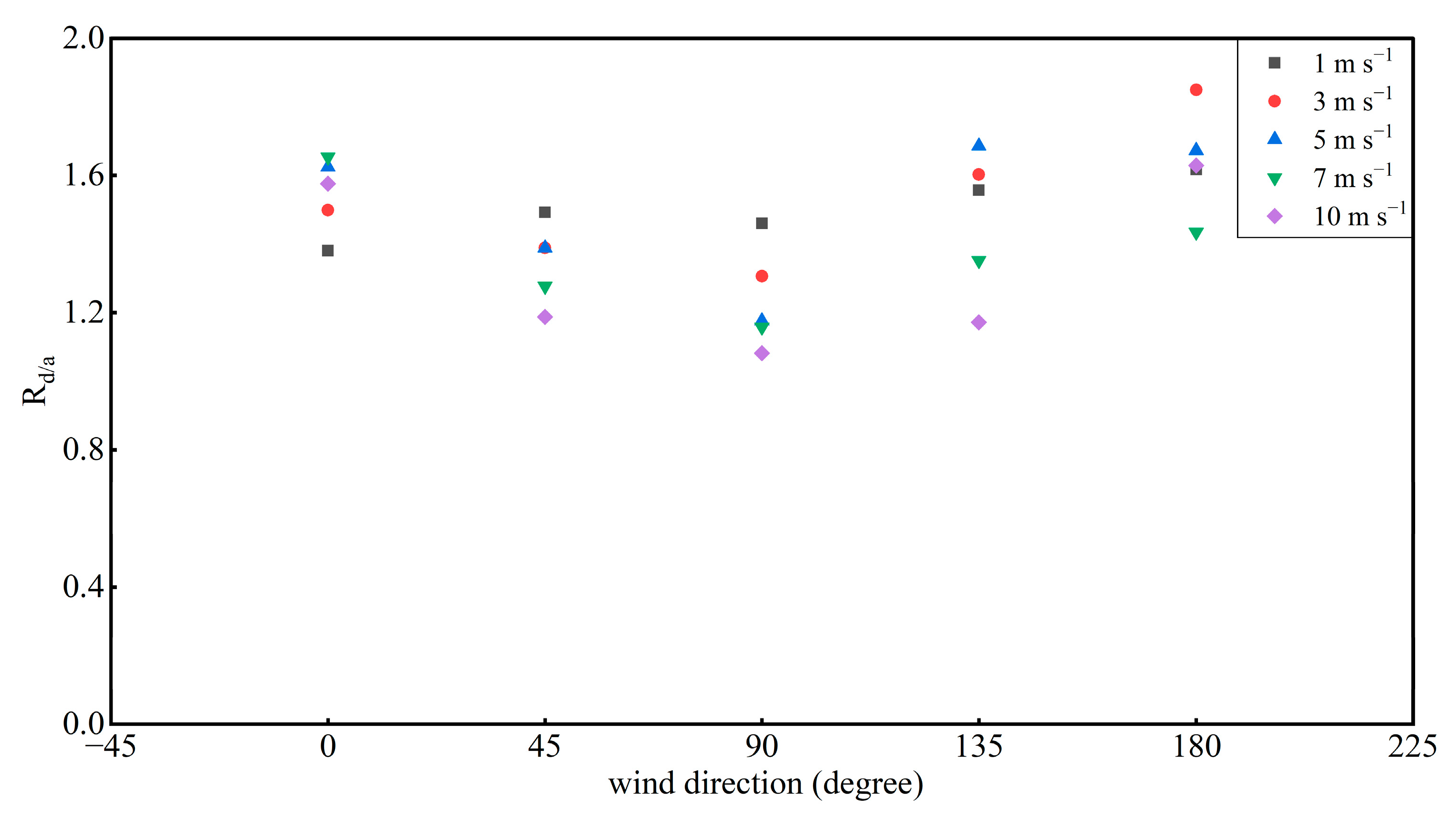
- Under axial winds (0° and 180°), the dorsal-to-abdominal CHTCs ratio () increased from 1.38 to 1.58 with airflow acceleration, whereas crosswinds (45–90°) reduced to nearly 1.1, indicating enhanced abdominal convection and improved thermal symmetry.
Author Contributions
Funding
Institutional Review Board Statement
Data Availability Statement
Conflicts of Interest
Abbreviations
| CFD | Computational fluid dynamics |
| CHTCs | Convective heat transfer coefficients, |
| Open FOAM | Open Source Field Operation and Manipulation |
| RANS | Reynolds-Averaged Navier–Stokes |
| Greek letters: | |
| the laminar thermal diffusivity, m2 s−1 | |
| the effective thermal diffusivity, the sum of laminar and turbulent thermal diffusivity, m2 s−1 | |
| the turbulent thermal diffusivity, m2 s−1 | |
| β | the volumetric expansion coefficient, K−1 |
| ε | the turbulent dissipation rate, m2 s−3 |
| the Karman’s constant | |
| the molecular viscosity, Pa s | |
| the sum of molecular viscosity and turbulent viscosity, Pa s | |
| the turbulent dynamic viscosity, Pa s | |
| ρ | the air density, assumed to vary with temperature, kg m−3 |
| a dimensionless parameter | |
| the reference density of the air, kg m−3 | |
| the tangential stress at the sky top boundary, MPa | |
| υ | the kinematic viscosity, m2 s−1 |
| the face flux, m3 s−1 | |
| ∇· | the divergence operator |
| Symbols: | |
| the empirical coefficient controlling the vertical growth of turbulent dissipation with height | |
| the empirical coefficient setting the baseline turbulent dissipation near the wall | |
| d | the zero plane displacement height, m |
| D | the characteristic dimension, which is the diameter of the cylinder in this study, m |
| D(U) | the rate of the strain tensor |
| Ekp | the production-related term appearing in the transport of turbulent kinetic energy |
| g | the gravitational acceleration, m s−2 |
| h | the sensible enthalpy, J |
| the convective heat transfer coefficients, | |
| the convective heat transfer coefficients over the abdominal regions of cows, | |
| the convective heat transfer coefficients over the dorsal regions of cows, | |
| H | the ridge height of the dairy barn, m |
| the height of the entire computation domain, m | |
| k | the turbulent kinetic energy, m2 s−2 |
| the thermal conductivity of the air, | |
| K | the kinetic-energy-related auxiliary variable involved in the turbulence transport equations as implemented in the buoyantSimpleFoam solver |
| L | the length of the dairy barn, m |
| the dimensionless Nusselt number | |
| the Nusselt numbers calculated from the relevant studies by Churchill and Bernstein [39] | |
| the Nusselt numbers calculated from the relevant studies by Zukauskas [38] | |
| the Nusselt number predicted by CFD simulation | |
| the Nusselt number calculated by empirical formulas | |
| the pressure of the air, Pa | |
| the hydrostatic-corrected pressure, Pa | |
| the Prandtl number, a dimensionless parameter defined as the ratio of the momentum diffusion coefficient to the thermal diffusion coefficient | |
| the convective heat transfer rate, W | |
| the radius of the entire computational domain, m | |
| the dorsal–abdominal CHTCs ratio | |
| the Reynolds number | |
| the surface area of the simplified cow model, m2 | |
| the air temperature, K | |
| the reference temperature of the air, K | |
| the surface temperature of the cow’s body, K | |
| U | the velocity field of the air, m s−1 |
| the friction velocity, m s−1 | |
| the reference wind speed, m s−1 | |
| the free stream speed, m s−1 | |
| the airflow velocity over each region at an external wind speed of 1 m s−1, m s−1 | |
| the airflow velocity over each body region under different external wind speeds, m s−1 | |
| the mean airflow velocity across all wind directions at each external wind speed, m s−1 | |
| W | the width of the dairy barn, m |
| the weight of the cow, kg | |
| z | the vertical height from the reference ground, m |
| the roughness length | |
| the reference height, m | |
References
- West, J.W. Effects of heat-stress on production in dairy cattle. J. Dairy Sci. 2003, 86, 2131–2144. [Google Scholar] [CrossRef]
- Collier, R.J.; Hall, L.W.; Rungruang, S.; Zimbleman, R.B. Quantifying heat stress and its impact on metabolism and performance. Dep. Anim. Sci. Univ. Ariz. 2012, 68, 74–84. [Google Scholar]
- Rong, L.; Liu, D.; Pedersen, E.F.; Zhang, G. The effect of wind speed and direction and surrounding maize on hybrid ventilation in a dairy cow building in Denmark. Energy Build. 2015, 86, 25–34. [Google Scholar] [CrossRef]
- Barrington, S.; Zemanchik, N.; Choiniere, Y. Orienting livestock shelters to optimize natural summer ventilation. Appl. Eng. Agric. 1994, 10, 641–645. [Google Scholar] [CrossRef]
- Christiaens, J. Airflow patterns in animal houses as influenced by wind direction. J. Agric. Eng. Res. 1994, 59, 309–317. [Google Scholar]
- Turner, L.W.; Chastain, J.P.; Hemken, R.W.; Gates, R.S.; Crist, W.L. Reducing heat stress in dairy cows through sprinkler and fan cooling. Appl. Eng. Agric. 1992, 8, 251–256. [Google Scholar] [CrossRef]
- Brouk, M.J.; Smith, J.F.; Harner, J.P., III. Fan Placement and heat stress abatement in 4-row freestall barns. In Proceedings of the 5th Western Dairy Management Conference, Las Vegas, NV, USA, 4–6 April 2001; pp. 161–167. [Google Scholar]
- Ikeguchi, A. Mixing fan installation method for drying wet floors in free-stall houses. Trans. ASAE 1998, 41, 1119–1124. [Google Scholar] [CrossRef]
- The Dairyland Initiative. Ventilation and Heat Abatement in Adult Cow Housing. The Dairyland Initiative, University of Wisconsin-Madison. 2018. Available online: https://thedairylandinitiative.vetmed.wisc.edu/home/housingmodule/adult-cow-housing/ventilation-and-heat-abatement/ (accessed on 24 August 2018).
- Saha, C.K.; Ammon, C.; Berg, W.; Loebsin, C.; Fiedler, M.; Brunsch, R.; von Bobrutzki, K. The effect of external wind speed and direction on sampling point concentrations, air change rate and emissions from a naturally ventilated dairy building. Biosyst. Eng. 2013, 114, 267–278. [Google Scholar] [CrossRef]
- Fiedler, M.; Berg, W.; Ammon, C.; Loebsin, C.; Sanftleben, P.; Samer, M.; von Bobrutzki, K.; Kiwan, A.; Saha, C.K. Air velocity measurements using ultrasonic anemometers in the animal zone of a naturally ventilated dairy barn. Biosyst. Eng. 2013, 116, 276–285. [Google Scholar] [CrossRef]
- Worley, J.W.; Bernard, J.K. Use of High-Volume Low-Speed (HVLS) fans for cooling dairy cows in a free stall barn in a hot humid climate. In 2005 ASAE Annual Meeting; American Society of Agricultural and Biological Engineers: St. Joseph, MI, USA, 2005; Paper No. 054081. [Google Scholar] [CrossRef]
- Worley, J.W.; Bernard, J.K. Cooling effectiveness of High-Volume Low-Speed fans versus conventional fans in a free-stall dairy barn in hot, humid conditions. Prof. Anim. Sci. 2008, 24, 23–28. [Google Scholar] [CrossRef]
- Mondaca, M.R. Ventilation Systems for Adult Dairy Cattle. Vet. Clin. N. Am.-Food Anim. Pract. 2019, 35, 139–156. [Google Scholar] [CrossRef] [PubMed]
- Norton, T.; Sun, D.; Grant, J.; Fallon, R.; Dodd, V. Applications of computational fluid dynamics (CFD) in the modelling and design of ventilation systems in the agricultural industry: A review. Bioresour. Technol. 2007, 98, 2386–2414. [Google Scholar] [CrossRef]
- Lee, I.-B.; Bitog, J.P.P.; Hong, S.-W.; Seo, I.-H.; Kwon, K.-S.; Bartzanas, T.; Kacira, M. The past, present and future of CFD for agro-environmental applications. Comput. Electron. Agric. 2013, 93, 168–183. [Google Scholar] [CrossRef]
- Lee, S.-Y.; Lee, I.-B.; Kim, R.-W. Evaluation of wind-driven natural ventilation of single-span greenhouses built on reclaimed coastal land. Biosyst. Eng. 2018, 171, 120–142. [Google Scholar] [CrossRef]
- Norton, T.; Grant, J.; Fallon, R.; Sun, D.-W. Assessing the ventilation effectiveness of naturally ventilated livestock buildings under wind-dominated conditions using computational fluid dynamics. Biosyst. Eng. 2009, 103, 78–99. [Google Scholar] [CrossRef]
- Bournet, P.; Rojano, F. Advances of computational fluid dynamics (CFD) applications in agricultural building modelling: Research, applications and challenges. Comput. Electron. Agric. 2022, 201, 107277. [Google Scholar] [CrossRef]
- Rong, L.; Nielsen, P.V.; Bjerg, B.; Zhang, G. Summary of best guidelines and validation of CFD modeling in livestock buildings to ensure prediction quality. Comput. Electron. Agric. 2016, 121, 180–190. [Google Scholar] [CrossRef]
- Kim, R.-W.; Hong, S.-W.; Norton, T.; Amon, T.; Youssef, A.; Berckmans, D.; Lee, I.-B. Computational fluid dynamics for non-experts: Development of a user-friendly CFD simulator (HNVR-SYS) for natural ventilation design applications. Biosyst. Eng. 2020, 193, 232–246. [Google Scholar] [CrossRef]
- Sakiyama, N.R.M.; Frick, J.; Bejat, T.; Garrecht, H. Using CFD to evaluate natural ventilation through a 3D parametric modeling approach. Energies 2021, 14, 2197. [Google Scholar] [CrossRef]
- Wang, X.; Zhang, G.; Choi, C.Y. Effect of airflow speed and direction on convective heat transfer of standing and reclining cows. Biosyst. Eng. 2018, 167, 87–98. [Google Scholar] [CrossRef]
- Zhou, B.; Wang, X.; Mondaca, M.R.; Rong, L.; Choi, C.Y. Assessment of optimal airflow baffle locations and angles in mechanically-ventilated dairy houses using computational fluid dynamics. Comput. Electron. Agric. 2019, 165, 104930. [Google Scholar] [CrossRef]
- Mondaca, M.R.; Choi, C.Y.; Cook, N.B. Understanding microenvironments within tunnel-ventilated dairy cow freestall facilities: Examination using computational fluid dynamics and experimental validation. Biosyst. Eng. 2019, 183, 70–84. [Google Scholar] [CrossRef]
- Berman, A. Effects of body surface area estimates on predicted energy requirements and heat stress. J. Dairy Sci. 2003, 86, 3605–3610. [Google Scholar] [CrossRef]
- Hong, S.; Exadaktylos, V.; Lee, I.; Amon, T.; Youssef, A.; Norton, T.; Berckmans, D. Validation of an open-source CFD code to simulate natural ventilation for agricultural buildings. Comput. Electron. Agric. 2017, 138, 80–91. [Google Scholar] [CrossRef]
- Tominaga, Y.; Mochida, A.; Yoshie, R.; Kataoka, H.; Nozu, T.; Yoshikawa, M.; Shirasawa, T. AIJ guidelines for practical applications of CFD to pedestrian wind environment around buildings. J. Wind Eng. Ind. Aerodyn. 2008, 96, 1749–1761. [Google Scholar] [CrossRef]
- CFD Direct. CFD direct user guide for OpenFOAM v12. CFD Direct 2024. Available online: https://doc.cfd.direct/openfoam/user-guide-v12 (accessed on 24 August 2024).
- Defraeye, T.; Herremans, E.; Verboven, P.; Carmeliet, J.; Nicolai, B. Convective heat and mass exchange at surfaces of horticultural products: A microscale CFD modelling approach. Agric. For. Meteorol. 2012, 162, 71–84. [Google Scholar] [CrossRef]
- Wu, J.; Cai, J.; Tang, Z. Thermal-hydraulic analysis of LBE flow in rod bundles with wire spacers based on heat transfer framework of OpenFOAM. Nucl. Eng. Des. 2024, 417, 112843. [Google Scholar] [CrossRef]
- Launder, B.E.; Spalding, D.B. The numerical computation of turbulent flows. In Numerical Prediction of Flow, Heat Transfer, Turbulence and Combustion; Elsevier: Amsterdam, The Netherlands, 1983; pp. 96–116. [Google Scholar] [CrossRef]
- Linden, P.F. The fluid mechanics of natural ventilation. Annu. Rev. Fluid Mech. 1999, 31, 201–238. [Google Scholar] [CrossRef]
- Letan, R.; Dubovsky, V.; Ziskind, G. Passive ventilation and heating by natural convection in a multi-storey building. Build. Environ. 2003, 38, 197–208. [Google Scholar] [CrossRef]
- Wu, W.; Zhai, J.; Zhang, G.; Nielsen, P.V. Evaluation of methods for determining air exchange rate in a naturally ventilated dairy cattle building with large openings using computational fluid dynamics (CFD). Atmos. Environ. 2012, 63, 179–188. [Google Scholar] [CrossRef]
- Fiedler, M.; Fischer, J.; Hempel, S.; Saha, C.; Loebsin, C.; Berg, W.; Amon, B.; Brunsch, R.; Amon, T. Flow fields within a dairy barn-measurements, physical modelling and numerical simulation. In Proceedings of the International Conference of Agricultural Engineering AgEng, Zurich, Switzerland, 6–10 July 2014; pp. 6–10. [Google Scholar]
- Franke, J.; Hellsten, A.; Schlünzen, H.; Carissimo, B. The COST 732 Best Practice Guideline for CFD simulation of flows in the urban environment: A summary. Int. J. Environ. Pollut. 2011, 44, 419–427. [Google Scholar] [CrossRef]
- Žukauskas, A. Heat Transfer from Tubes in Crossflow. Adv. Heat Transf. 1972, 8, 93–160. [Google Scholar] [CrossRef]
- Churchill, S.W.; Bernstein, M. A correlating equation for forced convection from gases and liquids to a circular cylinder in crossflow. J. Heat Transf. 1977, 99, 300–306. [Google Scholar] [CrossRef]
- Bergman, T.L. Fundamentals of Heat and Mass Transfer; John Wiley & Sons: Hoboken, NJ, USA, 2011. [Google Scholar]
- Bergman, T.L.; Lavine, A.S.; Incropera, F.P.; DeWitt, D.P. Introduction to Heat Transfer; John Wiley & Sons: Hoboken, NJ, USA, 2011. [Google Scholar] [CrossRef]
- Bottcher, R.W.; Baughman, G.R.; Munilla, R.D.; Grimes, J.L.; Gonder, E. Development of a large paddle fan for cooling poultry. Appl. Eng. Agric. 1998, 14, 87–96. [Google Scholar] [CrossRef]
- Wu, B.; Gebremedhin, K.G. CFD development and simulation of flow fields in ventilated spaces with multiple occupants. Trans. ASAE 2001, 44, 1839–1847. [Google Scholar] [CrossRef]
- Li, H.; Rong, L.; Zong, C.; Zhang, G. A numerical study on forced convective heat transfer of a chicken (model) in horizontal airflow. Biosyst. Eng. 2016, 150, 151–159. [Google Scholar] [CrossRef]
- Hartje, J. Development of an anisotropic porous model of a single cow for numerical barn simulations–A numerical study. Fluids 2025, 10, 142. [Google Scholar] [CrossRef]
- Hillman, P.E.; Lee, C.N.; Willard, S.T. Thermoregulatory responses associated with lying and standing in heat-stressed dairy cows. Trans. ASAE 2005, 48, 795–801. [Google Scholar] [CrossRef]
- Nordlund, K.V.; Strassburg, P.; Bennett, T.B.; Oetzel, G.R.; Cook, N.B. Thermodynamics of standing and lying behavior in lactating dairy cows in freestall and parlor holding pens during conditions of heat stress. J. Dairy Sci. 2019, 102, 6495–6507. [Google Scholar] [CrossRef]
- Collier, R.J.; Dahl, G.E.; VanBaale, M.J. Major advances associated with environmental effects on dairy cattle. J. Dairy Sci. 2006, 89, 1244–1253. [Google Scholar] [CrossRef]



| (a) | |||||||
| Mesh level | 0 | 1 | 2 | 3 | 4 | 5 | 6 |
| Mesh size (unit: m) | 1.6 | 0.8 | 0.4 | 0.2 | 0.1 | 0.05 | 0.025 |
| (b) | |||||||
| Refinement region | Mesh level of refinement region (Min level; Max level) | ||||||
| Inlet | (0; 0) | ||||||
| Outlet | (0; 0) | ||||||
| Sky | (0; 0) | ||||||
| Ground | (0; 0) | ||||||
| Building walls | (3; 5) | ||||||
| Cow | (5; 6) | ||||||
| Fans | (5; 6) | ||||||
| Terms | Case1 | Case2 | Case3 |
|---|---|---|---|
| Number of Meshes | 6,606,291 | 4,092,959 | 2,290,087 |
| Average speed at Z = 1.42 m (m s−1) | 5.28 | 5.24 | 5.13 |
| Relative Error | 0.0% | 0.76% | 2.84% |
| CHTCs (W m−2 K−1) | 7.78 | 7.72 | 7.48 |
| Relative Error | 0.0% | 0.77% | 3.86% |
| Terms | FvSchemes |
|---|---|
| div (,U) | bounded Gauss linearUpwind default |
| div (,h) | bounded Gauss linearUpwind default |
| div (,Ekp) | bounded Gauss linear |
| div (,K) | bounded Gauss linearUpwind default |
| div (,k) | bounded Gauss upwind |
| div (,) | bounded Gauss upwind |
| div ((() dev2(T(grad(U))))) | bounded Gauss linear |
| Terms | Inlet | Outlet | Sky | Ground | Cow | Walls |
|---|---|---|---|---|---|---|
| calculated | calculated | calculated | atmAlphatkWallFunction | compressible::alphatJayatillekeWallFunction | compressible::alphatJayatillekeWallFunction | |
| k | atmBoundaryLayerInletK | inletOutlet | zeroGradient | kqRWallFunction | kqRWallFunction | kqRWallFunction |
| atmBoundaryLayerInletEpsilon | inletOutlet | zeroGradient | atmEpsilonWallFunction | epsilonWallFunction | epsilonWallFunction | |
| U | atmBoundaryLayerInletVelocity | inletOutlet | fixedShearStress | noSlip | noSlip | noSlip |
| T | fixedValue, 298.15 K | inletOutlet, 298.15 K | zeroGradient | zeroGradient | fixedValue, 311.85 K | zeroGradient |
| p | calculated | calculated | calculated | calculated | calculated | calculated |
| fixedFluxPressure | uniformFixedValue | fixedFluxPressure | fixedFluxPressure | fixedFluxPressure | fixedFluxPressure | |
| calculated | calculated | calculated | atmNutkWallFunction | nutkWallFunction | nutkWallFunction |
| Static Pressure (pa) | 0 | 12 | 25 | 37 | 50 | 62 | 75 |
|---|---|---|---|---|---|---|---|
| Flow rate (m3 s−1) | 12.00 | 11.39 | 10.89 | 10.33 | 9.72 | 8.97 | 8.08 |
| Fan speeds () | 9.47 | 8.99 | 8.60 | 8.16 | 7.67 | 7.08 | 6.38 |
| Regions | Wind Directions | Δ% (Relative to 1 m s−1) | CV | ||||
|---|---|---|---|---|---|---|---|
| 1m s−1 | 3 m s−1 | 5 m s−1 | 7 m s−1 | 10 m s−1 | |||
| dorsal | 0° | 0.0% | 19.9% | 26.8% | 29.5% | 42.6% | 11.3% |
| 45° | 0.0% | −41.7% | −53.0% | −41.0% | −21.3% | 27.2% | |
| 90° | 0.0% | −41.8% | −20.7% | 4.3% | 46.4% | 30.1% | |
| 135° | 0.0% | −30.6% | −47.1% | −52.6% | −5.2% | 29.3% | |
| 180° | 0.0% | −39.7% | −68.1% | −66.1% | −6.3% | 44.9% | |
| abdominal | 0° | 0.0% | 1.6% | −5.3% | −5.3% | 15.0% | 7.4% |
| 45° | 0.0% | −40.8% | −29.0% | −0.4% | 40.8% | 30.1% | |
| 90° | 0.0% | −12.8% | 18.4% | 54.7% | 123.1% | 35.7% | |
| 135° | 0.0% | −37.0% | −53.7% | −5.1% | 64.4% | 43.3% | |
| 180° | 0.0% | −52.1% | −64.5% | −14.7% | 18.0% | 40.3% | |
| Regions | Wind Directions | Δ% (Relative to 1 m s−1) | CV | ||||
|---|---|---|---|---|---|---|---|
| 1m s−1 | 3 m s−1 | 5 m s−1 | 7 m s−1 | 10 m s−1 | |||
| head | 0° | 0.0% | 21.8% | 30.7% | 28.7% | 30.7% | 9.5% |
| 45° | 0.0% | −19.7% | −22.1% | −15.0% | −3.0% | 10.1% | |
| 90° | 0.0% | −16.8% | −19.2% | −15.6% | −1.7% | 9.1% | |
| 135° | 0.0% | −15.3% | −22.8% | −24.7% | −11.7% | 10.4% | |
| 180° | 0.0% | −18.3% | −29.3% | −19.9% | −7.6% | 12.0% | |
| dorsal | 0° | 0.0% | 18.3% | 26.9% | 27.4% | 30.1% | 9.1% |
| 45° | 0.0% | −27.1% | −30.9% | −24.3% | −12.7% | 13.9% | |
| 90° | 0.0% | −19.4% | −25.3% | −18.8% | −4.1% | 11.2% | |
| 135° | 0.0% | −11.4% | −15.9% | −21.6% | −15.3% | 8.3% | |
| 180° | 0.0% | −11.6% | −23.2% | −23.7% | −0.5% | 11.7% | |
| abdominal | 0° | 0.0% | 8.9% | 7.4% | 5.9% | 14.1% | 4.2% |
| 45° | 0.0% | −21.5% | −25.6% | −11.6% | 9.9% | 14.7% | |
| 90° | 0.0% | −10.3% | −7.7% | 1.7% | 29.1% | 13.6% | |
| 135° | 0.0% | −13.3% | −22.1% | −9.7% | 12.4% | 12.7% | |
| 180° | 0.0% | −22.2% | −24.8% | −13.7% | −0.9% | 11.8% | |
Disclaimer/Publisher’s Note: The statements, opinions and data contained in all publications are solely those of the individual author(s) and contributor(s) and not of MDPI and/or the editor(s). MDPI and/or the editor(s) disclaim responsibility for any injury to people or property resulting from any ideas, methods, instructions or products referred to in the content. |
© 2026 by the authors. Licensee MDPI, Basel, Switzerland. This article is an open access article distributed under the terms and conditions of the Creative Commons Attribution (CC BY) license.
Share and Cite
Liang, W.; Deng, J.; Li, H. Numerical Investigation of the Coupled Effects of External Wind Directions and Speeds on Surface Airflow and Convective Heat Transfer in Open Dairy Barns. Agriculture 2026, 16, 315. https://doi.org/10.3390/agriculture16030315
Liang W, Deng J, Li H. Numerical Investigation of the Coupled Effects of External Wind Directions and Speeds on Surface Airflow and Convective Heat Transfer in Open Dairy Barns. Agriculture. 2026; 16(3):315. https://doi.org/10.3390/agriculture16030315
Chicago/Turabian StyleLiang, Wei, Jun Deng, and Hao Li. 2026. "Numerical Investigation of the Coupled Effects of External Wind Directions and Speeds on Surface Airflow and Convective Heat Transfer in Open Dairy Barns" Agriculture 16, no. 3: 315. https://doi.org/10.3390/agriculture16030315
APA StyleLiang, W., Deng, J., & Li, H. (2026). Numerical Investigation of the Coupled Effects of External Wind Directions and Speeds on Surface Airflow and Convective Heat Transfer in Open Dairy Barns. Agriculture, 16(3), 315. https://doi.org/10.3390/agriculture16030315