Article

Effects of Climate Change and Crop Management on Wheat Phenology in Arid Oasis Areas

1
Institute of Desert Meteorology, China Meteorological Administration, Urumqi 830002, China
2
Wulanwusu National Special Test Field for Comprehensive Meteorological Observation, Urumqi 830002, China
3
Wulanwusu Ecology and Agrometeorology Observation and Research Station of Xinjiang, Urumqi 830002, China
4
Xinjiang Climate Center, Urumqi 830002, China
5
Urumqi Meteorological Satellite Ground Station, Urumqi 830011, China
*
Author to whom correspondence should be addressed.
Agriculture 2026, 16(3), 314; https://doi.org/10.3390/agriculture16030314
Submission received: 22 December 2025 / Revised: 20 January 2026 / Accepted: 23 January 2026 / Published: 27 January 2026
(This article belongs to the Section Ecosystem, Environment and Climate Change in Agriculture)

Abstract

Crops grown in ecologically vulnerable oases are increasingly vulnerable to climate change, a trend that poses a severe threat to the sustainability of agricultural production in arid zones. Clarifying the relative contributions of climate change and crop management to crop phenology is critical for designing climate-resilient agricultural practices—yet this remains underexplored for wheat in Xinjiang’s oases, a major arid-region agricultural hub. Using 1981–2021 phenological and meteorological data from 26 agrometeorological stations, we integrated a first-difference multiple regression model, Pearson’s correlation, multiple linear regression, and path analysis to quantify spatiotemporal phenological dynamics; disentangle the distinct impacts of climate and management factors; and identify dominant climatic drivers regulating wheat growth. Temperature was confirmed as the dominant climatic factor regulating wheat growth in arid oasis regions. Results showed that the annual change rates of sowing, emergence, booting, flowering, and maturity dates were 0.261 (−0.027), 0.265 (−0.103), −0.272 (−0.161), −0.269 (−0.226), and −0.216 (−0.127) days/year for winter (spring) wheat, respectively. For phenological durations, the annual change rates of sowing-to-emergence, emergence-to-anthesis, anthesis-to-maturity, vegetative growth period, reproductive growth period, and whole growth period were 0.007 (−0.076), −0.537 (−0.068), 0.096 (0.099), −0.502 (−0.134), 0.068 (0.034), and −0.434 (−0.100) days/year for winter (spring) wheat, respectively. Regarding climatic effects, maximum, minimum, and mean temperatures generally exerted positive impacts on wheat phenological durations; increased precipitation prolonged growth periods; and higher sunshine hours shortened winter wheat growth periods while extending those of spring wheat. Multiple regression and path analysis were employed to clarify the relative importance of climatic and management factors, as well as their direct and indirect effects on wheat phenology and yield. Furthermore, climate change had a substantially weaker impact on wheat phenology and yield compared to crop management, with climatic driver intensity following the order of mean temperature > precipitation > sunshine hours—confirming mean temperature as the key climate-induced driver. Correlation analysis revealed a positive relationship between yield and growth period length. This study provides novel insights into region-specific climate adaptation for wheat production in arid oases, highlighting that planting longer-growth-period varieties is an effective, eco-friendly strategy to enhance climate resilience and ensure sustainable agricultural development in fragile ecosystems.

1. Introduction

The global average surface temperature has risen by a likely range of 0.8 °C to 1.3 °C over the past century, with a 1.09 °C increase recorded between 2001 and 2020—a trend that indicates accelerated warming in recent decades [1]. Climate warming changes the phenology of wild [2] and crop [3] plants. Most studies suggest that rising temperatures drive the advancement of spring phenology and the delay of autumn phenology [4]. However, crop management practices also influence crop phenology, and it is unreasonable to simply attribute shifts in phenology solely to climate warming [5]. Thus, crop modeling approaches [6] and detrended statistical methods [7] have been employed to isolate the independent effects of climatic factors. Therefore, different global change drivers exhibit a hierarchy of impacts on distinct plant phenological stages; climate warming interacts pervasively with other global change drivers to affect plant phenology, with such interactions primarily manifesting as synergistic or antagonistic effects [8].
Whether the impact of crop management on phenology outweighs that of climate change remains a subject of debate. Many studies have argued that the effect of crop management on phenology outweighs that of climate change [9,10], whereas other studies suggested the opposite [11]. Various agronomic management practices exert significant effects on crop phenology and yield. The renewal of soybean and maize cultivars has rendered the impact of agricultural management on crop phenology greater than that of climate change, thereby mitigating the adverse effects of climate [12]. Optimization of sowing timelines and deployment of varieties with phenological characteristics matched to local growing conditions alleviate frost and heat stressors, resulting in a 4.6% improvement in wheat productivity and a diminished risk of total yield loss across most cultivation areas [13]. Optimized agronomic management practices can enhance winter wheat yields by 7–14%; notably, in the Huang–Huai–Hai region, the implementation of such optimized measures achieves a 6% reduction in nitrogen fertilizer application while maintaining or boosting yield performance [14].
In Xinjiang, all agricultural crops are grown exclusively in oasis areas, where water availability supports intensive cultivation. Previous studies analyzed wheat at 9 [15] and 11 [9] sites in Xinjiang’s oases, yet none quantified the proportional contributions of climatic factors (e.g., temperature, precipitation, and sunshine duration) to climate-driven phenological variations.
Therefore, this study utilized data from 26 stations (19 winter wheat, 7 spring wheat) to achieve the following objectives:
  • Examine the spatiotemporal variations in wheat phenological phases, phenological durations, and climatic elements (precipitation, sunshine duration, average temperature, minimum temperature, and maximum temperature) across the 26 stations in Xinjiang during each phenological period;
  • Explore dynamic linkages between climatic elements and changes in phenological durations;
  • Clarify and quantify the independent effects of climate change and crop management practices on the lengths of wheat phenological phases and yield;
  • Assess and compare the relative contribution magnitudes of climate change versus crop management to the observed variations in wheat phenology;
  • Determine the proportional contributions of temperature, precipitation, and sunshine hours to climate-driven shifts in wheat phenology.

2. Materials and Methods

2.1. Wheat Phenology, Wheat Yield, and Climate Data

Xinjiang is located in the northwest of China, covering a total area of 1.66 million square kilometers. Its oasis area reaches approximately 171,800 km2, which accounts for 63.78% of China’s total oasis area [16]. An oasis represents a distinctive geographical feature exclusive to arid and semi-arid zones, functioning as a pivotal hub for ecological stability and human habitation in desert landscapes through its dependence on a sustained water supply [17].
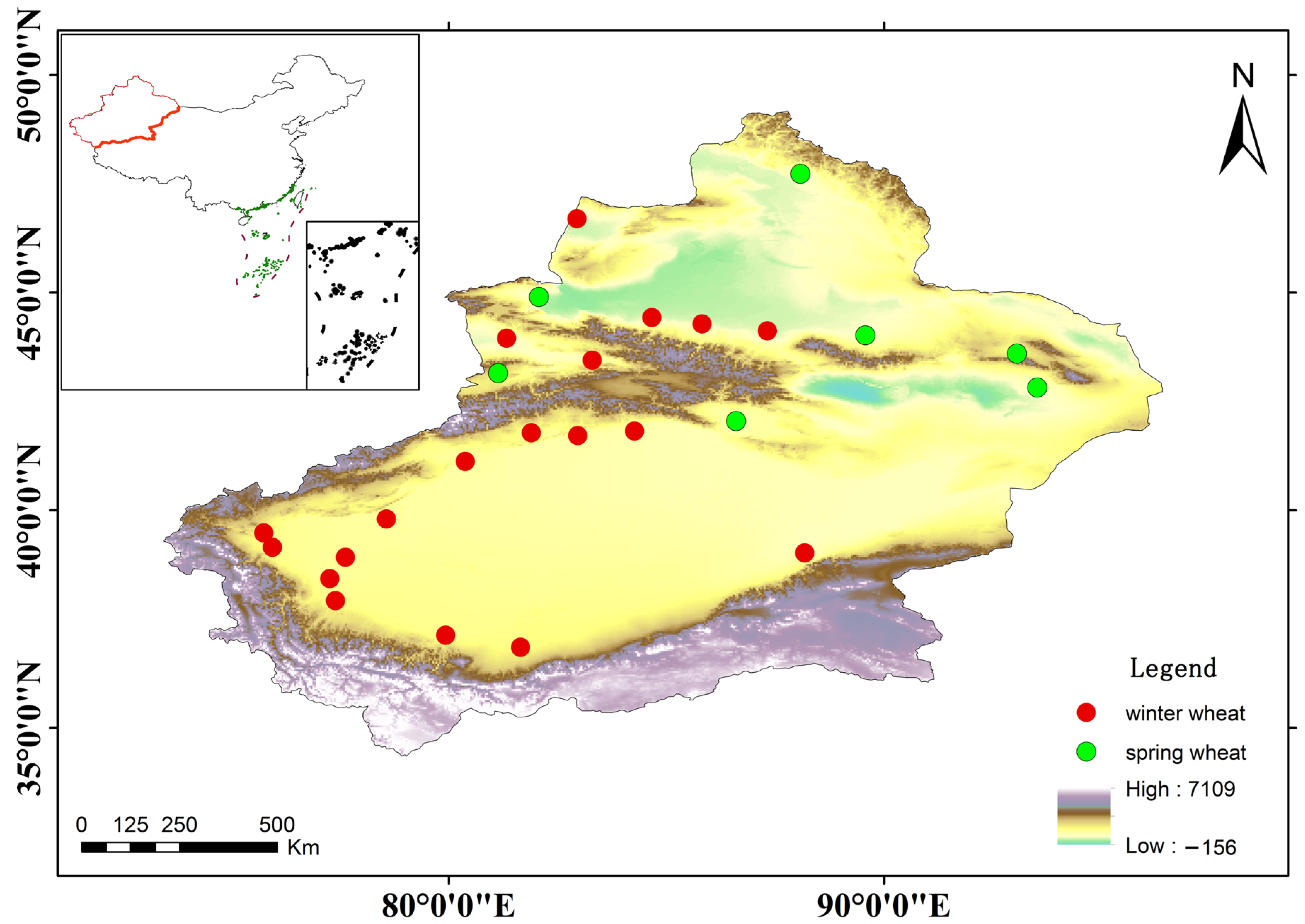
Phenological data for winter wheat (WW, 19 stations) and spring wheat (SW, 7 stations) of Xinjiang, China, spanning 1981–2021, were retrieved from the China Meteorological Administration website (http://data.cma.cn) following rigorous quality control and verification procedures. Phenological data comprised dates of five key phenological events, namely sowing (Sow), emergence (Eme), booting (Boo), anthesis (Ant), and maturity (Mat). Based on these data, several important phenological phases were delineated, including Sow–Eme (sowing to emergence), Eme–Ant (emergence to anthesis), Ant–Mat (anthesis to maturity), the vegetative growing period (VGP, sowing to booting), the reproductive growing period (RGP, booting to maturity), and the whole growing period (WGP, sowing to maturity). To explore the relationship between phenology and wheat yield (WY) as well as the impacts of climate change on WY, WY data from 26 meteorological stations (over 30 consecutive years) were compiled from Xinjiang Meteorological Administration. Daily meteorological data from 1980 to 2021, including maximum temperature (Tmax), minimum temperature (Tmin), mean temperature (Tmean), precipitation (Pre), and sunshine hours (SSH), were retrieved from the same source.
Due to the unique “three mountains surrounding two basins” terrain, Xinjiang features two distinct climatic regimes in southern and northern Xinjiang, with spring wheat grown exclusively in northern Xinjiang (Figure 1). For the 26 study stations, their detailed geographical characteristics, long-term mean climatic factors during the entire wheat growing season, and key phenological events are summarized in Table 1.

2.2. Methods

2.2.1. Temporal Trends in Climatic Factors, Wheat Phenology, and Yield

The average dates for Sow, Eme, Ant, and Mat of wheat were determined for each station. Based on the defined phenological growth stages, the average Tmax, average Tmin, average Tmean, cumulative Pre, and cumulative SSH for the six growth stages (Sow–Eme, Eme–Ant, Ant–Mat, VGP, RGP, and WGP) were calculated for each station.
In this study, linear regression analysis was employed to examine the variation trends of different phenological stages of wheat at 26 stations, as well as the trends of average Tmax, average Tmin, average Tmean, cumulative Pre, and cumulative SSH during these stages. For each station, the temporal variation trend of each variable was derived using the following method:
Ycli_i,j = TcliXi,j + int
where Ycli_i,j is the climatic factors [average Tmax (°C), average Tmin (°C), average Tmean (°C), cumulative Pre (mm), and cumulative SSH (h)] during the corresponding phenological stage in the ith year and the jth station; Tcli represents the linear slope of this factor; int represents the intercept; and Xi,j is the corresponding year. A two-tailed t-test was performed to assess the statistical significance.
By the same token, the variation trends of each wheat phenological stage (Tphe), as well as the variation trends of wheat yield (TWY), can be derived from Equation (1).

2.2.2. Analysis of Correlation and Path Coefficients Among Wheat Phenological Stages, WY, and Related Climatic Factors

As a commonly employed detrending method for establishing climate–yield relationships, the first-order difference method can mitigate the influence of long-term trends stemming from technological advances and other effects induced by adjustments to crop management practices [9,10,18,19,20]. However, the first-difference method also has its limitations, such as high sensitivity to short-term fluctuations, the unintended elimination of long-term climatic trends [21], inability to account for non-linear trends and dynamic panel bias [22], susceptibility to data discontinuity and missing values [23], and reductions in sample size and statistical degrees of freedom [24]. Variations in crop cultivars, fertilization regimes, pesticide application, and agronomic management strategies lead to interannual differences in crop growth performance. To exclude the impacts of non-climatic factors and accurately assess the effects of meteorological conditions on crop growth, the first-difference method was employed in the present study. This approach can significantly reduce the effects of cultivar, fertilizer, and managerial factors, thereby clarifying the interannual response patterns of crop growth to climate variations [25,26].
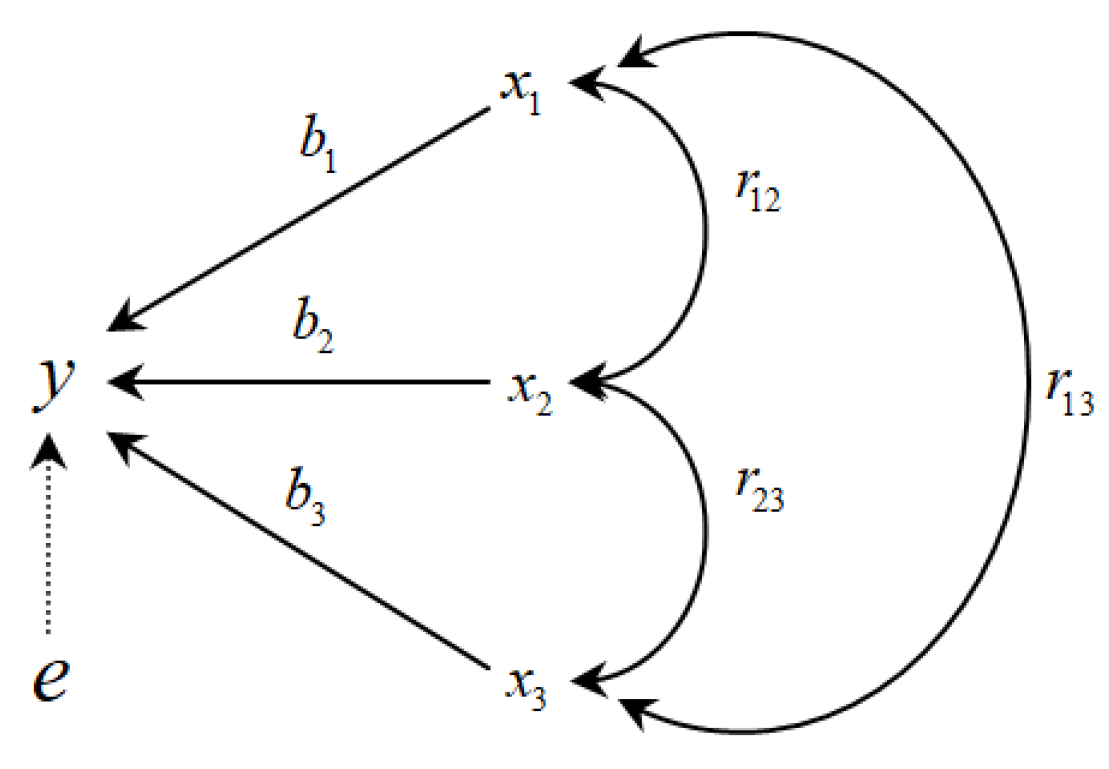
In this study, Pearson’s correlation analysis was performed for pairwise first-order differences (△) in wheat phenological stages, wheat yield (WY), and climatic factors. Subsequently, the path analysis approach was utilized to examine the relationships between y (△ of the six phenological stages) and x1 (△ of average Tmean), x2 (△ of cumulative Pre), and x3 (△ of SSH) during the corresponding phenological stages [27]. The relationships between y and each xi are illustrated in Figure 2. The importance of each xi to y is reflected by the partial regression coefficients bi, while the indirect effects among xi are indicated by rij × bj. Other factors influencing y are characterized by the residual path coefficient e. Therefore, the path chain of path analysis can be described as follows [27]:
r i y = b i + ( r i j × b j )
Ri2 = bi × riy
where riy is the total effect of xi on y; rij is the correlation coefficient between factors; bi is the partial regression coefficient; and Ri2 is the coefficient of determination for xi relative to y.

2.2.3. Disentangle the Effects of Climate Change and Crop Management Practices on Wheat Phenology and Yield

To distinguish the effects of climate change from the combined impacts of climate change and crop management practices on wheat phenological stages and wheat yield (WY), this study applied the △ values of observed wheat phenological stages, wheat yield, and climatic factors to a multiple linear regression analysis [9], which is expressed as follows:
Yphe (△YWY) = Vtem × △Tmean + Vpre × △Pre + VSSH × △SSH + int
where △Yphe (△YWY) denotes the △ value of each phenological phase (WY); △Tmean, △Pre, and △SSH are values of average Tmean, cumulative Pre, and cumulative SSH of the corresponding phenological phase (for WY, this corresponds to the whole growing period, WGP), respectively; int denotes the intercept of the regression model; Vtem, Vpre, and VSSH denote the sensitivities of wheat phenology to Tmean (day·°C−1), Pre (day·mm−1), and SSH (day·h−1), respectively. Key climatic elements, including Tmean, Pre, and SSH, are critical determinants of crop ontogeny and yield formation [28,29]. Furthermore, meteorological factors are interrelated with one another, and their multicollinearity must be taken into account when constructing regression models. Given the low Pearson’s correlation coefficient (r) between climatic variables, Tmean, Pre, and SSH were selected to develop the regression models.
The variation trend of wheat phenology and yield (WY) driven solely by climatic variables is determined using the following method
Tphe_cli (TWY) = Vtem × Ttmean + Vpre × Tpre + VSSH × TSSH
where Tphe_cli (TWY) denotes Tphe (TWY) under the sole influences of climate change; Ttmean, Tpre, and TSSH denote the trends of average Ttmean, cumulative Pre, and cumulative SSH, respectively; other parameters are defined identically to those in Equation (4).
Crop management’s impact on wheat phenology (TWY) is obtained by excluding the effect of climate change from the combined influences of climate change and crop management:
Tphe_man (TWY_man) = Tphe (TWY) − Tphe_cli (TWY_cli)
where Tphe_man (TWY_man) refers to the temporal trend of phenological stage duration (days·year−1) (TWY, kg·ha−1·year−1) affected solely by crop management. All stations utilized a two-sample t-test to assess the mean difference between Tphe and TWY, with a p-value < 0.05 indicating statistical significance at the 0.05 level.

2.2.4. Relative Contributions of Each Factor to Wheat Phenology Trends

Using Equation (5), we obtained the climate-driven-only phenological trends (Tphe_cli) for all stations. Accordingly, the relative contributions of Tmean (RCtmean), Pre (RCpre), and SSH (RCSSH) to wheat phenology were calculated as follows:
R C t m e a n = V t m e a n   × T t m e a n V t m e a n   × T t m e a n + V p r e   × T p r e + V S S H × T S S H × 100 %
where RCtmean specifically quantifies the relative contribution of Tmean to wheat phenology. By the same token, the relative contributions of Pre (RCpre) and SSH (RCSSH) can be computed using Equation (7) in the same manner.
Within a particular phenological phase, the average relative contribution of Tmean ( R C ¯ t m e a n ) change is defined as follows:
R C ¯ t m e a n = i = 1 n R C t m e a n , i i = 1 n R C t m e a n , i + i = 1 n R C p r e , i + i = 1 n R C S S H , i × 100 %
Within Equation (8), n denotes the total number of sites corresponding to each wheat planting regime; similarly, the same approach is used to calculate the average relative contributions of cumulative Pre and SSH across various wheat planting systems, denoted as R C ¯ p r e and R C ¯ S S H .
Climate change-induced contribution percentage (Ywp_cli) to phenological stage length and wheat yield (WY) across individual sites is defined by Equation (9):
Y w p _ c l i = T p h e _ c l i ( T W Y _ c l i ) T p h e _ m a n ( T W Y _ m a n ) + T p h e _ c l i ( T W Y _ c l i ) × 100 %
Likewise, the percentage contribution (%) of crop management (Ywp_man) to phenological duration is calculable via Equation (10):
Y w p _ m a n = T p h e _ m a n ( T W Y _ m a n ) T p h e _ m a n ( T W Y _ m a n ) + T p h e _ c l i ( T W Y _ c l i ) × 100 %
With respect to a given phenological stage duration, the mean contribution ratio of climate change affecting wheat’s phenology ( Y w p _ c l i , ¯ ) is computed as Equation (11):
Y w p _ c l i ¯ = i = 1 n Y w p _ c l i ,   i i = 1 n Y w p _ c l i , i + i = 1 n Y w p _ m a n , i × 100 %
Correspondingly, with respect to a given phenological stage duration, the mean contribution percentage of crop management affecting wheat phenology (Ywp_man) is computed via Equation (12):
Y w p _ m a n ¯ = i = 1 n Y w p _ m a n ,   i i = 1 n Y w p _ c l i , i + i = 1 n Y w p _ m a n , i × 100 %
where n represents the number of observation sites for each wheat phenological stage; Ywp_cli,i and Ywp_man,i represent the climate change-driven and crop management-induced contribution percentages at the i-th site, respectively.

2.2.5. Data Analysis Tools and Graphing Software

ArcGIS 10.5 (Esri, Redlands, CA, USA) was used for mapping wheat observation stations, the spatial variations in phenological trends, and the spatial variations in yield trends. Trend analysis and multiple regression models were conducted using SPSS 26 (IBM Corp., Armonk, NY, USA). The results of trend analysis, phenological contribution rates, and box plots were generated with SigmaPlot 12.5 (Systat Software Inc., San Jose, CA, USA), while heatmaps were plotted using Origin 2021 (OriginLab Corporation, Northampton, MA, USA).

3. Results

3.1. Spatiotemporal Patterns of Climatic Factors Across Disparate Phenological Phases

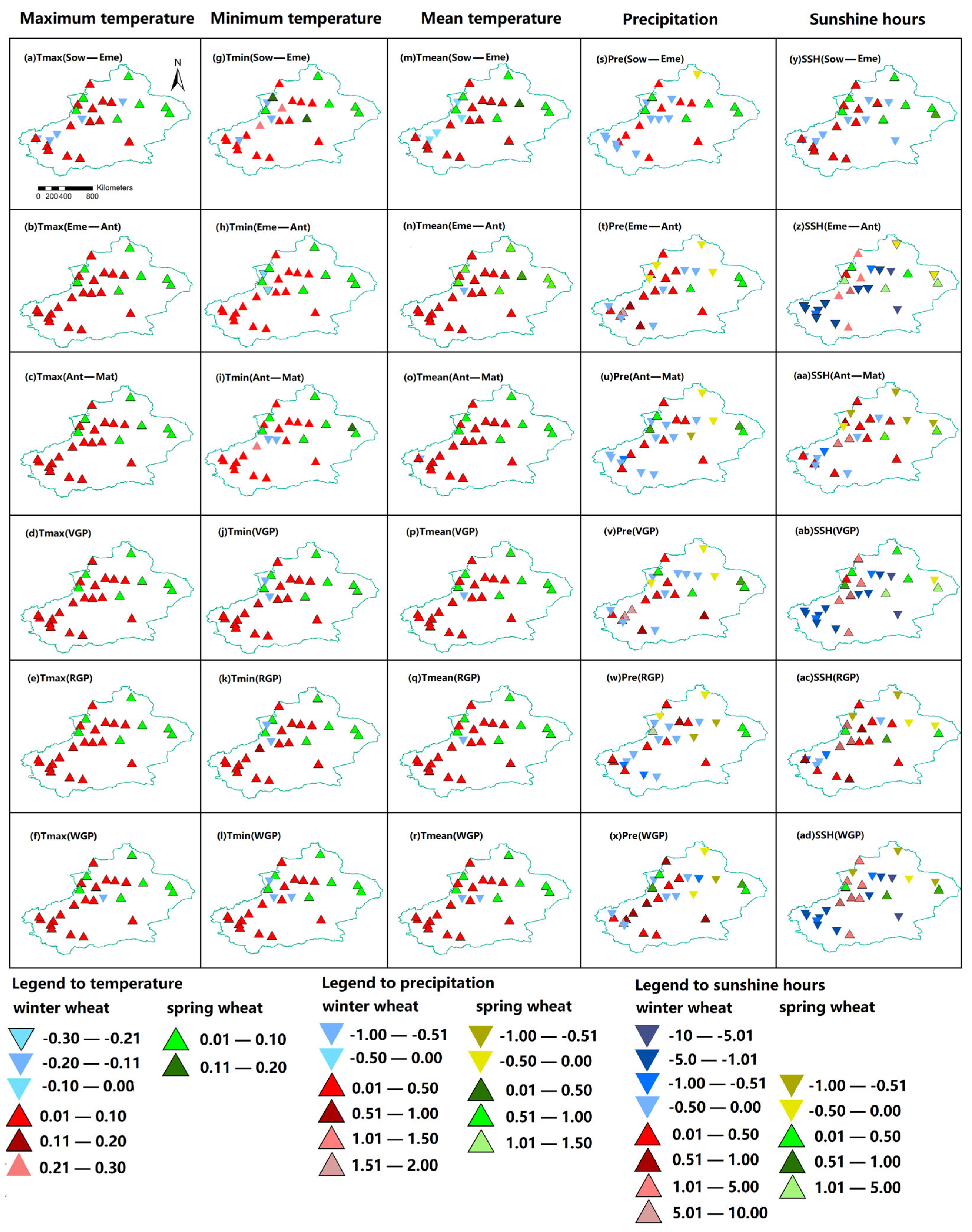
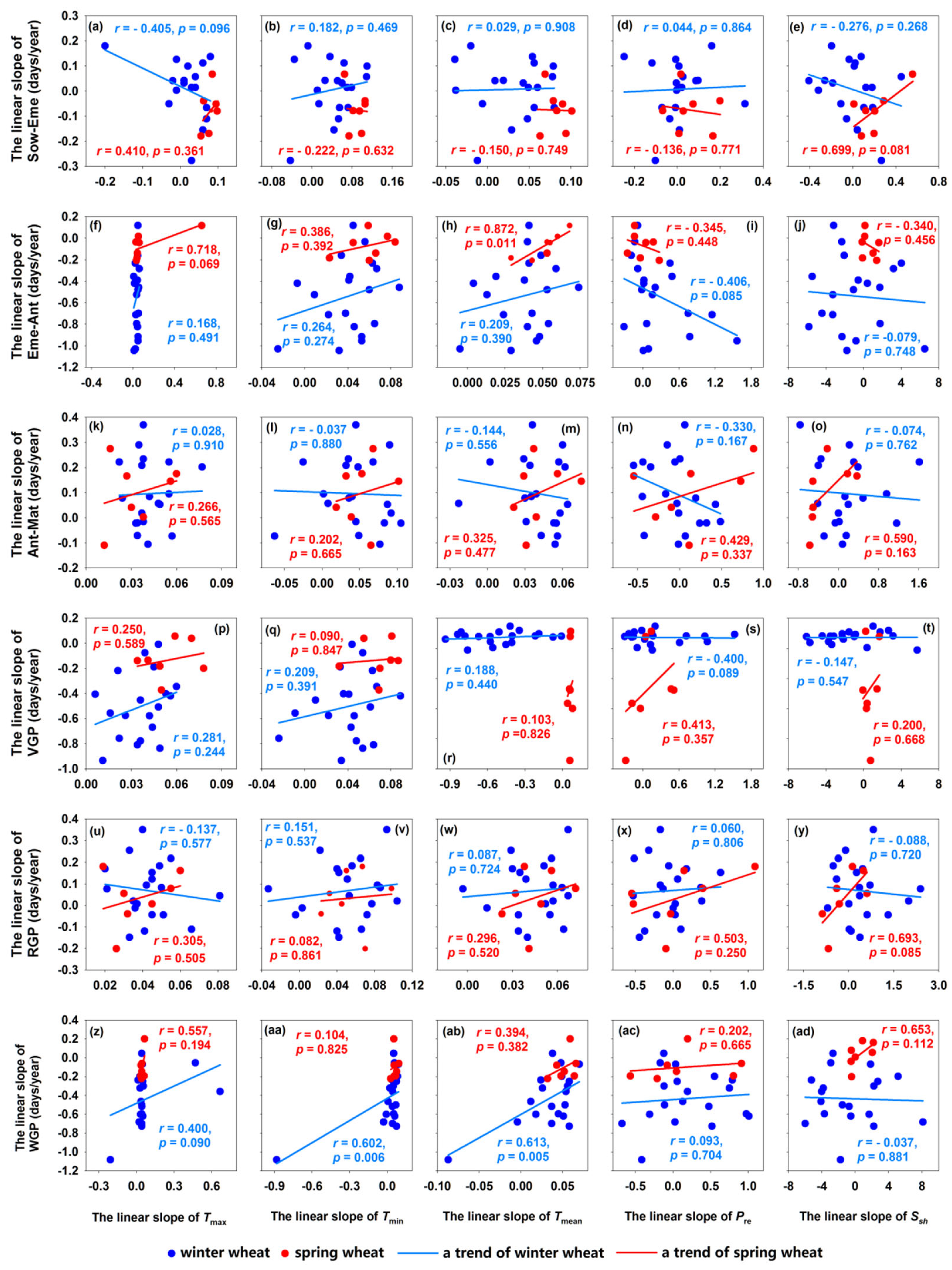
Across all phenological stages of winter and spring wheat, a general warming trend was observed for Tmax, Tmin, and Tmean (Figure 3a–r). However, a small number of sites still displayed a temperature decrease trend. The trend values of Tmax, Tmin, and Tmean, along with the number of sites with increasing trends, and the number of sites with a significantly increasing trend for winter (spring) wheat are presented in Table 2.
Notable spatiotemporal variability was observed in Pre. The linear trend ranges of cumulative Pre for winter (spring) wheat during Sow–Eme, Eme–Ant, Ant–Mat, VGP, RGP, and WGP were −0.247~0.315 (−0.068~0.199) (spring wheat values in parentheses for all instances hereafter), −0.312~1.564 (−0.256~0.273), −0.515~0.488 (−0.548~0.885), −0.303~1.524 (−0.286~0.515),−0.528~0.633 (−0.547~1.091), and −0.678~1.009 (−0.566~0.912) mm·year−1, respectively. The Pre trend values, the number of sites with increasing trends, and the number of sites with significant decreasing trends for winter (spring) wheat are presented in Table 2.
In general, winter wheat SSH increased during Sow–Eme, Ant–Mat, and RGP, yet decreased during Eme–Ant, VGP, and WGP (Figure 3y–ad). For spring wheat, by contrast, SSH showed an upward trend in Sow–Eme, Eme–Ant, VGP, and WGP, whereas it declined in Ant–Mat and RGP (Figure 3y–ad). The linear trend ranges of cumulative SSH for winter (spring) wheat during Sow–Eme, Eme–Ant, Ant–Mat, VGP, RGP, and WGP were −0.409~0.451 (0.010~0.556), −5.815~6.499 (−0.147~1.628), −0.764~1.613 (−0.573~0.369), −6.067~5.703 (−0.067~1.678), −0.694~2.329 (−0.867~0.616), and −5.980~8.095 (−0.493~2.172) h·year−1, respectively. The Ssh trend values, the number of sites with increasing trends, and the number of sites with significant increasing trends for winter (spring) wheat are presented in Table 2.

3.2. Spatiotemporal Patterns of Phenological Phase Lengths in Wheat

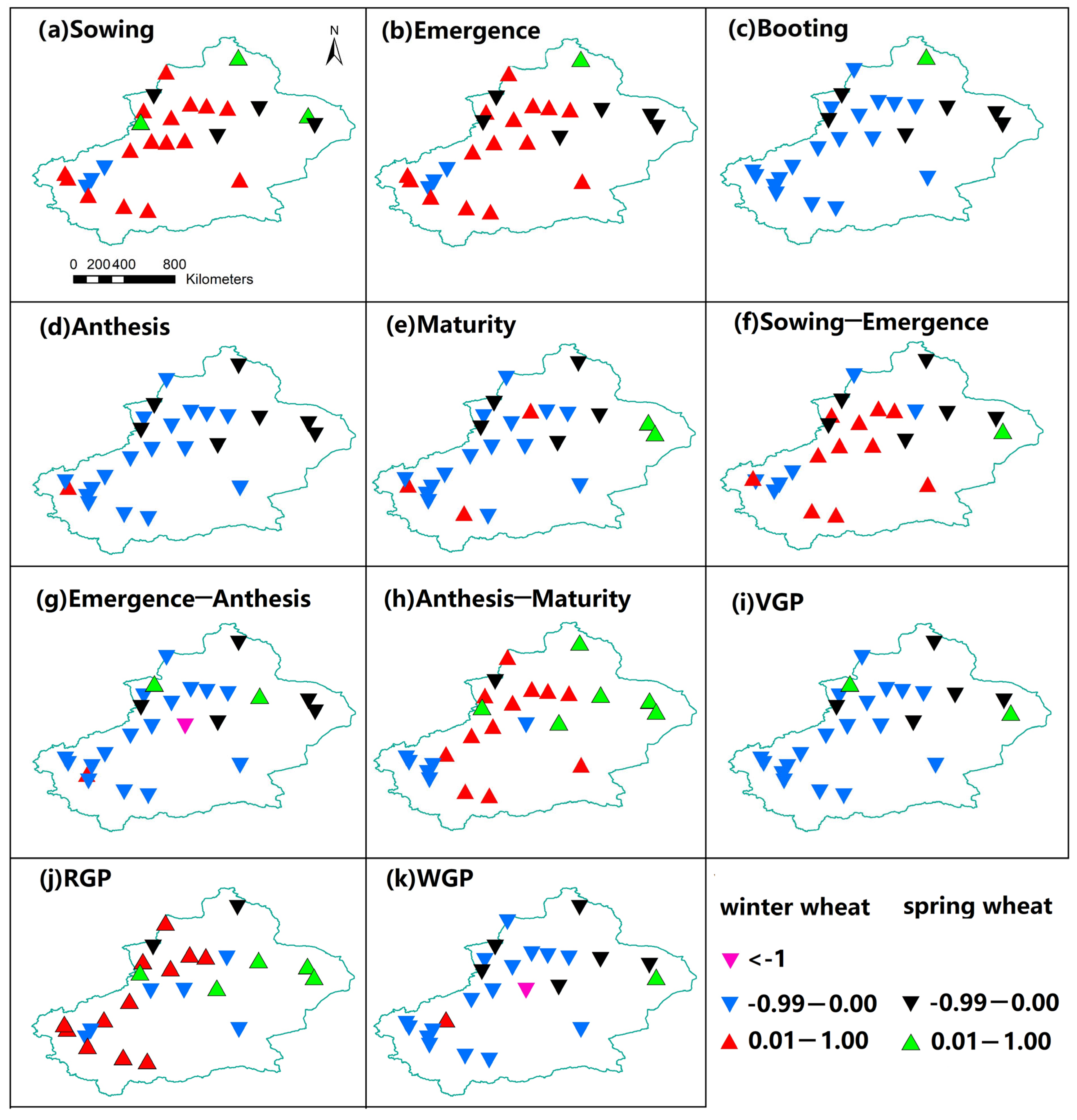
On average, the Boo, Ant, and Mat dates of winter wheat advanced by 0.272, 0.269, and 0.216 days·year−1, while its Sow and Eme dates were delayed by 0.261 and 0.265 days·year−1, respectively. In contrast, spring wheat exhibited an average advance in Sow, Eme, Boo, Ant, and Mat dates by 0.027, 0.103, 0.161, 0.226, and 0.127 days·year−1, respectively. Across the 19 winter wheat (7 spring wheat) observation sites, advancing trends were observed at 3 (4), 3 (6), 19 (6), 18 (7), and 16 (5) sites for Sow, Eme, Boo, Ant, and Mat dates, respectively. Delayed Mat was recorded at 2 (2) sites (Figure 4a–e, Table 3). Furthermore, significant advancing trends were detected at 1 (2), 2 (2), 16 (5), 16 (5), and 12 (3) sites for the corresponding phenological periods.
For winter wheat, the Eme–Ant, VGP, and WGP exhibited a significant shortening trend at average rates of 0.537, 0.502, and 0.434 days·year−1, respectively. In contrast, the Sow–Eme, Ant–Mat, and RGP showed a slight lengthening trend at average rates of 0.007, 0.096, and 0.068 days·year−1, respectively. For spring wheat, the Sow–Eme, Eme–Ant, VGP, and WGP shortened at average rates of 0.076, 0.068, 0.134, and 0.100 days·year−1, respectively, while the Ant–Mat and RGP prolonged at average rates of 0.099 and 0.034 days·year−1, respectively. Across the 19 winter wheat (7 for spring wheat) observation stations, the number of stations with shortened durations for Sow–Eme, Eme–Ant, Ant–Mat, VGP, RGP, and WGP was 6 (6), 18 (6), 6 (1), 19 (5), 6 (2), and 18 (6), respectively. Among these, 3 (3), 16 (2), 0 (0), 16 (2), 1 (1), and 14 (1) stations exhibited a statistically significant shortening trend. The number of stations with prolonged durations for the aforementioned periods was 13 (1), 1 (1), 13 (6), 0 (2), 13 (5), and 1 (1), respectively. Of these, 2 (0), 0 (0), 7 (3), 0 (0), 6 (1), and 0 (1) stations showed a statistically significant prolongation trend (Figure 4f–k, Table 3).

3.3. Impacts of Climate Change on Phenological Periods

The effects of changes in the linear slopes of climate variables (Tmax, Tmin, Tmean, Pre, and SSH) on the linear slopes of each phenological stage are illustrated in Figure 5. Distinct climate variables exert differential impacts on the slope changes of each phenological stage. Sow–Eme stage: wheat growth was primarily influenced by Tmax and SSH, increasing the linear slopes of Tmax and SSH, shortening the phenological duration of winter wheat but prolonging that of spring wheat (Figure 5a,e). Eme–Ant stage: elevated temperature prolonged winter and spring wheat phenological durations, while increased Pre and SSH shortened them (Figure 5f–j). Ant–Mat stage: elevated Tmean, Pre, and SSH reduced winter wheat’s phenological duration (Figure 5m,n), while increased Tmax, Tmin, Tmean, Pre, and SSH prolonged spring wheat’s (Figure 5k–n). VGP stage: Elevated Tmax and Tmin prolonged winter wheat’s phenological duration, while Tmean, Pre, and SSH had minimal influence. In contrast, increased temperature, Pre, and SSH all extended spring wheat’s phenology (Figure 5p–t). RGP stage: Increased Tmax and SSH shortened the phenological duration of winter wheat, while increased Tmin, Tmean, and Pre prolonged it. In contrast, increased temperature, Pre, and SSH all extended spring wheat’s phenology (Figure 5u–y). WGP stage: increased temperature shortened the growth periods of both winter and spring wheat, while increased Pre had a negligible effect on prolonging their growing periods. Conversely, more SSH shortened winter wheat’s growth period but extended spring wheat’s. In general, variations in the WGP linear slope were mainly governed by temperature (Figure 5z–ad).
To intuitively demonstrate the effects of climatic variables on crop phenology, the roles of each climatic variable across different phenological stages are summarized in Table 4.

3.4. Pearson’s Correlation Coefficients for Phenological Phases Versus Climate Variables

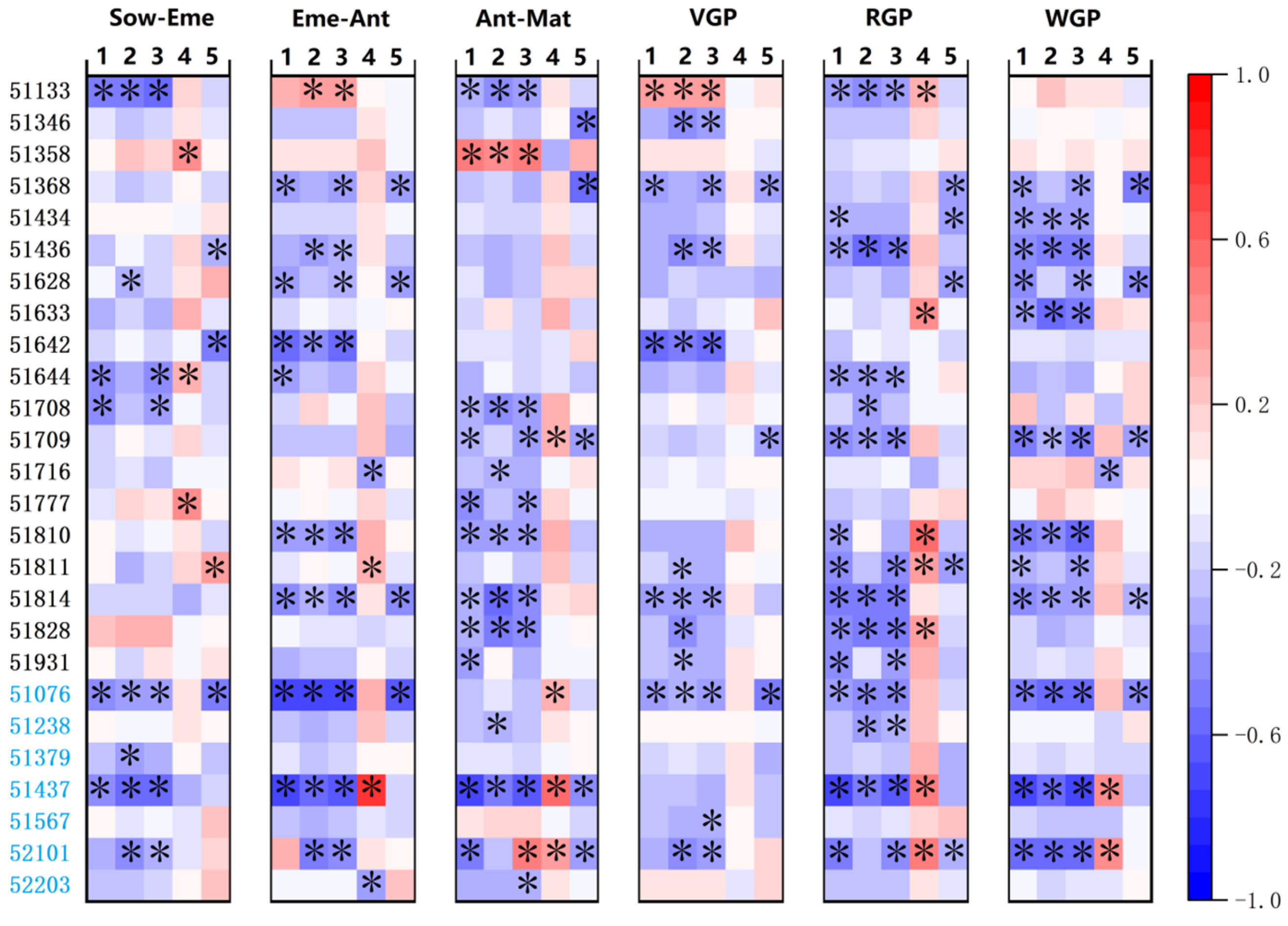
Figure 6 illustrates Pearson’s correlation coefficients (r) for the relationships between phenological stages and climatic factors. The results show that (1) in general, r between Tmax and the lengths of Sow–Eme, Eme–Ant, Ant–Mat stages, VGP, RGP, and WGP of winter wheat (spring wheat) ranged from −0.579 to 0.530 (−0.733 to 0.294). Among the 19 winter wheat sites (7 spring wheat sites), negative correlations with Tmax were observed at 13 (5), 16 (5), 18 (6), 17 (5), 19 (7), and 15 (7) sites, respectively, with 3 (2), 6 (2), 8 (2), 3 (1), 10 (3), and 9 (3) sites showing significant negative correlations (p < 0.05). Positive correlations were found at 6 (2), 3 (2), 1 (1), 2 (2), 0 (0), and 4 (0) sites, including 2 winter wheat sites with significant positive correlations. (2) For Tmin, r with the aforementioned phenological lengths of winter wheat (spring wheat) ranged from −0.586 to 0.827 (−0.694 to 0.176). Negative correlations were detected at 14 (7), 13 (7), 16 (6), 18 (5), 18 (7), and 14 (7) sites, with 2 (4), 4 (3), 6 (2), 7 (2), 7 (3), and 6 (3) sites showing significant negative correlations. Positive correlations occurred at 5 (0), 6 (0), 3 (1), 1 (2), 1 (0), and 5 (0) sites, including 3 winter wheat sites with significant positive correlations. (3) For Tmean, r with the phenological lengths of winter wheat (spring wheat) ranged from −0.582 to 0.530 (−0.708 to 0.476). Negative correlations were recorded at 14 (7), 16 (7), 18 (5), 17 (5), 19 (7), and 13 (7) sites, with 3 (3), 6 (3), 7 (2), 5 (3), 8 (4), and 9 (3) sites showing significant negative correlations. Positive correlations were observed at 5 (0), 3 (0), 1 (2), 2 (2), 0 (0), and 6 (0) sites, including 3 winter wheat sites and 1 spring wheat site with significant positive correlations. (4) For Pre, r with the phenological lengths of winter wheat (spring wheat) ranged from −0.350 to 0.573 (−0.358 to 0.756). Positive correlations were found at 12 (4), 16 (5), 13 (5), 12 (6), 14 (7), and 13 (3) sites, with 3 (0), 1 (1), 1 (3), 0 (0), 5 (2), and 0 (2) sites showing significant positive correlations. Negative correlations occurred at 7 (3), 3 (2), 6 (2), 7 (1), 5 (0), and 6 (4) sites, including 2 winter wheat sites and 1 spring wheat site with significant negative correlations. (5) For SSH, r with the phenological lengths of winter wheat (spring wheat) ranged from −0.558 to 0.340 (−0.633 to 0.597). Negative correlations were detected at 12 (3), 16 (4), 12 (5), 11 (5), 16 (5), and 13 (5) sites, with 2 (1), 3 (1), 3 (2), 2 (1), 4 (1), and 4 (1) sites showing significant negative correlations. Positive correlations were recorded at 7 (4), 3 (3), 7 (2), 8 (2), 3 (2), and 6 (2) sites, including 1 winter wheat site that was significantly positive.

3.5. Path Analysis of Wheat Phenological Stage Responses to Climate Variables

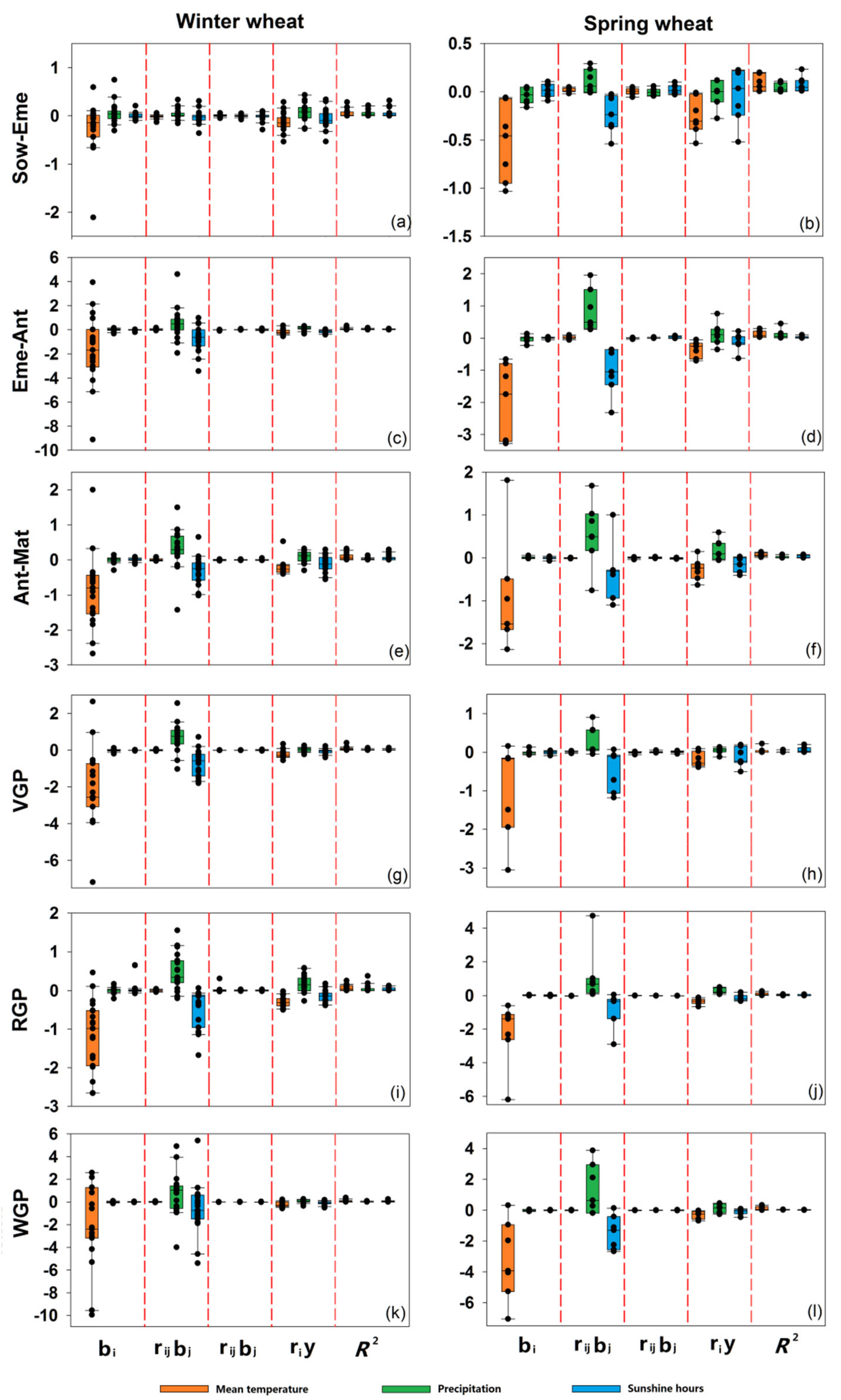
To quantify the effects of climate factors on phenology of winter and spring wheat, we analyzed average temperature (Tmean, x1), cumulative precipitation (Pre, x2), and cumulative sunshine hours (SSH, x3) across six phenological stages (y; Figure 7). For both wheat types, the factors’ impact intensity on stage durations followed the consistent order: Tmean > Pre > SSH. Tmean negatively affected all stages (shortening durations), while Pre positively affected all stages (lengthening durations). SSH had negligible (near-zero) effects on winter wheat’s stages. For spring wheat, however, SSH positively affected Sow–Eme (Figure 7b), negatively affected Eme–Ant, VGP, RGP, and WGP (Figure 7d,h,j,l), and had negligible effects on Ant–Mat (Figure 7f). In summary, Tmean and SSH accelerated growth (shortening stages), while Pre slowed growth (prolonging stages). The impacts of Tmean on both wheat types were dominated by direct effects; by contrast, Pre and SSH exerted stronger indirect effects (mediated via other climate variables) than direct effects (Figure 7b–i).
The direct effect refers to the impact of a climatic variable (e.g., mean temperature, Tmean) on the duration of wheat phenological stages, which occurs directly without mediation by other climatic variables. In Figure 7, the direct effect is represented by the bi bars in orange (Tmean), green (Pre), and blue (SSH) in each subplot. For all phenological stages of winter wheat, the height of the orange bi bars was significantly greater than that of bars in other colors, indicating that the impact of Tmean on phenological stages was dominated by direct effects—its effect of shortening phenological durations occurred directly, without mediation by other factors such as precipitation or sunshine duration.
The indirect effect refers to the impact of a climatic variable on phenological duration that occurs indirectly: the variable first influences other climatic variables, and the affected variables then exert an impact on phenological duration. In Figure 7, the indirect effect is represented by the rijbj bars, which reflect the magnitude of the indirect effect of a variable (e.g., Pre) on phenology through its correlation (rij) with other variables (e.g., Tmean). For example, in the green (Pre) and blue (SSH) bars of spring wheat subplots, the height of the rijbj bars was often greater than that of the bi bars, indicating that the impacts of Pre and SSH on phenological stages were dominated by indirect effects—they altered other factors such as temperature, which in turn indirectly affected phenological duration.

3.6. Effects of Climate Variability and Crop Management on Wheat Phenological Stages

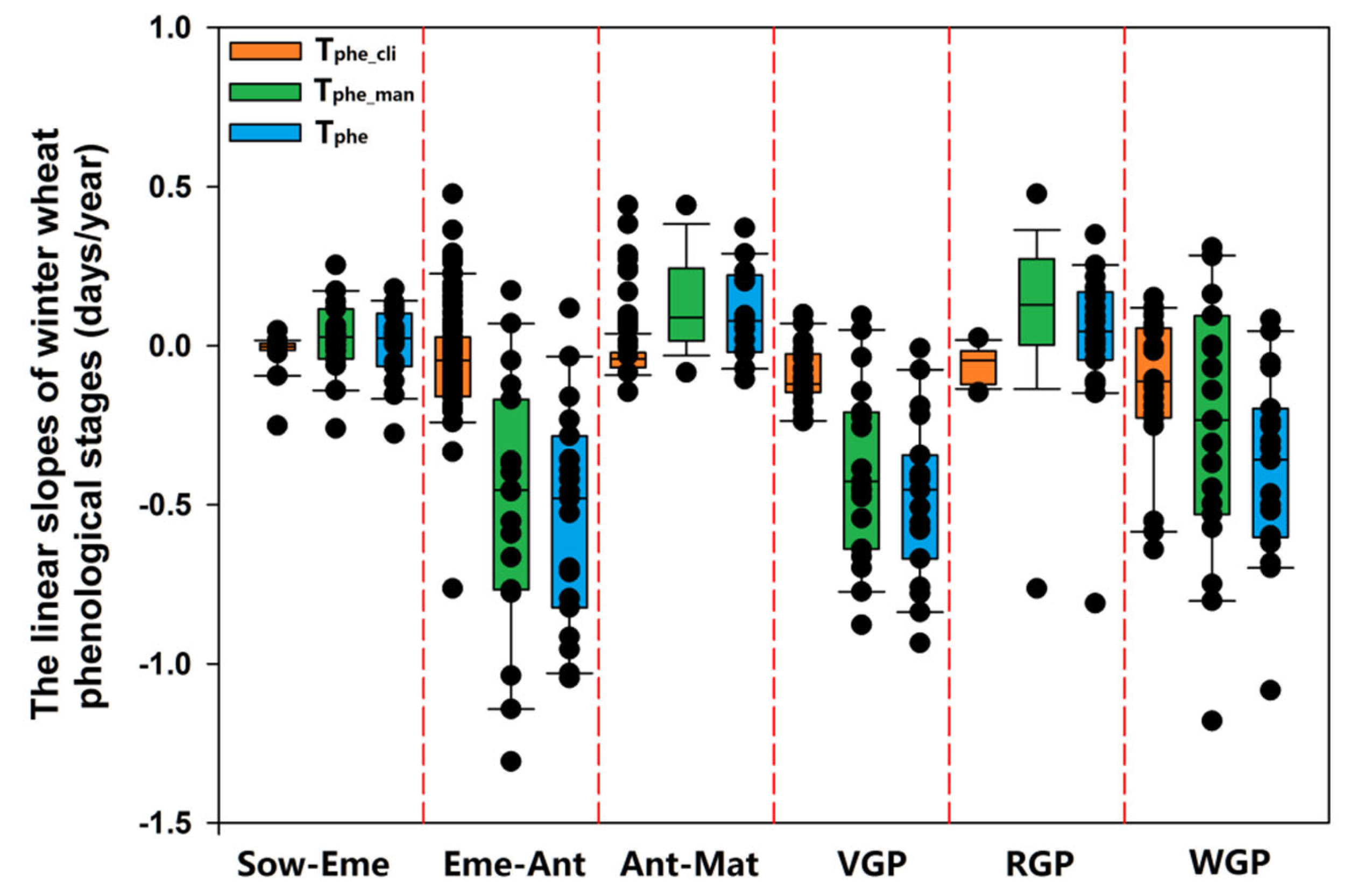
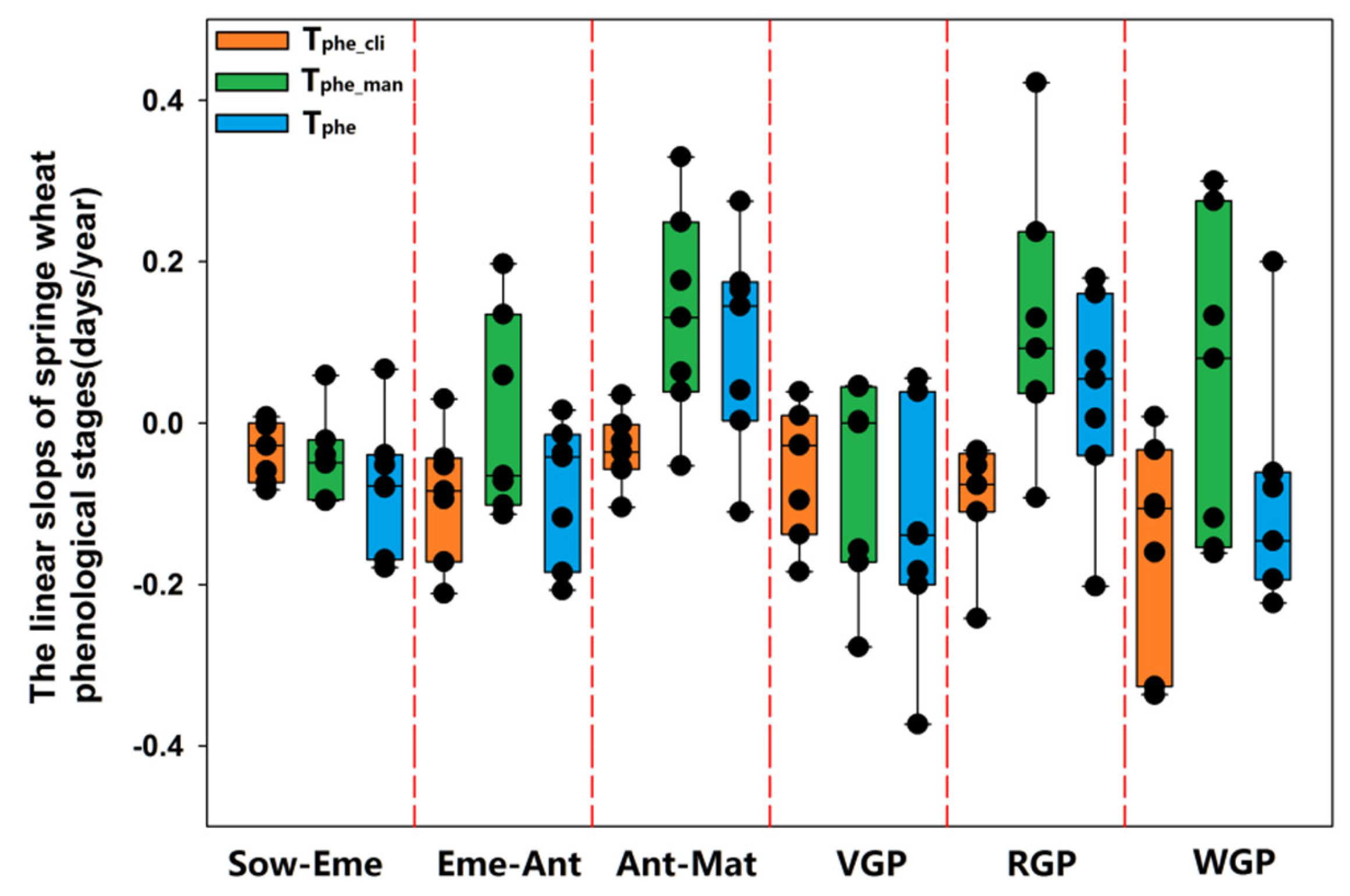
The linear slopes of six phenological stage lengths under three impact scenarios (combined: Tphe; climate change alone: Tphe_cli; crop management alone: Tphe_man) were visualized in Figure 8 (winter wheat) and Figure 9 (spring wheat). Results indicate that crop management exerted a dominant effect on wheat phenology across most phenological stages. Specifically, its impact outweighed not only the effect of climate change alone but also the combined effect of climate change and crop management. The only exception was the WGP of spring wheat, where the impact of climate change exceeded the combined effect of climate and management. Additionally, the median value of Tphe_man was closer to Tphe than to Tphe_cli. For winter wheat, Tphe_cli exerted a weak, trendless influence across all stages. In contrast, Tphe_man (the core driver) shortened the Eme–Ant and VGP stages, but lengthened the Ant–Mat, RGP, and WGP. The Tphe trend aligned closely with Tphe_man (only WGP differed), confirming that the main effect of Tphe was dominated by crop management (Figure 8). For spring wheat, Tphe_cli shortened RGP and WGP (significant effect) but had weak, trendless impacts elsewhere. Tphe_man (the core driver) lengthened Eme–Ant, Ant–Mat, VGP, RGP, and WGP. The Tphe trend largely matched Tphe_man (only Eme–Ant differed), so Tphe was dominated by Tphe_man—though in WGP, Tphe_cli outperformed Tphe (Figure 9).
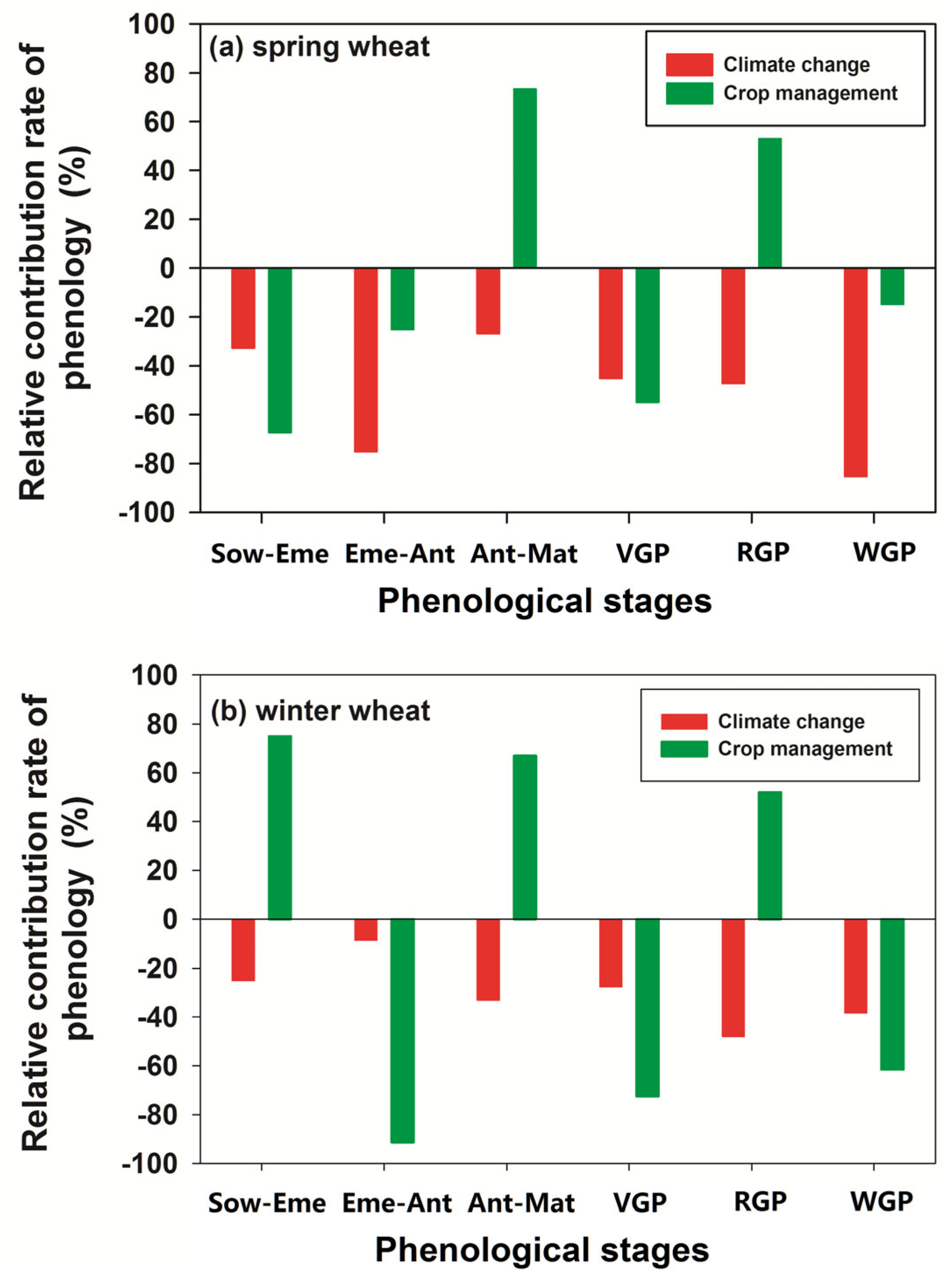
The relative contributions of climate change and crop management to wheat phenology differed across phenological stages. For spring wheat, climate change was the dominant contributor to the durations of Eme–Ant and WGP; whereas crop management exerted a more prominent influence on the durations of the Sow–Eme, Ant–Mat, VGP, and RGP (Figure 10a). Specifically, crop management prolonged the durations of Ant–Mat and RGP stages but shortened those of the Sow–Eme, Eme–Ant, VGP, and WGP. By comparison, climate change shortened the durations of all phenological stages (Figure 10a). For winter wheat, crop management contributed more to the duration of each phenological stage than climate change did (Figure 10b). Crop management prolonged the durations of the Sow–Eme, Ant–Mat, and RGP while shortening those of the Eme–Ant, VGP, and WGP stages, whereas climate change reduced the duration of all phenological stages (Figure 10b).

3.7. Comparative Impacts of Temperature, Precipitation, and Sunshine Hours on Wheat Phenology

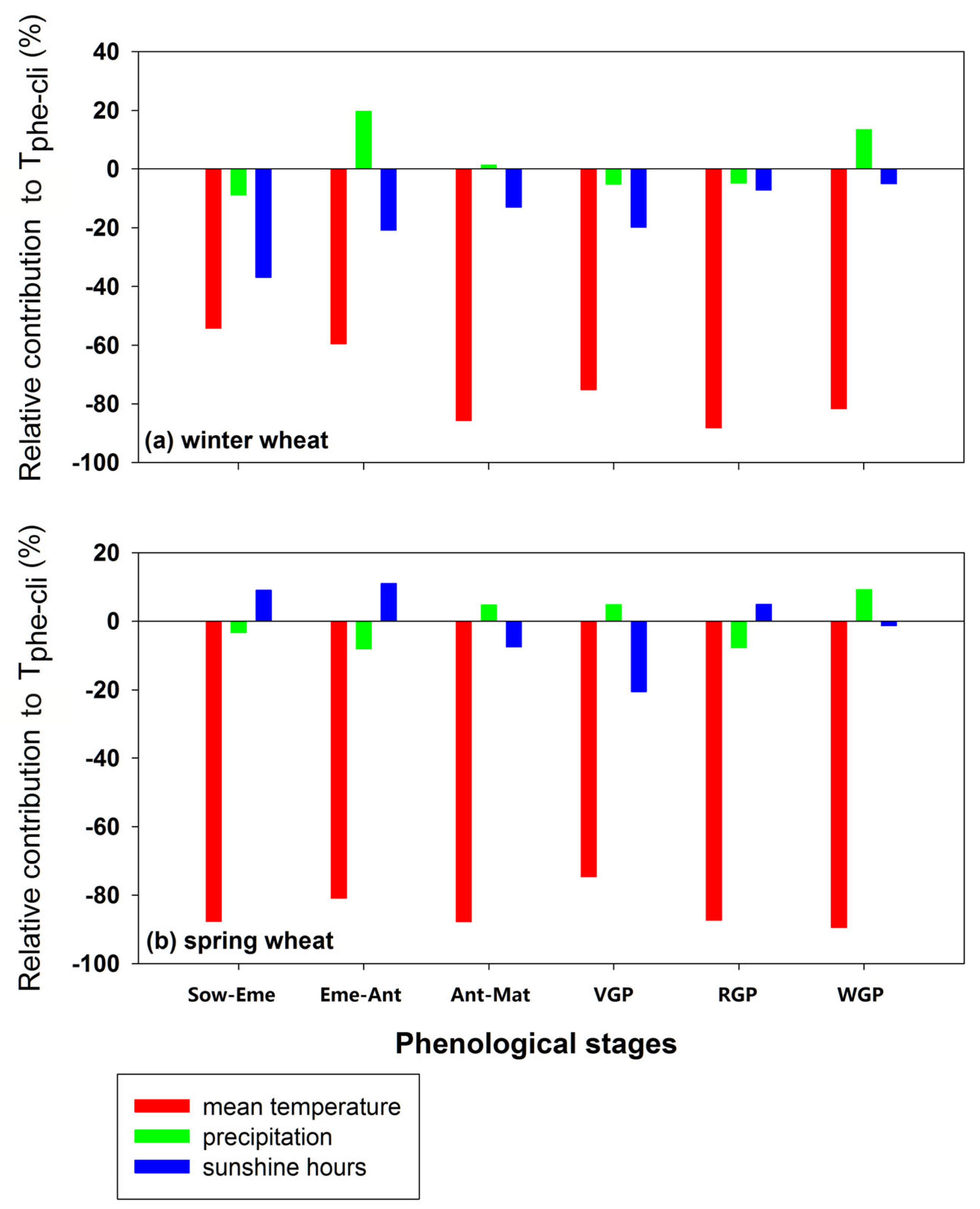
Figure 11 depicts the relative contributions of climatic factors to wheat phenological stages. Tmean showed the greatest impact, which was predominantly negative, indicating that increasing temperatures shortened wheat’s growth period duration. Specifically, Tmean accounted for over 55% of the relative contribution to individual phenological stages of winter wheat (Figure 11a) and over 75% of that of spring wheat (Figure 11b), consistent with findings from previous studies that temperature change is the primary driver of crop phenological dynamics [10,30,31]. SSH induced negative effects across all winter wheat phenological stages by reducing their durations, with the maximum impact in the Sow–Eme stage and the minimum in the WGP (Figure 11a). Conversely, SSH prolonged the Sow–Eme, Eme–Ant, and RGP durations of spring wheat but shortened the Ant–Mat, VGP, and WGP lengths, with the most pronounced negative effect observed in the VGP (Figure 11b). Regarding Pre, it lengthened the Eme–Ant, Ant–Mat, and WGP durations of winter wheat but shortened the Sow–Eme, VGP, and RGP durations, with the maximum effect in the Eme–Ant and the minimum in the Ant–Mat (Figure 11a). In contrast, Pre prolonged the Ant–Mat, VGP, and WGP durations of spring wheat yet reduced the Sow–Eme, Eme–Ant, and RGP durations in spring wheat, showing the strongest influence in the WGP and the weakest in the Sow–Eme stage (Figure 11b).

3.8. Relationship Between Wheat Phenology and WY

Pearson’s correlation coefficient (r) between WY and wheat phenology was calculated across 26 sites (19 winter wheat and 7 spring wheat sites) with continuous WY and phenological data records (Figure S2). The results indicate positive correlations between WY and the phenological stages of Sow, Eme, Bot, Ant, and Mat at 10 (4), 11 (2), 7 (4), 8 (5), and 11 (4) sites, respectively. Only 1 (1), 1 (1), 0 (0), 0 (0), and 0 (0) of these positive correlations were statistically significant (p < 0.05) for the corresponding stages. In contrast, negative correlations between WY and the same phenological stages were detected at 9 (3), 8 (5), 12 (3), 11 (2), and 8 (3) sites, respectively, with merely 0 (0), 0 (0), 1 (0), 0 (0), and 0 (0) of these negative correlations reaching statistical significance. Winter WY was positively correlated with Sow, Eme, and Mat dates, while it was negatively correlated with Boo and Ant dates. For spring wheat, yield showed a positive correlation with Sow, Boo, Ant, and Mat dates, and a negative correlation with the Eme date.
Pearson’s correlation coefficients between WY of winter (spring) wheat and the durations of Sow–Eme, Eme–Ant, Ant–Mat, VGP, RGP, and WGP were 0.009 (−0.162), −0.018 (0.138), 0.047 (−0.002), −0.028 (0.034), 0.090 (−0.027), and 0.023 (0.008), respectively. For winter (spring) wheat, the numbers of sites showing positive correlations between WY and the durations of Sow–Eme, Eme–Ant, Ant–Mat, VGP, RGP, and WGP were 11 (3), 10 (6), 11 (4), 7 (5), 13 (3), and 11 (4), respectively, with 0 (0), 0 (1), 0 (0), 1 (0), 1 (0), and 0 (1) of these correlations being statistically significant (p < 0.05). Conversely, negative correlations were detected at 8 (4), 9 (1), 8 (3), 12 (2), 6 (4), and 8 (3) sites, respectively, with 0 (2), 1 (1), 1 (0), 1 (0), 0 (1), and 0 (1) of these reaching statistical significance (Figure S2). Accordingly, winter WY increased with longer Sow–Eme, Eme–Ant, Ant–Mat, RGP, and WGP durations but decreased as VGP duration lengthened. In contrast, spring WY rose with extended Eme–Ant, Ant–Mat, VGP, and WGP durations, whereas it declined with increases in Sow–Eme and RGP lengths.
To synthesize the Pearson correlation patterns between wheat yield (WY) and phenology across 26 sites, distinct relationships emerged for winter and spring wheat. For phenological dates, winter WY was positively correlated with Sow, Eme, and Mat dates but negatively correlated with Boo and Ant dates, while spring WY showed positive correlations with Sow, Boo, Ant, and Mat dates and a negative correlation with the Eme date, with only a small number of these correlations reaching statistical significance (p < 0.05). Regarding phenological stage durations, winter WY was positively associated with the lengths of Sow–Eme, Eme–Ant, Ant–Mat, RGP, and WGP periods but negatively linked to VGP duration; by contrast, spring WY increased with prolonged Eme–Ant, Ant–Mat, VGP, and WGP durations but decreased with extended Sow–Eme and RGP periods. Overall, the correlation coefficients between WY and most phenological durations were weak, and only a limited number of site-specific correlations were statistically significant.

3.9. Impacts of Climate Change and Crop Management Measures on WY

Figure S3 shows the variation trends of WY and Pre, Tmean, and SSH during the whole wheat growth period at 26 sites in Xinjiang, China. WY of winter (spring) wheat ranged from 1012.5 to 10,950 (1035 to 6862) kg·ha−1, with a change trend ranging from 38.86 to 136.355 (58.148, 132.879) kg·ha−1·year−1 and an average change trend of 96.883 (103.832) kg·ha−1·year−1. Notably, WY exhibited a statistically significant increasing trend at all 26 sites (p < 0.05). Regarding Tmean during the growing period, among 19 winter wheat sites, 17 sites exhibited an increasing trend (12 statistically significant, p < 0.05), and only 2 sites a decreasing trend (neither significant); for 7 spring wheat sites, all exhibited a significant increasing trend (p < 0.05). For Pre during the growing period, 12 (4) winter (spring) wheat sites exhibited an increasing trend, while 7 (3) sites showed a decreasing trend, with no significant correlations observed across all sites. For SSH during the growing period, among winter wheat, 6 sites exhibited an increasing trend (2 significant, p < 0.05), and 13 sites showed a decreasing trend (4 significant, p < 0.05); in contrast, spring wheat sites showed 4 increasing trends (1 significant, p < 0.05) and 3 decreasing trends (none significant, p < 0.05). Correlation analysis (r) between WY and Tmean, Pre, and SSH revealed that WY was positively correlated with Tmean at 17 (7) winter (spring) wheat sites, with 16 (5) of these sites showing a significant negative correlation (p < 0.05); WY was positively correlated with Pre and SSH at 13 (4) and 8 (3) sites, respectively, with 1 (0) and 2 (0) sites achieving significant positive correlations (p < 0.05) (Figure S4). Additionally, WY remained significantly negatively correlated with SSH at four winter wheat sites, whereas no such correlation was observed for spring wheat sites. These findings demonstrate that increases in temperature and precipitation facilitated WY enhancement, while elevated sunshine duration tended to reduce yield.
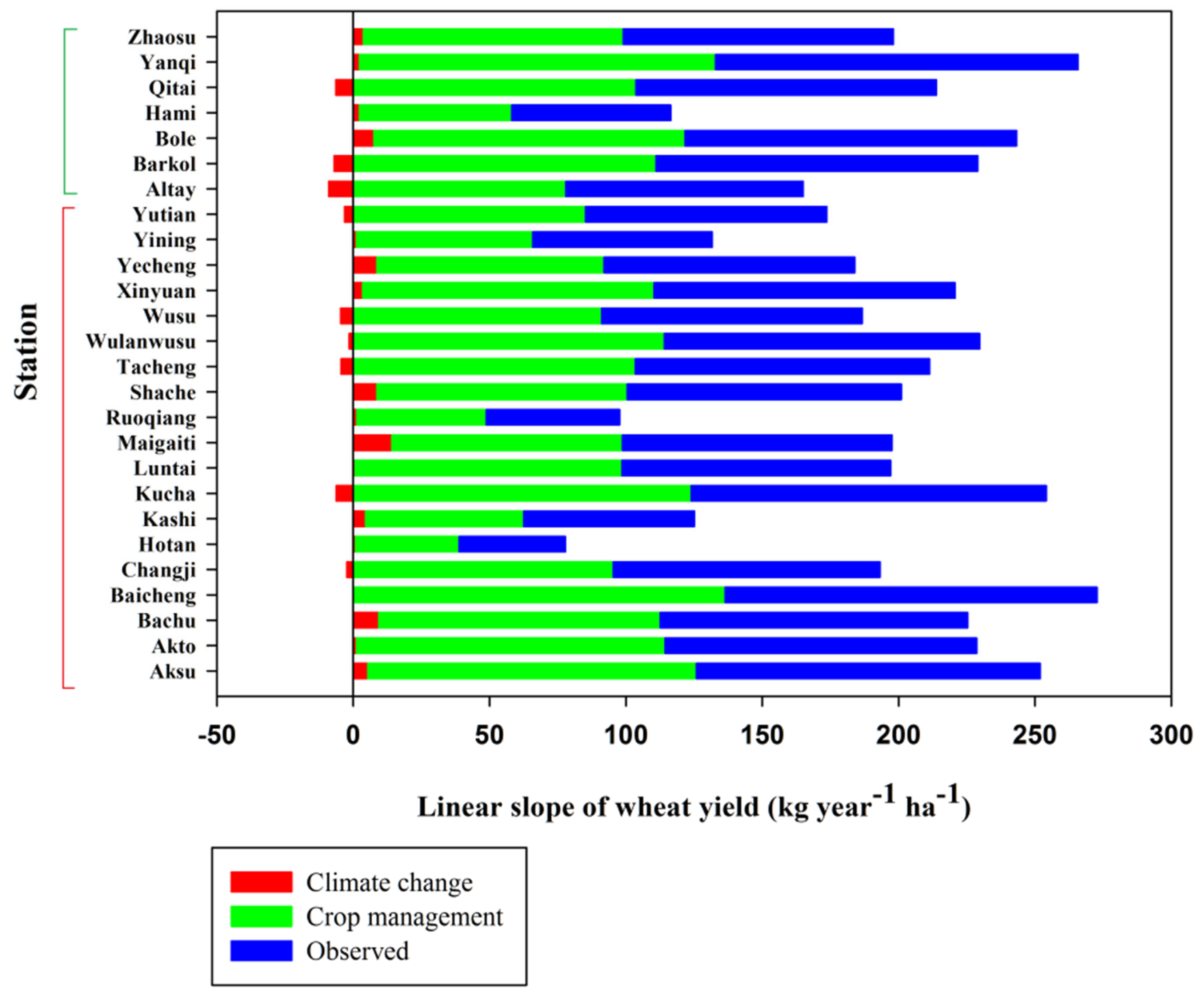
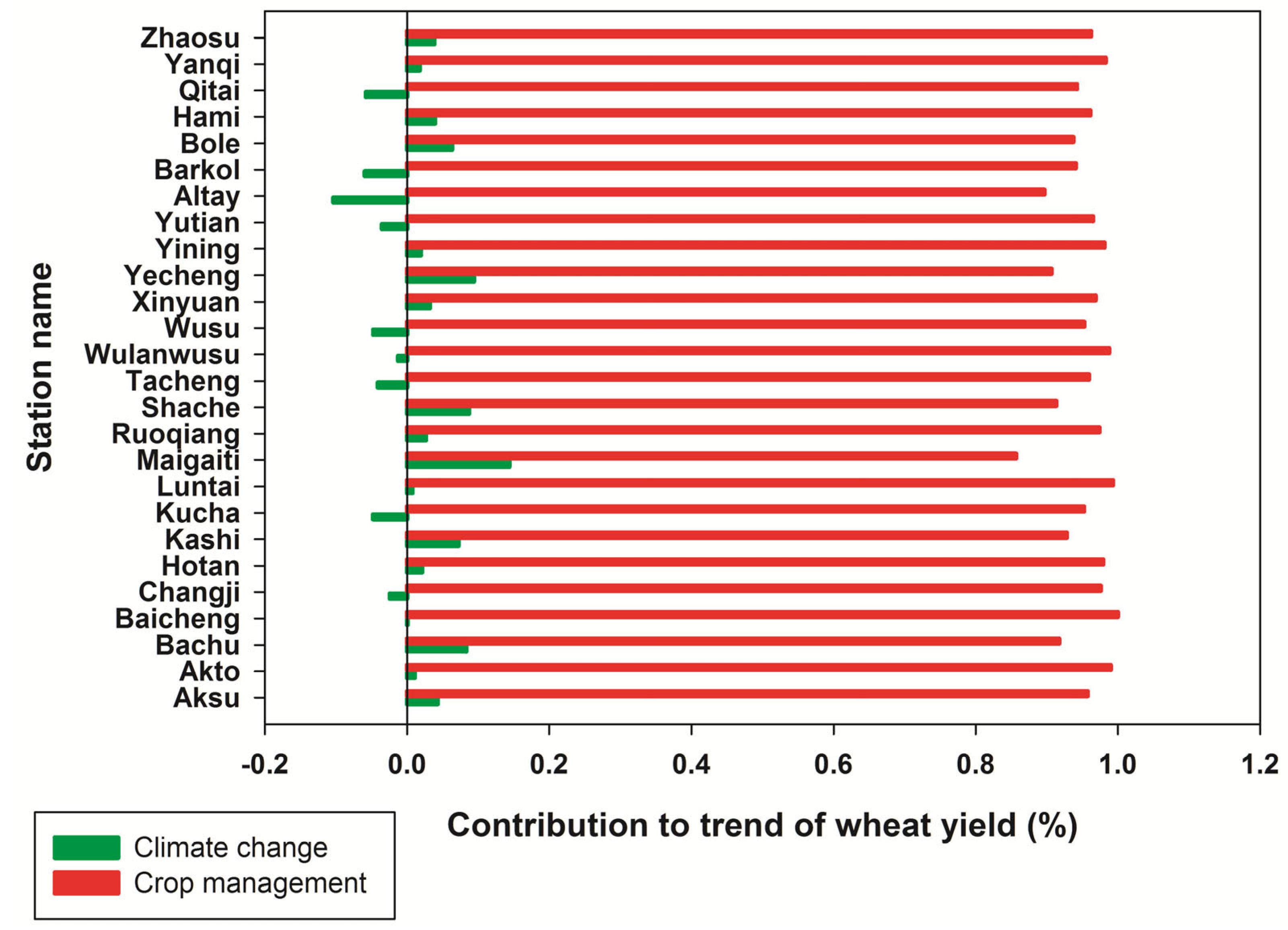
Figure 12 illustrates the individual, combined, and synergistic effects of climate change and crop management practices on the variation trend of WY. The findings indicate that the impact of climate change on the variation trend of WY was weaker than that of crop management alone or their combined synergistic effects. Furthermore, the variation trend of WY under the individual effect of crop management practices was more closely aligned with that under the combined effect. At 6 (3) winter (spring) wheat sites, the variation trend of WY was negative under the sole influence of climate change, suggesting that climate change exerted an adverse impact on these sites and resulted in yield reductions. Across all sites, both the combined synergistic effects of climate change and crop management practices, as well as the individual effect of crop management practices, exerted a positive impact on WY; under these two types of effects, the variation trend of WY was positive at all sites.
Figure 13 presents the relative contribution ratios of climate change and crop management practices to the variation trend of WY. The plus and minus signs preceding the percentage values indicate the direction of WY changes induced by climate change or crop management practices. Climate change exerted a negative relative contribution to the WY variation trend at 6 (3) winter (spring) wheat sites and a positive contribution at 13 (4) sites; in contrast, crop management practices showed a positive relative contribution across all 26 sites.

4. Discussion

4.1. Climate Change-Driven Shifts in Wheat Phenology

Previous studies have shown that wheat phenology in China exhibits distinct spatiotemporal differentiation characteristics: specifically, Sow and Eme dates have generally been delayed [9,32], while Ant and Mat dates have generally advanced [7,9,27], and VGP and WGP have shortened [7,9]. These trends further display significant differences in response patterns across different planting regions. Climate change acts as a key driver of alterations in wheat phenology [7], and climate warming represents the primary factor [32]. The lengths of different growth stages of wheat show a significant positive correlation with SSH; Tmean and SSH are key factors influencing changes in the WGP of spring wheat; and ≥ 0°C active accumulated temperature is the primary cause of variations in the WGP and VGP of winter wheat [33]. Therefore, the distribution characteristics and change trends of climatic factors in major winter wheat-producing regions of China exhibit spatial heterogeneity; against the backdrop of climate change, attention should be paid to the impacts of diurnal temperature range, SSH, and Pre on winter wheat growth, while focusing on the adverse effects of the aforementioned meteorological factors on yield during the heading-to-maturity stage of winter wheat [34]. Temperature stands as the primary environmental factor explaining phenological variability; it varies across different terrain zones and can account for up to 96% of interannual phenological variation [35]. In our study, the Boo, Ant, and Mat dates of winter wheat dates advanced, while Sow and Eme dates were delayed. However, the Sow, Eme, Boo, Ant, and Mat dates of spring wheat all advanced; meanwhile, the WGP of winter and spring wheat all shortened. Some of our results were consistent with those of previous studies, but discrepancies were also observed, particularly regarding the phenological responses to SSH and the direction of spring wheat phenological shifts. From an agro-physiological perspective, these discrepancies can be attributed to two core mechanisms. First, soil temperature dynamics regulate the vernalization and germination processes of wheat seeds: the persistent climatic warming trend in recent decades has raised the soil temperature threshold for winter wheat sowing, prompting farmers to delay sowing to avoid premature seedling emergence and frost damage, whereas the elevated soil temperatures in spring have accelerated the germination and seedling establishment of spring wheat, leading to advanced sowing and emergence dates [36,37,38]. Second, the interaction between SSH and temperature modulates crop photosynthetic efficiency and growth rate; unlike previous studies that reported a positive correlation between SSH and growth stage length, our study region featured a high-temperature and high-SSH co-occurrence pattern, where excessive solar radiation exacerbated crop transpiration and water stress during the reproductive growth stage, thus shortening the WGP instead of prolonging it. These agro-physiological mechanisms collectively contribute to the observed phenological discrepancies between our study and previous research [36,37]. These discrepancies could be attributed to the agro-physiological responses of wheat to soil temperature dynamics driven by the climatic warming trend over recent decades: specifically, rising soil temperatures have raised the vernalization threshold for winter wheat, prompting farmers to delay sowing to avoid premature seedling bolting and frost damage; in contrast, elevated soil temperatures in spring have accelerated the germination and seedling establishment of spring wheat, thus advancing its sowing and subsequent phenological stages.
Pre also serves as another factor influencing wheat phenology, with its effects varying across different regions. In arid/semi-arid regions, the WGP for both spring wheat and winter wheat increases with the rise in Pre during the growing season [39]. In semi-arid rain-fed regions, increased Pre prolongs the WGP of spring wheat, while decreased Pre coupled with climate warming shortens the entire growth period by 0.4–0.5 days per year [40]. In the same regions, the synergistic effect of decreased Pre, and increased temperature significantly shortens the WGP of spring wheat and reduces its yield [41]. However, in the arid region of this study, although Pre showed an insignificant increase during the WGP of winter and spring wheat, the WGP of both types of wheat was shortened. A possible reason was that the increased temperature coupled with an insignificant rise in Pre led to the shortening of the WGP according to [40,41].
Very long daylight conditions can significantly shorten the growth period of wheat [42]. The driving effect of SSH on the RGP varies across different regions. Heading can be effectively promoted by an increase in SSH; on the premise of wheat’s light requirements being met, the longer the SSH, the earlier heading and flowering occur [43]. If only 8 hours of sunshine is available per day, heading and seed setting may even fail to be achieved by some winter wheat cultivars; for spring wheat grown in low-latitude areas, premature heading can be induced by insufficient SSH (below 12–12.5 hours per day) [44]. In our study, during the RGP stage, increased SSH shortened the phenological duration of winter wheat and declined SSH extended spring wheat’s phenology; during the WGP stage, declined SSH shortened winter wheat’s growth period but increased SSH extended spring wheat’s. These results are partially inconsistent with previous studies. The possible reasons are as follows: the average annual change in SSH in the RGP and WGP of winter (spring) wheat was 0.411 (−0.142) and −0.142 (0.530) hours, respectively. Such a small rate of change was not sufficient to cause a significant change in the growth period. Additionally, path analysis in this study showed that the impact of SSH on the growth period was far less than that of temperature, and temperature was the dominant factor.
Many studies focused on the impacts of climate change on wheat phenology, yet overlooked the effects of crop management practices on phenology [40,41]. Modifications in crop management may be implemented as a response to climate change [45]. A first-order-difference multiple regression model was established to quantify the separate and comprehensive effects of climate change and management measures on wheat phenology, with this analysis aiding in elucidating the response of wheat phenology to climate change. Liu et al. [9] concluded that climate change had a weaker impact on wheat phenological changes than crop management. Crop management shortened wheat’s VGP and WGP, while lengthening its RGP. The results of our study aligned with their conclusions. As such, global warming speeds up wheat physiological development and shortens the overall growth period of wheat, whereas well-designed management strategies can lessen the harmful consequences of climate change. Since crop phenology responds to climate change differently in separate regions [39,40], we studied climate change’s effects on wheat phenology and growth phases across diverse areas and, thus, our results can deliver useful policy insights to design more targeted adaptation approaches.

4.2. The Influence of Projected Climate Change on Wheat Phenological Stages and Yield Formation

The results of our study demonstrate that historical climate variability has impacted wheat phenology and yield formation. Over the next 20 years, the global average temperature is very likely to reach or exceed 1.5 °C; as warming intensifies, the frequency and intensity of extreme high temperatures and heavy precipitation events will continue to rise, tropical cyclones of Category 3–5 intensity will become more frequent, droughts will intensify in some regions, and the probability of compound extreme events such as concurrent heatwaves and droughts will increase [1]. Hence, undertaking studies into how future climate conditions will affect wheat production is imperative. It plays a vital role in ensuring the security of crop production, and offers a scientific basis for mitigating climate change vulnerability.
Within the range of 15–20 °C, the developmental rate of wheat is correlated with temperature [46], while temperatures outside the optimal range inhibit or even reduce developmental rate [47,48]. Consistent with our empirical findings that temperature is a key direct driver of wheat phenology but is dominated by management measures across most stages (except spring wheat WGP), temperature during the Sow–Eme stage—an interval highly regulated by agronomic practices such as sowing date adjustment and soil temperature management—is the core factor influencing developmental days (a proxy for developmental rate) [49], and the developmental rate exhibits distinct response patterns across different temperature intervals [50]. Our study further complements these temperature effects by confirming that management can modulate phenological responses to warming: for instance, the observed 3.14-day shortening of spring wheat growth period per 1 °C warming [51] and 1.11-day prolongation of winter wheat growth period per 1 °C increase [52] can be mitigated by optimized sowing dates and irrigation scheduling—two management practices we identified as dominant in regulating phenology. Regarding the poleward shift of wheat cultivation boundaries (100–121 km per 1 °C warming, with larger shifts under high-emission scenarios [53]), our finding that management dominates phenological regulation implies that adaptive agronomic measures (e.g., selecting short-cycle varieties compatible with local management regimes or adjusting fertilization timings) can help exploit the expanded cultivation areas in high-latitude regions while offsetting warming-induced phenological mismatches. Collectively, these results underscore that elevated temperatures exert significant impacts on wheat growth and development, but such impacts are not deterministic—management measures can serve as effective buffers.
Climate warming alters wheat phenology, which in turn drives yield variations [54], and our empirical results clarify that management can reshape this phenology–yield linkage. Distinct differences are exhibited in the responses of the VGP and RGP of winter wheat to climate change: under the influence of climatic warming, the VGP is shortened while the RGP is prolonged. Such changes in stage allocation may affect the accumulation of photosynthates and grain-filling efficiency in wheat, thereby indirectly impacting wheat quality and yield [55]. However, our findings that management dominates most phenological stages (e.g., regulating VGP via sowing depth and RGP via post-anthesis irrigation) provide a pathway to optimize this stage allocation—for example, adjusting sowing dates to extend the VGP appropriately or applying targeted irrigation during the RGP to enhance grain-filling efficiency, thereby mitigating potential quality and yield losses. Global projections show that 2 °C and 4 °C warming will reduce spring wheat yields by 15.5% and 30.9%, and winter wheat yields by 12.6% and 23.9%, respectively [53], yet Wang et al. [55] reported yield gains under moderate 2 °C warming due to shortened dormancy, extended grain-filling periods, and improved photosynthetic efficiency. This discrepancy aligns with our core finding of management dominance: the yield benefits observed by Wang et al. [55] likely rely on optimized agronomic practices (e.g., adjusted sowing windows or nutrient management), which echoes our conclusion that management can override or reshape warming-induced yield responses. In contrast, the global yield reduction consensus may reflect scenarios with minimal adaptive management, highlighting the critical role of our observed management dominance in reconciling divergent projections.
The projected variations in wheat yield typically hinge on climate conditions [41], soil types [56,57], pest and disease pressures [58,59,60,61], and—consistent with our empirical focus—agronomic management practices [14,61,62]. As greenhouse gas emissions continue to rise, future crops will face elevated CO2 and temperatures, and our finding that management dominates phenology and yield regulation provides a framework to integrate these global change factors into adaptive strategies. For example, the CO2 fertilization effect (e.g., 26.1% yield increase with 200 μmol·mol−1 higher CO2 [63], 7.5–9.8% yield potential gain under RCP4.5/RCP8.5 [62]) can be amplified by optimized nitrogen fertilization—an important management measure in our study—given that the interaction of elevated CO2 and nitrogen fertilization maintains spike grain number and weight under stress [64,65]. Similarly, our identification of management as a dominant factor informs adaptation to ozone stress: while elevated ozone shortens the RGP by 1 day and reduces yields by 6% [66], and ozone-warming synergy shortens the whole growth period by 9 days [67], selecting ozone-resistant cultivars (a key management strategy [68]) and combining this with our observed effective measures (e.g., post-anthesis irrigation and optimized LAI regulation) can mitigate yield losses. Notably, controlling warm-season ozone below 60 µg/m3 (WHO guideline) increases yields by 8.71 ± 1.85% [69], and this benefit can be further enhanced by integrating with phenology-regulating management practices we identified, such as adjusting sowing dates to avoid peak ozone exposure during the RGP. In summary, our empirical finding that management dominates wheat phenology and yield regulation across most stages (except spring wheat WGP) provides a critical bridge between global climate change projections and on-farm adaptation. Future adaptation strategies under warming can leverage this management dominance: optimizing sowing dates, depths, and irrigation schedules to modulate temperature-sensitive stages (Sow–Eme, VGP, and RGP); integrating nitrogen fertilization with CO2 fertilization effects to maximize yield potential; and selecting stress-resistant cultivars (ozone and heat) while matching them with targeted agronomic practices. This integrated approach, rooted in our empirical results, transforms general climate projections into actionable adaptation measures, addressing the detachment between future implications and empirical findings.
Furthermore, studies have revealed that modifying crop management practices (such as altering irrigation patterns, increasing nitrogen fertilizer application, adjusting sowing dates, precision seeding, precision water and fertilizer management, and replacing cultivars) can serve as effective strategies for wheat production to adapt to climate change [14,62,70]. Accumulated evidence from previous investigations indicates that early sowing enhances wheat yield significantly [71,72]. Replacing early-maturing varieties with late-maturing ones enables a longer growth period, thereby boosting wheat yield [73,74]. Furthermore, some studies argue that wheat yield is primarily influenced by factors such as growth rate during critical developmental stages, rather than the total length of the growing period [75]. Additionally, when the supplementary irrigation volume remains modest, adjustment of irrigation regimes can serve as cost-effective and readily implementable adaptation measures [76,77,78].
Owing to multiple constraints, this study did not account for the impacts of carbon dioxide (CO2), ozone, fertilization, pests and diseases, and extreme weather events on wheat yield. In future research, a process-based wheat model should be adopted to incorporate the effects of cultivar replacement, management practices, pest and disease infestations, the northward shift of cultivation areas, and the synergistic effects of ozone and temperature. This will enable further quantitative analysis of the variations in wheat growth and yield, as well as the exploration of adaptation measures and strategies in response to climate change.
This study adopted the first-difference approach, whose core purpose is to eliminate the interference of time-invariant factors in the long-term evolution of crop phenology and focus on the relative contributions of the two types of factors at the interannual scale. The method classifies variables based on their driving attributes: climatic factors are defined as environmentally variable factors with interannual fluctuations, while crop management measures cover artificially adjusted agronomic practices, including short-term measures and long-term adaptive strategies such as gradual cultivar shifts. This classification is consistent with the mainstream paradigm of regional wheat research, as numerous studies on winter wheat in the North China Plain and Huanghuai Wheat Region have explicitly incorporated cultivar shifts into crop management systems. For instance, Jiang et al. [79] systematically analyzed the response of six large-scale cultivar shifts to climate warming in their study on winter wheat varieties of different eras in the North China Plain, confirming its core value as an adaptive management strategy. Wang et al. [80] regarded cultivar shifts as an important part of agronomic management optimization when sorting out the breeding rules of winter wheat in their study on the Huanghuai Wheat Region, providing a crucial basis for wheat variety improvement and management optimization in this region. Lei et al. [81] also echoed this in their earlier research, clarifying the core position of cultivar breeding in the agronomic management system. Essentially, gradual cultivar shifts are human decisions made by producers based on long-term climate adaptability, and their direct driving factor is management behavior rather than the direct effect of climate. Therefore, classifying them as “management factors” is an accurate attribution of the direct driving factor, not a denial of the underlying indirect climatic context.
It should be noted that there is a coupling relationship between the adaptive adjustment of management measures and long-term climate change on the long-term scale. The first-difference approach, within the interannual scale attribution framework, cannot completely separate the impact of this long-term coupling effect, which is a limitation of this study. In future research, long-term trend decomposition models, such as the Seasonal and Trend decomposition using Loess (STL) decomposition method, can be introduced to decompose phenological changes into components across multiple time scales, thereby further accurately quantifying the synergistic and antagonistic effects of the two types of factors.

5. Conclusions

  • Changes in temperature, light, and precipitation drive differentiated the phenological responses of winter and spring wheat. During the growing period of winter and spring wheat, air temperature and precipitation show an upward trend, while sunshine duration exhibits species-specific characteristics (decreasing for winter wheat and increasing for spring wheat). Most key phenological stages of both types advance, and the total growth period is shortened, showing differentiated adaptive features.
  • Crop management is the dominant factor regulating wheat phenology. The impacts of crop management and integrated climate-management measures on phenology are stronger than that of climate change alone. It can reshape the growth process by adjusting phenological rhythms, providing core support for climate adaptation.
  • Phenology–yield correlation rules clarify the direction for high-yield regulation. The correlation patterns between yield and phenology differ between winter and spring wheat. Winter wheat requires an extended total growth period and reproductive growth stage, while spring wheat needs optimized allocation of vegetative and reproductive growth, providing a basis for field management and variety selection.
  • Suggestion: Synergize “variety + management” to adapt to climate change. Prioritize breeding wheat varieties with strong adaptability, a high and stable yield, and simultaneously optimize supporting measures such as sowing date and irrigation to offset the impact of shortened growth period and ensure regional wheat production security.

Supplementary Materials

The following supporting information can be downloaded at: https://www.mdpi.com/article/10.3390/agriculture16030314/s1, Figure S1. Pearson’s correlation coefficients between average temperature, cumulative precipitation, and total sunshine duration in each phenological phase. (Black station IDs correspond to winter wheat, while blue IDs correspond to spring wheat. 1 refers to the correlation coefficient of average temperature vs. cumulative precipitation; 2 to that of cumulative precipitation vs. sunshine duration; 3 to that of sunshine duration vs. average temperature.) In the cells, blue indicates a negative correlation and red indicates a positive correlation, * represents a significant level at p < 0.05. Figure S2. Pearson’s correlation coefficients and significance (*) between wheat yield and phenological dates (1–5) as well as phenological durations (6–11). 1. Sowing; 2. Emergence; 3. Booting; 4. Anthesis; 5. Maturity; 6. Sow–Eme; 7. Eme–Ant; 8. Ant–Mat; 9. VGP; 10. RGP; 11. WGP. Station IDs in black represent winter wheat, while those in blue represent spring wheat. In the cells, blue indicates a negative correlation and red indicates a positive correlation, * represents a significant level at p < 0.05. Figure S3. Change trends of WY and Pre, Tmean, and SSH during wheat growth period at 26 sites in Xinjiang, China. Black and blue station IDs represent winter wheat and spring wheat, respectively. In the cells, blue indicates a negative correlation and red indicates a positive correlation, * represents a significant level at p < 0.05. The units of trend of (a), (b), (c), and (d) were kg·ha·year−1, °C·year−1, mm·year−1, and hour·year−1, respectively. Therefore, their color scales are different. Figure S4. Correlation coefficients between wheat yield and mean temperature, cumulative precipitation, and cumulative sunshine hours during the wheat growing period at 26 wheat sites. Black and blue IDs represent winter wheat and spring wheat, respectively. In the cells, blue indicates a negative correlation and red indicates a positive correlation, * represents a significant level at p < 0.05. Black and blue IDs represent winter wheat and spring wheat, respectively.

Author Contributions

Conceptualization, J.H. (Jian Huang); methodology, J.H. (Jian Huang) and J.H. (Juan Huang); Writing—original draft, J.H. (Jian Huang); review and editing, J.H. (Jian Huang); resources, J.H. (Juan Huang) and P.W.; data curation, J.H. (Juan Huang), W.X., P.W. and X.W.; funding acquisition, J.H. (Jian Huang). All authors have read and agreed to the published version of the manuscript.

Funding

Xinjiang Talent Development Fund (20240325), Tianshan mountain meritocracy project (2023SNGGNT029), and the S&T Development Fund of CAMS (2021KJ034) supported this work.

Data Availability Statement

Supplementary datasets have been deposited in ScienceDB under the accession number DOI: 10.57760/sciencedb.34018.

Conflicts of Interest

The authors declare no conflicts of interest.

References

  1. IPCC. Climate Change 2023: Synthesis Report; Core Writing Team, Lee, H., Romero, J., Eds.; IPCC: Geneva, Switzerland, 2023. [Google Scholar] [CrossRef]
  2. Clark, J.S.; Melillo, J.; Mohan, J.; Salk, C. The seasonal timing of warming that controls onset of the growing season. Global Change Biol. 2014, 20, 1136–1145. [Google Scholar] [CrossRef] [PubMed]
  3. Anwar, M.R.; Liu, D.L.; Farquharson, R.; Macadam, I.; Abadi, A.; Finlayson, J.; Wang, B.; Ramilan, T. Climate change impacts on phenology and yields of five broadacre crops at four climatologically distinct locations in Australia. Agric. Syst. 2015, 132, 133–144. [Google Scholar] [CrossRef]
  4. Liu, Q.; Fu, Y.; Zhu, Z.; Liu, Y.; Liu, Z.; Huang, M.; Janssens, I.; Piao, S. Delayed autumn phenology in the Northern Hemisphere is related to change in both climate and spring phenology. Glob. Change Biol. 2016, 22, 3702–3711. [Google Scholar] [CrossRef] [PubMed]
  5. Craufurd, P.Q.; Wheeler, T.R. Climate change and the flowering time of annual crops. J. Exp. Bot. 2009, 60, 2529–2539. [Google Scholar] [CrossRef]
  6. He, L.; Asseng, S.; Zhao, G.; Wu, D.; Yang, X.; Zhuang, W.; Jin, N.; Yu, Q. Impacts of recent climate warming, cultivar changes, and crop management on winter wheat phenology across the Loess Plateau of China. Agric. For. Meteorol. 2015, 200, 135–143. [Google Scholar] [CrossRef]
  7. Tao, F.; Zhang, S.; Zhang, Z. Spatiotemporal changes of wheat phenology in China under the effects of temperature, day length and cultivar thermal characteristics. Eur. J. Agron. 2012, 43, 201–212. [Google Scholar] [CrossRef]
  8. Zhou, H.; Min, X.; Chen, J.; Lu, C.; Huang, Y.; Zhang, Z.; Liu, H. Climate warming interacts with other global change drivers to influence plant phenology: A meta-analysis of experimental studies. Ecol. Lett. 2023, 26, 1370–1381. [Google Scholar] [CrossRef]
  9. Liu, Y.; Chen, Q.; Ge, Q.; Dai, J.; Qin, Y.; Dai, L.; Zou, X.; Chen, J. Modelling the impacts of climate change and crop management on phenological trends of spring and winter wheat in China. Agric. For. Meteorol. 2018, 248, 518–526. [Google Scholar] [CrossRef]
  10. Li, N.; Li, Y.; Biswas, A.; Wang, J.; Dong, H.; Chen, J.; Liu, C.; Fan, X. Impact of climate change and crop management on cotton phenology based on statistical analysis in the main-cotton-planting areas of China. J. Clean. Prod. 2021, 298, 126750. [Google Scholar] [CrossRef]
  11. Tao, F.; Zhang, L.; Zhang, Z.; Chen, Y. Climate warming outweighed agricultural managements in affecting wheat phenology across China during 1981–2018. Agr. Forest Meteorol. 2022, 316, 108865. [Google Scholar] [CrossRef]
  12. Zhao, Y.; Xiao, P.; Bai, H.; Tao, F. Research progress on the response and adaptation of crop phenology to climate change in China. Prog. Geogr. 2019, 38, 224–235. [Google Scholar]
  13. Collins, B.; Chenu, K. Improving productivity of Australian wheat by adapting sowing date and genotype phenology to future climate. Clim. Risk Manag. 2021, 32, 100300. [Google Scholar] [CrossRef]
  14. Gong, K.; Rong, L.; Zhang, Y.; Wang, X.; Duan, F.; Li, X.; He, Z.; Jiang, T.; Chen, S.; Feng, H.; et al. Efficient agronomic practices narrow yield gaps and alleviate climate change impacts on winter wheat production in China. Commun. Earth Environ. 2025, 6, 290. [Google Scholar] [CrossRef]
  15. Huang, J.; Huang, J.; Gu, Y.; Wang, M.; Gu, R. Analysis on temperature sensitivity and the response of winter wheat phenology to climate change in Xinjiang. Guizhou Agric. Sci. 2023, 51, 124–133. [Google Scholar]
  16. Gui, D.; Lin, J.; Liu, Y.; Liu, Q.; Zhang, S.; Liu, C. Video presentation: High-precision oasis dataset of China. J. Glob. Change Data Discov. 2024, 8, 455–460. [Google Scholar]
  17. Wang, Y.G.; Xiao, D.N.; Li, Y. Dynamic characteristics of land degradation development in agricultural oasis of desert-oasis ecotone. Trans. CSAE 2007, 23, 83–90. [Google Scholar]
  18. Lobell, D.B.; Ortiz-Monasterio, J.L.; Asner, G.P.; Matson, P.A.; Naylor, R.L.; Falcon, W.P. Analysis of wheat yield and climatic trends in Mexico. Field Crops Res. 2005, 94, 250–256. [Google Scholar] [CrossRef]
  19. Zhang, T.; Huang, Y. Estimating the impacts of warming trends on wheat and maize in China from 1980 to 2008 based on county level data. Int. J. Climatol. 2013, 33, 699–708. [Google Scholar] [CrossRef]
  20. Verón, S.R.; De Abelleyra, D.; Lobell, D.B. Impacts of precipitation and temperature on crop yields in the Pampas. Clim. Change 2015, 130, 235–245. [Google Scholar] [CrossRef]
  21. Gujarati, D.N.; Porter, D.C. Basic Econometrics, 5th ed.; McGraw-Hill: New York, NY, USA, 2009. [Google Scholar]
  22. Han, C.; Kim, H. The Role of Constant Instruments in Dynamic Panel Estimation. Econ. Lett. 2014, 124, 500–503. [Google Scholar] [CrossRef]
  23. Kennedy, P. A Guide to Econometrics, 6th ed.; Blackwell Publishing: Malden, MA, USA, 2008. [Google Scholar]
  24. Hsiao, C. Analysis of Panel Data, 3rd ed.; Cambridge University Press: Cambridge, UK, 2014. [Google Scholar]
  25. Bhatt, D.; Maskey, S.; Babel, M.; Uhlenbrook, S.; Prasad, K.C. Climate trends and impacts on crop production in the Koshi River basin of Nepal. Reg. Environ. Change 2014, 14, 1291–1301. [Google Scholar] [CrossRef]
  26. Lobell, D.B.; Cahill, K.N.; Field, C.B. Historical effects of temperature and precipitation on California crop yields. Clim. Change 2007, 81, 187–203. [Google Scholar] [CrossRef]
  27. Dong, Z.; Zhang, X.; Li, J.; Zhang, C.; Wei, T.; Yang, Z.; Cai, T.; Zhang, P.; Ding, R.; Jia, Z. Photosynthetic characteristics and grain yield of winter wheat (Triticum aestivum L.) in response to fertilizer, precipitation, and soil water storage before sowing under the ridge and furrow system: A path analysis. Agric. For. Meteorol. 2019, 272–273, 12–19. [Google Scholar] [CrossRef]
  28. Pettigrew, W.T. The effect of higher temperatures on cotton lint yield production and fiber quality. Crop Sci. 2008, 48, 279–285. [Google Scholar] [CrossRef]
  29. Snider, J.L.; Oosterhuis, D.M.; Skulman, B.W.; Kawakami, E.M. Heat stress-induced limitations to reproductive success in Gossypium hirsutum. Physiol. Plantarum 2009, 137, 125–138. [Google Scholar] [CrossRef]
  30. Estrella, N.; Sparks, T.H.; Menzel, A. Trends and temperature response in the phenology of crops in Germany. Glob. Change Biol. 2007, 13, 1737–1747. [Google Scholar] [CrossRef]
  31. Li, Z.; Yang, P.; Tang, H.; Wu, W.; Yin, H.; Liu, Z.; Zhang, L. Response of maize phenology to climate warming in Northeast China between 1990 and 2012. Reg. Environ. Change 2014, 14, 39–48. [Google Scholar] [CrossRef]
  32. Xiao, D.; Tao, F.; Liu, Y.; Shi, W.; Wang, M.; Liu, F.; Zhang, A.; Zhu, Z. Observed changes in winter wheat phenology in the North China Plain for 1981–2009. Int. J. Biometeorol. 2013, 57, 275–285. [Google Scholar] [CrossRef]
  33. Gao, J.; Yang, B.; Liao, J.; Liu, Y. Changes of Main Crops Growth Periods in China and Their Influencing Factors in the Context of Climate Warming. Chin. J. Agrometeorol. 2025, 46, 1261–1276. [Google Scholar]
  34. Wang, Y.; Zhang, X.; Shi, J.; Shen, Y. Climate change and its effect on winter wheat yield in the main winter wheat production areas of China. Chin. J. Eco-Agric. 2022, 30, 723–734. [Google Scholar]
  35. McMaster, G.S.; Green, T.R.; Erskine, R.H.; Edmunds, D.A.; Ascough, J.C. Spatial interrelationships between wheat phenology, thermal time, and terrain attributes. Agron. J. 2012, 104, 1110–1121. [Google Scholar] [CrossRef]
  36. Lindstrom, M.J.; Papendick, R.I.; Koehler, F.E. A model to predict winter wheat emergence as affected by soil temperature, water potential, and depth of planting. Agron. J. 1976, 68, 137–141. [Google Scholar] [CrossRef]
  37. Porter, J.R.; Gawith, M. Temperatures and the growth and development of wheat: A review. Eur. J. Agron. 1999, 10, 23–36. [Google Scholar] [CrossRef]
  38. Roper, W.R.; Osmond, D.L.; Heitman, J.L. Wheat cover crop has minimal effect on physical soil properties in the North Carolina Piedmont. Agron. J. 2024, 116, 2599–2614. [Google Scholar] [CrossRef]
  39. Liu, Y.; Chen, Q.; Ge, Q.; Dai, J. Spatiotemporal differentiation of changes in wheat phenology in China under climate change from 1981 to 2010. Sci. China Earth Sci. 2018, 61, 1088–1097. [Google Scholar] [CrossRef]
  40. Yao, Y.; Wang, R.; Yang, J.; Xiao, G.; Zhang, X. Impacts of climatic change on spring wheat growth in a semi-arid region of the Loess Plateau: A case study in Dingxi, Gansu Province. Acta Ecol. Sin. 2011, 31, 4225–4234. [Google Scholar]
  41. Zhang, K.; Wang, R.; Wang, H.; Zhao, H.; Zhao, F.; Yang, F.; Chen, F.; Qi, Y.; Lei, J. Synergistic Effects of Increased Temperature and Decreased Precipitation on the Growth and Yield of Spring Wheat in Semi-Arid Regions. Chin. J. Eco-Agric. 2019, 27, 413–421. [Google Scholar]
  42. Zheng, N.; Lu, X.; Zhao, J.; Fu, Y.; Ye, Z. Speeding wheat breeding using super-long lighting and immature embryo culture in vitro. J. Zhejiang Univ. (Agric. Life Sci.) 2024, 50, 838–844. [Google Scholar]
  43. Shen, Y.Z.; Guo, S.S. Effects of Photoperiod on Growth, Development, Yield and Nutritional Quality of Wheat in Controlled System. J. Triticeae Crops 2015, 35, 64–70. [Google Scholar]
  44. Dowla, M.N.U.; Edwards, I.; O’Hara, G.; Islam, S.; Ma, W. Developing Wheat for Improved Yield and Adaptation Under a Changing Climate: Optimization of a Few Key Genes. Engineering 2018, 4, 514–522. [Google Scholar] [CrossRef]
  45. Rezaei, E.E.; Siebert, S.; Ewert, F. Climate and management interaction cause diverse crop phenology trends. Agric. For. Meteorol. 2017, 233, 55–70. [Google Scholar] [CrossRef]
  46. Friend, D.J.C.; Helson, V.A.; Fisher, J.E. The rate of dry weight accumulation in marquis wheat as affected by temperature and light intensity. Can. J. Bot. 1962, 40, 939–955. [Google Scholar] [CrossRef]
  47. Yu, X.R.; Hao, D.; Gu, Q.Q.; Ni, A.C.; Xia, M.J.; Zang, Y.; Xiong, F. Effect of late spring coldness on caryopsis development of wheat. J. Triticeae Crops 2020, 40, 796–805. [Google Scholar]
  48. Guo, Y.; Zhao, J.; Wang, Z.; Gao, Z.; Du, X.; Dang, H. Effect of increasing temperature during late winter and early spring on wheat source-sink performance in northern North China Plain. Acta Agric. Boreali-Sin. 2023, 38, 77–86. [Google Scholar]
  49. Wang, S. A modelling study of the effects of temperature and daylength to the development of wheat. Acta Agric. Boreali-Sin. 1986, 1, 28–36. [Google Scholar]
  50. Li, L.; McMaster, G.S.; Jin, G.; Zhang, Y.; Prasad, P.V.V. Modification of the sine equation for thermal time calculation to account for cardinal temperatures in wheat development. Field Crops Res. 2008, 107, 102–115. [Google Scholar]
  51. Cui, Y.; Lu, J.; Qin, Y.; Zhang, S.; Liu, S.; Zhao, F.; Min, M.; Feng, T.; Li, J.; Liu, X.; et al. The phenology variations of spring wheat and their relationship with hydrothermal climatic conditions in China. J. Henan Univ. (Nat. Sci.) 2018, 48, 1–9. [Google Scholar]
  52. Chen, Y. Analysis of the Impacts of Climate Change on Annual Wheat-Maize Production Based on RCP Scenarios. Master’s Thesis, Shandong Agricultural University, Taian, China, 2018. [Google Scholar]
  53. Cong, J.; Zhao, C.; Asseng, S.; Wang, X.; Müller, C.; Jägermeyr, J.; Tian, X.; Liu, Z.; Zhao, J.; Gao, B.; et al. Potential expansion of wheat planting areas driven by climate warming offsets yield losses and enhances global production. One Earth 2025, 9, 101464. [Google Scholar] [CrossRef]
  54. Li, M.; Tang, Y.; Li, C.; Wu, X.; Tao, X.; Liu, M. Climate warming causes changes in wheat phenological development that benefit yield in the Sichuan Basin of China. Eur. J. Agron. 2022, 139, 126574. [Google Scholar] [CrossRef]
  55. Wang, R.; Zhao, C.; Asseng, S.; Liu, B.; Ruane, A.C.; Cong, J.; Wang, X.; Liu, Z.; Zhao, J.; Yang, X. Winter Dormant Wheat Will Benefit From Mean Temperature Increase of 2°C When Well-Watered and Fertilized in the Main Producing Regions of China. Glob. Chang. Biol. 2025, 31, e70324. [Google Scholar]
  56. Dubetz, S. Effect of soil type, soil moisture, and nitrogen fertilizer on the growth of spring wheat. Can. J. Soil. Sci. 1961, 41, 44–51. [Google Scholar] [CrossRef]
  57. Christensen, S.; Jensen, S.M. Unravelling the Complexities of Genotype-Soil-Management Interaction for Precision Agriculture. Agronomy 2023, 13, 2727. [Google Scholar] [CrossRef]
  58. Zhang, Q.; Men, X.; Hui, C.; Ge, F.; Ouyang, F. Wheat yield losses from pests and pathogens in China. Agric. Ecosyst. Environ. 2022, 326, 107821. [Google Scholar] [CrossRef]
  59. Pequeno, D.N.; Ferreira, T.B.; Fernandes, J.M.; Singh, P.K.; Pavan, W.; Sonder, K.; Robertson, R.; Krupnik, T.J.; Erenstein, O.; Asseng, S. Production vulnerability to wheat blast disease under climate change. Nat. Clim. Change 2024, 14, 178–183. [Google Scholar] [CrossRef]
  60. Ma, C.S.; Wang, B.X.; Wang, X.J.; Lin, Q.C.; Zhang, W.; Yang, X.F.; van Baaren, J.; Bebber, D.P.; Eigenbrode, S.D.; Zalucki, M.P.; et al. Crop pest responses to global changes in climate and land management. Nat. Rev. Earth Environ. 2025, 6, 264–283. [Google Scholar] [CrossRef]
  61. Jat, M.L.; Jat, R.K.; Singh, P.; Jat, S.L.; Sidhu, H.S.; Jat, H.S.; Niya, D.B.; Parihar, C.M.; Gupta, R. Predicting yield and stability analysis of wheat under different crop management systems across agro-ecosystems in India. Am. J. Plant Sci. 2017, 8, 1977–2012. [Google Scholar] [CrossRef]
  62. Liu, B.; Li, G.; Zhang, Y.; Zhang, L.; Lu, D.; Yan, P.; Yue, S.; Hoogenboom, G.; Meng, Q.; Chen, X. Optimizing management strategies to enhance wheat productivity in the North China Plain under climate change. J. Integr. Agric. 2025, 24, 2989–3003. [Google Scholar] [CrossRef]
  63. Li, H.; Liu, S.; Guo, J.; Liu, F.; Song, F.; Li, X. Effect of the transgenerational exposure to elevated CO2 on low temperature tolerance of winter wheat: Chloroplast ultrastructure and carbohydrate metabolism. J. Agron. Crop Sci. 2019, 205, 54–64. [Google Scholar] [CrossRef]
  64. Li, X.; Ulfat, A.; Shokat, S.; Liu, S.; Zhu, X.; Liu, F. Responses of carbohydrate metabolism enzymes in leaf and spike to CO2 elevation and nitrogen fertilization and their relations to grain yield in wheat. Environ. Exp. Bot. 2019, 164, 149–156. [Google Scholar] [CrossRef]
  65. Zong, Y.; Zhang, H.; Li, P.; Zhang, D.; Lin, W.; Xue, J.; Gao, Z.; Hao, X. Effects of Elevated Atmospheric CO2 Concentration and Temperature on Photosynthetic Characteristics, Carbon and Nitrogen Metabolism in Flag Leaves and Yield of Winter Wheat in North China. Sci. Agric. Sin. 2021, 54, 4984–4995. [Google Scholar]
  66. Xu, Y.; Tang, J.; Xia, J.; Ma, Y.; Shang, B.; Liu, B.; Kobayashi, K.; Feng, Z.; Agathokleous, E. Joint Ozone Pollution and Climate Warming Reduce Yield but Enhance Grain Protein Content in a Resistant Wheat Variety. Glob. Change Biol. 2025, 31, e70351. [Google Scholar]
  67. Liu, X.; Chu, B.; Tang, R.; Liu, Y.; Qiu, B.; Gao, M.; Li, X.; Sun, H.; Huang, X.; Desai, A.R.; et al. Air quality improvements can strengthen China’s food security. Nat. Food 2024, 5, 158–170. [Google Scholar] [CrossRef]
  68. Xu, Y.; Feng, Z.; Bao, M.; Li, Y.; Xia, J.; Xu, S.; Agathokleous, E.; Kobayashi, K.; Shang, B.; Liu, B. Warming mitigates ozone damage to wheat photosynthesis in a FACE experiment. Plant Cell Environ. 2025, 48, 2312–2328. [Google Scholar]
  69. Avnery, S.; Mauzerall, D.L.; Fiore, A.M. Increasing global agricultural production by reducing ozone damages via methane emission controls and ozone-resistant cultivar selection. Glob. Chang. Bio. 2013, 19, 1285–1299. [Google Scholar]
  70. Kang, M.; Zhang, D.; Cao, Y.; Xiao, L.; Tang, L.; Liu, L.; Liu, B. Integrative adaptation strategies for stabilizing wheat productivity with rising temperatures in China. Agric. Syst. 2026, 231, 104548. [Google Scholar] [CrossRef]
  71. An, X.; Zhang, H.J.; Jiang, F.S.; Lü, L.J.; Chen, J. Effects of Different Sowing Dates and Sowing Densities on the Population Structure and Yield of Two Spike Type Winter Wheats. Crops 2018, 132–136. [Google Scholar] [CrossRef]
  72. Wang, Z.; Liu, Q.; Wang, J.; Gong, J.; Yao, Q. Simulation of Response of Spring Wheat Yield and Biomass to Nitrogen Application Rate and Sowing Date in Dryland under Future Meteorological Conditions. Crops 2025, 276–282. [CrossRef]
  73. Yu, K.; Zhang, Y.Q.; Han, S.L.; Mu, M.C.; Shan, Y.S. Research on technology of grain production under double-cropping system in Yantai City. Chin. J. Eco-Agric. 2011, 19, 848–853. [Google Scholar]
  74. Yuan, L.; Tang, Y.; Huang, G.; Yu, Y. Effect of sowing date on the grain yield of spring wheat. Southw. China J. Agric. Sci. 2000, 13, 25–31. [Google Scholar]
  75. Slafer, G.A.; Savin, R.; Sadras, V.O. Wheat yield is not causally related to the duration of the growing season. Eur. J. Agron. 2023, 148, 126885. [Google Scholar] [CrossRef]
  76. Zhang, B.C.; Li, F.M.; Qi, G.P. Effects of regulated deficit irrigation on grain yield of spring wheat in an arid environment. Chin. J. Eco-Agric. 2007, 15, 58–62. [Google Scholar]
  77. Gao, M.; Liu, F.; Zhang, H.; Yuan, H.; Zong, R.; Zhang, M.; Li, Q. Exploring the Effects of Irrigation Schedules on Evapotranspiration Partitioning and Crop Water Productivity of Winter Wheat (Triticum aestivum L.) in North China Plain Using RZWQM2. J. Agron. Crop Sci. 2024, 210, e12760. [Google Scholar] [CrossRef]
  78. Zheng, H.; Zheng, C.; Sun, C.; Zheng, Y.; Cao, C.; Zhang, A.; Zhang, J.; Dang, H. Micro-sprinkler irrigation with optimal irrigation regimes maintain grain yields while increasing carbon emission efficiency and water productivity of winter wheat on the North China Plain. Agric. Water Manag. 2025, 321, 109933. [Google Scholar] [CrossRef]
  79. Jiang, Z.; Fang, S.; Wu, D.; Liu, X.; Zhao, H.; Guo, J.; Zhang, X.; Zhu, Y.; Li, X.; Wu, Y.; et al. Response to climate warming of winter wheat varieties bred across different eras in the North China Plain. Sci. China Earth Sci. 2024, 67, 3855–3867. [Google Scholar] [CrossRef]
  80. Wang, Y.; Li, S.; Xu, P.; Zhang, Z.; Jing, R. Agronomic traits and cluster analysis of wheat varieties (lines) in the Huanghuai and middle-lower Yangtze River winter wheat regions. Chin. J. Eco-Agric. 2020, 28, 395–404. [Google Scholar]
  81. Lei, Z.; Lin, Z.; Li, C. Breeding Methods for High-Yield Wheat in the Huanghuai Wheat Region. Crops 1994, 10, 10–12. [Google Scholar]
Figure 1. WW and SW cultivation regions and locations of the agricultural meteorological stations in Xinjiang, China.
Agriculture 16 00314 g001
Figure 2. Path coefficient analysis. Note: x1, x2, and x3 represent △ of average Tmean, accumulated Pre, and accumulated SSH during corresponding phenological phase, respectively. r is the correlation coefficient. b1, b2, and b3 are partial regression coefficients. y represents △ of the lengths of Sow–Eme, Eme–Ant, Ant–Mat, VGP, RGP, and WGP for wheat. e is the residual path coefficient [27].
Agriculture 16 00314 g002
Figure 3. The linear slopes of maximum temperature (°C·year−1), minimum temperature (°C·year−1), mean temperature (°C·year−1), precipitation (mm·year−1), sunshine hours (h·year−1), and in each phenology stage of winter and spring wheat at 26 sites in Xinjiang, China. Note: Spatial mapping was performed with ArcGIS 10.5 (ESRI Inc., Redlands, CA, USA; https://www.esri.com/).
Agriculture 16 00314 g003
Figure 4. The linear slopes of dates for different phenology dates and the lengths of phenology stages of wheat at 26 sites in Xinjiang, China. An upward-pointing triangular arrow indicates a delayed or extended phenology, while a downward-pointing one indicates an advanced or shortened phenology.
Agriculture 16 00314 g004
Figure 5. Linear slopes of climate variables and their impacts on the linear slopes of each phenological stage in Xinjiang, China. (a) Relationship between the linear slope of Tmax and the linear slope of Sow–Eme duration; (b) relationship between the slope of Tmin and the linear slope of Sow–Eme duration; (c) relationship between the slope of Tmean and the linear slope of Sow–Eme duration; (d) relationship between the slope of Pre and the linear slope of Sow–Eme duration; (e) relationship between the slope of Ssh and the linear slope of Sow–Eme duration; (f) relationship between the linear slope of Tmax and the linear slope of Eme–Ant duration; (g) relationship between the slope of Tmin and the linear slope of Eme–Ant duration; (h) relationship between the slope of Tmean and the linear slope of Eme–Ant duration; (i) relationship between the slope of Pre and the linear slope of Eme–Ant duration; (j) relationship between the slope of Ssh and the linear slope of Eme–Ant duration; (k) relationship between the linear slope of Tmax and the linear slope of Ant–Mat duration; (l) relationship between the slope of Tmin and the linear slope of Ant–Mat duration; (m) relationship between the slope of Tmean and the linear slope of Ant–Mat duration; (n) relationship between the slope of Pre and the linear slope of Ant–Mat duration; (o) relationship between the slope of Ssh and the linear slope of Ant–Mat duration; (p) relationship between the linear slope of Tmax and the linear slope of VGP duration; (q) relationship between the slope of Tmin and the linear slope of VGP duration; (r) relationship between the slope of Tmean and the linear slope of VGP duration; (s) relationship between the slope of Pre and the linear slope of VGP duration; (t) relationship between the slope of Ssh and the linear slope of VGP duration; (u) relationship between the linear slope of Tmax and the linear slope of RGP duration; (v) relationship between the slope of Tmin and the linear slope of RGP duration; (w) relationship between the slope of Tmean and the linear slope of RGP duration; (x) relationship between the slope of Pre and the linear slope of RGP duration; (y) relationship between the slope of Ssh and the linear slope of RGP duration; (z) relationship between the linear slope of Tmax and the linear slope of WGP duration; (aa) relationship between the slope of Tmin and the linear slope of WGP duration; (ab) relationship between the slope of Tmean and the linear slope of WGP duration; (ac) relationship between the slope of Pre and the linear slope of WGP duration; (ad) relationship between the slope of Ssh and the linear slope of WGP duration.
Agriculture 16 00314 g005
Figure 6. Pearson’s correlation analysis results (r) for phenological stage lengths vs. climate variables at 26 sites in Xinjiang, China. In the color scale setting, blue represents negative correlations and red represents positive correlations. The cells indicate the direction of correlations (red for positive correlations and blue for negative correlations). When a correlation reaches a significant level (p < 0.05), it is marked with an asterisk (*). Note: 1, 2, 3, 4, and 5 represent maximum temperature, minimum temperature, mean temperature, precipitation, and sunshine hours, respectively. Station numbers in black denote winter wheat, and those in blue correspond to spring wheat.
Agriculture 16 00314 g006
Figure 7. Box plots of the path coefficients in each region. Horizontal line: median; box-boundaries: 25th and 75th percentiles; whiskers: 10th and 90th percentiles; triangles: outliers. Direct effect (bi): the positive or negative value of the bar indicates the direction of the effect (positive = prolonged phenological duration, negative = shortened phenological duration), and the height of the bar represents the magnitude of the effect. Indirect effect (rijbj): This reflects the “chain reaction” among climatic variables. For example, precipitation (Pre) may influence temperature (Tmean), which then indirectly affects phenology; the total magnitude of this chain reaction is the indirect effect. (a) Path analysis of climatic factors during the Sow–Eme stage of winter wheat; (b) path analysis of climatic factors during the Sow–Eme stage of spring wheat; (c) path analysis of climatic factors during the Eme–Ant stage of winter wheat; (d) path analysis of climatic factors during the Eme–Ant stage of spring wheat; (e) path analysis of climatic factors during the Ant–Mat stage of winter wheat; (f) path analysis of climatic factors during the Ant–Mat stage of spring wheat; (g) path analysis of climatic factors during the VGP stage of winter wheat; (h) path analysis of climatic factors during the VGP stage of spring wheat; (i) path analysis of climatic factors during the RGP stage of winter wheat; (j) path analysis of climatic factors during the RGP stage of spring wheat; (k) path analysis of climatic factors during the WGP stage of winter wheat; (l) path analysis of climatic factors during the WGP stage of spring wheat.
Agriculture 16 00314 g007
Figure 8. Observation-based linear slopes for the duration of each phenological stage across individual sites. Note: Tphe, Tphe_cli, and Tphe_man represent the combined effects of climate change and crop management, the standalone effects of climate change, and the standalone effects of crop management on winter wheat phenology, respectively.
Agriculture 16 00314 g008
Figure 9. Observation-based linear slopes for the duration of each phenological stage across individual sites. Note: Tphe, Tphe_cli, and Tphe_man represent the combined effects of climate change and crop management, the standalone effects of climate change, and the standalone effects of crop management on spring wheat phenology, respectively.
Agriculture 16 00314 g009
Figure 10. Mean relative contributions of climate change and crop management to phenological duration trends. Note: Percentage values with positive or negative indicate the direction of wheat phenological shifts attributed to climate change or crop management.
Agriculture 16 00314 g010
Figure 11. Average relative contribution of each climatic factor on Tphe_cli to winter wheat (a) and spring wheat (b).
Agriculture 16 00314 g011
Figure 12. Linear trends of wheat yield (WY) across 26 sites in Xinjiang, China, based on observed and detrended data. Note: Climate change refers to the impact of variations in climatic factors on WY; crop management practices denote the effects of various crop management measures on WY; observed values represent the combined effect of the synergistic impacts of climate change and crop management practices on WY. The site numbers enclosed in green square brackets represent spring wheat, while those in red square brackets denote winter wheat.
Agriculture 16 00314 g012
Figure 13. Mean contributions of climate change and crop management practices to the variation trend of wheat yield (WY) across 26 sites in Xinjiang, China. The site numbers enclosed in green square brackets represent spring wheat, while those in purple square brackets denote winter wheat.
Agriculture 16 00314 g013
Table 1. The winter and spring station information in Xinjiang, China.
Cropping SystemStation
Code
Station NameLatitude (°)Longitude (°)Altitude (m)Time Series of Yield and Phenology (Year)
WW (19)51133Tacheng46.694782.94954951981–2021
51346Wusu44.4384.67478.71986–2021
51358Wulanwusu44.2885.82468.51990–2021
51368Changji44.1287.32515.71981–2021
51434Yining43.9581.33662.51983–2021
51436Xinyuan43.4583.3928.21982–2021
51628Aksu41.1280.381107.11981–2021
51633Baicheng41.7881.91229.21985–2021
51642Luntai41.8284.279821981–2021
51644Kuche41.716782.96671099.21981–2021
51708Akto39.1575.951325.11984–2021
51709Kashgar39.4875.751385.61983–2021
51716Bachu39.878.571116.51983–2021
51777Ruoqiang39.0288.18888.21981–2021
51810Maigaiti38.9277.631178.21985–2021
51811Shache38.4377.271231.21981–2021
51814Yecheng37.9277.41360.41981–2021
51828Hetian37.1379.9313751984–2021
51931Yutian36.8581.6514221982–2021
SW (7)51076Altay47.7388.08735.31981–2021
51238Bole44.982.07532.21981–2021
51379Qitai44.0289.57793.51981–2021
51437Zhaosu43.1581.133318511982–2021
51567Yanqi42.0586.61055.31981–2021
52101Barkol43.693.051679.41981–2021
52203Hami42.8293.52737.21981–2021
Note: WW means winter wheat, SW means spring wheat.
Table 2. Trends in climate factors during each phenological stage, number of sites with increasing trends, and number of sites with significant trends.
FactorItemSow–EmeEme–AntAnt–MatVGPRGPWGP
TmaxTrend a0.019 (0.079)0.038 (0.131)0.042 (0.034)0.036 (0.054)0.043 (0.038)0.082 (0.046)
Increase14 (7)19 (7)19 (7)19 (7)19 (7)18 (7)
Increase *5 (5)14 (7)16 (5)14 (7)16 (6)17 (7)
TminTrend a0.045 (0.089)0.041 (0.059)0.045 (0.054)0.041 (0.068)0.049 (0.055)0.039 (0.062)
Increase16 (7)17 (7)17 (7)17 (7)17 (7)16 (7)
Increase *12 (7)15 (6)16 (6)15 (7)16 (7)15 (7)
TmeanTrend a0.031 (0.083)0.037 (0.052)0.041 (0.041)0.036 (0.059)0.040 (0.044)0.043 (0.052)
Increase14 (7)18 (7)18 (7)18 (7)18 (7)17 (7)
Increase *9 (7)14 (6)15 (6)14 (7)15 (7)13 (7)
PreTrend b0.005 (0.061)0.259 (−0.011)−0.044 (0.133)0.235 (0.096)−0.059 (0.063)0.189 (0.158)
Increase9 (6)13 (3)8 (4)11 (4)9 (3)12 (4)
Decrease *0 (0)0 (0)2 (1)0 (0)1 (1)0 (0)
SshTrend c0.003 (0.208)−0.985 (0.580)0.181 (−0.255)−1.337 (0.672)0.411 (−0.142)−0.684 (0.530)
Increase11 (7)6 (5)12 (3)6 (5)15 (3)6 (4)
Increase *1 (1)2 (2)2 (0)1 (1)3 (0)2 (1)
Note: a—the unit of the trends of Tmax, Tmin, and Tmean is °C/year. b—the unit of the trends of Pre is mm/year. c—the unit of the trends of Ssh is hours/year. Values outside the parentheses are for winter wheat, and those inside are for spring wheat. * represents a significant level at p < 0.05. Since there were no sites with a significant increase in Pre, the number of sites with a significant decrease was used instead. For all other climate factors, the number of sites with a significant increase was adopted. “Increase”, “Increase *”, and “Decrease *” all refer to the number of corresponding sites, denoting the number of sites with an increasing trend, the number of sites with a significantly increasing trend (p < 0.05), and the number of sites with a significantly decreasing trend (p < 0.05), respectively.
Table 3. Statistics of wheat phenological variations and stage durations in arid zones.
Phenological StageTrendWinter WheatSpring Wheat
SowingInsignificant increase43
Significant increase120
Insignificant decrease22
Significant decrease12
EmergenceInsignificant increase51
Significant increase110
Insignificant decrease14
Significant decrease22
BootingInsignificant increase01
Significant increase00
Insignificant decrease31
Significant decrease165
AnthesisInsignificant increase10
Significant increase00
Insignificant decrease22
Significant decrease165
MaturityInsignificant increase33
Significant increase00
Insignificant decrease51
Significant decrease113
Sowing–EmergenceInsignificant increase111
Significant increase20
Insignificant decrease33
Significant decrease33
Emergence–AnthesisInsignificant increase11
Significant increase00
Insignificant decrease24
Significant decrease162
Anthesis–MaturityInsignificant increase93
Significant increase73
Insignificant decrease61
Significant decrease00
VGPInsignificant increase02
Significant increase00
Insignificant decrease33
Significant decrease162
RGPInsignificant increase74
Significant increase61
Insignificant decrease41
Significant decrease21
WGPInsignificant increase11
Significant increase00
Insignificant decrease25
Significant decrease161
Note: Both “significant increase” and “significant decrease” refer to a significance level of p < 0.05.
Table 4. Effects of climatic variables on crop phenology.
TmaxTminTmeanPreSsh
Sow–Eme↓ (↑)↑ (↓)↑ (↓)↑ (↓)↓ (↑)
Eme–Ant↑ (↑)↑ (↑)↑ (↑)↓ (↓)↓ (↓)
Ant–Mat↑ (↑)↓ (↑)↓ (↑)↓ (↑)↓ (↑)
VGP↑ (↑)↑ (↑)↑ (↑)↓ (↑)↓ (↑)
RGP↓ (↑)↑ (↑)↑ (↑)↑ (↑)↓ (↑)
WGP↑ (↑)↑ (↑)↑ (↑)↑ (↑)↓ (↑)
Note: Trends outside the parentheses refer to winter wheat, while those inside refer to spring wheat. The symbol ↓ indicates a shortened phenological duration, and ↑ indicates a prolonged phenological duration.
Disclaimer/Publisher’s Note: The statements, opinions and data contained in all publications are solely those of the individual author(s) and contributor(s) and not of MDPI and/or the editor(s). MDPI and/or the editor(s) disclaim responsibility for any injury to people or property resulting from any ideas, methods, instructions or products referred to in the content.