Article

Development and Field Evaluation of a Prototype Bacterial Inoculant for Cuban Rice Under Reduced Nitrogen Fertilization

by
Ionel Hernández-Forte
1,2,3,*,
María C. Nápoles-García
1,
Lázaro A. Maqueira-López
4,
Daisy Dopico-Ramírez
5,
Belkis Morales-Mena
1,
Oraima Marrero-Chapman
6,
Melisa E. Magallanes-Alba
7,
Vivian León-Fernández
5,
Kevin Verdugo-Chavez
8,
Tedy Sanhueza
8 and
Héctor Herrera
8,*
1
Departamento de Fisiología y Bioquímica Vegetal, Instituto Nacional de Ciencias Agrícolas (INCA), Carretera a Tapaste Km 3 y ½, San José de las Lajas 32700, Mayabeque, Cuba
2
Laboratorio de Interacción Planta-Microorganismo, Departamento de Bioquímica y Genómica Microbianas, Instituto de Investigaciones Biológicas Clemente Estable, Montevideo 11600, Uruguay
3
Laboratorio de Microbiología Ambiental, Departamento de Bioquímica y Genómica Microbianas, Instituto de Investigaciones Biológicas Clemente Estable, Montevideo 11600, Uruguay
4
Estación Experimental de Los Palacios, Instituto Nacional de Ciencias Agrícolas (INCA), Carretera de La Francia Km 1½, Los Palacios 22900, Pinar del Río, Cuba
5
Unidad Empresarial de Base Cuba 10, Instituto Cubano de Investigaciones de los Derivados de la Caña (ICIDCA), Calle 4 e/3 y 5 Pablo Noriega, Quivicán 33500, Mayabeque, Cuba
6
Departamento de Desarrollo, Instituto Nacional de Ciencias Agrícolas (INCA), Carretera a Tapaste Km 3 y ½, San José de Las Lajas 32700, Mayabeque, Cuba
7
Laboratorio de Evolución, Facultad de Ciencias, Universidad de la República, Montevideo 11400, Uruguay
8
Departamento de Biotecnología y Ciencias Veterinarias, Facultad de Ciencias Agropecuarias y Medioambiente, Universidad de La Frontera, Francisco Salazar 01145, Temuco 4811230, Chile
*
Authors to whom correspondence should be addressed.
Agriculture 2026, 16(20), 2180; https://doi.org/10.3390/agriculture16202180
Submission received: 13 September 2026 / Revised: 3 October 2026 / Accepted: 5 October 2026 / Published: 9 October 2026

Abstract

Rice is a priority crop in Cuba, and bacterial inoculants could help sustain productivity under reduced mineral fertilizer inputs. However, evidence describing the main stages involved in developing these bioproducts in the country remains limited. This study aimed to evaluate the suitability of a bacterial strain as the active microbial ingredient of a prototype rice inoculant for application under reduced nitrogen fertilization. Three promising bacterial strains were evaluated for their effects on rice yield components under field conditions at 60% of the recommended N fertilization rate. The taxonomic affiliation of the selected strain was assessed by multilocus phylogenetic analysis of the recA, rpoB, and glnII genes. The microbiological stability of inoculant formulations supplemented with CaCl2 or sodium alginate was evaluated during storage at 4 °C and room temperature for 231 days. Inoculant production was scaled up to working volumes of 30 and 300 L, and the resulting prototype was evaluated in a second field experiment at 30% of the recommended N fertilization rate. Among the inoculated treatments, strain Rpd16 produced the highest numbers of panicles per square meter and total and filled grains per panicle. This strain was selected as the active microbial ingredient and was phylogenetically affiliated with the Agrobacterium pusense lineage. After 231 days at 4 °C, all formulations contained viable cell concentrations above 108 CFU mL−1. Compared with the uninoculated treatment receiving the same N fertilization rate, seed bio-priming with the prototype inoculant, provisionally named Azofert-A, was associated with higher tiller number (5.6%), plant height (10.7%), flag leaf length (9.9%), flag leaf dry weight (41.2%), and grain yield (20.4%), providing preliminary evidence of its agronomic potential under reduced N fertilization. This study integrates the main stages involved in developing a prototype bacterial inoculant for rice under Cuban conditions.

1. Background

Biofertilizers are increasingly recognized as a complementary tool for reducing reliance on synthetic fertilizers and mitigating some of the environmental impacts associated with intensive agriculture, including nutrient losses to water bodies and greenhouse gas emissions [1]. Through the activity of beneficial microorganisms, biofertilizers can improve nutrient availability, support soil fertility, and contribute to nutrient cycling and agroecosystem functioning [2]. In the context of climate change, continued global population growth, soil degradation, and increasing pressure on natural resources, their integration into crop management practices may contribute to the development of more sustainable agricultural systems [3].
Biofertilizers generally consist of formulations containing viable microorganisms intended to improve plant nutrient acquisition or nutrient availability. They may contain bacteria, fungi, or microalgae and can be applied to seeds, plant surfaces, or soil, where the introduced microorganisms interact with plants or establish themselves in the rhizosphere or other plant-associated compartments [4]. Most microbial inoculants are produced by cultivating selected plant growth-promoting microorganisms through fermentation, followed by formulation of the resulting microbial biomass or culture broth with carriers and protective additives that help maintain cell viability and facilitate storage, transportation, and application [5,6]. Depending on the formulation, these processes may also preserve microbial metabolites produced during fermentation that contribute to plant growth-promoting activity [7].
Plant growth-promoting microorganisms constitute the active microbial ingredients of biofertilizers and must be carefully selected based on their capacity to improve plant growth, nutrient acquisition, or health [2,5]. Accurate taxonomic identification is also essential for ensuring strain traceability, process reproducibility, quality control, and regulatory assessment, although strain identity alone does not demonstrate the safety of a microbial inoculant [8,9]. Among these microorganisms, plant growth-promoting bacteria are widely investigated because some strains can enhance plant development through direct mechanisms, including biological nitrogen (N) fixation, nutrient mobilization, and phytohormone production, or through indirect mechanisms, such as the induction of systemic resistance and the suppression of phytopathogens [10,11]. Because these functional traits are strain-dependent, they must be experimentally verified for each microorganism considered for inoculant development.
Plant growth-promoting bacteria have shown favorable effects on crop development, particularly in controlled and greenhouse experiments involving rice (Oryza sativa), maize (Zea mays), wheat (Triticum aestivum), and sorghum (Sorghum bicolor) [12,13]. Nevertheless, their performance under field conditions is often less consistent because microbial establishment and activity are influenced by environmental conditions, crop genotype, soil properties, management practices, and interactions with native microbial communities [14]. Although numerous bacterial taxa exhibit plant growth-promoting traits, the development of inoculants for field application has focused primarily on selected strains belonging to Azospirillum, Azotobacter, Pseudomonas, Bacillus, Rhizobium, and Bradyrhizobium [5,15]. Therefore, candidate strains should be evaluated not only for their plant growth-promoting potential but also for their tolerance to environmental constraints, ability to remain functional in the presence of native microbiota, compatibility with formulation components, and suitability for scalable production and integration into existing crop management practices [16,17].
Fermentation parameters, including pH, temperature, aeration, agitation, dissolved oxygen concentration, and cultivation time, influence microbial growth, biomass production, metabolic activity, and cell survival, thereby affecting the quality and stability of the resulting inoculant [18,19]. Following fermentation, microbial biomass or culture broth can be combined with protective compounds to improve formulation stability and reduce cellular damage during storage. Polymers such as carboxymethyl cellulose, polyvinylpyrrolidone, and sodium alginate are frequently incorporated into microbial formulations because they can modify viscosity, improve cell suspension, or provide physical protection to bacterial cells [20,21]. In alginate-based systems, calcium chloride can promote ionic crosslinking and contribute to cell immobilization or encapsulation. Refrigerated storage at 4–6 °C may further preserve viable cell concentrations by slowing microbial metabolism and deterioration. However, the protective effect depends on the microorganism, additive concentration, and formulation characteristics and must therefore be experimentally evaluated for each inoculant candidate [22].
In Cuba, rice has received particular attention because it is an essential component of the population’s diet, with an annual per capita consumption of approximately 72 kg and domestic production exceeding 226,000 tonnes per year. However, domestic production remains insufficient, and limited access to fertilizers further constrains rice productivity, increasing the country’s dependence on imports [23,24]. Consequently, the development of microbial inoculants capable of supporting rice productivity under reduced fertilizer availability represents a relevant strategy for Cuban agriculture.
For more than three decades, plant growth-promoting bacteria-based biofertilizers such as Dimargon® (Azotobacter chroococcum), Nitrofix® (Azospirillum brasilense), Fosforina® (Pseudomonas fluorescens), Azofert-S® (Bradyrhizobium elkanii), and Bioeraiz® (Rhizobium sp.) have been developed and evaluated in Cuba for economically important crops, including potato (Solanum tuberosum), common bean (Phaseolus vulgaris), maize, sugarcane (Saccharum officinarum), tobacco (Nicotiana tabacum), soybean (Glycine max), and rice [25,26,27]. Nevertheless, evidence regarding the field performance of bacterial inoculants in rice remains limited. To our knowledge, Bioeraiz® is the only commercially available inoculant containing a Rhizobium strain that has been reported for use in rice in Cuba [28]. Published evaluations of this product have been restricted primarily to semi-controlled conditions, while the taxonomic resolution of its active microbial ingredient and publicly available information on formulation stability and scaled production remain limited [28,29].
Previous studies have enabled the isolation and identification of diverse strains associated with the rhizosphere of several rice cultivars. Characterization of these strains as plant growth-promoting bacteria has revealed traits related to plant growth promotion, biofertilization, and biocontrol of rice phytopathogens, as well as their ability to colonize rice plants as endophytes and promote rice growth and nutrition under controlled and greenhouse conditions [29,30,31,32,33,34]. However, their taxonomic affiliation requires further resolution, and their suitability for developing a microbiologically stable inoculant that can be produced at scale and further developed as a commercial product remains unknown. Likewise, it remains unclear whether the beneficial effects observed under controlled conditions can be maintained when these strains are formulated and evaluated as inoculants under field conditions. The study combined strain screening at 60% of the recommended N fertilization rate with a preliminary evaluation of the formulated inoculant at 30%, allowing agronomic responses to be assessed at two reduced N fertilization rates. Therefore, this study aimed to evaluate the suitability of a bacterial strain as the active microbial ingredient of a prototype rice inoculant for use under reduced nitrogen fertilization.

2. Materials and Methods

2.1. Biological Material

The bacterial strains Rpd16, Rpr11, and 5P1 were used in this study. Based on 16S rRNA gene sequencing, these strains were previously assigned to the genus Rhizobium, and their sequences were deposited in GenBank (accessed on 7 September 2026) under accession numbers MT387212, MT387213, and MT759831, respectively. Strains Rpd16 and Rpr11 were isolated from the rhizosphere of rice cultivar INCA LP-5, whereas strain 5P1 was isolated from the rhizosphere of cultivar INCA LP-7. Both cultivars were grown in Ferruginous Nodular Petroferric Gleysol soil representative of the main rice-growing areas of western Cuba [30,32,35]. All strains belong to the bacterial collection of the Department of Plant Physiology and Biochemistry at INCA. Previous studies documented their plant growth-promoting traits and beneficial effects on rice growth under controlled and greenhouse conditions [29,32,33]. Strain Rpd16 also exhibits biofilm formation and endophytic colonization of rice plants [32].
Certified seeds of rice cultivars INCA LP-5 and INCA LP-7 were used in the field experiments. The seeds were provided by the Los Palacios Rice Experimental Station of the National Institute of Agricultural Sciences, Cuba. Both cultivars are among the 11 principal rice cultivars grown in Cuba and have high yield potential and resistance to several fungal phytopathogens [36]. Together, they have been cultivated on approximately 33% of the area devoted to rice production (approximately 3000 ha).

2.2. Selection of the Active Microbial Ingredient

2.2.1. Effects of Rhizobial Inoculation and N Fertilization on Rice Yield Components

A field experiment was conducted during December 2021–March 2022 (dry season) at the Los Palacios Rice Experimental Station of the National Institute of Agricultural Sciences (INCA), Pinar del Río Province, Cuba (22°44′ N, 83°45′ W; 60 m a.s.l.). The region accounts for approximately 14% of Cuba’s rice-growing area (approximately 16,000 ha) [37] and has a seasonal tropical climate, with a mean annual temperature of 24–25 °C, annual precipitation of 1300–1500 mm, and mean relative humidity above 75%. The soil was classified as a Ferruginous Nodular Petroferric Gleysol [38]. Previous characterization of the soil showed a pH of 5.31 ± 0.5, organic matter content of 4.08 ± 0.9%, and available phosphorus of 6.60 ± 0.8 mg per 100 g of soil. Calcium, magnesium, sodium, and potassium concentrations were 5.80 ± 0.3, 2.88 ± 0.6, 0.19 ± 0.07, and 0.15 ± 0.08 cmolc kg−1, respectively (Supplementary Table S1). Soil preparation and crop management followed the recommendations for rice production in Cuba [36]. Soil preparation comprised initial tillage, cross-tillage, harrowing, and leveling, followed by water management. Basal potassium (75 kg ha−1) and phosphorus (65 kg ha−1) were applied throughout the experimental area using potassium chloride (60% K2O) and triple superphosphate (46% P2O5), respectively.
Each bacterial strain was cultured in mannitol-yeast extract medium (YM) for 16 h at 30 °C and 150 rpm. Bacterial suspensions were adjusted to 5 × 10⁹ CFU mL−1 by serial tenfold dilution with sterile YM. Seedlings for field establishment were raised from seeds of cultivar INCA LP-7 in nursery trays (60 × 30 × 3 cm) containing Ferruginous Nodular Petroferric Gleysol and organic matter (1:1). The substrate was supplemented with triple superphosphate (27 g m−2), urea (7 g m−2), and potassium chloride (4 g m−2). Urea and potassium chloride were reapplied at the same rates at 5, 10, and 15 days after sowing.
Seedlings for field establishment were raised from seeds of cultivar INCA LP-7 in nursery trays (60 × 30 × 3 cm) containing Ferruginous Nodular Petroferric Gleysol and organic matter (1:1). The substrate was supplemented with triple superphosphate (27 g m−2), urea (7 g m−2), and potassium chloride (4 g m−2). Urea and potassium chloride were reapplied at the same rates at 5, 10, and 15 days after sowing [36]; therefore, 60% corresponded to 72 kg N ha−1. All 60% N treatments received two applications, each equivalent to 30% of the recommended rate, at 55 days after transplanting and at the booting stage. The 60% rate was selected to screen candidate strains under a moderate reduction in mineral N fertilization. The 100% N control received these applications plus two additional applications, each equivalent to 20% of the recommended rate, at 12 and 35 days after transplanting.
Seedlings were transplanted manually, with one plant per hill and 20 cm spacing between plants. The experiment followed a randomized complete block design with three blocks and plots of 30 m2 (5 m × 6 m). Each treatment was randomly assigned to one plot within each block. The plot was the experimental unit, and individual plants were subsamples. At 50 days after transplanting, 15 plants per plot were randomly selected to determine tiller number per plant. At 105 days after transplanting, another 15 plants per plot were randomly selected to determine 1000-grain weight (g) and the numbers of filled, unfilled, and total grains per panicle. Plant measurements were averaged within each plot to obtain one observation per variable for statistical analysis (n = 3 plots per treatment). Panicle number per square meter was determined in a randomly selected 1-m2 area within each plot at 105 days after transplanting.
Strain selection was based on performance relative to the other inoculated treatments and significant improvements in yield components relative to the uninoculated 60% N control. The selected strain was subjected to further taxonomic characterization and evaluated as the candidate active microbial ingredient of a rice inoculant.

2.2.2. Taxonomic Assignment of Selected Strain

Previous 16S rRNA gene analysis placed the selected strain within the Rhizobium-Agrobacterium group [32]. Multilocus sequence analysis (MLSA) of the housekeeping genes rpoB, recA, and glnII was therefore performed to improve phylogenetic resolution [39]. The strain was grown in YM at 28 °C for 48 h. Genomic DNA was extracted using the DNeasy Blood & Tissue Kit (Qiagen, Hilden, Germany) according to the manufacturer’s instructions. DNA integrity was assessed by electrophoresis on 1% (w/v) agarose gels in TAE buffer, and samples with adequate integrity were used for PCR amplification. Partial sequences were amplified using the following primer pairs: recA6F (5′-CGKCTSGTAGAGGAYAAATCGGTGGA-3′) and recA555R (5′-CGRATCTGGTTGATGAAGATCACCAT-3′) for recA [40], TSglnIIF (5′-AAGCTCGAGTACATCTGGCTCGACGG-3′) and TSglnIIR (5′-SGAGCCGTTCCAGTCGGTGTCG-3′) for glnII [41]; and rpoB83F (5′-CCTSATCGAGGTTCACAGAAGGC-3′) and rpoB1061R (5′-AGCGTGTTGCGGATATAGGCG-3′) for rpoB [42].
For recA, PCR consisted of initial denaturation at 94 °C for 5 min; 30 cycles of denaturation at 94 °C for 45 s, annealing at 60 °C for 1 min, and extension at 72 °C for 1.5 min; and final extension at 72 °C for 7 min [40]. For glnII, PCR consisted of initial denaturation at 95 °C for 2 min; three cycles of denaturation at 94 °C for 2 min, annealing at 60 °C for 2 min, and extension at 72 °C for 1 min; 30 cycles of denaturation at 94 °C for 30 s, annealing at 62 °C for 1 min, and extension at 72 °C for 1 min; and final extension at 72 °C for 5 min [41]. For rpoB, PCR consisted of initial denaturation at 95 °C for 5 min; three cycles of denaturation at 94 °C for 2 min, annealing at 58 °C for 2 min, and extension at 72 °C for 1 min; 30 cycles of denaturation at 94 °C for 30 s, annealing at 58 °C for 1 min, and extension at 72 °C for 1 min; and final extension at 72 °C for 5 min [42]. PCR products were checked for the expected fragment sizes by electrophoresis on 1% (w/v) agarose gels in TAE buffer and purified using the PureLink PCR Purification Kit (Invitrogen, Carlsbad, CA, USA) according to the manufacturer’s instructions. Sanger sequencing was performed using an ABI 3500XL Genetic Analyzer (Applied Biosystems, Foster City, CA, USA).
Genome assemblies of type strains belonging to the Rhizobium–Agrobacterium complex were retrieved from the NCBI Assembly database (accessed on 7 September 2026) [43]. Only assemblies annotated as “type material” were included. Coding sequence files from 162 type strains were downloaded using the NCBI Datasets command-line tool in July 2026 (Supplementary Table S2) [44]. A local nucleotide BLAST v. 2.17.0 database was constructed from the combined coding sequence files, and rpoB, recA, and glnII sequences were retrieved by BLASTn v. 2.17.0 searches using homologous Rhizobium-Agrobacterium gene sequences as queries [45].
For each gene, the retrieved sequences and the corresponding Rpd16 amplicon sequence were aligned using MAFFT v7 [46] (Supplementary File S2A–C). Alignments were concatenated using SEGUL v0.22.1 [47], and a partition file defining the gene boundaries was generated. Maximum-likelihood phylogenetic reconstruction was performed using IQ-TREE 2 v2.4.0 [48]. The best-fitting nucleotide substitution model for each gene partition was selected using ModelFinder v.3.1.4 [49], with the best-fitting nucleotide substitution model for each partition selected using ModelFinder [50].

2.3. Characterization of Bacterial Inoculant

The selected strain was cultivated in modified Bradyfact® (INCA, San José de las Lajas, Mayabeque, Cuba) medium [29,51]. Colonies maintained on YM at 4 °C were transferred to 50-mL Erlenmeyer flasks containing 10 mL of sterile modified Bradyfact® medium and incubated at 28 °C and 150 rpm for 16 h. Cultures were then transferred to fresh medium at a 1:5 (v/v) inoculum-to-medium ratio and incubated under the same conditions to obtain 1000 mL of inoculant.

2.3.1. Chemical Characterization

Chemical composition was determined following analytical procedures established at the Institute of Materials and Reagents (IMRE), University of Havana, Cuba [52]. Potassium (K), sodium (Na), iron (Fe), calcium (Ca), cadmium (Cd), and magnesium (Mg) were quantified by flame atomic absorption spectrophotometry (novAA® 350, Analytik Jena AG, Jena, Germany) [53]. Samples were diluted with deionized water and analyzed using element-specific hollow cathode lamps. Concentrations were determined within the linear working range using external calibration with certified elemental standards and reagent-blank correction. Analytical wavelengths were 766.5 nm for K, 589.0 nm for Na, 248.3 nm for Fe, 422.7 nm for Ca, 228.8 nm for Cd, and 285.2 nm for Mg. Phosphorus (P) was quantified by the molybdenum blue method [54], with absorbance measured at 820–830 nm (QuasIR™ 2000, Galaxy Scientific, Nashua, NH, USA). Concentrations were calculated using phosphate calibration standards and reagent blanks, accounting for sample dilution.

2.3.2. Microbiological Stability

The effects of formulation composition and storage temperature on bacterial viability were evaluated following previously published protocols [29]. Inoculant produced in modified Bradyfact® medium at 2 × 10⁹ CFU mL−1 was mixed at a 1:1 (v/v) ratio with sterile modified Bradyfact® medium supplemented separately with CaCl2 or sodium alginate (1% w/v). Formulations were stored at 4 °C or room temperature (mean 32 °C) for 231 days. Viable cell concentrations were determined every 21 days by serial tenfold dilution and plating on YM, followed by incubation at 28 °C for 72 h. The logarithmic survival percentage (SS) was calculated from the initial (Ti) and final (Tf) viable cell concentrations [55].
S S   % = 1 − L o g   v i a b i l i t y   T i − L o g   v i a b i l i t y   T f   L o g   v i a b i l i t y   T i   × 100 .

2.4. Scale-Up of Bacterial Inoculant Production

Production and scale-up were conducted at the Bioprocesos Cuba 10 fermentation facility, Cuban Institute for Research on Sugarcane Derivatives (ICIDCA), Cuba. Operating conditions, inoculum volumes, and procedures for assessing culture purity and viable cell concentration were adopted and adapted from Peñaranda et al. [56], who developed a scale-up protocol for Pseudomonas-based inoculants at the same facility. These conditions were used for the initial scale-up of Rpd16 rather than optimized in the present study. The process comprised three stages: pre-inoculum preparation and inoculum production, pilot-scale fermentation, and production-scale fermentation.

2.4.1. Pre-Inoculum Preparation and Inoculum Production

The selected strain was transferred from solid YM to modified Bradyfact® medium and incubated at 30 ± 1 °C and 220 rpm for 12 h. Cultures were then transferred to ten 500-mL Erlenmeyer flasks containing 300 mL of the same medium each, yielding 3 L of inoculum, and incubated for another 12 h under the same conditions. Culture purity was assessed by Gram staining and colony morphology. Viable cell concentrations were determined by plating serial tenfold dilutions on YM and incubating at 28–30 °C for 48–72 h.

2.4.2. Pilot-Scale Fermentation

Pilot-scale fermentation was conducted for 16 h in a 42-L fermenter (Techfors-S, INFORS HT, Bottmingen, Switzerland) containing 30 L of sterile modified Bradyfact® medium, inoculated with 3 L of culture from the preceding stage. Operating conditions were 28–30 °C, pH 6.5–7.0, 400 rpm, and an airflow rate of 17.5 L min−1. Samples were collected aseptically every 4 h from inoculation (T0) to 16 h, with triplicate analytical determinations of culture purity and viable cell concentration as described above. Reducing sugar concentrations were determined in triplicate at 4 and 16 h using the 3,5-dinitrosalicylic acid method, with absorbance measured at 540 nm [57]. The percentage decrease in reducing sugar concentration and the logarithmic increase in viable cell concentration (Δlog10) were calculated [58,59], using the following equations:
Δ l o g 10 = l o g   ( f i n a l   c o n c e n t r a t i o n ) − l o g   ( i n i t i a l   c o n c e n t r a t i o n )
%   c o n s u m p t i o n = i n i c i a l   c o n c e n t r a t i o n − f i n a l   c o n c e n t r a t i o n   i n i c i a l   c o n c e n t r a t i o n      

2.4.3. Production-Scale Fermentation

Production-scale fermentation was conducted for 16 h in a 500-L fermenter (MD-500, Marubishi, Tokyo, Japan) containing 300 L of sterile modified Bradyfact® medium, inoculated with 30 L of culture from the pilot-scale fermenter. Operating conditions were 28–30 °C, pH 6.5–7.0, 200 rpm, and an airflow rate of 62.5 L min−1. Samples were collected aseptically every 4 h from T0 to 16 h, with triplicate analytical determinations as described for pilot-scale fermentation. Reducing sugar concentrations were measured at T0 and 16 h. After fermentation, the inoculant was transferred aseptically to sterile 20-L high-density polyethylene containers with polypropylene screw caps and stored at 4 °C. The prototype was provisionally designated Azofert-A as a candidate biofertilizer.

2.5. Effect of Azofert-A on Rice Growth and Yield Under Reduced Nitrogen Fertilization

A preliminary field evaluation of Azofert-A, produced as described in Section 2.4, was conducted with rice cultivar INCA LP-5 during December 2021–March 2022 (dry season) at the Los Palacios Rice Experimental Station of INCA. Soil characteristics, land preparation, water management, basal P and K fertilization, and crop management followed Section 2.2.1. Two treatments were established: Azofert-A inoculation and an uninoculated control. Azofert-A was adjusted to 5 × 10⁹ CFU mL−1 using sterile modified Bradyfact® medium. Seeds were immersed in the inoculant for 24 h, whereas control seeds were immersed in water for the same period. Seeds were then incubated for another 24 h in jute sacks in darkness at temperatures above 25 °C. Nursery trays contained an approximately 2-cm layer of Ferruginous Nodular Petroferric Gleysol and organic matter (1:1), supplemented with fertilizers at the rates described in Section 2.2.1. Approximately 130 g of seed was distributed uniformly per tray, corresponding to a seeding density of approximately 2.4 seeds cm−2 [60].
Seedlings were transplanted at 20 days after germination using a DAEDONG ERP-60 rice transplanter (DAEDONG Industrial Co., Ltd., Daegu, Republic of Korea) [60]. Seedlings were approximately 15 cm tall with a stem thickness of 2 mm, and 1–3 seedlings were placed per hill. Seedlings were approximately 15 cm tall with a stem thickness of 2 mm, and 1–3 seedlings were placed per hill. Both treatments received 30% of the recommended N rate (36 kg N ha−1), applied in two equal applications at 55 days after transplanting and at the booting stage. This rate imposed a greater reduction in mineral N fertilization than the 60% rate used for strain screening and was selected for preliminary prototype evaluation rather than as a fertilizer recommendation.
The experiment followed a randomized complete block design with plots of 4 m2 (2 m × 2 m) and six replicate plots per treatment. The plot was the experimental unit, and individual plants were subsamples. At 50 days after transplanting, 15 plants were randomly selected from each plot to measure plant height (cm), from the soil surface to the panicle apex of the tallest tiller; flag leaf length (cm); and flag leaf dry weight (g), after oven-drying at 70 °C to constant weight. Plant measurements were averaged within each plot to obtain one observation per variable for statistical analysis (n = 6 plots per treatment).
At 105 days after transplanting, all plants within each plot were harvested and manually threshed separately. Grains were sun-dried, and grain weight was adjusted to 14% moisture before calculating plot-level yield in t ha−1 [61].

2.6. Statistical Analysis

Data obtained from the strain-selection field experiment under reduced N fertilization (Section 2.2.1) were assessed for normality and homogeneity of variance using the Kolmogorov–Smirnov and Bartlett tests, respectively. Because the experiment followed a randomized complete block design, data were analyzed by analysis of variance (ANOVA), with treatment and block as sources of variation and plot means as the experimental observations. When significant treatment effects were detected, means were compared using Duncan’s multiple range test at p ≤ 0.05 to support the exploratory selection of a candidate strain. Data from the microbiological characterization of the bacterial inoculant were assessed for normality and homogeneity of variance using the same tests. Mean comparisons were performed using one-way ANOVA followed by Tukey’s honestly significant difference (HSD) test at p ≤ 0.05. Reducing sugar concentration data collected during inoculant scale-up (Section 2.4) and data from the field experiment evaluating Azofert-A effects on rice growth and grain yield under reduced N fertilization (Section 2.5) were analyzed using Student’s t-test to compare means, with statistical significance set at p ≤ 0.05. Statistical analyses were performed using Statgraphics Centurion XVI (Statpoint Technologies, Inc., Warrenton, VA, USA), and graphs were generated using Microsoft Excel for Microsoft 365 MSO, v.2508.

3. Results

3.1. Strain Rpd16 Was Selected as the Candidate Active Microbial Ingredient

At 60% of the recommended N fertilization rate, treatments inoculated with Rpd16, Rpr11, or 5P1 showed significantly higher tiller number, panicle number per square meter, total grains per panicle, and filled grains per panicle than the uninoculated control receiving the same N rate (Table 1). The number of unfilled grains per panicle was significantly higher in the Rpd16 and 5P1 treatments but significantly lower in the Rpr11 treatment than in the corresponding uninoculated control.
Among the inoculated treatments receiving 60% N fertilization, Rpd16 produced the highest number of panicles per square meter and the highest numbers of total and filled grains per panicle (Table 1). No significant differences in 1000-grain weight were detected between the uninoculated 60% N control and the Rpd16 or 5P1 treatments. The uninoculated control receiving 100% of the recommended N rate had significantly higher values than the inoculated treatments for most growth and yield-related variables. However, its number of unfilled grains per panicle did not differ significantly from that of the Rpd16 treatment. Overall, Rpd16 showed the most favorable performance among the inoculated treatments under 60% N fertilization and was therefore selected for subsequent taxonomic characterization and evaluation as the candidate active microbial ingredient of the rice inoculant.

3.2. Strain Rpd16 Is Phylogenetically Affiliated with the Agrobacterium pusense Lineage

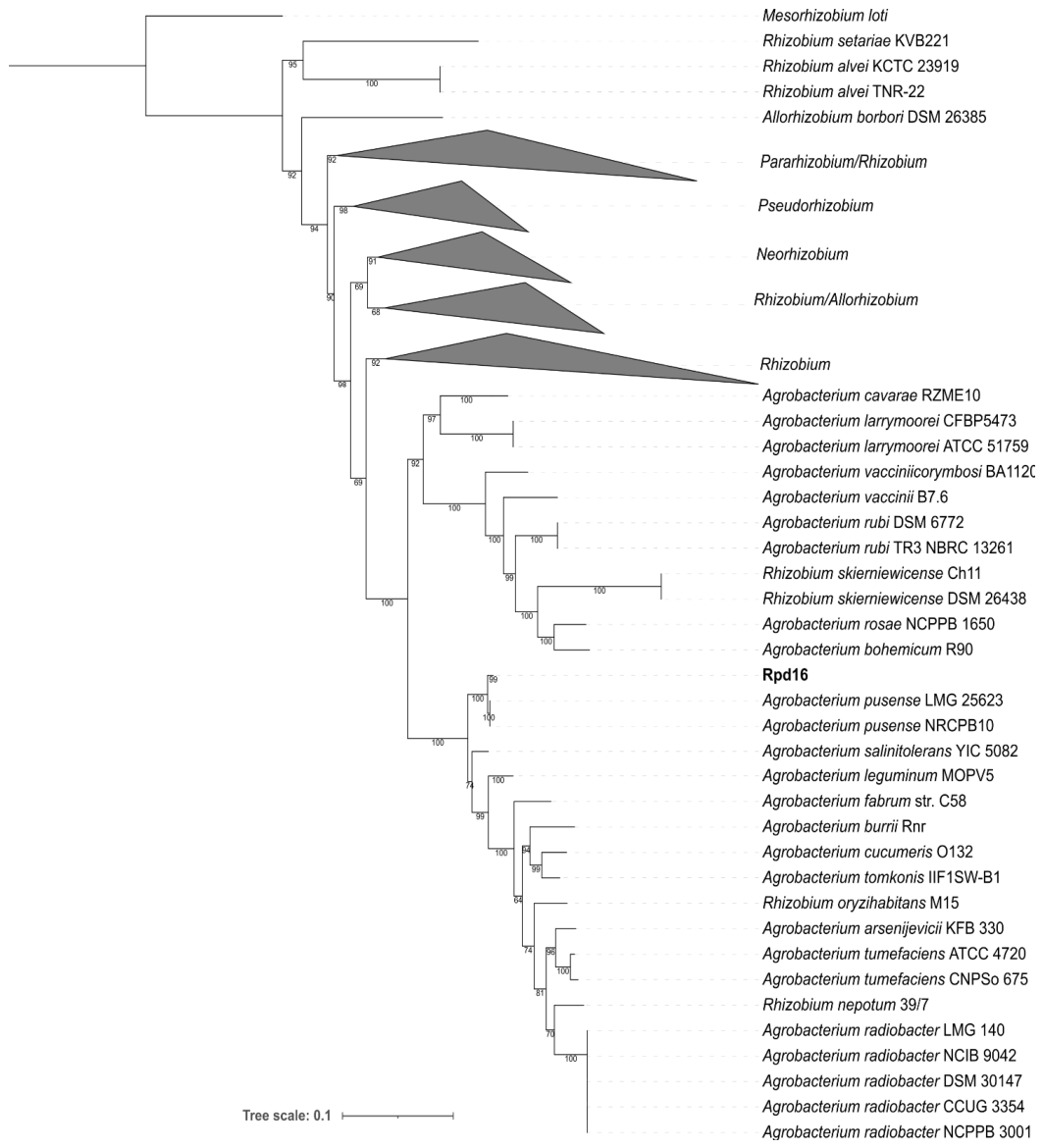
Maximum-likelihood phylogenies inferred separately from recA, rpoB, and glnII sequences consistently placed strain Rpd16 within the genus Agrobacterium, in the class Alphaproteobacteria. In each gene tree, Rpd16 formed a clade with the Agrobacterium pusense type strain NRCPB10T (=LMG 25623T), with 100% bootstrap support (Supplementary Figure S1A–C). The maximum-likelihood analysis of the concatenated recA, rpoB, and glnII alignments likewise placed Rpd16 in a strongly supported clade with this type strain (Figure 1). These results support the phylogenetic affiliation of Rpd16 with the A. pusense lineage.

3.3. Chemical Characterization and Storage Stability of the Rpd16 Inoculant

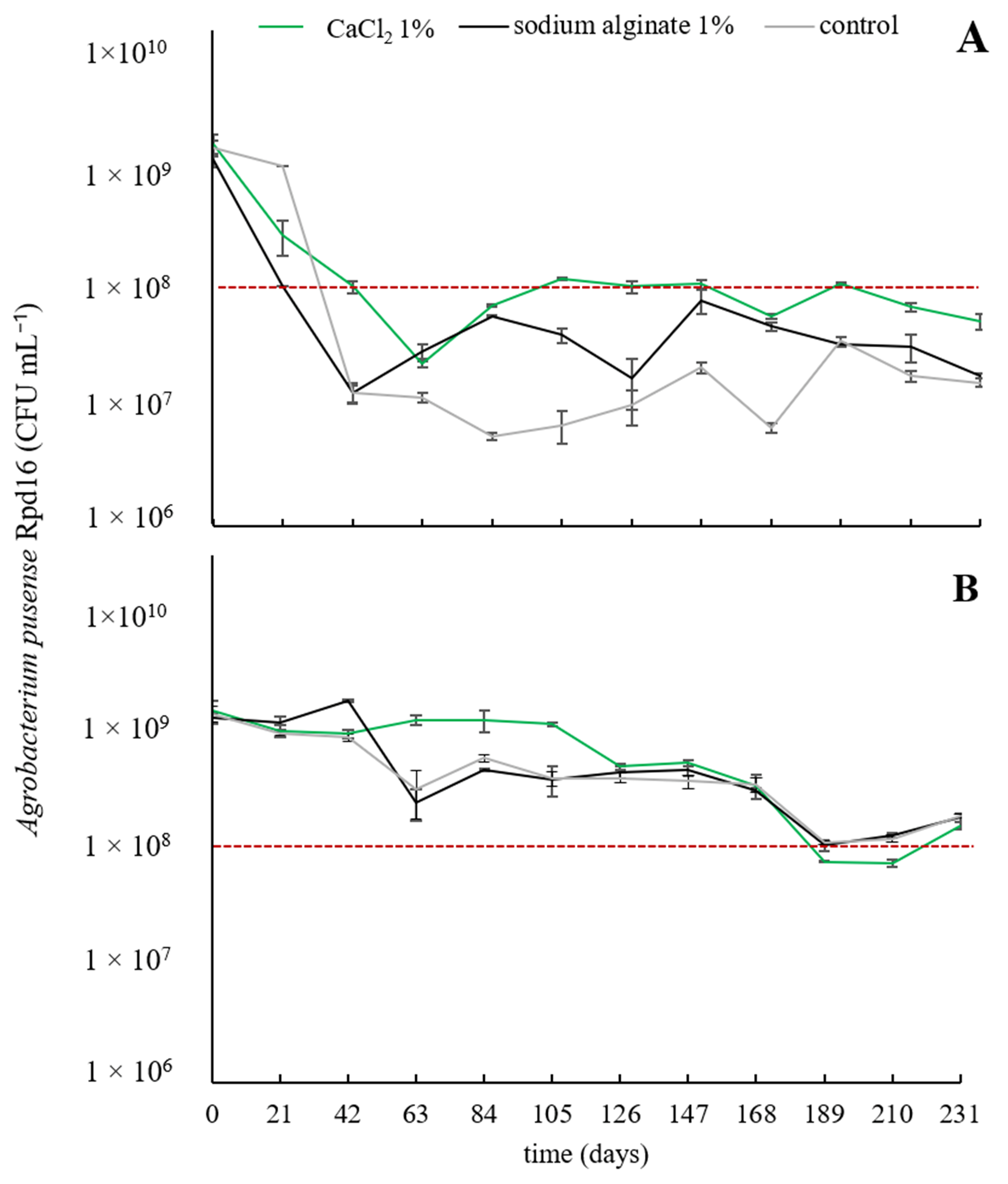
Preliminary chemical characterization of the Rpd16 inoculant produced in modified Bradyfact® medium showed Cd, Fe, and P concentrations of 0.45, 5.98, and 7.52 mg L−1, respectively. Na, Ca, Mg, and K concentrations were 1.3, 2.7, 1.1, and 11.2 g L−1, respectively. Storage temperature markedly affected viable cell concentrations. After 231 days, all formulations stored at 4 °C contained more than 108 CFU mL−1, whereas those stored at room temperature (mean 32 °C) contained concentrations on the order of 107 CFU mL−1 (Figure 2).
At room temperature, the viable cell concentration of the CaCl2-supplemented formulation decreased from approximately 109 to 107 CFU mL−1 during the first 63 days of storage, then increased and fluctuated around 108 CFU mL−1 between days 105 and 147. At day 231, this formulation had the highest viable cell concentration among treatments and a calculated logarithmic survival percentage of 83.9% (Figure 2A). The unsupplemented control and sodium alginate-supplemented formulation also showed marked decreases during the first 42 days, reaching concentrations on the order of 107 CFU mL−1. Thereafter, the sodium alginate-supplemented formulation generally maintained higher mean viable cell concentrations than the control. At day 231, their calculated logarithmic survival percentages were 80.0% and 78.6%, respectively (Figure 2A). Under refrigerated conditions, the CaCl2-supplemented formulation maintained higher viable cell concentrations than the other formulations between days 63 and 105, with values on the order of 109 CFU mL−1. No significant differences among formulations were detected between days 126 and 168. At day 231, all formulations had similar viable cell concentrations, with calculated logarithmic survival percentages of 89.3%, 90.6%, and 90.5% for the CaCl2-supplemented, sodium alginate-supplemented, and control formulations, respectively (Figure 2B).

3.4. Strain Rpd16 Reached High Cell Concentrations During Fermentation Scale-Up

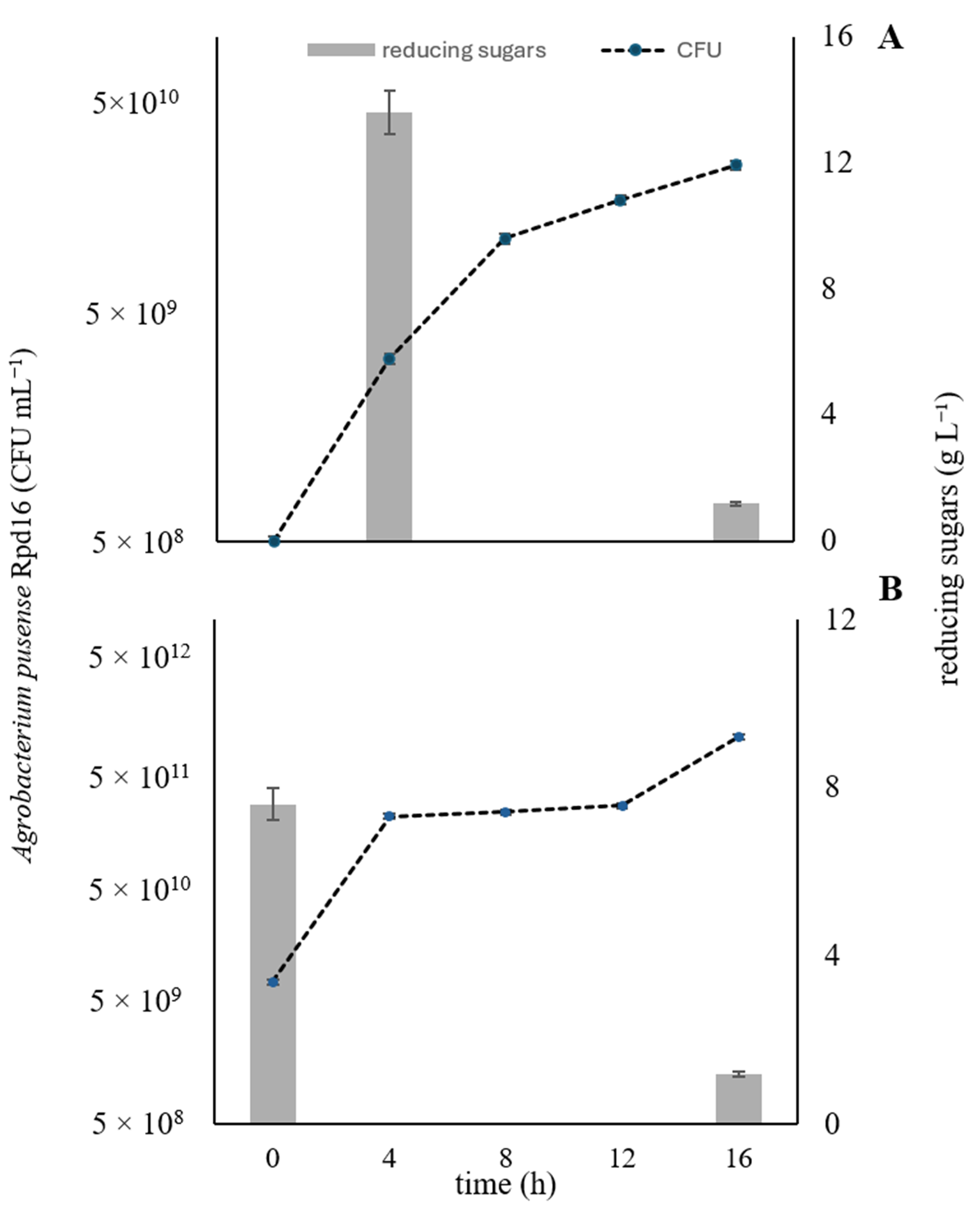
The viable cell concentration of strain Rpd16 increased during fermentation in both the 42-L and 500-L fermenters, operated at working volumes of 30 and 300 L, respectively. After 16 h, concentrations increased from an initial value of 5 × 10⁸ CFU mL−1 in both fermenters to 2.6 × 10¹⁰ CFU mL−1 in the 42-L fermenter and 1 × 10¹² CFU mL−1 in the 500-L fermenter (Figure 3; Supplementary Table S3).
In the 42-L fermenter, viable cell concentration increased progressively over 16 h, from 5 × 10⁸ to 2.6 × 10¹⁰ CFU mL−1, corresponding to an increase of 1.72 log10 units (Supplementary Table S3). The concentration reached approximately 109 CFU mL−1 at 4 h. Reducing sugar concentration decreased by approximately 91% between 4 and 16 h (Figure 3A). In the 500-L fermenter, viable cell concentration increased sharply from 5 × 10⁸ to approximately 1011 CFU mL−1 during the first 4 h and remained relatively stable through 12 h. A further increase between 12 and 16 h resulted in a final concentration of 1 × 10¹² CFU mL−1, corresponding to an overall increase of 3.30 log10 units (Supplementary Table S3). Reducing sugar concentration decreased by approximately 84% between 0 and 16 h (Figure 3B).

3.5. Rice Growth and Yield Responses to Azofert-A Under Reduced N Fertilization

The effects of Azofert-A were evaluated in rice cultivar INCA LP-5 under field conditions and reduced N fertilization. This preliminary field evaluation aimed to determine whether the Azofert-A prototype could produce a measurable agronomic response following formulation and scale-up. Both the Azofert-A treatment and the uninoculated control received 30% of the recommended N fertilization rate. Seed bio-priming with Azofert-A for 24 h was associated with higher growth and yield values than those of the uninoculated control (Table 2). Supplementary Figure S2 illustrates seedling development in both treatments before transplanting.
Seed bio-priming with Azofert-A was associated with higher mean tiller number, plant height, flag leaf length, flag leaf dry weight, and grain yield than those of the uninoculated treatment receiving the same N rate. Mean tiller number was 16.9 per plant in the Azofert-A treatment and 16.0 in the control, representing a 5.6% increase. Plant height increased from 23.3 to 25.8 cm (10.7%), flag leaf length from 28.2 to 31.0 cm (9.9%), and flag leaf dry weight from 0.17 to 0.24 g (41.2%). Grain yield was 5.9 t ha−1 in the Azofert-A treatment compared with 4.9 t ha−1 in the uninoculated control, representing an increase of approximately 20.4% (Table 2). These findings provide preliminary evidence of the agronomic potential of Azofert-A under 30% of the recommended N fertilization rate.

4. Discussion

This study examined key stages in developing a bacterial inoculant for rice, including candidate strain selection, multilocus assessment of taxonomic affiliation, storage stability, production scale-up, and preliminary field evaluation. Compared with the uninoculated control receiving the same 60% N rate, treatments with the three bacterial strains showed higher values for several rice yield-related traits, supporting their plant growth-promoting potential under reduced N fertilization (Table 1). Similar improvements have been reported under field conditions following inoculation with Herbaspirillum sp. or bacterial consortia containing Azospirillum lipoferum, Bacillus megaterium, and Bacillus circulans [62,63]. Because the screening experiment did not include inoculated treatments receiving 100% of the recommended N rate, it cannot establish whether inoculation provides additional benefits under full N fertilization. The experiment aimed to identify promising strains under reduced N fertilization, with uninoculated 60% and 100% N treatments serving as agronomic references. These results therefore support strain selection for further evaluation under reduced N inputs.
Panicle number per square meter and filled grain number per panicle are major components of rice yield, reflecting the abundance of reproductive structures and potentially harvestable grains, respectively [64,65]. Among the inoculated treatments, Rpd16 produced the highest values for both components, significantly exceeding those of Rpr11, 5P1, and the uninoculated 60% N control (Table 1). However, both values remained significantly below those of the uninoculated 100% N control, indicating that the improvements under reduced N fertilization did not match full-N performance for these yield components. Panicle formation and grain filling are influenced by several factors, including plant N assimilation during vegetative and reproductive development, particularly during panicle initiation, spikelet differentiation, flowering, and grain development and filling [66,67].
The root-dipping method may also have contributed to the responses observed following Rpd16 inoculation. This approach is particularly suitable for transplanted rice because it places bacterial cells in direct contact with roots before field establishment, potentially facilitating early root and rhizosphere colonization [68,69]. Previous studies reported indolic compound production, biofilm formation, and systemic endophytic colonization by Rpd16, as well as increased leaf carbohydrate content in inoculated plants [31,32]. These findings suggest possible explanations for the improved yield-related traits observed here. However, the underlying mechanisms were not evaluated in this study, and their contribution to the observed responses requires further investigation.
Rpd16 and 5P1 produced more unfilled grains per panicle than the uninoculated 60% N control, whereas Rpr11 produced fewer. These differences should be considered alongside total and filled grain counts, which were higher in all inoculated treatments than in the corresponding control (Table 1). A higher absolute number of unfilled grains should therefore not be interpreted as a beneficial response or, by itself, as evidence of a lower grain-filling proportion. The favorable performance of Rpd16 relative to Rpr11 and 5P1 under reduced N fertilization supported its selection for further characterization. MLSA provided greater phylogenetic resolution than the previous 16S rRNA gene analysis, supporting the affiliation of Rpd16 with the Agrobacterium pusense lineage containing the type strain LMG 25623T (Figure 1). This approach improves resolution within Rhizobiaceae, particularly among closely related members of Rhizobium and Agrobacterium [70,71]. Because the analysis included three housekeeping genes rather than whole-genome comparisons, it supports lineage affiliation rather than definitive species-level identification.
The type strain LMG 25623T was isolated from the rhizosphere of chickpea (Cicer arietinum) and originally described as Rhizobium pusense. It has been reported to lack tumor-inducing and root-inducing plasmids and virulence-associated genes and to cause no tumor formation in plants [72,73]. Genome mining and phenotypic studies of A. pusense strains have identified genes and traits potentially involved in plant-bacterium interactions and growth promotion, including auxin metabolism, iron acquisition, stress responses, and plant colonization [74]. Reported traits also include tolerance to abiotic stresses, biofilm formation, inorganic phosphate and zinc solubilization, and production of IAA, gibberellins, ACC deaminase, siderophores, and ammonium [75,76]. Positive growth responses following inoculation of wheat and chickpea further support the plant growth-promoting potential of strains affiliated with this species [75,77]. These findings do not establish the biosafety of Rpd16. Although its growth-promoting activity in rice has been demonstrated under controlled and greenhouse conditions [31,32], the present study did not assess Ti/Ri plasmids or virulence-associated genes or include standardized plant tumorigenicity assays. The pathogenicity and biosafety of Rpd16 therefore require specific assessment before its broader use as a microbial inoculant.
The available evidence supports further development of Rpd16 as the candidate active microbial ingredient of a rice inoculant. Modified Bradyfact® served as both the fermentation medium and the liquid carrier of the formulation. It contains sugarcane molasses and mineral salts, with the original soybean extract replaced by an aqueous rice extract [29]. This modification has been reported to support high bacterial cell concentrations and positive chemotactic responses in selected rice-associated plant growth-promoting bacteria [29], suggesting its suitability for producing and formulating the Rpd16 inoculant. The P, Fe, K, Mg, Ca, and Na detected in the inoculant likely originated from formulation components and may support bacterial growth and survival during production and storage.
Refrigeration at 4 °C favored the preservation of viable Rpd16 cells, with all formulations containing more than 108 CFU mL−1 after 231 days (Figure 2B). Concentrations of this magnitude have been proposed as practical quality benchmarks for some PGPB inoculants to provide a sufficiently large viable population at application [78,79]. The temperature effect was also reflected in the calculated logarithmic survival percentages of the unsupplemented formulation, which were 90.5% at 4 °C and 78.6% at 32 °C after 231 days. Similar benefits of refrigeration have been reported for inoculants containing Bradyrhizobium, Mesorhizobium, and Pseudomonas, potentially because lower temperatures reduce metabolic activity and slow cellular deterioration [6,80,81]. However, refrigerated storage may increase the logistical and economic demands of product distribution.
At room temperature, viable cell concentrations declined markedly, even in formulations supplemented with CaCl2 or sodium alginate (Figure 2A). Similar temperature-dependent differences have been reported for Cuban rhizobial inoculants: Rhizobium leguminosarum CF1 maintained concentrations ≥108 CFU mL−1 for 150 days at 4 °C, compared with 90 days at 29 ± 2 °C [82]. Greater metabolic activity at room temperature may accelerate nutrient depletion and metabolic by-product accumulation, increasing physiological stress during storage [83]. Nevertheless, the supplemented formulations generally maintained higher viable cell concentrations than the unsupplemented control (Figure 2A). Protective effects depend on additive properties [6]. Polymers such as PVP, CMC, and sodium alginate can modify viscosity, improve cell suspension, and provide physical protection. CaCl2 may alter ionic conditions and, in alginate-based systems, promote crosslinking and cell immobilization [19]. Combining PVP and sodium alginate has been reported to improve the survival of a liquid Bradyrhizobium japonicum inoculant at 28 °C, supporting the potential of polymeric additives, although their effects remain strain- and formulation-dependent [84].
Modified Bradyfact® medium was used throughout pre-inoculum preparation, inoculum production, and pilot- and production-scale fermentation. Maintaining the same medium composition may reduce physiological adjustment after transfer, shorten the lag phase, and simplify process operation [58]. Its inexpensive, readily available agro-industrial components also make it a potentially cost-effective alternative to laboratory media such as YM. Bradyfact® has been reported to increase the specific growth rate of a Bradyrhizobium elkanii strain relative to YM and is used to produce the commercial Cuban inoculants Azofert®-S and Azofert®-F for soybean and common bean, respectively [26,85,86].
Scale-up increased inoculant production from 3 to 300 L, with Rpd16 concentrations rising from approximately 108 to 1012 CFU mL−1 (Figure 3). These results indicate that Rpd16 growth was successfully maintained during the transition between fermentation scales. During production-scale fermentation, viable cell concentration increased by 3.30 log10 units (Supplementary Table S3). Reducing sugar concentrations decreased by 91% between 4 and 16 h in the 42-L fermenter and by 84% between 0 and 16 h in the 500-L fermenter. These decreases were consistent with substrate utilization during bacterial growth. However, measurements at only two time points per fermenter do not characterize substrate-consumption kinetics or establish the efficiency of medium utilization. Comparable scale-up approaches have been reported for plant-beneficial bacteria, although operating conditions vary among microorganisms. Azospirillum brasilense production was scaled from shake flasks to 10- and 1000-L bioreactors, reaching approximately 3.5–7.5 × 10⁸ CFU mL−1 [87]. Studies of Rhizobium phaseoli have highlighted the importance of medium composition for obtaining high cell densities at larger scales [88]. Bioreactor production of native Sinorhizobium strains has also been demonstrated following optimization of medium composition and agitation [89], while a starter-culture approach has been developed for pilot-scale production of Bradyrhizobium inoculants [90]. These studies emphasize that scale-up depends on cultivation conditions as well as culture volume. The sequential transfer of Rpd16 cultures to the 42- and 500-L fermenters supported growth at increasing production scales and yielded the prototype designated Azofert-A for preliminary field evaluation.
In the field evaluation, Azofert-A-treated plants showed higher growth and yield values than the uninoculated control receiving the same 30% N rate, with the largest percentage increases in flag leaf dry weight (41.2%) and grain yield (20.4%) (Table 2). The flag leaf contributes to canopy photosynthesis and is a major source of photoassimilates during rice grain filling. Although flag leaf traits are not yield components, they can influence assimilate availability and grain production [66,91]. Positive effects of PGPB, including Bacillus spp. and Sinorhizobium meliloti, on flag leaf development and photosynthesis-related variables have been reported [92,93]. Associations between flag leaf morphology and filled grain number, 1000-grain weight, and yield per plant have also been documented [94,95]. These findings provide a plausible physiological context for the observed responses. The absence of a treatment receiving the full recommended N rate prevents quantification of the inoculant’s capacity to compensate for reduced mineral N inputs. The 20.4% yield increase relative to the uninoculated 30% N control therefore provides preliminary evidence of agronomic potential rather than a defined N-substitution capacity. This experiment was intended as an initial field assessment of the prototype following formulation and scale-up. Factorial experiments combining N rates and Azofert-A application, including the full recommended N rate, are needed to assess its capacity to compensate for reduced N fertilization.
Plant N uptake, nitrogenase activity, and grain N content were not measured, and Rpd16 was not re-isolated after field inoculation. The growth and yield differences therefore cannot be attributed to increased N acquisition, nor was field colonization by Rpd16 confirmed. Although colonization has been documented under controlled conditions, its persistence in the present field experiment remains unknown. Previous studies with A. pusense RP1 provides a precedent for inoculant development within this lineage [77]. That study established cultivation conditions in flasks and a bioreactor and reported positive effects on wheat seed germination and early seedling development. The development of Azofert-A, based on Rpd16 affiliated with the A. pusense lineage, adds preliminary evidence of the agricultural potential of strains within this lineage. The present study integrates key stages from strain selection to inoculant production and preliminary field evaluation. Further evaluation across locations, growing seasons, N rates, and storage periods is needed to assess agronomic consistency, efficacy after storage, environmental safety, and the potential to reduce mineral fertilizer inputs.

5. Conclusions

The findings support further development of Rpd16 as a candidate active microbial ingredient of a rice inoculant for use under reduced N fertilization. Its favorable overall performance for rice yield components under 60% N fertilization provided the basis for prototype development. Multilocus phylogenetic analysis supported its affiliation with the Agrobacterium pusense lineage, while cultivation in modified Bradyfact® medium enabled production at the 300-L scale, reaching approximately 1012 CFU mL−1. Storage assessment further showed that all evaluated formulations contained more than 108 CFU mL−1 after 231 days at 4 °C. Following formulation and scale-up, seed bio-priming with the prototype, provisionally designated Azofert-A, was associated with improved flag leaf traits and higher grain yield than the uninoculated control receiving the same 30% N rate. Together, these results provide preliminary evidence of the strain’s suitability for inoculant development, although agronomic consistency and biosafety require further assessment. Thus, the main contribution is the integration of strain selection and characterization, formulation, production scale-up, storage stability assessment, and preliminary field evaluation, providing a basis for developing agricultural inoculants under limited mineral fertilizer availability.

Supplementary Materials

The following supporting information can be downloaded at: https://www.mdpi.com/article/10.3390/agriculture16202180/s1, Supplementary Table S1: Chemical characteristics of the Ferruginous Nodular Petroferric Gleysol soil where the field experiments were conducted, Table S2: Coding sequences of 162 type strains downloaded from NCBI Datasets and used to construct a Maximum Likelihood phylogenetic tree based on the concatenated alignment of three housekeeping genes (recA-rpoB-glnII), Table S3: Changes in viable cell concentration and reducing sugar concentration during fermentation of Agrobacterium pusense Rpd16, Figure S1A–C: Maximum Likelihood phylogenetic trees based on individual housekeeping genes, Figure S2: Rice seedlings of cultivar INCA LP-5 inoculated (left) or uninoculated (right) with Azofert-A for 24 h and sown in plastic trays containing a substrate, File S1: Partial sequences of the housekeeping genes (recA-rpoB-glnII) of strain Rpd16, File S2 A–C: Nucleotide sequences and MAFFT alignments of the housekeeping genes (recA-rpoB-glnII) used for the taxonomic analysis of strain Rpd16.

Author Contributions

I.H.-F., L.A.M.-L. and M.C.N.-G. conceived and designed the research. I.H.-F., L.A.M.-L., B.M.-M., O.M.-C., D.D.-R. and V.L.-F. developed the methodology and performed the experiments. I.H.-F. and L.A.M.-L. validated the methodology. I.H.-F. and M.E.M.-A. analyzed and curated the data. M.C.N.-G. and L.A.M.-L. provided the resources and coordinated the research activities. I.H.-F. prepared the figures. I.H.-F. and M.C.N.-G. supervised the research. I.H.-F. and M.C.N.-G. wrote the original draft. I.H.-F., K.V.-C., T.S. and H.H. reviewed and edited the manuscript. All authors have read and agreed to the published version of the manuscript.

Funding

This research received no external funding.

Institutional Review Board Statement

This article does not contain any studies with human participants or animals performed by the authors. These methods were carried out in accordance with relevant guidelines and regulations.

Informed Consent Statement

Not applicable.

Data Availability Statement

The data presented in this study are openly available in Zenodo repository at https://doi.org/10.5281/zenodo.22676856 (accessed on 9 September 2026).

Acknowledgments

We would like to thank the agricultural technicians at “Los Palacios” Experimental Station of National Institute of Agricultural Science (INCA) in Pinar del Río, Cuba. H.H. is grateful for the support received from the Dirección de Investigación, Universidad de La Frontera (DIUFRO), Chile, grant numbers DI23-0058, GI24-0036 and PP24-0017. T.S. acknowledges support from the ANID Doctorado Nacional grant number 21241943. During the preparation of this manuscript, the author(s) used ChatGPT (GPT-6, OpenAI) to improve the language and readability of the text. Following the use of this tool, the authors reviewed and edited the manuscript as necessary and take full responsibility for its content.

Conflicts of Interest

The authors declare no competing interests.

References

  1. Mącik, M.; Gryta, A.; Frąc, M. Biofertilizers in agriculture: An overview on concepts, strategies and effects on soil microorganisms. Adv. Agron. 2020, 162, 31–87. [Google Scholar] [CrossRef] [Scilit]
  2. Gautam, K.; Sirohi, C.; Singh, N.R.; Thakur, Y.; Jatav, S.S.; Rana, K.; Chitara, M.; Meena, R.P.; Singh, A.K.; Parihar, M. Microbial biofertilizer: Types, applications, and current challenges for sustainable agricultural production. In Biofertilizers: Advances in Bio-inoculants; Rakshit, A., Meena, V.S., Parihar, M., Singh, H.B., Singh, A.K., Eds.; Elsevier: Amsterdam, The Netherlands, 2021; Volume 1, pp. 3–19. [Google Scholar] [CrossRef] [Scilit]
  3. Duhan, P.; Kataria, R. Biofertilizers for sustainable agriculture. In Encyclopedia of Green Materials; Baskar, C., Ramakrishna, S., La Rosa, A.D., Eds.; Springer: Singapore, 2022; pp. 1–13. [Google Scholar] [CrossRef] [Scilit]
  4. Sun, X.; Xu, Z.; Zhang, N.; Miao, Y.; Zhang, C.; Ma, X.; Shen, Q.; Zhang, R. Biofertilizer industry and research developments in China: A mini-review. Microb. Biotechnol. 2025, 18, e70163. [Google Scholar] [CrossRef] [Scilit]
  5. Bashan, Y.; de-Bashan, L.E.; Prabhu, S.R.; Hernandez, J.-P. Advances in plant growth-promoting bacterial inoculant technology: Formulations and practical perspectives (1998–2013). Plant Soil 2014, 378, 1–33. [Google Scholar] [CrossRef] [Scilit]
  6. Berninger, T.; González López, Ó.; Bejarano, A.; Preininger, C.; Sessitsch, A. Maintenance and assessment of cell viability in formulation of non-sporulating bacterial inoculants. Microb. Biotechnol. 2018, 11, 277–301. [Google Scholar] [CrossRef] [Scilit]
  7. Khan, A.; Singh, A.V.; Gautam, S.S.; Agarwal, A.; Punetha, A.; Upadhayay, V.K.; Kukreti, B.; Bundela, V.; Jugran, A.K.; Goel, R. Microbial bioformulation: A microbial assisted biostimulating fertilization technique for sustainable agriculture. Front. Plant Sci. 2023, 14, 1270039. [Google Scholar] [CrossRef] [Scilit]
  8. Malusá, E.; Vassilev, N. A contribution to set a legal framework for biofertilisers. Appl. Microbiol. Biotechnol. 2014, 98, 6599–6607. [Google Scholar] [CrossRef] [Scilit]
  9. Pirttilä, A.M.; Mohammad Parast Tabas, H.; Baruah, N.; Koskimäki, J.J. Biofertilizers and biocontrol agents for agriculture: How to identify and develop new potent microbial strains and traits. Microorganisms 2021, 9, 817. [Google Scholar] [CrossRef] [Scilit]
  10. Alvarado, R.; Sagredo-Saez, C.; Fuentes-Quiroz, A.; Villanueva-Guerrero, A.; Mujica, M.I.; Ahumada, R.; Almonacid-Muñoz, L.; Jorquera-Fontena, E.; de Oliveira Costa, P.H.; da Silva Valadares, R.B.; et al. Endophytic seed-associated microbial diversity and its impact on seedling growth of the Andean tree Nothofagus obliqua (Mirb.) Oerst. Plant Growth Regul. 2024, 103, 321–336. [Google Scholar] [CrossRef] [Scilit]
  11. Backer, R.; Rokem, J.S.; Ilangumaran, G.; Lamont, J.; Praslickova, D.; Ricci, E.; Subramanian, S.; Smith, D.L. Plant growth-promoting rhizobacteria: Context, mechanisms of action, and roadmap to commercialization of biostimulants for sustainable agriculture. Front. Plant Sci. 2018, 9, 1473. [Google Scholar] [CrossRef] [Scilit]
  12. Fanai, A.; Bohia, B.; Lalremruati, F.; Lalhriatpuii, N.; Lalrokimi; Lalmuanpuii, R.; Singh, P.K.; Zothanpuia. Plant growth promoting bacteria (PGPB)-induced plant adaptations to stresses: An updated review. PeerJ 2024, 12, e17882. [Google Scholar] [CrossRef] [Scilit]
  13. Valenzuela, T.; Acuña, J.J.; Salvo, H.; Bol, R.; Sessitsch, A.; Jorquera, M.A. Systematic review reveals gaps in standardized protocol to determine efficacy of PGPB use in plants grown under abiotic stress conditions at the field level. Rhizosphere 2025, 36, 101190. [Google Scholar] [CrossRef] [Scilit]
  14. Kaminsky, L.M.; Trexler, R.V.; Malik, R.J.; Hockett, K.L.; Bell, T.H. The inherent conflicts in developing soil microbial inoculants. Trends Biotechnol. 2019, 37, 140–151. [Google Scholar] [CrossRef] [Scilit]
  15. Qiu, Z.; Egidi, E.; Liu, H.; Kaur, S.; Singh, B.K. New frontiers in agriculture productivity: Optimised microbial inoculants and in situ microbiome engineering. Biotechnol. Adv. 2019, 37, 107371. [Google Scholar] [CrossRef] [Scilit]
  16. Sivaram, A.K.; Abinandan, S.; Chen, C.; Venkateswartlu, K.; Megharaj, M. Microbial inoculant carriers: Soil health improvement and moisture retention in sustainable agriculture. Adv. Agron. 2023, 180, 35–91. [Google Scholar] [CrossRef] [Scilit]
  17. Ribeiro, R.C.; Matos, J.P.C.; Martins, D.V.d.S.; Canellas, L.P.; Olivares, F.L. Microbial inoculants and root microbiome: A path to sustainable agroecosystem management. npj Sustain. Agric. 2026, 4, 51. [Google Scholar] [CrossRef] [Scilit]
  18. Vassileva, M.; Malusà, E.; Sas-Paszt, L.; Trzcinski, P.; Galvez, A.; Flor-Peregrin, E.; Shilev, S.; Canfora, L.; Mocali, S.; Vassilev, N. Fermentation strategies to improve soil bio-inoculant production and quality. Microorganisms 2021, 9, 1254. [Google Scholar] [CrossRef] [Scilit]
  19. Díaz-Rodríguez, A.M.; Parra Cota, F.I.; Cira Chávez, L.A.; García Ortega, L.F.; Estrada Alvarado, M.I.; Santoyo, G.; de los Santos-Villalobos, S. Microbial inoculants in sustainable agriculture: Advancements, challenges, and future directions. Plants 2025, 14, 191. [Google Scholar] [CrossRef] [Scilit]
  20. Brahmaprakash, G.P.; Sahu, P.K.; Lavanya, G.; Gupta, A.; Nair, S.S.; Gangaraddi, V. Role of additives in improving efficiency of bioformulation for plant growth and development. In Frontiers in Soil and Environmental Microbiology; Nayak, S.K., Mishra, B.B., Eds.; CRC Press: Boca Raton, FL, USA, 2020; pp. 1–10. [Google Scholar] [CrossRef] [Scilit]
  21. Allouzi, M.M.A.; Allouzi, S.M.A.; Keng, Z.X.; Supramaniam, C.V.; Singh, A.; Chong, S. Liquid biofertilizers as a sustainable solution for agriculture. Heliyon 2022, 8, e12609. [Google Scholar] [CrossRef] [Scilit]
  22. Sivasakthivelan, P.; Saranraj, P.; Sayyed, R.Z.; Arivukkarasu, K.; Kokila, M.; Manigandan, M.; Seifi, S. Inoculant production and formulation of Azospirillum species. In Plant Growth Promoting Microorganisms of Arid Region; Mawar, R., Sayyed, R.Z., Sharma, S.K., Sattiraju, K.S., Eds.; Springer: Singapore, 2023; pp. 423–455. [Google Scholar] [CrossRef] [Scilit]
  23. Moreno García, R.R.; Giannetti, B.F.; Agostinho, F.; Almeida, C.M.V.B.; Sevegnani, F.; Parra Pérez, K.M.; Velásquez, L. Assessing the sustainability of rice production in Brazil and Cuba. J. Agric. Food Res. 2021, 4, 100152. [Google Scholar] [CrossRef] [Scilit]
  24. Food and Agriculture Organization of the United Nations. GIEWS Country Brief: The Republic of Cuba. 17 December 2024. Available online: https://www.fao.org/giews/countrybrief/country.jsp?code=CUB (accessed on 3 October 2026).
  25. Peña Borrego, M.D.; de Zayas Pérez, M.R.; Rodríguez Fernández, R.M. La producción científica sobre biofertilizantes en Cuba en el período 2008–2012: Un análisis bibliometrico de las revistas cubanas. Cult. Trop. 2015, 36, 44–54. [Google Scholar]
  26. Sauvu-Jonasse, C.; Nápoles-García, M.C.; Falcón-Rodríguez, A.B.; Lamz-Piedra, A.; Ruiz-Sánchez, M. Bioestimulantes en el crecimiento y rendimiento de soya (Glycine max (L.) Merrill). Cult. Trop. 2020, 41, e02. [Google Scholar]
  27. Gómez González, J.; Rios Rocafull, Y.; Tejeda González, G.; Dibut Álvarez, B.; Ortega García, M. Estado actual y perspectivas del biofertilizante DIMARGON®. Agrotec. Cuba 2025, 49, e03. [Google Scholar]
  28. Hernández Forte, I.; Pérez Arabí, C.; Barrios Hernández, A.; Machado Brito, V.; Travieso Hernández, L.; González Pérez, B.L.; León Fernández, V.; Dopico Ramírez, D. Efecto de la inoculación de Bioenraiz® y su fermentado final en el crecimiento y fisiología de arroz (Oryza sativa L.) cultivar Selección 1. Cult. Trop. 2025, 46, e01. [Google Scholar]
  29. Pérez-Arabi, C.; Hernández-Forte, I.; Travieso-Hernández, L.; Nápoles-García, M.C.; Machado-Brito, V.; Morales-Mena, B.; Verdugo-Chavez, K.; Villarroel-Contreras, M.J.; Herrera, H. Selection of a Rhizobium sp. strain and culture medium for the development of a liquid bioinoculant for rice (Oryza sativa L.) cultivar Selección 1. Microorganisms 2026, 14, 998. [Google Scholar] [CrossRef] [Scilit]
  30. Hernández Forte, I.; Nápoles García, M.C. Rizobios residentes en la rizosfera de plantas de arroz (Oryza sativa L.) cultivar INCA LP-5. Cult. Trop. 2017, 38, 39–49. [Google Scholar]
  31. Hernández Forte, I.; Nápoles García, M.C. Rhizobia promote rice (Oryza sativa L.) growth: First evidence in Cuba. In Microbial Probiotics for Agricultural Systems: Advances in Agronomic Use; Zúñiga-Dávila, D., González-Andrés, F., Ormeño-Orrillo, E., Eds.; Springer: Cham, Switzerland, 2019; pp. 155–168. [Google Scholar] [CrossRef] [Scilit]
  32. Hernández, I.; Taulé, C.; Pérez-Pérez, R.; Battistoni, F.; Fabiano, E.; Rivero, D.; Nápoles, M.C. Endophytic rhizobia promote the growth of Cuban rice cultivar. Symbiosis 2021, 85, 175–190. [Google Scholar] [CrossRef] [Scilit]
  33. Hernández-Forte, I.; Pérez-Pérez, R.; Nápoles-García, M.C.; Maqueira-López, L.A.; Rojan-Herrera, O. Rhizospheric rhizobia with potential as biofertilizers from Cuban rice cultivars. Agron. Colomb. 2021, 39, 78–89. [Google Scholar] [CrossRef] [Scilit]
  34. Hernández, I.; Taulé, C.; Pérez-Pérez, R.; Battistoni, F.; Fabiano, E.; Villanueva-Guerrero, A.; Nápoles, M.C.; Herrera, H. Endophytic seed-associated bacteria as plant growth promoters of Cuban rice (Oryza sativa L.). Microorganisms 2023, 11, 2317. [Google Scholar] [CrossRef] [Scilit]
  35. Hernández Forte, I.; Nápoles García, M.C.; Maqueira López, L.A.; Battistoni Urrutia, F. Contribución al conocimiento de la interacción Rhizobium-arroz (Oryza sativa L.). Oportunidades para la biofertilización del cultivo. An. Acad. Cienc. Cuba 2023, 13, 1329. [Google Scholar]
  36. MINAG. Plan 2018–2019 de Producción de Semilla de Arroz en Cuba. 2019. Available online: http://www.minag.gob.cu/node/167 (accessed on 1 September 2026).
  37. de Jesús Pérez-León, N.; Díaz-López, G.; Castell, S.; Castro-Álvarez, R.; Miranda-Caballero, A. La producción arrocera frente a las variaciones del clima en la localidad “Los Palacios”. Ing. Agríc. 2018, 8, 26–32. [Google Scholar]
  38. IUSS Working Group WRB. World Reference Base for Soil Resources 2014: International Soil Classification System for Naming Soils and Creating Legends for Soil Maps; World Soil Resources Reports No. 106; FAO: Rome, Italy, 2014. [Google Scholar]
  39. Delamuta, J.R.M.; Scherer, A.J.; Ribeiro, R.A.; Hungria, M. Genetic diversity of Agrobacterium species isolated from nodules of common bean and soybean in Brazil, Mexico, Ecuador and Mozambique, and description of the new species Agrobacterium fabacearum sp. nov. Int. J. Syst. Evol. Microbiol. 2020, 70, 4233–4244. [Google Scholar] [CrossRef] [Scilit]
  40. Gaunt, M.W.; Turner, S.L.; Rigottier-Gois, L.; Lloyd-Macgilp, S.A.; Young, J.P. Phylogenies of atpD and recA support the small subunit rRNA-based classification of rhizobia. Int. J. Syst. Evol. Microbiol. 2001, 51, 2037–2048. [Google Scholar] [CrossRef] [Scilit]
  41. Stępkowski, T.; Moulin, L.; Krzyżańska, A.; McInnes, A.; Law, I.J.; Howieson, J. European origin of Bradyrhizobium populations infecting lupins and serradella in soils of Western Australia and South Africa. Appl. Environ. Microbiol. 2005, 71, 7041–7052. [Google Scholar] [CrossRef] [Scilit]
  42. Martens, M.; Dawyndt, P.; Coopman, R.; Gillis, M.; De Vos, P.; Willems, A. Advantages of multilocus sequence analysis for taxonomic studies: A case study using 10 housekeeping genes in the genus Ensifer (including former Sinorhizobium). Int. J. Syst. Evol. Microbiol. 2008, 58, 200–214. [Google Scholar] [CrossRef] [Scilit]
  43. O’Leary, N.A.; Wright, M.W.; Brister, J.R.; Ciufo, S.; Haddad, D.; McVeigh, R.; Rajput, B.; Robbertse, B.; Smith-White, B.; Ako-Adjei, D.; et al. Reference sequence (RefSeq) database at NCBI: Current status, taxonomic expansion, and functional annotation. Nucleic Acids Res. 2016, 44, D733–D745. [Google Scholar] [CrossRef] [Scilit]
  44. O’Leary, N.A.; Cox, E.; Holmes, J.B.; Anderson, W.R.; Falk, R.; Hem, V.; Tsuchiya, M.T.N.; Schuler, G.D.; Zhang, X.; Torcivia, J.; et al. Exploring and retrieving sequence and metadata for species across the tree of life with NCBI Datasets. Sci. Data 2024, 11, 732. [Google Scholar] [CrossRef] [Scilit]
  45. Camacho, C.; Coulouris, G.; Avagyan, V.; Ma, N.; Papadopoulos, J.; Bealer, K.; Madden, T.L. BLAST+: Architecture and applications. BMC Bioinform. 2009, 10, 421. [Google Scholar] [CrossRef] [Scilit]
  46. Katoh, K.; Standley, D.M. MAFFT multiple sequence alignment software version 7: Improvements in performance and usability. Mol. Biol. Evol. 2013, 30, 772–780. [Google Scholar] [CrossRef] [Scilit]
  47. Handika, H.; Esselstyn, J.A. SEGUL: Ultrafast, memory-efficient and mobile-friendly software for manipulating and summarizing phylogenomic datasets. Mol. Ecol. Resour. 2024, 24, e13964. [Google Scholar] [CrossRef] [Scilit]
  48. Minh, B.Q.; Schmidt, H.A.; Chernomor, O.; Schrempf, D.; Woodhams, M.D.; von Haeseler, A.; Lanfear, R. IQ-TREE 2: New models and efficient methods for phylogenetic inference in the genomic era. Mol. Biol. Evol. 2020, 37, 1530–1534. [Google Scholar] [CrossRef] [Scilit]
  49. Kalyaanamoorthy, S.; Minh, B.Q.; Wong, T.K.F.; von Haeseler, A.; Jermiin, L.S. ModelFinder: Fast model selection for accurate phylogenetic estimates. Nat. Methods 2017, 14, 587–589. [Google Scholar] [CrossRef] [Scilit]
  50. Letunic, I.; Bork, P. Interactive Tree of Life (iTOL) v6: Recent updates to the phylogenetic tree display and annotation tool. Nucleic Acids Res. 2024, 52, W78–W82. [Google Scholar] [CrossRef] [Scilit]
  51. Nápoles, M.C.; Gutiérrez, Á.G.; Corbera-Gorotiza, J. Medio de Cultivo para Bradyrhizobium japonicum. Biopreparado Resultante. Cuba Patent No. 22797, 2002. Available online: https://patentscope2.wipo.int/search/pt/detail.jsf?docId=CU4401504 (accessed on 9 August 2026).
  52. Martínez, J.A.; Valdiviés-Cruz, K.; Milián-Pila, C.R. El Instituto de Ciencia y Tecnología de Materiales (IMRE) de la Universidad de La Habana: Aniversario XL. Rev. Cuba. Fis. 2025, 42, 138–144. [Google Scholar]
  53. Beaty, R.D.; Kerber, J.D. Concepts, Instrumentation and Techniques in Atomic Absorption Spectrophotometry; Perkin-Elmer: Shelton, CT, USA, 1978. [Google Scholar]
  54. Mendham, J.; Denney, R.C.; Barnes, J.D.; Thomas, M.J.K. Vogel’s Textbook of Quantitative Chemical Analysis, 6th ed.; Prentice Hall: Harlow, UK, 2000. [Google Scholar]
  55. Zapata-Narváez, Y.; Díaz-García, A.; Beltrán-Acosta, C.; Barrios-Candil, S.; Gómez-Marroquín, M.; Cortés-Rojas, D. Bacillus subtilis Bs006 formulations: Storage stability, biological activity and endophytism in vegetables. Chil. J. Agric. Anim. Sci. 2024, 40, 81–90. [Google Scholar] [CrossRef] [Scilit]
  56. Pérez Peñaranda, M.C.; Oramas García, J.; Sotolongo Valdés, E.A.; Valdivia Pérez, J.; Román Tabio, Y.; Beovides García, Y.; Simó González, J. Escalado de la producción de un biofertilizante a base de Pseudomonas fluorescens. Biotecnol. Veg. 2020, 20, 298–312. [Google Scholar]
  57. Miller, G.L. Use of dinitrosalicylic acid reagent for determination of reducing sugar. Anal. Chem. 1959, 31, 426–428. [Google Scholar] [CrossRef] [Scilit]
  58. Stanbury, P.F.; Whitaker, A.; Hall, S.J. Principles of Fermentation Technology, 3rd ed.; Butterworth-Heinemann: Oxford, UK, 2016. [Google Scholar]
  59. Madigan, M.T.; Bender, K.S.; Buckley, D.H.; Sattley, W.M.; Stahl, D.A. Brock Biology of Microorganisms, 16th ed.; Pearson: Singapore, 2021. [Google Scholar]
  60. Miranda-Caballero, A.; Díaz-López, G.S.; Ruiz-Sánchez, M.; Domínguez-Vento, C.; Paneque-Rondón, P. Evaluación de la calidad del trasplante mecanizado de arroz en Cuba. Rev. Cienc. Téc. Agropecu. 2022, 31, 1–8. [Google Scholar]
  61. Amador, M.; Peña, R. Tamaño óptimo de muestra para evaluar rendimiento y sus parámetros en el cultivo del arroz en la Estación Experimental de Jucarito. Cienc. Téc. Agric. Arroz 1986, 5, 41–62. [Google Scholar]
  62. Abd El-Mageed, T.A.; Abd El-Mageed, S.A.; El-Saadony, M.T.; Abdelaziz, S.; Abdou, N.M. Plant growth-promoting rhizobacteria improve growth, morph-physiological responses, water productivity, and yield of rice plants under full and deficit drip irrigation. Rice 2022, 15, 16. [Google Scholar] [CrossRef] [Scilit]
  63. Li, P.; Tian, Y.; Yang, K.; Tian, M.; Zhu, Y.; Chen, X.; Hu, R.; Qin, T.; Liu, Y.; Peng, S.; et al. Mechanism of microbial action of the inoculated nitrogen-fixing bacterium for growth promotion and yield enhancement in rice (Oryza sativa L.). Adv. Biotechnol. 2024, 2, 32. [Google Scholar] [CrossRef] [Scilit]
  64. Amanullah; Fahad, S. (Eds.) Rice—Technology and Production; InTech: Rijeka, Croatia, 2017. [Google Scholar] [CrossRef] [Scilit]
  65. Takai, T. Potential of rice tillering for sustainable food production. J. Exp. Bot. 2024, 75, 708–720. [Google Scholar] [CrossRef] [Scilit]
  66. Ali, J.; Wani, S.H. (Eds.) Rice Improvement: Physiological, Molecular Breeding and Genetic Perspectives; Springer: Cham, Switzerland, 2021. [Google Scholar] [CrossRef] [Scilit]
  67. Yuan, R.; Mao, Y.; Zhang, D.; Wang, S.; Zhang, H.; Wu, M.; Ye, M.; Zhang, Z. The formation of rice tillers and factors influencing it. Agronomy 2024, 14, 2904. [Google Scholar] [CrossRef] [Scilit]
  68. Malusá, E.; Sas-Paszt, L.; Ciesielska, J. Technologies for beneficial microorganisms inocula used as biofertilizers. Sci. World J. 2012, 2012, 491206. [Google Scholar] [CrossRef] [Scilit]
  69. Aloo, B.N.; Tripathi, V.; Makumba, B.A.; Mbega, E.R. Plant growth-promoting rhizobacterial biofertilizers for crop production: The past, present, and future. Front. Plant Sci. 2022, 13, 1002448. [Google Scholar] [CrossRef] [Scilit]
  70. Ferraz Helene, L.C.; Klepa, M.S.; Hungria, M. New insights into the taxonomy of bacteria in the genomic era and a case study with rhizobia. Int. J. Microbiol. 2022, 2022, 4623713. [Google Scholar] [CrossRef] [Scilit]
  71. Rejili, M.; Bouznif, B.; Benabderrahim, M.A.; Mars, M. Multilocus sequencing analysis of the rhizobial symbionts isolated from Acacia salicina (Lindl.) grown in different regions in Tunisia reveals putative novel Bradyrhizobium species. World J. Microbiol. Biotechnol. 2025, 41, 22. [Google Scholar] [CrossRef] [Scilit]
  72. Panday, D.; Schumann, P.; Das, S.K. Rhizobium pusense sp. nov., isolated from the rhizosphere of chickpea (Cicer arietinum L.). Int. J. Syst. Evol. Microbiol. 2011, 61, 2632–2639. [Google Scholar] [CrossRef] [Scilit]
  73. Waldburger, L.; Thompson, M.G.; Weisberg, A.J.; Lee, N.; Chang, J.H.; Keasling, J.D.; Shih, P.M. Transcriptome architecture of the three main lineages of agrobacteria. mSystems 2023, 8, e00333-23. [Google Scholar] [CrossRef] [Scilit]
  74. Chaudhary, T.; Gera, R.; Shukla, P. Deciphering the Potential of Rhizobium pusense MB-17a, a Plant Growth-Promoting Root Endophyte, and Functional Annotation of the Genes Involved in the Metabolic Pathway. Front. Bioeng. Biotechnol. 2021, 8, 617034. [Google Scholar] [CrossRef] [Scilit]
  75. Kaur, J.; Mudgal, G.; Chand, K.; Singh, G.B.; Perveen, K.; Bukhari, N.A.; Debnath, S.; Mohan, T.C.; Charukesi, R.; Singh, G. An exopolysaccharide-producing novel Agrobacterium pusense strain JAS1 isolated from snake plant enhances plant growth and soil water retention. Sci. Rep. 2022, 12, 21330. [Google Scholar] [CrossRef] [Scilit]
  76. Kumar, A.; Rani, R. Isolation and characterization of heavy metal-tolerant, plant growth-promoting bacteria and evaluation of the impact of lead [Pb(II)] on their functional traits. Arch. Microbiol. 2026, 208, 206. [Google Scholar] [CrossRef] [Scilit]
  77. Avetisova, G.; Melkonyan, L.; Ghochikyan, V.; Tsarukyan, G.; Toplaghaltsya, A.; Karapetyan, Z.; Keleshyan, S. Biofertilizer based on Agrobacterium as a key to food security. Bioact. Compd. Health Dis. 2024, 7, 558–569. [Google Scholar] [CrossRef] [Scilit]
  78. Izaguirre Mayoral, M.L.; Labandera, C.; Sanjuán, J. Biofertilizantes en Iberoamérica: Una Visión Técnica, Científica y Empresarial; Editorial Universitaria: Havana, Cuba, 2020. [Google Scholar]
  79. de Souza, G.K.; Sampaio, J.; Longoni, L.; Ferreira, S.; Alvarenga, S.; Beneduzi, A. Soybean inoculants in Brazil: An overview of quality control. Braz. J. Microbiol. 2019, 50, 205–211. [Google Scholar] [CrossRef] [Scilit]
  80. Temprano, F.; Albareda, M.; Camacho, M.; Daza, A.; Santamaría, C.; Rodríguez-Navarro, D.N. Survival of several Rhizobium/Bradyrhizobium strains on different inoculant formulations and inoculated seeds. Int. Microbiol. 2002, 5, 81–86. [Google Scholar] [CrossRef] [Scilit]
  81. Sahai, P.; Chandra, R. Shelf life of liquid and carrier based Mesorhizobium sp. and Pseudomonas sp. inoculants under different storage conditions. J. Food Legum. 2009, 22, 280–282. [Google Scholar]
  82. Morales Mena, B.; Nápoles García, M.C.; Hernández Forte, I. Efecto de la temperatura y el tiempo de conservación en la calidad de Azofert®-F. Cult. Trop. 2024, 45, e01. [Google Scholar]
  83. Lobo, C.B.; Juárez Tomás, M.S.; Viruel, E.; Ferrero, M.A.; Lucca, M.E. Development of low-cost formulations of plant growth-promoting bacteria to be used as inoculants in beneficial agricultural technologies. Microbiol. Res. 2019, 219, 12–25. [Google Scholar] [CrossRef] [Scilit]
  84. Maitra, P.; Al-Rashid, J.; Mandal, D.; Azam, M.S.; Rasul, N.M. Polyvinylpyrrolidone (PVP) and Na-alginate addition enhances the survival and agronomic performances of a liquid inoculant of Bradyrhizobium japonicum for soybean (Glycine max (L.) Merr.). Agronomy 2021, 11, 1009. [Google Scholar] [CrossRef] [Scilit]
  85. Gómez, L.G.G.; de Jesús Alarcón-Mok, M.; Vilar, D.A.; Álvarez, R.G.; Medina, A.T.; Méndez, J.A. Efecto del QuitoMax® y el Azofert-F® en el cultivo del frijol común (Phaseolus vulgaris L.), variedad “Velazco largo”. Chone Cienc. Tecnol. 2026, 4, 1. [Google Scholar]
  86. Nápoles, M.C.; Martínez, J.; Costales, D.; Gómez, G.; Somers, E. Efecto de diferentes medios de cultivo en la multiplicación celular de Bradyrhizobium elkanii. Cult. Trop. 2006, 27, 35–38. [Google Scholar]
  87. Trujillo-Roldán, M.A.; Valdez-Cruz, N.A.; Gonzalez-Monterrubio, C.F.; Acevedo-Sánchez, E.V.; Martínez-Salinas, C.; García-Cabrera, R.I.; Gamboa-Suasnavart, R.A.; Marín-Palacio, L.D.; Villegas, J.; Blancas-Cabrera, A. Scale-up from shake flasks to pilot-scale production of the plant growth-promoting bacterium Azospirillum brasilense for preparing a liquid inoculant formulation. Appl. Microbiol. Biotechnol. 2013, 97, 9665–9674. [Google Scholar] [CrossRef] [Scilit]
  88. García-Cabrera, R.I.; Valdez-Cruz, N.A.; Daniel-Vázquez, A.; Blancas-Cabrera, A.; Trujillo-Roldán, M.A. Roles of culture media and oxygen transfer in the scale-up from shake flasks to pneumatic bioreactor of the plant growth-promoting bacterium Rhizobium phaseoli. Rev. Mex. Ing. Quím. 2021, 20, 1091–1109. [Google Scholar] [CrossRef] [Scilit]
  89. Manzano-Gómez, L.A.; Rincón-Rosales, R.; Flores-Felix, J.D.; Gen-Jimenez, A.; Ruíz-Valdiviezo, V.M.; Ventura-Canseco, L.M.C.; Rincón-Molina, F.A.; Villalobos-Maldonado, J.J.; Rincón-Molina, C.I. Cost-effective cultivation of native PGPB Sinorhizobium strains in a homemade bioreactor for enhanced plant growth. Bioengineering 2023, 10, 960. [Google Scholar] [CrossRef] [Scilit]
  90. Aphaiso, B.; Phommalath, S.; Tittabutr, P.; Boonkerd, N.; Teaumroong, N. Infusion starter culture-based as a model for pilot scale of bradyrhizobial inoculant production. KKU Sci. J. 2021, 49, 117–126. [Google Scholar]
  91. Bao, J. (Ed.) Rice: Chemistry and Technology, 4th ed.; Elsevier: Amsterdam, The Netherlands, 2018. [Google Scholar]
  92. Pandey, N.; Vaishnav, R.; Rajavat, A.S.; Singh, A.N.; Kumar, S.; Tripathi, R.M.; Kumar, M.; Shrivastava, N. Exploring the potential of Bacillus for crop productivity and sustainable solution for combating rice false smut disease. Front. Microbiol. 2024, 15, 1405090. [Google Scholar] [CrossRef] [Scilit]
  93. Chi, F.; Shen, S.-H.; Cheng, H.-P.; Jing, Y.-X.; Yanni, Y.G.; Dazzo, F.B. Ascending migration of endophytic rhizobia, from roots to leaves, inside rice plants and assessment of benefits to rice growth physiology. Appl. Environ. Microbiol. 2005, 71, 7271–7278. [Google Scholar] [CrossRef] [Scilit]
  94. Zhang, B.; Ye, W.; Ren, D.; Tian, P.; Peng, Y.; Gao, Y.; Ruan, B.; Wang, L.; Zhang, G.; Guo, L.; et al. Genetic analysis of flag leaf size and candidate genes determination of a major QTL for flag leaf width in rice. Rice 2015, 8, 2. [Google Scholar] [CrossRef] [Scilit]
  95. Wang, Y.; Pang, Y.; Chen, K.; Zhai, L.; Shen, C.; Wang, S.; Xu, J. Genetic bases of source-, sink-, and yield-related traits revealed by genome-wide association study in Xian rice. Crop J. 2020, 8, 119–131. [Google Scholar] [CrossRef] [Scilit]
Figure 1. Maximum-likelihood phylogenetic tree inferred from the concatenated nucleotide sequences of three housekeeping genes (recA, rpoB, and glnII). Strain Rpd16, shown in bold, clustered within the Agrobacterium pusense lineage. Bootstrap support values greater than 80%, based on 1000 standard nonparametric replicates, are shown at the corresponding nodes. The tree was rooted using Mesorhizobium loti as the outgroup. The scale bar represents the expected number of nucleotide substitutions per site.
Agriculture 16 02180 g001
Figure 2. Viable cell concentration of Agrobacterium pusense Rpd16 in formulated inoculants stored for 231 days at room temperature (mean 32 °C; (A)) or 4 °C (B). Bacterial cultures grown for 16 h in modified Bradyfact® medium were mixed 1:1 (v/v) with sterile medium supplemented with CaCl2 (1%) or sodium alginate (1%). The control formulation contained unsupplemented medium. Viable cell concentration was determined every 21 days. The red dashed line indicates a concentration of 108 CFU mL−1. Values are means ± standard error (n = 3).
Agriculture 16 02180 g002
Figure 3. Changes in viable cell concentration and reducing sugar concentration during fermentation of Agrobacterium pusense Rpd16 in a 42-L pilot-scale bioreactor (A) and a 500-L production-scale bioreactor (B). Dashed lines represent viable cell concentration (CFU mL−1), displayed on a logarithmic scale, whereas gray bars represent reducing sugar concentration (g L−1). Values are means ± standard error from triplicate analytical determinations at each sampling time.
Agriculture 16 02180 g003
Table 1. Effects of bacterial inoculation and nitrogen fertilization on yield-related traits of rice cultivar INCA LP-7 under field conditions.
TreatmentsTiller NumberPanicles Number·m−21000 Grain Weight (g)Grain Number per Panicle
TotalFilledUnfilled
UI + 60%8.0 ± 0.7 c190.0 ± 9.4 d29.9 ± 0.4 a38.1 ± 0.9 e30.8 ± 0.7 e7.3 ± 0.5 c
UI + 100%22.1 ± 1.2 a410.0 ± 5.7 a28.2 ± 0.5 b129.3 ± 2.0 a111.7 ± 2.1 a17.6 ± 0.9 a
Rpd16 + 60%14.2 ± 1.1 b351.7 ± 6.7 b29.2 ± 0.3 a119.9 ± 2.4 b103.5 ± 2.0 b16.5 ± 0.7 a
Rpr11 + 60%16.3 ± 0.9 b255.0 ± 17.0 c22.8 ± 0.8 c51.7 ± 2.0 d45.2 ± 1.8 d6.5 ± 0.5 d
5P1 + 60%14.1 ± 1.0 b261.7 ± 13.6 c29.4 ± 0.3 a107.9 ± 1.9 c92.6 ± 2.0 c15.3 ± 0.9 b
Tiller number was evaluated at 50 days after transplanting; all other variables were evaluated at 105 days. UI, uninoculated control. Percentages indicate the proportion of the recommended nitrogen fertilization rate. Values are treatment means ± 95% confidence intervals calculated from plot-level observations (n = 3 independent replicate plots; individual plants within each plot were treated as subsamples). Different lowercase letters within a column indicate significant differences among treatments according to Duncan’s multiple range test (p < 0.05).
Table 2. Effect of Azofert-A inoculation and nitrogen fertilization on growth and grain yield of rice cultivar INCA LP-5 under field conditions. Percentages indicate the proportion of the recommended nitrogen fertilization rate.
TreatmentTiller NumberPlant Height (cm)Flag Leaf DryGrain Yield (t ha−1)
Length (cm)Dry Weight (g)
UI + 30%16.0 ± 1.123.3 ± 0.528.2 ± 1.10.17 ± 0.014.9 ± 0.4
Azofert-A + 30%16.9 ± 1.125.8± 0.631.0 ± 1.40.24 ± 0.025.9 ± 0.5
Increase over control (%)5.6 10.79.941.220.4
p-value0.01150.00150.0110<0.0010.0012
Tiller number was evaluated at 50 days after transplanting; all other variables were evaluated at 105 days. UI, uninoculated control. Values are treatment means ± 95% confidence intervals calculated from plot-level observations (n = 6 independent replicate plots; individual plants within each plot were treated as subsamples). p-values indicate the statistical significance of differences between the uninoculated control (UI + 30% N) and Azofert-A + 30% N treatments, using Student’s t-test.
Disclaimer/Publisher’s Note: The statements, opinions and data contained in all publications are solely those of the individual author(s) and contributor(s) and not of MDPI and/or the editor(s). MDPI and/or the editor(s) disclaim responsibility for any injury to people or property resulting from any ideas, methods, instructions or products referred to in the content.