Article

Identification and Characterization of the CRY Gene Family Involved in Safflower Flavonoid Biosynthesis


1
Hubei Provincial Key Laboratory for Protection and Application of Special Plant Germplasm in Wuling Area of China, College of Life Sciences, South-Central Minzu University, Wuhan 430074, China
2
School of Pharmaceutical Sciences, South-Central Minzu University, Wuhan 430074, China
3
Institute for Safflower Industry Research, Shihezi University, Shihezi 832003, China
4
Engineering Research Center, Chinese Ministry of Education for Bioreactor and Pharmaceutical Development, College of Life Science, Jilin Agricultural University, Changchun 130118, China
*
Author to whom correspondence should be addressed.
Agriculture 2026, 16(2), 260; https://doi.org/10.3390/agriculture16020260
Submission received: 16 December 2025 / Revised: 11 January 2026 / Accepted: 19 January 2026 / Published: 20 January 2026
(This article belongs to the Section Crop Genetics, Genomics and Breeding)

Abstract

The cryptochromes (CRYs) perceive blue light to regulate various developmental and metabolic events. However, the role of CRYs in flavonoid biosynthesis and flower pigmentation in safflower (Carthamus tinctorius L.) remains unknown. In this study, we determined flower color diversity among 485 safflower genotypes using the integrated CIELAB color space parameters and cluster analysis. On this basis, distinct colors were categorized into four groups, namely white (WW), yellow (YY), orange–red (OR), and yellow–red (YR). A genome-wide association study (GWAS) via 933,444 high-quality SNPs showed CtCRY2 as a flower color variation gene. Subsequently, genomic analysis identified three genes of the CRY family, including CtCRY1.1, CtCRY1.2, and CtCRY2. In silico analysis, such as gene structure, phylogeny and cis-acting elements, suggested CtCRY1.1 as a key candidate in pigment biosynthesis and was, therefore, selected for functional validation. Overexpression of CtCRY1.1 in Arabidopsis accumulated a high flavonoid content, particularly upregulating the expression of CHS, FLS, and ANS, proving its role as a positive regulator of flavonoid biosynthesis in safflower. These findings provide insights into the molecular mechanisms underlying flower color regulation in safflower and highlight CtCRY1.1 as a new target to enhance pigment-related traits in plants.

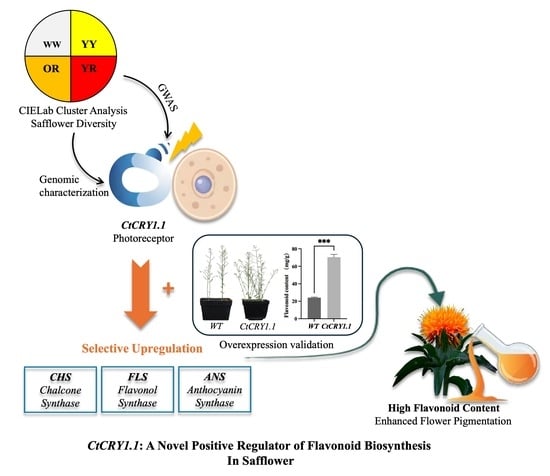
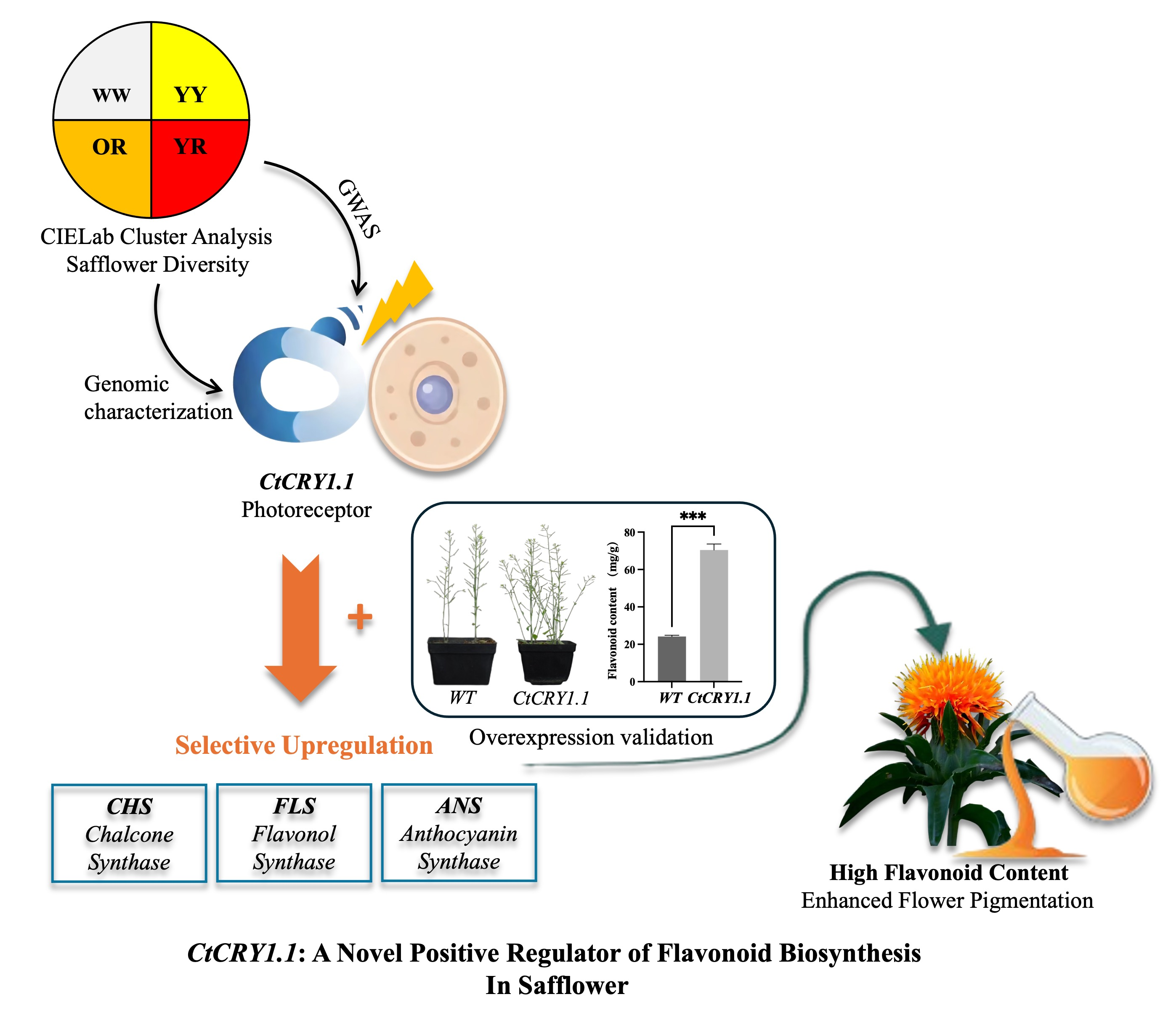
Graphical Abstract

1. Introduction

Safflower (Carthamus tinctorius L.), a dual-purpose industrial crop of the family Asteraceae, is primarily cultivated for its seeds and flowers. Traditionally, its flower has been utilized for various purposes such as food coloring, natural dyes, cosmetics, medicine, and ornamentals [1,2]. Its beneficial effects are due to essential bioactive substances, notably flavonoids, unsaturated fatty acids (oleic, linoleic, and linolenic acids), lignans, and alkaloids [3,4]. These substances offer immense benefits in terms of preventing cardiovascular, inflammatory, and cerebrovascular diseases [5,6]. Among these, flavonoids are the most abundantly used compounds in medicinal formation. For instance, hydroxysafflor yellow A (HSYA) is used to treat patients suffering from cerebral ischemia–reperfusion injury, osteoporosis, thrombosis, and arteriosclerosis [7,8,9]. Yin et al. [10] proposed that the consumption of safflower petal water-extract (SE) significantly reduced blood glucose as well as improved blood glucose homeostasis. In China, it serves as an essential ingredient in over 300 traditional medicines, particularly the Danhong injection, which is used for the treatment of stroke, coronary heart disease, and angina pectoris [11,12]. However, despite these significant traditional uses and therapeutic advantages, a comprehensive understanding of the molecular mechanism responsible for flavonoid biosynthesis in safflower remains limited. The gap in knowledge impedes the development of improved varieties with enhanced pharmaceutical properties.
Flower color is a prominent attribute that attracts pollinators and influences the growth and development of plants [13]. It is mainly determined by pigments such as flavonoids, carotenoids, and betalains [14]. Among them, flavonoids represent a class of secondary metabolites, exhibiting diverse colors ranging from light yellow to dark blue [13]. Qin et al. [15] revealed that changes in safflower flower color are mainly regulated by the differential expression of key flavonoid biosynthesis genes, influencing pigment concentration, including anthocyanins and carotenoids. The biosynthesis of flavonoids is initiated with phenylalanine, which is de-aminated into cinnamic acid through phenylalanine ammonia-lyase (PAL), hydroxylated into 4-coumaroyl-CoA using cinnamate 4-hydroxylase (C4H), and activated into 4-coumaroyl-CoA with 4-coumarate: CoA ligase (4CL) [16]. Chalcone synthase (CHS) uses 4-coumaroyl-CoA and three molecules of malonyl-CoA to produce chalcone, which is then isomerized into flavanone by chalcone isomerase (CHI) [17]. The flavanone is changed into dihydroflavonol by flavanone 3-hydroxylase (F3H), which is the precursor of flavonols by flavonol synthase (FLS), or flavones. To synthesize anthocyanin, dihydroflavonol 4-reductase (DFR) and anthocyanidin synthase (ANS) produce anthocyanidin sequentially, which is then stabilized by UDP-glycosyltransferases to produce anthocyanins [18]. Numerous transcription factors (TF) also participate in flavonoid biosynthesis by influencing key enzyme genes. For instance, transcription factor (TF) MYB, bHLH, and WD40 may form MYB-bHLH-WD40 (MBW) ternary complex. Although numerous TFs and structural and regulatory genes have been shown to regulate flavonoid production, the function of light-responsive photoreceptors, such as cryptochromes, in regulating the pathway is not yet well understood.
Cryptochromes are a group of flavoproteins that evolved from photolyases, which are enzymes that repair DNA under blue light [19]. CRYs possess two domains, an N-terminal PHR (photolyase homologous region) chromophore-binding domain which interacts non-covalently to FAD (flavin adenine dinucleotide), and a CCE domain (CRY C-terminal extension) [20,21]. The PHR domain is responsible for the light-sensing of plant CRYs, while the CCE domain impedes the activity of CRYs by interacting with constitutive photomorphogenesis 1 (COP1) in the light-signaling pathway [22]. Cryptochromes act as photoreceptors for blue and UV light, playing a critical role in regulating de-etiolation, photoperiodic flowering, and the circadian clock through the modulation of both input and output pathways [23]. Cryptochrome signaling is associated with two pathways: transcriptional modulation by light-dependent binding of CIB1 and other associated factors, which stimulate FT transcription to induce flowering, and post-translation control of proteolysis interaction with SPA proteins. The other pathway is that, by disrupting SPA-mediated activation of COP1, cryptochromes inhibit the degradation of HY5, HYH, CO, and other regulators, which allows photomorphogenic development and altered expression of light-responsive genes (LRGs) [24]. In addition, overexpression of the AcCRY1 in Arabidopsis accelerated flowering and photomorphogenesis under blue-light conditions [25]. In Brassica napus, upregulation of CRY1 results in shortened internodes, increased leaf size, and elevated anthocyanin content [26]. Furthermore, in poplar trees, overexpression of CRY1 notably increased anthocyanin contents [27]. Although, the molecular mechanism of cryptochromes (CRY1, and CRY2) has been extensively studied in Arabidopsis, tomato, rice, soybean, brassica, and pea, their identification and functional validation in safflower remain unknown.
Flavonoid compounds are accumulated mainly in safflower’s petals. Thus, differences in their accumulation are associated with flower color formation. We hypothesized that the cryptochrome 1.1 gene might be involved in flavonoid biosynthesis in safflower. In this study, the CIELAB color space system was utilized to classify safflower genotypes based on flower color. Genome-wide association study (GWAS) analysis led to the identification of the safflower cryptochrome gene family. Subsequently, in silico analysis was performed to characterize the gene family. Overexpression vectors of CtCRY1.1 were constructed and transformed into Arabidopsis for functional validation. The transcription levels of flavonoid biosynthesis pathway-related genes was investigated, and flavonoid content was measured. These findings open avenues for metabolic engineering and breeding to enhance the ornamental and pharmaceutical value of this economic crop.

2. Materials and Methods

2.1. Plant Material

A total of 485 safflower materials with extensive geographic and genetic diversity were analyzed. The seeds were planted at the experimental field located in Hainan province, China (20°02′48.7″ N, 110°11′44.4″ E). To ensure environmental uniformity and maximize the reliability of phenotypic data, standard agronomic practices were implemented.
Arabidopsis thaliana (Col-0) was cultivated under controlled environmental conditions. We kept the photoperiod of 16 h of light and 8 h of darkness. The temperature was regulated to 22 ± 2 °C throughout the growing phase. The flowering stage was selected for subsequent experiments.

2.2. Flower Color Measurement and Classification

A spectrocolorimeter (Guangdong Sanenshi Intelligent Technology Co., Ltd., Guangzhou, China) was used to measure the color space values of the flowers of the 485 genotypes. At the full blooming stage (three days after flowering), six flowers from each genotype of different plants were randomly harvested for color measurement with three technical replications, and the average values of L* (lightness), a* (redness), and b* (yellowness) were obtained [28]. Additionally, the chroma (c), hue (h°), and the quadrant were derived from a* and b* values using the following equations [29,30]:
C h r o m a = ( a * ) 2 + ( b * ) 2
hue h° = arctan − 1 (b*/a*)
Quadrant = h° × 180/3.141592
To classify 485 safflower genotypes based on flower color variation, the colorimetric values of each color trait were defined. Subsequently, the Unweighted Pair Group Method with Arithmetic Mean (UPGMA) cluster analysis with L*, a*, and b* values was carried out using Past (version 4.15) software [31]. The resulting dendrogram was used to determine the number of clusters, which were further visualized using the Chiplot online database [32]. Additionally, the CIELAB color space parameters of the different flower color groups were plotted on two-dimensional and three-dimensional coordinates to visualize their distribution [28]. Pearson correlations among the parameters of the CIELAB color space were analyzed with the psych package in R software (version 4.5.1) [33].

2.3. Genome-Wide Association Study (GWAS)

To examine the genetic basis of color variation in safflower, a genome-wide association study (GWAS) of flower color traits (L*, a*, and b*) was carried out [34,35]. A dataset of 933,447 high-quality SNPs were obtained after standard quality control and filtering [36] to analyze the association. The FarmCPU (Fixed and random model Circulating Probability Unification) model was applied to minimize false-positive associations and improve data accuracy. Manhattan and Q–Q plots were created to illustrate the false-positives of the applied method. A stringent threshold of −log10(P) ≥ 6 was applied to identify significant association signals. The most significant SNP locus was then selected, and a 300 kb upstream and downstream region surrounding this site was examined to identify candidate genes [37].

2.4. Gene Family Identification, Physicochemical and Cis-Acting Element Analysis

The safflower (Carthamus tinctorius L.) reference genome was retrieved from the public genome database (https://www.scuec.edu.cn/safflower/, accessed on 1 September 2025) [38]. Candidate sequences belonging to the CRY domain were initially identified using HMMER v3.4 against the protein sequences. The presence of the CRY domain in these candidates was subsequently verified using multiple online databases, including Pfam, SMART, and NCBI-CDD [39].
Physicochemical properties of the identified CtCRY gene family members were predicted using the ExPASy ProtParam tool (https://web.expasy.org/protparam/, accessed on 10 September 2025) [40]. Subcellular localization of the CtCRY proteins was determined using WoLF PSORT tool (https://wolfpsort.hgc.jp/, accessed on 10 September 2025) [41].
To analyze the promoter’s regulatory elements, the genomic sequences of the CtCRY genes were submitted to the Promoter 2.0 database [42]. A prediction score above 1.0 was considered, implying a high likelihood of promoter presence. Subsequently, 2000 bp sequences upstream of the ATG start codons of the CtCRY genes were retrieved and analyzed for cis-acting regulatory elements using the PlantCARE online tool [43]. The identified cis-regulatory elements were visualized using Tbtools (version 2.388) [44].

2.5. Phylogenetic, Conserved Motif, and Gene Structure Analysis

The CRY protein sequences of Carthamus tinctorius L. were retrieved from the safflower database [38], Helianthus annuus from Ensembl Plants [45], Brassica rapa from the Brassicaceae database [46], and the sequences of other related species from NCBI [47]. Multiple sequence alignment was performed via ClustalW in MEGA 12 software [48], and a phylogenetic tree was constructed using the neighbor-joining method. The bootstrap value was set to 1000. Finally, the tree was visualized through the Chiplot online tool. For conserved motif analysis, the protein sequences of the CtCRY gene family were submitted to the web tool MEME 5.5.7 [49]. All parameters were kept at their default settings, except for the motif width, which was adjusted to a range of 6 to 50 amino acids, and the number of motifs, which was limited to 10. The Chiplot database was used to visualize the conserved motifs. The online tool GSDS 2.0 was used to illustrate the gene structure of the CtCRY gene family [50].

2.6. Gene Cloning and Transformation

The full-length CRY1.1 CDS (without the stop codon) was amplified from safflower using gene-specific primers and purified using FastPure Gel DNA Extraction Mini kit (Vazyme Biotec Co., Ltd., Nanjing, China). The purified products were ligated into the pCAMBIA 1302 vector via One step seamless cloning kit (Beijing Genesand Biotech Co., Ltd., Beijing, China). The recombinant plasmids were transformed into chemically competent cells DH5α. The positive colonies were picked on LB agar plates containing Kanamycin (50 mg/L) and verified by Sanger sequencing [51]. Confirmed constructs were then inserted into the Agrobacterium tumefaciens strain GV3101 and transformed into Arabidopsis thaliana using the floral dip method [52]. The positive plants were screened on 1/2 Murashige and Skoog (MS) medium containing antibiotic hygromycin, and PCR amplification was performed [53].

2.7. Flavonoid Extraction

To evaluate total flavonoid contents in transgenic plants, fresh leaves were picked at the flowering stage. Leaf tissue (0.25 g) was ground in liquid nitrogen and homogenized in 1 mL of 60% ethanol. The suspension was sonicated at 300 W and 60 °C for 30 min, followed by centrifugation at 12,000 rpm for 10 min at 25 °C. The resulting supernatant was transferred into a new tube [54].
For colorimetric quantification, 400 μL of supernatant was transferred into a 1.5 mL EP tube. Then, 30 μL of 5% sodium nitrate (NaNO3) solution was added, and the mixture was incubated at room temperature for 5 min. Subsequently, 30 μL of 10% aluminum nitrate [Al(NO3)3] solution was added and allowed to stand for 5 min. The total volume was set to 1.5 mL with 60% ethanol after the addition of 400 μL of 4% sodium hydroxide (NaOH). It was mixed thoroughly and incubated at room temperature for 10 min. Microplate spectrophotometer (model: SpectraMax S64 company: Shanghai Co., Ltd., Shanghai, China) was used to analyze absorbance at a 510 nm wavelength. Flavonoid content was calculated based on standard curve using rutin, as described by [38,55], as a reference compound.

2.8. Gene Expression Analysis by qRT-PCR

The relative expression levels of eight flavonoid biosynthesis pathway genes including 4CL, CHS, CHI, F3H, F′3H, FLS, DFR, and ANS, with Actin as a reference gene was quantified using quantitative reverse transcription PCR (qRT-PCR) [56]. Primers for the target genes were designed from the exon–exon junction regions using the Vazyme online tool and synthesized by Beijing Tsingke Biotech Co., Ltd. (Beijing, China). For amplification, total RNA was extracted from leaf tissue by RNAiso Plus (Takara Bio Inc., Kusatsu, Japan) and reverse transcribed using All-in-One First-Strand Synthesis MasterMix (Yugong Biotech Co., Ltd., Lianyungang, China). The qRT-PCR reaction mixture preparation was followed by established protocol [57]. Fluorescence qRT-PCR (model: CFX Connect™ company: Bio-Rad, Hercules, CA, USA) was used for amplification. The quantification of relative gene expression was performed using the 2−ΔΔCT method [58].

2.9. Statistical Analysis

We performed the descriptive statistical analyses of L*, a*, and b* color space values. The maximum and minimum, mean, range, and coefficients of variation (CV) for each trait were calculated. The CV was measured using the formula: CV (%) = (SD/MN) × 100, where SD is the standard deviation and MN is the mean. The differences in transcription levels and flavonoid contents among overexpression and wild-type were examined using a t-test and ANOVA [59]. All statistical analyses and data visualization were performed via GraphPad Prism (version 9) [60].

3. Results

3.1. Classification Based on CIELAB Color Space System

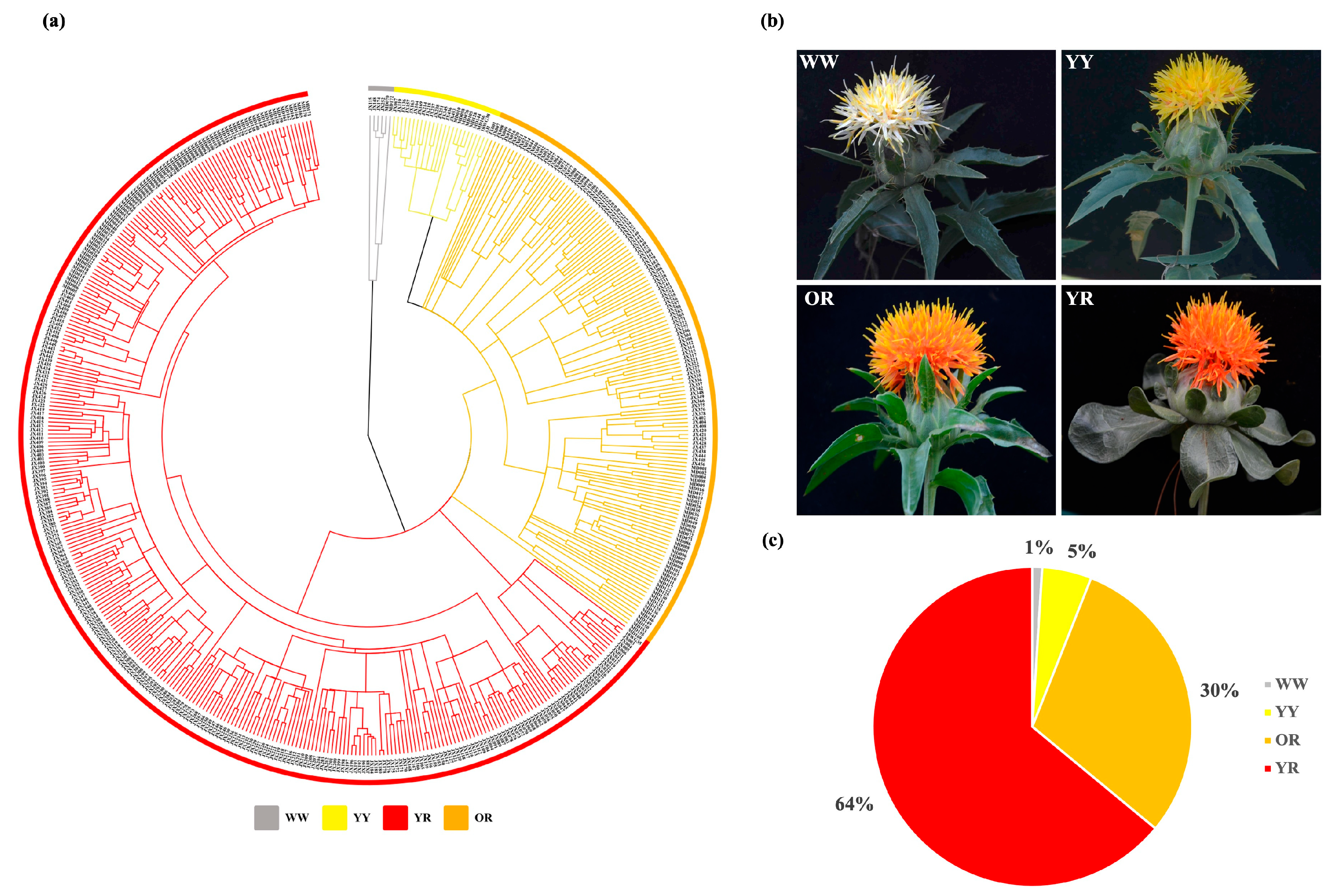
CIELAB color space values were used to determine the flower color variation among 485 safflower genotypes (Figure 1a). Firstly, we established colorimetric ranges of each color group and then divided the genotypes into four distinct color groups: white (WW), yellow (YY), orange–red (OR), and yellow–red (YR) (Table 1 and Figure 1b). Subsequently, cluster analysis based on L*, a*, and b* values validated the classification, grouping the genotypes into the same color categories (Figure 1a). The YR group constituted the highest proportion of genotypes (310), followed by OR (144), YY (25), and WW (6) (Figure 1c). These results indicated that this classification based on the CIELAB color space value is accurate and effective to discriminate the flower color of safflower.

3.2. Variation in Flower Color Traits

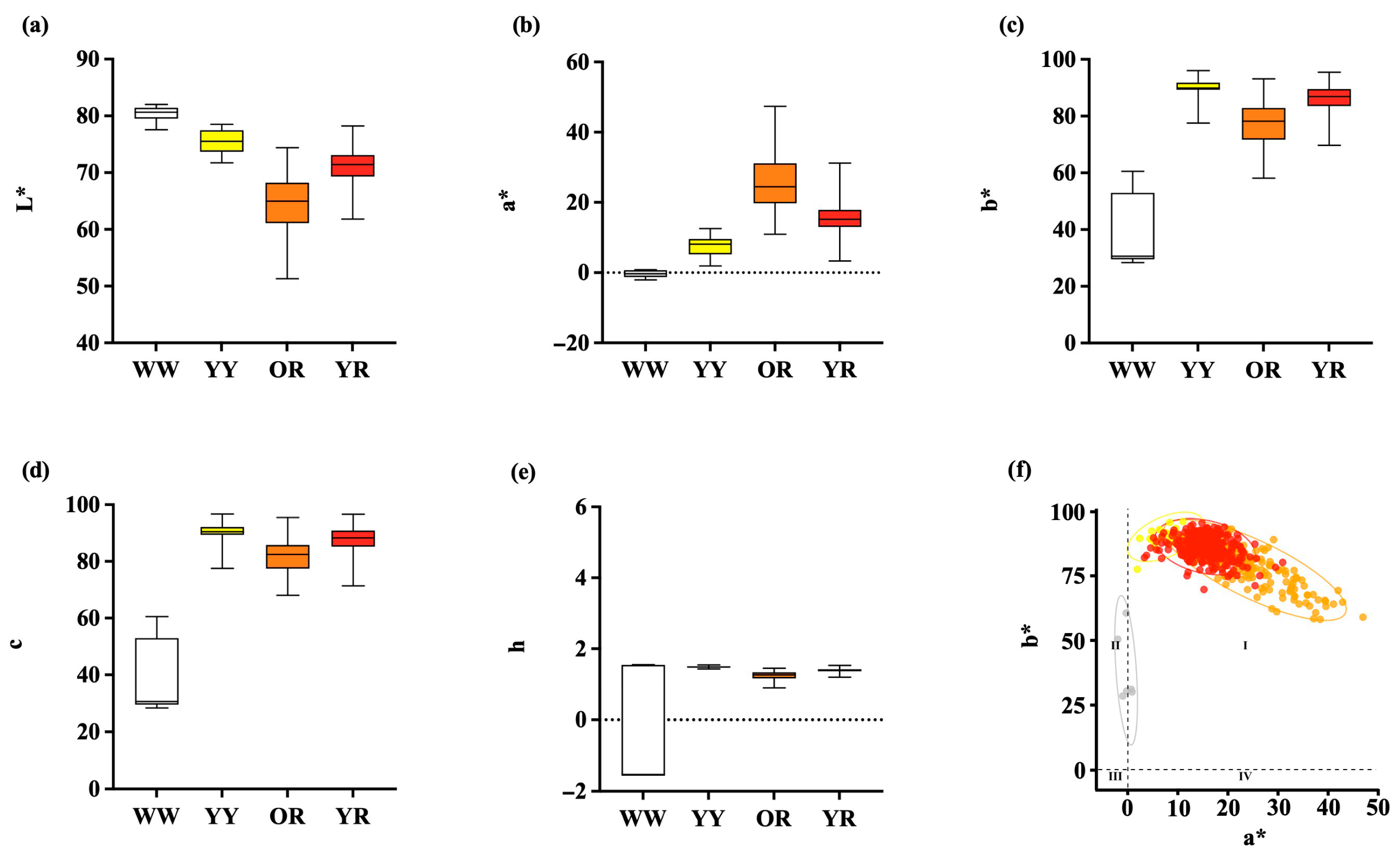
The characteristics distribution of four color groups of chromatic parameters (L*, a*, b*, c, and h°) were analyzed (Table 2). On L* (Lightness) coordinate: The WW group exhibited the highest L* values (77.58~82.01), indicative of a brighter appearance, followed by the YY and YR groups. In contrast, the OR group had the smallest L* values, which indicates darker pigmentation (Figure 2a). On a* (redness) coordinate: The WW group ranged from (−2.03 to 0.86), signifying a slight greenish tint (negative a*) to a faded reddish tone (positive a*). The OR and YR groups showed higher values of a*, indicating increased red intensity while the YY group showed values closer to zero (Figure 2b). On b* (yellowness) coordinate: The WW group exhibited a moderate yellow color. Contrary to this, the yellow color was dominant in the YY group (77.51~96.06). The OR group displayed a combination of yellow and orange colors, with yellow predominating. Similarly, the significant yellow influence was observed in the YR group (Figure 2c). All groups showed positive b* values.
c (chroma): The YY and YR groups depicted the highest saturation levels, moderate in the OR group, and lowest in the WW group. This trend demonstrates that color intensity increases from the WW to YY, YR, and OR group (Figure 2d). h° (hue angle): The WW and YY groups showed smaller variations in hue angles, indicating a more yellow-oriented coloration. The OR and YR groups had more varied hue angles, reflecting their mixture of red, yellow, and orange hues (Figure 2e).
To visualize the distribution of CIELAB color space values, 485 genotypes in four color groups were located on the two-dimensional rectangular (a* and b*) coordinate. The result indicated that all genotypes were mainly distributed in quadrants I and II corresponding to (red–yellow), and (green–yellow) color regions. No genotypes were distributed in quadrants III and IV, which represent blue and pink/purple color regions, respectively. The YY, OR, and YR flower color genotypes were clustered in quadrant I, while the WW color genotypes were distributed across both quadrants I and II (Figure 2f).

3.3. Three-Dimensional and Correlation Analysis

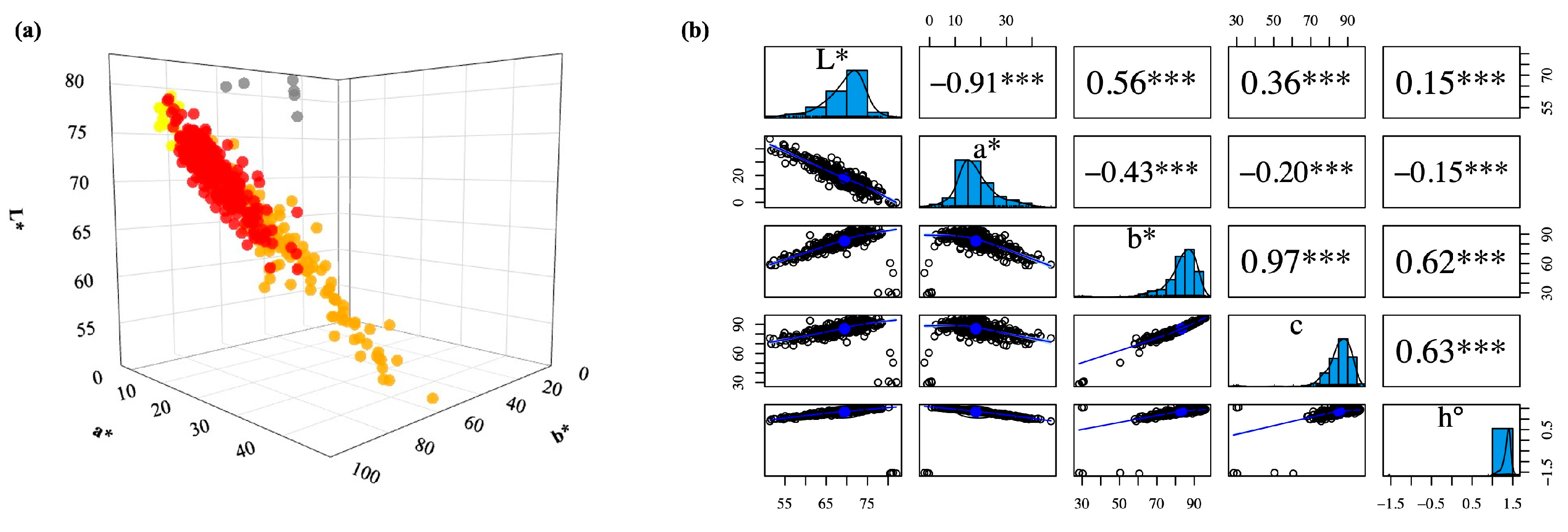
To investigate the combined distribution of L*, a*, and b* values, 485 genotypes were plotted in a three-dimensional coordinate system (Figure 3a). The three-dimensional scatter plot illustrated that the WW and YY genotypes were placed higher on the L* axis, indicating lighter colors, whereas the OR and YR genotypes were positioned lower, indicating darker colors. On the a* axis, the OR and YR genotypes exhibited high values, which are linked to a red color. However, the WW and YY genotypes were grouped at the bottom, which corresponds to lower red pigmentation. On the b* axis, the YY genotypes were placed at the top, which indicated extreme yellowness. Meanwhile, the spatial arrangement highlights the gradual transition from light to dark and from yellow to red hues.
Correlation analysis of the CIELAB color space parameters (L*, a*, b*, c, and h) showed a significant strong negative correlation between L* and a* (r = −0.91) and moderate negative correlation between b* and a* (r = −0.43) (Figure 3b), whereas chroma (c) displayed a significant positive correlation with b* (r = 0.97) and moderately positive correlation with hue angle h° (r = 0.63). Together, these findings showed that light and yellow-colored flowers exhibited reduced red pigmentation and vice versa, whereas the increased yellowness was strongly associated with high saturation.

3.4. Association Analysis and Identification of Candidate Gene

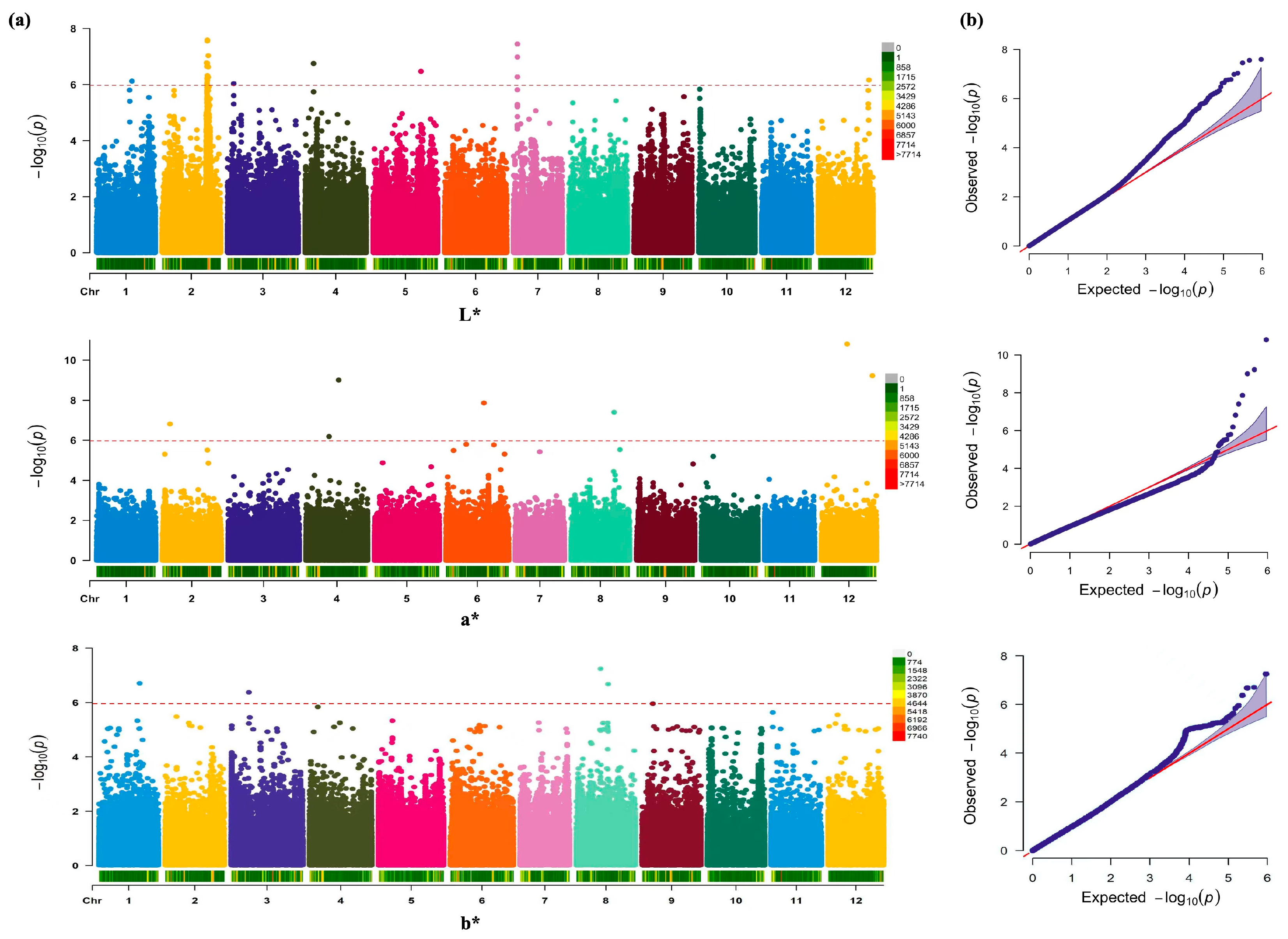
GWAS was conducted on flower color-related traits (L*, a*, and b*) using 933,447 high-quality SNPs. With the FarmCPU model, several important loci related to flower color were identified, which exhibited strong association signals. A total of 25 significant SNPs were obtained across three color traits. Manhattan and quantile–quantile (Q–Q) plots (Figure 4a,b) revealed distinct association peaks surpassing the significant threshold (−log10(P) ≥ 6), indicating several genomic regions responsible for flower coloration. Among these, a locus on chromosome 3 exhibited a strong association with the b* color trait (Table 3). Within the 300 kb region, two annotated genes were identified. Based on its statistical significance and biological relevance, CRY2 was selected as the potential gene.

3.5. Identification and Physicochemical Properties of CRY Gene Family

The safflower genome was retrieved and analyzed using HMMER and SMART software tools. Three CRY family genes were identified in safflower and designated as CRY1.1, CRY1.2, and CRY2 based on homology to the Arabidopsis genes. In addition, the physicochemical characteristics of this CRY gene family were analyzed (Table 4). The length of the coding sequence (CDS) varied from 1853 to 2004 base pairs, corresponding to protein lengths between 617 and 668 amino acids. The molecular weights (MW) of these proteins varied, with CRY1.2 being the heaviest (75.6 kDa), followed by CRY1.1 and CRY2. Isoelectric points (pI) displayed slightly acidic to near-neutral characteristics, with CRY1.1 and CRY1.2 having pI values of about 5.19 and 5.13, respectively, and CRY2 possessing a notably higher, basic pI of 6.13. The grand average of hydropathicity (GRAVY) values was relatively negative, ranging from −0.361 to −0.515, indicating that these proteins were generally hydrophilic. Furthermore, subcellular localization predicted that CRY1.1 is mainly nuclear, whereas CRY1.2 and CRY2 are cytoplasmic, suggesting potential functional differences in cellular compartments.

3.6. Conserved Motif, Gene Structure, and Phylogenetic Analysis

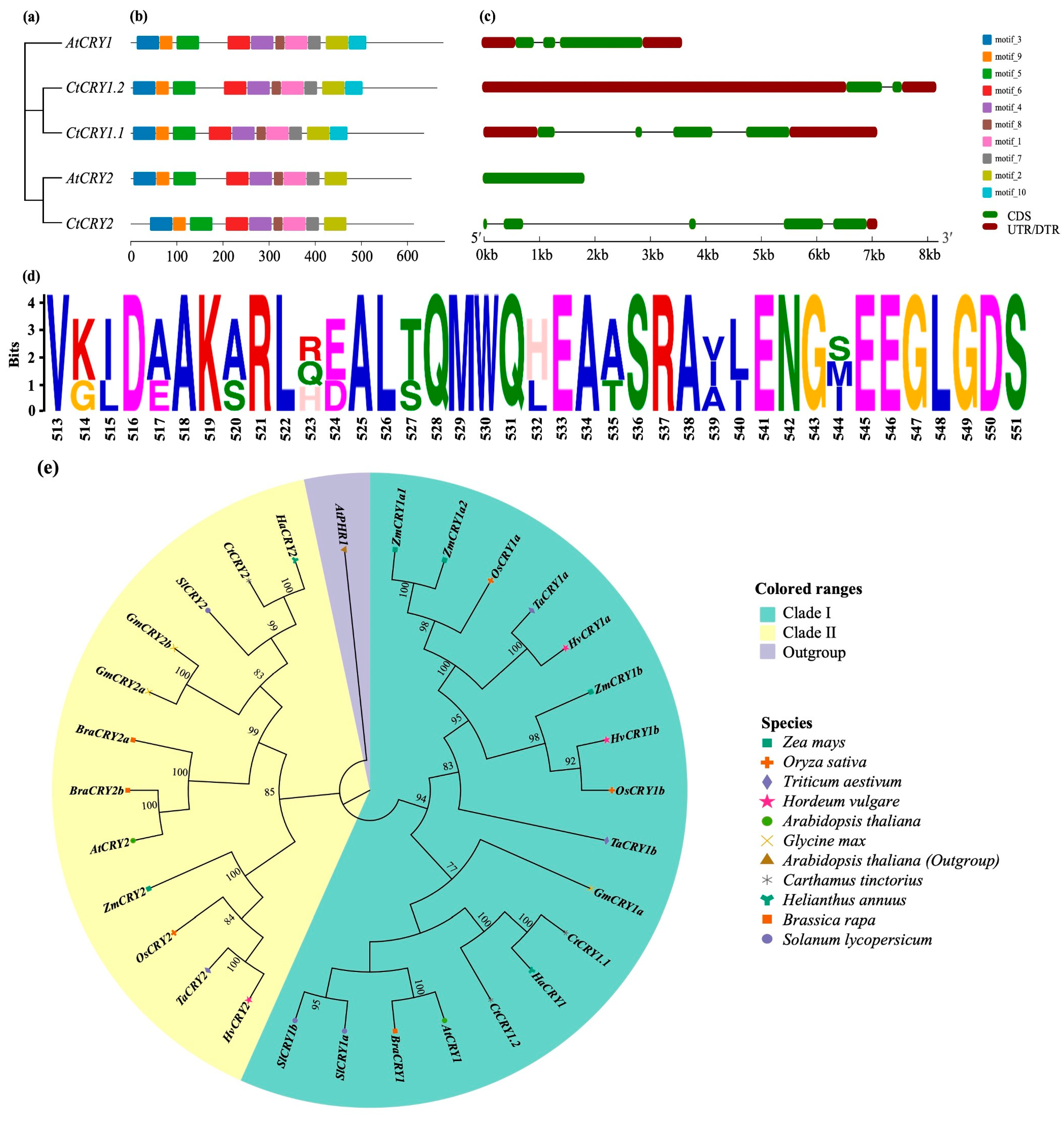
We initially investigated the evolutionary relationships of CtCRY proteins along with Arabidopsis CRYs (Figure 5a). Subsequently, motif analysis was carried out to examine the conserved motifs of the CtCRY gene family (Figure 5b). Ten conserved motifs were found across the gene family. Both CtCRY1.1 and CtCRY1.2 possessed all 10 motifs, whereas motif 10 was missing in CtCRY2. Moreover, to understand the structural diversity of CRYs, the exon–intron organization was determined (Figure 5c). The results showed that CtCRY1.1, CtCRY1.2, and CtCRY2 contain four, two, and five exons, while their corresponding introns were three, one, and four, respectively, indicating that the safflower CRY gene family members differ in exon–intron number and length, which may contribute to distinctions in gene function or regulation. A sequence logo analysis was conducted to display the conservation of individual residues, indicating that motif 10 is a key structural determinant distinguishing CtCRY1 from CtCRY2 (Figure 5d).
Furthermore, a phylogenetic tree was constructed to assess the evolutionary relationships of CtCRY genes among monocots (Zea mays, Oryza sativa, Triticum aestivum, Hordeum vulgare) and dicots (Arabidopsis thaliana, Glycine max, Helianthus annuus, Brassica rapa, Solanum lycopersicum) species (Figure 5e). A. thaliana type II CPD photolyase (PHR1) was used as the outgroup. The CRY gene family is classified into two well-supported clades, CRY1 and CRY2, each containing monocot- and dicot-specific subgroups. Within the CRY1 clade, CtCRY1.1 and CtCRY1.2 clustered with HaCRY1 in a dicot-specific branch, while in the CRY2 clade, CtCRY2 grouped with HaCRY2, forming a distinct dicot subclade separate from monocot CRY2 genes. The high sequence similarity among safflower and sunflower CRY genes shows that the function of this gene family is conserved across both species. Overall, such a phylogenetic pattern indicates that the ancestral duplication that gave rise to CRY1 and CRY2 had occurred before the monocot–dicot split, afterwards the lineage-specific divergence took place in each of the groups.

3.7. Cis-Acting Element Analysis

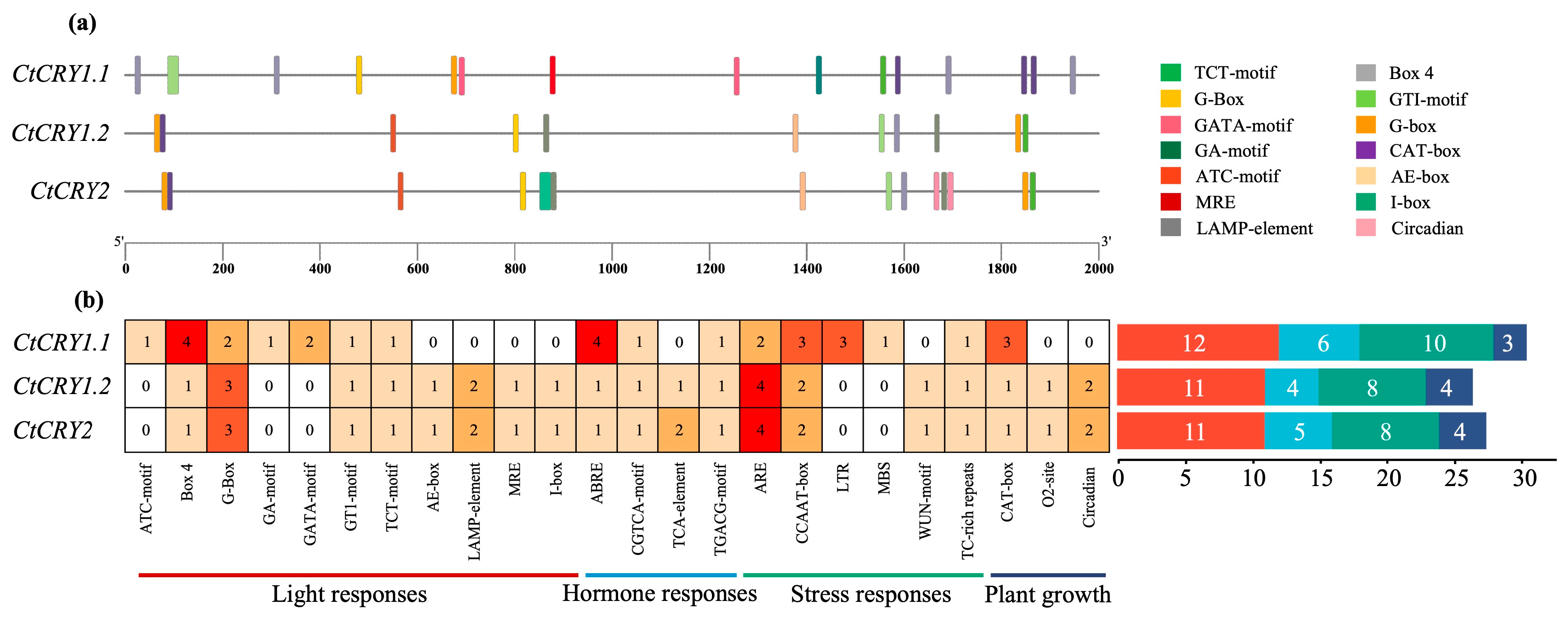
The cis-acting elements within the promoter region of the CtCRY gene family were predicted and analyzed to understand the functional mechanism of their transcriptional regulation (Figure 6a). A total of 86 cis-acting elements were identified in the promoter regions that represent 24 distinct types (Figure 6b). These were functional classes responsible for light responsiveness, hormonal regulation, stress responses, and plant development. Light-responsive elements such as G-box, Box-4, LAMP-element, GT1-motif, and TCT-motif were abundantly represented across all three genes. Interestingly, CtCRY1.1 exhibited the higher number of G-box (4) followed by Box-4 (2) elements implying its transcription is highly sensitive to light stimuli. However, CtCRY1.2 and CtCRY2 showed fewer light-responsive elements, indicating a potential divergence of light-regulatory behavior.
All three genes contained the hormone-responsive motifs for hormonal regulation, including ABRE, TGACG/CGTCA, and the TCA-element. CtCRY1.1 exhibited the highest ABRE motifs (4) implicating it in ABA-mediated stress pathways. Additionally, TCA-element enrichment was observed in CtCRY2. Finally, stress-related elements such as ARE (anaerobic induction) and CCAAT-box were prevalent in all genes. CtCRY1.2 and CtCRY2 contained a higher number of ARE motifs (four each), indicating their potential role in environmental stress adaptation. Notably, CtCRY1.1 was the only gene to contain the CAT-box element (three copies). In contrast, CtCRY1.2 and CtCRY2 uniquely possessed two circadian elements, suggesting a putative role in circadian-rhythm synchronization, which is consistent with cryptochromes known function in photoperiodic responses.

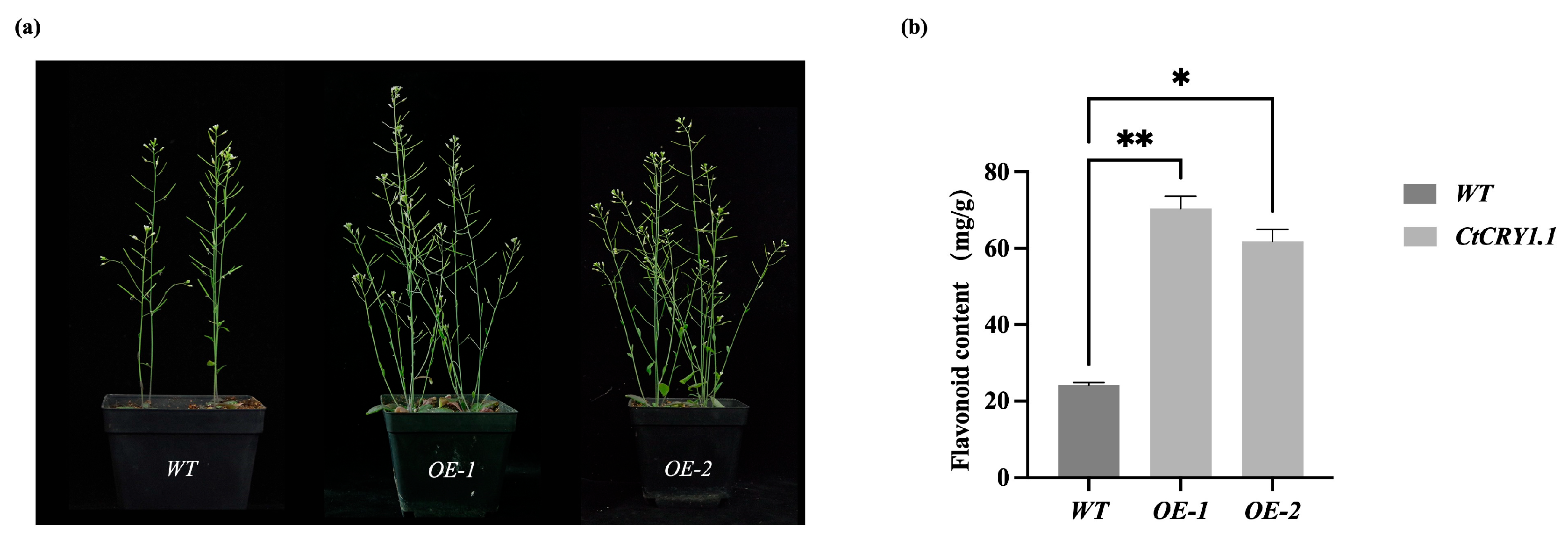
3.8. Morphology and Flavonoid Quantification Analysis in Overexpression Lines

The morphology of both wild-type (WT) and CtCRY1.1 overexpression (OE) lines showed distinct phenotypic changes (Figure 7a). The results revealed that WT plants exhibited a restricted growth habit and shorter stature. In contrast, transgenic lines displayed enhanced vegetative growth with long and spreading inflorescences, suggesting that CtCRY1.1 promotes vegetative growth.
At flowering, transgenic plants showed significantly high flavonoid content as compared to the wild-type (WT). Specifically, the CtCRY1.1 transgenic lines had accumulated about 2.6-to-3.0-fold more flavonoid, which indicates that CtCRY1.1 positively regulates flavonoid biosynthesis (Figure 7b).

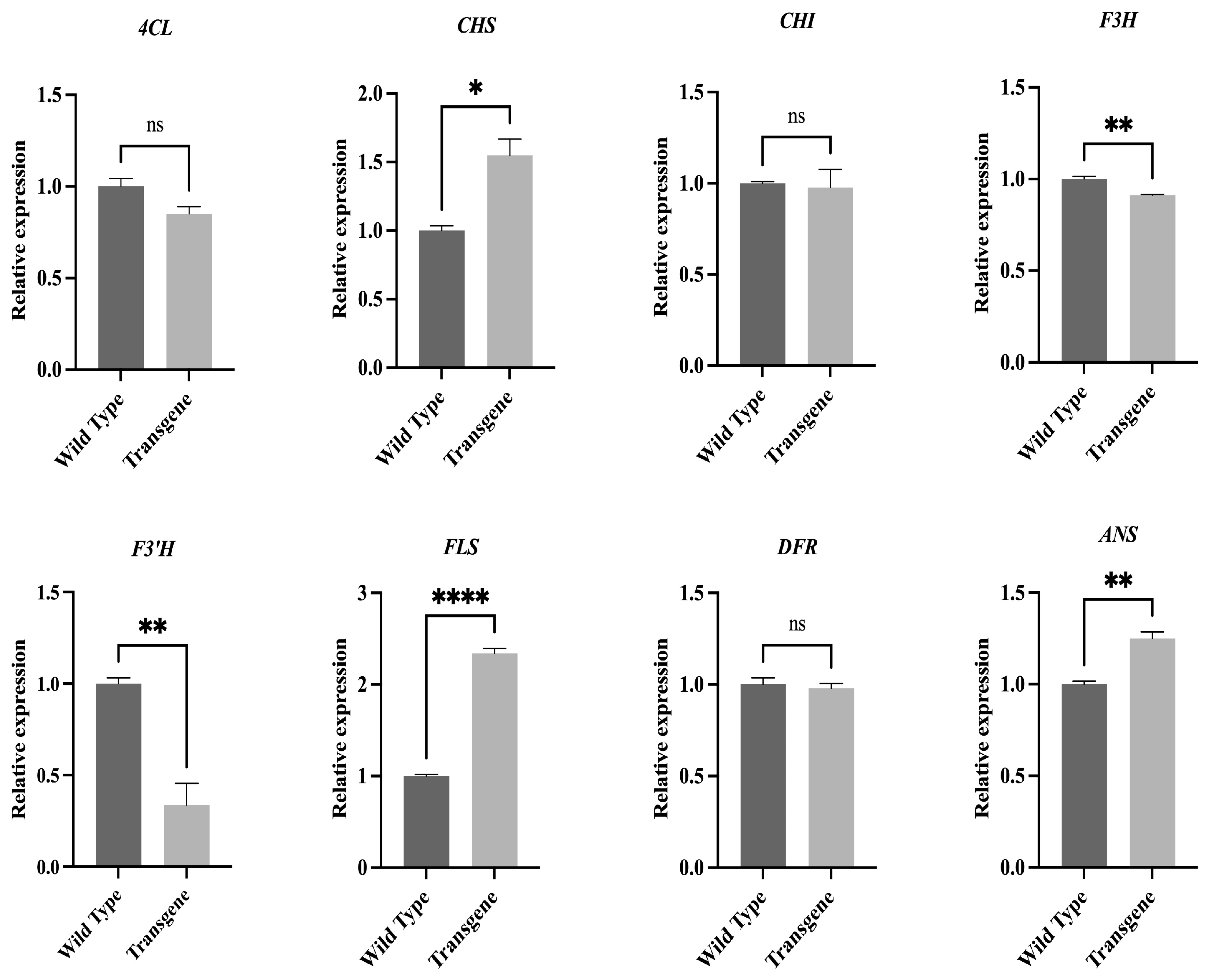
3.9. Expression Pattern of Flavonoid Biosynthesis Pathway Genes

The regulatory role of CtCRY1.1 in flavonoid biosynthesis was determined by analyzing the expression of essential pathway genes (Figure 8). Relative expression of CHS, FLS, and ANS was significantly upregulated, implying the activation of these early and late flavonoid biosynthesis genes. Whereas F3H and F3′H were downregulated in over-expression lines, exerting a selective inhibitory effect of CtCRY1.1 on mid-pathway enzymes. In addition, the expression levels of 4CL, CHI, and DFR remained relatively stable. These findings suggest that CtCRY1.1 promotes flavonoid production by regulating specific gene expressions and, thus, enhancing flavonoid production.

4. Discussion

A systematic classification of flower color is important for the standardized identification of germplasm resources and the precision breeding for flower color. Our study established threshold values for each color group based on CIELAB color space parameters and categorized the 485 genotypes into four distinct color groups (WW, YY, OR, and YR) with high precision. The resemblance between CIELAB-based classification and cluster analysis validates the accuracy of the division, proving that numeric colorimetric measurements can significantly determine the flower color diversity among safflower genotypes. Previously, similar methods have been utilized in several crop species. For instance, the CIELAB color system successfully classified cassava cultivars into four color groups [61] and separated Zhongyuan and Daikon Island tree peony cultivars into five major color groups [62]. In addition, this method along with the Munsell system have been used to classify tremendous chrysanthemum cultivars [28]. Zhou et al. [63] combined RHSCC and CIELAB parameters to classify 123 gerbera accessions into six color groups. These findings revealed that CIELAB offer a reliable foundation of phenotypic classification for color measurements and valuable phenotypic predictors to conduct association studies aimed at identifying genes related to pigment biosynthesis [63].
Many crops’ genetic makeup have been revealed by the association analysis, which resulted in the discovery of pigmentation-related genes [34,64,65]. A genome-wide association of flower and fruit color of 191 eggplant germplasm resources showed that certain loci are congruent with the reported QTLs [66]. Similarly, Prunus mume GWAS revealed that MYB108 was correlated with the bud, stigma, calyx, and petal color of the flower [67]. The findings suggest that association analysis with color phenotype is an effective approach to determine the potential loci in plants. In this context, our GWAS using CIELAB color space system identified an association between the b* value and a locus-harboring CtCRY2 gene. However, in silico analysis of the cryptochrome gene family revealed that CtCRY1.1 and CtCRY1.2 are more genetically associated with the flower color phenotype.
Previously, CRY1 has been identified as a key determinant of light-induced anthocyanin accumulation in plants [27,68]. The overexpression of CtCRY1.1 in Arabidopsis provides novel insights into the regulatory function of cryptochromes in plant growth and flavonoid metabolism. Cryptochromes are often thought of as blue-light photoreceptors [69], yet the CtCRY1.1 overexpression increases flavonoid accumulation and promotes vegetative growth even under white light [68,70]. This is consistent with the well-established model where CRY1 disrupts the COP1/SPA complex [71], lowering nuclear COP1 levels and permitting HY5 accumulation, which activates genes involved in flavonoid production. In addition, the CRY1-HY5-MYB signaling cascade has been demonstrated to act in guard cells to control flavonol amounts [72] and CRY1 has been found to recruit SWR1/H2A.Z chromatin remodeling complexes through HY5 in Arabidopsis [73]. Bhatia et al. [74] showed that MYB12 is an HY5-dependent gene, while COP1 reduced MYB12 and flavonol accumulation, which indicates that COP1 is a negative regulator of flavonoid biosynthesis. Thus, we propose that CtCRY1.1 can employ a parallel CRY1–COP1–HY5–MYB pathway to regulate the transcription of CHS and FLS and silence F3′H in safflower.
Our findings connect the CRY1 conserved pathway to the specific pigmentation in safflower. The early biosynthetic genes of the flavonoid pathway were the main targets of the gene-specific pattern of CtCRY1.1-mediated regulation. Chalcone Synthase (CHS), the key enzyme initiating flavonoid biosynthesis, is strongly induced. This is important for determining flavonoid variation and is consistent with its regulation by CRY1 under UV-A light [75]. The enhanced Flavanol Synthase (FLS) expression strongly indicates a preferential metabolic production of flavonoid by making FLS convert its precursor into the final flavonol product [76]. SG7 R2R3-MYB transcription factors play a major role in this competition with DFR for substrates, which is a key aspect in determining metabolic distribution [77]. The downregulation of F3′H (that regulate anthocyanin and proanthocyanidin metabolites) and the changes in ANS suggest that CtCRY1.1 regulates flavonoid composition through limiting the late anthocyanin branch. Instead of the overall activation of the entire system, these expression patterns are all indicative of a regulation process where CtCRY1.1 specifically channels the metabolic flux by increasing concentration of flavonoid precursors and flavonols (EBGs). The upregulation of CHS and selective silencing of the downstream F3′H are the indicators that CtCRY1.1 stimulates the pool of carthamoid precursors regulating safflower pigmentation. This functional validation of CtCRY1.1 in Arabidopsis provides a foundation for the molecular investigation of flower color.
We proposed a novel regulatory model in which CtCRY1.1 functions as a positive regulator of flavonoid biosynthesis, mainly through the silencing of branch-specific genes (F3′H) and the activation of important early (CHS, FLS) and late (ANS) pathway genes. This study broadens the insight into the role of cryptochromes in safflower pigmentation and creates opportunities for further research. In spite of CtCRY1.1 being functionally studied in the Arabidopsis thaliana system with heterologous expression of the gene, its exact role in controlling the process of color differentiation of safflower flowers remains unverified. Future work should focus on functional validation of the transcription factors, specifically R2R3-MYB, that link CtCRY1.1 signaling to the expression of CHS and FLS in safflower. Moreover, quantifying the carthamoid pigment in the transgenic lines of CtCRY1.1 is essential in understanding the effects of metabolism under this regulation network. Our study provides a basis of the genetic and molecular mechanism of flower pigmentation as well as promising future directions for metabolic engineering to enhance flavonoid content and modification of flower color in plants.

5. Conclusions

In conclusion, 485 safflower genotypes were clearly categorized into four color groups in terms of numeric intervals of CIELAB color space values and cluster analysis. GWAS and genomic characterization revealed CtCRY1.1, a major regulator of flavonoid biosynthesis in safflower. Arabidopsis functional validation revealed that CtCRY1.1 increased flavonoid production by promoting CHS, FLS, and ANS and suppressing F3′H, which alters the metabolic flux of the pathway. This regulation pattern is in contrast with the anthocyanin-based activity of CRY1 in other species which suggests an adaptive change in the lineages. Together, these findings identify CtCRY1.1 as a central regulator of safflower flower color and a promising target for genetic improvement and metabolic engineering. This study offers the foundational knowledge to accurately breed new safflower varieties with desired color traits to be used in the natural dye, food, and pharmaceutical industries and, hence, improve crop value and increase end-use applications.

Author Contributions

M.L.Z.: Designed, conducted, and wrote the manuscript, D.W.: Investigated and evaluated the research, Z.L.: Collected the field data, R.A.: Revised and improved the grammar, X.W.: Evaluated the statistical data, J.L.: Reviewed and edited the manuscript, J.W.: Helped in data analysis, R.Q.: Conceptualized the research idea, H.L.: Supervised the research and final revision of the manuscript. All authors have read and agreed to the published version of the manuscript.

Funding

Key Research and Development Program Project of Ningxia Hui Autonomous Region (No. 2025BEG02020); The Central Government’s Project Guiding Local Science and Technology Development of Hubei Province (No. 2025CF015), The Academic Innovation Teams of South-Central Minzu University (No. XTZ24020, PTZ25021).

Institutional Review Board Statement

Not applicable.

Data Availability Statement

The original contributions presented in this study are included in the article. Further inquiries can be directed to the corresponding author.

Conflicts of Interest

The authors declare no conflicts of interest.

References

  1. Bujak, T.; Zagórska-Dziok, M.; Ziemlewska, A.; Nizioł-Łukaszewska, Z.; Wasilewski, T.; Hordyjewicz-Baran, Z. Antioxidant and Cytoprotective Properties of Plant Extract from Dry Flowers as Functional Dyes for Cosmetic Products. Molecules 2021, 26, 2809. [Google Scholar] [CrossRef]
  2. Erbaş, S.; Mutlucan, M. Investigation of Flower Yield and Quality in Different Color Safflower Genotypes. Agronomy 2023, 13, 956. [Google Scholar] [CrossRef]
  3. Wang, C.-C.; Choy, C.-S.; Liu, Y.-H.; Cheah, K.-P.; Li, J.-S.; Wang, J.T.-J.; Yu, W.-Y.; Lin, C.-W.; Cheng, H.-W.; Hu, C.-M. Protective Effect of Dried Safflower Petal Aqueous Extract and Its Main Constituent, Carthamus Yellow, against Lipopolysaccharide-Induced Inflammation in RAW264.7 Macrophages. J. Sci. Food Agric. 2011, 91, 218–225. [Google Scholar] [CrossRef]
  4. Fan, K.; Qin, Y.; Hu, X.; Xu, J.; Ye, Q.; Zhang, C.; Ding, Y.; Li, G.; Chen, Y.; Liu, J.; et al. Identification of Genes Associated with Fatty Acid Biosynthesis Based on 214 Safflower Core Germplasm. BMC Genom. 2023, 24, 763. [Google Scholar] [CrossRef]
  5. Arshad, R.; Wan, J.; Ai, T.; Yin, C.; Qin, Y.; Qin, R.; Liu, J.; Liu, H. A Targeted Reformulation of Safflower Oil: Enhancing Anti-Inflammatory Potential and Market Competitiveness through Ω3 Enrichment. Food Res. Int. 2025, 203, 115793. [Google Scholar] [CrossRef]
  6. Ciumărnean, L.; Milaciu, M.V.; Runcan, O.; Vesa, Ș.C.; Răchișan, A.L.; Negrean, V.; Perné, M.-G.; Donca, V.I.; Alexescu, T.-G.; Para, I.; et al. The Effects of Flavonoids in Cardiovascular Diseases. Molecules 2020, 25, 4320. [Google Scholar] [CrossRef]
  7. Chen, L.; Xiang, Y.; Kong, L.; Zhang, X.; Sun, B.; Wei, X.; Liu, H. Hydroxysafflor Yellow A Protects Against Cerebral Ischemia–Reperfusion Injury by Anti-Apoptotic Effect Through PI3K/Akt/GSK3β Pathway in Rat. Neurochem. Res. 2013, 38, 2268–2275. [Google Scholar] [CrossRef]
  8. Yan, Z.; Alimu, R.; Wan, J.; Liao, X.; Lin, S.; Dai, S.; Chen, F.; Zhang, S.; Tong, Y.; Liu, H.; et al. Composition of Major Quinochalcone Hydroxysafflor Yellow A and Anhydrosafflor Yellow B Is Associated with Colour of Safflower (Carthamus tinctorius) during Colour-Transition but Not with Overall Antioxidant Capacity: A Study on 144 Cultivars. Food Res. Int. 2022, 162, 112098. [Google Scholar] [CrossRef] [PubMed]
  9. Xu, X.; Hu, X.; Zhou, S.; Liu, J.; Su, Z.; Zheng, Z.; Luo, D. Hydroxyl Safflower Yellow A Regulates Bone-Fat Balance in Osteoporosis by SphK1/S1P/S1PR Signaling Pathway. Biochem. Pharmacol. 2025, 242, 117258. [Google Scholar] [CrossRef] [PubMed]
  10. Yin, C.; Fang, R.; Xu, Y.; Li, K.; Ai, T.; Wan, J.; Qin, Y.; Lyu, X.; Liu, H.; Qin, R.; et al. Safflower Petal Water-Extract Consumption Reduces Blood Glucose via Modulating Hepatic Gluconeogenesis and Gut Microbiota. J. Funct. Foods 2024, 123, 106615. [Google Scholar] [CrossRef]
  11. Orgah, J.O.; He, S.; Wang, Y.; Jiang, M.; Wang, Y.; Orgah, E.A.; Duan, Y.; Zhao, B.; Zhang, B.; Han, J.; et al. Pharmacological Potential of the Combination of Salvia miltiorrhiza (Danshen) and Carthamus tinctorius (Honghua) for Diabetes Mellitus and Its Cardiovascular Complications. Pharmacol. Res. 2020, 153, 104654. [Google Scholar] [CrossRef]
  12. Feng, X.; Li, Y.; Wang, Y.; Li, L.; Little, P.J.; Xu, S.; Liu, S. Danhong Injection in Cardiovascular and Cerebrovascular Diseases: Pharmacological Actions, Molecular Mechanisms, and Therapeutic Potential. Pharmacol. Res. 2019, 139, 62–75. [Google Scholar] [CrossRef]
  13. Park, C.; Chae, S.; Park, S.-Y.; Kim, J.; Kim, Y.; Chung, S.; Arasu, M.; Al-Dhabi, N.; Park, S. Anthocyanin and Carotenoid Contents in Different Cultivars of Chrysanthemum (Dendranthema grandiflorum Ramat.) Flower. Molecules 2015, 20, 11090–11102. [Google Scholar] [CrossRef]
  14. Tanaka, Y.; Sasaki, N.; Ohmiya, A. Biosynthesis of Plant Pigments: Anthocyanins, Betalains and Carotenoids. Plant J. 2008, 54, 733–749. [Google Scholar] [CrossRef]
  15. Qin, Y.; Fan, K.; Yimamu, A.; Zhan, P.; Lv, L.; Li, G.; Liu, J.; Hu, Z.; Yan, X.; Hu, X.; et al. Integrated Genetic Diversity and Multi-Omics Analysis of Colour Formation in Safflower. Int. J. Mol. Sci. 2025, 26, 647. [Google Scholar] [CrossRef] [PubMed]
  16. Davies, K.M.; Andre, C.M.; Kulshrestha, S.; Zhou, Y.; Schwinn, K.E.; Albert, N.W.; Chagné, D.; Van Klink, J.W.; Landi, M.; Bowman, J.L. The Evolution of Flavonoid Biosynthesis. Philos. Trans. R. Soc. B Biol. Sci. 2024, 379, 20230361. [Google Scholar] [CrossRef] [PubMed]
  17. Jiang, W.; Yin, Q.; Wu, R.; Zheng, G.; Liu, J.; Dixon, R.A.; Pang, Y. Role of a Chalcone Isomerase-like Protein in Flavonoid Biosynthesis in Arabidopsis Thaliana. J. Exp. Bot. 2015, 66, 7165–7179. [Google Scholar] [CrossRef]
  18. Liu, W.; Feng, Y.; Yu, S.; Fan, Z.; Li, X.; Li, J.; Yin, H. The Flavonoid Biosynthesis Network in Plants. Int. J. Mol. Sci. 2021, 22, 12824. [Google Scholar] [CrossRef] [PubMed]
  19. Ozturk, N. Phylogenetic and Functional Classification of the Photolyase/Cryptochrome Family. Photochem. Photobiol. 2017, 93, 104–111. [Google Scholar] [CrossRef]
  20. Sancar, A. Structure and Function of DNA Photolyase and Cryptochrome Blue-Light Photoreceptors. Chem. Rev. 2003, 103, 2203–2238. [Google Scholar] [CrossRef]
  21. Cashmore, A.R. Cryptochromes. Cell 2003, 114, 537–543. [Google Scholar] [CrossRef]
  22. Wang, H.; Ma, L.-G.; Li, J.-M.; Zhao, H.-Y.; Deng, X.W. Direct Interaction of Arabidopsis Cryptochromes with COP1 in Light Control Development. Science 2001, 294, 154–158. [Google Scholar] [CrossRef]
  23. Lin, C. Blue Light Receptors and Signal Transduction. Plant Cell 2002, 14, S207–S225. [Google Scholar] [CrossRef]
  24. Liu, H.; Liu, B.; Zhao, C.; Pepper, M.; Lin, C. The Action Mechanisms of Plant Cryptochromes. Trends Plant Sci. 2011, 16, 684–691. [Google Scholar] [CrossRef] [PubMed]
  25. Jia, Q.; Yin, Y.; Gai, S.; Tian, L.; Zhu, Z.; Qin, L.; Wang, Y. Onion Cryptochrome 1 (AcCRY1) Regulates Photomorphogenesis and Photoperiod Flowering in Arabidopsis and Exploration of Its Functional Mechanisms under Blue Light. Plant Physiol. Biochem. 2024, 206, 108300. [Google Scholar] [CrossRef]
  26. Sharma, P.; Chatterjee, M.; Burman, N.; Khurana, J.P. Cryptochrome 1 Regulates Growth and Development in B Rassica through Alteration in the Expression of Genes Involved in Light, Phytohormone and Stress Signalling. Plant Cell Environ. 2014, 37, 961–977. [Google Scholar] [CrossRef]
  27. Chen, X.; Fan, Y.; Guo, Y.; Li, S.; Zhang, B.; Li, H.; Liu, L. Blue Light Photoreceptor Cryptochrome 1 Promotes Wood Formation and Anthocyanin Biosynthesis in Populus. Plant Cell Environ. 2024, 47, 2044–2057. [Google Scholar] [CrossRef] [PubMed]
  28. Lu, C.; Li, Y.; Wang, J.; Qu, J.; Chen, Y.; Chen, X.; Huang, H.; Dai, S. Flower Color Classification and Correlation between Color Space Values with Pigments in Potted Multiflora Chrysanthemum. Sci. Hortic. 2021, 283, 110082. [Google Scholar] [CrossRef]
  29. Yang, Y.; Li, B.; Feng, C.; Wu, Q.; Wang, Q.; Li, S.; Yu, X.; Wang, L. Chemical Mechanism of Flower Color Microvariation in Paeonia with Yellow Flowers. Hortic. Plant J. 2020, 6, 179–190. [Google Scholar] [CrossRef]
  30. Lee, Y.-K. Comparison of CIELAB ΔE* and CIEDE2000 Color-Differences after Polymerization and Thermocycling of Resin Composites. Dent. Mater. 2005, 21, 678–682. [Google Scholar] [CrossRef]
  31. Hammer, Ø.; Harper, D.A.T.; Ryan, P.D. PAST: Paleontological Statistics Software Package for Education and Data Analysis. Palaeontol. Electron. 2001, 4, 1. [Google Scholar]
  32. Xie, J.; Chen, Y.; Cai, G.; Cai, R.; Hu, Z.; Wang, H. Tree Visualization By One Table (tvBOT): A Web Application for Visualizing, Modifying and Annotating Phylogenetic Trees. Nucleic Acids Res. 2023, 51, W587–W592. [Google Scholar] [CrossRef]
  33. Revelle, W. Psych: Procedures for Psychological, Psychometric, and Personality Research. Version2.5.6. 2007. Available online: https://personality-project.org/r/psych/ (accessed on 18 January 2026).
  34. Wan, W.; Jia, F.; Liu, Z.; Sun, W.; Zhang, X.; Su, J.; Guan, Z.; Chen, F.; Zhang, F.; Fang, W. Quantitative Evaluation and Genome-Wide Association Studies of Chrysanthemum Flower Color. Sci. Hortic. 2024, 338, 113561. [Google Scholar] [CrossRef]
  35. Kusmec, A.; Schnable, P.S. Farm CPU Pp: Efficient Large-scale Genomewide Association Studies. Plant Direct 2018, 2, e00053. [Google Scholar] [CrossRef]
  36. Altmann, A.; Weber, P.; Bader, D.; Preuß, M.; Binder, E.B.; Müller-Myhsok, B. A Beginners Guide to SNP Calling from High-Throughput DNA-Sequencing Data. Hum. Genet. 2012, 131, 1541–1554. [Google Scholar] [CrossRef]
  37. Martin, E.R.; Chung, R. Linkage Disequilibrium and Association Analysis. In Genetic Analysis of Complex Diseases; Scott, W.K., Ritchie, M.D., Eds.; Wiley: Hoboken, NJ, USA, 2021; pp. 182–204. ISBN 978-1-118-12391-1. [Google Scholar]
  38. Wu, Z.; Liu, H.; Zhan, W.; Yu, Z.; Qin, E.; Liu, S.; Yang, T.; Xiang, N.; Kudrna, D.; Chen, Y.; et al. The Chromosome-scale Reference Genome of Safflower (Carthamus tinctorius) Provides Insights into Linoleic Acid and Flavonoid Biosynthesis. Plant Biotechnol. J. 2021, 19, 1725–1742. [Google Scholar] [CrossRef]
  39. Tan, Z.; Lu, D.; Li, L.; Su, X.; Sun, Y.; Wang, L.; Yu, Y.; Wan, X.; Xu, L.; Li, C.; et al. Comprehensive Analysis of Safflower R2R3-MYBs Reveals the Regulation Mechanism of CtMYB76 on Flavonol Biosynthesis. Ind. Crops Prod. 2025, 227, 120795. [Google Scholar] [CrossRef]
  40. Artimo, P.; Jonnalagedda, M.; Arnold, K.; Baratin, D.; Csardi, G.; De Castro, E.; Duvaud, S.; Flegel, V.; Fortier, A.; Gasteiger, E.; et al. ExPASy: SIB Bioinformatics Resource Portal. Nucleic Acids Res. 2012, 40, W597–W603. [Google Scholar] [CrossRef]
  41. Horton, P.; Park, K.-J.; Obayashi, T.; Fujita, N.; Harada, H.; Adams-Collier, C.J.; Nakai, K. WoLF PSORT: Protein Localization Predictor. Nucleic Acids Res. 2007, 35, W585–W587. [Google Scholar] [CrossRef]
  42. Knudsen, S. Promoter2.0: For the Recognition of PolII Promoter Sequences. Bioinformatics 1999, 15, 356–361. [Google Scholar] [CrossRef]
  43. Lescot, M.; Déhais, P.; Thijs, G.; Marchal, K.; Moreau, Y.; Van de Peer, Y.; Rouzé, P.; Rombauts, S. PlantCARE, a Database of Plant Cis-Acting Regulatory Elements and a Portal to Tools for in Silico Analysis of Promoter Sequences. Nucleic Acids Res. 2002, 30, 325–327. [Google Scholar] [CrossRef]
  44. Chen, C.; Wu, Y.; Li, J.; Wang, X.; Zeng, Z.; Xu, J.; Liu, Y.; Feng, J.; Chen, H.; He, Y.; et al. TBtools-II: A “One for All, All for One” Bioinformatics Platform for Biological Big-Data Mining. Mol. Plant 2023, 16, 1733–1742. [Google Scholar] [CrossRef]
  45. Bolser, D.; Staines, D.M.; Pritchard, E.; Kersey, P. Ensembl Plants: Integrating Tools for Visualizing, Mining, and Analyzing Plant Genomics Data. In Plant Bioinformatics; Edwards, D., Ed.; Methods in Molecular Biology; Springer: New York, NY, USA, 2016; Volume 1374, pp. 115–140. ISBN 978-1-4939-3166-8. [Google Scholar]
  46. Chen, H.; Wang, T.; He, X.; Cai, X.; Lin, R.; Liang, J.; Wu, J.; King, G.; Wang, X. BRAD V3.0: An Upgraded Brassicaceae Database. Nucleic Acids Res. 2022, 50, D1432–D1441. [Google Scholar] [CrossRef]
  47. Geer, L.Y.; Marchler-Bauer, A.; Geer, R.C.; Han, L.; He, J.; He, S.; Liu, C.; Shi, W.; Bryant, S.H. The NCBI BioSystems Database. Nucleic Acids Res. 2010, 38, D492–D496. [Google Scholar] [CrossRef]
  48. Kumar, S.; Stecher, G.; Suleski, M.; Sanderford, M.; Sharma, S.; Tamura, K. MEGA12: Molecular Evolutionary Genetic Analysis Version 12 for Adaptive and Green Computing. Mol. Biol. Evol. 2024, 41, msae263. [Google Scholar] [CrossRef]
  49. Bailey, T.L.; Boden, M.; Buske, F.A.; Frith, M.; Grant, C.E.; Clementi, L.; Ren, J.; Li, W.W.; Noble, W.S. MEME SUITE: Tools for Motif Discovery and Searching. Nucleic Acids Res. 2009, 37, W202–W208. [Google Scholar] [CrossRef]
  50. Hu, B.; Jin, J.; Guo, A.-Y.; Zhang, H.; Luo, J.; Gao, G. GSDS 2.0: An Upgraded Gene Feature Visualization Server. Bioinformatics 2015, 31, 1296–1297. [Google Scholar] [CrossRef]
  51. Inouye, M. The First Determination of DNA Sequence of a Specific Gene. Gene 2016, 582, 94–95. [Google Scholar] [CrossRef]
  52. Davis, A.M.; Hall, A.; Millar, A.J.; Darrah, C.; Davis, S.J. Protocol: Streamlined Sub-Protocols for Floral-Dip Transformation and Selection of Transformants in Arabidopsis Thaliana. Plant Methods 2009, 5, 3. [Google Scholar] [CrossRef]
  53. Zhang, J.; Huang, D.; Zhao, X.; Zhang, M.; Wang, Q.; Hou, X.; Di, D.; Su, B.; Wang, S.; Sun, P. Drought-Responsive WRKY Transcription Factor Genes IgWRKY50 and IgWRKY32 from Iris Germanica Enhance Drought Resistance in Transgenic Arabidopsis. Front. Plant Sci. 2022, 13, 983600. [Google Scholar] [CrossRef]
  54. Wang, Z.; Yang, S.; Gao, Y.; Huang, J. Extraction and Purification of Antioxidative Flavonoids from Chionanthus Retusa Leaf. Front. Bioeng. Biotechnol. 2022, 10, 1085562. [Google Scholar] [CrossRef] [PubMed]
  55. Ji, Y.; Guo, S.; Wang, B.; Yu, M. Extraction and Determination of Flavonoids in Carthamus tinctorius. Open Chem. 2018, 16, 1129–1133. [Google Scholar] [CrossRef]
  56. Li, X.-W.; Li, J.-W.; Zhai, Y.; Zhao, Y.; Zhao, X.; Zhang, H.-J.; Su, L.-T.; Wang, Y.; Wang, Q.-Y. A R2R3-MYB Transcription Factor, GmMYB12B2, Affects the Expression Levels of Flavonoid Biosynthesis Genes Encoding Key Enzymes in Transgenic Arabidopsis Plants. Gene 2013, 532, 72–79. [Google Scholar] [CrossRef]
  57. Lu, D.; Wang, L.; Yu, Y.; Li, L.; Su, X.; Sun, Y.; Yang, H.; Wan, X.; Li, C.; Xu, L.; et al. Genome-Wide Identification and Functional Analyses of the TCP Gene Family in Carthamus tinctorius L. Sci. Rep. 2025, 15, 12970. [Google Scholar] [CrossRef]
  58. Livak, K.J.; Schmittgen, T.D. Analysis of Relative Gene Expression Data Using Real-Time Quantitative PCR and the 2−ΔΔCT Method. Methods 2001, 25, 402–408. [Google Scholar] [CrossRef]
  59. Kim, H.-Y. Analysis of Variance (ANOVA) Comparing Means of More than Two Groups. Restor. Dent. Endod. 2014, 39, 74. [Google Scholar] [CrossRef]
  60. Swift, M.L. GraphPad Prism, Data Analysis, and Scientific Graphing. J. Chem. Inf. Comput. Sci. 1997, 37, 411–412. [Google Scholar] [CrossRef]
  61. Afonso, T.; Moresco, R.; Uarrota, V.G.; Navarro, B.B.; Nunes, E.D.C.; Maraschin, M.; Rocha, M. UV-Vis and CIELAB Based Chemometric Characterization of Manihot Esculenta Carotenoid Contents. J. Integr. Bioinform. 2017, 14, 20170056. [Google Scholar] [CrossRef]
  62. Wang, L.-S.; Shiraishi, A.; Hashimoto, F.; Aoki, N.; Shimizu, K.; Sakata, Y. Analysis of Petal Anthocyanins to Investigate Flower Coloration of Zhongyuan (Chinese) and Daikon Island (Japanese) Tree Peony Cultivars. J. Plant Res. 2001, 114, 33–43. [Google Scholar] [CrossRef]
  63. Zhou, Y.; Yin, M.; Abbas, F.; Sun, Y.; Gao, T.; Yan, F.; Li, X.; Yu, Y.; Yue, Y.; Yu, R.; et al. Classification and Association Analysis of Gerbera (Gerbera hybrida) Flower Color Traits. Front. Plant Sci. 2022, 12, 779288. [Google Scholar] [CrossRef] [PubMed]
  64. Wang, L.; Tu, W.; Jin, P.; Liu, Y.; Du, J.; Zheng, J.; Wang, Y.-H.; Li, J. Genome-Wide Association Study of Plant Color in Sorghum Bicolor. Front. Plant Sci. 2024, 15, 1320844. [Google Scholar] [CrossRef]
  65. Schulz, D.F.; Schott, R.T.; Voorrips, R.E.; Smulders, M.J.M.; Linde, M.; Debener, T. Genome-Wide Association Analysis of the Anthocyanin and Carotenoid Contents of Rose Petals. Front. Plant Sci. 2016, 7, 1798. [Google Scholar] [CrossRef]
  66. Cericola, F.; Portis, E.; Lanteri, S.; Toppino, L.; Barchi, L.; Acciarri, N.; Pulcini, L.; Sala, T.; Rotino, G.L. Linkage Disequilibrium and Genome-Wide Association Analysis for Anthocyanin Pigmentation and Fruit Color in Eggplant. BMC Genom. 2014, 15, 896. [Google Scholar] [CrossRef]
  67. Zhang, Q.; Zhang, H.; Sun, L.; Fan, G.; Ye, M.; Jiang, L.; Liu, X.; Ma, K.; Shi, C.; Bao, F.; et al. The Genetic Architecture of Floral Traits in the Woody Plant Prunus Mume. Nat. Commun. 2018, 9, 1702. [Google Scholar] [CrossRef]
  68. Ashikhmin, A.; Pashkovskiy, P.; Kosobryukhov, A.; Khudyakova, A.; Abramova, A.; Vereshchagin, M.; Bolshakov, M.; Kreslavski, V. The Role of Pigments and Cryptochrome 1 in the Adaptation of Solanum Lycopersicum Photosynthetic Apparatus to High-Intensity Blue Light. Antioxidants 2024, 13, 605. [Google Scholar] [CrossRef]
  69. Ahmad, M.; Jarillo, J.A.; Smirnova, O.; Cashmore, A.R. Cryptochrome Blue-Light Photoreceptors of Arabidopsis Implicated in Phototropism. Nature 1998, 392, 720–723. [Google Scholar] [CrossRef]
  70. Yang, L.-W.; Wen, X.-H.; Fu, J.-X.; Dai, S.-L. ClCRY2 Facilitates Floral Transition in Chrysanthemum Lavandulifolium by Affecting the Transcription of Circadian Clock-Related Genes under Short-Day Photoperiods. Hortic. Res. 2018, 5, 58. [Google Scholar] [CrossRef]
  71. Hughes, R.M.; Vrana, J.D.; Song, J.; Tucker, C.L. Light-Dependent, Dark-Promoted Interaction between Arabidopsis Cryptochrome 1 and Phytochrome B Proteins. J. Biol. Chem. 2012, 287, 22165–22172. [Google Scholar] [CrossRef] [PubMed]
  72. Chang, Y.; Shi, M.; Wang, X.; Cheng, H.; Zhang, J.; Liu, H.; Wu, H.; Ou, X.; Yu, K.; Zhang, X.; et al. A CRY1–HY5–MYB Signaling Cascade Fine-Tunes Guard Cell Reactive Oxygen Species Levels and Triggers Stomatal Opening. Plant Cell 2025, 37, koaf064. [Google Scholar] [CrossRef] [PubMed]
  73. Mao, Z.; Wei, X.; Li, L.; Xu, P.; Zhang, J.; Wang, W.; Guo, T.; Kou, S.; Wang, W.; Miao, L.; et al. Arabidopsis Cryptochrome 1 Controls Photomorphogenesis through Regulation of H2A.Z Deposition. Plant Cell 2021, 33, 1961–1979. [Google Scholar] [CrossRef] [PubMed]
  74. Bhatia, C.; Gaddam, S.R.; Pandey, A.; Trivedi, P.K. COP1 Mediates Light-Dependent Regulation of Flavonol Biosynthesis through HY5 in Arabidopsis. Plant Sci. 2021, 303, 110760. [Google Scholar] [CrossRef] [PubMed]
  75. Wade, H.K.; Bibikova, T.N.; Valentine, W.J.; Jenkins, G.I. Interactions within a Network of Phytochrome, Cryptochrome and UV-B Phototransduction Pathways Regulate Chalcone Synthase Gene Expression in Arabidopsis Leaf Tissue. Plant J. 2001, 25, 675–685. [Google Scholar] [CrossRef] [PubMed]
  76. Mao, Y.; Luo, J.; Cai, Z. Biosynthesis and Regulatory Mechanisms of Plant Flavonoids: A Review. Plants 2025, 14, 1847. [Google Scholar] [CrossRef]
  77. Lei, T.; Huang, J.; Ruan, H.; Qian, W.; Fang, Z.; Gu, C.; Zhang, N.; Liang, Y.; Wang, Z.; Gao, L.; et al. Competition between FLS and DFR Regulates the Distribution of Flavonols and Proanthocyanidins in Rubus Chingii Hu. Front. Plant Sci. 2023, 14, 1134993. [Google Scholar] [CrossRef] [PubMed]
Figure 1. Safflower flower color classification using L*, a*, and b* values; (a) UPGMA cluster analysis differentiated 485 safflower genotypes into four color groups (WW, YY, OR, and YR); (b) four kinds of safflower flowers; (c) pie chart shows the percentage distribution of the 485 safflower genotypes, with the colors representing the flower color types.
Agriculture 16 00260 g001
Figure 2. Box plot of CIELAB color space parameters L*, a*, b*, c, and h° (a) L* (darkness to lightness), (b) a* (redness to greenness), (c) b* (yellowness to blueness), (d) c (saturation), and (e) hue angle. (f) Distribution of 485 genotypes in two-dimensional coordinates system (a* and b*).
Agriculture 16 00260 g002
Figure 3. Distribution of distinct flower color genotypes on (a) three-dimensional coordinates (b) Pearson correlation matrix of color space parameters L*, a*, b*, c, and h°. Frequency distributions are presented in diagonal panels, scatter plots with best-fit regression lines (blue) are shown in lower panels, and Pearson correlation coefficients (r) are shown in the upper panels, with significant values (***) denoted by p < 0.001.
Agriculture 16 00260 g003
Figure 4. Manhattan and Q–Q plots of flower color traits (L*, a*, and b*) (a) Manhattan plot shows significant loci associated with individual traits association peaks surpassing the genome-wide significance threshold (b) Q–Q plot (L*, a*, and b*) shows deviations at the upper end suggest potential genetic associations.
Agriculture 16 00260 g004
Figure 5. This figure illustrates the in silico attributes of cryptochrome gene family. (a) Evolutionary relationships between safflower and Arabidopsis CRYs. (b) Distribution of conserved motifs. (c) Gene structure analysis showing varying number of intron–exon organization. (d) Sequence logo of motif 10 which distinguish CRY1 from CRY2 genes. (e) Phylogenetic tree of CRY genes from safflower and other plant species. The protein-coding sequences with neighbor-joining method was used to generate the tree.
Agriculture 16 00260 g005
Figure 6. Cis-regulatory element analysis in the promoter region of CtCRY genes. (a) Distribution of cis-regulatory elements among the members of the CRY gene family. (b) Heatmap representation of cis-regulatory element number and types in promoters. The cis-regulatory elements were categorized into four classes based on their function: light responses, hormone responses, stress responses, and plant growth. Bar graphs represent the number of cis-regulatory elements in each category of gene.
Agriculture 16 00260 g006
Figure 7. Morphology and flavonoid content determination in transgenic plants. (a) Phenotypic comparison of WT and CtCRY1.1 overexpression Arabidopsis plants. (b) Quantification of total flavonoid contents in WT and CtCRY1.1 overexpression plants. The statistical significance is denoted as p < 0.05 (*) and p < 0.01 (**).
Agriculture 16 00260 g007
Figure 8. Relative expression analysis of flavonoid biosynthesis pathway-related genes in wild-type and transgenic lines. The statistical significance is denoted as p < 0.05 (*), p < 0.01 (**) and p < 0.0001 (****).
Agriculture 16 00260 g008
Table 1. Classification of safflower genotypes into different groups based on colorimetric ranges of CIELAB color space values.
Color GroupsGenotype ClassificationL* Valuea* Valueb* Value
WW6>70<530 < b* < 40
YY25>70<15>70
OR144<7010 < a* < 6040 < a* < 70
YR310>705 < a* < 2050 < b* < 97
Table 2. The distribution range of CIELAB color space values for different safflower color groups.
Color GroupsCIELAB Color Space Coordinate
L*a*b*cQuadrant
WW77.58~82.01−2.03~0.8628.34~60.5528.35~60.55−1.56~1.54−89.68~88.77
YY71.74~78.511.90~12.5877.51~96.0677.53~96.701.43~1.54682.09~88.59
OR51.33~74.4010.96~47.3958.09~93.1268.03~95.440.89~1.4451.19~83.00
YR61.80~78.233.34~31.269.68~95.4871.34~96.641.19~1.5368.74~87.66
Table 3. Significant SNP loci associated with L*, a*, b* value of flower color traits in safflower.
TraitSNPChrp ValueREFALT
L*L02_5598845Chr89.76 × 10−7CT
L*L04_12620716Chr41.75 × 10−7CA
L*L07_33293348Chr77.55× 10−8CT
L*L01_49513621Chr14.74 × 10−7TC
L*L02_68350067Chr26.09 × 10−7GC
L*L02_69610220Chr26.71 × 10−7GA
L*L02_71859962Chr24.60 × 10−7AG
L*L02_71938743Chr21.42 × 10−8CT
a*A04_12620674Chr41.50 × 10−7AG
a*A04_12620716Chr46.38 × 10−8CA
a*A07_33293348Chr72.67 × 10−8CT
a*A07_33293355Chr74.98 × 10−7AT
a*A01_49513621Chr13.74 × 10−7TC
a*A01_49854429Chr12.65 × 10−7TC
a*A02_67561355Chr24.64 × 10−7TC
a*A02_67561360Chr26.27 × 10−7TG
a*A02_67622615Chr28.74 × 10−7AG
a*A02_67754900Chr25.49 × 10−7TG
a*A02_69608467Chr26.93 × 10−7TC
a*A02_71938743Chr29.10 × 10−7CT
a*A01_72395625Chr15.76 × 10−7TG
b*B03_26249492Chr34.23 × 10−7GA
b*B08_35986861Chr85.73 × 10−8AG
b*B08_47202978Chr82.11 × 10−7GA
b*B01_60336426Chr11.97 × 10−7GA
Table 4. Physico-chemical properties of cryptochrome gene family in safflower.
Gene NameLocation Start–EndCDS bpProtein Length (A.A.)MW
(Kda)
pIGRAVYIntron/
Exon
Sub-Cellular Localization
CRY1.180353868–80360974192063972.65.19−0.5153/4Nucleus
CRY1.279508515–79516710200466875.65.13−0.4791/2Cytoplasm
CRY279509600–79516710185361769.56.13−0.3614/5Cytoplasm
Disclaimer/Publisher’s Note: The statements, opinions and data contained in all publications are solely those of the individual author(s) and contributor(s) and not of MDPI and/or the editor(s). MDPI and/or the editor(s) disclaim responsibility for any injury to people or property resulting from any ideas, methods, instructions or products referred to in the content.