Article

Characterization of PpZCP11 as a Key Regulator of Primordium Formation in Pleurotus pulmonarius

1
School of Landscape and Ecological Engineering, Hebei University of Engineering, Handan 056038, China
2
Chengde Academy of Agricultural and Forestry Sciences, Chengde 067000, China
*
Author to whom correspondence should be addressed.
Agriculture 2026, 16(2), 211; https://doi.org/10.3390/agriculture16020211
Submission received: 5 December 2025 / Revised: 7 January 2026 / Accepted: 9 January 2026 / Published: 14 January 2026

Abstract

Pleurotus pulmonarius is a high-value, commercially cultivated edible fungus whose primordium formation is a critical phase for yield and commercial value. To better understand the developmental processes of P. pulmonarius, samples from four key developmental stages were collected and subjected to transcriptome analysis. A total of 6530 DEGs were identified, including 50 transcription factors from 10 families. Among these, the PpZCP11 gene, encoding a Zn2Cys6 transcription factor, was found to be specifically highly expressed during the primordium stage. We cloned PpZCP11 gene and confirmed its nuclear localization. The OE-PpZCP11 strains produced abundant primordia, while primordium formation in the RNAi-PpZCP11 strains was severely suppressed. Moreover, RNA-seq and yeast-one-hybrid analysis suggested that PpZCP11 may regulate cell wall synthesis. These findings indicate that the PpZCP11 transcription factor acts as a positive regulator of primordium formation by regulating the expression of cell wall-related genes. This study provides a theoretical reference for elucidating the molecular mechanism underlying primordium formation in P. pulmonarius.

1. Introduction

Pleurotus pulmonarius, known for its crisp texture and high nutritional value, is a commercially important edible mushroom [1]. With growing market demand, the industrial production of P. pulmonarius has reached 691,800 tons in 2023, an increase of 8.66% compared to 2022 [2]. Currently, the production of P. pulmonarius is gradually shifting towards specialization and industrialization, leading to a sharply rising demand for strains used for industrial cultivation. However, the expansion of the P. pulmonarius industry has exposed significant production challenges, most notably a shortage of high-quality cultivars. Commonly used strains frequently exhibit problems, the most serious of which is the failure to form primordia. This problem disrupts subsequent fruiting body differentiation, leading to a significant reduction in final yield and substantial economic losses for producers. Nevertheless, most strains currently used in production were introduced from Taiwan, China in the 1990s, which lack the capacity to support the industry’s rapid development [3,4]. Therefore, breeding new strains of P. pulmonarius with superior traits is urgently required to support the industry’s advancement.
The development of edible mushroom generally progresses through four distinct phases: mycelium, primordium, young fruiting body, and mature fruiting body. Primordium formation denotes a critical developmental transition from mycelial vegetative growth to reproductive organogenesis [5,6]. As the earliest stage of fruiting body differentiation, primordia are crucial for subsequent morphogenesis, thereby directly determining the yield of P. pulmonarius, which is closely associated with the commercial value [7]. Primordium formation is a highly complex physiological process that mainly relies on precise gene regulation and suitable environmental conditions, among which environmental factors mainly include temperature, light, humidity, and pH [8]. While the effects of environmental factors on primordium formation of P. pulmonarius have been well understood, the specific molecular mechanisms underlying primordium formation remain insufficiently elucidated.
In recent years, several genes associated with primordium formation have been successively identified. In Schizophyllum commune, the zcf7 gene encoded a C2H2 transcription factor, and deletion of this gene resulted in a significant delay in primordium formation, with the mutant strains failing to develop into mature fruiting bodies [9]. Conversely, in Hypsizygus marmoreus, the overexpression of laccase gene lcc1 accelerated primordium formation relative to wild-type strains. Primordium formation was induced 3–5 days earlier in the transgenic fungus, indicating a promotive role in early morphogenesis [10]. The MAC1a transcription factor in Pleurotus ostreatus showed pronounced upregulation in primordia, and its overexpression enhanced primordium formation and shortened the cultivation cycle [11]. The PDD1 transcription factor played a decisive role in the growth, development, and yield of Flammulina velutipes. RNAi-PDD1 strains failed to form primordia, whereas OE-PDD1 strains exhibited a 9.8% reduction in the cultivation period and at least a 33% increase in yield [12]. In Ganoderma lucidum, the APSES transcription factor Swi6 and pH-responsive transcription factor PacC have been identified as key regulators of fungal development. Silencing GlSwi6 resulted in severely impaired mycelial growth and aberrant hyphal branching. Consequently, both primordium formation and fruiting body formation were abolished in the mutant strains [13]. In PacC-silenced G. lucidum strains, abnormal mycelial growth was observed, which was accompanied by a failure to form primordia [14]. Further evidence from Cordyceps militaris underscored the importance of hydrophobin and lectin-related genes: the deletion of Cmhyd1 inhibited primordium formation [15], and the knockout of Cmlec4 resulted in a significant reduction in primordium number [16]. Furthermore, with the advancement of high-throughput sequencing technologies, omics approaches such as transcriptomics and proteomics have been applied to identify key genes involved in the regulation of primordium formation and differentiation in various edible fungi, such as Lentinula edodes [17], Pleurotus tuoliensis [18], Pleurotus eryngii [19], Pleurotus giganteus [20], H. marmoreus [21,22], Stropharia rugosoannulata [23], and Sparassis latifolia [24]. In summary, while these studies have identified genes associated with primordium development, the precise molecular mechanisms governing this process remain largely unknown. Moreover, studies focusing on primordium formation in P. pulmonarius are even more limited, highlighting a significant gap in the current understanding of edible mushroom development.
The ZCP transcription factors, a characteristic group of fungal-specific regulators, are widely present in fungi and exhibit diverse functions. It was shown that the fst1 showed peak expression during primordium formation, and the deletion of fst1 resulted in delayed primordium development of S. commune [9]. The disruption of fst3 led to an increased number of smaller fruiting bodies, and the loss of fst4 completely prevented fruiting body formation [25,26]. In P. ostreatus, the fst3 homolog Pofst3 possessed a conserved function [27]. The Zn(II)2Cys6 transcription factor HADA-1 regulated the growth and development of H. marmoreus. The hada-1-silenced strains exhibited slower mycelial growth and suppression of fruiting body development [28]. Similarly, Zn2Cys6 transcription factors in G. lucidum (Unigene0010252, Unigene0005391, Unigene0010249) played crucial roles in mycelial growth [29]. In C. militaris, the carotenogenesis regulatory factor Cmcrf1 was essential for fruiting body formation: the ΔCmcrf1 mutant showed normal mycelial growth but failed to generate fruiting bodies [30]. Additionally, the two key Zn2Cys6-type transcription factors CmTf1 and CmTf2 were closely associated with cordycepin production [31]. Thus far, studies on ZCP transcription factors in edible fungi are limited. While their regulatory functions have been uncovered in a few species, the roles of the majority remain to be elucidated.
While primordium formation is a crucial developmental phase in P. pulmonarius, the underlying molecular mechanisms remain elusive. In this study, we performed transcriptomic analysis on the growth and development of P. pulmonarius and cloned the PpZCP11 gene. Subsequently, PpZCP11 overexpression and RNA interference transformants were constructed to investigate their impact on primordium formation. In addition, we undertook a transcriptomic analysis and yeast one-hybrid assay to explore how PpZCP11 regulates primordium formation. These findings serve to clarify the molecular mechanisms underlying primordium development, and constitute genetic resources for breeding of excellent varieties of P. pulmonarius.

2. Materials and Methods

2.1. Test Materials

The P. pulmonarius strain xiu77 used in this study was provided by Institute of Agricultural Resources and Regional Planning, CAAS. The wild-type and mutant strains were inoculated onto potato dextrose agar (PDA) medium and cultured at 25 °C in the dark for 7 days. A portion of the mycelia were collected, immediately frozen with liquid nitrogen, and stored at −80 °C. Another portion of the mycelia were inoculated into cottonseed hull culture medium and incubated at 25 °C in the dark. After the mycelia were full, the temperature was adjusted to 12 °C for a 24 h cold shock treatment. Finally, all culture bags were transferred to the intelligent mushroom cultivation chambers for mushroom production. Primordia, young fruiting body, and mature fruiting body were collected and quickly frozen in liquid nitrogen. These samples were stored at −80 °C for subsequent transcriptome sequencing. All of these experiments were conducted between March 2022 and October 2025.

2.2. RNA Extraction and Sequencing

For each P. pulmonarius sample, 200 mg was weighed and transferred to a pre-chilled mortar, followed by the addition of liquid nitrogen for rapid grinding into a fine powder. The resulting powder was then collected into a 1.5 mL centrifuge tube. Subsequently, RNA isolation was performed individually for each sample with a plant genomic RNA kit (TIANGEN, Beijing, China). RNA integrity was first verified by agarose gel electrophoresis. Subsequently, RNA purity, concentration were measured using a NanoPhotometer® spectrophotometer (IMPLEN, Los Angeles, CA, USA). With an A260/A280 ratio of 1.8–2.0 and an RNA integrity number (RIN) value of 8.1–9.6, the qualified RNA samples were processed for library construction. A total of 1.5 μg of high-quality RNA per sample was used for library construction. A total of twelve sequencing libraries (three biological replicates per stage) were prepared with the RNA Library Prep Kit for Illumina® (NEB, San Diego, CA, USA). The twelve libraries were ultimately sequenced on an Illumina HiSeq 2500 platform in a paired-end configuration by Majorbio Bio-Pharm Technology Co., Ltd. (Shanghai, China).

2.3. Transcriptomics Analysis

Raw sequencing data were processed for quality control using fast software (https://github.com/OpenGene/fastp) (accessed on 18 November 2024). Subsequently, clean data were obtained by removing low-quality reads, including those with adapter contamination, ambiguous bases (N > 5), low sequencing quality (quality value < 20 at the 5′ end or <3 at the 3′ end), and short sequences (length < 30 bp). The clean data were then aligned to the reference genome of P. pulmonarius (https://www.ncbi.nlm.nih.gov/datasets/genome/GCA_012980535.1) (accessed on 22 November 2024) using Hisat2 software. Simultaneously, the quality of the transcriptome sequencing results was evaluated, including sequencing saturation, gene coverage, and the distribution of reads across different genomic regions and chromosomes. Gene expression levels were quantified at each of the four developmental stages using RSEM software (http://deweylab.github.io/RSEM/) (accessed on 3 December 2024), and Fragments Per Kilobase of transcript per Million fragments mapped (FPKM) values were calculated for each gene. Differentially expressed genes (DEGs) were identified using the DESeq2 package with p-value ≤ 0.05 and |log2FC| ≥ 1. The raw data were deposited at NCBI SRA under the accession number: PRJNA1369168, PRJNA1369160.
Using the Gene Ontology (GO) database (http://geneontology.org/) (accessed on 7 December 2024), these DEGs were categorized and annotated in terms of Biological Process (BP), Cellular Component (CC), and Molecular Function (MF). Additionally, transcription factors were predicted by the fungal transcription factor database the JASPAR CORE database (http://jaspar.genereg.net/) (accessed on 9 December 2024) and the plant transcription factor database Plant TFDB (https://planttfdb.gao-lab.org/) (accessed on 9 December 2024) with E value < 10−5. As a final validation measure, the quality of the transcriptome sequencing data was assessed by qPCR with the primers as detailed in Table S1.

2.4. Identification, Cloning, and Sequence Analysis of the PpZCP11 Gene

The PpZCP11 gene contained 8 exons and 7 introns. Based on the transcript sequences obtained from transcriptome sequencing, specific primers were designed to amplify the full-length sequences of PpZCP11 gene using cDNA and gDNA as templates, respectively. The PCR amplification conditions were as follows: 95 °C for 3 min; 95 °C for 30 s, 58 °C for 30 s, 72 °C for 1 min, 35 cycles; 72 °C for 5 min. After PCR amplification, the products were separated by 1% agarose gel electrophoresis. The PCR products were cloned into the SpeI-NotI sites of pEASY®-T5 Zero Cloning Vector (TransGen Biotech, Beijing, China) and transformed into Escherichia coli competent cells. Positive clones were selected and verified by PCR, followed by sequencing at Sangon Biotech (Shanghai, China) Co., Ltd. The sequencing results were compared with the transcriptome sequences to determine the final gene sequence. The experiments were independently repeated three times. The primers used in this study are shown in Table S1.
The ProtParam tool (https://web.expasy.org/protparam/) (accessed on 20 February 2025) was used to predict the physicochemical characteristics of PpZCP11, including molecular weight and grand average of hydropathicity (GRAVY). Subsequently, the secondary structure of the PpZCP11 protein was predicted using SOPMA (https://npsa-pbil.ibcp.fr/cgi-bin/npsa_automat.pl?page=npsa_sopma.html) (accessed on 22 February 2025). The tertiary structure model was constructed by SWISS-MODEL (https://swissmodel.expasy.org/) (accessed on 25 February 2025). Phylogenetic trees were constructed using the neighbor-joining method in MEGA 11 software, with bootstrap values based on 1000 repetitions.

2.5. Subcellular Localization and Transcriptional Activation Analysis

The pEGOEP35S-GFP vector was digested with the restriction enzyme BamHI at 37 °C for 2.5 h. After purification of the digestion product, the CDS fragment of the PpZCP11 gene was ligated with the linearized pEGOEP35S-GFP vector using the Uniclone One Step Seamless Cloning Kit (Beyotime, Beijing, China). The ligation reaction was performed at 37 °C for 30 min to obtain the recombinant plasmid pEGOEP35S-GFP-ZCP11. Subsequently, the recombinant plasmid was introduced into Agrobacterium tumefaciens GV3101 competent cells via heat-shock transformation. The transformed cells were plated on Luria–Bertani (LB) solid medium supplemented with kanamycin (50 mg/L) and rifampicin (50 mg/L), and incubated at 28 °C for 24–36 h. Individual colony was selected and transferred to LB liquid medium, followed by incubation with shaking. Positive clones were identified by PCR and further confirmed by DNA sequencing. For transient transformation, the positive clone was cultured and resuspended to an OD600 of 0.6 in an infiltration buffer containing 10 mmol/L MES, 10 mmol/L MgCl2, and 120 μmol/L AS. The bacterial suspension was pressure-infiltrated into the abaxial surface of tobacco leaves using a syringe. Infiltrated plants were maintained in the dark for 72 h. Fluorescence was visualized using laser scanning confocal microscopy (LSCM) (Leica, Wetzlar, Germany). The experiments were independently repeated three times.
To assess the transcriptional activation activity of the PpZCP11 transcription factor, the pGBKT7 plasmid was digested at 37 °C for 3 h using EcoRI and BamHI restriction enzymes. The digestion product was purified, and the full-length cDNA of the PpZCP11 gene was ligated into the linearized pGBKT7 vector using the Uniclone One Step Seamless Cloning Kit (Beyotime, Beijing, China) at 50 °C for 30 min. The ligation product was then transformed into E. coli DH5α competent cells and plated on LB solid medium containing kanamycin. Single colony was verified by PCR, and plasmids were extracted for sequencing. After confirming the sequence, the recombinant plasmid pGBKT7-PpZCP11 was successfully obtained. The empty pGBKT7 vector (negative control), pAD (positive control), and the recombinant plasmid pGBKT7-PpZCP11 were individually transformed into the AH109 yeast cells. Positive transformants were selected and verified by PCR. A single verified colony for each construct was inoculated into SD/-Trp liquid medium and cultured at 30 °C with shaking at 200 rpm for 24 h. The yeast cultures were then spotted onto SD/-Trp and SD/-Trp-His-Ade solid media and incubated upside down at 30 °C for 2–3 days. The growth status of the yeast strains was observed, recorded, and analyzed. The experiments were independently repeated three times. All primers used in this study are listed in Table S1.

2.6. Dynamic Expression Profiling of the PpZCP11 Gene Using qPCR

To profile the expression levels of PpZCP11 during key developmental stages (mycelium, primordium, fruiting body, mature fruiting body), we employed qPCR using the β-tubulin gene as a constitutively expressed internal control. The qPCR reactions were run for 40 cycles under the following conditions: 3 min at 95 °C; and cyclic steps of 3 s at 95 °C, 30 s at 60 °C; and final extension of 3 s at 72 °C. Relative expression levels were calculated via the 2−ΔΔCT method. The experiments were independently repeated three times. All primers used in this study are listed in Table S1.

2.7. PpZCP11 Overexpression and Interference

For the overexpression (OE) construct, the laboratory-stored OE plasmid was linearized by digestion with SpeI and PspOMI. The PpZCP11 cDNA was then ligated into the linearized vector to generate the OE plasmid harboring the PpZCP11 gene. To generate the RNAi plasmid, the original RNAi vector was first digested with SpeI and BglII. A cloned PpZCP11-sense fragment was inserted into the digested plasmid via homologous recombination. The resulting intermediate plasmid was subsequently digested with SpeI and PspOMI, and a cloned PpZCP11-antisense fragment was ligated into the site to assemble the final RNAi vector. All constructed plasmids were finally introduced into A. tumefaciens GV3101. Recombinant A. tumefaciens harboring OE and RNAi plasmids were transfected into P. pulmonarius mycelia. Putative transformants were selected on CYM medium supplemented with 90 μg/mL hygromycin and 50 μg/mL cefalexin. Transformants were identified via the PCR analysis of the hygromycin and PpZCP11 genes. The expression levels of PpZCP11 in the various transgenic strains were detected by qPCR. The experiments were independently repeated three times. All primers used in this study are listed in Table S1.

2.8. Phenotypic Characteristics of Different Transgenic Strains

The WT, OE-PpZCP11, and RNAi-PpZCP11 strains were activated on PDA medium and incubated at 25 °C for 7 days in the dark. Then, the activated strains were inoculated onto two different substrates for respective analyses. One set was inoculated onto PDA medium for mycelial growth rate measurement. Briefly, a punch (5 mm) with mycelia was placed to the center of PDA plate and cultured at 25 °C. The other was inoculated in the cottonseed hull cultivation medium with 10 punches per bag (78% cottonseed hull, 20% wheat bran, 2% gypsum) to evaluate phenotypic characteristics, which primarily included primordium formation time and density, along with the morphology of fruiting body, yield, and biological efficiency. biological efficiency was calculated for each strain using the following formula: percent biological efficiency = (weight of fresh mushroom/weight of dry substrate) × 100. The experiments were independently repeated three times.

2.9. Yeast One-Hybrid Assays

To generate the prey construct, the CDS sequence of PpZCP11 was amplified by PCR and directionally cloned into the pGADT7 vector. For bait preparation, promoter segments from randomly selected cell wall-related genes were PCR-amplified and inserted into the pAbAi vectors. The resulting recombinant pAbAi plasmids were then integrated into Y1H Gold yeast cells, generating bait-specific reporter strains. These yeast transformants were initially selected on SD/-Ura plates and cultured at 28 °C for 3–4 days. The resulting Y1H Gold [Bait] strain was then co-transformed with the prey plasmid. Positive interactions were selected on SD/-Leu medium containing aureobasidin A (AbA) to identify colonies in which the prey protein activated the AbAr reporter gene, indicating successful protein-promoter binding. For an interaction to be considered significant, the colony count in experimental samples had to exceed that of background controls by a substantial margin (typically >10-fold). The experiments were independently repeated three times. The primers used are listed in Table S1. The strains utilized in this investigation are presented in Table S2.

2.10. Data Analysis

Data are expressed as the mean ± standard deviation (SD) from three independent replicates. Statistical analyses were conducted using SPSS 26.0. Statistical significance was determined by one-way ANOVA using GraphPad Prism 8.0.1. Differences were considered statistically significant at p < 0.05, unless otherwise stated.

3. Results

3.1. Characterization of the Transcriptome Sequencing Data

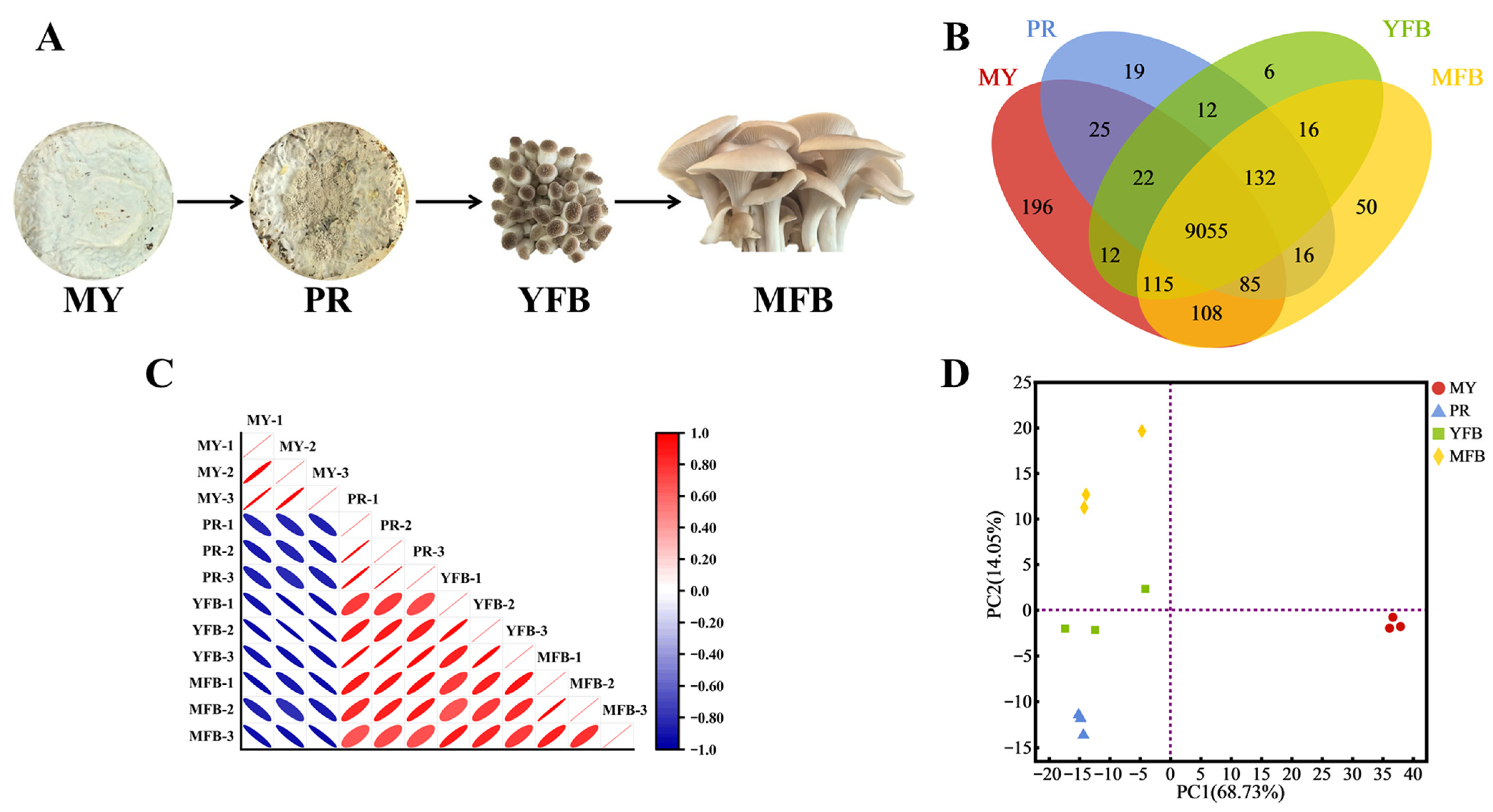
The growth and development process of P. pulmonarius is characterized by four stages: mycelium stage (MY), primordium stage (PR), young fruiting body stage (YFB), and mature fruiting body stage (MFB) (Figure 1A). Among these, primordium formation represents a particularly sensitive and critical period, as it directly determines subsequent yield and is closely correlated with the mushroom’s commercial value. To better understand the developmental processes of P. pulmonarius, samples (three biological replicates) from the four developmental stages were collected and subjected to transcriptome analysis using the Illumina High-Seq 2500 platform. After removing adaptors and reads of low-quality nucleotides, approximately 40 million clean reads per library were obtained, yielding a total of 76.52 G of clean data (Table S3). On average, 85.3% of the reads were uniquely mapped to P. pulmonarius genome using Hisat2 software. A total of 9869 genes were detected in the 12 RNA-seq samples (Table S4), among which 9055 genes were identified in all 4 samples (Figure 1B). Pearson correlation analysis revealed that high correlation coefficients were concentrated near the diagonal line, while low correlation coefficients were distributed in the lower left corner (Figure 1C). Meanwhile, PCA revealed that the three biological replicates from each tissue clustered together, apart from the other tissues (Figure 1D). Moreover, the results revealed the clearest separation between the mycelial stage and the three subsequent developmental stages (primordium, young fruiting body, and mature fruiting body). This pattern likely reflects a major transition in growth mode: the mycelial stage is primarily dedicated to vegetative growth, whereas the latter three stages represent distinct phases of reproductive growth. During vegetative growth, gene expression is predominantly enriched in functions related to carbohydrate metabolism and nutrient uptake and assimilation. In contrast, upon entering reproductive growth, the transcriptional program shifts toward processes such as cell differentiation, morphogenesis, fruiting body development, and reproduction-associated metabolism. The fundamental divergence in biological functions and physiological activities between these two growth modes is therefore clearly reflected in their distinct transcriptomic profiles. These results confirmed the high quality and reproducibility of the RNA-seq data obtained in this study.

3.2. Temporal Gene Expression During P. pulmonarius Development

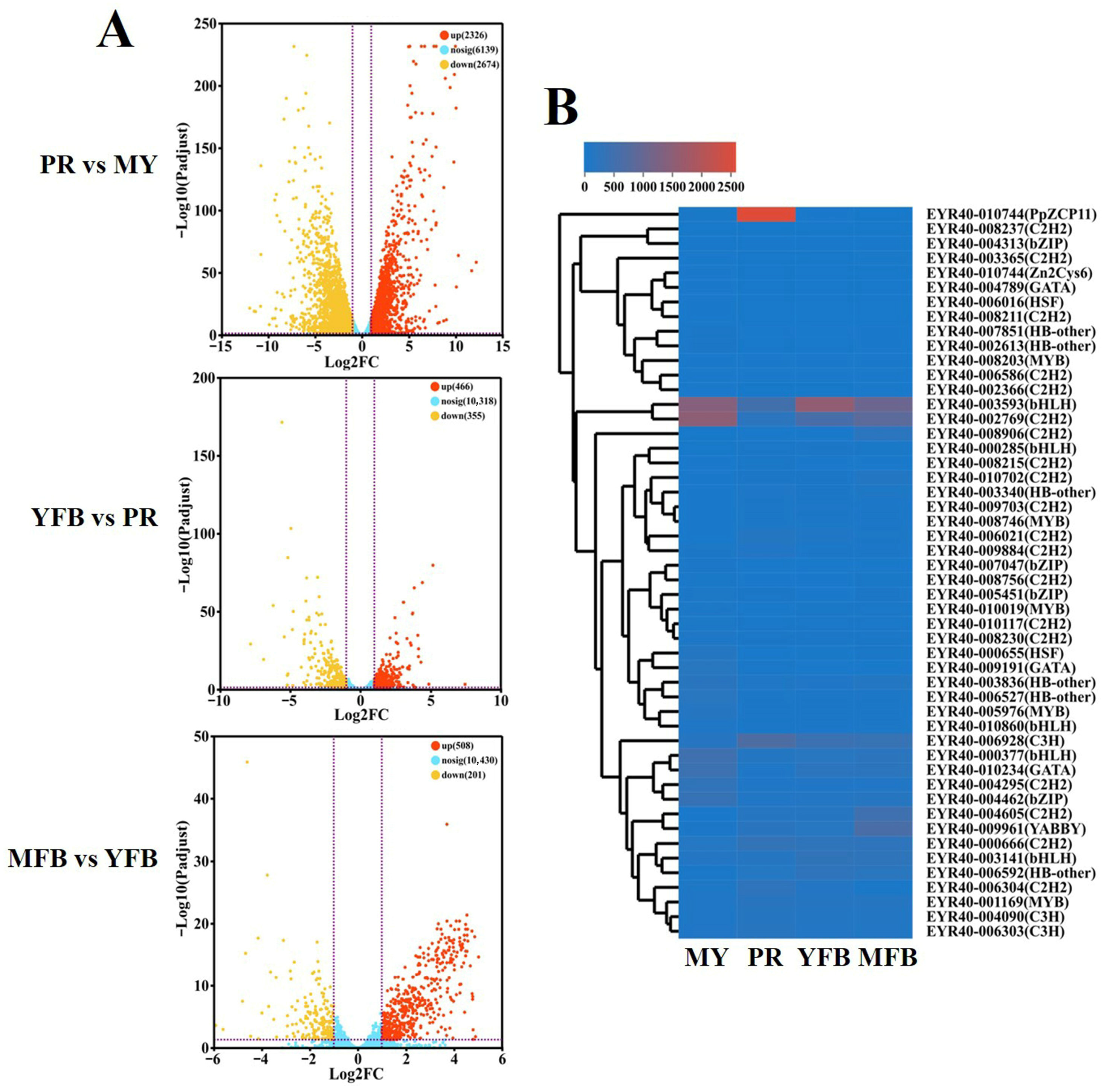
DEGs across developmental stages were profiled using the DESeq2 software (fold change ≥ 2, FDR ≤ 0.05). The results revealed that the highest number of DEGs was observed during the transition from MY stage to PR stage (2326 up-regulated and 2674 down-regulated) (Table S5), followed by PR stage to YFB stage (466 up-regulated and 355 down-regulated (Table S6). The number of DEGs reached its minimum during the transition from YFB stage to MFB stage (508 up-regulated and 201 down-regulated) (Figure 2A) (Table S7) Given the peak in DEGs numbers during primordium formation, gene regulatory activity may be most active during this phase. Further analysis showed that the 6530 DEGs encoded 50 transcription factors belonging to 10 transcription factor families comprising MYB, bHLH, bZIP, and others. The expression levels of these transcription factors differed significantly during different developmental stages. In particular, the PpZCP11 transcription factor was specifically highly expressed in the primordium formation stage (Figure 2B). The ZCP transcription factors are typical fungus-specific regulators that exhibit diverse functions. Therefore, PpZCP11 may be a key transcription factor involved in the primordium formation of P. pulmonarius. Subsequently, to validate the results of DEGs from RNA-seq analysis, 10 randomly selected DEGs were verified by qRT-PCR. Three replicates were set for each sample, and the relative expression level was calculated by the 2−ΔΔCt method. The expression trends of the 10 DEGs detected by qRT-PCR were highly consistent with those from RNA-seq (Figure S1). These results indicated that the DEGs data were reliable.

3.3. PpZCP11 Cloning and Sequence Analysis

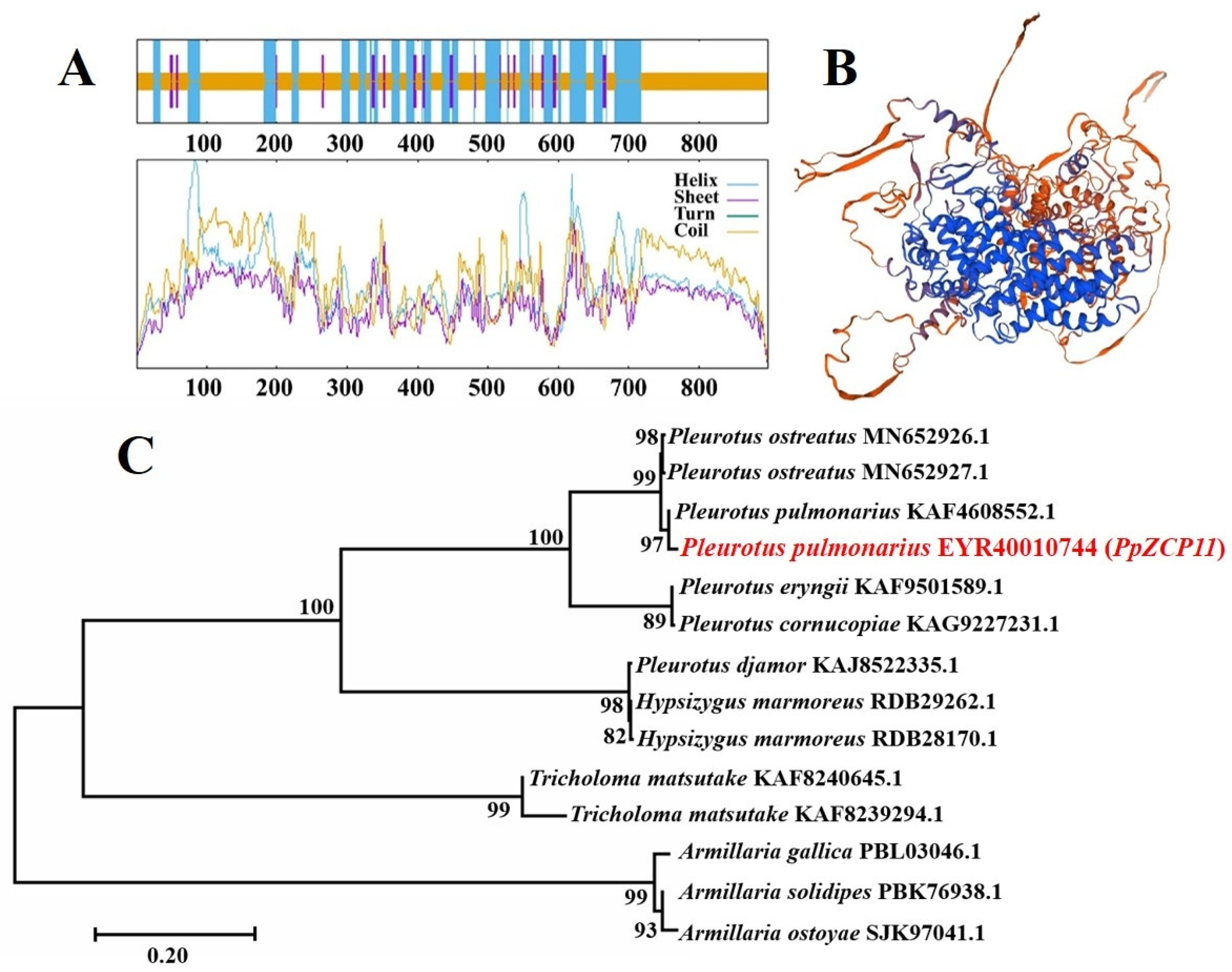
To determine the importance of the PpZCP11 gene in regulating primordium formation, the PpZCP11 gene was obtained and identified in the genome of GCA_012980535.1, with total cDNA lengths of 2697 bp. Bioinformatics analysis revealed that PpZCP11 encoded a polypeptide of 898 amino acids, with a molecular weight and pI of 98.79 kDa and 6.11, respectively. The secondary structure of the PpZCP11 protein primarily consisted of 29.84% α-helices and 65.26% random coils (Figure 3A), while the tertiary structure was predominantly composed of random coils (Figure 3B). To investigate phylogenetic relationships, we downloaded homologous sequences of the PpZCP11 protein from various fungi (e.g., P. ostreatus, Armillaria gallica, Tricholoma matsutake) from the NCBI database. Phylogenetic analysis demonstrated that PpZCP11 clustered closely with MN652926.1 and MN652927.1 (Figure 3C), implying that the PpZCP11 from P. pulmonarius may be evolutionarily and functionally similar to that of P. ostreatus.

3.4. Characterization of PpZCP11 Expression Patterns

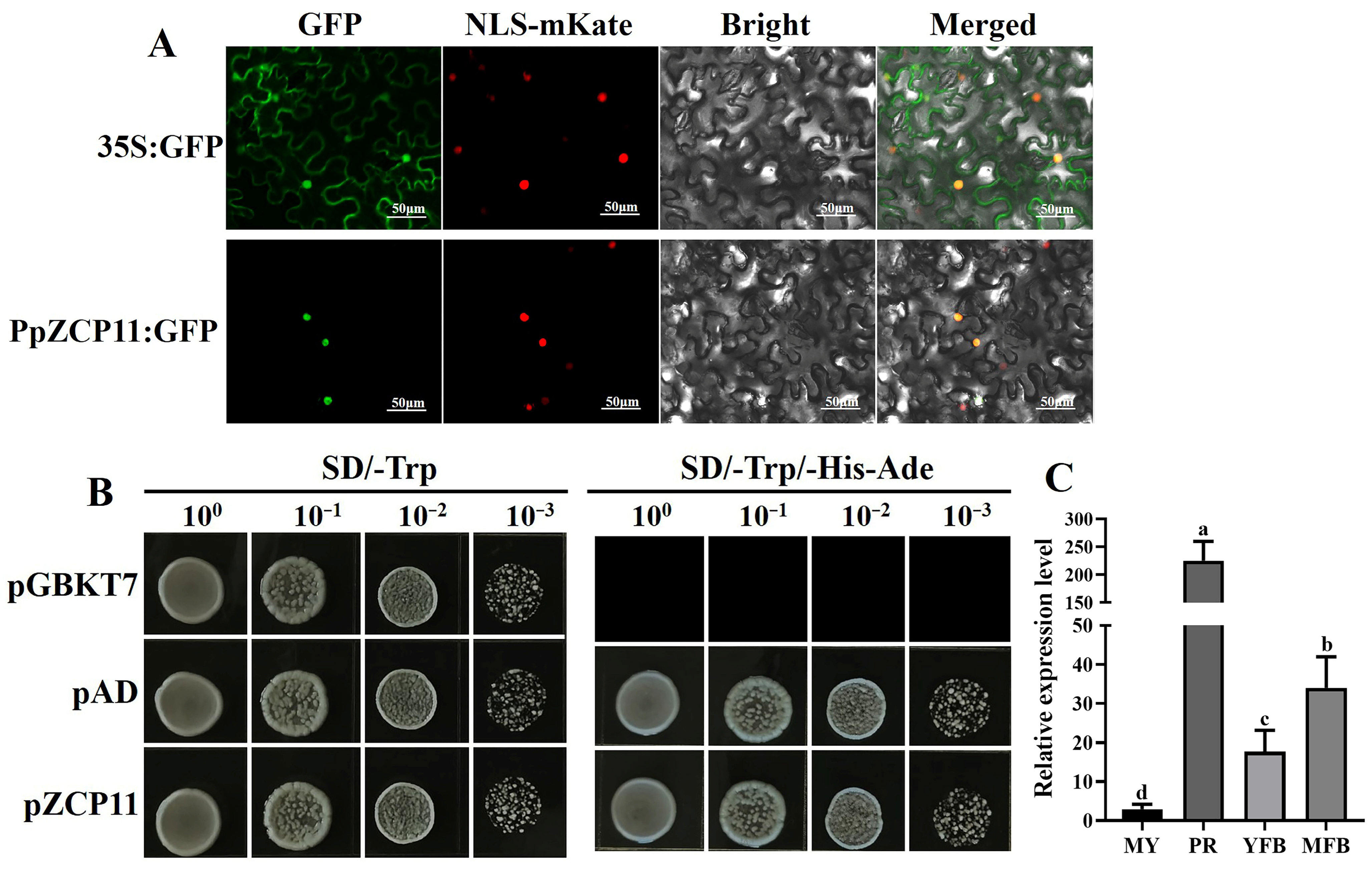
Transcription factors synthesized in the cytoplasm must be transferred to the nucleus to function. To investigate the subcellular localization of the PpZCP11 protein, we initially predicted its localization using the online tool WoLF PSORT (https://wolfpsort.hgc.jp/) (accessed on 6 March 2025), which indicated a potential nuclear localization. To experimentally verify this prediction, PpZCP11-GFP vector was infiltrated into tobacco leaves. An mKate protein containing a nuclear localization signal (NLS) was used as a positive control, while the empty GFP vector served as a negative control. PpZCP11-GFP- and mKate (RFP)-related fluorescence signals were observed to overlap in the nucleus (Figure 4A). The research results suggested that the PpZCP11 protein localized to the nucleus. Additionally, the transcriptional activation activity analysis confirmed that PpZCP11 exhibited transcriptional activation activity in yeast cells. As shown in Figure 4B, the positive control pAD possessed transcriptional activation activity and was capable of growing on both SD/-Trp medium and SD/-Trp-His-Ade medium. The negative control pGBKT7 lacked transcriptional activation activity; it grew on SD/-Trp medium but failed to grow on SD/-Trp-His-Ade medium. Similarly to the positive control, pGBKT7-PpZCP11 grew on both SD/-Trp medium and SD/-Trp-His-Ade medium, indicating that the transcription factor PpZCP11 had transcriptional activation activity. To investigate the expression pattern of the PpZCP11 gene, its transcript levels across different developmental stages were measured using qRT-PCR. The result revealed that PpZCP11 was specifically highly expressed in the primordia, with an expression level approximately 15-fold higher than that in the young fruiting body (Figure 4C). It is therefore proposed that PpZCP11 may play a key role in the primordium formation of P. pulmonarius.

3.5. PpZCP11 Positively Regulates Mycelial Growth

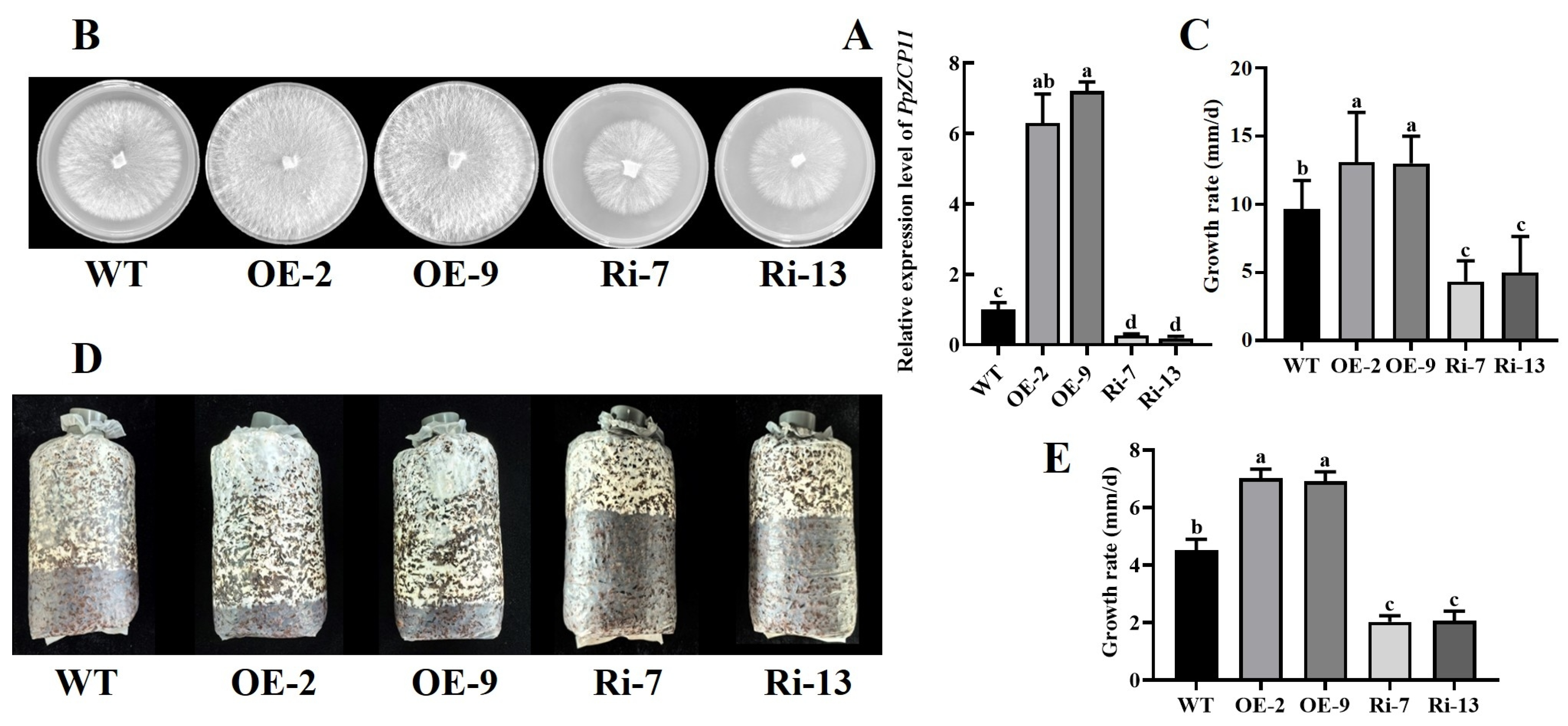
To elucidate the biological function of PpZCP11 in P. pulmonarius, we conducted mutant analysis. Firstly, overexpression strains (OE-2, OE-9) and RNA interference (RNAi-7, RNAi-13) strains were obtained via the ATMT method. Quantitative analysis revealed that the expression levels of PpZCP11 in the OE strains were 6.5-fold and 7.2-fold higher, respectively, than those in the WT strains. In contrast, its expression in the RNAi strains was reduced to 27% and 19% (Figure 5A). Subsequently, we performed phenotypic analysis to observe and compare the mycelial growth rates of wild-type and mutant strains cultured on two different substrates (cottonseed hull medium and PDA medium). These results revealed that the OE-PpZCP11 strains exhibited significantly faster mycelial growth compared to the WT strain. For the OE-PpZCP11 strains, the mycelia fully colonized the Petri dish and the cultivation bag in approximately 6 days and 19 days, respectively, with growth rates increased by 38.6% and 62.8% (Figure 5B–E). In contrast, the RNAi-PpZCP11 strains showed markedly slower mycelial growth than the WT strain. Among them, the RNAi-7 strain demonstrated the slowest growth rate on cottonseed hull medium, with a reduction of 61.6%. Full colonization of the cultivation bags by the mycelia of the RNAi-7 strain took approximately 65 days. (Figure 5D,E). Based on these findings, we concluded that the PpZCP11 gene played a promotive role in mycelial growth of P. pulmonarius.

3.6. PpZCP11 Positively Regulates Primordium Formation

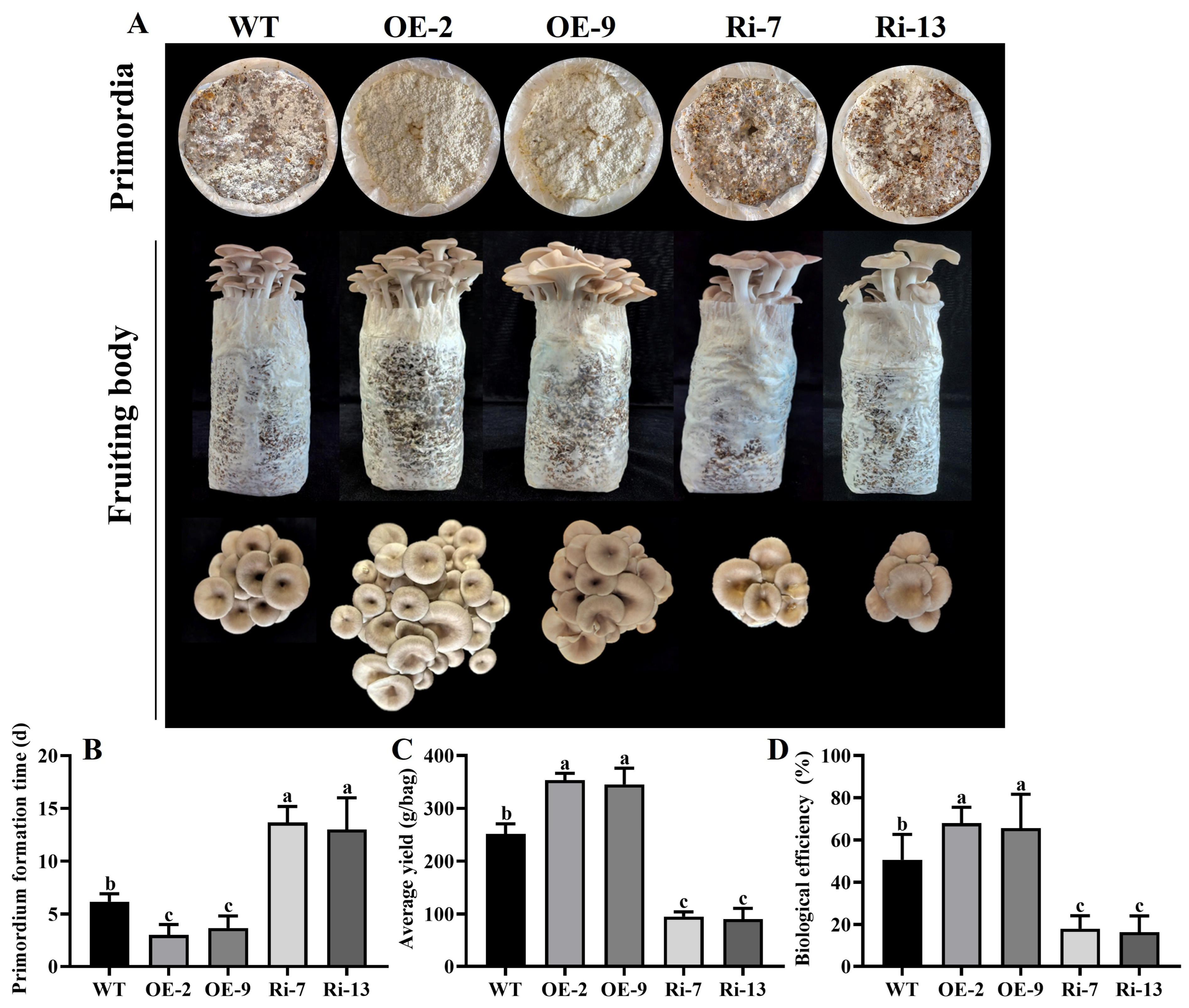
To further elucidate the role of the PpZCP11 gene in the growth and development of P. pulmonarius, a mushroom production assay was conducted. Under cold stimulation, the WT strain initiated primordia after 5–7 days. The OE-PpZCP11 strains, however, produced abundant primordia after only 2–4 days, demonstrating both accelerated initiation and a marked increase in primordia quantity. Conversely, primordium formation in the RNAi-PpZCP11 strains was severely suppressed, with only a few primordia appearing after 11–14 days of cold stimulation (Figure 6A,B). As the commercial production of P. pulmonarius, employs a single-flush explosion cultivation strategy, we evaluated the yield and biological efficiency of the first flush. Relative to the WT strain, the OE strains showed significantly enhanced yield and biological efficiency, while the RNAi strains suffered a sharp decline in yield, achieving only about 16% biological efficiency (Figure 6C,D). Collectively, these findings indicated that PpZCP11 acted as a positive regulator of growth and development in P. pulmonarius and that its overexpression markedly stimulated primordium formation and increased yield.

3.7. Transcriptome Change in Primordia of RNAi-PpZCP11

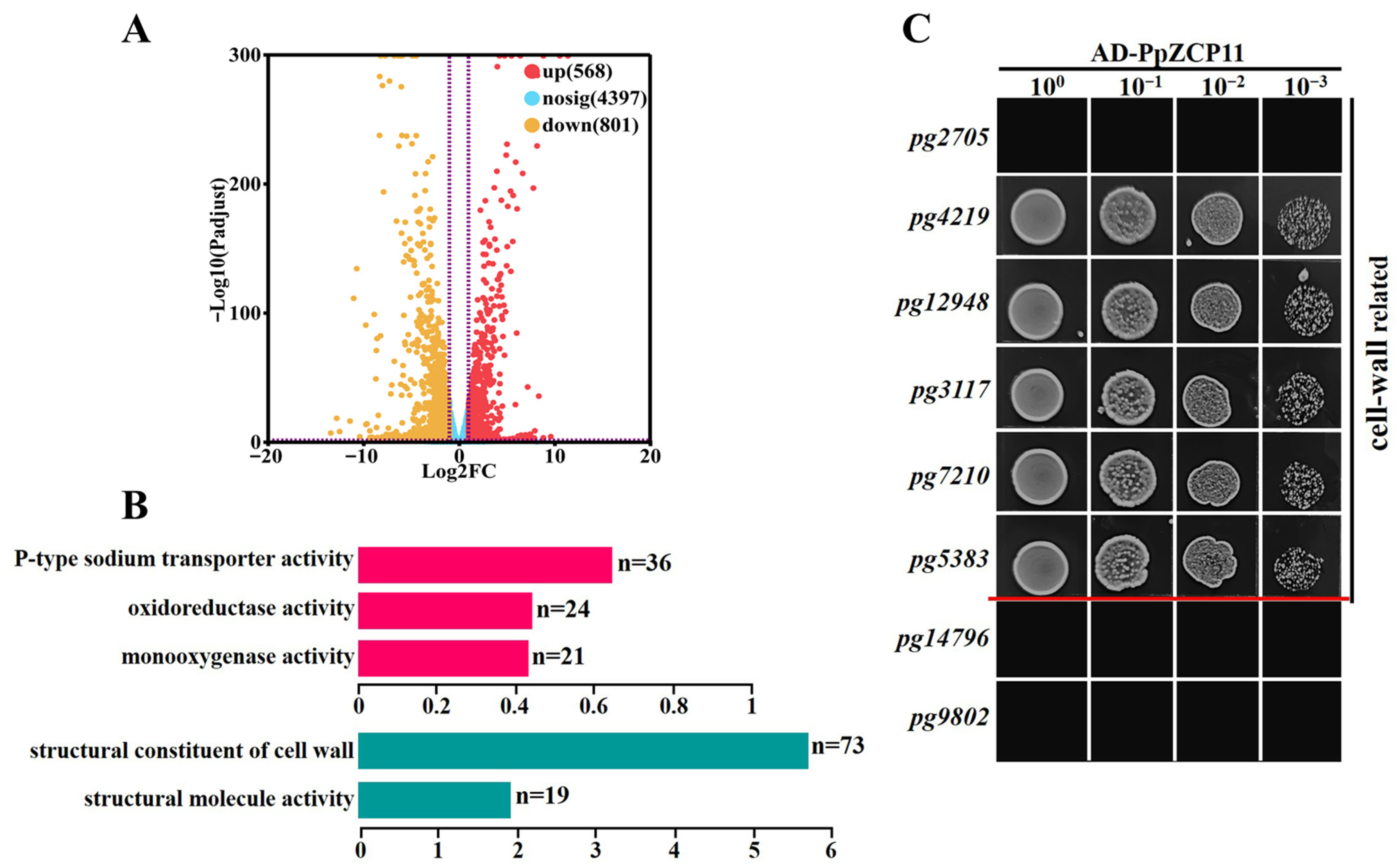
To identify potential target genes of PpZCP11, RNA-seq analysis was performed on primordia isolated from wild-type and RNAi-13 strains with three biological replicates. A total of 1369 DEGs were identified, including 568 upregulated and 801 downregulated genes (Figure 7A). GO enrichment analysis was conducted to elucidate the biological networks associated with these DEGs. In the molecular function category, the upregulated genes in the RNAi-13 primordia were enriched in GO terms associated with ‘P-type sodium transporter activity’, ‘oxidoreductase activity’, and ‘monooxygenase activity’. Surprisingly, the downregulated genes were primarily enriched in the cell wall (Figure 7B). These results suggested that either the inhibited formation of primordia in RNAi-13 may be endogenously coordinated with the cell wall synthesis or, alternatively, PpZCP11 may directly regulate the expression of these cell wall-related genes.
To investigate whether PpZCP11 directly regulated cell wall-related genes during primordium formation, we conducted a yeast one-hybrid (Y1H) assay. The experiment tested the interactions between PpZCP11 and the promoter regions (located 1 kb upstream of the start codon) of six randomly selected cell wall-related genes. As shown in Figure 7C, a robust interactions were detected between PpZCP11 and five out of six promoter regions selected. In contrast, no interaction was observed with the promoters of two upregulated genes from RNAi-13, which served as negative controls. These results indicated that PpZCP11 may be directly responsible for the expression of cell wall-related genes during primordium formation.

4. Discussion

The growth and development of edible fungi represent a sophisticated physiological process, contingent upon precise gene regulation. Transcriptome analysis serves as a powerful tool to elucidate the molecular networks that regulate this process [32]. By comprehensively profiling gene expression dynamics during key developmental stages of edible fungi, the transcriptome sequencing technology systematically reveals the core genes and regulatory networks that drive the morphogenesis. This approach not only identifies key functional genes involved in growth, signal transduction, stress response, and secondary metabolism but also helps elucidate the complete molecular mechanism underlying the transition from mycelial growth to primordium formation and ultimately to fruiting body differentiation. These findings provide a critical theoretical foundation and genetic resources for molecular breeding and precision cultivation of edible fungi, significantly advancing the high-quality development of edible mushroom industry. Currently, transcriptomics has been widely applied in various edible fungi, such as Lyophyllum decastes [33], H. marmoreus [34], and Morchella sextelata [35], serving as a core approach for mining key genes involved in growth and development. In this study, we investigated the growth and development mechanisms of P. pulmonarius by analyzing transcriptome data from four distinct developmental stages. A total of 6530 DEGs were identified. Notably, the transition from vegetative mycelium to primordium exhibited the highest number of DEGs. These findings indicated that this stage of primordium formation was the most physiologically active, which was consistent with the results reported by Ye et al. [36]. The primordium formation in edible fungi is critical for subsequent fruiting body differentiation and overall yield. Primordium development is a highly complex process requiring the participation of a variety of regulatory mechanisms. GO analysis revealed that the DEGs were significantly associated with cell wall synthesis and energy metabolism pathways, suggesting a substantial energy demand during primordium formation. Concurrently, we speculated that genes related to cell wall synthesis may play an important role in the primordium formation.
Transcription is the first step of gene expression. Even at low expression levels, Transcription factors can regulate numerous target genes [37]. In macrofungi, specific transcription factors not only mediate response to external environmental changes but also can regulate gene expression to drive various developmental processes, including mycelial growth, fructification, sclerotial formation, sexual reproduction, sporulation, and secondary metabolism [8]. In Flammulina filiformis, MYB transcription factor FfMYB15 could bind to the FfCEL6B promoter and activate its transcription, thereby positively regulating mycelial growth [38]. In Polyporus umbellatus, Ca2+-calcineurin signaling pathway-related C2H2 transcription factor PuCRZ1 could regulate mycelial growth [39]. Disruption of the putative transcription factor gene PoGat1, which contained a GATA-type zinc finger DNA-binding motif, significantly reduced ligninolytic activity and impaired fruiting body formation of P. ostreatus [40]. In Coprinopsis cinerea, the GATA transcription factor CcNsdD2 could change the developmental direction of sclerotium and fruiting body under light/dark conditions [6]. Spore formation and sexual reproduction are essential for generating fertile offspring in macrofungi. In P. ostreatus, four MYB transcription factors were highly enriched in spores, suggesting their potential involvement in spore-related processes [41]. In macrofungi, the developmental processes are closely linked to changes in secondary metabolism, which is regulated by transcription factors. In G. lucidum, the MADS-box transcription factor GlMADS1 negatively regulated the biosynthesis of ganoderic acids, as evidenced by the increased GA accumulation in RNAi- GlMADS1 strains [42]. In this study, a total of 50 transcription factors belonging to 10 families were identified. The C2H2 transcription factors were the most abundant. Furthermore, C2H2 transcription factor EYR40-002769 exhibited the highest expression levels during the mycelial growth stage, suggesting its potential role in regulating vegetative growth. Therefore, functional characterization of these transcription factors will be the focus of future research.
The ZCP family, which is the largest transcription factor family in many ascomycetes and basidiomycetes, has previously been found specifically in fungi. Members of the ZCP family bind two zinc atoms with a DNA-binding domain consisting of six cysteine residues. The number of ZCPs exhibits considerable variation across different species of edible fungi, and a growing number of these transcription factors are being identified and characterized. 55 members of the ZCP family were identified in Saccharomyces cerevisiae [43]. Genome-wide analysis identified 82 putative ZCPs in Candida albicans [44]. In contrast, the numbers were significantly higher in the pathogenic fungus Aspergillus flavus and the medicinal fungus Tolypocladium guangdongense, with up to 304 and 139 ZCPs identified, respectively [45,46]. 66 ZCPs were identified in P. ostreatus, which were divided into six groups [47]. ZCP transcription factors are key mediators of environmental adaptation in different species. In S. cerevisiae, ZCP transcription factor Stb5 was a key player in the control of NADPH production for resistance to oxidative stress [48]. Moreover, CmWC-1, a member of the ZCP family, played an active role in the light response [49]. Meanwhile, the ZCP transcription factors also play an irreplaceable role in both the vegetative growth and reproductive growth stages of fungi. The absence of the OEFC gene, a positive regulator of asexual development, led to the production of undifferentiated aerial hyphae and a failure to develop conidiophores in Aspergillus nidulans [50]. The putative Zn(II)2Cys6 transcription factor LFC1 acted as a negative regulator of development in F. velutipes. Reduction in LFC1 expression could shorten cultivation time and increase yield [51]. The function of ZCP transcription factors is relatively conserved in basidiomycetes. Studies had shown that members of the ZCP family in S. commune (e.g., fst3, fst1, and fst4) were involved in reproductive growth [25,26]. In P. ostreatus, the homologous gene Pofst3 had been confirmed to play an important role in primordium formation [27]. In this study, we identified the transcription factor PpZCP11, which exhibited the highest expression level in the primordia of P. pulmonarius. Based on this functional conservation, we hypothesized that PpZCP11 may play an important role in primordium formation. Thus, the functional characterization of the PpZCP11 transcription factor was a primary focus of our subsequent research.
Transcription factors are key regulators of gene expression that mainly act in the nucleus. Subcellular localization analysis showed that a GFP-fused PpZCP11 protein localized to the nucleus, consistent with its function as a transcription factor [52]. Additionally, transcriptional activation activity analysis revealed that PpZCP11 transcription facto possessed transcriptional activation activity. This result pointed to a potential role for PpZCP11 in acting as a positive regulator in the growth and development of P. pulmonarius. In addition, differential expression analysis revealed that PpZCP11 gene was highly expressed in the primordia of P. pulmonarius, implicating its important role in the development of this specific tissue. These results provided preliminary insights into the function of PpZCP11 gene. To further elucidate the role of the PpZCP11 gene, we conducted mutant analysis. The OE-PpZCP11 strains promoted the growth rate of mycelia. The downregulation of PpZCP11 led to a reduction in primordium number, yield, and biological efficiency. Taken together, these results indicated that PpZCP11 played a key positive regulatory role during the development, thereby validating our initial hypothesis. Subsequently, to elucidate how PpZCP11 regulated primordium formation, we identified the DEGs between the RNAi and WT strains via transcriptome sequencing. The decreased expression of PpZCP11 led to a predominant suppression of genes involved in the cell wall synthesis pathway. Subsequently, our Y1H assay further demonstrated that PpZCP11 directly bound to the regulatory regions of cell wall-related genes. These results raised an intriguing question regarding the exact biological importance of PpZCP11-regulated expression of cell wall-related genes. The plant cell wall plays a significant role in the process of cell differentiation. Changes in the composition and structure of the cell wall can influence cell morphology and function [53]. Thus, the PpZCP11 transcription factor may regulate primordium formation by influencing cell wall synthesis.
Although this study revealed the important role of PpZCP11 transcription factor in regulating primordium formation through transcriptome analysis and functional validation, and preliminarily clarified that it may function by regulating the cell wall synthesis pathway, we must point out several limitations in the research, which also indicate directions for future exploration. First, this study utilized only one cultivated strain of P. pulmonarius. Although this strain is widely used in production and is representative, different genetic backgrounds among strains may lead to variations in developmental regulation networks. Therefore, the generalizability of the function of the PpZCP11 gene and its potential application in breeding need to be verified in multiple strains. Second, this study primarily employed RNA interference (RNAi) technology for loss-of-function research. Although we verified multiple independent transformants and observed consistent phenotypes to minimize the impact of off-target effects, the inherent potential off-target risks of this technology cannot be completely excluded. In the future, when technical conditions are mature, CRISPR-Cas9 technology and complementation experiments will be adopted to further investigate the function of the PpZCP11 gene. Third, we will employ an integrated multi-omics approach, combining RNA-seq and ChIP-seq analyses, to systematically identify downstream target genes of the PpZCP11 transcription factor. The direct binding of PpZCP11 to specific cis-elements within these target genes will be validated using EMSA and ChIP-qPCR assays. Concurrently, cell wall composition analyses will be conducted to further elucidate the molecular mechanisms through which PpZCP11 regulates primordium formation. In summary, these experiments will be the focus of our subsequent research, contributing to further elucidation of the regulatory network of the PpZCP11 transcription factor.

5. Conclusions

In this study, we cloned the Zn2Cys6 transcription factor gene PpZCP11 from P. pulmonarius. Subcellular localization confirmed its nuclear residence, and expression profiling revealed its peak transcript levels during the primordium stage. In addition, we found that the primordium formation in the RNAi-PpZCP11 strain was severely suppressed, thereby affecting the subsequent development of fruiting body. Transcriptome sequencing analysis suggested that PpZCP11 transcription factor may be involved in the regulation of cell wall synthesis. Our findings further indicated that PpZCP11 transcription factor may be directly responsive for the expression of cell wall-related genes during primordium formation. This work establishes PpZCP11 gene as a critical regulator of primordium formation in P. pulmonarius and provides potential candidate gene for molecular breeding.

Supplementary Materials

The following supporting information can be downloaded at https://www.mdpi.com/article/10.3390/agriculture16020211/s1, Figure S1: Randomly selected DEGs were analyzed using qRT-PCR; Table S1: Primers used in this study; Table S2: List of different strains used in this study; Table S3: Information about sequencing of Pleurotus pulmonarius; Table S4: Information about genes detected in the 12 RNA-seq samples of Pleurotus pulmonarius; Table S5: List of DEGs in primordium compared to mycelium; Table S6: List of DEGs in young fruiting body compared to primordium; Table S7: List of DEGs in mature fruiting body compared to young fruiting body.

Author Contributions

Conceptualization, S.Z. and C.W.; methodology, C.W.; software, Z.G.; validation, C.W., Z.G. and L.W.; formal analysis, W.L.; investigation, Z.G.; resources, M.C. and C.L.; data curation, Z.G.; writing—original draft preparation, C.W.; writing—review and editing, C.W. and W.L. visualization, Y.L.; supervision, M.C., L.W. and C.L.; project administration, S.Z. and C.W.; funding acquisition, S.Z. and C.W. All authors have read and agreed to the published version of the manuscript.

Funding

This research was funded by the Hebei Natural Science Foundation (C2024402046) and the Modern Agricultural Industrial Technology System of Hebei Province (HBCT2023090207).

Institutional Review Board Statement

Not applicable.

Data Availability Statement

The original contributions presented in this study are included in the article. Further inquiries can be directed to the corresponding author.

Acknowledgments

We thank Majorbio Bio-Pharm Technology Co., Ltd. for the Illumina HiSeq 2500 cDNA library sequencing.

Conflicts of Interest

The authors declare no conflicts of interest.

References

  1. Wang, Z.; Xiao, J.; Liu, H.; Zheng, Z.; Zhang, Y.; Liu, Y.; Li, P. Molecular characterization of a novel mitovirus from the edible fungus Pleurotus pulmonarius. Arch. Virol. 2025, 170, 132. [Google Scholar] [CrossRef]
  2. China Edible Fungi Association. Analysis of statistical survey results of edible fungi in China in 2020. Edible Fungi China 2022, 41, 85–91. [Google Scholar]
  3. Liu, L.; Zhou, Y.; Chen, H.; Weng, B.; Lin, D.; Liu, P.; Jiang, Z. Research progress of Pleurotus geesteranus. Microbiol. China 2020, 47, 3650–3657. [Google Scholar]
  4. Yu, Y.; Liu, T.; Wang, Y.; Liu, L.; He, X.; Martin, F.; Peng, W.; Tan, H. Comparative analyses of Pleurotus pulmonarius mitochondrial genomes reveal two major lineages of mini oyster mushroom cultivars. Comput. Struct. Biotechnol. J. 2024, 23, 905–917. [Google Scholar] [CrossRef]
  5. Lyu, X.; Jiang, S.; Wang, L.; Chou, T.; Wang, Q.; Meng, L.; Mukhtar, I.; Xie, B.; Wang, W. The Fvclp1 gene regulates mycelial growth and fruiting body development in edible mushroom Flammulina velutipes. Arch. Microbiol. 2021, 203, 5373–5380. [Google Scholar] [CrossRef]
  6. Liu, C.; Kang, L.; Lin, M.; Bi, J.; Liu, Z.; Yuan, S. Molecular mechanism by which the GATA transcription factor CcNsdD2 regulates the developmental fate of Coprinopsis cinerea under dark or light conditions. mBio 2022, 13, e03626-21. [Google Scholar] [CrossRef] [PubMed]
  7. Qi, Y.; Sun, X.; Zhang, M.; Wen, Q.; Qiu, L.; Shen, J. Identification of up-regulated transcripts during Pleurotus ostreatus primordium stage and characterization of PoALDH1. J. Basic Microbiol. 2018, 12, 1071–1082. [Google Scholar] [CrossRef] [PubMed]
  8. Sun, X.; Liu, D.; Zhao, X. Transcription Factors: Switches for regulating growth and development in macrofungi. Appl. Microbiol. Biotechnol. 2023, 107, 6179–6191. [Google Scholar] [CrossRef]
  9. Vonk, P.; Ohm, R. H3K4me2 ChIP-Seq reveals the epigenetic landscape during mushroom formation and novel developmental regulators of Schizophyllum commune. Sci. Rep. 2021, 11, 8178. [Google Scholar] [CrossRef]
  10. Zhang, J.; Chen, H.; Chen, M.; Ren, A.; Huang, J.; Wang, H.; Zhao, M.; Feng, Z. Cloning and functional analysis of a laccase gene during fruiting body formation in Hypsizygus marmoreus. Microbiol. Res. 2015, 179, 54–63. [Google Scholar] [CrossRef]
  11. Yan, K.; Guo, L.; Zhang, B.; Chang, M.; Meng, J.; Deng, B.; Liu, J.; Hou, L. MAC family transcription factors enhance the tolerance of mycelia to heat stress and promote the primordial formation rate of Pleurotus ostreatus. J. Fungi 2023, 10, 13. [Google Scholar] [CrossRef]
  12. Wu, T.; Hu, C.; Xie, B.; Zhang, L.; Yan, S.; Wang, W.; Tao, Y.; Li, S. A single transcription factor (PDD1) determines development and yield of winter mushroom (Flammulina velutipes). Appl. Environ. Microbiol. 2019, 85, e01735-19. [Google Scholar] [CrossRef] [PubMed]
  13. Zhang, G.; Ren, A.; Shi, L.; Zhu, J.; Jiang, A.; Shi, D.; Zhao, M. Functional analysis of an APSES transcription factor (GlSwi6) involved in fungal growth, fruiting body development and ganoderic-acid biosynthesis in Ganoderma lucidum. Microbiol. Res. 2018, 207, 280–288. [Google Scholar] [CrossRef] [PubMed]
  14. Wu, F.; Zhang, G.; Ren, A.; Dang, Z.; Shi, L.; Jiang, A.; Zhao, M. The pH-responsive transcription factor PacC regulates mycelial growth, fruiting body development, and ganoderic acid biosynthesis in Ganoderma lucidum. Mycologia 2016, 108, 1104–1113. [Google Scholar]
  15. Li, X.; Wang, F.; Liu, M.; Dong, C. Hydrophobin CmHYD1 is involved in conidiation, infection and primordium formation, and regulated by GATA transcription factor CmAreA in edible fungus, Cordyceps militaris. J. Fungi 2021, 7, 674. [Google Scholar] [CrossRef]
  16. Ono, A.; Suzuki, T.; Takeshima, Y.; Kashiwa, T.; Motoyama, T.; Choi, J.; Sato, C.; Konno, N.; Miyakawa, H.; Ogata, M.; et al. CmLec4, a lectin from the fungus Cordyceps militaris, controls host infection and fruiting body formation. Int. J. Biol. Macromol. 2022, 215, 303–311. [Google Scholar] [CrossRef] [PubMed]
  17. Wang, Y.; Zeng, X.; Liu, W. De novo transcriptomic analysis during Lentinula edodes fruiting body growth. Gene 2018, 641, 326–334. [Google Scholar] [CrossRef]
  18. Wang, C.; Zhou, J.; Cao, Z.; Hu, B.; Wang, J.; Guo, J.; Zheng, S. De novo assembly transcriptome analysis reveals the preliminary molecular mechanism of primordium formation in Pleurotus tuoliensis. Genes 2022, 13, 1747. [Google Scholar] [CrossRef]
  19. Ye, D.; Du, F.; Zou, Y.; Hu, Q. Transcriptomics analysis of primordium formation in Pleurotus eryngii. Genes 2021, 12, 1863. [Google Scholar] [CrossRef]
  20. Yu, H.; Jiang, N.; Yan, M.; Cheng, X.; Zhang, L.; Zhai, D.; Liu, J.; Zhang, M.; Song, C.; Yu, H.; et al. Comparative analysis of proteomes and transcriptomes revealed the molecular mechanism of development and nutrition of Pleurotus giganteus at different fruiting body development stages. Front. Nutr. 2023, 10, 1197983. [Google Scholar] [CrossRef]
  21. Yang, X.; Lin, R.; Xu, K.; Guo, L.; Yu, H. Comparative proteomic analysis within the developmental stages of the mushroom white Hypsizygus marmoreus. J. Fungi 2021, 7, 1064. [Google Scholar] [CrossRef]
  22. Xu, L.; Lin, R.; Li, X.; Zhang, C.; Yang, X.; Guo, L.; Yu, H.; Gao, X.; Hu, C. Comparative proteomic analyses within three developmental stages of the mushroom white Hypsizygus marmoreus. J. Fungi 2023, 9, 225. [Google Scholar] [CrossRef] [PubMed]
  23. Hao, H.; Zhang, J.; Wang, Q.; Huang, J.; Juan, J.; Kuai, B.; Feng, Z.; Chen, H. Transcriptome and differentially expressed gene profiles in mycelium, primordium and fruiting body development in Stropharia rugosoannulata. Genes 2022, 13, 1080. [Google Scholar] [CrossRef]
  24. Shu, L.; Wang, M.; Xu, H.; Qiu, Z.; Li, T. De novo transcriptome assembly and comprehensive assessment provide insight into fruiting body formation of Sparassis latifolia. Sci. Rep. 2022, 12, 11075. [Google Scholar] [CrossRef]
  25. Ohm, R.; de Jong, J.; Lugones, L.; Aerts, A.; Kothe, E.; Stajich, J.; de Vries, R.; Record, E.; Levasseur, A.; Baker, S.; et al. Genome sequence of the model mushroom Schizophyllum commune. Nat. Biotechnol. 2010, 28, 957–963. [Google Scholar] [CrossRef]
  26. Ohm, R.; de Jong, J.; de Bekker, C.; Wösten, H.; Lugones, L. Transcription factor genes of Schizophyllum commune involved in regulation of mushroom formation. Mol. Microbiol. 2011, 81, 1433–1445. [Google Scholar] [CrossRef]
  27. Qi, Y.; Chen, H.; Zhang, M.; Wen, Q.; Qiu, L.; Shen, J. Identification and expression analysis of Pofst3 suggests a role during Pleurotus ostreatus primordia formation. Fungal Biol. 2019, 123, 200–208. [Google Scholar] [CrossRef] [PubMed]
  28. Zhang, J.; Hao, H.; Liu, H.; Wang, Q.; Chen, M.; Feng, Z.; Chen, H. Genetic and functional analysis of the Zn(II)2Cys6 transcription factor HADA-1 in Hypsizygus marmoreus. Appl. Microbiol. Biotechnol. 2021, 105, 2815–2829. [Google Scholar] [CrossRef]
  29. Liu, D.; Sun, X.; Diao, W.; Qi, X.; Bai, Y.; Yu, X.; Li, L.; Fang, H.; Chen, Z.; Liu, Q.; et al. Comparative transcriptome analysis revealed candidate genes involved in fruiting body development and sporulation in Ganoderma lucidum. Arch. Microbiol. 2022, 204, 514. [Google Scholar] [CrossRef]
  30. He, R.; Zhang, L.; Lan, J.; Mei, S.; Li, Y. Cmcrf1, a putative Zn2Cys6 fungal transcription factor, is involved in conidiation, carotenoid production, and fruiting body development in Cordyceps militaris. Biology 2022, 11, 1535. [Google Scholar] [CrossRef] [PubMed]
  31. Chen, B.; Wei, T.; Xue, L.; Zheng, Q.; Ye, Z.; Zou, Y.; Yang, Y.; Yun, F.; Guo, L.; Lin, J. Transcriptome analysis reveals the flexibility of cordycepin network in Cordyceps militaris activated by L-Alanine addition. Front. Microbiol. 2020, 11, 577. [Google Scholar] [CrossRef]
  32. Xie, M.; Wang, J.; Wang, F.; Wang, J.; Yan, Y.; Feng, K.; Chen, B. A review of genomic, transcriptomic, and proteomic applications in edible fungi biology: Current status and future directions. J. Fungi 2025, 11, 422. [Google Scholar] [CrossRef] [PubMed]
  33. Ke, S.; Ding, L.; Niu, X.; Shan, H.; Song, L.; Xi, Y.; Feng, J.; Wei, S.; Liang, Q. Comparative transcriptome analysis on candidate genes associated with fruiting body growth and development in Lyophyllum decastes. PeerJ 2023, 11, e16288. [Google Scholar] [CrossRef] [PubMed]
  34. Zhang, J.; Ren, A.; Chen, H.; Zhao, M.; Shi, L.; Chen, M.; Wang, H.; Feng, Z. Transcriptome analysis and its application in identifying genes associated with fruiting body development in basidiomycete Hypsizygus marmoreus. PLoS ONE 2015, 10, e0123025. [Google Scholar] [CrossRef] [PubMed]
  35. Zhang, C.; Shi, X.; Zhang, J.; Zhang, Y.; Liu, W.; Wang, W. Integration of metabolomes and transcriptomes provides insights into morphogenesis and maturation in Morchella sextelata. J. Fungi 2023, 9, 1143. [Google Scholar] [CrossRef]
  36. Ye, D.; Du, F.; Hu, Q.; Zou, Y.; Bai, X. Transcriptome analysis reveals candidate genes involved in light-induced primordium differentiation in Pleurotus eryngii. Int. J. Mol. Sci. 2021, 23, 435. [Google Scholar] [CrossRef]
  37. Duttke, S. Evolution and diversification of the basal transcription machinery. Trends Biochem. Sci. 2015, 40, 127–129. [Google Scholar] [CrossRef]
  38. Liu, Z.; Deng, B.; Yuan, H.; Zhang, B.; Liu, J.; Meng, J.; Chang, M. Transcription factor FfMYB15 regulates the expression of cellulase gene FfCEL6B during mycelial growth of Flammulina filiformis. Microb. Cell Fact. 2022, 21, 216. [Google Scholar] [CrossRef]
  39. Han, P.; Hua, Z.; Zhao, Y.; Huang, L.; Yuan, Y. PuCRZ1, an C2H2 transcription factor from Polyporus umbellatus, positively regulates mycelium response to osmotic stress. Front. Microbiol. 2023, 14, 1131605. [Google Scholar] [CrossRef]
  40. Nakazawa, T.; Morimoto, R.; Wu, H.; Kodera, R.; Sakamoto, M.; Honda, Y. Dominant effects of gat1 mutations on the ligninolytic activity of the white-rot fungus Pleurotus ostreatus. Fungal Biol. 2019, 123, 209–217. [Google Scholar] [CrossRef]
  41. Wang, L.; Gao, W.; Wu, X.; Zhao, M.; Qu, J.; Huang, C.; Zhang, J. Genome-wide characterization and expression analyses of Pleurotus ostreatus MYB transcription factors during developmental stages and under heat stress based on de novo sequenced genome. Int. J. Mol. Sci. 2018, 19, 2052. [Google Scholar] [CrossRef] [PubMed]
  42. Meng, L.; Zhang, S.; Chen, B.; Bai, X.; Li, Y.; Yang, J.; Wang, W.; Li, C.; Li, Y.; Li, Z. The MADS-box transcription factor GlMADS1 regulates secondary metabolism in Ganoderma lucidum. Mycologia 2021, 113, 12–19. [Google Scholar] [CrossRef] [PubMed]
  43. Joshua, I.; Höfken, T. From lipid homeostasis to differentiation: Old and new functions of the zinc cluster proteins Ecm22, Upc2, Sut1 and Sut2. Int. J. Mol. Sci. 2017, 18, 772. [Google Scholar] [CrossRef] [PubMed]
  44. Schillig, R.; Morschhäuser, J. Analysis of a fungus-specific transcription factor family, the Candida albicans zinc cluster proteins, by artificial activation. Mol. Microbiol. 2013, 89, 1003–1017. [Google Scholar] [CrossRef]
  45. Chang, P.; Ehrlich, K. Genome-wide analysis of the Zn(II)2Cys6; zinc cluster-encoding gene family in Aspergillus flavus. Appl. Microbiol. Biotechnol. 2013, 97, 4289–4300. [Google Scholar] [CrossRef]
  46. Zhang, C.; Huang, H.; Deng, W.; Li, T. Genome-wide analysis of the Zn(II)2Cys6 zinc cluster-encoding gene family in Tolypocladium guangdongense and its light-induced expression. Genes 2019, 10, 179. [Google Scholar] [CrossRef]
  47. Hou, Z.; Chen, Q.; Zhao, M.; Huang, C.; Wu, X. Genome-wide characterization of the Zn(II)2Cys6 zinc cluster-encoding gene family in Pleurotus ostreatus and expression analyses of this family during developmental stages and under heat stress. PeerJ 2020, 8, e9336. [Google Scholar] [CrossRef]
  48. Larochelle, M.; Drouin, S.; Robert, F.; Turcotte, B. Oxidative stress-activated zinc cluster protein Stb5 has dual activator/repressor functions required for pentose phosphate pathway regulation and NADPH production. Mol. Cell. Biol. 2006, 26, 6690–6701. [Google Scholar] [CrossRef]
  49. Yang, T.; Guo, M.; Yang, H.; Guo, S.; Dong, C. The blue-light receptor CmWC-1 mediates fruit body development and secondary metabolism in Cordyceps militaris. Appl. Microbiol. Biotechnol. 2016, 100, 743–755. [Google Scholar] [CrossRef]
  50. Lee, B.; Han, S.; Choi, H.; Kim, J.; Han, K.; Han, D. Screening of growth-or development-related genes by using genomic library with inducible promoter in Aspergillus nidulans. J. Microbiol. 2005, 43, 523–528. [Google Scholar]
  51. Wu, T.; Hu, C.; Xie, B.; Wei, S.; Zhang, L.; Zhu, Z.; Zhang, Z.; Li, S. A putative transcription factor LFC1 negatively regulates development and yield of winter mushroom. Appl. Microbiol. Biotechnol. 2020, 104, 5827–5844. [Google Scholar] [CrossRef] [PubMed]
  52. Liu, L.; Li, S.; Tang, F.; Li, P.; Liu, J.; Fu, R.; Zheng, L.; Zhang, J.; Chao, N. MaMYBR30, a novel 1R-MYB, plays important roles in plant development and abiotic stress resistance. Plants 2024, 13, 1794. [Google Scholar] [CrossRef] [PubMed]
  53. Schoenaers, S.; Balcerowicz, D.; Breen, G.; Hill, K.; Zdanio, M.; Mouille, G.; Holman, T.; Oh, J.; Wilson, M.; Nikonorova, N.; et al. The auxin-regulated CrRLK1L kinase ERULUS controls cell wall composition during root hair tip growth. Curr. Biol. 2018, 28, 722–732. [Google Scholar] [CrossRef] [PubMed]
Figure 1. General overview of the transcriptome data of P. pulmonarius. (A) Phenotypes of four developmental stages of P. pulmonarius. MY: mycelium; PR: primordium; YFB: young fruiting body; MFB: mature fruiting body. (B) Venn diagram showing the genes identified in four groups. (C) Pearson correlation analysis of transcriptome data from four groups (n = 3, per group). (D) PCA analysis among samples.
Agriculture 16 00211 g001
Figure 2. Identification of DEGs. (A) Volcano plots showing DEGs between different stages. (B) Dynamic changes in transcription factors expression throughout various developmental stages. MY: mycelium; PR: primordium; YFB: young fruiting body; MFB: mature fruiting body.
Agriculture 16 00211 g002
Figure 3. Bioinformatics analysis of PpZCP11 protein. (A) Secondary structure of PpZCP11 protein. (B) Tertiary structure of PpZCP11 protein. Homology-based modeling of the PpZCP11 protein tertiary structure was performed on the SWISS-MODEL server by aligning its amino acid sequence with template structures and generating a prediction from the resulting alignment. (C) A neighbor-joining phylogenetic tree of PpZCP11 protein in various fungi.
Agriculture 16 00211 g003
Figure 4. Subcellular localization and transcriptional activation analysis of PpZCP11. (A) Subcellular localization of PpZCP11 protein. Subcellular localization of PpZCP11-GFP fusion proteins in tobacco leaves. mKate containing a nucleus localisation signal was used as a positive control. The images were captured using a confocal laser-scanning microscope. Bars = 50 μm. (B) The transcriptional activation activity analysis of PpZCP11. (C) qPCR analysis of the relative expression of PpZCP11 in different developmental stages. Relative expression levels were calculated via the 2−ΔΔCT method. MY: mycelium; PR: primordium; YFB: young fruiting body; MFB: mature fruiting body. Different letters indicate significant differences for the comparison of samples (p < 0.05).
Agriculture 16 00211 g004
Figure 5. PpZCP11 participates in the regulation of the mycelial growth. (A) Quantitative analysis of the expression levels of PpZCP11 in different strains. (B) Mycelial phenotype of different strains cultured on PDA medium. (C) Statistical analysis of mycelial growth rate of different strains cultured on PDA medium. (D) Mycelial phenotype of different strains cultured on cottonseed hull medium. (E) Statistical analysis of mycelial growth rate of different strains cultured on cottonseed hull medium. Different letters indicate significant differences for the comparison of samples (p < 0.05).
Agriculture 16 00211 g005
Figure 6. The effect of PpZCP11 on the primordium formation. (A) The phenotypes of different strains at primordium stage and fruiting body stage. (B) Statistical analysis of the primordium formation time among different strains. (C) Statistical analysis of average yield among different strains. (D) Statistical analysis of biological efficiency among different strains. Different letters indicate significant differences for the comparison of samples (p < 0.05).
Agriculture 16 00211 g006
Figure 7. PpZCP11 is required for the expression of cell wall-related genes. (A) Volcano plots showing DEGs in primordia between RNAi-13 and wild-type. (B) Enriched GO terms among the DEGs in RNAi-13 primordia compared with wild-type. (C) Interactions of PpZCP11 with the promoter regions of cell wall-related genes shown by Y1H assay. Y1H analysis using promoter regions of random-selected cell wall-related genes (g2705, g4219, g12948, g3117, g7210, g5383) and non-cell wall genes (g14796, g9802) as bait and PpZCP11 as prey.
Agriculture 16 00211 g007
Disclaimer/Publisher’s Note: The statements, opinions and data contained in all publications are solely those of the individual author(s) and contributor(s) and not of MDPI and/or the editor(s). MDPI and/or the editor(s) disclaim responsibility for any injury to people or property resulting from any ideas, methods, instructions or products referred to in the content.