Article

The Effect of Straw Management and Nitrogen Fertilisation on Soil Properties During 50 Years of Continuous Spring Barley Cropping

1
Czech Geological Survey, 118 00 Prague, Czech Republic
2
Department of Agrosystems and Bioclimatology, Faculty of Agrisciences, Mendel University in Brno, 613 00 Brno, Czech Republic
3
Czech Agrifood Research Center, 161 00 Prague, Czech Republic
*
Authors to whom correspondence should be addressed.
Agriculture 2026, 16(2), 210; https://doi.org/10.3390/agriculture16020210
Submission received: 21 November 2025 / Revised: 5 January 2026 / Accepted: 7 January 2026 / Published: 13 January 2026

Abstract

This study is based on a long-term field trial with spring barley monoculture that was established in 1970 on Gleyic Fluvisol in the Žabčice, Czech Republic. The aim was to clarify the long-term impact of straw management and mineral nitrogen (N) application on grain yields and soil aggregate stability (SAS), and to determine the mineralogical and geochemical properties crucial for soil aggregate stability changes. Variants of the experiment included a combination of incorporated and harvested straw with doses of 0, 30, 60, and 90 kg N ha−1 in the form of ammonium sulphate (NH4)2SO4. The incorporated straw variants had a higher average grain yield of 0.51 t ha−1. The SAS values were in the range 54–64% and increased in all variants with N application compared to the 0N control. Ammonium sulphate fertilisation caused soil acidification, which was not reduced even by the incorporation of straw. SAS increased with decreasing pH value, although cation exchange capacity and exchangeable Ca2+ decreased, and the soil organic carbon content was similar in all variants. The relatively high content of Fe- and Al-(oxo)hydroxides extracted with ammonium oxalate (Feox and Alox) in all samples caused an increase in SAS due to decreasing pH in the N fertilised variants compared to the control. SAS should be considered in relation to other soil properties when evaluating soil quality and fertility.

1. Introduction

The management of crop residues represents a critical intersection between sustainable soil functioning and economic agricultural viability and is an important part of cropping systems [1,2]. Straw incorporation and crop residues improve soil structure and nutrient balance [3] and can increase soil organic carbon [4], regulate CO2 and CH4 emissions [5], alter soil aggregate size distribution [6], and increase crop yields [7] and aggregate stability [8,9,10,11]. Despite the environmental benefits of straw incorporation, straw is usually harvested and, for example, used as an energy source in connection with the support of biogas plants in the countries of the European Union [12].
The long-term application of mineral fertilisers acts as a primary driver of soil chemical dynamics, particularly concerning soil acidity and cation exchange capacity. The application of mineral fertilisers increases soil fertility [13] but can compromise soil aggregate stability. Long-term inputs of ammonia-based N drive acidification [14], which tends to decrease cation exchange capacity (CEC) via mineral weathering and base cation leaching [15,16]. Nevertheless, the final CEC trajectory also depends on organic matter dynamics; Czarnecki and Düring [17] observed that fertiliser-induced increases in soil organic C can override the acidification effect, resulting in higher CEC despite lower pH. Finally, the return of post-harvest residues to the soil is an effective method of mitigating acidification through their large K+ input [16], as cation exchange is an important pH buffering mechanism [18,19].
These chemical properties fundamentally shape the soil’s physical structure, as stable aggregates result from the rearrangement, bonding, and consolidation of building particles [20]. According to Bronick and Lal [21], the building particles of aggregates are composed of (a) soil organic carbon (SOC), (b) biota and their organic products, (c) exchangeable cations that bind the individual components of the aggregates, and (d) a mineral component, which is mainly composed of clay minerals, Al- and Fe- (oxo)hydroxides, or carbonates. Kay [22] reported that the aggregate formation depended on other factors such as soil management, plant influence (root system, exudates), SOC concentration, mineral composition, texture, pedogenic processes, microbial activity, cation exchange capacity (CEC) and exchangeable ions content, pH, nutrient supply and contribution (from subsoil, fertilisation), moisture, terrain, and climate.
The degree of aggregate stability is primarily governed by the interaction between soil organic carbon, mineral surface properties, and prevailing soil pH. The content of stable aggregates generally increases with increasing SOC, the specific surface area of minerals, and CEC [21]. Factors such as metal solubility (e.g., Fe, Al), microbial activity, and clay dispersion are highly dependent on soil pH [23]. Rasmussen et al. [24] reported that when pH (H2O) decreased below 6.5, the short-range-ordered mineral phases (mainly amorphous Fe- and Al-(oxo)hydroxides) with Al- and Fe-organo-metal complexes had a greater influence on soil organic matter (SOM) stabilisation than the exchangeable Ca2+ content. Amorphous Fe-(oxo)hydroxides are particularly important for aggregation, despite their small proportion in the soil mass, as they can form strong bonds with clay, silt, and sand particles, and in addition, the total clay content can mask the diversity of mineral properties and may not effectively capture the specific SOM stabilising mechanisms [25].
Within the soil structural hierarchy, the 1–2 mm macro-aggregate fraction plays a key role in soil functioning and response to agronomic practices. Soil aggregates in this fraction contribute most to soil stabilisation against erosion [26], are enriched in carbon and N [27], and show the highest biological activity [28]. Zeng et al. [29] and Zheng et al. [30] reported pronounced external influences on the soil properties, such as those exerted by weather conditions or the agronomic measures in the 0–5 cm surface soil layer.
Recent agricultural strategies—driven by the economic demand for straw and volatile fertiliser markets—are altering nutrient inputs and crop rotation diversity, leading to cumulative long-term effects on soil properties. These shifts threaten the sensitive electrochemical and biological balance required for aggregate formation, as described above. To address these uncertainties, we investigated the effect of agricultural management on soil properties in a long-term field experiment with barley monoculture and different straw management and mineral N doses.
We hypothesise that (1) mineral N application moderated by straw incorporation influences soil aggregate stability and that (2) higher doses of mineral N change the effect of geochemistry and mineralogy on soil aggregate stability.
The aims are (1) to determine the soil mineral and geochemical properties crucial for soil aggregate stability in the warm Central European region on Silty Loam soil and (2) to clarify the long-term impact of straw management and mineral N application on the soil fertility and aggregate stability.

2. Materials and Methods

2.1. Field Experiment: Site Description and Experimental Design

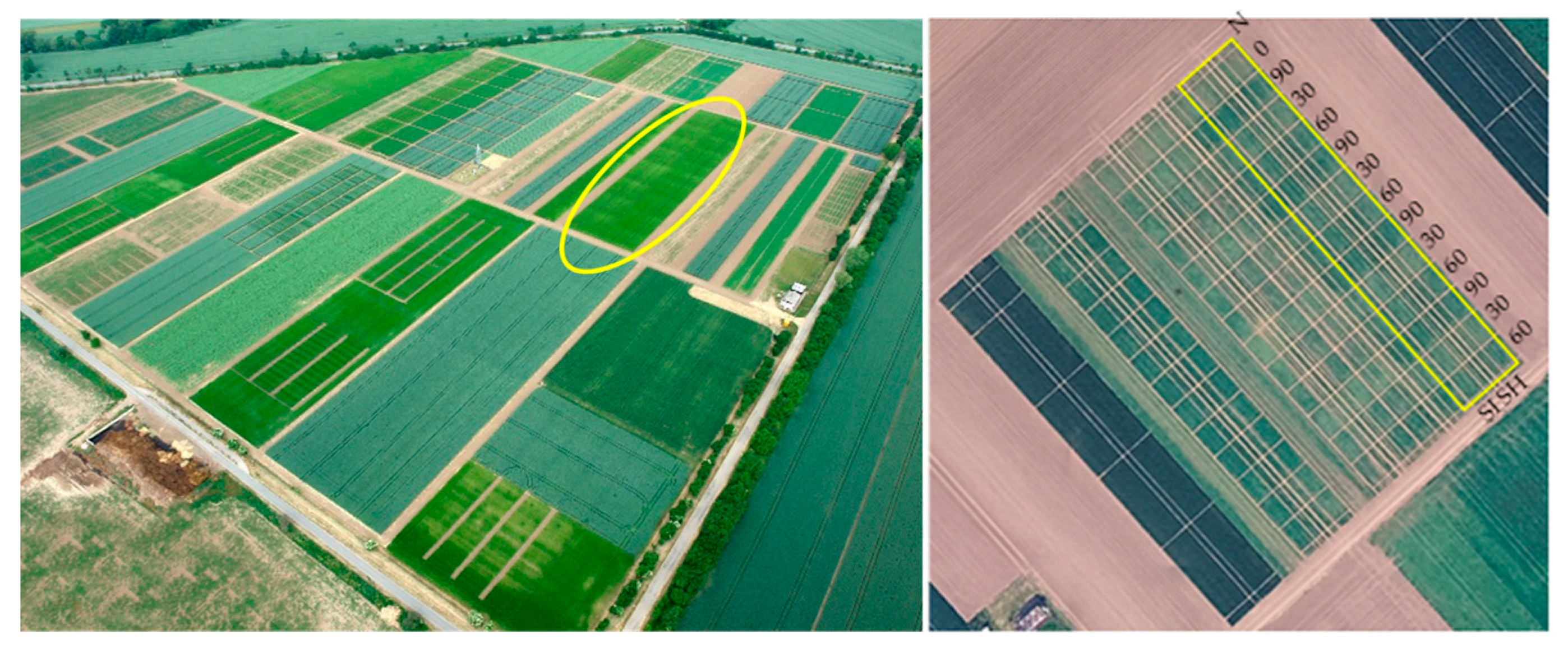
A long-term field trial with spring barley monoculture was established in 1970 in Žabčice at the field trial station of Mendel University in Brno (Figure 1). The region is one of the warmest in the Czech Republic.
The average total rainfall fluctuated considerably (398–646 mm/year) between 2017 and 2021 (Supplementary File S1). The average air temperature varied less significantly, at 9.6–11.5 °C. Climatic and soil characteristics of the experimental site are given in Table 1.
The field trial was established in two different straw management systems: (1) straw incorporation into the soil (SI) and (2) straw harvested from the field (SH). Four doses of mineral N from the (NH4)2SO4 ammonium sulphate source were applied in each straw management system: (1) untreated control with 0 kg N ha−1, (2) 30 kg N ha−1, (3) 60 kg N ha−1, and (4) 90 kg N ha−1. The experiment was carried out as a split-plot design with eight combinations of straw management systems (main plots) and mineral N treatments (sub-plot), with four replications of each combination: SH-0N (straw harvested, 0 kg N ha−1); SH-30N (straw harvested, 30 kg N ha−1); SH-60N (straw harvested, 60 kg N ha−1); SH-90N (straw harvested, 90 kg N ha−1); SI-0N (straw incorporated, 0 kg N ha−1); SI-30N (straw incorporated, 30 kg N ha−1); SI-60N (straw incorporated, 60 kg N ha−1); SI-90N (straw incorporated, 90 kg N ha−1).
The size of the plots varied between 9.6 and 12.15 m2 due to historically changing mechanisation. Plots of individual replicates are separated from each other by 150 cm strips with barley on all sides and 35 cm paths without barley vegetation between the plots.
The following standard cultivation measures were carried out on all treatments: (1) 8 cm shallow soil tillage after the spring barley harvest; (2) P + K fertilisation with 45% superphosphate application, providing 39.24 kg P ha−1, and 60% potassium salt application, delivering 99.6 kg K ha−1; (3) ploughing to 22cm in the third week of October; (4) seed bed preparation and manual application of ammonium sulphate with 30, 60, and 90 kg N ha−1 doses in spring; (5) sowing of 400 seeds m−2 spring barley (variety ‘Bojos’) at the beginning-to-middle of March; (6) rolling as soon as possible after sowing, dependent on the weather; (7) application of post-emergence herbicide in the tillering growth stage in the second half of April; and (8) the application of fungicide, insecticide, and growth regulators as required to ensure the stand’s good health. Detailed agrotechnical data are presented in Table 2.
Finally, harvesting took place in the first half of July with the small Sampo 2010 plot harvester (Sampo Rosenlew, Pori, Finland).

2.2. Soil Sampling and Processing

Samples for SAS determination were collected in 2018–2021. Soil samples were taken by field-shovel from the 0–5 cm upper soil layer in spring 2018–2021 (4 May 2018, 17 April 2019, 16 April 2020, 6 May 2021) and summer (13 July 2018, 10 July 2019, 30 July 2020, 3 August 2021), soon after crop harvests. Samples weighing approximately 2 kg were randomly taken from each repetition in each variant, taking approximately 20–25 partial samples. This was performed between the crop rows inside plots, at least 50 cm from their edges, and the samples were stored in plastic containers for transportation and analysis. Soil moisture was measured in all terms; in spring, values were stable and varied from 8.8 to 10.9%. In summer, soil moisture was seen to change over the years, with lower values in 2018 and 2019 (7.5–9.2%) and higher values in 2020 and 2021 (19.9 and 19.3%).
The soil samples were air-dried, homogenised, and then sieved through 10, 5, 2, 1, 0.5, and 0.25 mm sieves. The obtained soil fractions were then used for the following analyses.
(1) Fractions of 1–2 mm size were used for the determination of stable soil aggregate content (SAS); (2) fractions under 2 mm were subjected to mineralogical and geochemical analyses.

2.3. Analysis of Soil Aggregate Stability (SAS)

The soil aggregate stability (SAS, %) was assessed by wet sieving [31] and modified as in Kemper and Koch [32]. Air-dried soil samples were sieved to obtain the 1–2 mm aggregate fraction. A 4 g subsample (W) was placed on the sieve of the HERZOG laboratory equipment (Adolf Herzog GmbH, Vienna, AT, USA). The analysis consisted of two stages. Firstly, to determine the water-stable fraction, the samples were wet-sieved in distilled water for 5 min at laboratory temperature. The material retained on the sieve (water-stable aggregates and sand) was rinsed into weighing dishes, dried at 105 °C for 24 h, and weighed (M2).
Secondly, a correction for the coarse sand fraction was performed on the same samples. The dried residues from the first stage were soaked for 2 h in 50 mL of 0.1 M sodium pyrophosphate decahydrate solution (Na4P2O7 10H2O) to disperse the soil aggregates.
After dispersion, the samples were washed through the sieves with distilled water until only the sand fraction remained. The sand was dried at 105 °C for 16 h and weighed (M3).
Soil aggregate stability was calculated as the percentage of stable aggregates relative to the total sample weight, corrected for the sand content, using the following equation:
SAS (%) = ((M2 − M3)/(W − (M3 − M1))) × 100
where M1 is the weight of the dish, M2 is the weight of the dish with stable aggregates and sand, M3 is the weight of the dish with sand, and W is the initial sample weight. Three sub-samples were analysed from each sample for each replicate of the field trial variants.
Three sub-samples were analysed from each sample for each replicate of the field trial variants. The data for 4 years × 2 sampling dates (spring, summer) × 4 replicates × 3 sub-samples for each evaluated variant provided 96 SAS analyses/variants. Finally, the averages of the three weights analysed for each variant replicate were used in the calculations.

2.4. Geochemical and Mineralogical Analyses

Chemical and mineralogical analyses of soils were performed on samples taken in the spring of 2018; pH analyses were also carried out in the spring of 2021.
Grain size distribution, pH, SOC, and TN analyses were determined from four replications from all combinations of treatments. The CEC, the oxalate extraction, and mineralogical analyses were performed on control treatments (SH-0N, SI-0N) and treatments with maximum nitrogen doses (SH-90N, SI-90N) on samples mixed from four plots (replicates) after drying and sieving to under 2 mm. These parameters changed imperceptibly during the four years [33,34] of the project’s duration, from 2018 to 2021, so these analyses were only performed once. The largest differences in analysis were expected between the control and 90N treatment.
The total organic carbon (TOC) and total nitrogen content (TN) were determined after the combustion of the soil sample’s organic matter and the analysis of the gases produced using a Vario/CNS element analyser (Elementar Analysensysteme GmbH, Langenselbold, Germany). The CO2 content (Cmin) was determined following the decomposition of the sample with H3PO4 and ELTRA CS500 analysis in the IR area. Soil organic carbon (SOC) was expressed as the difference in TOC-Cmin. The water pH was measured potentiometrically in a soil–water suspension at a 1:5 0.2 kg/L soil/solution ratio. The CEC was determined by the barium chloride extract method (BaCl2) from the samples sieved to under 2 mm, as in the ISO 13536 standard procedure [35]. The concentration of the main Na+, K+, Mg2+, and Ca2+ exchangeable cations was then analysed in solution by flame atomic absorption spectroscopy (AAS) (Mg2+, Ca2+) and atomic emission spectroscopy (AES) (Na+ and K+). The ammonium oxalate and sodium pyrophosphate extractions were performed as in Buurman et al. [36]. The Fe, Al, Mn, and Si concentrations in solution were measured by AAS. The Feox, Alox, Mnox, and Siox element contents, determined in solution after ammonium oxalate extraction, represent short-range-ordered phases, poorly crystalline and amorphous (oxo)hydroxides and alumosilicates and metals, bound to organic matter. The Fep, Alp, Mnp, and Sip elements, extracted with sodium pyrophosphate, represent metals bound in organo-metal complexes. The grain size distribution was determined by pipetting, as in standard ISO 11277 [37] and ÖNORM L 1061 [38]. This followed sample sieving to under 0.25 mm and boiling in sodium hexametaphosphate solution. X-ray diffraction analysis determined the mineral composition (Supplement File S2). Differences in mineralogical properties between the treatments have not been found.

2.5. Statistical Data Processing

The basic statistics were calculated using Microsoft Excel (Microsoft Corporation, Redmond, WA, USA). The results were also processed using STATISTICA 12.0 software (StatSoft software Inc., Tulsa, OK, USA) using regression analysis and analysis of variance (ANOVA), followed by the testing of differences in mean values with Tukey’s HSD test. The level of statistical significance was set to α = 0.05. The input data for statistical evaluation was a composite sample corresponding to each variant. A multifactorial ANOVA was performed (experimental factors: year, sampling date, variant).
A GenAI tool, GEMINI 2.5, was used to perform a grammar check in Section 4.

3. Results

3.1. Grain Yield

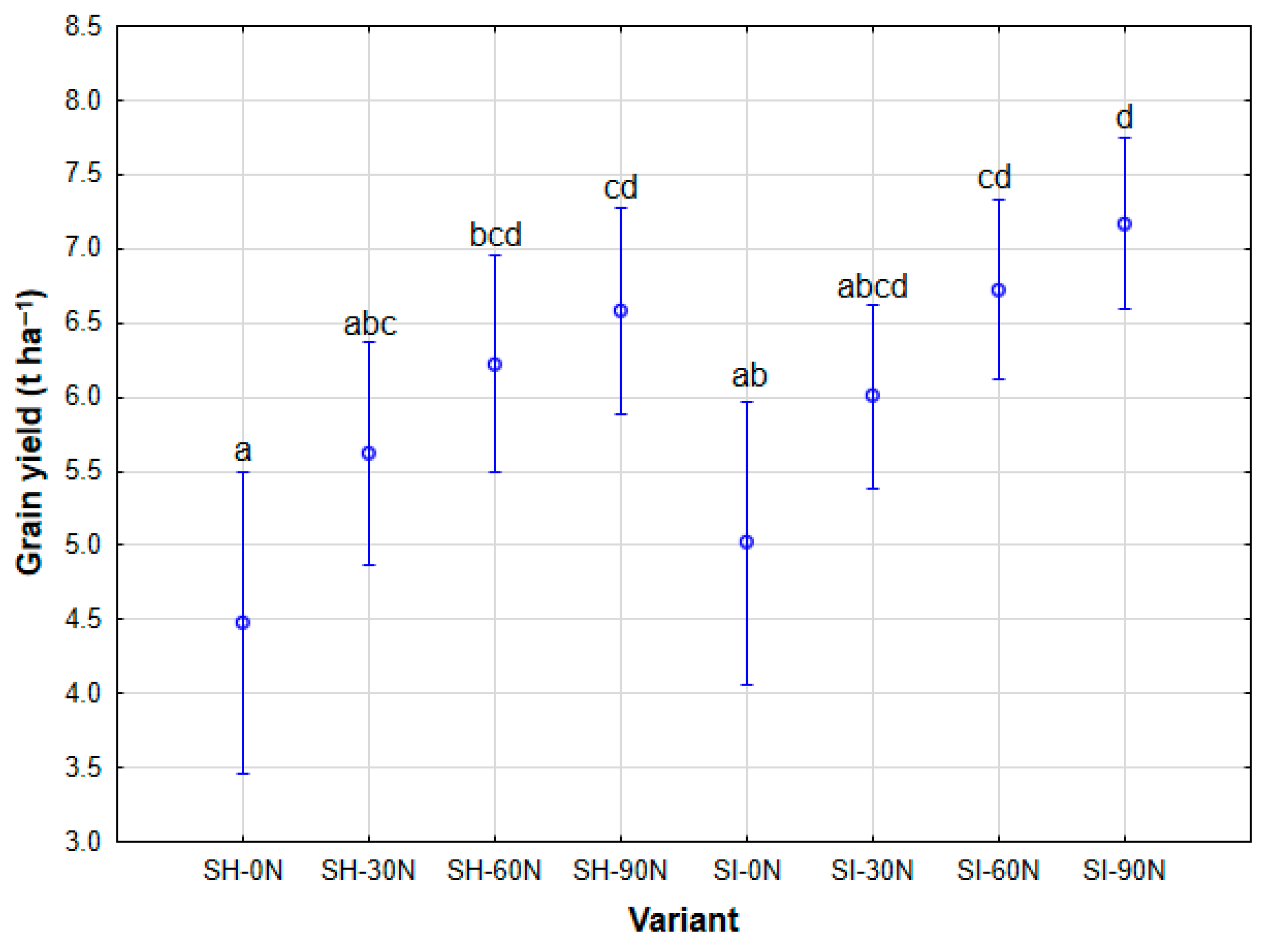
Higher grain yields were recorded for the straw-incorporated variants than for the harvested straw, and yield increased with increasing nitrogen (N) dosage (Table 3 and Figure 2).
Grain yield was statistically significantly influenced by all evaluated factors (variants, years, and their interaction, Table 2). Yields were significantly higher in variants with incorporated straw by an average of 0.51 t ha−1, and increased N doses enabled a yield increase for both incorporated and harvested straw. The average increase in grain yield with 90 kg N ha−1 dosage over the four-year experimental period was 2.15 t ha−1 in incorporated straw and 2.10 t ha−1 in harvested straw, compared to the unfertilized control variants.
Straw yield was (Table 4) evaluated in all variants every year, but not in replication. These data were not the main objective of the experiment, but served to evaluate the balance of organic matter in the soil. The straw yield ranged from 1.92 to 5.75 t ha−1, with the lowest values being mostly in the variant without nitrogen fertilisation. Straw yield also increased with increasing nitrogen doses.

3.2. Soil Aggregate Stability (SAS)

The differences in SAS were statistically significant for factors evaluated in the order of year, sampling season, and variant. There were also significant interactions between variant and year and variant and season (Table 5).
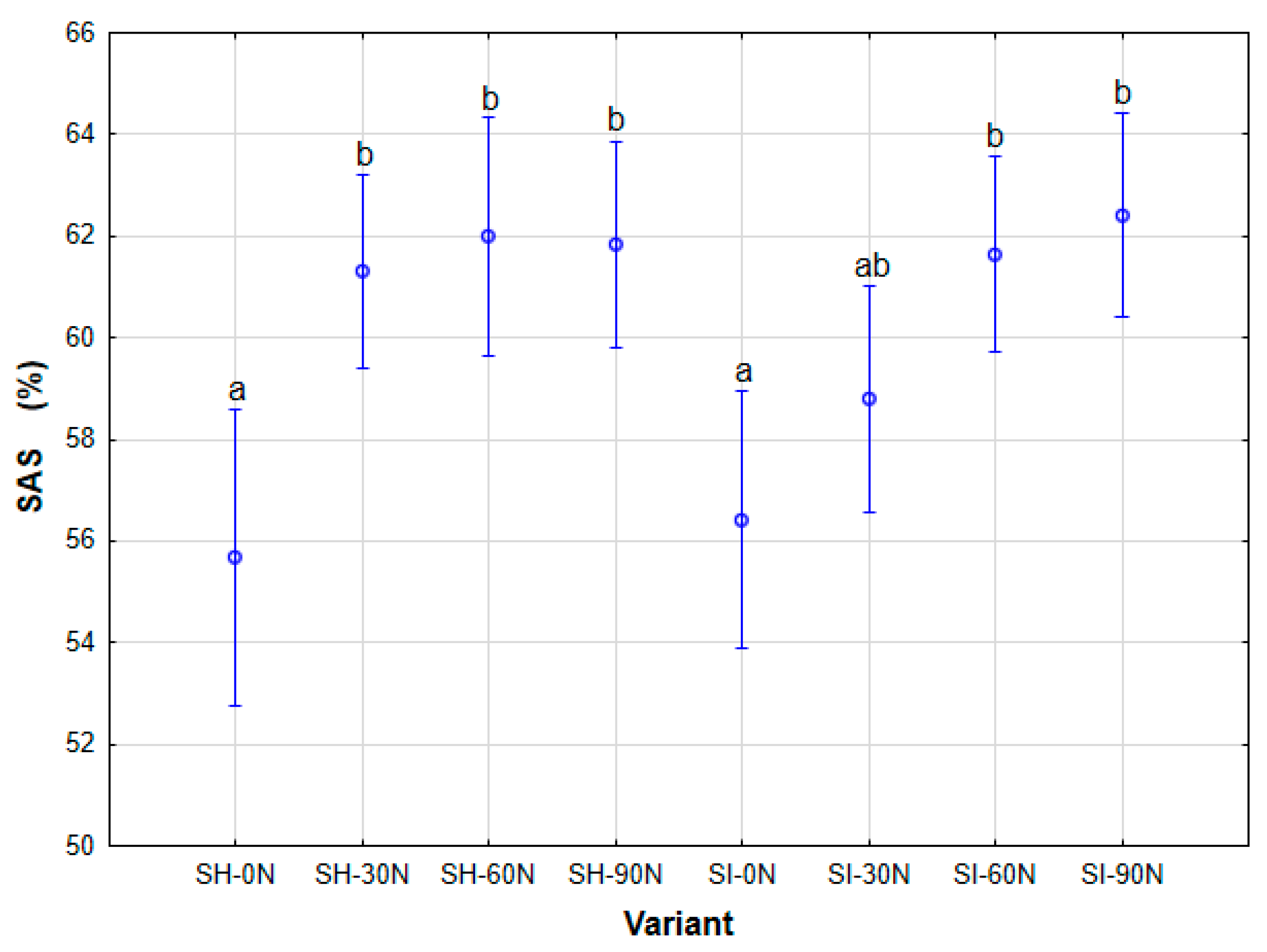
The average SAS value over 4 years of individual treatments ranged from 55 to 63% (Figure 2). Nitrogen (N) application positively affected SAS. The two lowest SAS values were found for both N-unfertilised controls, regardless of straw management (Figure 3). The SAS of the SI control was slightly higher than that of the SH control. The effect of increasing doses of N fertiliser manifested in a gradual SAS increase in plots with straw incorporation. Significantly higher SAS values compared to the control were shown only at higher N doses of 60N and 90N (61.6 and 62.5% SAS, resp.) treatments with straw incorporation (Figure 2). On the other hand, the SAS values significantly sharply increased at the lowest N dose compared to the control in plots with straw harvested, from 55.5% at the control to an average of 61.5% for N-fertilised plots. Moreover, the fertilised plots did not differ significantly from each other in this case.
There was also a significant difference in the experimental years, with the lowest average SAS value of 57.31% in 2021 and the highest of 63.87% in 2018 (Supplementary File S1). Although the average SAS varies from year to year, the trend for each variant (SH, SI), taken primarily in the summer, is very similar to the four-year average SAS each year (Supplementary File S1).

3.3. Relationships Between SAS and Soil Characteristics

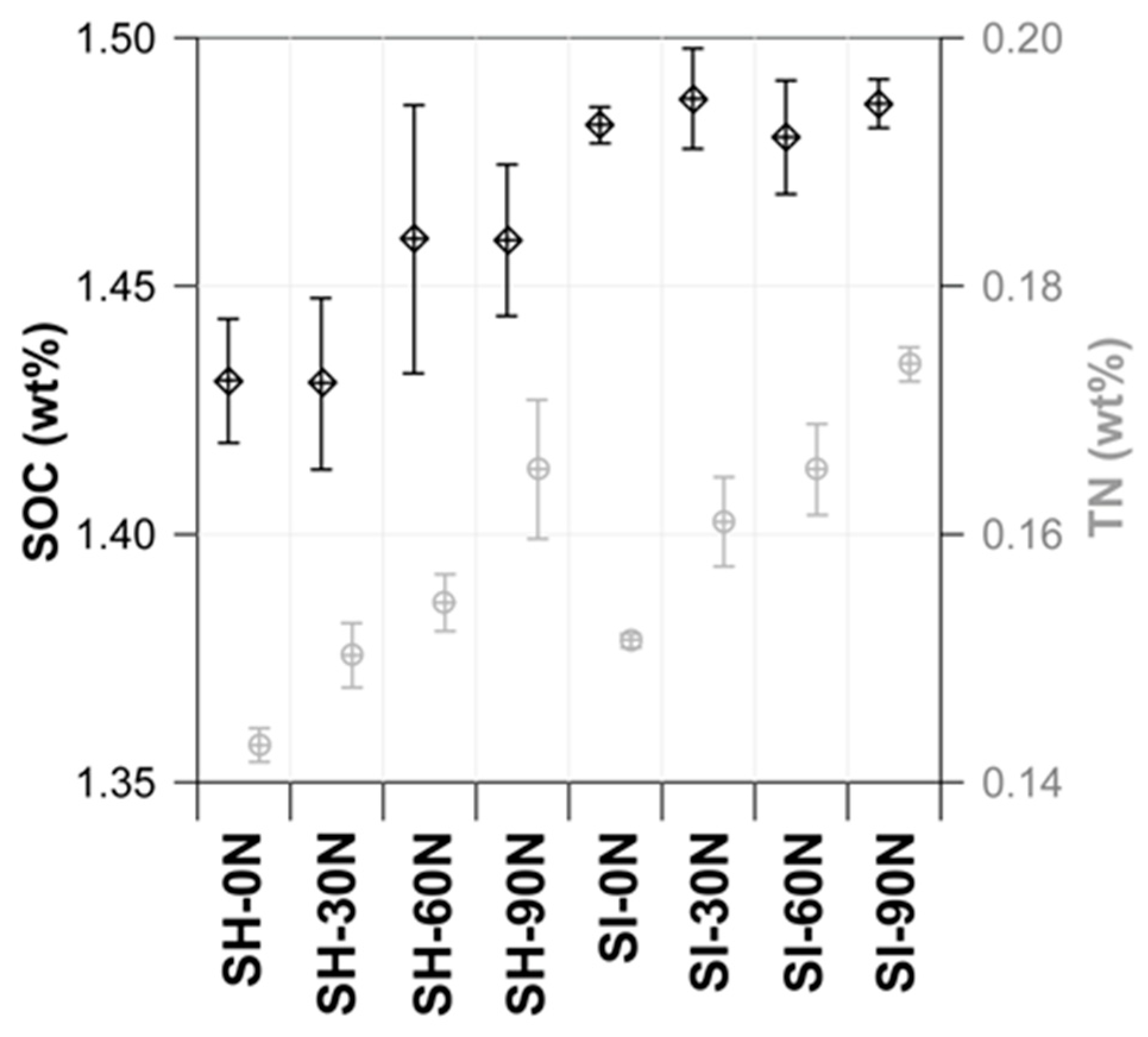
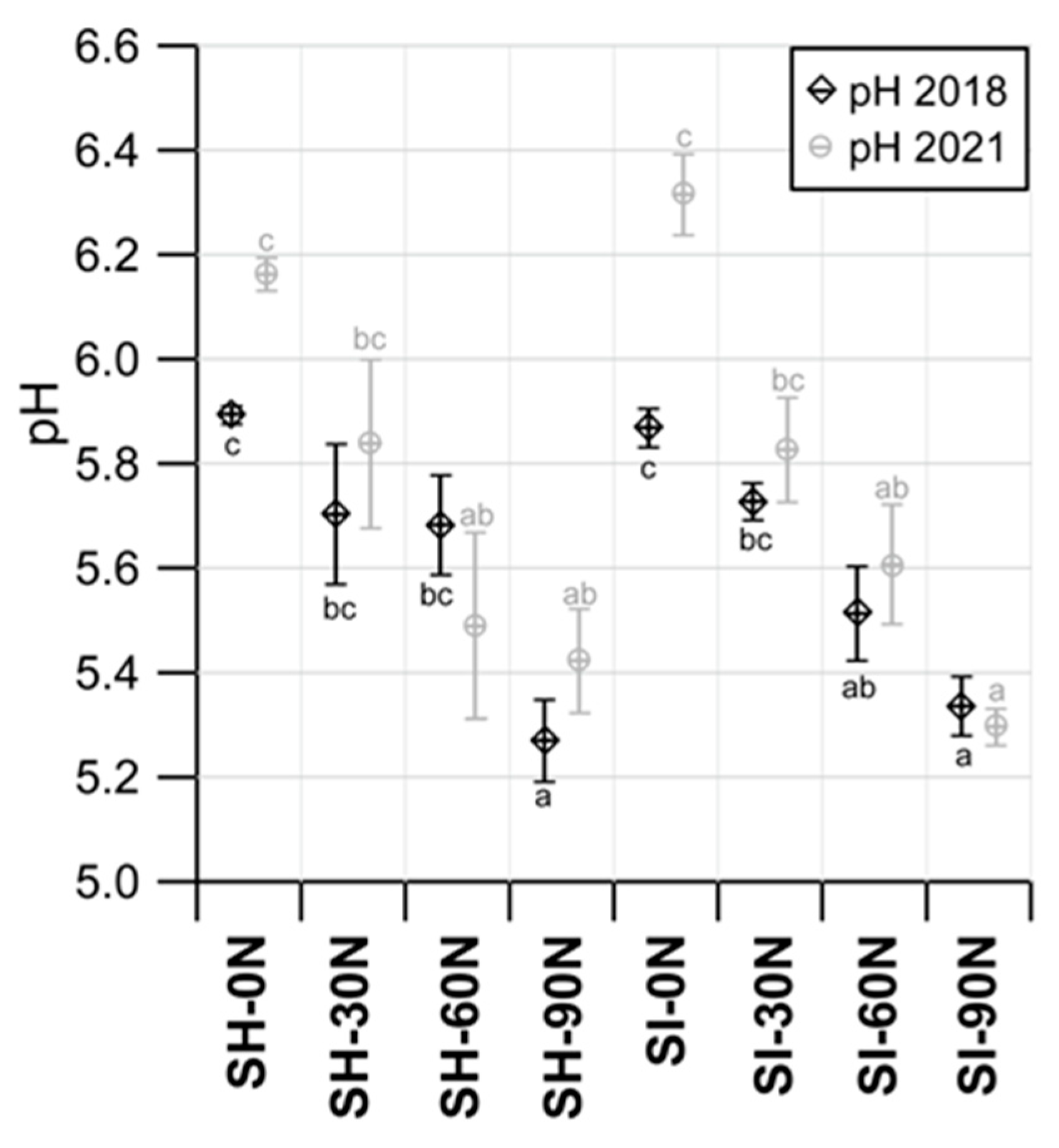
The SOC content was at about 1.47 wt% (Figure 4). The pH values in 2018 (Figure 5) ranged from approximately 5.3 (both SH and SI 90N) to approximately 5.9 (both SI and SH controls).
The studied variants also had a relatively stable grain size distribution (Table 6). The average clay fraction content was approximately 34 wt%, and the silt content was ca. 49 wt%.
The correlation analysis revealed significant positive dependence of soil aggregate stability (SAS) on TN and a significant negative dependence of SAS on pH and clay content (Table 7). There was no SAS dependence on SOC. SOC was positively correlated with TN and silt fraction, and negatively with clay fraction.

4. Discussion

The results of this long-term field experiment confirm our hypotheses that mineral N application and site-specific geochemistry are the primary drivers of SAS, overriding the influence of SOC dynamics in this specific context. Contrary to the common expectation that acidification leads to soil structure degradation, we observed a significant increase in SAS with increasing doses of ammonium sulphate, regardless of straw management. This finding appears counterintuitive, as the application of ammonium-based fertilisers has induced significant soil acidification. However, this acidification altered the dominant stabilising mechanism; as pH values declined, the stabilisation of soil aggregates shifted from cation exchange interactions involving Ca2+ toward stronger associations mediated by amorphous Fe- and Al-(oxo)hydroxides. Consequently, while straw incorporation positively influenced grain yields, the geochemical response to N-induced acidification proved to be the decisive factor for aggregate stability.

4.1. Agronomic Efficiency vs. Chemical Degradation

The agronomic response to the tested management practices followed established patterns, confirming the biological effectiveness of the fertilisation regime despite the underlying chemical changes. The consistent increase in barley grain yields with rising N doses aligns with the findings of other studies [39,40,41]. Furthermore, the beneficial effect of straw incorporation on yield validates the role of residues in sustaining long-term soil fertility [1,2], a trend consistent with earlier findings from this specific long-term experiment [42].
However, this productivity came at the cost of soil acidification. While the crop successfully utilised the applied nitrogen for biomass production, the ammonium sulphate fertiliser acted as a potent driver of acidification. This is consistent with the findings of Barak [15], who reported that soil acidification occurs when N input is not fully assimilated by biota or when the nitrification cycle is incomplete. The buffering capacity often attributed to crop residues was apparently insufficient in our experiment. Although straw return is generally considered the best strategy to improve soil structure [9] and an effective method of mitigating acidification [16], straw incorporation failed to eliminate the pH decline in the trial. This creates a divergence between the biological success of the system and its chemical trajectory, as noted by Halvorson et al. [43], who suggested that while mineral fertilisers increase yields and residue amounts, they may not necessarily increase total SOC content or buffer chemical changes.

4.2. Geochemical Control of Aggregate Stability

The interaction between N-induced acidification and the site’s specific mineralogy produced the study’s most significant finding—increased acidification led to increased aggregate stability. In contrast to findings reported in several previous studies where mineral N fertilisation degraded soil structure [9,44], our results indicate that the high content of amorphous iron oxides Feox at the Žabčice site effectively reversed this trend. The mechanism is clearly pH-dependent; as acidity intensified, the stabilisation of soil organic matter (SOM) shifted from weaker cation exchange bridges Ca2+ to stronger associations with Fe- and Al-(oxo)hydroxides and organo-metal complexes, as proposed by Rasmussen et al. [24].
This geochemical shift explains why stability improved despite the loss of structure-forming cations. The acidification reduced the content of exchangeable Ca2+, Mg2+, and decreased CEC, a process reported by Barak [15] in long-term N-fertilisation experiments. Furthermore, we observed a decrease in the clay fraction content in high-N variants. This corresponds with the findings of Pernes-Debuyser et al. [45], who observed significant decreases in the finest clay fractions under acidic treatment. This loss may be due to a greater degree of weathering and dissolution of phyllosilicates at lower pH, including a reduction in permanent layer charge [46], and an increase in smectite layers at the expense of illite.
However, the studied soil possesses an exceptionally high Feox content (approximately 5200 mg kg−1), which is more than double the amount recorded at other studied sites in the Czech Republic (authors’ archive). This high abundance amplified the stabilising effect of iron oxides at lower pH, allowing the soil to maintain, and even improve, its structure. This supports the conclusion of Regelink et al. [25] that Fe-(oxo)hydroxides significantly affect soil aggregation even when present in small amounts, effectively masking the loss of other stabilising mechanisms.

4.3. Straw Management Modulates Stabilisation Pathways

While N governed the primary geochemical mechanism, straw management introduced qualitative differences in the stabilisation pathway. Although straw incorporation did not significantly increase total SOC stocks—a common limitation in long-term mineral fertilisation trials [43]—it likely diversified the binding agents available for aggregation. The gradual increase in SAS observed in straw-incorporated variants, compared to the stepwise change in straw harvested variants, supports the hypothesis that residues promote the formation of specific Fe-organo-metal complexes and enhance the accumulation of Fe-(oxo)hydroxides in aggregates [8,10]. The observation that SAS was higher in SH-30N (harvested) than in SI-30N (incorporated) illustrates the complexity of these interactions. As pH decreases, the influence of Fe-organo-metal complexes increases relative to short-range ordered minerals (SRO) within the Feox pool [24]. In the SI variants, a greater proportion of Feox and Alox is bound in organo-metal complexes than in SH variants. At pH = 5.7 (SI-30N and SH-30N), however, the stabilising effect of SRO on SOM becomes more important than that of Fe- and Al-organo-metal complexes. Therefore, the lower SAS in SI-30N compared to SH-30N could be attributed to an increase in Fep at the expense of SRO (Feox − Fep). Thus, straw residues functioned not merely as a bulk carbon source but as a catalyst for specific organo-mineral interactions [11].

4.4. The Role of Temporal Dynamics

Finally, these management effects are modulated by temporal climatic factors. The average values of SAS ranged between 57.31% in 2021 and 63.87% in 2018. The temporal variability confirms that inter- and intra-annual fluctuations in aggregate stability are closely related to weather conditions [47]. We recorded the lowest average SAS value in summer 2021, likely caused by above-average precipitation before soil sampling. This aligns with Amézketa [48], who summarised that climatic variables, particularly water content changes (wetting-drying cycles), influence the dynamic formation and destruction of soil structure.
Conversely, extreme dryness can mask management effects. In 2018, very low soil moisture at the time of sampling (9.6% in spring and 7.5% in summer) resulted in high overall stability but reduced the differentiation between treatments; notably, the control did not differ significantly from fertilised variants in harvested straw plots. As demonstrated by Jirků et al. [49], weather conditions can play a dominant role, where drier conditions positively influence SAS.
Despite the irregularities caused by precipitation fluctuations and the varying time since soil cultivation, the specific SAS trend of individual variants remained consistent with the four-year average. This confirms that while weather modulates absolute values, the N-driven geochemical mechanism persists as the underlying driver of structural differences.

5. Conclusions

Our study confirms the hypothesis that mineral N application significantly influences soil aggregate stability (SAS) by shifting the dominant stabilising mechanism to geochemical control. SAS is not universally governed by SOC content but is to a large extent influenced by site-specific geochemistry and the resulting pH dynamics. Contrary to common expectations, the use of acidic ammonium sulfate fertiliser increased SAS due to the resulting soil acidification. This seemingly contradictory outcome is explained by the soil’s naturally high content of Fe- and Al-(oxo)hydroxides. Decreasing pH shifts the SOM stabilisation mechanism away from exchangeable Ca2+ binding toward stronger associations with minerals and organo-metal complexes.
Straw management acted as a key modulator of this geochemical response. While straw incorporation did not prevent acidification, it transformed the SAS response; unlike the stepwise change observed in straw-harvested variants, straw incorporation fostered a gradual and more consistent increase in SAS. Crop residue management diversified the available binding agents—specifically through the formation of organo-metal complexes—making it an important factor modulating soil structure resilience under chemical stress.
To manage the resulting conflict between liming for productivity and maintaining SAS, we propose a diagnostic approach evaluating SAS alongside geochemistry. In iron-rich soils, practitioners should balance nutrient availability with SAS by monitoring pH thresholds (typically < 6.5) rather than solely targeting optimal pH. Future research should focus on validating these pH-stability thresholds across different soil mineralogies and climates and integrating the Fe- and Al-(oxo)hydroxide content into soil quality prediction models to refine the management guidelines.

Supplementary Materials

The following supporting information can be downloaded at https://www.mdpi.com/article/10.3390/agriculture16020210/s1: Supplementary File S1: Meteorology and SAS; Supplementary File S2: Mineralogical analysis [50,51,52,53,54,55,56,57,58,59,60,61,62,63,64].

Author Contributions

Conceptualization, M.M. (Mikuláš Madaras) and J.K.; methodology, M.M. (Mikuláš Madaras), M.K. and J.K.; validation, M.M. (Mikuláš Madaras), M.K. and J.K.; formal analysis, M.K., M.M. (Markéta Mayerová), and V.S.; investigation, M.K. and J.K.; resources, V.S., T.D. and J.K.; data curation, T.D., J.K. and M.K.; writing—original draft preparation, M.K., J.K. and M.M. (Markéta Mayerová); writing—review and editing, M.M. (Mikuláš Madaras); supervision, M.M. (Mikuláš Madaras); project administration, M.M. (Mikuláš Madaras) and J.K.; funding acquisition, M.M. (Mikuláš Madaras) and J.K. All authors have read and agreed to the published version of the manuscript.

Funding

This research was funded by the Ministry of Agriculture of the Czech Republic, grant number QK1810186 and QK21010124, and the Technology Agency of the Czech Republic, grant number SS02030018—“Centre for Landscape and Biodiversity”.

Institutional Review Board Statement

Not applicable.

Data Availability Statement

The data are available from the authors upon reasonable request.

Acknowledgments

The authors are grateful to Iva Stehlíková, Filip Oulehle, and Tomáš Chuman for their contribution to the final manuscript, and to Oldřich Myška for his help in laboratory analyses (pH). The authors, and, in particular, M. Koubová, thank Douglas K. McCarty and the Chevron Energy Technology Company, a division of Chevron U.S.A. Inc., who allowed us free use of the Sybilla software 2.2 for academic purposes, and finally Jean-Christophe Viennet for helpful comments on fitting in the Sybilla software. During the preparation of this manuscript, the authors used GEMINI 2.5 for the purposes of checking the grammar in Section 4. The authors have reviewed and edited the output and take full responsibility for the content of this publication.

Conflicts of Interest

The authors declare no conflicts of interest.

Abbreviations

The following abbreviations are used in this manuscript:
SASsoil aggregate stability
SOCsoil organic carbon
CECcation exchange capacity
SOMsoil organic matter
TNtotal nitrogen content
AASatomic absorption spectroscopy
AESatomic emission spectroscopy
ANOVAanalysis of variance
MLMmixed-layer minerals
Iillite
Ssmectite
Cchlorite
Kkaolinite

References

  1. Hiel, M.P.; Chélin, M.; Parvin, N.; Barbieux, S.; Degrune, F.; Lemtiri, A.; Colinet, G.; Degré, A.; Bodson, B.; Garré, S. Crop residue management in arable cropping systems under a temperate climate. Part 2: Soil physical properties and crop production. A review. Biotechnol. Agron. Soc. Environ. 2016, 20, 245–256. Available online: https://hdl.handle.net/2268/196100 (accessed on 9 January 2025). [CrossRef]
  2. Lemtiri, A.; Degrune, F.; Barbieux, S.; Hiel, M.P.; Chélin, M.; Parvin, M.; Vandenbol MFrancis, F.; Colinet, G. Crop residue management in arable cropping systems under temperate climate. Part 1: Soil biological and chemical (phosphorus and nitrogen) properties. A review. Biotechnol. Agron. Soc. Environ. 2016, 20, 236–244. [Google Scholar] [CrossRef]
  3. Zhang, P.; Wei, T.; Jia, Z.K.; Han, Q.F.; Ren, X.L. Soil aggregate and crop yield changes with different rates of straw incorporation in semiarid areas of northwest China. Geoderma 2014, 230–231, 41–49. [Google Scholar] [CrossRef]
  4. Wu, Z.J.; Zhang, H.J.; Xu, G.S.; Zhang, Y.H.; Liu, C.P. Effect of returning corn straw into soil on soil fertility. J. Appl. Ecol. 2002, 13, 539–542. [Google Scholar]
  5. Zhang, Z.S.; Cao, C.G.; Guo, L.J.; Li, C.F. Emissions of CH4 and CO2 from paddy fields as affected by tillagepractices and crop residues in central China. Paddy Water Environ. 2015, 14, 85–92. [Google Scholar] [CrossRef]
  6. Christensen, B.T. Straw incorporation and soil organic matter in macro-aggregates and particle size separates. J. Soil Sci. 1986, 37, 125–135. [Google Scholar] [CrossRef]
  7. Piccoli, I.; Sartori, F.; Polese, R.; Berti, A. Crop yield after 5 decades of contrasting residue management. Nutr. Cycl. Agroecosyst. 2020, 117, 231–241. [Google Scholar] [CrossRef]
  8. Zhang, J.; Bo, G.; Zhang, Z.; Kong, F.; Wang, Y.; Shen, G. Effects of Straw Incorporation on Soil Nutrients, Enzymes, and Aggregate Stability in Tobacco Fields of China. Sustainability 2016, 8, 710. [Google Scholar] [CrossRef]
  9. Zhao, H.; Shar, A.G.; Li, S.; Chen, Y.; Shi, J.; Zhang, X.; Tian, X. Effect of straw return mode on soil aggregation and aggregate carbon content in an annual maize-wheat double cropping system. Soil Tillage Res. 2018, 175, 178–186. [Google Scholar] [CrossRef]
  10. Xue, B.; Huang, L.; Huang, Y.; Yin, Z.; Li, X.; Lu, J. Effects of organic carbon and iron oxides on soil aggregate stability under different tillage systems in a rice-rape cropping system. Catena 2019, 177, 1–12. [Google Scholar] [CrossRef]
  11. Xue, B.; Huang, L.; Huang, Y.; Kubar, K.A.; Li, X.; Lu, J. Straw management influences the stabilization of organic carbon by Fe (oxyhydr)oxides in soil aggregates. Geoderma 2020, 358, 113987. [Google Scholar] [CrossRef]
  12. Pastorelli, R.; Valboa, G.; Lagomarsino, A.; Fabiani, A.; Simoncini, S.; Zaghi, M.; Vignozzi, N. Recycling biogas digestate from energy crops: Effects on soil properties and crop productivity. Appl. Sci. 2021, 11, 750. [Google Scholar] [CrossRef]
  13. Allam, M.; Radicetti, E.; Quintarelli, V.; Petroselli, V.; Marinari, S.; Mancinelli, R. Influence of Organic and Mineral Fertilizers on Soil Organic Carbon and Crop Productivity under Different Tillage Systems: A Meta-Analysis. Agriculture 2022, 12, 464. [Google Scholar] [CrossRef]
  14. Schroder, J.L.; Zhang, H.; Girma, K.; Raun, W.R.; Penn, C.J.; Payton, M.E. Soil Acidification from Long-Term Use of Nitrogen Fertilizers on Winter Wheat. Soil Sci. Soc. Am. J. 2011, 75, 957–964. [Google Scholar] [CrossRef]
  15. Barak, P. Long-term effects of nitrogen fertilizers on soil acidity. In Proceedings from Fertilizer, Aglime and Pest Management Conference; University of Wisconsin-Madison Extension: Madison, WI, USA, 2000; pp. 223–229. Available online: https://extension.soils.wisc.edu/wp-content/uploads/sites/68/2016/06/2A.barak_.pdf (accessed on 9 January 2025).
  16. Hao, T.; Zhu, Q.; Zeng, M.; Shen, J.; Shi, X.; Liu, X.; Zhang, F.; de Vries, W. Impacts of nitrogen fertilizer type and application rate on soil acidification rate under a wheat-maize double cropping system. J. Environ. Manag. 2020, 270, 110888. [Google Scholar] [CrossRef] [PubMed]
  17. Czarnecki, S.; Düring, R.A. Influence of long-term mineral fertilization on metal contents and properties of soil samples taken from different locations in Hesse, Germany. Soil 2015, 1, 23–33. [Google Scholar] [CrossRef]
  18. Ulrich, B. Natural and anthropogenic components of soil acidification. J. Plant Nutr. Soil Sci. 1986, 149, 702–717. [Google Scholar] [CrossRef]
  19. De Vries, W.; Posch, M.; Kämäri, J. Simulation of the long-term soil response to acid deposition in various buffer ranges. Water Air Soil Pollut. 1989, 48, 349–390. [Google Scholar] [CrossRef]
  20. Duiker, S.W.; Rhoton, F.E.; Torrent, J.; Smeck, N.E.; Lal, R. Iron (hydr)oxide crystallinity effects on soil aggregation. Soil Sci. Soc. Am. J. 2003, 67, 606–611. [Google Scholar] [CrossRef]
  21. Bronick, C.J.; Lal, R. Soil structure and management: A review. Geoderma 2005, 124, 3–22. [Google Scholar] [CrossRef]
  22. Kay, B.D. Soil structure and organic carbon: A review. In Soil Processes and the Carbon Cycle; Lal, R., Kimble, J.M., Follett, R.F., Stewart, B.A., Eds.; CRC Press: Boca Raton, FL, USA, 1998; pp. 169–197. [Google Scholar] [CrossRef]
  23. Haynes, R.J.; Naidu, R. Influence of lime, fertilizer and manure applications on soil organic matter content and soil physical conditions: A review. Nutr. Cycl. Agroecosyst. 1998, 51, 123–137. [Google Scholar] [CrossRef]
  24. Rasmussen, C.; Heckman, K.; Wieder, W.R.; Keiluweit, M.; Lawrence, C.R.; Berhe, A.A.; Blankinship, J.C.; Crow, S.E.; Druhan, J.L.; Hicks Pries, C.E.; et al. Beyond clay: Towards an improved set of variables for predicting soil organic matter content. Biogeochemistry 2018, 137, 297–306. [Google Scholar] [CrossRef]
  25. Regelink, I.C.; Stoof, C.R.; Rousseva, S.; Weng, L.; Lair, G.J.; Kram, P.; Nikolaidis, N.P.; Kercheva, M.; Banwart, S.; Comans, R.N.J. Linkages between aggregate formation, porosity and soil chemical properties. Geoderma 2015, 247–248, 24–37. [Google Scholar] [CrossRef]
  26. Barthes, B.; Roose, E. Aggregate stability as an indicator of soil susceptibility to runoff and erosion; validation at several levels. Catena 2002, 47, 133–149. [Google Scholar] [CrossRef]
  27. Franzluebbers, A.J.; Arshad, M.A. Water-stable aggregation and organic matter in four soils under conventional and zero tillage. Can. J. Soil Sci. 1996, 76, 387–393. [Google Scholar] [CrossRef]
  28. Beare, M.H.; Cabrera, M.L.; Hendrix, P.F.; Coleman, D.C. Aggregate-Protected and Unprotected Organic Matter Pools in Conventional- and No-Tillage Soils. Soil Sci. Soc. Am. J. 1994, 58, 787–795. [Google Scholar] [CrossRef]
  29. Zeng, Q.; Darboux, F.; Man Ch Zhu, Z.; An, S. Soil aggregate stability under different rain conditions for three vegetation types on the Loess Plateau (China). Catena 2018, 167, 276–283. [Google Scholar] [CrossRef]
  30. Zheng, H.; Wuren, L.; Zheng, J.; Luo, Y.; Li, R.; Wang, H.; Qi, H. Effect of long-term tillage on soil aggregates and aggregate-associated carbon in black soil of Northeast China. PLoS ONE 2018, 13, e0199523. [Google Scholar] [CrossRef]
  31. Schiner, F.; Öhlinger, R.; Kandeler, E.; Margesin, R. (Eds.) Aggregate stability. In Methods in Soil Biology; Springer: Berlin, Germany, 1996; p. 426. [Google Scholar] [CrossRef]
  32. Kemper, W.D.; Koch, E.J. Aggregate Stability of Soils from Western United States and Canada. In Technical Bulletins; United States Department of Agriculture, Economic Research Service: Kansas City, MO, USA, 1966; Available online: https://ageconsearch.umn.edu/record/171386 (accessed on 9 January 2025). [CrossRef]
  33. Bakker, E.; Hubert, F.; Wander, M.M.; Lanson, B. Soil Development under Continuous Agriculture at the Morrow Plots Experimental Fields from X-ray Diffraction Profile Modelling. Soil Syst. 2018, 2, 46. [Google Scholar] [CrossRef]
  34. Bakker, E.; Lanson, B.; Findling, N.; Wander, M.M.; Hubert, F. Mineralogical differences in a temperate cultivated soil arising from different agronomic processes and plant K-uptake. Geoderma 2019, 347, 210–219. [Google Scholar] [CrossRef]
  35. ISO 13536; Soil Quality—Determination of the Potential Cation Exchange Capacity and Exchangeable Cations Using Barium Chloride Solution Buffered at pH = 8.1. ISO: Geneva, Switzerland, 2024. Available online: https://www.iso.org/standard/85886.html (accessed on 9 January 2025).
  36. Buurman, P.; Van Lagen, B.; Velthorst, E.J. Manual for Soil and Water Analysis; Department of Soil Science and Geology, Wageningen Agriculture University, Backhuys Publishers: Leiden, The Netherlands, 1996; pp. 45–48. [Google Scholar]
  37. ISO 11277; Soil Quality—Determination of Particle Size Distribution in Mineral Soil Material—Method by Sieving and Sedimentation. ISO: Geneva, Switzerland, 2020. Available online: https://www.iso.org/standard/69496.html (accessed on 9 January 2025).
  38. ÖNORM L 1061; Physikalische Bodenuntersuchungen—Bestimmung der Korngrößenverteilung des Mineralbodens in Land- und Forstwirtschaftlich Genutzten Böden. Austrian Standards International: Vienna, Austria, 1988. Available online: https://www.bdb.at/Service/NormenDetail?id=651036 (accessed on 9 January 2025).
  39. Moreno, A.; Moreno, M.M.; Ribas, F.; Cabello, J. Influence of nitrogen fertilizer on grain yield of barley (Hordeum vulgare L.) under irrigated conditions. Span. J. Agric. Res. 2003, 1, 91–100. [Google Scholar] [CrossRef]
  40. Janković, S.; Glamočlija, D.; Maletić, R.; Rakić, S.; Hristov, N.; Ikanović, J. Effects of nitrogen fertilization on yield and grain quality in malting barley. Afr. J. Biotechnol. 2011, 10, 19534–19541. [Google Scholar] [CrossRef]
  41. Tanaka, R.; Nakano, H. Barley Yield response to nitrogen application under different weather conditions. Sci. Rep. 2019, 9, 8477. [Google Scholar] [CrossRef]
  42. Prudil, J.; Pospíšilová, L.; Dryšlová, T.; Barančíková, G.; Smutný, V.; Sedlák, L.; Ryant, P.; Hlavinka, P.; Trnka, M.; Halas, J.; et al. Assessment of carbon sequestration as affected by different management practices using the RothC model. Plant Soil Environ. 2023, 69, 532–544. [Google Scholar] [CrossRef]
  43. Halvorson, A.D.; Wienhold, B.J.; Black, A.L. Tillage, nitrogen, and cropping system effects on soil carbon sequestration. Soil Sci. Soc. Am. J. 2002, 66, 906–912. [Google Scholar] [CrossRef]
  44. Brtnický, M.; Elbl, J.; Dvořáčková, H.; Kynický, J.; Hladký, J. Changes in soil aggregate stability induced by mineral nitrogen fertilizer application. Acta Univ. Agric. Silvic. Mendel. Brun. 2017, 65, 1477–1482. [Google Scholar] [CrossRef]
  45. Pernes-Debuyser, A.; Pernes, M.; Velde, B.; Tessier, D. Soil mineralogy evolution in the INRA 42 plots experiment (Versailles, France). Clays Clay Miner. 2003, 51, 577–584. [Google Scholar] [CrossRef]
  46. Viennet, J.-C.; Hubert, F.; Ferrage, E.; Tertre, E.; Legout, A.; Turpault, M.-P. Investigation of clay mineralogy in a temperate acidic soil of a forest using X-ray diffraction profile modeling: Beyond the HIS and HIV description. Geoderma 2015, 241–242, 75–86. [Google Scholar] [CrossRef]
  47. Bullock, M.S.; Kemper, W.D.; Nelson, S.D. Soil cohesion as affected by freezing, water content, time and tillage. Soil Sci. Soc. Am. J. 1988, 52, 770–776. [Google Scholar] [CrossRef]
  48. Amézketa, E. Soil Aggregate Stability: A Review. J. Sustain. Agric. 1999, 14, 83–151. [Google Scholar] [CrossRef]
  49. Jirků, V.; Kodešová, R.; Nikodem, A.; Mühlhanselová, M.; Žigová, A. Temporal variability of structure and hydraulic properties of topsoil of three soil types. Geoderma 2013, 204–205, 43–58. [Google Scholar] [CrossRef]
  50. Pálenský, P.; Nekovařík, Č.; Růžička, M. Geologická mapa ČR 24-34 Ivančice; Český geologický ústav: Praha, Czech Republic, 1997; p. 1. (In Czech) [Google Scholar]
  51. Havlíček, P.; Stráník, Z. Geologická Mapa ČSR 34-12 Pohořelice; Ústřední ústav geologický: Praha, Czech Republic, 1989; p. 1. (In Czech) [Google Scholar]
  52. Tanner, C.B.; Jackson, M.L. Nomographs of sedimentation times for soil particles under gravity or centrifugal acceleration. Soil Sci. Soc. Am. Proc. 1948, 12, 60–65. [Google Scholar] [CrossRef]
  53. Balesdent, J.; Besnard, E.; Arrouays, D.; Chenu, C. The dynamics of carbon in particle-size fractions of soil in a forest-cultivation sequence. Plant Soil 1998, 201, 49–57. [Google Scholar] [CrossRef]
  54. Ondruš, P. ZDS-WS Search/Match for Windows; ZDS Systém: Praha, Czech Republic, 2004. [Google Scholar]
  55. ICDD. Powder Diffraction File; McClune, W.F., Ed.; International Centre for Diffraction Data: Newtown Square, PA, USA, 2004. [Google Scholar]
  56. Snyder, R.L.; Bish, D.L. Quantitative analysis, in Modern Powder Diffraction. In Review in Mineralogy; Bish, D.L., Post, J.E., Eds.; Mineralogical Society of America: Washington, DC, USA, 1989; Volume 20, pp. 101–144. [Google Scholar] [CrossRef]
  57. FIZ ICSD. Inorganic Crystal Structure Database; Fachinformationszentrum Karlsruhe: Karlsruhe, Germany, 2020. [Google Scholar]
  58. Aplin, A.C.; Matenaar, I.F.; McCarty, D.K.; van Der Pluijm, B.A. Influence of mechanical compaction and clay mineral diagenesis on the microfabric and pore-scale properties of deep-water gulf of Mexico mudstones. Clays Clay Miner. 2006, 54, 500–514. [Google Scholar] [CrossRef]
  59. Drits, V.A.; Sakharov, B.A. X-Ray Analysis of Mixed-Layer Clay Minerals; Nauka: Moscow, Russia, 1976; p. 256. (In Russian) [Google Scholar]
  60. Drits, V.A.; Tchoubar, C. X-Ray Diffraction by Disordered Lamellar Structures; Springer: Berlin, Germany, 1976; p. 371. [Google Scholar]
  61. Jagodzinski, H. Eindimensionale fehlordnung in kristallen und ihr einfluss auf die röntgeninterferenzen. I. Berechnung des fehlordnungsgrades aus den röntgenintensitäten. Acta Crystallogr. 1949, 2, 201–207. [Google Scholar] [CrossRef]
  62. Drits, V.A.; Srodon, J.; Eberl, D.D. XRD Measurement of Mean Crystallite Thickness of Illite and Illite/Smectite: Reappraisal of the Kubler Index and the Scherrer Equation. Clays Clay Miner. 1979, 45, 461–475. [Google Scholar] [CrossRef]
  63. Georgiadis, A.; Dietel, J.; Dohrmann, R.; Rennert, T. What are the nature and formation conditions of hydroxy-interlayered minerals (HIMs) in soil? J. Plant Nutr. Soil Sci. 2020, 183, 12–26. [Google Scholar] [CrossRef]
  64. Viennet, J.-C.; Hubert, F.; Tertre, E.; Ferrage, E.; Robin, V.; Dzene, L.; Cochet, C.; Turpault, M.-P. Effect of particle size on the experimental dissolution and auto-aluminization processes of K-vermiculite. Geochim. Cosmochim. Acta 2016, 180, 164–176. [Google Scholar] [CrossRef]
Figure 1. Location of the study area (left) and visualisation of the experimental field (right). SI—straw incorporation into the soil; SH—straw harvested from the field; N 0–90—four doses of mineral N.
Agriculture 16 00210 g001
Figure 2. The effect of variants on grain yield (average values for the years 2018–2021). Different letters indicate significant differences at α = 0.05 by Tukey’s HSD test, and the vertical columns show 0.95 confidence interval.
Agriculture 16 00210 g002
Figure 3. The effect of variants on soil aggregate stability (% SAS—average values for the years 2018–2021). Different letters indicate significant differences at α = 0.05 by Tukey’s HSD test, and the vertical columns show 0.95 confidence interval.
Agriculture 16 00210 g003
Figure 4. Contents of soil organic carbon (mean ± standard error, black diamonds, wt%) and total nitrogen (mean ± standard error, grey circles, wt%) in soil samples; an average of four replicates from 2018.
Agriculture 16 00210 g004
Figure 5. Soil pH (mean ± standard error) in spring 2018 (black diamonds) and 2021 (grey circles). Different letters indicate significant differences between the means at α = 0.05 for the given variables (Tukey’s HSD test).
Agriculture 16 00210 g005
Table 1. Climatic and soil characteristics of the experimental site. Temperature and precipitation data are long-term normal, 1991–2020, and soil characteristics are from 2019 sampling.
CharacteristicsŽabčice, Czech Republic
Coordinates49.0226065 N,
16.6164471 E
Altitude (m)179
Average annual temperature (°C)10.3
Average annual rainfall total (mm)491
Soil typeGleyic Fluvisol
Soil textureSilty Clay Loam
pH (KCl)5.41
pH (H2O)6.07
Pavail (mg kg−1)90
Kavail (mg kg−1)201
Caavail (mg kg−1)2910
Mgavail (mg kg−1)390
Soil organic matter content (%)2.53
Table 2. Agrotechnical data in spring barley monoculture (2018–2021).
Agrotechnical MeasureMaterial *Dose per haDate
2017/20182018/20192019/20202020/2021
Stubble breaking—disking (depth 8 cm)disc cultivator 23 July 201716 July 201823 July 201911 August 2020
P fertilisationsuperphosphate (45%)39.24 kg P27 September 20177 September 201823 August 20199 September 2020
K fertilisationpotassium salt (60%)99.6 kg K
Ploughing
(depth 22 cm)
plough (reversible, 4 units) 25 October 201716 October 201817 October 201912 November 2020
Seedbed
preparation
harrowing 14 March 201826 February 201924 February 202015 March 2021
N fertilisationammonium sulphate
granulated (20%)
0 N, 30 N, 60 N, 90 N14 March 201827 February 201925 February 202016 March 2021
SowingBOJOS4 MGS14 March 201827 February 201925 February 202016 March 2021
RollingCambridge rollers 21 March 20181 March 201927 February 202018 March 2021
HerbicideAXIAL PLUS
(pinoxaden 50 g)
0.6 L24 April 201815 April 201921 April 20204 May 2021
BIATHLON 4D
(tritosulfuron 714 g,
florasulam 54 g) + DASH HC (palmitic and oleic acid methylester 37.5%, phosphoric acid polyalkylester 22.5%, oleic acid 5%)
70 g + 0.5 L3 May 20182 May 2019x19 May 2021
SEKATOR PLUS (2,4-D 287 g, amidosulfuron 25 g, iodosulfuron-methyl sodium 6.25 g)0.6 Lxx4 May 2020x
Growth regulatorCERONE 480 SL
(ethephon 480 g)
0.3 Lx14 May 2019x27 May 2021
MODDUS
(trinexapac-ethyl 250 g)
0.2 Lx14 May 2019xx
InsecticideVAZTAK ACTIVE
(alfa-cypermethrin 50 g)
0.2 L14 May 2018xxx
DECIS MEGA
(deltamethrin 50 g)
0.15 Lx21 May 201919 May 2020x
CYPERKILL MAX
(cypermethrin 500 g)
0.05 Lxxx3 June 2021
FungicideBOOGIE XPRO (bixafen
50 g, prothiokonazol 100 g, spiroxamin 250 g)
0.9 L28 May 2018xxx
HUTTON (prothiokonazol 100 g, spiroxamin 250 g,
tebukonazol 100 g)
0.8 Lxx19 May 2020x
ADEXAR PLUS (epoxykonazol 41.6 g, fluxapyroxad 41.6 g, pyraklostrobin 66.6 g)2.5 Lxx9 June 2020x
DELARO (prothiokonazol 175 g, trifloxystrobin 150 g)1.0 Lxxx3 June 2021
Harvestsmall plot combine machine 10 July 20188 July 201927 July 202027 July 2021
* Active substance values per L or kg; MGS = million germinating seeds. x Agrotechnical measure was not carried out.
Table 3. Significance of the effect of variant, year, and interaction of the two on the grain yield as revealed by two-way ANOVA.
Sources of VariabilityF-Valuep
Variant (A)178.3<0.001
Year (B)704.3<0.001
Variant × Year (A × B)47.5<0.001
Table 4. Straw yield in different variants (t ha−1).
YearVariant
SH-0NSH-30NSH-60NSH-90NSI-0NSI-30NSI-60NSI-90N
20182.492.872.374.152.672.12.764.18
20193.563.733.23.022.133.023.383.2
20204.815.275.245.334.464.625.135.1
20212.24.273.55.981.924.083.725.75
Average3.264.043.584.622.793.463.744.56
Table 5. Significance of the effects of variant, year, season of sampling, and their interaction on soil aggregate stability, revealed by multi-factorial ANOVA.
Sources of VariabilityF-Valuep
Variant (A)14.08<0.001
Year (B)40.09<0.001
Season of soil sampling (C)32.79<0.001
Variant × Year (A × B)1.990.008
Variant × Season of soil sampling (A × C)3.110.004
Table 6. Grain size distribution with standard errors from 2018. Clay: under 0.002 mm; silt: 0.002–0.05 mm; sand: 0.05–2 mm. Different letters indicate significant differences between the means at α = 0.05 for the given variables (Tukey’s HSD test). SH—straw harvested; SI—straw incorporated.
Straw ManagementDose of NVariantClaySiltSand
(kg ha−1)wt%
Straw harvested0SH-0N35.8 c ± 0.748.4 a ± 0.515.8 a ± 0.5
30SH-30N34.5 abc ± 0.346.4 a ± 1.219.1 a ± 1.1
60SH-60N34.6 abc ± 146.0 a ± 1.419.4 a ± 0.5
90SH-90N33.9 abc ± 0.647.3 a ± 0.918.9 a ± 1.1
Straw incorporated 0SI-0N34.8 bc ± 0.449.6 a ± 0.715.7 a ± 0.6
30SI-30N34.9 bc ± 0.848.5 a ± 2.116.7 a ± 1.4
60SI-60N32.5 ab ± 0.350.0 a ± 1.517.5 a ± 1.4
90SI-90N31.9 a ± 0.251.1 a ± 1.717.0 a ± 1.8
Table 7. Chemical soil properties and soil aggregate stability relationships (correlation coefficients r, n = 32; statistical significance at p < 0.05 in bold). SAS—soil aggregate stability; TN—total nitrogen; SOC—soil organic carbon. All variables are average values from all samples 2018–2021. Statistical significance at p < 0.05 is in bold.
VariableTNSOCpHClaySiltSandSAS
TN 1
SOC 0.5461
pH −0.730−0.0221
clay −0.612−0.4130.4851
silt 0.3480.511−0.129−0.5351
sand −0.004−0.332−0.169−0.026−0.8301
SAS0.4880.256−0.406−0.479−0.1610.5101
Disclaimer/Publisher’s Note: The statements, opinions and data contained in all publications are solely those of the individual author(s) and contributor(s) and not of MDPI and/or the editor(s). MDPI and/or the editor(s) disclaim responsibility for any injury to people or property resulting from any ideas, methods, instructions or products referred to in the content.