


Abstract
Cabbage stubble left in fields after harvest forms a mechanically complex stubble–soil composite that hinders subsequent tillage and crop establishment. Although the Discrete Element Method (DEM) is widely used to model soil-root systems, calibrated contact parameters for taproot-dominated vegetables like cabbage remain unreported. This study addresses this gap by calibrating a novel DEM framework that couples the JKR model and the Bonding V2 model to represent adhesion and mechanical interlocking at the stubble–soil interface. Soil intrinsic properties and contact parameters were determined through triaxial tests and angle-of-repose experiments. Physical pullout tests on ‘Zhonggan 21’ cabbage stubble yielded a mean peak force of 165.5 N, used as the calibration target. A three-stage strategy—factor screening, steepest ascent, and Box–Behnken design (BBD)—identified optimal interfacial parameters: shear stiffness per unit area = 4.40 × 10⁸ N·m−3, normal strength = 6.26 × 10⁴ Pa, and shear strength = 6.38 × 10⁴ Pa. Simulation predicted a peak pullout force of 162.0 N, showing only a 2.1% deviation from experiments and accurately replicating the force-time trend. This work establishes the first validated DEM framework for cabbage stubble–soil interaction, enabling reliable virtual prototyping of residue management implements and supporting low-resistance, energy-efficient tillage tool development for vegetable production.
1. Introduction
Cabbage (Brassica oleracea var. capitata Linnaeus) is a major vegetable crop in China, and the management of post-harvest stubble left in the field has become an increasingly critical issue [1]. These tough and structurally complex stubble residues become tightly interwoven with the surrounding soil, forming a “stubble–soil composite” that exhibits distinctive mechanical properties. Without effective treatment, this composite decomposes slowly under natural conditions, which not only hinders the release and cycling of nutrients from the stubble itself but also alters soil physical structure, thereby impairing seedbed preparation and the establishment of subsequent crops—and may even lead to replant disease [2,3]. Currently, rotary tillage for stubble fragmentation and incorporation is the predominant management practice. However, existing implements frequently suffer from low fragmentation efficiency, high operating resistance, and excessive energy consumption during field operations. Fundamentally, this is because conventional agricultural machinery design lacks a deep mechanistic understanding and accurate predictive capability of the interactions between key working components (e.g., rotary blades) and the complex stubble–soil composite [4,5,6,7,8].
The Discrete Element Method (DEM) is a powerful numerical simulation tool capable of revealing the mechanical behavior and motion laws of discontinuous media at the particle scale, offering a novel approach to addressing the aforementioned challenges [9,10,11]. In agricultural engineering, DEM has been successfully applied to simulate processes such as soil tillage, seed sowing, and fertilizer application, significantly advancing the optimized design of agricultural machinery [12,13]. More recently, its application has expanded to complex biomass materials, including crop residues and root systems [14,15,16,17,18,19,20]. By constructing high-fidelity DEM models, field operations can be simulated in a virtual environment with low cost and high efficiency, providing robust theoretical and data-driven support for the innovative development of agricultural equipment.
While the Discrete Element Method (DEM) is particularly well-suited for simulating granular materials and discontinuous media—such as soil particles interacting with plant roots or crop residues—other numerical approaches are also employed in agricultural engineering [21]. For instance, the Finite Element Method (FEM) excels in modeling continuous, deformable solids (e.g., root tissue or tillage tool deformation) but struggles with large displacements, fragmentation, and particle rearrangement. The Smoothed Particle Hydrodynamics (SPH) method, a mesh-free Lagrangian technique, can handle large deformations and fluid-like behavior, making it suitable for modeling wet soil or slurry flow, yet it often lacks accuracy in capturing frictional contact between solid particles. The Arbitrary Lagrangian-Eulerian (ALE) formulation combines advantages of both Lagrangian and Eulerian descriptions and is frequently used in soil-tool interaction simulations involving significant material flow; however, it typically assumes soil as a continuum and cannot resolve individual particle-scale mechanisms. In contrast, DEM explicitly tracks the motion and contact forces of each discrete particle, enabling direct representation of soil heterogeneity, root-particle interlocking, and micro-scale failure processes—key features essential for studying stubble–soil pullout mechanics. Therefore, DEM was selected as the most appropriate framework for this study.
In the study of mechanical behavior of root-soil composite systems, researchers have recognized that their mechanical properties—such as shear strength and cohesion—are not simply the sum of individual soil or root characteristics, but rather emerge from a complex interplay of multiple factors, including root content, spatial architecture, moisture content, and root-soil interfacial interactions [22,23,24]. Giadrossich pointed out that root morphology significantly influences the shear resistance of rooted soil, with interwoven root architectures exhibiting enhanced pullout resistance [25]. Schwarz et al. [26] investigated, through pullout tests, how root diameter, embedment length, and loading rate affect the mechanical response at the soil-root interface. Their findings revealed a strong correlation between root diameter and anchorage capacity across different plant species [27,28]. Liang et al. [29] developed a flexible DEM model of spinach roots incorporating both taproots and lateral roots, coupled with a calibrated soil model, to comparatively analyze root-cutting characteristics with and without lateral roots. The results showed that the peak shear force of the root-soil composite decreased by approximately 11.4% in the absence of lateral roots. Song et al. [30] combined DEM simulations with direct shear experiments to investigate the soil-reinforcement mechanism of taproot-type (inverted-triangle) root systems. Their study demonstrated that DEM effectively reproduces the mechanical response of both plant roots and root-soil composites. Tamás established a DEM model incorporating soil particles and plant roots to examine the role of particle shape in simulating soil-share interactions and to quantify the root-induced enhancement of soil shear strength [31]. Simulation results indicated that breakable roots significantly influence draft force, with root number identified as a key factor. Zeng et al. employed an incremental structure-from-motion and multi-view stereo algorithm to reconstruct three-dimensional root-soil structures from multi-angle images; direct shear tests on soil and root-soil composites at varying depths yielded average errors of 3.48% and 5.21%, respectively [32]. Xie et al. [33] constructed a DEM model of Panax notoginseng (Sanqi) roots interacting with cultivation soil to analyze adhesion between roots and soil. Their results showed that at a soil moisture content of 20.95%, the adhesion force was positively correlated with both root surface roughness and apparent contact area. Xin et al. [34] measured the geometric morphology, topological structure, and substrate-related parameters of rice roots, and integrated a reconstructed rice seedling root-substrate geometry into EDEM software using the Edinburgh Elasto-Plastic Adhesion with Bonding contact model. Comparative studies of compression and shear tests on root plugs showed good agreement between simulation and experiment in trend. Liu et al. [35] developed both an analytical model and a DEM model to simulate the interaction between a cutting tool and maize root-soil composites. Validation via cutting experiments on reconstituted and undisturbed maize root-soil samples showed that both models achieved prediction errors below 20%.
In summary, the root-soil composite is a bio-engineering hybrid system formed through the anchorage and mechanical coupling between roots and soil. Root morphology and soil environmental conditions are key factors governing its mechanical response. Specifically, roots significantly enhance the shear strength and overall stability of the root-soil composite through mechanisms such as reinforcement, anchoring, friction, and interlocking. Existing research has established a relatively systematic understanding of the macroscopic mechanical behavior, interfacial characteristics, and influencing factors of such composites, and numerical simulation techniques—particularly the Discrete Element Method (DEM)—have been widely adopted to develop high-fidelity models. These methodological advances and findings provide a solid theoretical foundation for the present study in constructing a DEM-based simulation model of the cabbage stubble–soil composite.
However, existing DEM modeling studies have primarily focused on field cereal crops (e.g., maize, wheat) or medicinal plants (e.g., Coptis chinensis, Panax notoginseng), whose root systems are predominantly fibrous. In contrast, cabbage—a typical vegetable crop—possesses a well-developed taproot with dense lateral roots. The composite formed by its post-harvest stubble and surrounding soil exhibits fundamental differences in both geometric configuration and mechanical behavior. Cabbage stubble is notably rigid and structurally compact, leading to a more complex anchorage mechanism with soil. To date, research on calibrating DEM contact parameters for such “taproot-dominated” vegetable stubble–soil systems remains unreported. Consequently, accurately characterizing the mechanical interactions at the interface between cabbage stubble and soil particles—and developing a high-fidelity DEM model capable of precisely predicting their complex mechanical response—has emerged as a critical scientific challenge hindering the advancement of efficient mechanized management technologies for vegetable residue.
To address the aforementioned research gap, this study first determined the fundamental intrinsic parameters (bulk density, elastic modulus, and Poisson’s ratio) of soil sampled from a cabbage field. Physical in situ pullout tests were then designed and conducted on cabbage stubble to obtain reliable pullout force data. A novel discrete element model that couples the JKR model (to capture microscale adhesion) and the Bonding V2 model (to represent macroscale mechanical interlocking) was developed to realistically simulate the complex stubble–soil interaction. Using the experimentally measured peak pullout force as the response metric, a systematic calibration approach—combining factor screening experiments, steepest ascent trials, and BBD—was employed to calibrate key DEM contact parameters at the stubble–soil interface, including stubble–soil tangential stiffness per unit area, stubble–soil normal strength, and stubble–soil shear strength. Finally, the accuracy and reliability of the calibrated discrete element model in predicting the mechanical behavior of cabbage stubble during in situ pullout were evaluated by comparing simulation results with physical test data. This work supports the development of intelligent tillage systems for sustainable vegetable production.
2. Materials and Methods
2.1. Materials
2.1.1. Cabbage Stubble and Soil Samples
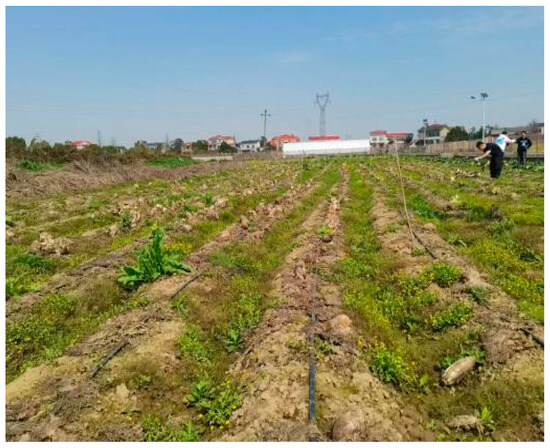
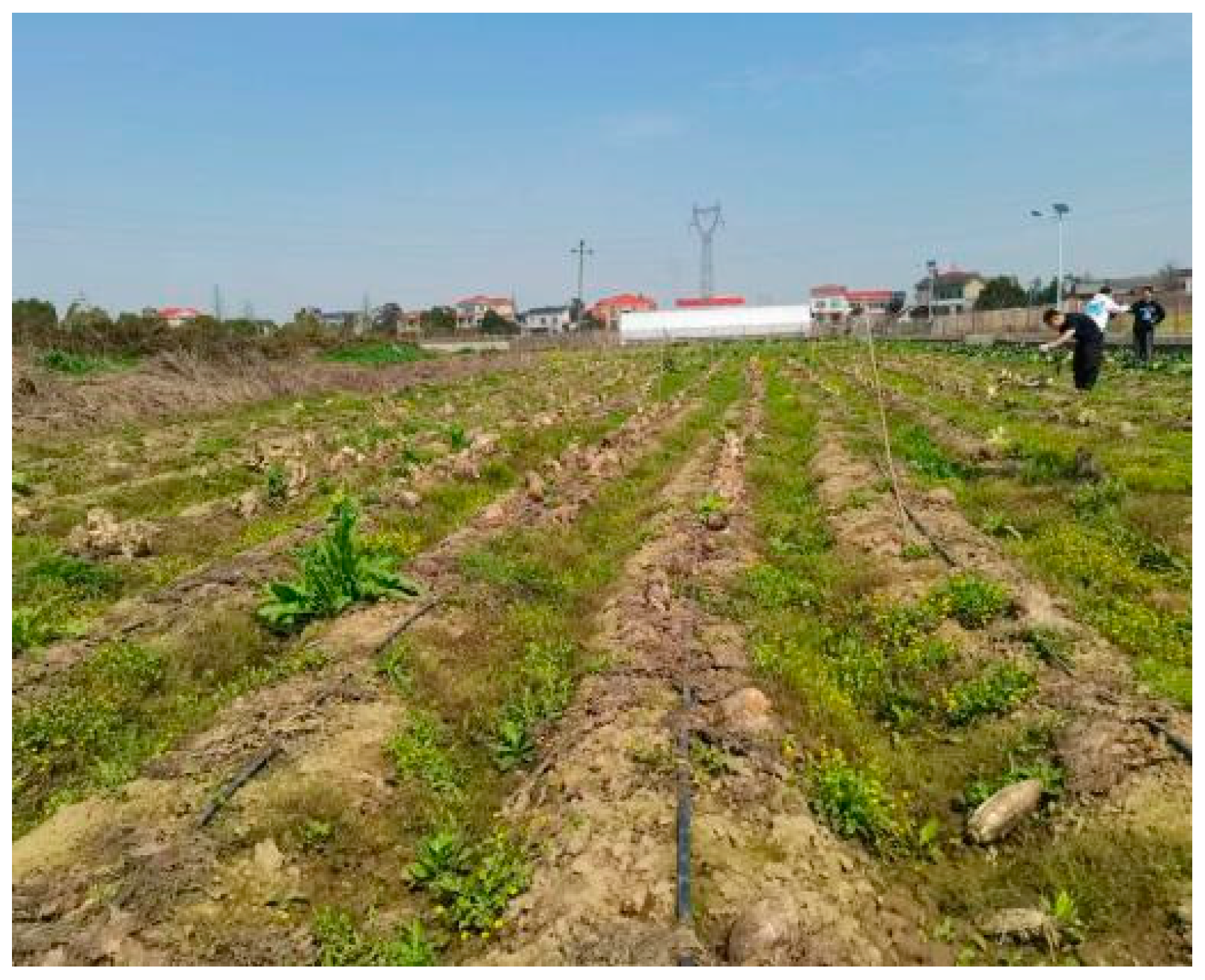
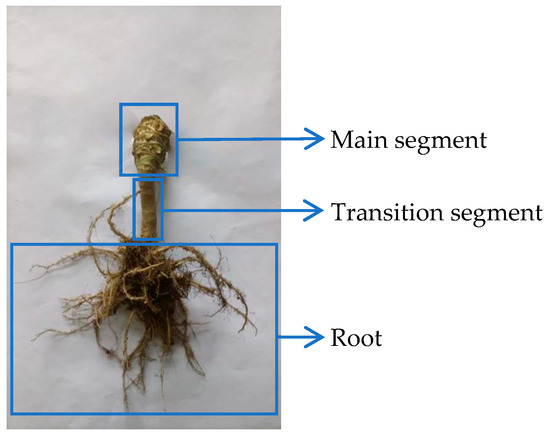
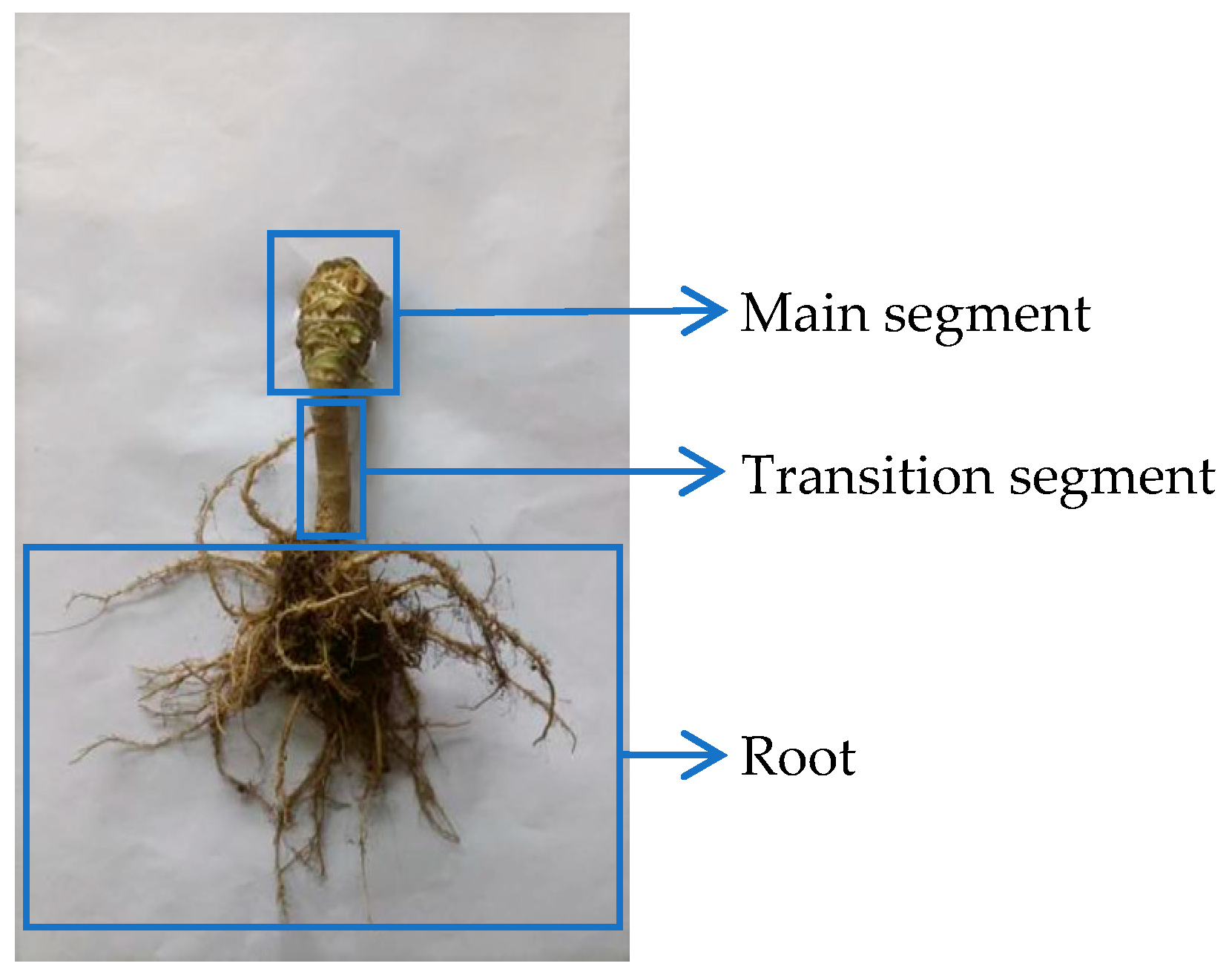
On 20 March 2024, cabbage stubble and soil samples were collected from the Jinchou Agricultural Cabbage Cultivation Base in Wangcheng District, Changsha City, Hunan Province (28.36° N, 112.82° E). The cabbage cultivar used was ‘Zhonggan 21’, sown in December and harvested at maturity in March of the following year. The agronomic practice employed double-row planting on raised beds, with a bed width of 70 cm and an in-row plant spacing of 30 cm [36]; the post-harvest cabbage stubble field is shown in Figure 1. To preserve root integrity, individual whole cabbage stubble specimens were carefully excavated from the field, and the adhering soil was gently removed from the roots to complete the sampling of one cabbage stubble specimen, as illustrated in Figure 2. The soil at this site is a typical clay loam commonly found in Hunan Province. Soil samples were collected from the 0–20 cm plow layer of the cabbage field using the core cutter method.
Figure 1.
Post-harvest cabbage stubble field.
Figure 2.
Cabbage stubble specimen.
2.1.2. Experimental Instruments and Equipment
The instruments and equipment used in this study are as follows:
Electronic balance, for measuring soil density; moisture content analyzer, for measuring soil water content; force gauge, for measuring cabbage stubble pullout force; soil penetrometer, for measuring soil compaction; triaxial testing apparatus, for measuring soil elastic modulus and Poisson’s ratio. Details of each instrument and equipment are provided in Table 1.
Table 1.
Instrument and equipment details.
The software versions used in this study are as follows:
DEM simulation software EDEM 2024.1 (Altair, Troy, MI, USA), for discrete element modeling and simulation of the cabbage stubble–soil composite; Design-Expert 12.0 (Stat-Ease, Inc., Minneapolis, MN, USA), for experimental design and analysis.
2.2. Methods
2.2.1. Determination of Intrinsic Parameters of Cabbage Stubble and Soil
To ensure the mechanical accuracy of the cabbage stubble discrete element model, preliminary studies have already been conducted to characterize the geometric properties of cabbage stubble. Key intrinsic parameters—including density, moisture content, elastic modulus, and Poisson’s ratio—as well as physical contact parameters—such as static friction coefficient, rolling friction coefficient, and coefficient of restitution—were systematically measured. Furthermore, the bonding V2 model parameters for cabbage stubble particles were calibrated by minimizing the discrepancy between simulated and experimentally measured peak shear forces. A systematic calibration procedure was carried out in three sequential stages: (1) an initial screening of key contact parameters—including normal and tangential stiffness per unit area, normal and tangential strength, and bond radius coefficient—to identify those most influential on the peak shear response; (2) an iterative adjustment of the significant parameters to approach the experimental peak shear force; and (3) a local refinement around the promising parameter region to determine the optimal combination that best reproduces the measured mechanical behavior. The final calibrated parameter values are reported in Section 3.1.
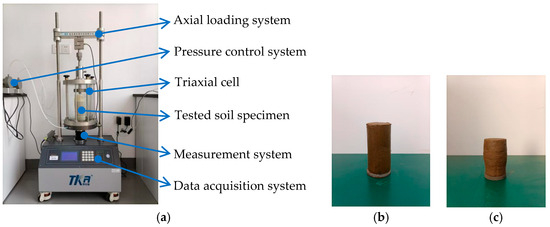
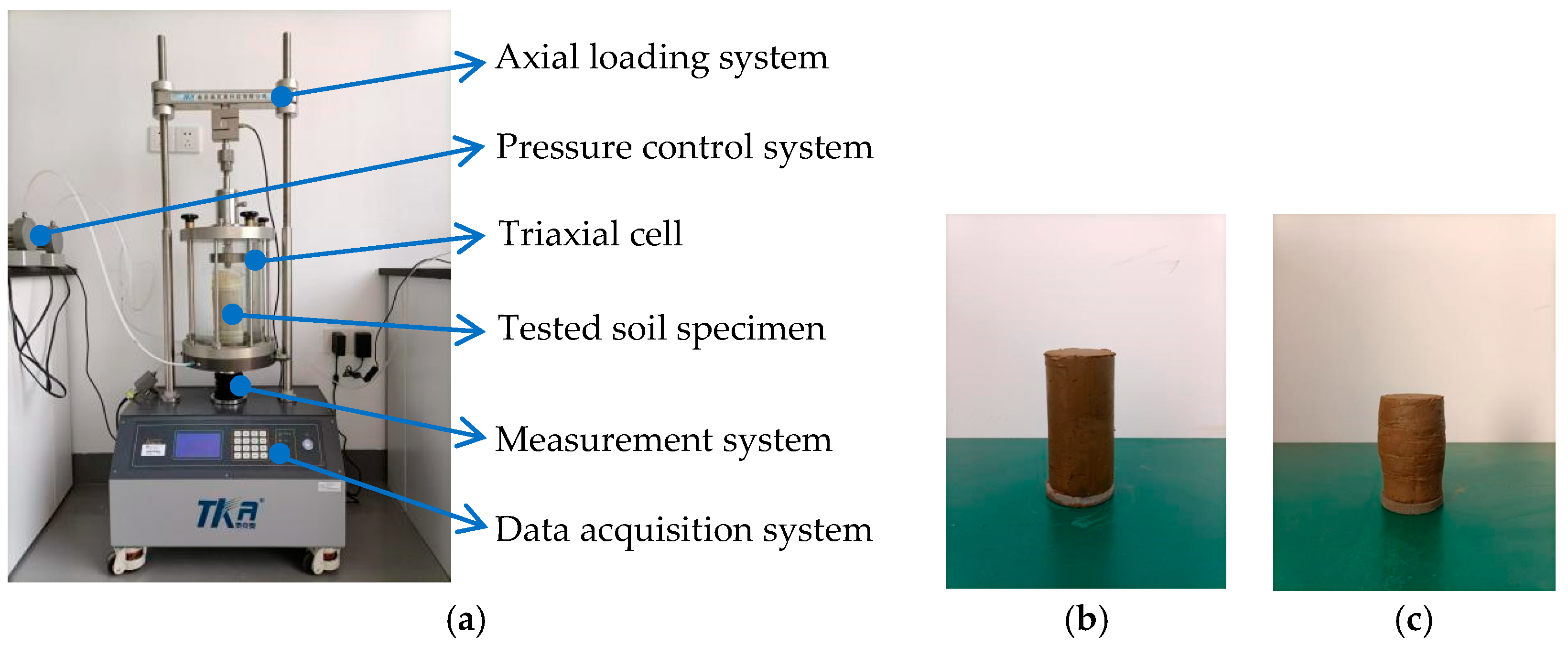
Soil bulk density was measured using the core cutter method [37] at five sampling locations selected by the five-point sampling technique within a 10 m × 10 m plot. To obtain soil intrinsic parameters such as elastic modulus and Poisson’s ratio, strain-controlled triaxial compression tests were conducted on soil sampled from the cabbage field using a triaxial testing apparatus. A consolidated undrained (CU) shear test procedure was adopted. Standard cylindrical triaxial specimens were prepared as remolded samples using soil collected from the cabbage field at its natural moisture content, without deliberate control of dry density or water content. The soil was gently compacted in three layers into a split mold using a compaction cylinder to form specimens with a diameter of 61.8 mm and a height of 150 mm. The prepared soil specimen was placed on the base pedestal of the triaxial cell, sealed with a rubber membrane, and the cell was then filled with water. A back pressure of 50 kPa was applied during saturation to achieve full saturation (B-value ≥ 0.95). The specimens were then compressed under total confining pressures of 100 kPa, 150 kPa, and 250 kPa, corresponding to effective confining pressures of 50 kPa, 100 kPa, and 200 kPa, respectively. Each specimen was axially compressed at a displacement rate of 1.00 mm/min until failure occurred or the axial strain reached the preset limit of 20%. The triaxial compression test setup is shown in Figure 3a, and the soil specimen before and after testing are presented in Figure 3b and Figure 3c, respectively.
Figure 3.
Soil triaxial compression test. (a) Triaxial testing apparatus. (b) Soil specimen before testing. (c) Soil specimen after testing.
During the test, the system automatically recorded the axial displacement (Δh), axial strain (ε1), force gauge reading, and the corresponding principal stress difference (σ1 − σ3) calculated therefrom. The principal stress difference was computed using Equation (1) [38,39]:
where C is the stiffness coefficient of the force gauge, in N/0.01 mm; R is the dial gauge reading of the force gauge, in 0.01 mm; and Aa is the corrected cross-sectional area of the specimen at any given moment, in cm2, calculated from the initial area A0 and the axial strain ε1 using the relation Aa = A0/(1 − ε1).
2.2.2. Calibration of the Soil Angle-of-Repose
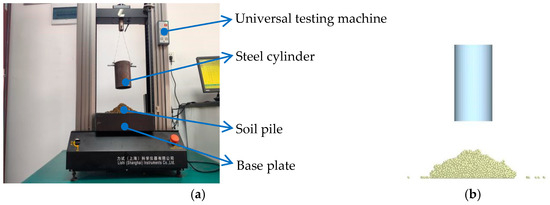
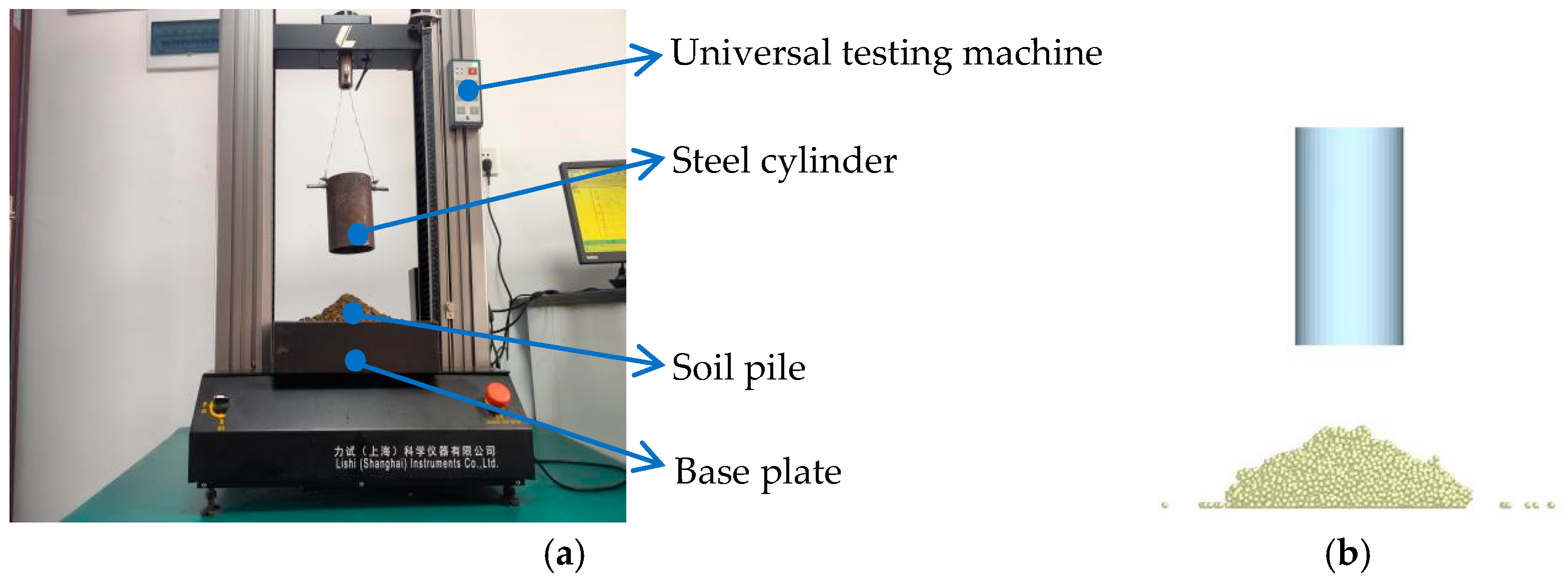
To ensure the accuracy of the soil discrete element model, the soil discrete element contact parameters were calibrated with the angle-of-repose as the target response value [40]. The soil for the angle-of-repose test was collected from the same cabbage field, immediately sealed in aluminum containers to preserve its in situ moisture content, and transported to the laboratory for prompt testing. Prior to the test, large clods were gently broken by hand to disaggregate the soil without altering its natural water content, and the material was sieved to retain particles within the size range of 0.5–5 mm. Due to the retained moisture, capillary forces and liquid bridging developed between particles, resulting in interparticle cohesion; therefore, the soil was treated as a cohesive material in the subsequent analysis and modeling. The angle-of-repose test was conducted using the cylinder lifting method. The experimental setup is shown in Figure 4a and mainly consists of a universal testing machine, a base plate, and a steel cylinder. The base plate has a side length of 400 mm, and the steel cylinder has an inner diameter to height ratio of 1:2 (inner diameter 100 mm, height 200 mm). The angle-of-repose test was conducted ten times to assess repeatability.
Figure 4.
Soil angle-of-repose test. (a) actual test. (b) simulation test.
During the experiment, 750 g of soil from the 0–200 mm depth of the plow layer was added to the steel cylinder. The cylinder was then secured to the lifting platform of the universal testing machine using a clamping device. The cylinder was lifted at a constant speed of 0.02 m/s, allowing the soil to gradually flow out from the bottom of the cylinder and accumulate on the base plate. Once the slope height of the accumulated soil became stable, a photograph was taken from the front view to measure the angle of repose.
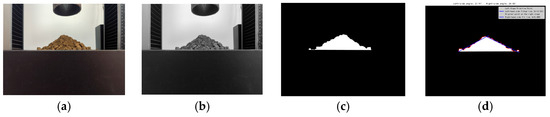
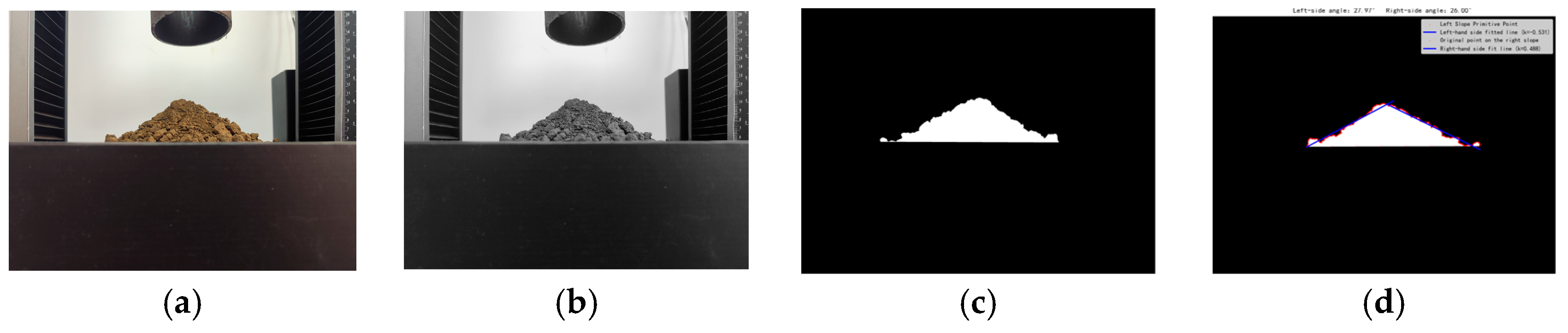
To obtain an accurate angle-of-repose from images, an image processing pipeline was developed in Python 3.8 using OpenCV 4.4.0, NumPy 1.23.0, and Matplotlib 3.7.5. First, original images were converted to grayscale to enhance the contrast between the soil pile and background by preserving luminance while discarding chromatic redundancy. The pile region was then manually annotated at the pixel level using LabelMe 5.5.0, generating JSON-formatted mask files, which were subsequently converted into binary PNG images (pile = white, background = black) via a format-conversion script from an open-source U-Net toolkit [41,42,43]. From the resulting binary image, the largest contour—corresponding to the target soil pile—was extracted using OpenCV to exclude spurious regions. Finally, the left and right slopes of the pile were independently fitted with straight lines using least-squares regression, and the corresponding angle-of-repose values were calculated from the slopes of these lines and visualized using Matplotlib. The entire process for determining the soil angle-of-repose is shown in Figure 5, and the final value for each test was taken as the average of the left and right measurements.
Figure 5.
Image processing workflow for determining the soil angle-of-repose. (a) Original image. (b) Grayscale. (c) Binarization. (d) Linear fitting.
In EDEM simulations, the computational load increases geometrically with the number of particles in the system. To effectively reduce simulation time and improve efficiency—while maintaining acceptable model accuracy—the number of particles was minimized as much as possible. Accordingly, the soil particle radius was set to 3 mm, with a contact radius of 3.6 mm [44,45].
During the formation of the soil angle of repose, the final pile morphology is primarily governed by the frictional characteristics and adhesive effects between particles. The static friction coefficient directly controls the threshold force required to initiate relative sliding between particles, the rolling friction coefficient influences energy dissipation during particle rolling, and the surface energy characterizes the strength of interparticle adhesion. Together, these three parameters determine the critical slope angle at which soil particles reach static equilibrium under gravity. In contrast, the coefficient of restitution characterizes the kinetic energy recovery during transient collisions and has a negligible effect on the long-term static equilibrium state; therefore, following existing literature [19,20,22,23], a coefficient of restitution of 0.35 was adopted for soil–soil particle interactions. Therefore, to calibrate the contact parameters between soil particles, the soil–soil static friction coefficient (A1), soil–soil rolling friction coefficient (B1), and soil surface energy coefficient (C1) were selected as experimental factors. Based on parameter calibration studies for clay loam soils typical of Hunan Province [46,47], the range of each factor was determined as listed in Table 2. The simulation model for the soil angle-of-repose test is shown in Figure 4b. A three-factor, three-level BBD was employed, with three replicate runs at the center point, resulting in a total of 15 simulation trials.
Table 2.
Coding table of factor levels for the simulated soil angle-of-repose test.
2.2.3. In Situ Pullout Test of Cabbage Stubble
Due to the complex soil forces acting on root systems and the difficulty of modeling at the microscale, the interaction between soil and cabbage stubble roots was simplified as a downward confining force. A custom-designed in situ pullout test rig was used to measure the pullout force of cabbage stubble.
Preliminary trials indicated that when a screw auger was screwed into the cabbage stubble for pullout force measurement, the friction between the auger and the stubble was significantly greater than the actual pullout force, resulting in an approximately rigid connection. This connection method thus satisfied the clamping requirement for accurate pullout force measurement.
Through preliminary trials, it was also found that the peak pullout force and minimum pullout force were nearly insensitive to changes in pullout speed, while the average pullout force exhibited only minor variations. Since the peak pullout force was adopted as the primary calibration metric in the DEM simulations—and demonstrated negligible dependence on pullout rate within the tested range—all in situ pullout tests on cabbage root stubs were performed at a constant pullout speed of 0.01 m/s to ensure consistency and repeatability.
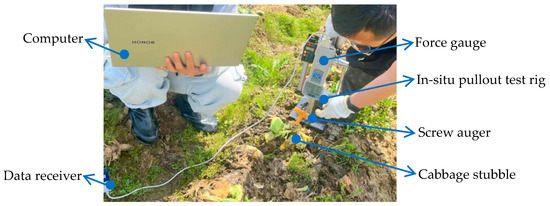
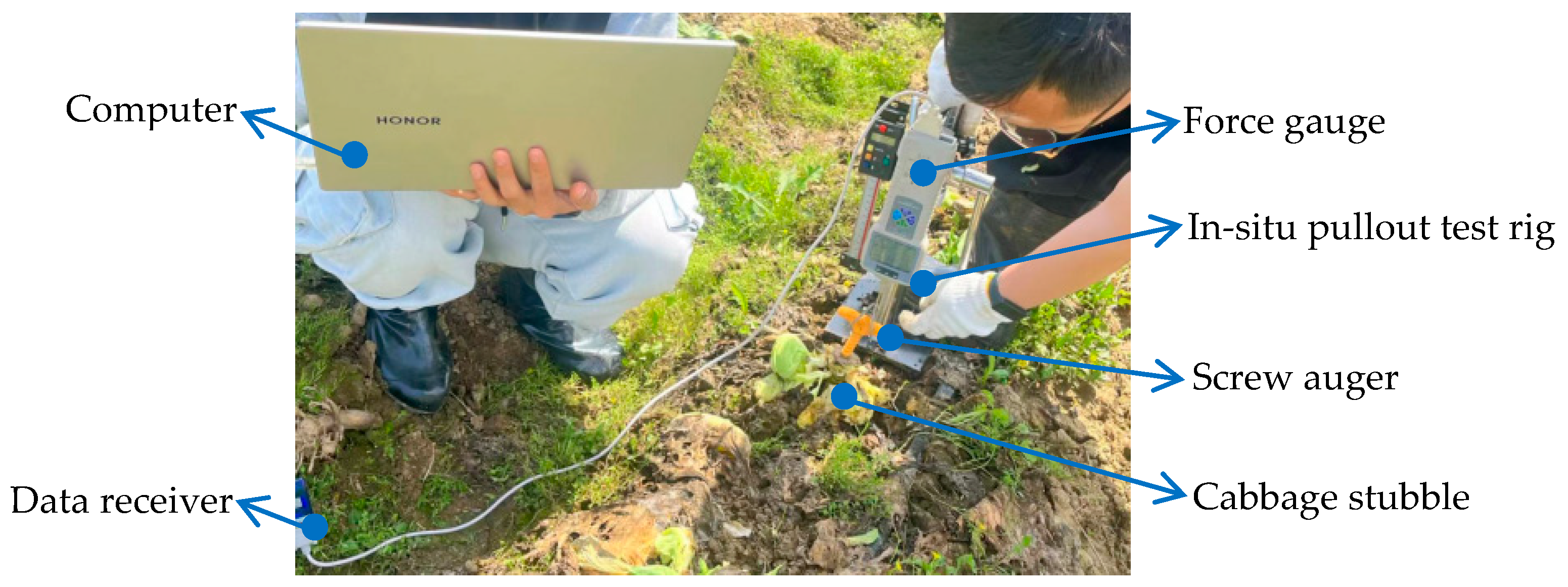
The screw auger was inserted into the center of the cabbage stubble, and two steel rings were used to connect the auger to the hook of the force gauge, establishing a stable linkage among the cabbage stubble, auger, and force gauge. In situ pullout tests were then conducted at a constant extraction speed of 0.01 m/s, continuing until the force curve stabilized to ensure complete detachment of the stubble from the soil. The in situ cabbage stubble pullout test procedure is shown in Figure 6, and the test was repeated 50 times.
Figure 6.
In situ pullout test for cabbage stubble.
2.2.4. Development of the Cabbage Stubble–Soil Composite Discrete Element Model
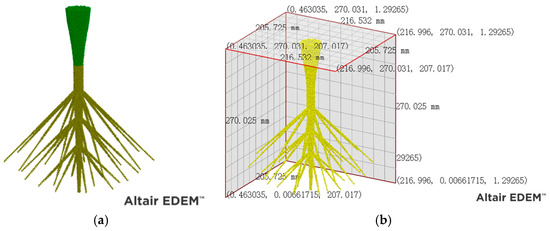
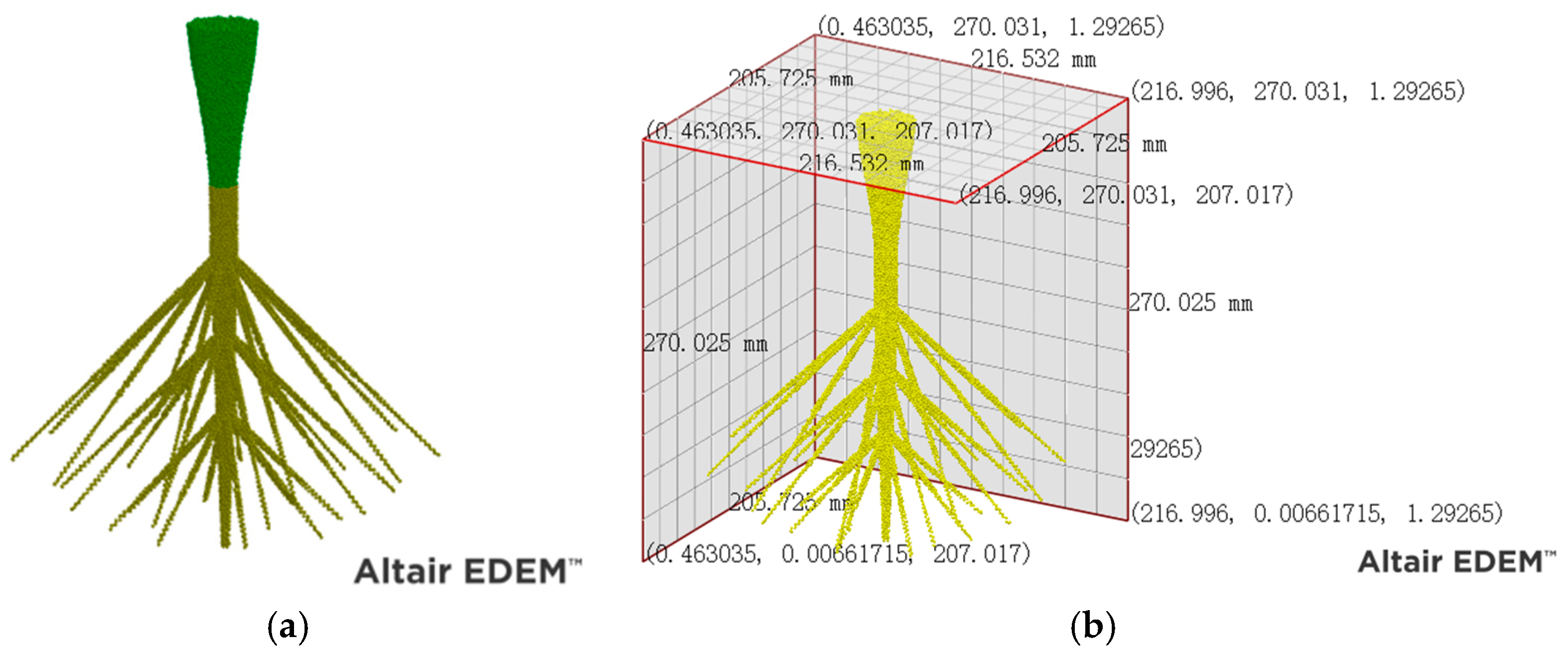
The geometric model of cabbage stubble created in SolidWorks 2022 was imported into EDEM 2024.1 in IGS file format, and global variables along with a particle factory were configured. The stubble geometry was then filled with spherical particles having a diameter of 1 mm and a contact radius of 1.2 mm. The resulting particle-filled cabbage stubble model is shown in Figure 7a. After particle filling, meta-particle representing the cabbage stubble were generated in EDEM 2024.1 based on the three-dimensional spatial coordinate method for use in subsequent simulations, as illustrated in Figure 7b.
Figure 7.
Discrete Element Method model of cabbage stubble. (a) Particle-filled model. (b) Meta-particle model.
After the generation of cabbage stubble meta-particle, the individual stubble particles remain in a discrete state. In EDEM 2024.1, the Hertz-Mindlin with Bonding V2 contact model can establish finite cohesive bonds between particles and is commonly used to simulate material failure, fracture, and similar phenomena [14,15,16,19,20]. A bond is created when the distance between the centers of two particles is less than the sum of their contact radii.
During each computational time step, forces and moments act on the bonds, accumulating incrementally over time. The incremental contributions of bond force and moment at each time step can be calculated using Equations (2)–(4). These bonds can resist external loads and undergo deformation; within the limit of critical stress, the bonded particle pairs exhibit flexible behavior. Once the critical stress is exceeded, the bond breaks, and the particles lose their cohesive connection thereafter.
where
where is the normal force acting on the particle bond, in N; is the tangential force acting on the particle bond, in N; is the normal moment acting on the particle bond, in N·m; is the tangential moment acting on the particle bond, in N·m; is the normal relative velocity between particles, in m/s; is the tangential relative velocity between particles, in m/s; is the normal bond stiffness, in N·m−3; is the tangential bond stiffness, in N·m−3; is the normal angular velocity of the particles, in rad/s; is the tangential angular velocity of the particles, in rad/s; is the contact area, in mm2; is the polar moment of inertia of the bonded spherical volume, in m4; is the bond radius, in mm; is the time step, in s.
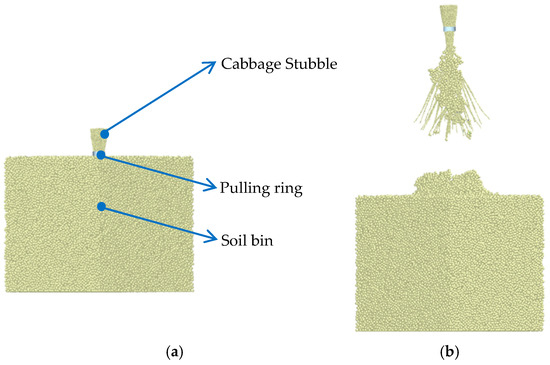
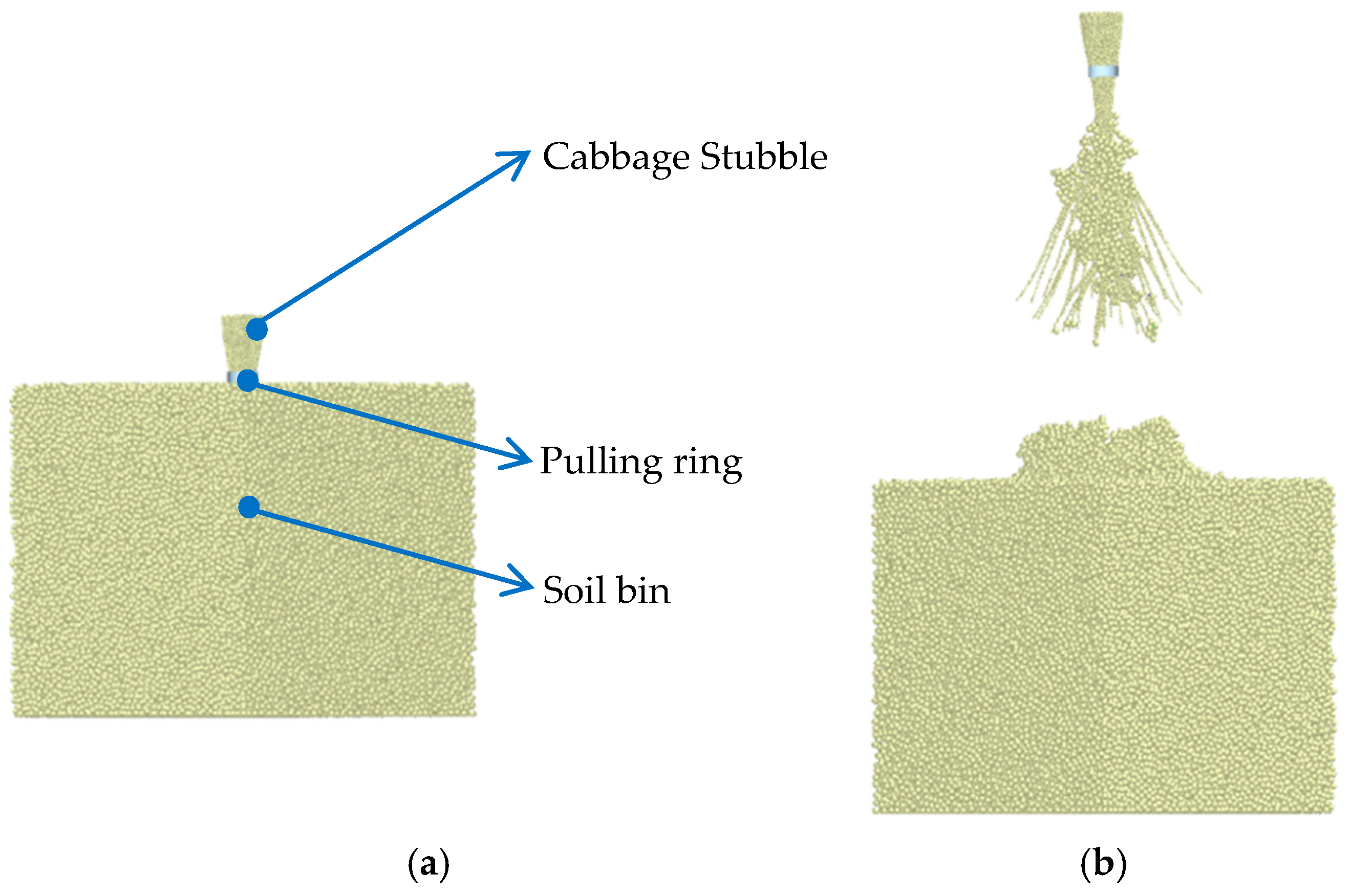
A soil bin measuring 30 cm × 30 cm × 30 cm was created for the in situ pullout simulation test, and the generated soil particles were allowed to fully settle under gravity. A pulling ring was assigned to the main segment of the cabbage stubble to simulate the in situ pullout device used in physical tests, and its upward velocity was set to match that of the physical experiment—0.01 m/s. The simulation employed a fixed time step of 2 × 10⁻⁶ s, and the in situ cabbage stubble pullout simulation process is illustrated in Figure 8.
Figure 8.
In situ pullout simulation for cabbage stubble. (a) Before pullout. (b) After pullout.
Given that cabbage stubble comprises a robust main root segment and a dense network of fine residual lateral roots, whose diameters are extremely small and spatial distribution highly complex, it is impractical to accurately represent them in discrete element modeling through explicit geometric reconstruction. Therefore, this study adopts a physics-mechanism-driven equivalent modeling approach: by coupling the Johnson-Kendall-Roberts (JKR) adhesion model with the Hertz-Mindlin with Bonding V2 contact model to characterize two dominant mechanical behaviors at the stubble–soil interface.
The JKR model, grounded in surface energy theory, effectively captures short-range adhesive forces arising from the wettability and microscale roughness of the stubble surface. Meanwhile, the Bonding V2 model simulates the macroscopic anchoring, reinforcement, and interlocking effects—originally provided by the residual lateral root network—by introducing breakable bonds between stubble and soil particles. This strategy circumvents the need for direct geometric modeling of the fine residual roots, instead achieving an equivalent representation of the complex stubble–soil interaction through mechanical response equivalence.
2.2.5. Calibration of DEM Parameters at the Stubble–Soil Interface
The DEM simulation parameters at the stubble–soil interface that require calibration include: mechanical contact parameters—stubble–soil coefficient of restitution (A2), stubble–soil static friction coefficient (B2), and stubble–soil rolling friction coefficient (C2); JKR model parameter—stubble–soil surface energy (D2); and Bonding model parameters—including stubble–soil normal stiffness per unit area (E2), stubble–soil tangential stiffness per unit area (F2), stubble–soil normal strength (G2), and stubble–soil shear strength (H2).
Based on experimentally measured intrinsic parameters and relevant literature [16,17,18,19,20], all parameters were initially constrained within a two-order-of-magnitude range, followed by extensive preliminary simulations; the final parameter ranges are listed in Table 3. Screening experiments to identify significant factors among these stubble–soil interface simulation parameters were conducted in Design-Expert 12.0 using the Minimum-Run Resolution IV Screening Design.
Table 3.
Parameter value ranges used in the significance screening test for stubble–soil interface simulation parameters.
Based on the results of the factor screening experiment, the direction and step size of the steepest ascent path were determined according to the effect magnitude of each factor, and the steepest ascent experiment was designed and conducted accordingly. Using Design-Expert 12.0 software, the factor levels from the experimental run with the smallest relative error in the steepest ascent test were set as the 0 (central) level; the adjacent lower and higher levels around the 0 level were designated as the low and high levels, respectively. A three-factor, three-level BBD was then carried out, with five replicate runs at the center point, resulting in a total of 17 DEM simulations of in situ cabbage stubble pullout tests. All non-significant parameters were kept consistent with those used in the steepest ascent experiment.
3. Results
3.1. Intrinsic Parameters of Cabbage Stubble and Soil
Table 4 summarizes the complete set of input parameters for the cabbage stubble discrete element model, including experimentally measured intrinsic properties (e.g., density, moisture content, elastic modulus, and Poisson’s ratio), physically determined contact parameters (e.g., static friction coefficient, rolling friction coefficient, and coefficient of restitution), as well as the bonding V2 model parameters calibrated through a systematic three-stage procedure to match experimental peak shear forces.
Table 4.
Material parameters and simulation parameters of cabbage stubble.
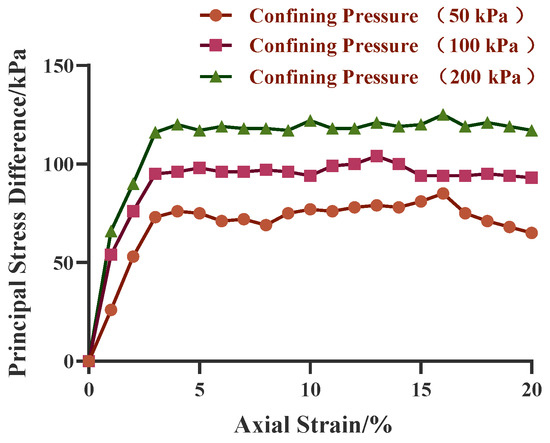
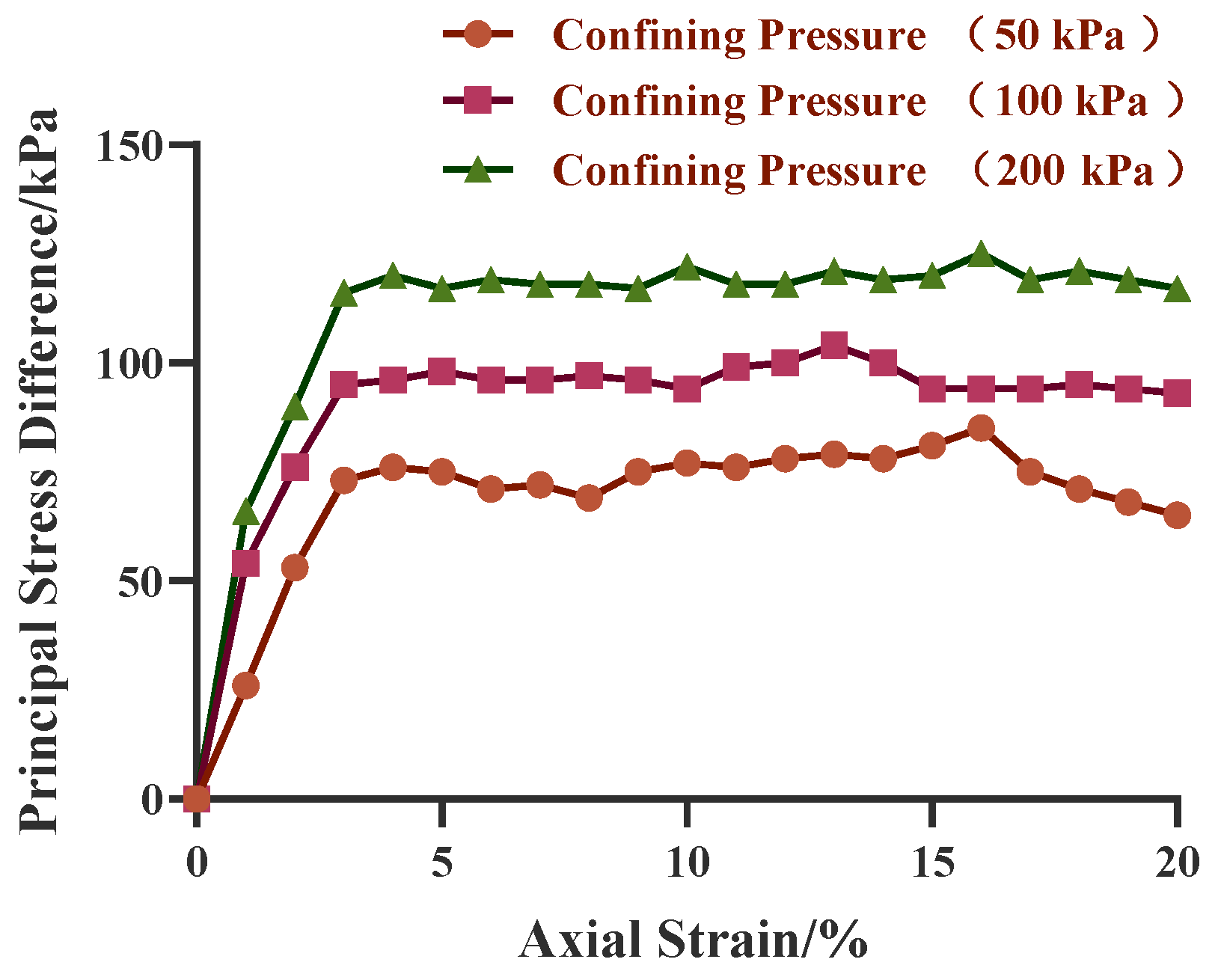
The average soil bulk density was determined to be 1.224 g/cm3 using the core cutter method. Through physical triaxial tests, the test data obtained under different confining pressures were processed to generate the relationship curves between principal stress difference (σ1 − σ3) and axial strain (ϵ1), as shown in Figure 9. All curves exhibit typical strain-softening behavior, where stress increases with strain to a peak value and then gradually decreases. The peak stress of each curve was taken as the failure strength of the soil specimen at the corresponding confining pressure.
Figure 9.
Principal stress difference vs. axial strain plot.
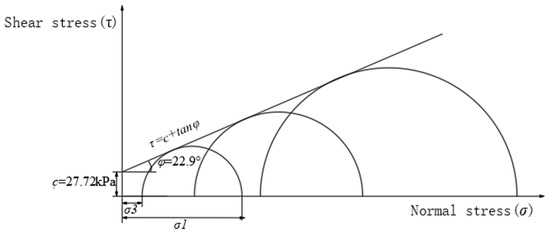
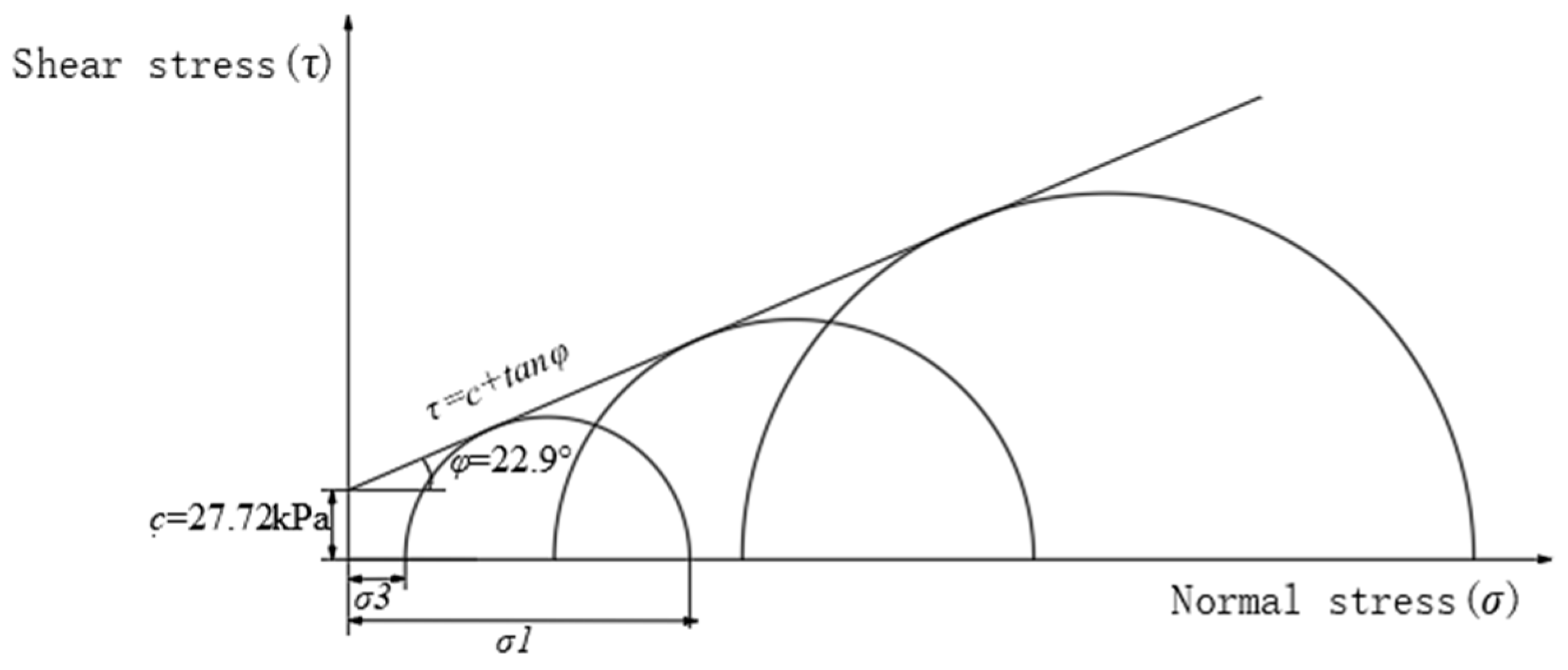
Based on the results of physical triaxial tests, and in accordance with the Mohr-Coulomb strength theory, the failure principal stresses—specifically, the major principal stress at failure (σ1) corresponding to three effective confining pressures (σ3 = 50, 100, 200 kPa) were used to construct a set of Mohr circles. Each Mohr circle is defined by its center at (σ1 + σ3)/2 on the axial stress axis and a radius of (σ1 − σ3)/2. The common tangent to these three Mohr circles was then drawn, representing the shear strength envelope of the soil sample, as shown in Figure 10.
Figure 10.
Shear strength envelope of the soil sample.
The intercept of the strength envelope on the vertical axis represents the soil cohesion c, and the angle between the envelope and the horizontal axis represents the soil internal friction angle φ. Linear regression analysis of the experimental data yielded a cohesion c of 27.72 kPa and an internal friction angle ϕ of 22.9° for the tested soil. The elastic modulus and Poisson’s ratio were then calculated using the following equations:
where Es is the soil elastic modulus, in kPa; μs is the soil Poisson’s ratio; Δσ is the principal stress difference; Δε is the axial strain of the soil; σ1 is the major total principal stress, in kPa; σ3 is the minor total principal stress, in kPa; and Δεν is the volumetric strain.
Using Equations (5) and (6), the soil elastic modulus Es was determined to be 4.73 × 10⁶ Pa, and the Poisson’s ratio μs was 0.32.
3.2. Calibration Results of Soil Angle-of-Repose Parameters
The simulation BBD experiments and results for the soil angle-of-repose are presented in Table 5, and the analysis of variance (ANOVA) results are summarized in Table 6.
Table 5.
Simulation BBD experiments and results for the soil angle-of-repose test.
Table 6.
ANOVA of the regression model for the simulation soil angle-of-repose test.
The BBD-based Response Surface Methodology (RSM) was employed to analyze the relationship between DEM contact parameters and the simulated angle-of-repose. The BBD results for the soil angle-of-repose were analyzed using Design-Expert 12.0 software, and the ANOVA results are shown in Table 6. The analysis indicates that the soil-soil static friction coefficient (A1), soil surface energy coefficient (C1), and the quadratic term of A1 (A12) have an extremely significant effect on the angle-of-repose (p < 0.001). The soil-soil rolling friction coefficient (B1) significantly affects the angle-of-repose at the 0.01 significance level. The interaction term between A1 and C1 (A1C1), as well as the quadratic terms B12 and C12, show significant effects at the 0.05 level. In contrast, the interaction terms A1B1 and B1C1 are not statistically significant. The fitted second-order regression model for the angle-of-repose is highly significant (p = 0.0001), while the lack-of-fit term is not significant (p = 0.1283). The resulting second-order regression equation for the angle-of-repose is:
Taking the average value of 27.83° from ten repeated measurements of the plow-layer soil pile angle-of-repose—with a standard deviation of 0.42°—as the target, the optimization module in Design-Expert 12.0 was used to solve the second-order regression model (Equation (7)). The optimal parameter combination was obtained as follows: soil-soil static friction coefficient (A1) = 0.33, soil-soil rolling friction coefficient (B1) = 0.13, and soil surface energy coefficient (C1) = 2.17 J·m−2.
3.3. Calibration Results of DEM Parameters at the Stubble-Soil Interface
The experimental design and results for screening significant factors of stubble–soil interface simulation parameters are presented in Table 7, and the analysis of variance (ANOVA) results are summarized in Table 8.
Table 7.
Experimental design and results of significance-based factor screening for stubble–soil interface simulation parameters.
Table 8.
ANOVA of the factor screening experiment for stubble–soil interface simulation parameters.
Significance testing of the simulation contact parameter screening experiment revealed that, in the DEM simulation of in situ cabbage stubble pullout, the stubble–soil shear strength (H2) has an extremely significant effect on the peak pullout force (Fp) (p < 0.001); the stubble–soil normal strength (G2) significantly affects Fp at the 0.01 level; and the stubble–soil tangential stiffness per unit area (F2) shows a significant effect at the 0.05 level. The remaining parameters exhibit relatively minor influence.
Accordingly, these three significant parameters—H2, G2, and F2—were selected as experimental factors, with the relative error between the simulated and measured peak pullout force (165.5 N) used as the evaluation metric for the steepest ascent experiment. The less influential parameters were fixed at their mid-level values (i.e., the averages of the low and high levels used in the factor screening experiment): stubble–soil coefficient of restitution (A2) = 0.2, stubble–soil static friction coefficient (B2) = 0.7, stubble–soil rolling friction coefficient (C2) = 0.3, stubble–soil surface energy (D2) = 2 J/m2, and stubble–soil normal stiffness per unit area (E2) = 1.2 × 10⁹ N·m−3.
Effect analysis indicated that H2 and G2 exert influences opposite in direction to that of F2; therefore, the steepest ascent paths for H2 and G2 are set in the opposite direction to that of F2. The experimental design and results of the steepest ascent test for stubble–soil interface simulation parameters are listed in Table 9.
Table 9.
Experimental design and results of the steepest ascent test for stubble–soil interface simulation parameters.
According to the results of the steepest ascent experiment for simulation parameters, the minimum relative error occurred at level 3; thus, the optimal parameter region is expected to lie near this level. Accordingly, level 3 was designated as the center point (coded as 0), while levels 2 and 4 were assigned as the low (–1) and high (+1) levels, respectively, for the BBD experiments. The coded levels of the significant simulation parameters for the BBD experiments are presented in Table 10, the experimental design and results are listed in Table 11, and the analysis of variance (ANOVA) results are shown in Table 12.
Table 10.
Coding table of factor levels for the BBD of stubble–soil interface simulation parameters.
Table 11.
BBD experimental results for stubble–soil interface simulation parameters.
Table 12.
ANOVA of the BBD experiment for stubble–soil interface simulation parameters.
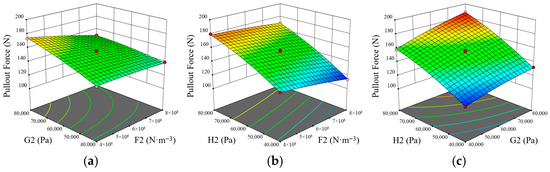
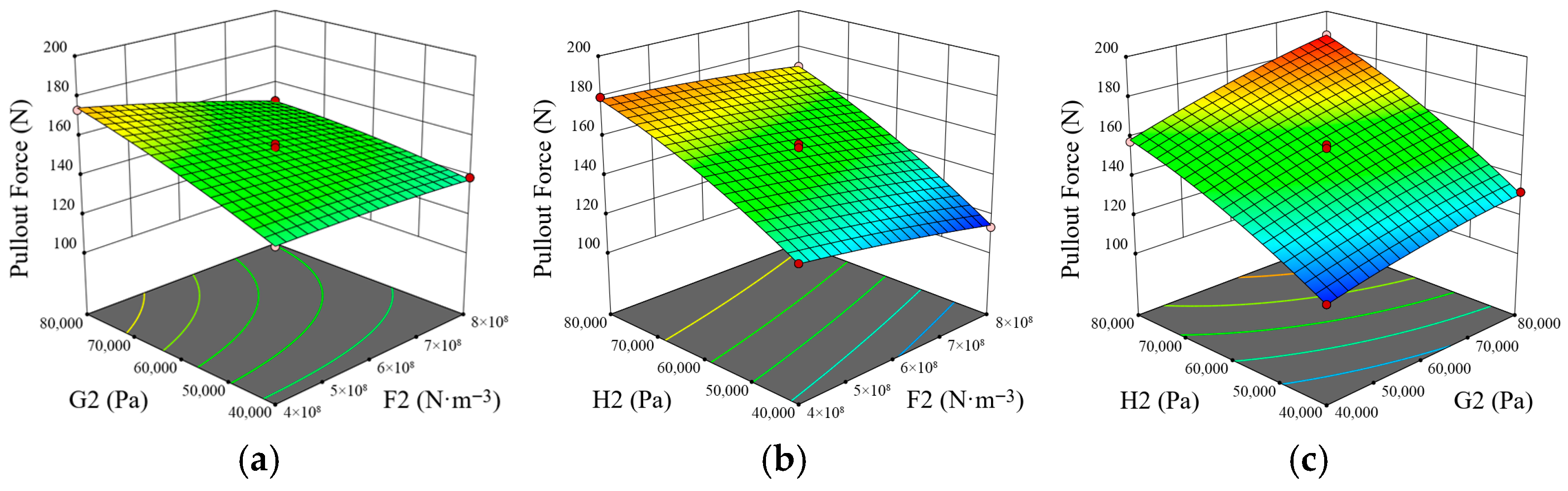
The BBD results for the simulation parameters were analyzed using Design-Expert 12.0 software, and the ANOVA results are shown in Table 12. The analysis reveals that stubble–soil tangential stiffness per unit area (F2), stubble–soil normal strength (G2), stubble–soil shear strength (H2), and the interaction term between F2 and G2 (F2G2) have an extremely significant effect on the peak pullout force (Fp) of cabbage stubble (p < 0.001). The quadratic term of H2 () significantly affects Fp at the 0.01 significance level. The interaction terms F2H2 and G2H2 show significant effects on Fp at the 0.05 level. In contrast, the quadratic terms and are not statistically significant. The response surfaces illustrating the effects of these interaction terms on the peak pullout force of cabbage stubble are presented in Figure 11.
Figure 11.
Interaction response surface for stubble–soil interface simulation parameters. (a) F2 × G2. (b) F2 × H2. (c) G2 × H2.
The fitted regression model for the cabbage stubble peak pullout force is statistically significant (p = 0.0071), while the lack-of-fit term is not significant (p = 0.6686), indicating good model fit with no evidence of lack of fit. The predicted coefficient of determination () is 0.9787, and the adjusted coefficient of determination () is 0.9917—both very close to 1—and the coefficient of variation (C.V.) is low at 1.23%, demonstrating that the model accurately represents the real-world behavior and is suitable for predicting the peak pullout force of cabbage stubble. After removing the non-significant quadratic terms while maintaining overall model significance, the following second-order regression equation for the simulated peak pullout force of cabbage stubble was obtained:
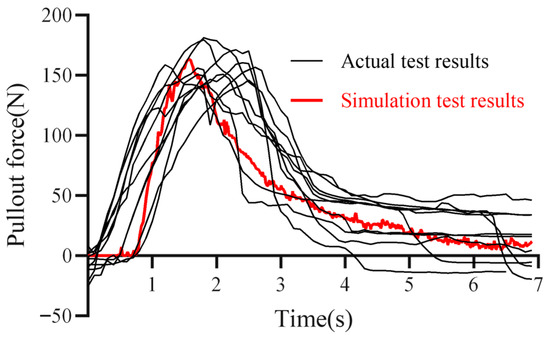
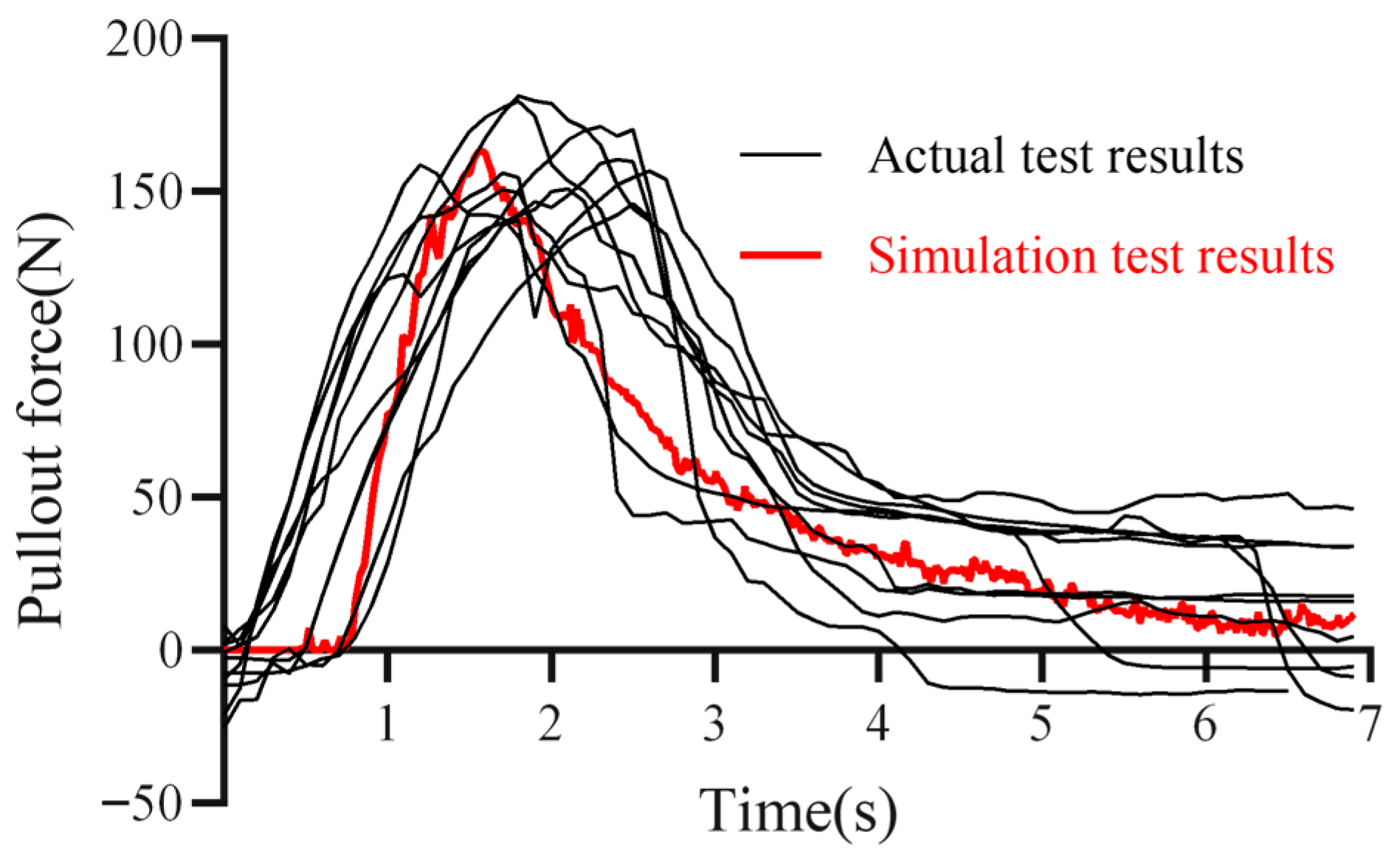
Taking the average peak pullout force (165.5 N) from 50 repetitions of the physical in situ pullout test as the target value, the optimization module in Design-Expert 12.0 was used to solve the second-order regression model (Equation (8)). The optimal parameter combination was obtained as follows: stubble–soil tangential stiffness per unit area (F2) = 4.40 × 10⁸ N·m−3, stubble–soil normal strength (G2) = 6.26 × 10⁴ Pa, and stubble–soil shear strength (H2) = 6.38 × 10⁴ Pa. Using this optimal parameter set, an in situ cabbage stubble pullout simulation was conducted, and the simulated and measured force-time curves are shown in Figure 12.
Figure 12.
Comparison of simulated and measured pullout force-time curves.
The simulated and measured “time-load” curves from the in situ pullout test exhibit consistent trends, demonstrating that the developed DEM model effectively captures the interaction characteristics of the cabbage stubble–soil system. The simulated peak pullout force is 162.0 N, which deviates by only 2.1% from the average value (165.5 N) obtained from 50 field repetitions.
4. Discussion
4.1. Discussion of Results
The high predictive accuracy achieved in this study—with a deviation of only 2.1% from experimental peak pullout forces—demonstrates the effectiveness of the coupled JKR and Bonding V2 contact model for simulating cabbage stubble–soil interactions. This level of agreement substantially exceeds the typical error ranges reported in DEM studies of root–soil or residue–soil systems, which often fall between 5% and 15% [20,32,34]. The improved fidelity is attributed to two key aspects: (1) the physical integration of dual interfacial mechanisms—adhesion governed by the JKR contact model and cohesive resistance governed by the Bonding V2 contact model—and (2) a rigorous three-stage parameter calibration strategy grounded in actual in situ mechanical response.
The necessity of combining JKR adhesion with a cohesive bonding law arises from the complex mechanical behavior at the stubble–soil interface. As noted in recent reviews, agricultural DEM simulations frequently rely on single-contact models that inadequately capture the full spectrum of soil–residue interactions [12,13]. For instance, models based solely on adhesive laws may reproduce particle attraction under moisture but fail to maintain structural integrity during shear or pullout, leading to underestimated resistance [6,45]. Conversely, purely cohesive models using linear or parallel bonds can generate stable aggregates but often overpredict tensile strength, resulting in brittle failure modes inconsistent with field observations [18,29]. By integrating the JKR model—accounting for short-range adhesion—with the Bonding V2 model—which governs normal and shear bond stiffness, strength, and breakage criteria—this study achieves a balanced representation of both surface adhesion and bulk cohesion, closely matching the measured pullout force-time curves.
It should be emphasized that this modeling effort is motivated by practical engineering needs in vegetable production systems. Specifically, the calibrated parameters are intended to support the virtual design and performance evaluation of rotary tillage implements for post-harvest cabbage residue management. Current work is extending this static stubble–soil model into dynamic multi-body simulations of tool–soil–stubble interactions, where parameters governing interfacial friction, bond strength, and particle stiffness directly influence predictions of stubble fragmentation efficiency and draft force—critical metrics for energy-efficient tillage [7,35].
Furthermore, the adoption of a three-stage calibration approach—comprising initial factor screening, steepest ascent path optimization, and final refinement via BBS—enhanced parameter identifiability and reduced equifinality, a well-documented challenge in DEM modeling of cohesive granular materials [9,10,11]. This systematic methodology ensures that the identified parameters are not only statistically optimal but also physically interpretable, as evidenced by their consistent performance across repeated pullout simulations.
4.2. Limitations and Future Work
Despite its demonstrated accuracy, the current model has several limitations that warrant acknowledgment. First, calibration was performed using in-field static pullout tests; validation under dynamic field operations—such as during actual rotary tillage—has not yet been conducted. Second, the soil domain is represented as a homogeneous assembly of uniform spherical particles, neglecting natural heterogeneities such as aggregates, macropores, layering, and spatial variability in texture or moisture content, all of which significantly affect root anchorage and residue retention in real fields [6,18,47]. Third, cabbage stubble is idealized as a bonded cluster of identical spheres, which cannot fully replicate the morphological complexity (e.g., branching architecture, tapering geometry, surface roughness) or anisotropic mechanical properties of actual plant residues [19,23,34].
To address these limitations, future research will pursue three directions. (1) Advanced experimental validation: Integrating high-speed imaging or X-ray CT during in situ pullout or tillage tests to observe micro-scale deformation and failure mechanisms, thereby enabling direct comparison with simulated particle kinematics [29,33]. (2) Model extension to dynamic scenarios: Incorporating the calibrated parameters into full-scale DEM simulations of rotary tillers operating in realistic soil beds, with explicit representation of tool motion, soil disturbance, and stubble transport [5,7]. (3) Enhanced biological and environmental realism: Accounting for moisture-dependent soil cohesion, time-varying root decay, and seasonal variations in stubble mechanical properties—factors known to influence soil–residue interaction but rarely included in current DEM frameworks [18,24,32].
Systematic validation across varying soil moisture levels, stubble densities, and loading rates remains essential. Ongoing simulations of soil–tool–stubble interactions provide a practical platform for further testing the robustness and transferability of the parameters established in this study.
5. Conclusions
This study addresses the complex composite system formed by cabbage stubble residues and soil in post-harvest fields, establishing a systematic Discrete Element Method (DEM) parameter calibration framework that directly targets in situ pullout force as the calibration objective. The framework innovatively integrates soil intrinsic property characterization, physical in situ pullout experiments, and a three-stage optimization protocol—factor screening → steepest ascent experiment → BBD. Crucially, it employs a superimposed modeling strategy combining the JKR adhesion model with the Bonding V2 mechanical interlocking model to jointly represent the dual physical mechanisms at the stubble–soil interface: the JKR model accurately captures microscale adhesive effects arising from stubble surface wettability and soil particle interactions, while the Bonding V2 model effectively simulates the macroscopic anchoring and reinforcement provided by the residual lateral root network on soil particles.
Based on this framework, three key parameters at the cabbage stubble–soil interface were successfully calibrated: tangential stiffness per unit area (4.40 × 10⁸ N·m−3), normal strength (6.26 × 10⁴ Pa), and shear strength (6.38 × 10⁴ Pa). The DEM model constructed with this parameter set yielded a predicted peak pullout force of 162.0 N during in situ pullout simulation, exhibiting only a 2.1% relative error compared to the average value (165.5 N) from 50 field repetitions, with excellent agreement in the overall trend of the force-time curves. This validation confirms that the proposed dual-mechanism model can accurately reproduce the complex separation mechanics of cabbage stubble.
This study establishes a high-fidelity DEM model of the cabbage stubble–soil composite system, filling a critical gap in the DEM parameter database for root-crop residue-soil systems dominated by taproots. The model provides robust support for the virtual prototyping of vegetable residue management implements—such as rotary tillers and stubble-cutting blades—thereby accelerating the development of low-resistance, energy-efficient, and intelligent tillage equipment, and laying a solid technical foundation for sustainable mechanized management in vegetable production.
Author Contributions
Conceptualization, P.J. and W.Z.; methodology, W.Z. and Z.L.; software, W.Z.; validation, W.Z. and Z.L.; formal analysis, W.Z.; investigation, W.Z., Z.L., Q.C. and W.L.; data curation, W.Z.; writing—original draft preparation, W.Z.; writing—review and editing, Z.L. and Q.C.; visualization, W.Z. and W.L.; supervision, P.J.; project administration, P.J.; funding acquisition, P.J. All authors have read and agreed to the published version of the manuscript.
Funding
This research was funded by the Hunan Provincial Science and Technology Department of Major Project—Ten Major Technical Research Projects (2023NK1020), the Hunan Provincial Department of Education Key Projects (23A0179), the 2023 High-level Guangdong Agricultural Science and Technology Demonstration City Construction Fund Municipal-Academy Cooperation Project (2320060002384), the Changsha Science and Technology Bureau Natural Science Foundation Project (kq2402110), the Natural Science Foundation Project of Hunan Provincial Department of Science and Technology (2025JJ50164).
Institutional Review Board Statement
Not applicable.
Data Availability Statement
The data presented in this study are available on request from the corresponding author.
Conflicts of Interest
The authors declare no conflicts of interest.
References
- Zhao, J.; Li, K.; Liu, X.; Yan, Z.; Zhao, L.; Li, Z.; Liu, X.; Yang, L. Full-mechanization Production Technology and Application for Field-grown Cabbage. China Veg. 2020, 101–106+126. [Google Scholar] [CrossRef]
- Wei, L.; Liang, Z.; Zhang, Y. Occurrence Pattern Integrated Management of Sclerotinia Rot in Cabbage. J. Change Veg. 2017, 9, 52–53, 3. [Google Scholar]
- Xu, H. Discussion on the Mechanized Comprehensive Utilization of Crop Straw. China South. Agric. Mach. 2023, 54, 81–83. [Google Scholar] [CrossRef]
- Aikins, K.A.; Barr, J.B.; Ucgul, M.; Jensen, T.A.; Antille, D.L.; Desbiolles, J.M.A. No-Tillage Furrow Opener Performance: A Review of Tool Geometry, Settings and Interactions with Soil and Crop Residue. Soil Res. 2020, 58, 603–621. [Google Scholar] [CrossRef] [Scilit]
- Fu, C.G.; Wang, Q.F.; He, W.W.; Lv, W.Q.; Wei, S.X. Parameter Optimization of Rotary Blade for Soil Breakage Using Discrete Element Method. Int. J. Simul. Model. 2025, 24, 647–658. [Google Scholar] [CrossRef] [Scilit]
- Aikins, K.A.; Ucgul, M.; Barr, J.B.; Jensen, T.A.; Antille, D.L.; Desbiolles, J.M.A. Determination of Discrete Element Model Parameters for a Cohesive Soil and Validation through Narrow Point Opener Performance Analysis. Soil Tillage Res. 2021, 213, 105123. [Google Scholar] [CrossRef] [Scilit]
- Xu, G.; Ding, Q.; Wang, X.; Liang, L.; He, R.; Chen, X. Analysis of Straw Displacement and Burying Effect in Straw–Soil Rotary Tiller Interaction. Trans. Chin. Soc. Agric. Mach. 2022, 53, 23–29. [Google Scholar] [CrossRef]
- Zhu, Y.; Bian, J.; Li, W.; Xing, J.; Wang, L.; Wang, X.; Hu, C. Optimized Design and Experimental Evaluation of a Ridging and Mulching Machine for Yellow Sand Substrate Based on the Discrete Element Method. Agriculture 2025, 15, 2103. [Google Scholar] [CrossRef] [Scilit]
- Bu, P.; Li, Y.; Zhang, X.; Wen, L.; Qiu, W. A Calibration Method of Discrete Element Contact Model Parameters for Bulk Materials Based on Experimental Design Method. Powder Technol. 2023, 425, 118596. [Google Scholar] [CrossRef] [Scilit]
- Li, C.; Yin, H.; Wu, C.; Zhang, Y.; Zhang, J.; Wu, Z.; Wang, W.; Jia, D.; Guan, S.; Ren, R. Calibration of the Discrete Element Method and Modeling of Shortening Experiments. Front. Earth Sci. 2021, 9, 636512. [Google Scholar] [CrossRef] [Scilit]
- Carr, M.J.; Roessler, T.; Robinson, P.W.; Otto, H.; Richter, C.; Katterfeld, A.; Wheeler, C.A. Calibration Procedure of Discrete Element Method (DEM) Parameters for Wet and Sticky Bulk Materials. Powder Technol. 2023, 429, 118919. [Google Scholar] [CrossRef] [Scilit]
- Zhao, H.; Wang, X.; Zhen, Z.; Li, X.; Huang, Y. Research Status and Progress of Discrete Element Method Applications in Agricultural Equipment. Trans. Chin. Soc. Agric. Mach. 2025, 56, 1–19. [Google Scholar] [CrossRef]
- Zeng, Z.; Ma, X.; Cao, X.; Li, Z.; Wang, X. Critical Review of Applications of Discrete Element Method in Agricultural Engineering. Trans. Chin. Soc. Agric. Mach. 2021, 52, 1–20. [Google Scholar] [CrossRef]
- Shi, G.; Li, J.; Ding, L.; Zhang, Z.; Ding, H.; Li, N.; Kan, Z. Calibration and Tests for the Discrete Element Simulation Parameters of Fallen Jujube Fruit. Agriculture 2022, 12, 38. [Google Scholar] [CrossRef] [Scilit]
- Du, C.; Han, D.; Song, Z.; Chen, Y.; Chen, X.; Wang, X. Calibration of Contact Parameters for Complex Shaped Fruits Based on Discrete Element Method: The Case of Pod Pepper (Capsicum annuum). Biosyst. Eng. 2023, 226, 43–54. [Google Scholar] [CrossRef] [Scilit]
- Zhang, G.; Chen, L.; Liu, H.; Dong, Z.; Zhang, Q.; Zhou, Y. Calibration and experiments of the discrete element simulation parameters for water chestnut. Trans. Chin. Soc. Agric. Eng. 2022, 38, 41–50. [Google Scholar] [CrossRef] [Scilit]
- Jiang, Y.; Ji, J.; Liu, X.; Cai, S.; Li, Y.; Fan, X. Root Reinforcement Mechanism Based on Bionic Materials. Sci. Soil Water Conserv. 2022, 20, 58–64. [Google Scholar] [CrossRef]
- Che, H.; Zhou, H.; Zhang, Y.; Song, X.; Wang, L.; Feng, W. Research status of mechanical properties of crop root-soil complexes. J. Chin. Agric. Mech. 2025, 46, 295–301, 310. [Google Scholar] [CrossRef]
- Zhao, J.; Yu, J.; Sun, K.; Sun, Y.; Wang, Y.; Liang, L.; Yu, Y. Modeling and verifying wheat roots using AgriDEM. Trans. Chin. Soc. Agric. Eng. 2025, 41, 63–72. [Google Scholar] [CrossRef]
- Xie, W.; Ouyang, C.; Jiang, P.; Meng, D.; Luo, H. Calibrating and optimizing the discrete element parameters for clamping section stems during rape shoot harvesting. Trans. Chin. Soc. Agric. Eng. 2024, 40, 104–116. [Google Scholar] [CrossRef]
- Zhang, Q.; Zhen, Z.; Liao, Q.; Yu, L.; Li, Y.; Wan, X. Appliction Status and Prospect of Coupled Simulation in Agricultural Engineering Resaech. Trans. Chin. Soc. Agric. Mach. 2025, 56, 20–37, 149. [Google Scholar] [CrossRef]
- Xie, W.; Peng, L.; Jiang, P.; Meng, D.; Wang, X. Discrete Element Model Building and Optimization of Double-layer Bonding of Rape Shoots Stems at Harvest Stage. Trans. Chin. Soc. Agric. Mach. 2023, 54, 112–120. [Google Scholar] [CrossRef]
- Sheng, Y.; Tian, H.; Wang, D.; Liu, F.; Li, D.; Xiao, Z.; Zhang, H. Study on Establishment of Discrete Element Model of Maize Root System Calibration of Simulation Parameters. J. Agric. Mech. Res. 2023, 45, 164–170. [Google Scholar] [CrossRef]
- Kamchoom, V.; Leung, A.K.; Boldrin, D.; Sakolpanya, T.; Wu, Z.; Likitlersuang, S. Shearing Behaviour of Vegetated Soils with Growing and Decaying Roots. Can. Geotech. J. 2022, 59, 2067–2084. [Google Scholar] [CrossRef] [Scilit]
- Giadrossich, F.; Cohen, D.; Schwarz, M.; Ganga, A.; Marrosu, R.; Pirastru, M.; Capra, G.F. Large Roots Dominate the Contribution of Trees to Slope Stability. Earth Surf. Process. Landf. 2019, 44, 1602–1609. [Google Scholar] [CrossRef] [Scilit]
- Schwarz, M.; Giadrossich, F.; Cohen, D. Modeling Root Reinforcement Using Root-Failure Weibull Survival Function. Hydrol. Earth Syst. Sci. 2013, 17, 4367–4377. [Google Scholar] [CrossRef] [Scilit]
- Cao, Y.; Chen, L.; Liu, X.; Yang, Y. The Influence Factors of PlantRoot—Soil Interface Friction. Tribology 2014, 34, 482–488. [Google Scholar] [CrossRef]
- Ji, X.; Cong, X.; Dai, X.; Zhang, A.; Chen, L. Studying the Mechanical Properties of the Soil-Root Interface Using the Pullout Test Method. J. Mt. Sci. 2018, 15, 882–893. [Google Scholar] [CrossRef] [Scilit]
- Liang, S.; Liu, L.; Liu, F.; Chang, H.; Cui, W.; Li, G. Establishment and calibration experiment of the discrete element model for spinach root-soil complex. Trans. Chin. Soc. Agric. Eng. 2025, 41, 38–49. [Google Scholar] [CrossRef]
- Song, X.; Tan, Y.; Lu, Y. Direct Shear Test and Discrete Element Method Study of Tap-Type Root-Soil Composite. In Proceedings of the Direct Shear Test and Discrete Element Method Study of Tap-Type Root-Soil Composite, Nyingchi, China, 26 September 2021; pp. 58–67. [Google Scholar]
- Tamás, K.; Bernon, L. Role of Particle Shape and Plant Roots in the Discrete Element Model of Soil–Sweep Interaction. Biosyst. Eng. 2021, 211, 77–96. [Google Scholar] [CrossRef] [Scilit]
- Zeng, B.; Li, M.; Yao, L.; Zhao, S.; Wang, Y.; Liu, F.; Xie, S. Simulation and experiment on the mechanical properties of Coptis chinensis root soil composites based on image reconstruction. Trans. Chin. Soc. Agric. Eng. 2023, 39, 75–84. [Google Scholar] [CrossRef]
- Xie, K. Study on Separation Mechanism of Panax Notoginseng Soil Complex. Master’s Thesis, Kunming University of Science and Technology, Kunming, China, 2023. [Google Scholar]
- Xin, L.; Li, Z.; Zhuang, Z.; Wang, H.; Zhu, X. Discrete Element Model for Pot-type Root–Soil Composite Based on Root Growth Simulation in Rice Pot Seedlings. Trans. Chin. Soc. Agric. Mach. 2025, 56, 128–138. [Google Scholar] [CrossRef]
- Liu, X. Research on the Interaction Mechanism Between the Blade and the Maize Root-Soil Composite and Optimization of the Wing-Shaped Stubble-Breaking Device. Doctor’s Thesis, Jilin University, Changchun, China, 2025. [Google Scholar]
- Jiang, P.; Qi, A.; Zhong, J.; Luo, Y.; Hu, W.; Shi, Y.; Liu, T. Field Cabbage Detection and Positioning System Based on Improved YOLOv8n. Plant Methods 2024, 20, 96–111. [Google Scholar] [CrossRef] [Scilit]
- Blake, G.R.; Hartge, K.H. Methods of Soil Analysis: Part 1—Physical and Mineralogical Methods, 2nd ed.; ASA and SSSA: Madison, WI, USA, 1986; ISBN 978-0-89118-088-3. [Google Scholar] [CrossRef] [Scilit]
- ASTM D2166/D2166M-24; US-ASTM Standard Test Method for Unconfined Compressive Strength of Cohesive Soil. ASTM: West Conshohocken, PA, USA, 2024.
- Head, K.H. Manual of Soil Laboratory Testing, 3rd ed.; Whittles Publishing: Caithness, UK, 2006; Volume 1: Soil Classification and Compaction Tests, ISBN 1-904445-36-5. [Google Scholar] [CrossRef] [Scilit]
- He, Y.; Xiang, W.; Wu, M.; Quan, W.; Chen, C. Parameters calibration of loam soil for discrete element simulation based on the repose angle of particle heap. J. Hunan Agric. Univ. Nat. Sci. 2018, 44, 216–220. [Google Scholar] [CrossRef]
- Wang, G.; Li, Z.; Weng, G.; Chen, Y. An Overview of Industrial Image Segmentation Using Deep Learning Models. Intell. Robot. 2025, 5, 143–180. [Google Scholar] [CrossRef] [Scilit]
- Ni, J.; Shi, J.; Zhan, Q.; Zhang, Z.; Gu, Y. An Improved U-Net Model with Multiscale Fusion for Retinal Vessel Segmentation. Intell. Robot. 2025, 5, 679–694. [Google Scholar] [CrossRef] [Scilit]
- Ruan, Y.; Wang, D.; Yuan, Y.; Jiang, S.; Yang, X. SKPNet: Snake KAN Perceive Bridge Cracks through Semantic Segmentation. Intell. Robot. 2025, 5, 105–118. [Google Scholar] [CrossRef] [Scilit]
- Yan, D.; Yu, J.; Wang, Y.; Zhou, L.; Tian, Y.; Zhang, N. Soil Particle Modeling and Parameter Calibration Based on Discrete Element Method. Agriculture 2022, 12, 1421. [Google Scholar] [CrossRef] [Scilit]
- Wu, Z.; Wang, X.; Liu, D.; Xie, F.; Ashwehmbom, L.G.; Zhang, Z.; Tang, Q. Calibration of Discrete Element Parameters and Experimental Verification for Modelling Subsurface Soils. Biosyst. Eng. 2021, 212, 215–227. [Google Scholar] [CrossRef] [Scilit]
- Xiang, W.; Wu, M.; Lv, J.; Quan, W.; Ma, L.; Liu, J. Calibration of simulation physical parameters of clay loam based on soil accumulation test. Trans. Chin. Soc. Agric. Eng. 2019, 35, 116–123. [Google Scholar] [CrossRef]
- Mudarisov, S.; Farkhutdinov, I.; Khamaletdinov, R.; Khasanov, E.; Mukhametdinov, A. Evaluation of the Significance of the Contact Model Particle Parameters in the Modelling of Wet Soils by the Discrete Element Method. Soil Tillage Res. 2022, 215, 105228. [Google Scholar] [CrossRef] [Scilit]

Disclaimer/Publisher’s Note: The statements, opinions and data contained in all publications are solely those of the individual author(s) and contributor(s) and not of MDPI and/or the editor(s). MDPI and/or the editor(s) disclaim responsibility for any injury to people or property resulting from any ideas, methods, instructions or products referred to in the content. |
© 2026 by the authors. Licensee MDPI, Basel, Switzerland. This article is an open access article distributed under the terms and conditions of the Creative Commons Attribution (CC BY) license.