1. Introduction
Sustaining agricultural productivity amid structural transformation—marked by rising labor costs, a shrinking workforce, and persistent land fragmentation—remains a central challenge for developing economies [
1]. This dilemma is not unique to China but prevails across nations like India and parts of Sub-Saharan Africa [
2,
3,
4,
5,
6]. While some regions, such as Latin America, have relied on land consolidation to achieve economies of scale [
4], Asian countries with high population density often face rigid land institutions that hinder this path. Consequently, the proliferation of agricultural socialized services has emerged as a burgeoning global trend [
7]. In China, this shift is primarily driven by rapid urbanization, which has caused a “hollowing out” of the high-quality rural labor force, leaving behind an aging population [
8]. Although substituting capital (machinery) for labor is a natural economic response, the high fixed costs and long payback periods of owning large-scale machinery are often prohibitive for smallholders with fragmented plots [
9]. In this context, the market for agricultural socialized services acts as a critical institutional innovation. It facilitates the productive reuse of underutilized plots and bridges the gap between labor shortages and modernization, offering farmers a crucial opportunity to consolidate resources and expand their operational scale without transferring land rights [
8,
10]. Compared to traditional cultivation, agricultural socialized services enabled farmers to engage in more professional and modern agricultural production while retaining their land rights and income [
11]. As noted by Lowder et al. (2021) regions with well-developed agricultural service networks exhibited labor productivity levels up to 40% higher than those with limited service access [
12]. Consequently, these services became a vital bridge connecting smallholders with modern agriculture and played an instrumental role in enhancing agricultural productivity. Policy support from the Chinese government was substantial. The 2023 “No. 1 Central Document” explicitly calls for vigorously advancing services such as “plowing and sowing on behalf of farmers, and management and harvesting on behalf of farmers”. This focus was reiterated in the 2024 and 2025 documents, which mandated the strengthening of service platforms, the promotion of standardization, the enhancement of service quality and efficiency, the diversification of service models, and the bolstering of their capacity to empower farmers. By the end of 2023, 1.094 million commercial entities were delivering services across an annual area of 2.14 billion mu-times to over 94 million smallholders, making a significant contribution to national food security. Academics framed the rise of this service market as an effective solution to the twin problems of land fragmentation and diseconomies of scale, terming it a “third road” toward a “service-based agriculture” that aligns with China’s national context [
13].
However, the impact of agricultural socialized services on land productivity remains a subject of intense debate, characterized by distinct trade-offs. On the positive side, these services have become a pivotal mechanism for advancing large-scale agriculture and improving technical efficiency by alleviating resource constraints and integrating complex production factors [
14,
15]. Specifically, expanding the scope of services allows providers to fully leverage specialization, promote advanced technologies, and standardize procedures, thereby boosting efficiency [
9,
16]. Conversely, significant drawbacks exist, primarily stemming from principal-agent problems and transaction costs. Due to the biological nature of agriculture and the spatial dispersion of fields, monitoring task quality—such as ensuring adequate fertilizer application or thorough pest control—is difficult. This information asymmetry can lead to moral hazard, where providers shirk responsibility to maximize profits at the expense of yields, potentially resulting in no net output gains or even efficiency losses [
17,
18]. Furthermore, risks such as market power concentration, which squeezes farmers’ profits, and the loss of agronomic skills due to excessive reliance on external markets, also persist.
It is argued that these inconsistent findings stem largely from a conceptual failure to distinguish between different intensities and governance structures of outsourcing, specifically between partial agricultural production chain management (PAPM) and whole-process agricultural production chain management (WAPM). Specifically, WAPM involves the entire production chain—tillage, planting, disease and pest control, and harvesting—whereas PAPM referred to the outsourcing of just one or selected stages of this cycle. Crucially, WAPM and PAPM differ fundamentally in their operational characteristics. Relative to the often ad-hoc and temporary nature of PAPM, WAPM offers greater stability, continuity, and standardization. Theoretically, this integrated governance structure is more conducive to mitigating the moral hazard issues mentioned earlier, although some scholars suggest that higher degrees of outsourcing could still face diminishing returns depending on the scale of operation [
19,
20,
21].
This study contributed to the literature in two significant ways. First, methodologically, it disaggregated agricultural outsourcing into WAPM and PAPM. This distinction was novel and helped resolve the inconsistent findings in prior studies that treated all outsourcing as a homogeneous variable. Second, from a global perspective, this study provided empirical evidence for a “service-led” modernization path. Unlike the Western model of “labor-saving through land consolidation”, the findings demonstrated that developing countries could achieve modernization through “service integration” while maintaining smallholder land rights. This offered a scalable solution for other land-scarce economies in the Global South.
However, empirical evidence comparing the productivity differentials between whole-process and partial outsourcing remains scarce. To address this gap, this study utilizes nationally representative micro-survey data to answer the following core research questions: (1) Does the comprehensive integration of WAPM yield superior land productivity gains compared to the fragmented approach of PAPM? (2) Through what mechanisms does WAPM enhance productivity? Specifically, does it achieve this by alleviating labor quality constraints and mitigating the diseconomies of small-scale farming? (3) Is the impact of WAPM heterogeneous across different regions and household endowments? By answering these questions, this study aims to provide robust empirical evidence for the modernization of smallholder agriculture.
The remainder of this paper is organized as follows:
Section 2 outlines the theoretical framework and research hypotheses.
Section 3 describes the data sources, variable selection, and model specification.
Section 4 reports the empirical results, including benchmark regressions, robustness checks, mechanism analysis, and heterogeneity tests.
Section 5 provides a discussion and analysis. Finally,
Section 6 summarizes the research conclusions and proposes policy recommendations.
3. Materials and Methods
3.1. Data
The data for this study were drawn from the 2014, 2016, and 2018 waves of the China Labor-force Dynamics Survey (CLDS). The CLDS is a nationally representative, longitudinal survey of households and individuals conducted by Sun Yat-sen University. It employs a multi-stage, stratified, probability-proportional-to-size sampling methodology, ensuring representativeness for 29 provinces in mainland China. The sampling process involved three stages: selecting counties, then villages, and finally households. A detailed list of these provinces, categorized by economic region, is provided in
Table 1. The survey provides detailed information on household demographics, agricultural production, off-farm employment, and community characteristics, making it well-suited for our analysis.
The analytical sample was constructed by applying several selection criteria to the pooled panel dataset. First, the sample was restricted to rural households engaged in grain crop cultivation (e.g., rice, wheat, or corn). Second, observations with zero reported cultivated-land area or zero grain output were excluded, as land productivity could not be computed for these cases. Observations with missing data on key variables were also dropped. This procedure yielded a mixed panel of 7798 household-year observations across 329 villages in 26 provinces. The broad geographic coverage of the sample enhanced the external validity of the findings.
3.2. Variable Selection
3.2.1. Explained Variable
The dependent variable, land productivity, was measured as the total market value of grain output per unit of cultivated-land area. Using the monetary value rather than physical quantity allowed for the aggregation of different grain crops and provided a standardized measure of productivity across households. To ensure the comparability of land productivity and avoid bias caused by the heterogeneity of crop types (e.g., high-value cash crops vs. staple grains), this study restricts the analytical sample to households primarily engaged in grain production (rice, wheat, and maize).
3.2.2. Explanatory Variables
The CLDS survey asks households about their degree of mechanization and the source of machinery services. Following Li et al. (2019) and Jiang (2020) [
37,
38], we construct our key categorical variable for farming modality as follows:
WAPM: A household is defined as adopting WAPM if it reports using “full mechanization” for its primary grain crop and that all machinery services were “rented from others or a company”. This operationalization captures the essence of WAPM, where the core production processes are outsourced to a professional provider.
PAPM: A household is defined as adopting PAPM if it reports using “partial mechanization” and sources these services externally.
Self-Cultivation: This is the baseline category, comprising households that use no external machinery services or use only their own machinery.
3.2.3. Mediating Variables
Off-farm Employment Share: The proportion of household members (aged 16–64) who report their primary employment as non-agricultural. This variable proxies for the constraint on the quantity of household labor available for farming.
Aging Dependency Ratio: The proportion of household members aged 60 and above. This variable serves as a proxy for the constraint on the quality and physical capacity of the household’s labor supply.
Farm Size: The total area of contracted household land, measured in mu (1 mu ≈ 0.0667 hectares or 666.67 m2). We also include its squared term to capture the potential non-linear relationship between farm size and productivity.
3.2.4. Control Variables
Guided by the agricultural production literature, we include a comprehensive set of time-varying control variables to mitigate potential omitted variable bias. These variables are categorized as follows:
Household Head Characteristics: age, age squared, years of education, and self-reported health status.
Household Composition: share of male labor in the household and share of children under 16.
Production Characteristics: an indicator for whether the household specializes in crop cultivation.
Village Characteristics: Several village-level control variables were included to account for local economic conditions and infrastructure, including the proportion of villagers engaged in seasonal migration, the presence of non-agricultural industries, the distance to the county seat, whether the village had collective irrigation facilities, whether agricultural services were provided by the village itself, and indicators of village topography (plains versus hilly or mountainous areas). In addition, dummy variables for major grain-producing regions were incorporated.
Table 2 reports detailed descriptions and descriptive statistics for each of these variables.
3.3. Descriptive Statistics
Table 2 presents the descriptive statistics for the key variables used in this study. In addition to the full sample means, the statistics were reported disaggregated by agricultural production mode: Self-cultivation, PAPM, and WAPM.
Regarding the dependent variable, the average land productivity for the full sample was 1250.367 Yuan/mu. A comparison across subsamples revealed significant structural differences. Specifically, households adopting WAPM exhibited the highest land productivity (1400.051 Yuan/mu), followed by the PAPM group (1334.583 Yuan/mu), while the traditional self-cultivation group recorded the lowest productivity (1089.431 Yuan/mu). This preliminary descriptive evidence aligned with the hypothesis that deeper integration of outsourcing services contributed to higher agricultural efficiency.
Regarding the key explanatory variables, the adoption patterns revealed a structural difference in agricultural socialized services. The mean adoption rate of PAPM was 0.223, suggesting that outsourcing single-link services had become relatively common. In contrast, the adoption rate of WAPM was lower at 0.155, indicating that although WAPM was an emerging trend, it had not yet reached the prevalence of partial outsourcing.
3.4. Empirical Model
To estimate the impact of WAPM on land productivity, the following econometric model was specified:
where LP
it represents the land productivity for household i in year t. WAPM
it was defined as 1 if the household adopted WAPM and 0 otherwise. PAPM
it was defined as 1 if the household adopted PAPM and 0 otherwise. The baseline reference category was self-cultivation. X
it′ denotes a vector of control variables. μ
p denotes province fixed effects, and λ
t denotes year fixed effects. The coefficients of interest, β
1 and β
2, capture the marginal differences in land productivity associated with adopting WAPM and PAPM relative to self-cultivation.
To ensure the reliability of the baseline results, a robustness check was pre-specified, with detailed findings presented in the results section. Specifically, Propensity Score Matching (PSM) was adopted as the core robustness-verification method. To mitigate potential self-selection bias arising from observable characteristics, PSM was implemented with three distinct matching algorithms: k-nearest-neighbor, radius, and kernel matching. This approach enabled the construction of an appropriate counterfactual group, based on which the treatment effect of the key variable was re-estimated.
3.5. Analytical Strategy
To empirically evaluate the impact of WAPM on land productivity and uncover its underlying mechanisms, the statistical analysis followed a four-step procedure:
First, a Two-way Fixed Effects (TWFE) model was employed as the baseline specification to estimate the average treatment effects of WAPM and PAPM, controlling for time-invariant regional heterogeneity and time-varying common shocks. Second, to address potential self-selection bias and ensure the robustness of the findings, PSM was utilized to construct counterfactuals. Third, grouped regression was employed to examine whether WAPM enhanced productivity by alleviating labor and land-scale constraints. Finally, heterogeneity analyses based on regional attributes and household endowments were conducted to assess the generalizability of the results.
4. Results
4.1. Baseline Regression Results
Table 3 reports the regression results of the TWFE model. The coefficients on both WAPM and PAPM were positive and statistically significant (columns 1 and 2). Specifically, relative to the baseline of self-cultivation, WAPM was associated with a 0.486 increase in land productivity, an effect significant at the 5% level. The coefficient for PAPM, 0.214, was smaller in magnitude. This suggested that the integrated governance structure of WAPM generated superior productivity gains by eliminating friction costs associated with coordinating multiple single-task services. This finding provided initial empirical support for the primary hypothesis regarding efficiency gains from comprehensive service provision.
The estimated coefficients for key explanatory variables were largely consistent with economic theory and prior empirical findings. The share of household off-farm employment had a negative and significant effect on land productivity (p < 0.01). Specifically, a higher proportion of off-farm employment reduced the effective supply of agricultural labor, consequently decreasing land productivity. Conversely, the aging-dependency ratio had a negative and significant effect (p < 0.05), consistent with the hypothesis that diminished labor capacity in aging households adversely affected agricultural productivity. Evidence was also found of a non-linear relationship between farm size and productivity. The positive and significant coefficient on the linear term, coupled with the negative and significant coefficient on the squared term, confirmed the hypothesized inverted U-shaped relationship.
Several control variables were significant predictors of land productivity, including the household head’s age and its square, self-reported health status, a dummy for crop specialization, and village-level characteristics such as transport infrastructure, irrigation access, and topography.
4.2. Robustness Checks
The average treatment effects on treated (ATT) estimates are presented in
Table 4. While point estimates exhibited minor variation across matching algorithms, they were quantitatively similar and qualitatively identical. In all specifications, the ATT was positive and statistically significant at conventional levels. These PSM results corroborated the findings from the baseline regression, lending strong support to the robustness of the conclusion. Averaging across the three estimates, the net effect of WAPM on land productivity, after correcting for observable selection bias, was a statistically significant increase of 0.381. This provided strong empirical evidence in support of H1.
4.3. Mechanism Analysis
After establishing the significant productivity premium associated with WAPM, the analysis examined the underlying economic channels. The hypotheses tested whether WAPM enhanced land productivity by alleviating household-labor constraints (H2a and H2b) and by mitigating the disadvantages of small-scale operations (H3).
4.3.1. Alleviating Labor Constraints
This section empirically investigated the mechanisms through which WAPM enhanced land productivity. The primary function of WAPM was hypothesized to be the alleviation of household-labor-supply constraints with respect to both labor quantity (i.e., availability) and labor quality (i.e., physical capacity). Recognizing the econometric challenges inherent in conventional mediation analysis [
39], the mechanisms were examined by grouped regression [
40]. This approach involved partitioning the full sample into subgroups based on the intensity of the hypothesized constraints and estimating the effect of WAPM within each subgroup. A statistically and economically larger treatment effect for more constrained households provided evidence consistent with the proposed mechanism. The results of these subgroup regressions are reported in
Table 5.
To test the labor-quantity channel, the household’s share of off-farm employment was used as a proxy for labor-availability constraints. The sample was partitioned at the mean into “high” and “low” off-farm-employment subgroups. The estimated coefficient on WAPM for the high-share group was 0.544 and significant at the 1% level, making it substantially larger than the corresponding coefficient of 0.426 for the low-share group. This suggested that productivity gains from WAPM were particularly pronounced for households facing greater labor scarcity due to non-agricultural employment.
The labor-quality channel was tested using the household’s aging-dependency ratio as a proxy for constraints on physical capacity. Following the same procedure, the sample was partitioned based on the mean dependency ratio. The results revealed marked heterogeneity: the estimated impact of WAPM for the high-aging subgroup was 0.786, more than double the effect for the low-aging subgroup (0.375). This substantial differential indicated that WAPM effectively substituted for the diminished physical labor capacity associated with an aging agricultural workforce. For aging households, who may lack the physical strength and up-to-date agronomic knowledge (human capital), WAPM provides a “service-for-labor” solution, enabling them to achieve productivity levels comparable to younger, more capable farmers. This highlights the inclusiveness of WAPM technology.
Collectively, these findings demonstrated that the productivity-enhancing effects of WAPM were significantly stronger for households facing more severe labor-supply constraints, both in quantity and quality, thereby providing robust empirical support for H2a and H2b.
4.3.2. Overcoming Land-Scale Limitations
The role of farm size as a channel through which WAPM influenced productivity was then examined to test H3—that WAPM enhanced land productivity by alleviating constraints associated with suboptimal operational scale.
The baseline specification (
Table 3) revealed an inverted U-shaped relationship between farm size and land productivity. This finding supports the classic “Inverse Relationship” (IR) hypothesis between farm size and land productivity in developing agriculture. It suggests that under the current household management model, expanding scale without corresponding service support leads to diseconomies of scale, primarily due to labor constraints and increasing supervision costs. The productivity-maximizing farm size, derived from the estimated quadratic function, was 28.39 mu. This estimated optimum was used as a threshold to partition the sample into two subgroups: households operating below the threshold (<28.39 mu) and those at or above it (≥28.39 mu). The effect of WAPM was estimated separately for each subgroup to test for treatment-effect heterogeneity.
The results (
Table 6) indicate a pronounced difference between the two groups. For households operating below the optimal scale, WAPM adoption was associated with a 0.514 increase in land productivity, a statistically significant effect. Conversely, for households operating at or above the optimal scale, the estimated coefficient on WAPM was statistically indistinguishable.
These results suggested that productivity gains attributable to WAPM were concentrated among smaller-scale farms. The finding was consistent with the interpretation that WAPM functioned as a mechanism enabling smallholders to overcome scale-related disadvantages by providing access to technologies, professional management, and economies of scale typically unavailable to independent operations. In essence, WAPM mitigated the productivity penalties associated with operating below the optimal scale, providing strong empirical support for H3.
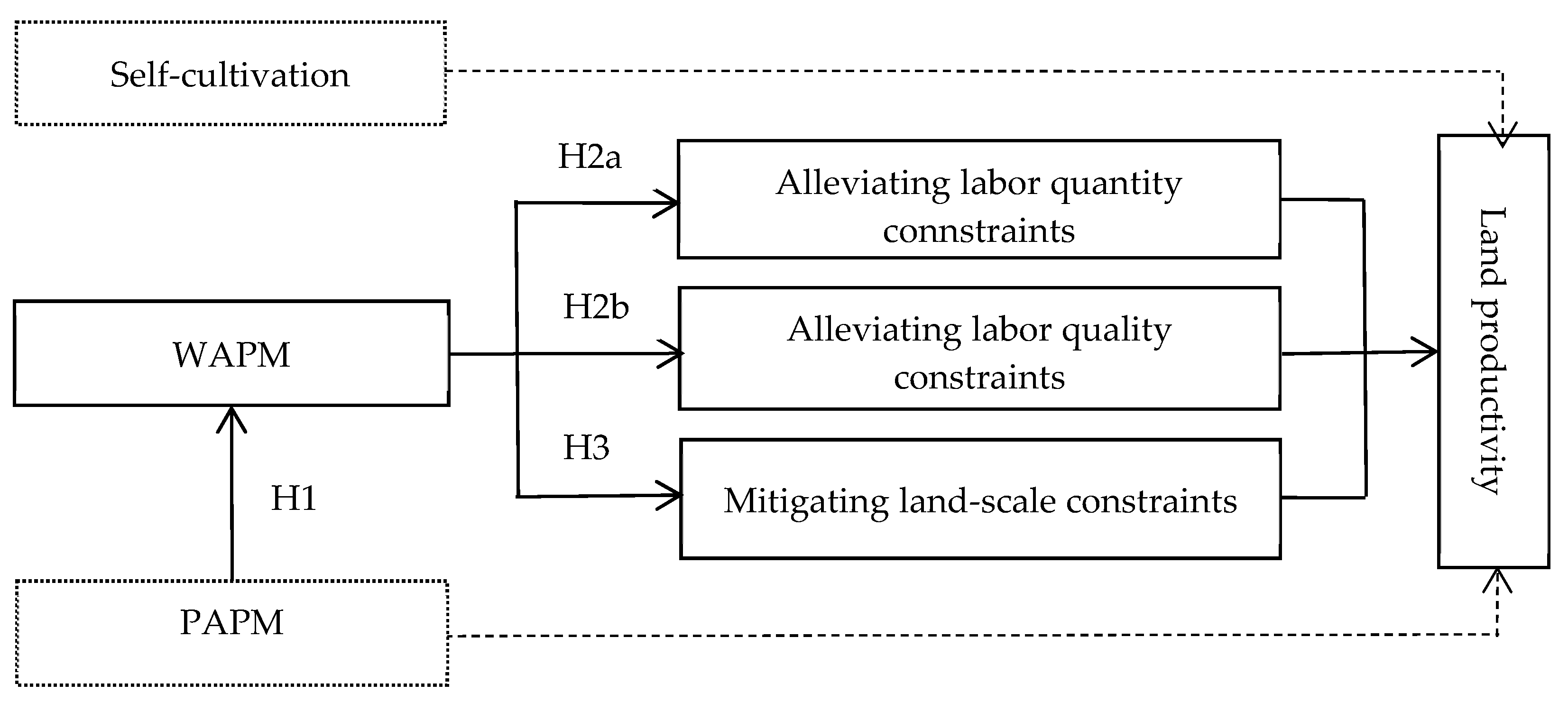
Theoretically,
Figure 1 proposes that WAPM enhanced land productivity through three specific pathways. The empirical results in
Table 5 and
Table 6 provided strong support for this framework. Specifically, the significant positive coefficients of the mediation terms confirmed that WAPM effectively unlocked these constraints. Therefore, the theoretical model depicted in
Figure 1 was empirically validated: WAPM did not merely increase input intensity but structurally optimized factor configuration, leading to the observed productivity gains.
4.4. Heterogeneity Analysis
The efficacy of WAPM was also found to be conditional on broader institutional and environmental contexts. Treatment-effect heterogeneity was explored with respect to two dimensions: regional agricultural specialization and local topography.
First, differential effects were tested between major and non-major grain-producing regions. The sample was partitioned accordingly, and results are presented in
Table 7. The estimates indicated that the productivity effect of WAPM was significantly larger in major grain-producing areas. This supported the hypothesis that regions characterized by more developed service markets and higher service quality provided a more conducive environment for WAPM to generate productivity gains. In contrast, thinner and less developed service markets in non-major areas may have limited potential returns to WAPM adoption.
Second, heterogeneity was examined with respect to village topography, which is a critical determinant of farming practices and service-market viability. The sample was divided into plains and hilly or mountainous areas. The results revealed that the treatment effect of WAPM was significantly more pronounced in hilly and mountainous regions. A plausible explanation was that these terrains presented obstacles to mechanization and were associated with lower baseline productivity; therefore, professional services via WAPM overcame substantial barriers, yielding larger marginal productivity improvements. Conversely, farms in plains regions operated closer to the technological frontier with higher mechanization levels, offering less potential for additional gains from WAPM adoption. Regarding infrastructure (topography), the finding that WAPM yielded larger productivity gains in hilly and mountainous regions was particularly noteworthy. It suggested that WAPM served as a critical compensatory mechanism in areas with poor natural endowments. In these regions, where traditional individual farming was inefficient due to terrain constraints, professional service providers—equipped with specialized machinery suitable for complex terrains—were able to achieve breakthroughs in efficiency that far exceeded what individual farmers could accomplish.
5. Discussion
5.1. The Productivity Effect of WAPM
The empirical results of this study clearly demonstrated that the adoption of WAPM had a robust positive impact on the land productivity of smallholder farmers. Even after controlling for endogeneity using PSM methods, this positive effect remained significant.
Specifically, our findings indicate that WAPM significantly improves land productivity. This result is consistent with the work of Li et al. (2018) [
41], who found that agricultural socialized services generally curbed inefficient agricultural investment. However, unlike previous studies that focused on single-stage outsourcing (e.g., only harvesting or plowing) [
42], this study highlighted the unique advantage of WAPM. By integrating all production stages, WAPM reduced transaction costs and coordination failures between different stages, offering a more comprehensive solution to the productivity stagnation of smallholders compared with PAPM.
5.2. Mechanism: Alleviating Labor Constraints
In terms of the transmission mechanism, the analysis revealed that WAPM primarily boosted productivity by optimizing the allocation of household labor resources. The results confirmed that productivity gains were particularly pronounced for households with labor shortages or an aging workforce.
Regarding these mechanisms, it was confirmed that WAPM alleviated constraints related to both labor quantity and labor quality (supporting H2a and H2b). This finding aligned with the research by Liu et al. (2025) [
43] on the substitution effect of machinery for labor. Furthermore, the results contributed to the literature on the “aging of the agricultural workforce”. While some scholars argued that aging negatively affected productivity [
43,
44], this study demonstrated that agricultural socialized services acted as an effective buffer. WAPM enabled elderly farmers to maintain high productivity by substituting their declining physical capacity with professionalized management services, thereby decoupling household labor endowments from agricultural output.
5.3. Theoretical Implication: Service Scale Economies
Furthermore, the heterogeneity analysis regarding farm size indicated that WAPM was particularly beneficial for small-scale operations, challenging the traditional view that land consolidation was the only viable modernization path.
The analysis of land-scale limitations addressed the classic debate on the “inverse relationship” between farm size and productivity [
36]. Traditional perspectives suggested that land consolidation was the primary route to modernization. However, the findings proposed an alternative path: “economies of scale in services” rather than “economies of scale in land” [
13]. WAPM allowed smallholders to access modern technology and achieve scale economies externally without transferring land rights. This extended the theoretical understanding of agricultural modernization in contexts where land fragmentation persisted.
5.4. Social Implications: Inclusiveness and Potential Inequality
Beyond productivity efficiency, the social implications of WAPM regarding smallholder inclusion and income inequality warranted in-depth discussion. First, contrary to the concern that modern technology might exclude smallholders, the findings suggested that WAPM fostered social inclusiveness. As evidenced by the mechanism analysis, WAPM significantly benefited aging households and those in disadvantaged mountainous regions. By enabling these vulnerable groups to access professional production means through market contracts, WAPM prevented them from being marginalized or forced out of the agricultural production cycle due to declining labor capability. In this sense, WAPM acted as a “stabilizer” for smallholder agriculture. Second, regarding income inequality, WAPM helped bridge the gap between farmers with different initial endowments. By substituting capital and technology for labor, it allowed labor-constrained households to achieve productivity levels comparable to those of labor-abundant households, thereby narrowing the inter-household income gap driven by labor heterogeneity. However, potential risks of exclusion remained. The adoption of WAPM required paying service fees, which created a capital threshold. Extremely poor households facing liquidity constraints might be excluded from this market, potentially widening the gap between those who could afford services and those who could not. Therefore, policy interventions, such as subsidies or financial credit for service purchase, are considered crucial to ensure that the dividends of WAPM are equitably shared.
5.5. Limitations and Future Research
Despite the robustness of these findings, this study had several limitations that should be acknowledged. First, although TWFE and PSM were employed to mitigate endogeneity, the use of survey data limited the ability to fully rule out time-varying unobserved confounders compared with randomized controlled trials. Second, the measure of land productivity relied on self-reported yield and value, which might have been subject to recall bias. Future studies could benefit from using satellite imagery or precision-agriculture data for more objective measurement. Finally, this study focused solely on economic productivity. Future research should further explore the environmental implications of WAPM, such as its impact on fertilizer-use efficiency and soil health.
6. Conclusions and Suggestions
6.1. Conclusions
Based on nationally representative data, this study empirically investigated the impact of WAPM on land productivity. The findings lead to three key conclusions:
First, agricultural socialized services are a potent driver of productivity growth, but the depth of integration matters. Our analysis confirms that WAPM yields a significantly higher productivity premium compared to PAPM. This validates the hypothesis that the comprehensive integration of production stages under a unified management structure offers superior efficiency gains over ad-hoc, fragmented outsourcing.
Second, WAPM effectively alleviates factor constraints inherent in the structural transformation of the rural economy. We found that the productivity-enhancing effects of WAPM are particularly pronounced for households facing severe labor constraints (both in terms of quantity and aging) and for those operating on small, fragmented plots. This indicates that WAPM serves as a critical substitute for household labor and a mechanism to achieve “service scale economies” without land consolidation.
Third, the benefits of WAPM are heterogeneous across regions. The positive impact is amplified in major grain-producing areas and regions with complex topography (e.g., hilly areas), where the marginal benefit of professional management is highest. This highlights the adaptability of the WAPM model to diverse agricultural contexts.
6.2. Suggestions
Based on the above research results, the following policy recommendations are proposed:
First, policymakers should prioritize the promotion of WAPM as a critical instrument for modernizing smallholder agriculture. Given its proven ability to alleviate labor and land scale constraints, government support should focus on incentivizing the adoption of WAPM in regions facing severe labor outflows. However, this promotion must strictly adhere to the foundational principles of China’s rural land system. Policies must ensure the stability of the household contract responsibility system and the security of farmers’ land-use rights, guaranteeing that farmers remain the primary beneficiaries of the value chain. Additionally, local governments should be encouraged to tailor service models to regional conditions, allowing for diverse forms of trusteeship where WAPM may not be fully applicable.
Second, government support for WAPM should be strategically targeted. The results indicated that productivity gains from WAPM were most pronounced in major grain-producing areas and hilly or mountainous regions. Therefore, policy and financial incentives should be concentrated in these areas to support the growth of service organizations and expand the scale of WAPM. Pilot programs for village-wide trusteeship should be encouraged, particularly in communities with high rates of off-farm labor migration. Moreover, specific initiatives are needed to promote technological innovation in machinery adapted for challenging topographies and to support mechanization-friendly infrastructure projects. Such efforts will lower the barriers for farmers in hilly regions to participate in WAPM.
Third, policy focus must extend beyond quantitative expansion to encompass service quality. As smallholders are integrated with WAPM organizations, it is crucial to establish robust mechanisms for monitoring service quality and facilitating information sharing. These measures will help reduce information asymmetry between farmers and providers, enhance farmer satisfaction, and build trust, thereby encouraging broader adoption. Ultimately, a sustained focus on service quality will ensure that the expansion of WAPM translates into durable gains in national land productivity.