Next Article in Journal
Research on Estimating Backfat Thickness in Jinfen White Pigs Using Deep Learning and Image Processing
Previous Article in Journal
Multi-Cooperative Agricultural Machinery Scheduling with Continuous Workload Allocation: A Hybrid PSO Approach with Sparsity Repair
error_outline You can access the new MDPI.com website here. Explore and share your feedback with us.
 
 
Article

Evaluation of Sensor-Based Soil EC Responses to Nitrogen and Potassium Fertilization Under Laboratory and Field Conditions


Department of Environmental and Biological Chemistry, Chungbuk National University, Cheongju 28644, Chungbuk, Republic of Korea
*
Author to whom correspondence should be addressed.
Agriculture 2026, 16(2), 137; https://doi.org/10.3390/agriculture16020137
Submission received: 25 November 2025 / Revised: 1 January 2026 / Accepted: 2 January 2026 / Published: 6 January 2026
(This article belongs to the Section Agricultural Soils)

Abstract

Improving nutrient use efficiency and minimizing environmental pollution from excessive fertilization require appropriate nutrient management supported by continuous monitoring of soil nutrient levels during crop growth. As only a few real-time sensors for the measurement of soil nutrients are available, this study evaluated the potential of electrical conductivity (EC) sensors, which reflect the ionic concentrations of the soil solution, for real-time estimation of plant-available nutrient levels. Nitrogen and potassium were sequentially supplied to achieve cumulative application rates of 25–300% of the nutrient uptake-based fertilization rate. The relationship between cumulative fertilization rate and accumulated sensor-based EC increase was described using linear, polynomial, and nonlinear saturation models. Sensor EC increased linearly from 25 to 125% of the nutrient uptake-based fertilization rate, while higher application rates were better explained by the nonlinear saturation equation. Sensor-based EC showed strong correlation with soil ammonium nitrogen (NH4+-N), indicating that the sensor effectively reflected nutrient dynamics. In open-field pepper soil, fertigation-induced increases in sensor EC followed the patterns predicted by both the linear and nonlinear saturation models established in the laboratory. These results demonstrate that EC sensors can be used for real-time monitoring of soil nutrient levels and may contribute to efficient nutrient management in open-field cultivation.

1. Introduction

Over the past decades, the prolonged and excessive use of chemical fertilizers has accelerated nutrient losses through leaching, volatilization, and run-off [1,2]. As a result, the accumulation or deficiency of specific nutrients has led to nutrient imbalance, deterioration of soil structure, and reduced biological activity, ultimately undermining soil health and productivity [3]. Sustainable agriculture relies on efficient nutrient management to maintain soil fertility, achieve high crop productivity, and minimize environmental pollution [4]. Therefore, to ensure the long-term sustainability of agricultural production, the optimization of nutrient usage while maintaining soil health is required. However, the estimation of nutrient contents in soil remains challenging because only a few real-time soil nutrient monitoring systems suitable for field-based applications are commercially available [5,6]. There are rather few sensors available which can directly measure N and K in situ [6]. Instead, most sensors rely on indirect indicators such as soil electrical conductivity, which is influenced by soil moisture, temperature, and ionic composition. Even the currently available sensors showed limitations in estimating soil available nutrients due to their instability under varying soil variables such as pH, temperature, and electrical conductivity (EC) [7,8]. Therefore, it is not robust enough for continuous use in heterogeneous and dynamic field conditions. Furthermore, conventional methods are inadequate for monitoring rapid changes in soil nutrients in situ [9,10]. Therefore, developing real-time soil nutrient detection technology is essential for ensuring sustainable and effective agricultural management [11].
Although laboratory-based methods are reliable, they involve complex procedures such as sampling, sample transport, and instrumental analysis. These multiple procedures are inappropriate for in situ and real-time monitoring of soil nutrient contents on a large scale [12]. The delay between soil sampling and data receiving limits the applicability of conventional methods for real-time nutrient management, particularly under dynamic conditions influenced by fertilization, irrigation, and weather variability [9]. Thus, sensor-based approaches are practical to accurately monitor soil conditions and nutrient contents in real time [13]. However, because only a few sensors are currently capable of directly measuring nutrient levels in soils, indirect estimation using existing sensors represents a viable option for sustainable agriculture.
For both direct and indirect measurement of nutrients in soil, various sensors can be used. Optical sensors, including visible and near-infrared (Vis-NIR) spectroscopy, mid-infrared (MIR) spectroscopy, and Raman spectroscopy, are promising approaches for in situ analysis of soil nutrients due to their rapid, non-destructive, and high-resolution capabilities [9]. Electrochemical sensors, including the ion-selective electrode (ISE) and ion-selective field effect transistor (ISFET), are sensitive and adaptable tools for detecting the concentration of specific ions by the reaction between ion-selective membranes and target ions [14]. Electrochemical impedance spectroscopy (EIS) is also a highly sensitive analytical technique that measures impedance responses over a wide frequency range, allowing for the separation and interpretation of various electrochemical processes, such as charge transfer and interfacial reactions. An ISE based on EIS can be used to monitor soil nitrate [15]. Despite the great potential of optical sensors and electrochemical sensors for real-time analysis, both sensors are significantly affected by soil properties, such as pH, moisture, texture, and temperature [9]. Optical sensors require expensive light source and appropriate preprocessing methods, such as denoising, scattering, baseline correction, and standardization, to accommodate different soil types [16]. Although electrochemical sensors offer the advantage of direct nutrient measurement, interactions among multiple soil nutrient elements may limit their accuracy [14]. In addition, electrochemical sensors generally require validation of long-term stability, because they consume reactive materials and rely on advanced technologies [17,18].
Among the existing sensing technologies, the EC sensor can be used for predicting soil nutrient contents because EC increases with increasing ions in soil solution [19,20]. For example, the apparent EC measured by the VerisEC sensor showed significant correlations with plant nutrients such as total N and K in soil [21]. Soil EC in crop fields was positively correlated with K and Mg contents as well as the satellite-derived normalized difference vegetation index (NDVI) of crops [22]. Jafaryahya et al. [23] reported that EC measured by EC sensors (TEROS 12, METER Group, Pullman, WA, USA) was linearly correlated with the potassium concentration, and a neural network machine learning model achieved prediction errors below 0.05 mg kg−1. Mirzakhaninafchi et al. [24] showed a high regression coefficient (R2 > 0.9) using polynomial regression for available nitrogen in three types of soil (clay loam with 46% clay, sandy loam with 61% sand, and sandy loam with 41% silt) with EC sensors (HI98331 Soil TestTM direct soil EC Tester, Hanna Instruments, Woonsocket, RI, USA). Mazur et al. [25] monitored soil EC with a sensor (U3 Soil Scanner, Veris Technologies, Salina, KS, USA) in three maize fields (23.4 ha, 25.4 ha, and 52.4 ha), and the sensor-based EC showed a Pearson correlation coefficient of 0.8 with potassium and 0.4 with magnesium. Kim and Park [26] showed that sensor-based EC values were positively correlated with exchangeable ions. Mechanistically, EC reflects both electrolyte conduction through the pore fluid and surface conduction along charged mineral surfaces associated with the diffuse double layer, as reported by Klein and Santamarina [27]. In multi-phase soil systems, EC provides robust data at frequencies up to the kHz range, integrating contributions from soil moisture, ion composition, porosity, and tortuosity. Therefore, EC sensors remain useful and cost-effective for long-term nutrient monitoring and for facilitating fertilizer application through irrigation systems, even though they are relatively simple and sometimes regarded as an old technique [19,20].
However, the direct use of EC sensors for nutrient quantification in field soil remains challenging. Soil EC sensor readings are influenced by various soil properties, such as soil moisture content, texture, bulk density, temperature, and salinity, because of three main pathways of EC measurement: (i) exchangeable ions adsorbed on the clay surface, (ii) dissolved salts in soil solution, and (iii) direct electrical contact between soil particles [19,28]. These multiple and inseparable soil factors make simple sensor-based monitoring insufficient for precise nutrient estimation [20]. This paper evaluates the field applicability of EC sensors and discusses their potential for real-time nutrient management. In this paper, soil EC was continuously monitored under controlled laboratory conditions using sensors following sequential nitrogen and potassium fertilization to assess the quantitative relationship between EC changes and nutrient additions.

2. Materials and Methods

2.1. Sequential Fertilization and Soil EC Monitoring in the Laboratory

The laboratory experiment was conducted from May to July 2025. Soil samples were collected from farmland located in Seunggok-ri, Nakdong-myeon, Sangju-si, and Gyeongsangbuk-do, Republic of Korea (36°21′55.5″ N, 128°13′56.4″ E, WGS84 datum). The collected soil samples were dried and passed through a 2 mm sieve. The farmland soil was sandy loam in texture with 20.83, 69.17, and 10.00 percent sand, silt, and clay. The soil organic matter content was 2.07%, which is rated a moderate level for agricultural soils [29]. Based on the World Reference Base for Soil Resources (WRB), the soil is classified as a Cambisol. The physicochemical properties of the soil are presented in Table 1. The soil was packed into a plastic box (13 × 13 × 13 cm) at a weight of 1.88 kg, corresponding to a soil volume of 1.5 L. Deionized water was added to adjust the water content to 25% (v/w). Soil EC was monitored using an EC sensor (TEROS 12, METER Group, Pullman, WA, USA) inserted vertically into the soil. The sensor has an epoxy-filled head (9.4 × 2.4 × 7.5 cm) equipped with three stainless steel rods (5.5 cm) arranged linearly with a fixed spacing of approximately 2.2 cm between adjacent rods. The TEROS 12 sensor is a capacitance-based sensor that operates at a measurement frequency of 70 MHz and simultaneously measures soil volumetric water content, temperature, and bulk EC. The applied oscillating electrical signal induces redistribution and storage of electrical charge within the surrounding soil, and changes in capacitance are used to derive volumetric water content and bulk EC, while soil temperature is measured using a thermistor embedded in the sensor. The TEROS 12 sensor was connected to a data logger (ZL6, METER Group, Pullman, WA, USA), which records sensor measurements at 1 min intervals and stores averaged values over the user-defined logging interval. In this study, EC data were logged at 15 min intervals as the average of 1 min measurements.
Three fertilizer treatment groups were established: N treatment (nitrogen-only), K treatment (potassium-only), and NK treatment (both nitrogen and potassium). Nitrogen and potassium were sequentially applied, and cumulative application rates corresponded to 25, 50, 75, 100, 125, 150, 200, and 300% of the nutrient uptake-based fertilization rate by diluting stock solutions (100 g L−1) of urea (CO(NH2)2, 46% of N, Namhae Chemical Corp., Ltd., Yeosu-si, Jeollanam-do, Korea) and potassium chloride (KCl, 60% of K2O, Namhae Chemical Corp., Ltd., Yeosu-si, Jeollanam-do, Korea), respectively. The nutrient uptake-based fertilization rate (100%) was 330 kg N ha−1 and 342 kg K ha−1. The nutrient uptake-based fertilization rates were based on a previous open-field pepper cultivation experiment and represents the total nutrient input applied over the growing season, considering both crop nutrient uptake and potential nutrient losses under field conditions. At each fertilization step, the fertilizer stock solution and deionized water were added in a total volume equivalent to the water loss calculated from the change in total weight, with the volume of stock solution adjusted to achieve the corresponding cumulative fertilizer application rate. When the soil water content decreased below 20%, the next sequential fertilization step was conducted using the same procedure.

2.2. Soil EC Monitoring During Fertigation in Field

Field monitoring of soil EC in response to fertilizer application was conducted in an open-field pepper cultivation area in September 2025, where soil for laboratory EC monitoring was collected as described in Section 2.1. The treatment plot covered an area of 171 m2. Nitrogen and potassium were fertigated using urea (46% of N, Namhae Chemical Corp., Ltd., Korea) and potassium sulfate (K2SO4, 45% of K2O, Pungnong Co., Ltd., Seocheon-gun, Chungcheongnam-do, Korea), respectively. The soil EC monitoring began 125 days after transplanting (DAT). During the soil EC monitoring period, two fertigation events were carried out: 22.9 kg N ha−1 and 33.6 kg K ha−1 were applied on the first fertigation day (F1), and 31.7 kg N ha−1 and 55.1 kg K ha−1 were supplied on the second (F2). EC sensors (TEROS 12, METER Group, Pullman, WA, USA) were inserted at a depth of 5 cm with an inter-sensor spacing of approximately 40 cm. Soil EC was monitored starting 1 day before the F1 for 7 days to evaluate changes in sensor-based EC values following fertigation. The EC sensors were connected to a data logger (ZL6, METER Group, Pullman, WA, USA), which collected soil volumetric water content, temperature, and bulk EC at 30 min intervals.

2.3. Modeling of Relationship Between Sensor-Based EC Values and Fertilization Rate

The sensor-based EC data obtained from both laboratory and field monitoring were preprocessed to evaluate the relationship between increased sensor-based EC values and cumulative fertilization rate. The changes in sensor-based EC (∆EC) for each fertilization event were calculated as the difference between the averaged sensor-based EC values before and after fertilization, after calibration to 20% volumetric water content. The averaging windows were defined as 24–36 h before and 24–36 h after each fertilization event for the laboratory monitoring, and 8 h before and 12–20 h after each fertigation event for the field monitoring. The averaging windows for ∆EC calculation were adjusted so that all data points were within the soil moisture range of 15–30%, v/v, where sensor-based EC and volumetric water content showed a linear relationship for proper calibration of EC based on water content. When nonlinearity occurred, the averaging window was shifted to include only the linear range of the sensor-based EC–water content relationship. The sensor-based EC calibration based on water content and ∆EC calculations were conducted according to Equations (1) and (2).
E C ¯ c a l = E C ¯ m e a n × 20 θ ¯
E C = E C ¯ c a l , a f t e r E C ¯ c a l , b e f o r e
where E C ¯ c a l represents sensor EC calibrated based on water content, and E C ¯ m e a n and θ ¯ are the mean sensor-based EC and volumetric water content (%) within each averaging window, respectively. E C ¯ c a l , a f t e r and E C ¯ c a l , b e f o r e indicates E C ¯ c a l after and before fertigation, respectively.

2.4. Soil Analysis

To determine the relationship between soil nutrient contents and sensor-based EC values in the laboratory experiment, soil samples were collected before each fertilization step and used for analysis. Soil texture was determined by the hydrometer method [30], and classified according to the United States Department of Agriculture (USDA) soil texture triangle. Soil organic matter content was analyzed using the Walkley–Black method [31]. For measurements of soil pH and EC, air-dried soil was mixed with deionized water at a 1:5 ratio (w/v) and shaken at 180 rpm for 30 min. The pH and EC of the soil were measured using a pH/conductivity meter (A215 pH/Conductivity Benchtop Multiparameter Meter, Thermo Fisher Scientific, Waltham, MA, USA). For inorganic nitrogen analysis, fresh soil samples were extracted with 2 M KCl at a 1:10 ratio (w/v) and shaken at 180 rpm for 30 min, then filtered through a 0.45 µm syringe filter. NH4+-N and NO3-N contents in the extracts were determined by the indophenol blue method and the vanadium(III) chloride reduction method, respectively [32,33]. Available phosphorus content of the soil was analyzed using the Bray No. 1 method [34]. Exchangeable cations were extracted by shaking soil with 1 M ammonium acetate at a 1:10 ratio (w/v) for 30 min at 180 rpm, followed by filtration through a 0.45 µm syringe filter. The filtrates were analyzed for cation concentrations using an inductively coupled plasma–optical emission spectrometer (ICP-OES; Avio 500, PerkinElmer, Waltham, MA, USA).

2.5. Statistical Analysis

For the laboratory monitoring, each fertilizer treatment (N, K, and NK) was conducted in duplicate, and the mean values obtained from five EC sensors were used for the field monitoring analysis. To evaluate the effect of fertilizer treatments on sensor-based EC values, soil pH, EC, and available nutrients, one-way analysis of variance (ANOVA) was conducted using SPSS 27 software (IBM, Armonk, NY, USA), followed by post hoc analysis performed with Duncan’s multiple range test (DMRT) at p < 0.05. Principal component analysis (PCA) was conducted using Xlstat-Student 2025.1.3.1431 (Addinsoft, New York, NY, USA) to evaluate the correlations among sensor-based EC values, soil pH, extract EC, and available nutrients.

3. Results and Discussion

3.1. Changes in Soil Chemical Properties According to Sequential Fertilization

Soil samples were collected at each fertilization stage, just before the next nutrient application, to analyze the pH, extract EC, inorganic nitrogen (NH4+-N and NO3-N), and exchangeable cations. Among the treatment groups, the sensor-based EC values showed a consistent trend of NK > N > K. The extract EC increased with cumulative nutrient application up to 100% and then decreased, showing a pattern similar to the increase in sensor-based EC (Table 2). The lack of further increase in extract EC beyond the 100% fertilization rate may be attributed to the saturation of soil cation exchange sites and the fixation of cations by non-exchangeable sites. At high nutrient concentrations, NH4+ and K+ compete for the same exchange sites and rapidly saturate the exchange complex, after which additional ions may become fixed in the interlayers of clay minerals [35]. Maintaining soil EC within an appropriate range is essential for crop growth. For most crops, optimal soil EC typically ranges 0.8–1.8 dS m−1, although the appropriate soil EC range varies with the growth stage [19]. Soil EC values above 2.5 dS m−1 may inhibit water uptake due to increased osmotic pressure, interfere with nutrient uptake, and cause symptoms such as root tip browning, dehydration, and a higher susceptibility to root diseases [19,36].
The soil pH of N and NK treatments was significantly lower than the K treatment, indicating soil acidification caused by H+ generation during the nitrification of NH4+ released through urea hydrolysis [37]. Therefore, both NH4+-N and NO3-N contents increased with higher nutrient application rates (Table 2). The decrease in soil pH was greater in the N treatment than the NK treatment, likely due to the additional application of K+. The soil acidification could be buffered by base cations such as exchangeable Ca2+, Mg2+, and K+ within the pH range of 4.5–7.5 [38]. At the 125% cumulative nutrient application rate, the NK treatment showed significantly higher exchangeable K+ content and a correspondingly higher content of exchangeable Ca2+ and Mg2+ (Table 2). The Ca2+ and Mg2+ directly compete with K+ for adsorption sites on soil colloids, and their displacement or redistribution alters the composition of exchangeable cations in the soil [39]. The 125% cumulative application rate represents the point where the soil cation exchange sites become saturated and additional NH4+ and K+ begin to shift into non-exchangeable fixation pools. The N treatment showed significantly higher exchangeable Ca2+ and Mg2+ contents than the K treatment (Table 2). The acidification caused by nitrification in the N treatment may increase the availability of Ca2+ and Mg2+, which aligns with the higher NH4+-N and NO3-N contents and lower pH in the N treatment [40] (Table 2).

3.2. Correlation of Sensor-Based EC and Soil Chemical Properties

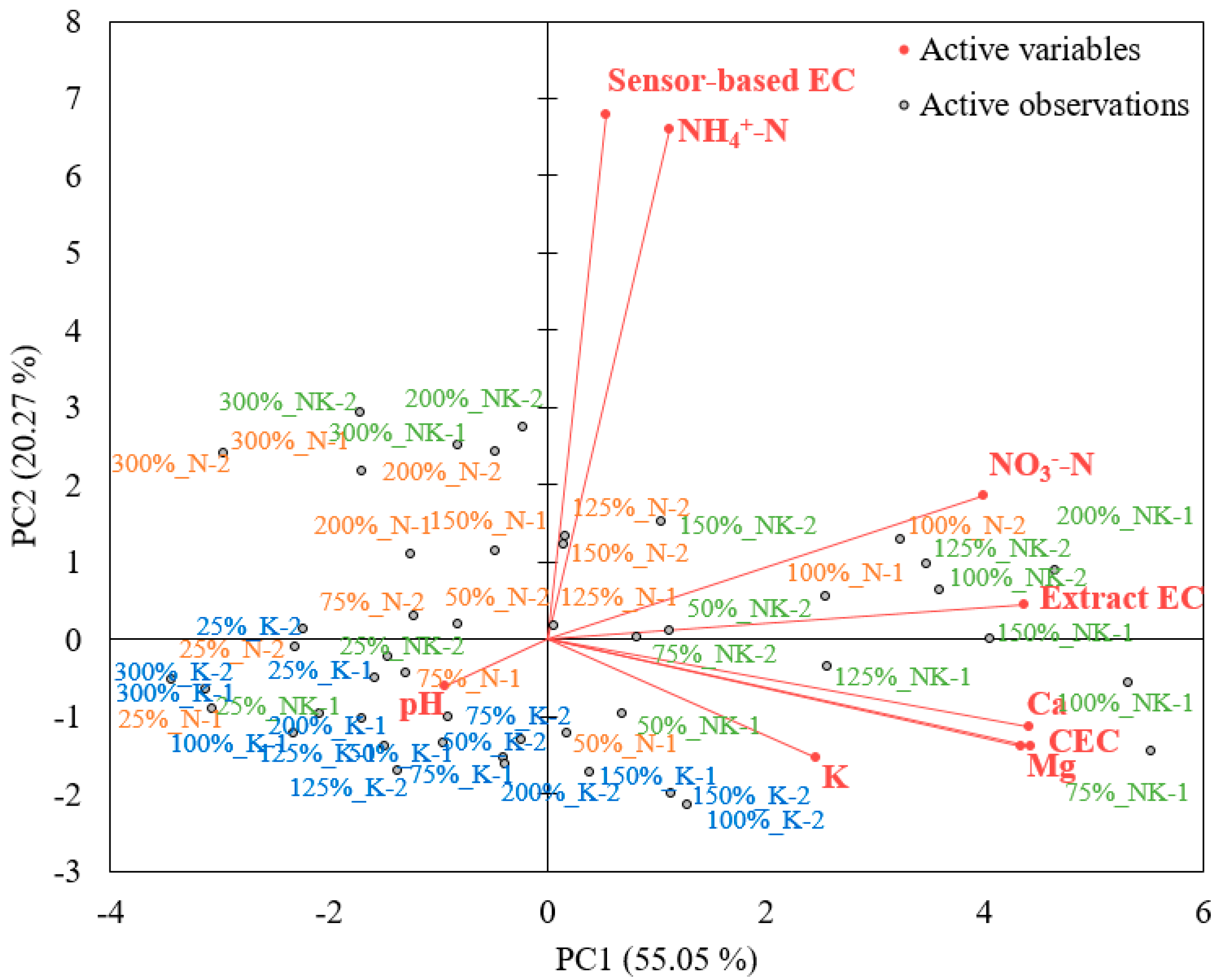
The principal component analysis (PCA) was conducted using data obtained from the sequential fertilization in the laboratory to identify the relationships between the sensor-based EC and the soil chemical properties. In the PCA, the first principal component (PC1) explained 55.0% of total variance, while second and third principal components (PC2 and PC3) accounted for 20.3% and 14.5%, respectively. PC1 showed high positive loadings for extract EC, exchangeable Ca, Mg, and K, and NO3-N, whereas PC2 had high positive loadings for sensor-based EC and NH4+-N, and PC3 for pH and exchangeable K (Table 3). These results indicate that PC2 was associated with the EC sensor response to ammonium accumulation in soil solution because urea is rapidly hydrolyzed in soil and released NH4+ [41]. Sensor-based EC showed weak correlation with extract EC, which might be attributed to differences in their measurement principles. The sensor-based EC represents bulk volumetric EC measured in situ and affected by soil water content and electrolyte concentration across the soil volume. In contrast, extract EC reflects localized soil conditions measured under standardized laboratory settings after sampling. Therefore, while extract EC provides point-specific information on soil salinity, sensor-based EC is more suitable for assessing dynamic changes in soil chemical properties under field conditions [20].
Since soil EC reflects the concentration of dissolved salts in the soil solution, the concentration of NH4+ is likely to be reflected in the sensor-based EC [19]. In this study, the correlation between sensor-based EC and NH4+-N was stronger than NO3-N. This result contrasts with previous studies, which reported stronger correlations between sensor-based EC and NO3-N under organic matter application and N fertilization in open-field broccoli soils [27,42]. Excessive fertilization can lead to the accumulation of salt in the soil [43]. In this study, urea was applied in excess, and the sensor-based EC was monitored up to 300% of the cumulative nutrient application rate under laboratory conditions within a short time, which led to the accumulation of NH4+ ions dominating the sensor-based EC response. This interpretation is consistent with the PCA results, in which samples with higher N application rates were positioned toward the positive side of PC2.
The distribution of the N and NK treatment was distinguished from the K treatment distributed in the lower left quadrant (Figure 1). Most N and NK treatments were distributed on the positive side of PC2, which showed high loadings for sensor-based EC and NH4+-N, indicating positive correlation with these variables. This indicates that the sensor-based EC was influenced by the ionic dynamics associated with urea hydrolysis, particularly the accumulation of NH4+ prior to nitrification. Since urea is continuously transformed from NH4+ release to subsequent nitrification, the sensor-based EC reflected these sustained changes associated with N fertilization [44].
Despite the high ionic contribution of KCl, the K treatment positioned in the negative side of PC2 showed a weak correlation with sensor-based EC. This weak correlation between the sensor-based EC and K treatment could be explained by the rapid adsorption of K+ ions onto soil colloids and significantly lower NH4+-N content in the K treatment compared with the N and NK treatments, as NH4+-N was the dominant ion influencing the sensor-based EC response [45] (Table 3). The high cumulative nutrient applications (150–300%) were also positioned on the positive side of PC2, showing strong associations with sensor-based EC. Han et al. [46] reported that soil EC increased from 0.24 to 0.68 dS m−1 as N fertilization increased from 0 to 1200 kg N ha−1.

3.3. Sensor-Based EC Response to Sequential Fertilization

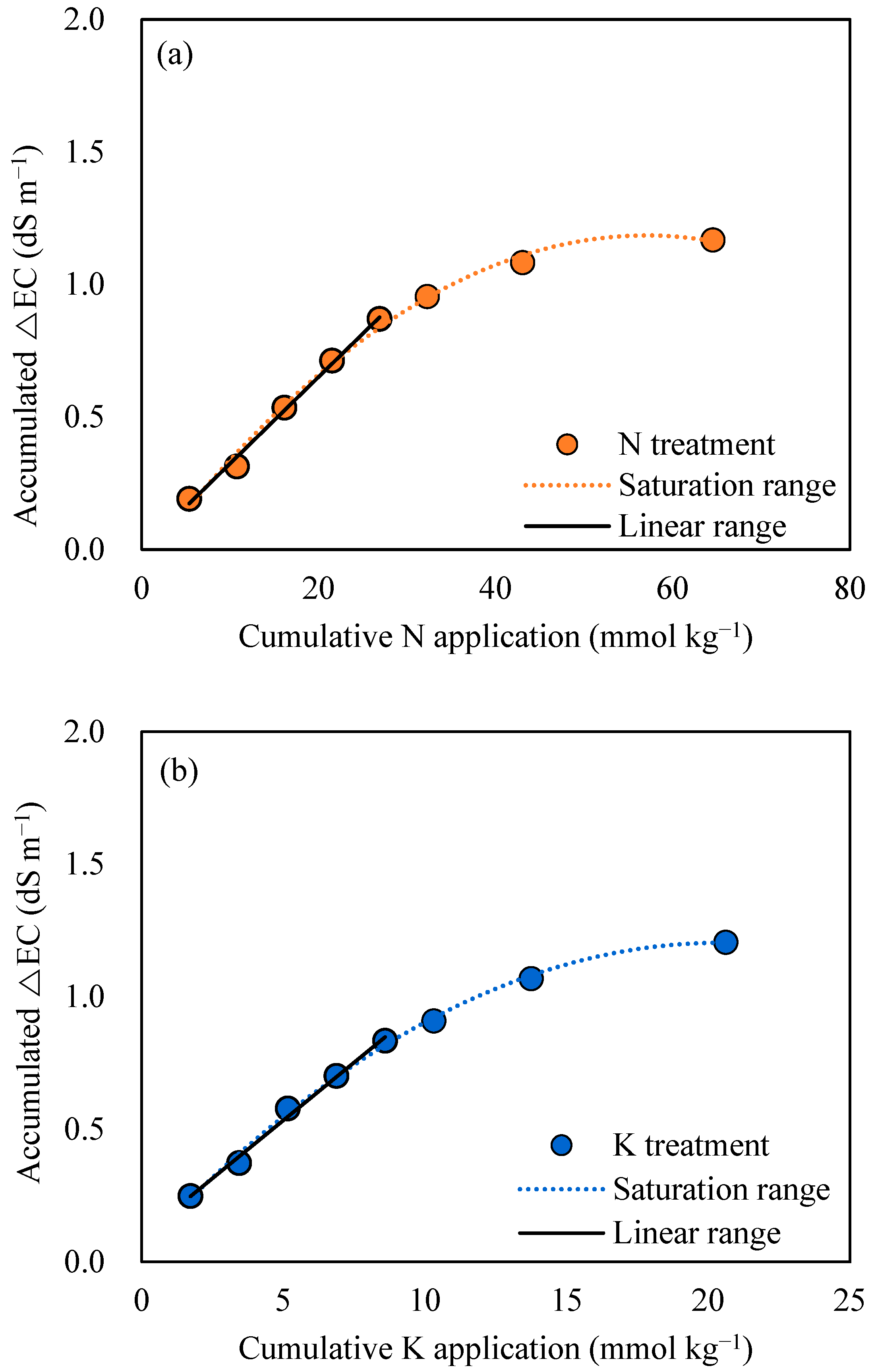
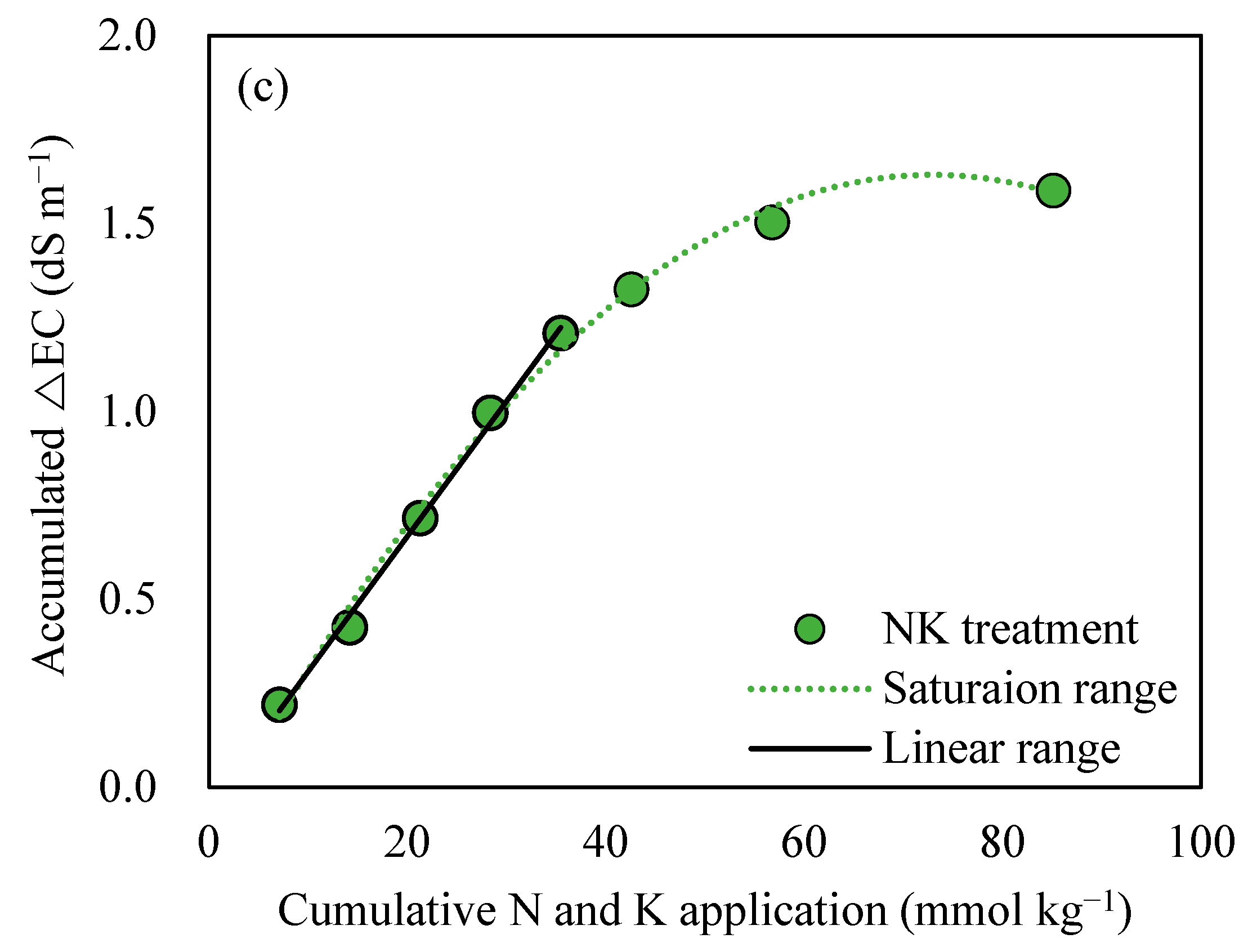
Sensor-based EC values increased with the increase in the cumulative fertilizer application rate, and the accumulated increase in sensor-based EC varied among fertilization treatment groups (Figure 2). In the lower range of cumulative nutrient application (25–125% of the nutrient uptake-based fertilization rate), sensor-based EC showed a linear increase following the nutrient input, with R2 values above 0.998 for all treatments. However, in the higher range (150–300%), the increase in sensor-based EC values gradually diminished as cumulative nutrient application increased. The sensor-based EC responded sensitively to the increase in ion concentrations at moderate fertilization levels but eventually approached a saturation state at higher concentrations. This behavior can be attributed to reduced ionic mobility due to enhanced ion–ion interactions and limitations in pore connectivity with increasing ionic concentrations. Therefore, the relationship between cumulative nutrient application and accumulated sensor-based EC increase (total increase in EC) can be described using the following nonlinear saturation equation:
A c c u m u l a t e d E C = a F b + F
where ∆EC is the increase in sensor-based electrical conductivity (dS m−1), F is the cumulative nutrient application (mmol kg−1), a represents the maximum sensor-based EC response achievable under excessive fertilization, and b is the half-saturation constant corresponding to the nutrient application at which ∆EC reaches half of a. A second-order polynomial equation also showed a similar fitting (R2 > 0.99) for all treatments (Figure 2). However, because the polynomial equation represents only an empirical curve that follows data, it was used as a reference to illustrate the curvature of the observed EC response and to allow for a comparison with linear and nonlinear saturation equations. The linear, second-order polynomial, and nonlinear saturation equations fitted EC–nutrient relationships are as follows:
  • For the N treatment
    (i)
    Linear equation; y = 0.0327x − 0.0017 (R2 = 0.9939);
    (ii)
    Second-order polynomial equation; y = −0.0004x2 + 0.0437x − 0.0607 (R2 = 0.9938);
    (iii)
    Nonlinear saturation equation; y = 1.17 x 17.6 + x
  • For the K treatment
    (i)
    Linear equation; y = 0.0874x + 0.0973 (R2 = 0.9921);
    (ii)
    Second-order polynomial equation y = −0.0028x2 + 0.1126x + 0.0531 (R2 = 0.9971);
    (iii)
    Nonlinear saturation equation; y = 1.21 x 5.49 + x
  • For the NK treatment
    (i)
    Linear equation; y = 0.0359x − 0.0513 (R2 = 0.9964);
    (ii)
    Second-order polynomial equation; y = −0.0003x2 + 0.0485x − 0.1407 (R2 = 0.9948);
    (iii)
    Nonlinear saturation equation; y = 1.59 x 23.2 + x
The increase in soil EC with increasing fertilizer application is consistent with previous studies [25,47]. Carneiro et al. [48] reported that soil EC increased linearly (R2 = 0.95) with KCl application rates ranging 50–150% of recommended dose. Since soil EC reflects the concentration of major inorganic solutes dissolved in the soil solution consisting of soluble and readily dissolvable salts, the pronounced accumulated increase in sensor-based EC observed in the NK treatment (1.59 dS m−1) is most likely attributable to its highest cumulative nutrient input [25]. Although the K application was lower than N, the increase in sensor-based EC values was comparable to that of the N and NK treatments. Because KCl is a highly soluble electrolyte that dissociates into K+ and Cl- in the soil solution, these ions directly increase the ionic strength and are reflected as higher soil EC [49]. However, in the NK treatment, the simultaneous presence of NH4+ with K+ results in competitive adsorption and ionic interactions that limit the increase in free K+ in the soil solution. Therefore, the K treatment showed a relatively high EC response per unit of nutrient input with a higher slope (0.0801) compared with the N (0.0301) and NK (0.0329) treatments (Figure 2).

3.4. Field Validation of Sensor-Based EC Response to Fertigation

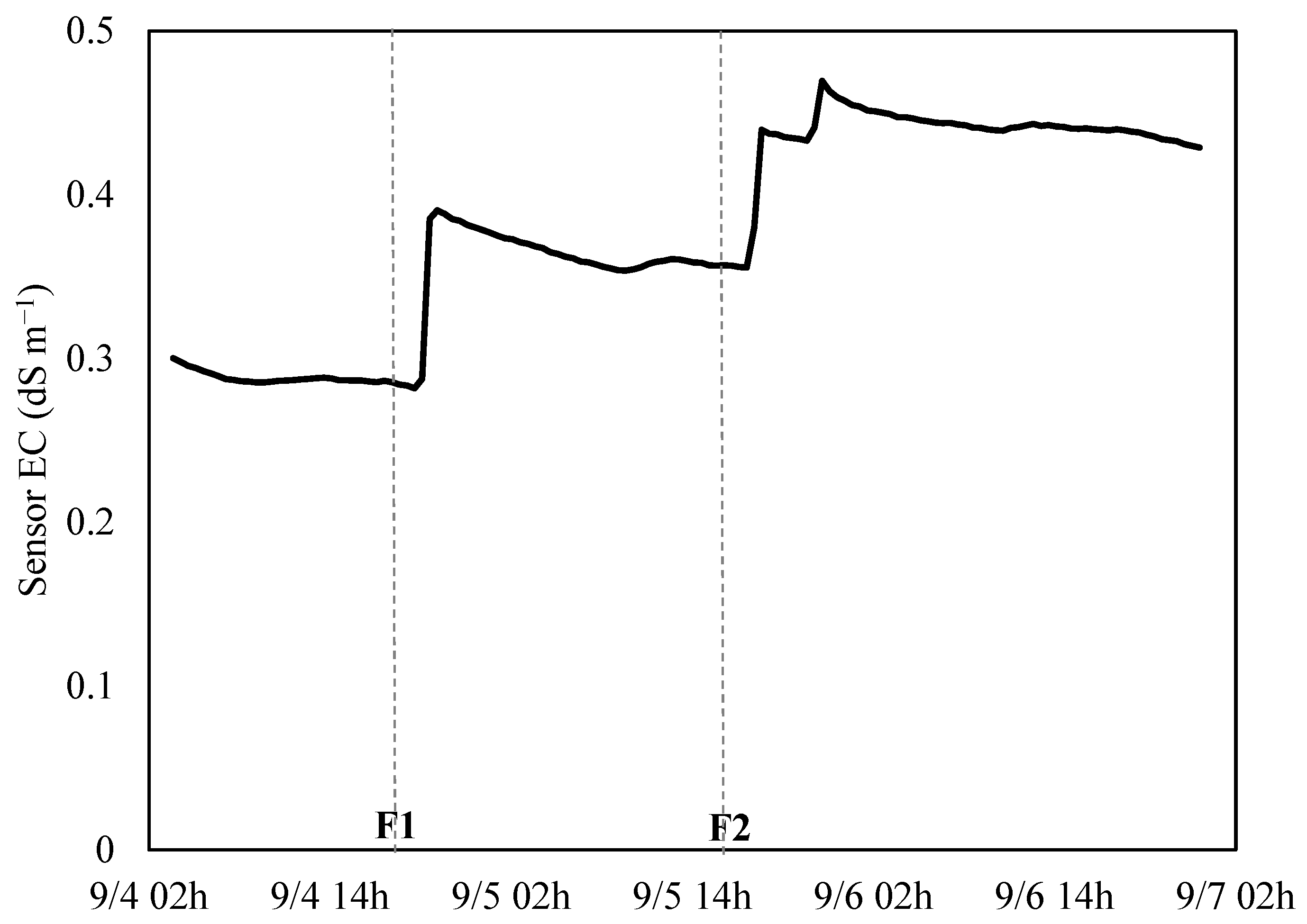
To evaluate whether the relationship between the nutrient application rate and sensor-based EC observed under laboratory conditions could be applied under field conditions, the equation derived from the NK treatment was applied to open-field pepper soil fertigated with N and K. F1 and F2 represent the first and second fertigation events, respectively. The total amounts of N and K applied on F1 and F2 are denoted as F 1 and F 2 , respectively. The nutrient application rates were 2.09 mmol kg−1 for F 1 and 3.09 mmol kg−1 for F 2 (Table 4). The sensor-based EC showed an increased peak with each fertigation, followed by a gradual decrease (Figure 3). To estimate the increased sensor-based EC values caused by fertigation, the initial fertilizer amount ( F 0 ) (an equivalent cumulative amount of N and K applied to the soil before EC monitoring) was determined. The initial sensor-based EC value before fertigation (0.295 dS m−1) was inserted into the linear, polynomial, and nonlinear saturation equations, resulting in F 0 values of 9.66, 9.55, and 5.31 mmol kg−1, respectively. With f ( x ) representing the fitted EC–nutrient relationship in the three equations and x representing the cumulative N and K application rate (mmol kg−1), the predicted sensor-based EC changes after the first fertigation event were calculated as f ( F 0 + F 1 ) f ( F 0 ) , and after second event as f ( F 0 + F 1 + F 2 ) f ( F 0 + F 1 ) .
The sensor-based EC value increased by 0.08 dS m−1 after F1 and by 0.09 dS m−1 after F2. Among the three equations, the linear model closely predicted the observed sensor-based EC increase under field conditions (Table 4). This is likely because the fertilization rate applied to the pepper field was much lower than those applied in the sequential fertilization experiment under laboratory conditions, falling within the range where the relationship between the sensor-based EC and fertilization rate remained linear. The polynomial equation derived from the NK treatment showed a mathematical maximum in accumulated ∆EC at a cumulative N and K application of 80.8 mmol kg−1, followed by a decrease after the maximum. This mathematical behavior reflects the inherent nature of polynomial functions, which produce a peak and subsequent decrease. However, the observed response of the sensor-based EC under laboratory conditions showed diminishing increases in the saturation trend for the sensor-based EC at a high nutrient application rate. Although the polynomial empirically describes the curvature of the observed ∆EC within the applied fertilization range, its peak at higher application rates arises from the mathematical properties of the function and does not represent the physical saturation behavior of soil EC. Therefore, the polynomial equation was not suitable for explaining the changes in sensor-based EC. Although a linear equation may be applicable when nutrient application rates are low, the nonlinear saturation equation is more appropriate in practice for the relationship between sensor-based EC and nutrient application because nutrient levels in field environments can vary from low to high.
The soil chemical properties were analyzed after F2 (Table 5). Although soil N and K concentrations did not increase in direct proportion to the applied fertilizer rates, measurable increases in both nutrients were observed following fertigation. These measurements provide a reference for understanding soil EC responses after fertigation under field conditions. The laboratory-derived fitting equations describe changes in sensor-based EC as a function of nutrient input. Therefore, the fitting equation may support the interpretation of soil EC response patterns following fertigation.
These field validation results indicated that sensor-based EC could reflect soil ionic strength changes due to fertilization under open-field conditions. The observed pattern, in which the sensor-based EC spiked immediately after fertigation and then rapidly declined, may be attributed to the dilution and redistribution of soluble ions (Figure 3). Yao et al. [50] reported that soil salinity decreased as salts dispersed during the water redistribution phase. Kumari et al. [51] reported the sensor-based EC increased immediately after fertigation and subsequently stabilized under field conditions, suggesting that simultaneous monitoring of soil moisture and EC might help determine optimal fertilization timing, reduce nutrient losses, and enable more precise nutrient management.
STENON (Stenon FarmLab, Stenon GmbH, Potsdam, Germany), NUTRISENS (Nutrisens, Verde Smart Corporation, Huelva, Spain), and DOTS (Beer Sheva, Israel) are representative commercially available sensors. The STENON sensor, combing electrical impedance spectroscopy and optical spectroscopy, is rapid and provides spatial distribution for soil parameters such as moisture, K, and pH. However, according to Grenzdörffer et al. [7] and Steiger et al. [8], the performance remained inconsistent for several key parameters, such as K, Mg, and soil organic matter, and exhibited unstable spatial patterns, indicating that it is not yet suitable for precision nutrient management. The NUTRISENS sensor, which operates electrochemically, demonstrated high reproducibility and showed high regression performance (R2 > 0.99) under various nitrate concentrations [6]. Nevertheless, the NUTRISENS sensor is not fully specific to nitrate and is primarily intended for single-point measurements. The DOTS sensor enables continuous and accurate nitrate detection using a patented spectroscopy-based analysis, but it requires the extraction of soil porewater. Although EC sensors are non-specific and influenced by soil parameters such as temperature and moisture, they can be applied across diverse locations and provide stable data, making them suitable for long-term field monitoring [19,20].
Given the limitations of nutrient-specific sensors for large-scale field applications, monitoring integrative soil parameters such as moisture and EC is important to improve nutrient use efficiency and minimize nutrient losses [27,52]. Conventional monitoring systems often measure only a single soil parameter or rely on data loggers that lack real-time monitoring capabilities, resulting in delayed detection of abnormal conditions [51,52]. Therefore, the development of an Internet of Things (IoT)-based soil nutrient management system using sensors capable of simultaneously measuring soil moisture, EC, and temperature would enable more convenient and efficient nutrient management in open-field conditions [53,54,55]. In addition, establishing the quantitative relationship between fertilizer input and the resulting increase in soil EC is essential for the practical implementation of such a system, as it enables accurate interpretation of EC signals in response to actual nutrient applications.

4. Conclusions

The sensor-based EC was sensitive to changes in the soil ionic composition, showing strong correlation with NH4+-N derived from urea hydrolysis when urea and KCl were applied simultaneously under laboratory conditions. The sensor-based EC increased linearly up to the 125% cumulative fertilization rate, but when the fertilization rate exceeded 150%, the increase in sensor-based EC diminished. The relationship between the cumulative fertilization rate and accumulated increase in sensor-based EC was demonstrated using linear, polynomial, and nonlinear saturation equations. Field validation indicated that, at higher fertilization rates, the nonlinear saturation model accurately predicted the sensor-based EC increases induced by fertigation. Although soil EC responds to multiple soil factors limiting direct nutrient quantification, fertilizer-induced changes in monitoring EC provide detailed information of dynamics on nutrient levels when initial soil conditions are known and a single mono-fertilizer is added. Therefore, real-time EC monitoring may support more efficient nutrient management by capturing fertilizer-induced changes in soil EC, provided that soil-specific response characteristics are well understood.

Author Contributions

Conceptualization, J.H.P. and S.K.S.; methodology, S.K.S., Y.-E.L., S.J.L., and J.H.P.; validation, J.H.P. and S.K.S.; formal analysis, S.K.S., Y.-E.L., and S.J.L.; writing—original draft preparation, S.K.S., Y.-E.L., and S.J.L.; writing—review and editing, J.H.P.; visualization, S.K.S.; supervision, J.H.P.; funding acquisition, J.H.P. All authors have read and agreed to the published version of the manuscript.

Funding

This work was carried out with the support of “Cooperative Research Program for Agriculture Science & Technology Development (Project No. RS-2021-RD009879)”, Rural Development Administration, Republic of Korea.

Data Availability Statement

The data presented in this study are available on request from the corresponding author.

Conflicts of Interest

The authors declare no conflicts of interest.

References

  1. Bora, K. Spatial patterns of fertilizer use and imbalances: Evidence from rice cultivation in India. Environ. Chall. 2022, 7, 100452. [Google Scholar] [CrossRef]
  2. Rahman, K.A.; Zhang, D. Effects of fertilizer broadcasting on the excessive use of inorganic fertilizers and environmental sustainability. Sustainability 2018, 10, 759. [Google Scholar] [CrossRef]
  3. Bayu, T. Review on contribution of integrated soil fertility management for climate change mitigation and agricultural sustainability. Cogent Environ. Sci. 2020, 6, 1823631. [Google Scholar] [CrossRef]
  4. Shah, F.; Wu, W. Soil and crop management strategies to ensure higher crop productivity within sustainable environments. Sustainability 2019, 11, 1485. [Google Scholar] [CrossRef]
  5. Ameer, S.; Ibrahim, H.; Kulsoom, F.; Ameer, G.; Sher, M. Real-time detection and measurements of nitrogen, phosphorous & potassium from soil samples: A comprehensive review. J. Soils Sediments 2024, 24, 2565–2583. [Google Scholar] [CrossRef]
  6. Bellosta-Diest, A.; Campo-Bescós, M.Á.; Zapatería-Miranda, J.; Casalí, J.; Arregui, L.M. Evaluation of nitrate soil probes for a more sustainable agriculture. Sensors 2022, 22, 9288. [Google Scholar] [CrossRef]
  7. Grenzdörffer, G.J.; Wienken, J.S.; Steiger, A. Spatial and Temporal Field-Scale Accuracy Assessment of a Multi-Sensor Spade for In Situ Soil Diagnostics: Performance and Limitations of the Stenon FarmLab for Precision Agriculture. Sensors 2025, 25, 7430. [Google Scholar] [CrossRef]
  8. Steiger, A.; Qaswar, M.; Bill, R.; Mouazen, A.M.; Grenzdörffer, G. Comparing the handheld Stenon FarmLab soil sensor with a Vis-NIR multi-sensor soil sensing platform. Smart Agric. Technol. 2025, 10, 100717. [Google Scholar] [CrossRef]
  9. Xie, A.; Zhou, Q.; Fu, L.; Zhan, L.; Wu, W. From lab to field: Advancements and applications of on-the-go soil sensors for real-time monitoring. Eurasian Soil Sci. 2024, 57, 1730–1745. [Google Scholar]
  10. Chen, X.; Zhang, H.; Wong, C.U.I. Dynamic monitoring and precision fertilization decision system for agricultural soil nutrients using UAV remote sensing and GIS. Agriculture 2025, 15, 1627. [Google Scholar] [CrossRef]
  11. Reza, M.N.; Lee, K.-H.; Karim, M.R.; Haque, M.A.; Bicamumakuba, E.; Dey, P.K.; Jang, Y.Y.; Chung, S.-O. Trends of soil and solution nutrient sensing for open field and hydroponic cultivation in facilitated smart agriculture. Sensors 2025, 25, 453. [Google Scholar] [CrossRef]
  12. Bulan, R.; Sitorus, A. Vis-NIR spectra combined with machine learning for predicting soil nutrients in cropland from Aceh Province, Indonesia. Case Stud. Chem. Environ. Eng. 2022, 6, 100268. [Google Scholar] [CrossRef]
  13. Burton, L.; Jayachandran, K.; Bhansali, S. The “Real-Time” revolution for in situ soil nutrient sensing. J. Electrochem. Soc. 2020, 167, 37569. [Google Scholar] [CrossRef]
  14. Yuan, Q.; Sheng, W.; Zhang, Z.; Li, H.; Zhang, M. Recent advances in soil nutrient monitoring: A review. Sens. Technol. Field -House Crop Prod. Technol. Rev. Case Stud. 2023, 28, 19–38. [Google Scholar]
  15. Eldeeb, M.A.; Dhamu, V.N.; Paul, A.; Muthukumar, S.; Prasad, S. Electrochemical soil nitrate sensor for in situ real-time monitoring. Micromachines 2023, 14, 1314. [Google Scholar] [CrossRef]
  16. Shin, S.K.; Lee, S.J.; Park, J.H. Prediction of soil properties using vis-nir spectroscopy combined with machine learning: A review. Sensors 2025, 25, 5045. [Google Scholar] [CrossRef] [PubMed]
  17. Popoola, O.A.; Stewart, G.B.; Mead, M.I.; Jones, R.L. Development of a baseline-temperature correction methodology for electrochemical sensors and its implications for long-term stability. Atmos. Environ. 2016, 147, 330–343. [Google Scholar] [CrossRef]
  18. Saputra, H.A. Electrochemical sensors: Basic principles, engineering, and state of the art. Monatshefte Für Chem.-Chem. Mon. 2023, 154, 1083–1100. [Google Scholar] [CrossRef]
  19. Ahmad, M.N.; Anuar, M.I.; Abd Aziz, N.; Murdi, A.A. Function and application of Soil Electrical Conductivity (EC) sensor in agriculture: A Review. Adv. Agric. Food Res. J. 2025, 6. [Google Scholar] [CrossRef]
  20. Park, J.H.; Sung, J. Comparison of various EC sensors for monitoring soil temperature, water content, and EC, and Its relation to ion contents in agricultural soils. J. Soil Groundw. Environ. 2021, 26, 157–164. [Google Scholar]
  21. Gholizadeh, A.; Amin, M.S.M.; Anuar, A.R.; Aimrun, W. Apparent electrical conductivity in correspondence to soil chemical properties and plant nutrients in soil. Commun. Soil Sci. Plant Anal. 2011, 42, 1447–1461. [Google Scholar] [CrossRef]
  22. Mazur, P.; Gozdowski, D.; Wnuk, A. Relationships between soil electrical conductivity and sentinel-2-derived NDVI with pH and content of selected nutrients. Agronomy 2022, 12, 354. [Google Scholar] [CrossRef]
  23. Jafaryahya, J.; Keshavarz, R.; Abolhasan, M.; Lipman, J.; Shariati, N. Integrating electrical features for simultaneous prediction of soil moisture and potassium levels based on neural network prediction model. IEEE Trans. Instrum. Meas. 2025, 74, 2513912. [Google Scholar] [CrossRef]
  24. Mirzakhaninafchi, H.; Mani, I.; Hasan, M.; Nafchi, A.M.; Parray, R.A.; Kumar, D. Development of prediction models for soil nitrogen management based on electrical conductivity and moisture content. Sensors 2022, 22, 6728. [Google Scholar] [CrossRef] [PubMed]
  25. Mazur, P.; Gozdowski, D.; Wójcik-Gront, E. Soil electrical conductivity and satellite-derived vegetation indices for evaluation of phosphorus, potassium and magnesium content, pH, and delineation of within-field management zones. Agriculture 2022, 12, 883. [Google Scholar] [CrossRef]
  26. Kim, H.N.; Park, J.H. Monitoring of soil EC for the prediction of soil nutrient regime under different soil water and organic matter contents. Appl. Biol. Chem. 2024, 67, 1. [Google Scholar] [CrossRef]
  27. Klein, K.A.; Santamarina, J.C. Electrical conductivity in soils: Underlying phenomena. J. Environ. Eng. Geophys. 2003, 8, 263–273. [Google Scholar] [CrossRef]
  28. Corwin, D.L.; Scudiero, E. Field-scale apparent soil electrical conductivity. Soil Sci. Soc. Am. J. 2020, 84, 1405–1441. [Google Scholar] [CrossRef]
  29. Abera, T.; Wegary, D.; Semu, E.; Msanya, B.; Debele, T.; Kim, H. Pedological characterization, fertility status and classification of the soils under maize production of Bako Tibe and Toke Kutaye Districts of Western Showa, Ethiopia. Ethiop. J. Appl. Sci. Technol. 2016, 7, 1–17. [Google Scholar]
  30. Gee, G.W.; Bauder, J.W. Particle-size analysis. Methods of soil analysis: Part 1 Physical and mineralogical methods. Soil Since Soc. Am. 1986, 5, 383–411. [Google Scholar]
  31. Walkley, A.; Black, I.A. An examination of the Degtjareff method for determining soil organic matter, and a proposed modification of the chromic acid titration method. Soil Sci. 1934, 37, 29–38. [Google Scholar] [CrossRef]
  32. Doane, T.A.; Horwáth, W.R. Spectrophotometric determination of nitrate with a single reagent. Anal. Lett. 2003, 36, 2713–2722. [Google Scholar] [CrossRef]
  33. Novamsky, I.; Van Eck, R.; Van Schouwenburg, C.; Walinga, I. Total nitrogen determination in plant material by means of the indophenol-blue method. Neth. J. Agric. Sci. 1974, 22, 3–5. [Google Scholar] [CrossRef]
  34. Bray, R.H.; Kurtz, L.T. Determination of total, organic, and available forms of phosphorus in soils. Soil Sci. 1945, 59, 39–46. [Google Scholar] [CrossRef]
  35. Buragohain, P.; Sreedeep, S.; Lin, P.; Ni, J.; Garg, A. Influence of soil variability on single and competitive interaction of ammonium and potassium: Experimental study on seven different soils. J. Soils Sed. 2019, 19, 186–197. [Google Scholar] [CrossRef]
  36. Farooq, M.; Hussain, M.; Wakeel, A.; Siddique, K.H. Salt stress in maize: Effects, resistance mechanisms, and management. A review. Agron. Sustain. Dev. 2015, 35, 461–481. [Google Scholar] [CrossRef]
  37. Wang, Z.; Tao, T.; Wang, H.; Chen, J.; Small, G.E.; Johnson, D.; Chen, J.; Zhang, Y.; Zhu, Q.; Zhang, S. Forms of nitrogen inputs regulate the intensity of soil acidification. Glob. Change Biol. 2023, 29, 4044–4055. [Google Scholar] [CrossRef]
  38. Tian, D.; Niu, S. A global analysis of soil acidification caused by nitrogen addition. Environ. Res. Lett. 2015, 10, 024019. [Google Scholar] [CrossRef]
  39. Han, T.; Cai, A.; Liu, K.; Huang, J.; Wang, B.; Li, D.; Qaswar, M.; Feng, G.; Zhang, H. The links between potassium availability and soil exchangeable calcium, magnesium, and aluminum are mediated by lime in acidic soil. J. Soils Sed. 2019, 19, 1382–1392. [Google Scholar] [CrossRef]
  40. Behera, S.K.; Shukla, A.K. Spatial distribution of surface soil acidity, electrical conductivity, soil organic carbon content and exchangeable potassium, calcium and magnesium in some cropped acid soils of India. Land Degrad. Dev. 2015, 26, 71–79. [Google Scholar] [CrossRef]
  41. Seok, Y.J.; Park, J.H. Reducing nitrogen leaching using wood vinegar treated in urea-fertilized soil. Environ. Sci. Pollut. Res. 2024, 31, 7138–7145. [Google Scholar]
  42. Sin, S.K.; Kim, J.Y.; Park, J.H. Evaluation of Plant Available Nutrient Levels Using EC Monitored by Sensor in Pepper and Broccoli Soil. J. Bio-Environ. Control 2023, 32, 328–335. [Google Scholar] [CrossRef]
  43. Othaman, N.C.; Isa, M.M.; Ismail, R.; Ahmad, M.; Hui, C. Factors that affect soil electrical conductivity (EC) based system for smart farming application. In Proceedings of the AIP Conference Proceedings; AIP Publishing LLC: Melville, NY, USA, 2020; p. 020055. [Google Scholar]
  44. Dal Molin, S.J.; Ernani, P.R.; Gerber, J.M. Soil acidification and nitrogen release following application of nitrogen fertilizers. Commun. Soil Sci. Plant Anal. 2020, 51, 2551–2558. [Google Scholar] [CrossRef]
  45. Delgado, A.; Quemada, M.; Mateos, L.; Villalobos, F.J. Fertilization with phosphorus, potassium, and other nutrients. In Principles of Agronomy for Sustainable Agriculture; Springer: Berlin/Heidelberg, Germany, 2024; pp. 415–437. [Google Scholar]
  46. Han, J.; Shi, J.; Zeng, L.; Xu, J.; Wu, L. Effects of nitrogen fertilization on the acidity and salinity of greenhouse soils. Environ. Sci. Pollut. Res. 2015, 22, 2976–2986. [Google Scholar]
  47. Vargas, O.L.; Bryla, D.R. Growth and fruit production of highbush blueberry fertilized with ammonium sulfate and urea applied by fertigation or as granular fertilizer. HortScience 2015, 50, 479–485. [Google Scholar] [CrossRef]
  48. Carneiro, M.A.; Lima, A.M.; Cavalcante, Í.H.; Cunha, J.C.; Rodrigues, M.S.; Lessa, T.B.d.S. Soil salinity and yield of mango fertigated with potassium sources. Rev. Bras. Eng. Agrícola E Ambient. 2017, 21, 310–316. [Google Scholar] [CrossRef]
  49. Rosolem, C.A.; Almeida, D.S.; Rocha, K.F.; Bacco, G.H. Potassium fertilisation with humic acid coated KCl in a sandy clay loam tropical soil. Soil Res. 2018, 56, 244–251. [Google Scholar] [CrossRef]
  50. Yao, R.; Li, H.; Zhu, W.; Yang, J.; Wang, X.; Yin, C.; Jing, Y.; Chen, Q.; Xie, W. Biochar and potassium humate shift the migration, transformation and redistribution of urea-N in salt-affected soil under drip fertigation: Soil column and incubation experiments. Irrig. Sci. 2022, 40, 267–282. [Google Scholar] [CrossRef]
  51. Kumari, S.; Ali, N.; Dagati, M.; Dong, Y. IoT-Enabled Soil Moisture and Conductivity Monitoring Under Controlled and Field Fertigation Systems. AgriEngineering 2025, 7, 207. [Google Scholar]
  52. Islam, M.R.; Oliullah, K.; Kabir, M.M.; Alom, M.; Mridha, M. Machine learning enabled IoT system for soil nutrients monitoring and crop recommendation. J. Agric. Food Res. 2023, 14, 100880. [Google Scholar] [CrossRef]
  53. Ananthi, N.; Divya, J.; Divya, M.; Janani, V. IoT based smart soil monitoring system for agricultural production. In Proceedings of the 2017 IEEE Technological Innovations in ICT for Agriculture and Rural Development (TIAR), Chennai, India, 7–8 April 2017; pp. 209–214. [Google Scholar]
  54. Gaikwad, S.V.; Vibhute, A.D.; Kale, K.V.; Mehrotra, S.C. An innovative IoT based system for precision farming. Comput. Electron. Agric. 2021, 187, 106291. [Google Scholar] [CrossRef]
  55. Reshma, R.; Sathiyavathi, V.; Sindhu, T.; Selvakumar, K.; SaiRamesh, L. IoT based classification techniques for soil content analysis and crop yield prediction. In Proceedings of the 2020 Fourth International Conference on I-SMAC (IoT in Social, Mobile, Analytics and Cloud)(I-SMAC), Palladam, India, 7–9 October 2020; pp. 156–160. [Google Scholar]
Figure 1. Biplot of PC1 and PC2 for sensor EC, soil exchangeable nutrients, pH, and extract EC during sequential nutrient application under N, K, and NK treatments. In the sample names, the first number indicates the fertilizer application rate, the following letter denotes the treatment type, and the final numbers represents the replicate.
Agriculture 16 00137 g001
Figure 2. Accumulated sensor-based EC response to sequential nutrient application under N (a), K (b), and NK (c) treatments.
Agriculture 16 00137 g002aAgriculture 16 00137 g002b
Figure 3. Changes in sensor-based EC during fertigation in pepper field (F1 and F2 represent the first and second fertigation events, respectively).
Agriculture 16 00137 g003
Table 1. Physicochemical properties of experimental soil.
TexturepHEC
(dS m−1)
SOM
(%)
NH4+-N
(mg kg−1)
NO3-N
(mg kg−1)
Available P
(mg kg−1)
Exchangeable Cation
(cmolc kg−1)
Ca2+Mg2+K+
Sandy loam6.770.162.0712.31.6570.64.281.320.48
Table 2. Soil chemical properties and sensor-based EC values in response to sequential fertilizer application under N, K, and NK treatments.
Cumulative Fertilization Rate (%)TreatmentSensor EC
(dS m−1)
pHExtract EC
(dS m−1)
NH4+-N
(mmol kg−1)
NO3-N
(mmol kg−1)
Exchangeable Cation
(cmolc kg−1)
Ca2+Mg2+K+
25N0.57 ± 0.15 a5.42 ± 0.05 b1.52 ± 0.59 a1.97 ± 0.16 a74.4 ± 1.42 a6.78 ± 1.76 a2.72 ± 0.89 a0.81 ± 0.10 b
K0.70 ± 0.09 a5.92 ± 0.09 a2.29 ± 0.81 a2.44 ± 0.23 a78.6 ± 6.50 a9.49 ± 1.33 a4.05 ± 0.83 a1.53 ± 0.04 a
NK0.59 ± 0.12 a5.68 ± 0.21 ab2.24 ± 0.24 a2.16 ± 0.08 a103.9 ± 32.4 a9.86 ± 1.21 a4.17 ± 0.74 a1.36 ± 0.0 a
50N0.53 ± 0.11 a5.01 ± 0.08 b3.56 ± 0.81 b5.03 ± 3.84 a164.6 ± 13.7 a14.3 ± 3.34 a6.20 ± 1.35 a1.02 ± 0.13 b
K0.56 ± 0.04 a5.84 ± 0.01 a3.00 ± 0.27 b1.04 ± 0.63 a87.2 ± 5.16 b13.0 ± 0.49 a6.07 ± 0.34 a2.15 ± 0.0 a
NK0.59 ± 0.12 a5.21 ± 0.11 b5.21 ± 0.07 a6.24 ± 3.23 a186.1 ± 4.74 a17.1 ± 0.76 a7.50 ± 0.39 a2.40 ± 0.29 a
75N0.65 ± 0.10 a4.68 ± 0.12 c3.40 ± 0.28 a4.70 ± 0.81 a49.4 ± 0.73 a11.9 ± 0.03 a5.02 ± 0.21 a0.95 ± 0.01 a
K0.54 ± 0.02 a5.72 ± 0.11 a4.24 ± 0.42 a1.04 ± 0.10 b70.2 ± 6.15 a15.1 ± 0.05 a6.69 ± 0.06 a2.68 ± 0.15 a
NK0.66 ± 0.13 a5.16 ± 0.15 b7.57 ± 2.53 a4.70 ± 1.17 a212.9 ± 96.6 a25.3 ± 11.2 a11.2 ± 5.68 a3.40 ± 1.39 a
100N0.75 ± 0.10 a4.70 ± 0.07 b7.43 ± 0.31 ab11.3 ± 0.63 a291.1 ± 68.1 a23.8 ± 0.80 a9.85 ± 0.10 a1.32 ± 0.03 b
K0.47 ± 0.03 a5.70 ± 0.11 a4.26 ± 2.42 b0.95 ± 0.37 c70.7 ± 21.9 b14.6 ± 10.2 a5.79 ± 3.99 a2.85 ± 1.10 ab
NK0.75 ± 0.16 a5.42 ± 0.27 a9.40 ± 1.06 a8.68 ± 0.69 b284.6 ± 49.5 a30.1 ± 3.99 a11.4 ± 2.27 a3.70 ± 0.41 a
125N0.75 ± 0.12 a5.04 ± 0.04 b4.66 ± 0.33 b8.64 ± 2.77 a154.1 ± 12.4 a16.3 ± 0.07 b6.00 ± 0.18 b1.04 ± 0.04 c
K0.49 ± 0.04 a5.67 ± 0.04 a2.86 ± 0.06 b0.51 ± 0.05 a45.6 ± 11.6 b11.2 ± 0.29 c4.45 ± 0.35 c2.99 ± 0.13 b
NK0.76 ± 0.10 a5.46 ± 0.31 ab7.37 ± 1.21 a9.75 ± 4.52 a245.0 ± 47.3 a23.6 ± 0.88 a9.79 ± 0.48 a3.89 ± 0.03 a
150N0.76 ± 0.11 a5.16 ± 0.03 b4.97 ± 0.82 b11.5 ± 2.09 a163.2 ± 12.3 ab13.7 ± 3.17 a5.26 ± 1.61 a1.04 ± 0.13 b
K0.51 ± 0.04 a5.47 ± 0.06 a5.50 ± 1.03 ab0.60 ± 0.02 b62.9 ± 16.7 b19.8 ± 0.83 a6.91 ± 0.90 a4.16 ± 0.04 a
NK0.79 ± 0.14 a5.51 ± 0.01 a8.62 ± 1.19 a11.8 ± 0.71 a220.7 ± 71.2 a20.8 ± 8.64 a7.99 ± 3.33 a3.86 ± 0.81 a
200N0.79 ± 0.14 a6.21 ± 0.11 a4.51 ± 0.47 a17.5 ± 3.33 a128.5 ± 21.8 a11.9 ± 1.34 a4.52 ± 0.42 a0.98 ± 0.08 b
K0.55 ± 0.05 a5.67 ± 0.11 a4.69 ± 1.77 a0.71 ± 0.09 b45.3 ± 14.2 a10.9 ± 4.03 a3.84 ± 0.87 a3.80 ± 0.43 ab
NK0.87 ± 0.16 a6.08 ± 0.45 a7.09 ± 2.98 a21.1 ± 1.16 a204.7 ± 97.1 a19.1 ± 11.6 a7.57 ± 4.80 a4.84 ± 1.74 a
300N0.84 ± 0.18 a5.20 ± 0.40 a2.09 ± 0.81 ab17.7 ± 8.00 ab67.3 ± 47.3 a6.38 ± 2.83 a2.24 ± 1.26 a0.83 ± 0.17 b
K0.63 ± 0.01 a5.81 ± 0.05 a1.08 ± 0.15 b1.07 ± 0.06 b16.5 ± 1.33 a3.34 ± 0.22 a1.02 ± 0.15 a2.96 ± 0.54 a
NK0.93 ± 0.20 a5.39 ± 0.02 a3.43 ± 0.81 a21.9 ± 6.80 a85.0 ± 37.3 a6.79 ± 1.05 a2.42 ± 0.47 a3.61 ± 0.38 a
Different letters in the same column at each fertilization level indicate significant differences among N, K, and NK treatments according to one-way ANOVA, followed by Duncan’s multiple range test (p < 0.05).
Table 3. Factor loadings of the first three rotated principal components.
PC1PC2PC3
Sensor-based EC0.1170.9120.080
pH−0.207−0.0820.881
Extract EC0.9660.0610.068
Ca0.977−0.153−0.067
Mg0.959−0.186−0.101
K0.544−0.2060.670
CEC0.977−0.1860.009
NH4+-N0.2460.8850.165
NO3--N0.8830.251−0.164
Eigenvalue4.9541.8241.305
Variability (%)55.04620.27214.502
Cumulative %55.04675.31889.819
The bold value indicates loadings greater than 0.5.
Table 4. Comparison of observed and model-predicted increase in sensor-based EC after fertigation events.
Fertigation EventN and K Application
(mmol kg−1)
Observed   E C
(dS m−1)
Predicted   E C (dS m−1)
LinearPolynomialSaturation
F12.090.080.070.090.09
F23.090.090.100.130.11
Table 5. The soil chemical properties and sensor-based EC values after the second fertigation event (F2) in the field conditions.
Sensor EC
(dS m−1)
pHExtract EC
(dS m−1)
NH4+-N
(mmol kg−1)
NO3-N
(mmol kg−1)
Exchangeable Cation
(cmolc kg−1)
Ca2+Mg2+K+
0.47 ± 0.065.72 ± 0.590.65 ± 0.1012.9 ± 6.1350.0 ± 7.752.89 ± 0.741.02 ± 0.291.83 ± 0.61
Disclaimer/Publisher’s Note: The statements, opinions and data contained in all publications are solely those of the individual author(s) and contributor(s) and not of MDPI and/or the editor(s). MDPI and/or the editor(s) disclaim responsibility for any injury to people or property resulting from any ideas, methods, instructions or products referred to in the content.