

Cultivating Governance: An Exploratory Analysis of Urban Garden Management Models for Long-Term Sustainability

 , , and
Abstract
1. Introduction
2. Materials and Methods
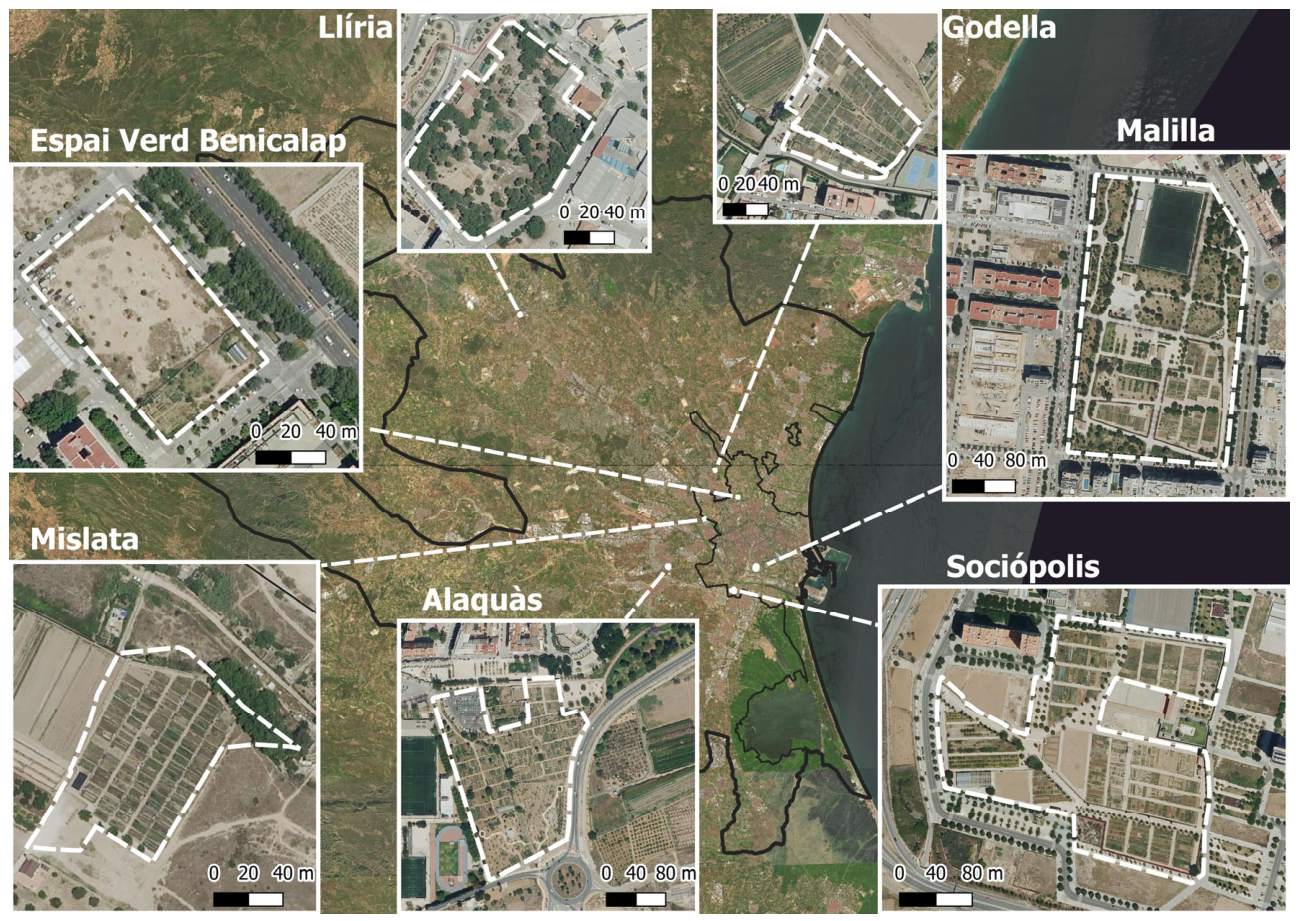
2.1. Spatial Context
2.2. Participants and Procedure
2.3. Guide to Interview Topics
2.4. Data Analysis and Ethical Considerations
3. Results: Comparative Analysis of Focus Groups and Interviews
3.1. Governance and the Institution–Community Relationship
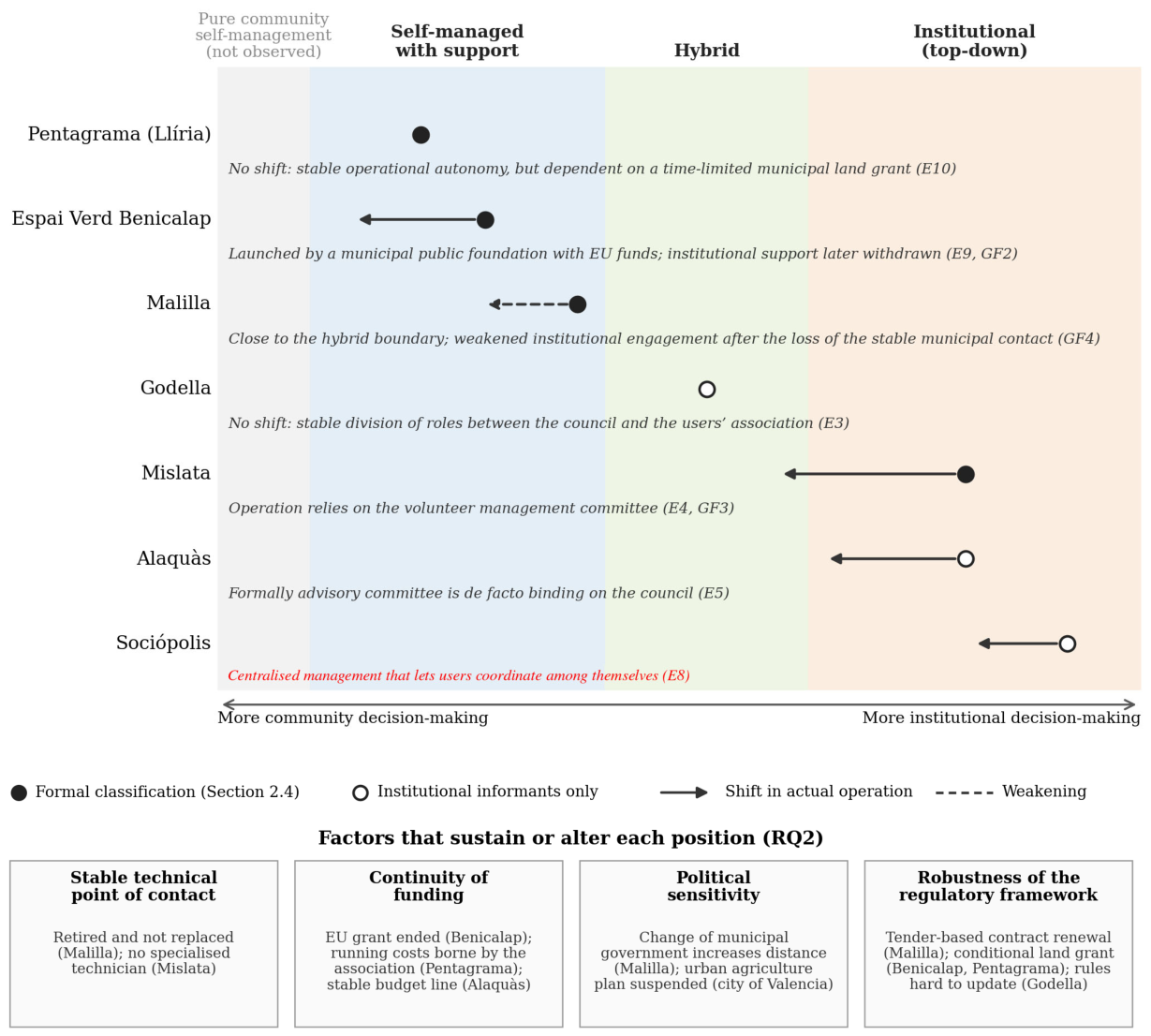
3.1.1. Type of Governance Model
3.1.2. Distribution of Responsibilities and the Role of Key Actors
3.1.3. Degree of Formalisation
3.1.4. User Autonomy and Institutional Support
3.1.5. Dependence on the Local Council and the Quality of Collaboration
3.2. Day-to-Day Operations and Practices
3.2.1. Organisation of Day-to-Day Work
3.2.2. Decision-Making
3.2.3. Resource Management
3.2.4. Discrepancies Between Regulations and Practice
3.3. Regulatory Framework and Tensions
3.3.1. Legislation and Regulation
3.3.2. Access and Allocation of Plots
3.3.3. Regulatory Rigidity Versus Flexibility
3.3.4. Tensions
3.4. Participation and Community
3.4.1. Level of Active Participation
3.4.2. Sense of Belonging
3.4.3. Community Dynamics
3.4.4. Inequality in Involvement
3.5. Conflicts and Regulatory Mechanisms
3.5.1. Types of Conflicts
3.5.2. Causes of Conflict
3.5.3. Resolution Mechanisms
3.5.4. Legitimacy of Rules and Authority
3.6. Knowledge, Learning and Education
3.6.1. Learning Amongst Users and the Transfer of Agricultural Knowledge
3.6.2. Educational Activities
3.6.3. Integration of New Users
3.7. Social, Environmental and Urban Impact
3.7.1. Social Benefits
3.7.2. Environmental Benefits
3.7.3. Urban Function
3.7.4. Perception of the Value of the Allotment
3.8. Social Inclusion and Public Service
3.8.1. Accessibility
3.8.2. Inclusion of Vulnerable Groups
3.8.3. Social Function and Equity of Access
3.9. Territorial and Urban Planning Dimension
3.9.1. Location and Accessibility
3.9.2. Land Tenure
3.9.3. Land-Use Conflicts
3.9.4. Integration into Urban Planning
3.10. Sustainability and the Future of the Model
3.10.1. Continuity of the Project
3.10.2. Risks
3.10.3. Scalability and Replicability
3.10.4. Vision for the Future and Proposals
4. Discussion
5. Conclusions
Supplementary Materials
Author Contributions
Funding
Institutional Review Board Statement
Informed Consent Statement
Data Availability Statement
Conflicts of Interest
References
- Cohen, N. Roles of cities in creating healthful food systems. Annu. Rev. Public Health 2022, 43, 419–437. [Google Scholar] [CrossRef] [Scilit] [PubMed]
- Sonnino, R. Food system transformation: Urban perspectives. Cities 2023, 134, 104164. [Google Scholar] [CrossRef] [Scilit]
- Bruckmeier, K. Food Systems and Social-Ecological Transformation. In The Anthropocene and Its Future: The Challenges of Accelerating Social and Ecological Change; Springer International Publishing: Cham, Switzerland, 2024; pp. 179–204. [Google Scholar]
- Béné, C.; Oosterveer, P.; Lamotte, L.; Brouwer, I.D.; de Haan, S.; Prager, S.D.; Talsma, E.F.; Khoury, C.K. When food systems meet sustainability—Current narratives and implications for actions. World Dev. 2019, 113, 116–130. [Google Scholar] [CrossRef] [Scilit]
- High Level Panel of Experts on Food Security and Nutrition (HLPE). Food Losses and Waste in the Context of Sustainable Food Systems; Committee on World Food Security: Rome, Italy, 2014; Available online: http://www.fao.org/3/a-i3901e.pdf (accessed on 28 September 2026).
- Reardon, T.; Echeverría, R.; Berdegué, J.; Minten, B.; Liverpool-Tasie, S.; Tschirley, D.; Zilberman, D. Rapid transformation of food systems in developing regions: Highlighting the role of agricultural research and innovations. Agric. Syst. 2019, 172, 47–59. [Google Scholar] [CrossRef] [Scilit]
- Caron, P.; Ferrero y de Loma-Osorio, G.; Nabarro, D.; Hainzelin, E.; Guillou, M.; Andersen, I.; Arnold, T.; Astralaga, M.; Beukeboom, M.; Bickersteth, S.; et al. Food systems for sustainable development: Proposals for a profound four-part transformation. Agron. Sustain. Dev. 2018, 38, 41. [Google Scholar] [CrossRef] [Scilit] [PubMed]
- Cano-Verdugo, G.; Flores-García, B.D.; Núñez-Rocha, G.M.; Ávila-Ortíz, M.N.; Nakagoshi-Cepeda, M.A.A. Impact of urban farming on health: A systematic review. J. Public Health 2024, 46, e500–e509. [Google Scholar] [CrossRef] [Scilit] [PubMed]
- Barthel, S.; Parker, J.; Ernstson, H. Food and green space in cities: A resilience lens on gardens and urban environmental movements. Urban Stud. 2015, 52, 1321–1338. [Google Scholar] [CrossRef] [Scilit]
- Langemeyer, J.; Madrid-Lopez, C.; Mendoza Beltran, A.; Villalba Mendez, G. Urban agriculture: A necessary pathway towards urban resilience and global sustainability? Landsc. Urban Plan. 2021, 210, 104055. [Google Scholar] [CrossRef] [Scilit]
- Burchard-Dziubińska, M. The role of urban gardening in building city resilience to climate change. Econ. Environ. 2021, 78, 32–43. [Google Scholar] [CrossRef] [Scilit] [PubMed]
- Camps-Calvet, M.; Langemeyer, J.; Calvet-Mir, L.; Gómez-Baggethun, E. Ecosystem services provided by urban gardens in Barcelona, Spain: Insights for policy and planning. Environ. Sci. Policy 2016, 62, 14–23. [Google Scholar] [CrossRef] [Scilit]
- Ghallab, R. Cultivating Connections: Exploring the Impact of Community Gardens on Social Cohesion. Master’s Thesis, Swedish University of Agricultural Sciences (SLU), Uppsala, Sweden, 2024. [Google Scholar]
- Pillai, S.V. Urban agriculture: A sustainability guide for developing countries. Soc. Responsib. J. 2025, 21, 725–750. [Google Scholar] [CrossRef] [Scilit]
- Badami, M.G.; Ramankutty, N. Urban agriculture and food security: A critique based on an assessment of urban land constraints. Glob. Food Secur. 2015, 4, 8–15. [Google Scholar] [CrossRef] [Scilit]
- Zutter, C.; Stoltz, A. Community gardens and urban agriculture: A healthy environment for healthy citizens. Int. J. Ment. Health Nurs. 2023, 32, 1452–1461. [Google Scholar] [CrossRef] [Scilit] [PubMed]
- Kwartnik-Pruc, A.; Droj, G. The role of allotments and community gardens and the challenges facing their development in urban environments: A literature review. Land 2023, 12, 325. [Google Scholar] [CrossRef] [Scilit]
- Ilieva, R.T.; Cohen, N.; Israel, M.; Specht, K.; Fox-Kämper, R.; Fargue-Lelièvre, A.; Poniży, L.; Schoen, V.; Caputo, S.; Kirby, C.K.; et al. The socio-cultural benefits of urban agriculture: A review of the literature. Land 2022, 11, 622. [Google Scholar] [CrossRef] [Scilit]
- Lemos, M.C.; Agrawal, A. Environmental governance. Annu. Rev. Environ. Resour. 2006, 31, 297–325. [Google Scholar] [CrossRef] [Scilit]
- Abrantes, P.; Moreno, L.; Fonseca, M.L.; Türeli, B.B.; Stergiadis, C.; Szüdi, G.; Gajdusek, M.F.; Zorell, C.V. Examining inclusive governance of community gardens: Lessons from European cities. City Environ. Interact. 2026, 29, 100286. [Google Scholar] [CrossRef] [Scilit]
- Fox-Kämper, R.; Wesener, A.; Münderlein, D.; Sondermann, M.; McWilliam, W.; Kirk, N. Urban community gardens: An evaluation of governance approaches and related enablers and barriers at different development stages. Landsc. Urban Plan. 2018, 170, 59–68. [Google Scholar] [CrossRef] [Scilit]
- Ponstingel, D. The governance of community gardens as commons and its role in the socio-ecological outcomes of gardening in Austin, Texas, USA. Socio-Ecol. Pract. Res. 2022, 4, 355–376. [Google Scholar] [CrossRef] [Scilit] [PubMed]
- Kanosvamhira, T.P. Beyond the blueprint: Rethinking governance and sustainability in Cape Town’s community gardens. J. Urban Aff. 2025, in press. [Google Scholar] [CrossRef] [Scilit]
- Bellows, A.C. One hundred years of allotment gardens in Poland. Food Foodways 2004, 12, 247–276. [Google Scholar] [CrossRef] [Scilit]
- Drake, L. Governmentality in urban food production? Following ‘community’ from intentions to outcomes. Urban Geogr. 2014, 35, 177–196. [Google Scholar] [CrossRef] [Scilit]
- Maćkiewicz, B.; Jeziorek, P. Exploring relations between community gardens and cultural institutions in terms of diverse governance models: A case study of Warsaw and Poznań, Poland. Prz. Geogr. 2024, 96, 103–126. [Google Scholar] [CrossRef] [Scilit]
- Jacob, M.; Rocha, C. Models of governance in community gardening: Administrative support fosters project longevity. Local Environ. 2021, 26, 557–574. [Google Scholar] [CrossRef] [Scilit]
- Tecco, N.; Coppola, F.; Sottile, F.; Peano, C. Urban gardens and institutional fences: The case of communal gardens in Turin. Future Food J. Food Agric. Soc. 2017, 5, 70–78. [Google Scholar]
- Willman, K. “It’s not only our task”: Administrative barriers to enabling urban gardening in Tampere, Finland. ACME Int. J. Crit. Geogr. 2023, 22, 921–946. [Google Scholar] [CrossRef]
- Ernwein, M. Urban agriculture and the neoliberalisation of what? ACME Int. J. Crit. Geogr. 2017, 16, 249–275. [Google Scholar]
- National Institute of Statistics (INE). Urban Indicators, 2024 ed.; INE: Madrid, Spain, 2024; Available online: https://www.ine.es/dyngs/Prensa/es/UA2024.pdf (accessed on 1 August 2026).
- Valencian Regional Government. Decree 219/2018 of 30 November of the Regional Council, Approving the Territorial Action Plan for the Planning and Revitalisation of the Huerta de València; Official Gazette of the Valencian Regional Government (DOGV), No. 8500. 25 December 2018. Available online: https://dogv.gva.es/es/resultat-dogv?signatura=2018/11893&L=1 (accessed on 12 August 2026).
- van der Jagt, A.P.N.; Szaraz, L.R.; Delshammar, T.; Cvejić, R.; Santos, A.; Goodness, J.; Buijs, A. Cultivating nature-based solutions: The governance of communal urban gardens in the European Union. Environ. Res. 2017, 159, 264–275. [Google Scholar] [CrossRef] [Scilit] [PubMed]
- Fernandez-Salido, N.; Gallego-Valadés, A.; Serra-Castells, C.; Garcés-Ferrer, J. Cultivating Bonds: On Urban Allotment Gardens and Their Relationship with Social Capital. Agriculture 2025, 15, 1048. [Google Scholar] [CrossRef] [Scilit]
- Fernández-Salido, N.; Gallego-Valadés, A.; Serra-Castells, C.; Garcés-Ferrer, J. Cultivating Well-Being: An Exploratory Analysis of the Integral Benefits of Urban Gardens in the Promotion of Active Ageing. Int. J. Environ. Res. Public Health 2025, 22, 1058. [Google Scholar] [CrossRef] [Scilit] [PubMed]
- Flick, U. An Introduction to Qualitative Research, 5th ed.; SAGE: London, UK, 2014. [Google Scholar]
- Patton, M.Q. Qualitative Research and Evaluation Methods: Integrating Theory and Practice, 4th ed.; SAGE: Thousand Oaks, CA, USA, 2015. [Google Scholar]
- Saunders, B.; Sim, J.; Kingstone, T.; Baker, S.; Waterfield, J.; Bartlam, B.; Burroughs, H.; Jinks, C. Saturation in qualitative research: Exploring its conceptualisation and operationalisation. Qual. Quant. 2018, 52, 1893–1907. [Google Scholar] [CrossRef] [Scilit] [PubMed]
- Hennink, M.; Kaiser, B.N. Sample sizes for saturation in qualitative research: A systematic review of empirical tests. Soc. Sci. Med. 2022, 292, 114523. [Google Scholar] [CrossRef] [Scilit] [PubMed]
- Toda, E.; Lowe, E. Gardens in a postsuburb: Community garden governance and ethos in Orange County. J. Agric. Food Syst. Community Dev. 2022, 11, 161–178. [Google Scholar] [CrossRef] [Scilit]
- Göttl, I.; Penker, M. Institutions for collective gardening: A comparative analysis of 51 urban community gardens in English-speaking and German-speaking countries. Int. J. Commons 2020, 14, 30–43. [Google Scholar] [CrossRef] [Scilit]
- Palau-Salvador, G.; de Luis, A.; Juan Pérez, J.; Sanchis-Ibor, C. Greening the post-crisis era: Collectivity in private and public community gardens in Valencia (Spain). Cities 2019, 92, 292–302. [Google Scholar] [CrossRef] [Scilit]
- Pino Cabeza, M. Key aspects of the governance of urban community gardens: Lessons from the Ru:rban project in the city of A Coruña. Rev. Gest. Soc. Ambient. 2022, 16, e03047. [Google Scholar] [CrossRef] [Scilit]
- Zhang, X.; Pan, D.; Wong, K.; Zhang, Y. A New Top-Down Governance Approach to Community Gardens: A Case Study of the “We Garden” Community Experiment in Shenzhen, China. Urban Sci. 2022, 6, 41. [Google Scholar] [CrossRef] [Scilit]
- Anthopoulou, T.; Nikolaidou, S.; Partalidou, M.; Petrou, M. The emergence of municipal allotment gardens in Greece in times of crisis: Governance challenges for new urban gardening practices. In Towards Sustainable Relations Between Agriculture and the City; Soulard, C.T., Perrin, C., Valette, E., Eds.; Springer: Cham, Switzerland, 2017. [Google Scholar] [CrossRef] [Scilit] [PubMed]
- Zerbian, T.; Escario-Chust, A.; Palau-Salvador, G.; Segura-Calero, S. The multiple and contested worlds of urban food governance: The case of the city of Valencia. Cities 2023, 141, 104516. [Google Scholar] [CrossRef] [Scilit]
- Hasson, A. Democratic processes in urban agriculture: A comparative analysis of community gardens and allotments in London. Land 2025, 14, 2395. [Google Scholar] [CrossRef] [Scilit]
- Lowe, M.; Bell, S.; Briggs, J.; McMillan, E.; Morley, M.; Grenfell, M.; Sweeting, D.; Whitten, A.; Jordan, N. A research-based, practice-relevant urban resilience framework for local government. Local Environ. 2024, 29, 785–804. [Google Scholar] [CrossRef] [Scilit]
- Clarke, M.; Davidson, M.; Egerer, M.; Anderson, E.; Fouch, N. The underutilised role of community gardens in improving cities’ adaptation to climate change: A review. People Place Policy 2019, 12, 241–251. [Google Scholar] [CrossRef] [Scilit]
- Suárez, M.; Rieiro-Díaz, A.M.; Alba, D.; Langemeyer, J.; Gómez-Baggethun, E.; Ametzaga-Arregi, I. Urban resilience through green infrastructure: A framework for policy analysis applied to Madrid, Spain. Landsc. Urban Plan. 2024, 241, 104923. [Google Scholar] [CrossRef] [Scilit]
- Sereenonchai, S.; Arunrat, N. Communication Strategies for Sustainable Urban Agriculture in Thailand. Sustainability 2024, 16, 10898. [Google Scholar] [CrossRef] [Scilit]
- DiCicco-Bloom, B.; Crabtree, B.F. The qualitative research interview. Med. Educ. 2006, 40, 314–321. [Google Scholar] [CrossRef] [Scilit] [PubMed]



| Code | Position/Role | Institution/Sector | Profile |
|---|---|---|---|
| E1 | Environmental technician in agricultural land and urban allotments | Supra-municipal administration | Institutional technician |
| E2 | Technician in sustainable food and food governance | Local government | Food governance specialist |
| E3 | Agriculture and environment technician in municipal allotments | Local government | Allotment management technician |
| E4 | Political office responsible for urban allotments | Local government | Policy-maker |
| E5 | Political office for urban services, environment and agriculture | Local government | Policy-maker |
| E6 | Gardening technician involved in allotment regulation | Municipal administration | Municipal technician |
| E7 | Lecturer and researcher in urban and peri-urban gardens | Public university | Academic expert |
| E8 | Technician in agricultural governance and allotment management | Local government | Agricultural governance specialist |
| E9 | Urban innovation technician in green infrastructure projects | Public innovation body | Innovation technician |
| E10 | Head of a third-sector organisation coordinating an inclusive municipal allotment | Nonprofit organisation, in collaboration with the local authority | Third sector |
| Code | Organisation/Venue/Profile | Participants | Relationship with Urban Gardens |
|---|---|---|---|
| FG1 | University lecturers in urban planning | 3 | Academic, teaching and research experience in urban planning, green spaces and urban gardens. |
| FG2 | Representatives of associations and groups managing a community urban allotment | 7 | Direct involvement in the community management, maintenance, social use and revitalisation of the allotment; includes members of the management committee, neighbourhood association and social groups. |
| FG3 | Users, members of the management committee and local authority staff at an urban allotment | 5 | Direct involvement in the cultivation, maintenance and monitoring of the plots; providing guidance to other users; informal monitoring of compliance with rules; collaboration with the local authority. |
| FG4 | Members of the executive committee of an urban allotment management association | 5 | Direct involvement in the management of the allotments by an association; formalisation of the association; advocacy for neighbourhood-led management carried out by the users themselves. |
| FG5 | Participants in a socially inclusive allotment workshop | 7 | Direct participation in the day-to-day activities of the allotment as part of a workshop run by a socio-inclusive association, with support from the coordinating organisation and volunteers; linking gardening activities to processes of social inclusion and well-being. |
| Garden/Group | Institutional Actors | Associations | Gardeners/Users | External Experts | Total |
|---|---|---|---|---|---|
| Sociópolis | 1 | – | – | – | 1 |
| Mislata | 3 | – | 3 | – | 6 |
| Alaquàs | 1 | – | – | – | 1 |
| Godella | 1 | – | – | – | 1 |
| Espai Verd Benicalap | 1 | 7 | – | – | 8 |
| Malilla | – | 5 | 5 | – | 5 |
| Pentagrama (Llíria) | – | 1 | 7 | – | 8 |
| Cross-cutting actors | 3 | – | – | – | 3 |
| Academic experts | – | – | – | 4 | 4 |
| Total | 10 | 13 | 15 | 4 | 37 |
| Governance Model | Position on the Continuum | Who Decides and Controls | Community Autonomy | Role of the Administration and NGOs | Distinctive Feature | Main Advantage and Risk |
|---|---|---|---|---|---|---|
| 1. Community self-management (grassroots) | Extremely bottom-up | The gardeners; the community sets priorities, rules, the division of labour and conflict resolution | Maximum | Minimal or non-existent; the organisations involved are grassroots, integrated within the community itself | The community not only participates but manages the allotment in its entirety | Advantage: maximum ownership, sense of belonging and local adaptation. Risk: vulnerability if rules or mediation are lacking. |
| 2. External support without loss of local leadership | Bottom-up with support (close to the hybrid model) | The community takes the lead; a local council, university, NGO or public agency provides support | High | Support infrastructure (land, funding, staff, training), not a substitute for the community | External support provides backing without taking the lead; this is usually linked to the project’s longevity | Advantage: resilience and continuity, particularly in low-income neighbourhoods. Risk: dependence on external resources |
| 3. Hybrid arrangements (co-governance) | Midway on the continuum (neither top-down nor bottom-up) | Shared leadership between the community and the organisation | Medium; division of roles | The institution provides land, funding, mediation, legal certainty and a link to urban policies; the community retains control over the day-to-day running of the allotment | Avoids the community/administered dichotomy; requires a finely tuned governance structure | Advantage: combines resources, public legitimacy and organisational capacity. Risk: unclear responsibilities and decision-making powers |
| 4. Institutional management mediated by NGOs or associations | Cross-cutting; somewhere between hybrid and top-down depending on where real power lies | An external entity (cultural institution, NGO or promoting association) becomes a central actor | Medium–low; power may shift towards hierarchical arrangements | The third party manages the project, obtains permits, ensures continuity and provides resources | This arises when the allotment needs an intermediary to survive; it ranges from support to substitution | Advantage: ability to sustain and extend the life of the community garden. Risk: limited user involvement in decisions |
| 5. Municipal or top-down management | Extreme top-down approach | The public administration centralises regulatory and strategic power | Low; the community loses influence over strategic decisions | The administration plans, regulates and protects the land; NGOs play a secondary or implementing role | It defines the “operational space” of the allotment; it can be both protective and disciplinary | Advantage: order, regulatory continuity and land protection. Risk: participation reduced to instrumental tasks and reduced sense of ownership |
| Allotment | Governance Model | Benefits of the Model | Risks of the Model | Social Benefits | Urban Benefits | Environmental Benefits |
|---|---|---|---|---|---|---|
| Malilla Allotment | Self-managed model with support (bottom-up): Management by the Geshuma neighbourhood association through a periodic municipal lease subject to a tender process, for which the association submits a management project to the Town Council. It has an extensive board of directors (18 members), a general assembly and its own internal regulations with a graduated system of disciplinary measures. It operates alongside five to seven partner associations. | High and sustained involvement (participation in joint activities exceeding 25 per cent), operational autonomy and a board with a rotation system. The association acts as the “eyes of the council” and ensures compliance with internal regulations. A model consulted by other local authorities interested in replicating it. | Periodic contract renewal (precedent of closure in San Isidro), lack of a stable municipal contact following the retirement of the key civil servant, and dependence on the electoral cycle. No involvement in the by-law and only reactive institutional support. | An intergenerational community (aged 20 to 85) and the inclusion of vulnerable groups (mental health, children, women, multiculturalism) through partner organisations; 220 people on the waiting list. Socio-professional diversity and educational activities with schoolchildren. | Integrated into Malilla Park as a green space planned under the PAI; partially compensates for the loss of the traditional vegetable garden. Densely built-up location, accessible on foot to around 50,000 residents without a metro link. | Sector-specific composting, biodiversity (insect hotels), agroecology and reused water. Organic farming is mandatory by by-law and makes use of shredded municipal prunings; a philosophy of a complete life cycle is demonstrated during school visits. |
| Sociópolis Allotment (La Torre) | Institutional model (top-down), with centralised management: The Municipal Agricultural Council (Consell Agrari Municipal) has managed Sociópolis on behalf of the City Council since 2008 and oversees all processes. No member of the Council has a plot, which guarantees impartiality. It operates alongside six associations under an agreement and in conjunction with the Water Tribunal (Favara irrigation channel). | Consolidated institutional stability and impartial decision-making through the separation of manager and user. Extensive support (training in organic farming, pest control and composting; 3+1-year leases) and de facto flexibility, with extensions granted for well-maintained plots. | Friction between two concurrent regulatory frameworks (restrictive guidelines from the council and a municipal by-law geared towards self-management). Bureaucratic overload and a digital divide incompatible with an older user demographic; rigid timetables and health-related issues caused by the heat. | For vulnerable groups (people with disabilities, those with mental health issues, marginalised women), it functions as a “healing project”; for older people, it functions as a structuring routine. Dynamics of reciprocity (cross-watering, time bank) and a strong sense of belonging. | Part of the Sociópolis urban development project (La Torre neighbourhood): a bridge between the city and the countryside and an element of spatial planning. Some 280 plots ranging from 65 to 90 m2 on public land set aside for community use, within a framework of traditional Valencian farming practices. | Organic farming (organic fertiliser, biological pest control, composting). Heritage value of traditional gravity-fed irrigation via the Favara irrigation channel; water scarcity remains an unresolved issue. |
| Mislata Allotment | Institutional model (top-down): A municipal initiative since 2017, created to protect agricultural land and revitalise the Pou del Quint. Municipal ownership and a regulatory by-law; 105 plots, a minimum of 5 years’ registration on the municipal register and a public lottery. A voluntary Management Committee that advises and inspects whilst the Town Council makes decisions. | A formal procedure with safeguards (hearing process, regulated revocation), low cost and a partnership with the Water Tribunal (free allocation of water). A high degree of operational autonomy within the formal framework and well-established waiting lists. | An ordinance in need of comprehensive review and the exhaustion of the volunteers who sustain the Committee. Administrative overload (around 200 cases) without a specific budget allocation; underhand tactics to accumulate plots and latent pressure on land. | High demand with a reserve list, predominantly comprising older people and pensioners. Daily interaction, exchange of produce, and physical, psychological and social benefits; inclusion through plots reserved for schools and an occupational centre. | A space for relaxation in one of Europe’s most densely populated municipalities. A central, pedestrianised location on land zoned as non-building land; the local council removed a roundabout from the master plan to preserve it. | Minimisation of chemical use, prioritisation of organic farming in the lottery selection criteria, and preservation of traditional irrigation via irrigation channels. Use of shredded prunings and future installation of a composting facility; the century-old well serves as a strategic reserve. |
| Godella Allotment | Hybrid model: The Town Council leases land from four private landowners and makes it available to users through the La Coscollosa association, which has compulsory membership, with an assembly, a board and self-funding (membership fee of €40). Regulations dating from 2013 and compulsory agroecological farming. | High operational autonomy and very smooth communication with the Town Council. Multidimensional support (land lease, annual grant of €3000, training, tools and legal support); well-established collaboration after twelve years. | The 2013 regulations are obsolete (the planned biennial lottery was never implemented) and there is a lack of flexibility in amending them. Dependence on private, rather than municipal, land, and pressure from “villa development” in a Grade 1 protected market garden area. | High demand and a very diverse membership (various social classes, ages and nationalities). A strong sense of belonging, mutual support and communal work days; benefits for older people and vulnerable groups through agreements. | Peri-urban location next to the Moncada irrigation channel, on Grade 1 protected agricultural land, acting as a transition between the town centre and traditional farmland. Advocates for the integration of allotments into urban design as a specific amenity. | Mandatory agroecological cultivation and preservation of traditional plant material (home-grown seedlings, seeds contributed by migrants). Conversion of a former rubbish tip into a reservoir of peri-urban biodiversity. |
| Espai Verd Benicalap Allotment | Self-managed model with support (bottom-up): Federative self-management on a municipally leased plot: the public foundation Las Naves provides support (initial funding from the European GrowGreen project, guidance) and then withdraws, with management falling to a federation of 15 to 20 neighbourhood groups with a governing committee. Distinguishing feature: The allotments must be collective, not individual, with statutes approved by the users. | Collective cultivation allows organisations to share tasks, while the federation coordinates external relations. Participants described operational autonomy alongside limited continuing support and concentrated workloads. | Reliance on the driving group and burnout amongst volunteers (low actual participation, 4–6 active members), recurrent vandalism and theft, lack of ongoing funding, and territorial uncertainty due to the reversible designation as an educational facility. | Intercultural and intergenerational cohesion in a low-income neighbourhood with a high mix of migrant communities; effective inclusion of vulnerable groups (an African woman has chaired the Espai). Access via open membership, with no income requirements. | Regenerative function: Transforms a derelict site used as an informal car park into a place for meeting and production. It addresses the shortage of public facilities in the Ciudad Fallera and forms part of the urban greening policy; a public catalogue of sites is proposed. | Organic farming required by the statutes, a microhabitat with pollinators in fallow areas, and an edible syntropic forest with native reforestation. It forms part of nature-based solutions (GrowGreen) to tackle climate change. |
| Alaquàs Allotment | Institutional model (top-down): A project stemming from a citizens’ initiative (ten years): a proposal included in the White Paper and submitted to the full council. Municipal management involving environmental and education specialists, and a de facto binding advisory committee. Two by-laws (on allocation and penalties) with provisions for different user categories. | Extensive institutional support (land, well water, fencing, car park, drip irrigation, technical expertise and training). Amendments to the by-law are proposed, for the most part, by the users; priority is given to social groups and the garden is open to the public on Saturdays. | Ban on direct sales (barter only) and immediate expulsion without notice for the use of chemicals. Private land held under a nominal lease until its transfer to the local authority; risks relating to hydrological and climatic conditions and future environmental disinvestment. | 200 active users (more than half on a daily basis) and a waiting list of 60–70 people; seven or eight nationalities. An emotional refuge (“better than any medicine”), financial savings and social interaction (Saturday lunches). | Structural function in a very densely populated municipality with stunted growth: an intentional green corridor (historic market garden, urban woodland, allotments and tree-lined avenue). Public land repurposed to preserve the agricultural area, with a green space ratio well above the WHO standard. | A biodiversity reservoir providing biological pest control; 100 per cent of water sourced from municipal wells and permeable concrete that returns water to the water table. Reduction in CO2 emissions and the urban heat island effect; natural preparations, reported restrictions on cultivation inputs. |
| Pentagrama Association’s Allotment (Llíria) | Self-managed model with support (bottom-up), managed by a third-sector association within a light institutional framework: Municipal land and buildings provided to the Pentagrama Association, which manages the allotment, the greenhouse and the nursery. Llíria Town Council owns and funds the initial infrastructure; retired farmer volunteers pass on their technical knowledge. Distinguishing feature: There are no plots or formal regulations, and the allotment operates as a therapeutic tool within a mental health programme. | High operational autonomy with tasks tailored to each person’s abilities and regulatory flexibility allowing for incremental development. Blurring of roles between users, volunteers and professionals; 19 years of experience and proven replicability across the region. | Consumables are funded entirely by the association (structural but not recurring operational support from the local council), and administrative procedures are perceived as complicated. Dependence on older volunteers with no guaranteed succession and on a municipal land lease with an agreed time frame. | Core focus: People with chronic mental illness; physical, attentional and emotional therapeutic benefits, self-esteem and a sense of belonging (“Pentagrama experienced as a family”). Collaboration with disability, older people and children, with a normalising effect. | Regeneration of an underused municipal facility and integration into the municipal mental health policy, in which Llíria was a pioneer. Land set aside for community use at the headquarters, with a second school garden opposite; no land-use conflicts. | Environmental dimension subordinate to the therapeutic focus: Low-impact practices (drip irrigation, composting, manure and natural substrate, self-defined as “organic”), but with no data on biodiversity or ecosystem services. |
Disclaimer/Publisher’s Note: The statements, opinions and data contained in all publications are solely those of the individual author(s) and contributor(s) and not of MDPI and/or the editor(s). MDPI and/or the editor(s) disclaim responsibility for any injury to people or property resulting from any ideas, methods, instructions or products referred to in the content. |
© 2026 by the authors. Licensee MDPI, Basel, Switzerland. This article is an open access article distributed under the terms and conditions of the Creative Commons Attribution (CC BY) license.
Share and Cite
Fernandez-Salido, N.; Gallego-Valadés, A.; Serra-Castells, C.; Garcés-Ferrer, J. Cultivating Governance: An Exploratory Analysis of Urban Garden Management Models for Long-Term Sustainability. Agriculture 2026, 16, 2158. https://doi.org/10.3390/agriculture16192158
Fernandez-Salido N, Gallego-Valadés A, Serra-Castells C, Garcés-Ferrer J. Cultivating Governance: An Exploratory Analysis of Urban Garden Management Models for Long-Term Sustainability. Agriculture. 2026; 16(19):2158. https://doi.org/10.3390/agriculture16192158
Chicago/Turabian StyleFernandez-Salido, Noelia, Alfonso Gallego-Valadés, Carlos Serra-Castells, and Jorge Garcés-Ferrer. 2026. "Cultivating Governance: An Exploratory Analysis of Urban Garden Management Models for Long-Term Sustainability" Agriculture 16, no. 19: 2158. https://doi.org/10.3390/agriculture16192158
APA StyleFernandez-Salido, N., Gallego-Valadés, A., Serra-Castells, C., & Garcés-Ferrer, J. (2026). Cultivating Governance: An Exploratory Analysis of Urban Garden Management Models for Long-Term Sustainability. Agriculture, 16(19), 2158. https://doi.org/10.3390/agriculture16192158