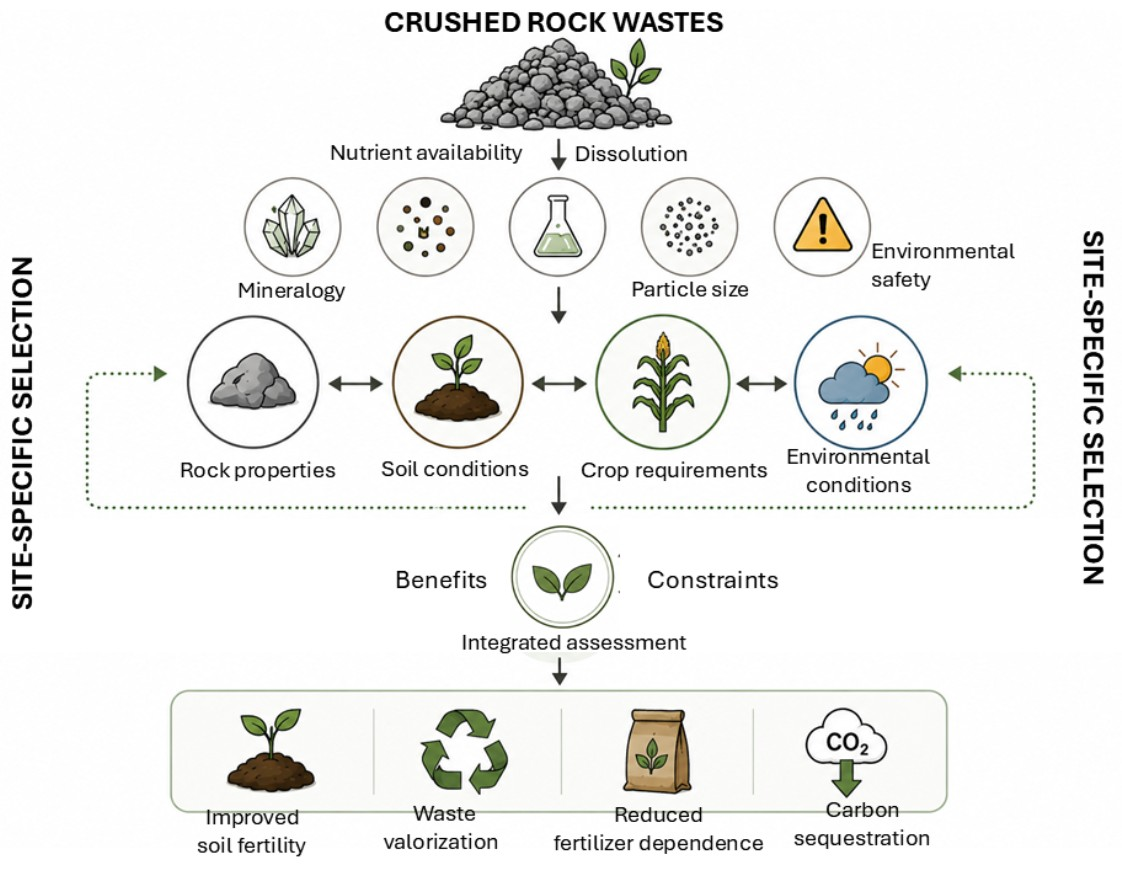
Material Selection for Soil Remineralization: Mineralogical, Agronomic and Environmental Perspectives on Crushed Rock Wastes

 ,
,  , , , ,
Abstract
1. Introduction
2. Materials and Methods
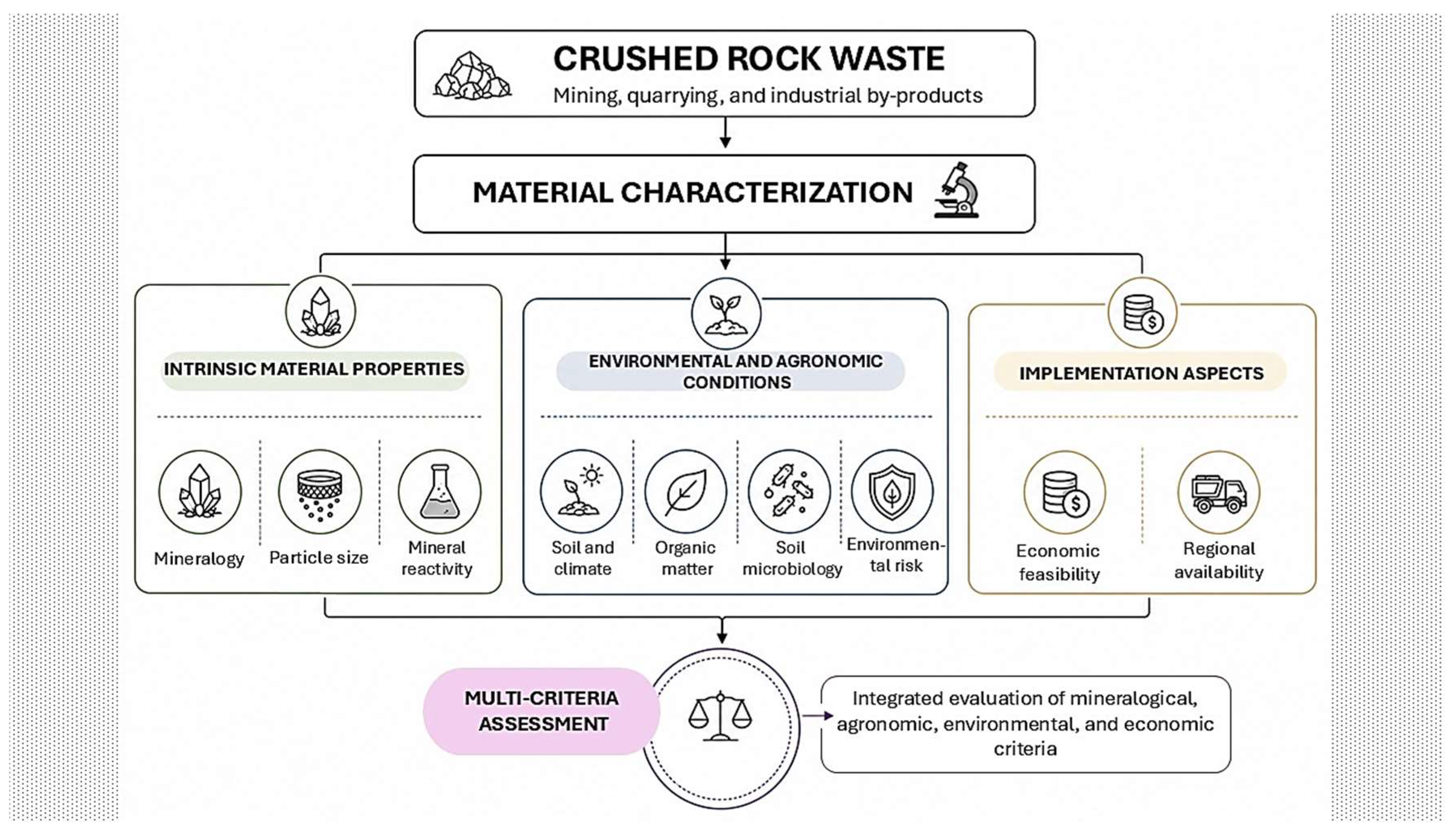
3. Material Selection Criteria for Soil Remineralization
4. Controls on Nutrient Release from Crushed Rock Wastes
4.1. Mineral Weathering and Dissolution
4.2. Factors Regulating Nutrient Availability
4.3. Nutrient Retention and Soil Fertility Enhancement
5. Agronomic Performance of Crushed Rock Wastes
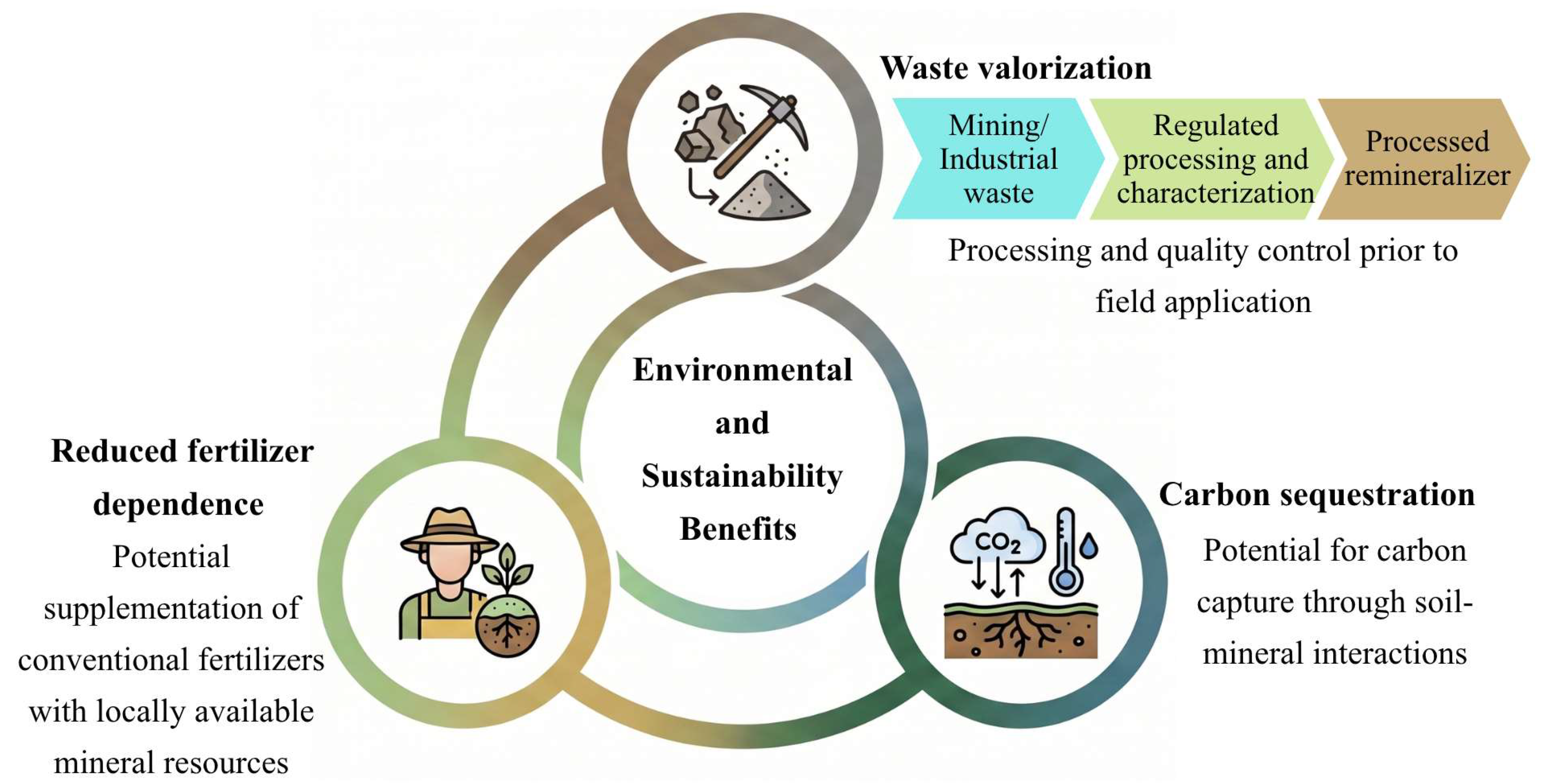
6. Environmental and Sustainability Perspectives
6.1. Circular Economy and Waste Valorization
6.2. Reduction in Fertilizer Dependence
6.3. Potential CO2 Removal Through Enhanced Weathering
7. Current Limitations and Future Challenges
7.1. Potential Release of Toxic Elements
7.2. Technical and Agronomic Limitations
8. Conclusions
Author Contributions
Funding
Data Availability Statement
Conflicts of Interest
References
- Razera, R.; Schiebelbein, B.E.; Souza, V.S.; da Silva, L.F.V.; Cherubin, M.R.; Manning, D.A.C.; de Azevedo, A.C. Mining By-Products and Circular Economy: Improving Soil Health and Carbon Stocks through Rock Dust Application. J. Environ. Manag. 2026, 413, 130406. [Google Scholar] [CrossRef] [Scilit] [PubMed]
- Cherubin, M.R.; Canisares, L.P.; Souza, L.N.; Junior, C.R.; de Moraes, M.T.; Bertol, F.; Bortolo, L.; Menillo, R.B.; Cerri, C.E. Long-Term Effects of Crop Diversification on Soil Health, Crop Yield and Resilience of Tropical Agroecosystems. J. Environ. Manag. 2025, 392, 126845. [Google Scholar] [CrossRef] [Scilit] [PubMed]
- Tailings (TL0511) UNDRR. Available online: https://www.undrr.org/understanding-disaster-risk/terminology/hips/tl0511?utm_source=chatgpt.com (accessed on 6 August 2026).
- de Carvalho Ribeiro, M.; Ganga, A.; Cattanio, I.S.; Martins, A.R.; Alves, R.S.; Lessa, L.G.F.; Pereira, H.S.; Galindo, F.S.; Filho, M.C.M.T.; Abreu-Junior, C.H.; et al. Residual Effect of Silicate Agromineral Application on Soil Acidity, Mineral Availability, and Soybean Anatomy. Agronomy 2024, 15, 5. [Google Scholar] [CrossRef] [Scilit]
- Prakash, N.B.; Majumdar, S.; Laxmanarayanan, M.; Kollalu, S. Silicon Nutrition of Agronomic Crops. Adv. Bot. Res. 2026, 118, 77–116. [Google Scholar] [CrossRef] [Scilit]
- Kurokawa, K.; Nakao, A.; Azuma, K.; Tomita, H.; Kubo, K.; Nomura, K.; Yanai, J. Direct Evidence for Enhanced Mineral Weathering in Cropland Verified by Quantitative X-Ray Powder Diffraction. Appl. Geochem. 2026, 205, 106869. [Google Scholar] [CrossRef] [Scilit]
- Campilongo, G.; Ponte, M.; Muto, F.; Critelli, S.; Catanzariti, F.; Perri, F. Geotechnical and Minero-Chemical Data of the Cutro Clay Formation (Calabria, Southern Italy). J. Mediterr. Earth Sci. 2022, 14, 11–26. [Google Scholar] [CrossRef] [PubMed]
- Dos Santos, M.G.; Paiva, A.B.; Costa, C.R.; Paiva, M.B.; de Oliveira Mendes, G.; de Souza Martins, É.; Marchi, G.; Lustosa Filho, J.F.; de Figueiredo, C.C. The Role of Oxalic Acid in Nutrient Solubilization, Potentially Toxic Elements from Sewage Sludge Biochar, and Remineralizers for Sustainable Local Fertilizers. Environ. Res. 2026, 294, 123818. [Google Scholar] [CrossRef] [Scilit] [PubMed]
- Beerling, D.J.; Leake, J.R.; Long, S.P.; Scholes, J.D.; Ton, J.; Nelson, P.N.; Bird, M.; Kantzas, E.; Taylor, L.L.; Sarkar, B.; et al. Farming with Crops and Rocks to Address Global Climate, Food and Soil Security. Nat. Plants 2018, 4, 138–147. [Google Scholar] [CrossRef] [Scilit] [PubMed]
- Oliveira, R.L.; de Andrade, N.; Freitas, C.C.; da Silva Oliveira, A.M.; da Silva, D.F.; Vieira, M.S.; Mendonça, R.S.; do Rêgo Barros, F.M.; de Azevedo, A.C.; Andreote, F.D. Rock Powder Type and Soil Texture Shape Microbial Community Shifts and Plant Biomass Responses in Highly Weathered Tropical Soils. Appl. Soil Ecol. 2025, 215, 106489. [Google Scholar] [CrossRef] [Scilit]
- Swoboda, P.; Döring, T.F.; Hamer, M. Remineralizing Soils? The Agricultural Usage of Silicate Rock Powders: A Review. Sci. Total Environ. 2022, 807, 150976. [Google Scholar] [CrossRef] [Scilit] [PubMed]
- Linke, T.; Oelkers, E.H.; Dideriksen, K.; Möckel, S.C.; Nilabh, S.; Grandia, F.; Gislason, S.R. The Geochemical Evolution of Basalt Enhanced Rock Weathering Systems Quantified from a Natural Analogue. Geochim. Cosmochim. Acta 2024, 370, 66–77. [Google Scholar] [CrossRef] [Scilit]
- Vitó, C.V.; Vieira, H.G.; Ferrarez, A.H.; De Almeida, C.M.; Silva, F.L.; Matos, W.O.; Souza, M.D. Inorganic Content of Rock Dust Waste from Northwest of Rio de Janeiro, Brazil: Do Environmental Risks Incur from Its Use as Natural Fertilizer? Environ. Monit. Assess. 2020, 192, 380. [Google Scholar] [CrossRef] [Scilit] [PubMed]
- Vanderkloot, E.; Ryan, P. Quantifying the Effect of Grain Size on Weathering of Basaltic Powders: Implications for Negative Emission Technologies via Soil Carbon Sequestration. Appl. Geochem. 2023, 155, 105728. [Google Scholar] [CrossRef] [Scilit]
- Akhmetov, A.; Imai, S.; Akimoto, Y.; Okajima, K.; Rustandi, R.A.; Kitagawa, N.; Morimoto, S. Energy Consumption Assessment of Silicate Rock Comminution Options for Enhanced Weathering. J. Environ. Manag. 2025, 393, 127073. [Google Scholar] [CrossRef] [Scilit] [PubMed]
- Guo, F.; Wang, Y.; Zhu, H.; Zhang, C.; Sun, H.; Fang, Z.; Yang, J.; Zhang, L.; Mu, Y.; Man, Y.B.; et al. Crop Productivity and Soil Inorganic Carbon Change Mediated by Enhanced Rock Weathering in Farmland: A Comparative Field Analysis of Multi-Agroclimatic Regions in Central China. Agric. Syst. 2023, 210, 103691. [Google Scholar] [CrossRef] [Scilit]
- Van Der Bauwhede, R.; Muys, B.; Vancampenhout, K.; Smolders, E. Accelerated Weathering of Silicate Rock Dusts Predicts the Slow-Release Liming in Soils Depending on Rock Mineralogy, Soil Acidity, and Test Methodology. Geoderma 2024, 441, 116734. [Google Scholar] [CrossRef] [Scilit]
- Cong, L.; Lu, S.; Jiang, P.; Zheng, T.; Zhang, Y.; Lü, X.; Yu, Z.; Xu, T. Harnessing Enhanced Rock Weathering for Carbon Neutrality: Potential and Challenges in China. Earth. Sci. Rev. 2025, 271, 105309. [Google Scholar] [CrossRef] [Scilit]
- Li, J.-G.; Dong, Y.-H. Effect of a Rock Dust Amendment on Disease Severity of Tomato Bacterial Wilt. Antonie Van Leeuwenhoek 2013, 103, 11–22. [Google Scholar] [CrossRef] [Scilit] [PubMed]
- Uchibayashi, H.; Maruyama, H.; Watanabe, T.; Hamamoto, S.; Toma, Y.; Nakao, A.; Kurokawa, K.; Shinano, T. Impact of Basalt Application on Soil Chemical Properties and Elemental Uptake by Paddy Rice through Enhanced Rock Weathering. Soil Sci. Plant Nutr. 2025, 71, 484–495. [Google Scholar] [CrossRef] [Scilit]
- Medeiros, F.P.; Theodoro, S.H.; Carvalho, A.M.X.; Oliveira, V.S.; Oliveira, L.C.; Almeida, R.M.P.; Viana, M.B.; Gomide, C.S. The Combination of Crushed Rock and Organic Matter Enhances the Capture of Inorganic Carbon in Tropical Soils. J. South Am. Earth Sci. 2025, 152, 105254. [Google Scholar] [CrossRef] [Scilit]
- Faraone, N.; MacPherson, S.; Hillier, N.K. Evaluation of Repellent and Insecticidal Properties of a Novel Granite Dust Product in Crop Protection. J. Pest Sci. 2018, 91, 1345–1352. [Google Scholar] [CrossRef] [Scilit]
- Oliveira, C.D.; Silva, G.N.; Marcante, N.C.; Vasconcelos, V.; Mandro, M.A.; Santos, E.F. Assessing the Agronomic Efficiency of Rock Dust as a Nutrient Source in Agriculture. Rev. Ciênc. Agron. 2025, 56, 1–13. [Google Scholar] [CrossRef] [Scilit]
- Leonardos, O.H.; Theodoro, S.H.; Assad, M.L. Remineralization for Sustainable Agriculture: A Tropical Perspective from a Brazilian Viewpoint. Nutr. Cycl. Agroecosystems 2000, 56, 3–9. [Google Scholar] [CrossRef] [Scilit]
- Faliagka, S.; Agrafioti, P.; Lampiri, E.; Katsoulas, N.; Athanassiou, C.G. Assessment of Different Inert Dust Formulations for the Control of Sitophilus Oryzae, Tribolium Confusum and Aphis Fabae. Crop Prot. 2020, 137, 105312. [Google Scholar] [CrossRef] [Scilit]
- Benevides Filho, P.R.R.; Blaskowski, A.E.; Ramos, M.N.; Lessa, L.G.F.; Filho, A.N.Z.; Abreu-Junior, C.H.; Jani, A.D.; Capra, G.F.; Nogueira, T.A.R. Potential Soil Remineralizers from Silicate Rock Powders (SRP) as Alternative Sources of Nutrients for Agricultural Production (Amazon Region). Minerals 2023, 13, 1255. [Google Scholar] [CrossRef] [Scilit]
- Luchese, A.V.; Gutz de Castro Leite, I.J.; da Silva Giaretta, A.P.; Alves, M.L.; Pivetta, L.A.; Missio, R.F. Use of Quarry Waste Basalt Rock Powder as a Soil Remineralizer to Grow Soybean and Maize. Heliyon 2023, 9, e14050. [Google Scholar] [CrossRef] [Scilit] [PubMed]
- de Carvalho Ribeiro, M.; Redondo Martins, A.; Silva Alves, R.; Frediani Lessa, L.G.; Seron Pereira, H.; Shintate Galindo, F.; Carvalho Minhoto Teixeira Filho, M.; Abreu–Junior, C.H.; Jani, A.D.; Capra, G.F.; et al. Basalt Rock Dust as a Soil Remineralizer in Upland Rice Grown in Tropical Soils: Residual Effects on Soil Fertility, Si Availability, and Leaf Anatomy. J. Clean. Prod. 2025, 520, 146063. [Google Scholar] [CrossRef] [Scilit]
- Rinder, T.; von Hagke, C. The Influence of Particle Size on the Potential of Enhanced Basalt Weathering for Carbon Dioxide Removal - Insights from a Regional Assessment. J. Clean. Prod. 2021, 315, 128178. [Google Scholar] [CrossRef] [Scilit]
- Razera, R.; de Azevedo, A.C.; da Silva, L.F.V.; Morgante, P.G.; Mendes, L.W. Ecological Impact of Mining Waste on Soil Fungal Diversity and Microbial Interactions. Appl. Soil Ecol. 2025, 214, 106382. [Google Scholar] [CrossRef] [Scilit]
- Moscatelli, M.C.; Massaccesi, L.; Marabottini, R.; Primavera, F.; Riccini, A.; Marinari, S. The Beneficial Use of Basalt Flour Combined to a Microbial Consortium to Improve Soil Quality in Basalt and Carbonatic Dismissed Quarries. Catena 2024, 237, 107820. [Google Scholar] [CrossRef] [Scilit]
- Rodrigues, M.; da Silva Junges, L.F.; Mozorovicz, C.; Seidel Ziemmer, G.; Kosera Neto, C.; Américo de Andrade, E.; Izabel dos Passos, A.; Palczewski Pacheco, F.; Cezar, E.; de Melo Teixeira, L. Paraná Basin Basalt Powder: A Multinutrient Soil Amendment for Enhancing Soil Chemistry and Microbiology. J. South Am. Earth Sci. 2024, 141, 104957. [Google Scholar] [CrossRef] [Scilit]
- Campe, J.; Mejbel, M.; Patskowski, D.; Nilson, A.; Filho, Z. Remineralization for a Healthy Planet Remineralize the Earth. 2022. Available online: https://www.remineralize.org/wp-content/uploads/2022/08/RTE-Remineralization-for-a-Healthy-Planet.pdf (accessed on day month year).
- Dalmora, A.C.; Ramos, C.G.; Plata, L.G.; da Costa, M.L.; Kautzmann, R.M.; Oliveira, L.F.S. Understanding the Mobility of Potential Nutrients in Rock Mining By-Products: An Opportunity for More Sustainable Agriculture and Mining. Sci. Total Environ. 2020, 710, 136240. [Google Scholar] [CrossRef] [Scilit] [PubMed]
- Cardozo, E.; Pinto, V.; Nadaleti, W.; Thue, P.; dos Santos, M.; Gomes, C.; Ribeiro, A.; Silva, A.C.; Vieira, B. Sustainable Agricultural Practices: Volcanic Rock Potential for Soil Remineralization. J. Clean. Prod. 2024, 466, 142876. [Google Scholar] [CrossRef] [Scilit]
- Ng, J.F.; Ahmed, O.H.; Jalloh, M.B.; Omar, L.; Kwan, Y.M.; Musah, A.A.; Poong, K.H. Soil Nutrient Retention and PH Buffering Capacity Are Enhanced by Calciprill and Sodium Silicate. Agronomy 2022, 12, 219. [Google Scholar] [CrossRef] [Scilit]
- Buckingham, F.L.; Henderson, G.M.; Holdship, P.; Renforth, P. Soil Core Study Indicates Limited CO2 Removal by Enhanced Weathering in Dry Croplands in the UK. Appl. Geochem. 2022, 147, 105482. [Google Scholar] [CrossRef] [Scilit]
- Xu, Q.; Zhang, F.; Song, F.; Guo, H.; Wang, X.; Bi, F.; Xu, M. Investigating CO2 Sequestration via Enhanced Rock Weathering: Effects of Temperature and Citric Acid on Dolomite and Basalt. J. Clean. Prod. 2024, 485, 144414. [Google Scholar] [CrossRef] [Scilit]
- Dupla, X.; Claustre, R.; Bonvin, E.; Graf, I.; Le Bayon, R.C.; Grand, S. Let the Dust Settle: Impact of Enhanced Rock Weathering on Soil Biological, Physical, and Geochemical Fertility. Sci. Total Environ. 2024, 954, 176297. [Google Scholar] [CrossRef] [Scilit] [PubMed]
- Vienne, A.; Frings, P.; Poblador, S.; Steinwidder, L.; Rijnders, J.; Schoelynck, J.; Vinduskova, O.; Vicca, S. Earthworms in an Enhanced Weathering Mesocosm Experiment: Effects on Soil Carbon Sequestration, Base Cation Exchange and Soil CO2 Efflux. Soil Biol. Biochem. 2024, 199, 109596. [Google Scholar] [CrossRef] [Scilit]
- Wang, H.; Krug, L.J.; Li, Z.; Sun, P.; Qian, X.; Dittert, K. Zeolite-Induced Enhancement of Soil Cation Exchange Capacity Reduces Nitrogen Gaseous Emissions and Improves Nitrate Retention under Urea Fertilization. Environ. Technol. Innov. 2025, 40, 104567. [Google Scholar] [CrossRef] [Scilit]
- Yin, N.; Geng, N.; Wang, T.; Wang, H.; Pan, H.; Yang, Q.; Lou, Y.; Zhuge, Y. Effect of Acidification on Clay Minerals and Surface Properties of Brown Soil. Sustainability 2023, 15, 179. [Google Scholar] [CrossRef] [Scilit]
- Wen, X.; Wang, Y.; Cheng, P.; Liu, D.; Ma, S.; Zhang, C.; Liu, T.; Tao, L. Surface Charge Properties of Variable Charge Soils Influenced by Environmental Factors. Appl. Clay Sci. 2020, 189, 105522. [Google Scholar] [CrossRef] [Scilit]
- Cao, H.; Liu, X.; Feng, B.; Sun, J.; Ma, D.; Chen, X.; Li, H. Effect of PH on the Surface Charges of Permanently/Variably Charged Soils and Clay Minerals. Sci. Rep. 2024 14:1 2024, 14, 23169. [Google Scholar] [CrossRef] [Scilit] [PubMed]
- Lyu, H.; Watanabe, T.; Sugimoto, S.; Kilasara, M.; Funakawa, S. Control of Climate on Soil Charge Characteristics through Organic Matter and Clay Mineral Distributions in Volcanic Soils of Mt. Kilimanjaro, Tanzania. Soil Sci. Plant Nutr. 2021, 67, 288–300. [Google Scholar] [CrossRef] [Scilit]
- Deepthy, R.; Balakrishnan, S. Climatic Control on Clay Mineral Formation: Evidence from Weathering Profiles Developed on Either Side of the Western Ghats. J. Earth Syst. Sci. 2005, 114, 545–556. [Google Scholar] [CrossRef] [Scilit]
- de Sousa, J.E.S.; dos Santos, J.C.B.; Corrêa, M.M.; do Nascimento, A.F.; Schulze, S.M.B.B.; Ferreira, T.O.; de Araújo Filho, J.C.; de Souza Júnior, V.S. Mineralogy and Genesis of Planosols under a Semi-Arid Climate, Borborema Plateau, NE Brazil. Catena 2020, 184, 104260. [Google Scholar] [CrossRef] [Scilit]
- Sultanbawa, F.; Sultanbawa, Y. Mineral Nutrient-Rich Plants–Do They Occur? Appl. Food Res. 2023, 3, 100347. [Google Scholar] [CrossRef] [Scilit]
- Kelland, M.E.; Wade, P.W.; Lewis, A.L.; Taylor, L.L.; Sarkar, B.; Andrews, M.G.; Lomas, M.R.; Cotton, T.E.A.; Kemp, S.J.; James, R.H.; et al. Increased Yield and CO 2 Sequestration Potential with the C 4 Cereal Sorghum Bicolor Cultivated in Basaltic Rock Dust-amended Agricultural Soil. Glob. Change Biol. 2020, 26, 3658–3676. [Google Scholar] [CrossRef] [Scilit] [PubMed]
- Pihlap, E.; Olagaray, N.; Klöffel, T.; Masters, M.D.; D’Ascanio, R.; Kantola, I.B.; Beerling, D.J.; Planavsky, N.J. Effects of Rock Amendment on Soil Physicochemical Properties and Organic Carbon Stabilization. iScience 2025, 28, 114232. [Google Scholar] [CrossRef] [Scilit] [PubMed]
- Conceição, L.T.; Silva, G.N.; Holsback, H.M.; de Figueiredo Oliveira, C.; Marcante, N.C.; de Souza Martins, É.; de Souza Santos, F.L.; Santos, E.F. Potential of Basalt Dust to Improve Soil Fertility and Crop Nutrition. J. Agric. Food Res. 2022, 10, 100443. [Google Scholar] [CrossRef] [Scilit]
- Faraone, N.; Hillier, N.K. Preliminary Evaluation of a Granite Rock Dust Product for Pest Herbivore Management in Field Conditions. Insects 2020, 11, 877. [Google Scholar] [CrossRef] [Scilit] [PubMed]
- Oladeji, O.A.; Atungwu, J.J.; Otusanya, M.O.; Olowokere, F.A.; Ayoade, S.O.; Aborisade, M.A. Rock Dust and Poultry Manure Amendments Suppress Root-Knot Nematodes and Enhance Fruit Yield in Watermelon Fields. Crop Prot. 2025, 197, 107295. [Google Scholar] [CrossRef] [Scilit]
- Rojht, H.; Horvat, A.; Athanassiou, C.G.; Vayias, B.J.; Tomanović, Ž.; Trdan, S. Impact of Geochemical Composition of Diatomaceous Earth on Its Insecticidal Activity against Adults of Sitophilus Oryzae (L.) (Coleoptera: Curculionidae). J. Pest Sci. 2010, 83, 429–436. [Google Scholar] [CrossRef] [Scilit]
- Oladele, S.O.; Curaqueo, G.; Awodun, M.A. Co-Amendment of Silicate Dust and Manure Improves Soil Health Metrics and Crop Yield in Coarser-Textured More than Medium-Textured Soils. Geoderma Reg. 2024, 39, e00887. [Google Scholar] [CrossRef] [Scilit]
- Ribeiro, I.D.A.; Volpiano, C.G.; Vargas, L.K.; Granada, C.E.; Lisboa, B.B.; Passaglia, L.M.P. Use of Mineral Weathering Bacteria to Enhance Nutrient Availability in Crops: A Review. Front. Plant Sci. 2020, 11, 590774. [Google Scholar] [CrossRef] [Scilit] [PubMed]
- Beerling, D.J.; Kantzas, E.P.; Lomas, M.R.; Wade, P.; Eufrasio, R.M.; Renforth, P.; Sarkar, B.; Andrews, M.G.; James, R.H.; Pearce, C.R.; et al. Potential for Large-Scale CO2 Removal via Enhanced Rock Weathering with Croplands. Nature 2020, 583, 242–248. [Google Scholar] [CrossRef] [Scilit] [PubMed]
- El Chami, D.; Santagata, R.; Moretti, S.; Moreschi, L.; Del Borghi, A.; Gallo, M. A Life Cycle Assessment to Evaluate the Environmental Benefits of Applying the Circular Economy Model to the Fertiliser Sector. Sustainability 2023, 15, 15468. [Google Scholar] [CrossRef] [Scilit]
- Russell, M.D.; Heckman, K.A.; Pan, L.; Ye, X.; Zalesny, R.S.; Kane, E.S. Mine Waste Rock as a Soil Amendment for Enhanced Weathering, Ecosystem Services, and Bioenergy Production. Front. Earth Sci. 2024, 12, 1414437. [Google Scholar] [CrossRef] [Scilit]
- Morão, H. The Economic Consequences of Fertilizer Supply Shocks. Food Policy 2025, 133, 102835. [Google Scholar] [CrossRef] [Scilit]
- Abay, K.A.; Chamberlin, J.; Chivenge, P.; Spielman, D.J. Fertilizer, Soil Health, and Economic Shocks: A Synthesis of Recent Evidence. Food Policy 2025, 133, 102892. [Google Scholar] [CrossRef] [Scilit]
- Madankan, M.; Renforth, P. An Inventory of UK Mineral Resources Suitable for Enhanced Rock Weathering. Int. J. Greenh. Gas Control. 2023, 130, 104010. [Google Scholar] [CrossRef] [Scilit]
- Wu, Z.; Su, C.; Gao, M.; Kang, R.; Goll, D.S.; Yao, M.; Tai, Z.; Wang, A.; Wang, Q.W.; Fang, Y. Carbon Sequestration Induced by Enhanced Silicate Rock Weathering in a Temperate Larch Plantation in Northeastern China. For. Ecol. Manag. 2025, 597, 123135. [Google Scholar] [CrossRef] [Scilit]
- Zeng, S.; Liu, Z.; Groves, C. Large-Scale CO2 Removal by Enhanced Carbonate Weathering from Changes in Land-Use Practices. Earth. Sci. Rev. 2022, 225, 103915. [Google Scholar] [CrossRef] [Scilit]
- Harrington, K.J.; Henderson, G.M.; Hilton, R.G. Current Rates of CO2 Removal Due to Rock Weathering in the UK. Sci. Total Environ. 2024, 957, 177458. [Google Scholar] [CrossRef] [Scilit] [PubMed]
- Maggio, V.; Tulone, A.; Ludicina, V.A.; Paliaga, S.; Biondo, A.; Galati, A. Exploring the Economic Trade-Offs of Carbon Farming Practices: A Systematic Literature Review. Ecosyst. Serv. 2026, 79, 101868. [Google Scholar] [CrossRef] [Scilit]
- Holden, F.J.; Davies, K.; Bird, M.I.; Hume, R.; Green, H.; Beerling, D.J.; Nelson, P.N. In-Field Carbon Dioxide Removal via Weathering of Crushed Basalt Applied to Acidic Tropical Agricultural Soil. Sci. Total Environ. 2024, 955, 176568. [Google Scholar] [CrossRef] [Scilit] [PubMed]
- Alwani, N.; Szabó, P.; Horváth-Mezőfi, Z.; Jókainé Szatura, Z.; Ban, M.; Nguyen, Q.D.; Hitka, G. Comparative Analysis of Potentially Toxic Elements (PTEs) in Waste Rock and Tailings: A Case Study from the Recsk Mining Area, Hungary. Minerals 2025, 15, 360. [Google Scholar] [CrossRef] [Scilit]
- Wang, H.; Li, X.; Chen, Y.; Li, Z.; Hedding, D.W.; Nel, W.; Ji, J.; Chen, J. Geochemical Behavior and Potential Health Risk of Heavy Metals in Basalt-Derived Agricultural Soil and Crops: A Case Study from Xuyi County, Eastern China. Sci. Total Environ. 2020, 729, 139058. [Google Scholar] [CrossRef] [Scilit] [PubMed]
- Dupla, X.; Möller, B.; Baveye, P.C.; Grand, S. Potential Accumulation of Toxic Trace Elements in Soils during Enhanced Rock Weathering. Eur. J. Soil Sci. 2023, 74, e13343. [Google Scholar] [CrossRef] [Scilit]
- Wilson, M.J. Weathering of the Primary Rock-Forming Minerals: Processes, Products and Rates. Clay Miner. 2004, 39, 233–266. [Google Scholar] [CrossRef] [Scilit]
- Brantley, S.L.; Kubicki, J.D.; White, A.F. Kinetics of Water-Rock Interaction; Springer: New York, NY, USA, 2008. [Google Scholar]
- Palma, H.H.; Granados, A.I.N.; Neckel, A.; Osorio, D.P.; Ríos, A.L.M.; Ramos, C.G. Valorization of Mineral By-Products through Soil Remineralization Enhances Sustainable Agriculture and Circular Economy Outcomes. Discov. Sustain. 2025, 6, 1134. [Google Scholar] [CrossRef] [Scilit]
- Vienne, A.; Poblador, S.; Portillo-Estrada, M.; Hartmann, J.; Ijiehon, S.; Wade, P.; Vicca, S. Enhanced Weathering Using Basalt Rock Powder: Carbon Sequestration, Co-Benefits and Risks in a Mesocosm Study With Solanum Tuberosum. Front. Clim. 2022, 4, 869456. [Google Scholar] [CrossRef] [Scilit]
- Wild, B.; Gerrits, R.; Bonneville, S. The Contribution of Living Organisms to Rock Weathering in the Critical Zone. npj Mater. Degrad. 2022, 6, 98. [Google Scholar] [CrossRef] [Scilit]
- Zhang, L.; Tan, C.; Li, W.; Lin, L.; Liao, T.; Fan, X.; Peng, H.; An, Q.; Liang, Y. Phosphorus-, Potassium-, and Silicon-Solubilizing Bacteria from Forest Soils Can Mobilize Soil Minerals to Promote the Growth of Rice (Oryza Sativa, L.). Chem. Biol. Technol. Agric. 2024, 11, 103. [Google Scholar] [CrossRef] [Scilit]
- Lefebvre, D.; Goglio, P.; Williams, A.; Manning, D.A.C.; de Azevedo, A.C.; Bergmann, M.; Meersmans, J.; Smith, P. Assessing the Potential of Soil Carbonation and Enhanced Weathering through Life Cycle Assessment: A Case Study for Sao Paulo State, Brazil. J. Clean. Prod. 2019, 233, 468–481. [Google Scholar] [CrossRef] [Scilit]
- Chen, X.; Wang, X.; Jia, X.; Wang, S.; Tan, R.R.; Wang, B.; Wang, F. Sustainability Analysis of Basalt Enhanced Weathering in China under the Carbon Neutrality Pathway. Environ. Impact Assess. Rev. 2026, 119, 108396. [Google Scholar] [CrossRef] [Scilit]
- Kroeger, J.; Zhang, B.; Planavsky, N.; Yao, Y. Analyzing-Benefits and Rock Sourcing in Life Cycle and Techno-Economic Assessment of Enhanced Rock Weathering. Environ. Sci. Technol. 2026, 60, 6215–6226. [Google Scholar] [CrossRef] [Scilit] [PubMed]
- Zhang, B.; Kroeger, J.; Planavsky, N.; Yao, Y. Techno-Economic and Life Cycle Assessment of Enhanced Rock Weathering: A Case Study from the Midwestern United States. Environ. Sci. Technol. 2023, 57, 13828–13837. [Google Scholar] [CrossRef] [Scilit] [PubMed]



| Selection Criterion | Indicators | Influence on Performance | Practical Implications | References |
|---|---|---|---|---|
| Predominant mineral type | Highly reactive minerals: nepheline, anorthite, glauconite, wollastonite, leucite, olivine, and pyroxenes | More reactive minerals generally favor faster nutrient release during weathering. | Mineralogy should be evaluated together with the nutrient content of the material. | [11,12] |
| Dissolution rate | Dissolution rates vary among minerals, with nepheline, anorthite, glauconite, wollastonite, and leucite generally showing faster dissolution than K-feldspars | Higher dissolution rates may increase nutrient availability in the short and medium term. | Rocks containing feldspathoids, glauconite, or more reactive mafic minerals may be more suitable when faster nutrient release is expected. | [11,12] |
| Rock reactivity | Mafic and ultramafic rocks, such as basalts and dunites, tend to be more reactive than granites. | More reactive rocks can favor the release of Ca, Mg, Fe, Si, and micronutrients. | Basaltic and ultramafic wastes are promising alternatives when their environmental safety is confirmed. | [11,12,13] |
| Total nutrient content | Presence of K, Ca, Mg, P, Si, Fe, Mn, Zn, and other micronutrients | Total nutrient content indicates the nutritional potential of the material but does not necessarily represent nutrient availability. | Chemical composition should be evaluated together with XRD, petrographic characterization, and dissolution tests. | [7,8] |
| Particle size | Studies report particles ranging from <74 µm to <2 mm. Finer particles generally have a larger specific surface area. | Smaller particles favor mineral dissolution, although finer grinding requires greater energy consumption. | Particle size should be selected considering both mineral reactivity and the energy required for processing. | [14,15] |
| Application rate | Most studies have evaluated rates between 1 and 20 t ha−1, although rates of 50–100 t ha−1 have also been reported. | Soil responses vary according to the applied rate, while very high rates may increase costs and lead to nutrient imbalances. | The application rate should be adjusted according to the material, soil characteristics, and crop requirements. | [16] |
| Soil type | Latosols, Argisols, Oxisols, and Ultisols, particularly acidic and highly weathered soils, have been evaluated in different studies. | Acidic and highly weathered soils may favor the dissolution of some minerals and the release of nutrients. | Soil characteristics should be considered when selecting the material and defining application conditions. | [13,14] |
| Soil pH | Acidic and moderately acidic soils | Soil acidity can favor silicate mineral dissolution and the release of base cations. | Remineralizers may contribute to soil conditioning, although they do not necessarily replace liming. | [17] |
| Climate | Warm and humid conditions favor mineral weathering. | Temperature and water availability directly affect mineral dissolution and nutrient release. | Climatic conditions should be considered when estimating the expected weathering rate after application. | [18] |
| Plant species | Maize, soybean, cocoa, coffee, black oat, eucalyptus, rice, tomato, and apple have been evaluated in different trials. | Plant species differ in their interaction with minerals and their ability to promote weathering and nutrient uptake. | The response to remineralizers should be evaluated according to the crop and management system. | [19,20] |
| Interaction with organic matter | Kamafugite: 40 t ha−1 + organic compost: 80 t ha−1 in leaching columns; increases in Ca, Mg, K, S, pH, and electrical conductivity were reported in the leachates. | Organic matter can favor biological and chemical processes involved in mineral weathering. | The combination with organic materials may increase nutrient release from some remineralizers. | [21] |
| Agricultural response | Trials with basalt, dacite, phonolite, glauconite, and mineral mixtures have reported changes in crop yield, soil pH, K, Ca, Mg, Si, Al, and Mn. | Positive effects on soil fertility and crop development have been reported, although the magnitude of the response varies considerably among studies. | Local trials remain important before these materials are applied on a larger scale. | [19,22,23] |
| Carbon removal and enhanced weathering | Basalt and other Ca- and Mg-rich rocks have been investigated for CO2 removal. Field studies have evaluated basalt applications of up to 50 t ha−1 f 50 t ha−1, with higher rates also reported in the literature. | Silicate weathering can contribute to CO2 removal, but long-term field evidence is still limited and mineral dissolution does not always correspond directly to CO2 removal. | Carbon monitoring should be considered together with soil and crop responses. | [16,24] |
| Environmental risk | Elements of concern include Cd, Cr, Ni, Pb, As, Hg, Cu, and Co. | The presence and mobility of potentially toxic elements may limit the agricultural use of some wastes. | Geochemical characterization and leaching tests are important before field application. | [25] |
| Economic feasibility | Costs are mainly associated with grinding, transport, application rate, and regional availability of the material. | Locally available wastes can reduce transport costs, whereas intensive grinding and high application rates may reduce economic advantages. | Techno-economic and life cycle assessments should be considered when evaluating large-scale application. | [15,25] |
| Contribution to the circular economy | Reuse of wastes from quarrying, mining, and crushing activities | Provides an alternative use for mineral wastes while generating an agricultural input. | Regional use can reduce waste accumulation and support local agricultural input chains. | [1,2] |
| Crop | Rock Material | Main Findings | Main Mechanism | Ref. |
|---|---|---|---|---|
| Tomato | Rock dust | Increased plant growth, reduced disease incidence, improved soil fertility | Gradual nutrient release, pH correction and improved nutrient availability | [19] |
| Cabbage | Granite rock dust | Reduced feeding damage by Plutella xylostella | Silicon supply and abrasive effect on insects | [22] |
| Bean | Siltstone + limestone | Higher Ca, Mg, K and P availability, greater biomass production | Slow nutrient release and improved soil chemical properties | [23] |
| Maize | Basalt rock powder | Greater biomass and nutrient accumulation | Mineral weathering and continuous nutrient release | [49] |
| Lily | Granite rock dust | Lower pest damage | Silicon-mediated plant resistance | [50] |
| Squash | Granite rock dust | Higher fruit production | Improved plant nutrition | [50] |
| Amaranth | Silicate rock powder + manure | Increased yield and microbial activity | Synergistic effect between organic matter and mineral weathering | [24] |
| Watermelon | Rock powder + poultry manure | Reduced nematode infestation and increased productivity | Improved soil fertility and biological activity | [51] |
| Sorghum | Basalt | Greater biomass production and CO2 sequestration potential | Enhanced rock weathering | [24] |
| Step | Screening Parameter | Purpose | Practical Decision |
|---|---|---|---|
| 1 | Geological origin and processing history | Identify materials that could contain higher concentrations of potentially toxic elements | Use as a preliminary warning step; prioritize detailed assessment when high-risk sources are identified |
| 2 | Total elemental composition | Determine whether the material contains useful nutrients and whether potentially toxic elements, such as Cd, Cr, Ni, Pb, As, Hg, Cu, and Co, occur at concentrations that could limit agricultural use | Compare with regulatory limits; materials exceeding legal thresholds should be restricted or excluded from agricultural use |
| 3 | Mineralogical occurrence | Evaluate whether nutrients and potentially toxic elements are present in resistant phases or in minerals that may weather more easily | Apply greater caution when potentially toxic elements are associated with reactive or easily weatherable minerals |
| 4 | Mobility and leachability | Estimate the potential release of potentially toxic elements into soil solution | Restrict application when leachable fractions are high, particularly in soils where pH, redox conditions, or low adsorption capacity could favor the mobility of potentially toxic elements |
| 5 | Bioavailability | Estimate the fraction of potentially toxic elements that could become available for root uptake | Require crop-specific evaluation, dose reduction or longer reapplication intervals when bioavailable fractions are high |
| 6 | Plant uptake | Verify whether potentially toxic elements are transferred to roots, shoots or edible tissues | Compare concentrations in edible tissues with applicable food safety limits; restrict or discontinue use when crop accumulation exceeds or approaches regulatory thresholds |
| 7 | Repeated-application risk | Estimate cumulative metal loading over successive applications | Define maximum application rates, reapplication intervals and monitoring frequency |
| 8 | Long-term field monitoring | Follow changes in soil pH, organic matter content, total concentrations, leachable/bioavailable fractions and crop tissues | Reduce dose, extend reapplication interval, or discontinue the material if risk indicators increase or approach regulatory limits |
Disclaimer/Publisher’s Note: The statements, opinions and data contained in all publications are solely those of the individual author(s) and contributor(s) and not of MDPI and/or the editor(s). MDPI and/or the editor(s) disclaim responsibility for any injury to people or property resulting from any ideas, methods, instructions or products referred to in the content. |
© 2026 by the authors. Licensee MDPI, Basel, Switzerland. This article is an open access article distributed under the terms and conditions of the Creative Commons Attribution (CC BY) license.
Share and Cite
Gonçalves, J.O.; Villa, M.S.; Bermudez, M.; Farias, B.S.d.; Ribeiro, E.S.; Salas, K.E.M.; Da Silva, R.M.P.; Fernandes, S.S. Material Selection for Soil Remineralization: Mineralogical, Agronomic and Environmental Perspectives on Crushed Rock Wastes. Agriculture 2026, 16, 1990. https://doi.org/10.3390/agriculture16181990
Gonçalves JO, Villa MS, Bermudez M, Farias BSd, Ribeiro ES, Salas KEM, Da Silva RMP, Fernandes SS. Material Selection for Soil Remineralization: Mineralogical, Agronomic and Environmental Perspectives on Crushed Rock Wastes. Agriculture. 2026; 16(18):1990. https://doi.org/10.3390/agriculture16181990
Chicago/Turabian StyleGonçalves, Janaína Oliveira, Maria Salas Villa, Magdalena Bermudez, Bruna Silva de Farias, Eduardo Silveira Ribeiro, Karen Esther Muñoz Salas, Renata Machado Pereira Da Silva, and Sibele Santos Fernandes. 2026. "Material Selection for Soil Remineralization: Mineralogical, Agronomic and Environmental Perspectives on Crushed Rock Wastes" Agriculture 16, no. 18: 1990. https://doi.org/10.3390/agriculture16181990
APA StyleGonçalves, J. O., Villa, M. S., Bermudez, M., Farias, B. S. d., Ribeiro, E. S., Salas, K. E. M., Da Silva, R. M. P., & Fernandes, S. S. (2026). Material Selection for Soil Remineralization: Mineralogical, Agronomic and Environmental Perspectives on Crushed Rock Wastes. Agriculture, 16(18), 1990. https://doi.org/10.3390/agriculture16181990