Article

Organosilicon-Mediated Cadmium Uptake, Transport, and Detoxification in Rice: Comparison Between Low-Cd and Conventional Rice Varieties

1
Universal Quality Education Institute, Wuchang College of Technology, Wuhan 430065, China
2
College of Resources and Environment, Huazhong Agricultural University, Wuhan 430070, China
*
Author to whom correspondence should be addressed.
Agriculture 2026, 16(18), 1977; https://doi.org/10.3390/agriculture16181977
Submission received: 29 July 2026 / Revised: 8 September 2026 / Accepted: 15 September 2026 / Published: 16 September 2026
(This article belongs to the Section Crop Production)

Abstract

Cadmium (Cd) contamination in rice threatens rice food safety. Organosilicon shows substantial potential to reduce the uptake and accumulation of Cd in crops. However, the current understanding of the mechanisms by which organosilicon reduces Cd toxicity in rice remains fragmented. In a one-season pot experiment using soil with a total Cd concentration of 1.04 mg·kg−1, we examined organosilicon-modulated physiological responses and Cd-transport gene expression in two rice varieties. The three organosilicon compounds tested were KH590 (3-mercaptopropyltrimethoxysilane), DMDCS (dimethyldichlorosilane), and D6 (dodecamethylcyclohexasiloxane). Two-way ANOVA confirmed significant cultivar × treatment interactions for Cd in all organs (p < 0.05). DMDCS treatment reduced grain Cd in Shaoxiang 100 by about 43.4%. Subcellular fractionation revealed that DMDCS enhanced Cd sequestration in root and culm cell walls (60.8% increase in culm), while D6 and KH590 showed greater efficacy in leaves. Gene expression analysis indicated that KH590 most potently suppressed the root uptake gene OsNramp5 (76% reduction), whereas DMDCS and D6 exerted stronger inhibition on the long-distance transport gene OsLCT1 (up to 91.8%). Principal component analysis further confirmed that KH590 primarily inhibited root uptake, DMDCS mainly enhanced root Fe oxide deposition and culm Cd retention, while D6 best maintained biomass and reduced late-stage Cd transport to grains, increasing yield by 28%. These findings provide evidence for differential pathways through which organosilicon compounds mitigate Cd stress in rice under pot conditions, offering a theoretical reference for reducing Cd pollution in farmland.

1. Introduction

Anthropogenic activities—including industrial effluent irrigation, excessive phosphate fertilizer application, and atmospheric deposition from mining and smelting—have become primary drivers of heavy metal accumulation in arable soils, posing a direct threat to global food security [1]. Statistics show that 14–17% of agricultural land worldwide faces threats from toxic metal contamination [2], among which cadmium (Cd) pollution is particularly severe due to its high toxicity and strong mobility [3]. The Cd readily bioaccumulates through food chains and induces multi-system toxic effects in humans, leading to its classification as a Category I human carcinogen [4,5]. As a primary staple crop in China, rice (Oryza sativa L.) represents a major pathway for dietary Cd exposure in populations [6,7]. Breeding and promoting low-Cd-accumulating rice varieties is therefore the most direct, economical, and effective strategy to address excessive Cd levels in rice grains [8,9]. Recent gene editing and mutagenesis have produced low-Cd varieties such as Shaoxiang 100 and Xizi 3, with extension areas exceeding 200,000 ha [10,11]. However, Cd accumulation in low-Cd rice is governed by coordinated multi-mechanism networks rather than a single trait [12], and the critical physiological nodes and regulatory network remain incompletely understood, limiting breeding efficiency.
In contaminated rice soils, Cd morphology and plant availability are influenced by soil pH, REDOX potential, and iron/manganese (hydr) oxides. Our previous studies have confirmed that organosilicones can adsorb/complexate Cd2+ through silanol or organic functional groups, increasing pH and promoting the conversion of soil Cd to less mobile residue states, thereby reducing the bioavailability of Cd [13]. These soil-chemical processes are distinct from subsequent endogenous regulation inside the plant. The Cd control mechanism of rice is a complex network involving multiple steps from root absorption to grain transport: root iron plaque adsorbs Cd as the first external barrier [12]; root uptake is mediated mainly by OsNRAMP5 [14,15]; once in root cells, Cd is sequestered into vacuoles by OsHMA3 or bound to cell walls [16]; and long-distance transport to shoots and grains is restricted by OsHMA2 and OsLCT1, respectively [17,18,19]. These transport and compartmentation nodes operate dynamically through feedback regulation of free Cd fluxes.
In parallel with variety improvement, exogenous regulatory measures to enhance endogenous Cd resistance in rice have emerged as another vital strategy for ensuring grain safety [20]. Silicon (Si), a beneficial element for rice growth [21,22,23], enhances stress tolerance, optimizes root development, and improves yield [24,25]. Organosilicon, as an efficient slow-release form of Si, offers higher bioavailability and longer-lasting physiological effects than conventional silicates, demonstrating notable advantages in reducing Cd accumulation in grain [26]. Significantly, the biological effects of organosilicon depend heavily on its molecular structure: varied side-chain structures-such as linear silanes with active chelating groups, hydrophobic chloro-silanes, and highly stable cyclic siloxanes-may alter rice physiological processes via distinct physical-chemical pathways. However, whether structurally different organosilicons interact differentially with low-Cd genetic backgrounds, particularly in regulating long distance Cd transport across rice genotypes, remains to be investigated.
Therefore, this study utilized the conventional Cd-accumulating variety Yuzhenxiang and the low-Cd variety Shaoxiang 100 to systematically compare the impacts of three structurally distinct organosilicon amendments (KH590, DMDCS, and D6) on Cd uptake, transport, and accumulation in rice. Mechanisms underlying organosilicon-enhanced Cd detoxification were unraveled across three dimensions: root apoplastic interception–subcellular compartmentalization–transport gene dynamic regulation. The objectives were to: (1) clarify physiological and molecular differences in Cd uptake and transport reduction between conventional and low-Cd varieties; (2) dissect organosilicon-mediated key regulatory pathways for Cd detoxification; and (3) construct a synergistic root plaque barrier–tissue compartmentalization–transport suppression model. This research provides a precise scientific basis for targeted trait modification in low-Cd rice and safe production in heavy metal-contaminated paddies.

2. Materials and Methods

2.1. Plant Materials and Soil Properties

Surface soil samples (0–20 cm) of yellow-brown soil (classified as Haplic Luvisol according to the World Reference Base for Soil Resources, WRB) were collected from farmland in Songshan Village, Daye City, Hubei Province, China (114°53′ E, 30°11′ N). The soil texture was silty clay loam. Samples were air-dried, finely ground, and sieved through a 2 mm mesh for soil property characterization. The total soil Cd concentration was 1.04 mg·kg−1. Physicochemical parameters: pH: 6.4 (weakly acidic), DTPA-Cd was 0.26 mg·kg−1, clay content 8.47%, TN: 1.43 g·kg−1, TP: 0.47 g·kg−1, TK: 13.06 g·kg−1, CEC: 17.33 cmol·kg−1, and OM: 27.18 g·kg−1. Fe oxides were 31.71 g·kg−1; Mn oxides were 0.37 g·kg−1. According to the Soil Environmental Quality Risk Control Standard for Soil Contamination of Agricultural Land in China (GB 15618-2018 [27]), the total soil Cd concentration (1.04 mg·kg−1) exceeded the risk screening value of 0.4 mg·kg−1 for paddy soils with 5.5 < pH ≤ 6.5, indicating a potential risk for rice production.
The organosilicon compounds evaluated were silane coupling agent KH590 (3-Mercaptopropyltrimethoxysilane (MPTMS), HS–CH2–CH2–CH2–Si(OCH3)), DMDCS (dimethyldichlorosilane, (CH3)2SiCl2) and D6 (dodecamethylcyclohexasiloxane, [(CH3)2SiO]6), which were purchased from Aladdin Bio-Chem Technology Co., Ltd. (Shanghai, China). It should be noted that DMDCS contains chlorine atoms, and its application may introduce Cl into the soil. However, the application rate of DMDCS was 200 mg Si kg−1 (equivalent to approximately 0.37 mmol Cl kg−1 soil), which is substantially lower than the typical chloride input from routine KCl fertilization.
The tested rice varieties were Yuzhenxiang (conventional Cd-accumulating) and Shaoxiang 100 (low-Cd-accumulating), provided by Hunan Jinhui Agricultural Technology Co., Ltd. (Changsha, China) Shaoxiang 100 was identified and selected using heavy-ion mutagenesis combined with the M1TDS gene mutation screening system.

2.2. Experimental Design

A controlled full-growth period pot experiment was conducted from July to October 2025 (late rice season) under greenhouse conditions at Huazhong Agricultural University. Four treatments were implemented: (1) control (CK); (2) DMDCS; (3) KH590; and (4) D6. The silicon application rate was set at 200 mg·kg−1 based on preliminary dose screening experiments (100, 200, and 300 mg Si kg−1), which showed that 200 mg·kg1 achieved the best balance between cadmium reduction effect and growth promotion and was consistent with the application rate in our previous study [13]. Each treatment included three biological replicates. Plastic pots (inner diameter 22 cm, height 30 cm) were filled with 7 kg of air-dried soil. Basal fertilizers comprised 0.2 g·kg−1 N (CO(NH2)2), 0.15 g·kg−1 P (Ca(H2PO4)2 H2O), and 0.2 g·kg−1 K (KCl). Organosilicon amendments and basal fertilizers were thoroughly mixed with soil, and water was added to maintain moist conditions. Seedlings were raised in seedbeds and transplanted at the three-leaf one-heart stage (five hills per pot, three seedlings per hill) in a randomized block arrangement. Nitrogen fertilizer (0.15 g·kg−1) was topdressed at the jointing stage, and standard management practices for pest and disease control were consistently applied.
Plant samples were harvested at the tillering and maturity stages. Plants were uprooted intact, and rhizosphere soil was collected. Rinsed plant samples were divided into roots, culm, leaves, and panicles. Fresh organs were heat-killed at 105 °C for 30 min, dried at 65 °C to constant weight, and weighed to evaluate shoot dry biomass. Soil and plant organs were pulverized with a ball mill prior to analysis. At maturity, effective panicle number, grain number per panicle, seed-setting rate, and 1000-grain weight were measured to calculate theoretical grain yield.

2.3. Measurements and Analytical Methods

2.3.1. Cadmium Content Determination and Translocation Parameters

Milled plant organs (0.1 g root; 0.2 g culm/leaf) were digested with HNO3-H2O2 (5:1, v/v). Cd concentrations were quantified using inductively coupled plasma mass spectrometry (ICP-MS, Agilent 7500ce, Agilent Technologies, Santa Clara, CA, USA). Translocation factors (TF) and bioconcentration factors (BCF) were calculated as follows:
T F ( r o o t - c u l m ) = C d c u l m C d r o o t
T F ( c u l m - l e a f ) = C d l e a f C d c u l m
T F ( l e a f - g r a i n ) = C d g r a i n C d l e a f
B C F = C d s h o o t C d s o i l
B C F = C d g r a i n C d s o i l

2.3.2. Extraction and Determination of Subcellular Fractions

Fresh plant tissue (1.0 g) was homogenized on ice in 8 mL extraction buffer containing 250 mmol L−1 sucrose, 50 mmol L−1 Tris-HCl (pH 7.5), and 1 mmol L−1 dithiothreitol. The homogenate was centrifuged at 300 RCF for 30 s to precipitate the cell wall fraction. The supernatant was further centrifuged at 20,000 RCF for 45 min to separate the organelle precipitate from the soluble fraction supernatant. Cell wall and organelle precipitates were dried at 70 °C, pre-digested overnight with 1 mL high-purity HNO3, and digested at 100 °C for 2 h. The soluble fraction was directly digested with HNO3, boiled, diluted, and filtered. Cd concentration was determined using inductively coupled plasma mass spectrometry (ICP-MS, Agilent 7500ce, USA) [26].

2.3.3. Root DCB-Extractable Fe

Root DCB-extractable Fe was extracted using the dithionite-citrate-bicarbonate (DCB) method [28]. Fresh roots were thoroughly washed with tap water, blotted dry, and cut into 1 cm segments, and 1 g root tissue was placed in a beaker with 30 mL solution of 0.03 mol L−1 sodium citrate (Na3C6H5O7⋅2H2O; Sinopharm Chemical Reagent Co., Ltd., Shanghai, China) and 0.125 mol L−1 sodium bicarbonate (NaHCO3; Sinopharm Chemical Reagent Co., Ltd., Shanghai, China) for 10 min. Subsequently, 1 g sodium dithionite (Na2S2O4; Sigma-Aldrich, St. Louis, MO, USA) was added, mixed, and incubated at 25 °C for 1 h. Extracts were transferred to 100 mL volumetric flasks, and roots were rinsed three times with deionized water to complete the volume. Filtered extracts were analyzed for Fe and Cd concentrations using ICP-MS (Agilent 7500ce, Agilent Technologies, Santa Clara, CA, USA).

2.3.4. RNA Extraction and Gene Expression Analysis

Total RNA was isolated from root organs and root-culm junctions using Trizol reagent (Invitrogen, Carlsbad, CA, USA) and reverse-transcribed into cDNA using HiScript II RT SuperMix Kit (Vazyme Biotech Co., Ltd., Nanjing, China). Real-time quantitative PCR (qRT-PCR) was executed using ChamQ™ SYBR Color qPCR Master Mix (Vazyme Biotech Co., Ltd., Nanjing, China) on a StepOnePlus Real-Time PCR System (Applied Biosystems, Foster City, CA, USA; StepOne Software v2.3). Primer sequences are detailed in Table 1. Relative gene expression levels were calculated using the 2−ΔΔCT method, with α-tubulin and Actin1 as internal reference genes for normalization. Primer sequences for target and reference genes are listed in Table 1 [29].

2.3.5. Agronomic Traits Evaluation

At maturity, three plants were randomly sampled per treatment to evaluate plant height, tiller number, biomass, and yield per plant. Plant height was recorded from the root-culm transition zone to the highest panicle tip. Productive tillers bearing filled grains were counted. Culms, leaves, and panicles were separated, heat-treated at 105 °C, and dried at 65 °C to constant weight. Yield per plant was determined as the total mass of filled grains per plant.

2.4. Data Analysis and Plotting

SPSS Statistics 26 (IBM Corp., Armonk, NY, USA) was used for statistical analysis. Statistical significance of all data was determined using one-way analysis of variance (ANOVA) and compared using Tukey’s honestly significant test at the p < 0.05 level. Origin 2017 (OriginLab Corporation, Northampton, MA, USA) and Canoco 5 (Microcomputer Power, Ithaca, NY, USA) software was used for data standardization and principal component analysis (PCA).

3. Results

3.1. Effects of Organosilicon on Cd Uptake and Translocation in Rice

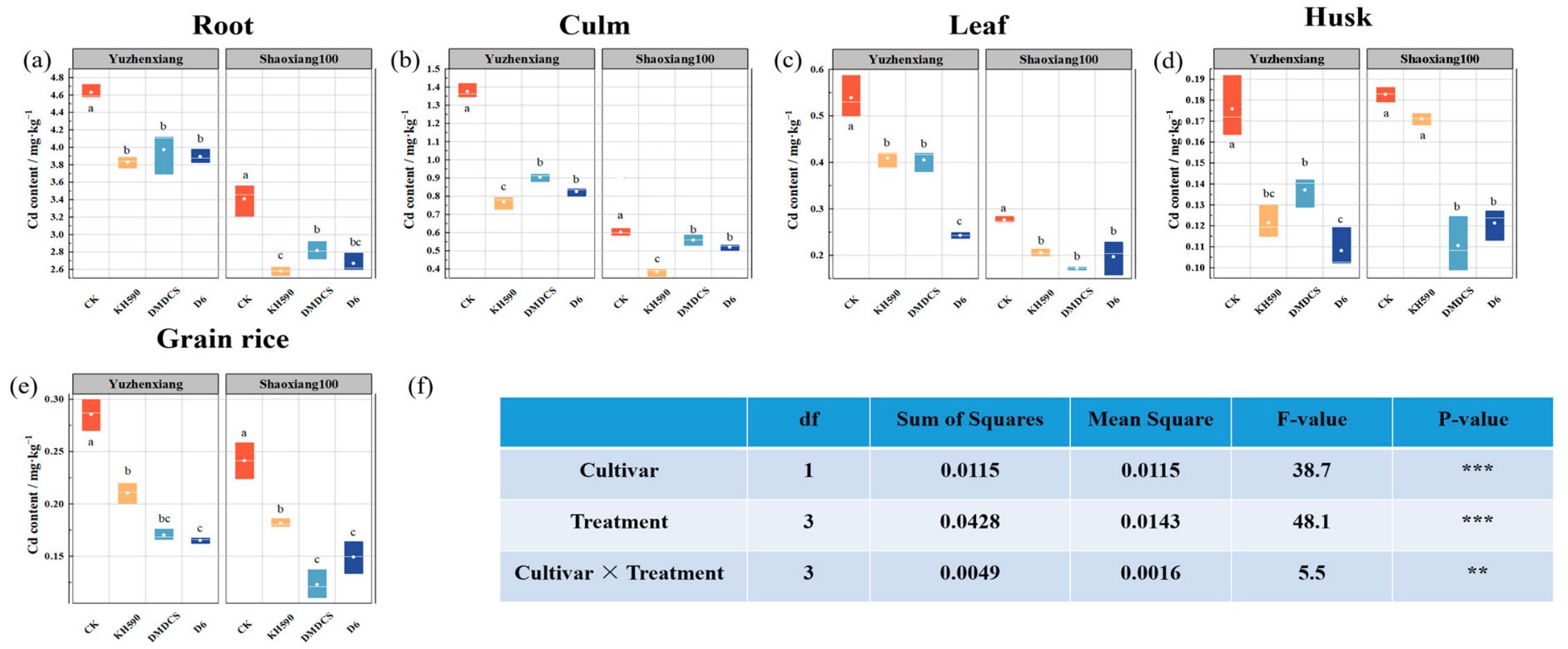
This study evaluated the regulatory effects of organosilicon on tissue growth and Cd accumulation in different rice varieties at the mature stage under 1 mg·kg−1 Cd stress (Figure 1). Overall, Cd concentration across organs followed the order of roots > culms > leaves > grain > husks in both varieties. Under CK treatment, Cd concentrations in all organs of the conventional variety Yuzhenxiang were consistently higher than Shaoxiang 100. Specifically, root Cd concentration in Yuzhenxiang was 36.1% higher than that in Shaoxiang 100 (Figure 1a). The culm and leaf Cd concentrations in Yuzhenxiang were approximately 2.2 and 2.3 times those of Shaoxiang 100, respectively (Figure 1b,c). In grain, Cd concentrations were 0.27 mg·kg−1 for Yuzhenxiang and 0.24 mg·kg−1 for Shaoxiang 100 (Figure 1e).
Organosilicon application reduced Cd concentrations across all organs in both varieties to varying degrees. Overall, Shaoxiang 100 exhibited a more sensitive response to organosilicon in terms of Cd decrease, especially in grain, where the decrease ranges of the organic silicon treatments (25.4–43.4%) were all higher than those of Yuzhenxiang (24.7–37.3%). For instance, DMDCS decreased grain Cd in Shaoxiang 100 from 0.24 mg·kg−1 to 0.14 mg·kg−1. Two-way ANOVA further revealed a highly significant variety × treatment interaction for grain Cd concentration (p < 0.01) (Figure 1f), indicating that the two rice varieties responded differently to organosilicon treatments.
Significant cultivar differences in Cd concentration were observed in a treatment- and organ-specific manner. In roots and culms, Yuzhenxiang consistently exhibited significantly higher Cd levels than Shaoxiang 100 across all four treatments (p < 0.01). In leaves, significant cultivar differences were detected under CK, KH590, and DMDCS treatments, but not under D6. In grains, the two cultivars differed significantly under KH590 and DMDCS, whereas no significant differences were observed under CK or D6 (Table 2).
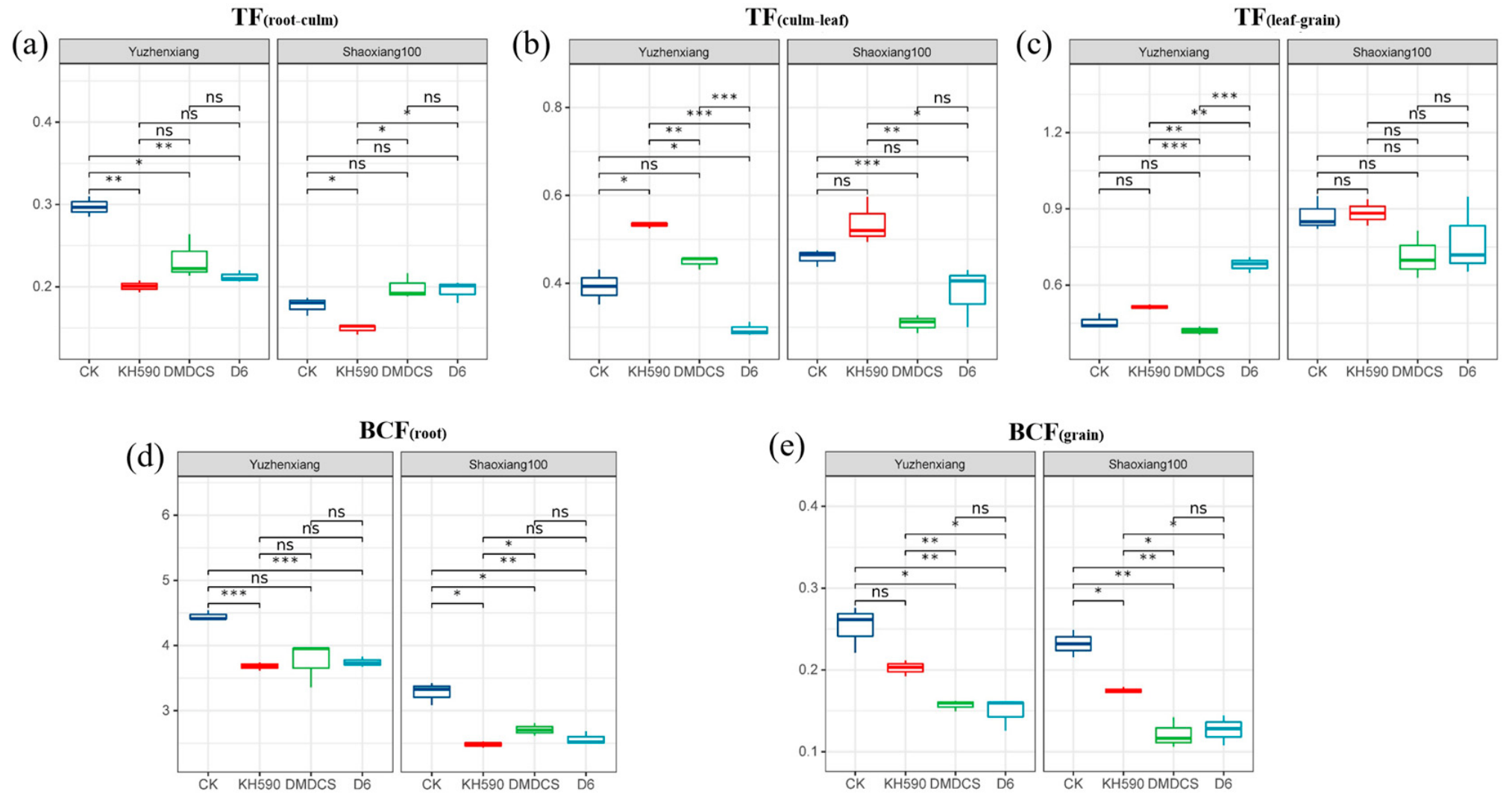
To evaluate the impact of organosilicon on Cd accumulation and mobility, the TF and BCF of Cd across organs were determined at the mature stage (Figure 2). Compared with CK, the organic silicon treatment has changed the TF of both varieties. For TFroot-culm, all three compounds reduced this factor in Yuzhenxiang (23–33%), whereas in Shaoxiang 100, only KH590 reduced it (17%), while DMDCS and D6 increased it by 13% and 9%, respectively. TFculm-leaf showed divergent responses. In Yuzhenxiang, D6 reduced it by 25%, but KH590 increased it by 37% and DMDCS by 15%. In Shaoxiang 100, DMDCS reduced it by 32% and KH590 increased it by 18%, while D6 moderately reduced it by 17%. For TFleaf-grain: in Yuzhenxiang, DMDCS reduced it by 7%, whereas D6 increased it by 50% and KH590 by 13%. In Shaoxiang 100, DMDCS reduced it by 18%, and D6 by 12%. Overall, organosilicon effectively lowered Cd accumulation but had compound- and variety-specific effects on translocation. Notably, KH590 enhanced Cd transfer to leaves in Yuzhenxiang, and D6 increased Cd partitioning to grains in the same variety. Relative to CK, organosilicon treatments reduced BCF in both varieties. In Yuzhenxiang, BCFroot decreased by 15–17% across treatments, and BCFgrain by 16–32%. In Shaoxiang 100, BCFroot decreased by 17–24%, and BCFgrain by 26–49%. Overall, DMDCS and D6 consistently and significantly reduced BCF in both varieties (p < 0.01).

3.2. Effects of Organosilicon on Key Physiological Pathways Associated with Cd Stress

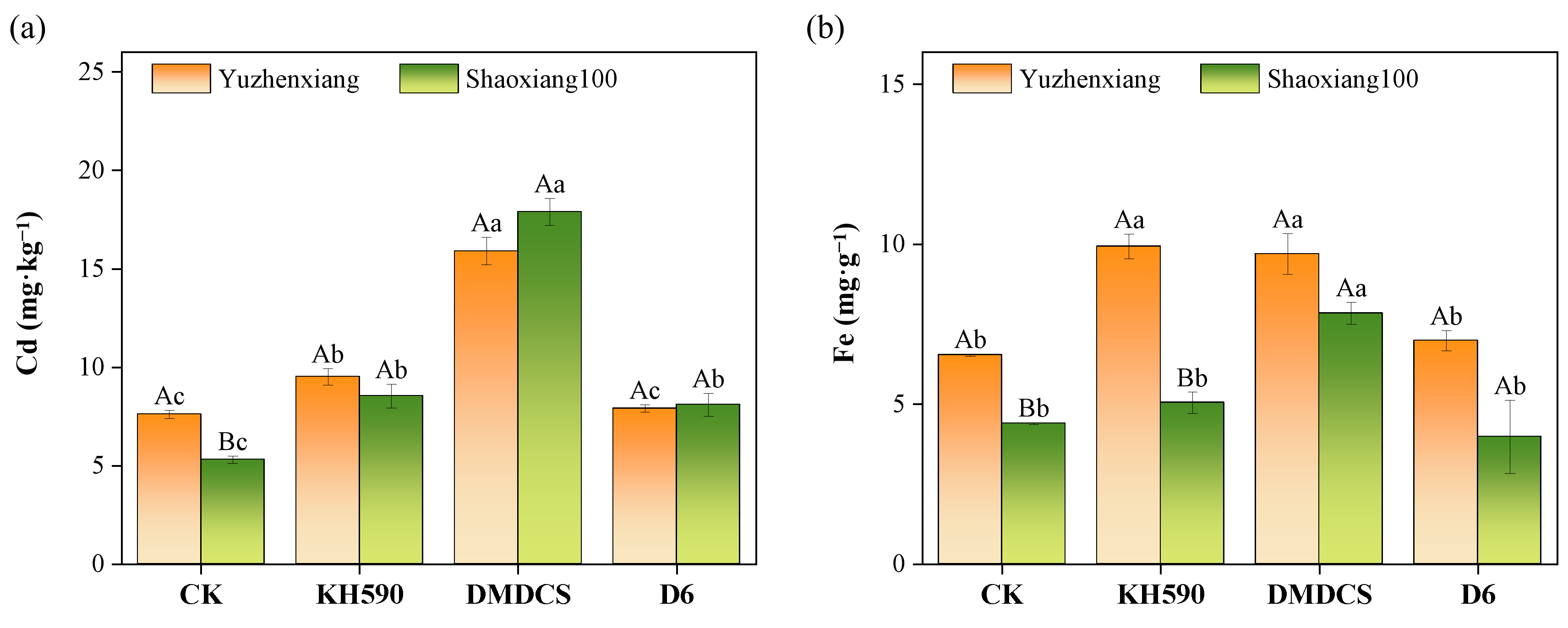
The root DCB-extractable Fe plays a critical role in immobilizing Cd in the rhizosphere, and its Fe and Cd concentrations were significantly affected by organosilicon application and variety characteristics (p < 0.05) (Figure 3). Under CK, Yuzhenxiang showed higher DCB-extractable Fe (6.53 mg·g−1) and Cd (7.61 mg·kg−1) concentrations than Shaoxiang 100 (Fe: 4.40 mg·g−1; Cd: 5.31 mg·kg−1), indicating a stronger inherent capacity for Fe oxide deposition on the root surface (p < 0.05). In Yuzhenxiang, DMDCS and KH590 significantly increased DCB-extractable Fe by 27.5% and 19.8%, respectively, compared with CK, whereas D6 treatment showed no significant effect (p = 0.214). Similarly, DCB-extractable Cd was significantly increased by DMDCS (109.0% increase) and KH590 (78.6% increase). In Shaoxiang 100, DMDCS increased DCB-extractable Fe by 48.2%, while KH590 and D6 showed no significant effect (p = 0.093 and 0.176, respectively). Notably, DCB-extractable Cd in Shaoxiang 100 was significantly enhanced by all three treatments, with DMDCS showing the greatest increase (237.0%), followed by KH590 (168.5%) and D6 (112.6%).

3.3. Effects of Organosilicon on Subcellular Distribution of Cd in Rice Under Cd Stress

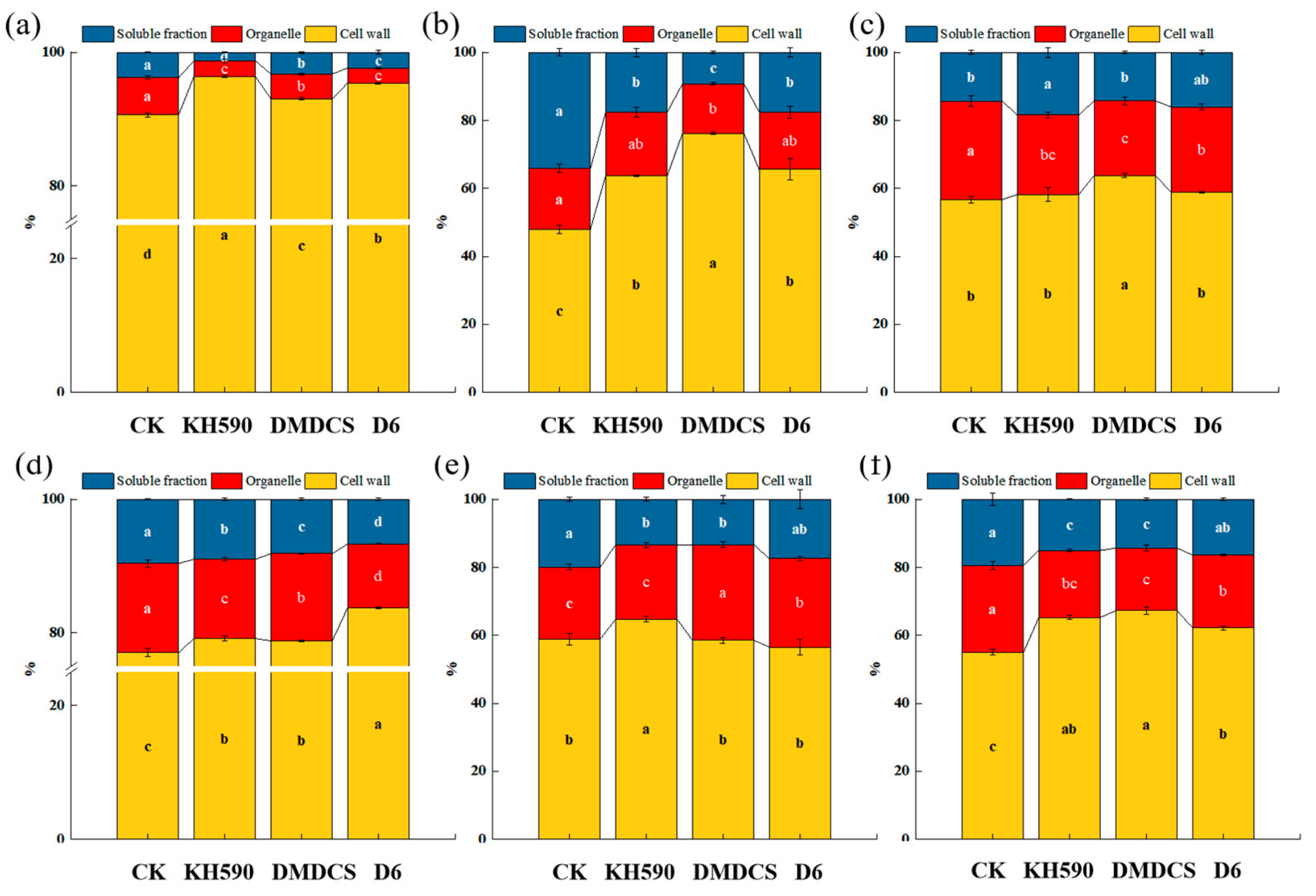
Subcellular fraction analysis indicated that the cell wall was the primary binding site for cadmium (Cd) in rice roots, culms, and leaves, accounting for more than 50% of total Cd, followed by the soluble fraction and organelles (Figure 4). Organosilicon application altered the subcellular distribution of Cd, enhancing Cd retention in the cell wall while reducing its presence in organelles and the soluble fraction. This trend was consistent across different organosilicon compounds in roots of both rice varieties, in culms of Yuzhenxiang and leaves of Shaoxiang 100 rice. Specifically, D6 was most effective in promoting Cd deposition in the root cell wall of both varieties, increasing root cell wall Cd from 4.10 to 7.02 mg·kg−1 in Yuzhenxiang and from 1.49 to 1.65 mg·kg−1 in Shaoxiang 100 (Figure 4a,d). The two varieties exhibited distinct response patterns: Yuzhenxiang was more sensitive to DMDCS, whereas Shaoxiang 100 responded more markedly to KH590 and D6.

3.4. Expression of Cd Transport Genes in Response to Organosilicon Treatment

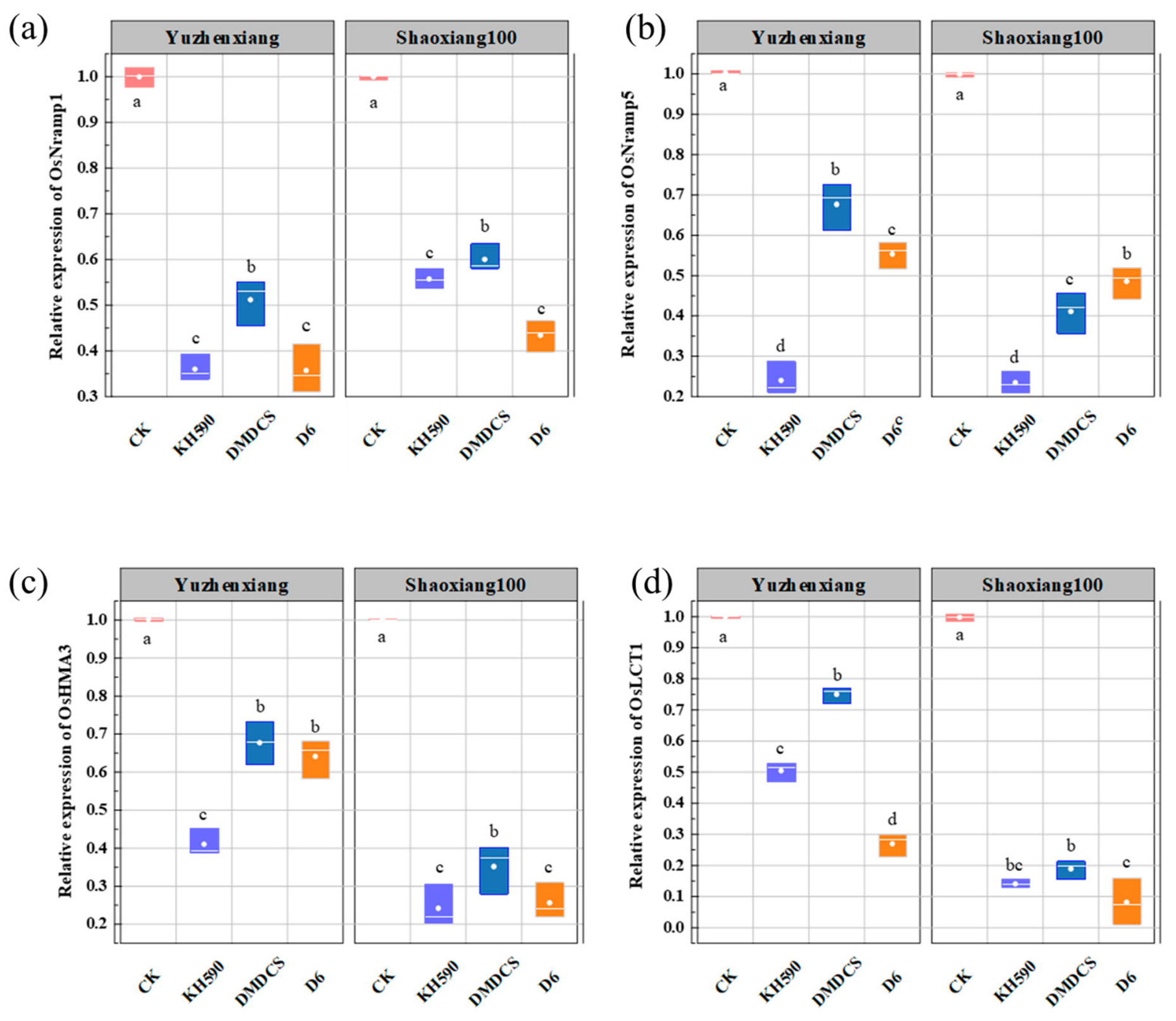
To evaluate the molecular regulation of Cd transport by organosilicon, the relative expression levels of key Cd transporter genes (OsNramp5, OsNramp1, OsHMA3, and OsLCT1) were investigated (Figure 5). Organosilicon application downregulated the expression of these key transporter genes in both rice varieties. In roots, KH590 treatment significantly suppressed the expression of OsNramp5, responsible for root Cd uptake, decreasing its relative expression by approximately 76% (p < 0.001) (Figure 5b). OsHMA3, responsible for vacuolar Cd sequestration in roots, was also downregulated (by 18.3–48.6%) (Figure 5c). Regarding long-distance transport genes, organosilicon treatment downregulated the expression of OsLCT1, which mediates phloem loading of Cd for grain allocation, by 24.9–73.0% in Yuzhenxiang and by 76.8–91.8% in Shaoxiang 100 (Figure 5d). Additionally, OsLCT1, a key gene involved in Cd translocation to grains, was markedly downregulated in both varieties, with a more pronounced reduction observed in the low-Cd variety Shaoxiang 100. Overall, organosilicon interrupted Cd accumulation and transport at the molecular level through the synergistic downregulation of genes responsible for root uptake, phloem loading, and grain allocation.
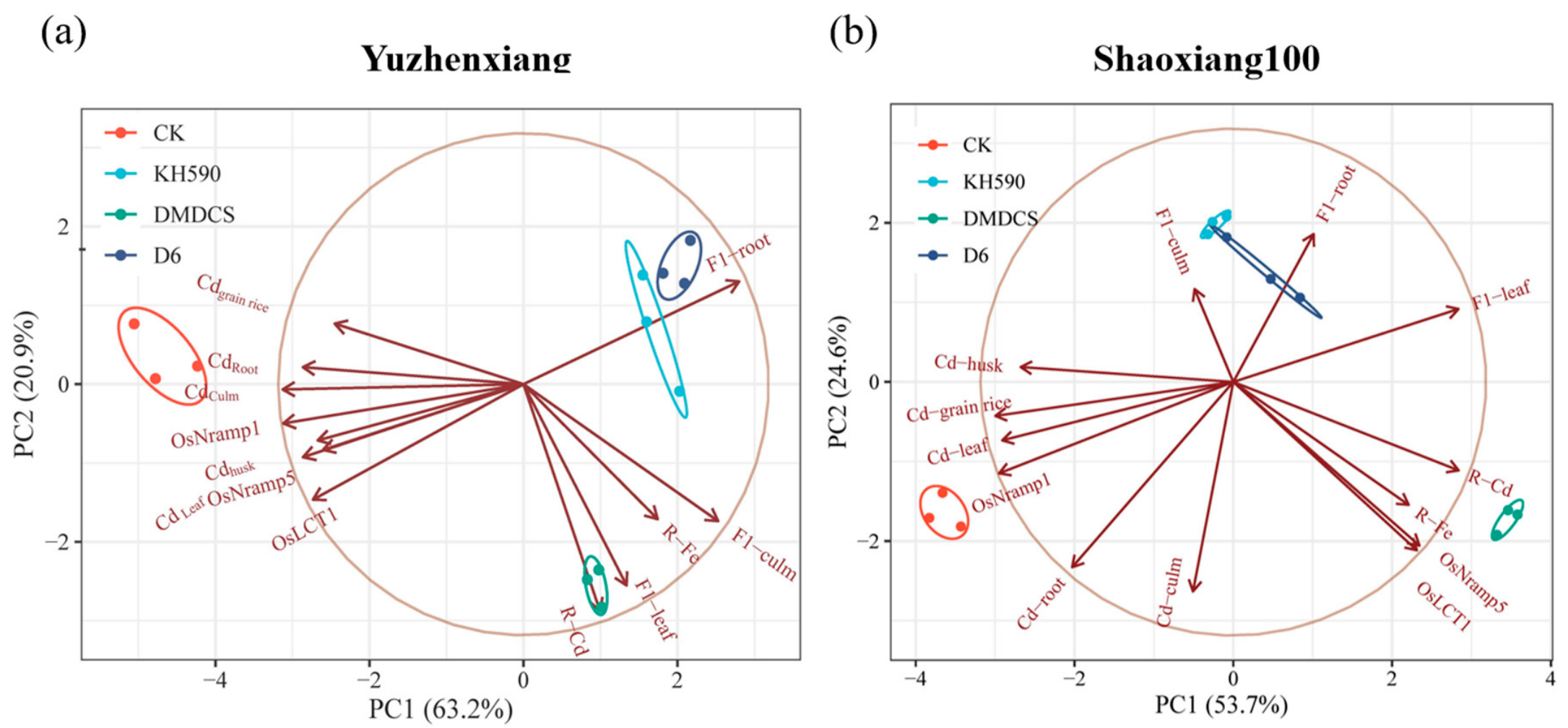
Principal component analysis (PCA) based on Cd accumulation parameters revealed that organosilicon treatments altered Cd transport and allocation patterns in both rice varieties (Figure 6). The confidence ellipses for the CK, KH590, DMDCS, and D6 groups tended to separate from each other in both varieties, though the separation was more distinct in Yuzhenxiang (PC1+PC2: 84.1%) than in Shaoxiang 100 (78.3%), suggesting that the low-Cd variety may have a more stable baseline allocation pattern that is less perturbed by exogenous treatments.

3.5. Grain Yield and Biomass Responses to Organosilicon Treatment

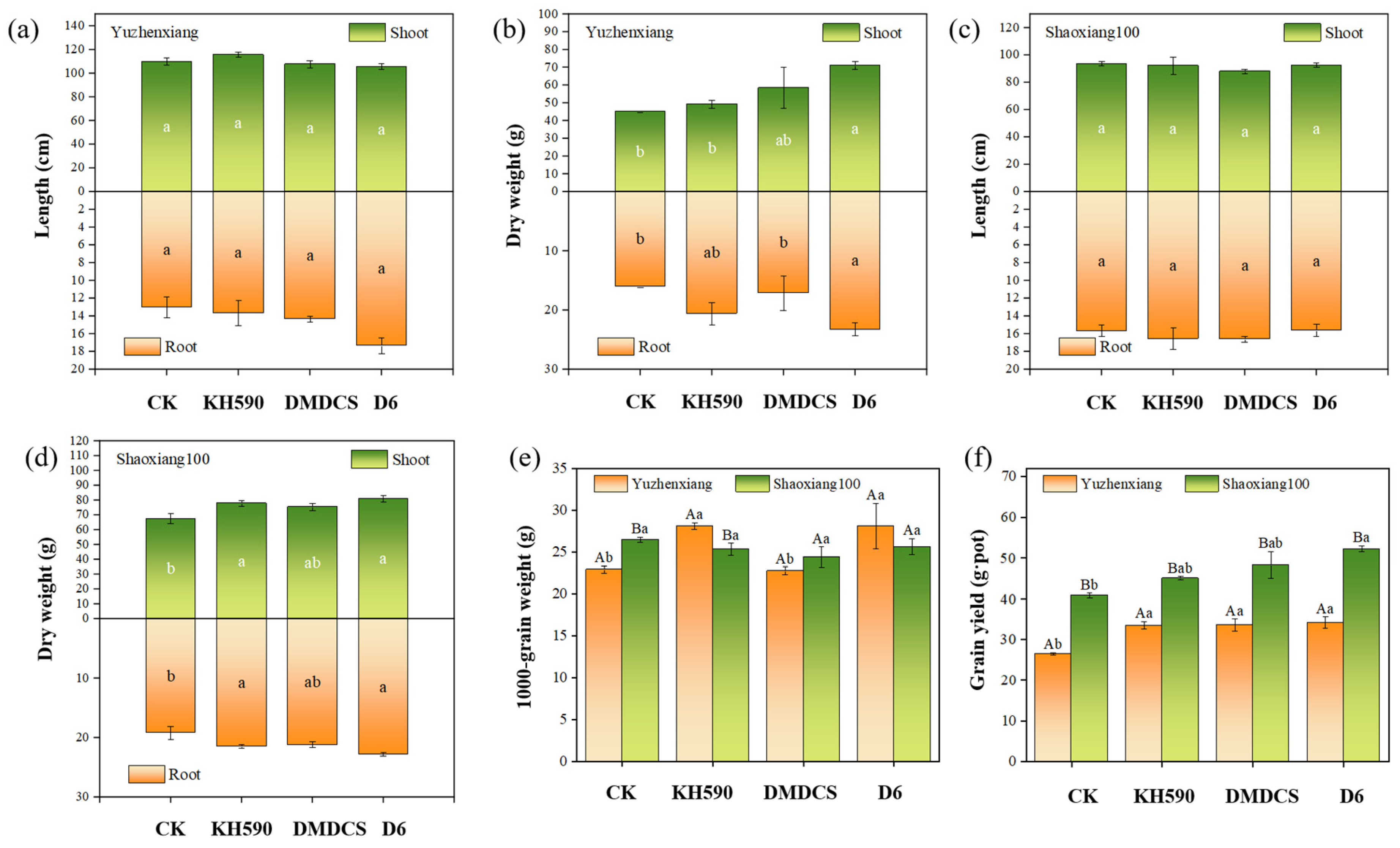
This study showed that organosilicon application alleviated the growth inhibition of mature rice plants under Cd stress (Figure 7). Compared with CK, D6 significantly increased shoot dry weight in both varieties (38.6% in Yuzhenxiang, p < 0.01; 22.4% in Shaoxiang 100, p < 0.05), whereas KH590 showed no significant effect on shoot dry weight in Shaoxiang 100 (p = 0.132), (Figure 7b,d). Specifically, organosilicon application increased shoot and root dry weights by an average of 32.3% and 26.8% in Yuzhenxiang, and by 15.7% and 13.8% in Shaoxiang 100, respectively. In terms of yield components, KH590 and D6 significantly increased the 1000-grain weight of Yuzhenxiang by 7.8% and 10.2%, respectively (p < 0.05), whereas DMDCS showed no significant effect (p = 0.152) (Figure 7e). For Shaoxiang 100, none of the three organosilicon treatments significantly affected 1000-grain weight (p > 0.05). Grain yield was significantly enhanced in both rice varieties (p < 0.05) (Figure 7f). Among the treatments, D6 exhibited the most remarkable yield-increasing effect, increasing grain yield by 28.8% in Yuzhenxiang and by 27.9% in Shaoxiang 100. Overall, these results demonstrate that organosilicon application promotes biomass accumulation and offers potential for synergistic yield enhancement in rice under Cd stress.

4. Discussion

4.1. Multi-Pathway Regulatory Mechanisms of Organosilicon in Controlling Cd Uptake and Transport

This study demonstrates that organosilicon can restrict Cd accumulation in rice through a multi-tiered defense system operating along the soil–root–shoot–grain continuum. This spatial cascade encompasses iron plaque sequestration at the root interface, suppressed transmembrane uptake, enhanced apoplastic retention, and impeded long-distance vascular translocation. First, at the root–soil interface, iron plaque serves as the primary apoplastic barrier against Cd entry into root organs [30]. Both KH590 and DMDCS significantly boosted root iron deposition and plaque-bound Cd content (p < 0.05) (Figure 3). These observations suggest that organosilicon may stimulate iron oxidation in the rhizosphere, thereby increasing the surface binding sites of Cd2+ [31,32]. However, alternative or complementary mechanisms cannot be excluded. For example, in this study, organosilicon treatment increased root biomass (Figure 7), which may enhance the physical retention of Cd on root surfaces by increasing root surface area, or reduce Cd concentration in root organs through a biomass dilution effect; these effects are not dependent on iron plaque oxidative immobilization. In addition, changes in rhizosphere pH induced by silicon application may also affect Cd speciation and solubility, thereby altering the amount of Cd available for adsorption onto iron plaque [13]. However, this study did not measure the soil pH and available silicon content after the experiment, which limits our ability to assess whether the organic silicon indirectly affects the bioavailability of cadmium through soil-chemical changes. This issue merits further investigation in future field trials.
Second, during the transmembrane uptake phase, Cd primarily enters root cells via transporters such as OsNRAMP5 [33]. The change trend of OsNRAMP5 was positively correlated with cadmium uptake and biological enrichment factor coefficients in roots [34]. Furthermore, organosilicon downregulated OsNRAMP1 expression, weakening intracellular Cd transport and rendering newly absorbed Cd more susceptible to localized immobilization [29]. The subcellular distribution of heavy metals represents one of the most critical detoxification mechanisms in plants, offering insights into organosilicon-mediated detoxification strategies [35,36]. Subcellular fraction analysis revealed that more than 50% of root Cd was associated with the cell wall fraction in the control group, and organosilicon treatments further increased the proportion of Cd retained in the root cell wall while correspondingly decreasing the soluble fraction, which is predominantly composed of free or small-molecule-bound Cd in the cytoplasm. Since cell walls are rich in pectin and hemicellulose with negatively charged carboxyl and hydroxyl groups that serve as primary Cd2+ binding sites [37], and the soluble fraction is considered the most mobile and phytotoxic Cd pool [38], these observations are consistent with a mechanism in which enhanced apoplastic sequestration limits the symplastic availability of Cd for long-distance transport. We speculate that organosilicon may increase the cation exchange capacity of cell walls by stimulating polysaccharide synthesis or altering the degree of pectin methylesterification, thereby retaining more Cd in the apoplast and reducing its migration toward protoplasts [39,40].
Third, at the level of long-distance cell-to-cell transport, organosilicon jointly restricted Cd translocation to shoots and grains by inhibiting phloem loading, nodal distribution, and phloem redistribution [41]. Translocation factor (TF) analysis showed that the effects of different organosilicon treatments on TF leaf-grain and TF culm-leaf were not uniform. Compared with the control treatment, the KH590 and D6 treatments even showed an increasing trend. The increase mainly resulted from a greater reduction in Cd concentration in leaves or culms than in grains, rather than from an increase in absolute Cd translocation. Subcellular fractionation results (Figure 4) further confirmed that organosilicon treatments significantly enhanced Cd immobilization in the cell walls of leaves and culms, substantially reducing the proportion of mobile Cd and thereby decreasing Cd redistribution to grains. Correlation analysis revealed a significant negative correlation (p < 0.01) between TF leaf-grain and leaf cell wall Cd retention, statistically supporting the view that apoplastic sequestration serves as a critical checkpoint restricting Cd export to grains. Gene expression profiles provided deep molecular evidence underpinning these physiological phenotypes. OsHMA3 is conventionally understood to sequester Cd into root vacuoles to restrict its upward translocation, with its upregulation regarded as a classic plant Cd-detoxification mechanism [42]. In this study, however, organosilicon treatments reduced OsHMA3 transcript levels, aligning with the findings of Huang [23]. We observed increased DCB-extractable Fe on root surfaces, downregulation of OsNRAMP5, and >50% cell wall Cd retention. Based on these observations, we propose that these dual apoplastic barriers may have maintained cytosolic Cd2+ at relatively low levels, potentially reducing the energy demand for vacuolar sequestration and thus leading to the observed downregulation of OsHMA3. Notably, the expression of OsLCT1, a low-affinity cation transport gene involved in phloem Cd loading and grain allocation, was downregulated after silicon application. This change was consistent with the decreasing trend of Cd transport efficiency from leaves to grains and Cd accumulation in grain. Based on the above observations, we hypothesized that organosilicon may reduce Cd accumulation in grains by inhibiting the expression of transport genes such as OsLCT1, which may impair the ability of directed Cd allocation to grains [43].
Overall, the three tested organosilicons exhibited distinct, structure-dependent modes of action: KH590 excels in suppressing root uptake genes (OsNRAMP5), and DMDCS was most effective in enhancing DCB-extractable Fe deposition on root surfaces, whereas D6 shows superior performance in leaf cell wall sequestration and overall long-distance transport inhibition. Elucidating these complementary, structure-specific mechanisms provides a solid theoretical foundation for selecting optimal functional groups to formulate cost-effective, multi-target composite organosilicon fertilizers.

4.2. Yield-Increasing Effects and Application Potential of Organosilicon Under Cd Stress

The Cd stress not only harms the safety and quality of rice grain, but also seriously inhibits plant growth and yield. In the safe utilization of Cd-contaminated paddy fields, achieving Cd reduction while maintaining grain yield remains a challenge, as conventional agronomic measures often pose a risk of yield reduction [44]. For example, long-term flooding can reduce Cd content in rice [45], but may inhibit root activity and increase methane emission [46]. Some alkaline immobilizing agents immobilize Cd but reduce the availability of soil trace elements, leading to crop yield reduction [47]. This study confirms that organosilicon is a strategy that can synergistically achieve efficient Cd reduction and production enhancement. Additionally, organosilicon demonstrated yield-enhancing potential far exceeding that of traditional Si fertilizers. Both shoot and root dry weights increased in two varieties, with root biomass gains surpassing shoot gains (Figure 7b,d), reflecting a preferential role in inducing root morphological recovery.
Overaccumulation of Cd damages chloroplast structures and reduces grain yield [44,48]. In our study, organosilicon significantly increased the proportion of Cd retained in the leaf cell wall fraction (Figure 4c,f), suggesting that a greater proportion of Cd was sequestered in the apoplast rather than entering the cytoplasm of photosynthetic cells. This apoplastic sequestration may help protect photosynthetic tissues from Cd toxicity [49], although direct evidence for photosynthetic protection was not measured in this study. The observed yield increases (Figure 7f) are consistent with this interpretation but may also reflect additional mechanisms such as improved root growth and nutrient uptake. Among the three preparations, D6 treatment had the most pronounced effect of increasing yield. This is attributed to the cyclic Si-O skeleton and twelve methyl groups of D6, which can gradually loosen the ring with water in the soil water environment and release active silyl alcohol with both hydrophilic and hydrophobic properties [50]. This persistent Si supply provided ample nutrients for root elongation, endodermal silicification, and chloroplast repair, while persistently activating antioxidant enzyme systems [51]. Moreover, KH590 formed a stable S-Cd chelation structure with the sulfhydryl (-SH) group [52], which enhanced chemical fixation at the rhizosphere and cell wall levels. Meanwhile, exogenous sulfur supply reestablished intracellular reactive oxygen species (ROS) balance, activated sulfhydryl detoxification system and regulated nutrient ion homeostasis, thereby improving rice Cd tolerance in general [53].
Notably, in Shaoxiang 100, DMDCS treatment reduced grain Cd to approximately 0.14 mg·kg−1, corresponding to a reduction of 43.4% relative to the control, while also maintaining marked biomass gains. Importantly, after organosilicon application, the grain Cd concentrations of both varieties fell below the Chinese safety limit of 0.2 mg·kg−1 (GB 2762–2022 [54]). This enhanced responsiveness may be related to Shaoxiang 100’s inherently lower baseline Cd uptake and transport activity, which could render it more amenable to further suppression by organosilicon-induced iron plaque formation, apoplastic sequestration, and OsLCT1 downregulation. The alleviation of Cd toxicity, coupled with activated endogenous resistance, substantially lowered the metabolic costs required for stress defense and cell repair. More photosynthetic assimilates were allocated to culm structure and grain filling, leading to simultaneous gains in biomass accumulation and grain plumpness. Based on the present pot-experiment data, DMDCS combined with Shaoxiang 100 achieved the greatest Cd reduction among all treatment–variety combinations, making it a promising candidate for scenarios where grain Cd minimization is the primary objective. D6, on the other hand, exhibited a more balanced profile of Cd reduction and yield maintenance, suggesting potential utility in contexts where both food safety and productivity are prioritized. These genotype–agent recommendations, however, remain preliminary and require field validation across multiple seasons and soil types.

5. Conclusions

This study demonstrated that the three organosilicon compounds reduced Cd translocation to rice grains through mechanisms involving retention by DCB-extractable Fe plaque on root surfaces, Cd fixation in root and culm cell walls, and inhibition of Cd transport gene expression. However, their modes of action were compound-specific. KH590 primarily suppressed Cd uptake in roots and culms of Shaoxiang 100, with moderate effects on iron plaque formation. DMDCS most effectively enhanced Cd fixation in the iron plaque and in root and culm cell walls in both varieties, leading to the greatest reduction in grain Cd. D6 was most effective in maintaining biomass and blocking late-stage Cd transport to grain, thereby providing the best yield performance among the three treatments. The low-Cd variety Shaoxiang 100 showed particularly strong synergy with organosilicon compounds: the DMDCS + Shaoxiang 100 combination achieved the greatest grain Cd reduction and appears the most promising option for maximum Cd mitigation, whereas D6 offered a more balanced performance in sustaining yield and food safety. Given the strong synergy between the tested amendments and the low-Cd cultivar Shaoxiang 100, we recommend combining DMDCS with a low-Cd cultivar when maximum grain Cd reduction is required, whereas D6 is preferable when yield stability is equally important. However, these findings are based on pot experiments and therefore require validation through multi-location, multi-season field trials before practical recommendations can be made. Future work should also assess residual soil effects, microbial responses, economic feasibility, and co-contaminant risks (As, Pb) under integrated remediation approaches.

Author Contributions

J.S.: Data curation, investigation, visualization, software, validation, writing—original draft; S.Y.: Data curation; H.H.: Writing—review and editing; S.T.: Conceptualization, supervision, writing—review and editing, funding acquisition. All authors have read and agreed to the published version of the manuscript.

Funding

This work was supported by the National Natural Science Foundation of China (Organosilicon-mediated soil cadmium transformation and ion interface behavior (Grant No. 42277392), the National Key Research and Development Program of China (The identification of soil pollution sources and source-sink relationships in rapidly developing economic areas) (Grant No. 2018YFC1800305) and Project 2662026ZHQD001 supported by the Fundamental Research Funds for the Central Universities.

Data Availability Statement

The raw data supporting the conclusions of this article will be made available by the authors on request.

Conflicts of Interest

The authors declare no competing financial interest.

References

  1. Ma, B.; Wang, J.; Zhang, L. Two cadmium-resistant strains of agricultural soil effective in remediating soil cadmium pollution. J. Environ. Chem. Eng. 2023, 11, 111189. [Google Scholar] [CrossRef] [Scilit]
  2. Hou, D.; Jia, X.; Nriagu, J. Global soil pollution by toxic metals threatens agriculture and human health. Science 2025, 388, 316–321. [Google Scholar] [CrossRef] [Scilit]
  3. Wu, M.; Xu, J.; Nie, Z.; Shi, H.; Liu, H.; Zhang, Y.; Li, C.; Zhao, P.; Liu, H. Physiological, biochemical and transcriptomic insights into the mechanisms by which molybdenum mitigates cadmium toxicity in Triticum aestivum L. J. Hazard. Mater. 2024, 472, 134516. [Google Scholar] [CrossRef] [Scilit]
  4. Wu, L.; Yu, Y.; Hu, H.; Tao, Y.; Song, P.; Li, D.; Guan, Y.; Gao, H.; Sui, X.; Volodymyr, T. New SFT2-like Vesicle Transport Protein (SFT2L) Enhances Cadmium Tolerance and Reduces Cadmium Accumulation in Common Wheat Grains. J. Agric. Food Chem. 2022, 18, 70. [Google Scholar] [CrossRef] [Scilit]
  5. Cui, Z.G.; Ahmed, K.; Zaidi, S.F.; Muhammad, J.S. Ins and Outs of Cadmium-induced carcinogenesis: Mechanism and prevention. Cancer Treat. Res. Commun. 2021, 1, 100372. [Google Scholar] [CrossRef] [Scilit]
  6. Shen, S.; Li, Y.; Pan, M.C.H.L.X.K. Reduced cadmium toxicity in rapeseed via alteration of root properties and accelerated plant growth by a nitrogen-fixing bacterium. J. Hazard. Mater. 2023, 449, 131040. [Google Scholar] [CrossRef] [Scilit]
  7. Yan, H.; Zhang, H.; Hao, S.; Wang, L.; Xu, W.; Mi, M.; Luo, Y.; He, Z. Cadmium contamination in food crops: Risk assessment and control in smart age. Crit. Rev. Environ. Sci. Technol. 2023, 53, 1643–1661. [Google Scholar] [CrossRef] [Scilit]
  8. Shao, Y.; Hu, Y.; Peng, Y.; Liu, H.; Tang, C.; Lei, B.; Tang, L.; Yu, L.; Li, W.; Luo, W.; et al. Directed improvement of hybrid rice Zhuo Liangyou 1126 traits by heavy ion beam mutagenesis based on M1TDS targeted screening technology. Chin. J. Rice Sci. 2025, 39, 624–634. [Google Scholar]
  9. Xu, M.; Yang, L.; Chen, Y.; Jing, H.; Wu, P.; Yang, W. Selection of rice and maize varieties with low cadmium accumulation and derivation of soil environmental thresholds in karst. Ecotoxicol. Environ. Saf. 2022, 247, 114244. [Google Scholar] [CrossRef] [Scilit]
  10. Mao, B. The new hybrid rice combination of CD low accumulation Zhen Liangyou 8612 has been widely used successfully. Hybrid Rice 2024, 39, 88. [Google Scholar]
  11. Li, J.; Shao, Y.; Yin, H.; Yu, L.; Huang, G.; Peng, Y.; Shao, D.; Zhou, L.; Zhao, B. Cultivation and experimental demonstration of Shaoxiang 100, a high quality conventional rice with low cadmium accumulation. J. Plant Genet. Resour. 2024, 25, 1996–2004. [Google Scholar]
  12. Li, C.; Fu, Y.; Trotsenko, V.; Zhatova, H. Understanding the physiological and molecular mechanisms of grain cadmium accumulation conduces to produce low cadmium grain crops: A review. Plant Growth Regul. 2024, 2, 103. [Google Scholar] [CrossRef] [Scilit]
  13. Sun, J.; Tu, S.; Zhu, Z. Deciphering cd stabilization pathways by organosilicon in soil-pakchoi systems through isotope-tracing. Plant Physiol. Biochem. 2025, 229, 110424. [Google Scholar] [CrossRef] [Scilit]
  14. Wei, R.; Liu, Y.; Kang, F.; Tian, L.; Wei, Q.; Li, Z.; Xu, P.; Hu, H.; Tan, Q.; Zhao, C. Impact of Rhizosphere Biostimulation on Cd Transport and Isotope Fractionation in Cd-Tolerant and Hyperaccumulating Plants Based on MC-ICP-MS and NanoSIMS. Environ. Sci. Technol. 2024, 58, 19408–19418. [Google Scholar] [CrossRef] [Scilit]
  15. Lan, F.; Zou, X.; Guo, B.; Zhou, X.; He, D.; Zhang, Z.; Luo, J.-S.; Dong, C. Effect of pH on growth and Cd accumulation in different rice varieties under hydroponics. Plant Signal. Behav. 2024, 19, 2399429. [Google Scholar] [CrossRef] [Scilit]
  16. Cao, Z.-Z.; Qin, M.-L.; Lin, X.-Y.; Zhu, Z.-W.; Chen, M.-X. Sulfur supply reduces cadmium uptake and translocation in rice grains (Oryza sativa L.) by enhancing iron plaque formation, cadmium chelation and vacuolar sequestration. Environ. Pollut. 2018, 238, 76–84. [Google Scholar] [CrossRef] [Scilit]
  17. Shao, J.F.; Xia, J.X.; Yamaji, N.; Shen, F.R.; Ma, J.F. Effective reduction of cadmium accumulation in rice grain by expressing OsHMA3 under the control of the OsHMA2 promoter. J. Exp. Bot. 2018, 69, 2743–2752. [Google Scholar] [CrossRef] [Scilit]
  18. Zhong, S.; Li, X.; Li, F.; Liu, T.; Huang, F.; Yin, H.; Chen, G.; Cui, J. Water Management Alters Cadmium Isotope Fractionation between Shoots and Nodes/Leaves in a Soil-Rice System. Environ. Sci. Technol. 2021, 55, 12902–12913. [Google Scholar] [CrossRef] [Scilit]
  19. Tian, S.; Liang, S.; Qiao, K.; Wang, F.; Zhang, Y.; Chai, T. Co-expression of multiple heavy metal transporters changes the translocation, accumulation, and potential oxidative stress of Cd and Zn in rice (Oryza sativa). J. Hazard. Mater. 2019, 380, 120853. [Google Scholar] [CrossRef] [Scilit]
  20. Gheshlaghpour, J.; Asghari, B.; Khademian, R.; Sedaghati, B. Silicon alleviates cadmium stress in basil (Ocimum basilicum L.) through alteration of phytochemical and physiological characteristics. Ind. Crops Prod. 2021, 163, 113338. [Google Scholar] [CrossRef] [Scilit]
  21. Rajput, V.; Minkina, T.; Feizi, M.; Choudhary, R. Effects of Silicon and Silicon-Based Nanoparticles on Rhizosphere Microbiome, Plant Stress and Growth. Biology 2021, 10, 791. [Google Scholar] [CrossRef] [Scilit]
  22. Thakral, V.; Raturi, G.; Sudhakaran, S.; Mandlik, R.; Sharma, Y.; Shivaraj, S.M.; Tripathi, D.K.; Sonah, H.; Deshmukh, R. Silicon, a quasi-essential element: Availability in soil, fertilizer regime, optimum dosage, and uptake in plants. Plant Physiol. Biochem. 2024, 208, 108459. [Google Scholar] [CrossRef] [Scilit]
  23. Huang, H.; Li, M.; Rizwan, M.; Dai, Z.; Tu, S. Synergistic Effect of Silicon and Selenium on the Alleviation of Cadmium Toxicity in Rice Plants. J. Hazard. Mater. 2020, 401, 123393. [Google Scholar] [CrossRef] [Scilit]
  24. Khan, I.; Awan, S.A.; Rizwan, M.; Ali, S.; Huang, L. Effects of silicon on heavy metal uptake at the soil-plant interphase: A review. Ecotoxicol. Environ. Saf. 2021, 222, 112510. [Google Scholar] [CrossRef] [Scilit]
  25. Pang, Z.; Tayyab, M.; Islam, W.; K-Tarin, M.W.; Zhang, H. Silicon-mediated improvement in tolerance of economically important crops under drought stress. Appl. Ecol. Environ. Res. 2019, 17, 6151–6170. [Google Scholar] [CrossRef] [Scilit]
  26. Wang, Z.; Tu, S.; Shehzad, K.; Hou, J.; Xiong, S.; Cao, M. Comparative study of organosilicon and inorganic silicon in reducing cadmium accumulation in wheat: Insights into rhizosphere microbial communities and molecular regulation mechanisms. J. Hazard. Mater. 2025, 492, 138061. [Google Scholar] [CrossRef] [Scilit]
  27. GB 15618-2018; Soil Environmental Quality Risk Control Standard for Soil Contamination of Agricultural Land. Ministry of Ecology and Environment of the People’s Republic of China: Beijing, China, 2018.
  28. Tian, X.; Chai, G.; Lu, M.; Xiao, R.; Xie, Q.; Luo, L. A new insight into the role of iron plaque in arsenic and cadmium accumulation in rice (Oryza sativa L.) roots. Ecotoxicol. Environ. Saf. 2023, 254, 114714. [Google Scholar] [CrossRef] [Scilit]
  29. Chang, J.D.; Huang, S.; Yamaji, N.; Zhang, W.; Ma, J.F.; Zhao, F.J. OsNRAMP1 transporter contributes to cadmium and manganese uptake in rice. Plant Cell Environ. 2020, 43, 2476–2491. [Google Scholar] [CrossRef] [Scilit]
  30. Peiman, Z.; Jianjun, Y.; Aminu, D.; Elke, B.; Xing, X.; Yaosheng, W.; Qian, L.; Ewald, S. Iron plaque formation, characteristics, and its role as a barrier and/or facilitator to heavy metal uptake in hydrophyte rice (Oryza sativa L.). Environ. Geochem. Health 2022, 45, 525–559. [Google Scholar] [CrossRef] [Scilit]
  31. Fu, Y.; Yang, X.; Shen, H. Root iron plaque alleviates cadmium toxicity to rice (Oryza sativa) seedlings. Ecotoxicol. Environ. Saf. 2018, 161, 534–541. [Google Scholar] [CrossRef] [Scilit]
  32. Wei, T.; Liu, X.; Dong, M.; Lv, X.; Hua, L.; Jia, H.; Ren, X.; Yu, S.; Guo, J.; Li, Y. Rhizosphere iron and manganese-oxidizing bacteria stimulate root iron plaque formation and regulate Cd uptake of rice plants (Oryza sativa L.). J. Environ. Manag. 2021, 278, 111533. [Google Scholar] [CrossRef] [Scilit]
  33. Zhang, Q.; Huang, D.; Xu, C.; Zhu, H.; Feng, R.-W.; Zhu, Q. Fe fortification limits rice Cd accumulation by promoting root cell wall chelation and reducing the mobility of Cd in xylem. Ecotoxicol. Environ. Saf. 2022, 240, 113700. [Google Scholar] [CrossRef] [Scilit]
  34. Xiao, Q.; Zhao, B.; Du, C.; Dun, Z.; Xiong, D.; Cui, K.; Peng, S.; Huang, J. Cadmium distribution in ratoon rice: OsNramp5 mutant reduces accumulation while physiological factors modulate node-specific partitioning. Ecotoxicol. Environ. Saf. 2026, 320, 120370. [Google Scholar] [CrossRef] [Scilit]
  35. Gkdere, H.; Inci, H.E.; Bilir, B. Evaluation of the role of silicon in alleviating cadmium stress in sorghum. Front. Plant Sci. 2026, 16, 1721563. [Google Scholar] [CrossRef] [Scilit]
  36. Liu, J.; Ma, J.; He, C.; Li, X.; Zhang, W.; Xu, F.; Lin, Y.; Wang, L. Inhibition of cadmium ion uptake in rice (Oryza sativa) cells by a wall-bound form of silicon. New Phytol. 2013, 200, 691–699. [Google Scholar] [CrossRef] [Scilit]
  37. Jia, H.; Wang, X.; Wei, T.; Zhou, R.; Ding, Y. Accumulation and fixation of Cd by tomato cell wall pectin under Cd stress. Environ. Exp. Bot. 2019, 167, 103829. [Google Scholar] [CrossRef] [Scilit]
  38. Xue, W.-J.; Zhang, C.-B.; Wang, P.-P.; Wang, C.-R.; Huang, Y.-C.; Zhang, X.; Liu, Z.-Q. Rice vegetative organs alleviate cadmium toxicity by altering the chemical forms of cadmium and increasing the ratio of calcium to manganese. Ecotoxicol. Environ. Saf. 2019, 184, 109640. [Google Scholar] [CrossRef] [Scilit]
  39. Riaz, M.; Kamran, M.; Fahad, S.; Wang, X. Nano-silicon mediated alleviation of Cd toxicity by cell wall adsorption and antioxidant defense system in rice seedlings. Plant Soil 2026, 486, 103–117. [Google Scholar]
  40. Jiang, Y.; Wei, C.; Jiao, Q.; Li, G.; Alyemeni, M.N.; Ahmad, P.; Shah, T.; Fahad, S.; Zhang, J.; Zhao, Y.; et al. Interactive effect of silicon and zinc on cadmium toxicity alleviation in wheat plants. J. Hazard. Mater. 2023, 458, 131933. [Google Scholar] [CrossRef] [Scilit]
  41. Liu, Y.S.; Tao, Y.; Yang, X.Z.; Liu, Y.N.; Shen, R.F.; Zhu, X.F. Gibberellic acid alleviates cadmium toxicity in rice by regulating NO accumulation and cell wall fixation capacity of cadmium. J. Hazard. Mater. 2022, 439, 129597. [Google Scholar] [CrossRef] [Scilit]
  42. Charagh, S.; Wang, J.; Hui, S.; Zhou, L.; Yang, L.; Chen, Y.; Zhang, Y.; Wu, Y.; Luo, C.; Cao, R.; et al. Oryza sativa heavy metal ATPase (OsHMA) transporter-mediated cadmium uptake in rice: Functional insights for low-Cd breeding. Food Chem. Mol. Sci. 2026, 13, 100425. [Google Scholar] [CrossRef] [Scilit]
  43. Wang, C.; Cheng, T.; Liu, H.; Zhou, F.; Zhang, J.; Zhang, M.; Liu, X.; Shi, W.; Cao, T. Nano-selenium controlled cadmium accumulation and improved photosynthesis in indica rice cultivated in lead and cadmium combined paddy soils. J. Environ. Sci. 2021, 103, 336–346. [Google Scholar] [CrossRef] [Scilit]
  44. Huang, F.; Li, Z.; Yang, X.; Liu, H.; Chen, L.; Chang, N.; He, H.; Zeng, Y.; Qiu, T.; Fang, L. Silicon reduces toxicity and accumulation of arsenic and cadmium in cereal crops: A meta-analysis, mechanism, and perspective study. Sci. Total Environ. 2024, 918, 170663. [Google Scholar] [CrossRef] [Scilit]
  45. Seyfferth, A.L.; Amaral, D.; Limmer, M.A.; Guilherme, L.R.G. Combined impacts of Si-rich rice residues and flooding extent on grain As and Cd in rice. Environ. Int. 2019, 128, 301–309. [Google Scholar] [CrossRef] [Scilit]
  46. Heredia, M.C.; Kant, J.; Prodhan, M.A.; Dixit, S.; Wissuwa, M. Breeding rice for a changing climate by improving adaptations to water saving technologies. Theor. Appl. Genet. 2021, 135, 17–33. [Google Scholar] [CrossRef] [Scilit]
  47. Natasha, N.; Shahid, M.; Khalid, S.; Bibi, I.; Naeem, M.A.; Niazi, N.K.; Tack, F.M.G.; Ippolito, J.A.; Rinklebe, J. Influence of biochar on trace element uptake, toxicity and detoxification in plants and associated health risks: A critical review. Crit. Rev. Environ. Sci. Technol. 2022, 52, 2803–2843. [Google Scholar] [CrossRef] [Scilit]
  48. Kang, M.; Liu, Y.; Weng, Y.; Wang, H.; Bai, X. A critical review on the toxicity regulation and ecological risks of zinc oxide nanoparticles to plants. Environ. Sci. Nano 2024, 11, 14–35. [Google Scholar] [CrossRef] [Scilit]
  49. Ram, K.; Mohammad, S.; Waquar, A.; Khalid, M.; Mohammad, A.; Durgesh, K.; Akhilesh, Y.; Sudhakar, P.; Md, A. Silicon alleviates cadmium toxicity in muskmelon (Cucumis melo): Integrative insights from photosynthesis to antioxidant activity to gene expression. Environ. Sci. Adv. 2025, 4, 921–937. [Google Scholar] [CrossRef] [Scilit]
  50. Xu, S. Fate of Cyclic Methylsiloxanes in Soils. 1. The Degradation Pathway. Environ. Sci. Technol. 2015, 33, 603–608. [Google Scholar]
  51. Ijaz, M.; Ijaz, R.; Bi, J.A.; Ahmed, T.; Noman, M.; Rani, H.; Malook, M.B.; Shahid, M.S.; Ondrasek, G.; Lin, B.; et al. Silicon-functionalized nanotherapeutics modulate physio-biochemical functions and soil enzyme profile for curtailing cadmium toxicity in rice (Oryza sativa L.) at vegetative phase. Clean. Eng. Technol. 2025, 28, 101070. [Google Scholar] [CrossRef] [Scilit]
  52. Weng, Z.; Tu, S.; Sun, J.; Xiong, S.; Cao, M. Effects of organosilicon on the physicochemical properties of acidic and saline-alkaline soils and the flocculation kinetics of clay particles. Colloids Surf. C 2025, 3, 100079. [Google Scholar] [CrossRef] [Scilit]
  53. Jung, H.I.; Lwin, C.S.; Kim, M.-S.; Lee, E.J.; Lee, T.-G.; Latt, T.T.; Lee, J.; Lee, B.-R. Sulfur Supplementation Enhances Cadmium Tolerance in Rice by Modulating Reactive Oxygen Species Scavenging, Thiol-Dependent Detoxification, and Mineral Nutrient Homeostasis. Antioxidants 2026, 15, 467. [Google Scholar] [CrossRef] [Scilit]
  54. GB 2762-2022; National Food Safety Standard — Maximum Levels of Contaminants in Foods. Standards Press of China: Beijing, China, 2022.
Figure 1. Effects of organosilicon treatment on cadmium content in different organs of rice at maturity. (a) Root, (b) culm, (c) leaf, (d) husk, and (e) grain. Different letters indicate significant differences among treatments within the same tissue (one-way ANOVA followed by Tukey’s HSD test, p < 0.05). Data are presented as mean ± SD (n = 3); (f) general linear model (GLM) analysis. ** p < 0.01, *** p < 0.001.
Agriculture 16 01977 g001
Figure 2. Effects of organosilicon treatment on Cd translocation factor (TF) and bioconcentration factor (BCF) in different organs of rice varieties: (a) TFroot-culm, (b) TFculm-leaf, (c) TFleaf-grain, (d) BCFroot, and (e) BCFgrain. Data are presented as mean ± SD (n = 3). * p < 0.05, ** p < 0.01, and *** p < 0.001; ns, not significant.
Agriculture 16 01977 g002
Figure 3. Effects of organosilicon treatment on DCB-extractable Cd and Fe contents in rice roots. (a) DCB-extractable Cd content. (b) DCB-extractable Fe content. Note: Data are presented as mean ± SD (n = 3). Uppercase letters indicate significant differences between the two varieties within the same treatment; lowercase letters indicate significant differences among different treatments within the same variety.
Agriculture 16 01977 g003
Figure 4. Effects of organosilicon treatments on cadmium content in subcellular fractions of different organs in rice varieties. Note: Data represent cadmium content (mg·kg−1) in subcellular fractions (cell wall, organelle, and soluble fractions). Yuzhenxiang: (a) roots; (b) culms; and (c) leaves. Shaoxiang 100: (d) roots; (e) culms; and (f) leaves. Data are presented as mean ± SD (n = 3). Different letters indicate significant differences among treatments within the same tissue at p < 0.05.
Agriculture 16 01977 g004
Figure 5. Effect of organosilicon on the expression of cadmium transport genes in rice. (a) OsNramp1, (b) OsNramp5, (c) OsHMA3, and (d) OsLCT1. Data are presented as mean ± SD (n = 3). Different letters indicate significant differences among treatments within the same tissue (one-way ANOVA followed by Tukey’s HSD test, p < 0.05). Total RNA was extracted from roots (for OsNramp1, OsNramp5, and OsHMA3) and from root-culm junction tissues (for OsLCT1).
Agriculture 16 01977 g005
Figure 6. Principal component analysis (PCA) of Cd accumulation parameters and expression of transport genes in organosilicon-treated rice. (DCB-extractable Cd) R-Cd, (DCB-extractable Fe) R-Fe, (Cd content in root cell wall) F1-root, (Cd content of culm cell wall) F1-culms, and (Cd content of leaf cell wall) F1-leaves.
Agriculture 16 01977 g006
Figure 7. Effects of organosilicon on the growth characteristics and yield indicators of rice plants at the ripening stage under cadmium stress. Shoot and root length of (a) Yuzhenxiang and (c) Shaoxiang 100. Dry weight of shoots and roots of (b) Yuzhenxiang and (d) Shaoxiang 100. (e) 1000-grain weight and (f) grain yield per pot. Data are presented as mean ± SD (n = 3). Uppercase letters indicate significant differences between the two varieties within the same treatment; lowercase letters indicate significant differences among different treatments within the same variety (one-way ANOVA followed by Tukey’s HSD test, p < 0.05).
Agriculture 16 01977 g007
Table 1. The primers used for quantitive RT-PCR.
Gene LOC NumberForward PrimerReverse Primer
α-tubulinOs03g51600GGAAATACATGGCTTGCTGCTTTCTCTTCGTCTTGATGGTTGCA
Actin1Os03g50890CAACA CCCCTGCTATGTACGCATCACCAGAGTCACAACACAA
OsNramp1Os01g0503400CATCGCATACCTTGATCCTAGTGGAGTACCCATAGCAACGAATA
OsNramp5Os07g0257200TTCGTTTATATTTGTGCGGTCCCACCTCCCCTCAAATGCTTATA
OsHMA3Os07g0232900CAATGGTGTTGGTCGTTGCCTCCCATTTCTGCAGTCTTTC
OsLCT1Os06g0579200AGCACATCTCTGGCTTCCACCGGCTCATTGCATTCTGCTC
Table 2. Statistical significance of cultivar differences in Cd concentration across organs and treatments.
OrganCKKH590DMDCSD6
Root************
Culm************
Leaf*******ns
Husknsns**
Grain ricens***ns
Note: Significance levels: * p < 0.05, ** p < 0.01, and *** p < 0.001; ns, not significant.
Disclaimer/Publisher’s Note: The statements, opinions and data contained in all publications are solely those of the individual author(s) and contributor(s) and not of MDPI and/or the editor(s). MDPI and/or the editor(s) disclaim responsibility for any injury to people or property resulting from any ideas, methods, instructions or products referred to in the content.