Land-Use Policy and Farmers’ Livelihood Resilience: A Structured Review of Conceptual Pathways to Rural Revitalization

Abstract
1. Introduction
2. Research Methodology
2.1. Bibliometric Dataset and Analysis
2.2. Core Literature Search and Screening
2.3. Data Extraction and Qualitative Synthesis
3. The Development and Definition of Farmers’ Livelihood Resilience
3.1. The Origin and Development of Farmers’ Livelihood Resilience
3.2. Definition of Farmers’ Livelihood Resilience
4. The Assessment System of Farmers’ Livelihood Resilience
5. Factors Influencing Farmers’ Livelihood Resilience
6. Interactions Between Different Land-Use Policies and Farmers’ Livelihood Resilience
6.1. Conceptual Assessment Framework and Selection Logic for Farmers’ Livelihood Resilience Under Land-Use Policies
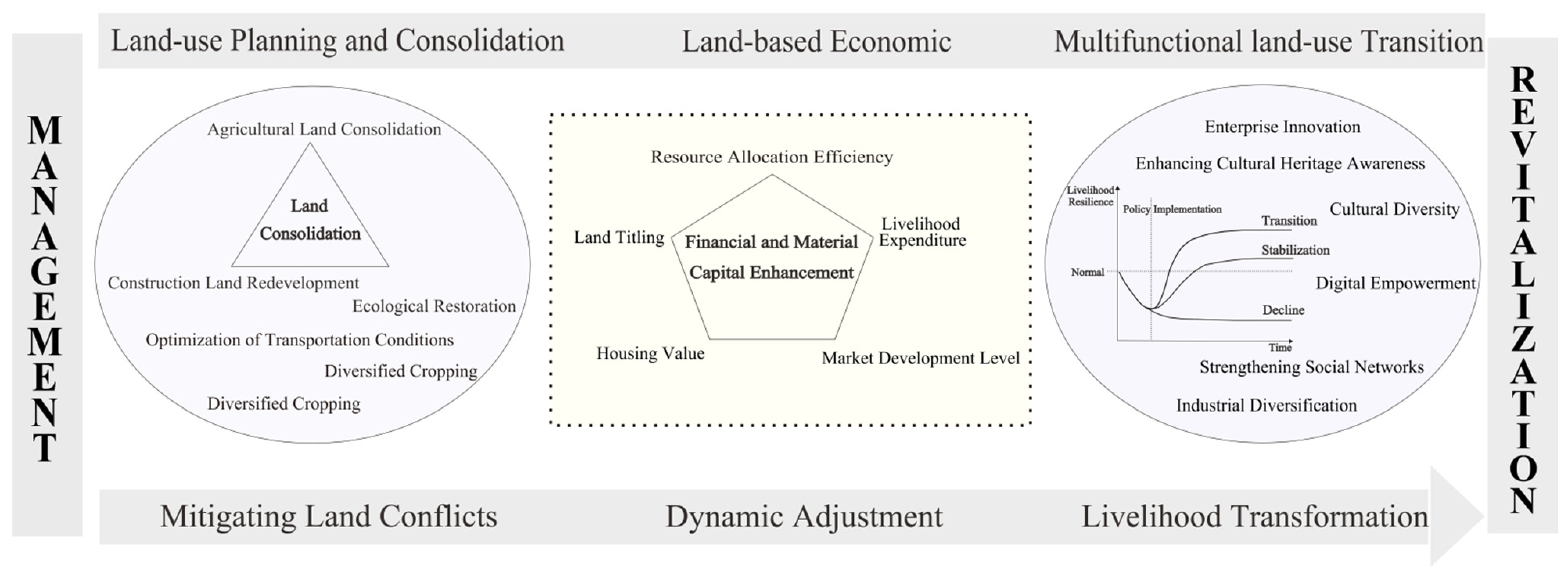
6.2. Pathways Linking Land-Use Policy, Livelihood Resilience, and Rural Revitalization
- (1)
- Land-use planning and consolidation: strengthening the resource base for risk buffering
- (2)
- Land-based economic policies: resource reallocation and livelihood adaptation
- (3)
- Multifunctional land-use transition policies: diversification and long-term livelihood transformation
7. Discussion
8. Conclusions
Supplementary Materials
Author Contributions
Funding
Institutional Review Board Statement
Informed Consent Statement
Data Availability Statement
Conflicts of Interest
References
- Tanner, T.; Lewis, D.; Wrathall, D.; Bronen, R.; Cradock-Henry, N.; Huq, S.; Lawless, C.; Nawrotzki, R.; Prasad, V.; Rahman, M.A.; et al. Livelihood resilience in the face of climate change. Nat. Clim. Change 2015, 5, 23–26. [Google Scholar] [CrossRef] [Scilit]
- Speranza, C.I.; Wiesmann, U.; Rist, S. An indicator framework for assessing livelihood resilience in the context of social-ecological dynamics. Glob. Environ. Change 2014, 28, 109–119. [Google Scholar] [CrossRef] [Scilit]
- United Nations. Transforming Our World: The 2030 Agenda for Sustainable Development; United Nations: New York, NY, USA, 2015. [Google Scholar]
- World Bank. Rural Population (% of Total Population) [Data Set]. World Development Indicators. Available online: https://data.worldbank.org/indicator/SP.RUR.TOTL.ZS (accessed on 7 July 2026).
- Pelletier, B.; Hickey, G.M.; Bothi, K.L.; Mude, A. Linking rural livelihood resilience and food security: An international challenge. Food Secur. 2016, 8, 469–476. [Google Scholar] [CrossRef] [Scilit]
- Xie, S.; Zhang, J.; Li, X.; Xia, X.; Chen, Z. The effect of agricultural insurance participation on rural households’ economic resilience to natural disasters: Evidence from China. J. Clean. Prod. 2024, 434, 140123. [Google Scholar] [CrossRef] [Scilit]
- Zhao, X.; Xiang, H.; Zhao, F. Measurement and Spatial Differentiation of Farmers’ Livelihood Resilience Under the COVID-19 Epidemic Outbreak in Rural China. Soc. Indic. Res. 2023, 166, 239–267. [Google Scholar] [CrossRef] [Scilit] [PubMed]
- Deininger, K. Land Policies for Growth and Poverty Reduction; World Bank: Washington, DC, USA; Oxford University Press: New York, NY, USA, 2003. [Google Scholar]
- Chen, K.; Wang, Y.; Li, N.; Xu, Y.; Zheng, Y.; Zhan, X.; Li, Q. The impact of farmland use transition on rural livelihood transformation in China. Habitat Int. 2023, 135, 102784. [Google Scholar] [CrossRef] [Scilit]
- Daniel, D.; Sutherland, M.; Ifejika Speranza, C. The role of tenure documents for livelihood resilience in Trinidad and Tobago. Land Use Policy 2019, 87, 104008. [Google Scholar] [CrossRef] [Scilit]
- Feder, G.; Feeny, D. Land tenure and property rights: Theory and implications for development policy. World Bank Econ. Rev. 1991, 5, 135–153. [Google Scholar] [CrossRef] [Scilit]
- Li, Y.; Wu, W.; Liu, Y. Land consolidation for rural sustainability in China. Land Use Policy 2018, 74, 137–141. [Google Scholar] [CrossRef] [Scilit]
- Jiang, Y.; Long, H.; Ives, C.D.; He, S.; Zhou, Y.; Chen, K.; Zhang, Y.; Wei, C. Modes and practices of rural vitalisation promoted by land consolidation in a rapidly urbanising China. Habitat Int. 2022, 121, 102514. [Google Scholar] [CrossRef] [Scilit]
- Zhou, T.; Jiang, G.; Ma, W.; Zhang, R.; Yang, Y.; Tian, Y.; Zhao, Q. Revitalization of idle rural residential land. Habitat Int. 2023, 138, 102867. [Google Scholar] [CrossRef] [Scilit]
- Chambers, R.; Conway, G.R. Sustainable Rural Livelihoods: Practical Concepts for the 21st Century; IDS Discussion Paper 296; Institute of Development Studies: Brighton, UK, 1992. [Google Scholar]
- Scoones, I. Sustainable Rural Livelihoods: A Framework for Analysis; IDS Working Paper 72; Institute of Development Studies: Brighton, UK, 1998. [Google Scholar]
- Carney, D. Implementing the sustainable rural livelihoods approach. In Sustainable Rural Livelihoods: What Contribution Can We Make? Carney, D., Ed.; Department for International Development: London, UK, 1998; pp. 3–23. [Google Scholar]
- Department for International Development. Sustainable Livelihoods Guidance Sheets; Department for International Development: London, UK, 1999. [Google Scholar]
- Holling, C.S. Resilience and stability of ecological systems. Annu. Rev. Ecol. Syst. 1973, 4, 1–23. [Google Scholar] [CrossRef] [Scilit]
- Folke, C. Resilience: The emergence of a perspective for social-ecological systems analyses. Glob. Environ. Change 2006, 16, 253–267. [Google Scholar] [CrossRef] [Scilit]
- Walker, B.; Holling, C.S.; Carpenter, S.R.; Kinzig, A. Resilience, adaptability and transformability in social-ecological systems. Ecol. Soc. 2004, 9, 5. [Google Scholar] [CrossRef] [Scilit]
- Li, E.; Deng, Q.; Zhou, Y. Livelihood resilience and the generative mechanism of rural households out of poverty: An empirical analysis from Lankao County, Henan Province, China. J. Rural. Stud. 2022, 93, 210–222. [Google Scholar] [CrossRef] [Scilit]
- Xu, J.; Lu, W.; Wang, W. From “fragile smallholders” to “resilient smallholders”: Measuring rural household resilience in China. Humanit. Soc. Sci. Commun. 2024, 11, 1712. [Google Scholar] [CrossRef] [Scilit]
- Zhao, M.; Chen, H.; Shao, L.; Xia, X.; Zhang, H. Impacts of rangeland ecological compensation on livelihood resilience of herdsmen. J. Rural. Stud. 2024, 107, 103245. [Google Scholar] [CrossRef] [Scilit]
- Barrett, C.B.; Ghezzi-Kopel, K.; Hoddinott, J.; Homami, N.; Tennant, E.; Upton, J.; Wu, T. A scoping review of the development resilience literature: Theory, methods and evidence. World Dev. 2021, 146, 105612. [Google Scholar] [CrossRef] [Scilit]
- Fan, Y.; Shi, X.; Li, X.; Feng, X. Livelihood resilience of vulnerable groups in the face of climate change: A systematic review and meta-analysis. Environ. Dev. 2022, 44, 100777. [Google Scholar] [CrossRef] [Scilit]
- Natarajan, N.; Newsham, A.; Rigg, J.; Suhardiman, D. A sustainable livelihoods framework for the 21st century. World Dev. 2022, 155, 105898. [Google Scholar] [CrossRef] [Scilit]
- Higgins, D.; Balint, T.; Liversage, H.; Winters, P. Investigating the impacts of increased rural land tenure security: A systematic review of the evidence. J. Rural. Stud. 2018, 61, 34–62. [Google Scholar] [CrossRef] [Scilit]
- Huntington, H.; Lisher, J. Reviewing the evidence on land tenure and governance: An overview of the impact evaluation literature and lessons learned. Land Use Policy 2025, 159, 107774. [Google Scholar] [CrossRef] [Scilit]
- Hong, Q.N.; Fàbregues, S.; Bartlett, G.; Boardman, F.; Cargo, M.; Dagenais, P.; Gagnon, M.-P.; Griffiths, F.; Nicolau, B.; O’Cathain, A.; et al. The Mixed Methods Appraisal Tool (MMAT) version 2018 for information professionals and researchers. Educ. Inf. 2018, 34, 285–291. [Google Scholar] [CrossRef] [Scilit]
- Folke, C.; Carpenter, S.R.; Walker, B.; Scheffer, M.; Chapin, T.; Rockström, J. Resilience thinking: Integrating resilience, adaptability and transformability. Ecol. Soc. 2010, 15, 20. [Google Scholar] [CrossRef] [Scilit]
- Mahajan, S.; Hausladen, C.I.; Argota Sánchez-Vaquerizo, J.; Korecki, M.; Helbing, D. Participatory resilience: Surviving, recovering and improving together. Sustain. Cities Soc. 2022, 83, 103942. [Google Scholar] [CrossRef] [Scilit]
- Marchese, D.; Reynolds, E.; Bates, M.E.; Morgan, H.; Clark, S.S.; Linkov, I. Resilience and sustainability: Similarities and differences in environmental management applications. Sci. Total Environ. 2018, 613–614, 1275–1283. [Google Scholar] [CrossRef] [Scilit] [PubMed]
- Carpenter, S.R.; Westley, F.; Turner, M.G. Surrogates for Resilience of Social–Ecological Systems. Ecosystems 2005, 8, 941–944. [Google Scholar] [CrossRef] [Scilit]
- Ribeiro, P.J.G.; Pena Jardim Gonçalves, L.A. Urban resilience: A conceptual framework. Sustain. Cities Soc. 2019, 50, 101625. [Google Scholar] [CrossRef] [Scilit]
- Wilson, G.A.; Hu, Z.; Rahman, S. Community resilience in rural China: The case of Hu Village, Sichuan Province. J. Rural. Stud. 2018, 60, 130–140. [Google Scholar] [CrossRef] [Scilit]
- Wilson, G.A.; Schermer, M.; Stotten, R. The resilience and vulnerability of remote mountain communities: The case of Vent, Austrian Alps. Land Use Policy 2018, 71, 372–383. [Google Scholar] [CrossRef] [Scilit]
- Nyamwanza, A.M. Livelihood resilience and adaptive capacity: A critical conceptual review. Jàmbá J. Disaster Risk Stud. 2012, 4, 6. [Google Scholar] [CrossRef] [Scilit]
- Walker, B.; Carpenter, S.; Anderies, J.; Abel, N.; Cumming, G.; Janssen, M.; Lebel, L.; Norberg, J.; Peterson, G.; Pritchard, R. Resilience Management in Social-ecological Systems: A Working Hypothesis for a Participatory Approach. Conserv. Ecol. 2002, 6, 14. [Google Scholar] [CrossRef] [Scilit]
- Benfica, R.; Henderson, H. The Effect of the Sectoral Composition of Economic Growth on Rural and Urban Poverty. Rev. Income Wealth 2021, 67, 248–284. [Google Scholar] [CrossRef] [Scilit]
- Guo, H.; Rogers, S.; Li, J.; Li, C. Farmers to urban citizens? Understanding resettled households’ adaptation to urban life in Shaanxi, China. Cities 2024, 145, 104667. [Google Scholar] [CrossRef] [Scilit]
- Scoones, I. Livelihoods perspectives and rural development. J. Peasant. Stud. 2009, 36, 171–196. [Google Scholar] [CrossRef] [Scilit]
- Zheng, Z.-Q.; Chou, R.-J. Rebuilding the resilience of mountainous rural communities by enhancing community capital through industrial transformation: A case study from rural Fujian, China. Habitat Int. 2024, 149, 103086. [Google Scholar] [CrossRef] [Scilit]
- Cutter, S.L.; Ash, K.D.; Emrich, C.T. The geographies of community disaster resilience. Glob. Environ. Change 2014, 29, 65–77. [Google Scholar] [CrossRef] [Scilit]
- Béné, C.; Arthur, R.; Norbury, H.; Allison, E.H.; Beveridge, M.; Bush, S.; Campling, L.; Leschen, W.; Little, D.; Squires, D.; et al. Contribution of Fisheries and Aquaculture to Food Security and Poverty Reduction: Assessing the Current Evidence. World Dev. 2016, 79, 177–196. [Google Scholar] [CrossRef] [Scilit]
- Shilomboleni, H.; Epstein, G.; Mansingh, A. Building resilience in Africa’s smallholder farming systems: Contributions from agricultural development interventions—A scoping review. Ecol. Soc. 2024, 29, 22. [Google Scholar] [CrossRef] [Scilit]
- Jacob, D.; Lera St. Clair, A.; Mahon, R.; Marsland, S.; Ndebele Murisa, M.; Buontempo, C.; Pulwarty, R.S.; Siddiqui, M.R.; Grossi, A.; Steynor, A.; et al. Co-production of climate services: Challenges and enablers. Front. Clim. 2025, 7, 1507759. [Google Scholar] [CrossRef] [Scilit]
- Laursen, S.; Puniwai, N.; Genz, A.S.; Nash, S.A.B.; Canale, L.K.; Ziegler-Chong, S. Collaboration Across Worldviews: Managers and Scientists on Hawaii Island Utilize Knowledge Coproduction to Facilitate Climate Change Adaptation. Environ. Manag. 2018, 62, 619–630. [Google Scholar] [CrossRef] [Scilit] [PubMed]
- Orsango, R.; Rajan, D.S.; Senapathy, M.; Bojago, E. An analysis of rural farmers’ livelihood sustainability in Offa district, Southern Ethiopia. J. Agric. Food Res. 2023, 12, 100610. [Google Scholar] [CrossRef] [Scilit]
- Park, B.; Kennedy Ochieng, H. The impacts of rural development project on resilience to climatic disasters: The case of Bangladesh. World Dev. 2024, 180, 106631. [Google Scholar] [CrossRef] [Scilit]
- Gocer, O.; Boyacioglu, D.; Karahan, E.E.; Shrestha, P. Cultural tourism and rural community resilience: A framework and its application. J. Rural. Stud. 2024, 107, 103238. [Google Scholar] [CrossRef] [Scilit]
- Gocer, O.; Shrestha, P.; Boyacioglu, D.; Gocer, K.; Karahan, E. Rural gentrification of the ancient city of Assos (Behramkale) in Turkey. J. Rural. Stud. 2021, 87, 146–159. [Google Scholar] [CrossRef] [Scilit]
- Murken, L.; Gornott, C. The importance of different land tenure systems for farmers’ response to climate change: A systematic review. Clim. Risk Manag. 2022, 35, 100419. [Google Scholar] [CrossRef] [Scilit]
- Heckert, J.; Pereira, A.; Doss, C.; Myers, E.C.; Quisumbing, A. Structural Transformation and Gendered Transitions to Adulthood among Rural Youth: Cross-National Evidence from Low- and Middle-Income Countries. J. Dev. Stud. 2021, 57, 614–634. [Google Scholar] [CrossRef] [Scilit]
- Perez, C.; Jones, E.M.; Kristjanson, P.; Cramer, L.; Thornton, P.K.; Förch, W.; Barahona, C. How resilient are farming households and communities to a changing climate in Africa? A gender-based perspective. Glob. Environ. Change 2015, 34, 95–107. [Google Scholar] [CrossRef] [Scilit]
- Shi, G.; Zhao, Y.; Mei, X.; Yan, D.; Zhang, H.; Xu, Y.; Dong, Y. Livelihood Resilience Perception: Gender Equalisation of Resettlers from Rural Reservoirs—Empirical Evidence from China. Sustainability 2022, 14, 11053. [Google Scholar] [CrossRef] [Scilit]
- Pierri, F.M.; Anseeuw, W.; Campolina, A. Land tenure for resilient and inclusive rural transformation. Glob. Food Secur. 2025, 44, 100835. [Google Scholar] [CrossRef] [Scilit]
- Zhang, Y.; Wang, W.; Feng, Y. Impact of different models of rural land consolidation on rural household poverty vulnerability. Land Use Policy 2022, 114, 105963. [Google Scholar] [CrossRef] [Scilit]
- Huang, X.; Li, H.; Zhang, X.; Zhang, X. Land use policy as an instrument of rural resilience—The case of land withdrawal mechanism for rural homesteads in China. Ecol. Indic. 2018, 87, 47–55. [Google Scholar] [CrossRef] [Scilit]
- Heijman, W.; Hagelaar, G.; van der Heide, M. Rural resilience as a new development concept. In EU Bioeconomy Economics and Policies: Volume II; Dries, L., Heijman, W., Jongeneel, R., Purnhagen, K., Wesseler, J., Eds.; Palgrave Macmillan: Cham, Switzerland, 2019; pp. 195–211. [Google Scholar] [CrossRef] [Scilit] [PubMed]
- Huang, Y.; Hui, E.C.; Zhou, J.; Lang, W.; Chen, T.; Li, X. Rural Revitalization in China: Land-Use Optimization through the Practice of Place-making. Land Use Policy 2020, 97, 104788. [Google Scholar] [CrossRef] [Scilit]
- McManus, P.; Walmsley, J.; Argent, N.; Baum, S.; Bourke, L.; Martin, J.; Pritchard, B.; Sorensen, T. Rural community and rural resilience: What is important to farmers in keeping their country towns alive? J. Rural. Stud. 2012, 28, 20–29. [Google Scholar] [CrossRef] [Scilit]
- Tan, J.; Peng, L.; Guo, S. Measuring Household Resilience in Hazard-Prone Mountain Areas: A Capacity-Based Approach. Soc. Indic. Res. 2020, 152, 1153–1176. [Google Scholar] [CrossRef] [Scilit]
- Li, C.; Gao, M.; Li, S.; Lei, H. Impact of rural households’ livelihood resilience on multidimensional poverty: Evidence from the poverty alleviation relocation areas in Shaanxi Province. China Popul. Resour. Environ. 2021, 31, 150–160. (In Chinese) [Google Scholar]
- Chen, X.; An, Y.; Pan, W.; Wang, Y.; Chen, L.; Gu, Y.; Liu, H.; Yang, F. Dynamic transfer and driving mechanisms of the coupling and coordination of agricultural resilience and rural land use efficiency in China. J. Geogr. Sci. 2024, 34, 1589–1614. [Google Scholar] [CrossRef] [Scilit]
- Gong, Y.; Zhang, R.; Yao, K.; Liu, B.; Wang, F. A Livelihood Resilience Measurement Framework for Dam-Induced Displacement and Resettlement. Water 2020, 12, 3191. [Google Scholar] [CrossRef] [Scilit]
- Jurjonas, M.; Seekamp, E. Rural coastal community resilience: Assessing a framework in eastern North Carolina. Ocean. Coast. Manag. 2018, 162, 137–150. [Google Scholar] [CrossRef] [Scilit]
- Li, Y. A systematic review of rural resilience. China Agric. Econ. Rev. 2023, 15, 66–77. [Google Scholar] [CrossRef] [Scilit]
- Frankenberger, T.; Mueller, M.; Spangler, T.; Alexander, S. Community Resilience: Conceptual Framework and Measurement—Feed the Future Learning Agenda; Westat: Rockville, MD, USA, 2013. [Google Scholar]
- Food and Agriculture Organization of the United Nations. RIMA-II: Resilience Index Measurement and Analysis II; FAO: Rome, Italy, 2016; Available online: https://www.fao.org/3/i5665e/i5665e.pdf (accessed on 22 August 2026).
- Sun, F.; Zheng, Q.; Ye, C.; Lin, J. A rural resilience development indicator system oriented to common prosperity: The case of a coastal village in Zhejiang Province. Ecol. Indic. 2023, 156, 111126. [Google Scholar] [CrossRef] [Scilit]
- Savari, M.; Eskandari Damaneh, H.; Eskandari Damaneh, H. Effective factors to increase rural households’ resilience under drought conditions in Iran. Int. J. Disaster Risk Reduct. 2023, 90, 103644. [Google Scholar] [CrossRef] [Scilit]
- Liu, R.; Zhang, L.; Tang, Y.; Jiang, Y. Understanding and evaluating the resilience of rural human settlements with a social-ecological system framework: The case of Chongqing Municipality, China. Land Use Policy 2024, 136, 106966. [Google Scholar] [CrossRef] [Scilit]
- Zhang, X.; Luo, Y.; Liu, Y.; Han, Z.; Wang, F. Resilience in urban, rural, and transitional communities: An empirical study in Guangdong, China. Int. J. Disaster Risk Reduct. 2023, 84, 103396. [Google Scholar] [CrossRef] [Scilit]
- Zhou, J.; Hou, Q. Resilience assessment and planning of suburban rural settlements based on complex network. Sustain. Prod. Consum. 2021, 28, 1645–1662. [Google Scholar] [CrossRef] [Scilit]
- Constas, M.; Frankenberger, T.; Hoddinott, J. Resilience Measurement Principles: Toward an Agenda for Measurement Design; Resilience Measurement Technical Working Group, Technical Series No. 1; Food Security Information Network (FSIN): Rome, Italy, 2014; Available online: https://www.fsnnetwork.org/sites/default/files/FSINRMTS1final.pdf (accessed on 22 August 2026).
- D’Errico, M.; Smith, L.C. Comparison of FAO and TANGO Measures of Household Resilience and Resilience Capacity; Food and Agriculture Organization of the United Nations (FAO) and TANGO International: Rome, Italy, 2020. [Google Scholar]
- Adato, M.; Meinzen-Dick, R. Assessing the Impact of Agricultural Research on Poverty Using the Sustainable Livelihoods Framework; EPTD Discussion Paper 89/FCND Discussion Paper 128; International Food Policy Research Institute: Washington, DC, USA, 2002. [Google Scholar] [CrossRef]
- Ma, L.; Zhang, Y.; Li, T.; Zhao, S.; Yi, J. Livelihood capitals and livelihood resilience: Understanding the linkages in China’s government-led poverty alleviation resettlement. Habitat Int. 2024, 147, 103057. [Google Scholar] [CrossRef] [Scilit]
- Ma, L.; He, Q.; Long, H.; Zhang, Y.; Liao, L. Rural return migration in the post COVID-19 China: Incentives and barriers. J. Rural. Stud. 2024, 107, 103258. [Google Scholar] [CrossRef] [Scilit]
- Sina, D.; Chang-Richards, A.Y.; Wilkinson, S.; Potangaroa, R. A conceptual framework for measuring livelihood resilience: Relocation experience from Aceh, Indonesia. World Dev. 2019, 117, 253–265. [Google Scholar] [CrossRef] [Scilit]
- Baldwin, C.; Hamerlinck, J.; McKinlay, A. Institutional support for building resilience within rural communities characterised by multifunctional land use. Land Use Policy 2023, 132, 106808. [Google Scholar] [CrossRef] [Scilit]
- Long, H.; Tu, S.; Ge, D.; Li, T.; Liu, Y. The allocation and management of critical resources in rural China under restructuring: Problems and prospects. J. Rural. Stud. 2016, 47, 392–412. [Google Scholar] [CrossRef] [Scilit]
- Rathi, A. Is Agrarian Resilience limited to Agriculture? Investigating the “farm” and “non-farm” processes of Agriculture Resilience in the rural. J. Rural. Stud. 2022, 93, 155–164. [Google Scholar] [CrossRef] [Scilit]
- Londres, M.; Schmink, M.; Börner, J.; Duchelle, A.E.; Frey, G.P. Multidimensional forests: Complexity of forest-based values and livelihoods across Amazonian socio-cultural and geopolitical contexts. World Dev. 2023, 165, 106200. [Google Scholar] [CrossRef] [Scilit]
- Fan, Y.; Cong, S. Fiscal transfer payments and farmers’ livelihood resilience: “Driving” or “constraining”? China Rural. Econ. 2024, 1, 125–148. (In Chinese) [Google Scholar] [CrossRef]
- Gao, Q.; Sun, M.; Chen, L. The impact of digital inclusive finance on agricultural economic resilience. Financ. Res. Lett. 2024, 66, 105679. [Google Scholar] [CrossRef] [Scilit]
- Kyriakopoulos, P. Revisiting research on firm-level innovation in rural areas: A systematic literature review and future research directions. J. Rural. Stud. 2024, 111, 103437. [Google Scholar] [CrossRef] [Scilit]
- Young, J.C. Rural digital geographies and new landscapes of social resilience. J. Rural. Stud. 2019, 70, 66–74. [Google Scholar] [CrossRef] [Scilit]
- Xiong, A.; Li, Y.; Liu, S.; Li, H. Knowledge acquisition and precautionary behaviors for individual resilience to the COVID-19 pandemic: A study of rural Latin America. J. Rural. Stud. 2022, 95, 373–381. [Google Scholar] [CrossRef] [Scilit] [PubMed]
- Li, Y.; Westlund, H.; Liu, Y. Why some rural areas decline while some others not: An overview of rural evolution in the world. J. Rural. Stud. 2019, 68, 135–143. [Google Scholar] [CrossRef] [Scilit]
- Fang, Y.-P.; Zhu, F.-B.; Qiu, X.-P.; Zhao, S. Effects of natural disasters on livelihood resilience of rural residents in Sichuan. Habitat Int. 2018, 76, 19–28. [Google Scholar] [CrossRef] [Scilit]
- Payne, P.R.; Kaye-Blake, W.H.; Kelsey, A.; Brown, M.; Niles, M.T. Measuring rural community resilience: Case studies in New Zealand and Vermont, USA. Ecol. Soc. 2021, 26, 2. [Google Scholar] [CrossRef] [Scilit]
- Clay, N.; Zimmerer, K.S. Who is resilient in Africa’s Green Revolution? Sustainable intensification and Climate Smart Agriculture in Rwanda. Land Use Policy 2020, 97, 104558. [Google Scholar] [CrossRef] [Scilit] [PubMed]
- Liu, Y.; Li, Y. Revitalize the world’s countryside. Nature 2017, 548, 275–277. [Google Scholar] [CrossRef] [Scilit] [PubMed]
- Zhang, Q.; Gong, J.; Wang, Y. How resilience capacity and multiple shocks affect rural households’ subjective well-being: A comparative study of the Yangtze and Yellow River Basins in China. Land Use Policy 2024, 142, 107192. [Google Scholar] [CrossRef] [Scilit]
- Wu, S.; Zhu, H.; Lu, X. Impact effects and mechanisms of comprehensive land consolidation on farmers’ livelihood resilience: A case study of some counties in Hubei Province. Res. Agric. Mod. 2023, 44, 1002–1013. (In Chinese) [Google Scholar] [CrossRef]
- Kim, H.; Marcouiller, D.W. Rural Prospects for Resilience: Planning Sustainable Livelihoods and Coping with Flood Hazards along the U.S. Mississippi River. Soc. Nat. Resour. 2021, 34, 168–187. [Google Scholar] [CrossRef] [Scilit]
- Del Prete, D.; Ghins, L.; Magrini, E.; Pauw, K. Land consolidation, specialization and household diets: Evidence from Rwanda. Food Policy 2019, 83, 139–149. [Google Scholar] [CrossRef] [Scilit]
- Lyu, X.; Zhang, Q.; Zhang, X.; Zhang, J. The impact of farmland transfer on farmers’ livelihood resilience under the goal of common prosperity: An empirical study of typical farmers in Shenyang. J. Nat. Resour. 2025, 40, 636–651. (In Chinese) [Google Scholar] [CrossRef] [Scilit]
- Wang, Y.; Zhang, Q.; Li, Q.; Wang, J.; Sannigrahi, S.; Bilsborrow, R.; Bellingrath-Kimura, S.; Li, J.; Song, C. Role of social networks in building household livelihood resilience under payments for ecosystem services programs in a poor rural community in China. J. Rural. Stud. 2021, 86, 208–225. [Google Scholar] [CrossRef] [Scilit]
- Yu, R.; Cheng, J.; Su, X.; Liang, L. Tourism smallholders’ perceived risks, resilience, and response strategies in the upper reaches of the Yihe River, China. Ecol. Indic. 2023, 154, 110491. [Google Scholar] [CrossRef] [Scilit]
- Zhou, Y.; Gu, H. Enhancing rural resilience through the rural revitalisation strategy in rural China: Evidence from Wushi Village, Hunan Province. J. Rural. Stud. 2025, 113, 103493. [Google Scholar] [CrossRef] [Scilit]
- Tunalı, S.P.; Dağdelen, N. Comparison of different models for land consolidation projects: Aydin Yenipazar Plain. Land Use Policy 2023, 127, 106590. [Google Scholar] [CrossRef] [Scilit]
- Ichinose, Y.; Higuchi, H.; Kubo, R.; Nishigaki, T.; Kilasara, M.; Shinjo, H.; Funakawa, S. Adaptation of farmland management strategies to maintain livelihood by the Chagga people in the Kilimanjaro highlands. Agric. Syst. 2020, 181, 102829. [Google Scholar] [CrossRef] [Scilit]
- Hu, Z.; Song, G.; Hu, Z.; Fang, J. An improved dynamic game analysis of farmers, enterprises and rural collective economic organizations based on idle land reuse policy. Land Use Policy 2024, 140, 107098. [Google Scholar] [CrossRef] [Scilit]
- Li, F.; Meng, B.; Wang, Y. Agricultural land system transition based on resilience and vitality: A case study on the Loess Plateau (Yulin, China). J. Rural. Stud. 2025, 117, 103643. [Google Scholar] [CrossRef] [Scilit]
- Wang, D.; Chen, C.; Findlay, C. A review of rural transformation studies: Definition, measurement, and indicators. J. Integr. Agric. 2023, 22, 3568–3581. [Google Scholar] [CrossRef] [Scilit]
- Rocha, J.C.; Baraibar, M.M.; Deutsch, L.; De Bremond, A.; Oestreicher, J.S.; Rositano, F.; Gelabert, C.C. Toward understanding the dynamics of land change in Latin America: Potential utility of a resilience approach for building archetypes of land-systems change. Ecol. Soc. 2019, 24, 17. [Google Scholar] [CrossRef] [Scilit]
- Ruiz-Ballesteros, E. Social-ecological resilience and community-based tourism. Tour. Manag. 2011, 32, 655–666. [Google Scholar] [CrossRef] [Scilit]
- Dhyani, S.; Murthy, I.K.; Kadaverugu, R.; Dasgupta, R.; Kumar, M.; Adesh Gadpayle, K. Agroforestry to Achieve Global Climate Adaptation and Mitigation Targets: Are South Asian Countries Sufficiently Prepared? Forests 2021, 12, 303. [Google Scholar] [CrossRef] [Scilit]
- Qu, M.; Zollet, S. Neo-endogenous revitalisation: Enhancing community resilience through art tourism and rural entrepreneurship. J. Rural. Stud. 2023, 97, 105–114. [Google Scholar] [CrossRef] [Scilit]
- Li, Q.; Zander, P. Resilience building of rural livelihoods in PES programmes: A case study in China’s Loess Hills. Ambio 2020, 49, 962–985. [Google Scholar] [CrossRef] [Scilit] [PubMed]
- Schouten, M.A.H.; Van Der Heide, C.M.; Heijman, W.J.M.; Opdam, P.F.M. A resilience-based policy evaluation framework: Application to European rural development policies. Ecol. Econ. 2012, 81, 165–175. [Google Scholar] [CrossRef] [Scilit]
- Henley, D. The Agrarian Roots of Industrial Growth: Rural Development in South-East Asia and sub-Saharan Africa. Dev. Policy Rev. 2012, 30, S25–S47. [Google Scholar] [CrossRef] [Scilit]



| Study Context | Analytical Level | Definition Emphasis | References |
|---|---|---|---|
| Resettlement | Household | Information processing, purposeful action and reflective learning | [56] |
| Hazard-prone areas | Household | Coping, adaptive and transformative capacities | [63] |
| Poverty alleviation | Household | Maintenance, adaptation and transformation of livelihood functions | [64] |
| Rural transition | Community | Resistance, absorption, adaptation and recovery | [36] |
| Land-use transformation | Social–ecological system | Interaction between ecosystem services and human well-being | [59] |
| Agricultural development | Agricultural system | Resistance, recovery and functional optimization | [65] |
| Framework | Core Dimensions | Typical Methods and Data | Strengths | Limitations | Typical Applications | Representative Source(s) |
|---|---|---|---|---|---|---|
| Livelihood resilience indicator framework | Buffer capacity; self-organization; learning capacity | Composite indicators; household/community surveys | Integrates buffering, organization, and learning | Potential overlap among dimensions and indicators | Household/community livelihood resilience | [2] |
| Three-capacity resilience approach | Absorptive; adaptive; transformative capacities | Multidimensional indicators; household/community surveys | Distinguishes maintenance, adjustment, and transformation | Capacity boundaries and indicators vary across studies | Shock response and resilience-capacity comparison | [63,69] |
| Sustainable Livelihoods Framework (SLF) | Five livelihood capitals; vulnerability context; transforming structures and processes | Household livelihood, asset, institutional, and contextual data | Identifies resource endowments and institutional conditions | Does not directly distinguish resilience capacities or policy-effect pathways | Livelihood resources, constraints, and strategies | [27] |
| RIMA/resilience-capacity index approach | Basic services; assets; social safety nets; adaptive capacity | Household surveys; factor-based/composite resilience indices | Integrates multidimensional household resources into a comparable measure | Sensitive to indicator and model specification | Household resilience and food security | [70] |
| Six-attribute community-resilience framework | Knowledge; networks; infrastructure; economic diversity; governance; people–place relations | Longitudinal or mixed community-level data | Captures social, spatial, and long-term community change | Limited direct inference about household or single-policy effects | Rural community, tourism, and heritage transitions | [51] |
| DPSER framework | Driver; pressure; state; effect; response | Ecological, socioeconomic, and policy indicators; composite weighting | Organizes system change and policy responses coherently | Long indicator chains may obscure household heterogeneity | Regional rural-resilience assessment | [71] |
| Disaster-management cycle approach | Preparedness; response; recovery; prevention | Disaster surveys, event information, and composite indicators | Highlights disaster-response and recovery processes | Less suited to gradual or long-term livelihood transformation | Disaster-risk and recovery assessment | [72] |
| Social–ecological systems (SES) framework | Resources; actors; governance; subsystem interactions | Multi-scale ecological, socioeconomic, and governance data | Captures cross-scale human–environment interactions | Data-intensive; household policy effects are difficult to isolate | Territorial and rural human-settlement resilience | [73] |
| Perceived community-resilience approach | Leadership; collective efficacy; preparedness; place attachment; social trust | Perception surveys; profile/regression or comparative analysis | Captures subjective and social dimensions of resilience | Subjective measures may diverge from objective livelihood outcomes | Community resilience perceptions and typologies | [74] |
| Policy Category | Mechanism | Resilience Capacity | Study Context and Design | Key Finding | References |
|---|---|---|---|---|---|
| Land-use planning and consolidation | Reconfigures farmland and settlement land, integrates ecological restoration, and improves resource conditions | Buffering (primary); adaptive | Hubei, China; farmer survey; livelihood resilience index; difference-in-differences | Land consolidation improved livelihood resilience | [97] |
| Combines spatial planning, mitigation measures, and collaborative governance to reduce hazard vulnerability | Buffering; adaptive | Rural counties along the Mississippi River, United States; modeling, content analysis, and comparative case evidence | Outcomes varied with planning quality and governance conditions | [98] | |
| Promotes priority-crop specialization; production shifts and relative prices affect household food consumption | Buffering | Rwanda; household panel data; propensity-score matching combined with difference-in-differences | Adverse effects were stronger under high-intensity consolidation | [99] | |
| Land-based economic policies | Reallocates land and livelihood capital and may alter employment, social networks, and knowledge access | Adaptive (primary); buffering | Shenyang, China; 329 farm households; propensity-score matching | Participation in farmland transfer was associated with higher livelihood resilience levels | [100] |
| Reallocates rural land through land market development and government regulation | Adaptive; transformative | Guangzhou, Chongqing, and Wuxi, China; comparative rural-scale study; multidimensional resilience indicators | Resilience outcomes differed across development models | [59] | |
| Social–ecological feedbacks alter livelihood decisions and social networks, while social ties provide buffering support | Buffering; adaptive | Poor rural community, China; household scale; social-network analysis and agent-based modeling | Modeled livelihood resilience declined under the existing policy scenario for 2013–2030 | [101] | |
| Multifunctional land-use transition policies | Spatial adaptation, knowledge updating, and enterprise collaboration reshape livelihood assets and livelihood strategies | Adaptive; transformative | Upper Yihe River, China; 262 tourism smallholders; household survey | Livelihood resilience levels were associated with different risk-response strategies among tourism smallholders | [102] |
| Skills, networks, infrastructure, diversification, and participatory governance support livelihood adjustment | Adaptive; transformative | Assos, Turkey; longitudinal community case study, 2000–2022 | Lower dependence on a single livelihood capital and stronger cross-level collaboration were associated with greater adaptive capacity | [51] | |
| Diversification, hybrid planning, and internal–external networks connect local actors with expertise and markets | Adaptive; transformative | Wushi Village, Hunan, China; village/community case study | Resilience gains were linked to multifunctional development | [103] |
Disclaimer/Publisher’s Note: The statements, opinions and data contained in all publications are solely those of the individual author(s) and contributor(s) and not of MDPI and/or the editor(s). MDPI and/or the editor(s) disclaim responsibility for any injury to people or property resulting from any ideas, methods, instructions or products referred to in the content. |
© 2026 by the authors. Licensee MDPI, Basel, Switzerland. This article is an open access article distributed under the terms and conditions of the Creative Commons Attribution (CC BY) license.
Share and Cite
Liu, X.; Liu, D.; Li, X.; Gong, H.; Li, Y. Land-Use Policy and Farmers’ Livelihood Resilience: A Structured Review of Conceptual Pathways to Rural Revitalization. Agriculture 2026, 16, 1852. https://doi.org/10.3390/agriculture16171852
Liu X, Liu D, Li X, Gong H, Li Y. Land-Use Policy and Farmers’ Livelihood Resilience: A Structured Review of Conceptual Pathways to Rural Revitalization. Agriculture. 2026; 16(17):1852. https://doi.org/10.3390/agriculture16171852
Chicago/Turabian StyleLiu, Xiaoqiao, Daping Liu, Xinyuan Li, Heyang Gong, and Yuefen Li. 2026. "Land-Use Policy and Farmers’ Livelihood Resilience: A Structured Review of Conceptual Pathways to Rural Revitalization" Agriculture 16, no. 17: 1852. https://doi.org/10.3390/agriculture16171852
APA StyleLiu, X., Liu, D., Li, X., Gong, H., & Li, Y. (2026). Land-Use Policy and Farmers’ Livelihood Resilience: A Structured Review of Conceptual Pathways to Rural Revitalization. Agriculture, 16(17), 1852. https://doi.org/10.3390/agriculture16171852