1. Introduction
Weeds represent one of the most formidable biological constraints in global crop production, leading to substantial yield losses, degrading product quality, and increasing management costs by competing with the crop for available sunlight, water, and nutrients [
1]. Their remarkable adaptability to human disturbance, such as tillage and herbicide application, allows them to persist and proliferate within agroecosystems despite intensive management [
2,
3]. Among the key biological traits contributing to their persistence, seed dispersal plays a critical role in determining population dynamics, spatial distribution, and the capacity for invasion or re-infestation following control efforts [
4].
Seed dispersal is the process by which seeds or fruits are spread away from their parental plant [
5]. The unit of dispersal, known as a “diaspore”, varies depending on the fruit type and dehiscence characteristics [
4,
6]. In dehiscent fruits, the seed itself acts as the diaspore, whereas indehiscent fruits disperse as a whole structure, such as samaras in Acer or loment segments in certain legumes. For most weed species, seed dispersal represents the only stage in which spatial redistribution can occur, profoundly shaping the “seedscape” in which new individuals establish [
7].
Given the passive nature of most plant dispersal mechanisms, weed seeds often rely on vectors such as wind (anemochory), water (hydrochory), animals (zoochory), and human activity (anthropochory) for movement across landscapes [
8]. Seed dispersal influences nearly all aspects of plant ecology, including spatial pattern formation, gene flow, population persistence, community assembly, and ecosystem functioning [
9]. Consequently, understanding dispersal processes is essential for predicting plant population dynamics and developing effective weed management strategies [
10]. Weed species, in particular, exhibit remarkable structural and morphological adaptations that facilitate dispersal by different agents. For example, wind-dispersed species often possess appendages such as wings or pappus hairs that reduce terminal velocity, as observed in
Solidago canadensis and
Pastinaca sativa.
Our laboratory has systematically investigated the hydrochory (water-mediated dispersal) of weed seeds, demonstrating that microstructural traits (e.g., surface ornamentation and air cavities) are key determinants of seed buoyancy and dispersal distance, as can be seen in grass weeds, such as
Alopecurus aequalis,
A. japonicas,
Beckmannia syzigachne and
Polypogon fugax [
11,
12]. Similarly, harvester-mediated dispersal may act as a selective filter, where specific morphological and phenological traits determine a seed’s likelihood of being carried. Studies on weedy rice (
Oryza sativa f.
spontanea) and
B. syzigachne have confirmed the long-distance transport capabilities of combine harvesters [
13,
14]. Other weeds, including
Bidens pilosa,
Xanthium strumarium, and
Galium aparine, possess barbed appendages that adhere to animal fur or human clothing, promoting dispersal over long distances.
In modern agroecosystems, human-mediated dispersal has become increasingly significant and the effect of human-mediated dispersal is related to seed and plant traits’ anthropogenic vectors [
15]. Mechanized agriculture, especially the widespread use of combine harvesters, has created novel and highly efficient dispersal pathways for weed seeds. During harvesting, large quantities of seeds can detach from mature weeds and either fall onto the soil surface or become entrained within the harvesting machinery. Subsequent movements of the same machinery between fields or across regions can transport viable seeds over tens of kilometers [
13,
14], resulting in the rapid spread of troublesome weed species such as
Avena fatua,
Lolium rigidum,
Sorghum halepense,
Oryza sativa f.
spontanea and
Beckmannia syzigachne.
Harvesting machinery acts not only as a dispersal vector but also as a potential selective agent, likely influencing which seeds are mobilized and how far they travel. Our previous study showed that the microstructural characteristics of seeds can determine the floating capacity that can influence the water dispersal [
11,
16]. However, for mechanical dispersal, a broader suite of traits—including seed size, surface texture, appendage type, plant height, and phenological synchrony with the crop—are hypothesized to be critical. Despite the growing awareness of harvester-mediated dispersal, quantitative data on the relationship between seed/plant morphological and phenological traits and dispersal dynamics remain limited. Most previous studies have focused on the number of seeds dispersed or the distances traveled, without explicitly linking these outcomes to the morphological and phenological traits of the seed/plants themselves.
In this study, we combined field surveys across rice–wheat continuous cropping systems in eastern China with a morphological trait analysis and simulated dispersal experiments to investigate how the morphological and phenological traits of weed seeds influence their potential mechanical dispersal by combine harvesters. Specifically, we aimed to carry out the following:
Identify the weed species most frequently dispersed by combine harvesters through the machinery parts during rice and wheat harvests;
Quantify the key morphological and traits that influence the dispersal capacity;
Model the dispersal pattern of weed seeds within and between fields to better understand the potential range of harvester-mediated seed spread.
The present study aims to bridge this knowledge gap by combining field surveys, morphological trait analysis, and simulated dispersal experiments. Specifically, we seek to identify the key morphological and phenological traits that influence seed dispersal via combine harvesters and to model the dispersal patterns of weed seeds across fields. This research will provide a theoretical and practical foundation for developing machinery-based weed control strategies that are aligned with sustainable agricultural practices.
2. Materials and Methods
2.1. Field Survey
2.1.1. Weed Seeds Retained on Combine Harvesters
Field Sampling: Field surveys were conducted during wheat harvest (June–July) of 2021 across 60 fields in Suqian (118.22° E, 33.82° N), Kunshan (119.45° E, 31.68° N), and Gaoyou (119.60° E, 32.76° N) in Jiangsu Province, 20 fields for each region. These fields, ranging from 500–3000 m
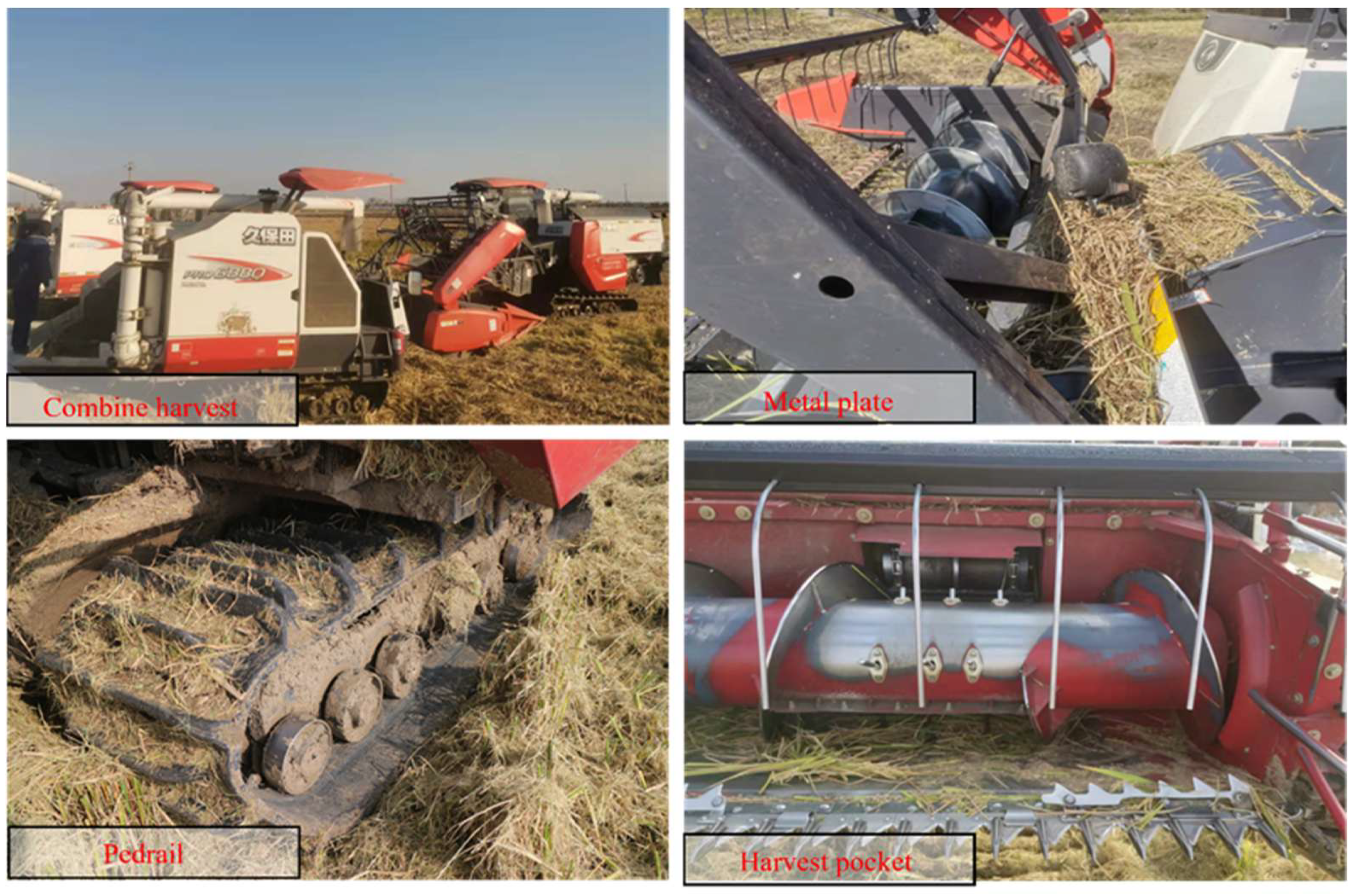
2, were selected for their historically high weed infestation levels. And the same 60 fields (20 per region) were also surveyed during rice harvest (November–December). All sampled machines were 2 m-wide full-feed combine harvesters (e.g., Kubota 4LZ-4J) with a feeding capacity of 6–8 kg/s and a longitudinal-axis-flow threshing mechanism, representing five commonly used commercial models. Immediately after harvest, residues were systematically collected from three key machine components (e.g.,
Figure 1): pedrail (crawler), metal plate, and harvesting pocket.
Before harvest, the weed populations and densities in each field were also surveyed using 5 randomly sampled 1 m
2 quadrats. After each wheat or paddy field was harvested, samples were collected from different machinery parts of harvester, including metal plate, harvesting pocket, and pedrail, and the samples for each field and from different parts were separately labeled and then took back to laboratory for inspection the weed seeds. Each sample was weighted respectively after the straw and soil are removed. About 5 g residue from each sample was placed into Petri dishes and examined under a binocular microscope (maximum magnification of ×400) for weed seed identification. The weed seeds were identified according to illustrated handbooks [
17].
2.1.2. Pre-Harvest Weed Density and Seed Production
The pre-harvest survey of the 60 fields described above was conducted to correlate the natural weed density and seed production in the field with the actual amount of seeds retained in the harvester. The species with the top 5 population densities in both rice fields and wheat fields were selected. Two weeks before harvesting, weed density, species composition, and per-plant seed production were assessed using a 9-point inverted “W” sampling pattern with 0.25 m2 quadrats. Ten representative plants per species were collected to determine seed output per plant and the proportion of mature.
2.2. Weed Seed Collection and Morphological Characterization
2.2.1. Weed Seed Collection
All the weed species that appeared in the field investigation were selected as common agricultural weed species in rice and wheat fields for the analysis of the seed structural traits and dispersal potential. Some of these seeds were collected from rice and wheat fields, as well as adjacent field margins, across Jiangsu, Anhui, and Zhejiang Provinces, China, between 2017 and 2019. The remaining seed specimens were obtained from the Weed Research Laboratory Herbarium at Nanjing Agricultural University. During collection, dispersal-related appendages (e.g., awns, hooks, and pappi) were carefully preserved. All seed samples were air-dried under ambient laboratory conditions and stored at room temperature prior to analysis.
2.2.2. Morphological Characterization of Seeds
Seed Size and Shape: Seed length, width, and thickness were measured using a Vernier caliper (precision ± 0.01 mm). Following the method of Thompson et al. [
18], seed shape was defined based on the maximum surface outline with the hilum facing downward. Length was recorded as the maximum axis between the hilum and the opposite end; width was measured perpendicular to the length; thickness was measured perpendicular to the width. For seeds with appendages, measurements were taken after appendage removal. Each measurement was replicated five times per species.
Seed Weight: Thousand-seed weight was determined using an analytical balance (precision ± 0.0001 g). Each sample was measured five times, and mean values were used for further analyses.
Seed/Plant Characteristics and Appendages: Each species was classified according to the presence and type of appendages (awn, hook, hair, pappus, prickle, wing, or perianth).
The above parameters (seed size, weight, and appendage presence) were measured experimentally on collected specimens.
General seed/plant morphology: Plant height—and flowering phenology—was supplemented from reference works such as Flora of China [
19], Weed Flora of China [
20], and List of Alien Invasive Plants [
21].
2.3. Simulated Harvester-Mediated Dispersal Experiment
To quantify the attenuation coefficients of different weed seed dispersal during the operation of the combined harvester, and establish a model for their dispersal patterns, a simulated seed-retention experiment was conducted in June and November 2022 (during the wheat and rice harvest season, respectively) in Jintan District, Jiangsu Province. Six representative weeds were selected based on their prevalence in filed survey and contrasting seed trait:
Wheat-field weeds: Lolium multiflorum, Alopecurus japonicus, Aegilops tauschii;
Rice-field weeds: Echinochloa crus-galli var. zelayensis, Leptochloa chinensis, Ludwigia prostrata.
Seeds were stained with 1% safranin T for visibility and deactivated by autoclaving (121 °C, 20 min) [
13]. A total of 320 g of mixed rice-field weed seeds (300 g of
Echinochloa crus-galli var.
zelayensis, 10 g of
Leptochloa chinensis, and 10 g of
Ludwigia prostrata) or a total of 1150 g of mixed wheat-field weed seeds (500 g of
Lolium multiflorum, 150 g of
Alopecurus japonicus, and 500 g of
Lolium multiflorum) was evenly distributed across the harvesting pocket of a clean combine harvester before operation. The harvester was then used to conduct 5 harvesting runs (traveled distances from 250–1500 m) totally across five separate fields (500–3000 m
2).
Dyed seeds dispersed along the harvesting direction were collected using 0.25 m2 quadrats at 10 m intervals up to 100 m, and at 50 m intervals up to 1500 m. Seed density (seeds m−2) was quantified under a stereomicroscope.
A commercially available full-feed crawler combine harvester, Kubota 4LZ-4J, was used in the field experiment. This model is suitable for both rice and wheat harvesting and is representative of combine harvesters commonly used in rice–wheat continuous cropping systems in China. The pedrail width was 500 mm. The header width was 2.2 m, the minimum cutting height was 40 mm, and the feeding capacity was 6 kg s−1. During field operation, the combine harvester was operated along a predefined harvesting route around the four sides of each field to simulate weed seed retention and dispersal during practical mechanical harvesting. The actual operating speed was maintained at approximately 7 km h−1 during the experiment. The operating procedure was kept consistent among different fields to minimize the influence of variation in harvesting paths on weed seed dispersal.
During harvesting operation, the soil surface was dry and had no water accumulation, without any special artificial preparation, to simulate real-world agricultural conditions.
2.4. Data Analysis
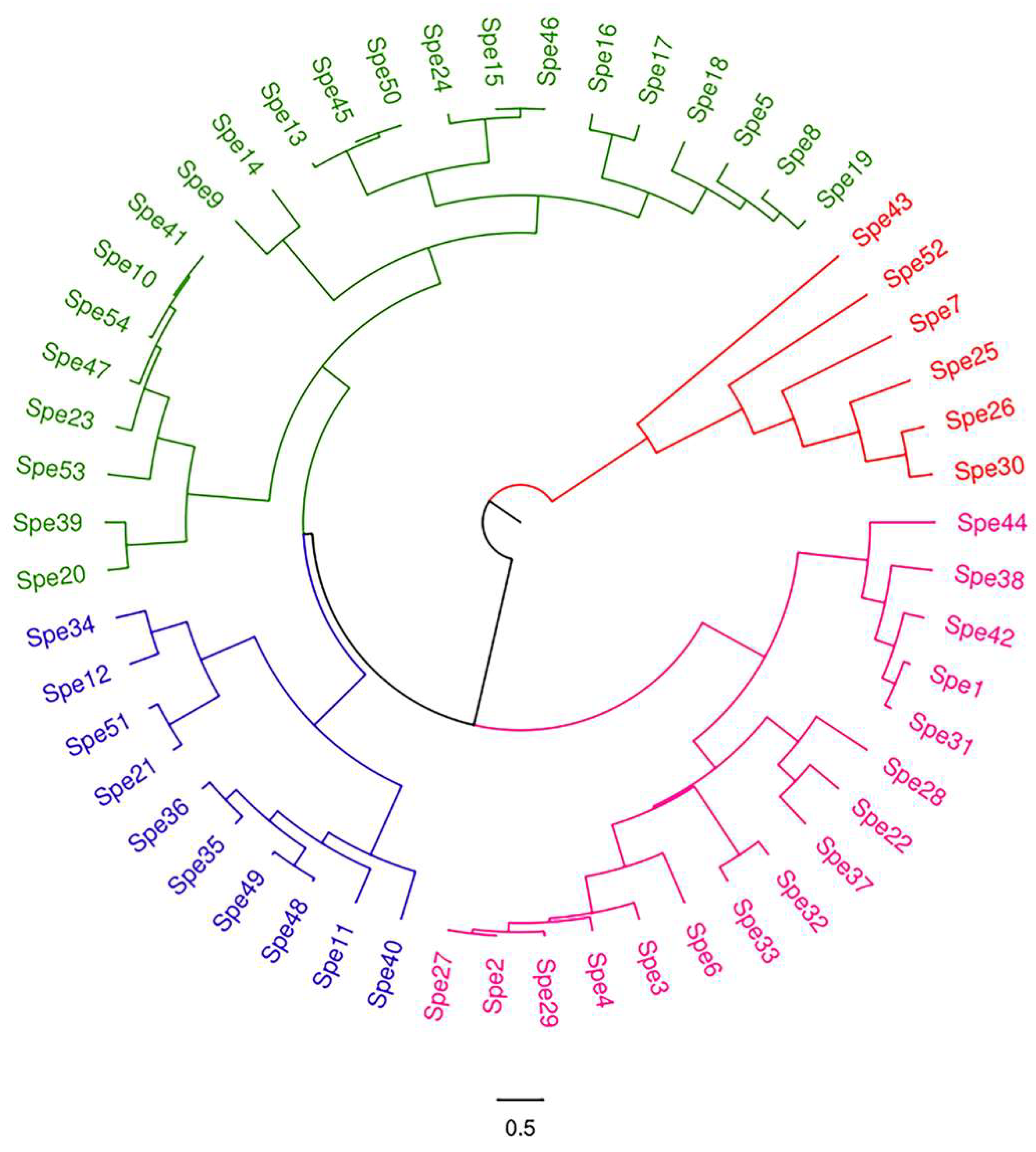
The hierarchical clustering (Z-score, Euclidean distance, and complete linkage) based on the morphological characterization of weed seed or plant (
Table 1) was conducted to classify the dispersal ability of selected weed seeds using R v4.3.1 with flexclust package, and the cluster tree was visualized with FigTree v1.4.3.3. The Euclidean distance was chosen because our selected traits (e.g., seed weight and size) are continuous quantitative variables, making it the most appropriate metric for multidimensional trait space.
Seed dispersal data along harvesting paths were analyzed using a general linear model in R (version 4.3.1). Exponential decay models were fitted to describe seed loss with increasing distance:
where
N0 is the initial dispersed seed density by the harvester,
α represents the attenuation coefficient, and
r is the distance traveled, and
N(
r) represents the dispersed seed quantity per m
2 at the traveling distance r.
The dispersal distance
r corresponding to a given initial dispersed seed density and the given dispersed seed quantity per m
2 was estimated as follows:
where
N0 is the initial dispersed seed density by the harvester,
α represents the attenuation coefficient, and
r is the distance traveled; and
N represents the dispersed seed quantity per m
2 at the traveling distance
r.
Graphical representations were produced using OriginPro 2024 (OriginLab, Hampton, MA, USA).
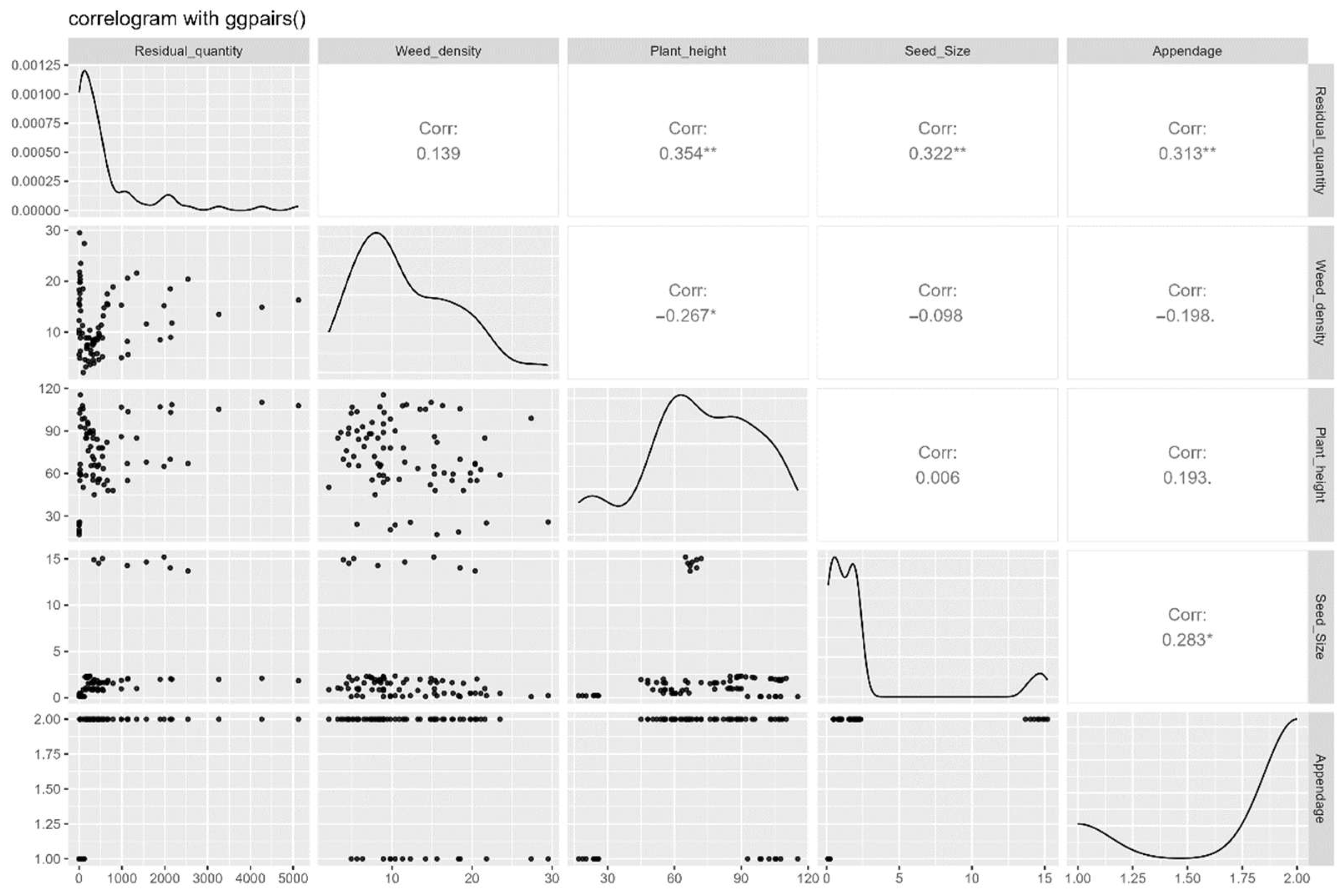
The correlation analysis was used to assess the factors influencing the carrying quantity (residual quantity) of weed seeds in the harvester. Significance was evaluated at p < 0.05, and pairwise comparisons were performed for post hoc tests. The statistical analyses and graph drawing were conducted using R v4.3.3 with GGally and ggplot2 packages.
3. Results
3.1. Weed Seeds Retained on Combine Harvesters
Field surveys across 60 fields with a rice–wheat continuous cropping system revealed that combine harvesters retained numerous weed seeds after both rice and wheat harvesting processes were completed in that specific field (
Table 2 and
Table 3).
After the rice harvest, 22 weed species were discovered in seed residues within harvesters, including 7 grass species (Poaceae) and 6 sedge species (Cyperaceae). The total weight of seeds remaining in harvesters ranged from 21.5 g to 1199.8 g, with a mean of 389.6 g. Seeds were mainly found in the harvesting pocket, followed by the metal plate and pedrail components. The most frequent rice-field weeds retained were Echinochloa crus-galli (L.) P. Beauv., and Oryza sativa f L. spontanea. The average and maximum numbers of retained seeds of E. crus-galli (L.) P. Beauv. in the harvester were 998 and 12,039, respectively. After wheat harvest, 32 weed species were detected, including 11 grass species (Poaceae), with Beckmannia syzigachne and Lolium multiflorum being the most abundant ones. The average and maximum numbers of retained seeds of B. syzigachne in the harvester were 1992 and 15,039, respectively, and the average and maximum numbers of retained seeds of L. multiflorum in the harvester was 695 and 13,826.
The weed population compositions were different in three regions: Aegilops tauschii Coss. was the main weed in Suqian, while it was not found in Kunshan and Gaoyou. The remaining seeds in the harvester pocket and the seeds adhering to the pedrail are generally consistent with the weed population, but there are also regional differences. Gramineous weeds were the main species constituting the weed community in wheat and rice fields, and they had also been identified as the most prevalent residual seeds in the harvester pocket and pedrail. The seed of Oryza sativa L. spontanea, and Echinochloa crus-galli (L.) Beauv. were mainly found in the harvester pocket, while Leptochloa chinensis (L.) Nees seeds were mainly located on the pedrail.
In addition, Cyperaceae weeds were an important component of rice-field weeds. However, their seeds were not found in the harvester pocket, but they were detected in the soil carried by the harvester pedrail. The seeds of the main weeds in the paddy fields with a lower plant height, e.g., Lindernia procumbens (Krock.) Borbás, Rotala rotundifolia (Buch.-Ham. ex Roxb.) Koehne, and Eclipta prostrata (L.) L., were only found in the soil carried by the harvester pedrail. The seeds of the Asteraceae family weeds in the wheat fields were not found in the harvester pocket, but were present in the soil carried by the harvester pocket.
These species are characterized by a moderate to large seed size, firm outer coats, and awned or rough surfaces, enhancing their adhesion to machinery surfaces, and are mainly more likely to be present in the harvester pocket and metal plate. These species’ maturity with synchronous phenology to wheat or rice is one of the prerequisites to mechanical dispersal. In both crop systems, grass weeds with plant heights similar to the crop canopy and synchronous maturation were disproportionately represented among the retained seeds, suggesting strong trait filtering by harvesting operations.
3.2. Morphological Characteristics of Weed Seeds
The morphological analysis of 54 weed species (
Table 2 and
Table 3) found in the field investigations revealed considerable interspecific variation. The thousand-seed weight ranged from 21.8 mg to 37,967.0 mg, reflecting substantial interspecific variation. Our results confirm that
arvensis exhibited the heaviest seeds, while
Osbeckia chinensis had the lightest. Approximately 68.3% of species possessed seeds weighing between 0.3 g and 1.0 g per thousand seeds, representing the dominant weight class across the studied flora.
The seed size varied widely across taxa, with Bidens pilosa producing the longest seeds (13 mm) and Salvia plebeia the shortest (0.4 mm). Among the 54 species, 30 species (55.6%) exhibited distinct appendages such as awns, wings, pappi, or spines, of which 17 species had firmly attached appendages resistant to detachment at maturity. These appendages are key functional traits for dispersal via wind, water, or mechanical adhesion.
The majority of grass weeds (Poaceae) produced elongated, awned diaspores, whereas many Asteraceae and Leguminosae species bore pappi or hooked structures. The prevalence of such appendages suggests that a substantial proportion of the weed community in rice–wheat rotation systems possesses morphological adaptations facilitating dispersal by either natural or anthropogenic vectors.
3.3. Species and Comparison of Dispersal Ability
A cluster analysis based on seed morphology, appendage type, weight, plant height, and phenological synchrony grouped the 54 species into four functional dispersal types (
Figure 2).
3.3.1. Type I—Highly Dispersible Species
This group includes six species, primarily tall grasses with a high 1000-grain weight, large seed size, and approximate maturity time with group, including Vicia sativa, weedy rice (Oryza sativa), Aegilops tauschii, Avena fatua, Geranium carolinianum, and Calystegia hederacea. The 1000-grain weight of these weeds is over 2.5 g, and can even reach 24 g (Oryza sativa), extremely close to the weight of rice or wheat. Moreover, the weeds in this group have similar phenological cycles to rice or wheat, with most species in this group having a relative height rating of 3 (tall, ≥100 cm), allowing the weeds to fully enter the cutting range of the harvester during crop harvest, increasing the possibility of seeds being collected by the harvester.
The harvesting machine’s sorting system is unable to remove these seeds through the use of wind or size differences. They are directly mixed into the grain storage and spread over long distances and across different regions through the transportation of grain.
3.3.2. Type II—Moderately Dispersible Species
This type comprises 16 species, including 11 species of the Gramineae family, such as Echinochloa crus-galli, Alopecurus myosuroides, Lolium multiflorum, Beckmannia syzigachnethis, and others, 2 species of the Asteraceae family (Hemisteptia lyrata, Cirsium arvense var. integrifolium), 1 species of Polygonaceae family (Persicaria lapathifolia var. salicifolia), 1 species of Alismataceae family (Sagittaria pygmaea), and 1 species of Rubiaceae family (Galium spurium). Among the 11 grass weeds, 6 species are wheat weeds and 5 species are rice weeds. This group mostly have medium-sized seeds and a high plant height, the 1000-seed weight generally ranging from 768.4 mg (Hemisteptia lyrata) to 3414.6 mg (Bromus japonicus), and the plant height ranging from 81.8 cm to 129.7 cm. These weeds in this group are in line with the maturity period of the crops and have appendages that remain attached during maturation. These seeds do not need to enter the grain silo. Instead, they adhere to the gears and conveyor belts of the harvesting machine through hooks or special surface friction. When the machinery moves between different fields, the seeds fall off due to the vibration of the machine.
3.3.3. Type III—Low-Dispersal Species
This type contains 22 species, including 6 species of the Cyperaceae family, such as Cyperus difformis and Schoenoplectiella juncoides. Weeds in this group mainly have a small size with no appendage and the weed plant height is relatively low. The 1000-seed weight of 10 species in this group is lower than 500 mg. Moreover, the weeds in this group mature earlier than crops. During the crop harvesting process, the weeds in this group avoided being cut by the harvester due to their lower plant height. Moreover, since the weeds in this group matured earlier than the crops, most of the weeds had already shed their seeds during the harvesting period. Therefore, the amount of weed seeds entering the harvester was limited and was not likely to be spread by the harvester.
3.3.4. Type IV—Light and Early-Maturing Species
This type consists of 10 species, including 6 weed families, with small, lightweighted seeds and a lower plant height relative to crops, e.g., Ammannia auriculata, Poa annua, and Pontederia vaginalis. Although some seeds have appendages, but, for the lower height of the weeds (lower than 50 cm), usually at the lower layer of the crop, they will not be harvested into the harvesting machine during the crop harvest process. Therefore, the possibility of being carried and spread by the harvesting machine is relatively low.
This classification underscores that the mechanical dispersal potential is strongly determined by the interaction of seed morphology, appendage traits, and phenological alignment with crop harvest.
3.4. Seed Dispersal Dynamics During Harvest
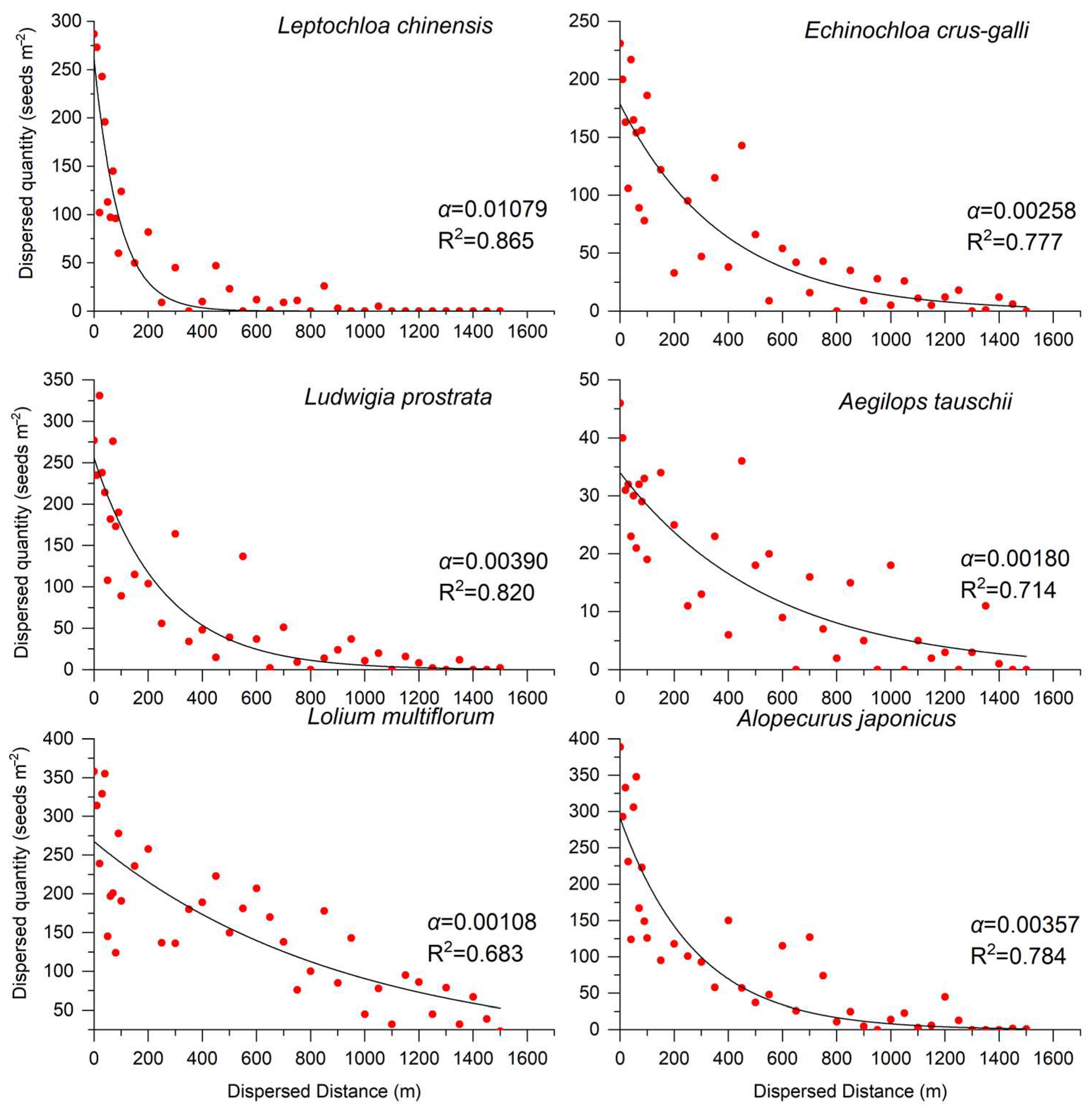
Simulated dispersal experiments demonstrated that dyed weed seeds placed on the metal plate of a harvester were progressively released during operation, resulting in a decreasing seed density along the harvesting path. Without considering the replenishment of weed seeds during the harvesting process, the number of seeds deposited per unit area declined exponentially with increasing distance, conforming to the exponential model that was mentioned in Equation (1) (the R
2 of the fitted exponential model was ≥0.683;
Figure 3.
Species-specific variation in α was observed. Seeds with rough surfaces or appendages and larger sizes (e.g., E. crus-galli and L. multiflorum had awns attached to the caryopsis, and A. tauschii had the large seed size and weight) exhibited smaller α values, indicating a slower loss in the harvesters and longer dispersal distances; in contrast, smooth, lightweight seeds (e.g., L. chinensis and L. prostrata) demonstrated larger α values, signifying faster attenuation and shorter dispersal distances; meanwhile, the seeds with a medium weight or without appendages showed medium α values (e.g., A. japonicas).
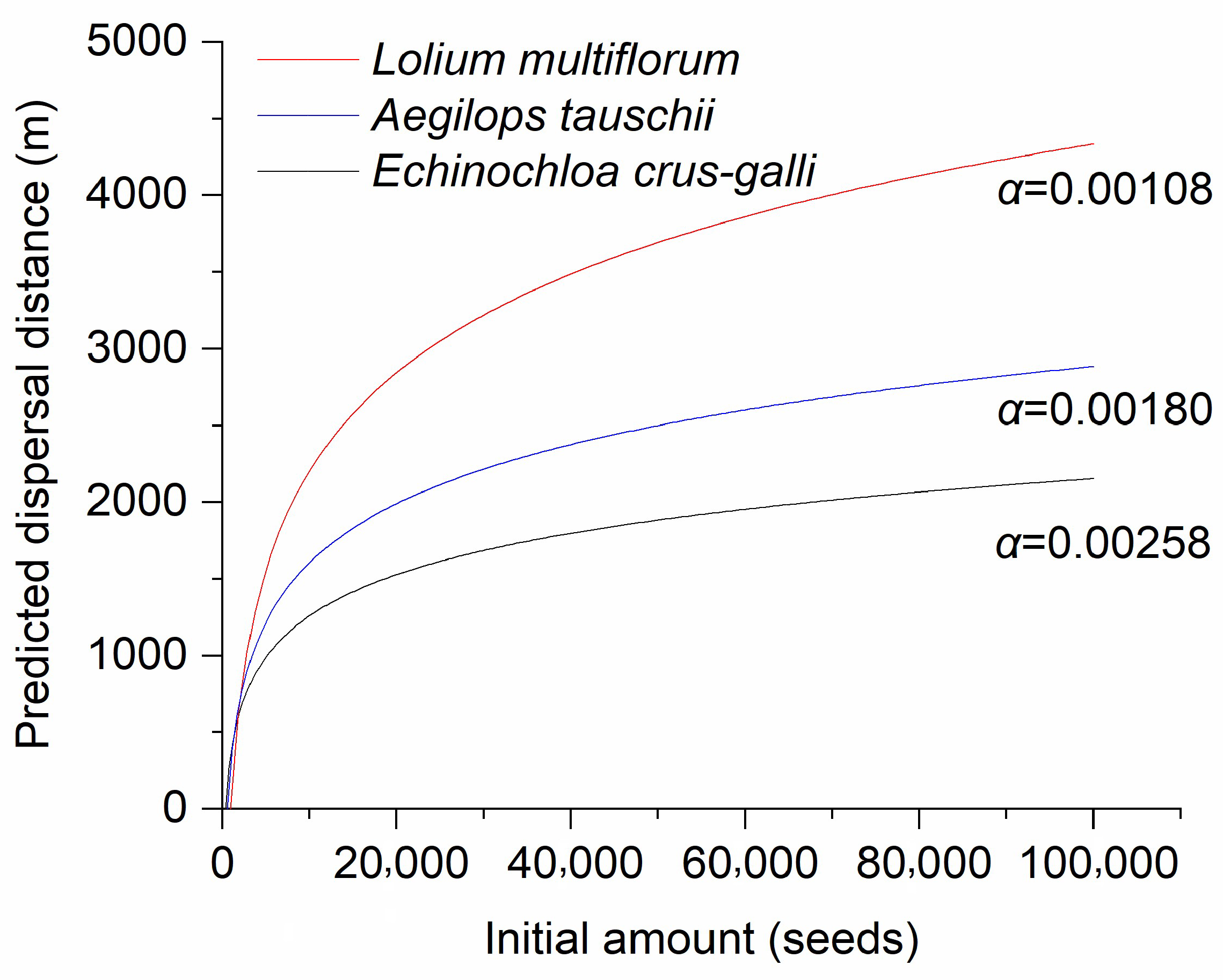
According to Equation (2), under a certain attenuation coefficient, as the initial number of seeds carried by the harvester increases, the dispersal distance will show a logarithmic growth pattern (
Figure 4), with the same initial carrying amount; the smaller the attenuation coefficient, the greater the dispersal distance (
Figure 4). Without taking into account the continuous replenishment of weed seeds during the crop harvesting process, when the initial amount of weed seeds carried by the harvester was 10,000, the dispersal distances of
E. crus-galli,
A. tauschii, and
E. multiflorum could reach up to 1263 m, 1606 m, and 2220 m, respectively. If the initial amount of weed seeds reached 100,000, the dispersal distances of
E. crus-galli,
A. tauschii, and
E. multifloru could reach up to 2152 m, 2885 m, and 4335 m, respectively
The model fitting indicated that the predicted potential harvester-mediated dispersal distances of the noxious weeds E. crus-galli, A. tauschii. and E. multiflorum can extend over 2000 m under continuous operation, highlighting the capacity of modern mechanized systems to promote regional-scale weed migration.
3.5. Factors Influencing Seed Retention and Dispersal
We conducted a correlation analysis of the factors influencing the carrying quantity (residual quantity) of weed seeds in the harvester, and found that the residual quantity of seeds was significantly correlated with the height of weed plants, the seed size, and the appendage (
Figure 5). Specifically, taller weeds whose seeds/fruit stood on the same layer as crop seeds/fruit could be harvested easily along with the crops, thereby increasing the probability of seed detachment and retention. Larger seeds, due to their greater mass and size, were less likely to be winnowed out by airflow systems and might accumulate more readily in crevices and grain tanks. Accessory structures such as awns, hooks, or wings could enhance seed adhesion to machine surfaces or crop materials, facilitating unintentional transport. Moreover, weeds that still held seeds/fruit when the crop matured were harvested together, leading to higher incorporation of their seeds into the harvested material. As a result, weeds possessing those traits—a taller stature, larger seeds, accessory structures, and no shattering—may be more prone to being carried by the harvester during crop harvesting, thereby increasing their potential for dispersal across fields.
These findings suggest that the interplay of morphological and phenological traits determines a species’ susceptibility to mechanical transport. Weeds that combine a tall stature, large seeds, and adhesive appendages—particularly within Poaceae—are at the highest risk of long-distance dissemination via combine harvesters.
4. Discussion
Our study provides empirical evidence that combine harvesters’ function as highly effective anthropogenic vectors for the dispersal of weed seeds in rice–wheat continuous cropping systems. Importantly, the dispersal process was not random, but strongly shaped by the interaction between weed morphological traits, plant architecture, and harvesting operations. Weed species with a taller stature, larger seed size, rough seed surfaces, persistent appendages, and phenological synchrony with crops were disproportionately represented in harvester residues, indicating that combine harvesters act not only as dispersal vectors but also as selective ecological filters.
This selective process is consistent with the broader trait-based dispersal theory, in which plant species evolve structural and phenological adaptations that increase the probability of successful transport by specific dispersal vectors [
22]. Traditionally, such traits were associated with hydrochory, zoochory, or anemochory [
23]. However, our findings suggest that modern agricultural machinery has become an additional dispersal pathway capable of exerting directional selection pressure on weed communities. Similar to hydrochory, where the floating capacity is influenced by the seed microstructure and buoyancy, harvester-mediated dispersal favors seeds capable of resisting airflow removal, adhering to machinery surfaces, or retaining appendages during harvesting.
The increasing mobility and regional sharing of combine harvesters in modern agriculture further amplify this dispersal pathway. Consequently, machinery-mediated seed movement may now represent one of the most important anthropogenic processes influencing weed population dynamics, gene flow, and the spread of herbicide resistance in mechanized agroecosystems [
13].
Our study provides empirical evidence that combine harvesters are effective vectors for the dispersal of a wide range of weed species in wheat–rice continuous cropping systems. The dispersal is not random but exhibits a clear trait-based selection. Plant dispersal mechanisms rely on anatomical and morphological adaptations for the use of physical or biological dispersal vectors [
24]. Weed species with a taller stature, larger seeds, adhesive appendages, and phenological synchrony with the crop were disproportionately represented in harvester residues, consistent with findings in other cropping systems (e.g.,
Avena fatua, and
Lolium rigidum) [
25,
26]. The data demonstrate that harvesting machinery not only facilitates the within-field redistribution of seeds but also enables the long-distance, inter-field transport of viable diaspores. This mechanical dispersal pathway, driven by the increasing mobility and regional sharing of agricultural machinery, represents one of the most significant anthropogenic forces shaping modern weed population dynamics.
4.1. Combine Harvesters as Drivers of Trait-Selective Weed Dispersal
Our results demonstrate that seed retention within combine harvesters is strongly associated with plant height, seed size, appendage type, and phenological synchrony with crops. Taller weeds that mature simultaneously with wheat or rice are more likely to enter the cutting zone of the harvester and subsequently pass through threshing and cleaning systems together with crop materials. By contrast, low-growing species or species that shatter before crop harvest are less likely to be incorporated into harvesting machinery.
The influence of seed size on dispersal can be partially explained by the cleaning mechanisms of combine harvesters. During harvest, lightweight seeds are more easily removed by airflow systems and discharged close to the source field, whereas larger and denser seeds are less efficiently separated from crop residues or grain fractions. Consequently, seeds with a larger mass may remain trapped in grain tanks, conveyor belts, harvesting pockets, or internal crevices for extended periods, thereby increasing the likelihood of long-distance transport.
Seed appendages and surface roughness also play important mechanistic roles in harvester-mediated dispersal. Structures such as awns, hooks, hairs, or rough epidermal surfaces increase friction and entanglement with machinery components and crop residues. Although these appendages likely evolved originally for epizoochory or wind dispersal, they may now inadvertently enhance anthropogenic dispersal via agricultural machinery. In our study, seeds possessing appendages or rough surfaces exhibited lower attenuation coefficients (α), indicating slower rates of release during harvesting operations and, consequently, greater dispersal potential.
The harvesting pocket and metal plate were identified as major seed retention hotspots. Seeds accumulated particularly in sheltered mechanical areas where vibration and airflow were insufficient to remove them immediately. These observations indicate that machinery architecture itself contributes to trait-selective dispersal and may explain why some species are consistently overrepresented in harvester residues.
The ecological implications of this process are substantial. Harvester-mediated transport can facilitate the rapid movement of adaptive traits such as herbicide resistance across regions. Similar mechanisms have been reported for
Avena fatua and
Lolium rigidum in Europe and Australia, where machinery movement contributed to the regional spread of resistant populations [
25,
26]. In the present study, we predicted that continuous harvester operation occasionally could result in seed transport distances exceeding 2 km. However, such distances likely represent upper-bound scenarios under uninterrupted field operation without cleaning. Actual dispersal distances may vary depending on the harvester type, harvesting duration, field size, road transport frequency, and cleaning practices.
4.2. Seed Characteristics, Seed Retention, and Mechanical Dispersal Capacity
Although the seed microstructure contributes to adhesion and persistence, our findings indicate that macroscopic morphological traits and plant-level characteristics are dominant determinants of the harvester-mediated dispersal capacity. Species possessing elongated diaspores, rough surfaces, persistent appendages, and a large seed mass showed substantially greater retention during harvesting.
The lower attenuation coefficients observed in species such as
Echinochloa crus-galli and
Lolium multiflorum indicate that seeds with rough surfaces or appendages are released more gradually during the harvester movement. Mechanistically, such seeds may become entangled within crop residues or adhere more effectively to metallic and rubber components through increased frictional contact. In contrast, smooth and lightweight seeds were lost rapidly during the initial stages of operation [
27,
28].
Importantly, seed shattering before harvest likely plays a critical role in determining whether seeds enter the harvesting machinery. Species with a strong seed retention at crop maturity are more likely to be collected and dispersed by combine harvesters, whereas species that disperse naturally before harvest may largely escape mechanical transport. Therefore, harvester-mediated dispersal should be interpreted as the combined outcome of both seed-entry processes and seed-retention dynamics within the machinery.
This finding has important ecological implications because mechanized harvesting may indirectly favor weed species exhibiting delayed shattering, synchronized maturity, and a greater canopy height. Over long-term agricultural intensification, such trait filtering could alter the weed community composition toward species better adapted to mechanized production systems.
Our results also support the emerging concept that anthropogenic dispersal pathways can function as evolutionary extensions of classical dispersal syndromes [
29]. Traits originally selected for natural dispersal vectors may now increase dispersal success under mechanized agriculture. This convergence between natural and anthropogenic dispersal mechanisms highlights the need to integrate agricultural engineering with trait-based weed ecology.
4.3. Implications for Weed Ecology, Gene Flow, and Population Dynamics
From an ecological perspective, harvester-mediated dispersal may substantially reshape weed spatial distribution patterns and increase the connectivity among populations. The long-distance movement of seeds between fields reduces spatial isolation and enhances the opportunities for gene flow. This process is particularly important for the spread of adaptive alleles, including herbicide resistance.
The rapid regional expansion of herbicide-resistant populations of
Alopecurus myosuroides and
Lolium rigidum in Europe and Australia has previously been associated with machinery-mediated dispersal [
30,
31]. Based on the machinery-mediated dispersal phenomenon that we have observed and the existing literature research, similar processes may occur in Chinese rice–wheat production systems, especially under conditions of intensive mechanization and regional machinery sharing.
In addition to facilitating gene flow, the selective nature of mechanical dispersal may influence the weed community assembly. Tall annual grass weeds that synchronize reproduction with crops are preferentially captured and transported, whereas early-maturing or low-growing species experience reduced mechanical dispersal opportunities. Consequently, mechanized harvesting may progressively favor species possessing traits associated with both competitive ability and dispersal success.
Nevertheless, seed movement alone does not necessarily guarantee successful invasion or population establishment. Although many seeds may survive harvesting operations, mechanical abrasion, compression, or heat exposure could reduce viability in some species. Furthermore, establishment success after deposition depends on habitat suitability, tillage practices, crop competition, and post-dispersal environmental conditions. Future studies should therefore combine dispersal analysis with direct assessments of seed viability and establishment probability following harvester transport.
4.4. Implications for Integrated Weed Management
The demonstrated dispersal capacity of combine harvesters highlights the urgent need to integrate harvest-based weed management strategies into existing integrated weed management (IWM) systems.
4.4.1. Harvest Weed Seed Control (HWSC)
Harvest Weed Seed Control (HWSC) technologies aim to intercept or destroy weed seeds during harvest before they enter the soil seedbank [
32,
33]. Our results suggest that HWSC may be particularly effective against highly dispersible grass weeds possessing synchronized maturity and high seed retention, including
Alopecurus japonicus,
Beckmannia syzigachne,
Lolium multiflorum, and
Echinochloa crus-galli. These species were frequently retained within harvesters and therefore represent ideal targets for harvest-time interventions.
It was reported that systems such as seed destructors, chaff carts, and narrow windrow burning have achieved high weed seed destruction efficiencies [
34,
35]. In Australia, one such system, the Harrington Seed Destructor (HSD), has been applied in three major grain crops, wheat (
Triticum aestivum L.), barley (
Hordeum vulgare L.), and lupin (
Lupinus angustifolius L.)—it can consistently destroy weed seeds infesting grain crop chaff fractions with a >95% weed seed destruction efficacy [
32]. Given the high proportion of retained seeds (e.g.,
Alopecurus japonicus, and
Echinochloa crus-galli) observed in this study, similar technologies could potentially reduce seedbank replenishment in East Asian rice–wheat systems.
4.4.2. Machinery Cleaning and Sanitation
The routine cleaning of combine harvesters between fields and regions is equally important for reducing cross-field contamination. Studies in Europe indicate that uncleaned harvesters can carry more than 10,000 viable weed seeds between operations [
36]. Our observations identified the harvesting pocket, conveyor areas, and metal plate regions as major seed retention sites. These components should therefore be prioritized during sanitation procedures.
A trait-based risk assessment may further improve machinery hygiene strategies. Species with large seeds, rough surfaces, and persistent appendages are more likely to remain attached to machinery and should be considered high-risk dispersal targets during cleaning operations.
4.4.3. Harvest Timing and Crop Rotation
Adjusting the harvest timing to reduce the overlap between weed seed maturity and crop harvest may decrease seed capture by machinery. Likewise, crop rotation systems involving crops with contrasting phenological schedules may disrupt the selective advantage currently experienced by highly synchronized weed species.
4.5. Toward Sustainable and Predictive Weed Management
Mechanization has greatly improved agricultural productivity, but it has simultaneously created novel ecological pathways for weed dispersal across landscapes. Understanding these pathways is increasingly important for predicting the spread of herbicide-resistant and invasive weeds under modern agricultural intensification.
Our study contributes to both fundamental and applied weed ecology by demonstrating that harvester-mediated dispersal is strongly trait-dependent. The integration of morphological trait analysis with dispersal modeling provides a framework for predicting which weed species are most likely to spread under mechanized farming systems.
These findings also emphasize the need to integrate agricultural engineering, weed ecology, and dispersal biology into future weed management strategies. Trait-based prediction models may help identify high-risk weed species before regional spread occurs, thereby enabling earlier intervention.
Several limitations of the present study should also be acknowledged. First, the study focused on a limited number of harvester models and regions within eastern China, which may not fully represent broader mechanized production systems. Second, direct measurements of post-harvest seed viability and germination rate of mechanically dispersed seeds were not conducted; thus, conclusions regarding weed spread may be overstated. Third, the experiments primarily evaluated short-term dispersal dynamics and did not assess long-term establishment success after transport. Fourth, the climate conditions during harvest season and operational conditions during the harvesting process were not sufficiently considered. Future research should therefore incorporate multi-season validation, direct viability testing, and comparisons among different harvesting systems, climate conditions, and operational conditions.
Overall, addressing harvester-mediated weed dispersal through integrated technological and management approaches will be essential for reducing the spread of problematic and herbicide-resistant weed species in sustainable agroecosystems.
5. Conclusions
This study demonstrates that combine harvesters’ function not only as effective anthropogenic vectors for weed seed dispersal but also as selective filters that preferentially transport weed species possessing specific morphological and phenological traits in rice–wheat continuous cropping systems. Field surveys identified 54 weed species retained on harvesters after rice and wheat harvesting, with Poaceae species accounting for the majority of the retained seeds. Seed retention was strongly associated with plant height, seed size, appendage characteristics, and phenological synchrony with crop maturity. Based on these traits, weed species were classified into four functional groups representing different levels of mechanical dispersal potential.
Simulated dispersal experiments further revealed that harvester-mediated seed dispersal followed an exponential decay pattern with increasing harvesting distance. Weed species with rough seed surfaces, persistent appendages, or relatively large seeds exhibited lower attenuation coefficients and, consequently, greater dispersal distances. Under continuous harvesting operations, the predicted dispersal distances exceeded 2 km for several economically important weed species, highlighting the capacity of combine harvesters to facilitate both the within-field redistribution and long-distance inter-field movement of weed seeds.
These findings provide a trait-based framework for predicting the mechanical dispersal risk of weed species under modern mechanized agriculture. The results also emphasize the importance of integrating harvest weed seed control technologies, routine machinery cleaning, and trait-informed integrated weed management strategies to reduce weed seed spread and limit the regional expansion of problematic and herbicide-resistant weed populations. Future research should evaluate seed viability following harvester transport, quantify dispersal under different harvester configurations and operating conditions, and validate trait-based prediction models across diverse cropping systems to support sustainable weed management.








 represents the dispersed weed seed quantity observed along the harvesting route.