Article

Mitigation of Odor Emissions by Replacing Soybean Meal with Distiller’s Grains-Derived Protein Sources: Assessment via In Vitro Simulated Fermentation

1
Engineering Research Center for Animal Breeding and Sustainable Production, College of Animal Sciences, Fujian Agriculture and Forestry University, Fuzhou 350002, China
2
Zhejiang Provincial Key Laboratory of Agricultural Microbiomics, Institute of Plant Protection and Microbiology, Zhejiang Academy of Agricultural Sciences, Hangzhou 310021, China
*
Author to whom correspondence should be addressed.
Agriculture 2026, 16(14), 1510; https://doi.org/10.3390/agriculture16141510
Submission received: 16 April 2026 / Revised: 3 July 2026 / Accepted: 7 July 2026 / Published: 13 July 2026

Abstract

Malodorous gases such as ammonia (NH3) and hydrogen sulfide (H2S) emitted from pig intestines and excrement have become critical environmental bottlenecks restricting the green transformation of the swine industry. Therefore, identifying sustainable protein feed alternatives with odor-reducing potential has become increasingly important. This study evaluated the effects of replacing soybean meal with four distiller’s grains-derived protein raw materials (DGPRMs), including Baijiu DDGS, Sorghum DDGS, Corn DDGS, and Cassava DDGS, using an in vitro fermentation system simulating the intestinal environment of six fattening pigs. After 24 h of fermentation, odor-related gas production, short-chain fatty acid (SCFA) concentrations, and microbial community composition were analyzed to assess the odor-mitigation potential of these alternative protein sources. Results demonstrated that Baijiu distiller’s grains, sorghum distiller’s grains, and corn distiller’s grains significantly reduced the yields of NH3 and H2S under the in vitro fermentation system (p < 0.05). Meanwhile, they reshaped the intestinal microbial community structure by inhibiting the growth and reproduction of odor-producing genera (e.g., Ligilactobacillus) and promoting the enrichment of beneficial genera (e.g., Limosilactobacillus) that were significantly negatively correlated with malodor indicators. Notably, among all tested DGPRMs, Baijiu DDGS exhibited the strongest odor-reducing effect, markedly decreasing NH3, H2S, and volatile sulfur compounds while enriching beneficial bacterial taxa associated with reduced odor generation. These findings suggest that selected DGPRMs, particularly Baijiu DDGS, may serve as promising alternative protein ingredients for mitigating odor emissions in pig production systems.

1. Introduction

Global swine production is crucial for ensuring meat supply and supporting agricultural economic development, but intensive pig farming is frequently accompanied by severe malodorous gas emissions, which have become a critical environmental constraint limiting the sustainable development of the industry [1]. These malodorous pollutants are primarily derived from the microbial fermentation of dietary proteins and sulfur-containing amino acids in the pig intestinal tract, leading to the release of toxic and harmful volatile compounds such as hydrogen sulfide (H2S), ammonia (NH3), and methanethiol. Beyond deteriorating the surrounding ecological environment, these gases can impair animal health and production performance, and also pose potential risks to the occupational health of breeding workers [2]. Notably, sulfides from sulfur-containing amino acid degradation and amines from protein putrefaction are the major contributors to malodorous pollution, and their emission intensity is closely associated with the nutritional composition of the diet [3]. Soybean meal (SBM) has long been the dominant high-quality protein source in fattening pig diets due to its high crude protein content and balanced amino acid profile. However, the high solubility of proteins in SBM makes them vulnerable to microbial degradation in the intestinal tract, resulting in the excessive production of malodorous precursors and subsequent exacerbation of odor emissions [3]. Additionally, the global shortage of protein feed resources, coupled with the high dependence on imported soybean meal in many regions, leads to frequent price fluctuations and increased breeding costs. Thus, the development of unconventional protein sources as alternatives to soybean meal has become an inevitable trend in the swine industry [4]. Distiller’s grains-based protein raw materials (DGPRMs), such as Corn distillers dried grains with solubles (DDGS), Baijiu distiller’s grains, and Cassava DDGS, are abundant by-products of cereal fermentation for alcohol and liquor production. After drying and processing, DGPRMs retain considerable amounts of crude protein, dietary fiber, and bioactive substances, and possess the advantages of wide availability and low cost, making them promising alternatives to soybean meal in swine feed formulation [5]. The differences in crude protein and other nutritional components among these DGPRMs lead to variations in feed formulation when meeting nutritional requirements, resulting in differences in the nutritional composition, odor emissions, and microbial communities of the final feed. Previous studies have demonstrated that dietary fiber from distiller’s grains can modulate the intestinal microbial community structure, inhibit excessive protein fermentation, and thereby reduce malodorous gas emissions. This not only achieves the high-value utilization of agricultural by-products but also aligns with the concept of green and low-carbon farming.
The intestinal microbial community serves as a key driver regulating dietary nutrient metabolism and malodorous gas production, and its diversity and composition directly affect the production efficiency of metabolites such as short-chain fatty acids (SCFAs) and malodorous compounds [3]. For instance, Lactobacillus can promote nutrient digestion and absorption while reducing the accumulation of putrefactive metabolites, whereas Megasphaera is closely associated with the production of sulfur-containing malodorous gases [6]. Despite the growing interest in DGPRMs as soybean meal alternatives, most existing studies have focused on growth performance and single odorant reduction. Li et al. found that adding 2–4% of Mao-tai distillers’ grains to the basal diet improved amino acid metabolism and reduced the abundance of sulfate-reducing bacteria producing hydrogen sulfide in the gut, without affecting growth performance in weaned piglets [7]. However, systematic investigations remain limited, with limited systematic investigations into the nutritional differences among DGPRMs from different sources, their in vitro fermentation odor-emission characteristics, and the underlying regulatory mechanisms linking microbial community shifts to metabolic changes. Furthermore, the suitability and feasibility of different DGPRMs as soybean meal substitutes remain unclear.
To address these research gaps, the present study selected soybean meal and four DGPRMs from different sources (Cassava DDGS, Baijiu DDGS, Corn DDGS, and Sorghum DDGS). The nutritional profiles (conventional nutrients and amino acids) of these raw materials were first determined. Subsequently, an in vitro fermentation model simulating the intestinal environment of six fattening pigs was established to compare the differences in malodorous gas and SCFA production among groups. Additionally, 16S rRNA gene sequencing was employed to characterize the microbial community structure, and the correlations between microbial taxa and metabolites were analyzed. The objectives of this study were to clarify the feasibility of DGPRMs as soybean meal alternatives, screen the optimal substitute, and provide theoretical and technical support for the source reduction in malodorous emissions in the intestinal environment, efficient utilization of unconventional protein resources, and the construction of green swine production systems.

2. Materials and Methods

2.1. Experimental Raw Materials

The feed raw materials used in this experiment were all purchased from feed enterprises, including Soybean meal (SBM) which was purchased from Zhejiang Kesheng Feed Co., Ltd. (Hangzhou, China); Cassava distillers dried grains with solubles (Cassava DDGS) was obtained from Zhejiang Jindi Agricultural Technology Co., Ltd. (Jinhua, China); Baijiu distillers dried grains with solubles (Baijiu DDGS) was purchased from Qinglian Food Co., Ltd. (Jiaxing, China); Corn distillers dried grains with solubles (Corn DDGS) and Sorghum distillers dried grains with solubles (Sorghum DDGS) were supplied by Zhejiang Xinxin Feed Co., Ltd. (Shaoxing, China). Before preparing the fermentation medium, all feed materials were dried, ground, and passed through a 30-mesh sieve.
All chemical reagents used in the experiment were provided by Shanghai Sangon Biotech Co., Ltd. (Shanghai, China), including sodium chloride (purity ≥ 99.5%), calcium chloride hexahydrate (purity ≥ 99.0%), magnesium sulfate heptahydrate (purity ≥ 99.0%), dipotassium hydrogen phosphate (purity ≥ 99.0%), potassium dihydrogen phosphate (purity ≥ 99.0%), ready-to-use phosphate-buffered saline (PBS) tablets, metaphosphoric acid, and crotonic acid.

2.2. Nutritional Composition Analysis of Substrates

Prior to in vitro fermentation, the chemical composition of soybean meal (SBM) and the four distiller’s grains-derived protein raw materials (DGPRMs), including Cassava DDGS, Baijiu DDGS, Corn DDGS, and Sorghum DDGS, was determined. Moisture, dry matter (DM), crude protein (CP), crude fat (EE), crude fiber (CF), ash, calcium (Ca), phosphorus (P), and amino acid profiles were analyzed according to standard procedures. The nutritional composition of the substrates is presented in Table 1.
Crude protein was determined using the Kjeldahl method (AOAC 990.03), crude fat by ether extraction (AOAC 920.39), crude fiber according to AOAC 978.10, and ash content by combustion in a muffle furnace (AOAC 942.05). Amino acid composition was analyzed using an automatic amino acid analyzer after acid hydrolysis. All analyses were conducted in triplicate.

2.3. Collection of Fecal Samples

Fecal samples in this experiment were collected from the rectums of 6 crossbred fattening pigs (Duroc × Landrace × Yorkshire) aged 120 days in April 2025. After sampling, the feces were immediately placed in a sterile sampling box containing oxygen-absorbing bags and ice packs (approximately 4 °C) and transported to the laboratory within 4 h. Subsequently, the oxygen-unexposed part (≥3 g) from the center of the feces was taken to prepare the inoculum.

2.4. Pretreatment of Fecal Samples

Sterile PBS buffer was prepared by dissolving one ready-to-use PBS tablet in ultrapure water, followed by autoclaving at 121 °C for 15 min (Shanghai Shen’an Medical Instrument Factory, Shanghai, China) and cooling. Then, 3 g of fresh fecal sample and 30 mL of the above sterile PBS buffer were added to a 50 mL sterile centrifuge tube and mixed using a vortex oscillator. The mixture was filtered through a 200-mesh stainless steel sieve to remove large particulate impurities, and finally, 30 mL of 10% fecal suspension inoculum stock solution was obtained. This stock solution was further diluted to the required concentration according to experimental needs.

2.5. Fermentation Experiment

2.5.1. Preparation of Fermentation Medium

An in vitro simulated fermentation system was adopted in this study at the lab of the Zhejiang provincial key laboratory of agricultural microbiomics in Hangzhou city in April 2025. The flow chart of the experimental design is shown in Supplementary Figure S1. The medium formula was based on the method described by Duncan et al. [8]. The medium contained the following components: L-cysteine (1 g/L), heme solution (0.01 g/L), sodium chloride (0.9 g/L), calcium chloride dihydrate (0.0604 g/L), potassium dihydrogen phosphate (0.45 g/L), dipotassium hydrogen phosphate (0.45 g/L), and magnesium sulfate heptahydrate (0.09 g/L) as the basic salt solution. Additionally, corn flour (3 g) and the test feed raw materials (3 g) were added as carbon and nitrogen sources. All components were accurately weighed, dissolved in ultrapure water, and mixed to prepare the final fermentation medium.
The in vitro fermentation system was prepared referring to the method of Chen et al. [9]. The prepared liquid fermentation medium was heated to a continuous boil on a magnetic heating stirrer (Hangzhou Instrument Motor Co., Ltd., Hangzhou, China) to remove gases. Then, under continuous nitrogen flushing to maintain an anaerobic environment, the medium was dispensed into vials using a peristaltic pump (Baoding Lange Constant Flow Pump Co., Ltd., Baoding, China), with 4.5 mL per vial. Immediately after dispensing, the vials were capped, sealed, and labeled. All vials were finally sterilized at 115 °C for 30 min, cooled, and stored for later use.

2.5.2. Inoculation of Medium Vials and Extraction of Fermentation Broth

Inoculation and cultivation were carried out in a clean bench. Using a sterile syringe (Changzhou Yuekang Medical Device Co., Ltd., Changzhou, China), 0.5 mL of 10% fecal suspension inoculum from each pig was injected into 5 fermentation media with different formulations, respectively. The inoculum from each pig corresponded to a complete series of media, and proper labeling was done. After gentle mixing, all vials were placed in a 37 °C water-jacketed incubator for constant-temperature cultivation for 24 h. After cultivation, the samples were stored at 4 °C for subsequent detection.
For analysis, a gas analyzer was first used to determine the total gas volume and composition in the vials. Then, the vials were opened, and an appropriate amount of fermentation broth was dispensed into 1.5 mL centrifuge tubes and centrifuged at 12,000 r/min for 5 min. The obtained precipitate (bacterial cells) was used for subsequent bacterial DNA extraction and 16S rRNA gene sequencing analysis (Shanghai Majorbio Bio-pharm Technology Co., Ltd., Shanghai, China); the supernatant was transferred to gas chromatography (GC) sampling vials, and the content of short-chain fatty acids (SCFAs) was analyzed using a gas chromatograph (GC-2010Plus, Shimadzu, Kyoto, Japan).

2.6. Sample Detection

2.6.1. Analysis of Gases in Vials After Fermentation

After the fermented vials were cooled to room temperature, the concentrations of total mixed gases (TME), carbon disulfide (CS2), dimethyl sulfide (DMS), dimethyl disulfide (DMDS), ethylene (EB), methyl mercaptan (CH3SH), ammonia (NH3), hydrogen sulfide (H2S), and total volatile organic compounds (TVOC) were detected using an intestinal microbial gas detector (Shenzhen Shandun Technology Co., Ltd., Shenzhen, China) according to the method of Ye et al. Prior to each analytical run, the detector was calibrated according to the manufacturer’s instructions. During the detection process, the inlet and outlet of the instrument were connected to the vials using rubber hoses and syringe tips to prevent the fermentation medium from contacting the sampling needle. The gas concentration first increased and then decreased over time, and the maximum recorded value was used as the gas concentration generated during fermentation. The next sample was detected when the gas value dropped to zero. Six biological replicates were analyzed for each treatment. Detailed information regarding instrument validation, including detection accuracy, stability, repeatability, and detection limits, has been reported in our previous studies [3,10,11].

2.6.2. Determination of Short-Chain Fatty Acids After Fermentation

The concentrations of acetate, propionate, butyrate, isobutyrate, valerate, and isovalerate were determined according to the method of Pi et al. [12]. Crotonic acid was used as the internal standard for quantification. Standard curves were established using a series of gradient concentrations of SCFA standards prepared in a crotonic acid/metaphosphoric acid solution. Three replicates were analyzed for each concentration level.
After thawing at 4 °C, 500 μL of fermentation broth was mixed with 100 μL of crotonic acid/metaphosphoric acid solution, vortexed, and acidified at −40 °C for 24 h. The samples were then centrifuged at 12,000 r/min for 5 min at 4 °C, and the supernatants were filtered through a 0.22 μm membrane filter prior to analysis. SCFAs were quantified using a gas chromatograph (GC-2010 Plus, Shimadzu, Kyoto, Japan) equipped with a flame ionization detector (FID) and a DB-FFAP capillary column (30 m × 0.32 mm × 0.50 μm; Agilent Technologies, Santa Clara, CA, USA). The oven temperature program was as follows: 80 °C for 1 min, increased to 190 °C at 10 °C/min and held for 0.5 min, followed by an increase to 240 °C at 40 °C/min and held for 5 min. The injector and detector temperatures were both maintained at 240 °C. Nitrogen was used as the carrier gas at 20 mL/min, with hydrogen and air supplied at 40 and 400 mL/min, respectively. The analytical procedure was performed as described by Pi et al. [12].
Notably, lactic acid was not quantified in the present study; only acetate, propionate, isobutyrate, butyrate, isovalerate, and valerate were detected as target short-chain fatty acids associated with protein fermentation.

2.6.3. Detection of Nutritional Components

In this in vitro simulated fermentation experiment, the conventional nutritional components and protein amino acid composition of soybean meal and four distiller’s grains-derived protein raw materials were systematically analyzed. Crude protein content was determined by the Kjeldahl method in accordance with the national standard (GB/T 6432-2018) [13]. Crude fiber content was measured by the filtration method according to (GB/T 6434-2006) [14]. In addition, the amino acid content of distiller’s grains-derived protein raw materials was determined in accordance with the national standard (GB/T 18246-2000) [15].

2.7. DNA Extraction and 16S rRNA Gene Sequencing of Fecal and Fermented Samples

Fermentation broth was subjected to centrifugation at 12,000 r/min for 5 min to harvest pellets. Bacterial genomic DNA was isolated from the pellets using the DNeasy PowerSoil Pro Kit (Qiagen, Germantown, MD, USA). The integrity of the extracted DNA was assessed by 1% agarose gel electrophoresis, while its concentration was measured with a NanoDrop 2000 spectrophotometer (Thermo Scientific, Wilmington, MA, USA). Primers 338F (ACTCCTACGGGAGGCAGCAG) and 806R (GGACTACHVGGGTWTCTAAT) were employed to amplify the V3–V4 hypervariable region of the 16S rRNA gene. The PCR amplicons were sequenced on an Illumina MiSeq system (Illumina, San Diego, CA, USA). Following quality control, denoised and refined sequences were obtained using the DADA2 plugin integrated in QIIME2, and these sequences were further clustered into amplicon sequence variants (ASVs) [16]. Each sample was rarefied to a sequencing depth of 54,000 reads. Species-level taxonomic assignment of ASVs was carried out using the naive Bayes classifier in QIIME2 (v2024.10.10), with reference to the Silva 16S rRNA database (v138). Raw sequencing data have been deposited in the NCBI Sequence Read Archive (SRA) with accession number PRJNA1417358.

2.8. Data Statistics and Analysis

Microbial community data analysis included: Chao index and Shannon index (calculated on the QIIME 2 platform) to evaluate the alpha diversity of the microbial community. Since the diversity indices did not meet the assumptions of normality, inter-group comparisons were performed using the non-parametric Kruskal–Wallis rank-sum test. Beta diversity was analyzed at the genus level based on Bray–Curtis distances. Beta diversity was analyzed at the genus level based on Bray–Curtis distances and visualized using principal coordinate analysis (PCoA). Meanwhile, the relative abundance of bacterial taxa at the phylum and genus levels was statistically compared, and LEfSe analysis (LDA threshold > 3.5) was used to identify bacterial taxa showing significant differences among groups. Finally, Spearman’s correlation coefficient was used to evaluate the correlation between bacterial genera and fermentation gas parameters in each group. The above analyses and visualizations were completed on the Majorbio Cloud Platform.
Other fermentation parameters were statistically analyzed using SPSS 23 software (IBM Corp., Armonk, NY, USA). All data were first tested for normality using the Shapiro–Wilk test and for homogeneity of variance using Levene’s test. Variables meeting the assumptions of parametric analysis were analyzed using one-way analysis of variance (ANOVA), followed by Tukey’s multiple comparison test to control for multiple comparisons among treatments. The donor pig was considered the biological replicate in the statistical analysis. Results are presented as mean ± standard error of the mean (SEM). Differences were considered statistically significant at p < 0.05.

3. Results

3.1. Analysis of Conventional Nutrients and Amino Acid Profiles of Soybean Meal and Five Alternative Protein Raw Materials

The nutritional composition of soybean meal and DGPRMs is presented in Table 1. Soybean meal contained the highest crude protein content (43.10%), whereas the crude protein contents of DGPRMs ranged from 11.78% to 27.90%. Compared with soybean meal, all DGPRMs exhibited lower lysine- and sulfur-containing amino acid concentrations. In contrast, DGPRMs generally contained higher crude fiber and crude fat contents. Among the DGPRMs, Corn DDGS showed the highest crude protein content (27.90%), whereas Cassava DDGS contained the lowest crude protein content (11.78%). Baijiu DDGS exhibited the highest crude fiber content (14.90%).

3.2. Malodorous Gas Production from In Vitro Fermentation of Soybean Meal- and Distiller’s Grains-Based Protein Raw Materials

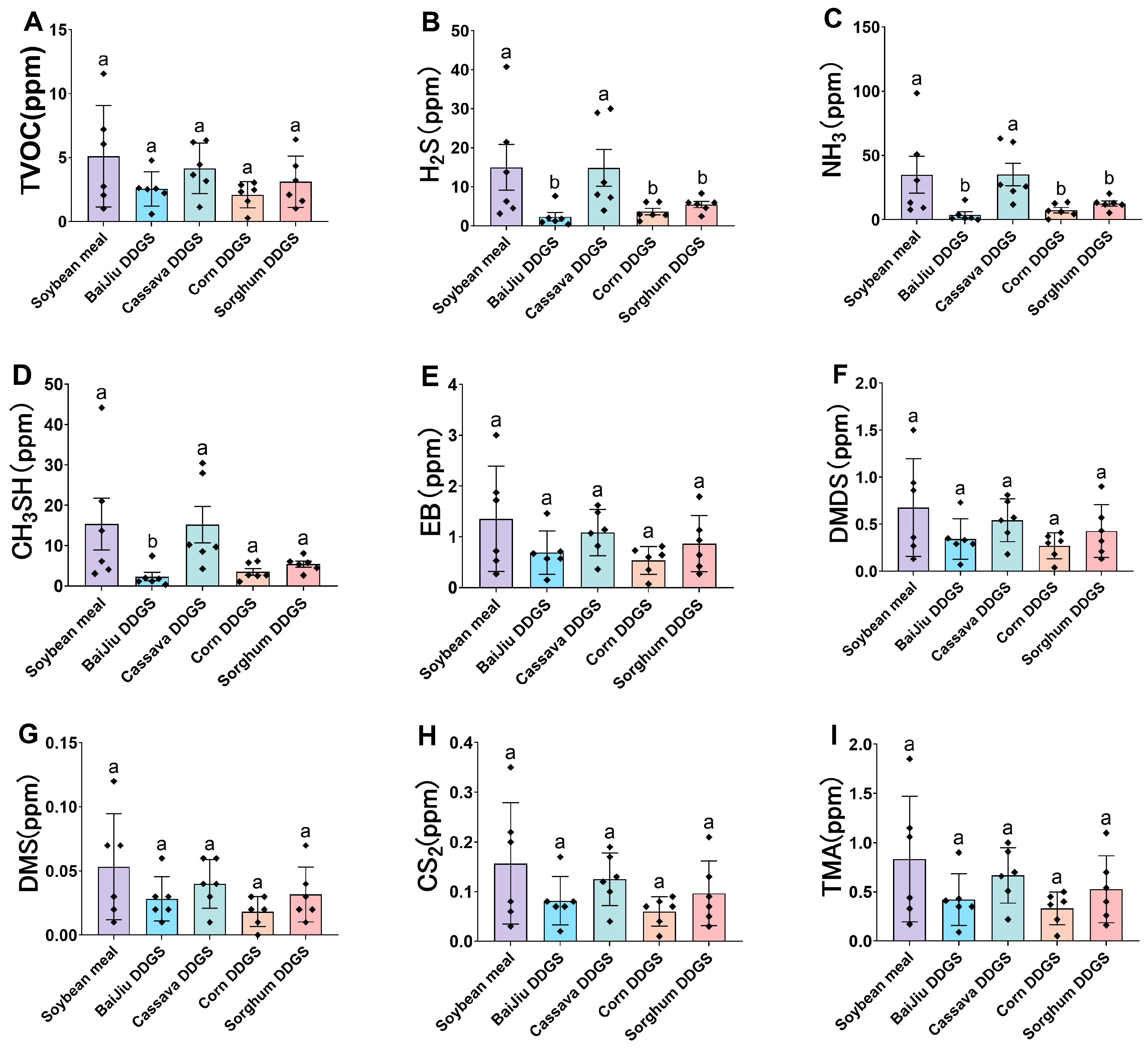
Compared with soybean meal, distiller’s grains-based protein raw materials significantly affected malodorous gas production during in vitro fermentation (Supplementary Table S1 and Figure 1). Soybean meal showed the highest concentrations across all detected gases, including ammonia (NH3, 35.01 ± 33.44 ppm), hydrogen sulfide (H2S, 14.97 ± 13.73 ppm), methyl mercaptan (CH3SH, 15.38 ± 15.09 ppm), trimethylamine (TMA, 0.83 ± 0.64 ppm), ethylbenzene (EB, 1.35 ± 0.99 ppm), dimethyl disulfide (DMDS, 0.68 ± 0.49 ppm), dimethyl sulfide (DMS, 0.05 ± 0.04 ppm), carbon disulfide (CS2, 0.16 ± 0.12 ppm), and total volatile organic compounds (TVOC, 5.11 ± 3.85 ppm) (Supplementary Table S1). Among the distiller’s grains-based protein raw materials, Baijiu DDGS, Corn DDGS, and Sorghum DDGS showed significantly lower concentrations of NH3 and H2S compared with soybean meal (p < 0.05), whereas Cassava DDGS exhibited comparable levels of NH3 and H2S to soybean meal (Supplementary Table S1).
For other gas components, including CH3SH, TMA, DMDS, DMS, EB, CS2, and TVOC, all DGPRM groups generally showed lower concentrations than in soybean meal, with varying degrees of reduction among different substrates (Supplementary Table S1). As shown in Figure 1, a clear separation in gas emission profiles was observed between soybean meal and DGPRM groups. Soybean meal consistently exhibited higher gas production across most indicators, while Baijiu, corn, and Sorghum DDGS formed a cluster with relatively lower emission levels. Cassava DDGS showed an intermediate pattern, closer to soybean meal for several gas components.

3.3. Short-Chain Fatty Acid Contents from In Vitro Fermentation of Soybean Meal- and Distiller’s Grains-Based Protein Raw Materials

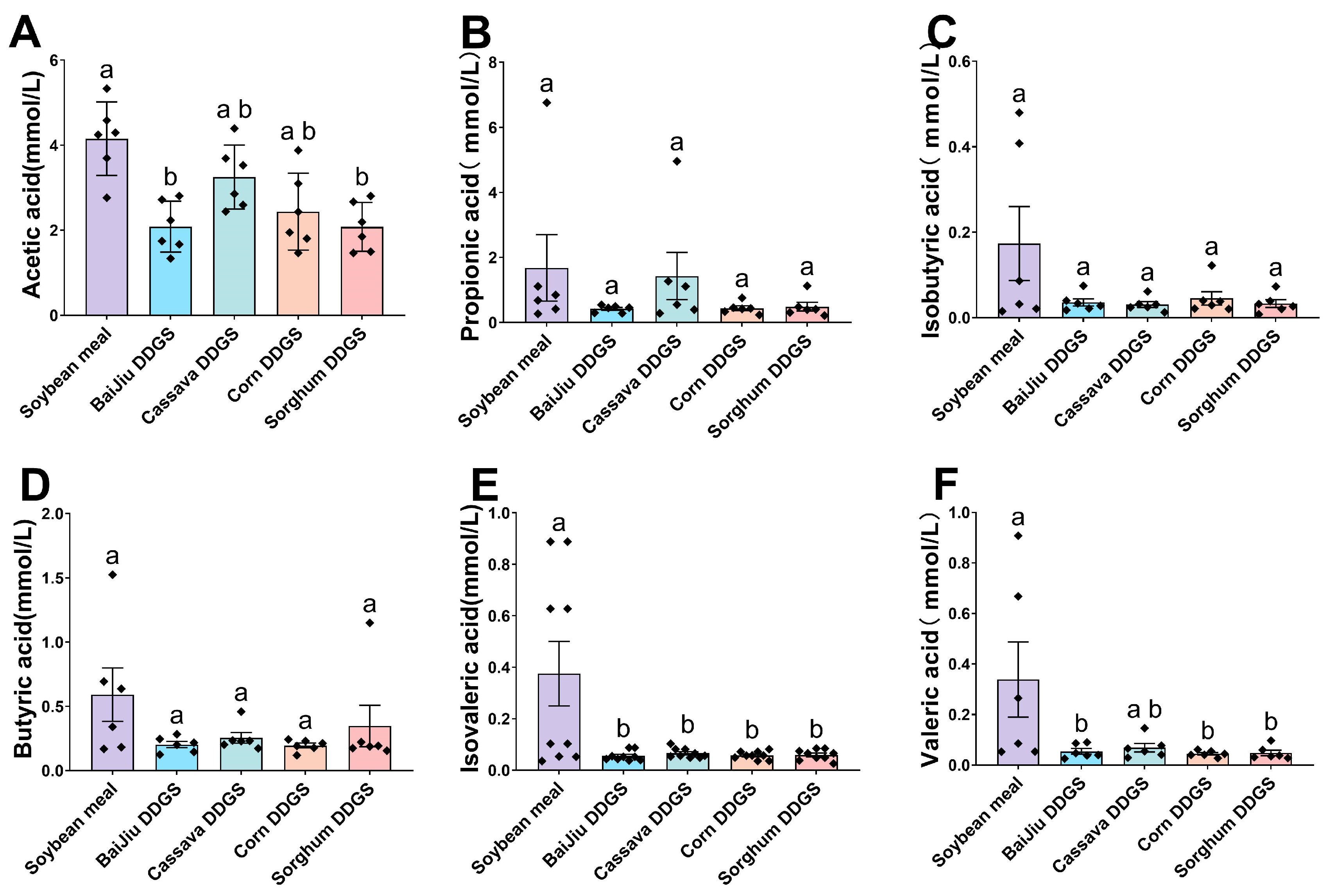
The concentrations of SCFAs after in vitro fermentation are presented in Supplementary Table S2 and Figure 2. Soybean meal exhibited the highest production levels of acetic acid (4.15 ± 0.86 mmol/L), (1.68 ± 2.40 mmol/L), isobutyric acid (0.17 ± 0.21 mmol/L), butyric acid (0.59 ± 0.51 mmol/L), isovaleric acid (0.29 ± 0.37 mmol/L), and valeric acid (0.34 ± 0.36 mmol/L). The acetic acid production in Baijiu distiller’s grains (2.09 ± 0.60 mmol/L) and Sorghum DDGS (2.08 ± 0.57 mmol/L) was significantly lower than Soybean meal (4.15 ± 0.86 mmol/L) (p < 0.05). However, no significant differences were observed in the production of propionic acid, isobutyric acid, isovaleric acid, and valeric acid between Baijiu distiller’s grains and the latter three groups. The production levels of various SCFAs in the Cassava, corn, and sorghum distiller’s grains groups were generally low, with no statistically significant differences among these three groups (p > 0.05). As shown in Figure 2, soybean meal consistently exhibited higher SCFA production across all measured acids compared with DGPRM groups, while Baijiu DDGS showed an intermediate fermentation profile. Overall, SCFA concentrations were generally higher in the soybean meal group than in the DGPRM groups.

3.4. Characteristics of Microbial Community Structure and Diversity

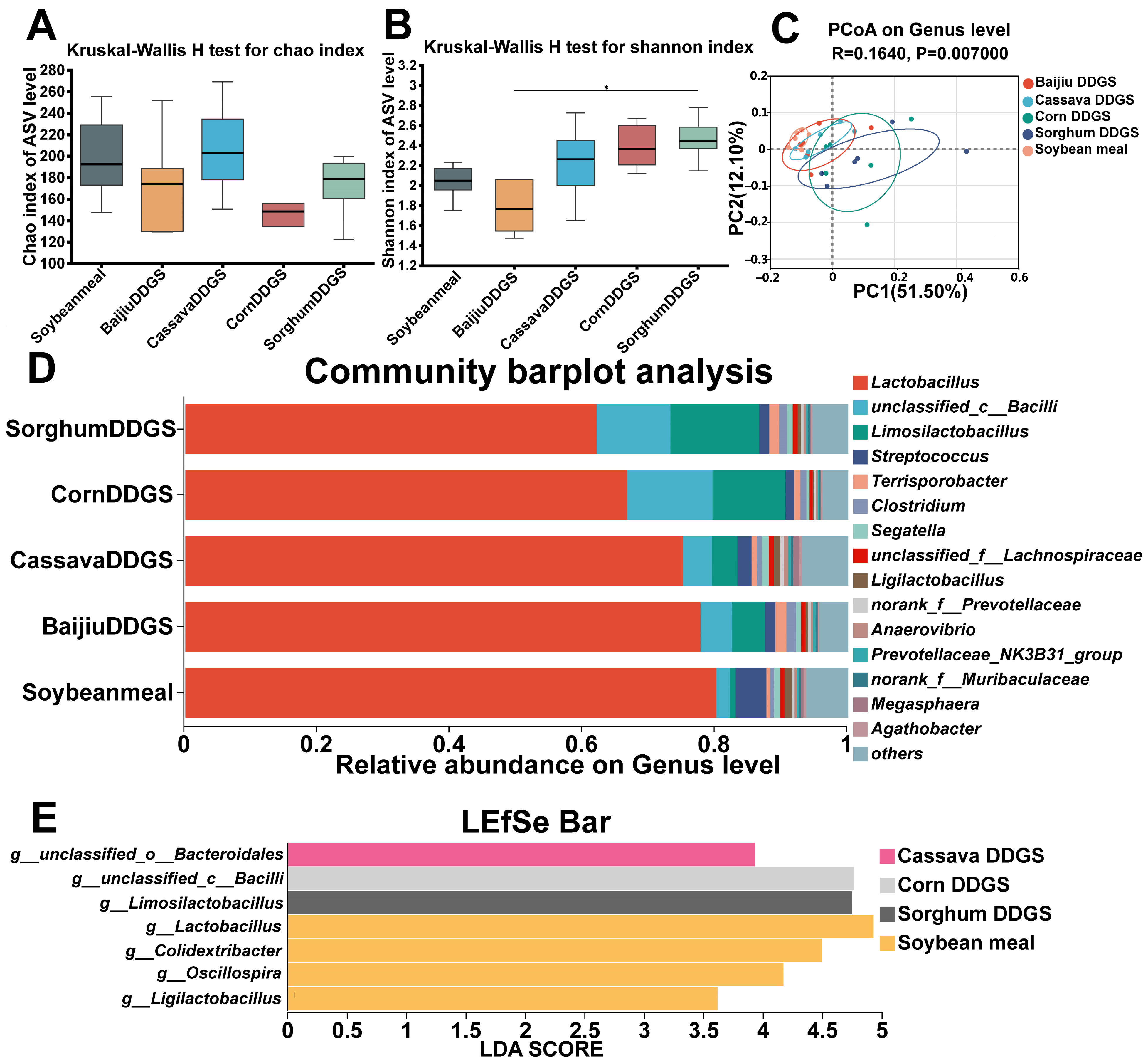
To explore the differences in intestinal microbial diversity and community composition during in vitro simulated fermentation of finishing pigs fed soybean meal- and distiller’s grains-based protein raw materials, we performed microbial 16S rRNA gene sequencing. The results demonstrated that different protein feed substrates significantly affected the microbial community structure and diversity in the fermentation system. Alpha diversity analysis showed that the Chao1 index and Shannon index were the highest in the soybean meal group, indicating the greatest microbial richness and diversity, whereas the Sorghum DDGS group exhibited the lowest diversity (Figure 3A,B). Principal coordinate analysis (PCoA) for beta diversity further revealed a distinct separation of microbial community composition between the soybean meal group and all distiller’s grains-based groups, suggesting that substrate type was the key factor driving the shifts in microbial community structure (Figure 3C).
At the genus level, Lactobacillus was the dominant genus in the soybean meal group. In contrast, the distiller’s grains-based groups were mainly dominated by unclassified_Bacillales and Ligilactobacillus, with marked differences in the relative abundance of dominant genera among the various distiller’s grains-based treatments (Figure 3D). LEfSe analysis further identified the key microbial biomarkers with significant differences in the soybean meal group, including Lactobacillus and Streptococcus, while Ligilactobacillus and unclassified_Bacillales were more abundant in the distiller’s grains-based groups (Figure 3E). Specifically, the Cassava DDGS group was enriched with unclassified_o__Bacteroidales, the Corn DDGS group was characterized by unclassified_c__Bacilli as a differential biomarker, and Limosilactobacillus was identified as the key differential genus in the Sorghum DDGS group (Figure 3E). Overall, differences were observed in both microbial community composition and metabolite profiles among the fermentation substrates.

3.5. The Association Between Microbial Community and Fermentation Metabolic Characteristics

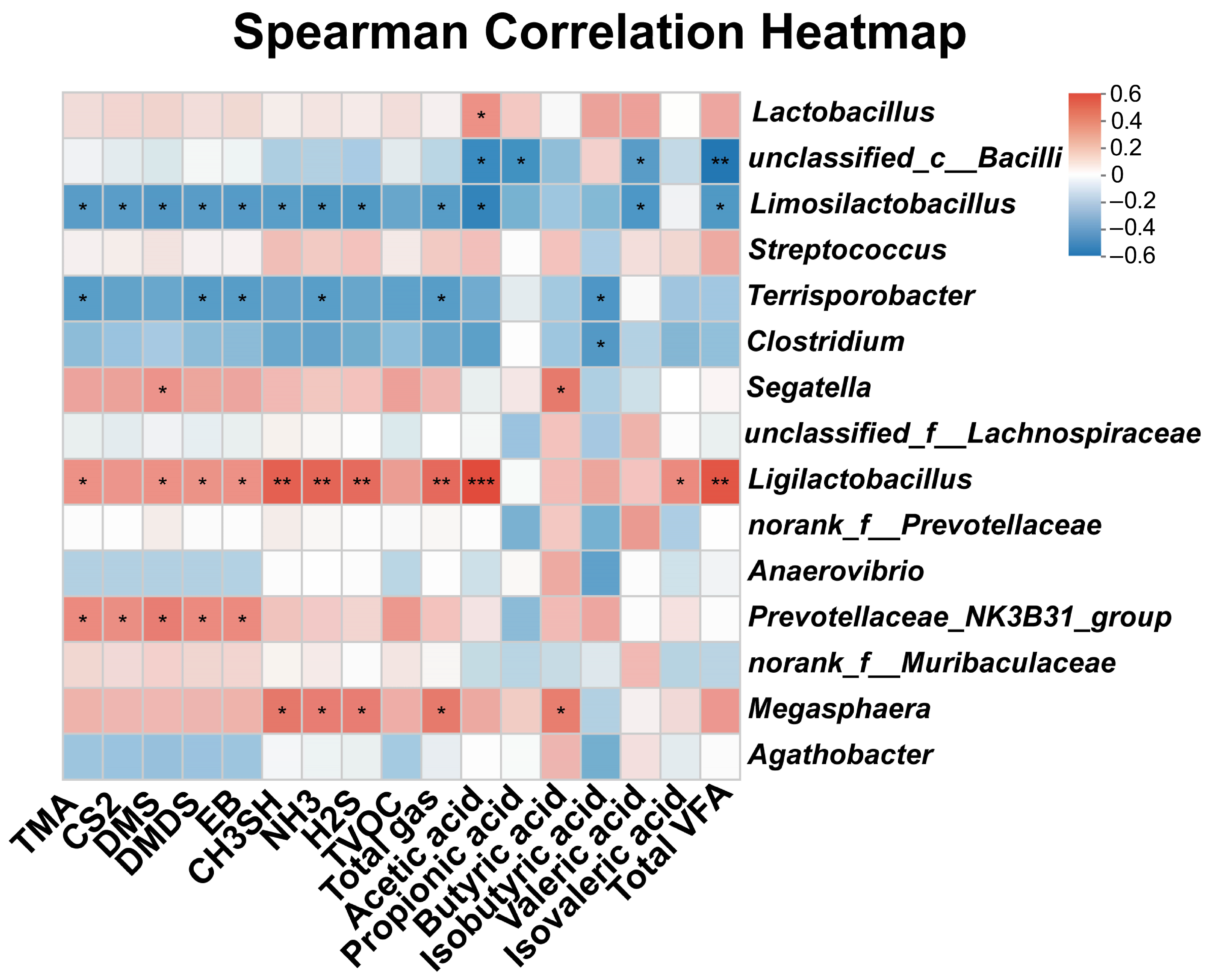
To clarify the association between microbial community and fermentation metabolic characteristics, Spearman correlation analysis was performed (Figure 4). The results showed that the genus Ligilactobacillus was significantly and positively correlated with the contents of seven malodorous gases, as well as the contents of acetic acid and isovaleric acid (p < 0.05). The abundance of the genus Prevotellaceae_NK3B31_group was significantly positively correlated with five malodorous gases (TMA, CS2, DMS, DMDS, EB), while the abundance of the genus Megasphaera was significantly positively correlated with CH3SH, NH3, H2S, and overall malodorous gas emissions. However, Limosilactobacillus was significantly negatively correlated with multiple malodorous gases (including NH3, H2S, CH3SH, TMA, DMS, DMDS, CS2, EB, and TVOC), as well as with the concentrations of acetic acid and valeric acid. The genus Terrisporobacter was significantly negatively correlated with four malodorous gases (TMA, DMDS, EB, NH3). In addition, the abundance of unclassified_c__Bacilli was significantly negatively correlated with the production of acetic acid, propionic acid, valeric acid. These results demonstrated significant associations between specific bacterial genera and fermentation metabolites.

4. Discussion

The large-scale development of the pig fattening industry faces dual challenges: environmental pollution and efficient utilization of protein resources. The malodorous gases emitted from pig fattening barns are dominated by ammonia (NH3), hydrogen sulfide (H2S), volatile organic sulfur compounds (VOSs), and trimethylamine (TMA), which not only pose a serious threat to the ecological environment and public health, but also restrict the sustainable development of the industry [17]. Soybean meal (SBM), the most widely used high-quality protein source in pig fattening diets, is rich in soluble proteins that are easily degraded by intestinal microorganisms, producing malodorous precursors such as amino acids, amines, and sulfides. These precursors are further converted into various malodorous gases, making SBM the primary source of odor emissions during pig fattening [18]. Meanwhile, distiller’s grains, a major by-product of the brewing industry, are abundant in crude protein, essential amino acids, and bioactive substances. However, they have long been plagued by prominent problems such as low resource utilization rate and environmental pollution caused by stacking, which have become key difficulties in the treatment of industrial waste [19]. To address the above problems, this study systematically evaluated the regulatory effects of replacing soybean meal with distiller’s grains-based protein raw materials (DGPRMs) on nutrient utilization, metabolic profiles, and microbial community structure using an in vitro fermentation system simulating the pig fattening stage. The results not only clarify the potential of DGPRMs as alternative protein sources to reduce malodorous emissions, but also further reveal the underlying microbial-metabolic regulatory mechanism, providing important theoretical and practical support for the green transformation of the pig fattening industry and the high-value utilization of industrial by-products.
Nutritional composition analysis showed that the crude protein (CP) and total amino acid (TAA) contents in the control group (soybean meal) were significantly higher than those in all DGPRM groups, which was consistent with the recognized nutritional characteristics of soybean meal as a high-quality protein source [20]. The high crude protein content and digestibility of soybean meal enable it to meet the high protein demand of fattening pigs for rapid growth. Although the core nutritional indicators (crude protein, total amino acids) of DGPRMs were lower than those of soybean meal, DGPRMs still maintained a crude protein content of 10–30% and a similar range of total amino acid contents. Moreover, they contained essential amino acids (e.g., lysine, methionine) and branched-chain amino acids (e.g., leucine, isoleucine) required for the growth of fattening pigs, indicating their basic potential as partial substitutes for soybean meal. Notably, DGPRMs are rich in dietary fiber and bioactive substances (e.g., polyphenols, organic acids), which can regulate intestinal peristalsis and microbial metabolism in fattening pigs, thereby indirectly improving feed nutrient utilization efficiency and compensating for their slight deficiencies in nutritional indicators [21]. This differs from the previous study by Schwarz et al. [5], which primarily evaluated the effects of Corn DDGS, used as a partial replacement for soybean meal, on growth performance, carcass traits, and feed cost reduction in pigs. In contrast, the present study further investigated the effects of different distiller’s grains-based protein raw materials on microbial fermentation characteristics, odor-related gas production, and microbial community composition using an in vitro fermentation model, thereby providing mechanistic insights into odor mitigation. In practical production, based on the nutritional characteristics of DGPRMs and the nutritional requirements of fattening pigs, rational diet formulation can reduce feed costs and malodorous emissions without compromising fattening performance, which conforms to the current development trend of “cost reduction, efficiency improvement and environmental protection” in the pig farming industry [22].
Although Cassava DDGS did not exhibit superior odor-reducing performance compared with Baijiu DDGS and Corn DDGS, its inclusion provided important comparative information. Distiller’s grains products are derived from diverse substrates and fermentation processes, resulting in considerable variation in nutrient composition and biological functionality. As an emerging coproduct widely available in cassava-producing regions, Cassava DDGS represents a potentially valuable alternative feed resource. The present findings indicate that not all DGPRMs exert equivalent effects on microbial fermentation and odor generation, emphasizing the importance of substrate source when evaluating their practical application. Therefore, the inclusion of Cassava DDGS enabled a broader assessment of DGPRM diversity and helped identify substrate-dependent differences in odor-mitigation potential.
It should be emphasized that DGPRMs are not intended to completely replace soybean meal in practical swine production. Instead, they are more commonly used as partial protein sources in combination with soybean meal and crystalline amino acids. Although the crude protein content of DGPRMs (10–30%) is generally lower than that of soybean meal, practical diet formulation can compensate for this difference through balanced amino acid supplementation [23]. Based on the present results, Baijiu DDGS and Corn DDGS exhibited the most promising odor-reducing potential and may represent suitable alternative protein ingredients for future application. However, because only one inclusion level was evaluated in this study, the optimal replacement ratio cannot be determined and requires further dose–response validation.
The characteristics of in vitro fermentation metabolism simulating the pig fattening stage revealed that the production of short-chain fatty acids (SCFAs) in the soybean meal group was significantly higher than that in all DGPRM groups, which was closely related to the high protein and carbohydrate contents of soybean meal and the metabolic characteristics of intestinal microorganisms in fattening pigs. During the pig fattening stage, the intestinal microbial community has a strong ability to degrade high-protein and high-carbohydrate substrates, thereby promoting the synthesis of short-chain fatty acids [24]. As important metabolites of intestinal microbial fermentation, SCFAs not only provide energy for intestinal epithelial cells and maintain intestinal barrier function, but their content and composition can also indirectly reflect the metabolic activity of the microbial community [25]. However, the core finding of this study is that there is no positive correlation between SCFA concentration and malodorous gas emissions. Although the SCFA production in the DGPRM groups was lower, their emissions of malodorous gases (including NH3, H2S, TMA, VOSs, etc.) were significantly lower than those in the soybean meal group. Although this finding may initially appear counterintuitive, SCFA production and odor generation are largely derived from different microbial metabolic pathways. SCFAs, including acetate, propionate, and butyrate, are primarily produced through the fermentation of carbohydrates and other readily fermentable substrates. In contrast, major odor-related compounds such as ammonia, hydrogen sulfide, trimethylamine, indole, and skatole are predominantly generated through the degradation of proteins, amino acids, and other nitrogen- or sulfur-containing substrates [26]. Our findings are consistent with previous studies showing that ammonia is primarily generated through microbial deamination of amino acids, whereas hydrogen sulfide mainly originates from microbial degradation of sulfur-containing amino acids and from sulfate reduction [27]. Similar observations have been reported in swine fermentation studies, indicating that dietary protein source can differentially regulate nitrogen and sulfur metabolic pathways [28]. Consequently, reductions in odor emissions do not necessarily require increased SCFA production, and the two processes may respond differently to changes in substrate composition and microbial community structure. This phenomenon indicates that the difference in microbial community structure and the resulting changes in metabolic pathways, rather than the simple substrate degradation rate or SCFA production, are the key factors regulating malodorous gas emissions in the in vitro fermentation system simulating the pig fattening stage.
Furthermore, some bacterial taxa may contribute to both SCFA production and odor formation depending on substrate availability and metabolic conditions. For example, several fermentative bacteria are capable of utilizing carbohydrates to produce SCFAs under nutrient-balanced conditions but may shift toward amino acid catabolism when protein substrates are abundant, thereby generating odor-related metabolites [29]. Therefore, SCFA-producing bacteria should not automatically be regarded as indicators of reduced odor production. The present results suggest that DGPRM supplementation may alter microbial substrate utilization patterns, favoring reduced proteolytic fermentation and odor generation even when overall SCFA production is lower.
Taken together, these findings indicate that odor mitigation is more closely associated with the regulation of microbial metabolic pathways than with the absolute production of SCFAs. This distinction may explain why lower SCFA concentrations and lower odor emissions were observed simultaneously in several DGPRM treatments.
Spearman correlation analysis further revealed the specific regulatory mechanism between the microbial community and malodorous emissions. The genera Ligilactobacillus, Prevotellaceae_NK3B31_group, and Megasphaera were significantly positively correlated with the emissions of various malodorous gases. Among them, the genus Megasphaera showed a significant positive correlation with the emissions of CH3SH, NH3, and H2S, which was consistent with the conclusion that Megasphaera plays a key role in sulfur metabolism in the pig intestine and can promote hydrogen sulfide emissions by participating in the degradation of sulfur-containing amino acids [6]. This interpretation is also consistent with previous studies in swine demonstrating that microbial catabolism of methionine and cysteine is a major source of hydrogen sulfide and other volatile sulfur compounds in the large intestine [30]. Therefore, alterations in sulfur amino acid metabolism may partially explain the differences in odor production observed among the DGPRM treatments.
Interestingly, the positive association between Ligilactobacillus and odor compounds appears inconsistent with the generally recognized probiotic role of lactobacilli. However, microbial functions are highly dependent on substrate availability and environmental conditions. Certain members of the family Lactobacillaceae possess amino acid catabolic capabilities and may participate in nitrogen turnover under protein-rich fermentation conditions [31]. Therefore, the positive correlations observed in the present study may reflect substrate-specific metabolic activities rather than a universally detrimental role of Ligilactobacillus. Furthermore, because the present analysis was conducted at the genus level, species-specific functional differences cannot be excluded. It remains unclear whether Ligilactobacillus directly contributes to odor formation or is simply associated with microbial communities that favor proteolytic fermentation. Future studies integrating metagenomics and metabolomics will be valuable for clarifying its functional role. This discrepancy highlights key functional heterogeneity among lactic acid bacteria (LAB). It should be noted that lactic acid bacteria (LAB) are generally regarded as beneficial microorganisms because they contribute to intestinal homeostasis, inhibit pathogen colonization, and promote carbohydrate fermentation. However, not all LAB exert identical metabolic functions. Under specific substrate compositions and fermentation conditions, certain LAB species may also participate in the formation of odor-related metabolites through amino acid metabolism or interactions with other microorganisms. Therefore, the ecological role of LAB in odor formation is likely species-dependent and substrate-dependent. In the present study, the observed correlations involving Limosilactobacillus should not be interpreted as evidence that all LAB uniformly reduce malodorous compound production. Prior work has confirmed the odor-producing capacity of Clostridium in fermentation environments [32]. In our experiment, Clostridium abundance remained low and showed no significant variation among substrate groups. Despite its significant negative correlation with isobutyric acid, this short-chain fatty acid showed no intergroup differences. Therefore, Clostridium cannot account for the distinct changes in key malodorous gases, and we did not analyze this genus in depth. Further dedicated research on Clostridium is needed in the future.
In contrast, Limosilactobacillus was consistently associated with lower odor production. A possible explanation is that this genus preferentially utilizes fermentable carbohydrates through glycolytic and lactic acid fermentation pathways, resulting in increased production of lactate and other organic acids. Enhanced carbohydrate utilization may reduce microbial reliance on amino acid degradation as an energy source, thereby decreasing the generation of ammonia, hydrogen sulfide, trimethylamine, and other odor-related metabolites [33]. In addition, lactate accumulation may suppress proteolytic and putrefactive microorganisms through localized acidification of the fermentation environment, further contributing to odor mitigation. However, the present study quantified only SCFAs and did not determine lactate or other intermediate organic acids that may better reflect carbohydrate fermentation. Therefore, the proposed mechanism that Limosilactobacillus may shift microbial metabolism toward carbohydrate utilization should be regarded as a plausible hypothesis rather than direct experimental evidence. Future studies integrating targeted metabolomics (including lactate and other organic acids) with metagenomic analysis will be necessary to verify the metabolic pathways underlying this association.
The ecological role of Terrisporobacter in odor regulation remains less well understood. Although Terrisporobacter was negatively associated with several odor compounds in the present study, current evidence is insufficient to confirm a direct causal role in odor mitigation. It is possible that this genus functions as an indicator of broader microbial community restructuring rather than acting as a direct regulator of odor production. Alternatively, competition for nutrients and ecological niche occupation may indirectly suppress odor-producing microorganisms. Additional functional studies are required to determine the metabolic pathways underlying this association.
Taken together, these findings suggest that the reduction in odor emissions observed in DGPRM treatments is likely mediated by coordinated shifts in microbial community structure and metabolic activity rather than by the action of a single bacterial genus. The observed associations highlight the importance of microbial ecological interactions in regulating odor formation and provide a potential mechanistic basis for the odor-mitigating effects of DGPRMs.
Microbial community analysis showed significant differences in microbial community structure and diversity between the soybean meal group and the DGPRM groups. The soybean meal group had the highest microbial richness (Chao1 index) and diversity (Shannon index), with Lactobacillus as the dominant genus, which was consistent with the inherent microbial community characteristics of the fattening pig intestine [34]. As an important probiotic in the intestines of fattening pigs, Lactobacillus can maintain intestinal microecological balance and promote the digestion and absorption of nutrients, which is closely related to the high nutritional value and good digestibility of soybean meal. In comparison, the DGPRM groups were dominated by unclassified_Bacillales and Ligilactobacillus, with significantly lower microbial richness and diversity than the soybean meal group. The possible reasons for this phenomenon are as follows: DGPRMs contain certain anti-nutritional factors (e.g., phytic acid, tannins) that can inhibit the growth and reproduction of some sensitive microorganisms; meanwhile, dietary fiber in distiller’s grains can selectively enrich fiber-degrading bacteria such as unclassified_Bacillales, thereby reshaping the microbial community structure. LEfSe analysis identified key microbial biomarkers between groups, further confirming that replacing soybean meal with DGPRMs can significantly alter the microbial community structure of the in vitro fermentation system simulating the pig fattening stage.
Combined with the results of correlation analysis, this study proposes a potential regulatory pathway: replacement of soybean meal with DGPRMs → reshaping of microbial community structure (reducing the abundance of odor-producing bacteria such as Lactobacillus, Prevotellaceae_NK3B31_group and Megasphaera; enriching the abundance of odor-inhibiting bacteria such as Limosilactobacillus and Terrisporobacter) → optimization of microbial metabolic pathways (reducing the degradation of malodorous precursors and regulating SCFA metabolism) → reduction in malodorous gas emissions. This pathway makes up for the deficiencies of previous studies that only focused on changes in microbial community structure or malodorous emissions without clarifying their intrinsic correlation, providing a clear microbial-metabolic regulatory framework for the application of DGPRMs in malodor reduction during pig fattening.
Several limitations of the present study should be acknowledged when interpreting the practical implications of these findings. First, the in vitro fermentation experiment was conducted using a single inoculum source under standardized temperature and pH conditions. Although this design minimized experimental variability and enabled direct comparisons among treatments, microbial fermentation responses may differ under alternative environmental conditions. Therefore, future studies should evaluate the consistency of DGPRM-mediated odor reduction across multiple inoculum sources and fermentation environments. Second, only a single DGPRM inclusion level was investigated, preventing assessment of potential dose-dependent relationships between DGPRM supplementation and odor mitigation. Consequently, the optimal replacement ratio cannot be determined from the present data. Additionally, fewer experimental repetitions may also result in a lower probability of detecting significant differences. Third, the study was based on endpoint measurements obtained after 24 h of fermentation and therefore could not characterize temporal changes in microbial community succession and odor production during the incubation process. Because fermentation is a dynamic process involving continuous shifts in substrate utilization and microbial metabolism, future studies incorporating multiple sampling time points are warranted. In addition, although SCFAs were quantified, lactate and other intermediate organic acids were not measured. Consequently, the metabolic mechanism linking Limosilactobacillus enrichment to reduced odor production could not be directly verified. Future studies integrating targeted metabolomics and metagenomics are warranted. Despite these limitations, the present results consistently demonstrated that Baijiu DDGS exhibited the strongest odor-reducing potential, followed by Corn DDGS. These findings suggest that both ingredients may represent promising alternative protein sources for reducing odor emissions in pig production systems. However, additional dose–response experiments and in vivo feeding trials are required before definitive recommendations regarding practical inclusion levels can be established. Overall, the present findings support our original hypothesis that replacing soybean meal with distiller’s grains-based protein raw materials can modulate microbial fermentation and microbial community composition, thereby reducing odor-related metabolite production under in vitro fermentation conditions.
In conclusion, using an in vitro fermentation system simulating the pig fattening stage, this study systematically elucidated the regulatory effects of replacing soybean meal with DGPRMs on the nutritional characteristics, metabolites, and microbial community structure of the fermentation system, and revealed the core regulatory mechanism of “DGPRM substitution–microbial community reshaping–metabolic pathway optimization–malodor reduction”. The present results demonstrate that, under the conditions of this in vitro fermentation experiment, DGPRMs—particularly Baijiu DDGS and Corn DDGS—can effectively modulate microbial fermentation characteristics and reduce the production of odor-related metabolites compared with soybean meal. These findings provide experimental evidence supporting the potential application of DGPRMs as alternative protein sources for odor mitigation in pig production, although further in vivo validation is required before practical application.


Supplementary Materials

The following supporting information can be downloaded at: https://www.mdpi.com/article/10.3390/agriculture16141510/s1, Figure S1: Flow chart of experimental design; Table S1: Gas production values of each fermentation group; Table S2: SCFA concentrations after in vitro fermentation.

Author Contributions

Conceptualization, X.P. and H.F.; methodology, H.Z.; software, S.W. (Shanchuan Wei); validation, X.Z.; formal analysis, I.N.A.O. and S.W. (Shihao Wang); investigation, L.W.; resources, H.F.; data curation, R.H., R.F. and H.Z.; writing—original draft preparation, H.Z.; writing—review and editing, L.Z. and H.F.; visualization, N.S.; supervision, H.F. and L.Z.; project administration, L.Z. and H.F. All authors have read and agreed to the published version of the manuscript.

Funding

This research was supported by the Fujian Province Natural Science Foundation of China (Grant Nos. 2025J01560) and the “Three Rural and Nine Party” agricultural science and technology cooperation program of Zhejiang province (Grant Nos. 2024SNJF041, 2025SNJF081, and 2023SNJF55) and the Zhejiang provincial agricultural major technology collaborative promotion project (Grant Nos. 2025ZDXT14 and 2023ZDXT13). This research was also supported by the Zhejiang Provincial Natural Science Foundation of China under Grant No. LTGN24C170001.

Institutional Review Board Statement

This study was conducted in accordance with the experimental protocol (no. 26ZALAS27) and was approved by the Institution of Animal Care and Use Committee (ACUC) of Zhejiang Academy of Agricultural Sciences.

Informed Consent Statement

Not applicable.

Data Availability Statement

All raw sequencing data generated in this study have been deposited in the NCBI Sequence Read Archive (SRA) database under the BioProject accession number PRJNA1417358. The data are publicly available and can be accessed at https://www.ncbi.nlm.nih.gov/bioproject/PRJNA1417358 (accessed on 3 July 2026).

Acknowledgments

We sincerely thank Xionge Pi for her assistance and support in the implementation of the project.

Conflicts of Interest

The authors declare no conflicts of interest.

References

  1. Li, Y.; Liu, Y.; Mu, C.; Zhang, C.; Yu, M.; Tian, Z.; Deng, D.; Ma, X. Magnolol-driven microbiota modulation elicits changes in tryptophan metabolism resulting in reduced skatole formation in pigs. J. Hazard. Mater. 2024, 467, 133423. [Google Scholar] [CrossRef] [PubMed]
  2. Cao, T.; Zheng, Y.; Dong, H. Control of odor emissions from livestock farms: A review. Environ. Res. 2023, 225, 115545. [Google Scholar] [CrossRef] [PubMed]
  3. Fu, H.; Li, Y.; Ke, F.; Quan, H.; Xu, X.; Li, X.; Chen, Q.; Li, G.; Pi, X. Protein feed-driven regulation of pig intestinal microbiota: Mechanisms underlying odor emission mitigation and development of sustainable deodorizing formulations. Resour. Environ. Sustain. 2025, 21, 100245. [Google Scholar] [CrossRef]
  4. Parrini, S.; Aquilani, C.; Pugliese, C.; Bozzi, R.; Sirtori, F. Soybean Replacement by Alternative Protein Sources in Pig Nutrition and Its Effect on Meat Quality. Animals 2023, 13, 494. [Google Scholar] [CrossRef] [PubMed]
  5. Schwarz, T.; Przybyło, M.; Zapletal, P.; Turek, A.; Pabiańczyk, M.; Bartlewski, P.M. Effects of Using Corn Dried Distillers’ Grains with Solubles (cDDGS) as a Partial Replacement for Soybean Meal on the Outcomes of Pig Fattening, Pork Slaughter Value and Quality. Animals 2021, 11, 2956. [Google Scholar] [CrossRef] [PubMed]
  6. Zhang, D.; Ji, H.; Wang, S.; Liu, Y.; Chen, M.; Liu, H. Lactobacillus-driven feed fermentation regulates microbiota metabolism and reduces odor emission from the feces of pigs. mSystems 2023, 8, e0098823. [Google Scholar] [CrossRef] [PubMed]
  7. Li, Z.; Zhu, Q.; Azad, M.A.K.; Li, H.; Huang, P.; Kong, X. The Impacts of Dietary Fermented Mao-tai Lees on Growth Performance, Plasma Metabolites, and Intestinal Microbiota and Metabolites of Weaned Piglets. Front. Microbiol. 2021, 12, 778555. [Google Scholar] [CrossRef] [PubMed]
  8. Duncan, S.H.; Hold, G.L.; Harmsen, H.J.M.; Stewart, C.S.; Flint, H.J. Growth requirements and fermentation products of Fusobacterium prausnitzii, and a proposal to reclassify it as Faecalibacterium prausnitzii gen. nov., comb. nov. Int. J. Syst. Evol. Microbiol. 2002, 52, 2141–2146. [Google Scholar] [CrossRef] [PubMed]
  9. Chen, J.; Pi, X.; Liu, W.; Ding, Q.; Wang, X.; Jia, W.; Zhu, L. Age-related changes of microbiota in midlife associated with reduced saccharolytic potential: An in vitro study. BMC Microbiol. 2021, 21, 47. [Google Scholar] [CrossRef] [PubMed]
  10. Pi, X.E.; Fu, H.; Yang, X.X.; Yu, Z.C.; Teng, W.L.; Zhang, Y.; Ye, X.W.; Quan, H.H.; Lu, L.Z.; Liu, W. Bacterial, short-chain fatty acid and gas profiles of partially hydrolyzed guar gum in vitro fermentation by human fecal microbiota. Food Chem. 2024, 430, 137006. [Google Scholar] [CrossRef] [PubMed]
  11. Lv, G.; Fu, H.; Liao, Y.; Ma, X.; Chen, Q.; Han, Q.; Li, G.; Pi, X. Mitigation of odor emissions by replacing soybean meal with unconventional protein ingredients: Assessment via in vitro simulated fermentation. Environ. Technol. Innov. 2026, 41, 104749. [Google Scholar] [CrossRef]
  12. Pi, X.; Hua, H.; Wu, Q.; Wang, X.; Wang, X.; Li, J. Effects of Different Feeding Methods on the Structure, Metabolism, and Gas Production of Infant and Toddler Intestinal Flora and Their Mechanisms. Nutrients 2022, 14, 1568. [Google Scholar] [CrossRef] [PubMed]
  13. GB/T 6432-2018; Determination of Crude Protein in Feeds—Kjeldahl Method. Institute of Agricultural Quality Standards and Testing Technology, Chinese Academy of Agricultural Sciences [National Feed Quality Supervision and Inspection Center]: Beijing, China, 2018.
  14. GB/T 6434-2006; Feeding Stuffs—Determination of Crude Fiber Content—Method with Intermediate Filtration. Feed Quality Supervision, Inspection and Testing Center of the Ministry of Agriculture: Jinan, China, 2006.
  15. GB/T 18246-2000; Determination of Amino Acids in Feeds. National Feed Product Quality Supervision and Inspection Center: Beijing, China, 2000.
  16. Bolyen, E.; Rideout, J.R.; Dillon, M.R.; Bokulich, N.A.; Abnet, C.C.; Al-Ghalith, G.A.; Alexander, H.; Alm, E.J.; Arumugam, M.; Asnicar, F.; et al. Reproducible, interactive, scalable and extensible microbiome data science using QIIME 2. Nat. Biotechnol. 2019, 37, 852–857. [Google Scholar] [CrossRef] [PubMed]
  17. Hossain, M.M.; Cho, S.B.; Kim, I.H. Strategies for reducing noxious gas emissions in pig production: A comprehensive review on the role of feed additives. J. Anim. Sci. Technol. 2024, 66, 237–250. [Google Scholar] [CrossRef] [PubMed]
  18. Zong, C.; Li, H.; Zhang, G. Ammonia and greenhouse gas emissions from fattening pig house with two types of partial pit ventilation systems. Agric. Ecosyst. Environ. 2015, 208, 94–105. [Google Scholar] [CrossRef]
  19. He, R.; Yang, Y.; Li, Y.; Yang, M.; Kong, L.; Yang, F. Recent Progress in Distiller’s Grains: Chemical Compositions and Biological Activities. Molecules 2023, 28, 7492. [Google Scholar] [CrossRef] [PubMed]
  20. Ibáñez, M.A.; de Blas, C.; Cámara, L.; Mateos, G.G. Chemical composition, protein quality and nutritive value of commercial soybean meals produced from beans from different countries: A meta-analytical study. Anim. Feed. Sci. Technol. 2020, 267, 114531. [Google Scholar] [CrossRef]
  21. Cristobal, M.; Lee, S.A.; Parsons, C.M.; Stein, H.H. Feeding intact protein from soybean meal instead of corn and synthetic amino acids does not affect growth performance, carcass composition, blood cytokines, or mRNA abundance of intestinal amino acid transporters in growing pigs, but net energy tends to be greater in diets with soybean meal. J. Anim. Sci. 2025, 103, skaf349. [Google Scholar] [CrossRef] [PubMed]
  22. Papatsiros, V.G.; Tsekouras, N.; Papakonstantinou, G.I.; Kamvysi, K.; Eliopoulos, C.; Fotos, L.; Arapoglou, D.; Meletis, E.; Michailidis, G.; Gougoulis, D. The Use of Food Industry By-Products in Pig Diets as a Challenge Option to Reduce the Environmental Footprint. Agriculture 2025, 15, 2390. [Google Scholar] [CrossRef]
  23. Ajao, A.M.; White, D.; Kim, W.K.; Olukosi, O.A. Partial Replacement of Soybean Meal with Canola Meal or Corn DDGS in Low-Protein Diets Supplemented with Crystalline Amino Acids-Effect on Growth Performance, Whole-Body Composition, and Litter Characteristics. Animals 2022, 12, 2662. [Google Scholar] [CrossRef] [PubMed]
  24. Sarri, L.; Costa-Roura, S.; Balcells, J.; Seradj, A.R.; de la Fuente, G. The Impact of Genetics on Gut Microbiota of Growing and Fattening Pigs under Moderate N Restriction. Animals 2021, 11, 2846. [Google Scholar] [CrossRef] [PubMed]
  25. Mutuyemungu, E.; Motta-Romero, H.A.; Yang, Q.; Liu, S.; Liu, S.; Singh, M.; Rose, D.J. Megasphaera elsdenii, a commensal member of the gut microbiota, is associated with elevated gas production during in vitro fermentation. Gut Microbiome 2024, 5, 18. [Google Scholar]
  26. Li, H.; Bian, Y.; Wu, Y.; Hang, X.; Zhang, M.; Gao, L.; Dong, Y.; Mu, T.; Zhao, W. Sugarcane polyphenols modulate gut microbiota and odor-associated metabolites during in vitro fecal fermentation of elderly. Food Biosci. 2026, 76, 108318. [Google Scholar] [CrossRef]
  27. Teigen, L.; Biruete, A.; Khoruts, A. Impact of diet on hydrogen sulfide production: Implications for gut health. Curr. Opin. Clin. Nutr. Metab. Care 2023, 26, 55–58. [Google Scholar] [CrossRef] [PubMed]
  28. Sheng, Q.K.; Yang, Z.J.; Zhao, H.B.; Wang, X.L.; Guo, J.F. Effects of L-tryptophan, Fructan, and Casein on Reducing Ammonia, Hydrogen Sulfide, and Skatole in Fermented Swine Manure. Asian-Australas. J. Anim. Sci. 2015, 28, 1202–1208. [Google Scholar] [CrossRef] [PubMed]
  29. Oliphant, K.; Allen-Vercoe, E. Macronutrient metabolism by the human gut microbiome: Major fermentation by-products and their impact on host health. Microbiome 2019, 7, 91. [Google Scholar] [CrossRef] [PubMed]
  30. Carbonero, F.; Benefiel, A.C.; Alizadeh-Ghamsari, A.H.; Gaskins, H.R. Microbial pathways in colonic sulfur metabolism and links with health and disease. Front. Physiol. 2012, 3, 448. [Google Scholar] [CrossRef] [PubMed]
  31. Tang, H.; Huang, W.; Yao, Y.F. The metabolites of lactic acid bacteria: Classification, biosynthesis and modulation of gut microbiota. Microb. Cell 2023, 10, 49–62. [Google Scholar] [CrossRef] [PubMed]
  32. Cho, S.; Hwang, O.; Park, S. Effect of Dietary Protein Levels on Composition of Odorous Compounds and Bacterial Ecology in Pig Manure. Asian-Australas. J. Anim. Sci. 2015, 28, 1362–1370. [Google Scholar] [CrossRef] [PubMed]
  33. Korpela, K. Diet, Microbiota, and Metabolic Health: Trade-Off Between Saccharolytic and Proteolytic Fermentation. Annu. Rev. Food Sci. Technol. 2018, 9, 65–84. [Google Scholar] [CrossRef] [PubMed]
  34. Luo, Y.; Ren, W.; Smidt, H.; Wright, A.-D.G.; Yu, B.; Schyns, G.; McCormack, U.M.; Cowieson, A.J.; Yu, J.; He, J.; et al. Dynamic Distribution of Gut Microbiota in Pigs at Different Growth Stages: Composition and Contribution. Microbiol. Spectr. 2022, 10, e0068821. [Google Scholar] [CrossRef] [PubMed]
Figure 1. Gas production results of microbial communities in each fermentation group. (A) TVOC, total volatile organic compounds; (B) H2S, hydrogen sulfide; (C) NH3, ammonia; (D) CH3SH, methanethiol; (E) EB, styrene; (F) DMDS, dimethyl disulfide; (G) DMS, dimethyl sulfide; (H) CS2, carbon disulfide; (I) TMA, trimethylamine. One-way analysis of variance (ANOVA); different lowercase letters (a, b) indicate significant differences among fermentation groups (p < 0.05).
Agriculture 16 01510 g001
Figure 2. Concentrations of SCFAs after in vitro fermentation. (A) Acetic acid; (B) propionic acid; (C) isobutyric acid; (D) butyric acid; (E) isovaleric acid; (F) valeric acid. One-way analysis of variance (ANOVA); different lowercase letters (a, b) indicate significant differences among fermentation groups (p < 0.05).
Agriculture 16 01510 g002
Figure 3. Differences in diversity and composition of bacterial communities at the genus level after in vitro fermentation of each raw material group. (A) Chao index and (B) Shannon index, Kruskal–Wallis H test, *: 0.01 < p < 0.05; (C) microbial β-diversity; (D) composition of microbial community at the genus level; (E) differences in genus enrichment among groups, LEfSe (Linear Discriminant Analysis Effect Size), LDA > 3.5.
Agriculture 16 01510 g003
Figure 4. Correlation analysis between fecal microbiota at the genus level, SCFAs, and gases. Red indicates a positive correlation, blue indicates a negative correlation, and the depth of the color indicates the strength of the correlation: the darker the color, the stronger the correlation; the lighter the color, the weaker the correlation. *: 0.01 < p < 0.05; **: 0.001 < p < 0.01; ***: p < 0.001.
Agriculture 16 01510 g004
Table 1. Chemical composition of soybean meal and DGPRMs (% DM basis).
ItemSBMSorghum DDGSCorn DDGSBaijiu DDGSCassava DDGS
Moisture (%)11.539.517.1611.446.40
Dry matter (%)88.4790.4992.8488.5693.60
Crude protein (%)43.1022.8027.9022.1811.78
Crude fat (%)2.477.557.195.442.70
Crude fiber (%)6.808.508.4014.909.20
Ash (%)6.002.808.207.5016.90
Calcium (%)0.290.080.760.310.93
Phosphorus (%)0.590.430.320.500.27
Lysine (%)2.300.430.370.330.31
Methionine (%)0.570.300.200.220.14
Cysteine (%)0.740.280.190.210.11
Met + Cys (%)1.300.580.390.420.26
Tryptophan (%)2.030.540.330.440.39
Disclaimer/Publisher’s Note: The statements, opinions and data contained in all publications are solely those of the individual author(s) and contributor(s) and not of MDPI and/or the editor(s). MDPI and/or the editor(s) disclaim responsibility for any injury to people or property resulting from any ideas, methods, instructions or products referred to in the content.