Article

Effects of Tray-Free Simplified Rice Seedling Raising Technology Using Biodegradable Biomass Film on Grain Yield and Its Components


1
Heilongjiang Academy of Agricultural Sciences, Harbin 150028, China
2
Institute of Plant Nutrition and Resources and Environment, Beijing Academy of Agriculture and Forestry Sciences, Beijing 100097, China
3
Institute of Bast Fiber Crops, Chinese Academy of Agricultural Sciences, Changsha 410205, China
*
Author to whom correspondence should be addressed.
These two authors contributed equally to this paper and should be considered co-first authors.
Agriculture 2026, 16(14), 1504; https://doi.org/10.3390/agriculture16141504
Submission received: 18 May 2026 / Revised: 29 June 2026 / Accepted: 6 July 2026 / Published: 10 July 2026
(This article belongs to the Section Crop Production)

Abstract

The conventional method of raising seedlings with plastic trays has drawbacks, including large plastic tray consumption, difficulty in recycling and potential farmland white pollution, along with high labor input and production costs. To clarify the effects of tray-free simplified rice seedling raising technology, which uses biodegradable biomass seedling films to replace traditional plastic trays on rice grain yield and its components, large-scale comparative field experiments were conducted in seven major rice-producing counties of Heilongjiang Province from 2022 to 2024. Independent-sample t-tests, linear mixed-effects models and structural equation modeling were applied to systematically evaluate the application effects of this technology. The results showed that the average grain yield of the treatment group reached 9032 kg/ha, which was a significant increase of 5.93% compared with the 8526.0 kg/ha of the control group. Compared with the conventional method, this technology markedly increased the effective panicle number, the filled grain number per panicle and 1000-grain weight, and reduced the percentage of unfilled grains, presenting positive yield performance across different regions, although the magnitude of increase varied (2.7–9.5%). Based on the previous literature, this technology has the potential to reduce plastic use and its associated environmental impacts, although direct measurements of carbon emissions and degradation rates were not conducted in this study. Featuring potential ecological benefits and simplified cultivation with prominent yield-increasing effects, it is worthy of popularization and application in cold-region rice planting areas.

1. Introduction

Rice is one of the most important food crops in China, and its stable production holds strategic significance for national food security. Seedling raising is a critical step in rice production, as seedling quality directly affects transplanting recovery, tillering, population establishment, and final yield. Although traditional plastic tray seedling raising meets the requirements of mechanical transplanting to a certain extent, it suffers from problems such as high consumption of plastic trays, difficulty in recycling, and potential white pollution to farmland. Furthermore, soil collection and fertilization involve high labor intensity and production costs [1,2]. With the increasing concentration and scale of rural land transfer and the continuous decline in agricultural labor, traditional seedling raising methods can no longer meet the demands of intensive and large-scale rice production. While the reduction in plastic tray use is an obvious advantage of this technology (eliminating the need for trays entirely), the current study did not directly quantify the amount of plastic saved, recycling proportion, or residual plastic loads in the soil. Future research should include life-cycle assessments to fully evaluate the environmental benefits of tray-free seedling raising. Overall, developing simplified and efficient alternative seedling raising technologies has become an important direction in the field of rice cultivation [3].
Different rice seedling raising methods exert remarkable effects on seedling quality and yield formation. Dry seedling raising and nutrient soil seedling raising markedly raise the number of effective panicles and total population spikelets, and maintain a stable seed setting percentage and 1000-grain weight, thereby promoting yield increase [4]. Pot seedling raising has advantages over carpet seedling raising, such as higher seedling quality, greater flexibility in seedling age, and shorter recovery period after transplanting, achieving a yield increase of more than 7% [5]. Research on precision drill sowing seedling raising indicates that improved seedling quality increases the proportion of low-position tillers after transplanting, leading to a higher yield through increased effective panicle numbers [6]. These studies have revealed the regulatory mechanisms of seedling raising methods on rice yield formation from different perspectives, providing important methodological references for this study.
In recent years, the application of degradable biomass materials in seedling raising has received widespread attention. The laying jute seedling film under trays significantly promotes root development of machine-transplanted rice seedlings, increases root binding strength, and ultimately enhances yield [7]. Multi-site trials in cold-region rice areas show that the jute film tray-free seedling raising technology achieves good yield-increasing effects (3.1–11.4%) [8]. The biomass seedling tray increased yield by 5.8% and further optimized the molding process and formulation parameters through response surface analysis [9]. The jute seedling film significantly improves the quality and yield of early rice seedlings [10]. However, existing studies mostly focus on describing the effects of individual technical aspects, lacking systematic quantitative analysis of how this technology indirectly affects yield by regulating yield components [11]. In particular, the stability of the technological effect under different ecological conditions and the consistency of its action pathways remain unclear.
From the perspective of sustainable agriculture, emission reduction in rice cultivation has become an important direction for green agricultural development. Rice cultivation contributes approximately 12% of global anthropogenic methane emissions, accounting for more than 50% of food-related greenhouse gas emissions [12]. Through technical pathways such as water–nitrogen synergistic management, water-saving irrigation, and variety improvement, significant emission reductions can be achieved while maintaining yield [13,14]. The biomass-based eco-friendly seedling film used in this study is made of plant fibers, which gradually degrade under microbial action without pollution or residue, increasing the humus content of the seedbed soil and forming an organic layer [15].
To this end, we conducted large-plot comparative trials from 2022 to 2024 in seven major rice-producing regions in Heilongjiang Province, systematically evaluating the treatment effects of the tray-free simplified seedling raising technology (using biomass-based eco-friendly seedling film as a substitute for traditional plastic trays) on rice yield and its component factors. Independent-sample t-tests, linear mixed-effects models, forest plots, and structural equation modeling were employed to clarify the yield-increasing mechanism, ecological adaptability, and main action pathways of this technology, providing theoretical basis and practical guidance for promoting simplified seedling raising technology in cold-region rice areas and similar ecological regions. It is important to note that while we hypothesize environmental benefits (reduced plastic use) based on the biodegradable nature of the seedling film, this study focuses primarily on measuring yield and yield component responses. Direct measurements of carbon emissions, degradation rates, and soil impacts were not conducted and should be addressed in future research.

2. Materials and Methods

2.1. Overview of Experimental Sites

The experiments were conducted from 2022 to 2024 in seven major rice-producing regions in Heilongjiang Province: Tailai, Tonghe, Fangzheng, Qing’an, Mishan, Suibin, and Fuyuan. The geographical coordinates, climatic conditions (≥10 °C accumulated temperature, frost-free period, annual precipitation), soil types, and physicochemical properties (organic matter, pH, alkaline hydrolyzable nitrogen, available phosphorus, available potassium) of each experimental site are detailed in Table 1. Geographical coordinates were determined by GPS positioning using a handheld GPS receiver (Garmin eTrex 10, Garmin International, Olathe, KS, USA), climatic data were averaged over the experimental period (2022–2024), and soil indicators were measured by conventional methods [16].

2.2. Experimental Varieties

The varieties used at each experimental site were locally cultivated varieties (Oryza sativa L.) approved at the national or provincial level to ensure adaptability and representativeness. The specific varieties were as follows: Tailai County (Longyang 16, Longdao 124, Zhongkefa 5), Tonghe County (Shansidao 8, Tiannong 17, Suijing 9), Fangzheng County (Fangxiangdao 2, Tianhe 1), Qing’an County (Longjing 3010, Zaodaoxiang, Qingyuan 12), Mishan City (Suijing 18, Longjing 31, Longdao 1), Suibin County (Longjing 31, Longjing 1718, Lianhui 6730), and Fuyuan City (Longjing 31, Lianhui 13, Longjing 3049). The tested varieties covered the main planting types in the cold rice region and had good representativeness. At each experimental site, the same rice variety was used for both treatment and control groups within a given year. However, varieties differed across sites and years based on local recommendations (see variety list). To account for potential variety effects, we fitted a linear mixed-effects model including variety as a random intercept effect (see Section 2.6.2).

2.3. Experimental Materials

The core material was a naturally biodegradable biomass-based seedling film composed primarily of jute (Corchorus capsularis L.) fibers (approximately 85%) bound with a starch-based biodegradable adhesive (approximately 15%). The film thickness was 0.8–1.0 mm, width 1.5 m, and areal density 40 g/m2 developed by the Institute of Biotechnology, Heilongjiang Academy of Agricultural Sciences (Harbin, China). Auxiliary materials included a biodegradable perforated isolation film (thickness 0.01 mm, width 3 m, pore diameter 0.5 cm, spacing 5 cm × 5 cm) and special nutrient soil for seedling raising (organic matter content ≥ 30%). The control group (CK) used traditional plastic seedling trays (58 cm × 28 cm, pore diameter 0.3 cm, spacing 5 cm × 5 cm) (Harbin, China).

2.4. Experimental Design

This experimental design is suitable for demonstration and comparative purposes but does not replace fully randomized replicated field experiments. We used the “experimental sites” in different accumulated temperature zones as ecological replicates. Within each site, the treatment and control were arranged adjacent to each other to control local environmental differences. The two treatments (treatment and control) were placed adjacently in the same seedling greenhouse, and the variety was kept consistent within each site. Sowing date, water and fertilizer management, temperature and humidity control, and disease prevention were uniformly carried out by designated personnel. The area of each treatment plot was ≥150 m2 and the seedling age was 25–38 d.
Treatment group (T1): Tray-free, simplified, environmentally friendly seedling raising technology for rice in cold regions. Seedbed leveling → laying isolation film → laying biomass-based eco-friendly seedling film (pressing edges) → spreading 2 cm of nutrient base soil → thoroughly watering base soil → sowing (600 g/m2 of dry seeds) → covering with 0.5 cm of topsoil → covering with plastic film for insulation → conventional greenhouse management.
Control group (CK): Traditional machine-transplanted tray seedling raising. Seedbed leveling → laying mesh cloth or fine sand → placing seedling trays → spreading 2 cm of nutrient base soil → thoroughly watering base soil → sowing (600 g/m2 of dry seeds) → covering with 0.5 cm of topsoil → covering with plastic film for insulation → conventional greenhouse management.

2.5. Measurement Indicators

At maturity, three 1 m2 quadrats were randomly selected from each treatment to investigate the number of hills (hills/m2) and the number of panicles (panicles/m2). Twenty representative plants (hills) were taken for indoor yield component analysis, measuring plant height (cm), panicle length (cm), total grain number per panicle (grains/panicle), and filled grain number per panicle (grains/panicle). The empty grain percentage (%) was calculated. The 1000-grain weight (g) was measured using a PM-8188 grain moisture meter (Kett Electric Laboratory, Tokyo, Japan). Each plot was harvested separately and sun-dried for weighing, and the yield per ha (kg/ha) was converted at a standard moisture content of 14.5%. Lodging degree (by rating) was also recorded. Thus, for each site-year combination, we obtained a single treatment value and a single control value for each yield component. All subsequent statistical analyses (t-tests, ANOVA, correlation, path analysis) were performed on these plot-level averages (n = 22 per group).

2.6. Data Source and Statistical Methods

2.6.1. Data Source

The data were derived from the treatment versus control comparative trials conducted at the seven experimental sites mentioned above from 2022 to 2024. Within each large plot, three sampling areas (subplots) were randomly selected for measurement. These sampling areas are not true biological replicates because they are within the same large plot and are not independently randomized. For statistical analysis, we treated each site-year combination as one experimental unit (n = 22 per group), with subplot measurements averaged before analysis, and the data in the tables are the means of the replicates. A total of 22 treatment group samples and 22 control group samples were obtained, covering 18 rice varieties. Longjing 31 was used at three sites and counted once. For each experimental site, the final yield increase percentage presented in the forest plot was calculated as the arithmetic mean of the annual yield increase percentage from 2022 to 2024. This approach preserves the paired structure of the data (treatment vs. control within each year) and accounts for inter-annual variation at each site.

2.6.2. Statistical Methods

Data were organized using Excel 2021 (Microsoft, Redmond, WA, USA) and statistically analyzed using SPSS 26.0 (IBM, Armonk, NY, USA).
Descriptive statistics: Calculation of mean and standard deviation for each indicator.
Paired t-test: Comparison of the significance of differences in yield component indicators between the treatment group and the control group, with each site-year treated as a paired observation (n = 22 pairs). This accounts for the paired design where treatment and control plots were adjacent within the same site, greenhouse, year, and variety. Linear mixed-effects model (LMM): Treatment was fitted as a fixed factor, while site, year, and variety were fitted as random intercept effects. The model was estimated using restricted maximum likelihood (REML), with denominator degrees of freedom approximated by the Satterthwaite method. This specification accounts for the hierarchical structure of the data, where multiple years and varieties were nested within each site. Pearson correlation analysis: Analysis of the relationships between yield and its component factors.

2.6.3. Forest Plot and Path Analysis

Forest plot: Python 3.9 (matplotlib library) was used to plot the yield increase percentage and its 95% confidence interval for each experimental site. For each experimental site is i and year is j, the annual yield increase percentage was first calculated as
R i j = Y T , i j Y C , i j Y C , i j × 100 %
where YT,ij and YC,ij are the treatment and control yields for site i in year j, respectively. For each site, the mean yield increase percentage across years was computed as
R i = 1 n i j = 1 n i R i j
where ni is the number of experimental years at site i (in this study, ni = 3 for all seven sites, corresponding to 2022–2024). The standard error of the mean yield increase percentage for site i was calculated as
S E i = S D i N i
where SDi is the standard deviation of the annual increase percentage (Rij) across the three years at site i. The 95% confidence interval for each site was then constructed as
R i   ±   1.96   ×   SE i
This paired-by-year calculation preserves the matched structure of the experimental design (treatment vs. control within the same year, site, and variety) and accounts for inter-annual variation at each location.
The overall pooled yield increase percentage and its 95% confidence interval across all sites were estimated using a random-effects meta-analysis model with the DerSimonian–Laird estimator, implemented via the metafor package in R 4.3.0. Heterogeneity among sites was assessed using the I2 statistic.
Path analysis: Structural equation modeling (SEM) was constructed using the lavaan package (R package) in R 4.3.0 (R Foundation for Statistical Computing, Vienna, Austria). Treatment was set as an exogenous variable (binary variable: 0 = control, 1 = treatment), while panicle number, filled grain number per panicle, empty grain percentage, and 1000-grain weight were set as mediating variables, and yield per unit area was set as the dependent variable. Parameter estimation was performed using the maximum likelihood (ML) method. Model fit was evaluated using the comparative fit index (CFI), root mean square error of approximation (RMSEA), and standardized root mean square residual (SRMR). Standardized path coefficients were used to assess the relative contributions of each mediating variable. Structural equation modeling can handle multiple causal relationships simultaneously and has been widely used in studies on rice yield formation mechanisms [17,18].

3. Results

3.1. Descriptive Statistics of Yield and Its Components and Treatment Effects

The descriptive statistics and paired t-test results for 22 treatment group samples and 22 control group samples are shown in Table 2. The treatment group was significantly superior to the control group in panicle number, filled grain number per panicle, 1000-grain weight, and yield (p < 0.05 or p < 0.001), while the empty grain percentage was significantly reduced (p < 0.01). Specifically, the average yield of the treatment group was 9032 kg/ha, which was 506 kg/ha higher than that of the control group (8526 kg/ha), representing an increase of 5.93%. In terms of yield components, the treatment group showed an increase of 10.3 panicles/m2 (+2.27%) in panicle number, 2.6 grains/panicle (+3.27%) in filled grain number, and 0.2 g (+0.77%) in 1000-grain weight, while the empty grain percentage decreased by 0.6 percentage points (−5.22%). The coefficient of variation (CV) indicated that the variability of each indicator in the treatment group was generally lower than that in the control group, suggesting that the application of this technology improved the stability of yield components. Sun et al. [8] also verified in large-scale production trials across seven major rice-producing regions in Heilongjiang Province that this technology promotes seedling height, root length, stem base width, and 100-seedling fresh and dry weights, with 100-seedling fresh weight increasing by 1.00–6.15 g and 100-seedling dry weight increasing by 0.13–0.90 g, providing support from the perspective of seedling quality for the changes in yield components observed in this study.

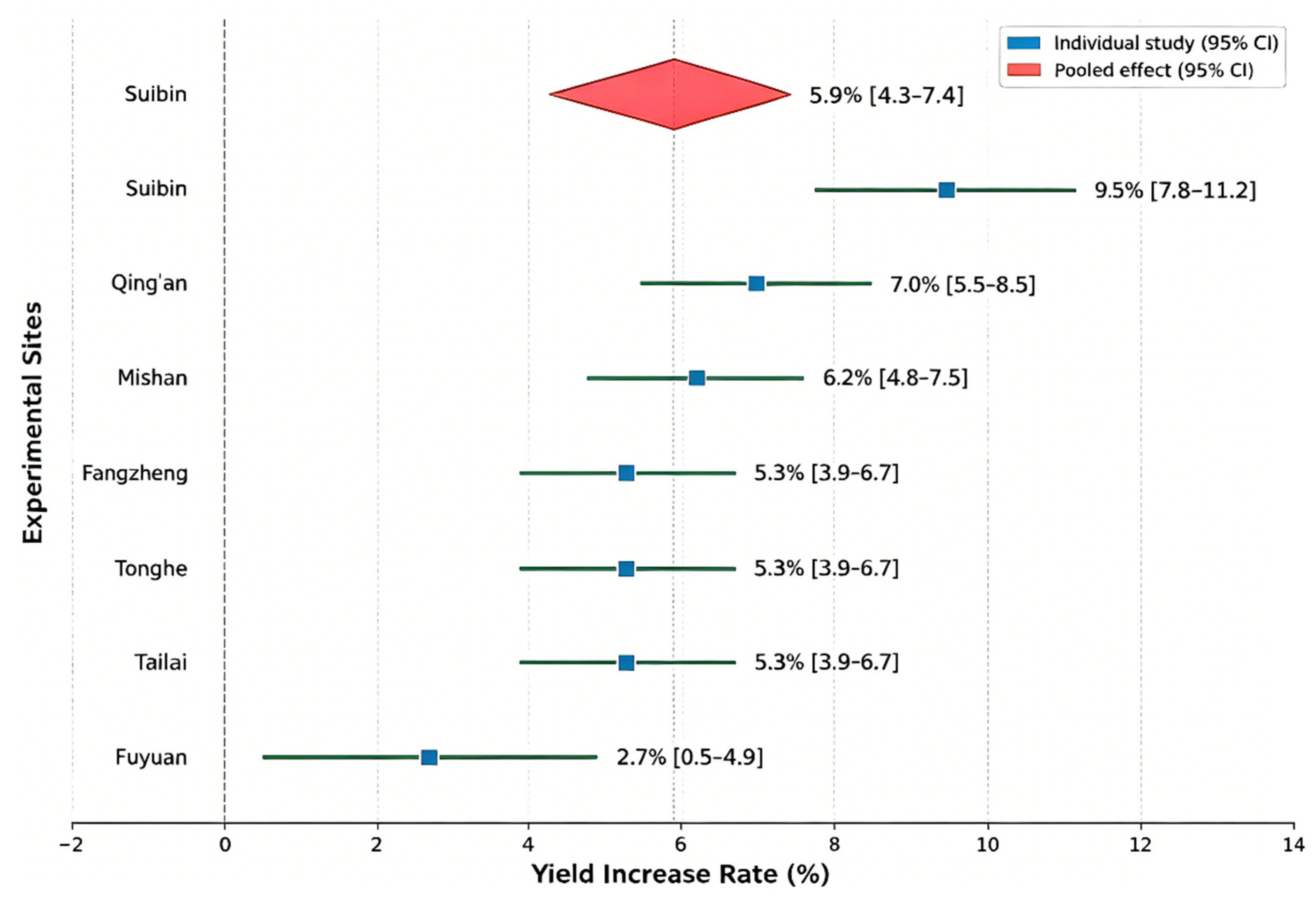
3.2. Yield-Increasing Effects at Different Experimental Sites and Forest Plot Analysis

The average yield increase percentage of the treatment group compared to the control group at each experimental site are shown in Figure 1. All seven experimental sites showed yield increases, with the average yield increase ranging from 2.7% (Fuyuan) to 9.5% (Suibin). Among them, Suibin had the highest average yield increase percentage (9.5%), followed by Qing’an (7.0%), while Mishan (6.2%), Fangzheng (5.3%), Tonghe (5.3%), and Tailai (5.3%) had percentage between 5.3% and 6.2%, and Fuyuan had the lowest (2.7%). The 95% confidence intervals for all experimental sites did not include zero (the Fuyuan site was close to zero but did not include it), indicating that the yield-increasing effects at each site were significant. The overall pooled yield increase percentage obtained using a random-effects model was 5.9% (95% CI: 4.3–7.4%). However, the heterogeneity test showed I2 = 70.3% (substantial heterogeneity), indicating that there were significant differences in the actual yield-increasing effects among the experimental sites, and the technological effect was greatly influenced by ecological conditions, soil, or cultivation management, and did not show a consistent effect under all conditions. Therefore, when promoting this technology, it is necessary to adapt it to local conditions and further analyze the reasons for regional differences.

3.3. Treatment Effect and Variance Components from the Linear Mixed-Effects Model

The results of the linear mixed-effects model for grain yield are shown in Table 3, with treatment fitted as a fixed effect and site, year, and variety as random intercept effects. The treatment effect was highly significant (F = 39.7, p < 0.001), confirming that the tray-free simplified seedling raising technology significantly increased grain yield overall. The random effects accounted for substantial proportions of the total variance: site (22.9%), variety (16.2%), and year (6.3%), indicating that yield varied considerably across locations, varieties, and years. The residual variance (54.6%) reflected unexplained variation within site-year-variety combinations. The larger variance component for site compared with year suggests that spatial heterogeneity (e.g., accumulated temperature, soil type) had a greater influence on yield than inter-annual climatic fluctuations. However, the substantial heterogeneity in effect sizes (I2 = 70.3%; range 2.7–9.5%) indicates that the magnitude of yield increase varied considerably among sites. Therefore, while the technology consistently produced positive yield responses, the degree of benefit is influenced by local ecological conditions.

3.4. Correlation Analysis Between Yield Components and Yield

Pearson correlation analysis (Table 4) showed that yield was significantly positively correlated with panicle number (r = 0.66, p < 0.001), filled grain number per panicle (r = 0.63, p < 0.001), and 1000-grain weight (r = 0.39, p = 0.008), and significantly negatively correlated with empty grain percentage (r = −0.56, p < 0.001). The correlation between total grain number per panicle and yield was not significant (r = 0.21, p = 0.12). This indicates that the yield increase in the treatment group mainly came from the increase in effective panicle number, improvement in grain filling (more filled grains and lower empty grain percentage), and a slight increase in grain weight. This result is consistent with many studies on rice yield components. Chen et al. [19] analyzed the yield structure of the blast-resistant hybrid rice “Guyou 168” and reported that the contribution of panicle number per hectare was 34.2%, grains per panicle was 27.3%, 1000-grain weight was 18.4%, and seed setting percentage was 17.5%, with panicle number contributing the most to yield. Li et al. [20] also showed a significant positive correlation between yield and effective panicle number as well as filled grain number per panicle in japonica rice in cold regions. In this study, the increases in panicle number (+2.27%) and filled grain number per panicle (+3.27%) were both greater than that in 1000-grain weight (+0.77%), consistent with the contribution ranking in the above studies, confirming that this technology mainly achieves yield increase through two pathways: increasing panicle number and increasing filled grain number per panicle. Liu et al. [21] also demonstrated through path analysis that effective panicle number and grains per panicle are the main factors affecting yield, further supporting the conclusions of this study.

3.5. Path Analysis—Direct and Indirect Effects of Treatment on Yield

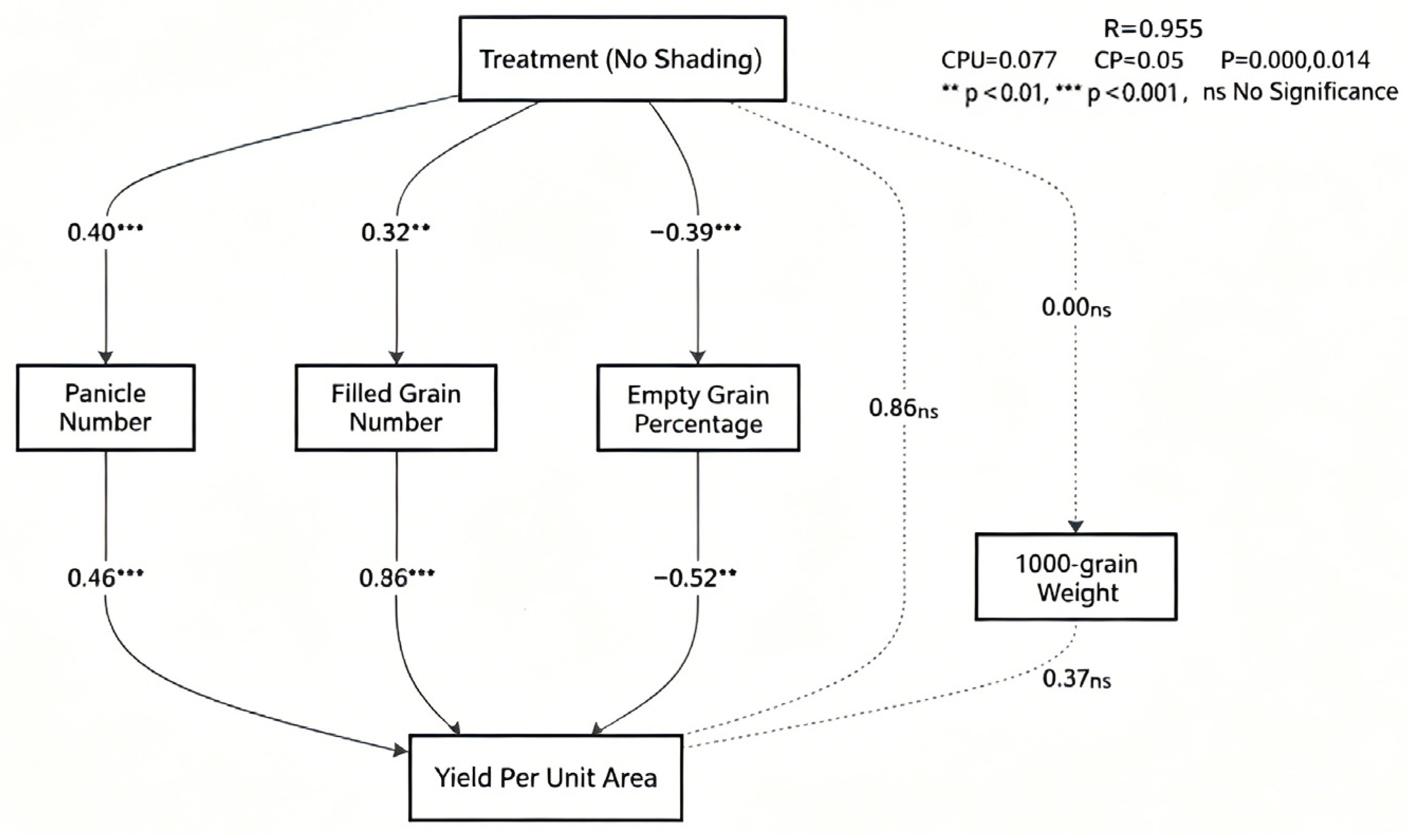
To further elucidate the pathways through which the treatment affects yield, a structural equation model was constructed (Figure 2). The model fit was good: CFI = 0.971, RMSEA = 0.061 (90% CI: 0.035–0.087), and SRMR = 0.044. Standardized path coefficients and effect decomposition are shown in Table 5. The results showed that the direct effect of treatment on yield was not significant (β = 0.08, p = 0.23), but the indirect effect was significant (total indirect effect β = 0.83, p < 0.001). The treatment mainly affected yield through three mediating pathways:
Panicle number pathway: Treatment → Panicle number (β = 0.40, p < 0.001) → Yield (β = 0.89, p < 0.001), indirect effect = 0.36.
Filled grain number pathway: Treatment → Filled grain number (β = 0.32, p = 0.003) → Yield (β = 0.86, p < 0.001), indirect effect = 0.28.
Empty grain percentage pathway: Treatment → Empty grain percentage (β = −0.35, p < 0.001) → Yield (β = −0.52, p = 0.006), indirect effect = 0.18 (absolute value).
The indirect effect of the 1000-grain weight pathway was small (0.06, p = 0.09) and not significant. The three significant pathways together explained 76.5% of the total variation in yield (R2 = 0.765). This result indicates that the tray-free simplified seedling raising technology does not directly affect final yield but instead indirectly increases yield by improving population structure (increasing panicle number) and enhancing grain filling capacity (increasing filled grain number and reducing empty grain percentage).

4. Discussion

4.1. Yield-Increasing Mechanism of the Tray-Free Simplified Seedling Raising Technology

The results of this study showed that the average yield of the treatment group was 9032 kg/ha, which was 5.93% higher than that of the control group (8526 kg/ha), with yield increase ranging from 2.7% to 9.5% across the seven experimental sites. This is highly consistent with the results of from multi-site trials in Heilongjiang (yield increase of 3.1–11.4%) and the 5.8% yield [8,9]. Similar studies have shown that the use of biomass seedling trays can increase the emergence by 9.5% and yield by 5.8% [9], which is very close to the results of this study. The seedling raising with degradable straw substrate blocks results in less transplanting damage and rapid establishment and growth after transplanting, which is beneficial for high quality and high yield of japonica rice [22]. Furthermore, demonstration results of fully biodegradable bowl-carpet integrated seedling trays for machine transplanting in Jiangxi showed an early rice yield increase of 700 kg/ha and a late rice yield increase of 7649 kg/ha compared to ordinary flat trays [23], and bast fiber film improved early rice seedling quality and transplanting performance in hard tray seedling raising [24], further verifying the yield-increasing potential of biodegradable materials in the seedling raising stage.
To analyze the yield-increasing mechanism, we systematically evaluated the yield components and path analysis results obtained in this experiment. Table 2 shows that the treatment group was significantly superior to the control group in all three major yield components: panicle number increased by 10.3 panicles/m2 (+2.27%, p < 0.05), filled grain number per panicle increased by 2.6 grains/panicle (+3.27%, p < 0.05), 1000-grain weight increased by 0.2 g (+0.77%, p < 0.05), and empty grain percentage decreased by 0.6 percentage points (−5.22%, p < 0.01). Correlation analysis (Table 4) showed that yield was significantly positively correlated with panicle number (r = 0.66, p < 0.001), filled grain number per panicle (r = 0.63, p < 0.001), and 1000-grain weight (r = 0.39, p = 0.008), and significantly negatively correlated with empty grain percentage (r = −0.56, p < 0.001). This indicates that the direct reasons for the yield increase are an increase in effective panicles, improved grain filling (more filled grains and fewer empty grains), and a slight increase in grain weight. Although the relative increases in individual yield components were modest (panicle number +2.27%, 1000-grain weight +0.77%), their combined effect resulted in a 5.93% yield increase. This synergistic effect is typical in rice production, where small improvements across multiple components often produce larger cumulative yield gains.
Path analysis (Figure 2, Table 5) further quantified the pathways through which the treatment affects yield. The results showed that the direct effect of treatment on yield was not significant (β = 0.08, p = 0.23), but yield was increased through three indirect pathways: increasing panicle number (indirect effect 0.36), increasing filled grain number per panicle (indirect effect 0.28), and reducing empty grain percentage (indirect effect 0.18). Together, these three pathways explained 76.5% of the yield variation. The panicle number pathway contributed the most (0.36), which is highly consistent with the contribution of panicle number per hectare (34.2%) [19,20] that effective panicle number has the strongest positive correlation with yield in cold-region japonica rice. The contribution of the filled grain number pathway (0.28) was second, matching the contribution of grains per panicle (27.3%) in the above studies.
The path analysis indicates that the treatment’s effect on yield is statistically mediated by yield components (panicle number, filled grain number, and empty grain percentage), with no significant residual direct effect remaining after accounting for these mediators. This statistical finding should not be interpreted as evidence that the technology has no direct biological effect on yield, but rather that its effects operate primarily through these measured components. The yield-increasing mechanism of this technology can be described as follows: the treatment drives yield improvement through indirect pathways that increase panicle number and filled grain number per panicle and reduce empty grain percentage, with the panicle number pathway making the largest contribution (0.36). This mechanism is consistent with the ranking of yield component contribution percentage (panicle number > grains per panicle > 1000-grain weight), indicating that the technology mainly increases yield by optimizing population structure and improving grain filling. While the path analysis provides a useful framework for understanding the statistical mediation of treatment effects through yield components, readers should be aware that causality cannot be definitively established from this observational study design.

4.2. Ecological Adaptability

These results indicate that this technology can increase yield from the first accumulated temperature zone (Tailai, ≥10 °C accumulated temperature 2850 °C) to the fourth accumulated temperature zone (Fuyuan, 2350 °C) in Heilongjiang Province. Even in Fuyuan, which has the poorest heat conditions, an average yield increase of 2.7% was achieved. These benefits derive from the thermal insulation and moisture retention properties of the seedling film, which reduce the adverse effects of early spring low temperatures on emergence and seedling growth [25]. Comparisons with previous studies in cold-region rice production reveal consistent patterns. In Heilongjiang Province, Sun et al. [8] reported yield increases of 3.1–11.4% using jute film tray-free technology, which aligns closely with our range of 2.7–9.5%. Similarly, Li et al. [9] found a 5.8% yield increase using biomass seedling trays, nearly identical to our pooled increase of 5.93%. Studies in other cold regions, including early rice trials in Jiangxi [23] and japonica rice trials in Jiangsu [22], have also demonstrated yield benefits ranging from 5% to 10%. Collectively, these findings suggest that biodegradable seedling materials improve rice yield across diverse cold-region environments, although the magnitude of benefit varies with local conditions and management practices.
In addition, the coefficients of variation for yield indicators in the treatment group were generally lower than those in the control group, indicating that the application of this technology improves yield stability, helping to mitigate production risks. The study on drill sowing of hybrid rice that reducing the number of sowing rows increased yield, and improved seedling quality increased the proportion of low-position tillers after transplanting [6], which is consistent with the technical mechanism of the panicle number pathway (0.36) in this study. In a study on ultra-high density seedling raising with straw substrate blocks, the high-density treatment achieved high yield under short seedling age conditions, with yields reaching 10.69 and 10.65 t/ha for two consecutive years and obtaining the highest economic returns [26], further demonstrating that appropriate seedling raising techniques can achieve yield increases under different conditions.
The yield increase varied considerably among varieties, from as low as 1.8% (Qingyuan 12) to as high as 11.7% (Longjing 31). This suggests a potential variety × technology interaction. Varieties with different panicle types, tillering ability, seedling vigor, and transplanting recovery may respond differently to tray-free seedling raising. For example, varieties with strong early vigor may benefit more from the improved root development associated with biodegradable films [25]. Future research should systematically evaluate variety-specific responses using factorial designs that cross seedling method with variety. Research on precision drill sowing seedling raising has shown that the fewer seeds per hill and the fewer sowing rows, the higher the seedling quality, and improved seedling quality increases the proportion of tillers at the second and third leaf positions after transplanting as well as tillering capacity per plant [6], providing methodological references for optimizing seedling raising parameters for different varieties [27]. In addition, multiple studies have verified the yield-increasing effects of biomass seedling materials from different perspectives. Using degradable straw substrate blocks for seedling raising resulted in less transplanting damage and rapid establishment and growth after transplanting, favoring high quality and high yield of japonica rice [28]. The fully biodegradable bowl-carpet integrated seedling trays for machine transplanting increased early rice yield by 700 kg/ha and late rice yield by 764 kg/ha compared to ordinary flat trays [22]. There is an interaction effect between the seedling film and sowing density, and an appropriate sowing density can further improve seedling quality and yield [29]. The bast fiber film improves machine transplanting quality when applied to early rice hard tray seedling raising [30]. At the statistical method level, through path analysis that effective panicle number and grains per panicle are the main factors affecting yield, which corroborates the results of the path analysis in this study [21]. Jin et al. [24] also demonstrated the application effects of bast fiber film in early rice hard tray seedling raising, further confirming the adaptability of this technology across different rice cropping systems.

4.3. Simplification and Economic Benefits

Compared with traditional plastic tray seedling raising, this technology has significant advantages in terms of simplification and cost-effectiveness. First, it eliminates the need for purchasing, recycling, cleaning, and storing plastic trays, greatly reducing labor intensity and labor costs. Based on cost accounting from a previous study using the same technology [31], estimated savings were approximately 44.1 US$/ha in labor costs and 22.1 US$/ha in tray and auxiliary material costs, totaling 66.2 US$/ha. However, these figures are from prior research and were not directly measured in the current experiment. Additionally, the analysis does not include the costs of biomass seedling film production, transport, and installation, nor does it account for price variability. A full life-cycle cost analysis is needed to accurately assess the economic viability of this technology. The yield increase benefit, based on our measured average increase of 506 kg/ha and a market price of 0.44 US$/kg, is approximately 223 US$/ha. Combining this with the estimated cost savings yields a net benefit of approximately 289 US$/ha, but this should be considered a preliminary estimate subject to verification in future studies. At the same time, the amount of nutrient soil used can be controlled, avoiding the damage to the plow layer caused by excessive soil extraction in traditional seedling raising [32].
Considering the environmental cost of tray recycling and disposal, the comprehensive benefits of this technology are even higher.
According to previous studies [33,34], biomass seedling films made from natural plant fibers can degrade under field conditions within approximately 25 days, with minimal residue. However, we did not directly measure degradation rates, residual amounts, or soil impacts in the current study. The claim of “full biodegradability” is based on prior literature rather than direct measurements in this experiment. Future research should include direct measurements of film degradation, residue quantification, and long-term soil microecological effects. After degradation, it increases the humus content of the seedbed soil [33]. This characteristic fundamentally eliminates the “white pollution” caused by plastic trays in farmland, aligning with the direction of green agricultural development. In summary, this technology combines simplification, cost-effectiveness, and potential ecological benefits, and has high value for promotion and application.

4.4. Research Limitations and Prospects

This study adopted large-plot comparative trials without true biological replicates at each site. The three subplot samples from each large plot were pseudo replicates because treatment and control plots were arranged adjacently in the same greenhouse without independent randomization. We addressed this limitation via paired t-test and linear mixed-effects modeling, using site-year as the experimental unit (n = 22). While multi-site temporal and spatial replication strengthened conclusion reliability, rigorous randomized complete block designs with multiple true replicates are recommended for future verification. In addition, rice varieties showed distinct performances under the tray-free seedling raising technology, with yield increases varying from 1.8% to 11.7%; detailed adaptability evaluation is required for varieties with different panicle types and plant architectures [21,35].
Several indicators were not measured in the present study, including carbon emissions, seedling film degradation rates, residue loads and long-term soil microecological impacts, all of which need long-term positioning observations [34]. The economic analysis also relied partly on previous cost accounting rather than field measurements, indicating that a full life-cycle cost analysis is essential. In addition, the rapid development of rice seedling substrates for various mechanized planting methods [36] and biomass seedling tray molding technology [9] will facilitate further optimization of this technology.

5. Conclusions

Comparative trials conducted from 2022 to 2024 in seven major rice-producing regions in Heilongjiang Province showed the following:
(1)
The tray-free, simplified rice seedling raising technology (replacing traditional plastic seedling trays with biomass-based eco-friendly seedling film) significantly increased rice yield, with an average increase of 506 kg/ha (5.93%). The average yield increase at the seven experimental sites ranged from 2.7% to 9.5%, indicating positive technological performance across sites, though the magnitude of benefit varied with local conditions.
(2)
The optimization of yield components was manifested as a 2.3% increase in panicle number, a 3.3% increase in filled grain number per panicle, a 0.8% increase in 1000-grain weight, and a 5.2% decrease in empty grain percentage.
(3)
Path analysis revealed that the treatment had no significant direct effect on yield but acted mainly through three indirect pathways: increasing panicle number (effect 0.36), increasing filled grain number per panicle (effect 0.28), and reducing empty grain percentage (effect 0.18), together explaining 76.5% of the yield variation.
(4)
Based on the yield data from this experiment and the cost accounting of previous studies, we conclude that compared with traditional plastic tray seedling raising, this technology eliminates the need for tray purchase and recycling, saving about 66.2 US$/ha in costs and increasing income by about 223 US$/ha through yield increase, resulting in a net benefit increase of approximately 289 US$/ha, with significant cost savings and efficiency gains. At the same time, according to the previous literature, the seedling film is biodegradable and has potential environmental benefits.
(5)
This technology is suitable for promotion in Heilongjiang Province and similar cold-region rice areas.

Author Contributions

Conceptualization, Z.-Y.S., Y.-F.W. and Q.-H.K.; methodology, Z.-Y.S., Y.-F.W. and H.-R.G.; software, B.-P.Z. and C.-X.L.; validation, Z.-H.X. and H.-Y.L.; formal analysis, S.W. and Y.L.; investigation, S.-S.C.; resources, H.-D.W.; data curation, Z.-G.L. and D.W.; writing—original draft preparation, Z.-Y.S., Y.-F.W. and Q.-H.K.; writing—review and editing, X.-X.S. and D.-D.Y.; visualization, H.-Y.L.; supervision, Y.-F.W. and D.W.; project administration, Z.-Y.S., Q.-H.K. and Y.-F.W.; funding acquisition, Z.-Y.S. and Q.-H.K. All authors have read and agreed to the published version of the manuscript.

Funding

Provincial Foundation Project: Construction of an AI-based precision control system for tray-free rice seedling raising using an IoT platform (JJ2025XQ0145); Provincial Scientific Research Operating Expenses Project: Integration of intelligent tray-free rice seedling raising technology and development of materialized products (CZKYF2026-1-A005); Central Government Guides Local Science and Technology Development Special Fund: Targeted conversion and high-value artificial substrate industrialization of agricultural waste (ZY04JD05-003); Ministry of Finance & Ministry of Agriculture and Rural Affairs: National Bast Fiber Crops Industry Technology System Project (CARS-15).

Data Availability Statement

The original contributions presented in this study are included in the article. Further inquiries can be directed to the corresponding author.

Conflicts of Interest

The authors declare no conflicts of interest. The funders had no role in the design of the study; in the collection, analyses, or interpretation of data; in the writing of the manuscript; or in the decision to publish the results.

References

  1. Ying, W.J.; Wang, Y.L.; Zhu, D.F.; Huai, Y.; Zhang, Y.P.; Xiang, J.; Chen, H.Z. Research Progress on Mechanized Rice Seedling Raising and Transplanting Technology. China Rice 2024, 30, 12–16. [Google Scholar]
  2. Zhu, D.F.; Zhang, Y.P.; Chen, H.Z.; Wang, Y.L. Development and Prospect of Rice Cultivation Technology in China. China Rice 2021, 27, 45–49. [Google Scholar]
  3. Du, Y.; Lu, C.J.; Zhang, Y.; Xu, Z.X. Effects of Different Seedling Raising Methods on Seedling Quality, Transplanting Performance and Yield of Rice. China Rice 2019, 25, 91–93,96. [Google Scholar]
  4. Zhong, P.; Ji, L.; Sun, C.M.; Shao, W.Q. Influence of Different Seedling-Raising Methods on Seedling Quality, Transplantation Quality, and Rice Yield of Machine Transplanted Seedling. Acta Agric. Shanghai 2024, 40, 15–19. [Google Scholar]
  5. Zhang, H.C.; Zhu, C.C.; Huo, Z.Y.; Xu, K.; Jiang, X.H.; Chen, H.C.; Gao, S.Q.; Li, D.J.; Zhao, C.M.; Dai, Q.G.; et al. Advantages of Yield Formation and Main Characteristics of Physiological and Ecological in Rice with Nutrition Bowl Machine Transplanting. Trans. Chin. Soc. Agric. Eng. 2013, 29, 50–59. [Google Scholar]
  6. Tang, C.H.; Wang, J.Q.; Chen, H.Z.; Zhang, Y.P.; Xiang, J.; Zhang, Y.K.; Wang, Z.G.; Huai, Y.; Chen, J.F.; Wang, Y.L. Effect of Seedling Quality of Hybrid Rice with Drill Sowing and Machine Transplanting on Yield. Chin. J. Rice Sci. 2025, 39, 245–254. [Google Scholar]
  7. Wang, C.Y.; Yi, Y.J.; Zhou, W.L.; Cheng, J.P.; Zhao, F.; Li, M.; Wang, H.Y. Effect of Bast Fiber Film Mat on Seedling Root Growth and Yield of Machine-transplanted Rice. J. Chin. Agric. Mech. 2013, 34, 84–88. [Google Scholar]
  8. Sun, Z.Y.; Kang, Q.H.; Yao, D.D.; Song, X.X.; Jiang, W.D.; Yang, J.F.; Leng, C.X.; Wu, L.C.; Yan, P.; Wu, H.T.; et al. Application Effect of Rice Seedling Cultivation Technology with Hemp Film and No Seedling Tray in Cold Region. China Seed Ind. 2023, 9, 131–135. [Google Scholar]
  9. Li, H.L.; Wang, C.; Zou, H.F.; Sun, H.T.; Wang, H.X.; Yu, Z.Z.; Shi, J.W.; Liu, X.Y. Structural Design and Performance Test of Biomass-Based Nursery Trays. Sustainability 2022, 14, 9101. [Google Scholar] [CrossRef]
  10. Zhao, X.; Zhai, Y.; Yi, Y.J.; Zhou, C.G.; Zhong, L.H.; Liu, Z.Q.; Cheng, L.G.; Zhao, Y.; Mo, C.A.; Zeng, L.B. Effects of Bast Fiber Seedling Film on Early Rice Seedling Characters and Yield. Plant Fiber Sci. China 2022, 44, 240–244. [Google Scholar]
  11. Shi, H.Z.; Zhu, D.F.; Zhang, Y.P.; Xiang, J.; Zhang, Y.K.; Zhu, C.H.; Wu, H.; Chen, H.Z. Effect of Biodegradable Seedling Tray and Sowing Rate on Seedling Quality and Yield of Machine-transplanted Rice. Trans. Chin. Soc. Agric. Eng. 2017, 33, 27–34. [Google Scholar]
  12. Jin, K.D.; Yang, Y.T.; Song, K.F.; Ma, J.; Dong, Y.J.; Zhu, Z.K.; Ge, T.D.; Lv, S.H.; Zhang, G.B.; Xu, H. Optimizing water management in water-saving and drought-resistant rice cultivation reduces methane emissions with enhanced net economic benefits. Field Crops Res. 2025, 333, 110123. [Google Scholar] [CrossRef]
  13. Chen, S.W.; Liu, T.Q.; Cao, C.G.; Ling, L.; Wang, B. Current Situation of Carbon Neutrality in Rice Production and Technical Strategies for Low-Carbon Rice Farming. J. Huazhong Agric. Univ. 2021, 40, 3–12. [Google Scholar]
  14. Zhou, X.; Li, J.; Yu, S.X.; Liu, W.; Hu, R.G. Comprehensive Assessment of Rice Planting Patterns Based on Emission Reduction Potential and Cost: A Case Study of Hubei Province, China. J. Agro-Environ. Sci. 2017, 34, 568–575. [Google Scholar]
  15. Zhou, W.L. Study on Mechanism of Bast Fiber Seedling Film in Improving Rice Seedling Quality for Mechanical Transplanting. Ph.D. Thesis, Hunan Agricultural University, Changsha, China, 2020. [Google Scholar]
  16. Bao, S.D. Soil and Agricultural Chemistry Analysis, 3rd ed.; China Agriculture Press: Beijing, China, 2000. [Google Scholar]
  17. Liu, B.S.; Liu, Y.; Huang, G.Z.; Jiang, X.T.; Liang, Y.P.; Yang, C.; Huang, L.H. Comparison of yield prediction models and estimation of the relative importance of main agronomic traits affecting rice yield formation in saline-sodic paddy fields. Eur. J. Agron. 2023, 148, 126870. [Google Scholar] [CrossRef]
  18. Li, S.X.; Xu, Y.; Huang, Y.G.; Guo, H. Relationships Among Yield Components of New Hybrid Rice Variety Luyou 692. Agric. Technol. Serv. 2022, 39, 1–4. [Google Scholar]
  19. Chen, X.B.; Rao, M.D.; Su, R.L.; Le, K.F. Breeding of Blast-Resistant Hybrid Rice ‘Guyou 168’ and Its Yield Structure Analysis. Chin. Agric. Sci. Bull. 2018, 34, 7–12. [Google Scholar]
  20. Li, H.L.; Sun, Y.Y.; Hou, G.Q.; Chen, D.J.; Liu, C.G.; Xu, D.H.; Wang, L.; Shi, X.R. Relationship between Yield and Main Components of Japonica Rice in Cold Region. Agric. Res. Arid Areas 2021, 39, 107–112. [Google Scholar]
  21. Liu, Y.; Zhao, Y.Z.; Li, X.; Zhang, Z.; Ni, S.J.; Mao, T.; Zhong, S.C.; Wang, S.Y. Yield Trait Correlation and Path Analysis of Rice Varieties in Coastal Rice Region. North Rice 2022, 52, 1–5. [Google Scholar]
  22. Bai, H.J. Preliminary Report on Application of Fully Biodegradable Bowl-Plate Integrated Rice Nursery Tray. Agric. Sci. Technol. Commun. 2016, 6, 128–129. [Google Scholar]
  23. Sun, Z.Y.; Kang, Q.H.; Yao, D.D.; Song, X.X.; Jiang, W.D.; Yang, J.F.; Leng, C.X.; Wu, L.C.; Yan, P.; Wu, H.T.; et al. Techniques for Raising Rice Seedlings in Cold Regions with Hemp Film and No Seedling Tray. China Seed Ind. 2023, 8, 146–148. [Google Scholar]
  24. Jin, G.R.; Xu, S.C.; Mao, G.F.; Wang, J.W.; Chen, C.L.; Luo, X.H.; Zhu, G.L.; Zhang, J.Q. Application Effects of Bast Fiber Film in Hard Disk Seedling of Mechanical-Transplanting Early Rice. Acta Agric. Zhejiangensis 2013, 25, 431–434. [Google Scholar]
  25. Liu, D.; Gao, S.Q. Preliminary Study on the Application Effects of Bast Fiber Seedling Film in Two Varieties of Rice Seedling Raising for Mechanical Transplanting. Plant Fiber Sci. China 2016, 38, 85–88. [Google Scholar]
  26. Zhou, W.L.; Yi, Y.J.; Wang, H.Y.; Tan, Z.J.; Yang, Y.R.; Wang, C.Y. Effects of Bast Fiber Seedling Film and Sowing Rate on Quality and Grain Yield of Machine-Transplanted Rice. China Rice 2017, 23, 58–62. [Google Scholar]
  27. Ling, Y.F.; Hu, Q.; Xia, Y.X.; Zhang, K.W.; Fu, D.H.; Feng, Y.; Xu, F.F.; Li, G.Y.; Xing, Z.P.; Gao, H.; et al. Effects of high-density seedling cultivation with crop straw boards on rice blanket seedling morpho-physiology and adaptability to mechanical transplanting. Trans. Chin. Soc. Agric. Eng. 2025, 41, 22–35. [Google Scholar]
  28. Wang, X.L.; Su, Z.B.; Xu, J.; Chen, D.J.; Song, Z.J. Experiment on Application of Degradable Straw Substrate Blocks for Seedling Raising of High-Quality Japonica Rice Variety Nanjing 5718. Mod. Agric. Sci. Technol. 2023, 4, 26–28. [Google Scholar]
  29. Guo, X.O.; Yu, C.H.; Xue, X.B. Effects of Different Seedling Raising Methods on Growth, Development and Yield of Mechanically Transplanted Rice. Bull. Agric. Sci. Technol. 2019, 9, 68–70. [Google Scholar] [CrossRef]
  30. Yang, F.S.; Pan, X.H.; Sun, A.H. Effects of Different Seedling Raising Methods on Growth and Development of Late Season Rice. J. Jiangxi Agric. Univ. (Nat. Sci.) 2004, 26, 714–718. [Google Scholar]
  31. Sun, Z.Y.; Kang, Q.H.; Yao, D.D.; Song, X.X.; Jiang, W.D.; Yang, J.F.; Leng, C.X.; Wu, L.C.; Yan, P.; Wu, H.T. Technical and Economic Benefit Analysis of Tray-Free Seedling Raising with Jute Film for Rice in Cold Region. Anhui Agric. Sci. Bull. 2023, 29, 1–4. [Google Scholar]
  32. Xiong, C.C.; Li, J.Z.; Wang, H.W.; Yu, A.A.; Li, X.; Tang, D.L. Experiment and Demonstration of Machine Transplanting Technology for Early Rice Using Degradable Jute Film for Seedling Raising. Hubei Agric. Sci. 2013, 52, 2994–2996. [Google Scholar]
  33. Xia, Y.Y.; Wang, Z.J.; Li, H.Y.; Hu, C.J.; Lü, Y.D.; Zhao, H.C.; Zheng, G.P. Effects of Seedling Raising Methods on Seedling Quality, Yield and Quality of Rice in Cold Region. Crops 2023, 1, 103–108. [Google Scholar]
  34. Long, S.F.; Zhu, Q.H.; Zhou, J.L.; Huang, D.Y.; Liu, B.; Lü, G.H.; Duan, M.M. Effects of Environmental Conditions on the Degradation of Bast Fiber Mulch Film, Soil Microbial Biomass and Enzymes Activities. J. Soil Water Conserv. 2019, 33, 214–219. [Google Scholar]
  35. Zhou, W.L.; Yi, Y.J.; Wang, H.Y.; Li, G.Y.; Tan, L.T.; Lü, J.N. Effects of Jute Seedling Film on Seedbed Temperature and Seedling Growth of Rice. Chin. J. Agrometeorol. 2019, 40, 634–641. [Google Scholar]
  36. Hua, J.; Zhu, Q.B.; Gao, W.W.; Yang, Y.P.; Xue, G.X.; Wang, G.P.; Wang, X.Y.; Zhang, X.C.; Wang, Y.; Feng, Y.F. Effects of Straw Substrate Block Seedling Raising on Seedling Quality and Yield of Machine-Transplanted Rice. Bull. Agric. Sci. Technol. 2023, 5, 76–78. [Google Scholar]
Figure 1. Forest plot of rice yield increase percentage at different experimental sites. Note: Forest plot of site-specific mean yield increase percentage ( R i ) averaged over 2022–2024. Error bars indicate 95% confidence intervals ( R i ± 1.96 × SEi), calculated from inter-annual variation at each site. The dashed vertical line represents the overall pooled estimate (5.9%) from a random-effects meta-analysis. Heterogeneity: I2 = 70.3%.
Agriculture 16 01504 g001
Figure 2. Path diagram of the structural equation model for the effect of treatment on yield (rectangles represent observed variables; the arrows indicate causal paths; solid lines represent significant paths (p < 0.05), dashed lines represent non-significant paths; values are standardized path coefficients).
Agriculture 16 01504 g002
Table 1. Basic information and soil physicochemical properties of the experimental sites.
Experimental SiteLatitude and Longitude≥10 °C Accumulated Temperature (°C)Frost-Free Period (d)Annual Precipitation (mm)Soil TypeOrganic Matter (g/kg)pH ValueAlkaline Hydrolyzable N (mg/kg)Available P (mg/kg)Available K (mg/kg)
Tailai CountyN46°33′–47°00′,
E123°34′–124°56′
2850 ± 52142 ± 7400 ± 35Meadow chernozem soil28.6 ± 2.37.2 ± 0.3125.4 ± 8.623.8 ± 3.1186.5 ± 12.4
Tonghe CountyN45°53′–46°40′,
E128°09′–129°25′
2600 ± 48135 ± 6650 ± 42Dark brown soil35.2 ± 3.16.8 ± 0.2142.7 ± 9.328.5 ± 2.7203.6 ± 10.8
Fangzheng CountyN45°32′–46°09′,
E128°13′–129°04′
2550 ± 45130 ± 5620 ± 38Black soil32.8 ± 2.76.9 ± 0.2138.2 ± 7.925.3 ± 2.4195.8 ± 11.2
Qing’an CountyN46°30′–47°35′,
E126°14′–127°45′
2700 ± 50138 ± 6580 ± 40Chernozem soil30.5 ± 2.57.0 ± 0.3131.6 ± 8.124.6 ± 2.9190.3 ± 13.1
Mishan CityN45°14′–46°37′,
E131°14′–133°08′
2650 ± 46132 ± 5550 ± 36Meadow soil33.7 ± 2.96.7 ± 0.2145.3 ± 9.629.1 ± 3.2210.7 ± 12.6
Suibin CountyN47°11′–47°45′,
E131°8′–132°31′
2500 ± 42128 ± 5500 ± 32Bog soil36.4 ± 3.26.6 ± 0.2150.2 ± 10.430.4 ± 2.8215.4 ± 11.9
Fuyuan CityN47°25′–48°27′,
E133°40′–135°05′
2350 ± 38120 ± 4480 ± 30Albic soil26.3 ± 2.16.5 ± 0.2118.5 ± 7.522.7 ± 2.3178.6 ± 10.5
Note: Soil samples were collected from three random locations within each experimental site before the 2022 growing season and combined into one composite sample per site. All soil properties listed in Table 1 are the mean values of these composite samples. Climatic data, obtained from local meteorological bureaus of each experimental region, are expressed as mean ± standard deviation for the experimental period from 2022 to 2024. Soil organic matter was measured using the potassium dichromate volumetric method. Soil pH was determined via the potentiometric method at a soil-to-water ratio of 1:2.5. Alkaline hydrolyzable nitrogen was analyzed by the diffusion method, available phosphorus by the molybdenum-antimony-ascorbic acid colorimetric method, and available potassium by the flame photometric method.
Table 2. Comparison of yield and yield components between treatment and control groups (mean ± SD, n = 22 paired site-year combinations).
IndicatorTreatment GroupControl GroupDifference (T − C)Paired t-Valuep-Value
Number of hills (hills/m2)23.8 ± 2.823.8 ± 2.90.00.001.00
Panicle number (panicles/m2)463 ± 45453 ± 44102.580.017 *
Total grain number per panicle (grains/panicle)93.0 ± 8.691.5 ± 9.41.51.580.129
Filled grain number per panicle (grains/panicle)82.2 ± 7.279.6 ± 7.82.62.360.028 *
Empty grain percentage (%)10.9 ± 3.511.5 ± 4.0−0.6−2.890.009 **
1000-grain weight (g)26.1 ± 1.425.9 ± 1.30.22.150.044 *
Yield (kg/ha)9032 ± 9818526 ± 9035063.680.001 ***
Note: Values are means ± SD of 22 site-year combinations (n = 22 per group). Each site-year value is the average of three subplot measurements. Paired t-test was applied (each pair: treatment vs. control within the same site, year, and variety). * p< 0.05; ** p < 0.01; *** p < 0.001. Difference = Treatment group − Control group.
Table 3. Results of the linear mixed-effects model for grain yield, with treatment as fixed effect and site, year, and variety as random effects.
Source of VariationSum of Squares (SS)Degrees of Freedom (df)Mean Square (MS)F-Valuep-Value
Fixed effect
Treatment25,433125,43339.7<0.001 ***
Random effectsVariance componentStd.deviation% of total variance
Site409564.022.9
Year112433.56.3
Variety289653.816.2
Residual976098.854.6
Total17,875 100
Note: Treatment was fitted as a fixed effect (two levels: tray-free vs. conventional). Site, year, and variety were included as random intercept effects. *** p < 0.001. Degrees of freedom for fixed effects were approximated using the Satterthwaite method. The ‘Total’ row represents the sum of variance components from random effects and residual, not the total sum of squares.
Table 4. Pearson correlation coefficients between yield and its components.
IndicatorPanicle NumberTotal Grain Number per PanicleFilled Grain Number per PanicleEmpty Grain Percentage1000-Grain Weight
Yield0.66 ***0.210.63 ***−0.56 ***0.39 **
Note: ** p < 0.01, *** p < 0.001. These correlations are expected given that yield is mathematically determined by its component factors. Therefore, the correlation coefficients should not be interpreted as evidence of independent causal relationships but rather as confirmation of expected associations.
Table 5. Decomposition of path effects of treatment on yield (standardized).
Effect TypePathEffect ValueStandard ErrorZ-Valuep-Value
Direct effectTreatment → Yield0.080.061.20.23
Indirect effectTreatment → Panicle number → Yield0.360.074.58<0.001
Indirect effectTreatment → Filled grain number → Yield0.280.083.150.002
Indirect effectTreatment → Empty grain percentage → Yield0.180.062.640.008
Indirect effectTreatment → 1000-grain weight → Yield0.060.041.420.156
Total indirect effect0.830.098.33<0.001
Total effect0.910.0810.15<0.001
Note: Path coefficients are standardized regression coefficients from SEM and should be interpreted as exploratory associations, not definitive causal effects.
Disclaimer/Publisher’s Note: The statements, opinions and data contained in all publications are solely those of the individual author(s) and contributor(s) and not of MDPI and/or the editor(s). MDPI and/or the editor(s) disclaim responsibility for any injury to people or property resulting from any ideas, methods, instructions or products referred to in the content.