Article

Integrated Physiological and Metabolomic Analyses Identify Metabolic Traits Associated with Cold Resistance in Two Oat Varieties

Henan Key Laboratory of Innovation and Utilization of Grassland Resources, College of Animal Science and Technology, Henan Agricultural University, Zhengzhou 450046, China
*
Author to whom correspondence should be addressed.
Agriculture 2026, 16(13), 1470; https://doi.org/10.3390/agriculture16131470 (registering DOI)
Submission received: 12 June 2026 / Revised: 1 July 2026 / Accepted: 2 July 2026 / Published: 5 July 2026
(This article belongs to the Special Issue Forage Breeding and Cultivation—2nd Edition)

Abstract

Low temperatures limit the yield and stability of autumn-sown oats; thus, investigating cold resistance physiological responses is essential. In this study, we compared a cold-resistant variety (‘Aiwo’) and a cold-sensitive variety (‘Hewang’). ‘Aiwo’ exhibited a significantly higher overwintering survival rate (96.9%) and superior physiological traits, including elevated levels of soluble proteins, proline, putrescine, unsaturated fatty acids, and glutathione, alongside greater ATPase activity and reduced ROS levels. Exogenous putrescine application suggested a potential role of Put in alleviating lipid peroxidation. Metabolomic analysis showed that the arginine–proline and cysteine–methionine pathways were enriched among DAMs associated with ‘Aiwo’, accompanied by the accumulation of stress-protective metabolites. These metabolic changes may contribute to improved energy balance and membrane stability under low-temperature conditions. Our findings suggest that proline, putrescine, and glutathione are candidate physiological indicators associated with the cold-resistant phenotype, which may facilitate future screening of cold-resistant oat germplasm.

1. Introduction

Driven by global climate change, the frequency of extreme temperature events, particularly severe cold and heat waves, has increased significantly in recent years [1,2]. Among these, cold stress substantially reduces the overwintering rate of crops and compromises their spring regrowth capacity, serving as the primary abiotic constraint on the geographical distribution of crops and the optimization of cropping systems. At the cellular level, low-temperature stress induces intracellular ice crystal formation, leading to cellular dehydration and mechanical injury. Concurrently, dysfunction in the mitochondrial electron transport chain causes electron leakage, facilitating the single-electron reduction of oxygen to superoxide anions (O2). This subsequently triggers a cascade of reactions producing various reactive oxygen species (ROS), including hydrogen peroxide (H2O2) [3]. Excessive ROS induces membrane lipid peroxidation, resulting in the degradation of polyunsaturated fatty acids (PUFA) in cell membranes and the generation of substantial amounts of malondialdehyde (MDA), ultimately causing irreversible cellular damage and even plant death [4]. To adapt to low temperatures, plants lower their cellular freezing point by accumulating osmolytes such as soluble proteins and sugars, and modulate membrane lipid composition to enhance cell membrane stability [5]. Additionally, plants maintain cellular homeostasis by activating antioxidant enzyme systems, such as superoxide dismutase (SOD) and catalase (CAT), to promptly scavenge intracellular free radicals including O2 [6]. Metabolomic approaches have been increasingly used to investigate cold-stress responses in cereal crops. Previous studies in oats, wheat, barley, and rye have shown that low-temperature adaptation and overwintering are associated with changes in amino acid metabolism, soluble sugars, organic acids, lipid metabolism, antioxidant-related metabolites, and other stress-responsive metabolic processes [7,8,9,10]. These studies indicate that metabolomics can complement conventional physiological measurements by revealing stress-responsive metabolic processes underlying cold tolerance. Nevertheless, most available studies have focused on controlled low-temperature treatments or cereal crops other than autumn-sown oats, and the metabolic variations associated with natural overwintering performance among different oat cultivars remain poorly understood.
Oats are globally cultivated cereals and forage crops of the grass family. Due to their high nutritional value, palatability, and broad adaptability, they play an important role in livestock production [11]. Autumn-sown oats are primarily cultivated in the Yangtze River Basin of central China and in southwestern regions, where winters are not severely cold, allowing them to overwinter safely. The climatic conditions in regions suitable for autumn-sown oats in Europe and the United States are similar to those in the Yangtze River Basin, with winter temperatures rarely dropping below 0 °C, thereby thus avoiding overwintering concerns. Although oats cannot overwinter in most of northern China, research indicates that autumn-sown oats can survive winters in the southern Huang-Huai-Hai region. Furthermore, autumn-sown oats yield over 50% more than spring-sown oats and can be harvested approximately half a month earlier, facilitating a double-cropping system with corn [12]. However, ensuring the safe overwintering of oats remains a key bottleneck limiting the promotion of this cropping system. Cold resistance varies substantially among oat varieties. Currently, research on oat cold resistance largely focuses on short-term cold stress at the seedling stage under laboratory conditions; systematic studies on cold stress during natural overwintering in the field remain extremely limited. Moreover, existing reports are predominantly restricted to surveys of agronomic traits or measurements of single physiological indicators, lacking multidimensional analyses that integrate key physiological phenotypes of cold responses with metabolomics. This research gap not only restricts our fundamental understanding of the physiological and metabolic basis of cold adaptation in oats but also directly constrains the precise screening and genetic improvement of cold-resistant oat germplasm.
Therefore, we compared the overwintering rates, physiological and biochemical traits, and metabolomic profiles of two oat varieties with contrasting overwintering abilities: the cold-resistant ‘Aiwo’ and the cold-sensitive ‘Hewang’. The aim of this study is to identify key physiological indicators and core metabolic pathways associated with oat cold resistance, and to elucidate the physiological and metabolic responses of oats to natural low-temperature stress. Ultimately, this work provides specific physiological and metabolic markers to facilitate the evaluation and breeding of cold-resistant oat germplasm.

2. Materials and Methods

2.1. Materials and Experimental Design

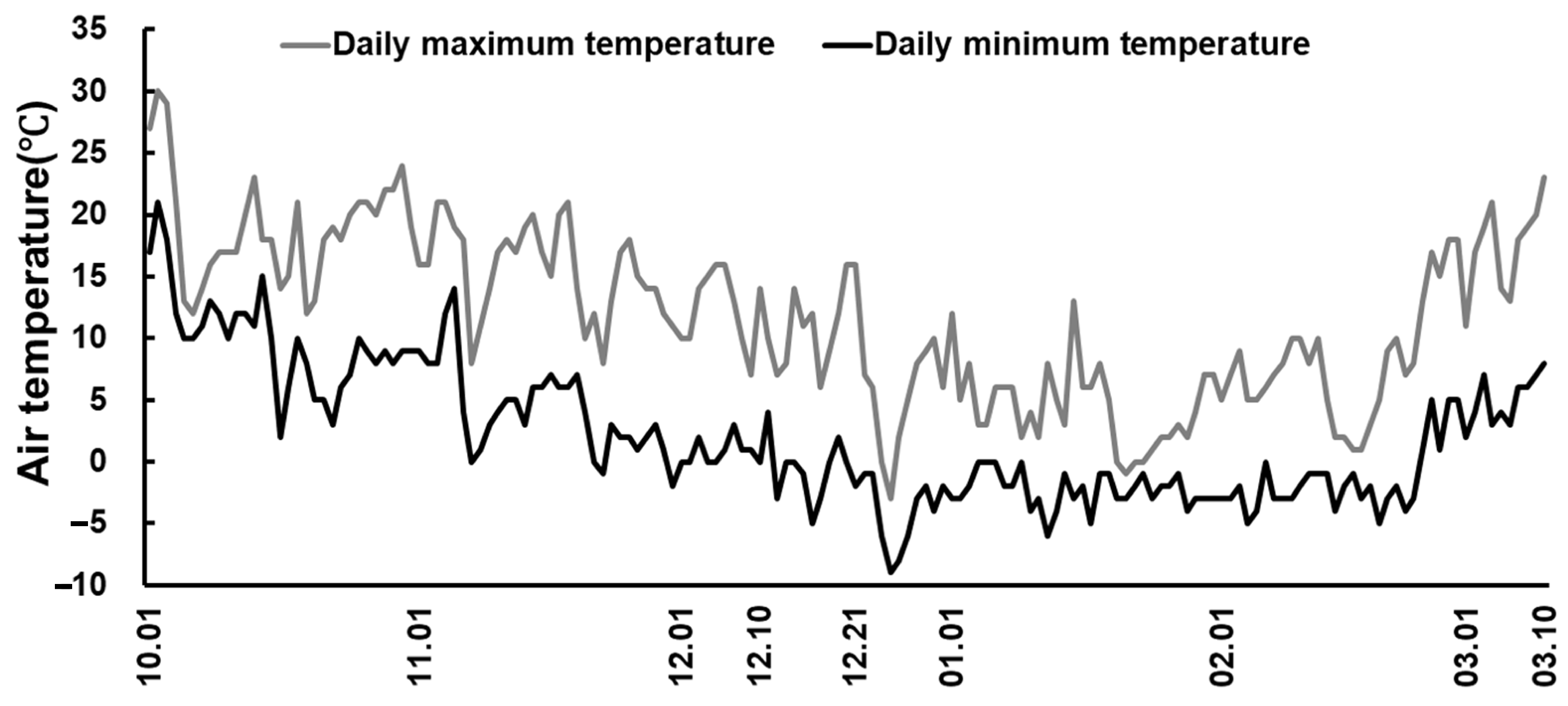
The experiment was conducted in Henan Province, central China (35°6′ N, 113°56′ E). The region has a continental monsoon climate in the transition zone between the North Subtropical and Warm Temperate zones, with an average annual frost-free period of 233 days. The months from December to February are characterized by cold and dry conditions, with extreme minimum temperatures ranging from −15 °C to −8 °C. The long-term mean annual precipitation is approximately 653 mm, with most precipitation occurring in summer (approximately 404 mm), especially in July (approximately 268 mm), whereas winter precipitation is relatively low, averaging approximately 30 mm. Snowfall events were observed from 23 to 25 January, on 20 February, and on 2 March 2025 during the experimental period. Temperature conditions during the experimental period are presented in Figure 1. The experimental soil was a loam with moderate fertility. Before sowing, the soil organic matter content was 1.33%, alkali-hydrolyzable nitrogen was 73.5 mg/kg, available potassium was 107 mg/kg, and available phosphorus was 18.8 mg/kg.
The experiment selected the cold-resistant oat variety ‘Aiwo’ (A; origin: USA) and the cold-sensitive oat variety ‘Hewang’ (H; origin: Canada), which were preliminarily identified from a screening of 23 commercial oat varieties based on contrasting winter survival rates, while exhibiting comparable hay yields and nutritional qualities (Supplementary Table S1). The seeds were purchased from Beijing Zhengdao Ecological Technology Co., Ltd. (Beijing, China). and Beijing Yangguang Lvdi Ecological Technology Co., Ltd. (Beijing, China), respectively. A randomized block design was employed with four replicates, with each experimental plot measuring 2 m × 10 m. Manual row seeding was conducted on 1 October 2024 at a seeding rate of 100 kg·hm−2, with row spacing of 20 cm and seeding depth of 3–5 cm. After emergence, the final plant population densities of both ‘Aiwo’ and ‘Hewang’ were close to 4.0 × 10⁶ plants·hm−2. Basal fertilizer was applied before sowing as a compound fertilizer (N:P2O5:K2O = 24%:14%:7%) at a rate of 300 kg·hm−2, equivalent to 72 kg·hm−2 N, 42 kg·hm−2 P2O5, and 21 kg·hm−2 K2O.

2.2. Determination of Overwintering Rate and Relative Chlorophyll Content (SPAD)

The initial seedling count (M1) was recorded on 21 December 2024, and the number of surviving seedlings (M2) was recorded after regrowth on March 10 of the following year. The overwintering rate was calculated using the following equation:
O v e r w i n t e r i n g   r a t e ( % ) = M 2 / M 1 × 100 %
Additionally, relative chlorophyll content (SPAD) was measured at the midpoint of the 3rd to 5th leaves on the main stem using a TYS-A chlorophyll meter across three developmental stages: pre-overwintering (3 December 2024), regreening (5 March 2025), and jointing (9 April 2025).

2.3. Measurement of Freezing Point, Relative Electrical Conductivity (REC), and ATPase Activity

Fresh leaf samples from the 3rd to 5th nodes were collected on 21 December 2024. To determine the freezing point, fresh leaves were placed into a 300 mL metal can. The probe of a testo 175-T2 high-precision electronic temperature recorder (accuracy 0.1 °C) was positioned directly between the leaf samples to record leaf temperature, avoiding contact with the metal walls. The apparatus was placed in a −20 °C freezer, and temperature data were recorded every 10 s. The cooling curve was generated to monitor the continuous temperature drop, and the freezing point was determined from the stable exotherm plateau (the temperature stabilization following ice nucleation and latent heat release) [13,14]. Relative electrical conductivity (REC) was evaluated following the method described by [15]. In situ ATPase activity was detected via the lead precipitation method on frozen sections prepared with an HM525 NX microtome (Thermo Fisher Scientific, Waltham, MA, USA) and observed under an ECLIPSE-Ci microscope (Nikon, Tokyo, Japan).

2.4. Quantification of Osmotic Regulators and Fatty Acids

Leaf samples collected on 21 December 2024 were stored at −80 °C for subsequent biochemical analyses. Soluble sugar and protein contents were measured using the anthrone and Coomassie Brilliant Blue colorimetric methods, respectively [16].
For lipid analysis, fatty acids were extracted from frozen leaf powder and analyzed using gas chromatography-mass spectrometry (GC-MS) [17]. The index of unsaturated fatty acids (IUFA) and double bond index (DBI) were calculated as described previously [18]. Fatty acid desaturase (FAD) activity was estimated using a plant-specific ELISA kit for plant fatty acid desaturase (FADS) (YJ977042, Shanghai Yuanju Biotechnology Center, Shanghai, China) according to the manufacturer’s instructions. Briefly, fresh leaf samples were homogenized on ice in PBS buffer (0.01 M, pH 7.4), using approximately 9 mL of extraction buffer per 1 g of tissue. The homogenate was centrifuged at 5000× g for 5 min, and the supernatant was collected for analysis. Standards and sample extracts were added to antibody-precoated microplates and incubated at 37 °C for 90 min. After washing, biotin-labeled antibody working solution was added and incubated at 37 °C for 60 min, followed by HRP-streptavidin working solution for 30 min. After color development with TMB substrate for 10–20 min, the reaction was terminated, and absorbance was measured at 450 nm using a microplate reader. FAD-related activity was calculated according to the standard curve provided with the kit.

2.5. Assessment of Oxidative Damage and Antioxidant Systems

The levels of reactive oxygen species (O2 and H2O2), lipid/protein oxidation markers (MDA and PCO), non-enzymatic antioxidant GSH, and the activities of key antioxidant enzymes (SOD, CAT, POD, and APX) were determined using commercial micro-assay kits from Beijing Solarbio Science & Technology Co., Ltd. (Beijing, China) according to the manufacturer’s instructions. The kit catalog numbers were as follows: O2, BC1295; H2O2, BC3595; MDA, BC0025; PCO, BC1275; GSH, BC1175; SOD, BC0175; CAT, BC0205; POD, BC0095; and APX, BC0225. Briefly, frozen leaf samples were homogenized on ice using the extraction buffers supplied with the corresponding kits, and the supernatants obtained after centrifugation were used for micro-assay measurements with a microplate reader or spectrophotometer. Calibration curves were generated using the standards supplied with the relevant kits, and blank controls were included for absorbance correction. For assays without standard curves, concentrations or enzyme activities were calculated according to the equations provided by the manufacturer. Representative samples were pre-tested to ensure that absorbance values fell within the recommended detection ranges, and samples outside the linear range were diluted and re-assayed. The detection limits and linear ranges were those specified in the kit manuals.

2.6. GC-MS-Based Untargeted Metabolomics Analysis

Metabolomic analysis was performed using five biological replicates for each cultivar, including five ‘Aiwo’ samples and five ‘Hewang’ samples. Leaf samples were extracted by homogenizing 50 mg of tissue in 500 µL of cold methanol–water (4:1, v/v) containing 0.02 mg/mL ribitol (internal standard) and 200 μL of chloroform. The homogenate was ground at 50 Hz for 3 min (twice), ultrasonicated at low temperature for 30 min, and incubated at −20 °C for 30 min. After centrifugation (13,000× g, 4 °C, 15 min), the supernatant was dried under a nitrogen stream. For derivatization, the residue was oximated with 80 μL of methoxyamine hydrochloride (15 mg/mL in pyridine) at 37 °C for 90 min, followed by silylation with 80 μL of BSTFA (1% TMCS) at 70 °C for 60 min [19].
Metabolites were analyzed using a TRACE 1610 GC coupled to an Orbitrap Exploris mass spectrometer (Thermo Fisher Scientific, USA). Separation was performed on a TG-5SILMS column (30 m × 0.25 mm × 0.25 μm) using helium carrier gas (1 mL/min). A 1 μL sample was injected in split mode (10:1) at 300 °C. The oven program started at 80 °C (0 min), ramped to 310 °C at 20 °C/min, and held for 8 min. The EI source was operated at 70 eV and 230 °C. Mass spectra were acquired in full-scan mode (m/z 30–1000) at 30,000 FWHM resolution. A pooled quality control (QC) sample was injected every 5–15 samples to monitor system stability.
Raw data were processed using Compound Discoverer 3.3 SP3 for peak extraction, deconvolution, and alignment. Metabolites were putatively identified by matching mass spectra and retention indices (RI, calculated using C10–C33 alkane standards) against the NIST 2023, Thermo GC-Orbitrap Metabolomics v2.0, and Majorbio self-built libraries. Identifications were retained based on an HRF score > 80, MS match factor > 600, and ΔRI < 50.
Subsequent data analyses were performed on the Majorbio Cloud Platform (https://cloud.majorbio.com) [20]. Metabolic features detected in ≥80% of any group were retained, missing values were imputed with the minimum, and intensities were sum-normalized. Variables with an RSD > 30% in QC samples were excluded, followed by log10 transformation. After quality filtering, a total of 273 metabolic features were retained for downstream statistical analysis. PCA and PLS-DA were conducted using the R package “ropls” (Version 1.6.2). Differentially accumulated metabolic features were identified based on VIP > 1 and p < 0.05, resulting in 84 differential features, including 47 up-regulated and 37 down-regulated features in ‘Aiwo’ compared with ‘Hewang’. Successfully annotated representative DAMs were further used for compound classification and heatmap visualization. Finally, KEGG pathway (https://www.kegg.jp/kegg/pathway.html, accessed on 10 October 2025) enrichment of DAMs was evaluated using Fisher’s exact test (scipy.stats package in Python (version 3.9.13)).

2.7. Metabolite Co-Expression Network Analysis

A metabolite co-expression network was constructed based on the Weighted Co-expression Network Analysis (WGCNA) framework to identify modules of highly correlated metabolites. A signed network was constructed using Pearson correlation coefficients. The soft-thresholding power was set to 9 to approximate scale-free network topology, and modules were identified using the dynamic tree cut method with a minimum module size of 30 and a merge cut height of 0.25. Module membership was evaluated based on the correlation between each metabolite and the corresponding module eigengene (kME), and metabolites with kME ≥ 0.30 were considered module members. Two co-expressed metabolite modules were generated, including MEturquoise and MEblue, containing 47 and 37 metabolites, respectively. Modules significantly associated with phenotypic traits were selected for further analysis to explore metabolic networks and the correlations between phenotypes and hub metabolites. For network visualization, the top 30 highly connected metabolites within the selected module were analyzed, and edges with correlation weights greater than 0.02 were retained. The relevant functions were executed using the WGCNA R package (version 1.72) [21].

2.8. Determination of Key Metabolite Contents and Validation of the Cold Resistance Effect of Exogenous Putrescine

The extraction and quantification of free amino acids in oat leaves were performed following the method described by [22], using a high-performance liquid chromatography (HPLC) system. Glutathione (GSH), a key product of the cysteine–methionine pathway, was quantified using a microassay kit (Solarbio Science & Technology Co., Ltd., Beijing, China; Cat. No. BC1175). Putrescine (Put), a downstream product of the arginine–proline pathway, was measured using a specific enzyme-linked immunosorbent assay (ELISA) kit (Shanghai Enzyme-Linked Biotechnology Co., Ltd., Shanghai, China).
To evaluate the short-term physiological effect of exogenous putrescine under low-temperature conditions, a foliar spraying experiment was conducted on the cold-sensitive oat variety ‘Hewang’. Based on previous exogenous polyamine applications in gramineous crops such as wheat [23] and our preliminary studies, the putrescine concentration was set at 1 mM. This treatment was designed as a single-concentration, short-term physiological test rather than a dose–response experiment. The treatment group received the putrescine solution, while the control group was treated with distilled water. The applied putrescine had a purity of ≥98% (Macklin, Shanghai, China). Foliar spraying was performed on 28 December 2024, and the solutions were applied until runoff. Three days post-treatment, leaf samples were collected from the middle sections of the third to fifth leaves on the main stem. Each treatment comprised three biological replicates. The harvested samples were immediately frozen in liquid nitrogen and stored at −80 °C. The superoxide anion (O2) and malondialdehyde (MDA) contents were determined using commercial assay kits (Solarbio Science & Technology Co., Ltd.; O2, BC1295; MDA, BC0025).

2.9. Quantitative Real-Time PCR Analysis of Candidate Genes

To provide transcriptional support for the candidate pathways identified by metabolomic and WGCNA analyses, qRT-PCR was performed for representative genes associated with arginine–proline metabolism, arginine-derived putrescine biosynthesis, cysteine–methionine-related glutathione-dependent antioxidant defense, and membrane lipid remodeling, including AsADC, AsARG1, AsOAT, AsGPX6, AsGSTU12, and AsFAD2. Total RNA was extracted from low-temperature-treated leaf samples of ‘Aiwo’ and ‘Hewang’, with three biological replicates per cultivar. After reverse transcription, qRT-PCR was performed using ChamQ Universal SYBR qPCR Master Mix (Vazyme Biotech Co., Ltd., Nanjing, China; Cat. No. Q711-02) according to the manufacturer’s instructions. Gene-specific primers were used for amplification, and primer sequences are provided in Supplementary Table S3. The relative transcript levels were calculated using the 2−ΔΔCt method, with Actin used as the internal reference gene.

2.10. Statistical Analyses

Statistical analysis was performed using IBM SPSS Statistics 27 (IBM Corp., Armonk, NY, USA), employing one-way analysis of variance (ANOVA) followed by Tukey’s multiple comparison test to evaluate the significance of differences (p < 0.05). Charts were generated using GraphPad Prism 10.1.2 (GraphPad Software, San Diego, CA, USA) and Adobe Photoshop 2024 (Adobe Systems Inc., San Jose, CA, USA). Bioinformatics analysis was completed on the Majorbio Cloud Platform (https://www.majorbio.com).

3. Results

3.1. Overwintering Rates and Osmolyte Contents in the Two Oat Varieties

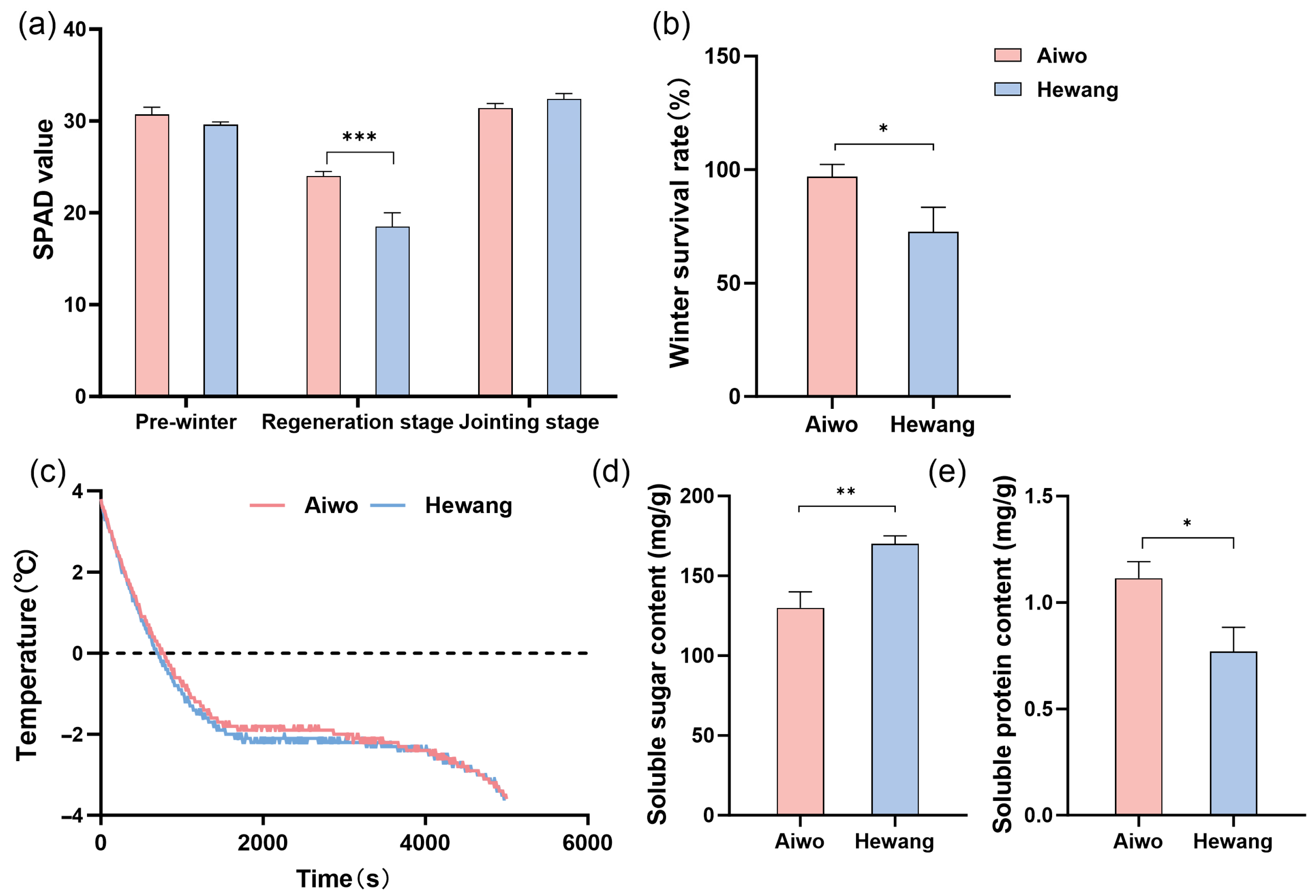
Prior to overwintering, there was no significant difference in SPAD values between the two varieties. Low temperatures during the overwintering period inhibited chlorophyll synthesis and accelerated its degradation, leading to a significant decrease in SPAD values. During the regreening period, the SPAD value of ‘Aiwo’ was significantly higher than that of ‘Hewang’ (p < 0.001). This is consistent with the higher overwintering survival rate of ‘Aiwo’ (96.9%, p < 0.05), indicating that the cold-resistant variety sustained less chlorophyll degradation and exhibited a faster recovery. As temperatures rose towards the jointing stage, SPAD values increased for both varieties, and the significant difference disappeared (Figure 2a,b).
Overwintering leaves collected on 21 December 2024 were subjected to a −20 °C environment to determine their freezing points. The leaf temperature decline curves (Figure 2c) showed that ‘Aiwo’ and ‘Hewang’ entered a plateau phase at approximately −1.9 °C and −2.1 °C, respectively, suggesting that their freezing points were similar (both near −2 °C). Further analysis of osmotic regulators revealed that the soluble sugar content in ‘Aiwo’ was significantly lower than that in ‘Hewang’ (p < 0.01) (Figure 2d), whereas its soluble protein content was significantly higher (p < 0.05) (Figure 2e).

3.2. Fatty Acid Composition and Membrane Stability in Two Oat Varieties

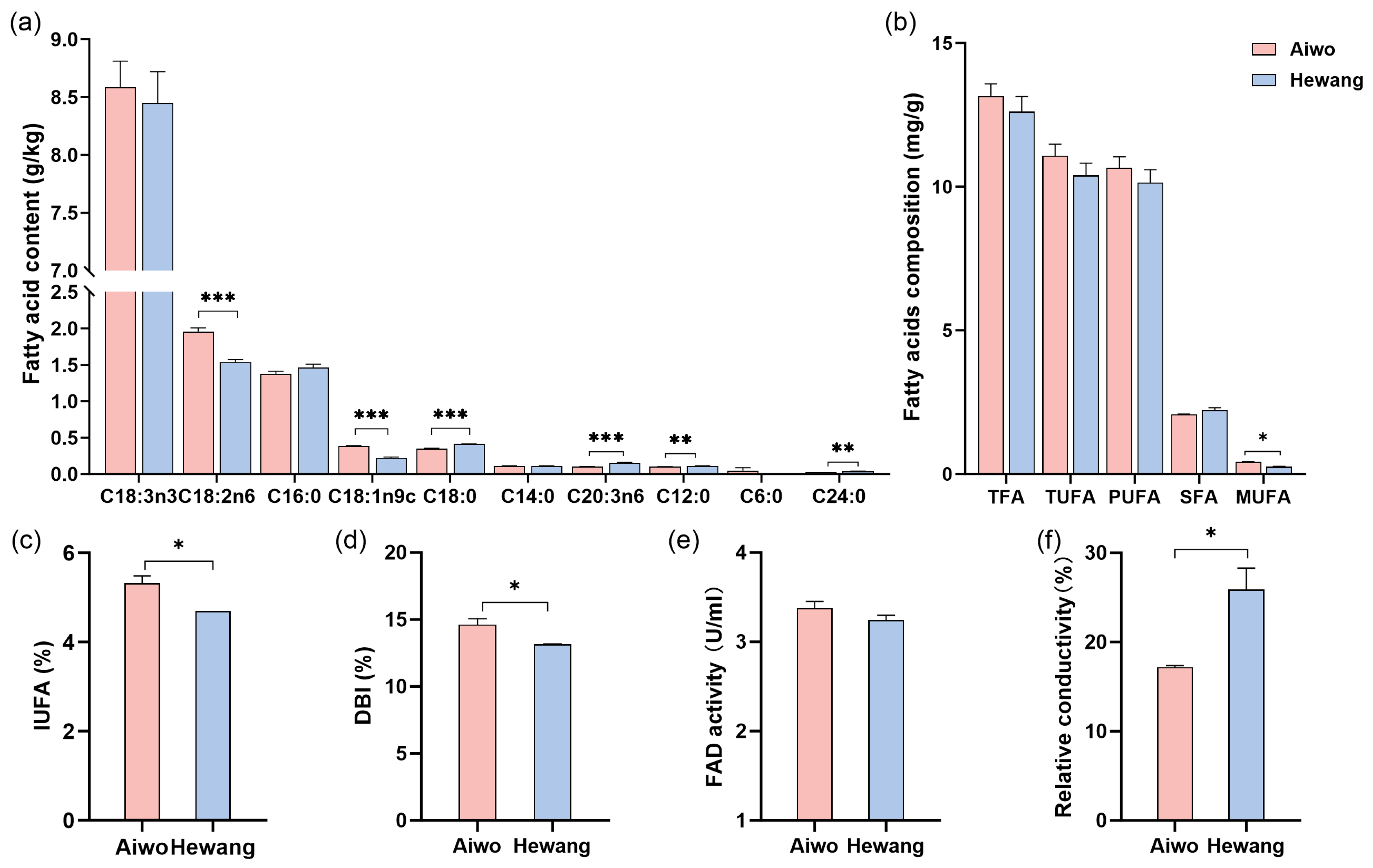
The content of unsaturated fatty acids (including linoleic acid (C18:2n6), oleic acid (C18:1n9c), etc.) in ‘Aiwo’ was significantly higher than that in ‘Hewang’ (p < 0.001), while the content of saturated fatty acids (including stearic acid (C18:0), dodecanoic acid (C12:0), etc.) in ‘Aiwo’ was significantly lower than that in ‘Hewang’ (p < 0.01) (Figure 3a). Simultaneously, the levels of total unsaturated fatty acids (TUFA), polyunsaturated fatty acids (PUFA), index of unsaturated fatty acids (IUFA, p < 0.05), double bond index (DBI, p < 0.05), and fatty acid desaturase (FAD) activity were all higher in ‘Aiwo’ than in ‘Hewang’ (Figure 3b–e), while the relative electrical conductivity (REC) was lower (p < 0.05) (Figure 3f).

3.3. ATPase Activity, Reactive Oxygen Species Accumulation, and Antioxidant Parameters in Two Oat Varieties

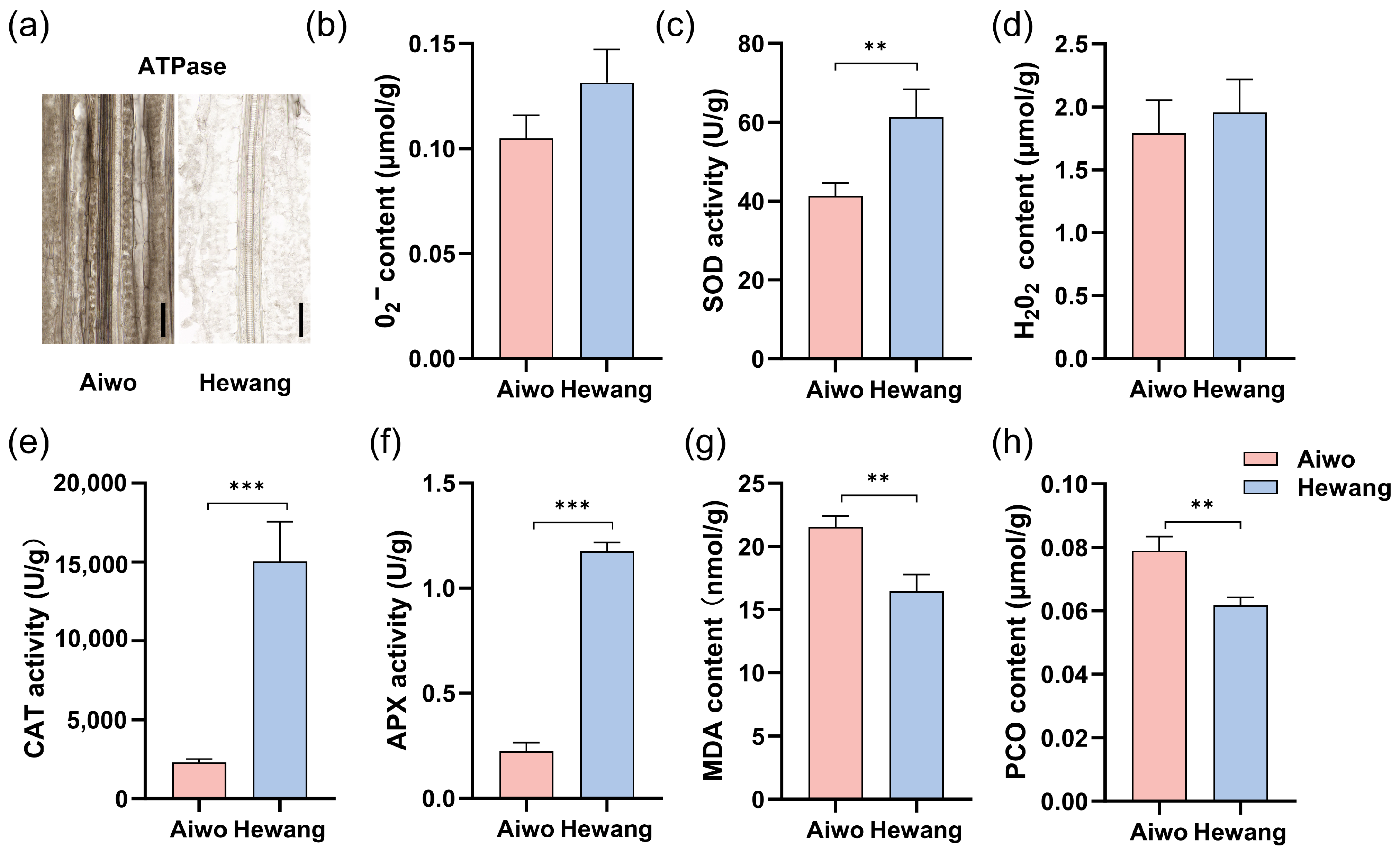
ATPase histochemical staining results (Figure 4a) revealed that the leaf tissue of ‘Aiwo’ appeared dark brown after staining, whereas the leaf tissue of ‘Hewang’ exhibited lighter coloration, indicating that ‘Aiwo’ displayed more active ATPase activity. The content of superoxide anion (O2) and the activity of superoxide dismutase (SOD, p < 0.01) were lower in ‘Aiwo’ than in ‘Hewang’ (Figure 4b,c). Furthermore, the hydrogen peroxide (H2O2) content and the activities of catalase (CAT, p < 0.001) and ascorbate peroxidase (APX, p < 0.001) were also lower in ‘Aiwo’ (Figure 4d–f). In contrast, the contents of malondialdehyde (MDA) and protein carbonyl (PCO) were significantly higher in ‘Aiwo’ than in ‘Hewang’ (p < 0.01) (Figure 4g,h).

3.4. Metabolic Differences Between the Two Oat Varieties Under Low-Temperature Stress

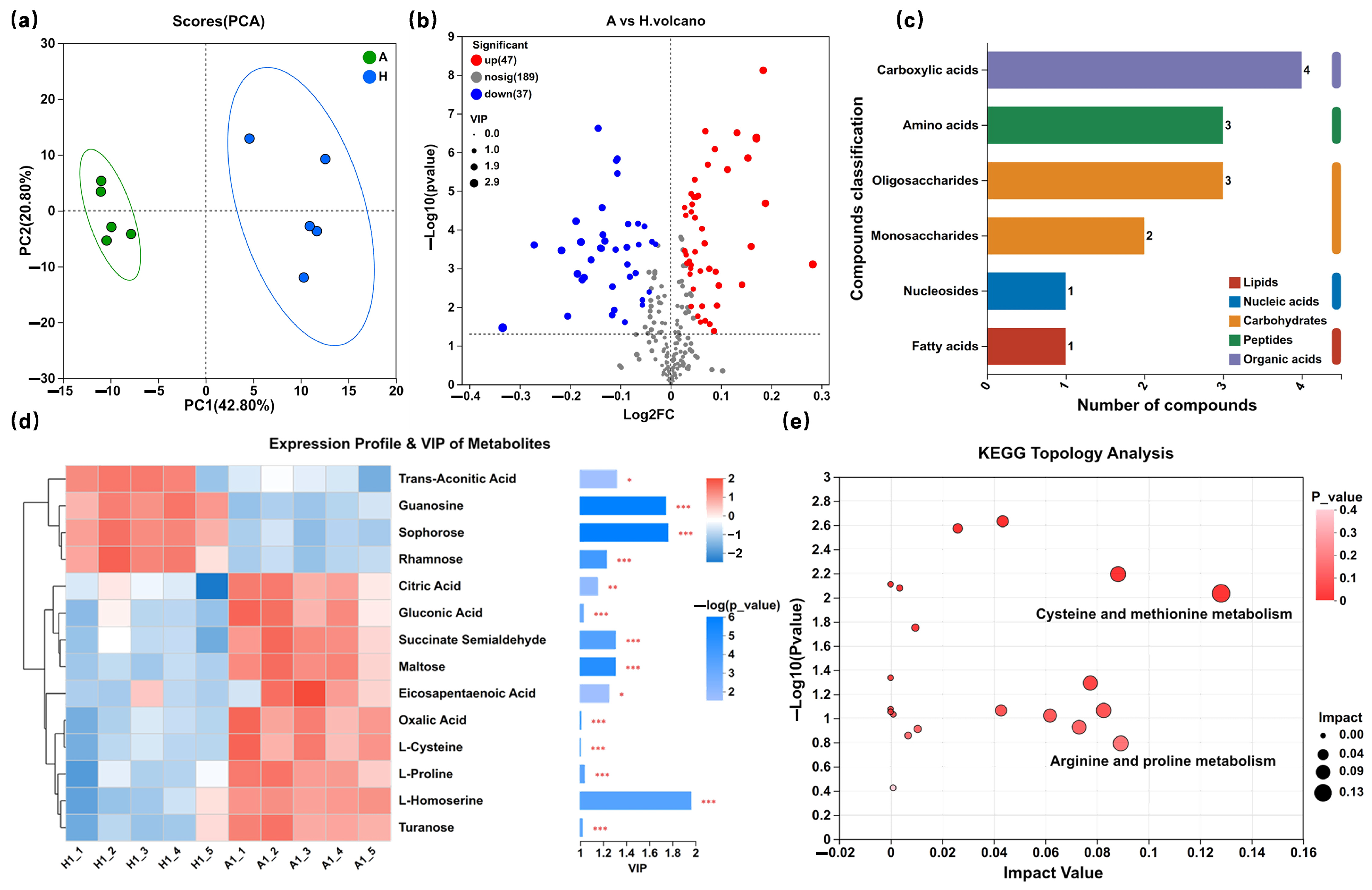
To investigate the metabolic differences between the two oat varieties under low-temperature stress, an untargeted metabolomics analysis was conducted. Principal component analysis (PCA) revealed that the cold-resistant variety ‘Aiwo’ and the cold-sensitive variety ‘Hewang’ were distinctly separated along the PC1 axis (PC1 = 42.80%, PC2 = 20.80%, and PC1 + PC2 = 63.60% of the total variance). All biological replicates clustered within their 95% confidence intervals, indicating significant differences in the overall metabolic phenotypes between the two varieties (Figure 5a). The first three principal components explained 73.80% of the total variance. PLS-DA was further used as a supervised auxiliary analysis for model evaluation and VIP calculation. The corresponding model validation statistics, including R2X, R2Y, and Q2 values, are provided in Supplementary Figure S1. A total of 84 differentially accumulated metabolic features (DAMs) were identified. Compared with the cold-sensitive control ‘Hewang’, 47 DAMs were significantly upregulated and 37 were downregulated in ‘Aiwo’ (Figure 5b).
KEGG compound classification demonstrated that 14 successfully annotated DAMs were primarily categorized into carbohydrates (including oligosaccharides and monosaccharides) and peptides (including amino acids), accounting for 57.1% of the classified compounds (Figure 5c). By combining variable importance in projection (VIP) values with differential significance analysis, key metabolic features contributing to the inter-varietal differences were identified. Notably, stress-related amino acids, such as L-homoserine, L-proline, and L-cysteine, showed higher relative abundance in ‘Aiwo’ (Figure 5d). Furthermore, KEGG pathway enrichment and topology analysis indicated that the DAMs were mainly associated with cysteine and methionine metabolism and arginine and proline metabolism (Figure 5e). These results indicate that the differentially accumulated metabolic features were associated with these two metabolic pathways, but do not by themselves demonstrate pathway-level regulation.

3.5. Analysis of Metabolite Co-Expression Networks and Validation of Key Metabolite Contents

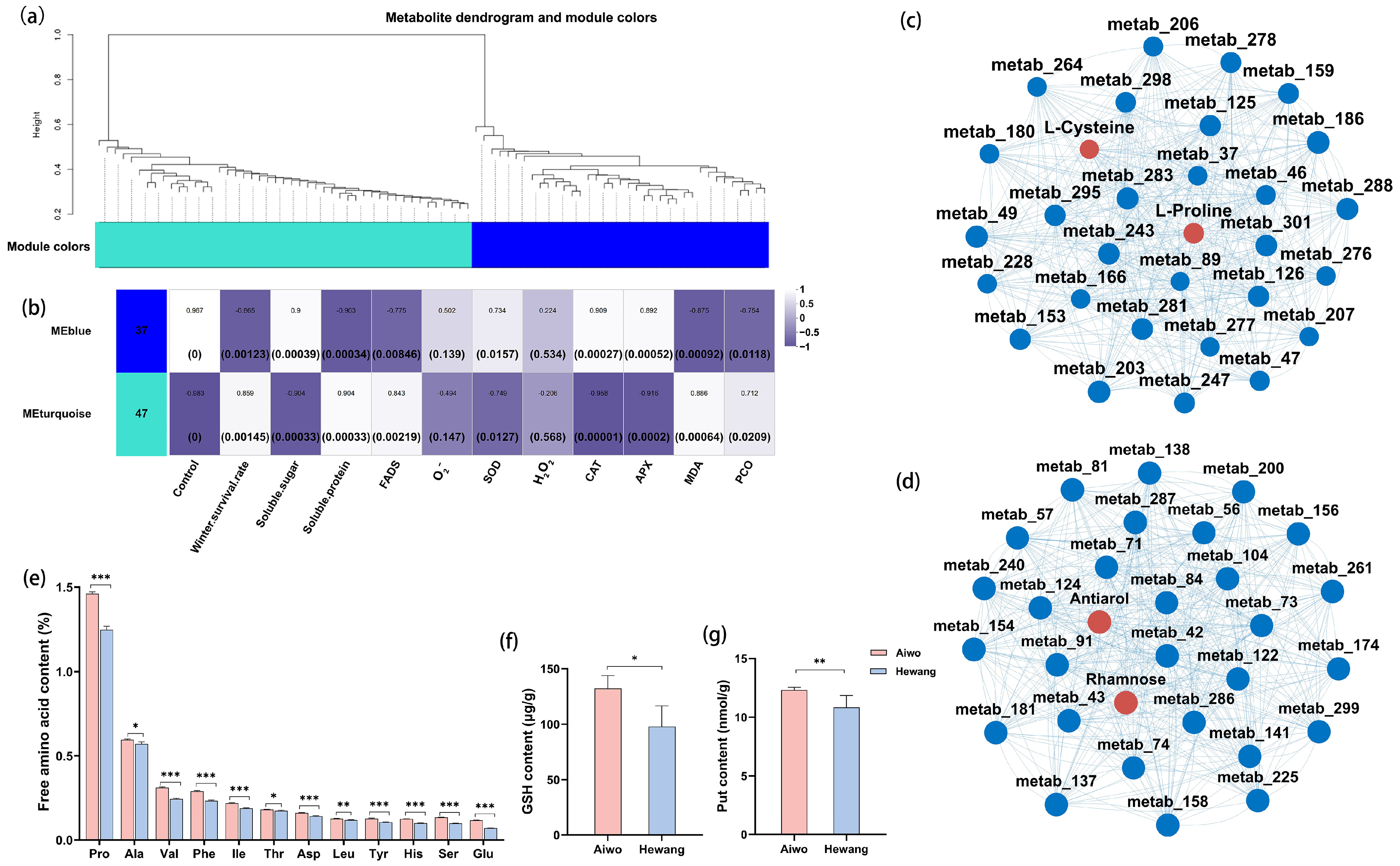
Cluster analysis of the differentially accumulated metabolites (DAMs) was performed using weighted co-expression network analysis (WGCNA), identifying two co-expressed metabolite modules (Figure 6a). Heatmap analysis of module-phenotype correlations (Figure 6b) revealed that the turquoise module (MEturquoise, containing 47 metabolites) displayed highly significant positive correlations with overwintering rate, soluble protein, and lipid/protein peroxidation indices; it also displayed significant negative correlations with soluble sugars and antioxidant enzyme activities including SOD, CAT, and APX. In contrast, the blue module (MEblue, containing 37 metabolites) exhibited a completely opposite correlation pattern, showing strong positive correlations with various antioxidant enzymes and soluble sugars. To further explore key regulatory molecules, the top 30 metabolites from each module were selected to construct co-expression network diagrams (Figure 6c,d). In the turquoise module, L-proline and L-cysteine were identified as hub metabolites (red nodes) (Figure 6c). In the blue module, two hub nodes were also identified that may play key roles in the cold-sensitive variety (Figure 6d).
The hub metabolites L-proline and L-cysteine identified via WGCNA were primarily enriched in the arginine–proline and cysteine–methionine metabolic pathways, respectively. Accordingly, the contents of key metabolites and their derivatives within these pathways were further determined. The ‘Aiwo’ variety exhibited the highest proline content, with a highly significant difference (p < 0.001), and the levels of other free amino acids were consistently higher in ‘Aiwo’ (Figure 6e). Given that L-cysteine is an important precursor for glutathione (GSH) synthesis, and that both L-proline and putrescine (Put) originate from arginine metabolism, GSH and Put contents were subsequently quantified. GSH and Put levels were also significantly higher in ‘Aiwo’ (p < 0.05) (Figure 6f,g). These results supported the metabolite-level relevance of the arginine–proline and cysteine–methionine pathways in the two contrasting oat cultivars.

3.6. Physiological Effects of Exogenous Putrescine and qRT-PCR Analysis of Candidate Genes

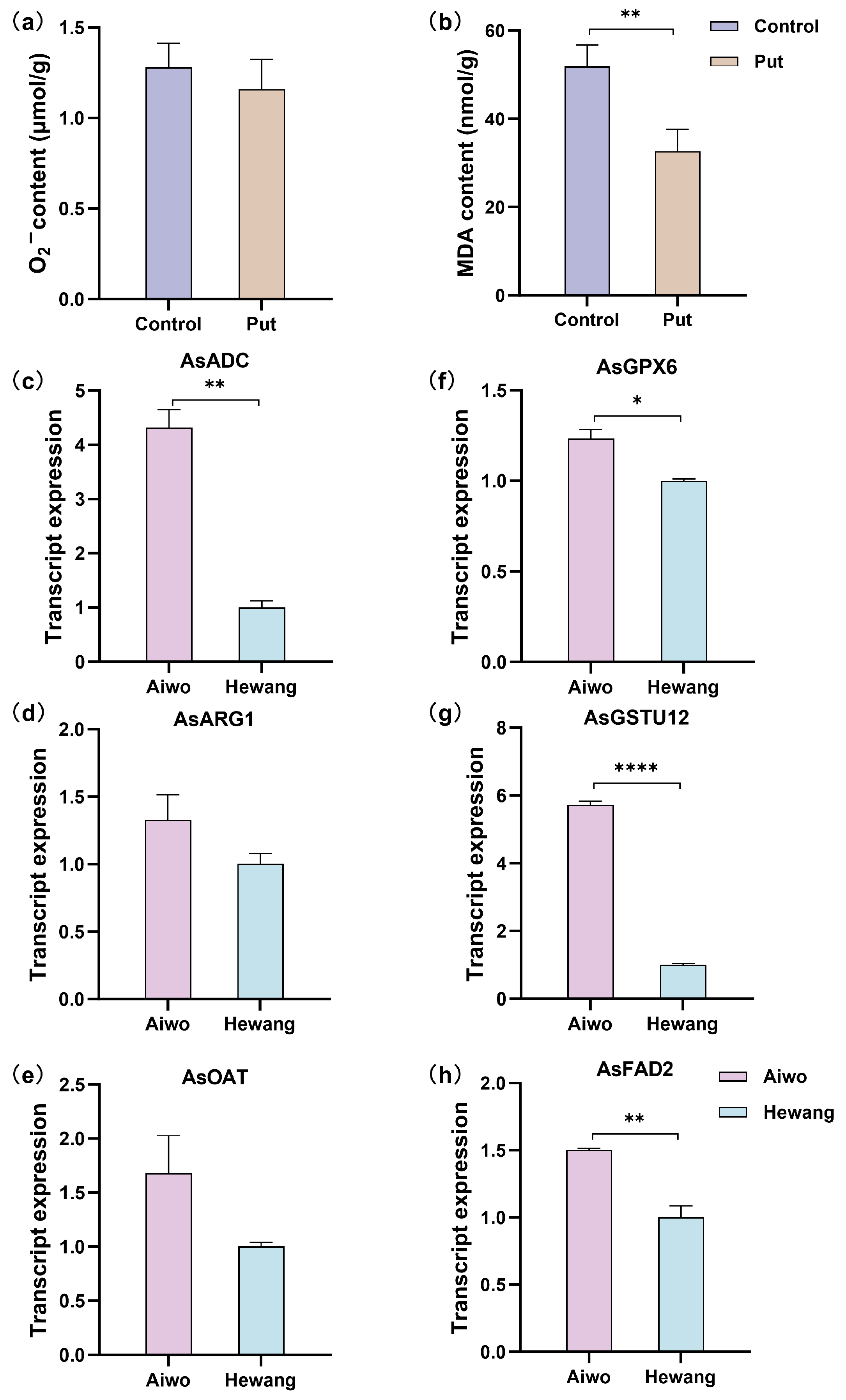
To further evaluate the potential physiological role of putrescine in the cold-stress response, exogenous Put was applied to the cold-sensitive cultivar ‘Hewang’. Compared with the control, Put treatment showed a decreasing trend in superoxide anion (O2) accumulation (Figure 7a) and significantly reduced malondialdehyde (MDA) content (p < 0.01; Figure 7b). These results suggest that exogenous Put may contribute to alleviating short-term oxidative stress and membrane lipid peroxidation damage in the cold-sensitive cultivar.
To further examine whether the candidate pathways identified by metabolomic and WGCNA analyses were transcriptionally responsive to cold stress, the relative expression levels of representative genes were analyzed by qRT-PCR. For arginine–proline metabolism and related arginine-derived putrescine biosynthesis, AsADC expression was significantly higher in ‘Aiwo’ than in ‘Hewang’ (p < 0.01; Figure 7c), whereas AsARG1 and AsOAT showed higher but non-significant trends in ‘Aiwo’ (Figure 7d,e). For cysteine–methionine-related glutathione-dependent antioxidant defense and membrane lipid remodeling, AsGPX6 (p < 0.05), AsGSTU12 (p < 0.0001), and AsFAD2 (p < 0.01) were significantly more highly expressed in ‘Aiwo’ than in ‘Hewang’ (Figure 7f–h). Together, these gene expression patterns provide transcriptional support for the involvement of arginine–proline metabolism, arginine-derived putrescine biosynthesis, cysteine-related glutathione antioxidant responses, and membrane lipid remodeling in the contrasting cold responses of the two oat cultivars.

4. Discussion

4.1. The Cold-Resistant Oat Cultivar Exhibits Enhanced Cold Resistance by Accumulating Soluble Protein

Under low-temperature stress, the freezing of cell sap into ice crystals can cause severe damage to organelles. To counteract this, plants generally employ two strategies: freezing avoidance (lowering the freezing point) and freezing tolerance (mitigating damage after ice formation) [24]. Traditionally, plants accumulate osmotic regulators, such as soluble sugars, to increase the concentration of the cell sap, thereby inhibiting ice formation and lowering the freezing point [25]. Soluble sugars serve as primary osmotic regulators, and their content is frequently used as an indicator of freezing avoidance. However, the relationship between soluble sugar accumulation and cold resistance is not always linear or universally positive, and may vary depending on species, genotype, tissue type, stress duration, and sampling stage. While cold-resistant varieties typically accumulate higher levels of osmotic regulators [26], this correlation is highly species-dependent. For instance, in Arabidopsis [27,28] and apple rootstocks [29], no consistent positive correlation was found between soluble sugar accumulation and cold resistance; in certain cases, a negative correlation was even observed. Consistent with these findings, our study revealed that the cold-resistant variety ‘Aiwo’ exhibited a lower soluble sugar content. This result suggests that, in the two oat cultivars examined and at the sampling stage used in this study, soluble sugar accumulation was not the dominant physiological feature associated with the superior overwintering performance of ‘Aiwo’. Instead, we propose that its enhanced cold resistance might be associated with freezing tolerance, potentially facilitated by the significantly higher accumulation of soluble proteins [30].
The freezing points of the two oat varieties are similar (approximately −2 °C). During the overwintering period, the frequent alternation between sub-zero nighttime and warmer daytime temperatures subjected the oats to multiple freeze–thaw cycles. These cycles induce intracellular ice crystal formation, causing the mechanical rupture of cell membranes and subsequent protoplasmic dehydration upon thawing [13]. Furthermore, repeated freeze–thaw stress disrupts protein spatial structures, altering the conformation of enzyme active sites and impairing their catalytic functions [31]. Soluble proteins mitigate this stress by inhibiting the ordered growth of ice crystals and modifying their morphology, thereby reducing mechanical injury to membranes and organelles [32]. Additionally, under low-temperature stress, soluble proteins can bind to functional enzymes, enhancing their structural stability and preventing cold-induced conformational changes [33]. In this study, the cold-resistant variety ‘Aiwo’ exhibited a significantly higher soluble protein content. Therefore, we speculate that this enhanced accumulation of soluble proteins might play a positive role in the freezing tolerance mechanism, potentially contributing to its superior cold resistance.

4.2. The Cold-Resistant Oat Cultivar Exhibits Enhanced Cold Resistance by Reducing O2 Accumulation and Increasing Unsaturated Fatty Acid Content

The cell membrane is the primary site of cold damage. Low temperatures increase the intermolecular forces between phospholipids in the cell membrane, inhibiting their movement and reducing membrane fluidity. This leads to gaps in the lipid bilayer, increases membrane permeability, and triggers electrolyte leakage, manifested as an increase in relative electrical conductivity (REC) [34]. Therefore, REC is a reliable indicator for assessing plant cold resistance [35]. A higher REC value indicates greater cell membrane damage and weaker cold resistance. To counteract cold damage, plants maintain cell membrane fluidity at low temperatures by increasing the content of unsaturated fatty acids, such as alpha-linolenic acid and linoleic acid, in the cell membrane [36]. This response is consistent with the general concept of cold-induced membrane lipid remodeling, in which increased fatty acid unsaturation helps maintain membrane fluidity and stability under low-temperature conditions [37]. Studies in cereals have also shown that cold acclimation and freezing tolerance are closely associated with changes in plasma membrane lipid composition and fatty acid unsaturation, including classic observations in oat and rye and lipidomic evidence from barley and maize [38,39]. In this experiment, the cold-resistant variety ‘Aiwo’ exhibited higher fatty acid desaturase (FAD) activity, introducing more double bonds to increase fatty acid unsaturation and the double bond index, thereby enhancing membrane fluidity.
Low temperatures cause damage to the mitochondrial electron transport chain, leading to electron leakage and the formation of superoxide anions (O2) through their reaction with oxygen molecules. O2 possesses strong oxidizing properties that can damage cell membranes and organelles, resulting in cellular dysfunction or even cell death [40]; simultaneously, it inhibits mitochondrial ATP synthase activity, reducing ATP synthesis [41]. Plants possess a comprehensive antioxidant enzyme system to scavenge excess ROS [42], thereby reducing cellular damage. Superoxide dismutase (SOD) serves as the first line of defense against O2, converting harmful O2 into oxygen (O2) and hydrogen peroxide (H2O2) [43]. Since H2O2 is highly reactive, it must be further reduced to water by enzymes such as catalase (CAT) and ascorbate peroxidase (APX) [44]. Typically, cold-resistant varieties exhibit higher antioxidant enzyme activity but Mittler et al. [45] proposed the concept of a plant ROS gene network, suggesting that a delicate dynamic balance exists between ROS production and scavenging, rather than simply the activity levels of individual systems. If the ROS production rate itself is low, enzyme activity need not be upregulated to maintain redox homeostasis. In this study, cold-resistant cultivars exhibited lower O2 levels, and their antioxidant enzyme activities were correspondingly lower, which is consistent with the dynamic balance between ROS production and scavenging. Lower O2 accumulation mitigated mitochondrial oxidative damage, allowing the mitochondria to maintain higher ATPase activity, thereby sustaining stable ATP synthesis and energy supply.
Some unneutralized ROS react with intracellular polyunsaturated fatty acids to form malondialdehyde (MDA) [46]. MDA can react with components such as proteins and DNA, causing damage to enzymes and plasma membranes and disrupting the barrier function of cell membranes [47]. Consequently, MDA is frequently used as a key indicator for assessing the extent of damage caused by plant stress [48]. We acknowledge the apparent paradox wherein the cold-resistant variety ‘Aiwo’ exhibits higher MDA content despite displaying less severe membrane damage (lower REC). Our GC-MS lipid profiling provides a possible biochemical explanation for this phenomenon: compared with the cold-sensitive cultivar ‘Hewang’, ‘Aiwo’ showed a relatively higher degree of fatty acid unsaturation, as reflected by significantly higher IUFA and DBI values, together with increased linoleic acid (C18:2n6) content. Chemically, MDA is derived from the oxidation of PUFA [49], and its absolute generation may be highly dependent on substrate availability [50]. Therefore, we hypothesize that the higher baseline concentration of PUFA substrates in ‘Aiwo’ may inherently provide more targets for peroxidation, potentially leading to a greater absolute yield of MDA, even under controlled ROS levels. It should be noted that this interpretation is based on correlative GC-MS data and established biochemical theory, and strict chemical verification remains to be performed in future studies.
Furthermore, we propose that this elevated MDA level does not necessarily translate to critical membrane failure. Previous studies have shown that fatty acid desaturases are involved in regulating fatty acid unsaturation and membrane fluidity and are associated with plant responses to low-temperature stress [51,52]. Supported by elevated fatty acid desaturase (FAD)-related activity, ‘Aiwo’ may possess a stronger compensatory capacity to replenish its unsaturated fatty acids. This active lipid remodeling process could allow the cells to retain a sufficient proportion of functional PUFA to preserve membrane fluidity and structural integrity, ultimately keeping electrolyte leakage low [37]. Other unneutralized ROS react with proteins to form protein carbonyl (PCO), and the accumulation of PCO in cells leads to apoptosis [53]. Therefore, PCO is considered an important biomarker reflecting the level of protein oxidative damage [54]. Similarly, the higher PCO content in ‘Aiwo’ may be partially attributable to its highly enriched soluble protein pool providing abundant substrates for oxidation, rather than solely indicating failing antioxidant defenses. Consequently, relying solely on absolute MDA and PCO concentrations to evaluate cold resistance may be misleading, as their levels appear to be influenced by the baseline concentrations of their respective substrates.
In summary, antioxidant enzyme activities (e.g., SOD and CAT) and oxidative damage markers (MDA and PCO) remain important indicators for assessing plant responses to cold stress. However, their interpretation may be influenced by multiple factors, including baseline substrate availability and ROS production rates. Therefore, these indices are best evaluated together with other physiological parameters and direct ROS measurements. This is consistent with the broader view that crop performance under environmental constraints often depends on coordinated physiological adjustment rather than a single response factor [55]. As an early product of ROS generation, O2 accumulation may provide additional information regarding oxidative stress responses [56]. In the two oat cultivars examined in this study, O2 levels showed a response pattern that appeared to be associated with the contrasting cold-tolerance phenotypes of the two cultivars. Nevertheless, further validation using a broader range of oat germplasms is required before general conclusions can be drawn.

4.3. Metabolic Traits Associated with Cysteine–Methionine and Arginine–Proline Metabolism in Two Oat Varieties

Under cold stress, the maintenance of cellular homeostasis depends on coordinated metabolic and biochemical adjustments rather than changes in a single metabolite or pathway. In this study, the WGCNA co-expression network suggested that L-cysteine and L-proline were hub metabolites associated with the cysteine–methionine and arginine–proline metabolic pathways, respectively. The higher accumulation of proline, GSH, and Put in ‘Aiwo’ further supported the metabolite-level relevance of these pathways in the two contrasting oat cultivars.
Cysteine and methionine metabolism plays a crucial role in maintaining cellular redox homeostasis and responding to environmental stress. Cysteine is a key substrate for glutathione (GSH) synthesis, and its concentration can influence the cellular capacity for ROS scavenging [57]. As an important non-enzymatic antioxidant, GSH can directly scavenge ROS or act as a substrate for glutathione peroxidase (GPX) to reduce H2O2, thereby alleviating oxidative damage caused by low-temperature stress [58]. In this study, untargeted metabolomic analysis showed that L-cysteine was relatively more abundant in the cold-resistant cultivar ‘Aiwo’, and targeted physiological measurement further showed that GSH content was higher in ‘Aiwo’ than in the cold-sensitive cultivar ‘Hewang’. In addition, AsGPX6 and AsGSTU12 were significantly more highly expressed in ‘Aiwo’, providing transcriptional evidence that glutathione-dependent antioxidant processes may be more active in this cultivar under cold stress. These results suggest that the cysteine–methionine-related glutathione-dependent antioxidant response may contribute to the oxidative stress response of ‘Aiwo’, although further functional validation is still required.
Arginine–proline metabolism is an important pathway involved in plant responses to low-temperature stress. In this pathway, arginine can serve as an upstream metabolic node, contributing to proline accumulation through the ornithine pathway and to putrescine production through polyamine metabolism. Proline participates in the low-temperature stress response through mechanisms such as maintaining cellular osmotic balance, stabilizing the native conformation of proteins, and protecting the structural integrity of cell membranes. As a key component of polyamine metabolism, putrescine has also been reported to alleviate oxidative damage caused by abiotic stress [59]. In the present study, the arginine–proline pathway was enriched among DAMs associated with the cold-resistant cultivar ‘Aiwo’, and both proline and putrescine levels were higher than in ‘Hewang’. The significantly higher expression of AsADC in ‘Aiwo’ provided transcriptional support for related arginine-derived putrescine biosynthesis, while the increasing trends of AsARG1 and AsOAT were generally consistent with the involvement of arginine–proline metabolism under cold stress. Moreover, exogenous putrescine application reduced MDA content and tended to decrease O2 accumulation in the cold-sensitive cultivar, supporting a protective physiological role of Put in alleviating cold-induced oxidative damage. Because this experiment evaluated short-term oxidative damage indicators rather than survival, regrowth, or long-term freezing tolerance, these results indicate mitigation of oxidative injury but do not directly demonstrate enhanced cold resistance. It should be noted that this exogenous putrescine application was conducted as a short-term physiological validation, and its broader agronomic implications under prolonged field conditions remain to be investigated.
Previous studies have shown that both the cysteine–methionine and arginine–proline metabolic pathways undergo significant changes during low-temperature stress in wheat, thereby contributing to stress adaptation [60]. Consistent with these findings, the present study combined metabolite accumulation, exogenous Put treatment, and qRT-PCR analysis of representative genes to provide complementary evidence supporting the involvement of these pathways in the contrasting cold responses of the two oat cultivars. Similar genotype-dependent biological responses have also been reported in other stress-adaptation studies, where distinct mechanisms contributed to differential environmental resilience among genotypes [61].
It should be noted that the present study was conducted using two oat cultivars with contrasting overwintering phenotypes, and the observed physiological and metabolic differences mainly reflect the responses of these specific materials. Therefore, these findings may not fully represent universal cold-resistance mechanisms across diverse oat germplasms. Although qRT-PCR provided preliminary transcriptional support for the candidate pathways, further validation using a broader panel of oat cultivars, multi-year and multi-environment trials, and targeted functional experiments is still needed. Nevertheless, the candidate physiological and metabolic indicators identified in this study, including proline, putrescine, GSH, and associated metabolic responses, may provide useful references for the screening and evaluation of cold-resistant oat germplasm.

5. Conclusions

The cold-resistant oat cultivar ‘Aiwo’ exhibited a significantly higher overwintering rate following autumn sowing in central China. Under low-temperature stress, ‘Aiwo’ showed enrichment of the arginine–proline and cysteine–methionine pathways, which was accompanied by higher accumulation of soluble protein, proline, putrescine, and glutathione. These metabolic changes were associated with maintained ATPase activity, lower superoxide anion accumulation, increased fatty acid unsaturation in membrane lipids, and improved membrane stability. Collectively, these physiological and metabolic adaptations may contribute to the improved overwintering performance of ‘Aiwo’ under low-temperature field conditions. Proline, putrescine, and glutathione were consistently associated with the cold-resistant phenotype and may represent promising candidate indicators for future screening of cold-tolerant oat germplasm.

Supplementary Materials

The following supporting information can be downloaded at: https://www.mdpi.com/article/10.3390/agriculture16131470/s1, Table S1: Screening of 23 autumn-sown oat varieties for winter survival and forage quality in Henan Province, China (2020–2021 growing season); Table S2: Raw physiological, biochemical, free amino acid, and fatty acid-related data used in this study; Table S3: Primer sequences, accession numbers/Gene IDs, and source information for genes used in qRT-PCR analysis; Figure S1: PLS-DA model evaluation of GC-MS-based metabolomic profiles between ‘Aiwo’ and ‘Hewang’ under low-temperature stress.

Author Contributions

H.Z. and D.L. conceived and designed the study; H.Z., Y.L., Y.Z., Y.S., Y.C., X.Z., Z.W. and B.L. performed the experiments and collected the data; H.Z. and Y.L. analyzed the data; H.Z. wrote the original draft manuscript; D.L. reviewed and edited the manuscript. All authors have read and agreed to the published version of the manuscript.

Funding

This work was supported by the Henan Science and Technology Breakthrough Project (Grant No. 262102110268) and the earmarked fund for CARS (CARS-33).

Data Availability Statement

The metabolomic data presented in this study are deposited in the CNCB OMIX repository, accession number OMIX016850. The raw physiological datasets used to support the findings of this study are provided in the Supplementary Materials.

Acknowledgments

We thank Sun Hao for his valuable academic guidance during the early conceptualization of this study. We also thank Shanghai Majorbio Bio-Pharm Technology Co., Ltd. for their assistance with metabolomics data generation and analysis.

Conflicts of Interest

The authors declare no competing interests.

Abbreviations

A: ‘Aiwo’ (cold-resistant oat variety); ADC: arginine decarboxylase; Ala: alanine; ANOVA: analysis of variance; APX: ascorbate peroxidase; ARGAH: arginase; BSTFA: N,O-bis(trimethylsilyl)trifluoroacetamide; CAT: catalase; DAMs: differentially accumulated metabolites; DBI: Double Bond Index; ELISA: enzyme-linked immunosorbent assay; FAD: fatty acid desaturase; GC-MS: gas chromatography-mass spectrometry; GC-Orbitrap-MS: gas chromatography-Orbitrap-mass spectrometry; GSH: reduced glutathione; H: ‘Hewang’ (cold-sensitive oat variety); H2O2: hydrogen peroxide; HPLC: high-performance liquid chromatography; IUFA: Index of Unsaturated Fatty Acids; KEGG: Kyoto Encyclopedia of Genes and Genomes; MDA: malondialdehyde; MS: mass spectrometry; MUFA: monounsaturated fatty acids; O2: superoxide anion; PLS-DA: partial least squares discriminant analysis; PCO: protein carbonyl; PCA: principal component analysis; Pro: proline; PUFA: polyunsaturated fatty acids; Put: putrescine; REC: relative electrical conductivity; ROS: reactive oxygen species; RSD: relative standard deviation; SD: standard deviation; SFA: saturated fatty acids; SI: similarity index; SOD: superoxide dismutase; SPAD: Soil Plant Analysis Development (relative chlorophyll content); TCA: tricarboxylic acid; TFA: total fatty acids; TUFA: total unsaturated fatty acids; VIP: variable importance in projection; WGCNA: weighted co-expression network analysis.

References

  1. Stott, P. How climate change affects extreme weather events. Science 2016, 352, 1517–1518. [Google Scholar] [CrossRef] [PubMed]
  2. Li, J.; Lian, H.; Zheng, A.; Zhang, J.; Dai, P.; Niu, Y.; Gao, T.; Li, M.; Zhang, L.; Fu, T. Effects of Different Roughages on Growth Performance, Nutrient Digestibility, Ruminal Fermentation, and Microbial Community in Weaned Holstein Calves. Front. Vet. Sci. 2022, 9, 864320. [Google Scholar] [CrossRef] [PubMed]
  3. Jahed, K.R.; Saini, A.K.; Sherif, S.M. Coping with the cold: Unveiling cryoprotectants, molecular signaling pathways, and strategies for cold stress resilience. Front. Plant Sci. 2023, 14, 1246093. [Google Scholar] [CrossRef] [PubMed]
  4. Møller, I.M.; Jensen, P.E.; Hansson, A. Oxidative Modifications to Cellular Components in Plants. Annu. Rev. Plant Biol. 2007, 58, 459–481. [Google Scholar] [CrossRef] [PubMed]
  5. Wang, Y.; Wang, J.; Sarwar, R.; Zhang, W.; Geng, R.; Zhu, K.M.; Tan, X.L. Research progress on the physiological response and molecular mechanism of cold response in plants. Front. Plant Sci. 2024, 15, 1334913. [Google Scholar] [CrossRef] [PubMed]
  6. Mishra, N.; Jiang, C.; Chen, L.; Paul, A.; Chatterjee, A.; Shen, G. Achieving abiotic stress tolerance in plants through antioxidative defense mechanisms. Front. Plant Sci. 2023, 14, 1110622. [Google Scholar] [CrossRef] [PubMed]
  7. Liu, M.; Wu, X.; Li, M.; Li, S.; Xiong, T.; Li, C.; Tang, Y. Multi-omics analysis reveals the physiological and molecular response to cold stress in different spring wheat cultivars at the booting stage. Front. Plant Sci. 2025, 16, 1594676. [Google Scholar] [CrossRef] [PubMed]
  8. Lv, L.; Dong, C.; Liu, Y.; Zhao, A.; Zhang, Y.; Li, H.; Chen, X. Transcription-associated metabolomic profiling reveals the critical role of frost tolerance in wheat. BMC Plant Biol. 2022, 22, 333. [Google Scholar] [CrossRef] [PubMed]
  9. Janmohammadi, M.; Sabaghnia, N.; Mahfoozi, S. Frost tolerance and metabolite changes of rye (Secale cereale) during the cold hardening and overwintering. Acta Physiol. Plant. 2018, 40, 42. [Google Scholar] [CrossRef]
  10. Henson, C.A.; Duke, S.H.; Livingston, D.P., III. Metabolic changes in Avena sativa crowns recovering from freezing. PLoS ONE 2014, 9, e93085. [Google Scholar] [CrossRef] [PubMed]
  11. Zhang, Y.; Wu, X.; Li, Q.; Liang, X.; Zhang, Y.; Zhang, X.; Dong, X.; Yu, K.; Zhao, Z.; Luo, X.; et al. Comprehensive Evaluation and Screening of Autumn-Sown Oat (Avena sativa L.) Germplasm in Different Agropastoral Regions. Agronomy 2025, 15, 994. [Google Scholar] [CrossRef]
  12. Islam, M.R.; Eneji, A.E.; Ren, C.; Hu, Y.; Gong, C.; Xue, X. Oat-based Cropping System for Sustainable Agricultural Development in Arid Regions of Northern China. J. Agric. Biotechnol. Ecol. 2010, 3, 1–8. [Google Scholar]
  13. Pearce, R.S. Plant Freezing and Damage. Ann. Bot. 2001, 87, 417–424. [Google Scholar] [CrossRef]
  14. James, C.; Seignemartin, V.; James, S.J. The freezing and supercooling of garlic (Allium sativum L.). Int. J. Refrig. 2009, 32, 253–260. [Google Scholar] [CrossRef]
  15. Luo, Y.; Xie, Y.; Li, W.; Wei, M.; Dai, T.; Li, Z.; Wang, B. Physiological and Transcriptomic Analyses Reveal Exogenous Trehalose Is Involved in the Responses of Wheat Roots to High Temperature Stress. Plants 2021, 10, 2644. [Google Scholar] [CrossRef] [PubMed]
  16. Li, H.S. Experimental Principles and Techniques of Plant Physiology and Biochemistry; Higher Education Press: Beijing, China, 2000. [Google Scholar]
  17. Cao, X.; Dong, Z.; Tian, D.; Dong, L.; Qian, W.; Liu, J.; Liu, X.; Qin, H.; Zhai, W.; Gao, C.; et al. Development and characterization of marker-free and transgene insertion site-defined transgenic wheat with improved grain storability and fatty acid content. Plant Biotechnol. J. 2020, 18, 129–140. [Google Scholar] [PubMed]
  18. Larkindale, J.; Huang, B. Changes of lipid composition and saturation level in leaves and roots for heat-stressed and heat-acclimated creeping bentgrass (Agrostis stolonifera). Environ. Exp. Bot. 2004, 51, 57–67. [Google Scholar] [CrossRef]
  19. Kong, X.; Guo, Z.; Yao, Y.; Xia, L.; Liu, R.; Song, H.; Zhang, S. Acetic acid alters rhizosphere microbes and metabolic composition to improve willows drought resistance. Sci. Total Environ. 2022, 844, 157132. [Google Scholar] [CrossRef] [PubMed]
  20. Ren, Y.; Yu, G.; Shi, C.; Liu, L.; Guo, Q.; Han, C.; Zhang, D.; Zhang, L.; Liu, B.; Gao, H.; et al. Majorbio Cloud: A one-stop, comprehensive bioinformatic platform for multiomics analyses. iMeta 2022, 1, e12. [Google Scholar] [CrossRef] [PubMed]
  21. Langfelder, P.; Horvath, S. WGCNA: An R package for weighted correlation network analysis. BMC Bioinform. 2008, 9, 559. [Google Scholar] [CrossRef]
  22. Španić, V.; Sarić, B.; Budimir, K.Š.; Duvnjak, J.; Žilić, S. Sugar and Free Amino Acid Contents in Winter Wheat Flour Under Fusarium Head Blight Treatment and Natural Infection. Plants 2025, 14, 1504. [Google Scholar] [CrossRef] [PubMed]
  23. Hassan, N.; Ebeed, H.; Aljaarany, A. Exogenous application of spermine and putrescine mitigate adversities of drought stress in wheat by protecting membranes and chloroplast ultra-structure. Physiol. Mol. Biol. Plants Int. J. Funct. Plant Biol. 2020, 26, 233–245. [Google Scholar] [CrossRef]
  24. Román-Figueroa, C.; Bravo, L.; Paneque, M.; Navia, R.; Cea, M. Chemical products for crop protection against freezing stress: A review. J. Agron. Crop Sci. 2021, 207, 391–403. [Google Scholar] [CrossRef]
  25. Bois, J.F.; Winkel, T.; Lhomme, J.P.; Raffaillac, J.P.; Rocheteau, A. Response of some Andean cultivars of quinoa (Chenopodium quinoa Willd.) to temperature: Effects on germination, phenology, growth and freezing. Eur. J. Agron. 2006, 25, 299–308. [Google Scholar] [CrossRef]
  26. Zhou, L.; Ullah, F.; Zou, J.; Zeng, X. Molecular and Physiological Responses of Plants that Enhance Cold Tolerance. Int. J. Mol. Sci. 2025, 26, 1157. [Google Scholar] [CrossRef] [PubMed]
  27. Klotke, J.; Kopka, J.; Gatzke, N.; Heyer, A.G. Impact of soluble sugar concentrations on the acquisition of freezing tolerance in accessions of Arabidopsis thaliana with contrasting cold adaptation—Evidence for a role of raffinose in cold acclimation. Plant Cell Environ. 2004, 27, 1395–1404. [Google Scholar] [CrossRef]
  28. Wanner, L.A.; Junttila, O. Cold-Induced Freezing Tolerance in Arabidopsis. Plant Physiol. 1999, 120, 391–400. [Google Scholar] [CrossRef] [PubMed]
  29. Wang, Y.; Hu, Y.; Chen, B.; Zhu, Y.; Dawuda, M.M.; Sofkova, S. Physiological mechanisms of resistance to cold stress associated with 10 elite apple rootstocks. J. Integr. Agric. 2018, 17, 857–866. [Google Scholar] [CrossRef]
  30. Deryabin, A.; Zhukova, K.; Naraikina, N.; Venzhik, Y. Effect of Low Temperature on Content of Primary Metabolites in Two Wheat Genotypes Differing in Cold Tolerance. Metabolites 2024, 14, 199. [Google Scholar] [CrossRef] [PubMed]
  31. Feng, Y.; Li, Z.; Kong, X.; Khan, A.; Ullah, N.; Zhang, X. Plant Coping with Cold Stress: Molecular and Physiological Adaptive Mechanisms with Future Perspectives. Cells 2025, 14, 110. [Google Scholar] [CrossRef] [PubMed]
  32. Zhang, Y.; Wang, Y.; Dong, H.; Li, J.; Sun, J.; Mao, X. Interaction of L-proline with water and ice: Implications for Litopenaeus vannamei Cryoprotection during temperature fluctuation. Food Chem. 2025, 470, 142629. [Google Scholar] [CrossRef] [PubMed]
  33. Raza, A.; Charagh, S.; Abbas, S.; Hassan, M.U.; Saeed, F.; Haider, S.; Sharif, R.; Anand, A.; Corpas, F.J.; Jin, W.; et al. Assessment of proline function in higher plants under extreme temperatures. Plant Biol. 2023, 25, 379–395. [Google Scholar] [CrossRef] [PubMed]
  34. Vigh, L.; Nakamoto, H.; Landry, J.; Gomez-Munoz, A.; Harwood, J.L.; Horvath, I. Membrane regulation of the stress response from prokaryotic models to mammalian cells. Ann. N. Y. Acad. Sci. 2007, 1113, 40–51. [Google Scholar] [CrossRef] [PubMed]
  35. Peng, N.; Guo, S.; Tang, Y.; Li, S.; Pham, T.; Kuang, X.; Yi, Z.; Xiao, L. Cold Stress Responses of Different Genotypes of Miscanthus Assessed by Relative Electrical Conductivity and LT50. Plants 2025, 14, 1760. [Google Scholar] [CrossRef] [PubMed]
  36. Dhaliwal, L.K.; Shim, J.; Auld, D.; Shim, R.B.A. Fatty acid unsaturation improves germination of upland cotton (Gossypium hirsutum) under cold stress. Front. Plant Sci. 2024, 15, 1286908. [Google Scholar] [CrossRef] [PubMed]
  37. Barrero-Sicilia, C.; Silvestre, S.; Haslam, R.P.; Michaelson, L.V. Lipid remodelling: Unravelling the response to cold stress in Arabidopsis and its extremophile relative Eutrema salsugineum. Plant Sci. 2017, 263, 194–200. [Google Scholar] [CrossRef] [PubMed]
  38. Kovács, T.; Ahres, M.; Pálmai, T.; Kovács, L.; Uemura, M.; Crosatti, C.; Galiba, G. Decreased R:FR ratio in incident white light affects the composition of barley leaf lipidome and freezing tolerance in a temperature-dependent manner. Int. J. Mol. Sci. 2020, 21, 7557. [Google Scholar] [CrossRef] [PubMed]
  39. Zhao, X.; Wei, Y.; Zhang, J.; Yang, L.; Liu, X.; Zhang, H.; Shao, W.; He, L.; Li, Z.; Zhang, Y.; et al. Membrane Lipids’ Metabolism and Transcriptional Regulation in Maize Roots Under Cold Stress. Front. Plant Sci. 2021, 12, 639132. [Google Scholar] [CrossRef] [PubMed]
  40. Su, L.; Lan, Q.; Pritchard, H.W.; Xue, H.; Wang, X. Reactive oxygen species induced by cold stratification promote germination of Hedysarum scoparium seeds. Plant Physiol. Biochem. 2016, 109, 406–415. [Google Scholar] [CrossRef] [PubMed]
  41. Kerbler, S.M.; Taylor, N.L.; Millar, A.H. Cold sensitivity of mitochondrial ATP synthase restricts oxidative phosphorylation in Arabidopsis thaliana. New Phytol. 2019, 221, 1776–1788. [Google Scholar] [PubMed]
  42. Dumont, S.; Rivoal, J. Consequences of Oxidative Stress on Plant Glycolytic and Respiratory Metabolism. Front. Plant Sci. 2019, 10, 166. [Google Scholar] [CrossRef] [PubMed]
  43. Liu, Z.; Guo, Y.; Li, H.; Zhang, J.; Dong, Y.; Hu, C.; Long, J.; Chen, Y. The superoxide dismutase (SOD) gene family in perennial ryegrass: Characterization and roles in heat stress tolerance. Plant Physiol. Biochem. 2025, 226, 110061. [Google Scholar] [CrossRef] [PubMed]
  44. Kolupaev, Y.E.; Horielova, E.I.; Yastreb, T.O.; Ryabchun, N.I. State of antioxidant system in triticale seedlings at cold hardening of varieties of different frost resistance. Cereal Res. Commun. 2020, 48, 165–171. [Google Scholar] [CrossRef]
  45. Mittler, R.; Vanderauwera, S.; Gollery, M.; Breusegem, F.V. Reactive oxygen gene network of plants. Trends Plant Sci. 2004, 9, 490–498. [Google Scholar] [CrossRef] [PubMed]
  46. Wang, P.; Liu, W.; Han, C.; Wang, S.; Bai, M.; Song, C. Reactive Oxygen Species: Multidimensional Regulators of Plant Adaptation to Abiotic Stress and Development. J. Integr. Plant Biol. 2024, 66, 330–367. [Google Scholar] [CrossRef] [PubMed]
  47. Ruelland, E.; Vaultier, M.-N.; Zachowski, A.; Hurry, V. Chapter 2 Cold Signalling and Cold Acclimation in Plants. Adv. Bot. Res. 2009, 49, 35–150. [Google Scholar] [CrossRef]
  48. Weber, H.; Chételat, A.; Reymond, P.; Farmer, E.E. Selective and powerful stress gene expression in Arabidopsis in response to malondialdehyde. Plant J. 2004, 37, 877–888. [Google Scholar] [CrossRef] [PubMed]
  49. Tsikas, D. Assessment of lipid peroxidation by measuring malondialdehyde (MDA) and relatives in biological samples: Analytical and biological challenges. Anal. Biochem. 2017, 524, 13–30. [Google Scholar] [CrossRef] [PubMed]
  50. Morales, M.; Munné-Bosch, S. Malondialdehyde: Facts and Artifacts. Plant Physiol. 2019, 180, 1246–1250. [Google Scholar] [CrossRef] [PubMed]
  51. Dar, A.A.; Choudhury, A.R.; Kancharla, P.K.; Arumugam, N. The FAD2 Gene in Plants: Occurrence, Regulation, and Role. Front. Plant Sci. 2017, 8, 1789. [Google Scholar] [CrossRef] [PubMed]
  52. Wang, X.; Yu, C.; Liu, Y.; Yang, L.; Li, Y.; Yao, W.; Cai, Y.; Yan, X.; Li, S.; Cai, Y.; et al. GmFAD3A, a ω-3 fatty acid desaturase gene, enhances cold tolerance and seed germination rate under low temperature in rice. Int. J. Mol. Sci. 2019, 20, 3796. [Google Scholar] [CrossRef] [PubMed]
  53. Li, B.; Zhang, S.; Lü, Y.; Wei, S.; Hu, Y. Reactive oxygen species-induced protein carbonylation promotes deterioration of physiological activity of wheat seeds. PLoS ONE 2022, 17, e0263553. [Google Scholar] [CrossRef] [PubMed]
  54. Mano, J.; Nagata, M.; Okamura, S.; Shiraya, T.; Mitsui, T. Identification of oxidatively modified proteins in salt-stressed Arabidopsis: A carbonyl-targeted proteomics approach. Plant Cell Physiol. 2014, 55, 1233–1244. [Google Scholar] [CrossRef] [PubMed]
  55. Ayas, S. Integrated water, nutrient, and mulch management enhances yield efficiency and quality in globe artichoke. Sci. Agric. 2026, 83, e20240277. [Google Scholar] [CrossRef]
  56. Devireddy, A.R.; Tschaplinski, T.J.; Tuskan, G.A.; Muchero, W.; Chen, J. Role of Reactive Oxygen Species and Hormones in Plant Responses to Temperature Changes. Int. J. Mol. Sci. 2021, 22, 8843. [Google Scholar] [CrossRef] [PubMed]
  57. Gheshlaghi, Z.; Kafi, M. Synergistic cysteine-glutathione foliar application enhances wheat tolerance to cadmium-lead co-stress in calcareous soils: Mechanisms and phytoremediation implications. Plant Stress 2026, 20, 101234. [Google Scholar] [CrossRef]
  58. Hacham, Y.; Kaplan, A.; Cohen, E.; Gal, M.; Amir, R. Sulfur metabolism under stress: Oxidized glutathione inhibits methionine biosynthesis by destabilizing the enzyme cystathionine γ-synthase. J. Integr. Plant Biol. 2025, 67, 87–100. [Google Scholar] [PubMed]
  59. Kalisz, A.; Kornaś, A.; Gil, J.; Sękara, A.; Húska, D.; Rudolphi-Szydło, E.; Sieprawska, A.; Gawrońska, K.; Kulak, M.; Fotopoulos, V.; et al. Exogenously applied putrescine and chitosan–putrescine nanocomposite alleviate the negative effects of chilling stress on iceberg lettuce seedlings. Sci. Rep. 2025, 15, 26963. [Google Scholar] [CrossRef] [PubMed]
  60. Zhao, Y.; Zhou, M.; Xu, K.; Li, J.; Li, S.; Zhang, S.; Yang, X. Integrated transcriptomics and metabolomics analyses provide insights into cold stress response in wheat. Crop J. 2019, 7, 857–866. [Google Scholar] [CrossRef]
  61. Gonçalves, R.R.; Sena, P.T.S.; Fracetto, G.G.M.; Carvalho, E.X.; Santos, M.J.G.; Lira, M.A. Cactus-endophyte partnerships uncovered: Genotype-dependent assemblages and growth-promoting functions in arid forages. Sci. Agric. 2026, 83, e20240172. [Google Scholar] [CrossRef]
Figure 1. Air temperature from October to March of the following year.
Agriculture 16 01470 g001
Figure 2. Comparison of cold-related physiological and biochemical indices between ‘Aiwo’ and ‘Hewang’ oats. (a) Leaf SPAD values at different growth stages. (b) Overwintering survival rates. (c) Leaf freezing point. (d) Soluble sugar content. (e) Soluble protein content. Values are mean ± SD of three biological replicates. Statistical significance was assessed by one-way ANOVA with Tukey’s test (* p < 0.05; ** p < 0.01; *** p < 0.001).
Agriculture 16 01470 g002
Figure 3. Comparison of fatty acid composition, membrane stability, and related physiological indices in leaves of two oat cultivars under low-temperature stress. (a) Contents of 10 major fatty acids. (b) Fatty acid composition (TFA: total fatty acids; TUFA: total unsaturated fatty acids; PUFA: polyunsaturated fatty acids; SFA: saturated fatty acids; MUFA: monounsaturated fatty acids). (c) Index of Unsaturated Fatty Acids (IUFA). (d) Double Bond Index (DBI). (e) Fatty acid desaturase (FAD) activity. (f) Relative electrical conductivity (REC). Values are mean ± SD of three biological replicates. Statistical significance was assessed by one-way ANOVA with Tukey’s test (* p < 0.05; ** p < 0.01; *** p < 0.001).
Agriculture 16 01470 g003
Figure 4. Comparison of ATPase activity, reactive oxygen species accumulation, antioxidant defense system, and oxidative damage in leaves of two oat varieties under low-temperature stress. (a) Histochemical staining of ATPase (Scale bar = 50 μm). (b) Superoxide anion (O2) content. (c) Superoxide dismutase (SOD) activity. (d) Hydrogen peroxide (H2O2) content. (e) Catalase (CAT) activity. (f) Ascorbate peroxidase (APX) activity. (g) Malondialdehyde (MDA) content. (h) Protein carbonyl (PCO) content. Values are mean ± SD of three biological replicates. Statistical significance was assessed by one-way ANOVA with Tukey’s test (** p < 0.01; *** p < 0.001).
Agriculture 16 01470 g004
Figure 5. Untargeted metabolomic profiles of the two oat varieties under cold stress. (a) Principal component analysis (PCA) score plot with 95% confidence ellipses. (b) Volcano plot of differentially accumulated metabolites (DAMs). Dot size indicates variable importance in projection (VIP) values; red, blue, and grey denote upregulated, downregulated, and non-significant metabolites, respectively. (c) KEGG classification of DAMs. (d) Heatmap of relative abundance and VIP values for key DAMs. Right bar colors indicate −log10 (p-value), with asterisks denoting statistical significance (* p < 0.05, ** p < 0.01, *** p < 0.001). (e) KEGG pathway enrichment and topology analysis of DAMs. Bubble size indicates impact value; color intensity reflects significance level.
Agriculture 16 01470 g005
Figure 6. Weighted metabolite co-expression network analysis (WGCNA) and targeted validation of key metabolites. (a) Hierarchical clustering dendrogram and module identification based on metabolite abundance. The branches represent co-expression similarity among metabolites, and the color bands indicate the two identified modules. (b) Heatmap of module-phenotype correlations. Each row corresponds to a module eigengene (ME), and each column represents a phenotypic trait. The color scale indicates the correlation coefficient (see the color scale bar for correlation direction and magnitude), with numbers in parentheses denoting the corresponding p-values. (c) Metabolite co-expression network of the MEturquoise module. Nodes represent metabolites, and edge thickness indicates the strength of the co-expression correlation. Red nodes indicate hub metabolites selected based on intra-module connectivity. (d) Metabolite co-expression network of the MEblue module. Nodes represent metabolites, and edge thickness indicates the strength of the co-expression correlation. Red nodes indicate hub metabolites selected based on intra-module connectivity. (e) Free amino acid content. (f) Glutathione (GSH) content. (g) Putrescine (Put) content. For (eg), values are mean ± SD of three biological replicates. Statistical significance was assessed by one-way ANOVA with Tukey’s test (* p < 0.05; ** p < 0.01; *** p < 0.001).
Agriculture 16 01470 g006
Figure 7. Physiological effects of exogenous putrescine application and transcriptional analysis of representative genes associated with cold tolerance. (a) Superoxide anion (O2) content and (b) malondialdehyde (MDA) content in the cold-sensitive cultivar ‘Hewang’ following exogenous putrescine application under cold stress. (ce) Relative transcript levels of genes associated with arginine–proline metabolism and related arginine-derived putrescine biosynthesis: AsADC, AsARG1, and AsOAT. (fh) Relative transcript levels of genes associated with glutathione-dependent antioxidant defense and membrane lipid remodeling: AsGPX6, AsGSTU12, and AsFAD2. For (a,b), values are mean ± SD of three biological replicates for control and Put-treated samples. For (ch), values are mean ± SD of three biological replicates for ‘Aiwo’ and ‘Hewang’ under cold stress. Statistical significance was assessed by one-way ANOVA with Tukey’s test (* p < 0.05; ** p < 0.01; **** p < 0.0001).
Agriculture 16 01470 g007
Disclaimer/Publisher’s Note: The statements, opinions and data contained in all publications are solely those of the individual author(s) and contributor(s) and not of MDPI and/or the editor(s). MDPI and/or the editor(s) disclaim responsibility for any injury to people or property resulting from any ideas, methods, instructions or products referred to in the content.