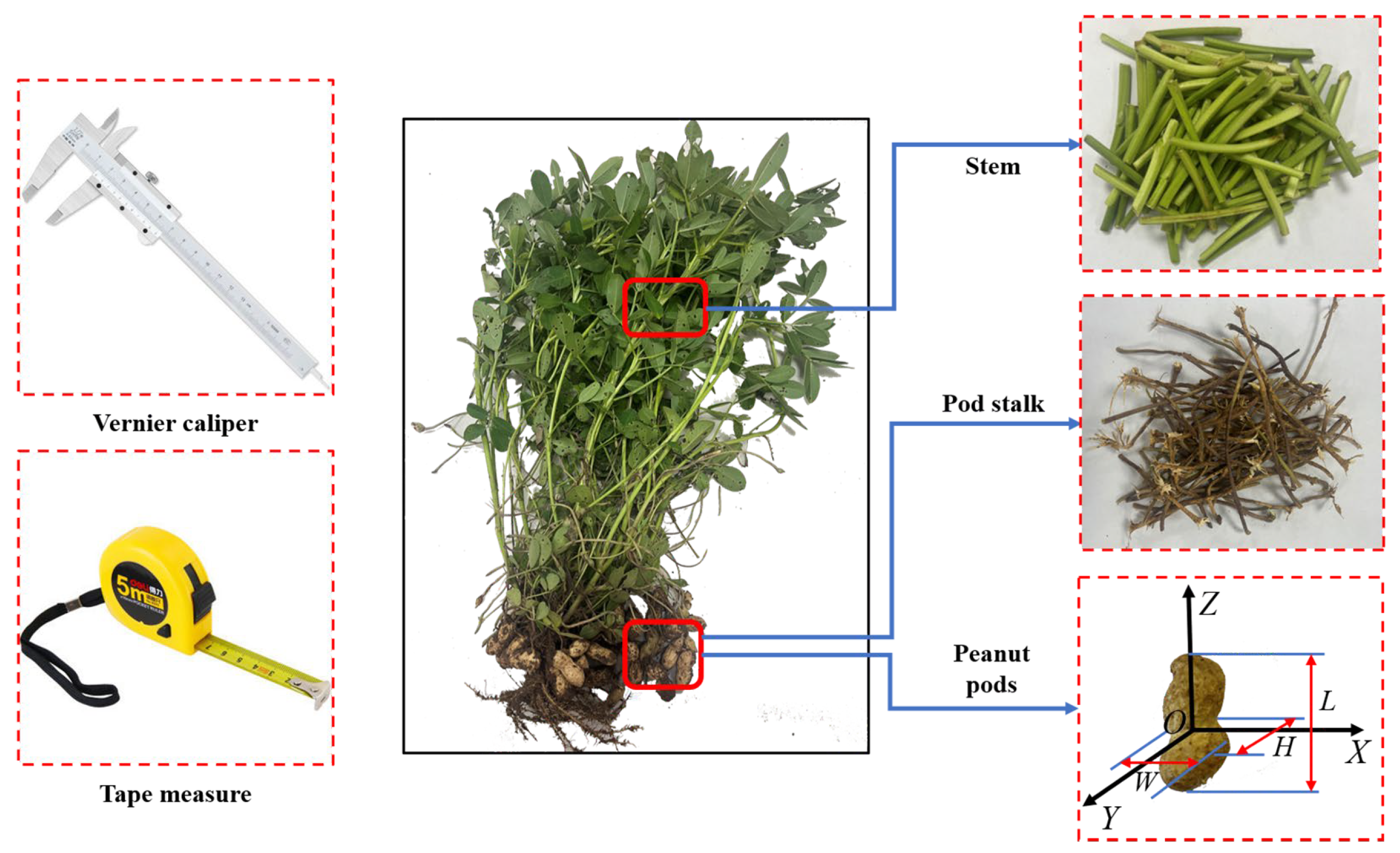
During peanut plant modelling, the Hertz–Mindlin contact model was used to describe non-bonded contacts among peanut pods, pod stalks, and steel components. In this model, contact behavior includes both normal and tangential components. The normal contact component is mainly characterized by the elastic modulus, Poisson’s ratio, equivalent contact radius, normal overlap, and restitution coefficient, which together determine the normal elastic response and damping behavior during collision. The tangential contact component is mainly characterized by the static friction coefficient, rolling friction coefficient, and tangential contact stiffness and damping, which determine sliding resistance, rolling resistance, and tangential energy dissipation.
Therefore, the contact parameter measurements in this study were designed according to the physical meaning of each DEM parameter. The inclined-plane test was used to determine the static friction coefficient, which characterizes tangential sliding resistance. The inclined impact test was used to determine the collision restitution coefficient, which characterizes the normal rebound and energy dissipation behavior during collision. The rolling test was used to determine the rolling friction coefficient, which characterizes resistance to rotational motion. Three main contact pairs were considered according to the main contact events occurring during peanut harvesting: peanut pod–peanut pod, peanut pod–steel, and pod stalk–steel.
2.2.1. Determination of Static Friction Coefficient
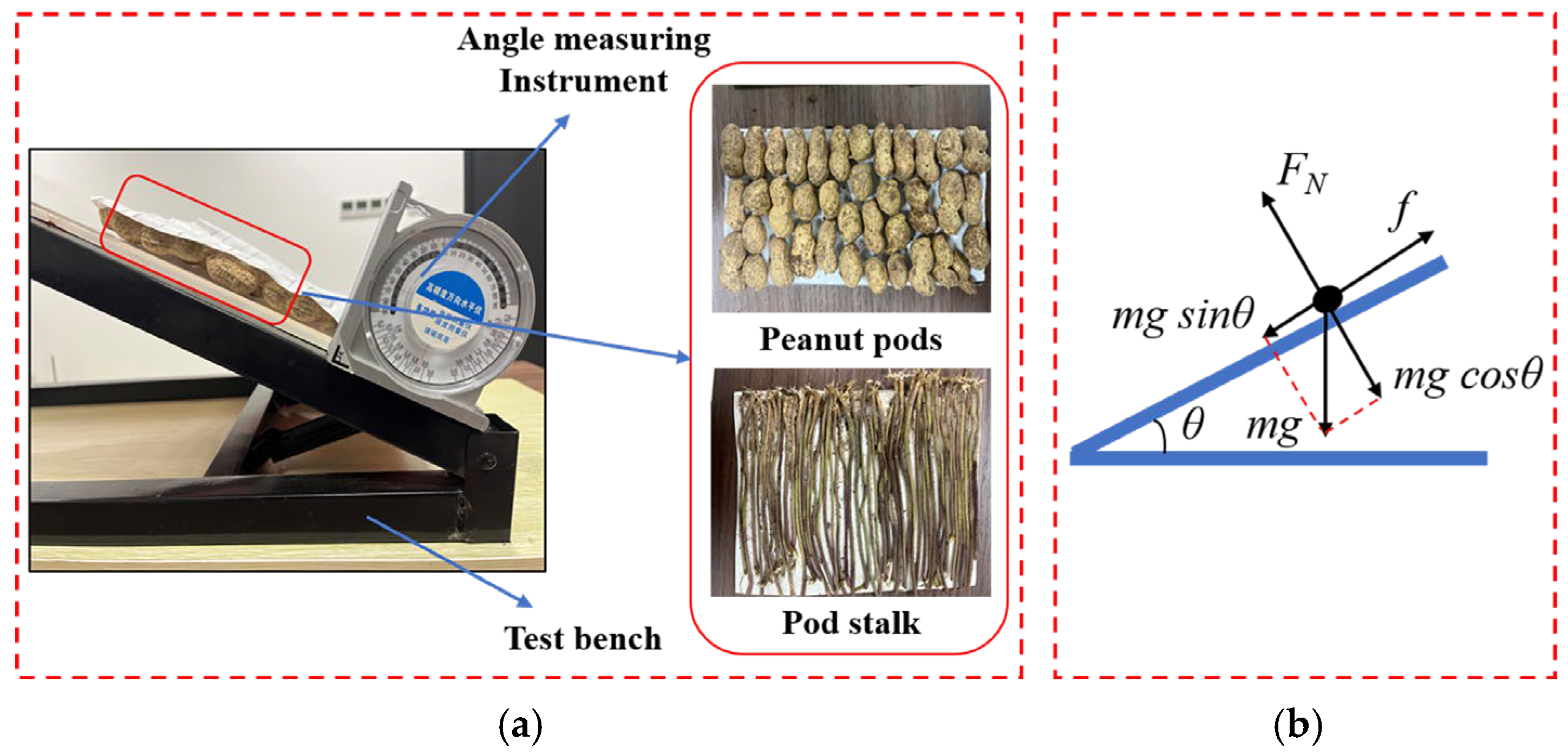
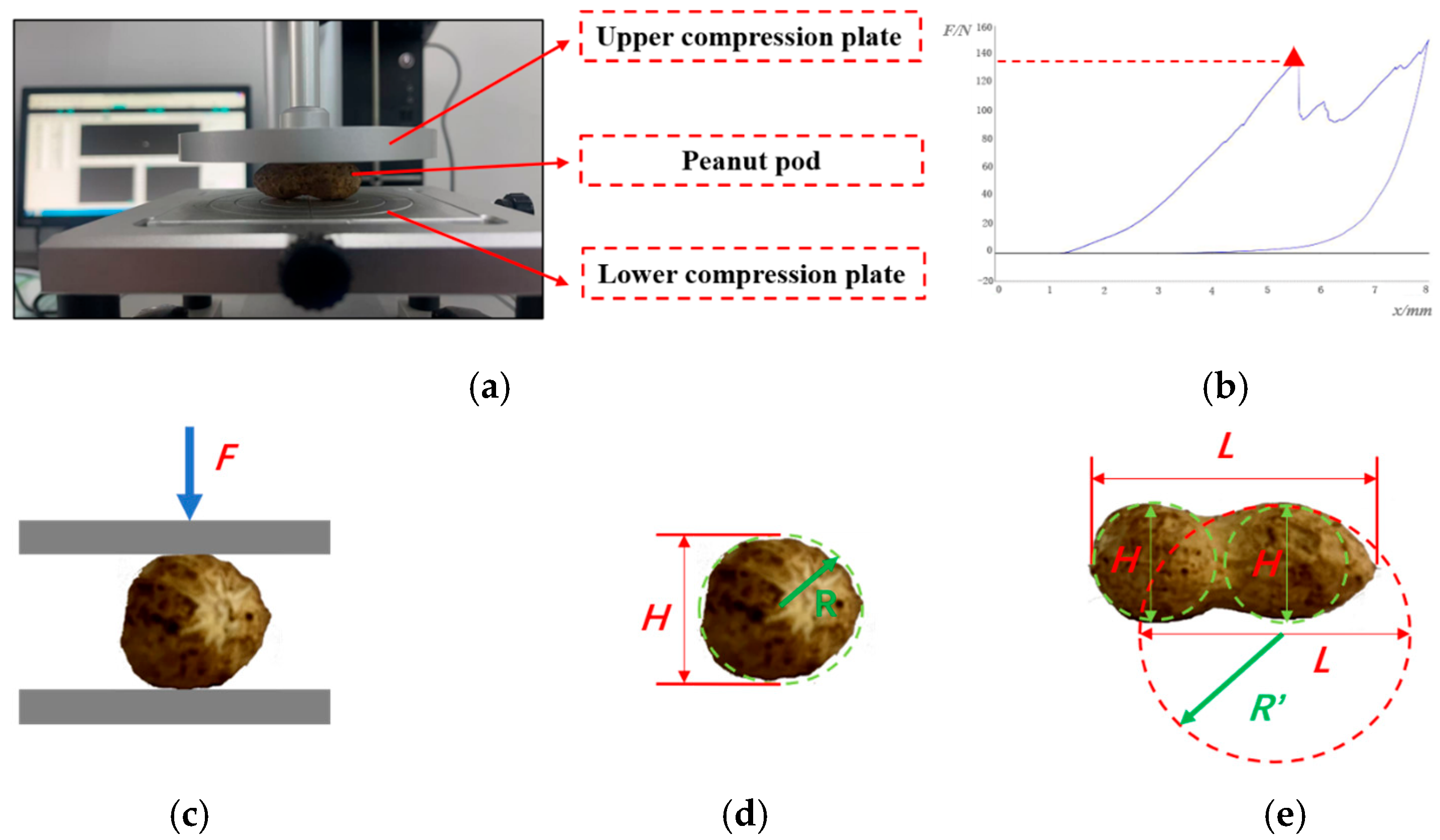
The static friction coefficient between contacting materials was determined using an inclined-plane test based on Coulomb’s friction law. As shown in
Figure 2. Three types of contact pairs were considered according to the main contact events occurring during peanut harvesting: peanut pod–peanut pod, peanut pod–steel, and pod stalk–steel. For the peanut pod–peanut pod contact pair, two pod-arrangement conditions were prepared. In the aligned arrangement, peanut pods were fixed on the lower plate with their longitudinal axes approximately parallel to one another. In the random arrangement, peanut pods were randomly distributed on the lower plate to better reproduce the disordered pod orientation during mechanical harvesting. The random-orientation result was used as the input value for the DEM model because the pod posture in actual harvesting is generally irregular and dynamically changing.
During the test, the tested sample was placed on the prepared contact plate, and the inclination angle of the plate was gradually increased at a uniform rate. The critical angle
θ at which the sample started to slide was recorded. Each contact pair was tested 10 times, and the average value was used as the measured static friction coefficient. The static friction coefficient was calculated as follows:
where
γ is the static friction coefficient between the tested material and the contact material,
θ is the inclination angle of the plane.
To evaluate the effect of pod arrangement on the measured static friction coefficient, two peanut pod–peanut pod contact conditions were compared: aligned arrangement and random arrangement. In the aligned arrangement, the longitudinal axes of peanut pods were approximately parallel, which represented an idealized and ordered contact condition. In the random arrangement, the peanut pods were placed with irregular orientations, which was closer to the actual contact state during mechanical harvesting.
The measured static friction coefficients under the aligned and random arrangements were 0.62 and 0.71, respectively. Compared with the aligned arrangement, the random arrangement produced a higher static friction coefficient and greater fluctuation in the critical sliding angle. This difference was mainly caused by the irregular surface morphology of peanut pods and the local interlocking between adjacent pods under random orientation. Since peanut pods are generally disordered and continuously changing in posture during harvesting, the random-arrangement friction coefficient was selected as the DEM input parameter for the peanut pod–peanut pod contact pair.
2.2.2. Determination of the Collision Recovery Coefficient
Traditional methods for determining impact recovery coefficients typically rely on free-fall impact tests. However, these methods are susceptible to errors caused by the drop height. When the drop height is too great, air resistance can cause the material’s trajectory to deviate. When the drop height is too small, the material fails to achieve sufficient bounce height. Therefore, a new impact drop test rig has been developed based on the principle of inclined-plane impact.
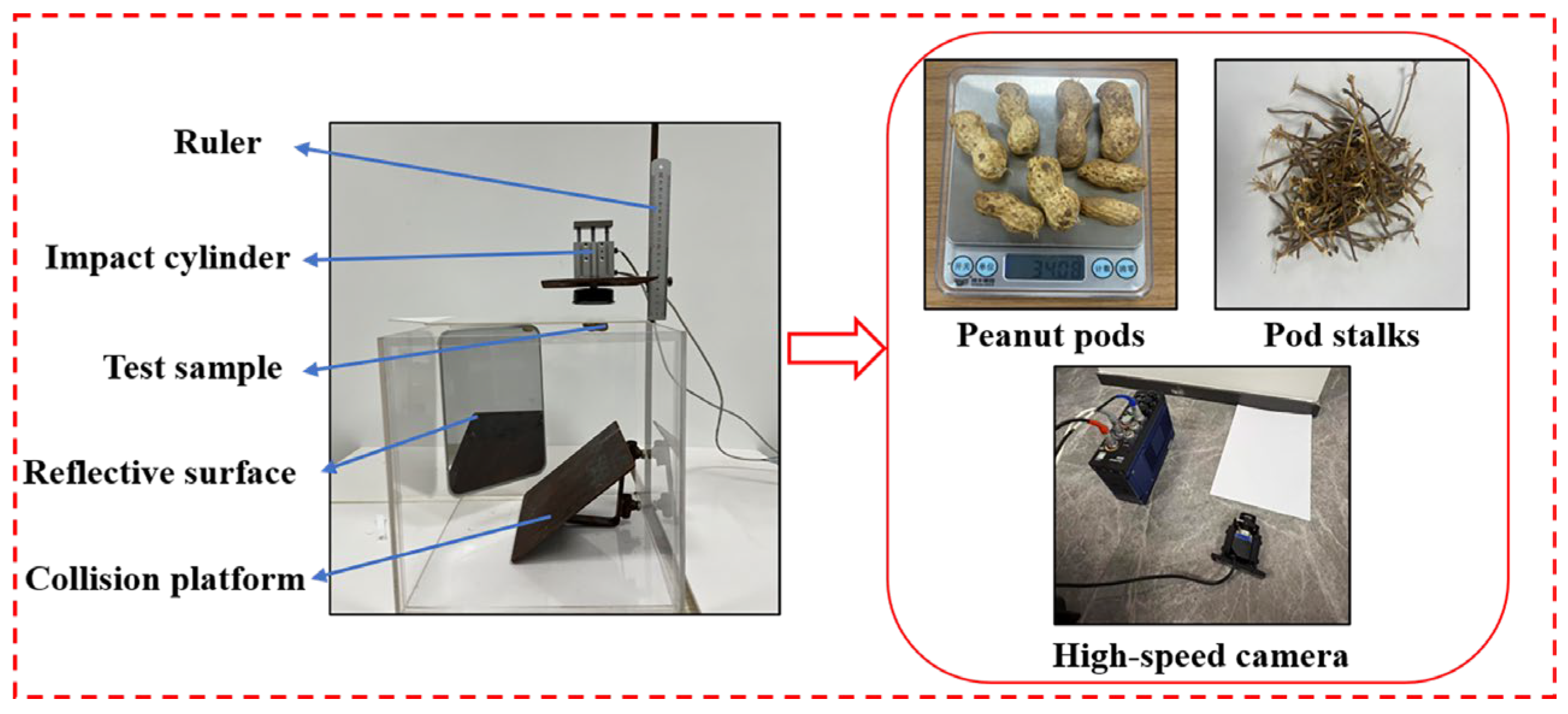
Construct an impact drop test rig based on the inclined plane collision principle, as shown in
Figure 3. Measure the velocity of the peanut pod before collision and the resultant value of velocity components along the three coordinate axes after collision. Use Equation (2) to determine the collision recovery coefficient.
where
e is the collision recovery coefficient between materials,
v2 is the instantaneous rebound velocity of peanut pods after collision,
v1 is the instantaneous velocity of the peanut pod during its descent prior to collision.
The principle of the improved impact test bench is shown in
Figure 3. The test bench consisted of an impact cylinder, a collision platform, a test sample, a reflective surface, and a high-speed camera. During the test, the peanut pod was released from the impact cylinder and then collided with the material plate mounted on the collision platform. The collision platform could be kept horizontal or adjusted to a specified inclination angle, so that the impact behavior under different collision angles could be measured.
Compared with the conventional free-fall rebound method, in which the restitution coefficient is usually calculated from the drop height and rebound height under vertical impact, the present test bench was designed to obtain the velocity components of the irregular peanut pod before and after collision. This design is more suitable for peanut pods because their irregular shape often causes oblique rebound, rotation, and non-planar motion after impact. Therefore, using only the rebound height may introduce errors in the restitution coefficient.
The reflective surface in
Figure 3 was used as an optical mirror rather than as a collision surface. It allowed the high-speed camera to record the side-view projection of the peanut pod trajectory while the reference wall provided the front-view projection. By combining the coordinates obtained from the reference wall and the reflective surface, the three-dimensional position of the peanut pod center could be reconstructed. The velocity components along the
X-,
Y-, and
Z-directions after collision were then calculated from two consecutive frames. The resultant rebound velocity was used to calculate the collision restitution coefficient.
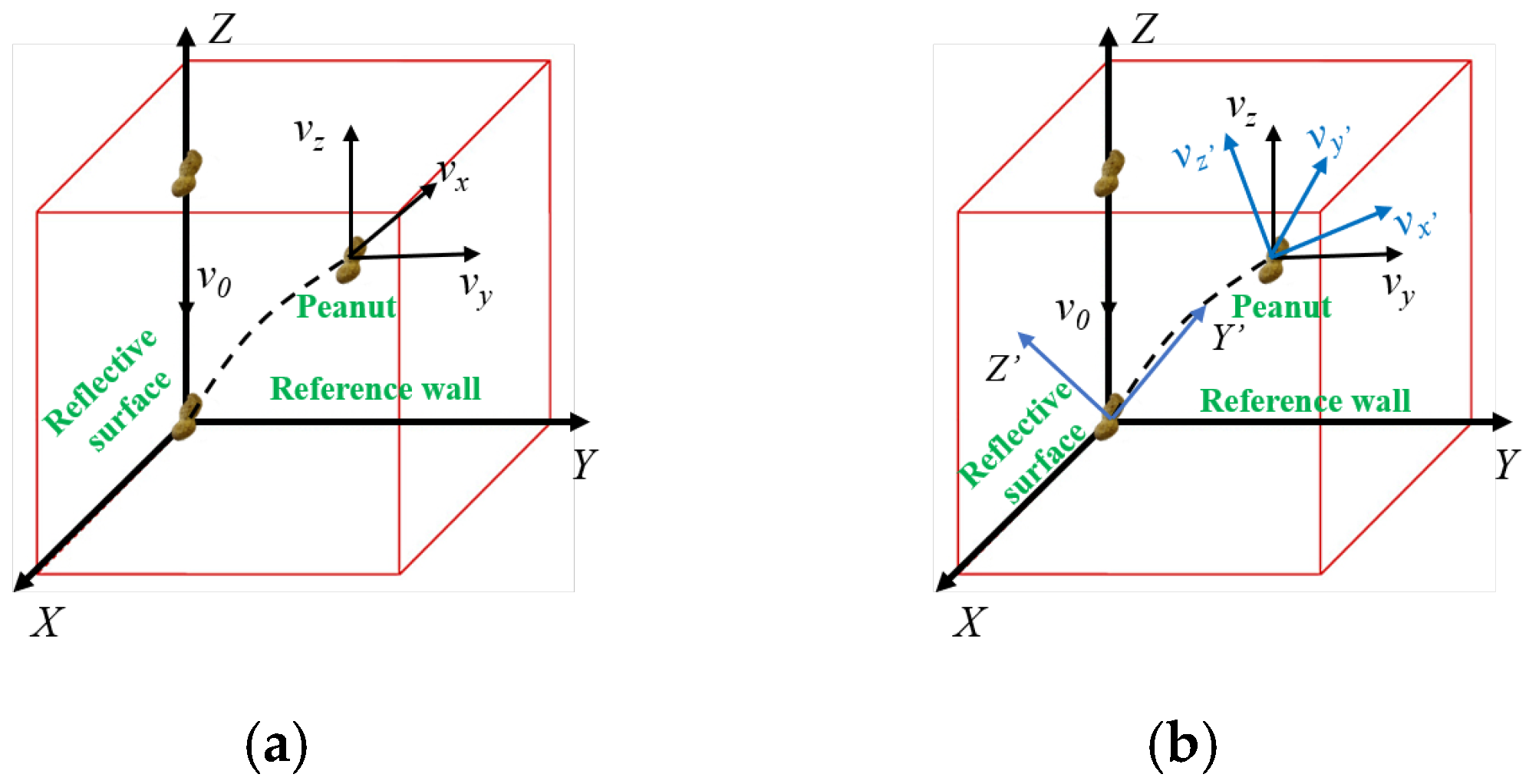
Perform a kinematic analysis of the falling, collision, and rebound process of a peanut pod. The peanut pod undergoes uniformly accelerated motion in the vertical direction prior to colliding with the material plate. The material plate is positioned horizontally or at a certain angle of inclination. When the collision angle is 0°, establish a horizontal Cartesian coordinate system
XYZ, as shown in
Figure 4a. The spatial reference wall coordinates before collision are (
Ya,
Za). The coordinates on the reflecting mirror surface are (
Xa,
Za). At the moment of collision, the spatial reference wall coordinates are (
Y0,
Z0). The coordinates on the reflecting mirror surface are (
X0,
Z0).
Before collision, the peanut pod moved approximately with uniform acceleration in the vertical direction. The average velocity during the falling interval was first calculated from the displacement and time. Then, according to the uniformly accelerated motion equation, the instantaneous velocity immediately before collision was obtained. The average velocity during this period is expressed as:
The instantaneous velocity before collision can be expressed as:
Perform a kinematic analysis of the peanut pod’s descent, impact, and rebound process. Obtain the component velocities along the three spatial axes. The equation is expressed as:
The collision recovery coefficient equation between peanut pods and materials is simplified as follows:
where
vx is the component velocity of the pod along the
X-direction after collision,
vy is the component velocity of the pod along the
Y-direction after collision,
vz is the component velocity of the pod along the
Z-direction after collision,
g is the acceleration due to gravity, and
ta is the acceleration time.
When the collision material plate is inclined at an angle
α, the spatial coordinate system
XYZ is transformed into the inclined spatial coordinate system
X′
Y′
Z′, as shown in
Figure 4b. The relationship equations for the spatial coordinate systems are:
The contact between peanut pods and the inclined material plate can be decomposed into a normal collision recovery coefficient and a tangential collision recovery coefficient. The following equations express these:
where
is the component velocity of the pod along direction
x′ after collision,
is the component velocity of the pod along direction
y′ after collision,
is the component velocity of the pod along direction
z′ after collision.
Through kinematic analysis of the falling, collision, and rebound process of peanut pods, it was found that when the collision angle remains constant, the collision recovery coefficient between peanut pods and the material plate depends on the displacement change of the peanut pods before and after collision.
Decompose the motion of the peanut pod after collision rebound into uniform horizontal motion and uniformly decelerated vertical motion. Use a high-speed camera to record the coordinate points at the instant the peanut pod rebounds. The reference wall coordinates are (
Y0,
Z0). The mirror surface coordinates are (
X0,
Z0). When rebounding to a certain height, the motion time is denoted as
tn. The reference wall coordinates are (
Yn,
Zn). The mirror surface coordinates are (
Xn,
Zn). Then the instantaneous horizontal velocity is expressed as:
Vertical uniform deceleration motion can be expressed as:
Substitute Equations (9)–(11) into Equation (6). Rearrange to obtain the collision recovery coefficient equation:
Using a high-speed camera, capture the coordinate values of the center point of the peanut pod between two frames. Substituting these values into Equation (12) allows calculation of the collision recovery coefficient between the peanut pod and the material.
Because peanut pods are irregular biological particles, post-collision rotational motion may contribute to energy dissipation [
27]. Therefore, the rotation of the pod after collision was also evaluated using high-speed images. The rotational kinetic energy was estimated as:
and the translational kinetic energy was calculated as:
The proportion of rotational energy was then expressed as:
where
Er is the rotational kinetic energy,
Et is the translational kinetic energy,
Ix,
Iy, and
Iz are the moments of inertia of the peanut pod around the three principal axes,
ωx,
ωy, and
ωz are the angular velocities,
m is the pod mass, and
vx,
vy, and
vz are the rebound velocity components. This treatment improves the reliability of the restitution coefficient used in the DEM model.
The peanut pod was approximated as an equivalent triaxial ellipsoid for estimating the moments of inertia. The semi-axes of the equivalent ellipsoid were defined as a = L/2, b = W/2, and c = H/2, where L, W, and H are the length, width, and thickness of the pod, respectively. Based on the high-speed image analysis, the average rotational kinetic energy was Er = 0.895 × 10⁻⁵ J, and the average rotational energy ratio was νr = 15.84%. This result indicates that post-collision rotation accounted for 1/5 proportion of the total kinetic energy. Therefore, considering rotational motion improved the reliability of the restitution coefficient used in the DEM model.
2.2.3. Determination of Rolling Friction Coefficient
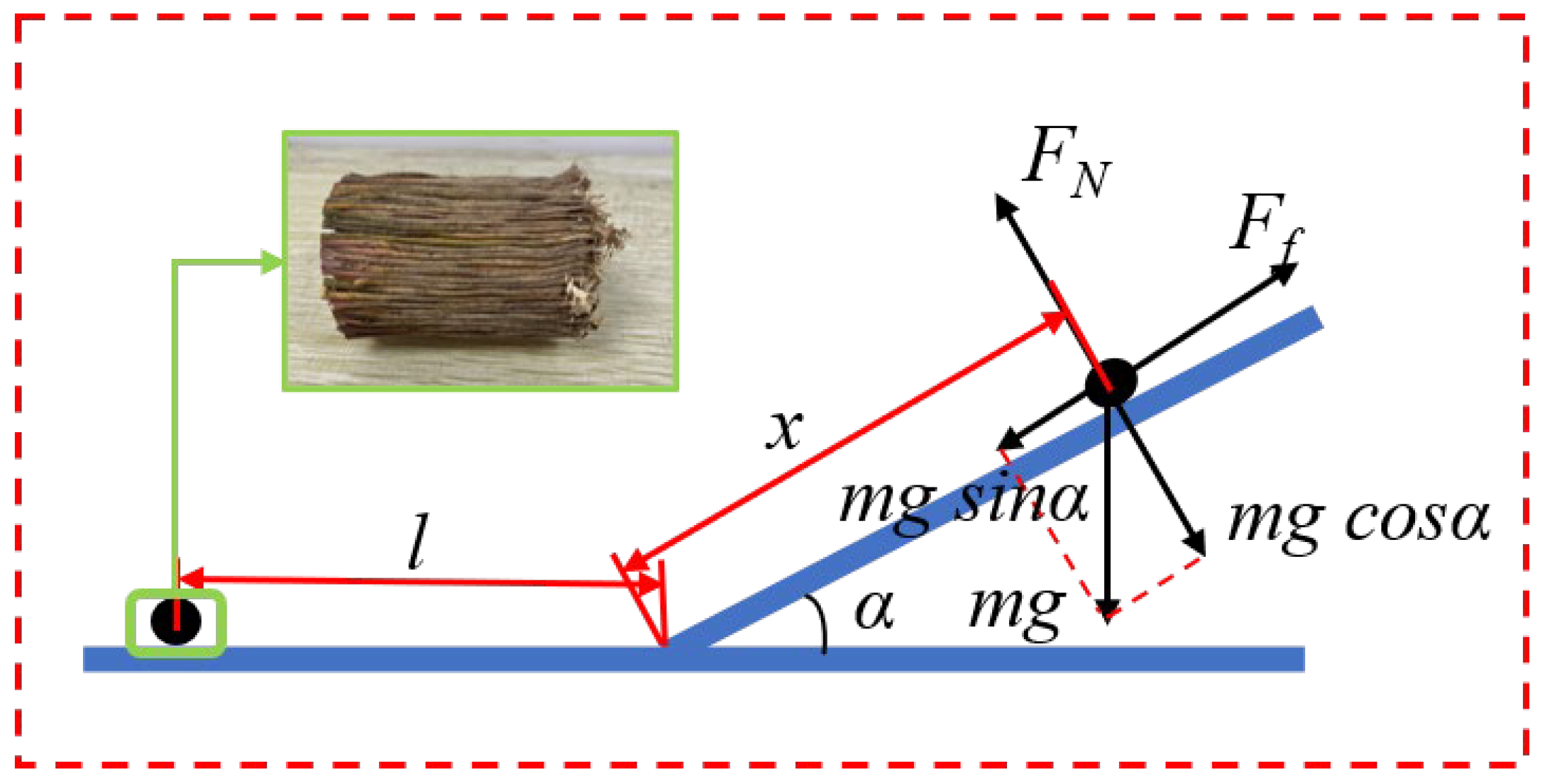
The determination of the coefficient of rolling friction utilizes the law of conservation of energy. The change in a material’s kinetic energy is equal to the work done on it by the net external force. The experimental principle is shown in
Figure 5.
The rolling friction coefficient was determined based on the energy balance of a cylindrical sample rolling along an inclined plane and then along a horizontal plane. Since peanut pod stalks have irregular shapes that make stable rolling difficult, pod stalk samples were processed into short cylindrical specimens while retaining their inherent surface characteristics as much as possible. During the test, the cylindrical sample rolled down the inclined plane and continued moving along the horizontal plane until it stopped.
At the initial and final states, the translational and rotational velocities of the sample were both zero. Therefore, the gravitational potential energy lost during rolling along the inclined plane was assumed to be dissipated by rolling resistance along both the inclined and horizontal sections. The energy balance can be expressed as:
where Δ
E represents the change in kinetic energy;
Ep represents the gravitational potential energy of the material;
Ws represents the work done by the frictional force;
m represents the mass of the material;
g represents the acceleration due to gravity;
Ff represents the frictional force;
f represents the coefficient of rolling friction;
x represents the distance the material rolls down the inclined plane;
l represents the distance the material rolls along the horizontal plane; and
α represents the angle of inclination of the plane.
By substituting the gravitational potential energy and the work done by rolling resistance into the energy balance equation and cancelling m and g, the rolling friction coefficient can be obtained as:
This derivation clarifies that the rolling friction coefficient was calculated from the measured rolling distance along the inclined plane, the horizontal stopping distance, and the inclination angle of the plane.