Article

Single-Cell RNA Sequencing Reveals Dynamic Intercellular Communication Networks During Chicken Skeletal Muscle Development


1
College of Animal Science and Technology, Yangzhou University, Yangzhou 225009, China
2
Key Laboratory of Livestock and Poultry Genetic Resources (Poultry) Evaluation and Utilization, Ministry of Agriculture and Rural Affairs, Yangzhou 225009, China
*
Author to whom correspondence should be addressed.
Agriculture 2026, 16(13), 1365; https://doi.org/10.3390/agriculture16131365 (registering DOI)
Submission received: 8 May 2026 / Revised: 13 June 2026 / Accepted: 19 June 2026 / Published: 23 June 2026

Abstract

Intercellular communication is crucial for the coordination of skeletal muscle development. However, the intricate signaling networks that regulate chicken myogenesis are not yet fully elucidated. In this study, we utilized CellChat analysis on single-cell and single-nucleus RNA sequencing data to systematically delineate cell–cell communication patterns across five critical developmental stages of chicken skeletal muscle: embryonic day 4 (E4), day 6 (E6), day 12 (E12), day 18 (E18), and post-hatch day 30 (P30). Our findings indicate that communication architectures are highly stage-specific, with mesenchymal cells acting as the predominant signaling hub during the early embryonic stages (E4–E6), whereas fibro-adipogenic progenitors become the principal communicators during mid-to-late embryogenesis (E12–E18). At E4, the communication network was relatively simple, comprising 51 ligand–receptor pairs primarily involving the neural cell adhesion molecule, slit guidance ligand, and midkine (MK) signaling pathways between myogenic progenitors and mesenchymal cells. By E6, the network had expanded significantly, encompassing 6237 ligand–receptor pairs across 51 signaling pathways, which coincided with the emergence of multiple myogenic lineages. Peak communication complexity was observed at E12, characterized by 11,675 ligand–receptor pairs and 61 signaling pathways, reflecting the secondary wave of myogenesis. Comparative analysis across developmental stages revealed key signaling transitions: the pleiotrophin and MK pathways were predominantly active during the early phase of myogenic commitment (E4–E6), whereas the collagen, laminin, and adhesion G protein-coupled receptor L pathways were more prominent during the secondary myogenesis phase (E6–E12). Notably, a significant shift in communication patterns was observed from E12 to E18, marked by a reduction in developmental pathway signaling and an increase in immune-related communications. By P30, the communication network had stabilized into a homeostatic state, centered on interactions among myofibers, stromal cells, and the vascular system. This comprehensive atlas of intercellular communication offers novel insights into the signaling dynamics underpinning chicken skeletal muscle development.

1. Introduction

Skeletal muscle development is a highly orchestrated process involving myogenic determination, proliferation, differentiation, and fusion, which ultimately gives rise to mature muscle fibers [1]. In avian species, particularly in chickens (Gallus gallus), skeletal muscle development is not only a fundamental biological question but also a critical factor in agricultural productivity and meat quality. Chicken skeletal muscle constitutes the largest proportion and most valuable component of meat mass. Its development is closely associated with the amount of meat production and its quality, ultimately affecting the economic benefits of the chicken industry [2,3,4]. Thus, understanding the underlying mechanisms that regulate chicken skeletal muscle development is of critical importance. Numerous studies have focused on identifying key factors regulating skeletal muscle development and exploring the underlying mechanisms using next-generation sequencing technology [5,6,7,8]. While the transcriptional regulation and signaling pathways governing myogenesis have been extensively studied, most existing research has relied on bulk tissue analysis, which masks cellular heterogeneity and intercellular communication dynamics [9,10].
Recent advances in single-cell RNA sequencing (scRNA-seq) have revolutionized our ability to dissect complex biological systems at cellular resolution. This technology has enabled the identification of distinct cell subpopulations, rare progenitor states, and lineage trajectories during development and regeneration [11,12]. In the context of skeletal muscle, scRNA-seq studies in mammals have revealed diverse cell types, including myoblasts, fibroblasts, endothelial cells, and immune cells, which collectively contribute to muscle development, homeostasis, and regeneration [13,14,15]. However, comparable studies in chicken skeletal muscle remain limited. Recent advances in single-cell and single-nucleus transcriptomics have elucidated the cellular heterogeneity and lineage trajectories involved in chicken muscle development [16,17]. Nevertheless, these investigations have predominantly concentrated on the identification of cell types and the dynamics of differentiation, without a comprehensive analysis of the intercellular communication networks that orchestrate these processes. In particular, our previous snRNA-seq study [16] identified 22 distinct cell populations and delineated lineage differentiation trajectories, yet it did not address the pivotal question of how these diverse cell types interact to coordinate myogenesis.
In addition to cellular heterogeneity, intercellular communication mediated by ligand–receptor interactions plays a pivotal role in coordinating developmental processes [18]. Myogenesis is not an autonomous cellular process. Instead, it requires precise spatiotemporal coordination between myogenic progenitors and their surrounding niche, which includes stromal, vascular, and immune components. Therefore, understanding these intercellular interactions is crucial. While signaling pathways such as Notch [19], Wnt [20], and p38 MAPK [21] have been implicated in regulating myogenesis, the cell type-specific activity and temporal dynamics during chicken muscle development remain poorly understood. Analyzing cell–cell communication networks across developmental stages can uncover key signaling hubs and niche interactions that drive myogenesis, providing insights into both conserved and species-specific regulatory mechanisms. In mammals, intricate intercellular networks orchestrate the regeneration of skeletal muscle. Fibro-adipogenic progenitors (FAPs) play a supportive role for muscle stem cells through IL-4/IL-13 signaling [22], extracellular matrix (ECM) secretion [23], and the relay of mechanical signals via the Yap1/Taz-Thbs1-CD47 axis [24]. Endothelial cells enhance the proliferation of satellite cells by utilizing growth factors such as IGF-1, HGF, bFGF, PDGF-BB, and VEGF [25]. Concurrently, macrophages contribute to the coupling of myogenesis and angiogenesis and mediate both regenerative and fibrotic signaling through TNF-α, IGF-1, and IL-10 [26,27,28]. Nonetheless, it remains largely unexplored whether these communication mechanisms are conserved in avian species.
CellChat-based analysis is expected to reveal novel developmental mechanisms by identifying stage-specific signaling hubs, ligand–receptor axes, and communication pattern transitions that cannot be inferred from individual cell transcriptomes alone [29]. Here, we performed CellChat analysis on our previously established single-nucleus RNA sequencing (snRNA-seq) dataset [16] to systematically explore cell–cell communication networks during chicken skeletal muscle development across five key stages: embryonic day 4 (E4), embryonic day 6 (E6), embryonic day 12 (E12), embryonic day 18 (E18), and post-hatch day 30 (P30). These five developmental stages were selected to capture the major biological transitions in chicken myogenesis: E4 represents the early myogenic specification phase when somitic cells commit to the myogenic lineage; E6 corresponds to primary myofiber formation; E12 marks the peak of secondary myogenesis; E18 represents late embryonic maturation; and P30 reflects the post-hatch hypertrophic growth phase. We hypothesized that intercellular communication networks undergo dynamic reorganization during chicken skeletal muscle development, with distinct signaling hubs and pathways governing each developmental phase. Our objectives were: (1) to delineate stage-specific communication patterns by identifying key signaling pathways and cellular interactions at each time point, and (2) to elucidate the dynamic changes in intercellular networks throughout development, revealing how signaling mechanisms evolve to support distinct phases of myogenesis. Notably, CellChat databases are largely derived from mammalian ligand–receptor annotations; although ortholog mapping was performed, potential biases may exist because avian-specific ligand–receptor interactions may be underrepresented. This analysis provides novel insights into the signaling dynamics of chicken skeletal muscle development and serves as a valuable resource for understanding the molecular basis of poultry meat production.

2. Materials and Methods

2.1. Single-Nucleus RNA Sequencing Data

The single-nucleus RNA sequencing data used in this study were derived from our previously published work [16]. Briefly, fertilized eggs of Heying Black broiler chicken were obtained from Jiangsu Heying Poultry Breeding Technology Co., Ltd. A total of 100 fertilized eggs were incubated, and for each developmental stage (E6, E12, E18, and P30), samples were collected from at least 6 embryos (with 2 biological replicates, each replicate pooled from 3 embryos). For the post-hatch stage (P30), 6 chickens were sampled (2 biological replicates, each replicate pooled from 3 individuals). Whole leg muscle samples were collected at E6, and peroneus longus muscle samples were collected at E12, E18, and P30. The use of whole leg muscle at E6 was necessary because the peroneus longus is not yet sufficiently developed at this early stage for reliable dissection. While this difference in tissue sampling could introduce variation in cellular composition, the core myogenic and stromal cell populations identified were consistent across stages, and CellChat’s communication probability computation normalizes for cell group size differences. Nuclei isolation was performed using a modified protocol involving tissue homogenization, iodixanol density gradient centrifugation, and nuclear purification. Single-nucleus RNA libraries were constructed using the 10× Genomics Chromium Next GEM Single Cell 3′ Reagent Kits v3.1 (10× Genomics, Pleasanton, CA, USA) and sequenced on the Illumina NovaSeq 5000 platform (Illumina, CA, USA). After quality control, a total of 111,328 nuclear transcriptomes with an average of 2315 detected genes per nucleus were obtained for downstream analysis. Additionally, a publicly available single-cell dataset of chicken skeletal muscle at E4 was integrated for comprehensive analysis [17]. Of note, the E4 dataset was generated using scRNA-seq rather than snRNA-seq. At E4, the developing limb bud tissue is relatively undifferentiated, and scRNA-seq is capable of capturing the majority of cell types present. However, as skeletal muscle development progresses, multinucleated myocytes and myotubes form, which are too large in diameter to be captured by standard droplet-based scRNA-seq platforms. Therefore, nuclear isolation followed by snRNA-seq was employed for E6 and later stages to ensure comprehensive profiling of these large, multinucleated cell populations. While we acknowledge that technical differences between scRNA-seq and snRNA-seq may introduce some variation, we applied Harmony-based batch correction during integration and focused our comparative analyses on normalized information flow rather than absolute expression levels to mitigate potential confounders.

2.2. Cell Type Annotation

Cell clustering and annotation were performed as previously described [16]. Briefly, dimensionality reduction, clustering, and visualization were conducted using Seurat 3.1.1. Quality control filtering was applied to remove low-quality nuclei with fewer than 330 detected genes or greater than 8% mitochondrial gene content. After quality control, the number of nuclei retained per stage was as follows, E6 (n = 29,541), E12 (n = 31,808), E18 (n = 25,304), and P30 (n = 24,675), totaling 111,328 nuclear transcriptomes. The E4 single-cell dataset contained 8597 cells after quality control. The Harmony algorithm was employed for batch effect correction and dataset integration, using the default theta parameter (theta = 2) and running a maximum of 20 iterations. The integration was performed on the first 30 principal components. Principal component analysis (PCA) was performed for dimensional reduction, and statistically significant principal components were identified using the ElbowPlot function. Unsupervised clustering was performed using the FindClusters function at resolution parameters ranging from 0.3 to 0.8, with the optimal resolution selected based on biological interpretability. Clusters were visualized using Uniform Manifold Approximation and Projection (UMAP). Cell types were annotated based on differentially expressed marker genes identified using the Wilcoxon rank-sum test (adjusted p-value < 0.05, logfc.threshold = 0.6) and through extensive literature review of specific gene expression patterns. Key marker genes used for annotation included: PAX3 and PAX7 for myogenic progenitors; MEGF10 for myoblasts; TMEM8C for myocytes; FGF13, MYH1F, MYH1D, and MYH7B for myofiber nuclei; PDGFRA and DCN for FAPs; LMX1B and PRRX1 for mesenchymal cells; EGFL7 for endothelial cells; MKX for tenocytes; COL22A1 for myotendinous junction (MTJ) nuclei; COL1A1 and POSTN for fibroblasts; SLC4A1 for erythrocytes; HBA1 for erythroid progenitors; RUNX2 for prechondrocytes; PDGFRB for pericytes; ACAN and COL2A1 for chondrocytes; and CD74, CDH19, and CD3D for immune cells. A total of 22 cell populations were identified, including nine myogenic populations (MPs, myoblasts, myocytes, and various myonuclear subtypes) and 13 non-myogenic populations (FAPs, mesenchymal cells, endothelial cells, immune cells, and others).

2.3. CellChat Analysis for Intercellular Communication

CellChat analysis was performed using the CellChat R package (version 2.0.2) to infer and analyze intercellular communication networks [29]. For each developmental stage (E4, E6, E12, E18, and P30), a CellChat object was created from the normalized expression matrix and cell type annotations. The CellChatDB database, a comprehensive manually curated database of ligand–receptor interactions, was used as the reference for communication inference. Gene symbols in the CellChatDB database were converted to chicken homologous gene symbols using the babelgene package (version 22.9), which maps orthologs based on the Orthologs Matrix from the NCBI HomoloGene database. A total of 745 human genes were converted into chicken homologous gene symbols, and 700 genes were supported by at least one database. The analysis pipeline included the following steps: (1) data preprocessing and over-dispersion identification using the identifyOverExpressedGenes function; (2) communication probability inference using the computeCommunProb function, which models interaction probabilities based on the law of mass action; (3) communication pathway enrichment using the computeCommunProbPathway function; (4) aggregated cell–cell communication network computation using the aggregateNet function; and (5) signaling pathway analysis including outgoing and incoming communication patterns.

2.4. Comparative Analysis Across Developmental Stages

To examine the dynamic alterations in intercellular communication throughout skeletal muscle development, a comparative series of analyses were performed across successive developmental stages (E4 vs. E6, E6 vs. E12, E12 vs. E18, and E18 vs. P30). The liftCellChat approach implemented in CellChat was used to align cell types across different datasets. Differential communication analysis was performed using the netVisual_diffInteraction function to identify signaling pathways exhibiting significant changes in information flow. The rankNet function was employed to compare the overall signaling intensity between stages. Key ligand–receptor pairs contributing to differential signaling were identified using the netAnalysis_signalingRole_scatter function. For each comparison, we analyzed: (1) alterations in the total number and strength of interaction; (2) differential signaling pathways between stages; (3) cell type-specific changes in outgoing and incoming communication; and (4) key ligand–receptor pairs mediating communications. Given the varying cellular compositions across developmental stages, our comparative analysis focused on signaling pathway-level information flow rather than raw interaction counts. CellChat normalizes information flow by accounting for differences in cell population sizes, thereby enabling robust comparison of communication networks across stages with heterogeneous cell type proportions.

2.5. Statistical Analysis and Visualization

The statistical significance of ligand–receptor interactions was assessed utilizing the default permutation test provided by CellChat, with a sample size of 100 permutations. Interactions with a p-value less than 0.05 were deemed statistically significant and were included in subsequent analyses. To address the issue of multiple testing across ligand–receptor pairs, Benjamini–Hochberg false discovery rate (FDR) correction was employed, retaining interactions with an FDR value below 0.05 for further analysis. To control for differences in cell population sizes across developmental stages, CellChat’s communication probability computation normalizes for cell group size. Communication probability matrices were computed using the trimean method for robust estimation. Network visualization was performed using built-in CellChat visualization functions, including netVisual_circle for interaction networks, netVisual_heatmap for communication heatmaps, netVisual_bubble for ligand–receptor pairs, and netAnalysis_signalingRole_heatmap for signaling pathways. All analyses were performed using R (version 4.2.0) with appropriate packages.

3. Results

3.1. Overview of Intercellular Communication Networks During Chicken Skeletal Muscle Development

To systematically characterize the intercellular communication networks during chicken skeletal muscle development, we conducted a CellChat analysis on single-nucleus and single-cell RNA sequencing data from five critical developmental stages: embryonic day 4 (E4), embryonic day 6 (E6), embryonic day 12 (E12), embryonic day 18 (E18), and post-hatch day 30 (P30). These stages were selected to capture the major transitions in chicken myogenesis, including the primary myogenic phase (E4–E6), the secondary myogenic phase (E12–E18), and the post-hatch maturation phase (P30). Our findings revealed dramatic changes in both the complexity and architecture of intercellular communication networks across development, reflecting the dynamic cellular composition and signaling requirements at each stage.
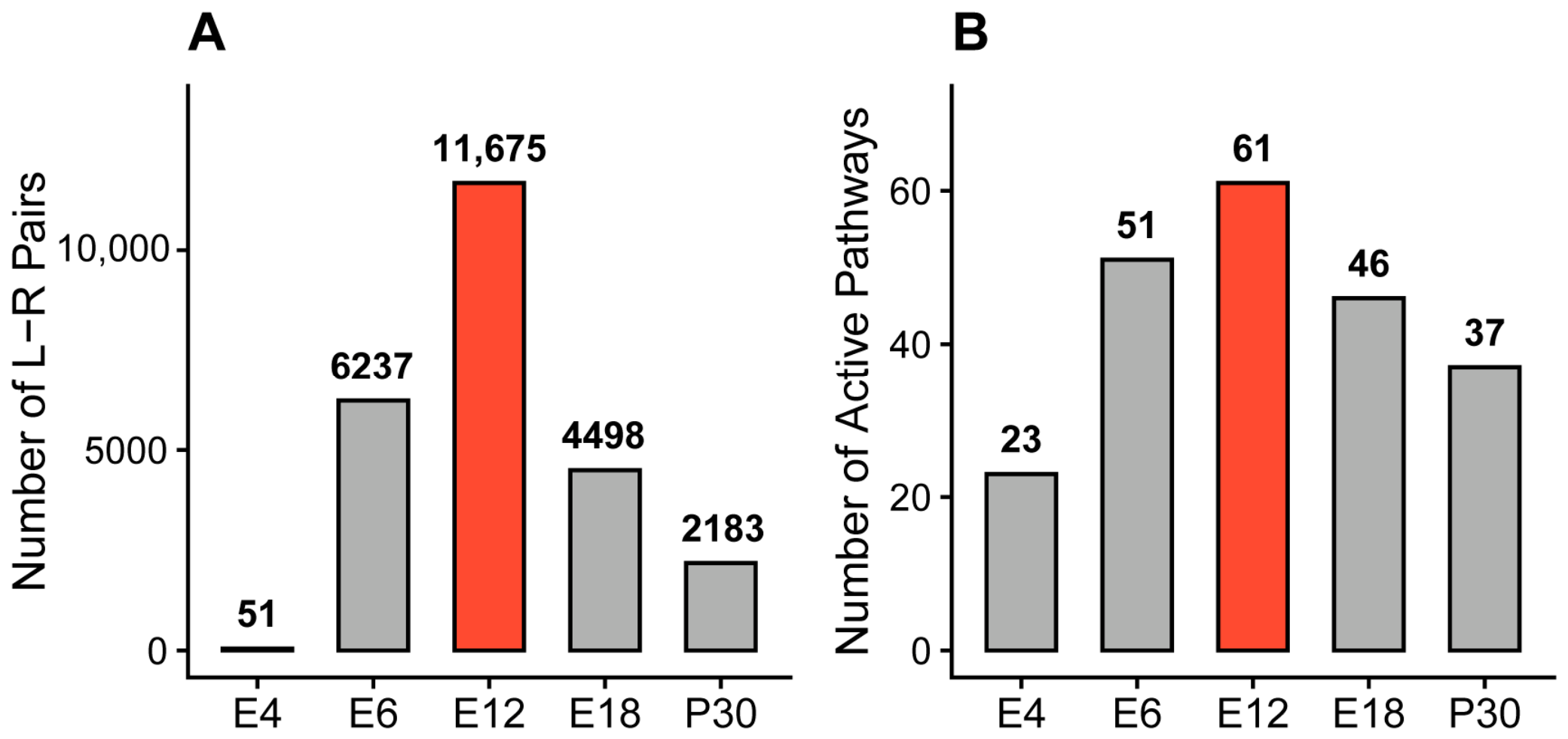
The total number of ligand–receptor pairs identified increased substantially from E4 (51 pairs) to E6 (6237 pairs), peaked at E12 (11,675 pairs), and subsequently decreased at E18 (4498 pairs) and P30 (2183 pairs). Similarly, the number of active signaling pathways expanded from 10 at E4 to 51 at E6, reached maximum complexity at E12 (61 pathways), and then contracted to 46 and 37 at E18 and P30, respectively. This temporal pattern mirrors the developmental trajectory of chicken skeletal muscle, with peak signaling complexity coinciding with the secondary wave of myogenesis at E12, when extensive cell proliferation, differentiation, and fusion events occur (Figure 1). In summary, the intercellular communication network undergoes a biphasic trajectory during chicken skeletal muscle development, with peak complexity at E12 coinciding with secondary myogenesis, and progressive consolidation thereafter.

3.2. Stage-Specific Intercellular Communication Patterns

3.2.1. Communication Networks on Embryonic Day 4 (E4): Early Myogenic Specification

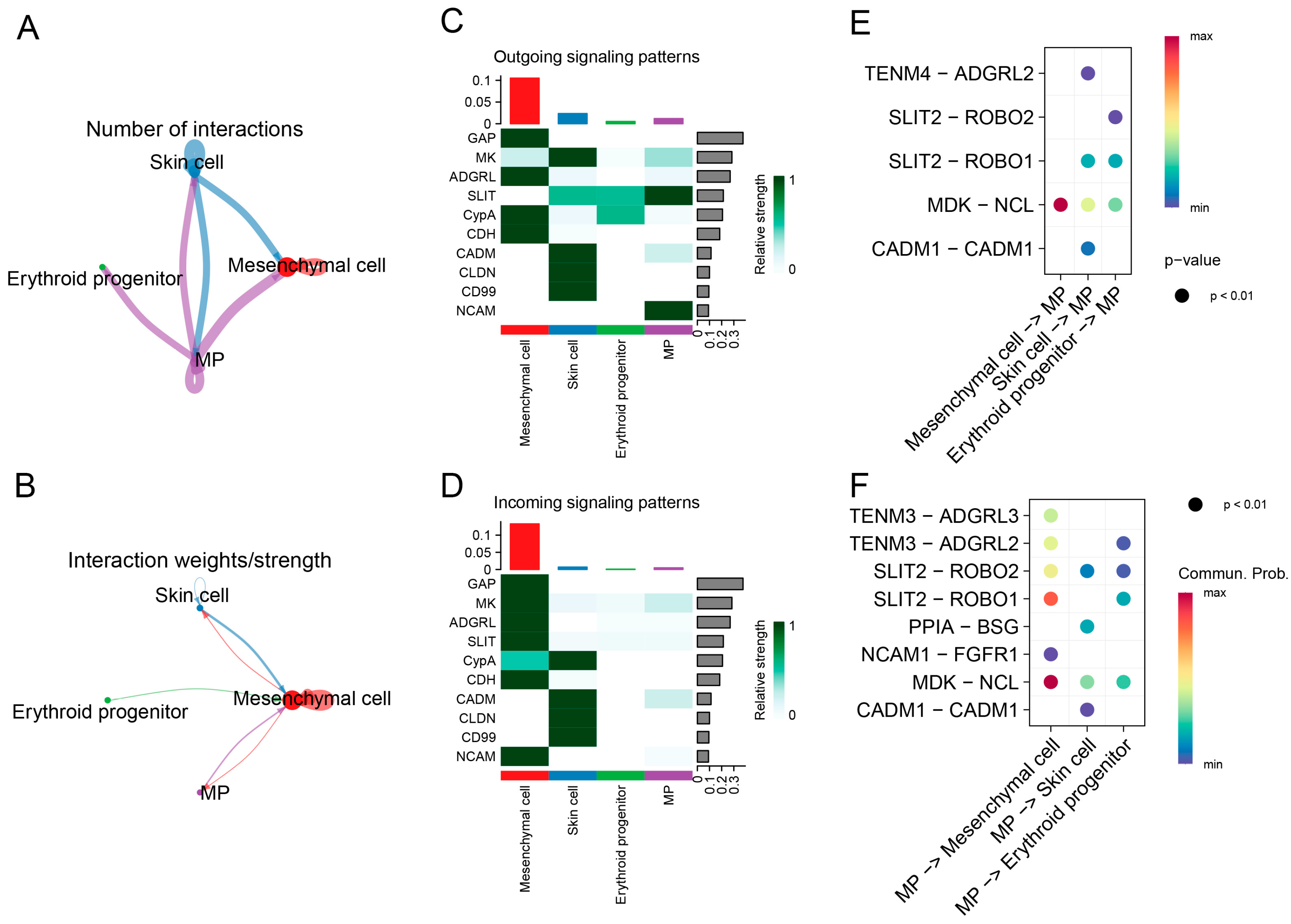
At the E4 stage, the skeletal muscle anlage was primarily constituted of mesenchymal cells (82%), with smaller populations of myogenic progenitors (MPs, 2%) and erythroid progenitors. CellChat analysis revealed 51 significant ligand–receptor (L-R) interactions converging into 10 signaling pathways. These pathways were mainly characterized by secreted factors (MK, SLIT, CypA) and cell–cell contact molecules (NCAM, CADM, ADGRL, CDH, GAP, CLDN, CD99) (Table S1). Mesenchymal cells exhibited the most substantial outgoing and autocrine signaling capacity, whereas MPs served as a communication hub, engaging in bidirectional crosstalk predominantly with mesenchymal cells and skin cells (Figure 2A,B).
To delineate the specific molecular dialog between MPs and the mesenchymal niche, we resolved the outgoing and incoming interaction strengths of the enriched pathways (Figure 2C,D). MPs were found to orchestrate communication primarily through the NCAM, SLIT, and MK pathways. Intriguingly, our analysis revealed a prominent bidirectional signaling loop between MPs and mesenchymal cells mediated by the MK pathway, where both populations exchanged signals via the MDK-NCL ligand–receptor pair. Additionally, MPs broadcasted signals to mesenchymal cells through the SLIT2-ROBO1/2 axis (SLIT pathway) and the NCAM1-FGFR1 axis (NCAM pathway). Beyond these myogenic axes, the mesenchymal population itself maintained high-probability autocrine signaling, notably via the TENM3-ADGRL2/3 pairs (ADGRL pathway) and GJA1-GJA1 pairs (GAP pathway), suggesting a highly interactive stromal network that establishes the permissive microenvironment necessary for early skeletal muscle specification (Figure 2E,F).

3.2.2. Communication Networks on Embryonic Day 6 (E6): Primary Myofiber Formation

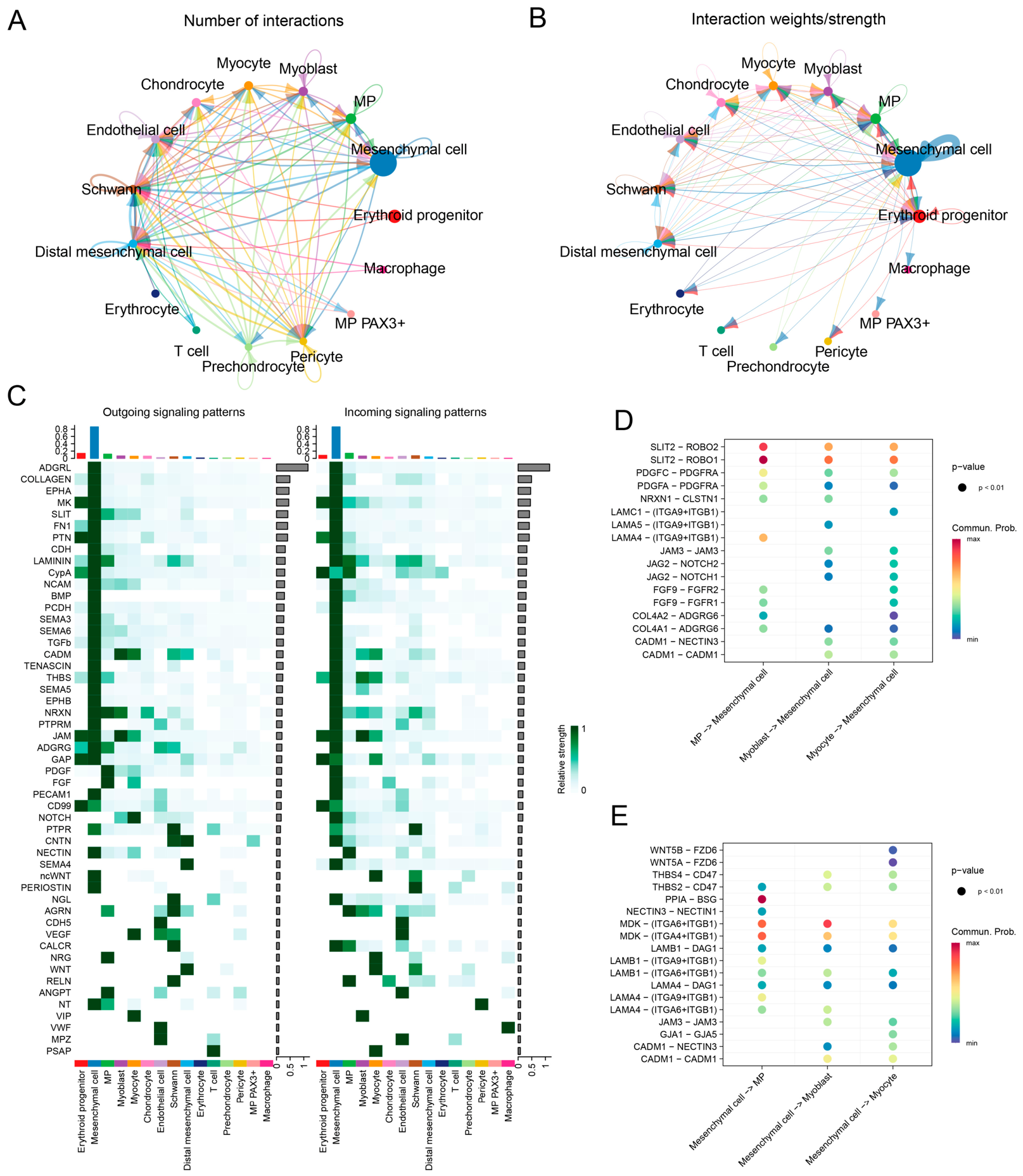
By E6, the cellular composition had diversified substantially, with the emergence of PAX3+ MPs, PAX7+ MPs, myoblasts, and myocytes/primary myofibers [16]. Mesenchymal cells remained the predominant population (50.5%), but their relative proportion decreased compared to E4, while MPs increased to 8.1% and myoblasts appeared for the first time (4.8%). This cellular diversification was accompanied by a dramatic expansion of the intercellular communication network to 6237 L-R pairs across 51 signaling pathways, a 122-fold increase compared to E4. The signaling repertoire was dominated by ADGRL, EPHA, FN1, SLIT, COLLAGEN, CDH, PTN, and MK pathways (Table S2). Mesenchymal cells served as the principal communication hub at E6, exhibiting the highest aggregate interaction strength across the entire network (Figure 3A,B), consistent with their important role as the niche supporting primary myofiber formation.
Dissection of individual myogenic population communication signatures revealed distinct pathway preferences (Figure 3C). MPs exhibited the most diverse and elaborate signaling repertoire among myogenic cells, sending signals primarily via SLIT, LAMININ, NRXN, ADGRG, PDGF, FGF, and AGRN pathways, while receiving signals through MK, LAMININ, CypA, and NECTIN pathways. PAX3+ MPs showed a notably restricted profile relying heavily on the CNTN pathway, consistent with their specialized role in maintaining an undifferentiated, migratory state. Myoblasts orchestrated communication primarily through CADM, NRXN, and JAM pathways for outgoing signals and received via LAMININ, CADM, THBS, JAM, and AGRN, reflecting the critical requirement for cell adhesion during myoblast recognition and fusion initiation. Myocytes/primary myofibers utilized CADM, JAM, FGF, NOTCH, and VEGF for outgoing signaling, with the emergence of NOTCH and VEGF pathways reflecting lateral inhibition for progenitor balance and angiogenic coupling during primary myogenesis, respectively.
Resolution of the specific L-R pairs mediating mesenchymal–myogenic crosstalk identified SLIT2-ROBO1/ROBO2 as the predominant myogenic-to-mesenchymal axis across all three myogenic subpopulations, with MPs additionally deploying PDGFC-PDGFRA and LAMA4-(ITGA9+ITGB1) pairs. In the reciprocal direction, MDK-(ITGA6+ITGB1) and MDK-(ITGA4+ITGB1) pairs were the principal mediators, with PPIA-BSG also showing high probability in mesenchymal-to-MP communication. The CADM1-CADM1 homophilic interaction prominently mediated signaling from mesenchymal cells to both myoblasts and myocytes, consistent with the function of CADM1/SynCAM in promoting myoblast adhesion and fusion (Figure 3D,E).

3.2.3. Communication Networks on Embryonic Day 12 (E12): Secondary Myogenesis Peak

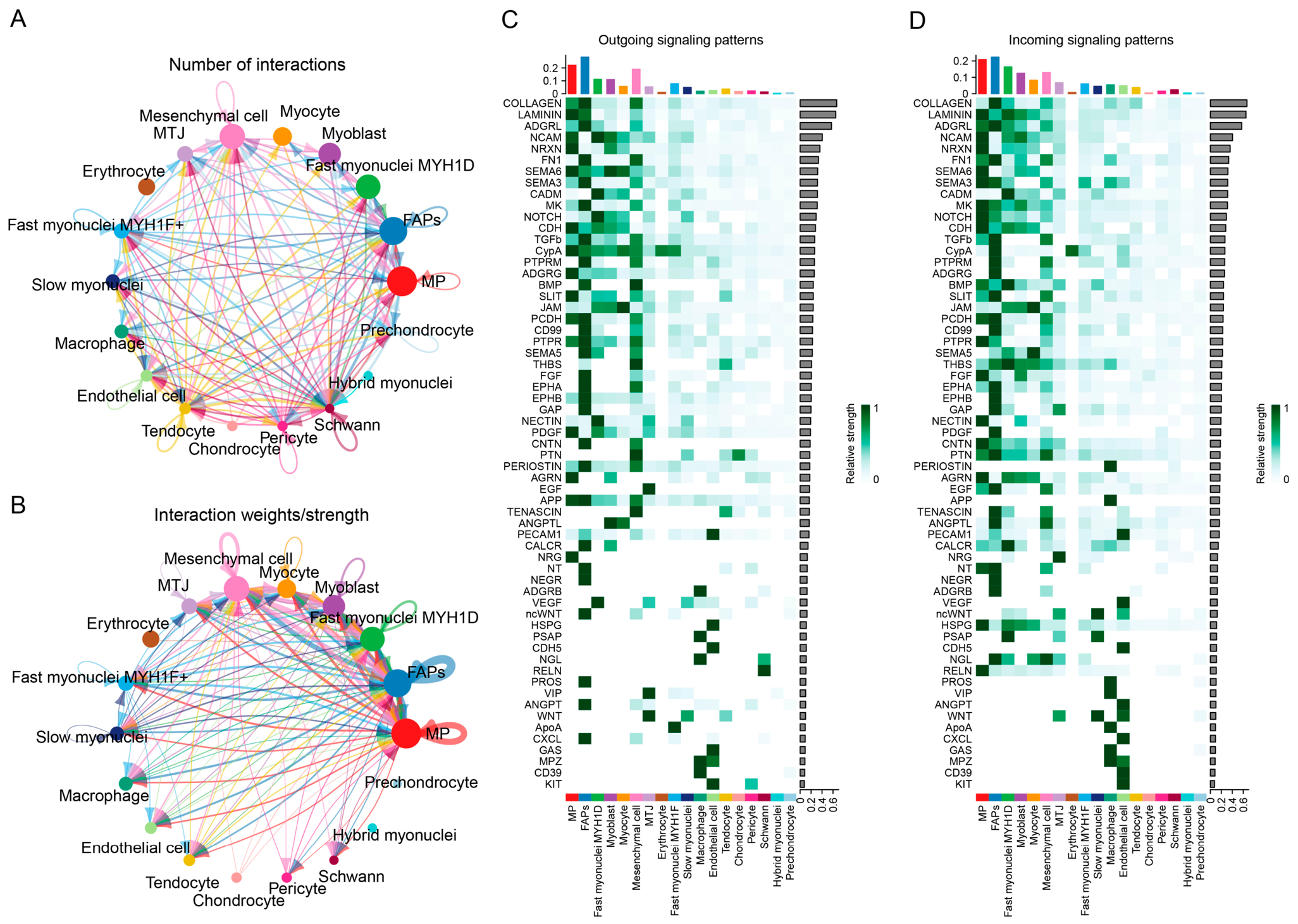
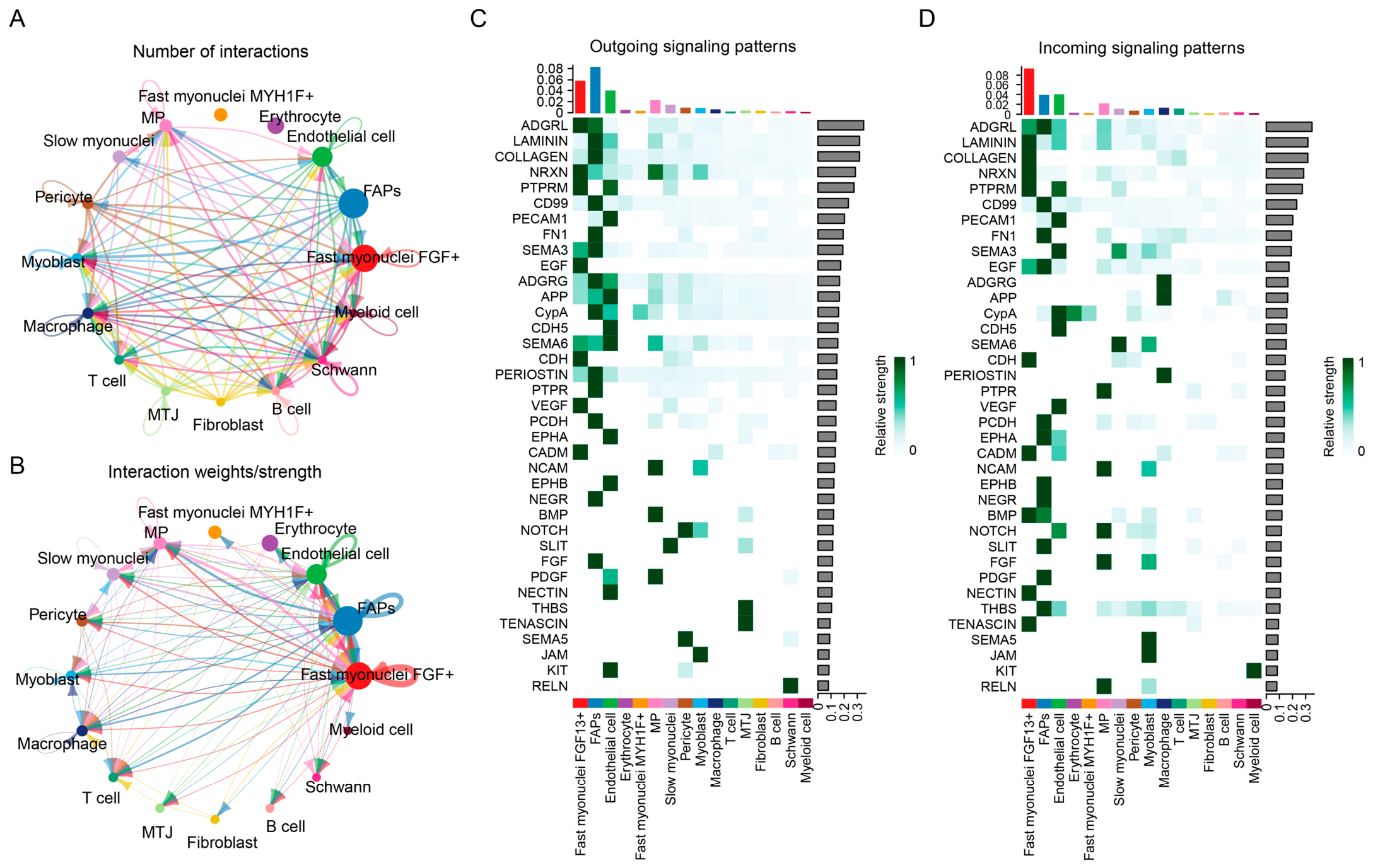
At E12, the communication network reached maximum complexity with 11,675 L-R pairs across 61 signaling pathways, reflecting the extensive cellular interactions required for secondary myofiber formation. MPs became the largest cell population (14.5%), followed by FAPs (11.0%) and multiple myofiber types (MYH1D+, MYH1F+, MYH7B+). The signaling repertoire was dominated by COLLAGEN, LAMININ, ADGRL, FN1, SEMA3, and THBS pathways (Table S3). A fundamental shift in communication architecture was observed: FAPs emerged as the dominant signaling hub, surpassing mesenchymal cells, and engaged in robust bidirectional signaling with MPs, myoblasts, and myocytes (Figure 4A,B). This mesenchymal-to-FAP hub transition reflects the developmental maturation of the stromal compartment, as mesenchymal progenitors differentiate into specialized FAPs that provide tailored paracrine support for the expanding myogenic populations.
Dissection of outgoing and incoming signaling patterns revealed functionally distinct communication strategies across the stromal and myogenic compartments (Figure 4C,D). Stromal populations specialized in ECM deposition and paracrine regulation: FAPs predominantly broadcasted signals via COLLAGEN, LAMININ, FN1, and SEMA3 pathways, while integrating niche cues through ADGRG, PDGF, and SLIT. Mesenchymal cells complemented this by driving TGFβ and BMP signaling alongside ECM production, and responding to PTN, TENASCIN, and JAM pathways. MPs adopted a guidance-oriented strategy, utilizing NCAM, SLIT, SEMA6, and NRXN for outgoing communication, while their incoming profile was heavily reliant on LAMININ, ADGRL, MK, and NOTCH pathways critical for balancing progenitor maintenance and activation. Among committed myogenic cells, myoblasts communicated primarily via NCAM, NRXN, and ANGPTL, whereas myocytes switched toward SEMA6 and CADM, reflecting the transition from migratory exploration to fusion-competent adhesion. Corroborating their hub status, fast MYH1D+ myonuclei exhibited a broad repertoire (outgoing: NCAM, CADM, NOTCH, PDGF; incoming: LAMININ, BMP, PSAP), whereas MYH1F+ and slow myonuclei remained communicatively restrained at this stage.
To resolve the molecular determinants of this extensive stromal–myogenic crosstalk, we mapped the specific L-R pairs mediating these axes. Myogenic populations directed signals to mesenchymal cells predominantly via the SLIT2-ROBO1/2 axis and the TGFB2-(ACVR1+TGFBR1) pair, implicating SLIT-mediated migratory guidance and TGFβ-driven paracrine modulation of the stromal niche. MPs additionally deployed the homophilic PCDHGC3-PCDHGC3 interaction to engage mesenchymal cells. Signaling from myogenic cells to FAPs was largely ECM- and adhesion-mediated, driven by TENM3-ADGRL2/ADGRL3 and collagens (COL1A1/COL4A1/COL4A2) engaging the (ITGA9+ITGB1) integrin complex (Figures S1 and S2).
Conversely, incoming signals from the stroma to the myogenic compartment highlighted a profound reliance on ECM sensing and mechanotransduction. Myogenic cells received cues from mesenchymal cells via FN1 binding to (ITGAV+ITGB1)/(ITGA4+ITGB1), COL1A1/COL1A2 interacting with CD44, and THBS2 engaging CD47 (Figure S3). Notably, the COL1A1/COL1A2-(ITGA9+ITGB1) axis was specifically enriched in communication to MYH1D+ fast myonuclei. Finally, FAPs signaled to myogenic populations through TENM4-ADGRL2/ADGRL3 and, critically, via LAMA4/LAMB1 engaging (ITGA6+ITGB1) and DAG1 (Figure S4). The LAMA4-DAG1 interaction is of particular developmental significance, as it points to the early establishment of the dystrophin–glycoprotein complex (DGC)—an essential structural linkage between the basal lamina and the myofiber cytoskeleton that is likely important for sarcolemma stability during rapid muscle growth. Collectively, this high-resolution L-R mapping underscores that E12 is defined by a multi-faceted, ECM-integrated communication network, bridging stromal production of the structural matrix with myogenic mechanosensing and early sarcolemma assembly.

3.2.4. Communication Networks on Embryonic Day 18 (E18): Late Embryonic Maturation

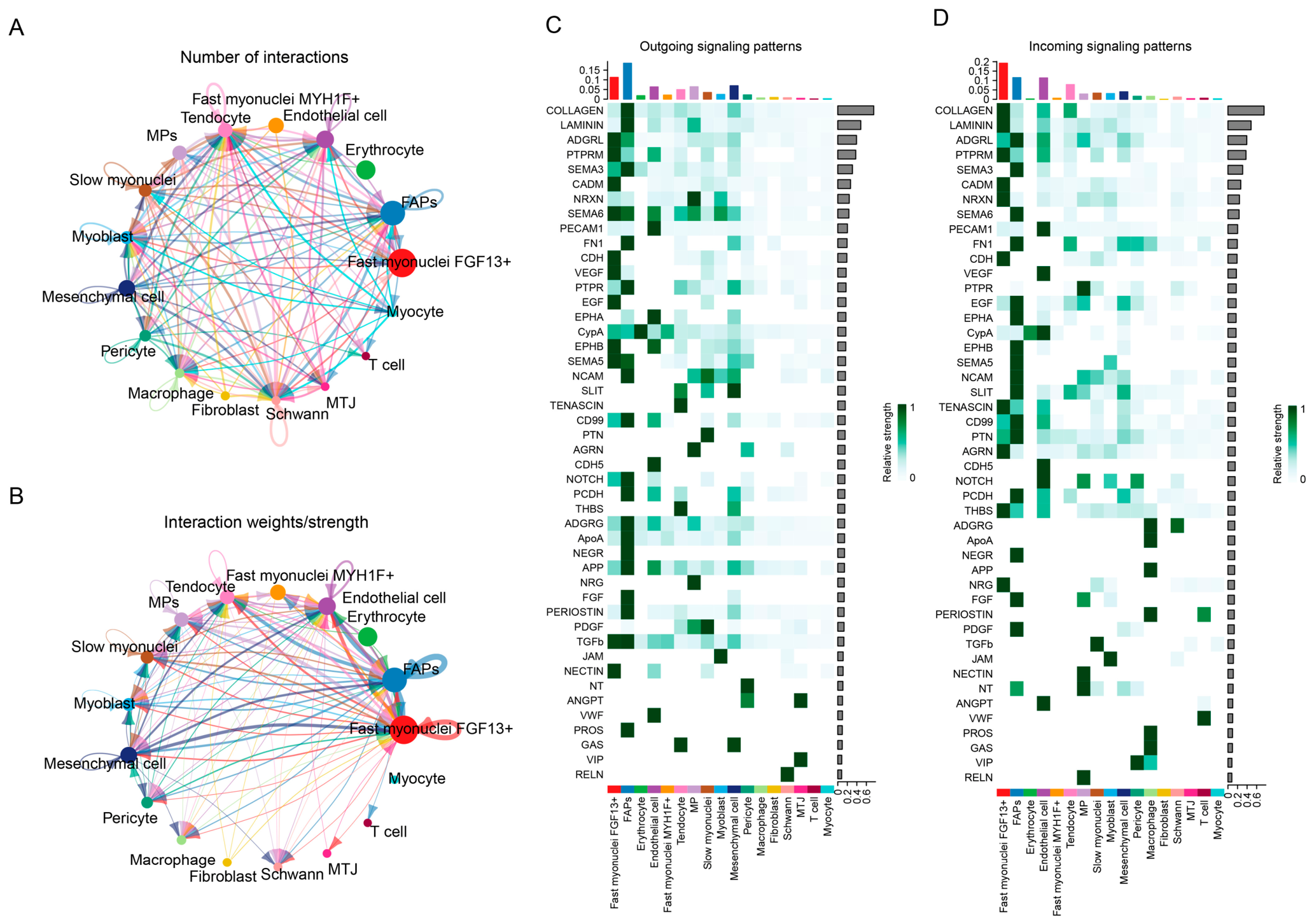
At the late embryonic stage (E18), CellChat analysis identified a refined intercellular communication network comprising 4498 significant ligand–receptor interactions across 17 cell populations and 46 signaling pathways (Table S4). Network topology revealed a transition toward a terminal maturation architecture: FAPs and mesenchymal cells consolidated their roles as the principal signaling exporters, while fast myonuclei (FGF13+ and MYH1F+) collectively constituted the largest aggregate sink for incoming signals (Figure 5A,B). Notably, FAPs exhibited the strongest bidirectional interaction specifically with slow myonuclei, consistent with the ECM coupling and metabolic priming required for slow-twitch fiber identity maintenance. Fast FGF13+ myonuclei maintained robust communication with both FAPs and endothelial cells, reflecting ongoing coordination between fast myofiber maturation and stromal-vascular support. Specialized cell types—including Schwann cells, myotendinous junction (MTJ) nuclei, and T cells—exhibited restricted connectivity, reflecting a developmental shift from broad paracrine signaling toward highly localized, juxtacrine communication essential for terminal structural integration such as neuromuscular junction assembly and myotendinous attachment formation.
Dissection of pathway-level signaling revealed a striking functional asymmetry between outgoing and incoming myogenic communication. The outgoing myogenic profile was distinguished by the emergence of neural and synaptic pathways, including AGRN, NRG, and NRXN, alongside sustained adhesion (CADM, NECTIN, CDH) and trophic signaling (VEGF, EGF, PDGF). This neural-enriched outgoing signature is consistent with the active recruitment of motor neurons and initiation of a postsynaptic apparatus assembly characteristic of late embryogenesis (Figure 5C). Conversely, the incoming myogenic profile was overwhelmingly dominated by ECM-sensing and mechanotransduction pathways (COLLAGEN, LAMININ, FN1, TENASCIN), supplemented by guidance cues (SEMA3, SLIT, EPHA/EPHB) and neural-adhesion modules (NEGR, NGL, PCDH) (Figure 5D). This asymmetry underscores a developmental state in which maturing myofibers appeared to broadcast neural-recruiting and vascular signals while becoming increasingly dependent on the stroma for structural scaffolding and positional information.
At the molecular level, FAPs communicated with fast FGF13+ myonuclei through a comprehensive ECM repertoire, including extensive collagen-mediated signaling via COL1A1/COL1A2, COL4A1/COL4A2, and notably COL6A1/COL6A2/COL6A3 engaging the (ITGA9+ITGB1) integrin complex. The prominence of COL6—a microfibrillar collagen predominantly synthesized by FAPs—highlights its important role in bridging the myofiber basal lamina with the interstitial matrix during late embryonic growth (Figure S5A). Laminin-mediated interactions demonstrated increased receptor complexity, with FAPs and endothelial cells communicating via LAMA4, LAMB1, and LAMC1 engaging both (ITGA9+ITGB1) and DAG1. The concurrent utilization of multiple laminin chains binding to DAG1 suggests the terminal assembly and stabilization of the dystrophin–glycoprotein complex, a potentially important step for establishing sarcolemma integrity prior to hatching. This maturation axis was further reinforced by non-ECM mechanisms including PTPRM-PTPRM homophilic interactions and the TENM4-ADGRL2 pair, indicating a multi-modal signaling network coordinating myofiber adhesion, basal lamina stratification, and membrane specialization during the final stages of embryonic myogenesis (Figure S5B).

3.2.5. Communication Networks on Post-Hatch Day 30 (P30): Homeostatic State

At P30, the skeletal muscle intercellular communication network had transitioned to a low-intensity, homeostatic state. CellChat analysis identified 2183 significant ligand–receptor pairs across 16 cell populations, encompassing 37 signaling pathways (Table S5). Overall interaction weights were substantially reduced compared to embryonic stages, reflecting a functional shift from active developmental crosstalk to the maintenance of a mature, stable tissue architecture. In this postnatal context, endothelial cells and FAPs emerged as the dominant communication hubs, replacing the myofiber-centric signaling pattern observed at E18. Endothelial cells exhibited intense homotypic signaling via PECAM1-PECAM1 and CDH5-CDH5 interactions, underscoring their role in sustaining a quiescent vasculature. FAPs maintained broad but low-intensity communication with multiple cell types (Figure 6A,B). The strongest directional signals occurred from endothelial cells to FAPs (e.g., via PECAM1 and CD99), and from FAPs to endothelial cells, MPs, and other stromal populations, primarily through the FN1, COLLAGEN, and LAMININ pathways (Figure 6C,D). This highlights their ongoing role in physiological ECM turnover and trophic support.
While myogenic progenitors and maturing myofibers were central signaling hubs during embryogenesis, their communication roles diminished markedly at P30. Instead of acting as primary signal senders, mature FGF13+ myonuclei now functioned predominantly as recipients of homeostatic and structural cues. The most prominent signaling axis was the delivery of ECM components from FAPs, endothelial cells, and pericytes to FGF13+ myonuclei. Specifically, this sustained communication was mediated by collagen (COL1A1/COL1A2/COL4A1/COL4A2/COL6A1/COL6A2/COL6A3-ITGA9_ITGB1) and laminin (LAMA4-ITGA9_ITGB1 and LAMA4-DAG1) interactions (Figure S6). These convergent ECM inputs underscore the important role of the myofiber microenvironment in maintaining sarcolemmal integrity and facilitating lateral force transmission.
In summary, intercellular communication hubs transitioned dynamically across stages. Mesenchymal cells dominated early signaling (E4–E6), which then shifted to fibro-adipogenic progenitors (FAPs) during peak myogenesis (E12–E18), characterized by extensive ECM signaling. The network culminated in a homeostatic state at P30, centered on endothelial cells and FAPs.

3.3. Dynamic Changes in Intercellular Communication During Skeletal Muscle Development

Having established the stage-specific communication architectures at each developmental time point, we next sought to systematically characterize the dynamic transitions in intercellular communication between consecutive stages. Using the CellChat liftCellChat framework for cross-stage comparative analysis, we quantified changes in interaction number, signaling pathway information flow, and cell type-specific communication roles across four developmental transitions: E4 to E6, E6 to E12, E12 to E18, and E18 to P30. This analysis revealed a biphasic developmental trajectory, an ascending phase of rapidly escalating communication complexity (E4 to E12) followed by a descending phase of progressive network consolidation (E12 to P30), with each transition exhibiting distinct pathway-level signatures that reflect the shifting biological priorities of the developing muscle.

3.3.1. Transition from E4 to E6: Emergence of Myogenic Communication Networks

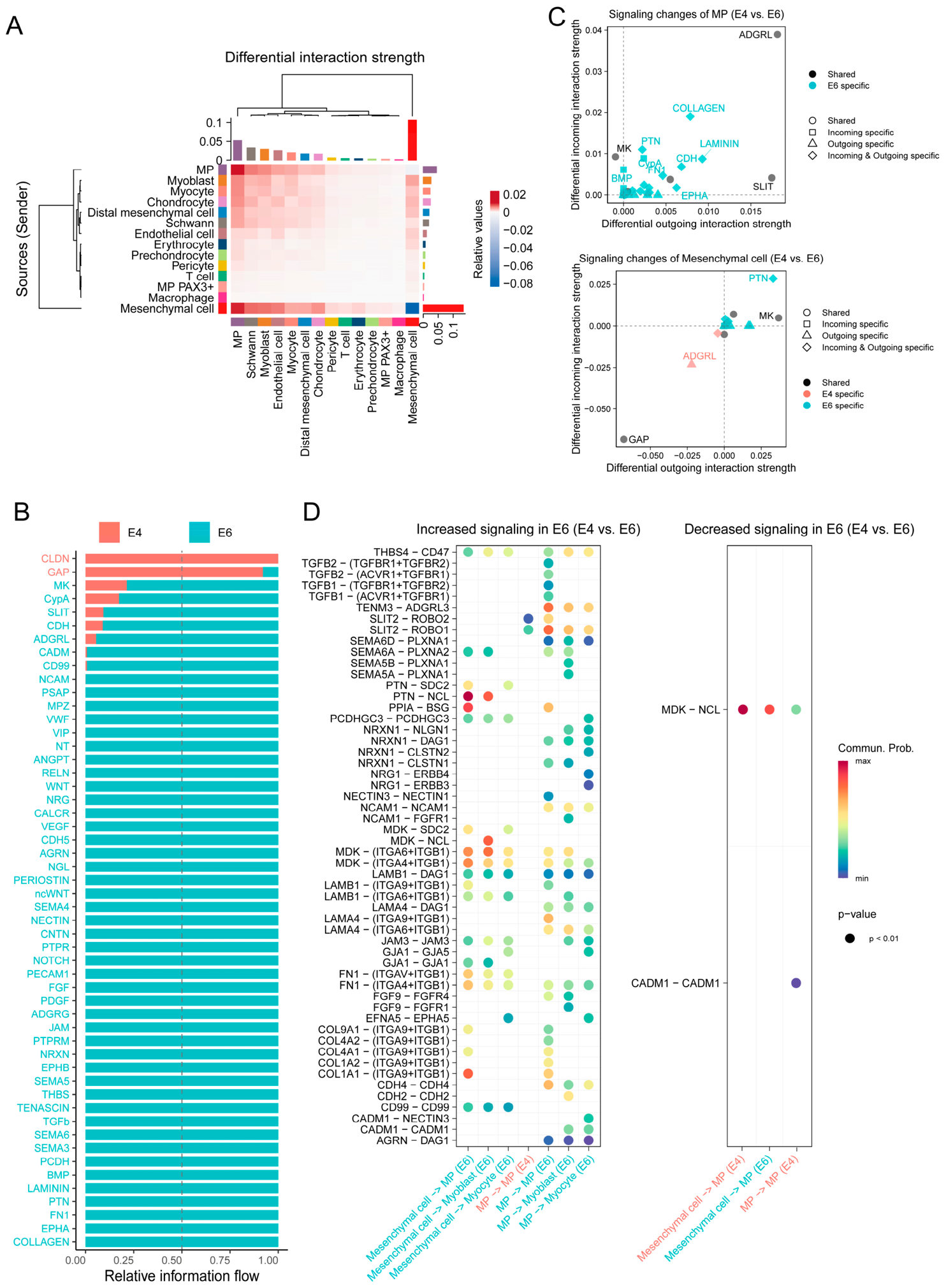
Comparative analysis between E4 and E6 revealed the most dramatic changes in intercellular communication during chicken skeletal muscle development, reflecting the transition from early myogenic specification to primary myofiber formation (Figure 7A). The total number of ligand–receptor pairs increased 122-fold from 51 at E4 to 6237 at E6, while the number of active signaling pathways more than doubled from 10 to 51. This exponential expansion in communication complexity coincided with the emergence of multiple myogenic lineages and the initiation of primary myofiber formation.
We then compared the information flow for each signaling pathway between E4 and E6 time points. We found that CLDN and GAP signaling pathways mediated the information flow of intercellular communication at the E4 stage. In contrast, 43 signaling pathways, including COLLAGEN, EPHA, FN1, PTN, LAMININ, and BMP, were activated at E6 as compared to E4. Furthermore, CD99, CADM, ADGRL, CDH, SLIT, CypA, and MK signaling pathways showed increased information flow at E6 as compared to E4 (Figure 7B).
Given the importance of mesenchymal cells and MPs in intercellular communication of skeletal muscle at E6, we focused on identifying key pathways that mediate communications between mesenchymal cells, MPs, and the myogenic cell lineage. From E4 to E6, PTN and MK pathways exhibited the strongest signaling changes in mesenchymal cells, while ADGRL, COLLAGEN, PTN, CDH, and LAMININ demonstrated significantly increased signaling in MPs (Figure 7C). Specifically, from E4 to E6, information flow transmitted from mesenchymal cells to MPs via the PTN-NCL and PPIA-BSG ligand–receptor pairs in the PTN signaling pathway increased significantly, as did information flow from mesenchymal cells to myoblasts via the PTN-NCL pair. Additionally, the MDK-(ITGA6+ITGB1) and MDK-(ITGA4+ITGB1) ligand–receptor pairs in the MK signaling pathway mediated a significant increase in the information flow transmitted to MPs, myoblasts, and myocytes from mesenchymal cells. The TENM3-ADGRL3 ligand–receptor pair in the ADGRL signaling pathway, CDH4-CDH4 ligand–receptor pair in the CDH signaling pathway, and LAMA4-(ITGA6+ITGB1) ligand–receptor pairs in the MK signaling pathway mediated the significant increase in information flow transmitted to MPs, myoblasts, and myocytes from MPs (Figure 7D).

3.3.2. Transition from E6 to E12: Peak Communication Complexity During Secondary Myogenesis

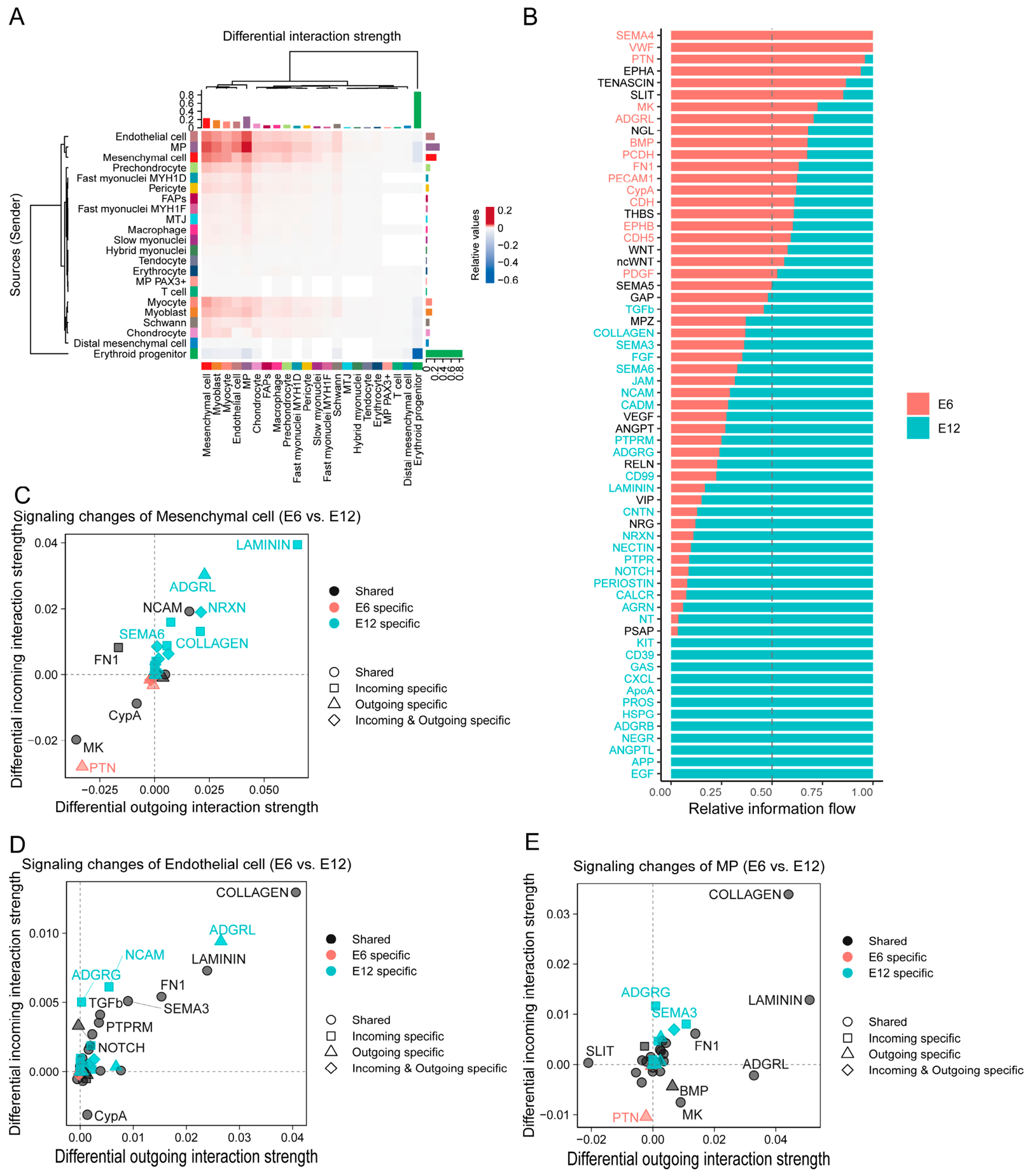
From E6 to E12, as skeletal muscle entered the secondary myogenesis phase, the intercellular communication network underwent its most dramatic expansion during development. The total number of significant ligand–receptor pairs surged from 6237 to 11,675, an 87% increase, while the number of active signaling pathways rose from 51 to 61. Several pathways, including SEMA3, EPHA, and EPHB, were activated for the first time at this stage. This quantitative leap was accompanied by a fundamental reorganization of network topology: FAPs emerged as dominant hubs alongside mesenchymal cells, MPs, and the newly specified MYH1D+ fast myonuclei, whereas pathways that were highly active at E6 showed marked attenuation (Figure 8A).
Information flow comparison revealed a significant decrease in pathways mediating early developmental signaling (e.g., SEMA4, VWF, PTN, MK, ADGRL, and CDH). Conversely, information flow through pathways associated with myogenic progression—such as NT, AGRN, CALCR, PERIOSTIN, NOTCH, PTPR, and NECTIN—was increased at E12. Additionally, twelve signaling pathways (including EGF, APP, ANGPTL, NEGR, ADGRB, HSPG, PROS, ApoA, CXCL, GAS, CD39, and KIT) became newly active at this stage (Figure 8B). To specifically delineate the communication dynamics among myogenic subpopulations and their niche, we analyzed the crosstalk between myogenic cells and endothelial or mesenchymal cells. A notable shift was observed: while the early PTN and MK pathways showed a marked reduction, the LAMININ, ADGRL, NRXN, NCAM, and COLLAGEN pathways exhibited significant alterations in mesenchymal cells (Figure 8C). Furthermore, information flow through the COLLAGEN, LAMININ, FN1, ADGRL, and SEMA3 pathways was significantly enhanced in both endothelial cells and MPs (Figure 8D,E). The significant co-enrichment of the COLLAGEN, LAMININ, and ADGRL pathways across mesenchymal cells, endothelial cells, and MPs underscores their essential role in facilitating intercellular communication to drive secondary myogenesis.
At the molecular level, specific ligand–receptor pairs mediated robust stromal-to-myogenic crosstalk to support the diverse myogenic lineages. For the earlier myogenic populations (MPs, myoblasts, and myocytes), major signaling axes included the LAMA4/LAMB1-ITGA6/ITGA9/ITGB1 pairs in the LAMININ pathway and the COL1A1/COL1A2/COL4A1-ITGA9/ITGB1 pairs in the COLLAGEN pathway, originating from mesenchymal cells, MPs, and endothelial cells. Concurrently, the ADGRL pathway was highly active, with TENM3-ADGRL2/3 and TENM4-ADGRL2/3 pairs mediating significant communication from mesenchymal cells/MPs and MPs/endothelial cells, respectively, to MPs, myoblasts, and myocytes (Figure S7A). As newly specified myonuclei emerged, they received targeted communication: COL1A1/COL1A2/COL4A1/COL4A2 engaging ITGA11/ITGB1 (COLLAGEN pathway) from mesenchymal cells, MPs, and endothelial cells, along with TENM4-ADGRL2/3 (ADGRL pathway) from MPs and endothelial cells, were identified as key signals directed specifically to the fast MYH1D+ myonuclei. Notably, the TENM4-ADGRL2/3 axis was broadly active, mediating crucial signals from MPs and endothelial cells to all myonuclear populations (Figure S7B).

3.3.3. Transition from E12 to E18: Developmental Pathway Shutdown and Immune Signaling Emergence

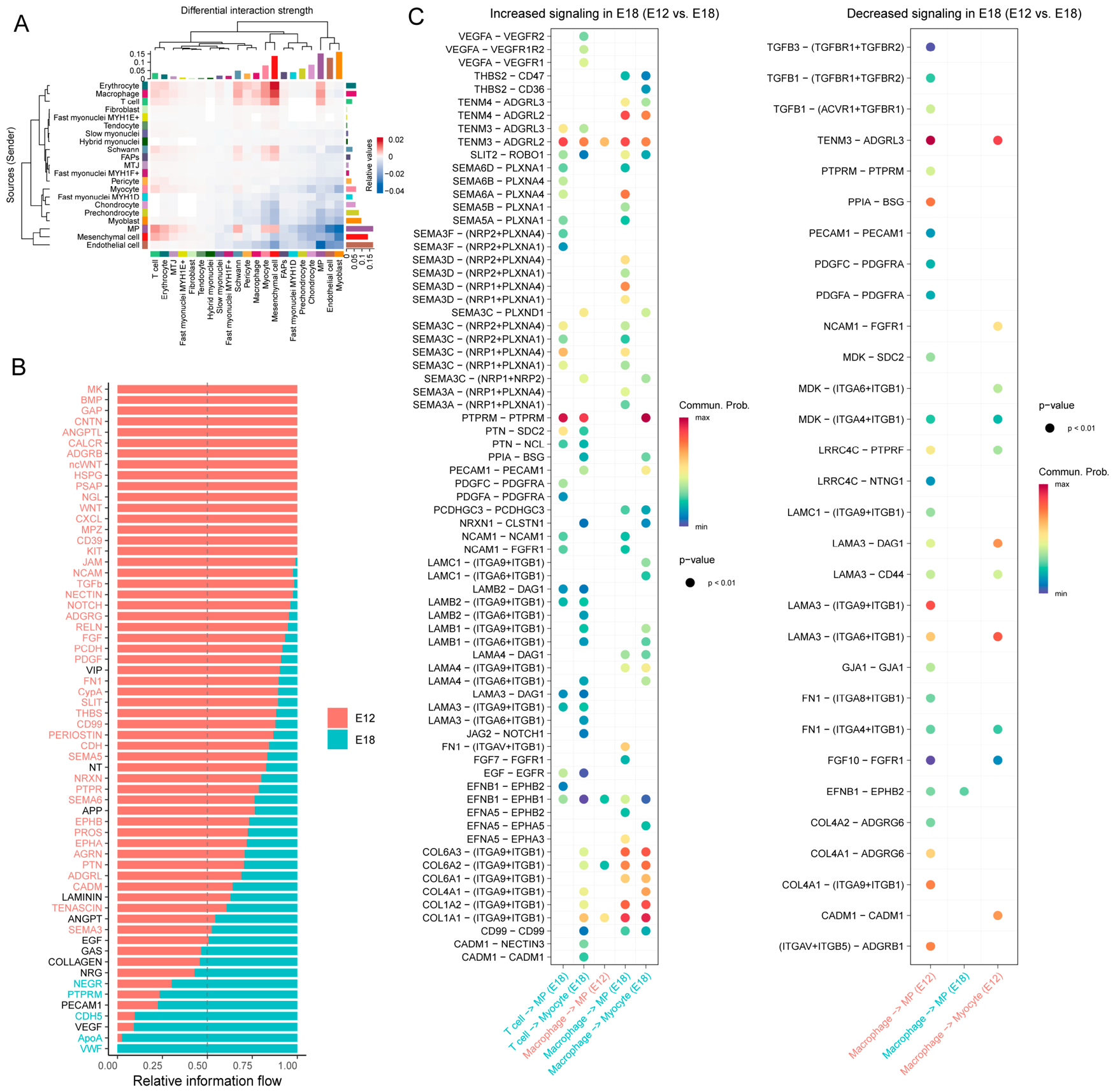
From E12 to E18, as skeletal muscle further developed and muscle fibers gradually matured, the proportions of skeletal muscle progenitors and myoblasts decreased. Consequently, overall interaction strength and the number of connections between myogenic populations and most other cell types declined. Interestingly, this general attenuation was accompanied by a specific increase in interaction strength between myogenic populations (MPs and myocytes) and immune cells (macrophages and T cells) (Figure 5A,B and Figure 9A). Concurrently, network topology reorganized, with FAPs, endothelial cells, and FGF13+ fast myonuclei emerging as the dominant communication hubs at E18. Information flow analysis revealed that the majority of pathways highly enriched at E12 (e.g., CNTN, GAP, BMP, MK, ADGRL, and ADGRB) mediated significantly decreased signaling by E18. In contrast, pathways including NEGR, PTPRM, CDH5, ApoA, and VWF showed significantly increased information flow, implicating their specific roles in regulating late embryonic skeletal muscle maturation. Meanwhile, ten pathways—such as LAMININ, ANGPT, EGF, GAS, COLLAGEN, and NRG—maintained consistent information flow across both stages, underscoring their sustained importance in muscle development (Figure 9B).
To resolve the molecular determinants of the enhanced myogenic–immune crosstalk, we identified key ligand–receptor pairs mediating signaling to myogenic subpopulations. Specifically, macrophages communicated robustly with MPs and myocytes via collagen-mediated interactions, utilizing the COL1A1/COL1A2/COL6A2/COL6A3 ligands engaging the ITGA9/ITGB1 receptor complex. Furthermore, the PTPRM-PTPRM homophilic pair was identified as a significant mediator of communication from both macrophages and T cells to MPs and myocytes, highlighting a localized immune–myogenic dialog during late embryogenesis (Figure 9C).

3.3.4. Transition from E18 to P30: Establishment of Mature Homeostatic Networks

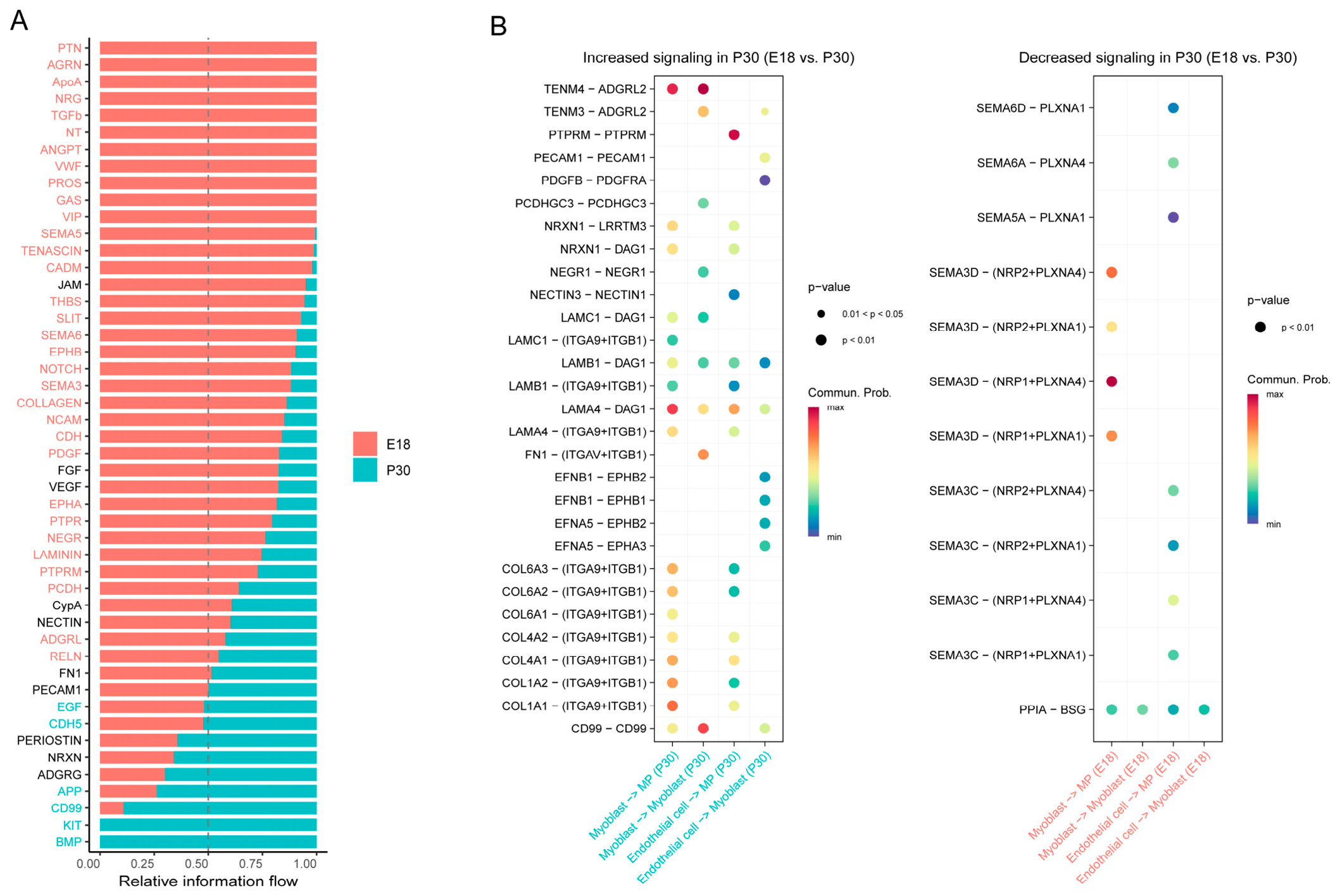
Skeletal muscle development comprises two primary phases: embryonic myoblast proliferation and postnatal myotube hypertrophy. In poultry, it is well established that muscle fiber number is determined during embryonic development and that post-hatch growth is dependent on hypertrophy of the existing fibers. From E18 to P30, chicken skeletal muscle thus transitions from late embryonic maturation to the post-hatch hypertrophic phase. CellChat analysis indicated a consistent decrease in both interaction number and strength among most cell populations at P30, reflecting a broad contraction of the developmental communication network (Figure 1A). Compared with E18, 32 signaling pathways (including VIP, GAS, PROS, VWF, ANGPT, NT, TGFb, NRG, ApoA, AGRN, and PTN) were silenced or significantly attenuated at P30. Conversely, only six pathways (EGF, CDH5, BMP, KIT, CD99, and APP) exhibited increased information flow, highlighting their specific importance in regulating skeletal muscle maturation and hypertrophy (Figure 10A).
Despite this overall network attenuation, intercellular communication analysis revealed a striking exception: interaction strength between endothelial cells and myogenic subpopulations (MPs and myoblasts), as well as between MPs and myoblasts themselves, was significantly enhanced. This suggests that endothelial cells may play a pivotal role in post-hatch myofiber hypertrophy by engaging in targeted crosstalk with myogenic lineages (Figure S8). At the molecular level, endothelial cells appeared to broadcast structural and adhesive cues to MPs, primarily through collagen-mediated interactions (COL1A1/COL1A2/COL4A1/COL4A2 engaging ITGA9+ITGB1), laminin signaling (LAMA4 binding to DAG1 and ITGA9+ITGB1), and PTPRM-PTPRM homophilic interactions. Similarly, endothelial cells communicated with myoblasts via the EPHA signaling axis (EFNB1-EPHB1/2 and EFNA5-EPHB2/3), the LAMA4-DAG1 laminin pair, and PECAM1 homophilic adhesion (Figure 10B). Collectively, these specific ECM-sensing and juxtacrine pathways underscore the important role of the vascular niche in providing structural support and pro-hypertrophic signals to myogenic cells during postnatal skeletal muscle growth.
In summary, comparative analysis across consecutive developmental stages revealed a biphasic trajectory of intercellular communication, with each transition marked by distinct pathway-level reorganization. The E4-to-E6 transition was characterized by the most dramatic expansion, with a 122-fold increase in ligand–receptor pairs and activation of 43 new signaling pathways (e.g., COLLAGEN, PTN, LAMININ, BMP), alongside enhanced MK and PTN signaling from mesenchymal cells to emerging myogenic lineages. During E6-to-E12, the network reached peak complexity, with FAPs emerging as dominant signaling hubs and ECM-integrated pathways (COLLAGEN, LAMININ, FN1, ADGRL) becoming co-enriched across mesenchymal cells, endothelial cells, and MPs. The E12-to-E18 transition was marked by the shutdown of multiple developmental pathways (e.g., CNTN, GAP, BMP, MK, ADGRL), the emergence of immune–myogenic crosstalk mediated by collagen and PTPRM signaling, and the persistence of key structural pathways (LAM-ININ, COLLAGEN, NRG). Finally, the E18-to-P30 transition involved broad network contraction with 32 pathways silenced or attenuated, yet featured selectively enhanced endothelial-to-myogenic communication via collagen, laminin, and EPHA signaling axes, highlighting the vascular niche as a critical signaling hub during post-hatch hypertrophic growth.

4. Discussion

This study presents the first comprehensive analysis of intercellular communication networks during the development of chicken skeletal muscle. A key finding is the identification of a biphasic developmental trajectory, initially characterized by rapid network expansion from embryonic day 4 to day 12, followed by progressive consolidation from embryonic day 12 to post-hatch day 30. The peak in communication complexity on embryonic day 12 coincides with the onset of secondary myogenesis, a critical period necessitating precise spatiotemporal coordination of myoblast proliferation, alignment, and fusion [30]. Significantly, the 122-fold increase in ligand–receptor pairs from embryonic day 4 to day 6 signifies a developmental inflection point, indicating the transition of the muscle anlage from a simple, mesenchymal-dominated structure to a complex, multicellular histogenetic environment. Despite variations in specific signaling pathways, this biphasic pattern of increasing complexity followed by consolidation appears to be a conserved feature of vertebrate organogenesis [31], evolving the shifting mechanical and paracrine requirements as tissues transition from morphogenesis to terminal maturation [32].
A significant transformation observed in our communication network is the shift in the primary stromal signaling hub from mesenchymal cells (E4–E6) to fibro-adipogenic progenitors (FAPs, E12–E18). Initially, mesenchymal cells were responsible for facilitating survival and migratory signals, such as MK, SLIT, and NCAM. However, as FAPs became the hub during secondary myogenesis [33,34], the signaling repertoire shifted towards ECM deposition and mechanotransduction. This shift involved molecules such as COLLAGEN, LAMININ, and FN1, as well as the modulation of adhesion through ADGRL. Our findings highlight the evolving physical demands of developing muscle tissue: while early commitment is predominantly dependent on soluble factors [35], the formation of secondary myofibers necessitates a robust structural scaffold, mediated by integrin signaling [36].
The identification of the LAMA4-DAG1 interaction at E18 holds significant implications, as it points to the potential involvement of FAPs in the early assembly of the dystrophin–glycoprotein complex (DGC). This assembly is crucial for maintaining the structural integrity of muscle cells by linking the intracellular cytoskeleton to the extracellular matrix [37,38,39]. Furthermore, the concurrent prominence of Collagen VI (COL6) at this developmental stage further indicates a conserved role for ECM derived from FAPs in the organization of the satellite cell niche during late embryogenesis [40,41]. Given that the composition of intramuscular ECM directly affects the texture and water-holding capacity of poultry meat [42,43], elucidating the dynamic remodeling of the matrix by FAPs offers a mechanistic framework for enhancing meat quality.
During the early stages of chicken myogenesis (embryonic days 4 to 6), the process is characterized by transient yet highly active signaling pathways. The SLIT-ROBO and PTN-MK pathways display early peaks in activity followed by progressive downregulation, aligning with their conserved roles in facilitating myoblast migration [44] and the initial expansion of the progenitor pool [45,46]. NOTCH signaling demonstrates a temporal pattern consistent with its established function in balancing progenitor maintenance and the timing of differentiation [19,47], showing high activity during primary myogenesis (E6–E12) but diminishing as muscle fibers mature. The appearance of specific fibroblast growth factor (FGF) ligands, particularly FGF7, which mediates FAP and myoblast interactions at E12, indicates that stromal-derived trophic support is dynamically adapted to meet the specific requirements of secondary myogenesis [48]. This stage-specific deployment of growth factors likely ensures the adequate expansion of progenitor pools prior to the terminal differentiation associated with the secondary wave of myogenesis [49].
The transition from E12 to E18 represents a significant functional reorganization of the communication network, characterized by a shift from broad developmental signaling to highly localized, terminal maturation cues. The emergence of neural and synaptic pathways, including AGRN, NRG, and NRXN, aligns precisely with the established timeline of motor innervation in chickens [50]. Research indicates that Schwann cells serve as crucial signaling intermediaries during this phase [51], promoting the assembly of the neuromuscular junction (NMJ) through the localized release of neuregulin and agrin [52], as developmental pathways diminish. This transition highlights the concept that late-stage myofiber maturation and fiber-type specification are significantly reliant on neural activity [53].
Concurrently with this neural integration, the crosstalk between the immune and myogenic systems intensified unexpectedly. Macrophages and T cells communicated with myogenic populations through collagen-mediated interactions (COL-ITGA9) and PTPRM homophilic adhesion. In mammalian systems, immune cells are primarily studied in the context of injury and regeneration [27,28]. However, their presence during late embryogenesis in chickens suggests a conserved role in developmental immune surveillance, apoptotic cell clearance, and ECM remodeling prior to hatching [54], potentially facilitated by cytokines such as macrophage migration inhibitory factor (MIF).
In poultry, post-hatch skeletal muscle growth is exclusively dependent on myofiber hypertrophy rather than hyperplasia [42]. At P30, the overall communication network was generally reduced, whereas endothelial-to-myogenic signaling was significantly enhanced. We observed that endothelial cells transmitted structural cues (such as COLLAGEN and LAMININ) and juxtacrine signals (including EPHA and PECAM1) specifically to MPs and myoblasts. These findings indicate that the vascular niche functions not merely as a passive conduit for nutrients, but as an active signaling hub. This hub provides pro-hypertrophic and structural maintenance signals essential for sustaining rapid muscle growth post-hatch. The concurrent enrichment of VEGF [55] and GAS6-AXL [56] pathways at P30 further corroborates a model in which angiogenesis and the quiescence/homeostasis of satellite cells are intricately linked to the maintenance of muscle mass [57]. Thus, further investigation of the endothelial–myogenic interface may provide valuable insights into enhancing muscle growth efficiency in broiler production. From an evolutionary perspective, several communication pathways identified in this study appear to be conserved between avian and mammalian systems. The transition from mesenchymal-to-FAP signaling dominance during development parallels observations in mouse muscle regeneration, where FAPs serve as essential niche cells supporting myogenesis [33,34]. Similarly, the SLIT-ROBO and PTN-MK signaling axes identified during early chicken myogenesis have established roles in mammalian myoblast migration and progenitor expansion [44,45,46], suggesting deep evolutionary conservation of these regulatory modules. However, avian-specific features are also evident: the relatively early emergence of immune–myogenic crosstalk during late embryogenesis (E18) contrasts with the injury-regeneration paradigm in mammals, where immune involvement is primarily triggered by tissue damage [27,28], suggesting a developmental immune surveillance role unique to the rapid embryonic growth in birds. Additionally, the exclusive reliance on hypertrophy rather than hyperplasia for post-hatch muscle growth in poultry [42] may underlie the distinct homeostatic communication architecture observed at P30, where endothelial–myogenic signaling predominates over the myogenic progenitor-centric networks seen in adult mammalian muscle.
The present study is subject to several limitations. First, CellChat predicts potential cell–cell interactions based on transcriptomic profiles; therefore, the predicted networks should be interpreted as hypothesis-generating frameworks. Functional validation through experiments will be necessary to confirm the physiological relevance of key signaling axes identified in this study. Second, the reliance on mammalian-derived ligand–receptor databases may not fully capture avian-specific signaling events. Although we utilized ortholog mapping to bridge this gap, some chicken-specific ligand–receptor pairs may have been missed, highlighting the need for expanded, species-specific interaction databases in future poultry research. Third, as with all single-cell and single-nucleus dissociation protocols, the inherent loss of spatial context limits our ability to map the precise physical niches of signaling hubs. Future integration with spatial transcriptomics will be essential to validate the spatial proximity of interacting cell types, particularly at the endothelial–myogenic interface during post-hatch hypertrophy. Last, the inherent heterogeneity of the integrated datasets—arising from the biological necessity of using scRNA-seq for early embryonic limb buds (E4) and snRNA-seq for later stages containing large multinucleated myotubes, as well as variations in sampled muscle tissues (whole leg at E6 vs. peroneus longus at later stages)—introduces potential technical confounders. While we rigorously mitigated these effects using Harmony-based batch correction and focused on CellChat’s normalized information flow to account for varying cellular compositions, some subtle variations cannot be entirely excluded. Future studies employing uniform tissue sampling, consistent sequencing protocols across all developmental stages, and increased biological replication will be critical to further validate and refine the dynamic communication networks identified herein.

5. Conclusions

In summary, this study presents the first comprehensive atlas of intercellular communication networks underlying chicken skeletal muscle development, revealing a highly dynamic and biphasic trajectory. The signaling architecture initially relied on mesenchymal-derived migratory and survival cues, but subsequently underwent a transition where FAPs drove extensive extracellular matrix remodeling during secondary myogenesis. As development progressed into late embryogenesis, the regulatory inputs shifted markedly from broad developmental signaling to localized terminal maturation cues, with neural-synaptic pathways emerging to facilitate neuromuscular junction assembly and immune-mediated dialogs participating in tissue remodeling. Ultimately, the communication network consolidated into a post-hatch homeostatic state, where enhanced endothelial–myogenic crosstalk emerged as a potential contributor to the maintenance of myofiber hypertrophy. By generating this predictive signaling landscape, the current work provides a framework for hypothesis-driven investigation of avian myogenesis, with the understanding that the predicted interactions require experimental validation to confirm their biological significance.

Supplementary Materials

The following supporting information can be downloaded at https://www.mdpi.com/article/10.3390/agriculture16131365/s1, Figure S1: Dot plot of predicted ligand–receptor pairs mediating information flow from myogenic populations to mesenchymal cell population at E12 stage; Figure S2: Dot plot of predicted ligand–receptor pairs mediating information flow from myogenic populations to FAP population at E12 stage; Figure S3: Dot plot of predicted ligand–receptor pairs mediating information flow from mesenchymal cell population to myogenic populations at E12 stage; Figure S4: Dot plot of predicted ligand–receptor pairs mediating information flow from FAP population to myogenic populations at E12 stage; Figure S5: Dot plot of predicted ligand–receptor pairs mediating information flow from FAP and endothelial cell populations to myogenic populations at E18 stage; Figure S6: Dot plot of predicted ligand–receptor pairs mediating information flow from FAP and endothelial cell populations to myogenic populations at P30 stage; Figure S7: Bubble plot of the ligand–receptor pairs with increased (left) and decreased (right) interaction strength among the cell populations in E12 compared to E6; Figure S8: Differential interaction number and strength between E18 and P30 stages; Table S1: The significant ligand–receptor (L-R) interactions identified using CellChat at E4 stage; Table S2: The significant ligand–receptor (L-R) interactions identified using CellChat at E6 stage; Table S3: The significant ligand–receptor (L-R) interactions identified using CellChat at E12 stage; Table S4: The significant ligand–receptor (L-R) interactions identified using CellChat at E18 stage; Table S5: The significant ligand–receptor (L-R) interactions identified using CellChat at P30 stage.

Author Contributions

Conceptualization, G.Z. and T.Z.; methodology, T.Z., Y.C., Y.Z. (Yueli Zhou) and W.C.; software, T.Z. and H.C.; validation, Y.Z. (Yan Zhang), R.Z. and J.Y.; formal analysis, T.Z.; investigation, T.Z., Y.C. and W.C.; resources, G.Z.; data curation, T.Z. and H.J.; writing—original draft preparation, T.Z. and Y.Z. (Yueli Zhou); writing—review and editing, G.Z., Y.Z. (Yueli Zhou) and T.Z.; visualization, T.Z.; supervision, G.Z.; project administration, G.Z.; funding acquisition, T.Z. and G.Z. All authors have read and agreed to the published version of the manuscript.

Funding

This research was funded by the National Natural Science Foundation of China (32573198), National Key Research and Development Program of China (2024YFF1000200), Jiangsu Agriculture Science and Technology Innovation Fund (JASTIF) (CX(24)3081), and the earmarked fund for CARS (CARS-41).

Institutional Review Board Statement

The study was approved by the Ethics Committee of Yangzhou University (protocol code: 202303105) on 11 March 2023.

Data Availability Statement

The original single-nucleus data presented in the study are openly available in GSA at https://ngdc.cncb.ac.cn/gsa (accessed on 3 June 2026) with accession number CRA026518. The original single-cell data presented in the study are openly available in GEO at https://www.ncbi.nlm.nih.gov/geo/ (accessed on 9 May 2019) with accession number GSE130439.

Acknowledgments

During the preparation of this manuscript, the authors used GLM-5.1 for language editing. The authors have reviewed and edited the output and take full responsibility for the content of this publication.

Conflicts of Interest

The authors declare no conflicts of interest.

Abbreviations

The following abbreviations are used in this manuscript:
FAPfibro-adipogenic progenitor
scRNA-seqsingle-cell RNA sequencing
snRNA-seqsingle-nucleus RNA sequencing
L-Rligand–receptor
DGCdystrophin–glycoprotein complex
ECMextracellular matrix
FGFfibroblast growth factor
NMJneuromuscular junction
MIFmacrophage migration inhibitory factor
MTJmyotendinous junction

References

  1. Ito, N.; Miyagoe-Suzuki, Y.; Takeda, S.; Kudo, A. Periostin Is Required for the Maintenance of Muscle Fibers during Muscle Regeneration. Int. J. Mol. Sci. 2021, 22, 3627. [Google Scholar] [CrossRef] [PubMed]
  2. Xu, K.; Han, C.X.; Zhou, H.; Ding, J.M.; Xu, Z.; Yang, L.Y.; He, C.; Akinyemi, F.; Zheng, Y.M.; Qin, C.; et al. Effective MSTN Gene Knockout by AdV-Delivered CRISPR/Cas9 in Postnatal Chick Leg Muscle. Int. J. Mol. Sci. 2020, 21, 2584. [Google Scholar] [CrossRef] [PubMed]
  3. Liu, J.; Lei, Q.; Li, F.; Zhou, Y.; Gao, J.; Liu, W.; Han, H.; Cao, D. Dynamic Transcriptomic Analysis of Breast Muscle Development From the Embryonic to Post-hatching Periods in Chickens. Front. Genet. 2019, 10, 1308. [Google Scholar] [CrossRef] [PubMed]
  4. Liu, J.; Li, F.; Hu, X.; Cao, D.; Liu, W.; Han, H.; Zhou, Y.; Lei, Q. Deciphering the miRNA transcriptome of breast muscle from the embryonic to post-hatching periods in chickens. BMC Genom. 2021, 22, 64. [Google Scholar] [CrossRef]
  5. Zhao, D.; Shi, Y.; Deng, J.; Zhong, B.; Zeng, Y.; Ouyang, Q.; Zhang, H.; Song, Z.; He, X. New insights into the transcriptomic profile during the late stages of chicken embryonic development. Poult. Sci. 2025, 104, 105695. [Google Scholar] [CrossRef] [PubMed]
  6. Lei, Q.; Hu, X.; Han, H.; Wang, J.; Liu, W.; Zhou, Y.; Cao, D.; Li, F.; Liu, J. Integrative analysis of circRNA, miRNA, and mRNA profiles to reveal ceRNA regulation in chicken muscle development from the embryonic to post-hatching periods. BMC Genom. 2022, 23, 342. [Google Scholar] [CrossRef]
  7. Liu, J.; Zhou, Y.; Hu, X.; Yang, J.; Lei, Q.; Liu, W.; Han, H.; Li, F.; Cao, D. Transcriptome Analysis Reveals the Profile of Long Non-coding RNAs During Chicken Muscle Development. Front. Physiol. 2021, 12, 660370. [Google Scholar] [CrossRef] [PubMed]
  8. Gu, S.; Huang, Q.; Sun, C.; Wen, C.; Yang, N. Transcriptomic and epigenomic insights into pectoral muscle fiber formation at the late embryonic development in pure chicken lines. Poult. Sci. 2024, 103, 103882. [Google Scholar] [CrossRef] [PubMed]
  9. Tsoucas, D.; Dong, R.; Chen, H.; Zhu, Q.; Guo, G.; Yuan, G.C. Accurate estimation of cell-type composition from gene expression data. Nat. Commun. 2019, 10, 2975. [Google Scholar] [CrossRef] [PubMed]
  10. Byun, W.S.; Lee, J.; Baek, J.H. Beyond the bulk: Overview and novel insights into the dynamics of muscle satellite cells during muscle regeneration. Inflamm. Regen. 2024, 44, 39. [Google Scholar] [CrossRef] [PubMed]
  11. Gul, S.; Zhang, C. Single Cell RNA Sequencing and Its Impact on Understanding Human Embryo Development. Int. J. Mol. Sci. 2025, 26, 7741. [Google Scholar] [CrossRef] [PubMed]
  12. Xu, H.; Cao, L.; Chen, Y.; Zhou, C.; Xu, J.; Zhang, Z.; Li, X.; Liu, L.; Lu, J. Single-cell RNA sequencing reveals the heterogeneity and interactions of immune cells and Müller glia during zebrafish retina regeneration. Neural Regen. Res. 2025, 20, 3635–3648. [Google Scholar] [CrossRef] [PubMed]
  13. Xu, D.; Wan, B.; Qiu, K.; Wang, Y.; Zhang, X.; Jiao, N.; Yan, E.; Wu, J.; Yu, R.; Gao, S.; et al. Single-Cell RNA-Sequencing Provides Insight into Skeletal Muscle Evolution during the Selection of Muscle Characteristics. Adv. Sci. 2023, 10, e2305080. [Google Scholar] [CrossRef]
  14. Cai, C.; Yue, Y.; Yue, B. Single-cell RNA sequencing in skeletal muscle developmental biology. Biomed. Pharmacother. 2023, 162, 114631. [Google Scholar] [CrossRef] [PubMed]
  15. Barai, P.; Chen, J. Cytokine expression and cytokine-mediated cell-cell communication during skeletal muscle regeneration revealed by integrative analysis of single-cell RNA sequencing data. J. Cell Commun. Signal 2024, 18, e12055. [Google Scholar] [CrossRef] [PubMed]
  16. Zhang, T.; Chen, Y.; Chen, W.; Chen, H.; Zhang, Y.; Yan, J.; Zhou, Y.; Zhang, G. Single-Nucleus RNA Sequencing Reveals Cellular Heterogeneity and Trajectories of Lineage Differentiation during Chicken Skeletal Muscle Development. J. Agric. Food Chem. 2026, 74, 4895–4914. [Google Scholar] [CrossRef] [PubMed]
  17. Feregrino, C.; Sacher, F.; Parnas, O.; Tschopp, P. A single-cell transcriptomic atlas of the developing chicken limb. BMC Genom. 2019, 20, 401. [Google Scholar] [CrossRef] [PubMed]
  18. Demonbreun, A.R.; McNally, E.M. Muscle cell communication in development and repair. Curr. Opin. Pharmacol. 2017, 34, 7–14. [Google Scholar] [CrossRef] [PubMed]
  19. Gioftsidi, S.; Relaix, F.; Mourikis, P. The Notch signaling network in muscle stem cells during development, homeostasis, and disease. Skelet. Muscle 2022, 12, 9. [Google Scholar] [CrossRef] [PubMed]
  20. Girardi, F.; Le Grand, F. Wnt Signaling in Skeletal Muscle Development and Regeneration. Prog. Mol. Biol. Transl. Sci. 2018, 153, 157–179. [Google Scholar] [CrossRef] [PubMed]
  21. Segalés, J.; Perdiguero, E.; Muñoz-Cánoves, P. Regulation of Muscle Stem Cell Functions: A Focus on the p38 MAPK Signaling Pathway. Front. Cell Dev. Biol. 2016, 4, 91. [Google Scholar] [CrossRef] [PubMed]
  22. Heredia, J.E.; Mukundan, L.; Chen, F.M.; Mueller, A.A.; Deo, R.C.; Locksley, R.M.; Rando, T.A.; Chawla, A. Type 2 innate signals stimulate fibro/adipogenic progenitors to facilitate muscle regeneration. Cell 2013, 153, 376–388. [Google Scholar] [CrossRef] [PubMed]
  23. Loomis, T.; Smith, L.R. Thrown for a loop: Fibro-adipogenic progenitors in skeletal muscle fibrosis. Am. J. Physiol. Cell Physiol. 2023, 325, C895–C906. [Google Scholar] [CrossRef] [PubMed]
  24. Kaneshige, A.; Kaji, T.; Zhang, L.; Saito, H.; Nakamura, A.; Kurosawa, T.; Ikemoto-Uezumi, M.; Tsujikawa, K.; Seno, S.; Hori, M.; et al. Relayed signaling between mesenchymal progenitors and muscle stem cells ensures adaptive stem cell response to increased mechanical load. Cell Stem Cell 2022, 29, 265–280.e266. [Google Scholar] [CrossRef] [PubMed]
  25. Christov, C.; Chrétien, F.; Abou-Khalil, R.; Bassez, G.; Vallet, G.; Authier, F.J.; Bassaglia, Y.; Shinin, V.; Tajbakhsh, S.; Chazaud, B.; et al. Muscle satellite cells and endothelial cells: Close neighbors and privileged partners. Mol. Biol. Cell 2007, 18, 1397–1409. [Google Scholar] [CrossRef] [PubMed]
  26. Latroche, C.; Weiss-Gayet, M.; Muller, L.; Gitiaux, C.; Leblanc, P.; Liot, S.; Ben-Larbi, S.; Abou-Khalil, R.; Verger, N.; Bardot, P.; et al. Coupling between Myogenesis and Angiogenesis during Skeletal Muscle Regeneration Is Stimulated by Restorative Macrophages. Stem Cell Rep. 2017, 9, 2018–2033. [Google Scholar] [CrossRef] [PubMed]
  27. Tidball, J.G. Inflammatory processes in muscle injury and repair. Am. J. Physiol. Regul. Integr. Comp. Physiol. 2005, 288, R345–R353. [Google Scholar] [CrossRef] [PubMed]
  28. Tidball, J.G.; Villalta, S.A. Regulatory interactions between muscle and the immune system during muscle regeneration. Am. J. Physiol. Regul. Integr. Comp. Physiol. 2010, 298, R1173–R1187. [Google Scholar] [CrossRef] [PubMed]
  29. Jin, S.; Plikus, M.V.; Nie, Q. CellChat for systematic analysis of cell-cell communication from single-cell transcriptomics. Nat. Protoc. 2025, 20, 180–219. [Google Scholar] [CrossRef] [PubMed]
  30. Chal, J.; Pourquié, O. Making muscle: Skeletal myogenesis in vivo and in vitro. Development 2017, 144, 2104–2122. [Google Scholar] [CrossRef] [PubMed]
  31. Kalinka, A.T.; Varga, K.M.; Gerrard, D.T.; Preibisch, S.; Corcoran, D.L.; Jarrells, J.; Ohler, U.; Bergman, C.M.; Tomancak, P. Gene expression divergence recapitulates the developmental hourglass model. Nature 2010, 468, 811–814. [Google Scholar] [CrossRef] [PubMed]
  32. Cai, C.; Wan, P.; Wang, H.; Cai, X.; Wang, J.; Chai, Z.; Wang, J.; Wang, H.; Zhang, M.; Yang, N.; et al. Transcriptional and open chromatin analysis of bovine skeletal muscle development by single-cell sequencing. Cell Prolif. 2023, 56, e13430. [Google Scholar] [CrossRef] [PubMed]
  33. Uezumi, A.; Fukada, S.; Yamamoto, N.; Takeda, S.; Tsuchida, K. Mesenchymal progenitors distinct from satellite cells contribute to ectopic fat cell formation in skeletal muscle. Nat. Cell Biol. 2010, 12, 143–152. [Google Scholar] [CrossRef] [PubMed]
  34. Joe, A.W.; Yi, L.; Natarajan, A.; Le Grand, F.; So, L.; Wang, J.; Rudnicki, M.A.; Rossi, F.M. Muscle injury activates resident fibro/adipogenic progenitors that facilitate myogenesis. Nat. Cell Biol. 2010, 12, 153–163. [Google Scholar] [CrossRef] [PubMed]
  35. Wosczyna, M.N.; Biswas, A.A.; Cogswell, C.A.; Goldhamer, D.J. Multipotent progenitors resident in the skeletal muscle interstitium exhibit robust BMP-dependent osteogenic activity and mediate heterotopic ossification. J. Bone Miner. Res. 2012, 27, 1004–1017. [Google Scholar] [CrossRef] [PubMed]
  36. Hynes, R.O. Integrins: Bidirectional, allosteric signaling machines. Cell 2002, 110, 673–687. [Google Scholar] [CrossRef] [PubMed]
  37. Xu, C.; Zhang, G.; Wang, X.; Huang, X.; Zhang, J.; Han, S.; Wang, J.; Hall, D.D.; Xu, R.; He, F.; et al. Ptpn23 Controls Cardiac T-Tubule Patterning by Promoting the Assembly of Dystrophin-Glycoprotein Complex. Circulation 2024, 149, 1375–1390. [Google Scholar] [CrossRef] [PubMed]
  38. Bozzi, M.; Sciandra, F.; Brancaccio, A. Role of gelatinases in pathological and physiological processes involving the dystrophin-glycoprotein complex. Matrix Biol. 2015, 44–46, 130–137. [Google Scholar] [CrossRef] [PubMed]
  39. Ervasti, J.M.; Campbell, K.P. A role for the dystrophin-glycoprotein complex as a transmembrane linker between laminin and actin. J. Cell Biol. 1993, 122, 809–823. [Google Scholar] [CrossRef] [PubMed]
  40. Urciuolo, A.; Quarta, M.; Morbidoni, V.; Gattazzo, F.; Molon, S.; Grumati, P.; Montemurro, F.; Tedesco, F.S.; Blaauw, B.; Cossu, G.; et al. Collagen VI regulates satellite cell self-renewal and muscle regeneration. Nat. Commun. 2013, 4, 1964. [Google Scholar] [CrossRef] [PubMed]
  41. Bönnemann, C.G. The collagen VI-related myopathies: Muscle meets its matrix. Nat. Rev. Neurol. 2011, 7, 379–390. [Google Scholar] [CrossRef] [PubMed]
  42. Velleman, S.G. Recent Developments in Breast Muscle Myopathies Associated with Growth in Poultry. Annu. Rev. Anim. Biosci. 2019, 7, 289–308. [Google Scholar] [CrossRef] [PubMed]
  43. Soglia, F.; Mudalal, S.; Babini, E.; Di Nunzio, M.; Mazzoni, M.; Sirri, F.; Cavani, C.; Petracci, M. Histology, composition, and quality traits of chicken Pectoralis major muscle affected by wooden breast abnormality. Poult. Sci. 2016, 95, 651–659. [Google Scholar] [CrossRef] [PubMed]
  44. Goetsch, K.P.; Myburgh, K.H.; Niesler, C.U. In vitro myoblast motility models: Investigating migration dynamics for the study of skeletal muscle repair. J. Muscle Res. Cell Motil. 2013, 34, 333–347. [Google Scholar] [CrossRef] [PubMed]
  45. Muramatsu, T. Midkine and pleiotrophin: Two related proteins involved in development, survival, inflammation and tumorigenesis. J. Biochem. 2002, 132, 359–371. [Google Scholar] [CrossRef] [PubMed]
  46. Kadomatsu, K.; Kishida, S.; Tsubota, S. The heparin-binding growth factor midkine: The biological activities and candidate receptors. J. Biochem. 2013, 153, 511–521. [Google Scholar] [CrossRef] [PubMed]
  47. Conboy, I.M.; Rando, T.A. The regulation of Notch signaling controls satellite cell activation and cell fate determination in postnatal myogenesis. Dev. Cell 2002, 3, 397–409. [Google Scholar] [CrossRef] [PubMed]
  48. Ma, L.; Meng, Y.; An, Y.; Han, P.; Zhang, C.; Yue, Y.; Wen, C.; Shi, X.; Jin, J.; Yang, G.; et al. Single-cell RNA-seq reveals novel interaction between muscle satellite cells and fibro-adipogenic progenitors mediated with FGF7 signalling. J. Cachexia Sarcopenia Muscle 2024, 15, 1388–1403. [Google Scholar] [CrossRef] [PubMed]
  49. Pawlikowski, B.; Vogler, T.O.; Gadek, K.; Olwin, B.B. Regulation of skeletal muscle stem cells by fibroblast growth factors. Dev. Dyn. 2017, 246, 359–367. [Google Scholar] [CrossRef] [PubMed]
  50. Landmesser, L.T. The acquisition of motoneuron subtype identity and motor circuit formation. Int. J. Dev. Neurosci. 2001, 19, 175–182. [Google Scholar] [CrossRef] [PubMed]
  51. Jessen, K.R.; Mirsky, R. Origin and early development of Schwann cells. Microsc. Res. Tech. 1998, 41, 393–402. [Google Scholar] [CrossRef]
  52. Wu, H.; Xiong, W.C.; Mei, L. To build a synapse: Signaling pathways in neuromuscular junction assembly. Development 2010, 137, 1017–1033. [Google Scholar] [CrossRef] [PubMed]
  53. Hawke, T.J.; Garry, D.J. Myogenic satellite cells: Physiology to molecular biology. J. Appl. Physiol. 2001, 91, 534–551. [Google Scholar] [CrossRef] [PubMed]
  54. Balic, A.; Garcia-Morales, C.; Vervelde, L.; Gilhooley, H.; Sherman, A.; Garceau, V.; Gutowska, M.W.; Burt, D.W.; Kaiser, P.; Hume, D.A.; et al. Visualisation of chicken macrophages using transgenic reporter genes: Insights into the development of the avian macrophage lineage. Development 2014, 141, 3255–3265. [Google Scholar] [CrossRef] [PubMed]
  55. Ling, M.; Quan, L.; Lai, X.; Lang, L.; Li, F.; Yang, X.; Fu, Y.; Feng, S.; Yi, X.; Zhu, C.; et al. VEGFB Promotes Myoblasts Proliferation and Differentiation through VEGFR1-PI3K/Akt Signaling Pathway. Int. J. Mol. Sci. 2021, 22, 13352. [Google Scholar] [CrossRef] [PubMed]
  56. Al-Zaeed, N.; Budai, Z.; Szondy, Z.; Sarang, Z. TAM kinase signaling is indispensable for proper skeletal muscle regeneration in mice. Cell Death Dis. 2021, 12, 611. [Google Scholar] [CrossRef] [PubMed]
  57. Lemos, D.R.; Babaeijandaghi, F.; Low, M.; Chang, C.-K.; Lee, S.T.; Fiore, D.; Zhang, R.-H.; Natarajan, A.; Nedospasov, S.A.; Rossi, F.M.V. Nilotinib reduces muscle fibrosis in chronic muscle injury by promoting TNF-mediated apoptosis of fibro/adipogenic progenitors. Nat. Med. 2015, 21, 786–794. [Google Scholar] [CrossRef] [PubMed]
Figure 1. Overview of intercellular communication across various developmental stages. (A) The number of ligand–receptor pairs at various developmental stages; (B) the number of active pathways at various developmental stages.
Agriculture 16 01365 g001
Figure 2. Intercellular communication pattern on embryonic day 4. (A) Circle plot displaying the number of interactions among all four cell populations. The thickness of lines represents the relative quantity of intercellular communication. (B) Circle plot displaying the interaction strength among all four cell populations. The thickness of lines represents the relative weight of intercellular communication. (C) Outgoing signaling pathways of four cell populations. (D) Incoming signaling pathways of four cell populations. (E) Dot plot of predicted ligand–receptor pairs mediating information flow from non-myogenic populations to myogenic progenitor (MP) population. (F) Dot plot of predicted ligand–receptor pairs mediating information flow from MP populations to non-myogenic populations.
Agriculture 16 01365 g002
Figure 3. Intercellular communication pattern on embryonic day 6. (A) Circle plot displaying the number of interactions among all fifteen cell populations. The thickness of lines represents the relative quantity of intercellular communication. (B) Circle plot displaying the interaction strength among all fifteen cell populations. The thickness of lines represents the relative weight of intercellular communication. (C) Outgoing and incoming signaling pathways of fifteen cell populations. (D) Dot plot of predicted ligand–receptor pairs mediating information flow from myogenic populations to mesenchymal cell population. (E) Dot plot of predicted ligand–receptor pairs mediating information flow from mesenchymal cell population to myogenic populations.
Agriculture 16 01365 g003
Figure 4. Intercellular communication pattern on embryonic day 12. (A) Circle plot displaying the number of interactions among all eighteen cell populations. The thickness of lines represents the relative quantity of intercellular communication. (B) Circle plot displaying the interaction strength among all eighteen cell populations. The thickness of lines represents the relative weight of intercellular communication. (C) Outgoing signaling pathways of eighteen cell populations. (D) Incoming signaling pathways of eighteen cell populations.
Agriculture 16 01365 g004
Figure 5. Intercellular communication pattern on embryonic day 18. (A) Circle plot displaying the number of interactions among all seventeen cell populations. The thickness of lines represents the relative quantity of intercellular communication. (B) Circle plot displaying the interaction strength among all seventeen cell populations. The thickness of lines represents the relative weight of intercellular communication. (C) Outgoing signaling pathways of seventeen cell populations. (D) Incoming signaling pathways of seventeen cell populations.
Agriculture 16 01365 g005
Figure 6. Intercellular communication pattern on post-hatch day 30. (A) Circle plot displaying the number of interactions among all sixteen cell populations. The thickness of lines represents the relative quantity of intercellular communication. (B) Circle plot displaying the interaction strength among all sixteen cell populations. The thickness of lines represents the relative weight of intercellular communication. (C) Outgoing signaling pathways of sixteen cell populations. (D) Incoming signaling pathways of sixteen cell populations.
Agriculture 16 01365 g006
Figure 7. Comparative analysis of cellular communication in E4 and E6 stages. (A) Differential interaction strength between E4 and E6 stages. (B) The information flow comparison of interaction strength between E4 and E6 stages. The dashed line at x = 0.5 indicates equal relative information flow between the two compared stages. The pathways that are stronger in E4 are colored red, and those stronger in E6 are colored blue. (C) Incoming interaction strength (y-axis) and outgoing interaction strength (x-axis) for MP and mesenchymal cell populations in E4 (red) and E6 (blue) groups. The dashed lines mark the reference lines of zero differential strength between compared stages, dividing the plot into quadrants that indicate gain or loss of outgoing/incoming signaling. (D) Bubble plot of the ligand–receptor pairs with increased (left) and decreased (right) interaction strength among the cell populations in E6 compared to E4.
Agriculture 16 01365 g007
Figure 8. Comparative analysis of cellular communication in E6 and E12 stages. (A) Differential interaction strength between E6 and E12 stages. (B) The information flow comparison of interaction strength between E6 and E12 stages. The dashed line at x = 0.5 indicates equal relative information flow between the two compared stages. The pathways that are stronger in E6 are colored red, and those stronger in E12 are colored blue. (C) Incoming interaction strength (y-axis) and outgoing interaction strength (x-axis) for mesenchymal cell population in E6 (red) and E12 (blue) groups. (D) Incoming interaction strength (y-axis) and outgoing interaction strength (x-axis) for endothelial cell population in E6 (red) and E12 groups. (E) Incoming interaction strength (y-axis) and outgoing interaction strength (x-axis) for MP population in E6 (red) and E12 (blue) groups. The dashed lines mark the reference lines of zero differential strength between compared stages, dividing the plot into quadrants that indicate gain or loss of outgoing/incoming signaling.
Agriculture 16 01365 g008
Figure 9. Comparative analysis of cellular communication in E12 and E18 stages. (A) Differential interaction strength between E12 and E18 stages. (B) The information flow comparison of interaction strength between E12 and E18 stages. The dashed line at x = 0.5 indicates equal relative information flow between the two compared stages. The pathways that are stronger in E12 are colored red, and those stronger in E18 are colored blue. (C) Bubble plot of the ligand–receptor pairs with increased (left) and decreased (right) interaction strength among the cell populations in E18 compared to E12.
Agriculture 16 01365 g009
Figure 10. Comparative analysis of cellular communication in E18 and P30 stages. (A) The information flow comparison of interaction strength between E18 and P30 stages. The dashed line at x = 0.5 indicates equal relative information flow between the two compared stages. The pathways that are stronger in E18 are colored red, and those stronger in P30 are colored blue. (B) Bubble plot of the ligand–receptor pairs with increased (left) and decreased (right) interaction strength among the cell populations in P30 compared to E18.
Agriculture 16 01365 g010
Disclaimer/Publisher’s Note: The statements, opinions and data contained in all publications are solely those of the individual author(s) and contributor(s) and not of MDPI and/or the editor(s). MDPI and/or the editor(s) disclaim responsibility for any injury to people or property resulting from any ideas, methods, instructions or products referred to in the content.