Article

Kinematic Analysis of a Variable-Amplitude Vibrating Screen and the Behavior of Mixed Sea Buckthorn Particles on the Screen


1
College of Mechanical and Electrical Engineering, Gansu Agricultural University, Lanzhou 730070, China
2
College of Food Science and Engineering, Gansu Agricultural University, Lanzhou 730070, China
*
Author to whom correspondence should be addressed.
Agriculture 2026, 16(12), 1343; https://doi.org/10.3390/agriculture16121343
Submission received: 12 May 2026 / Revised: 10 June 2026 / Accepted: 16 June 2026 / Published: 18 June 2026
(This article belongs to the Section Agricultural Technology)

Abstract

Variable-amplitude vibrating screens are widely adopted for screening frozen sea buckthorn berry particles. Investigating their motion characteristics and particle behaviors on the screen surface is essential for optimizing the screening process and improving equipment performance and screening efficiency. In this work, a variable-amplitude vibrating screen is taken as the research subject. Its structural composition and working principle are elaborated, and kinematic simulations are conducted via RecurDyn. The results reveal that the vertical amplitude and velocity of the screen surface increase gradually from the feed end to the discharge end, which facilitates rapid particle penetration. Meanwhile, the horizontal velocity remains stable across all sections of the screen. Specifically, crank length governs the screen amplitude, while crank rotational speed determines the vibration frequency. A dynamic model of particles and the screen surface is established by combining EDEM 2024 and RecurDyn V9R4, and two-way coupling of the discrete element model is realized. Coupled simulation results indicate that the dynamic screening efficiency rises with increasing crank length and rotational speed, reaching the maximum at a crank length of 20 mm and a rotational speed of 208 r/min. Crank parameters exert remarkable effects on the thickness of the particle layer and the quantity of penetrated particles: a thicker particle layer leads to a longer residence time of materials on the screen. Field tests are carried out to verify the model accuracy. It turns out that the simulation results are basically consistent with experimental data. In conclusion, crank length and rotational speed are critical influencing factors for variable-amplitude vibrating screens. Research on the screen’s motion characteristics and particle behaviors can provide a theoretical reference for its efficient operation and optimal design.

1. Introduction

The screening of materials is a crucial step in particle classification [1,2,3]. Variable-amplitude vibrating screens, which exhibit a gradual change in amplitude from the feed end to the discharge end, are widely used in large-scale mineral processing and agricultural harvesting machinery for the separation of granular materials. This amplitude variation enhances the processing capacity of the screen surface [4,5,6].
Numerous scholars have conducted extensive research on particle stratification, sieving, and flow on vibrating screens using physical experiments and mathematical models. These studies have revealed the motion trajectories of vibrating screen surfaces and the behavior of particles under different motion conditions [7,8,9,10,11,12].
Jiang et al. utilized theoretical analysis and ADAMS dynamics software to perform dynamic simulation analysis of vibrating screen motion characteristics, uncovering the collision mechanism between particles and the screen surface [13]. Wang et al. employed dynamic simulation software to conduct kinematic analysis of bionic sieve surfaces, obtaining the relationship between velocity, displacement, and time for each sieve surface [14]. Guo et al. [15] investigated the displacement and velocity of the center of mass of a combined vibrating screen using multibody dynamics (MBD) software. They found that varying frequency and amplitude combinations could alter particle motion states, facilitating the loosening and stratification of wet particles [15]. Wang et al. [16] derived a mathematical model for the motion of a reciprocating vibrating screen using the matrix method and performed numerical simulations and analysis in MATLAB. Their results indicated that the motion trajectories of the screen surface varied at different positions [16]. Cundall et al. proposed a discrete element-based numerical simulation method capable of simulating complex particle motion behaviors [17]. Elskamp et al. optimized sieving process parameters using the discrete element method (DEM), demonstrating that operating parameters and particle shape significantly influence sieving efficiency [18]. Ning et al. studied the fundamental principles of the sieving process on oscillating screens using EDEM, analyzing the effects of different vibration parameters on particle stratification and sieving [19]. Ma et al. [20] simulated the motion of seeds and stalks on the reciprocating vibrating screen of a combine harvester using EDEM software. They observed that the reciprocating motion caused particles at the feed end to move rapidly backward, hindering material separation [20]. Li et al. employed the discrete element method to study the sieving process of wet particles on multi-deck vibrating screens, identifying optimal parameters for vibration frequency, amplitude, and screen inclination [21]. Delaney et al. investigated the shape and flow rate of particles on vibrating screens, concluding that modeling particles as non-spherical entities more accurately represents their actual flow behavior [22]. The bidirectional coupling of multibody dynamics and discrete element methods offers a novel approach to studying interactions between complex mechanisms and particles, and has been widely applied in particle and machinery research [23,24,25]. Wu et al. conducted research on the bidirectional coupling of discrete elements and multibody dynamics for particle–screen surface interactions, achieving bidirectional coupling between flexible plates and particles [26]. For variable-amplitude vibrating screens, understanding the dynamic characteristics of the screen surface under different motion conditions and the behavior of particles with varying sizes is essential for optimizing screen design and improving sieving performance [6,27,28,29].
Existing studies have analyzed the dynamics of variable-amplitude vibrating screens and the motion characteristics of particles on the screen surface. However, research on the screening of mixed particles of frozen sea buckthorn berries by such screens is still insufficient. Previous work established a mixed particle model of frozen sea buckthorn berries using EDEM (2024, Altair Engineering, Edinburgh, UK), and adopted RecurDyn (V9R4, FunctionBay, Inc., Seongnam-si, Gyeonggi-do, Republic of Korea) to analyze the motion characteristics of the screen surface at different positions under various crank lengths and rotational speeds for parameter combination optimization of the vibrating screen. Nevertheless, since sea buckthorn cleaning and sorting is conducted in low-temperature environments, the above simulations failed to reflect the influence of temperature on crank performance and rotational speed. In this study, co-simulation with RecurDyn and EDEM is adopted to explore the motion rules and screening mechanism of mixed frozen sea buckthorn berry particles on the screen surface. The research results can provide a theoretical reference for the efficient operation and optimal design of variable-amplitude vibrating screens used in the cleaning and sorting of frozen sea buckthorn berries.

2. Composition and Working Principle of Variable-Amplitude Vibrating Screen

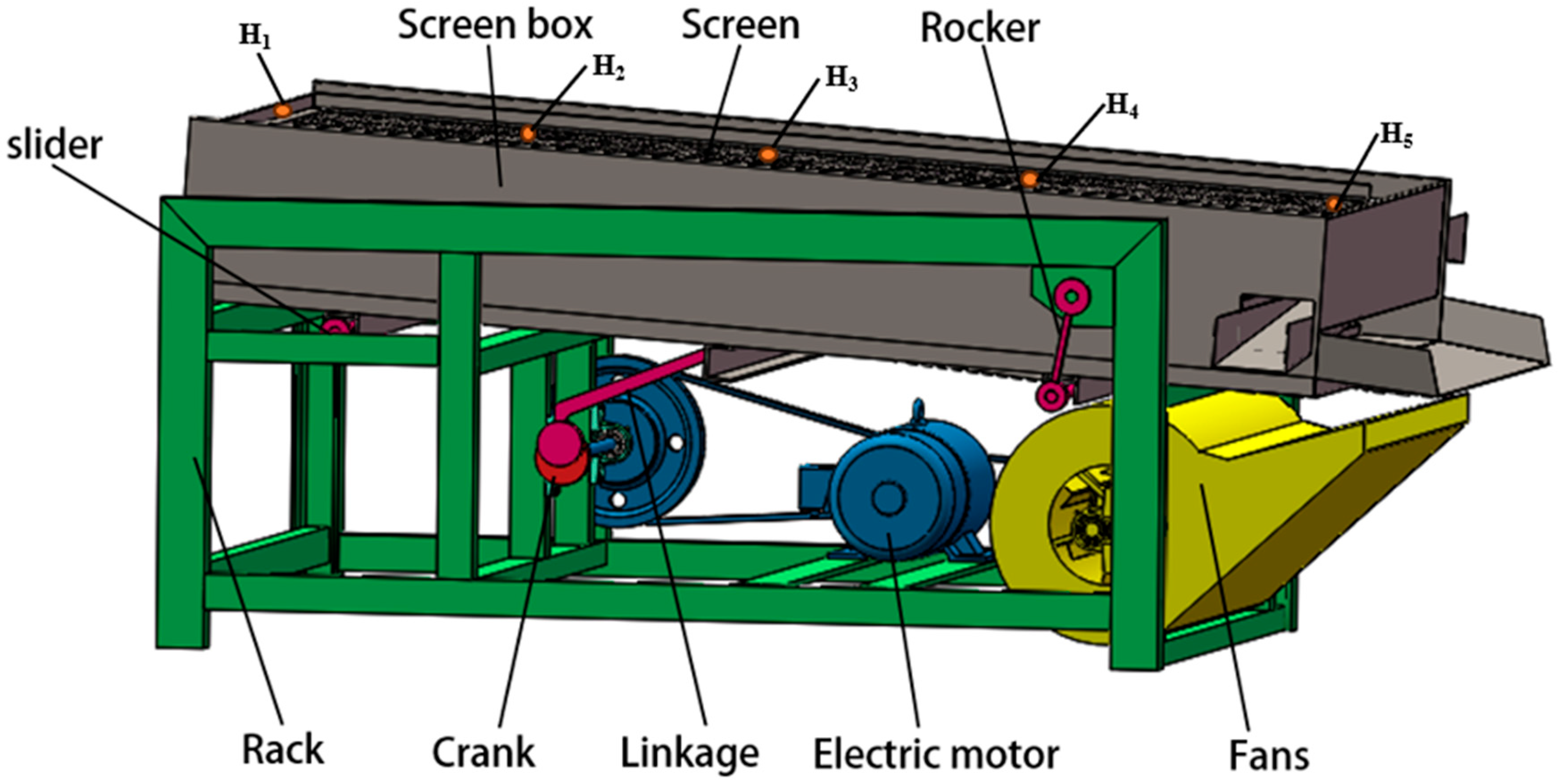
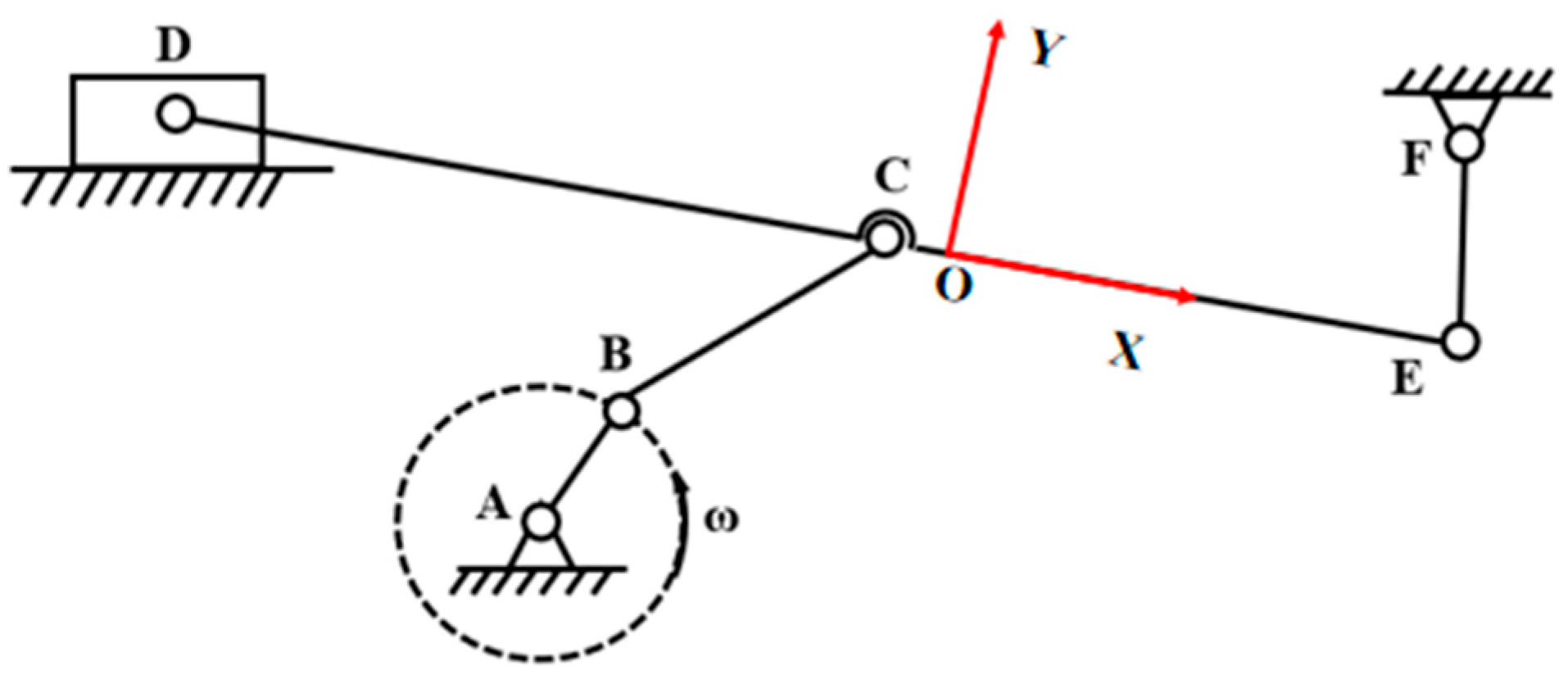
As shown in Figure 1, the variable-amplitude vibrating screen is mainly composed of an offset crank structure, a double-rocker mechanism and a crank-slider mechanism. High-speed rotation of the crank produces excitation force to drive the screen body to vibrate. Under such vibration, materials on the screen surface are lifted, layered and sieved, and finally conveyed to the discharge outlet. Subsequently, the discharged materials undergo secondary separation treatment by a fan. As illustrated in Figure 2, the offset crank-slider mechanism corresponds to the DCEF structure, while the crank-driven double-rocker mechanism is formed by the ABCEF structure.

3. Materials and Methods

3.1. Motion Simulation of Variable-Amplitude Screen Based on RecurDyn

In this paper, 3D software was used to establish a 3D model of the variable-amplitude vibrating screen. The parts and structures in the model that have little influence on the simulation results were omitted, and the relatively static rigid body parts were merged into a whole by a Boolean operation, to avoid the loss of information imported into the simulation model. Materials are defined in Material Type for each part of the imported model, rotating pairs are added to the rotating parts [30], and moving pairs are added to the sliding parts of the frame and screen box. The connection relationship between components of the variable-amplitude vibrating screen are shown in Table 1.

3.2. Kinematics Simulation Experiment

In order to explore the influence of the crank length and rotation speed of the variable-amplitude vibrating screen on the displacement and velocity of the variable-amplitude screen surface, five points were selected equally from the feed end to the discharge end of the screen surface as H1, H2, H3, H4, and H5, as shown in Figure 1. The velocity and displacement curves of the variable-amplitude vibrating screen with time at 5 points on the screen surface under different crank lengths and rotation speeds were obtained in RecurDyn V9R4, and fast Fourier transform was performed on the velocity diagrams of the five points to obtain the change rule of the amplitude of the velocity at each point with frequency. By changing the crank length and rotation speed, the effects of crank length and rotation speed on the motion of the screen surface were explored.
Due to the fact that the inertial force generated by the variable-amplitude vibrating screen during the movement cannot be balanced, when the crank speed is too high, vibration and dynamic loads will be generated, which will destroy the movement of the variable-amplitude vibrating screen and cause it to fail to work properly. According to simulation and design experience data, when the crank speed is too low, granular materials on the screen surface were prone to accumulation and clogging. Limited by the movement of the mechanism, pre-tests were conducted to simulate the critical values of different lengths and rotational speeds of variable-amplitude vibrating screen crank; when the crank length was 25 mm, the rotational speed exceeded 155 r/min, and the mechanism cannot work normally, so 155 r/min was used as the minimum rotation speed of this simulation. The simulation experimental data is shown in Table 2.

3.3. EDEM–RecurDyn Coupling Simulation

3.3.1. Particle Contact Model

This study selected the Hertz–Mindlin contact model, which was proposed by Mindlin and Deresiewicz in 1953 [31]. There are damping forces in the normal force and tangential force in the model, and the damping coefficient is related to the recovery coefficient [32]; the friction force satisfies Coulomb’s theorem (Cundall and Strack 1979) [17].
The normal force F n in the model is a function of the normal overlap δ n , and is calculated by the following equation:
F n = 4 3 E * R * δ n 3 2
1 E * = ( 1 σ i ) E i + ( 1 σ j ) E j
1 R * = 1 R i + 1 R j
where E * is the equivalent Young’s modulus, R * is the equivalent radius, δ n is the normal overlap amount, E i and E j are the Young’s modulus of particles i and j, σ i σ j are the Poisson’s ratio of particles i and j, and R i , and R j are the radius of contacting particles i and j.
The damping force F n d in the model is calculated by the following equation:
F n d = 2 5 6 β S n M * V n r e l
M * = m i m j m i + m j
β = l n e l n 2 e + π 2
S n = 2 E * R * δ n
V n r e l = ( V i V j )
where M * is the equivalent mass, e is the restitution coefficient, V n r e l is the normal component of relative velocity, β is the dimensionless damping coefficient, and S n is the normal stiffness.
The tangential force is calculated by the following formula:
F t = S t δ t
S t = 8 G * R * δ n
G * = 2 σ i 2 G i + 2 σ j 2 G j
where G * is the equivalent shear modulus, and G i and G j are the equivalent shear modulus of particles i and j, respectively.
The tangential damping force F t d is calculated by the following equation:
F t d = 2 5 6 β S t m * V t r e l
where V t r e l is the relative tangential velocity.

3.3.2. Particle Model

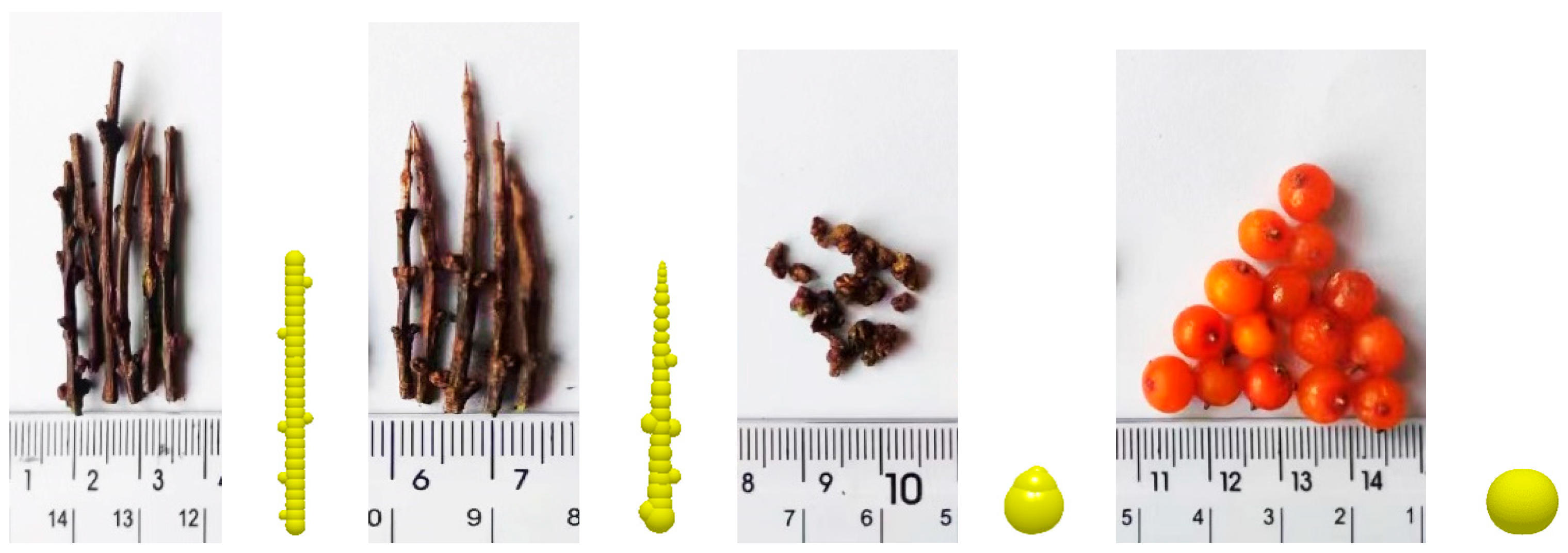
The application of EDEM software to establish an accurate material model is the basis for ensuring the validity of the simulation results [33,34]; in this study, frozen sea buckthorn branch-fruits were selected to be separated and processed by the fruit removal machine to obtain the frozen berries and branch materials, which mainly contain spherical particles of frozen berries, non-spherical twigs, fruit stems and other impurities. The Hertz–Mindlin particle contact model was used for simulation in EDEM software simulation [35] and the mechanical properties of each material and the contact properties between each material are shown in Table 3 and Table 4 [36].
After being quick-frozen, sea buckthorn branches and fruits were mechanically removed in the workshop environment of −5–−8 °C, the mixed particles of sea buckthorn fell down to the conveyor belt, and the particles were transferred to the feed end of the screen surface through the conveyor belt. The mixed particles on the screen were statistically analyzed, to obtain frozen sea buckthorn berries, and the proportion of sea buckthorn frozen berries, branches and fruit stems was 67%, 7% and 26%.
In EDEM, sea buckthorn frozen berries were modeled using a single sphere, and the rest of the materials were modeled using the multi-sphere overlapping method, as shown in Figure 3 [37]. It is difficult to simulate the motion of complex models in EDEM; in order to make the simulated variable-amplitude vibrating screen consistent with the motion of the variable-amplitude vibrating screen in production, EDEM–RecurDyn was used for coupled simulation. According to the experiments in Table 2, the motion behavior of mixed particles on the screen surface under different crank lengths and speeds was studied. The geometric parameters and operating parameters of the variable-amplitude vibrating screen are shown in Table 5, the variable-amplitude vibrating screen is composed of three layers of screens, the diameter of the first layer of screen holes was 12 mm and the hole spacing was 16 mm, the hole diameter of the second layer was 8 mm, the hole spacing was 11 mm, and the diameter of the third layer screen was 5 mm; it was composed of a round hole screen with a hole spacing of 6 mm, the spherical particles were composed of frozen berry particles, and the non-spherical particles were composed of frozen branches and fruit stems.

3.3.3. Evaluation Method

In industrial production, screening efficiency is often used to evaluate the screening performance of vibrating screens [38,39,40]. Screening efficiency refers to the ratio of the mass of fine particles that pass through the sieve during the screening process (actual screening mass) to the mass of particles smaller than the sieve hole diameter in the feed particles; the formula is shown in Equation (13):
δ = m p 1 m p 2 m d 1 m d 2 × 100 %
where δ is the screening efficiency, m p 1 is the particles with a diameter smaller than the diameter of the sieve hole, m p 2 is the total mass of particles with a diameter smaller than the diameter of the sieve holes, m d 1 is the mass of particles with a diameter larger than the diameter of the sieve hole that passes through the sieve holes, and m d 2 is the total mass of particles with a diameter larger than the diameter of the sieve hole.
In the EDEM simulation, approximately spherical particles were larger than the diameter of the sieve hole of the third layer, and the mass passing through the sieve was negligible; during the simulation process, the sieving of particles is a dynamic process. This paper introduced a dynamic screening efficiency method to study the changes in screening efficiency; for dynamic changes in simulation time, Formula (13) was simplified into a dynamic screening efficiency calculation formula, such as Formula (14):
δ t = m p t 1 m p t 2
where   δ t is the sieving efficiency at time t, m p t 1 is the screened particles smaller than the hole diameter of the screen aperture at time t, and m p t 2 is the total mass of particles with diameters smaller than the hole diameter of the screen at time t.

4. Results and Discussion

4.1. Simulation Analysis of Screen Surface Displacement

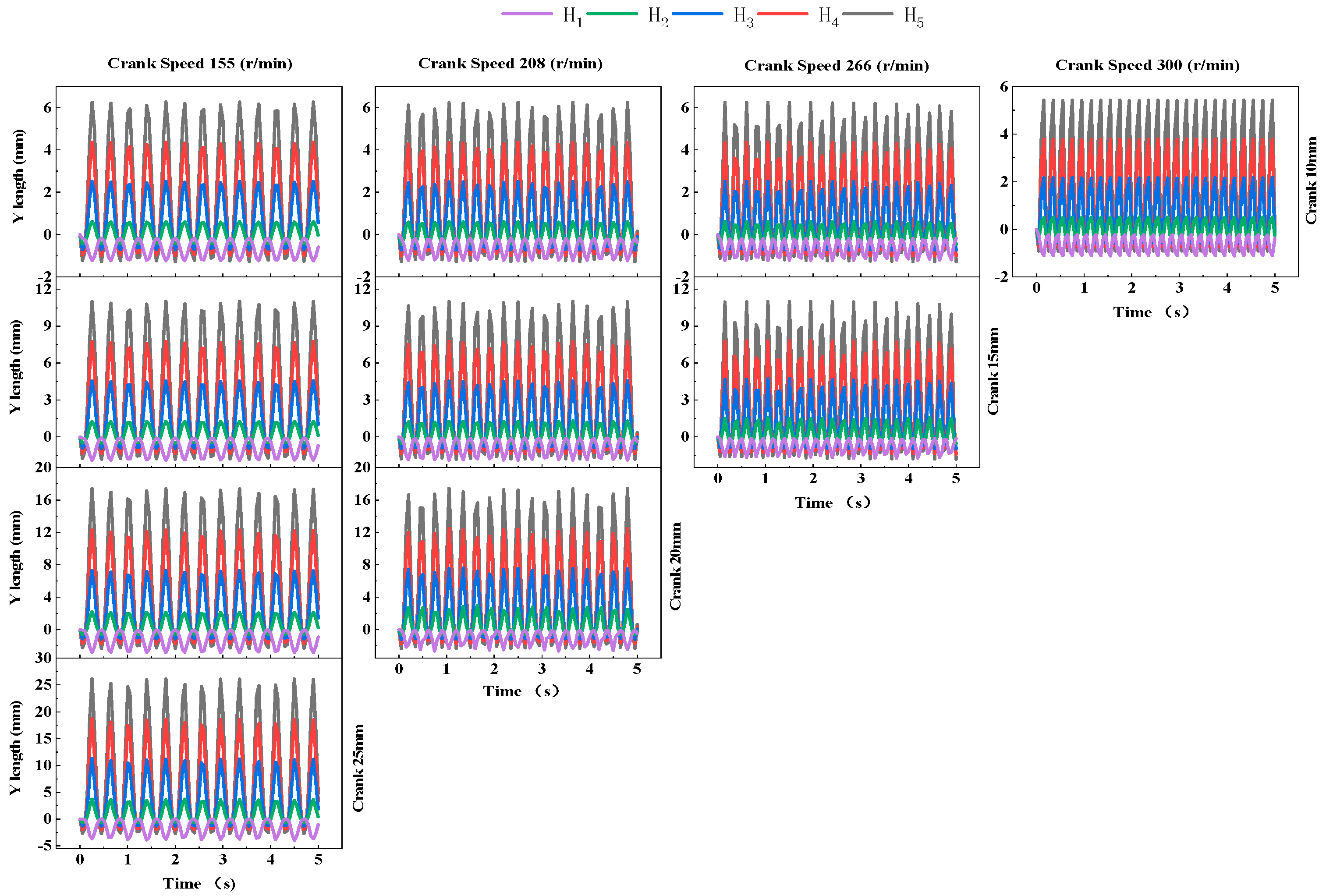
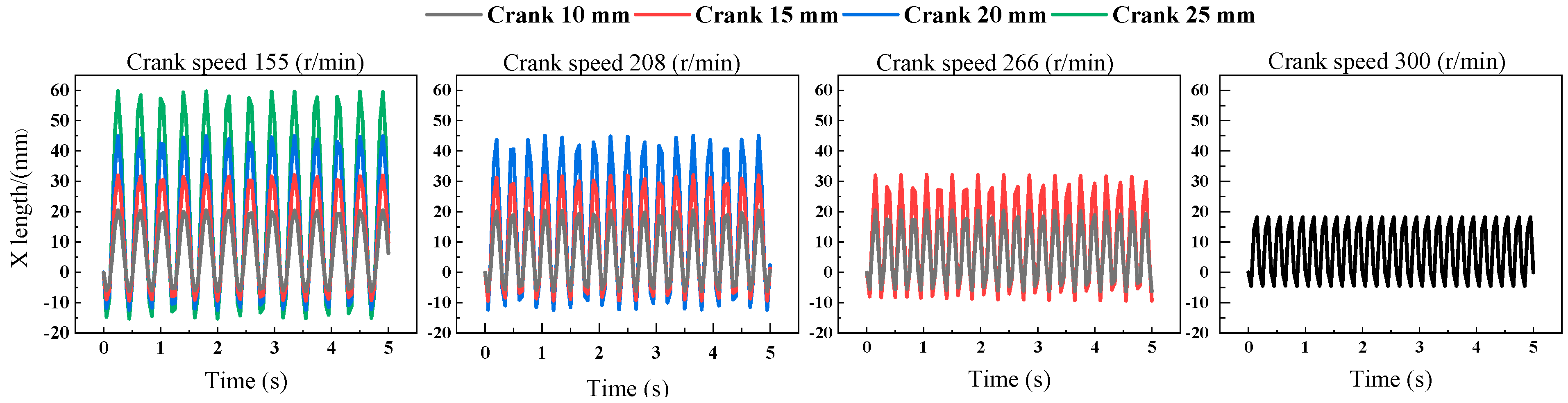
Figure 4 and Figure 5 show the change rule of displacement with time at different positions in the Y- and X-directions of the variable-amplitude vibrating screen under different crank lengths and rotational speeds; the displacement curves of the X and Y axes were roughly sinusoidal.
As shown in Figure 4, the displacement of the sieve surface along the Y-direction increases sequentially from point H1 to H5, and when the crank length was 10 mm and the rotational speed was 155 r/min, the maximum moving distance at each point from H1 to H5 was 0.86 mm, 0.93 mm, 2.75 mm, 4.54 mm, 6.34 mm, respectively, which was conducive to the rapid movement of the impurity particles on the sieve surface towards the back, and accelerated the separation of the impurity particles from seabuckthorn frozen berries [4]. Under different crank lengths, the crank speed cannot change the amplitude of the screen surface at each point; the larger the crank speed, the shorter the time for the screen surface displacement to reach the peak value. At different crank speeds, the displacement in the Y-direction at each point on the screen surface increased with the increase in crank length; when the crank speed was 155 r/min, the displacement at point H1 was 6.34 mm, 12.86 mm, 19.73 mm and 28.96 mm for crank lengths of 10 mm, 15 mm, 20 mm and 25 mm, respectively.
As shown in Figure 2, due to the horizontal displacement of the variable-amplitude, the vibrating screen is controlled by the offset crank-slider mechanism; the horizontal displacement of each point on the screen surface is kept the same. As shown in Figure 5, the displacement of the screen surface in the X-direction increased with the increase in crank length, when the crank speed was 155 r/min, corresponding to crank lengths of 10 mm, 15 mm, 20 mm and 25 mm; the displacements in the X-direction were 26.45 mm, 40.95 mm, 56.74 mm, and 74.47 mm. The displacement of the screen surface in the X-direction remained constant with increasing crank speed for different crank lengths, and when the crank was 10 mm, the speeds of 155 r/min, 208 r/min, 266 r/min and 300 r/min corresponded to the displacement in X-direction oscillates around 20 mm.

4.2. Simulation Analysis of Sieve Surface Velocity

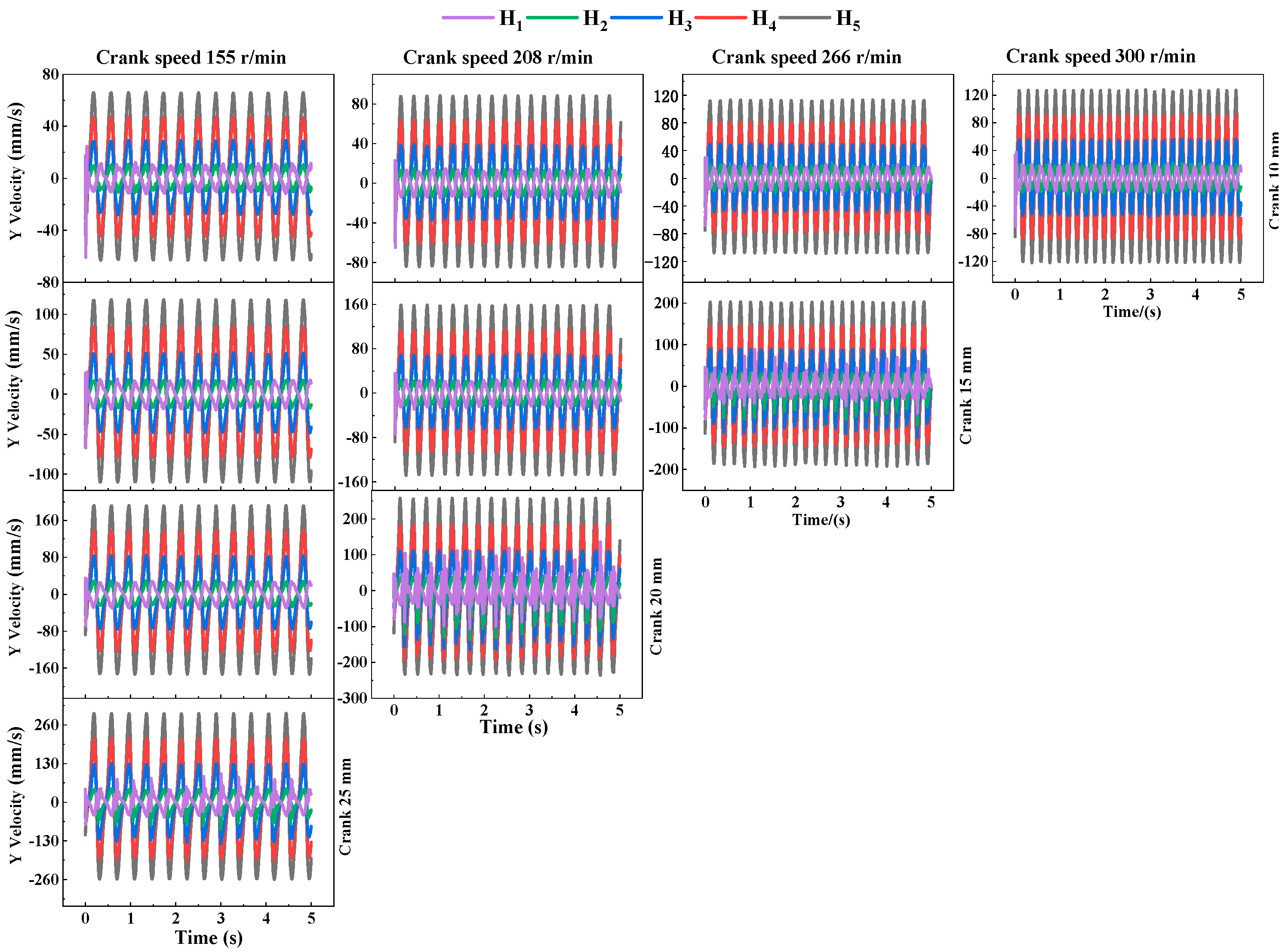
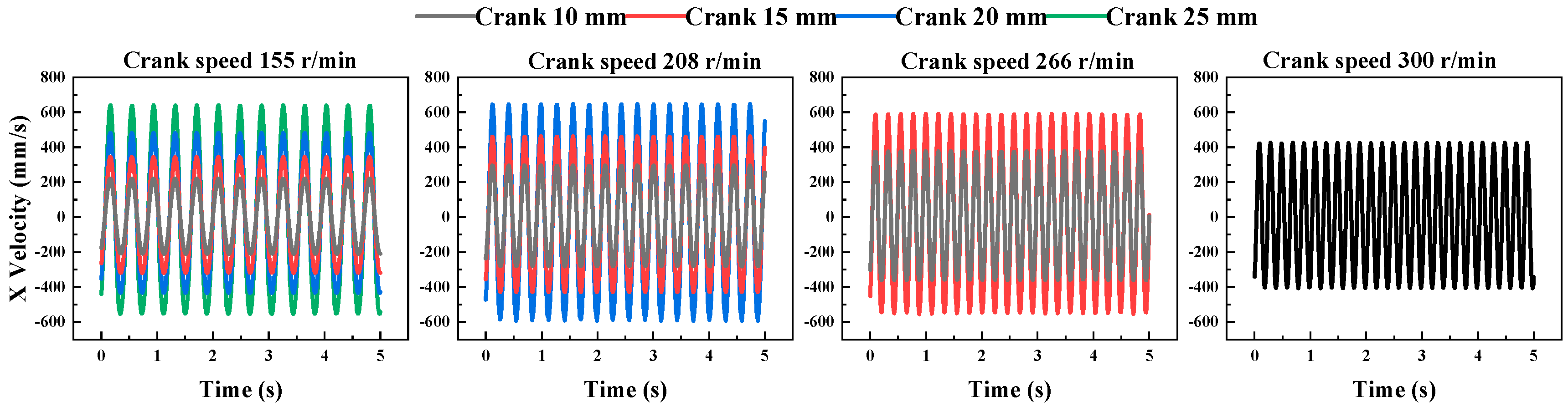
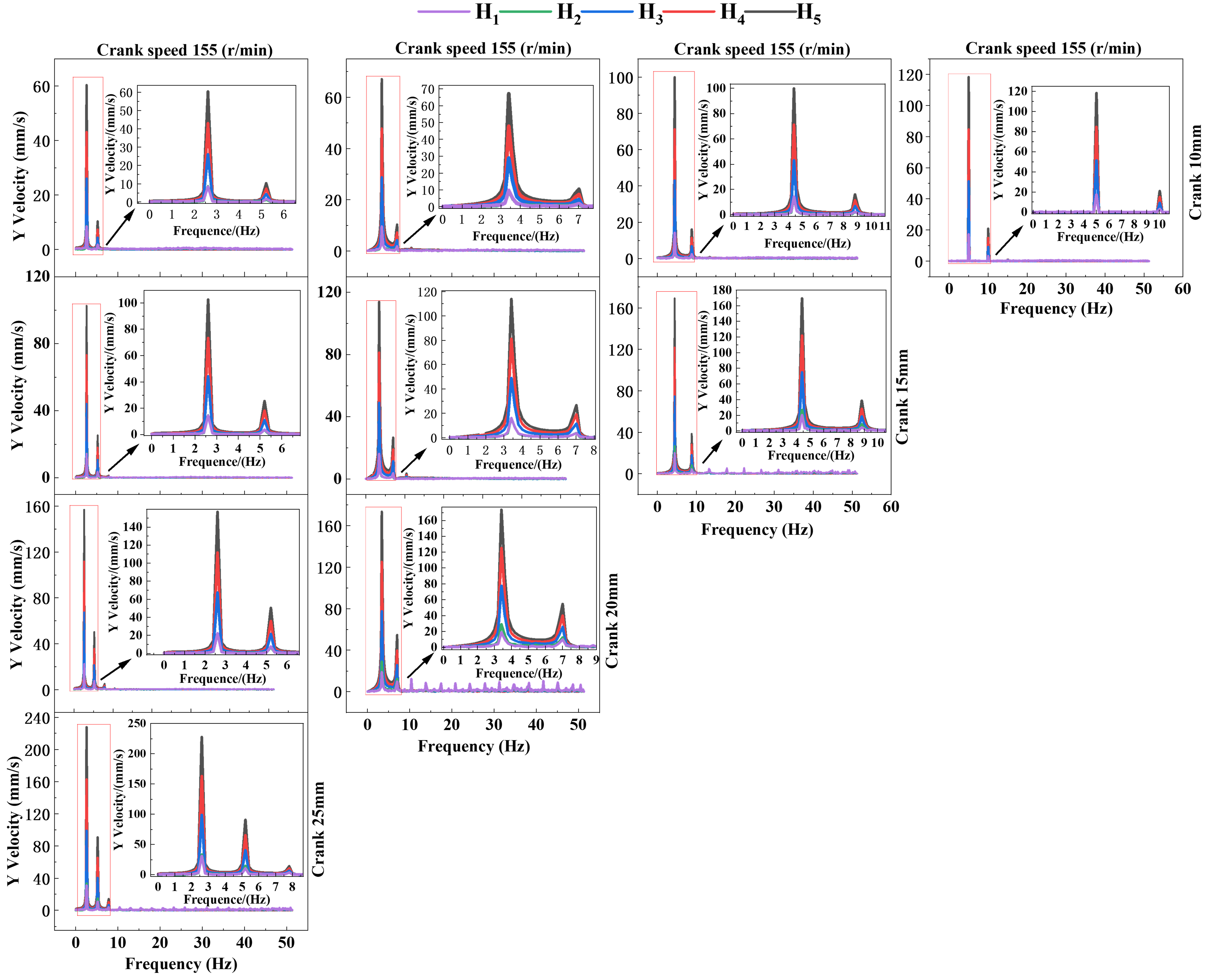
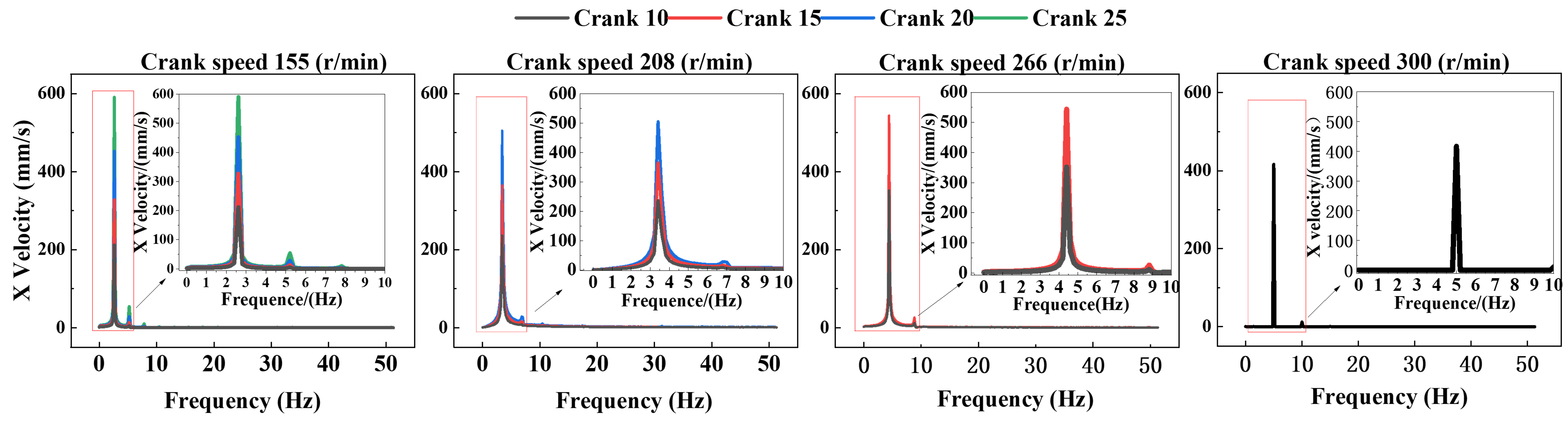
Figure 6 and Figure 7 show the velocity diagrams of the screen surface in the X- and Y-directions for the variable-amplitude vibrating screen at different crank lengths and speeds. In Figure 6, the first column shows the velocity of the vibrating screen in the Y-direction at a crankshaft speed of 155 r/min for crankshaft lengths of 10 mm, 15 mm, 20 mm, and 25 mm. A total of 512 points were collected from the velocity map at different points on the sieve surface [14]; the velocity map was rapidly changed by Fourier to obtain the relative frequency and amplitude characteristics of the velocity in the X- and Y-directions, as shown in Figure 8 and Figure 9.
As shown in Figure 6 and Figure 7, the velocities in the X- and Y-directions of the variable-amplitude vibrating screen exhibit an approximate sinusoidal distribution. The velocities at various points on the screen surface in the Y- and X-directions increase with increasing crank length and rotational speed, respectively. The velocities along the Y-direction for points H1 to H5 on the screen surface increase sequentially.
Figure 8 and Figure 9 show the amplitude and relative frequency variation characteristics of the screen surface velocity in the Y-direction and X-direction of the variable-amplitude vibrating screen; the relative frequency of the screen surface speed of the variable-amplitude vibrating screen was related to the crank speed and was independent of crank length. Due to the low damping of the variable-amplitude vibrating screen system, the initial response of the variable-amplitude screen and the accompanying free vibration persist, leading to the appearance of another frequency component in the frequency plot of velocity. When the crank speed was 155 r/min, 208 r/min, 266 r/min, and 300 r/min, the corresponding main frequency was 2.6 Hz, 3.4 Hz, 4.4 Hz, and 5.0 Hz [11]. When the rotational speed and crank length exceed a certain value, multiple high-frequency components emerge in the Y-direction velocity of the variable-amplitude vibrating screen. This impairs the stability of the screen surface and causes the equipment to malfunction.

4.3. Numerical Study of Screening Process

During the simulation process, in order to maintain the consistency of the motion state of the simulated mixed particles and the particles in production, the mixed particles were dropped to the conveyor belt during the simulation process and the particles were sent to the feed end of the variable-amplitude vibrating screen through the conveyor belt; when falling to the screen surface, the mass of the mixed particles increased first and then decreased, and finally, they all fell into the feed end. Subsequently, the mixed particles were stratified and screened under the action of the variable-amplitude vibrating screen; they passed through the sieve, and finally the mixed particles were separated.
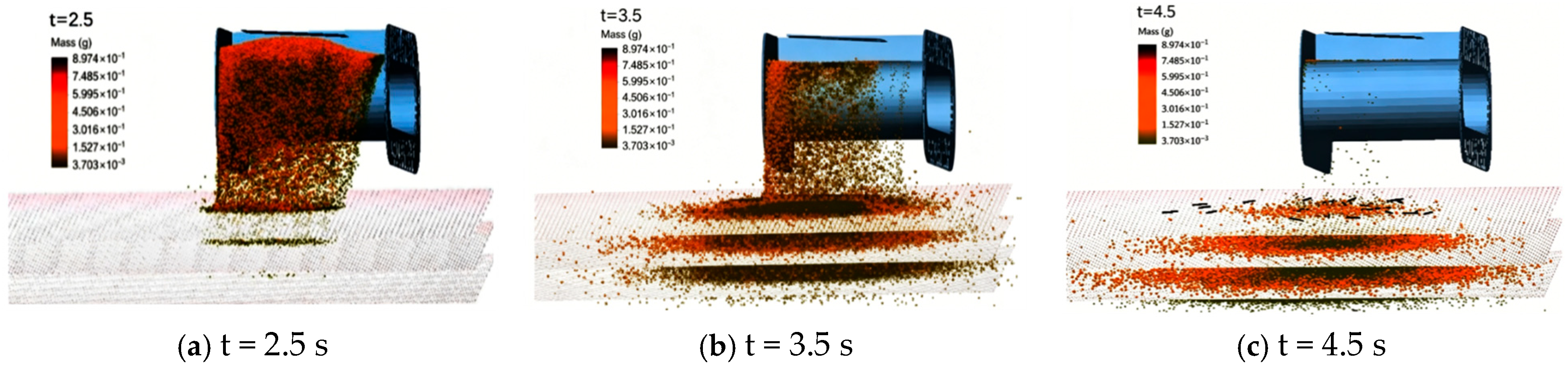
Figure 10 illustrates the screening process of mixed particles on the variable-amplitude vibrating screen under a crank length of 20 mm and a rotational speed of 266 r/min. As shown in Figure 10a, mixed particles drop onto the screen surface and begin to stratify at 2.5 s. In Figure 10b, a large quantity of materials fall onto the first screen layer at 3.5 s and are thrown upward by screen vibration. During movement, materials collide with the screen surface, and particles smaller than the screen apertures pass through the mesh, accompanied by continuous particle stratification. Figure 10c indicates that the screening of upper-layer materials is basically completed at 4.5 s. The middle screen layer shares the screening load of the lower layer, which loosens mixed particles and accelerates the particle separation efficiency of the lower screen layer. After mixed particles enter the screening area, particles on the screen move backward, increasing the collision frequency between particles and the screen surface. In addition, the stratification zone of mixed particles on the screen is mainly concentrated near the feeding inlet.

4.4. Analysis of Screening Effect

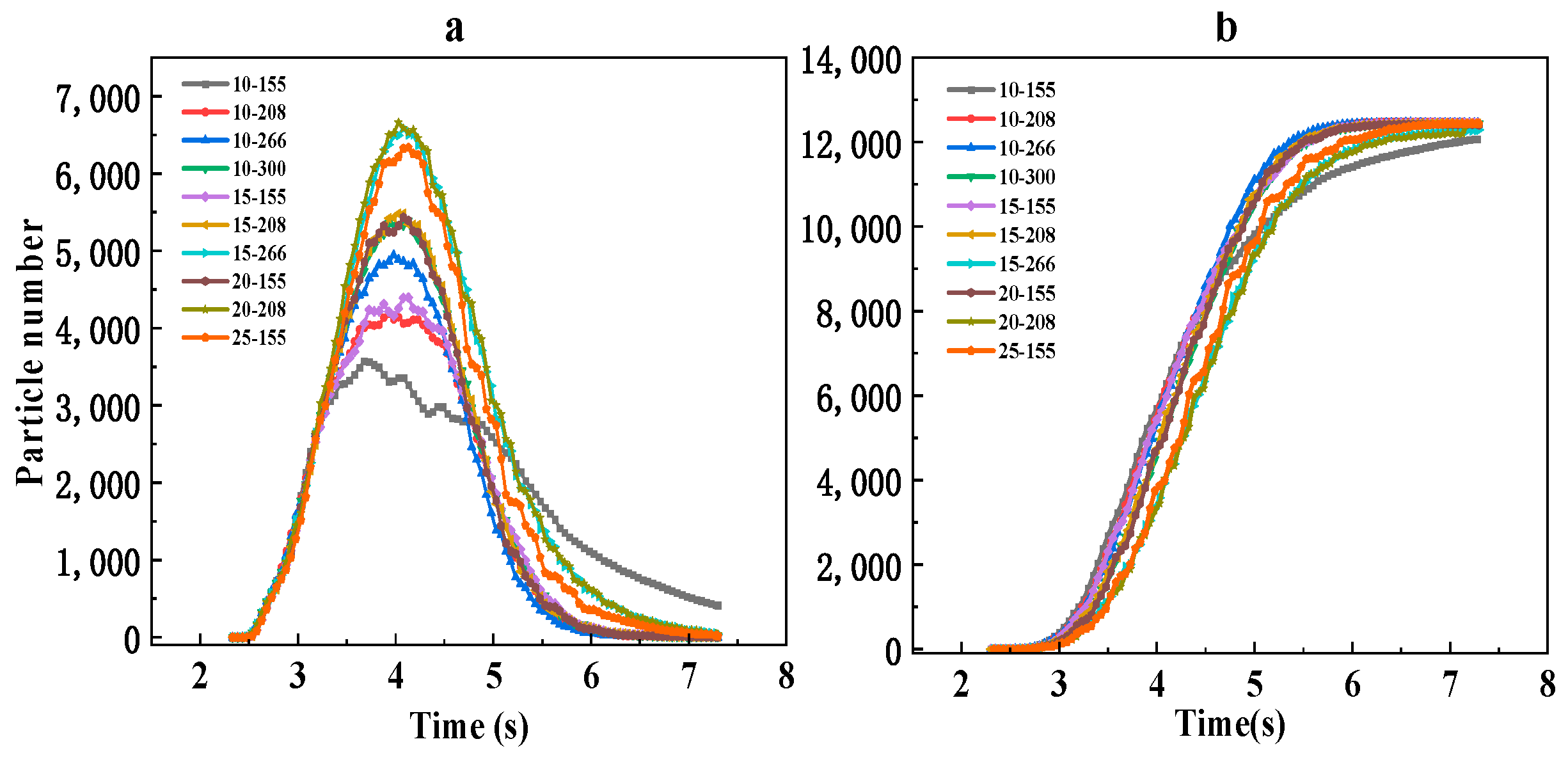
The number of particles passing through the sieve is an important indicator of the effectiveness of sieving [3]. Figure 11 shows the situation of spherical particles passing through the screen; the number of particles passing through the screen was related to the feeding amount of the material, the thickness of the screen surface, and the movement parameters of the material [11,14]. In Figure 11a, before 4.3 s, the amount of granular material passing through the first layer of sieves was greater than the amount of particles on the second layer of sieves; at 4.3 s, the number of particles on the second layer of sieves reached its peak value. After the simulation time exceeded 4.3 s, the number of materials passing through the first layer of sieves was less than the number of materials passing through the second layer of sieves, and the number of particles on the sieves gradually decreased. As shown in Figure 11b, the spherical particles on the third layer of the sieve cannot pass through the sieve holes; the number of spherical particles on the sieve passing through the sieve gradually increased with the simulation time and finally stabilized. As shown in Figure 11a,b, as the crank length and rotational speed increased, the number of spherical particles passing through the first layer of the screen increased, and the increase in the thickness of the material on the second layer of the screen resulted in a decrease in the number of spherical particles passing through the screen in that layer.
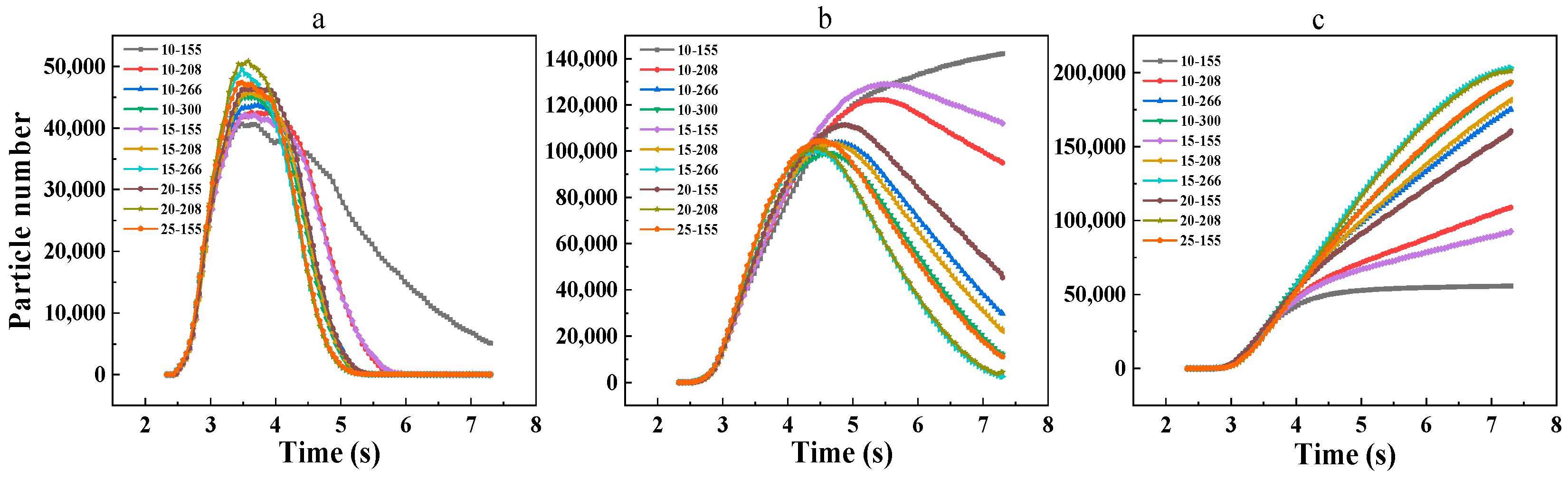
Figure 12 shows the sieving situation of non-spherical particles; in Figure 12a, the non-spherical particles and spherical particles have the same tendency to pass through the sieve, but the peak time of non-spherical particles on the sieve is earlier than that of spherical particles. The main reason is that the particles smaller than the sieve hole in the non-spherical particles have more contact opportunities with the sieve hole, resulting in a shorter sieve penetration time than spherical particles. Figure 12b shows the changes in the amount of material between the second and third screen at different crank lengths and speeds; with the increase in simulation time, the number of non-spherical particles in the material on the screen of the amplitude-vibrating screen increased and then slowly decreased. The number of non-spherical particles varies greatly with different crank lengths and speeds; the crank length is 10 mm and the speed is 155 r/min. The number of non-spherical particles passing through the sieve is much lower than that of particles passing through the sieve under the other parameters of the motion. Figure 12c shows a gradual increase in the number of non-spherical particles passing through the sieve as the crank length and rotational speed increase. As shown in Figure 11 and Figure 12, the number of particles passing through the sieve is related to the thickness of the particles on the sieve surface; the thicker the particles on the upper sieve, the longer the particles stay on the sieve, resulting in a decrease in the number of particles passing through the sieve.
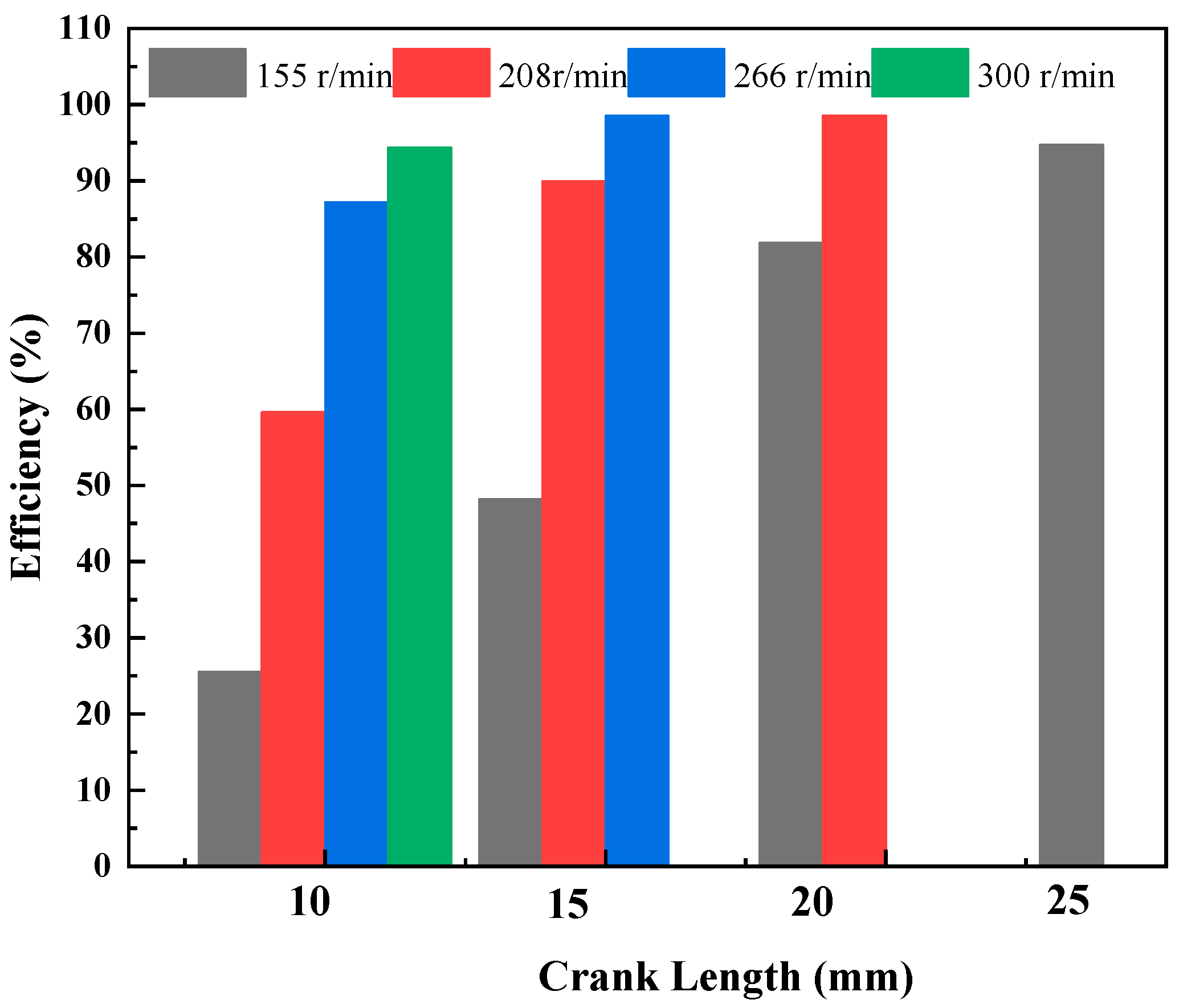
Figure 13 shows the effect of different crank lengths and rotational speeds on the screening efficiency of the material, under different motion parameters; there is a large gap in the screening efficiency of variable-amplitude vibrating screens. When the simulation time is 7.3 s, the crank length is 20 mm, the rotational speed is 208 r/min, and the maximum value of the screening efficiency is 98.56%, when the crank length is 10 mm, the rotational speed is 155 r/min, the minimum screening efficiency is 25.54%; the screening efficiency increased with the increase in crank length and rotational speed. A longer crank length leads to a greater vibration amplitude of the screen surface. This enhances material loosening and stratification, reduces particle adhesion and accumulation, and helps fine particles pass through sieve holes sufficiently. In addition, the improved particle movement boosts the fluidity of the material bed, accelerates screening and raises the overall efficiency.
When the crank length is 15 mm, speed is 208 r/min, and when the crank length is 20 mm, speed is 266 r/min, corresponding to the screening efficiency of 98.12% and 98.56%; so, in order to obtain a higher screening efficiency under the conditions of ensuring the normal operation of the amplitude-vibrating screen, we should keep the crank speed and crank length matching.

4.5. Effect of Motion Parameters on Velocity

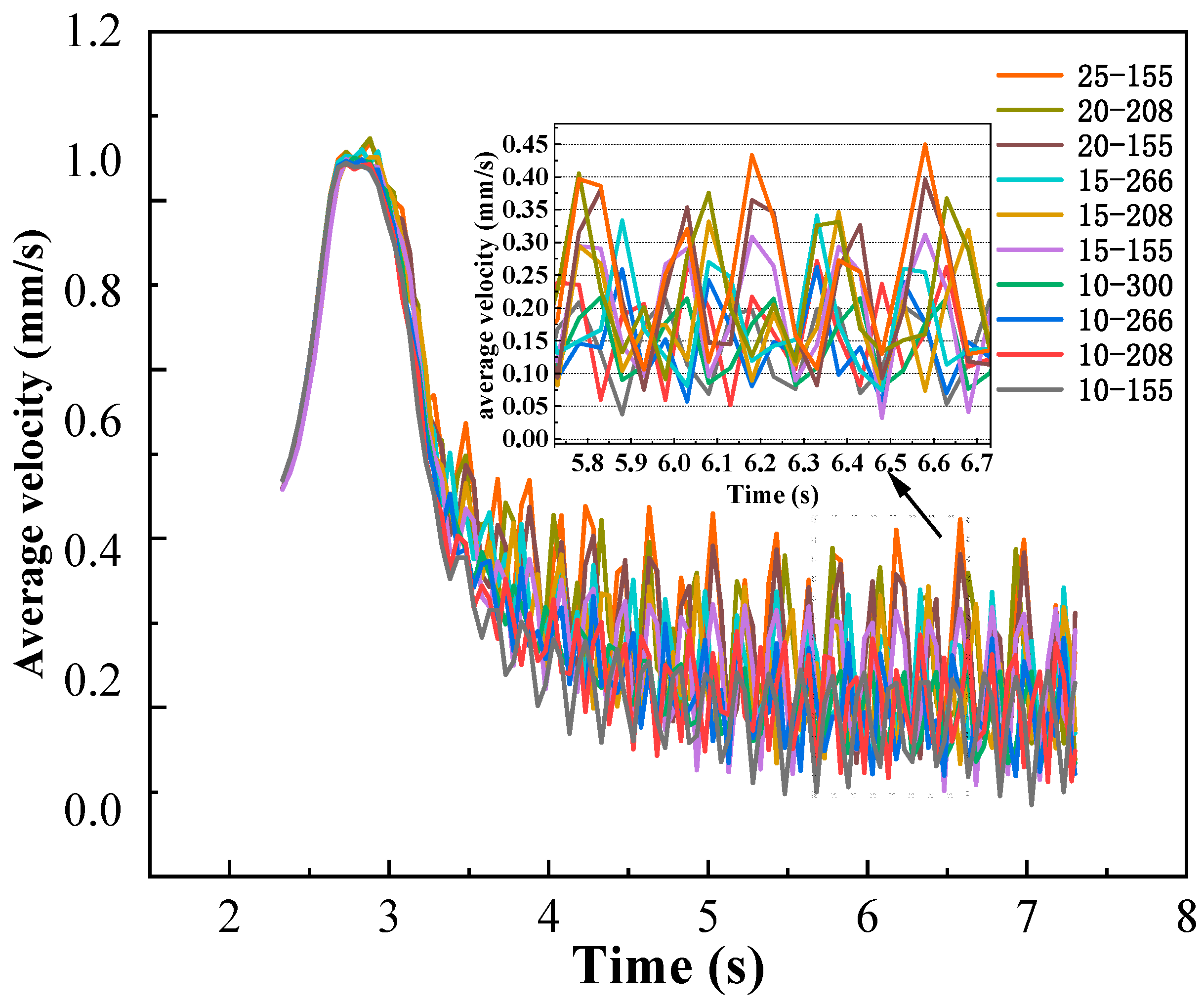
The average velocity of the particles on the variable-amplitude vibrating screen under different motion parameters is shown in Figure 14; when the particles fell from the conveyor belt to the screen surface, the potential energy of the particles is transformed into kinetic energy, the particles obtained a high falling speed, and the velocity reached the maximum value at 2.88 s, with a value of 1.06 mm/s. After the particles collided with the screen surface from 2.88 s to 3.3 s, some of the particles completed the penetration of the screen, and the rest of the particles were thrown up by the surface to move forward; the average velocity of the particles decreased rapidly, and the average velocity of the particles on the sieve first decreased and then tended to a stable value. The change in the average velocity amplitude of the particles on the sieve gradually increased and was consistent with the change in the velocity amplitude of the sieve surface. As shown in Figure 14, as the simulation time proceeds, the average velocity of the particles on the sieve gradually converged to a dynamic stability value under different motion parameters; when the crank length is 10 mm, 15 mm, 20 mm, and 25 mm, the average velocity of the particles under different rotational speeds kept floating up and down at 0.15 mm/s, 0.2 mm/s, 0.25 mm/s, and 0.75 mm/s. The rotational speed had no significant effect on the dynamic stability value of the particles on the sieve, but only affected the time for the particles to reach the peak value.

4.6. Effect of Material Displacement on the Screen Surface

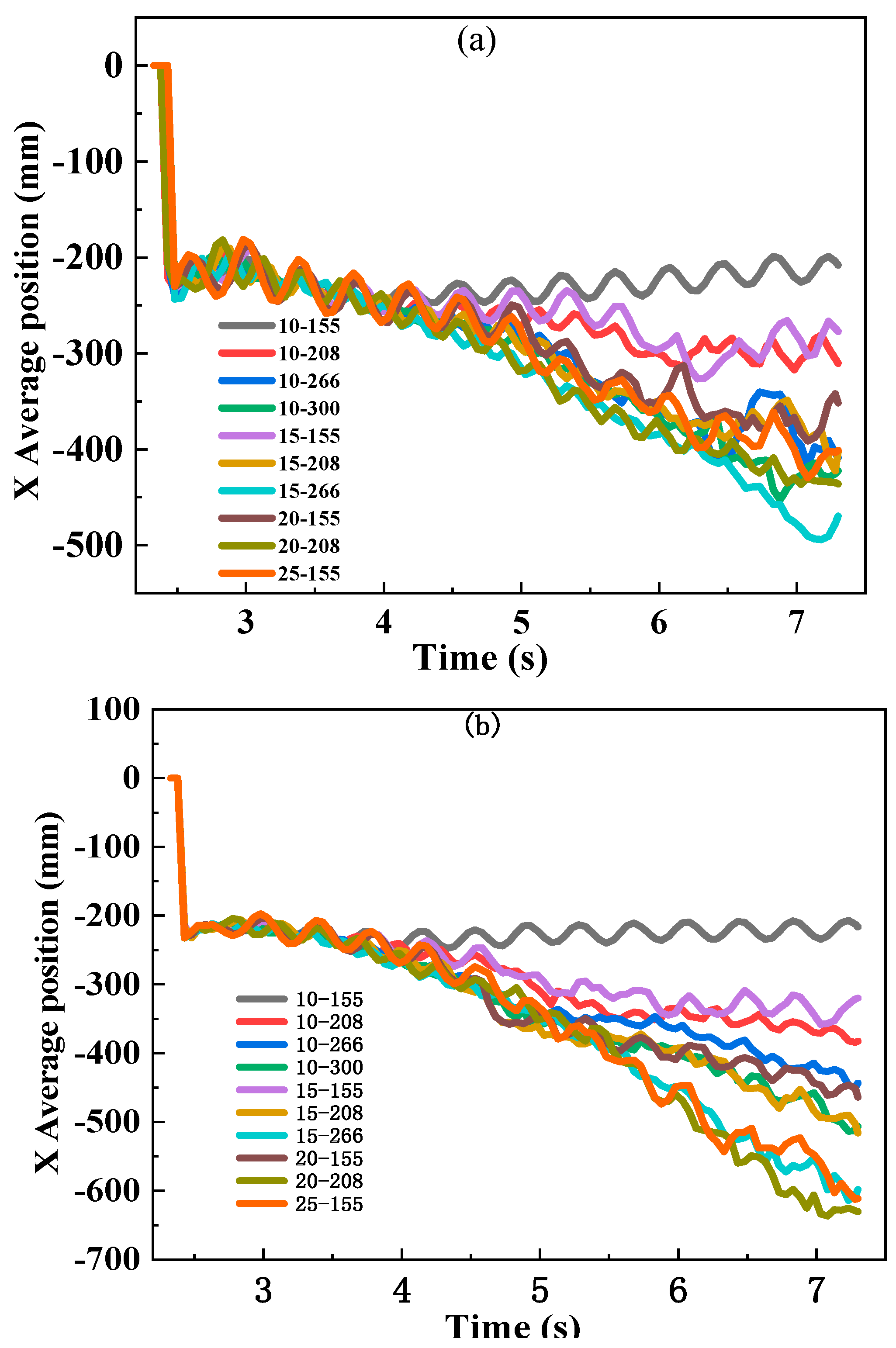
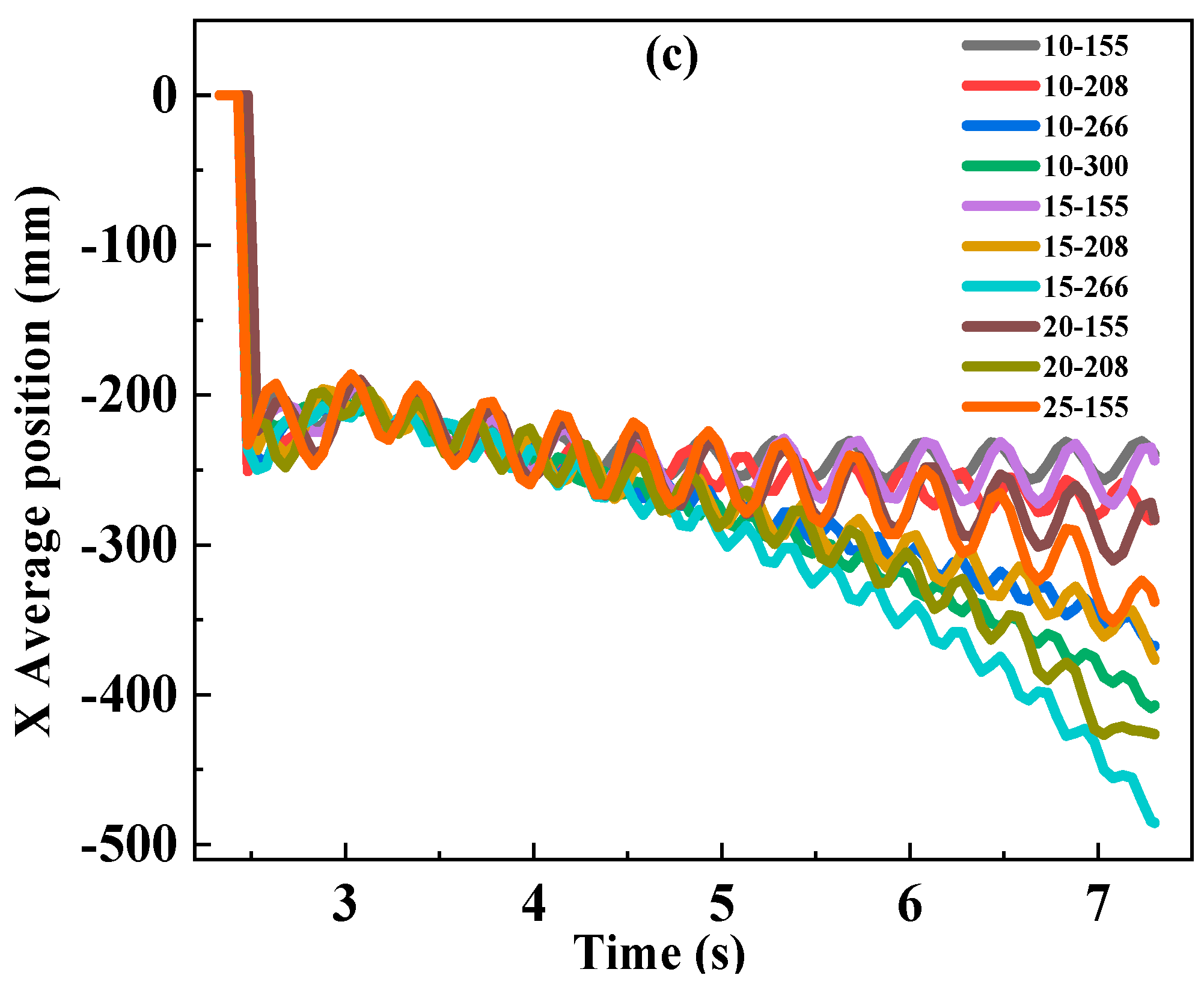
Figure 15 shows the average displacement of particles on each layer of the screen surface under different crank lengths and rotational speeds. As shown in Figure 15a–c, the particles on the variable-amplitude vibrating screen have a tendency to move backwards, which is not favorable for the movement of the material. Due to the fact that the amplitude and speed of the screen surface along the Y-direction from the feed port to the discharge port of the amplitude-variable vibrating screen increase gradually, it can ensure that the material on the screen surface moves in the direction of the discharge port. As shown in Figure 15, when the crank length is 10 mm and the rotational speed is 155 r/min, the displacement of the particles on the three-layer screen surface is almost unchanged, and the particles cannot be quickly conveyed to the discharge port. When the simulation time is 7.3 s, the maximum value of the average displacement of the particles on the first layer of the screen surface is 637 mm, and the minimum value is 216 mm, the maximum value of the average displacement of the particles on the second layer of the screen surface is 485 mm, and the minimum value is 243 mm, and the maximum value of the average displacement of the particles on the third layer of the screen surface is 494 mm, and the minimum value is 199 mm; this shows that, at different crank lengths and rotational speeds, the amplitude-vibrating screen has a greater variability of particle moving distance on the screen surface under different crank lengths and crank speeds, and the moving distance of the particles increases with the increase in the crank length and crank speeds.

5. Experimental Verification

To validate the effectiveness of the simulation model, a series of simplified field experiments were conducted. To prevent the thawing of frozen berries [40], the tests were performed in an environment maintained at −8 °C. The screen parameters were consistent with those in the simulation model. Since the crank length of the amplitude-vibrating screen was not easily adjustable, it was fixed at 15 mm, while the crank speed was regulated via a frequency converter and a tachometer to 155 r/min, 208 r/min, and 266 r/min, corresponding to the simulation parameters. Since only the crank length of 15 mm was selected for testing, not all simulation data could be fully verified, resulting in limitations of the model. However, the present study still offers useful references for relevant research on variable-amplitude vibrating screens.
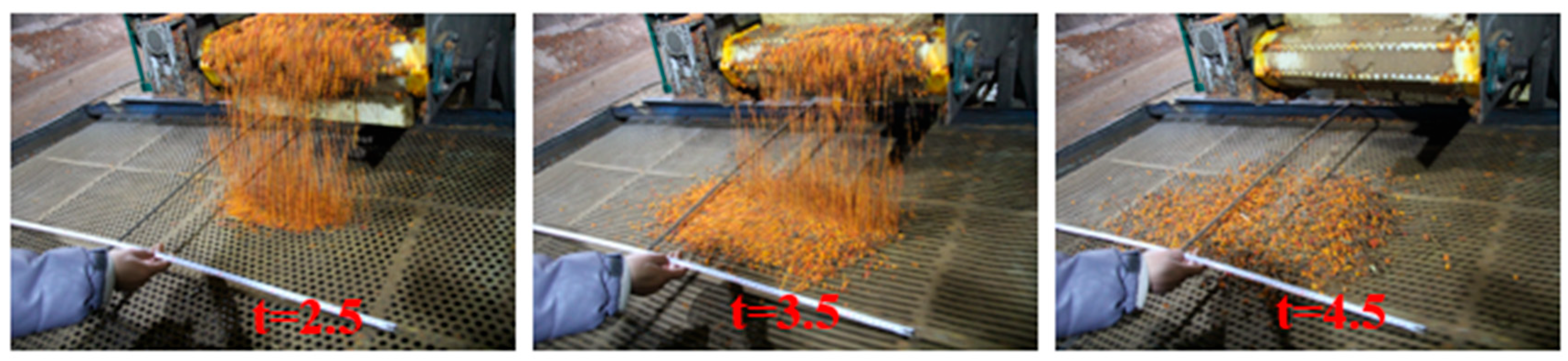
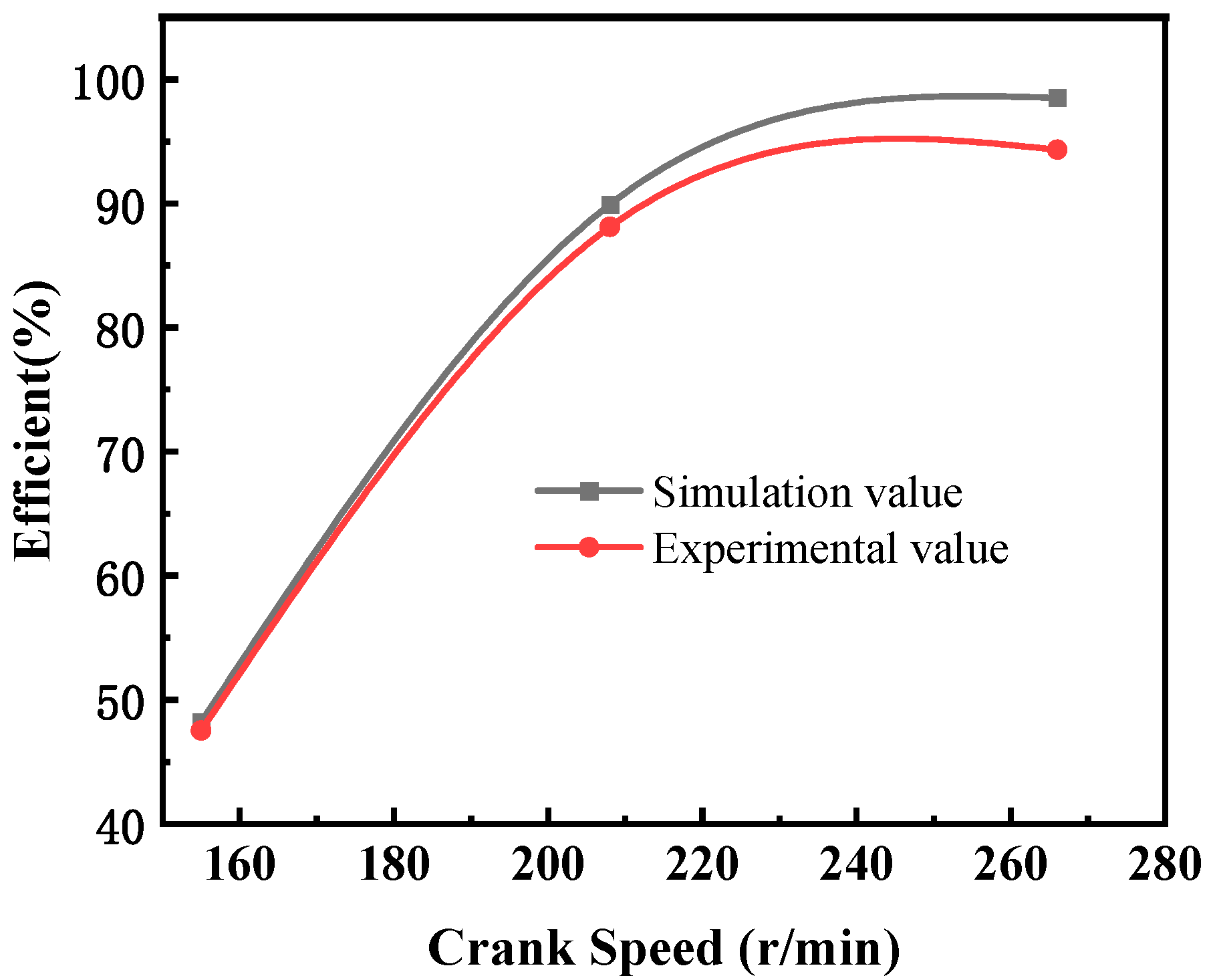
As shown in Figure 16, the material distribution on the screen surface during field tests closely matched the simulation results: after being fed onto the screen, the material rapidly spread toward the discharge end and both sides while simultaneously passing through the screen. Quantitative comparison in Figure 17 and Table 6 shows that, at the crank speeds of 155 r/min, 208 r/min, and 266 r/min, the errors between the simulation and field test results were 0.68%, 1.82%, and 4.18%, respectively. The field tests were conducted at low temperatures, while the simulation model did not take the low-temperature effects on particle properties into account. The viscosity between seabuckthorn particles increases significantly as the temperature rises. Since the tests were maintained at −8 °C throughout the process, the particles stayed in an ideal screening state. Consequently, the overall error between simulation and field test results is less than 5%. Nevertheless, the deviation in screening efficiency rises with the increase in crank speed. Higher rotating speed intensifies screen vibration and particle interactions. As the simulation fails to incorporate low-temperature viscosity, structural deformation and mechanical loss of the equipment, the simulation error gradually grows along with the rising speed [41]. These results confirm a fundamental agreement between the coupled simulation model and the experimental data.

6. Conclusions

In this study, based on EDEM and RecurDyn software, a series of numerical simulations of a variable-amplitude vibrating screen are carried out to study the influence of crank speed and length on the motion characteristics of different positions of the screen surface of the variable-amplitude vibrating screen and the granular materials on the screen; the following conclusions are obtained:
1. The displacement and speed of the screen surface of variable-amplitude vibrating screen increases sequentially from the feed port to the discharge port, which is favorable to the rapid movement of sea buckthorn frozen berries, branches and other mixed particles. Crank length and rotational speed directly affect the displacement and speed of the screen surface; simulation results show that the crank length and rotational speed of the vibrating screen mechanism are limited by its own structure, and their threshold value cannot be exceeded, in order to ensure the normal operation of the amplitude-vibrating screen.
2. Particle passage is influenced by both particle size and material bed thickness. An increased bed thickness prolongs the residence time of particles on the screen, consequently diminishing the screening rate. This can be counteracted by optimizing the crank rotational speed and length, which facilitates prompt stratification of the material and thereby improves dynamic screening efficiency.
3. The cleaning process of sea buckthorn berries is complex. The accuracy of a coupled EDEM–RecurDyn simulation model was validated through field experiments. This model provides a novel approach for investigating the mechanism of complex variable-amplitude screening. The findings offer valuable insights for optimizing the structural design and manufacturing of variable-amplitude vibrating screens.

Author Contributions

J.H.: Conceptualization, Investigation, Visualization, Formal analysis, Methodology, Validation, Funding, Writing—original draft. M.Y.: Conceptualization, Methodology, Data curation, Writing—review and editing, Q.Z.: Investigation, Methodology. J.Y.: Conceptualization, Data curation. W.Z.: Conceptualization, Methodology, Data curation, Supervision, Writing—review and editing. Y.B.: Conceptualization, Methodology, Data curation, Supervision, Writing—review and editing. All authors have read and agreed to the published version of the manuscript.

Funding

This work was supported by a grant from the National Natural Science Foundation of China (52065006).

Data Availability Statement

The original contributions presented in this study are included in the article. Further inquiries can be directed to the corresponding author.

Acknowledgments

The authors would like to thank the editor and reviewers of the manuscript for their thoughtful and helpful comments.

Conflicts of Interest

The authors declare no conflict of interest.

References

  1. Dong, K.; Yu, A. Numerical simulation of the particle flow and sieving behaviour on sieve bend/low head screen combination. Min. Eng. 2012, 31, 2–9. [Google Scholar] [CrossRef]
  2. Li, J.; Webb, C.; Pandiella, S.; Campbell, G. A numerical simulation of separation of crop seeds by screening-effect of particle bed depth. Food Bioprod. Process. 2002, 80, 109–117. [Google Scholar] [CrossRef]
  3. Li, Z.; Tong, X. A study of particles penetration in sieving process on a linear vibration screen. Int. J. Coal Sci. Technol. 2015, 2, 299–305. [Google Scholar] [CrossRef]
  4. Wang, L.; Zhang, S.; Cui, T.; Gao, Y.; Wang, B. Kinetic characteristics of a bionic screen with continuous variable amplitude from front to rear and behaviour of maize mixture on the screen. Powder Technol. 2023, 424, 118370. [Google Scholar] [CrossRef]
  5. Zhao, L.; Zhao, Y.; Bao, C.; Hou, Q.; Yu, A. Optimisation of a circularly vibrating screen based on DEM simulation and Taguchi orthogonal experimental design. Powder Technol. 2017, 310, 307–317. [Google Scholar] [CrossRef]
  6. Jiang, H.; Zhao, Y.; Duan, C.; Yang, X.; Liu, C.; Wu, J.; Qiao, J.; Diao, H. Kinematics of variable-amplitude screen and analysis of particle behavior during the process of coal screening. Powder Technol. 2017, 306, 88–95. [Google Scholar] [CrossRef]
  7. Jiang, H.; Zhao, Y.; Duan, C.; Liu, C.; Wu, J.; Diao, H.; Qiao, J. Dynamic characteristics of an equal-thickness screen with a variable amplitude and screening analysis. Powder Technol. 2017, 311, 239–246. [Google Scholar] [CrossRef]
  8. Chen, Y.-S.; Hsiau, S.-S.; Lee, H.-Y.; Chyou, Y.-P.; Hsu, C.-J. Size separation of particulates in a trommel screen system. Chem. Eng. Process. Process. Intensif. 2010, 49, 1214–1221. [Google Scholar] [CrossRef]
  9. Jiang, H.; Yu, S.; Pan, M.; Duan, C.; Zhao, Y.; Zhou, Z.; Liu, C.; Wu, J.; Song, B. Effect of excitation parameters on motion characteristics and classification performance of rigid-flexible coupled elastic screen surface for moist coal. Adv. Powder Technol. 2020, 31, 1196–1208. [Google Scholar] [CrossRef]
  10. Dong, K.; Wang, B.; Yu, A. Modeling of particle flow and sieving behavior on a vibrating screen: From discrete particle simulation to process performance prediction. Ind. Eng. Chem. Res. 2013, 52, 11333–11343. [Google Scholar] [CrossRef]
  11. Jiang, H.; Qiao, J.; Zhou, Z.; Zhao, Y.; Yang, Y.; Duan, C.; Luo, Z.; Cai, L.; Wang, S.; Pan, M. Time evolution of kinematic characteristics of variable-amplitude equal-thickness screen and material distribution during screening process. Powder Technol. 2018, 336, 350–359. [Google Scholar] [CrossRef]
  12. Zhao, L.; Zhao, Y.; Bao, C.; Hou, Q.; Yu, A. Laboratory-scale validation of a DEM model of screening processes with circular vibration. Powder Technol. 2016, 303, 269–277. [Google Scholar] [CrossRef]
  13. Jiang, H.; Duan, C.; Wu, J.; Zhao, Y.; Liu, C.; Luo, Z.; Dong, L.; Zhang, B.; Wang, Z.; Zhang, C. Kinematics characteristics of the vibrating screen with rigid-flexible screen rod and the behavior of moist coal particles during the dry deep screening process. Powder Technol. 2017, 319, 92–101. [Google Scholar] [CrossRef]
  14. Wang, L.; Yu, Y.; Zhang, S.; Feng, L.; Song, L. Bionic design and performance test of maize grain cleaning screen through earthworm motion characteristics. Int. J. Agric. Biol. Eng. 2021, 14, 12–21. [Google Scholar] [CrossRef]
  15. Guo, N.; Huang, W.; Lin, J.Y. Kinematical Simulation and Analysis of the Combining Vibrating Screen. Adv. Mater. Res. 2011, 308, 2334–2339. [Google Scholar] [CrossRef]
  16. Wang, L.; Ding, Z.; Meng, S.; Zhao, H.; Song, H. Kinematics and dynamics of a particle on a non-simple harmonic vibrating screen. Particuology 2017, 32, 167–177. [Google Scholar] [CrossRef]
  17. Cundall, P.A.; Strack, O.D.L. A discrete numerical model for granual assemblies. Géotechnique 1979, 29, 47–65. [Google Scholar] [CrossRef]
  18. Elskamp, F.; Kruggel-Emden, H.; Hennig, M.; Teipel, U. Discrete element investigation of process models for batch screening under altered operational conditions. Powder Technol. 2016, 301, 78–95. [Google Scholar] [CrossRef]
  19. Ning, S.; Xiao, J.; Wang, G.; Huang, P. Study on the particle stratification and penetration of a swing vibrating screen by using DEM. Eng. Comput. 2020, 37, 881–894. [Google Scholar] [CrossRef]
  20. Ma, Z.; Li, Y.; Xu, L. Discrete-element method simulation of agricultural particles’ motion in variable-amplitude screen box. Comput. Electron. Agric. 2015, 118, 92–99. [Google Scholar] [CrossRef]
  21. Li, Y.; Zhao, P.; Mo, L.; Ren, T.; Zhang, M. Numerical simulation of particle screening efficiency of large multi-layer vibrating screen based on discrete element method. Proc. Inst. Mech. Eng. Part E J. Process. Mech. Eng. 2022, 236, 565–574. [Google Scholar] [CrossRef]
  22. Delaney, G.; Cleary, P.W.; Hilden, M.; Morrison, R.D. Testing the validity of the spherical DEM model in simulating real granular screening processes. Chem. Eng. Sci. 2012, 68, 215–226. [Google Scholar] [CrossRef]
  23. Xu, G.; Fang, H.; Song, Y.; Du, W. Optimal design and analysis of cavitating law for well-cellar cavitating mechanism based on MBD-DEM bidirectional coupling model. Agriculture 2023, 13, 142. [Google Scholar] [CrossRef]
  24. Wang, X.; Yang, S.; Li, W.; Wang, Y. Vibratory finishing co-simulation based on ADAMS-EDEM with experimental validation. Int. J. Adv. Manuf. Technol. 2018, 96, 1175–1185. [Google Scholar] [CrossRef]
  25. Dong, K.; Yu, A.; Brake, I. DEM simulation of particle flow on a multi-deck banana screen. Miner. Eng. 2009, 22, 910–920. [Google Scholar] [CrossRef]
  26. Wu, B.; Zhang, X.; Niu, L.; Xiong, X.; Dong, Z.; Tang, J. Research on sieving performance of flip-flow screen using two-way particles-screen panels coupling strategy. IEEE Access 2019, 7, 124461–124473. [Google Scholar] [CrossRef]
  27. Ma, Z.; Li, Y.; Xu, L.; Chen, J.; Zhao, Z.; Tang, Z. Dispersion and migration of agricultural particles in a variable-amplitude screen box based on the discrete element method. Comput. Electron. Agric. 2017, 142, 173–180. [Google Scholar] [CrossRef]
  28. Jiang, H.; Zhao, Y.; Qiao, J.; Duan, C.; Chen, Z.; Zhou, E.; Diao, H.; Zheng, D. Process analysis and operational parameter optimization of a variable amplitude screen for coal classification. Fuel 2017, 194, 329–338. [Google Scholar] [CrossRef]
  29. Jiang, H.; Qiao, J.; Zhao, Y.; Duan, C.; Luo, Z.; Liu, C.; Yang, Y.; He, J.; Zhao, L.; Pan, M. Evolution process and regulation of particle kinematics and spatial distribution driven by exciting parameters during variable-amplitude screening. Powder Technol. 2018, 330, 292–303. [Google Scholar] [CrossRef]
  30. Chen, Y.; Cheng, Y.; Chen, J.; Zheng, Z.; Hu, C.; Cao, J. Design and experiment of the buckwheat hill-drop planter hole forming device. Agriculture 2021, 11, 1085. [Google Scholar] [CrossRef]
  31. Mindlin, R.D.; Deresiewicz, H. Elastic Spheres in Contact Under Varying Oblique Forces. J. Appl. Mech. 1953, 20, 327–344. [Google Scholar] [CrossRef]
  32. Tsuji, Y.; Tanaka, T.; Ishida, T. Lagrangian numerical simulation of plug flow of cohesionless particles in a horizontal pipe. Powder Technol. 1992, 71, 239–250. [Google Scholar] [CrossRef]
  33. Elskamp, F.; Kruggel-Emden, H. Review and benchmarking of process models for batch screening based on discrete element simulations. Adv. Powder Technol. 2015, 26, 679–697. [Google Scholar] [CrossRef]
  34. Kruggel-Emden, H.; Simsek, E.; Rickelt, S.; Wirtz, S.; Scherer, V. Review and extension of normal force models for the Discrete Element Method. Powder Technol. 2007, 171, 157–173. [Google Scholar] [CrossRef]
  35. Di Renzo, A.; Di Maio, F.P. Comparison of contact-force models for the simulation of collisions in DEM-based granular flow codes. Chem. Eng. Sci. 2004, 59, 525–541. [Google Scholar] [CrossRef]
  36. Zhang, Q.; Hu, J.; Yang, M.; Yang, J.; Li, M.; Wang, Q.; Zhang, W.; Bi, Y. Parameter Optimization and Analysis of Vibration Cleaning Device for Frozen Sea Buckthorn Berries Based on EDEM. Agric. Res. Arid Areas 2024, 42, 276–286, 298. [Google Scholar]
  37. Qiao, J.; Duan, C.; Jiang, H.; Zhao, Y.; Chen, J.; Huang, L.; Wen, P.; Wu, J. Research on screening mechanism and parameters optimization of equal thickness screen with variable amplitude based on DEM simulation. Powder Technol. 2018, 331, 296–309. [Google Scholar] [CrossRef]
  38. Xiao, J.; Tong, X. Characteristics and efficiency of a new vibrating screen with a swing trace. Particuology 2013, 11, 601–606. [Google Scholar] [CrossRef]
  39. Li, Z.; Tong, X.; Zhou, B.; Wang, X. Modeling and parameter optimization for the design of vibrating screens. Miner. Eng. 2015, 83, 149–155. [Google Scholar] [CrossRef]
  40. Yin, Z.; Zhang, H. Simulation of particle flow on an elliptical vibrating screen using the discrete element method. Powder Technol. 2016, 302, 443–454. [Google Scholar] [CrossRef]
  41. Li, M.; Hu, J.; Yang, M.; Yang, J.; Zhang, Q.; Zubarev, Y.A.; Zhao, W.; Bi, Y. Quality Attributes and Dielectric Properties of Sea Buckthorn Berries under Differing Freezing Regimes and Their Interrelationships. Foods 2022, 11, 3825. [Google Scholar] [CrossRef] [PubMed]
Figure 1. Variable-amplitude vibrating screen.
Agriculture 16 01343 g001
Figure 2. Mathematical model of variable-amplitude vibrating screen mechanism.
Agriculture 16 01343 g002
Figure 3. Sea buckthorn branches, fruit stems, frozen berries and models.
Agriculture 16 01343 g003
Figure 4. Y-direction displacement diagram of variable-amplitude vibrating screen.
Agriculture 16 01343 g004
Figure 5. X-direction displacement diagram of variable-amplitude vibrating screen.
Agriculture 16 01343 g005
Figure 6. Y-direction velocity diagram of variable-amplitude vibrating screen.
Agriculture 16 01343 g006
Figure 7. Velocity diagram of variable-amplitude vibrating screen in X-direction.
Agriculture 16 01343 g007
Figure 8. Amplitude versus frequency characteristics of the Y-direction velocity of the variable-amplitude vibrating screen.
Agriculture 16 01343 g008
Figure 9. Frequency and amplitude plots of X-direction velocity of variable-amplitude vibrating screen.
Agriculture 16 01343 g009
Figure 10. Material simulation screening process; pictures (ac) are colored according to particle mass (dark green to black indicate particle mass from large to small).
Agriculture 16 01343 g010
Figure 11. Number of spherical particles passing through the sieve of a variable-amplitude vibrating screen. (a) Number of frozen berries in the middle of the first two screen layers. (b) Number of frozen berries in the middle of the second to the three screen layers.
Agriculture 16 01343 g011
Figure 12. The number of non-spherical particles passing through the variable-amplitude vibrating screen. (a) Non-spherical impurities in the middle of the first and second screen; (b) non-spherical impurities in the middle of the second and third screen; (c) non-spherical impurities under the third screen.
Agriculture 16 01343 g012
Figure 13. Screening efficiency of variable-amplitude vibrating screen at 7.3 s.
Agriculture 16 01343 g013
Figure 14. Average velocity of particles with different motion parameters.
Agriculture 16 01343 g014
Figure 15. Mean displacement of particles in X-direction on the sieve surface for different structure and motion parameters ((a) particles on the first layer of the sieve surface; (b) particles on the second layer of the sieve surface; (c) particles on the third sieve surface).
Agriculture 16 01343 g015aAgriculture 16 01343 g015b
Figure 16. Experimental prototype of variable-amplitude vibrating screen.
Agriculture 16 01343 g016
Figure 17. Field test validation results.
Agriculture 16 01343 g017
Table 1. Variable-amplitude vibrating screen component connection relationship.
Constraint NumberConstraint ObjectConstraint Type
1Rack–groundFix pair
2Crank–shaftRevolute pair
3Linkage–crankRevolute pair
4Linkage–rackRevolute pair
5Rocker–rackRevolute pair
6Rocker–screen boxRevolute pair
7Slider–rackRevolute pair
8Slider–screen boxTranslate pair
Table 2. Variable-amplitude vibrating screen pre-simulation experiment.
Crank Length (mm)Rotating Speed (r/min)
155208266300
10
15
20
25
Table 3. Mechanical properties of materials.
MaterialsPoisson’s RatioShear Modulus/MPaDensity/(kg/m3)
Frozen berry0.412.791.07 × 103
Branch0.503.430.93 × 103
Fruiting stem0.437.220.22 × 103
Screen surface0.292.05 × 1057.93 × 103
Table 4. Interaction properties of materials.
ParametersCollision Recovery CoefficientStatic Friction FactorRolling
Friction Factor
Branchesand branches0.4830.2660.031
Branches and frozen berries0.5840.2660.041
Branches and fruit stems0.5430.3160.031
Branches and screen surfaces0.2680.3730.065
Frozen berries and frozen berries0.5840.3160.076
Frozen berries and stems0.4830.2660.031
Frozen berries screen surface0.2420.2120.023
Fruit stems and fruit stems0.440.3220.075
Fruit stem and screen surface0.2590.4360.075
Table 5. Material properties of particles and screen used in the simulations.
ParameterValue
Screen length (mm)1800
Screen width (mm)990
screen aperture (mm)12, 8, 5, Round holes
Screen angle3~8°
Linkage l2, l3 (mm)35, 1225
Rocker l4 (mm)170
Conveyor movement speed (m/s)0.5
Particle feeding amount (kg)3
Frozen berry particle (mm)5.6
Columnar branch particles (mm)42 × 2 (Length × diameter)
Conical branch particles (mm)38 × 1.8 (Length × diameter)
Fruit stem particles (mm)3 × 3.5 × 2.7 (Length × wide × height)
Table 6. Simulation and field test results (crank length: 15 mm).
Crank Speed (r/min)Field Test Results (%)Simulation Test Results (%)Relative Error (%)
15547.5248.20.68
20888.1189.931.82
26694.3398.514.18
Disclaimer/Publisher’s Note: The statements, opinions and data contained in all publications are solely those of the individual author(s) and contributor(s) and not of MDPI and/or the editor(s). MDPI and/or the editor(s) disclaim responsibility for any injury to people or property resulting from any ideas, methods, instructions or products referred to in the content.