General Soil Properties Modulate Bacterial Community Tolerance to Clarithromycin in Laboratory-Spiked Agricultural Soils


 ,
,  and
and 
Abstract
1. Introduction
2. Materials and Methods
2.1. Chemical Products
2.2. Soil Samples
2.3. Experimental Design
2.4. Statistical Analysis
3. Results and Discussion
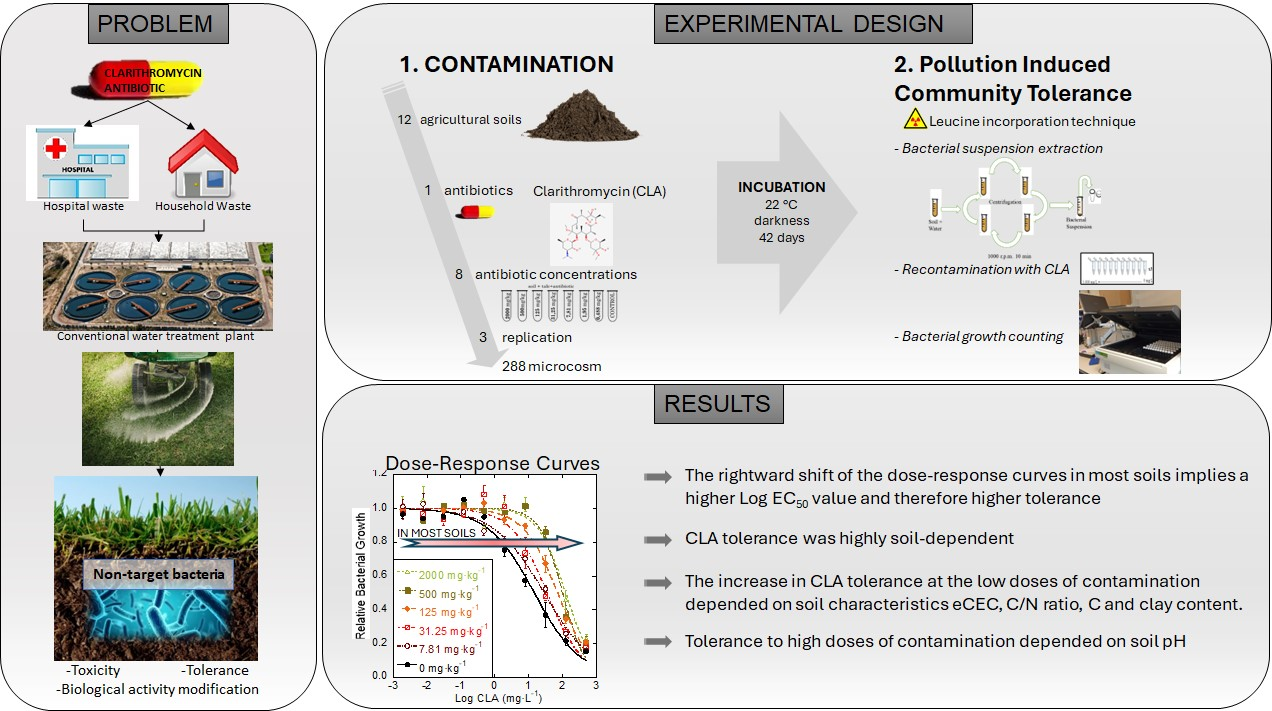
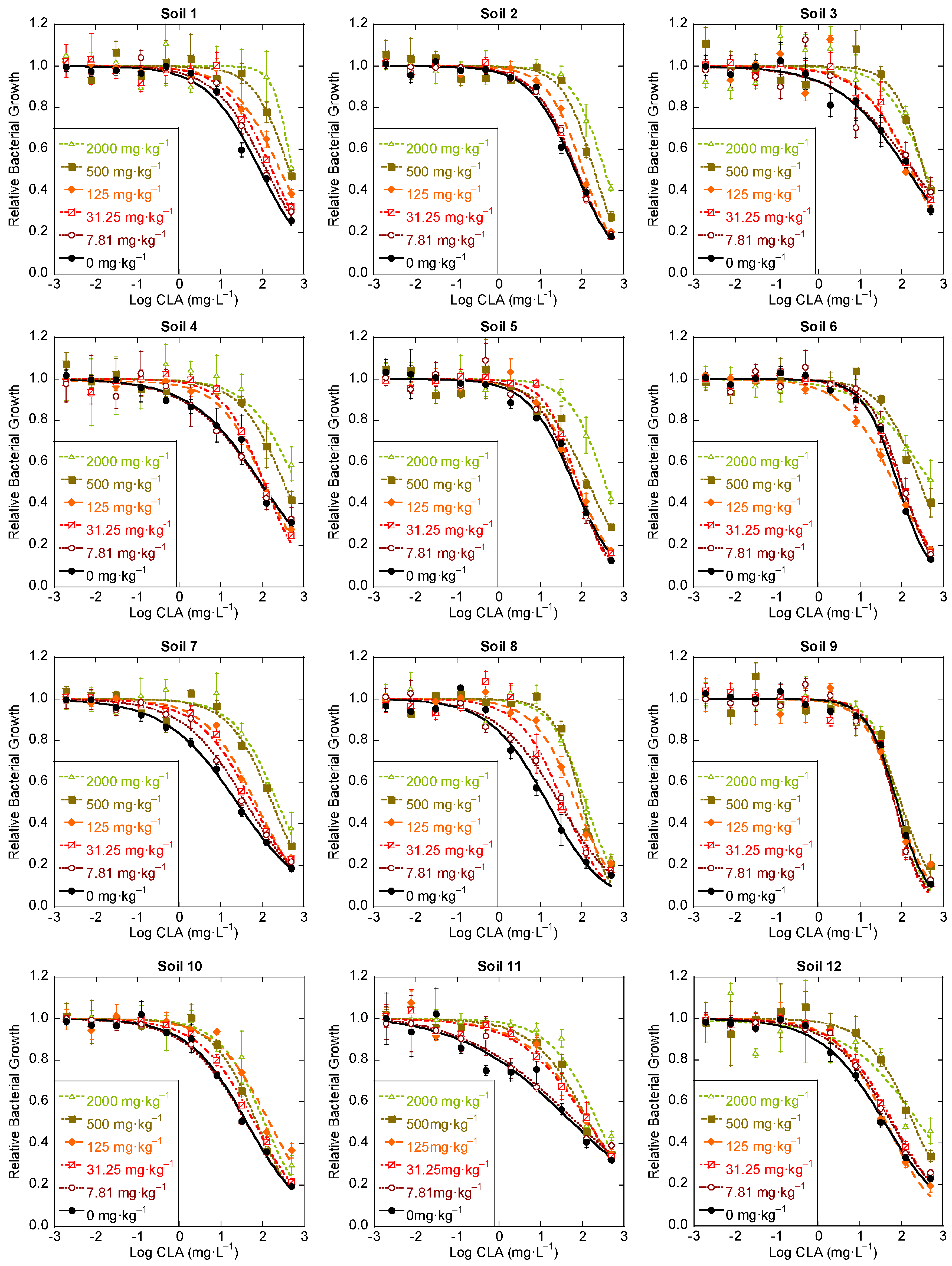
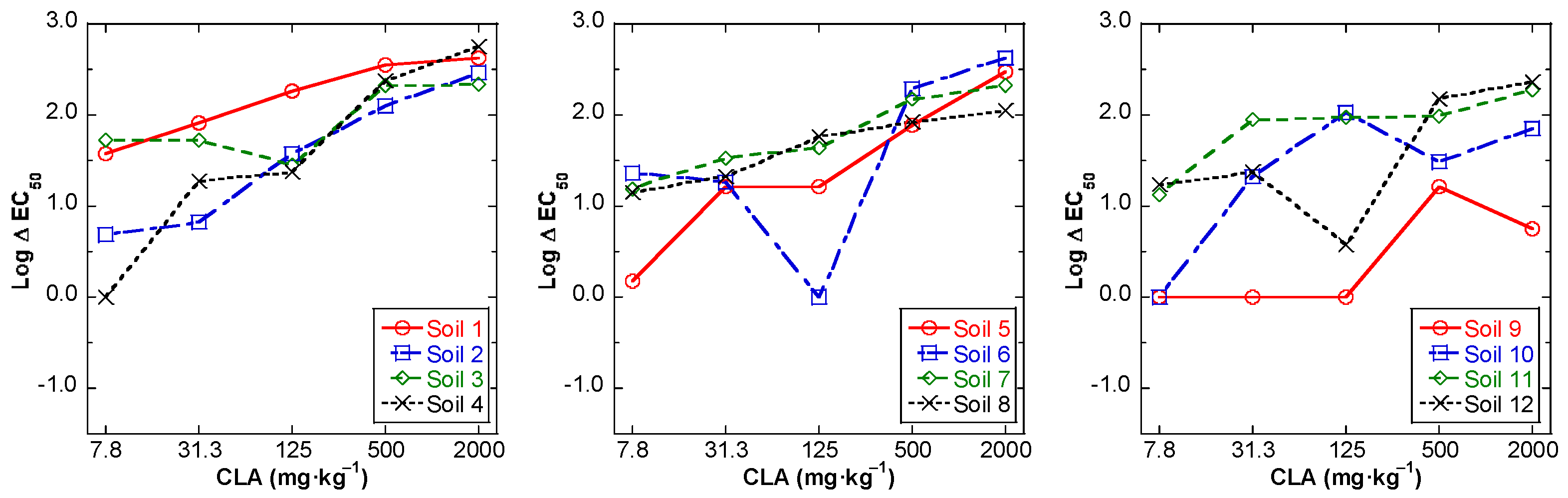
3.1. Bacterial Tolerance to CLA in CLA-Contaminated Soils
3.2. CLA Tolerance by Soil Characteristics
4. Conclusions
Supplementary Materials
Author Contributions
Funding
Data Availability Statement
Conflicts of Interest
Abbreviation
| CLA | Clarithromycin |
References
- Klein, E.Y.; Impalli, I.; Poleon, S.; Denoel, P.; Cipriano, M.; Van Boeckel, T.P.; Pecetta, S.; Bloom, D.E.; Nandi, A. Global trends in antibiotic consumption during 2016–2023 and future projections through 2030. Proc. Natl. Acad. Sci. USA 2024, 121, e2411919121. [Google Scholar] [CrossRef] [PubMed]
- Hirsch, R.; Ternes, T.A.; Haberer, K.; Mehlich, A.; Ballwanz, F.; Kratz, K.L. Determination of antibiotics in different water compartments via liquid chromatography–electrospray tandem mass spectrometry. J. Chromatogr. A 1998, 815, 213–223. [Google Scholar] [CrossRef] [PubMed]
- Hammesfahr, U.; Heuer, H.; Manzke, B.; Smalla, K.; Thiele-Bruhn, S. Impact of the antibiotic sulfadiazine and pig manure on the microbial community structure in agricultural soils. Soil Biol. Biochem. 2008, 40, 1583–1591. [Google Scholar] [CrossRef]
- Kümmerer, K. Antibiotics in the aquatic environment—A review—Part I. Chemosphere 2009, 75, 417–434. [Google Scholar] [CrossRef]
- Lienert, J.; Güdel, K.; Escher, B.I. Screening Method for Ecotoxicological Hazard Assessment of 42 Pharmaceuticals Considering Human Metabolism and Excretory Routes. Environ. Sci. Technol. 2007, 41, 4471–4478. [Google Scholar] [CrossRef]
- Berset, J.D.; Kupper, T.; Etter, R.; Tarradellas, J. Considerations about the enantioselective transformation of polycyclic musks in wastewater, treated wastewater and sewage sludge and analysis of their fate in a sequencing batch reactor plant. Chemosphere 2004, 57, 987–996. [Google Scholar] [CrossRef] [PubMed]
- Petrovic, M. Analysis and removal of emerging contaminants in wastewater and drinking water. Trac-Trends Anal. Chem. 2003, 22, 685–696. [Google Scholar] [CrossRef]
- Ternes, T.A.; Meisenheimer, M.; McDowell, D.; Sacher, F.; Brauch, H.-J.; Haist-Gulde, B.; Preuss, G.; Wilme, U.; Zulei-Seibert, N. Removal of Pharmaceuticals during Drinking Water Treatment. Environ. Sci. Technol. 2002, 36, 3855–3863. [Google Scholar] [CrossRef] [PubMed]
- Carballa, M.; Omil, F.; Lema, J.M.; Llompart, M.; García-Jares, C.; Rodríguez, I.; Gómez, M.; Ternes, T. Behavior of pharmaceuticals, cosmetics and hormones in a sewage treatment plant. Water Res. 2004, 38, 2918–2926. [Google Scholar] [CrossRef]
- Radjenovic, J.; Petrovic, M.; Barceló, D. Analysis of pharmaceuticals in wastewater and removal using a membrane bioreactor. Anal. Bioanal. Chem. 2007, 387, 1365–1377. [Google Scholar] [CrossRef]
- Rizzo, L.; Manaia, C.; Merlin, C.; Schwartz, T.; Dagot, C.; Ploy, M.C.; Michael, I.; Fatta-Kassinos, D. Urban wastewater treatment plants as hotspots for antibiotic resistant bacteria and genes spread into the environment: A review. Sci. Total Environ. 2013, 447, 345–360. [Google Scholar] [CrossRef]
- Aydın, S.; Ulvi, A.; Bedük, F.; Aydın, M.E. Pharmaceutical residues in digested sewage sludge: Occurrence, seasonal variation and risk assessment for soil. Sci. Total Environ. 2022, 817, 152864. [Google Scholar] [CrossRef]
- Fijalkowski, K.; Rorat, A.; Grobelak, A.; Kacprzak, M.J. The presence of contaminations in sewage sludge—The current situation. J. Environ. Manag. 2017, 203, 1126–1136. [Google Scholar] [CrossRef]
- Baguer, A.J.; Jensen, J.; Krogh, P.H. Effects of the antibiotics oxytetracycline and tylosin on soil fauna. Chemosphere 2000, 40, 751–757. [Google Scholar] [CrossRef]
- Nannipieri, P.; Ascher, J.; Ceccherini, M.T.; Landi, L.; Pietramellara, G.; Renella, G. Microbial diversity and soil functions. Eur. J. Soil Sci. 2003, 54, 655–670. [Google Scholar] [CrossRef]
- Pankhurst, C.E.; Ophel-Keller, K.; Doube, B.M.; Gupta, V.S.R. Biodiversity of soil microbial communities in agricultural systems. Biodivers. Conserv. 1996, 5, 197–209. [Google Scholar] [CrossRef]
- Warman, P.R. The Effect of Amprolium and Aureomycin on the Nitrification of Poultry Manure-Amended Soil. Soil Sci. Soc. Am. J. 1980, 44, 1333–1334. [Google Scholar] [CrossRef]
- Blanck, H. A Critical Review of Procedures and Approaches Used for Assessing Pollution-Induced Community Tolerance (PICT) in Biotic Communities. Hum. Ecol. Risk Assess. Int. J. 2002, 8, 1003–1034. [Google Scholar] [CrossRef]
- Ondon, S.; Li, S.; Zhou, Q.; Li, F. Sources of Antibiotic Resistant Bacteria (ARB) and Antibiotic Resistance Genes (ARGs) in the Soil: A Review of the Spreading Mechanism and Human Health Risks. In Reviews of Environmental Contamination and Toxicology; Springer: Cham, Switzerland, 2021; Volume 256, pp. 121–153. [Google Scholar] [CrossRef]
- Klümper, U.; Riber, L.; Dechesne, A.; Sannazzarro, A.; Hansen, L.H.; Sørensen, S.J.; Smets, B.F. Broad host range plasmids can invade an unexpectedly diverse fraction of a soil bacterial community. ISME J. 2015, 9, 934–945. [Google Scholar] [CrossRef]
- Sharda, N.; Kumar, D.; Thakur, R.; Sharma, A.K.; Sankhyan, S.; Kumar, A. Environmental Antibiotic Resistance: Recent Trends, Scope, and Relevance. Water Air Soil Pollut. 2023, 234, 683. [Google Scholar] [CrossRef]
- Zhao, C.; Yan, S.; Luo, Y.; Song, Y.; Xia, X. Analyzing resistome in soil and Human gut: A study on the characterization and risk evaluation of antimicrobial peptide resistance. Front. Microbiol. 2024, 15, 1352531. [Google Scholar] [CrossRef]
- World Health Organization. Antimicrobial Resistance. Global Report on Surveillance; World Health Organization: Geneva, Switzerland, 2014. [Google Scholar]
- Terreni, M.; Taccani, M.; Pregnolato, M. New Antibiotics for Multidrug-Resistant Bacterial Strains: Latest Research Developments and Future Perspectives. Molecules 2021, 26, 2671. [Google Scholar] [CrossRef] [PubMed]
- Van Boeckel, T.P.; Gandra, S.; Ashok, A.; Caudron, Q.; Grenfell, B.T.; Levin, S.A.; Laxminarayan, R. Global antibiotic consumption 2000 to 2010: An analysis of national pharmaceutical sales data. Lancet Infect. Dis. 2014, 14, 742–750. [Google Scholar] [CrossRef]
- World Health Organization. Critically Important Antimicrobials for Human Medicine 5th Revision 2016; World Health Organization: Geneva, Switzerland, 2017. [Google Scholar]
- Ghirardini, A.; Grillini, V.; Verlicchi, P. A review of the occurrence of selected micropollutants and microorganisms in different raw and treated manure—Environmental risk due to antibiotics after application to soil. Sci. Total Environ. 2020, 707, 136118. [Google Scholar] [CrossRef]
- Patel, M.; Kumar, R.; Kishor, K.; Mlsna, T.; Pittman, C.U.; Mohan, D. Pharmaceuticals of Emerging Concern in Aquatic Systems: Chemistry, Occurrence, Effects, and Removal Methods. Chem. Rev. 2019, 119, 3510–3673. [Google Scholar] [CrossRef]
- Ferrero, J.L.; Bopp, B.A.; Marsh, K.C.; Quigley, S.C.; Johnson, M.J.; Anderson, D.J.; Lamm, J.E.; Tolman, K.G.; Sanders, S.W.; Cavanaugh, J.H. Metabolism and disposition of clarithromycin in man. Drug Metab. Dispos. 1990, 18, 441–446. [Google Scholar] [CrossRef]
- Bao, F.; Zhou, Y.; Zhang, Z.; Du, Y.; Zhang, H.; Huang, Y. A perspective of spatial variability and ecological risks of antibiotics in the agricultural-pastoral ecotone soils in eastern Inner Mongolia. Chemosphere 2024, 353, 141627. [Google Scholar] [CrossRef]
- Hrčka, M.; Hřebečková, T.; Hanč, A.; Grasserová, A.; Cajthaml, T. Changes in the content of emerging pollutants and potentially hazardous substances during vermi/composting of a mixture of sewage sludge and moulded pulp. Environ. Pollut. 2024, 348, 123736. [Google Scholar] [CrossRef] [PubMed]
- Zhang, Y.; Hu, Y.; Li, X.; Gao, L.; Wang, S.; Jia, S.; Shi, P.; Li, A. Prevalence of antibiotics, antibiotic resistance genes, and their associations in municipal wastewater treatment plants along the Yangtze River basin, China. Environ. Pollut. 2024, 348, 123800. [Google Scholar] [CrossRef] [PubMed]
- Zeng, Y.; Quan, W.; Li, C. Environmental Fate, Soil Ecological Responses and Fruit Quality Impacts of Emerging Contaminants (Antibiotics) in Orchard Ecosystems: A Review. Molecules 2026, 31, 865. [Google Scholar] [CrossRef]
- Ilie, M.; Marinescu, F.; Ghita, G.; Savin, I.; Tudor, G.; Luminaroiu, L.; Gheorghe, P.-I.; Dumitrescu, G.; Noor, N.M. Evaluation of the Ecological Risk and the Development of Antimicrobial Resistance due to the Presence of the Macrolide Antibiotics Azithromycin and Clarithromycin in Romanian Aquatic Environment. In Proceedings of the IOP Conference Series: Earth and Environmental Science; IOP Publishing: Bristol, UK, 2023; Volume 1216, p. 012009. [Google Scholar] [CrossRef]
- Mao, Y.; Ye, K.; Yang, S.; Salam, M.; Yu, W.; He, Q.; He, R.; Li, H. Repeated exposure enhanced toxicity of clarithromycin on Microcystis aeruginosa versus single exposure through photosynthesis, oxidative stress, and energy metabolism shift. Environ. Sci. Technol. 2024, 58, 4070–4082. [Google Scholar] [CrossRef]
- Santos, J.L.; Martín, J.; Mejías, C.; Aparicio, I.; Alonso, E. Pharmaceuticals and their metabolites in sewage sludge and soils: Distribution and environmental risk assessment. In Emerging Pollutants in Sewage Sludge and Soils; Springer International Publishing: Cham, Switzerland, 2022; pp. 19–36. [Google Scholar] [CrossRef]
- Stando, K.; Zogornik, P.; Kopiec, M.; Pieszczek, M.; Kowalska, K.; Felis, E.; Bajkacz, S. Degradation of fluoroquinolones and macrolides by solar light-driven heterogeneous photocatalysis–Proposed drug transformation pathways. J. Photochem. Photobiol. A Chem. 2024, 453, 115651. [Google Scholar] [CrossRef]
- Kodešová, R.; Kočárek, M.; Klement, A.; Golovko, O.; Koba, O.; Fér, M.; Nikoderm, A.; Vondráčková, L.; Jakšík, O.; Grabic, R. An analysis of the dissipation of pharmaceuticals under thirteen different soil conditions. Sci. Total Environ. 2016, 544, 369–381. [Google Scholar] [CrossRef]
- Topp, E.; Renaud, J.; Sumarah, M.; Sabourin, L. Reduced persistence of the macrolide antibiotics erythromycin, clarithromycin and azithromycin in agricultural soil following several years of exposure in the field. Sci. Total Environ. 2016, 562, 136–144. [Google Scholar] [CrossRef]
- Senta, I.; Krizman-Matasic, I.; Terzic, S.; Ahel, M. Comprehensive determination of macrolide antibiotics, their synthesis intermediates and transformation products in wastewater effluents and ambient waters by liquid chromatography–tandem mass spectrometry. J. Chromatogr. A 2017, 1509, 60–68. [Google Scholar] [CrossRef]
- Baumann, M.; Weiss, K.; Maletzki, D.; Schüssler, W.; Schudoma, D.; Kopf, W.; Kühnen, U. Aquatic toxicity of the macrolide antibiotic clarithromycin and its metabolites. Chemosphere 2015, 120, 192–198. [Google Scholar] [CrossRef] [PubMed]
- Rodríguez-González, L.; Santás-Miguel, V.; Campillo-Cora, C.; Arias-Estévez, M.; Fernández-Calviño, D. The effect of clarithromycin toxicity on the growth of bacterial communities in agricultural soils. Processes 2021, 9, 1303. [Google Scholar] [CrossRef]
- Rodríguez-González, L.; García-Campos, E.; Martín, A.; Díaz-Raviña, M.; Arias-Estévez, M.; Fernández-Calviño, D.; Santás-Miguel, V. Microbial Communities as Affected by Clarithromycin Addition in Four Acid Soils (NW Iberian Peninsula). Span. J. Soil Sci. 2023, 13, 11319. [Google Scholar] [CrossRef]
- Uddin, M.; Chen, J.; Qiao, X.; Tian, R.; Arafat, Y.; Yang, X. Bacterial community variations in paddy soils induced by application of veterinary antibiotics in plant-soil systems. Ecotox. Environ. Safe 2019, 167, 44–53. [Google Scholar] [CrossRef] [PubMed]
- Brown, L.P.; Murray, R.; Scott, A.; Tien, Y.-C.; Lau, C.H.-F.; Tai, V.; Topp, E. Responses of the Soil Bacterial Community, Resistome, and Mobilome to a Decade of Annual Exposure to Macrolide Antibiotics. Appl. Environ. Microbiol. 2022, 88, e00316-22. [Google Scholar] [CrossRef]
- Della-Negra, O.; Bastos, M.C.; Bru-Adan, V.; Santa-Catalina, G.; Ait-Mouheb, N.; Chiron, S.; Patureau, D. Temporal dynamics of the soil resistome and microbiome irrigated with treated wastewater containing clarithromycin. Environ. Res. 2025, 270, 120954. [Google Scholar] [CrossRef]
- Lau, C.H.-F.; Tien, Y.-C.; Stedtfeld, R.D.; Topp, E. Impacts of multi-year field exposure of agricultural soil to macrolide antibiotics on the abundance of antibiotic resistance genes and selected mobile genetic elements. Sci. Total Environ. 2020, 727, 138520. [Google Scholar] [CrossRef]
- Meisner, A.; Bååth, E.; Rousk, J. Microbial growth responses upon rewetting soil dried for four days or one year. Soil Biol. Biochem. 2013, 66, 188–192. [Google Scholar] [CrossRef]
- Walters, E.; McClellan, K.; Halden, R.U. Occurrence and loss over three years of 72 pharmaceuticals and personal care products from biosolids–soil mixtures in outdoor mesocosms. Water Res. 2010, 44, 6011–6020. [Google Scholar] [CrossRef]
- Santás-Miguel, V.; Arias-Estévez, M.; Díaz-Raviña, M.; Fernández-Sanjurjo, M.J.; Álvarez-Rodríguez, E.; Núñez-Delgado, A.; Fernández-Calviño, D. Interactions between soil properties and tetracycline toxicity affecting to bacterial community growth in agricultural soil. Appl. Soil Ecol. 2020, 147, 103437. [Google Scholar] [CrossRef]
- Rousk, J.; Demoling, L.A.; Bahr, A.; Bååth, E. Examining the fungal and bacterial niche overlap using selective inhibitors in soil. FEMS Microbiol. Ecolo. 2008, 63, 350–358. [Google Scholar] [CrossRef]
- Bhalsing, M.; Chumbhale, D. Development and evaluation of non-saccharide polymer-based taste-masked clarithromycin tablets: A novel approach to improve pediatric compliance. J. Appl. Pharm. Res. 2025, 13, 134–146. [Google Scholar] [CrossRef]
- De Guzman, G.Q.; Ecalne, J.K.T.; Andaya, B.A.; Ramil, M.D.I.; Ramil, R.J.D. Formulation, bio-equivalence and correlation studies of a cashew in vitro-in vivo gum-based clarithromycin sustained-release tablet. Adv. Pharm. J. 2018, 3, 62–69. [Google Scholar] [CrossRef]
- Santás-Miguel, V.; Rodríguez-González, L.; Núñez-Delgado, A.; Álvarez-Rodríguez, E.; Díaz-Raviña, M.; Arias-Estévez, M.; Fernández-Calviño, D. Time-course evolution of bacterial community tolerance to tetracycline antibiotics in agricultural soils: A laboratory experiment. Chemosphere 2022, 291, 132758. [Google Scholar] [CrossRef]
- Udikovic-Kolic, N.; Wichmann, F.; Broderick, N.A.; Handelsman, J. Bloom of resident antibiotic-resistant bacteria in soil following manure fertilization. Proc. Natl. Acad. Sci. USA 2014, 111, 15202–15207. [Google Scholar] [CrossRef]
- Bååth, E. Thymidine and leucine incorporation in soil bacteria with different cell size. Microb. Ecol. 1994, 27, 267–278. [Google Scholar] [CrossRef] [PubMed]
- Bååth, E.; Pettersson, M.; Söderberg, K.H. Adaptation of a rapid and economical microcentrifugation method to measure thymidine and leucine incorporation by soil bacteria. Soil Biol. Biochem. 2001, 33, 1571–1574. [Google Scholar] [CrossRef]
- Smith, M.S.; Yang, R.K.; Knapp, C.W.; Niu, Y.; Peak, N.; Hanfelt, M.M.; Galland, J.C.; Graham, D.W. Quantification of Tetracycline Resistance Genes in Feedlot Lagoons by Real-Time PCR. Appl. Environ. Microbiol. 2004, 70, 7372–7377. [Google Scholar] [CrossRef]
- Wu, N.; Qiao, M.; Zhang, B.; Cheng, W.-D.; Zhu, Y.-G. Abundance and Diversity of Tetracycline Resistance Genes in Soils Adjacent to Representative Swine Feedlots in China. Environ. Sci. Technol. 2010, 44, 6933–6939. [Google Scholar] [CrossRef]
- Huang, T.; Xu, Y.; Zeng, J.; Zhao, D.-H.; Li, L.; Liao, X.-P.; Liu, Y.-H.; Sun, J. Low-Concentration Ciprofloxacin Selects Plasmid-Mediated Quinolone Resistance Encoding Genes and Affects Bacterial Taxa in Soil Containing Manure. Front. Microbiol. 2016, 7, 1730. [Google Scholar] [CrossRef] [PubMed]
- Mattila, T.J.; Rajala, J. Estimating cation exchange capacity from agronomic soil tests: Comparing Mehlich-3 and ammonium acetate sum of cations. Soil Sci. Soc. Am. J. 2022, 86, 47–50. [Google Scholar] [CrossRef]
- Cela-Dablanca, R.; Barreiro, A.; Ferreira-Coelho, G.; Campillo-Cora, C.; Pérez-Rodríguez, P.; Arias-Estévez, M.; Núñez-Delgado, A.; Álvarez-Rodríguez, E.; Fernández-Sanjurjo, M.J. Cu and As(V) Adsorption and Desorption on/from Different Soils and Bio-Adsorbents. Materials 2022, 15, 5023. [Google Scholar] [CrossRef]
- Rath, S.; Fostier, A.H.; Pereira, L.A.; Dioniso, A.C.; de Oliveira Ferreira, F.; Doretto, K.M.; Maniero Peruchi, L.; Viera, A.; de Oliveira Neto, F.; Dal Bosco, S.M.; et al. Sorption behaviors of antimicrobial and antiparasitic veterinary drugs on subtropical soils. Chemosphere 2019, 214, 111–122. [Google Scholar] [CrossRef]
- Vasudevan, D.; Bruland, G.L.; Torrance, B.S.; Upchurch, V.G.; MacKay, A.A. pH-dependent ciprofloxacin sorption to soils: Interaction mechanisms and soil factors influencing sorption. Geoderma 2009, 151, 68–76. [Google Scholar] [CrossRef]
- Sibley, S.D.; Pedersen, J.A. Interaction of the Macrolide Antimicrobial Clarithromycin with Dissolved Humic Acid. Environ. Sci. Technol. 2008, 42, 422–428. [Google Scholar] [CrossRef]
- Yang, L.; Wu, L.; Liu, W.; Huang, Y.; Luo, Y.; Christie, P. Dissipation of antibiotics in three different agricultural soils after repeated application of biosolids. Environ. Sci. Pollut. Res. 2018, 25, 104–114. [Google Scholar] [CrossRef]
- Wang, S.; Wang, H. Adsorption behavior of antibiotic in soil environment: A critical review. Front. Environ. Sci. Eng. 2015, 9, 565–574. [Google Scholar] [CrossRef]
- Wegst-Uhrich, S.R.; Navarro, D.A.; Zimmerman, L.; Aga, D.S. Assessing antibiotic sorption in soil: A literature review and new case studies on sulfonamides and macrolides. Chem. Cent. J. 2014, 8, 5. [Google Scholar] [CrossRef]
- Hanamoto, S.; Nakada, N.; Jürgens, M.D.; Johnson, A.C.; Yamashita, N.; Tanaka, H. The different fate of antibiotics in the Thames River, UK, and the Katsura River, Japan. Environ. Sci. Pollut. Res. 2018, 25, 1903–1913. [Google Scholar] [CrossRef]
- Rodríguez-López, L.; Santás-Miguel, V.; Cela-Dablanca, R.; Núñez-Delgado, A.; Álvarez-Rodríguez, E.; Rodríguez-Seijo, A.; Arias-Estévez, M. Clarithromycin as soil and environmental pollutant: Adsorption-desorption processes and influence of pH. Environ. Res. 2023, 233, 116520. [Google Scholar] [CrossRef]
- Yan, F.; Tuller, M.; de Jonge, L.W.; Moldrup, P.; Arthur, E. Specific surface area of soils with different clay mineralogy can be estimated from a single hygroscopic water content. Geoderma 2023, 438, 116614. [Google Scholar] [CrossRef]
- Wan, X.; Huang, Z.; He, Z.; Yu, Z.; Wang, M.; Davis, M.R.; Yang, Y. Soil C:N ratio is the major determinant of soil microbial community structure in subtropical coniferous and broadleaf forest plantations. Plant Soil 2015, 387, 103–116. [Google Scholar] [CrossRef]
- Craine, J.M.; Morrow, C.; Fierer, N. Microbial nitrogen limitation increases decomposition. Ecology 2007, 88, 2105–2113. [Google Scholar] [CrossRef]
- Ye, J.; Perez, P.G.; Zhang, R.; Nielsen, S.; Huang, D.; Thomas, T. Effects of different C/N ratios on bacterial compositions and processes in an organically managed soil. Biol. Fertil. Soils 2018, 54, 137–147. [Google Scholar] [CrossRef]
- Wang, L.; Wang, Z.; Wang, F.; Guan, Y.; Meng, D.; Li, X.; Zhou, H.; Li Chen, Y.; Tan, Z. Response of performance, antibiotic resistance genes and bacterial community exposure to compound antibiotics stress: Full nitrification to shortcut nitrification and denitrification. Chem. Eng. J. 2023, 451, 138750. [Google Scholar] [CrossRef]
- Periti, P.; Mazzei, T.; Mini, E.; Novelli, A. Clinical Pharmacokinetic Properties of the Macrolide Antibiotics. Clin. Pharmacokinet. 1989, 16, 193–214. [Google Scholar] [CrossRef]
- Noguchi, S.; Takiyama, K.; Fujiki, S.; Iwao, Y.; Miura, K.; Itai, S. Polymorphic Transformation of Antibiotic Clarithromycin Under Acidic Condition. J. Pharm. Sci. 2014, 103, 580–586. [Google Scholar] [CrossRef]
- Cela-Dablanca, R.; Barreiro, A.; Rodríguez-López, L.; Pérez-Rodríguez, P.; Arias-Estévez, M.; Fernández-Sanjurjo, M.J.; Álvarez-Rodríguez, E.; Núñez-Delgado, A. Azithromycin adsorption onto different soils. Processes 2022, 10, 2565. [Google Scholar] [CrossRef]
- Martinez, J.L. Environmental pollution by antibiotics and by antibiotic resistance determinants. Environ. Pollut. 2009, 157, 2893–2902. [Google Scholar] [CrossRef]
- Liu, Z.; Zhao, Y.; Zhang, B.; Wang, J.; Zhu, L.; Hu, B. Deterministic Effect of pH on Shaping Soil Resistome Revealed by Metagenomic Analysis. Environ. Sci. Technol. 2023, 57, 985–996. [Google Scholar] [CrossRef]
- Baquero, F.; Martinez, J.L.; Lanza, V.F.; Rodríguez-Beltrán, J.; Galán, J.C.; San Millán, A.; Cantón, T.; Coque, T.M. Evolutionary pathways and trajectories in antibiotic resistance. Clin. Microbiol. Rev. 2021, 34, e00050-19. [Google Scholar] [CrossRef]
- Ebbensgaard, A.E.; Løbner-Olesen, A.; Frimodt-Møller, J. The role of efflux pumps in the transition from low-level to clinical antibiotic resistance. Antibiotics 2020, 9, 855. [Google Scholar] [CrossRef]
- Darkes, M.J.M.; Perry, C.M. Clarithromycin Extended-Release Tablet. Am. J. Respir. Med. 2003, 2, 175–201. [Google Scholar] [CrossRef] [PubMed]
- Pechère, J.-C. Macrolide resistance mechanisms in Gram-positive cocci. Int. J. Antimicrob. Agents 2001, 18, 25–28. [Google Scholar] [CrossRef] [PubMed]
- Amdan, N.A.N.; Shahrulzamri, N.A.; Hashim, R.; Jamil, N.M. Understanding the evolution of macrolides resistance: A mini review. J. Glob. Antimicrob. Resist. 2024, 38, 368–375. [Google Scholar] [CrossRef] [PubMed]
- Fyfe, C.; Grossman, T.H.; Kerstein, K.; Sutcliffe, J. Resistance to Macrolide Antibiotics in Public Health Pathogens. Cold Spring Harb. Perspect. Med. 2016, 6, a025395. [Google Scholar] [CrossRef]
- Alexander, D.C.; Farquhar, T.; Adams, J.M.; Suchan, D.M.; Workman, S.D.; Wallace, R.J., Jr.; Elliott, B.A.B.; Halfawy, O.M.E.; Cameron, A.D. Macrolide resistance due to erm (55). Microbiol. Spectr. 2025, 13, e02397-24. [Google Scholar] [CrossRef] [PubMed]
- Shivaee, A.; Kazemi, F.; Navidifar, T.; Golab, N.; Parvizi, E.; Mofid, M.; Sholeh, M.; Beig, M. Global trends in macrolide and lincosamide resistance in Streptococcus species: A comprehensive systematic review and meta-analysis. BMC Infect. Dis. 2025, 25, 1577. [Google Scholar] [CrossRef]
- Milaković, M.; Križanović, S.; Petrić, I.; Šimatović, A.; González-Plaza, J.J.; Gužvinec, M.; Andrašević, A.T.; Pole, L.; Fuka, M.M.; Udiković-Kolić, N. Characterization of macrolide resistance in bacteria isolated from macrolide-polluted and unpolluted river sediments and clinical sources in Croatia. Sci. Total Environ. 2020, 749, 142357. [Google Scholar] [CrossRef] [PubMed]



| Soil | Crop | pHW | pHKCl | C (%) | N (%) | eCEC (cmolc kg−1) | DOC (mg kg−1) | Sand (%) | Silt (%) | Clay (%) | USDA Clasification | WRB Clasification | Feo (g kg−1) | Alo (g kg−1) |
|---|---|---|---|---|---|---|---|---|---|---|---|---|---|---|
| 1 | Vineyard | 5.6 | 4.2 | 0.6 | 0.06 | 5.9 | 120 | 61 | 25 | 13 | Sandy loam | Regosol | 1.3 | 0.7 |
| 2 | Vineyard | 5.6 | 4.9 | 3.6 | 0.26 | 19.5 | 263 | 69 | 17 | 14 | Sandy loam | Umbrisol | 3.5 | 5.8 |
| 3 | Vineyard | 5.6 | 4.8 | 1.6 | 0.18 | 6.02 | 243 | 44 | 34 | 23 | Loam | Umbrisol | 2.2 | 1.0 |
| 4 | Vineyard | 6.1 | 5.3 | 2.8 | 0.23 | 37.2 | 265 | 61 | 21 | 18 | Sandy loam | Umbrisol | 3.6 | 4.4 |
| 5 | Vineyard | 5.7 | 4.9 | 4.8 | 0.40 | 17.3 | 332 | 58 | 20 | 21 | Sandy clay loams | Umbrisol | 2.8 | 5.3 |
| 6 | Vineyard | 5.5 | 4.2 | 6.5 | 0.49 | 10.5 | 350 | 66 | 13 | 21 | Sandy clay loams | Umbrisol | 5.5 | 3.1 |
| 7 | Corn | 4.8 | 4.4 | 3.1 | 0.37 | 5.2 | 633 | 70 | 18 | 12 | Sandy loam | Umbrisol | 1.8 | 2.1 |
| 8 | Corn | 4.6 | 4.2 | 2.4 | 0.28 | 3.2 | 336 | 77 | 14 | 9 | Loamy sands | Umbrisol | 1.6 | 2.2 |
| 9 | Corn | 4.1 | 3.7 | 3.3 | 0.34 | 4.3 | 599 | 81 | 10 | 9 | Loamy sands | Umbrisol | 2.3 | 1.8 |
| 10 | Corn | 5.2 | 4.7 | 3.2 | 0.41 | 4.1 | 327 | 55 | 28 | 17 | Sandy loam | Umbrisol | 8.9 | 3.1 |
| 11 | Corn | 5.6 | 5.1 | 3.4 | 0.44 | 11.2 | 356 | 45 | 33 | 22 | Loam | Umbrisol | 8.1 | 3.8 |
| 12 | Corn | 5.1 | 4.5 | 6.8 | 0.59 | 5.5 | 318 | 34 | 38 | 28 | Clay loam | Umbrisol | 8.9 | 8.7 |
Disclaimer/Publisher’s Note: The statements, opinions and data contained in all publications are solely those of the individual author(s) and contributor(s) and not of MDPI and/or the editor(s). MDPI and/or the editor(s) disclaim responsibility for any injury to people or property resulting from any ideas, methods, instructions or products referred to in the content. |
© 2026 by the authors. Licensee MDPI, Basel, Switzerland. This article is an open access article distributed under the terms and conditions of the Creative Commons Attribution (CC BY) license.
Share and Cite
Rodríguez-González, L.; Arias-Estévez, M.; Díaz-Raviña, M.; Villaverde, J.J.; Fernández-Calviño, D.; Santás-Miguel, V. General Soil Properties Modulate Bacterial Community Tolerance to Clarithromycin in Laboratory-Spiked Agricultural Soils. Agriculture 2026, 16, 1312. https://doi.org/10.3390/agriculture16121312
Rodríguez-González L, Arias-Estévez M, Díaz-Raviña M, Villaverde JJ, Fernández-Calviño D, Santás-Miguel V. General Soil Properties Modulate Bacterial Community Tolerance to Clarithromycin in Laboratory-Spiked Agricultural Soils. Agriculture. 2026; 16(12):1312. https://doi.org/10.3390/agriculture16121312
Chicago/Turabian StyleRodríguez-González, Laura, Manuel Arias-Estévez, Montserrat Díaz-Raviña, Juan José Villaverde, David Fernández-Calviño, and Vanesa Santás-Miguel. 2026. "General Soil Properties Modulate Bacterial Community Tolerance to Clarithromycin in Laboratory-Spiked Agricultural Soils" Agriculture 16, no. 12: 1312. https://doi.org/10.3390/agriculture16121312
APA StyleRodríguez-González, L., Arias-Estévez, M., Díaz-Raviña, M., Villaverde, J. J., Fernández-Calviño, D., & Santás-Miguel, V. (2026). General Soil Properties Modulate Bacterial Community Tolerance to Clarithromycin in Laboratory-Spiked Agricultural Soils. Agriculture, 16(12), 1312. https://doi.org/10.3390/agriculture16121312