1. Introduction
Agricultural production underpins economic development and social stability, and grain security remains a central policy concern in many developing countries. In recent years, global food systems have become increasingly vulnerable to external shocks, including geopolitical conflicts, trade disputes, and market volatility, all of which have intensified concerns over food security [
1]. In China, the balance between grain supply and demand remains fragile under the combined pressure of population growth and dietary upgrading [
2]. At the same time, the long-term intensive use of chemical fertilizers and pesticides has contributed to cultivated land degradation and weakened the productive capacity of arable land, posing a growing challenge to the sustainable development of grain production [
3].
As one of the most important inputs in crop production, chemical fertilizer has played a vital role in increasing yields and safeguarding food supply [
4]. However, excessive fertilizer application has also led to a series of problems, including soil degradation, declining fertility, low fertilizer use efficiency (FUE), and agricultural non-point source pollution [
5], which directly threaten the food security and sustainable development of agriculture in China. Therefore, improving FUE has become essential for reconciling grain production with agricultural sustainability. In this context, conservation tillage (CT) has been widely promoted in China as an important technological pathway for protecting cultivated land quality and improving the agroecological environment. Existing studies suggest that CT can improve soil structure, enhance water retention, promote nutrient cycling, and mitigate land degradation [
6]. These potential benefits imply that CT may also affect farmers’ FUE. However, whether CT can effectively improve FUE at the farm level remains an open empirical question.
More importantly, CT should be understood as a set of distinct tillage technologies rather than a single farming practice. Different tillage practices, such as conventional rotary tillage with straw returning (CTS), no-tillage with straw returning (NTS), and deep tillage with straw returning (DTS), differ substantially in their operational requirements, agronomic effects, and implications for FUE. Pooling these practices into one broad CT category may therefore mask important differences in their effects on farmers’ FUE. Existing studies on CT and FUE are mainly drawn from agronomic field experiments, yet their conclusions remain mixed. Some studies find that CT practices such as no-tillage or straw returning can improve FUE [
6,
7]. By contrast, other studies report that no-tillage with straw mulching may reduce nitrogen-use efficiency, especially under low-temperature conditions in the early crop growth stage [
8]. Still others suggest that the effect of CT on FUE is uncertain or highly context-dependent [
9]. These inconsistent findings indicate that the effects of CT on FUE may be highly context-specific and practice-specific.
International evidence also shows that the relationship between conservation tillage and fertilizer-use efficiency is highly context-dependent. In the Indo-Gangetic Plains, conservation agriculture, zero tillage, residue recycling, and improved nutrient management have been widely discussed as strategies for improving productivity and resource-use efficiency under smallholder farming conditions [
10,
11]. In the US Corn Belt, conservation tillage is more often embedded in large-scale mechanized production systems, where its effects depend on climate, soil quality, irrigation conditions, and nutrient-management practices [
12]. These international experiences suggest that conservation tillage does not automatically improve fertilizer efficiency; instead, its effects depend on farm size, machinery access, soil conditions, and complementary fertilizer-management practices. Therefore, examining the heterogeneous effects of different tillage practices in China’s wheat–maize system can provide useful evidence for broader debates on conservation agriculture and input-use efficiency.
Although agronomic experiments provide valuable evidence, they often abstract from farmers’ actual production and management behavior. As a result, they may have limited ability to capture the farm-level efficiency consequences of tillage adoption under real-world decision-making conditions. By contrast, social science approaches based on household survey data can explicitly account for farmers’ behavioral heterogeneity and production constraints. Existing economic studies on CT have examined outcomes such as carbon efficiency and environmental performance [
13], but relatively little attention has been paid to farmers’ FUE. More specifically, three important gaps remain. First, existing studies rarely examine the effect of CT on FUE using micro-level household data. Second, most studies do not sufficiently distinguish between alternative tillage practices, thereby overlooking possible heterogeneity in FUE effects across CTS, NTS, and DTS. Third, limited evidence is available on the mechanisms through which CT affects FUE and on whether these effects vary across different operational scales.
Using household survey data collected in 2024 from wheat–maize farmers in five provinces of China, this study estimates farmers’ FUE and identifies the effects of different tillage choices while addressing potential self-selection bias. It further explores the underlying mechanisms and threshold heterogeneity across farm-size regimes. This study contributes to the literature in three ways. First, it extends the CT literature by shifting attention from yield, soil, and environmental outcomes to FUE at the farm level. Second, it moves beyond treating CT as a single broad category by explicitly comparing the effects of CTS, NTS, and DTS. Third, by combining treatment-effect estimation, mechanism analysis, and threshold regression, this study provides a more comprehensive understanding of how and under what conditions different tillage practices affect farmers’ FUE. These findings also offer useful implications for the targeted promotion of CT and the improvement of FUE in grain production.
4. Results
4.1. Calculation Results of Fertilizer Use Efficiency
Based on the estimation results of the SFA model, the likelihood ratio test strongly rejects the null hypothesis of “” at the 1% significance level. The ratio of the standard deviation of the technical inefficiency term to that of the random error term, denoted by λ, is estimated to be approximately 2.3235. This provides evidence of technical inefficiency among sampled grain farmers and indicates that the SFA specification is more appropriate than OLS for estimating farmers’ FUE.
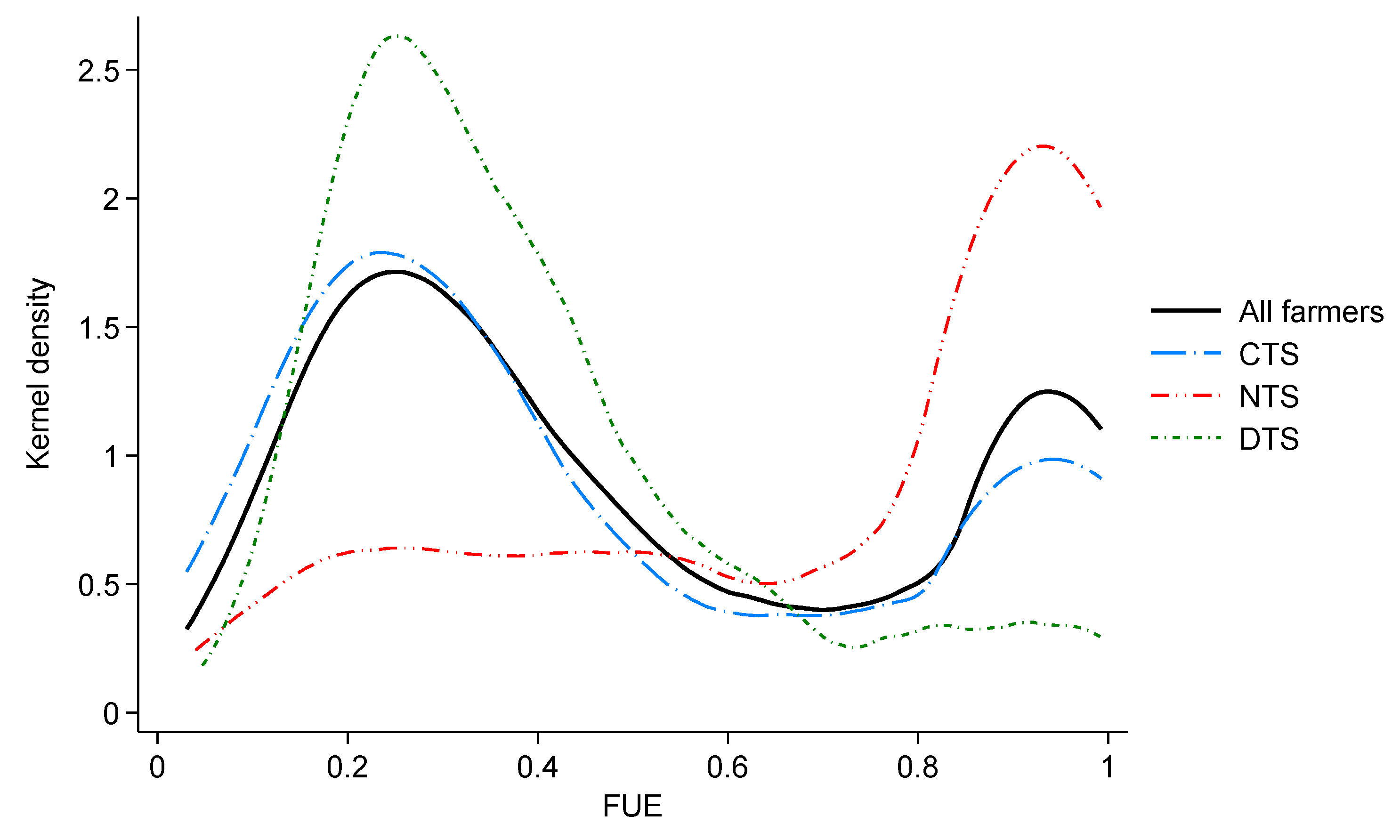
Figure 1 presents the kernel density distributions of FUE for all farmers and by tillage practice. Overall, the average FUE in the sample is 0.5045, indicating a moderate level of FUE among wheat–maize producers in the study area. The distribution of farmers’ FUE exhibits substantial heterogeneity across tillage practices. The kernel density distribution of the SFA-derived FUE indicator shows two visible local peaks, suggesting that farmers are clustered in relatively low- and high-FUE groups. In particular, the distribution for NTS is markedly shifted to the right, with a large concentration of observations in the high-efficiency range, whereas DTS is concentrated more heavily in the lower-efficiency range. This pattern may reflect differences in the agronomic and operational characteristics of the two practices. NTS may improve the soil environment for fertilizer absorption by reducing soil disturbance and maintaining straw cover, while DTS is more dependent on soil compaction conditions, machinery quality, and standardized field operations. When these supporting conditions are insufficient, DTS may not translate its potential yield benefits into higher FUE. CTS occupies an intermediate position. These patterns indicate that different tillage choices are associated with substantial differences in the distribution of FUE, rather than merely differences in average efficiency levels.
4.2. Determinants of the Farmers’ Tillage Choice
This section examines the determinants of farmers’ tillage choices.
Table 4 shows how farmers’ characteristics, production conditions, and external support factors affect the probabilities of adopting CTS, NTS, and DTS. The results reveal substantial heterogeneity in tillage choices, indicating that farmers’ adoption decisions are not random but are systematically associated with observable household and production characteristics. The corresponding MNL coefficient estimates are provided in
Table A1 for reference.
Household-head characteristics are significantly associated with farmers’ tillage choices. The marginal effects of age show that each additional year of the household head’s age reduces the probability of adopting CTS by 0.39 percentage points and increases the probability of adopting NTS by 0.46 percentage points. This suggests that older farmers are less likely to remain with conventional rotary tillage and more likely to adopt no-tillage with straw return. By contrast, farming experience has the opposite effect. Each additional year of grain cultivation experience increases the probability of adopting CTS by 0.41 percentage points and decreases the probability of adopting NTS by 0.62 percentage points, implying that more experienced farmers tend to rely on familiar tillage practices and are less inclined to shift to no-tillage systems.
Production conditions also significantly affect tillage choices. Better field-road access increases the probability of adopting NTS by 6.87 percentage points, indicating that favorable operating conditions and machinery accessibility are particularly important for the adoption of no-tillage practices. Irrigation access also matters. Better irrigation conditions reduce the probability of adopting CTS by 4.70 percentage points and increase the probability of adopting NTS by 4.56 percentage points, suggesting that no-tillage is more likely to be adopted under better water management conditions. A one-unit increase in the perceived severity of disaster-related losses reduces the probability of adopting NTS by 4.93 percentage points but raises the probability of adopting DTS by 4.05 percentage points. This suggests that farmers facing greater production risks may be less willing to adopt no-tillage and more likely to choose deep tillage instead.
Among the remaining variables, delivery access is particularly noteworthy. The presence of a delivery station in the village increases the probability of adopting NTS by 7.94 percentage points and decreases the probability of adopting DTS by 7.96 percentage points. This indicates that better village-level access to information and logistics services facilitates the adoption of no-tillage practices, while making deep tillage less likely. In addition, land fragmentation significantly increases the probability of adopting CTS, suggesting that fragmented land conditions may constrain farmers from shifting away from conventional rotary tillage.
The IVs also perform as expected. Participation in CT-related training significantly reduces the probability of adopting CTS by 28.07% and increases the probabilities of adopting NTS and DTS by 11.12% and 16.95%, respectively. This highlights the important role of training and extension services in promoting CT adoption. Similarly, stronger perceptions that CT contributes to environmental protection reduce the probability of adopting CTS by 4.88% and increase the probability of adopting NTS by 3.27%, suggesting that environmental awareness also encourages farmers to shift away from CTS.
4.3. Treatment Effect of Tillage Choice on Farmers’ FUE
Based on the two-stage estimation of the MESR model, this paper further quantifies the treatment effects of alternative tillage practices on farmers’ FUE. It should be clarified that the primary purpose of employing the MESR framework is to estimate the causal treatment effects of tillage choice on FUE, rather than to analyze the determinants of FUE. For brevity, the detailed second-stage results are reported in
Appendix A (
Table A2).
Table 5 reports the ATT of tillage choice on farmers’ FUE. By construction, the ATT measures the average effect of a given tillage practice on those farmers who actually adopted it, relative to the counterfactual outcome they would have obtained had they adopted CTS instead.
The results show that, for farmers who actually adopted NTS, their observed FUE is significantly higher than the counterfactual FUE they would have achieved under CTS. The estimated ATT is 0.1591, indicating that no-tillage with straw return increases FUE by 0.1591 on average among its actual adopters. This suggests that, after accounting for both observable and unobservable selection bias, NTS can effectively improve FUE. This finding is broadly consistent with evidence that no-tillage can improve nutrient use efficiency and reduce fertilizer losses under suitable conditions.
By contrast, for farmers who actually adopted DTS, the estimated ATT is negative and statistically significant. Specifically, the observed FUE of DTS adopters is lower than the counterfactual FUE they would have obtained had they adopted CTS, with an ATT of −0.0562. This means that, among actual DTS adopters, deep tillage with straw return reduces FUE relative to CTS. A possible explanation is that the efficiency effect of deep tillage is more conditional on production conditions and management quality and may not automatically translate into input-efficiency gains at the farm level.
Taken together, these results indicate that CT should not be treated as a homogeneous technology package. While NTS generates a significant positive effect on FUE for its actual adopters, DTS produces the opposite effect. This interpretation is also consistent with the broader literature showing that the effects of agricultural technologies are heterogeneous and depend on both the specific practice adopted and the conditions under which it is implemented.
4.4. Robustness Tests for the Effects of Tillage Choices on Farmers’ FUE
This section evaluates the robustness of the conclusions through two checks. First, FUE is winsorized at the top and bottom 5% to reduce the influence of outliers. Second, the estimation strategy is altered by applying propensity score matching (PSM) using alternative matching algorithms. The results in
Table 6 and
Table 7 show that, across all specifications, the estimated effects of NTS and DTS on FUE remain qualitatively unchanged. Therefore, these results confirm that the estimated positive effect of NTS and the negative effect of DTS on FUE are stable across alternative model specifications and sample treatments, reinforcing the credibility of the empirical findings.
4.5. Mechanism Analysis: Fertilizer-Input and Yield Channels
From an economic perspective, different tillage practices may affect FUE through adjustments on either the input side, the output side, or both. Having established that the main findings are robust across alternative specifications and estimation strategies, we next investigate the channels underlying these effects by examining fertilizer inputs and crop output responses. NTS and DTS are estimated separately relative to CTS; the regressions are reported in
Table 8.
The results show that NTS affects FUE through both input reduction and output improvement. Specifically, relative to CTS, NTS significantly reduces fertilizer input intensity and significantly increases yield. This suggests that no-tillage with straw return not only helps farmers reduce fertilizer use, but also improves production performance at the same time. In other words, the positive effect of NTS on FUE appears to operate through a dual pathway: lowering fertilizer input redundancy on the one hand, and strengthening output realization on the other.
By contrast, the mechanism through which DTS affects FUE is different. The coefficient of DTS on fertilizer input is negative but statistically insignificant, indicating that deep tillage with straw return does not significantly reduce fertilizer use. However, DTS has a significantly positive effect on yield, suggesting that its role is mainly reflected in output improvement rather than input saving. This means that, although DTS may contribute to higher grain production, it does not appear to improve FUE by reducing fertilizer input at the farm level.
Taken together, the mechanism results indicate that different tillage practices influence FUE through distinct channels. For NTS, the improvement in FUE is jointly driven by lower fertilizer input and higher yield. For DTS, however, the mechanism is more limited and mainly operates through yield enhancement, with no clear evidence of fertilizer-saving effects. These findings further suggest that CT should not be treated as a uniform technology package, since different tillage practices may improve production performance through different pathways.
4.6. Threshold Effect Analysis of Tillage Choice on Farmers’ FUE
To further examine whether the effects of tillage choice on farmers’ FUE vary across farm-size conditions, this study conducts a threshold regression analysis. The threshold-effect tests are reported in
Table 9, the estimated farm-size thresholds are presented in
Table 10, and the threshold regression results are reported in
Table 11. The threshold effect tests indicate that the effect of NTS on FUE is characterized by a single-threshold pattern, whereas the effect of DTS follows a double-threshold structure. These results suggest that the efficiency effects of tillage choice are nonlinear rather than constant across farm-size regimes.
For NTS, the estimated threshold value is 4.5 mu, equivalent to 0.30 ha. The regression results show that NTS has a significantly positive effect on FUE in both regimes, but the positive effect becomes substantially stronger once cultivated land size exceeds 0.30 ha. This indicates that although no-tillage with straw return can improve FUE in general, larger-scale farmers are better able to translate this practice into efficiency gains.
For DTS, the estimated thresholds are 8 mu and 24 mu, equivalent to 0.53 ha and 1.60 ha, respectively. The regression results indicate that DTS is associated with a significantly negative effect on FUE when the cultivated land size is below 0.53 ha. When cultivated land size falls between 0.53 and 1.60 ha, the coefficient remains negative but loses statistical significance. A significantly positive effect emerges only when cultivated land size exceeds 1.60 ha. This pattern suggests that the FUE effect of DTS is highly conditional on operational scale and that its benefits can only be realized under relatively more favorable production conditions.
Overall, the threshold regression results confirm that the effects of tillage choice on farmers’ FUE are heterogeneous across farm-size regimes.
5. Discussion
The results show that conservation tillage practices have heterogeneous effects on farmers’ FUE. Relative to CTS, NTS significantly improves FUE, whereas DTS reduces FUE on average [
44]. The bimodal distribution of FUE further suggests that farmers are divided into relatively low- and high-efficiency groups. This pattern should be interpreted as evidence of heterogeneous fertilizer-management capacity rather than as a purely China-specific phenomenon. Recent international evidence also shows that nutrient-use efficiency varies substantially across crops, regions, and production systems. A global assessment of major crops indicates that nitrogen and phosphorus use efficiencies remain highly context-dependent and differ by crop type and region [
45]. Evidence from South Asia further shows that opportunities to improve nitrogen-use efficiency vary across sub-regions and farm-management conditions [
46]. Farm-level evidence from the Eastern Indo-Gangetic Plains also suggests that fertilizer-use efficiency effects differ across farm-size groups and fertilizer-management conditions [
47]. These studies are consistent with our finding that some farmers are able to combine tillage practices with efficient fertilizer management, whereas others remain constrained by land fragmentation, limited access to services, and weaker technical capacity.
The positive effect of NTS can be explained by both input-saving and output-enhancing mechanisms. The mechanism results show that NTS significantly reduces fertilizer input while increasing yield. This suggests that NTS improves FUE not only by reducing fertilizer redundancy but also by improving the production conditions under which fertilizer is converted into crop output. This finding is broadly consistent with previous evidence that conservation tillage can improve farm performance through output-enhancing and cost-saving pathways [
48]. However, this study focuses specifically on fertilizer input rather than total production cost. Since chemical fertilizer is an important component of production inputs, the reduction in fertilizer input observed for NTS can be interpreted as a fertilizer-specific input-saving mechanism. By reducing soil disturbance and maintaining straw cover, NTS may improve soil moisture retention, reduce runoff and nutrient loss, and create better root-growth conditions.
By contrast, DTS can break compacted soil layers and improve root penetration, but its effect depends more strongly on soil conditions, machinery quality, and operation standards. Since DTS increases yield but does not significantly reduce fertilizer input, its yield-enhancing effect does not necessarily translate into higher FUE. This helps explain why DTS has a negative average effect on FUE, especially among small farms where machinery access and standardized field operations may be insufficient. This interpretation is consistent with international evidence showing that the performance of conservation agriculture is conditional on implementation quality and complementary production conditions. Studies from the Indo-Gangetic Plains show that conservation agriculture can improve productivity, soil carbon fractions, and resource-use performance, but these benefits depend on site-specific soil conditions, cropping systems, management duration, and farmer capacity [
10]. Evidence from the western US Corn Belt also indicates that conservation tillage generates heterogeneous yield effects across climate, soil quality, and irrigation gradients [
12]. More broadly, these findings are also consistent with studies showing that different CT technologies may generate markedly different efficiency effects and that some practices do not automatically improve technical efficiency [
48]. They also accord with evidence that the impacts of conservation agriculture on farm performance and fertilizer use are heterogeneous and depend strongly on complementary conditions and farmers’ resource endowments [
15,
43]. Therefore, our finding does not imply that DTS is universally inefficient. Rather, it suggests that machinery- and operation-intensive tillage practices may fail to improve FUE when applied on small and fragmented farms without adequate machinery services, soil-compaction diagnosis, and standardized field operations.
The mechanism results can also be interpreted through the perspectives of precision agriculture and global soil health. Precision agriculture emphasizes site-specific input management through soil testing, crop monitoring, remote sensing, variable-rate fertilization, and data-supported decision-making. Recent evidence suggests that precision agriculture can optimize chemical fertilizer use, improve nutrient-use efficiency, and reduce environmental risks [
18]. From this perspective, improving FUE requires not only reducing fertilizer input but also improving the match between fertilizer application, crop demand, and soil nutrient supply. The global soil health perspective further suggests that conservation agriculture should be understood not merely as reduced mechanical disturbance, but as a broader soil-management strategy involving residue retention, soil cover, improved soil structure, and enhanced biological activity. Recent evidence shows that conservation agriculture can improve soil health and sustain crop production under long-term warming conditions [
19]. This perspective helps explain why NTS improves FUE through both reduced fertilizer input and increased yield, whereas DTS may fail to improve FUE when applied without soil-compaction diagnosis, appropriate machinery matching, and coordinated fertilizer management.
These findings can be better understood by comparing China’s conservation tillage pathway with input-efficiency strategies in developed and emerging agricultural systems. In developed agricultural systems, input-efficiency improvement is often supported by larger farm size, stronger digital infrastructure, mature advisory services, and more standardized farm management. European evidence shows that sustainable soil management is increasingly connected with nutrient-loss reduction, fertilizer reduction, biodiversity protection, and climate-change mitigation [
49]. Studies on European wheat systems further show that precision nitrogen management can improve fertilizer application by aligning nitrogen supply with crop demand and soil spatial heterogeneity [
17]. In this context, fertilizer-efficiency gains are often achieved through the integration of conservation practices, precision nutrient management, and farm-level decision-support systems.
By contrast, in many emerging agricultural systems, input-efficiency strategies are more strongly constrained by small farm size, land fragmentation, limited access to specialized machinery, and uneven technical support. Evidence from India’s Indo-Gangetic Plains shows that conservation agriculture, zero tillage, residue recycling, diversified cropping systems, and improved nutrient management can improve productivity, nutrient productivity, profitability, and environmental performance, but these effects depend on system design, local production conditions, and farmers’ management capacity [
11]. Evidence from Latin America also indicates that no-tillage systems need to be coordinated with cover crops, residue management, soil diagnosis, and nitrogen fertilization to improve FUE outcomes. In the Brazilian Cerrado, cover crops under no-tillage systems affect soil mineral nitrogen and maize nitrogen FUE, suggesting that soil conservation and fertilizer management need to be jointly considered [
50].
Compared with these international pathways, China’s wheat–maize production system has a distinct institutional feature: the central role of agricultural socialized services in overcoming smallholder constraints. Since many Chinese smallholders cannot efficiently purchase or operate specialized conservation tillage machinery individually, service-based adoption becomes central to improving FUE. Outsourced no-tillage seeding, straw-return operations, soil testing, formula fertilization, and field management training can reduce the fixed costs of technology adoption and improve the standardization of field operations. This interpretation is consistent with studies emphasizing the role of farm size in the adoption and performance of alternative tillage-related technologies, as larger farms usually have stronger resource capacity, better machinery access, and clearer economies of scale [
51]. It is also related to evidence that agricultural technology adoption is facilitated by favorable production conditions and complementary support factors [
15], while improved information access, training, knowledge, and environmental awareness can promote conservation-oriented agricultural practices [
42,
52]. Therefore, compared with developed markets that rely more heavily on precision agriculture and digital nutrient-management systems, and compared with emerging markets where conservation agriculture often depends on farmers’ own adoption capacity, China’s model highlights the importance of service-supported conservation tillage for smallholder-based input-efficiency improvement.
This study has several limitations. First, the analysis is based on cross-sectional household survey data. Although the multinomial endogenous switching regression model is used to correct for self-selection bias, unobserved heterogeneity may still remain. Future research could use panel data or quasi-experimental designs to further identify the dynamic effects of conservation tillage on FUE. Second, FUE is estimated using a stochastic frontier analysis framework. This approach is useful for measuring farm-level fertilizer-oriented efficiency, but it cannot fully capture biophysical nutrient dynamics. Future studies could combine household survey data with soil testing, nitrogen-balance indicators, soil organic carbon, and field-level nutrient-loss measurements. Third, this study focuses on wheat–maize rotation systems in five Chinese provinces. Future studies could compare different regions, crop systems, and conservation tillage packages, with particular attention to the quality of agricultural socialized services, including machinery operation standards, service timing, straw-return quality, and the integration of tillage services with fertilizer-management guidance.
6. Conclusions and Policy Implications
6.1. Conclusions
This study is based on survey data from 1528 grain farmers to estimate farmers’ FUE by the stochastic frontier translog production function model. It then employs the MESR model to examine the impact of tillage practices adoption on farmers’ FUE and then explores the underlying mechanisms. Furthermore, the threshold regression model is applied to explore the threshold effect of the impact of tillage practices on farmers’ FUE with respect to farm size. The main conclusions of this study are as follows.
First, farmers in the sample regions generally show technical inefficiency in grain production, indicating that there is room for improving FUE. The average FUE is 0.5045, indicating that with the current technical level and other input-output factors unchanged, there is the potential to reduce fertilizer input by 49.55%.
Second, the treatment effects of tillage choice on farmers’ FUE are markedly heterogeneous. NTS significantly improves farmers’ FUE, while DTS significantly reduces farmers’ FUE. Under the counterfactual hypothesis, if farmers who actually adopt NTS were to switch to CTS, their FUE would decrease by 0.1591, equivalent to a decline of 28.73%. By contrast, if farmers who actually adopt DTS were to switch to CTS, their FUE would increase by 0.0562, equivalent to an increase of 12.69%.
Third, the mechanisms through which tillage practices affect FUE also differ. NTS improves FUE through both reduced fertilizer input and increased yield, indicating that its efficiency gains stem from both input saving and output enhancement. By contrast, DTS mainly operates through yield improvement, with no significant evidence that it reduces fertilizer input. This implies that higher productivity does not necessarily translate into higher FUE.
Fourth, the effects of tillage practices on farmers’ FUE exhibit threshold heterogeneity across farm-size regimes. NTS exhibits a single-threshold effect, with its positive impact becoming stronger when cultivated land size exceeds 0.30 ha. DTS shows a double-threshold pattern: it reduces FUE when farm size is below 0.53 ha, has no significant effect when farm size is between 0.53 and 1.60 ha, and improves FUE only when farm size exceeds 1.60 ha. This indicates that farm size is an important conditioning factor shaping the FUE effects of tillage practices.
6.2. Policy Implications
Based on the above research results, the following policy implications can be derived:
First, local governments should strengthen technical guidance on fertilizer application, promote soil testing and formula fertilization, and improve field-level management training to reduce excessive fertilizer use under existing technological conditions. At the same time, improving farmers’ access to production information and extension services is equally important for helping them move closer to the efficient production frontier.
Second, policies should promote the coordinated development of no-tillage, straw return, and scientific fertilizer management. This requires support for no-tillage seeding machinery, better access to straw treatment and return services, and closer integration between CT and precision fertilizer management. By contrast, the promotion of deep tillage with straw return should be more selective and better aligned with local soil and operational conditions. Where DTS is adopted, greater attention should be given to operation quality, machinery matching, and field management standards so that potential yield gains can be translated more effectively into input-use efficiency gains. In particular, DTS should not be promoted as a universal CT option, but should be conditionally adopted where soil compaction is present and standardized machinery services are available.
Third, farm size should be explicitly considered in the design of tillage promotion policies. The threshold regression results provide direct evidence for designing farm-size-based subsidy models and technical support packages. For farmers operating less than 4.5 mu, equivalent to 0.30 ha, policy support should prioritize low-threshold and service-based NTS adoption rather than individual machinery purchase subsidies. Specifically, local governments may provide service vouchers or operation-based subsidies for outsourced no-tillage seeding, straw-return operations, soil testing, and fertilizer management guidance. This would allow smallholders to benefit from NTS without bearing the fixed costs of specialized machinery. For smaller and more fragmented farmers, policy support should focus on technologies with lower scale requirements and stronger adaptability, such as NTS. By contrast, support for DTS should be directed mainly toward farmers with relatively larger and better-organized operations. More specifically, DTS should not be subsidized for farms below 8 mu, equivalent to 0.53 ha, because it significantly reduces FUE in this group. For farms between 8 and 24 mu, equivalent to 0.53–1.60 ha, DTS should be promoted only when soil compaction is verified and machinery service quality can be guaranteed. For farms above 24 mu, equivalent to 1.60 ha, DTS subsidies may be provided conditionally, together with technical standards for deep-tillage depth, straw incorporation, machinery matching, and fertilizer management. In this regard, measures such as land transfer, plot consolidation, and the development of moderate-scale farming can help create the conditions under which the efficiency gains of CT can be realized.
Fourth, agricultural socialized services should be strengthened to ease the operational constraints faced by smallholders. Since the effective implementation of alternative tillage practices often depends on machinery quality, field coordination, and standardized management, local governments should support specialized service providers in tillage, seeding, straw return, and machinery operation, while improving the availability of mechanized CT services at the village level. For small and fragmented farms, these services should be organized as integrated technical support packages that combine no-tillage seeding, straw-return services, soil testing, formula fertilization, and field management training. Such packages can reduce the indivisibility of machinery investment, improve operation quality, and help smallholders translate conservation tillage adoption into actual FUE gains. This service-based approach is particularly important for smallholders because it can lower the cost of accessing specialized conservation tillage equipment, improve the standardization of field operations, and provide complementary fertilizer-management guidance. This would allow smallholders to adopt CT without bearing the full fixed costs of machinery purchase and operation.
Finally, CT policy should shift from simple technology diffusion toward efficiency-oriented promotion. The policy objective should not merely be to raise adoption rates, but to improve input-use efficiency and grain production performance under appropriate technical and operational conditions. Future policy design should therefore place greater emphasis on the match between tillage practices, farm size, and local production conditions, and evaluate CT not only by adoption outcomes, but also by its actual contribution to fertilizer-use efficiency and sustainable grain production. Accordingly, a differentiated policy framework should be established: NTS can be promoted more broadly through service-based support for smallholders and performance-based incentives for larger farms, whereas DTS should be promoted selectively according to farm size, soil conditions, and machinery-service capacity.