Review

Natural Adsorbents as Therapeutic Candidates Against Necrotic Enteritis in Poultry: A Conceptual Review

by
Samuel Eleojo Agada
and
Samson Oladokun
*
Department of Poultry Science, Texas A&M University, College Station, TX 77840, USA
*
Author to whom correspondence should be addressed.
Agriculture 2026, 16(12), 1299; https://doi.org/10.3390/agriculture16121299
Submission received: 27 April 2026 / Revised: 3 June 2026 / Accepted: 5 June 2026 / Published: 12 June 2026
(This article belongs to the Special Issue Gut Microbiome and Health of Poultry)

Abstract

Necrotic enteritis (NE), primarily associated with Clostridium perfringens, remains a major enteric disease in poultry production, particularly under reduced-antibiotic and antibiotic-free systems. Natural adsorbents, including biochar, clay minerals, and graphite-based materials, have attracted interest because of their capacity to interact with toxins, microbial metabolites, pathogens, and the intestinal environment. This conceptual review synthesizes current evidence on the physicochemical and biological properties of these materials and evaluates their potential relevance to NE mitigation. Biochar and clay minerals have stronger poultry-related evidence, particularly for mycotoxin adsorption, gut microbial modulation, and performance responses, whereas graphite remains an emerging candidate supported mainly by in vitro, non-poultry, and graphite-derivative literature. Across all three adsorbent classes, direct evidence for NetB-specific adsorption is currently absent, making this a central research gap rather than an established mechanism. Therefore, this review proposes a structured evaluation pipeline integrating material characterization, in vitro toxin-binding and epithelial response assays, and in vivo poultry NE outcomes such as lesion scores, CP burden, barrier integrity, inflammation, oxidative stress, microbiome shifts, and growth performance. Overall, natural adsorbents should be viewed as promising but incompletely validated candidates requiring standardized, NE-specific testing before therapeutic or commercial application.

1. Introduction

Poultry farming is integral to global animal agriculture, supplying a vital source of economical protein for an expanding human population [1]. The industry makes up more than a third of the world’s meat production, and it is expected to grow to around half of all meat production, reaching 182 million tons in the next ten years [2]. Notwithstanding, the industry faces ongoing health challenges that jeopardize productivity and animal welfare, with necrotic enteritis (NE) remaining one of the most economically important poultry diseases and widely estimated to cost the global poultry sector approximately 2–6 billion U.S. dollars annually [3]. Beyond the economic burden, NE undermines gut integrity by inducing mucosal necrosis, barrier failure, malabsorption, diarrhea, anorexia, and dysbiosis, severely affecting poultry health and welfare [4]. NE is a re-emerging enteric disease in chicken caused by Clostridium perfringens (CP), especially in production systems where antibiotic growth promoters (AGPs) are restricted or banned [4,5]. Country-specific regulations such as the European Union (under Regulation EC No. 1831/2003 in 2006) and the United States Food and Drug Administration have placed restrictions on the use of AGP. The withdrawal of AGPs has left a therapeutic gap, exposing producers to additional economic losses and welfare issues from NE outbreaks. This expanding dilemma highlights the critical need for effective, antibiotic-free ways to manage NE, while maintaining poultry health and productivity.
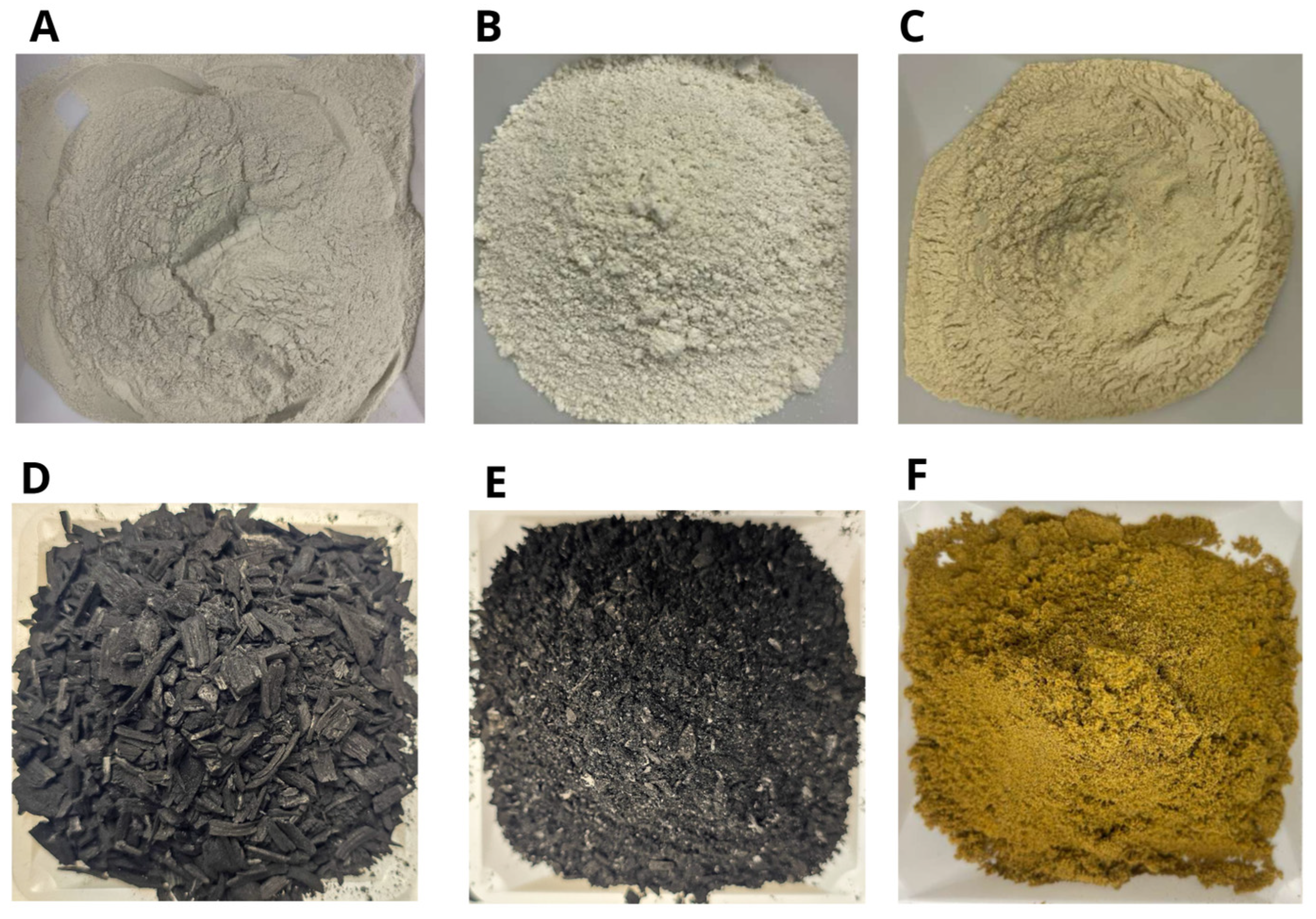
Natural adsorbents (NAs) such as biochar [6,7], clay minerals [8], and graphite-based or graphene-derived materials [9] (Figure 1) have been employed in livestock production as mycotoxin binders to reduce the impact of aflatoxin, ochratoxin, and fumonisin contamination in feed. Beyond mycotoxin sequestration, these adsorbents may also have broader gut-health-related roles. Biochar has been reported to stabilize gut microbiota diversity [10] and clays to exhibit antimicrobial and immunomodulatory activities [11,12], while graphite derivatives such as graphene oxide demonstrate antibacterial and anti-biofilm properties [13]. Given these distinct mechanisms, the interaction between natural adsorbents and necrotic enteritis-associated protein toxins is expected to differ substantially, making it important to examine how these materials may function within the context of NE pathogenesis and toxin activity.
Despite these encouraging findings, the direct relevance of natural adsorbents to NE remains unclear. Most available studies have focused on general growth performance, mycotoxin mitigation, or broad gut-health outcomes rather than NE-specific mechanisms. In particular, limited attention has been given to how these materials may influence toxin adsorption, oxidative stress modulation, intestinal barrier protection, CP load, or NE-associated lesion severity. Therefore, a critical assessment is needed to determine which proposed mechanisms are supported by direct poultry evidence, which are based on indirect or non-poultry evidence, and which remain hypothetical. Accordingly, this review uses a conceptual framework to synthesize current mechanistic knowledge, evaluate translational relevance, and identify key gaps that must be addressed before natural adsorbents can be advanced as validated NE-control strategies.
Accordingly, this conceptual review addresses four guiding questions. First, which physicochemical properties of biochar, clay minerals, and graphite-based materials are most relevant to toxin adsorption, antimicrobial activity, oxidative stress modulation, and intestinal barrier protection in poultry? Second, what direct and indirect evidence supports the use of these adsorbents for NE mitigation, and where does the evidence remain extrapolative? Third, what gaps currently limit translation, particularly regarding NetB-specific adsorption, dose-response relationships, nutrient interactions, material standardization, and in vivo poultry validation? Fourth, how can a staged screening framework be used to prioritize adsorbents for future NE-focused testing? By addressing these questions, this review provides a critical conceptual framework rather than a definitive efficacy claim for natural adsorbents as NE therapeutics.

2. Literature Search Strategy and Evidence Synthesis

This article was developed as a structured conceptual review rather than a systematic review or meta-analysis. The purpose was to synthesize mechanistic and translational evidence on natural adsorbents as candidate non-antibiotic strategies for NE mitigation in poultry, with emphasis on biochar, clay minerals, graphite, and graphite-derived materials. Literature searches were conducted on PubMed, Web of Science, Scopus, Google Scholar, and relevant agricultural databases, including CAB Abstracts and AGRICOLA, where accessible. Searches covered publications from database inception to 15 April 2026. Because this review was conceptual rather than systematic, database hit counts were not used as exclusionary criteria; instead, source selection was based on relevance to the review objectives, primary-study status, mechanistic value, and translational relevance to poultry gastrointestinal health or NE pathogenesis. A total of 186 references were ultimately included in the manuscript after screening for relevance and removal of sources that were weakly aligned with the final scope.
Search terms were combined using Boolean operators and included: “necrotic enteritis” OR “Clostridium perfringens” OR “NetB” OR “poultry gut health” OR “broiler intestinal barrier” AND “biochar” OR “charcoal” OR “activated carbon” OR “clay mineral” OR “bentonite” OR “montmorillonite” OR “kaolinite” OR “zeolite” OR “graphite” OR “graphene oxide” OR “graphitic materials” AND “toxin adsorption” OR “mycotoxin binding” OR “antibacterial activity” OR “oxidative stress” OR “microbiota” OR “intestinal permeability” OR “short-chain fatty acids.” Additional primary studies were identified through backward and forward citation tracking of included articles.
Peer-reviewed primary research articles were prioritized. Studies were included if they addressed at least one of the following: physicochemical properties relevant to adsorption or gastrointestinal application; poultry or livestock studies involving biochar, clay minerals, graphite, graphene oxide, or related carbonaceous materials; in vitro or in vivo evidence for toxin adsorption, antimicrobial activity, oxidative stress modulation, epithelial protection, microbiome modulation, or nutrient interaction; and NE-relevant outcomes such as CP burden, intestinal lesions, epithelial integrity, inflammatory responses, oxidative stress markers, or growth performance. Studies were excluded if they were unrelated to animal gastrointestinal health, lacked relevance to adsorption or host-pathogen interaction, or could not be linked mechanistically to NE pathogenesis or poultry production.
As the evidence spans poultry science, material science, microbiology, toxicology, and nanomedicine, studies were synthesized narratively and categorized by translational relevance as: direct poultry NE evidence, poultry non-NE evidence, non-poultry in vivo evidence, in vitro mechanistic evidence, physicochemical/adsorption evidence, or hypothetical extrapolation. This classification was used to distinguish established findings from plausible but untested mechanisms and to identify research gaps requiring NE-specific validation.

3. Pathophysiology of NE in Poultry

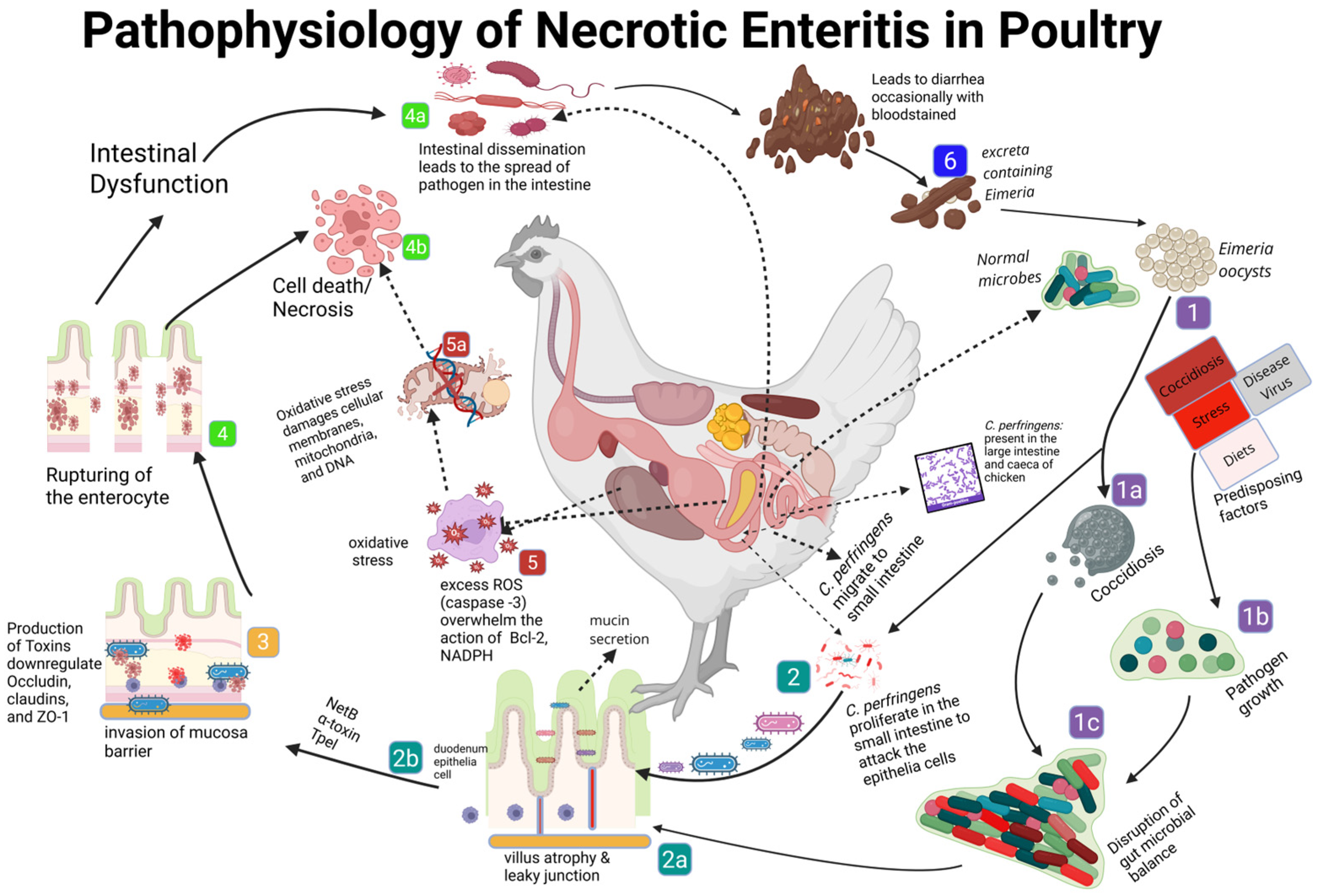
The pathogenesis of an infectious disease elucidates the mechanisms of disease manifestation, necessitating a comprehensive understanding of the host-pathogen interaction that precipitates the condition. The principal etiological agent of NE is CP, a Gram-positive, rod-shaped, anaerobic, encapsulated bacterium that resides commensally in the gut of healthy poultry [14]. Although CP is a typical resident of the digestive tract and environment, its pathogenicity is closely associated with its capacity to generate a diverse range of strong toxins [15]. CP can be detected in the guts of healthy birds and in poultry production environments, including excreta, litter, and hatchery-associated samples [16,17]. Nevertheless, its presence alone does not signify disease [17]. The pathogenic potential of this bacterium manifests when virulence factors are expressed, notably the NetB (Necrotic enteritis B) toxin [18] (Figure 2).
The pathogenesis of NE is intricate, encompassing both CP proliferation and host susceptibility. High-protein diets, coccidial infection, dysbiosis of intestinal microbiota, and diminished mucosal immunity are all contributing factors to bacterial overgrowth and toxin production [19]. Figure 2 illustrates that the disease induces mucosal necrosis, compromises epithelial integrity, and elicits excessive inflammatory responses in poultry, leading to suboptimal performance, elevated morbidity, and significant mortality [20]. Subclinical NE diminishes efficiency and growth, whereas the acute clinical variant can lead to mortality rates of up to 50% [19].
Central to NE pathogenesis is the interplay between CP toxins and host oxidative stress responses. Excess reactive oxygen species (ROS) generated by immune activation and bacterial toxins promote epithelial death via lipid peroxidation, mitochondrial dysfunction, and DNA damage, triggering apoptosis [21], as shown in Figure 2. Alpha-toxin, a zinc-dependent phospholipase C, disrupts membrane phospholipids, causing cytotoxicity and inflammation, though it is not considered the principal virulence factor, since α-toxin-deficient strains can still cause NE [22]. The NetB toxin, a β-pore-forming toxin, is regarded as pivotal, compromising enterocyte membranes and leading to cell lysis, villus blunting, mucosal necrosis, and pseudo-membrane formation, with damage starting at the basement membrane [18,23]. TpeL toxin modifies Ras proteins and disrupts signaling pathways, promoting apoptosis, although its role is debated since it is found only in a subset of NetB-positive strains [24].

4. Existing Strategies for Controlling NE

Despite decades of research, control of NE remains challenging. Historically, the use of AGPs effectively suppressed CP proliferation [25], but the global movement to restrict or ban AGPs due to concerns over antimicrobial resistance has reignited NE outbreaks [26]. Vaccination strategies show promise but are not yet commercially reliable, as antigenic diversity and inconsistent protection limit their practical utility [27]. Alternatives such as probiotics [28], prebiotics [29], organic acids [30], and phytogenics [31] contribute to gut health but often yield inconsistent results under field conditions. Also, the differences in gut microbiota composition, feed formulations, pathogen loads, and rearing conditions have caused contradictory results across trials [32,33]. This situation necessitates a comprehensive re-evaluation of existing methods, underscoring the urgent requirement for integrated approaches that reduce reliance on traditional antibiotics.

5. Natural Adsorbents-Relevance in Poultry

5.1. Biochar

Biochar is produced through incomplete pyrolysis (heating to ~550 °C under oxygen-limited conditions) of organic materials like wood, straw, manure, crop residues, and leaves [34,35]. Biochar, contingent upon feed material and pyrolysis conditions, comprises 40–80% carbon, 0.1–0.8% nitrogen, 1–2% potassium, and 5–6% calcium on a weight/dry weight basis, with a cation exchange capacity (CEC) ranging from 25 to 150 cmol+/kg [34,36]. Biochar has historically been used in soil remediation [37], and it has recently been investigated as a feed supplement in animal husbandry due to its adsorptive qualities, ability to bind toxins, and potential to alter gut microbes [38,39]. The integration of biochar into poultry feeds has demonstrated promising outcomes, including a decrease in pathogenic bacteria, such as Campylobacter jejuni and Gallibacterium anatis, due to their adsorption capabilities [10,40]. The porous structure may facilitate the binding of selected metabolites in the gastrointestinal tract, but its relevance to NE requires direct validation in standardized challenge models [41].
Furthermore, poultry supplemented with biochar have demonstrated a wide range of physiological benefits, including improved immunological responses, lower plasma triglycerides, and elevated lipid profiles [42,43]. These findings suggest that biochar may support gut health through adsorptive and microbiota-associated mechanisms, but direct evidence for NE prevention remains limited. The type of feedstock and the pyrolysis conditions affect the composition and efficiency of biochar, which is made from a variety of biomass sources like bamboo, woody green waste, and rice husks [10,44,45]. As a result of its adsorptive properties and compatibility with sustainable farming approaches, biochar remains a plausible candidate for further NE-focused evaluation.
Aside from pathogen reduction, biochar has shown adsorption capacity for selected mycotoxins, including aflatoxins, ochratoxin A, and zearalenone [6,7]. This is relevant to poultry gut health because mycotoxin exposure can compromise intestinal integrity and immune function, potentially increasing susceptibility to secondary enteric disorders. Evidence from intestinal epithelial, animal, and poultry challenge models further supports that different mycotoxins can alter gastrointestinal function, microbial balance, and host responses relevant to enteric disease susceptibility [46,47,48]. Teleb et al. [49] reported that 0.5% kaolin or activated charcoal reduced the adverse effects of low-level aflatoxin exposure in broilers, improving growth-related outcomes and reducing mortality. Considering that activated charcoal is not identical to biochar, this study should be interpreted as indirect evidence that adsorbent materials could mitigate toxin exposure, rather than as direct evidence for biochar efficacy. The direct use of biochar for NE remains poorly researched; therefore, NE-specific challenge studies are still required before biochar can be considered a validated preventive strategy. Table 1 summarizes reported applications of biochar and charcoal-based materials in poultry and other animal systems.

5.1.1. Physicochemical Properties of Biochar

The functional activity of biochar depends strongly on feedstock type and pyrolysis conditions. Higher pyrolysis temperatures generally increase aromatic carbon content, structural stability, and pore development, whereas lower temperatures preserve more oxygen-containing functional groups that contribute to surface charge and cation exchange behavior [55,56]. For example, aflatoxin B1 has been shown in pig and mouse models to impair intestinal barrier integrity by reducing tight-junction proteins and promoting epithelial apoptosis [57]. Although this evidence is not NE-specific and is not derived from broilers, it supports the rationale that toxin sequestration may indirectly protect intestinal barrier function under toxin-associated stress. These properties are relevant to gastrointestinal applications because surface area, porosity, pH, ash content, volatile matter, and functional groups influence the capacity of biochar to absorb organic compounds, microbial metabolites, and selected mycotoxins [58,59,60,61,62,63,64].
In poultry, biochar-related benefits have been reported for aflatoxin-challenged broilers, gut microbial modulation, and reduction in selected poultry pathogens [6,10,40]. However, these findings should be interpreted with caution because the studies differ in disease context, feedstock type, inclusion level, pyrolysis condition, bird age, and outcome measures. For example, aflatoxin studies mainly support toxin-sequestration potential, whereas pathogen-reduction studies support possible microbiome or antimicrobial effects; neither study type directly establishes efficacy against CP-induced NE or NetB-associated injury. A cautious connecting hypothesis is that biochar may be most useful when its pore structure, surface area, pH, and functional groups align with the target luminal toxin, microbial metabolite, or pathogen-related stressor, but this requires validation under standardized poultry NE challenge conditions. These differences emphasize the need to characterize biochar materials before comparing biological efficacy across studies (Table 2).
In the context of NE, biochar with a high cation exchange capacity may offer greater adsorptive potential because negatively charged surface functional groups can enhance interactions with cationic species in the gut lumen [63]. Accordingly, high porosity and large surface area may thus increase the overall adsorption capacity of biochar. As NetB is a key pore-forming toxin involved in avian necrotic enteritis [18,71], these adsorptive properties may be relevant to NE mitigation, although direct primary evidence for NetB adsorption by biochar is still needed. Together, these properties support further evaluation of biochar as a candidate material for NE mitigation, but direct mechanism-specific validation remains necessary.

5.1.2. Source of Biochar

The different sources of biochar and their suitability for NE-focused adsorbent evaluation are summarized in Table 3 and Table 4, respectively. Wood-derived biochar is a promising feedstock for adsorption-based applications, but different wood types have different advantages. Softwood-derived chars have been reported to reach as high as 326.0 m2/g, compared with 221.0 m2/g for a hardwood counterpart in the same study [60]. Wood biochars can also develop vesicle- and slit-like pore structures during pyrolysis, which contribute to adsorption capacity [72]. In addition, increasing pyrolysis temperature promotes the development of condensed aromatic structures and greater structural ordering in biochar [55]. In the context of NE mitigation, these characteristics support the use of wood-derived biochar as a candidate adsorbent, but direct primary evidence for differential adsorption of NetB or other NE-associated toxins by specific wood feedstocks is still needed.

5.1.3. Limitation of Biochar Use

Despite its purported antibacterial, antioxidant, and adsorptive properties, direct evidence supporting biochar specifically against NE remains limited. Most published poultry studies have instead focused on broader outcomes such as growth performance, gut microbial changes, or toxin-related applications outside NE-specific or NetB models. In addition, depending on feedstock and pyrolysis conditions, some biochars may contain residual contaminants such as polycyclic aromatic hydrocarbons and heavy metals, highlighting the need for careful characterization before biological use [88]. Although dietary biochar has shown promise in some poultry studies, high inclusion levels may adversely affect feed intake or performance in certain contexts, indicating that dose optimization is necessary [12,89]. These limitations highlight the need for standardized production criteria and targeted NE-specific in vivo trials.
Biochar and clay minerals differ substantially in their dominant adsorption mechanisms. Biochar is a carbon-rich, porous material whose activity is influenced by feedstock, pyrolysis temperature, surface area, aromaticity, and oxygen-containing functional groups [55,56,58,59,60,61,62,63,64]. In contrast, clay minerals are naturally occurring aluminosilicate materials with layered structures and surface reactivity that may support enteric adsorption and gut-health applications [90,91]. This distinction provides the basis for considering clay minerals separately from biochar in the following section.

5.2. Clay Mineral

The Joint Nomenclature Committees (JNC) define clay minerals as naturally occurring materials made mostly of fine-grained minerals [90]. These materials are usually plastic when they contain the right amount of water, and they will harden when dried or fired [90]. Clay minerals, such as bentonite, zeolite, and kaolinite, have unique properties that help reduce mycotoxin exposure in poultry (Table 5). The addition of clay minerals like montmorillonite, kaolinite, and palygorskite to poultry feed may improve gastrointestinal health, enhance performance, and reduce the harmful effects of pathogens in chickens [91].
Research by Ghazalah et al. [92] shows that bentonite, a type of clay mineral, can reduce the negative impacts of mycotoxins in broiler diets. This absorption reduces their uptake in the gastrointestinal tract and promotes better health and growth in poultry birds [10,11,92]. This highlights how clay minerals may enhance gut integrity, which is crucial for preventing conditions like NE that can arise from gut dysbiosis and pathogen overgrowth.
In addition, studies have found that some clay minerals have antibacterial properties. Research by Lafi and Al-Dulaimy [93] showed that certain mineral clays have antimicrobial properties. This could be particularly significant for managing NE, as reducing the presence of CP and other pathogens is vital for effective disease control. Nonetheless, more studies are needed to substantiate the dual capabilities of clay minerals. As shown in Table 5, both layered and non-layered clay minerals have potential in tackling various animal health issues, especially gastrointestinal infections.
Table 5. Application of Clay in the Treatment of Animal Diseases/Infections.
Clay TypeDisease Effect TreatedMechanism of ActionAnimal SpeciesReference
Montmorillonite (MMT)Diarrhea, bacterial infections (e.g., E. coli, Salmonella enteritidis)Adsorbs bacteria and toxins; enriched forms (e.g., Cu-MMT) enhance antimicrobial activityPoultry, pigs[94]
BentoniteAflatoxicosis, general toxin adsorptionBinds aflatoxins and mycotoxins, reducing toxin transfer to organs or milkBroilers, milk samples from cows, camels, sheep and goats[92,95]
Clinoptilolite (Zeolite)Mycotoxicosis (e.g., aflatoxins), intestinal hygieneMolecular sieve structure traps mycotoxins, supports immune responsePoultry[96,97,98]
SepiolitePathogen-induced intestinal damageAdsorbs bacterial toxins and supports gut lining integrityBroilers[99]
KaoliniteDigestive disorders, diarrheaAnti-toxic properties, reduce water content in droppingsPiglets[100]
Natural ZeoliteMycotoxin effects, gut flora imbalanceHigh ion exchange and binding capacity; reduces NH3 emissionsBroilers, layers[101,102]
Attapulgite (Palygorskite)Mycotoxicosis, intestinal pathogensHigh surface area for adsorbing toxins and pathogensBroilers, pigs[103]

5.2.1. Physicochemical Properties of Clay Minerals

Clay minerals are naturally occurring aluminosilicates whose layered structures and surface reactivity make them useful adsorbents in animal gastrointestinal applications. Their crystal architecture, including 1:1 and 2:1-layer arrangements, influences hydration behavior, interlayer accessibility, and adsorption performance [104,105]. In general, clay minerals differ markedly in specific surface area and CEC, two properties that strongly affect their ability to bind ions, toxins, and other dissolved compounds. In a comparative study of bentonite, illite, and kaolinite, bentonite showed substantially greater surface area and CEC than kaolinite, supporting the view that higher-charge, higher-surface-area clays have greater adsorption potential [106]. Likewise, studies on smectitic clays have shown that adsorption efficiency depends on physicochemical characteristics such as mineral origin, native sodium content, swelling behavior, and charge-related properties [105]. Experimental work in digestive-tract models also confirms that clay minerals can modify the solubility of bivalent cations under ruminal, abomasal, and duodenal conditions, demonstrating that these materials actively interact with the gut environment [104]. Collectively, these characteristics support the use of selected clay minerals as enteric adsorbents that may reduce luminal toxin exposure, help maintain ionic balance, and lessen pathogenic burden during necrotic enteritis and related enteric disorders.
In addition, recent molecular studies suggest that matching the molecular size and polarity of targeted toxins in this case NetB with the appropriate clay interlayer architecture, and not simply maximizing surface area or CEC, is essential for selective toxin binding. Deng et al. and Deng and Szczerba [107,108,109] showed that CEC plays little to no role in the adsorption of most toxins, because common mycotoxins are nonionic or negatively charged at neutral pH (e.g., fumonisin) and therefore do not participate in cation exchange processes with smectites or zeolites. Instead, aflatoxin B1 (AfB1) is one of the few well-studied nonionic mycotoxins that bind to smectite clays primarily through polarity and size matching between the toxin and the non-polar nanoscale interlayer domains of smectites, allowing the planar AfB1 molecule to intercalate into the interlayer space [108]. Within this confined environment, adsorption is driven by ion-dipole interactions and coordination between exchange cations and the carbonyl groups of AfB1, as well as hydrogen bonding between carbonyl oxygens and hydration-shell water at higher humidity [107,109].
Besides surface charge and adsorption, clay minerals also possess hydration, swelling or pore structure, and ion exchange characteristics that contribute to their usefulness as natural adsorbents in poultry systems. Broiler studies with clinoptilolite and bentonite have shown improvements in gut-related parameters or mitigation of aflatoxin effects [110,111], while adsorption studies show that these performance differences depend on physicochemical traits such as charge, swelling behavior, and mineral origin [105]. Many natural aluminosilicate adsorbents used in feed and environmental systems have near-neutral point-of-zero-charge values; for example, natural zeolite has been reported at about pH 6.2, while bentonite-based adsorbents commonly fall near neutral to slightly alkaline values depending on treatment and composition [112,113]. Because pH at the point of zero charge influences whether the surface is net positive or net negative, it can affect electrostatic interactions with dissolved compounds in gut digesta [112,114].
Smectite-rich clays such as bentonite are expandable and take up substantial amounts of water, and swelling bentonites have been shown to perform well as aflatoxin adsorbents [105,115]. In contrast, kaolinite is a non-expanding clay with comparatively high structural stability, a property that limits excessive swelling relative to smectites [116,117]. Zeolites such as clinoptilolite are crystalline porous materials whose adsorption and ion exchange behavior are closely linked to their framework structure, and primary studies have demonstrated effective uptake of ammonia and heavy metals by natural or modified clinoptilolite [118,119]. Taken together, these complementary physicochemical properties support the therapeutic potential of selected clay minerals as relatively low-cost and physiologically compatible agents for reducing luminal toxin burden and improving gut health in poultry, especially in antibiotic-free production systems.

5.2.2. Potential Limitations and Safety Considerations Regarding Clay Minerals

Although clay minerals have detoxifying and antibacterial potential, their effects appear strongly shaped by mineral type, inclusion level, and dietary context. Smectites, zeolites, and bentonites can bind aflatoxins and improve selected gut-health or performance outcomes under toxin pressure, but their adsorption is not fully selective [120,121]. For example, copper-bearing montmorillonite at 1.5 g/kg diet improved growth performance, digestive enzyme activity, intestinal morphology, and microflora in broilers [94], whereas calcium bentonite showed dose-dependent responses, with 2% inclusion producing better growth responses than 5% inclusion and higher inclusion altering digesta moisture, intestinal viscosity, serum lipids, and meat fatty-acid composition [122]. These findings suggest that clay efficacy may follow a non-linear response, where moderate inclusion supports toxin binding or gut function, but excessive inclusion may reduce nutrient utilization or alter digesta properties. Because increased intestinal viscosity can depress nutrient utilization, especially lipid digestion, clay-based NE strategies should be evaluated not only for toxin-binding efficacy but also for unintended nutrient sequestration, viscosity changes, and raw material safety [122,123]. Safety assessment is also important because some natural clays can carry environmental contaminants if sourcing and processing are poorly controlled; for example, dioxins have been identified in mined clay products and in ball clay associated with poultry-feed contamination [124,125].

5.3. Graphite-An Emerging Natural Adsorbent

Of the three adsorbent classes reviewed, graphite has the weakest direct poultry evidence base. No published in vivo poultry study currently demonstrates that dietary graphite prevents or mitigates necrotic enteritis, and no primary study has directly shown adsorption or neutralization of NetB by graphite. Therefore, graphite is considered here as an emerging material rather than a validated NE therapeutic candidate. Nevertheless, observations from our laboratory (manuscript in preparation) support a biologically plausible mechanistic basis for its investigation, and the experimental gaps that must be addressed before its therapeutic potential can be fully evaluated are identified here.
Graphite is a crystalline carbon material composed of stacked hexagonal carbon sheets held together by weak interlayer forces [126,127,128]. Natural graphite is obtained from geological deposits, whereas synthetic graphite is produced by high-temperature graphitization of carbonaceous precursors [129,130]. Differences in purity, morphology, defect density, processing history, and precursor source may influence surface behavior and reproducibility [131,132,133,134]. These characteristics are relevant because batch-to-batch consistency and contaminant control would be essential before graphite could be evaluated as a feed-grade adsorbent.
The graphite-related evidence should be interpreted according to material class. Selected graphene-derivative studies have reported antibiofilm and stress-response effects in bacterial systems [135], while engineered graphitic nanozymes have shown pH-responsive antimicrobial activity in a non-poultry Helicobacter pylori model [136]. Bulk graphite and related graphene-family materials have also shown antibacterial activity in selected in vitro systems, although this evidence cannot be directly transferred to dietary graphite in poultry [137]. Additional graphene oxide studies in non-poultry infection, biofilm, and gut models are summarized in Table 6 [138,139,140,141,142]. Evidence for graphene oxide and reduced graphene oxide is more extensive than evidence for bulk graphite, but it cannot be directly transferred to graphite because oxidation and exfoliation substantially increase surface area, hydrophilicity, oxygen-containing functional groups, and biological reactivity [143,144,145]. Therefore, graphene oxide and engineered graphitic materials should be treated as mechanistic analogues, not as direct evidence that dietary graphite is effective against poultry NE.
Available graphite-derivative studies suggest possible antibacterial, antibiofilm, oxidative stress-modulating, and microbiome-related effects, but most evidence comes from in vitro systems or non-poultry models [135,137,142]. Oral graphene oxide has also been shown to alter gut microbial composition and colon ultrastructure in mice, indicating that dose, material chemistry, and host context may strongly influence biological outcomes [142]. These findings support further hypothesis-driven investigation but do not establish graphite as a near-term therapeutic for NE. The most important gaps are the absence of poultry NE challenge studies, the lack of purified NetB adsorption or neutralization assays, limited information on safe dietary inclusion levels, and uncertainty about whether graphite would retain functional activity under gastrointestinal and feed-processing conditions. Accordingly, future work should first evaluate graphite using standardized physicochemical characterization, CP inhibition assays, NetB-binding assays, intestinal epithelial cell protection models, and controlled in vivo poultry NE studies before therapeutic claims are made. Table 6 provides an overview of graphite and graphene-derived materials and their reported biological activities in selected experimental models.

Safety Considerations for Graphite and Graphene-Derived Materials

Although graphite and graphene-based materials have shown antioxidants, cytoprotective, and antibacterial effects in several experimental systems, direct evidence for their efficacy against necrotic enteritis or the NetB toxin remains very limited [146,147]. Most available data come from non-NE models, including an in vitro gut-liver injury model and an in vivo zebrafish microbiome model, so extrapolation to poultry should be made with caution [146,148]. Furthermore, oral exposure to graphene oxide has been shown to alter gut microbial composition and colon ultrastructure in mice, while microbiome-dependent immune effects have also been reported in zebrafish, indicating that dose and host context may strongly influence biological outcomes [142,148]. These findings highlight the need to define safe dietary inclusion limits and to conduct validation studies specifically in poultry before practical application can be considered.

6. Natural Adsorbent’s Mechanism(s) of Action

6.1. Biochar

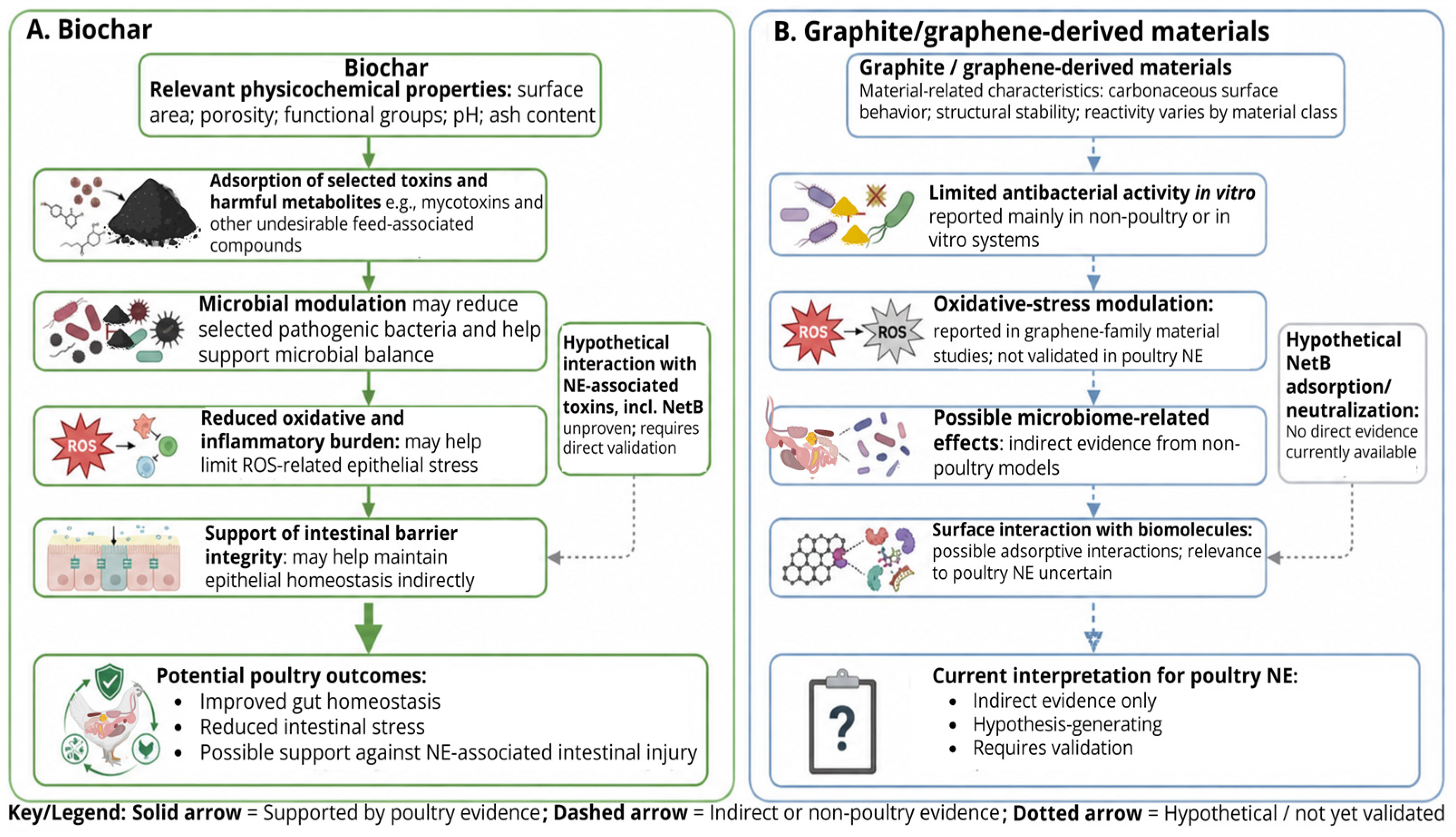
Biochar appears to act in the poultry gut through a first-line adsorptive mechanism, as illustrated in Figure 3, where its porous carbon matrix and reactive surface sites trap harmful luminal compounds before they contact the intestinal mucosa. Primary studies have shown that biochar-based adsorbents can bind important mycotoxins, including aflatoxin B1, ochratoxin A, and zearalenone [6]. Other carbonaceous adsorbents have also shown adsorption of deoxynivalenol under appropriate conditions [149]. In poultry, this toxin-sequestering role is complemented by a microbiota-modulating effect. In layer chickens, dietary biochar altered intestinal microbial communities and reduced Campylobacter load without distorting overall microbial richness and diversity, supporting the mechanism in Figure 3 in which biochar suppresses pathogenic bacteria while preserving broader community structure [10]. A follow-up poultry study further showed that feed supplementation with biochar lowered pathogens such as Gallibacterium anatis and Campylobacters, with the most pronounced effects observed at 2% dietary inclusion [40].
The downstream consequence of these actions is likely a gut environment more favorable for beneficial microbial metabolism, epithelial stability, and immune protection, as depicted in Figure 3. As biochar reduces pathogen pressure while reshaping intestinal microbial composition, it may indirectly support fermentation patterns associated with short-chain fatty acids, especially butyrate-producing communities, although evidence for direct biochar-butyrate metabolism in poultry remains limited [40,150]. This matters because butyrate is a well-established mediator of gut barrier function: primary studies show that it enhances tight-junction assembly and improves epithelial barrier integrity [151,152]. In vivo poultry, evidence also shows that biochar can reduce systemic toxic stress. In broilers challenged with aflatoxin B1, poultry litter biochar improved growth-related outcomes and restored serum protein and albumin while lowering indicators of liver injury, indicating that luminal adsorption can translate into measurable physiological protection [6]. Together, these findings support the mechanism proposed in Figure 3: biochar first adsorbs toxins and limits pathogen abundance, then stabilizes the microbial ecosystem and indirectly promotes barrier integrity and gut immunity.

6.2. Clay Minerals

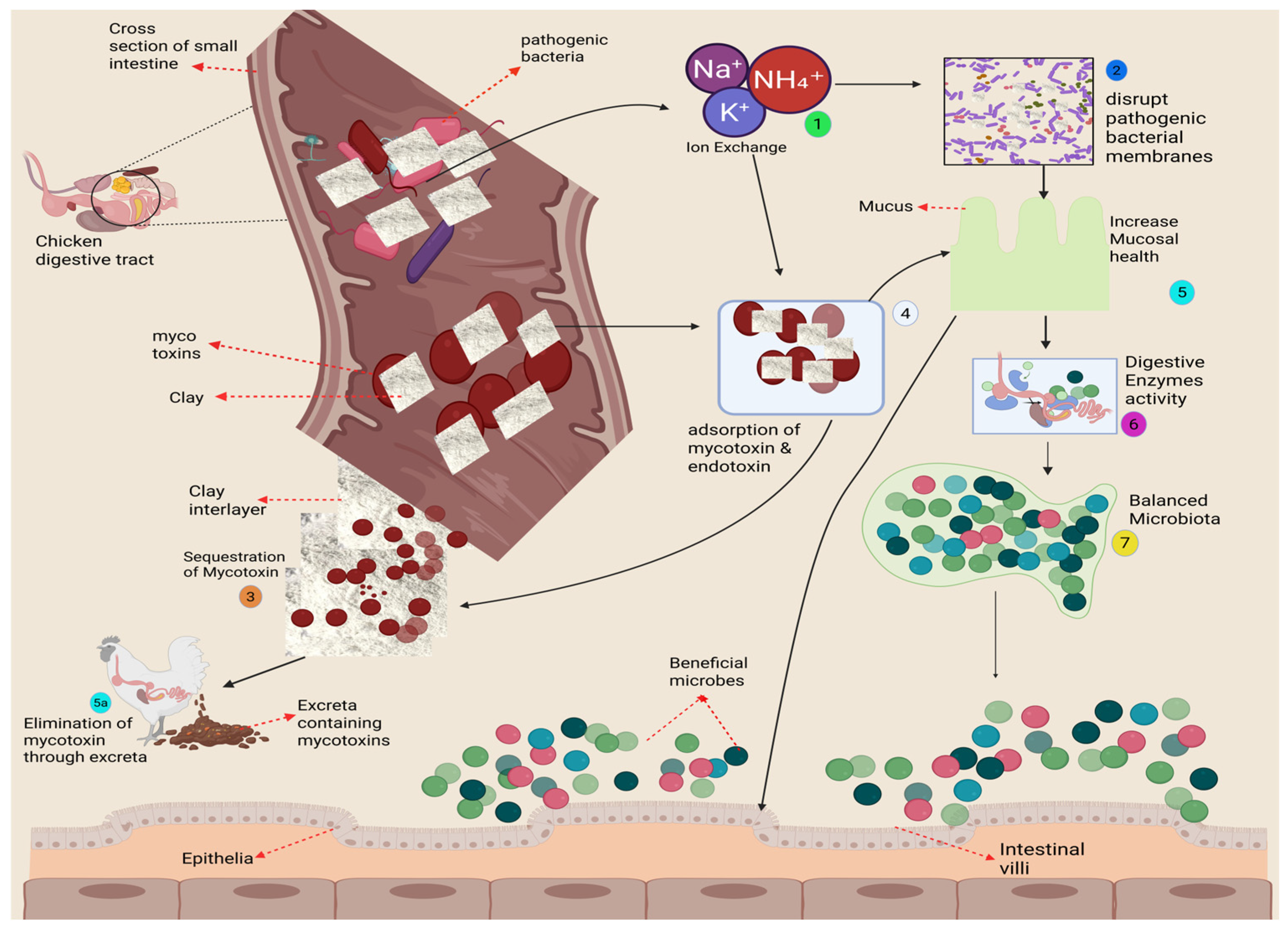
Clay minerals such as bentonite, montmorillonite, zeolite, and halloysite appear to improve poultry gastrointestinal health through a sequential mechanism that begins with ion exchange and luminal adsorption, as illustrated in Figure 4. Their layered aluminosilicate surfaces can bind aflatoxin B1 in the poultry gastrointestinal model, although the same materials may also sequester essential trace minerals, confirming both their detoxifying potential and their non-selective binding risk [120]. In broilers, calcium montmorillonite adsorbed aflatoxin B1 and, when added to feed at 0.5%, significantly reduced the adverse effects of aflatoxin exposure, which fits the Figure 4 step showing toxin capture in the gut lumen before absorption [153]. Clay supplementation has also been linked with improved digestive conditions; for example, Transcarpathian zeolite improved gut morphology and digestive enzyme activity in broilers, supporting the Figure 4 pathway connecting luminal stabilization with better digestive function [154].
Beyond toxin binding, clay minerals may also support gut health by reducing pathogen pressure, preserving mucosal integrity, and stabilizing the intestinal ecosystem, as depicted in the central and right-hand portions of Figure 4. Natural antibacterial clays can inhibit bacteria through surface-related geochemical mechanisms, although most direct membrane-disruption evidence comes from non-poultry systems and should therefore be extrapolated with caution [155]. In poultry, palygorskite supplementation improved immunity, oxidative status, intestinal integrity, and barrier function in broilers, while a later broiler study showed improved antioxidant capacity, immune status, intestinal barrier function, and altered cecal microbiota [156,157]. Halloysite has also been used successfully in broiler production, improving feed conversion and house hygiene parameters, which supports the broader Figure 4 concept that clay can contribute to a healthier gut environment [158]. Taken together, these findings support the mechanism proposed in Figure 4: clay first exchanges ions and sequesters harmful luminal compounds, then helps limit microbial stress while supporting digestion, barrier health, and microbial balance in the poultry gut.

6.3. Graphite

Graphite-derived materials have been reported to influence bacterial survival, oxidative stress, adsorption-related interactions, and host responses in selected experimental systems, as summarized in Figure 3. Sharp graphenic edges can physically damage bacterial membranes, leading to leakage of intracellular content and loss of viability [13,159]. Surface chemistry also shapes the response, because graphene oxide can exert contact-dependent antibacterial effects that vary with sheet size and oxidation state and may involve oxidative stress-related pathways [159,160]. In epithelial models, graphene oxide has reduced ROS and improved cell viability during gut-liver injury, indicating a cytoprotective antioxidant mechanism in addition to its antimicrobial activity [146]. Graphene oxide can also modify the intestinal microbial environment by increasing short-chain-fatty-acid-producing bacteria such as Clostridium cluster IV and Allobaculum spp., which suggests an additional microbiota-mediated mechanism [161]. Collectively, these findings suggest that graphite-derived materials may be relevant to NE through combined effects on bacterial survival, oxidative injury, and gut microbial balance, although direct evidence for NetB binding or in vivo NE control is still limited.
Understanding microbiota-host interactions is important for optimizing the therapeutic potential of graphene oxide while minimizing unintended biological effects. Oral GO has been shown to alter gut microbial composition in mice, including increasing short-chain-fatty-acid-producing bacteria such as Clostridium cluster IV and Allobaculum spp. [161]. Short-chain fatty acids are important mediators of gut health because they support epithelial barrier integrity, influence immune signaling, and serve as energy substrates for colonocytes [162,163]. However, prolonged or dose-dependent exposure to graphene-based materials can also disturb microbial composition and metabolism, with reported changes in gut community structure, metabolite profiles, and host physiological outcomes [164,165].

6.4. NetB Adsorption as a Central Unproven Mechanism

A critical limitation across the natural adsorbent literature is the absence of direct evidence demonstrating adsorption or neutralization of NetB by biochar, clay minerals, graphite, or graphite-derived materials. NetB is a major pore-forming toxin associated with avian NE, and its structure and function have been experimentally characterized [18,71]. However, current support for adsorbent-NetB interaction is based on physicochemical plausibility rather than direct experimental validation. For biochar, the rationale is based on its porosity, surface area, and functional groups known to support adsorption of some organic compounds and mycotoxins [6,7,50]. For clay minerals, the rationale is based on their toxin-binding studies showing that adsorption depends on molecular size, polarity, interlayer accessibility, and exchangeable cations [105,107,108,109,120,153]. For graphite and graphene-derived materials, the rationale is derived from surface interactions, antimicrobial activity, and biomolecule adsorption reported in non-NE systems [137,143,144,145,159,160]. However, none of these findings confirms binding of NetB under poultry gastrointestinal conditions. Therefore, NetB adsorption should be treated as a testable hypothesis and a priority research gap. Future studies should directly evaluate purified NetB binding, residual toxin activity, epithelial cytotoxicity, and dose-dependent adsorbent performance under simulated poultry intestinal conditions before NetB neutralization is presented as a mechanism of NE control.
To clarify the strength and translational relevance of the evidence supporting each proposed mechanism, Table 7 summarizes whether the evidence is derived from poultry studies, non-poultry models, in vitro systems, physicochemical plausibility, or hypothetical extrapolation. The “current confidence” classification was assigned based on the proximity of the evidence to poultry NE application, the presence or absence of direct NE-relevant outcomes, and the degree of experimental validation. Mechanisms were considered moderate to high confidence when supported by poultry studies measuring relevant outcomes such as mycotoxin adsorption, gut-health responses, pathogen modulation, performance, or intestinal integrity. Mechanisms were classified as low or very low confidence when evidence was limited to non-poultry models, in vitro systems, engineered material platforms, or physicochemical plausibility without direct poultry NE validation. Because no study has directly demonstrated NetB sequestration, adsorption, or neutralization by biochar, clay minerals, graphite, or graphene-derived materials, NetB-related mechanisms were classified as conceptual or very low confidence. This classification also accounts for whether differences in feed composition, challenge model, bird age, material purity, inclusion level, or processing conditions limit direct comparison across studies.
In summary, the physicochemical mode of action of adsorbents differs fundamentally from other biological alternatives. Unlike probiotics or vaccines, which depend on microbial competition or immune priming, natural adsorbents exert direct physicochemical sequestration of toxins and microbial metabolites [166,167]. This mechanism is not influenced by antimicrobial resistance patterns and remains stable under feed-processing conditions. Furthermore, adsorbents may provide multifunctional benefits, including toxin binding, oxidative stress attenuation, and modulation of the luminal microenvironment, making them a feasible option in antibiotic-free production systems.
When compared with other non-antibiotic interventions used against NE, such as probiotics, phytogenic compounds, organic acids, and vaccination strategies, natural adsorbents offer several distinctive features (Table 8). Probiotics and phytogenics primarily modulate microbial populations or host signaling pathways but may exhibit variability due to strain stability, storage conditions, or environmental stressors [168,169]. Vaccination strategies targeting NetB and other virulence factors have shown promise in experimental models; however, protective efficacy may vary depending on challenge strain and field conditions [18,170]. In contrast, adsorbents function through non-biological mechanisms, including electrostatic interactions, cation exchange, and surface adsorption, allowing immediate binding of toxins and microbial by-products in the gut lumen [166,171]. Nevertheless, inclusion levels must be carefully optimized, as excessive adsorption capacity may interfere with nutrient availability and mineral bio-accessibility [172]. Therefore, a balanced risk-benefit evaluation, including dose-response assessments, lesion scoring, gut integrity markers, and production performance metrics, is essential when positioning natural adsorbents as therapeutic candidates for NE mitigation.

7. Proposed Screening Framework for Evaluating Natural Adsorbents for NE Control in Poultry

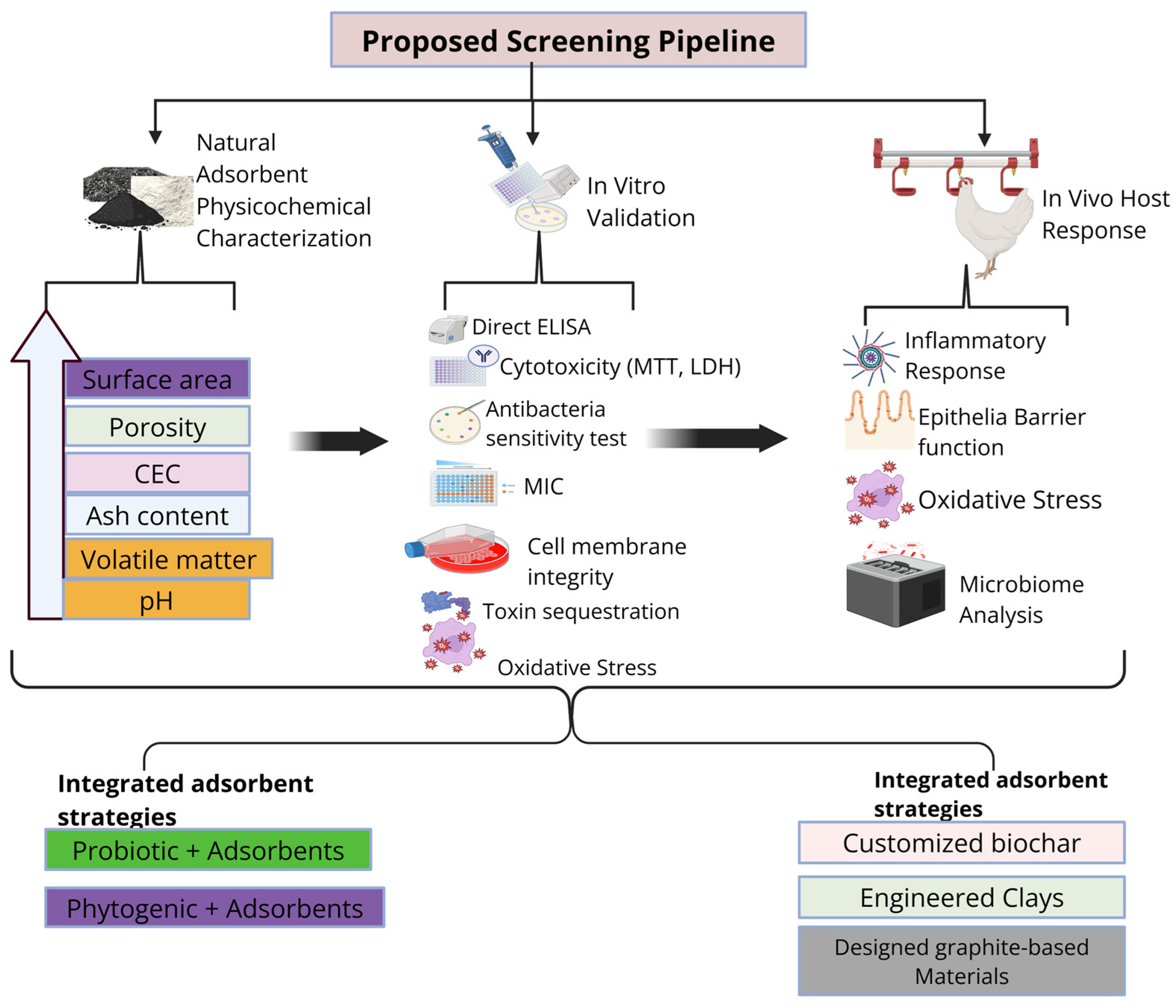
The evaluation of natural adsorbents as candidate NE-control strategies requires a systematic framework that connects material characterization with poultry health outcomes [120]. Future research should follow a defined testing process that begins with a comprehensive analysis of adsorbent properties, including surface area, porosity, charge characteristics, and ash content [120,131]. The evaluation process should include NetB-binding or residual toxicity assays, antibacterial MIC/MBC assays, agar well diffusion assays, cytotoxicity testing, ROS modulation, and epithelial barrier integrity assessment (Figure 5). While in vitro IEC models provide valuable mechanistic insight and align with animal-welfare priorities, they cannot fully replicate the complex interactions between microbiota, immune function, and nutrient dynamics in the live bird [180,181]. Therefore, adsorbents that demonstrate strong in vitro activity should progress to standardized in vivo models assessing intestinal lesion scores, CP enumeration, serum cytokines (IL-1β, IL-6, IFN-γ), villus morphology, tight-junction integrity, microbiome shifts, oxidative stress markers, growth performance, and feed conversion ratio [182,183,184].

7.1. Dose-Response and Go/No-Go Decision Criteria

Progression between screening tiers should be based on predefined go/no-go criteria. At the physicochemical stage, candidate adsorbents should proceed only if they show acceptable batch consistency, feed-grade safety, low contaminant burden, stable pH behavior, and reproducible surface properties relevant to adsorption [61,68,88,120]. Key screening parameters should include specific surface area, pore structure, CEC, ash content, volatile matter, pH, surface functional groups, and contaminant burden. For biochar, materials with excessive ash, residual volatile matter, heavy metals, or polycyclic aromatic hydrocarbons should be excluded because these properties vary by feedstock and pyrolysis condition and may affect biological safety [61,68,88]. For clay minerals, progression should require toxin-binding activity without excessive sequestration of essential trace minerals, because aluminosilicates can bind both aflatoxin B1 and essential minerals in poultry gastrointestinal models [120].
At the in vitro stage, progression should require the absence of cytotoxicity at biologically relevant intestinal exposure levels, reproducible reduction in CP growth or toxin-associated epithelial injury, measurable protection against oxidative stress or barrier disruption, and minimal non-selective binding of essential nutrients or minerals [120,137,146,159,160]. For NE-focused screening, candidate materials should show measurable activity in at least one disease-relevant assay, such as CP inhibition, NetB-binding or residual toxicity assays, epithelial-cell viability, ROS reduction, or preservation of epithelial barrier integrity. Materials should not progress solely because they show high adsorption capacity if they also show cytotoxicity, strong nutrient sequestration, or adverse epithelial effects.
At the in vivo stage, candidate materials should be advanced only if they reduce NE lesion severity or pathogen/toxin-associated injury without impairing feed intake, body weight gain, feed conversion, nutrient utilization, or bird welfare [182,183,184]. Where a 0–4 intestinal lesion scoring system is used, an effective candidate should reduce lesion scores toward the none-to-mild range, preferably 0–1, and show a statistically meaningful reduction compared with the challenged untreated control. Additional practical benchmarks should include lower CP burden, improved villus morphology or tight-junction integrity, reduced inflammatory or oxidative stress markers, and no negative effect on growth performance or feed conversion.
Dose-response considerations and synergistic interactions are also important in adsorbent evaluation. Current poultry studies suggest that moderate dietary inclusion levels, commonly around 0.5–2% depending on material type and experimental context, may support toxin binding, antimicrobial activity, or gut-barrier protection, whereas excessive inclusion may reduce nutrient digestibility or alter digesta viscosity [89,153,185,186]. Therefore, the ideal biological response is likely to be non-linear, with moderate inclusion improving adsorptive or gut-protective effects while maintaining feed efficiency. Combinations such as montmorillonite with charcoal or clay with phytogenics may provide complementary benefits through toxin sequestration, pH buffering, and microbial modulation [180]. However, combinations may also create antagonistic effects through nutrient competition or excessive micronutrient adsorption, highlighting the need for systematic dose optimization within realistic dietary inclusion limits [120,172]. This multi-tiered validation pipeline ensures both mechanistic rigor and practical relevance for NE mitigation.

7.2. Translational and Commercial Considerations

Translation of natural adsorbents into poultry production requires consideration beyond biological efficacy. Commercial deployment will depend on scalable sourcing, batch-to-batch standardization, contaminant screening, cost-effectiveness, feed-manufacturing compatibility, pelleting stability, and regulatory acceptance as feed additives or therapeutic adjuncts. Biochar presents standardization challenges because feedstock type, pyrolysis temperature, ash content, residual volatile matter, heavy metals, and polycyclic aromatic hydrocarbons can differ across products [61,68,79,88,89]. Clay minerals require similar scrutiny because mineral origin, swelling capacity, CEC, interlayer chemistry, and environmental contamination can influence both efficacy and safety [105,120,124,125]. Graphite-based materials may face additional safety and regulatory barriers because graphite, graphene oxide, and engineered graphitic nanomaterials differ substantially in particle size, surface chemistry, bioavailability, and biological reactivity [137,142,143,144,145,159,160,161]. Finally, all adsorbents should be evaluated for unintended interactions with vitamins, trace minerals, medications, vaccines, enzymes, organic acids, probiotics, and phytogenic additives, because non-selective adsorption may reduce the efficacy of other dietary interventions [120,172,180].

8. Conclusions

Natural adsorbents, including biochar, clay minerals, and graphite-based materials, represent promising but unevenly validated candidates for supporting gut health and reducing enteric disease pressure in poultry. Biochar and clay minerals currently have stronger poultry-related evidence, particularly for toxin adsorption, gut environmental modulation, and selected performance or barrier-related outcomes. In contrast, graphite remains exploratory because most available evidence comes from graphite-derived materials, in vitro systems, or non-poultry models. Importantly, direct evidence showing that any of these adsorbents bind or neutralize NetB is still absent; therefore, NetB adsorption should be viewed as a priority hypothesis rather than an established mechanism. Future research should focus on standardized physicochemical characterization, dose optimization, nutrient-interaction studies, NetB-specific adsorption assays, and controlled in vivo NE challenge trials. Such studies are essential before natural adsorbents can be confidently advanced from conceptual promise to practical therapeutic use in poultry production.


Author Contributions

Conceptualization, S.O.; writing—original draft preparation, S.E.A.; writing—review and editing, S.E.A. and S.O.; visualization, S.E.A.; supervision, S.O.; funding acquisition, S.O. All authors have read and agreed to the published version of the manuscript.

Funding

Samson Oladokun’s research (USDA National Institute of Food and Agriculture Hatch project number 8126-0) received support from Texas A&M University Research startup funds.

Institutional Review Board Statement

Not applicable.

Data Availability Statement

No new data were created or analyzed in this study. Data sharing is not applicable to this article.

Conflicts of Interest

The authors declare no conflicts of interest.

References

  1. Food and Agriculture Organization of the United Nations. FAOSTAT: Live Animals Data. Available online: http://www.fao.org/faostat/en/ (accessed on 15 December 2025).
  2. OECD; FAO. OECD-FAO Agricultural Outlook 2019–2028; OECD Publishing: Paris, France, 2019. [Google Scholar]
  3. Wade, B.; Keyburn, A. The true cost of necrotic enteritis. Poult. World 2015, 31, 16–17. [Google Scholar]
  4. Van Immerseel, F.; De Buck, J.; Pasmans, F.; Huyghebaert, G.; Haesebrouck, F.; Ducatelle, R. Clostridium perfringens in poultry: An emerging threat for animal; public health. Avian Pathol. 2004, 33, 537–549. [Google Scholar] [CrossRef] [PubMed]
  5. Williams, R.B. Intercurrent coccidiosis and necrotic enteritis of chickens: Rational, integrated disease management by maintenance of gut integrity. Avian Pathol. 2005, 34, 159–180. [Google Scholar] [CrossRef]
  6. Rashidi, N.; Khatibjoo, A.; Taherpour, K.; Akbari-Gharaei, M.; Shirzadi, H. Effects of licorice extract, probiotic, toxin binder and poultry litter biochar on performance, immune function, blood indices and liver histopathology of broilers exposed to aflatoxin-B1. Poult. Sci. 2020, 99, 5896–5906. [Google Scholar] [CrossRef]
  7. Appell, M.; Wegener, E.; Sharma, B.; Eller, F.; Evans, K.; Compton, D. In vitro evaluation of the adsorption efficacy of biochar materials on aflatoxin B1, ochratoxin A, and zearalenone. Animals 2023, 13, 3311. [Google Scholar] [CrossRef]
  8. Papaioannou, D.; Kyriakis, S.; Papasteriadis, A.; Roumbies, N.; Yannakopoulos, A.; Alexopoulos, C. A field study on the effect of in-feed inclusion of a natural zeolite (clinoptilolite) on health status and performance of sows/gilts and their litters. Res. Vet. Sci. 2002, 72, 51–59. [Google Scholar] [CrossRef]
  9. Horký, P.; Venusová, E.; Aulichova, T.; Ridošková, A.; Skládanka, J.; Skalickova, S. Usability of graphene oxide as a mycotoxin binder: In vitro study. PLoS ONE 2020, 15, e0239479. [Google Scholar] [CrossRef]
  10. Prasai, T.P.; Walsh, K.B.; Bhattarai, S.P.; Midmore, D.J.; Van, T.T.; Moore, R.J.; Stanley, D. Biochar, bentonite and zeolite supplemented feeding of layer chickens alters intestinal microbiota and reduces campylobacter load. PLoS ONE 2016, 11, e0154061. [Google Scholar] [CrossRef]
  11. Khatoon, A.; Khan, M.Z.; Abidin, Z.U.; Bhatti, S.A. Effects of feeding bentonite clay upon ochratoxin A-induced immunosuppression in broiler chicks. Food Addit. Contam. 2018, 35, 538–545. [Google Scholar] [CrossRef]
  12. Dim, C.E.; Akuru, E.A.; Egom, M.A.; Nnajiofor, N.W.; Ossai, O.K.; Ukaigwe, C.G.; Onyimonyi, A.E. Effect of dietary inclusion of biochar on growth performance, haematology and serum lipid profile of broiler birds. Agro-Science 2018, 17, 9–17. [Google Scholar] [CrossRef]
  13. Akhavan, O.; Ghaderi, E. Toxicity of graphene and graphene oxide nanowalls against bacteria. ACS Nano 2010, 4, 5731–5736. [Google Scholar] [CrossRef]
  14. Prescott, J.F.; Parreira, V.R.; Mehdizadeh Gohari, I.; Lepp, D.; Gong, J. The pathogenesis of necrotic enteritis in chickens: What we know and what we need to know: A review. Avian Pathol. 2016, 45, 288–294. [Google Scholar] [CrossRef]
  15. Keyburn, A.L.; Bannam, T.L.; Moore, R.J.; Rood, J.I. NetB, a Pore-Forming Toxin from Necrotic Enteritis Strains of Clostridium perfringens. Toxins 2010, 2, 1913–1927. [Google Scholar] [CrossRef]
  16. Fancher, C.A.; Thames, H.T.; Colvin, M.G.; Zhang, L.; Nuthalapati, N.; Kiess, A.; Dinh, T.T.N.; Sukumaran, A.T. Research Note: Prevalence and molecular characteristics of Clostridium perfringens in “no antibiotics ever” broiler farms. Poult. Sci. 2021, 100, 101414. [Google Scholar] [CrossRef] [PubMed]
  17. Craven, S.E.; Cox, N.A.; Stern, N.J.; Mauldin, J.M. Prevalence of Clostridium perfringens in commercial broiler hatcheries. Avian Dis. 2001, 45, 1050–1053. [Google Scholar] [CrossRef]
  18. Keyburn, A.L.; Boyce, J.D.; Vaz, P.; Bannam, T.L.; Ford, M.E.; Parker, D.; Di Rubbo, A.; Rood, J.I.; Moore, R.J. NetB, a New Toxin That Is Associated with Avian Necrotic Enteritis Caused by Clostridium perfringens. PLoS Pathog. 2008, 4, e26. [Google Scholar] [CrossRef]
  19. Timbermont, L.; Haesebrouck, F.; Ducatelle, R.; Van Immerseel, F. Necrotic enteritis in broilers: An updated review on pathogenesis. Avian Pathol. 2011, 40, 341–347. [Google Scholar] [CrossRef]
  20. Wijewanta, E.A.; Seneviratna, P. Bacteriological studies of fatal Clostridium perfringens type A infection in chickens. Avian Dis. 1971, 15, 654–661. [Google Scholar] [CrossRef] [PubMed]
  21. Cao, L.; Wu, X.H.; Bai, Y.L.; Wu, X.Y.; Gu, S.B. Anti-inflammatory and antioxidant activities of probiotic powder containing Lactobacillus plantarum 1.2567 in necrotic enteritis model of broiler chickens. Livest. Sci. 2019, 223, 157–163. [Google Scholar] [CrossRef]
  22. Keyburn, A.L.; Sheedy, S.A.; Ford, M.E.; Williamson, M.M.; Awad, M.M.; Rood, J.I.; Moore, R.J. Alpha-Toxin of Clostridium perfringens Is Not an Essential Virulence Factor in Necrotic Enteritis in Chickens. Infect. Immun. 2006, 74, 6496–6500. [Google Scholar] [CrossRef] [PubMed]
  23. Mohiuddin, M.; Yuan, W.; Song, Z.; Liao, S.; Qi, N.; Li, J.; Lv, M.; Wu, C.; Lin, X.; Hu, J.; et al. Experimental induction of necrotic enteritis with or without predisposing factors using netB positive Clostridium perfringens strains. Gut Pathog. 2021, 13, 68. [Google Scholar] [CrossRef]
  24. Chen, J.; McClane, B.A. Characterization of Clostridium perfringens TpeL Toxin Gene Carriage, Production, Cytotoxic Contributions, and Trypsin Sensitivity. Infect. Immun. 2015, 83, 2369–2381. [Google Scholar] [CrossRef]
  25. Muneeb, M.; Khan, E.U.; Ahmad, S.; Naveed, S.; Ali, M.; Qazi, M.A.; Ahmad, T.; Abdollahi, M.R. An updated review on alternative strategies to antibiotics against necrotic enteritis in commercial broiler chickens. World’s Poult. Sci. J. 2024, 80, 821–870. [Google Scholar] [CrossRef]
  26. Casewell, M.; Friis, C.; Marco, E.; McMullin, P.; Phillips, I. The European ban on growth-promoting antibiotics and emerging consequences for human and animal health. J. Antimicrob. Chemother. 2003, 52, 159–161161. [Google Scholar] [CrossRef]
  27. Lanckriet, A.; Timbermont, L.; Eeckhaut, V.; Haesebrouck, F.; Ducatelle, R.; Van Immerseel, F. Variable protection after vaccination of broiler chickens against necrotic enteritis using supernatants of different Clostridium perfringens strains. Vaccine 2010, 28, 5920–5923. [Google Scholar] [CrossRef]
  28. Oladokun, S.; Koehler, A.; MacIsaac, J.; Ibeagha-Awemu, E.M.; Adewole, D.I. Bacillus subtilis delivery route: Effect on growth performance, intestinal morphology, cecal short-chain fatty acid concentration, and cecal microbiota in broiler chickens. Poult. Sci. 2021, 100, 100809. [Google Scholar] [CrossRef] [PubMed]
  29. Keerqin, C.; Morgan, N.K.; Wu, S.B.; Swick, R.A.; Choct, M. Dietary inclusion of arabinoxylo-oligosaccharides in response to broilers challenged with subclinical necrotic enteritis. Br. Poult. Sci. 2017, 58, 418–424. [Google Scholar] [CrossRef] [PubMed]
  30. Kumar, A.; Toghyani, M.; Kheravii, S.K.; Pineda, L.; Han, Y.; Swick, R.A.; Wu, S.B. Organic acid blends improve intestinal integrity, modulate short-chain fatty acids profiles and alter microbiota of broilers under necrotic enteritis challenge. Anim. Nutr. 2022, 8, 82–90. [Google Scholar] [CrossRef]
  31. Wati, T.; Ghosh, T.K.; Syed, B.; Haldar, S. Comparative efficacy of a phytogenic feed additive and an antibiotic growth promoter on production performance, caecal microbial population and humoral immune response of broiler chickens inoculated with enteric pathogens. Anim. Nutr. 2015, 1, 213–219. [Google Scholar] [CrossRef] [PubMed]
  32. Angel, R.; Dalloul, R.A.; Doerr, J. Performance of broiler chickens fed diets supplemented with a direct-fed microbial. Poult. Sci. 2005, 84, 1222–1231. [Google Scholar] [CrossRef]
  33. Houshmand, M.; Azhar, K.; Zulkifli, I.; Bejo, M.H.; Kamyab, A. Effects of non-antibiotic feed additives on performance, immunity and intestinal morphology of broilers fed different levels of protein. S. Afr. J. Anim. Sci. 2012, 42, 22–32. [Google Scholar] [CrossRef]
  34. Khater, E.S.; Bahnasawy, A.; Hamouda, R.; Sabahy, A.; Abbas, W.; Morsy, O.M. Biochar production under different pyrolysis temperatures with different types of agricultural wastes. Sci. Rep. 2024, 14, 2625. [Google Scholar] [CrossRef]
  35. Yang, X.; Wang, H.; Strong, P.; Xu, S.; Liu, S.; Lu, K.; Sheng, K.; Guo, J.; Che, L.; He, L.; et al. Thermal properties of biochars derived from waste biomass generated by agricultural and forestry sectors. Energies 2017, 10, 469. [Google Scholar] [CrossRef]
  36. Da Silva, M.; Filho, A.; Carnier, R.; De Oliveira Santos Marcatto, J.; Saldanha, M.; Coscione, A.; De Carvalho, T.; Merlotto, G.; De Andrade, C. Low-temperature slow pyrolysis: Exploring biomass-specific biochar characteristics and potential for soil applications. Technologies 2025, 13, 100. [Google Scholar] [CrossRef]
  37. Haider, F.U.; Coulter, J.A.; Cheema, S.A.; Farooq, M.; Wu, J.; Zhang, R.; Shuaijie, G.; Liqun, C. Co-application of biochar and microorganisms improves soybean performance and remediate cadmium-contaminated soil. Ecotoxicol. Environ. Saf. 2021, 214, 112112. [Google Scholar] [CrossRef] [PubMed]
  38. Fujita, H.; Honda, K.; Iwakiri, R.; Guruge, K.S.; Yamanaka, N.; Tanimura, N. Suppressive effect of polychlorinated dibenzo-p-dioxins, polychlorinated dibenzofurans and dioxin-like polychlorinated biphenyls transfer from feed to eggs of laying hens by activated carbon as feed additive. Chemosphere 2012, 88, 820–827. [Google Scholar] [CrossRef] [PubMed]
  39. Lan, T.T.; Preston, T.R.; Leng, R.A. Feeding biochar or charcoal increased the growth rate of striped catfish (Pangasius hypophthalmus) and improved water quality. Livest. Res. Rural Dev. 2016, 28, 84. [Google Scholar]
  40. Willson, N.L.; Van, T.T.H.; Bhattarai, S.P.; Courtice, J.M.; McIntyre, J.R.; Prasai, T.P.; Moore, R.J.; Walsh, K.; Stanley, D. Feed supplementation with biochar may reduce poultry pathogens, including Campylobacter hepaticus, the causative agent of Spotty Liver Disease. PLoS ONE 2019, 14, e0214471. [Google Scholar] [CrossRef]
  41. Watarai, S. Eliminating the carriage of Salmonella enterica serovar Enteritidis in domestic fowls by feeding activated charcoal from bark containing wood vinegar liquid (Nekka-Rich). Poult. Sci. 2005, 84, 515–521. [Google Scholar] [CrossRef]
  42. Hien, N.; Dung, N.; Minh, L.H.; Minh, B.T.L. Effects of biochar inclusion in feed and chicken litter on growth performance, plasma lipids and fecal bacteria count of Noi lai chicken. Livest. Res. Rural Dev. 2018, 30, 131. [Google Scholar]
  43. Islam, M.M.; Ahmed, S.T.; Kim, Y.J.; Mun, H.S.; Kim, Y.J.; Yang, C.J. Effect of Sea Tangle and Charcoal Supplementation as Alternatives to Antibiotics on Growth Performance and Meat Quality of Ducks. Asian-Australas. J. Anim. Sci. 2014, 27, 217–224. [Google Scholar] [CrossRef] [PubMed]
  44. Leng, R.; Inthapanya, S.; Preston, T. Biochar reduces enteric methane and improves growth and feed conversion in local “Yellow” cattle fed cassava root chips and fresh cassava foliage. Livest. Res. Rural Dev. 2012, 24, 199. [Google Scholar]
  45. Chu, G.M.; Jung, C.K.; Kim, H.Y.; Ha, J.H.; Kim, J.H.; Jung, M.S.; Lee, S.J.; Song, Y.; Ibrahim, R.I.H.; Cho, J.H.; et al. Effects of bamboo charcoal and bamboo vinegar as antibiotic alternatives on growth performance, immune responses and fecal microflora population in fattening pigs. Anim. Sci. J. 2013, 84, 113–120. [Google Scholar] [CrossRef]
  46. Kolf-Clauw, M.; Sassahara, M.; Lucioli, J.; Rubira-Gerez, J.; Alassane-Kpembi, I.; Lyazhri, F.; Borin, C.; Oswald, I.P. The emerging mycotoxin, enniatin B1, down-modulates the gastrointestinal toxicity of T-2 toxin in vitro on intestinal epithelial cells and ex vivo on intestinal explants. Arch. Toxicol. 2013, 87, 2233–2241. [Google Scholar] [CrossRef]
  47. Jamil, M.; Khatoon, A.; Saleemi, M.K.; Abbas, R.Z. Bacillus licheniformis as a protective agent in broiler chicken concurrently exposed to mycotoxins and necrotic enteritis: Toxicopathological and hematobiochemical perspectives. Microb. Pathog. 2025, 198, 107108. [Google Scholar] [CrossRef]
  48. Cui, Y.; Guan, H.; Okyere, S.K.; Hua, Z.; Deng, Y.; Deng, H.; Ren, Z.; Deng, J. Microbial guardians or foes? Metagenomics reveal association of gut microbiota in intestinal toxicity caused by DON in mice. Int. J. Mol. Sci. 2025, 26, 1712. [Google Scholar] [CrossRef]
  49. Teleb, H.M.; Hegazy, A.A.; Hussein, Y.A. Efficiency of Kaolin and Activated Charcoal to Reduce the Toxicity of Low Level of Aflatoxin in Broilers. Sci. J. King Faisal Univ. J. Basic Appl. Sci. 2004, 5, 145–160. [Google Scholar]
  50. Jandosov, J.M.; Mikhalovska, L.I.; Howell, C.A.; Chenchik, D.I.; Kosher, B.K.; Lyubchik, S.B.; Silvestre-Albero, J.; Ablaikhanova, N.T.; Srailova, G.T.; Tuleukhanov, S.T.; et al. Synthesis, Morphostructure, Surface Chemistry and Preclinical Studies of Nanoporous Rice Husk-Derived Biochars for Gastrointestinal Detoxification. Eurasian Chem.-Technol. J. 2017, 19, 303–313. [Google Scholar] [CrossRef]
  51. Rattanawut, J. Effects of dietary bamboo charcoal powder including bamboo vinegar liquid supplementation on growth performance, fecal microflora population and intestinal morphology in Betong chickens. Poult. Sci. 2014, 51, 165–171. [Google Scholar]
  52. Winders, T.M.; Jolly-Breithaupt, M.L.; Freeman, C.B.; Mark, B.M.; Erickson, G.E.; Watson, A.K. Evaluating the Effect of Feeding Biochar to Cattle on Methane Production and Diet Digestibility. In Proceedings of the ASABE 2018, Omaha, NE, USA, 25–27 September 2018; pp. 18–148. [Google Scholar] [CrossRef]
  53. Thu, M.; Koshio, S.; Ishikawa, M.; Yokoyama, S. Effects of supplementation of dietary bamboo charcoal on growth performance and body composition of juvenile Japanese flounder, Paralichthys olivaceus. J. World Aquacult. Soc. 2010, 41, 255–262. [Google Scholar] [CrossRef]
  54. Kara, T.; Bharti, V.S.; Amal, C.T.; Shukla, S.P.; Manupati, A.A.R.; Sahu, N.P. Sugarcane bagasse biochar enhances the growth parameters, haematological parameters, and enzyme activities of genetically improved farmed tilapia (GIFT) reared in inland saline water. Environ. Sci. Pollut. Res. 2024, 31, 62346–62357. [Google Scholar] [CrossRef]
  55. Keiluweit, M.; Nico, P.S.; Johnson, M.G.; Kleber, M. Dynamic molecular structure of plant biomass-derived black carbon (biochar). Environ. Sci. Technol. 2010, 44, 1247–1253. [Google Scholar] [CrossRef]
  56. Chatterjee, R.; Sajjadi, B.; Chen, W.Y.; Mattern, D.L.; Hammer, N.; Raman, V.; Dorris, A. Effect of pyrolysis temperature on physicochemical properties and acoustic-based amination of biochar for efficient CO2 adsorption. Front. Energy Res. 2020, 8, 85. [Google Scholar] [CrossRef]
  57. Zhang, M.; Li, Q.; Wang, J.; Sun, J.; Xiang, Y.; Jin, X. Aflatoxin B1 disrupts the intestinal barrier integrity by reducing junction protein; promoting apoptosis in pigs; mice. Ecotoxicol. Environ. Saf. 2022, 247, 114250. [Google Scholar] [CrossRef]
  58. Zimmerman, A.R. Abiotic and microbial oxidation of laboratory-produced black carbon (biochar). Environ. Sci. Technol. 2010, 44, 1295–1301. [Google Scholar] [CrossRef]
  59. Crombie, K.; Mašek, O.; Sohi, S.P.; Brownsort, P.; Cross, A. The effect of pyrolysis conditions on biochar stability as determined by three methods. GCB Bioenergy 2013, 5, 122–131. [Google Scholar] [CrossRef]
  60. Darmstadt, H.; Pantea, D.; Sümmchen, L.; Roland, U.; Kaliaguine, S.; Roy, C. Surface and bulk chemistry of charcoal obtained by vacuum pyrolysis of bark: Influence of feedstock moisture content. J. Anal. Appl. Pyrolysis 2000, 53, 1–17. [Google Scholar] [CrossRef]
  61. Domingues, R.R.; Trugilho, P.F.; Silva, C.A.; De Melo, I.C.N.A.; Melo, L.C.A.; Magriotis, Z.M.; Sánchez-Monedero, M.A. Properties of biochar derived from wood and high-nutrient biomasses with the aim of agronomic and environmental benefits. PLoS ONE 2017, 12, e0176884. [Google Scholar] [CrossRef] [PubMed]
  62. Rodríguez, J.A.; Lustosa Filho, J.F.; Melo, L.C.A.; de Assis, I.R.; de Oliveira, T.S. Influence of pyrolysis temperature and feedstock on the properties of biochars produced from agricultural and industrial wastes. J. Anal. Appl. Pyrolysis 2020, 149, 104839. [Google Scholar] [CrossRef]
  63. Banik, C.; Lawrinenko, M.; Bakshi, S.; Laird, D.A. Impact of Pyrolysis Temperature and Feedstock on Surface Charge and Functional Group Chemistry of Biochars. J. Environ. Qual. 2018, 47, 452–461. [Google Scholar] [CrossRef] [PubMed]
  64. Tsechansky, L.; Graber, E.R. Methodological limitations to determining acidic groups at biochar surfaces via the Boehm titration. Carbon 2014, 66, 730–733. [Google Scholar] [CrossRef]
  65. Edeh, I.G.; Masek, O.; Fusseis, F. 4D structural changes and pore network model of biomass during pyrolysis. Sci. Rep. 2023, 13, 22863. [Google Scholar] [CrossRef] [PubMed]
  66. Yuan, J.H.; Xu, R.K.; Zhang, H. The forms of alkalis in the biochar produced from crop residues at different temperatures. Bioresour. Technol. 2011, 102, 3488–3497. [Google Scholar] [CrossRef] [PubMed]
  67. Liang, B.; Lehmann, J.; Solomon, D.; Kinyangi, J.; Grossman, J.; O’Neill, B.; Skjemstad, J.O.; Thies, J.; Luizão, F.J.; Petersen, J.; et al. Black carbon increases cation exchange capacity in soils. Soil Sci. Soc. Am. J. 2006, 70, 1719–1730. [Google Scholar] [CrossRef]
  68. Zornoza, R.; Moreno-Barriga, F.; Acosta, J.A.; Muñoz, M.A.; Faz, A. Stability, nutrient availability and hydrophobicity of biochars derived from manure, crop residues, and municipal solid waste for their use as soil amendments. Chemosphere 2016, 144, 122–130. [Google Scholar] [CrossRef]
  69. Lima, I.M.; Boateng, A.A.; Klasson, K.T. Pyrolysis of broiler manure: Char and product gas characterization. Ind. Eng. Chem. Res. 2009, 48, 1292–1297. [Google Scholar] [CrossRef]
  70. Janu, R.; Mrlik, V.; Ribitsch, D.; Hofman, J.; Sedláček, P.; Bielská, L.; Soja, G. Biochar surface functional groups as affected by biomass feedstock, biochar composition and pyrolysis temperature. Carbon Res. Convers. 2021, 4, 36–46. [Google Scholar] [CrossRef]
  71. Yan, X.X.; Porter, C.J.; Hardy, S.P.; Steer, D.; Smith, A.I.; Quinsey, N.S.; Hughes, V.; Cheung, J.K.; Keyburn, A.L.; Kaldhusdal, M.; et al. Structural and functional analysis of the pore-forming toxin NetB from Clostridium perfringens. mBio 2013, 4, 10–1128. [Google Scholar] [CrossRef] [PubMed]
  72. Mukome, F.N.; Zhang, X.; Silva, L.C.; Six, J.; Parikh, S.J. Use of chemical and physical characteristics to investigate trends in biochar feedstocks. J. Agric. Food Chem. 2013, 61, 2196–2204. [Google Scholar] [CrossRef]
  73. McFarlane, Z.D.; Myer, P.R.; Cope, E.R.; Evans, N.D.; Bone, T.C.; Biss, B.E.; Mulliniks, J.T.; McFarlane, Z.D.; Myer, P.R.; Cope, E.R.; et al. Effect of Biochar Type and Size on in Vitro Rumen Fermentation of Orchard Grass Hay. J. Agric. Sci. 2017, 8, 316–325. [Google Scholar] [CrossRef]
  74. Thu, M.; Koshio, S.; Ishikawa, M.; Yokoyama, S. Effects of Dietary Bamboo Charcoal on Growth Parameters, Apparent Digestibility and Ammonia Nitrogen Excretion of Tiger Puffer Fish, Takifugu rubripes. Aquac. Sci. 2009, 57, 53–60. [Google Scholar]
  75. Phongpanith, S.; Inthapanya, S.; Preston, T. Effect on feed intake, digestibility and N balance in goats of supplementing a basal diet of Muntingia foliage with biochar and water spinach (Ipomoea aquatica). Livest. Res. Rural. Dev. 2013, 25, 35. Available online: https://www.lrrd.org/lrrd25/2/seng25035.htm (accessed on 15 December 2025).
  76. Prasai, T.P.; Walsh, K.B.; Midmore, D.J.; Jones, B.E.; Bhattarai, S.P. Manure from biochar, bentonite and zeolite feed supplemented poultry: Moisture retention and granulation properties. J. Environ. Manag. 2018, 216, 82–88. [Google Scholar] [CrossRef]
  77. Saleem, A.M.; Ribeiro, G.O.; Yang, W.Z.; Ran, T.; Beauchemin, K.A.; McGeough, E.J.; Ominski, K.H.; Okine, E.K.; McAllister, T.A. Effect of engineered biocarbon on rumen fermentation, microbial protein synthesis, and methane production in an artificial rumen (RUSITEC) fed a high forage diet. J. Anim. Sci. 2018, 96, 3121–3130. [Google Scholar] [CrossRef]
  78. Joseph, S.; Pow, D.; Dawson, K.; Mitchell, D.R.G.; Rawal, A.; Hook, J.; Taherymoosavi, S.; Van Zwieten, L.; Rust, J.; Donne, S.; et al. Feeding Biochar to Cows: An Innovative Solution for Improving Soil Fertility and Farm Productivity. Pedosphere 2015, 25, 666–679. [Google Scholar] [CrossRef]
  79. Evans, A.M.; Boney, J.W.; Moritz, J.S. The effect of poultry litter biochar on pellet quality, one to 21 d broiler performance, digesta viscosity, bone mineralization, and apparent ileal amino acid digestibility. J. Appl. Poult. Res. 2017, 26, 89–98. [Google Scholar] [CrossRef]
  80. Jindo, K.; Mizumoto, H.; Sawada, Y.; Sanchez-Monedero, M.A.; Sonoki, T. Physical and chemical characterization of biochars derived from different agricultural residues. Biogeosciences 2014, 11, 6613–6621. [Google Scholar] [CrossRef]
  81. Yargicoglu, E.N.; Sadasivam, B.Y.; Reddy, K.R.; Spokas, K. Physical and chemical characterization of waste wood derived biochars. Waste Manag. 2015, 36, 256–268. [Google Scholar] [CrossRef]
  82. Beljin, J.; Isakovski, M.K.; Zeremski, T.; Đukanović, N.; Apostolović, T.; Rončević, S.; Maletić, S. The efficiency of the hard wood origin biochar addition on the PAHs bioavailability and stability in sediment. J. Hazard. Mater. Adv. 2023, 10, 100276. [Google Scholar] [CrossRef]
  83. Clemente, J.S.; Beauchemin, S.; Thibault, Y.; MacKinnon, T.; Smith, D. Differentiating inorganics in biochars produced at commercial scale using principal component analysis. ACS Omega 2018, 3, 6931–6944. [Google Scholar] [CrossRef] [PubMed]
  84. Bai, T.; Qu, W.; Yan, Y.; Ma, K.; Xu, Y.; Zhou, X.; Xu, Y. Influence of pyrolysis temperature on the properties and environmental safety of heavy metals in chicken manure-derived biochars. J. Environ. Sci. 2020, 55, 941–950. [Google Scholar] [CrossRef]
  85. Katuwal, S.; Ashworth, A.J.; Rafsan, N.A.S.; Kolar, P. Characterization of poultry litter biochar and activated biochar as a soil amendment for valorization. Biomass 2022, 2, 209–223. [Google Scholar] [CrossRef]
  86. Lima, I.M.; Kyoung, S.; Ro, G.B.R.; Debbie, L.B.; Kjell, T.K. Efficacy of Chicken Litter and Wood Biochars and Their Activated Counterparts in Heavy Metal Clean up from Wastewater. Agriculture 2015, 3, 806–825. [Google Scholar] [CrossRef]
  87. Pereira, M.E.; Varanda, L.D.; de Carvalho, N.R.; Sette, C.R., Jr.; de Padua, F.A.; De Conti, A.C.; Yamaji, F.M. Biochar produced from poultry litter waste. Res. Soc. Dev. 2021, 10, e351101119704. [Google Scholar] [CrossRef]
  88. Alharbi, H.A.; Alotaibi, K.D.; El-Saeid, M.H.; Giesy, J.P. Polycyclic Aromatic Hydrocarbons (PAHs) and Metals in Diverse Biochar Products: Effect of Feedstock Type and Pyrolysis Temperature. Toxics 2023, 11, 96. [Google Scholar] [CrossRef]
  89. Evans, A.M.; Loop, S.A.; Moritz, J.S. Effect of poultry litter biochar diet inclusion on feed manufacture and 4-to 21-d broiler performance. J. Appl. Poult. Res. 2015, 24, 380–386. [Google Scholar] [CrossRef]
  90. Guggenheim, S.; Martin, R.T. Definition of clay and clay mineral: Joint report of the AIPEA nomenclature and CMS nomenclature committees. Clays Clay Miner. 1995, 43, 255–256. [Google Scholar] [CrossRef]
  91. Dunislawska, A.; Biesek, J.; Banaszak, M.; Siwek, M.; Adamski, M. Effect of Zeolite Supplementation on Gene Expression in the Intestinal Mucosa in the Context of Immuno safety Support in Poultry. Genes 2022, 13, 732. [Google Scholar] [CrossRef]
  92. Ghazalah, A.A.; Abd-Elsamee, M.O.; Elkloub, K.; Moustafa, M.E.; Khattab, M.A.; Rehan, A.-E.A.A.; Ghazalah, A.A.; Abd-Elsamee, M.O.; Moustafa, K.E.M.E.; Khattab, M.A.; et al. Effect of Nanosilica and Bentonite as Mycotoxins Adsorbent Agent in Broiler Chickens’ Diet on Growth Performance and Hepatic Histopathology. Animals 2021, 11, 2129. [Google Scholar] [CrossRef] [PubMed]
  93. Lafi, S.A.; Al-Dulaimy, M.R. Antibacterial Effect of some Mineral Clays In Vitro. Egypt. Acad. J. Biol. Sci. G Microbiol. 2011, 3, 75–81. [Google Scholar] [CrossRef]
  94. Xia, M.S.; Hu, C.H.; Xu, Z.R. Effects of copper-bearing montmorillonite on growth performance, digestive enzyme activities, and intestinal microflora and morphology of male broilers. Poult. Sci. 2004, 83, 1868–1875. [Google Scholar] [CrossRef]
  95. Hamad, G.M.; El-Makarem, H.S.A.; Allam, M.G.; El Okle, O.S.; El-Toukhy, M.I.; Mehany, T.; El-Halmouch, Y.; Abushaala, M.M.F.; Saad, M.S.; Korma, S.A.; et al. Evaluation of the Adsorption Efficacy of Bentonite on Aflatoxin M1 Levels in Contaminated Milk. Toxins 2023, 15, 107. [Google Scholar] [CrossRef]
  96. Oğuz, H.; Kurtoğlu, V. Effect of clinoptilolite on performance of broiler chickens during experimental aflatoxicosis. Br. Poult. Sci. 2000, 41, 512–517. [Google Scholar] [CrossRef] [PubMed]
  97. Oğuz, H.; Keçeci, T.; Birdane, Y.O.; Onder, F.; Kurtoğlu, V. Effect of clinoptilolite on serum biochemical and haematological characters of broiler chickens during aflatoxicosis. Res. Vet. Sci. 2000, 69, 89–93. [Google Scholar] [CrossRef] [PubMed]
  98. Oğuz, H.; Kurtoğlu, V.; Coşkun, B. Preventive efficacy of clinoptilolite in broilers during chronic aflatoxin (50 and 100 ppb) exposure. Res. Vet. Sci. 2000, 69, 197–201. [Google Scholar] [CrossRef] [PubMed]
  99. Yalçın, S.; Gebeş, E.S.; Şahin, A.; Duyum, H.M.; Escribano, F.; Ceylan, A. Sepiolite as a feed supplement for broilers. Appl. Clay Sci. 2017, 148, 95–102. [Google Scholar] [CrossRef]
  100. Trckova, M.; Vondruskova, H.; Zraly, Z.; Alexa, P.; Hamrik, J.; Kummer, V.; Maskova, J.; Mrlik, V.; Krizova, K.; Slana, I.; et al. The effect of kaolin feeding on efficiency, health status and course of diarrhoeal infections caused by enterotoxigenic Escherichia coli strains in weaned piglets. Vet. Med. 2009, 54, 47–63. [Google Scholar] [CrossRef]
  101. Elsherbeni, A.I.; Youssef, I.M.; Kamal, M.; Youssif, M.A.M.; El-Gendi, G.M.; El-Garhi, O.H.; Alfassam, H.E.; Rudayni, H.A.; Allam, A.A.; Moustafa, M.; et al. Impact of adding zeolite to broilers’ diet and litter on growth, blood parameters, immunity, and ammonia emission. Poult. Sci. 2024, 103, 103981. [Google Scholar] [CrossRef]
  102. Amon, M.; Dobeic, M.; Sneath, R.W.; Phillips, V.R.; Misselbrook, T.H.; Pain, B.F. A farm-scale study on the use of clinoptilolite zeolite and De-Odorase® for reducing odour and ammonia emissions from broiler houses. Bioresour. Technol. 1997, 61, 229–237. [Google Scholar] [CrossRef]
  103. Chen, Y.; Cheng, Y.; Wen, C.; Wang, W.; Kang, Y.; Wang, A.; Zhou, Y. The protective effects of modified palygorskite on the broilers fed a purified zearalenone-contaminated diet. Poult. Sci. 2019, 98, 3802–3810. [Google Scholar] [CrossRef]
  104. Schlattl, M.; Buffler, M.; Windisch, W. Clay Minerals Affect the Solubility of Zn and Other Bivalent Cations in the Digestive Tract of Ruminants In Vitro. Animals 2021, 11, 877. [Google Scholar] [CrossRef]
  105. D’Ascanio, V.; Greco, D.; Menicagli, E.; Santovito, E.; Catucci, L.; Logrieco, A.F.; Avantaggiato, G. The role of geological origin of smectites and of their physico-chemical properties on aflatoxin adsorption. Appl. Clay Sci. 2019, 181, 105209. [Google Scholar] [CrossRef]
  106. Kahr, G.; Madsen, F.T. Determination of the cation exchange capacity and the surface area of bentonite, illite and kaolinite by methylene blue adsorption. Appl. Clay Sci. 1995, 9, 327–336. [Google Scholar] [CrossRef]
  107. Deng, Y.; Velázquez, A.L.B.; Billes, F.; Dixon, J.B. Bonding mechanisms between aflatoxin B1 and smectite. Appl. Clay Sci. 2010, 50, 92–98. [Google Scholar] [CrossRef]
  108. Deng, Y.; Liu, L.; Velázquez, A.L.B.; Dixon, J.B. The determinative role of the exchange cation and Layer-Charge density of smectite on aflatoxin adsorption. Clays Clay Miner. 2012, 60, 374–386. [Google Scholar] [CrossRef]
  109. Deng, Y.; Szczerba, M. Computational evaluation of bonding between aflatoxin B1 and smectite. Appl. Clay Sci. 2011, 54, 26–33. [Google Scholar] [CrossRef]
  110. Wu, Q.J.; Wang, L.C.; Zhou, Y.M.; Zhang, J.F.; Wang, T. Effects of clinoptilolite and modified clinoptilolite on the growth performance, intestinal microflora, and gut parameters of broilers. Poult. Sci. 2013, 92, 684–692. [Google Scholar] [CrossRef]
  111. Shannon, T.A.; Ledoux, D.R.; Rottinghaus, G.E.; Shaw, D.P.; Daković, A.; Marković, M. The efficacy of raw and concentrated bentonite clay in reducing the toxic effects of aflatoxin in broiler chicks. Poult. Sci. 2017, 96, 1651–1658. [Google Scholar] [CrossRef]
  112. Kragović, M.; Stojmenović, M.; Petrović, J.; Loredo, J.; Pašalić, S.; Nedeljković, A.; Ristović, I. Influence of alginate encapsulation on point of zero charge (pHpzc) and thermodynamic properties of the natural and Fe (III)-modified zeolite. Procedia Manuf. 2019, 32, 286–293. [Google Scholar] [CrossRef]
  113. Nwosu, F.O.; Ajala, O.J.; Owoyemi, R.M.; Raheem, B.G. Preparation and characterization of adsorbents derived from bentonite and kaolin clays. Appl. Water Sci. 2018, 8, 195. [Google Scholar] [CrossRef]
  114. Egbedina, A.O.; Odejobi, S.B.; Akinbile, B.J.; Ambushe, A.A.; Olu-Owolabi, B.I.; Adebowale, K.O. A porous bentonite-coconut husk composite for the enhanced adsorption of selected emerging contaminants from aqueous solution. Environ. Sci. Adv. 2023, 2, 1554–1565. [Google Scholar] [CrossRef]
  115. Kaufhold, S.; Dohrmann, R.; Klinkenberg, M. Water-uptake capacity of bentonites. Clays Clay Miner. 2010, 58, 37–43. [Google Scholar] [CrossRef]
  116. Miranda-Trevino, J.C.; Coles, C.A. Kaolinite properties, structure and influence of metal retention on pH. Appl. Clay Sci. 2003, 23, 133–139. [Google Scholar] [CrossRef]
  117. Wang, N.; Yin, Q.; Du, X. Experimental Investigation into the Performances of Water Adsorption in Kaolinite Clay: Implications for Occupational Pneumoconiosis Prevention and Treatment. J. Taibah Univ. Sci. 2022, 16, 535–549. [Google Scholar] [CrossRef]
  118. Li, X.; Lin, C.; Wang, Y.; Zhao, M.; Hou, Y. Clinoptilolite adsorption capability of ammonia in pig farm. Procedia Environ. Sci. 2010, 2, 1598–1612. [Google Scholar] [CrossRef]
  119. Tosun, I. Ammonium removal from aqueous solutions by clinoptilolite: Determination of isotherm and thermodynamic parameters and comparison of kinetics by the double exponential model and conventional kinetic models. Int. J. Environ. Res. 2012, 9, 970–984. [Google Scholar] [CrossRef]
  120. Hernández-Martínez, S.P.; Delgado-Cedeño, A.; Ramos-Zayas, Y.; Franco-Molina, M.A.; Méndez-Zamora, G.; Marroquín-Cardona, A.G.; Kawas, J.R. Aluminosilicates as a Double-Edged Sword: Adsorption of Aflatoxin B1 and Sequestration of Essential Trace Minerals in an In Vitro Gastrointestinal Poultry Model. Toxins 2023, 15, 519. [Google Scholar] [CrossRef]
  121. Alharthi, A.S.; Al Sulaiman, A.R.; Aljumaah, R.S.; Alabdullatif, A.A.; Ferronato, G.; Alqhtani, A.H.; Abudabos, A.M. The efficacy of bentonite and zeolite in reducing aflatoxin B1 toxicity on production performance and intestinal and hepatic health of broiler chickens. Ital. J. Anim. Sci. 2022, 21, 181–1189. [Google Scholar] [CrossRef]
  122. Bouderoua, Y.; Ait-Saada, D.; Selselet-Attou, G.; Mourot, J.; Perier, C.; Robin, G. Effects of dietary addition of raw and treated calcium bentonite on growth, digesta characteristics, blood profiles and meat fatty acids composition of broilers chicks. Asian J. Anim. Vet. Adv. 2016, 11, 805–814. [Google Scholar] [CrossRef]
  123. Maisonnier, S.; Gomez, J.; Carré, B. Nutrient digestibility and intestinal viscosities in broiler chickens fed on wheat diets, as compared to maize diets with added guar gum. Br. Poult. Sci. 2001, 42, 102–110. [Google Scholar] [CrossRef]
  124. Schmitz, M.; Scheeder, G.; Bernau, S.; Dohrmann, R.; Germann, K. Dioxins in primary kaolin and secondary kaolinitic clays. Environ. Sci. Technol. 2011, 45, 461–467. [Google Scholar] [CrossRef]
  125. Ferrario, J.; Byrne, C.; Schaum, J. An assessment of dioxin levels in processed ball clay from the United States. Organohalogen Compd. 2004, 66, 1639–1644. [Google Scholar]
  126. Kwiecińska, B.; Petersen, H.I. Graphite, semi-graphite, natural coke, and natural char classification-ICCP system. Int. J. Coal Geol. 2004, 57, 99–116. [Google Scholar] [CrossRef]
  127. Bernal, J.D. The structure of graphite. Proc. R. Soc. Lond. A 1924, 106, 749–773. [Google Scholar] [CrossRef]
  128. Wang, W.; Dai, S.; Li, X.; Yang, J.; Srolovitz, D.J.; Zheng, Q. Measurement of the cleavage energy of graphite. Nat. Commun. 2015, 6, 7853. [Google Scholar] [CrossRef]
  129. Kulkarni, S.; Huang, T.Y.; Thapaliya, B.P.; Luo, H.; Dai, S.; Zhao, F. Prospective life cycle assessment of synthetic graphite manufactured via electrochemical graphitization. ACS Sustain. Chem. Eng. 2022, 10, 13607–13618. [Google Scholar] [CrossRef]
  130. Simandl, G.J.; Paradis, S.; Akam, C. Graphite deposit types, their origin, and economic significance. Br. Columbia Geol. Surv. 2015, 3, 163–171. [Google Scholar]
  131. Mundszinger, M.; Farsi, S.; Rapp, M.; Golla-Schindler, U.; Kaiser, U.; Wachtler, M. Morphology and texture of spheroidized natural and synthetic graphites. Carbon 2017, 111, 764–773. [Google Scholar] [CrossRef]
  132. Ioni, Y.; Khamidullin, T.; Sapkov, I.; Brusko, V.; Dimiev, A.M. Revealing the effect of graphite source on the properties of synthesized graphene oxide. Carbon Lett. 2024, 34, 1219–1228. [Google Scholar] [CrossRef]
  133. Gulas, M.; Delort, F.; Gilardi, R.; Juri, G.; Ostinelli, L.; Rauscher, F.; Wang, X.; Zürcher, S. High-Purity Biomass-Derived Synthetic Graphite: Catalyst-Free Industrial Synthesis and Applications. ACS Omega 2026, 11, 9435–9450. [Google Scholar] [CrossRef] [PubMed]
  134. Kim, J.H.; Shim, G.H.; Vo, T.T.N.; Kweon, B.; Kim, K.M.; Ahn, H.S. Building with graphene oxide: Effect of graphite nature and oxidation methods on the graphene assembly. RSC Adv. 2021, 11, 3645–3654. [Google Scholar] [CrossRef]
  135. Maksimova, Y.; Pyankova, E.; Nesterova, L.; Maksimov, A. Effects of Graphene Derivatives and Near-Infrared Laser Irradiation on E. coli Biofilms and Stress Response Gene Expression. IJMS Int. J. Mol. Sci. 2025, 26, 4728. [Google Scholar] [CrossRef]
  136. Zhang, L.; Zhang, L.; Deng, H.; Li, H.; Tang, W.; Guan, L.; Qiu, Y.; Donovan, M.J.; Chen, Z.; Tan, W. In vivo activation of pH-responsive oxidase-like graphitic nanozymes for selective killing of Helicobacter pylori. Nat. Commun. 2021, 12, 2002. [Google Scholar] [CrossRef]
  137. Liu, S.; Zeng, T.H.; Hofmann, M.; Burcombe, E.; Wei, J.; Jiang, R.; Kong, J.; Chen, Y. Antibacterial activity of graphite, graphite oxide, graphene oxide, and reduced graphene oxide: Membrane and oxidative stress. ACS Nano 2011, 5, 6971–6980. [Google Scholar] [CrossRef] [PubMed]
  138. Wu, X.; Tan, S.; Xing, Y.; Pu, Q.; Wu, M.; Zhao, J.X. Graphene oxide as an efficient antimicrobial nanomaterial for eradicating multi-drug-resistant bacteria in vitro and in vivo. Colloids Surf. B Biointerfaces 2017, 157, 1–9. [Google Scholar] [CrossRef]
  139. Saeed, S.I.; Vivian, L.; Zalati, C.W.S.C.W.; Sani, N.I.M.; Aklilu, E.; Mohamad, M.; Noor, A.A.M.; Muthoosamy, K.; Kamaruzzaman, N.F. Antimicrobial activities of graphene oxide against biofilm and intracellular Staphylococcus aureus isolated from bovine mastitis. BMC Vet. Res. 2023, 19, 10. [Google Scholar] [CrossRef]
  140. Wu, S.; Gan, T.; Xie, L.; Deng, S.; Liu, Y.; Zhang, H.; Hu, X.; Lei, L. Antibacterial performance of graphene oxide/alginate-based antisense hydrogel for potential therapeutic application in Staphylococcus aureus infection. Biomater. Adv. 2022, 141, 213121. [Google Scholar] [CrossRef]
  141. Papi, M.; Palmieri, V.; Bugli, F.; De Spirito, M.; Sanguinetti, M.; Ciancico, C.; Braidotti, M.C.; Gentilini, S.; Angelani, L.; Conti, C. Biomimetic antimicrobial cloak by graphene-oxide agar hydrogel. Sci. Rep. 2016, 6, 12. [Google Scholar] [CrossRef] [PubMed]
  142. Shen, J.; Dong, J.; Zhao, J.; Ye, T.; Gong, L.; Wang, H.; Chen, W.; Fu, M.; Cai, Y. The effects of the oral administration of graphene oxide on the gut microbiota and ultrastructure of the colon of mice. Ann. Transl. Med. 2022, 10, 278. [Google Scholar] [CrossRef]
  143. Dreyer, D.R.; Park, S.; Bielawski, C.W.; Ruoff, R.S. The chemistry of graphene oxide. Chem. Soc. Rev. 2010, 39, 228–240. [Google Scholar] [CrossRef] [PubMed]
  144. Paulista Neto, A.J.; Fileti, E.E. Impact of edge groups on the hydration and aggregation properties of graphene oxide. J. Phys. Chem. B 2018, 122, 2578–2586. [Google Scholar] [CrossRef]
  145. Ji, L.; Chen, W.; Xu, Z.; Zheng, S.; Zhu, D. Graphene nanosheets and graphite oxide as promising adsorbents for removal of organic contaminants from aqueous solution. J. Environ. Qual. 2013, 42, 191–198. [Google Scholar] [CrossRef]
  146. Aghara, H.; Chadha, P.; Mandal, P. Mitigative Effect of Graphene Oxide Nanoparticles in Maintaining Gut Liver Homeostasis against Alcohol Injury. Gastroenterol. Insights 2024, 15, 574–587. [Google Scholar] [CrossRef]
  147. Olczak, K.; Jakubowski, W.; Szymański, W. Bactericidal Activity of Graphene Oxide Tests for Selected Microorganisms. Materials 2023, 16, 4199. [Google Scholar] [CrossRef]
  148. Peng, G.; Sinkko, H.M.; Alenius, H.; Lozano, N.; Kostarelos, K.; Bräutigam, L.; Fadeel, B. Graphene oxide elicits microbiome-dependent type 2 immune responses via the aryl hydrocarbon receptor. Nat. Nanotechnol. 2022, 18, 42–48. [Google Scholar] [CrossRef]
  149. Ying, Z.; Zhao, D.; Li, H.; Liu, X.; Zhang, J. Efficient Adsorption of Deoxynivalenol by Porous Carbon Prepared from Soybean Dreg. Toxins 2021, 13, 500. [Google Scholar] [CrossRef] [PubMed]
  150. Goiri, I.; Ruiz, R.; Atxaerandio, R.; Lavín, J.; Otálora, X.; García-Rodríguez, A. Assessing the potential use of a feed additive based on biochar on broilers feeding upon productive performance, pH of digestive organs, cecum fermentation and bacterial community. Anim. Feed Sci. Technol. 2021, 279, 115039. [Google Scholar] [CrossRef]
  151. Peng, L.; He, Z.; Chen, W.; Holzman, I.R.; Lin, J. Effects of butyrate on intestinal barrier function in a Caco-2 cell monolayer model of intestinal barrier. Pediatr. Res. 2007, 61, 37–41. [Google Scholar] [CrossRef] [PubMed]
  152. Mátis, G.; Mackei, M.; Boomsma, B.; Fébel, H.; Nadolna, K.; Szymański, Ł.; Edwards, J.E.; Neogrády, Z.; Kozłowski, K. Dietary Protected Butyrate Supplementation of Broilers Modulates Intestinal Tight Junction Proteins and Stimulates Endogenous Production of Short Chain Fatty Acids in the Caecum. Animals 2022, 12, 1940. [Google Scholar] [CrossRef]
  153. Desheng, Q.; Fan, L.; Yanhu, Y.; Niya, Z. Adsorption of aflatoxin B1 on montmorillonite. Poult. Sci. 2005, 84, 959–961. [Google Scholar] [CrossRef]
  154. Wawrzyniak, A.; Kapica, M.; Stępień-Pyśniak, D.; Łuszczewska-Sierakowska, I.; Szewerniak, R.; Jarosz, Ł. The effect of dietary supplementation of transcarpathian zeolite on intestinal morphology in female broiler chickens. J. Appl. Poult. Res. 2017, 26, 421–430. [Google Scholar] [CrossRef]
  155. Williams, L.B.; Metge, D.W.; Eberl, D.D.; Harvey, R.W.; Turner, A.G.; Prapaipong, P.; Poret-Peterson, A.T. What makes a natural clay antibacterial? Environ. Sci. Technol. 2011, 45, 3768–3773. [Google Scholar] [CrossRef]
  156. Chen, Y.P.; Cheng, Y.F.; Li, X.H.; Zhang, H.; Yang, W.L.; Wen, C.; Zhou, Y.M. Dietary palygorskite supplementation improves immunity, oxidative status, intestinal integrity, and barrier function of broilers at early age. Anim. Feed Sci. Technol. 2016, 219, 200–209. [Google Scholar] [CrossRef]
  157. Du, M.; Chen, Y.; Wang, S.; Zhao, H.; Wen, C.; Zhou, Y. Effects of dietary palygorskite supplementation on the growth performance, oxidative status, immune function, intestinal barrier and cecal microbial community of broilers. Front. Microbiol. 2022, 13, 985784. [Google Scholar] [CrossRef]
  158. Nadziakiewicz, M.; Lis, M.W.; Micek, P. The Effect of Dietary Halloysite Supplementation on the Performance of Broiler Chickens and Broiler House Environmental Parameters. Animals 2021, 11, 2040. [Google Scholar] [CrossRef]
  159. Perreault, F.; de Faria, A.F.; Nejati, S.; Elimelech, M. Antimicrobial Properties of Graphene Oxide Nanosheets: Why Size Matters. ACS Nano 2015, 9, 7226–7236. [Google Scholar] [CrossRef]
  160. Barrios, A.C.; Wang, Y.; Gilbertson, L.M.; Perreault, F. Structure-Property-Toxicity Relationships of Graphene Oxide: Role of Surface Chemistry on the Mechanisms of Interaction with Bacteria. Environ. Sci. Technol. 2019, 53, 14679–14687. [Google Scholar] [CrossRef] [PubMed]
  161. Li, J.; Yang, S.; Yu, J.; Cui, R.; Liu, R.; Lei, R.; Chang, Y.; Geng, H.; Qin, Y.; Gu, W.; et al. Lipid- and gut microbiota-modulating effects of graphene oxide nanoparticles in high-fat diet-induced hyperlipidemic mice. RSC Adv. 2018, 8, 31366–31371. [Google Scholar] [CrossRef]
  162. Kim, C.H. Complex regulatory effects of gut microbial short-chain fatty acids on immune tolerance and autoimmunity. Cell. Mol. Immunol. 2023, 20, 341–350. [Google Scholar] [CrossRef] [PubMed]
  163. Yue, X.; Wen, S.; Long-Kun, D.; Man, Y.; Chang, S.; Min, Z.; Shuang-Yu, L.; Xin, Q.; Jie, M.; Liang, W. Three important short-chain fatty acids (SCFAs) attenuate the inflammatory response induced by 5-FU and maintain the integrity of intestinal mucosal tight junction. BMC Immunol. 2022, 23, 19. [Google Scholar] [CrossRef]
  164. Zheng, M.; Lu, J.; Lin, G.; Su, H.; Sun, J.; Luan, T. Dysbiosis of gut microbiota by dietary exposure of three graphene-family materials in zebrafish (Danio rerio). Environ. Pollut. 2019, 254, 112969. [Google Scholar] [CrossRef]
  165. Couvillion, S.P.; Danczak, R.E.; Cao, X.; Yang, Q.; Keerthisinghe, T.P.; McClure, R.S.; Bitounis, D.; Burnet, M.C.; Fansler, S.J.; Richardson, R.E.; et al. Graphene oxide exposure alters gut microbial community composition and metabolism in an in vitro human model. NanoImpact 2023, 30, 100463. [Google Scholar] [CrossRef]
  166. Huwig, A.; Freimund, S.; Käppeli, O.; Dutler, H. Mycotoxin detoxication of animal feed by different adsorbents. Toxicol. Lett. 2001, 122, 179–188. [Google Scholar] [CrossRef]
  167. Vekiru, E.; Fruhauf, S.; Sahin, M.; Ottner, F.; Schatzmayr, G.; Krska, R. Investigation of various adsorbents for their ability to bind aflatoxin B1. Mycotoxin Res. 2007, 23, 27–33. [Google Scholar] [CrossRef]
  168. Mountzouris, K.C.; Tsirtsikos, P.; Kalamara, E.; Nitsch, S.; Schatzmayr, G.; Fegeros, K. Evaluation of the efficacy of a probiotic containing Lactobacillus, Bifidobacterium, Enterococcus, and Pediococcus strains in broilers. Poult. Sci. 2007, 86, 309–317. [Google Scholar] [CrossRef] [PubMed]
  169. Windisch, W.; Schedle, K.; Plitzner, C.; Kroismayr, A. Use of phytogenic products as feed additives for swine and poultry. J. Anim. Sci. 2008, 86, E140–E148. [Google Scholar] [CrossRef]
  170. Mot, D.; Timbermont, L.; Haesebrouck, F.; Ducatelle, R.; Van Immerseel, F. Progress and problems in vaccination against necrotic enteritis in broiler chickens. Avian Pathol. 2014, 43, 290–300. [Google Scholar] [CrossRef]
  171. Brigatti, M.F.; Galan, E.; Theng, B.K.G. Structure and Mineralogy of Clay Minerals. Appl. Clay Sci. 2013, 5, 21–81. [Google Scholar] [CrossRef]
  172. Zavala-Franco, A.; Hernández-Patlán, D.; Solis-Cruz, B. Impact of dietary inclusion of zeolite on nutrient digestibility and mineral retention in broilers. Poult. Sci. 2018, 97, 316–323. [Google Scholar]
  173. Zavala-Franco, A.; Hernández-Patlán, D.; Solís-Cruz, B.; López-Arellano, R.; Tellez-Isaias, G.; Vázquez-Durán, A.; Méndez-Albores, A. Assessing the Aflatoxin B1 Adsorption Capacity between Biosorbents Using an In Vitro Multicompartmental Model Simulating Dynamic Conditions in the Gastrointestinal Tract of Poultry. Toxins 2018, 10, 484. [Google Scholar] [CrossRef]
  174. Shini, S.; Zhang, D.; Aland, R.C.; Li, X.; Dart, P.J.; Callaghan, M.J.; Speight, R.E.; Bryden, W.L. Probiotic Bacillus amyloliquefaciens H57 ameliorates subclinical necrotic enteritis in broiler chicks by maintaining intestinal mucosal integrity and improving feed efficiency. Poult. Sci. 2020, 99, 4278–4293. [Google Scholar] [CrossRef]
  175. Khairunnesa, M.; Kumar, A.; Wu, S.B.; Akter, S.; Barekatain, R.; Palanisamy, K.; Gharib-Naseri, K. Phytogenic feed additive mitigates necrotic enteritis-associated gut damage and performance loss in broilers. Poult. Sci. 2026, 10, 106592. [Google Scholar] [CrossRef]
  176. Keyburn, A.L.; Portela, R.W.; Sproat, K.; Ford, M.E.; Bannam, T.L.; Yan, X.; Rood, J.I.; Moore, R.J. Vaccination with recombinant NetB toxin partially protects broiler chickens from necrotic enteritis. Vet. Res. 2013, 44, 54. [Google Scholar] [CrossRef]
  177. Keyburn, A.L.; Portela, R.W.; Ford, M.E.; Bannam, T.L.; Yan, X.X.; Rood, J.I.; Moore, R.J. Maternal immunization with vaccines containing recombinant NetB toxin partially protects progeny chickens from necrotic enteritis. Vet. Res. 2013, 44, 108. [Google Scholar] [CrossRef]
  178. Pham, V.H.; Kan, L.; Huang, J.; Geng, Y.; Zhen, W.; Guo, Y.; Abbas, W.; Wang, Z. Dietary encapsulated essential oils and organic acids mixture improves gut health in broiler chickens challenged with necrotic enteritis. J. Anim. Sci. Biotechnol. 2020, 11, 18. [Google Scholar] [CrossRef]
  179. Swaggerty, C.L.; Byrd, J.A., 2nd; Arsenault, R.J.; Perry, F.; Johnson, C.N.; Genovese, K.J.; He, H.; Kogut, M.H.; Piva, A.; Grilli, E. A blend of microencapsulated organic acids and botanicals reduces necrotic enteritis via specific signaling pathways in broilers. Poult. Sci. 2022, 101, 101753. [Google Scholar] [CrossRef]
  180. Lee, J.; Cho, H.; Song, D.; Chang, S.; An, J.; Nam, J.; Lee, B.; Kim, S.; Kim, W.K.; Cho, J. Effects of Combinations of Toxin Binders with or without Natural Components on Broiler Breeders Exposed to Ochratoxin A. Animals 2023, 13, 2266. [Google Scholar] [CrossRef]
  181. Zaytsoff, S.J.M.; Lyons, S.M.; Garner, A.M.; Uwiera, R.R.E.; Zandberg, W.F.; Abbott, D.W.; Inglis, G.D. Host responses to Clostridium perfringens challenge in a chicken model of chronic stress. Gut Pathog. 2020, 12, 24. [Google Scholar] [CrossRef]
  182. Goo, D.; Ko, H.; Sharma, M.K.; Choppa, V.S.R.; Paneru, D.; Shi, H.; Kim, W.K. Comparison of necrotic enteritis effects on growth performance and intestinal health in two different meat-type chicken strains Athens Canadian Random Bred and Cobb 500. Poult. Sci. 2024, 103, 103599. [Google Scholar] [CrossRef]
  183. Tian, X.; Li, J.; Liu, S.; Dong, Q.; Fu, Y.; Luo, R.; Sun, Y.; Guo, L.; Lu, Q.; Ye, C.; et al. Anemoside B4 attenuates necrotic enteritis of laying hens induced by Clostridium perfringens via inhibiting NF-κB and PI3K/Akt/mTOR signalling pathways. Heliyon 2024, 10, e33161. [Google Scholar] [CrossRef]
  184. Calik, A.; Niraula, A.; Dong, B.; Blue, C.E.; Fenster, D.A.; Dalloul, R.A. Iohexol-based assessment of intestinal permeability in broilers challenged with Eimeria maxima, Clostridium perfringens or both. Front. Physiol. 2024, 15, 1520346. [Google Scholar] [CrossRef]
  185. Pervaiz, R.; Mustafa, R.; Farooq, U.; Abbas, W.; Khalid, M.F.; Rehman, A.; Hussain, M.; Riaz, M.M.; Fatima, A. Effect of Dietary Supplementation of Biochars on Growth Performance, Bone Mineralization, Footpad Health, Lymphoid Organs Weight, Antibody Titers of Newcastle Disease and Infectious Bronchitis Disease in Broiler Chicks. Vet. Sci. 2025, 12, 680. [Google Scholar] [CrossRef]
  186. Rejeb, R.; Baere, S.; Devreese, M.; Ducatelle, R.; Croubels, S.; Ayed, M.H.; Ghorbal, A.; Antonissen, G. Calcination Improves the In Vivo Efficacy of a Montmorillonite Clay to Bind Aflatoxin G1 in Broiler Chickens: A Toxicokinetic Approach. Toxins 2020, 12, 660. [Google Scholar] [CrossRef]
Figure 1. Physical forms of natural adsorbents. (A) Montmorillonite clay, (B) Kaolinite Clay, (C) Bentonite Clay, (D) Agricultural waste biochar, (E) Wood biochar, and (F) Graphite. All images are from the Oladokun Lab.
Agriculture 16 01299 g001
Figure 2. Pathophysiology of necrotic enteritis in chickens. Necrotic enteritis develops through interacting dietary, microbial, parasitic, and host-related factors that promote Clostridium perfringens proliferation, toxin production, epithelial injury, oxidative stress, and intestinal dysfunction. The figure summarizes the major predisposing events and downstream pathological changes involved in NE development. Numbered legend: (1) Predisposing factors, including Eimeria oocysts, coccidiosis, diet, disease agents, and stress, contribute to NE susceptibility. (1a) Ingestion of Eimeria oocysts initiates coccidial damage to the intestinal mucosa. (1b) Diets rich in water-soluble non-starch polysaccharides or high animal-derived protein may promote intestinal conditions favorable to pathogen proliferation. (1c) Coccidial infection and dietary factors contribute to intestinal dysbiosis. (2) CP proliferates in the small intestine under permissive conditions. (2a) Epithelial damage, mucin leakage, and impaired host defense further support bacterial expansion. (2b) NetB and TpeL toxins contribute to duodenal epithelial cell injury and promote intestinal barrier disruption. (3) Virulence factors, including NetB and other toxins, contribute to the disruption of epithelial integrity and tight-junction regulation. (4) Enterocyte injury leads to mucosal damage and barrier dysfunction. (4a) Intestinal dissemination may contribute to the spread of pathogens within the intestine. (4b) Cellular injury may promote epithelial apoptosis and necrosis. (5) Oxidative stress and excessive reactive oxygen species contribute to lipid peroxidation and cellular damage. (5a) Oxidative stress damages cellular macromolecules, including proteins, mitochondria, and DNA. (6) Excreta shedding can contribute to environmental contamination and continued disease transmission within the production environment. The figure was created in BioRender.com (BioRender, Toronto, ON, Canada).
Agriculture 16 01299 g002
Figure 3. Proposed and evidence-supported mechanisms by which biochar and graphite-derived materials may influence gastrointestinal health. (A) Biochar has stronger poultry-related evidence for the adsorption of selected toxins, microbial modulation, and indirect support of intestinal homeostasis. (B) Graphite- and graphene-derived mechanisms are supported mainly by in vitro and non-poultry studies and should therefore be interpreted as hypothesis-generating rather than validated in poultry necrotic enteritis. Solid arrows indicate mechanisms supported by poultry evidence, dashed arrows indicate indirect or non-poultry evidence, and dotted arrows indicate hypothetical pathways requiring validation. The figure was created in BioRender.com (BioRender, Toronto, ON, Canada).
Agriculture 16 01299 g003
Figure 4. Mechanism of Action of Clay in the Gastrointestinal Tract: Clay particles bind harmful ions like ammonia (NH4+) through cation exchange, which contributes to gut detoxification (1). These actions lead to two key outcomes: antimicrobial action, where clay disrupts pathogenic bacteria through membrane destabilization (2), and toxin sequestration, where mycotoxins and bacterial toxins are adsorbed within clay layers (3 and 4) and eliminated via the excreta (5a). These actions collectively improve mucosal health, linking detoxification to enhanced epithelial integrity and reduced inflammation. Improved mucosal health then supports digestive enzyme activity (6), enabling enzymes like amylase, protease, and lipase to function more effectively, which leads to balanced microbiota (7) and beneficial microbes. The figure was created in BioRender.com (BioRender, Toronto, ON, Canada).
Agriculture 16 01299 g004
Figure 5. Proposed screening framework for evaluating natural adsorbents for NE control in poultry. The figure was created in BioRender.com (BioRender, Toronto, ON, Canada).
Agriculture 16 01299 g005
Table 1. Reported applications of biochar and charcoal-based materials in poultry and other animal systems.
Biochar EffectsCondition TargetedAnimal TypeReference(s)
Increases HDL, lowers LDL; improves omega-3/6 ratioEnhances lipid profile, immune supportPoultry (Ducks)[43]
Adsorbs gut pathogens; reduces Campylobacter jejuni and Gallibacterium anatisBacterial infections in the gutPoultry[10,40]
Reduces plasma blood triglycerides; improves immunityCardiovascular/metabolic healthPoultry[42]
Removes uremic toxins (e.g., urea, creatinine)Toxin accumulation/detoxificationPoultry and cattle[50]
Adsorbs toxic substances; detoxifies biogenic aminesGastrointestinal healthPoultry[51]
Reduces enteric methane emissionsMethane mitigationCattle[44,52]
Increases protein efficiency ratio (PER), specific growth rate (SGR)Growth performance, nutritional healthFish [53,54]
Table 2. Physicochemical Properties of Biochar and Their Functional Relevance.
PropertyFunctional Relevance to NE ControlInfluencing FactorObserved Range/ValueReference
Surface AreaHigh surface area may enhance adsorption of selected luminal compounds; NetB-specific binding remains untestedPyrolysis temp., feedstock200–300 m2/g[60]
PorositySupports microbial niche, gut integrity, and nutrient interactionBiomass anatomy, pyrolysis conditionsPore network and porosity vary with biomass structure and pyrolysis conditions[65]
pHBuffers gut acidity; can inhibit CP growthFeedstock ash, pyrolysis temp6.48–11.32[66]
CECFacilitates nutrient retention; binds inflammatory ions and toxinsFunctional groups, oxidation26.7–222.4 mmolc kg−1[67]
Ash ContentSource of minerals; high ash may clog pores Feedstock (esp. manure vs. wood)24.0–68.4%[68]
Carbon ContentHigh aromatic carbon stabilizes the structure and limits microbial degradationPyrolysis temp., feedstock lignin24.7–90.9%[61]
Volatile MatterLower VM = more stable and safer; high VM may leach tars, affect microbiotaPyrolysis temperature9.7–84.8%[69]
Functional Groups (-OH, -COOH)Critical for CEC, ROS scavenging, polar toxin binding, and immune modulationLow-temp pyrolysis, surface agingVaries (increases with age)[64,70]
Table 3. Different Sources of Biochar.
TypeBiochar SourceApplication ContextReference(s)
Various treesOrchard grass, chestnut oak, yellow poplar, white pineFeed additive; processed at high temperature[73]
Fast-growing grassBambooUsed in pigs and fish diets to enhance immunity and growth[45,74]
Agricultural wasteRice husks, water spinach, cassavaWidely used in ruminants[44,75]
Plant biomassWoody green wasteUsed in poultry diets for growth and egg yield improvement[10,76]
Forestry wastePine wood chipsUsed in cattle for methane reduction[77]
Forestry wasteJarrah woodPromote weight gain and meat taste in cattle[78]
Agricultural wasteCorn stoverPoultry diet to improve body weight and FCR[12]
Livestock wasteCommercial broiler litterPoultry diet: improved weight gain and FCR[79]
Mixed plant residuesApple tree branch, oak tree, rice strawAffect the porosity and surface area of biochar[80]
Table 4. Comparison of Biochar Feedstock Sources and Their Suitability for Therapeutic Application in NE.
Feedstock TypepHSurface Area (BET)PorosityAsh ContentVolatile Matter (%)Fixed CarbonNutrient ContentStability in GutToxin Adsorption PotentialRisksReferences
Softwood BiocharModerately alkaline (7–9)50–300 m2/gMesoporous<5%Low (~10–15%)70–80%Low, mainly CHigh, resists breakdownGood, depends on porosityMinimal if clean feedstock[60,72,81]
Hardwood BiocharAlkaline (8–10)200–500 m2/gMicroporous + mesoporous5–10%Moderate (~15–25%)75–85%Low, mainly CVery high, resists breakdownExcellent, high microporosityMinimal if clean feedstock[82,83,84]
Poultry Waste BiocharStrongly alkaline (9–12)10–50 m2/gPores clogged with minerals30–50%High (~30–40%)30–50%High N, P, K, CaLower, soluble due to salts/ashPoor-moderate, ash interferesHeavy metals, ammonia risk[85,86,87]
Table 6. Reported biological activities of graphite- and graphene-derived materials in selected experimental models.
MaterialAnimal Model/ConditionReported Mechanism or Biological OutcomeReference
GraphiteEscherichia coli (in vitro)Exhibits antimicrobial activity via membrane disruption and oxidative stress (glutathione oxidation); lower efficacy than GO/rGO, but still noteworthy[137]
Graphene Oxide (GO)Mouse, Klebsiella pneumoniae lung infectionAntimicrobial and anti-inflammatory blocks bacterial growth, boosts macrophage response, reduces tissue damage, and mortality[138]
GOCow, Staphylococcus aureus mastitisDisrupts biofilms, kills intracellular pathogens, enhances antibiotic susceptibility[139]
GO-alginate hydrogelMouse, S. aureus skin infectionEradicates biofilm, promotes tissue repair with minimal cytotoxicity[140,141]
Oral GOMouse, gut microbiota and colon structureModulates gut microbiota, alters colon morphology, suggesting gut-barrier interaction[142]
Table 7. Evidence level and translational readiness of natural adsorbent mechanisms relevant to NE mitigation.
NAsProposed MechanismMain Evidence BasePoultry RelevanceCurrent ConfidenceKey NE-Specific GapReferences
BiocharMycotoxin adsorptionIn vitro adsorption and poultry aflatoxin studiesModerateModerateNE challenge studies must separate mycotoxin protection from direct CP/NetB effects[6,7]
BiocharMicrobiome/pathogen modulationPoultry non-NE studiesModerateModerateNeed standardized NE models measuring lesion scores, CP load, SCFAs, and microbiome shifts[10,40,150]
BiocharNetB adsorptionPhysicochemical plausibility onlyConceptualLowDirect purified NetB binding and residual cytotoxicity assays are absent[18,71]
BiocharFeed-manufacturing compatibility and dose effectsBroiler feed-performance studiesHighModerateNeed realistic inclusion rates that do not impair performance, viscosity, or digestibility[79,89]
Clay mineralsAflatoxin adsorptionIn vitro and poultry studiesHighModerate-highNeed comparison with NE-associated bacterial toxins and nutrient-binding risk[105,107,108,109,120,153]
Clay
minerals
Nutrient/mineral sequestrationIn vitro poultry gastrointestinal modelHighModerateNeed dose thresholds that preserve trace mineral bioavailability[120]
Clay mineralsAntibacterial/gut-barrier supportPoultry and non-poultry studiesModerateLow-moderateNeed CP-specific and NE lesion studies[94,110,111,156,157,158]
GraphiteAntibacterial contact/oxidative stressIn vitro graphite/graphene-family material studiesLowLowNeed poultry-relevant CP, IEC, and in vivo NE validation[137,159,160]
Graphene oxideMicrobiome modulationMouse/zebrafish/in vitro modelsIndirectLowEffects may be beneficial or adverse depending on dose, host, and material chemistry[142,161,164,165]
Graphitic nanozymespH-responsive antimicrobial activityNon-poultry H. pylori modelVery indirectLowMechanism depends on engineered nanozyme properties and cannot be assumed for dietary graphite[136]
Graphite/GONetB adsorptionNo direct evidenceConceptualVery lowHighest-priority gap requiring purified NetB binding and epithelial protection assays[18,71,137]
Table 8. Comparison of Non-Antibiotic Strategies for NE Mitigation in Poultry.
StrategyPrimary MechanismEvidence in PoultryAdvantagesKey Limitations
NAs: clay, biochar, graphitePhysicochemical toxin sequestration, cation exchange, adsorption of microbial metabolites, and possible microbiome modulationClay minerals bind aflatoxin and can improve performance under mycotoxin challenge [111,153,173]; biochar modulates gut microbiota and may reduce selected poultry pathogens [10,40]; graphite evidence remains indirect and mainly from in vitro or non-poultry graphene-family studies [137,142,159,160,161]Resistance-independent; potentially stable in feed; multifunctional effects; compatible with antibiotic-free systemsInclusion levels must be optimized; possible nutrient or mineral sequestration; limited direct in vivo NE evidence; graphite evidence remains exploratory
ProbioticsCompetitive exclusion, immune modulation, microbial balanceSome probiotic interventions reduce NE-associated lesion scores and improve gut integrity in broilers [174]Supports microbiota and barrier function; industry acceptedStrain-specific effects; stability and efficacy vary across diets, environments, and challenge models
PhytogenicsPlant-derived antimicrobial, antioxidant, and anti-inflammatory effectsPhytogenic products can reduce NE-associated gut damage and performance loss in broilers [31,175]Natural compounds; multi-target biological effectsVariable composition, dose response, and product consistency
Vaccines, including NetB-based vaccinesImmune priming against CP virulence factorsRecombinant NetB vaccination provides partial experimental protection against NE [176,177]Mechanistically targeted; may reduce disease susceptibilityVariable field efficacy; delivery and cost challenges
Organic acidsLower gut pH, inhibit pathogen growth, support barrier function and microbial metabolitesOrganic acid blends improve intestinal integrity, SCFA profiles, and microbiota in NE-challenged broilers [30,178,179]Broad antimicrobial and gut-health effectsEfficacy depends on acid type, coating, dose, diet, and farm conditions
Disclaimer/Publisher’s Note: The statements, opinions and data contained in all publications are solely those of the individual author(s) and contributor(s) and not of MDPI and/or the editor(s). MDPI and/or the editor(s) disclaim responsibility for any injury to people or property resulting from any ideas, methods, instructions or products referred to in the content.